EP2774908A1 - Method for preventing decrease in optical purity - Google Patents
Method for preventing decrease in optical purity Download PDFInfo
- Publication number
- EP2774908A1 EP2774908A1 EP20110875211 EP11875211A EP2774908A1 EP 2774908 A1 EP2774908 A1 EP 2774908A1 EP 20110875211 EP20110875211 EP 20110875211 EP 11875211 A EP11875211 A EP 11875211A EP 2774908 A1 EP2774908 A1 EP 2774908A1
- Authority
- EP
- European Patent Office
- Prior art keywords
- bis
- groups
- group
- diyl
- nitrogen
- Prior art date
- Legal status (The legal status is an assumption and is not a legal conclusion. Google has not performed a legal analysis and makes no representation as to the accuracy of the status listed.)
- Granted
Links
- 0 CC(C(*)NS(*)(=O)=O)N* Chemical compound CC(C(*)NS(*)(=O)=O)N* 0.000 description 1
Classifications
-
- C—CHEMISTRY; METALLURGY
- C07—ORGANIC CHEMISTRY
- C07C—ACYCLIC OR CARBOCYCLIC COMPOUNDS
- C07C29/00—Preparation of compounds having hydroxy or O-metal groups bound to a carbon atom not belonging to a six-membered aromatic ring
- C07C29/74—Separation; Purification; Use of additives, e.g. for stabilisation
- C07C29/94—Use of additives, e.g. for stabilisation
-
- C—CHEMISTRY; METALLURGY
- C07—ORGANIC CHEMISTRY
- C07B—GENERAL METHODS OF ORGANIC CHEMISTRY; APPARATUS THEREFOR
- C07B53/00—Asymmetric syntheses
-
- C—CHEMISTRY; METALLURGY
- C07—ORGANIC CHEMISTRY
- C07C—ACYCLIC OR CARBOCYCLIC COMPOUNDS
- C07C253/00—Preparation of carboxylic acid nitriles
- C07C253/32—Separation; Purification; Stabilisation; Use of additives
-
- C—CHEMISTRY; METALLURGY
- C07—ORGANIC CHEMISTRY
- C07C—ACYCLIC OR CARBOCYCLIC COMPOUNDS
- C07C29/00—Preparation of compounds having hydroxy or O-metal groups bound to a carbon atom not belonging to a six-membered aromatic ring
- C07C29/74—Separation; Purification; Use of additives, e.g. for stabilisation
Definitions
- the present invention relates to a method for deactivating a transition metal complex used as a catalyst for producing a reduction reaction product by a reduction reaction, without loss in optical purity of the target product.
- Transition metal complexes Hydrogenation and hydrogen transfer reactions using transition metal complexes are important methods for producing optically active compounds. It is known that prochiral ketones are reacted in the presence of a transition metal catalyst by using a secondary alcohol, formic acid, hydrogen, or the like as a hydrogen source, in general.
- a transition metal catalyst having a reducing function also has an oxidizing function, oxidation of the produced secondary alcohol occurs in some cases, causing decrease in optical purity of the product.
- the present inventors have found that when a nitrogen-containing compound is added to a reaction solution of a reduction reaction, (i) the nitrogen-containing compound selectively reacts with a transition metal catalyst, and (ii) the reducing function and the oxidizing function of the transition metal complex are eliminated, so that the decrease in optical purity of a reduction reaction product is suppressed. This finding has led to the completion of the present invention.
- the present invention includes the following contents [1] to [8].
- the present invention makes it possible to efficiently produce an optically active compound without causing decrease in optical purity during purification of the product conducted after a reduction reaction such as an asymmetric hydrogenation, asymmetric hydrogen transfer, or ester reduction reaction is conducted.
- Transition metals in the transition metal complex used in the present invention include metals of group 8 to 10 in the periodic table. Of these metals, rhodium, ruthenium, and iridium are preferable, and ruthenium is particularly preferable.
- Preferred transition metal complexes include complexes in which a diamine, a diphosphine, a lower alkyl group (for example, a linear or branched alkyl groups having 1 to 10 carbon atoms, and specifically, a methyl group, an ethyl group, a n-propyl group, an isopropyl group, a n-butyl group, a s-butyl group, an isobutyl group, a t-butyl group, or the like; a linear or branched alkyl group having 1 to 6 carbon atoms is preferable), a substituted benzene, a halogen atom, pentamethylcyclopentadiene, or the like is coordinated as a ligand.
- the diamine and the diphosphine as the ligand is more preferably optically active.
- Substituents which may be possessed by the C 1 to C 20 alkyl group, the C 3 to C 8 cycloalkyl group, the C 7 to C 20 aralkyl group, the aryl group, or the heterocyclic group represented by R N1 or R N2 and substituents which may be possessed by the C 1 to C 20 alkyl group represented by R N3 include methyl groups, ethyl groups, cyclopropyl groups, cyclobutyl groups, cyclopentyl groups, cyclohexyl groups, benzyl, 1-phenylethyl groups, phenyl groups, o-toluyl groups, p-toluyl groups, thienyl groups, furyl groups, pyridyl groups, piperidinyl groups, piperidino groups, and the like.
- optically active diamine examples include N- ⁇ p-toluenesulfonyl)-1,2-diphenylethylenediamine, N-methanesulfonyl-1,2-diphenylethylenediamine, N-trifluoromethanesulfonyl-1,2-diphenylethylenediamine, N-(p-fluorobenzenesulfonyl)-1,2-diphenylethylenediamine, N-pentafluorobenzenesulfonyl-1,2-diphenylethylenediamine, N-(p-methoxybenzenesulfonyl)-1,2-diphenylethylenediamine, N-(3,5-xylylsulfonyl)-1,2-diphenylethylenediamine, N-(2,4,6-trimethylbenzenesulfonyl)-1,2-diphenylethylenediam ine, N-((1R)-camphorsulfonyl
- diphosphines represented by general formula (B): R P1 R P2 P-Q-PR P3 R P4 (B) wherein R P1 , R P2 , R P3 , and R P4 each independently represent an optionally substituted aryl group, an optionally substituted cycloalkyl group, or an optionally substituted alkyl group, or R P1 and R P2 and/or R P3 and R P4 may together form a ring(s); and Q represents an optionally substituted divalent arylene group or a ferrocenediyl group.
- B diphosphines represented by general formula (B): R P1 R P2 P-Q-PR P3 R P4 (B) wherein R P1 , R P2 , R P3 , and R P4 each independently represent an optionally substituted aryl group, an optionally substituted cycloalkyl group, or an optionally substituted alkyl group, or R P1 and R P2 and/or R P3 and R P
- examples of the optionally substituted aryl group represented by R P1 , R P2 , R P3 or R P4 include aryl groups having 6 to 14 carbon atoms, and specifically include a phenyl group, a naphthyl group, an anthryl group, a phenanthryl group, a biphenyl group, and the like. These aryl groups may have one or two or more substituents, and the substituents include alkyl groups, alkoxy groups, aryl groups, heterocyclic groups, and the like.
- the alkyl groups as the substituents in the aryl group include linear or branched alkyl groups having, for example, 1 to 15 carbon atoms, preferably 1 to 10 carbon atoms, and more preferably 1 to 6 carbon atoms, and specific examples thereof include methyl groups, ethyl groups, n-propyl groups, isopropyl groups, n-butyl groups, s-butyl groups, isobutyl groups, t-butyl groups, and the like.
- the alkoxy groups as the substituents in the aryl group include linear or branched alkoxy groups having, for example, 1 to 6 carbon atoms, and specifically include methoxy groups, ethoxy groups, n-propoxy groups, isopropoxy groups, n-butoxy groups, s-butoxy groups, isobutoxy groups, t-butoxy groups, and the like.
- the aryl groups as the substituents in the aryl group include aryl groups having, for example, 6 to 14 carbon atoms, and specifically include phenyl groups, naphthyl groups, anthryl groups, phenanthryl groups, biphenyl groups, and the like.
- the heterocyclic groups as the substituents of the aryl group include aliphatic heterocyclic groups and aromatic heterocyclic groups.
- the aliphatic heterocyclic groups include 5 to 8-membered, preferably 5 or 6-membered monocyclic aliphatic heterocyclic groups having 2 to 14 carbon atoms and containing at least one, preferably 1 to 3 hetero atoms such as nitrogen atoms, oxygen atoms, and sulfur atoms; and polycyclic or condensed-cyclic aliphatic heterocyclic groups constituted of any of these monocyclic aliphatic heterocyclic groups.
- aliphatic heterocyclic groups include 2-oxopyrrolidyl groups, piperidino groups, piperazinyl groups, morpholino groups, tetrahydrofuryl groups, tetrahydropyranyl groups, tetrahydrothienyl groups, and the like.
- aromatic heterocyclic groups include 5 to 8-membered, preferably 5 or 6-membered monocyclic heteroaryl groups having 2 to 15 carbon atoms and containing at least one, preferably 1 to 3 hetero atoms such as nitrogen atoms, oxygen atoms, and sulfur atoms; and polycyclic or condensed-cyclic heteroaryl groups constituted of any of these monocyclic heteroaryl groups.
- the aromatic heterocyclic groups include furyl groups, thienyl groups, pyridyl groups, pyrimidinyl groups, pyrazinyl groups, pyridazinyl groups, pyrazolyl groups, imidazolyl groups, oxazolyl groups, thiazolyl groups, benzofuryl groups, benzothienyl groups, quinolyl groups, isoquinolyl groups, quinoxalyl groups, phthalazinyl groups, quinazolinyl groups, naphthyridinyl groups, cinnolinyl groups, benzoimidazolyl groups, benzoxazolyl groups, benzothiazolyl groups, and the like.
- the optionally substituted cycloalkyl group represented by R P1 , R P2 , R P3 , or R P4 includes 5-membered or 6-membered cycloalkyl groups, and preferred cycloalkyl groups include a cyclopentyl group, a cyclohexyl group, and the like.
- One or two or more substituents such as alkyl groups or alkoxy groups as listed as the substituents of the aryl group may be introduced onto the ring of the cycloalkyl group.
- the optionally substituted alkyl group represented by R P1 , R P2 , R P3 , or R P4 include linear or branched alkyl groups having, for example, 1 to 15 carbon atoms, preferably 1 to 10 carbon atoms, and more preferably 1 to 6 carbon atoms. Specific examples thereof include a methyl group, an ethyl group, a n-propyl group, an isopropyl group, a n-butyl group, a s-butyl group, an isobutyl group, a t-butyl group, a pentyl group, a hexyl group, and the like.
- alkyl groups may have one or two or more substituents, and examples of the substituents include alkoxy groups, halogen atoms, and the like.
- the alkoxy groups include the alkoxy groups listed as the substituents of the aryl group.
- the ring which may be formed by R P1 and R P2 and/or R P3 and R P4 includes four-membered rings, five-membered rings, and six-membered rings including the phosphorus atom to which R P1 and R P2 or R P3 and R P4 are bound.
- the rings include phosphetane rings, phospholane rings, phosphane rings, 2,4-dimethylphosphetane rings, 2,4-diethylphosphetane rings, 2,5-dimethylphospholane rings, 2,5-diethylphospholane rings, 2, 6-dimethyl phosphane rings, 2, 6-diethyl phosphane rings, and the like. These rings may be optically active.
- the optionally substituted divalent arylene group represented by Q includes arylene groups having 6 to 20 carbon atoms such as phenylene groups, biphenyldiyl groups, and binaphthalenediyl groups.
- the phenylene groups include o- and m-phenylene groups, and the phenylene groups may be substituted with any ones of alkyl groups having 1 to 4 carbon atoms such as methyl groups, ethyl groups, n-propyl groups, isopropyl groups, n-butyl groups, s-butyl groups, isobutyl groups, and t-butyl groups; alkoxy groups having 1 to 4 carbon atoms such as methoxy groups, ethoxy groups, n-propoxy groups, isopropoxy groups, n-butoxy groups, s-butoxy groups, isobutoxy groups, and t-butoxy groups; hydroxy groups; amino groups; substituted amino groups (substituents of the substituted amino groups include
- the biphenyldiyl groups and the binaphthalenediyl groups preferably have a structure of the 1,1'-biaryl-2,2'-diyl type, and the biphenyldiyl groups and the binaphthalenediyl groups may be substituted with any ones of the alkyl groups and the alkoxy group described above, alkylenedioxy groups such as methylenedioxy groups, ethylenedioxy groups, and trimethylenedioxy groups, hydroxy groups, amino groups, substituted amino groups, and the like.
- the ferrocenediyl group may also have substituents, and the substituents include the alkyl groups, alkoxy groups, alkylenedioxy groups, hydroxy groups, amino groups, substituted amino groups, which are described above, and the like.
- diphosphines represented by general formula (B) include known diphosphines, and one of the known diphosphines is a compound represented by the following general formula (C): wherein R 1 and R 2 each independently represent a phenyl group which may be substituted with a substituent(s) selected from halogen atoms, alkyl groups, and alkoxy groups, a cyclopentyl group, or a cyclohexyl group.
- Examples of the alkyl groups as the substituents in the phenyl group represented by the above-described R 1 or R 2 include linear or branched alkyl groups having 1 to 6 carbon atoms such as methyl groups and t-butyl groups.
- Examples of the alkoxy groups as the substituents in the phenyl group include linear or branched alkoxy groups having 1 to 6 carbon atoms such as methoxy groups and t-butoxy groups.
- Examples of the halogen atoms as the substituents in the phenyl group include chlorine atoms, bromine atoms, fluorine atoms, and the like. A plurality of these substituents may be introduced onto the phenyl group.
- R 1 and R 2 include phenyl groups, p-tolyl groups, m-tolyl groups, o-tolyl groups, 3,5-xylyl groups, 3,5-di-t-butylphenyl groups, p-t-butylphenyl groups, p-methoxyphenyl groups, 3,5-di-t-butyl-4-methoxyphenyl groups, p-chlorophenyl groups, m-chlorophenyl groups, p-fluorophenyl groups, m-fluorophenyl groups, cyclobutane groups, cyclopentyl groups, cyclohexyl groups, isopropyl groups, and the like.
- the binaphthyl ring which is a basic skeleton of the compound represented by general formula (C) may be substituted with a substituent(s), and examples of the substituents include C 1 to C 20 alkyl groups such as methyl groups and t-butyl group; C 1 to C 20 alkoxy groups such as methoxy groups and t-butoxy groups; tri(C 1 to C 20 )alkylsilyl groups such as trimethylsilyl groups, triisopropylsilyl groups, and t-butyldimethylsilyl groups; and tri (C 1 to C 20 ) arylsilyl groups such as triphenylsilyl groups.
- diphosphines represented by general formula (B) is a compound represented by the following general formula (D): wherein R 3 and R 4 each independently represent a phenyl group which may be substituted with a substituent(s) selected from halogen atoms, alkyl groups, and alkoxy groups, a cyclopentyl group, or a cyclohexyl group; R 5 , R 6 , R 7 , R 8 , R 9 , and R 10 , which may be the same or different, each represent a hydrogen atom, an alkyl group, an alkoxy group, an acyloxy group, a halogen atom, a haloalkyl group, or a dialkylamino group; two of R 5 , R 6 , and R 7 may form an optionally substituted methylene chain or an optionally substituted (poly)methylenedioxy group; two of R 8 , R 9 , and R 10 may form an optionally substituted
- Examples of the alkyl groups as the substituents in the phenyl group represented by the above-described R 3 or R 4 include linear or branched alkyl groups having 1 to 6 carbon atoms such as methyl groups and t-butyl groups.
- Examples of the alkoxy groups as the substituents in the phenyl group include linear or branched alkoxy groups having 1 to 6 carbon atoms such as methoxy groups and t-butoxy group.
- Examples of the halogen atoms as the substituents in the phenyl group include chlorine atoms, bromine atoms, fluorine atoms, and the like. A plurality of these substituents may be introduced onto the phenyl group.
- R 3 and R 4 include phenyl groups, p-tolyl groups, m-tolyl groups, o-tolyl groups, 3,5-xylyl groups, 3,5-di-t-butylphenyl groups, p-t-butylphenyl groups, p-methoxyphenyl groups, 3,5-di-t-butyl-4-methoxyphenyl groups, p-chlorophenyl groups, m-chlorophenyl groups, p-fluorophenyl groups, m-fluorophenyl groups, cyclobutane groups, cyclopentyl groups, cyclohexyl groups, isopropyl groups, and the like.
- examples of the alkyl group represented by R 5 to R 10 include linear or branched alkyl groups having 1 to 6 carbon atoms such as a methyl group or a t-butyl group; examples of the alkoxy group represented by R 5 to R 10 include linear or branched alkoxy groups having 1 to 6 carbon atoms such as a methoxy group or a t-butoxy group; and examples of the acyloxy group represented by R 5 to R 10 include acyloxy groups having 2 to 10 carbon atoms such as an acetoxy group, a propanoyloxy group, a trifluoroacetoxy group, or a benzoyloxy group; examples of the halogen atom represented by R 5 to R 10 include a chlorine atom, a bromine atom, a fluorine atom, and the like; examples of the haloalkyl group represented by R 5 to R 10 include haloalkyl groups having 1 to 4 carbon atoms such as a trifluoro
- the methylene chain is preferably, for example, a methylene chain having 3 to 5 carbon atoms, and specifically includes a trimethylene group, a tetramethylene group, a pentamethylene group, and the like.
- the substituent(s) in the optionally substituted methylene chain include alkyl groups, halogen atoms, and the like, and specific examples thereof include the above-described alkyl groups having 1 to 6 carbon atoms, fluorine atoms, and the like.
- an optionally substituted methylene chain is formed by two of R 5 , R 6 , and R 7
- an optionally substituted methylene chain is formed by two of R 8 , R 9 , and R 10
- specific examples of the methylene chain include methylene chains having 1 to 4 carbon atoms such as a methylene group, an ethylene group, a trimethylene group, and a propylene group.
- substituent(s) introduced onto the methylene chain include alkyl groups, halogen atoms, and the like, and specific examples thereof include the above-described alkyl groups having 1 to 6 carbon atoms, fluorine atoms, and the like.
- an optionally substituted (poly) methylenedioxy group is formed by two of R 5 , R 6 , and R 7
- an optionally substituted (poly)methylenedioxy group is formed by two of R 8 , R 9 , and R 10
- specific examples of the (poly)methylenedioxy group include (poly) methylenedioxy groups having 1 to 4 carbon atoms such as a methylenedioxy group, an ethylenedioxy group, and a trimethylenedioxy group.
- substituent(s) introduced onto the (poly)methylenedioxy group include alkyl groups, halogen atoms, and the like, and specific examples thereof include the above-described alkyl groups having 1 to 6 carbon atoms, fluorine atoms, and the like.
- optically active diphosphine examples include 2,2'-bis(diphenylphosphino)-1,1'-binaphthyl, 2,2'-bis[di(p-tolyl)phosphino]-1,1'-binaphthyl (tolbinap), 2,2'-bis[di(m-tolyl)phosphino]-1,1'-binaphthyl, 2,2'-bis[di(3,5-xylyl)phosphino]-1,1'-binaphthyl (xylbinap), 2,2'-bis[di(p-t-butylphenyl)phosphino]-1,1'-binaphthyl, 2,2'-bis[di(p-methoxyphenyl)phosphino]-1,1'-binaphthyl, 2,2'-bis[di(3,5-di-t-butyl-4-methoxyphenyl
- diphosphines usable in the present invention include N,N-dimethyl-1-[1',2-bis(diphenylphosphino)ferrocenyl]ethyl amine, 2,3-bis(diphenylphosphino)butane, 1-cyclohexyl-1,2-bis(diphenylphosphino)ethane, 2,3-O-isopropylidene-2,3-dihydroxy-1,4-bis(diphenylphosphin o)butane, 1,2-bis[(o-methoxyphenyl)phenylphosphino]ethane, 1,2-bis(2,5-dimethylphospholano)ethane, N,N'-bis(diphenylphosphino)-N,N'-bis(1-phenylethyl)ethylene diamine, 1,2-bis(diphenylphosphino)propane, 2,4-bis(dipheny
- the nitrogen-containing compound added in the present invention includes aliphatic amines, aromatic amines, and nitrogen-containing heterocyclic compounds. Of these, nitrogen-containing compounds having two or more nitrogen atoms are preferable.
- An aliphatic amine means a compound in which a hydrogen atom(s) of ammonia (NH 3 ) is(are) replaced by an aliphatic group(s).
- the aliphatic groups include linear or branched alkyl groups having 1 to 10 carbon atoms and alicyclic groups. Linear or branched alkyl groups having 1 to 6 carbon atoms and alicyclic groups are preferable.
- examples of the aliphatic amines include methylamine, ethylamine, propylamine, butylamine, isopropylamine, 2-ethylhexylamine, tert-butylamine, diethylamine, diisopropylamine, triethylamine, tributylamine, diethylenetriamine, triethylenetetramine, tris(2,2',2"-aminoethyl)amine, N,N'-bis(2-aminoethyl)-1,3-propanediamine, N,N'-bis(3-aminopropyl)ethylenediamine, bis(3-aminopropyl)amine, 1,2-bis(3-aminopropylamino)ethane, 1,4-bis(3-aminopropyl)piperidine, cyclopropylamine, cyclohexylamine, and the like.
- the aliphatic amine is preferably diethylenetriamine, triethylenetetramine, tris(2,2',2"-aminoethyl)amine, N,N'-bis(2-aminoethyl)-1,3-propanediamine, N,N'-bis(3-aminopropyl)ethylenediamine, bis(3-aminopropyl)amine, 1,2-bis(3-aminopropylamino)ethane, 1,4-bis(3-aminopropyl)piperidine, or the like, and more preferably diethylenetriamine or triethylenetetramine.
- An aromatic amine means a compound in which a hydrogen atom(s) of ammonia is(are) replaced by an aromatic group(s).
- the aromatic groups include monocyclic or polycyclic (condensed cyclic) aromatic groups having aromaticity.
- Specific examples of the aromatic amines include aniline, toluidine, xylidine, anisidine, naphthylamine, diphenylamine, triphenylamine, benzidine, 1,2-phenylenediamine, 4-fluoro-1,2-phenylenediamine, 2,3-diaminopyridine, 3,4-diaminopyridine, 2,3-diaminotoluene, 3,4-diaminotoluene, 3,3'-diaminobenzine, 3,4-diaminobenzophenone, 2,5-diamino-5-bromopyridine, 6,6'-diamino-2,2'-dipyridyl, 4,5-dichloro-1,
- Preferred aromatic amines include 1,2-phenylenediamine, 4-fluoro-1,2-phenylenediamine, 2,3-diaminopyridine, 3,4-diaminopyridine, 2,3-diaminotoluene, 3,4-diaminotoluene, 3,3'-diaminobenzine, 3,4-diaminobenzophenone, 2,5-diamino-5-bromopyridine, 6,6'-diamino-2,2'-dipyridyl, 4,5-dichloro-1,2-phenylenediamine, 3,4-diaminobenzoic acid, 2,2'-dipyridyl, 2,2'-bi-4-picoline, 6,6'-bi-3-picoline, phthalocyanine, 2,2'-biquinoline, and the like. 1,2-Phenylenediamine and 3,4-diaminobenzoic acid are more preferable.
- the nitrogen-containing heterocyclic compounds include aromatic compounds such as pyrrole, pyridine, imidazole, 2-methylimidazole, 1-methylimidazole, 1,3-thiazole, oxazole, pyrazole, 1,2,4-triazole, pyrazine, pyrimidine, pyridazine, indole, quinoline, and purine; and endocyclic aliphatic amines such as diazabicycloundecane (DBU), piperidine, diazabicyclooctane (DABCO), and sparteine.
- DBU diazabicycloundecane
- DABCO diazabicyclooctane
- Preferred nitrogen-containing heterocyclic compounds include imidazole, 2-methylimidazole, 1-methylimidazole, 1,3-thiazole, 1,3-oxazole, pyrazole, 1,2,4-triazole, and the like. Imidazoles such as 2-methylimidazole, 1-methylimidazole, and imidazole are more preferable.
- the amount of the nitrogen-containing compound added is not less than one, preferably two, and more preferably three times the number of moles of the transition metal complex, when the nitrogen-containing compound has one nitrogen atom, or is not less than 1 and preferably 1.5 times the number of moles of the transition metal complex, when the nitrogen-containing compound has two or more nitrogen atoms.
- the present invention makes it possible to avoid the decrease in optical purity of the product without separating the catalyst.
- Asymmetric reduction methods conducted in the production method of the present invention includes asymmetric hydrogenation reactions, asymmetric hydrogen transfer reactions, and the like.
- the asymmetric hydrogenation reactions are not particularly limited, and include a method for producing an optically active alcohol by asymmetric hydrogenation of a carbonyl group (for example, Documents (5th ed., Jikken Kagaku Kouza 19, organic compound synthesis VII, Maruzen Company, Limited, p. 122) etc.), and a method for producing an optically active compound by asymmetric hydrogenation of a carbon-carbon double bond, an imino group, or the like (for example, Documents (Asymmetric Catalysis In Organic Synthesis, p. 16 to p. 94 ) etc.).
- a method for producing an optically active alcohol by asymmetric hydrogenation of a carbonyl group for example, Documents (5th ed., Jikken Kagaku Kouza 19, organic compound synthesis VII, Maruzen Company, Limited, p. 122) etc.
- a method for producing an optically active compound by asymmetric hydrogenation of a carbon-carbon double bond, an imino group, or the like for example, Documents
- the asymmetric hydrogen transfer reactions are not particularly limited, and examples thereof include a method for producing an optically active alcohol by asymmetric reduction of a carbonyl group as described in Documents ( J. Am. Chem. Soc., 1997, 119, 8378 , J. Am. Chem. Soc. 1996, 118, 2521 , etc.), and the like.
- reaction solvent recovery and/or distillation are/is performed.
- the reaction shown below was conducted in the presence of Ru[(R,R)-Tsdpen](phenylenediamine) 2 in an amount of 0.5 equivalents to a substrate (phenylethanol having an optical purity of (R)-phenylethanol of 94.5% ee).
- the reaction shown below was conducted in the same manner in the presence of [Ru(R,R)-Tsdpen(p-cymene)] instead of Ru[(R,R)-Tsdpen](phenylenediamine) 2 .
- the reaction shown below was conducted in the same manner while 1.5 equivalents of ⁇ -phenylenediamine was added in addition to [Ru(R,R)-Tsdpen(p-cymene)].
- Table 1 shows the obtained results. From Table 1, it can be seen that no racemization proceeds in the presence of Ru[(R,R)-Tsdpen](phenylenediamine) 2 or in the presence of [Ru(R,R)-Tsdpen(p-cymene)] and ⁇ -phenylenediamine.
- Table 1 Optical Purity Ru[(R,R)-Tsdpen](phenylenediamine) 2 94.5% ee [Ru(R,R)-Tsdpen(p-cymene)] 75.3% ee [Ru(R,R)-Tsdpen(p-cymene)] and ⁇ -phenylenediamine 93.2% ee
- Nitrogen-containing compounds were each added to 1 g (Ru: 0.123 mmol) of the (S)-phenylethanol concentrate having an optical purity of 79.5% ee, obtained in Reference Example 1, and stored at 5°C for 4 days, and the mixtures were heated at 80°C for 16 hours. The results were as shown in the following table.
- Table 3 Example Additive Equivalents Optical purity 2 Triethylenetetramine 3 79.5% ee 3 3,4-Diaminobenzoic acid 2 79.5% ee 4 Imidazole 2 79.5% ee 5 Bipyridine 2 71.4% ee
- the optical purity was 95.6% ee.
- Example 6 The same procedures as in Example 6 were conducted, except that no triethylenetetramine was added.
- the optical purity of the distillate was 86.2% ee.
- Nitrogen-containing compounds were each added to 1 g (Ru: 0.138 mmol) of a (S)-phenylethanol concentrate having an optical purity of 83.9% ee and obtained by the same procedures as in Reference Example 2, and the mixtures were heated at 80°C for 17 hours. The results were as shown in the following Table. Table 5 Example Additive Equivalents Optical purity 7 Diethylenetriamine 2 83.6% ee 8 Imidazole 2 83.8% ee 9 Bipyridine 2 83.8% ee
Landscapes
- Chemical & Material Sciences (AREA)
- Organic Chemistry (AREA)
- Catalysts (AREA)
- Organic Low-Molecular-Weight Compounds And Preparation Thereof (AREA)
Abstract
Description
- The present invention relates to a method for deactivating a transition metal complex used as a catalyst for producing a reduction reaction product by a reduction reaction, without loss in optical purity of the target product.
- Hydrogenation and hydrogen transfer reactions using transition metal complexes are important methods for producing optically active compounds. It is known that prochiral ketones are reacted in the presence of a transition metal catalyst by using a secondary alcohol, formic acid, hydrogen, or the like as a hydrogen source, in general.

- Since a transition metal catalyst having a reducing function also has an oxidizing function, oxidation of the produced secondary alcohol occurs in some cases, causing decrease in optical purity of the product.

- Since these reactions proceed under a neutral or basic condition, a method in which an acid such as hydrochloric acid is added or the like is employed for stopping these reactions.
- However, when the product is distilled in the presence of hydrochloric acid, the inside of a distillation apparatus is exposed to a high temperature and an acidic atmosphere, and hence the apparatus is more likely to be damaged. Hence, limitations are imposed on the reaction apparatus used and the operation method employed.
- The present inventors have found that when a nitrogen-containing compound is added to a reaction solution of a reduction reaction, (i) the nitrogen-containing compound selectively reacts with a transition metal catalyst, and (ii) the reducing function and the oxidizing function of the transition metal complex are eliminated, so that the decrease in optical purity of a reduction reaction product is suppressed. This finding has led to the completion of the present invention.
- The present invention includes the following contents [1] to [8].
- [1] A method for producing a reduction reaction product, comprising:
- adding a nitrogen-containing compound to a reaction solution in which a reduction reaction has been conducted by using a transition metal complex; and then
- performing reaction solvent recovery and/or distillation.
- [2] The production method according to the above-described [1], wherein the reduction reaction is an asymmetric hydrogenation, asymmetric hydrogen transfer, or ester reduction reaction.
- [3] The production method according to the above-described [1] or [2], wherein the transition metal complex is a ruthenium complex, a rhodium complex, or an iridium complex.
- [4] The production method according to the above-described [3], wherein one equivalent or more of the nitrogen-containing compound is added relative to the transition metal complex.
- [5] The production method according to the above-described [4], wherein the number of nitrogen atoms in the nitrogen-containing compound is two or more.
- [6] The production method according to the above-described [5], wherein the nitrogen-containing compound is an imidazole.
- [7] The production method according to the above-described [1] to [6], wherein the addition of the nitrogen-containing compound is intended to suppress the decrease in optical purity of the reduction reaction product during the reaction solvent recovery and/or the distillation.
- [8] The production method according to the above-described [7], wherein the addition of the nitrogen-containing compound results in a reaction of the nitrogen-containing compound with the transition metal complex to form a complex containing the nitrogen-containing compound, and thus suppresses the decrease in optical purity of the reduction reaction product.
- The present invention makes it possible to efficiently produce an optically active compound without causing decrease in optical purity during purification of the product conducted after a reduction reaction such as an asymmetric hydrogenation, asymmetric hydrogen transfer, or ester reduction reaction is conducted.
- Hereinafter, the present invention will be described specifically.
- Transition metals in the transition metal complex used in the present invention include metals of group 8 to 10 in the periodic table. Of these metals, rhodium, ruthenium, and iridium are preferable, and ruthenium is particularly preferable.
- Preferred transition metal complexes include complexes in which a diamine, a diphosphine, a lower alkyl group (for example, a linear or branched alkyl groups having 1 to 10 carbon atoms, and specifically, a methyl group, an ethyl group, a n-propyl group, an isopropyl group, a n-butyl group, a s-butyl group, an isobutyl group, a t-butyl group, or the like; a linear or branched alkyl group having 1 to 6 carbon atoms is preferable), a substituted benzene, a halogen atom, pentamethylcyclopentadiene, or the like is coordinated as a ligand. The diamine and the diphosphine as the ligand is more preferably optically active.
- Examples of the diamine include diamines represented by general formula (A):

- Substituents which may be possessed by the C1 to C20 alkyl group, the C3 to C8 cycloalkyl group, the C7 to C20 aralkyl group, the aryl group, or the heterocyclic group represented by RN1 or RN2 and substituents which may be possessed by the C1 to C20 alkyl group represented by RN3 include methyl groups, ethyl groups, cyclopropyl groups, cyclobutyl groups, cyclopentyl groups, cyclohexyl groups, benzyl, 1-phenylethyl groups, phenyl groups, o-toluyl groups, p-toluyl groups, thienyl groups, furyl groups, pyridyl groups, piperidinyl groups, piperidino groups, and the like.
- Specific examples of the optically active diamine include N-{p-toluenesulfonyl)-1,2-diphenylethylenediamine, N-methanesulfonyl-1,2-diphenylethylenediamine, N-trifluoromethanesulfonyl-1,2-diphenylethylenediamine, N-(p-fluorobenzenesulfonyl)-1,2-diphenylethylenediamine, N-pentafluorobenzenesulfonyl-1,2-diphenylethylenediamine, N-(p-methoxybenzenesulfonyl)-1,2-diphenylethylenediamine, N-(3,5-xylylsulfonyl)-1,2-diphenylethylenediamine, N-(2,4,6-trimethylbenzenesulfonyl)-1,2-diphenylethylenediam ine, N-((1R)-camphorsulfonyl)-1,2-diphenylethylenediamine, N-(naphthylsulfonyl)-1,2-diphenylethylenediamine, N-(p-toluenesulfonyl)-1,2-cyclohexanediamine, N-methanesulfonyl-1,2-cyclohexanediamine, and N-trifluoromethanesulfonyl-1,2-cyclohexanediamine.
- Examples of the diphosphine include diphosphines represented by general formula (B):
RP1RP2P-Q-PRP3RP4 (B)
wherein RP1, RP2, RP3, and RP4 each independently represent an optionally substituted aryl group, an optionally substituted cycloalkyl group, or an optionally substituted alkyl group, or RP1 and RP2 and/or RP3 and RP4 may together form a ring(s); and Q represents an optionally substituted divalent arylene group or a ferrocenediyl group. - In the above formula, examples of the optionally substituted aryl group represented by RP1, RP2, RP3 or RP4 include aryl groups having 6 to 14 carbon atoms, and specifically include a phenyl group, a naphthyl group, an anthryl group, a phenanthryl group, a biphenyl group, and the like. These aryl groups may have one or two or more substituents, and the substituents include alkyl groups, alkoxy groups, aryl groups, heterocyclic groups, and the like.
- The alkyl groups as the substituents in the aryl group include linear or branched alkyl groups having, for example, 1 to 15 carbon atoms, preferably 1 to 10 carbon atoms, and more preferably 1 to 6 carbon atoms, and specific examples thereof include methyl groups, ethyl groups, n-propyl groups, isopropyl groups, n-butyl groups, s-butyl groups, isobutyl groups, t-butyl groups, and the like.
- The alkoxy groups as the substituents in the aryl group include linear or branched alkoxy groups having, for example, 1 to 6 carbon atoms, and specifically include methoxy groups, ethoxy groups, n-propoxy groups, isopropoxy groups, n-butoxy groups, s-butoxy groups, isobutoxy groups, t-butoxy groups, and the like.
- The aryl groups as the substituents in the aryl group include aryl groups having, for example, 6 to 14 carbon atoms, and specifically include phenyl groups, naphthyl groups, anthryl groups, phenanthryl groups, biphenyl groups, and the like.
- The heterocyclic groups as the substituents of the aryl group include aliphatic heterocyclic groups and aromatic heterocyclic groups. Examples of the aliphatic heterocyclic groups include 5 to 8-membered, preferably 5 or 6-membered monocyclic aliphatic heterocyclic groups having 2 to 14 carbon atoms and containing at least one, preferably 1 to 3 hetero atoms such as nitrogen atoms, oxygen atoms, and sulfur atoms; and polycyclic or condensed-cyclic aliphatic heterocyclic groups constituted of any of these monocyclic aliphatic heterocyclic groups. Specific examples of the aliphatic heterocyclic groups include 2-oxopyrrolidyl groups, piperidino groups, piperazinyl groups, morpholino groups, tetrahydrofuryl groups, tetrahydropyranyl groups, tetrahydrothienyl groups, and the like. Meanwhile, examples of the aromatic heterocyclic groups include 5 to 8-membered, preferably 5 or 6-membered monocyclic heteroaryl groups having 2 to 15 carbon atoms and containing at least one, preferably 1 to 3 hetero atoms such as nitrogen atoms, oxygen atoms, and sulfur atoms; and polycyclic or condensed-cyclic heteroaryl groups constituted of any of these monocyclic heteroaryl groups. Specifically, the aromatic heterocyclic groups include furyl groups, thienyl groups, pyridyl groups, pyrimidinyl groups, pyrazinyl groups, pyridazinyl groups, pyrazolyl groups, imidazolyl groups, oxazolyl groups, thiazolyl groups, benzofuryl groups, benzothienyl groups, quinolyl groups, isoquinolyl groups, quinoxalyl groups, phthalazinyl groups, quinazolinyl groups, naphthyridinyl groups, cinnolinyl groups, benzoimidazolyl groups, benzoxazolyl groups, benzothiazolyl groups, and the like.
- Meanwhile, the optionally substituted cycloalkyl group represented by RP1, RP2, RP3, or RP4 includes 5-membered or 6-membered cycloalkyl groups, and preferred cycloalkyl groups include a cyclopentyl group, a cyclohexyl group, and the like. One or two or more substituents such as alkyl groups or alkoxy groups as listed as the substituents of the aryl group may be introduced onto the ring of the cycloalkyl group.
- Moreover, the optionally substituted alkyl group represented by RP1, RP2, RP3, or RP4 include linear or branched alkyl groups having, for example, 1 to 15 carbon atoms, preferably 1 to 10 carbon atoms, and more preferably 1 to 6 carbon atoms. Specific examples thereof include a methyl group, an ethyl group, a n-propyl group, an isopropyl group, a n-butyl group, a s-butyl group, an isobutyl group, a t-butyl group, a pentyl group, a hexyl group, and the like. These alkyl groups may have one or two or more substituents, and examples of the substituents include alkoxy groups, halogen atoms, and the like. The alkoxy groups include the alkoxy groups listed as the substituents of the aryl group.
- In addition, the ring which may be formed by RP1 and RP2 and/or RP3 and RP4 includes four-membered rings, five-membered rings, and six-membered rings including the phosphorus atom to which RP1 and RP2 or RP3 and RP4 are bound. Specifically, the rings include phosphetane rings, phospholane rings, phosphane rings, 2,4-dimethylphosphetane rings, 2,4-diethylphosphetane rings, 2,5-dimethylphospholane rings, 2,5-diethylphospholane rings, 2, 6-dimethyl phosphane rings, 2, 6-diethyl phosphane rings, and the like. These rings may be optically active.
- In addition, the optionally substituted divalent arylene group represented by Q includes arylene groups having 6 to 20 carbon atoms such as phenylene groups, biphenyldiyl groups, and binaphthalenediyl groups. The phenylene groups include o- and m-phenylene groups, and the phenylene groups may be substituted with any ones of alkyl groups having 1 to 4 carbon atoms such as methyl groups, ethyl groups, n-propyl groups, isopropyl groups, n-butyl groups, s-butyl groups, isobutyl groups, and t-butyl groups; alkoxy groups having 1 to 4 carbon atoms such as methoxy groups, ethoxy groups, n-propoxy groups, isopropoxy groups, n-butoxy groups, s-butoxy groups, isobutoxy groups, and t-butoxy groups; hydroxy groups; amino groups; substituted amino groups (substituents of the substituted amino groups include alkyl groups having 1 to 4 carbon atoms); and the like. The biphenyldiyl groups and the binaphthalenediyl groups preferably have a structure of the 1,1'-biaryl-2,2'-diyl type, and the biphenyldiyl groups and the binaphthalenediyl groups may be substituted with any ones of the alkyl groups and the alkoxy group described above, alkylenedioxy groups such as methylenedioxy groups, ethylenedioxy groups, and trimethylenedioxy groups, hydroxy groups, amino groups, substituted amino groups, and the like. In addition, the ferrocenediyl group may also have substituents, and the substituents include the alkyl groups, alkoxy groups, alkylenedioxy groups, hydroxy groups, amino groups, substituted amino groups, which are described above, and the like.
- Specific examples of the diphosphines represented by general formula (B) include known diphosphines, and one of the known diphosphines is a compound represented by the following general formula (C):

- Examples of the alkyl groups as the substituents in the phenyl group represented by the above-described R1 or R2 include linear or branched alkyl groups having 1 to 6 carbon atoms such as methyl groups and t-butyl groups. Examples of the alkoxy groups as the substituents in the phenyl group include linear or branched alkoxy groups having 1 to 6 carbon atoms such as methoxy groups and t-butoxy groups. Examples of the halogen atoms as the substituents in the phenyl group include chlorine atoms, bromine atoms, fluorine atoms, and the like. A plurality of these substituents may be introduced onto the phenyl group.
- Specific examples of R1 and R2 include phenyl groups, p-tolyl groups, m-tolyl groups, o-tolyl groups, 3,5-xylyl groups, 3,5-di-t-butylphenyl groups, p-t-butylphenyl groups, p-methoxyphenyl groups, 3,5-di-t-butyl-4-methoxyphenyl groups, p-chlorophenyl groups, m-chlorophenyl groups, p-fluorophenyl groups, m-fluorophenyl groups, cyclobutane groups, cyclopentyl groups, cyclohexyl groups, isopropyl groups, and the like.
- In addition, the binaphthyl ring, which is a basic skeleton of the compound represented by general formula (C), may be substituted with a substituent(s), and examples of the substituents include C1 to C20 alkyl groups such as methyl groups and t-butyl group; C1 to C20 alkoxy groups such as methoxy groups and t-butoxy groups; tri(C1 to C20)alkylsilyl groups such as trimethylsilyl groups, triisopropylsilyl groups, and t-butyldimethylsilyl groups; and tri (C1 to C20) arylsilyl groups such as triphenylsilyl groups.
- In addition, another specific example of the diphosphines represented by general formula (B) is a compound represented by the following general formula (D):

and R7 and R10 may form an optionally substituted methylene chain or an optionally substituted (poly)methylenedioxy group, provided that neither R7 nor R10 is a hydrogen atom. - Examples of the alkyl groups as the substituents in the phenyl group represented by the above-described R3 or R4 include linear or branched alkyl groups having 1 to 6 carbon atoms such as methyl groups and t-butyl groups. Examples of the alkoxy groups as the substituents in the phenyl group include linear or branched alkoxy groups having 1 to 6 carbon atoms such as methoxy groups and t-butoxy group. Examples of the halogen atoms as the substituents in the phenyl group include chlorine atoms, bromine atoms, fluorine atoms, and the like. A plurality of these substituents may be introduced onto the phenyl group. Specific examples of R3 and R4 include phenyl groups, p-tolyl groups, m-tolyl groups, o-tolyl groups, 3,5-xylyl groups, 3,5-di-t-butylphenyl groups, p-t-butylphenyl groups, p-methoxyphenyl groups, 3,5-di-t-butyl-4-methoxyphenyl groups, p-chlorophenyl groups, m-chlorophenyl groups, p-fluorophenyl groups, m-fluorophenyl groups, cyclobutane groups, cyclopentyl groups, cyclohexyl groups, isopropyl groups, and the like.
- In addition, examples of the alkyl group represented by R5 to R10 include linear or branched alkyl groups having 1 to 6 carbon atoms such as a methyl group or a t-butyl group; examples of the alkoxy group represented by R5 to R10 include linear or branched alkoxy groups having 1 to 6 carbon atoms such as a methoxy group or a t-butoxy group; and examples of the acyloxy group represented by R5 to R10 include acyloxy groups having 2 to 10 carbon atoms such as an acetoxy group, a propanoyloxy group, a trifluoroacetoxy group, or a benzoyloxy group; examples of the halogen atom represented by R5 to R10 include a chlorine atom, a bromine atom, a fluorine atom, and the like; examples of the haloalkyl group represented by R5 to R10 include haloalkyl groups having 1 to 4 carbon atoms such as a trifluoromethyl group; and examples of the dialkylamino group represented by R5 to R10 include di (C1 to C20)alkylamino groups such as a dimethylamino group and a diethylamino group.
- When an optionally substituted methylene chain is formed by two of R5, R5, and R7, or an optionally substituted methylene chain is formed by two of R8, R9, and R10, the methylene chain is preferably, for example, a methylene chain having 3 to 5 carbon atoms, and specifically includes a trimethylene group, a tetramethylene group, a pentamethylene group, and the like. In addition, the substituent(s) in the optionally substituted methylene chain include alkyl groups, halogen atoms, and the like, and specific examples thereof include the above-described alkyl groups having 1 to 6 carbon atoms, fluorine atoms, and the like.
- In addition, when an optionally substituted methylene chain is formed by two of R5, R6, and R7, when an optionally substituted methylene chain is formed by two of R8, R9, and R10, or when an optionally substituted methylene chain is formed by R7 and R10, specific examples of the methylene chain include methylene chains having 1 to 4 carbon atoms such as a methylene group, an ethylene group, a trimethylene group, and a propylene group. In addition, the substituent(s) introduced onto the methylene chain include alkyl groups, halogen atoms, and the like, and specific examples thereof include the above-described alkyl groups having 1 to 6 carbon atoms, fluorine atoms, and the like.
- Meanwhile, when an optionally substituted (poly) methylenedioxy group is formed by two of R5, R6, and R7, when an optionally substituted (poly)methylenedioxy group is formed by two of R8, R9, and R10, or when an optionally substituted (poly)methylenedioxy group is formed by R7 and R10, specific examples of the (poly)methylenedioxy group include (poly) methylenedioxy groups having 1 to 4 carbon atoms such as a methylenedioxy group, an ethylenedioxy group, and a trimethylenedioxy group. In addition, the substituent(s) introduced onto the (poly)methylenedioxy group include alkyl groups, halogen atoms, and the like, and specific examples thereof include the above-described alkyl groups having 1 to 6 carbon atoms, fluorine atoms, and the like.
- Specific examples of the optically active diphosphine include 2,2'-bis(diphenylphosphino)-1,1'-binaphthyl, 2,2'-bis[di(p-tolyl)phosphino]-1,1'-binaphthyl (tolbinap), 2,2'-bis[di(m-tolyl)phosphino]-1,1'-binaphthyl, 2,2'-bis[di(3,5-xylyl)phosphino]-1,1'-binaphthyl (xylbinap), 2,2'-bis[di(p-t-butylphenyl)phosphino]-1,1'-binaphthyl, 2,2'-bis[di(p-methoxyphenyl)phosphino]-1,1'-binaphthyl, 2,2'-bis[di(3,5-di-t-butyl-4-methoxyphenyl)phosphino]-1,1'-binaphthyl, 2,2'-bis[di(cyclopentyl)phosphino]-1,1'-binaphthyl, 2,2'-bis[di(cyclohexyl)phosphino]-1,1'-binaphthyl, 2,2'-bis(diphenylphosphino)-5,5',6,6',7,7',8,8'-octahydro-1 ,1'-binaphthyl, 2,2'-bis(di-p-tolylphosphino)-5,5',6,6',7,7',8,8'-octahydro -1,1'-binaphthyl, 2,2'-bis(di-m-tolylphosphino)-5,5',6,6',7,7',8,8'-octahydro -1,1'-binaphthyl (xylyl-H8-binap), 2,2'-bis(di-3,5-xylylphosphino)-5,5',6,6',7,7',8,8'-octahyd ro-1,1'-binaphthyl, 2,2'-bis(di-p-t-butylphenylphosphino)-5,5',6,6',7,7',8,8'-o ctahydro-1,1'-binaphthyl, 2,2'-bis(di-p-methoxyphenylphosphino)-5,5',6,6',7,7',8,8'-o ctahydro-1,1'-binaphthyl, 2,2'-bis(di-p-chlorophenylphosphino)-5,5',6,6',7,7',8,8'-oc tahydro-1,1'-binaphthyl, 2,2'-bis(dicyclopentylphosphino)-5,5',6,6',7,7',8,8'-octahy dro-1,1'-binaphthyl, 2,2'-bis(dicyclohexylphosphino)-5,5',6,6',7,7',8,8'-octahyd ro-1,1'-binaphthyl, ((4,4'-bi-1,3-benzodioxole)-5,5'-diyl)bis(diphenylphosphine ) (segphos), (4,4'-bi-1,3-benzodioxole)-5,5'-diyl)bis(di(3,5-xylyl)phosp hine) (dm-segphos), ((4,4'-bi-1,3-benzodioxole)-5,5'-diyl)bis(di(3,5-di-t-butyl -4-methoxyphenyl)phosphine), ((4,4'-bi-1,3-benzodioxole)-5,5'-diyl)bis(di(4-methoxypheny 1)phosphine), ((4,4'-bi-1,3-benzodioxole)-5,5'-diyl)bis(dicyclohexylphosp hine), ((4,4'-bi-1,3-benzodioxole)-5,5'-diyl)bis(bis(3,5-di-t-buty lphenyl)phosphine), 2,2'-bis(di-3,5-xylylphosphino)-6,6'-dimethoxy-1,1'-bipheny l (xylyl-MeO-biphep), 2,2'-bis(diphenylphosphino)-6,6'-dimethyl-1,1-biphenyl, 2,2'-bis(di-p-tolylphosphino)-6,6'-dimethyl-1,1'-biphenyl, 2,2'-bis(di-o-tolylphosphino)-6,6'-dimethyl-1,1'-biphenyl, 2,2'-bis(di-m-fluorophenylphosphino)-6,6'-dimethyl-1,1'-bip henyl, 2,2'-bis(diphenylphosphino)-6,6'-dimethoxy-1,1'-biphenyl, 2,2'-bis(di-p-tolylphosphino)-6,6'-dimethoxy-1,1'-biphenyl, 2,2',6,6'-tetramethoxy-4,4'-bis(di-3,5-xylylphosphino)-3,3' -bipyridine (xylyl-p-phos), 2,2',6,6'-tetramethoxy-4,4'-bis(diphenylphosphino)-3,3'-bip yridine, 2,2',6,6'-tetramethoxy-4,4'-bis(di-p-tolylphosphino)-3,3'-b ipyridine, 2,2',6,6'-tetramethoxy-4,4'-bis(di-o-tolylphosphino)-3,3'-b ipyridine, 4,12-bis(di-3,5-xylylphosphino)-[2.2]-paracyclophane, 4,12-bis(diphenylphosphino)-[2.2]-paracyclophane, 4,12-bis(di-p-tolylphosphino)-[2.2]-paracyclophane, 4,12-bis(di-o-tolylphosphino)-[2.2]-paracyclophane, 1,1'-bis(2,4-diethylphosphotano)ferrocene, 1,13-bis(diphenylphosphino)-7,8-dihydro-6H-dibenzo[f,h][1,5 ]dioxonin, 1,13-bis(bis(3,5-dimethylphenyl)phosphino)-7,8-dihydro-6H-d ibenzo[f,h][1,5]dioxonin (xylyl-C3-tunephos), 6,6'-bis(bis(3,5-dimethylphenyl)phosphino)-2,2',3,3'-tetrah ydro-5,5'-bi-1,4-benzodioxin (xylyl-synphos), and the like. Besides the above-described diphosphines, specific examples of the diphosphines usable in the present invention include N,N-dimethyl-1-[1',2-bis(diphenylphosphino)ferrocenyl]ethyl amine, 2,3-bis(diphenylphosphino)butane, 1-cyclohexyl-1,2-bis(diphenylphosphino)ethane, 2,3-O-isopropylidene-2,3-dihydroxy-1,4-bis(diphenylphosphin o)butane, 1,2-bis[(o-methoxyphenyl)phenylphosphino]ethane, 1,2-bis(2,5-dimethylphospholano)ethane, N,N'-bis(diphenylphosphino)-N,N'-bis(1-phenylethyl)ethylene diamine, 1,2-bis(diphenylphosphino)propane, 2,4-bis(diphenylphosphino)pentane, cyclohexylanisylmethylphosphine, 2,3-bis(diphenylphosphino)-5-norbornene, 3,4-bis(diphenylphosphino)-1-benzylpyrrolidine, 1-[1',2-bis(diphenylphosphino)ferrocenyl]ethyl alcohol, 2,2'-bis(diphenylphosphino)-1,1'-dicyclopentane, 2,2'-bis(diphenylphosphino)-1,1-binaphthyl-5,5'-disulfonic acid sodium salt, 2,2'-bis(di(3,5-xylyl)phosphino)-1,1-binaphthyl-5,5'-disulf onic acid sodium salt, 1,1-(2,2'-bis(diphenylphosphino)-1,1'-binaphthyl-6,6'-diyl) bis(methylene)guanidine, 1,1-(2,2'-bis(di(3,5-xylyl)phosphino)-1,1'-binaphthyl-6,6'-diyl)bis(methylene)guanidine, (6,6'-bis(tris(3,3,4,4,5,5,6,6,7,7,8,8,8-tridecafluorooctyl )silyl)-1,1'-binaphthyl-2,2'-diyl)bis(diphenylphosphine), (6,6'-bis(tris(3,3,4,4,5,5,6,6,7,7,8,8,8-tridecafluorooctyl )silyl)-1,1'-binaphthyl-2,2'-diyl)bis(di(3,5-xylyl)phosphin e), (2,2'-bis(diphenylphosphino)-1,1'-binaphthyl-4,4'-diyl)dime thanamine·hydrobromide, (2,2'-bis(di(3,5-xylyl)phosphino)-1,1'-binaphthyl-4,4'-diyl )dimethanamine·hydrobromide, (4,4'-bis(trimethylsilyl)-1,1'-binaphthyl-2,2'-diyl)bis(dip henylphosphine),(4,4'-bis(trimethylsilyl)-1,1'-binaphthyl-2 ,2'-diyl)bis(di(3,5-xylyl)phosphine), (4,4'-bis(triisopropylsilyl)-1,1'-binaphthyl-2,2'-diyl)bis( diphenylphosphine), (4,4'-bis(triisopropylsilyl)-1,1'-binaphthyl-2,2'-diyl)bis( di(3,5-xylyl)phosphine), 2,2'-bis(diphenylphosphino)-1,1'-binaphthyl-4,4'-diyldiphos phonic acid, 2,2'-bis(di(3,5-xylyl)phosphino)-1,1'-binaphthyl-4,4'-diyld iphosphonic acid, tetraethyl 2,2'-bis(diphenylphosphino)-1,1'-binaphthyl-4,4'-diyldiphos phonate, tetraethyl 2,2'-bis(di(3,5-xylyl)phosphino)-1,1'-binaphthyl-4,4'-diyld iphosphonate, (4,4'-diphenyl-1,1'-binaphthyl-2,2'-diyl)bis(diphenylphosph ine), (4,4'-diphenyl-1,1'-binaphthyl-2,2'-diyl)bis(di(3,5-xylyl)p hosphine), (4,4'-dichloro-1,1'-binaphthyl-2,2'-diyl)bis(diphenylphosph ine), (4,4'-dichloro-1,1'-binaphthyl-2,2'-diyl)bis(di(3,5-xylyl)p hosphine), (4,4'-dibromo-1,1'-binaphthyl-2,2'-diyl)bis(diphenylphosphi ne), (4,4'-dibromo-1,1'-binaphthyl-2,2'-diyl)bis(di(3,5-xylyl)ph osphine), (4,4'-dimethyl-1,1'-binaphthyl-2,2'-diyl)bis(diphenylphosph ine), (4,4'-dimethyl-1,1'-binaphthyl-2,2'-diyl)bis(di(3,5-xylyl)p hosphine), (2,2'-bis(diphenylphosphino)-1,1'-binaphthyl-4,4'-diyl)bis( diphenylmethanol), (2,2'-bis(di(3,5-xylyl)phosphino)-1,1'-binaphthyl-4,4'-diyl )bis(diphenylmethanol), (4,4'-bis(1,1,1,2,2,3,3,4,4,5,5,6,6,8,8,9,9,10,10,11,11,12, 12,13,13,13-hexacosafluoro-7-(perfluorohexyl)tridecan-7-yl) -1,1'-binaphthyl-2,2'-diyl)bis(diphenylphosphine), (4,4'-bis(1,1,1,2,2,3,3,4,4,5,5,6,6,8,8,9,9,10,10,11,11,12, 12,13,13,13-hexacosafluoro-7-(perfluorohexyl)tridecan-7-yl) -1,1'-binaphthyl-2,2'-diyl)bis(di(3,5-xylyl)phosphine), (7,7'-dimethoxy-1,1'-binaphthyl-2,2'-diyl)bis(diphenylphosp hine), (7,7'-dimethoxy-1,1'-binaphthyl-2,2'-diyl)bis(di(3,5-xylyl) phosphine), 4,4'-di-tert-butyl-4,4',5,5'-tetrahydro-3H,3'H-3,3'-bidinap htho[2,1-c:1',2'-e]phosphapine, 1,2-bis(3H-dinaphtho[2,1-c:1',2'-e]phosphapin-4(5H)-yl)benz ene, 3,3'-bis(diphenylphosphino)-4,4'-biphenanthrene, 3,3'-bis(di(3,5-xylyl)phosphino)-4,4'-biphenanthrene, (3,3'-diphenyl-1,1'-binaphthyl-2,2'-diyl)bis(methylene)bis( diphenylphosphine), (3,3'-diphenyl-1,1'-binaphthyl-2,2'-diyl)bis(methylene)bis( di(3,5-xylyl)phosphine), 2,2'-bis(diphenylphosphinoxy)-1,1'-binaphthyl, 2,2'-bis(di(3,5-xylyl)phosphinoxy)-1,1'-binaphthyl, (3,3'-dimethyl-1,1'-binaphthyl-2,2'-diyl)bis(oxy)bis(diphen ylphosphine), (3,3'-dimethyl-1,1'-binaphthyl-2,2'-diyl)bis(oxy)bis(di(3,5 -xylyl)phosphine), (3,3'-diphenyl-1,1'-binaphthyl-2,2'-diyl)bis(oxy)bis(diphen ylphosphine), (3,3'-diphenyl-1,1'-binaphthyl-2,2'-diyl)bis(oxy)bis(di(3,5 -xylyl)phosphine), (3,3'-bis(3,5-dimethylphenyl)-1,1'-binaphthyl-2,2'-diyl)bis (oxy)bis(diphenylphosphine), (3,3'-bis(3,5-dimethylphenyl)-1,1'-binaphthyl-2,2'-diyl)bis (oxy)bis(di(3,5-xylyl)phosphine), (3,3'-diphenyl-1,1'-binaphthyl-2,2'-diyl)bis(oxy)bis(bis(3, 5-dimethylphenyl)phosphine), N2,N2'-bis(diphenylphosphino)-1,1'-binaphthyl-2,2'-diamine, N2,N2'-bis(di(3,5-xylyl)phosphino)-1,1'-binaphthyl-2,2'-dia mine, (SP)-1-[(S)-α-(dimethylamino)-2-(diphenylphosphino)benzyl]-2-diphenylphosphinoferrocene, (RP)-1-[(R)-α-(dimethylamino)-2-(diphenylphosphino)benzyl]-2-diphenylphosphinoferrocene, (R)-1-{(RP)-2-[2-(diphenylphosphino)phenyl]ferrocenyl}ethyl diphenylphosphine, (S)-1-{(SP)-2-[2-(diphenylphosphino)phenyl]ferrocenyl}ethyl diphenylphosphine, (R)-1-{(RP)-2-[2-(diphenylphosphino)phenyl]ferrocenyl}ethyl dicyclophosphine, (S)-1-{(SP)-2-[2-(diphenylphosphino)phenyl]ferrocenyl}ethyl dicyclophosphine, (R)-1-{(RP)-2-[2-(diphenylphosphino)phenyl]ferrocenyl}ethyl di(2-norbonyl)phosphine, (S)-1-{(SP)-2-[2-(diphenylphosphino)phenyl]ferrocenyl}ethyl di(2-norbonyl) phosphine, (R)-1-{(RP)-2-[2-(diphenylphosphino)phenyl]ferrocenyl}ethyl di(3,5-xylyl)phosphine, (S)-1-{(SP)-2-[2-(diphenylphosphino)phenyl]ferrocenyl}ethyl di(3,5-xylyl)phosphine, (R)-1-{(RP)-2-[2-[di(3,5-xylyl)phosphino] phenyl]ferrocenyl}ethyldi(3,5-xylyl)phosphine, (S)-1-{(SP)-2-[2-[di(3,5-xylyl)phosphino]phenyl]ferrocenyl} ethyldi(3,5-xylyl)phosphine, (R)-1-{(RP)-2-[2-(diphenylphosphino)phenyl]ferrocenyl}ethyl bis[3,5-bis-(trifluoromethyl)phenyl]phosphine, (S)-1-{(SP)-2-[2-(diphenylphosphino)phenyl]ferrocenyl}ethyl bis[3,5-bis-(trifluoromethyl)phenyl]phosphine, (R)-1-{(RP)-2-[2-[bis(4-methoxy-3,5-dimethylphenyl)phosphin o]phenyl]ferrocenyl}ethylbis[3,5-bis(trifluoromethyl)phenyl ]phosphine, (S)-1-{(SP)-2-[2-[bis(4-methoxy-3,5-dimethylphenyl)phosphin o]phenyl]ferrocenyl}ethylbis[3,5-bis(trifluoromethyl)phenyl ]phosphine, 3,3',4,4'-tetramethyl-1,1'-diphenyl-2,2',5,5'-tetrahydro-1H ,1'H-2,2'-biphosphole, 1,1'-di-tert-butyl-2,2'-biphospholane, 2,2'-di-tert-butyl-2,2',3,3'-tetrahydro-1H,1'H-1,1'-bisisop hosphindole, 1,2-bis(2,4-dimethylphosphetan-1-yl)ethane, 1,2-bis(2,5-dimethylphospholan-1-yl)ethane, 1,2-bis(2,4-dimethylphosphetan-1-yl)benzene, 1,2-bis(2,5-dimethylphospholan-1-yl)benzene, 3,4-bis(2,5-dimethylphospholan-1-yl)furan-2,5-dione, 3,4-bis(2,5-diethylphospholan-1-yl)furan-2,5-dione, 3,4-bis(2,5-dimethylphospholan-1-yl)-1-phenyl-1H-pyrrole-2, 5-dione, 1-(3,5-bis(trifluoromethyl)phenyl)-3,4-bis(2,5-dimethylphos pholan-1-yl)-1H-pyrrole-2,5-dione, 1-((1R,2S,4R,5S)-2,5-dimethyl-7-phosphabicyclo[2.2.1]heptan -7-yl)-2-((2R,5S)-2,5-dimethyl-7-phosphabicyclo[2.2.1]hepta ne-7-yl)benzene, 1,1'-(benzo[b]thiophene-2,3-diyl)bis(2,5-dimethylphospholan e), (2,2',4,4'-tetramethyl-3,3',4,4'-tetrahydro-2H,2'H-6,6'-bib enzo[b][1,4]dioxepin-7,7'-diyl)bis(diphenylphosphine), (2,2',4,4'-tetramethyl-3,3',4,4'-tetrahydro-2H,2'H-6,6'-bib enzo[b][1,4]dioxepin-7,7'-diyl)bis(di(3,5-xylyl)phosphine), ((6R)-6,7-dimethyl-6,7-dihydrodibenzo[e,g][1,4]dioxocin-1,1 2-diyl)bis(diphenylphosphine), ((6R)-6,7-dimethyl-6,7-dihydrodibenzo[e,g][1,4]dioxocin-1,1 2-diyl)bis(di(3,5-xylyl)phosphine), (4,4',5,5',6,6'-hexamethylbiphenyl-2,2'-diyl)bis(diphenylph osphine), (4,4',5,5',6,6'-hexamethylbiphenyl-2,2'-diyl)bis(di(3,5-xyl yl)phosphine), (4,4',5,5',6,6'-hexamethoxybiphenyl-2,2'-diyl)bis(diphenylp hosphine), (4,4',5,5',6,6'-hexamethoxybiphenyl-2,2'-diyl)bis(di(3,5-xy lyl)phosphine), (5,5'-dichloro-4,4',6,6'-tetramethylbiphenyl-2,2'-diyl)bis( diphenylphosphine), (5,5'-dichloro-4,4',6,6'-tetramethylbiphenyl-2,2'-diyl)bis( di(3,5-xylyl)phosphine), (5,5'-dimethoxy-4,4',6,6'-tetramethylbiphenyl-2,2'-diyl)bis (diphenylphosphine), (5,5'-dimethoxy-4,4',6,6'-tetramethylbiphenyl-2,2'-diyl)bis (di(3,5-xylyl)phosphine), 2,2'-bis(diphenylphosphino)-6,6'-dimethoxybiphenyl-3,3'-dio l, 2,2'-bis(di(3,5-xylyl)phosphino)-6,6'-dimethoxybiphenyl-3,3 '-diol, (3,3',6,6'-tetramethoxybiphenyl-2,2'-diyl)bis(diphenylphosp hine), (3,3',6,6'-tetramethoxybiphenyl-2,2'-diyl)bis(di(3,5-xylyl) phosphine), (3,3'-diisopropyl-6,6'-dimethoxybiphenyl-2,2'-diyl)bis(diph enylphosphine), (3,3'-diisopropyl-6,6'-dimethoxybiphenyl-2,2'-diyl)bis(di(3 ,5-xylyl)phosphine), (6,6'-dimethoxy-3,3'-bis(p-tolyloxy)biphenyl-2,2'-diyl)bis( diphenylphosphine), (6,6'-dimethoxy-3,3'-bis(p-tolyloxy)biphenyl-2,2'-diyl)bis( di(3,5-xylyl)phosphine), 2,2'-bis(diphenylphosphino)-6,6'-dimethoxybiphenyl-3,3'-diy lbis(2,2-dimethylpropanoate), 2,2'-bis(di(3,5-xylyl)phosphino)-6,6'-dimethoxybiphenyl-3,3 '-diyl bis(2,2-dimethylpropanoate), (5,5'-dichloro-6,6'-dimethoxybiphenyl-2,2'-diyl)bis(dipheny lphosphine), (5,5'-dichloro-6,6'-dimethoxybiphenyl-2,2'-diyl)bis(di(3,5-xylyl)phosphine), 6,6'-bis(diphenylphosphino)biphenyl-2,2'-diyl diacetate, 6,6'-bis(di(3,5-xylyl)phosphino)biphenyl-2,2'-diyl diacetate, 6,6'-bis(diphenylphosphino)biphenyl-2,2'-diyl bis(2,2-dimethylpropanoate), 6,6'-bis(di(3,5-xylyl)phosphino)biphenyl-2,2'-diyl bis(2,2-dimethylpropanoate), 6,6'-bis(diphenylphosphino)biphenyl-2,2'-diyl bis(2-methylpropanoate), 6,6'-bis(di(3,5-xylyl)phosphino)biphenyl-2,2'-diyl bis(2-methylpropanoate), 6,6'-bis(diphenylphosphino)biphenyl-2,2'-diyl dicyclohexanecarboxylate, 6,6'-bis(di(3,5-xylyl)phosphino)biphenyl-2,2'-diyl dicyclohexanecarboxylate, (4,4',6,6'-tetrakis(trifluoromethyl)biphenyl-2,2'-diyl)bis( diphenylphosphine), (4,4',6,6'-tetrakis(trifluoromethyl)biphenyl-2,2'-diyl)bis( di(3,5-xylyl)phosphine), (5-methoxy-4,6-dimethyl-4',6'-bis(trifluoromethyl)biphenyl-2,2'-diyl)bis(diphenylphosphine), (5-methoxy-4,6-dimethyl-4',6'-bis(trifluoromethyl)biphenyl-2,2'-diyl)bis(di(3,5-xylyl)phosphine), (2,2,2',2'-tetramethyl-4,4'-bibenzo[d][1,3]dioxole-5,5'-diy l)bis(diphenylphosphine), (2,2,2',2'-tetramethyl-4,4'-bibenzo[d][1,3]dioxole-5,5'-diy l)bis(di(3,5-xylyl)phosphine), 6,6'-bis(diphenylphosphino)-2,2',3,3'-tetrahydro-7,7'-biben zofuran, 6,6'-bis(di(3,5-xylyl)phosphino)-2,2',3,3'-tetrahydro-7,7'-bibenzofuran, (2,2,2',2'-tetrafluoro-4,4'-bibenzo[d][1,3]dioxole-5,5'-diy l)bis(diphenylphosphine), (2,2,2',2'-tetrafluoro-4,4'-bibenzo[d][1,3]dioxole-5,5'-diy l)bis(di(3,5-xylyl)phosphine), 2-(naphthyl)-8-diphenylphosphino-1-[3,5-dioxa-4-phospha-cyclohepta[2,1-a;3,4-a']dinaphthalene-4-yl] -1,2-dihydroquinoline, 4,12-bis(di(3,5-xylyl)phosphino)-[2.2]-paracyclophane, 7,7'-bis(di(3,5-xylyl)phosphino)-2,2',3,3'-tetrahydro-1,1'-spirobiindane (Xyl-SDP), 7,7'-bis(diphenylphosphino)-2,2',3,3'-tetrahydro-1,1'-spiro biindane (SDP), bis(2-diphenylphosphinophenyl) ether (DPEphos), 4,5-bis(diphenylphosphinomethyl)-2,2-dimethyl-1,3-dioxolane (DIOP), 1,2-bis(diphenylphosphino)propane (PROPHOS), 2,3-bis(diphenylphosphino)butane (CHIRAPHOS), 1,2-bis[(2-methoxyphenyl)(phenyl)phosphino]ethane (DIPAMP), 3,4-bis(diphenylphosphino)-1-benzylpyrrolidine (DEGUPHOS), 2,3-bis(diphenylphosphino)-bicyclo[2.2.1]hept-5-ene (NORPHOS), 1-tertiary-butoxycarbonyl-4-diphenylphosphino-2-(diphenylph osphinomethyl)pyrrolidine (BPPM), (2,2'-bis-(dibenzofuran-3,3-diyl)-bis-diphenylphosphine (BIBFUP), 2,2-bis (diphenylphosphino) - 3,3-binaphtho [b] furan (BINAPFu), 2,2'-bis (diphenylphosphino) - 3,3'-bi [benzo [b] thiophene] (BITIANP), N,N'-dimethyl-7,7'-bis(di(3,5-xylyl)phosphino)-3,3',4,4'-te trahydro-8,8'-bi-2H-1,4-benzoxazine (Xyl-Solphos), 2,3-bis(tertiary-butylmethylphosphino)quinoxaline (QuinoxP*), 2,4-bis(diphenylphosphino)pentane (SKEWPHOS), 2,4-bis(di(3,5-xylyl)phosphino)pentane (XylSKEWPHOS), 4,4'-bis(diphenylphosphino)-2,2',5,5'-tetramethyl-3,3'-bith iophene (TMBTP), 3,3'-bis(diphenylphosphonyl)-1,1'-2,2'-biindole (N-Me-2-BINPO), (2,2',5,5'-tetramethyl-3,3'-bithiophene-4,4'-diyl)bis(diphe nylphosphine) (BITIANP), (4,4',6,6'-tetramethyl-3,3'-bibenzo[b]thiophene-2,2'-diyl)b is(diphenylphosphine) (tetraMe-BITIANP), 1,1'-bis(diphenylphosphino)-3,3'-dimethyl-1H,1'H-2,2'-biind ole (BISCAP), 2,2'-bis(diphenylphosphino)-3,3'-bibenzofuran (BICUMP), 2,2'-bis(diphenylphosphino)-1,1'-bibenzo[d]imidazole (BIMIP), 1,3-bis(diphenylphosphino)propane, 1,4-bis(diphenylphosphino)butane, bis(2-(diphenylphosphino)ethyl)amine, 2-(diphenylphosphino)ethaneamine, and the like.
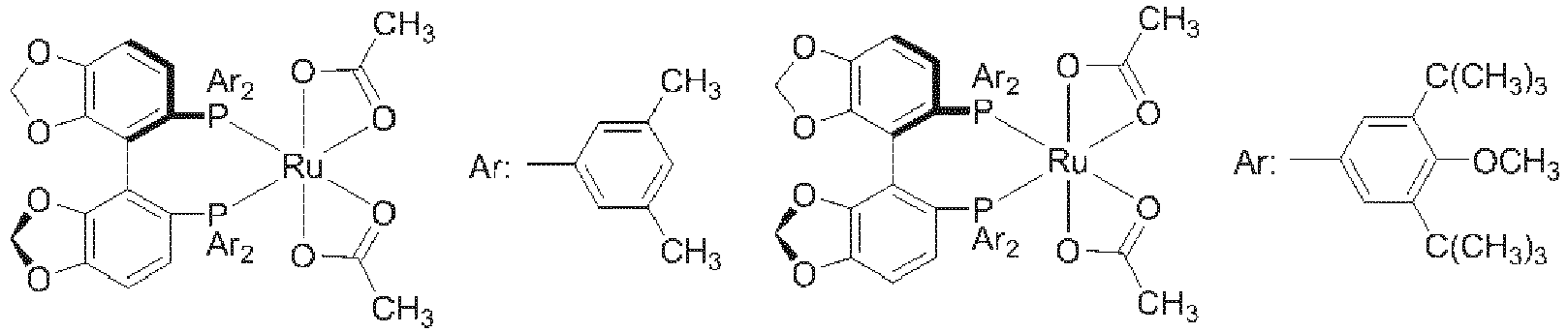
- The following are specific examples of the transition metal complex:




- The nitrogen-containing compound added in the present invention includes aliphatic amines, aromatic amines, and nitrogen-containing heterocyclic compounds. Of these, nitrogen-containing compounds having two or more nitrogen atoms are preferable.
- An aliphatic amine means a compound in which a hydrogen atom(s) of ammonia (NH3) is(are) replaced by an aliphatic group(s). The aliphatic groups include linear or branched alkyl groups having 1 to 10 carbon atoms and alicyclic groups. Linear or branched alkyl groups having 1 to 6 carbon atoms and alicyclic groups are preferable. Specifically, examples of the aliphatic amines include methylamine, ethylamine, propylamine, butylamine, isopropylamine, 2-ethylhexylamine, tert-butylamine, diethylamine, diisopropylamine, triethylamine, tributylamine, diethylenetriamine, triethylenetetramine, tris(2,2',2"-aminoethyl)amine, N,N'-bis(2-aminoethyl)-1,3-propanediamine, N,N'-bis(3-aminopropyl)ethylenediamine, bis(3-aminopropyl)amine, 1,2-bis(3-aminopropylamino)ethane, 1,4-bis(3-aminopropyl)piperidine, cyclopropylamine, cyclohexylamine, and the like. The aliphatic amine is preferably diethylenetriamine, triethylenetetramine, tris(2,2',2"-aminoethyl)amine, N,N'-bis(2-aminoethyl)-1,3-propanediamine, N,N'-bis(3-aminopropyl)ethylenediamine, bis(3-aminopropyl)amine, 1,2-bis(3-aminopropylamino)ethane, 1,4-bis(3-aminopropyl)piperidine, or the like, and more preferably diethylenetriamine or triethylenetetramine.
- An aromatic amine means a compound in which a hydrogen atom(s) of ammonia is(are) replaced by an aromatic group(s). The aromatic groups include monocyclic or polycyclic (condensed cyclic) aromatic groups having aromaticity. Specific examples of the aromatic amines include aniline, toluidine, xylidine, anisidine, naphthylamine, diphenylamine, triphenylamine, benzidine, 1,2-phenylenediamine, 4-fluoro-1,2-phenylenediamine, 2,3-diaminopyridine, 3,4-diaminopyridine, 2,3-diaminotoluene, 3,4-diaminotoluene, 3,3'-diaminobenzine, 3,4-diaminobenzophenone, 2,5-diamino-5-bromopyridine, 6,6'-diamino-2,2'-dipyridyl, 4,5-dichloro-1,2-phenylenediamine, 3,4-diaminobenzoic acid, 2,2'-dipyridyl, 2,2'-bi-4-picoline, 6,6'-bi-3-picoline, phthalocyanine, 2,2'-biquinoline, and the like. Preferred aromatic amines include 1,2-phenylenediamine, 4-fluoro-1,2-phenylenediamine, 2,3-diaminopyridine, 3,4-diaminopyridine, 2,3-diaminotoluene, 3,4-diaminotoluene, 3,3'-diaminobenzine, 3,4-diaminobenzophenone, 2,5-diamino-5-bromopyridine, 6,6'-diamino-2,2'-dipyridyl, 4,5-dichloro-1,2-phenylenediamine, 3,4-diaminobenzoic acid, 2,2'-dipyridyl, 2,2'-bi-4-picoline, 6,6'-bi-3-picoline, phthalocyanine, 2,2'-biquinoline, and the like. 1,2-Phenylenediamine and 3,4-diaminobenzoic acid are more preferable.
- The nitrogen-containing heterocyclic compounds include aromatic compounds such as pyrrole, pyridine, imidazole, 2-methylimidazole, 1-methylimidazole, 1,3-thiazole, oxazole, pyrazole, 1,2,4-triazole, pyrazine, pyrimidine, pyridazine, indole, quinoline, and purine; and endocyclic aliphatic amines such as diazabicycloundecane (DBU), piperidine, diazabicyclooctane (DABCO), and sparteine. Preferred nitrogen-containing heterocyclic compounds include imidazole, 2-methylimidazole, 1-methylimidazole, 1,3-thiazole, 1,3-oxazole, pyrazole, 1,2,4-triazole, and the like. Imidazoles such as 2-methylimidazole, 1-methylimidazole, and imidazole are more preferable.
- The amount of the nitrogen-containing compound added is not less than one, preferably two, and more preferably three times the number of moles of the transition metal complex, when the nitrogen-containing compound has one nitrogen atom, or is not less than 1 and preferably 1.5 times the number of moles of the transition metal complex, when the nitrogen-containing compound has two or more nitrogen atoms.
- Especially after an asymmetric reduction reaction using an optically active transition metal complex as a catalyst, the present invention makes it possible to avoid the decrease in optical purity of the product without separating the catalyst.
- Asymmetric reduction methods conducted in the production method of the present invention includes asymmetric hydrogenation reactions, asymmetric hydrogen transfer reactions, and the like.
- The asymmetric hydrogenation reactions are not particularly limited, and include a method for producing an optically active alcohol by asymmetric hydrogenation of a carbonyl group (for example, Documents (5th ed., Jikken Kagaku Kouza 19, organic compound synthesis VII, Maruzen Company, Limited, p. 122) etc.), and a method for producing an optically active compound by asymmetric hydrogenation of a carbon-carbon double bond, an imino group, or the like (for example, Documents (Asymmetric Catalysis In Organic Synthesis, p. 16 to p. 94) etc.).
- The asymmetric hydrogen transfer reactions are not particularly limited, and examples thereof include a method for producing an optically active alcohol by asymmetric reduction of a carbonyl group as described in Documents (J. Am. Chem. Soc., 1997, 119, 8378, J. Am. Chem. Soc. 1996, 118, 2521, etc.), and the like.
- In the production method of the present invention, after the nitrogen-containing compound is added to a reaction solution in which the reduction reaction has been conducted by using the transition metal complex, reaction solvent recovery and/or distillation are/is performed.
- Hereinafter, the present invention will be described in detail based on Examples. However, the present invention is not limited to these examples. Note that, in the following Examples and Comparative Examples, the MS spectrum was measured with an LCMS-IT-TOF apparatus manufactured by SHIMADZU. In addition, the GC analysis was conducted with GC: Chirasil Dex-CB (0.25 mm×25 m, DF=0.25).
- To a 200 ml reaction vessel, 0.5 g (4.15 mmol) of acetophenone, 250 mg (0.415 mmol) of [Ru (R, R) -Tsdpen (p-cymene)], and 42 mg of 2-propanol were added, followed by purging with nitrogen. In this solution, a reaction was allowed to proceed at room temperature for 2 hours.
- The conversion to (R)-phenylethanol was 86%, and the optical purity was 91% ee.
- Moreover, 67.3 mg (0.622 mmol) of α-phenylenediamine was added to the reaction solution, and the reaction solution was stirred. As a result, the color of the solution changed from reddish brown to purple. The solvent was removed by distillation under reduced pressure, and reslurring in heptane was conducted to remove acetophenone and phenylethanol. After, drying, mass spectrometry was conducted. The mass was 679.1438. From the mass spectrometry, the obtained compound was assumed to be Ru[(R,R)-Tsdpen](phenylenediamine)2.
- The reaction shown below was conducted in the presence of Ru[(R,R)-Tsdpen](phenylenediamine)2 in an amount of 0.5 equivalents to a substrate (phenylethanol having an optical purity of (R)-phenylethanol of 94.5% ee). In addition, the reaction shown below was conducted in the same manner in the presence of [Ru(R,R)-Tsdpen(p-cymene)] instead of Ru[(R,R)-Tsdpen](phenylenediamine)2. Moreover, the reaction shown below was conducted in the same manner while 1.5 equivalents of α-phenylenediamine was added in addition to [Ru(R,R)-Tsdpen(p-cymene)].

- Table 1 shows the obtained results. From Table 1, it can be seen that no racemization proceeds in the presence of Ru[(R,R)-Tsdpen](phenylenediamine)2 or in the presence of [Ru(R,R)-Tsdpen(p-cymene)] and α-phenylenediamine.
Table 1 Optical Purity Ru[(R,R)-Tsdpen](phenylenediamine)2 94.5% ee [Ru(R,R)-Tsdpen(p-cymene)] 75.3% ee [Ru(R,R)-Tsdpen(p-cymene)] and α-phenylenediamine 93.2% ee - To a 200 ml reaction vessel, 10 g (8.32 mmol) of acetophenone, 1.06 g (1.6646 mmol) of [RuCl(S,S)-Tsdpen(p-cymene)], and 41.5 ml of formic acid/triethylamine (5/2 (volume ratio)) were added, followed by purging with nitrogen. This solution was stirred at 30°C for 17 hours. Then, 45 ml of methylene chloride and 40 ml of water were added thereto, and the organic layer was separated. From the organic layer, methylene chloride was removed by distillation to obtain 13.5 g of an (S)-phenylethanol concentrate. This concentrate was stored at 5°C for 4 days. The change in optical purity from the completion of the reaction was as follows.
Table 2 Completion of reaction Concentrate 5°C, 4 days 97.1% ee 96.6% ee 79.5% ee - One gram of the (S)-phenylethanol concentrate having an optical purity of 79.5% ee, obtained in Reference Example 1, and stored at 5°C for 4 days was heated at 80°C for 16 hours. As a result, the optical purity decreased to 13.6% ee.
- Nitrogen-containing compounds were each added to 1 g (Ru: 0.123 mmol) of the (S)-phenylethanol concentrate having an optical purity of 79.5% ee, obtained in Reference Example 1, and stored at 5°C for 4 days, and the mixtures were heated at 80°C for 16 hours. The results were as shown in the following table.
Table 3 Example Additive Equivalents Optical purity 2 Triethylenetetramine 3 79.5% ee 3 3,4-Diaminobenzoic acid 2 79.5% ee 4 Imidazole 2 79.5% ee 5 Bipyridine 2 71.4% ee - To a 200 mL four-necked flask, 15.0 g (103.3 mmol) of 4-acetylbenzonitrile, 30 ml of MeOH, and 126 mg (0.2 mmol) of [RuCl(R,R)-Tsdpen(p-cymene)] were added. While the temperature was kept at 15°C, 75 ml of formic acid/triethylamine (5/2 (volume ratio)) was added dropwise at 20°C or below over 30 minutes. After the temperature was raised to 25°C, the mixture was stirred for 64 hours. After completion of the reaction, the mixture was cooled to 15°C. Then, 30 ml of water was added, and extraction was conducted with 90 ml of ethyl acetate, followed by washing with 30 ml of water twice. Subsequently, 75.5 mg (0.5 mmol) of triethylenetetramine was weighed in a 300 ml recovery flask, and the ethyl acetate extract solution was added to the recovery flask. Under reduced pressure, ethyl acetate was removed by distillation. The obtained liquid concentrate (14.4 g (95.9% ee)) was purified by distillation under reduced pressure (118 to 120°C/1 torr) to obtain 11.7 g of the desired (R)-4-(1-hydroxyethyl)benzonitrile (yield 76.9%).
- The optical purity was 95.6% ee.
- The same procedures as in Example 6 were conducted, except that no triethylenetetramine was added. The optical purity of the distillate was 86.2% ee.
- To a 200 ml reaction vessel, 10 g (8.30 mmol) of acetophenone, 1.00 g (1.5712 mmol) of [RuCl (S, S) -Tsdpen (p-cymene)], 300 ml of 2-propanol, and 300 mg (7.500 mmol) of sodium hydroxide were added, followed by purging with nitrogen. This solution was stirred at 40°C for 22 hours, and then the solvent was removed by distillation to obtain 11.3 g of (S)-phenylethanol concentrate. The change in optical purity from the completion of the reaction was as follows.
Table 4 Completion of reaction Concentrate 84.2% ee 83.9% ee - One gram of the (S)-phenylethanol concentrate having an optical purity of 83.9% ee obtained in Reference Example 2 was heated at 80°C for 17 hours. As a result, the optical purity decreased to 78.2% ee.
- Nitrogen-containing compounds were each added to 1 g (Ru: 0.138 mmol) of a (S)-phenylethanol concentrate having an optical purity of 83.9% ee and obtained by the same procedures as in Reference Example 2, and the mixtures were heated at 80°C for 17 hours. The results were as shown in the following Table.
Table 5 Example Additive Equivalents Optical purity 7 Diethylenetriamine 2 83.6% ee 8 Imidazole 2 83.8% ee 9 Bipyridine 2 83.8% ee - To a 200 ml reaction vessel, 100 mg (0.819 mmol) of (R)-phenylethanol (94.5% ee), 24.6 mg (0.041 mmol) of [Ru(R,R)-Tsdpen(p-cymene)], and 2 ml of formic acid/triethylamine (5/2 (volume ratio)) were added, followed by purging with nitrogen. This solution was stirred at 80°C for 17 hours. As a result, the optical purity was 55.4% ee.
- The same procedures as in Reference Example 3 were conducted, except that nitrogen-containing compounds were added to reaction vessels. The results were as shown in the following Table.
Table 6 Example Additive Equivalents Optical purity 10 2-Methylimidazole 1.5 90.1% ee 11 2-Methylimidazole 3 93.7% ee 12 1-Methylimidazole 1.5 91.4% ee 13 1,2,4-Thiazole 1.5 93.3% ee 14 2-Pyridinol 1.5 92.0% ee 15 Pyrazole 1.5 89.1% ee
Claims (8)
- A method for producing a reduction reaction product, comprising:adding a nitrogen-containing compound to a reaction solution in which a reduction reaction has been conducted by using a transition metal complex; and thenperforming reaction solvent recovery and/or distillation.
- The production method according to claim 1, wherein the reduction reaction is an asymmetric hydrogenation, asymmetric hydrogen transfer, or ester reduction reaction.
- The production method according to claim 1 or 2, wherein the transition metal complex is a ruthenium complex, a rhodium complex, or an iridium complex.
- The production method according to claim 3, wherein one equivalent or more of the nitrogen-containing compound is added relative to the transition metal complex.
- The production method according to claim 4, wherein the number of nitrogen atoms in the nitrogen-containing compound is two or more.
- The production method according to claim 5, wherein the nitrogen-containing compound is an imidazole.
- The production method according to any one of claims 1 to 6, wherein the addition of the nitrogen-containing compound is intended to suppress the decrease in optical purity of the reduction reaction product during the reaction solvent recovery and/or the distillation.
- The production method according to claim 7, wherein the addition of the nitrogen-containing compound results in a reaction of the nitrogen-containing compound with the transition metal complex to form a complex containing the nitrogen-containing compound, and thus suppresses the decrease in optical purity of the reduction reaction product.
Applications Claiming Priority (1)
| Application Number | Priority Date | Filing Date | Title |
|---|---|---|---|
| PCT/JP2011/075491 WO2013065189A1 (en) | 2011-11-04 | 2011-11-04 | Method for preventing decrease in optical purity |
Publications (3)
| Publication Number | Publication Date |
|---|---|
| EP2774908A1 true EP2774908A1 (en) | 2014-09-10 |
| EP2774908A4 EP2774908A4 (en) | 2015-07-01 |
| EP2774908B1 EP2774908B1 (en) | 2017-02-08 |
Family
ID=48191576
Family Applications (1)
| Application Number | Title | Priority Date | Filing Date |
|---|---|---|---|
| EP11875211.2A Active EP2774908B1 (en) | 2011-11-04 | 2011-11-04 | Method for preventing decrease in optical purity |
Country Status (3)
| Country | Link |
|---|---|
| US (1) | US9896402B2 (en) |
| EP (1) | EP2774908B1 (en) |
| WO (1) | WO2013065189A1 (en) |
Cited By (1)
| Publication number | Priority date | Publication date | Assignee | Title |
|---|---|---|---|---|
| WO2025257251A1 (en) * | 2024-06-11 | 2025-12-18 | Firmenich Sa | Process for purifying a crude product mixture |
Family Cites Families (11)
| Publication number | Priority date | Publication date | Assignee | Title |
|---|---|---|---|---|
| FI956170L (en) | 1994-12-22 | 1996-06-23 | Kyocera Corp | Piezoelectric ceramic composition |
| JPH09124367A (en) | 1995-10-31 | 1997-05-13 | Kyocera Corp | Piezoelectric ceramic composition |
| JP4015450B2 (en) | 2001-05-18 | 2007-11-28 | 高砂香料工業株式会社 | Method for producing optically active alcohol |
| US7754889B2 (en) | 2004-03-29 | 2010-07-13 | Takasago International Corporation | Optically active transition metal-diamine compound and process for producing optically active alcohol with the same |
| US6887999B1 (en) | 2004-05-21 | 2005-05-03 | Acura Pharmaceuticals, Inc. | Preparation of dihydrocodeine from codeine |
| CN101058532A (en) * | 2006-11-28 | 2007-10-24 | 南开大学 | Method of preparing chiral primary alcohol and secondary alcohol with chirality center at ortho position of hydroxyl group |
| EP1970360B1 (en) | 2007-03-16 | 2016-08-31 | Takasago International Corporation | Method for producing alcohols |
| AU2008207580B2 (en) | 2007-05-04 | 2011-04-14 | SpecGx LLC | Improved process for the preparation of 6-alpha-hydroxy-N-alkylated opiates |
| JP2009001545A (en) * | 2007-05-22 | 2009-01-08 | Takasago Internatl Corp | Method for producing alcohols |
| EP2438989B1 (en) | 2009-06-03 | 2016-04-13 | Takasago International Corporation | Use of asymmetric hydrogenation catalyst |
| JP5685046B2 (en) | 2010-10-14 | 2015-03-18 | 高砂香料工業株式会社 | Optical purity reduction prevention method |
-
2011
- 2011-11-04 WO PCT/JP2011/075491 patent/WO2013065189A1/en not_active Ceased
- 2011-11-04 EP EP11875211.2A patent/EP2774908B1/en active Active
- 2011-11-04 US US14/355,895 patent/US9896402B2/en active Active
Cited By (1)
| Publication number | Priority date | Publication date | Assignee | Title |
|---|---|---|---|---|
| WO2025257251A1 (en) * | 2024-06-11 | 2025-12-18 | Firmenich Sa | Process for purifying a crude product mixture |
Also Published As
| Publication number | Publication date |
|---|---|
| EP2774908B1 (en) | 2017-02-08 |
| US20140296582A1 (en) | 2014-10-02 |
| WO2013065189A1 (en) | 2013-05-10 |
| US9896402B2 (en) | 2018-02-20 |
| EP2774908A4 (en) | 2015-07-01 |
Similar Documents
| Publication | Publication Date | Title |
|---|---|---|
| EP2563799B1 (en) | Ruthenium complex and method for preparing optically active alcohol compound | |
| Patel et al. | Asymmetric catalytic coupling of organoboranes, alkynes, and imines with a removable (trialkylsilyloxy) ethyl group—direct access to enantiomerically pure primary allylic amines | |
| EP2294075B1 (en) | Novel ruthenium complexes having hybrid amine ligands, their preparation and use | |
| US9938204B2 (en) | Intermolecular C-H silylation of unactivated arenes | |
| Kojima et al. | Enantioselective intramolecular hydroamination of N-alkenyl ureas catalyzed by tropos BIPHEP-Gold (I) complexes with Au-Au interaction | |
| CN103443111B (en) | The preparation method of ruthenium complexe and the optical activity alkylol cpd using this title complex as catalyzer | |
| Liu et al. | Discovery of chiral catalysts by asymmetric activation for highly enantioselective diethylzinc addition to imines: using racemic and achiral diimines as effective activators | |
| JP6065259B2 (en) | Method for producing optically active amines | |
| US20110028749A1 (en) | Ruthenium compound and method for producing optically active aminoalcohol compound | |
| JP5685046B2 (en) | Optical purity reduction prevention method | |
| EP2774908B1 (en) | Method for preventing decrease in optical purity | |
| Flückiger et al. | Iron (II)‐Catalyzed Asymmetric Hydrosilylation of Acetophenone | |
| Jean-Baptiste dit Dominique et al. | Chiral Variation of a Hybrid Bis (carbene-amido) Ligand System | |
| Mizushima et al. | Asymmetric transfer hydrogenation of aryl-alkyl ketones catalyzed by ruthenium (II) complexes having chiral pyridylmethylamine and phosphine ligands | |
| US7642357B2 (en) | Iridium complexes | |
| Hamashima et al. | Scope and Mechanism of Tandem Aza‐Michael Reaction/Enantioselective Protonation Using a Pd–μ‐Hydroxo Complex under Mild Conditions Buffered with Amine Salts | |
| EP3016961B1 (en) | Novel ruthenium catalysts and their use for asymmetric reduction of ketones | |
| WO2007034975A1 (en) | Diphosphine ligand and transition metal complex using the same | |
| Shi et al. | Synthesis of Chiral Biphenol‐Based Diphosphonite Ligands and Their Application in Palladium‐Catalyzed Intermolecular Asymmetric Allylic Amination Reactions | |
| JP2012031119A (en) | Axially chiral isoquinoline derivative, its production method, and asymmetric synthesis method | |
| JP5266495B2 (en) | Cyanation catalyst and method for producing optically active cyanohydrin compounds using the same | |
| Spahn | The Large-Scale Synthesis and Asymmetric Hydrosilylations of CuIPhEt, a C2-Symmetric N-Heterocyclic Carbene | |
| JP6551922B2 (en) | Process for producing alcohol by hydrogenation of carboxylic acid compound, and ruthenium complex used in the process | |
| Shibasaki et al. | Desymmetrizing Heck Reactions | |
| TWI510472B (en) | Process for the stereoselective preparation of a pyrazole carboxamide |
Legal Events
| Date | Code | Title | Description |
|---|---|---|---|
| PUAI | Public reference made under article 153(3) epc to a published international application that has entered the european phase |
Free format text: ORIGINAL CODE: 0009012 |
|
| 17P | Request for examination filed |
Effective date: 20140603 |
|
| AK | Designated contracting states |
Kind code of ref document: A1 Designated state(s): AL AT BE BG CH CY CZ DE DK EE ES FI FR GB GR HR HU IE IS IT LI LT LU LV MC MK MT NL NO PL PT RO RS SE SI SK SM TR |
|
| DAX | Request for extension of the european patent (deleted) | ||
| RIC1 | Information provided on ipc code assigned before grant |
Ipc: C07C 255/53 20060101ALI20150521BHEP Ipc: C07B 61/00 20060101ALI20150521BHEP Ipc: C07B 53/00 20060101ALI20150521BHEP Ipc: C07C 33/22 20060101ALI20150521BHEP Ipc: C07C 253/32 20060101ALI20150521BHEP Ipc: C07C 29/74 20060101AFI20150521BHEP |
|
| RA4 | Supplementary search report drawn up and despatched (corrected) |
Effective date: 20150601 |
|
| GRAP | Despatch of communication of intention to grant a patent |
Free format text: ORIGINAL CODE: EPIDOSNIGR1 |
|
| INTG | Intention to grant announced |
Effective date: 20160630 |
|
| GRAS | Grant fee paid |
Free format text: ORIGINAL CODE: EPIDOSNIGR3 |
|
| GRAA | (expected) grant |
Free format text: ORIGINAL CODE: 0009210 |
|
| RAP1 | Party data changed (applicant data changed or rights of an application transferred) |
Owner name: TAKASAGO INTERNATIONAL CORPORATION |
|
| AK | Designated contracting states |
Kind code of ref document: B1 Designated state(s): AL AT BE BG CH CY CZ DE DK EE ES FI FR GB GR HR HU IE IS IT LI LT LU LV MC MK MT NL NO PL PT RO RS SE SI SK SM TR |
|
| REG | Reference to a national code |
Ref country code: GB Ref legal event code: FG4D |
|
| REG | Reference to a national code |
Ref country code: CH Ref legal event code: EP Ref country code: AT Ref legal event code: REF Ref document number: 866803 Country of ref document: AT Kind code of ref document: T Effective date: 20170215 |
|
| REG | Reference to a national code |
Ref country code: IE Ref legal event code: FG4D |
|
| REG | Reference to a national code |
Ref country code: NL Ref legal event code: FP |
|
| REG | Reference to a national code |
Ref country code: DE Ref legal event code: R096 Ref document number: 602011034981 Country of ref document: DE |
|
| REG | Reference to a national code |
Ref country code: LT Ref legal event code: MG4D |
|
| REG | Reference to a national code |
Ref country code: AT Ref legal event code: MK05 Ref document number: 866803 Country of ref document: AT Kind code of ref document: T Effective date: 20170208 |
|
| PG25 | Lapsed in a contracting state [announced via postgrant information from national office to epo] |
Ref country code: FI Free format text: LAPSE BECAUSE OF FAILURE TO SUBMIT A TRANSLATION OF THE DESCRIPTION OR TO PAY THE FEE WITHIN THE PRESCRIBED TIME-LIMIT Effective date: 20170208 Ref country code: NO Free format text: LAPSE BECAUSE OF FAILURE TO SUBMIT A TRANSLATION OF THE DESCRIPTION OR TO PAY THE FEE WITHIN THE PRESCRIBED TIME-LIMIT Effective date: 20170508 Ref country code: LT Free format text: LAPSE BECAUSE OF FAILURE TO SUBMIT A TRANSLATION OF THE DESCRIPTION OR TO PAY THE FEE WITHIN THE PRESCRIBED TIME-LIMIT Effective date: 20170208 Ref country code: GR Free format text: LAPSE BECAUSE OF FAILURE TO SUBMIT A TRANSLATION OF THE DESCRIPTION OR TO PAY THE FEE WITHIN THE PRESCRIBED TIME-LIMIT Effective date: 20170509 Ref country code: HR Free format text: LAPSE BECAUSE OF FAILURE TO SUBMIT A TRANSLATION OF THE DESCRIPTION OR TO PAY THE FEE WITHIN THE PRESCRIBED TIME-LIMIT Effective date: 20170208 |
|
| PG25 | Lapsed in a contracting state [announced via postgrant information from national office to epo] |
Ref country code: ES Free format text: LAPSE BECAUSE OF FAILURE TO SUBMIT A TRANSLATION OF THE DESCRIPTION OR TO PAY THE FEE WITHIN THE PRESCRIBED TIME-LIMIT Effective date: 20170208 Ref country code: AT Free format text: LAPSE BECAUSE OF FAILURE TO SUBMIT A TRANSLATION OF THE DESCRIPTION OR TO PAY THE FEE WITHIN THE PRESCRIBED TIME-LIMIT Effective date: 20170208 Ref country code: RS Free format text: LAPSE BECAUSE OF FAILURE TO SUBMIT A TRANSLATION OF THE DESCRIPTION OR TO PAY THE FEE WITHIN THE PRESCRIBED TIME-LIMIT Effective date: 20170208 Ref country code: BG Free format text: LAPSE BECAUSE OF FAILURE TO SUBMIT A TRANSLATION OF THE DESCRIPTION OR TO PAY THE FEE WITHIN THE PRESCRIBED TIME-LIMIT Effective date: 20170508 Ref country code: PT Free format text: LAPSE BECAUSE OF FAILURE TO SUBMIT A TRANSLATION OF THE DESCRIPTION OR TO PAY THE FEE WITHIN THE PRESCRIBED TIME-LIMIT Effective date: 20170608 Ref country code: SE Free format text: LAPSE BECAUSE OF FAILURE TO SUBMIT A TRANSLATION OF THE DESCRIPTION OR TO PAY THE FEE WITHIN THE PRESCRIBED TIME-LIMIT Effective date: 20170208 Ref country code: LV Free format text: LAPSE BECAUSE OF FAILURE TO SUBMIT A TRANSLATION OF THE DESCRIPTION OR TO PAY THE FEE WITHIN THE PRESCRIBED TIME-LIMIT Effective date: 20170208 |
|
| REG | Reference to a national code |
Ref country code: FR Ref legal event code: PLFP Year of fee payment: 7 |
|
| PG25 | Lapsed in a contracting state [announced via postgrant information from national office to epo] |
Ref country code: CZ Free format text: LAPSE BECAUSE OF FAILURE TO SUBMIT A TRANSLATION OF THE DESCRIPTION OR TO PAY THE FEE WITHIN THE PRESCRIBED TIME-LIMIT Effective date: 20170208 Ref country code: RO Free format text: LAPSE BECAUSE OF FAILURE TO SUBMIT A TRANSLATION OF THE DESCRIPTION OR TO PAY THE FEE WITHIN THE PRESCRIBED TIME-LIMIT Effective date: 20170208 Ref country code: EE Free format text: LAPSE BECAUSE OF FAILURE TO SUBMIT A TRANSLATION OF THE DESCRIPTION OR TO PAY THE FEE WITHIN THE PRESCRIBED TIME-LIMIT Effective date: 20170208 Ref country code: SK Free format text: LAPSE BECAUSE OF FAILURE TO SUBMIT A TRANSLATION OF THE DESCRIPTION OR TO PAY THE FEE WITHIN THE PRESCRIBED TIME-LIMIT Effective date: 20170208 |
|
| REG | Reference to a national code |
Ref country code: DE Ref legal event code: R097 Ref document number: 602011034981 Country of ref document: DE |
|
| PG25 | Lapsed in a contracting state [announced via postgrant information from national office to epo] |
Ref country code: DK Free format text: LAPSE BECAUSE OF FAILURE TO SUBMIT A TRANSLATION OF THE DESCRIPTION OR TO PAY THE FEE WITHIN THE PRESCRIBED TIME-LIMIT Effective date: 20170208 Ref country code: PL Free format text: LAPSE BECAUSE OF FAILURE TO SUBMIT A TRANSLATION OF THE DESCRIPTION OR TO PAY THE FEE WITHIN THE PRESCRIBED TIME-LIMIT Effective date: 20170208 Ref country code: SM Free format text: LAPSE BECAUSE OF FAILURE TO SUBMIT A TRANSLATION OF THE DESCRIPTION OR TO PAY THE FEE WITHIN THE PRESCRIBED TIME-LIMIT Effective date: 20170208 |
|
| PLBE | No opposition filed within time limit |
Free format text: ORIGINAL CODE: 0009261 |
|
| STAA | Information on the status of an ep patent application or granted ep patent |
Free format text: STATUS: NO OPPOSITION FILED WITHIN TIME LIMIT |
|
| 26N | No opposition filed |
Effective date: 20171109 |
|
| PG25 | Lapsed in a contracting state [announced via postgrant information from national office to epo] |
Ref country code: SI Free format text: LAPSE BECAUSE OF FAILURE TO SUBMIT A TRANSLATION OF THE DESCRIPTION OR TO PAY THE FEE WITHIN THE PRESCRIBED TIME-LIMIT Effective date: 20170208 |
|
| PG25 | Lapsed in a contracting state [announced via postgrant information from national office to epo] |
Ref country code: MC Free format text: LAPSE BECAUSE OF FAILURE TO SUBMIT A TRANSLATION OF THE DESCRIPTION OR TO PAY THE FEE WITHIN THE PRESCRIBED TIME-LIMIT Effective date: 20170208 |
|
| PG25 | Lapsed in a contracting state [announced via postgrant information from national office to epo] |
Ref country code: LU Free format text: LAPSE BECAUSE OF NON-PAYMENT OF DUE FEES Effective date: 20171104 |
|
| REG | Reference to a national code |
Ref country code: BE Ref legal event code: MM Effective date: 20171130 |
|
| PG25 | Lapsed in a contracting state [announced via postgrant information from national office to epo] |
Ref country code: MT Free format text: LAPSE BECAUSE OF NON-PAYMENT OF DUE FEES Effective date: 20171104 |
|
| REG | Reference to a national code |
Ref country code: FR Ref legal event code: PLFP Year of fee payment: 8 |
|
| PG25 | Lapsed in a contracting state [announced via postgrant information from national office to epo] |
Ref country code: BE Free format text: LAPSE BECAUSE OF NON-PAYMENT OF DUE FEES Effective date: 20171130 |
|
| PG25 | Lapsed in a contracting state [announced via postgrant information from national office to epo] |
Ref country code: HU Free format text: LAPSE BECAUSE OF FAILURE TO SUBMIT A TRANSLATION OF THE DESCRIPTION OR TO PAY THE FEE WITHIN THE PRESCRIBED TIME-LIMIT; INVALID AB INITIO Effective date: 20111104 |
|
| PG25 | Lapsed in a contracting state [announced via postgrant information from national office to epo] |
Ref country code: CY Free format text: LAPSE BECAUSE OF NON-PAYMENT OF DUE FEES Effective date: 20170208 |
|
| PG25 | Lapsed in a contracting state [announced via postgrant information from national office to epo] |
Ref country code: MK Free format text: LAPSE BECAUSE OF FAILURE TO SUBMIT A TRANSLATION OF THE DESCRIPTION OR TO PAY THE FEE WITHIN THE PRESCRIBED TIME-LIMIT Effective date: 20170208 |
|
| PG25 | Lapsed in a contracting state [announced via postgrant information from national office to epo] |
Ref country code: TR Free format text: LAPSE BECAUSE OF FAILURE TO SUBMIT A TRANSLATION OF THE DESCRIPTION OR TO PAY THE FEE WITHIN THE PRESCRIBED TIME-LIMIT Effective date: 20170208 |
|
| PG25 | Lapsed in a contracting state [announced via postgrant information from national office to epo] |
Ref country code: AL Free format text: LAPSE BECAUSE OF FAILURE TO SUBMIT A TRANSLATION OF THE DESCRIPTION OR TO PAY THE FEE WITHIN THE PRESCRIBED TIME-LIMIT Effective date: 20170208 Ref country code: IS Free format text: LAPSE BECAUSE OF FAILURE TO SUBMIT A TRANSLATION OF THE DESCRIPTION OR TO PAY THE FEE WITHIN THE PRESCRIBED TIME-LIMIT Effective date: 20170608 |
|
| PGFP | Annual fee paid to national office [announced via postgrant information from national office to epo] |
Ref country code: NL Payment date: 20251022 Year of fee payment: 15 |
|
| REG | Reference to a national code |
Ref country code: CH Ref legal event code: U11 Free format text: ST27 STATUS EVENT CODE: U-0-0-U10-U11 (AS PROVIDED BY THE NATIONAL OFFICE) Effective date: 20251201 |
|
| PGFP | Annual fee paid to national office [announced via postgrant information from national office to epo] |
Ref country code: DE Payment date: 20251022 Year of fee payment: 15 |
|
| PGFP | Annual fee paid to national office [announced via postgrant information from national office to epo] |
Ref country code: GB Payment date: 20251023 Year of fee payment: 15 |
|
| PGFP | Annual fee paid to national office [announced via postgrant information from national office to epo] |
Ref country code: IT Payment date: 20251022 Year of fee payment: 15 |
|
| PGFP | Annual fee paid to national office [announced via postgrant information from national office to epo] |
Ref country code: FR Payment date: 20251023 Year of fee payment: 15 |
|
| PGFP | Annual fee paid to national office [announced via postgrant information from national office to epo] |
Ref country code: CH Payment date: 20251201 Year of fee payment: 15 |
|
| PGFP | Annual fee paid to national office [announced via postgrant information from national office to epo] |
Ref country code: IE Payment date: 20251024 Year of fee payment: 15 |