EP2772924A1 - Discontinuous shielding tape for data communication cable - Google Patents
Discontinuous shielding tape for data communication cable Download PDFInfo
- Publication number
- EP2772924A1 EP2772924A1 EP13305232.4A EP13305232A EP2772924A1 EP 2772924 A1 EP2772924 A1 EP 2772924A1 EP 13305232 A EP13305232 A EP 13305232A EP 2772924 A1 EP2772924 A1 EP 2772924A1
- Authority
- EP
- European Patent Office
- Prior art keywords
- substrate
- foil
- elements
- communication cable
- disposed
- Prior art date
- Legal status (The legal status is an assumption and is not a legal conclusion. Google has not performed a legal analysis and makes no representation as to the accuracy of the status listed.)
- Withdrawn
Links
- 238000004891 communication Methods 0.000 title claims abstract description 21
- 239000011888 foil Substances 0.000 claims abstract description 58
- 239000000758 substrate Substances 0.000 claims abstract description 55
- 229910052751 metal Inorganic materials 0.000 claims description 7
- 239000002184 metal Substances 0.000 claims description 7
- 239000000463 material Substances 0.000 claims description 6
- -1 polyethylene terephthalate Polymers 0.000 claims description 6
- 239000005020 polyethylene terephthalate Substances 0.000 claims description 4
- 229920000139 polyethylene terephthalate Polymers 0.000 claims description 4
- 239000004743 Polypropylene Substances 0.000 claims description 2
- 229920006217 cellulose acetate butyrate Polymers 0.000 claims description 2
- 229920001155 polypropylene Polymers 0.000 claims description 2
- 229910052782 aluminium Inorganic materials 0.000 description 10
- XAGFODPZIPBFFR-UHFFFAOYSA-N aluminium Chemical compound [Al] XAGFODPZIPBFFR-UHFFFAOYSA-N 0.000 description 10
- 239000000853 adhesive Substances 0.000 description 4
- 230000001070 adhesive effect Effects 0.000 description 4
- 238000013461 design Methods 0.000 description 4
- 238000003780 insertion Methods 0.000 description 4
- 230000037431 insertion Effects 0.000 description 4
- 238000000034 method Methods 0.000 description 3
- 238000010276 construction Methods 0.000 description 2
- 239000003292 glue Substances 0.000 description 2
- 238000012986 modification Methods 0.000 description 2
- 230000004048 modification Effects 0.000 description 2
- 239000005041 Mylar™ Substances 0.000 description 1
- 239000004020 conductor Substances 0.000 description 1
- 238000010924 continuous production Methods 0.000 description 1
- 230000001186 cumulative effect Effects 0.000 description 1
- 230000000694 effects Effects 0.000 description 1
- 239000012943 hotmelt Substances 0.000 description 1
- 238000009434 installation Methods 0.000 description 1
- 150000002739 metals Chemical class 0.000 description 1
- 230000000116 mitigating effect Effects 0.000 description 1
- 230000000737 periodic effect Effects 0.000 description 1
- 230000000704 physical effect Effects 0.000 description 1
- 239000002985 plastic film Substances 0.000 description 1
- 229920006255 plastic film Polymers 0.000 description 1
- 238000001228 spectrum Methods 0.000 description 1
- 238000006467 substitution reaction Methods 0.000 description 1
- 238000012360 testing method Methods 0.000 description 1
Images




Classifications
-
- H—ELECTRICITY
- H01—ELECTRIC ELEMENTS
- H01B—CABLES; CONDUCTORS; INSULATORS; SELECTION OF MATERIALS FOR THEIR CONDUCTIVE, INSULATING OR DIELECTRIC PROPERTIES
- H01B11/00—Communication cables or conductors
- H01B11/02—Cables with twisted pairs or quads
- H01B11/04—Cables with twisted pairs or quads with pairs or quads mutually positioned to reduce cross-talk
-
- H—ELECTRICITY
- H01—ELECTRIC ELEMENTS
- H01B—CABLES; CONDUCTORS; INSULATORS; SELECTION OF MATERIALS FOR THEIR CONDUCTIVE, INSULATING OR DIELECTRIC PROPERTIES
- H01B11/00—Communication cables or conductors
- H01B11/02—Cables with twisted pairs or quads
- H01B11/06—Cables with twisted pairs or quads with means for reducing effects of electromagnetic or electrostatic disturbances, e.g. screens
- H01B11/10—Screens specially adapted for reducing interference from external sources
- H01B11/1008—Features relating to screening tape per se
-
- H—ELECTRICITY
- H01—ELECTRIC ELEMENTS
- H01B—CABLES; CONDUCTORS; INSULATORS; SELECTION OF MATERIALS FOR THEIR CONDUCTIVE, INSULATING OR DIELECTRIC PROPERTIES
- H01B11/00—Communication cables or conductors
- H01B11/02—Cables with twisted pairs or quads
- H01B11/06—Cables with twisted pairs or quads with means for reducing effects of electromagnetic or electrostatic disturbances, e.g. screens
Definitions
- This application relates to a shielding tape. More particularly, this application relates to a shielding tape for LAN (Local Area Network) cables.
- LAN Local Area Network
- LAN or network type communication cables are typically constructed of a plurality of twisted pairs (two twisted conductors), enclosed within a jacket.
- a typical construction is to have four twisted pairs inside of a jacket, but many other larger pair count cables are available.
- many LAN cables may be arranged next to one another, and signals in the pairs from a first cable may cause interference or crosstalk with another pair in an adjacent LAN cable.
- the lay length or twist rate of the pairs in a cable is varied differently from one another.
- the cross talk can be increased so the pairs within a cable are twisted around one another (helically or SZ stranding) to further decrease interference.
- Spacing elements can also be used so that the jacket is spaced apart from the pairs so that pairs in adjacent cables are as far away as possible.
- LAN cable shielding is usually in the form of a foil that is wrapped around the pairs inside the cable, under the jacket. This metal foil is usually wrapped around the assembled core of twisted pairs prior to jacketing and is constructed of suitable metals, for example aluminum.
- the shield is effective for preventing alien crosstalk and other external signal interferences
- the shield must be grounded to the connector in order to meet safety regulations. This is a time consuming step that increases the cost to install the shielded cable.
- One typical example requires a drain wire to be helically coiled around the shield which also increases the overall cable cost.
- the signals traveling in the pairs can cause induced signals in discontinuous foil elements with the breaks in the shielding giving rise to reflected waves which can create issues with return loss.
- the patches can collectively interact with the transmitting electrical signals in a cumulative or resonant manner to produce a spike in return loss at a particular frequency of the transmitting signals.
- the generated reflected waves are such that they may occur at one specific frequency, and at a significant amplitude.
- discontinuous shields have attempted to minimize the reflected wave that can be created by discontinuous shielding elements of equal length and spacing by varying the length of the shielding elements relative to the length of the foil segments, finding that the frequency/location of the spike may depend upon the sizes of the foil sections and the gap therebwteen.
- discontinuous shielding tapes try to minimize the amplitude of the reflected wave by having foil pieces (and breaks) that are not perpendicular to the long edge of the substrate running in the direction of the pairs (ie parallelograms).
- the present arrangement overcomes the drawbacks of the prior art by providing a discontinuous shielding tape, where the conductive shielding elements, disposed on the tape substrate do not form a complete electrical connection from one end of the cable to the other.
- the metal shielding elements on the tape substrate are shaped and dimensioned in a manner that is easy to construct, but also minimizes other signal/interference problems that may be caused by such discontinuous shielding elements, reducing the amplitude of the reflected waves by further increasing the range of frequencies that these reflections occur at and reducing the amplitude of such interference signals.
- the present arrangement provides a communication cable having a plurality of twisted pair communication elements, a jacket surrounding the twisted pairs and a shield element disposed between the pairs and the jacket.
- the shield element is constructed as a tape substrate with a plurality of foil shielding elements disposed thereon, the foil shielding elements being formed in the shape of triangles and arranged on the substrate with at least a first foil shield element having a base of its triangle shape disposed substantially parallel to a longitudinal edge of the tape substrate. Each subsequent triangle is disposed on the tape substrate at a distance apart from the first triangle foil shielding element with a base of its triangle shape disposed substantially parallel to an opposite longitudinal edge of the tape substrate.
- Figure 1 shows an exemplary LAN cable 10 having a jacket 12, a plurality of twisted pairs 14 and a discontinuous shield 20, disposed over pairs 14 within jacket 12.
- discontinuous shielding tape 20 shown in Figures 2-9
- FIG. 1 shows an exemplary LAN cable 10 having a jacket 12, a plurality of twisted pairs 14 and a discontinuous shield 20, disposed over pairs 14 within jacket 12.
- discontinuous shielding tape 20 shown in Figures 2-9
- FIG. 2-9 may be equally applied to larger or smaller pair count cables, or in other communication cable designs that employ a shield.
- FIG. 2 shows a first discontinuous shielding tape 20 constructed of a first substrate 22 and a plurality of triangular shaped foil elements 24.
- triangle shaped foil elements 24 are disposed on both sides of substrate 22.
- substrate 22 is typically a thin plastic film composed of any one of polyethylene terephthalate (Mylar TM ), polypropylene, cellulose acetate butyrate, or other film with sufficient physical properties to survive typical cabling processes. These tapes typically range from 0.001" to 0.005" in thickness and are sometimes flame retarded to improve cable fire test performance.
- the width of substrate 22 can vary depending on the size of the cable construction being shielded and the method of shield application. Exemplary widths for substrate 22 can range from 0.250" to 3.000".
- such elements can have a wide variety of dimensions depending on the width of substrate 22 and the angles used to form the triangles.
- the thickness of foil 24 can range anywhere from 0.0005" to 0.0050" depending on the type of external shielding effectiveness required.
- foil 24 typically faces away from pairs 14 with the non-conductive substrate 22 being in contact with pairs 14.
- foil 24 there may be some situations where foil elements 24 on substrate 22 are applied to face towards twisted pairs 14 with foil 24 either being in direct contact with pairs 14 or separated from the pairs 14 by another layer, such as a second layer of non-conductive substrate.
- substrate 22 is substantially 1" wide with a thickness of about 0.0015" and constructed of polyethylene terephthalate.
- the preferred triangular metal foil elements 24 in this configuration have a base of substantially 2", a height of 1", 45 degree angles at the base and a 90 degree angle at the vertex.
- the bases of triangular foil elements 24 are located along the opposite sides of substrate 22 in such a manner where the base of each successive foil triangle element 24 is located on the opposite side of substrate 22 as shown for example in Figures 2 and 3 .
- a preferred gap distance between any two triangles 22 is substantially 0.040" or less.
- the present arrangement uses triangular foil elements 24, applied in alternating fashion, creates reflected waves throughout the entire frequency spectrum instead at just isolated frequencies. By doing this, the amplitude of the reflected waves is greatly reduced along the length of cable 10, thus improving the overall performance of the discontinuously shielded cable.
- Figure 3A is prior art chart showing insertion loss peaks over certain common communication cable frequencies using prior art rectangular shield elements (10.5cm) showing a large insertion loss spike at 500MHz and smaller spikes at 250MHz and 125MHz. This phenomenon is not desirable.
- Figure 3B is another chart showing insertion loss peaks over the same common communication cable frequencies using the present arrangement as shown in Figure 2 , using triangular shield elements (base length 10.5cm). Since triangle elements 24 do not provide a distinct/regular surface perpendicular to the travel of the signals in pairs 14, there are no discrete frequencies of reflected waves and thus no corresponding return loss spikes as in the prior art arrangements.
- the advantage to disposing triangle shaped foil elements 24 on both sides of substrate 22 is that greater shielding effectiveness can be obtained.
- substrate 22 has a discontinuous shield foil 24 on only one side, gaps exist in which noise can enter cable 10 or signal can escape from cable 10.
- elements 24 are arranged in such a way where they overlap one another and along with the gaps on each side respectively, providing a more complete shielding if required.
- foil elements 24 are circular shaped.
- foil elements 24 are irregularly shaped.
- Circular shaped and irregularly shaped foil elements 24, as with triangles, also mitigate the standing wave issue.
- circles 24 have a diameter of about substantially 1/10 th the width of substrate 22 and placed in succession across the width of substrate 22 with a thickness ranging from about 0.0005" to 0.0050", although the invention is not limited in this respect.
- shielding effectiveness is improved by placing smaller shielding circles or other shielding foil shapes in the small interstices between the circular shielding elements 24.
- foil elements 24 are initially formed as a continuous element, but are later randomly disrupted into a broken arrangement.
- the shielding 24 is chipped by mechanical means and blown onto a glue 25, coated onto substrate 22 in random locations on substrate 22.
- the chips on shielding material 24 may vary in shape and size according to the speed and design of the mechanical chipper.
- overlapping shielding material can be wiped off or blow off by means of brushes or air jets.
- the excess shielding material can be cut from the edges of substrate 22 by means of a cutter on each side. Shielding material should lay on substrate 22 in many different orientations; having some disjointed sections placed randomly along the length of substrate 22.
- Aluminum foil sheet is placed over a heated metal form of the desired shape with small holes in the surface. These small holes would lead to an internal cavity that is under vacuum. The vacuum would hold the aluminum foil over the form while a die slighty larger but the same shape as the form comes down over the form cutting the aluminum foil sheet. What is now left is a piece of aluminum foil in the shape of the form being held in place by the small holes in the form drawing vacuum.
- the heated form with the aluminum foil piece adhered to it is then positioned over a substrate with a heat activated adhesive such as a hot melt glue.
- the heated form with the aluminum foil piece is then positioned over and pressed down onto the substrate. The form is then momentarily held in place so that heat from the form can be transferred to the heat activated adhesive.
- the form can be lifted away from the substrate, leaving the aluminum foil piece bonded to the substrate.
- a continuous process can be created with this technique by using multiple forms.
- a system to adhere the aluminum foil pieces to the substrate can be based on adhesives that are not heat activated as well.
Landscapes
- Physics & Mathematics (AREA)
- Electromagnetism (AREA)
- Insulated Conductors (AREA)
- Communication Cables (AREA)
- Shielding Devices Or Components To Electric Or Magnetic Fields (AREA)
Abstract
Description
- This application relates to a shielding tape. More particularly, this application relates to a shielding tape for LAN (Local Area Network) cables.
- LAN or network type communication cables are typically constructed of a plurality of twisted pairs (two twisted conductors), enclosed within a jacket. A typical construction is to have four twisted pairs inside of a jacket, but many other larger pair count cables are available.
- Care is taken to construct these cables in a manner to prevent cross talk with adjacent cables. For example, in a typical installation, many LAN cables may be arranged next to one another, and signals in the pairs from a first cable may cause interference or crosstalk with another pair in an adjacent LAN cable. In order to prevent this, the lay length or twist rate of the pairs in a cable is varied differently from one another. Additionally, when pairs in adjacent cables are running parallel to one another the cross talk can be increased so the pairs within a cable are twisted around one another (helically or SZ stranding) to further decrease interference. Spacing elements can also be used so that the jacket is spaced apart from the pairs so that pairs in adjacent cables are as far away as possible.
- Nevertheless, despite all of these features, in some cases, the requirements for increased bandwidth may necessitate additional protection from crosstalk. One such common type of protection is shielding. LAN cable shielding is usually in the form of a foil that is wrapped around the pairs inside the cable, under the jacket. This metal foil is usually wrapped around the assembled core of twisted pairs prior to jacketing and is constructed of suitable metals, for example aluminum.
- Although the shield is effective for preventing alien crosstalk and other external signal interferences, the shield must be grounded to the connector in order to meet safety regulations. This is a time consuming step that increases the cost to install the shielded cable. One typical example requires a drain wire to be helically coiled around the shield which also increases the overall cable cost.
- In the prior art, there have been proposals to mitigate the above effect by providing a discontinuous shielding tape having periodic breaks in the shield. This design makes sure that any signals that collect in the shield do not extend continuously from end to end of the cable and this obviates the need for grounding the shield. However, in doing so, this design has generated yet another drawback, particularly with respect to the signal quality within the pairs of the cable, owing to interference caused by signals generated by the discontinuous shield elements.
- For example, with discontinuous shields, the signals traveling in the pairs can cause induced signals in discontinuous foil elements with the breaks in the shielding giving rise to reflected waves which can create issues with return loss. The patches can collectively interact with the transmitting electrical signals in a cumulative or resonant manner to produce a spike in return loss at a particular frequency of the transmitting signals.
- In one example, where the foil size and shape is rectangular with each foil element of the same size and at regular spacing from one another, the generated reflected waves are such that they may occur at one specific frequency, and at a significant amplitude.
- Other prior art arrangements of discontinuous shields have attempted to minimize the reflected wave that can be created by discontinuous shielding elements of equal length and spacing by varying the length of the shielding elements relative to the length of the foil segments, finding that the frequency/location of the spike may depend upon the sizes of the foil sections and the gap therebwteen.
- Other prior art discontinuous shielding tapes try to minimize the amplitude of the reflected wave by having foil pieces (and breaks) that are not perpendicular to the long edge of the substrate running in the direction of the pairs (ie parallelograms).
- Although these various arrangements may have some mitigating effect to reduce the amplitude of the reflected waves by increasing the range of frequencies that these reflections occur at, they are still not an optimum solution.
- The present arrangement overcomes the drawbacks of the prior art by providing a discontinuous shielding tape, where the conductive shielding elements, disposed on the tape substrate do not form a complete electrical connection from one end of the cable to the other. Moreover, the metal shielding elements on the tape substrate are shaped and dimensioned in a manner that is easy to construct, but also minimizes other signal/interference problems that may be caused by such discontinuous shielding elements, reducing the amplitude of the reflected waves by further increasing the range of frequencies that these reflections occur at and reducing the amplitude of such interference signals.
- To this end, the present arrangement provides a communication cable having a plurality of twisted pair communication elements, a jacket surrounding the twisted pairs and a shield element disposed between the pairs and the jacket.
- The shield element is constructed as a tape substrate with a plurality of foil shielding elements disposed thereon, the foil shielding elements being formed in the shape of triangles and arranged on the substrate with at least a first foil shield element having a base of its triangle shape disposed substantially parallel to a longitudinal edge of the tape substrate. Each subsequent triangle is disposed on the tape substrate at a distance apart from the first triangle foil shielding element with a base of its triangle shape disposed substantially parallel to an opposite longitudinal edge of the tape substrate.
- The present invention can be best understood through the following description and accompanying drawings, wherein:
-
Figure 1 shows an exemplary four pair LAN cable with a shield showing the general application of the shield, in accordance with one embodiment; -
Figure 2 shows a discontinuous shield in accordance with one embodiment; -
Figures 3A and 3B are charts showing insertion loss in the prior art (Figure 3A vs. the present arrangementFigure 3B , in accordance with one embodiment; -
Figure 4 shows a discontinuous shield in accordance with one embodiment; -
Figure 5 shows a discontinuous shield in accordance with one embodiment; -
Figure 6 shows a discontinuous shield in accordance with one embodiment; -
Figure 7 shows a discontinuous shield in accordance with one embodiment; -
Figure 8 shows a discontinuous shield in accordance with one embodiment; -
Figure 9 shows a discontinuous shield in accordance with one embodiment; and -
Figure 10 shows a discontinuous shield in accordance with one embodiment. - In one embodiment,
Figure 1 shows anexemplary LAN cable 10 having ajacket 12, a plurality oftwisted pairs 14 and adiscontinuous shield 20, disposed overpairs 14 withinjacket 12. For the purpose of illustrating the salient features of the present arrangement, different versions ofdiscontinuous shielding tape 20, shown inFigures 2-9 , is envisioned as being applied as shown byelement 20 inFigure 1 . However, it is understood that the subsequently describeddiscontinuous shields 20, shown inFigures 2-9 may be equally applied to larger or smaller pair count cables, or in other communication cable designs that employ a shield. - Turning to the
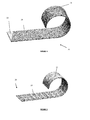
discontinuous shielding tape 20,Figure 2 , shows a firstdiscontinuous shielding tape 20 constructed of afirst substrate 22 and a plurality of triangularshaped foil elements 24. In another arrangement, as shown inFigure 3 , triangleshaped foil elements 24 are disposed on both sides ofsubstrate 22. - In a preferred
embodiment substrate 22 is typically a thin plastic film composed of any one of polyethylene terephthalate (Mylar™), polypropylene, cellulose acetate butyrate, or other film with sufficient physical properties to survive typical cabling processes. These tapes typically range from 0.001" to 0.005" in thickness and are sometimes flame retarded to improve cable fire test performance. The width ofsubstrate 22 can vary depending on the size of the cable construction being shielded and the method of shield application. Exemplary widths forsubstrate 22 can range from 0.250" to 3.000". - Regarding the composition of the triangular
shaped foil elements 24, such elements can have a wide variety of dimensions depending on the width ofsubstrate 22 and the angles used to form the triangles. Typically the thickness offoil 24 can range anywhere from 0.0005" to 0.0050" depending on the type of external shielding effectiveness required. For the arrangement withfoil 24 on only one side ofsubstrate 22,foil 24 typically faces away frompairs 14 with thenon-conductive substrate 22 being in contact withpairs 14. Alternatively, there may be some situations wherefoil elements 24 onsubstrate 22 are applied to face towardstwisted pairs 14 withfoil 24 either being in direct contact withpairs 14 or separated from thepairs 14 by another layer, such as a second layer of non-conductive substrate. - In one exemplary arrangement,
substrate 22 is substantially 1" wide with a thickness of about 0.0015" and constructed of polyethylene terephthalate. The preferred triangularmetal foil elements 24 in this configuration have a base of substantially 2", a height of 1", 45 degree angles at the base and a 90 degree angle at the vertex. The bases oftriangular foil elements 24 are located along the opposite sides ofsubstrate 22 in such a manner where the base of each successivefoil triangle element 24 is located on the opposite side ofsubstrate 22 as shown for example inFigures 2 and3 . A preferred gap distance between any twotriangles 22 is substantially 0.040" or less. - Unlike the prior art discussed above, the present arrangement, using
triangular foil elements 24, applied in alternating fashion, creates reflected waves throughout the entire frequency spectrum instead at just isolated frequencies. By doing this, the amplitude of the reflected waves is greatly reduced along the length ofcable 10, thus improving the overall performance of the discontinuously shielded cable. -
Figure 3A is prior art chart showing insertion loss peaks over certain common communication cable frequencies using prior art rectangular shield elements (10.5cm) showing a large insertion loss spike at 500MHz and smaller spikes at 250MHz and 125MHz. This phenomenon is not desirable. -
Figure 3B is another chart showing insertion loss peaks over the same common communication cable frequencies using the present arrangement as shown inFigure 2 , using triangular shield elements (base length 10.5cm). Sincetriangle elements 24 do not provide a distinct/regular surface perpendicular to the travel of the signals inpairs 14, there are no discrete frequencies of reflected waves and thus no corresponding return loss spikes as in the prior art arrangements. - Regarding the version of
tape 20 shown inFigure 4 , the advantage to disposing triangle shapedfoil elements 24 on both sides ofsubstrate 22 is that greater shielding effectiveness can be obtained. Whensubstrate 22 has adiscontinuous shield foil 24 on only one side, gaps exist in which noise can entercable 10 or signal can escape fromcable 10. When both sides ofsubstrate 22 havediscontinuous shield elements 24,elements 24 are arranged in such a way where they overlap one another and along with the gaps on each side respectively, providing a more complete shielding if required. - In another arrangement, as shown in
Figures 5 and6 , instead of using triangle shapedfoil elements 24,foil elements 24 are circular shaped. And, in another arrangement, as shown inFigures 7 and8 , instead of using triangle shapedfoil elements 24,foil elements 24 are irregularly shaped. - Circular shaped and irregularly shaped
foil elements 24, as with triangles, also mitigate the standing wave issue. In one example, circles 24 have a diameter of about substantially 1/10th the width ofsubstrate 22 and placed in succession across the width ofsubstrate 22 with a thickness ranging from about 0.0005" to 0.0050", although the invention is not limited in this respect. In one arrangement, shielding effectiveness is improved by placing smaller shielding circles or other shielding foil shapes in the small interstices between thecircular shielding elements 24. - In yet another arrangement, as shown in
Figures 9 and10 , instead of using triangle shapedfoil 24,foil elements 24 are initially formed as a continuous element, but are later randomly disrupted into a broken arrangement. In this arrangement, the shielding 24 is chipped by mechanical means and blown onto a glue 25, coated ontosubstrate 22 in random locations onsubstrate 22. The chips on shieldingmaterial 24 may vary in shape and size according to the speed and design of the mechanical chipper. In one arrangement, overlapping shielding material can be wiped off or blow off by means of brushes or air jets. In such an arrangement, it may be desirable to press the shielding material on tosubstrate 22 by means of a roller or other device for proper adhesion. The excess shielding material can be cut from the edges ofsubstrate 22 by means of a cutter on each side. Shielding material should lay onsubstrate 22 in many different orientations; having some disjointed sections placed randomly along the length ofsubstrate 22. - Aluminum foil sheet is placed over a heated metal form of the desired shape with small holes in the surface. These small holes would lead to an internal cavity that is under vacuum. The vacuum would hold the aluminum foil over the form while a die slighty larger but the same shape as the form comes down over the form cutting the aluminum foil sheet. What is now left is a piece of aluminum foil in the shape of the form being held in place by the small holes in the form drawing vacuum. The heated form with the aluminum foil piece adhered to it is then positioned over a substrate with a heat activated adhesive such as a hot melt glue. The heated form with the aluminum foil piece is then positioned over and pressed down onto the substrate. The form is then momentarily held in place so that heat from the form can be transferred to the heat activated adhesive. Once the heat activated adhesive forms a bond to the aluminum foil piece, the form can be lifted away from the substrate, leaving the aluminum foil piece bonded to the substrate. A continuous process can be created with this technique by using multiple forms. A system to adhere the aluminum foil pieces to the substrate can be based on adhesives that are not heat activated as well.
- While only certain features of the invention have been illustrated and described herein, many modifications, substitutions, changes or equivalents will now occur to those skilled in the art. It is therefore, to be understood that this application is intended to cover all such modifications and changes that fall within the true spirit of the invention.
Claims (10)
- A communication cable, said cable comprising:a plurality of twisted pair communication elements;a jacket surround said twisted pairs; anda shield element disposed between said pairs and said jacket, wherein said shield element is constructed as a tape substrate with a plurality of foil shielding elements disposed thereon, the foil shielding elements being formed in the shape of triangles and arranged on said substrate with at least a first foil shield element having a base of its triangle shape disposed substantially parallel to a longitudinal edge of said tape substrate with each subsequent triangles disposed on said tape substrate at a distance apart from said first triangle foil shielding element with a base of its triangle shape disposed substantially parallel to an opposite longitudinal edge of said tape substrate.
- The communication cable as claimed in claim 1, wherein tape substrate is constructed of a material selected from the group consisting of polyethylene terephthalate, polypropylene, and cellulose acetate butyrate.
- The communication cable as claimed in claim 1, wherein tape substrate is substantially 0.001" to 0.005" in thickness.
- The communication cable as claimed in claim 1, wherein tape substrate is substantially 0.250" to 3.000" in width.
- The communication cable as claimed in claim 1, wherein said foil shielding elements are substantially 0.0005" to 0.0050" in thickness.
- The communication cable as claimed in claim 1, wherein said substrate is substantially 1" wide, has a thickness of substantially 0.0015" thick and constructed of polyethylene terephthalate with said triangular metal foil elements each having a base of substantially 2" wide, a height of substantially 1" across the width of said substrate with 45 degree angles at the base and a 90 degree angle at the vertex.
- The communication cable as claimed in claim 1, wherein said a gap between any two triangular metal foil elements is substantially 0.040" or less.
- The communication cable as claimed in claim 1, wherein foil shield elements are disposed on both sides of said substrate.
- The communication cable as claimed in claim 1, wherein said foil shield elements and gaps there between are arranged on said substrate such that communications signals passing through said twisted pairs, reflecting off of said foil shield elements generated standing waves, where such standing waves are distributed over wide range of frequencies.
- The communication cable as claimed in claim 1, wherein said foil shield elements are disposed on a side of said substrate facing inwards towards said twisted pairs of said cable.
Applications Claiming Priority (1)
| Application Number | Priority Date | Filing Date | Title |
|---|---|---|---|
| US13/779,089 US9196398B2 (en) | 2013-02-27 | 2013-02-27 | Discontinuous shielding tapes for data communications cable |
Publications (1)
| Publication Number | Publication Date |
|---|---|
| EP2772924A1 true EP2772924A1 (en) | 2014-09-03 |
Family
ID=47843218
Family Applications (1)
| Application Number | Title | Priority Date | Filing Date |
|---|---|---|---|
| EP13305232.4A Withdrawn EP2772924A1 (en) | 2013-02-27 | 2013-02-28 | Discontinuous shielding tape for data communication cable |
Country Status (5)
| Country | Link |
|---|---|
| US (1) | US9196398B2 (en) |
| EP (1) | EP2772924A1 (en) |
| KR (1) | KR20140107147A (en) |
| CN (1) | CN104008815B (en) |
| BR (1) | BR102014004540A2 (en) |
Families Citing this family (15)
| Publication number | Priority date | Publication date | Assignee | Title |
|---|---|---|---|---|
| JP6294616B2 (en) * | 2013-09-24 | 2018-03-14 | 古河電気工業株式会社 | Underwater cable and multilayer tape for water shielding layer |
| CN104240834B (en) * | 2014-09-30 | 2016-04-13 | 国家电网公司 | A kind of power cable with metal mesh structure |
| US10102946B1 (en) * | 2015-10-09 | 2018-10-16 | Superior Essex International LP | Methods for manufacturing discontinuous shield structures for use in communication cables |
| US10186350B2 (en) | 2016-07-26 | 2019-01-22 | General Cable Technologies Corporation | Cable having shielding tape with conductive shielding segments |
| US10388435B2 (en) | 2017-06-26 | 2019-08-20 | Panduit Corp. | Communications cable with improved electro-magnetic performance |
| US10867724B1 (en) | 2017-08-17 | 2020-12-15 | Superior Essex International LP | Method for forming power over ethernet twisted pair communication cables |
| US10249410B1 (en) * | 2017-08-17 | 2019-04-02 | Superior Essex International LP | Power over ethernet twisted pair communication cables |
| US11152137B2 (en) * | 2018-02-26 | 2021-10-19 | Panduit Corp. | Communications cable with triboelectric protection |
| US10276280B1 (en) | 2018-03-23 | 2019-04-30 | Superior Essex International LP | Power over ethernet twisted pair communications cables with a shield used as a return conductor |
| CN209729555U (en) * | 2018-06-01 | 2019-12-03 | 凡甲电子(苏州)有限公司 | flat data transmission cable |
| EP3582235B1 (en) * | 2018-06-14 | 2023-12-20 | General Cable Technologies Corporation | Cable having shielding tape with conductive shielding segments |
| US20220181046A1 (en) * | 2020-12-04 | 2022-06-09 | Dongguan Ching Tai Electric Wire & Cable Co.,Ltd. | Manufacturing method of a screening tape for an unshielded signal transmission cable |
| EP4179552A1 (en) * | 2020-12-30 | 2023-05-17 | Sterlite Technologies Limited | Intermittent tape |
| CN114300192B (en) * | 2021-11-25 | 2023-11-03 | 通鼎互联信息股份有限公司 | Low-crosstalk framework type photoelectric hybrid cable |
| CN120299815B (en) * | 2025-06-13 | 2025-10-10 | 广州宝新电线电缆制造有限公司 | Electrocardiogram main cable based on multilayer heterogeneous shielding structure and manufacturing method thereof |
Citations (4)
| Publication number | Priority date | Publication date | Assignee | Title |
|---|---|---|---|---|
| US20060048961A1 (en) * | 2004-09-03 | 2006-03-09 | Draka Comteq Germany Gmbh & Co. Kg | Multi-layer, strip-type screening sheet for electric lines and electric cable, in particular a data transmission cable, equipped therewith |
| GB2432963A (en) * | 2005-12-01 | 2007-06-06 | Brand Rex Ltd | High frequency cable |
| US20100224389A1 (en) * | 2009-03-03 | 2010-09-09 | Panduit Corp. | Method and Apparatus For Manufacturing Mosaic Tape For Use In Communication Cable |
| US8119907B1 (en) * | 2006-08-11 | 2012-02-21 | Superior Essex Communications, Lp | Communication cable with electrically isolated shield comprising holes |
Family Cites Families (8)
| Publication number | Priority date | Publication date | Assignee | Title |
|---|---|---|---|---|
| US6207266B1 (en) * | 1997-06-03 | 2001-03-27 | Hitachi Chemical Company, Ltd. | Electromagnetically shielding bonding film |
| CN2310371Y (en) * | 1997-06-26 | 1999-03-10 | 上海摩恩电气有限公司 | Cable with sparse wound metal filament shielding |
| US8253035B2 (en) * | 2005-03-15 | 2012-08-28 | Fujifilm Corporation | Plating processing method, light transmitting conductive film and electromagnetic wave shielding film |
| CN100553037C (en) * | 2005-03-28 | 2009-10-21 | 立维腾制造有限公司 | Discontinued cable shield system and method |
| US8119906B1 (en) * | 2006-08-11 | 2012-02-21 | Superior Essex Communications, Lp | Communication cable shielded with mechanically fastened shielding elements |
| US7923641B2 (en) * | 2006-08-11 | 2011-04-12 | Superior Essex Communications LLP | Communication cable comprising electrically isolated patches of shielding material |
| EP2269196B1 (en) * | 2008-03-06 | 2016-11-09 | Panduit Corp. | Barrier tape for communication cable with improved crosstalk attenuation |
| US8183462B2 (en) * | 2008-05-19 | 2012-05-22 | Panduit Corp. | Communication cable with improved crosstalk attenuation |
-
2013
- 2013-02-27 US US13/779,089 patent/US9196398B2/en active Active
- 2013-02-28 EP EP13305232.4A patent/EP2772924A1/en not_active Withdrawn
- 2013-04-18 CN CN201310135359.5A patent/CN104008815B/en not_active Expired - Fee Related
-
2014
- 2014-02-26 BR BR102014004540A patent/BR102014004540A2/en not_active IP Right Cessation
- 2014-02-27 KR KR1020140023728A patent/KR20140107147A/en not_active Withdrawn
Patent Citations (4)
| Publication number | Priority date | Publication date | Assignee | Title |
|---|---|---|---|---|
| US20060048961A1 (en) * | 2004-09-03 | 2006-03-09 | Draka Comteq Germany Gmbh & Co. Kg | Multi-layer, strip-type screening sheet for electric lines and electric cable, in particular a data transmission cable, equipped therewith |
| GB2432963A (en) * | 2005-12-01 | 2007-06-06 | Brand Rex Ltd | High frequency cable |
| US8119907B1 (en) * | 2006-08-11 | 2012-02-21 | Superior Essex Communications, Lp | Communication cable with electrically isolated shield comprising holes |
| US20100224389A1 (en) * | 2009-03-03 | 2010-09-09 | Panduit Corp. | Method and Apparatus For Manufacturing Mosaic Tape For Use In Communication Cable |
Also Published As
| Publication number | Publication date |
|---|---|
| CN104008815A (en) | 2014-08-27 |
| KR20140107147A (en) | 2014-09-04 |
| US9196398B2 (en) | 2015-11-24 |
| CN104008815B (en) | 2018-01-19 |
| US20140238720A1 (en) | 2014-08-28 |
| BR102014004540A2 (en) | 2015-12-01 |
Similar Documents
| Publication | Publication Date | Title |
|---|---|---|
| US9196398B2 (en) | Discontinuous shielding tapes for data communications cable | |
| KR101127252B1 (en) | Discontinuous cable shield system and method | |
| CN107833693B (en) | parallel pair cable | |
| US9129724B2 (en) | Shielded electrical cable | |
| EP2729941B1 (en) | Shielding for cable components and method | |
| US9214260B2 (en) | Differential signal transmission cable and multi-core differential signal transmission cable | |
| CA3031668C (en) | Cable having shielding tape with conductive shielding segments | |
| US20160037691A1 (en) | Discontinuous shielding tape for data communications cable and method for making the same | |
| US20090229850A1 (en) | Cable For High Speed Data Communications | |
| JP2009032685A (en) | High-speed differential transmission cable | |
| WO2011099457A1 (en) | Leaky coaxial cable | |
| EP3646353B1 (en) | Communications cable with improved electro-magnetic performance | |
| US9767939B2 (en) | Discontinuous shielding tape for data communications cable | |
| US20210241939A1 (en) | Shielding Tape With Features For Mitigating Micro-Fractures And The Effects Thereof | |
| EP4009336A1 (en) | Screening tape and manufacturing method thereof and unshielded signal transmission cable using same | |
| KR20150021181A (en) | Communication cable comprising discontinuous shield tape and discontinuous shield tape | |
| EP3582235B1 (en) | Cable having shielding tape with conductive shielding segments | |
| JP7394814B2 (en) | Communication cable and its manufacturing method | |
| KR20230068501A (en) | Ethernet cable | |
| CN201242908Y (en) | Grounding device for flexible flat cable | |
| KR102020067B1 (en) | Leaky Coaxial Cable | |
| EP1148516A1 (en) | Telecommunication cable assembly with individually embedded shielded pairs |
Legal Events
| Date | Code | Title | Description |
|---|---|---|---|
| PUAI | Public reference made under article 153(3) epc to a published international application that has entered the european phase |
Free format text: ORIGINAL CODE: 0009012 |
|
| 17P | Request for examination filed |
Effective date: 20130228 |
|
| AK | Designated contracting states |
Kind code of ref document: A1 Designated state(s): AL AT BE BG CH CY CZ DE DK EE ES FI FR GB GR HR HU IE IS IT LI LT LU LV MC MK MT NL NO PL PT RO RS SE SI SK SM TR |
|
| AX | Request for extension of the european patent |
Extension state: BA ME |
|
| R17P | Request for examination filed (corrected) |
Effective date: 20150303 |
|
| RBV | Designated contracting states (corrected) |
Designated state(s): AL AT BE BG CH CY CZ DE DK EE ES FI FR GB GR HR HU IE IS IT LI LT LU LV MC MK MT NL NO PL PT RO RS SE SI SK SM TR |
|
| RAP1 | Party data changed (applicant data changed or rights of an application transferred) |
Owner name: NEXANS |
|
| 17Q | First examination report despatched |
Effective date: 20180516 |
|
| GRAP | Despatch of communication of intention to grant a patent |
Free format text: ORIGINAL CODE: EPIDOSNIGR1 |
|
| RIC1 | Information provided on ipc code assigned before grant |
Ipc: H01B 11/06 20060101ALN20190510BHEP Ipc: H01B 11/10 20060101AFI20190510BHEP |
|
| INTG | Intention to grant announced |
Effective date: 20190606 |
|
| GRAS | Grant fee paid |
Free format text: ORIGINAL CODE: EPIDOSNIGR3 |
|
| STAA | Information on the status of an ep patent application or granted ep patent |
Free format text: STATUS: THE APPLICATION IS DEEMED TO BE WITHDRAWN |
|
| 18D | Application deemed to be withdrawn |
Effective date: 20191017 |