EP2771832B1 - Typing profile identification - Google Patents
Typing profile identification Download PDFInfo
- Publication number
- EP2771832B1 EP2771832B1 EP11776709.5A EP11776709A EP2771832B1 EP 2771832 B1 EP2771832 B1 EP 2771832B1 EP 11776709 A EP11776709 A EP 11776709A EP 2771832 B1 EP2771832 B1 EP 2771832B1
- Authority
- EP
- European Patent Office
- Prior art keywords
- typing
- user
- profile
- key
- periods
- Prior art date
- Legal status (The legal status is an assumption and is not a legal conclusion. Google has not performed a legal analysis and makes no representation as to the accuracy of the status listed.)
- Not-in-force
Links
Images


Classifications
-
- G—PHYSICS
- G06—COMPUTING OR CALCULATING; COUNTING
- G06F—ELECTRIC DIGITAL DATA PROCESSING
- G06F21/00—Security arrangements for protecting computers, components thereof, programs or data against unauthorised activity
- G06F21/30—Authentication, i.e. establishing the identity or authorisation of security principals
- G06F21/31—User authentication
- G06F21/316—User authentication by observing the pattern of computer usage, e.g. typical user behaviour
-
- G—PHYSICS
- G06—COMPUTING OR CALCULATING; COUNTING
- G06F—ELECTRIC DIGITAL DATA PROCESSING
- G06F2221/00—Indexing scheme relating to security arrangements for protecting computers, components thereof, programs or data against unauthorised activity
- G06F2221/21—Indexing scheme relating to G06F21/00 and subgroups addressing additional information or applications relating to security arrangements for protecting computers, components thereof, programs or data against unauthorised activity
- G06F2221/2101—Auditing as a secondary aspect
-
- H—ELECTRICITY
- H04—ELECTRIC COMMUNICATION TECHNIQUE
- H04L—TRANSMISSION OF DIGITAL INFORMATION, e.g. TELEGRAPHIC COMMUNICATION
- H04L63/00—Network architectures or network communication protocols for network security
- H04L63/08—Network architectures or network communication protocols for network security for authentication of entities
- H04L63/0861—Network architectures or network communication protocols for network security for authentication of entities using biometrical features, e.g. fingerprint, retina-scan
Definitions
- the present invention relates to a method for extracting a typing profile from a typing sample input by a user, and to a method for comparing a typing profile with a reference typing profile of another user.
- the invention further relates to a system for identifying a user according to a typing sample input by the user.
- each person When a person is asked to type a text on a keyboard, each person types the text in an individual manner. The way the person presses and releases the various keys of the keyboard can be regarded as a biometric feature of the person who is typing the text. Like a fingerprint, the typing behavior of a person is a highly individual feature. When two different people type a text, the typing behavior differs significantly.
- U. S. Patent Application US 2008/0092209 A1 relates to a user authentication system and discloses a system for determining whether a purported or alleged authorized user is in fact the authorized user, by comparing a new data on a real-time basis against probability distribution representations including an authorized user probability distribution representation and global or wide population probability distribution representation, to prove a probability as to whether the purported authorized user is the authorized user.
- This invention may utilize keyboard dynamics, data, X-Y device data, or other data from similar measurable characteristics, to determine the probability that the new data from the purported authorized user indicates or identifies that user as the authorized user.
- a method for extracting a typing profile from a typing sample input by a user comprises recording a typing sample when the user types an arbitrary text, wherein said recording comprises recording points of time when the user presses or releases keys.
- the method further comprises extracting from the typing sample a multitude of time periods, the time periods comprising at least one of holding periods of the various keys that have been pressed and transition periods between two different keys.
- the method further comprises taking the holding periods of a certain key or the transition periods for a certain pair of keys as realizations of a random variable, and performing a kernel density estimation to determine a probability density function related to the holding periods of said key or to the transition periods for said pair of keys.
- the preceding step is performed for a multitude of different keys or pairs of keys.
- the method further comprises representing the user's typing profile as a set of probability density functions related to said multitude of different keys or pairs of keys.
- the above-described method for extracting a typing profile yields typing profiles which characterizes the respective user's typing behavior.
- a typing profile obtained by performing kernel density estimation allows to identify a respective user.
- the above-described typing profiles can be used for identifying the person who is typing. Both the "false acceptance rate" and the “false rejection rate” are very low. Even if the user only types a rather short text, the typical features of the user's typing behavior can be identified. As a typing sample, an arbitrary text can be used. It is not necessary to use a predefined text. Another advantage of the above-described method is that it may operate in the background, to verify a user's identity.
- each key holding periods related to said key are treated as realizations of a random variable.
- transition periods between a first key and a second key are treated as realizations of a random variable.
- the method further comprises the steps of extracting from the typing sample holding periods of the various keys that have been pressed; and of sorting the holding periods extracted from the typing sample into a set of first bins, each of the first bins corresponding to a certain key, the first bins being configured for storing holding periods of the respective key.
- the values of the holding period stored in a respective first bin are taken as realizations of a random variable related to the holding period of said key.
- the method further comprises the steps of extracting from the typing sample transition periods between two different keys; and of sorting the transition periods extracted from the typing sample into a set of second bins, each of the second bins corresponding to a pair of keys, the second bins being configured for storing transition periods between a first key and a second key.
- the method further comprises at least one of: extracting from the typing sample transition periods between two keys that have been pressed subsequently; and extracting from the typing sample transition periods between two keys that are not immediate neighbors.
- the values of the transition period stored in a respective second bin are taken as realizations of a random variable related to the transition period of the pair of keys.
- each of the keys is represented by a unique key code.
- the typing sample is input on a keyboard or a keypad.
- the typing sample is input on at least one of: a conventional keyboard, a touchscreen, a keypad, a keypad of a phone or mobile phone.
- the typing profile is extracted in the background while the user types an arbitrary text.
- Gaussian bell curves are used as kernel functions for performing the kernel density estimation.
- the typing profile of the user is stored in a database or in a file.
- a method for comparing a typing profile of a first user with a reference typing profile of a second user comprises extracting a typing profile of the first user from a typing sample input by the first user according to the above-described method for extracting a typing profile from a typing sample.
- the method further comprises comparing the typing profile of the first user with the reference typing profile, and determining a degree of agreement between the typing profile and the reference typing profile.
- the method further comprises determining, in dependence on the result of the comparison, whether the typing profile matches with the reference typing profile or not.
- the method comprises determining, in dependence on the result of the comparison, whether the first user is identical to the second user or not.
- the method comprises comparing each of the probability density functions of the first user's typing profile with a corresponding probability density function of the reference typing profile.
- the method comprises determining, for each of the probability density functions of the first user's typing profile, a distance dimension indicating a distance between said probability density function of the first user's typing profile and a corresponding probability density function of the reference typing profile.
- the method further comprises determining a total distance between the first user's typing profile and the reference typing profile by calculating a sum or a weighted sum of said distance dimensions.
- the method further comprises comparing a total distance between the first user's typing profile and the reference typing profile with a predefined threshold.
- the typing profile matches with the reference typing profile, and the first user is identical to the second user.
- the typing profile does not match with the reference typing profile, and the first user is not identical to the second user.
- the method is used for at least one of:
- a system for identifying a user according to a typing sample input by the user comprises a recording unit configured for recording the user's typing sample when the user types an arbitrary text, wherein said recording comprises recording point of time when the user presses or releases keys.
- the system further comprises a feature extraction unit configured for extracting from the typing sample a multitude of time periods, the time periods comprising at least one of holding periods of the various keys that have been pressed and transition periods between two different keys.
- the system further comprises a kernel density estimation unit configured for taking the holding periods of a certain key or the transition periods for a certain pair of keys as realizations of a random variable, and performing a kernel density estimation to determine a probability density function related to the holding periods of said key or to the transition periods for said pair of keys.
- the system further comprises a profile evaluation unit configured for comparing a typing profile of a first user with a reference typing profile of a second user, and for determining, in dependence on the result of the comparison, whether the typing profile matches with the reference typing profile or not.
- each person When a person is asked to type a text on a keyboard, each person types the text in an individual manner. The way the person presses and releases the various keys of the keyboard can be regarded as a biometric feature of the person who is typing the text. Like a fingerprint, the typing behavior of a person is a highly individual feature. When two different people type a text, the typing behavior differs significantly. In fact, after typing a comparatively short text, an analysis of the typing behavior allows to unambiguously identify the person who is typing.
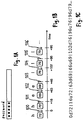
- Figs. 1A, 1B and 1C show how data related to the specific typing behavior of a person is acquired.
- the person might type a password, e.g. the word “hello”.
- Typing the word “hello” comprises consecutively pressing and releasing the five keys “h”, “e”, “l”, “i”, and "o”.
- Fig. 1B and Fig. 1C it is shown how events related to pressing and releasing these different keys are recorded as a function of time.
- the time period between the current event and the preceding event may be recorded.
- the time period relative to the first key may be recorded.
- the key “h” is pressed, as indicated by arrow 100 in Fig. 1B . Pressing a key will be referred to as a "down event".
- a corresponding key code is recorded.
- the event of pressing the key “h” is recorded as "0d72", with the time period "0" indicating that this event is the first event of a sequence of events, with "d” denoting a down event.
- the key code 72 denotes the key "h", which is true for a German keyboard.
- the respective key code may depend on the type of keyboard that is used.
- the key "h” is released, which is indicated by arrow 101 in Fig. 1B .
- Releasing a key will be referred to as an "up event”.
- the relative time period between the second event and the first event is indicated as "+16”, which may for example denote 16 clock cycles of a sampling clock.
- the second event is recorded as "16u72", with “16” denoting the time period between the first event and the second event, with “u” indicating an up event, and with "72” denoting the key code of the key "h”.
- the key "e” is pressed, which is indicated by arrow 102 in Fig. 1B .
- the time interval between the second event and the third event is equal to 63 clock cycles. Accordingly, as shown in Fig. 1C , the third event is recorded as "63d69", with “63” denoting the time period, with “d” denoting a “down event”, and with "69” indicating the key code of the key "e”.
- the key "e” is released, which is indicated by arrow 103 in Fig. 1B .
- the time period between the third event and the fourth event is equal to 46 clock cycles, and accordingly, as shown in Fig. 1C , the fourth event is recorded as "46u69".
- the key "l” (key code 76) is pressed, as indicated by arrow 104 in Fig. 1B . Accordingly, the fifth event is recorded as "102d76" in Fig. 1C .
- the process of recording a person's typing behavior is continued until the person has finished typing the typing sample.
- the person's typing behavior may be recorded in the background, while the person is typing a typing sample.
- any text input can be used for acquiring a person's typing profile.
- the typing sample shown in Fig. 1C is obtained.
- the time period relative to the preceeding event, a "d" (for "down event") or an "u” (for "up event”) and the key code of the respective key are indicated.
- a typing sample of the kind shown in Fig. 1C can be used as a starting point for determining a person's typing profile.
- keyboards used in different countries look different, because various language-specific character sets may be allocated to the keys of a keyboard. For example, one may think of the specific characters in the Scandinavian languages, one may think of the German umlauts, or of the Cyrillic characters used in Russia. Furthermore, also the arrangement of the characters on the keyboard may differ from country to country. For example, on European-style keyboards, the letter “y” is located in the lower left of the keyboard, whereas the letter “z” is located in the center of the upper part of the keyboard. For US-style keyboards, the respective positions of the characters "y" and "z" are exchanged.
- the person's typing behavior is recorded in terms of key codes, with said key codes being assigned to the different positions of the keys on the keyboard.
- key codes By using key codes, a person's typing behavior can be recorded in terms of the location of the keys on the keyboard.
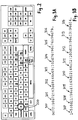
- Fig. 2 shows the key codes assigned to the keys of a standard keyboard. These key codes do not depend on the respective country version of the keyboard. For example, in Fig. 2 , the key 200 with the key code "65" is indicated with a circle. On a German keyboard, the key 200 corresponds to the letter "a”. On a Russian keyboard, the key 200 corresponds to a specific letter of the Cyrillic alphabet. According to embodiments of the present invention, by using key codes, the typing behavior is recorded in dependence on the location of the keys, and without any dependence on the character set that is assigned to the keys of the keyboard.
- a typing sample can either be recorded as a non-masked typing sample or as a masked typing sample.
- a masked typing sample is especially useful for passwords.
- Fig. 3A shows the recording of a non-masked typing sample comprising the entries 300 to 306, which corresponds to the typing sample shown in Fig. 1C .
- Each of the entries 300 to 306 comprises a relative time delay relative to the preceeding event, a letter "u" or "d” denoting an up event or a down event, and a key code of the key that has been pressed or released.
- Fig. 3B shows an example of a masked typing sample comprising a first entry 307 denoting the length of the password and subsequent entries 308 to 314.
- the key code is replaced by an index of the key that is pressed or released.
- l1 denotes the first pressed key
- l2 denotes the second pressed key
- Each of the entries 308 to 314 comprises a relative time delay relative to a preceeding event, a letter “u” or “d” denoting an up event or a down event, and an index of the key that has been pressed or released. Thus, it is no longer possible to retrieve the password from the stored data.
- control characters like e.g. "Enter”, “Tab”, “Shift Key” on the left side, “Shift key” on the right side, "Alt” on the left side, “Alt” on the right side, "CTRL” on the left side, “CTRL” on the right side, "Backspace”, “Delete” etc. should not be masked.
- Storing these control characters in a non-masked manner provides advantages. For example, when entering a password, with the "Backspace” key being used at least once, the entering of the password can be reconstructed if the "Backspace” key is recorded without masking.
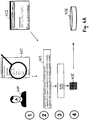
- Fig. 4A shows how a typing profile of a user A is set up.
- the user 400 types text into a web form 401 or into a document 402 of an application program or in any other program, for example in an e-mail program or a word processing program.
- a typing sample 403 is recorded in the background.
- the acquired typing sample 403 is forwarded to a core engine 404.
- the core engine 404 is configured for calculating a typing profile 405 of the user 400.
- the typing profile 405 of the user 400 is stored in a user data base 406.
- the user data base 406 comprises user profiles for many different users.
- Fig. 4B it is shown how an unknown user can be identified by comparing the unknown user's typing sample with a number of typing samples stored in a data base.
- the unknown user 407 enters text into a web form or a document 408 of an application program or in any other program, for example in an e-mail program or in a word processing program.
- a typing sample 409 of the unknown user 407 is recorded in the background.
- the acquired typing sample 409 of the user 407 is forwarded to the core engine 410.
- the core engine 410 is configured for comparing the typing sample 409 with at least one of the typing profiles 411, 412, 413 of known users.
- Typing profile 411 is the typing profile of user A
- typing profile 412 is the typing profile of user B
- typing profile 413 is the typing profile of user C.
- the typing profiles 411, 412, 413 are stored in a data base 414.
- the core engine 410 may compare the acquired typing sample 409 with a selected one of the typing profiles stored in the data base 414. Alternatively, the core engine 410 may compare the typing sample 409 with a subset of the typing profiles stored in the data base 414. Further alternatively, the core engine 410 may compare the typing sample 409 with each of the typing profiles stored in the data base 414.
- the core engine 410 is configured for determining whether the typing sample 409 matches with one of the typing profiles stored in the data base 414. In case a match is detected, the unknown user 407 can be identified, because for each of the profiles 411 to 413, the corresponding users A, B, C are known.
- the core engine 410 outputs the result of the comparison. For example, the core engine 410 may find out that user A has typed the text with a probability of 98%.
- the result of the comparison may e.g. be displayed as a graphical display element 415.
- the graphical element 415 indicates the probability that the typing sample 409 has been input by a certain user A.
- the probability is displayed by means of an arrow 416, said arrow 416 pointing to a probability value between 0% and 100%.
- the graphical display element 415 is divided into a red segment 417, a yellow segment 418, and a green segment 419.
- the arrow 416 lies within the red segment 417, the text has probably not been input by user A.
- the arrow 416 lies within the yellow segment 418, it is not quite sure whether the text has been input by user A or not.
- the arrow 416 lies within the green segment 419, the text has probably been input by user A.
- the graphical user element provides a visualization of the probability that a certain typing sample has been input by a certain user.
- the core engine 404 shown in Fig. 4A is configured for extracting a typing profile 405 from the typing sample 403 of user A. Determining a user's typing profile comprises extracting a variety of different features from the rough data provided by the typing sample. In the following, it will be discussed in more detail how a user's typing profile is determined starting from the rough data of the typing sample. In particular, features related to the holding periods and the transition periods recorded for the various different keys are of particular interest for determining a user's specific typing behavior.
- Fig. 5A illustrates the typical time periods that occur when pressing and releasing two keys subsequently.
- a first key 500 is pressed and released, and then, a second key 501 is pressed and released.
- the typing sample comprises a down event 502 and an up event 503 for the first key 500, followed by a down event 504 and an up event 505 for the second key 501.
- the holding period 506 indicates how long the first key 500 has been pressed. Accordingly, the holding period 506 can be obtained as a time difference between down event 502 and the up event 503.
- the holding period 507 of the second key 501 can be determined as a time difference between the down event 504 and the up event 505.
- the holding periods 506, 507 are important features for analyzing a person's typing behavior.
- transition period between the first key 500 and the second key 501 Another important feature of a person's typing behavior is the transition period between the first key 500 and the second key 501.
- the transition period may be determined in four different ways.
- a first possibility is to determine a transition period 508, which is the time difference between the down event 504 and the down event 502.
- a second possibility is to determine a transition period 509, which is the time difference between the up event 505 and the up event 503.
- transition periods 510, 511 may be defined as time differences between the down event 504 and the up event 503, or, further alternatively, between the up event 505 and the down event 502. In the following, only the transition period 508 will be considered for further analysis of a person's typing behaviour.
- Fig. 5B shows the typical time periods that occur when subsequently pressing and releasing a sequence of three keys.
- a first key 513 is pressed and released, then, a second key 514 is pressed and released, and then, a third key 515 is pressed and released.
- the typing sample comprises a down event 516 and an up event 517 for the first key 513, a down event 518 and an up event 519 for the second key 514, and a down event 520 and an up event 521 for the third key 515.
- the holding period 522 is obtained as a time difference between down event 516 and up event 517.
- the holding period 522 indicates how long the first key 513 has been pressed.
- the holding periods 523 and 524 indicate how long the second key 514 and the third key 515 have been pressed, respectively.
- transition periods between the first key 513, the second key 514 and the third key 515 are important features of a person's typing behavior.
- the transition period between the first key 513 and the second key 514 may be determined in four different ways.
- a first possibility is to determine a transition period 525, which is the time difference between the down event 518 and the down event 516.
- a second possibility is to determine the transition period 526, which is the time difference between the up event 519 and the up event 517.
- transition periods 527, 528 may be defined as time differences between the down event 518 and the up event 517, or, further alternatively, between the up event 519 and the down event 516.
- transition periods between the second key 514 and the third key 515 can be determined in a similar manner. However, for reasons of clarity and to avoid confusion, the transition periods between the second key 514 and the third key 515 are not indicated in Fig. 5B .
- transitions between subsequently pressed keys also transitions between two keys in a sequence of keys which are not immediate neighbors may be extracted from the sample. Transitions between any two keys which are not pressed subsequently provide characteristic features of a person's typing behavior. It has turned out that transition periods between two keys which are not immediate neighbors provide valuable information about a person's typing behavior.
- the transition between the first key 513 and the third key 515 may be subjected to further evaluation.
- the transition period may be determined in four different ways.
- a first possibility is to determine a transition period 529, which is the time difference between the down event 520 and the down event 516.
- a second possibility is to determine the transition period 530, which is the time difference between the up event 521 and the up event 517.
- transition periods 531, 532 may be defined, as indicated in Fig. 5B .
- the time intervals may be used as they are.
- the time intervals may as well be subjected to some kind of preprocessing, e.g. a logarithm of a respective time interval may be determined, and then, the preprocessed values may be used as "holding periods" and "transition periods".
- Fig. 6A shows some of the bins configured for storing holding periods that have been extracted from the typing sample, with each of the bins being related to a specific key of the keyboard.
- bin 600 is configured for storing holding periods determined for key code 69, which is the key "e".
- bin 600 contains eight different holding periods for the key "e", which have been extracted from a typing sample input by the user.
- bin 601 is related to the character "o", key code 79.
- Bin 601 is configured for storing holding periods that have been determined for the key "o”.
- Bin 601 contains five different holding periods for the key "o", key code 79.
- Bin 602 is configured for storing holding periods related to the character "h", key code 72.
- bin 602 contains four different holding periods for the character "h", which have been acquired by analyzing a typing sample entered by the user.
- Bin 603 relates to key code 76, which is the key "l". In bin 603, five different holding periods for the key "l" are stored.
- bin 604 is configured for storing holding periods for key "a", key code 65. Bin 604 contains five different holding periods.
- Bin 605 corresponds to key code 89, which is the key "y”. Bin 605 comprises two different holding periods acquired from the user's typing sample.
- the holding periods obtained by analyzing a typing sample are sorted into a set of different bins, which each bin corresponding to a certain key of the keyboard.
- a set of different holding periods is acquired and stored in a corresponding bin.
- Transition periods extracted from the typing sample are also sorted into a set of different bins.
- Fig. 6B shows some of the bins configured for storing transition periods related to transitions between a first key having a first key code and a second key having a second key code.
- a transition period is defined as the time difference between pressing the first key and pressing the second key. For example, according to a preferred embodiment, the time difference between the down event of the first key and the down event of the second key may be determined.
- bin 606 corresponds to a pair of consecutively pressed keys, i.e. to a certain combination of a first key and a second key, which are pressed one after the other.
- bin 606 corresponds to the transition from key code 69 (character “e") to key code 78 (character “n”).
- Bin 606 is configured for storing transition periods related to the transition from “e” to “n", with the transition period being the time difference between pressing the key "e” and pressing the key "n”.
- bin 606 contains three different values of the transition period for the transition from "e” to "n", which have been extracted from the typing sample entered by the user.
- bin 607 is configured for storing transition periods related to the transition from key code 72 (character “h") to key code 69 (character “e”). In the example of Fig. 6B , bin 607 contains two transition periods from key "h” to key "e”.
- Bin 608 is related to the transition from character "b" (key code 66) to character "e” (key code 69). Bin 608 contains three values of the transition period, which have been obtained by analyzing a user's typing sample.
- Bin 609 is configured for storing transition periods related to the transition from character "e" (key code 69) to character "u" (key code 85). In the example of Fig. 6B , bin 609 only contains one single value of this transition period.
- a separate bin or data structure is set up for accommodating the respective transition periods.
- the number of bins required for accommodating the transition periods may get quite large, with a plurality of these bins only containing one single value.
- the data structure shown in Figs. 6A and 6B has proven to be useful for analyzing a person's typing behavior.
- a person's typing behavior may change in the course of time, and therefore, a set of holding values and transition values extracted from a typing sample at an earlier point of time may not accurately reflect the person's actual typing behavior any more.
- the typing profile is constantly adapted to the person's actual typing behavior. There exist several different ways how this can be achieved. According to a first method, whenever a new typing sample of the respective person is acquired, holding periods and transition periods are extracted from the typing sample and added to the respective bins of the person's typing profile. Thus, the number of values stored in the respective bins is steadily increasing. After the number of values in a certain bin exceeds a certain threshold, the oldest values stored in the bin may e.g. be deleted.
- the values in the bins are replaced according to a "first-in first-out" scheme.
- the content of the bins is continuously adapted to the person's actual typing behavior.
- new values stored in a respective bin may be assigned a higher weight than older values stored in the bin.
- old values are continuously replaced by new values, with the old values fading away.
- Each of the bins 600 to 609 shown in Fig. 6A and Fig. 6B contains a certain number of values.
- the set of values contained in any one of the bins shown in Figs. 6A and 6B is treated as a set of observed values of a random experiment.
- the set of values contained in one of the bins is treated as a set of realizations of a random variable, the random variable having a certain probability distribution.
- bin 600 contains eight different values of the holding period for character "e", key code 69. These eight values contained in bin 600 are treated as results of the random experiment "measuring the holding period for key code 69". Hence, the eight values stored in bin 600 are taken as realizations of the holding period for key code 69, which is considered as a random variable having a certain probability distribution. In a similar way, the three values of the transition period stored in bin 606 are considered as three different realizations of another random variable having another probability distribution.
- the values contained in any one of the bins which are considered as a set of realizations of a random variable, are taken as a starting point for estimating the underlying probability density distribution of the random experiment.
- the recorded values stored in a bin are taken as a starting point for deriving, for each bin, a most suitable estimate of the probability density function.
- kernel density estimation is a way of estimating the probability density function of a random variable based on a finite data sample. In the following, it will be explained how kernel density estimation can be performed starting from a set of realizations x 1 to x n of a random experiment. For example, the eight values of the holding period contained in bin 600 may be taken as a set of realizations x 1 to x 8 .
- a Gaussian bell curve also referred to as a Gaussian normal distribution curve, is used as a kernel function.
- Fig. 7A shows a standardized Gaussian bell curve 700, which can be expressed as s 2 ⁇ exp ⁇ 1 2 s 2 ⁇ x 2 , with s being a fitting parameter of the Gaussian bell curve 700.
- the standard deviation 701 of the Gaussian bell curve is also indicated. The larger the standard deviation 701, the broader the Gaussian bell curve 700 will be.
- Gaussian bell curves of the type shown in Fig. 7A are well-suited for performing a kernel density estimation.
- Fig. 7B it is shown how the eight recorded values x 1 to x 8 are plotted along the horizontal axis of the diagram.
- kernel functions 702 to 709 are placed on each of the eight values x 1 to x 8 in a way that each of the kernel functions 702 to 709 is centered at a corresponding data point x 1 to x 8 .
- the kernel functions 702 to 709 are Gaussian bell curves of the type shown in Fig. 7A .
- the kernel functions 702 to 709 shown in Fig. 7B are summed up.
- the kernel density estimate 710 is obtained, which is considered as an estimate of the probability density function of the random variable X, with x 1 to x 8 being realizations of the random variable X.
- Gaussian bell curves have been used as a kernel function.
- a range of other kernel functions may also be used.
- a kernel function is a symmetric but not necessarily positive function that integrates to one.
- K h 1 h ⁇ K x h .
- the obtained kernel density estimate 710 strongly depends on the fitting parameter s of the Gaussian bell curve.
- a suitable choice of the fitting parameter s is essential. In the following, the effects of the choice of s on the obtained kernel density estimate will be discussed in more detail.
- Fig. 8A shows a Gaussian bell curve 800 that is described by the following formula s 2 ⁇ exp ⁇ 1 2 s 1 2 ⁇ x 2 .
- the fitting parameter s 1 , of the Gaussian bell curve 800 has been chosen to be quite small, and accordingly, the standard deviation 801 of the Gaussian bell curve 800 is quite large.
- Fig. 8B shows what happens when the Gaussian bell curve 800 of Fig. 8A is used as a kernel function. Again, the eight data points x 1 , to x 8 are protracted along the horizontal axis of the diagram, and on each of the data points x 1 , to x 8 , a corresponding Gaussian bell curve 802 to 809 of the kind shown in Fig. 8A is placed, wherein the center of each of the Gaussian bell curves 802 to 809 coincides with one of the data points x 1 to x 8 .
- the kernel functions 802 to 809 are summed up.
- a kernel density estimate 810 is obtained. It can be seen that the kernel density estimate 810 appears to be oversmoothed, which is due to the large standard deviation 801 of the kernel function 800. Because of the oversmoothing, the details of the probability density function are lost, which is not desirable. Hence, it can be concluded that the fitting parameter s 1 is too small.
- Fig. 9A shows a Gaussian bell curve 900, which is described by s 2 2 ⁇ exp ⁇ 1 2 s 2 2 ⁇ x 2 .
- the fitting parameter s 2 is chosen to be quite large, and accordingly, the standard deviation 901 of the Gaussian bell curve 900 is quite small.
- the Gaussian bell curve 900 can be used as a kernel function for performing a kernel density estimation.
- the data points x 1 to x 8 are protracted along the horizontal axis of the diagram shown in Fig. 9B , and on each of the data points x 1 to x 8 , a corresponding kernel function 902 to 909 is placed, with the center of the i-th kernel function being located at the i-th data point x i .
- the kernel functions 902 to 909 are summed up, and a kernel density estimate 910 is obtained. From Fig.
- the kernel density estimate 910 is not smooth enough. In other words, the kernel density estimate 910 is undersmoothed.
- the kernel density estimate 910 is not a good estimate of the probability density function, because the fitting parameter s 2 has been chosen to be too large.
- Figs. 8A and 8B the case of oversmoothing has been described, with the fitting parameter s 1 being too small.
- Figs. 9A and 9B the case of undersmoothing has been described, with the fitting parameter s 2 being too large.
- the optimum fitting parameter s optimum should be larger than s 1 and smaller than s 2 : s 1 ⁇ s optimum ⁇ s 2 .
- choosing a suitable value of the fitting parameter s is the most critical step in kernel density estimation.
- the fitting parameter s determines the degree of smoothing. There exist several different techniques for determining the optimum of the fitting parameter s.
- the cost function C(s) is shown in dependence on the fitting parameter s.
- the minimum of the cost function C(s) corresponds to an optimum s optimum of the fitting parameter.
- the optimum fitting parameter s optimum can be determined.
- the optimum Gaussian bell curve for performing the kernel density estimation is known as well.
- a kernel density estimation is performed for each one of the bins 600 to 605 shown in Fig. 6A , which are configured for storing holding periods. As a result, for each one of the bins 600 to 605, an estimate of the corresponding probability density function is obtained. In the same way, for each one of the bins 606 to 609 shown in Fig. 6B , which are configured for storing transition periods, a kernel density estimation is performed. As a result, for each one of the bins 606 to 609, an estimate of the corresponding probability density function is obtained.
- Fig. 11 The results of the kernel density estimation are illustrated in Fig. 11 .
- various different bins 1100, 1101, 1102 configured for storing holding periods are shown.
- Each of the bins 1100, 1101, 1102 contains a set of holding periods for one specific key.
- bin 1100 contains eight holding periods for key "e”
- bin 1101 contains five holding periods for key "o”
- bin 1102 contains four holding periods for key "h”.
- the set of eight holding periods contained in bin 1100 is considered as a set of realizations of a random variable.
- a kernel density estimation is performed. As a result, an estimate 1103 of a probability density function is obtained.
- the estimate 1103 corresponds to the set of eight holding periods stored in bin 1100.
- the estimate 1103 describes the probability distribution of the holding period for key "e".
- the five holding periods stored in bin 1101 are also treated as realizations of a random variable.
- a corresponding probability density estimate 1104 is obtained.
- the probability density estimate 1104 indicates the probability distribution of the holding period for key "o".
- bin 1102 four holding periods for key "h" are stored.
- an estimate 1105 of the probability density function is obtained, said estimate 1105 describing the probability distribution of the holding period for key "h".
- estimates of a corresponding probability density function are determined.
- Bin 1106 contains three transition periods for the transition from key "e” to key "n”. These three values stored in bin 1106 are taken as observed values of a random variable. By performing a kernel density estimation, an estimate 1109 of the corresponding probability density function is obtained. The estimate 1109 describes the probability distribution of the transition times stored in bin 1106.
- Bin 1107 contains two transition periods for the transition "h-e”. Based on these two values, a kernel density estimation is performed, and an estimate 1110 of the probability density function is obtained.
- Bin 1108 contains three transition periods related to the transition "b-e". By performing a kernel density estimation, an estimate 1111 of the probability density function is determined, with the estimate 1111 indicating the probability distribution of the transition periods stored in bin 1108.
- a typing behavior of a user can be described by a set of probability density functions, with each of the probability density functions describing a probability distribution of a holding period or a probability distribution of a transition period.
- the entire set of probability density estimates extracted from a user's typing sample will be referred to as the typing profile of the user.
- the user's typing profile comprises at least one of probability density estimates related to holding periods and probability density estimates related to transition periods.
- the typing profile may comprise both probability density estimates of holding periods and probability density estimates of transition periods extracted from the user's typing behavior.
- the typing profile may only comprise probability density estimates related to holding periods.
- the typing profile may only comprise probability density estimates related to transition periods.
- a typing profile may comprise further probability density estimates describing additional features extracted from the user's typing sample.
- a typing profile of user A is compared with a typing profile of a user B.
- user A is identical to user B.
- user B may be a user whose identity is known.
- Fig. 12A shows bins 1200, 1201, 1202 configured for storing holding periods.
- a corresponding probability density estimate 1203, 1204, 1205 is shown, with the probability density estimates being derived from the values contained in the corresponding bin.
- the probability density estimate 1203 describes the probability distribution of the holding period for key "e”
- the probability density estimate 1204 describes the holding period for key "o”
- the probability density estimate 1205 describes the holding period for key "h”.
- the typing profile of user A further comprises bins 1206, 1207, 1208 configured for storing transition periods. For each of the bins 1206, 1207, 1208, corresponding probability density estimates 1209, 1210, 1211 are shown. Each of the probability density estimates 1209, 1210, 1211 has been derived from the transition periods stored in a corresponding bin. For example, the probability density estimate 1209 describes the transition period from “e” to “n”, the probability density estimate 1210 describes the transition from "h” to "e”, and the probability density estimate 1211 describes the transition from "b” to "e”.
- the typing profile of user A shown in Fig. 12A may comprise further bins configured for storing transition periods, which are not shown in Fig. 12A .
- Fig. 12B shows the typing profile for user B.
- the typing profile for user B comprises bins 1212, 1213, 1214 configured for storing holding periods of the keys “e”, “o”, “h”, respectively. Together with the bins 1212 to 1214, corresponding probability density estimates 1215, 1216, 1217 are shown.
- the typing profile for user B further comprises bins 1218, 1219, 1220 configured for storing transition periods for the transitions "e-n", “h-e", “b-e”, respectively. For each of the bins 1218 to 1220, corresponding probability density estimates 1221, 1222, 1223 are shown as well.
- the typing profile for user B may comprise further bins, which are not shown in Fig. 12B .
- each of the probability density estimates of the first typing profile shown in Fig. 12A is compared with a corresponding probability density estimate of the second typing profile shown in Fig. 12B .
- the probability density estimate 1203 of the first typing profile is compared with the probability density estimate 1215 of the second typing profile, as indicated by arrow 1224.
- a degree of deviation between the probability density estimate 1203 and the probability density estimate 1215 is determined.
- the probability density estimate 1204 is compared with the probability density estimate 1216, as indicated by arrow 1225.
- the probability density estimate 1205 is compared with the probability density estimate 1217, as indicated by arrow 1226.
- the probability density estimates of the first typing profile are compared with corresponding probability density estimates of the second typing profiles.
- the probability density estimate 1209 is compared with the probability density estimate 1221, as indicated by arrow 1227, and a degree of deviation is determined.
- the probability density estimate 1210 is compared with the probability density estimate 1222, as indicated by arrow 1228, and the probability density estimate 1211 is compared with the probability density estimate 1223, as indicated by arrow 1229.
- a degree of deviation between the two probability density functions is determined. This may e.g. be done by determining a distance dimension of the two probability density functions.
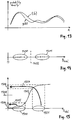
- Fig. 13 both the first probability density function f i (x) and the second probability density function g i (x) are shown.
- the parameter x is indicated, with x either denoting a holding period or a transition period.
- the corresponding probability density is indicated.
- a distance dimension d(f i , g i ) is determined.
- the distance dimension d(f i , g i ) indicates how far the two functions f i and g i are separated. In case d(f i , g i ) is rather small, the two probability density functions f i , and g i are quite similar. In case the distance dimension d(f i , g i ) is comparatively large, the two functions f i , and g i do not match.
- a corresponding distance dimension d(f i , g i ) is determined. For example, the distance between the two probability density estimates 1203 and 1215, the distance between the probability density estimates 1204 and 1216, the distance between the probability density estimates 1205 and 1217 etc. are determined.
- the sum is a sum over all the probability density functions of the typing profiles.
- the coefficients i are weight coefficients which determine the respective weight of the distance dimension d(f i , g i ).
- the weight coefficients i are predefined fixed weight coefficients.
- the magnitude of the weight coefficients i may be varied in dependence on the number of values contained in the corresponding bin.
- the bins 1200 and 1212 contain 8 values and 6 values, respectively, and therefore, the weight of the distance dimension between the probability density estimates 1203 and 1215 should be quite large.
- any other method for determining D total may be employed, like e.g. a machine learning method.
- the weighted sum D total indicates the degree of agreement between the first typing profile shown in Fig. 12A and the second typing profile shown in Fig. 12B .
- the distance dimensions d(f i , g i ) will be quite large, and the weighted sum D total will be quite large as well. In this case, there is no match between the two typing profiles, and it can be concluded that the two typing profiles have been input by different users.
- FIG. 14 A simple method for evaluating the total distance D total is shown in Fig. 14 .
- the obtained values of D total are indicated.
- the values of D total in the cluster 1401 correspond to the case where typing profiles of two different users are compared.
- the obtained values of D total are quite large.
- Fig. 15 shows an alternative method for evaluating the obtained values of D total .
- the values of D total are indicated on the horizontal axis of the diagram shown in Fig. 15 .
- the values of D total in the first cluster 1500 have been obtained by comparing typing profiles of one and the same user.
- the values of D total in the cluster 1501 have been obtained by comparing typing profiles of two different users.
- a sigmoidal function 1502 is used for further evaluation of the values of D total .
- the sigmoidal function 1502 is applied to the values of D total , in particular to the first cluster 1500 and to the second cluster 1501 of values D total .
- the first cluster 1500 is translated into a corresponding cluster 1504, as indicated by arrow 1505.
- the second cluster 1501 is translated into a corresponding cluster 1506, as indicated by arrow 1507.
- the sigmoidal function 1502 is configured for enhancing the contrast between the two clusters 1500 and 1501.
- the resulting cluster 1504 and 1506 can be clearly and unambiguously distinguished.
- a threshold 1508 that is located between the two clusters 1504 and 1506. Values within the cluster 1504 indicate that the two typing profiles have been input by one and the same person, whereas values within the cluster 1506 indicate that the two typing profiles have been input by two different persons.
Landscapes
- Engineering & Computer Science (AREA)
- Computer Hardware Design (AREA)
- General Engineering & Computer Science (AREA)
- Computer Security & Cryptography (AREA)
- Theoretical Computer Science (AREA)
- Health & Medical Sciences (AREA)
- General Health & Medical Sciences (AREA)
- Social Psychology (AREA)
- Software Systems (AREA)
- Physics & Mathematics (AREA)
- General Physics & Mathematics (AREA)
- Input From Keyboards Or The Like (AREA)
Description
- The present invention relates to a method for extracting a typing profile from a typing sample input by a user, and to a method for comparing a typing profile with a reference typing profile of another user. The invention further relates to a system for identifying a user according to a typing sample input by the user.
- When a person is asked to type a text on a keyboard, each person types the text in an individual manner. The way the person presses and releases the various keys of the keyboard can be regarded as a biometric feature of the person who is typing the text. Like a fingerprint, the typing behavior of a person is a highly individual feature. When two different people type a text, the typing behavior differs significantly.
- U. S. Patent Application
US 2008/0092209 A1 relates to a user authentication system and discloses a system for determining whether a purported or alleged authorized user is in fact the authorized user, by comparing a new data on a real-time basis against probability distribution representations including an authorized user probability distribution representation and global or wide population probability distribution representation, to prove a probability as to whether the purported authorized user is the authorized user. This invention may utilize keyboard dynamics, data, X-Y device data, or other data from similar measurable characteristics, to determine the probability that the new data from the purported authorized user indicates or identifies that user as the authorized user. - It is an object of the invention to provide an improved method for evaluating a typing sample of a user.
- The object of the invention is solved by the independent claims. Further embodiments are described in the dependent claims.
- According to embodiments of the present invention, a method for extracting a typing profile from a typing sample input by a user is provided. The method comprises recording a typing sample when the user types an arbitrary text, wherein said recording comprises recording points of time when the user presses or releases keys. The method further comprises extracting from the typing sample a multitude of time periods, the time periods comprising at least one of holding periods of the various keys that have been pressed and transition periods between two different keys. The method further comprises taking the holding periods of a certain key or the transition periods for a certain pair of keys as realizations of a random variable, and
performing a kernel density estimation to determine a probability density function related to the holding periods of said key or to the transition periods for said pair of keys. The preceding step is performed for a multitude of different keys or pairs of keys. The method further comprises representing the user's typing profile as a set of probability density functions related to said multitude of different keys or pairs of keys. - The above-described method for extracting a typing profile yields typing profiles which characterizes the respective user's typing behavior. Hence, a typing profile obtained by performing kernel density estimation allows to identify a respective user. The above-described typing profiles can be used for identifying the person who is typing. Both the "false acceptance rate" and the "false rejection rate" are very low. Even if the user only types a rather short text, the typical features of the user's typing behavior can be identified. As a typing sample, an arbitrary text can be used. It is not necessary to use a predefined text. Another advantage of the above-described method is that it may operate in the background, to verify a user's identity.
- According to a preferred embodiment, for each key, holding periods related to said key are treated as realizations of a random variable. According to another preferred embodiment, for each pair of keys, transition periods between a first key and a second key are treated as realizations of a random variable.
- According to a preferred embodiment, the method further comprises the steps of extracting from the typing sample holding periods of the various keys that have been pressed; and of sorting the holding periods extracted from the typing sample into a set of first bins, each of the first bins corresponding to a certain key, the first bins being configured for storing holding periods of the respective key.
- According to a preferred embodiment, for each key, the values of the holding period stored in a respective first bin are taken as realizations of a random variable related to the holding period of said key.
- According to a preferred embodiment, the method further comprises the steps of extracting from the typing sample transition periods between two different keys; and of sorting the transition periods extracted from the typing sample into a set of second bins, each of the second bins corresponding to a pair of keys, the second bins being configured for storing transition periods between a first key and a second key.
- According to a preferred embodiment, the method further comprises at least one of: extracting from the typing sample transition periods between two keys that have been pressed subsequently; and extracting from the typing sample transition periods between two keys that are not immediate neighbors.
- According to a preferred embodiment, for each pair of keys, the values of the transition period stored in a respective second bin are taken as realizations of a random variable related to the transition period of the pair of keys.
- According to a preferred embodiment, each of the keys is represented by a unique key code.
- According to a preferred embodiment, the typing sample is input on a keyboard or a keypad.
- According to a preferred embodiment, the typing sample is input on at least one of: a conventional keyboard, a touchscreen, a keypad, a keypad of a phone or mobile phone.
- According to a preferred embodiment, the typing profile is extracted in the background while the user types an arbitrary text.
- According to a preferred embodiment, Gaussian bell curves are used as kernel functions for performing the kernel density estimation.
- According to a preferred embodiment, the typing profile of the user is stored in a database or in a file.
- According to embodiments of the present invention, a method for comparing a typing profile of a first user with a reference typing profile of a second user is provided. The method comprises extracting a typing profile of the first user from a typing sample input by the first user according to the above-described method for extracting a typing profile from a typing sample. The method further comprises comparing the typing profile of the first user with the reference typing profile, and determining a degree of agreement between the typing profile and the reference typing profile. The method further comprises determining, in dependence on the result of the comparison, whether the typing profile matches with the reference typing profile or not.
- According to a preferred embodiment, the method comprises determining, in dependence on the result of the comparison, whether the first user is identical to the second user or not.
- According to a preferred embodiment, the method comprises comparing each of the probability density functions of the first user's typing profile with a corresponding probability density function of the reference typing profile.
- According to a preferred embodiment, the method comprises determining, for each of the probability density functions of the first user's typing profile, a distance dimension indicating a distance between said probability density function of the first user's typing profile and a corresponding probability density function of the reference typing profile.
- According to a preferred embodiment, the method further comprises determining a total distance between the first user's typing profile and the reference typing profile by calculating a sum or a weighted sum of said distance dimensions.
- According to a preferred embodiment, the method further comprises comparing a total distance between the first user's typing profile and the reference typing profile with a predefined threshold.
- According to a preferred embodiment, in case the total distance between the first user's typing profile and the reference typing profile is below a predefined threshold, the typing profile matches with the reference typing profile, and the first user is identical to the second user. According to another preferred embodiment, in case the total distance between the first user's typing profile and the reference typing profile is above a predefined threshold, the typing profile does not match with the reference typing profile, and the first user is not identical to the second user.
- According to a preferred embodiment, the method is used for at least one of:
- detecting a defrauder by analyzing the defrauder's typing behavior;
- establishing data bases with typing profiles of a large number of users;
- detecting whether a person who has logged in is actually typing, or whether another person is typing;
- performing authentification of a user by analyzing a short typing sample of the user; automatically signing of documents in accordance with a person's typing profile;
- password hardening by evaluating a person's typing behavior in addition to password input.
- According to embodiments of the present invention, a system for identifying a user according to a typing sample input by the user is provided. The system comprises a recording unit configured for recording the user's typing sample when the user types an arbitrary text, wherein said recording comprises recording point of time when the user presses or releases keys. The system further comprises a feature extraction unit configured for extracting from the typing sample a multitude of time periods, the time periods comprising at least one of holding periods of the various keys that have been pressed and transition periods between two different keys. The system further comprises a kernel density estimation unit configured for taking the holding periods of a certain key or the transition periods for a certain pair of keys as realizations of a random variable, and performing a kernel density estimation to determine a probability density function related to the holding periods of said key or to the transition periods for said pair of keys. The system further comprises a profile evaluation unit configured for comparing a typing profile of a first user with a reference typing profile of a second user, and for determining, in dependence on the result of the comparison, whether the typing profile matches with the reference typing profile or not.
- For a better understanding of the present invention and to show how the same be carried into effect, reference will now be made by a way of example to the accompanying drawings in which:
- Fig. 1A
- shows the input of a password;
- Fig. 1B
- shows how a sequence of down events and up events is recorded;
- Fig. 1C
- shows an example of a typing sample;
- Fig. 2
- shows a keyboard, with key codes being assigned to the various keys of the keyboard;
- Fig. 3A
- gives an example of a non-masked typing sample;
- Fig. 3B
- gives an example of a masked typing sample;
- Fig. 4A
- shows how a typing profile is calculated starting from a typing sample of a known user;
- Fig. 4B
- shows how an unknown user is identified by comparing his typing profile with a multitude of typing profiles stored in a data base;
- Fig. 5A
- shows holding periods and transition periods for two subsequently pressed keys;
- Fig. 5B
- shows holding periods and transition periods for three subsequently pressed keys;
- Fig. 6A
- shows a set of bins configured for storing holding periods, with each bin corresponding to a certain key of the keyboard;
- Fig. 6B
- shows a set of bins configured for storing transition periods, with each bin corresponding to a pair of consecutively pressed keys;
- Fig. 7A
- shows a Gaussian bell curve that is used as a kernel function for performing kernel density estimation;
- Fig. 7B
- illustrates how kernel density estimation is performed, with the Gaussian bell curve of
Fig. 7A being used as a kernel function; - Fig. 8A
- shows a Gaussian bell curve with a comparatively large standard deviation;
- Fig. 8B
- shows a kernel density estimate obtained for the case of oversmoothing, with the Gaussian bell curve of
Fig. 8A being used as a kernel function; - Fig. 9A
- shows a Gaussian bell curve with a comparatively small standard deviation;
- Fig. 9B
- shows a kernel density estimate obtained for the case of undersmoothing, with the Gaussian bell curve of
Fig. 9A being used as a kernel function; - Fig. 10
- shows a cost function C(s), with the minimum of the cost function C(s) corresponding to the optimum of the fitting parameter s;
- Fig. 11
- illustrates a user's typing profile;
- Fig. 12A
- shows a typing profile of a user A;
- Fig. 12B
- shows a typing profile of a user B, which is compared with the typing profile shown in
Fig. 12A ; - Fig. 13
- shows how a distance dimension between two probability density functions fi(x) and gi(x) is determined;
- Fig. 14
- shows total distance values Dtotal between two typing profiles both for the case of identical users and for the case of two different users; and
- Fig. 15
- shows a sigmoidal function which is applied to the total distance values Dtotal.
- When a person is asked to type a text on a keyboard, each person types the text in an individual manner. The way the person presses and releases the various keys of the keyboard can be regarded as a biometric feature of the person who is typing the text. Like a fingerprint, the typing behavior of a person is a highly individual feature. When two different people type a text, the typing behavior differs significantly. In fact, after typing a comparatively short text, an analysis of the typing behavior allows to unambiguously identify the person who is typing.
-
Figs. 1A, 1B and 1C show how data related to the specific typing behavior of a person is acquired. For example, as shown inFig. 1A , the person might type a password, e.g. the word "hello". Typing the word "hello" comprises consecutively pressing and releasing the five keys "h", "e", "l", "i", and "o". - In
Fig. 1B and Fig. 1C , it is shown how events related to pressing and releasing these different keys are recorded as a function of time. In particular, for each event, the time period between the current event and the preceding event may be recorded. Alternatively, for each event, the time period relative to the first key may be recorded. - As a first event, the key "h" is pressed, as indicated by
arrow 100 inFig. 1B . Pressing a key will be referred to as a "down event". For each key that is pressed or released, a corresponding key code is recorded. As shown inFig. 1C , the event of pressing the key "h" is recorded as "0d72", with the time period "0" indicating that this event is the first event of a sequence of events, with "d" denoting a down event. In this example, thekey code 72 denotes the key "h", which is true for a German keyboard. In general, the respective key code may depend on the type of keyboard that is used. - Next, as a second event, the key "h" is released, which is indicated by
arrow 101 inFig. 1B . Releasing a key will be referred to as an "up event". The relative time period between the second event and the first event is indicated as "+16", which may for example denote 16 clock cycles of a sampling clock. InFig. 1C , the second event is recorded as "16u72", with "16" denoting the time period between the first event and the second event, with "u" indicating an up event, and with "72" denoting the key code of the key "h". - As a third event, the key "e" is pressed, which is indicated by
arrow 102 inFig. 1B . The time interval between the second event and the third event is equal to 63 clock cycles. Accordingly, as shown inFig. 1C , the third event is recorded as "63d69", with "63" denoting the time period, with "d" denoting a "down event", and with "69" indicating the key code of the key "e". - Next, as a fourth event, the key "e" is released, which is indicated by
arrow 103 inFig. 1B . The time period between the third event and the fourth event is equal to 46 clock cycles, and accordingly, as shown inFig. 1C , the fourth event is recorded as "46u69". - As a fifth event, the key "l" (key code 76) is pressed, as indicated by
arrow 104 inFig. 1B . Accordingly, the fifth event is recorded as "102d76" inFig. 1C . - Next, as a sixth event, the key "l" is released, as indicated by
arrow 105 inFig. 1B . This event is recorded as "96u76" inFig. 1C . - The process of recording a person's typing behavior is continued until the person has finished typing the typing sample. For example, the person's typing behavior may be recorded in the background, while the person is typing a typing sample. Thus, any text input can be used for acquiring a person's typing profile. As a result, the typing sample shown in
Fig. 1C is obtained. For each event, the time period relative to the preceeding event, a "d" (for "down event") or an "u" (for "up event") and the key code of the respective key are indicated. A typing sample of the kind shown inFig. 1C can be used as a starting point for determining a person's typing profile. - In general, keyboards used in different countries look different, because various language-specific character sets may be allocated to the keys of a keyboard. For example, one may think of the specific characters in the Scandinavian languages, one may think of the German umlauts, or of the Cyrillic characters used in Russia. Furthermore, also the arrangement of the characters on the keyboard may differ from country to country. For example, on European-style keyboards, the letter "y" is located in the lower left of the keyboard, whereas the letter "z" is located in the center of the upper part of the keyboard. For US-style keyboards, the respective positions of the characters "y" and "z" are exchanged.
- According to embodiments of the present invention, the person's typing behavior is recorded in terms of key codes, with said key codes being assigned to the different positions of the keys on the keyboard. By using key codes, a person's typing behavior can be recorded in terms of the location of the keys on the keyboard.
-
Fig. 2 shows the key codes assigned to the keys of a standard keyboard. These key codes do not depend on the respective country version of the keyboard. For example, inFig. 2 , the key 200 with the key code "65" is indicated with a circle. On a German keyboard, the key 200 corresponds to the letter "a". On a Russian keyboard, the key 200 corresponds to a specific letter of the Cyrillic alphabet. According to embodiments of the present invention, by using key codes, the typing behavior is recorded in dependence on the location of the keys, and without any dependence on the character set that is assigned to the keys of the keyboard. - In
Figs. 3A and 3B , it is shown how a typing sample can either be recorded as a non-masked typing sample or as a masked typing sample. A masked typing sample is especially useful for passwords.Fig. 3A shows the recording of a non-masked typing sample comprising theentries 300 to 306, which corresponds to the typing sample shown inFig. 1C . Each of theentries 300 to 306 comprises a relative time delay relative to the preceeding event, a letter "u" or "d" denoting an up event or a down event, and a key code of the key that has been pressed or released. - In case of a password, it is not desired to explicitly store the sequence of key codes. The sequence of key codes discloses the password, and the password should not be stored explicitly. For this reason, the acquired typing sample is stored as a masked typing sample.
Fig. 3B shows an example of a masked typing sample comprising afirst entry 307 denoting the length of the password andsubsequent entries 308 to 314. In each of theentries 308 to 314, the key code is replaced by an index of the key that is pressed or released. For example, l1 denotes the first pressed key, l2 denotes the second pressed key, etc. Each of theentries 308 to 314 comprises a relative time delay relative to a preceeding event, a letter "u" or "d" denoting an up event or a down event, and an index of the key that has been pressed or released. Thus, it is no longer possible to retrieve the password from the stored data. - However, when the acquired typing sample is stored as a masked typing sample, control characters like e.g. "Enter", "Tab", "Shift Key" on the left side, "Shift key" on the right side, "Alt" on the left side, "Alt" on the right side, "CTRL" on the left side, "CTRL" on the right side, "Backspace", "Delete" etc. should not be masked. Storing these control characters in a non-masked manner provides advantages. For example, when entering a password, with the "Backspace" key being used at least once, the entering of the password can be reconstructed if the "Backspace" key is recorded without masking.
-
Fig. 4A shows how a typing profile of a user A is set up. In a first step, theuser 400 types text into aweb form 401 or into adocument 402 of an application program or in any other program, for example in an e-mail program or a word processing program. In a second step, atyping sample 403 is recorded in the background. In the third step, the acquiredtyping sample 403 is forwarded to acore engine 404. Starting from thetyping sample 403, thecore engine 404 is configured for calculating atyping profile 405 of theuser 400. In the fourth step, thetyping profile 405 of theuser 400 is stored in auser data base 406. Theuser data base 406 comprises user profiles for many different users. - In
Fig. 4B , it is shown how an unknown user can be identified by comparing the unknown user's typing sample with a number of typing samples stored in a data base. In a first step, theunknown user 407 enters text into a web form or adocument 408 of an application program or in any other program, for example in an e-mail program or in a word processing program. In the second step, atyping sample 409 of theunknown user 407 is recorded in the background. In the third step, the acquiredtyping sample 409 of theuser 407 is forwarded to thecore engine 410. Thecore engine 410 is configured for comparing thetyping sample 409 with at least one of the typing profiles 411, 412, 413 of known users.Typing profile 411 is the typing profile of user A, typingprofile 412 is the typing profile of user B, and typingprofile 413 is the typing profile of user C. The typing profiles 411, 412, 413 are stored in adata base 414. Thecore engine 410 may compare the acquiredtyping sample 409 with a selected one of the typing profiles stored in thedata base 414. Alternatively, thecore engine 410 may compare thetyping sample 409 with a subset of the typing profiles stored in thedata base 414. Further alternatively, thecore engine 410 may compare thetyping sample 409 with each of the typing profiles stored in thedata base 414. Thecore engine 410 is configured for determining whether thetyping sample 409 matches with one of the typing profiles stored in thedata base 414. In case a match is detected, theunknown user 407 can be identified, because for each of theprofiles 411 to 413, the corresponding users A, B, C are known. - In the fourth step, the
core engine 410 outputs the result of the comparison. For example, thecore engine 410 may find out that user A has typed the text with a probability of 98%. - The result of the comparison may e.g. be displayed as a
graphical display element 415. Thegraphical element 415 indicates the probability that thetyping sample 409 has been input by a certain user A. The probability is displayed by means of anarrow 416, saidarrow 416 pointing to a probability value between 0% and 100%. Thegraphical display element 415 is divided into ared segment 417, ayellow segment 418, and agreen segment 419. In case thearrow 416 lies within thered segment 417, the text has probably not been input by user A. In case thearrow 416 lies within theyellow segment 418, it is not quite sure whether the text has been input by user A or not. In case thearrow 416 lies within thegreen segment 419, the text has probably been input by user A. Hence, the graphical user element provides a visualization of the probability that a certain typing sample has been input by a certain user. - The
core engine 404 shown inFig. 4A is configured for extracting atyping profile 405 from thetyping sample 403 of user A. Determining a user's typing profile comprises extracting a variety of different features from the rough data provided by the typing sample. In the following, it will be discussed in more detail how a user's typing profile is determined starting from the rough data of the typing sample. In particular, features related to the holding periods and the transition periods recorded for the various different keys are of particular interest for determining a user's specific typing behavior. -
Fig. 5A illustrates the typical time periods that occur when pressing and releasing two keys subsequently. First, afirst key 500 is pressed and released, and then, asecond key 501 is pressed and released. Accordingly, the typing sample comprises adown event 502 and an upevent 503 for thefirst key 500, followed by adown event 504 and an upevent 505 for thesecond key 501. The holdingperiod 506 indicates how long thefirst key 500 has been pressed. Accordingly, the holdingperiod 506 can be obtained as a time difference betweendown event 502 and the upevent 503. In the same way, the holdingperiod 507 of thesecond key 501 can be determined as a time difference between thedown event 504 and the upevent 505. The holdingperiods - Another important feature of a person's typing behavior is the transition period between the
first key 500 and thesecond key 501. The transition period may be determined in four different ways. A first possibility is to determine atransition period 508, which is the time difference between thedown event 504 and thedown event 502. A second possibility is to determine atransition period 509, which is the time difference between theup event 505 and the upevent 503. Further alternatively,transition periods down event 504 and the upevent 503, or, further alternatively, between theup event 505 and thedown event 502. In the following, only thetransition period 508 will be considered for further analysis of a person's typing behaviour. -
Fig. 5B shows the typical time periods that occur when subsequently pressing and releasing a sequence of three keys. First, afirst key 513 is pressed and released, then, asecond key 514 is pressed and released, and then, athird key 515 is pressed and released. The typing sample comprises adown event 516 and an upevent 517 for thefirst key 513, adown event 518 and an upevent 519 for thesecond key 514, and adown event 520 and an upevent 521 for thethird key 515. The holding period 522 is obtained as a time difference betweendown event 516 and upevent 517. The holding period 522 indicates how long thefirst key 513 has been pressed. - In the same way, the holding
periods 523 and 524 indicate how long thesecond key 514 and thethird key 515 have been pressed, respectively. - Besides the holding periods, the transition periods between the
first key 513, thesecond key 514 and thethird key 515 are important features of a person's typing behavior. First, the transition between thefirst key 513 and thesecond key 514 is discussed. The transition period between thefirst key 513 and thesecond key 514 may be determined in four different ways. A first possibility is to determine atransition period 525, which is the time difference between thedown event 518 and thedown event 516. A second possibility is to determine thetransition period 526, which is the time difference between theup event 519 and the upevent 517. Further alternatively,transition periods down event 518 and the upevent 517, or, further alternatively, between theup event 519 and thedown event 516. These four possible ways of determining the transition period between thefirst key 513 and thesecond key 514 are indicated inFig. 5B . - The transition periods between the
second key 514 and the third key 515 can be determined in a similar manner. However, for reasons of clarity and to avoid confusion, the transition periods between thesecond key 514 and thethird key 515 are not indicated inFig. 5B . - Besides transitions between subsequently pressed keys, also transitions between two keys in a sequence of keys which are not immediate neighbors may be extracted from the sample. Transitions between any two keys which are not pressed subsequently provide characteristic features of a person's typing behavior. It has turned out that transition periods between two keys which are not immediate neighbors provide valuable information about a person's typing behavior.
- For example, the transition between the
first key 513 and thethird key 515 may be subjected to further evaluation. Also with regard to the transition between thefirst key 513 and thethird key 515, the transition period may be determined in four different ways. A first possibility is to determine atransition period 529, which is the time difference between thedown event 520 and thedown event 516. A second possibility is to determine thetransition period 530, which is the time difference between theup event 521 and the upevent 517. Further alternatively,transition periods Fig. 5B . - When extracting holding periods and transition periods from a typing sample, the time intervals may be used as they are. However, according to an alternative embodiment, the time intervals may as well be subjected to some kind of preprocessing, e.g. a logarithm of a respective time interval may be determined, and then, the preprocessed values may be used as "holding periods" and "transition periods".
- After the respective holding periods and transition periods have been extracted from a text typed by a user, the holding periods and the transition periods are sorted into a multitude of data structures or "bins".
Fig. 6A shows some of the bins configured for storing holding periods that have been extracted from the typing sample, with each of the bins being related to a specific key of the keyboard. - For example,
bin 600 is configured for storing holding periods determined forkey code 69, which is the key "e". In the example ofFig. 6A ,bin 600 contains eight different holding periods for the key "e", which have been extracted from a typing sample input by the user. - In a similar way,
bin 601 is related to the character "o",key code 79.Bin 601 is configured for storing holding periods that have been determined for the key "o".Bin 601 contains five different holding periods for the key "o",key code 79. -
Bin 602 is configured for storing holding periods related to the character "h",key code 72. In the example shown inFig. 6A ,bin 602 contains four different holding periods for the character "h", which have been acquired by analyzing a typing sample entered by the user. -
Bin 603 relates tokey code 76, which is the key "l". Inbin 603, five different holding periods for the key "l" are stored. - In a similar way,
bin 604 is configured for storing holding periods for key "a",key code 65.Bin 604 contains five different holding periods. -
Bin 605 corresponds to key code 89, which is the key "y".Bin 605 comprises two different holding periods acquired from the user's typing sample. - The holding periods obtained by analyzing a typing sample are sorted into a set of different bins, which each bin corresponding to a certain key of the keyboard. Thus, for each key of the keyboard, a set of different holding periods is acquired and stored in a corresponding bin.
- Transition periods extracted from the typing sample are also sorted into a set of different bins.
Fig. 6B shows some of the bins configured for storing transition periods related to transitions between a first key having a first key code and a second key having a second key code. A transition period is defined as the time difference between pressing the first key and pressing the second key. For example, according to a preferred embodiment, the time difference between the down event of the first key and the down event of the second key may be determined. - Each of the bins shown in
Fig. 6B corresponds to a pair of consecutively pressed keys, i.e. to a certain combination of a first key and a second key, which are pressed one after the other. For example,bin 606 corresponds to the transition from key code 69 (character "e") to key code 78 (character "n").Bin 606 is configured for storing transition periods related to the transition from "e" to "n", with the transition period being the time difference between pressing the key "e" and pressing the key "n". In the example ofFig. 6B ,bin 606 contains three different values of the transition period for the transition from "e" to "n", which have been extracted from the typing sample entered by the user. - In a similar way,
bin 607 is configured for storing transition periods related to the transition from key code 72 (character "h") to key code 69 (character "e"). In the example ofFig. 6B ,bin 607 contains two transition periods from key "h" to key "e". -
Bin 608 is related to the transition from character "b" (key code 66) to character "e" (key code 69).Bin 608 contains three values of the transition period, which have been obtained by analyzing a user's typing sample. -
Bin 609 is configured for storing transition periods related to the transition from character "e" (key code 69) to character "u" (key code 85). In the example ofFig. 6B ,bin 609 only contains one single value of this transition period. - Hence, for each transition from a first character to a second character, a separate bin or data structure is set up for accommodating the respective transition periods. Especially in case of a large text being used as a typing sample, the number of bins required for accommodating the transition periods may get quite large, with a plurality of these bins only containing one single value. However, though the number of bins may be regarded as being quite large, the data structure shown in
Figs. 6A and 6B has proven to be useful for analyzing a person's typing behavior. - However, a person's typing behavior may change in the course of time, and therefore, a set of holding values and transition values extracted from a typing sample at an earlier point of time may not accurately reflect the person's actual typing behavior any more. According to a preferred embodiment, the typing profile is constantly adapted to the person's actual typing behavior. There exist several different ways how this can be achieved. According to a first method, whenever a new typing sample of the respective person is acquired, holding periods and transition periods are extracted from the typing sample and added to the respective bins of the person's typing profile. Thus, the number of values stored in the respective bins is steadily increasing. After the number of values in a certain bin exceeds a certain threshold, the oldest values stored in the bin may e.g. be deleted.
- Thus, the values in the bins are replaced according to a "first-in first-out" scheme. The content of the bins is continuously adapted to the person's actual typing behavior. According to a second method, new values stored in a respective bin may be assigned a higher weight than older values stored in the bin. Thus, it can be achieved that old values are continuously replaced by new values, with the old values fading away.
- Each of the
bins 600 to 609 shown inFig. 6A and Fig. 6B contains a certain number of values. According to embodiments of the present invention, the set of values contained in any one of the bins shown inFigs. 6A and 6B is treated as a set of observed values of a random experiment. In other words, the set of values contained in one of the bins is treated as a set of realizations of a random variable, the random variable having a certain probability distribution. - For example,
bin 600 contains eight different values of the holding period for character "e",key code 69. These eight values contained inbin 600 are treated as results of the random experiment "measuring the holding period forkey code 69". Hence, the eight values stored inbin 600 are taken as realizations of the holding period forkey code 69, which is considered as a random variable having a certain probability distribution. In a similar way, the three values of the transition period stored inbin 606 are considered as three different realizations of another random variable having another probability distribution. - Now, the values contained in any one of the bins, which are considered as a set of realizations of a random variable, are taken as a starting point for estimating the underlying probability density distribution of the random experiment. In other words, the recorded values stored in a bin are taken as a starting point for deriving, for each bin, a most suitable estimate of the probability density function.
- In case a set of realizations of a random variable is given, the underlying probability density function can be determined by a technique known as "kernel density estimation". Kernel density estimation is a way of estimating the probability density function of a random variable based on a finite data sample. In the following, it will be explained how kernel density estimation can be performed starting from a set of realizations x1 to xn of a random experiment. For example, the eight values of the holding period contained in
bin 600 may be taken as a set of realizations x1 to x8. - In the example shown in
Fig. 7A and 7B , a Gaussian bell curve, also referred to as a Gaussian normal distribution curve, is used as a kernel function.Fig. 7A shows a standardizedGaussian bell curve 700, which can be expressed as
Gaussian bell curve 700. The fitting parameter s is the inverse of the standard deviation, s = 1/. InFig. 7A , thestandard deviation 701 of the Gaussian bell curve is also indicated. The larger thestandard deviation 701, the broader theGaussian bell curve 700 will be. Gaussian bell curves of the type shown inFig. 7A are well-suited for performing a kernel density estimation. - In
Fig. 7B , it is shown how the eight recorded values x1 to x8 are plotted along the horizontal axis of the diagram. For determining the kernel density estimate, kernel functions 702 to 709 are placed on each of the eight values x1 to x8 in a way that each of the kernel functions 702 to 709 is centered at a corresponding data point x1 to x8. The kernel functions 702 to 709 are Gaussian bell curves of the type shown inFig. 7A . - For obtaining the kernel density estimate, the kernel functions 702 to 709 shown in
Fig. 7B are summed up. As a result, thekernel density estimate 710 is obtained, which is considered as an estimate of the probability density function of the random variable X, with x1 to x8 being realizations of the random variable X. - In the example shown in
Figs. 7A and 7B , Gaussian bell curves have been used as a kernel function. Alternatively, a range of other kernel functions may also be used. - For example, instead of the Gaussian bell curve, uniform, triangular, biweight, triweight and epanechnikov kernels may e.g. be used as well. In general, a kernel function is a symmetric but not necessarily positive function that integrates to one. With K(x) denoting a kernel function, the kernel density estimate can be written as:

- In this equation, h>0 denotes a fitting parameter, and Kh denotes a scaled kernel function:

- From
Fig. 7B , it can be understood that the obtainedkernel density estimate 710 strongly depends on the fitting parameter s of the Gaussian bell curve. For obtaining a good estimate of the underlying probability density function, a suitable choice of the fitting parameter s is essential. In the following, the effects of the choice of s on the obtained kernel density estimate will be discussed in more detail. -
Fig. 8A shows aGaussian bell curve 800 that is described by the following formula
- The fitting parameter s1, of the
Gaussian bell curve 800 has been chosen to be quite small, and accordingly, thestandard deviation 801 of theGaussian bell curve 800 is quite large.Fig. 8B shows what happens when theGaussian bell curve 800 ofFig. 8A is used as a kernel function. Again, the eight data points x1, to x8 are protracted along the horizontal axis of the diagram, and on each of the data points x1, to x8, a correspondingGaussian bell curve 802 to 809 of the kind shown inFig. 8A is placed, wherein the center of each of theGaussian bell curves 802 to 809 coincides with one of the data points x1 to x8. Next, the kernel functions 802 to 809 are summed up. Thus, akernel density estimate 810 is obtained. It can be seen that thekernel density estimate 810 appears to be oversmoothed, which is due to the largestandard deviation 801 of thekernel function 800. Because of the oversmoothing, the details of the probability density function are lost, which is not desirable. Hence, it can be concluded that the fitting parameter s1 is too small. - In
Fig. 9A and 9B , the opposite case is described.Fig. 9A shows aGaussian bell curve 900, which is described by
- The fitting parameter s2 is chosen to be quite large, and accordingly, the
standard deviation 901 of theGaussian bell curve 900 is quite small. As shown inFig. 9B , theGaussian bell curve 900 can be used as a kernel function for performing a kernel density estimation. The data points x1 to x8 are protracted along the horizontal axis of the diagram shown inFig. 9B , and on each of the data points x1 to x8, a correspondingkernel function 902 to 909 is placed, with the center of the i-th kernel function being located at the i-th data point xi. Next, the kernel functions 902 to 909 are summed up, and akernel density estimate 910 is obtained. FromFig. 9B , it can be seen that thekernel density estimate 910 is not smooth enough. In other words, thekernel density estimate 910 is undersmoothed. Thekernel density estimate 910 is not a good estimate of the probability density function, because the fitting parameter s2 has been chosen to be too large. - In
Figs. 8A and 8B , the case of oversmoothing has been described, with the fitting parameter s1 being too small. InFigs. 9A and 9B , the case of undersmoothing has been described, with the fitting parameter s2 being too large. The optimum fitting parameter soptimum should be larger than s1 and smaller than s2: s1 < soptimum < s2. In fact, for determining a suitable kernel density estimate, choosing a suitable value of the fitting parameter s is the most critical step in kernel density estimation. The fitting parameter s determines the degree of smoothing. There exist several different techniques for determining the optimum of the fitting parameter s. According to one of these techniques, a cost function C(s) is set up, said cost function being defined as:

- Hence, the cost function C(s) can be expressed as:

- In
Fig. 10 , the cost function C(s) is shown in dependence on the fitting parameter s. The minimum of the cost function C(s) corresponds to an optimum soptimum of the fitting parameter. Hence, by determining the minimum of the cost function C(s), the optimum fitting parameter soptimum can be determined. In turn, once soptimum is known, the optimum Gaussian bell curve for performing the kernel density estimation is known as well. By using this optimum Gaussian bell curve for performing the kernel density estimation, a kernel density estimate can be determined, with said kernel density estimate having exactly the right amount of smoothing. - Now, for each one of the
bins 600 to 605 shown inFig. 6A , which are configured for storing holding periods, a kernel density estimation is performed. As a result, for each one of thebins 600 to 605, an estimate of the corresponding probability density function is obtained. In the same way, for each one of thebins 606 to 609 shown inFig. 6B , which are configured for storing transition periods, a kernel density estimation is performed. As a result, for each one of thebins 606 to 609, an estimate of the corresponding probability density function is obtained. - The results of the kernel density estimation are illustrated in
Fig. 11 . In the upper part ofFig. 11 , variousdifferent bins 1100, 1101, 1102 configured for storing holding periods are shown. Each of thebins 1100, 1101, 1102 contains a set of holding periods for one specific key. For example, bin 1100 contains eight holding periods for key "e", bin 1101 contains five holding periods for key "o", andbin 1102 contains four holding periods for key "h". The set of eight holding periods contained in bin 1100 is considered as a set of realizations of a random variable. Based on the eight holding periods contained in bin 1100, a kernel density estimation is performed. As a result, anestimate 1103 of a probability density function is obtained. On the horizontal axis, the holding period is indicated, and on the vertical axis, a corresponding probability density is indicated. Theestimate 1103 corresponds to the set of eight holding periods stored in bin 1100. Theestimate 1103 describes the probability distribution of the holding period for key "e". - In the same way, the five holding periods stored in bin 1101 are also treated as realizations of a random variable. By performing a kernel density estimation, a corresponding
probability density estimate 1104 is obtained. Theprobability density estimate 1104 indicates the probability distribution of the holding period for key "o". - In
bin 1102, four holding periods for key "h" are stored. By performing a kernel density estimation, anestimate 1105 of the probability density function is obtained, saidestimate 1105 describing the probability distribution of the holding period for key "h". In the same way, for all the remaining bins configured for storing holding periods, estimates of a corresponding probability density function are determined. - In the lower part of
Fig. 11 , variousdifferent bins Bin 1106 contains three transition periods for the transition from key "e" to key "n". These three values stored inbin 1106 are taken as observed values of a random variable. By performing a kernel density estimation, anestimate 1109 of the corresponding probability density function is obtained. Theestimate 1109 describes the probability distribution of the transition times stored inbin 1106. - Bin 1107 contains two transition periods for the transition "h-e". Based on these two values, a kernel density estimation is performed, and an
estimate 1110 of the probability density function is obtained. -
Bin 1108 contains three transition periods related to the transition "b-e". By performing a kernel density estimation, anestimate 1111 of the probability density function is determined, with theestimate 1111 indicating the probability distribution of the transition periods stored inbin 1108. - As shown in
Fig. 11 , a typing behavior of a user can be described by a set of probability density functions, with each of the probability density functions describing a probability distribution of a holding period or a probability distribution of a transition period. In the following, the entire set of probability density estimates extracted from a user's typing sample will be referred to as the typing profile of the user. The user's typing profile comprises at least one of probability density estimates related to holding periods and probability density estimates related to transition periods. - For example, according to a preferred embodiment, the typing profile may comprise both probability density estimates of holding periods and probability density estimates of transition periods extracted from the user's typing behavior. According to another embodiment, the typing profile may only comprise probability density estimates related to holding periods. According to yet another alternative embodiment, the typing profile may only comprise probability density estimates related to transition periods. Additionally, a typing profile may comprise further probability density estimates describing additional features extracted from the user's typing sample.
- In the following, it is described how a typing profile of user A is compared with a typing profile of a user B. In case the typing profile of user A matches with the typing profile of user B, user A is identical to user B. In case the typing profiles do not match, user A is not identical to user B. For example, user A may be an unknown user, and user B may be a user whose identity is known. By detecting a match between the two typing profiles, the unknown user can be identified.
- In
Fig. 12A , the typing profile of user A is shown, and inFig. 12B , the typing profile of user B is shown.Fig. 12A showsbins bins probability density estimate probability density estimate 1203 describes the probability distribution of the holding period for key "e", theprobability density estimate 1204 describes the holding period for key "o", and theprobability density estimate 1205 describes the holding period for key "h". In addition to thebins Fig. 12A . - The typing profile of user A further comprises
bins bins probability density estimates probability density estimates probability density estimate 1209 describes the transition period from "e" to "n", theprobability density estimate 1210 describes the transition from "h" to "e", and theprobability density estimate 1211 describes the transition from "b" to "e". The typing profile of user A shown inFig. 12A may comprise further bins configured for storing transition periods, which are not shown inFig. 12A . -
Fig. 12B shows the typing profile for user B. The typing profile for user B comprisesbins bins 1212 to 1214, correspondingprobability density estimates bins bins 1218 to 1220, correspondingprobability density estimates Fig. 12B , the typing profile for user B may comprise further bins, which are not shown inFig. 12B . - For comparing the two typing profiles, each of the probability density estimates of the first typing profile shown in
Fig. 12A is compared with a corresponding probability density estimate of the second typing profile shown inFig. 12B . For example, theprobability density estimate 1203 of the first typing profile is compared with theprobability density estimate 1215 of the second typing profile, as indicated byarrow 1224. In particular, a degree of deviation between theprobability density estimate 1203 and theprobability density estimate 1215 is determined. Theprobability density estimate 1204 is compared with theprobability density estimate 1216, as indicated byarrow 1225. Theprobability density estimate 1205 is compared with theprobability density estimate 1217, as indicated byarrow 1226. Thus, a comparison between the probability density estimates of the first and the second typing profile is performed for all the probability density estimates related to holding periods of the various keys. - In a similar manner, for all the probability density estimates related to transition periods between subsequently pressed keys, the probability density estimates of the first typing profile are compared with corresponding probability density estimates of the second typing profiles. For example, the
probability density estimate 1209 is compared with theprobability density estimate 1221, as indicated byarrow 1227, and a degree of deviation is determined. Theprobability density estimate 1210 is compared with theprobability density estimate 1222, as indicated byarrow 1228, and theprobability density estimate 1211 is compared with theprobability density estimate 1223, as indicated byarrow 1229. - Whenever a comparison between two probability density functions is performed, a degree of deviation between the two probability density functions is determined. This may e.g. be done by determining a distance dimension of the two probability density functions.
- For example, let us assume that there is a first probability density function fi(x) of the first typing profile shown in
Fig. 12A , and a second probability density function gi(x) of the second typing profile shown inFig. 12B . - In
Fig. 13 , both the first probability density function fi(x) and the second probability density function gi(x) are shown. On the right-hand axis ofFig. 13 , the parameter x is indicated, with x either denoting a holding period or a transition period. On the vertical axis, the corresponding probability density is indicated. - For each pair of corresponding probability density estimates fi, gi, a distance dimension d(fi, gi) is determined. The distance dimension d(fi, gi) indicates how far the two functions fi and gi are separated. In case d(fi, gi) is rather small, the two probability density functions fi, and gi are quite similar. In case the distance dimension d(fi, gi) is comparatively large, the two functions fi, and gi do not match.
- For each pair of corresponding probability density estimates fi, gi shown in
Fig. 12A and 12B , a corresponding distance dimension d(fi, gi) is determined. For example, the distance between the twoprobability density estimates probability density estimates probability density estimates - For determining the overall agreement between the first typing profile shown in
Fig. 12A and the second typing profile shown inFig. 12B , a weighted sum of the individual distance dimensions d(fi, gi) is determined as follows:
- In this equation, the sum is a sum over all the probability density functions of the typing profiles. The coefficients i are weight coefficients which determine the respective weight of the distance dimension d(fi, gi). According to a first embodiment, the weight coefficients i are predefined fixed weight coefficients. Alternatively, according to a second embodiment, the magnitude of the weight coefficients i may be varied in dependence on the number of values contained in the corresponding bin. For example, the
bins probability density estimates - The weighted sum Dtotal indicates the degree of agreement between the first typing profile shown in
Fig. 12A and the second typing profile shown inFig. 12B . In case the probability density estimates of the first profile differ considerably from the probability density estimates of the second profile, the distance dimensions d(fi, gi) will be quite large, and the weighted sum Dtotal will be quite large as well. In this case, there is no match between the two typing profiles, and it can be concluded that the two typing profiles have been input by different users. - In the opposite case, if there is a good agreement between the probability density estimates of the first typing profile and the probability density estimates of the second typing profile, the distance dimensions d(fi, gi) will be quite small, and the weighted sum Dtotal will be quite small as well. In this case, there is a good match between the first typing profile and the second typing profile, and it can be concluded that the two typing profiles have been input by the same user.
- Based on the total distance Dtotal,it is possible to estimate whether the two typing profiles have been input by the same user or by different users.
- A simple method for evaluating the total distance Dtotal is shown in
Fig. 14 . Along the horizontal axis, the obtained values of Dtotal are indicated. It can be seen that there is afirst cluster 1400 of rather small values of Dtotal. Small values of Dtotal are obtained when typing profiles of the same user are compared to one another. In contrast, the values of Dtotal in thecluster 1401 correspond to the case where typing profiles of two different users are compared. In this case, the obtained values of Dtotal are quite large. It is possible to define athreshold 1402 that is located between thefirst cluster 1400 and thesecond cluster 1401. In case the comparison of two typing profiles yields a value Dtotal that is below thethreshold 1402, it can be assumed that the two typing profiles have been input by the same user. In contrast, in case the comparison of two typing profiles yields a value Dtotal that is above thethreshold 1402, it can be assumed that the two typing profiles have been input by two different users. -
Fig. 15 shows an alternative method for evaluating the obtained values of Dtotal. The values of Dtotal are indicated on the horizontal axis of the diagram shown inFig. 15 . The values of Dtotal in thefirst cluster 1500 have been obtained by comparing typing profiles of one and the same user. In contrast, the values of Dtotal in thecluster 1501 have been obtained by comparing typing profiles of two different users. InFig. 15 , asigmoidal function 1502 is used for further evaluation of the values of Dtotal. The sigmoidal function s(x) may e.g. be expressed as:
- Now, the
sigmoidal function 1502 is applied to the values of Dtotal, in particular to thefirst cluster 1500 and to thesecond cluster 1501 of values Dtotal. By applying thesigmoidal function 1502, thefirst cluster 1500 is translated into acorresponding cluster 1504, as indicated byarrow 1505. Thesecond cluster 1501 is translated into acorresponding cluster 1506, as indicated byarrow 1507. By applying the sigmoidal 1502 to the values of Dtotal, the differences between thefirst cluster 1500 and thesecond cluster 1501 are enhanced. Thesigmoidal function 1502 is configured for enhancing the contrast between the twoclusters cluster threshold 1508 that is located between the twoclusters cluster 1504 indicate that the two typing profiles have been input by one and the same person, whereas values within thecluster 1506 indicate that the two typing profiles have been input by two different persons.
Claims (12)
- A method for extracting a typing profile from a typing sample input by a user, the method comprising:a) recording a typing sample when the user types an arbitrary text, wherein any text input can be used, wherein said recording comprises recording points of time when the user presses or releases keys;b) extracting from the typing sample a multitude of time periods, the time periods comprising at least one of holding periods of the various keys that have been pressed and transition periods between two different keys, and sorting the at least one of the holding periods and the transition periods into a set of bins;c) taking the holding periods of a certain key or the transition periods for a certain pair of keys as realizations of a random variable, and performing a kernel density estimation to determine a probability density function related to the holding periods of said key or to the transition periods for said pair of keys;d) performing step c) for a multitude of different keys or pairs of keys;e) representing the user's typing profile as a set of probability density functions related to said multitude of different keys or pairs of keys; andf) constantly adapting the typing profile to the user's actual typing behaviour, with the content of the bins being constantly adapted to the user's actual typing behaviour.
- The method of claim 1, further comprising at least one of the following features:for each key, holding periods related to said key are treated as realizations of a random variable;for each pair of keys, transition periods between a first key and a second key are treated as realizations of a random variable.
- The method of claim 1 or claim 2, wherein the method further comprises:extracting from the typing sample holding periods of the various keys that have been pressed; andsorting the holding periods extracted from the typing sample into a set of first bins, each of the first bins corresponding to a certain key, the first bins being configured for storing holding periods of the respective key wherein, preferably, for each key, the values of the holding period stored in a respective first bin are taken as realizations of a random variable related to the holding period of said key.
- The method of any one of claims 1 to 3, wherein the method further comprises:extracting from the typing sample transition periods between two different keys;sorting the transition periods extracted from the typing sample into a set of second bins, each of the second bins corresponding to a pair of keys, the second bins being configured for storing transition periods between a first key and a second key, wherein the method preferably further comprises at least one of:extracting from the typing sample transition periods between two keys that have been pressed subsequently; andextracting from the typing sample transition periods between two keys that are not immediate neighbors.
- The method of claim 4, wherein for each pair of keys, the values of the transition period stored in a respective second bin are taken as realizations of a random variable related to the transition period of the pair of keys.
- The method of any one of claims 1 to 5, further comprising one or more of the following features:each of the keys is represented by a unique key code;the typing sample is input on a keyboard or a keypad;the typing sample is input on at least one of: a conventional keyboard, a touchscreen, a keypad, a keypad of a phone or mobile phone;the typing profile is extracted in the background while the user types an arbitrary text;Gaussian bell curves are used as kernel functions for performing the kernel density estimation;the typing profile of the user is stored in a database or in a file.
- A method for comparing a typing profile of a first user with a reference typing profile of a second user, the method comprising:a) extracting a typing profile of the first user from a typing sample input by the first user according to the method of claims 1 to 6;b) comparing the typing profile of the first user with the reference typing profile, and determining a degree of agreement between the typing profile and the reference typing profile, wherein said comparing and determining the degree of agreement comprise:b1) comparing each of the probability density functions of the first user's typing profile with a corresponding probability density function of the reference typing profile;b2) determining, for each of the probability density functions of the first user's typing profile, a distance dimension indicating how far said probability density function of the first user's typing profile and a corresponding probability density function of the reference typing profile are separated; andb3) determining a total distance between the first user's typing profile and the reference typing profile by calculating a sum or a weighted sum of said distance dimensions;c) determining, in dependence on the result of the comparison, whether the typing profile matches with the reference typing profile or not, preferably further comprising:
determining, in dependence on the result of the comparison, whether the first user is identical to the second user or not. - The method of claim 7, further comprising
comparing a total distance between the first user's typing profile and the reference typing profile with a predefined threshold. - The method of claim 7 or claim 8, further comprising at least one of the following features:in case the total distance between the first user's typing profile and the reference typing profile is below a predefined threshold, the typing profile matches with the reference typing profile, and the first user is identical to the second user;in case the total distance between the first user's typing profile and the reference typing profile is above a predefined threshold, the typing profile does not match with the reference typing profile, and the first user is not identical to the second user.
- The method of any one of claims 7 to 9, wherein the method is used for at least one of the following applications:detecting a defrauder by analyzing the defrauder's typing behavior;establishing data bases with typing profiles of a large number of users;detecting whether a person who has logged in is actually typing, or whether another person is typing;performing authentification of a user by analyzing a short typing sample of the user;automatically signing of documents in accordance with a person's typing profile;password hardening by evaluating a person's typing behavior in addition to password input.
- A system for identifying a user according to a typing sample input by the user, the system comprising:a recording unit configured for recording the user's typing sample when the user types an arbitrary text, wherein any text input can be used, wherein said recording comprises recording points of time when the user presses or releases keys;a feature extraction unit configured for extracting from the typing sample a multitude of time periods, the time periods comprising at least one of holding periods of the various keys that have been pressed and transition periods between two different keys, and for sorting the at least one of the holding periods and the transition periods into a set of bins;a kernel density estimation unit configured for taking the holding periods of a certain key or the transition periods for a certain pair of keys as realizations of a random variable, and performing a kernel density estimation to determine a probability density function related to the holding periods of said key or to the transition periods for said pair of keys, wherein the user's typing profile is constantly adapted to the user's actual typing behaviour, with the content of the bins being constantly adapted to the person's actual typing behaviour;a profile evaluation unit configured for comparing a typing profile of a first user with a reference typing profile of a second user, and for determining, in dependence on the result of the comparison, whether the typing profile matches with the reference typing profile or not.
- The system of claim 11, further comprising at least one of:the typing sample is input on a keyboard or a keypad;the typing sample is input on at least one of: a conventional keyboard, a touchscreen, a keypad, a keypad of a phone or mobile phone.
Applications Claiming Priority (1)
| Application Number | Priority Date | Filing Date | Title |
|---|---|---|---|
| PCT/EP2011/005404 WO2013060345A1 (en) | 2011-10-26 | 2011-10-26 | Typing profile identification |
Publications (2)
| Publication Number | Publication Date |
|---|---|
| EP2771832A1 EP2771832A1 (en) | 2014-09-03 |
| EP2771832B1 true EP2771832B1 (en) | 2018-05-23 |
Family
ID=44903157
Family Applications (1)
| Application Number | Title | Priority Date | Filing Date |
|---|---|---|---|
| EP11776709.5A Not-in-force EP2771832B1 (en) | 2011-10-26 | 2011-10-26 | Typing profile identification |
Country Status (2)
| Country | Link |
|---|---|
| EP (1) | EP2771832B1 (en) |
| WO (1) | WO2013060345A1 (en) |
Family Cites Families (1)
| Publication number | Priority date | Publication date | Assignee | Title |
|---|---|---|---|---|
| WO2007146437A2 (en) * | 2006-06-14 | 2007-12-21 | Agent Science Technologies, Inc. | User authentication system |
-
2011
- 2011-10-26 WO PCT/EP2011/005404 patent/WO2013060345A1/en not_active Ceased
- 2011-10-26 EP EP11776709.5A patent/EP2771832B1/en not_active Not-in-force
Non-Patent Citations (1)
| Title |
|---|
| None * |
Also Published As
| Publication number | Publication date |
|---|---|
| WO2013060345A1 (en) | 2013-05-02 |
| EP2771832A1 (en) | 2014-09-03 |
Similar Documents
| Publication | Publication Date | Title |
|---|---|---|
| US9268927B1 (en) | Method and system of identifying users based upon free text keystroke patterns | |
| US8997191B1 (en) | Gradual template generation | |
| Saevanee et al. | Continuous user authentication using multi-modal biometrics | |
| US6405922B1 (en) | Keyboard signature security system | |
| Buckley et al. | The language of biometrics: Analysing public perceptions | |
| CN101478401B (en) | Authentication method and system based on key stroke characteristic recognition | |
| US7571326B2 (en) | Relative latency dynamics for identity authentication | |
| WO2016049983A1 (en) | User keyboard key-pressing behavior mode modeling and analysis system, and identity recognition method thereof | |
| Gunetti et al. | Keystroke analysis of different languages: a case study | |
| EP2879072A1 (en) | Biometric information registration device and method | |
| CN106570367B (en) | Method for identifying ID and device based on keyboard operation | |
| CN113645173A (en) | Malicious domain name identification method, system and equipment | |
| Syed et al. | Effects of user habituation in keystroke dynamics on password security policy | |
| Al Solami et al. | User-representative feature selection for keystroke dynamics | |
| JP2013120540A (en) | Authentication system, registration device, authentication device, and portable medium | |
| Samura et al. | Keystroke timing analysis for individual identification in Japanese free text typing | |
| EP1973065A1 (en) | Improvements in and relating to modelling | |
| JP2020160418A (en) | Advance prevention system for criminal acts by voice call such as transfer fraud, robbery, and appointment call for burglary | |
| Gunetti et al. | Dealing with different languages and old profiles in keystroke analysis of free text | |
| Saini et al. | Authenticating mobile phone user using keystroke dynamics | |
| Saunders et al. | Using automated comparisons to quantify handwriting individuality | |
| Darabseh et al. | Keystroke active authentications based on most frequently used words | |
| Samura et al. | Influence of keyboard difference on personal identification by keystroke dynamics in Japanese free text typing | |
| WO2013060345A1 (en) | Typing profile identification | |
| JP6126732B1 (en) | Signature authentication method and signature authentication system |
Legal Events
| Date | Code | Title | Description |
|---|---|---|---|
| PUAI | Public reference made under article 153(3) epc to a published international application that has entered the european phase |
Free format text: ORIGINAL CODE: 0009012 |
|
| 17P | Request for examination filed |
Effective date: 20140224 |
|
| AK | Designated contracting states |
Kind code of ref document: A1 Designated state(s): AL AT BE BG CH CY CZ DE DK EE ES FI FR GB GR HR HU IE IS IT LI LT LU LV MC MK MT NL NO PL PT RO RS SE SI SK SM TR |
|
| DAX | Request for extension of the european patent (deleted) | ||
| 17Q | First examination report despatched |
Effective date: 20150717 |
|
| REG | Reference to a national code |
Ref country code: DE Ref legal event code: R079 Ref document number: 602011048610 Country of ref document: DE Free format text: PREVIOUS MAIN CLASS: G06F0021300000 Ipc: G06F0021310000 |
|
| GRAP | Despatch of communication of intention to grant a patent |
Free format text: ORIGINAL CODE: EPIDOSNIGR1 |
|
| STAA | Information on the status of an ep patent application or granted ep patent |
Free format text: STATUS: GRANT OF PATENT IS INTENDED |
|
| RIC1 | Information provided on ipc code assigned before grant |
Ipc: G06F 21/31 20130101AFI20171124BHEP Ipc: H04L 29/06 20060101ALI20171124BHEP |
|
| INTG | Intention to grant announced |
Effective date: 20171211 |
|
| GRAS | Grant fee paid |
Free format text: ORIGINAL CODE: EPIDOSNIGR3 |
|
| GRAA | (expected) grant |
Free format text: ORIGINAL CODE: 0009210 |
|
| STAA | Information on the status of an ep patent application or granted ep patent |
Free format text: STATUS: THE PATENT HAS BEEN GRANTED |
|
| AK | Designated contracting states |
Kind code of ref document: B1 Designated state(s): AL AT BE BG CH CY CZ DE DK EE ES FI FR GB GR HR HU IE IS IT LI LT LU LV MC MK MT NL NO PL PT RO RS SE SI SK SM TR |
|
| REG | Reference to a national code |
Ref country code: GB Ref legal event code: FG4D |
|
| REG | Reference to a national code |
Ref country code: CH Ref legal event code: EP |
|
| REG | Reference to a national code |
Ref country code: IE Ref legal event code: FG4D |
|
| REG | Reference to a national code |
Ref country code: AT Ref legal event code: REF Ref document number: 1002081 Country of ref document: AT Kind code of ref document: T Effective date: 20180615 |
|
| REG | Reference to a national code |
Ref country code: DE Ref legal event code: R096 Ref document number: 602011048610 Country of ref document: DE |
|
| REG | Reference to a national code |
Ref country code: SE Ref legal event code: TRGR |
|
| REG | Reference to a national code |
Ref country code: RO Ref legal event code: EPE |
|
| REG | Reference to a national code |
Ref country code: CH Ref legal event code: NV Representative=s name: OFFICE ERNEST T. FREYLINGER S.A., CH |
|
| REG | Reference to a national code |
Ref country code: NL Ref legal event code: FP |
|
| REG | Reference to a national code |
Ref country code: LT Ref legal event code: MG4D |
|
| REG | Reference to a national code |
Ref country code: FR Ref legal event code: PLFP Year of fee payment: 8 |
|
| PG25 | Lapsed in a contracting state [announced via postgrant information from national office to epo] |
Ref country code: ES Free format text: LAPSE BECAUSE OF FAILURE TO SUBMIT A TRANSLATION OF THE DESCRIPTION OR TO PAY THE FEE WITHIN THE PRESCRIBED TIME-LIMIT Effective date: 20180523 Ref country code: LT Free format text: LAPSE BECAUSE OF FAILURE TO SUBMIT A TRANSLATION OF THE DESCRIPTION OR TO PAY THE FEE WITHIN THE PRESCRIBED TIME-LIMIT Effective date: 20180523 Ref country code: NO Free format text: LAPSE BECAUSE OF FAILURE TO SUBMIT A TRANSLATION OF THE DESCRIPTION OR TO PAY THE FEE WITHIN THE PRESCRIBED TIME-LIMIT Effective date: 20180823 Ref country code: BG Free format text: LAPSE BECAUSE OF FAILURE TO SUBMIT A TRANSLATION OF THE DESCRIPTION OR TO PAY THE FEE WITHIN THE PRESCRIBED TIME-LIMIT Effective date: 20180823 Ref country code: FI Free format text: LAPSE BECAUSE OF FAILURE TO SUBMIT A TRANSLATION OF THE DESCRIPTION OR TO PAY THE FEE WITHIN THE PRESCRIBED TIME-LIMIT Effective date: 20180523 |
|
| PG25 | Lapsed in a contracting state [announced via postgrant information from national office to epo] |
Ref country code: HR Free format text: LAPSE BECAUSE OF FAILURE TO SUBMIT A TRANSLATION OF THE DESCRIPTION OR TO PAY THE FEE WITHIN THE PRESCRIBED TIME-LIMIT Effective date: 20180523 Ref country code: GR Free format text: LAPSE BECAUSE OF FAILURE TO SUBMIT A TRANSLATION OF THE DESCRIPTION OR TO PAY THE FEE WITHIN THE PRESCRIBED TIME-LIMIT Effective date: 20180824 Ref country code: LV Free format text: LAPSE BECAUSE OF FAILURE TO SUBMIT A TRANSLATION OF THE DESCRIPTION OR TO PAY THE FEE WITHIN THE PRESCRIBED TIME-LIMIT Effective date: 20180523 Ref country code: RS Free format text: LAPSE BECAUSE OF FAILURE TO SUBMIT A TRANSLATION OF THE DESCRIPTION OR TO PAY THE FEE WITHIN THE PRESCRIBED TIME-LIMIT Effective date: 20180523 |
|
| REG | Reference to a national code |
Ref country code: AT Ref legal event code: MK05 Ref document number: 1002081 Country of ref document: AT Kind code of ref document: T Effective date: 20180523 |
|
| PG25 | Lapsed in a contracting state [announced via postgrant information from national office to epo] |
Ref country code: SK Free format text: LAPSE BECAUSE OF FAILURE TO SUBMIT A TRANSLATION OF THE DESCRIPTION OR TO PAY THE FEE WITHIN THE PRESCRIBED TIME-LIMIT Effective date: 20180523 Ref country code: PL Free format text: LAPSE BECAUSE OF FAILURE TO SUBMIT A TRANSLATION OF THE DESCRIPTION OR TO PAY THE FEE WITHIN THE PRESCRIBED TIME-LIMIT Effective date: 20180523 Ref country code: DK Free format text: LAPSE BECAUSE OF FAILURE TO SUBMIT A TRANSLATION OF THE DESCRIPTION OR TO PAY THE FEE WITHIN THE PRESCRIBED TIME-LIMIT Effective date: 20180523 Ref country code: AT Free format text: LAPSE BECAUSE OF FAILURE TO SUBMIT A TRANSLATION OF THE DESCRIPTION OR TO PAY THE FEE WITHIN THE PRESCRIBED TIME-LIMIT Effective date: 20180523 Ref country code: EE Free format text: LAPSE BECAUSE OF FAILURE TO SUBMIT A TRANSLATION OF THE DESCRIPTION OR TO PAY THE FEE WITHIN THE PRESCRIBED TIME-LIMIT Effective date: 20180523 Ref country code: CZ Free format text: LAPSE BECAUSE OF FAILURE TO SUBMIT A TRANSLATION OF THE DESCRIPTION OR TO PAY THE FEE WITHIN THE PRESCRIBED TIME-LIMIT Effective date: 20180523 |
|
| REG | Reference to a national code |
Ref country code: DE Ref legal event code: R097 Ref document number: 602011048610 Country of ref document: DE |
|
| PG25 | Lapsed in a contracting state [announced via postgrant information from national office to epo] |
Ref country code: IT Free format text: LAPSE BECAUSE OF FAILURE TO SUBMIT A TRANSLATION OF THE DESCRIPTION OR TO PAY THE FEE WITHIN THE PRESCRIBED TIME-LIMIT Effective date: 20180523 Ref country code: SM Free format text: LAPSE BECAUSE OF FAILURE TO SUBMIT A TRANSLATION OF THE DESCRIPTION OR TO PAY THE FEE WITHIN THE PRESCRIBED TIME-LIMIT Effective date: 20180523 |
|
| PLBE | No opposition filed within time limit |
Free format text: ORIGINAL CODE: 0009261 |
|
| STAA | Information on the status of an ep patent application or granted ep patent |
Free format text: STATUS: NO OPPOSITION FILED WITHIN TIME LIMIT |
|
| 26N | No opposition filed |
Effective date: 20190226 |
|
| PG25 | Lapsed in a contracting state [announced via postgrant information from national office to epo] |
Ref country code: SI Free format text: LAPSE BECAUSE OF FAILURE TO SUBMIT A TRANSLATION OF THE DESCRIPTION OR TO PAY THE FEE WITHIN THE PRESCRIBED TIME-LIMIT Effective date: 20180523 |
|
| REG | Reference to a national code |
Ref country code: BE Ref legal event code: MM Effective date: 20181031 |
|
| PG25 | Lapsed in a contracting state [announced via postgrant information from national office to epo] |
Ref country code: MC Free format text: LAPSE BECAUSE OF FAILURE TO SUBMIT A TRANSLATION OF THE DESCRIPTION OR TO PAY THE FEE WITHIN THE PRESCRIBED TIME-LIMIT Effective date: 20180523 |
|
| PG25 | Lapsed in a contracting state [announced via postgrant information from national office to epo] |
Ref country code: BE Free format text: LAPSE BECAUSE OF NON-PAYMENT OF DUE FEES Effective date: 20181031 |
|
| PG25 | Lapsed in a contracting state [announced via postgrant information from national office to epo] |
Ref country code: AL Free format text: LAPSE BECAUSE OF FAILURE TO SUBMIT A TRANSLATION OF THE DESCRIPTION OR TO PAY THE FEE WITHIN THE PRESCRIBED TIME-LIMIT Effective date: 20180523 |
|
| PGFP | Annual fee paid to national office [announced via postgrant information from national office to epo] |
Ref country code: LU Payment date: 20191022 Year of fee payment: 9 |
|
| PG25 | Lapsed in a contracting state [announced via postgrant information from national office to epo] |
Ref country code: MT Free format text: LAPSE BECAUSE OF NON-PAYMENT OF DUE FEES Effective date: 20181026 |
|
| PGFP | Annual fee paid to national office [announced via postgrant information from national office to epo] |
Ref country code: IE Payment date: 20191021 Year of fee payment: 9 Ref country code: DE Payment date: 20190910 Year of fee payment: 9 Ref country code: RO Payment date: 20191023 Year of fee payment: 9 Ref country code: SE Payment date: 20191023 Year of fee payment: 9 Ref country code: NL Payment date: 20191022 Year of fee payment: 9 |
|
| PGFP | Annual fee paid to national office [announced via postgrant information from national office to epo] |
Ref country code: FR Payment date: 20191022 Year of fee payment: 9 |
|
| PG25 | Lapsed in a contracting state [announced via postgrant information from national office to epo] |
Ref country code: TR Free format text: LAPSE BECAUSE OF FAILURE TO SUBMIT A TRANSLATION OF THE DESCRIPTION OR TO PAY THE FEE WITHIN THE PRESCRIBED TIME-LIMIT Effective date: 20180523 |
|
| PGFP | Annual fee paid to national office [announced via postgrant information from national office to epo] |
Ref country code: CH Payment date: 20191023 Year of fee payment: 9 |
|
| PGFP | Annual fee paid to national office [announced via postgrant information from national office to epo] |
Ref country code: GB Payment date: 20191023 Year of fee payment: 9 |
|
| PG25 | Lapsed in a contracting state [announced via postgrant information from national office to epo] |
Ref country code: PT Free format text: LAPSE BECAUSE OF FAILURE TO SUBMIT A TRANSLATION OF THE DESCRIPTION OR TO PAY THE FEE WITHIN THE PRESCRIBED TIME-LIMIT Effective date: 20180523 |
|
| PG25 | Lapsed in a contracting state [announced via postgrant information from national office to epo] |
Ref country code: HU Free format text: LAPSE BECAUSE OF FAILURE TO SUBMIT A TRANSLATION OF THE DESCRIPTION OR TO PAY THE FEE WITHIN THE PRESCRIBED TIME-LIMIT; INVALID AB INITIO Effective date: 20111026 Ref country code: CY Free format text: LAPSE BECAUSE OF FAILURE TO SUBMIT A TRANSLATION OF THE DESCRIPTION OR TO PAY THE FEE WITHIN THE PRESCRIBED TIME-LIMIT Effective date: 20180523 Ref country code: MK Free format text: LAPSE BECAUSE OF NON-PAYMENT OF DUE FEES Effective date: 20180523 |
|
| PG25 | Lapsed in a contracting state [announced via postgrant information from national office to epo] |
Ref country code: IS Free format text: LAPSE BECAUSE OF FAILURE TO SUBMIT A TRANSLATION OF THE DESCRIPTION OR TO PAY THE FEE WITHIN THE PRESCRIBED TIME-LIMIT Effective date: 20180923 |
|
| REG | Reference to a national code |
Ref country code: DE Ref legal event code: R119 Ref document number: 602011048610 Country of ref document: DE |
|
| REG | Reference to a national code |
Ref country code: CH Ref legal event code: PL |
|
| REG | Reference to a national code |
Ref country code: SE Ref legal event code: EUG |
|
| REG | Reference to a national code |
Ref country code: NL Ref legal event code: MM Effective date: 20201101 |
|
| GBPC | Gb: european patent ceased through non-payment of renewal fee |
Effective date: 20201026 |
|
| PG25 | Lapsed in a contracting state [announced via postgrant information from national office to epo] |
Ref country code: LU Free format text: LAPSE BECAUSE OF NON-PAYMENT OF DUE FEES Effective date: 20201026 |
|
| PG25 | Lapsed in a contracting state [announced via postgrant information from national office to epo] |
Ref country code: NL Free format text: LAPSE BECAUSE OF NON-PAYMENT OF DUE FEES Effective date: 20201101 Ref country code: DE Free format text: LAPSE BECAUSE OF NON-PAYMENT OF DUE FEES Effective date: 20210501 Ref country code: RO Free format text: LAPSE BECAUSE OF NON-PAYMENT OF DUE FEES Effective date: 20201026 Ref country code: FR Free format text: LAPSE BECAUSE OF NON-PAYMENT OF DUE FEES Effective date: 20201031 |
|
| PG25 | Lapsed in a contracting state [announced via postgrant information from national office to epo] |
Ref country code: CH Free format text: LAPSE BECAUSE OF NON-PAYMENT OF DUE FEES Effective date: 20201031 Ref country code: LI Free format text: LAPSE BECAUSE OF NON-PAYMENT OF DUE FEES Effective date: 20201031 Ref country code: GB Free format text: LAPSE BECAUSE OF NON-PAYMENT OF DUE FEES Effective date: 20201026 Ref country code: SE Free format text: LAPSE BECAUSE OF NON-PAYMENT OF DUE FEES Effective date: 20201027 |
|
| PG25 | Lapsed in a contracting state [announced via postgrant information from national office to epo] |
Ref country code: IE Free format text: LAPSE BECAUSE OF NON-PAYMENT OF DUE FEES Effective date: 20201026 |