EP2771343B1 - Methyltransferase inhibitors for treating cancer - Google Patents
Methyltransferase inhibitors for treating cancer Download PDFInfo
- Publication number
- EP2771343B1 EP2771343B1 EP12784836.4A EP12784836A EP2771343B1 EP 2771343 B1 EP2771343 B1 EP 2771343B1 EP 12784836 A EP12784836 A EP 12784836A EP 2771343 B1 EP2771343 B1 EP 2771343B1
- Authority
- EP
- European Patent Office
- Prior art keywords
- chosen
- compound according
- nmr
- mhz
- hydrocarbon
- Prior art date
- Legal status (The legal status is an assumption and is not a legal conclusion. Google has not performed a legal analysis and makes no representation as to the accuracy of the status listed.)
- Not-in-force
Links
- 206010028980 Neoplasm Diseases 0.000 title claims description 16
- 201000011510 cancer Diseases 0.000 title claims description 15
- 239000003697 methyltransferase inhibitor Substances 0.000 title description 2
- 150000001875 compounds Chemical class 0.000 claims description 67
- 239000004215 Carbon black (E152) Substances 0.000 claims description 17
- 229930195733 hydrocarbon Natural products 0.000 claims description 17
- 150000002430 hydrocarbons Chemical class 0.000 claims description 16
- 102000016397 Methyltransferase Human genes 0.000 claims description 15
- 108060004795 Methyltransferase Proteins 0.000 claims description 15
- 238000000034 method Methods 0.000 claims description 15
- 230000000694 effects Effects 0.000 claims description 12
- 239000001257 hydrogen Substances 0.000 claims description 12
- 229910052739 hydrogen Inorganic materials 0.000 claims description 12
- UFHFLCQGNIYNRP-UHFFFAOYSA-N Hydrogen Chemical compound [H][H] UFHFLCQGNIYNRP-UHFFFAOYSA-N 0.000 claims description 11
- 125000004169 (C1-C6) alkyl group Chemical group 0.000 claims description 8
- 125000002496 methyl group Chemical group [H]C([H])([H])* 0.000 claims description 6
- 125000000896 monocarboxylic acid group Chemical group 0.000 claims description 6
- 229910052760 oxygen Inorganic materials 0.000 claims description 6
- 125000001797 benzyl group Chemical group [H]C1=C([H])C([H])=C(C([H])=C1[H])C([H])([H])* 0.000 claims description 5
- 125000001495 ethyl group Chemical group [H]C([H])([H])C([H])([H])* 0.000 claims description 5
- 125000001153 fluoro group Chemical group F* 0.000 claims description 4
- 230000002401 inhibitory effect Effects 0.000 claims description 4
- 239000008194 pharmaceutical composition Substances 0.000 claims description 4
- 208000000236 Prostatic Neoplasms Diseases 0.000 claims description 3
- 206010006187 Breast cancer Diseases 0.000 claims description 2
- 208000026310 Breast neoplasm Diseases 0.000 claims description 2
- 206010060862 Prostate cancer Diseases 0.000 claims description 2
- 125000006620 amino-(C1-C6) alkyl group Chemical group 0.000 claims description 2
- 125000000440 benzylamino group Chemical group [H]N(*)C([H])([H])C1=C([H])C([H])=C([H])C([H])=C1[H] 0.000 claims description 2
- 239000003937 drug carrier Substances 0.000 claims description 2
- 125000002795 guanidino group Chemical group C(N)(=N)N* 0.000 claims description 2
- 238000000338 in vitro Methods 0.000 claims 2
- XEKOWRVHYACXOJ-UHFFFAOYSA-N Ethyl acetate Chemical compound CCOC(C)=O XEKOWRVHYACXOJ-UHFFFAOYSA-N 0.000 description 61
- IAZDPXIOMUYVGZ-WFGJKAKNSA-N Dimethyl sulfoxide Chemical compound [2H]C([2H])([2H])S(=O)C([2H])([2H])[2H] IAZDPXIOMUYVGZ-WFGJKAKNSA-N 0.000 description 46
- YMWUJEATGCHHMB-UHFFFAOYSA-N Dichloromethane Chemical compound ClCCl YMWUJEATGCHHMB-UHFFFAOYSA-N 0.000 description 43
- VLKZOEOYAKHREP-UHFFFAOYSA-N n-Hexane Chemical compound CCCCCC VLKZOEOYAKHREP-UHFFFAOYSA-N 0.000 description 39
- 239000000243 solution Substances 0.000 description 37
- 239000011734 sodium Substances 0.000 description 36
- 239000000203 mixture Substances 0.000 description 34
- HEDRZPFGACZZDS-UHFFFAOYSA-N Chloroform Chemical compound ClC(Cl)Cl HEDRZPFGACZZDS-UHFFFAOYSA-N 0.000 description 28
- 238000005160 1H NMR spectroscopy Methods 0.000 description 25
- OKKJLVBELUTLKV-UHFFFAOYSA-N Methanol Chemical compound OC OKKJLVBELUTLKV-UHFFFAOYSA-N 0.000 description 24
- 235000019439 ethyl acetate Nutrition 0.000 description 24
- 238000001644 13C nuclear magnetic resonance spectroscopy Methods 0.000 description 23
- HEDRZPFGACZZDS-MICDWDOJSA-N Trichloro(2H)methane Chemical compound [2H]C(Cl)(Cl)Cl HEDRZPFGACZZDS-MICDWDOJSA-N 0.000 description 22
- UIIMBOGNXHQVGW-UHFFFAOYSA-M Sodium bicarbonate Chemical compound [Na+].OC([O-])=O UIIMBOGNXHQVGW-UHFFFAOYSA-M 0.000 description 21
- XKRFYHLGVUSROY-UHFFFAOYSA-N Argon Chemical compound [Ar] XKRFYHLGVUSROY-UHFFFAOYSA-N 0.000 description 20
- 238000006243 chemical reaction Methods 0.000 description 20
- XLYOFNOQVPJJNP-UHFFFAOYSA-N water Substances O XLYOFNOQVPJJNP-UHFFFAOYSA-N 0.000 description 17
- 239000011541 reaction mixture Substances 0.000 description 15
- 230000002829 reductive effect Effects 0.000 description 15
- 150000003839 salts Chemical class 0.000 description 15
- 238000003786 synthesis reaction Methods 0.000 description 15
- -1 benzylaminoethyl Chemical group 0.000 description 14
- 230000015572 biosynthetic process Effects 0.000 description 14
- 239000012267 brine Substances 0.000 description 14
- HPALAKNZSZLMCH-UHFFFAOYSA-M sodium;chloride;hydrate Chemical compound O.[Na+].[Cl-] HPALAKNZSZLMCH-UHFFFAOYSA-M 0.000 description 14
- 239000007832 Na2SO4 Substances 0.000 description 13
- PMZURENOXWZQFD-UHFFFAOYSA-L Sodium Sulfate Chemical compound [Na+].[Na+].[O-]S([O-])(=O)=O PMZURENOXWZQFD-UHFFFAOYSA-L 0.000 description 13
- 108090000765 processed proteins & peptides Proteins 0.000 description 13
- 229910052938 sodium sulfate Inorganic materials 0.000 description 13
- 210000004027 cell Anatomy 0.000 description 12
- OKKJLVBELUTLKV-VMNATFBRSA-N methanol-d1 Chemical compound [2H]OC OKKJLVBELUTLKV-VMNATFBRSA-N 0.000 description 12
- 108010033040 Histones Proteins 0.000 description 11
- 125000000217 alkyl group Chemical group 0.000 description 10
- 229910052786 argon Inorganic materials 0.000 description 10
- 208000037265 diseases, disorders, signs and symptoms Diseases 0.000 description 10
- 229920006395 saturated elastomer Polymers 0.000 description 10
- 239000000725 suspension Substances 0.000 description 10
- LFQSCWFLJHTTHZ-UHFFFAOYSA-N Ethanol Chemical compound CCO LFQSCWFLJHTTHZ-UHFFFAOYSA-N 0.000 description 9
- 239000012044 organic layer Substances 0.000 description 9
- 239000012074 organic phase Substances 0.000 description 9
- 229910000030 sodium bicarbonate Inorganic materials 0.000 description 9
- OKTJSMMVPCPJKN-UHFFFAOYSA-N Carbon Chemical compound [C] OKTJSMMVPCPJKN-UHFFFAOYSA-N 0.000 description 8
- 102000055027 Protein Methyltransferases Human genes 0.000 description 8
- 108700040121 Protein Methyltransferases Proteins 0.000 description 8
- VYPSYNLAJGMNEJ-UHFFFAOYSA-N Silicium dioxide Chemical compound O=[Si]=O VYPSYNLAJGMNEJ-UHFFFAOYSA-N 0.000 description 8
- 239000008346 aqueous phase Substances 0.000 description 8
- 238000009472 formulation Methods 0.000 description 8
- 230000005764 inhibitory process Effects 0.000 description 8
- 239000000047 product Substances 0.000 description 8
- 239000011369 resultant mixture Substances 0.000 description 8
- 238000010898 silica gel chromatography Methods 0.000 description 8
- LMXOHSDXUQEUSF-YECHIGJVSA-N sinefungin Chemical compound O[C@@H]1[C@H](O)[C@@H](C[C@H](CC[C@H](N)C(O)=O)N)O[C@H]1N1C2=NC=NC(N)=C2N=C1 LMXOHSDXUQEUSF-YECHIGJVSA-N 0.000 description 8
- 102000004190 Enzymes Human genes 0.000 description 7
- 108090000790 Enzymes Proteins 0.000 description 7
- 239000003153 chemical reaction reagent Substances 0.000 description 7
- 239000012043 crude product Substances 0.000 description 7
- RTZKZFJDLAIYFH-UHFFFAOYSA-N ether Substances CCOCC RTZKZFJDLAIYFH-UHFFFAOYSA-N 0.000 description 7
- 125000002485 formyl group Chemical class [H]C(*)=O 0.000 description 7
- 239000003112 inhibitor Substances 0.000 description 7
- 125000001424 substituent group Chemical group 0.000 description 7
- CSCPPACGZOOCGX-UHFFFAOYSA-N Acetone Chemical compound CC(C)=O CSCPPACGZOOCGX-UHFFFAOYSA-N 0.000 description 6
- WEVYAHXRMPXWCK-UHFFFAOYSA-N Acetonitrile Chemical compound CC#N WEVYAHXRMPXWCK-UHFFFAOYSA-N 0.000 description 6
- NLXLAEXVIDQMFP-UHFFFAOYSA-N Ammonia chloride Chemical compound [NH4+].[Cl-] NLXLAEXVIDQMFP-UHFFFAOYSA-N 0.000 description 6
- KDXKERNSBIXSRK-UHFFFAOYSA-N Lysine Natural products NCCCCC(N)C(O)=O KDXKERNSBIXSRK-UHFFFAOYSA-N 0.000 description 6
- 239000004472 Lysine Substances 0.000 description 6
- ZMANZCXQSJIPKH-UHFFFAOYSA-N Triethylamine Chemical compound CCN(CC)CC ZMANZCXQSJIPKH-UHFFFAOYSA-N 0.000 description 6
- 150000001241 acetals Chemical class 0.000 description 6
- 239000012230 colorless oil Substances 0.000 description 6
- 201000010099 disease Diseases 0.000 description 6
- 239000000543 intermediate Substances 0.000 description 6
- 239000007788 liquid Substances 0.000 description 6
- 239000000126 substance Substances 0.000 description 6
- ILJSQTXMGCGYMG-UHFFFAOYSA-N triacetic acid Chemical class CC(=O)CC(=O)CC(O)=O ILJSQTXMGCGYMG-UHFFFAOYSA-N 0.000 description 6
- 102100025064 Cellular tumor antigen p53 Human genes 0.000 description 5
- 102100032742 Histone-lysine N-methyltransferase SETD2 Human genes 0.000 description 5
- 230000008901 benefit Effects 0.000 description 5
- 125000000753 cycloalkyl group Chemical group 0.000 description 5
- 238000007069 methylation reaction Methods 0.000 description 5
- FVAUCKIRQBBSSJ-UHFFFAOYSA-M sodium iodide Chemical compound [Na+].[I-] FVAUCKIRQBBSSJ-UHFFFAOYSA-M 0.000 description 5
- 239000002904 solvent Substances 0.000 description 5
- 230000001225 therapeutic effect Effects 0.000 description 5
- IJGRMHOSHXDMSA-UHFFFAOYSA-N Atomic nitrogen Chemical compound N#N IJGRMHOSHXDMSA-UHFFFAOYSA-N 0.000 description 4
- 108010036115 Histone Methyltransferases Proteins 0.000 description 4
- 102000011787 Histone Methyltransferases Human genes 0.000 description 4
- VEXZGXHMUGYJMC-UHFFFAOYSA-N Hydrochloric acid Chemical compound Cl VEXZGXHMUGYJMC-UHFFFAOYSA-N 0.000 description 4
- CSNNHWWHGAXBCP-UHFFFAOYSA-L Magnesium sulfate Chemical compound [Mg+2].[O-][S+2]([O-])([O-])[O-] CSNNHWWHGAXBCP-UHFFFAOYSA-L 0.000 description 4
- JUJWROOIHBZHMG-UHFFFAOYSA-N Pyridine Chemical compound C1=CC=NC=C1 JUJWROOIHBZHMG-UHFFFAOYSA-N 0.000 description 4
- ZJUKTBDSGOFHSH-WFMPWKQPSA-N S-Adenosylhomocysteine Chemical compound O[C@@H]1[C@H](O)[C@@H](CSCC[C@H](N)C(O)=O)O[C@H]1N1C2=NC=NC(N)=C2N=C1 ZJUKTBDSGOFHSH-WFMPWKQPSA-N 0.000 description 4
- 125000003545 alkoxy group Chemical group 0.000 description 4
- 238000003556 assay Methods 0.000 description 4
- 125000004429 atom Chemical group 0.000 description 4
- QVGXLLKOCUKJST-UHFFFAOYSA-N atomic oxygen Chemical compound [O] QVGXLLKOCUKJST-UHFFFAOYSA-N 0.000 description 4
- 125000004432 carbon atom Chemical group C* 0.000 description 4
- 208000035475 disorder Diseases 0.000 description 4
- IKDUDTNKRLTJSI-UHFFFAOYSA-N hydrazine hydrate Chemical compound O.NN IKDUDTNKRLTJSI-UHFFFAOYSA-N 0.000 description 4
- 230000004048 modification Effects 0.000 description 4
- 238000012986 modification Methods 0.000 description 4
- 239000001301 oxygen Substances 0.000 description 4
- 125000006239 protecting group Chemical group 0.000 description 4
- 238000000746 purification Methods 0.000 description 4
- 239000000741 silica gel Substances 0.000 description 4
- 229910002027 silica gel Inorganic materials 0.000 description 4
- 229950008974 sinefungin Drugs 0.000 description 4
- 239000000758 substrate Substances 0.000 description 4
- DTQVDTLACAAQTR-UHFFFAOYSA-N trifluoroacetic acid Substances OC(=O)C(F)(F)F DTQVDTLACAAQTR-UHFFFAOYSA-N 0.000 description 4
- KQZLRWGGWXJPOS-NLFPWZOASA-N 1-[(1R)-1-(2,4-dichlorophenyl)ethyl]-6-[(4S,5R)-4-[(2S)-2-(hydroxymethyl)pyrrolidin-1-yl]-5-methylcyclohexen-1-yl]pyrazolo[3,4-b]pyrazine-3-carbonitrile Chemical compound ClC1=C(C=CC(=C1)Cl)[C@@H](C)N1N=C(C=2C1=NC(=CN=2)C1=CC[C@@H]([C@@H](C1)C)N1[C@@H](CCC1)CO)C#N KQZLRWGGWXJPOS-NLFPWZOASA-N 0.000 description 3
- QTBSBXVTEAMEQO-UHFFFAOYSA-N Acetic acid Chemical compound CC(O)=O QTBSBXVTEAMEQO-UHFFFAOYSA-N 0.000 description 3
- WFDIJRYMOXRFFG-UHFFFAOYSA-N Acetic anhydride Chemical compound CC(=O)OC(C)=O WFDIJRYMOXRFFG-UHFFFAOYSA-N 0.000 description 3
- QGZKDVFQNNGYKY-UHFFFAOYSA-N Ammonia Chemical group N QGZKDVFQNNGYKY-UHFFFAOYSA-N 0.000 description 3
- 239000004475 Arginine Substances 0.000 description 3
- UHOVQNZJYSORNB-UHFFFAOYSA-N Benzene Chemical compound C1=CC=CC=C1 UHOVQNZJYSORNB-UHFFFAOYSA-N 0.000 description 3
- CURLTUGMZLYLDI-UHFFFAOYSA-N Carbon dioxide Chemical compound O=C=O CURLTUGMZLYLDI-UHFFFAOYSA-N 0.000 description 3
- QMMFVYPAHWMCMS-UHFFFAOYSA-N Dimethyl sulfide Chemical compound CSC QMMFVYPAHWMCMS-UHFFFAOYSA-N 0.000 description 3
- 102100025210 Histone-arginine methyltransferase CARM1 Human genes 0.000 description 3
- 102100027704 Histone-lysine N-methyltransferase SETD7 Human genes 0.000 description 3
- 101710159508 Histone-lysine N-methyltransferase SETD7 Proteins 0.000 description 3
- 102000006947 Histones Human genes 0.000 description 3
- 101000654725 Homo sapiens Histone-lysine N-methyltransferase SETD2 Proteins 0.000 description 3
- 101000708645 Homo sapiens N-lysine methyltransferase SMYD2 Proteins 0.000 description 3
- WMFOQBRAJBCJND-UHFFFAOYSA-M Lithium hydroxide Chemical compound [Li+].[OH-] WMFOQBRAJBCJND-UHFFFAOYSA-M 0.000 description 3
- 102000000717 Lysine methyltransferases Human genes 0.000 description 3
- 108050008120 Lysine methyltransferases Proteins 0.000 description 3
- 102100032806 N-lysine methyltransferase SMYD2 Human genes 0.000 description 3
- 102000051614 SET domains Human genes 0.000 description 3
- 108700039010 SET domains Proteins 0.000 description 3
- HEMHJVSKTPXQMS-UHFFFAOYSA-M Sodium hydroxide Chemical compound [OH-].[Na+] HEMHJVSKTPXQMS-UHFFFAOYSA-M 0.000 description 3
- YXFVVABEGXRONW-UHFFFAOYSA-N Toluene Chemical compound CC1=CC=CC=C1 YXFVVABEGXRONW-UHFFFAOYSA-N 0.000 description 3
- DHKHKXVYLBGOIT-UHFFFAOYSA-N acetaldehyde Diethyl Acetal Natural products CCOC(C)OCC DHKHKXVYLBGOIT-UHFFFAOYSA-N 0.000 description 3
- 239000002253 acid Substances 0.000 description 3
- 239000004480 active ingredient Substances 0.000 description 3
- 150000001336 alkenes Chemical class 0.000 description 3
- ODKSFYDXXFIFQN-UHFFFAOYSA-N arginine Natural products OC(=O)C(N)CCCNC(N)=N ODKSFYDXXFIFQN-UHFFFAOYSA-N 0.000 description 3
- 125000003118 aryl group Chemical group 0.000 description 3
- 229910052799 carbon Inorganic materials 0.000 description 3
- 239000000969 carrier Substances 0.000 description 3
- 108010030886 coactivator-associated arginine methyltransferase 1 Proteins 0.000 description 3
- 229940125877 compound 31 Drugs 0.000 description 3
- 238000010511 deprotection reaction Methods 0.000 description 3
- NKLCNNUWBJBICK-UHFFFAOYSA-N dess–martin periodinane Chemical compound C1=CC=C2I(OC(=O)C)(OC(C)=O)(OC(C)=O)OC(=O)C2=C1 NKLCNNUWBJBICK-UHFFFAOYSA-N 0.000 description 3
- 230000001973 epigenetic effect Effects 0.000 description 3
- 238000000605 extraction Methods 0.000 description 3
- 239000000706 filtrate Substances 0.000 description 3
- 238000003818 flash chromatography Methods 0.000 description 3
- XMBWDFGMSWQBCA-UHFFFAOYSA-N hydrogen iodide Chemical compound I XMBWDFGMSWQBCA-UHFFFAOYSA-N 0.000 description 3
- 239000004615 ingredient Substances 0.000 description 3
- 229910052757 nitrogen Inorganic materials 0.000 description 3
- 230000001105 regulatory effect Effects 0.000 description 3
- 239000007858 starting material Substances 0.000 description 3
- WSLDOOZREJYCGB-UHFFFAOYSA-N 1,2-Dichloroethane Chemical compound ClCCCl WSLDOOZREJYCGB-UHFFFAOYSA-N 0.000 description 2
- IZXIZTKNFFYFOF-UHFFFAOYSA-N 2-Oxazolidone Chemical compound O=C1NCCO1 IZXIZTKNFFYFOF-UHFFFAOYSA-N 0.000 description 2
- ZCYVEMRRCGMTRW-UHFFFAOYSA-N 7553-56-2 Chemical compound [I] ZCYVEMRRCGMTRW-UHFFFAOYSA-N 0.000 description 2
- VHUUQVKOLVNVRT-UHFFFAOYSA-N Ammonium hydroxide Chemical compound [NH4+].[OH-] VHUUQVKOLVNVRT-UHFFFAOYSA-N 0.000 description 2
- 101100218322 Arabidopsis thaliana ATXR3 gene Proteins 0.000 description 2
- 0 C*NC(**)=O Chemical compound C*NC(**)=O 0.000 description 2
- 101710150820 Cellular tumor antigen p53 Proteins 0.000 description 2
- 229940126639 Compound 33 Drugs 0.000 description 2
- 108020004414 DNA Proteins 0.000 description 2
- 102100035043 Histone-lysine N-methyltransferase EHMT1 Human genes 0.000 description 2
- 108091016366 Histone-lysine N-methyltransferase EHMT1 Proteins 0.000 description 2
- 101000865038 Homo sapiens Histone-lysine N-methyltransferase SETD1A Proteins 0.000 description 2
- 101001008816 Homo sapiens N-lysine methyltransferase KMT5A Proteins 0.000 description 2
- 101000687346 Homo sapiens PR domain zinc finger protein 2 Proteins 0.000 description 2
- 101000757216 Homo sapiens Protein arginine N-methyltransferase 1 Proteins 0.000 description 2
- 101000757232 Homo sapiens Protein arginine N-methyltransferase 2 Proteins 0.000 description 2
- 101000924541 Homo sapiens Protein arginine N-methyltransferase 3 Proteins 0.000 description 2
- 101100149326 Homo sapiens SETD2 gene Proteins 0.000 description 2
- LZHSWRWIMQRTOP-UHFFFAOYSA-N N-(furan-2-ylmethyl)-3-[4-[methyl(propyl)amino]-6-(trifluoromethyl)pyrimidin-2-yl]sulfanylpropanamide Chemical compound CCCN(C)C1=NC(=NC(=C1)C(F)(F)F)SCCC(=O)NCC2=CC=CO2 LZHSWRWIMQRTOP-UHFFFAOYSA-N 0.000 description 2
- 102100027771 N-lysine methyltransferase KMT5A Human genes 0.000 description 2
- MBBZMMPHUWSWHV-BDVNFPICSA-N N-methylglucamine Chemical compound CNC[C@H](O)[C@@H](O)[C@H](O)[C@H](O)CO MBBZMMPHUWSWHV-BDVNFPICSA-N 0.000 description 2
- UFWIBTONFRDIAS-UHFFFAOYSA-N Naphthalene Chemical compound C1=CC=CC2=CC=CC=C21 UFWIBTONFRDIAS-UHFFFAOYSA-N 0.000 description 2
- CBENFWSGALASAD-UHFFFAOYSA-N Ozone Chemical compound [O-][O+]=O CBENFWSGALASAD-UHFFFAOYSA-N 0.000 description 2
- KDLHZDBZIXYQEI-UHFFFAOYSA-N Palladium Chemical compound [Pd] KDLHZDBZIXYQEI-UHFFFAOYSA-N 0.000 description 2
- 101100533304 Plasmodium falciparum (isolate 3D7) SETVS gene Proteins 0.000 description 2
- 102100022985 Protein arginine N-methyltransferase 1 Human genes 0.000 description 2
- 102100034603 Protein arginine N-methyltransferase 3 Human genes 0.000 description 2
- MEFKEPWMEQBLKI-AIRLBKTGSA-N S-adenosyl-L-methioninate Chemical compound O[C@@H]1[C@H](O)[C@@H](C[S+](CC[C@H](N)C([O-])=O)C)O[C@H]1N1C2=NC=NC(N)=C2N=C1 MEFKEPWMEQBLKI-AIRLBKTGSA-N 0.000 description 2
- 101150117538 Set2 gene Proteins 0.000 description 2
- PNUZDKCDAWUEGK-CYZMBNFOSA-N Sitafloxacin Chemical compound C([C@H]1N)N(C=2C(=C3C(C(C(C(O)=O)=CN3[C@H]3[C@H](C3)F)=O)=CC=2F)Cl)CC11CC1 PNUZDKCDAWUEGK-CYZMBNFOSA-N 0.000 description 2
- CDBYLPFSWZWCQE-UHFFFAOYSA-L Sodium Carbonate Chemical compound [Na+].[Na+].[O-]C([O-])=O CDBYLPFSWZWCQE-UHFFFAOYSA-L 0.000 description 2
- QAOWNCQODCNURD-UHFFFAOYSA-N Sulfuric acid Chemical compound OS(O)(=O)=O QAOWNCQODCNURD-UHFFFAOYSA-N 0.000 description 2
- 150000007513 acids Chemical class 0.000 description 2
- 235000019270 ammonium chloride Nutrition 0.000 description 2
- 239000012131 assay buffer Substances 0.000 description 2
- HSDAJNMJOMSNEV-UHFFFAOYSA-N benzyl chloroformate Chemical compound ClC(=O)OCC1=CC=CC=C1 HSDAJNMJOMSNEV-UHFFFAOYSA-N 0.000 description 2
- KGNDCEVUMONOKF-UGPLYTSKSA-N benzyl n-[(2r)-1-[(2s,4r)-2-[[(2s)-6-amino-1-(1,3-benzoxazol-2-yl)-1,1-dihydroxyhexan-2-yl]carbamoyl]-4-[(4-methylphenyl)methoxy]pyrrolidin-1-yl]-1-oxo-4-phenylbutan-2-yl]carbamate Chemical compound C1=CC(C)=CC=C1CO[C@H]1CN(C(=O)[C@@H](CCC=2C=CC=CC=2)NC(=O)OCC=2C=CC=CC=2)[C@H](C(=O)N[C@@H](CCCCN)C(O)(O)C=2OC3=CC=CC=C3N=2)C1 KGNDCEVUMONOKF-UGPLYTSKSA-N 0.000 description 2
- WGQKYBSKWIADBV-UHFFFAOYSA-N benzylamine Chemical compound NCC1=CC=CC=C1 WGQKYBSKWIADBV-UHFFFAOYSA-N 0.000 description 2
- 239000006227 byproduct Substances 0.000 description 2
- 230000009702 cancer cell proliferation Effects 0.000 description 2
- 235000011089 carbon dioxide Nutrition 0.000 description 2
- 230000001413 cellular effect Effects 0.000 description 2
- 239000000460 chlorine Substances 0.000 description 2
- 229940125833 compound 23 Drugs 0.000 description 2
- 125000004122 cyclic group Chemical group 0.000 description 2
- HGCIXCUEYOPUTN-UHFFFAOYSA-N cyclohexene Chemical compound C1CCC=CC1 HGCIXCUEYOPUTN-UHFFFAOYSA-N 0.000 description 2
- NNBZCPXTIHJBJL-UHFFFAOYSA-N decalin Chemical compound C1CCCC2CCCCC21 NNBZCPXTIHJBJL-UHFFFAOYSA-N 0.000 description 2
- 239000012153 distilled water Substances 0.000 description 2
- 239000000839 emulsion Substances 0.000 description 2
- 230000008029 eradication Effects 0.000 description 2
- 238000001704 evaporation Methods 0.000 description 2
- 230000008020 evaporation Effects 0.000 description 2
- 230000006870 function Effects 0.000 description 2
- 230000014509 gene expression Effects 0.000 description 2
- 125000000623 heterocyclic group Chemical group 0.000 description 2
- FFUAGWLWBBFQJT-UHFFFAOYSA-N hexamethyldisilazane Chemical compound C[Si](C)(C)N[Si](C)(C)C FFUAGWLWBBFQJT-UHFFFAOYSA-N 0.000 description 2
- 102000046485 human PRMT2 Human genes 0.000 description 2
- PQNFLJBBNBOBRQ-UHFFFAOYSA-N indane Chemical compound C1=CC=C2CCCC2=C1 PQNFLJBBNBOBRQ-UHFFFAOYSA-N 0.000 description 2
- 238000001990 intravenous administration Methods 0.000 description 2
- 239000011630 iodine Substances 0.000 description 2
- 229910052740 iodine Inorganic materials 0.000 description 2
- 230000000155 isotopic effect Effects 0.000 description 2
- 239000010410 layer Substances 0.000 description 2
- 229910052943 magnesium sulfate Inorganic materials 0.000 description 2
- 230000007246 mechanism Effects 0.000 description 2
- 150000004702 methyl esters Chemical class 0.000 description 2
- 230000011987 methylation Effects 0.000 description 2
- 231100000252 nontoxic Toxicity 0.000 description 2
- 230000003000 nontoxic effect Effects 0.000 description 2
- 239000003960 organic solvent Substances 0.000 description 2
- BWHMMNNQKKPAPP-UHFFFAOYSA-L potassium carbonate Chemical compound [K+].[K+].[O-]C([O-])=O BWHMMNNQKKPAPP-UHFFFAOYSA-L 0.000 description 2
- 238000002360 preparation method Methods 0.000 description 2
- 230000008569 process Effects 0.000 description 2
- 230000000069 prophylactic effect Effects 0.000 description 2
- UMJSCPRVCHMLSP-UHFFFAOYSA-N pyridine Natural products COC1=CC=CN=C1 UMJSCPRVCHMLSP-UHFFFAOYSA-N 0.000 description 2
- 230000035484 reaction time Effects 0.000 description 2
- 239000012279 sodium borohydride Substances 0.000 description 2
- 229910000033 sodium borohydride Inorganic materials 0.000 description 2
- GEHJYWRUCIMESM-UHFFFAOYSA-L sodium sulfite Chemical compound [Na+].[Na+].[O-]S([O-])=O GEHJYWRUCIMESM-UHFFFAOYSA-L 0.000 description 2
- AKHNMLFCWUSKQB-UHFFFAOYSA-L sodium thiosulfate Chemical compound [Na+].[Na+].[O-]S([O-])(=O)=S AKHNMLFCWUSKQB-UHFFFAOYSA-L 0.000 description 2
- 239000007787 solid Substances 0.000 description 2
- 210000000130 stem cell Anatomy 0.000 description 2
- 238000003756 stirring Methods 0.000 description 2
- 238000007920 subcutaneous administration Methods 0.000 description 2
- 230000000699 topical effect Effects 0.000 description 2
- 238000012546 transfer Methods 0.000 description 2
- 229940086542 triethylamine Drugs 0.000 description 2
- RIOQSEWOXXDEQQ-UHFFFAOYSA-N triphenylphosphine Chemical compound C1=CC=CC=C1P(C=1C=CC=CC=1)C1=CC=CC=C1 RIOQSEWOXXDEQQ-UHFFFAOYSA-N 0.000 description 2
- SZUVGFMDDVSKSI-WIFOCOSTSA-N (1s,2s,3s,5r)-1-(carboxymethyl)-3,5-bis[(4-phenoxyphenyl)methyl-propylcarbamoyl]cyclopentane-1,2-dicarboxylic acid Chemical compound O=C([C@@H]1[C@@H]([C@](CC(O)=O)([C@H](C(=O)N(CCC)CC=2C=CC(OC=3C=CC=CC=3)=CC=2)C1)C(O)=O)C(O)=O)N(CCC)CC(C=C1)=CC=C1OC1=CC=CC=C1 SZUVGFMDDVSKSI-WIFOCOSTSA-N 0.000 description 1
- MTCFGRXMJLQNBG-REOHCLBHSA-N (2S)-2-Amino-3-hydroxypropansäure Chemical compound OC[C@H](N)C(O)=O MTCFGRXMJLQNBG-REOHCLBHSA-N 0.000 description 1
- IUSARDYWEPUTPN-OZBXUNDUSA-N (2r)-n-[(2s,3r)-4-[[(4s)-6-(2,2-dimethylpropyl)spiro[3,4-dihydropyrano[2,3-b]pyridine-2,1'-cyclobutane]-4-yl]amino]-3-hydroxy-1-[3-(1,3-thiazol-2-yl)phenyl]butan-2-yl]-2-methoxypropanamide Chemical compound C([C@H](NC(=O)[C@@H](C)OC)[C@H](O)CN[C@@H]1C2=CC(CC(C)(C)C)=CN=C2OC2(CCC2)C1)C(C=1)=CC=CC=1C1=NC=CS1 IUSARDYWEPUTPN-OZBXUNDUSA-N 0.000 description 1
- QYMGRIFMUQCAJW-UHFFFAOYSA-N 1,2-dihydropyrazine Chemical compound C1NC=CN=C1 QYMGRIFMUQCAJW-UHFFFAOYSA-N 0.000 description 1
- RYHBNJHYFVUHQT-UHFFFAOYSA-N 1,4-Dioxane Chemical compound C1COCCO1 RYHBNJHYFVUHQT-UHFFFAOYSA-N 0.000 description 1
- ONBQEOIKXPHGMB-VBSBHUPXSA-N 1-[2-[(2s,3r,4s,5r)-3,4-dihydroxy-5-(hydroxymethyl)oxolan-2-yl]oxy-4,6-dihydroxyphenyl]-3-(4-hydroxyphenyl)propan-1-one Chemical compound O[C@@H]1[C@H](O)[C@@H](CO)O[C@H]1OC1=CC(O)=CC(O)=C1C(=O)CCC1=CC=C(O)C=C1 ONBQEOIKXPHGMB-VBSBHUPXSA-N 0.000 description 1
- UNILWMWFPHPYOR-KXEYIPSPSA-M 1-[6-[2-[3-[3-[3-[2-[2-[3-[[2-[2-[[(2r)-1-[[2-[[(2r)-1-[3-[2-[2-[3-[[2-(2-amino-2-oxoethoxy)acetyl]amino]propoxy]ethoxy]ethoxy]propylamino]-3-hydroxy-1-oxopropan-2-yl]amino]-2-oxoethyl]amino]-3-[(2r)-2,3-di(hexadecanoyloxy)propyl]sulfanyl-1-oxopropan-2-yl Chemical compound O=C1C(SCCC(=O)NCCCOCCOCCOCCCNC(=O)COCC(=O)N[C@@H](CSC[C@@H](COC(=O)CCCCCCCCCCCCCCC)OC(=O)CCCCCCCCCCCCCCC)C(=O)NCC(=O)N[C@H](CO)C(=O)NCCCOCCOCCOCCCNC(=O)COCC(N)=O)CC(=O)N1CCNC(=O)CCCCCN\1C2=CC=C(S([O-])(=O)=O)C=C2CC/1=C/C=C/C=C/C1=[N+](CC)C2=CC=C(S([O-])(=O)=O)C=C2C1 UNILWMWFPHPYOR-KXEYIPSPSA-M 0.000 description 1
- JKMHFZQWWAIEOD-UHFFFAOYSA-N 2-[4-(2-hydroxyethyl)piperazin-1-yl]ethanesulfonic acid Chemical compound OCC[NH+]1CCN(CCS([O-])(=O)=O)CC1 JKMHFZQWWAIEOD-UHFFFAOYSA-N 0.000 description 1
- QKNYBSVHEMOAJP-UHFFFAOYSA-N 2-amino-2-(hydroxymethyl)propane-1,3-diol;hydron;chloride Chemical compound Cl.OCC(N)(CO)CO QKNYBSVHEMOAJP-UHFFFAOYSA-N 0.000 description 1
- TVTJUIAKQFIXCE-HUKYDQBMSA-N 2-amino-9-[(2R,3S,4S,5R)-4-fluoro-3-hydroxy-5-(hydroxymethyl)oxolan-2-yl]-7-prop-2-ynyl-1H-purine-6,8-dione Chemical compound NC=1NC(C=2N(C(N(C=2N=1)[C@@H]1O[C@@H]([C@H]([C@H]1O)F)CO)=O)CC#C)=O TVTJUIAKQFIXCE-HUKYDQBMSA-N 0.000 description 1
- 125000000022 2-aminoethyl group Chemical group [H]C([*])([H])C([H])([H])N([H])[H] 0.000 description 1
- 125000000094 2-phenylethyl group Chemical group [H]C1=C([H])C([H])=C(C([H])=C1[H])C([H])([H])C([H])([H])* 0.000 description 1
- 125000003903 2-propenyl group Chemical group [H]C([*])([H])C([H])=C([H])[H] 0.000 description 1
- FWMNVWWHGCHHJJ-SKKKGAJSSA-N 4-amino-1-[(2r)-6-amino-2-[[(2r)-2-[[(2r)-2-[[(2r)-2-amino-3-phenylpropanoyl]amino]-3-phenylpropanoyl]amino]-4-methylpentanoyl]amino]hexanoyl]piperidine-4-carboxylic acid Chemical compound C([C@H](C(=O)N[C@H](CC(C)C)C(=O)N[C@H](CCCCN)C(=O)N1CCC(N)(CC1)C(O)=O)NC(=O)[C@H](N)CC=1C=CC=CC=1)C1=CC=CC=C1 FWMNVWWHGCHHJJ-SKKKGAJSSA-N 0.000 description 1
- QQJXZVKXNSFHRI-UHFFFAOYSA-N 6-Benzamidopurine Chemical compound N=1C=NC=2N=CNC=2C=1NC(=O)C1=CC=CC=C1 QQJXZVKXNSFHRI-UHFFFAOYSA-N 0.000 description 1
- JJTNLWSCFYERCK-UHFFFAOYSA-N 7h-pyrrolo[2,3-d]pyrimidine Chemical compound N1=CN=C2NC=CC2=C1 JJTNLWSCFYERCK-UHFFFAOYSA-N 0.000 description 1
- 230000005730 ADP ribosylation Effects 0.000 description 1
- 208000031261 Acute myeloid leukaemia Diseases 0.000 description 1
- COVZYZSDYWQREU-UHFFFAOYSA-N Busulfan Chemical compound CS(=O)(=O)OCCCCOS(C)(=O)=O COVZYZSDYWQREU-UHFFFAOYSA-N 0.000 description 1
- OYPRJOBELJOOCE-UHFFFAOYSA-N Calcium Chemical compound [Ca] OYPRJOBELJOOCE-UHFFFAOYSA-N 0.000 description 1
- OKTJSMMVPCPJKN-NJFSPNSNSA-N Carbon-14 Chemical compound [14C] OKTJSMMVPCPJKN-NJFSPNSNSA-N 0.000 description 1
- ZAMOUSCENKQFHK-UHFFFAOYSA-N Chlorine atom Chemical compound [Cl] ZAMOUSCENKQFHK-UHFFFAOYSA-N 0.000 description 1
- LVZWSLJZHVFIQJ-UHFFFAOYSA-N Cyclopropane Chemical compound C1CC1 LVZWSLJZHVFIQJ-UHFFFAOYSA-N 0.000 description 1
- 230000007067 DNA methylation Effects 0.000 description 1
- 230000008836 DNA modification Effects 0.000 description 1
- 239000006144 Dulbecco’s modified Eagle's medium Substances 0.000 description 1
- JOYRKODLDBILNP-UHFFFAOYSA-N Ethyl urethane Chemical compound CCOC(N)=O JOYRKODLDBILNP-UHFFFAOYSA-N 0.000 description 1
- PIICEJLVQHRZGT-UHFFFAOYSA-N Ethylenediamine Chemical compound NCCN PIICEJLVQHRZGT-UHFFFAOYSA-N 0.000 description 1
- PXGOKWXKJXAPGV-UHFFFAOYSA-N Fluorine Chemical compound FF PXGOKWXKJXAPGV-UHFFFAOYSA-N 0.000 description 1
- 102100038970 Histone-lysine N-methyltransferase EZH2 Human genes 0.000 description 1
- 102100039121 Histone-lysine N-methyltransferase MECOM Human genes 0.000 description 1
- 102100029768 Histone-lysine N-methyltransferase SETD1A Human genes 0.000 description 1
- 102100032804 Histone-lysine N-methyltransferase SMYD3 Human genes 0.000 description 1
- 102100028988 Histone-lysine N-methyltransferase SUV39H2 Human genes 0.000 description 1
- 102100029239 Histone-lysine N-methyltransferase, H3 lysine-36 specific Human genes 0.000 description 1
- 101000882127 Homo sapiens Histone-lysine N-methyltransferase EZH2 Proteins 0.000 description 1
- 101001033728 Homo sapiens Histone-lysine N-methyltransferase MECOM Proteins 0.000 description 1
- 101000708574 Homo sapiens Histone-lysine N-methyltransferase SMYD3 Proteins 0.000 description 1
- 101000696699 Homo sapiens Histone-lysine N-methyltransferase SUV39H2 Proteins 0.000 description 1
- 101000634050 Homo sapiens Histone-lysine N-methyltransferase, H3 lysine-36 specific Proteins 0.000 description 1
- DGAQECJNVWCQMB-PUAWFVPOSA-M Ilexoside XXIX Chemical compound C[C@@H]1CC[C@@]2(CC[C@@]3(C(=CC[C@H]4[C@]3(CC[C@@H]5[C@@]4(CC[C@@H](C5(C)C)OS(=O)(=O)[O-])C)C)[C@@H]2[C@]1(C)O)C)C(=O)O[C@H]6[C@@H]([C@H]([C@@H]([C@H](O6)CO)O)O)O.[Na+] DGAQECJNVWCQMB-PUAWFVPOSA-M 0.000 description 1
- ODKSFYDXXFIFQN-BYPYZUCNSA-P L-argininium(2+) Chemical compound NC(=[NH2+])NCCC[C@H]([NH3+])C(O)=O ODKSFYDXXFIFQN-BYPYZUCNSA-P 0.000 description 1
- KDXKERNSBIXSRK-YFKPBYRVSA-N L-lysine Chemical compound NCCCC[C@H](N)C(O)=O KDXKERNSBIXSRK-YFKPBYRVSA-N 0.000 description 1
- AYFVYJQAPQTCCC-GBXIJSLDSA-N L-threonine Chemical compound C[C@@H](O)[C@H](N)C(O)=O AYFVYJQAPQTCCC-GBXIJSLDSA-N 0.000 description 1
- RQVLGLPAZTUBKX-VKHMYHEASA-N L-vinylglycine Chemical compound C=C[C@H](N)C(O)=O RQVLGLPAZTUBKX-VKHMYHEASA-N 0.000 description 1
- WHXSMMKQMYFTQS-UHFFFAOYSA-N Lithium Chemical compound [Li] WHXSMMKQMYFTQS-UHFFFAOYSA-N 0.000 description 1
- 239000012448 Lithium borohydride Substances 0.000 description 1
- FYYHWMGAXLPEAU-UHFFFAOYSA-N Magnesium Chemical compound [Mg] FYYHWMGAXLPEAU-UHFFFAOYSA-N 0.000 description 1
- AFVFQIVMOAPDHO-UHFFFAOYSA-N Methanesulfonic acid Chemical compound CS(O)(=O)=O AFVFQIVMOAPDHO-UHFFFAOYSA-N 0.000 description 1
- 239000012359 Methanesulfonyl chloride Substances 0.000 description 1
- 208000033776 Myeloid Acute Leukemia Diseases 0.000 description 1
- 108010047956 Nucleosomes Proteins 0.000 description 1
- 108700020796 Oncogene Proteins 0.000 description 1
- 102100024885 PR domain zinc finger protein 2 Human genes 0.000 description 1
- 239000002033 PVDF binder Substances 0.000 description 1
- 229920001213 Polysorbate 20 Polymers 0.000 description 1
- ZLMJMSJWJFRBEC-UHFFFAOYSA-N Potassium Chemical compound [K] ZLMJMSJWJFRBEC-UHFFFAOYSA-N 0.000 description 1
- 102000003708 Protein arginine N-methyltransferase Human genes 0.000 description 1
- 108020000912 Protein arginine N-methyltransferase Proteins 0.000 description 1
- KDCGOANMDULRCW-UHFFFAOYSA-N Purine Natural products N1=CNC2=NC=NC2=C1 KDCGOANMDULRCW-UHFFFAOYSA-N 0.000 description 1
- 108010041897 SU(VAR)3-9 Proteins 0.000 description 1
- 229940124639 Selective inhibitor Drugs 0.000 description 1
- MTCFGRXMJLQNBG-UHFFFAOYSA-N Serine Natural products OCC(N)C(O)=O MTCFGRXMJLQNBG-UHFFFAOYSA-N 0.000 description 1
- KEAYESYHFKHZAL-UHFFFAOYSA-N Sodium Chemical compound [Na] KEAYESYHFKHZAL-UHFFFAOYSA-N 0.000 description 1
- 201000003696 Sotos syndrome Diseases 0.000 description 1
- 208000005718 Stomach Neoplasms Diseases 0.000 description 1
- NINIDFKCEFEMDL-UHFFFAOYSA-N Sulfur Chemical compound [S] NINIDFKCEFEMDL-UHFFFAOYSA-N 0.000 description 1
- PZBFGYYEXUXCOF-UHFFFAOYSA-N TCEP Chemical compound OC(=O)CCP(CCC(O)=O)CCC(O)=O PZBFGYYEXUXCOF-UHFFFAOYSA-N 0.000 description 1
- FEWJPZIEWOKRBE-UHFFFAOYSA-N Tartaric acid Natural products [H+].[H+].[O-]C(=O)C(O)C(O)C([O-])=O FEWJPZIEWOKRBE-UHFFFAOYSA-N 0.000 description 1
- AYFVYJQAPQTCCC-UHFFFAOYSA-N Threonine Natural products CC(O)C(N)C(O)=O AYFVYJQAPQTCCC-UHFFFAOYSA-N 0.000 description 1
- 239000004473 Threonine Substances 0.000 description 1
- XSTXAVWGXDQKEL-UHFFFAOYSA-N Trichloroethylene Chemical compound ClC=C(Cl)Cl XSTXAVWGXDQKEL-UHFFFAOYSA-N 0.000 description 1
- RHQDFWAXVIIEBN-UHFFFAOYSA-N Trifluoroethanol Chemical compound OCC(F)(F)F RHQDFWAXVIIEBN-UHFFFAOYSA-N 0.000 description 1
- 108010040002 Tumor Suppressor Proteins Proteins 0.000 description 1
- 102000001742 Tumor Suppressor Proteins Human genes 0.000 description 1
- HCHKCACWOHOZIP-UHFFFAOYSA-N Zinc Chemical compound [Zn] HCHKCACWOHOZIP-UHFFFAOYSA-N 0.000 description 1
- 150000001242 acetic acid derivatives Chemical class 0.000 description 1
- 230000021736 acetylation Effects 0.000 description 1
- 238000006640 acetylation reaction Methods 0.000 description 1
- 125000005073 adamantyl group Chemical group C12(CC3CC(CC(C1)C3)C2)* 0.000 description 1
- 229960001570 ademetionine Drugs 0.000 description 1
- 150000001298 alcohols Chemical class 0.000 description 1
- 125000003342 alkenyl group Chemical group 0.000 description 1
- 125000002947 alkylene group Chemical group 0.000 description 1
- 125000000304 alkynyl group Chemical group 0.000 description 1
- HFEHLDPGIKPNKL-UHFFFAOYSA-N allyl iodide Chemical compound ICC=C HFEHLDPGIKPNKL-UHFFFAOYSA-N 0.000 description 1
- XAGFODPZIPBFFR-UHFFFAOYSA-N aluminium Chemical compound [Al] XAGFODPZIPBFFR-UHFFFAOYSA-N 0.000 description 1
- 229910052782 aluminium Inorganic materials 0.000 description 1
- 238000004458 analytical method Methods 0.000 description 1
- 238000013459 approach Methods 0.000 description 1
- 230000006217 arginine-methylation Effects 0.000 description 1
- 239000012300 argon atmosphere Substances 0.000 description 1
- 230000009286 beneficial effect Effects 0.000 description 1
- JUHORIMYRDESRB-UHFFFAOYSA-N benzathine Chemical compound C=1C=CC=CC=1CNCCNCC1=CC=CC=C1 JUHORIMYRDESRB-UHFFFAOYSA-N 0.000 description 1
- SRSXLGNVWSONIS-UHFFFAOYSA-M benzenesulfonate Chemical compound [O-]S(=O)(=O)C1=CC=CC=C1 SRSXLGNVWSONIS-UHFFFAOYSA-M 0.000 description 1
- WPYMKLBDIGXBTP-UHFFFAOYSA-N benzoic acid group Chemical group C(C1=CC=CC=C1)(=O)O WPYMKLBDIGXBTP-UHFFFAOYSA-N 0.000 description 1
- AGEZXYOZHKGVCM-UHFFFAOYSA-N benzyl bromide Chemical compound BrCC1=CC=CC=C1 AGEZXYOZHKGVCM-UHFFFAOYSA-N 0.000 description 1
- 230000033228 biological regulation Effects 0.000 description 1
- 210000000481 breast Anatomy 0.000 description 1
- 239000000872 buffer Substances 0.000 description 1
- 125000000484 butyl group Chemical group [H]C([*])([H])C([H])([H])C([H])([H])C([H])([H])[H] 0.000 description 1
- 239000011575 calcium Substances 0.000 description 1
- 229910052791 calcium Inorganic materials 0.000 description 1
- 239000002775 capsule Substances 0.000 description 1
- 125000002915 carbonyl group Chemical group [*:2]C([*:1])=O 0.000 description 1
- 150000007942 carboxylates Chemical class 0.000 description 1
- 239000003054 catalyst Substances 0.000 description 1
- 238000000423 cell based assay Methods 0.000 description 1
- 230000024245 cell differentiation Effects 0.000 description 1
- 230000010261 cell growth Effects 0.000 description 1
- 239000007795 chemical reaction product Substances 0.000 description 1
- 239000003795 chemical substances by application Substances 0.000 description 1
- 229910052801 chlorine Inorganic materials 0.000 description 1
- VDANGULDQQJODZ-UHFFFAOYSA-N chloroprocaine Chemical compound CCN(CC)CCOC(=O)C1=CC=C(N)C=C1Cl VDANGULDQQJODZ-UHFFFAOYSA-N 0.000 description 1
- 229960002023 chloroprocaine Drugs 0.000 description 1
- OEYIOHPDSNJKLS-UHFFFAOYSA-N choline Chemical compound C[N+](C)(C)CCO OEYIOHPDSNJKLS-UHFFFAOYSA-N 0.000 description 1
- 229960001231 choline Drugs 0.000 description 1
- 229940126543 compound 14 Drugs 0.000 description 1
- 229940126142 compound 16 Drugs 0.000 description 1
- 229940125851 compound 27 Drugs 0.000 description 1
- 229940125807 compound 37 Drugs 0.000 description 1
- 239000000470 constituent Substances 0.000 description 1
- 230000001276 controlling effect Effects 0.000 description 1
- DOBRDRYODQBAMW-UHFFFAOYSA-N copper(i) cyanide Chemical compound [Cu+].N#[C-] DOBRDRYODQBAMW-UHFFFAOYSA-N 0.000 description 1
- 238000006880 cross-coupling reaction Methods 0.000 description 1
- WZHCOOQXZCIUNC-UHFFFAOYSA-N cyclandelate Chemical compound C1C(C)(C)CC(C)CC1OC(=O)C(O)C1=CC=CC=C1 WZHCOOQXZCIUNC-UHFFFAOYSA-N 0.000 description 1
- 125000001995 cyclobutyl group Chemical group [H]C1([H])C([H])([H])C([H])(*)C1([H])[H] 0.000 description 1
- 125000004210 cyclohexylmethyl group Chemical group [H]C([H])(*)C1([H])C([H])([H])C([H])([H])C([H])([H])C([H])([H])C1([H])[H] 0.000 description 1
- 125000001511 cyclopentyl group Chemical group [H]C1([H])C([H])([H])C([H])([H])C([H])(*)C1([H])[H] 0.000 description 1
- 125000001559 cyclopropyl group Chemical group [H]C1([H])C([H])([H])C1([H])* 0.000 description 1
- 125000004186 cyclopropylmethyl group Chemical group [H]C([H])(*)C1([H])C([H])([H])C1([H])[H] 0.000 description 1
- 210000000805 cytoplasm Anatomy 0.000 description 1
- 230000002939 deleterious effect Effects 0.000 description 1
- 238000003745 diagnosis Methods 0.000 description 1
- ZBCBWPMODOFKDW-UHFFFAOYSA-N diethanolamine Chemical compound OCCNCCO ZBCBWPMODOFKDW-UHFFFAOYSA-N 0.000 description 1
- 229940043237 diethanolamine Drugs 0.000 description 1
- 230000004069 differentiation Effects 0.000 description 1
- 239000002552 dosage form Substances 0.000 description 1
- 231100000673 dose–response relationship Toxicity 0.000 description 1
- 238000001035 drying Methods 0.000 description 1
- 230000002500 effect on skin Effects 0.000 description 1
- 230000002255 enzymatic effect Effects 0.000 description 1
- 229940012017 ethylenediamine Drugs 0.000 description 1
- 230000007717 exclusion Effects 0.000 description 1
- 238000002474 experimental method Methods 0.000 description 1
- 239000012467 final product Substances 0.000 description 1
- 239000000796 flavoring agent Substances 0.000 description 1
- 239000011737 fluorine Substances 0.000 description 1
- 229910052731 fluorine Inorganic materials 0.000 description 1
- 235000013355 food flavoring agent Nutrition 0.000 description 1
- 238000004108 freeze drying Methods 0.000 description 1
- 230000002496 gastric effect Effects 0.000 description 1
- 239000000499 gel Substances 0.000 description 1
- PCHJSUWPFVWCPO-UHFFFAOYSA-N gold Chemical compound [Au] PCHJSUWPFVWCPO-UHFFFAOYSA-N 0.000 description 1
- 229910052737 gold Inorganic materials 0.000 description 1
- 239000010931 gold Substances 0.000 description 1
- 239000008187 granular material Substances 0.000 description 1
- 150000004820 halides Chemical class 0.000 description 1
- BHEPBYXIRTUNPN-UHFFFAOYSA-N hydridophosphorus(.) (triplet) Chemical compound [PH] BHEPBYXIRTUNPN-UHFFFAOYSA-N 0.000 description 1
- 150000002431 hydrogen Chemical class 0.000 description 1
- 125000004435 hydrogen atom Chemical group [H]* 0.000 description 1
- 238000005984 hydrogenation reaction Methods 0.000 description 1
- 238000007327 hydrogenolysis reaction Methods 0.000 description 1
- 230000006872 improvement Effects 0.000 description 1
- 238000001727 in vivo Methods 0.000 description 1
- 238000002347 injection Methods 0.000 description 1
- 239000007924 injection Substances 0.000 description 1
- 238000007918 intramuscular administration Methods 0.000 description 1
- 150000002500 ions Chemical class 0.000 description 1
- 125000001449 isopropyl group Chemical group [H]C([H])([H])C([H])(*)C([H])([H])[H] 0.000 description 1
- 208000032839 leukemia Diseases 0.000 description 1
- 229910052744 lithium Inorganic materials 0.000 description 1
- DLEDOFVPSDKWEF-UHFFFAOYSA-N lithium butane Chemical compound [Li+].CCC[CH2-] DLEDOFVPSDKWEF-UHFFFAOYSA-N 0.000 description 1
- 238000011068 loading method Methods 0.000 description 1
- 230000006216 lysine-methylation Effects 0.000 description 1
- 230000002101 lytic effect Effects 0.000 description 1
- 239000011777 magnesium Substances 0.000 description 1
- 229910052749 magnesium Inorganic materials 0.000 description 1
- 229960003194 meglumine Drugs 0.000 description 1
- 239000012528 membrane Substances 0.000 description 1
- LWJROJCJINYWOX-UHFFFAOYSA-L mercury dichloride Chemical compound Cl[Hg]Cl LWJROJCJINYWOX-UHFFFAOYSA-L 0.000 description 1
- QARBMVPHQWIHKH-UHFFFAOYSA-N methanesulfonyl chloride Chemical compound CS(Cl)(=O)=O QARBMVPHQWIHKH-UHFFFAOYSA-N 0.000 description 1
- 125000004998 naphthylethyl group Chemical group C1(=CC=CC2=CC=CC=C12)CC* 0.000 description 1
- 239000012299 nitrogen atmosphere Substances 0.000 description 1
- QJGQUHMNIGDVPM-UHFFFAOYSA-N nitrogen group Chemical group [N] QJGQUHMNIGDVPM-UHFFFAOYSA-N 0.000 description 1
- 229910000069 nitrogen hydride Inorganic materials 0.000 description 1
- UMRZSTCPUPJPOJ-KNVOCYPGSA-N norbornane Chemical compound C1C[C@H]2CC[C@@H]1C2 UMRZSTCPUPJPOJ-KNVOCYPGSA-N 0.000 description 1
- 125000002868 norbornyl group Chemical group C12(CCC(CC1)C2)* 0.000 description 1
- 210000001623 nucleosome Anatomy 0.000 description 1
- 239000003921 oil Substances 0.000 description 1
- ZQPPMHVWECSIRJ-KTKRTIGZSA-N oleic acid group Chemical group C(CCCCCCC\C=C/CCCCCCCC)(=O)O ZQPPMHVWECSIRJ-KTKRTIGZSA-N 0.000 description 1
- 230000003647 oxidation Effects 0.000 description 1
- 238000007254 oxidation reaction Methods 0.000 description 1
- WURFKUQACINBSI-UHFFFAOYSA-M ozonide Chemical compound [O]O[O-] WURFKUQACINBSI-UHFFFAOYSA-M 0.000 description 1
- 229910052763 palladium Inorganic materials 0.000 description 1
- NXJCBFBQEVOTOW-UHFFFAOYSA-L palladium(2+);dihydroxide Chemical compound O[Pd]O NXJCBFBQEVOTOW-UHFFFAOYSA-L 0.000 description 1
- 238000007911 parenteral administration Methods 0.000 description 1
- 230000007170 pathology Effects 0.000 description 1
- 239000008188 pellet Substances 0.000 description 1
- 229940080469 phosphocellulose Drugs 0.000 description 1
- 230000026731 phosphorylation Effects 0.000 description 1
- 238000006366 phosphorylation reaction Methods 0.000 description 1
- 125000005592 polycycloalkyl group Polymers 0.000 description 1
- 239000000256 polyoxyethylene sorbitan monolaurate Substances 0.000 description 1
- 235000010486 polyoxyethylene sorbitan monolaurate Nutrition 0.000 description 1
- 229920002981 polyvinylidene fluoride Polymers 0.000 description 1
- 238000002600 positron emission tomography Methods 0.000 description 1
- 239000011591 potassium Substances 0.000 description 1
- 229910052700 potassium Inorganic materials 0.000 description 1
- 229910000027 potassium carbonate Inorganic materials 0.000 description 1
- 230000003389 potentiating effect Effects 0.000 description 1
- 239000000843 powder Substances 0.000 description 1
- 230000002265 prevention Effects 0.000 description 1
- 150000003138 primary alcohols Chemical class 0.000 description 1
- 229960004919 procaine Drugs 0.000 description 1
- MFDFERRIHVXMIY-UHFFFAOYSA-N procaine Chemical compound CCN(CC)CCOC(=O)C1=CC=C(N)C=C1 MFDFERRIHVXMIY-UHFFFAOYSA-N 0.000 description 1
- 102000004196 processed proteins & peptides Human genes 0.000 description 1
- 239000000651 prodrug Substances 0.000 description 1
- 229940002612 prodrug Drugs 0.000 description 1
- 230000035755 proliferation Effects 0.000 description 1
- 125000001436 propyl group Chemical group [H]C([*])([H])C([H])([H])C([H])([H])[H] 0.000 description 1
- 210000002307 prostate Anatomy 0.000 description 1
- 230000009993 protective function Effects 0.000 description 1
- 108090000623 proteins and genes Proteins 0.000 description 1
- 102000004169 proteins and genes Human genes 0.000 description 1
- 125000000561 purinyl group Chemical group N1=C(N=C2N=CNC2=C1)* 0.000 description 1
- 230000002285 radioactive effect Effects 0.000 description 1
- 238000010992 reflux Methods 0.000 description 1
- 230000022983 regulation of cell cycle Effects 0.000 description 1
- 238000011160 research Methods 0.000 description 1
- 238000004007 reversed phase HPLC Methods 0.000 description 1
- 125000006413 ring segment Chemical group 0.000 description 1
- 125000002914 sec-butyl group Chemical group [H]C([H])([H])C([H])([H])C([H])(*)C([H])([H])[H] 0.000 description 1
- 238000000926 separation method Methods 0.000 description 1
- 238000007493 shaping process Methods 0.000 description 1
- 238000005055 short column chromatography Methods 0.000 description 1
- 230000019491 signal transduction Effects 0.000 description 1
- 239000002002 slurry Substances 0.000 description 1
- 150000003384 small molecules Chemical class 0.000 description 1
- 229910052708 sodium Inorganic materials 0.000 description 1
- 235000017557 sodium bicarbonate Nutrition 0.000 description 1
- 229910000029 sodium carbonate Inorganic materials 0.000 description 1
- 239000012312 sodium hydride Substances 0.000 description 1
- 229910000104 sodium hydride Inorganic materials 0.000 description 1
- 235000009518 sodium iodide Nutrition 0.000 description 1
- 235000010265 sodium sulphite Nutrition 0.000 description 1
- 239000012321 sodium triacetoxyborohydride Substances 0.000 description 1
- 239000012453 solvate Substances 0.000 description 1
- 241000894007 species Species 0.000 description 1
- BDHFUVZGWQCTTF-UHFFFAOYSA-M sulfonate Chemical compound [O-]S(=O)=O BDHFUVZGWQCTTF-UHFFFAOYSA-M 0.000 description 1
- 229910052717 sulfur Inorganic materials 0.000 description 1
- 239000011593 sulfur Substances 0.000 description 1
- 230000010741 sumoylation Effects 0.000 description 1
- 239000006228 supernatant Substances 0.000 description 1
- 230000001629 suppression Effects 0.000 description 1
- 235000002906 tartaric acid Nutrition 0.000 description 1
- 239000011975 tartaric acid Substances 0.000 description 1
- 125000000999 tert-butyl group Chemical group [H]C([H])([H])C(*)(C([H])([H])[H])C([H])([H])[H] 0.000 description 1
- UQJXXWHAJKRDKY-UHFFFAOYSA-N tert-butyl n-[[(2-methylpropan-2-yl)oxycarbonylamino]-methylsulfanylmethylidene]carbamate Chemical compound CC(C)(C)OC(=O)NC(SC)=NC(=O)OC(C)(C)C UQJXXWHAJKRDKY-UHFFFAOYSA-N 0.000 description 1
- DPKBAXPHAYBPRL-UHFFFAOYSA-M tetrabutylazanium;iodide Chemical compound [I-].CCCC[N+](CCCC)(CCCC)CCCC DPKBAXPHAYBPRL-UHFFFAOYSA-M 0.000 description 1
- 238000002560 therapeutic procedure Methods 0.000 description 1
- 238000011200 topical administration Methods 0.000 description 1
- FTVLMFQEYACZNP-UHFFFAOYSA-N trimethylsilyl trifluoromethanesulfonate Chemical compound C[Si](C)(C)OS(=O)(=O)C(F)(F)F FTVLMFQEYACZNP-UHFFFAOYSA-N 0.000 description 1
- 210000004881 tumor cell Anatomy 0.000 description 1
- 239000000225 tumor suppressor protein Substances 0.000 description 1
- 230000034512 ubiquitination Effects 0.000 description 1
- 238000010798 ubiquitination Methods 0.000 description 1
- PXXNTAGJWPJAGM-UHFFFAOYSA-N vertaline Natural products C1C2C=3C=C(OC)C(OC)=CC=3OC(C=C3)=CC=C3CCC(=O)OC1CC1N2CCCC1 PXXNTAGJWPJAGM-UHFFFAOYSA-N 0.000 description 1
- 238000010626 work up procedure Methods 0.000 description 1
- 229910052725 zinc Inorganic materials 0.000 description 1
- 239000011701 zinc Substances 0.000 description 1
Classifications
-
- C—CHEMISTRY; METALLURGY
- C07—ORGANIC CHEMISTRY
- C07H—SUGARS; DERIVATIVES THEREOF; NUCLEOSIDES; NUCLEOTIDES; NUCLEIC ACIDS
- C07H19/00—Compounds containing a hetero ring sharing one ring hetero atom with a saccharide radical; Nucleosides; Mononucleotides; Anhydro-derivatives thereof
- C07H19/02—Compounds containing a hetero ring sharing one ring hetero atom with a saccharide radical; Nucleosides; Mononucleotides; Anhydro-derivatives thereof sharing nitrogen
- C07H19/04—Heterocyclic radicals containing only nitrogen atoms as ring hetero atom
- C07H19/14—Pyrrolo-pyrimidine radicals
-
- A—HUMAN NECESSITIES
- A61—MEDICAL OR VETERINARY SCIENCE; HYGIENE
- A61P—SPECIFIC THERAPEUTIC ACTIVITY OF CHEMICAL COMPOUNDS OR MEDICINAL PREPARATIONS
- A61P35/00—Antineoplastic agents
-
- C—CHEMISTRY; METALLURGY
- C07—ORGANIC CHEMISTRY
- C07D—HETEROCYCLIC COMPOUNDS
- C07D473/00—Heterocyclic compounds containing purine ring systems
- C07D473/26—Heterocyclic compounds containing purine ring systems with an oxygen, sulphur, or nitrogen atom directly attached in position 2 or 6, but not in both
- C07D473/32—Nitrogen atom
- C07D473/34—Nitrogen atom attached in position 6, e.g. adenine
-
- C—CHEMISTRY; METALLURGY
- C07—ORGANIC CHEMISTRY
- C07D—HETEROCYCLIC COMPOUNDS
- C07D487/00—Heterocyclic compounds containing nitrogen atoms as the only ring hetero atoms in the condensed system, not provided for by groups C07D451/00 - C07D477/00
- C07D487/02—Heterocyclic compounds containing nitrogen atoms as the only ring hetero atoms in the condensed system, not provided for by groups C07D451/00 - C07D477/00 in which the condensed system contains two hetero rings
- C07D487/04—Ortho-condensed systems
-
- C—CHEMISTRY; METALLURGY
- C07—ORGANIC CHEMISTRY
- C07H—SUGARS; DERIVATIVES THEREOF; NUCLEOSIDES; NUCLEOTIDES; NUCLEIC ACIDS
- C07H19/00—Compounds containing a hetero ring sharing one ring hetero atom with a saccharide radical; Nucleosides; Mononucleotides; Anhydro-derivatives thereof
- C07H19/02—Compounds containing a hetero ring sharing one ring hetero atom with a saccharide radical; Nucleosides; Mononucleotides; Anhydro-derivatives thereof sharing nitrogen
- C07H19/04—Heterocyclic radicals containing only nitrogen atoms as ring hetero atom
- C07H19/16—Purine radicals
Definitions
- the invention relates to chemical compounds having methyltransferase inhibitory activity and their use in the treatment of diseases and conditions associated with inappropriate methyltransferase activity.
- Epigenetics is inheritable information not encoded in DNA manifested through control of gene expression, thereby controlling a range of cellular activity, including determining cell fate, stem cell fate and regulating proliferation.
- Epigenetic control over gene expression is accomplished in at least four ways: (1) covalent histone modification, (2) covalent DNA modification, (3) histone variation, and (4) nucleosome structure and DNA/histone contact points.
- Epigenetic control through one mechanism can influence the other suggesting a combinatorial regulation, as evidenced by the methylation of histones being implicated in the modulation of DNA methylation.
- Covalent histone modifications a key mechanism involved in epigenetic control, include: (1) lysine acetylation, (2) lysine and arginine methylation, (3) serine and threonine phosphorylation, (4) ADP-ribosylation, (5) ubiquitination, and (6) SUMOylation. Specific enzymatic activities are associated with these modifications and in the case of histone methylation, methyltransferases catalyze the transfer of a methyl group from cofactor S-adenosylmethionine to a lysine or arginine, producing S-adenosylhomocysteine as a by-product. Methyltransferases can also modify residues in other cellular proteins, e.g. the tumor suppressor p53.
- Histone methyltransferases fall into subgroups that include arginine methyltransferases, SET-domain containing methyltransferases SU(VAR)3-9, E(Z) and TRX, and DOT-like methyltransferase hDOT1L. Families of SET-domain containing methyltransferases have been identified and include SUV39, SET1, SET2 and RIZ.
- methyltransferases The disruption of the normal functions of methyltransferases has been implicated in human diseases.
- Members of different classes of methyltransferases are implicated in cancer and representative examples for the subgroups and subclasses are provided: (1) hDOTIL, a member of the DOT-like methyltransferases, is linked to leukemogenesis [ Nature Cell Biology, 8:1017-1028 (2006 ); Cell, 121:167-178 (2005 ); Cell, 112:771-723 (2003 )].
- EZH2 a SET1 methyltransferase, is up-regulated in tumor cell lines and has been linked to breast, gastric and prostate cancers [ British Journal of Cancer, 90:761-769 (2004 )].
- SMYD2 lysine methyltransferases that modify the tumor suppressor protein, p53 and through this activity, may function as an oncogene that interferes with p53's protective functions [ Nature, 444(7119):629-632 (2006 )].
- SMYD3 a SET-domain containing lysine methyltransferase, is involved in cancer cell proliferation [ Nature Cell Biology, 6(8):731-740 (2004 )].
- CARM1 an arginine methlytransferase, is linked to prostate cancer [ Prostate, 66(12):1292-301 (2006 )].
- Inappropriate methyltransferase activities thus represent attractive targets for therapeutic intervention by small molecule inhibitors.
- inhibitors of SUV(AR) histone methyltransferase [ Nature Chemical Biology, 1:143-145 (2005 )] and protein arginine methyltransferase [ Journal of Biological Chemistry, 279:23892-23899 (2004 )] have been described.
- WO 2009/153575 and Osborne et al. disclose the use of sinefungin in the treatment of cancer. Yet, they do not disclose the compounds of the invention nor their use in the treatment of cancer.
- the present invention relates to novel synthetic compounds effective as inhibitors of inappropriate histone methyltransferase activities that would be useful in treating human diseases, such as cancer.
- the invention relates to compounds of general formulae I and II, which are potent and selective inhibitors of lysine and arginine methyltransferases: wherein:
- A is a bivalent moiety and R 1 or R 2 is a substituent on A.
- the members of these genera are effective as inhibitors of methyltransferase activities and therefore, are useful for the inhibition, prevention and suppression of various pathologies associated with such activities, such as, for example, cancer cell and cancer stem cell fate differentiation, and cancer cell proliferation and cell cycle regulation.
- the compounds are also useful research tools for studying protein methyl transferase biology.
- the invention in another aspect, relates to pharmaceutical compositions comprising a therapeutically effective amount of at least one compound of general formula I or II and a pharmaceutically acceptable carrier.
- the invention relates to compounds for use in a method for treating cancer comprising administering to a subject suffering from a cancer a therapeutically effective amount of a compound of formula I or II.
- the invention relates to compounds having general formula I:
- R 3 is chosen from H, methyl and ethyl. In some embodiments n is 2. In some embodiments QR 3 is OH. In some embodiments n is 1 and QR 3 is OH; these fall into a genus of formula Ia:
- R 1 -A is chosen from (C 1 -C 6 )alkyl, benzyl and (C 3 -C 6 )oxaalkyl.
- R 1 is conceptually H and A is, for example, -(CH 2 CH 2 CH 2 )-; or R 1 is conceptually H and A is or R 1 is H and A is -(CH 2 OCH 2 CH 2 CH 2 )-.
- R 3 is chosen from H, methyl and ethyl. In some embodiments n is 2. In some embodiments QR 3 is OH. In some embodiments n is 1 and QR 3 is OH; these fall into a genus of formula IIa:
- A is azaalkyl, the number of carbons between nitrogens is preferably two or three.
- R 1 -A and R 2 -A may be, for example, aminoethyl, benzylaminoethyl, guanidinoethyl, and (C 1 -C 6 )alkyaminoethyl.
- X 1 may be CH, i.e. the heterocycle is 7-deazapurine (also known as 7 H -pyrrolo[2,3- d ]pyrimidine) or X 1 may be N, i.e. the heterocycle is purine.
- alkyl (or alkylene) is intended to include linear, branched, or cyclic hydrocarbon structures and combinations thereof. A combination would be, for example, cyclopropylmethyl.
- Lower alkyl refers to alkyl groups of from 1 to 6 carbon atoms. Examples of lower alkyl groups include methyl, ethyl, propyl, isopropyl, butyl, s-and t-butyl and the like. Preferred alkyl groups are those of C 10 or below.
- Cycloalkyl is a subset of alkyl and includes cyclic hydrocarbon groups of from 3 to 8 carbon atoms. Examples of cycloalkyl groups include c-propyl, c-butyl, c-pentyl, norbornyl and the like.
- C 1 to C 20 hydrocarbon includes alkyl, cycloalkyl, polycycloalkyl, alkenyl, alkynyl, aryl and combinations thereof. Examples include benzyl, phenethyl, cyclohexylmethyl, adamantyl, camphoryl and naphthylethyl. Hydrocarbon refers to any substituent comprised of hydrogen and carbon as the only elemental constituents.
- carbocycle is intended to include ring systems in which the ring atoms are all carbon but of any oxidation state.
- C 3 -C 10 carbocycle refers to both non-aromatic and aromatic systems, including such systems as cyclopropane, benzene and cyclohexene;
- C 8 -C 12 carbopolycycle refers to such systems as norbornane, decalin, indane and naphthalene.
- Carbocycle if not otherwise limited, refers to monocycles, bicycles and polycycles.
- Alkoxy or alkoxyl refers to groups of from 1 to 8 carbon atoms of a straight, branched or cyclic configuration and combinations thereof attached to the parent structure through an oxygen. Examples include methoxy, ethoxy, propoxy, isopropoxy, cyclopropyloxy, cyclohexyloxy and the like. Lower-alkoxy refers to groups containing one to four carbons. For the purpose of this application, alkoxy and lower alkoxy include methylenedioxy and ethylenedioxy.
- Oxaalkyl refers to alkyl residues in which one or more carbons (and their associated hydrogens) have been replaced by oxygen. Examples include methoxypropoxy, 3,6,9-trioxadecyl and the like.
- the term oxaalkyl is intended as it is understood in the art [see Naming and Indexing of Chemical Substances for Chemical Abstracts, published by the American Chemical Society, 196 , but without the restriction of 127(a)], i.e. it refers to compounds in which the oxygen is bonded via a single bond to its adjacent atoms (forming ether bonds); it does not refer to doubly bonded oxygen, as would be found in carbonyl groups.
- thiaalkyl and azaalkyl refer to alkyl residues in which one or more carbons has been replaced by sulfur or nitrogen, respectively.
- Examples of azaalkyl include ethylaminoethyl and aminohexyl.
- the term “compound of formula I” refers to the compound or a pharmaceutically acceptable salt thereof.
- the recitation of “a compound” - unless expressly further limited - is intended to include salts of that compound.
- the term “compound of formula I” refers to the compound or a pharmaceutically acceptable salt thereof.
- Suitable pharmaceutically acceptable acids for salts of the compounds of the present invention include, for example, acetic, adipic, alginic, ascorbic, aspartic, benzenesulfonic (besylate), benzoic, boric, butyric, camphoric, camphorsulfonic, carbonic, citric, ethanedisulfonic, ethanesulfonic, ethylenediaminetetraacetic, formic, fumaric, glucoheptonic, gluconic, glutamic, hydrobromic, hydrochloric, hydroiodic, hydroxynaphthoic, isethionic, lactic, lactobionic, laurylsulfonic, maleic, malic, mandelic, methanesulfonic, mucic, naphthylenesulfonic, nitric, o
- Suitable pharmaceutically acceptable base addition salts for the compounds of the present invention include, but are not limited to, metallic salts made from aluminum, calcium, lithium, magnesium, potassium, sodium and zinc or organic salts made from lysine, arginine, N,N'-dibenzylethylenediamine, chloroprocaine, choline, diethanolamine, ethylenediamine, meglumine (N-methylglucamine) and procaine.
- Further pharmaceutically acceptable salts include, when appropriate, nontoxic ammonium cations and carboxylate, sulfonate and phosphonate anions attached to alkyl having from 1 to 20 carbon atoms.
- the compounds of this invention can exist in radiolabeled form, i.e., the compounds may contain one or more atoms containing an atomic mass or mass number different from the atomic mass or mass number usually found in nature. Alternatively, a plurality of molecules of a single structure may include at least one atom that occurs in an isotopic ratio that is different from the isotopic ratio found in nature.
- Radioisotopes of hydrogen, carbon, phosphorous, fluorine, chlorine and iodine include 2 H, 3 H, 11 C, 13 C, 14 C, 15 N, 35 S, 18 F, 36 Cl, 125 I, 124 I and 131 I respectively.
- Radiolabeled compounds of formulae I and II of this invention and prodrugs thereof can generally be prepared by methods well known to those skilled in the art. Conveniently, such radiolabeled compounds can be prepared by carrying out the procedures disclosed in the Examples and Schemes by substituting a readily available radiolabeled reagent for a non-radiolabeled reagent.
- the present invention provides a pharmaceutical composition
- a pharmaceutical composition comprising a compound of formula I or II or a pharmaceutically acceptable salt or solvate thereof, together with one or more pharmaceutically carriers thereof and optionally one or more other therapeutic ingredients.
- the carrier(s) must be "acceptable” in the sense of being compatible with the other ingredients of the formulation and not deleterious to the recipient thereof.
- the compositions may be formulated for oral, topical or parenteral administration. For example, they may be given intravenously, intraarterially, subcutaneously, and directly into the CNS - either intrathecally or intracerebroventricularly.
- Formulations include those suitable for oral, parenteral (including subcutaneous, intradermal, intramuscular, intravenous and intraarticular), rectal and topical (including dermal, buccal, sublingual and intraocular) administration.
- the compounds are preferably administered orally or by injection (intravenous or subcutaneous).
- the precise amount of compound administered to a patient will be the responsibility of the attendant physician. However, the dose employed will depend on a number of factors, including the age and sex of the patient, the precise disorder being treated, and its severity. Also, the route of administration may vary depending on the condition and its severity.
- the formulations may conveniently be presented in unit dosage form and may be prepared by any of the methods well known in the art of pharmacy. In general, the formulations are prepared by uniformly and intimately bringing into association the active ingredient with liquid carriers or finely divided solid carriers or both and then, if necessary, shaping the product into the desired formulation.
- Formulations of the present invention suitable for oral administration may be presented as discrete units such as capsules, cachets or tablets each containing a predetermined amount of the active ingredient; as a powder or granules; as a solution or a suspension in an aqueous liquid or a non-aqueous liquid; or as an oil-in-water liquid emulsion or a water-in-oil liquid emulsion.
- the active ingredient may also be presented as a bolus, electuary or paste.
- formulations of this invention may include other agents conventional in the art having regard to the type of formulation in question, for example those suitable for oral administration may include flavoring agents.
- treatment or “treating,” or “palliating” or “ameliorating” are used interchangeably herein. These terms refers to an approach for obtaining beneficial or desired results including but not limited to therapeutic benefit and/or a prophylactic benefit.
- therapeutic benefit is meant eradication or amelioration of the underlying disorder being treated.
- a therapeutic benefit is achieved with the eradication or amelioration of one or more of the physiological systems associated with the underlying disorder such that an improvement is observed in the patient, notwithstanding that the patient may still be afflicted with the underlying disorder.
- the compositions may be administered to a patient at risk of developing a particular disease, or to a patient reporting one or more of the physiological systems of a disease, even though a diagnosis of this disease may not have been made.
- a protecting group refers to a group which is used to mask a functionality during a process step in which it would otherwise react, but in which reaction is undesirable.
- the protecting group prevents reaction at that step, but may be subsequently removed to expose the original functionality. The removal or “deprotection” occurs after the completion of the reaction or reactions in which the functionality would interfere.
- Suitable groups for that purpose are discussed in standard textbooks in the field of chemistry, such as Protective Groups in Organic Synthesis by T.W. Greene [John Wiley & Sons, New York, 1991 ].
- the compounds of the present invention may be prepared by the methods illustrated in the general reaction schemes as, for example, described below, or by modifications thereof, using readily available starting materials, reagents and conventional synthesis procedures. In these reactions, it is also possible to make use of variants that are in themselves known, but are not mentioned here.
- the starting materials are either commercially available, synthesized as described in the examples or may be obtained by the methods well known to persons of skill in the art.
- the ⁇ -amino methyl carboxylate was dissolved in 6 mL THF and cooled down to 0 °C. Saturated aqueous NaHCO 3 solution of 0.4 mL was then added, followed by addition of 30 ⁇ L benzyl chloroformate. The resultant mixture was allowed to spontaneously warm up at ambient temperature and stirred for additional 8 hr. To the reaction mixture were added 20 mL ethyl acetate and 20 mL water. The organic layer was separated. The aqueous layer was further extracted with ethyl acetate (3 ⁇ 20 mL). The combined organic layer was washed with brine and dried with anhydrous Na 2 SO 4 .
- Acetic anhydride (370 ⁇ L, 4mmol) was then added.
- the resultant suspension was treated with TMSOTf (33 ⁇ L, 0.18 mmol) dropwise under argon.
- the reaction mixture was heated at 50 °C for 2h, cooled down to ambient temperature, and then quenched with saturated aqueous NaHCO 3 (20mL).
- the organic phase was separated, and the aqueous phase was further extracted with CH 2 Cl 2 (3 ⁇ 20 mL).
- the organic phase was combined, washed with brine and the dried with anhydrous Na 2 SO 4 .
- the subsequent hydrogenation reaction was carried out with hydrogen balloon for 12 h.
- the reaction mixture was filtered through a short pad of Celite that was pre-washed with 20 mL MeOH and then 20 mL 0.1% TFA/water.
- the combined filtrates were concentrated under reduced pressure.
- the resultant crude product was purified by preparative reversed-phase HPLC (XBridgeTM Prep C 18 5 ⁇ m OBDTM 19 ⁇ 150mm) as the following: the 0 ⁇ 10 % gradient of acetonitrile in aqueous trifluoroacetic acid (0.1%) in 10 min and a flow rate of 10 mL/min;
- the fractions containing desired compound was collected.
- the volatile solvents were removed by SpeedVac.
- the resultant solution was lyophilized to give the desired products 100, 101 and 110.
- the aldehyde 22 was dissolved in dry 1,2-dichloroethane (20mL) and benzylamine (252 ⁇ L, 2.3mmol), and sodium triacetoxyborohydride (653mg, 3.1mmol) were added in turn.
- the suspension was stirred at room temperature under a nitrogen atmosphere for 2 hours. TLC analysis showed the reaction had completed.
- the reaction mixture was quenched by adding aqueous saturated NaHCO 3 (20mL). After the separation, the aqueous phase was extracted with dichloromethane (30mL ⁇ 3). The combined organic solvent was washed with brine and dried over MgSO 4 .
- the crude compound was obtained after concentration, redissoved in THF (25mL) and cooled down to 0°C.
- Filter-paper Assay This assay relies on Whatman P-81 filter paper, which binds peptides but not SAM. Protein Methyl Transferases (PMTs) transfer 3 H-Me of [ 3 H-Me]-SAM to peptide substrates and the resultant 3 H-methylated, filter-paper-bound peptide is quantified with a scintillation counter. Briefly, 6 ⁇ l of the methylation reaction was spotted onto Whatman P-81 phosphocellulose filter paper (1.2 x 1.2 cm 2 ) to immobilize the 3 H-labeled peptide.
- PMTs Protein Methyl Transferases
- HEK-293T cells were grown in DMEM plus 10% FBS and maintained in a humidified incubator set to 37 °C, 5% CO 2 .
- cells were plated in 6-well plate at a density of 0.5 ⁇ 10 6 cells/well in 2 mL of media. The following day the media was removed and replenish with 2 mL of increasing concentrations of PropylSinefungin up to 100 ⁇ M. Cell were harvested after 24 h and proceed to do the histone extraction (see below).
- Histone Extraction The nuclear pellet and cytoplasm extract were obtained using the Cell Lytic TM NuCLEAR Extraction Kit (SIGMA). Then 40 ⁇ L of cold 0.2 M Sulfuric Acid were added and incubate overnight at 4°C. Then, the samples were centrifuge at 11000 ⁇ g for 1 min and the supernatant containing the histones was collected. The concentration was measured using Quick StartTM Bradford 1x Dye Reagent (BIO-RAD).
- Compound 102 which, along with 110 , is selective for SETD2, was tested in vivo and showed activity in inhibiting histone methyltransferase.
Landscapes
- Chemical & Material Sciences (AREA)
- Organic Chemistry (AREA)
- Health & Medical Sciences (AREA)
- General Health & Medical Sciences (AREA)
- Life Sciences & Earth Sciences (AREA)
- Molecular Biology (AREA)
- Genetics & Genomics (AREA)
- Biotechnology (AREA)
- Biochemistry (AREA)
- Engineering & Computer Science (AREA)
- Medicinal Chemistry (AREA)
- Public Health (AREA)
- Veterinary Medicine (AREA)
- Animal Behavior & Ethology (AREA)
- Pharmacology & Pharmacy (AREA)
- Nuclear Medicine, Radiotherapy & Molecular Imaging (AREA)
- General Chemical & Material Sciences (AREA)
- Chemical Kinetics & Catalysis (AREA)
- Pharmaceuticals Containing Other Organic And Inorganic Compounds (AREA)
Description
- This application claims priority from
US provisional applications 61/551,976 61/552,236 61/624,636 - The invention relates to chemical compounds having methyltransferase inhibitory activity and their use in the treatment of diseases and conditions associated with inappropriate methyltransferase activity.
- Epigenetics is inheritable information not encoded in DNA manifested through control of gene expression, thereby controlling a range of cellular activity, including determining cell fate, stem cell fate and regulating proliferation. Epigenetic control over gene expression is accomplished in at least four ways: (1) covalent histone modification, (2) covalent DNA modification, (3) histone variation, and (4) nucleosome structure and DNA/histone contact points. Epigenetic control through one mechanism can influence the other suggesting a combinatorial regulation, as evidenced by the methylation of histones being implicated in the modulation of DNA methylation.
- Covalent histone modifications, a key mechanism involved in epigenetic control, include: (1) lysine acetylation, (2) lysine and arginine methylation, (3) serine and threonine phosphorylation, (4) ADP-ribosylation, (5) ubiquitination, and (6) SUMOylation. Specific enzymatic activities are associated with these modifications and in the case of histone methylation, methyltransferases catalyze the transfer of a methyl group from cofactor S-adenosylmethionine to a lysine or arginine, producing S-adenosylhomocysteine as a by-product. Methyltransferases can also modify residues in other cellular proteins, e.g. the tumor suppressor p53.
- Histone methyltransferases fall into subgroups that include arginine methyltransferases, SET-domain containing methyltransferases SU(VAR)3-9, E(Z) and TRX, and DOT-like methyltransferase hDOT1L. Families of SET-domain containing methyltransferases have been identified and include SUV39, SET1, SET2 and RIZ.
- The disruption of the normal functions of methyltransferases has been implicated in human diseases. Members of different classes of methyltransferases are implicated in cancer and representative examples for the subgroups and subclasses are provided: (1) hDOTIL, a member of the DOT-like methyltransferases, is linked to leukemogenesis [Nature Cell Biology, 8:1017-1028 (2006); Cell, 121:167-178 (2005); Cell, 112:771-723 (2003)]. (2) EZH2, a SET1 methyltransferase, is up-regulated in tumor cell lines and has been linked to breast, gastric and prostate cancers [British Journal of Cancer, 90:761-769 (2004)]. (3) SUV39-1/2, SUV39 methyltransferases, have been linked to signaling pathways regulating cancer cell growth and differentiation [Genetica, 117(2-3):149-58 (2003)]. (4) NSD1, a SET2 subclass methyltransferase, has been linked to acute myeloid leukemia and Sotos syndrome, a predisposition to cancer [Molecular Cell Biology, 24(12):5184-96 (2004)]. (5) EVI1, a RIZ methyltransferase, is overexpressed in solid tumors and leukemia [Proceeding of the National Academy of Sciences, 93:1642-1647 (1996)]. (6) Related enzymes, namely SMYD2, are lysine methyltransferases that modify the tumor suppressor protein, p53 and through this activity, may function as an oncogene that interferes with p53's protective functions [Nature, 444(7119):629-632 (2006)]. (7) SMYD3, a SET-domain containing lysine methyltransferase, is involved in cancer cell proliferation [Nature Cell Biology, 6(8):731-740 (2004)]. (8) CARM1, an arginine methlytransferase, is linked to prostate cancer [Prostate, 66(12):1292-301 (2006)].
- Inappropriate methyltransferase activities thus represent attractive targets for therapeutic intervention by small molecule inhibitors. In fact, inhibitors of SUV(AR) histone methyltransferase [Nature Chemical Biology, 1:143-145 (2005)] and protein arginine methyltransferase [Journal of Biological Chemistry, 279:23892-23899 (2004)] have been described.
WO 2009/153575 and Osborne et al. (Biochemistry;46(46):13370-13381, 2007) disclose the use of sinefungin in the treatment of cancer. Yet, they do not disclose the compounds of the invention nor their use in the treatment of cancer. The present invention relates to novel synthetic compounds effective as inhibitors of inappropriate histone methyltransferase activities that would be useful in treating human diseases, such as cancer. - In one aspect, the invention relates to compounds of general formulae I and II, which are potent and selective inhibitors of lysine and arginine methyltransferases:


- X1 is N or CH;
- Q is NH or O;
- A is chosen from direct bond, (C1-C20)hydrocarbon, (C1-C20)oxaalkyl and (C1-C20)azaalkyl;
- R1 is chosen from hydrogen, -C(=NH)NH2, -C(=NH)NH(C1-C10)hydrocarbon, fluoro(C1-C6)hydrocarbon, and -CH(NH2)COOH, with the provisos that,
- (1) when A is a direct bond, R1 cannot be H;
- (2) when QR3 is OH, R1 cannot be fluoro(C2-C6)hydrocarbon;
- R2 is chosen from hydrogen, -C(=NH)NH2, -C(=NH)NH(C1-C10)hydrocarbon and -CH(NH2)COOH;
- R3 is chosen from H and (C1-C20) hydrocarbon; and
- n is 1 or 2.
- In these compounds, A is a bivalent moiety and R1 or R2 is a substituent on A. The members of these genera are effective as inhibitors of methyltransferase activities and therefore, are useful for the inhibition, prevention and suppression of various pathologies associated with such activities, such as, for example, cancer cell and cancer stem cell fate differentiation, and cancer cell proliferation and cell cycle regulation. The compounds are also useful research tools for studying protein methyl transferase biology.
- In another aspect, the invention relates to pharmaceutical compositions comprising a therapeutically effective amount of at least one compound of general formula I or II and a pharmaceutically acceptable carrier.
- In another aspect, the invention relates to compounds for use in a method for treating cancer comprising administering to a subject suffering from a cancer a therapeutically effective amount of a compound of formula I or II.
- Throughout this specification the substituents are defined when introduced and retain their definitions.
- In one aspect, the invention relates to compounds having general formula I:

- In some embodiments of I, R3 is chosen from H, methyl and ethyl. In some embodiments n is 2. In some embodiments QR3 is OH. In some embodiments n is 1 and QR3 is OH; these fall into a genus of formula Ia:

- In some embodiments, R1-A is chosen from (C1-C6)alkyl, benzyl and (C3-C6)oxaalkyl. In these embodiments, R1 is conceptually H and A is, for example, -(CH2CH2CH2)-; or R1 is conceptually H and A is

- In some embodiments R1-A may be chosen from HOOC(NH2)CH-azaalkyl and NH2(NH=)C-azaalkyl.
- In another aspect the invention relates to compounds having general formula II

- In some embodiments of II, R3 is chosen from H, methyl and ethyl. In some embodiments n is 2. In some embodiments QR3 is OH. In some embodiments n is 1 and QR3 is OH; these fall into a genus of formula IIa:

- In some embodiments R2-A is chosen from hydrogen, (C1-C6)alkyl, benzyl and -C(=NH)NH2.
When A is azaalkyl, the number of carbons between nitrogens is preferably two or three.
Thus, R1-A and R2-A may be, for example, aminoethyl, benzylaminoethyl, guanidinoethyl, and (C1-C6)alkyaminoethyl. - In all of the foregoing embodiments, X1 may be CH, i.e. the heterocycle is 7-deazapurine (also known as 7H-pyrrolo[2,3-d]pyrimidine) or X1 may be N, i.e. the heterocycle is purine.
- For convenience and clarity certain terms employed in the specification, examples and claims are described herein.
- Unless otherwise specified, alkyl (or alkylene) is intended to include linear, branched, or cyclic hydrocarbon structures and combinations thereof. A combination would be, for example, cyclopropylmethyl. Lower alkyl refers to alkyl groups of from 1 to 6 carbon atoms. Examples of lower alkyl groups include methyl, ethyl, propyl, isopropyl, butyl, s-and t-butyl and the like. Preferred alkyl groups are those of C10 or below. Cycloalkyl is a subset of alkyl and includes cyclic hydrocarbon groups of from 3 to 8 carbon atoms. Examples of cycloalkyl groups include c-propyl, c-butyl, c-pentyl, norbornyl and the like.
- C1 to C20 hydrocarbon includes alkyl, cycloalkyl, polycycloalkyl, alkenyl, alkynyl, aryl and combinations thereof. Examples include benzyl, phenethyl, cyclohexylmethyl, adamantyl, camphoryl and naphthylethyl. Hydrocarbon refers to any substituent comprised of hydrogen and carbon as the only elemental constituents.
- Unless otherwise specified, the term "carbocycle" is intended to include ring systems in which the ring atoms are all carbon but of any oxidation state. Thus (C3-C10) carbocycle refers to both non-aromatic and aromatic systems, including such systems as cyclopropane, benzene and cyclohexene; (C8-C12) carbopolycycle refers to such systems as norbornane, decalin, indane and naphthalene. Carbocycle, if not otherwise limited, refers to monocycles, bicycles and polycycles.
- Alkoxy or alkoxyl refers to groups of from 1 to 8 carbon atoms of a straight, branched or cyclic configuration and combinations thereof attached to the parent structure through an oxygen. Examples include methoxy, ethoxy, propoxy, isopropoxy, cyclopropyloxy, cyclohexyloxy and the like. Lower-alkoxy refers to groups containing one to four carbons. For the purpose of this application, alkoxy and lower alkoxy include methylenedioxy and ethylenedioxy.
- Oxaalkyl refers to alkyl residues in which one or more carbons (and their associated hydrogens) have been replaced by oxygen. Examples include methoxypropoxy, 3,6,9-trioxadecyl and the like. The term oxaalkyl is intended as it is understood in the art [see Naming and Indexing of Chemical Substances for Chemical Abstracts, published by the American Chemical Society, 196, but without the restriction of 127(a)], i.e. it refers to compounds in which the oxygen is bonded via a single bond to its adjacent atoms (forming ether bonds); it does not refer to doubly bonded oxygen, as would be found in carbonyl groups. Similarly, thiaalkyl and azaalkyl refer to alkyl residues in which one or more carbons has been replaced by sulfur or nitrogen, respectively. Examples of azaalkyl include ethylaminoethyl and aminohexyl.
- Substituents Rn are generally defined when introduced and retain that definition throughout the specification and in all independent claims.
- As used herein, and as would be understood by the person of skill in the art, the recitation of "a compound" - unless expressly further limited - is intended to include salts of that compound. Thus, for example, the recitation "a compound of formula I" as depicted above, which depicts a substituent COOH, would include salts in which the substituent is COO- M+, wherein M is any counterion. Similarly, formula I as depicted above depicts a substituent NH2, and therefore would also include salts in which the substituent is NH3 X-, wherein X is any counterion. The compounds may commonly exist as zwitterions, which are effectively internal salts. In a particular embodiment, the term "compound of formula I" refers to the compound or a pharmaceutically acceptable salt thereof. As used herein, and as would be understood by the person of skill in the art, the recitation of "a compound" - unless expressly further limited - is intended to include salts of that compound. In a particular embodiment, the term "compound of formula I" refers to the compound or a pharmaceutically acceptable salt thereof.
- The term "pharmaceutically acceptable salt" refers to salts whose counter ion derives from pharmaceutically acceptable non-toxic acids and bases. Suitable pharmaceutically acceptable acids for salts of the compounds of the present invention include, for example, acetic, adipic, alginic, ascorbic, aspartic, benzenesulfonic (besylate), benzoic, boric, butyric, camphoric, camphorsulfonic, carbonic, citric, ethanedisulfonic, ethanesulfonic, ethylenediaminetetraacetic, formic, fumaric, glucoheptonic, gluconic, glutamic, hydrobromic, hydrochloric, hydroiodic, hydroxynaphthoic, isethionic, lactic, lactobionic, laurylsulfonic, maleic, malic, mandelic, methanesulfonic, mucic, naphthylenesulfonic, nitric, oleic, pamoic, pantothenic, phosphoric, pivalic, polygalacturonic, salicylic, stearic, succinic, sulfuric, tannic, tartaric acid, teoclatic, p-toluenesulfonic, and the like. Suitable pharmaceutically acceptable base addition salts for the compounds of the present invention include, but are not limited to, metallic salts made from aluminum, calcium, lithium, magnesium, potassium, sodium and zinc or organic salts made from lysine, arginine, N,N'-dibenzylethylenediamine, chloroprocaine, choline, diethanolamine, ethylenediamine, meglumine (N-methylglucamine) and procaine. Further pharmaceutically acceptable salts include, when appropriate, nontoxic ammonium cations and carboxylate, sulfonate and phosphonate anions attached to alkyl having from 1 to 20 carbon atoms.
- It will be recognized that the compounds of this invention can exist in radiolabeled form, i.e., the compounds may contain one or more atoms containing an atomic mass or mass number different from the atomic mass or mass number usually found in nature. Alternatively, a plurality of molecules of a single structure may include at least one atom that occurs in an isotopic ratio that is different from the isotopic ratio found in nature. Radioisotopes of hydrogen, carbon, phosphorous, fluorine, chlorine and iodine include 2H, 3H, 11C, 13C, 14C, 15N, 35S, 18F, 36Cl, 125I, 124I and 131I respectively. Compounds that contain those radioisotopes and/or other radioisotopes of other atoms are within the scope of this invention. Tritiated, i.e. 3H, and carbon-14, i.e., 14C, radioisotopes are particularly preferred for their ease in preparation and detectability. Compounds that contain isotopes 11C, 13N, 15O, 124I and 18F are well suited for positron emission tomography. Radiolabeled compounds of formulae I and II of this invention and prodrugs thereof can generally be prepared by methods well known to those skilled in the art. Conveniently, such radiolabeled compounds can be prepared by carrying out the procedures disclosed in the Examples and Schemes by substituting a readily available radiolabeled reagent for a non-radiolabeled reagent.
- Although this invention is susceptible to embodiment in many different forms, preferred embodiments of the invention are shown. It should be understood, however, that the present disclosure is to be considered as an exemplification of the principles of this invention and is not intended to limit the invention to the embodiments illustrated. It may be found upon examination that certain members of the claimed genus are not patentable to the inventors in this application. In this event, subsequent exclusions of species from the compass of applicants' claims are to be considered artifacts of patent prosecution and not reflective of the inventors' concept or description of their invention; the invention encompasses all of the members of the genera I and II that are not already in the possession of the public.
- While it may be possible for the compounds of formula I or II to be administered as the raw chemical, it is preferable to present them as a pharmaceutical composition. According to a further aspect, the present invention provides a pharmaceutical composition comprising a compound of formula I or II or a pharmaceutically acceptable salt or solvate thereof, together with one or more pharmaceutically carriers thereof and optionally one or more other therapeutic ingredients. The carrier(s) must be "acceptable" in the sense of being compatible with the other ingredients of the formulation and not deleterious to the recipient thereof. The compositions may be formulated for oral, topical or parenteral administration. For example, they may be given intravenously, intraarterially, subcutaneously, and directly into the CNS - either intrathecally or intracerebroventricularly.
- Formulations include those suitable for oral, parenteral (including subcutaneous, intradermal, intramuscular, intravenous and intraarticular), rectal and topical (including dermal, buccal, sublingual and intraocular) administration. The compounds are preferably administered orally or by injection (intravenous or subcutaneous). The precise amount of compound administered to a patient will be the responsibility of the attendant physician. However, the dose employed will depend on a number of factors, including the age and sex of the patient, the precise disorder being treated, and its severity. Also, the route of administration may vary depending on the condition and its severity. The formulations may conveniently be presented in unit dosage form and may be prepared by any of the methods well known in the art of pharmacy. In general, the formulations are prepared by uniformly and intimately bringing into association the active ingredient with liquid carriers or finely divided solid carriers or both and then, if necessary, shaping the product into the desired formulation.
- Formulations of the present invention suitable for oral administration may be presented as discrete units such as capsules, cachets or tablets each containing a predetermined amount of the active ingredient; as a powder or granules; as a solution or a suspension in an aqueous liquid or a non-aqueous liquid; or as an oil-in-water liquid emulsion or a water-in-oil liquid emulsion. The active ingredient may also be presented as a bolus, electuary or paste.
- It should be understood that in addition to the ingredients particularly mentioned above, the formulations of this invention may include other agents conventional in the art having regard to the type of formulation in question, for example those suitable for oral administration may include flavoring agents.
- As used herein, "treatment" or "treating," or "palliating" or "ameliorating" are used interchangeably herein. These terms refers to an approach for obtaining beneficial or desired results including but not limited to therapeutic benefit and/or a prophylactic benefit. By therapeutic benefit is meant eradication or amelioration of the underlying disorder being treated. Also, a therapeutic benefit is achieved with the eradication or amelioration of one or more of the physiological systems associated with the underlying disorder such that an improvement is observed in the patient, notwithstanding that the patient may still be afflicted with the underlying disorder. For prophylactic benefit, the compositions may be administered to a patient at risk of developing a particular disease, or to a patient reporting one or more of the physiological systems of a disease, even though a diagnosis of this disease may not have been made.
- Terminology related to "protecting", "deprotecting" and "protected" functionalities occurs throughout this application. Such terminology is well understood by persons of skill in the art and is used in the context of processes that involve sequential treatment with a series of reagents. In that context, a protecting group refers to a group which is used to mask a functionality during a process step in which it would otherwise react, but in which reaction is undesirable. The protecting group prevents reaction at that step, but may be subsequently removed to expose the original functionality. The removal or "deprotection" occurs after the completion of the reaction or reactions in which the functionality would interfere. Thus, when a sequence of reagents is specified, as it is in the processes of the invention, the person of ordinary skill can readily envision those groups that would be suitable as "protecting groups". Suitable groups for that purpose are discussed in standard textbooks in the field of chemistry, such as Protective Groups in Organic Synthesis by T.W. Greene [John Wiley & Sons, New York, 1991].
- A comprehensive list of abbreviations utilized by organic chemists appears in the first issue of each volume of the Journal of Organic Chemistry, which is typically presented in a table entitled "Standard List of Abbreviations".
- In general, the compounds of the present invention may be prepared by the methods illustrated in the general reaction schemes as, for example, described below, or by modifications thereof, using readily available starting materials, reagents and conventional synthesis procedures. In these reactions, it is also possible to make use of variants that are in themselves known, but are not mentioned here. The starting materials are either commercially available, synthesized as described in the examples or may be obtained by the methods well known to persons of skill in the art.


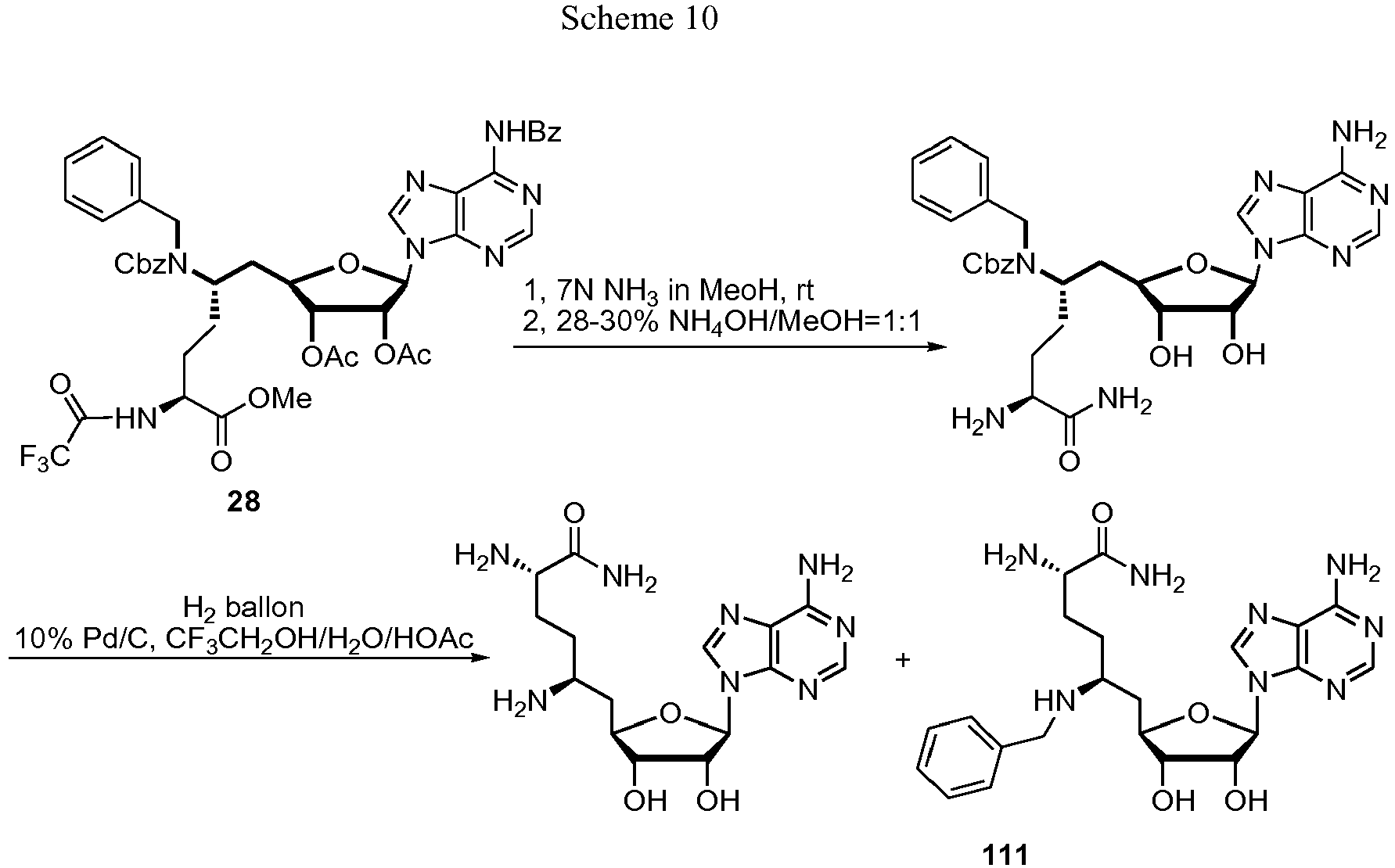

- Deazapurines were synthesized as shown in Scheme 12:

- In the deprotection Step 1. for 115d, a by-product was isolated in which the acetates were cleaved but the methyl ester was not. These were separated, and in a subsequent Step 2., the CBZ was cleaved and the allyl group was reduced to provide, in addition to the fully deprotected and reduced products 116a-116d, the methyl ester of the acid 116d, which is identified as 116e:

- Compounds in which n is 2 are synthesized as described in Scheme 13:

- Synthesis of 4a, 4b, 4c. To a stirred suspension of sodium hydride (60%, 86 mg, 2.1 mmol) in 5 mL THF at ambient temperature was added dropwise the solution of the urethane 3 (160mg, 0.36 mmol) in 20 mL THF. After the mixture was stirred for 1 h, the corresponding halides (2.1 mmol) were added (methyl/ethyl/ally iodide or benzyl bromide), followed by tetrabutylammonium iodide (10 mg). The resultant mixture was stirred for 20 h. The reaction was then quenched with saturated aqueous NH4Cl (20 mL) and volatile components in the mixture was removed under reduced pressure. This mixture was further extracted with ethyl acetate (3×30 mL). The combined organic phase was washed with brine and then dried with anhydrous Na2SO4. After removing volatile components, the crude mixture was purified by silica gel chromatography (hexane:EtOAc = 3:1 then 2:1) to yield Compounds 4a, 4b, 4c as colorless oil.
- 4a R = Me, 85% yield. [α]D 18.9 +7.83(c 1.30, CHCl3);1H-NMR (600 MHz, DMSO-d6 , 74°C): δ 1.25(s, 3H), 1.38(s, 3H), 1.60-1.64(m, 1H), 1.78-1.82(m, 1H), 2.17-2.21(m, 1H), 2.30-2.31(m, 1H), 2.75(s, 1H), 3.27(s, 3H), 3.96(dd, 1H, J= 10.4Hz, 4.2 Hz), 4.22-4.23(m, 1H), 4.54(d, 1H, J= 5.9 Hz), 4.56(d, 1H, J= 5.9 Hz), 4.85(s, 1H), 4.99(dt, 1H, J= 10.2Hz, 0.9 Hz), 5.05(d, 1H, J = 10.2 Hz), 5.09(d, 2H, J= 1.2 Hz) 5.63-5.72(m, 1H), 7.28-7.31(m, 1H), 7.33-7.36(m, 4H); 13C-NMR (125 MHz, CDCl3, rotamers): δ 24.61, 24.96, 26.41, 26.47, 36.77, 37.23, 37.35, 37.64, 55.15, 55.30, 66.89, 67.24, 83.75, 83.82, 84.38, 84.48, 85.55, 85.60, 109.86, 110.00, 112.26, 112.35, 117.24, 117.40, 127.65, 127.80, 127.87, 128.31, 128.41, 134.57, 134.89, 136.92, 137.07, 165.42, 165.74; MS(ESI) m/z: 428 [M+Na]+; HRMS: calculated for C22H31NO6Na ([M+Na]+) 428.2049, found 428.2036.
- 4b R = Et, 57% yield. [α]D 18.9 +3.38(c 0.87, CHCl3); 1H-NMR (600 MHz, DMSO-d6 , 74°C): δ 1.11(t, 3H, J= 7.0 Hz), 1.26(s, 3H), 1.38(s, 3H), 1.63-1.67(m, 1H), 1.89-1.91(m, 1H), 2.23-2.27(m, 1H), 2.35-2.40(m, 1H), 3.18-3.23(m, 2H), 3.27(s, 3H), 3.96-3.98(m, 1H), 4.01(dd, 1H, J = 10.7Hz, 3.6 Hz), 4.54(d, 1H, J= 6.2 Hz), 4.55(d, 1H, J= 5.9 Hz), 4.85(s, 1H), 4.99(dt, 1H, J= 10.2Hz, 1.0 Hz), 5.05(dd, 1H, J = 10.2Hz, 1.7 Hz), 5.10(s, 2H), 5.68-5.75(m, 1H), 7.29-7.31(m, 1H), 7.34-7.35(m, 4H); 13C-NMR (150 MHz, DMSO-d6 rotamers): δ 14.35, 15.22, 24.64, 26.25, 36.50, 37.05, 37.59, 38.10, 54.49, 65.78, 66.08, 83.24, 83.32, 83.75, 84.81, 109.08, 109.21, 111.33, 117.08, 117.20, 127.25, 127.36, 127.70, 128.30, 128.40, 135.39, 135.58, 137.04, 137.25, 155.21, 155.39; MS(ESI) m/z: 442 [M+Na]+ , HRMS: calculated for C23H33NO6Na ([M+Na] +) 442.2206, found 442.2206.
- 4c R = Bn, 86% yield. 1H-NMR (600 MHz, DMSO-d6 , 74°C): δ 1.23(s, 3H), 1.36(s, 3H), 1.61-1.66(m, 1H), 1.86-1.89(m, 1H), 2.22-2.26(m, 1H), 2.28-2.31(m, 1H), 3.22(s, 3H), 3.94-3.96(m, 2H), 4.33(s, 1H), 4.36-4.38(m, 2H), 4.48(d, 1H, J= 5.9 Hz), 4.54(d, 1H, J = 15.6 Hz), 4.83(s, 1H), 4.90(s, 1H), 4.92(d, 1H, J= 5.2 Hz), 5.14(s, 2H), 5.53-5.60(m, 1H), 7.23-7.24(m, 1H), 7.29-7.34(m, 9H); 13C-NMR (150 MHz, DMSO-d6 rotamers): δ24.65, 26.23, 36.45, 37.12, 37.46, 38.05, 54.51, 66.18, 66.60, 83.08, 83.21, 83.56, 84.75, 109.08, 111.27, 117.09, 126.96, 127.44, 127.56, 127.74, 128.23, 128.29, 135.16, 135.33, 136.80, 138.89, 155.30, 156.51; MS(ESI) m/z: 504 [M+Na]+.
- Synthesis of 5. To a stirred CH2Cl2 solution containing the alkene 4 (0.29 mmol) was bubbled a stream of ozone at -78 °C until the blue color persisted over 5min. After the solution was flushed with argon and turned transparent, triphenylphosphine (220 mg, 0.87 mmol) was added at -78 °C. The dry ice bath was then removed and the reaction mixture was allowed to warm up spontaneously at ambient temperature. The resultant reaction mixture was stirred until the ozonide intermediates disappeared (monitored by TLC, ~20h). Evaporation of the solvent under reduced pressure gave the crude aldehyde, which was purified by flash silica gel chromatography (hexane:EtOAc = 2:1 then 1:1) to yield the product as colorless oil. Without further storage, the intermediated aldehyde (around 0.22 mmol) was dissolved in 15mL ethanol and reacted with NaBH4 (10 mg, 0.29 mmol, added by batch) at 0 °C under argon. The reaction mixture was stirred at 0 °C for 20 min and then quenched with saturated aqueous NH4Cl solution (20 mL, added dropwise). The resultant mixture was diluted with 20 mL ethyl acetate. The organic phase was separated and the aqueous phase was further extracted with ethyl acetate (3×30 mL). The combined organic phase was washed with brine, dried with Na2SO4 and concentrated. The crude mixture was purified by a short column chromatography (hexane:EtOAc = 1:1 then 1:2) to give the corresponding alcohols 5a, 5b and 5c.
5b R = Et, 95% yield. [α]D 17.9 +1.38(c 1.17, CHCl3); 1H-NMR (600 MHz, DMSO-d6 74°C): δ 1.11(t, 3H, J = 7.0 Hz), 1.26(s, 3H), 1.38(s, 3H), 1.59-1.66(m, 2H), 1.80-1.83(m, 1H), 1.91-1.93(m, 1H), 3.20-3.27(m, 2H), 3.38(s, 3H), 3.40(q, 2H, J= 6.0 Hz), 3.97(br, 1H), 4.01(dd, 1H, J = 10.6Hz, 3.7 Hz), 4.10-4.11(m, 1H), 4.53(d, 1H, J = 6.0 Hz), 4.55(d, 1H, J = 6.0 Hz), 4.86(s, 1H), 5.09(s, 2H), 7.29-7.31(m, 1H), 7.34-7.36(m, 4H); 13C-NMR (150 MHz, DMSO-d6 rotamers): δ14.92, 24.66, 26.25, 37.11, 37.75, 54.41, 57.79, 57.86, 65.69, 66.02, 83.43, 83.75, 84.81, 109.04, 109.14, 111.30, 127.23, 127.68, 128.26, 128.40, 137.27, 155.45; MS(ESI) m/z: 446 [M+Na]+; HRMS: calculated for C22H33NO7Na ([M+Na]+) 446.2155, found 446.2148. - Synthesis of 6. To the solution of the primary alcohol 5(0.4 mmol) in 20 mL dry dichloromethane (DCM) was added triethyl amine (82 µL, 0.59 mmol) and then methanesulfonyl chloride (39 µL, 0.5 mmol) at 0°C. The resultant mixture was stirred at 0°C for additional 30 min, diluted with another 20 mL DCM, washed with 30 mL saturated aqueous NaHCO3 solution. The organic layer was separated. The aqueous phase was further extracted with DCM (3×20 mL). The combined organic phase was washed with brine and dried with anhydrous Na2SO4. After removing volatile components and without any purification, the crude methanesulfonate was redissolved with 25 mL acetone. To the resultant reaction mixture was added sodium bicarbonate (160 mg, 1.95 mmol), sodium sulfite (147 mg, 1.17 mmol) and sodium iodide (580 mg, 3.9 mmol). The suspension was heated to 50 °C and stirred for about 3 hr under argon. Upon the completion of the reaction, 20 mL water was added and the resultant mixture was concentrated under reduced pressure. The residual mixture was then extracted with ethyl acetate (3×30 mL). The combined organic phase was washed with brine and dried with anhydrous Na2SO4. Removal of the volatile components, followed by purification with silica gel chromatography (hexane:EtOAc = 4:1 then 3:1) yield the final product 6.
6 b R = Et, 70% yield. [α]D 17.9 -10.9(c 0.91, CHCl3); 1H-NMR (600 MHz, CDCl3, rotamers): δ 1.18-1.23(m, 3H), 1.30(s, 3H), 1.47(s, 3H), 1.59-1.63(m, 1H), 1.92-1.94(m ,0.4H), 2.00-2.04(m, 0.6H), 2.17(br, 0.4H), 2.43(br, 0.6H), 3.02-3.03(m, 0.4H), 3.09-3.13(m, 1H), 3.15-3.17(m, 0.6H), 3.23-3.30(m, 3H), 3.42(s, 2H), 4.12-4.19(m, 1H), 4.44(d, 0.4H, J = 5.8 Hz), 4.52(d, 0.6H, J = 5.8 Hz), 4.56(d, 0.4H, J = 5.8 Hz), 4.61(d, 0.6H, J = 5.8 Hz), 4.90(s, 0.4H), 4.96(s, 0.6H), 5.10-5.14(m, 1.6H), 5.19(d, 0.4H, J = 12.2 Hz), 7.31-7.38(m, 5H); 13C-NMR (150 MHz, CDCl3, rotamers): δ 14.92, 15.47, 25.10, 25.17, 26.63, 26.66, 37.50, 37.78, 38.53, 38.62, 55.78, 55.98, 67.00, 67.47, 83.82, 83.98, 84.59, 84.68, 85.72, 85.76, 110.24, 110.44, 112.45, 112.59, 127.89, 128.13, 128.40, 128.65, 128.72, 136.75, 136.99, 155.72, 156.33. MS (ESI) m/z: 556 [M+Na]+; HRMS: calculated for C22H32NO6NaI ([M+Na]+) 556.1172, found 556.1169. - Synthesis of 7. n-Butyllithum (500 µL, 1.6 M in hexane) was added dropwise to a stirred solution of (2R)-2,5-dihydro-2-isopropyl-3,6-dimethoxypyrazine(150 µL, 0.83 mmol) in 3 mL dry THF at -78°C under argon atmosphere. The resultant mixture was allowed to be stirred for additional 5 min. The obtained yellow solution was subsequently transferred via a double-tipped needle to stirred slurry of copper (I) cyanide (38 mg, 0.42 mmol) in 2 mL THF at -78°C under argon. This mixture was stirred at 0 °C for around 1.5 min to afford cyanocuprate as a tan colored solution. The reaction was then immediately cooled down to -78 °C. A solution of the iodide 6 (0.28 mmol) in 10 mL dry THF was then added dropwise. The reaction mixture was stirred at -78 °C for 30 min and then for 16 h at -25 °C under argon. The reaction was quenched by adding a 1:9 mixture of aqueous ammonia/saturated aqueous ammonium chloride (15 mL). The aqueous phase was further extracted with diethyl ether (3×20 mL). The organic layer was combined and then washed with the 1:9 mixtures of concentrated aqueous ammonia/saturated aqueous ammonium chloride, followed by brine, and then dried with anhydrous Na2SO4. After removing the volatile components with rotavapor, the crude product was purified by silica gel flash chromatography (hexane:EtOAc = 4:1 then 3:1) afforded the desired product 7 as colorless oil.
7b R = Et, 79% yield. [α]D 17.9 +6.75(c 1.01, CHCl3); 1H-NMR (600 MHz, DMSO-d6 , 64°C): δ 0.65(d, 3H, J= 6.8 Hz), 0.99(d, 3H, J= 6.8 Hz), 1.10(t, 3H, J = 7.0 Hz), 1.25(s, 3H), 1.37(s, 3H), 1.45-1.48(m, 1H), 1.50-1.60(m, 3H), 1.71-1.75(m, 1H), 1.82-1.85(m, 1H), 2.15-2.20(m, 1H), 3.14-3.19(m, 2H), 3.25(s, 3H), 3.60(s, 3H), 3.61(s, 3H), 3.89(t, 1H, J= 3.6 Hz), 3.98(dd, 1H, J= 10.8Hz, 4.0 Hz), 3.99-4.01(m, 2H), 4.53(d, 1H, J= 5.9 Hz), 4.55(d, 1H, J= 5.9 Hz), 4.86(s, 1H), 5.09(s, 2H), 7.30-7.31(m, 1H), 7.33-7.36(m, 4H); 13C-NMR (150 MHz, DMSO-d6 rotamers): δ 14.20, 15.17, 16.38, 19.01, 24.64, 26.23, 27.90, 30.73, 31.03, 37.52, 37.88, 52.07, 53.83, 54.03, 54.27, 59.77, 65.81, 66.13, 83.29, 83.41, 83.66, 83.70, 84.90, 109.05, 109.22, 111.32, 127.22, 127.60, 127.68, 128.21, 128.36, 136.97, 137.26, 155.52, 162.76, 163.03, 163.11; MS(ESI) m/z: 590 [M+H]+; HRMS: calculated for C31H48N3O8 ([M+H]+) 590.3441, found 590.3440. - Synthesis of 9. To a solution of the dihydropyrazine 7 (0.25 mmol) in 8 mL acetonitrile was added 6 mL 0.25 M aqueous HCl. This mixture was stirred for 2 hr at ambient temperature and then neutralized with 10 mL saturated aqueous NaHCO3 solution at 0 °C. The crude product was extracted with 20 mL ethyl acetate. The resultant aqueous phase was further extracted with ethyl acetate (3×20 mL). The combined organic layer was washed with brine, dried with anhydrous Na2SO4, and then concentrated under reduced pressure to give the corresponding crude α-amino methyl carboxylate 8. Without further purification, the α-amino methyl carboxylate was dissolved in 6 mL THF and cooled down to 0 °C. Saturated aqueous NaHCO3 solution of 0.4 mL was then added, followed by addition of 30 µL benzyl chloroformate. The resultant mixture was allowed to spontaneously warm up at ambient temperature and stirred for additional 8 hr. To the reaction mixture were added 20 mL ethyl acetate and 20 mL water. The organic layer was separated. The aqueous layer was further extracted with ethyl acetate (3×20 mL). The combined organic layer was washed with brine and dried with anhydrous Na2SO4. After removing volatile solvents, the crude reaction product was purified by silica gel flash chromatography on (hexane:EtOAc = 3:1 then 3:2) to afford 9.
9b R = Et, 78% yield. [α]D 17.9 +11.10 (c 1.21, CHCl3); 1H-NMR (600 MHz, DMSO-d6 at 64°C): δ 1.10(t, 3H, J = 7.0 Hz), 1.25(s, 3H), 1.38(s, 3H), 1.54-1.68(m, 5H), 1.83-1.85(m, 1H), 3.10-3.15(m, 1H), 3.16-3.21(m, 1H), 3.24(s, 3H), 3.62(s, 3H), 3.98(dd, 2H, J= 10.8Hz, 3.8 Hz),4.09-4.12(m, 1H), 4.53(d, 1H, J= 6.0 Hz), 4.55(d, 1H, J= 6.0 Hz), 4.85(s, 1H), 5.04(s, 2H), 5.10(d, 2H, J= 10.2 Hz), 7.29-7.37(m, 10H), 7.40(br, 1H); 13C-NMR (150 MHz, DMSO-d6 rotamers): δ14.11, 14.38, 15.30, 24.63, 26.25, 29.04, 37.21, 37.72, 51.89, 53.38, 54.35, 65.51, 65.91, 66.12, 83.20, 83.27, 83.73, 83.77, 84.83, 109.09, 109.22, 111.32, 111.35, 127.16, 127.26, 127.59, 127.72, 127.80, 127.89, 128.26, 128.38, 128.43, 136.93, 137.05, 137.24, 155.49, 156.18, 172.75, 172.81; MS(ESI) m/z: 651 [M+Na]+; HRMS: calculated for C33H44N2O10Na ([M+Na]+) 651.2894, found 651.2905. - Synthesis of 10. To a stirred solution of 9 (0.2 mmol) in 20 mL dioxane was added 4 M aqueous hydrochloric acid (5 mL, 20 mmol) at ambient temperature. The resultant mixture was stirred at ambient temperature for additional 40 h. The reaction was then quenched with saturated aqueous NaHCO3 at 0 °C and was concentrated under reduced pressure. The crude product was extracted with ethyl acetate (3×40 mL). The combined organic phase was dried with anhydrous Na2SO4. The corresponding crude triol product was obtained after removing volatile components under reduced pressure. The crude product was dissolved in 5 mL dry pyridine and cooled down to 0°C. Acetic anhydride (370 µL, 4mmol) was then added. The resultant reaction mixture was stirred at 0 °C at ambient temperature overnight, and then concentrated under reduced pressure at ambient temperature. After adding saturated NaHCO3 (30mL), the residual mixture was extracted with ethyl acetate (3×40 mL). The combined organic phase was washed with brine, dried with anhydrous Na2SO4. After removing volatile solvents with ratovapor, the crude product was purified by silica gel chromatography (hexane:EtOAc = 2:1 then 1:1) to yield the triacetate derivative of 10 as a 1'-anomeric mixture.
- Triacetate 10b R = Et, 62% yield. [α]D 17.9 +12.88 (c 0.94, CHCl3); 1H-NMR (600 MHz, DMSO-d6 , 74°C): δ 1.07(t, 3H, 7.0 Hz), 1.56-1.62(m, 3H), 1.64-1.69(m, 2H), 1.98-2.05(m, 1H), 2.00(s, 3H), 2.04(s, 3H), 2.07(s, 3H), 3.07-3.11(m, 1H), 3.16-3.21(m, 1H), 3.61(s, 3H), 3.92-3.94(m, 1J), 4.01-4.05(m, 1H), 4.05-4.07(m, 1H), 5.04-5.09(m, 5H), 5.26(dd, 1H, J = 5.1 Hz, 1.2 Hz), 6.02(d, 1H, J= 1.2 Hz), 7.29-7.32(m, 1H), 7.33-7.37(m, 10H); 13C-NMR (150 MHz, DMSO-d6 rotamers): δ14.11, 15.16, 20.24, 20.27, 20.36, 20.85, 27.75, 27.86, 29.09, 37.24, 37.63, 51.89, 53.57, 65.52, 65.99, 66.07, 73.58, 73.70, 73.95, 78.65, 78.84, 98.11, 127.27, 127.76, 127.79, 128.89, 128.31, 128.38, 128.43, 136.94, 137.01, 137.16, 155.38, 156.17, 168.97, 169.35, 169.62, 172.62, 172.69; MS(ESI) m/z: 723 [M+Na]+; HRMS: calculated for C35H44N2O13Na ([M+Na]+) 723.2741, found: 723.2770.
- Synthesis of 12. To an oven-dried flask was added N 6-benzoyladenine (44 mg, 0.18 mmol), hexamethyldisilazane (3mL) and then dry pyridine (1mL). The suspension was heated to 115 °C under argon to give a clear solution, which was stirred to 115 °C for additional 3 h. After removing volatile components to dryness, the residual volatile component was then coevaporated with toluene (3×5 mL). The mixture was subject to high vacuum for another 2 h. The resultant white solid was added to the solution of the triacetate derivative 10 as prepared above (0.037 mmol) and then dissolved in dry 1,2-dichloroethane (15 mL). The resultant suspension was treated with TMSOTf (33 µL, 0.18 mmol) dropwise under argon. The reaction mixture was heated at 50 °C for 2h, cooled down to ambient temperature, and then quenched with saturated aqueous NaHCO3 (20mL). The organic phase was separated, and the aqueous phase was further extracted with CH2Cl2 (3×20 mL). The organic phase was combined, washed with brine and the dried with anhydrous Na2SO4. After removing volatile components with ratovapor, the crude product was purified by silica gel chromatography (CH2Cl2:MeOH = 25:1) to give 12.
12b R = Et, 81 % yield. [α]D 17.7 +9.4 (c 0.86, CHCl3); 1H-NMR (600 MHz, DMSO-d6 , 74°C): δ 1.09(t, 3H, J= 7.1 Hz), 1.54-1.57(m, 2H), 1.61-1.66(m, 2H), 1.99-2.03(m, 1H), 2.02(s, 3H), 2.10-2.16(m, 1H), 2.14(s, 3H), 3.11(q, 1H, J = 7.1 Hz), 3.18(q, 1H, J = 7.1 Hz), 3.59(s, 3H), 3.92-3.94(m, 1H), 4.03-4.07(m, 2H), 5.03-5.10(m, 4H), 5.45(t, 1H, J= 7.2 Hz), 6.06(t, 1H, J= 5.4 Hz), 6.25(d, 1H, J= 5.4 Hz), 7.27-7.35(m, 11H), 7.54(t, 2H, J= 7.7 Hz), 7.63(t, 1H, J= 7.4 Hz), 8.05(d, 2H, J= 7.5 Hz), 8.63(s, 1H), 8.73(s, 1H), 10.85(br, 1H); 13C-NMR (150 MHz, DMSO-d6 rotamers): δ 14.00, 14.23, 15.18, 20.28, 20.43, 23.72, 24.31, 27.79, 28.26, 28.73, 29.06, 29.12, 30.73, 31.32, 35.54, 35.95, 36.23, 51.87, 53.61, 65.50, 65.97, 71.95, 73.25, 73.32, 79.07, 79.25, 85.76, 85.88, 126.07, 127.13, 127.30, 127.56, 127.75, 127.83, 128.19, 128.27, 128.35, 128.44, 128.53, 128.56, 132.58, 133.25, 136.83, 136.95, 137.17, 143.82, 143.97, 150.73, 151.79, 151.89, 155.42, 156.12, 165.68, 169.42, 169.59, 172.60, 172.67; MS (ESI) m/z: 902 [M+Na]+; HRMS: calculated for C45H50N7O12 ([M+H]+) 880.3517, found: 880.3541. - Synthesis of 100, 101 and 110. To a stirred solution of 12 (0.02 mmol) in methanol (10 mL) was added potassium carbonate (14 mg, 0.1 mmol). The resultant mixture was stirred at ambient temperature for 8h, concentrated to dryness and then redissolved in 10 mL water. To the mixture was added hydrazine monohydrate (5 µL, 0.1 mmol). The reaction was stirred for 8 h at ambient temperature, neutralized with 1M aqueous HCl and then concentrated under reduced pressure. This mixture was then dissolved in 6 mL ethanol: water (5:1). To this solution was added 20 µL acetic acid and palladium on activated carbon (15 mg, 10 wt%, wet Degussa type). The subsequent hydrogenation reaction was carried out with hydrogen balloon for 12 h. The reaction mixture was filtered through a short pad of Celite that was pre-washed with 20 mL MeOH and then 20 mL 0.1% TFA/water. The combined filtrates were concentrated under reduced pressure. The resultant crude product was purified by preparative reversed-phase HPLC (XBridge™ Prep C 18 5µm OBD™ 19×150mm) as the following: the 0∼10 % gradient of acetonitrile in aqueous trifluoroacetic acid (0.1%) in 10 min and a flow rate of 10 mL/min; The fractions containing desired compound was collected. The volatile solvents were removed by SpeedVac. The resultant solution was lyophilized to give the desired products 100, 101 and 110.
- 100 R = Et, 56% yield. 1H-NMR (600 MHz, MeOD): δ 1.11(t, 3H, J = 7.2 Hz), 1.93-1.97(m, 2H), 1.99-2.07(m, 2H), 2.23-2.27(m, 1H), 2.28-2.32(m, 1H), 3.05(q, 2H, J= 7.2 Hz), 3.46-3.48(m, 1H), 3.97(t, 1H, J=6.0 Hz), 4.19-4.22(m, 1H), 4.37(t, 1H, J=6.0 Hz), 4.70(dd, 1H, J = 5.4Hz, 3.8 Hz), 5.99(d, 1H, J= 3.8 Hz), 8.30(s, 2H); 13C-NMR (150 MHz, MeOD): δ 11.53, 26.99, 27.71, 33.51, 41.92, 53.75, 56.89, 74.57, 75.17, 80.91, 91.78, 118.09(q, J = 289.2 Hz), 121.12, 142.79, 150.26, 151.64, 156.02, 162.70(q, J= 35.4 Hz),171.77 ; MS(ESI) m/z: 410 [M+H]+; HRMS: calculated for C17H28N7O5 ([M+H]+) 410.2152, found 410.2142.
- 101 R = Me, 52% yield. 1H-NMR (600 MHz, MeOD): δ1.96-2.03(m, 2H), 2.05-2.08(m, 2H), 2.25-2.29(m, 2H), 2.64(s, 3H), 3.43-3.45(m, 1H), 3.99-4.03(m, 1H), 4.19-4.22(m, 1H), 4.36(t, 1H, J=5.9 Hz), 4.65(dd, 1H, J= 5.4Hz, 3.7 Hz), 6.01(d, 1H, J= 3.7 Hz), 8.35(s, 1H), 8.36(s, 1H); 13C-NMR (150 MHz, MeOD): δ 26.54, 27.60, 31.43, 33.55, 53.59, 58.23, 74.86, 75.01, 80.92, 91.85, 117.99(q, J = 289.7Hz ), 121.15, 143.44, 149.45, 150.10, 154.64, 162.57(q, J = 35.5 Hz),171.52; MS(ESI) m/z: 396 [M+H]+; HRMS: calculated for C17H28N705 ([M+H]+) 396.1995, found: 396.1982.
- 110 R = Bn, 30% yield. 1H-NMR (600 MHz, MeOD): δ 1.97-2.10(m, 4H), 2.31 (ddd, 1H, J = 15.8Hz, 5.8Hz, 3.2 Hz), 2.40-2.45(m, 1H), 3.57-3.59(m, 1H), 3.99(t, 1H, J=6.0 Hz), 4.12(d, 1H, J= 13.0 Hz), 4.20(d, 1H, .J = 13.0 Hz), 4.41(t, 1H, .J =6.0 Hz), 4.70(dd, 1H, J = 5.8Hz, 4.0 Hz), 5.49(s, 2H), 5.99(d, 1H, J= 3.8 Hz), 7.10(d, 2H, J= 7.2 Hz), 7.23(t, 2H, J= 7.2 Hz), 7.31(t, 1H, J= 7.2 Hz), 8.20(s, 1H), 8.33(s, 1H); 13C-NMR (150 MHz, MeOD): δ 27.09, 27.87, 32.45, 53.71, 54.96, 57.08, 74.33, 74.84, 80.98, 91.88, 121.22, 130.22, 130.55, 130.68, 132.26, 142.88, 150.14, 151.49, 155.86, 162.55(q, J= 35.4 Hz), 171.75; MS(ESI) m/z: 472 [M+H]+; HRMS: calculated for C22H30N705 ([M+H]+) 472.2308, found 472.2299.
- Synthesis of 13. A stream of ozone was bubbled through a stirred solution of the alkene 4 (0.64 mmol) in a 30 mL mixture of 1:1 methanol and CH2Cl2 at -78°C until blue color persisted over 5 min. Then the solution was flushed with argon until it became clear, dimethyl sulfide (1 mL) was added into the solution at -78°C. After removing the dry ice bath, the reaction mixture was allowed to warm up spontaneously at ambient temperature and was then stirred overnight. Evaporation of the volatile chemicals under reduced pressure gave the crude acetal, which was purified by flash silica gel chromatography (hexane:EtOAc = 2:1 then 1:1) to yield Compound 13 as colorless oil (215 mg, 77% yield).
13 [α]D 16.6 -7.2(c 1.14, CHCl3); 1H-NMR (500 MHz, CDCl3): δ1.31(s, 3H), 1.48(s, 3H), 1.72-7.74(m, 1H), 1.76-1.81(m, 1H), 1.84-1.86(m, 2H), 3.30(s, 3H), 3.33(s, 3H), 3.36(s, 3H), 3.98-4.02(m, 1H), 4.32(dd, 1H, J= 10.6Hz, 3.6 Hz), 4.47(t, 1H, J= 5.5 Hz), 4.55(d, 1H, J= 5.9 Hz), 4.60 d, 1H, J = 5.9 Hz), 4.97(s, 1H), 5.10(d, 1H, J= 1.4 Hz), 5.18(d, 1H, J = 9.2 Hz), 7.31-7.36(m, 5H); 13C-NMR (125 MHz, CDCl3): δ24.97, 26.47, 37.78, 39.82, 45.90, 52.65, 53.46, 55.32, 66.52, 83.87, 84.57, 85.44, 102.45, 110.09, 112.35, 128.02, 128.08, 128.46, 136.69, 155.82; MS(ESI) m/z: 462 [M+Na]+; HRMS: calculated for C22H33NO8Na ([M+Na] +) 462.2104, found 462.2089. - Compound 14 was synthesized through the procedure for intermediate 4 using allyl iodide.
56% yield. [α]D 17.5 +7.8(c 1.93, CHCl3); 1H-NMR (500 MHz, CDCl3): δ1.31(s, 3H), 1.48(s, 3H), 1.72-7.74(m, 1H), 1.76-1.81(m, 1H), 1.84-1.86(m, 2H), 3.30(s, 3H), 3.33(s, 3H), 3.36(s, 3H), 3.98-4.02(m, 1H), 4.32(dd, 1H, J= 10.6Hz, 3.6 Hz), 4.47(t, 1H, J= 5.5 Hz), 4.55(d, 1H, J= 5.9 Hz), 4.60 d, 1H, J = 5.9 Hz), 4.97(s, 1H), 5.10(d, 1H, J= 1.4 Hz), 5.18(d, 1H, J = 9.2 Hz), 7.31-7.36(m, 5H); 13C-NMR (125 MHz, CDCl3): δ24.97, 26.47, 37.78, 39.82, 45.90, 52.65, 53.46, 55.32, 66.52, 83.87, 84.57, 85.44, 102.45, 110.09, 112.35, 128.02, 128.08, 128.46, 136.69, 155.82; MS(ESI) m/z: 502 [M+Na]+; HRMS: calculated for C25H37NO8Na ([M+Na]+) 502.2417, found 502.2404. - Synthesis of 15. A solution of the acetal 14 (170 mg, 0.36 mmol) and iodine (9 mg, 0.035 mmol) in 15 mL acetone (ACS reagent, ≤0.5% H2O) was stirred at room temperature for 20 min. The reaction process was carefully monitored by TLC (CH2Cl2/MeOH = 15:1). When most of the starting material (∼90%) was consumed, the reaction was quenched with 5% aqueous Na2S2O3 (5 mL). The reaction mixture was concentrated under reduced pressure and then diluted with 50mL ethyl acetate. The mixture was washed with 20 mL H2O and then 20 mL brine. The resultant organic layer was dried with anhydrous Na2SO4. The solvent was removed to give the crude aldehyde. Without further purification, the aldehyde product was reduced with NaBH4 as described for 5. After flash chromatography workup (hexane:EtOAc = 1:1 then 1:2), 15 was obtained in 79% yield (12 mg acetal 7 was recovered).
15 [α]D 17.5 +14.7(c 1.08, CHCl3); 1H-NMR (600 MHz, DMSO-d6 at 74°C): 1.25(s, 3H), 1.38(s, 3H), 1.60-1.65(m, 2H), 1.80-1.85(m, 1H), 1.88-1.92(m, 1H), 3.27(s, 3H), 3.38(q, 2H, J= 6.0 Hz), 3.77(dt, 1H, J = 6.2Hz, 1.2 Hz), 3.79(dt, 1H, J = 6.2Hz, 1.2 Hz), 4.01(dd, 1H, J = 10.4Hz, 4.2 Hz), 4.05(br, 1H), 4.08(t, 1H, J = 4.8 Hz), 4.51(d, 1H, J = 6.0 Hz), 4.54(d, 1H, J= 6.0 Hz), 4.85(s, 1H), 5.08(dd, 1H, J = 10.2Hz, 1.4 Hz), 5.10(s, 2H), 5.17(dd, 1H, J = 17.2Hz, 1.2 Hz), 5.83-5.89(m, 1H), 7.30-7.31(m, 1H), 7.34-7.37(m, 4H); 13C-NMR (150 MHz, DMSO-d6 rotamers): δ 25.08, 26.60, 36.09, 37.81, 55.56, 58.90, 67.64, 76.97, 77.23, 77.48, 83.75, 84.55, 85.68, 110.16, 112.44, 117.54, 128.00, 128.20, 128.66, 135.18, 136.62, 156.54, 157.39; MS(ESI) m/z: 458 [M+Na]+; HRMS: calculated for C23H33NO7Na ([M+Na]+) 458.2155, found 458.2156. - Compound 16 was obtained from 15 by a series of steps analogous to steps 5 →12 of Scheme 1.
16 98% yield. [α]D 17.7 +4.90 (c 1.15, CHCl3); 1H-NMR (600 MHz, DMSO-d6 , 64°C): δ 1.52-1.54(m, 2H), 1.62-1.65(m, 2H), 1.99-2.06(m, 1H), 2.03(s, 3H), 2.10-2.16(m, 1H), 2.11(s, 3H), 3.59(s, 3H), 3.69(dd, 1H, J = 15.8Hz, 6.4 Hz), 3.81(dd, 1H, J = 15.8Hz, 6.4 Hz), 4.03-4.09(m, 3H), 5.03-5.09(m, 5H), 5.14(d, 1H, J= 17.2 Hz), 5.44(t, 1H, J= 5.2 Hz), 5.80-5.87(m, 1H), 6.07(t, 1H, J= 5.6 Hz), 6.25(d, 1H, J= 5.5 Hz), 7.28-7.35(m, 10H), 7.42(br, 1H), 7.55(t, 2H, J= 7.9 Hz), 7.64(t, 1H, J= 7.4 Hz), 8.05(d, 2H, J= 7.4 Hz), 8.64(s, 1H), 8.74(s, 1H), 10.93(s, 1H); 13C-NMR (150 MHz, DMSO-d6 rotamers): δ 20.23, 20.37, 27.71, 28.98, 30.68, 35.53, 51.82, 53.55, 65.48, 66.19, 66.26, 71.97, 73.09, 73.20, 79.15, 85.71, 85.83, 116.89, 126.02, 127.09, 127.29, 127.71, 127.80, 128.16, 128.31, 128.48, 128.51, 132.52, 133.25, 136.70, 136.92, 143.73, 143.89, 150.70, 151.77, 151.85, 155.63, 156.08, 165.64, 169.35, 169.47, 172.61; MS (ESI) m/z: 914 [M+Na]+; HRMS: calculated for C46H50N7O12 ([M+H]+) 892.3517, found: 892.3495. - Compound 102 was obtained from 16 by the procedure described for conversion of 12 to 100 above and in Scheme 1.
102 1H-NMR (500 MHz, MeOD): δ 0.83(t, 3H, J= 7.4 Hz), 1.42-1.49(m, 1H), 1.52-1.59(m, 1H), 1.94-2.09(m, 4H), 2.21-2.26(m, 1H), 2.29-2.35(m, 1H), 2.92(t, 2H, J= 8.0 Hz) 3.44-3.48(m, 1H), 4.01(t, 1H, J =6.0 Hz), 4.19-4.22(m, 1H), 4.40(t, 1H, J =6.0 Hz), 4.67(dd, 1H, J = 5.4Hz, 3.4 Hz), 6.02(d, 1H, J= 3.4 Hz), 8.35(s, 1H), 8.36(s, 1H); 13C-NMR (150 MHz, MeOD): δ 11.20, 20.77, 27.05, 27.64, 33.32, 48.23, 53.54, 57.29, 74.83, 75.16, 80.91, 91.90, 117.92 (q, J = 289.4 Hz),121.11, 143.47, 149.35, 150.09, 154.55, 162.44(q, J = 35.8 Hz),171.50; MS(ESI) m/z: 424 [M+H]+; HRMS: calculated for C18H30N7O5 ([M+H]+) 424.2308, found 424.2296. - The synthesis of 23 ( as shown in Scheme 6). To a solution of oxazolidinone 1 (2.0g, 4.5mmol) in dry diethyl ether (60mL) was added anhydrous ethanol (316µL, 5.4mmol) and LiBH4 (2.0M in THF, 2.7mL, 5.4mmol) at 0°C. The reaction was stirred for 30 min and allowed to warm to room temperature and stirred for additional 3h under argon. The reaction was quenched slowly with aqueous sodium hydroxide (1.0M, 40mL) and allowed to stir until both layers were clear. The aqueous phase was separated and extracted with ethyl acetate (40mL×3). All the organic layers were combined, washed with brine and dried over MgSO4. After the removal of organic solvent, the residue was purified by flash silica gel chromatography (hexane: EtOAc = 2:1) to give an intermediate alcohol as a colorless oil (1.0g, 3.68mmol, 82% yield).
1H-NMR (500 MHz, CDCl3): δ 1.30(s, 3H), 1.47(s, 3H),1.53-1.58(m, 1H), 1.61-1.67(m, 1H), 1.82-1.87(m, 2H), 2.08-2.14(m, 1H), 2.16-2.22(m, 1H), 3.35(s, 3H), 3.62(dd, 2H, J = 7.9Hz, 5.0Hz), 4.32(dd, 1H, J = 10.0Hz, 5.3Hz), 4.52(d, 1H, J = 5.9Hz), 4.60(d, 1H, J = 5.9Hz), 4.93(s, 1H), 5.01-5.08(m, 2H), 5.74-5.81(m, 1H);13C-NMR (125 MHz, CDCl3): δ 24.98, 26.52, 35.90, 36.02, 37.38, 55.32, 64.42, 76.78, 77.03, 77.28, 84.69, 84.88, 85.45, 109.95, 112.29, 116.63, 136.55; MS(ESI) m/z: 295 ([M+Na]+ ; HRMS: calculated for C14H24NO5Na ([M+Na] +) 295.1521, found 295.1529. - To the solution of alcohol (600mg, 2.2nnol) in dichloromethane (30mL) was added NaHCO3 (1.8g, 22mmol) and Dess-Martin periodinane (1,1,1-triacetoxy-1,1-dihydro-1,2-benziodoxol-3(1H)-one) (1.12g, 2.64mmol) at 0°C. The suspension was stirred for 40min at room temperature under nitrogen. The solution of Na2S2O3 (2.0M, 2mL) and saturated aqueous NaHCO3 solution (10mL) was added to above suspension and stirred for 15min. The system was diluted with water (20mL) and separated. The aqueous phase was extracted with dichloromethane (30mL×3). All the organic layers were combined and washed with brine and dried over Na2SO4. After the concentration on rotavapor at room temperature, the crude aldehyde 22 was used to next run directly (Note: the concentrated aldehyde may decompose over time at room temperature).
- The aldehyde 22 was dissolved in dry 1,2-dichloroethane (20mL) and benzylamine (252µL, 2.3mmol), and sodium triacetoxyborohydride (653mg, 3.1mmol) were added in turn. The suspension was stirred at room temperature under a nitrogen atmosphere for 2 hours. TLC analysis showed the reaction had completed. The reaction mixture was quenched by adding aqueous saturated NaHCO3 (20mL). After the separation, the aqueous phase was extracted with dichloromethane (30mL×3). The combined organic solvent was washed with brine and dried over MgSO4. The crude compound was obtained after concentration, redissoved in THF (25mL) and cooled down to 0°C. Saturated NaHCO3 (5mL) was added to above solution followed by benzyl chloroformate (400µL, 3.3mmol). The suspension was allowed to warm to room temperature spontaneously and stirred for 12 h. The mixture was diluted with water (30mL) and extracted with ethyl acetate (40mL×3). The combined organic layers were washed with brine, then dried over anhydrous Na2SO4 and evaporated. The residue was purified by silica gel chromatography (hexane: EtOAc = 4:1∼2:1) to furnish compound 23 as colorless oil (671mg, 61% over 3 steps)
Compound 23 [α]D 18.6 -13.6 (c 0.98, CHCl3); 1H-NMR (600 MHz, DMSO-d6 , 74°C): δ 1.26(s, 3H), 1.37(s, 3H), 1.38-1.42(m, 1H), 1.48-1.52(m, 1H), 3.20-3.24(m, 2H), 3.22(s, 3H), 4.08(t, 1H, J = 7.5Hz), 4.38(d, 1H, J = 5.8Hz), 4.48(d, 2H, J = 2.3Hz), 4.50(d, 1H, J = 5.8Hz), 4.84(s, 1H), 4.96-4.99(m, 2H), 5.13(s, 1H), 5.67-5.72(m, 2H), 7.23-7.27(m, 3H), 7.30-7.34(m, 7H); 13C-NMR (150 MHz, DMSO-d6 rotamers): δ 24.72, 26.30, 32.78, 33.02, 36.25, 49.74, 50.02, 50.21, 50.42, 54.47, 65.39, 66.38, 66.55, 83.64, 83.94, 84.04, 84.77, 84.83, 108.95, 111.31, 11672, 116.86, 127.01, 127.10, 127.16, 127.48, 127.68, 127.78, 127.83, 128.29, 128.37, 128.48, 128.51, 136.10, 136.26, 136.86, 138.15, 155.90, 156.11; MS(ESI) m/z: 518 ([M+Na]+); HRMS: calculated for C29H37NO6Na ([M+Na] +)518.2519, found 518.2522. - Compounds 201 and 202 were synthesized from intermediate 23, via intermediate 24, as shown in Scheme 6.
Compound 201 1H-NMR (500 MHz, D2O): δ 1.49-1.55(m, 2H), 1.84-1.97(m, 5H), 2.96(dd, 1H, J=12.8Hz, 6.9Hz), 3.05(dd, 1H, J=12.8Hz, 5.4Hz), 3.82(t, 1H, J=6.0Hz), 3.99-4.03(m, 1H), 4.19-4.22(m, 1H), 4.36(t, 1H, J = 5.9Hz), 4.65(dd, 1H, J = 5.4Hz, 3.7Hz), 6.01(d, 1H, J = 3.7Hz), 8.35(s, 1H), 8.36(s, 1H); 13C-NMR (150 MHz, D2O): δ 25.84, 26.88, 33.12, 33.65, 41.94, 53.79, 73.35, 81.18, 88.81, 115.28, 116.25(q, J = 289.8Hz), 119.02, 142.76, 144.67, 148.17, 150.08, 162.97(q, J = 35.2Hz),173.33; MS(ESI) m/z: 396 [M+H]+; HRMS: calculated for C16H25N7O5 ([M+H]+) 396.1995, found: 396.1982. - Compound 202 1H-NMR (600 MHz, MeOD): δ 1.46-1.56(m, 2H), 1.76-1.80(m, 1H), 1.83-1.91(m, 2H), 1.92-2.03(m, 2H), 2.94-3.00(m, 1H), 3.82(t, 1H, J= 7.0Hz), 3.95(d, 1H, J = 13.0Hz ), 3.98-4.00(m, 1H), 4.04(d, 1H, J= 13.0Hz ),4.08(t, 1H, J = 5.7Hz), 4.49(dd, 1H, J = 5.4Hz, 4.0Hz), 5.84(d, 1H, J= 4.0Hz), 7.12(t, 2H, J= 7.4Hz), 7.20(t, 2H, J= 7.4Hz), 7.25(d, 1H, J= 7.4Hz), 8.09(s, 1H), 8.16(s, 1H); 13C-NMR (150 MHz, MeOD): δ 27.90, 28.72, 34.32, 34.69, 52.07, 53.01, 54.07, 74.88, 75.36, 82.07, 91.65, 121.19, 130.37, 130.83, 130.90, 132.10, 142.68, 150.18, 151.31, 162.40(q, J = 35.4Hz),171.94; MS(ESI) m/z: 486 [M+H]+; HRMS: calculated for C23H32N7O5 ([M+H]+) 486.2465, found:486.2464.
- Compound 31(Scheme 8) was derived from intermediate 40 in a similar way to the preparation of compound 27 in scheme 7.
Compound 31 [α]D 18.3 -5.2 (c 0.93, CHCl3); 1H-NMR (600 MHz, DMSO-d6 , 84°C) δ 1.31-1.39(m, 2H), 1.64-1.67(m, 1H), 1.75-1.80(m, 1H), 1.81-1.88(m, 2H), 1.92-1.95(m, 1H), 2.04(s, 3H), 2.10(s, 3H), 3.13-3.16(m, 1H), 3.23-3.26(m, 1H), 3.66(s, 3H), 4.15-4.18(m, 1H), 4.24-4.28(m, 1H), 4.39(d, 1H, J = 15.6Hz), 4.45(d, 1H, J= 15.6Hz), 5.10(d, 2H, J= 5.5Hz), 5.41(t, 1H, J = 5.6Hz), 6.04(t, 1H, J = 5.6Hz),6.23(d, 1H, J = 5.6Hz), 7.12-7.13 (m, 2H), 7.22-7.31(m, 8H), 7.54(t, 2H, J= 7.6Hz), 7.63(t, 1H, J= 7.4Hz), 8.04(d, 2H, J= 7.6Hz), 8.59(s, 1H), 8.71(s, 1H), 9.39(d, 1H, J= 6.4Hz), 10.76(s, 1H); 13C-NMR (150 MHz, DMSO-d6 rotamers): δ 20.25, 20.38, 20.42, 26.70, 27.48, 30.72, 32.41, 32.81, 34.25, 52.29, 52.82, 54.94, 66.38, 66.52, 71.89, 73.17, 79.17, 85.75, 85.85, 115.77(q, J= 286.1Hz),, 126.01, 126.90, 127.12, 127.28, 127.39, 127.51, 127.79, 128.29, 128.32, 128.43, 128.52, 128.54, 132.57, 133.23, 136.77, 137.85, 143.88, 150.71, 151.80, 151.85, 155.87, 156.59(q, J = 36.4Hz)" 165.67, 169.40, 169.51, 169.60, 170.92; MS(ESI) m/z: 940 ([M+Na]+ ; HRMS: calculated for C45H47N7O11F3 ([M+Na] +)918.3286, found 918.3311. - A suspension of 20% palladium hydroxide on activated carbon (25mg) in a solution of compound 31 (20mg) in trifluoroethanol (10mL) was stirred under hydrogen balloon at room temperature for 16 h. After this period, the mixture was filtered though a pad of Celite, which was washed with methanol (40mL). The combined filtrates were concentrated and redissolved in dichloromethane (5mL). 1,3-Di-Boc-2-methylisothiourea (8.2mg, 0.028mmol) and triethylamine(8µL, 0.06mmol) was added to above solution, followed by the solution of mercury(II) chloride (7mg, 0.028mmol) in THF (100µL). The resulting clear solution was turned to cloudy after stirring at room temperature for approximately 15min. The mixture was attired for additional 2h and filtered through a short pad of Celite, and the Celite pad was washed with dichloromethane (30mL). The combined filtrates were concentrated under reduced pressure give a residue which was chromatographed over silica gel (DCM: MeOH = 30:1) to afford compound 33(12mg).
- To the solution of compound 33 (12mg) in methanol (5mL) was added 0.2 M lithium hydroxide (1.2mL). The resulting solution was stirred at room temperature overnight and then concentrated. The residue was dissolved in water (3mL) and hydrazine monohydrate (3.1µL) was added. The reaction mixture was stirred for 6 h at room temperature and water was removed by lyophilization. The residue was treated with 1.5mL TFA: H2O (9:1) for 1 h at room temperature. After this period, the reaction system was diluted with water (10mL), then freeze-fried. The residue of 204 was dissolved in water (2 mL) and purified as described for compound 100.
Compound 204 1H-NMR (500 MHz, MeOD): δ 1.58-1.62(m, 2H), 1.88-2.06(m, 5H), 3.20(t, 1H, J = 1.8Hz), 3.94(t, 1H, J = 5.8Hz), 4.11-4.15(m, 1H), 4.25(t, 1H, J = 5.7Hz), 4.75(dd, 1H, J= 5.4Hz, 4.0Hz), 6.00(d, 1H, J= 4.0Hz), 8.30(s, 1H), 8.31(s, 1H); MS(ESI) m/z: 438 [M+H]+; HRMS: calculated for C17H28N9O5 ([M+H]+) 438.2213, found: 438.2210. - Synthesis of 300 as depicted in Scheme 13: To the solution of alkene (100mg, 021mmol) and protected vinyl glycine (100mg, 0.42mmol) in dry dichloromethane (20mL) was added Grubbs 2nd catalyst (35mg, 0.041mmol) under argon. The resulting dark brown solution was sealed and heated to reflux for 6 hr and cooled down to room temperature. The system was concentrated and purified through silica gel column (hexane: EA = 4:1 to 3:1) to yield cross coupling product 41 (60mg, 41%).1H NMR (CDCl3, 500MHz, rotamers): δ 1.27(s, 3H), 1.46(s, 3H), 1.62-1.64(m, 1H), 1.78-1.82(m, 0.4H), 2.00-2.10(m, 0.6H), 2.14-2.17(m, 0.4H), 2.20-2.24(m, 0.6H), 2.28-2.38(m, 1H), 3.21(s, 1.3H), 3.30(s, 1.7H), 3.70(1.7H), 3.72(s, 1.3H), 4.08-4.11(m, 0.4H), 4.12-4.15(m, 0.6H), 4.25-4.35(m, 1.4H),4.41(d, 0.6H, J = 5.0Hz), 4.47(d, 0.4H, J= 5.0Hz), 4.54((d, 0.6H, J= 5.0Hz), 4.63-4.71(m, 2H), 4.87(s, 0.4H), 4.92(s, 0.6H), 5.10-5.23(m, 5.5H), 5.37-5.44(m, 1.5H), 7.26-7.35(m, 15H); 13C NMR (CDCl3, 600MHz, rotamers): δ 14.40, 21.26, 25.02, 25.08, 26.60, 29.90, 52.75, 52.83, 55.37, 55.51, 55.60, 55.70, 60.61, 67.25, 67.76, 83.93, 84.03, 84.26, 84.39, 85.60, 85.65, 110.10, 110.28, 112.39, 112.47, 126.50, 127.62, 128.08, 128.16, 128.36, 128.42, 128.49, 128.66, 128.68, 128.73, 128.77, 131.56, 136.35, 136.64, 136.70, 138.56, 155.61, 155.67, 157.22, 171.38; MS(ESI): 703([M+H]+)
- The compound 37 was converted to its fully-protected form as previously described. HRMS: calculated for C51H52N7O12 ([M+H]+) 954.3674, found 954.3672. The deprotection was carried out through hydrogenolysis and basic treatment to give the final compound 300. 1H-NMR (600 MHz, MeOD): δ 1.65-1.70(m, 2H), 1.96-2.08(m, 4H), 2.25-2.29(m, 2H), 3.43-3.45(m, 1H), 3.99-4.03(m, 1H), 4.19-4.22(m, 1H), 4.36(t, 1H, J = 5.9Hz), 4.65(dd, 1H, J = 5.4Hz, 3.7Hz), 6.00(d, 1H, J = 3.7Hz), 8.35(s, 1H), 8.36(s, 1H);MS (ESI): 396([M+H]+); HRMS: calculated for C16H26N7O5 ([M+H]+) 396.1995, found 396.1982.
- The compounds described above were tested as described below:
- Methylation Reaction. The 20 µL methylation reaction was carried out at ambient temperature using two mixtures: A. 10 µl of enzyme mixture in the assay buffer containing 50 mM Hepes (pH=8.0), 0.005% Tween-20, 5µg/ml BSA and 1mM TCEP; B. 10 µl of a mixture of 1.5 µM, 0.15 µCi [3H-Me]-SAM cofactor and 3 µM of the corresponding peptide substrate in the same assay buffer. After A and B were mixed for a designated time period, the reaction mixture was examined with our filter-paper assay.
- Conditions for the enzymes:
Enzyme [Enzyme mixture] (nM) [Enzyme]final (nM) Peptite Substrate Reaction Time (h) G9a (913-1913) 40 20 H3 (1-21 aa) 1 GLP1 (951-1235) 20 10 H3 (1-21 aa) 1 SUV39H2 (112-410) 10 5 H3 (1-21 aa) 4 SET7/9 Full-length 300 150 H3 (1-21 aa) 3 PRMT1 (10-352) 200 100 RGG 1.5 PRMT3 (211-531) 200 100 RGG 3 CARM1 (19-608) 600 300 H3 (1-40 aa) 7 SET8 (191-352) 2000 1000 H4 (10-30 aa) 8 SETD2 (1357-1711) 500 250 H3 (20-20 aa) 4 SMYD2 Full-length 100 50 p53 (360-393 aa) 10 H3 (1-21-aa): ARTKQTARKSTGGKAPRKQLA (SEQ ID NO: 1)
RGG: GGRGGFGGRGGFGGRGGFG (SEQ ID NO: 2)
H3 (1-40 aa): ARTKQTARKSTGGKAPRKQLATKAARKSAPATGGVKKPHR (SEQ ID NO: 3)
H4 (10-30 aa): LGKGGAKRHRKVLRDNIQGIT (SEQ ID NO: 4)
H3 (20-50 aa): ATKAARKSAPATGGVKKPHRYRPGTVALRE (SEQ ID NO: 5)
p53 (360-393 aa): GGSRAHSSHLKSKKGQSTSRHKKLMFKTEGPDSD (SEQ ID NO: 6) - Filter-paper Assay. This assay relies on Whatman P-81 filter paper, which binds peptides but not SAM. Protein Methyl Transferases (PMTs) transfer 3H-Me of [3H-Me]-SAM to peptide substrates and the resultant 3H-methylated, filter-paper-bound peptide is quantified with a scintillation counter. Briefly, 6 µl of the methylation reaction was spotted onto Whatman P-81 phosphocellulose filter paper (1.2 x 1.2 cm2) to immobilize the 3H-labeled peptide. After drying in air for 20 min, the filter paper was immersed into 20 mL of 50 mM Na2CO3/NaHCO3 buffer (pH=9.2), and washed 5 times for 10 min each time. The washed filter paper was then transferred to a 20 ml scintillation vial containing 1 mL of distilled water and 10 mL of Ultima Gold scintillation cocktail or 7 mL scintillation vial containing 0.5 mL od distilled water and 5 mL of scintillation cocktail (PerkinElmer). The radioactivity was quantified by a Beckman LS6000IC liquid scintillation counter.
- Dose-response Curves and IC50. Twice the PMT concentration was incubated for 10 min with varied concentration of inhibitors (0.1 - 400 µM stocks), into which 10 µl of the PMT peptide substrate and radioactive cofactor (3 µM of the corresponding peptide and 1.5 µM, 0.15 µCi [3H-Me]-SAM) were added. After incubating the reaction mixture for the respective reaction time, the conversion was quantified with the filter paper assay as described above. The inhibition was expressed as the percentage between the high control (no inhibition) and the low control (no enzyme) as follows: Percentage Inhibition = [(high control - reading)/(high control - low control)] ×100%. Each experiment was performed in triplicate. The IC50 values were obtained by fitting inhibition percentage versus inhibitor concentration using GraphPad Prism5 software.
- Cellular Assay: HEK-293T cells were grown in DMEM plus 10% FBS and maintained in a humidified incubator set to 37 °C, 5% CO2. For assessment of the inhibitor effect, cells were plated in 6-well plate at a density of 0.5 × 10⁶ cells/well in 2 mL of media. The following day the media was removed and replenish with 2 mL of increasing concentrations of PropylSinefungin up to 100 µM. Cell were harvested after 24 h and proceed to do the histone extraction (see below). 8 µg of the histones were separated on 18% Tris-HCl gels (BIO-RAD), transferred to 0.2 µM PVDF membranes and blotted with histone 3 lysine 36 tri-methyl antibody (Abcam) or H3 (Millipore) as a loading control.
- Histone Extraction: The nuclear pellet and cytoplasm extract were obtained using the Cell Lytic ™ NuCLEAR Extraction Kit (SIGMA). Then 40 µL of cold 0.2 M Sulfuric Acid were added and incubate overnight at 4°C. Then, the samples were centrifuge at 11000 × g for 1 min and the supernatant containing the histones was collected. The concentration was measured using Quick Start™ Bradford 1x Dye Reagent (BIO-RAD).
- The results are shown in the following table, in which S-adenosyl homocysteine (SAH) and sinefungin (SIN) are controls:
Compd No. G9a GLP1 SET7/9 SET8 SETD2 PRMT1 PRMT3 SUV39 H2 CARM 1 SMYD2 -FL SAH 6.7 0.7 >100 >100 3.0 8.6 39.5 0.6 1.9 -50 SIN 18.9 32.0 1.1 >100 28.4 1.0 28.2 4.6 0.5 0.2 100 >500 >500 1.7 >100 8.2 55 37.9 95.7 1.4 0.2 101 164.6 373.7 1.4 >100 125.2 83.9 76.2 43.2 1.7 0.5 102 >100 >100 2.2 >100 0.8 9.5 ∼100 9.8 3.0 0.5 103 >100 >100 12.6 >100 2.9 >50 ∼70 ∼100 9.9 0.3 104 32 >100 14.8 >100 11.3 29.9 0.9 16 1.1 3.6 105 >100 >100 16.6 >100 5.2 1.9 1.9 13.3 0.09 TBD 106 >50 37.4 33.3 >100 <1.5 3.7 TBD 37.5 0.06 TBD 107 >100 >100 >100 >100 >100 >100 >100 >100 ∼50 ∼50 109 >100 >100 0.19 >100 37 2 1.8 33 0.05 1.7 110 >100 >100 >100 >100 0.5 >100 5.1 >100 22.4 4 111 >100 >100 >100 >100 46.5 >100 33 >100 ∼80 >100 116a >100 >100 0.7 >100 >100 >100 >100 >100 >100 2.5 116b >100 >100 0.2 >100 >100 >100 >100 >100 >100 3 116c >100 >100 0.4 >100 >100 >100 >100 >100 >100 3 116d >100 >100 1.1 >100 >100 >100 >100 >100 61.4 <0.5 116e >100 >100 10.3 >100 ∼100 >100 9.7 >100 42 9 201 >100 >100 27.6 >100 136.1 2.5 13.1 24.5 0.1 <0.2 202 >100 >100 >100 >100 10.8 15.25 3.4 10.1 0.09 1.6 203 ∼25 ∼12.5 9.6 21.8 4.2 >100 7.6 10.7 5.2 1 204 32 24.2 34.8 >100 24.4 1.9 0.7 8.6 0.02 0.2 205 >100 >100 >100 >100 67.9 ∼50 9.4 TBD 32.7 ∼12.5 300 ∼100 ∼100 ∼70 ∼70 21.2 18.75 9.9 35.13 4.4 37 - Compounds that show selective inhibition of one or a few families of PMTs are of greater interest as candidates for use in therapy, since it is believed that broad spectrum inhibition is likely to be associated with a higher probability of side effects. In this regard, compounds described above as 201, 202, 204, 109, 105 and 106 are of interest because of their apparent selectivity - among the subset of PMTs screened - for CARM1 inhibition. Analogously, the deazapurines (116a, 116b and 116c) appear to be selective for SET7/9.
- Compound 102, which, along with 110, is selective for SETD2, was tested in vivo and showed activity in inhibiting histone methyltransferase.
-
- <110> Memorial Sloan-Kettering Cancer Center
- <120> Methyltransferase Inhibitors for Treating Cancer
- <130> H84-B-43381 EP
- <140>
EP 12784836.4
<141> 2012-10-26 - <150>
US 61/552236
<151> 2011-10-27 - <150>
US 61/552,236
<151> 2011-10-27 - <150>
US 61/551976
<151> 2011-10-27 - <150>
US 61/624636
<151> 2012-04-16 - <150>
PCT/US2012/062157
<151> 2012-10-26 - <160> 6
- <170> PatentIn version 3.5
- <210> 1
<211> 21
<212> PRT
<213> Artificial Sequence - <220>
<223> Synthetic peptide - <400> 1

- <210> 2
<211> 19
<212> PRT
<213> Artificial Sequence - <220>
<223> Synthetic peptide - <400> 2


- <210> 3
<211> 40
<212> PRT
<213> Artificial Sequence - <220>
<223> Synthetic peptide - <400> 3

- <210> 4
<211> 21
<212> PRT
<213> Artificial Sequence - <220>
<223> Synthetic peptide - <400> 4

- <210> 5
<211> 30
<212> PRT
<213> Artificial Sequence - <220>
<223> Synthetic peptide - <400> 5

- <210> 6
<211> 34
<212> PRT
<213> Artificial Sequence - <220>
<223> Synthetic peptide - <400> 6

Claims (16)
- A compound of formula I or II

 X1 is N or CH;Q is NH or O;A is chosen from direct bond, (C1-C20)hydrocarbon, (C1-C20)oxaalkyl and (C1-C20)azaalkyl;R1 is chosen from hydrogen, -C(=NH)NH2, -C(=NH)NH(C1-C10)hydrocarbon, fluoro(C1-C6)hydrocarbon, and -CH(NH2)COOH, with the provisos that,(1) when A is a direct bond, R1 cannot be H;(2) when QR3 is OH, R1 cannot be fluoro(C2-C6)hydrocarbon;R2 is chosen from hydrogen, -C(=NH)NH2, -C(=NH)NH(C1-C10)hydrocarbon and -CH(NH2)COOH;R3 is chosen from H and (C1-C20) hydrocarbon; andn is 1 or 2.
 - A compound according to claim 1 wherein R3 is chosen from H, methyl and ethyl.
- A compound according to claim 1 wherein n is 2.
- A compound according to claim 3 wherein QR3 is OH.
- A compound according to claim 1 of formula Ia or IIa
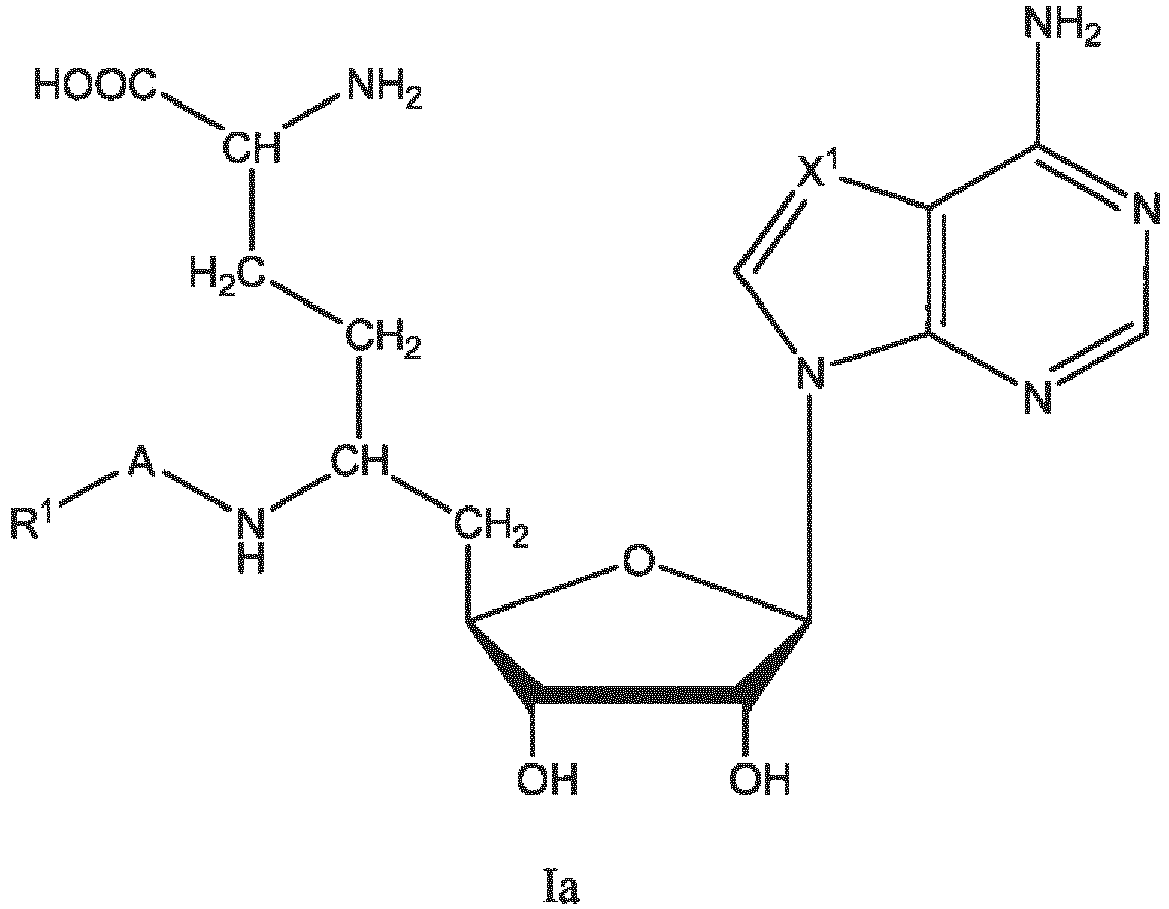
 X1 is N or CH;A is chosen from direct bond, (C1-C20)hydrocarbon, (C1-C20)oxaalkyl and (C1-C20)azaalkyl;R1 is chosen from hydrogen, -C(=NH)NH2, -C(=NH)NH(C1-C10)hydrocarbon, CF3 and -CH(NH2)COOH, with the proviso that, when A is a direct bond, R1 cannot be H;R2 is chosen from hydrogen, -C(=NH)NH2, -C(=NH)NH(C1-C10)hydrocarbon and -CH(NH2)COOH.
 - A compound according to claim 1 or 5 of formula I or Ia wherein
R1-A is chosen from (C1-C6)alkyl, benzyl and (C3-C6)oxaalkyl. - A compound according to claim 1 or 5 of formula I or Ia wherein
R1-A is chosen from amino(C1-C6)alkyl, benzylamino(C1-C6)alkyl and guanidino(C1-C6)alkyl. - A compound according to claim 1 or 5 of formula I or Ia wherein R1-A is chosen from HOOC(NH2)CH-azaalkyl and NH2(NH=)C-azaalkyl.
- A compound according to claim 1 or 5 of formula II or IIa wherein R2-A is chosen from hydrogen, (C1-C6)alkyl, benzyl and -C(=NH)NH2.
- A compound according to claim 1 or 5 wherein X1 is N.
- A compound according to claim 1 or 5 wherein X1 is CH.
- An in vitro method for inhibiting the activity of a methyltransferase enzyme comprising bringing said methyltransferase enzyme into contact with a compound according to claim 1 or 5.
- An in vitro method for selectively inhibiting the activity of a first methyltransferase enzyme in the presence of a second methyltransferase enzyme comprising bringing both of said methyltransferase enzymes into contact with a compound according to claim 1 or 5.
- A compound according to claim 1 or 5 for use in method of treating cancer.
- A compound for its use according to claim 14 wherein said cancer is breast cancer or prostate cancer.
- A pharmaceutical composition comprising a pharmaceutically acceptable carrier and a compound according to claim 1 or 5.
Applications Claiming Priority (4)
| Application Number | Priority Date | Filing Date | Title |
|---|---|---|---|
| US201161552236P | 2011-10-27 | 2011-10-27 | |
| US201161551976P | 2011-10-27 | 2011-10-27 | |
| US201261624636P | 2012-04-16 | 2012-04-16 | |
| PCT/US2012/062157 WO2013063417A1 (en) | 2011-10-27 | 2012-10-26 | Methyltransferase inhibitors for treating cancer |
Publications (2)
| Publication Number | Publication Date |
|---|---|
| EP2771343A1 EP2771343A1 (en) | 2014-09-03 |
| EP2771343B1 true EP2771343B1 (en) | 2016-07-13 |
Family
ID=47178343
Family Applications (1)
| Application Number | Title | Priority Date | Filing Date |
|---|---|---|---|
| EP12784836.4A Not-in-force EP2771343B1 (en) | 2011-10-27 | 2012-10-26 | Methyltransferase inhibitors for treating cancer |
Country Status (5)
| Country | Link |
|---|---|
| US (1) | US9493501B2 (en) |
| EP (1) | EP2771343B1 (en) |
| AU (1) | AU2012328609B2 (en) |
| CA (1) | CA2853501A1 (en) |
| WO (1) | WO2013063417A1 (en) |
Families Citing this family (14)
| Publication number | Priority date | Publication date | Assignee | Title |
|---|---|---|---|---|
| EP2914298B1 (en) | 2012-11-02 | 2020-01-08 | Duke University | Inhibition of histone methyltransferase for cardiac reprogramming |
| WO2014172330A1 (en) | 2013-04-16 | 2014-10-23 | Sloan-Kettering Institute For Cancer Research | Methyltransferase inhibitors for treating cancer |
| US20160168185A1 (en) * | 2013-07-22 | 2016-06-16 | Baylor College Of Medicine | Non-ribose containing inhibitors of histone methyltransferase dot1l for cancer treatment |
| KR102285119B1 (en) * | 2014-04-01 | 2021-08-02 | 경북대학교 산학협력단 | Novel histone methyl transferase inhibitor and use thereof |
| JP6495714B2 (en) * | 2015-03-31 | 2019-04-03 | 国立大学法人 長崎大学 | Novel membrane permeable peptide |
| WO2017070464A1 (en) * | 2015-10-22 | 2017-04-27 | Memorial Sloan-Kettering Cancer Center | Cofactor analogs as methyltransferase inhibitors for treating cancer |
| US10730903B2 (en) | 2016-09-19 | 2020-08-04 | Memorial Sloan-Kettering Cancer Center | Adenosine analogs as methyltransferase inhibitors for treating cancer |
| US10266542B2 (en) | 2017-03-15 | 2019-04-23 | Mirati Therapeutics, Inc. | EZH2 inhibitors |
| MX2020001759A (en) * | 2017-08-14 | 2020-12-10 | Epizyme Inc | Methods of treating cancer by inhibiting setd2. |
| NZ766447A (en) | 2018-01-31 | 2021-12-24 | Mirati Therapeutics Inc | Prc2 inhibitors |
| AU2019321464B2 (en) | 2018-08-14 | 2025-03-27 | Epizyme, Inc. | Substituted indoles and methods of use thereof |
| CA3121546A1 (en) * | 2018-11-30 | 2020-06-04 | Epizyme, Inc. | Methods of treating whsc1-overexpressing cancers by inhibiting setd2 |
| JP7624404B2 (en) | 2019-04-22 | 2025-01-30 | ミラティ セラピューティクス,インク. | Naphthyridine Derivatives as PRC2 Inhibitors |
| AU2020288563A1 (en) | 2019-06-05 | 2022-01-06 | Mirati Therapeutics, Inc. | Imidazo(1,2-c)pyrimidine derivatives as PRC2 inhibitors for treating cancer |
Family Cites Families (2)
| Publication number | Priority date | Publication date | Assignee | Title |
|---|---|---|---|---|
| US20080132525A1 (en) * | 2006-12-04 | 2008-06-05 | Methylgene Inc. | Inhibitors of DNA Methyltransferase |
| GB0811360D0 (en) | 2008-06-20 | 2008-07-30 | Imp Innovations Ltd | Methods |
-
2012
- 2012-10-26 US US14/353,815 patent/US9493501B2/en not_active Expired - Fee Related
- 2012-10-26 WO PCT/US2012/062157 patent/WO2013063417A1/en not_active Ceased
- 2012-10-26 EP EP12784836.4A patent/EP2771343B1/en not_active Not-in-force
- 2012-10-26 AU AU2012328609A patent/AU2012328609B2/en not_active Expired - Fee Related
- 2012-10-26 CA CA2853501A patent/CA2853501A1/en not_active Abandoned
Non-Patent Citations (2)
| Title |
|---|
| KENNETH W. FOREMAN ET AL: "Structural and Functional Profiling of the Human Histone Methyltransferase SMYD3", PLOS ONE, vol. 6, no. 7, E22290, 1 January 2011 (2011-01-01), XP055049424, ISSN: 1932-6203, DOI: 10.1371/journal.pone.0022290 * |
| WEIHONG ZHENG ET AL: "Sinefungin Derivatives as Inhibitors and Structure Probes of Protein Lysine Methyltransferase SETD2", JOURNAL OF THE AMERICAN CHEMICAL SOCIETY, vol. 134, no. 43, 31 October 2012 (2012-10-31), pages 18004 - 18014, XP055049439, ISSN: 0002-7863, DOI: 10.1021/ja307060p * |
Also Published As
| Publication number | Publication date |
|---|---|
| US20140303106A1 (en) | 2014-10-09 |
| AU2012328609A1 (en) | 2014-05-29 |
| US9493501B2 (en) | 2016-11-15 |
| EP2771343A1 (en) | 2014-09-03 |
| WO2013063417A1 (en) | 2013-05-02 |
| CA2853501A1 (en) | 2013-05-02 |
| AU2012328609B2 (en) | 2017-07-13 |
Similar Documents
| Publication | Publication Date | Title |
|---|---|---|
| US9493501B2 (en) | Methyltransferase inhibitors for treating cancer | |
| US9029343B2 (en) | Modulators of histone methyltransferase, and methods of use thereof | |
| CN112209980B (en) | substituted purine nucleotides | |
| EP3083620B1 (en) | Tetrahydropyridopyrazines modulators of gpr6 | |
| US9321798B2 (en) | Phosphoramidite derivatives of gemcitabine for use in the treatment of cancer | |
| BR112013013659B1 (en) | Epigenetic enzyme modulating compounds, pharmaceutical composition comprising said compounds and uses of said pharmaceutical composition to treat cancer, hematological cancer or leukemia | |
| OA12279A (en) | 2-Aminocarbonyl-9H-purine derivatives. | |
| EP1567169A2 (en) | Gemcitabine prodrugs, pharmaceutical compositions and uses thereof | |
| EP4043461A1 (en) | Compound as small molecule inhibitor pd-1/pd-l1 and application thereof | |
| EP3964518A1 (en) | Cd73 inhibitor, preparation method therefor and application thereof | |
| EP4353724A1 (en) | Compound as cdk kinase inhibitor and use thereof | |
| CA2909543A1 (en) | Methyltransferase inhibitors for treating cancer | |
| US20040162422A1 (en) | Chemical compounds | |
| EP4055026A1 (en) | Compounds as cd73 inhibitors | |
| WO2021053158A1 (en) | Novel histone methyltransferase inhibitors | |
| WO2017070464A1 (en) | Cofactor analogs as methyltransferase inhibitors for treating cancer | |
| US20230135822A1 (en) | Adenosine analogs as methyltransferase inhibitors for treating cancer | |
| WO2009053654A2 (en) | Gemcitabine phosphoester prodrugs as anticancer agents | |
| RU2441876C2 (en) | Derivative of 3т-ethynilcytidine | |
| KR101231925B1 (en) | Gemcitabine prodrugs and method for production thereof | |
| JP7641918B2 (en) | Carbocyclic Nucleoside Analogues | |
| WO2023034617A1 (en) | 2'-chloro-2'-fluoro-n2-amino-n6-methylamino purine nucleotides for flavivirus treatment | |
| JPWO1989007105A1 (en) | Staurosporine derivatives | |
| HK1230176A1 (en) | Tetrahydropyridopyrazines modulators of gpr6 | |
| HK1230176B (en) | Tetrahydropyridopyrazines modulators of gpr6 |
Legal Events
| Date | Code | Title | Description |
|---|---|---|---|
| PUAI | Public reference made under article 153(3) epc to a published international application that has entered the european phase |
Free format text: ORIGINAL CODE: 0009012 |
|
| 17P | Request for examination filed |
Effective date: 20140509 |
|
| AK | Designated contracting states |
Kind code of ref document: A1 Designated state(s): AL AT BE BG CH CY CZ DE DK EE ES FI FR GB GR HR HU IE IS IT LI LT LU LV MC MK MT NL NO PL PT RO RS SE SI SK SM TR |
|
| DAX | Request for extension of the european patent (deleted) | ||
| 17Q | First examination report despatched |
Effective date: 20150722 |
|
| GRAP | Despatch of communication of intention to grant a patent |
Free format text: ORIGINAL CODE: EPIDOSNIGR1 |
|
| INTG | Intention to grant announced |
Effective date: 20160225 |
|
| GRAS | Grant fee paid |
Free format text: ORIGINAL CODE: EPIDOSNIGR3 |
|
| GRAA | (expected) grant |
Free format text: ORIGINAL CODE: 0009210 |
|
| AK | Designated contracting states |
Kind code of ref document: B1 Designated state(s): AL AT BE BG CH CY CZ DE DK EE ES FI FR GB GR HR HU IE IS IT LI LT LU LV MC MK MT NL NO PL PT RO RS SE SI SK SM TR |
|
| REG | Reference to a national code |
Ref country code: GB Ref legal event code: FG4D |
|
| REG | Reference to a national code |
Ref country code: AT Ref legal event code: REF Ref document number: 812209 Country of ref document: AT Kind code of ref document: T Effective date: 20160715 Ref country code: CH Ref legal event code: EP |
|
| REG | Reference to a national code |
Ref country code: IE Ref legal event code: FG4D |
|
| REG | Reference to a national code |
Ref country code: DE Ref legal event code: R096 Ref document number: 602012020491 Country of ref document: DE |
|
| REG | Reference to a national code |
Ref country code: FR Ref legal event code: PLFP Year of fee payment: 5 |
|
| REG | Reference to a national code |
Ref country code: LT Ref legal event code: MG4D |
|
| REG | Reference to a national code |
Ref country code: NL Ref legal event code: MP Effective date: 20160713 |
|
| PGFP | Annual fee paid to national office [announced via postgrant information from national office to epo] |
Ref country code: FR Payment date: 20160919 Year of fee payment: 5 |
|
| REG | Reference to a national code |
Ref country code: AT Ref legal event code: MK05 Ref document number: 812209 Country of ref document: AT Kind code of ref document: T Effective date: 20160713 |
|
| PG25 | Lapsed in a contracting state [announced via postgrant information from national office to epo] |
Ref country code: HR Free format text: LAPSE BECAUSE OF FAILURE TO SUBMIT A TRANSLATION OF THE DESCRIPTION OR TO PAY THE FEE WITHIN THE PRESCRIBED TIME-LIMIT Effective date: 20160713 Ref country code: LT Free format text: LAPSE BECAUSE OF FAILURE TO SUBMIT A TRANSLATION OF THE DESCRIPTION OR TO PAY THE FEE WITHIN THE PRESCRIBED TIME-LIMIT Effective date: 20160713 Ref country code: NL Free format text: LAPSE BECAUSE OF FAILURE TO SUBMIT A TRANSLATION OF THE DESCRIPTION OR TO PAY THE FEE WITHIN THE PRESCRIBED TIME-LIMIT Effective date: 20160713 Ref country code: IT Free format text: LAPSE BECAUSE OF FAILURE TO SUBMIT A TRANSLATION OF THE DESCRIPTION OR TO PAY THE FEE WITHIN THE PRESCRIBED TIME-LIMIT Effective date: 20160713 Ref country code: FI Free format text: LAPSE BECAUSE OF FAILURE TO SUBMIT A TRANSLATION OF THE DESCRIPTION OR TO PAY THE FEE WITHIN THE PRESCRIBED TIME-LIMIT Effective date: 20160713 Ref country code: IS Free format text: LAPSE BECAUSE OF FAILURE TO SUBMIT A TRANSLATION OF THE DESCRIPTION OR TO PAY THE FEE WITHIN THE PRESCRIBED TIME-LIMIT Effective date: 20161113 Ref country code: RS Free format text: LAPSE BECAUSE OF FAILURE TO SUBMIT A TRANSLATION OF THE DESCRIPTION OR TO PAY THE FEE WITHIN THE PRESCRIBED TIME-LIMIT Effective date: 20160713 Ref country code: NO Free format text: LAPSE BECAUSE OF FAILURE TO SUBMIT A TRANSLATION OF THE DESCRIPTION OR TO PAY THE FEE WITHIN THE PRESCRIBED TIME-LIMIT Effective date: 20161013 |
|
| PGFP | Annual fee paid to national office [announced via postgrant information from national office to epo] |
Ref country code: GB Payment date: 20161026 Year of fee payment: 5 Ref country code: DE Payment date: 20161018 Year of fee payment: 5 |
|
| PG25 | Lapsed in a contracting state [announced via postgrant information from national office to epo] |
Ref country code: PT Free format text: LAPSE BECAUSE OF FAILURE TO SUBMIT A TRANSLATION OF THE DESCRIPTION OR TO PAY THE FEE WITHIN THE PRESCRIBED TIME-LIMIT Effective date: 20161114 Ref country code: SE Free format text: LAPSE BECAUSE OF FAILURE TO SUBMIT A TRANSLATION OF THE DESCRIPTION OR TO PAY THE FEE WITHIN THE PRESCRIBED TIME-LIMIT Effective date: 20160713 Ref country code: AT Free format text: LAPSE BECAUSE OF FAILURE TO SUBMIT A TRANSLATION OF THE DESCRIPTION OR TO PAY THE FEE WITHIN THE PRESCRIBED TIME-LIMIT Effective date: 20160713 Ref country code: GR Free format text: LAPSE BECAUSE OF FAILURE TO SUBMIT A TRANSLATION OF THE DESCRIPTION OR TO PAY THE FEE WITHIN THE PRESCRIBED TIME-LIMIT Effective date: 20161014 Ref country code: ES Free format text: LAPSE BECAUSE OF FAILURE TO SUBMIT A TRANSLATION OF THE DESCRIPTION OR TO PAY THE FEE WITHIN THE PRESCRIBED TIME-LIMIT Effective date: 20160713 Ref country code: LV Free format text: LAPSE BECAUSE OF FAILURE TO SUBMIT A TRANSLATION OF THE DESCRIPTION OR TO PAY THE FEE WITHIN THE PRESCRIBED TIME-LIMIT Effective date: 20160713 Ref country code: PL Free format text: LAPSE BECAUSE OF FAILURE TO SUBMIT A TRANSLATION OF THE DESCRIPTION OR TO PAY THE FEE WITHIN THE PRESCRIBED TIME-LIMIT Effective date: 20160713 Ref country code: BE Free format text: LAPSE BECAUSE OF NON-PAYMENT OF DUE FEES Effective date: 20160713 |
|
| REG | Reference to a national code |
Ref country code: DE Ref legal event code: R097 Ref document number: 602012020491 Country of ref document: DE |
|
| PG25 | Lapsed in a contracting state [announced via postgrant information from national office to epo] |
Ref country code: EE Free format text: LAPSE BECAUSE OF FAILURE TO SUBMIT A TRANSLATION OF THE DESCRIPTION OR TO PAY THE FEE WITHIN THE PRESCRIBED TIME-LIMIT Effective date: 20160713 Ref country code: RO Free format text: LAPSE BECAUSE OF FAILURE TO SUBMIT A TRANSLATION OF THE DESCRIPTION OR TO PAY THE FEE WITHIN THE PRESCRIBED TIME-LIMIT Effective date: 20160713 |
|
| PLBE | No opposition filed within time limit |
Free format text: ORIGINAL CODE: 0009261 |
|
| STAA | Information on the status of an ep patent application or granted ep patent |
Free format text: STATUS: NO OPPOSITION FILED WITHIN TIME LIMIT |
|
| PG25 | Lapsed in a contracting state [announced via postgrant information from national office to epo] |
Ref country code: CZ Free format text: LAPSE BECAUSE OF FAILURE TO SUBMIT A TRANSLATION OF THE DESCRIPTION OR TO PAY THE FEE WITHIN THE PRESCRIBED TIME-LIMIT Effective date: 20160713 Ref country code: BG Free format text: LAPSE BECAUSE OF FAILURE TO SUBMIT A TRANSLATION OF THE DESCRIPTION OR TO PAY THE FEE WITHIN THE PRESCRIBED TIME-LIMIT Effective date: 20161013 Ref country code: SK Free format text: LAPSE BECAUSE OF FAILURE TO SUBMIT A TRANSLATION OF THE DESCRIPTION OR TO PAY THE FEE WITHIN THE PRESCRIBED TIME-LIMIT Effective date: 20160713 Ref country code: DK Free format text: LAPSE BECAUSE OF FAILURE TO SUBMIT A TRANSLATION OF THE DESCRIPTION OR TO PAY THE FEE WITHIN THE PRESCRIBED TIME-LIMIT Effective date: 20160713 Ref country code: SM Free format text: LAPSE BECAUSE OF FAILURE TO SUBMIT A TRANSLATION OF THE DESCRIPTION OR TO PAY THE FEE WITHIN THE PRESCRIBED TIME-LIMIT Effective date: 20160713 |
|
| REG | Reference to a national code |
Ref country code: CH Ref legal event code: PL |
|
| 26N | No opposition filed |
Effective date: 20170418 |
|
| REG | Reference to a national code |
Ref country code: IE Ref legal event code: MM4A |
|
| PG25 | Lapsed in a contracting state [announced via postgrant information from national office to epo] |
Ref country code: CH Free format text: LAPSE BECAUSE OF NON-PAYMENT OF DUE FEES Effective date: 20161031 Ref country code: LI Free format text: LAPSE BECAUSE OF NON-PAYMENT OF DUE FEES Effective date: 20161031 |
|
| PG25 | Lapsed in a contracting state [announced via postgrant information from national office to epo] |
Ref country code: SI Free format text: LAPSE BECAUSE OF FAILURE TO SUBMIT A TRANSLATION OF THE DESCRIPTION OR TO PAY THE FEE WITHIN THE PRESCRIBED TIME-LIMIT Effective date: 20160713 Ref country code: LU Free format text: LAPSE BECAUSE OF NON-PAYMENT OF DUE FEES Effective date: 20161026 |
|
| PG25 | Lapsed in a contracting state [announced via postgrant information from national office to epo] |
Ref country code: IE Free format text: LAPSE BECAUSE OF NON-PAYMENT OF DUE FEES Effective date: 20161026 |
|
| REG | Reference to a national code |
Ref country code: DE Ref legal event code: R119 Ref document number: 602012020491 Country of ref document: DE |
|
| PG25 | Lapsed in a contracting state [announced via postgrant information from national office to epo] |
Ref country code: HU Free format text: LAPSE BECAUSE OF FAILURE TO SUBMIT A TRANSLATION OF THE DESCRIPTION OR TO PAY THE FEE WITHIN THE PRESCRIBED TIME-LIMIT; INVALID AB INITIO Effective date: 20121026 |
|
| GBPC | Gb: european patent ceased through non-payment of renewal fee |
Effective date: 20171026 |
|
| PG25 | Lapsed in a contracting state [announced via postgrant information from national office to epo] |
Ref country code: MC Free format text: LAPSE BECAUSE OF FAILURE TO SUBMIT A TRANSLATION OF THE DESCRIPTION OR TO PAY THE FEE WITHIN THE PRESCRIBED TIME-LIMIT Effective date: 20160713 Ref country code: MT Free format text: LAPSE BECAUSE OF NON-PAYMENT OF DUE FEES Effective date: 20161031 Ref country code: CY Free format text: LAPSE BECAUSE OF FAILURE TO SUBMIT A TRANSLATION OF THE DESCRIPTION OR TO PAY THE FEE WITHIN THE PRESCRIBED TIME-LIMIT Effective date: 20160713 Ref country code: MK Free format text: LAPSE BECAUSE OF FAILURE TO SUBMIT A TRANSLATION OF THE DESCRIPTION OR TO PAY THE FEE WITHIN THE PRESCRIBED TIME-LIMIT Effective date: 20160713 |
|
| REG | Reference to a national code |
Ref country code: FR Ref legal event code: ST Effective date: 20180629 |
|
| PG25 | Lapsed in a contracting state [announced via postgrant information from national office to epo] |
Ref country code: DE Free format text: LAPSE BECAUSE OF NON-PAYMENT OF DUE FEES Effective date: 20180501 Ref country code: GB Free format text: LAPSE BECAUSE OF NON-PAYMENT OF DUE FEES Effective date: 20171026 |
|
| PG25 | Lapsed in a contracting state [announced via postgrant information from national office to epo] |
Ref country code: FR Free format text: LAPSE BECAUSE OF NON-PAYMENT OF DUE FEES Effective date: 20171031 |
|
| PG25 | Lapsed in a contracting state [announced via postgrant information from national office to epo] |
Ref country code: AL Free format text: LAPSE BECAUSE OF FAILURE TO SUBMIT A TRANSLATION OF THE DESCRIPTION OR TO PAY THE FEE WITHIN THE PRESCRIBED TIME-LIMIT Effective date: 20160713 Ref country code: TR Free format text: LAPSE BECAUSE OF FAILURE TO SUBMIT A TRANSLATION OF THE DESCRIPTION OR TO PAY THE FEE WITHIN THE PRESCRIBED TIME-LIMIT Effective date: 20160713 |