EP2770599A2 - Method for optimizing power flow in electric power network - Google Patents
Method for optimizing power flow in electric power network Download PDFInfo
- Publication number
- EP2770599A2 EP2770599A2 EP14153841.3A EP14153841A EP2770599A2 EP 2770599 A2 EP2770599 A2 EP 2770599A2 EP 14153841 A EP14153841 A EP 14153841A EP 2770599 A2 EP2770599 A2 EP 2770599A2
- Authority
- EP
- European Patent Office
- Prior art keywords
- constraints
- max
- optimization
- buses
- power
- Prior art date
- Legal status (The legal status is an assumption and is not a legal conclusion. Google has not performed a legal analysis and makes no representation as to the accuracy of the status listed.)
- Granted
Links
Images



Classifications
-
- H—ELECTRICITY
- H02—GENERATION; CONVERSION OR DISTRIBUTION OF ELECTRIC POWER
- H02J—ELECTRIC POWER NETWORKS; CIRCUIT ARRANGEMENTS OR SYSTEMS FOR SUPPLYING OR DISTRIBUTING ELECTRIC POWER; SYSTEMS FOR STORING ELECTRIC ENERGY
- H02J3/00—Circuit arrangements for AC mains or AC distribution networks
- H02J3/04—Arrangements for connecting networks of the same frequency but supplied from different sources
- H02J3/06—Controlling the transfer of power between connected networks; Controlling load sharing between connected networks
-
- G—PHYSICS
- G06—COMPUTING OR CALCULATING; COUNTING
- G06F—ELECTRIC DIGITAL DATA PROCESSING
- G06F17/00—Digital computing or data processing equipment or methods, specially adapted for specific functions
- G06F17/10—Complex mathematical operations
- G06F17/11—Complex mathematical operations for solving equations, e.g. nonlinear equations, general mathematical optimization problems
-
- H—ELECTRICITY
- H02—GENERATION; CONVERSION OR DISTRIBUTION OF ELECTRIC POWER
- H02J—ELECTRIC POWER NETWORKS; CIRCUIT ARRANGEMENTS OR SYSTEMS FOR SUPPLYING OR DISTRIBUTING ELECTRIC POWER; SYSTEMS FOR STORING ELECTRIC ENERGY
- H02J2103/00—Details of circuit arrangements for mains or AC distribution networks
- H02J2103/30—Simulating, planning, modelling, reliability check or computer assisted design [CAD] of electric power networks
-
- Y—GENERAL TAGGING OF NEW TECHNOLOGICAL DEVELOPMENTS; GENERAL TAGGING OF CROSS-SECTIONAL TECHNOLOGIES SPANNING OVER SEVERAL SECTIONS OF THE IPC; TECHNICAL SUBJECTS COVERED BY FORMER USPC CROSS-REFERENCE ART COLLECTIONS [XRACs] AND DIGESTS
- Y02—TECHNOLOGIES OR APPLICATIONS FOR MITIGATION OR ADAPTATION AGAINST CLIMATE CHANGE
- Y02B—CLIMATE CHANGE MITIGATION TECHNOLOGIES RELATED TO BUILDINGS, e.g. HOUSING, HOUSE APPLIANCES OR RELATED END-USER APPLICATIONS
- Y02B70/00—Technologies for an efficient end-user side electric power management and consumption
- Y02B70/30—Systems integrating technologies related to power network operation and communication or information technologies for improving the carbon footprint of the management of residential or tertiary loads, i.e. smart grids as climate change mitigation technology in the buildings sector, including also the last stages of power distribution and the control, monitoring or operating management systems at local level
- Y02B70/3225—Demand response systems, e.g. load shedding, peak shaving
-
- Y—GENERAL TAGGING OF NEW TECHNOLOGICAL DEVELOPMENTS; GENERAL TAGGING OF CROSS-SECTIONAL TECHNOLOGIES SPANNING OVER SEVERAL SECTIONS OF THE IPC; TECHNICAL SUBJECTS COVERED BY FORMER USPC CROSS-REFERENCE ART COLLECTIONS [XRACs] AND DIGESTS
- Y02—TECHNOLOGIES OR APPLICATIONS FOR MITIGATION OR ADAPTATION AGAINST CLIMATE CHANGE
- Y02E—REDUCTION OF GREENHOUSE GAS [GHG] EMISSIONS, RELATED TO ENERGY GENERATION, TRANSMISSION OR DISTRIBUTION
- Y02E40/00—Technologies for an efficient electrical power generation, transmission or distribution
- Y02E40/70—Smart grids as climate change mitigation technology in the energy generation sector
-
- Y—GENERAL TAGGING OF NEW TECHNOLOGICAL DEVELOPMENTS; GENERAL TAGGING OF CROSS-SECTIONAL TECHNOLOGIES SPANNING OVER SEVERAL SECTIONS OF THE IPC; TECHNICAL SUBJECTS COVERED BY FORMER USPC CROSS-REFERENCE ART COLLECTIONS [XRACs] AND DIGESTS
- Y02—TECHNOLOGIES OR APPLICATIONS FOR MITIGATION OR ADAPTATION AGAINST CLIMATE CHANGE
- Y02E—REDUCTION OF GREENHOUSE GAS [GHG] EMISSIONS, RELATED TO ENERGY GENERATION, TRANSMISSION OR DISTRIBUTION
- Y02E60/00—Enabling technologies; Technologies with a potential or indirect contribution to GHG emissions mitigation
-
- Y—GENERAL TAGGING OF NEW TECHNOLOGICAL DEVELOPMENTS; GENERAL TAGGING OF CROSS-SECTIONAL TECHNOLOGIES SPANNING OVER SEVERAL SECTIONS OF THE IPC; TECHNICAL SUBJECTS COVERED BY FORMER USPC CROSS-REFERENCE ART COLLECTIONS [XRACs] AND DIGESTS
- Y04—INFORMATION OR COMMUNICATION TECHNOLOGIES HAVING AN IMPACT ON OTHER TECHNOLOGY AREAS
- Y04S—SYSTEMS INTEGRATING TECHNOLOGIES RELATED TO POWER NETWORK OPERATION, COMMUNICATION OR INFORMATION TECHNOLOGIES FOR IMPROVING THE ELECTRICAL POWER GENERATION, TRANSMISSION, DISTRIBUTION, MANAGEMENT OR USAGE, i.e. SMART GRIDS
- Y04S10/00—Systems supporting electrical power generation, transmission or distribution
- Y04S10/50—Systems or methods supporting the power network operation or management, involving a certain degree of interaction with the load-side end user applications
-
- Y—GENERAL TAGGING OF NEW TECHNOLOGICAL DEVELOPMENTS; GENERAL TAGGING OF CROSS-SECTIONAL TECHNOLOGIES SPANNING OVER SEVERAL SECTIONS OF THE IPC; TECHNICAL SUBJECTS COVERED BY FORMER USPC CROSS-REFERENCE ART COLLECTIONS [XRACs] AND DIGESTS
- Y04—INFORMATION OR COMMUNICATION TECHNOLOGIES HAVING AN IMPACT ON OTHER TECHNOLOGY AREAS
- Y04S—SYSTEMS INTEGRATING TECHNOLOGIES RELATED TO POWER NETWORK OPERATION, COMMUNICATION OR INFORMATION TECHNOLOGIES FOR IMPROVING THE ELECTRICAL POWER GENERATION, TRANSMISSION, DISTRIBUTION, MANAGEMENT OR USAGE, i.e. SMART GRIDS
- Y04S20/00—Management or operation of end-user stationary applications or the last stages of power distribution; Controlling, monitoring or operating thereof
- Y04S20/20—End-user application control systems
- Y04S20/222—Demand response systems, e.g. load shedding, peak shaving
-
- Y—GENERAL TAGGING OF NEW TECHNOLOGICAL DEVELOPMENTS; GENERAL TAGGING OF CROSS-SECTIONAL TECHNOLOGIES SPANNING OVER SEVERAL SECTIONS OF THE IPC; TECHNICAL SUBJECTS COVERED BY FORMER USPC CROSS-REFERENCE ART COLLECTIONS [XRACs] AND DIGESTS
- Y04—INFORMATION OR COMMUNICATION TECHNOLOGIES HAVING AN IMPACT ON OTHER TECHNOLOGY AREAS
- Y04S—SYSTEMS INTEGRATING TECHNOLOGIES RELATED TO POWER NETWORK OPERATION, COMMUNICATION OR INFORMATION TECHNOLOGIES FOR IMPROVING THE ELECTRICAL POWER GENERATION, TRANSMISSION, DISTRIBUTION, MANAGEMENT OR USAGE, i.e. SMART GRIDS
- Y04S40/00—Systems for electrical power generation, transmission, distribution or end-user application management characterised by the use of communication or information technologies, or communication or information technology specific aspects supporting them
- Y04S40/20—Information technology specific aspects, e.g. CAD, simulation, modelling, system security
Definitions
- the present invention relates generally to electric power networks, and more particularly to optimizing the power flows in the networks.
- An electric power network includes buses connected to transmission lines.
- the buses are locally connected to generators and loads.
- Optimal power flow (OPF) analysis is often used for monitoring and controlling the operation of the network.
- the power flow depends, in part, on voltage magnitudes and phase angles. Power flows and voltage levels on the buses are optimized by minimizing an objective function subject to constraints, such as the magnitudes, phases, power transferred, generator capacity, thermal losses, and the like.
- U.S. Patent 6,625,520 describes a system and method for operating an electric power system that determines optimal power flow and available transfer capability of the electric power system based on the optimal power flow.
- the system derives data associated with an initial phase angle and maximum electric power value of a generator by determining mechanical output and electrical output of a generator, including a generator phase angle defined by a time function with a constraint condition that the generator phase angle does not exceed a preset value.
- the embodiments of the invention provide methods for optimizing power flows in electric power networks using a decomposition and coordination procedure.
- the decomposition procedure distributes the optimization problem into a set of smaller disjoint parameterized optimization problems that are independent of each other.
- the coordination procedure modifies the parameter associated with the individual problems to ensure that a solution of the entire problem is attained.
- the methods are based on dualizing coupled constraints to obtain the set of smaller decoupled optimization problems.
- the theory of semi-smooth equations is used in the coordination procedure.
- the semismooth equation theory ensures that superlinear convergence can be theoretically guaranteed in a neighborhood of the solution. Further, the theory allows for using a merit function to ensure global convergence to a solution using initial parameters that are not near the solution.
- the theory of smoothing based methods is used to solve the decomposed problems.
- a monotonic decrease of the smoothing parameter is used to ensure that superlinear convergence can be theoretically guaranteed in the neighborhood of a solution.
- the theory allows for using a merit function to ensure global convergence to a solution even when the initial parameters are far from optimal.
- Fig. 1 shows a topology of an electric power network that can use embodiments of the invention.
- the network can include AC components, and DC components connected by convertors. The only requirement is that variables and constraints that control the operation of the network are continuously controllable.
- the network includes buses 10 locally connected to loads (L) 12 and generators (G) 14.
- the buses are interconnected by transmission lines 20, also known as branches (B).
- Some of the transmission lines can be connected to transformers (T) 22.
- the generators supply active power (measured in, e.g., Mega Watts (MW)), and reactive power (measured in Mega Volt Ampere Reactive (MVar)).
- active power measured in, e.g., Mega Watts (MW)
- reactive power measured in Mega Volt Ampere Reactive (MVar)
- the loads consume the power.
- the power is defined by voltage magnitude and phase angle.
- the parameters for the optimization include, but are not limited to, an admittance matrix based on the branch impedance and bus fixed shunt admittance, and the flow capacity ratings, i.e., the maximal total power flow constrained by thermal ratings.
- the topology of the network can be represented by a graph G of nodes (generators and connected loads) 30 connected by edges (transmission lines) 31.
- Input to the method optimization includes the following:
- Output of the method includes complex valued voltages V i ⁇ i ⁇ N at the buses, and active and reactive power levels P i G , Q i G ⁇ i ⁇ N of the generators.
- f P G ⁇ Q G ⁇ V ⁇ i ⁇ N c 2 ⁇ i ⁇ P i G 2 + c 1 ⁇ i ⁇ P i G + c 0 ⁇ i , where c indicates constants, with c 2 i , c 1 i ⁇ 0 ⁇ i ⁇ N.
- equality constraints To model the limits of feasible operation of the network, equality constraints, inequality constraints, and bounds on the decision variables are used.
- the optimization problem in equation (3) can be decomposed 220 to separate the variables x 1 221 and x 2 222 into a set of disjoint parametrized optimization problems, and corresponding constraints, and then solve the set optimization problems x 1 , x 2 independently.
- the set includes two disjoint problems x 1 , and x 2 .
- each problem can be further decomposed to a finer granularity as necessary.
- the updating can be performed using a line search procedure to find a local minimum.
- the line search finds a descent direction along which the objective function is reduced, and a step size.
- the descent direction can be computed by various methods, such as gradient descent, Newton's method and the quasi-Newton method.
- a trust region can be used to optimize a subset of the region of a (quadratic) model function. If an adequate model of the objective function is found within the trust region, then the region is expanded, otherwise the region is contracted.
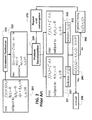
- Fig. 3 shows an embodiment that accelerates the convergence of dual decomposition based methods.
- the initial steps are as described above for the conventional method to obtain a set of disjoint optimization problems.
- the invented method obtains the optimal solution ( ⁇ ), ( ⁇ ) 231-232 as before, but also sensitivities of the solution to the choice of 331-332.
- the sensitivity measures the variation in the solutions ( ⁇ ), ( ⁇ ) to changes in the multiplying parameter ⁇ .
- the updating is also different, in that now the updating 360 uses x 1 ⁇ , x 2 ⁇ , ⁇ ⁇ ⁇ x 1 ⁇ , ⁇ ⁇ ⁇ x 2 ⁇ .
- the sensitivities can be obtained by a solution of the following linear complementarity problem.
- the sensitivity for x 2 can be obtained in a similar manner.
- the system of equation (4) can be reduced to a solution of linear equations when the solution satisfies: also called a strict complementarity.
- the merit function influences the choice of the next multipliers through the sufficient decrease requirement
- the step length ⁇ ⁇ (0,1] is selected to satisfy: ⁇ ⁇ ⁇ + ⁇ ⁇ d ⁇ ⁇ ⁇ ⁇ + ⁇ ⁇ ⁇ ⁇ ⁇ ⁇ ; d ⁇ ⁇ , where ⁇ > 0 is usually a small constant, and ⁇ '( ⁇ ; d ⁇ ) is the directional derivative of the merit function at the point ⁇ along the direction d ⁇ .
- n i is the number of sub-networks k in which the node i occurs.
- Constraints are also imposed on power generation and voltage magnitudes at the buses.
- ( ⁇ ) the optimal solution to the problem corresponding to the sub-network k .
- the sensitivity can be obtained as follows.
- a solution ( ⁇ ) to the optimal solution to the problem corresponding to the sub-network k will necessarily satisfy the first order optimality conditions listed above.
- ⁇ + ⁇ + ⁇ d ⁇ where 0 ⁇ ⁇ ⁇ 1 is selected as described below.
- the merit function is the Euclidean norm of the residual of the dualized constraints that couple the different sub-networks. This measures the degree to which the original problem in equation (1) has been solved.
- ⁇ ( ⁇ ) ⁇ the method terminates with ( ⁇ ) as the solution for equation (1).
- the fast decomposition approach is based on the computation of sensitivities with respect to the multipliers ⁇ for the dualized constraints.
- the sensitivity may not exist under some conditions. For instance in optimization problem (3) when does not hold. In such instances only a directional derivative can be obtained.
- the second property ensures that the for all ⁇ > 0 the optimization problems are smooth and continuously differentiable. While the first property ensures that one can recover a solution to equation (9) by solving a sequence smoothed problem when ⁇ ⁇ 0. There exist several choices for such a function:
- the merit function is the Euclidean norm of the residual of the dualized constraints that couple the different sub-networks. This measures the degree to which the original problem (1) has been solved.
- ⁇ ( ⁇ ; ⁇ ) ⁇ ⁇ the iterations for particular smoothing parameter value can be terminated and decrease the parameter.
- ⁇ ( ⁇ ;0) ⁇ the method terminates ( ⁇ ) with as the solution for equation (1).
- the step for multipliers is selected so that the merit function decreases as prescribed in the following condition: ⁇ ⁇ ⁇ + ⁇ ⁇ d ⁇ ⁇ ; ⁇ ⁇ ⁇ ⁇ ⁇ + ⁇ ⁇ ⁇ ⁇ ⁇ ⁇ ⁇ ⁇ ⁇ T ⁇ d ⁇ ⁇ , where ⁇ ⁇ ⁇ ( ⁇ ; ⁇ ) is the gradient of the merit function at the given point ⁇ .
- a full derivative can be defined, instead of a directional derivative as in equation (13). If the smoothing parameter is selected to be decreased superlinearly, then fast local convergence in the neighborhood of the solution to equation (1) can be obtained.
- Figs. 4 and 5 show the pseudo code for the above embodiments.
- the steps of the method can be performed in one or more processors connected to memory and input/output interfaces as known in the art.
Landscapes
- Engineering & Computer Science (AREA)
- Physics & Mathematics (AREA)
- Mathematical Physics (AREA)
- General Physics & Mathematics (AREA)
- Pure & Applied Mathematics (AREA)
- Mathematical Optimization (AREA)
- Mathematical Analysis (AREA)
- Computational Mathematics (AREA)
- Data Mining & Analysis (AREA)
- Theoretical Computer Science (AREA)
- Operations Research (AREA)
- Algebra (AREA)
- Databases & Information Systems (AREA)
- Software Systems (AREA)
- General Engineering & Computer Science (AREA)
- Power Engineering (AREA)
- Supply And Distribution Of Alternating Current (AREA)
Abstract
Description
- The present invention relates generally to electric power networks, and more particularly to optimizing the power flows in the networks.
- An electric power network includes buses connected to transmission lines. The buses are locally connected to generators and loads. Optimal power flow (OPF) analysis is often used for monitoring and controlling the operation of the network. The power flow depends, in part, on voltage magnitudes and phase angles. Power flows and voltage levels on the buses are optimized by minimizing an objective function subject to constraints, such as the magnitudes, phases, power transferred, generator capacity, thermal losses, and the like.
- Most conventional OPF optimizations:
- (i) Solve the problem in a centralized manner.
- (ii)Do not exploit a topology of the network to distribute the optimization over the buses.
- Some conventional methods for distributing the optimization problem:
- (i) Use the Schur complement method, also called iterative substructuring, to distribute the computation of a single step in the optimization problem.
- (ii) When the optimization problem is distributed by dual decomposition, a conventional subgradient method is used for solving the optimization problem. The subgradient method converges sub-linearly to a solution.
- Thus, there remains a need to optimize power flows in electric power networks in an efficient and expedient manner by appropriately distributing the computations.
-
U.S. Patent 6,625,520 describes a system and method for operating an electric power system that determines optimal power flow and available transfer capability of the electric power system based on the optimal power flow. The system derives data associated with an initial phase angle and maximum electric power value of a generator by determining mechanical output and electrical output of a generator, including a generator phase angle defined by a time function with a constraint condition that the generator phase angle does not exceed a preset value. - The embodiments of the invention provide methods for optimizing power flows in electric power networks using a decomposition and coordination procedure. The decomposition procedure distributes the optimization problem into a set of smaller disjoint parameterized optimization problems that are independent of each other. The coordination procedure modifies the parameter associated with the individual problems to ensure that a solution of the entire problem is attained.
- The methods are based on dualizing coupled constraints to obtain the set of smaller decoupled optimization problems. In one embodiment of the method, the theory of semi-smooth equations is used in the coordination procedure. The semismooth equation theory ensures that superlinear convergence can be theoretically guaranteed in a neighborhood of the solution. Further, the theory allows for using a merit function to ensure global convergence to a solution using initial parameters that are not near the solution.
- In one embodiment, the theory of smoothing based methods is used to solve the decomposed problems. A monotonic decrease of the smoothing parameter is used to ensure that superlinear convergence can be theoretically guaranteed in the neighborhood of a solution. Further, the theory allows for using a merit function to ensure global convergence to a solution even when the initial parameters are far from optimal.
-
-
Fig. 1 is a schematic of an electric power network and a graph representing the network that can be used by embodiments of the invention; -
Fig. 2 is a flow chart of a conventional power optimization method; -
Fig. 3 is a flow chart of a power optimization method according to embodiments of the invention; and -
Fig. 4 and5 are pseudo code for power optimization methods according to some embodiments of the invention. -
Fig. 1 shows a topology of an electric power network that can use embodiments of the invention. The network can include AC components, and DC components connected by convertors. The only requirement is that variables and constraints that control the operation of the network are continuously controllable. - The network includes
buses 10 locally connected to loads (L) 12 and generators (G) 14. The buses are interconnected bytransmission lines 20, also known as branches (B). Some of the transmission lines can be connected to transformers (T) 22. - The generators supply active power (measured in, e.g., Mega Watts (MW)), and reactive power (measured in Mega Volt Ampere Reactive (MVar)). The loads consume the power. The power is defined by voltage magnitude and phase angle.
- The parameters for the optimization include, but are not limited to, an admittance matrix based on the branch impedance and bus fixed shunt admittance, and the flow capacity ratings, i.e., the maximal total power flow constrained by thermal ratings.
- The topology of the network can be represented by a graph G of nodes (generators and connected loads) 30 connected by edges (transmission lines) 31.
- Input to the method optimization includes the following:
- 1) A graph G(N, E) with a set of N nodes connected by a set of E edges (i,j).
- 2) An admittance of the lines yij = gij + jbij ∀(i,j) ∈ E, where g represents conductance of the line, b represents susceptance (imaginary part of the admittance) of the line with

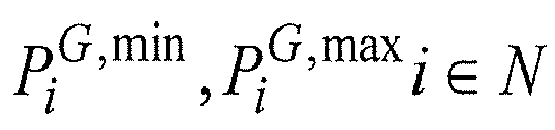
- 3) Constraints on active power

- 4) Constraints

- 5) Limits

- 6) Constraints

- Output of the method includes complex valued voltages


- The optimization uses a decision function f(PG, QG, V) that depends on active power generation variables


- The form of the decision function f is quadratic and strictly increasing:

- To model the limits of feasible operation of the network, equality constraints, inequality constraints, and bounds on the decision variables are used. The operation of the electrical network can be modeled by the equality constraints

- The constraints on the limits on power generated by generators, limits on voltage magnitudes at the buses, power transferred on the lines and thermal losses ensuring feasible operation are modeled as inequality constraints

- To determine the voltages at the buses and the powers produced by the generators, the following optimization problem is solved for global optimality:

- In the preferred embodiment, the equality constraints

- Power flows on the lines

- Power balances at the buses


- In the preferred embodiment, the inequality constraints

- Limit on apparent power transferred on lines

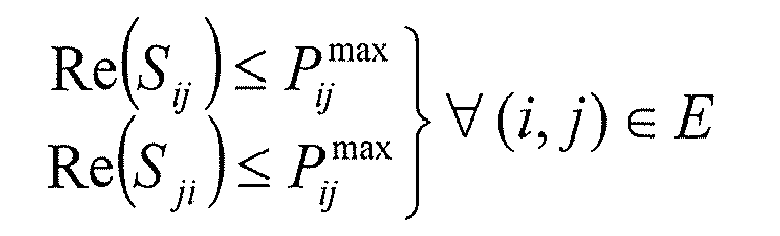
- Limit on active power transferred on lines
- Limit on thermal loss on lines

- Limit of Power Generation

- Limit on Voltage Magnitude

-
Figs. 2 shows a conventional method for solving anoptimization problem 201 as defined by equation (2) below:
- Observe that the optimization problem can be decomposed to separate x 1,x 2, but for the equality constraint A 1 x 1 + A 2 x 2 = b. These coupling constraints can be removed by dualizing 210 the constraints in the objective function using multipliers ξ as in equation (3) below:

- The optimization problem in equation (3) can be decomposed 220 to separate the variables x 1 221 and x 2 222 into a set of disjoint parametrized optimization problems, and corresponding constraints, and then solve the set optimization problems x 1, x 2 independently. In the examples used herein the set includes two disjoint problems x 1, and x 2. However, it is understood, that each problem can be further decomposed to a finer granularity as necessary.
- Denote by(ξ) 231 and
 (ξ) 232 the optimal solution to each of the decomposed problems. The correct choice of multipliers ξ is rarely known perfectly. As a consequence, the method iterates 270 until
convergence 250 using aconvergence test 240, and otherwise updating 260 the multipliers ξ using only(ξ), (ξ), until the constraints
 are approximately satisfied.
- The updating can be performed using a line search procedure to find a local minimum. The line search finds a descent direction along which the objective function is reduced, and a step size. The descent direction can be computed by various methods, such as gradient descent, Newton's method and the quasi-Newton method.
- Alternatively, a trust region can be used to optimize a subset of the region of a (quadratic) model function. If an adequate model of the objective function is found within the trust region, then the region is expanded, otherwise the region is contracted.
-
Fig. 3 shows an embodiment that accelerates the convergence of dual decomposition based methods. The initial steps are as described above for the conventional method to obtain a set of disjoint optimization problems. - The key difference is as follows. When solving each of the optimization, the invented method obtains the optimal solution(ξ),
 (ξ) 231-232 as before, but also sensitivities of the solution to the choice of
 331-332.
- The sensitivity measures the variation in the solutions(ξ),
 (ξ) to changes in the multiplying parameter ξ.
- The updating is also different, in that now the updating 360 uses

- The sensitivities can be obtained by a solution of the following linear complementarity problem. In the subproblem for x 1 the sensitivities are obtained as:


- The sensitivity for x 2 can be obtained in a similar manner. The system of equation (4) can be reduced to a solution of linear equations when the solution satisfies:also called a strict complementarity.

- Using the sensitivity to the multiplier ξ, a search direction dξ can be determined using the linearization of the dualized constraints as:

- This constitutes taking a Newton-like direction for the dualized constraints, and this is precisely why the convergence is accelerated. The Newton step is known to converge locally superlinearly when in the neighborhood of the solution. The conventional dual decomposition method does not have this rapid local convergence property.
- Further, this approach allows one to define a merit function

optimization problem 201 of equation (2), where ∥ ∥2 represent the Euclidean vector norm. - The merit function influences the choice of the next multipliers through the sufficient decrease requirement where the step length α ∈ (0,1] is selected to satisfy:


- Consider a partition of the edges in the network into Ng smaller set of edges (E1 , E2 , ...,ENg ) where the sets are disjoint and their union is the set of all edges E. The set of buses in edge set Ek is denoted by Nk. Utilizing this set of smaller networks G(Nk, Ek ) the optimal power flow problem can be equivalently formulated as described in the following. Further, denote by Ki the set of networks to which the node i belongs.
- The objective function for each sub-network can be posed as:


- The constraints model the operation of the electrical network by the equality constraints:

- We model the limits on power generated by generators, limits on voltage magnitudes at the buses, constraints on the power transferred on the lines and thermal losses ensuring feasible operation as inequality constraints

- Constraints are also imposed on power generation and voltage magnitudes at the buses.
- To determine the voltages at the buses and the powers produced by the generators, the following optimization problem is solved to global optimality:

- For ease of exposition, the notation xk = (PG,k, QG,k, Vk ) is used in the following and


- The above problem equation is decomposed into smaller optimization problems by removing the set of the equality constraints in the optimization and replacing it in the objective function as:


- The optimization for each sub-network is:


- The decomposition step solves each of the optimization problems for the sub-networks k =1, ...,Ng for a given choice of the multipliers ξ. Denote by(ξ) the optimal solution to the problem corresponding to the sub-network k. Further, denote by
 the sensitivity of the optimal solution to the sub-network k for the given choice of multipliers. The sensitivity can be obtained as follows. The first order optimality conditions for the sub-network k is:


- A solution(ξ) to the optimal solution to the problem corresponding to the sub-network k will necessarily satisfy the first order optimality conditions listed above. The sensitivity of the optimal solution to the multipliers ξ can be obtained by solving the following linear complementarity problem obtained by differentiating the first order conditions with respect to variables xk and multipliers (λh,k, λg,k ):


- The sensitivity computations are used to compute a search direction dξ for the multipliers by solving the following equations:

- Using this search direction a new set of multipliers ξ + = ξ + αdξ where 0 < α ≤ 1 is selected as described below. Define the function φ(ξ) termed the merit function as

- The merit function is the Euclidean norm of the residual of the dualized constraints that couple the different sub-networks. This measures the degree to which the original problem in equation (1) has been solved. When φ(ξ) ≈ 0, the method terminates with(ξ) as the solution for equation (1).

- The step for multipliers is selected so that the merit function is decreased as prescribed the following condition:


- Using the new multiplier ξ +, the decomposed optimization in equation (3), sensitivity computation (4) and multiplier step computation (5) are repeated until the merit function φ(ξ) is close to zero.
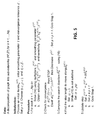
- A description of the methodic steps is provided in
Fig 4 . - The fast decomposition approach is based on the computation of sensitivities with respect to the multipliers ξ for the dualized constraints. However, the sensitivity may not exist under some conditions. For instance in optimization problem (3) whendoes not hold. In such instances only a directional derivative can be obtained.

- To rectify this situation consider the modification of the problem solved for each of the sub-networks k as follows. Consider modifying the stationary conditions (9) as,

- (i) ψ(a,b;0)=0 ⇔ a≥0⊥b≥0
- (ii) ψ(a,b;τ) is continuously differentiable for all τ > 0.
- The second property ensures that the for all τ > 0 the optimization problems are smooth and continuously differentiable. While the first property ensures that one can recover a solution to equation (9) by solving a sequence smoothed problem when τ → 0. There exist several choices for such a function:
- 1.

- 2.

- 3.

- In the third choice the nonnegativity of a and b have to enforced explicitly. This is precisely what interior point methods do.
- Using this modification the method where solution to original problem (1) is obtained can be restated by first solving for fixed τ > 0 the problem in equation (14) to a certain tolerance and then decreasing τ → 0 to obtain a solution to equation (1) in the limit.
- Denote bythe solutions to equation (14). In the case of smoothing, the sensitivity of solutions to the multipliers ξ can be computed as the solution of the following linear equations:


- Observe these are linear equations as opposed to linear complementarity equations as in equation (10).
- The sensitivity computations are used to compute a search direction dξ for the multipliers by solving the following equations:

- Using this search direction a new set of multipliers ξ + = ξ + αdξ where 0 < α ≤ 1 is selected as described below. Define the function φ(ξ) termed the merit function as

- The merit function is the Euclidean norm of the residual of the dualized constraints that couple the different sub-networks. This measures the degree to which the original problem (1) has been solved. When φ(ξ;τ) ≈ τ, the iterations for particular smoothing parameter value can be terminated and decrease the parameter. When φ(ξ;0) ≈ 0, the method terminates(ξ) with as the solution for equation (1).

- The step for multipliers is selected so that the merit function decreases as prescribed in the following condition:

-
Figs. 4 and5 show the pseudo code for the above embodiments. The steps of the method can be performed in one or more processors connected to memory and input/output interfaces as known in the art.
Claims (12)
- A method for optimizing a power flow in an electric power network by solving an optimization problem (201), comprising the steps of:decomposing (220) the optimization problem into a set of disjoint parameterized optimization problems, wherein the disjoint parameterized optimization problems in the set are independent of each other, and wherein the decomposition is based on constraints having corresponding multipliers, which are parameters of the disjoint parameterized optimization problems, and wherein constraints are dualized coupled constraints;solving (231, 232) each disjoint parameterized optimization problem independently to obtain a corresponding solution, and a sensitivity of each solution to changes in the parameter; andupdating (260) the parameters using the corresponding solutions and the sensitivities, and repeating (270) the decomposing (220), the solving (231, 232), and the updating (260) until convergence, wherein the steps are performed in a processor.
- The method of claim 1, wherein variables of the constraints are continuously controllable.
- The method of claim 1, further comprising:representing the electric power network by a graph of nodes and edges, wherein the nodes represent generators and loads connected to buses, and the edges (i, j) between nodes represent transmission lines.
- The method of claim 3, wherein input to the method includes:the graph,an admittance of the transmission lines

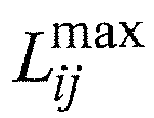
 constraints on active power
 constraints
 limits
 constraints
 complex valued voltages Vi at the buses, and active and reactive power levels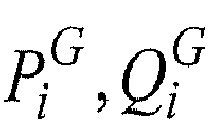
- The method of claim 4, wherein the optimization uses a decision function f(PG, QG, V) that depends on active power generation variables


- The method of claim 5, wherein the decision function f is quadratic and strictly increasing:

- The method of claim 1, wherein limits of feasible operation of the network, equality constraints, inequality constraints, and bounds on decision variables are used.
- The method of claim 1, wherein inequality constraints are represented as a smoothed equality constraints using a smoothing parameter, and the smoothing parameter is reduced to zero during the repeating (270) of the updating (260).
- The method of claim 1, wherein the update of the parameters are performed using a line search procedure.
- The method of claim 1, wherein the update of the parameters are performed using a trust region.
- The method of claim 1, wherein the updating (270) alternates between updating with and without using the sensitivities.
- The method of claim 1, wherein the sensitivities measures variation in the solutions to changes in the multipliers.
Applications Claiming Priority (1)
| Application Number | Priority Date | Filing Date | Title |
|---|---|---|---|
| US13/775,589 US8756556B1 (en) | 2013-02-25 | 2013-02-25 | Method for optimizing power flows in electric power networks |
Publications (3)
| Publication Number | Publication Date |
|---|---|
| EP2770599A2 true EP2770599A2 (en) | 2014-08-27 |
| EP2770599A3 EP2770599A3 (en) | 2015-08-26 |
| EP2770599B1 EP2770599B1 (en) | 2018-11-14 |
Family
ID=50072903
Family Applications (1)
| Application Number | Title | Priority Date | Filing Date |
|---|---|---|---|
| EP14153841.3A Active EP2770599B1 (en) | 2013-02-25 | 2014-02-04 | Method for optimizing power flow in electric power network |
Country Status (3)
| Country | Link |
|---|---|
| US (1) | US8756556B1 (en) |
| EP (1) | EP2770599B1 (en) |
| JP (1) | JP6157368B2 (en) |
Cited By (2)
| Publication number | Priority date | Publication date | Assignee | Title |
|---|---|---|---|---|
| CN104734150A (en) * | 2015-03-30 | 2015-06-24 | 国家电网公司 | Power distribution network optimizing method |
| CN107681653A (en) * | 2017-09-01 | 2018-02-09 | 国网辽宁省电力有限公司电力科学研究院 | A Load Curve Decomposition and Reconfiguration Method for Improving Power Grid Flexibility |
Families Citing this family (6)
| Publication number | Priority date | Publication date | Assignee | Title |
|---|---|---|---|---|
| US11181564B2 (en) * | 2014-06-29 | 2021-11-23 | International Business Machines Corporation | Distributed control of electric power grids |
| US9960604B2 (en) * | 2014-10-14 | 2018-05-01 | Mitsubishi Electric Research Laboratories, Inc. | System and method for operating an electric power system with distributed generation and demand responsive resources based on distribution locational marginal prices |
| EP3602325A1 (en) * | 2017-03-30 | 2020-02-05 | Universita' della Svizzera Italiana | Method to accelerate the processing of multiperiod optimal power flow problems |
| US11063472B1 (en) | 2020-03-03 | 2021-07-13 | Topolonet Corporation | Topology identification and state estimation of power grids |
| US20240291274A1 (en) * | 2023-02-03 | 2024-08-29 | Arizona Board Of Regents On Behalf Of Arizona State University | Systems and methods for ac optimal power flow modeling for unbalanced distribution systems |
| CN118970954B (en) * | 2024-10-14 | 2025-01-28 | 湖南省湘电试验研究院有限公司 | Calculation and optimization method of regional power transmission constraints in areas with UHV DC and new energy access |
Citations (1)
| Publication number | Priority date | Publication date | Assignee | Title |
|---|---|---|---|---|
| US6625520B1 (en) | 2000-05-31 | 2003-09-23 | Luonan Chen | System and method for operating electric power systems utilizing optimal power flow |
Family Cites Families (11)
| Publication number | Priority date | Publication date | Assignee | Title |
|---|---|---|---|---|
| JP3310632B2 (en) * | 1999-06-24 | 2002-08-05 | 建生 河村 | Optimal Power Flow Calculation System by Nonlinear Programming |
| RU2270469C2 (en) * | 2004-03-11 | 2006-02-20 | Олег Алексеевич Суханов | System for controlling modes of electric energy based systems |
| US7660649B1 (en) * | 2004-07-02 | 2010-02-09 | Optimal Innovations Inc. | Resource management using calculated sensitivities |
| JP4148208B2 (en) * | 2004-09-15 | 2008-09-10 | 株式会社日立製作所 | Distribution system state estimation device, method and program |
| US8126685B2 (en) * | 2006-04-12 | 2012-02-28 | Edsa Micro Corporation | Automatic real-time optimization and intelligent control of electrical power distribution and transmission systems |
| JP4705563B2 (en) * | 2006-12-20 | 2011-06-22 | 株式会社日立製作所 | Distribution system state estimation device, state estimation method and program thereof |
| US7979255B2 (en) * | 2007-03-16 | 2011-07-12 | Airbus Operations Sas | Method, system and computer program product for the optimization of power system architectures at the aircraft level during pre-design |
| US20110106327A1 (en) * | 2009-11-05 | 2011-05-05 | General Electric Company | Energy optimization method |
| US8775136B2 (en) * | 2010-12-13 | 2014-07-08 | Siemens Aktiengesellschaft | Primal-dual interior point methods for solving discrete optimal power flow problems implementing a chain rule technique for improved efficiency |
| US8977524B2 (en) * | 2012-03-06 | 2015-03-10 | Siemens Aktiengesellschaft | Interior point method for reformulated optimal power flow model |
| US9093842B2 (en) * | 2012-08-16 | 2015-07-28 | Mitsubishi Electric Research Laboratories, Inc. | Method for globally optimizing power flows in electric networks |
-
2013
- 2013-02-25 US US13/775,589 patent/US8756556B1/en active Active
-
2014
- 2014-01-07 JP JP2014000953A patent/JP6157368B2/en active Active
- 2014-02-04 EP EP14153841.3A patent/EP2770599B1/en active Active
Patent Citations (1)
| Publication number | Priority date | Publication date | Assignee | Title |
|---|---|---|---|---|
| US6625520B1 (en) | 2000-05-31 | 2003-09-23 | Luonan Chen | System and method for operating electric power systems utilizing optimal power flow |
Cited By (2)
| Publication number | Priority date | Publication date | Assignee | Title |
|---|---|---|---|---|
| CN104734150A (en) * | 2015-03-30 | 2015-06-24 | 国家电网公司 | Power distribution network optimizing method |
| CN107681653A (en) * | 2017-09-01 | 2018-02-09 | 国网辽宁省电力有限公司电力科学研究院 | A Load Curve Decomposition and Reconfiguration Method for Improving Power Grid Flexibility |
Also Published As
| Publication number | Publication date |
|---|---|
| JP6157368B2 (en) | 2017-07-05 |
| JP2014166134A (en) | 2014-09-08 |
| EP2770599A3 (en) | 2015-08-26 |
| US8756556B1 (en) | 2014-06-17 |
| EP2770599B1 (en) | 2018-11-14 |
Similar Documents
| Publication | Publication Date | Title |
|---|---|---|
| EP2770599B1 (en) | Method for optimizing power flow in electric power network | |
| Tang et al. | A novel consensus-based economic dispatch for microgrids | |
| US9280744B2 (en) | System and method for optimal power flow analysis | |
| EP2773005B1 (en) | Method for Optimizing a Power Flow in an Electric Power Network | |
| Rana et al. | Backward/forward sweep load flow algorithm for radial distribution system | |
| US9093842B2 (en) | Method for globally optimizing power flows in electric networks | |
| Dereich et al. | Robust analysis of preferential attachment models with fitness | |
| Chen et al. | Mean square convergence analysis for kernel least mean square algorithm | |
| Zhan et al. | Vulnerability assessment and reconfiguration of microgrid through search vector artificial physics optimization algorithm | |
| JP6584214B2 (en) | A method for estimating optimal power flow in a power grid using distributed processing based on consensus | |
| JP2014166134A5 (en) | ||
| Li et al. | Optimal economic dispatch by fast distributed gradient | |
| Oviedo et al. | A non-monotone linear search algorithm with mixed direction on Stiefel manifold | |
| Ferro et al. | A distributed approach to the optimal power flow problem for unbalanced and mesh networks | |
| Minot et al. | A parallel primal-dual interior-point method for DC optimal power flow | |
| JP6822082B2 (en) | Tidal current calculation device, tidal current calculation method, and tidal current calculation program | |
| Vasquez et al. | Load flow method for radial distribution systems with distributed generation using a dynamic data matrix | |
| Muzzammel et al. | Design and power flow analysis of electrical system using electrical transient and program software | |
| Issicaba et al. | Evaluation of the forward-backward sweep load flow method using the contraction mapping principle | |
| Michail et al. | Power flow analysis in an Islanded microgrid without slack bus | |
| Plietzsch et al. | Linear response theory for renewable fluctuations in power grids with transmission losses | |
| Ding et al. | Performance and suitability assessment of controlled islanding methods for online WAMPAC application | |
| Sepúlveda et al. | Optimal power flow for three-phase unbalanced active distribution networks with delta connections | |
| Zargar et al. | Linear iterative power flow approach based on the current injection model of load and generator | |
| Wei et al. | A fixed-time optimal consensus algorithm over undirected networks |
Legal Events
| Date | Code | Title | Description |
|---|---|---|---|
| PUAI | Public reference made under article 153(3) epc to a published international application that has entered the european phase |
Free format text: ORIGINAL CODE: 0009012 |
|
| 17P | Request for examination filed |
Effective date: 20140204 |
|
| AK | Designated contracting states |
Kind code of ref document: A2 Designated state(s): AL AT BE BG CH CY CZ DE DK EE ES FI FR GB GR HR HU IE IS IT LI LT LU LV MC MK MT NL NO PL PT RO RS SE SI SK SM TR |
|
| AX | Request for extension of the european patent |
Extension state: BA ME |
|
| PUAL | Search report despatched |
Free format text: ORIGINAL CODE: 0009013 |
|
| AK | Designated contracting states |
Kind code of ref document: A3 Designated state(s): AL AT BE BG CH CY CZ DE DK EE ES FI FR GB GR HR HU IE IS IT LI LT LU LV MC MK MT NL NO PL PT RO RS SE SI SK SM TR |
|
| AX | Request for extension of the european patent |
Extension state: BA ME |
|
| RIC1 | Information provided on ipc code assigned before grant |
Ipc: H02J 3/06 20060101ALI20150717BHEP Ipc: G06F 17/11 20060101AFI20150717BHEP |
|
| R17P | Request for examination filed (corrected) |
Effective date: 20160210 |
|
| RBV | Designated contracting states (corrected) |
Designated state(s): AL AT BE BG CH CY CZ DE DK EE ES FI FR GB GR HR HU IE IS IT LI LT LU LV MC MK MT NL NO PL PT RO RS SE SI SK SM TR |
|
| REG | Reference to a national code |
Ref country code: DE Ref legal event code: R079 Ref document number: 602014035854 Country of ref document: DE Free format text: PREVIOUS MAIN CLASS: H02J0003060000 Ipc: H02J0003000000 |
|
| GRAP | Despatch of communication of intention to grant a patent |
Free format text: ORIGINAL CODE: EPIDOSNIGR1 |
|
| STAA | Information on the status of an ep patent application or granted ep patent |
Free format text: STATUS: GRANT OF PATENT IS INTENDED |
|
| RIC1 | Information provided on ipc code assigned before grant |
Ipc: H02J 3/06 20060101ALI20180430BHEP Ipc: H02J 3/00 20060101AFI20180430BHEP Ipc: G06F 17/11 20060101ALI20180430BHEP |
|
| INTG | Intention to grant announced |
Effective date: 20180530 |
|
| GRAS | Grant fee paid |
Free format text: ORIGINAL CODE: EPIDOSNIGR3 |
|
| GRAA | (expected) grant |
Free format text: ORIGINAL CODE: 0009210 |
|
| STAA | Information on the status of an ep patent application or granted ep patent |
Free format text: STATUS: THE PATENT HAS BEEN GRANTED |
|
| AK | Designated contracting states |
Kind code of ref document: B1 Designated state(s): AL AT BE BG CH CY CZ DE DK EE ES FI FR GB GR HR HU IE IS IT LI LT LU LV MC MK MT NL NO PL PT RO RS SE SI SK SM TR |
|
| REG | Reference to a national code |
Ref country code: CH Ref legal event code: EP Ref country code: AT Ref legal event code: REF Ref document number: 1065966 Country of ref document: AT Kind code of ref document: T Effective date: 20181115 |
|
| REG | Reference to a national code |
Ref country code: DE Ref legal event code: R096 Ref document number: 602014035854 Country of ref document: DE |
|
| REG | Reference to a national code |
Ref country code: IE Ref legal event code: FG4D |
|
| REG | Reference to a national code |
Ref country code: NL Ref legal event code: MP Effective date: 20181114 |
|
| REG | Reference to a national code |
Ref country code: LT Ref legal event code: MG4D |
|
| REG | Reference to a national code |
Ref country code: AT Ref legal event code: MK05 Ref document number: 1065966 Country of ref document: AT Kind code of ref document: T Effective date: 20181114 |
|
| PG25 | Lapsed in a contracting state [announced via postgrant information from national office to epo] |
Ref country code: ES Free format text: LAPSE BECAUSE OF FAILURE TO SUBMIT A TRANSLATION OF THE DESCRIPTION OR TO PAY THE FEE WITHIN THE PRESCRIBED TIME-LIMIT Effective date: 20181114 Ref country code: LV Free format text: LAPSE BECAUSE OF FAILURE TO SUBMIT A TRANSLATION OF THE DESCRIPTION OR TO PAY THE FEE WITHIN THE PRESCRIBED TIME-LIMIT Effective date: 20181114 Ref country code: HR Free format text: LAPSE BECAUSE OF FAILURE TO SUBMIT A TRANSLATION OF THE DESCRIPTION OR TO PAY THE FEE WITHIN THE PRESCRIBED TIME-LIMIT Effective date: 20181114 Ref country code: BG Free format text: LAPSE BECAUSE OF FAILURE TO SUBMIT A TRANSLATION OF THE DESCRIPTION OR TO PAY THE FEE WITHIN THE PRESCRIBED TIME-LIMIT Effective date: 20190214 Ref country code: FI Free format text: LAPSE BECAUSE OF FAILURE TO SUBMIT A TRANSLATION OF THE DESCRIPTION OR TO PAY THE FEE WITHIN THE PRESCRIBED TIME-LIMIT Effective date: 20181114 Ref country code: LT Free format text: LAPSE BECAUSE OF FAILURE TO SUBMIT A TRANSLATION OF THE DESCRIPTION OR TO PAY THE FEE WITHIN THE PRESCRIBED TIME-LIMIT Effective date: 20181114 Ref country code: AT Free format text: LAPSE BECAUSE OF FAILURE TO SUBMIT A TRANSLATION OF THE DESCRIPTION OR TO PAY THE FEE WITHIN THE PRESCRIBED TIME-LIMIT Effective date: 20181114 Ref country code: IS Free format text: LAPSE BECAUSE OF FAILURE TO SUBMIT A TRANSLATION OF THE DESCRIPTION OR TO PAY THE FEE WITHIN THE PRESCRIBED TIME-LIMIT Effective date: 20190314 Ref country code: NO Free format text: LAPSE BECAUSE OF FAILURE TO SUBMIT A TRANSLATION OF THE DESCRIPTION OR TO PAY THE FEE WITHIN THE PRESCRIBED TIME-LIMIT Effective date: 20190214 |
|
| PG25 | Lapsed in a contracting state [announced via postgrant information from national office to epo] |
Ref country code: SE Free format text: LAPSE BECAUSE OF FAILURE TO SUBMIT A TRANSLATION OF THE DESCRIPTION OR TO PAY THE FEE WITHIN THE PRESCRIBED TIME-LIMIT Effective date: 20181114 Ref country code: NL Free format text: LAPSE BECAUSE OF FAILURE TO SUBMIT A TRANSLATION OF THE DESCRIPTION OR TO PAY THE FEE WITHIN THE PRESCRIBED TIME-LIMIT Effective date: 20181114 Ref country code: RS Free format text: LAPSE BECAUSE OF FAILURE TO SUBMIT A TRANSLATION OF THE DESCRIPTION OR TO PAY THE FEE WITHIN THE PRESCRIBED TIME-LIMIT Effective date: 20181114 Ref country code: PT Free format text: LAPSE BECAUSE OF FAILURE TO SUBMIT A TRANSLATION OF THE DESCRIPTION OR TO PAY THE FEE WITHIN THE PRESCRIBED TIME-LIMIT Effective date: 20190314 Ref country code: GR Free format text: LAPSE BECAUSE OF FAILURE TO SUBMIT A TRANSLATION OF THE DESCRIPTION OR TO PAY THE FEE WITHIN THE PRESCRIBED TIME-LIMIT Effective date: 20190215 Ref country code: AL Free format text: LAPSE BECAUSE OF FAILURE TO SUBMIT A TRANSLATION OF THE DESCRIPTION OR TO PAY THE FEE WITHIN THE PRESCRIBED TIME-LIMIT Effective date: 20181114 |
|
| PG25 | Lapsed in a contracting state [announced via postgrant information from national office to epo] |
Ref country code: IT Free format text: LAPSE BECAUSE OF FAILURE TO SUBMIT A TRANSLATION OF THE DESCRIPTION OR TO PAY THE FEE WITHIN THE PRESCRIBED TIME-LIMIT Effective date: 20181114 Ref country code: CZ Free format text: LAPSE BECAUSE OF FAILURE TO SUBMIT A TRANSLATION OF THE DESCRIPTION OR TO PAY THE FEE WITHIN THE PRESCRIBED TIME-LIMIT Effective date: 20181114 Ref country code: PL Free format text: LAPSE BECAUSE OF FAILURE TO SUBMIT A TRANSLATION OF THE DESCRIPTION OR TO PAY THE FEE WITHIN THE PRESCRIBED TIME-LIMIT Effective date: 20181114 Ref country code: DK Free format text: LAPSE BECAUSE OF FAILURE TO SUBMIT A TRANSLATION OF THE DESCRIPTION OR TO PAY THE FEE WITHIN THE PRESCRIBED TIME-LIMIT Effective date: 20181114 |
|
| REG | Reference to a national code |
Ref country code: DE Ref legal event code: R097 Ref document number: 602014035854 Country of ref document: DE |
|
| PG25 | Lapsed in a contracting state [announced via postgrant information from national office to epo] |
Ref country code: SM Free format text: LAPSE BECAUSE OF FAILURE TO SUBMIT A TRANSLATION OF THE DESCRIPTION OR TO PAY THE FEE WITHIN THE PRESCRIBED TIME-LIMIT Effective date: 20181114 Ref country code: SK Free format text: LAPSE BECAUSE OF FAILURE TO SUBMIT A TRANSLATION OF THE DESCRIPTION OR TO PAY THE FEE WITHIN THE PRESCRIBED TIME-LIMIT Effective date: 20181114 Ref country code: EE Free format text: LAPSE BECAUSE OF FAILURE TO SUBMIT A TRANSLATION OF THE DESCRIPTION OR TO PAY THE FEE WITHIN THE PRESCRIBED TIME-LIMIT Effective date: 20181114 Ref country code: RO Free format text: LAPSE BECAUSE OF FAILURE TO SUBMIT A TRANSLATION OF THE DESCRIPTION OR TO PAY THE FEE WITHIN THE PRESCRIBED TIME-LIMIT Effective date: 20181114 |
|
| PLBE | No opposition filed within time limit |
Free format text: ORIGINAL CODE: 0009261 |
|
| STAA | Information on the status of an ep patent application or granted ep patent |
Free format text: STATUS: NO OPPOSITION FILED WITHIN TIME LIMIT |
|
| REG | Reference to a national code |
Ref country code: CH Ref legal event code: PL |
|
| 26N | No opposition filed |
Effective date: 20190815 |
|
| GBPC | Gb: european patent ceased through non-payment of renewal fee |
Effective date: 20190214 |
|
| PG25 | Lapsed in a contracting state [announced via postgrant information from national office to epo] |
Ref country code: SI Free format text: LAPSE BECAUSE OF FAILURE TO SUBMIT A TRANSLATION OF THE DESCRIPTION OR TO PAY THE FEE WITHIN THE PRESCRIBED TIME-LIMIT Effective date: 20181114 Ref country code: MC Free format text: LAPSE BECAUSE OF FAILURE TO SUBMIT A TRANSLATION OF THE DESCRIPTION OR TO PAY THE FEE WITHIN THE PRESCRIBED TIME-LIMIT Effective date: 20181114 Ref country code: LU Free format text: LAPSE BECAUSE OF NON-PAYMENT OF DUE FEES Effective date: 20190204 |
|
| REG | Reference to a national code |
Ref country code: BE Ref legal event code: MM Effective date: 20190228 |
|
| REG | Reference to a national code |
Ref country code: IE Ref legal event code: MM4A |
|
| PG25 | Lapsed in a contracting state [announced via postgrant information from national office to epo] |
Ref country code: LI Free format text: LAPSE BECAUSE OF NON-PAYMENT OF DUE FEES Effective date: 20190228 Ref country code: CH Free format text: LAPSE BECAUSE OF NON-PAYMENT OF DUE FEES Effective date: 20190228 |
|
| PG25 | Lapsed in a contracting state [announced via postgrant information from national office to epo] |
Ref country code: IE Free format text: LAPSE BECAUSE OF NON-PAYMENT OF DUE FEES Effective date: 20190204 Ref country code: GB Free format text: LAPSE BECAUSE OF NON-PAYMENT OF DUE FEES Effective date: 20190214 |
|
| PG25 | Lapsed in a contracting state [announced via postgrant information from national office to epo] |
Ref country code: BE Free format text: LAPSE BECAUSE OF NON-PAYMENT OF DUE FEES Effective date: 20190228 |
|
| PG25 | Lapsed in a contracting state [announced via postgrant information from national office to epo] |
Ref country code: TR Free format text: LAPSE BECAUSE OF FAILURE TO SUBMIT A TRANSLATION OF THE DESCRIPTION OR TO PAY THE FEE WITHIN THE PRESCRIBED TIME-LIMIT Effective date: 20181114 |
|
| PG25 | Lapsed in a contracting state [announced via postgrant information from national office to epo] |
Ref country code: MT Free format text: LAPSE BECAUSE OF NON-PAYMENT OF DUE FEES Effective date: 20190204 |
|
| PG25 | Lapsed in a contracting state [announced via postgrant information from national office to epo] |
Ref country code: CY Free format text: LAPSE BECAUSE OF FAILURE TO SUBMIT A TRANSLATION OF THE DESCRIPTION OR TO PAY THE FEE WITHIN THE PRESCRIBED TIME-LIMIT Effective date: 20181114 |
|
| PG25 | Lapsed in a contracting state [announced via postgrant information from national office to epo] |
Ref country code: HU Free format text: LAPSE BECAUSE OF FAILURE TO SUBMIT A TRANSLATION OF THE DESCRIPTION OR TO PAY THE FEE WITHIN THE PRESCRIBED TIME-LIMIT; INVALID AB INITIO Effective date: 20140204 |
|
| REG | Reference to a national code |
Ref country code: DE Ref legal event code: R084 Ref document number: 602014035854 Country of ref document: DE |
|
| PG25 | Lapsed in a contracting state [announced via postgrant information from national office to epo] |
Ref country code: MK Free format text: LAPSE BECAUSE OF FAILURE TO SUBMIT A TRANSLATION OF THE DESCRIPTION OR TO PAY THE FEE WITHIN THE PRESCRIBED TIME-LIMIT Effective date: 20181114 |
|
| P01 | Opt-out of the competence of the unified patent court (upc) registered |
Effective date: 20230512 |
|
| PGFP | Annual fee paid to national office [announced via postgrant information from national office to epo] |
Ref country code: FR Payment date: 20241231 Year of fee payment: 12 |
|
| PGFP | Annual fee paid to national office [announced via postgrant information from national office to epo] |
Ref country code: DE Payment date: 20241231 Year of fee payment: 12 |