EP2770020A1 - Rubber composition and tire using same - Google Patents
Rubber composition and tire using same Download PDFInfo
- Publication number
- EP2770020A1 EP2770020A1 EP12841990.0A EP12841990A EP2770020A1 EP 2770020 A1 EP2770020 A1 EP 2770020A1 EP 12841990 A EP12841990 A EP 12841990A EP 2770020 A1 EP2770020 A1 EP 2770020A1
- Authority
- EP
- European Patent Office
- Prior art keywords
- parts
- mass
- rubber
- silica
- group
- Prior art date
- Legal status (The legal status is an assumption and is not a legal conclusion. Google has not performed a legal analysis and makes no representation as to the accuracy of the status listed.)
- Granted
Links
Classifications
-
- C—CHEMISTRY; METALLURGY
- C08—ORGANIC MACROMOLECULAR COMPOUNDS; THEIR PREPARATION OR CHEMICAL WORKING-UP; COMPOSITIONS BASED THEREON
- C08K—Use of inorganic or non-macromolecular organic substances as compounding ingredients
- C08K5/00—Use of organic ingredients
- C08K5/16—Nitrogen-containing compounds
- C08K5/17—Amines; Quaternary ammonium compounds
-
- B—PERFORMING OPERATIONS; TRANSPORTING
- B60—VEHICLES IN GENERAL
- B60C—VEHICLE TYRES; TYRE INFLATION; TYRE CHANGING; CONNECTING VALVES TO INFLATABLE ELASTIC BODIES IN GENERAL; DEVICES OR ARRANGEMENTS RELATED TO TYRES
- B60C1/00—Tyres characterised by the chemical composition or the physical arrangement or mixture of the composition
-
- B—PERFORMING OPERATIONS; TRANSPORTING
- B60—VEHICLES IN GENERAL
- B60C—VEHICLE TYRES; TYRE INFLATION; TYRE CHANGING; CONNECTING VALVES TO INFLATABLE ELASTIC BODIES IN GENERAL; DEVICES OR ARRANGEMENTS RELATED TO TYRES
- B60C1/00—Tyres characterised by the chemical composition or the physical arrangement or mixture of the composition
- B60C1/0016—Compositions of the tread
-
- B—PERFORMING OPERATIONS; TRANSPORTING
- B60—VEHICLES IN GENERAL
- B60C—VEHICLE TYRES; TYRE INFLATION; TYRE CHANGING; CONNECTING VALVES TO INFLATABLE ELASTIC BODIES IN GENERAL; DEVICES OR ARRANGEMENTS RELATED TO TYRES
- B60C1/00—Tyres characterised by the chemical composition or the physical arrangement or mixture of the composition
- B60C1/0025—Compositions of the sidewalls
-
- B—PERFORMING OPERATIONS; TRANSPORTING
- B60—VEHICLES IN GENERAL
- B60C—VEHICLE TYRES; TYRE INFLATION; TYRE CHANGING; CONNECTING VALVES TO INFLATABLE ELASTIC BODIES IN GENERAL; DEVICES OR ARRANGEMENTS RELATED TO TYRES
- B60C1/00—Tyres characterised by the chemical composition or the physical arrangement or mixture of the composition
- B60C1/0041—Compositions of the carcass layers
-
- C—CHEMISTRY; METALLURGY
- C08—ORGANIC MACROMOLECULAR COMPOUNDS; THEIR PREPARATION OR CHEMICAL WORKING-UP; COMPOSITIONS BASED THEREON
- C08K—Use of inorganic or non-macromolecular organic substances as compounding ingredients
- C08K3/00—Use of inorganic substances as compounding ingredients
- C08K3/34—Silicon-containing compounds
- C08K3/36—Silica
-
- C—CHEMISTRY; METALLURGY
- C08—ORGANIC MACROMOLECULAR COMPOUNDS; THEIR PREPARATION OR CHEMICAL WORKING-UP; COMPOSITIONS BASED THEREON
- C08K—Use of inorganic or non-macromolecular organic substances as compounding ingredients
- C08K5/00—Use of organic ingredients
- C08K5/54—Silicon-containing compounds
-
- C—CHEMISTRY; METALLURGY
- C08—ORGANIC MACROMOLECULAR COMPOUNDS; THEIR PREPARATION OR CHEMICAL WORKING-UP; COMPOSITIONS BASED THEREON
- C08L—COMPOSITIONS OF MACROMOLECULAR COMPOUNDS
- C08L7/00—Compositions of natural rubber
-
- C—CHEMISTRY; METALLURGY
- C08—ORGANIC MACROMOLECULAR COMPOUNDS; THEIR PREPARATION OR CHEMICAL WORKING-UP; COMPOSITIONS BASED THEREON
- C08L—COMPOSITIONS OF MACROMOLECULAR COMPOUNDS
- C08L71/00—Compositions of polyethers obtained by reactions forming an ether link in the main chain; Compositions of derivatives of such polymers
- C08L71/02—Polyalkylene oxides
-
- C—CHEMISTRY; METALLURGY
- C08—ORGANIC MACROMOLECULAR COMPOUNDS; THEIR PREPARATION OR CHEMICAL WORKING-UP; COMPOSITIONS BASED THEREON
- C08L—COMPOSITIONS OF MACROMOLECULAR COMPOUNDS
- C08L9/00—Compositions of homopolymers or copolymers of conjugated diene hydrocarbons
-
- B—PERFORMING OPERATIONS; TRANSPORTING
- B60—VEHICLES IN GENERAL
- B60C—VEHICLE TYRES; TYRE INFLATION; TYRE CHANGING; CONNECTING VALVES TO INFLATABLE ELASTIC BODIES IN GENERAL; DEVICES OR ARRANGEMENTS RELATED TO TYRES
- B60C1/00—Tyres characterised by the chemical composition or the physical arrangement or mixture of the composition
- B60C2001/005—Compositions of the bead portions, e.g. clinch or chafer rubber or cushion rubber
Definitions
- the present invention relates to a rubber composition and a tire produced by using the same, more specifically to a rubber composition in which dispersibility of silica is improved and in which a viscosity of an unvulcanized rubber is lowered and heat build-up of a vulcanized rubber is improved as well, and a tire prepared by using the rubber composition.
- silica is compounded so frequently as a filler which allows low heat build-up of a rubber composition for a tire to be consistent with a gripping property of a tire on a wet road surface for the purpose of saving fuel consumption of automobiles.
- Silica used tends to cause coagulation of particles themselves by virtue of a hydrogen bond of a silanol group which is a surface functional group, and in order to improve dispersibility of silica in a rubber, a kneading time has to be long.
- silica causes the defects that a Mooney viscosity of a rubber composition is raised due to its unsatisfactory dispersibility in a rubber and that the rubber composition is inferior in processability such as extrusion.
- the surface of silica is acidic, and therefore silica involves the defects that it adsorbs thereon basic substances which are used as a vulcanization accelerator to prevent the rubber composition from being sufficiently vulcanized and that the storage modulus of the rubber composition is not enhanced. Accordingly, silica-compounded rubber compositions have so far been desired to be improved in processability and the like.
- a rubber composition improved in an electrostatic property which is characterized by compounding 100 parts by weight of a rubber component containing 90 parts by weight or more of a diene base rubber with 30 to 120 parts by weight of a filler containing 40 % by weight or more of a white filler such as silica and aluminum hydroxide and 0.2 to 8 parts by weight of a nonionic surfactant or specific phosphoric acid ester has so far been known as technology for improving various properties and the like in a silica-compounded rubber composition (refer to, for example, patent document 1 filed by the present applicants).
- the purpose of the patent document 1 described above is to reduce a volume resistance value and inhibit generation of static electricity to improve an electrostatic property, and it is neither described, suggested nor indicated therein to improve dispersibility of silica in the rubber composition, to lower a viscosity of an unvulcanized rubber and to improve as well heat build-up of a vulcanized rubber as is the case with the present invention. Further, it is shown in the examples thereof that an addition amount of silica is as small as 50 parts by mass or less at most, and the above patent document 1 is different in a technical concept from the present invention.
- Patent document 1 WO95/031888 (claims, examples and others)
- the present invention intends to solve them, and an object thereof is to provide a rubber composition in which dispersibility of silica is improved and in which a viscosity of an unvulcanized rubber is lowered and heat build-up of a vulcanized rubber can be improved as well, a tire prepared by using the above rubber composition, and a viscosity lowering method for an unvulcanized rubber.
- the present invention comprises the following items (1) to (11).
- a rubber composition in which dispersibility of silica is improved and in which a viscosity of an unvulcanized rubber is lowered and heat build-up of a vulcanized rubber is improved as well, a tire prepared by using the rubber composition, and a viscosity lowering method for an unvulcanized rubber.
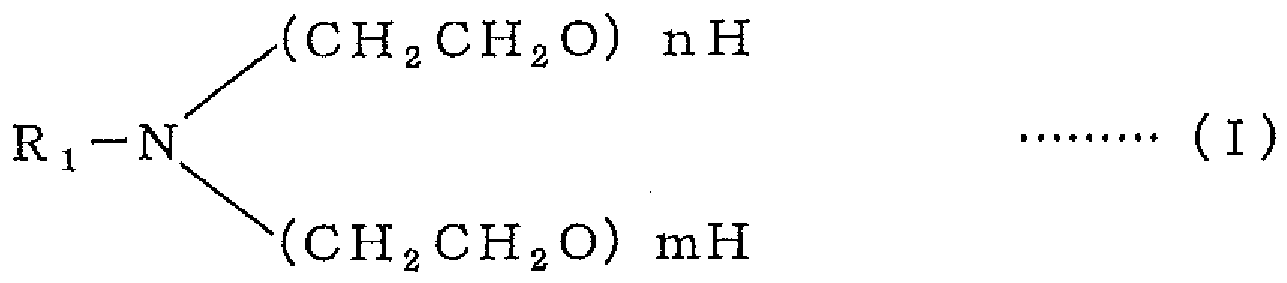
- the rubber composition of the present invention is prepared by compounding 100 parts by mass of at least one rubber component selected from natural rubber and/or diene base synthetic rubbers with 55 to 200 parts by mass of silica and 0.5 to 15 parts by mass of at least one of alkanolamines represented by the following Formula (I):
- R 1 represents an alkyl group or an alkenyl group having 1 to 24 carbon atoms, and the alkyl group and alkenyl group may be any of a linear group, a branched group or a cyclic group
- m and n represent an average addition molar number
- the rubber component used for the rubber composition of the present invention comprises natural rubber and/or a diene base synthetic rubber.
- the diene base synthetic rubber includes polyisoprene rubber (IR), polybutadiene rubber (BR), styrene-butadiene copolymer rubber (SBR), butyl rubber (IIR), ethylene-propylene copolymers and the like.
- the rubber components may be used alone or in a blend of two or more kinds thereof.
- the silica used for the rubber composition of the present invention shall not specifically be restricted, and commercial products used for rubber compositions can be used. Among them, wet silica (precipitated silica), dry silica (anhydrated silica), colloidal silica and the like can be used, and particularly wet silica is preferably used.
- a compounding amount of the silica falls in a range of preferably 55 to 200 parts by mass, more preferably 55 to 150 parts by mass based on 100 parts by mass of the rubber component described above, and it falls in a range of further preferably 55 to 120 parts by mass, further more preferably 60 to 120 parts by mass and particularly preferably 70 to 100 parts by mass. Particularly in a case of the present invention, the effects of the present invention can be exerted even when a compounding amount of the silica is as high as 55 parts by mass or more based on 100 parts by mass of the rubber component.
- a compounding amount of the silica is preferably 55 parts by mass or more based on 100 parts by mass of the rubber component described above from the viewpoint of lowering the hysteresis. On the other hand, it is preferably 200 parts by mass or less from the viewpoint of improving the workability.
- a silane coupling agent is preferably used from the viewpoint of the reinforcing property.
- the silane coupling agent which can be used shall not specifically be restricted and includes, for example, at least one of bis(3-triethoxysilylpropyl) tetrasulfide, bis(3-triethoxysilylpropyl) trisulfide, bis(3-triethoxysilylpropyl) disulfide, bis(2-triethoxysilylethyl) tetrasulfide, bis(3-trimethoxysilylpropyl) tetrasulfide, bis(2-trimethoxysilylethyl) tetrasulfide, 3-mercaptopropyltrimethoxysilane, 3-mercaptopropyltriethoxysilane, 2-mercaptoethyltrimethoxysilane, 2-mercaptoethyltriethoxysilane, 3-nitropropyltrimethoxysilane, 3-nitropropyltriethoxysilane, 3-chloropropy
- a compounding amount of the silane coupling agent is, though varied according to a compounding amount of the silica, preferably 1 part by mass or more based on 100 parts by mass of silica from the viewpoint of the effects exerted by adding the coupling agent, and on the other hand, from the viewpoint of maintaining the reinforcing property and the heat build-up, it is preferably 20 parts by mass or less. From the above viewpoints, the compounding amount falls in a range of further preferably 1 to 12 parts by mass, further more preferably 6 to 12 parts by mass.
- carbon black can be used in combination as a reinforcing filler in addition to the silica described above.
- the carbon black which can be used shall not specifically be restricted, and the grades of, for example, FEF, SRF, HAF, ISASF, SAF and the like can be used.
- a compounding amount of the carbon blacks shall not specifically be restricted as well, and it is preferably 0 to 60 parts by mass, more preferably 10 to 50 parts by mass based on 100 parts by mass of the rubber component described above. It is preferably 60 parts by mass or less from the viewpoint of maintaining the heat build-up.
- the alkanolamine represented by the following Formula (I) which is used in the present invention is compounded in order to lower a viscosity of the unvulcanized silica-compounded rubber and improve heat build-up of a vulcanized rubber to exert the effects of the present invention:
- R 1 represents an alkyl group or an alkenyl group having 1 to 24 carbon atoms, and the alkyl group and alkenyl group may be any of a linear group, a branched group or a cyclic group
- m and n represent an average addition molar number
- R 1 is an alkyl group or an alkenyl group having 1 to 24 carbon atoms, and the alkyl group and alkenyl group may have any of a linear group, a branched group or a cyclic group.
- alkyl group such as methyl, ethyl, propyl, isopropyl, butyl, isobutyl, t-butyl, pentyl, isopentyl, hexyl, isoheptyl, 2-ethylhexyl, octyl, isononyl, decyl, dodecyl, isotridecyl, tetradecyl, hexadecyl, isocetyl, octadecyl, isostearyl, docosyl and tetracosyl, and the alkenyl group such as allyl, 3-butenyl, methallyl, 2-methyl-3-butenyl, 3-methyl-3-butenyl, 1,1-dimethyl-2-propenyl, 4-pentenyl, oleyl and tetracosylidene (tetracosenyl).
- alkyl group such as methyl,
- R 1 has preferably 6 or more carbon atoms from the viewpoint of the viscosity lowering effect, and it has preferably 18 or less carbon atoms from the viewpoint of compatibility between the cost for synthesis and the viscosity lowering effect.
- R 1 is an alkyl group or an alkenyl group having further preferably 11 to 18 carbon atoms, further more preferably 14 to 18 carbon atoms, and the alkyl group and alkenyl group may have any of a linear group, a branched group or a cyclic group. It is preferably heptyl, 2-ethylhexyl, undecyl, tridecyl, pentadecyl, heptadecyl and heptadecenyl.
- the term m + n is preferably 1.5 or more from the viewpoint of the interaction with the surface of silica, and it is preferably 10 or less from the viewpoint of maintaining the heat build-up. From the above viewpoints, the term m + n is more preferably 1.5 to 5, further preferably 1.5 to 3.5 and further more preferably 2 to 3.5. Also, m and n may be same or different, and preferably they each are independently positive numbers exceeding 0 and are more preferably 0.5 to 5, further preferably 0.5 to 2.5.
- the alkanolamine represented by Formula (I) described above which can specifically be used includes, for example, at least one of POE (2) octylamine, POE (4) decylamine, POE (2) dodecylamine, POE (5) dodecylamine, POE (15) dodecylamine, POE (2) tetradecylamine, POE (2) hexadecylamine, POE (2) octadecylamine, POE (20) octadecylamine and POE (2) octadecenylamine (in this connection, POE (n) shows that polyoxyethylene is added in an amount of average n mole).
- POE (2) dodecylamine, POE (5) dodecylamine, POE (2) tetradecylamine, POE (2) hexadecylamine and POE (2) octadecenylamine are preferably used.
- a synthetic process for the alkanolamine represented by Formula (I) described above is already known, and the alkanolamine can be obtained by various production processes. Also, commercial products may be used.
- a compounding amount of at least one of the alkanolamines is preferably 0.5 to 15 parts by mass based on 100 parts by mass of the rubber component, and it is more preferably 1 to 15 parts by mass, further preferably 2 to 10 parts by mass and further more preferably 3 to 7 parts by mass from the viewpoint of further exerting the effects of the present invention. Also, a compounding amount of at least one of the alkanolamines is preferably 0.5 to 20 parts by mass, more preferably 0.5 to 15 parts by mass, further preferably 1 to 15 parts by mass, further more preferably 1 to 7 parts by mass and particularly preferably 2 to 6 parts by mass based on 100 parts by mass of silica.
- a compounding amount of at least one of the alkanolamines is 0.5 part by mass or more based on 100 parts by mass of the rubber component, the viscosity lowering effect on the unvulcanized rubber is high. On the other hand, when it is 20 parts by mass or less, a smaller influence is exerted on the rubber burning property, and the range is preferred.
- the rubber composition of the present invention can be compounded, in addition to the rubber component, silica and the alkanolamine represented by Formula (I) each described above, with ingredients suitably selected from compounding ingredients usually used in the rubber industry, for example, antioxidants, softening agents, stearic acid, zinc oxide, vulcanization accelerators, vulcanization accelerator activators, vulcanizing agents and the like as long as the objects of the present invention are not disturbed.
- Commercial products can suitably be used as the above compounding ingredients.
- the rubber composition of the present invention can be obtained by kneading, warming up and extruding the rubber component, silica, at least one of the alkanolamines described above and, if necessary, various compounding ingredients suitably selected by means of a mixer such as a mixing roll and an internal mixer. After mold processing, the rubber composition is vulcanized and can be used for applications to tire members of pneumatic tires, such as tire treads, under treads, carcasses, side walls and bead parts, and in addition thereto, it can be used as well for applications to industrial products and the like, such as rubber vibration insulators, belts, hoses and others.
- the surface of the silica is hydrophobized, whereby the silica particles are inhibited from being coagulated each other to lower a viscosity of an unvulcanized rubber and that the accelerator is inhibited from being adsorbed on the surface of the silica, whereby the heat build-up as well as the processability of the rubber composition can be improved.
- the tire of the present invention is obtained by a usual process using the rubber composition of the present invention. That is, the rubber composition of the present invention compounded, if necessary, with various compounding ingredients as described above is extruded and processed into a tire member, for example, a member for a tread at an unvulcanized stage, and the member is stuck on a tire under molding by a usual process on a tire building machine, whereby a green tire is molded. The green tire is heated and pressed in a vulcanizer to obtain a tire. Since the tire of the present invention thus obtained is excellent in low heat build-up, it is excellent in fuel consumption, and it is excellent as well in productivity because of good processability of the rubber composition.
- At least one of the alkanolamines represented by Formula (I) is compounded with a mixture prepared by mixing 100 parts by mass of at least one rubber component selected from natural rubber and/or diene base synthetic rubbers with 55 to 200 parts by mass of the silica, whereby the surface of the silica is hydrophobized, and therefore the silica particles are inhibited from being coagulated each other to lower a viscosity of an unvulcanized rubber.
- the present invention further discloses the following compositions and processes with respect to the embodiment described above.
- the preferred embodiments and numerical ranges have been described above.
- Rubber compositions were prepared according to recipes shown in Table 1 and Table 2 by an ordinary method. Numerical values in Table 1 and Table 2 are shown by mass parts.
- the rubber compositions shown in Table 1 and Table 2 were used to measure a viscosity of unvulcanized rubbers by the following measuring method.
- the rubber compositions obtained were vulcanized at 160°C for 14 minutes, and the vulcanized rubbers thus obtained were used to measure a viscoelasticity (tan ⁇ ) by the following measuring method.
- the viscosity of the unvulcanized rubber was measured according to JIS K 6300-1:2001 (Mooney viscosity).
- a viscoelasticity measuring equipment (manufactured by Rheometric Corporation) was used to measure tan ⁇ at a temperature of 50°C, a distortion of 5 % and a frequency of 15 Hz, and the results thereof were shown by indices, wherein the value obtained in Comparative Example 1 was set to 100 in Table 1, and the value obtained in Comparative Example 4 was set to 100 in Table 2. It is shown that the smaller the above value is, the lower the heat build-up is, and the better the fuel consumption is.
- the rubber compositions shown in Table 2 were subjected to pressing cure at 160°C for 20 minutes, and test pieces (thickness: 10 mm) were obtained from them and exposed outsides for 3 months, and then a discoloration property thereof was evaluated according to the following evaluation criteria.
- the respective rubber compositions shown in Table 2 were produced in Examples 6 to 7 and Comparative Examples 3 to 5 in order to clearly show the significance of a lower limit value of a compounding amount (55 parts by mass) of silica.
- Table 2 it has been found from the evaluation results of the viscosity of the unvulcanized rubber, the viscoelasticity (tan ⁇ ) and the discoloration property that the rubber compositions produced in Examples 5 to 6 falling in the scope of the present invention are improved in a viscosity lowering effect of an unvulcanized rubber and heat build-up of a vulcanized rubber and that the vulcanized rubber is reduced in discoloration with the passage of time as compared with the rubber compositions produced in Comparative Examples 3 to 5 falling outside the scope of the present invention.
- the rubber compositions produced according to the present invention can be used for tire members of pneumatic tires, such as tire treads, under treads, carcasses, side walls and bead parts, and in addition thereto, they can suitably be used as well for rubber products, such as rubber vibration insulators, belts and hoses.
Landscapes
- Chemical & Material Sciences (AREA)
- Health & Medical Sciences (AREA)
- Chemical Kinetics & Catalysis (AREA)
- Medicinal Chemistry (AREA)
- Polymers & Plastics (AREA)
- Organic Chemistry (AREA)
- Engineering & Computer Science (AREA)
- Mechanical Engineering (AREA)
- Compositions Of Macromolecular Compounds (AREA)
Abstract
Description
- The present invention relates to a rubber composition and a tire produced by using the same, more specifically to a rubber composition in which dispersibility of silica is improved and in which a viscosity of an unvulcanized rubber is lowered and heat build-up of a vulcanized rubber is improved as well, and a tire prepared by using the rubber composition.
- In accordance with social demands to energy saving in recent years, silica is compounded so frequently as a filler which allows low heat build-up of a rubber composition for a tire to be consistent with a gripping property of a tire on a wet road surface for the purpose of saving fuel consumption of automobiles.
- Silica used tends to cause coagulation of particles themselves by virtue of a hydrogen bond of a silanol group which is a surface functional group, and in order to improve dispersibility of silica in a rubber, a kneading time has to be long. Also, silica causes the defects that a Mooney viscosity of a rubber composition is raised due to its unsatisfactory dispersibility in a rubber and that the rubber composition is inferior in processability such as extrusion. Further, the surface of silica is acidic, and therefore silica involves the defects that it adsorbs thereon basic substances which are used as a vulcanization accelerator to prevent the rubber composition from being sufficiently vulcanized and that the storage modulus of the rubber composition is not enhanced. Accordingly, silica-compounded rubber compositions have so far been desired to be improved in processability and the like.
- A rubber composition improved in an electrostatic property which is characterized by compounding 100 parts by weight of a rubber component containing 90 parts by weight or more of a diene base rubber with 30 to 120 parts by weight of a filler containing 40 % by weight or more of a white filler such as silica and aluminum hydroxide and 0.2 to 8 parts by weight of a nonionic surfactant or specific phosphoric acid ester has so far been known as technology for improving various properties and the like in a silica-compounded rubber composition (refer to, for example, patent document 1 filed by the present applicants).
- However, the purpose of the patent document 1 described above is to reduce a volume resistance value and inhibit generation of static electricity to improve an electrostatic property, and it is neither described, suggested nor indicated therein to improve dispersibility of silica in the rubber composition, to lower a viscosity of an unvulcanized rubber and to improve as well heat build-up of a vulcanized rubber as is the case with the present invention. Further, it is shown in the examples thereof that an addition amount of silica is as small as 50 parts by mass or less at most, and the above patent document 1 is different in a technical concept from the present invention.
- Patent document 1:
WO95/031888 - In light of the problems on the conventional arts described above and the like, the present invention intends to solve them, and an object thereof is to provide a rubber composition in which dispersibility of silica is improved and in which a viscosity of an unvulcanized rubber is lowered and heat build-up of a vulcanized rubber can be improved as well, a tire prepared by using the above rubber composition, and a viscosity lowering method for an unvulcanized rubber.
- In light of the problems on the conventional arts described above and the like, intense studies repeated by the present inventors have resulted in finding that a rubber composition which meets the object described above, a tire prepared by using the same and a viscosity lowering method for an unvulcanized rubber are obtained by compounding at least one rubber component selected from natural rubber and/or diene base synthetic rubbers with a specific amount or more of silica and at least one of specific alkanolamines, and thus, the present invention has come to be completed.
- That is, the present invention comprises the following items (1) to (11).
- (1) A rubber composition prepared by compounding 100 parts by mass of at least one rubber component selected from natural rubber and/or diene base synthetic rubbers with 55 to 200 parts by mass of silica and 0.5 to 15 parts by mass of at least one of alkanolamines represented by the following Formula (I):

- (2) The rubber composition as described in the above item (1), wherein the rubber composition is further compounded with a silane coupling agent.
- (3) The rubber composition as described in the above item (2), wherein a compounding amount of the silane coupling agent is 1 to 20 parts by mass based on 100 parts by mass of silica.
- (4) The rubber composition as described in any one of the above items (1) to (3), wherein a compounding amount of the alkanolamine is 0.5 to 20 parts by mass based on 100 parts by mass of silica.
- (5) The rubber composition as described in any one of the above items (1) to (4), wherein R1 has 11 to 18 carbon atoms, and m + n is 2 to 5.
- (6) A tire using the rubber composition as described in any one of the above items (1) to (5) for a tire member.
- (7) A viscosity lowering method for an unvulcanized rubber, wherein 100 parts by mass of at least one rubber component selected from natural rubber and/or diene base synthetic rubbers are compounded with 55 to 200 parts by mass of silica and 0.5 to 15 parts by mass of at least one of alkanolamines represented by the following Formula (I):

- (8) The viscosity lowering method for an unvulcanized rubber as described in the above item (7), wherein the unvulcanized rubber is further compounded with a silane coupling agent.
- (9) The viscosity lowering method for an unvulcanized rubber as described in the above item (8), wherein a compounding amount of the silane coupling agent is 1 to 20 parts by mass based on 100 parts by mass of silica.
- (10) The viscosity lowering method for an unvulcanized rubber as described in any one of the above items (7) to (9), wherein a compounding amount of the alkanolamine is 0.5 to 20 parts by mass based on 100 parts by mass of silica.
- (11) The viscosity lowering method for an unvulcanized rubber as described in any one of the above items (7) to (10), wherein R1 has 11 to 18 carbon atoms, and m + n is 2 to 5.
- According to the present invention, provided are a rubber composition in which dispersibility of silica is improved and in which a viscosity of an unvulcanized rubber is lowered and heat build-up of a vulcanized rubber is improved as well, a tire prepared by using the rubber composition, and a viscosity lowering method for an unvulcanized rubber.
- The embodiment of the present invention shall be explained below in detail.
- The rubber composition of the present invention is prepared by compounding 100 parts by mass of at least one rubber component selected from natural rubber and/or diene base synthetic rubbers with 55 to 200 parts by mass of silica and 0.5 to 15 parts by mass of at least one of alkanolamines represented by the following Formula (I):

- The rubber component used for the rubber composition of the present invention comprises natural rubber and/or a diene base synthetic rubber. In this connection, the diene base synthetic rubber includes polyisoprene rubber (IR), polybutadiene rubber (BR), styrene-butadiene copolymer rubber (SBR), butyl rubber (IIR), ethylene-propylene copolymers and the like. The rubber components may be used alone or in a blend of two or more kinds thereof.
- The silica used for the rubber composition of the present invention shall not specifically be restricted, and commercial products used for rubber compositions can be used. Among them, wet silica (precipitated silica), dry silica (anhydrated silica), colloidal silica and the like can be used, and particularly wet silica is preferably used.
- A compounding amount of the silica falls in a range of preferably 55 to 200 parts by mass, more preferably 55 to 150 parts by mass based on 100 parts by mass of the rubber component described above, and it falls in a range of further preferably 55 to 120 parts by mass, further more preferably 60 to 120 parts by mass and particularly preferably 70 to 100 parts by mass. Particularly in a case of the present invention, the effects of the present invention can be exerted even when a compounding amount of the silica is as high as 55 parts by mass or more based on 100 parts by mass of the rubber component.
- A compounding amount of the silica is preferably 55 parts by mass or more based on 100 parts by mass of the rubber component described above from the viewpoint of lowering the hysteresis. On the other hand, it is preferably 200 parts by mass or less from the viewpoint of improving the workability.
- In the present invention, a silane coupling agent is preferably used from the viewpoint of the reinforcing property.
- The silane coupling agent which can be used shall not specifically be restricted and includes, for example, at least one of bis(3-triethoxysilylpropyl) tetrasulfide, bis(3-triethoxysilylpropyl) trisulfide, bis(3-triethoxysilylpropyl) disulfide, bis(2-triethoxysilylethyl) tetrasulfide, bis(3-trimethoxysilylpropyl) tetrasulfide, bis(2-trimethoxysilylethyl) tetrasulfide, 3-mercaptopropyltrimethoxysilane, 3-mercaptopropyltriethoxysilane, 2-mercaptoethyltrimethoxysilane, 2-mercaptoethyltriethoxysilane, 3-nitropropyltrimethoxysilane, 3-nitropropyltriethoxysilane, 3-chloropropyltrimethoxysilane, 3-chloropropyltriethoxysilane, 2-chloroethyltrimethoxysilane, 2-chloroethyltriethoxysilane, 3-trimethoxysilylpropyl-N,N-dimethylthiocarbamoyl tetrasulfide, 3-triethoxysilylpropyl-N,N-dimethylthiocarbamoyl tetrasulfide, 2-triethoxysilylethyl-N,N-dimethylthiocarbamoyl tetrasulfide, 3-trimethoxysilylpropylbenzothiazole tetrasulfide, 3-triethoxysilylpropylbenzothiazole tetrasulfide, 3-triethoxysilylpropylmethacrylate monosulfide, 3-trimethoxysilylpropylmethacrylate monosulfide, bis(3-diethoxymethylsilylpropyl) tetrasulfide, 3-mercaptopropyldimethoxymethylsilane, 3-nitropropyldimethoxymethylsilane, 3-chloropyldimethoxymethylsilane, dimethoxymethylsilylpropyl-N,N-dimethylthiocarbamoyl tetrasulfide, dimethoxymethylsilylpropylbenzothiazole tetrasulfide and the like.
- A compounding amount of the silane coupling agent is, though varied according to a compounding amount of the silica, preferably 1 part by mass or more based on 100 parts by mass of silica from the viewpoint of the effects exerted by adding the coupling agent, and on the other hand, from the viewpoint of maintaining the reinforcing property and the heat build-up, it is preferably 20 parts by mass or less. From the above viewpoints, the compounding amount falls in a range of further preferably 1 to 12 parts by mass, further more preferably 6 to 12 parts by mass.
- In the present invention, carbon black can be used in combination as a reinforcing filler in addition to the silica described above.
- The carbon black which can be used shall not specifically be restricted, and the grades of, for example, FEF, SRF, HAF, ISASF, SAF and the like can be used.
- A compounding amount of the carbon blacks shall not specifically be restricted as well, and it is preferably 0 to 60 parts by mass, more preferably 10 to 50 parts by mass based on 100 parts by mass of the rubber component described above. It is preferably 60 parts by mass or less from the viewpoint of maintaining the heat build-up.
- The alkanolamine represented by the following Formula (I) which is used in the present invention is compounded in order to lower a viscosity of the unvulcanized silica-compounded rubber and improve heat build-up of a vulcanized rubber to exert the effects of the present invention:

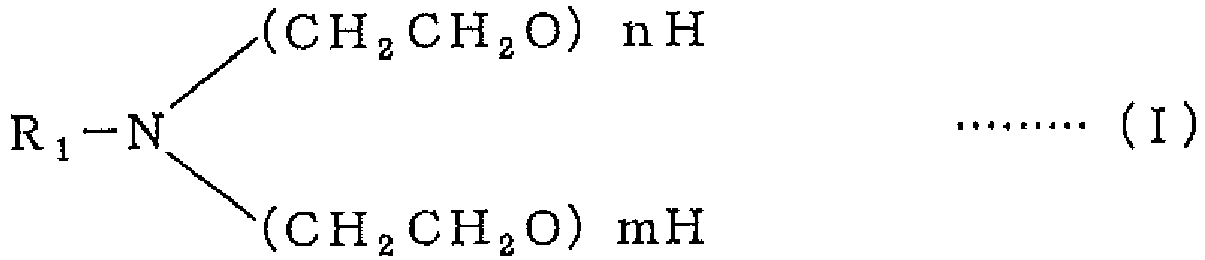
- In Formula (I) described above, R1 is an alkyl group or an alkenyl group having 1 to 24 carbon atoms, and the alkyl group and alkenyl group may have any of a linear group, a branched group or a cyclic group. It includes, for example, the alkyl group such as methyl, ethyl, propyl, isopropyl, butyl, isobutyl, t-butyl, pentyl, isopentyl, hexyl, isoheptyl, 2-ethylhexyl, octyl, isononyl, decyl, dodecyl, isotridecyl, tetradecyl, hexadecyl, isocetyl, octadecyl, isostearyl, docosyl and tetracosyl, and the alkenyl group such as allyl, 3-butenyl, methallyl, 2-methyl-3-butenyl, 3-methyl-3-butenyl, 1,1-dimethyl-2-propenyl, 4-pentenyl, oleyl and tetracosylidene (tetracosenyl). R1 has preferably 6 or more carbon atoms from the viewpoint of the viscosity lowering effect, and it has preferably 18 or less carbon atoms from the viewpoint of compatibility between the cost for synthesis and the viscosity lowering effect. From the above viewpoints, R1 is an alkyl group or an alkenyl group having further preferably 11 to 18 carbon atoms, further more preferably 14 to 18 carbon atoms, and the alkyl group and alkenyl group may have any of a linear group, a branched group or a cyclic group. It is preferably heptyl, 2-ethylhexyl, undecyl, tridecyl, pentadecyl, heptadecyl and heptadecenyl.
- In Formula (I), m and n represent an average addition molar number, and m and n are numerical values which represent m + n = 1 to 20. The term m + n is preferably 1.5 or more from the viewpoint of the interaction with the surface of silica, and it is preferably 10 or less from the viewpoint of maintaining the heat build-up. From the above viewpoints, the term m + n is more preferably 1.5 to 5, further preferably 1.5 to 3.5 and further more preferably 2 to 3.5. Also, m and n may be same or different, and preferably they each are independently positive numbers exceeding 0 and are more preferably 0.5 to 5, further preferably 0.5 to 2.5.
- The alkanolamine represented by Formula (I) described above which can specifically be used includes, for example, at least one of POE (2) octylamine, POE (4) decylamine, POE (2) dodecylamine, POE (5) dodecylamine, POE (15) dodecylamine, POE (2) tetradecylamine, POE (2) hexadecylamine, POE (2) octadecylamine, POE (20) octadecylamine and POE (2) octadecenylamine (in this connection, POE (n) shows that polyoxyethylene is added in an amount of average n mole). Among them, POE (2) dodecylamine, POE (5) dodecylamine, POE (2) tetradecylamine, POE (2) hexadecylamine and POE (2) octadecenylamine are preferably used.
- A synthetic process for the alkanolamine represented by Formula (I) described above is already known, and the alkanolamine can be obtained by various production processes. Also, commercial products may be used.
- A compounding amount of at least one of the alkanolamines is preferably 0.5 to 15 parts by mass based on 100 parts by mass of the rubber component, and it is more preferably 1 to 15 parts by mass, further preferably 2 to 10 parts by mass and further more preferably 3 to 7 parts by mass from the viewpoint of further exerting the effects of the present invention. Also, a compounding amount of at least one of the alkanolamines is preferably 0.5 to 20 parts by mass, more preferably 0.5 to 15 parts by mass, further preferably 1 to 15 parts by mass, further more preferably 1 to 7 parts by mass and particularly preferably 2 to 6 parts by mass based on 100 parts by mass of silica.
- When a compounding amount of at least one of the alkanolamines is 0.5 part by mass or more based on 100 parts by mass of the rubber component, the viscosity lowering effect on the unvulcanized rubber is high. On the other hand, when it is 20 parts by mass or less, a smaller influence is exerted on the rubber burning property, and the range is preferred.
- The rubber composition of the present invention can be compounded, in addition to the rubber component, silica and the alkanolamine represented by Formula (I) each described above, with ingredients suitably selected from compounding ingredients usually used in the rubber industry, for example, antioxidants, softening agents, stearic acid, zinc oxide, vulcanization accelerators, vulcanization accelerator activators, vulcanizing agents and the like as long as the objects of the present invention are not disturbed. Commercial products can suitably be used as the above compounding ingredients.
- The rubber composition of the present invention can be obtained by kneading, warming up and extruding the rubber component, silica, at least one of the alkanolamines described above and, if necessary, various compounding ingredients suitably selected by means of a mixer such as a mixing roll and an internal mixer. After mold processing, the rubber composition is vulcanized and can be used for applications to tire members of pneumatic tires, such as tire treads, under treads, carcasses, side walls and bead parts, and in addition thereto, it can be used as well for applications to industrial products and the like, such as rubber vibration insulators, belts, hoses and others.
- The reasons why in the rubber composition thus constituted, dispersibility of silica is improved and a viscosity of an unvulcanized rubber is lowered and why heat build-up of a vulcanized rubber is improved as well are presumed as follows.
- That is, it is presumed that in the rubber composition of the present invention, when at least one of the alkanolamines represented by Formula (I) is compounded with a mixture prepared by mixing 100 parts by mass of at least one rubber component selected from natural rubber and/or diene base synthetic rubbers with 55 to 200 parts by mass of silica, the surface of the silica is hydrophobized, whereby the silica particles are inhibited from being coagulated each other to lower a viscosity of an unvulcanized rubber and that the accelerator is inhibited from being adsorbed on the surface of the silica, whereby the heat build-up as well as the processability of the rubber composition can be improved.
- Next, the tire of the present invention is obtained by a usual process using the rubber composition of the present invention. That is, the rubber composition of the present invention compounded, if necessary, with various compounding ingredients as described above is extruded and processed into a tire member, for example, a member for a tread at an unvulcanized stage, and the member is stuck on a tire under molding by a usual process on a tire building machine, whereby a green tire is molded. The green tire is heated and pressed in a vulcanizer to obtain a tire. Since the tire of the present invention thus obtained is excellent in low heat build-up, it is excellent in fuel consumption, and it is excellent as well in productivity because of good processability of the rubber composition.
- Further, in the viscosity lowering method of an unvulcanized rubber according to the present invention, at least one of the alkanolamines represented by Formula (I) is compounded with a mixture prepared by mixing 100 parts by mass of at least one rubber component selected from natural rubber and/or diene base synthetic rubbers with 55 to 200 parts by mass of the silica, whereby the surface of the silica is hydrophobized, and therefore the silica particles are inhibited from being coagulated each other to lower a viscosity of an unvulcanized rubber.
- The present invention further discloses the following compositions and processes with respect to the embodiment described above. The preferred embodiments and numerical ranges have been described above.
- [1] A rubber composition prepared by compounding 100 parts by mass of at least one rubber component selected from natural rubber and/or diene base synthetic rubbers with 55 to 200 parts by mass, preferably 55 to 150 parts by mass, more preferably 60 to 120 parts by mass and further more preferably 70 to 100 parts by mass of silica and 0.5 to 15 parts by mass, preferably 1 to 15 parts by mass, more preferably 2 to 10 parts by mass and further more preferably 3 to 7 parts by mass of at least one of alkanolamines represented by the following Formula (I):
- [4] The rubber composition as described in any one of the above items [1] to [3], wherein a compounding amount of the alkanolamine is 0.5 to 20 parts by mass, preferably 0.5 to 15 parts by mass, more preferably 1 to 15 parts by mass, further preferably 1 to 7 parts by mass and further more preferably 2 to 6 parts by mass based on 100 parts by mass of silica.
- [5] The rubber composition as described in any one of the above items [1] to [4], wherein R1 has 11 to 18 carbon atoms, and m + n is 2 to 5.
- [6] A tire prepared by using the rubber composition as described in any one of the above items [1] to [5] for a tire member.
- [7] A viscosity lowering method for an unvulcanized rubber, wherein 100 parts by mass of at least one rubber component selected from natural rubber and/or diene base synthetic rubbers are compounded with 55 to 200 parts by mass, preferably 55 to 150 parts by mass, more preferably 60 to 120 parts by mass and further more preferably 70 to 100 parts by mass of silica and 0.5 to 15 parts by mass, preferably 1 to 15 parts by mass, more preferably 2 to 10 parts by mass and further more preferably 3 to 7 parts by mass of at least one of alkanolamines represented by the following Formula (I):

- [8] The viscosity lowering method for an unvulcanized rubber as described in the above item [7], wherein the unvulcanized rubber is further compounded with a silane coupling agent.
- [9] The viscosity lowering method for an unvulcanized rubber as described in the above item [7] or [8], wherein a compounding amount of the silane coupling agent is 1 to 20 parts by mass, preferably 1 to 12 parts by mass and more preferably 6 to 12 parts by mass based on 100 parts by mass of silica.
- [10] The viscosity lowering method for an unvulcanized rubber as described in any one of the above items [7] to [9], wherein a compounding amount of the alkanolamine is 0.5 to 20 parts by mass, preferably 0.5 to 15 parts by mass, more preferably 1 to 15 parts by mass, further preferably 1 to 7 parts by mass and further more preferably 2 to 6 parts by mass based on 100 parts by mass of silica.
- [11] The viscosity lowering method for an unvulcanized rubber as described in any one of the above items [7] to [10], wherein R1 has 11 to 18 carbon atoms, and m + n is 2 to 5.
- Next, the present invention shall be explained in further details with reference to examples and comparative examples, but the present invention shall by no means be restricted to the following examples.
- Rubber compositions were prepared according to recipes shown in Table 1 and Table 2 by an ordinary method. Numerical values in Table 1 and Table 2 are shown by mass parts.
- The rubber compositions shown in Table 1 and Table 2 were used to measure a viscosity of unvulcanized rubbers by the following measuring method. The rubber compositions obtained were vulcanized at 160°C for 14 minutes, and the vulcanized rubbers thus obtained were used to measure a viscoelasticity (tan δ) by the following measuring method.
- Further, the rubber compositions shown in Table 2 were used to evaluate a discoloration property by the following evaluation method.
- The results thereof are shown in the following Table 1 and Table 2.
- The viscosity of the unvulcanized rubber was measured according to JIS K 6300-1:2001 (Mooney viscosity).
- The evaluation results thereof were shown by indices, wherein the value obtained in Comparative Example 1 was set to 100 in Table 1, and the value obtained in Comparative Example 4 was set to 100 in Table 2. It is shown that the smaller the value of viscosity of the unvulcanized rubbers is, the better the workability is.
- A viscoelasticity measuring equipment (manufactured by Rheometric Corporation) was used to measure tan δ at a temperature of 50°C, a distortion of 5 % and a frequency of 15 Hz, and the results thereof were shown by indices, wherein the value obtained in Comparative Example 1 was set to 100 in Table 1, and the value obtained in Comparative Example 4 was set to 100 in Table 2. It is shown that the smaller the above value is, the lower the heat build-up is, and the better the fuel consumption is.
- The rubber compositions shown in Table 2 were subjected to pressing cure at 160°C for 20 minutes, and test pieces (thickness: 10 mm) were obtained from them and exposed outsides for 3 months, and then a discoloration property thereof was evaluated according to the following evaluation criteria.
-
- ○: no change is observed
- Δ: a little change is observed
- ×: apparent change is observed
- As apparent from the results shown in Table 1, it has been found from the evaluation results of the viscosity of the unvulcanized rubber and the viscoelasticity (tan δ) that the rubber compositions produced in Examples 1 to 4 falling in the scope of the present invention are improved in a viscosity lowering effect of an unvulcanized rubber and heat build-up of a vulcanized rubber as compared with the rubber compositions produced in Comparative Examples 1 to 2 falling outside the scope of the present invention.
- Further, the respective rubber compositions shown in Table 2 were produced in Examples 6 to 7 and Comparative Examples 3 to 5 in order to clearly show the significance of a lower limit value of a compounding amount (55 parts by mass) of silica. As apparent from the results shown in Table 2, it has been found from the evaluation results of the viscosity of the unvulcanized rubber, the viscoelasticity (tan δ) and the discoloration property that the rubber compositions produced in Examples 5 to 6 falling in the scope of the present invention are improved in a viscosity lowering effect of an unvulcanized rubber and heat build-up of a vulcanized rubber and that the vulcanized rubber is reduced in discoloration with the passage of time as compared with the rubber compositions produced in Comparative Examples 3 to 5 falling outside the scope of the present invention.
- The rubber compositions produced according to the present invention can be used for tire members of pneumatic tires, such as tire treads, under treads, carcasses, side walls and bead parts, and in addition thereto, they can suitably be used as well for rubber products, such as rubber vibration insulators, belts and hoses.
| Comparative Example | Example | |||||
| 1 | 2 | 1 | 2 | 3 | 4 | |
| S-SBR *1 | 137.5 | 137.5 | 137.5 | 137.5 | 137.5 | 137.5 |
| Carbon black *2 | 20 | 20 | 20 | 20 | 20 | 20 |
| Silica *3 | 80 | 80 | 80 | 80 | 80 | 80 |
| Silane coupling agent *4 | 8 | 8 | 8 | 8 | 8 | 8 |
| Stearic acid | 1 | 1 | 1 | 1 | 1 | 1 |
| Wax*5 | 2 | 2 | 2 | 2 | 2 | 2 |
| Antioxidant 6PPD *6 6 | 4 | 4 | 4 | 4 | 4 | 4 |
| Antioxidant TMQ *7 | 0.3 | 0.3 | 0.3 | 0.3 | 0.3 | 0.3 |
| Zinc oxide | 2.5 | 2.5 | 2.5 | 2.5 | 2.5 | 2.5 |
| Vulcanization accelerator DPG *8 | 0.8 | 0.8 | 0.8 | 0.8 | 0.8 | 0.8 |
| Vulcanization accelerator MBTS *9 | 0.8 | 0.8 | 0.8 | 0.8 | 0.8 | 0.8 |
| Vulcanization accelerator CBS *10 | 0.9 | 0.9 | 0.9 | 0.9 | 0.9 | 0.9 |
| Sulfur | 1.5 | 1.5 | 1.5 | 1.5 | 1.5 | 1.5 |
| Dimethylstearylamine *11 | 5 | |||||
| Alkanolamine 1 *12 | 5 | |||||
| Alkanolamine 2 *13 | 5 | |||||
| Alkanolamine 3 *14 | 5 | |||||
| Alkanolamine 4 *15 | 5 | |||||
| Viscosity of unvulcanized rubber | 100 | 90 | 87 | 88 | 86 | 88 |
| tan δ | 100 | 97 | 95 | 92 | 89 | 90 |
| Comparative Example | Example | ||||
| 3 | 4 | 5 | 5 | 6 | |
| S-SBR *1 | 137.5 | 137.5 | 137.5 | 137.5 | 137.5 |
| Carbon black *2 | 20 | 20 | 20 | 20 | 20 |
| Silica *3 | 50 | 50 | 55 | 55 | 55 |
| Silane coupling agent *4 | 8 | 8 | 8 | 8 | 8 |
| Stearic acid | 1 | 1 | 1 | 1 | 1 |
| Wax*5 | 2 | 2 | 2 | 2 | 2 |
| Antioxidant 6PPD *6 | 4 | 4 | 4 | 4 | 4 |
| Antioxidant TMQ *7 | 0.3 | 0.3 | 0.3 | 0.3 | 0.3 |
| Zinc oxide | 2.5 | 2.5 | 2.5 | 2.5 | 2.5 |
| Vulcanization accelerator DPG *8 | 0.8 | 0.8 | 0.8 | 0.8 | 0.8 |
| Vulcanization accelerator MBTS *9 | 0.8 | 0.8 | 0.8 | 0.8 | 0.8 |
| Vulcanization accelerator CBS *10 | 0.9 | 0.9 | 0.9 | 0.9 | 0.9 |
| Sulfur | 1.5 | 1.5 | 1.5 | 1.5 | 1.5 |
| Alkanolamine 1 *12 | 0 | 3 | 0 | 3.3 | 5 |
| Viscosity of unvulcanized rubber | 120 | 100 | 126 | 103 | 99 |
| tan δ | 110 | 100 | 115 | 102 | 100 |
| Discoloration property | ○ | × | ○ | ○ | Δ |
| *1 to *15 in Table 1 and Table 2 show the followings. *1: Tufdene 2830 (manufactured by Asahi Kasei Chemicals Corporation) (rubber component: 100 parts by mass, oil component: 37.5 parts by mass) *2: SEAST 7HM (manufactured by Tokai Carbon Co., Ltd.) *3: Nipsil VN3 (manufactured by Tosoh Silica Corporation) *4: Bis(3-triethoxysilylpropyl) tetrasulfide 5: Microcrystalline wax, Ozoace 0701 (manufactured by Nippon Seiro Co., Ltd.) *6: NOCRAC 6C (manufactured by Ouchi Shinko Industrial Co., Ltd.) *7: NONFLEX RD-S (manufactured by Seiko Chemical Co., Ltd.) *8: NOCCELER D (manufactured by Ouchi Shinko Industrial Co., Ltd.) *9: NOCCELER DM (manufactured by Ouchi Shinko Industrial Co., Ltd.) *10: Sanceler CM-G (manufactured by Sanshin Chemical Industrial Co., Ltd.) *11: FARMIN DM8098 (dimethylstearylamine, manufactured by Kao Corporation) *12: Amiet 102 (POE (2) dodecylamine, manufactured by Kao Corporation) *13: Amiet 105 (POE (5) dodecylamine, manufactured by Kao Corporation) *14: Amiet 302 (POE (2) octadecylamine, manufactured by Kao Corporation) *15: Amiet 320 (POE (20) octadecylamine, manufactured by Kao Corporation) |
Claims (11)
- A rubber composition prepared by compounding 100 parts by mass of at least one rubber component selected from natural rubber and/or diene base synthetic rubbers with 55 to 200 parts by mass of silica and 0.5 to 15 parts by mass of at least one of alkanolamines represented by the following Formula (I):

- The rubber composition as described in claim 1, wherein the rubber composition is further compounded with a silane coupling agent.
- The rubber composition as described in claim 2, wherein a compounding amount of the silane coupling agent is 1 to 20 parts by mass based on 100 parts by mass of silica.
- The rubber composition as described in any one of claims 1 to 3, wherein a compounding amount of the alkanolamine is 0.5 to 20 parts by mass based on 100 parts by mass of silica.
- The rubber composition as described in any one of claims 1 to 4, wherein R1 has 11 to 18 carbon atoms, and m + n is 2 to 5.
- A tire using the rubber composition as described in any one of claims 1 to 5 for a tire member.
- A viscosity lowering method for an unvulcanized rubber, wherein 100 parts by mass of at least one rubber component selected from natural rubber and/or diene base synthetic rubbers are compounded with 55 to 200 parts by mass of silica and 0.5 to 15 parts by mass of at least one of alkanolamines represented by the following Formula (I):

- The viscosity lowering method for an unvulcanized rubber as described in claim 7, wherein the unvulcanized rubber is further compounded with a silane coupling agent.
- The viscosity lowering method for an unvulcanized rubber as described in claim 8, wherein a compounding amount of the silane coupling agent is 1 to 20 parts by mass based on 100 parts by mass of silica.
- The viscosity lowering method for an unvulcanized rubber as described in any one of claims 7 to 9, wherein a compounding amount of the alkanolamine is 0.5 to 20 parts by mass based on 100 parts by mass of silica.
- The viscosity lowering method for an unvulcanized rubber as described in any one of claims 7 to 10, wherein R1 has 11 to 18 carbon atoms, and m + n is 2 to 5.
Applications Claiming Priority (2)
| Application Number | Priority Date | Filing Date | Title |
|---|---|---|---|
| JP2011228683 | 2011-10-18 | ||
| PCT/JP2012/076957 WO2013058320A1 (en) | 2011-10-18 | 2012-10-18 | Rubber composition and tire using same |
Publications (3)
| Publication Number | Publication Date |
|---|---|
| EP2770020A1 true EP2770020A1 (en) | 2014-08-27 |
| EP2770020A4 EP2770020A4 (en) | 2015-07-08 |
| EP2770020B1 EP2770020B1 (en) | 2017-09-06 |
Family
ID=48140963
Family Applications (1)
| Application Number | Title | Priority Date | Filing Date |
|---|---|---|---|
| EP12841990.0A Active EP2770020B1 (en) | 2011-10-18 | 2012-10-18 | Rubber composition and tire using same |
Country Status (5)
| Country | Link |
|---|---|
| US (1) | US9034961B2 (en) |
| EP (1) | EP2770020B1 (en) |
| JP (1) | JP5918780B2 (en) |
| CN (1) | CN104024321B (en) |
| WO (1) | WO2013058320A1 (en) |
Cited By (1)
| Publication number | Priority date | Publication date | Assignee | Title |
|---|---|---|---|---|
| WO2016055953A1 (en) * | 2014-10-07 | 2016-04-14 | Bridgestone Corporation | Rubber compound for tyre portions |
Families Citing this family (9)
| Publication number | Priority date | Publication date | Assignee | Title |
|---|---|---|---|---|
| JP6158038B2 (en) * | 2013-10-29 | 2017-07-05 | 株式会社ブリヂストン | Rubber composition and tire using the same |
| KR101687914B1 (en) | 2014-11-26 | 2016-12-19 | 주식회사 엘지화학 | Rubber Composition comprising conjugated diene polymer and dispensing agent |
| ITUB20159808A1 (en) * | 2015-12-30 | 2017-06-30 | Milano Politecnico | Elastomeric composition and accelerator for vulcanization used in the same. |
| JP6937111B2 (en) | 2016-05-16 | 2021-09-22 | ハリマ化成株式会社 | Tire fillers, tire rubber compositions, tires, and methods for manufacturing tire fillers. |
| EP3636705A4 (en) * | 2017-06-09 | 2020-12-09 | Bridgestone Corporation | Rubber composition, crosslinked rubber composition, rubber article, and tire |
| JP7501084B2 (en) * | 2020-05-01 | 2024-06-18 | 住友ゴム工業株式会社 | Rubber composition for tires |
| JP2023070526A (en) * | 2021-11-09 | 2023-05-19 | 住友ゴム工業株式会社 | Rubber composition for tires, and pneumatic tire |
| JP7753812B2 (en) * | 2021-11-09 | 2025-10-15 | 住友ゴム工業株式会社 | Rubber composition for tires and pneumatic tires |
| CN120590141B (en) * | 2025-08-08 | 2025-10-28 | 湖南科技大学 | A modified magnesium phosphate cement grouting material and its preparation method and application |
Family Cites Families (13)
| Publication number | Priority date | Publication date | Assignee | Title |
|---|---|---|---|---|
| JPS51109048A (en) * | 1975-03-20 | 1976-09-27 | Kuraray Co | GOSEIGOMUSOSEIBUTSUNOSEIHO |
| JPS564637A (en) * | 1979-06-26 | 1981-01-19 | Lion Corp | Antistatic resin composition having excellent nonstickness |
| US4438235A (en) * | 1982-09-30 | 1984-03-20 | Basf Wyandotte Corporation | Tertiary alkanolamines to increase viscosity of filled liquid polymers |
| GB2147596A (en) * | 1983-10-06 | 1985-05-15 | Basf Wyandotte Corp | Increasing the viscosity of filled liquid polymers |
| JPH061857B2 (en) | 1988-12-29 | 1994-01-05 | ミツミ電機株式会社 | Oscillator circuit |
| JP2868872B2 (en) * | 1990-09-14 | 1999-03-10 | 株式会社ブリヂストン | Pneumatic tire having a foamed rubber layer on the tread |
| JP3037468B2 (en) * | 1991-07-01 | 2000-04-24 | 株式会社ブリヂストン | Improved rubber composition |
| JPH05261740A (en) * | 1992-03-23 | 1993-10-12 | Toyoda Gosei Co Ltd | Rubber for washing mold |
| JP3462503B2 (en) | 1994-10-11 | 2003-11-05 | 株式会社ブリヂストン | Rubber composition with improved chargeability and pneumatic tire using the same |
| JP3734304B2 (en) * | 1996-04-22 | 2006-01-11 | 旭化成ケミカルズ株式会社 | Resin composition and resin film |
| JP4157608B2 (en) * | 1996-06-26 | 2008-10-01 | 株式会社ブリヂストン | Rubber composition |
| WO2007007403A1 (en) * | 2005-07-13 | 2007-01-18 | Miyoshi Kasei, Inc. | Surface-treated powder and cosmetic comprising the same |
| JP5651013B2 (en) * | 2007-10-19 | 2015-01-07 | ランクセス・インク. | Butyl rubber compound containing ternary mixed modifier system |
-
2012
- 2012-10-18 JP JP2013539684A patent/JP5918780B2/en active Active
- 2012-10-18 CN CN201280062728.6A patent/CN104024321B/en active Active
- 2012-10-18 US US14/352,488 patent/US9034961B2/en active Active
- 2012-10-18 WO PCT/JP2012/076957 patent/WO2013058320A1/en not_active Ceased
- 2012-10-18 EP EP12841990.0A patent/EP2770020B1/en active Active
Cited By (1)
| Publication number | Priority date | Publication date | Assignee | Title |
|---|---|---|---|---|
| WO2016055953A1 (en) * | 2014-10-07 | 2016-04-14 | Bridgestone Corporation | Rubber compound for tyre portions |
Also Published As
| Publication number | Publication date |
|---|---|
| JP5918780B2 (en) | 2016-05-18 |
| CN104024321B (en) | 2017-07-21 |
| EP2770020A4 (en) | 2015-07-08 |
| US20140323627A1 (en) | 2014-10-30 |
| EP2770020B1 (en) | 2017-09-06 |
| CN104024321A (en) | 2014-09-03 |
| WO2013058320A1 (en) | 2013-04-25 |
| JPWO2013058320A1 (en) | 2015-04-02 |
| US9034961B2 (en) | 2015-05-19 |
Similar Documents
| Publication | Publication Date | Title |
|---|---|---|
| EP2770020B1 (en) | Rubber composition and tire using same | |
| EP2644650B1 (en) | Rubber composition and tire using the same | |
| JP7511393B2 (en) | Rubber composition, rubber composition for tires, crosslinked rubber for tires, additives for tires and rubber | |
| US9169375B2 (en) | Rubber composition for tread, and pneumatic tire | |
| EP2174801A2 (en) | Rubber composition and pneumatic tire | |
| US7493927B2 (en) | Rubber composition | |
| EP3300920B1 (en) | Preparation method of rubber composition for tire and production method of tire | |
| EP1743919B1 (en) | Rubber composition and process for preparing the same | |
| WO2012070625A1 (en) | Rubber composition and tire using the same | |
| JP2017218583A (en) | Production method of rubber composition, rubber composition and tire | |
| JP5848942B2 (en) | Rubber composition and tire using the same | |
| JP6114067B2 (en) | Rubber composition and tire | |
| JP7511392B2 (en) | Rubber composition, rubber composition for tires, crosslinked rubber for tires, additives for tires and rubber | |
| JP6158039B2 (en) | Rubber composition and tire using the same | |
| JP6158038B2 (en) | Rubber composition and tire using the same | |
| JP7197238B2 (en) | Additive for rubber, additive composition for rubber, rubber composition for tire, crosslinked rubber composition for tire, rubber product for tire, and tire | |
| JP5869956B2 (en) | Rubber composition for tire | |
| JP5848943B2 (en) | Rubber composition and tire using the same | |
| JP2011026441A (en) | Method for producing rubber composition | |
| JP7458247B2 (en) | Rubber compositions, rubber compositions for tires, rubber compositions for tire treads, crosslinked rubber for tires, tire treads and tires | |
| EP3385317A1 (en) | Method for preparing rubber composition and method for preparing tire |
Legal Events
| Date | Code | Title | Description |
|---|---|---|---|
| PUAI | Public reference made under article 153(3) epc to a published international application that has entered the european phase |
Free format text: ORIGINAL CODE: 0009012 |
|
| 17P | Request for examination filed |
Effective date: 20140506 |
|
| AK | Designated contracting states |
Kind code of ref document: A1 Designated state(s): AL AT BE BG CH CY CZ DE DK EE ES FI FR GB GR HR HU IE IS IT LI LT LU LV MC MK MT NL NO PL PT RO RS SE SI SK SM TR |
|
| DAX | Request for extension of the european patent (deleted) | ||
| RA4 | Supplementary search report drawn up and despatched (corrected) |
Effective date: 20150608 |
|
| RIC1 | Information provided on ipc code assigned before grant |
Ipc: C08L 9/00 20060101ALI20150601BHEP Ipc: C08K 3/36 20060101ALI20150601BHEP Ipc: C08K 5/17 20060101ALI20150601BHEP Ipc: C08K 5/54 20060101ALI20150601BHEP Ipc: C08L 7/00 20060101AFI20150601BHEP Ipc: B60C 1/00 20060101ALI20150601BHEP |
|
| 17Q | First examination report despatched |
Effective date: 20160826 |
|
| GRAP | Despatch of communication of intention to grant a patent |
Free format text: ORIGINAL CODE: EPIDOSNIGR1 |
|
| INTG | Intention to grant announced |
Effective date: 20170315 |
|
| GRAS | Grant fee paid |
Free format text: ORIGINAL CODE: EPIDOSNIGR3 |
|
| GRAA | (expected) grant |
Free format text: ORIGINAL CODE: 0009210 |
|
| AK | Designated contracting states |
Kind code of ref document: B1 Designated state(s): AL AT BE BG CH CY CZ DE DK EE ES FI FR GB GR HR HU IE IS IT LI LT LU LV MC MK MT NL NO PL PT RO RS SE SI SK SM TR |
|
| REG | Reference to a national code |
Ref country code: GB Ref legal event code: FG4D |
|
| REG | Reference to a national code |
Ref country code: CH Ref legal event code: EP Ref country code: AT Ref legal event code: REF Ref document number: 925864 Country of ref document: AT Kind code of ref document: T Effective date: 20170915 |
|
| REG | Reference to a national code |
Ref country code: IE Ref legal event code: FG4D |
|
| REG | Reference to a national code |
Ref country code: FR Ref legal event code: PLFP Year of fee payment: 6 |
|
| REG | Reference to a national code |
Ref country code: DE Ref legal event code: R096 Ref document number: 602012037121 Country of ref document: DE |
|
| REG | Reference to a national code |
Ref country code: NL Ref legal event code: MP Effective date: 20170906 |
|
| REG | Reference to a national code |
Ref country code: LT Ref legal event code: MG4D |
|
| PG25 | Lapsed in a contracting state [announced via postgrant information from national office to epo] |
Ref country code: NO Free format text: LAPSE BECAUSE OF FAILURE TO SUBMIT A TRANSLATION OF THE DESCRIPTION OR TO PAY THE FEE WITHIN THE PRESCRIBED TIME-LIMIT Effective date: 20171206 Ref country code: FI Free format text: LAPSE BECAUSE OF FAILURE TO SUBMIT A TRANSLATION OF THE DESCRIPTION OR TO PAY THE FEE WITHIN THE PRESCRIBED TIME-LIMIT Effective date: 20170906 Ref country code: SE Free format text: LAPSE BECAUSE OF FAILURE TO SUBMIT A TRANSLATION OF THE DESCRIPTION OR TO PAY THE FEE WITHIN THE PRESCRIBED TIME-LIMIT Effective date: 20170906 Ref country code: LT Free format text: LAPSE BECAUSE OF FAILURE TO SUBMIT A TRANSLATION OF THE DESCRIPTION OR TO PAY THE FEE WITHIN THE PRESCRIBED TIME-LIMIT Effective date: 20170906 Ref country code: HR Free format text: LAPSE BECAUSE OF FAILURE TO SUBMIT A TRANSLATION OF THE DESCRIPTION OR TO PAY THE FEE WITHIN THE PRESCRIBED TIME-LIMIT Effective date: 20170906 |
|
| REG | Reference to a national code |
Ref country code: AT Ref legal event code: MK05 Ref document number: 925864 Country of ref document: AT Kind code of ref document: T Effective date: 20170906 |
|
| PG25 | Lapsed in a contracting state [announced via postgrant information from national office to epo] |
Ref country code: BG Free format text: LAPSE BECAUSE OF FAILURE TO SUBMIT A TRANSLATION OF THE DESCRIPTION OR TO PAY THE FEE WITHIN THE PRESCRIBED TIME-LIMIT Effective date: 20171206 Ref country code: RS Free format text: LAPSE BECAUSE OF FAILURE TO SUBMIT A TRANSLATION OF THE DESCRIPTION OR TO PAY THE FEE WITHIN THE PRESCRIBED TIME-LIMIT Effective date: 20170906 Ref country code: ES Free format text: LAPSE BECAUSE OF FAILURE TO SUBMIT A TRANSLATION OF THE DESCRIPTION OR TO PAY THE FEE WITHIN THE PRESCRIBED TIME-LIMIT Effective date: 20170906 Ref country code: LV Free format text: LAPSE BECAUSE OF FAILURE TO SUBMIT A TRANSLATION OF THE DESCRIPTION OR TO PAY THE FEE WITHIN THE PRESCRIBED TIME-LIMIT Effective date: 20170906 Ref country code: GR Free format text: LAPSE BECAUSE OF FAILURE TO SUBMIT A TRANSLATION OF THE DESCRIPTION OR TO PAY THE FEE WITHIN THE PRESCRIBED TIME-LIMIT Effective date: 20171207 |
|
| PG25 | Lapsed in a contracting state [announced via postgrant information from national office to epo] |
Ref country code: NL Free format text: LAPSE BECAUSE OF FAILURE TO SUBMIT A TRANSLATION OF THE DESCRIPTION OR TO PAY THE FEE WITHIN THE PRESCRIBED TIME-LIMIT Effective date: 20170906 |
|
| PG25 | Lapsed in a contracting state [announced via postgrant information from national office to epo] |
Ref country code: CZ Free format text: LAPSE BECAUSE OF FAILURE TO SUBMIT A TRANSLATION OF THE DESCRIPTION OR TO PAY THE FEE WITHIN THE PRESCRIBED TIME-LIMIT Effective date: 20170906 Ref country code: PL Free format text: LAPSE BECAUSE OF FAILURE TO SUBMIT A TRANSLATION OF THE DESCRIPTION OR TO PAY THE FEE WITHIN THE PRESCRIBED TIME-LIMIT Effective date: 20170906 Ref country code: RO Free format text: LAPSE BECAUSE OF FAILURE TO SUBMIT A TRANSLATION OF THE DESCRIPTION OR TO PAY THE FEE WITHIN THE PRESCRIBED TIME-LIMIT Effective date: 20170906 |
|
| PG25 | Lapsed in a contracting state [announced via postgrant information from national office to epo] |
Ref country code: AT Free format text: LAPSE BECAUSE OF FAILURE TO SUBMIT A TRANSLATION OF THE DESCRIPTION OR TO PAY THE FEE WITHIN THE PRESCRIBED TIME-LIMIT Effective date: 20170906 Ref country code: EE Free format text: LAPSE BECAUSE OF FAILURE TO SUBMIT A TRANSLATION OF THE DESCRIPTION OR TO PAY THE FEE WITHIN THE PRESCRIBED TIME-LIMIT Effective date: 20170906 Ref country code: SM Free format text: LAPSE BECAUSE OF FAILURE TO SUBMIT A TRANSLATION OF THE DESCRIPTION OR TO PAY THE FEE WITHIN THE PRESCRIBED TIME-LIMIT Effective date: 20170906 Ref country code: SK Free format text: LAPSE BECAUSE OF FAILURE TO SUBMIT A TRANSLATION OF THE DESCRIPTION OR TO PAY THE FEE WITHIN THE PRESCRIBED TIME-LIMIT Effective date: 20170906 Ref country code: IS Free format text: LAPSE BECAUSE OF FAILURE TO SUBMIT A TRANSLATION OF THE DESCRIPTION OR TO PAY THE FEE WITHIN THE PRESCRIBED TIME-LIMIT Effective date: 20180106 |
|
| REG | Reference to a national code |
Ref country code: CH Ref legal event code: PL |
|
| REG | Reference to a national code |
Ref country code: DE Ref legal event code: R097 Ref document number: 602012037121 Country of ref document: DE |
|
| PG25 | Lapsed in a contracting state [announced via postgrant information from national office to epo] |
Ref country code: MC Free format text: LAPSE BECAUSE OF FAILURE TO SUBMIT A TRANSLATION OF THE DESCRIPTION OR TO PAY THE FEE WITHIN THE PRESCRIBED TIME-LIMIT Effective date: 20170906 |
|
| PLBE | No opposition filed within time limit |
Free format text: ORIGINAL CODE: 0009261 |
|
| STAA | Information on the status of an ep patent application or granted ep patent |
Free format text: STATUS: NO OPPOSITION FILED WITHIN TIME LIMIT |
|
| REG | Reference to a national code |
Ref country code: IE Ref legal event code: MM4A |
|
| PG25 | Lapsed in a contracting state [announced via postgrant information from national office to epo] |
Ref country code: DK Free format text: LAPSE BECAUSE OF FAILURE TO SUBMIT A TRANSLATION OF THE DESCRIPTION OR TO PAY THE FEE WITHIN THE PRESCRIBED TIME-LIMIT Effective date: 20170906 Ref country code: CH Free format text: LAPSE BECAUSE OF NON-PAYMENT OF DUE FEES Effective date: 20171031 Ref country code: LU Free format text: LAPSE BECAUSE OF NON-PAYMENT OF DUE FEES Effective date: 20171018 Ref country code: LI Free format text: LAPSE BECAUSE OF NON-PAYMENT OF DUE FEES Effective date: 20171031 |
|
| 26N | No opposition filed |
Effective date: 20180607 |
|
| REG | Reference to a national code |
Ref country code: BE Ref legal event code: MM Effective date: 20171031 |
|
| GBPC | Gb: european patent ceased through non-payment of renewal fee |
Effective date: 20171206 |
|
| PG25 | Lapsed in a contracting state [announced via postgrant information from national office to epo] |
Ref country code: BE Free format text: LAPSE BECAUSE OF NON-PAYMENT OF DUE FEES Effective date: 20171031 Ref country code: SI Free format text: LAPSE BECAUSE OF FAILURE TO SUBMIT A TRANSLATION OF THE DESCRIPTION OR TO PAY THE FEE WITHIN THE PRESCRIBED TIME-LIMIT Effective date: 20170906 |
|
| PG25 | Lapsed in a contracting state [announced via postgrant information from national office to epo] |
Ref country code: MT Free format text: LAPSE BECAUSE OF NON-PAYMENT OF DUE FEES Effective date: 20171018 |
|
| REG | Reference to a national code |
Ref country code: FR Ref legal event code: PLFP Year of fee payment: 7 |
|
| PG25 | Lapsed in a contracting state [announced via postgrant information from national office to epo] |
Ref country code: IE Free format text: LAPSE BECAUSE OF NON-PAYMENT OF DUE FEES Effective date: 20171018 |
|
| PG25 | Lapsed in a contracting state [announced via postgrant information from national office to epo] |
Ref country code: GB Free format text: LAPSE BECAUSE OF NON-PAYMENT OF DUE FEES Effective date: 20171206 |
|
| PG25 | Lapsed in a contracting state [announced via postgrant information from national office to epo] |
Ref country code: HU Free format text: LAPSE BECAUSE OF FAILURE TO SUBMIT A TRANSLATION OF THE DESCRIPTION OR TO PAY THE FEE WITHIN THE PRESCRIBED TIME-LIMIT; INVALID AB INITIO Effective date: 20121018 |
|
| PG25 | Lapsed in a contracting state [announced via postgrant information from national office to epo] |
Ref country code: CY Free format text: LAPSE BECAUSE OF NON-PAYMENT OF DUE FEES Effective date: 20170906 |
|
| PG25 | Lapsed in a contracting state [announced via postgrant information from national office to epo] |
Ref country code: MK Free format text: LAPSE BECAUSE OF FAILURE TO SUBMIT A TRANSLATION OF THE DESCRIPTION OR TO PAY THE FEE WITHIN THE PRESCRIBED TIME-LIMIT Effective date: 20170906 |
|
| PG25 | Lapsed in a contracting state [announced via postgrant information from national office to epo] |
Ref country code: TR Free format text: LAPSE BECAUSE OF FAILURE TO SUBMIT A TRANSLATION OF THE DESCRIPTION OR TO PAY THE FEE WITHIN THE PRESCRIBED TIME-LIMIT Effective date: 20170906 |
|
| PG25 | Lapsed in a contracting state [announced via postgrant information from national office to epo] |
Ref country code: PT Free format text: LAPSE BECAUSE OF FAILURE TO SUBMIT A TRANSLATION OF THE DESCRIPTION OR TO PAY THE FEE WITHIN THE PRESCRIBED TIME-LIMIT Effective date: 20170906 |
|
| PG25 | Lapsed in a contracting state [announced via postgrant information from national office to epo] |
Ref country code: AL Free format text: LAPSE BECAUSE OF FAILURE TO SUBMIT A TRANSLATION OF THE DESCRIPTION OR TO PAY THE FEE WITHIN THE PRESCRIBED TIME-LIMIT Effective date: 20170906 |
|
| P01 | Opt-out of the competence of the unified patent court (upc) registered |
Effective date: 20230529 |
|
| PGFP | Annual fee paid to national office [announced via postgrant information from national office to epo] |
Ref country code: DE Payment date: 20251021 Year of fee payment: 14 |
|
| PGFP | Annual fee paid to national office [announced via postgrant information from national office to epo] |
Ref country code: IT Payment date: 20251024 Year of fee payment: 14 |
|
| PGFP | Annual fee paid to national office [announced via postgrant information from national office to epo] |
Ref country code: FR Payment date: 20251030 Year of fee payment: 14 |