EP2769723A1 - Compounds for use in inhibiting HIV capsid assembly - Google Patents
Compounds for use in inhibiting HIV capsid assembly Download PDFInfo
- Publication number
- EP2769723A1 EP2769723A1 EP13156371.0A EP13156371A EP2769723A1 EP 2769723 A1 EP2769723 A1 EP 2769723A1 EP 13156371 A EP13156371 A EP 13156371A EP 2769723 A1 EP2769723 A1 EP 2769723A1
- Authority
- EP
- European Patent Office
- Prior art keywords
- alkyl
- group
- independently
- amr
- alkenyl
- Prior art date
- Legal status (The legal status is an assumption and is not a legal conclusion. Google has not performed a legal analysis and makes no representation as to the accuracy of the status listed.)
- Withdrawn
Links
- 0 *c(c(*)c1*)c(*)c(*)c1O* Chemical compound *c(c(*)c1*)c(*)c(*)c1O* 0.000 description 16
- LALDDLWUGQUEEW-NYDIFVMJSA-N C/C=C\C=C\C(\NCCC[n]1cncc1)=N/C(C([C@@H](CC=C1)C=C1Cl)=C)=N Chemical compound C/C=C\C=C\C(\NCCC[n]1cncc1)=N/C(C([C@@H](CC=C1)C=C1Cl)=C)=N LALDDLWUGQUEEW-NYDIFVMJSA-N 0.000 description 1
- KBYWIVZYVDZSLM-UHFFFAOYSA-N C=CC=[IH](C1=C)N=C(c2cccnc2)N=C1N Chemical compound C=CC=[IH](C1=C)N=C(c2cccnc2)N=C1N KBYWIVZYVDZSLM-UHFFFAOYSA-N 0.000 description 1
- LWXGLJBYGVFWFH-PLNGDYQASA-N CC(/C=C\C(Cl)=C)=C Chemical compound CC(/C=C\C(Cl)=C)=C LWXGLJBYGVFWFH-PLNGDYQASA-N 0.000 description 1
- UXTFMNPOJWDPSI-UHFFFAOYSA-N CC(c1ccccc1NC(c1cnccc1)=O)=O Chemical compound CC(c1ccccc1NC(c1cnccc1)=O)=O UXTFMNPOJWDPSI-UHFFFAOYSA-N 0.000 description 1
- RHDTYOZJLIAKHZ-RTLXGIGLSA-N CCC(C/C(/C=C(C)C)=C/C=C/C(OCC)=O)C1=NC(C/C=C\C(\Cl)=C/C)=NC2C1=CC=CC2 Chemical compound CCC(C/C(/C=C(C)C)=C/C=C/C(OCC)=O)C1=NC(C/C=C\C(\Cl)=C/C)=NC2C1=CC=CC2 RHDTYOZJLIAKHZ-RTLXGIGLSA-N 0.000 description 1
- UYMTVNVMZLATGJ-UHFFFAOYSA-N CCOC(C(CC=C1)C=C1I)=O Chemical compound CCOC(C(CC=C1)C=C1I)=O UYMTVNVMZLATGJ-UHFFFAOYSA-N 0.000 description 1
- SHFUYWACDDZMLX-VLDJQENVSA-N CC[C@](C)(C(C1)[I]1#C)/C=C\CC(C)N Chemical compound CC[C@](C)(C(C1)[I]1#C)/C=C\CC(C)N SHFUYWACDDZMLX-VLDJQENVSA-N 0.000 description 1
- HELXUVVYCHLMIX-UHFFFAOYSA-N CNc(ccc([N+]([O-])=O)c1)c1I Chemical compound CNc(ccc([N+]([O-])=O)c1)c1I HELXUVVYCHLMIX-UHFFFAOYSA-N 0.000 description 1
- JWRSXNRCJYZFPZ-UHFFFAOYSA-N COCCCOC(CC(C(C(N)=O)=C1)N)=C1OCCOC Chemical compound COCCCOC(CC(C(C(N)=O)=C1)N)=C1OCCOC JWRSXNRCJYZFPZ-UHFFFAOYSA-N 0.000 description 1
- RFIPCEWTKOORKS-UHFFFAOYSA-O C[NH2+]C(C=C(N(C)C1=NC(c2ccncc2)=NC2=CCC=CC=C12)[I]=C1)=C1N(C)N Chemical compound C[NH2+]C(C=C(N(C)C1=NC(c2ccncc2)=NC2=CCC=CC=C12)[I]=C1)=C1N(C)N RFIPCEWTKOORKS-UHFFFAOYSA-O 0.000 description 1
- UHIGHLGTNVYXOP-UHFFFAOYSA-N Cc(cc1F)cc(F)c1F Chemical compound Cc(cc1F)cc(F)c1F UHIGHLGTNVYXOP-UHFFFAOYSA-N 0.000 description 1
- WIQISTBTOQNVCE-UHFFFAOYSA-N Cc(ccc([N+]([O-])=O)c1)c1F Chemical compound Cc(ccc([N+]([O-])=O)c1)c1F WIQISTBTOQNVCE-UHFFFAOYSA-N 0.000 description 1
- XSFIPDPCQOJJFR-UHFFFAOYSA-N [O-][N+](c(cc1)cc(I)c1F)=O Chemical compound [O-][N+](c(cc1)cc(I)c1F)=O XSFIPDPCQOJJFR-UHFFFAOYSA-N 0.000 description 1
- ANPFMDLUEWNKIM-UHFFFAOYSA-N [O-][N+](c1cc(F)ccc1I)=O Chemical compound [O-][N+](c1cc(F)ccc1I)=O ANPFMDLUEWNKIM-UHFFFAOYSA-N 0.000 description 1
- KUJTZQXHTBKAMO-UHFFFAOYSA-N [O-][N+](c1cc(I)ccc1F)=O Chemical compound [O-][N+](c1cc(I)ccc1F)=O KUJTZQXHTBKAMO-UHFFFAOYSA-N 0.000 description 1
- CAHANEDMQDTZAQ-UHFFFAOYSA-N c1c[s]c(Nc2nc(-c3cccnc3)nc3c2cccc3)n1 Chemical compound c1c[s]c(Nc2nc(-c3cccnc3)nc3c2cccc3)n1 CAHANEDMQDTZAQ-UHFFFAOYSA-N 0.000 description 1
Images
Classifications
-
- A—HUMAN NECESSITIES
- A61—MEDICAL OR VETERINARY SCIENCE; HYGIENE
- A61K—PREPARATIONS FOR MEDICAL, DENTAL OR TOILETRY PURPOSES
- A61K31/00—Medicinal preparations containing organic active ingredients
- A61K31/33—Heterocyclic compounds
- A61K31/395—Heterocyclic compounds having nitrogen as a ring hetero atom, e.g. guanethidine or rifamycins
- A61K31/495—Heterocyclic compounds having nitrogen as a ring hetero atom, e.g. guanethidine or rifamycins having six-membered rings with two or more nitrogen atoms as the only ring heteroatoms, e.g. piperazine or tetrazines
- A61K31/505—Pyrimidines; Hydrogenated pyrimidines, e.g. trimethoprim
- A61K31/517—Pyrimidines; Hydrogenated pyrimidines, e.g. trimethoprim ortho- or peri-condensed with carbocyclic ring systems, e.g. quinazoline, perimidine
-
- A—HUMAN NECESSITIES
- A61—MEDICAL OR VETERINARY SCIENCE; HYGIENE
- A61K—PREPARATIONS FOR MEDICAL, DENTAL OR TOILETRY PURPOSES
- A61K31/00—Medicinal preparations containing organic active ingredients
- A61K31/33—Heterocyclic compounds
- A61K31/395—Heterocyclic compounds having nitrogen as a ring hetero atom, e.g. guanethidine or rifamycins
- A61K31/495—Heterocyclic compounds having nitrogen as a ring hetero atom, e.g. guanethidine or rifamycins having six-membered rings with two or more nitrogen atoms as the only ring heteroatoms, e.g. piperazine or tetrazines
- A61K31/505—Pyrimidines; Hydrogenated pyrimidines, e.g. trimethoprim
- A61K31/506—Pyrimidines; Hydrogenated pyrimidines, e.g. trimethoprim not condensed and containing further heterocyclic rings
-
- A—HUMAN NECESSITIES
- A61—MEDICAL OR VETERINARY SCIENCE; HYGIENE
- A61K—PREPARATIONS FOR MEDICAL, DENTAL OR TOILETRY PURPOSES
- A61K31/00—Medicinal preparations containing organic active ingredients
- A61K31/33—Heterocyclic compounds
- A61K31/395—Heterocyclic compounds having nitrogen as a ring hetero atom, e.g. guanethidine or rifamycins
- A61K31/495—Heterocyclic compounds having nitrogen as a ring hetero atom, e.g. guanethidine or rifamycins having six-membered rings with two or more nitrogen atoms as the only ring heteroatoms, e.g. piperazine or tetrazines
- A61K31/505—Pyrimidines; Hydrogenated pyrimidines, e.g. trimethoprim
- A61K31/519—Pyrimidines; Hydrogenated pyrimidines, e.g. trimethoprim ortho- or peri-condensed with heterocyclic rings
-
- A—HUMAN NECESSITIES
- A61—MEDICAL OR VETERINARY SCIENCE; HYGIENE
- A61K—PREPARATIONS FOR MEDICAL, DENTAL OR TOILETRY PURPOSES
- A61K31/00—Medicinal preparations containing organic active ingredients
- A61K31/33—Heterocyclic compounds
- A61K31/395—Heterocyclic compounds having nitrogen as a ring hetero atom, e.g. guanethidine or rifamycins
- A61K31/535—Heterocyclic compounds having nitrogen as a ring hetero atom, e.g. guanethidine or rifamycins having six-membered rings with at least one nitrogen and one oxygen as the ring hetero atoms, e.g. 1,2-oxazines
- A61K31/5375—1,4-Oxazines, e.g. morpholine
- A61K31/5377—1,4-Oxazines, e.g. morpholine not condensed and containing further heterocyclic rings, e.g. timolol
-
- A—HUMAN NECESSITIES
- A61—MEDICAL OR VETERINARY SCIENCE; HYGIENE
- A61K—PREPARATIONS FOR MEDICAL, DENTAL OR TOILETRY PURPOSES
- A61K31/00—Medicinal preparations containing organic active ingredients
- A61K31/70—Carbohydrates; Sugars; Derivatives thereof
- A61K31/7042—Compounds having saccharide radicals and heterocyclic rings
- A61K31/7052—Compounds having saccharide radicals and heterocyclic rings having nitrogen as a ring hetero atom, e.g. nucleosides, nucleotides
- A61K31/706—Compounds having saccharide radicals and heterocyclic rings having nitrogen as a ring hetero atom, e.g. nucleosides, nucleotides containing six-membered rings with nitrogen as a ring hetero atom
- A61K31/7064—Compounds having saccharide radicals and heterocyclic rings having nitrogen as a ring hetero atom, e.g. nucleosides, nucleotides containing six-membered rings with nitrogen as a ring hetero atom containing condensed or non-condensed pyrimidines
-
- A—HUMAN NECESSITIES
- A61—MEDICAL OR VETERINARY SCIENCE; HYGIENE
- A61P—SPECIFIC THERAPEUTIC ACTIVITY OF CHEMICAL COMPOUNDS OR MEDICINAL PREPARATIONS
- A61P31/00—Antiinfectives, i.e. antibiotics, antiseptics, chemotherapeutics
- A61P31/12—Antivirals
- A61P31/14—Antivirals for RNA viruses
- A61P31/18—Antivirals for RNA viruses for HIV
Definitions
- the present invention relates to compounds a pharmaceutically acceptable salts or solvates thereof for use in inhibiting HIV capsid assembly.
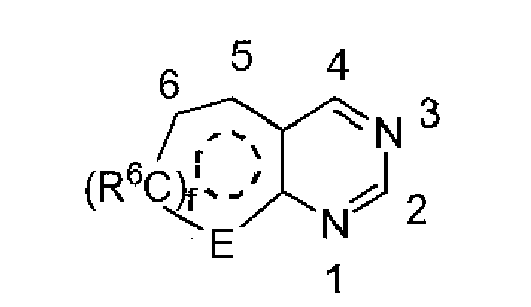
- the conjugates or pharmaceutically acceptable salt or solvate thereof comprise the following core structure wherein E is S or CR 7 , and wherein f is 0 or 1, and wherein in case E is N, O or S, preferably S, f is 0, and wherein the core structure is at least substituted in 2 and 4 position.
- the family of retroviruses comprises small enveloped virus particles (diameter ⁇ 100 nm) carrying two copies of a single-stranded positive sense RNA genome. All retroviruses possess three major genes encoding for the polyproteins Gag (structural proteins), Pol (enzymes) and Env (surface glycoproteins).
- the most studied member of the retroviral family is human immunodeficiency virus type 1 (HIV-1), the causative agent of acquired immunodeficiency syndrome (AIDS) with approx. 33.4 million people infected worldwide and 2 million deaths due to AIDS in 2008 alone.
- HIV-1 human immunodeficiency virus type 1
- HIV-1 the causative agent of acquired immunodeficiency syndrome
- AIDS acquired immunodeficiency syndrome
- HAART highly active antiretroviral therapy
- anti-HIV-1 drugs targeting mainly viral enzymes (e.g. nucleoside and non-nucleoside reverse transcriptase inhibitors, protease inhibitors, integrase inhibitors) or the viral entry into the host cell (fusion inhibitors and attachment inhibitors).
- viral enzymes e.g. nucleoside and non-nucleoside reverse transcriptase inhibitors, protease inhibitors, integrase inhibitors
- fusion inhibitors and attachment inhibitors fusion inhibitors and attachment inhibitors
- the Gag polyprotein alone is necessary and sufficient to form virus like particles. Its multimerization is mainly driven by intermolecular interactions between the capsid (CA), spacer peptide 1 (sp1) and nucleocapsid (NC) region of neighboring Gag molecules.
- the Gag polyprotein precursor radially lines the inside of the viral membrane and forms the spherical immature core. Concomitant with, or shortly after release, Gag is processed into matrix, CA, sp1, NC, spacer peptide 2 (sp2) and protein of 6 kDa (p6).
- CA then builds up the conical core of the mature virion which encloses the viral genome. Only after this maturation process the virus becomes infectious.
- CAI capsid assembly inhibitor
- C-CA C-terminal CA
- CAI C-terminal CA
- Vanda Bartonova JBC 283:32024-32033, 2008
- CA variants carrying mutations Y169A, L211A, or L211S had a reduced affinity for CAI and were unable to form mature-like particles in vitro. These mutations also blocked morphological conversion to mature virions in tissue culture and abolished infectivity.
- X-ray crystallographic analyses of the variant C-CA domains revealed that these alterations induced the same allosteric changes at the dimer interface observed in the C-CA/CAI complex.
- US 7,618,975 describes the use of 4-arylamino-quinazolines and of analogs thereof as activators of caspases and inducers of apoptosis.
- the compounds described in US 7,618,975 allow for induction of apoptosis, for inhibiting the assembly of tubulin and for inhibiting topoisomerase II.
- 4-arylamino-quinazolines can be used for inhibiting HIV capsid assembly.
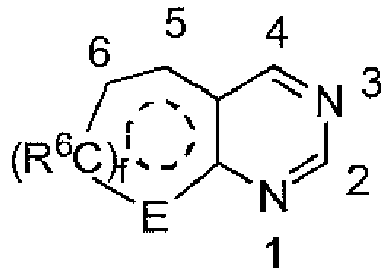
- the present invention relates to a compound or pharmaceutically acceptable salts or solvates thereof for use in inhibiting HIV capsid assembly, the compounds comprising the following core structure wherein E is S or CR 7 , and wherein f is 0 or 1, and wherein in case E is S, f is 0, and wherein the core structure is at least substituted in 2 and 4 position.
- residue R 6 and R 7 said residues, are independently of each other, selected from the group consisting of -H, -D, -alkyl, alkoxy, alkenyl, alkynyl, halides, -NO 2 , -OH, -NH 2 , -NHR 4# , -CN, - S(O)R 4# , -SO 2 R 4# , -P(O)R 4# R 5# , -P(O)(OR 4# )R 5# , -P(O)(OR 4# )(OR 5# ), -C(O)NR 4# R 5# , - C(O)SR 4# , -C(O)R 4# , -C(O)O-R 4# , alkoxy and glycol chains; wherein R 6 may optionally form a cyclic residue, with a further substituent present in 5 or 6 position, and wherein R 4# and R 5# are, independently
- the present invention relates to a pharmaceutical composition for inhibiting HIV capsid assembly comprising the compound, as described above, in a therapeutically affective amount, and the use of a compound, as described above, for the manufacture of a medicament for inhibiting HIV capsid assembly.
- the present invention relates to a method of treating a patient suffering from HIV comprising administering a therapeutically effective amount of the compound as defined above, as well as the use of this compound for treating a patient suffering from HIV.
- core structure as used in the context of the present invention is denoted to mean that - besides the substitutions in 2 and 4 position, the shown structure may be further suitably substituted.
- the term also encompasses alkyl groups which are further substituted by one or more suitable substituent.
- the alkyl groups according to the invention have from 1 to 20 carbon atoms, more preferably from 1 to 10 carbon atoms.
- Such alkyl groups are hereinunder also referred to as C1-20alkyl and C1-10alkyl, respectively.
- substituted as used in the context of the present invention preferably refers to organic groups in which a hydrogen group, in any position, is replaced by one or more substituents, preferably by 1, 2, 3, 4, 5 or 6 substituents, more preferably by 1, 2, or 3 substituents. If two or more substituents are present, each substituent may be the same or may be different from the at least one other substituent. There are in general no limitations as to the substituent.
- the substituents may be, for example, selected from the group consisting of aryl, alkenyl, alkynyl, halogen, hydroxyl, alkylcarbonyloxy, arylcarbonyloxy, alkoxycarbonyloxy, aryloxycarbonyloxy, carboxylate, alkylcarbonyl, arylcarbonyl, alkoxycarbonyl, aminocarbonyl, alkylaminocarbonyl, dialkylaminocarbonyl, alkylthiocarbonyl, alkoxy, phosphate, phosphonato, phosphinato, amino, acylamino, including alkylcarbonylamino, arylcarbonylamino, carbamoyl and ureido, amidino, nitro, imino, sulfhydryl, alkylthio, arylthio, thiocarboxylate, sulfates, alkylsulfinyl, sulfonate, s
- cyclopentyl or cyclohexyl such as e.g. morpholino, piperazinyl or piperidinyl, alkylaryl, arylalkyl and heteroaryl.
- Preferred substituents of such organic residues are, for example, halogens, such as in particular fluorine or iodine, amino groups, hydroxyl groups, carbonyl groups, thiol groups and carboxyl groups.
- cyclic alkyl or "cycloalkyl” relates to optionally suitably substituted to 8-membered single-ring alkyl groups as well as optionally suitably substituted multicyclic alkyl residues preferably having up to 20, more preferably up to 10 carbon atoms.
- Cycloalkyl groups residues having up to 20, preferably up to 10 carbon atoms also referred to as C1-20cycloalkyl and C1-10cyclocloalkyl, respectively.
- cycloalkyl groups are mentioned: cyclopentyl, cyclohexyl, cycloheptyl cyclopropylmethyl, cyclopentylmethyl, cyclohexylmethyl, cyclohexylcyclopentylmethyl, dicyclohexylmethyl, 1-cyclopentylethyl, 1-cyclohexylethyl, 2-cyclopropylethyl, 2-cyclopentylethyl, 2-cyclohexylethyl, 2-cycloheptylethyl, 1-cyclohexyl-1-methylethyl, 1-cyclohexylpropyl, 2-cyclopentylpropyl, 3-cyclobutylpropyl, 3-cyclopentylpropyl, 3- cyclohexylpropyl, 3-cycloheptylpropyl, 1-cyclopropyl-lmethylpropyl, 1-cyclohexyl-2-methylpropyl
- heterocycloalkyl relates to optionally suitably substituted 3 to 8-membered single-ring alkyl groups as well as optionally suitably substituted multicyclic alkyl residues having preferably up to 20, more preferably up to 10 carbon atoms, wherein the cyclic alkyl groups comprise one or more, preferably from 1 to 4 such as 1, 2, 3 or 4, heteroatoms, wherein in case the cycloalkyl residue comprises more than 1 heteroatom, the heteroatoms may be the same or different.
- Heterocycloalkyl groups residues having up to 20, preferably up to 10 carbon atoms also referred to as C1-20heterocycloalkyl and C1-10heterocyclocloalkyl, respectively.
- the heteroatoms are selected from the group consisting of O, S and N.
- alkyl also encompasses groups which are further substituted by one or more suitable substituent.
- aryl refers to, but is not limited to, optionally suitably substituted 5- and 6-membered single-ring aromatic groups as well as optionally suitably substituted multicyclic groups, for example bicyclic or tricyclic aryl groups.
- aryl thus includes, for example, optionally substituted phenyl groups or optionally suitably substituted naphthyl groups.
- Aryl groups can also be fused or bridged with alicyclic or heterocycloalkyl rings are not aromatic so as to form a polycycle, e.g., benzodioxolyl or tetraline.
- aryl further includes aromatic groups which linked via a single bond to further aromatic groups so as to form, e.g., biphenyl groups.
- heteroaryl as used within the meaning of the present invention includes optionally suitably substituted 5- and 6-membered single-ring aromatic groups as well as substituted or unsubstituted multicyclic aryl groups, for example bicyclic or tricyclic aryl groups, comprising one or more, preferably from 1 to 4 such as 1, 2, 3 or 4, heteroatoms, wherein in case the aryl residue comprises more than 1 heteroatom, the heteroatoms may be the same or different.
- heteroaryl groups including from 1 to 4 heteroatoms are, for example, benzodioxolyl, pyrrolyl, furanyl, thiophenyl, thiazolyl, isothiazolyl, imidazolyl, triazolyl, tetrazolyl, pyrazolyl, oxazolyl, isoxazolyl, pyridinyl, pyrazinyl, pyridazinyl, benzoxazolyl, benzodioxazolyl, benzothiazolyl, benzoimidazolyl, benzothiophenyl, methylenedioxyphenylyl, napthyridinyl, quinolinyl, isoquinolinyl, benztriazyl, isoindolyl, benzofuranyl, purinyl, deazapurinyl, pteridinyl, or indolizinyl.
- substituted aryl and the term “substituted heteroaryl” as used in the context of the present invention describes moieties having substituents replacing a hydrogen on one or more atoms, e.g. C or N, of an aryl or heteroaryl moiety. Again, there are in general no limitations as to the substituent.
- the substituents may be, for example, selected from the group consisting of alkyl, alkenyl, alkynyl, halogen, hydroxyl, alkylcarbonyloxy, arylcarbonyloxy, alkoxycarbonyloxy, aryloxycarbonyloxy, carboxylate, alkylcarbonyl, arylcarbonyl, alkoxycarbonyl, aminocarbonyl, alkylaminocarbonyl, dialkylaminocarbonyl, alkylthiocarbonyl, alkoxy, phosphate, phosphonato, phosphinato, amino, acylamino, including alkylcarbonylamino, arylcarbonylamino, carbamoyl and ureido, amidino, nitro, imino, sulfhydryl, alkylthio, arylthio, thiocarboxylate, sulfates, alkylsulfinyl, sulfonate, s
- alkenyl refers to unsaturated alkyl groups having at least one double bond.
- the term also encompasses alkenyl groups which are substituted by one or more suitable substituent.
- cycloalkenyl refers to unsaturated cycloalkyl groups having at least one double bond.
- the term also encompasses alkenyl groups which are substituted by one or more suitable substituent.
- the following groups are mentioned: cyclopentenyl, cyclohexenyl, cycloheptenyl, cyclooctenyl, cyclopentadienyl, cyclohexadienyl, cycloheptadienyl, cyclooctadienyl, and the like.
- Preferred are those with 5-7 carbon atoms, including cyclopentenyl, cyclohexenyl, and cycloheptenyl.
- alkynyl refers to unsaturated alkyl groups having at least one triple bond.
- the term also encompasses alkynyl groups which are substituted by one or more suitable substituent.
- alkoxy refers to an alkyl residue being linked via an oxygen group to the respective parent molecule, thus to a residue having the structure -O-alkyl, wherein this term is meant to also encompass groups in which the alkyl group bears further substituents, as mentioned above.
- the group E present in the core structure is CR 7 or S, and f is 0 or 1, and wherein in case E is S, f is 0.
- the following preferred core structures are mentioned:
- E is CR 7 and f is 1, thus, the compound of the invention preferably comprises the core structure
- the core structure comprised in the compounds according to the invention is at least substituted in 2 and in 4 position.
- the core structure is substituted with Z in 2 position, Z being selected from the group consisting of aryl, heteroaryl, -X Z -aryl and -X Z -heteroaryl, wherein X Z is selected from the group consisting of O, NH, N(Me) and S, and wherein the core structure is further substituted with a group in 4 position, wherein X is selected from the group consisting of N, O or S, and wherein R 3 is selected from the group consisting of H, alkyl, cycloalkyl, aryl, heteroaryl and heterocycloalkyl, wherein integer n is 0 or 1, and wherein Q is selected from the group consisting of alkyl, alkoxy, cycloalkyl, heterocycloalkyl, aryl, alkoxyalkyl and heteroaryl.
- the compound according to the invention preferably comprises a structure according to the following formula (I), such as a structure according to one of the following formulas:
- the compound according to the invention has a structure according to following formula, including salts and solvates thereof, more preferably according to one of the following formulas, and most preferably according to the following formula (II): wherein R 4 , R 5 , R 6 , and R 7 are, independently of each other, selected from the group consisting of -H, -D, -alkyl, alkoxy, alkenyl, alkynyl, halides, -NO 2 , OH, NH 2 , NHR 4# CN, S(O)R 4# , SO 2 R 4# , P(O)R 4# R 5# , P(O)(OR 4# )R 5# , P(O)(OR 4# )(OR 5# ), C(O)NR 4# R 5# C(O)SR 4# , -C(O)R 4# , -C(O)O-R 4# , alkoxy and glycol chains; and wherein R 4 , R 5
- R 4 , R 5 , R 6 , and R 7 are, independently of each other, selected from the group consisting of H, -D, -alkyl, alkoxy, alkenyl, alkynyl, halides, -NO 2 , -OH, -NH 2 , -NHR 4# -CN, -S(O)R 4# , -SO 2 R 4# , -P(O)R 4# R 5# , -P(O)(OR 4# )R 5# , -P(O)(OR 4# )(OR 5# ), - C(O)NR 4# R 5# , -C(O)SR 4# , -C(O)R 4# , -C(O)O-R 4# , alkoxy and glycol chains, wherein R 4 and R 5 or R 5 and R 6 can form a cyclic residue.
- each R 4# may be the same or may be different from each other, provided that R 4# is selected from the group consisting of -H, -alkyl, -alkenyl, -heterocycloalkyl, aryl and heteroaryl.
- each R 5# may be the same or may be different from each other, provided that R 5# is selected from the group consisting of -H, -alkyl, -alkenyl, - heterocycloalkyl, aryl and heteroaryl.
- R 4 , R 5 , R 6 , and R 7 are, independently of each other, selected from the group consisting of -H, -OH, alkyl, alkoxy, in particular methoxy, -NO 2 , -C(O)O-R 4# , glycol chains, wherein in case, any of R 4 , R 5 , R 6 , and R 7 is an alkyl group, the alkyl group is preferably a, optionally substituted, C1-20alkyl group, more preferably a, optionally substituted, C1-10alkyl group, more preferably a, optionally substituted, methyl, ethyl, propyl, or butyl group, and most preferably a methyl group comprising at least one fluorine substituent, such as a, -CF 3 , CHF 2 , CH 2 F.
- R 4# is preferably alkyl, more preferably C1-20alkyl, more preferably C1-10 alkyl, more preferably methyl, ethyl, propyl, or butyl.
- the alkoxy group is preferably a, optionally substituted, C1-20alkoxy group, more preferably a, optionally substituted, C1-10alkoxy group, more preferably a ethoxy or methoxy group.
- glycol chain preferably refers to an "ethylene glycol chain” or "oligoethylene glycol chain", i.e. to a group having a repeating ethylene glycol unit and optionally being capped with a methoxy group.
- ethylene glycol chain can be any length, however typically it includes from 1 to about 100 and more typically from 1 to about 10 ethylene glycol units.
- the glycol chain according to the invention has the following structure: -O-[CH 2 -CH 2 -O] g -Me with integer g being preferably of from 1 to 100, more preferably of from 1 to 10. According to a particular preferred embodiment, g is 1.
- residue R 4 As to residue R 4 , according to a preferred embodiment of the invention, this residue is H.
- residues R 5 and R 6 are preferably, independently of each other, selected from the group consisting of -H, -CF 3 , CHF 2 , CH 2 F, H, -OH, C1-10alkyl, C1-10alkoxy, in particular methoxy or ethoxy, -NO 2 , -C(O)O-R 4# , with R 4# being C1-10alkyl, and glycol chains, in particular -O-[CH 2 -CH 2 -O] g -Me with integer g being preferably of from 1 to 10.
- this residue R 7 is a preferred embodiment of the invention, this residue H or alkoxy, such as selected from the group consisting of H, methoxy and ethoxy, more preferably H or methoxy, most preferably H.
- Table 1 Preferred combinations of groups R 4 , R 5 , R 6 , and R 7 , by way of example: Structure R 4 R 5 R 6 R 7 H -H, -CF 3 , CHF 2 , CH 2 F, H, -OH, C1-10alkyl, methoxy, ethoxy, NO 2 , -C(O)O-R 4# , with R 4# being C1-10alkyl, and -O-[CH 2 -CH 2 -O] g -Me -CF 3 H H methoxy -H, -CF 3 , CHF 2 , CH 2 F, H, -OH, C1-10alkyl, methoxy, ethoxy, NO 2 , -C(O)O-R 4
- the substituent in 2 position is Z, wherein Z is preferably selected from the group consisting of aryl, heteroraryl, -X Z -aryl and -X Z -heteroaryl, as described above.
- Z has a structure according the following formulas, wherein X Z is selected from the group consisting of O, NH, N(Me) and S, and wherein integer zz is 0 or 1, and wherein R 1 and R 2 , are, suitable substituents, in particular, R 1 and R 2 , are independently of each other, selected from the group consisting of H, D, -alkyl, cycloalkyl, cycloalkenyl, heterocycloalkyl, heterocycloalkenyl, aryl, heteroaryl, alkenyl, alkoxy, halides, -C(O)R 1# , -C(O)OR 1# , -S(O)R 1# , -SO 2 R 1#
- Z has a structure according to the following formula:
- the present invention also describes a compound for inhibiting HIV capsid assembly, the conjugate having a structure according to the following formula or a pharmaceutically acceptable salt or solvate thereof for use in inhibiting HIV capsid assembly, wherein Z is wherein X Z is selected from the group consisting of O, NH, N(Me) and S, and wherein integer zz is 0 or 1, more preferably wherein Z is and wherein R 1 and R 2 , are, independently of each other, selected from the group consisting of H, D, -alkyl, cycloalkyl, cycloalkenyl, heterocycloalkyl, aryl, heteroaryl, alkenyl, alkoxy, halides, -C(O)R 1# , -C(O)OR 1# , -S(O)R 1# , -SO 2 R 1# , -P(O)R 1# R 2# , - P(O)(OR 1# )R 2# , -P(
- the present invention relates to the use of a compound, as described above, for the manufacture of a medicament for inhibiting HIV capsid assembly. Further, the present invention relates to a method of treating a patient suffering from HIV comprising administering a therapeutically effective amount of the compound, as defined above, as well as the use of this compound for treating a patient suffering from HIV.
- X Z is preferably NH.
- Z has preferably the structure
- R 1 and R 2 are, independently of each other, selected from the group consisting of H, D, -alkyl, cycloalkyl, cycloalkenyl, heterocycloalkyl, aryl, heteroaryl, alkenyl, alkoxy, halides, -C(O)R 1# , -C(O)OR 1# , -S(O)R 1# , -SO 2 R 1# , -P(O)R 1# R 2# , - P(O)(OR 1# )R 2# , -P(O)(OR # )(OR 2# ), -C(O)NR 1# R 2# , -C(O)NR 1# and -C(O)SR 1# , wherein R 1# and R 2# are, independently of each other, selected from the group consisting of -H, - alkyl, -alkenyl, -heterocycloalkyl,
- R 1 and R 2 are, independently of each other, selected from the group consisting alkyl cycloalkyl, heterocycloalkyl, cycloalkenyl, alkenyl, aryl, heteroaryl, H, halides, -D, C(O)R 1# , C(O)OR 1# and alkoxy, wherein R 1# is C 1-10 alkyl, more preferably from the group consisting of C1-20alkyl, in particular C1-10alkyl, C3-10cycloalkyl, C3-10heterocycloalkyl, C3-10cycloalkenyl, C2-20alkenyl, C6-10aryl, C5-10heteroaryl, C(O)R 1# , C(O)OR 1# , -H, -D, -C1-10alkoxy, and -F, wherein R 1# is C 1-10 alkyl, more preferably methyl, ethyl or butyl.
- R 1 or R 2 is C1-10alkyl
- the following C 1-10 alkyl groups are preferred: methyl, ethyl, propyl, butyl, pentyl, hexyl or octyl.
- R 1 or R 2 is C3-10cycloalkyl
- the following preferred C3-10cycloalkyl groups are mentioned, by way of example: cyclopentyl, cyclohexyl, cycloheptyl cyclopropylmethyl, cyclopentylmethyl, cyclohexylmethyl, cyclohexylcyclopentylmethyl, dicyclohexylmethyl, 1-cyclopentylethyl, 1-cyclohexylethyl, 2-cyclopropylethyl, 2-cyclopentylethyl, 2-cyclohexylethyl, 2-cycloheptylethyl, 1-cyclohexyl-1-methylethyl, 1-cyclohexylpropyl, 2-cyclopentylpropyl, 3-cyclobutylpropyl, 3-cyclopentylpropyl, 3-cyclohexylpropyl, 3-cycloheptylpropyl, 1-cycloprop
- R 1 or R 2 is C3-10heterocycloalkyl
- preferred C3-10heterocycloalkyl groups are mentioned by way of example: morpholino, piperazinyl, piperidinyl tetrahydrofuran, pyrrolidin, pyrrolidin-2-on.
- R 1 or R 2 is C3-10cycloalkenyl
- the following preferred C3-10cycloalkenyl groups are mentioned by way of example: cyclopentenyl, cyclohexenyl, and cycloheptenyl.
- C6-10aryl groups are mentioned: phenyl (including substituted phenyl groups), benzyl (including substituted benzyl groups), naphthyl, anthryl, phenanthryl, biphenyl, and the like.
- benzodioxolyl pyrrolyl, furanyl, thiophenyl, thiazolyl, isothiazolyl, imidazolyl, triazolyl, tetrazolyl, pyrazolyl, oxazolyl, isoxazolyl, pyridinyl, pyrazinyl, pyridazinyl, benzoxazolyl, benzodioxazolyl, benzothiazolyl, benzoimidazolyl, benzothiophenyl, methylenedioxyphenylyl, napthyridinyl, quinolinyl, isoquinolinyl, indolyl, benzofuranyl, purinyl, deazapurinyl, or indolizinyl.
- R 1 or are selected from the group consisting of C1-20alkyl, C3-10cycloalkyl, C3-10heterocycloalkyl, C3-10cycloalkenyl, C2-20alkenyl, C6-10aryl, C5-10heteroaryl, C(O)R 1# , C(O)OR 1# , -H, -D, -C1-10alkoxy, and -F, wherein R 1# is C 1-10 alkyl.
- R 1 and R 2 are both -H.
- A, B and G preferably at least one of these atoms is N.
- Z preferably has one of the following structures: more preferably one of the following structures;
- A, B and G are N, and the respective other groups are C-R 8 , C-R 9 , or C-R 10 , respectively.
- Z is preferably
- R 8 , R 9 and R 10 these residues are, preferably, independently of each other, selected from the group consisting of H, -D, -alkyl, cycloalkyl, cycloalkenyl, heterocycloalkyl, heterocycloalkenyl, aryl, heteroaryl, alkenyl, alkoxy, halides, -C(O)R 1# , C(O)OR 8# , -S(O)R 8# , -SO 2 R 8# , -P(O)R 8# R 9# , -P(O)(OR 8# )R 9# , -P(O)(OR 8# )(OR 9# ), - C(O)NR 8# R 9# , -C(O)NR 8# and -C(O)SR 8# , and wherein R 8# and R 9# are, independently of each other, selected from the group consisting of -H, -alkyl, and wherein R
- R 8 , R 9 and R 10 are, independently of each other -H, -alkyl, -O-alkyl and -halide.
- R 8 , R 9 and R 10 are, independently of each other, selected from the group consisting of -H, C1-10alkyl, -O-[C1-10alkyl], -I, -Br, -Cl and -F, more preferably selected from the group consisting of -H, methyl, ethyl, propyl, trifluoromethyl, methoxy, ethoxy, -I and -F.]
- Z has as structure according to the following formula, wherein zz is 0 or 1, and wherein A is C-R 8 , B is C-R 9 , and C-R 10 , Z thus having the following structure:
- the present invention also describes a compound for inhibiting HIV capsid assembly, as described above, the conjugate having a structure according to the following formula, or a pharmaceutically acceptable salt or solvate thereof for use in inhibiting HIV capsid assembly, wherein Z is
- Z is selected from the group consisting of
- the group X present in the structural moiety is selected from the group consisting of N, O or S, with the proviso that in case X is S, n is 0, and in case X is N, n is 1.
- the present invention also describes a compound for inhibiting HIV capsid assembly, the conjugate having a structure according to the one of the following formula or a pharmaceutically acceptable salt or solvate thereof for use in inhibiting HIV capsid assembly, wherein Z is wherein X Z is selected from the group consisting of O, NH, N(Me) and S, and wherein integer zz is 0 or 1, more preferably wherein Z is and wherein R 1 and R 2 , are, independently of each other, selected from the group consisting of H, D, -alkyl, cycloalkyl, cycloalkenyl, heterocycloalkyl, aryl, heteroaryl, alkenyl, alkoxy, halides, -C(O)R 1# , -C(O
- X is N and n is 1, the compound thus having the
- R 3 is selected from the group consisting of H, alkyl, cycloalkyl, aryl, heteroaryl and heterocycloalkyl.
- R 3 is selected from the group consisting of H, C1-10alkyl, C3-10cycloalkyl, C3-10heterocycloalkyl, C6-10aryl and C5-10heteroaryl, more preferably H or C1-10alkyl. It is to be understood that all mentioned residues mentioned may be substituted or unsubstituted.
- R 3 is selected from the group consisting of H, C1-10alkyl and C3-10cycloalky, such as H, methyl, ethyl, propyl, butyl, pentyl, cyclopentyl, cylohexyl and hexyl. This includes the respective substituted residues.
- R 3 is H or a C1-10alkyl being substituted with at least on halogen, such as with 1, 2 or 3 halogens, preferably with 1 or 2 or 3 fluorides, such as a 2-fluoroethyl group, or a C3-10cycloalkyl group being substituted with at least on halogen, such as with 1, 2 or 3 halogens, preferably with 1 or 2 or 3 fluorides.
- R 3 is H or methyl.
- the present invention also relate to a compound, as described above, having the structure preferably a structure according to one of the following formulas, wherein X is N, n is 1 and R 3 is H or alkyl or cycloalkyl, preferably H or methyl, more preferably H.
- residue Q this residue is preferably selected from the group consisting of alkyl, alkoxy, cycloalkyl, heterocycloalkyl, aryl, alkoxyalkyl and heteroaryl.
- Q is selected from the group consisting of C1-10alkyl, C1-10alkoxy, C3-10cycloalkyl, C3-10heterocycloalkyl, C6-10aryl, C1-4alkoxy-C1-10alkyl and C5-10heteroaryl.
- Q is an aryl group
- Q is preferably phenyl, or a benzocyclopentadienyl group, or a benzocyclopentyl group.
- Q is preferably selected from the group consisting of methyl, ethyl, propyl, -CF 3 , -CHF 2 , - CH 2 F, -CH 2 -CF 3 , -CH 2 -CHF 2 , -CH 2 -CH 2 F, -CHF-CH 3 , more methyl or -CF 3 .
- Q is a heteroaryl group, Q is preferably selected from the group consisting of indolyl, benzimidazolyl, pyridinyl, benztriazyl pyrimidinyl and pyrazinyl.
- Q is preferably selected cyclohexane or cyclopentane.
- Q is preferably selected from the group consisting of morpholino, piperazinyl, piperidinyl tetrahydrofuran, pyrrolidin and pyrrolidin-2-on It is to be understood that all above mentioned residues mentioned may be substituted or unsubstituted.
- Q is selected from the group consisting phenyl, benzocyclopentadienyl group, benzocyclopentyl group, methyl, ethyl, propyl, - CF 3 , -CHF 2 , -CH 2 F, -CH 2 -CF 3 , -CH 2 -CHF 2 , -CH 2 -CH 2 F, indolyl, benzimidazolyl, pyridinyl, benztriazyl, pyrimidinyl, pyrazinyl, cyclohexane, cyclopentane, morpholino, piperazinyl, piperidinyl, tetrahydrofuran, pyrrolidin, pyrrolidin-2-on, wherein all residues mentioned (except for CF 3 , -CHF 2 , -CH 2 F, -CH 2 -CF 3 , -CH 2 -CHF 2 , -CH
- Q is selected from the group consisting of a C1-10alkyl group, which is optionally substituted with at least one fluorine group.
- alkyl alkoxy, alkynyl, alkenyl may be substituted or unsubstituted.
- this alkyl group is preferably selected from the group consisting of methyl, ethyl, propyl, -CF 3 , -CHF 2 , -CH 2 F, -CH 2 -CF 3 , -CH 2 -CHF 2 , -CH 2 -CH 2 F and -CHF-CH 3 , more methyl or -CF 3 .
- the alkyl group present in this residues is preferably, a optionally substituted, methyl group, ethyl group, propyl group....
- R 11 , R 12 , R 13 , R 14 , and R 15 is an electron withdrawing group.
- electron-withdrawing group is recognized in the art, and denotes the tendency of a functional group to attract valence electrons from neighboring atoms by means of a difference in electronegativity with respect to the neighbouring atom (inductive effect) or by withdrawal of ⁇ -electrons via conjugation (mesomeric effect).
- Q is selected from the group consisting of
- R in the above depicted formula is H or alkyl
- Q is selected from the group consisting of
- At least one of one of R 11 , R 12 , R 13 , R 14 , and R 15 is -F, more preferably at least R 12 , R 13 and R 14 are -F, more preferably Q is
- the present invention also describes a compound for inhibiting HIV capsid assembly, as described above, the conjugate having a structure according to the following formula or a pharmaceutically acceptable salt or solvate thereof for use in inhibiting HIV capsid assembly, wherein Q is
- the present invention also describes a compound for inhibiting HIV capsid assembly, as described above, the conjugate having a structure according to the following formula or a pharmaceutically acceptable salt or solvate thereof for use in inhibiting HIV capsid assembly, wherein Q is wherein T is -C-R 19 , N or N-Y T , with Y T being H or alkyl wherein U is -C-R 20 , N or N-Y U , with Y U being H or alkyl wherein V is -C-R 21 , N or N-Y Y , with Y V being H or alkyl the bond (a) is a single or double bond, the bond (b) is a single or double bond, with the proviso that one of (a) and (b) is a double bond, and wherein R 19 , R 20 , and R 21 are, independently of each other selected from the group consisting of H and -alkyl and wherein R 16 , R 17 and R 18 , are independently of each other selected
- Y T , Y U and Y V these groups are, if present, independently from each other H or alkyl, preferably H or C1-10 alkyl, more preferably selected from the group consisting of H, methyl and ethyl, most preferably H of methyl.
- Q is selected from the following formulas more preferably from one of the following formulas:
- the present invention also describes a compound for inhibiting HIV capsid assembly, as described above, the conjugate having a structure according to the following formula or a pharmaceutically acceptable salt or solvate thereof for use in inhibiting HIV capsid assembly, wherein Q is selected from the group consisting of
- the compound of the present invention is combined with at least one further antiretroviral agent.
- Preferred further antiretroviral agents are disclosed elsewhere herein.
- the present invention also envisages a composition comprising the compound of the present invention and at least one further antiretroviral agent.
- the compounds of the present invention can be formulated as pharmaceutically acceptable salt or solvate.
- pharmaceutically acceptable refers to those compounds or salts and solvates thereof as well as pharmaceutical, compositions, and/or dosage forms which are, within the scope of sound medical judgment, suitable for treatment of human beings and animals without excessive toxicity, irritation, allergic response, or other problem complications commensurate with a reasonable benefit/ risk ratio.
- Typical pharmaceutically acceptable salts include those salts prepared by reaction of the compounds of the present invention with a pharmaceutically acceptable mineral or organic acid or an organic or inorganic base. Such salts are known as acid addition and base addition salts. Acids commonly employed to form acid addition salts are inorganic acids such as hydrochloric acid, hydrobromic acid, hydroiodic acid, sulfuric acid, phosphoric acid, and the like, and organic acids such as p-toluenesulfonic acid, methanesulfonic acid, oxalic acid, p-bromophenylsulfonic acid, carbonic acid, succinic acid, citric acid, benzoic acid, acetic acid, and the like.
- inorganic acids such as hydrochloric acid, hydrobromic acid, hydroiodic acid, sulfuric acid, phosphoric acid, and the like
- organic acids such as p-toluenesulfonic acid, methanesulfonic acid, oxalic acid, p-
- salts examples include the sulfate, pyrosulfate, bisulfate, sulfite, bisulfite, phosphate, monohydrogenphosphate, dihydrogenphosphate, metaphosphate, pyrophosphate, bromide, iodide, acetate, propionate, decanoate, caprylate, acrylate, formate, hydrochloride, dihydrochloride, isobutyrate, caproate, heptanoate, propiolate, oxalate, malonate, succinate, suberate, sebacate, fumarate, maleate, butyne-1,4-dioate, hexyne-1,6-dioate, benzoate, chlorobenzoate, methylbenzoate, hydroxybenzoate, methoxybenzoate, phthalate, xylenesulfonate, phenylacetate, phenylpropionate, phenylbutyrate, cit
- Preferred pharmaceutically acceptable acid addition salts are those formed with mineral acids such as hydrochloric acid and hydrobromic acid, and those formed with organic acids such as maleic acid and methanesulfonic acid.
- Salts of amine groups may also comprise quaternary ammonium salts in which the amino nitrogen carries a suitable organic group such as an alkyl, alkenyl, alkynyl, or aralkyl moiety.
- Base addition salts include those derived from inorganic bases, such as ammonium or alkali or alkaline earth metal hydroxides, carbonates, bicarbonates, and the like.
- Such bases useful in preparing the salts of this invention thus include sodium hydroxide, potassium hydroxide, ammonium hydroxide, potassium carbonate, sodium carbonate, sodium bicarbonate, potassium bicarbonate, calcium hydroxide, calcium carbonate, and the like.
- the potassium and sodium salt forms are particularly preferred. It should be recognized that the particular counter ion forming a part of any salt of this invention is usually not of a critical nature, so long as the salt as a whole is pharmacologically acceptable and as long as the counter ion does not contribute undesired qualities to the salt as a whole.
- acceptable solvate encompasses also pharmaceutically acceptable solvates of the compounds of the invention, wherein the compound combines with a solvent such as water, methanol, ethanol or acetonitrile to form a pharmaceutically acceptable solvate such as the corresponding hydrate, methanolate, ethanolate or acetonitrilate.
- a solvent such as water, methanol, ethanol or acetonitrile to form a pharmaceutically acceptable solvate such as the corresponding hydrate, methanolate, ethanolate or acetonitrilate.
- the present invention also relates to a pharmaceutical composition
- a pharmaceutical composition comprising in a therapeutically effective amount the compound of the invention..
- terapéuticaally effective amount preferably refers to an amount of the compound, as defined herein, that effectively inhibits the HIV capsid assembly.
- the conjugate may be used in combination with a pharmaceutical excipient.
- the compound will be in a solid form which can be combined with a suitable pharmaceutical excipient that can be in either solid or liquid form.
- a suitable pharmaceutical excipient that can be in either solid or liquid form.
- carbohydrates, inorganic salts, antimicrobial agents, antioxidants, surfactants, buffers, acids, bases, and combinations thereof may be mentioned.
- a carbohydrate such as a sugar, a derivatized sugar such as an alditol, aldonic acid, an esterified sugar, and/or a sugar polymer may be present as an excipient.
- carbohydrate excipients include, for example: monosaccharides, such as fructose, maltose, galactose, glucose, D-mannose, sorbose, and the like; disaccharides, such as lactose, sucrose, trehalose, cellobiose, and the like; polysaccharides, such as raffmose, melezitose, maltodextrins, dextrans, starches, and the like; and alditols, such as mannitol, xylitol, maltitol, lactitol, sorbitol (glucitol), pyranosyl sorbitol, myoinositol, and the like.
- monosaccharides such as fructose, maltose, galactose, glucose, D-mannose, sorbose, and the like
- disaccharides such as lactose, sucrose, trehalose,
- the excipient may also include an inorganic salt or buffer such as citric acid, sodium chloride, potassium chloride, sodium sulfate, potassium nitrate, sodium phosphate monobasic, sodium phosphate dibasic, and combinations thereof.
- the pharmaceutical composition according to the present invention may also comprise an antimicrobial agent for preventing or determining microbial growth, such as, e.g., benzalkonium chloride, benzethonium chloride, benzyl alcohol, cetylpyridinium chloride, chlorobutanol, phenol, phenylethyl alcohol, phenylmercuric nitrate, thimersol, and combinations thereof.
- the pharmaceutical composition according to the present invention may also comprise an antioxidant, such as, e.g., ascorbyl palmitate, butylated hydroxyanisole, butylated hydroxytoluene, hypophosphorous acid, monothioglycerol, propyl gallate, sodium bisulfite, sodium formaldehyde sulfoxylate, sodium metabisulfite, and combinations thereof.
- an antioxidant such as, e.g., ascorbyl palmitate, butylated hydroxyanisole, butylated hydroxytoluene, hypophosphorous acid, monothioglycerol, propyl gallate, sodium bisulfite, sodium formaldehyde sulfoxylate, sodium metabisulfite, and combinations thereof.
- the pharmaceutical composition according to the present invention may also comprise a surfactant, such as, e.g., polysorbates, or pluronics sorbitan esters; lipids, such as phospholipids and lecithin and other phosphatidylcholines, phosphatidylethanolamines, acids and fatty esters; steroids, such as cholesterol; and chelating agents, such as EDTA or zinc.
- a surfactant such as, e.g., polysorbates, or pluronics sorbitan esters
- lipids such as phospholipids and lecithin and other phosphatidylcholines, phosphatidylethanolamines, acids and fatty esters
- steroids such as cholesterol
- chelating agents such as EDTA or zinc.
- the pharmaceutical composition according to the present invention may also comprise acids or bases such as, e.g., hydrochloric acid, acetic acid, phosphoric acid, citric acid, malic acid, lactic acid, formic acid, trichloroacetic acid, nitric acid, perchloric acid, phosphoric acid, sulfuric acid, fumaric acid, and combinations thereof, and/or sodium hydroxide, sodium acetate, ammonium hydroxide, potassium hydroxide, ammonium acetate, potassium acetate, sodium phosphate, potassium phosphate, sodium citrate, sodium formate, sodium sulfate, potassium sulfate, potassium fumarate, and combinations thereof.
- acids or bases such as, e.g., hydrochloric acid, acetic acid, phosphoric acid, citric acid, malic acid, lactic acid, formic acid, trichloroacetic acid, nitric acid, perchloric acid, phosphoric acid, sulfuric acid, fumaric acid, and
- the compound of the present invention shall inhibit the assembly of the HIV capsid, in particular, of the HIV-1 capsid.
- the term "capsid” refers to the protein shell of the HIV virus.
- the capsid of HIV is well known in the art, and, e.g. described by Engelman, A. and Cherepanov, P. Nature Reviews Microbiology 10, 279-290 (2012 ).
- a major component of the HIV capsid, is the so called CA protein (capsid protein) which originated from the Gag polyprotein which is processed during maturation into various polypeptides.
- the pharmaceutical composition according to the present invention comprises at least one further antiretroviral agent as set forth herein below.
- the present invention relates to use of a compound of the present invention for the manufacture of a HIV capsid inhibitor, and, thus, for a medicament for inhibiting HIV capsid assembly.
- the present invention is method of treating a patient suffering from HIV comprising administering a therapeutically effective amount of the compound or the pharmaceutical composition of the present invention to said subject.
- the human immunodeficiency virus is a retrovirus that may cause acquired immunodeficiency syndrome (AIDS), a condition which may lead to life-threatening opportunistic infections.
- HIV in the context of the present invention preferably, refers to HIV-1 and HIV-2. However, it is particularly contemplated that the term "HIV" refers to HIV-1.
- Antiretroviral medicaments may be also used for pre-exposure and post-exposure prophylaxis (see Morbidity and Mortality Weekly Reports 2011;60 (03);65-68 ). Therefore, is it also contemplated that the compound or the pharmaceutical composition of the present invention is used for pre-exposure and post-exposure prophylaxis.
- the compound or the pharmaceutical composition of the present invention may also be administered to subjects which are not infected with HIV (in case of pre-exposure prophylaxis), or in subjects which are suspected of having contracted HIV recently (in case of post-exposure prophylaxis). Thereby, HIV infection may be prevented.
- the compound or composition of the present invention may be administered by any way deemed appropriate.
- the compound or composition of the present invention is administered orally, parenterally, intracisternally, intrasternally, intravaginally, intraperitoneally or topically. It is particularly preferred to administer the compound or composition of the present invention orally or parentally.
- the compound or composition of the present invention is administered in combination with at least one further antiretroviral HIV medicament.
- the at least one further antiretroviral medicament is selected from the group consisting of: a nucleoside reverse transcriptase inhibitor (NRTI), a non-nucleoside reverse transcriptase inhibitor (NNRTI) a protease inhibitor and an integrase inhibitor.
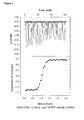
- Figure 1 shows the isothermal titration of CA ligand AMR-346 with HIV capsid protein C-terminal part.
- Upper graph raw experimental data.
- Lower graph Fit (line) to the integrated heats (full circles) from each injection, corrected for the heat of dilution of CA ligand AMR-346.
- reaction conditions a: Et 3 N / dioxane, CH 2 Cl 2 , reflux; b: 1 M NaOH in H 2 O, reflux; c: POCl 3 / DMF, 90 °C; d: 6 M HCl in dioxane, reflux; e: cat. HCl / dioxane, reflux or 1. t-BuONa / THF, 2. 3 M HCl
- reaction mixture was concentrated and the residue was adsorbed on silica gel and purified by flash column chromatography on silica gel (eluents Hex/EA: 1/0 --> 1/2) to afford title compound, which was converted to pale yellow hydrochloric salt (0.240 g, 76%) by treatment with HCl ethanol.
- the title compound was prepared from 4-chloro-6,7,8-trimethoxy-2-(pyridin-3-yl)quinazoline (0.2 g, 0.604 mmol) and 2-fluoro-4-nitroaniline (0.113 g, 0.725 mmol) by using an analogous procedure to that described in general procedure F and was isolated as yellow solid (0.2 g, 68%).
- the title compound was prepared from 4-chloro-2-(pyridin-3-yl)quinazoline (0.15 g, 0.62 mmol) and 3-nitropyridin-4-amine (0.1 g, 0.745 mmol) by using an analogous procedure to that described in general procedure F and was isolated as yellow solid (0.147 g, 69 %).
- the title compound was prepared from 4-chloro-2-(pyridin-3-yl)quinoline (0.2 g, 0.931 mmol) and 2-fluoro-4-nitroaniline (0.139 g, 0.997 mmol) by using an analogous procedure to that described in general procedure F and was isolated as yellow solid (0.219 g, 73 %).
- the title compound was prepared from 4-chloro-2-(pyridin-3-yl)qumazoline (0.2 g, 0.83 mmol) and 2,3,4,5-tetrafluoroaniline (0.164 g, 1.0 mmol) by using an analogous procedure to that described in general procedure E and was isolated as white solid (0.233 g, 76 %).
- the title compound was prepared from 4-chloro-2-(pyridin-3-yl)pyrimidine quinazoline (0.2 g, 0.83 mmol) and 5-bromo-2,4-difluoroaniline (0.207 g, 1.0 mmol) by using an analogous procedure to that described in general procedure E and was isolated as yellow solid (0.233 g, 68 %).
- the title compound was prepared from 4-chloro-2-(pyridin-3-yl)pyrimidine (0.2 g, 0.83 mmol) and 2-iodo-4-nitroaniline (0.262 mg, 1.0 mmol) by using an analogous procedure to that described in general procedure E and was isolated as yellow solid (0.252 mg, 65%).
- the title compound was prepared from 4-chloro-2-(pyridin-3-yl)pyrimidine (0.2 g, 0.83 mmol) and pyrimidin-4-amine (94 mg, 1.0 mmol) by using an analogous procedure to that described in general procedure E and was isolated as white solid (0.164 g, 66 %).
- the title compound was prepared from 4-chloroquinazoline (0.4 g, 2.43 mmol) and 4-fluoro-3-nitroaniline (0:429 g, 2.92 mmol) by using an analogous procedure to that described in general procedure E and was isolated as white solid (0.455 g, 71 %).
- Nitric acid (65 %, 16.2 g, 254.5 mmol) was dropwise added directly into flask containing 3,4-bis(2-methoxyethoxy)benzonitrile (12.8 g, 50.9 mmol). The mixture was then heated with stirring to 50 °C until starting material was completely dissolved. After stirring for two days at RT the reaction mixture was dissolved with water (50 ml) and formed precipitate was filtered off and washed with water (100 ml). After crystallization from chloroform the title compound was obtained in form of white crystals (7.1 g, 47 %). Spectral data were in agreement with literature.
- N -(2-carbamoyl-4,5-bis(2-methoxyethoxy)phenyl)nicotinamide hydrochloride (3.15 g, 8.1 mmol) was dissolved in aqueous KOH (25 ml, 1M) and stirred with heating to 100° C for 10 h. The resulting solution was diluted wit water and extracted six times with butanol. Solvents were removed in vacuo and title compound was obtained as white solid (3.0 g, 95 %). Sample for analysis was treated with HCl and then analysed as hydrochloride.
- the compounds synthesized were tested in ALPHA screen and in YFP screen on tissue cultures.
- the AlphaScreen experiments are performed using Perkin Elmer Enspire plate reader in white 96-well ProxiPlates and PBS supplemented with 0.05% Tween20, 2mM DTT, 2% DMSO.
- Streptavidin-coated Donor beads are used to capture the CAI-biotin peptide.
- a fusion protein of CA with glutathione-S-transferase (CA-GST) is mixed with GSH Acceptor beads. Both mixtures were incubated and then mixed together.
- CA-GST glutathione-S-transferase
- Donor beads containing the photosensitizer phthalocyanine Upon illumination by laser at 680 nm, Donor beads containing the photosensitizer phthalocyanine convert ambient oxygen to an excited form of singlet oxygen 1 O 2.
- Singlet oxygen can within its half-life of ⁇ 4 ⁇ s diffuse approximately 200 nm in solution. If an Acceptor bead is within that proximity, which is mostly upon CA:CAI interaction, energy is transferred from the singlet oxygen to thioxene derivates within the Acceptor and signal at 520 - 620 nm is emitted. In the absence of an Acceptor bead, i.e. a compound inhibits CA/CAI interaction, singlet oxygen falls to ground state and no signal is produced.
- HEK293T cells were cotransfected with pNL4.3 ⁇ LTR ⁇ Nef and YFP-pNL4.3 ⁇ LTR ⁇ Nef in 1 : 1 ratio by FuGENE6 method according the manufacturer instructions.
- Transfected cells were immediately seeded on 96-well plate by Multidrop in the density of 3 x 10 4 cells per well in the volume of 100 ⁇ l.
- the controls include nontransfected cells, late(-) transfected cells (HIV-1 variant with impaired release), pEYFP transfected cells and cells cotransfected with pNL4.3 ⁇ LTR ⁇ Nef and YFP-pNL4.3 ⁇ LTR ⁇ Nef treated with 1% DMSO.
- Obtained YFP intensities were normalized and evaluated according to stringent and less stringent criteria as described further.
- Nontransfected cells and corresponding supernatants were taken as a background values and subtracted from all other values.
- DMSO treated cotransfected cells and corresponding supernatants were averaged and this value was used as the max value representing 100 % effectivity of virus release.
- the stringent criteria were set as follows: supernatant value must be lower than 75 % of DMSO control and concomitantly cell associated YFP intensity cannot be lower than 80 % of DMSO control. Only 7 compounds of 218 tested were evaluated as hits at three of four plates according to these stringent criteria (table 5).
- norm sup bcgrd /(sup bcgrd +cell bcgrd ) and then related to DMSO control. As hits were considered compounds that have norm value lower than 75 % of that of the DMSO control. These less stringent criteria were fulfilled by 5 additional compounds that were evaluated as hits at three of four plates according to the stringent or less stringent criteria (table 5).
- Hits selected in the YFP-screen were further evaluated in the tissue culture experiments with cells infected with the wild type NL4.3 HIV-1.
- the virus for infection was obtained from co-culture of MT4 cells.
- the MT4 cells co-culture was synchronized for one week and then used for the infection of fresh MT 4 cells.
- 48 hrs post-infection was the culture supernatant harvested, cleared by the filtration through 45 ⁇ m filter and stored in -80 °C in 1 ml aliquots. Amount of virus was quantified by enzyme-linked immuno sorbent assay (ELISA) with antibodies against HIV-1 CA (3 ng of CA/ml) and blue cell assay (1x10 5 IU/ml), which gives 3 x 10 4 IU/ng of CA.
- ELISA enzyme-linked immuno sorbent assay
- TZM cells were seeded on 96-well plate in the density 5 x 10 3 cells per well.
- the culture media was aspirated approx. 16 hrs later and cells were infected by the wild type NLA.3 HIV-1 by addition of 50J..il of prepared virus stock diluted with 50 ⁇ l of complete DMEM.
- the compounds were added twice to ensure that there are not any preassembled viruses present at the time of their addition.
- Compounds were first added 8 hrs post-infection and then 24 hrs later. In both cases the old culture media were replaced by 100 ⁇ l of fresh complete DMEM prior to the compounds addition. Different compounds concentrations were tested, but the DMSO concentration never exceeded 1 % DMSO.
- TZM titration was performed on the cells seeded day before on 96-well plate in the density 5 x 10 3 cells per well. The analysis was performed for each compound concentration at three different dilutions and in duplicates.
- the culture media was aspired and cells were lysed 48 hrs post-infection by addition of 100 ⁇ l of SteadyGlo luciferase substrate (Promega) diluted 1 : 1 by complete DMEM.
- the luminescence signal was measured on Luminoskan Ascent (Thermo Labsystems) after the transfer of 80 ⁇ l of lysate to the flat bottom white polystyrene assay plates (Costar).
- the Maxisorp plates were precoated with monoclonal mouse anti HIV-1 CA antibodies at RT over night and blocked with 10 % FCS in PBS for at least 2 hrs at 37 °C prior the loading of inactivated supernatant. The analysis was done in three different dilutions and in duplicates for each compound concentration. For detection were used polyclonal rabbit anti HIV-1 CA antibodies and secondary antibodies labeled with horseradish peroxidase. The product of colorimetric reaction was quantified by measuring of absorbance at 450 nm at Multiscan EX reader (Thermo Scientific).
- Cytotoxicity of selected hits tested in the assay with NL4.3 infected cells was determined by MTT test.
- TZM cells were seeded on the previous day on 96-well plate in the density 5 x 10 3 cells per well. The tested compounds were added in different concentrations, but the DMSO concentration never exceeded 1 % DMSO.
- As controls were used cells treated only with 1 % DMSO (non-toxic concentration) and cells treated with 5 % DMSO (toxic concentration).
- 20 ⁇ l of the CellTiter 96 Aqueous One substrate (Promega) was added to the 100 ⁇ l of culture media 48 hrs after the compounds addition and the color development was quantified 4 hrs later by measuring the absorbance at 490 nm on Saphire reader. Compounds were consider non-cytotoxic (at given concentrations) when the measured values were higher than 80 % of the value of 1 % DMSO treated cells.
- CA ligand AMR-346 The binding of CA ligand AMR-346 to the HIV capsid protein and its C-terminal part was monitared using a VP-ITC microcalorimeter (MicroCal Inc., Northampton, USA) at 25 °C.
- the solutions of reactants were prepared in 30 mM MES, pH 6.0 containing 10 % glycerol, 2 mM 2-mercaptoethanol, 2 % DMSO, and the exact concentrations of proteins were determined by amino acid analysis. Due to low solubility of AMR-346, the precipitation was observed at concentration required for ITC measurement.
- the isothermal titration was used to estimate the ligand concentration and the binding parameters were calculated for situation when single AMR-346 molecule binds to monomer or dimer of protein, respectively.
- 9 ⁇ l aliquots of AMR-346 were injected stepwise into the sample cell containing 1.43 ml of 7 ⁇ M protein until saturation was achieved.
- the experiment was accompanied by a corresponding control experiment in which AMR-346 was injected into buffer alone.
- the association constants were determined by software developed by MicroCal.
- Figure 1 shows the calorimetric titration curves from which the parameters for binding of one ligand molecule to monomeric proteins were calculated.
- the CA ligand AMR-346 binds to monomer of HIV capsid protein or its C-terminal part with dissociation constants of 230 nM or 50 nM, respectively.
- the dissociation constants were estimated to be 120 nM and 26 nM, respectively.
- Table 4 Synthesized and tested compounds ⁇ screen tissue culture toxicity compound code compound structure mol.
- Weight IC50 ( ⁇ M) IC50 ( ⁇ M) LC50 ( ⁇ M) AMR.320 406,1 14,2 AMR.322 330,2 > 200 AMR.325 339,1 > 200 AMR.328 358,1 110,2 AMR.328 .HCl 394,1 > 200 AMR.331 352,1 44,4 AMR.334 362,1 43,2 AMR.335 397,1 6,5 AMR.336 427,1 118,6 AMR.341 400,1 31,5 AMR.345 402,0 22 AMR.346 406,1 7,2 ⁇ 15 non-toxic AMR.347 330,2 > 200 AMR.347 .HCl 366,1 152,8 AMR.347 .2HCl 402,1 > 200 AMR.348 397,1 7,2 AMR.350 394,1 > 200 AMR.351 377,1 15,4 AMR.352 402,0 190,7 AMR.353 352,1
- IC 50 and CC 50 values of compounds inhibiting HIV-1 infectivity in tissue culture infected by the wild type NL4.3 HIV-1.
- IC 50 values are based on the TZM titration, CC 50 values on the MTT cytotoxicity test and selectivity index (SI) was calculated as CC 50 /IC 50 .
Landscapes
- Health & Medical Sciences (AREA)
- Life Sciences & Earth Sciences (AREA)
- Chemical & Material Sciences (AREA)
- Medicinal Chemistry (AREA)
- Pharmacology & Pharmacy (AREA)
- Animal Behavior & Ethology (AREA)
- General Health & Medical Sciences (AREA)
- Public Health (AREA)
- Veterinary Medicine (AREA)
- Epidemiology (AREA)
- Molecular Biology (AREA)
- Virology (AREA)
- AIDS & HIV (AREA)
- Tropical Medicine & Parasitology (AREA)
- Communicable Diseases (AREA)
- Oncology (AREA)
- Chemical Kinetics & Catalysis (AREA)
- General Chemical & Material Sciences (AREA)
- Nuclear Medicine, Radiotherapy & Molecular Imaging (AREA)
- Organic Chemistry (AREA)
- Pharmaceuticals Containing Other Organic And Inorganic Compounds (AREA)
Abstract
Description
- The present invention relates to compounds a pharmaceutically acceptable salts or solvates thereof for use in inhibiting HIV capsid assembly. The conjugates or pharmaceutically acceptable salt or solvate thereof comprise the following core structure

- The family of retroviruses comprises small enveloped virus particles (diameter ~100 nm) carrying two copies of a single-stranded positive sense RNA genome. All retroviruses possess three major genes encoding for the polyproteins Gag (structural proteins), Pol (enzymes) and Env (surface glycoproteins). The most studied member of the retroviral family is human immunodeficiency virus type 1 (HIV-1), the causative agent of acquired immunodeficiency syndrome (AIDS) with approx. 33.4 million people infected worldwide and 2 million deaths due to AIDS in 2008 alone. In the past two decades highly active antiretroviral therapy (HAART) has been implemented. There are two types of HIV, HIV-1 and HIV-2, with HIV-1 accounting for the majority of infections. Currently there are available many anti-HIV-1 drugs targeting mainly viral enzymes (e.g. nucleoside and non-nucleoside reverse transcriptase inhibitors, protease inhibitors, integrase inhibitors) or the viral entry into the host cell (fusion inhibitors and attachment inhibitors). Available drugs are nowadays used preferentially in combinations; still the occurrence of drug-resistant variants is the main problem in HIV-1 treatment. Therefore any new target in the HIV-1 life cycle would be useful tool in anti-retroviral therapy.
- The Gag polyprotein alone is necessary and sufficient to form virus like particles. Its multimerization is mainly driven by intermolecular interactions between the capsid (CA), spacer peptide 1 (sp1) and nucleocapsid (NC) region of neighboring Gag molecules. The Gag polyprotein precursor radially lines the inside of the viral membrane and forms the spherical immature core. Concomitant with, or shortly after release, Gag is processed into matrix, CA, sp1, NC, spacer peptide 2 (sp2) and protein of 6 kDa (p6). CA then builds up the conical core of the mature virion which encloses the viral genome. Only after this maturation process the virus becomes infectious.
- In 2005 was published by Jana Sticht et al. (Nature structural and molecular biology 12:671-677, 2005) a 12-mer peptide, capsid assembly inhibitor (CAI), that binds the capsid (CA) domain of Gag and inhibits assembly of immature- and mature-like particles in vitro. CAI was identified by phage display screening among a group of peptides with similar sequences that bind to a single reactive site in CA. Its binding site was mapped to CA residues 169-191, with an additional contribution from the last helix of CA. This result was confirmed by a separate X-ray structure analysis at the 1.7-Å-resolution showing that CAI inserts into a conserved hydrophobic groove and alters the CA dimer interface (F. Ternois et al. Nature structural and molecular biology 12:678-682, 2005). The CAI binding site was suggested as a new target for antiviral development, and CAI was the first known inhibitor directed against assembly of immature HIV-1.
- The detail interaction between C-terminal CA (C-CA) and CAI was further investigated by Vanda Bartonova (JBC 283:32024-32033, 2008) and in this study were identified the amino acid residues essential for C-CA/CAI interaction. CA variants carrying mutations Y169A, L211A, or L211S had a reduced affinity for CAI and were unable to form mature-like particles in vitro. These mutations also blocked morphological conversion to mature virions in tissue culture and abolished infectivity. X-ray crystallographic analyses of the variant C-CA domains revealed that these alterations induced the same allosteric changes at the dimer interface observed in the C-CA/CAI complex.
- Peptide inhibitors, however, have inherent drawbacks, as they usually have a short half-life and poor bioavailability. Accordingly it was shown that neither addition of the CAI peptide to virus-producing cells in culture nor peptide transfection caused any inhibition of HIV-1 release (J. Sticht et al. Nature structural and molecular biology 12:671-677, 2005). Thus, CAI cannot be directly used as an antiviral agent. Thus, there is a need for HIV capsid assembly inhibitors not having the drawbacks of the known capsid assembly inhibitors.
-
US 7,618,975 describes the use of 4-arylamino-quinazolines and of analogs thereof as activators of caspases and inducers of apoptosis. The compounds described inUS 7,618,975 allow for induction of apoptosis, for inhibiting the assembly of tubulin and for inhibiting topoisomerase II. However, the document does not disclose that 4-arylamino-quinazolines can be used for inhibiting HIV capsid assembly. - Tian et al. (Bioorg. Med. Chem. Lett. 19 (2009) 2162-2167) discloses the use of acylhydrazone derivatives for inhibiting HIV-1 capsid assembly in vitro.
- Li et al. (Bioorganic & Medicinal Chemistry 17 (2009) 3177-3188) discloses that thiourea compounds for inhibiting HIV-1 capsid assembly in vitro.
- There is a need for effective HIV capsid assembly inhibitors. Thus, the present invention relates to a compound or pharmaceutically acceptable salts or solvates thereof for use in inhibiting HIV capsid assembly, the compounds comprising the following core structure
- Further, the present invention relates to a pharmaceutical composition for inhibiting HIV capsid assembly comprising the compound, as described above, in a therapeutically affective amount, and the use of a compound, as described above, for the manufacture of a medicament for inhibiting HIV capsid assembly.
- Further, the present invention relates to a method of treating a patient suffering from HIV comprising administering a therapeutically effective amount of the compound as defined above, as well as the use of this compound for treating a patient suffering from HIV.
- The term "core structure" as used in the context of the present invention is denoted to mean that - besides the substitutions in 2 and 4 position, the shown structure may be further suitably substituted.
- Within the meaning of the present invention, the term "alkyl" relates to non-branched alkyl residues and branched alkyl residues, as well as residues comprising one or more heteroatoms or functional groups, such as, by way of example, -O-, -S-, -NH-, -NH-C(=O)-, -C(=O)-NH-, and the like. The term also encompasses alkyl groups which are further substituted by one or more suitable substituent. Preferably, the alkyl groups according to the invention have from 1 to 20 carbon atoms, more preferably from 1 to 10 carbon atoms. Such alkyl groups are hereinunder also referred to as C1-20alkyl and C1-10alkyl, respectively.
- The term "substituted" as used in the context of the present invention preferably refers to organic groups in which a hydrogen group, in any position, is replaced by one or more substituents, preferably by 1, 2, 3, 4, 5 or 6 substituents, more preferably by 1, 2, or 3 substituents. If two or more substituents are present, each substituent may be the same or may be different from the at least one other substituent. There are in general no limitations as to the substituent. The substituents may be, for example, selected from the group consisting of aryl, alkenyl, alkynyl, halogen, hydroxyl, alkylcarbonyloxy, arylcarbonyloxy, alkoxycarbonyloxy, aryloxycarbonyloxy, carboxylate, alkylcarbonyl, arylcarbonyl, alkoxycarbonyl, aminocarbonyl, alkylaminocarbonyl, dialkylaminocarbonyl, alkylthiocarbonyl, alkoxy, phosphate, phosphonato, phosphinato, amino, acylamino, including alkylcarbonylamino, arylcarbonylamino, carbamoyl and ureido, amidino, nitro, imino, sulfhydryl, alkylthio, arylthio, thiocarboxylate, sulfates, alkylsulfinyl, sulfonate, sulfamoyl, sulfonamido, trifluoromethyl, cyano, azido, cycloalkyl such as e.g. cyclopentyl or cyclohexyl, heterocycloalkyl such as e.g. morpholino, piperazinyl or piperidinyl, alkylaryl, arylalkyl and heteroaryl. Preferred substituents of such organic residues are, for example, halogens, such as in particular fluorine or iodine, amino groups, hydroxyl groups, carbonyl groups, thiol groups and carboxyl groups.
- Within the meaning of the present invention, the term "cyclic alkyl" or "cycloalkyl" relates to optionally suitably substituted to 8-membered single-ring alkyl groups as well as optionally suitably substituted multicyclic alkyl residues preferably having up to 20, more preferably up to 10 carbon atoms. Cycloalkyl groups residues having up to 20, preferably up to 10 carbon atoms, also referred to as C1-20cycloalkyl and C1-10cyclocloalkyl, respectively. By way of example, the following cycloalkyl groups are mentioned: cyclopentyl, cyclohexyl, cycloheptyl cyclopropylmethyl, cyclopentylmethyl, cyclohexylmethyl, cyclohexylcyclopentylmethyl, dicyclohexylmethyl, 1-cyclopentylethyl, 1-cyclohexylethyl, 2-cyclopropylethyl, 2-cyclopentylethyl, 2-cyclohexylethyl, 2-cycloheptylethyl, 1-cyclohexyl-1-methylethyl, 1-cyclohexylpropyl, 2-cyclopentylpropyl, 3-cyclobutylpropyl, 3-cyclopentylpropyl, 3- cyclohexylpropyl, 3-cycloheptylpropyl, 1-cyclopropyl-lmethylpropyl, 1-cyclohexyl-2-methylpropyl, 1-cyclopentyl butyl, 1-cyclohexylbutyl, 3-cyclohexylbutyl, 4-cyclopropylputyl, 4-cyclobutylbutyl, 4-cyclopentylbutyl, 1-cyclohexyl 1-methylbutyl, 1-cyclopentyl-2-ethylbutyl, 1-cyclohexyl-3methylbutyl, 1-cyclopentylpentyl, 1-cyclohexylpentyl, 1-cyclohexylmethylpentyl, 2-cyclohexylpentyl, 2-cyclohexylmethylpentyl, 3-cyclopentylpentyl, 1-cyclohexyl-4methylpentyl, 5-cyclopentylpentyl, 1-cyclopentylhexyl, 1-cyclohexylhexyl, 1-cyclopentylmethylhexyl, 2-cyclopentylhexyl, 2-cyclopropylethylhexyl, 3-cyclopentylhexyl, 1-cyclohexylheptyl, 1-cyclopentyl-1-methylheptyl, 1-cyclohexyl-1,6-dimethylheptyl, 1-cycloheptyloctyl, 2-cyclopentyloctyl, 3-cyclohexyloctyl, 2-cyclopentylmethyloctyl, 1-cyclopentylnonyl, 1-cyclohexylnonyl, 3-cyclopropylnonyl, 1-cyclopentyldecyl, 1-cyclohexylundecyl, 1-cyclopentyl tridecyl, 2-cyclohexyltridecyl, and the like
- Within the meaning of the present invention, the term "heterocycloalkyl" relates to optionally suitably substituted 3 to 8-membered single-ring alkyl groups as well as optionally suitably substituted multicyclic alkyl residues having preferably up to 20, more preferably up to 10 carbon atoms, wherein the cyclic alkyl groups comprise one or more, preferably from 1 to 4 such as 1, 2, 3 or 4, heteroatoms, wherein in case the cycloalkyl residue comprises more than 1 heteroatom, the heteroatoms may be the same or different. Heterocycloalkyl groups residues having up to 20, preferably up to 10 carbon atoms, also referred to as C1-20heterocycloalkyl and C1-10heterocyclocloalkyl, respectively.
- Preferably, the heteroatoms are selected from the group consisting of O, S and N.
- The term "alkyl", "cycloalkyl", "cyclic alkyl" and "heterocycloalkyl", also encompasses groups which are further substituted by one or more suitable substituent.
- Within the meaning of the present invention, the term "aryl" refers to, but is not limited to, optionally suitably substituted 5- and 6-membered single-ring aromatic groups as well as optionally suitably substituted multicyclic groups, for example bicyclic or tricyclic aryl groups. The term "aryl" thus includes, for example, optionally substituted phenyl groups or optionally suitably substituted naphthyl groups. Aryl groups can also be fused or bridged with alicyclic or heterocycloalkyl rings are not aromatic so as to form a polycycle, e.g., benzodioxolyl or tetraline. The term "aryl" further includes aromatic groups which linked via a single bond to further aromatic groups so as to form, e.g., biphenyl groups.
- The term "heteroaryl," as used within the meaning of the present invention includes optionally suitably substituted 5- and 6-membered single-ring aromatic groups as well as substituted or unsubstituted multicyclic aryl groups, for example bicyclic or tricyclic aryl groups, comprising one or more, preferably from 1 to 4 such as 1, 2, 3 or 4, heteroatoms, wherein in case the aryl residue comprises more than 1 heteroatom, the heteroatoms may be the same or different. Such heteroaryl groups including from 1 to 4 heteroatoms are, for example, benzodioxolyl, pyrrolyl, furanyl, thiophenyl, thiazolyl, isothiazolyl, imidazolyl, triazolyl, tetrazolyl, pyrazolyl, oxazolyl, isoxazolyl, pyridinyl, pyrazinyl, pyridazinyl, benzoxazolyl, benzodioxazolyl, benzothiazolyl, benzoimidazolyl, benzothiophenyl, methylenedioxyphenylyl, napthyridinyl, quinolinyl, isoquinolinyl, benztriazyl, isoindolyl, benzofuranyl, purinyl, deazapurinyl, pteridinyl, or indolizinyl.
- The term "substituted aryl" and the term "substituted heteroaryl" as used in the context of the present invention describes moieties having substituents replacing a hydrogen on one or more atoms, e.g. C or N, of an aryl or heteroaryl moiety. Again, there are in general no limitations as to the substituent. The substituents may be, for example, selected from the group consisting of alkyl, alkenyl, alkynyl, halogen, hydroxyl, alkylcarbonyloxy, arylcarbonyloxy, alkoxycarbonyloxy, aryloxycarbonyloxy, carboxylate, alkylcarbonyl, arylcarbonyl, alkoxycarbonyl, aminocarbonyl, alkylaminocarbonyl, dialkylaminocarbonyl, alkylthiocarbonyl, alkoxy, phosphate, phosphonato, phosphinato, amino, acylamino, including alkylcarbonylamino, arylcarbonylamino, carbamoyl and ureido, amidino, nitro, imino, sulfhydryl, alkylthio, arylthio, thiocarboxylate, sulfates, alkylsulfinyl, sulfonate, sulfamoyl, sulfonamido, trifluoromethyl, cyano, azido, cycloalkyl such as e.g. cyclopentyl or cyclohexyl, heterocycloalkyl such as e.g. morpholino, piperazinyl or piperidinyl, alkylaryl, arylalkyl and heteroaryl.
- The term "alkenyl" as used in the context of the present invention refers to unsaturated alkyl groups having at least one double bond. The term also encompasses alkenyl groups which are substituted by one or more suitable substituent.
- The term "cycloalkenyl" as used in the context of the present invention refers to unsaturated cycloalkyl groups having at least one double bond. The term also encompasses alkenyl groups which are substituted by one or more suitable substituent. By way of example, the following groups are mentioned: cyclopentenyl, cyclohexenyl, cycloheptenyl, cyclooctenyl, cyclopentadienyl, cyclohexadienyl, cycloheptadienyl, cyclooctadienyl, and the like. Preferred are those with 5-7 carbon atoms, including cyclopentenyl, cyclohexenyl, and cycloheptenyl.
- The term "alkynyl" refers to unsaturated alkyl groups having at least one triple bond. The term also encompasses alkynyl groups which are substituted by one or more suitable substituent.
- The term "alkoxy", as used herein, refers to an alkyl residue being linked via an oxygen group to the respective parent molecule, thus to a residue having the structure -O-alkyl, wherein this term is meant to also encompass groups in which the alkyl group bears further substituents, as mentioned above.
- As mentioned above, the group E present in the core structure is CR7 or S, and f is 0 or 1, and wherein in case E is S, f is 0. Thus, the following preferred core structures are mentioned:

- Most preferably E is CR7 and f is 1, thus, the compound of the invention preferably comprises the core structure

- As mentioned above, the core structure comprised in the compounds according to the invention is at least substituted in 2 and in 4 position.
- According to a preferred embodiment of the invention, the core structure is substituted with Z in 2 position, Z being selected from the group consisting of aryl, heteroaryl, -XZ-aryl and -XZ-heteroaryl, wherein XZ is selected from the group consisting of O, NH, N(Me) and S, and wherein the core structure is further substituted with a group

- Thus, the compound according to the invention preferably comprises a structure according to the following formula (I),


- More preferably, the compound according to the invention, described above, has a structure according to following formula, including salts and solvates thereof,


- As mentioned above, R4, R5, R6, and R7, are, independently of each other, selected from the group consisting of H, -D, -alkyl, alkoxy, alkenyl, alkynyl, halides, -NO2, -OH, -NH2, -NHR4# -CN, -S(O)R4#, -SO2R4#, -P(O)R4#R5#, -P(O)(OR4#)R5#, -P(O)(OR4#)(OR5#), - C(O)NR4#R5#, -C(O)SR4#, -C(O)R4#, -C(O)O-R4#, alkoxy and glycol chains, wherein R4 and R5 or R5 and R6 can form a cyclic residue.
- It is to be understood that in case the compound comprises more than one residue denote herein as R4#, each R4# may be the same or may be different from each other, provided that R4# is selected from the group consisting of -H, -alkyl, -alkenyl, -heterocycloalkyl, aryl and heteroaryl. In the same way, in case the compound comprises more than one residue denote herein as R5#, each R5# may be the same or may be different from each other, provided that R5# is selected from the group consisting of -H, -alkyl, -alkenyl, - heterocycloalkyl, aryl and heteroaryl.
- According to a preferred embodiment of the invention, R4, R5, R6, and R7, are, independently of each other, selected from the group consisting of -H, -OH, alkyl, alkoxy, in particular methoxy, -NO2, -C(O)O-R4#, glycol chains, wherein in case, any of R4, R5, R6, and R7 is an alkyl group, the alkyl group is preferably a, optionally substituted, C1-20alkyl group, more preferably a, optionally substituted, C1-10alkyl group, more preferably a, optionally substituted, methyl, ethyl, propyl, or butyl group, and most preferably a methyl group comprising at least one fluorine substituent, such as a, -CF3, CHF2, CH2F. R4# is preferably alkyl, more preferably C1-20alkyl, more preferably C1-10 alkyl, more preferably methyl, ethyl, propyl, or butyl. In case, any of R4, R5, R6, and R7 is an alkoxy group, the alkoxy group is preferably a, optionally substituted, C1-20alkoxy group, more preferably a, optionally substituted, C1-10alkoxy group, more preferably a ethoxy or methoxy group.
- The term "glycol chain" preferably refers to an "ethylene glycol chain" or "oligoethylene glycol chain", i.e. to a group having a repeating ethylene glycol unit and optionally being capped with a methoxy group. However, other glycol groups known to the skilled person are also encompassed. The ethylene glycol chain can be any length, however typically it includes from 1 to about 100 and more typically from 1 to about 10 ethylene glycol units. Preferably, the glycol chain according to the invention has the following structure: -O-[CH2-CH2-O]g-Me with integer g being preferably of from 1 to 100, more preferably of from 1 to 10. According to a particular preferred embodiment, g is 1.
- As to residue R4, according to a preferred embodiment of the invention, this residue is H.
- As to residues R5 and R6, according to a preferred embodiment of the invention, these residues are preferably, independently of each other, selected from the group consisting of -H, -CF3, CHF2, CH2F, H, -OH, C1-10alkyl, C1-10alkoxy, in particular methoxy or ethoxy, -NO2, -C(O)O-R4#, with R4# being C1-10alkyl, and glycol chains, in particular -O-[CH2-CH2-O]g-Me with integer g being preferably of from 1 to 10.
- As to residue R7, according to a preferred embodiment of the invention, this residue H or alkoxy, such as selected from the group consisting of H, methoxy and ethoxy, more preferably H or methoxy, most preferably H.
Table 1: Preferred combinations of groups R4, R5, R6, and R7, by way of example: Structure R4 R5 R6 R7 
H -H, -CF3, CHF2, CH2F, H, -OH, C1-10alkyl, methoxy, ethoxy, NO2, -C(O)O-R4#, with R4# being C1-10alkyl, and -O-[CH2-CH2-O]g-Me -CF3 H H methoxy -H, -CF3, CHF2, CH2F, H, -OH, C1-10alkyl, methoxy, ethoxy, NO2, -C(O)O-R4#, with R4# being C1-10alkyl, or -O-[CH2-CH2-O]g-Me H H methoxy -H, -CF3, CHF2, CH2F, H, -OH, C1-10alkyl, methoxy, ethoxy, NO2, -C(O)O-R4#, with R4# being C1-10alkyl, or -O-[CH2-CH2-O]g-Me methoxy H -H, -CF3, CHF2, CH2F, H, -OH, C1-10alkyl, methoxy, ethoxy, NO2, -C(O)O-R4#, with R4# being C1-10alkyl, or -O-[CH2-CH2-O]g-Me methoxy methoxy - Preferably, the substituent in 2 position is Z, wherein Z is preferably selected from the group consisting of aryl, heteroraryl, -XZ-aryl and -XZ-heteroaryl, as described above. According to a preferred embodiment Z has a structure according the following formulas,

- More preferably integer zz is 0, thus preferably Z has a structure according to the following formula:

- Thus, the present invention also describes a compound for inhibiting HIV capsid assembly, the conjugate having a structure according to the following formula


- In case, XZ is present, XZ is preferably NH. Thus, according to this embodiment, Z has preferably the structure
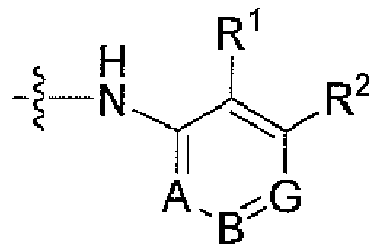
- As mentioned above, R1 and R2, are, independently of each other, selected from the group consisting of H, D, -alkyl, cycloalkyl, cycloalkenyl, heterocycloalkyl, aryl, heteroaryl, alkenyl, alkoxy, halides, -C(O)R1#, -C(O)OR1#, -S(O)R1#, -SO2R1#, -P(O)R1#R2#, - P(O)(OR1#)R2#, -P(O)(OR#)(OR2#), -C(O)NR1#R2#, -C(O)NR1# and -C(O)SR1#, wherein R1# and R2# are, independently of each other, selected from the group consisting of -H, - alkyl, -alkenyl, -heterocycloalkyl, aryl, heteroaryl. Preferably R1 and R2, are, independently of each other, selected from the group consisting alkyl cycloalkyl, heterocycloalkyl, cycloalkenyl, alkenyl, aryl, heteroaryl, H, halides, -D, C(O)R1#, C(O)OR1# and alkoxy, wherein R1# is C1-10alkyl, more preferably from the group consisting of C1-20alkyl, in particular C1-10alkyl, C3-10cycloalkyl, C3-10heterocycloalkyl, C3-10cycloalkenyl, C2-20alkenyl, C6-10aryl, C5-10heteroaryl, C(O)R1#, C(O)OR1#, -H, -D, -C1-10alkoxy, and -F, wherein R1# is C1-10alkyl, more preferably methyl, ethyl or butyl.
- In case any one of R1 or R2 is C1-10alkyl , the following C1-10alkyl groups are preferred: methyl, ethyl, propyl, butyl, pentyl, hexyl or octyl.
- In case any one of R1 or R2 is C3-10cycloalkyl, the following preferred C3-10cycloalkyl groups are mentioned, by way of example: cyclopentyl, cyclohexyl, cycloheptyl cyclopropylmethyl, cyclopentylmethyl, cyclohexylmethyl, cyclohexylcyclopentylmethyl, dicyclohexylmethyl, 1-cyclopentylethyl, 1-cyclohexylethyl, 2-cyclopropylethyl, 2-cyclopentylethyl, 2-cyclohexylethyl, 2-cycloheptylethyl, 1-cyclohexyl-1-methylethyl, 1-cyclohexylpropyl, 2-cyclopentylpropyl, 3-cyclobutylpropyl, 3-cyclopentylpropyl, 3-cyclohexylpropyl, 3-cycloheptylpropyl, 1-cyclopropyl-lmethylpropyl, 1-cyclohexyl-2-methylpropyl, 1-cyclopentyl butyl, 1-cyclohexylbutyl, 3-cyclohexylbutyl, 4-cyclopropylputyl, 4-cyclobutylbutyl, 4-cyclopentylbutyl, 1-cyclohexyl 1-methylbutyl, 1-cyclopentyl-2-ethylbutyl, 1-cyclohexyl-3methylbutyl, 1-cyclopentylpentyl, 1-cyclohexylpentyl, 1-cyclohexylmethylpentyl, 2-cyclohexylpentyl, 2-cyclohexylmethylpentyl, 3-cyclopentylpentyl, 1-cyclohexyl-4methylpentyl, 5-cyclopentylpentyl, 1-cyclopentylhexyl, 1-cyclohexylhexyl, 1-cyclopentyhnethylhexyl, 2-cyclopentylhexyl, 2-cyclopropylethylhexyl, 3-cyclopentylbexyl, 1-cyclohexylheptyl, 1-cyclopentyl-1-methylheptyl, 1-cydohexyl-1,6-dimethylheptyl, 1-cycloheptyloctyl, 2-cyclopentyloctyl, 3-cyclohexyloctyl, 2-cyclopentylmethyloctyl, 1-cyclopentylnonyl, 1-cyclohexylnonyl, 3-cyclopropylnonyl, 1-cyclopentyldecyl, 1-cyclohexylundecyl, 1-cyclopentyl tridecyl, 2-cyclohexyltridecyl, and the like
- In case any one of R1 or R2 is C3-10heterocycloalkyl the following preferred C3-10heterocycloalkyl groups are mentioned by way of example: morpholino, piperazinyl, piperidinyl tetrahydrofuran, pyrrolidin, pyrrolidin-2-on.
- In case any one of R1 or R2 is C3-10cycloalkenyl, the following preferred C3-10cycloalkenyl groups are mentioned by way of example: cyclopentenyl, cyclohexenyl, and cycloheptenyl.
- Further, the following preferred C2-20alkenyl groups are mentioned: ethenyl, propenyl, butenyl, pentenyl.
- Further, the following preferred C6-10aryl groups are mentioned: phenyl (including substituted phenyl groups), benzyl (including substituted benzyl groups), naphthyl, anthryl, phenanthryl, biphenyl, and the like.
- Further, the following preferred C5-10heteroaryl are mentioned: benzodioxolyl, pyrrolyl, furanyl, thiophenyl, thiazolyl, isothiazolyl, imidazolyl, triazolyl, tetrazolyl, pyrazolyl, oxazolyl, isoxazolyl, pyridinyl, pyrazinyl, pyridazinyl, benzoxazolyl, benzodioxazolyl, benzothiazolyl, benzoimidazolyl, benzothiophenyl, methylenedioxyphenylyl, napthyridinyl, quinolinyl, isoquinolinyl, indolyl, benzofuranyl, purinyl, deazapurinyl, or indolizinyl.
- Most preferably, R1 or are selected from the group consisting of C1-20alkyl, C3-10cycloalkyl, C3-10heterocycloalkyl, C3-10cycloalkenyl, C2-20alkenyl, C6-10aryl, C5-10heteroaryl, C(O)R1#, C(O)OR1#, -H, -D, -C1-10alkoxy, and -F, wherein R1# is C1-10alkyl.
- According to a particularly preferred embodiment, R1 and R2, are both -H.
- As regards, A, B and G, preferably at least one of these atoms is N. Thus, Z preferably has one of the following structures:


- According to a preferred embodiment of the invention, only one of A, B and G is N, and the respective other groups are C-R8, C-R9, or C-R10, respectively. Thus, Z is preferably

- As regards, R8, R9 and R10, these residues are, preferably, independently of each other, selected from the group consisting of H, -D, -alkyl, cycloalkyl, cycloalkenyl, heterocycloalkyl, heterocycloalkenyl, aryl, heteroaryl, alkenyl, alkoxy, halides, -C(O)R1#, C(O)OR8#, -S(O)R8#, -SO2R8#, -P(O)R8#R9#, -P(O)(OR8#)R9#, -P(O)(OR8#)(OR9#), - C(O)NR8#R9#, -C(O)NR8# and -C(O)SR8#, and wherein R8# and R9# are, independently of each other, selected from the group consisting of -H, -alkyl, -alkenyl, -heterocycloalkyl, aryl and heteroaryl.
- More preferably, R8, R9 and R10, are, independently of each other -H, -alkyl, -O-alkyl and -halide. According to a preferred embodiment of the invention, R8, R9 and R10, are, independently of each other, selected from the group consisting of -H, C1-10alkyl, -O-[C1-10alkyl], -I, -Br, -Cl and -F, more preferably selected from the group consisting of -H, methyl, ethyl, propyl, trifluoromethyl, methoxy, ethoxy, -I and -F.]
- Thus, the following preferred groups Z are mentioned by way of example:
Table 2: Preferred groups Z, by way of example: Structure Z [XZ]zz R1 R2 R8 R9 R10 
zz=0 or zz = 1 and XZ = NH H H - H -H, C1-10alkyl, -O-[C1-10alkyl], -I, -Br, -Cl or -F zz=0 or zz = 1 and XZ = NH H H - -H, C1-10alkyl, -O-[C1-10alkyl], -I, -Br, -Cl or -F H zz = 0 or zz = 1 and XZ=NH H -H, C1-10alkyl, -O-[C1-10alkyl], -I, -Br, -Cl or -F - H H zz = 0 or zz = 1 and XZ = NH -H, C1-10alkyl, -O-[C1-10alkyl], -I, -Br, -Cl or -F H - H H 
zz = 0 or zz = 1 and XZ = NH H -H, C1-10alkyl, -O-[C1-10alkyl], -I, -Br, -Cl or -F H - H zz=0 or zz= 1 and XZ = NH H H -H, C1-10alkyl, -O-[C1-10alkyl], -I, -Br, -Cl or -F - H zz=0 or zz = 1 and -H, Cl-10alkyl, -O-[C1-10alkyl],-I, -Br, -Cl H H - H XZ = NH or -F zz=0 or zz = 1 and XZ = NH H H H - -H, C1-10alkyl, -O-[C1-10alkyl], -I, -Br, -Cl or -F 
zz=0 or zz = 1 and XZ = NH -H, C1-10alkyl, -O-[C1-10alkyl], -I, -Br, -Cl or -F H H H - zz = 0 or zz= 1 and XZ = NH H -H, C1-10alkyl, -O-[C1-10alkyl, -I, Br, -Cl or -F H H - zz = 0 or zz = 1 and X2=NH H H -H, C1-10alkyl, -O-[C1-10alkyl],-I, -Br, -Cl or -F - zz = 0 or zz = 1 and XZ=NH H H H -H, C1-10alkyl,-O-[C1-10alkyl], -I, -Br, -Cl or-F - - According to a further preferred embodiment of the present invention, Z has as structure according to the following formula,


- In this case, integer zz is preferably 0. Thus, the present invention also describes a compound for inhibiting HIV capsid assembly, as described above, the conjugate having a structure according to the following formula,


- Thus, the following further preferred groups Z are mentioned by way of example.
Table 3: Further preferred groups Z, by way of example Structure Z [XZ]zz R1 R2 R8 R9 R10 
zz = 0 H H H H -H, C1-10alkyl, -O-[C1-10alkyl], -I, -Br, -Cl or -F zz = 0 H F H F -H, C1-10alkyl, -O-[C1-10alkyl], -I, -Br, -Cl or -F zz = 1 and XZ=NH H F H F -H, C1-10alkyl, -O-[C1-10alkyl, -I, -Br, -Cl or -F - Most preferably, Z is selected from the group consisting of

- As mentioned above, the group X present in the structural moiety


- According to a preferred embodiment of the present invention, X is N and n is 1, the compound thus having the

- R3 is selected from the group consisting of H, alkyl, cycloalkyl, aryl, heteroaryl and heterocycloalkyl. Preferably R3 is selected from the group consisting of H, C1-10alkyl, C3-10cycloalkyl, C3-10heterocycloalkyl, C6-10aryl and C5-10heteroaryl, more preferably H or C1-10alkyl. It is to be understood that all mentioned residues mentioned may be substituted or unsubstituted. In particular, R3 is selected from the group consisting of H, C1-10alkyl and C3-10cycloalky, such as H, methyl, ethyl, propyl, butyl, pentyl, cyclopentyl, cylohexyl and hexyl. This includes the respective substituted residues. More preferably R3 is H or a C1-10alkyl being substituted with at least on halogen, such as with 1, 2 or 3 halogens, preferably with 1 or 2 or 3 fluorides, such as a 2-fluoroethyl group, or a C3-10cycloalkyl group being substituted with at least on halogen, such as with 1, 2 or 3 halogens, preferably with 1 or 2 or 3 fluorides. [ More preferably, R3 is H or methyl.
- Thus, the present invention also relate to a compound, as described above, having the structure


- As regards residue Q, this residue is preferably selected from the group consisting of alkyl, alkoxy, cycloalkyl, heterocycloalkyl, aryl, alkoxyalkyl and heteroaryl.
- Preferably Q is selected from the group consisting of C1-10alkyl, C1-10alkoxy, C3-10cycloalkyl, C3-10heterocycloalkyl, C6-10aryl, C1-4alkoxy-C1-10alkyl and C5-10heteroaryl. In case Q is an aryl group, Q is preferably phenyl, or a benzocyclopentadienyl group, or a benzocyclopentyl group.. In case Q is an alkyl group, Q is preferably selected from the group consisting of methyl, ethyl, propyl, -CF3, -CHF2, - CH2F, -CH2-CF3, -CH2-CHF2, -CH2-CH2F, -CHF-CH3, more methyl or -CF3. In case Q is a heteroaryl group, Q is preferably selected from the group consisting of indolyl, benzimidazolyl, pyridinyl, benztriazyl pyrimidinyl and pyrazinyl. In case Q is an cycloalkyl group, Q is preferably selected cyclohexane or cyclopentane. In case Q is an cycloheteroalkyl group, Q is preferably selected from the group consisting of morpholino, piperazinyl, piperidinyl tetrahydrofuran, pyrrolidin and pyrrolidin-2-on It is to be understood that all above mentioned residues mentioned may be substituted or unsubstituted.
- Thus according to a preferred embodiment, Q is selected from the group consisting phenyl, benzocyclopentadienyl group, benzocyclopentyl group, methyl, ethyl, propyl, - CF3, -CHF2, -CH2F, -CH2-CF3, -CH2-CHF2, -CH2-CH2F, indolyl, benzimidazolyl, pyridinyl, benztriazyl, pyrimidinyl, pyrazinyl, cyclohexane, cyclopentane, morpholino, piperazinyl, piperidinyl, tetrahydrofuran, pyrrolidin, pyrrolidin-2-on, wherein all residues mentioned (except for CF3, -CHF2, -CH2F, -CH2-CF3, -CH2-CHF2, -CH2-CH2F) may be substituted or unsubstituted.
- According to a one preferred embodiment of the invention, Q is selected from the group consisting of a C1-10alkyl group, which is optionally substituted with at least one fluorine group.
- According to a further preferred embodiment of the invention, Q is selected from residues having one of the following structures:

- Thus, the present invention also describes a compound for inhibiting HIV capsid assembly, as described above, the conjugate having a structure according to the following formula


wherein Y is O, S or NH, and wherein Y1 is O, S or NR*, wherein R* is H or alkyl, and wherein R11# and R12# are, independently of each other, selected from the group consisting of -H, -alkyl, -alkenyl, -heterocycloalkyl, aryl and heteroaryl. - Preferably, R11, R12, R13, R14, and R15 are, independently of each other, selected from the group consisting of -H, -C1-10alkyl, -F, -I, -Cl, -Br, C1-10alkoxy, C2-10alkynyl, C2-10alkenyl, --NO2, -CN, -C(=O)-alkyl, -C(=O)-H, -C(=O)-O-alkyl, C(=O)-NH-alkyl (C(=O)-NH- alkyl substituted with 1, 2 or 3 halogens, in particular F, in particular -C(=O)-NH(-CH2-CH2F)), -C(=O)-N(alkyl)2 (such as C(=O)-N(-CH2-CH2F)2), -C(=O)-OH, -O-alkyl, -NH2, -NH-alkyl, -CN, -S(O)alkyl, -SO2alkyl (such as -SO2-alkyl substituted with 1, 2 or 3 halogens, in particular F), -C(=O)-NH-cycloalkyl (such as -C(=O)-NH-cycloalkyl substituted with 1, 2 or 3 halogens, in particular F), -C(=O)-N(cycloalkyl)2 (such as - C(=O)-N(cycloalkyl)2 substituted with 1, 2 or 3 halogens, in particular F. It is to be understood that all above mentioned residues denoted as alkyl, alkoxy, alkynyl, alkenyl may be substituted or unsubstituted. In case any one of R11, R12, R13, R14, and R15 is an alkyl group, this alkyl group is preferably selected from the group consisting of methyl, ethyl, propyl, -CF3, -CHF2, -CH2F, -CH2-CF3, -CH2-CHF2, -CH2-CH2F and -CHF-CH3, more methyl or -CF3.
- E.g., R11 R12, R13, R14, and R15 are, independently of each other, selected from the group consisting of -F, -I, NO2, -C(=O)-alkyl, -C(=O)-OH, -C(=O)-O-alkyl, -C(=Y)-OH and - NH-alkyl.
- In case any one of R11, R12, R13, R14, and R15 is selected from the group consisting of - C(=O)-alkyl, -C(=O)-O-alkyl and C(=O)-NH-alkyl, the alkyl group present in this residues is preferably, a optionally substituted, methyl group, ethyl group, propyl group....
- Most favorable is a substitution in which at least one of R11, R12, R13, R14, and R15 is an electron withdrawing group. The term "electron-withdrawing group" is recognized in the art, and denotes the tendency of a functional group to attract valence electrons from neighboring atoms by means of a difference in electronegativity with respect to the neighbouring atom (inductive effect) or by withdrawal of π-electrons via conjugation (mesomeric effect). Examples for suitable withdrawing groups are the above mentioned groups, -F, -I, -NO2, -C(=O)-alkyl, -C(=O)-NH-alkyl, - C(=O)-N(alkyl)2, -C(=O)-OH, -C(=O)-O-alkyl, -C(=Y)-OH, preferably the electron withdrawing group is selected from the group consisting of -F, -I, -NO2, -C(=O)-methyl, -C(=O)-ethyl, -COOH, -CF3, -CHF2, -CH2F, -CH2-CF3, -CH2-CHF2 and -CH2-CH2F.
- Preferably Q is selected from the group consisting of


- Wherein R in the above depicted formula is H or alkyl,
- More preferably Q is selected from the group consisting of


- In particular at least one of one of R11, R12, R13, R14, and R15 is -F, more preferably at least R12, R13 and R14 are -F, more preferably Q is

- Thus, the present invention also describes a compound for inhibiting HIV capsid assembly, as described above, the conjugate having a structure according to the following formula


- Furthermore , the present invention also describes a compound for inhibiting HIV capsid assembly, as described above, the conjugate having a structure according to the following formula


wherein U is -C-R20, N or N-YU, with YU being H or alkyl
wherein V is -C-R21, N or N-YY, with YV being H or alkyl
the bond (a) is a single or double bond,
the bond (b) is a single or double bond,
with the proviso that one of (a) and (b) is a double bond,
and wherein R19, R20, and R21 are, independently of each other selected from the group consisting of H and -alkyl and wherein R16, R17 and R18, are independently of each other selected from the group consisting of -H, -alkyl, -halides, alkoxy, alkynyl, alkenyl, -NO2, - C(=Y)-alkyl, -C(=Y)-H, -C(=Y)-Y1-alkyl, -C(=Y)-OH and -Y-alkyl. - Preferably, R16, R17 and R18, are independently of each other selected from the group consisting of -H, -C1-10alkyl, -F, -I, C1-10alkoxy, C2-10alkynyl, C2-10alkenyl, -NO2, - C(=O)-C1-10alkyl, -C(=O)-H, -C(=O)-O-C1-10alkyl, -C(=O)-OH and -O-C1-10alkyl, more preferably R16, R17 and R18, are independently of each other selected from the group consisting of -H, -CH3, -CH2-CH3, CF3, -CHF2, -CH2F, -CH2-CF3, -CH2-CHF2 and -CH2-CH2F, -F, -I, methoxy, ethoxy, -NO2, -C(=O)-methyl, C(=O)- ethyl, -C(=O)-H, -C(=O)-O-methyl, -C(=O)-O-ethyl and -C(=O)-OH.
- According to a preferred embodiment Q is selected from the group consisting o


- As regards, YT, YU and YV, these groups are, if present, independently from each other H or alkyl, preferably H or C1-10 alkyl, more preferably selected from the group consisting of H, methyl and ethyl, most preferably H of methyl.
- In particular, Q is selected from the following formulas


- Thus, the present invention also describes a compound for inhibiting HIV capsid assembly, as described above, the conjugate having a structure according to the following formula


- In a preferred embodiment of the present invention, the compound of the present invention is combined with at least one further antiretroviral agent. Preferred further antiretroviral agents are disclosed elsewhere herein. Thus, the present invention also envisages a composition comprising the compound of the present invention and at least one further antiretroviral agent.
- As described above, the compounds of the present invention can be formulated as pharmaceutically acceptable salt or solvate.
- The term "pharmaceutically acceptable" refers to those compounds or salts and solvates thereof as well as pharmaceutical, compositions, and/or dosage forms which are, within the scope of sound medical judgment, suitable for treatment of human beings and animals without excessive toxicity, irritation, allergic response, or other problem complications commensurate with a reasonable benefit/ risk ratio.
- Typical pharmaceutically acceptable salts include those salts prepared by reaction of the compounds of the present invention with a pharmaceutically acceptable mineral or organic acid or an organic or inorganic base. Such salts are known as acid addition and base addition salts. Acids commonly employed to form acid addition salts are inorganic acids such as hydrochloric acid, hydrobromic acid, hydroiodic acid, sulfuric acid, phosphoric acid, and the like, and organic acids such as p-toluenesulfonic acid, methanesulfonic acid, oxalic acid, p-bromophenylsulfonic acid, carbonic acid, succinic acid, citric acid, benzoic acid, acetic acid, and the like. Examples of such pharmaceutically acceptable salts are the sulfate, pyrosulfate, bisulfate, sulfite, bisulfite, phosphate, monohydrogenphosphate, dihydrogenphosphate, metaphosphate, pyrophosphate, bromide, iodide, acetate, propionate, decanoate, caprylate, acrylate, formate, hydrochloride, dihydrochloride, isobutyrate, caproate, heptanoate, propiolate, oxalate, malonate, succinate, suberate, sebacate, fumarate, maleate, butyne-1,4-dioate, hexyne-1,6-dioate, benzoate, chlorobenzoate, methylbenzoate, hydroxybenzoate, methoxybenzoate, phthalate, xylenesulfonate, phenylacetate, phenylpropionate, phenylbutyrate, citrate, lactate, gamma-hydroxybutyrate, glycolate, tartrate, methanesulfonate, propanesulfonate, naphthalene-1-sulfonate, napththalene-2-sulfonate, mandelate and the like. Preferred pharmaceutically acceptable acid addition salts are those formed with mineral acids such as hydrochloric acid and hydrobromic acid, and those formed with organic acids such as maleic acid and methanesulfonic acid. Salts of amine groups may also comprise quaternary ammonium salts in which the amino nitrogen carries a suitable organic group such as an alkyl, alkenyl, alkynyl, or aralkyl moiety. Base addition salts include those derived from inorganic bases, such as ammonium or alkali or alkaline earth metal hydroxides, carbonates, bicarbonates, and the like. Such bases useful in preparing the salts of this invention thus include sodium hydroxide, potassium hydroxide, ammonium hydroxide, potassium carbonate, sodium carbonate, sodium bicarbonate, potassium bicarbonate, calcium hydroxide, calcium carbonate, and the like. The potassium and sodium salt forms are particularly preferred. It should be recognized that the particular counter ion forming a part of any salt of this invention is usually not of a critical nature, so long as the salt as a whole is pharmacologically acceptable and as long as the counter ion does not contribute undesired qualities to the salt as a whole.
- The term acceptable solvate encompasses also pharmaceutically acceptable solvates of the compounds of the invention, wherein the compound combines with a solvent such as water, methanol, ethanol or acetonitrile to form a pharmaceutically acceptable solvate such as the corresponding hydrate, methanolate, ethanolate or acetonitrilate.
- As described above, the present invention also relates to a pharmaceutical composition comprising in a therapeutically effective amount the compound of the invention..
- The term "therapeutically effective amount", as used herein, preferably refers to an amount of the compound, as defined herein, that effectively inhibits the HIV capsid assembly.
- As far as the pharmaceutical compositions according to the present invention, are concerned, the conjugate may be used in combination with a pharmaceutical excipient. Generally, the compound will be in a solid form which can be combined with a suitable pharmaceutical excipient that can be in either solid or liquid form. As excipients, carbohydrates, inorganic salts, antimicrobial agents, antioxidants, surfactants, buffers, acids, bases, and combinations thereof may be mentioned. A carbohydrate such as a sugar, a derivatized sugar such as an alditol, aldonic acid, an esterified sugar, and/or a sugar polymer may be present as an excipient. Specific carbohydrate excipients include, for example: monosaccharides, such as fructose, maltose, galactose, glucose, D-mannose, sorbose, and the like; disaccharides, such as lactose, sucrose, trehalose, cellobiose, and the like; polysaccharides, such as raffmose, melezitose, maltodextrins, dextrans, starches, and the like; and alditols, such as mannitol, xylitol, maltitol, lactitol, sorbitol (glucitol), pyranosyl sorbitol, myoinositol, and the like. The excipient may also include an inorganic salt or buffer such as citric acid, sodium chloride, potassium chloride, sodium sulfate, potassium nitrate, sodium phosphate monobasic, sodium phosphate dibasic, and combinations thereof. The pharmaceutical composition according to the present invention may also comprise an antimicrobial agent for preventing or determining microbial growth, such as, e.g., benzalkonium chloride, benzethonium chloride, benzyl alcohol, cetylpyridinium chloride, chlorobutanol, phenol, phenylethyl alcohol, phenylmercuric nitrate, thimersol, and combinations thereof.
- The pharmaceutical composition according to the present invention may also comprise an antioxidant, such as, e.g., ascorbyl palmitate, butylated hydroxyanisole, butylated hydroxytoluene, hypophosphorous acid, monothioglycerol, propyl gallate, sodium bisulfite, sodium formaldehyde sulfoxylate, sodium metabisulfite, and combinations thereof.
- The pharmaceutical composition according to the present invention may also comprise a surfactant, such as, e.g., polysorbates, or pluronics sorbitan esters; lipids, such as phospholipids and lecithin and other phosphatidylcholines, phosphatidylethanolamines, acids and fatty esters; steroids, such as cholesterol; and chelating agents, such as EDTA or zinc.
- The pharmaceutical composition according to the present invention may also comprise acids or bases such as, e.g., hydrochloric acid, acetic acid, phosphoric acid, citric acid, malic acid, lactic acid, formic acid, trichloroacetic acid, nitric acid, perchloric acid, phosphoric acid, sulfuric acid, fumaric acid, and combinations thereof, and/or sodium hydroxide, sodium acetate, ammonium hydroxide, potassium hydroxide, ammonium acetate, potassium acetate, sodium phosphate, potassium phosphate, sodium citrate, sodium formate, sodium sulfate, potassium sulfate, potassium fumarate, and combinations thereof.
- The compound of the present invention shall inhibit the assembly of the HIV capsid, in particular, of the HIV-1 capsid. Preferably, the term "capsid" refers to the protein shell of the HIV virus. The capsid of HIV is well known in the art, and, e.g. described by Engelman, A. and Cherepanov, P. Nature Reviews Microbiology 10, 279-290 (2012). A major component of the HIV capsid, is the so called CA protein (capsid protein) which originated from the Gag polyprotein which is processed during maturation into various polypeptides.
- Preferably, the pharmaceutical composition according to the present invention comprises at least one further antiretroviral agent as set forth herein below.
- Moreover, the present invention relates to use of a compound of the present invention for the manufacture of a HIV capsid inhibitor, and, thus, for a medicament for inhibiting HIV capsid assembly.
- Further envisaged by the present invention is method of treating a patient suffering from HIV comprising administering a therapeutically effective amount of the compound or the pharmaceutical composition of the present invention to said subject.
- The term "patient" as used herein, preferably, relates to a human. Moreover, the patient according to the present invention is preferably infected with the human immunodeficiency virus (HIV). As set forth elsewhere herein, the human immunodeficiency virus is a retrovirus that may cause acquired immunodeficiency syndrome (AIDS), a condition which may lead to life-threatening opportunistic infections. HIV in the context of the present invention, preferably, refers to HIV-1 and HIV-2. However, it is particularly contemplated that the term "HIV" refers to HIV-1.
- Antiretroviral medicaments may be also used for pre-exposure and post-exposure prophylaxis (see Morbidity and Mortality Weekly Reports 2011;60 (03);65-68). Therefore, is it also contemplated that the compound or the pharmaceutical composition of the present invention is used for pre-exposure and post-exposure prophylaxis. Thus, the compound or the pharmaceutical composition of the present invention may also be administered to subjects which are not infected with HIV (in case of pre-exposure prophylaxis), or in subjects which are suspected of having contracted HIV recently (in case of post-exposure prophylaxis). Thereby, HIV infection may be prevented.
- The compound or composition of the present invention may be administered by any way deemed appropriate. Preferably, the compound or composition of the present invention is administered orally, parenterally, intracisternally, intrasternally, intravaginally, intraperitoneally or topically. It is particularly preferred to administer the compound or composition of the present invention orally or parentally. Parental administration as used herein, preferably, refers to modes of administration which include intravenous, intramuscular, intraperitoneal, intracisternal, intrasternal, subcutaneous and intraarticular injection and infusion.
- Preferably, the compound or composition of the present invention is administered in combination with at least one further antiretroviral HIV medicament. Preferably, the at least one further antiretroviral medicament is selected from the group consisting of: a nucleoside reverse transcriptase inhibitor (NRTI), a non-nucleoside reverse transcriptase inhibitor (NNRTI) a protease inhibitor and an integrase inhibitor.
- In the following especially preferred embodiments of the present invention are described:
- 1. As compound or a pharmaceutically acceptable salt or solvate thereof for use in inhibiting HIV capsid assembly, the compound comprising the core structure

- 2. The compound according to embodiment 1 having a structure according to formula (I)


and wherein, A is N or C-R8, and wherein B is N or C-R9, and wherein C is N or C-R10
and wherein R8, R9 and R10, are, independently of each other, selected from the group consisting of -H, -D, -alkyl, cycloalkyl, cycloalkenyl, heterocycloalkyl, heterocycloalkenyl, aryl, heteroaryl, alkenyl, alkoxy, halides, -C(O)R1#, -C(O)OR8#, -S(O)R8#, -SO2R8#, -P(O)R8#R9#, -P(O)(OR8#)R9#, -P(O)(OR8#)(OR9#), - C(O)NR8#R9#, -C(O)NR8# and -C(O)SR8#, and wherein R8# and R9# are, independently of each other, selected from the group consisting of -H, -alkyl, - alkenyl, -heterocycloalkyl, aryl and heteroaryl,
X is selected from the group consisting of N, O or S,
wherein R3 is selected from the group consisting of H, alkyl, cycloalkyl, aryl, heteroaryl and heterocycloalkyl,
wherein integer n is 0 or 1,
and wherein R4, R5, are, independently of each other, selected from the group consisting of -H, -D, -alkyl, alkoxy, alkenyl, alkynyl, halides, -NO2, -OH, -NH2, - NHR4#, -CN, -S(O)R4#, -SO2R4#, -P(O)R4#R5#, -P(O)(OR4#)R5#, -P(O)(OR4#)(OR5#), -C(O)NR4#R5#, -C(O)SR4#, -C(O)R4#, -C(O)O-R4#, alkoxy and glycol chains;
wherein R4 and R5 or R5 and R6 can form a cyclic residue,
and wherein R4# and R5# are, independently of each other, selected from the group consisting of -H, -alkyl, -alkenyl, -heterocycloalkyl, aryl and heteroaryl,
and wherein Q is selected from the group consisting of alkyl, alkoxy, cycloalkyl, heterocycloalkyl, aryl, alkoxyalkyl and heteroaryl,
with the proviso that in case X is S, n is 0, and in case X is N, n is 1. - 3. The compound according to embodiment 2, wherein R1 and R2, are, independently of each other, selected from the group consisting of C1-20alkyl, C3-10cycloalkyl, C3-10heterocycloalkyl, C3-10cycloalkenyl, C2-20alkenyl, C6-10aryl, C5-10heteroaryl, C(O)R1#, C(O)OR1#, -H, -D, -C1-10alkoxy, and -F, wherein R1# is C1-10alkyl.
- 4. The compound according to any one of embodiments 2 or 3, wherein R8, R9 and R10, are, independently of each other, selected from the group consisting of -H, C1-10alkyl, -O-[C1-10alkyl], -I, -Br, -Cl and -F.
- 5. The compound according to any one of embodiments 2 to 4, having a structure according to formula (II)

- 6. The compound according to any one of embodiments 2 to 4, wherein at least one of A, B and G is N.
- 7. The compound according to any one of embodiments 2 to 6, wherein X is N and n is 1, the compound thus having the

- 8. The compound according embodiment 5 or 7, wherein R5 and R6 are, independently of each other, selected from the group consisting of -H, -CF3, CHF2, CH2F, H, -OH, C1-10alkyl, C1-10alkoxy, in particular methoxy or ethoxy, -NO2,- - C(O)O-R4#, with R4# being C1-10alkyl, and glycol chains, in particular -O-[CH2-CH2-O]g-Me with integer g being preferably of from 1 to 10.
- 9. The compound The compound according embodiment 5 or 7 or 8, wherein R7, is H or alkoxy, and preferably selected from the group consisting of H, methoxy and ethoxy, more preferably H or methoxy, most preferably H.
- 10. The compound according to any one of embodiments 2 to 9, wherein X is N, n is 1 and R3 is H or alkyl, preferably H or methyl, more preferably H.
- 11. The compound according to any one of embodiments 2 to 10, wherein Q is selected from the group consisting of C1-10alkyl, C1-10alkoxy, C3-10cycloalkyl, C3-10heterocycloalkyl, C6-10aryl and C5-10heteroaryl-.
- 12. The compound according to any one of embodiments 2 to 11, wherein Q is selected from the group consisting of an C1-10alkyl group, which is optionally substituted with at least one fluoride, the group

wherein Y is O, S or NH, and wherein Y1 is O, S or NR*, wherein R* is H or alkyl, and wherein R11# and R12# are, independently of each other, selected from the group consisting of -H, -alkyl, -alkenyl, -heterocycloalkyl, aryl and heteroaryl,
wherein T is -C-R19, N or N-YT, with YT being H or alkyl,
wherein U is -C-R20, N or N-YU, with YU being H or alkyl, and
wherein V is -C-R21, N or N-YY, with YV being H or alkyl
the bond (a) is a single or double bond,
the bond (b) is a single or double bond,
with eth proviso that one of (a) and (b) is a double bond,
R19, R20, and R21 are, independently of each other, H or -alkyl, and wherein R16, R17 and R18, are independently of each other selected from the group consisting of
-H, -alkyl, -halides, alkoxy, alkynyl, alkenyl, -NO2, -C(=Y)-alkyl, -C(=Y)-H, - C(=Y)-Y1-alkyl, -C(=Y)-OH and -Y-alkyl-. - 13. The compound according to any one of embodiments 2 to 12, wherein Q is

wherein Y is O, S or NH, and wherein Y1 is O, S or NR*, wherein R* is H or alkyl, and wherein R11# and R12# are, independently of each other, selected from the group consisting of -H, -alkyl, -alkenyl, -heterocycloalkyl, aryl and heteroaryl. - 14. The compound according to embodiment 13, wherein at least one of R11, R12, R13, R14, and R15 is selected from the group consisting of -F, -I, NO2, -C(=O)-alkyl, - C(=O)-OH, -C(=O)-O-alkyl, -C(=Y)-OH and -NH-alkyl.
- 15. The compound according to embodiment 13 or 14, wherein at least one of R11, R12, R13, R14, and R15 is -F.
- 16. The compound according to embodiment 13 or 14 or 15, wherein Q is selected from the group consisting


- 17. The compound according to any one of embodiments 2 to 12, wherein Q is

the bond (b) is a single or double bond,
with eth proviso that one of (a) and (b) is a double bond,
R19, R20, and R21 are, independently of each other selected from the group consisting of H, -alkyl,
and wherein R16, R17 and R18, are independently of each other selected from the group consisting of -H, -alkyl, -halides, alkoxy, alkynyl, alkenyl, -NO2, -C(=Y)-alkyl, -C(=Y)-H, -C(=Y)-Y1-alkyl, -C(=Y)-OH and -Y-alkyl. - 18. The compound according embodiment 17, wherein Q is selected from the group consisting of

- 19. The compound according to any one of embodiments 2 to 18, wherein Z is selected from the group consisting of

- 20. The compound according any one of embodiments 2 to 19, wherein Z has the following structure:
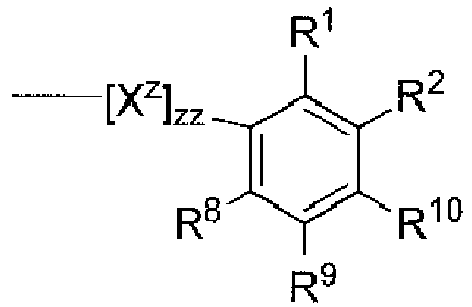
- 21. The compound according to any one of embodiments 2 to 20, wherein Z is selected from the group consisting of

- 22. A compound according any one of embodiments 1 to 21, wherein HIV is HIV-1.
- 21. A pharmaceutical composition comprising in a therapeutically effective amount a compound according to any one of embodiments 1 to 22.
- 23. Use of a compound as defined in any one of embodiments 1 to 22 for the manufacture of a medicament for inhibiting HIV capsid assembly.
- 24. A method of treating a patient suffering from HIV comprising administering a therapeutically effective amount of the compound as defined in any one of embodiments 1 to 13.
-
Figure 1 shows the isothermal titration of CA ligand AMR-346 with HIV capsid protein C-terminal part. Upper graph: raw experimental data. Lower graph: Fit (line) to the integrated heats (full circles) from each injection, corrected for the heat of dilution of CA ligand AMR-346. -

reaction conditions:
a: Et3N / dioxane, CH2Cl2, reflux; b: 1 M NaOH in H2O, reflux; c: POCl3 / DMF, 90 °C; d: 6 M HCl in dioxane, reflux; e: cat. HCl / dioxane, reflux or 1. t-BuONa / THF, 2. 3 M HCl -

- To a solution of 2-aminobenzamide (1.0 mmol) and triethylamine (10.0 mmol) in tetrahydrofurane (1.0 ml) and dichloromethane (1.0 ml) was added aromatic acid chloride (1.0 mmol) in one portion. The reaction mixture was heated to reflux with stirring. After 15 h the solvents were removed in vacuo and obtained solid was dissolved in ethyl acetate (10.0 ml) and extracted with water (3.0 ml) three times. After evaporation of solvent the appropriate N-(2-carbamoylphenyl)arylamide was obtained. This compound was then dissolved in aqueous KOH (1M, 3.0 ml) and stirred with heating to 100° C for 10 h. The resulting solution was diluted with water (20.0 ml) and the resulting 2-arylquinazolin-4(3H)-one was filtered off and washed with water (20.0 ml). Treating this compound with POCl3 (10.0 mmol) in dimethylformamide (10.0 ml) at 80° C followed by decomposition of excess of POCl3 on ice (100 g) and neutralization with sodium hydroxide (20% aqueous solution) led to crude product. Appropriate 4-chloroquinazoline derivative was obtained after chromatography (CHCl3 with gradient of MeOH).
-

- The appropriate aminoester (30 mmol), and the appropriate nitrile (30 mmol), were placed in 150 ml flask, and saturated HCl solution in dioxane (30 ml) was added dropwise. The reaction mixture was heated with stirring at 100 °C for 16 h. After it was cooled to rt, the reaction mixture was poured into water (100 mL). The formed precipitate was filtered and washed with a small amount of EtOH to give the title compound.
-

- To a solution of 2-arylquinazolin-4(3H)-one (30 mmol) in dimethylformamide (30 ml) were added POCl3 (300 mmol). The reaction mixture was heated with stirring at 80° C for 16 h. After it was cooled to rt, the reaction mixture was poured into ice-water, followed by neutralization with 2M NaOH leads to crude 4-chloroquinazoline derivative. Appropriate 4-chloroquinazoline derivative was obtained after chromatography (CHCl3 with gradient of MeOH).
-

- To a solution of starting quinazoline derivative (1.0 mmol) and aryl amine (1.2 mmol) in dioxane is heated to 100° C. Then two drops of concentrated hydrochloric acid are added. Resulting solution is then heated to 100° C for 15 h or until disappearance of starting quinazoline derivative. Solvents are evaporated in vacuo and chromatography (CHCl3 with gradient of MeOH) leads to a desired product.
- To a solution of starting quinazoline derivative (1.0 mmol) and aryl amine (1.2 mmol) in dry THF was added solution of sodium tert-butoxide (3 mmol) in THF. The reaction mixture was stirred at RT overnight or until disappearance of starting quinazoline derivative. The reaction mixture was concentrated and the residue was adsorbed on silica gel and purified by flash column chromatography on silica gel (CHCl3 with gradient of MeOH) leads to a desired product, which was converted to hydrochloric salt by treatment with HCl ethanol.
- To a de-gassed mixture of quinazoline derivative (0.313 mmol), arylamine (0.376 mmol), and Cs2CO3 (0.438 mmol) in dioxane (5 ml) under argon was added Pd(OAc)2 (0.016 mmol) and BINAP (0.023 mmol). The mixture was stirred at 80°C for 16 hours. The reaction mixture was concentrated and the residue was adsorbed on silica gel and purified by flash column chromatography on silica gel (eluents Hex/EA: 1/0 -->1/1) to afford title compound, which was converted to hydrochloric salt by treatment with HCl ethanol.
-

- A solution of 2-(Pyridin-3-yl)quinazolin-4(3H)-one (1.5 g, 6.7 mmol) and Lawesson's reagent (2.2 g, 5.4 mmol) in pyridine (30 mL) was irradiated at 115°C (power input: 70 W) until completion (TLC monitoring, 45 min). After cooling, the solvent was removed under reduced pressure. The residue was then poured into boiling water and was filtered off. The collected yellow solid was dissolved into 1 M NaOH solution and the solution was filtered again. The filtrate was neutralised with a saturated NH4Cl solution until complete crystallisation occurred. After filtration the title compound was obtained as pale yellow solid (1.3 g, 82 %).
1H NMR (400 MHz, DMSO-d6) δ 14.16 (bs, 1H); 9.25 (bd, 1H, J = 2.0 Hz); 8.77 (dm, 1H, J = 5.1 Hz); 8.62 (dm, 1H, J = 8.2 Hz); 8.48 (dm, 1H, J = 8.1 Hz); 7.92 (m, 1H); 7.81 (bd, 1H, J = 8.1 Hz); 7.62 (m, 1H); 7.59 (m, 1H).
13C (125 MHz, DMSO-d6) δ 188.1; 152.0; 150.3; 149.5; 144.4; 136.4; 135.7; 129.5; 128.7; 128.5, 128.5; 128.0; 123.6.
HRMS: calcd for C13H8N3S, 238.04444; found, 238.04392 -

- To a de-gassed mixture of 2-(pyridin-3-yl)quinazoline-4(3H)-thione (0.2 g, 0.836 mmol, example 1), 1,2-difluoro-4-nitrobenzene (0.093 ml, 0.836 mmol), and K2CO3 (0.347, 2.51 mmol) in DMF (7 ml) under argon. The mixture was stirred at rt for 16 hours. The reaction mixture was concentrated and the residue was adsorbed on silica gel and purified by flash column chromatography on silica gel (eluents Hex/EA: 1/0 --> 1/2) to afford title compound, which was converted to pale yellow hydrochloric salt (0.240 g, 76%) by treatment with HCl ethanol.
1H NMR (400 MHz, DMSO-d6) δ 9.15 (bd, J= 2.3 Hz, 1H); 8.66 (dd, J = 4.8 Hz, J = 1.7 Hz, 1H); 8.48 (dd, J = 8.7 Hz, J = 2.4 Hz, 1H); 8.39 (dt, J = 8.0 Hz, J = 2.0 Hz, 1H); 9.34 (dm, J = 8.3 Hz, 1H); 8.31 (dd, J = 8.5 Hz, J= 2.4 Hz, 1H); 8.19 (dd, J = 8.5 Hz, J= 6.9 Hz, 1H); 8.10 - 8.14 (m, 2H); 7.85 (m, 1H); 7.50 (ddd, J= 8.0 Hz, J= 4.8 Hz, J= 0.9 Hz).
13C (125 MHz, DMSO-d6) δ 168.4; 156.7; 151,8; 149.2; 148.9; 138.8; 135.9; 135.3; 132.4; 129.1; 129.1; 124.2; 124.1; 123.1 (d, J = 18.5 Hz); 121.5; 120.4 (d, J=3.7 Hz); 112.0 (d, J=28.4).
HRMS: calcd for C15H11O2N5F, 312.0891; found, 312.0891. -

- The title compound was prepared from 4-chloro-6,7,8-trimethoxy-2-(pyridin-3-yl)quinazoline (0.2 g, 0.604 mmol) and 2-fluoro-4-nitroaniline (0.113 g, 0.725 mmol) by using an analogous procedure to that described in general procedure F and was isolated as yellow solid (0.2 g, 68%).
1H NMR (400 MHz, DMSO-d6) δ 9.53 (bd, 1H, J = 2.1 Hz); 9.17 (dt, 1H, J = 8.1 Hz, J = 1.8 Hz); 9.02 (dd, 1H, J = 5.5 Hz, J = 1.5 Hz); 8.93 (dd, 1H, J = 6.9 Hz, J = 2.9 Hz); 8.55 (d, 1H, J = 6.1 Hz); 8.10 (ddd, 1H, J = 8.1 Hz, J = 5.5 Hz, J = 0.7 Hz); 8.07 (ddd, 1H, J = 9.1 Hz, J = 3.9 Hz, J = 2.8 Hz); 7.62 (dd, 1H, J = 11.2 Hz, J = 9.1 Hz); 7.09 (d, 1H, J = 6.1 Hz).
13C (125 MHz, DMSO-d6) δ 160.3; 158.3; 154.5; 150.4 (d, J = 258.6 Hz); 145.6; 143.1; 142.1; 136.5 (d, J = 7.8 Hz); 136.1 (d, J = 3.1 Hz); 134.8; 127.7 (d, J = 8.2 Hz); 126.8; 119.2 (d, J = 22.2 Hz); 116.8 (d, J = 2.4 Hz); 108.0.
HRMS: calcd for C22H19FN5O5, 452.13693; found, 452.1365. -

- The title compound was prepared from 4-chloro-2-(pyridin-3-yl)quinazoline (0.15 g, 0.62 mmol) and 3-nitropyridin-4-amine (0.1 g, 0.745 mmol) by using an analogous procedure to that described in general procedure F and was isolated as yellow solid (0.147 g, 69 %). 1H NMR (400 MHz, DMSO-d6) δ 11.73 (bs, 1H); 9.46 (bd, 1H, J = 2.0 Hz); 9.26 (bs, 1H); 9.16 (dt, 1H, J = 8.2 Hz, J = J = 1.7 Hz); 9.02 (bdd, 1H, J = 5.6 Hz, J = 1.4 Hz); 8.89 (d, 1H, J = 5.6 Hz); 8.74 (dm, 1H, J = 8.3 Hz); 8.19 (d, 1H, J = 5.7 Hz); 8.15 (bdd, 1H, J = 8.2 Hz, J = 5.5 Hz); 8.06-8.10 (m, 2H); 7.85 (m, 1H).
13C (125 MHz, DMSO-d6) δ 158.0; 154.2; 153.3; 150.3; 146.1; 144.3; 143.0; 142.3; 138.9; 135.5; 135.4; 128.6; 128.3; 127.2; 124.3; 119.5; 115.0.
HRMS: calcd for C18H13O2 N6,345.10945; found, 345.10943. -

- The title compound was prepared from 4-chloro-2-(pyridin-3-yl)quinoline (0.2 g, 0.931 mmol) and 2-fluoro-4-nitroaniline (0.139 g, 0.997 mmol) by using an analogous procedure to that described in general procedure F and was isolated as yellow solid (0.219 g, 73 %). 1H NMR (400 MHz, DMSO-d6) δ 11.44 (bs, 1H); 9.27 (bd, 1H, J= 2.3 Hz); 8.96 (bd, 1H, J= 8.5 Hz); 891 (dd, 1H, J= 5.1 Hz, J = 1.4 Hz); 8.66 (dm, 1H, J = 8.1 Hz); 8.47 (bd, 1H, J= 8.6 Hz); 8.39 (dd, 1H, J= 10.5 Hz, J= 2.6 Hz); 8.27 (m, 1H); 8.10 (m, 1H); 7.96 (dd, 1H, J= 8.9 Hz, J= 7.9 Hz); 7.87 (m, 1H); 7.84 (dd, 1H, J = 8.1 Hz, J= 5.1 Hz); 7.23 (m, 1H).
13C (125 MHz, DMSO-d6) δ 155.6 (d, J= 252.9 Hz); 153.8; 150.7; 149.8; 147.4; 146.1; 139.7; 134.3; 132.5; 129.6; 128.3; 127.9; 124.9; 124.2; 122.1; 121.2; 117.6; 113.6 (d, J= 25.0 Hz); 102.2.
HRMS: calcd for C20H12O2 N4F, 359.09498; found, 359.09513. -

- The title compound was prepared from 4-chloro-2-(pyridin-3-yl)qumazoline (0.2 g, 0.83 mmol) and 2,3,4,5-tetrafluoroaniline (0.164 g, 1.0 mmol) by using an analogous procedure to that described in general procedure E and was isolated as white solid (0.233 g, 76 %). 1H NMR (400 MHz, DMSO-d6) δ 10.76 (bs, 1H); 9.43 (bd, 1H, J= 2.0 Hz); 9.05 (dt, 1H, J = 8.1 Hz, J= 1.8 Hz); 8.94 (dd, 1H, J= 5.5 Hz, J= 1.5 Hz); 8.65 (dm, 1H, J= 8.3 Hz); 8.00-8.05 (m, 3H); 7.74-7.80 (m, 2H).
13C (125 MHz, DMSO-d6) δ 159.1; 155.2; 149.3; 145.5; 143.5; 141.7; 135.4; 134.8; 128.0; 127.8; 126.6; 123.9; 114.1; 110.6 (bd, J= 21.3 Hz).
HRMS: calcd for C19H10 N4 F4, 370.0842; found, 370.0840. -

- The title compound was prepared from 4-chloro-2-(pyridin-3-yl)pyrimidine quinazoline (0.2 g, 0.83 mmol) and 5-bromo-2,4-difluoroaniline (0.207 g, 1.0 mmol) by using an analogous procedure to that described in general procedure E and was isolated as yellow solid (0.233 g, 68 %).
1H NMR (400 MHz, DMSO-d6) δ 11.43 (bs, 1H); 9.38 (bd, 1H, J= 2.0 Hz); 8.99 (dt, 1H, J= 8.2 Hz, J= 1.8 Hz); 8.91-8.95 (m, 2H); 8.15 (bd, 1H, J= 7.7 Hz); 8.05 (t, 1H, J= 7.7 Hz); 8.02 (m, 1H); 7.97 (bdd, 1H, J= 8.1 Hz, J= 5.4 Hz); 7.73-7.77 (m, 2H).
13C (125 MHz, DMSO-d6) δ 159.4; 155.5, 157.8; 155.2; 147.8; 146.4; 144.1; 141.0; 135.0; 134.2; 131.9; 127.9; 126.3, 123.4; 124.7; 123.8; 113.9; 106.2 (t, J=26.8 Hz); 102.7.
HRMS: calcd for C19H12 N4BrF2, 413.02079; found, 413.02070. -

- The title compound was prepared from 4-chloro-2-(pyridin-3-yl)pyrimidine (0.2 g, 0.83 mmol) and 2,3,4,5,6-pentafluoroaniline (0.182 g, 1.0 mmol) by using an analogous procedure to that described in general procedure E and was isolated as white solid (0.24 g, 75%).
1H NMR (400 MHz, DMSO-d6) δ 10.50 (bs, 1H); 9.38 (bd, 1H, J= 2.0 Hz); 8.77-8.80 (m, 2H); 8.59 (bd, 1H, J= 8.3 Hz); 7.99-8.03 (m, 2H); 7.74-7.79 (m, 1H).
13C (125 MHz, DMSO-d6) δ 158.9; 156.9; 150.2; 150.0; 147.9; 136.9; 134.6; 133.7; 128.4; 127.6; 124.6; 123.5; 113.9.
HRMS: calcd for C19H9N4F5, 388.0747; found, 388.0751. -

- The title compound was prepared from 4-chloro-2-(pyridin-3-yl)pyrimidine (0.2 g, 0.83 mmol) and 2-iodo-4-nitroaniline (0.262 mg, 1.0 mmol) by using an analogous procedure to that described in general procedure E and was isolated as yellow solid (0.252 mg, 65%). 1H NMR (400 MHz, DMSO-d6) δ 10.65 (bs, 1H); 9.36(bd, J = 1.9 Hz, 1H); 8.85-8.89 (m, 2H); 8.79 (d, J = 2.6 Hz, 1H); 8.64 (dm, J = 8.2 Hz, 1H); 8.42 (dd, J = 8.8 Hz, J = 2.6 Hz, 1H); 8.01 - 8.03 (m, 2H); 7.96 (d, J = 8.8 Hz, 1H); 7.89 (m, 1H); 7.78 (m, 1H).
13C (125 MHz, DMSO-d6) δ 158.7; 155.6; 149.2; 147.2; 147.0; 145.5; 145.0; 140.2; 134.7; 134.7; 134.6; 134.2; 128.7; 127.8; 127.7; 125.9; 124.2; 123.7; 114.2; 98.5. HRMS: calcd for C19H12N5O2I, 469.0036; found, 469.0044. -
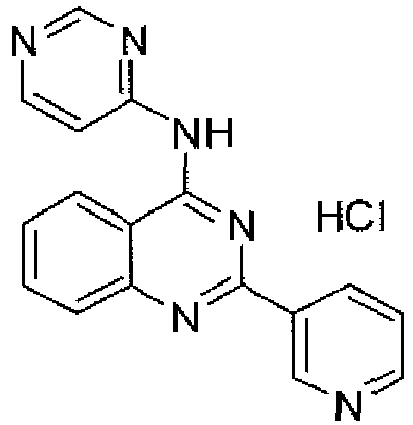
- The title compound was prepared from 4-chloro-2-(pyridin-3-yl)pyrimidine (0.2 g, 0.83 mmol) and pyrimidin-4-amine (94 mg, 1.0 mmol) by using an analogous procedure to that described in general procedure E and was isolated as white solid (0.164 g, 66 %). 1H NMR (400 MHz, DMSO-d6) δ 10.98 (bs, 1H); 9.60 (bd, 1H, J= 2.2 Hz); 9.00 (d, 1H, J = 1.3 Hz); 8.83 (d, 1H, J= 5.8 Hz); 8.74-8.77 (m, 3H); 8.57 (dd, 1H, J= 5.8 Hz, J= 1.3 Hz); 7.97-8.01 (m, 2H); 7.69 (m, 1H); 7.61 (dd, 1H, J= 7.9 Hz, J= 4.8 Hz).
13C (125 MHz, DMSO-d6) δ 159.6; 158.5; 158.2; 158.1; 157.38; 151.5; 150.9; 149.5; 135.7; 134.6; 133.5; 128.5; 127.5; 124.2, 124.1; 114.8; 111.7.
HRMS: calcd for C17H11N6, 299.1045; found, 299.1044. -

- The title compound was prepared from 4-chloroquinazoline (0.4 g, 2.43 mmol) and 4-fluoro-3-nitroaniline (0:429 g, 2.92 mmol) by using an analogous procedure to that described in general procedure E and was isolated as white solid (0.455 g, 71 %).
1H NMR (400 MHz, DMSO-d6) δ 11.62 (bs, 1H; 9.00 (s, 1H); 8.92 (bd, 1H, J= 8.5 Hz); 8.11 (ddd, 1H, J= 8.4 Hz, J= 7.1 Hz, J= 1.0 Hz); 7.98 (dd, 1H, J= 8.4 Hz, J= 1.0 Hz); 7.91 (m, 2H); 7.87 (ddd, 1H, J= 8.5 Hz, J= 7.1 Hz, J= 1.2 Hz).
13C (125 MHz, DMSO-d6) δ 159.8; 151.9; 150.0 (ddd, J=245.2 Hz, J= 10.1 Hz, J= 5.2 Hz); 105.0; 140.9; 136.8 (dt, J= 248.1 Hz, J= 15.9 Hz); 136.3; 133.8; 128.8; 124.8; 121.6; 114.0; 109.2 (d, J= 23.7 Hz); 103.2.
HRMS: calcd for C14H9N3F3, 276.07431; found, 276.07430. -

- To a mixture of 2-(pyridin-3-yl)quinazoline-4(3H)-thione (0.15 g, 0.63 mmol, example 1) and KOH (5 mg, 0.63 mmol, in 10 ml of H2O) in acetone (100 ml) was added acetobromo-α-D-glucose (0.28 g, 0.69 mmol). The mixture was stirred at rt for 16 hours. The reaction mixture was concentrated and the residue was adsorbed on silica gel and purified by flash column chromatography on silica gel (eluent CHCl3/MeOH: 1/0 -->10/1) to afford title compound, which was converted to pale yellow salt (0.570 g, 55%).
1H NMR (400 MHz, DMSO-d6) δ 9.80 (bs, 1H); 8.84 (dt, 1H, J= 7.9 Hz, J' = 1.8 Hz); 8.05 (bd, 1H, J= 8.4 Hz); 8.01 (dd, 1H, J= 8.4 Hz, J= 1.3 Hz); 7.91 (ddd, 1H, J= 8.5 Hz, J= 6.9 Hz, J= 1.4 Hz); 7.60 (ddd, 1H, J= 8.3 Hz, J= 6.9 Hz, J= 1.2 Hz); 7.52 (bdd, 1H, J = 7.8 Hz, J= 4.9 Hz); 6.26 (d, 1H, J= 10.4 Hz); 5.42-5.50 (m, 2H); 5.21 (t, 1H, J= 9.7 Hz); 4.24 (dd, 1H, J = 12.6 Hz, J= 6.0 Hz); 4.12-4.16 (m, 2H); 2.10 (s, 3H); 2.07 (s, 3H); 2.05 (s, 3H); 1.80 (s, 3H).
13C (125 MHz, DMSO-d6) δ 170.5, 170.0, 169.5, 169.5; 168.0; 157.0; 151.3; 150.0; 149.1; 135.6; 134.5; 133.2; 129.1; 127.7; 123.7; 123.5; 122.5; 80.0; 76.6; 74.0; 68.9; 68.2; 62.2; 21.0, 20.9, 20.8, 20.7.
HRMS: calcd for C27H28O9N3S, 570.15408; found, 570.15437. -

- The title compound was prepared from 4-chloro-2-phenylquinazoline (0.4 g, 1.66 mmol) and 3,4,5-trifluoroaniline (0.293 g, 2.0 mmol) by using an analogous procedure to that described in general procedure E and was isolated as white solid (0.438 g, 75%).
1H NMR (400 MHz, DMSO-d6) δ 11.21 (bs, 1H); 8.81 (bd, 1H, J= 8.3 Hz); 8.37 (m, 2H); 8.17 (bd, 1H, J= 8.4 Hz); 8.05 (m, 1H); 7.98 (m, 2H); 7.87 (m, 1H); 7.61-7.68 (m, 3H). 13C (125 MHz, DMSO-d6) δ 158.9; 158.1; 150.0; 150.0 (ddd, J = 244.8 Hz, J= 10.4 Hz, J = 5.6 Hz); 144.4; 136.0; 135.6; 134.4; 132.6; 129.1, 129.1; 128.9, 128.9; 127,9; 124.2; 123.7; 113.3; 108.3; 108.3.
HRMS: calcd for C20H13N3F3, 570.15408; found, 570.15437. -

- The reaction of 4-chloro-2-(pyridin-3-yl)quinazoline (400 mg, 1.65 mmol) and 2-amino-5-hydroxybenzoic acid (510 mg, 3.3 mmol) according to general procedure D gave the title compound (390 mg, 60 %) as a brown precipitate. Due its insolubility in DMSO the product was treated with NaOH to give free base for NMR experiments.
Free base 1H NMR (500 MHz, DMSO-d6) δ 11.57 (bs, 1H), 9.49 (bs, 1H), 8.96 (bd, J= 8.0 Hz, 1H), 8.88 (bd, J= 5.1 Hz, 1H), 8.39 (d, J 5-6 = 8.4 Hz, 1H), 8.26 (bd, J= 8.2 Hz, 1H), 8.04-7.97 (m, 2H), 7.89 (m, 1H), 7.77 (m, 1H), 7.47 (d, J= 2.9 Hz, 1H), 7.19 (dd, J= 8.8 Hz, J = 2.9 Hz, 1H).
13C NMR (125 MHz, DMSO-d6) δ 169.08,158.28, 156.09, 154.23, 148.12, 147.59, 146.37, 139.30, 134.53, 133.85, 130.97, 127.97, 125.83, 125.32, 123.27, 122.70, 116.98, 114.22.
HRMS: calculated for C20H14N4O3, 358.1066, found 358.1059. -

- To a solution of 3,4-dihydroxybenzonitrile (10g, 74.0 mmol) and K2CO3 (30.7g, 222.0 mmol) in dimethylformamide was dropwise added 1-chloro-2-methoxyethane (28g, 296.0 mmol). The reaction mixture was heated with stirring to 70 °C overnight. Inorganic salts were removed by filtration and resulting solution was poured into the brine and then extracted with ethyl acetate. Solvents were removed in vacuo and title compound was obtained as white solid (13.2 g, 71 %).
Spectral data were in agreement with literature. Chandregowda, Venkateshappa; Rao, Gudapati Ventakeswara; Reddy, Goukanapalli Chandrasekara Heterocycles, 2007, vol.71, # 1 p.39-48. -

- Nitric acid (65 %, 16.2 g, 254.5 mmol) was dropwise added directly into flask containing 3,4-bis(2-methoxyethoxy)benzonitrile (12.8 g, 50.9 mmol). The mixture was then heated with stirring to 50 °C until starting material was completely dissolved. After stirring for two days at RT the reaction mixture was dissolved with water (50 ml) and formed precipitate was filtered off and washed with water (100 ml). After crystallization from chloroform the title compound was obtained in form of white crystals (7.1 g, 47 %). Spectral data were in agreement with literature.Chandregowda, Venkateshappa; Rao, Gudapati Ventakeswara; Reddy, Goukanapalli Chandrasekara Heterocycles, 2007 , vol. 71, # 1 p. 39 - 48.
-

Spectral data were in agreement with literature. -

- To a solution of 4,5-bis(2-methoxyethoxy)-2-nitrobenzatnide (6.1 g, 19.4 mmol) and ammonium formate (6.1 g, 102.4 mmol) in ethanol was added Pd/C (0.5 g) and the reaction mixture was heated with stirring to reflux for 2 h. Pd/C was then filtered off and solvent was removed in vacuo. Resulting crude product was suspended in water and filtered off to remove remaining ammonium formate. Obtained white solid (5.2 g, 95 %) used in the next reaction without additional purification.
Spectral data were in agreement with literature. -

- To a solution of 2-amino-4,5-bis(2-methoxyethoxy)benzamide (4.5 g, 15.8 mmol) and triethylamine (10 g, 97.8 mmol) in tetrahydrofurane and dichloromethane was added nicotinoyl chloride hydrochloride (3.1 g, 17.4 mmol) in one portion. The reaction mixture was heated to reflux with stirring. After 15 h the solvents were removed in vacuo and obtained solid was dissolved in ethyl acetate and extracted with water three times. After evaporation of solvent the title compound was obtained in form of white solid (3.2 g, 51 %).
1H NMR (500 MHz, DMSO-d6) δ 13.44 (bs, 1H), 9.21 (dd, J= 2.4 Hz, J= 0.9 Hz, 1H), 8.78 (dd, J= 4.8 Hz, J= 1.7 Hz, 1H), 8.66 (s, 1H), 8.33 (ddd, J= 8.0 Hz, J= 2.4 Hz, J= 1.6 Hz, 1H), 7.94 (bs, 1H), 7.58 (ddd, J = 8.0 Hz,J= 4.8 Hz, J = 0.9 Hz, 1H), 7.56 (s, 1H), 7.06 (bs, 1H), 4.26 (m, 2H), 4.19 (m, 2H), 3.80 (m, 2H), 3.71 (m, 2H), 3.41 (s, 3H), 3.37 (s, 3H).
13C NMR (125 MHz, DMSO-d6) δ 172.27, 163.78, 153.53, 153.26, 149.39, 144.57, 137.67, 135.45, 13J.SS, 124.53, 115.30, 11.18, 106.15, 71.70, 71.32, 70.04, 69.15, 59.05, 58.99.
HRMS: calculated for C19H23N3O6, 389.1587; found, 389.1595 -

- N-(2-carbamoyl-4,5-bis(2-methoxyethoxy)phenyl)nicotinamide hydrochloride (3.15 g, 8.1 mmol) was dissolved in aqueous KOH (25 ml, 1M) and stirred with heating to 100° C for 10 h. The resulting solution was diluted wit water and extracted six times with butanol. Solvents were removed in vacuo and title compound was obtained as white solid (3.0 g, 95 %). Sample for analysis was treated with HCl and then analysed as hydrochloride. Protonated product 1H NMR (500 MHz, DMSO-d6) δ 12.60 (bs, 1H), 9.27 (dd, J= 2.4 Hz, J= 0.9 Hz, 1H), 8.72 (dd, J = 4.8 Hz, J = 1.6 Hz, 1H), 8.45 (ddd, J= 8.1 Hz, J= 2.4 Hz, J= 1.6 Hz, 1H), 7.56 (ddd, J= 8.1 Hz, J= 4.8 Hz, J= 0.9 Hz, 1H), 7.50 (s, 1H), 7.25 (s, 1H), 4.28 (m, 2H), 4.23 (m, 2H), 3.74-3.71 (m, 4H), 3.34 (s, 6H).
13C NMR (125 MHz, DMSO-d6) δ 161.63, 154.34, 151.74, 149.41, 148.75, 148.28, 144.81, 135.26, 129.01, 123.75, 114.45, 109.51, 106.55, 70.38, 70.29, 68.42, 68.33, 58.57, 58.56.
HRMS: calculated for C19H21N3O5, 371.1481; found, 371.1479 -

13C NMR (125 MHz, DMSO-d6) δ 158.63, 156.52, 156.00, 151.28, 150.85, 148.97, 148.91, 134.99, 132.05, 123.79, 117.42, 108.02, 104.02, 70.11, 69.98, 68.89, 68.77, 58.43. HRMS: calculated for C19H20ClN3O4, 389.1142; found, 389.1145 -
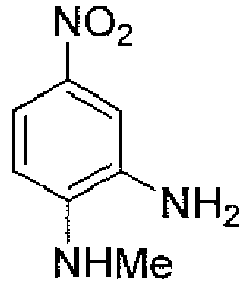
- To a solution of 1-chloro-2,4-dinitrobenzene in tetrahydrofuran was added methylamine in portions. After stirring for 1 h at RT N-methyl-2,4-dinitroaniline precipitate from solution. The precipitate was filtered off, washed with water and cold ethanol. Than the a suspension of crude N-methyl-2,4-dinitroaniline in ethanol was added to solution of sodium sulphide nonahydrate and powder sulphur in water and heated to 100° C for 2 h. Diluting the reaction mixture a cooling it to 0° C lead to precipitation of crude product. After filtration and washing with water and cold ethanol the title compound was obtained (6.6 g, 68 %) as dark red precipitate.
Spectral data were in agreement with literature. Russ. J. Gen. Chem. 2006, 76, No 6, 1282-1287 -

- To a solution of 4-chloro-6,7-bis(2-methoxyethoxy)-2-(pyridin-3-yl)quinazoline (100 mg, 260 µmol) and 2-methylamino-5-nitroaniline (85 mg, 510 µmol) in dioxane were added 2 drops of concentrated hydrochloric acid. The resulting mixture was heated with stirring to reflux for 10 h. Formed precipitate was filtered off and washed sequentially with acetone to give the title compound (70 mg, 50 %).
1H NMR (500 MHz, DMSO-d6) δ 9.47 (bs, 1H), 9.31 (dd, J= 2.2 Hz, J= 0.8 Hz, 1H),
8.57 (dd, J= 4.7 Hz, J= 1.7 Hz, 1H), 8.47 (dt, J= 8.0 Hz, J= 2.0 Hz,1H), 8.24 (bs, 1H), 8.12 (bdd, J= 9.2 Hz, J= 2.6 Hz, 1H), 7.92 (s, 1H), 7.44 (ddd, J= 7.9 Hz, J= 4.7 Hz, J= 0.9 Hz 1H), 7.30 (s, 1H), 6.86 (bs, 1H), 6.80 (d, J= 9.4 Hz, 1H), 4.33-4.29 (m, 4H), 3.80-3.76 (m, 4H), 3.38 (s, 3H), 3.36 (s, 3H), 2.87 (s, 3H).
13C NMR (125 MHz, DMSO-d6) δ 158.23, 156.21, 15-1.88, 151.58, 150.50, 149.04, 148.01, 147.40, 135.03, 134.66, 134.19, 124.35, 123.62, 123.22, 108.78, 108.58, 108.48, 104.48, 70.32, 72.31, 68.45, 68.26, 58.60, 58.56, 29.83.
HRMS: calculated for C26H28N6O6, 520.2070; found, 520.2074 -

- Reaction of 2-amino-6-fluorobenzamide (1 g, 6.5 mmol) with nicotinoyl chloride hydrochloride (1.15 g, 6.5 mmol) according to general procedure A gave the title compound (260 mg, 16 %) as white solid.
1H NMR (500 MHz, DMSO-d6) δ 9.39 (bd, J= 2.0 Hz, 1H), 8.92 (dd, J= 5.2 Hz, J= 1.5 Hz, 1H), 8.79 (ddd, J= 8.1 Hz, J= 2.2 Hz, J = 1.5 Hz, 1H), 7.88 (bdd, J= 8.1 Hz, J = 5.2 Hz, 1H), 7.85 (td, J= 8.2 Hz, J= 5.6 Hz, 1H), 7.60 (dd, J= 8.2 Hz, J= 1.0 Hz, 1H), 7.32 (ddd, J= 10.9 Hz, J= 8.1 Hz, J= 1.0 Hz, 1H).
13C NMR (125 MHz, DMSO-d6) δ 161.55 (m), 150.90, 150.49, 148.65, 145.89, 139.67, 135.73 (d, J = 10.6 Hz), 129.92, 125.36, 123.92, 113.93 (d, J = 20.5 Hz), 110.91 (d, J = 6.7 Hz).
HRMS: calculated for C13H7ClFN3, 259.0313; found, 259.0307 -

- The reaction of 4-chloro-2-(pyridine-4-yl)quinazoline (200 mg, 0.83 mmol) with 4-aminobenzophenone (326 mg, 1.7 mmol) according to general procedure D gave the title compound (172 mg, 47 %) as white solid.
1H NMR (500 MHz, DMSO-d6) δ 10.64 (bs), 9.01 (m, 2H), 8.84 (dt, J= 8.5 Hz, J= 1.0 Hz, 1H), 8.75 (m, 2H), 8.24 (m, 2H), 7.98-8.00 (m, 2H), 7.91 (m, 2H), 7.76-7.79 (m, 3H), 7.69 (m, 1H), 7.60 (m, 2H).
13C NMR (125 MHz, DMSO-d6) δ 194.90,158.44,155.01, 152.26, 149.91, 43.71, 143.49, 137.83, 134.51, 132.53, 131.94, 131.13, 129.64, 128.81, 128.69, 128.49, 124.68, 124.02, 121.59, 115.00.
HRMS: calculated for C26H19N4O, 403.1559; found 403.1553 -

- Reaction of 2-aminobenzamide (1.0 g, 7.3 mmol) with 4-benzoylbenzoyl chloride (1.79 g, 7.3 mmol) according to general procedure A gave the title compound (637 mg, 38 %) as white solid.
1H NMR (400 MHz, CDCl3) δ 8.78-8.64 (m, 2H), 8.29 (dd, J= 8.4 Hz, J= 0.8 Hz, 1H), 8.14 (d, J= 8.4, 1H), 8.01-7.97 (m, 1H), 7.97-7.93 (m, 2H), 7.88-7.83 (m, 2H), 7.72 (ddd, J= 8.2 Hz, J= 7.0 Hz, J=1.1 Hz, 1H), 7.65-7.59 (m, 1H), 7.52 (dd, J= 9.4 Hz, J= 5.7 Hz, 2H).
13C NMR (100 MHz, CDCl3) δ 196.35, 162.73, 159.07, 151.80, 140.18,139.54, 137.50, 135.03, 132.60, 130.26, 130.08, 129.09, 128.78, 128.56, 128.35, 125.89, 122.69. HRMS: calculated for C21H13ClN2O, 344.0716; found 344.0713. -

- Reaction of 4-chloro-2-(pyridine-2-yl)quinazoline (100 mg, 0.41 mmol) with 2-amino-6-fluorobenzamide (63.2 mg, 0.41 mmol) according to general procedure D gave the title compound (78 mg, 48 %) as a brown hygroscopic solid.
1H NMR (500 MHz, DMSO-d6) δ 12.32 (bs, 1H), 8.91 (ddd, J = 4.7 Hz, J = 1.7 Hz, J = 0.9 Hz, 1H), 8.84 (dd, J = 8.4 Hz, J = 1.2 Hz, 1H), 8.36 (dd, J = 8.6 Hz, J = 1.1 Hz, 1H), 8.28 (dt, J = 7.9 Hz, J 1.1 Hz, 1H), 8.14-8.18 (m, 3H), 7.91 (ddd, J = 8.4 Hz, J = 7.1 Hz, J = 1.1 Hz, 1H), 7.82 (ddd, J= 7.6 Hz, J= 4.8 Hz, J= 1.3 Hz, 1H), 7.80 (bs, 1H), 7.64-7.71 (m, 2H), 7.42 (ddd, J = 10.0 Hz, J = 8.2 Hz, J = 1.3 Hz, 1H).
13C NMR (125 MHz, DMSO-d6) δ 164.21, 160.68, 159.45 (d, J=248.2 Hz), 154.71, 149.49, 147.38, 140.01, 139.64, 136.94, 135.86 (d, J= 5.5 Hz), 131.62 (d, J= 5.5 Hz), 129.27, 128.65, 125.29, 124.86, 123.57, 121.83 (d, J=18.7 Hz), 121.24, 115.32 (d, J= 22.8 Hz), 113.28.
HRMS: calculated for C20H14FN2ONa, 382.1080; found 382.1075. -
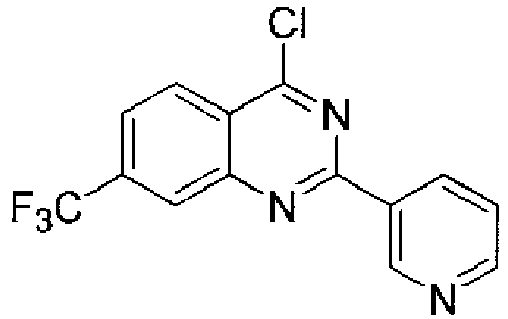
- The reaction of 2-amino-4-(trifluoromethyl)benzamide (2.0 g, 9.8 mmol) with nicotinoyl chloride hydrochloride (1.75 g, 9.8 mmol) according to general procedure A gave the title compound (880 mg, 28 %) as white solid.
1H NMR (500 MHz, DMSO-d6) δ 9.58 (dd, J = 2.2 Hz, J = 0.8 Hz, 1H), 8.79 (dd, J= 4.8 Hz, J= 1.7 Hz, 1H), 8.74 (ddd, J = 8.0 Hz, J = 2.2 Hz, J = 1.8 Hz, 1H), 8.49-8.51 (m, 2H), 8.12 (bdd, J= 8.8 Hz, J= 1.8 Hz, 1H), 7.64 (ddd, J= 8.0 Hz, J = 4.8 Hz, J= 0.9 Hz, 1H). 13C NMR (125 MHz, DMSO-d6) δ 162.94, 58.83, 152.52, 150.65, 149.60, 135.91, 135.33 (q, J= 32.8 Hz), 131.32, 128.22, 126.48 (q, J= 4.3 Hz), 125.00 (q, J= 3.1 Hz), 124.28, 124.14, 123.37 (q, J= 273.4 Hz).
HRMS: calculated for C14H7ClF3N3, 309.0281; found, 309.0279. -

- Reaction of 4-chloro-2-(pyridine-2-yl)quinazoline (50 mg, 0.21 mmol) with cyclohexylamine (21 mg mg, 0.21 mmol) according to general procedure D gave the title compound (10 mg, 16 %) as a white solid.
1H NMR (500 MHz, DMSO-d6) δ 9.58 (dd, J = 2.2 Hz, J = 0.9 Hz, 1H), 8.72 (ddd, J = 8.0 Hz, J= 2.2 Hz, J = 1.7 Hz, 1H), 8.67 (dd, J = 4.7 Hz, J = 1.7 Hz, 1H), 8.38 (m, 1H), 8.07 (bd, J = 7.5 Hz, 1H), 7.75-7.78 (m, 2H), 7.53 (ddd, J = 8.0 Hz, J = 4.7 Hz, J= 0.9 Hz, 1H), 7.50 (m, 1H), 4.34 (m, 1H), 2.06 (m, 2H), 1.82 (m, 2H), 1.70 (m, 1H), 1.43-1.49 (m, 4H), 1.23 (m, 1H).
13C NMR (125 MHz, DMSO-d6) δ 159.11, 157.90, 150.88, 149.98, 149.36, 135.21, 134.20, 133.00, 127.97, 125.65, 123.71, 123.28, 114.18, 50.06, 32.19, 25.30, 23.96. HRMS: calculated for C19H21N4, 305.1761; found, 305.1759. -

- The reaction of 4-chloro-2-(pyridin-3-yl)-7-(trifluoromethyl)quinazoline (50 mg, 0.16 mmol) and 2-fluoro-5-nitroaniline (31 mg, 0.20 mmol) according to general procedure F gave the title compound (62 mg, 90 %) as a red-brown solid.
1H NMR (500 MHz, DMSO-d6) δ 9.62 (bs, 1H), 9.21 (bdd, J= 6.6 Hz, J= 2.9 Hz, 1H), 8.76 (dt, J= 8.0 Hz, J=1.9 Hz, 1H), 8.72 (bd, J = 8.7 Hz, 1H), 8.70 (m, 1H), 8.24-8.27 (m, 2H), 7.89 (m, 1H), 7.64 (t, J=9.5 Hz, 1H), 7.49 (m, 1H).
13C NMR (125 MHz, DMSO-d6) δ 159.14-161.18 (m), 152.46, 151.60, 150.80, 145.16, 136.19, 135.30 (q, J= 32.8 Hz), 133-92,126.88 (q, J= 4.0 Hz), 125.47, 124.24, 122.69-122.99 (m), 117.63 (d, J = 23.1 Hz), 117.20.
HRMS calculated for C20H12F4N5O2, 430.0922; found, 430.0920. -

- The reaction of 4-chloro-2-(pyridin-3-yl)quinazoline (50 mg, 0.21 mmol) and 3-(trifluoromethyl)aniline (40 mg, 0.25 mmol) according to general procedure D gave the title compound (26 mg, 31 %) as a pale yellow solid.
1H NMR (500 MHz, DMSO-d6) δ 11.16 (bs, 1H), 9.53 (bd, J= 2.1 Hz, 1H), 9.03 (bd, J= 8.4 Hz, 1H), 8.98 (dm, J = 8.1 Hz, 1H), 8.87 (dd, J = 5.1 Hz, J = 1.5 Hz, 1H), 8.53 (m, 1H), 8.32 (dm, J = 8.1 Hz, 1H), 8.09 (m, 1H), 7.99 (m, 1H), 7.84 (bdd, J = 8.1 Hz, J= 5.2 Hz, 1H), 7.70-7.75 (m, 2H), 7.56 (dm, J= 7.9 Hz, 1H).
13C NMR (125 MHz, DMSO-d6) δ 158.69, 156.05, 148.4, 148.4, 146.4, 139.72, 139.0, 134.67, 133.9, 129.93, 129.38 (q, J = 31.5 Hz), 127.59, 126.81, 125.33, 124.51, 124.49 (q, J = 272.7 Hz), 120.82, 119.60, 114.34.
HRMS: calculated for C20H14F3N4, 367.11651; found, 367.11648. -

- The reaction of 4-chloro-2-(pyridin-3-yl)quinazoline (50 mg, 0.21 mmol) and 3,4,5-trifluoroaniline (37 mg, 0.25 mmol) according to general procedure D gave the title compound (63 mg, 77 %) as a pale yellow solid.
1H NMR (500 MHz, DMSO-d6) δ 11.23 (bs, 1H), 9.52 (bd, J= 2.1 Hz, 1H), 9.11 (dt, J= 8.1 Hz, J = 1.8 Hz, 1H), 9.07 (bd, J = 8.4 Hz, 1H), 8.96 (dd, J = 5.3 Hz, J = 1.6 Hz, 1H), 8.11 (m, 2H), 8.02 (dd, J= 8.1 Hz, J= 5.3 Hz, 1H), 7.99 (m, 1H), 7.72 (m, 1H).
13C NMR (125 MHz, DMSO-d6) δ 158.63, 155.40, 149.99 (ddd, J= 244.1 Hz, J=10.1 Hz, J= 5.5 Hz), 148.7, 146.3, 144.30, 141.00, 134.64-136.47 (m), 134.76, 127.79, 127.20, 126.30, 124.65, 114.38, 107.58 (m).
HRMS: calculated for C19H12F3N4, 353.10086; found, 353.10082. -

- To a solution of 2-aminoacetophenone (5.0 g, 37 mmol) in dichloromethane (50 ml) at 0 °C was sequentially added nicotinoyl chloride hydrochloride (7.24 g, 40.7 mmol), DMAP (0.4 g) and pyridine (6.4 g, 81 mmol). The mixture was allowed to stir at 20 °C overnight. The reaction was quenched by addidion of water and crude product was extracted with CHCl3. Combined organic layers were washed with water, brine and dried. Chromatography (hexane-EtOAc 1:1) gave the title compound 6.77 g (76%).
m.p. 116.7-118.3 °C.
1H NMR (400 MHz, CDCl3) δ 12.85 (s), 9.34 (d, J= 1.8, 1H), 8.97 (d, J= 7.5, 1H), 8.82 (dd, J = 4.8, 1.6, 1H), 8.45 - 8.24 (m, 1H), 8.01 (dd, J= 8.0, 1.5, 1H), 7.75 - 7.57 (m, 1H), 7.49 (dd, J= 8.0, 4.8, 1H), 7.27 - 7.18 (m, 1H), 2.76 (s, 3H).
13C NMR (101 MHz, CDCl3) δ 203.38, 164.24, 152.60, 149.15, 140.98, 135.43, 134.87, 131.84, 130.39, 123.45, 122.97, 122.06, 120.90, 2$.51.
Jones, Carrie P.; Anderson, Kevin W.; Buchwald, Stephen L. Journal of Organic Chemistry, 2007, vol. 72, # 21 p. 7968 - 7973 -

- Suspension of N-(2-acetylphenyl)nicotinamide (4.4 g, 18.31 mmol) and NaOH (2.2 g, 55 mmol) in dioxane (70 ml) was refluxed for 4h and then allowed to cool down. Resulting precipitate was filtered off and solid was washed with hexane then water. The crude product was dried in vacuo to afford 4.0 g (98%) of title compound.
1H NMR (400 MHz, DMSO) δ 11.56 (bs, 1H), 9.05 (s, 1H), 8.77 (d, J = 3.7, 1H), 8.26 (d, J = 7.9, 1H), 8.12 (d, J = 7.9, 1H), 7.76 (d, J = 8.2, 1H), 7.70 (t, J = 7.6, 1H), 7.62 (dd, J = 7.9, 4.8, 1H), 7.37 (t, J= 7.4, 1H), 6.44 (bs, 1H).
Jones, Carrie P.; Anderson, Kevin W.; Buchwald, Stephen L. Journal of Organic Chemistry, 2007 , vol. 72, # 21 p. 7968 - 7973 -

- To a solution of 2-(pyridin-3-yl)quinolin-4(1H)-one (4.0 g, 18.0 mmol) in DMF (15 ml) was added POCl3 (13.81 g, 90 mmol) under Ar. The reaction mixture was stirred at 80 °C for 3h and then poured into ice. Neutralization with 20 % KOH solution to pH = 9, extraction with CHCl3 and evaporation of solvent lead to crude product. Chromatography (hexane-EtOAc 1:1) of the residue gave the title compound (3.21 g, 74%).
1H NMR (400 MHz, CDCl3) δ 9.37 (d, J= 1.7, 1H), 8.75 (dd, J= 4.8, 1.6, 1H), 8.57 - 8.46 (m, 1H), 8.28 (d, J = 8.4, 1H), 8.22 (d, J = 8.4, 1H), 8.01 (s, 1H), 7.89 - 7.76 (m, 1H), 7.74- 7.63 (m, 1H), 7.50 (dd, J= 8.0, 4.8, 1H).
13C NMR (101 MHz, CDCl3) δ 154.57, 150.65, 149.13, 148.75, 143.60, 134.84, 134.12, 130.87, 130.13, 127.74, 125.53, 124.03, 123.67, 118.63. -

- The reaction of 4-chloro-2-(pyridin-3-yl)quinoline (50 mg, 0.21 mmol) and and 3,4,5-trifluoroaniline (37 mg, 0.25 mmol) according to general procedure F gave the title compound (20 mg, 27 %) as a yellow solid.
1H NMR (500 MHz, DMSO-d6) δ 9.28 (bs, 1H), 9.25 (bs, 1H), 8.65 (m, 1H), 8.46 (ddd, J = 8.0 Hz, J= 2.3 Hz, J= 1.7 Hz, 1H), 8.32 (dm, J= 8.5 Hz, 1H), 8.02 (dm, J= 8.5 Hz, 1H), 7.78 (m, 1H), 7.65 (s, 1H), 7.60 (m, 1H), 7.53 (ddd, J= 8.0 Hz, J= 4.8 Hz, J= 0.9 Hz, 1H), 7.37 (dd, J= 9.7 Hz, J= 6.3 Hz, 2H).
13C NMR (125 MHz, DMSO-d6) δ 154.81, 151.06 (ddd, J= 245.2 Hz, J= 10.2 Hz, J 5.7 Hz), 150.24, 149.03, 148.59, 147.85, 137.75 (m), 134.07-136.13 (m), 134.97, 134.86, 130.38,129.77, 125.66,123.91,122.19, 119.58, 106.12 (m), 100.83.
HRMS: calculated for C20H12F3N3, 350.0905; found, 350.0897. -

- To a solution of 2-amino-5-hydroxybenzoic acid (1.0 g, 6.6 mmol) in methanol is dropwise added SOCl2 (3.75 g, 33.0 mmol). The reaction mixture was stirred with reflux overnight. The volatiles and solvents were removed in vacuo to give the title compound (915mg, 83%).
1H NMR (400 MHz, DMSO) δ 8.66 (s, 1H), 7.10 (d, J= 2.9 Hz, 1H), 6.80 (dd, J= 8.8 Hz and 2.9 Hz, 1H), 6.64 (d, J= 8.8 Hz, 1H), 6.07 (s, 2H), 3.76 (s, 3H).
13C NMR (101 MHz, DMSO) δ 167.52, 146.53, 144.59, 123.41, 117.75, 114.32, 108.81, 51.16.
HRMS: calculated for C8H9NO3, 167.0582; found, 167.0583. -

- The reaction of methyl 2-amino-5-hydroxybenzoate (915 mg, 5.5 mmol)) and 3-cyanopyridine (570 mg, 5.5 mmol) according to general procedure B gave the title compound (450 mg, 32 % overall).
1H NMR (400 MHz, DMSO) δ 9.52 (d, J = 1.7 Hz, 1H), 8.71 (dd, J = 4.7 Hz, J = 1.5 Hz, 1H), 8.70 - 8.65 (m, 1H), 8.03 (d, J = 9.1 Hz, 1H), 7.67 (dd, J = 9.1 Hz, J = 2.7 Hz, 1H), 7.58 (dd, J = 8.0 Hz, J = 4.8 Hz, 1H), 7.45 (d, J = 2.6 Hz, 1H).
13C NMR (101 MHz, DMSO) δ 159.53, 158,12, 154.32, 151,11, 148.64, 145.86, 134.81 , 131.81, 130.39, 128.30, 123.76, 123.32, 105.76.
HRMS: calculated for C13H9NO3Cl, 258.04287; found, 258.04280. -

- The reaction of 4-chloro-2-(pyridin-3-yl)quinazolin-6-ol (50 mg, 0.19 mmol) and 3,4,5-trifluoroaniline (30 mg, 0.20 mmol) according to general procedure D gave the title compound (12 mg, 15 %) as a beige solid.
1H NMR (500 MHz, DMSO-d6) δ 10.46 (bs, 1H), 10.03 (bs, 1H), 9.48 (bd, J = 2.1 Hz, 1H), 8.66 (dd, J = 4.7 Hz, J = 1.6 Hz, 1H), 8.62 (td, J = 7.9 Hz, J = 1.9 Hz, 1H), 8.05 (m, 2H), 7.88 (d, J = 2.6 Hz, 1H), 7.80 (d, J = 9.0 Hz, 1H), 7.58 (dd, J = 9.0 Hz, J =2.6 Hz, 1H), 7.55 (bdd, J = 8.0 Hz, J = 4.7 Hz, 1H).
13C NMR (125 MHz, DMSO-d6) δ 156.90, 156.56, 154.44, 150.71, 150.01 (ddd, J = 242.9 Hz, 9.2 Hz, J = 5.3 Hz), 148.99,144.72, 136.31 (m), 134.78, 134.66 (dt, J = 244.5 Hz, J = 15.8 Hz), 133.94, 12992, 125.21, 123.86, 115.47, 105.94 (m), 105.55.
HRMS: calculated for C13H10N4O3F3, 367.08122; found, 367.08147. -

- The reaction of 4-chloro-2(pyridine-3-yl)quinazoline (50 mg, 0.21 mmol) and thiazol-2-amine (25 mg, 0.25 mmol) according to general procedure E followed by treatment of resulting free base with 3 M HCl gave the title compound (17 mg, 26 %).
1H NMR (500 MHz, DMSO-d6) δ 9.47 (dd, J = 2.2 Hz, J = 0.7 Hz, 1H), 9.50 (bs, 1H), 9.29 (dm, J = 8.1 Hz, 1H), 9.02 (dd, J = 5.3 Hz, J = 1.5 Hz, 1H), 8.64 (bd, J = 8.2 Hz, 1H), 8.15 (dm, J = 8.1 Hz, 1H), 8.04 (dd, J = 8.1 Hz, J = 5.3 Hz, 1H), 8.00 (m, 1H), 7.74 (m, 1H), 7.73 (d, J = 4.1 Hz, 1H), 7.48 (d, J = 4.1 Hz, 1H).
13C NMR (125 MHz, DMSO-d6) δ 163.7,159.24, 155.20,147.9,145.8,145.2,141.13, 134.99, 133.1, 130.7, 128.27, 126.05, 124.84, 124.1, 116.92, 115.07.
HRMS: calculated for C16H12N5S, 308.08079; found, 308.08074. -

- To a solution of 4-chloro-2(pyridine-3-yl)quinazoline (50 mg, 0.21 mmol) in dry ethanol (5 ml) was added sodium tert-butoxide (56 mg, 59 mmol) and the reaction mixture was stirred at RT overnight. The solvents were evaporated and chromatography (CHCl3 with gradient of methanol) gave the title compound (36 mg, 68 %).
1H NMR (500 MHz, DMSO-d6) δ 9.63 (bdd, J = 2.2 Hz, J = 0.9 Hz, 1H), 8.77 (ddd, J = 8.0 Hz, J = 2.2 Hz, J =1.8 Hz, 1H), 8.73 (dd, J = 4.8 Hz, J = 1.7 Hz, 1H), 8.16 (m, 1H), 7.95-7.99 (m, 2H), 7.58 (ddd, J = 7.9 Hz, J = 4.8 Hz, J = 0.9 Hz, 1H), 4.76 (q, J = 7.1 Hz, 2H), 1.52 (t, J = 7.1 Hz, 3H).
13C NMR (125 MHz, DMSO-d6) δ 166.59, 157.61, 151.55, 151.16, 149.46, 135.48, 134.59, 133.04, 127.86, 123.92, 123.53, 114.99, 63.33, 14.37.
HRMS: calculated for C15H13ON3, 251.1059; found, 251.1060. -

- To a solution of 4-chloro-2-(pyridin-3-yl)quinazolin-6-ol (400 mg, 1.52 mmol) in acetone was added diethylamine (400 mg, 5.6 mmol) and the reaction mixture was stirred at RT overnight. Solvents were evaporated and free base was treated with excess of HCl (3 M) to give its salt. Crude product was dried in vacuo and chromatography of residue (CHCl3 with gradient of MeOH) gave the title compound (335 mg, 73 %).
1H NMR (500 MHz, DMSO-d6) δ 10.09 (bs, 1H), 9.56 (bd, J =1.9 Hz, 1H), 8.69 (dt, J = 7.9 Hz, J = 2.0 Hz, 1H), 8.64 (dd, J = 4.7 Hz, J =1.7 Hz, 1H), 7.47 (d, J = 9.0 Hz, 1H), 7.50 (ddd, J = 7.9 Hz, J = 4.7 Hz, J = 0.9 Hz, 1H), 7.46 (d, J = 2.6 Hz, 1H), 7.34 (dd, J = 8.9 Hz, J = 2.6 Hz, 1H), 3.35 (s, 6H).
13C NMR (125 MHz, DMSO-d6) δ 162.67, 154.59, 154.15, 150.47, 149.09, 146.26, 134.88, 134.09, 129.88, 123.99, 123.66, 115.88, 108.18, 41.55.
HRMS: calculated for C15H15ON4, 257.12404; found, 257. 12383. -

- Pyridine (2 ml) was cooled to -20° C and chlorosulfonic acid (220 mg, 1.9 mmol) was slowly added. Resulting solution was cooled to -20° C again and 4-(dimethylamino)-2-(pyridin-3-yl)quinazolin-6-ol hydrochloride (300 mg, 1.2 mmol) in pyridine was added in one portion. The reaction mixture was stirred at RT overnight then the excess of pyridine vas evaporated and residue was neutralized with aqueous Na2CO3 to pH = 10. Evaporation of solvents and extraction of solid phase with hot acetone followed by chromatography (CHCl3 with gradient of MeOH) gave the title compound (152 mg, 34 %).
1H NMR (500 MHz, DMSO-d6) δ 9.59 (dd, J = 2.2 Hz, J = 0.9 Hz, 1H), 8.73 (ddd, J = 7.9 Hz, J = 2.2 Hz, J = 1.8 Hz, 1H), 8.66 (dd, J = 4.8 Hz, J = 1.7 Hz, 1H), 8.03 (d, J = 2.6 Hz, 1H), 7.79 (d, J =9.0 Hz, 1H), 7.61 (dd, J = 9.0 Hz, J = 2.5 Hz, 1H), 7.53 (ddd, J = 7.9 Hz, J = 4.7 Hz, J = 0.9 Hz, 1H), 3.40 (s, 6H).
13C NMR (125 MHz, DMSO-d6) δ 162.91,155.56, 150.77, 150.10, 149.29, 148.54, 135.17, 133.95, 128.85, 127.47, 123.72, 115.45, 114.79, 41.57.
HRMS: calculated for C15H15O4N4S, 347.08085; found, 347.08086. - Further synthesized compounds are shown in table 4 hereinunder. These compounds were also synthesized following the general procedures A to F, described above.
- The compounds synthesized were tested in ALPHA screen and in YFP screen on tissue cultures.
- The AlphaScreen experiments are performed using Perkin Elmer Enspire plate reader in white 96-well ProxiPlates and PBS supplemented with 0.05% Tween20, 2mM DTT, 2% DMSO. First, Streptavidin-coated Donor beads are used to capture the CAI-biotin peptide. In the other solution, a fusion protein of CA with glutathione-S-transferase (CA-GST) is mixed with GSH Acceptor beads. Both mixtures were incubated and then mixed together. To test the ability of prepared organic compounds to inhibit the CAI binding to CA, they are screened at concentrations between 0.5-100 µM and IC50 values are calculated from the influenced signals.
- Upon illumination by laser at 680 nm, Donor beads containing the photosensitizer phthalocyanine convert ambient oxygen to an excited form of singlet oxygen 1O2. Singlet oxygen can within its half-life of ~ 4 µs diffuse approximately 200 nm in solution. If an Acceptor bead is within that proximity, which is mostly upon CA:CAI interaction, energy is transferred from the singlet oxygen to thioxene derivates within the Acceptor and signal at 520 - 620 nm is emitted. In the absence of an Acceptor bead, i.e. a compound inhibits CA/CAI interaction, singlet oxygen falls to ground state and no signal is produced.
- For YFP-screen were used cells transfected with the YFP expressing variant of NL4.3 HIV-1. Briefly, HEK293T cells were cotransfected with pNL4.3ΔLTRΔNef and YFP-pNL4.3ΔLTRΔNef in 1 : 1 ratio by FuGENE6 method according the manufacturer instructions. Transfected cells were immediately seeded on 96-well plate by Multidrop in the density of 3 x 10⁴ cells per well in the volume of 100 µl. Compounds from parental plate (5 µl of 2,7 or 6,75 µM compound in 100 % DMSO) were diluted by addition of 95 µl of complete DMEM (Dulbecco's modified Eagle medium containing 10 % fetal calf sera and peniciline/streptorriycine combination) by Hydra™. Compounds were added to transfected cells 10 hrs post-transfection. Hydra™ transferred 8 µl of diluted compounds from parental plate, so the final concentration of the compounds in the cell media was 10 or 25 µM. Supernatant was harvested again by Hydra™ 24 hrs later and the YFP intensities in supernatant and in cells were measured on the Saphire fluorescence reader.
- Several controls were distributed randomly on the plate and on the plate edges. The controls include nontransfected cells, late(-) transfected cells (HIV-1 variant with impaired release), pEYFP transfected cells and cells cotransfected with pNL4.3ΔLTRΔNef and YFP-pNL4.3ΔLTRΔNef treated with 1% DMSO.
- Obtained YFP intensities were normalized and evaluated according to stringent and less stringent criteria as described further. Nontransfected cells and corresponding supernatants were taken as a background values and subtracted from all other values. DMSO treated cotransfected cells and corresponding supernatants were averaged and this value was used as the max value representing 100 % effectivity of virus release. The stringent criteria were set as follows: supernatant value must be lower than 75 % of DMSO control and concomitantly cell associated YFP intensity cannot be lower than 80 % of DMSO control. Only 7 compounds of 218 tested were evaluated as hits at three of four plates according to these stringent criteria (table 5).
- Less stringent criteria involved the following normalization: norm=supbcgrd/(supbcgrd+cellbcgrd) and then related to DMSO control. As hits were considered compounds that have norm value lower than 75 % of that of the DMSO control. These less stringent criteria were fulfilled by 5 additional compounds that were evaluated as hits at three of four plates according to the stringent or less stringent criteria (table 5).
- Hits selected in the YFP-screen were further evaluated in the tissue culture experiments with cells infected with the wild type NL4.3 HIV-1. The virus for infection was obtained from co-culture of MT4 cells. The MT4 cells co-culture was synchronized for one week and then used for the infection of fresh MT 4 cells. 48 hrs post-infection was the culture supernatant harvested, cleared by the filtration through 45 µm filter and stored in -80 °C in 1 ml aliquots. Amount of virus was quantified by enzyme-linked immuno sorbent assay (ELISA) with antibodies against HIV-1 CA (3 ng of CA/ml) and blue cell assay (1x10⁵ IU/ml), which gives 3 x 10⁴ IU/ng of CA.
- For compounds testing the TZM cells were seeded on 96-well plate in the density 5 x 10³ cells per well. The culture media was aspirated approx. 16 hrs later and cells were infected by the wild type NLA.3 HIV-1 by addition of 50J..il of prepared virus stock diluted with 50 µl of complete DMEM. The compounds were added twice to ensure that there are not any preassembled viruses present at the time of their addition. Compounds were first added 8 hrs post-infection and then 24 hrs later. In both cases the old culture media were replaced by 100 µl of fresh complete DMEM prior to the compounds addition. Different compounds concentrations were tested, but the DMSO concentration never exceeded 1 % DMSO. As controls were used cells treated only with 1 % DMSO and cells treated with 0,1 µM Lopinavir (HIV-1 protease inhibitor). Supernatant was harvested 24 hrs after the second compound addition, i.e. 56 hrs post-infection. Harvested supernatants were immediately titrated on the fresh TZM cells in aim to perform the infectivity assay (TZM titration), or inactivated by addition of Triton X-100 to the final concentration 0.025 % for further ELISA analysis.
- TZM titration was performed on the cells seeded day before on 96-well plate in the density 5 x 10³ cells per well. The analysis was performed for each compound concentration at three different dilutions and in duplicates. The culture media was aspired and cells were lysed 48 hrs post-infection by addition of 100 µl of SteadyGlo luciferase substrate (Promega) diluted 1 : 1 by complete DMEM. The luminescence signal was measured on Luminoskan Ascent (Thermo Labsystems) after the transfer of 80 µl of lysate to the flat bottom white polystyrene assay plates (Costar).
- For ELISA measurement, the Maxisorp plates (Nunc) were precoated with monoclonal mouse anti HIV-1 CA antibodies at RT over night and blocked with 10 % FCS in PBS for at least 2 hrs at 37 °C prior the loading of inactivated supernatant. The analysis was done in three different dilutions and in duplicates for each compound concentration. For detection were used polyclonal rabbit anti HIV-1 CA antibodies and secondary antibodies labeled with horseradish peroxidase. The product of colorimetric reaction was quantified by measuring of absorbance at 450 nm at Multiscan EX reader (Thermo Scientific).
- Cytotoxicity of selected hits tested in the assay with NL4.3 infected cells was determined by MTT test. TZM cells were seeded on the previous day on 96-well plate in the density 5 x 10³ cells per well. The tested compounds were added in different concentrations, but the DMSO concentration never exceeded 1 % DMSO. As controls were used cells treated only with 1 % DMSO (non-toxic concentration) and cells treated with 5 % DMSO (toxic concentration). 20 µl of the CellTiter 96 Aqueous One substrate (Promega) was added to the 100 µl of culture media 48 hrs after the compounds addition and the color development was quantified 4 hrs later by measuring the absorbance at 490 nm on Saphire reader. Compounds were consider non-cytotoxic (at given concentrations) when the measured values were higher than 80 % of the value of 1 % DMSO treated cells.
- The binding of CA ligand AMR-346 to the HIV capsid protein and its C-terminal part was monitared using a VP-ITC microcalorimeter (MicroCal Inc., Northampton, USA) at 25 °C. The solutions of reactants were prepared in 30 mM MES, pH 6.0 containing 10 % glycerol, 2 mM 2-mercaptoethanol, 2 % DMSO, and the exact concentrations of proteins were determined by amino acid analysis. Due to low solubility of AMR-346, the precipitation was observed at concentration required for ITC measurement. The isothermal titration was used to estimate the ligand concentration and the binding parameters were calculated for situation when single AMR-346 molecule binds to monomer or dimer of protein, respectively. Typically, 9 µl aliquots of AMR-346 were injected stepwise into the sample cell containing 1.43 ml of 7 µM protein until saturation was achieved. The experiment was accompanied by a corresponding control experiment in which AMR-346 was injected into buffer alone. The association constants were determined by software developed by MicroCal.
-
Figure 1 shows the calorimetric titration curves from which the parameters for binding of one ligand molecule to monomeric proteins were calculated. The CA ligand AMR-346 binds to monomer of HIV capsid protein or its C-terminal part with dissociation constants of 230 nM or 50 nM, respectively. For the binding mode of single molecule AMR-346 toward dimeric capsid protein and its C-terminal part, the dissociation constants were estimated to be 120 nM and 26 nM, respectively.Table 4: Synthesized and tested compounds α screen tissue culture toxicity compound code compound structure mol. Weight IC50 (µM) IC50 (µM) LC50 (µM) AMR.320 
406,1 14,2 AMR.322 
330,2 > 200 AMR.325 
339,1 > 200 AMR.328 
358,1 110,2 AMR.328 .HCl 
394,1 > 200 AMR.331 
352,1 44,4 AMR.334 
362,1 43,2 AMR.335 
397,1 6,5 AMR.336 
427,1 118,6 AMR.341 
400,1 31,5 AMR.345 
402,0 22 AMR.346 
406,1 7,2 ~15 non-toxic AMR.347 
330,2 > 200 AMR.347 .HCl 
366,1 152,8 AMR.347 .2HCl 
402,1 > 200 AMR.348 
397,1 7,2 AMR.350 
394,1 > 200 AMR.351 
377,1 15,4 AMR.352 
402,0 190,7 AMR.353 
352,1 > 200 AMR.354 
362,1 165,1 AMR.355 
349,1 25 AMR.356 
427,1 155,8 AMR.357 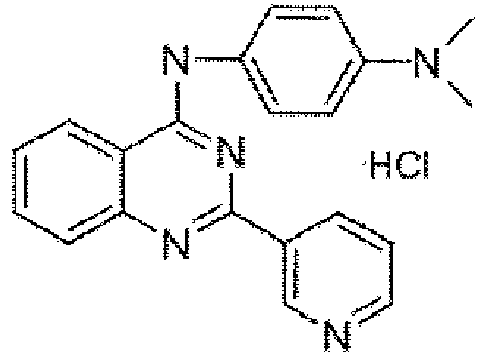
377,1 66,7 AMR.358 
339,1 5 AMR.359 
400,1 37,5 AMR.361 
439,1 >200 AMR.362 
435,0 > 200 AMR.363 
427,1 54,8 AMR.364 
385,1 > 200 AMR.365 
395,1 > 200 AMR.366 
430,0 > 200 AMR.367 
363,1 > 200 AMR.368 
410,1 33,7 AMR.370 
460,1 > 200 AMR.3 71 
408,1 5 AMR.372 
389,1 6,4 AMR.373 
389,1 17,3 AMR.374 
422,1 6,6 AMR.378 
341,2 > 200 AMR.378 .HCl 
377,1 24,7 AMR.379 
341,2 217,3 AMR.379+HCl 
377,1 30,1 AMR.380 
410,1 157,2 AMR.381 
377,1 130,1 AMR.390 
473,0 > 200 AMR.391 
464,0 > 200 AMR.392 
433,1 > 200 AMR.393 
442,0 2 AMR.395 
491,0 120,9 AMR.396 
468,9 > 200 AMR.397 
419,0 > 200 AMR.400 
460,1 > 200 AMR.401 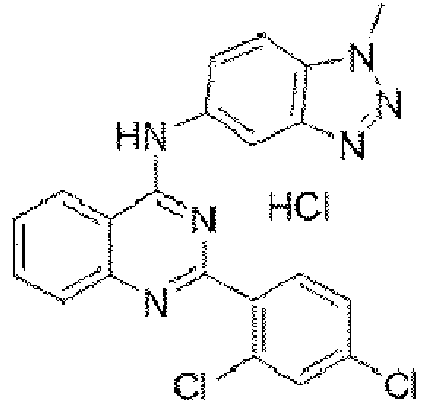
456,0 41,8 AMR.402 
408,1 26,7 AMR.402+HCl 
444,1 28,6 AMR.403 
444,1 41,1 AMR.416 
387,1 2,3 AMR.421 
389,1 33,7 AMR.422 
375,1 3,2 AMR.424 
397,1 1,9 AMR.425 
397,1 7 non toxic AMR.426 
397,1 14,5 AMR.427 
386,1 16,5 AMR.428 
441,1 114,7 AMR.429 
383,1 2,4 AMR.437 
397,1 50,9 AMR.444 
464,1 > 200 AMR.445 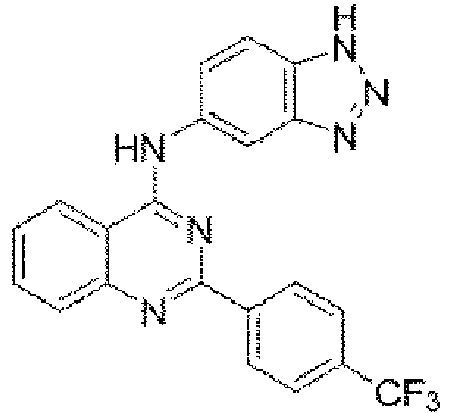
406,1 53,2 AMR.446 
420,1 28,2 AMR.448 
397,1 2,6 AMR.448H 
379,1 1,8 AMR.449 
397,1 2,9 AMR.450 
397,1 169,1 AMR.451 
386,1 15,1 AMR.455 
448,0 15,3 AMR.456 
395,1 10,2 AMR.457 
364,1 > 200 AMR.458 
395,1 5,8 AMR.461 
395,1 57,4 AMR.462 
394,1 15,2 AMR.464 
389,1 97,4 AMR.466 
408,1 4,7 AMR.471 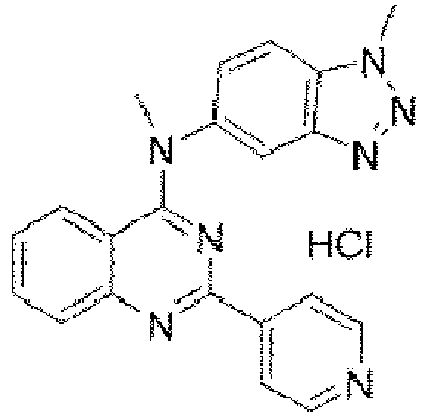
403,1 > 200 AMR.475 
320,0 > 200 AMR.476 
298,1 137,4 AMR.479 
389,1 53,7 AMR.479-MAT 
389,1 123,2 AMR.480 
375,1 1,9 AMR.481 
395,1 2,1 AMR.483 
448,0 16,1 AMR.484 
364,1 178,8 AMR.492 
395,1 19,7 AMR.493 
394,1 30 AMR.494 
408,1 0,9 ~15 AMR.494 HNO3 
435,4 AMR.494 H2SO4 
471,5 AMR.494 H3PO4 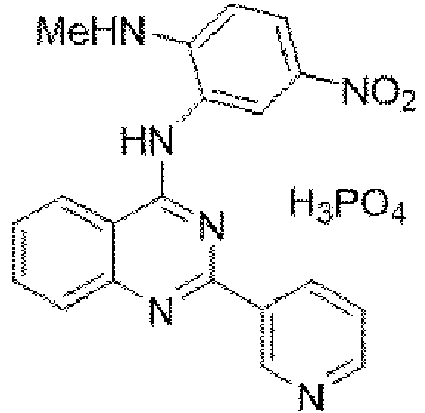
470,4 AMR.494 AcOH 
432,4 AMR.494 TFA 
486,4 AMR.494 TfOH 
522,5 AMR.494 lactic 
462,5 AMR.494 citric 
564,2 AMR.494 tartaric 
522,5 AMR.494 picolinic 
495,5 AMR.494 ascorbic 
548,8 AMR.504 
405,1 76 AMR.505 
388,1 59,8 AMR.508 
439,1 > 200 AMR.509 
431,2 > 200 AMR.511 
439,1 > 200 AMR.512 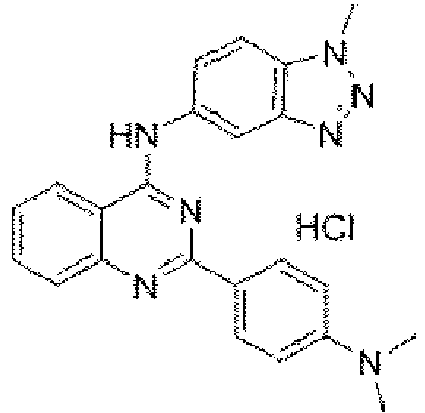
431,2 30,8 AMR-535 
376,8 < 5 non-toxic AMR-540 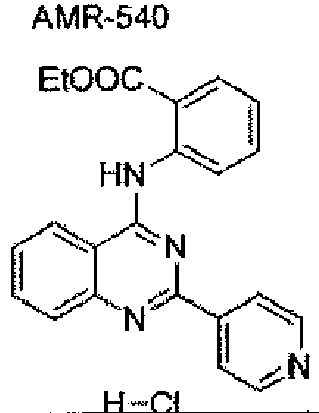
406,9 > 10 non-toxic AMR-541 
406,9 < 5 non-toxic AMR-542 
378,8 >10 non-toxic AMR-546 
388,9 > 10 non-toxic AMR-549 
359,8 >10 non-toxic AMR-551 
412,9 > 10 non-toxic AMR-556 
377,8 > 10 non-toxic AMR-558 
381,8 > 10 non-toxic AMR-560 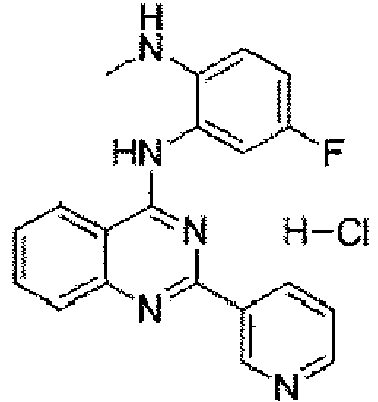
381,8 ~12 non-toxic AMR-566 
378,9 ~10 non-toxic AMR-568 
391,9 < 5 ~7 AMR-570 
380,9 ~10 non-toxic AMR-573 
396,9 > 10 non-toxic AMR-577 
413,9 > 10 non-toxic OSR-1 
423,8 OSR-2 
394,8 OSR-3 
364,8 OSR-5 
414,2 OSR-17x 
407,8 OSR-33 
557,0 OSR-33 HNO3 
583,6 OSR-33 H2SO4 
618,6 OSR-33 H3PO4 
618,5 OSR-33 AcOH 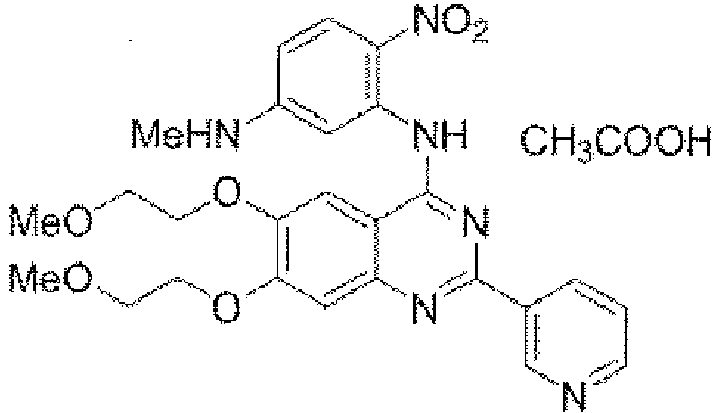
580,6 OSR-33 TFA 
634,6 OSR-33 TfOH 
670,6 OSR-33 lactic 
610,6 OSR-33 citric 
712,7 OSR-33 tartaric 
670,2 OSR-33 picolinic 
643,6 OSR-33 ascorbic 
696,7 OSR-48 
438,9 >25 non toxic OSR-72 
241,7 OSR-73 
500,1 OSR-73 VI 
464,4 OSR-77 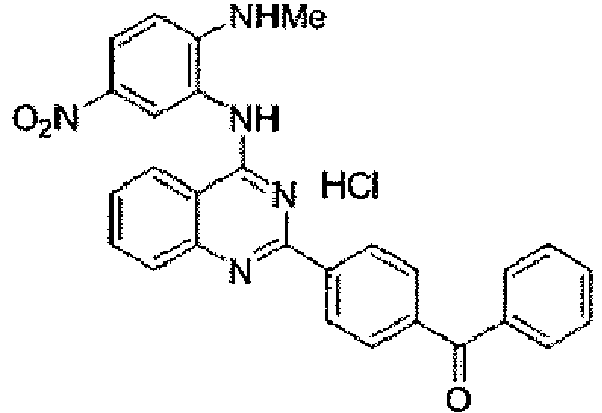
512,0 ~3 ~7 OSR-79 
543,0 >25 non toxic OSR-79 free base 
506,5 >25 non toxic OSR-85 
395,8 ~8 non toxic OSR-166 
340,8 OSR-177 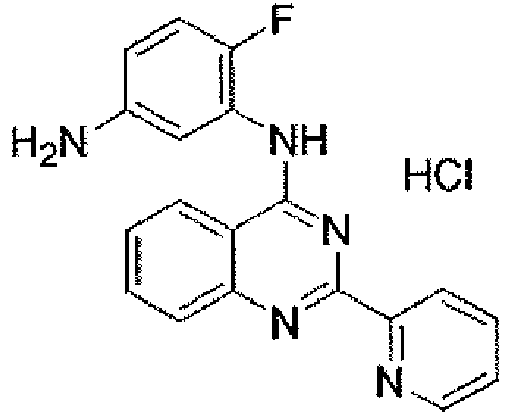
367,1 OSR-178 
465,8 ~5 ~11 OSR-183 
356,1 >25 non-toxic OSR-198 
402,1 >25 non-toxic OSR-199 
388,8 ~5 non-toxic OSR-201 
470,8 ~8 non-toxic OSR-205 
378,8 ~10 non-toxic OSR-217 
404,8 non-toxic OSR-219 
341,8 OSR-236 
251,1 ~10-15 non-toxic OSR-242X 
266,1 0.5 - 1 non-toxic OSR-243 
275,6 -17 non-toxic OSR-250 
368,3 >10 non-toxic OSR-283 HCl 
374,9 > 10 non-toxic OSR-242 HCl 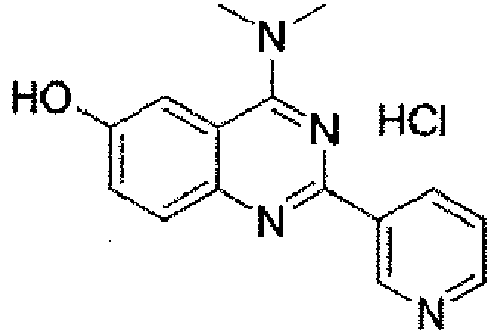
302,8 ~3 ~20 OSR-285 
315,8 > 10 non-toxic OSR-290 
351,9 >10 non-toxic OSR-291 
577,6 insoluble in DMSO OSR-295 
300,8 >10 non-toxic OSA-296 
464,9 > 10 non-toxic OSR-298 
388,8 >10 non-toxic OSR-299 
388,8 ~10 non-toxic OSR-302 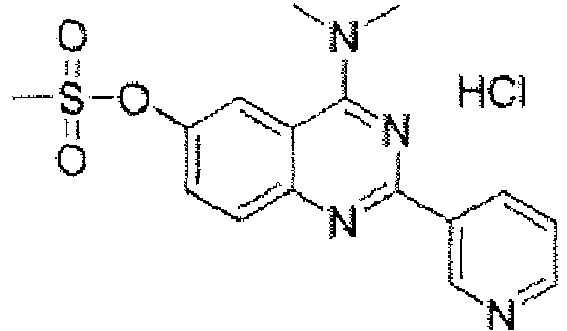
380,8 a lot of dead cells ~7 OSR-242 Na 
288,2 ~8 ~20 OSR-242 HCl 
339,2 < 5 -15 OSR-306 HCl 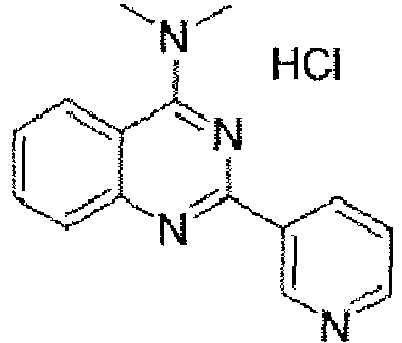
286,8 >10 non-toxic OSR-306 2HCl 
323,2 > 10 non-toxic KP-34 
347,7 >25 non-toxic KP-43 
347,7 non-toxic KP-66 
487,9 ~5 non-toxic KP-76 
378,3 ~5 non-toxic KP-92 
344,3 ~8 non-toxic KP-94 
360,3 ~5 -20 KP-98 
370,3 ~15 non-toxic KP-100 
412,2 -15 non-toxic KP-107 
388,3 ~7 non-toxic KP-108 
469,2 ~1.5 ~20 KP-111 
300,3 ~18 non-toxic KP-119 
569,6 > 25 non-toxic KP-130 
378,3 >25 non-toxic KP-139 
479,4 >25 non-toxic KP-152 
275,2 ~17 non-toxic KP-153 
351,3 ~10-15 non-toxic KP-158 (old) 
431,2 0.5 - 1 non-toxic KP-161 
477,2 ~10 non-toxic KP-154 
406,9 ~2 ~15 KP-158 (new pure) 
367,7 ~3 non-toxic KP-165 
352,8 >10 non-toxic KP-179 
822,7 >10 non-toxic KP-187 
346,1 >10 non-toxic KP-190 
328,8 > 10 non-toxic KP-199 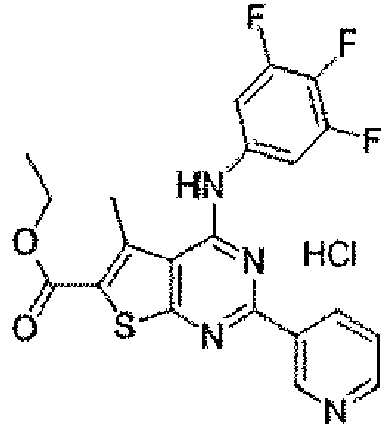
480,9 >10 non-toxic KP-207 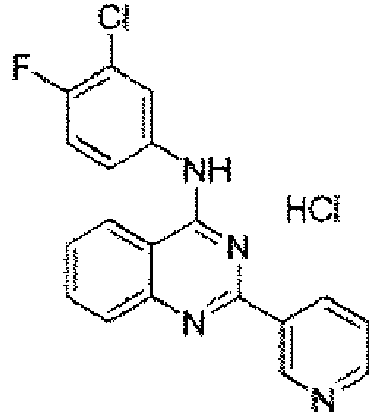
387,2 >10 non-toxic KP-216 
298,8 > 10 non-toxic KP-233 
438,9 >10 non-toxic KP-236 
364,8 ~10 ~10 KP-237 
314,7 > 10 non-toxic KP-242 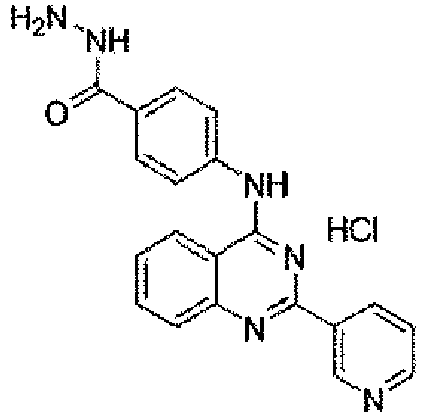
392,8 >10 non-toxic KP-251 
385,2 ~5 non-toxic KP-253 
438,1 insoluble in DMSO KP-255 
401,3 ~10 non-toxic KP-260 
438,1 > 10 non-toxic KP-265 
493,2 ~10 non-toxic KP-268 
396,8 > 10 non-toxic KP-270 
482 > 10 non-toxic KP-271 
370,8 ~10 non-toxic KP-272 
553,3 < 5 non-toxic KP-278 
416,8 ~10 non-toxic KP-283 
365,8 >10 non-toxic KP-288 
322,2 >10 non-toxic KP-291 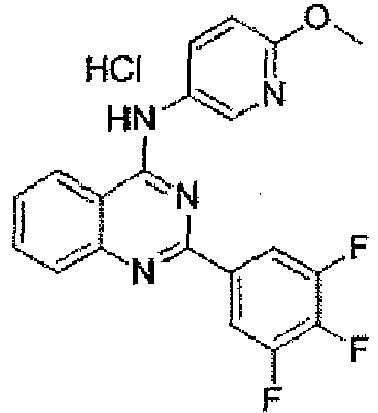
418,8 >10 non-toxic Tab. 5 IC50 and CC50 values of compounds inhibiting HIV-1 infectivity in tissue culture infected by the wild type NL4.3 HIV-1. Presented IC50 values are based on the TZM titration, CC50 values on the MTT cytotoxicity test and selectivity index (SI) was calculated as CC50/IC50. IC50(µM) CC50(µM) SI OSR77 2 7.1 3.5 OSR85 6.5 125 19.2 OSR178 1.5 5 3.3 OSR199 5.1 100 19.6 OSR201 8.5 25 2.9 AMR325 6.9 200 29 AMR480 8.8 150 17.1 AMR494HCl 1.8 16.1 8.9
Claims (16)
- As compound or a pharmaceutically acceptable salt or solvate thereof for use in inhibiting HIV capsid assembly, the compound comprising the core structure

- The compound according to claim 1 having a structure according to formula (I)

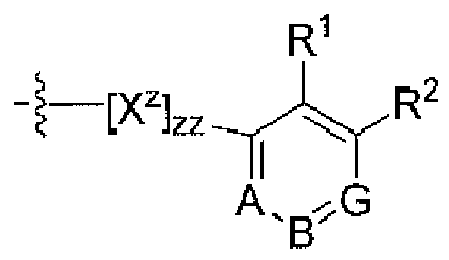

and wherein, A is N or C-R8, and wherein B is N or C-R9, and wherein C is N or C-R10
and wherein R8, R9 and R10, are, independently of each other, selected from the group consisting of H, -D, -alkyl, cycloalkyl, cycloalkenyl, heterocycloalkyl, heterocycloalkenyl, aryl, heteroaryl, alkenyl, alkoxy, halides, -C(O)R1#, -C(O)OR8#, -S(O)R8#, -SO2R8#, -P(O)R8#R9#, -P(O)(OR8#)R9#, -P(O)(OR8#)(OR9#), - C(O)NR8#R9#, -C(O)NR8# and -C(O)SR8#, and wherein R8# and R9# are, independently of each other, selected from the group consisting of -H, -alkyl, - alkenyl, -heterocycloalkyl, aryl and heteroaryl,
X is selected from the group consisting ofN, O or S,
wherein R3 is selected from the group consisting of H, alkyl, cycloalkyl, aryl, heteroaryl and heterocycloalkyl,
wherein integer n is 0 or 1,
and wherein R4, R5, are, independently of each other, selected from the group consisting of -H, -D, -alkyl, alkoxy, alkenyl, alkynyl, halides, -NO2, -OH, -NH2, - NHR4#, -CN, -S(O)R4#, -SO2R4#, -P(O)R4#R5#, -P(O)(OR4#)R5#,-P(O)(OR4#)(OR5#), -C(O)NR4#R5#, -C(O)SR4#, -C(O)R4#, -C(O)O-R4#, alkoxy and glycol chains;
wherein R4 and R5 or R5 and R6 can form a cyclic residue,
and wherein R4# and R5# are, independently of each other, selected from the group consisting of -H, -alkyl, -alkenyl, -heterocycloalkyl, aryl and heteroaryl,
and wherein Q is selected from the group consisting of alkyl, alkoxy, cycloalkyl, heterocycloalkyl, aryl, alkoxyalkyl and heteroaryl,
with the proviso that in case X is S, n is 0, and in case X is N, n is 1. - The compound according to claim 2, wherein R1 and R2, are, independently of each other, selected from the group consisting of C1-20alkyl, C3-10cycloalkyl, C3-10heterocycloalkyl, C3-10cycloalkenyl, C2-20alkenyl, C6-10aryl, C5-10heteroaryl, C(O)R1#, C(O)OR1#, -H, -D, -C1-10alkoxy, and -F, wherein R1# is C1-10alkyl.
- The compound according to claim 2 or 3 , having a structure according to formula (II)

- The compound according to any one of claims 2 to 4, wherein at least one of A, B and G is N.
- The compound according to any one of claims 2 to 5, wherein X is N, n is 1 and R3 is H or alkyl, preferably H or methyl, more preferably H.
- The compound according to any one of claims 2 to 6, wherein Q is

wherein Y is O, S or NH, and wherein Y1 is O, S or NR*, wherein R* is H or alkyl, and wherein R11# and R12# are, independently of each other, selected from the group consisting of -H, -alkyl, -alkenyl, -heterocycloalkyl, aryl and heteroaryl. - The compound according to claim 5, wherein at least one of R11, R12, R13, R14, and R15 is selected from the group consisting of -F, -I, NO2, -C(=O)-alkyl, -C(=O)-OH, -C(=O)-O-alkyl, -C(=Y)-OH and -NH-alkyl.
- The compound according to claim 6 or 7, wherein at least one of R11, R12, R13, R14, and R15 is -F.
- The compound according to any of claims 2 to 8, wherein Q is selected from the group consisting

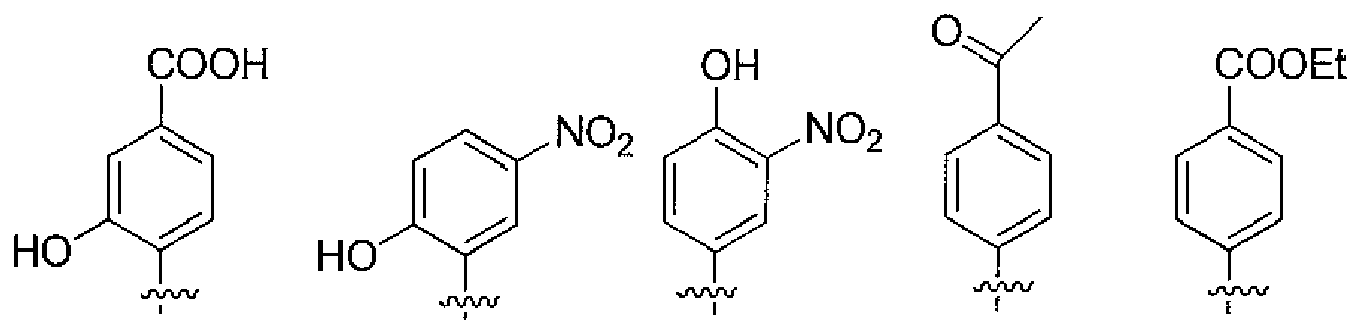

- The compound according to any one of claims 2 to 6, wherein Q

the bond (b) is a single or double bond,
with eth proviso that one of (a) and (b) is a double bond,
R19, R20, and R21 are, independently of each other H or -alkyl,
and wherein R16, R17 and R18, are independently of each other selected from the group consisting of -H, -alkyl, -halides, alkoxy, alkynyl, alkenyl, -NO2, -C(=Y)-alkyl, -C(=Y)-H, -C(=Y)-Y1-alkyl, -C(=Y)-OH and -Y-alkyl,
preferably wherein Q is selected from the group consisting of
- The compound according to any one of claims 2 to 12, wherein Z is selected from
the group consisting of
- A compound according to any one of claims 1 to 12, wherein HIV is HIV-1 capsid assembly
- A pharmaceutical composition comprising a compound according to any one of claims 1 to 12.
- Use of a compound as defined in any one of claims 1 to 12 for the manufacture of a medicament for inhibiting HIV capsid assembly.
- A method of treating a patient suffering from HIV comprising administering a therapeutically effective amount of the compound as defined in any one of claims 1 to 12.
Priority Applications (2)
| Application Number | Priority Date | Filing Date | Title |
|---|---|---|---|
| EP13156371.0A EP2769723A1 (en) | 2013-02-22 | 2013-02-22 | Compounds for use in inhibiting HIV capsid assembly |
| PCT/EP2014/053303 WO2014128206A1 (en) | 2013-02-22 | 2014-02-20 | Compounds for use in inhibiting hiv capsid assembly |
Applications Claiming Priority (1)
| Application Number | Priority Date | Filing Date | Title |
|---|---|---|---|
| EP13156371.0A EP2769723A1 (en) | 2013-02-22 | 2013-02-22 | Compounds for use in inhibiting HIV capsid assembly |
Publications (1)
| Publication Number | Publication Date |
|---|---|
| EP2769723A1 true EP2769723A1 (en) | 2014-08-27 |
Family
ID=47739162
Family Applications (1)
| Application Number | Title | Priority Date | Filing Date |
|---|---|---|---|
| EP13156371.0A Withdrawn EP2769723A1 (en) | 2013-02-22 | 2013-02-22 | Compounds for use in inhibiting HIV capsid assembly |
Country Status (2)
| Country | Link |
|---|---|
| EP (1) | EP2769723A1 (en) |
| WO (1) | WO2014128206A1 (en) |
Cited By (5)
| Publication number | Priority date | Publication date | Assignee | Title |
|---|---|---|---|---|
| WO2015112739A1 (en) * | 2014-01-22 | 2015-07-30 | The United States Of America, As Represented By The Secretary, Department Of Health And Human Services | Compounds and method for treating parp1-deficient cancers |
| CN108358798A (en) * | 2018-02-12 | 2018-08-03 | 黑龙江鑫创生物科技开发有限公司 | A kind of method of micro passage reaction synthesis Tarceva intermediate |
| CN108440500A (en) * | 2018-04-18 | 2018-08-24 | 山东大学 | A kind of quinazoline ditosylate salt HIV-1 inhibitor and its preparation method and application |
| JP2019531349A (en) * | 2017-03-17 | 2019-10-31 | 南京柏▲アオ▼納熙医薬科技有限公司Nanjing Bioenergy Medicine Science & Technology Co., Ltd. | Acetophenone compounds, preparation methods thereof, and use for prevention and treatment of fatty liver |
| WO2021037868A1 (en) * | 2019-08-28 | 2021-03-04 | F. Hoffmann-La Roche Ag | Novel quinazoline compounds for the treatment and prophylaxis of hepatitis b virus disease |
Families Citing this family (6)
| Publication number | Priority date | Publication date | Assignee | Title |
|---|---|---|---|---|
| EP3237397B1 (en) | 2014-12-24 | 2018-11-21 | Gilead Sciences, Inc. | Isoquinoline compounds for the treatment of hiv |
| TW202237569A (en) | 2014-12-24 | 2022-10-01 | 美商基利科學股份有限公司 | Quinazoline compounds |
| ES2735087T3 (en) | 2014-12-24 | 2019-12-16 | Gilead Sciences Inc | Fused pyrimidine compounds for HIV treatment |
| CZ309449B6 (en) * | 2020-12-24 | 2023-01-25 | Ústav experimentální botaniky AV ČR, v. v. i. | Quinazoline derivatives as selective cyclooxygenase-1 inhibitors |
| CN113292547B (en) * | 2021-05-31 | 2022-08-16 | 南方医科大学 | 2-aromatic heterocyclic quinazoline ketone compound and preparation method and application thereof |
| KR102769394B1 (en) * | 2022-01-20 | 2025-02-17 | 동아대학교 산학협력단 | Method for synthesizing Avenanthramide C |
Citations (10)
| Publication number | Priority date | Publication date | Assignee | Title |
|---|---|---|---|---|
| EP0579496A1 (en) * | 1992-07-15 | 1994-01-19 | Ono Pharmaceutical Co., Ltd. | 4-Aminoquinazoline derivatives, and their use as medicine |
| WO2005000405A2 (en) * | 2003-06-06 | 2005-01-06 | The Trustees Of The University Of Pennsylvania | P38 kinase inhibitor compositions and methods of use |
| WO2005007672A2 (en) * | 2003-06-20 | 2005-01-27 | Coley Pharmaceutical Gmbh | Small molecule toll-like receptor (tlr) antagonists |
| WO2005076861A2 (en) * | 2004-02-04 | 2005-08-25 | University Of Virginia Patent Foundation | Compounds that inhibit hiv particle formation |
| WO2006019831A1 (en) * | 2004-07-14 | 2006-02-23 | Ptc Therapeutics, Inc. | Methods for treating hepatitis c |
| EP1698627A1 (en) * | 2000-09-15 | 2006-09-06 | Vertex Pharmaceuticals Incorporated | Pyrazole compounds useful as protein kinase inhibitors |
| WO2007048042A2 (en) * | 2005-10-21 | 2007-04-26 | University Of Alabama At Birmingham | Small molecule inhibitors of hiv-1 capsid assembly |
| WO2007100759A2 (en) * | 2006-02-22 | 2007-09-07 | Synta Pharmaceuticals Corp. | Method for treating common variable immunodeficiency |
| WO2007117995A2 (en) * | 2006-03-30 | 2007-10-18 | Takeda San Diego, Inc. | Kinase inhibitors |
| US7618975B2 (en) | 2003-07-03 | 2009-11-17 | Myriad Pharmaceuticals, Inc. | 4-arylamino-quinazolines and analogs as activators of caspases and inducers of apoptosis and the use thereof |
-
2013
- 2013-02-22 EP EP13156371.0A patent/EP2769723A1/en not_active Withdrawn
-
2014
- 2014-02-20 WO PCT/EP2014/053303 patent/WO2014128206A1/en not_active Ceased
Patent Citations (10)
| Publication number | Priority date | Publication date | Assignee | Title |
|---|---|---|---|---|
| EP0579496A1 (en) * | 1992-07-15 | 1994-01-19 | Ono Pharmaceutical Co., Ltd. | 4-Aminoquinazoline derivatives, and their use as medicine |
| EP1698627A1 (en) * | 2000-09-15 | 2006-09-06 | Vertex Pharmaceuticals Incorporated | Pyrazole compounds useful as protein kinase inhibitors |
| WO2005000405A2 (en) * | 2003-06-06 | 2005-01-06 | The Trustees Of The University Of Pennsylvania | P38 kinase inhibitor compositions and methods of use |
| WO2005007672A2 (en) * | 2003-06-20 | 2005-01-27 | Coley Pharmaceutical Gmbh | Small molecule toll-like receptor (tlr) antagonists |
| US7618975B2 (en) | 2003-07-03 | 2009-11-17 | Myriad Pharmaceuticals, Inc. | 4-arylamino-quinazolines and analogs as activators of caspases and inducers of apoptosis and the use thereof |
| WO2005076861A2 (en) * | 2004-02-04 | 2005-08-25 | University Of Virginia Patent Foundation | Compounds that inhibit hiv particle formation |
| WO2006019831A1 (en) * | 2004-07-14 | 2006-02-23 | Ptc Therapeutics, Inc. | Methods for treating hepatitis c |
| WO2007048042A2 (en) * | 2005-10-21 | 2007-04-26 | University Of Alabama At Birmingham | Small molecule inhibitors of hiv-1 capsid assembly |
| WO2007100759A2 (en) * | 2006-02-22 | 2007-09-07 | Synta Pharmaceuticals Corp. | Method for treating common variable immunodeficiency |
| WO2007117995A2 (en) * | 2006-03-30 | 2007-10-18 | Takeda San Diego, Inc. | Kinase inhibitors |
Non-Patent Citations (13)
| Title |
|---|
| ENGELMAN, A.; CHEREPANOV, P., NATURE REVIEWS MICROBIOLOGY, vol. 10, 2012, pages 279 - 290 |
| F. TERNOIS ET AL., NATURE STRUCTURAL AND MOLECULAR BIOLOGY, vol. 12, 2005, pages 678 - 682 |
| FADER L D ET AL: "Discovery of a 1,5-dihydrobenzo[b][1,4]diazepine-2,4-dione series of inhibitors of HIV-1 capsid assembly", BIOORGANIC & MEDICINAL CHEMISTRY LETTERS, PERGAMON, ELSEVIER SCIENCE, GB, vol. 21, no. 1, 1 January 2011 (2011-01-01), pages 398 - 404, XP027566670, ISSN: 0960-894X, [retrieved on 20101031] * |
| J. STICHT ET AL., NATURE STRUCTURAL AND MOLECULAR BIOLOGY, vol. 12, 2005, pages 671 - 677 |
| JANA STICHT ET AL., NATURE STRUCTURAL AND MOLECULAR BIOLOGY, vol. 12, 2005, pages 671 - 677 |
| JONES, CARRIE P.; ANDERSON, KEVIN W.; BUCHWALD, STEPHEN L., JOURNAL OF ORGANIC CHEMISTRY, vol. 72, no. 21, 2007, pages 7968 - 7973 |
| JOURNAL OF ORGANIC CHEMISTRY, vol. 72, no. 21, 2007, pages 7968 - 7973 |
| LI ET AL., BIOORGANIC & MEDICINAL CHEMISTRY, vol. 17, 2009, pages 3177 - 3188 |
| MORBIDITY AND MORTALITY WEEKLY REPORTS, vol. 60, no. 03, 2011, pages 65 - 68 |
| PREVELIGE P E: "Inhibiting virus-capsid assembly by altering the polymerisation pathway", TRENDS IN BIOTECHNOLOGY, ELSEVIER PUBLICATIONS, CAMBRIDGE, GB, vol. 16, no. 2, 1 February 1998 (1998-02-01), pages 61 - 65, XP004107043, ISSN: 0167-7799, DOI: 10.1016/S0167-7799(97)01154-2 * |
| RUSS. J. GEN. CHEM., vol. 76, no. 6, 2006, pages 1282 - 1287 |
| TIAN ET AL., BIOORG. MED. CHEM. LETT., vol. 19, 2009, pages 2162 - 2167 |
| VANDA BARTONOVA, JBC, vol. 283, 2008, pages 32024 - 32033 |
Cited By (5)
| Publication number | Priority date | Publication date | Assignee | Title |
|---|---|---|---|---|
| WO2015112739A1 (en) * | 2014-01-22 | 2015-07-30 | The United States Of America, As Represented By The Secretary, Department Of Health And Human Services | Compounds and method for treating parp1-deficient cancers |
| JP2019531349A (en) * | 2017-03-17 | 2019-10-31 | 南京柏▲アオ▼納熙医薬科技有限公司Nanjing Bioenergy Medicine Science & Technology Co., Ltd. | Acetophenone compounds, preparation methods thereof, and use for prevention and treatment of fatty liver |
| CN108358798A (en) * | 2018-02-12 | 2018-08-03 | 黑龙江鑫创生物科技开发有限公司 | A kind of method of micro passage reaction synthesis Tarceva intermediate |
| CN108440500A (en) * | 2018-04-18 | 2018-08-24 | 山东大学 | A kind of quinazoline ditosylate salt HIV-1 inhibitor and its preparation method and application |
| WO2021037868A1 (en) * | 2019-08-28 | 2021-03-04 | F. Hoffmann-La Roche Ag | Novel quinazoline compounds for the treatment and prophylaxis of hepatitis b virus disease |
Also Published As
| Publication number | Publication date |
|---|---|
| WO2014128206A1 (en) | 2014-08-28 |
Similar Documents
| Publication | Publication Date | Title |
|---|---|---|
| WO2014128206A1 (en) | Compounds for use in inhibiting hiv capsid assembly | |
| CA2754808C (en) | Prodrug forms of kinase inhibitors and their use in therapy | |
| EP2769722A1 (en) | Compounds for use in inhibiting HIV capsid assembly | |
| JP6134338B2 (en) | Inhibitors of hepatitis B virus covalently closed circular DNA formation and methods for their use | |
| CN102112447B (en) | HIV integrase inhibitors from pyridoxine | |
| EP0445811B1 (en) | Nitrogen-containing heterocyclic compounds, their production and use | |
| RU2568639C2 (en) | Kinase inhibitors, prodrug forms thereof and use thereof in therapy | |
| AU2015353210A1 (en) | 2-aminopyrimidine compound and pharmaceutical composition and use thereof | |
| CN106831605B (en) | A kind of substituted diaryl pyridine derivatives and the preparation method and application thereof | |
| HK1244278B (en) | Salts of quinazoline derivative and method for preparing same | |
| CN111303121A (en) | 4-phenoxypyridine compound containing quinoxalinone and application thereof | |
| WO2017198196A1 (en) | Quinoline derivative having anti-tumor activity | |
| AU2012300274B2 (en) | HIV replication inhibitors | |
| CN106543077B (en) | N, N'-disubstituted arylthiourea derivatives and their synthetic methods and applications | |
| CN104876860B (en) | A kind of diaryl pyrazole piperidine derivatives and preparation method and application | |
| KR102909106B1 (en) | Pyrrolopyridine derivatives and use thereof | |
| US12371408B2 (en) | Aryl hydrocarbon receptor agonists and uses thereof | |
| KR20150012289A (en) | Methanethione compounds having antiviral activity | |
| CZ12097A3 (en) | Trifluoromethylquinolinecarboxylic acid derivatives and pharmaceutical composition containing thereof | |
| KR20250040981A (en) | Heteroaryl derivative compounds and uses thereof | |
| WO2019213295A1 (en) | Small molecule modulators of mhc-i | |
| CN101723904B (en) | 4-cyanodiarylpyrimidine derivatives and its preparation method and use | |
| EA053130B1 (en) | ARYL HYDROCARBON RECEPTOR AGONISTS AND THEIR APPLICATIONS | |
| EP4067354B1 (en) | Novel triazolopyridine derivative and pharmaceutical composition comprising same | |
| CN109053613A (en) | Diaryltriazine compound containing biphenyl structural and its preparation method and application |
Legal Events
| Date | Code | Title | Description |
|---|---|---|---|
| PUAI | Public reference made under article 153(3) epc to a published international application that has entered the european phase |
Free format text: ORIGINAL CODE: 0009012 |
|
| 17P | Request for examination filed |
Effective date: 20130222 |
|
| AK | Designated contracting states |
Kind code of ref document: A1 Designated state(s): AL AT BE BG CH CY CZ DE DK EE ES FI FR GB GR HR HU IE IS IT LI LT LU LV MC MK MT NL NO PL PT RO RS SE SI SK SM TR |
|
| AX | Request for extension of the european patent |
Extension state: BA ME |
|
| RIN1 | Information on inventor provided before grant (corrected) |
Inventor name: PARKAN, KAMIL Inventor name: STICHT, JANA Inventor name: LUX, VANDA Inventor name: STEPANEK, ONDREJ Inventor name: MACHARA, ALE Inventor name: GRANTZ SASKOVA, KLARA Inventor name: KOTORA, MARTIN Inventor name: PAVOVA, MARCELA Inventor name: KOZISEK, MILAN Inventor name: KRAEUSSLICH, HANS-GEORG Inventor name: KONVALINKA, JAN |
|
| STAA | Information on the status of an ep patent application or granted ep patent |
Free format text: STATUS: THE APPLICATION IS DEEMED TO BE WITHDRAWN |
|
| 18D | Application deemed to be withdrawn |
Effective date: 20150228 |