EP2768819B1 - Cabazitaxel, related compounds and methods of synthesis - Google Patents
Cabazitaxel, related compounds and methods of synthesis Download PDFInfo
- Publication number
- EP2768819B1 EP2768819B1 EP12783910.8A EP12783910A EP2768819B1 EP 2768819 B1 EP2768819 B1 EP 2768819B1 EP 12783910 A EP12783910 A EP 12783910A EP 2768819 B1 EP2768819 B1 EP 2768819B1
- Authority
- EP
- European Patent Office
- Prior art keywords
- acid
- compound
- silyl
- tri
- cabazitaxel
- Prior art date
- Legal status (The legal status is an assumption and is not a legal conclusion. Google has not performed a legal analysis and makes no representation as to the accuracy of the status listed.)
- Not-in-force
Links
- 238000000034 method Methods 0.000 title claims description 82
- 229960001573 cabazitaxel Drugs 0.000 title claims description 50
- BMQGVNUXMIRLCK-OAGWZNDDSA-N cabazitaxel Chemical compound O([C@H]1[C@@H]2[C@]3(OC(C)=O)CO[C@@H]3C[C@@H]([C@]2(C(=O)[C@H](OC)C2=C(C)[C@@H](OC(=O)[C@H](O)[C@@H](NC(=O)OC(C)(C)C)C=3C=CC=CC=3)C[C@]1(O)C2(C)C)C)OC)C(=O)C1=CC=CC=C1 BMQGVNUXMIRLCK-OAGWZNDDSA-N 0.000 title claims description 43
- 150000001875 compounds Chemical class 0.000 title claims description 27
- 238000003786 synthesis reaction Methods 0.000 title description 11
- 230000015572 biosynthetic process Effects 0.000 title description 6
- -1 taxane compound Chemical class 0.000 claims description 67
- QTBSBXVTEAMEQO-UHFFFAOYSA-N Acetic acid Chemical compound CC(O)=O QTBSBXVTEAMEQO-UHFFFAOYSA-N 0.000 claims description 37
- NLXLAEXVIDQMFP-UHFFFAOYSA-N Ammonia chloride Chemical compound [NH4+].[Cl-] NLXLAEXVIDQMFP-UHFFFAOYSA-N 0.000 claims description 34
- 229960003668 docetaxel Drugs 0.000 claims description 34
- OKKJLVBELUTLKV-UHFFFAOYSA-N Methanol Chemical group OC OKKJLVBELUTLKV-UHFFFAOYSA-N 0.000 claims description 27
- VEXZGXHMUGYJMC-UHFFFAOYSA-N Hydrochloric acid Chemical compound Cl VEXZGXHMUGYJMC-UHFFFAOYSA-N 0.000 claims description 26
- 125000006239 protecting group Chemical group 0.000 claims description 26
- CSCPPACGZOOCGX-UHFFFAOYSA-N Acetone Chemical compound CC(C)=O CSCPPACGZOOCGX-UHFFFAOYSA-N 0.000 claims description 23
- 125000002887 hydroxy group Chemical group [H]O* 0.000 claims description 22
- LFQSCWFLJHTTHZ-UHFFFAOYSA-N Ethanol Chemical compound CCO LFQSCWFLJHTTHZ-UHFFFAOYSA-N 0.000 claims description 21
- 229940123237 Taxane Drugs 0.000 claims description 21
- KRHYYFGTRYWZRS-UHFFFAOYSA-N Fluorane Chemical compound F KRHYYFGTRYWZRS-UHFFFAOYSA-N 0.000 claims description 20
- HCHKCACWOHOZIP-UHFFFAOYSA-N Zinc Chemical compound [Zn] HCHKCACWOHOZIP-UHFFFAOYSA-N 0.000 claims description 20
- ZDZOTLJHXYCWBA-VCVYQWHSSA-N N-debenzoyl-N-(tert-butoxycarbonyl)-10-deacetyltaxol Chemical compound O([C@H]1[C@H]2[C@@](C([C@H](O)C3=C(C)[C@@H](OC(=O)[C@H](O)[C@@H](NC(=O)OC(C)(C)C)C=4C=CC=CC=4)C[C@]1(O)C3(C)C)=O)(C)[C@@H](O)C[C@H]1OC[C@]12OC(=O)C)C(=O)C1=CC=CC=C1 ZDZOTLJHXYCWBA-VCVYQWHSSA-N 0.000 claims description 19
- WEVYAHXRMPXWCK-UHFFFAOYSA-N Acetonitrile Chemical compound CC#N WEVYAHXRMPXWCK-UHFFFAOYSA-N 0.000 claims description 18
- 229960001592 paclitaxel Drugs 0.000 claims description 18
- XLYOFNOQVPJJNP-UHFFFAOYSA-N water Substances O XLYOFNOQVPJJNP-UHFFFAOYSA-N 0.000 claims description 18
- 239000002253 acid Substances 0.000 claims description 17
- RCINICONZNJXQF-MZXODVADSA-N taxol Chemical compound O([C@@H]1[C@@]2(C[C@@H](C(C)=C(C2(C)C)[C@H](C([C@]2(C)[C@@H](O)C[C@H]3OC[C@]3([C@H]21)OC(C)=O)=O)OC(=O)C)OC(=O)[C@H](O)[C@@H](NC(=O)C=1C=CC=CC=1)C=1C=CC=CC=1)O)C(=O)C1=CC=CC=C1 RCINICONZNJXQF-MZXODVADSA-N 0.000 claims description 17
- 239000002841 Lewis acid Substances 0.000 claims description 16
- 150000007517 lewis acids Chemical class 0.000 claims description 16
- DKPFODGZWDEEBT-QFIAKTPHSA-N taxane Chemical class C([C@]1(C)CCC[C@@H](C)[C@H]1C1)C[C@H]2[C@H](C)CC[C@@H]1C2(C)C DKPFODGZWDEEBT-QFIAKTPHSA-N 0.000 claims description 16
- 229930012538 Paclitaxel Natural products 0.000 claims description 15
- WYURNTSHIVDZCO-UHFFFAOYSA-N Tetrahydrofuran Chemical compound C1CCOC1 WYURNTSHIVDZCO-UHFFFAOYSA-N 0.000 claims description 15
- 239000002798 polar solvent Substances 0.000 claims description 13
- 239000011734 sodium Substances 0.000 claims description 13
- FKLJPTJMIBLJAV-UHFFFAOYSA-N Compound IV Chemical compound O1N=C(C)C=C1CCCCCCCOC1=CC=C(C=2OCCN=2)C=C1 FKLJPTJMIBLJAV-UHFFFAOYSA-N 0.000 claims description 12
- TWRXJAOTZQYOKJ-UHFFFAOYSA-L Magnesium chloride Chemical compound [Mg+2].[Cl-].[Cl-] TWRXJAOTZQYOKJ-UHFFFAOYSA-L 0.000 claims description 12
- 239000002585 base Substances 0.000 claims description 11
- NLFBCYMMUAKCPC-KQQUZDAGSA-N ethyl (e)-3-[3-amino-2-cyano-1-[(e)-3-ethoxy-3-oxoprop-1-enyl]sulfanyl-3-oxoprop-1-enyl]sulfanylprop-2-enoate Chemical compound CCOC(=O)\C=C\SC(=C(C#N)C(N)=O)S\C=C\C(=O)OCC NLFBCYMMUAKCPC-KQQUZDAGSA-N 0.000 claims description 11
- MZRVEZGGRBJDDB-UHFFFAOYSA-N N-Butyllithium Chemical compound [Li]CCCC MZRVEZGGRBJDDB-UHFFFAOYSA-N 0.000 claims description 10
- 235000019270 ammonium chloride Nutrition 0.000 claims description 10
- BDAGIHXWWSANSR-UHFFFAOYSA-N methanoic acid Natural products OC=O BDAGIHXWWSANSR-UHFFFAOYSA-N 0.000 claims description 10
- 229910000104 sodium hydride Inorganic materials 0.000 claims description 10
- JIAARYAFYJHUJI-UHFFFAOYSA-L zinc dichloride Chemical compound [Cl-].[Cl-].[Zn+2] JIAARYAFYJHUJI-UHFFFAOYSA-L 0.000 claims description 10
- 239000002904 solvent Substances 0.000 claims description 9
- 229910052725 zinc Inorganic materials 0.000 claims description 9
- 239000011701 zinc Substances 0.000 claims description 9
- WQDUMFSSJAZKTM-UHFFFAOYSA-N Sodium methoxide Chemical group [Na+].[O-]C WQDUMFSSJAZKTM-UHFFFAOYSA-N 0.000 claims description 8
- VSCWAEJMTAWNJL-UHFFFAOYSA-K aluminium trichloride Chemical compound Cl[Al](Cl)Cl VSCWAEJMTAWNJL-UHFFFAOYSA-K 0.000 claims description 8
- 239000003638 chemical reducing agent Substances 0.000 claims description 8
- INQOMBQAUSQDDS-UHFFFAOYSA-N iodomethane Chemical compound IC INQOMBQAUSQDDS-UHFFFAOYSA-N 0.000 claims description 8
- OYPRJOBELJOOCE-UHFFFAOYSA-N Calcium Chemical compound [Ca] OYPRJOBELJOOCE-UHFFFAOYSA-N 0.000 claims description 7
- DGAQECJNVWCQMB-PUAWFVPOSA-M Ilexoside XXIX Chemical compound C[C@@H]1CC[C@@]2(CC[C@@]3(C(=CC[C@H]4[C@]3(CC[C@@H]5[C@@]4(CC[C@@H](C5(C)C)OS(=O)(=O)[O-])C)C)[C@@H]2[C@]1(C)O)C)C(=O)O[C@H]6[C@@H]([C@H]([C@@H]([C@H](O6)CO)O)O)O.[Na+] DGAQECJNVWCQMB-PUAWFVPOSA-M 0.000 claims description 7
- BFNBIHQBYMNNAN-UHFFFAOYSA-N ammonium sulfate Chemical compound N.N.OS(O)(=O)=O BFNBIHQBYMNNAN-UHFFFAOYSA-N 0.000 claims description 7
- 229910052921 ammonium sulfate Inorganic materials 0.000 claims description 7
- 235000011130 ammonium sulphate Nutrition 0.000 claims description 7
- 229910052791 calcium Inorganic materials 0.000 claims description 7
- 239000011575 calcium Substances 0.000 claims description 7
- 239000000203 mixture Substances 0.000 claims description 7
- 229910052708 sodium Inorganic materials 0.000 claims description 7
- UTQNKKSJPHTPBS-UHFFFAOYSA-N 2,2,2-trichloroethanone Chemical group ClC(Cl)(Cl)[C]=O UTQNKKSJPHTPBS-UHFFFAOYSA-N 0.000 claims description 6
- 229910052744 lithium Inorganic materials 0.000 claims description 6
- 229910001629 magnesium chloride Inorganic materials 0.000 claims description 6
- 229910052751 metal Inorganic materials 0.000 claims description 6
- 239000002184 metal Substances 0.000 claims description 6
- 239000003960 organic solvent Substances 0.000 claims description 6
- 125000002924 primary amino group Chemical group [H]N([H])* 0.000 claims description 6
- 125000005931 tert-butyloxycarbonyl group Chemical group [H]C([H])([H])C(OC(*)=O)(C([H])([H])[H])C([H])([H])[H] 0.000 claims description 6
- OSWFIVFLDKOXQC-UHFFFAOYSA-N 4-(3-methoxyphenyl)aniline Chemical compound COC1=CC=CC(C=2C=CC(N)=CC=2)=C1 OSWFIVFLDKOXQC-UHFFFAOYSA-N 0.000 claims description 5
- USFZMSVCRYTOJT-UHFFFAOYSA-N Ammonium acetate Chemical compound N.CC(O)=O USFZMSVCRYTOJT-UHFFFAOYSA-N 0.000 claims description 5
- 239000005695 Ammonium acetate Substances 0.000 claims description 5
- UXVMQQNJUSDDNG-UHFFFAOYSA-L Calcium chloride Chemical compound [Cl-].[Cl-].[Ca+2] UXVMQQNJUSDDNG-UHFFFAOYSA-L 0.000 claims description 5
- WHXSMMKQMYFTQS-UHFFFAOYSA-N Lithium Chemical group [Li] WHXSMMKQMYFTQS-UHFFFAOYSA-N 0.000 claims description 5
- KEAYESYHFKHZAL-UHFFFAOYSA-N Sodium Chemical compound [Na] KEAYESYHFKHZAL-UHFFFAOYSA-N 0.000 claims description 5
- 235000019257 ammonium acetate Nutrition 0.000 claims description 5
- 229940043376 ammonium acetate Drugs 0.000 claims description 5
- 125000001584 benzyloxycarbonyl group Chemical group C(=O)(OCC1=CC=CC=C1)* 0.000 claims description 5
- 239000001110 calcium chloride Substances 0.000 claims description 5
- 229910001628 calcium chloride Inorganic materials 0.000 claims description 5
- 235000011148 calcium chloride Nutrition 0.000 claims description 5
- 235000019253 formic acid Nutrition 0.000 claims description 5
- UYWQUFXKFGHYNT-UHFFFAOYSA-N phenylmethyl ester of formic acid Natural products O=COCC1=CC=CC=C1 UYWQUFXKFGHYNT-UHFFFAOYSA-N 0.000 claims description 5
- 239000012312 sodium hydride Substances 0.000 claims description 5
- YLQBMQCUIZJEEH-UHFFFAOYSA-N tetrahydrofuran Natural products C=1C=COC=1 YLQBMQCUIZJEEH-UHFFFAOYSA-N 0.000 claims description 5
- JOXIMZWYDAKGHI-UHFFFAOYSA-N toluene-4-sulfonic acid Chemical compound CC1=CC=C(S(O)(=O)=O)C=C1 JOXIMZWYDAKGHI-UHFFFAOYSA-N 0.000 claims description 5
- 125000000026 trimethylsilyl group Chemical group [H]C([H])([H])[Si]([*])(C([H])([H])[H])C([H])([H])[H] 0.000 claims description 5
- 239000011592 zinc chloride Substances 0.000 claims description 5
- 235000005074 zinc chloride Nutrition 0.000 claims description 5
- ZLMJMSJWJFRBEC-UHFFFAOYSA-N Potassium Chemical compound [K] ZLMJMSJWJFRBEC-UHFFFAOYSA-N 0.000 claims description 4
- 239000001166 ammonium sulphate Substances 0.000 claims description 4
- VAYGXNSJCAHWJZ-UHFFFAOYSA-N dimethyl sulfate Chemical compound COS(=O)(=O)OC VAYGXNSJCAHWJZ-UHFFFAOYSA-N 0.000 claims description 4
- 235000011147 magnesium chloride Nutrition 0.000 claims description 4
- 229910052700 potassium Inorganic materials 0.000 claims description 4
- 239000011591 potassium Substances 0.000 claims description 4
- FCSKOFQQCWLGMV-UHFFFAOYSA-N 5-{5-[2-chloro-4-(4,5-dihydro-1,3-oxazol-2-yl)phenoxy]pentyl}-3-methylisoxazole Chemical compound O1N=C(C)C=C1CCCCCOC1=CC=C(C=2OCCN=2)C=C1Cl FCSKOFQQCWLGMV-UHFFFAOYSA-N 0.000 claims description 3
- ODZPKZBBUMBTMG-UHFFFAOYSA-N sodium amide Chemical compound [NH2-].[Na+] ODZPKZBBUMBTMG-UHFFFAOYSA-N 0.000 claims description 3
- 229910052723 transition metal Inorganic materials 0.000 claims description 3
- 150000003624 transition metals Chemical class 0.000 claims description 3
- 229910010084 LiAlH4 Inorganic materials 0.000 claims description 2
- FYYHWMGAXLPEAU-UHFFFAOYSA-N Magnesium Chemical compound [Mg] FYYHWMGAXLPEAU-UHFFFAOYSA-N 0.000 claims description 2
- 229910052788 barium Inorganic materials 0.000 claims description 2
- DSAJWYNOEDNPEQ-UHFFFAOYSA-N barium atom Chemical compound [Ba] DSAJWYNOEDNPEQ-UHFFFAOYSA-N 0.000 claims description 2
- 239000012280 lithium aluminium hydride Substances 0.000 claims description 2
- 229910000103 lithium hydride Inorganic materials 0.000 claims description 2
- 239000011777 magnesium Substances 0.000 claims description 2
- 229910052987 metal hydride Inorganic materials 0.000 claims description 2
- 150000004681 metal hydrides Chemical class 0.000 claims description 2
- 239000000843 powder Substances 0.000 claims description 2
- 229910052749 magnesium Inorganic materials 0.000 claims 1
- 238000006243 chemical reaction Methods 0.000 description 44
- XEKOWRVHYACXOJ-UHFFFAOYSA-N Ethyl acetate Chemical compound CCOC(C)=O XEKOWRVHYACXOJ-UHFFFAOYSA-N 0.000 description 36
- 239000000243 solution Substances 0.000 description 23
- 238000003756 stirring Methods 0.000 description 22
- 238000002360 preparation method Methods 0.000 description 19
- 238000010511 deprotection reaction Methods 0.000 description 17
- WPPPFZJNKLMYBW-FAEUQDRCSA-N 13-acetyl-9-dihydrobaccatin iii Chemical compound O([C@@H]1[C@]2(O)C[C@@H](C(=C([C@@H](OC(C)=O)[C@H](O)[C@]3(C)[C@@H](O)C[C@H]4OC[C@]4([C@H]31)OC(C)=O)C2(C)C)C)OC(=O)C)C(=O)C1=CC=CC=C1 WPPPFZJNKLMYBW-FAEUQDRCSA-N 0.000 description 13
- YWLXLRUDGLRYDR-ZHPRIASZSA-N 5beta,20-epoxy-1,7beta,10beta,13alpha-tetrahydroxy-9-oxotax-11-ene-2alpha,4alpha-diyl 4-acetate 2-benzoate Chemical compound O([C@H]1[C@H]2[C@@](C([C@H](O)C3=C(C)[C@@H](O)C[C@]1(O)C3(C)C)=O)(C)[C@@H](O)C[C@H]1OC[C@]12OC(=O)C)C(=O)C1=CC=CC=C1 YWLXLRUDGLRYDR-ZHPRIASZSA-N 0.000 description 13
- FFCWRLFQIKDRNO-UHFFFAOYSA-N 9-dihydro-13-acetyl baccatin III Natural products CC(=O)OC1C2C(O)CC(OC(=O)C)C3(CO3)C2C(OC(=O)C)C4(O)CC(OC(=O)C)C(=C(C1OC(=O)C)C4(C)C)C FFCWRLFQIKDRNO-UHFFFAOYSA-N 0.000 description 13
- 238000005160 1H NMR spectroscopy Methods 0.000 description 12
- 239000000543 intermediate Substances 0.000 description 12
- 239000007787 solid Substances 0.000 description 11
- FAPWRFPIFSIZLT-UHFFFAOYSA-M Sodium chloride Chemical class [Na+].[Cl-] FAPWRFPIFSIZLT-UHFFFAOYSA-M 0.000 description 10
- 239000012044 organic layer Substances 0.000 description 10
- 230000007423 decrease Effects 0.000 description 8
- 125000005233 alkylalcohol group Chemical group 0.000 description 7
- 230000037361 pathway Effects 0.000 description 7
- HOJZAHQWDXAPDJ-UHFFFAOYSA-N 3-anilino-2-hydroxypropanoic acid Chemical group OC(=O)C(O)CNC1=CC=CC=C1 HOJZAHQWDXAPDJ-UHFFFAOYSA-N 0.000 description 6
- 239000007832 Na2SO4 Substances 0.000 description 6
- PMZURENOXWZQFD-UHFFFAOYSA-L Sodium Sulfate Chemical compound [Na+].[Na+].[O-]S([O-])(=O)=O PMZURENOXWZQFD-UHFFFAOYSA-L 0.000 description 6
- HEDRZPFGACZZDS-MICDWDOJSA-N Trichloro(2H)methane Chemical compound [2H]C(Cl)(Cl)Cl HEDRZPFGACZZDS-MICDWDOJSA-N 0.000 description 6
- 229910052938 sodium sulfate Inorganic materials 0.000 description 6
- UIIMBOGNXHQVGW-UHFFFAOYSA-M Sodium bicarbonate Chemical class [Na+].OC([O-])=O UIIMBOGNXHQVGW-UHFFFAOYSA-M 0.000 description 5
- DHXVGJBLRPWPCS-UHFFFAOYSA-N Tetrahydropyran Chemical compound C1CCOCC1 DHXVGJBLRPWPCS-UHFFFAOYSA-N 0.000 description 5
- XKRFYHLGVUSROY-UHFFFAOYSA-N Argon Chemical compound [Ar] XKRFYHLGVUSROY-UHFFFAOYSA-N 0.000 description 4
- IJGRMHOSHXDMSA-UHFFFAOYSA-N Atomic nitrogen Chemical compound N#N IJGRMHOSHXDMSA-UHFFFAOYSA-N 0.000 description 4
- 241001116500 Taxus Species 0.000 description 4
- 239000007864 aqueous solution Substances 0.000 description 4
- 239000002152 aqueous-organic solution Substances 0.000 description 4
- 238000005516 engineering process Methods 0.000 description 4
- 150000003839 salts Chemical class 0.000 description 4
- 238000001308 synthesis method Methods 0.000 description 4
- DRSHXJFUUPIBHX-UHFFFAOYSA-N COc1ccc(cc1)N1N=CC2C=NC(Nc3cc(OC)c(OC)c(OCCCN4CCN(C)CC4)c3)=NC12 Chemical compound COc1ccc(cc1)N1N=CC2C=NC(Nc3cc(OC)c(OC)c(OCCCN4CCN(C)CC4)c3)=NC12 DRSHXJFUUPIBHX-UHFFFAOYSA-N 0.000 description 3
- 241000015728 Taxus canadensis Species 0.000 description 3
- 239000002246 antineoplastic agent Substances 0.000 description 3
- 239000012141 concentrate Substances 0.000 description 3
- 125000000956 methoxy group Chemical group [H]C([H])([H])O* 0.000 description 3
- 230000008569 process Effects 0.000 description 3
- 239000007858 starting material Substances 0.000 description 3
- 0 CC(C)(C)OC(N[C@]([C@](C(O[C@@](C1)C(C)=C([C@](C([C@](C)([C@](C2)OC(OC*)=O)[C@@]([C@]3O)[C@@]4(*)[C@@]2OC4)=O)OC(OCC(Cl)(Cl)Cl)=C)C(C)(C)[C@@]13O)=O)O*)c1ccccc1)=O Chemical compound CC(C)(C)OC(N[C@]([C@](C(O[C@@](C1)C(C)=C([C@](C([C@](C)([C@](C2)OC(OC*)=O)[C@@]([C@]3O)[C@@]4(*)[C@@]2OC4)=O)OC(OCC(Cl)(Cl)Cl)=C)C(C)(C)[C@@]13O)=O)O*)c1ccccc1)=O 0.000 description 2
- BMYNFMYTOJXKLE-UHFFFAOYSA-N DL-isoserine Natural products NCC(O)C(O)=O BMYNFMYTOJXKLE-UHFFFAOYSA-N 0.000 description 2
- 206010028980 Neoplasm Diseases 0.000 description 2
- JUJWROOIHBZHMG-UHFFFAOYSA-N Pyridine Chemical compound C1=CC=NC=C1 JUJWROOIHBZHMG-UHFFFAOYSA-N 0.000 description 2
- 241000508252 Taxus mairei Species 0.000 description 2
- 241001149649 Taxus wallichiana var. chinensis Species 0.000 description 2
- 229940041181 antineoplastic drug Drugs 0.000 description 2
- 229910052786 argon Inorganic materials 0.000 description 2
- 239000010953 base metal Substances 0.000 description 2
- 230000008901 benefit Effects 0.000 description 2
- 230000008499 blood brain barrier function Effects 0.000 description 2
- 210000001218 blood-brain barrier Anatomy 0.000 description 2
- 230000008878 coupling Effects 0.000 description 2
- 238000010168 coupling process Methods 0.000 description 2
- 238000005859 coupling reaction Methods 0.000 description 2
- 229940079593 drug Drugs 0.000 description 2
- 239000003814 drug Substances 0.000 description 2
- 230000000694 effects Effects 0.000 description 2
- 150000002148 esters Chemical class 0.000 description 2
- 238000001914 filtration Methods 0.000 description 2
- 239000011261 inert gas Substances 0.000 description 2
- 239000010410 layer Substances 0.000 description 2
- 238000004519 manufacturing process Methods 0.000 description 2
- 150000002739 metals Chemical class 0.000 description 2
- 238000007069 methylation reaction Methods 0.000 description 2
- 229910052757 nitrogen Inorganic materials 0.000 description 2
- 229910052756 noble gas Inorganic materials 0.000 description 2
- 230000001590 oxidative effect Effects 0.000 description 2
- 239000002243 precursor Substances 0.000 description 2
- BDERNNFJNOPAEC-UHFFFAOYSA-N propan-1-ol Chemical compound CCCO BDERNNFJNOPAEC-UHFFFAOYSA-N 0.000 description 2
- 230000035484 reaction time Effects 0.000 description 2
- 238000006722 reduction reaction Methods 0.000 description 2
- 238000010189 synthetic method Methods 0.000 description 2
- 238000010626 work up procedure Methods 0.000 description 2
- 150000003952 β-lactams Chemical class 0.000 description 2
- RZARFIRJROUVLM-GVHYBUMESA-N (3r)-3-amino-2-hydroxy-3-phenylpropanoic acid Chemical compound OC(=O)C(O)[C@H](N)C1=CC=CC=C1 RZARFIRJROUVLM-GVHYBUMESA-N 0.000 description 1
- YWLXLRUDGLRYDR-UHFFFAOYSA-N 10-deacetylbaccatin Chemical compound CC(=O)OC12COC1CC(O)C(C(C(O)C1=C(C)C(O)CC3(O)C1(C)C)=O)(C)C2C3OC(=O)C1=CC=CC=C1 YWLXLRUDGLRYDR-UHFFFAOYSA-N 0.000 description 1
- OZJPLYNZGCXSJM-UHFFFAOYSA-N 5-valerolactone Chemical compound O=C1CCCCO1 OZJPLYNZGCXSJM-UHFFFAOYSA-N 0.000 description 1
- DEXFNLNNUZKHNO-UHFFFAOYSA-N 6-[3-[4-[2-(2,3-dihydro-1H-inden-2-ylamino)pyrimidin-5-yl]piperidin-1-yl]-3-oxopropyl]-3H-1,3-benzoxazol-2-one Chemical compound C1C(CC2=CC=CC=C12)NC1=NC=C(C=N1)C1CCN(CC1)C(CCC1=CC2=C(NC(O2)=O)C=C1)=O DEXFNLNNUZKHNO-UHFFFAOYSA-N 0.000 description 1
- DCERHCFNWRGHLK-UHFFFAOYSA-N C[Si](C)C Chemical compound C[Si](C)C DCERHCFNWRGHLK-UHFFFAOYSA-N 0.000 description 1
- 230000004668 G2/M phase Effects 0.000 description 1
- 229910004373 HOAc Inorganic materials 0.000 description 1
- 206010062904 Hormone-refractory prostate cancer Diseases 0.000 description 1
- UFHFLCQGNIYNRP-UHFFFAOYSA-N Hydrogen Chemical compound [H][H] UFHFLCQGNIYNRP-UHFFFAOYSA-N 0.000 description 1
- 241000202349 Taxus brevifolia Species 0.000 description 1
- 102000004243 Tubulin Human genes 0.000 description 1
- 108090000704 Tubulin Proteins 0.000 description 1
- 125000003668 acetyloxy group Chemical group [H]C([H])([H])C(=O)O[*] 0.000 description 1
- 230000002378 acidificating effect Effects 0.000 description 1
- 238000007259 addition reaction Methods 0.000 description 1
- 150000001298 alcohols Chemical class 0.000 description 1
- 150000001412 amines Chemical class 0.000 description 1
- 125000003277 amino group Chemical group 0.000 description 1
- 230000000719 anti-leukaemic effect Effects 0.000 description 1
- 230000000118 anti-neoplastic effect Effects 0.000 description 1
- 230000000259 anti-tumor effect Effects 0.000 description 1
- 239000008346 aqueous phase Substances 0.000 description 1
- QVGXLLKOCUKJST-UHFFFAOYSA-N atomic oxygen Chemical compound [O] QVGXLLKOCUKJST-UHFFFAOYSA-N 0.000 description 1
- 230000009286 beneficial effect Effects 0.000 description 1
- 125000003236 benzoyl group Chemical group [H]C1=C([H])C([H])=C(C([H])=C1[H])C(*)=O 0.000 description 1
- 210000004556 brain Anatomy 0.000 description 1
- 210000000481 breast Anatomy 0.000 description 1
- 239000006227 byproduct Substances 0.000 description 1
- 239000003054 catalyst Substances 0.000 description 1
- 230000025084 cell cycle arrest Effects 0.000 description 1
- 230000004663 cell proliferation Effects 0.000 description 1
- 230000000052 comparative effect Effects 0.000 description 1
- 238000006482 condensation reaction Methods 0.000 description 1
- 238000002425 crystallisation Methods 0.000 description 1
- 230000008025 crystallization Effects 0.000 description 1
- 230000003247 decreasing effect Effects 0.000 description 1
- 238000010790 dilution Methods 0.000 description 1
- 239000012895 dilution Substances 0.000 description 1
- 150000004625 docetaxel anhydrous derivatives Chemical class 0.000 description 1
- 238000001647 drug administration Methods 0.000 description 1
- 239000012467 final product Substances 0.000 description 1
- 125000002485 formyl group Chemical class [H]C(*)=O 0.000 description 1
- 239000012458 free base Substances 0.000 description 1
- 239000001257 hydrogen Substances 0.000 description 1
- 229910052739 hydrogen Inorganic materials 0.000 description 1
- 238000009776 industrial production Methods 0.000 description 1
- 239000003112 inhibitor Substances 0.000 description 1
- 230000005764 inhibitory process Effects 0.000 description 1
- 150000007529 inorganic bases Chemical class 0.000 description 1
- 238000002955 isolation Methods 0.000 description 1
- 229940025735 jevtana Drugs 0.000 description 1
- 125000000468 ketone group Chemical group 0.000 description 1
- 208000032839 leukemia Diseases 0.000 description 1
- 210000004072 lung Anatomy 0.000 description 1
- 229910012375 magnesium hydride Inorganic materials 0.000 description 1
- 125000002496 methyl group Chemical group [H]C([H])([H])* 0.000 description 1
- 230000001035 methylating effect Effects 0.000 description 1
- 230000011987 methylation Effects 0.000 description 1
- 230000025090 microtubule depolymerization Effects 0.000 description 1
- ZDZOTLJHXYCWBA-BSEPLHNVSA-N molport-006-823-826 Chemical compound O([C@H]1[C@H]2[C@@](C([C@H](O)C3=C(C)[C@@H](OC(=O)[C@H](O)[C@@H](NC(=O)OC(C)(C)C)C=4C=CC=CC=4)C[C@@]1(O)C3(C)C)=O)(C)[C@@H](O)C[C@H]1OC[C@]12OC(=O)C)C(=O)C1=CC=CC=C1 ZDZOTLJHXYCWBA-BSEPLHNVSA-N 0.000 description 1
- 230000021616 negative regulation of cell division Effects 0.000 description 1
- 230000012106 negative regulation of microtubule depolymerization Effects 0.000 description 1
- 230000007935 neutral effect Effects 0.000 description 1
- 239000012299 nitrogen atmosphere Substances 0.000 description 1
- 150000007530 organic bases Chemical class 0.000 description 1
- 210000001672 ovary Anatomy 0.000 description 1
- 230000003647 oxidation Effects 0.000 description 1
- 238000007254 oxidation reaction Methods 0.000 description 1
- 239000001301 oxygen Substances 0.000 description 1
- 229910052760 oxygen Inorganic materials 0.000 description 1
- 230000003389 potentiating effect Effects 0.000 description 1
- 239000000047 product Substances 0.000 description 1
- 238000000746 purification Methods 0.000 description 1
- UMJSCPRVCHMLSP-UHFFFAOYSA-N pyridine Natural products COC1=CC=CN=C1 UMJSCPRVCHMLSP-UHFFFAOYSA-N 0.000 description 1
- 238000003908 quality control method Methods 0.000 description 1
- 230000009467 reduction Effects 0.000 description 1
- 230000000707 stereoselective effect Effects 0.000 description 1
- 239000000126 substance Substances 0.000 description 1
- 230000002194 synthesizing effect Effects 0.000 description 1
- RCINICONZNJXQF-XAZOAEDWSA-N taxol® Chemical compound O([C@@H]1[C@@]2(CC(C(C)=C(C2(C)C)[C@H](C([C@]2(C)[C@@H](O)C[C@H]3OC[C@]3(C21)OC(C)=O)=O)OC(=O)C)OC(=O)[C@H](O)[C@@H](NC(=O)C=1C=CC=CC=1)C=1C=CC=CC=1)O)C(=O)C1=CC=CC=C1 RCINICONZNJXQF-XAZOAEDWSA-N 0.000 description 1
- 229940063683 taxotere Drugs 0.000 description 1
- 150000003505 terpenes Chemical class 0.000 description 1
- 235000007586 terpenes Nutrition 0.000 description 1
- ILMRJRBKQSSXGY-UHFFFAOYSA-N tert-butyl(dimethyl)silicon Chemical group C[Si](C)C(C)(C)C ILMRJRBKQSSXGY-UHFFFAOYSA-N 0.000 description 1
- 210000004881 tumor cell Anatomy 0.000 description 1
- 230000001875 tumorinhibitory effect Effects 0.000 description 1
Images



Classifications
-
- C—CHEMISTRY; METALLURGY
- C07—ORGANIC CHEMISTRY
- C07D—HETEROCYCLIC COMPOUNDS
- C07D305/00—Heterocyclic compounds containing four-membered rings having one oxygen atom as the only ring hetero atoms
- C07D305/14—Heterocyclic compounds containing four-membered rings having one oxygen atom as the only ring hetero atoms condensed with carbocyclic rings or ring systems
Definitions
- This invention relates to chemical synthesis of compounds having utility in the medical field.
- the invention provides a preparation method of a novel taxane isoserine esters and novel methods of preparation of the anti-tumor drug cabazitaxel.
- Taxane family of terpenes has received much attention in the scientific and medical community, because members of this family have demonstrated broad spectrum of anti-leukemic and tumor-inhibitory activity.
- a well-known member of this family is paclitaxel (Taxol®).
- Paclitaxel was first isolated from the bark of the pacific yew tree ( Taxus brevifolia ) in 1971, and has proved to be a potent natural anti-cancer agent. To date, paclitaxel has been found to have activity against different forms of leukemia and against solid tumors in the breast, ovary, brain, and lung in humans.
- this beneficial activity has stimulated an intense research effort over recent years with a view to identifying other taxanes having similar or improved properties, and with a view to developing synthetic pathways for making these taxanes, such as paclitaxel.
- docetaxel also known as Taxotere®
- docetaxel has been found to have a very good anti-tumour activity and better bioavailability than paclitaxel.
- Docetaxel is similar in structure to paclitaxel, having t-butoxycarbonyl instead of benzoyl on the amino group at the 3' position, and a hydroxy group instead of the acetoxy group at the C-10 position.
- taxanes are structurally complicated molecules, and the development of commercially viable synthetic methods to make taxanes has been a challenge.
- a number of semi-synthetic pathways have been developed over the years, which typically begin with the isolation and purification of a naturally occurring starting material, which can be converted to a specific taxane derivative of interest.
- Cabazitaxel (I) is an anti-tumor drug which belongs to the taxol family. It differs from docetaxel in that it has methoxy groups at positions 7 and 10 of the molecule, as opposed to the hydroxyl groups at equivalent positions in docetaxel.
- Cabazitaxel is obtained by semi-synthesis from an extract of Chinese yew ( Taxus mairei ). It is understood that cabazitaxel can be obtained via semi-synthesis from other taxus species including T.candensis, T.baccatta, T.chinensis, T. mairei etc.
- Cabazitaxel is a semi-synthetic derivative of the natural taxoid 10-deacetylbaccatin III (10-DAB) with potentially unique antineoplastic activity for a variety of tumors.
- Cabazitaxel binds to and stabilizes tubulin, resulting in the inhibition of microtubule depolymerization and cell division, cell cycle arrest in the G2/M phase, and the inhibition of tumor cell proliferation.
- This drug is a microtubule depolymerization inhibitor, which can penetrate blood brain barrier (BBB).
- Cabazitaxel was recently approved by the US Federal Drug Administration (FDA) for the treatment of docetaxel resistant hormone refractory prostate cancer. It has been developed by Sanofi-Aventis under the trade name of Jevtana. The CAS number for the compound is 183133-96-2. A synonym is dimethoxydocetaxel. The compound is also known as RPR-116258A; XRP6258; TXD 258; and axoid XRP6258.
- the free base form of cabazitaxel has the chemical name (2aR,4S,4aS,6R,9S,11S,12S,12aR,12bS)-12b-acetoxy-9-(((2R,3S)-3-((tert-butoxycarbonyl)amino)-2-hydroxy-3-phenylpropanoyl)oxy)-11-hydroxy-4,6-dimethoxy-4a,8,13,13-tetramethyl-5-oxo-2a,3,4,4a,5,6,9,10,11,12,12a,12b-dodecahydro-1H-7,11-methanocyclodeca[3,4]benzo[1,2-b]oxet-12-yl benzoate.
- taxel drugs including paclitaxel (taxol), docetaxel (taxotere) and cabazitaxel may be prepared starting from 10-deacetylbaccatin (known as 10-DAB) derived from Taxus plants, via semi-synthesis.
- 10-DAB 10-deacetylbaccatin
- the same inventive methodologies can be used to semi-synthesize cabazitaxel starting from 9-dihydro-13-acetylbaccatin III (9-DHB).
- Patent numbers CN1213042C , CN152870 , CN1179716 and CN1179775 disclose methods to prepare cabazitaxel from 10-DAB (herein compound II).
- the present invention provides a method as defined in claims 1-15.
- the invention provides a new method for the preparation of cabazitaxel, one embodiment of which can be summarized as follows, showing the preparation of a protected taxane intermediate and its deprotection to taxane compounds:
- paclitaxel taxol
- a first synthetic pathway of the invention can be summarized as follows, as illustrated above, wherein steps (a) and (b) are known in the art for example from WO 2006/004708 , WO 2008/032104 and EP 2 003 124 A1 .
- docetaxel is a hydroxy analogue of cabazitaxel.
- Paclitaxel may also be produced using the same methodology, starting from 9-dihydro-13-acetylbaccatin III (9-DHB) instead of 10-DAB and noting that just one selective protection is necessary at step a.
- 9-DHB 9-dihydro-13-acetylbaccatin III
- the moiety R1 is hydroxy (or hydroxyl) protecting group.
- the hydroxy protecting group is any group which can protect hydroxy. It should be a group that remains stable during reaction and after reaction, and can be removed to deprotect without destroying any other structure of the molecule. These kinds of group can be found in the following reference " The protecting groups in organic synthesis” (T.W. Greene, East China University of Science & Technology publisher ) and “ Protecting groups” (P.Kocienski, Thieme Publisher ). In this invention, the hydroxy protecting group can be any hydroxy protecting group, as understood by a skilled person.
- R1 is a hydroxy protecting group which can be deprotected in acidic, basic or neutral pH.
- R1 is benzyloxy-carbonyl, tert-butyloxy-carbonyl, trichloro-acetyl, trifluro-acetyl, 1-ethoxy-ethyl, methoxy-iso-propanyl, tri-ethylsilyl (TES), or trimethyl silyl (TMS), furanidinyl, tert-butyl-bimethylsilyl (TBS), tert-butyl-biphenylsilyl (TBDIPS), optimal protecting group is 1-ethoxy-ethyl (EE), tri-ethylsilyl (TES), tetrahydropyrane (THP) or tert-butyl-bimethyl silyl (TBS).
- a further important novel taxel isoserine ester or its salt, involved as an intermediate in the methodologies of the invention, has the compound number IV: R1 is the hydroxyl protecting group mentioned above for compound III.
- Compound IV can be obtained in the art by zinc powder reduction methods to selectively deprotect the trichloroethoxycarbonyl groups (TROC groups) from compound V.
- Preparation of compound V can be found in the reference Bioorganic & Medicinal Chemistry Letters ,Vol 13, No.11, 2419-2482, 1993 .
- R1 is a hydroxyl protecting group as outlined above for formula III, or hydrogen.
- trichloroethoxycarbonyl can be deprotected in the presence of zinc powder in acetic acid.
- acetic acid deprotection may also be used to selectively deprotect trichloroethoxycarbonyl (TROC), for example when R1 is triethylsilyl, tert-butyl-bimethyl silyl (TBS) and tert-butyl-biphenyl silyl.
- TROC trichloroethoxycarbonyl
- R1 triethylsilyl
- TBS tert-butyl-bimethyl silyl
- tert-butyl-biphenyl silyl tert-butyl-biphenyl
- the invention provides a novel method to deprotect trichloroethoxycarbonyl (TROC).
- acetic acid is replaced by a Lewis acid and the solvent is preferably a polar solvent or solvent containing polarity.
- R1 can be any hydroxyl protecting group, including acid-sensitive groups, such as tetrahydropyrone (THP) or 1-ethoxy-ethyl.
- Polar solvents include but are not limited to all alcohols, acetone, tetrahydrofuran, acetonitrile and water.
- the reducing agent can be any reducing agent known in the art, but preferably a metal-based reducing agent including metals such as zinc, potassium, calcium, barium, sodium and magnesium and metal hydrides such as NaH, LiH, LiAlH 4 and CaH 2 .
- the reducing agent may be in the form of a powder.
- a Lewis acid can be defined in the art as an electron pair (lone pair) acceptor, i.e. an entity that can accept a pair of electrons to complete its stable electronic configuration.
- Lewis acids include but are not limited to ammonium chloride, ammonium sulfate, ammonium acetate, zinc chloride, magnesium chloride and calcium chloride.
- the deprotection reaction can occur in a solvent containing lower alkyl alcohol or water in the presence of zinc powder and ammonium chloride.
- a lower alkyl alcohol as defined in this specification, is a C1, C2, C3, C4 or C5 straight chain or branched alkyl alcohol such as methanol, ethanol or propanol.
- the TROC deprotection reaction of the invention is typically carried out at -100 to 75 degrees C, preferably -10 to 50 degrees C and more preferably 5 to 10 degrees C.
- the reaction time for the invention can be 1 minute to 24 hrs, or more preferably 2 minutes to 12 hrs, even more preferably 3 minutes to 6 hrs, and most preferably 30 minutes to 2hrs.
- the reaction is preferably carried under nitrogen or argon or other noble gas or another inert gas.
- the inventive method of deprotecting trichloroethoxycarbonyl (TROC) in the reaction is not only useful for preparation of cabazitaxel, but also for preparation of docetaxel and paclitaxel.
- the inventive method of the invention includes reacting compound IV with a base to obtain intermediate metallated compound VI M is a group IA, IIA, IIIA, IVA, VA, VIA metal or transition metal, zinc or calcium
- the base is an inorganic base metal base or organic base metal base.
- the base is sodium methoxide, sodium amide, sodium hydride, lithium n-butyl, lithium bi(trimethyl silyl)amino or sodium hexamethyl bisilyl amino.
- the reaction of the invention is typically carried out at -100 to 75 degrees C, preferably -10 to 50 degrees C and more preferably 5 to 10 degrees C.
- the reaction time for the invention can be 1 minute to 24 hrs, or more preferably 2 minutes to 12 hrs, even more preferably 3 minutes to 6 hrs, and most preferably 30 minutes to 2hrs.
- the reaction is preferably carried in the absence of water and oxygen, under nitrogen or argon or other noble gas or another inert gas.
- Compound VI is subsequently reacted with methyl iodide (Mel) or dimethyl sulfate (Me) 2 SO 4 to obtain compound III via a methylation reaction, replacing the metals M with methyl groups.
- Compound III is deprotected at the R1 position preferably in aqueous solution having pH 1 to 9.
- the above R1 deprotection reaction is in acid solution wherein the acid is formic acid, acetic acid, hydrofluoric acid, hydrochloric acid, p-methylphenyl sulfonic acid or a mixture thereof.
- the acid is hydrochloric acid or hydrofluoric acid
- the solution is aqueous solution, organic solution or mixed aqueous-organic solution.
- the above R1 deprotection reaction is carried out at -50 to 100 degrees C, preferably -30 to 60 degrees C, or most preferably -10 to 20 degrees C.
- the R1 deprotection reaction is carried out for example for 0.5 hr to 80 hrs, preferably 1 hr to 60 hrs, or more preferably 2 hrs to 50 hrs.
- R1 deprotection reaction as step (e) above can be used to prepare docetaxel directly from compound IV.
- the deprotection is carried out in aqueous solution having pH 1 to 9.
- the above deprotection reaction is in acid solution wherein the acid is formic acid, acetic acid, hydrofluoric acid, hydrochloric acid, p-methylphenyl sulfonic acid or a mixture thereof.
- the acid is hydrochloric acid or hydrofluoric acid
- the solution is aqueous solution, organic solution or mixed aqueous-organic solution.
- the above deprotection reaction is carried out at -50 to 100 degrees C, preferably -30 to 60 degrees C, or most preferably -10 to 20 degrees C.
- the deprotection reaction is carried out for example for 0.5 hr to 80 hrs, preferably 1 hr to 60 hrs, or more preferably 2 hrs to 50 hrs.
- the above methods start from the taxane compound 10-deacetylbaccatin (10-DAB), derived from Taxus plant species.
- 10-DAB 10-deacetylbaccatin
- steps (3) and (4) may be perfomed in the opposite order, namely firstly coupling the phenylisoserine chain at the 13 position, then oxidizing the 9 position.
- steps (1) and (2) namely firstly deprotecting at the 10 and 13 positions to provide 7,10,13-hydroxy-9DHB, then selectively methylating at the 7 position to yield 7-OMe-10,13 deacetyl-9DHB. Then, the steps (3) to (6) are carried out as described above.
- Figure 3 depicts a further synthetic scheme of the invention, again using the starting material 9DHB.
- 9DHB is firstly protected using a protecting group TROC at the 7 position. This is equivalent to step (a) explained above.
- the 7-TROC protected 9DHB is then deprotected at the C10 and C13 positions, and is oxidized to provide the 7-TROC protected 10DAB equivalent compound.
- 7-TROC 10DAB can then be coupled to its phenylisoserine side chain as explained above, to yield a mono-TROC protected docetaxel analogue.
- the 7-TROC 10DAB may be further protected with TROC to yield 7,10-diTROC 10DAB which is labeled as protected taxane intermediate V above.
- Compound V may then be used in the pathways explained above in connection with Figure 1 , to produce cabazitaxel or docetaxel.
- the invention has several advantages.
- the invention provides a new, simple, easy to operate method of synthesizing cabazitaxel, paclitaxel and docetaxel.
- the method has fewer steps, mild reaction conditions and high purity of the reaction solution. Work-up treatment is easy and the intermediates and product are obtained simply by crystallization. This simplifies the operation and the requirements for equipment and decreases the production cost. Further, the schemes described herein yield a stable solid intermediate which benefits the quality control of both intermediates and final product, especially during industrial production.
- TES triethylsilyl
- TROC trichloroethoxycarbonyl, also known as trichloroethyloxycarbonyl, defined by the formula CCl 3 CH 2 OC(O)-
- TBS t-Butyldimethylsilyl
- THP tetrahydropyran.
- Example 1-5 show that the yield when deprotecting TROC according to the invention (example 2-5) is improved compared to current technology (example 1).
- Example 1 is a prior art-type acetic acid deprotection, and as well as suffering from worse yield, also has more steps than the inventive method.
Landscapes
- Chemical & Material Sciences (AREA)
- Organic Chemistry (AREA)
- Epoxy Compounds (AREA)
- Pharmaceuticals Containing Other Organic And Inorganic Compounds (AREA)
Description
- This invention relates to chemical synthesis of compounds having utility in the medical field. In particular the invention provides a preparation method of a novel taxane isoserine esters and novel methods of preparation of the anti-tumor drug cabazitaxel.
- The taxane family of terpenes has received much attention in the scientific and medical community, because members of this family have demonstrated broad spectrum of anti-leukemic and tumor-inhibitory activity. A well-known member of this family is paclitaxel (Taxol®).

- Paclitaxel was first isolated from the bark of the pacific yew tree (Taxus brevifolia) in 1971, and has proved to be a potent natural anti-cancer agent. To date, paclitaxel has been found to have activity against different forms of leukemia and against solid tumors in the breast, ovary, brain, and lung in humans.
- As will be appreciated, this beneficial activity has stimulated an intense research effort over recent years with a view to identifying other taxanes having similar or improved properties, and with a view to developing synthetic pathways for making these taxanes, such as paclitaxel.
- This research effort led to the discovery of a synthetic analogue of paclitaxel, namely, docetaxel (also known as Taxotere®). As disclosed in
U.S. Patent No. 4,814,470 , docetaxel has been found to have a very good anti-tumour activity and better bioavailability than paclitaxel. Docetaxel is similar in structure to paclitaxel, having t-butoxycarbonyl instead of benzoyl on the amino group at the 3' position, and a hydroxy group instead of the acetoxy group at the C-10 position.
- As will be appreciated, taxanes are structurally complicated molecules, and the development of commercially viable synthetic methods to make taxanes has been a challenge. A number of semi-synthetic pathways have been developed over the years, which typically begin with the isolation and purification of a naturally occurring starting material, which can be converted to a specific taxane derivative of interest. Cabazitaxel (I) is an anti-tumor drug which belongs to the taxol family. It differs from docetaxel in that it has methoxy groups at
positions 
- Cabazitaxel is a semi-synthetic derivative of the natural taxoid 10-deacetylbaccatin III (10-DAB) with potentially unique antineoplastic activity for a variety of tumors. Cabazitaxel binds to and stabilizes tubulin, resulting in the inhibition of microtubule depolymerization and cell division, cell cycle arrest in the G2/M phase, and the inhibition of tumor cell proliferation. This drug is a microtubule depolymerization inhibitor, which can penetrate blood brain barrier (BBB).
- Cabazitaxel was recently approved by the US Federal Drug Administration (FDA) for the treatment of docetaxel resistant hormone refractory prostate cancer. It has been developed by Sanofi-Aventis under the trade name of Jevtana. The CAS number for the compound is 183133-96-2. A synonym is dimethoxydocetaxel. The compound is also known as RPR-116258A; XRP6258; TXD 258; and axoid XRP6258.
- The free base form of cabazitaxel has the chemical name (2aR,4S,4aS,6R,9S,11S,12S,12aR,12bS)-12b-acetoxy-9-(((2R,3S)-3-((tert-butoxycarbonyl)amino)-2-hydroxy-3-phenylpropanoyl)oxy)-11-hydroxy-4,6-dimethoxy-4a,8,13,13-tetramethyl-5-oxo-2a,3,4,4a,5,6,9,10,11,12,12a,12b-dodecahydro-1H-7,11-methanocyclodeca[3,4]benzo[1,2-b]oxet-12-yl benzoate.
- In a first part of this description, taxel drugs including paclitaxel (taxol), docetaxel (taxotere) and cabazitaxel may be prepared starting from 10-deacetylbaccatin (known as 10-DAB) derived from Taxus plants, via semi-synthesis. Furthermore, the same inventive methodologies can be used to semi-synthesize cabazitaxel starting from 9-dihydro-13-acetylbaccatin III (9-DHB).
- Patent numbers
CN1213042C ,CN152870 ,CN1179716 andCN1179775 disclose methods to prepare cabazitaxel from 10-DAB (herein compound II).
- A typical prior art synthesis route is as follows:


- The method above which synthesizes cabazitaxel has many synthetic steps, a very low overall yield and high price.
-
WO 2010/024762 A1 aims to provide a process for stereoselective synthesis of a β-phenylisoserine comprises reacting a carbonyl imine R-C=N-CO-OR1 with a protected α-oxyaldehyde X1O-CH2CHO in the presence of a chiral amine catalyst and oxidizing aldehyde so obtained. - There is therefore a need in the art to develop new methods to synthesize cabazitaxel and its intermediates to improve the yield of cabazitaxel, simplify the methodology and optimize the synthetic technology.
- The present invention provides a method as defined in claims 1-15.
- The invention is illustrated by Figures in which:
-
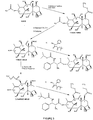
FIGURE 1 depicts a first method of preparing cabazitazel according to the invention; -
FIGURE 2 depicts a second method of preparing cabazitaxel according to the invention; -
FIGURE 3 depicts further reaction schemes according to the invention; and -
FIGURE 4 depicts a prior art synthesis of taxane derivatives starting from 9-DHB. - Herein described are also:
- 1. A compound according to formula IV and its salts, wherein R1 is a hydroxy protecting group.
- 2. The compound of
clause 1 wherein R1 of formula IV is benzyloxy-carbonyl, tert-butyloxy carbonyl, tri-chloro-acetyl, trifluro-acetyl, 1-ethoxy-ethyl, methoxy-isopropyl, tri-ethyl-silyl, tri-methyl-silyl, furanidinyl, tert-butyl-bi-methyl-silyl, tert-butyl-bi-phenyl-silyl. - 3. The compound of
clause 2 wherein R1 of formula IV is 1-ethoxy-ethyl-, methoxyl-iso-propanyl-, tri-methyl-silyl-, furanidinyl- or tert-butyl-bi-methyl-silyl-. - 4. A compound according to formula III and its salts, wherein R1 is a hydroxy protecting group.
- 5. The compound of
clause 4 wherein R1 of formula III is: benzoxyl-carbonyl, tert-butyloxy carbonyl, tri-chloro-acetyl, tri-fluro-acetyl, 1-ethoxy-ethyl-, methoxy-iso-propanyl-, tri-ethyl-silyl- or tri-methyl-silyl-, furanidinyl, tert-butyl-bi-methyl-silyl-, tert-butyl-bi-phenyl-silyl-. - 6. The compound of
clause 5 wherein R1 of formula III is: 1-ethoxy-ethyl-, methoxy-iso-propanyl-, tri-methyl-silyl-, furanidinyl or tert-butyl-bi-methyl-silyl. - 7. A method for preparing a compound of formula IV including de-protection of tri-chloro-carbonyl of compound V to obtain compound IV, wherein R1 of formula V is a hydroxy protecting group.
- 8. The method of
clause 7 wherein R1 of formula V is: benzyloxy-carbonyl, tert-butyloxy-carbonyl, tri-chloro-acetyl, tri-fluro-acetyl, 1-ethoxy-ethyl, methoxy-iso-propanyl, tri-ethyl-silyl or tri-methyl-silyl, furanidinyl, tert-butyl-bi-methyl-silyl, tert-butyl-bi-phenyl-silyl. - 9. The method of clause 8 wherein R1 of formula V is 1-ethoxy-ethyl-, methoxy-iso-propanyl, tri-ethyl-silyl-, furanidinyl or tert-butyl-bi-methyl-silyl.
- 10. The method of any of
clauses 7 to 9 wherein the deprotection uses zinc powder and a Lewis acid, in polar solvent, in a reduction reaction to de-protect tri-chloro-methoxy-carbonyl selectively. - 11. The method of
clause 10 wherein the Lewis acid is selected from ammonium chloride, ammonium sulphate, ammonium acetate, zinc chloride, magnesium chloride, calcium chloride and aluminum chloride. - 12. The method of clause 11 wherein the mentioned Lewis acid is ammonium chloride or magnesium chloride.
- 13. The method of
clause 10 wherein the polar solvent is water, lower alkyl alcohol, acetone, furanidine and acetonitrile. - 14. The method of
clause 13 wherein the polar solvent is methanol, ethanol and acetone. - 15. A method for preparing compound III including:
- 1) Reacting compound IV with a strong base to obtain compound IV's metallated equivalent compound VI
- 2) Reacting compound VI with methyl iodide or dimethyl sulphate to obtain compound III;
M is IA, IIA, IIIA, IVA, VA, VIA group elements, or transition metals, zinc or calcium. - 16. The method of clause 15 wherein R1 is: benzyloxy-carbonyl, tert-butyloxy-carbonyl, tri-chloro-acetyl, tri-fluro-acetyl, 1-ethoxy-ethyl, methoxy-iso-propanyl, tri-ethyl-silyl or tri-methyl-silyl, furanidinyl, tert-butyl-bi-methyl-silyl, tert-butyl-bi-phenyl-silyl.
- 17. The method of clause 16 wherein R1 is 1-ethoxy-ethyl, methoxy-iso-propanyl, tri-ethyl-silyl, furanidinyl or tert-butyl-bi-methyl-silyl.
- 18. The method of clause 15 wherein M of compound VI is sodium, potassium, lithium, zinc or calcium.
- 19. The method of clause 15 wherein the strong base is sodium methoxide, sodium amide, sodium hydride, n-butyl-lithium, lithium bi(trimethyl silyl)amino or sodium hexamethyl bisilyl amino.
- 20. The method of clause 19 wherein the strong base is sodium hydride or n-butyl-lithium.
- 21. A method of deprotecting tri-chloro-ethoxy-carbonyl selectively during a reaction to obtain cabazitaxel, in which with the presence of zinc powder and Lewis acid, in polar solvent, the reducing reaction deprotects tri-chloro-ethoxy-carbonyl.
- 22. The method of clause 21 wherein the Lewis acid is ammonium chloride, ammonium sulphate, ammonium acetate, zinc chloride, magnesium chloride, calcium chloride and aluminum chloride.
- 23. The method of clause 22 wherein the Lewis acid is ammonium chloride or' ammonium sulphate.
- 24. The method of clause 21 wherein the polar solvent is water, lower alkyl alcohol, acetone, furanidine or acetonitrile.
- 25. The method of clause 24 wherein the lower alkyl alcohol mentioned is methanol, ethanol or propanol.
- 26. A method of cabazitaxel preparation including: deprotecting the R1 protecting group from compound II to obtain cabazitaxel.
- 27. The method of clause 26 comprising deprotecting the protecting group in acid solvent, the acid is formic acid, acetic acid, hydrofluric acid, hydrochloric acid, p-methyl-benzene monosulfonic acid or their mixture and the solvent is water, organic solvent or organic solvent with water.
- 28. The method of clause 27 wherein the acid is hydrochloric acid or hydrofluoric acid.
- 29. A method of preparation of docetaxel including deprotecting the protecting group R1 from compound IV to obtain docetaxel.
- 30. The method of clause 29 comprising deprotecting the protecting group in acid solvent, the acid is formic acid, acetic acid, hydrofluoric acid, hydrochloric acid, p-methyl benzene monosulfonic acid or their mixture, the solvent is water, organic solvent or organic solvent with water.
- 31. The method of clause 30 wherein the acid is hydrochloric acid or hydrofluoric acid.
- 32. A method of taxol preparation including the following steps: (1) deprotect tri-chloro-ethoxy-carbonyl from compound VI to obtain compound VII; and (2) deprotect the protecting group R1 from compound VII to obtain taxol; wherein R1 is hydroxyl-protecting group.
- 33. The method of clause 32 in the presence of zinc powder and Lewis acid in polar solvent wherein the reducing reaction deprotects tri-chloro-ethoxy-carbonyl selectively.
- 34. The method of clause 33 wherein the Lewis acid is ammonium chloride, ammonium sulfate, ammonium acetate, zinc chloride, calcium chloride and aluminum chloride.
- 35. The method of clause 34 wherein the Lewis acid is ammonium chloride or ammonium sulfate.
- 36. The method of clause 33 wherein the polar solvent is water, lower alkyl alcohol, acetone, furanidine and acetonitrile.
- 37. The method of clause 36 wherein the polar solvent is methanol, ethanol or acetone.
- 38. Application of compound III in the preparation of cabazitaxel.
- 39. Application of compound IV in the preparation of cabazitaxel and docetaxel.
- The invention provides a new method for the preparation of cabazitaxel, one embodiment of which can be summarized as follows, showing the preparation of a protected taxane intermediate and its deprotection to taxane compounds:
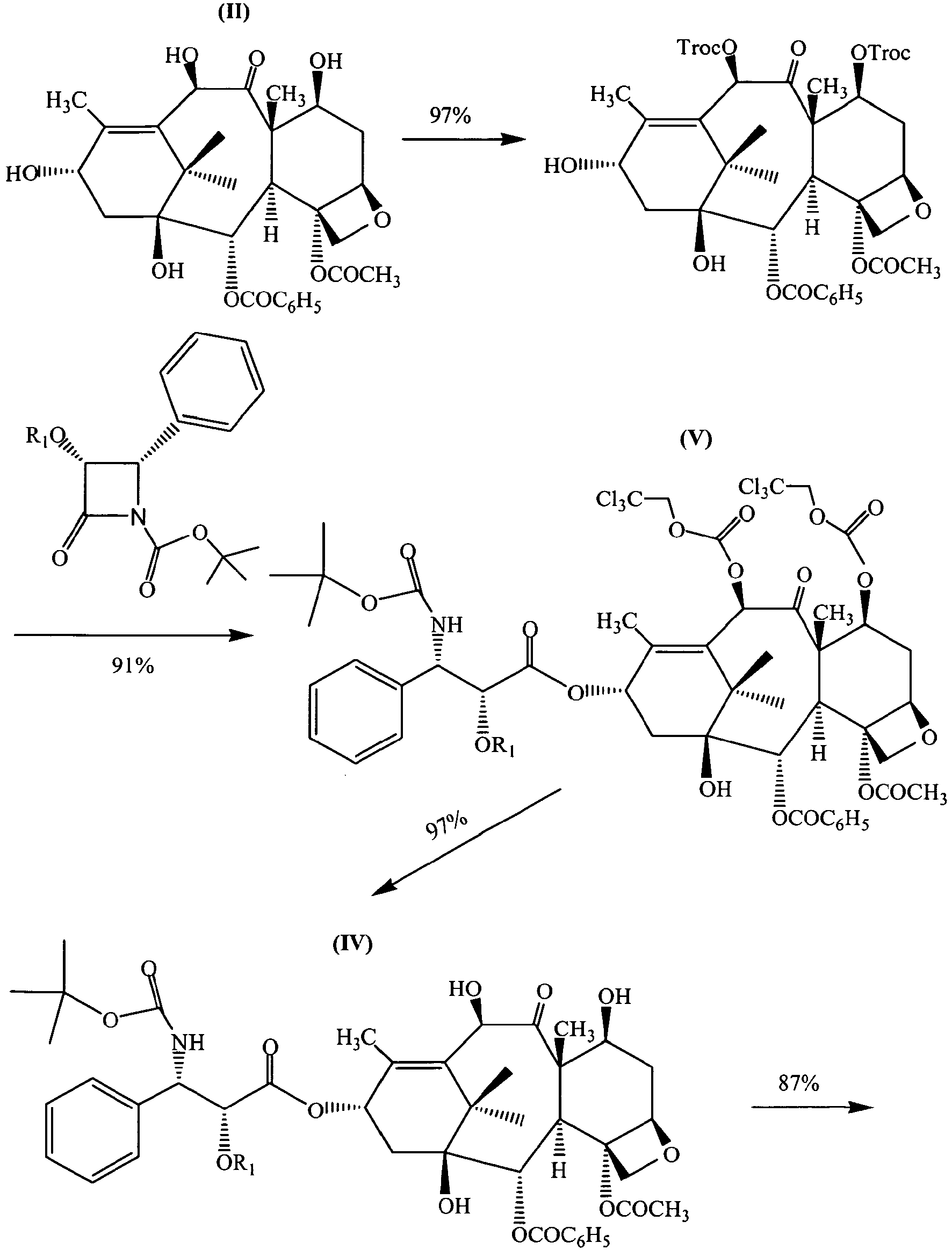
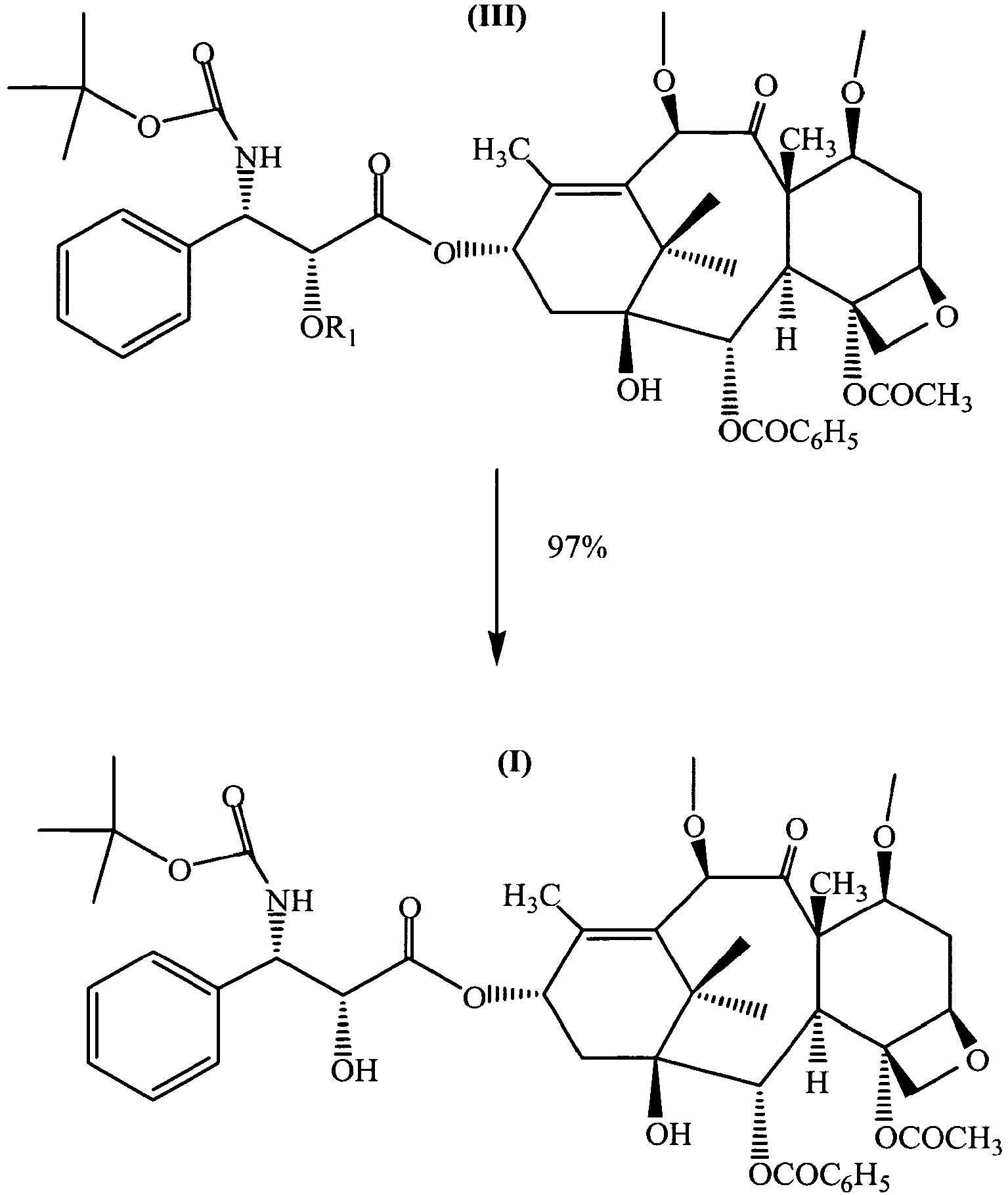
- This reaction is also depicted in
Figure 1 . The reaction of the invention reduces the number of steps and increases yield of cabazitaxel. - The deprotection methods of the invention can also be used for the preparation of paclitaxel (taxol):

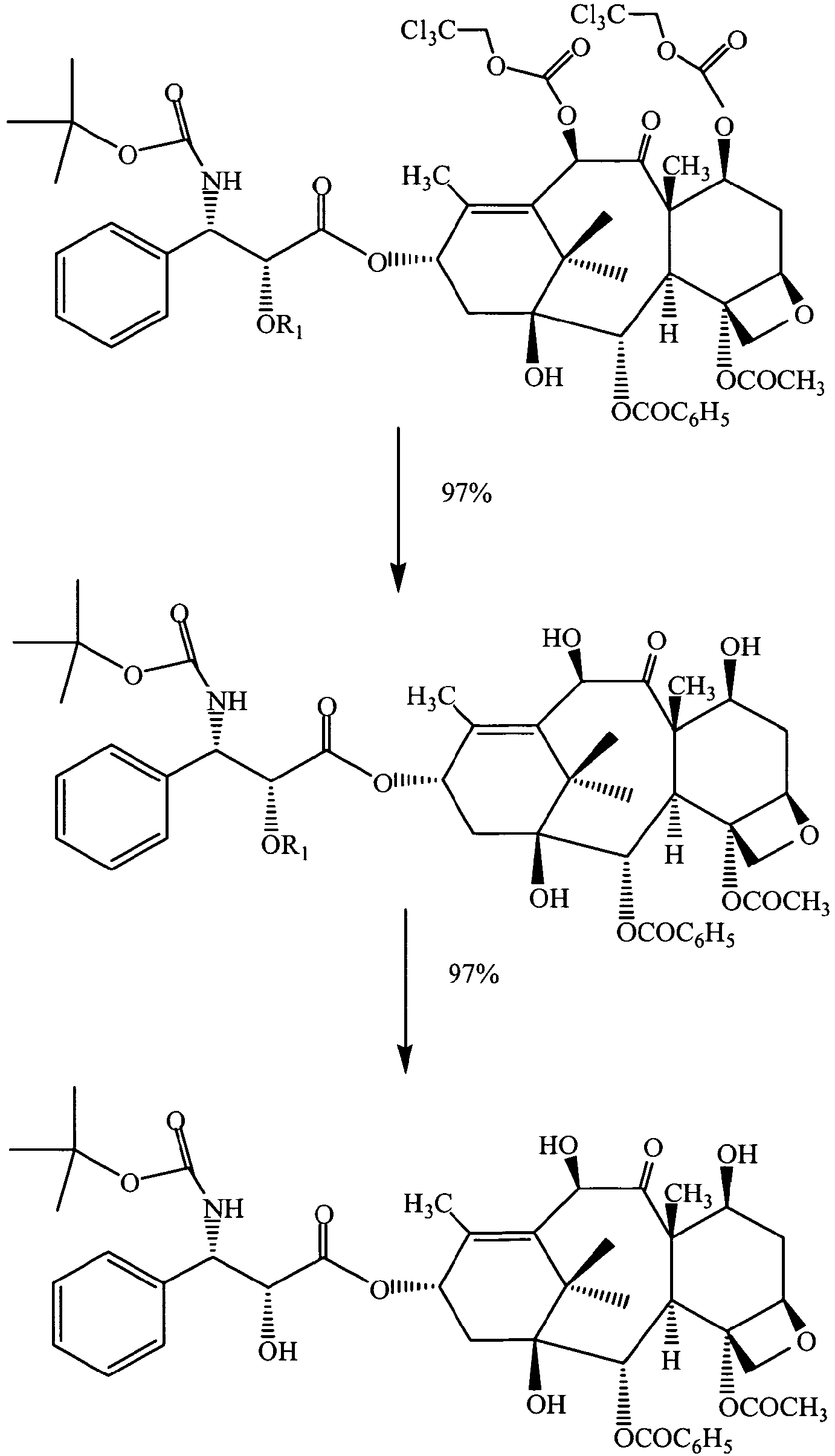
- The deprotection methods of the invention can also be applied to the preparation of docetaxel:
- A first synthetic pathway of the invention can be summarized as follows, as illustrated above, wherein steps (a) and (b) are known in the art for example from
WO 2006/004708 ,WO 2008/032104 andEP 2 003 124 A1 - a) Starting from 10-DAB (compound II), selectively protect the 7 and 10 positions of the molecule with an OH-protecting group such as TROC (trichloroethoxycarbonyl groups);
- b) Couple the protected 10-DAB analogue at the 13 position to a phenylisoserine side-chain precursor (a beta-lactam) protected by a suitable hydroxy protecting group R1 at the 2'-position such that the resulting 7, 10-protected C-13 substituted taxane intermediate (compound V) has an R1 hydroxy protecting group at the 2'-position on the phenylisoserine side chain;
- c) Deprotect at the 7 and 10 positions using a reducing agent and a Lewis acid to yield 7, 10-hydroxy compound (IV);
- d) Methylate at the 7 and 10 positions to provide novel ester III; and
- e) Deprotect the R1 group to yield cabazitaxel (I).
- To produce docetaxel, one simply needs to omit the methylation step (d) above, since docetaxel is a hydroxy analogue of cabazitaxel.
- Processes for the side-chain condensation reaction have been described in the art, for example in
WO 2008/090368 andWO2004033442 . Such techniques are suitable for the side-chain addition reactions mentioned herein and depicted in the reaction schemes of this disclosure. - Paclitaxel may also be produced using the same methodology, starting from 9-dihydro-13-acetylbaccatin III (9-DHB) instead of 10-DAB and noting that just one selective protection is necessary at step a.
- An important intermediate of the above synthetic pathways is the novel taxol isoserine ester or its salt (formula III):

- In compound III, the moiety R1 is hydroxy (or hydroxyl) protecting group.
- The hydroxy protecting group is any group which can protect hydroxy. It should be a group that remains stable during reaction and after reaction, and can be removed to deprotect without destroying any other structure of the molecule. These kinds of group can be found in the following reference "The protecting groups in organic synthesis" (T.W. Greene, East China University of Science & Technology publisher) and "Protecting groups" (P.Kocienski, Thieme Publisher). In this invention, the hydroxy protecting group can be any hydroxy protecting group, as understood by a skilled person.
- In the method of the invention, R1 is a hydroxy protecting group which can be deprotected in acidic, basic or neutral pH.
- In an example at the invention, R1 is benzyloxy-carbonyl, tert-butyloxy-carbonyl, trichloro-acetyl, trifluro-acetyl, 1-ethoxy-ethyl, methoxy-iso-propanyl, tri-ethylsilyl (TES), or trimethyl silyl (TMS), furanidinyl, tert-butyl-bimethylsilyl (TBS), tert-butyl-biphenylsilyl (TBDIPS), optimal protecting group is 1-ethoxy-ethyl (EE), tri-ethylsilyl (TES), tetrahydropyrane (THP) or tert-butyl-bimethyl silyl (TBS).
- A further important novel taxel isoserine ester or its salt, involved as an intermediate in the methodologies of the invention, has the compound number IV:
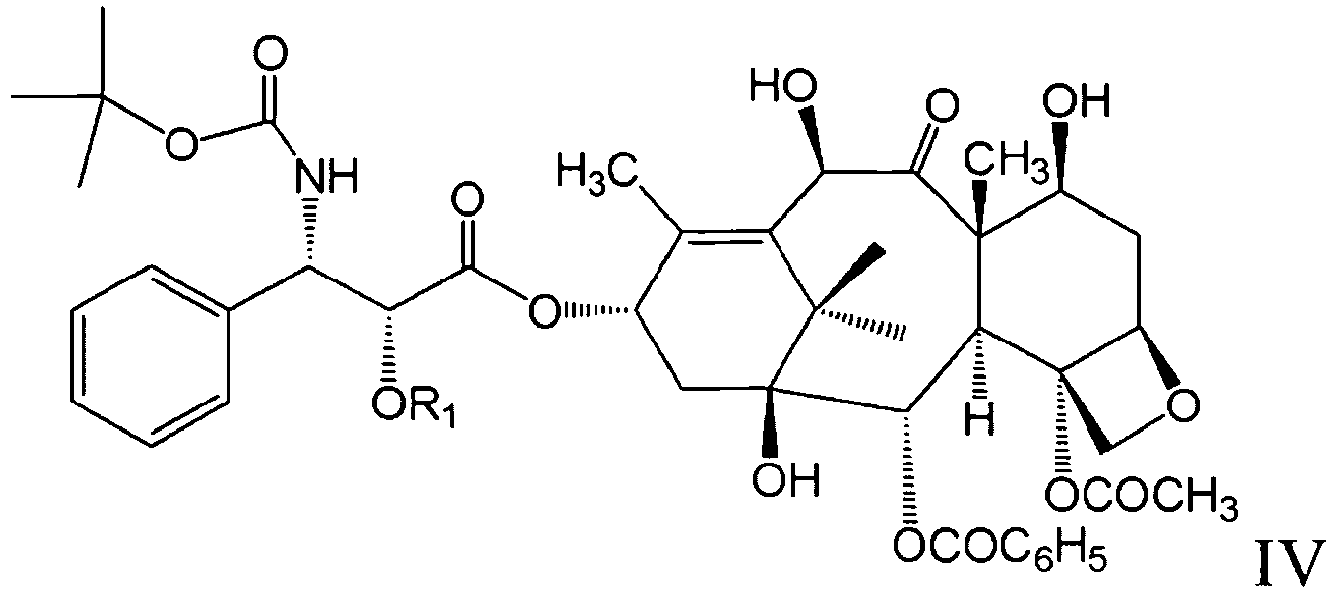
- Compound IV can be obtained in the art by zinc powder reduction methods to selectively deprotect the trichloroethoxycarbonyl groups (TROC groups) from compound V. Preparation of compound V can be found in the reference Bioorganic & Medicinal Chemistry Letters ,.

- In formula V, R1 is a hydroxyl protecting group as outlined above for formula III, or hydrogen.
- In the published reports, trichloroethoxycarbonyl (TROC) can be deprotected in the presence of zinc powder in acetic acid.
- If R1 is more or less stable in acetic acid, then acetic acid deprotection may also be used to selectively deprotect trichloroethoxycarbonyl (TROC), for example when R1 is triethylsilyl, tert-butyl-bimethyl silyl (TBS) and tert-butyl-biphenyl silyl. However due to the presence of acetic acid, a small proportion of the protecting group at R1 is expected to also be deprotected. The yield of compound IV is therefore decreased and work-up of the reaction is difficult due to side products.
- The invention provides a novel method to deprotect trichloroethoxycarbonyl (TROC).
- In the invention, acetic acid is replaced by a Lewis acid and the solvent is preferably a polar solvent or solvent containing polarity. Under these conditions, R1 can be any hydroxyl protecting group, including acid-sensitive groups, such as tetrahydropyrone (THP) or 1-ethoxy-ethyl.
- Polar solvents include but are not limited to all alcohols, acetone, tetrahydrofuran, acetonitrile and water.
- The reducing agent can be any reducing agent known in the art, but preferably a metal-based reducing agent including metals such as zinc, potassium, calcium, barium, sodium and magnesium and metal hydrides such as NaH, LiH, LiAlH4 and CaH2. The reducing agent may be in the form of a powder.
- A Lewis acid can be defined in the art as an electron pair (lone pair) acceptor, i.e. an entity that can accept a pair of electrons to complete its stable electronic configuration. Lewis acids include but are not limited to ammonium chloride, ammonium sulfate, ammonium acetate, zinc chloride, magnesium chloride and calcium chloride.
- Optionally, the deprotection reaction can occur in a solvent containing lower alkyl alcohol or water in the presence of zinc powder and ammonium chloride. A lower alkyl alcohol, as defined in this specification, is a C1, C2, C3, C4 or C5 straight chain or branched alkyl alcohol such as methanol, ethanol or propanol.
- The TROC deprotection reaction of the invention is typically carried out at -100 to 75 degrees C, preferably -10 to 50 degrees C and more preferably 5 to 10 degrees C.
- The reaction time for the invention can be 1 minute to 24 hrs, or more preferably 2 minutes to 12 hrs, even more preferably 3 minutes to 6 hrs, and most preferably 30 minutes to 2hrs.
- The reaction is preferably carried under nitrogen or argon or other noble gas or another inert gas.
- The inventive method of deprotecting trichloroethoxycarbonyl (TROC) in the reaction is not only useful for preparation of cabazitaxel, but also for preparation of docetaxel and paclitaxel.
- The inventive method of the invention includes reacting compound IV with a base to obtain intermediate metallated compound VI

- In the method of the invention, the base is an inorganic base metal base or organic base metal base.
- Preferably the base is sodium methoxide, sodium amide, sodium hydride, lithium n-butyl, lithium bi(trimethyl silyl)amino or sodium hexamethyl bisilyl amino.
- The reaction of the invention is typically carried out at -100 to 75 degrees C, preferably -10 to 50 degrees C and more preferably 5 to 10 degrees C.
- The reaction time for the invention can be 1 minute to 24 hrs, or more preferably 2 minutes to 12 hrs, even more preferably 3 minutes to 6 hrs, and most preferably 30 minutes to 2hrs.
- The reaction is preferably carried in the absence of water and oxygen, under nitrogen or argon or other noble gas or another inert gas.
- Compound VI is subsequently reacted with methyl iodide (Mel) or dimethyl sulfate (Me)2SO4 to obtain compound III via a methylation reaction, replacing the metals M with methyl groups.
- Compound III is deprotected at the R1 position preferably in aqueous
solution having pH 1 to 9. - Preferably the above R1 deprotection reaction is in acid solution wherein the acid is formic acid, acetic acid, hydrofluoric acid, hydrochloric acid, p-methylphenyl sulfonic acid or a mixture thereof. Preferably the acid is hydrochloric acid or hydrofluoric acid, the solution is aqueous solution, organic solution or mixed aqueous-organic solution.
- In a method of the invention, the above R1 deprotection reaction is carried out at -50 to 100 degrees C, preferably -30 to 60 degrees C, or most preferably -10 to 20 degrees C.
- The R1 deprotection reaction is carried out for example for 0.5 hr to 80 hrs, preferably 1 hr to 60 hrs, or more preferably 2 hrs to 50 hrs.
- An equivalent R1 deprotection reaction as step (e) above can be used to prepare docetaxel directly from compound IV. Preferably the deprotection is carried out in aqueous
solution having pH 1 to 9. - Preferably the above deprotection reaction is in acid solution wherein the acid is formic acid, acetic acid, hydrofluoric acid, hydrochloric acid, p-methylphenyl sulfonic acid or a mixture thereof. Preferably the acid is hydrochloric acid or hydrofluoric acid, the solution is aqueous solution, organic solution or mixed aqueous-organic solution.
- In a method of the invention, the above deprotection reaction is carried out at -50 to 100 degrees C, preferably -30 to 60 degrees C, or most preferably -10 to 20 degrees C.
- The deprotection reaction is carried out for example for 0.5 hr to 80 hrs, preferably 1 hr to 60 hrs, or more preferably 2 hrs to 50 hrs.
- The above methods start from the taxane compound 10-deacetylbaccatin (10-DAB), derived from Taxus plant species. In addition, it is possible to adopt the same or equivalent synthetic strategies to produce cabazitaxel starting from a different taxoid starting material, namely 9-dihydro-13-acetylbaccatin III (9-DHB), present in another Taxus species, namely the Canadian yew (Taxus Canadensis).

- The equivalent 9-DHB synthetic methods may be summarized as follows, and are depicted in
Figure 2 : - 1. Starting from 9-DHB, protect the 7 position with methoxy (OMe);
- 2. Deprotect the resultant 7-protected 9-DHB at the C10 and C13 positions to yield 7-OMe-10,13-deacetyl-9DHB;
- 3. Oxidize at 9-position to give 7-OMe-10DAB, i.e introduce a keto group at the 9- position;
- 4. Couple the 7-protected 10-DAB analogue at the 13 position to a phenylisoserine side-chain precursor (a beta-lactam) protected by a suitable hydroxy protecting group R1 at the 2'-position such that the resulting 7-protected C-13 substituted taxane intermediate has an R1 hydroxy protecting group at the 2'-position on the phenylisoserine side chain;
- 5. Methylate as described above (step d) for the 10-DAB pathway at the 10 position to provide novel ester III; and
- 6. Deprotect the R1 group as described above (step e) for the 10-DAB pathway to yield cabazitaxel (I).
- Alternatively, in the 9-DHB procedure immediately above, steps (3) and (4) may be perfomed in the opposite order, namely firstly coupling the phenylisoserine chain at the 13 position, then oxidizing the 9 position.
- Furthermore, one could reverse the order of steps (1) and (2), namely firstly deprotecting at the 10 and 13 positions to provide 7,10,13-hydroxy-9DHB, then selectively methylating at the 7 position to yield 7-OMe-10,13 deacetyl-9DHB. Then, the steps (3) to (6) are carried out as described above.
-
Figure 3 depicts a further synthetic scheme of the invention, again using the starting material 9DHB. - In the
Figure 3 scheme, 9DHB is firstly protected using a protecting group TROC at the 7 position. This is equivalent to step (a) explained above. The 7-TROC protected 9DHB is then deprotected at the C10 and C13 positions, and is oxidized to provide the 7-TROC protected 10DAB equivalent compound. - 7-TROC 10DAB can then be coupled to its phenylisoserine side chain as explained above, to yield a mono-TROC protected docetaxel analogue.
- Alternatively, the 7-TROC 10DAB may be further protected with TROC to yield 7,10-diTROC 10DAB which is labeled as protected taxane intermediate V above. Compound V may then be used in the pathways explained above in connection with
Figure 1 , to produce cabazitaxel or docetaxel. - The necessary reaction conditions for "protection", "deprotection", "oxidation" and "side chain coupling" to manufacture taxane intermediates starting from 9-DHB are known in the art of taxane molecule synthesis, for example in
EP 2 003 124 A1Figure 4 presents a typical synthesis for information. - The invention has several advantages. The invention provides a new, simple, easy to operate method of synthesizing cabazitaxel, paclitaxel and docetaxel. The method has fewer steps, mild reaction conditions and high purity of the reaction solution. Work-up treatment is easy and the intermediates and product are obtained simply by crystallization. This simplifies the operation and the requirements for equipment and decreases the production cost. Further, the schemes described herein yield a stable solid intermediate which benefits the quality control of both intermediates and final product, especially during industrial production.
- The invention is illustrated by the following examples. These examples only illustrate the invention but do not restrict the invention.
- The following acronyms are used in the examples: TES = triethylsilyl; TROC = trichloroethoxycarbonyl, also known as trichloroethyloxycarbonyl, defined by the formula CCl3CH2OC(O)-; TBS = t-Butyldimethylsilyl; and THP = tetrahydropyran.
- Pour 80 ml acetic acid and 12 g active zinc powder into a reaction container, stirring evenly, increase temperature to 60-70 degrees C, add 5 g of 2'-TBS-7,10-TROC-docetaxel, and stir for 5 hrs until TLC shows the reaction completion. After filtering, add 80 ml of ethyl acetate and 80 ml of water into the filter liquor, extract, wash the organic layer with 50 ml of water, saturated NaHCO3 (50 ml x 2), saturated NaCl (50 ml). Then dry with anhydrous Na2SO4. Filter and then evaporate the solution to gain white solid 2'-TBS-Docetaxel 2.5 g (yield 81 %).
- MS (m/z): 972 (M+Na). 1HNMR (500MHz) δ 0.31 (6H, m), 0.92 (9H, m), 1.13 (3H, s), 1. 30 (12H, m), 1.72 (7H, m), 1.92 (4H, m), 2.18 (1H, m), 2.35 (1H, m), 2.61 (4H, m), 3.95 (1H, d), 4.21 (3H, m), 4.28(1H, d), 4.54 (1H, s), 4.97 (1H, d), 5.21 (1H, s), 5.27 (1H, m), 5.50 (1H, m), 5.70 (1H, d), 6.31 (1H, t), 7.29 (2H, m), 7.37 (2H, t), 7.59 (1H, t), 8.11 (1H, d),
- At 35 to 40 degrees C, add 50 ml of methanol, 10 g of active zinc powder, 50 ml of water and 10 g of NH4Cl into a 100 ml reaction container. Stirring evenly, then add 5 g of 2'-TES-7,10-TROC-docetaxel.
Stir 4 hrs until TLC shows reaction completed. After filtering, add 80 ml of ethyl acetate, 80 ml of water into filter liquor, after extracting wash the organic layer with water (50 ml), saturated NaHCO3 (50 ml x 2), saturated NaCl (50 ml), dry with non-aqueous Na2SO4, filter and evaporate the solution to obtain white solid, 2.8 g of 2'-TES-docetaxel (yield 90%). - MS (m/z): 972 (M+Na). 1HNMR (500MHz) δ 0.39 (6H, m), 0.78 (9H, m), 1.13 (3H, s), 1.30 (12H, m), 1.72 (7H, m), 1.92 (4H, m), 2.18 (1H, m), 2.35 (1H, m), 2.61 (4H, m), 3.95 (1H, d), 4.21 (3H, m), 4.28 (1H, d), 4.54 (1H, s), 4.97 (1H, d), 5.21 (1H, s), 5.27 (1H, m), 5.50 (1H, m), 5.70 (1H, d), 6.31 (1H, t), 7.29 (2H, m), 7.37 (2H, t), 7.59 (1H, t), 8.11 (1H, d),
- At room temperature add 50 ml of ethanol, 10 g of active zinc powder and 10 g of NH4Cl into a 100 ml reaction container. Stirring evenly, add 5 g of 2'-(1-ethoxyethyl)-7,10-TROC-docetaxel.
Stir 1 hr until TLC shows reaction completion, filter and evaporate the filter liquor to obtain white solid, 2'-(1-ethoxyethyl)-docetaxel, 3.1 g, (yield 88%). - MS(m/z): 902 (M+Na). 1HNMR (500MHz) δ 1.13 (6H, m), 1.30 (15H, m), 1.72 (7H, m), 1.92 (4H, m), 2.18 (1H, m), 2.35 (1H, m), 2.61 (4H, m), 3.48 (2H, m), 3.95 (1H, d), 4.21 (3H, m), 4.28 (1H, d), 4.37 (1H, m), 4.54 (1H, s), 4.97 (1H, d), 5.21 (1H, s), 5.27 (1H, m), 5.50 (1H, m), 5.70 (1H, d), 6.31 (111, t), 7.29 (2H, m), 7.37 (2H, t), 7.59 (1H, t), 8.11 (1H, d),
- At room temperature add 50 ml of methanol, 8 g of active zinc powder and 8 g of NH4Cl into a 100 ml reaction container. Stirring evenly, add 5 g of 2'-THP-7,10-TROC-docetaxel.
Stir 1 hr until TLC shows reaction completion, filter, evaporate the filter liquor to obtain white solid 3.3 g of 2'-THP-docetaxel. (yield 91%). - 1HNMR (500MHz) δ 1.15 (6H, m), 1.42 (15H, m), 1.82 (7H, m), 1.96 (6H, m), 2.28 (5H, m), 2.38 (3H, m), 2.69 (5H, m), 3.38 (4H, m), 3.88 (1H, d), 4.25 (3H, m), 4.26 (1H, d), 4.39 (1H, m), 4.54 (1H, s), 4.97 (1H, d), 5.21 (1H, s), 5.32 (1H, m), 5.50 (1H, m), 5.72 (1H, d), 6. 32 (1H, t),7.39 (2H, m), 7.39 (2H, t), 7.61 (1H, t), 8.11 (1H, d),
- At room temperature add 50 ml of methanol, 8 g of active zinc powder and 8 g of NH4Cl into a 100 ml reaction container. Stirring evenly, add 5 g of 2'-TES-7,10-TROC-docetaxel.
Stir 1 hr, TLC shows reaction completion, filter, evaporate to obtain white solid 3.0 g of 2'-TES-docetaxel (yield 97%). - The examples 1-5 show that the yield when deprotecting TROC according to the invention (example 2-5) is improved compared to current technology (example 1). Example 1 is a prior art-type acetic acid deprotection, and as well as suffering from worse yield, also has more steps than the inventive method.
- Add 50 ml of tetrahydrofuran and 5 g of 2'-TES-docetaxel in 100 ml reaction container, stirring evenly, decrease temperature to -10 to -5 degrees C, add 2.5 ml of 30% n-butyl lithium solution dropwise into a 100 ml reaction container, add 0.8 ml of methyl iodide dropwise at -10 to -5 degrees C and
stir 1 hr. After TLC shows reaction completed, add 80 ml of ethyl acetate and 80 ml of saturated NH4Cl solution into the reaction solution. After extracting, wash the organic layer with saturated NH4Cl (50 ml x 2), saturated NaCl (50 ml), then dry with non-aqueous filter and evaporate the solution to obtain a light yellow viscous solid, 4.3 g of 2'-TES-cabazitaxel (yield 85%). - 1HNMR (500MHz) δ 0.38 (6H, m), 0.79 (9H, m), 1.2 ∼ 1.3 (16H, m), 1.60 (2H, m), 1.72 (3H, m), 1.96 (3H, m), 2.04 (1H, s), 2.35 (1H, m), 2.53 (3H, s), 3.31 (3H, s), 3.46 (3H, s), 3.88 (2H, m), 4.11 (1H, m), 4.19 (1H, d), 4.32 (1H, d), 4.55 (1H, s), 4.81 (1H, s), 4.97 (1H, d), 5.29 (1H, m), 5.50 (1H, m), 5.66 (1H, d), 6.31 (1H, t), 7.29 (4H, m), 7.37 (2H, t), 7.48 (2H, t), 7.59 (1H, t), 8.11 (2H, d),
- Add 50 ml of methyl iodide and 5 g of 2'-TBS-docetaxel into a 100 ml reaction container, stirring evenly, decrease temperature to -10 degrees C to -5 degrees C. Add 0.26 g of 50% NaH dropwise. Stir at -10 degrees C to -5 degrees C for 1 hr. TLC shows the reaction completion. Add 80 ml of ethyl acetate and 80 ml of saturated NH4Cl solution, extract, wash the organic layer with saturated NH4Cl (50 ml x 2), saturated NaCl (50 ml), dry with anhydrous filter and evaporate the solution to obtain a light yellow viscous solid 4.4 g of 2'-TBS-cabazitaxel (yield 87%).
- 1HNMR (500MHz) δ 0.38 (6H, s), 0.95 (9H, s), 1.2 ∼ 1.3 (16H, m), 1.60 (2H, m), 1.72 (3H, m), 1.96 (3H, m), 2.04 (1H, s), 2. 35 (1H, m), 2.53 (3H, s), 3.31 (3H, s), 3.46 (3H, s), 3.88 (2H, m), 4.11 (1H, m), 4.19 (1H, d), 4.32 (1H, d), 4.55 (1H, s), 4.81 (1H, s), 4.97 (1H, d), 5.29 (1H, m), 5.50 (1H, m), 5.66 (1H, d), 6.31 (1H, t), 7.29 (4H, m), 7.37 (2H, t), 7.48 (2H, t), 7.59 (1H, t), 8.11 (2H, d),
- Add 50 ml of methyl iodide and 5 g of 2'-TES-docetaxel into a 100 ml reaction container, stirring evenly, decrease temperature to -10 degrees C to -5 degrees C. Add 0.26 g of 50% NaH dropwise. Stir at -10 degrees C to -5 degrees C for 1 hr. TLC shows the reaction completion. Add 80 ml of ethyl acetate and 80 ml of saturated NH4Cl solution, extract, wash the organic layer with saturated NH4Cl (50 ml x 2), saturated NaCl (50 ml), dry with anhydrous Na2SO4, filter and evaporate the solution to obtain a light yellow viscous solid 4.3 g of 2'-TES-cabazitaxel (yield 87%).
- Add 50 ml of methyl iodide and 5 g of 2'-THP-docetaxel into a 100 ml reaction container, stirring evenly, decrease temperature to -10 degrees C to -5 degrees C. Add 0.26 g of 50% NaH dropwise. Stir at -10 degrees C to -5 degrees C for 1 hr. TLC shows the reaction completion. Add 80 ml of ethyl acetate and 80 ml of saturated NH4Cl solution, extract, wash the organic layer with saturated NH4Cl (50 ml x 2), saturated NaCl (50 ml), dry with non-aqueous filter and evaporate the solution to obtain a light yellow viscous solid 4.3 g of 2'-THP-cabazitaxel (yield 87%).
- 1HNMR (500MHz) δ 1.15 (6H, m), 1.42 (15H, m), 1.82 (7H, m), 1.96 (6H, m), 2.28 (5H, m), 2.38 (3H, m), 2.69 (5H, m), 3.31 (6H, m), 3.46 (3H, s), 3.88 (1H, d), 4.25 (3H, m), 4.26 (1H, d), 4.39 (1H, m), 4.54 (1H, s), 4.97 (1H, d), 5.21 (1H, s), 5.32 (1H, m), 5.50 (1H, m), 5.72 (1H, d), 6.32 (1H, t), 7.39 (2H, m), 7.39 (2H, t), 7.61 (1H, t), 8.11 (1H, d),
- Add 50 ml of tetrahydrofuran, 1 ml of dimethyl sulfate and 5 g of 2'-THP-docetaxel in a 100 ml reaction container, stirring evenly, decrease temperature to -10 to -5 degrees C, add 0.26 g of 30% sodium methoxide in methanol solution dropwise, stir at -10 to -5 degrees C for 1 hr. TLC shows reaction completed. Add 80 ml of ethyl acetate and 80 ml of saturated NH4Cl solution into the reaction solution, extract, wash organic layer with saturated NH4Cl (50 ml x 2), saturated NaCl (50 ml), dry with anhydrous filter and evaporate the solution to obtain light yellow viscous solid, 45.1 g of 2'-THP-cabazitaxel (yield 90%).
- 2'-(1-ethoxy-ethyl)-cabazitaxel preparation is the same as Example 10 (yield 88%).
- 1HNMR (500MHz) δ 1.13 (6H, m), 1.30 (15H, m), 1.72 (7H, m), 1.92 (4H, m), 2.18 (1H, m), 2.35 (1H, m), 2.61 (4H, m), 3.31 (3H, s), 3.46 (5H, m), 3.95 (1H, d), 4.21 (3H, m), 4.28 (1H, d), 4.37 (1H, m), 4.54 (1H, s), 4.97 (1H, d), 5.21 (1H, s), 5.27 (1H, m), 5.50 (1H, m), 5.70 (1H, d), 6.31 (1H, t), 7.29 (2H, m), 7.37 (2H, t), 7.59 (1H, t), 8.11 (1H, d),
- Dissolve 100 g of 2'-THP-cabazitaxel in 1730 ml of HOAc/H2O/THF (3:1:1), under N2 atmosphere, increase temperature to 50 degrees C and
stir 4 hrs. Then cool to room temperature. Add 2L of ethyl acetate, 2 L of H2O, stir, separate layers, wash organic layer with saturated NaHCO3 (3 L x 2), saturated NaCl (3 L), dry with Na2SO4. Concentrate to obtain white 77.8 g of cabazitaxel (yield 83%). - MS (m/z): 859 (M+Na). 1HNMR (500MHz) δ 1.21 (6H, d), 1.36 (9H, s), 1.59 (1H, s), 1.64 (1H, s), 1.79 (1H, m), 1.87 (3H, s), 2.27 (2H, m), 2.35 (3H, m), 2.69 (1H, m), 3.30 (3H, s), 3.45 (3H, s), 3.85 (2H, m), 4.16 (1H, d), 4.29 (1H, d), 4.62 (1H, bs), 4.79 (1H, s), 5.29 (1H, m), 5.42 (1H, d), 5.62 (1H, d), 6.21 (1H, t), 7.2 ∼ 7.4 (6H, m), 7.48 (2H, t), 7.59 (1H, t), 8.11 (2H, d),
- Dissolve 100 g of 2'-TES-cabazitaxel in 10 L of acetonitrile, add 650 ml of pyridine, decrease temperature to -8 degrees C, add 1.5 L of hydrofluoric acid dropwise while keeping reaction temperature at or below -3 degrees C (about 90 minutes). After addition is complete, keep at 0 degrees C for 22 hrs.
- Add 10 L of ethyl acetate to the reaction solution for dilution, then wash with 1 N hydrochloric acid, extract aqueous layer with 10 L non-aqueous ethyl acetate, combine organic layers, wash with saturated NaHCO3 (10 L x 5), saturated NaCl (3.5 L x 1). Dry with anyhydrous Na2SO4 then concentrate under reduced pressure (<35 degrees C) to dry to obtain 85.1 g of cabazitaxel (yield 97%).
- Dissolve 100 g of 2'-(1-ethoxyethyl)-cabazitaxel in tetrahydrofuran, add 1 L of ethanol, decrease temperature to -8 degrees C. Add 2N hydrochloric acid (200 ml) dropwise, while keeping the reaction temperature at or below -3 degrees C (about 90 minutes). After addition, keep at 0 degrees C for 22 hrs.
- Add 24 L of ethyl acetate into the reaction solution to dilute, then wash with 1 N hydrochloric acid (20 L x 2), extract aqueous phase with 10 L anhydrous ethyl acetate, combine organic layers, wash with saturated NaHCO3 (20 L x 5), saturated NaCl (7.5 L x 1). Dry with anhydrous Na2SO4 then concentrate under reduced pressure (<35 degrees C) to dry to obtain 83.2 g of cabazitaxel (yield 95%).
- Synthesis method of cabazitaxel from 2'-TBS-cabazitaxel is same as Example 13.
- Synthesis method of cabazitaxel from 2'-TES-docetaxel is the same as Example 13.
- MS (m/z): 830 (M+Na). 1H NMR (CDCl3, 500MHz): δ 8.12 (d, 2H), 7.63 (t, 1H), 7.51 (t, 2H), 7.32 ∼ 7.35 (m, 5H), 6.19 (bt, 1H), 4.66 (d, 1H), 4.33 (d, 1H), 4.21 (m, 1H), 4.18 (d, 1H), 3.92 (d, 1H), 3.53 (s, 1H), 2.63 (m, 1H), 2.55 (m, 1H), 2.38 (s, 3H), 2.24 (m, 2H), 1.90 (s, 3H), 1.85 (m, 1H), 1.80 (s, 3H), 1.35 (m, 9H), 1.26 (s, 3H), 1.13 (s, 3H).
- Synthesis method of 2'-TES-taxol from 2'-TES-7-TROC-taxol is same as Example 2.
- 1H NMR (CDCl3, 500MHz): δ 8.12 (d, 2H), 7.73 (d, 2H), 7.51 (t, 1H), 7.44 (m, 5H), 7.38 (m, 5H), 7.03 (d, 1H), 6.24 (s, 1H), 6.22 (bt, 1H), 5.78 (dd, 1H), 5.67 (d, 1H), 4.93 (bd, 1H), 4.79 (d, 1H), 4.39 (dd, 1H), 4.30 (d, 1H), 4.19 (d, 1H), 4.11 (dd, 1H), 3.79 (d, 1H), 3.67 (bs, 1H), 2.53 (ddd, 1H), 2.43 (bs, 1H), 2.38 (s, 3H), 2.31 (dd, 1H), 2.26 (dd, 1H), 2.23 (s, 3H), 2.03 (s, 2H), 1.86 (m, 1H), 1.74 (s, 3H), 1.67 (s, 3H), 1.22 (s,3H), 1.14 (s, 3H), 0.85 (9H, m), 0.41 (6H, m).
- Synthesis method of taxol from 2'-TES-taxol is the same as Example 13.
- MS (m/z): 876 (M+Na). 1H NMR (CDCl3, 500MHz): δ 8.12 (d, 2H), 7.73 (d, 2H), 7.51 (t, 1H), 7.44 (m, 5H), 7.38 (m, 5H), 7.03 (d, 1H), 6.24 (s, 1H), 6.22 (bt, 1H), 5.78 (dd, 1H), 5.67 (d, 1H), 4.93 (bd, 1H), 4.79 (d, 1H), 4.39 (dd, 1H), 4.30 (d, 1H), 4.19 (d, 1H), 4.11 (dd, 1H), 3.79 (d, 1H), 3.67 (bs, 1H), 2.53 (dd, 1H), 2.43 (bs, 1H), 2.38 (s, 3H), 2.31 (dd, 1H), 2.26 (dd, 1H), 2.23 (s, 3H), 2.03 (s, 2H), 1.86 (m, 1H), 1.74 (s, 3H), 1.67 (s, 3H), 1.22 (s, 3H), 1.14 (s, 3H).
- When used in this specification and claims, the terms "comprises" and "comprising" and variations thereof mean that the specified features, steps or integers are included. The terms are not to be interpreted to exclude the presence of other features, steps or components.
- The features disclosed in the foregoing description, or the following claims, or the accompanying drawings, expressed in their specific forms or in terms of a means for performing the disclosed function, or a method or process for attaining the disclosed result, as appropriate, may, separately, or in any combination of such features, be utilised for realising the invention in diverse forms thereof.
Claims (15)
- A method of preparing a taxane product compound from a protected taxane intermediate, the method comprising reacting the protected taxane intermediate with a reducing agent and a Lewis acid, wherein eitherA: the protected taxane intermediate has the formula V:

 or B: the protected taxane intermediate has the formula VI and the taxane compound has the formula VII: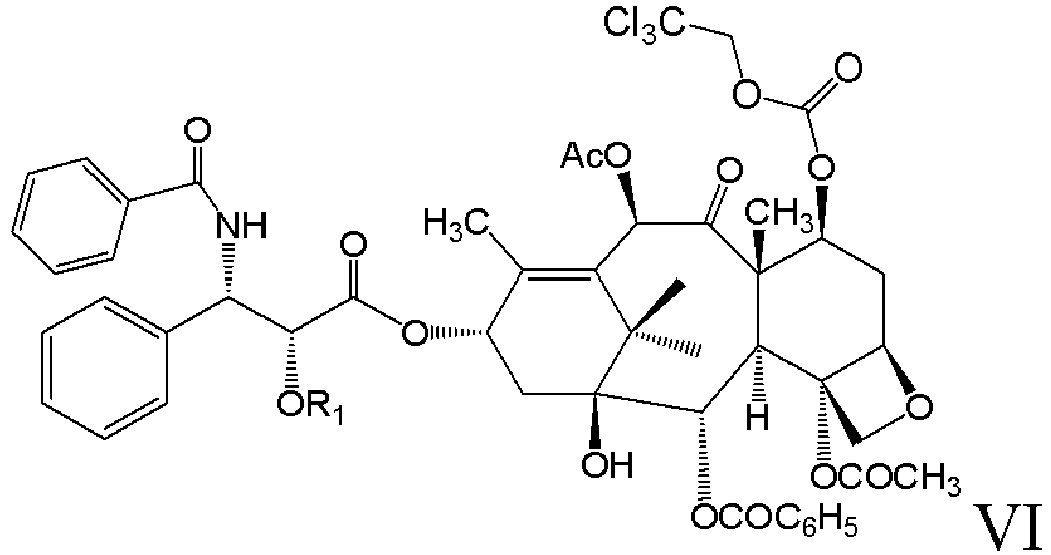

- The method of claim 1, wherein the reducing agent is selected from a metal including zinc, potassium, calcium, barium, sodium and magnesium and a metal hydride including NaH, LiH, LiAlH4 and CaH2.
- The method of any of claims 1 to 2 wherein the reducing agent is zinc, for example zinc metal powder.
- The method according to any of claims 1 to 3 wherein the Lewis acid is selected from ammonium chloride, ammonium sulphate, ammonium acetate, zinc chloride, magnesium chloride, calcium chloride and aluminum chloride.
- The method according to claim 4 wherein the Lewis acid is ammonium chloride or magnesium chloride.
- The method according to any one of claims 1 to 5, wherein the method is carried out in a polar solvent.
- The method according to claim 6 wherein the polar solvent is selected from water, alcohol, acetone, tetrahydrofuran, acetonitrile and mixtures thereof, and preferably wherein the polar solvent is selected from methanol, ethanol, acetone and mixtures thereof.
- The method of claim 1, and further comprising:a. reacting the taxane compound of formula IV
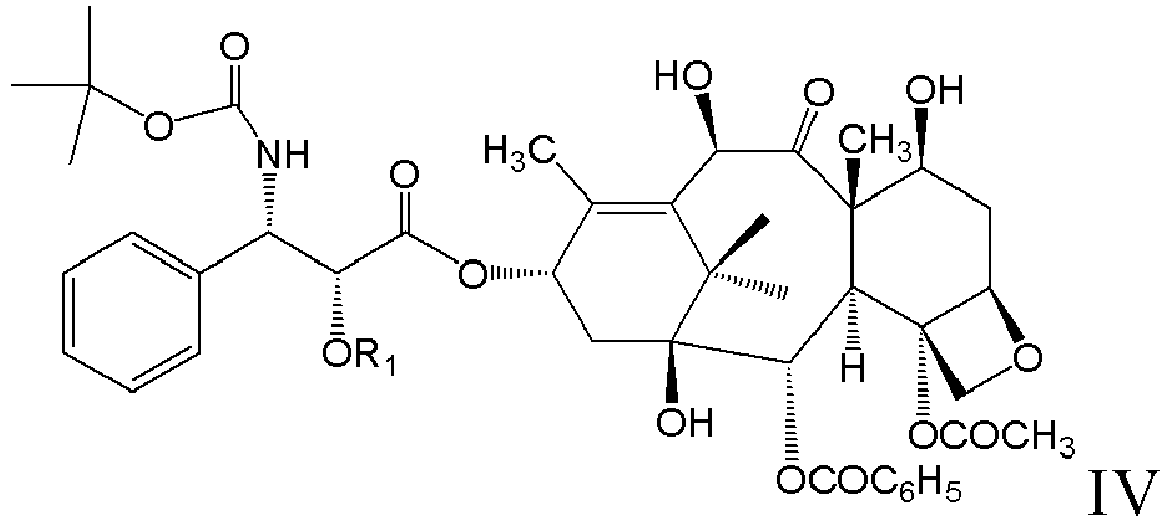
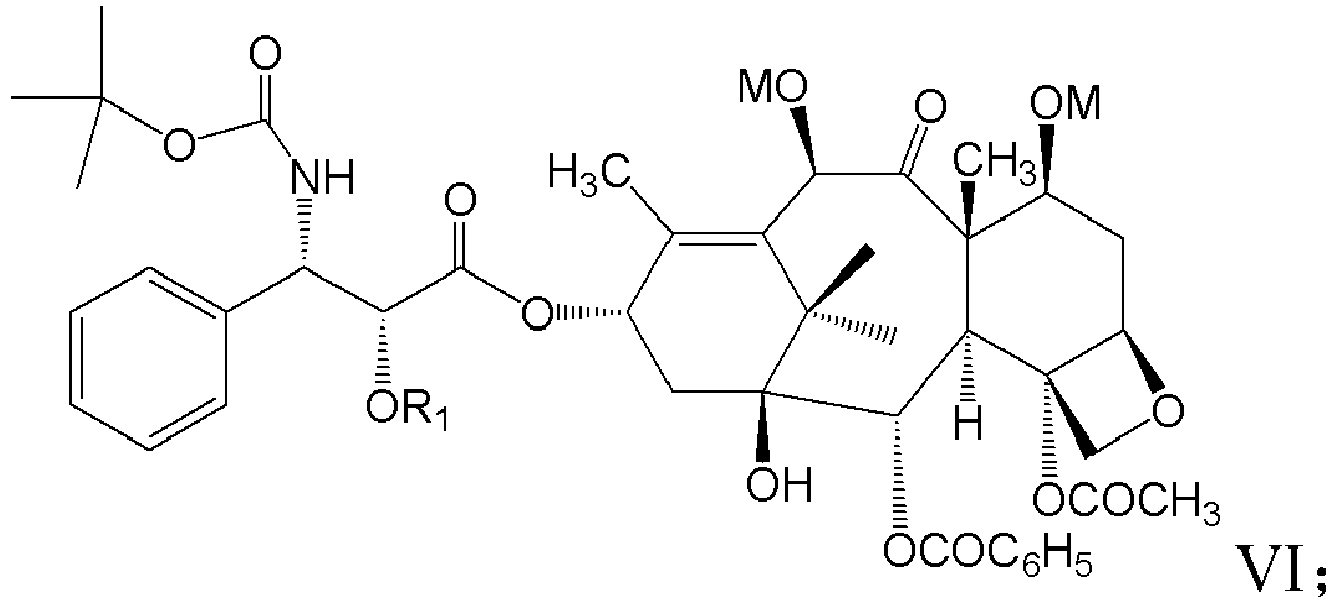 b. and reacting with methyl iodide or dimethyl sulphate to obtain compound III;
M is a IA, IIA, IIIA, IVA, VA, VIA group element, or a transition metal, zinc or calcium. - The method of claim 8 wherein M is sodium, potassium, lithium, zinc or calcium.
- The method of any one of claims 8 to 9 wherein the strong base is sodium methoxide, sodium amide, sodium hydride, n-butyl-lithium, lithium bi(trimethyl silyl)amino or sodium hexamethyl bisilyl amino, and preferably wherein the strong base is sodium hydride or n-butyl-lithium.
- The method of claim 8, further comprising deprotecting the R1 protecting group from compound III


- The method of claim 1, further comprising deprotecting the R1 protecting group from compound IV


- The method of claim 1, further comprising deprotecting the R1 protecting group from compound VII

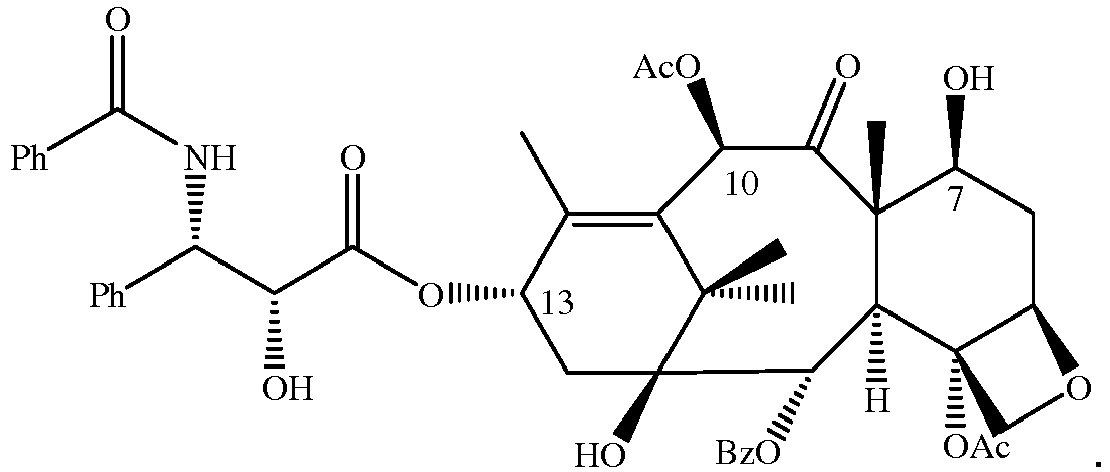
- The method of any of claims 11 to 13 wherein the method is carried out by deprotecting the protecting group R1 in acid solvent, the acid being selected from formic acid, acetic acid, hydrofluoric acid, hydrochloric acid, p-methyl-benzene monosulfonic acid or a mixture thereof, wherein the solvent is water, organic solvent or organic solvent with water and preferably wherein the acid is hydrochloric acid or hydrofluoric acid.
- The method of any of claims 1 to 14 wherein R1 is selected from the group consisting of benzyloxy-carbonyl, tert-butyloxy-carbonyl, tri-chloro-acetyl, tri-fluro-acetyl, 1-ethoxy-ethyl, methoxy-iso-propanyl, tri-ethyl-silyl or tri-methyl-silyl, furanidinyl, tert-butyl-bi-methyl-silyl, tert-butyl-bi-phenyl-silyl, and preferably wherein R1 is selected from the group consisting of 1-ethoxy-ethyl-, methoxy-iso-propanyl, tri-ethyl-silyl-, furanidinyl or tert-butyl-bi-methyl-silyl.
Applications Claiming Priority (2)
| Application Number | Priority Date | Filing Date | Title |
|---|---|---|---|
| CN201110318046.4A CN102408397B (en) | 2011-10-19 | 2011-10-19 | New taxane derivative and preparation method thereof |
| PCT/EP2012/070773 WO2013057260A1 (en) | 2011-10-19 | 2012-10-19 | Cabazitaxel, related compounds and methods of synthesis |
Publications (2)
| Publication Number | Publication Date |
|---|---|
| EP2768819A1 EP2768819A1 (en) | 2014-08-27 |
| EP2768819B1 true EP2768819B1 (en) | 2018-07-25 |
Family
ID=45910785
Family Applications (1)
| Application Number | Title | Priority Date | Filing Date |
|---|---|---|---|
| EP12783910.8A Not-in-force EP2768819B1 (en) | 2011-10-19 | 2012-10-19 | Cabazitaxel, related compounds and methods of synthesis |
Country Status (4)
| Country | Link |
|---|---|
| US (1) | US9567312B2 (en) |
| EP (1) | EP2768819B1 (en) |
| CN (1) | CN102408397B (en) |
| WO (2) | WO2013056662A1 (en) |
Families Citing this family (13)
| Publication number | Priority date | Publication date | Assignee | Title |
|---|---|---|---|---|
| CN102408397B (en) * | 2011-10-19 | 2014-08-20 | 上海贝美医药科技有限公司 | New taxane derivative and preparation method thereof |
| CN102659721B (en) * | 2012-04-19 | 2014-08-06 | 信泰制药(苏州)有限公司 | Synthetic method of cabazitaxel |
| CN102675256A (en) * | 2012-04-20 | 2012-09-19 | 重庆市碚圣农业科技股份有限公司 | Synthetic method for cabazitaxel |
| CN102675257B (en) * | 2012-05-10 | 2014-07-02 | 上海金和生物技术有限公司 | Cabazitaxel crystal and preparation method thereof |
| CN102952102B (en) * | 2012-07-27 | 2015-04-22 | 江苏奥赛康药业股份有限公司 | Compound, preparation method thereof and application of compound in preparation of cabazitaxel |
| CN102898406B (en) * | 2012-11-02 | 2014-12-03 | 上海金和生物技术有限公司 | Cabazitaxel crystal and preparation method thereof |
| CN103044364B (en) * | 2013-01-07 | 2016-01-20 | 重庆泰濠制药有限公司 | Amorphous crystalline substance of a kind of Cabazitaxel and preparation method thereof |
| CN103217493B (en) * | 2013-03-30 | 2015-04-15 | 神威药业集团有限公司 | Method for measuring cabazitaxel related substances by using HPLC (High Performance Liquid Chromatography) method |
| WO2014199401A2 (en) * | 2013-06-14 | 2014-12-18 | Hetero Research Foundation | Process for cabazitaxel |
| CN106632158B (en) * | 2013-08-28 | 2018-11-06 | 江苏恒瑞医药股份有限公司 | The preparation method of 7 β, 10 β-dimethoxy -10- deacetylate Baccatine IIIs |
| CN106432141B (en) * | 2016-07-19 | 2019-12-31 | 浙江大学 | Preparation method and application of cabazitaxel prodrug |
| CN108003119B (en) * | 2017-12-28 | 2020-04-24 | 云南汉德生物技术有限公司 | Method for synthesizing cabazitaxel from 10-deacetylbaccatin III |
| CN110078686A (en) * | 2019-04-28 | 2019-08-02 | 云南汉德生物技术有限公司 | The method of 10- deacetylate Bakating III synthesis Cabazitaxel |
Family Cites Families (28)
| Publication number | Priority date | Publication date | Assignee | Title |
|---|---|---|---|---|
| FR2601675B1 (en) | 1986-07-17 | 1988-09-23 | Rhone Poulenc Sante | TAXOL DERIVATIVES, THEIR PREPARATION AND THE PHARMACEUTICAL COMPOSITIONS CONTAINING THEM |
| FR2702212B1 (en) * | 1993-03-02 | 1995-04-07 | Rhone Poulenc Rorer Sa | New taxoids, their preparation and the pharmaceutical compositions containing them. |
| WO1996000724A1 (en) * | 1994-06-28 | 1996-01-11 | Pharmacia & Upjohn Company | 7-ether-taxol analogs, antineoplastic use and pharmaceutical compositions containing them |
| DE4425146A1 (en) | 1994-07-15 | 1996-01-18 | Basf Ag | Use of heterocyclic compounds |
| MA23823A1 (en) * | 1995-03-27 | 1996-10-01 | Aventis Pharma Sa | NEW TAXOIDS, THEIR PREPARATION AND THE COMPOSITIONS CONTAINING THEM |
| CN1179716A (en) | 1995-03-28 | 1998-04-22 | 詹森药业有限公司 | Low dose ridogrel formulations and their use for treatment of inflammatory bowel diseases |
| US5688977A (en) * | 1996-02-29 | 1997-11-18 | Napro Biotherapeutics, Inc. | Method for docetaxel synthesis |
| CA2206739C (en) * | 1997-06-03 | 2006-10-10 | Ensuiko Sugar Refining Co., Ltd. | Taxoid derivative and method of producing thereof |
| FR2771092B1 (en) * | 1997-11-18 | 1999-12-17 | Rhone Poulenc Rorer Sa | PROCESS FOR THE PREPARATION OF DERIVATIVES OF THE TAXOID CLASS |
| CN1392145A (en) * | 2002-04-22 | 2003-01-22 | 江苏佩沃特生物基因工程有限公司 | Semi synthetic method for taxol |
| AU2003273671A1 (en) | 2002-10-09 | 2004-05-04 | Phytogen Life Sciences, Inc. | Novel taxanes and methods related to use and preparation thereof |
| US7202370B2 (en) | 2003-10-27 | 2007-04-10 | Conor Medsystems, Inc. | Semi-synthesis of taxane intermediates from 9-dihydro-13-acetylbaccatin III |
| US20050288520A1 (en) | 2004-06-25 | 2005-12-29 | Phytogen Life Sciences Inc. | One pot synthesis of taxane derivatives and their conversion to paclitaxel and docetaxel |
| GB0618176D0 (en) | 2006-09-15 | 2006-10-25 | Chatham Biotech Ltd | One pot synthesis of taxane derivatives and their conversion to paclitaxel and docetaxel |
| GB0701523D0 (en) | 2007-01-26 | 2007-03-07 | Chatham Biotec Ltd | Semi-synthetic process for the preparation of taxane derivatives |
| CA2721153C (en) * | 2008-04-10 | 2018-10-02 | Abraxis Bioscience, Llc | Compositions of hydrophobic taxane derivatives and uses thereof |
| WO2010024762A1 (en) | 2008-08-26 | 2010-03-04 | Organoclick Aktiebolag | PREPARATION OF β-PHENYL-ISOSERINE DERIVATIVES |
| CN101353334A (en) * | 2008-09-10 | 2009-01-28 | 重庆医科大学医药研究所 | Method for preparing docetaxel |
| EA201171195A8 (en) * | 2009-03-30 | 2014-08-29 | Серулин Фарма Инк. | CONJUGATES, PARTICLES, POLYMER-AGENT COMPOSITIONS AND METHODS OF THEIR APPLICATION |
| KR101096282B1 (en) | 2009-04-24 | 2011-12-20 | 주식회사 삼양제넥스 | How to prepare taxane derivatives |
| CN102050804B (en) * | 2009-10-30 | 2012-11-28 | 上海百灵医药科技有限公司 | Methods for preparing docetaxel and intermediates thereof |
| US8791279B2 (en) * | 2010-12-13 | 2014-07-29 | Yung Shin Pharm. Ind. Co., Ltd. | Process for preparing taxoids from baccatin derivatives using lewis acid catalyst |
| CN102060815B (en) * | 2010-12-24 | 2012-09-26 | 重庆泰濠制药有限公司 | Preparation method of taxanes compound |
| CN102285947B (en) * | 2011-06-17 | 2014-12-03 | 常州大学 | Method for synthesizing cabazitaxel |
| CN102336726B (en) * | 2011-09-30 | 2014-11-26 | 重庆泰濠制药有限公司 | Method for preparing cabazitaxel |
| CN102408397B (en) * | 2011-10-19 | 2014-08-20 | 上海贝美医药科技有限公司 | New taxane derivative and preparation method thereof |
| CN102532065B (en) * | 2011-12-13 | 2014-09-17 | 重庆泰濠制药有限公司 | Synthesis method of cabazitaxel |
| CN102675256A (en) * | 2012-04-20 | 2012-09-19 | 重庆市碚圣农业科技股份有限公司 | Synthetic method for cabazitaxel |
-
2011
- 2011-10-19 CN CN201110318046.4A patent/CN102408397B/en active Active
-
2012
- 2012-10-18 WO PCT/CN2012/083162 patent/WO2013056662A1/en not_active Ceased
- 2012-10-19 US US14/351,963 patent/US9567312B2/en not_active Expired - Fee Related
- 2012-10-19 EP EP12783910.8A patent/EP2768819B1/en not_active Not-in-force
- 2012-10-19 WO PCT/EP2012/070773 patent/WO2013057260A1/en not_active Ceased
Non-Patent Citations (1)
| Title |
|---|
| None * |
Also Published As
| Publication number | Publication date |
|---|---|
| US20140371474A1 (en) | 2014-12-18 |
| CN102408397B (en) | 2014-08-20 |
| US9567312B2 (en) | 2017-02-14 |
| WO2013056662A1 (en) | 2013-04-25 |
| WO2013057260A1 (en) | 2013-04-25 |
| EP2768819A1 (en) | 2014-08-27 |
| CN102408397A (en) | 2012-04-11 |
Similar Documents
| Publication | Publication Date | Title |
|---|---|---|
| US9567312B2 (en) | Cabazitaxel, related compounds and methods of synthesis | |
| US7906661B2 (en) | Semi-synthetic conversion of paclitaxel to docetaxel | |
| US5679807A (en) | Preparation of taxol and docetaxel through primary amines | |
| EP0773938B1 (en) | Semi-synthetic taxanes with anti-tumoural activity | |
| US8293930B1 (en) | One pot synthesis of taxane derivatives and their conversion to paclitaxel and docetaxel | |
| CA2583366C (en) | Semi-synthesis of taxane intermediates from 9-dihydro-13-acetylbaccatin iii | |
| WO1995027708A1 (en) | Preparation of 10-deacetylbaccatin iii and 7-protected-10-deacetylbaccatin iii derivatives from 10-deacetyl taxol a, 10-deacetyl taxol b, and 10-deacetyl taxol c | |
| US20050272807A1 (en) | Semi-synthesis of taxane intermediates and their conversion to paclitaxel and docetaxel | |
| Li et al. | Syntheses and biological evaluation of C-3′-N-acyl modified taxane analogues from 1-deoxybaccatin-VI | |
| US7893283B2 (en) | Semi-synthesis of taxane intermediates and their conversion to paclitaxel and docetaxel | |
| CN101528720A (en) | Semi-synthetic route for the preparation of paclitaxel, docetaxel and 10-deacetylbaccatin III from 9-dihydro-13-acetylbaccatin III | |
| CZ20031534A3 (en) | Process for preparing paclitaxel | |
| Cheng et al. | The synthesis and biological activity of 9-and 2′-cAMP 7-deoxypaclitaxel analogues from 5-cinnamoyltriacetyltaxicin-I | |
| WO2008032104A1 (en) | One pot synthesis of taxane derivatives and their conversion to paclitaxel and docetaxel | |
| CN103421036B (en) | A kind of Cabazitaxel intermediate and its preparation method and application | |
| WO1996000712A1 (en) | A method for the preparation of a novel a-ring precursor for taxoids and novel intermediates | |
| Chang et al. | Design, synthesis and cytotoxicity of novel 3′-n-alkoxycarbonyl docetaxel analogs | |
| CN108530400A (en) | 1- deoxidation bearing taxanes of C-2 and C-4 modifications and preparation method thereof | |
| EP0747372A1 (en) | Taxane derivatives from 14-beta-hydroxy-10 deacetybaccatin III | |
| EP1099696A2 (en) | Preparation of oxazolidine | |
| KR20090092285A (en) | A process for the preparation of secotaxanes |
Legal Events
| Date | Code | Title | Description |
|---|---|---|---|
| PUAI | Public reference made under article 153(3) epc to a published international application that has entered the european phase |
Free format text: ORIGINAL CODE: 0009012 |
|
| 17P | Request for examination filed |
Effective date: 20140519 |
|
| AK | Designated contracting states |
Kind code of ref document: A1 Designated state(s): AL AT BE BG CH CY CZ DE DK EE ES FI FR GB GR HR HU IE IS IT LI LT LU LV MC MK MT NL NO PL PT RO RS SE SI SK SM TR |
|
| DAX | Request for extension of the european patent (deleted) | ||
| 17Q | First examination report despatched |
Effective date: 20170705 |
|
| GRAP | Despatch of communication of intention to grant a patent |
Free format text: ORIGINAL CODE: EPIDOSNIGR1 |
|
| INTG | Intention to grant announced |
Effective date: 20171018 |
|
| GRAS | Grant fee paid |
Free format text: ORIGINAL CODE: EPIDOSNIGR3 |
|
| GRAA | (expected) grant |
Free format text: ORIGINAL CODE: 0009210 |
|
| AK | Designated contracting states |
Kind code of ref document: B1 Designated state(s): AL AT BE BG CH CY CZ DE DK EE ES FI FR GB GR HR HU IE IS IT LI LT LU LV MC MK MT NL NO PL PT RO RS SE SI SK SM TR |
|
| REG | Reference to a national code |
Ref country code: GB Ref legal event code: FG4D |
|
| REG | Reference to a national code |
Ref country code: CH Ref legal event code: EP |
|
| REG | Reference to a national code |
Ref country code: AT Ref legal event code: REF Ref document number: 1021618 Country of ref document: AT Kind code of ref document: T Effective date: 20180815 |
|
| REG | Reference to a national code |
Ref country code: IE Ref legal event code: FG4D |
|
| REG | Reference to a national code |
Ref country code: DE Ref legal event code: R096 Ref document number: 602012048916 Country of ref document: DE |
|
| REG | Reference to a national code |
Ref country code: NL Ref legal event code: MP Effective date: 20180725 |
|
| REG | Reference to a national code |
Ref country code: LT Ref legal event code: MG4D |
|
| PG25 | Lapsed in a contracting state [announced via postgrant information from national office to epo] |
Ref country code: NL Free format text: LAPSE BECAUSE OF FAILURE TO SUBMIT A TRANSLATION OF THE DESCRIPTION OR TO PAY THE FEE WITHIN THE PRESCRIBED TIME-LIMIT Effective date: 20180725 |
|
| REG | Reference to a national code |
Ref country code: AT Ref legal event code: MK05 Ref document number: 1021618 Country of ref document: AT Kind code of ref document: T Effective date: 20180725 |
|
| PG25 | Lapsed in a contracting state [announced via postgrant information from national office to epo] |
Ref country code: LT Free format text: LAPSE BECAUSE OF FAILURE TO SUBMIT A TRANSLATION OF THE DESCRIPTION OR TO PAY THE FEE WITHIN THE PRESCRIBED TIME-LIMIT Effective date: 20180725 Ref country code: BG Free format text: LAPSE BECAUSE OF FAILURE TO SUBMIT A TRANSLATION OF THE DESCRIPTION OR TO PAY THE FEE WITHIN THE PRESCRIBED TIME-LIMIT Effective date: 20181025 Ref country code: IS Free format text: LAPSE BECAUSE OF FAILURE TO SUBMIT A TRANSLATION OF THE DESCRIPTION OR TO PAY THE FEE WITHIN THE PRESCRIBED TIME-LIMIT Effective date: 20181125 Ref country code: RS Free format text: LAPSE BECAUSE OF FAILURE TO SUBMIT A TRANSLATION OF THE DESCRIPTION OR TO PAY THE FEE WITHIN THE PRESCRIBED TIME-LIMIT Effective date: 20180725 Ref country code: SE Free format text: LAPSE BECAUSE OF FAILURE TO SUBMIT A TRANSLATION OF THE DESCRIPTION OR TO PAY THE FEE WITHIN THE PRESCRIBED TIME-LIMIT Effective date: 20180725 Ref country code: NO Free format text: LAPSE BECAUSE OF FAILURE TO SUBMIT A TRANSLATION OF THE DESCRIPTION OR TO PAY THE FEE WITHIN THE PRESCRIBED TIME-LIMIT Effective date: 20181025 Ref country code: PL Free format text: LAPSE BECAUSE OF FAILURE TO SUBMIT A TRANSLATION OF THE DESCRIPTION OR TO PAY THE FEE WITHIN THE PRESCRIBED TIME-LIMIT Effective date: 20180725 Ref country code: AT Free format text: LAPSE BECAUSE OF FAILURE TO SUBMIT A TRANSLATION OF THE DESCRIPTION OR TO PAY THE FEE WITHIN THE PRESCRIBED TIME-LIMIT Effective date: 20180725 Ref country code: FI Free format text: LAPSE BECAUSE OF FAILURE TO SUBMIT A TRANSLATION OF THE DESCRIPTION OR TO PAY THE FEE WITHIN THE PRESCRIBED TIME-LIMIT Effective date: 20180725 Ref country code: GR Free format text: LAPSE BECAUSE OF FAILURE TO SUBMIT A TRANSLATION OF THE DESCRIPTION OR TO PAY THE FEE WITHIN THE PRESCRIBED TIME-LIMIT Effective date: 20181026 |
|
| PG25 | Lapsed in a contracting state [announced via postgrant information from national office to epo] |
Ref country code: AL Free format text: LAPSE BECAUSE OF FAILURE TO SUBMIT A TRANSLATION OF THE DESCRIPTION OR TO PAY THE FEE WITHIN THE PRESCRIBED TIME-LIMIT Effective date: 20180725 Ref country code: HR Free format text: LAPSE BECAUSE OF FAILURE TO SUBMIT A TRANSLATION OF THE DESCRIPTION OR TO PAY THE FEE WITHIN THE PRESCRIBED TIME-LIMIT Effective date: 20180725 Ref country code: LV Free format text: LAPSE BECAUSE OF FAILURE TO SUBMIT A TRANSLATION OF THE DESCRIPTION OR TO PAY THE FEE WITHIN THE PRESCRIBED TIME-LIMIT Effective date: 20180725 |
|
| REG | Reference to a national code |
Ref country code: DE Ref legal event code: R097 Ref document number: 602012048916 Country of ref document: DE |
|
| PG25 | Lapsed in a contracting state [announced via postgrant information from national office to epo] |
Ref country code: EE Free format text: LAPSE BECAUSE OF FAILURE TO SUBMIT A TRANSLATION OF THE DESCRIPTION OR TO PAY THE FEE WITHIN THE PRESCRIBED TIME-LIMIT Effective date: 20180725 Ref country code: IT Free format text: LAPSE BECAUSE OF FAILURE TO SUBMIT A TRANSLATION OF THE DESCRIPTION OR TO PAY THE FEE WITHIN THE PRESCRIBED TIME-LIMIT Effective date: 20180725 Ref country code: RO Free format text: LAPSE BECAUSE OF FAILURE TO SUBMIT A TRANSLATION OF THE DESCRIPTION OR TO PAY THE FEE WITHIN THE PRESCRIBED TIME-LIMIT Effective date: 20180725 Ref country code: CZ Free format text: LAPSE BECAUSE OF FAILURE TO SUBMIT A TRANSLATION OF THE DESCRIPTION OR TO PAY THE FEE WITHIN THE PRESCRIBED TIME-LIMIT Effective date: 20180725 Ref country code: ES Free format text: LAPSE BECAUSE OF FAILURE TO SUBMIT A TRANSLATION OF THE DESCRIPTION OR TO PAY THE FEE WITHIN THE PRESCRIBED TIME-LIMIT Effective date: 20180725 |
|
| REG | Reference to a national code |
Ref country code: DE Ref legal event code: R119 Ref document number: 602012048916 Country of ref document: DE |
|
| PG25 | Lapsed in a contracting state [announced via postgrant information from national office to epo] |
Ref country code: SM Free format text: LAPSE BECAUSE OF FAILURE TO SUBMIT A TRANSLATION OF THE DESCRIPTION OR TO PAY THE FEE WITHIN THE PRESCRIBED TIME-LIMIT Effective date: 20180725 Ref country code: SK Free format text: LAPSE BECAUSE OF FAILURE TO SUBMIT A TRANSLATION OF THE DESCRIPTION OR TO PAY THE FEE WITHIN THE PRESCRIBED TIME-LIMIT Effective date: 20180725 Ref country code: DK Free format text: LAPSE BECAUSE OF FAILURE TO SUBMIT A TRANSLATION OF THE DESCRIPTION OR TO PAY THE FEE WITHIN THE PRESCRIBED TIME-LIMIT Effective date: 20180725 |
|
| PLBE | No opposition filed within time limit |
Free format text: ORIGINAL CODE: 0009261 |
|
| REG | Reference to a national code |
Ref country code: CH Ref legal event code: PL |
|
| STAA | Information on the status of an ep patent application or granted ep patent |
Free format text: STATUS: NO OPPOSITION FILED WITHIN TIME LIMIT |
|
| GBPC | Gb: european patent ceased through non-payment of renewal fee |
Effective date: 20181025 |
|
| REG | Reference to a national code |
Ref country code: BE Ref legal event code: MM Effective date: 20181031 |
|
| PG25 | Lapsed in a contracting state [announced via postgrant information from national office to epo] |
Ref country code: LU Free format text: LAPSE BECAUSE OF NON-PAYMENT OF DUE FEES Effective date: 20181019 Ref country code: MC Free format text: LAPSE BECAUSE OF FAILURE TO SUBMIT A TRANSLATION OF THE DESCRIPTION OR TO PAY THE FEE WITHIN THE PRESCRIBED TIME-LIMIT Effective date: 20180725 |
|
| 26N | No opposition filed |
Effective date: 20190426 |
|
| REG | Reference to a national code |
Ref country code: IE Ref legal event code: MM4A |
|
| PG25 | Lapsed in a contracting state [announced via postgrant information from national office to epo] |
Ref country code: DE Free format text: LAPSE BECAUSE OF NON-PAYMENT OF DUE FEES Effective date: 20190501 |
|
| PG25 | Lapsed in a contracting state [announced via postgrant information from national office to epo] |
Ref country code: SI Free format text: LAPSE BECAUSE OF FAILURE TO SUBMIT A TRANSLATION OF THE DESCRIPTION OR TO PAY THE FEE WITHIN THE PRESCRIBED TIME-LIMIT Effective date: 20180725 Ref country code: FR Free format text: LAPSE BECAUSE OF NON-PAYMENT OF DUE FEES Effective date: 20181031 Ref country code: CH Free format text: LAPSE BECAUSE OF NON-PAYMENT OF DUE FEES Effective date: 20181031 Ref country code: LI Free format text: LAPSE BECAUSE OF NON-PAYMENT OF DUE FEES Effective date: 20181031 Ref country code: BE Free format text: LAPSE BECAUSE OF NON-PAYMENT OF DUE FEES Effective date: 20181031 |
|
| PG25 | Lapsed in a contracting state [announced via postgrant information from national office to epo] |
Ref country code: GB Free format text: LAPSE BECAUSE OF NON-PAYMENT OF DUE FEES Effective date: 20181025 Ref country code: IE Free format text: LAPSE BECAUSE OF NON-PAYMENT OF DUE FEES Effective date: 20181019 |
|
| PG25 | Lapsed in a contracting state [announced via postgrant information from national office to epo] |
Ref country code: MT Free format text: LAPSE BECAUSE OF NON-PAYMENT OF DUE FEES Effective date: 20181019 |
|
| PG25 | Lapsed in a contracting state [announced via postgrant information from national office to epo] |
Ref country code: TR Free format text: LAPSE BECAUSE OF FAILURE TO SUBMIT A TRANSLATION OF THE DESCRIPTION OR TO PAY THE FEE WITHIN THE PRESCRIBED TIME-LIMIT Effective date: 20180725 |
|
| PG25 | Lapsed in a contracting state [announced via postgrant information from national office to epo] |
Ref country code: PT Free format text: LAPSE BECAUSE OF FAILURE TO SUBMIT A TRANSLATION OF THE DESCRIPTION OR TO PAY THE FEE WITHIN THE PRESCRIBED TIME-LIMIT Effective date: 20180725 |
|
| PG25 | Lapsed in a contracting state [announced via postgrant information from national office to epo] |
Ref country code: HU Free format text: LAPSE BECAUSE OF FAILURE TO SUBMIT A TRANSLATION OF THE DESCRIPTION OR TO PAY THE FEE WITHIN THE PRESCRIBED TIME-LIMIT; INVALID AB INITIO Effective date: 20121019 Ref country code: MK Free format text: LAPSE BECAUSE OF NON-PAYMENT OF DUE FEES Effective date: 20180725 Ref country code: CY Free format text: LAPSE BECAUSE OF FAILURE TO SUBMIT A TRANSLATION OF THE DESCRIPTION OR TO PAY THE FEE WITHIN THE PRESCRIBED TIME-LIMIT Effective date: 20180725 |