EP2768038A2 - Flexible display device - Google Patents
Flexible display device Download PDFInfo
- Publication number
- EP2768038A2 EP2768038A2 EP13183536.5A EP13183536A EP2768038A2 EP 2768038 A2 EP2768038 A2 EP 2768038A2 EP 13183536 A EP13183536 A EP 13183536A EP 2768038 A2 EP2768038 A2 EP 2768038A2
- Authority
- EP
- European Patent Office
- Prior art keywords
- display device
- flexible display
- actuator
- electrode
- display body
- Prior art date
- Legal status (The legal status is an assumption and is not a legal conclusion. Google has not performed a legal analysis and makes no representation as to the accuracy of the status listed.)
- Withdrawn
Links
Images


Classifications
-
- G—PHYSICS
- G09—EDUCATION; CRYPTOGRAPHY; DISPLAY; ADVERTISING; SEALS
- G09F—DISPLAYING; ADVERTISING; SIGNS; LABELS OR NAME-PLATES; SEALS
- G09F9/00—Indicating arrangements for variable information in which the information is built-up on a support by selection or combination of individual elements
-
- G—PHYSICS
- G02—OPTICS
- G02F—OPTICAL DEVICES OR ARRANGEMENTS FOR THE CONTROL OF LIGHT BY MODIFICATION OF THE OPTICAL PROPERTIES OF THE MEDIA OF THE ELEMENTS INVOLVED THEREIN; NON-LINEAR OPTICS; FREQUENCY-CHANGING OF LIGHT; OPTICAL LOGIC ELEMENTS; OPTICAL ANALOGUE/DIGITAL CONVERTERS
- G02F1/00—Devices or arrangements for the control of the intensity, colour, phase, polarisation or direction of light arriving from an independent light source, e.g. switching, gating or modulating; Non-linear optics
- G02F1/01—Devices or arrangements for the control of the intensity, colour, phase, polarisation or direction of light arriving from an independent light source, e.g. switching, gating or modulating; Non-linear optics for the control of the intensity, phase, polarisation or colour
- G02F1/03—Devices or arrangements for the control of the intensity, colour, phase, polarisation or direction of light arriving from an independent light source, e.g. switching, gating or modulating; Non-linear optics for the control of the intensity, phase, polarisation or colour based on ceramics or electro-optical crystals, e.g. exhibiting Pockels effect or Kerr effect
-
- G—PHYSICS
- G06—COMPUTING OR CALCULATING; COUNTING
- G06F—ELECTRIC DIGITAL DATA PROCESSING
- G06F3/00—Input arrangements for transferring data to be processed into a form capable of being handled by the computer; Output arrangements for transferring data from processing unit to output unit, e.g. interface arrangements
- G06F3/01—Input arrangements or combined input and output arrangements for interaction between user and computer
- G06F3/03—Arrangements for converting the position or the displacement of a member into a coded form
- G06F3/041—Digitisers, e.g. for touch screens or touch pads, characterised by the transducing means
-
- G—PHYSICS
- G09—EDUCATION; CRYPTOGRAPHY; DISPLAY; ADVERTISING; SEALS
- G09G—ARRANGEMENTS OR CIRCUITS FOR CONTROL OF INDICATING DEVICES USING STATIC MEANS TO PRESENT VARIABLE INFORMATION
- G09G5/00—Control arrangements or circuits for visual indicators common to cathode-ray tube indicators and other visual indicators
-
- H—ELECTRICITY
- H10—SEMICONDUCTOR DEVICES; ELECTRIC SOLID-STATE DEVICES NOT OTHERWISE PROVIDED FOR
- H10K—ORGANIC ELECTRIC SOLID-STATE DEVICES
- H10K59/00—Integrated devices, or assemblies of multiple devices, comprising at least one organic light-emitting element covered by group H10K50/00
-
- H—ELECTRICITY
- H10—SEMICONDUCTOR DEVICES; ELECTRIC SOLID-STATE DEVICES NOT OTHERWISE PROVIDED FOR
- H10K—ORGANIC ELECTRIC SOLID-STATE DEVICES
- H10K59/00—Integrated devices, or assemblies of multiple devices, comprising at least one organic light-emitting element covered by group H10K50/00
- H10K59/10—OLED displays
- H10K59/12—Active-matrix OLED [AMOLED] displays
-
- G—PHYSICS
- G02—OPTICS
- G02F—OPTICAL DEVICES OR ARRANGEMENTS FOR THE CONTROL OF LIGHT BY MODIFICATION OF THE OPTICAL PROPERTIES OF THE MEDIA OF THE ELEMENTS INVOLVED THEREIN; NON-LINEAR OPTICS; FREQUENCY-CHANGING OF LIGHT; OPTICAL LOGIC ELEMENTS; OPTICAL ANALOGUE/DIGITAL CONVERTERS
- G02F1/00—Devices or arrangements for the control of the intensity, colour, phase, polarisation or direction of light arriving from an independent light source, e.g. switching, gating or modulating; Non-linear optics
- G02F1/0009—Materials therefor
- G02F1/0018—Electro-optical materials
-
- G—PHYSICS
- G06—COMPUTING OR CALCULATING; COUNTING
- G06F—ELECTRIC DIGITAL DATA PROCESSING
- G06F3/00—Input arrangements for transferring data to be processed into a form capable of being handled by the computer; Output arrangements for transferring data from processing unit to output unit, e.g. interface arrangements
- G06F3/01—Input arrangements or combined input and output arrangements for interaction between user and computer
- G06F3/016—Input arrangements with force or tactile feedback as computer generated output to the user
-
- G—PHYSICS
- G09—EDUCATION; CRYPTOGRAPHY; DISPLAY; ADVERTISING; SEALS
- G09G—ARRANGEMENTS OR CIRCUITS FOR CONTROL OF INDICATING DEVICES USING STATIC MEANS TO PRESENT VARIABLE INFORMATION
- G09G2380/00—Specific applications
- G09G2380/02—Flexible displays
-
- H—ELECTRICITY
- H10—SEMICONDUCTOR DEVICES; ELECTRIC SOLID-STATE DEVICES NOT OTHERWISE PROVIDED FOR
- H10K—ORGANIC ELECTRIC SOLID-STATE DEVICES
- H10K2102/00—Constructional details relating to the organic devices covered by this subclass
- H10K2102/10—Transparent electrodes, e.g. using graphene
- H10K2102/101—Transparent electrodes, e.g. using graphene comprising transparent conductive oxides [TCO]
- H10K2102/103—Transparent electrodes, e.g. using graphene comprising transparent conductive oxides [TCO] comprising indium oxides, e.g. ITO
-
- H—ELECTRICITY
- H10—SEMICONDUCTOR DEVICES; ELECTRIC SOLID-STATE DEVICES NOT OTHERWISE PROVIDED FOR
- H10K—ORGANIC ELECTRIC SOLID-STATE DEVICES
- H10K2102/00—Constructional details relating to the organic devices covered by this subclass
- H10K2102/301—Details of OLEDs
- H10K2102/311—Flexible OLED
-
- H—ELECTRICITY
- H10—SEMICONDUCTOR DEVICES; ELECTRIC SOLID-STATE DEVICES NOT OTHERWISE PROVIDED FOR
- H10K—ORGANIC ELECTRIC SOLID-STATE DEVICES
- H10K59/00—Integrated devices, or assemblies of multiple devices, comprising at least one organic light-emitting element covered by group H10K50/00
- H10K59/10—OLED displays
-
- H—ELECTRICITY
- H10—SEMICONDUCTOR DEVICES; ELECTRIC SOLID-STATE DEVICES NOT OTHERWISE PROVIDED FOR
- H10K—ORGANIC ELECTRIC SOLID-STATE DEVICES
- H10K77/00—Constructional details of devices covered by this subclass and not covered by groups H10K10/80, H10K30/80, H10K50/80 or H10K59/80
- H10K77/10—Substrates, e.g. flexible substrates
- H10K77/111—Flexible substrates
Definitions
- the present invention relates to a flexible display device, and more particularly, to a flexible display device that is improved to control a physical change of the flexible display device.
- a flexible display device indicates a device that has flexibility by having a display unit formed on a flexible substrate such as polyimide.
- the flexible display device is very convenient since a shape of the flexible display device can be changed to reduce its size for portability.
- the present invention provides a flexible display device that is improved to exactly control a change state of the flexible display device and to decrease power consumption for changing and driving the flexible display device.
- a flexible display device including a display body having flexibility; an actuator for changing and driving the display body; and an initial shape forming substrate for maintaining an initial state of the display body before the display body is changed and driven.
- the actuator may include a first electrode and a second electrode which face each other, and an electro-active polymer layer that is interposed between the first electrode and the second electrode.
- the electro-active polymer layer When a voltage is applied to the first electrode and the second electrode, the electro-active polymer layer may extend whereby the flexible display device may be changed.
- the electro-active polymer layer may include polyvinylidene fluoride (PVDF), polydimethyl siloxane (PDMS), or polyvinylidene fluoride-co-trifluoroethylene (PVFT).
- PVDF polyvinylidene fluoride
- PDMS polydimethyl siloxane
- PVFT polyvinylidene fluoride-co-trifluoroethylene
- the first electrode and the second electrode may include an indium tin oxide (ITO) material.
- ITO indium tin oxide
- the actuator may be formed of one basic unit in which the electro-active polymer layer is interposed between the first electrode and the second electrode.
- the actuator may have a structure in which a plurality of basic units are stacked, wherein the electro-active polymer layer is interposed between the first electrode and the second electrode in each of the plurality of basic units.
- the initial shape forming substrate may maintain the initial state of the display body as a folding state, and when the actuator is driven, the display body may be turned into a flat state.
- the initial shape forming substrate may be formed of an alloy material including at least one of magnesium, aluminum, and lead.
- the display body may be attached to one surface of the initial shape forming substrate, and the actuator may be attached to another surface of the initial shape forming substrate.
- the display body may be attached to one surface of the actuator, and the initial shape forming substrate may be attached to another surface of the actuator.
- FIG. 1 illustrates a flexible display device 100 according to an embodiment of the present invention.
- the flexible display device 100 includes a display body 130 having flexibility, an initial shape forming substrate 120 that is attached on one surface of the display body 130, and an actuator 110 that is attached on another surface of the initial shape forming substrate 120.
- a reference numeral 101 indicates an adhesive layer.
- the display body 130 indicates a structure which includes a thin-film transistor (TFT) and a light-emitting device to realize an image, and an encapsulation layer to cover and protect the TFT and the light-emitting device that are stacked on a flexible substrate.
- TFT thin-film transistor
- encapsulation layer to cover and protect the TFT and the light-emitting device that are stacked on a flexible substrate.
- the structure is simply referred to as the display body 130. Since the display body 130 uses the flexible substrate, instead of a solid glass substrate, the display body 130 may be freely bent to the extent of the maximal flexibility of the display body 130.
- the initial shape forming substrate 120 is formed by casting an alloy of magnesium, aluminum, lead, or the like having a low elasticity modulus in a die, and functions to maintain an initial state of the flexible display device 100 as a folded state as shown in FIG. 2 . That is, the initial shape forming substrate 120 is formed to the folded state of a U-shape via the casting, and maintains the folding state unless an external force is applied in an opposite direction. Thus, the display body 130 that is combined with the initial shape forming substrate 120 maintains a folded state when it is not used. In other words, the default shape of the display is a folded state.
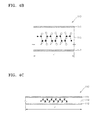
- the actuator 110 is attached to the initial shape forming substrate 120 through the adhesive layer 101 arranged between them, and has a structure in which an electro-active polymer layer 113 is interposed between first and second electrodes 111 and 112 that face each other as shown in FIG. 4A .
- the actuator 110 is driven by a principle in which a bending force is exerted since the electro-active polymer layer 113 extends according to a voltage that is applied to the first and second electrodes 111 and 112.
- FIGS. 4B and 4C are diagrams related to the principles of driving the actuator 110.
- the electro-active polymer layer 113 maintains its initial thickness and length L1.
- the voltage is applied to the first and second electrodes 111 and 112, as illustrated in FIG. 4C .
- the length L2 of the electro-active polymer layer 113 extends.
- the length L2 shown in FIG. 4C is greater than the length L1 shown in FIG. 4B .
- the surface of the actuator 110 is attached to and thus is restrained by the initial shape forming substrate 120, the other surface of the actuator 110 further extends, so that a bending force is exerted.
- the electro-active polymer layer 113 returns to the state of FIG. 4B before the bending force is exerted.
- the initial state by the initial shape forming substrate 120 is the U-shape folding state
- a state before the application of the voltage as shown in FIG. 4B is the folded state
- a state after the application of the voltage as shown in FIG. 4C is a flat state (or unfolded state).
- FIG. 3 illustrates a driving state in which the bending force of the actuator 110 is exerted.
- the flexible display device 100 maintains its U-shape folded state by the initial shape forming substrate 120, when the actuator 110 is driven, the bending force is exerted so that the flexible display device 100 is unfolded into the flat state.
- the flexible display device 100 Due to the bending force, when the actuator 110 is driven, the display body 130 that is combined with the actuator 110 is also unfolded. On the other hand, when the voltage applied to the actuator 110 is removed, the flexible display device 100 returns to the U-shape folding state that is initially set by the initial shape forming substrate 120.
- the electro-active polymer layer 113 may be formed of a material including polyvinylidene fluoride (PVDF), polydimethyl siloxane (PDMS), or polyvinylidene fluoride-co-trifluoroethylene (PVFT), and the first and second electrodes 111 and 112 may be formed of an indium tin oxide (ITO) material having flexibility.
- PVDF polyvinylidene fluoride
- PDMS polydimethyl siloxane
- PVFT polyvinylidene fluoride-co-trifluoroethylene
- ITO indium tin oxide
- the flexible display device 100 may be used as follows:
- the flexible display device 100 maintains its folded state by the initial shape forming substrate 120 as shown in FIG. 2 .
- a voltage is not applied to the actuator 110, no power is used, and thus the flexible display device 100 is carried or is placed. Since a length of the flexible display device 100 in the folding state is decreased by half, it is very convenient to carry and place the flexible display device 100.
- the voltage is not applied to the actuator 110 (referring to FIG. 4B ), useless power consumption does not occur while the flexible display device 100 is carried or is placed.
- the voltage is applied to the first and second electrodes 111 and 112 of the actuator 110. Then, the electro-active polymer layer 113 extends (referring to FIG. 4C ), so that the flexible display device 100 is unfolded (referring to FIG. 3 ) and then is finally turned into a flat state (referring to FIG. 1 .).
- the display body 130 at the flat state is driven, a user may watch images on a flat screen of the display body 130.
- the voltage that is applied to the actuator 110 is removed, so that the flexible display device 100 returns to the folding state that is set by the initial shape forming substrate 120.
- the folding state and the flat state are controlled by driving the actuator 110, it is very exact and convenient to fold and carry the flexible display device 100 and then to flatly unfold the flexible display device 100 for use.
- both portability and user convenience may be improved.
- the actuator 110 has a structure in which the electro-active polymer layer 113 is interposed between the first and second electrodes 111 and 112.
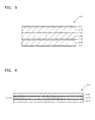
- an actuator 210 may have a multi-layer structure in which electro-active polymer layers 212, 214, and 216 are interposed between electrodes 211, 213, 215, and 217, respectively, i.e., a plurality of units are stacked while forming multiple layers.
- a bending force may be increased.
- the flexible display device 100 has the structure in which the display body 130 is attached to the surface of the initial shape forming substrate 120, and the actuator 110 is attached to the other surface of the initial shape forming substrate 120.
- a flexible display device 300 may have a structure in which a display body 330 is attached to a surface of an actuator 320, and an initial shape forming substrate 310 is attached to a surface of the actuator 320.
- a bending force may be decreased.
- an appropriate bending force may be achieved.
- the flexible display device when a user carries a flexible display device according to an embodiment of the present invention, the flexible display device maintains a folded state without power consumption, and then when the user uses the flexible display device, the flexible display device drives an actuator so that the user may unfold the flexible display device and may watch a flat screen. Accordingly, the flexible display device may be used with minimum power consumption, improved portability, and improved user convenience.
- the display shape can be changed between a first shape and a second shape by driving an actuator which is attached to the display.
- the first shape may be a folded shape which is adopted when the actuator is not driven.
- the second shape may be a flat shape which is adopted when the actuator is driven.
- the flexible display device allows a user to exactly control a change state of the flexible display device by driving the actuator and to decrease power consumption for changing and driving the flexible display device.
- the flexible display device allows a user to exactly control a change state of the flexible display device by driving the actuator and to decrease power consumption for changing and driving the flexible display device.
Landscapes
- Engineering & Computer Science (AREA)
- Physics & Mathematics (AREA)
- General Physics & Mathematics (AREA)
- Theoretical Computer Science (AREA)
- Nonlinear Science (AREA)
- General Engineering & Computer Science (AREA)
- Crystallography & Structural Chemistry (AREA)
- Chemical & Material Sciences (AREA)
- Ceramic Engineering (AREA)
- Optics & Photonics (AREA)
- Computer Hardware Design (AREA)
- Devices For Indicating Variable Information By Combining Individual Elements (AREA)
- Human Computer Interaction (AREA)
- Microelectronics & Electronic Packaging (AREA)
- Electroluminescent Light Sources (AREA)
Abstract
Description
- The present invention relates to a flexible display device, and more particularly, to a flexible display device that is improved to control a physical change of the flexible display device.
- In general, a flexible display device indicates a device that has flexibility by having a display unit formed on a flexible substrate such as polyimide. The flexible display device is very convenient since a shape of the flexible display device can be changed to reduce its size for portability.
- However, until now, there is no means of exactly controlling a physical change of the flexible display device. In this regard, since a user has to roughly fold or unfold the flexible display device, when the user reduces the size of the flexible display device so as to carry it, it is difficult for the user to exactly change the shape into a reduced shape, and when the user unfolds the flexible display device so as to watch a screen, it is difficult for the user to exactly change the shape into a flat shape.
- Thus, in order to solve these inconveniences, there is a demand for a flexible display device having a new structure by which a change state of the flexible display device can be exactly controlled.
- The present invention provides a flexible display device that is improved to exactly control a change state of the flexible display device and to decrease power consumption for changing and driving the flexible display device.
- According to an aspect of the present invention, there is provided a flexible display device including a display body having flexibility; an actuator for changing and driving the display body; and an initial shape forming substrate for maintaining an initial state of the display body before the display body is changed and driven.
- The actuator may include a first electrode and a second electrode which face each other, and an electro-active polymer layer that is interposed between the first electrode and the second electrode.
- When a voltage is applied to the first electrode and the second electrode, the electro-active polymer layer may extend whereby the flexible display device may be changed.
- The electro-active polymer layer may include polyvinylidene fluoride (PVDF), polydimethyl siloxane (PDMS), or polyvinylidene fluoride-co-trifluoroethylene (PVFT).
- The first electrode and the second electrode may include an indium tin oxide (ITO) material.
- The actuator may be formed of one basic unit in which the electro-active polymer layer is interposed between the first electrode and the second electrode.
- The actuator may have a structure in which a plurality of basic units are stacked, wherein the electro-active polymer layer is interposed between the first electrode and the second electrode in each of the plurality of basic units.
- The initial shape forming substrate may maintain the initial state of the display body as a folding state, and when the actuator is driven, the display body may be turned into a flat state.
- The initial shape forming substrate may be formed of an alloy material including at least one of magnesium, aluminum, and lead.
- The display body may be attached to one surface of the initial shape forming substrate, and the actuator may be attached to another surface of the initial shape forming substrate.
- The display body may be attached to one surface of the actuator, and the initial shape forming substrate may be attached to another surface of the actuator.
- The above and other features and advantages of the present invention will become more apparent by describing in detail exemplary embodiments thereof with reference to the attached drawings in which:
-
FIG. 1 illustrates a flexible display device according to an embodiment of the present invention; -
FIG. 2 illustrates an initial state of the flexible display device ofFIG. 1 before the flexible display device is driven; -
FIG. 3 illustrates a procedure of driving the flexible display device ofFIG. 1 ; -
FIG. 4A illustrates a structure of an actuator of the flexible display device ofFIG. 1 ; -
FIGS. 4B and 4C illustrate states of the actuator shown inFIG. 4A before and after the actuator is driven; and -
FIGS. 5 and 6 illustrate flexible display devices having amended structures of the flexible display device ofFIG. 1 , according to embodiments of the present invention. - Hereinafter, the present invention will be described in detail by explaining exemplary embodiments of the invention with reference to the attached drawings.
-
FIG. 1 illustrates aflexible display device 100 according to an embodiment of the present invention. - As illustrated in
FIG. 1 , theflexible display device 100 includes adisplay body 130 having flexibility, an initialshape forming substrate 120 that is attached on one surface of thedisplay body 130, and anactuator 110 that is attached on another surface of the initialshape forming substrate 120. InFIG. 1 , areference numeral 101 indicates an adhesive layer. - The
display body 130 indicates a structure which includes a thin-film transistor (TFT) and a light-emitting device to realize an image, and an encapsulation layer to cover and protect the TFT and the light-emitting device that are stacked on a flexible substrate. Hereinafter, the structure is simply referred to as thedisplay body 130. Since thedisplay body 130 uses the flexible substrate, instead of a solid glass substrate, thedisplay body 130 may be freely bent to the extent of the maximal flexibility of thedisplay body 130. - The initial
shape forming substrate 120 is formed by casting an alloy of magnesium, aluminum, lead, or the like having a low elasticity modulus in a die, and functions to maintain an initial state of theflexible display device 100 as a folded state as shown inFIG. 2 . That is, the initialshape forming substrate 120 is formed to the folded state of a U-shape via the casting, and maintains the folding state unless an external force is applied in an opposite direction. Thus, thedisplay body 130 that is combined with the initialshape forming substrate 120 maintains a folded state when it is not used. In other words, the default shape of the display is a folded state. - The
actuator 110 is attached to the initialshape forming substrate 120 through theadhesive layer 101 arranged between them, and has a structure in which an electro-active polymer layer 113 is interposed between first andsecond electrodes FIG. 4A . Theactuator 110 is driven by a principle in which a bending force is exerted since the electro-active polymer layer 113 extends according to a voltage that is applied to the first andsecond electrodes -
FIGS. 4B and 4C are diagrams related to the principles of driving theactuator 110. First, as illustrated inFIG. 4B , when a current does not flow, the electro-active polymer layer 113 maintains its initial thickness and length L1. At this state, when the voltage is applied to the first andsecond electrodes FIG. 4C , the length L2 of the electro-active polymer layer 113 extends. In other words, the length L2 shown inFIG. 4C is greater than the length L1 shown inFIG. 4B . Here, since the surface of theactuator 110 is attached to and thus is restrained by the initialshape forming substrate 120, the other surface of theactuator 110 further extends, so that a bending force is exerted. On the other hand, when the voltage that is applied to the first andsecond electrodes active polymer layer 113 returns to the state ofFIG. 4B before the bending force is exerted. Here, since the initial state by the initialshape forming substrate 120 is the U-shape folding state, a state before the application of the voltage as shown inFIG. 4B is the folded state, and a state after the application of the voltage as shown inFIG. 4C is a flat state (or unfolded state). -
FIG. 3 illustrates a driving state in which the bending force of theactuator 110 is exerted. In this regard, while theflexible display device 100 maintains its U-shape folded state by the initialshape forming substrate 120, when theactuator 110 is driven, the bending force is exerted so that theflexible display device 100 is unfolded into the flat state. - Due to the bending force, when the
actuator 110 is driven, thedisplay body 130 that is combined with theactuator 110 is also unfolded. On the other hand, when the voltage applied to theactuator 110 is removed, theflexible display device 100 returns to the U-shape folding state that is initially set by the initialshape forming substrate 120. - The electro-
active polymer layer 113 may be formed of a material including polyvinylidene fluoride (PVDF), polydimethyl siloxane (PDMS), or polyvinylidene fluoride-co-trifluoroethylene (PVFT), and the first andsecond electrodes second electrodes second electrodes - The
flexible display device 100 may be used as follows: - First, when the
flexible display device 100 is not used, theflexible display device 100 maintains its folded state by the initialshape forming substrate 120 as shown inFIG. 2 . Here, since a voltage is not applied to theactuator 110, no power is used, and thus theflexible display device 100 is carried or is placed. Since a length of theflexible display device 100 in the folding state is decreased by half, it is very convenient to carry and place theflexible display device 100. As described above, since the voltage is not applied to the actuator 110 (referring toFIG. 4B ), useless power consumption does not occur while theflexible display device 100 is carried or is placed. - In order to use the
flexible display device 100, the voltage is applied to the first andsecond electrodes actuator 110. Then, the electro-active polymer layer 113 extends (referring toFIG. 4C ), so that theflexible display device 100 is unfolded (referring toFIG. 3 ) and then is finally turned into a flat state (referring toFIG. 1 .). Thus, when thedisplay body 130 at the flat state is driven, a user may watch images on a flat screen of thedisplay body 130. - Afterward, when a use of the
flexible display device 100 is ended, the voltage that is applied to theactuator 110 is removed, so that theflexible display device 100 returns to the folding state that is set by the initialshape forming substrate 120. - As described above, since the folding state and the flat state are controlled by driving the
actuator 110, it is very exact and convenient to fold and carry theflexible display device 100 and then to flatly unfold theflexible display device 100 for use. Thus, by using theflexible display device 100, both portability and user convenience may be improved. - Also, since power is not consumed in the
actuator 110 in a folding state of non-use state, but is only consumed in a use-state, useless power consumption does not occur. - In the embodiment of
FIG. 1 , theactuator 110 has a structure in which the electro-active polymer layer 113 is interposed between the first andsecond electrodes FIG. 5 , anactuator 210 may have a multi-layer structure in which electro-active polymer layers 212, 214, and 216 are interposed betweenelectrodes actuator 210 has the multi-layer structure, a bending force may be increased. - Also, in the embodiment of
FIG. 1 , theflexible display device 100 has the structure in which thedisplay body 130 is attached to the surface of the initialshape forming substrate 120, and theactuator 110 is attached to the other surface of the initialshape forming substrate 120. However, as in another embodiment ofFIG. 6 , aflexible display device 300 may have a structure in which adisplay body 330 is attached to a surface of anactuator 320, and an initialshape forming substrate 310 is attached to a surface of theactuator 320. In this case, since the surfaces of theactuator 320 are attached to and thus are restrained by thedisplay body 330 and the initialshape forming substrate 310, respectively, a bending force may be decreased. However, if adherence varies on the surfaces, an appropriate bending force may be achieved. - As described above, according to the one or more embodiments of the present invention, when a user carries a flexible display device according to an embodiment of the present invention, the flexible display device maintains a folded state without power consumption, and then when the user uses the flexible display device, the flexible display device drives an actuator so that the user may unfold the flexible display device and may watch a flat screen. Accordingly, the flexible display device may be used with minimum power consumption, improved portability, and improved user convenience.
- In other words, the display shape can be changed between a first shape and a second shape by driving an actuator which is attached to the display. The first shape may be a folded shape which is adopted when the actuator is not driven. The second shape may be a flat shape which is adopted when the actuator is driven.
- Also, the flexible display device allows a user to exactly control a change state of the flexible display device by driving the actuator and to decrease power consumption for changing and driving the flexible display device. Thus, by using the flexible display device, user convenience can be improved and the flexible display device can be driven with low power consumption.
- While the present invention has been particularly shown and described with reference to exemplary embodiments thereof, it will be understood by those of ordinary skill in the art that various changes in form and details may be made therein without departing from the scope of the present invention as defined by the following claims.
Claims (15)
- A flexible display device comprising:a flexible display body;an actuator for changing the shape of the display body; anda substrate for maintaining an initial shape of the display body.
- The flexible display device of claim 1, wherein the actuator comprises an electrically activated member that is arranged to change between first and second shapes in response to an applied voltage.
- The flexible display device of claim 2, wherein the actuator comprises a first electrode and a second electrode which face each other, and an electro-active polymer layer that is interposed between the first electrode and the second electrode.
- The flexible display device of claim 3, wherein, when a voltage is applied to the first and second electrodes, the electro-active polymer layer extends to change the shape of the flexible display device.
- The flexible display device of claim 3 or 4, wherein the electro-active polymer layer comprises a material selected from the group consisting of polyvinylidene fluoride (PVDF), polydimethyl siloxane (PDMS), polyvinylidene fluoride-co-trifluoroethylene (PVFT), and combinations thereof.
- The flexible display device of claim 3, 4 or 5, wherein the first electrode and the second electrode comprise an indium tin oxide (ITO) material.
- The flexible display device of any one of claims 3 to 6, wherein the actuator is formed of one basic unit in which the electro-active polymer layer is interposed between the first electrode and the second electrode.
- The flexible display device of any one of claims 3 to 6, wherein the actuator has a structure in which a plurality of basic units are stacked, wherein the electro-active polymer layer is interposed between the first electrode and the second electrode in each of the plurality of basic units.
- The flexible display device of any one of the preceding claims, wherein the initial shape of the display body comprises a folded shape.
- The flexible display device of any one of the preceding claims, wherein the display body has the initial shape when the actuator is not driven.
- The flexible display device of any one of the preceding claims, wherein when the actuator is driven, the display body is changed to a flat shape.
- The flexible display device of any one of the preceding claims, wherein the substrate is formed of an alloy material comprising at least one selected from the group consisting of magnesium, aluminum, lead, and combinations thereof.
- The flexible display device of any one of the preceding claims, wherein the display body is attached to one surface of the substrate, and the actuator is attached to the opposite surface of the substrate.
- The flexible display device of any one of any one of claims 1 to 12, wherein the display body is attached to one surface of the actuator, and the substrate is attached to an opposite surface of the actuator.
- The flexible display device of any one of the preceding claims, wherein each of the display body, the actuator and the substrate has a planar structure and the display body, the actuator and the substrate are arranged in the form of a stack.
Applications Claiming Priority (1)
| Application Number | Priority Date | Filing Date | Title |
|---|---|---|---|
| KR1020130015532A KR102048922B1 (en) | 2013-02-13 | 2013-02-13 | A flexible display device |
Publications (2)
| Publication Number | Publication Date |
|---|---|
| EP2768038A2 true EP2768038A2 (en) | 2014-08-20 |
| EP2768038A3 EP2768038A3 (en) | 2017-12-06 |
Family
ID=49118396
Family Applications (1)
| Application Number | Title | Priority Date | Filing Date |
|---|---|---|---|
| EP13183536.5A Withdrawn EP2768038A3 (en) | 2013-02-13 | 2013-09-09 | Flexible display device |
Country Status (5)
| Country | Link |
|---|---|
| US (1) | US9053651B2 (en) |
| EP (1) | EP2768038A3 (en) |
| JP (1) | JP6310706B2 (en) |
| KR (1) | KR102048922B1 (en) |
| CN (1) | CN103985338B (en) |
Cited By (1)
| Publication number | Priority date | Publication date | Assignee | Title |
|---|---|---|---|---|
| DE102014113732A1 (en) * | 2014-09-23 | 2016-03-24 | Osram Oled Gmbh | Optoelectronic assembly and method for manufacturing an optoelectronic assembly |
Families Citing this family (33)
| Publication number | Priority date | Publication date | Assignee | Title |
|---|---|---|---|---|
| KR101940187B1 (en) * | 2012-10-25 | 2019-01-21 | 삼성디스플레이 주식회사 | Two side display device and manufacturing method thereof |
| KR101404628B1 (en) * | 2013-05-29 | 2014-06-11 | 김선종 | flexilbe electronic device |
| KR102034002B1 (en) * | 2014-08-26 | 2019-10-21 | 한국전자통신연구원 | Display apparatus and manufacturing method thereof |
| KR102226694B1 (en) * | 2014-09-01 | 2021-03-11 | 엘지디스플레이 주식회사 | Foldable display apparatus |
| KR102228857B1 (en) * | 2014-09-05 | 2021-03-17 | 엘지전자 주식회사 | Protable electronic device |
| KR102322762B1 (en) | 2014-09-15 | 2021-11-08 | 삼성디스플레이 주식회사 | Display apparatus |
| KR102319835B1 (en) * | 2014-09-22 | 2021-11-01 | 엘지디스플레이 주식회사 | Foldable display apparatus |
| CN104469632B (en) * | 2014-11-28 | 2018-02-02 | 华勤通讯技术有限公司 | A kind of vocal technique and sound-producing device |
| US20160179230A1 (en) * | 2014-12-23 | 2016-06-23 | Intel Corporation | Electroactive layer coupled to a flexible display |
| EP3041058B1 (en) * | 2014-12-31 | 2019-09-11 | LG Display Co., Ltd. | Multilayer transformable device and display device comprising the same |
| US10042394B2 (en) | 2014-12-31 | 2018-08-07 | Lg Display Co., Ltd. | Foldable plate and foldable display device with the same |
| KR20160089164A (en) * | 2015-01-19 | 2016-07-27 | 삼성전자주식회사 | Flexible device and method for controlling shape of display thereof |
| CN104536162B (en) * | 2015-01-19 | 2018-08-21 | 昆山国显光电有限公司 | Transparence display control structure and transparent display |
| CN104536187B (en) * | 2015-01-23 | 2018-01-23 | 京东方科技集团股份有限公司 | Flexible display |
| CN104658430A (en) * | 2015-02-28 | 2015-05-27 | 北京维信诺科技有限公司 | Flexible display device |
| KR102387038B1 (en) | 2015-05-19 | 2022-04-15 | 삼성디스플레이 주식회사 | Display apparatus |
| US10061357B2 (en) * | 2015-06-10 | 2018-08-28 | Intel Corporation | Electroactive layer to coil a flexible display |
| KR102378758B1 (en) * | 2015-06-19 | 2022-03-25 | 엘지디스플레이 주식회사 | Flexible display apparatus |
| US10345905B2 (en) * | 2015-09-08 | 2019-07-09 | Apple Inc. | Electronic devices with deformable displays |
| CN106873814B (en) * | 2015-12-14 | 2020-02-21 | 联想(北京)有限公司 | Control method and electronic equipment |
| KR102490890B1 (en) | 2016-01-11 | 2023-01-25 | 삼성디스플레이 주식회사 | Display apparatus |
| KR20170088565A (en) * | 2016-01-25 | 2017-08-02 | 삼성전자주식회사 | Protection case of portable electronic device and method for determining state thereof |
| CN105508889A (en) * | 2016-02-01 | 2016-04-20 | 京东方科技集团股份有限公司 | Light-emitting assembly and manufacturing method thereof |
| JP6851362B2 (en) * | 2016-02-18 | 2021-03-31 | ダウ・東レ株式会社 | Flexible laminate and flexible display using it |
| JP6271828B1 (en) * | 2016-04-26 | 2018-01-31 | 東レ・ダウコーニング株式会社 | Flexible laminate and flexible display including the same |
| CN106601132B (en) * | 2017-01-04 | 2019-12-03 | 昆山国显光电有限公司 | A kind of flexible display apparatus and its control method |
| US10539993B2 (en) * | 2017-03-14 | 2020-01-21 | Microsoft Technology Licensing, Llc | Integrated energy storage systems in computing facilities |
| CN107240600B (en) * | 2017-06-26 | 2019-10-18 | 京东方科技集团股份有限公司 | A flexible display device |
| JP7077001B2 (en) * | 2017-12-15 | 2022-05-30 | 株式会社ジャパンディスプレイ | Display device |
| KR102483893B1 (en) * | 2018-02-09 | 2023-01-02 | 삼성디스플레이 주식회사 | Flexible display device |
| KR102827056B1 (en) * | 2019-04-16 | 2025-07-01 | 엘지이노텍 주식회사 | Flexible circuit substrate and flexible device |
| US11810487B2 (en) | 2020-11-30 | 2023-11-07 | Rovi Guides, Inc. | Display system for directing different images to different viewers |
| NL2028249B1 (en) * | 2021-05-19 | 2022-12-06 | Microsoft Technology Licensing Llc | Active slack management in a layered article |
Family Cites Families (25)
| Publication number | Priority date | Publication date | Assignee | Title |
|---|---|---|---|---|
| US4266339A (en) * | 1979-06-07 | 1981-05-12 | Dielectric Systems International, Inc. | Method for making rolling electrode for electrostatic device |
| JP2003280546A (en) * | 2002-03-27 | 2003-10-02 | Matsushita Electric Ind Co Ltd | Self-deformable flexible display and information processing terminal using the same |
| US7456823B2 (en) * | 2002-06-14 | 2008-11-25 | Sony Corporation | User interface apparatus and portable information apparatus |
| TW200413776A (en) * | 2002-11-05 | 2004-08-01 | Matsushita Electric Industrial Co Ltd | Display element and display using the same |
| WO2004049050A1 (en) * | 2002-11-22 | 2004-06-10 | Koninklijke Philips Electronics N.V. | Method of manufacturing a curved display |
| US20050269943A1 (en) * | 2004-06-04 | 2005-12-08 | Michael Hack | Protected organic electronic devices and methods for making the same |
| US7714801B2 (en) * | 2005-01-05 | 2010-05-11 | Nokia Corporation | Foldable electronic device and a flexible display device |
| JP4732798B2 (en) * | 2005-05-19 | 2011-07-27 | 株式会社日立製作所 | Actuators and actuator modules |
| JP4732876B2 (en) * | 2005-11-30 | 2011-07-27 | 株式会社日立製作所 | Actuator, actuator module, and actuator module manufacturing method |
| JP2008151818A (en) * | 2006-12-14 | 2008-07-03 | Hitachi Ltd | Display device |
| US9823833B2 (en) * | 2007-06-05 | 2017-11-21 | Immersion Corporation | Method and apparatus for haptic enabled flexible touch sensitive surface |
| JPWO2009050812A1 (en) * | 2007-10-18 | 2011-02-24 | 富士通株式会社 | Display device and display system |
| JP5258436B2 (en) * | 2008-07-30 | 2013-08-07 | 株式会社東芝 | Display device and manufacturing method thereof |
| KR20100031027A (en) | 2008-09-11 | 2010-03-19 | 전남대학교산학협력단 | Electro-active polymer actuators with self-healing function and artificial body tissue including the actuators |
| KR101067661B1 (en) * | 2009-04-14 | 2011-09-27 | 한국과학기술원 | Flexible display shape changing device using electro-active polymer operated by ion and method |
| WO2011016265A1 (en) * | 2009-08-07 | 2011-02-10 | シャープ株式会社 | Display element and electric apparatus |
| US20110084898A1 (en) * | 2009-10-14 | 2011-04-14 | Sony Corporation | Memory shape element for flexible oled display screen |
| WO2011105837A2 (en) | 2010-02-24 | 2011-09-01 | (주) 씨아이제이 | Soft electrode material and manufacturing method thereof |
| KR101809191B1 (en) * | 2010-10-11 | 2018-01-18 | 삼성전자주식회사 | Touch panel |
| JP5299406B2 (en) | 2010-11-10 | 2013-09-25 | コニカミノルタ株式会社 | Flat display device, display control method, and display control program |
| EP3364636B1 (en) * | 2011-03-21 | 2021-02-10 | Apple Inc. | Electronic devices with flexible displays |
| KR101245375B1 (en) * | 2011-06-08 | 2013-03-20 | 주식회사 팬택 | Active Flexible Display, Apparatus and Method for Controlling Active Flexible Display |
| KR101340716B1 (en) * | 2011-08-25 | 2013-12-12 | 주식회사 팬택 | Flexible display control apparatus and flexible display control method |
| CN102629015A (en) * | 2012-03-27 | 2012-08-08 | 京东方科技集团股份有限公司 | Flexible display device and manufacturing method thereof |
| KR101661526B1 (en) * | 2012-04-08 | 2016-10-04 | 삼성전자주식회사 | Flexible display apparatus and user interface providing method thereof |
-
2013
- 2013-02-13 KR KR1020130015532A patent/KR102048922B1/en active Active
- 2013-06-26 US US13/927,318 patent/US9053651B2/en active Active
- 2013-08-29 CN CN201310384460.4A patent/CN103985338B/en active Active
- 2013-09-09 EP EP13183536.5A patent/EP2768038A3/en not_active Withdrawn
-
2014
- 2014-01-23 JP JP2014010320A patent/JP6310706B2/en active Active
Non-Patent Citations (1)
| Title |
|---|
| None |
Cited By (3)
| Publication number | Priority date | Publication date | Assignee | Title |
|---|---|---|---|---|
| DE102014113732A1 (en) * | 2014-09-23 | 2016-03-24 | Osram Oled Gmbh | Optoelectronic assembly and method for manufacturing an optoelectronic assembly |
| US10082270B2 (en) | 2014-09-23 | 2018-09-25 | Osram Oled Gmbh | Optoelectronic module and method for producing an optoelectronic module |
| DE102014113732B4 (en) | 2014-09-23 | 2022-11-24 | Pictiva Displays International Limited | 3D OLED and method of making a 3D OLED |
Also Published As
| Publication number | Publication date |
|---|---|
| KR102048922B1 (en) | 2020-01-09 |
| CN103985338A (en) | 2014-08-13 |
| US9053651B2 (en) | 2015-06-09 |
| KR20140102087A (en) | 2014-08-21 |
| JP2014153711A (en) | 2014-08-25 |
| US20130286462A1 (en) | 2013-10-31 |
| EP2768038A3 (en) | 2017-12-06 |
| JP6310706B2 (en) | 2018-04-11 |
| CN103985338B (en) | 2017-05-17 |
Similar Documents
| Publication | Publication Date | Title |
|---|---|---|
| EP2768038A2 (en) | Flexible display device | |
| JP7119192B2 (en) | Electronic device and display device | |
| CN114283693B (en) | Flexible Display | |
| CN115273705B (en) | display screen | |
| CN105742480B (en) | The display device that multi-layer variable shape dress is set and set comprising the multi-layer variable shape dress | |
| TWI690076B (en) | Optimal mounting of a flexible display | |
| US20130265631A1 (en) | Flexible display apparatus | |
| KR102573789B1 (en) | Flexible display device | |
| JP2011081069A (en) | Display device | |
| KR102114318B1 (en) | A flexible display device | |
| TWI631740B (en) | Multilayer transformable device and display device comprising the same | |
| JP5499967B2 (en) | IC card with display function | |
| KR20210086027A (en) | Display apparatus | |
| KR20160081760A (en) | Multilayer actuator and display device comprising the same |
Legal Events
| Date | Code | Title | Description |
|---|---|---|---|
| PUAI | Public reference made under article 153(3) epc to a published international application that has entered the european phase |
Free format text: ORIGINAL CODE: 0009012 |
|
| 17P | Request for examination filed |
Effective date: 20130909 |
|
| AK | Designated contracting states |
Kind code of ref document: A2 Designated state(s): AL AT BE BG CH CY CZ DE DK EE ES FI FR GB GR HR HU IE IS IT LI LT LU LV MC MK MT NL NO PL PT RO RS SE SI SK SM TR |
|
| AX | Request for extension of the european patent |
Extension state: BA ME |
|
| RAP1 | Party data changed (applicant data changed or rights of an application transferred) |
Owner name: SAMSUNG DISPLAY CO., LTD. |
|
| PUAL | Search report despatched |
Free format text: ORIGINAL CODE: 0009013 |
|
| AK | Designated contracting states |
Kind code of ref document: A3 Designated state(s): AL AT BE BG CH CY CZ DE DK EE ES FI FR GB GR HR HU IE IS IT LI LT LU LV MC MK MT NL NO PL PT RO RS SE SI SK SM TR |
|
| AX | Request for extension of the european patent |
Extension state: BA ME |
|
| RIC1 | Information provided on ipc code assigned before grant |
Ipc: H01L 51/00 20060101AFI20171101BHEP Ipc: H01L 27/32 20060101ALI20171101BHEP |
|
| R17P | Request for examination filed (corrected) |
Effective date: 20180425 |
|
| RBV | Designated contracting states (corrected) |
Designated state(s): AL AT BE BG CH CY CZ DE DK EE ES FI FR GB GR HR HU IE IS IT LI LT LU LV MC MK MT NL NO PL PT RO RS SE SI SK SM TR |
|
| STAA | Information on the status of an ep patent application or granted ep patent |
Free format text: STATUS: EXAMINATION IS IN PROGRESS |
|
| 17Q | First examination report despatched |
Effective date: 20190401 |
|
| STAA | Information on the status of an ep patent application or granted ep patent |
Free format text: STATUS: THE APPLICATION IS DEEMED TO BE WITHDRAWN |
|
| 18D | Application deemed to be withdrawn |
Effective date: 20190813 |