EP2767920A1 - Remote monitoring systems for monitoring medical devices via wireless communication networks - Google Patents
Remote monitoring systems for monitoring medical devices via wireless communication networks Download PDFInfo
- Publication number
- EP2767920A1 EP2767920A1 EP14168075.1A EP14168075A EP2767920A1 EP 2767920 A1 EP2767920 A1 EP 2767920A1 EP 14168075 A EP14168075 A EP 14168075A EP 2767920 A1 EP2767920 A1 EP 2767920A1
- Authority
- EP
- European Patent Office
- Prior art keywords
- medical device
- patient
- data
- web server
- medical
- Prior art date
- Legal status (The legal status is an assumption and is not a legal conclusion. Google has not performed a legal analysis and makes no representation as to the accuracy of the status listed.)
- Granted
Links
Images





Classifications
-
- G—PHYSICS
- G16—INFORMATION AND COMMUNICATION TECHNOLOGY [ICT] SPECIALLY ADAPTED FOR SPECIFIC APPLICATION FIELDS
- G16H—HEALTHCARE INFORMATICS, i.e. INFORMATION AND COMMUNICATION TECHNOLOGY [ICT] SPECIALLY ADAPTED FOR THE HANDLING OR PROCESSING OF MEDICAL OR HEALTHCARE DATA
- G16H40/00—ICT specially adapted for the management or administration of healthcare resources or facilities; ICT specially adapted for the management or operation of medical equipment or devices
- G16H40/60—ICT specially adapted for the management or administration of healthcare resources or facilities; ICT specially adapted for the management or operation of medical equipment or devices for the operation of medical equipment or devices
- G16H40/67—ICT specially adapted for the management or administration of healthcare resources or facilities; ICT specially adapted for the management or operation of medical equipment or devices for the operation of medical equipment or devices for remote operation
-
- A—HUMAN NECESSITIES
- A61—MEDICAL OR VETERINARY SCIENCE; HYGIENE
- A61B—DIAGNOSIS; SURGERY; IDENTIFICATION
- A61B5/00—Measuring for diagnostic purposes; Identification of persons
- A61B5/0002—Remote monitoring of patients using telemetry, e.g. transmission of vital signals via a communication network
- A61B5/0026—Remote monitoring of patients using telemetry, e.g. transmission of vital signals via a communication network characterised by the transmission medium
-
- H—ELECTRICITY
- H04—ELECTRIC COMMUNICATION TECHNIQUE
- H04L—TRANSMISSION OF DIGITAL INFORMATION, e.g. TELEGRAPHIC COMMUNICATION
- H04L45/00—Routing or path finding of packets in data switching networks
- H04L45/70—Routing based on monitoring results
-
- H—ELECTRICITY
- H04—ELECTRIC COMMUNICATION TECHNIQUE
- H04L—TRANSMISSION OF DIGITAL INFORMATION, e.g. TELEGRAPHIC COMMUNICATION
- H04L49/00—Packet switching elements
- H04L49/25—Routing or path finding in a switch fabric
Definitions
- the present application is directed to a remote monitoring system for monitoring medical devices in communication with a wireless communication network, and more particularly, to a remote monitoring system for monitoring medical devices that communicate with the wireless communication network via one or more wireless relay modules and a wireless relay network.
- ZIGBEE networks based on the IEEE 802.15.4 standard for wireless personal area networks have been used for collecting information from a variety of medical devices in accordance with IEEE 11073 Device Specializations for point-of-care medical device communication, including for example pulse oximeters, blood pressure monitors, pulse monitors, weight scales and glucose meters. See, e.g., ZIGBEE Wireless Sensor Applications for Health, Wellness and Fitness , the ZIGBEE Alliance, March 2009, which is incorporated by reference herein in its entirety.
- ZIGBEE networks provide the advantage of being dynamically configurable, for example, in "self-healing" mesh configurations, and operating with low power requirements (enabling, for example, ZIGBEE transceivers to be integrally coupled to the medical devices under battery power).
- transmission ranges between individual ZIGBEE transceivers are generally limited to no more than several hundred feet.
- such networks are suitable for on-site communications with medical devices, but unusable for centralized monitoring locations located off-site.
- a hybrid system may be employed in which one or more wireless personal area networks are configured to facilitate on-site communications between medical devices and one or more wireless relay modules which are further configured to communicate with off-site centralized monitoring systems (for example, via a wireless wide-area network (WWAN) such as a mobile telephone data network, for example, based on a Global System for Mobile Communications (GSM) or Code Division Multiple Access (CDMA) cellular network or associated wireless data channels).
- WWAN wireless wide-area network
- GSM Global System for Mobile Communications
- CDMA Code Division Multiple Access
- HIPAA Health Insurance Portability and Accountability Act of 1996
- communication of information between the monitored medical devices and the central monitoring location must be done securely, and medical device and associated patient information must be made available only to personnel accessing the centralized monitoring systems who are in possession of the appropriate access credentials.
- the centralized monitoring system In order to be viable, the centralized monitoring system must also be capable of recognizing medical device information indicating an alert condition requiring response by on-site or other specialized personnel and reaching those on-site or specialized personnel to report the alert condition in a timely fashion.
- a remote, centralized medical information monitoring system that communicates over a wireless network of wide reach (for example, a wireless wide area network) with one or more critical care and/or home care health service centers via one or more wireless relay modules at each site, where the wireless relay modules relay communications provided by on-site medical devices over a wireless local area network or wireless personal area network. It would further be desirable for the centralized medical information monitoring system to be capable of also configuring medical devices according to associations with individual sites and patients, of logging communications from medical devices, of displaying medical device data to users of the centralized medical information monitoring system who are able to provide sufficient credentials, and of recognizing medical device alert conditions and reporting these conditions to responsible personnel in a timely fashion. In addition, it would be desirable for the centralized information monitoring system to be capable of transmitting information to the medical devices via the wireless relay modules for operating and maintaining the medical devices, including for example software upgrades and library upgrades downloaded to the medical devices.
- the present invention is directed to a remote monitoring system and method for monitoring the status of a plurality of medical devices located remotely from the monitoring system at a patient care or home care facility.
- one or more medical devices including but not limited to including for example, respirators, enteral feeding devices, pulse oximeters, blood pressure monitors, pulse monitors, weight scales and glucose meters
- An interface circuit is coupled to each medical device, and is configured for communicating with one of a plurality of the wireless relay modules via a wireless relay network.
- the wireless relay modules are further configured to communicate with the remote monitoring device over an internet-accessible wireless communication network, and preferably, a wireless wide-area network (WWAN) such as a mobile telephone data network including (for example, based on a Global System for Mobile Communications (GSM) or Code Division Multiple Access (CDMA) cellular network or associated wireless data channels).
- WWAN wireless wide-area network
- GSM Global System for Mobile Communications
- CDMA Code Division Multiple Access
- communications over each of the wireless networks are preferably conducted securely.
- the remote monitoring system and method includes a device integration server in communication with the wireless relay modules for receiving data packets from the wireless relay modules including information provided by the medical devices.
- This information includes identification of an associated medical device and data of the medical device, and is preferably encrypted or otherwise securely transmitted, for example, in compliance with HIPAA patient data privacy provisions.
- the information may include encrypted or otherwise securely transmitted patient identification information, which in addition may preferably be coded in its unencrypted state to avoid any reference to the patient's identity.
- the remote monitoring system also includes a data management system including a secure device web server and a device control database, and an outbound web server.
- the data management system is configured to log information provided to the device integration server concerning the medical devices.
- the web server is configured to provide webpages including the data of the medical devices for display on a remote monitoring computer, subject to authentication of an associated data request originating from the monitoring computer.
- the remote monitoring system may further be configured for secure communications with a patient care database node that securely stores associated patient information, and for providing additional access to the remote monitoring computer upon receiving sufficient requestor authentication for configuring medical devices to patients and for controlling the operation of the medical devices.
- the remote monitoring system may be configured to process alert messages received from the wireless relay modules and, in response, transmit text message information to the wireless relay modules to be relayed to one or more text messaging recipients.
- the remote monitoring system may be configured to transmit the text message directly to the one or more text messaging recipients.
- FIGs. 1-6 For the purpose of illustrating the present invention, exemplary embodiments are described with reference to FIGs. 1-6 .
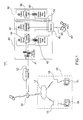
- FIG. 1 A diagram of an exemplary system 100 for monitoring medical devices in accordance with the present invention is illustrated in FIG. 1 .
- one or more medical devices 10 are provided at a patient facility 20 for monitoring the medical condition and/or administering medical treatment to one or more patients.
- Patient facility 20 may comprise a critical care health service center (for example, including hospitals, clinics, assisted living centers and the like) servicing a number of patients, a home facility for servicing one or more patients, or a personal enclosure (for example, a backpack) that may attached to or worn by an ambulatory patient.
- a critical care health service center for example, including hospitals, clinics, assisted living centers and the like
- a personal enclosure for example, a backpack
- each medical device 10 Associated with each medical device 10 is an interface circuit 15 that includes a transceiver having one or more of a transmitter and/or a receiver for respectively transmitting and receiving signals in a facility-oriented wireless network 17 such as, for example, a Low-Rate Wireless Personal Area Networks or "LR-WPAN,” ZIGBEE network or another low-power personal area network such as a low power BLUETOOTH network, existing or presently under development or consideration. See, e.g., Houda Labiod et al., Wi-Fi, Bluetooth, Zigbee and WiMax, Springer 2010 , which is incorporated by reference herein in its entirety. It should be understood that interface circuit 15 may be contained within or disposed external to medical device 10 in accordance with the present invention.
- Each relay module 30 includes a first transceiver for receiving signals from and transmitting signals to the interface circuits 15 in the facility-oriented wireless network, and further includes a second transceiver for wirelessly transmitting signals to and receiving signals from an access point 40 via a wireless wide-area network ("WWAN") 52.
- WWANs for use with the present invention include, for example, networks based on a Global System for Mobile Communications (GSM) or Code Division Multiple Access (CDMA) cellular network or associated with the 2G, 3G, 3G Long Term Evolution, 4G, WiMAX cellular wireless standards of the International Telecommunication Union Radiocommunication Sector (ITU-R).
- GSM Global System for Mobile Communications
- CDMA Code Division Multiple Access
- communications over each of the facility-oriented wireless network and WWAN are preferably conducted securely using, for example, using a Secure Sockets Layer (SSL) protocol or a Transport Layer Security (TLS) protocol.
- SSL Secure Sockets Layer
- TLS Transport Layer Security
- the access point 40 useable with the present invention includes an inbound server (“device integration server”) 41 that incorporates or otherwise has access to a transceiver for communicating with the relay modules 30 over the WWAN.
- Medical device data received by the device integration server 41 over the WWAN is forwarded to a secure device web server 42, which is configured for example to log the received data in association with identification information of the associated medical devices in a device control database 44.
- An outbound web server 43 is configured, for example, to receive and qualify data retrieval requests submitted by one or more of remote monitoring devices 62 over a broad-band network 50 (for example, over the Internet).
- the outbound web server 43 requests associated medical device data to be retrieved from the device control database 44 via the secure device web server 42, requests associated program data for constructing a display page from a metadata and applications database 46, and requests associated patient data to be retrieved and from a patient database 66 provided in a patient care database node 60 over a secure link 54 via a secure patient web server 64.
- the secure link 54 can be implemented, for example as another WWAN using a SSL protocol or a TLS protocol.
- a third party service provider may host the access point 40 to simultaneously support a number of distinct patient and/or home care facilities, thereby eliminating the need for each of these facilities to configure and maintain their own private access point facilities and providing hosting service to each facility that are likely far less than the costs of configuring and maintaining dedicated access point facilities by each care facility provider.
- access point 40 and patient care database node 60 may nevertheless be integrated into a single access point or node (for example, by a provider of a very large-scale facility provider monitoring many hundreds or thousands of patients).
- the outbound web server 43 provides an interface for authenticated clinicians to retrieve patient and medical data from each of the patient care database node 60 and the access point 40 in a convenient and transparent manner such that the details of the configurations and operation of the access point 40 and patient care database node 60 are of no consequence to the clinicians.
- the outbound web server 43 upon retrieving the requested medical device data and patient data, the outbound web server 43 then proceeds to format and transmit the retrieved medical device and patient data for display by one of monitoring devices 62 according to the retrieved program data.
- the device integration server 41 of FIG. 1 is configured to transmit information and commands to the relay modules 30, for example, for transmitting medical device alert messages to other WWAN-reachable nodes (for example, cellular telephones of emergency attendants), and/or transmitting operating commands and/or software or firmware updates to the medical devices 10 via the interface circuits 15 and facility-oriented wireless network 17.
- WWAN-reachable nodes for example, cellular telephones of emergency attendants
- operating commands and/or software or firmware updates to the medical devices 10 via the interface circuits 15 and facility-oriented wireless network 17.
- the device integration server 41 may also be configured to receive and analyze patient metric information from the secure patient web server 64 via the outbound web server 43 and secure device web server 42, or by an alternate and direct secure data link to the secure patient web server 64 in order to prevent unsafe medical device usage based upon the patient metrics information. In this manner, the device integration server 41 would function as an additional failsafe for preventing operating errors that could result in patient harm due. For example, in the case that the patient metric information indicates that an enteral feeding pump is associated with a neonate, the device integration server 41 may act to discard remote monitoring commands programming large bolus or excessive feeding rates that could be harmful to a young child. Alternatively, if the patient metric information indicates that a specific feeding rate or bolus amount has been prescribed by a doctor or clinician, the device integration server may act to discard remote monitoring commands programming a rate or bolus that deviates from the prescription.
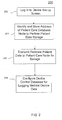
- FIG. 2 illustrates a flow diagram of one exemplary method 200 in accordance with the invention for registering medical devices 10 with the system 100 of FIG. 1 .
- the method 200 begins at step 202, at which an authorized technician having access to one of the remote monitoring devices 62 provides authenticating credentials (for example, a recognized log-in and password) to the outbound web server 43, and the web server responds by transmitting a device set-up screen to the remote monitoring device 62 requesting medical device identifying information and associated patient identifying information.
- authenticating credentials for example, a recognized log-in and password
- the outbound web server 43 preferably queries the metadata and application database 46 according to one or more of identifying information for the technician and/or identifying information for the patient to identify an associated patient care database node 60 from a plurality of patient care database nodes for the patient and record a destination address for the associated patient care database node 60 in the metadata and application database 46 in association with the identifying data for the medical device 10 and/or identifying information for the patient.
- Identifying information for the patient is preferably generated anonymously (for example as a random number), and transmitted at step 206 to the patient care database node 60 for association with securely-stored patient identifying information.
- the outbound web server 43 requests that the secure device web server 42 assign an area of the device control database 44 for logging associated data for the medical device 10 as it is received by the device integration server 41, such that it can be later retrieved by the outbound web server 43 upon receiving an authorized request from an authenticated user operating one of the remote monitoring terminals 62.
- step 204 of method 200 for identifying and storing the address of the patient care database node 60 may be omitted in accordance with the invention if a single patient care database node is utilized with system 100 of FIG. 1 .
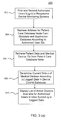
- FIG. 3(a) presents a flow diagram illustrating one exemplary method 300 in accordance with the invention for retrieving and viewing data for a registered medical device 10 according to the system of FIG. 1 .
- the method 300 begins at step 302 with an authorized user having access to one of the remote monitoring devices 62 provides authenticating credentials (for example, a recognized log-in and password) to the outbound web server 43.
- authenticating credentials for example, a recognized log-in and password
- the outbound web server 43 queries the metadata and applications database 46 to identify the address of a patient care database node 60 to which the authorized user is entitled to obtain access, and at step 306, requests data from the patient care database node 60 relating to at least one identified patient for which the user is authorized to view medical device data, including for example a listing of medical devices 10 which are presently associated with the identified patient.
- the outbound web server 43 queries the device control database 44 via the secure device web server 42 for status information to determine which of the listed medical devices are presently active according to the data logged by the device control database 44.
- a medical device 10 its associated interface device 15, an associated wireless relay module 30 and/or the device integration server 41 may be programmed to provide data from the medical device 10 to the device integration server 41 at predetermined, preset intervals.
- FIG. 3(b) presents a first exemplary screen display 320 that provides an array of medical devices 10 available for monitoring according to device type.
- available device types include ventilators 321, urology devices 322, energy delivery devices 323, pulse oximeters 324, predictive thermometers 325, tympanic thermometers 326 and food pumps 327.
- Each of the device types 321-327 in FIG. 3(b) is presented with an identifying label (for example, label 321A) and an identifying image (for example, image 321B) for ease of recognition.
- a second exemplary screen display 330 as illustrated by FIG. 3(c) may preferably transmitted by the outbound web server 43 for display at the remote monitoring device 62.
- labels 337A are provided in association with images 337B in order to identify individual food pumps (for example, by patient and/or by logical or physical location).
- Medical devices 10 that are unavailable may for example preferably be depicted with a label 337A' ("Off Line") and an image 337B' (depicting the device with a slash or cross applied over the image) that clearly distinguish the unavailable medical devices 10 from available medical devices 10.
- a third exemplary screen display 340 as illustrated by FIG. 3(d) may preferably transmitted by the outbound web server 43 for display at the remote monitoring device 62.
- device information of the medical device 10 in this case, a food pump
- a screen 347A recreating a current screen generated by the medical device 10.
- the screen display 340 includes a panel 347B providing identifying information for the medical device 10 (in this case, a pump location), a panel 347C for displaying a message indicating a current error condition of the pump, and an icon button 347D for selecting an alternate "status" mode of the screen display 340.
- the screen display 340 also includes a control icon button 347E for selecting a system set-up screen display, and a control icon button 347F for enabling device control from the remote monitoring device 62. For example, upon selecting the control icon 347F, the screen display 340 may preferably be refreshed to include the medical devices screen 347A and one or more operable buttons that mimic the appearance of control buttons on the medical device.
- the control button features are described in greater detail below in relation to FIGs. 4(b) and 4(c) .
- exemplary computer screen images 320, 330 and 340 and corresponding navigation depicted by FIGs. 3(b), 3(c) and 3(d) are for illustration purposes only and that many other user screen images displays and interface tools may be utilized for carrying out the present invention including, for example, computer screens that depict accessible medical devices by other means than device type as illustrated in FIG. 3(b) .
- FIG. 3(d) As a suitable alternative to the screen image 340 of FIG. 3(d) that conveys information from a single medical device, it is possible to implement displays that provide information from multiple medical devices.
- outbound web server 43 will preferably be operable to prepare display pages for display on any of a wide variety of display devices (including, for example, workstations, personal computers, tablet devices including tablet computers, and display-based mobile devices including personal digital assistants, smartphones, portable game systems and the like.
- display devices including, for example, workstations, personal computers, tablet devices including tablet computers, and display-based mobile devices including personal digital assistants, smartphones, portable game systems and the like.
- FIG. 4(a) presents a flow diagram illustrating an exemplary method 400 in accordance with the invention for issuing a command to a medical device 10 via the system 100 according to FIG. 1 .
- the method 400 begins at step 402 with a clinician (also referred to as a "user” herein) logging into the outbound web server 43 and navigating to the device screen display 340 of FIG. 3(d) (for example, as described above with reference to FIGs. 3(a)-3(d) ).
- the clinician proceeds to select the "Enable Full Control" button 347F of FIG. 3(d) to initiate an operational command directed to the medical device 10, and is preferably provided with a request for authentication pertaining in particular to the patient associated with the medical device 10.
- patient authentication information provided by the clinician is forwarded by the outbound web server 43 to a patient care database node 60 according to a patient care database node address stored by the metadata and applications database 46 in association with the clinician, and the clinician is authenticated for the patient by the outbound web server 43 upon receipt of an authentication confirmed message from the patient care database node 60.
- a control request is forwarded by the outbound web server 43 at step 408 to the secure device web server 42 to be logged in the information record of the device control database 44 that is associated with the medical device 10 (and optionally, with an anonymous ID for the patient).
- the secure device web server forwards the control request to the device integration server 41, which transmits an associated device control command over the secure WWAN 52 for receipt by an associated wireless relay module 30 at step 412.
- the wireless relay module 30 wirelessly communicates the command to the medical device 10 via an associated device interface 15, and awaits a reply confirming execution of the command transmitted by the device interface 15.
- the device integration server 41 receives an update message from the wireless relay module 30 via the secure WWAN 52 which confirms that the command was executed by the medical device 10.
- the device integration server 41 forwards the update message to the secure device web server 42 to be logged in the information record of the device control database 44 that is associated with the medical device 10.
- the secure device web server 42 forwards information pertaining to the update message to the outbound web server 43, and the outbound web server 43 prepares an updated display screen that is transmitted to the remote monitoring device 62 to indicate that the command has been executed.
- the authenticated clinician may select the "System Setup" control icon button 347E to perform a command other than an operational command directed to the medical device 10.
- FIG. 4(b) illustrates a display screen 450 that is presented to the clinician upon selecting the control icon button 347E.
- the display screen 450 includes a number of icon buttons that may be selected by the clinician (for example, as the result of a mouse-over or mouse-click initiated by the clinician) to select a specific setup command.
- icon button 451 may be selected to initiate a command for providing identification information of the medical device 10.
- Icon button 452 may be selected to provide text paging in response to an alert condition, as is further described herein.
- Icon button 453 may be selected to initiate a software or firmware download for updating the medical device 10.
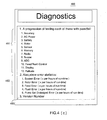
- FIG. 4(c) illustrates an exemplary display screen 460 that may be displayed to the clinician upon selection of the icon button 454.
- the clinician may select one or more of (including a progression of) a series of diagnostic tests 461 directed to components of the medical device (for example, including power components, memory components, alarm components and the like).
- the clinician may select one or more of a series of performance statistics 462 to be gathered and displayed (for example, including various device error statistics such as feed error, rotor error and flush error rates for a food pump).
- the clinician may select a version number test 463 to obtain version identifying information for the software and/or firmware (preferably including, for example, a software and/or firmware download history).
- a version number test 463 to obtain version identifying information for the software and/or firmware (preferably including, for example, a software and/or firmware download history).
- processes for performing the diagnostic tests 461, preparing the performance statistics 462 and identifying the software and/or firmware version number 463 may run automatically without specifically being selected by the clinician, with a complete reporting of all results on the display screen.
- a bandwidth priority command or instruction to a relay module, such as relay module 30 of FIG. 1 , for the relay module to grant priority for relaying information received from a particular medical device relative to other medical devices that may send or receive communications via this relay module.
- icon button 455 may be selected to enable the clinician to specify data transfer rates, priorities and other parameters relating to the wireless transceiver of the interface device associated with the medical device.
- Icon button 456 may be selected to provide the clinician with the an alarm history, event history and other information as has been logged for example for the medical device in the device control database 44 of FIG. 1 .
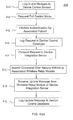
- FIG. 5(a) presents a flow diagram illustrating one exemplary method in accordance with the invention for recognizing and reporting an alert condition according to medical data logged via the system 100 according to FIG. 1 .
- the method 500 begins at step 502 with the transmission of an alert message by a wireless relay module 30 over the secure WAN 52 to the device integration server 41.
- the wireless relay module 30 is configured to analyze a message type of a message transmitted by an associated medical device 10 to determine that the message is an alert message, and to transmit the message to the device integration server 41 upon determining that the message is an alert message (for example, as a priority message).
- the wireless relay module 30 may simply queue all messages for transmission to the device integration server 41 in order upon receipt, and rely upon the device integration server 41 to analyze an associated message type to determine that a message is an alert message.
- the device integration server 41 Upon determining that the transmitted message is an alert message, the device integration server 41 proceed, at step 503, to log the message in the device control database 44, and at step 504, invokes a text messaging application that retrieves text messaging numbers associated with identifying information of the medical device 10 and/or anonymous patient identifying information.
- the text messaging application may preferably retrieve the text messaging numbers by queries the metadata and applications database 46 to identify the address of an associated patient care database node 60, and either making a direct request or instructing the outbound web server 43 to request the text messaging numbers from the associated patient care database node 60.
- the device integration server 41 sends one or more messages including the retrieved text messaging numbers and text message information according to the alert message to one or more wireless relay modules 30 over the secure WWAN 52.
- the one or more wireless relay modules 30 transmit the text message information addressed to the text messaging numbers over one or more of the secure WWAN 52 and/or the facility-oriented wireless network 17.
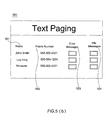
- FIG. 5(b) illustrates a "Text Paging" 452 screen display 550 that may be invoked, for example, by using the method 400 of FIG. 4(a) for issuing a command to a medical device 10.
- the text paging screen 550 is displayed at the remote monitoring device of an authenticated clinician upon the clinician's selection of the "system Setup" icon button 347e of the screen display 340, and thereafter upon the clinician's selection go the "Text Paging" icon button of the screen display 450.
- FIG. 5(b) illustrates a "Text Paging" 452 screen display 550 that may be invoked, for example, by using the method 400 of FIG. 4(a) for issuing a command to a medical device 10.
- the text paging screen 550 is displayed at the remote monitoring device of an authenticated clinician upon the clinician's selection of the "system Setup" icon button 347e of the screen display 340, and thereafter upon the clinician's selection go the "Text Paging" icon button of the screen display
- the "Text Paging" screen display 550 include a listing of one or more names 551 of individuals responsible for responding to alert messages of at least two types: "Error Messages" 553, which may for example indicate a malfunction of the medical device 10, and/or "Info Messages" 554, which may for example indicate a significant patient health condition (for example, a patient respiration rate below a preset minimum rate specified for a ventilator device 321 of FIG. 3(b) .
- the information retrieved by the outbound web server 43 to prepare this display is preferable retrieved from the patient care database node 60, by providing on one or more of identifying information for the medical device 10 and/or anonymous patient identifying information stored in the device control database 44.
- the information provided on the "Text Paging" screen display may be retrieved by the device integration server 41 by querying the metadata and applications server 46 to retrieve address information for the patient care database node 60, and forwarding a text paging information request to the patient care database node 60 based upon one or more of identifying information for the medical device 10 and/or anonymous patient identifying information stored in the device control database 44.
- FIG. 6 shows an illustrative computer system 600 suitable for implementing server and computer components of the present invention (for example, including device integration server 41, secure device web server 42, outbound web server 43, and secure patient web server 64).
- the computer system 600 as described herein may comprise, for example, a personal computer running the WINDOWS operating system, or a server computer running, WINDOWS Server, LINUX or another UNIX-based operating system.
- the computer system 600 described herein may comprise a mobile device, tablet devices or computers, or information appliance running, for example, an operating system in the group including Symbian , Android, Apple iOS, Blackberry, Microsoft Windows Phone, Linux, Palm/HP WebOS, BADA, MAEMO and MEEGO.
- the above-described methods carried out by the server and computer components of the present invention may be implemented on the computer system 600 as stored program control instructions directed to control application software.
- Computer system 600 includes processor 610, memory 620, storage device 630 and input/output devices 640.
- One of the input/output devices 640 may preferably include a display 645.
- Some or all of the components 610, 620, 630 and 640 may be interconnected by a system bus 650.
- Processor 610 may be single or multi-threaded, and may have one or more cores.
- Processor 610 executes instructions which in the disclosed embodiments of the present invention are the steps described, for example, in one or more of FIGs. 2 , 3(a) , 4(a) or 5(a) . These instructions may be stored in one or more of memory 620 or in storage device 630. Information may be received and output using one or input/output devices 640.
- Memory 620 may store information and may comprise a computer-readable medium, such as volatile or non-volatile memory.
- Storage device 630 may provide storage for system 600 including for the example, the previously described database, and may be a computer-readable medium.
- storage device 630 may be one or more of a flash memory device, a floppy disk drive, a hard disk device, and optical disk device, and/or a tape device.
- Input devices 640 may provide input/output operations for system 600.
- Input/output devices 640 may include one or more of a keyboard, a pointing device, and/or microphone.
- Input/output devices 640 may further include a display unit for displaying graphical user interfaces, a speaker and a printer and any of a number of other serial devices (for example, configured as Universal Serial Bus (USB)-based devices.
- USB Universal Serial Bus
- a system for enabling the remote monitoring of a plurality of medical devices comprising:
- said device integration component is configured to reply to said wireless relay when said packet type for a received data packet matches a predetermined packet type.
- the system described above further comprising a database of addresses of at least one remotely located secure patient database, said remote secure patient database maintaining a patient and medical device IDs.
- said database of addresses further comprises location information associated with the respective medical device IDs
- said web server is configured to retrieve a destination address from said address database according to said location information, retrieve patient data and medical device ID data from said remotely located patient database via said secure communications link according to said destination address, and retrieve said medical device data from said device control database according to said registered location data and said medical device ID data, said retrieved medical device data being transmitted to said web server.
- said data manager system further comprises a secure device server.
- a system for enabling the monitoring of a plurality of medical devices comprising:
- a method for processing a medical device alert in a medical device monitoring system comprising the steps of:
- alert response information comprises text message data for transmission by said medical relay device via a mobile communications network.
- a method for displaying medical device data by a medical device monitoring system comprising the steps of:
Landscapes
- Health & Medical Sciences (AREA)
- Engineering & Computer Science (AREA)
- Biomedical Technology (AREA)
- Life Sciences & Earth Sciences (AREA)
- Medical Informatics (AREA)
- General Health & Medical Sciences (AREA)
- Public Health (AREA)
- Business, Economics & Management (AREA)
- General Business, Economics & Management (AREA)
- Primary Health Care (AREA)
- Epidemiology (AREA)
- Molecular Biology (AREA)
- Animal Behavior & Ethology (AREA)
- Biophysics (AREA)
- Pathology (AREA)
- Heart & Thoracic Surgery (AREA)
- Computer Networks & Wireless Communication (AREA)
- Surgery (AREA)
- Physics & Mathematics (AREA)
- Veterinary Medicine (AREA)
- Measuring And Recording Apparatus For Diagnosis (AREA)
- Alarm Systems (AREA)
- Telephonic Communication Services (AREA)
- Medical Treatment And Welfare Office Work (AREA)
- Computer And Data Communications (AREA)
- Mobile Radio Communication Systems (AREA)
Abstract
Description
- The present application is directed to a remote monitoring system for monitoring medical devices in communication with a wireless communication network, and more particularly, to a remote monitoring system for monitoring medical devices that communicate with the wireless communication network via one or more wireless relay modules and a wireless relay network.
- In critical care and home care health service centers including hospitals, clinics, assisted living centers and the like, care giver-patient interaction time is at a premium. Moreover, response times by care givers to significant health conditions and events can be critical. Systems of centralized monitoring have been developed to better manage care giver time and patient interaction. In such systems, physiological data from each patient is transmitted to a centralized location. At this centralized location, a single or small number of technicians monitor all of this patient information to determine patient status. Information indicating a patient alarm condition will cause the technicians and/or system to communicate with local care givers to provide immediate patient attention, for example via wireless pagers and/or cell phones, and/or by making a facility-wide audio page.
- Implementing such centralized monitoring systems using wireless networks may present a number of difficulties. In order to effectively monitor patient status using information provided by a variety of medical devices that may be dynamically assigned to patients in a variety of rooms and on a variety of floors in a facility, it would be desirable to establish communications between the medical devices and the centralized location by means of a local area network such as, for example, a "WiFi" network based on IEEE 802.11 standards. However, as such networks are typically already in place in facilities to support a variety of other functions (for example, physician access to electronic medical records (EMRs), facility administrative systems and other functions), it is often undesirable to secure sufficient local area network access for the purpose of providing centralized monitoring. Moreover, when a patient is located remotely from a critical care health service center (for example, at home), access to traditional local area network facilities such as a WiFi network may be unavailable or not sufficiently reliable to support critical care monitoring applications.
- Clearly, for improved efficiencies in centralized monitoring of critical care and home care health service centers, it may be desirable to provide a single "off-site" centralized monitoring location for monitoring several geographically-dispersed critical care health service centers.
- As an alternative to conventional WiFi or IEEE 801.11-based local area networks, ZIGBEE networks based on the IEEE 802.15.4 standard for wireless personal area networks have been used for collecting information from a variety of medical devices in accordance with IEEE 11073 Device Specializations for point-of-care medical device communication, including for example pulse oximeters, blood pressure monitors, pulse monitors, weight scales and glucose meters. See, e.g., ZIGBEE Wireless Sensor Applications for Health, Wellness and Fitness, the ZIGBEE Alliance, March 2009, which is incorporated by reference herein in its entirety. As compared to present IEEE 802.15.1 BLUETOOTH wireless personal area networks, for example, ZIGBEE networks provide the advantage of being dynamically configurable, for example, in "self-healing" mesh configurations, and operating with low power requirements (enabling, for example, ZIGBEE transceivers to be integrally coupled to the medical devices under battery power). However, transmission ranges between individual ZIGBEE transceivers are generally limited to no more than several hundred feet. As a consequence, such networks are suitable for on-site communications with medical devices, but unusable for centralized monitoring locations located off-site. Therefore, a hybrid system may be employed in which one or more wireless personal area networks are configured to facilitate on-site communications between medical devices and one or more wireless relay modules which are further configured to communicate with off-site centralized monitoring systems (for example, via a wireless wide-area network (WWAN) such as a mobile telephone data network, for example, based on a Global System for Mobile Communications (GSM) or Code Division Multiple Access (CDMA) cellular network or associated wireless data channels). Such a relay module and system are respectively described in the related patent applications entitled "Wireless Relay Module for Remote Monitoring Systems" (
U.S. Application Ser. No. 13/006769 _ (Attorney Docket No. HKN-01842, filed January 14, 2011) and "Medical Device Wireless Network Architectures" (U.S. Application Ser. No. 13/006784 (Attorney Docket No. HKN-01920), filed January 14, 2011) which have been incorporated by reference within this patent application. - In accordance with applicable patient data privacy provisions of the Health Insurance Portability and Accountability Act of 1996 (HIPAA), communication of information between the monitored medical devices and the central monitoring location must be done securely, and medical device and associated patient information must be made available only to personnel accessing the centralized monitoring systems who are in possession of the appropriate access credentials. In order to be viable, the centralized monitoring system must also be capable of recognizing medical device information indicating an alert condition requiring response by on-site or other specialized personnel and reaching those on-site or specialized personnel to report the alert condition in a timely fashion.
- Thus, it would be desirable to provide a remote, centralized medical information monitoring system that communicates over a wireless network of wide reach (for example, a wireless wide area network) with one or more critical care and/or home care health service centers via one or more wireless relay modules at each site, where the wireless relay modules relay communications provided by on-site medical devices over a wireless local area network or wireless personal area network. It would further be desirable for the centralized medical information monitoring system to be capable of also configuring medical devices according to associations with individual sites and patients, of logging communications from medical devices, of displaying medical device data to users of the centralized medical information monitoring system who are able to provide sufficient credentials, and of recognizing medical device alert conditions and reporting these conditions to responsible personnel in a timely fashion. In addition, it would be desirable for the centralized information monitoring system to be capable of transmitting information to the medical devices via the wireless relay modules for operating and maintaining the medical devices, including for example software upgrades and library upgrades downloaded to the medical devices.
- The present invention is directed to a remote monitoring system and method for monitoring the status of a plurality of medical devices located remotely from the monitoring system at a patient care or home care facility. In accordance with one embodiment of the invention, one or more medical devices (including but not limited to including for example, respirators, enteral feeding devices, pulse oximeters, blood pressure monitors, pulse monitors, weight scales and glucose meters) are provided at a patient care or home care facility. An interface circuit is coupled to each medical device, and is configured for communicating with one of a plurality of the wireless relay modules via a wireless relay network. The wireless relay modules are further configured to communicate with the remote monitoring device over an internet-accessible wireless communication network, and preferably, a wireless wide-area network (WWAN) such as a mobile telephone data network including (for example, based on a Global System for Mobile Communications (GSM) or Code Division Multiple Access (CDMA) cellular network or associated wireless data channels). Also, for compliance for example with HIPAA regulations, communications over each of the wireless networks are preferably conducted securely.
- The remote monitoring system and method includes a device integration server in communication with the wireless relay modules for receiving data packets from the wireless relay modules including information provided by the medical devices. This information includes identification of an associated medical device and data of the medical device, and is preferably encrypted or otherwise securely transmitted, for example, in compliance with HIPAA patient data privacy provisions. In addition, the information may include encrypted or otherwise securely transmitted patient identification information, which in addition may preferably be coded in its unencrypted state to avoid any reference to the patient's identity.
- The remote monitoring system also includes a data management system including a secure device web server and a device control database, and an outbound web server. The data management system is configured to log information provided to the device integration server concerning the medical devices. The web server is configured to provide webpages including the data of the medical devices for display on a remote monitoring computer, subject to authentication of an associated data request originating from the monitoring computer.
- The remote monitoring system may further be configured for secure communications with a patient care database node that securely stores associated patient information, and for providing additional access to the remote monitoring computer upon receiving sufficient requestor authentication for configuring medical devices to patients and for controlling the operation of the medical devices. In addition, the remote monitoring system may be configured to process alert messages received from the wireless relay modules and, in response, transmit text message information to the wireless relay modules to be relayed to one or more text messaging recipients. Alternatively, the remote monitoring system may be configured to transmit the text message directly to the one or more text messaging recipients.
- The invention will become more readily apparent from the Detailed Description of the Invention, which proceeds with reference to the drawings, in which:
-
FIG. 1 presents a block diagram of an exemplary remote monitoring system for remotely monitoring medical devices according to the present invention; -
FIG. 2 presents a flow diagram illustrating an exemplary method for registering medical devices with the remote monitoring system according toFIG. 1 ; -
FIG. 3(a) presents a flow diagram illustrating an exemplary method for retrieving and viewing medical data via the remote monitoring system according toFIG. 1 ; -
FIGs. 3(b)-3(d) illustrate exemplary screen displays for retrieving and viewing the medical data according to the method ofFIG. 3(a) ; -
FIG. 4(a) presents a flow diagram illustrating an exemplary method for issuing a command to a medical device via the remote monitoring system according toFIG. 1 ; -
FIG. 4(b) and4(c) illustrate exemplary screen displays for commanding a medical device according to the method ofFIG. 4(a) ; -
FIG. 5(a) presents a flow diagram illustrating an exemplary method for recognizing and reporting an alert condition according to medical data logged via the remote monitoring system according toFIG. 1 ; -
FIG. 5(b) illustrates ad exemplary screen display for selecting a recipient for receiving an alert message according to the method ofFIG. 5(a) ; and -
FIG. 6 presents a block diagram of an exemplary computer or server device suitable for use in the remote monitoring system according toFIG. 1 . - Reference will now be made in detail to exemplary embodiments of the invention, including the best modes contemplated by the inventors for carrying out the invention. Examples of these exemplary embodiments are illustrated in the accompanying drawings. While the invention is described in conjunction with these embodiments, it will be understood that it is not intended to limit the invention to the described embodiments. Rather, the invention is also intended to cover alternatives, modifications, and equivalents as may be included within the spirit and scope of the invention as defined by the appended claims.
- In the following description, specific details are set forth in order to provide a thorough understanding of the present invention. The present invention may be practiced without some or all of these specific details. In other instances, well-known aspects have not been described in detail in order not to unnecessarily obscure the present invention.
- For the purpose of illustrating the present invention, exemplary embodiments are described with reference to
FIGs. 1-6 . - In this specification and the appended claims, the singular forms "a," "an," and "the" include plural references unless the context clearly dictates otherwise. Unless defined otherwise, all technical and scientific terms used herein have the same meaning as commonly understood to one of ordinary skill in the art to which this invention belongs.
- A diagram of an
exemplary system 100 for monitoring medical devices in accordance with the present invention is illustrated inFIG. 1 . For example, one or moremedical devices 10 are provided at apatient facility 20 for monitoring the medical condition and/or administering medical treatment to one or more patients.Patient facility 20 may comprise a critical care health service center (for example, including hospitals, clinics, assisted living centers and the like) servicing a number of patients, a home facility for servicing one or more patients, or a personal enclosure (for example, a backpack) that may attached to or worn by an ambulatory patient. - Associated with each
medical device 10 is aninterface circuit 15 that includes a transceiver having one or more of a transmitter and/or a receiver for respectively transmitting and receiving signals in a facility-orientedwireless network 17 such as, for example, a Low-Rate Wireless Personal Area Networks or "LR-WPAN," ZIGBEE network or another low-power personal area network such as a low power BLUETOOTH network, existing or presently under development or consideration. See, e.g., Houda Labiod et al., Wi-Fi, Bluetooth, Zigbee and WiMax, Springer 2010, which is incorporated by reference herein in its entirety. It should be understood thatinterface circuit 15 may be contained within or disposed external tomedical device 10 in accordance with the present invention. - Also provided within the
patient facility 20 are one ormore relay modules 30. Eachrelay module 30 includes a first transceiver for receiving signals from and transmitting signals to theinterface circuits 15 in the facility-oriented wireless network, and further includes a second transceiver for wirelessly transmitting signals to and receiving signals from anaccess point 40 via a wireless wide-area network ("WWAN") 52. Suitable WWANs for use with the present invention include, for example, networks based on a Global System for Mobile Communications (GSM) or Code Division Multiple Access (CDMA) cellular network or associated with the 2G, 3G, 3G Long Term Evolution, 4G, WiMAX cellular wireless standards of the International Telecommunication Union Radiocommunication Sector (ITU-R). See, e.g., Vijay Garg, Wireless Communications & Networking, Morgan Kaufmann 2007, which is incorporated by reference herein in its entirety. For compliance with HIPAA regulations, communications over each of the facility-oriented wireless network and WWAN are preferably conducted securely using, for example, using a Secure Sockets Layer (SSL) protocol or a Transport Layer Security (TLS) protocol. - As illustrated in
FIG. 1 , theaccess point 40 useable with the present invention includes an inbound server ("device integration server") 41 that incorporates or otherwise has access to a transceiver for communicating with therelay modules 30 over the WWAN. Medical device data received by thedevice integration server 41 over the WWAN is forwarded to a securedevice web server 42, which is configured for example to log the received data in association with identification information of the associated medical devices in adevice control database 44. An outbound web server 43 is configured, for example, to receive and qualify data retrieval requests submitted by one or more ofremote monitoring devices 62 over a broad-band network 50 (for example, over the Internet). For each qualified request, the outbound web server 43 requests associated medical device data to be retrieved from thedevice control database 44 via the securedevice web server 42, requests associated program data for constructing a display page from a metadata andapplications database 46, and requests associated patient data to be retrieved and from apatient database 66 provided in a patientcare database node 60 over asecure link 54 via a securepatient web server 64. Thesecure link 54 can be implemented, for example as another WWAN using a SSL protocol or a TLS protocol. By separating medical device data and patient data to be respectively stored and managed byaccess point 40 and patientcare database node 60, certain economies of scale can be achieved by configuring theaccess point 40 to support a number of different patient care facilities each maintaining its own secure patientcare database node 60 to ensure privacy and control of its associated patient data. - In this case, for example, a third party service provider may host the
access point 40 to simultaneously support a number of distinct patient and/or home care facilities, thereby eliminating the need for each of these facilities to configure and maintain their own private access point facilities and providing hosting service to each facility that are likely far less than the costs of configuring and maintaining dedicated access point facilities by each care facility provider. It should be noted however that, consistent with principles of the present invention,access point 40 and patientcare database node 60 may nevertheless be integrated into a single access point or node (for example, by a provider of a very large-scale facility provider monitoring many hundreds or thousands of patients). In either case, and as further described herein, the outbound web server 43 provides an interface for authenticated clinicians to retrieve patient and medical data from each of the patientcare database node 60 and theaccess point 40 in a convenient and transparent manner such that the details of the configurations and operation of theaccess point 40 and patientcare database node 60 are of no consequence to the clinicians. - Returning to
FIG. 1 , upon retrieving the requested medical device data and patient data, the outbound web server 43 then proceeds to format and transmit the retrieved medical device and patient data for display by one ofmonitoring devices 62 according to the retrieved program data. - In addition, and as will be further described herein, the
device integration server 41 ofFIG. 1 is configured to transmit information and commands to therelay modules 30, for example, for transmitting medical device alert messages to other WWAN-reachable nodes (for example, cellular telephones of emergency attendants), and/or transmitting operating commands and/or software or firmware updates to themedical devices 10 via theinterface circuits 15 and facility-orientedwireless network 17. - Further, in addition to monitoring and sending commands to medical devices, the
device integration server 41 may also be configured to receive and analyze patient metric information from the securepatient web server 64 via the outbound web server 43 and securedevice web server 42, or by an alternate and direct secure data link to the securepatient web server 64 in order to prevent unsafe medical device usage based upon the patient metrics information. In this manner, thedevice integration server 41 would function as an additional failsafe for preventing operating errors that could result in patient harm due. For example, in the case that the patient metric information indicates that an enteral feeding pump is associated with a neonate, thedevice integration server 41 may act to discard remote monitoring commands programming large bolus or excessive feeding rates that could be harmful to a young child. Alternatively, if the patient metric information indicates that a specific feeding rate or bolus amount has been prescribed by a doctor or clinician, the device integration server may act to discard remote monitoring commands programming a rate or bolus that deviates from the prescription. -
FIG. 2 illustrates a flow diagram of oneexemplary method 200 in accordance with the invention for registeringmedical devices 10 with thesystem 100 ofFIG. 1 . Themethod 200 begins atstep 202, at which an authorized technician having access to one of theremote monitoring devices 62 provides authenticating credentials (for example, a recognized log-in and password) to the outbound web server 43, and the web server responds by transmitting a device set-up screen to theremote monitoring device 62 requesting medical device identifying information and associated patient identifying information. - At
step 204, the outbound web server 43 preferably queries the metadata andapplication database 46 according to one or more of identifying information for the technician and/or identifying information for the patient to identify an associated patientcare database node 60 from a plurality of patient care database nodes for the patient and record a destination address for the associated patientcare database node 60 in the metadata andapplication database 46 in association with the identifying data for themedical device 10 and/or identifying information for the patient. Identifying information for the patient is preferably generated anonymously (for example as a random number), and transmitted atstep 206 to the patientcare database node 60 for association with securely-stored patient identifying information. Atstep 208 of themethod 200 ofFIG. 2 , the outbound web server 43 requests that the securedevice web server 42 assign an area of thedevice control database 44 for logging associated data for themedical device 10 as it is received by thedevice integration server 41, such that it can be later retrieved by the outbound web server 43 upon receiving an authorized request from an authenticated user operating one of theremote monitoring terminals 62. - It should be readily understood by one skilled in the art that step 204 of
method 200 for identifying and storing the address of the patientcare database node 60 may be omitted in accordance with the invention if a single patient care database node is utilized withsystem 100 ofFIG. 1 . -
FIG. 3(a) presents a flow diagram illustrating oneexemplary method 300 in accordance with the invention for retrieving and viewing data for a registeredmedical device 10 according to the system ofFIG. 1 . Themethod 300 begins atstep 302 with an authorized user having access to one of theremote monitoring devices 62 provides authenticating credentials (for example, a recognized log-in and password) to the outbound web server 43. Atstep 304, based on the authenticating credentials, the outbound web server 43 queries the metadata andapplications database 46 to identify the address of a patientcare database node 60 to which the authorized user is entitled to obtain access, and atstep 306, requests data from the patientcare database node 60 relating to at least one identified patient for which the user is authorized to view medical device data, including for example a listing ofmedical devices 10 which are presently associated with the identified patient. - At
step 308 of themethod 300 ofFIG. 3(a) , the outbound web server 43 queries thedevice control database 44 via the securedevice web server 42 for status information to determine which of the listed medical devices are presently active according to the data logged by thedevice control database 44. It should be noted that one or more of amedical device 10, its associatedinterface device 15, an associatedwireless relay module 30 and/or thedevice integration server 41 may be programmed to provide data from themedical device 10 to thedevice integration server 41 at predetermined, preset intervals. - Upon obtaining the status information, the outbound web server 43 prepares a display page, according for example to display information retrieved from the metadata and
applications database 46, to display a listing ofmedical devices 10 available for monitoring the user at theremote monitoring device 62.FIG. 3(b) presents a firstexemplary screen display 320 that provides an array ofmedical devices 10 available for monitoring according to device type. For example, in thescreen display 320 ofFIG. 3(b) , available device types includeventilators 321,urology devices 322,energy delivery devices 323,pulse oximeters 324,predictive thermometers 325,tympanic thermometers 326 and food pumps 327. Each of the device types 321-327 inFIG. 3(b) is presented with an identifying label (for example,label 321A) and an identifying image (for example,image 321B) for ease of recognition. - Once a device type is selected by a user (for example, in response to an associated mouse-over or mouse-click executed by the authorized user), a second
exemplary screen display 330 as illustrated byFIG. 3(c) may preferably transmitted by the outbound web server 43 for display at theremote monitoring device 62. In thedisplay 330,labels 337A are provided in association withimages 337B in order to identify individual food pumps (for example, by patient and/or by logical or physical location).Medical devices 10 that are unavailable may for example preferably be depicted with alabel 337A' ("Off Line") and animage 337B' (depicting the device with a slash or cross applied over the image) that clearly distinguish the unavailablemedical devices 10 from availablemedical devices 10. - Once an individual device is selected by a user (for example, once again, in response to an associated mouse-over or mouse-click executed by the authorized user), a third
exemplary screen display 340 as illustrated byFIG. 3(d) may preferably transmitted by the outbound web server 43 for display at theremote monitoring device 62. In thedisplay 340, for example, device information of the medical device 10 (in this case, a food pump) is displayed in ascreen 347A recreating a current screen generated by themedical device 10. In addition, thescreen display 340 includes apanel 347B providing identifying information for the medical device 10 (in this case, a pump location), apanel 347C for displaying a message indicating a current error condition of the pump, and anicon button 347D for selecting an alternate "status" mode of thescreen display 340. Thescreen display 340 also includes acontrol icon button 347E for selecting a system set-up screen display, and acontrol icon button 347F for enabling device control from theremote monitoring device 62. For example, upon selecting thecontrol icon 347F, thescreen display 340 may preferably be refreshed to include themedical devices screen 347A and one or more operable buttons that mimic the appearance of control buttons on the medical device. The control button features are described in greater detail below in relation toFIGs. 4(b) and4(c) . - It should be readily understood that exemplary
computer screen images FIGs. 3(b), 3(c) and3(d) are for illustration purposes only and that many other user screen images displays and interface tools may be utilized for carrying out the present invention including, for example, computer screens that depict accessible medical devices by other means than device type as illustrated inFIG. 3(b) . For example, as a suitable alternative to thescreen image 340 ofFIG. 3(d) that conveys information from a single medical device, it is possible to implement displays that provide information from multiple medical devices. In addition, it should be readily understood that the outbound web server 43 will preferably be operable to prepare display pages for display on any of a wide variety of display devices (including, for example, workstations, personal computers, tablet devices including tablet computers, and display-based mobile devices including personal digital assistants, smartphones, portable game systems and the like. -
FIG. 4(a) presents a flow diagram illustrating anexemplary method 400 in accordance with the invention for issuing a command to amedical device 10 via thesystem 100 according toFIG. 1 . Themethod 400 begins atstep 402 with a clinician (also referred to as a "user" herein) logging into the outbound web server 43 and navigating to thedevice screen display 340 ofFIG. 3(d) (for example, as described above with reference toFIGs. 3(a)-3(d) ). Atstep 404, the clinician proceeds to select the "Enable Full Control"button 347F ofFIG. 3(d) to initiate an operational command directed to themedical device 10, and is preferably provided with a request for authentication pertaining in particular to the patient associated with themedical device 10. Atstep 406, patient authentication information provided by the clinician is forwarded by the outbound web server 43 to a patientcare database node 60 according to a patient care database node address stored by the metadata andapplications database 46 in association with the clinician, and the clinician is authenticated for the patient by the outbound web server 43 upon receipt of an authentication confirmed message from the patientcare database node 60. - Upon receipt of the patient authentication, a control request is forwarded by the outbound web server 43 at
step 408 to the securedevice web server 42 to be logged in the information record of thedevice control database 44 that is associated with the medical device 10 (and optionally, with an anonymous ID for the patient). Atstep 410, the secure device web server forwards the control request to thedevice integration server 41, which transmits an associated device control command over thesecure WWAN 52 for receipt by an associatedwireless relay module 30 atstep 412. Thewireless relay module 30 wirelessly communicates the command to themedical device 10 via an associateddevice interface 15, and awaits a reply confirming execution of the command transmitted by thedevice interface 15. - At
step 414, thedevice integration server 41 receives an update message from thewireless relay module 30 via thesecure WWAN 52 which confirms that the command was executed by themedical device 10. Atstep 416, thedevice integration server 41 forwards the update message to the securedevice web server 42 to be logged in the information record of thedevice control database 44 that is associated with themedical device 10. Optionally, and preferably, the securedevice web server 42 forwards information pertaining to the update message to the outbound web server 43, and the outbound web server 43 prepares an updated display screen that is transmitted to theremote monitoring device 62 to indicate that the command has been executed. Alternatively, atstep 404, the authenticated clinician may select the "System Setup"control icon button 347E to perform a command other than an operational command directed to themedical device 10.FIG. 4(b) illustrates adisplay screen 450 that is presented to the clinician upon selecting thecontrol icon button 347E. Thedisplay screen 450 includes a number of icon buttons that may be selected by the clinician (for example, as the result of a mouse-over or mouse-click initiated by the clinician) to select a specific setup command. For example,icon button 451 may be selected to initiate a command for providing identification information of themedical device 10.Icon button 452 may be selected to provide text paging in response to an alert condition, as is further described herein.Icon button 453 may be selected to initiate a software or firmware download for updating themedical device 10. -
Icon button 454 may be selected to initiate a diagnostic test of themedical device 10.FIG. 4(c) illustrates anexemplary display screen 460 that may be displayed to the clinician upon selection of theicon button 454. Via thedisplay screen 460 ofFIG. 4(C) , the clinician may select one or more of (including a progression of) a series ofdiagnostic tests 461 directed to components of the medical device (for example, including power components, memory components, alarm components and the like). Alternatively and/or in addition, the clinician may select one or more of a series ofperformance statistics 462 to be gathered and displayed (for example, including various device error statistics such as feed error, rotor error and flush error rates for a food pump). In addition, perhaps most usefully before issuing a software and/or firmware download command, the clinician may select aversion number test 463 to obtain version identifying information for the software and/or firmware (preferably including, for example, a software and/or firmware download history). Optionally, processes for performing thediagnostic tests 461, preparing theperformance statistics 462 and identifying the software and/orfirmware version number 463 may run automatically without specifically being selected by the clinician, with a complete reporting of all results on the display screen. - In a similar manner to that performed by the method of
FIG. 4(a) , it is possible to issue a bandwidth priority command or instruction to a relay module, such asrelay module 30 ofFIG. 1 , for the relay module to grant priority for relaying information received from a particular medical device relative to other medical devices that may send or receive communications via this relay module. - Referring again to
FIG. 4(b) ,icon button 455 may be selected to enable the clinician to specify data transfer rates, priorities and other parameters relating to the wireless transceiver of the interface device associated with the medical device.Icon button 456 may be selected to provide the clinician with the an alarm history, event history and other information as has been logged for example for the medical device in thedevice control database 44 ofFIG. 1 . -
FIG. 5(a) presents a flow diagram illustrating one exemplary method in accordance with the invention for recognizing and reporting an alert condition according to medical data logged via thesystem 100 according toFIG. 1 . Themethod 500 begins atstep 502 with the transmission of an alert message by awireless relay module 30 over thesecure WAN 52 to thedevice integration server 41. In this case, thewireless relay module 30 is configured to analyze a message type of a message transmitted by an associatedmedical device 10 to determine that the message is an alert message, and to transmit the message to thedevice integration server 41 upon determining that the message is an alert message (for example, as a priority message). Alternatively, thewireless relay module 30 may simply queue all messages for transmission to thedevice integration server 41 in order upon receipt, and rely upon thedevice integration server 41 to analyze an associated message type to determine that a message is an alert message. - Upon determining that the transmitted message is an alert message, the
device integration server 41 proceed, atstep 503, to log the message in thedevice control database 44, and atstep 504, invokes a text messaging application that retrieves text messaging numbers associated with identifying information of themedical device 10 and/or anonymous patient identifying information. The text messaging application may preferably retrieve the text messaging numbers by queries the metadata andapplications database 46 to identify the address of an associated patientcare database node 60, and either making a direct request or instructing the outbound web server 43 to request the text messaging numbers from the associated patientcare database node 60. - At step 506, the
device integration server 41 sends one or more messages including the retrieved text messaging numbers and text message information according to the alert message to one or morewireless relay modules 30 over thesecure WWAN 52. Atstep 508, the one or morewireless relay modules 30 transmit the text message information addressed to the text messaging numbers over one or more of thesecure WWAN 52 and/or the facility-orientedwireless network 17. -
FIG. 5(b) illustrates a "Text Paging" 452screen display 550 that may be invoked, for example, by using themethod 400 ofFIG. 4(a) for issuing a command to amedical device 10. Specifically, and with particular reference toFIGs. 3(d) and4(b) , thetext paging screen 550 is displayed at the remote monitoring device of an authenticated clinician upon the clinician's selection of the "system Setup" icon button 347e of thescreen display 340, and thereafter upon the clinician's selection go the "Text Paging" icon button of thescreen display 450. As illustrated inFIG. 5(b) , the "Text Paging"screen display 550 include a listing of one ormore names 551 of individuals responsible for responding to alert messages of at least two types: "Error Messages" 553, which may for example indicate a malfunction of themedical device 10, and/or "Info Messages" 554, which may for example indicate a significant patient health condition (for example, a patient respiration rate below a preset minimum rate specified for aventilator device 321 ofFIG. 3(b) . - The information retrieved by the outbound web server 43 to prepare this display is preferable retrieved from the patient
care database node 60, by providing on one or more of identifying information for themedical device 10 and/or anonymous patient identifying information stored in thedevice control database 44. Upon recognizing an alert message for themedical device 10, the information provided on the "Text Paging" screen display may be retrieved by thedevice integration server 41 by querying the metadata andapplications server 46 to retrieve address information for the patientcare database node 60, and forwarding a text paging information request to the patientcare database node 60 based upon one or more of identifying information for themedical device 10 and/or anonymous patient identifying information stored in thedevice control database 44. -
FIG. 6 shows anillustrative computer system 600 suitable for implementing server and computer components of the present invention (for example, includingdevice integration server 41, securedevice web server 42, outbound web server 43, and secure patient web server 64). Thecomputer system 600 as described herein may comprise, for example, a personal computer running the WINDOWS operating system, or a server computer running, WINDOWS Server, LINUX or another UNIX-based operating system. Alternatively, thecomputer system 600 described herein may comprise a mobile device, tablet devices or computers, or information appliance running, for example, an operating system in the group including Symbian , Android, Apple iOS, Blackberry, Microsoft Windows Phone, Linux, Palm/HP WebOS, BADA, MAEMO and MEEGO. The above-described methods carried out by the server and computer components of the present invention may be implemented on thecomputer system 600 as stored program control instructions directed to control application software. -
Computer system 600 includesprocessor 610,memory 620,storage device 630 and input/output devices 640. One of the input/output devices 640 may preferably include adisplay 645. Some or all of thecomponents system bus 650.Processor 610 may be single or multi-threaded, and may have one or more cores.Processor 610 executes instructions which in the disclosed embodiments of the present invention are the steps described, for example, in one or more ofFIGs. 2 ,3(a) ,4(a) or5(a) . These instructions may be stored in one or more ofmemory 620 or instorage device 630. Information may be received and output using one or input/output devices 640.Memory 620 may store information and may comprise a computer-readable medium, such as volatile or non-volatile memory.Storage device 630 may provide storage forsystem 600 including for the example, the previously described database, and may be a computer-readable medium. In various aspects,storage device 630 may be one or more of a flash memory device, a floppy disk drive, a hard disk device, and optical disk device, and/or a tape device. -
Input devices 640 may provide input/output operations forsystem 600. Input/output devices 640 may include one or more of a keyboard, a pointing device, and/or microphone. Input/output devices 640 may further include a display unit for displaying graphical user interfaces, a speaker and a printer and any of a number of other serial devices (for example, configured as Universal Serial Bus (USB)-based devices. - It should of course, be understood that while the present invention has been described with respect to disclosed embodiments, numerous variations are possible without departing from the spirit and scope of the present invention as defined in the claims.
- Moreover, it is intended that the scope of the present invention include all other foreseeable equivalents to the elements and structures as described herein and with reference to the drawing figures. Accordingly, the invention is to be limited only by the scope of the claims and their equivalents.
- A system for enabling the remote monitoring of a plurality of medical devices, the system comprising:
- a device integrator server in communication with at least one wireless relay device, wherein said wireless relay device is configured to transmit data packets containing information provided by the medical devices, wherein each said data packet includes data identifying at least a medical device ID, a patient ID and medical device data;
- a data manager system coupled to said device integrator server, said data manager system comprising at least a device control database, and
- a web server configured for providing web pages for receiving at least the medical data and, subject to verification of the patient ID and medical device ID, transmitting the medical device data to a remote monitoring computer via a secure internet connection for displaying the medical device data by the remote monitoring computer.
- The system described above wherein said device integration component is configured to reply to said wireless relay when said packet type for a received data packet matches a predetermined packet type.
- The system described above wherein said web server is further configured to perform said verification.
- The system described above wherein said data manager system is further configured to perform said verification.
- The system described above wherein said verification is performed by a remote system.
- The system described above further comprising a database of addresses of at least one remotely located secure patient database, said remote secure patient database maintaining a patient and medical device IDs.
- The system described above wherein said database of addresses further comprises location information associated with the respective medical device IDs, wherein said web server is configured to retrieve a destination address from said address database according to said location information, retrieve patient data and medical device ID data from said remotely located patient database via said secure communications link according to said destination address, and retrieve said medical device data from said device control database according to said registered location data and said medical device ID data, said retrieved medical device data being transmitted to said web server.
- The system described above wherein said data manager system further comprises a secure device server.
- A system for enabling the monitoring of a plurality of medical devices, the system comprising:
- a device integrator server in communication with at least one wireless relay device [via a mobile communications network], wherein said wireless relay device is configured to transmit data packets containing information provided by the medical devices, and
- said device integration component is configured to receive the transmitted packets, to extract a packet type, a medical device ID and medical device data from each received packet, to identify a registered location associated with the extracted medical device ID, and to store the extracted medical device data with the extracted medical device ID and registered location in a device control database;
- a web server configured for hosting web pages for display on a user computer, said web server being coupled to a patient data management system via a secure communications link; and
- a data management component coupled to said device integration component and said web server, said data management component comprising said device control database, an applications database and a secure device server, wherein
- said device integration component is configured to reply to said wireless relay via said mobile communications network when said packet type for a received data packet matches a predetermined packet type, and
- said web server is configured to retrieve a destination address from said application database according to said registered location data, to retrieve patient data and medical device ID data from said patient data management system via said secure communications link according to said destination address, to retrieve said medical device data from said device control database via said secure device server according to said registered location data and said medical device ID data, and to prepare a web page for displaying said retrieved medical device data and patient data at the user computer.
- A method for processing a medical device alert in a medical device monitoring system, the method comprising the steps of:
- remotely receiving a data packet from a wireless relay device in communication with a medical device;
- retrieving from the data packet a packet type, a medical device ID and a registered location of the medical device;
- determining if said packet type is indicative of an alert condition;
- retrieving alert response information from a patient data management system via a secure communications link; and
- transmitting said alert response information to said medical relay device.
- The method described above further comprising the step of:
- storing said data packet as a data entry in a device control database, said data entry identifying said alert condition.
- The method of
claim 10, further comprising the steps of: - retrieving said stored data entry by a web server;
- identifying a computer in communication with said web server as a current monitor for said medical device; and
- transmitting an alert by said web server for display on a web page of said computer indicating said alert condition.
- The method described above, wherein said alert response information comprises text message data for transmission by said medical relay device via a mobile communications network.
- The method described above, further comprising the step of:
- transmitting a bandwidth priority instruction to said medical relay device instructing said medical relay device to grant a service priority for relaying information between said medical device and said medical device monitoring system while said alert condition persists.
- A method for displaying medical device data by a medical device monitoring system, the method comprising the steps of:
- receiving credentials from a user of a monitoring computer and a request from said user for medical device information for a patient to be monitored;
- verifying said user is authorized to receive the medical device information; and
- if verification is achieved, then
- (a) identifying, based on at least said credentials and said request, an address for a secure patient database having information regarding said patient; ;
- (b) retrieving patient data and associated medical device identification data by a web server from said patient data management system over a secure communications link;
- (c) retrieving medical device data from a device control database for at least one medical device according to said retrieved medical device identification data; and
- (d) transmitting said retrieved medical device data by said web server for display on said monitoring computer.
Claims (9)
- A method for registering a medical device for a patient with a medical device monitoring system, the method comprising the steps of:receiving credentials of a user of a set-up computer;receiving medical device identification data and associated patient identification data for a patient to be monitored;verifying said user is authorized to initialize a medical device associated with the medical device information;if verification is achieved then,(a) storing said medical device identification data in a device control database of said device data management system;(b) identifying, based on at least said received medical device identification data or patient identification data, an address for a secure patient database having information regarding said patient; and(c) storing said identified address in said device data management system in association with said medical device identification data; andforwarding said patient identification data and said address to a web server that will generate secure webpages of medical device monitor information for access by a user of a monitoring computer.
- The method of claim 1 wherein the verifying step comprises determining whether said user is a member of a group authorized to initialize the medical device indicated in said medical device identification data.
- A method for controlling a medical device by a medical device monitoring system, the method comprising the steps of:receiving credentials from a user of a monitoring computer and a request from said user to control a medical device;verifying said user is authorized to control said medical device; andif verification is achieved, thenlogging said request in a device control database;transmitting a control command based on said user request to a relay device, said relay device being configured to issue said control command to said medical device;receiving an update message from said relay device in response to said control command; andlogging said update message in said device control database.
- The method of claim 3, further comprising the step if said verification is achieved of:transmitting said update message by a web server for display on said monitoring computer.
- The method of claim 4, further comprising the step if said verification is achieved of transmitting data by said web server to said monitoring computer to display an image of a control panel of said medical device.
- The method of claim 5, wherein said web server displays said update message by updating said image of said control panel.
- The method of claim 6, wherein said updating includes activating an animated feature of said image.
- The method of claim 3, wherein said verification step further comprises the steps of:retrieving authorized use information for said medical device, anddetermining that verification is achieved when said user is authorized to control said medical device and said control command is directed to an authorized use according to said authorized use information.
- The method of claim 8, wherein said authorized use information comprises at least one of clinician instructions or prescriptions relating to a patient associated with said medical device, or patient metrics for the patient associated with said medical device.
Priority Applications (1)
| Application Number | Priority Date | Filing Date | Title |
|---|---|---|---|
| EP23177677.4A EP4258280B1 (en) | 2011-03-01 | 2012-02-21 | Remote monitoring systems for monitoring medical devices via wireless communication networks |
Applications Claiming Priority (3)
| Application Number | Priority Date | Filing Date | Title |
|---|---|---|---|
| US13/037,886 US8694600B2 (en) | 2011-03-01 | 2011-03-01 | Remote monitoring systems for monitoring medical devices via wireless communication networks |
| PCT/US2012/025906 WO2012118639A2 (en) | 2011-03-01 | 2012-02-21 | Remote monitoring systems for monitoring medical devices via wireless communication networks |
| EP12708203.0A EP2681681A2 (en) | 2011-03-01 | 2012-02-21 | Remote monitoring systems for monitoring medical devices via wireless communication networks |
Related Parent Applications (1)
| Application Number | Title | Priority Date | Filing Date |
|---|---|---|---|
| EP12708203.0A Division EP2681681A2 (en) | 2011-03-01 | 2012-02-21 | Remote monitoring systems for monitoring medical devices via wireless communication networks |
Related Child Applications (1)
| Application Number | Title | Priority Date | Filing Date |
|---|---|---|---|
| EP23177677.4A Division EP4258280B1 (en) | 2011-03-01 | 2012-02-21 | Remote monitoring systems for monitoring medical devices via wireless communication networks |
Publications (3)
| Publication Number | Publication Date |
|---|---|
| EP2767920A1 true EP2767920A1 (en) | 2014-08-20 |
| EP2767920C0 EP2767920C0 (en) | 2023-06-07 |
| EP2767920B1 EP2767920B1 (en) | 2023-06-07 |
Family
ID=45814669
Family Applications (4)
| Application Number | Title | Priority Date | Filing Date |
|---|---|---|---|
| EP23177677.4A Active EP4258280B1 (en) | 2011-03-01 | 2012-02-21 | Remote monitoring systems for monitoring medical devices via wireless communication networks |
| EP14167899.5A Active EP2779008B1 (en) | 2011-03-01 | 2012-02-21 | Remote monitoring systems for monitoring medical devices via wireless communication networks |
| EP14168075.1A Active EP2767920B1 (en) | 2011-03-01 | 2012-02-21 | Remote monitoring systems for monitoring medical devices via wireless communication networks |
| EP12708203.0A Withdrawn EP2681681A2 (en) | 2011-03-01 | 2012-02-21 | Remote monitoring systems for monitoring medical devices via wireless communication networks |
Family Applications Before (2)
| Application Number | Title | Priority Date | Filing Date |
|---|---|---|---|
| EP23177677.4A Active EP4258280B1 (en) | 2011-03-01 | 2012-02-21 | Remote monitoring systems for monitoring medical devices via wireless communication networks |
| EP14167899.5A Active EP2779008B1 (en) | 2011-03-01 | 2012-02-21 | Remote monitoring systems for monitoring medical devices via wireless communication networks |
Family Applications After (1)
| Application Number | Title | Priority Date | Filing Date |
|---|---|---|---|
| EP12708203.0A Withdrawn EP2681681A2 (en) | 2011-03-01 | 2012-02-21 | Remote monitoring systems for monitoring medical devices via wireless communication networks |
Country Status (14)
| Country | Link |
|---|---|
| US (2) | US8694600B2 (en) |
| EP (4) | EP4258280B1 (en) |
| JP (1) | JP2014514626A (en) |
| CN (1) | CN103415852A (en) |
| AU (1) | AU2012223646B2 (en) |
| BR (1) | BR112013022236A2 (en) |
| CA (1) | CA2828436A1 (en) |
| ES (3) | ES3021409T3 (en) |
| IL (1) | IL228111A0 (en) |
| MX (1) | MX2013009985A (en) |
| RU (1) | RU2571590C2 (en) |
| SG (1) | SG192994A1 (en) |
| WO (1) | WO2012118639A2 (en) |
| ZA (1) | ZA201306524B (en) |
Families Citing this family (134)
| Publication number | Priority date | Publication date | Assignee | Title |
|---|---|---|---|---|
| US9596989B2 (en) | 2009-03-12 | 2017-03-21 | Raytheon Company | Networked symbiotic edge user infrastructure |
| US11462314B2 (en) | 2009-10-14 | 2022-10-04 | Trice Imaging, Inc. | Systems and devices for encrypting, converting and interacting with medical images |
| US11948678B2 (en) * | 2009-10-14 | 2024-04-02 | Trice Imaging, Inc. | Systems and devices for encrypting, converting and interacting with medical images |
| KR101886712B1 (en) | 2009-10-14 | 2018-08-09 | 트라이스 이미징 인코퍼레이티드 | Systems and methods for converting and delivering medical images to mobile devices and remote communications systems |
| US11206245B2 (en) | 2009-10-14 | 2021-12-21 | Trice Imaging, Inc. | Systems and devices for encrypting, converting and interacting with medical images |
| US9712498B2 (en) | 2009-10-14 | 2017-07-18 | Trice Imaging, Inc. | Systems and devices for encrypting, converting and interacting with medical images |
| BR112012012147A2 (en) | 2009-10-16 | 2019-09-24 | Spacelabs Healthcare Llc | improved light flow tube |
| JP2014500538A (en) | 2010-10-12 | 2014-01-09 | タニス,ケヴィン ジェイ. | Medical equipment |
| WO2012068567A1 (en) | 2010-11-19 | 2012-05-24 | Spacelabs Healthcare, Llc | Dual serial bus interface |
| US8811888B2 (en) * | 2011-01-14 | 2014-08-19 | Covidien Lp | Wireless relay module for monitoring network status |
| US8798527B2 (en) | 2011-01-14 | 2014-08-05 | Covidien Lp | Wireless relay module for remote monitoring systems |
| US8855550B2 (en) * | 2011-01-14 | 2014-10-07 | Covidien Lp | Wireless relay module having emergency call functionality |
| US8897198B2 (en) | 2011-01-14 | 2014-11-25 | Covidien Lp | Medical device wireless network architectures |
| US8694600B2 (en) | 2011-03-01 | 2014-04-08 | Covidien Lp | Remote monitoring systems for monitoring medical devices via wireless communication networks |
| US9495511B2 (en) | 2011-03-01 | 2016-11-15 | Covidien Lp | Remote monitoring systems and methods for medical devices |
| US9020419B2 (en) | 2011-01-14 | 2015-04-28 | Covidien, LP | Wireless relay module for remote monitoring systems having power and medical device proximity monitoring functionality |
| US8903308B2 (en) * | 2011-01-14 | 2014-12-02 | Covidien Lp | System and method for patient identification in a remote monitoring system |
| US8818260B2 (en) | 2011-01-14 | 2014-08-26 | Covidien, LP | Wireless relay module for remote monitoring systems |
| US9629566B2 (en) | 2011-03-11 | 2017-04-25 | Spacelabs Healthcare Llc | Methods and systems to determine multi-parameter managed alarm hierarchy during patient monitoring |
| US8645531B2 (en) * | 2011-03-31 | 2014-02-04 | Alcatel Lucent | Method and apparatus for home network access by a trusted monitoring agent |
| DE102011107795A1 (en) | 2011-07-15 | 2013-01-17 | Fresenius Medical Care Deutschland Gmbh | Method and device for remote monitoring and control of medical fluid management devices |
| EP2751727A2 (en) * | 2011-09-07 | 2014-07-09 | Koninklijke Philips Electronics N.V. | Contactless remote control system and method for medical devices. |
| CN104661601B (en) | 2012-05-22 | 2018-06-22 | 史密夫及内修公开有限公司 | Apparatus and method for wound therapy |
| JP6106955B2 (en) * | 2012-05-30 | 2017-04-05 | 日本電気株式会社 | Information processing apparatus, portable communication terminal, control method thereof, and control program |
| GB2505459B (en) * | 2012-08-30 | 2019-08-28 | Draeger Safety Uk Ltd | Telemetry monitoring apparatus |
| JP6081111B2 (en) * | 2012-09-12 | 2017-02-15 | 東芝メディカルシステムズ株式会社 | Ultrasonic diagnostic apparatus and ultrasonic image communication system |
| MX2015003087A (en) | 2012-09-13 | 2015-07-14 | Covidien Lp | Docking station for enteral feeding pump. |
| US20150297082A1 (en) * | 2012-11-26 | 2015-10-22 | John M. HOGGLE | Medical monitoring system |
| US10561560B2 (en) * | 2013-03-12 | 2020-02-18 | Biolase, Inc. | Dental laser unit with communication link to assistance center |
| US11583462B2 (en) | 2013-03-12 | 2023-02-21 | Biolase, Inc. | Dental laser unit with communication link to assistance center |
| US9737649B2 (en) | 2013-03-14 | 2017-08-22 | Smith & Nephew, Inc. | Systems and methods for applying reduced pressure therapy |
| AU2014236701B2 (en) | 2013-03-14 | 2018-07-19 | Smith & Nephew Inc. | Systems and methods for applying reduced pressure therapy |
| WO2014144339A1 (en) | 2013-03-15 | 2014-09-18 | Zoll Medical Corporation | Patient monitor screen aggregation |
| US20140280882A1 (en) * | 2013-03-15 | 2014-09-18 | Carefusion 303, Inc. | Synchronization and routing of components and data |
| US10987026B2 (en) | 2013-05-30 | 2021-04-27 | Spacelabs Healthcare Llc | Capnography module with automatic switching between mainstream and sidestream monitoring |
| US9531704B2 (en) | 2013-06-25 | 2016-12-27 | Google Inc. | Efficient network layer for IPv6 protocol |
| US9191209B2 (en) | 2013-06-25 | 2015-11-17 | Google Inc. | Efficient communication for devices of a home network |
| US9781541B2 (en) * | 2013-07-25 | 2017-10-03 | Verizon Patent And Licensing Inc. | Facilitating communication between a user device and a client device via a common services platform |
| CA2920850C (en) | 2013-08-13 | 2022-08-30 | Smith & Nephew, Inc. | Systems and methods for applying reduced pressure therapy |
| USD746441S1 (en) | 2013-09-13 | 2015-12-29 | Covidien Lp | Pump |
| US9986044B2 (en) * | 2013-10-21 | 2018-05-29 | Huawei Technologies Co., Ltd. | Multi-screen interaction method, devices, and system |
| US9900177B2 (en) * | 2013-12-11 | 2018-02-20 | Echostar Technologies International Corporation | Maintaining up-to-date home automation models |
| US9769522B2 (en) | 2013-12-16 | 2017-09-19 | Echostar Technologies L.L.C. | Methods and systems for location specific operations |
| WO2015140801A2 (en) * | 2014-03-20 | 2015-09-24 | Wefind-Tech Ltd | Frequent periodic adaptation and durability of multi-device wireless communication according to the environment and ad-hoc status of the communicating device |
| US10447573B2 (en) * | 2014-07-17 | 2019-10-15 | Sysmex Corporation | Method and system for aggregating diagnostic analyzer related information |
| EP3659638B1 (en) | 2014-07-31 | 2026-01-07 | Smith & Nephew, Inc. | Systems and methods for applying reduced pressure therapy |
| US12133789B2 (en) | 2014-07-31 | 2024-11-05 | Smith & Nephew, Inc. | Reduced pressure therapy apparatus construction and control |
| US10002235B2 (en) * | 2014-08-13 | 2018-06-19 | Ivenix, Inc. | Medical device management and theft inhibitor techniques |
| CN104202791B (en) * | 2014-09-03 | 2015-10-07 | 创业软件股份有限公司 | The system of selection of via node in a kind of community medicine sign data wireless transmission |
| US9824578B2 (en) | 2014-09-03 | 2017-11-21 | Echostar Technologies International Corporation | Home automation control using context sensitive menus |
| JP6347707B2 (en) * | 2014-09-24 | 2018-06-27 | 日本光電工業株式会社 | Medical system |
| US9989507B2 (en) | 2014-09-25 | 2018-06-05 | Echostar Technologies International Corporation | Detection and prevention of toxic gas |
| KR102679915B1 (en) * | 2014-10-15 | 2024-07-01 | 트라이스 이미징 인코퍼레이티드 | Systems and methods for encrypting, converting and interacting with medical images |
| US9983011B2 (en) | 2014-10-30 | 2018-05-29 | Echostar Technologies International Corporation | Mapping and facilitating evacuation routes in emergency situations |
| US9511259B2 (en) | 2014-10-30 | 2016-12-06 | Echostar Uk Holdings Limited | Fitness overlay and incorporation for home automation system |
| US9967614B2 (en) | 2014-12-29 | 2018-05-08 | Echostar Technologies International Corporation | Alert suspension for home automation system |
| GB2533793B (en) * | 2014-12-30 | 2019-04-17 | Gen Electric | Method and system for verifying wireless connection between medical devices |
| EP3240586B1 (en) | 2014-12-30 | 2024-08-28 | Smith & Nephew, Inc | System for applying reduced pressure therapy |
| CA2972691C (en) | 2014-12-30 | 2023-02-21 | Smith & Nephew, Inc. | Systems and methods for applying reduced pressure therapy |
| US10382375B2 (en) * | 2015-02-23 | 2019-08-13 | Vivint, Inc. | Personalized communications |
| US11259758B2 (en) * | 2015-03-30 | 2022-03-01 | Avaya, Inc. | Enhanced communication with an application service provider based on medical telemetry collected by a user device |
| US10148761B2 (en) | 2015-04-09 | 2018-12-04 | Web Sensing, Llc | System-on-chip data security appliance and methods of operating the same |
| US10938913B2 (en) | 2015-04-09 | 2021-03-02 | Web Sensing, Llc | Hardware turnstile |
| US9918884B2 (en) | 2015-04-22 | 2018-03-20 | Kpr U.S., Llc | Remote monitoring of absorbent article |
| EP3091457B1 (en) * | 2015-05-02 | 2018-10-24 | F. Hoffmann-La Roche AG | Point-of-care testing system |
| WO2016188738A1 (en) * | 2015-05-26 | 2016-12-01 | F. Hoffmann-La Roche Ag | Point of care testing poct system |
| US9948477B2 (en) | 2015-05-12 | 2018-04-17 | Echostar Technologies International Corporation | Home automation weather detection |
| US9946857B2 (en) | 2015-05-12 | 2018-04-17 | Echostar Technologies International Corporation | Restricted access for home automation system |
| US10132916B2 (en) | 2015-05-27 | 2018-11-20 | Intelligent Locations, LLC | Power saving intelligent locator |
| US9960980B2 (en) | 2015-08-21 | 2018-05-01 | Echostar Technologies International Corporation | Location monitor and device cloning |
| CN108292529A (en) | 2015-10-07 | 2018-07-17 | 史密夫和内修有限公司 | System and method for application decompression treatment |
| US10629052B2 (en) | 2015-10-28 | 2020-04-21 | Hill-Rom Services, Inc. | Bed alert condition configuration using a remote computer device |
| US10306012B2 (en) * | 2015-11-25 | 2019-05-28 | Fenwal, Inc. | Secure network access to infusion pump |
| US9996066B2 (en) | 2015-11-25 | 2018-06-12 | Echostar Technologies International Corporation | System and method for HVAC health monitoring using a television receiver |
| US10101717B2 (en) | 2015-12-15 | 2018-10-16 | Echostar Technologies International Corporation | Home automation data storage system and methods |
| US10091017B2 (en) | 2015-12-30 | 2018-10-02 | Echostar Technologies International Corporation | Personalized home automation control based on individualized profiling |
| US10060644B2 (en) | 2015-12-31 | 2018-08-28 | Echostar Technologies International Corporation | Methods and systems for control of home automation activity based on user preferences |
| CN106934204A (en) * | 2015-12-31 | 2017-07-07 | 创领心律管理医疗器械(上海)有限公司 | The follow-up system and its application method of medical treatment device |
| US10073428B2 (en) | 2015-12-31 | 2018-09-11 | Echostar Technologies International Corporation | Methods and systems for control of home automation activity based on user characteristics |
| US11797706B2 (en) | 2016-02-09 | 2023-10-24 | Health2047, Inc. | Mobile device network traffic modification and user based restrictions on data access |
| AU2017218439B2 (en) | 2016-02-12 | 2022-07-28 | Smith & Nephew, Inc. | Systems and methods for detecting operational conditions of reduced pressure therapy |
| CN105520728A (en) * | 2016-02-18 | 2016-04-27 | 江苏爱思普医疗科技有限公司 | Intracranial pressure monitoring system adopting internet platform |
| US11657175B2 (en) * | 2016-02-23 | 2023-05-23 | Philips Medical Systems Technologies Ltd | Patient medical data acquisition system and method using an external device |
| US10542075B2 (en) * | 2016-02-24 | 2020-01-21 | Nokia Technologies Oy | Method and apparatus for configuration for monitoring patient information |
| WO2017184747A1 (en) | 2016-04-19 | 2017-10-26 | Intelligent Locations, LLC | Methods and systems for tracking an asset in a medical environment and determining its status |
| EP4059530B1 (en) | 2016-05-13 | 2025-07-23 | Smith & Nephew, Inc. | Automatic wound coupling detection in negative pressure wound therapy systems |
| US9882736B2 (en) | 2016-06-09 | 2018-01-30 | Echostar Technologies International Corporation | Remote sound generation for a home automation system |
| JP6099287B1 (en) * | 2016-06-29 | 2017-03-22 | リーズンホワイ株式会社 | SEARCH SYSTEM, INFORMATION PROVIDING SYSTEM, CLIENT SIDE DEVICE, INFORMATION PROVIDING METHOD, INFORMATION PROVIDING PROGRAM, AND CLIENT SIDE PROGRAM |
| US20190244707A1 (en) * | 2016-07-12 | 2019-08-08 | Stryker Corporation | Equipment management system |
| US10294600B2 (en) | 2016-08-05 | 2019-05-21 | Echostar Technologies International Corporation | Remote detection of washer/dryer operation/fault condition |
| US10049515B2 (en) | 2016-08-24 | 2018-08-14 | Echostar Technologies International Corporation | Trusted user identification and management for home automation systems |
| US12263294B2 (en) | 2016-09-28 | 2025-04-01 | T.J.Smith And Nephew, Limited | Systems and methods for operating negative pressure wound therapy devices |
| WO2018064077A2 (en) | 2016-09-29 | 2018-04-05 | Smith & Nephew, Inc. | Construction and protection of components in negative pressure wound therapy systems |
| US10589014B2 (en) * | 2016-12-21 | 2020-03-17 | Baxter International Inc. | Medical fluid delivery system including remote machine updating and control |
| WO2018156809A1 (en) | 2017-02-24 | 2018-08-30 | Masimo Corporation | Augmented reality system for displaying patient data |
| US11417426B2 (en) | 2017-02-24 | 2022-08-16 | Masimo Corporation | System for displaying medical monitoring data |
| EP3592313B2 (en) | 2017-03-07 | 2024-12-18 | Smith & Nephew, Inc | Reduced pressure therapy systems and methods including an antenna |
| US10932705B2 (en) | 2017-05-08 | 2021-03-02 | Masimo Corporation | System for displaying and controlling medical monitoring data |
| EP3622453A4 (en) * | 2017-06-29 | 2020-08-05 | Gethelp, Inc. | Patient bed inventory hardware and software system and method |
| WO2019010127A1 (en) | 2017-07-03 | 2019-01-10 | Stryker Corporation | System for communication of data |
| US11712508B2 (en) | 2017-07-10 | 2023-08-01 | Smith & Nephew, Inc. | Systems and methods for directly interacting with communications module of wound therapy apparatus |
| US11389575B2 (en) | 2017-07-14 | 2022-07-19 | Fresenius Medical Care Holdings, Inc. | Prescription compatibility checking for a medical device |
| WO2019022031A1 (en) * | 2017-07-24 | 2019-01-31 | 株式会社フジタ医科器械 | Biometric information monitoring system, biometric information monitoring method, and biometric information monitoring program |
| RU179296U1 (en) * | 2017-08-01 | 2018-05-07 | Общество с ограниченной ответственностью "Системная интеграция" | OFFLINE DEVICE FOR DATA COLLECTION AND TRANSMISSION |
| CN108156065A (en) * | 2017-12-25 | 2018-06-12 | 上海京颐科技股份有限公司 | Doctors and patients' system based on bridge |
| CN111902880B (en) * | 2018-04-06 | 2024-09-10 | 德尔格制造股份两合公司 | Method and computer-readable recording medium for updating data in a medical monitoring device using a self-describing module |
| DE102018005193A1 (en) * | 2018-07-02 | 2020-01-02 | Drägerwerk AG & Co. KGaA | Method for operating a medical device and medical device operating according to the method |
| US20200054292A1 (en) * | 2018-08-20 | 2020-02-20 | Biosense Webster (Israel) Ltd. | Remote biometric monitoring and communication system |
| DE102018123011A1 (en) * | 2018-09-19 | 2020-03-19 | Fresenius Medical Care Deutschland Gmbh | Safe control of dialysis machines |
| US11120908B2 (en) | 2018-09-20 | 2021-09-14 | Abiomed, Inc. | Data storage and retrieval system for non-contiguous medical device operational data |
| CN112912967A (en) * | 2018-10-26 | 2021-06-04 | 百多力两合公司 | Method for initiating data transfer from an implantable medical device |
| CN111326248B (en) * | 2018-12-17 | 2024-06-11 | 深圳迈瑞生物医疗电子股份有限公司 | Synchronous display compatibility method, device and equipment for display terminal and medical equipment |
| GB201820668D0 (en) | 2018-12-19 | 2019-01-30 | Smith & Nephew Inc | Systems and methods for delivering prescribed wound therapy |
| US11185379B2 (en) * | 2019-01-10 | 2021-11-30 | Verily Life Sciences Llc | Comprehensive messaging system for robotic surgical systems |
| WO2020173858A1 (en) | 2019-02-27 | 2020-09-03 | T.J.Smith And Nephew,Limited | Systems and methods for synchronizing a device clock in wound monitoring and/or treatment systems |
| US12102416B2 (en) | 2019-06-26 | 2024-10-01 | Spacelabs Healthcare L.L.C. | Using data from a body worn sensor to modify monitored physiological data |
| WO2021000230A1 (en) * | 2019-07-01 | 2021-01-07 | 深圳迈瑞生物医疗电子股份有限公司 | Central monitoring system, monitoring device, mobile terminal, and patient monitoring method |
| GB201911693D0 (en) | 2019-08-15 | 2019-10-02 | Smith & Nephew | Systems and methods for monitoring essential performance of wound therapy |
| DE102019124995A1 (en) * | 2019-09-17 | 2021-03-18 | B. Braun Melsungen Aktiengesellschaft | Medical patient validation facility |
| EP3796331A1 (en) * | 2019-09-23 | 2021-03-24 | Siemens Healthcare GmbH | System for cooperative motion control and / or motion monitoring of mobile medical components |
| JP7217387B2 (en) | 2019-11-14 | 2023-02-02 | レスメド・プロプライエタリー・リミテッド | Managing remote respiratory therapy devices |
| WO2021227053A1 (en) * | 2020-05-15 | 2021-11-18 | 深圳迈瑞生物医疗电子股份有限公司 | Patient monitor and device information management method therefor |
| RU2745261C1 (en) * | 2020-05-31 | 2021-03-22 | Ковалев Александр Сергеевич | Complex for the centralized distribution of the pressure of the respiratory mixture for simultaneous and individual artificial ventilation of the lungs (avl) to a group of patients and an individual gas distribution unit providing an individual patient with individual avl with the help of the complex |
| CN111750493B (en) * | 2020-06-24 | 2021-08-13 | 珠海格力电器股份有限公司 | Control method, control device and cloud control system |
| US12165767B2 (en) * | 2020-08-10 | 2024-12-10 | Hill-Rom Services, Inc. | System and method for identification of remotely accessed patient device |
| CN112017766B (en) * | 2020-08-26 | 2024-03-12 | 上海申挚医疗科技有限公司 | Data processing system capable of realizing data communication of hospitals |
| WO2022125485A1 (en) * | 2020-12-11 | 2022-06-16 | Hanger, Inc. | Systems and methods for encoded clinical data communication |
| RU2748052C1 (en) * | 2021-03-18 | 2021-05-19 | Общество С Ограниченной Ответственностью "Джибукинг" | Method and system for medical data exchange |
| WO2022224167A1 (en) | 2021-04-21 | 2022-10-27 | Chamoun Tony | Device and system for improving care on subjects on medical devices |
| WO2022223646A1 (en) | 2021-04-21 | 2022-10-27 | T.J. Smith And Nephew, Limited | Communication systems and methods for negative pressure wound therapy devices |
| US12620481B2 (en) * | 2021-05-21 | 2026-05-05 | Roche Diagnostics Operations, Inc. | Automatic registration of at least one device in a laboratory system |
| CN113867483B (en) * | 2021-10-19 | 2025-02-11 | 深圳市华瑞安科技有限公司 | An educational tablet computer with remote monitoring function |
| CN116417152A (en) * | 2021-12-31 | 2023-07-11 | 深圳迈瑞生物医疗电子股份有限公司 | Method for remotely viewing patient medical information and related equipment |
| US20240420840A1 (en) * | 2023-06-15 | 2024-12-19 | Beaconmedaes Llc | Digitized reports of technical systems |
Citations (4)
| Publication number | Priority date | Publication date | Assignee | Title |
|---|---|---|---|---|
| US20020178126A1 (en) * | 2001-05-25 | 2002-11-28 | Beck Timothy L. | Remote medical device access |
| WO2005098736A2 (en) * | 2004-03-26 | 2005-10-20 | Convergence Ct | System and method for controlling access and use of patient medical data records |
| US20070276270A1 (en) * | 2006-05-24 | 2007-11-29 | Bao Tran | Mesh network stroke monitoring appliance |
| US20100318578A1 (en) * | 2009-06-15 | 2010-12-16 | Nxstage Medical, Inc. | System and method for identifying and pairing devices |
Family Cites Families (128)
| Publication number | Priority date | Publication date | Assignee | Title |
|---|---|---|---|---|
| US20010011224A1 (en) | 1995-06-07 | 2001-08-02 | Stephen James Brown | Modular microprocessor-based health monitoring system |
| ATE190413T1 (en) | 1992-12-11 | 2000-03-15 | Siemens Medical Systems Inc | PORTABLE MODULAR PATIENT MONITORING DEVICE WITH DATA COLLECTION MODULE |
| US5451839A (en) | 1993-01-12 | 1995-09-19 | Rappaport; Theodore S. | Portable real time cellular telephone and pager network system monitor |
| JP3494650B2 (en) | 1993-01-22 | 2004-02-09 | ミネソタ・マイニング・アンド・マニュファクチュアリング・カンパニー | Electrical safety system for electrical equipment |
| US6083248A (en) | 1995-06-23 | 2000-07-04 | Medtronic, Inc. | World wide patient location and data telemetry system for implantable medical devices |
| US5936539A (en) | 1996-03-19 | 1999-08-10 | Siemens Medical Systems, Inc. | Method and apparatus for automatic configuration of a network node |
| US5813972A (en) | 1996-09-30 | 1998-09-29 | Minnesota Mining And Manufacturing Company | Medical perfusion system with data communications network |
| JP2933615B1 (en) | 1998-07-15 | 1999-08-16 | 静岡日本電気株式会社 | Channel switching decision device in digital cordless |
| US6558320B1 (en) | 2000-01-20 | 2003-05-06 | Medtronic Minimed, Inc. | Handheld personal data assistant (PDA) with a medical device and method of using the same |
| US6578002B1 (en) | 1998-11-25 | 2003-06-10 | Gregory John Derzay | Medical diagnostic system service platform |
| US6377162B1 (en) | 1998-11-25 | 2002-04-23 | Ge Medical Systems Global Technology Company, Llc | Medical diagnostic field service method and apparatus |
| US7028182B1 (en) | 1999-02-19 | 2006-04-11 | Nexsys Electronics, Inc. | Secure network system and method for transfer of medical information |
| US8265907B2 (en) | 1999-03-03 | 2012-09-11 | Card Guard Scientific Survival Ltd. | System and a method for physiological monitoring |
| GB9910938D0 (en) * | 1999-05-11 | 1999-07-14 | Murphy Graham F | Diagnostic apparatus |
| FR2799005B1 (en) | 1999-09-23 | 2003-01-17 | Saint Gobain Vitrage | GLAZING PROVIDED WITH A STACK OF THIN FILMS ACTING ON THE SOLAR RADIATION |
| US6442433B1 (en) | 1999-10-26 | 2002-08-27 | Medtronic, Inc. | Apparatus and method for remote troubleshooting, maintenance and upgrade of implantable device systems |
| US7645258B2 (en) | 1999-12-01 | 2010-01-12 | B. Braun Medical, Inc. | Patient medication IV delivery pump with wireless communication to a hospital information management system |
| US6519569B1 (en) | 1999-12-01 | 2003-02-11 | B. Braun Medical, Inc. | Security infusion pump with bar code reader |
| US6790198B1 (en) | 1999-12-01 | 2004-09-14 | B-Braun Medical, Inc. | Patient medication IV delivery pump with wireless communication to a hospital information management system |
| US7050984B1 (en) | 1999-12-22 | 2006-05-23 | Ge Medical Systems, Inc. | Integrated interactive service to a plurality of medical diagnostic systems |
| US6813519B2 (en) | 2000-01-21 | 2004-11-02 | Medtronic Minimed, Inc. | Ambulatory medical apparatus and method using a robust communication protocol |
| US7249036B2 (en) | 2000-07-06 | 2007-07-24 | Cary Gresham Bayne | Method for clinician house calls utilizing portable computing and communications equipment |
| US7349947B1 (en) | 2000-08-04 | 2008-03-25 | Firelogic, Inc. | System and method for managing, manipulating, and analyzing data and devices over a distributed network |
| WO2002017210A2 (en) | 2000-08-18 | 2002-02-28 | Cygnus, Inc. | Formulation and manipulation of databases of analyte and associated values |
| US8108543B2 (en) | 2000-09-22 | 2012-01-31 | Axeda Corporation | Retrieving data from a server |
| US7185014B1 (en) | 2000-09-22 | 2007-02-27 | Axeda Corporation | Retrieving data from a server |
| RU2175212C1 (en) * | 2000-10-11 | 2001-10-27 | Учебно-Исследовательский Центр Космической Биомедицины | Telemetric complex for controlling and diagnosing functional state of human organism |
| US7440904B2 (en) | 2000-10-11 | 2008-10-21 | Malik M. Hanson | Method and system for generating personal/individual health records |
| EP2384782A1 (en) | 2000-11-30 | 2011-11-09 | Canon Kabushiki Kaisha | Portable terminal and health management method and system using portable terminal |
| US6839753B2 (en) | 2001-02-23 | 2005-01-04 | Cardiopulmonary Corporation | Network monitoring systems for medical devices |
| AU2002254463A1 (en) | 2001-03-28 | 2002-10-15 | Televital, Inc. | Real-time monitoring assessment, analysis, retrieval, and storage of physiological data |
| US6747556B2 (en) | 2001-07-31 | 2004-06-08 | Medtronic Physio-Control Corp. | Method and system for locating a portable medical device |
| AU2002348242A1 (en) | 2001-11-30 | 2003-06-17 | Becton, Dickinson And Company | Medication adherence system |
| US7178149B2 (en) | 2002-04-17 | 2007-02-13 | Axeda Corporation | XML scripting of soap commands |
| US7082460B2 (en) | 2002-04-19 | 2006-07-25 | Axeda Corporation | Configuring a network gateway |
| US20050288571A1 (en) | 2002-08-20 | 2005-12-29 | Welch Allyn, Inc. | Mobile medical workstation |
| US7294105B1 (en) | 2002-09-03 | 2007-11-13 | Cheetah Omni, Llc | System and method for a wireless medical communication system |
| US20040204743A1 (en) | 2003-01-14 | 2004-10-14 | Mcgrath Thomas J. | Remotely operating external medical devices |
| CA2514571C (en) | 2003-02-01 | 2019-01-15 | Baxter International Inc. | Wireless medical data communication system and method |
| AU2004224345B2 (en) | 2003-03-21 | 2010-02-18 | Welch Allyn, Inc. | Personal status physiologic monitor system and architecture and related monitoring methods |
| WO2004102333A2 (en) * | 2003-05-08 | 2004-11-25 | University Of Florida Research Foundation, Inc. | Method, system, and apparatus for clinical trial management over a communications network |
| CN100440231C (en) | 2003-06-11 | 2008-12-03 | 德尔格医疗系统有限公司 | A Mobile Patient Monitoring System Including Location Recognition Capabilities |
| EP1692784B1 (en) | 2003-12-09 | 2016-06-29 | Awarepoint Corporation | Plug-in network appliance |
| JP4387932B2 (en) | 2003-12-09 | 2009-12-24 | キヤノン株式会社 | Process cartridge and electrophotographic image forming apparatus |
| US20060154642A1 (en) | 2004-02-20 | 2006-07-13 | Scannell Robert F Jr | Medication & health, environmental, and security monitoring, alert, intervention, information and network system with associated and supporting apparatuses |
| US7630323B2 (en) | 2004-03-11 | 2009-12-08 | Symbol Technologies, Inc. | Self-configuring wireless personal area network |
| US7613169B2 (en) | 2004-03-16 | 2009-11-03 | Nokia Corporation | Enhancement of packet transfer mode when circuit switched resources are requested |
| US20050243988A1 (en) | 2004-04-30 | 2005-11-03 | Barclay Deborah L | Telephone switching system and method for alerting for priority calls |
| US7319386B2 (en) | 2004-08-02 | 2008-01-15 | Hill-Rom Services, Inc. | Configurable system for alerting caregivers |
| US8125318B2 (en) | 2004-09-10 | 2012-02-28 | Hill-Rom Services, Inc. | Wireless control system for a patient-support apparatus |
| EP1850734A4 (en) | 2005-01-13 | 2009-08-26 | Welch Allyn Inc | MONITOR OF VITAL SIGNS |
| WO2006114658A2 (en) | 2005-04-28 | 2006-11-02 | Yeda Research And Development Co., Ltd | Lung cancer diagnosis using magnetic resonance imaging data obtained at three time points |
| US7717342B2 (en) | 2005-08-26 | 2010-05-18 | Hand Held Products, Inc. | Data collection device having dynamic access to multiple wireless networks |
| US7712670B2 (en) | 2005-09-28 | 2010-05-11 | Sauerwein Jr James T | Data collection device and network having radio signal responsive mode switching |
| US20070106126A1 (en) | 2005-09-30 | 2007-05-10 | Mannheimer Paul D | Patient monitoring alarm escalation system and method |
| US7733224B2 (en) | 2006-06-30 | 2010-06-08 | Bao Tran | Mesh network personal emergency response appliance |
| US7761164B2 (en) | 2005-11-30 | 2010-07-20 | Medtronic, Inc. | Communication system for medical devices |
| US20070180140A1 (en) | 2005-12-03 | 2007-08-02 | Welch James P | Physiological alarm notification system |
| KR101268432B1 (en) | 2006-01-09 | 2013-05-28 | 삼성전자주식회사 | Smart door open and close certification System using Smart Communicator and Method thereof |
| WO2007096810A1 (en) | 2006-02-24 | 2007-08-30 | Koninklijke Philips Electronics N.V. | Wireless body sensor network |
| US8002701B2 (en) | 2006-03-10 | 2011-08-23 | Angel Medical Systems, Inc. | Medical alarm and communication system and methods |
| US20070258395A1 (en) | 2006-04-28 | 2007-11-08 | Medtronic Minimed, Inc. | Wireless data communication protocols for a medical device network |
| US20070254593A1 (en) | 2006-04-28 | 2007-11-01 | Medtronic Minimed, Inc. | Wireless data communication for a medical device network that supports a plurality of data communication modes |
| US8073008B2 (en) | 2006-04-28 | 2011-12-06 | Medtronic Minimed, Inc. | Subnetwork synchronization and variable transmit synchronization techniques for a wireless medical device network |
| US20070255126A1 (en) * | 2006-04-28 | 2007-11-01 | Moberg Sheldon B | Data communication in networked fluid infusion systems |
| US7539532B2 (en) | 2006-05-12 | 2009-05-26 | Bao Tran | Cuffless blood pressure monitoring appliance |
| US7539533B2 (en) | 2006-05-16 | 2009-05-26 | Bao Tran | Mesh network monitoring appliance |
| TW200743537A (en) | 2006-05-29 | 2007-12-01 | Ming-Ren Chen | Clamping device for weld seam-backing member |
| US7508787B2 (en) | 2006-05-31 | 2009-03-24 | Cisco Technology, Inc. | Graphical selection of information display for wireless mesh hierarchies |
| US7949404B2 (en) | 2006-06-26 | 2011-05-24 | Medtronic, Inc. | Communications network for distributed sensing and therapy in biomedical applications |
| US7749164B2 (en) | 2006-06-28 | 2010-07-06 | The General Electric Company | System and method for the processing of alarm and communication information in centralized patient monitoring |
| US7545318B2 (en) | 2006-07-14 | 2009-06-09 | Remotemdx | Remote tracking system and device with variable sampling and sending capabilities based on environmental factors |
| US8126392B2 (en) | 2006-08-18 | 2012-02-28 | Fujitsu Limited | System and method for implementing a multi-radio wireless network |
| EP1895456A1 (en) | 2006-08-31 | 2008-03-05 | Cargo Trax Oy | Container unit, mesh network and system reporting container events |
| BRPI0714993A2 (en) | 2006-09-19 | 2013-07-30 | Kci Licensing Inc | reduced pressure treatment system and one-place fabric treatment method |
| US8126728B2 (en) | 2006-10-24 | 2012-02-28 | Medapps, Inc. | Systems and methods for processing and transmittal of medical data through an intermediary device |
| US8131566B2 (en) | 2006-10-24 | 2012-03-06 | Medapps, Inc. | System for facility management of medical data and patient interface |
| US9619621B2 (en) | 2006-10-24 | 2017-04-11 | Kent Dicks | Systems and methods for medical data interchange via remote command execution |
| US20080108880A1 (en) | 2006-11-03 | 2008-05-08 | National Yang-Ming University | Wireless transmission apparatus for transmitting physiological parameters and method thereof |
| US8522019B2 (en) | 2007-02-23 | 2013-08-27 | Qualcomm Incorporated | Method and apparatus to create trust domains based on proximity |
| EP1972642A1 (en) | 2007-03-19 | 2008-09-24 | Total Petrochemicals Research Feluy | Homo-or co-polymers of ethylene with combination of processability and toughness properties |
| US7617342B2 (en) | 2007-06-28 | 2009-11-10 | Broadcom Corporation | Universal serial bus dongle device with wireless telephony transceiver and system for use therewith |
| CN101152077A (en) * | 2007-07-23 | 2008-04-02 | 北京爱心无限医疗技术开发有限公司 | Wireless intelligent tutelage system and method for medical treatment |
| US7978062B2 (en) | 2007-08-31 | 2011-07-12 | Cardiac Pacemakers, Inc. | Medical data transport over wireless life critical network |
| US9848058B2 (en) | 2007-08-31 | 2017-12-19 | Cardiac Pacemakers, Inc. | Medical data transport over wireless life critical network employing dynamic communication link mapping |
| US8134459B2 (en) | 2007-10-19 | 2012-03-13 | Smiths Medical Asd, Inc. | Wireless telecommunications system adaptable for patient monitoring |
| US7940168B2 (en) | 2007-11-19 | 2011-05-10 | Intel-Ge Care Innovations Llc | System, apparatus and method for automated emergency assistance with manual cancellation |
| US7965195B2 (en) | 2008-01-20 | 2011-06-21 | Current Technologies, Llc | System, device and method for providing power outage and restoration notification |
| US20100085948A1 (en) | 2008-01-31 | 2010-04-08 | Noosphere Communications, Inc. | Apparatuses for Hybrid Wired and Wireless Universal Access Networks |
| KR101002020B1 (en) * | 2008-03-27 | 2010-12-16 | 계명대학교 산학협력단 | Real-time electrocardiogram monitoring system and method, patch type electrocardiogram measuring device, communication device |
| US8275347B2 (en) | 2008-03-31 | 2012-09-25 | At&T Mobility Ii Llc | Emergency alert initiation via a mobile device |
| WO2009125388A2 (en) | 2008-04-08 | 2009-10-15 | Modu Ltd. | Modular cell phone for fixed mobile convergence |
| US8456997B2 (en) * | 2008-05-08 | 2013-06-04 | Koninklijke Philips Electronics N.V. | Wireless communication systems for medical data |
| US8082353B2 (en) | 2008-05-13 | 2011-12-20 | At&T Mobility Ii Llc | Reciprocal addition of attribute fields in access control lists and profiles for femto cell coverage management |
| US20100027518A1 (en) | 2008-07-31 | 2010-02-04 | Yu Wang | Real-time visualization of wireless network status |
| KR20100028318A (en) | 2008-09-04 | 2010-03-12 | 주식회사 케이티테크 | Communication terminal of dual mode and communication method for the same |
| US7917438B2 (en) | 2008-09-10 | 2011-03-29 | Expanse Networks, Inc. | System for secure mobile healthcare selection |
| US8493946B2 (en) | 2008-10-01 | 2013-07-23 | Digi International Inc. | Identifying a desired mesh network in a multiple network environment |
| EP2375968B1 (en) | 2008-12-15 | 2018-11-14 | Medtronic Monitoring, Inc. | Patient monitoring systems and methods |
| US8538004B2 (en) | 2008-12-30 | 2013-09-17 | Sony Corporation Sony Mobile Communications AB | Method and apparatus for relaying calls |
| RU2554559C2 (en) | 2009-02-02 | 2015-06-27 | Конинклейке Филипс Электроникс Н.В. | Transceiver device for on-body and off-body communication |
| WO2010091102A1 (en) | 2009-02-04 | 2010-08-12 | Abbott Diabetes Care Inc. | Multi-function analyte test device and methods therefor |
| US7873772B2 (en) | 2009-02-17 | 2011-01-18 | Tyco Healthcare Group Lp | Portable and programmable medical device |
| EP2227063B1 (en) | 2009-03-04 | 2012-03-14 | Fujitsu Limited | Improvements to wireless sensor networks |
| CA2754721A1 (en) * | 2009-03-11 | 2010-09-16 | Airstrip Ip Holdings, Llc | Systems and methods for viewing patient data |
| US9596989B2 (en) | 2009-03-12 | 2017-03-21 | Raytheon Company | Networked symbiotic edge user infrastructure |
| US8208891B2 (en) | 2009-05-01 | 2012-06-26 | At&T Intellectual Property I, L.P. | Methods and systems for relaying out of range emergency information |
| US8606173B2 (en) | 2009-06-11 | 2013-12-10 | Electronics And Telecommunications Research Institute | Communication relay method and apparatus based on object sensing function |
| JP5706433B2 (en) | 2009-10-13 | 2015-04-22 | カーディオパルモナリー コーポレイション | Method and apparatus for displaying data from a medical device |
| US8334768B2 (en) | 2009-12-22 | 2012-12-18 | Mindray Ds Usa, Inc. | Systems and methods for determining a location of a medical device |
| JP5801376B2 (en) | 2010-04-06 | 2015-10-28 | コーニンクレッカ フィリップス エヌ ヴェ | High-speed link layer handoff method for heterogeneous networks |
| US9554706B2 (en) | 2010-04-06 | 2017-01-31 | Koninklijke Philips N.V. | System and method for highly reliable delivery of life-critical alarms through shared wireless channels |
| EP2556650B1 (en) | 2010-04-08 | 2017-05-17 | Koninklijke Philips N.V. | Patient monitoring over heterogeneous networks |
| JP2011254132A (en) | 2010-05-31 | 2011-12-15 | Fujitsu Ltd | Relay station and relay method, and wireless communication system |
| US20120004925A1 (en) | 2010-06-30 | 2012-01-05 | Microsoft Corporation | Health care policy development and execution |
| US8903308B2 (en) | 2011-01-14 | 2014-12-02 | Covidien Lp | System and method for patient identification in a remote monitoring system |
| US9020419B2 (en) | 2011-01-14 | 2015-04-28 | Covidien, LP | Wireless relay module for remote monitoring systems having power and medical device proximity monitoring functionality |
| US8897198B2 (en) | 2011-01-14 | 2014-11-25 | Covidien Lp | Medical device wireless network architectures |
| US8694600B2 (en) | 2011-03-01 | 2014-04-08 | Covidien Lp | Remote monitoring systems for monitoring medical devices via wireless communication networks |
| US20130162426A1 (en) | 2011-12-22 | 2013-06-27 | Tyco Healthcare Group Lp | Wireless Relay Module For Remote Monitoring Systems Having Alarm And Display Functionality |
| US8811888B2 (en) | 2011-01-14 | 2014-08-19 | Covidien Lp | Wireless relay module for monitoring network status |
| US9495511B2 (en) | 2011-03-01 | 2016-11-15 | Covidien Lp | Remote monitoring systems and methods for medical devices |
| US8818260B2 (en) | 2011-01-14 | 2014-08-26 | Covidien, LP | Wireless relay module for remote monitoring systems |
| US8798527B2 (en) | 2011-01-14 | 2014-08-05 | Covidien Lp | Wireless relay module for remote monitoring systems |
| US8855550B2 (en) | 2011-01-14 | 2014-10-07 | Covidien Lp | Wireless relay module having emergency call functionality |
| WO2012135059A2 (en) | 2011-03-25 | 2012-10-04 | Zoll Medical Corporation | System and method for adapting alarms in a wearable medical device |
| US20120256751A1 (en) | 2011-04-08 | 2012-10-11 | Madhu Nallabelli | Talking Power Management Utility |
| US9041530B2 (en) | 2012-04-18 | 2015-05-26 | Qualcomm Incorporated | Biometric attribute anomaly detection system with adjusting notifications |
-
2011
- 2011-03-01 US US13/037,886 patent/US8694600B2/en active Active
-
2012
- 2012-02-21 BR BR112013022236A patent/BR112013022236A2/en not_active IP Right Cessation
- 2012-02-21 EP EP23177677.4A patent/EP4258280B1/en active Active
- 2012-02-21 EP EP14167899.5A patent/EP2779008B1/en active Active
- 2012-02-21 ES ES23177677T patent/ES3021409T3/en active Active
- 2012-02-21 EP EP14168075.1A patent/EP2767920B1/en active Active
- 2012-02-21 SG SG2013065230A patent/SG192994A1/en unknown
- 2012-02-21 WO PCT/US2012/025906 patent/WO2012118639A2/en not_active Ceased
- 2012-02-21 RU RU2013140303/08A patent/RU2571590C2/en not_active IP Right Cessation
- 2012-02-21 JP JP2013556717A patent/JP2014514626A/en active Pending
- 2012-02-21 CN CN2012800110250A patent/CN103415852A/en active Pending
- 2012-02-21 CA CA2828436A patent/CA2828436A1/en not_active Abandoned
- 2012-02-21 MX MX2013009985A patent/MX2013009985A/en active IP Right Grant
- 2012-02-21 ES ES14168075T patent/ES2948043T3/en active Active
- 2012-02-21 EP EP12708203.0A patent/EP2681681A2/en not_active Withdrawn
- 2012-02-21 ES ES14167899T patent/ES2891299T3/en active Active
- 2012-02-21 AU AU2012223646A patent/AU2012223646B2/en not_active Ceased
-
2013
- 2013-08-25 IL IL228111A patent/IL228111A0/en unknown
- 2013-08-29 ZA ZA2013/06524A patent/ZA201306524B/en unknown
-
2014
- 2014-01-14 US US14/154,285 patent/US8943168B2/en active Active
Patent Citations (4)
| Publication number | Priority date | Publication date | Assignee | Title |
|---|---|---|---|---|
| US20020178126A1 (en) * | 2001-05-25 | 2002-11-28 | Beck Timothy L. | Remote medical device access |
| WO2005098736A2 (en) * | 2004-03-26 | 2005-10-20 | Convergence Ct | System and method for controlling access and use of patient medical data records |
| US20070276270A1 (en) * | 2006-05-24 | 2007-11-29 | Bao Tran | Mesh network stroke monitoring appliance |
| US20100318578A1 (en) * | 2009-06-15 | 2010-12-16 | Nxstage Medical, Inc. | System and method for identifying and pairing devices |
Non-Patent Citations (2)
| Title |
|---|
| HOUDA LABIOD; ZIGBEE; WIMAX ET AL.: "Wi-Fi, Bluetooth", 2010, SPRINGER |
| VIJAY GARG: "Wireless Communications & Networking", 2007, MORGAN KAUFINANN |
Also Published As
| Publication number | Publication date |
|---|---|
| EP4258280C0 (en) | 2025-04-09 |
| EP2681681A2 (en) | 2014-01-08 |
| ES2948043T3 (en) | 2023-08-30 |
| WO2012118639A2 (en) | 2012-09-07 |
| ES3021409T3 (en) | 2025-05-26 |
| RU2571590C2 (en) | 2015-12-20 |
| AU2012223646A1 (en) | 2013-05-02 |
| US20140152466A1 (en) | 2014-06-05 |
| EP4258280A3 (en) | 2023-10-25 |
| US20120226768A1 (en) | 2012-09-06 |
| EP2779008B1 (en) | 2021-08-25 |
| IL228111A0 (en) | 2013-09-30 |
| BR112013022236A2 (en) | 2016-12-06 |
| ES2891299T3 (en) | 2022-01-27 |
| EP2779008A3 (en) | 2014-10-22 |
| EP4258280A2 (en) | 2023-10-11 |
| AU2012223646B2 (en) | 2015-04-16 |
| ZA201306524B (en) | 2016-07-27 |
| CN103415852A (en) | 2013-11-27 |
| RU2013140303A (en) | 2015-04-10 |
| EP2779008A2 (en) | 2014-09-17 |
| WO2012118639A4 (en) | 2013-03-21 |
| US8694600B2 (en) | 2014-04-08 |
| EP4258280B1 (en) | 2025-04-09 |
| EP2767920C0 (en) | 2023-06-07 |
| WO2012118639A3 (en) | 2013-01-24 |
| SG192994A1 (en) | 2013-10-30 |
| CA2828436A1 (en) | 2012-09-07 |
| EP2767920B1 (en) | 2023-06-07 |
| US8943168B2 (en) | 2015-01-27 |
| MX2013009985A (en) | 2013-09-26 |
| JP2014514626A (en) | 2014-06-19 |
Similar Documents
| Publication | Publication Date | Title |
|---|---|---|
| AU2012223646B2 (en) | Remote monitoring systems for monitoring medical devices via wireless communication networks | |
| US9495511B2 (en) | Remote monitoring systems and methods for medical devices | |
| AU2013205106A1 (en) | Remote monitoring systems and methods for medical devices | |
| JP7190238B2 (en) | Delivery and data sharing of clinical data in equipment management | |
| US20200206517A1 (en) | Systems and methods for ems device communications interface | |
| EP3499507B1 (en) | System for providing role-based data feeds for caregivers | |
| US11176801B2 (en) | Health care sanitation monitoring system | |
| KR20150067289A (en) | System and method for providing patient care | |
| US10262110B2 (en) | Systems and methods for managing patient devices | |
| JP6416112B2 (en) | Monitor defibrillator teletherapy server | |
| US20220020491A1 (en) | Systems and methods for ems device communications interface | |
| HK1191427A (en) | Remote monitoring systems for monitoring medical devices via wireless communication networks |
Legal Events
| Date | Code | Title | Description |
|---|---|---|---|
| PUAI | Public reference made under article 153(3) epc to a published international application that has entered the european phase |
Free format text: ORIGINAL CODE: 0009012 |
|
| 17P | Request for examination filed |
Effective date: 20140513 |
|
| AC | Divisional application: reference to earlier application |
Ref document number: 2681681 Country of ref document: EP Kind code of ref document: P |
|
| AK | Designated contracting states |
Kind code of ref document: A1 Designated state(s): AL AT BE BG CH CY CZ DE DK EE ES FI FR GB GR HR HU IE IS IT LI LT LU LV MC MK MT NL NO PL PT RO RS SE SI SK SM TR |
|
| STAA | Information on the status of an ep patent application or granted ep patent |
Free format text: STATUS: EXAMINATION IS IN PROGRESS |
|
| 17Q | First examination report despatched |
Effective date: 20170831 |
|
| RAP1 | Party data changed (applicant data changed or rights of an application transferred) |
Owner name: KPR U.S., LLC |
|
| REG | Reference to a national code |
Ref country code: DE Ref legal event code: R079 Ref document number: 602012079692 Country of ref document: DE Free format text: PREVIOUS MAIN CLASS: G06F0019000000 Ipc: G16H0040670000 |
|
| GRAP | Despatch of communication of intention to grant a patent |
Free format text: ORIGINAL CODE: EPIDOSNIGR1 |
|
| STAA | Information on the status of an ep patent application or granted ep patent |
Free format text: STATUS: GRANT OF PATENT IS INTENDED |
|
| RIC1 | Information provided on ipc code assigned before grant |
Ipc: G16H 40/67 20180101AFI20220705BHEP |
|
| INTG | Intention to grant announced |
Effective date: 20220726 |
|
| GRAS | Grant fee paid |
Free format text: ORIGINAL CODE: EPIDOSNIGR3 |
|
| GRAA | (expected) grant |
Free format text: ORIGINAL CODE: 0009210 |
|
| STAA | Information on the status of an ep patent application or granted ep patent |
Free format text: STATUS: THE PATENT HAS BEEN GRANTED |
|
| AC | Divisional application: reference to earlier application |
Ref document number: 2681681 Country of ref document: EP Kind code of ref document: P |
|
| AK | Designated contracting states |
Kind code of ref document: B1 Designated state(s): AL AT BE BG CH CY CZ DE DK EE ES FI FR GB GR HR HU IE IS IT LI LT LU LV MC MK MT NL NO PL PT RO RS SE SI SK SM TR |
|
| REG | Reference to a national code |
Ref country code: GB Ref legal event code: FG4D |
|
| REG | Reference to a national code |
Ref country code: CH Ref legal event code: EP Ref country code: AT Ref legal event code: REF Ref document number: 1577425 Country of ref document: AT Kind code of ref document: T Effective date: 20230615 Ref country code: DE Ref legal event code: R096 Ref document number: 602012079692 Country of ref document: DE |
|
| U01 | Request for unitary effect filed |
Effective date: 20230707 |
|
| U07 | Unitary effect registered |
Designated state(s): AT BE BG DE DK EE FI FR IT LT LU LV MT NL PT SE SI Effective date: 20230720 |
|
| REG | Reference to a national code |
Ref country code: ES Ref legal event code: FG2A Ref document number: 2948043 Country of ref document: ES Kind code of ref document: T3 Effective date: 20230830 |
|
| REG | Reference to a national code |
Ref country code: LT Ref legal event code: MG9D |
|
| PG25 | Lapsed in a contracting state [announced via postgrant information from national office to epo] |
Ref country code: NO Free format text: LAPSE BECAUSE OF FAILURE TO SUBMIT A TRANSLATION OF THE DESCRIPTION OR TO PAY THE FEE WITHIN THE PRESCRIBED TIME-LIMIT Effective date: 20230907 |
|
| PG25 | Lapsed in a contracting state [announced via postgrant information from national office to epo] |
Ref country code: RS Free format text: LAPSE BECAUSE OF FAILURE TO SUBMIT A TRANSLATION OF THE DESCRIPTION OR TO PAY THE FEE WITHIN THE PRESCRIBED TIME-LIMIT Effective date: 20230607 Ref country code: HR Free format text: LAPSE BECAUSE OF FAILURE TO SUBMIT A TRANSLATION OF THE DESCRIPTION OR TO PAY THE FEE WITHIN THE PRESCRIBED TIME-LIMIT Effective date: 20230607 Ref country code: GR Free format text: LAPSE BECAUSE OF FAILURE TO SUBMIT A TRANSLATION OF THE DESCRIPTION OR TO PAY THE FEE WITHIN THE PRESCRIBED TIME-LIMIT Effective date: 20230908 |
|
| PG25 | Lapsed in a contracting state [announced via postgrant information from national office to epo] |
Ref country code: SK Free format text: LAPSE BECAUSE OF FAILURE TO SUBMIT A TRANSLATION OF THE DESCRIPTION OR TO PAY THE FEE WITHIN THE PRESCRIBED TIME-LIMIT Effective date: 20230607 |
|
| PG25 | Lapsed in a contracting state [announced via postgrant information from national office to epo] |
Ref country code: IS Free format text: LAPSE BECAUSE OF FAILURE TO SUBMIT A TRANSLATION OF THE DESCRIPTION OR TO PAY THE FEE WITHIN THE PRESCRIBED TIME-LIMIT Effective date: 20231007 |
|
| PG25 | Lapsed in a contracting state [announced via postgrant information from national office to epo] |
Ref country code: SM Free format text: LAPSE BECAUSE OF FAILURE TO SUBMIT A TRANSLATION OF THE DESCRIPTION OR TO PAY THE FEE WITHIN THE PRESCRIBED TIME-LIMIT Effective date: 20230607 Ref country code: SK Free format text: LAPSE BECAUSE OF FAILURE TO SUBMIT A TRANSLATION OF THE DESCRIPTION OR TO PAY THE FEE WITHIN THE PRESCRIBED TIME-LIMIT Effective date: 20230607 Ref country code: RO Free format text: LAPSE BECAUSE OF FAILURE TO SUBMIT A TRANSLATION OF THE DESCRIPTION OR TO PAY THE FEE WITHIN THE PRESCRIBED TIME-LIMIT Effective date: 20230607 Ref country code: IS Free format text: LAPSE BECAUSE OF FAILURE TO SUBMIT A TRANSLATION OF THE DESCRIPTION OR TO PAY THE FEE WITHIN THE PRESCRIBED TIME-LIMIT Effective date: 20231007 Ref country code: CZ Free format text: LAPSE BECAUSE OF FAILURE TO SUBMIT A TRANSLATION OF THE DESCRIPTION OR TO PAY THE FEE WITHIN THE PRESCRIBED TIME-LIMIT Effective date: 20230607 |
|
| PG25 | Lapsed in a contracting state [announced via postgrant information from national office to epo] |
Ref country code: PL Free format text: LAPSE BECAUSE OF FAILURE TO SUBMIT A TRANSLATION OF THE DESCRIPTION OR TO PAY THE FEE WITHIN THE PRESCRIBED TIME-LIMIT Effective date: 20230607 |
|
| REG | Reference to a national code |
Ref country code: DE Ref legal event code: R097 Ref document number: 602012079692 Country of ref document: DE |
|
| U20 | Renewal fee for the european patent with unitary effect paid |
Year of fee payment: 13 Effective date: 20240227 |
|
| PLBE | No opposition filed within time limit |
Free format text: ORIGINAL CODE: 0009261 |
|
| STAA | Information on the status of an ep patent application or granted ep patent |
Free format text: STATUS: NO OPPOSITION FILED WITHIN TIME LIMIT |
|
| 26N | No opposition filed |
Effective date: 20240308 |
|
| PG25 | Lapsed in a contracting state [announced via postgrant information from national office to epo] |
Ref country code: MC Free format text: LAPSE BECAUSE OF FAILURE TO SUBMIT A TRANSLATION OF THE DESCRIPTION OR TO PAY THE FEE WITHIN THE PRESCRIBED TIME-LIMIT Effective date: 20230607 |
|
| REG | Reference to a national code |
Ref country code: CH Ref legal event code: PL |
|
| PG25 | Lapsed in a contracting state [announced via postgrant information from national office to epo] |
Ref country code: CH Free format text: LAPSE BECAUSE OF NON-PAYMENT OF DUE FEES Effective date: 20240229 |
|
| PG25 | Lapsed in a contracting state [announced via postgrant information from national office to epo] |
Ref country code: CH Free format text: LAPSE BECAUSE OF NON-PAYMENT OF DUE FEES Effective date: 20240229 |
|
| PG25 | Lapsed in a contracting state [announced via postgrant information from national office to epo] |
Ref country code: IE Free format text: LAPSE BECAUSE OF NON-PAYMENT OF DUE FEES Effective date: 20240221 |
|
| PG25 | Lapsed in a contracting state [announced via postgrant information from national office to epo] |
Ref country code: IE Free format text: LAPSE BECAUSE OF NON-PAYMENT OF DUE FEES Effective date: 20240221 |
|
| U20 | Renewal fee for the european patent with unitary effect paid |
Year of fee payment: 14 Effective date: 20250227 |
|
| PG25 | Lapsed in a contracting state [announced via postgrant information from national office to epo] |
Ref country code: CY Free format text: LAPSE BECAUSE OF FAILURE TO SUBMIT A TRANSLATION OF THE DESCRIPTION OR TO PAY THE FEE WITHIN THE PRESCRIBED TIME-LIMIT; INVALID AB INITIO Effective date: 20120221 |
|
| PG25 | Lapsed in a contracting state [announced via postgrant information from national office to epo] |
Ref country code: HU Free format text: LAPSE BECAUSE OF FAILURE TO SUBMIT A TRANSLATION OF THE DESCRIPTION OR TO PAY THE FEE WITHIN THE PRESCRIBED TIME-LIMIT; INVALID AB INITIO Effective date: 20120221 |
|
| PG25 | Lapsed in a contracting state [announced via postgrant information from national office to epo] |
Ref country code: TR Free format text: LAPSE BECAUSE OF FAILURE TO SUBMIT A TRANSLATION OF THE DESCRIPTION OR TO PAY THE FEE WITHIN THE PRESCRIBED TIME-LIMIT Effective date: 20230607 |
|
| U20 | Renewal fee for the european patent with unitary effect paid |
Year of fee payment: 15 Effective date: 20260227 |
|
| PGFP | Annual fee paid to national office [announced via postgrant information from national office to epo] |
Ref country code: GB Payment date: 20260227 Year of fee payment: 15 |
|
| PGFP | Annual fee paid to national office [announced via postgrant information from national office to epo] |
Ref country code: ES Payment date: 20260302 Year of fee payment: 15 |
|
| U1N | Appointed representative for the unitary patent procedure changed after the registration of the unitary effect |
Representative=s name: MARKS & CLERK LLP; GB |