EP2767917A1 - Apparatus, method, program, and storage medium for predicting acid dissociation constant - Google Patents
Apparatus, method, program, and storage medium for predicting acid dissociation constant Download PDFInfo
- Publication number
- EP2767917A1 EP2767917A1 EP13190802.2A EP13190802A EP2767917A1 EP 2767917 A1 EP2767917 A1 EP 2767917A1 EP 13190802 A EP13190802 A EP 13190802A EP 2767917 A1 EP2767917 A1 EP 2767917A1
- Authority
- EP
- European Patent Office
- Prior art keywords
- atom
- pair
- index value
- data
- containing data
- Prior art date
- Legal status (The legal status is an assumption and is not a legal conclusion. Google has not performed a legal analysis and makes no representation as to the accuracy of the status listed.)
- Granted
Links
Images



Classifications
-
- G—PHYSICS
- G16—INFORMATION AND COMMUNICATION TECHNOLOGY [ICT] SPECIALLY ADAPTED FOR SPECIFIC APPLICATION FIELDS
- G16C—COMPUTATIONAL CHEMISTRY; CHEMOINFORMATICS; COMPUTATIONAL MATERIALS SCIENCE
- G16C10/00—Computational theoretical chemistry, i.e. ICT specially adapted for theoretical aspects of quantum chemistry, molecular mechanics, molecular dynamics or the like
-
- G—PHYSICS
- G16—INFORMATION AND COMMUNICATION TECHNOLOGY [ICT] SPECIALLY ADAPTED FOR SPECIFIC APPLICATION FIELDS
- G16C—COMPUTATIONAL CHEMISTRY; CHEMOINFORMATICS; COMPUTATIONAL MATERIALS SCIENCE
- G16C20/00—Chemoinformatics, i.e. ICT specially adapted for the handling of physicochemical or structural data of chemical particles, elements, compounds or mixtures
- G16C20/10—Analysis or design of chemical reactions, syntheses or processes
-
- G—PHYSICS
- G16—INFORMATION AND COMMUNICATION TECHNOLOGY [ICT] SPECIALLY ADAPTED FOR SPECIFIC APPLICATION FIELDS
- G16C—COMPUTATIONAL CHEMISTRY; CHEMOINFORMATICS; COMPUTATIONAL MATERIALS SCIENCE
- G16C20/00—Chemoinformatics, i.e. ICT specially adapted for the handling of physicochemical or structural data of chemical particles, elements, compounds or mixtures
- G16C20/30—Prediction of properties of chemical compounds, compositions or mixtures
Definitions
- the embodiment discussed herein is related to prediction of an acid dissociation constant.
- pK a is a constant that represents acid dissociation equilibrium (acidity) and used as, for example, an index for determining the presence of a proton (H + ) that is important in a chemical reaction in biomolecules.
- the former technique enables theoretical calculation, and the latter technique enables generally fast prediction.
- an apparatus for predicting an acid dissociation constant includes: a memory configured to store index value-containing data, element pair-containing data, and index value group-containing data, the index value-containing data containing an index value of an interatomic bond of a target molecule determined on the basis of the value of the electron density of the interatomic bond, the element pair-containing data containing a coefficient value specific to two elements that serves for the interatomic bond, the index value group-containing data entirely covering the target molecule and being based on the index value-containing data and the element pair-containing data; and an acid dissociation constant prediction unit that predicts an acid dissociation constant from the index value group-containing data and the element pair-containing data.
- FIG. 1 illustrates an acid dissociation constant pK a .
- pK a is a constant that represents acid dissociation equilibrium as illustrated in FIG. 1 and represented by Formula 1.
- p ⁇ K a - log ⁇ K a
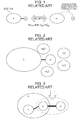
- FIG. 2 illustrates an example of a method for predicting pK a .
- pK a is defined as a value that is in proportion to a change ⁇ G in free energy as represented by Formula 2.
- FIG. 3 illustrates another example of a method for predicting pK a .
- a prediction technique illustrated in FIG. 3 only the physical properties related to a hydrogen H and an atom X of a molecule A (hereinafter referred to as atom H-X) are utilized.
- atom H-X an atom X of a molecule A
- pK a is predicted on the basis of an estimated formula (Formula 3) in which the physical properties related to the atom H-X (d 1 , d 2 ,..., d N ) are used as variables.
- This embodiment provides a prediction apparatus and prediction method in which an index based on the electron density of an interatomic bond is used to enable fast and highly accurate prediction of the acid dissociation constant pK a of a molecule regardless of the types of molecules.
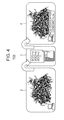
- FIG. 4 illustrates a configuration example of a molecular design support system according to the embodiment.
- a molecular design support system 1000 includes a molecular structure design unit 2, an acid dissociation constant prediction unit 3, and a prediction result display unit 4.
- the combination of the molecular structure design unit 2, acid dissociation constant prediction unit 3, and prediction result display unit 4, namely, the molecular design support system 1000 may be in the form of one computer apparatus.
- the molecular structure design unit 2, the acid dissociation constant prediction unit 3, and the prediction result display unit 4 may be in the form of independent computer apparatuses.
- the combination of the acid dissociation constant prediction unit 3 and the prediction result display unit 4 may be in the form of one computer apparatus; such a computer apparatus corresponds to an acid dissociation constant prediction apparatus.
- a computer apparatus that serves as the molecular design support system 1000 has, for example, a hardware configuration illustrated in FIG. 5.
- FIG. 5 illustrates the hardware configuration of a computer apparatus.
- a computer apparatus 100 includes a central processing unit (CPU) 11, a main memory 12, an auxiliary memory 13, an input device 14, a display 15, an output device 16, a communication interface I/F 17, and a drive 18 and is connected to a bus B.
- CPU central processing unit
- the CPU 11 controls the computer apparatus 100 on the basis of a program stored in the main memory 12.
- An example of the main memory 12 is a random access memory (RAM), and the main memory 12 stores, for instance, a program that is to be executed by the CPU 11, data used for processing by the CPU 11, and data obtained through processing by the CPU 11. Part of the storage area of the main memory 12 is allocated to a working area used for processing by the CPU 11.
- a hard disk drive is used as the auxiliary memory 13 and stores data such as programs used for carrying out various processing. Some of the programs stored in the auxiliary memory 13 are loaded by the main memory 12 and executed by the CPU 11, thereby carrying out various processing.
- a memory 130 includes the main memory 12 and/or the auxiliary memory 13.
- the input device 14 includes, for example, a mouse and a keyboard and is handled by users for inputting a variety of information used for processing by the computer apparatus 100.
- the output device 16 includes, for instance, a printer and serves to output a variety of information in response to instructions from users.
- the communication I/F 17 is connected to, for example, internet or local area network (LAN) and serves to control communication with an external apparatus. The communication by the communication I/F 17 is not limited to wireless communication or wire communication.
- a program used for processing by the computer apparatus 100 is provided for the computer apparatus 100 from a memory medium 19 such as a compact disc read-only memory (CD-ROM).
- a memory medium 19 such as a compact disc read-only memory (CD-ROM).
- CD-ROM compact disc read-only memory
- the drive 18 reads the program from the memory medium 19, and the read program is installed in the auxiliary memory 13 through the bus B.
- the CPU 11 starts processing on the basis of the program.
- the medium storing a program is not limited to CD-ROMs, and any computer-readable medium may be used. Examples of a computer-readable memory medium other than CD-ROMs include digital versatile discs (DVDs), portable memory media such as a USB memory, and semiconductor memories such as a flash memory.
- the molecular design support system 1000 includes the molecular structure design unit 2, the acid dissociation constant prediction unit 3, and the prediction result display unit 4 as illustrated in FIG. 6 .
- the memory 130 stores molecular structure data 71, electron density data (D) 72, index value-containing data (BD) 73, element pair-containing data (AD) 74, index value group-containing data (GD) 75, and a pK a prediction result 76.
- the molecular structure design unit 2 helps users to design a molecular structure.
- the datum of the molecular structure designed by users (hereinafter referred to as molecular structure data 71) is stored in the memory 130.
- the molecular structure data 71 include the coordinates of atoms constituting a molecule and information of a dissociated proton.
- the acid dissociation constant prediction unit 3 highly accurately predicts an acid dissociation constant pK a and includes a data determination part 31, an electron density calculation part 32, an index calculation part 33, and a pK a prediction part 34.
- atom pairs of the molecular structure designed by users are formed with reference to the molecular structure data 71 and stored in the element pair-containing data (AD) 74 of the memory 130.
- AD element pair-containing data
- the electron density calculation part 32 calculates the molecular orbital and calculates the electron density of the entire molecule.
- Electron density data (D) that represents the calculated electron density is stored in the memory 130.
- a target proton H and a molecule A are illustrated; in the molecule A, X is an atom directly bonded to the target proton H, and Y is an atom which is not bonded to the target proton H.
- the atom Y may be multiple.
- Atom pairs formed in the calculation of electron density are classified into the following pair types: a pair type PT1 " H-X", namely, an atom pair consisting of the target proton H and the atom X directly bonded to the target proton H; a pair type PT2 "H-Y” (all atoms other than the atom X contained in the molecule A), namely, an atom pair consisting of the target proton H and the atom Y other than the atom X directly bonded to the target proton H; a pair type PT 3 " X-Y”, namely, an atom pair including the atom X directly bonded to the target proton H, not including the target proton H; and a pair type PT 4 that is an atom pair other than the pair types PT1 to PT 3.
- a pair type PT1 " H-X namely, an atom pair consisting of the target proton H and the atom X directly bonded to the target proton H
- the index calculation part 33 calculates an index value that represents bond strength.
- an index value (Formula 4) is determined from the electron density (D ab ) (Formula 5) between atoms a and b with reference to I. Mayer, "Bond Order and Valence Indices: A Personal Account", Journal of Computational Chemistry Special Issue, Vol. 28, No. 1, Wiley InterScience, Wiley Periodicals, Inc., pp. 204-221, 2007 .
- an atom pair is represented by atoms a and b.
- the pK a prediction part 34 weights the index values of atom pairs related to the target proton H and atom X directly bonded to the target proton H in terms of the types of the element pairs.
- the pK a prediction part 34 determines a pK a estimated formula (Formula 6) on the basis of the index value group-containing data (GD) 75.
- index values (B) are derived from a data set including the element pair-identifying data (A) and atom pair-identifying data (N) of atom pairs included in groups based on the index value group-containing data (GD) 75, thereby determining the pK a estimated formula (Formula 6).
- the prediction result display unit 4 serves to display result of the prediction of pK a by the pK a prediction part 34 on the display 15.
- the index value-containing data (BD) 73 has a data structure storing the index values of interatomic bonds, which have been determined on the basis of electron density, and includes an index value (B), atom pair-identifying data (N), element pair-identifying data (A), and a coefficient flag (F).
- the element pair-containing data (AD) 74 has a data structure storing a coefficient value specific to two elements concerning bonding in intermolecular bonds and includes a coefficient value (C[F]), element pair-identifying data (A), and atom pair-identifying data (N).
- the coefficient value (C[F]) is determined for each element pair in advance.
- the index value group-containing data (GD) 75 has a data structure storing the groups of atom pairs related to the target proton H and the atom X directly bonded to the target proton H and includes group-identifying data (G) and atom pair-identifying data (N).
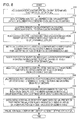
- FIG. 8 illustrates an example of a process for predicting an acid dissociation constant.
- the acid dissociation constant prediction unit 3 determines the atom pair-identifying data (N) of the element pair-containing data (AD) to all atom pairs (step S52).
- the electron density calculation part 32 calculates a molecular orbital to obtain electron density (D) (step S53).
- the index calculation part 33 calculates index values from the electron density (D) to determine the index value data (B) of the index value-containing data (BD) (step S54).
- the index calculation part 33 classifies the atom pairs into corresponding element pairs and allocates numbers to the element pair-identifying data (A) of the index value-containing data (BD) (step S55).
- the index calculation part 33 determines the hydrogen having the largest electric charge as the target proton H for obtaining pK a (step S56).
- the index calculation part 33 classifies the atom pairs into corresponding pair types to define the coefficient flag (F) of the index value-containing data (BD) (step S57).
- the pK a prediction part 34 weights atom pairs including the target proton H or the atom X directly bonded to the target proton H and then groups the weighted atom pairs (step S58). Atom pairs weighted into the same category are classified into the same group.
- the pK a prediction part 34 assigns group numbers to the individual index value groups (step S59).
- the group numbers are determined as the index value group-identifying data (G) of the index value group-containing data (GD).
- the pK a prediction part 34 predicts pK a from the sum of products (Formula 6) of the index values (B) of the atom pairs and the coefficient values (C) of the element pairs (step S60).
- Result of the prediction of pK a is displayed on the display 15 by the prediction result display unit 4 (step S61).
- the image of the molecular structure including the target proton H may be displayed on the display 15.
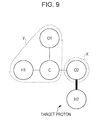
- FIG. 9 illustrates the molecular structure of formic acid. Circles represent atomic particles, and the identification names of atoms C, O1, O2, H1, and H2 are given inside the circles to uniquely identify the atoms in the molecular structure.
- the atom “H2" is the target proton
- the atom “O2” directly bonded to the target proton is an atom X
- the atoms "C", “O1” ,and "H1" not bonded to the target proton H are atoms Y.
- the molecular structure data 71 that represents the molecular structure of formic acid is stored in the memory 130.
- the data decision part 31 creates atom pairs from the molecular structure of formic acid on the basis of the molecular structure data 71.
- atom pair-identifying data N (N is an integer) is allocated.
- the atom pairs are identifiable in the index value-containing data BD[N]. Examples of the atom pairs found in the molecular structure of formic acid in FIG. 9 and allocation of the atom pair-identifying data N are as follows:
- the data decision part 31 extracts element pairs; in this case, different atom pairs which consist of the same elements are regarded as the same element pair.
- the element pair-identifying data A (A is an integer) is allocated.
- the element pairs are identifiable in the element pair-containing data AD [A]. Examples of the element pairs identified in the atom pairs in the molecular structure of formic acid in FIG. 9 and allocation of the element pair-identifying data A are as follows:
- AD 1 - > N 1 1
- AD 1 - > N 2 2
- AD 2 - > N 1 3
- AD 2 - > N 2 4
- AD 3 - > N 1 5
- AD 4 - > N 1 6
- AD 4 - > N 2 7
- AD 4 - > N 3 8
- AD 4 - > N 4 9
- AD 5 - > N 1 10
- the electron density calculation part 32 calculates a molecular orbital and calculates the electron density of each atom pair by Formula 5.
- the index calculation part 33 obtains the index value B of each atom pair from the obtained electron density by Formula 4.
- the electron density calculation part 32 allocates the element pair-identifying data (A) of the atom pairs to the index value-containing data (BD) 73.
- the electron density calculation part 32 determines the pair type of each atom pair.
- the pK a prediction part 34 groups atom pairs including the atom "H2" defined as the target proton (target proton itself) or the atom "O2" (atom directly connected to target proton) in terms of weighting.
- the categories of the weighting are determined.
- the atom pairs of the same pair type are weighted into the same category. In this case, the atom pairs of the coefficient flag (F) "4" are not considered.
- the atom pairs are classified into the categories of weighting as follows:
- the pK a prediction part 34 classifies the atom pairs grouped in terms of weighting into index value groups.
- the target proton or the atom X directly bonded to the target proton is paired with the element corresponding to the atom combined therewith (hereinafter referred to as index value pair), thereby grouping the weighted atom pairs.
- the weighted atom pairs correspond to the atom pairs having the coefficient flags (F) "1", "2", and "3".
- Identification data is allocated to each index value group, for example, as follows:
- the pK a prediction part 34 multiplies the index value (B) of the atom pair (O2-X, H2-X, or O2-H2) by the coefficient value (C[F]) of the element pair in each index value group GD [G].
- the coefficient (C[F]) of the element pair is specified by the number "1", “2", or "3" of the coefficient flag (F).
- the index value group "1" has one atom pair.
- the atom pair “O1-O2” has atom pair-identifying data "5", and the element pair “O-O” thereof has element pair-identifying data "3".
- the coefficient flag that specifies the weighting of the atom pair "O1-O2" is "3".
- the index value group "2" has two atom pairs.
- the index value group "3" has one atom pair.
- the index value group "4" has two atom pairs.
- the index value group "5" has one atom pair.
- the index value group "6" has one atom pair.
- N 1 4
- BD 4 - > A 2
- BD 4 - > F 2 therefore, AD 2 - > C 2 ⁇ BD 4 - > B accordingly, C C - H 2 ⁇ B C - H ⁇ 2 .
- FIG. 10A illustrates results of analysis by the technique disclosed in Jahanbakhsh Ghasemi, Saadi Saaidpour, Steven D. Brown, "QSPRstudy for estimation of acidity constants of some aromatic acids derivatives using multiple linear regression (MLR) analysis", Journal of Molecular Structure, THEOCHEM, pp. 27-32, 2007 .
- MLR multiple linear regression
- FIG. 10B illustrates results of analysis by the embodiment.
- electron density is defined by Austin model 1 (AM1) disclosed in Jahanbakhsh Ghasemi, Saadi Saaidpour, Steven D. Brown, "QSPRstudy for estimation of acidity constants of some aromatic acids derivatives using multiple linear regression (MLR) analysis", Journal of Molecular Structure, THEOCHEM, pp. 27-32, 2007 ; and index values are calculated on the basis of Index of Wiberg (Formula described above) disclosed in I. Mayer, “Bond Order and Valence Indices: A Personal Account", Journal of Computational Chemistry Special Issue, Vol. 28, No. 1, Wiley InterScience, Wiley Periodicals, Inc., pp. 204-221, 2007 .
- AM1 Austin model 1
- MLR linear regression
- a correlation R 2 is approximately 0.89 in the related art as illustrated in FIG. 10A ; in contrast, a correlation R 2 is approximately 0.99 in the embodiment as illustrated in FIG. 10B , which elucidates that the embodiment may provide highly accurate results even through a calculation that is as fast as the calculation by the technique disclosed in Jahanbakhsh Ghasemi, Saadi Saaidpour, Steven D. Brown, "QSPRstudy for prediction of acidity constants of some aromatic acids derivatives using multiple linear regression (MLR) analysis", Journal of Molecular Structure, THEOCHEM, pp. 27-32, 2007 .
- MLR multiple linear regression
- an index for example, bond order
- pKa acid dissociation constant
Landscapes
- Engineering & Computer Science (AREA)
- Theoretical Computer Science (AREA)
- Computing Systems (AREA)
- Life Sciences & Earth Sciences (AREA)
- Chemical & Material Sciences (AREA)
- Bioinformatics & Cheminformatics (AREA)
- Bioinformatics & Computational Biology (AREA)
- Crystallography & Structural Chemistry (AREA)
- Physics & Mathematics (AREA)
- Analytical Chemistry (AREA)
- Chemical Kinetics & Catalysis (AREA)
- Health & Medical Sciences (AREA)
- General Health & Medical Sciences (AREA)
- Spectroscopy & Molecular Physics (AREA)
- Investigating Or Analyzing Non-Biological Materials By The Use Of Chemical Means (AREA)
- Information Retrieval, Db Structures And Fs Structures Therefor (AREA)
- Management, Administration, Business Operations System, And Electronic Commerce (AREA)
- Other Investigation Or Analysis Of Materials By Electrical Means (AREA)
Abstract
Description
- The embodiment discussed herein is related to prediction of an acid dissociation constant.
- pKa is a constant that represents acid dissociation equilibrium (acidity) and used as, for example, an index for determining the presence of a proton (H+) that is important in a chemical reaction in biomolecules.
- A variety of techniques for predicting pKa have been therefore studied. Such techniques are broadly classified into two types: a technique based on the thermodynamic theory and a technique involving approximation by a function of a physical property that is a variable.
- The former technique enables theoretical calculation, and the latter technique enables generally fast prediction.
- In the technique based on the thermodynamic theory, however, not only the prediction is greatly affected by the number and position of water molecules located near a target molecule, but also highly accurate calculation is demanded to obtain good result (see Junming Ho, Michelle L. Coote, "A universal approach for continuum solvent pKa calculations: are we there yet?", Theor Chem Acc, pp.3-21, 2010). Fast prediction has been therefore still under development. Thus, such a technique is impractical for analysis of macromolecules and screening of mass data.
- In the technique involving approximation by a function of a physical property that is a variable, an approach of using a variety of physical properties has been made to enable highly accurate prediction. In an example of such an approach, the electrical charges of a hydrogen atom (H) dissociated into a proton and oxygen atom (O) directly bonded to H and the distance therebetween are used as variables (see Jahanbakhsh Ghasemi, Saadi Saaidpour, Steven D. Brown, "QSPRstudy for estimation of acidity constants of some aromatic acids derivatives using multiple linear regression (MLR) analysis", Journal of Molecular Structure, THEOCHEM, pp. 27-32, 2007). In the case of using such variables, however, another function expression is entailed on the basis of, for instance, the type of the acid of a target molecule; in addition, all function expressions have not given highly accurate results (see Mario J. Citra, "ESTIMATING THE pKa OF PHENOLS, CARBOXYLIC ACIDS AND ALCOHOLS FROM SEMI-EMPIRICAL QUANTUM CHEMICAL METHODS", Chemosphere, Vol. 38, No. 1, pp. 191-206, 1999). Hence, such a technique is unsuitable for analysis of novel molecules.
- It is desirable to enable the predicted value of pKa to be applied to analysis of macromolecules, screening of mass data, and analysis of novel molecules.
- According to an aspect of the invention, an apparatus for predicting an acid dissociation constant, includes: a memory configured to store index value-containing data, element pair-containing data, and index value group-containing data, the index value-containing data containing an index value of an interatomic bond of a target molecule determined on the basis of the value of the electron density of the interatomic bond, the element pair-containing data containing a coefficient value specific to two elements that serves for the interatomic bond, the index value group-containing data entirely covering the target molecule and being based on the index value-containing data and the element pair-containing data; and an acid dissociation constant prediction unit that predicts an acid dissociation constant from the index value group-containing data and the element pair-containing data.
- The advantages of the invention will be realized and attained by means of the elements and combinations particularly pointed out in the claims.
- It is to be understood that both the foregoing general description and the following detailed description are exemplary and explanatory and are not restrictive of the invention, as claimed.
-
-
FIG. 1 illustrates an acid dissociation constant pKa; -
FIG. 2 illustrates an example of a method for predicting pKa; -
FIG. 3 illustrates another example of a method for predicting pKa; -
FIG. 4 illustrates a configuration example of a molecular design support system according to an embodiment; -
FIG. 5 illustrates the hardware configuration of a computer apparatus; -
FIG. 6 illustrates an example of the functional configuration of the molecular design support system; -
FIG. 7 illustrates a pair type; -
FIG. 8 illustrates an example of a process for predicting an acid dissociation constant; -
FIG. 9 illustrates the molecular structure of formic acid; -
FIG. 10A illustrates results of analysis by related art; and -
FIG. 10B illustrates results of analysis by the embodiment. - An embodiment will hereinafter be described with reference to the drawings. First of all, a typical method for predicting an acid dissociation constant pKa will now be described.
-
FIG. 1 illustrates an acid dissociation constant pKa. pKa is a constant that represents acid dissociation equilibrium as illustrated inFIG. 1 and represented by Formula 1.
pKa serves as an index for determining the presence of a proton (H+) that is important in a chemical reaction in biomolecules. - In a known prediction technique, pKa is obtained from a definition equation.
FIG. 2 illustrates an example of a method for predicting pKa. In the prediction technique by a definition equation, pKa is defined as a value that is in proportion to a change ΔG in free energy as represented byFormula 2.
- In such a prediction technique, a prediction result depends on the number and position of water molecules located near an acid AH illustrated in
FIG. 2 , and highly accurate calculation is therefore demanded. Hence, such a technique is unsuitable for analysis of macromolecules and screening of mass data. -
FIG. 3 illustrates another example of a method for predicting pKa. In a prediction technique illustrated inFIG. 3 , only the physical properties related to a hydrogen H and an atom X of a molecule A (hereinafter referred to as atom H-X) are utilized. In particular, pKa is predicted on the basis of an estimated formula (Formula 3) in which the physical properties related to the atom H-X (d1, d2,..., dN) are used as variables.
In this prediction method, however, an estimated formula greatly varies depending on the types of molecules; hence, such a prediction technique is impractical for analysis of novel molecules and prediction of pKa in a multistep oxidation reaction. - This embodiment provides a prediction apparatus and prediction method in which an index based on the electron density of an interatomic bond is used to enable fast and highly accurate prediction of the acid dissociation constant pKa of a molecule regardless of the types of molecules.
-
FIG. 4 illustrates a configuration example of a molecular design support system according to the embodiment. With reference toFIG. 4 , a moleculardesign support system 1000 includes a molecularstructure design unit 2, an acid dissociationconstant prediction unit 3, and a predictionresult display unit 4. - The combination of the molecular
structure design unit 2, acid dissociationconstant prediction unit 3, and predictionresult display unit 4, namely, the moleculardesign support system 1000 may be in the form of one computer apparatus. Alternatively, the molecularstructure design unit 2, the acid dissociationconstant prediction unit 3, and the predictionresult display unit 4 may be in the form of independent computer apparatuses. Furthermore, the combination of the acid dissociationconstant prediction unit 3 and the predictionresult display unit 4 may be in the form of one computer apparatus; such a computer apparatus corresponds to an acid dissociation constant prediction apparatus. - A computer apparatus that serves as the molecular
design support system 1000 has, for example, a hardware configuration illustrated inFIG. 5. FIG. 5 illustrates the hardware configuration of a computer apparatus. With reference toFIG. 5 , acomputer apparatus 100 includes a central processing unit (CPU) 11, amain memory 12, anauxiliary memory 13, aninput device 14, adisplay 15, anoutput device 16, a communication interface I/F 17, and a drive 18 and is connected to a bus B. - The
CPU 11 controls thecomputer apparatus 100 on the basis of a program stored in themain memory 12. An example of themain memory 12 is a random access memory (RAM), and themain memory 12 stores, for instance, a program that is to be executed by theCPU 11, data used for processing by theCPU 11, and data obtained through processing by theCPU 11. Part of the storage area of themain memory 12 is allocated to a working area used for processing by theCPU 11. - A hard disk drive is used as the
auxiliary memory 13 and stores data such as programs used for carrying out various processing. Some of the programs stored in theauxiliary memory 13 are loaded by themain memory 12 and executed by theCPU 11, thereby carrying out various processing. Amemory 130 includes themain memory 12 and/or theauxiliary memory 13. - The
input device 14 includes, for example, a mouse and a keyboard and is handled by users for inputting a variety of information used for processing by thecomputer apparatus 100. On thedisplay 15, a variety of useful information is displayed under control of theCPU 11. Theoutput device 16 includes, for instance, a printer and serves to output a variety of information in response to instructions from users. The communication I/F 17 is connected to, for example, internet or local area network (LAN) and serves to control communication with an external apparatus. The communication by the communication I/F 17 is not limited to wireless communication or wire communication. - A program used for processing by the
computer apparatus 100 is provided for thecomputer apparatus 100 from amemory medium 19 such as a compact disc read-only memory (CD-ROM). In particular, once thememory medium 19 storing a program is placed on the drive 18, the drive 18 reads the program from thememory medium 19, and the read program is installed in theauxiliary memory 13 through the bus B. When the program installed in theauxiliary memory 13 is started, theCPU 11 starts processing on the basis of the program. The medium storing a program is not limited to CD-ROMs, and any computer-readable medium may be used. Examples of a computer-readable memory medium other than CD-ROMs include digital versatile discs (DVDs), portable memory media such as a USB memory, and semiconductor memories such as a flash memory.
FIG. 6 illustrates an example of the functional configuration of a molecular design support system. The moleculardesign support system 1000 includes the molecularstructure design unit 2, the acid dissociationconstant prediction unit 3, and the predictionresult display unit 4 as illustrated inFIG. 6 . Thememory 130 storesmolecular structure data 71, electron density data (D) 72, index value-containing data (BD) 73, element pair-containing data (AD) 74, index value group-containing data (GD) 75, and a pKa prediction result 76. - The molecular
structure design unit 2 helps users to design a molecular structure. The datum of the molecular structure designed by users (hereinafter referred to as molecular structure data 71) is stored in thememory 130. Themolecular structure data 71 include the coordinates of atoms constituting a molecule and information of a dissociated proton. - The acid dissociation
constant prediction unit 3 highly accurately predicts an acid dissociation constant pKa and includes adata determination part 31, an electrondensity calculation part 32, anindex calculation part 33, and a pKa prediction part 34. - In the
data determination part 31, atom pairs of the molecular structure designed by users are formed with reference to themolecular structure data 71 and stored in the element pair-containing data (AD) 74 of thememory 130. - The electron
density calculation part 32 calculates the molecular orbital and calculates the electron density of the entire molecule. Electron density data (D) that represents the calculated electron density is stored in thememory 130. - In an example of a simple molecular structure in
FIG. 7 , a target proton H and a molecule A are illustrated; in the molecule A, X is an atom directly bonded to the target proton H, and Y is an atom which is not bonded to the target proton H. The atom Y may be multiple. Atom pairs formed in the calculation of electron density are classified into the following pair types: a pair type PT1 " H-X", namely, an atom pair consisting of the target proton H and the atom X directly bonded to the target proton H; a pair type PT2 "H-Y" (all atoms other than the atom X contained in the molecule A), namely, an atom pair consisting of the target proton H and the atom Y other than the atom X directly bonded to the target proton H; apair type PT 3 " X-Y", namely, an atom pair including the atom X directly bonded to the target proton H, not including the target proton H; and apair type PT 4 that is an atom pair other than the pair types PT1 toPT 3. - On the basis of the electron density obtained by the electron
density calculation part 32, theindex calculation part 33 calculates an index value that represents bond strength. - Through the processing by the electron
density calculation part 32 and theindex calculation part 33, an index value (Formula 4) is determined from the electron density (Dab) (Formula 5) between atoms a and b with reference to I. Mayer, "Bond Order and Valence Indices: A Personal Account", Journal of Computational Chemistry Special Issue, Vol. 28, No. 1, Wiley InterScience, Wiley Periodicals, Inc., pp. 204-221, 2007.
where
InFormula 4, an atom pair is represented by atoms a and b. - The pKa prediction part 34 weights the index values of atom pairs related to the target proton H and atom X directly bonded to the target proton H in terms of the types of the element pairs. The pKa prediction part 34 determines a pKa estimated formula (Formula 6) on the basis of the index value group-containing data (GD) 75.

Weighed index values (B) are derived from a data set including the element pair-identifying data (A) and atom pair-identifying data (N) of atom pairs included in groups based on the index value group-containing data (GD) 75, thereby determining the pKa estimated formula (Formula 6). - The prediction
result display unit 4 serves to display result of the prediction of pKa by the pKa prediction part 34 on thedisplay 15. - The index value-containing data (BD) 73 has a data structure storing the index values of interatomic bonds, which have been determined on the basis of electron density, and includes an index value (B), atom pair-identifying data (N), element pair-identifying data (A), and a coefficient flag (F).
- The element pair-containing data (AD) 74 has a data structure storing a coefficient value specific to two elements concerning bonding in intermolecular bonds and includes a coefficient value (C[F]), element pair-identifying data (A), and atom pair-identifying data (N). The coefficient value (C[F]) is determined for each element pair in advance.
- The index value group-containing data (GD) 75 has a data structure storing the groups of atom pairs related to the target proton H and the atom X directly bonded to the target proton H and includes group-identifying data (G) and atom pair-identifying data (N).
- The items related to weighting of index values based on such data structures are herein specified as follows:
- Index value group-containing data GD of group number G: GD[G]
- Atom pair-identifying data N of GD[G]: GD[G]->N
- Index value-containing data BD to which the group number GD[G]->N belongs:
- BD[GD[G]->N]
- Index value data B of BD[GD[G]->N]: BD[GD[G]->N]->B
- Coefficient flag F of BD[GD[G]->N]: BD[GD[G]->N]->F
- Element pair-identifying data belonging to BD[GD[G]->N]: BD[GD[G]->N]->A Element pair-containing data AD to which BD[GD[G]->N]->A belongs:
- AD[BD[GD[G]->N]->A]
- Coefficient value data C of AD[BD[GD[G]->N]->A]: AD[BD[GD[G]->N]->A]->C[BD[GD[G]->N]->F]
- Index value data B of BD[GD[G]->N]: BD[GD[G]->N]->B
- Hence, the weighting of an index value based on a coefficient value is obtained by the following formula: AD[BD[GD[G]->N]->A]->C[BD[GD[G]->N]->F] ×
- BD[GD[G]->N]->B.
- An example of a process for predicting an acid dissociation constant according to the embodiment will now be described with reference to
FIG. 8. FIG. 8 illustrates an example of a process for predicting an acid dissociation constant. With reference toFIG. 8 , in the acid dissociationconstant prediction unit 3, a flag is determined for calculation of pKa and starts the process for predicting an acid dissociation constant (step S51). In the acid dissociationconstant prediction unit 3, thedata determination part 31 determines the atom pair-identifying data (N) of the element pair-containing data (AD) to all atom pairs (step S52). The electrondensity calculation part 32 calculates a molecular orbital to obtain electron density (D) (step S53). - Then, the
index calculation part 33 calculates index values from the electron density (D) to determine the index value data (B) of the index value-containing data (BD) (step S54). Theindex calculation part 33 classifies the atom pairs into corresponding element pairs and allocates numbers to the element pair-identifying data (A) of the index value-containing data (BD) (step S55). - On the basis of the electron density (D), the
index calculation part 33 determines the hydrogen having the largest electric charge as the target proton H for obtaining pKa (step S56). Theindex calculation part 33 classifies the atom pairs into corresponding pair types to define the coefficient flag (F) of the index value-containing data (BD) (step S57). - The pKa prediction part 34 weights atom pairs including the target proton H or the atom X directly bonded to the target proton H and then groups the weighted atom pairs (step S58). Atom pairs weighted into the same category are classified into the same group.
- The pKa prediction part 34 assigns group numbers to the individual index value groups (step S59). The group numbers are determined as the index value group-identifying data (G) of the index value group-containing data (GD).
- On the basis of all index value group-containing data (GD), the pKa prediction part 34 predicts pKa from the sum of products (Formula 6) of the index values (B) of the atom pairs and the coefficient values (C) of the element pairs (step S60).
- Result of the prediction of pKa is displayed on the
display 15 by the prediction result display unit 4 (step S61). In the displaying of the result of the prediction of pKa on thedisplay 15, the image of the molecular structure including the target proton H may be displayed on thedisplay 15. - Specific examples of the above-mentioned process for predicting an acid dissociation constant will now be described, in which formic acid is employed as an example.
FIG. 9 illustrates the molecular structure of formic acid. Circles represent atomic particles, and the identification names of atoms C, O1, O2, H1, and H2 are given inside the circles to uniquely identify the atoms in the molecular structure. - The atom "H2" is the target proton, the atom "O2" directly bonded to the target proton is an atom X, and the atoms "C", "O1" ,and "H1" not bonded to the target proton H are atoms Y.
- The
molecular structure data 71 that represents the molecular structure of formic acid is stored in thememory 130. - The
data decision part 31 creates atom pairs from the molecular structure of formic acid on the basis of themolecular structure data 71. To each atom pair found in the molecular structure of formic acid, atom pair-identifying data N (N is an integer) is allocated. The atom pairs are identifiable in the index value-containing data BD[N]. Examples of the atom pairs found in the molecular structure of formic acid inFIG. 9 and allocation of the atom pair-identifying data N are as follows: - C-O1: 1
- C-O2: 2
- C-H1: 3
- C-H2: 4
- O1-O2: 5
- O1-H1: 6
- O1-H2: 7
- O2-H1: 8
- O2-H2: 9
- H1-H2: 10
- From the identified atom pairs, the
data decision part 31 extracts element pairs; in this case, different atom pairs which consist of the same elements are regarded as the same element pair. To each element pair identified through the extraction, the element pair-identifying data A (A is an integer) is allocated. The element pairs are identifiable in the element pair-containing data AD [A]. Examples of the element pairs identified in the atom pairs in the molecular structure of formic acid inFIG. 9 and allocation of the element pair-identifying data A are as follows: - C-O: 1
- C-H : 2
- O-O: 3
- O-H: 4
- H-H : 5
- In the element pairs and atom pairs which have been identified as described above, the element pairs and the atom pairs corresponding thereto are registered in the form of AD[A]->N; an example thereof in the molecular structure of formic acid in
FIG. 9 is as follows:


- Then, the electron
density calculation part 32 calculates a molecular orbital and calculates the electron density of each atom pair byFormula 5. Theindex calculation part 33 obtains the index value B of each atom pair from the obtained electron density byFormula 4. - The index values B of the atom pairs are determined in the index value-containing data (BD) 73 as follows:





- The electron
density calculation part 32 allocates the element pair-identifying data (A) of the atom pairs to the index value-containing data (BD) 73. - The element pair-identifying data (A) of the atom pairs is allocated to the index value-containing data (BD) 73 as follows:

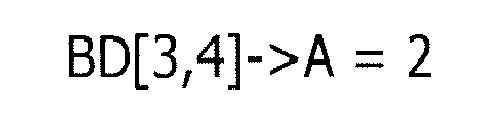


- The electron
density calculation part 32 determines the pair type of each atom pair. - In particular, the coefficient flags (F) of the index value-containing data (BD) 73 are determined as follows:


- In order to consider the electron density of the entire molecule, the pKa prediction part 34 groups atom pairs including the atom "H2" defined as the target proton (target proton itself) or the atom "O2" (atom directly connected to target proton) in terms of weighting. With reference to the coefficient flags (F) that represent the pair types, the categories of the weighting are determined. The atom pairs of the same pair type are weighted into the same category. In this case, the atom pairs of the coefficient flag (F) "4" are not considered.
- The atom pairs are classified into the categories of weighting as follows:
- Weighting 1: O2-O1, O2-H1, and O2-C
- Weighting 2: H2-O1, H2-H1, and H2-C
- Weighting 3: O2-H2
- The pKa prediction part 34 classifies the atom pairs grouped in terms of weighting into index value groups. In the index value groups, the target proton or the atom X directly bonded to the target proton is paired with the element corresponding to the atom combined therewith (hereinafter referred to as index value pair), thereby grouping the weighted atom pairs. The weighted atom pairs correspond to the atom pairs having the coefficient flags (F) "1", "2", and "3".
- Identification data is allocated to each index value group, for example, as follows:
- O2-O: 1
- O2-H: 2
- O2-C: 3
- H2-O: 4
- H2-H: 5
- H2-C: 6
- Then, the pKa prediction part 34 multiplies the index value (B) of the atom pair (O2-X, H2-X, or O2-H2) by the coefficient value (C[F]) of the element pair in each index value group GD [G]. The coefficient (C[F]) of the element pair is specified by the number "1", "2", or "3" of the coefficient flag (F).
- The index value group "1" has one atom pair. The atom pair "O1-O2" has atom pair-identifying data "5", and the element pair "O-O" thereof has element pair-identifying data "3". In addition, the coefficient flag that specifies the weighting of the atom pair "O1-O2" is "3".
- In particular, the following relationship is obtained:

therefore,
accordingly,
- Similarly, the index value group "2" has two atom pairs. The following relationships are obtained:

therefore,
accordingly,

therefore
accordingly
- The index value group "3" has one atom pair. In particular, the following relationship is obtained:

therefore,
accordingly,
- The index value group "4" has two atom pairs. In particular, the following relationships are obtained:

therefore,
accordingly,

therefore,
accordingly,
- The index value group "5" has one atom pair. In particular, the following relationship is obtained:

therefore,
accordingly,
- The index value group "6" has one atom pair. In particular, the following relationship is obtained:

therefore,
accordingly,
- The above-mentioned results of the multiplication are added together.

This process enables prediction of an acid dissociation constant pKa based on O2-H2 of formic acid. - A process for predicting an acid dissociation constant according to the embodiment has been described with reference to an example of the molecular structure of formic acid in
FIG. 9 ; furthermore, the inventor has obtained correlations between actual values and predicted values of 103 molecules that are analysis subjects.FIGs. 10A and 10B illustrate effects of the embodiment.FIG. 10A illustrates results of analysis by the technique disclosed in Jahanbakhsh Ghasemi, Saadi Saaidpour, Steven D. Brown, "QSPRstudy for estimation of acidity constants of some aromatic acids derivatives using multiple linear regression (MLR) analysis", Journal of Molecular Structure, THEOCHEM, pp. 27-32, 2007. In the analysis inFIG. 10A , the relationship of x = 121.4191 - 240.451 pchgH - 43.4984 bl(O-H) + 24.30716 pchgO is provided. -
FIG. 10B illustrates results of analysis by the embodiment. InFIG. 10B , electron density is defined by Austin model 1 (AM1) disclosed in Jahanbakhsh Ghasemi, Saadi Saaidpour, Steven D. Brown, "QSPRstudy for estimation of acidity constants of some aromatic acids derivatives using multiple linear regression (MLR) analysis", Journal of Molecular Structure, THEOCHEM, pp. 27-32, 2007; and index values are calculated on the basis of Index of Wiberg (Formula described above) disclosed in I. Mayer, "Bond Order and Valence Indices: A Personal Account", Journal of Computational Chemistry Special Issue, Vol. 28, No. 1, Wiley InterScience, Wiley Periodicals, Inc., pp. 204-221, 2007. - A correlation R2 is approximately 0.89 in the related art as illustrated in
FIG. 10A ; in contrast, a correlation R2 is approximately 0.99 in the embodiment as illustrated inFIG. 10B , which elucidates that the embodiment may provide highly accurate results even through a calculation that is as fast as the calculation by the technique disclosed in Jahanbakhsh Ghasemi, Saadi Saaidpour, Steven D. Brown, "QSPRstudy for prediction of acidity constants of some aromatic acids derivatives using multiple linear regression (MLR) analysis", Journal of Molecular Structure, THEOCHEM, pp. 27-32, 2007. - As described above, an index (for example, bond order) based on the electron density of an intermolecular bond is utilized, which enables fast and highly accurate prediction of the acid dissociation constant pKa of a target molecule regardless of the types of molecules.
Claims (7)
- An apparatus for predicting an acid dissociation constant, the apparatus comprising:a memory configured to store index value-containing data, element pair-containing data, and index value group-containing data, the index value-containing data containing an index value of an interatomic bond of a target molecule determined on the basis of the value of the electron density of the interatomic bond, the element pair-containing data containing a coefficient value specific to two elements that serves for the interatomic bond, the index value group-containing data entirely covering the target molecule and being based on the index value-containing data and the element pair-containing data; andan acid dissociation constant prediction unit that predicts an acid dissociation constant from the index value group-containing data and the element pair-containing data.
- The apparatus according to claim 1,
wherein the index value-containing data further includes
atom pair-identifying data that serves to identify the interatomic bond of the target molecule,
element pair-identifying data that serves to identify a combination of two elements included in the interatomic bond, and
coefficient flag data that serves to identify the type of an atom pair; and
the index value-containing data has a data structure that gives accessibility from the atom pair-identifying data to the index value and the element pair-distinguish data. - The apparatus according to claim 2,
wherein the element pair-containing data contains the coefficient value by the type of an atom pair;
the element pair-containing data further includes element pair-identifying data that serves to specify an element pair corresponding to the atom pair, and
atom pair-identifying data that holds the element pair corresponding to the atom pair and that is stored in the index value-containing data; and
the element pair-containing data has a data structure which gives accessibility from the element pair-identifying data to the coefficient value and the atom pair-identifying data. - The apparatus according to claim 3,
wherein interatomic bonds including a hydrogen atom corresponding to a proton dissociated in the target molecule, a first atom directly bonded to the proton, a second atom other than the first atom, or any combination thereof are grouped into a first atom pair including the proton, a second atom pair including the first atom, and a third atom pair including the proton and the first atom on the basis of the element pair-identifying data;
the index value group-containing data includes group-identifying data and the atom pair-identifying data, the group-identifying data serving to identify the groups; and
the atom pair-identifying data specifies an atom pair included in a group. - The apparatus according to claim 4,
wherein the acid dissociation constant prediction unit predicts an acid dissociation constant for each group from a function in which the coefficient value and that index value are used, the coefficient value being accessible from the element pair-identifying data of the index value-containing data, the index value being accessible from atom the pair-identifying data accessible from the element pair-identifying data. - A method for predicting an acid dissociation constant with a computer, the method comprising:predicting an acid dissociation coefficient based on a target proton of a molecular structure stored in a memory and an atom directly bonded to the target proton through the sum of product of an index value and a coefficient value given to an element pair corresponding to the atom pair, the index value being bond strength of an atom pair that includes any one of bonding to the target proton and bonding to the atom.
- A computer-readable storage medium that stores a program configured to allow a computer to carry out a process for predicting an acid dissociation coefficient based on a target proton of a molecular structure stored in a memory and an atom directly bonded to the target proton through the sum of product of an index value and a coefficient value given to an element pair corresponding to the atom pair, the index value being bond strength of an atom pair that includes any one of bonding to the target proton and bonding to the atom.
Applications Claiming Priority (1)
| Application Number | Priority Date | Filing Date | Title |
|---|---|---|---|
| JP2013026464A JP6089750B2 (en) | 2013-02-14 | 2013-02-14 | Acid dissociation constant prediction apparatus and method |
Publications (2)
| Publication Number | Publication Date |
|---|---|
| EP2767917A1 true EP2767917A1 (en) | 2014-08-20 |
| EP2767917B1 EP2767917B1 (en) | 2021-10-13 |
Family
ID=49680787
Family Applications (1)
| Application Number | Title | Priority Date | Filing Date |
|---|---|---|---|
| EP13190802.2A Not-in-force EP2767917B1 (en) | 2013-02-14 | 2013-10-30 | Apparatus, method, program, and storage medium for predicting acid dissociation constant |
Country Status (3)
| Country | Link |
|---|---|
| US (1) | US20140229148A1 (en) |
| EP (1) | EP2767917B1 (en) |
| JP (1) | JP6089750B2 (en) |
Families Citing this family (3)
| Publication number | Priority date | Publication date | Assignee | Title |
|---|---|---|---|---|
| EP3327603B1 (en) * | 2015-07-17 | 2021-08-11 | Fujitsu Limited | Method and device for calculating acid dissociation constant, and program |
| CN114300056B (en) * | 2021-12-06 | 2024-09-13 | 深圳晶泰科技有限公司 | Acidity coefficient determination method, acidity coefficient determination device, acidity coefficient determination equipment and computer-readable storage medium |
| WO2023102688A1 (en) * | 2021-12-06 | 2023-06-15 | 深圳晶泰科技有限公司 | Acidity coefficient determination method, apparatus and device, and computer-readable storage medium |
-
2013
- 2013-02-14 JP JP2013026464A patent/JP6089750B2/en not_active Expired - Fee Related
- 2013-10-30 EP EP13190802.2A patent/EP2767917B1/en not_active Not-in-force
- 2013-10-31 US US14/068,380 patent/US20140229148A1/en not_active Abandoned
Non-Patent Citations (11)
| Title |
|---|
| D. BROWN: "QSPRstudy for estimation of acidity constants of some aromatic acids derivatives using multiple linear regression (MLR) analysis", JOURNAL OF MOLECULAR STRUCTURE, THEOCHEM, 2007, pages 27 - 32 |
| GHASEMI J. ET AL: "QSPR study for estimation of acidity constants of some aromatic acids derivatives using multiple linear regression (MLR) analysis", JOURNAL OF MOLECULAR STRUCTURE (THEOCHEM), ELSEVIER SCIENCE PUBLISHERS B.V., AMSTERDAM, NL, vol. 805, no. 1-3, 1 February 2007 (2007-02-01), pages 27 - 32, XP005868316, ISSN: 0166-1280, DOI: 10.1016/J.THEOCHEM.2006.09.026 * |
| I. MAYER: "Journal of Computational Chemistry Special Issue", vol. 28, 2007, WILEY INTERSCIENCE, WILEY PERIODICALS, INC., article "Bond Order and Valence Indices: A Personal Account", pages: 204 - 221 |
| JAHANBAKHSH GHASEMI; SAADI SAAIDPOUR; STEVEN D. BROWN: "QSPRstudy for estimation of acidity constants of some aromatic acids derivatives using multiple linear regression (MLR) analysis", JOURNAL OF MOLECULAR STRUCTURE, THEOCHEM, 2007, pages 27 - 32 |
| JAHANBAKHSH GHASEMI; SAADI SAAIDPOUR; STEVEN D. BROWN: "QSPRstudy for prediction of acidity constants of some aromatic acids derivatives using multiple linear regression (MLR) analysis", JOURNAL OF MOLECULAR STRUCTURE, THEOCHEM, 2007, pages 27 - 32 |
| JUNMING HO; MICHELLE L. COOTE: "A universal approach for continuum solvent pKa calculations: are we there yet?", THEOR CHEM ACC, 2010, pages 3 - 21 |
| MARIO J: "ESTIMATING THE pKa OF PHENOLS,CARBOXYLIC ACIDS AND ALCOHOLS FROM SEMI-EMPIRICAL QUANTUMCHEMICAL METHODS", CHEMOSPHERE, vol. 38, no. 1, 1999, pages 191 - 206 |
| MAYER I.: "Bond order and valence indices: A personal account", JOURNAL OF COMPUTATIONAL CHEMISTRY, vol. 28, no. 1, 15 January 2007 (2007-01-15), pages 204 - 221, XP055120798, ISSN: 0192-8651, DOI: 10.1002/jcc.20494 * |
| SARACINO G. A. A. ET AL: "Absolute pKa determination for carboxylic acids using density functional theory and the polarizable continuum model", CHEMICAL PHYSICS LETTERS, vol. 373, no. 3-4, 1 May 2003 (2003-05-01), pages 411 - 415, XP055120939, ISSN: 0009-2614, DOI: 10.1016/S0009-2614(03)00607-9 * |
| SORIANO E. ET AL: "Computational determination of pKa values. A comparison of different theoretical approaches and a novel procedure", JOURNAL OF MOLECULAR STRUCTURE (THEOCHEM), ELSEVIER SCIENCE PUBLISHERS B.V., AMSTERDAM, NL, vol. 684, no. 1-3, 27 September 2004 (2004-09-27), pages 121 - 128, XP004645914, ISSN: 0166-1280, DOI: 10.1016/J.THEOCHEM.2004.06.041 * |
| STEVEN D. BROWN: "QSPRstudy for estimation of acidity constants of some aromatic acids derivatives using multiple linear regression (MLR) analysis", JOURNAL OF MOLECULAR STRUCTURE, THEOCHEM, 2007, pages 27 - 32 |
Also Published As
| Publication number | Publication date |
|---|---|
| EP2767917B1 (en) | 2021-10-13 |
| JP2014157020A (en) | 2014-08-28 |
| JP6089750B2 (en) | 2017-03-08 |
| US20140229148A1 (en) | 2014-08-14 |
Similar Documents
| Publication | Publication Date | Title |
|---|---|---|
| Rudzinski et al. | Coarse-graining entropy, forces, and structures | |
| Chapman et al. | Measurements of the solute dependence of solvation dynamics in 1-propanol: the role of specific hydrogen-bonding interactions | |
| Csomós et al. | Weighted sequential splittings and their analysis | |
| Golmohammadi et al. | Quantitative structure–activity relationship prediction of blood-to-brain partitioning behavior using support vector machine | |
| Marenich et al. | Perspective on foundations of solvation modeling: the electrostatic contribution to the free energy of solvation | |
| EP2767917B1 (en) | Apparatus, method, program, and storage medium for predicting acid dissociation constant | |
| Guérin et al. | Reactive conformations and non-Markovian cyclization kinetics of a Rouse polymer | |
| Armentrout | The power of accurate energetics (or thermochemistry: what is it good for?) | |
| JP7669693B2 (en) | Device for learning and predicting activation energy in chemical reactions | |
| CN113222624A (en) | Intelligent analysis method and system for preventing electricity stealing | |
| Maurer et al. | Linear-scaling symmetry-adapted perturbation theory with scaled dispersion | |
| Batista et al. | Dynamic and relativistic effects on Pt–Pt indirect spin–spin coupling in aqueous solution studied by ab initio molecular dynamics and two-vs four-component density functional NMR calculations | |
| Haq et al. | An adaptive multivariate EWMA mean chart with variable sample sizes and/or variable sampling intervals | |
| Li et al. | Raman spectroscopy as a diagnostic tool for monitoring acute nephritis | |
| Huang et al. | Cation Radicals of Hachimoji Nucleobases. Canonical Purine and Noncanonical Pyrimidine Forms Generated in the Gas Phase and Characterized by UV–Vis Photodissociation Action Spectroscopy | |
| CN103221808B (en) | The method that automatic peak value in calorimetric data is searched | |
| Elhajj et al. | When Do Band Gap Calculations Agree with Experiments in Monolayer-Protected Cu14 and Au20 Atomically Precise Nanoclusters? A (TD)-DFT Comparison of HOMO–LUMO, Fundamental, Optical, and Electrochemical Energy Gaps | |
| Al Nabulsi et al. | Systematic Testing of the Maximum Hardness and Minimum Electrophilicity Principles | |
| CN104995624B (en) | Reliability design auxiliary device and reliability design householder method | |
| CN113538039B (en) | Attribution method, attribution device, attribution computer equipment and attribution storage medium for passenger flow data | |
| Sayano et al. | Multicanonical Monte Carlo calculation of the free‐energy map of the base–amino acid interaction | |
| Vider-Shalit et al. | MHC-I prediction using a combination of T cell epitopes and MHC-I binding peptides | |
| Hartmann et al. | Direct sampling of complex landscapes at low temperatures: the three-dimensional±J Ising spin glass | |
| Farrokhpour et al. | Intermolecular potential energy surface for CS2 dimer | |
| Dalakoglou et al. | Shear-induced effects in hyperbranched-linear polyelectrolyte complexes |
Legal Events
| Date | Code | Title | Description |
|---|---|---|---|
| PUAI | Public reference made under article 153(3) epc to a published international application that has entered the european phase |
Free format text: ORIGINAL CODE: 0009012 |
|
| 17P | Request for examination filed |
Effective date: 20131030 |
|
| AK | Designated contracting states |
Kind code of ref document: A1 Designated state(s): AL AT BE BG CH CY CZ DE DK EE ES FI FR GB GR HR HU IE IS IT LI LT LU LV MC MK MT NL NO PL PT RO RS SE SI SK SM TR |
|
| AX | Request for extension of the european patent |
Extension state: BA ME |
|
| R17P | Request for examination filed (corrected) |
Effective date: 20140811 |
|
| RBV | Designated contracting states (corrected) |
Designated state(s): AL AT BE BG CH CY CZ DE DK EE ES FI FR GB GR HR HU IE IS IT LI LT LU LV MC MK MT NL NO PL PT RO RS SE SI SK SM TR |
|
| STAA | Information on the status of an ep patent application or granted ep patent |
Free format text: STATUS: EXAMINATION IS IN PROGRESS |
|
| 17Q | First examination report despatched |
Effective date: 20170928 |
|
| REG | Reference to a national code |
Ref country code: DE Ref legal event code: R079 Ref document number: 602013079621 Country of ref document: DE Free format text: PREVIOUS MAIN CLASS: G06F0019000000 Ipc: G16C0020300000 |
|
| RIC1 | Information provided on ipc code assigned before grant |
Ipc: G16C 20/10 20190101ALN20210604BHEP Ipc: G16C 20/30 20190101AFI20210604BHEP |
|
| GRAP | Despatch of communication of intention to grant a patent |
Free format text: ORIGINAL CODE: EPIDOSNIGR1 |
|
| STAA | Information on the status of an ep patent application or granted ep patent |
Free format text: STATUS: GRANT OF PATENT IS INTENDED |
|
| INTG | Intention to grant announced |
Effective date: 20210716 |
|
| GRAS | Grant fee paid |
Free format text: ORIGINAL CODE: EPIDOSNIGR3 |
|
| GRAA | (expected) grant |
Free format text: ORIGINAL CODE: 0009210 |
|
| STAA | Information on the status of an ep patent application or granted ep patent |
Free format text: STATUS: THE PATENT HAS BEEN GRANTED |
|
| AK | Designated contracting states |
Kind code of ref document: B1 Designated state(s): AL AT BE BG CH CY CZ DE DK EE ES FI FR GB GR HR HU IE IS IT LI LT LU LV MC MK MT NL NO PL PT RO RS SE SI SK SM TR |
|
| REG | Reference to a national code |
Ref country code: GB Ref legal event code: FG4D |
|
| REG | Reference to a national code |
Ref country code: CH Ref legal event code: EP |
|
| REG | Reference to a national code |
Ref country code: DE Ref legal event code: R096 Ref document number: 602013079621 Country of ref document: DE |
|
| REG | Reference to a national code |
Ref country code: IE Ref legal event code: FG4D |
|
| REG | Reference to a national code |
Ref country code: AT Ref legal event code: REF Ref document number: 1438777 Country of ref document: AT Kind code of ref document: T Effective date: 20211115 |
|
| REG | Reference to a national code |
Ref country code: LT Ref legal event code: MG9D |
|
| REG | Reference to a national code |
Ref country code: NL Ref legal event code: MP Effective date: 20211013 |
|
| REG | Reference to a national code |
Ref country code: AT Ref legal event code: MK05 Ref document number: 1438777 Country of ref document: AT Kind code of ref document: T Effective date: 20211013 |
|
| PG25 | Lapsed in a contracting state [announced via postgrant information from national office to epo] |
Ref country code: RS Free format text: LAPSE BECAUSE OF FAILURE TO SUBMIT A TRANSLATION OF THE DESCRIPTION OR TO PAY THE FEE WITHIN THE PRESCRIBED TIME-LIMIT Effective date: 20211013 Ref country code: LT Free format text: LAPSE BECAUSE OF FAILURE TO SUBMIT A TRANSLATION OF THE DESCRIPTION OR TO PAY THE FEE WITHIN THE PRESCRIBED TIME-LIMIT Effective date: 20211013 Ref country code: FI Free format text: LAPSE BECAUSE OF FAILURE TO SUBMIT A TRANSLATION OF THE DESCRIPTION OR TO PAY THE FEE WITHIN THE PRESCRIBED TIME-LIMIT Effective date: 20211013 Ref country code: BG Free format text: LAPSE BECAUSE OF FAILURE TO SUBMIT A TRANSLATION OF THE DESCRIPTION OR TO PAY THE FEE WITHIN THE PRESCRIBED TIME-LIMIT Effective date: 20220113 Ref country code: AT Free format text: LAPSE BECAUSE OF FAILURE TO SUBMIT A TRANSLATION OF THE DESCRIPTION OR TO PAY THE FEE WITHIN THE PRESCRIBED TIME-LIMIT Effective date: 20211013 |
|
| REG | Reference to a national code |
Ref country code: CH Ref legal event code: PL |
|
| PG25 | Lapsed in a contracting state [announced via postgrant information from national office to epo] |
Ref country code: IS Free format text: LAPSE BECAUSE OF FAILURE TO SUBMIT A TRANSLATION OF THE DESCRIPTION OR TO PAY THE FEE WITHIN THE PRESCRIBED TIME-LIMIT Effective date: 20220213 Ref country code: SE Free format text: LAPSE BECAUSE OF FAILURE TO SUBMIT A TRANSLATION OF THE DESCRIPTION OR TO PAY THE FEE WITHIN THE PRESCRIBED TIME-LIMIT Effective date: 20211013 Ref country code: PT Free format text: LAPSE BECAUSE OF FAILURE TO SUBMIT A TRANSLATION OF THE DESCRIPTION OR TO PAY THE FEE WITHIN THE PRESCRIBED TIME-LIMIT Effective date: 20220214 Ref country code: PL Free format text: LAPSE BECAUSE OF FAILURE TO SUBMIT A TRANSLATION OF THE DESCRIPTION OR TO PAY THE FEE WITHIN THE PRESCRIBED TIME-LIMIT Effective date: 20211013 Ref country code: NO Free format text: LAPSE BECAUSE OF FAILURE TO SUBMIT A TRANSLATION OF THE DESCRIPTION OR TO PAY THE FEE WITHIN THE PRESCRIBED TIME-LIMIT Effective date: 20220113 Ref country code: NL Free format text: LAPSE BECAUSE OF FAILURE TO SUBMIT A TRANSLATION OF THE DESCRIPTION OR TO PAY THE FEE WITHIN THE PRESCRIBED TIME-LIMIT Effective date: 20211013 Ref country code: LV Free format text: LAPSE BECAUSE OF FAILURE TO SUBMIT A TRANSLATION OF THE DESCRIPTION OR TO PAY THE FEE WITHIN THE PRESCRIBED TIME-LIMIT Effective date: 20211013 Ref country code: HR Free format text: LAPSE BECAUSE OF FAILURE TO SUBMIT A TRANSLATION OF THE DESCRIPTION OR TO PAY THE FEE WITHIN THE PRESCRIBED TIME-LIMIT Effective date: 20211013 Ref country code: GR Free format text: LAPSE BECAUSE OF FAILURE TO SUBMIT A TRANSLATION OF THE DESCRIPTION OR TO PAY THE FEE WITHIN THE PRESCRIBED TIME-LIMIT Effective date: 20220114 Ref country code: ES Free format text: LAPSE BECAUSE OF FAILURE TO SUBMIT A TRANSLATION OF THE DESCRIPTION OR TO PAY THE FEE WITHIN THE PRESCRIBED TIME-LIMIT Effective date: 20211013 |
|
| REG | Reference to a national code |
Ref country code: BE Ref legal event code: MM Effective date: 20211031 |
|
| REG | Reference to a national code |
Ref country code: DE Ref legal event code: R097 Ref document number: 602013079621 Country of ref document: DE |
|
| PG25 | Lapsed in a contracting state [announced via postgrant information from national office to epo] |
Ref country code: SM Free format text: LAPSE BECAUSE OF FAILURE TO SUBMIT A TRANSLATION OF THE DESCRIPTION OR TO PAY THE FEE WITHIN THE PRESCRIBED TIME-LIMIT Effective date: 20211013 Ref country code: SK Free format text: LAPSE BECAUSE OF FAILURE TO SUBMIT A TRANSLATION OF THE DESCRIPTION OR TO PAY THE FEE WITHIN THE PRESCRIBED TIME-LIMIT Effective date: 20211013 Ref country code: RO Free format text: LAPSE BECAUSE OF FAILURE TO SUBMIT A TRANSLATION OF THE DESCRIPTION OR TO PAY THE FEE WITHIN THE PRESCRIBED TIME-LIMIT Effective date: 20211013 Ref country code: MC Free format text: LAPSE BECAUSE OF FAILURE TO SUBMIT A TRANSLATION OF THE DESCRIPTION OR TO PAY THE FEE WITHIN THE PRESCRIBED TIME-LIMIT Effective date: 20211013 Ref country code: LU Free format text: LAPSE BECAUSE OF NON-PAYMENT OF DUE FEES Effective date: 20211030 Ref country code: EE Free format text: LAPSE BECAUSE OF FAILURE TO SUBMIT A TRANSLATION OF THE DESCRIPTION OR TO PAY THE FEE WITHIN THE PRESCRIBED TIME-LIMIT Effective date: 20211013 Ref country code: DK Free format text: LAPSE BECAUSE OF FAILURE TO SUBMIT A TRANSLATION OF THE DESCRIPTION OR TO PAY THE FEE WITHIN THE PRESCRIBED TIME-LIMIT Effective date: 20211013 Ref country code: CZ Free format text: LAPSE BECAUSE OF FAILURE TO SUBMIT A TRANSLATION OF THE DESCRIPTION OR TO PAY THE FEE WITHIN THE PRESCRIBED TIME-LIMIT Effective date: 20211013 Ref country code: BE Free format text: LAPSE BECAUSE OF NON-PAYMENT OF DUE FEES Effective date: 20211031 |
|
| PLBE | No opposition filed within time limit |
Free format text: ORIGINAL CODE: 0009261 |
|
| STAA | Information on the status of an ep patent application or granted ep patent |
Free format text: STATUS: NO OPPOSITION FILED WITHIN TIME LIMIT |
|
| PG25 | Lapsed in a contracting state [announced via postgrant information from national office to epo] |
Ref country code: LI Free format text: LAPSE BECAUSE OF NON-PAYMENT OF DUE FEES Effective date: 20211031 Ref country code: CH Free format text: LAPSE BECAUSE OF NON-PAYMENT OF DUE FEES Effective date: 20211031 |
|
| 26N | No opposition filed |
Effective date: 20220714 |
|
| PG25 | Lapsed in a contracting state [announced via postgrant information from national office to epo] |
Ref country code: IE Free format text: LAPSE BECAUSE OF NON-PAYMENT OF DUE FEES Effective date: 20211030 Ref country code: AL Free format text: LAPSE BECAUSE OF FAILURE TO SUBMIT A TRANSLATION OF THE DESCRIPTION OR TO PAY THE FEE WITHIN THE PRESCRIBED TIME-LIMIT Effective date: 20211013 |
|
| PG25 | Lapsed in a contracting state [announced via postgrant information from national office to epo] |
Ref country code: SI Free format text: LAPSE BECAUSE OF FAILURE TO SUBMIT A TRANSLATION OF THE DESCRIPTION OR TO PAY THE FEE WITHIN THE PRESCRIBED TIME-LIMIT Effective date: 20211013 |
|
| PG25 | Lapsed in a contracting state [announced via postgrant information from national office to epo] |
Ref country code: IT Free format text: LAPSE BECAUSE OF FAILURE TO SUBMIT A TRANSLATION OF THE DESCRIPTION OR TO PAY THE FEE WITHIN THE PRESCRIBED TIME-LIMIT Effective date: 20211013 Ref country code: HU Free format text: LAPSE BECAUSE OF FAILURE TO SUBMIT A TRANSLATION OF THE DESCRIPTION OR TO PAY THE FEE WITHIN THE PRESCRIBED TIME-LIMIT; INVALID AB INITIO Effective date: 20131030 |
|
| PG25 | Lapsed in a contracting state [announced via postgrant information from national office to epo] |
Ref country code: CY Free format text: LAPSE BECAUSE OF FAILURE TO SUBMIT A TRANSLATION OF THE DESCRIPTION OR TO PAY THE FEE WITHIN THE PRESCRIBED TIME-LIMIT Effective date: 20211013 |
|
| PGFP | Annual fee paid to national office [announced via postgrant information from national office to epo] |
Ref country code: GB Payment date: 20230907 Year of fee payment: 11 |
|
| PGFP | Annual fee paid to national office [announced via postgrant information from national office to epo] |
Ref country code: FR Payment date: 20230911 Year of fee payment: 11 |
|
| PGFP | Annual fee paid to national office [announced via postgrant information from national office to epo] |
Ref country code: DE Payment date: 20230906 Year of fee payment: 11 |
|
| PG25 | Lapsed in a contracting state [announced via postgrant information from national office to epo] |
Ref country code: MK Free format text: LAPSE BECAUSE OF FAILURE TO SUBMIT A TRANSLATION OF THE DESCRIPTION OR TO PAY THE FEE WITHIN THE PRESCRIBED TIME-LIMIT Effective date: 20211013 |
|
| PG25 | Lapsed in a contracting state [announced via postgrant information from national office to epo] |
Ref country code: TR Free format text: LAPSE BECAUSE OF FAILURE TO SUBMIT A TRANSLATION OF THE DESCRIPTION OR TO PAY THE FEE WITHIN THE PRESCRIBED TIME-LIMIT Effective date: 20211013 |
|
| PG25 | Lapsed in a contracting state [announced via postgrant information from national office to epo] |
Ref country code: MT Free format text: LAPSE BECAUSE OF FAILURE TO SUBMIT A TRANSLATION OF THE DESCRIPTION OR TO PAY THE FEE WITHIN THE PRESCRIBED TIME-LIMIT Effective date: 20211013 |
|
| REG | Reference to a national code |
Ref country code: DE Ref legal event code: R119 Ref document number: 602013079621 Country of ref document: DE |
|
| GBPC | Gb: european patent ceased through non-payment of renewal fee |
Effective date: 20241030 |
|
| PG25 | Lapsed in a contracting state [announced via postgrant information from national office to epo] |
Ref country code: DE Free format text: LAPSE BECAUSE OF NON-PAYMENT OF DUE FEES Effective date: 20250501 |
|
| PG25 | Lapsed in a contracting state [announced via postgrant information from national office to epo] |
Ref country code: GB Free format text: LAPSE BECAUSE OF NON-PAYMENT OF DUE FEES Effective date: 20241030 |
|
| PG25 | Lapsed in a contracting state [announced via postgrant information from national office to epo] |
Ref country code: FR Free format text: LAPSE BECAUSE OF NON-PAYMENT OF DUE FEES Effective date: 20241031 |