EP2765791A1 - Method and apparatus for determining directions of uncorrelated sound sources in a higher order ambisonics representation of a sound field - Google Patents
Method and apparatus for determining directions of uncorrelated sound sources in a higher order ambisonics representation of a sound field Download PDFInfo
- Publication number
- EP2765791A1 EP2765791A1 EP20130305156 EP13305156A EP2765791A1 EP 2765791 A1 EP2765791 A1 EP 2765791A1 EP 20130305156 EP20130305156 EP 20130305156 EP 13305156 A EP13305156 A EP 13305156A EP 2765791 A1 EP2765791 A1 EP 2765791A1
- Authority
- EP
- European Patent Office
- Prior art keywords
- dom
- time frame
- dominant
- sound sources
- directions
- Prior art date
- Legal status (The legal status is an assumption and is not a legal conclusion. Google has not performed a legal analysis and makes no representation as to the accuracy of the status listed.)
- Withdrawn
Links
- 238000000034 method Methods 0.000 title claims description 38
- 238000009826 distribution Methods 0.000 claims abstract description 23
- 230000002596 correlated effect Effects 0.000 claims abstract description 7
- 230000006870 function Effects 0.000 claims description 56
- 230000000875 corresponding effect Effects 0.000 claims description 35
- 238000012360 testing method Methods 0.000 claims description 22
- 230000003111 delayed effect Effects 0.000 claims description 20
- 238000012545 processing Methods 0.000 claims description 15
- 238000005070 sampling Methods 0.000 claims description 11
- 230000005428 wave function Effects 0.000 claims description 9
- 230000008569 process Effects 0.000 claims description 6
- 238000009499 grossing Methods 0.000 claims description 5
- 230000001131 transforming effect Effects 0.000 claims 1
- 230000002123 temporal effect Effects 0.000 abstract description 4
- 239000011159 matrix material Substances 0.000 description 10
- FVFVNNKYKYZTJU-UHFFFAOYSA-N 6-chloro-1,3,5-triazine-2,4-diamine Chemical compound NC1=NC(N)=NC(Cl)=N1 FVFVNNKYKYZTJU-UHFFFAOYSA-N 0.000 description 6
- 239000006185 dispersion Substances 0.000 description 4
- ZACLXWTWERGCLX-MDUHGFIHSA-N dom-1 Chemical compound O([C@@H]1C=C(C([C@@H](O)[C@@]11CO)=O)C)[C@@H]2[C@H](O)C[C@@]1(C)C2=C ZACLXWTWERGCLX-MDUHGFIHSA-N 0.000 description 4
- 230000000694 effects Effects 0.000 description 4
- 238000013459 approach Methods 0.000 description 3
- 230000017105 transposition Effects 0.000 description 3
- 230000008901 benefit Effects 0.000 description 2
- 238000000354 decomposition reaction Methods 0.000 description 2
- 230000015572 biosynthetic process Effects 0.000 description 1
- 230000006835 compression Effects 0.000 description 1
- 238000007906 compression Methods 0.000 description 1
- 230000021615 conjugation Effects 0.000 description 1
- 230000007423 decrease Effects 0.000 description 1
- 230000003247 decreasing effect Effects 0.000 description 1
- 230000001934 delay Effects 0.000 description 1
- 230000001419 dependent effect Effects 0.000 description 1
- 238000010586 diagram Methods 0.000 description 1
- 238000001914 filtration Methods 0.000 description 1
- 230000037433 frameshift Effects 0.000 description 1
- 238000004519 manufacturing process Methods 0.000 description 1
- 238000012986 modification Methods 0.000 description 1
- 230000004048 modification Effects 0.000 description 1
- 238000009877 rendering Methods 0.000 description 1
- 238000011160 research Methods 0.000 description 1
- 230000004044 response Effects 0.000 description 1
- 238000000926 separation method Methods 0.000 description 1
- 238000003786 synthesis reaction Methods 0.000 description 1
Images


Classifications
-
- H—ELECTRICITY
- H04—ELECTRIC COMMUNICATION TECHNIQUE
- H04S—STEREOPHONIC SYSTEMS
- H04S3/00—Systems employing more than two channels, e.g. quadraphonic
-
- G—PHYSICS
- G10—MUSICAL INSTRUMENTS; ACOUSTICS
- G10L—SPEECH ANALYSIS TECHNIQUES OR SPEECH SYNTHESIS; SPEECH RECOGNITION; SPEECH OR VOICE PROCESSING TECHNIQUES; SPEECH OR AUDIO CODING OR DECODING
- G10L19/00—Speech or audio signals analysis-synthesis techniques for redundancy reduction, e.g. in vocoders; Coding or decoding of speech or audio signals, using source filter models or psychoacoustic analysis
- G10L19/008—Multichannel audio signal coding or decoding using interchannel correlation to reduce redundancy, e.g. joint-stereo, intensity-coding or matrixing
-
- G—PHYSICS
- G10—MUSICAL INSTRUMENTS; ACOUSTICS
- G10L—SPEECH ANALYSIS TECHNIQUES OR SPEECH SYNTHESIS; SPEECH RECOGNITION; SPEECH OR VOICE PROCESSING TECHNIQUES; SPEECH OR AUDIO CODING OR DECODING
- G10L21/00—Speech or voice signal processing techniques to produce another audible or non-audible signal, e.g. visual or tactile, in order to modify its quality or its intelligibility
- G10L21/02—Speech enhancement, e.g. noise reduction or echo cancellation
- G10L21/0272—Voice signal separating
-
- H—ELECTRICITY
- H04—ELECTRIC COMMUNICATION TECHNIQUE
- H04S—STEREOPHONIC SYSTEMS
- H04S2420/00—Techniques used stereophonic systems covered by H04S but not provided for in its groups
- H04S2420/11—Application of ambisonics in stereophonic audio systems
Definitions
- the invention relates to a method and to an apparatus for determining directions of uncorrelated sound sources in a Higher Order Ambisonics representation of a sound field.
- HOA Higher Order Ambisonics
- WFS wave field synthesis
- 22.2 channel based approaches like 22.2
- the HOA representation offers the advantage of being independent of a specific loudspeaker set-up. This flexibility, however, is at the expense of a decoding process which is required for the playback of the HOA representation on a particular loudspeaker set-up.
- HOA may also be rendered to set-ups consisting of only few loudspeakers.
- a further advantage of HOA is that the same representation can also be employed without any modification for binaural rendering to headphones.
- HOA is based on a representation of the spatial density of complex harmonic plane wave amplitudes by a truncated Spherical Harmonics (SH) expansion.
- SH Spherical Harmonics
- Each expansion coefficient is a function of angular frequency, which can be equivalently represented by a time domain function.
- the complete HOA sound field representation actually can be assumed to consist of 0 time domain functions, where 0 denotes the number of expansion coefficients.
- these time domain functions are referred to as HOA coefficient sequences or as HOA channels.
- HOA has the potential to provide a high spatial resolution, which improves with a growing maximum order N of the expansion. It offers the possibility of analysing the sound field with respect to dominant sound sources.
- An application could be how to identify from a given HOA representation independent dominant sound sources constituting the sound field, and how to track their temporal trajectories. Such operations are required e.g. for the compression of HOA representations by decomposition of the sound field into dominant directional signals and a remaining ambient component as described in patent application EP 12305537.8 .
- a further application for such direction tracking method would be a coarse preliminary source separation. It could also be possible to use the estimated direction trajectories for the post-production of HOA sound field recordings in order to amplify or to attenuate the signals of particular sound sources.
- EP 12306485.9 To overcome this problem, it was suggested in patent application EP 12306485.9 to introduce a simple statistical source movement prediction model, which is employed for a statistically motivated smoothing implemented by the Bayesian learning rule.
- EP 12306485.9 and EP 12305537.8 compute the likelihood function for the sound source directions only from the directional power distribution. This distribution represents the power of a high number of general plane waves from directions specified by nearly uniformly distributed sampling points on the unit sphere. It does not provide any information about the mutual correlation between general plane waves from different directions.
- the order N of the HOA representation is usually limited, resulting in a spatially band-limited sound field.
- the EP 12306485.9 and EP 12305537.8 direction tracking methods would identify more than a single sound source in case the sound field consists of a single general plane wave of lower order than N, which is an undesired property.
- a problem to be solved by the invention is to improve the determination of dominant sound sources in an HOA sound field, such that their temporal trajectories can be tracked. This problem is solved by the methods disclosed in claims 1, 2 and 6. An apparatus that utilises the method of claim 6 is disclosed in claim 7.
- the invention improves the EP 12306485.9 processing.
- the inventive processing looks for independent dominant sound sources and tracks their directions over time.
- the expression 'independent dominant sound sources' means that the signals of the respective sound sources are uncorrelated.
- the inventive processing described below removes for the search of each direction candidate from the original HOA representation all the components which are correlated with the signals of previously found sound sources. By such operation the problem of erroneously detecting many instead of only one correct sound source can be avoided in case its contributions to the sound field are highly directionally dispersed. As mentioned above, such an effect would occur for HOA representations of order N which contain general plane waves encoded in an order lower than N .
- the candidates found for the dominant sound source directions are then assigned to previously found dominant sound sources and are finally smoothed according to a statistical source movement model.
- the inventive processing provides temporally smooth direction estimates, and is able to capture abrupt direction changes or onsets of new dominant sounds.
- the inventive processing determines estimates of dominant sound source directions for successive frames of an HOA representation in two subsequent processings:
- the selected direction candidates for the current time frame are assigned to dominant sound sources found in the previous time frame k - 1 of HOA coefficients.
- the final direction estimates which are smoothed with respect to the resulting time trajectory, are computed by carrying out a Bayesian inference process, wherein this Bayesian inference process exploits on one hand a statistical a priori sound source movement model and, on the other hand, the directional power distributions of the dominant sound source components of the original HOA representation. That a priori sound source movement model statistically predicts the current movement of individual sound sources from their direction in the previous time frame k - 1 and movement between the previous time frame k - 1 and the penultimate time frame k-2.
- the assignment of direction estimates to dominant sound sources found in the previous time frame ( k - 1) of HOA coefficients is accomplished by a joint minimisation of the angles between pairs of a direction estimate and the direction of a previously found sound source, and maximisation of the absolute value of the correlation coefficient between the pairs of the directional signals related to a direction estimate and to a dominant sound source found in the previous time frame.
- the inventive method is suited for determining directions of uncorrelated sound sources in a Higher Order Ambisonics representation denoted HOA of a sound field, said method including the steps:
- the inventive apparatus is suited for determining directions of uncorrelated sound sources in a Higher Order Ambisonics representation denoted HOA of a sound field, said apparatus including:
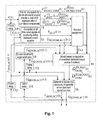
- Fig. 1 The principle of the inventive direction tracking processing is illustrated in Fig. 1 and is explained in the following. It is assumed that the direction tracking is based on the successive processing of input frames C(k) of HOA coefficient sequences of length L, where k denotes the frame index.
- a first step or stage 11 the k-th frame C ( k ) of the HOA representation is preliminary analysed for dominant sound sources.
- D ⁇ ( k ) of detected dominant directional signals is determined as well as the corresponding D ⁇ ( k ) preliminary direction estimates ⁇ ⁇ DOM 1 k , ... , ⁇ ⁇ DOM D ⁇ k k .
- the directional power distribution of the original HOA representation C ( k ) is computed as proposed in EP 12305537.8 and successively analysed for the presence of dominant sound sources.
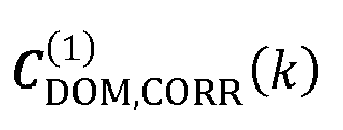
- the respective preliminary direction estimate ⁇ ⁇ DOM 1 k is computed. Additionally, the corresponding directional signal x INST 1 k is estimated, together with that component C DOM , CORR 1 k of current frame C(k) which is assumed to be created by this sound source. It assumed that C DOM , CORR 1 k represents that component of C(k) which is correlated with the directional signal x INST 1 k . Finally, the HOA component C DOM , CORR 1 k is subtracted from C ( k ) in order to obtain the residual HOA representation C REM 2 k .
- the dominant sound sources found in step/stage 11 in the k -th frame are assigned to the corresponding sound sources (assumed to be) active in the ( k - 1)-th frame.
- the assignment is accomplished by comparing the preliminary direction estimates ⁇ ⁇ DOM 1 k , ... , ⁇ ⁇ DOM D ⁇ k k for the current frame ( k ) and the smoothed directions of sound sources (assumed to be) active in the ( k -1)-th frame, which are contained in the set G ⁇ ,DOM,ACT ( k -1) and whose indices are contained in the set
- the correlation between the instantaneous directional signals x INST d k , d 1, ..., D ⁇ ( k ) of the detected dominant sound sources at frame k and the directional signals X ACT (k -1) of sound sources (assumed to be) active in the ( k - 1)-th frame.
- the result of the assignment is formulated by an assignment function f, A,k : ⁇ 1, ... D ⁇ ( k ) ⁇ ⁇ ⁇ 1, ..., D ⁇ , where D denotes the maximum number of expected sound sources to be tracked, meaning that the d -th newly found sound source is assigned to the previously active sound source with index f, A,k ( d ).
- a detailed description of this model based smoothing procedure is provided in below section Model based computation of smoothed dominant sound
- This operation has the purpose to not spuriously deactivate sound sources which have not been detected for a small number of successive frames.
- Step or stage 12 performs the computation of the directional signals of sound sources supposed to be active in the ( k - 1) -th frame using the HOA representation C ( k - 1) of frame k - 1 and the set G ⁇ ,DOM,ACT ( k -1) of smoothed directions of sound sources supposed to be active in the ( k - 1)-th frame.
- the computation is based on the principle of mode matching as described in M.A. Poletti, "Three-Dimensional Surround Sound Systems Based on Spherical Harmonics", J. Audio Eng. Soc., vol.53(11), pp.1004-1025, 2005 .
- the set G ⁇ ,DOM,ACT ( k -1) of movement angles of the dominant active sound sources at frame k - 1 is computed from the two sets G ⁇ ,DOM,ACT ( k -1) and G ⁇ ,DOM,ACT ( k -2) of smoothed direction estimates of sound sources supposed to be active in the ( k -1)-th and ( k - 2) -th frame, respectively.
- the movement is understood to happen between frames k - 2 and k - 1.
- the movement angle of an active dominant sound source is the arc between its smoothed direction estimate at frame k - 2 and that at frame k - 1.
- This operation causes the a-priori probability for the next direction of this sound source to become nearly uniform over all possible directions, cf. below section Determine indices and directions of currently active dominant sound sources.
- Frame delays 171 to 174 are delaying the respective signals by one frame. In the following, the above-mentioned steps and stages are explained in more detail.
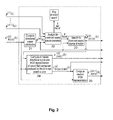
- the computation procedure for a single direction d index is illustrated in Fig. 2 .
- the remaining HOA representation C REM d k produced after the estimation of the ( d - 1) -th direction (related to the estimation of the d -th direction for the k-th time frame) is input to this stage. It is thereby understood that in the beginning of the loop C REM 1 k corresponds to the original HOA frame C(k).
- step or stage 22 the directional power distribution p (d) ( k )is analysed for the presence of a dominant sound source.
- the respective directional signal x INST d k and the HOA representation C DOM , CORR d k , of the sound field component assumed to be created by the d-th dominant sound source are computed in step or stage 24 as described in more detail in below section Computation of dominant directional signal and HOA representation of sound field produced by the dominant sound source.
- step or stage 25 the HOA component C DOM , CORR d k is subtracted from C REM d k in order to obtain the residual HOA representation C REM d + 1 k , which is used for the search of the next (i.e. ( d + 1) -th) directional sound source. It is thereby explicitly assured that sound field components created by the d -th sound source found are excluded for the further direction search.
- the directional power distributions p (1) (k), ... , p ( d ) ( k ) of the remaining HOA representations C REM 1 k , ... , C REM d k are considered.
- the variance ratio ⁇ p d k : var p d k var p 1 k , which can be regarded as a measure for the importance of the sound field represented by the remaining HOA representation C REM d k compared to the sound field represented by the initial HOA representation C(k).
- a small ratio ⁇ p d k indicates that none of the sound sources represented by the HOA representation C REM d k should be considered as being dominant.
- the variance var p NORM d k can be regarded as a measure of the uniformity of the directional power distribution p ( d ) (k). In particular, the variance is the smaller the more uniform the power is distributed over all directions of incidence. In the limiting case of a spatially diffuse noise, the variance var p NORM d k should approach a value of zero. Based on these considerations, the variance ratio ⁇ p , NORM d k indicates whether the directional power of the HOA representation C REM d k is distributed more uniformly than that of C REM d - 1 k .
- ⁇ p 10 -3 .
- a preliminary estimate of its direction ⁇ ⁇ DOM d k is searched for by employing the directional power distribution p ( d ) (k).
- the rotation is performed such that the first rotated sampling position ⁇ ROT , 1 d k corresponds to the preliminary direction estimate ⁇ ⁇ DOM d k .
- 0 plane wave functions also referred to as grid directional signals
- ⁇ GRID d k S GRID , 1 d k S GRID , 2 d k ... S GRID , O d k ⁇ R O ⁇ O with S 0 0 ⁇ ROT , o d k , S 1 - 1 ⁇ ROT , o d k , S 1 0 ⁇ ROT , o d k , ... , S N N ⁇ ROT , o d k T ⁇ R O .
- FIR finite impulse response
- the directional 1 signals x ACT i ACT , k - 1 d ⁇ ⁇ k - 1 of sound sources sup-posed to be active in the ( k - 1)-th frame are contained within matrix X ACT ( k - 1) according to equation (20).
- step/stage 13 of Fig. 1 is accomplished by comparing the preliminary direction estimates ⁇ ⁇ DOM 1 k , ... , ⁇ ⁇ DOM D ⁇ k k and the smoothed directions of sound sources supposed to be active in the ( k - 1)-th frame, which are contained in the set where i ACT, k -1 ( d' ) denotes the index of the d'-th sound source assumed to be active in the ( k - 1)-th frame.
- the first operation has the effect that, if the angles between the d -th newly found direction ⁇ ⁇ DOM d k and the directions of all previously active dominant sound sources are greater than ⁇ MIN , this newly found direction is favoured to belong to a new sound source.
- the assignment problem can be solved by using the well-known Hungarian algorithm described in H.W. Kuhn, "The Hungarian method for the assignment problem", Naval research logistics quarterly, vol.2(1-2), pp.83-97, 1955 .
- This section addresses the computation of the smoothed dominant sound source directions in step/stage 14 of Fig. 1 according to a statistical sound source movement model.
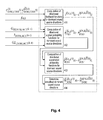
- the individual steps for this computation are illustrated in Fig. 4 and are explained in detail in the following.
- the computation is based on a simple sound source movement prediction model introduced in EP 12306485.9 .
- the directional a priori probability function P PRIO f A , k d k for the d -th newly found dominant sound source is assumed to be a discrete version of the von Mises-Fisher distribution on the unit sphere in the three-dimensional space.
- the principle behind this computation is to increase the concentration of the a priori probability function the less the sound source has moved before. If the sound source has moved a lot before, the uncertainty about its successive direction is high and thus the concentration parameter has to achieve a small value.
- This operation has the purpose of not spuriously deactivating sound sources which have not been detected for a small number of successive frames, which might happen for sources like e.g. castanets producing impulse-like sounds with short pauses between the individual impulses.
- sources like e.g. castanets producing impulse-like sounds with short pauses between the individual impulses.
- the desired set is obtained by removing from the indices of such sources which have not been detected for a number of K INACT previous successive frames.
- the number D ACT ( k ) of active dominant sound sources at frame k is set to the number of elements of
- HOA Higher Order Ambisonics
- the expansion coefficients A n m k are depending only on the angular wave number k . It is implicitly assumed that the sound pressure is spatially band-limited. Thus the series is truncated with respect to the order index n at an upper limit N, which is called the order of the HOA representation.
- the sound field is represented by a superposition of an infinite number of harmonic plane waves of different angular frequencies ⁇ arriving from all possible directions specified by the angle tuple ( ⁇ , ⁇ ) it can be shown (see B. Rafaely, "Plane-wave Decomposition of the Sound Field on a Sphere by Spherical Convolution", J. Acoust. Soc.
- the position index of a time domain function c n m t within the vector c (t) is given by n(n + 1 ) + 1 + m.
- the elements of c (lT S ) are referred to as Ambisonics coefficients.
- the time domain signals c n m t and hence the Ambisonics coefficients are real-valued.
- the time domain behaviour of the spatial density of plane wave amplitudes is a multiple of its behaviour at any other direction.
- the functions c ( t , ⁇ 1 ) and c ( t , ⁇ 2 ) for some fixed directions ⁇ 1 and ⁇ 2 are highly correlated with each other with respect to time t.
- the mode matrix is invertible in general.
- inventive processing can be carried out by a single processor or electronic circuit, or by several processors or electronic circuits operating in parallel and/or operating on different parts of the inventive processing.
Landscapes
- Engineering & Computer Science (AREA)
- Physics & Mathematics (AREA)
- Acoustics & Sound (AREA)
- Signal Processing (AREA)
- Multimedia (AREA)
- Health & Medical Sciences (AREA)
- Audiology, Speech & Language Pathology (AREA)
- Human Computer Interaction (AREA)
- Computational Linguistics (AREA)
- Mathematical Physics (AREA)
- Quality & Reliability (AREA)
- Stereophonic System (AREA)
- General Physics & Mathematics (AREA)
- Radar, Positioning & Navigation (AREA)
- Remote Sensing (AREA)
- Measurement Of Mechanical Vibrations Or Ultrasonic Waves (AREA)
Abstract
Higher Order Ambisonics (HOA) represents three-dimensional sound. HOA provides high spatial resolution and facilitates analysing of the sound field with respect to dominant sound sources. The invention aims to identify independent dominant sound sources constituting the sound field, and to track their temporal trajectories. Known applications are searching for all potential candidates for dominant sound source directions by looking at the directional power distribution of the original HOA representation, whereas in the invention all components which are correlated with the signals of previously found sound sources are removed. By such operation the problem of erroneously detecting many instead of only one correct sound source can be avoided in case its contributions to the sound field are highly directionally dispersed.
Description
- The invention relates to a method and to an apparatus for determining directions of uncorrelated sound sources in a Higher Order Ambisonics representation of a sound field.
- Higher Order Ambisonics (HOA) offers one possibility to represent three-dimensional sound among other techniques like wave field synthesis (WFS) or channel based approaches like 22.2. In contrast to channel based methods, however, the HOA representation offers the advantage of being independent of a specific loudspeaker set-up. This flexibility, however, is at the expense of a decoding process which is required for the playback of the HOA representation on a particular loudspeaker set-up. Compared to the WFS approach, where the number of required loudspeakers is usually very large, HOA may also be rendered to set-ups consisting of only few loudspeakers. A further advantage of HOA is that the same representation can also be employed without any modification for binaural rendering to headphones.
- HOA is based on a representation of the spatial density of complex harmonic plane wave amplitudes by a truncated Spherical Harmonics (SH) expansion. Each expansion coefficient is a function of angular frequency, which can be equivalently represented by a time domain function. Hence, without loss of generality, the complete HOA sound field representation actually can be assumed to consist of 0 time domain functions, where 0 denotes the number of expansion coefficients. In the following, these time domain functions are referred to as HOA coefficient sequences or as HOA channels.
- HOA has the potential to provide a high spatial resolution, which improves with a growing maximum order N of the expansion. It offers the possibility of analysing the sound field with respect to dominant sound sources.
- An application could be how to identify from a given HOA representation independent dominant sound sources constituting the sound field, and how to track their temporal trajectories. Such operations are required e.g. for the compression of HOA representations by decomposition of the sound field into dominant directional signals and a remaining ambient component as described in patent application
EP 12305537.8 - In
EP 12305537.8 - The number of currently present dominant sound sources within a time frame is identified and the corresponding directions are searched for. The number of dominant sound sources is determined from the eigenvalues of the HOA channel cross-correlation matrix. For the search of the dominant sound source directions the directional power distribution corresponding to a frame of HOA coefficients for a fixed high number of predefined test directions is evaluated. The first direction estimate is obtained by looking for the maximum in the directional power distribution. Then, the remaining identified directions are found by consecutively repeating the following two operations:
- the test directions in the spatial neighbourhood are eliminated from the remaining set of test directions and the resulting set is considered for the search of the maximum of the directional power distribution.
- The estimated directions are assigned to the sound sources deemed to be active in the last time frame.
- Following the assignment, an appropriate smoothing of the direction estimates is performed in order to obtain a temporally smooth direction trajectory.
- However, although with such processing the temporal smoothing of the direction estimates is accomplished in principle by computing the exponentially-weighted moving average, this technique has the disadvantage of not being able to accurately capture abrupt direction changes or onsets of new dominant sounds.
- To overcome this problem, it was suggested in patent application
EP 12306485.9 EP 12306485.9 EP 12305537.8 EP 12306485.9 EP 12305537.8 - The
EP 12306485.9 EP 12305537.8 - A problem to be solved by the invention is to improve the determination of dominant sound sources in an HOA sound field, such that their temporal trajectories can be tracked. This problem is solved by the methods disclosed in
claims claim 6 is disclosed in claim 7. - The invention improves the
EP 12306485.9 EP 12305537.8 EP 12306485.9 - Like in
EP 12306485.9 EP 12306485.9 - The inventive processing determines estimates of dominant sound source directions for successive frames of an HOA representation in two subsequent processings:
- From a current time frame k of an HOA representation, candidates or estimates for dominant sound source directions are successively searched, and the components of the HOA representation, which are supposed to be created by the respective sound sources, are determined. In each iteration of this search process each further direction candidate is computed from a residual HOA representation which represents the original HOA representation from which all the components correlated with the signals of previously found sound sources have been removed. The current direction candidate is selected out of a number of predefined test directions,
- such that the power of the related general plane wave of the residual HOA representation, impinging from the chosen direction on the listener position, is maximum compared to that of all other test directions.
- Next, the selected direction candidates for the current time frame are assigned to dominant sound sources found in the previous time frame k - 1 of HOA coefficients. Thereafter the final direction estimates, which are smoothed with respect to the resulting time trajectory, are computed by carrying out a Bayesian inference process, wherein this Bayesian inference process exploits on one hand a statistical a priori sound source movement model and, on the other hand, the directional power distributions of the dominant sound source components of the original HOA representation. That a priori sound source movement model statistically predicts the current movement of individual sound sources from their direction in the previous time frame k - 1 and movement between the previous time frame k - 1 and the penultimate time frame k-2.
- The assignment of direction estimates to dominant sound sources found in the previous time frame (k - 1) of HOA coefficients is accomplished by a joint minimisation of the angles between pairs of a direction estimate and the direction of a previously found sound source, and maximisation of the absolute value of the correlation coefficient between the pairs of the directional signals related to a direction estimate and to a dominant sound source found in the previous time frame.
- In principle, the inventive method is suited for determining directions of uncorrelated sound sources in a Higher Order Ambisonics representation denoted HOA of a sound field, said method including the steps:
- in a current time frame of HOA coefficients, searching successively preliminary direction estimates of dominant sound sources, and computing HOA sound field components which are created by the corresponding dominant sound sources, and computing the corresponding directional signals;
- assigning said computed dominant sound sources to corresponding sound sources active in the previous time frame of said HOA coefficients by comparing said preliminary direction estimates of said current time frame and smoothed directions of sound sources active in said previous time frame, and by correlating said directional signals of said current time frame and directional signals of sound sources active in said previous time frame, resulting in an assignment function;
- computing smoothed dominant source directions using said assignment function, said set of smoothed directions in said previous time frame, a set of indices of active dominant sound sources in said previous time frame, a set of respective source movement angles between the penultimate time frame and said previous time frame, and said HOA sound field components created by the corresponding dominant sound sources;
- determining indices and directions of the active dominant sound sources of said current time frame, using said smoothed dominant source directions, the frame delayed version of directions of the active dominant sound sources of said previous time frame and the frame delayed version of indices of the active dominant sound sources of said previous time frame,
- In principle the inventive apparatus is suited for determining directions of uncorrelated sound sources in a Higher Order Ambisonics representation denoted HOA of a sound field, said apparatus including:
- means being adapted for searching successively in a current time frame of HOA coefficients preliminary direction estimates of dominant sound sources, and for computing HOA sound field components which are created by the corresponding dominant sound sources, and for computing the corresponding directional signals;
- means being adapted for assigning said computed dominant sound sources to corresponding sound sources active in the previous time frame of said HOA coefficients by comparing said preliminary direction estimates of said current time frame and smoothed directions of sound sources active in said previous time frame, and by correlating said directional signals of said current time frame and directional signals of sound sources active in said previous time frame, resulting in an assignment function;
- means being adapted for computing smoothed dominant source directions using said assignment function, said set of smoothed directions in said previous time frame, a set of indices of active dominant sound sources in said previous time frame, a set of respective source movement angles between the penultimate time frame and said previous time frame, and said HOA sound field components created by the corresponding dominant sound sources;
- means being adapted for determining indices and directions of the active dominant sound sources of said current time frame, using said smoothed dominant source directions, the frame delayed version of directions of the active dominant sound sources of said previous time frame and the frame delayed version of indices of the active dominant sound sources of said previous time frame,
wherein said directional signals of sound sources active in said previous time frame are computed from said frame delayed version of directions of the active dominant sound sources of said previous time frame and the HOA coefficients of said previous time frame using mode matching,
and wherein said set of source movement angles between said penultimate time frame and said previous time frame is computed from said frame delayed version of directions of the active dominant sound sources of said previous time frame and a further frame delayed version thereof. - Advantageous additional embodiments of the invention are disclosed in the respective dependent claims.
- Exemplary embodiments of the invention are described with reference to the accompanying drawings, which show in:
- Fig. 1
- Block diagram of the inventive processing for estimation of the directions of dominant and uncorrelated directional signals of a Higher Order Ambisonics signal;
- Fig. 2
- Detail of preliminary direction estimation;
- Fig. 3
- Computation of dominant directional signal and HOA representation of sound field produced by the dominant sound source;
- Fig. 4
- Model based computation of smoothed dominant sound source directions;
- Fig. 5
- Spherical coordinate system;
- Fig. 6
- Normalised dispersion function ν N (Θ) for different Ambisonics orders N and for angles θ ∈ [0,π].
- The principle of the inventive direction tracking processing is illustrated in
Fig. 1 and is explained in the following. It is assumed that the direction tracking is based on the successive processing of input frames C(k) of HOA coefficient sequences of length L, where k denotes the frame index. The frames are defined with respect to the HOA coefficient sequences specified in equation (45) in section Basics of Higher Order Ambisonics as
where T S denotes the sampling period and B ≤ L indicates the frame shift. It is reasonable, but not necessary, to assume that successive frames are overlapping, i.e. B < L. - In a first step or
stage 11, the k-th frame C(k) of the HOA representation is preliminary analysed for dominant sound sources. A detailed description of this processing is provided in below section Preliminary direction search. In particular, the number D̃(k) of detected dominant directional signals is determined as well as the corresponding D̃(k) preliminary direction estimates


EP 12305537.8 




- In direction assignment step or
stage 13, the dominant sound sources found in step/stage 11 in the k-th frame are assigned to the corresponding sound sources (assumed to be) active in the (k - 1)-th frame. On one hand, the assignment is accomplished by comparing the preliminary direction estimates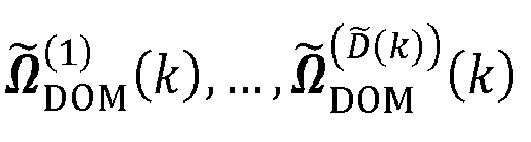


- In a model based computation of smoothed dominant sound source directions step or
stage 14 the smoothed dominant source directions
EP 12306485.9 

- In a last step or
stage 15, the indices and the directions of the currently active dominant sound sources are determined, which are supposed to be contained in the sets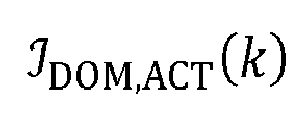

stage 14 and the sets G Ω,DOM,ACT(k-1) and
- Step or
stage 12 performs the computation of the directional signals of sound sources supposed to be active in the (k - 1) -th frame using the HOA representation C (k - 1) of frame k - 1 and the set G Ω,DOM,ACT(k-1) of smoothed directions of sound sources supposed to be active in the (k - 1)-th frame. The computation is based on the principle of mode matching as described in M.A. Poletti, "Three-Dimensional Surround Sound Systems Based on Spherical Harmonics", J. Audio Eng. Soc., vol.53(11), pp.1004-1025, 2005. - In a source movement angle estimation step or
stage 16, the set G θ̂,DOM,ACT(k-1) of movement angles of the dominant active sound sources at frame k - 1 is computed from the two sets G Ω,DOM,ACT(k-1) and G Ω,DOM,ACT(k-2) of smoothed direction estimates of sound sources supposed to be active in the (k-1)-th and (k - 2) -th frame, respectively. The movement is understood to happen between frames k - 2 and k - 1. The movement angle of an active dominant sound source is the arc between its smoothed direction estimate at frame k - 2 and that at frame k - 1. - Remarks: if no direction estimate for frame k - 2 is available for a dominant sound source which is assumed to be active in frame k - 1, the respective movement angle can be set to a maximum value of 'π'. In general, when initialising the processing for a first frame k and frame k - 1 values are not yet available, the corresponding sets or values to be input in the steps or stages of
Fig. 1 are empty or set to zero, respectively. - This operation causes the a-priori probability for the next direction of this sound source to become nearly uniform over all possible directions, cf. below section Determine indices and directions of currently active dominant sound sources.
- Frame delays 171 to 174 are delaying the respective signals by one frame.
In the following, the above-mentioned steps and stages are explained in more detail. - In the preliminary direction search step/
stage 11, the current number D̃(k) of present dominant sound sources (in frame k) and the respective directions


- The computation procedure for a single direction d index is illustrated in
Fig. 2 . The remaining HOA representation

stage 21, the directional power distribution p (d)(k) of the remaining HOA representation

where (·) T denotes transposition. The directional power distribution is represented by the vector
whose components

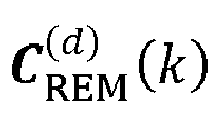
EP 12305537.8 stage 22, the directional power distribution p (d)(k)is analysed for the presence of a dominant sound source. One way of detecting a dominant source is described in below section Analysis for dominant sound source presence. If the absence of a dominant sound source is detected, then the direction search is stopped and the total number of found dominant directions is set to D̃(k) = d - 1. Otherwise, if a dominant source is detected, a preliminary estimate of its direction
stage 23, see below section Search for dominant sound source direction for details. - Successively, the respective directional signal


stage 24 as described in more detail in below section Computation of dominant directional signal and HOA representation of sound field produced by the dominant sound source. - Finally, in step or
stage 25 the HOA component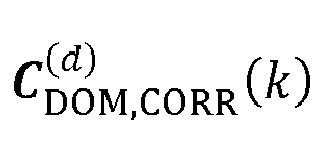


- For detecting the presence of a dominant sound source within the sound field represented by


which can be regarded as a measure for the importance of the sound field represented by the remaining HOA representation


- On the other hand, it is also reasonable to watch the ratio

of the variances of the normalised directional power distributions



are defined in dependence of those of p (d) (k) by
- The variance var


- To summarise the above considerations, it can be assumed that there is always at least a single dominant sound source present in the sound field represented by C(k), i.e. D̃(k) ≥1. Further dominant sources are detected (for d ≥ 2) if the value of the variance ratio


- The value for ε p is to be set with respect to the interpretation of what 'dominant' means. The inventors have found that a reasonable choice is given by εp = 10-3 .
- After the d-th sound source has been detected, a preliminary estimate of its direction


- - Computation of dominant directional signal and HOA representation of sound field produced by the dominant sound source Subsequently, after having determined a preliminary estimate


Fig. 3 . In step orstage 31, a fixed predefined spherical grid G Ω,INIT consisting of 0 sampling positions ΩINIT,o o = 1, ..., 0, which are assumed to be nearly uniformly distributed on the unit sphere, is rotated to provide the grid


- In step or
stage 32, the HOA representation


- To compute the plane wave functions


with
- Assuming each grid directional signal


where L denotes the length (in samples) of the analysed HOA representation, the computation of all grid directional signals is accomplished by a Spherical Harmonics Transform (see below section Spherical Harmonic Transform for an explanation) as
- Since the preliminary estimate


wave function 


- To determine that component of


stage 33. Hence, the grid directional signals

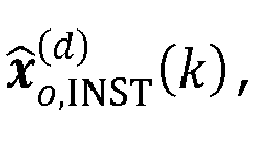
- One way of accomplishing such prediction is to assume the predicted signals


stage 34 by an inverse Spherical Harmonics Transform (see below section Spherical Harmonic Transform for an explanation) as
- The directional 1 signals


where C(k - 1) denotes the (k - 1)-th frame of the original HOA sound field representation and


with
- As previously mentioned, on one hand the assignment in step/
stage 13 ofFig. 1 is accomplished by comparing the preliminary direction estimates


between a pair of a preliminary direction estimate

- On the other hand, for the assignment the correlation between the instantaneous directional signals


- Using this definition, it is postulated that the higher the absolute value of the correlation coefficient

between the two signals

- Based on these considerations, an assignment function


- It is implicitly assumed that for the direction indices


are virtually set to a minimum angle of ΘMIN, where e.g. ΘMIN = 2π/N . Further, the correlation coefficients
- for the direction indices


- The assignment problem can be solved by using the well-known Hungarian algorithm described in H.W. Kuhn, "The Hungarian method for the assignment problem", Naval research logistics quarterly, vol.2(1-2), pp.83-97, 1955.
- This section addresses the computation of the smoothed dominant sound source directions in step/
stage 14 ofFig. 1 according to a statistical sound source movement model. The individual steps for this computation are illustrated inFig. 4 and are explained in detail in the following. - The directional a priori probability functions

stage 42 using: - the set

- the setG Ω,DOM,ACT(k-1) of the corresponding dominant source direction estimates

- the set G θ̂,DOM,ACT(k-1) of the respective source movement angles Θ̂i
ACT,k-1 (d') (k - 1), d' = 1, ..., DACT(k - 1) between the frame (k-2) and (k - 1), - and the assignment function fA,k .
- The computation is based on a simple sound source movement prediction model introduced in
EP 12306485.9 
- In the following it is assumed that the directional a priori probability function


- To compute the a priori probabilities for the individual test directions Ω q two cases are to be distinguished:
- a) If the source index fA,k (d) assigned to the d-th newly found dominant sound source is contained within the set
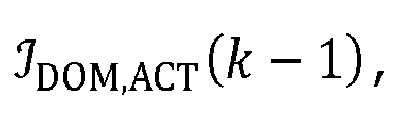

where Θ q,d (k) denotes the angle between the estimated direction

- Further, k d (k) denotes a concentration parameter that is computed using the source movement angle estimate Θ̂f
A,k (d) (k - 1) according to
where C D may be set to
- Reasonable values for the parameters κ MAx and C R have been found to be (see
EP 12306485.9 
- The principle behind this computation is to increase the concentration of the a priori probability function the less the sound source has moved before. If the sound source has moved a lot before, the uncertainty about its successive direction is high and thus the concentration parameter has to achieve a small value.
- b) If the source index fA,k (d) assigned to the d-th newly found dominant sound source is not contained within the set


- The directional likelihood functions L (f
A,k (d)) (k), d = 1,...,D̃(k), are computed in step or stage 41 using the HOA sound field components
A,k (d)) (k,Ωq ) for the individual test directions Ω q, q = 1,..., Q, as
- The individual likelihoods L(f,
A,k (d))(k, Ωq) are computed to be approximations of the powers of general plane waves impinging from the test direction Ω q , as described inEP 12305537.8 
where
denotes the mode vector with respect to the test direction Ω q (with

indicates the HOA inter-coefficients correlation matrix with respect to the HOA representation
- The directional a posteriori probability functions


A,k (d) (k), d = 1, ..., D̃(k). Here, once again, the directional a posteriori probability function


- The individual a posteriori probabilities

EP 12306485.9 
- Assuming a fixed direction index d the denominator of equation (37) is constant for each test direction Ω q . For the purpose of the following direction search, where only the maximum of the a posteriori probability functions is of interest, such a global scaling is irrelevant. Hence, it is noted that the computation of the denominator of equation (37) may be completely waived to save computational power.
- The smoothed dominant sound source directions

stage 44 using the a posteriori probability functions


- The set


stage 15 ofFig. 1 using the set G Ω,DOM,ACT(k-1) of the smoothed estimates




- From this set the desired set


- Finally, the dominant source direction estimates


- This means that the directions of previously active dominant sound sources are held fixed if the respective sound source is not newly detected at frame k.
- Higher Order Ambisonics (HOA) is based on the description of a sound field within a compact area of interest, which is assumed to be free of sound sources. In that case the spatio-temporal behaviour of the sound pressure p(t, x ) at time t and position x within the area of interest is physically fully determined by the homogeneous wave equation. In the following a spherical coordinate system as shown in
Fig. 5 is assumed. In the used coordinate system the x axis points to the frontal position, the γ axis points to the left, and the z axis points to the top. A position in space x = (r,θ,φ)T is represented by a radius r > 0 (i.e. the distance to the coordinate origin), an inclination angle θ ∈[0,π] measured from the polar axis z and an azimuth angle φ ∈ [0,2π[ measured counter-clockwise in the x - y plane from the x axis. (·) T denotes the transposition. - Then, it can be shown (cf. E.G. Williams, "Fourier Acoustics", vol.93 of Applied Mathematical Sciences, Academic Press, 1999) that the Fourier transform of the sound pressure with respect to time denoted by , i.e.

with ω denoting the angular frequency and i indicating the imaginary unit, can be expanded into a series of Spherical Harmonics according to
- In equation (40), C Sdenotes the speed of sound and k denotes the angular wave number, which is related to the angular frequency ω by


- If the sound field is represented by a superposition of an infinite number of harmonic plane waves of different angular frequencies ω arriving from all possible directions specified by the angle tuple (θ, φ) it can be shown (see B. Rafaely, "Plane-wave Decomposition of the Sound Field on a Sphere by Spherical Convolution", J. Acoust. Soc. Am., vol.4 (116), pp.2149-2157, 2004) that the respective plane wave complex amplitude function C(ω, θ, φ) can be expressed by the following Spherical Harmonics expansion:

where the expansion coefficients


- When assuming that the individual coefficients


for each order n and degree m, which can be collected in asingle vector 
- The position index of a time domain function

- The final Ambisonics format provides the sampled version of c (t) using a sampling frequency f s as

where T S = 1/f S denotes the sampling period. The elements of c(lT S ) are referred to as Ambisonics coefficients. The time domain signals
- The real-valued Spherical Harmonics
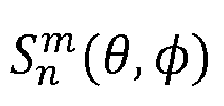

with
- The associated Legendre functions Pn,m(x) are defined as

with the Legendre polynomial Pn(x) and, unlike in the above-mentioned E.G. Williams textbook, without the Condon-Shortley phase term (-1) m . - A general plane wave function x(t) arriving from a direction Ω 0 = (θ 0, φ 0) T is represented in HOA by

- The corresponding spatial density of plane wave amplitudes


- It can be seen from equation (51) that it is a product of the general plane wave function x(t) and a spatial dispersion function νN (Θ), which can be shown as depending only on the angle Θ between Ω and Ω 0 having the property

- As expected, in the limit of an infinite order, i.e. N→ ∞, the spatial dispersion function turns into a Dirac delta δ(·), i.e.

- However, in the case of a finite order N, the contribution of the general plane wave from direction Ω 0 is smeared to neighbouring directions, where the extent of the blurring decreases with an increasing order. A plot of the normalised function ν N (Θ)for different values of N is provided in
Fig. 6 . - For any direction Ω the time domain behaviour of the spatial density of plane wave amplitudes is a multiple of its behaviour at any other direction. In particular, the functions c(t, Ω 1) and c(t, Ω 2) for some fixed directions Ω 1 and Ω 2 are highly correlated with each other with respect to time t.
- If the spatial density of plane wave amplitudes is discretised at a number of 0 spatial directions Ω 0, 1 ≤ o ≤ 0, which are nearly uniformly distributed on the unit sphere, 0 directional signals c(t, Ω 0) are obtained. Collecting these signals into a vector as


where (·) H indicates the joint transposition and conjugation, and ψ denotes a mode-matrix defined by
with

- Because the directions Ω 0 are nearly uniformly distributed on the unit sphere, the mode matrix is invertible in general. Hence, the continuous Ambisonics representation can be computed from the directional signals c(t, Ω 0) by

- Both equations constitute a transform and an inverse transform between the Ambisonics representation and the 'spatial domain'. These transforms are denoted the Spherical Harmonic Transform and the inverse Spherical Harmonic Transform, respectively. Because the directions Ω 0 are nearly uniformly distributed on the unit sphere, there is the approximation

which justifies the use of Ψ -1 instead of Ψ H in equation (55). All mentioned relations are valid for the discretetime domain, too. - The inventive processing can be carried out by a single processor or electronic circuit, or by several processors or electronic circuits operating in parallel and/or operating on different parts of the inventive processing.
and wherein said set of source movement angles between said penultimate time frame and said previous time frame is computed from said frame delayed version of directions of the active dominant sound sources of said previous time frame and a further frame delayed version thereof.
Claims (11)
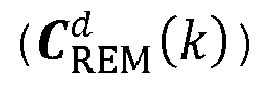
- Method for determining directions (G Ω,DOM,ACT(k)) of uncorrelated sound sources in a Higher Order Ambisonics representation denoted HOA of a sound field, said method including the step:- in a current time frame (k) of HOA coefficients (C(k)), searching (11) successively preliminary direction estimates



- Method according to claim 1, wherein said selected direction estimates for said current time frame (k) of HOA coefficients (C(k)) are assigned (13) to dominant sound sources found in the previous time frame (k -1) of HOA coefficients ( C (k - 1)) and the final direction estimates are smoothed with respect to the resulting time trajectory.
- Method according to claim 2, wherein said smoothing is performed by carrying out a Bayesian inference process, wherein this Bayesian inference process exploits a statistical a priori sound source movement model and the directional power distributions of the dominant sound source components of the original HOA representation.
- Method according to claim 3, wherein said statistical a priori model statistically predicts the movement of individual sound sources from the knowledge of their direction in said previous time frame (k -1) and the knowledge of the movement between said previous time frame (k -1) and the penultimate time frame (k-2).
- Method according to claim 3 or 4, wherein said assignment of direction estimates to dominant sound sources found in said previous time frame (k -1) of HOA coefficients is accomplished by a joint minimisation of the angles between pairs of a direction estimate and the direction of a previously found sound source, and maximisation of the absolute value of the correlation coefficient between the pairs of the directional signals related to a direction estimate and to a dominant sound source found in said previous time frame (k -1) of HOA coefficients.
- Method for determining directions (G Ω,DOM,ACT(k)) of uncorrelated sound sources in a Higher Order Ambisonics representation denoted HOA of a sound field, said method including the steps:- in a current time frame (k) of HOA coefficients (C(k)), searching (11) successively preliminary direction estimates
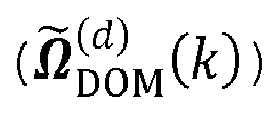
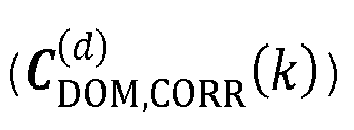
 - assigning (13) said computed dominant sound sources to corresponding sound sources active in the previous time frame (k - 1) of said HOA coefficients by comparing said preliminary direction estimates
 - computing (14) smoothed dominant source directions


 - determining (15) indices

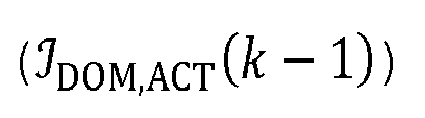
wherein said directional signals ( X ACT(k - 1)) of sound sources active in said previous time frame (k - 1) are computed (12) from said frame delayed (174) version of directions (G Ω,DOM,ACT(k-1)) of the active dominant sound sources of said previous time frame (k - 1) and the HOA coefficients (C(k - 1)) of said previous time frame using mode matching,
and wherein said set G θ̂,DOM,ACT(k-1) of source movement angles between said penultimate time frame (k - 2) and said previous time frame (k - 1) is computed from said frame delayed (174) version of directions (G Ω,DOM,ACT(k-1)) of the active dominant sound sources of said previous time frame (k - 1) and a further frame delayed (173) version (G Ω,DOM,ACT(k-2)) thereof. - Apparatus for determining directions (G Ω,DOM,ACT(k)) of uncorrelated sound sources in a Higher Order Ambisonics representation denoted HOA of a sound field, said apparatus including:- means (11) being adapted for searching successively in a current time frame (k) of HOA coefficients (C(k)) preliminary direction estimates


 - means (13) being adapted for assigning said computed dominant sound sources to corresponding sound sources active in the previous time frame (k - 1) of said HOA coefficients by comparing said preliminary direction estimates
 - means (14) being adapted for computing smoothed dominant source directions

 - means (15) being adapted for determining indices


wherein said directional signals (X ACT(k - 1)) of sound sources active in said previous time frame (k -1) are computed (12) from said frame delayed (174) version of directions (G Ω,DOM,ACT(k-1)) of the active dominant sound sources of said previous time frame (k -1) and the HOA coefficients ( C (k - 1)) of said previous time frame using mode matching,
and wherein said set (G θ̂,DOM,ACT(k-1)) of source movement angles between said penultimate time frame (k - 2) and said previous time frame (k -1) is computed from said frame delayed (174) version of directions(G Ω,DOM,ACT(k - 1)) of the active dominant sound sources of said previous time frame (k - 1) and a further frame delayed (173) version (G Ω,DOM,ACT(k - 2)) thereof. - Method according to claim 6, or apparatus according to claim 7, wherein in said determination of the number (D̃(k)) of detected dominant directional signals and the corresponding preliminary direction estimates


- Method according to the method of claim 8, or apparatus according to the apparatus of claim 8, wherein for a single direction index (d) the directional power distribution ( p (d)(k)) of the remaining residual HOA representation


- Method according to the method of claims 8 and 9, or apparatus according to the apparatus of claims 8 and 9, wherein, after having determined a preliminary estimate


 - rotating (31) a fixed predefined spherical grid
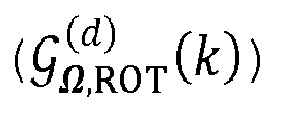


 - transforming (32) said remaining residual HOA representation
 - performing (33) a prediction of said grid direction signals from dominant sound source signals;- computing (34) the HOA representation

- Method according to the method of one of claims 6 and 8 to 10, or apparatus according to the apparatus of one of claims 7 to 10, wherein said computing (14) of smoothed dominant source directions
 - computing (42) a directional a priori probability functions


 - computing (41) directional likelihood functions (L(f,
A,K (d))(k)) for dominant sound source directions using said assignment function (fA,k) and using said HOA sound field components - computing (43) directional a posteriori probability functions
A,K (d))(k)) and using said directional a priori probability functions - determining (44) smoothed dominant sound source directions

Priority Applications (8)
| Application Number | Priority Date | Filing Date | Title |
|---|---|---|---|
| EP20130305156 EP2765791A1 (en) | 2013-02-08 | 2013-02-08 | Method and apparatus for determining directions of uncorrelated sound sources in a higher order ambisonics representation of a sound field |
| US14/766,739 US9622008B2 (en) | 2013-02-08 | 2014-02-07 | Method and apparatus for determining directions of uncorrelated sound sources in a higher order ambisonics representation of a sound field |
| EP14703102.5A EP2954700B1 (en) | 2013-02-08 | 2014-02-07 | Method and apparatus for determining directions of uncorrelated sound sources in a higher order ambisonics representation of a sound field |
| JP2015556516A JP6374882B2 (en) | 2013-02-08 | 2014-02-07 | Method and apparatus for determining the direction of uncorrelated sound sources in higher-order ambisonic representations of sound fields |
| PCT/EP2014/052479 WO2014122287A1 (en) | 2013-02-08 | 2014-02-07 | Method and apparatus for determining directions of uncorrelated sound sources in a higher order ambisonics representation of a sound field |
| CN201480008017.XA CN104995926B (en) | 2013-02-08 | 2014-02-07 | Method and apparatus for determining the direction of uncorrelated sound sources in a high-order ambisonic representation of a sound field |
| KR1020157021230A KR102220187B1 (en) | 2013-02-08 | 2014-02-07 | Method and apparatus for determining directions of uncorrelated sound sources in a higher order ambisonics representation of a sound field |
| TW103104224A TWI647961B (en) | 2013-02-08 | 2014-02-10 | Method and apparatus for determining directions of uncorrelated sound sources in a higher order ambisonics representation of a sound field |
Applications Claiming Priority (1)
| Application Number | Priority Date | Filing Date | Title |
|---|---|---|---|
| EP20130305156 EP2765791A1 (en) | 2013-02-08 | 2013-02-08 | Method and apparatus for determining directions of uncorrelated sound sources in a higher order ambisonics representation of a sound field |
Publications (1)
| Publication Number | Publication Date |
|---|---|
| EP2765791A1 true EP2765791A1 (en) | 2014-08-13 |
Family
ID=47780000
Family Applications (2)
| Application Number | Title | Priority Date | Filing Date |
|---|---|---|---|
| EP20130305156 Withdrawn EP2765791A1 (en) | 2013-02-08 | 2013-02-08 | Method and apparatus for determining directions of uncorrelated sound sources in a higher order ambisonics representation of a sound field |
| EP14703102.5A Active EP2954700B1 (en) | 2013-02-08 | 2014-02-07 | Method and apparatus for determining directions of uncorrelated sound sources in a higher order ambisonics representation of a sound field |
Family Applications After (1)
| Application Number | Title | Priority Date | Filing Date |
|---|---|---|---|
| EP14703102.5A Active EP2954700B1 (en) | 2013-02-08 | 2014-02-07 | Method and apparatus for determining directions of uncorrelated sound sources in a higher order ambisonics representation of a sound field |
Country Status (7)
| Country | Link |
|---|---|
| US (1) | US9622008B2 (en) |
| EP (2) | EP2765791A1 (en) |
| JP (1) | JP6374882B2 (en) |
| KR (1) | KR102220187B1 (en) |
| CN (1) | CN104995926B (en) |
| TW (1) | TWI647961B (en) |
| WO (1) | WO2014122287A1 (en) |
Cited By (14)
| Publication number | Priority date | Publication date | Assignee | Title |
|---|---|---|---|---|
| CN105516875A (en) * | 2015-12-02 | 2016-04-20 | 上海航空电器有限公司 | Device for quickly measuring spatial angle resolution of virtual sound production equipment |
| GR1008860B (en) * | 2015-12-29 | 2016-09-27 | Κωνσταντινος Δημητριου Σπυροπουλος | System for the isolation of speakers from audiovisual data |
| US9466305B2 (en) | 2013-05-29 | 2016-10-11 | Qualcomm Incorporated | Performing positional analysis to code spherical harmonic coefficients |
| US9495968B2 (en) | 2013-05-29 | 2016-11-15 | Qualcomm Incorporated | Identifying sources from which higher order ambisonic audio data is generated |
| WO2017055485A1 (en) * | 2015-09-30 | 2017-04-06 | Dolby International Ab | Method and apparatus for generating 3d audio content from two-channel stereo content |
| US9620137B2 (en) | 2014-05-16 | 2017-04-11 | Qualcomm Incorporated | Determining between scalar and vector quantization in higher order ambisonic coefficients |
| US9653086B2 (en) | 2014-01-30 | 2017-05-16 | Qualcomm Incorporated | Coding numbers of code vectors for independent frames of higher-order ambisonic coefficients |
| US9736607B2 (en) | 2013-04-29 | 2017-08-15 | Dolby Laboratories Licensing Corporation | Method and apparatus for compressing and decompressing a Higher Order Ambisonics representation |
| US9747910B2 (en) | 2014-09-26 | 2017-08-29 | Qualcomm Incorporated | Switching between predictive and non-predictive quantization techniques in a higher order ambisonics (HOA) framework |
| CN107147975A (en) * | 2017-04-26 | 2017-09-08 | 北京大学 | A kind of Ambisonics matching pursuit coding/decoding methods put towards irregular loudspeaker |
| US9852737B2 (en) | 2014-05-16 | 2017-12-26 | Qualcomm Incorporated | Coding vectors decomposed from higher-order ambisonics audio signals |
| US9922656B2 (en) | 2014-01-30 | 2018-03-20 | Qualcomm Incorporated | Transitioning of ambient higher-order ambisonic coefficients |
| FR3074584A1 (en) * | 2017-12-05 | 2019-06-07 | Orange | PROCESSING DATA OF A VIDEO SEQUENCE FOR A ZOOM ON A SPEAKER DETECTED IN THE SEQUENCE |
| US10770087B2 (en) | 2014-05-16 | 2020-09-08 | Qualcomm Incorporated | Selecting codebooks for coding vectors decomposed from higher-order ambisonic audio signals |
Families Citing this family (11)
| Publication number | Priority date | Publication date | Assignee | Title |
|---|---|---|---|---|
| EP2665208A1 (en) * | 2012-05-14 | 2013-11-20 | Thomson Licensing | Method and apparatus for compressing and decompressing a Higher Order Ambisonics signal representation |
| EP2743922A1 (en) | 2012-12-12 | 2014-06-18 | Thomson Licensing | Method and apparatus for compressing and decompressing a higher order ambisonics representation for a sound field |
| US10089063B2 (en) | 2016-08-10 | 2018-10-02 | Qualcomm Incorporated | Multimedia device for processing spatialized audio based on movement |
| JP6723120B2 (en) * | 2016-09-05 | 2020-07-15 | 本田技研工業株式会社 | Acoustic processing device and acoustic processing method |
| EP3622509B1 (en) | 2017-05-09 | 2021-03-24 | Dolby Laboratories Licensing Corporation | Processing of a multi-channel spatial audio format input signal |
| US10405126B2 (en) | 2017-06-30 | 2019-09-03 | Qualcomm Incorporated | Mixed-order ambisonics (MOA) audio data for computer-mediated reality systems |
| CN110751956B (en) * | 2019-09-17 | 2022-04-26 | 北京时代拓灵科技有限公司 | Immersive audio rendering method and system |
| CN111933182B (en) * | 2020-08-07 | 2024-04-19 | 抖音视界有限公司 | Sound source tracking method, device, equipment and storage medium |
| CN112019971B (en) * | 2020-08-21 | 2022-03-22 | 安声(重庆)电子科技有限公司 | Sound field construction method and device, electronic equipment and computer readable storage medium |
| US11743670B2 (en) | 2020-12-18 | 2023-08-29 | Qualcomm Incorporated | Correlation-based rendering with multiple distributed streams accounting for an occlusion for six degree of freedom applications |
| CN117041856A (en) * | 2021-03-05 | 2023-11-10 | 华为技术有限公司 | Method and device for obtaining HOA coefficients |
Citations (3)
| Publication number | Priority date | Publication date | Assignee | Title |
|---|---|---|---|---|
| EP1230648A1 (en) | 1999-07-02 | 2002-08-14 | DNA Research Innovations Limited | Magnetic particle composition |
| EP1230553A1 (en) | 1999-11-16 | 2002-08-14 | Maxmat SA | Chemical or biochemical analyser with reaction temperature adjustment |
| EP2469741A1 (en) * | 2010-12-21 | 2012-06-27 | Thomson Licensing | Method and apparatus for encoding and decoding successive frames of an ambisonics representation of a 2- or 3-dimensional sound field |
Family Cites Families (12)
| Publication number | Priority date | Publication date | Assignee | Title |
|---|---|---|---|---|
| FR2839565B1 (en) | 2002-05-07 | 2004-11-19 | Remy Henri Denis Bruno | METHOD AND SYSTEM FOR REPRESENTING AN ACOUSTIC FIELD |
| FR2858403B1 (en) | 2003-07-31 | 2005-11-18 | Remy Henri Denis Bruno | SYSTEM AND METHOD FOR DETERMINING REPRESENTATION OF AN ACOUSTIC FIELD |
| JP5220922B2 (en) | 2008-07-08 | 2013-06-26 | ブリュエル アンド ケアー サウンド アンド ヴァイブレーション メジャーメント エー/エス | Sound field reconstruction |
| EP2285139B1 (en) * | 2009-06-25 | 2018-08-08 | Harpex Ltd. | Device and method for converting spatial audio signal |
| WO2011041834A1 (en) * | 2009-10-07 | 2011-04-14 | The University Of Sydney | Reconstruction of a recorded sound field |
| AU2011231565B2 (en) | 2010-03-26 | 2014-08-28 | Dolby International Ab | Method and device for decoding an audio soundfield representation for audio playback |
| ES2922639T3 (en) * | 2010-08-27 | 2022-09-19 | Sennheiser Electronic Gmbh & Co Kg | Method and device for sound field enhanced reproduction of spatially encoded audio input signals |
| EP2450880A1 (en) * | 2010-11-05 | 2012-05-09 | Thomson Licensing | Data structure for Higher Order Ambisonics audio data |
| EP2541547A1 (en) * | 2011-06-30 | 2013-01-02 | Thomson Licensing | Method and apparatus for changing the relative positions of sound objects contained within a higher-order ambisonics representation |
| EP2665208A1 (en) | 2012-05-14 | 2013-11-20 | Thomson Licensing | Method and apparatus for compressing and decompressing a Higher Order Ambisonics signal representation |
| EP2738962A1 (en) | 2012-11-29 | 2014-06-04 | Thomson Licensing | Method and apparatus for determining dominant sound source directions in a higher order ambisonics representation of a sound field |
| US9913064B2 (en) * | 2013-02-07 | 2018-03-06 | Qualcomm Incorporated | Mapping virtual speakers to physical speakers |
-
2013
- 2013-02-08 EP EP20130305156 patent/EP2765791A1/en not_active Withdrawn
-
2014
- 2014-02-07 CN CN201480008017.XA patent/CN104995926B/en active Active
- 2014-02-07 JP JP2015556516A patent/JP6374882B2/en active Active
- 2014-02-07 KR KR1020157021230A patent/KR102220187B1/en active Active
- 2014-02-07 EP EP14703102.5A patent/EP2954700B1/en active Active
- 2014-02-07 US US14/766,739 patent/US9622008B2/en active Active
- 2014-02-07 WO PCT/EP2014/052479 patent/WO2014122287A1/en not_active Ceased
- 2014-02-10 TW TW103104224A patent/TWI647961B/en active
Patent Citations (3)
| Publication number | Priority date | Publication date | Assignee | Title |
|---|---|---|---|---|
| EP1230648A1 (en) | 1999-07-02 | 2002-08-14 | DNA Research Innovations Limited | Magnetic particle composition |
| EP1230553A1 (en) | 1999-11-16 | 2002-08-14 | Maxmat SA | Chemical or biochemical analyser with reaction temperature adjustment |
| EP2469741A1 (en) * | 2010-12-21 | 2012-06-27 | Thomson Licensing | Method and apparatus for encoding and decoding successive frames of an ambisonics representation of a 2- or 3-dimensional sound field |
Non-Patent Citations (7)
| Title |
|---|
| B. RA- FAELY: "Plane-wave Decomposition of the Sound Field on a Sphere by Spherical Convolution", J. ACOUST. SOC. AM., vol. 4, no. 116, 2004, pages 2149 - 2157 |
| E.G. WILLIAMS: "Applied Mathematical Sciences", vol. 93, 1999, ACADEMIC PRESS, article "Fourier Acoustics" |
| ERIK HELLERUD ET AL: "Spatial redundancy in Higher Order Ambisonics and its use for lowdelay lossless compression", ACOUSTICS, SPEECH AND SIGNAL PROCESSING, 2009. ICASSP 2009. IEEE INTERNATIONAL CONFERENCE ON, IEEE, PISCATAWAY, NJ, USA, 19 April 2009 (2009-04-19), pages 269 - 272, XP031459218, ISBN: 978-1-4244-2353-8 * |
| H.W. KUHN: "The Hungarian method for the assignment problem", NAVAL RESEARCH LOGISTICS QUARTERLY, vol. 2, no. 1-2, 1955, pages 83 - 97 |
| HAOHAI SUN ET AL: "Optimal 3-D hoa encoding with applications in improving close-spaced source localization", APPLICATIONS OF SIGNAL PROCESSING TO AUDIO AND ACOUSTICS (WASPAA), 2011 IEEE WORKSHOP ON, IEEE, 16 October 2011 (2011-10-16), pages 249 - 252, XP032011472, ISBN: 978-1-4577-0692-9, DOI: 10.1109/ASPAA.2011.6082263 * |
| JÉRÔME DANIEL ET AL: "Further Investigations of High Order Ambisonics and Wavefield Synthesis for Holophonic Sound Imaging", PREPRINTS OF PAPERS PRESENTED AT THE AES CONVENTION, XX, XX, 22 March 2003 (2003-03-22), pages 1 - 18, XP007904475 * |
| M.A. POLETTI: "Three-Dimensional Surround Sound Systems Based on Spherical Harmonics", J. AUDIO ENG. SOC., vol. 53, no. 11, 2005, pages 1004 - 1025 |
Cited By (42)
| Publication number | Priority date | Publication date | Assignee | Title |
|---|---|---|---|---|
| US9736607B2 (en) | 2013-04-29 | 2017-08-15 | Dolby Laboratories Licensing Corporation | Method and apparatus for compressing and decompressing a Higher Order Ambisonics representation |
| US12317055B2 (en) | 2013-04-29 | 2025-05-27 | Dolby Laboratories Licensing Corporation | Methods and apparatus for compressing and decompressing a higher order ambisonics representation |
| US11895477B2 (en) | 2013-04-29 | 2024-02-06 | Dolby Laboratories Licensing Corporation | Methods and apparatus for compressing and decompressing a higher order ambisonics representation |
| US11758344B2 (en) | 2013-04-29 | 2023-09-12 | Dolby Laboratories Licensing Corporation | Methods and apparatus for compressing and decompressing a higher order ambisonics representation |
| US11284210B2 (en) | 2013-04-29 | 2022-03-22 | Dolby Laboratories Licensing Corporation | Methods and apparatus for compressing and decompressing a higher order ambisonics representation |
| US10999688B2 (en) | 2013-04-29 | 2021-05-04 | Dolby Laboratories Licensing Corporation | Methods and apparatus for compressing and decompressing a higher order ambisonics representation |
| US10623878B2 (en) | 2013-04-29 | 2020-04-14 | Dolby Laboratories Licensing Corporation | Methods and apparatus for compressing and decompressing a higher order ambisonics representation |
| US10264382B2 (en) | 2013-04-29 | 2019-04-16 | Dolby Laboratories Licensing Corporation | Methods and apparatus for compressing and decompressing a higher order ambisonics representation |
| US9913063B2 (en) | 2013-04-29 | 2018-03-06 | Dolby Laboratories Licensing Corporation | Methods and apparatus for compressing and decompressing a higher order ambisonics representation |
| US9854377B2 (en) | 2013-05-29 | 2017-12-26 | Qualcomm Incorporated | Interpolation for decomposed representations of a sound field |
| US9466305B2 (en) | 2013-05-29 | 2016-10-11 | Qualcomm Incorporated | Performing positional analysis to code spherical harmonic coefficients |
| US9749768B2 (en) | 2013-05-29 | 2017-08-29 | Qualcomm Incorporated | Extracting decomposed representations of a sound field based on a first configuration mode |
| US10499176B2 (en) | 2013-05-29 | 2019-12-03 | Qualcomm Incorporated | Identifying codebooks to use when coding spatial components of a sound field |
| US11146903B2 (en) | 2013-05-29 | 2021-10-12 | Qualcomm Incorporated | Compression of decomposed representations of a sound field |
| US9502044B2 (en) | 2013-05-29 | 2016-11-22 | Qualcomm Incorporated | Compression of decomposed representations of a sound field |
| US11962990B2 (en) | 2013-05-29 | 2024-04-16 | Qualcomm Incorporated | Reordering of foreground audio objects in the ambisonics domain |
| US9763019B2 (en) | 2013-05-29 | 2017-09-12 | Qualcomm Incorporated | Analysis of decomposed representations of a sound field |
| US9769586B2 (en) | 2013-05-29 | 2017-09-19 | Qualcomm Incorporated | Performing order reduction with respect to higher order ambisonic coefficients |
| US9774977B2 (en) | 2013-05-29 | 2017-09-26 | Qualcomm Incorporated | Extracting decomposed representations of a sound field based on a second configuration mode |
| US9495968B2 (en) | 2013-05-29 | 2016-11-15 | Qualcomm Incorporated | Identifying sources from which higher order ambisonic audio data is generated |
| US9980074B2 (en) | 2013-05-29 | 2018-05-22 | Qualcomm Incorporated | Quantization step sizes for compression of spatial components of a sound field |
| US9883312B2 (en) | 2013-05-29 | 2018-01-30 | Qualcomm Incorporated | Transformed higher order ambisonics audio data |
| US9716959B2 (en) | 2013-05-29 | 2017-07-25 | Qualcomm Incorporated | Compensating for error in decomposed representations of sound fields |
| US9922656B2 (en) | 2014-01-30 | 2018-03-20 | Qualcomm Incorporated | Transitioning of ambient higher-order ambisonic coefficients |
| US9653086B2 (en) | 2014-01-30 | 2017-05-16 | Qualcomm Incorporated | Coding numbers of code vectors for independent frames of higher-order ambisonic coefficients |
| US9754600B2 (en) | 2014-01-30 | 2017-09-05 | Qualcomm Incorporated | Reuse of index of huffman codebook for coding vectors |
| US9747911B2 (en) | 2014-01-30 | 2017-08-29 | Qualcomm Incorporated | Reuse of syntax element indicating vector quantization codebook used in compressing vectors |
| US9747912B2 (en) | 2014-01-30 | 2017-08-29 | Qualcomm Incorporated | Reuse of syntax element indicating quantization mode used in compressing vectors |
| US10770087B2 (en) | 2014-05-16 | 2020-09-08 | Qualcomm Incorporated | Selecting codebooks for coding vectors decomposed from higher-order ambisonic audio signals |
| US9852737B2 (en) | 2014-05-16 | 2017-12-26 | Qualcomm Incorporated | Coding vectors decomposed from higher-order ambisonics audio signals |
| US9620137B2 (en) | 2014-05-16 | 2017-04-11 | Qualcomm Incorporated | Determining between scalar and vector quantization in higher order ambisonic coefficients |
| US9747910B2 (en) | 2014-09-26 | 2017-08-29 | Qualcomm Incorporated | Switching between predictive and non-predictive quantization techniques in a higher order ambisonics (HOA) framework |
| WO2017055485A1 (en) * | 2015-09-30 | 2017-04-06 | Dolby International Ab | Method and apparatus for generating 3d audio content from two-channel stereo content |
| US10827295B2 (en) | 2015-09-30 | 2020-11-03 | Dolby Laboratories Licensing Corporation | Method and apparatus for generating 3D audio content from two-channel stereo content |
| US10448188B2 (en) | 2015-09-30 | 2019-10-15 | Dolby Laboratories Licensing Corporation | Method and apparatus for generating 3D audio content from two-channel stereo content |
| CN105516875B (en) * | 2015-12-02 | 2020-03-06 | 上海航空电器有限公司 | Apparatus for rapid measurement of spatial angular resolution of virtual sound-generating devices |
| CN105516875A (en) * | 2015-12-02 | 2016-04-20 | 上海航空电器有限公司 | Device for quickly measuring spatial angle resolution of virtual sound production equipment |
| GR1008860B (en) * | 2015-12-29 | 2016-09-27 | Κωνσταντινος Δημητριου Σπυροπουλος | System for the isolation of speakers from audiovisual data |
| CN107147975A (en) * | 2017-04-26 | 2017-09-08 | 北京大学 | A kind of Ambisonics matching pursuit coding/decoding methods put towards irregular loudspeaker |
| US11076224B2 (en) | 2017-12-05 | 2021-07-27 | Orange | Processing of data of a video sequence in order to zoom to a speaker detected in the sequence |
| WO2019110913A1 (en) * | 2017-12-05 | 2019-06-13 | Orange | Processing of data of a video sequence in order to zoom on a speaker detected in the sequence |
| FR3074584A1 (en) * | 2017-12-05 | 2019-06-07 | Orange | PROCESSING DATA OF A VIDEO SEQUENCE FOR A ZOOM ON A SPEAKER DETECTED IN THE SEQUENCE |
Also Published As
| Publication number | Publication date |
|---|---|
| KR102220187B1 (en) | 2021-02-25 |
| CN104995926B (en) | 2017-12-26 |
| US9622008B2 (en) | 2017-04-11 |
| TW201448616A (en) | 2014-12-16 |
| EP2954700A1 (en) | 2015-12-16 |
| WO2014122287A1 (en) | 2014-08-14 |
| EP2954700B1 (en) | 2018-03-07 |
| TWI647961B (en) | 2019-01-11 |
| US20150373471A1 (en) | 2015-12-24 |
| JP6374882B2 (en) | 2018-08-15 |
| CN104995926A (en) | 2015-10-21 |
| KR20150115779A (en) | 2015-10-14 |
| JP2016509812A (en) | 2016-03-31 |
Similar Documents
| Publication | Publication Date | Title |
|---|---|---|
| EP2954700B1 (en) | Method and apparatus for determining directions of uncorrelated sound sources in a higher order ambisonics representation of a sound field | |
| EP2926482B1 (en) | Method and apparatus for determining dominant sound source directions in a higher order ambisonics representation of a sound field | |
| EP2530484B1 (en) | Sound source localization apparatus and method | |
| Li et al. | Online localization and tracking of multiple moving speakers in reverberant environments | |
| WO2016119388A1 (en) | Method and device for constructing focus covariance matrix on the basis of voice signal | |
| Christensen | Multi-channel maximum likelihood pitch estimation | |
| US7277116B1 (en) | Method and apparatus for automatically controlling video cameras using microphones | |
| CN105812721A (en) | Tracking monitoring method and tracking monitoring device | |
| Varzandeh et al. | Speech-aware binaural DOA estimation utilizing periodicity and spatial features in convolutional neural networks | |
| US12560670B2 (en) | Model learning device, direction of arrival estimation device, model learning method, direction of arrival estimation method, and program | |
| Krause et al. | Data diversity for improving DNN-based localization of concurrent sound events | |
| Kim et al. | Sound source separation algorithm using phase difference and angle distribution modeling near the target. | |
| Toma et al. | Efficient Detection and Localization of Acoustic Sources with a low complexity CNN network and the Diagonal Unloading Beamforming | |
| EP4171064B1 (en) | Spatial dependent feature extraction in neural network based audio processing | |
| Martin-Salinas et al. | Enhanced U-Net architectures for accurate room impulse response generation via differential-phase learning | |
| JP7276469B2 (en) | Wave source direction estimation device, wave source direction estimation method, and program | |
| Kienegger et al. | Adaptive Rotary Steering with Joint Autoregression for Robust Extraction of Closely Moving Speakers in Dynamic Scenarios | |
| Pérez-López et al. | Papafil: A Low Complexity Sound Event Localization and Detection Method with Parametric Particle Filtering and Gradient Boosting. | |
| Cohen et al. | Synthetic Aperture Local Conformal Autoencoder for Semi-Supervised Speaker's DOA Tracking | |
| Xie et al. | A polyphonic SELD network based on attentive feature fusion and multi-stage training strategy | |
| Wei et al. | Dynamic blind source separation based on source-direction prediction | |
| US10939204B1 (en) | Techniques for selecting a direct path acoustic signal | |
| Wang et al. | IPDnet2: an efficient and improved inter-channel phase difference estimation network for sound source localization | |
| Xiao et al. | Accurate Deeplofargram: Accurate dynamic dim frequency line recovery for underwater acoustic target via waveform diffusion model | |
| Johnson et al. | Latent gaussian activity propagation: using smoothness and structure to separate and localize sounds in large noisy environments |
Legal Events
| Date | Code | Title | Description |
|---|---|---|---|
| PUAI | Public reference made under article 153(3) epc to a published international application that has entered the european phase |
Free format text: ORIGINAL CODE: 0009012 |
|
| 17P | Request for examination filed |
Effective date: 20130208 |
|
| AK | Designated contracting states |
Kind code of ref document: A1 Designated state(s): AL AT BE BG CH CY CZ DE DK EE ES FI FR GB GR HR HU IE IS IT LI LT LU LV MC MK MT NL NO PL PT RO RS SE SI SK SM TR |
|
| AX | Request for extension of the european patent |
Extension state: BA ME |
|
| STAA | Information on the status of an ep patent application or granted ep patent |
Free format text: STATUS: THE APPLICATION IS DEEMED TO BE WITHDRAWN |
|
| 18D | Application deemed to be withdrawn |
Effective date: 20150214 |