EP2765788A2 - Multi-channel headphone - Google Patents
Multi-channel headphone Download PDFInfo
- Publication number
- EP2765788A2 EP2765788A2 EP14153015.4A EP14153015A EP2765788A2 EP 2765788 A2 EP2765788 A2 EP 2765788A2 EP 14153015 A EP14153015 A EP 14153015A EP 2765788 A2 EP2765788 A2 EP 2765788A2
- Authority
- EP
- European Patent Office
- Prior art keywords
- sound
- audio output
- housing
- wall
- output hole
- Prior art date
- Legal status (The legal status is an assumption and is not a legal conclusion. Google has not performed a legal analysis and makes no representation as to the accuracy of the status listed.)
- Granted
Links
Images








Classifications
-
- H—ELECTRICITY
- H04—ELECTRIC COMMUNICATION TECHNIQUE
- H04R—LOUDSPEAKERS, MICROPHONES, GRAMOPHONE PICK-UPS OR LIKE ACOUSTIC ELECTROMECHANICAL TRANSDUCERS; ELECTRIC HEARING AIDS; PUBLIC ADDRESS SYSTEMS
- H04R5/00—Stereophonic arrangements
- H04R5/033—Headphones for stereophonic communication
-
- H—ELECTRICITY
- H04—ELECTRIC COMMUNICATION TECHNIQUE
- H04R—LOUDSPEAKERS, MICROPHONES, GRAMOPHONE PICK-UPS OR LIKE ACOUSTIC ELECTROMECHANICAL TRANSDUCERS; ELECTRIC HEARING AIDS; PUBLIC ADDRESS SYSTEMS
- H04R1/00—Details of transducers, loudspeakers or microphones
- H04R1/10—Earpieces; Attachments therefor ; Earphones; Monophonic headphones
- H04R1/1058—Manufacture or assembly
- H04R1/1075—Mountings of transducers in earphones or headphones
-
- H—ELECTRICITY
- H04—ELECTRIC COMMUNICATION TECHNIQUE
- H04R—LOUDSPEAKERS, MICROPHONES, GRAMOPHONE PICK-UPS OR LIKE ACOUSTIC ELECTROMECHANICAL TRANSDUCERS; ELECTRIC HEARING AIDS; PUBLIC ADDRESS SYSTEMS
- H04R1/00—Details of transducers, loudspeakers or microphones
- H04R1/20—Arrangements for obtaining desired frequency or directional characteristics
- H04R1/22—Arrangements for obtaining desired frequency or directional characteristics for obtaining desired frequency characteristic only
- H04R1/24—Structural combinations of separate transducers or of two parts of the same transducer and responsive respectively to two or more frequency ranges
-
- H—ELECTRICITY
- H04—ELECTRIC COMMUNICATION TECHNIQUE
- H04R—LOUDSPEAKERS, MICROPHONES, GRAMOPHONE PICK-UPS OR LIKE ACOUSTIC ELECTROMECHANICAL TRANSDUCERS; ELECTRIC HEARING AIDS; PUBLIC ADDRESS SYSTEMS
- H04R5/00—Stereophonic arrangements
- H04R5/033—Headphones for stereophonic communication
- H04R5/0335—Earpiece support, e.g. headbands or neckrests
-
- H—ELECTRICITY
- H04—ELECTRIC COMMUNICATION TECHNIQUE
- H04R—LOUDSPEAKERS, MICROPHONES, GRAMOPHONE PICK-UPS OR LIKE ACOUSTIC ELECTROMECHANICAL TRANSDUCERS; ELECTRIC HEARING AIDS; PUBLIC ADDRESS SYSTEMS
- H04R1/00—Details of transducers, loudspeakers or microphones
- H04R1/10—Earpieces; Attachments therefor ; Earphones; Monophonic headphones
- H04R1/1008—Earpieces of the supra-aural or circum-aural type
-
- H—ELECTRICITY
- H04—ELECTRIC COMMUNICATION TECHNIQUE
- H04R—LOUDSPEAKERS, MICROPHONES, GRAMOPHONE PICK-UPS OR LIKE ACOUSTIC ELECTROMECHANICAL TRANSDUCERS; ELECTRIC HEARING AIDS; PUBLIC ADDRESS SYSTEMS
- H04R1/00—Details of transducers, loudspeakers or microphones
- H04R1/10—Earpieces; Attachments therefor ; Earphones; Monophonic headphones
- H04R1/1016—Earpieces of the intra-aural type
-
- H—ELECTRICITY
- H04—ELECTRIC COMMUNICATION TECHNIQUE
- H04R—LOUDSPEAKERS, MICROPHONES, GRAMOPHONE PICK-UPS OR LIKE ACOUSTIC ELECTROMECHANICAL TRANSDUCERS; ELECTRIC HEARING AIDS; PUBLIC ADDRESS SYSTEMS
- H04R11/00—Transducers of moving-armature or moving-core type
- H04R11/02—Loudspeakers
-
- H—ELECTRICITY
- H04—ELECTRIC COMMUNICATION TECHNIQUE
- H04R—LOUDSPEAKERS, MICROPHONES, GRAMOPHONE PICK-UPS OR LIKE ACOUSTIC ELECTROMECHANICAL TRANSDUCERS; ELECTRIC HEARING AIDS; PUBLIC ADDRESS SYSTEMS
- H04R2205/00—Details of stereophonic arrangements covered by H04R5/00 but not provided for in any of its subgroups
- H04R2205/022—Plurality of transducers corresponding to a plurality of sound channels in each earpiece of headphones or in a single enclosure
-
- H—ELECTRICITY
- H04—ELECTRIC COMMUNICATION TECHNIQUE
- H04R—LOUDSPEAKERS, MICROPHONES, GRAMOPHONE PICK-UPS OR LIKE ACOUSTIC ELECTROMECHANICAL TRANSDUCERS; ELECTRIC HEARING AIDS; PUBLIC ADDRESS SYSTEMS
- H04R9/00—Transducers of moving-coil, moving-strip, or moving-wire type
- H04R9/06—Loudspeakers
Definitions
- the present invention relates to a headphone, and more particularly to a multi-channel headphone with a stereo sound effect through multiple sound guiding channels.
- Headphones are connected to audio source devices for users to listen audio information outputted from the audio source devices after users wear the headphones, the audio source devices output electronic signals to the headphones, and the headphones convert the electronic signals into audible sound.
- a conventional headphone has a housing, a bracket, a first speaker unit, and a second speaker unit.
- the body has a main audio output channel.
- the bracket disposed inside the housing includes a front plate, a first tube portion, a second tube portion and a connecting portion.
- the front plate has a central hole and multiple surrounding holes around the central hole.
- the first tube portion is connected to the front plate and has a first accommodating space.
- the second tube portion is separated from the first tube portion and has a second accommodating space.
- the first accommodating space communicates with the main audio output channel through the central hole.
- the second accommodating space communicates with the main audio output channel through the surrounding holes.
- the first speaker unit is disposed in the first accommodating space, and the second speaker is disposed in the second accommodating space.
- Sound generated by the first speaker unit propagates to the main audio output channel through the central hole, and sound generated by the second speaker unit propagates to the main audio output channel through the surrounding holes. Sound generated by the first and second speaker units are mixed in the main audio output channel before propagating to a user's ears so as to provide a wider audio output frequency and a uniform frequency response.
- the foregoing conventional headphone still has the structure that one audio output channel is available at only one side of the headphone. It means that users can only listen two-channel audio output instead of a stereo sound effect provided by more than two audio output channels.
- An objective of the present invention is to provide a multi-channel headphone providing multiple layers of auditory feeling and a stereo sound effect with sound travelling through direct and indirect sound channels.
- the multi-channel headphone has a housing and a speaker unit.
- the housing has two audio output holes formed in the housing.
- the speaker unit is mounted inside the housing and has two sound-generating parts mounted on the speaker unit. Sound produced by one of the sound-generating parts directly travels through one of the audio output holes, and sound produced by the other sound-generating part indirectly travels through the other audio output hole.
- the multi-channel headphone has a housing and multiple speaker units.
- the housing has multiple audio output holes formed in the housing.
- the speaker units are mounted inside the housing.
- Each speaker unit has a sound-generating part mounted thereon. Sound produced by one of the sound-generating parts directly travels through one of the audio output holes, and sound produced by the rest of sound-generating parts indirectly travels through the rest of the audio output holes.
- the multi-channel headphone has two speaker units and a headband.
- Each speaker unit has a housing and a speaker.
- the housing has multiple audio output holes formed in the housing.
- the speaker is mounted inside the housing and has two sound-generating parts. The sound produced by one of the sound-generating parts directly travels through one of the audio output holes, and sound produced by the other sound-generating part indirectly travels through the other audio output hole.
- the headband is connected between the two speaker units with the speaker units symmetrically arranged.
- the multi-channel headphone has a housing and a speaker unit.
- the housing having two audio output holes formed in the housing.
- the speaker unit is mounted inside the housing and has two sound-generating parts mounted in the speaker unit.
- the sound produced by one of the sound-generating parts indirectly travels through one of the audio output holes, and sound produced by the other sound-generating part indirectly travels through the other audio output hole.
- sound produced by one or more speaker units can travel to the auditory canal of the outer ear of a user through multiple independent sound channels for the produced sound to directly travel through or to be refracted and then travel through. Accordingly, multiple layers of auditory feeling and a stereo sound effect can be achieved for the sake of varying time for sound to reach the auditory canal through the different sound channels.
- inner direction specifies a direction proximal to the auditory canal of an outer ear of a user
- outer direction specifies a direction distal to the auditory canal of the outer ear of the user
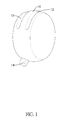
- a first embodiment of a multi-channel headphone in accordance with the present invention has a housing 10 and a speaker unit 20.
- the housing 10 is cylindrical and has a compartment 11, a first audio output hole 12 and a second audio output hole 13 and a wire hole 14.
- the compartment 11 is defined inside the housing 10.
- the first audio output hole 12, the second audio output hole 13 and the wire hole 14 are formed on and recessed inwards from a curve surface of the housing 10 to communicate with the compartment 11.
- the speaker unit 20 is a moving-coil speaker and has a first sound-generating part 21 and a second sound-generating part 22 respectively formed on two opposite sides of the speaker unit 20.
- the speaker unit 20 is mounted inside the compartment 11 so that the first audio output hole 12 and the second audio output hole 13 do not communicate with each other. Circuitry of the speaker unit 20 extends beyond the housing 10 through the wire hole 14.
- Sound produced by the second sound-generating part 22 directly travels through an opening of the second audio output hole 13.
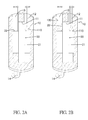
- a sound wall 110 is formed on an inner wall of the compartment 11 being opposite to and spaced apart from the first sound-generating part 21. Sound produced by the first sound-generating part 21 is retracted by the sound wall 110 first and then travels through the first audio output hole 12 instead of directly travelling the first audio output hole 12.
- the housing 10 When the present embodiment is in use, the housing 10 is placed in the outer ear of a user's ear with the opening of the second audio output hole 13 directly facing the auditory canal of the outer ear and the first audio output hole 13 located in the pinna of the outer ear and facing an inner wall of the pinna.
- the first sound-generating part 21 and the second sound-generating part 22 of the speaker unit 20 simultaneously produce sound, the sound produced by the second sound-generating part 22 travels to the auditory canal through the second audio output hole 13, and the sound produced by the first sound-generating part 21 is first refracted by the sound wall 110 and then travels to the auditory canal through the first audio output hole 12.
- the travelling speed of the sound produced by the first sound-generating part 21 to the auditory cannel is slower than that of the sound produced by the second sound-generating part 22 such that multiple layers of auditory feeling can be provided.
- the first audio output hole 12 and the second audio output hole 13 are independently formed and sound-travelling paths in the first and second audio output holes 12, 13 differ from each other, a stereo sound effect can be generated for users to enjoy better auditory feeling.
- the second sound-generating part 22' may be arranged to face the opening of the second audio output hole 13.
- a first sound wall 110 is formed on an inner wall of the first audio output hole 12 and faces the first sound-generating part 21. Sound produced by the first sound-generating part 21 is refracted by the first sound wall 110 and then travels through an opening of the first audio output hole 12.
- a second sound wall 120 is formed on an inner wall of the second audio output hole 13 and faces the second sound-generating part 22'. Sound produced by the second sound-generating part 22' is retracted by the second sound wall 120 first and then travels through the second audio output hole 13.
- the housing 10 When the present embodiment is in use, the housing 10 is placed in the outer ear of a user's ear with the opening of the first audio output hole 12 directly facing the auditory canal of the outer ear and the second audio output hole 13 located in the pinna of the outer ear and facing an inner wall of the pinna.
- the first sound-generating part 21 and the second sound-generating part 22' of the speaker unit 20 simultaneously produce sound, the sound produced by the first sound-generating part 21 is refracted by the first sound wall 110 and then travels to the auditory canal through the first audio output hole 12, and the sound produced by the second sound-generating part 22' is first refracted by the second sound wall 120 and then travels to the auditory canal through the second audio output hole 13.
- the sounds produced by the first sound-generating part 21 and the second sound-generating part 22' travel to the auditory canal through different paths, multiple layers of auditory feeling can be provided.
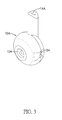
- a second embodiment of the multi-channel headphone in accordance with the present invention has a housing 10A and a speaker unit 20A.
- the housing 10A is disc-shaped, and has a compartment 11A, a first audio output hole 12A, two second audio output holes 13A, and a wire hole 14A.
- the compartment 11A is defined inside the housing 10A.
- the first audio output hole 12A is formed on and recessed inwards from one of two end faces of the housing 10A.
- the second audio output holes 13A are laterally formed through the housing 10A with two openings oppositely located on an outer circumferential surface of the housing 10A.
- the wire hole 14A is formed on and recessed inwards from the outer circumferential surface of the housing 10A.
- the first audio output hole 12A, the second audio output holes 13A and the wire hole 14A communicate with the compartment 11A.
- the speaker unit 20A is a moving-coil speaker, and has a first sound-generating part 22A and a second sound-generating part 21A respectively formed on two opposite sides of the speaker unit 20A.
- the speaker unit 20A is mounted inside the compartment 11A so that the first audio output hole 12A and the second audio output hole 13A do not communicate with each other. Circuitry of the speaker unit 20A extends beyond the housing 10A through the wire hole 14A. Sound produced by the first sound-generating part 22A directly travels through an opening of the first audio output hole 12A.
- An external side of the second sound-generating part 21A and an opposite inner wall of the compartment 11A are spaced apart.
- a sound wall 110A is formed on the opposite inner wall of the compartment 11A. Sound produced by the second sound-generating part 21A is refracted by the sound wall 110A first and then travels through the second audio output hole 13A instead of directly travelling through the second audio output hole 13A.
- the housing 10A When the present embodiment is in use, the housing 10A is placed in the outer ear of a user's ear with the opening of the first audio output hole 12A directly facing the auditory canal of the outer ear and the second audio output hole 13A located in the pinna of the outer ear and facing an inner wall of the pinna.
- the first sound-generating part 22A and the second sound-generating part 21A of the speaker unit 20 simultaneously produce sound, the sound produced by the first sound-generating part 22A travels to the auditory canal through the first audio output hole 12, and the sound produced by the second sound-generating part 21A is first refracted by the sound wall 110A and then travels to the auditory canal through the second audio output hole 13A.
- the travelling speed of the sound produced by the second sound-generating part 21A to the auditory cannel is slower than that of the sound produced by the first sound-generating part 22A such that multiple layers of auditory feeling can be provided.
- the first audio output hole 12 and the second audio output hole 13 are independently formed and sound-travelling paths in the first and second audio output holes 12, 13 differ from each other, a stereo sound effect can be generated for users to enjoy better auditory feeling.
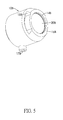
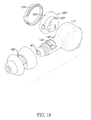
- a third embodiment of a multi-channel headphone in accordance with the present invention is an earplug type headphone, and has a housing 10B and three speaker units 20B, 21B, 22B.
- the housing 10B is cylindrical, and has a first compartment 11B, a second compartment 12B, a third compartment 13B, a first audio output hole 14B, a second audio output hole 15B, a third audio output hole 16B, and a wire hole 17B.
- the first compartment 11B, the second compartment 12B and the third compartment 13B are partitioned inside the housing 10B.
- the first compartment 11B is adjacent to one of two end faces of the housing 10B.
- the second compartment 12B and the third compartment 13B are adjacent to a curve surface of the housing 10B.
- the first audio output hole 14B, the second audio output hole 15B and the third audio output hole 16B are formed on and recessed inwards from the end face adjacent to the first compartment, and the second audio output hole 15B and the third audio output hole 16B are formed beside the first audio output hole 14B.
- the first audio output hole 14B, the second audio output hole 15B and the third audio output hole 16B respectively communicate with the first compartment 11B, the second compartment 12B and the third compartment 13B.
- the wire hole 17B also communicates with the first compartment 11B, the second compartment 12B and the third compartment 13B.
- a first sound-generating part is mounted on one side of each of the speaker units 20B, 21B, 22B.
- a second sound-generating part is mounted on an opposite side of each of the speaker units 20B, 21B, 22B.
- the speaker units 20B, 21B, 22B include a first speaker unit 20B, a second speaker unit 21B and a third speaker unit 22B.
- the first speaker unit 20B is mounted inside the first compartment 11B.
- the second speaker unit 21B is mounted inside the second compartment 12B.
- the third speaker unit 22B is mounted inside the third compartment 13B. Circuitries of the first, second and third speaker units 20B, 21B, 22B extend beyond the housing 10B through the wire hole 17B.
- Sound produced by the first sound-generating part of the first speaker unit 20B directly travels through an opening of the first audio output hole 14B.
- the first sound-generating part of the second speaker unit 21 B and an inner wall of the second compartment 12B are spaced apart.
- a first sound wall 120B is formed on the inner wall of the second compartment 12B and faces the first sound-generating part of the second speaker unit 21B. Sound produced by the first sound-generating part of the second speaker unit 2 1 B is refracted by the sound wall 120B before travelling through the second audio output hole 15B instead of directly travelling through the second audio output hole 15B.
- the first sound-generating part of the third speaker unit 22B and an inner wall of the third compartment 13B are spaced apart.
- a second sound wall 130B is formed on the inner wall of the third compartment 13B and faces the first sound-generating part of the third speaker unit 22B. Sound produced by the first sound-generating part of the third speaker unit 22B is refracted by the second sound wall 130B before travelling through the third audio output hole 16B instead of directly travelling through the third audio output hole 16B.
- the second sound-generating parts of the first, second and third speaker units 20B, 21B, 22B are adjacent to one another.
- the housing 10B When the present embodiment is in use, the housing 10B is placed in the outer ear of a user's ear with the opening of the first audio output hole 14B directly facing the auditory canal of the outer ear and the second audio output hole 15B and the third audio output hole 16B located in the pinna of the outer ear and facing an inner wall of the pinna.
- the first sound-generating part of the first speaker unit 20B produces sound, the produced sound travels to the auditory canal through the first audio output hole 14B.
- the sound produced by the first sound-generating part of the second speaker unit 2 1 B is first refracted by the first sound wall 120B and then travels to the auditory canal through the second audio output hole 15B.
- the sound produced by the first sound-generating part of the third speaker unit 22B is first refracted by the second sound wall 130B and then travels to the auditory canal through the third audio output hole 16B.
- the travelling speed of the sound produced by the second speaker unit 2 1 B and the third speaker unit 22B to the auditory cannel is slower than that of the sound produced by the first speaker unit 20B such that multiple layers of auditory feeling can be provided.
- first audio output hole 14B, the second audio output hole 15B and the third audio output hole 16B are independently formed and sound-travelling paths in the first, second and third audio output holes 14B, 15B, 16B differ from one another, a stereo sound effect can be generated for users to enjoy better auditory feeling.
- a fourth embodiment of a multi-channel headphone in accordance with the present invention has a housing 10C and three speaker units 20C, 21C, 22C.
- the housing 10C is cylindrical and has a first compartment 11C, a second compartment 12C, a third compartment 13C, a first audio output hole 15C, a second audio output hole 16C, and a third audio output hole 17C.
- the first compartment 11C, the second compartment 12C and the third compartment 13 are mutually separated by partition walls 14C located adjacent to a first end of the housing 10C.
- the first audio output hole 15C is formed on and recessed inwards from the first end of the housing 10C, and longitudinally communicates with the first compartment 11C.
- the second audio output hole 16C and the third audio output hole 17C are radially and oppositely formed through a curve surface of the housing 10C, the second audio output hole 16C communicates with the second compartment 12C, and the third audio output hole 17C communicates with the third compartment 13C.
- the speaker units 20C, 21C, 22C are balanced-armature speaker units and includes a first speaker unit 20C, a second speaker unit 21C and a third speaker unit 22C.
- a sound-generating part is mounted on a reduced neck end of each of the speaker units 20C, 21 C, 22C.
- the first speaker unit 20C, the second speaker unit 21 C and the third speaker unit 22C are respectively mounted inside the first compartment 11C, the second compartment 12C and the third compartment 13C.
- the sound-generating parts of the first, second and third speaker units 20C, 21C, 22C are blocked by the partition walls 14C and do not communicate with one another. Circuitries of the first, second and third speaker units 20C, 21 C, 22C extend beyond the housing 10C through a second end of the housing opposite to the first end.
- sound produced by the sound-generating part of the first speaker unit 20C directly travels through the first audio output hole 15C.
- an external side of the sound-generating part of the second speaker unit 21C and an opposite inner wall of the second compartment 12C are spaced apart.
- a first sound wall 120C is formed on the opposite inner wall of the second compartment 12C.
- the sound-generating part of the second speaker unit 21 C faces the first sound wall 120C instead of directly facing the second audio output hole 16C.
- An external side of the sound-generating part of the third speaker unit 22C and an opposite inner wall of the third compartment 13C are spaced apart.
- a second sound wall 130C is formed on the opposite inner wall of the third compartment 13C. Sound produced by the sound-generating part of the third speaker unit 22C is refracted by the second sound wall 130C before travelling through the second audio output hole 17C instead of directly travelling through the second audio output hole 17C.
- the housing 10C When the present embodiment is in use, the housing 10C is placed in the outer ear of a user's ear with the opening of the first audio output hole 15C directly facing the auditory canal of the outer ear and the second audio output hole 16C and the third audio output hole 17C located in the pinna of the outer ear and facing an inner wall of the pinna.
- the sound-generating part of the first speaker unit 20C produces sound, the produced sound travels to the auditory canal through the first audio output hole 15C.
- the sound produced by the second speaker unit 21C is first refracted by the first sound wall 120C and then travels to the auditory canal through the second audio output hole 16C.
- the sound produced by the third speaker unit 22C is first refracted by the second sound wall 130C and then travels to the auditory canal through the third audio output hole 17C.
- the travelling speed of the sound produced by the second speaker unit 21C and the third speaker unit 22C to the auditory cannel is slower than that of the sound produced by the first speaker unit 20C such that multiple layers of auditory feeling can be provided.
- a fifth embodiment of a multi-channel headphone in accordance with the present invention is an earplug type headphone, and has a housing and three speaker units 20D, 21D, 22D.
- the housing has an inner housing 10D and an outer housing 11D.
- the inner housing 10D is cylindrical.
- the inner housing 10D has a second compartment 13D, a third compartment 14D, a first audio output hole 16D, a second audio output hole 17D, and a third audio output hole 18D.
- the second compartment 13D and the third compartment 14D are formed in an outer end of the inner housing 10D, and a partition wall 15D is formed between the second compartment 13D and the third compartment 14D to separate the second compartment 13D and the third compartment 14D.
- the second compartment 13D and the third compartment 14D respectively have a second opening and a third opening at the outer end of the inner housing 10D.
- the first audio output hole 16D is longitudinally formed through the inner housing 10D.
- the second audio output hole 17D and the third audio output hole 18D are oppositely and radially formed on and recessed inwards from a curve surface of the inner housing 10D, and respectively communicate with the second compartment 13D and the third compartment 14D.
- the outer housing 11D is disc-shaped, is connected to the inner housing 10D, and has a first compartment 12D.
- the first compartment 12D is formed in an inner side of the outer housing 11D with a first opening 120D located at the inner side of the outer housing 11D.
- the first opening 120D of the outer housing 11D is connected to the outer end of the inner housing 10D.
- the first compartment 12D communicates with the first audio output hole 16D through the first opening 120D.
- the speaker units 20D, 21D, 22D include a first speaker unit 20D, a second speaker unit 21D, and a third speaker unit 22D.
- the first speaker unit 20D is a moving-coil speaker, is disc-shaped, and has a first sound-generating part 200D and a second sound-generating part 201D respectively formed on two opposite sides of the first speaker unit 20D.
- the first speaker unit 20D is mounted inside the first compartment 12D with the first sound-generating part 200D facing the first opening 120D of the first compartment 12D and an opening of the second audio output hole 17D.
- the second speaker unit 21D and the third speaker unit 22D are balanced-armature speakers, are cylindrical, and are respectively mounted inside the second compartment 13D and the third compartment 14D of the inner housing 10D.
- the second speaker unit 21D has a sound-generating part 210D mounted on one end thereof.
- the third speaker unit 22D has a sound-generating part 220D mounted on one end thereof.
- the sound-generating parts 210D, 220D of the second and third speaker units 21D, 22D are separated by a partition wall 15D without communicating with each other.
- the second speaker unit 21D and an inner wall of the second compartment 13D is spaced apart.
- a first sound wall 130D is formed on the inner wall of the second compartment 13D. Sound produced by the sound-generating part 210D of the second speaker unit 21D is refracted by the first sound wall 130D before travelling through the second audio output hole 17D instead of directly travelling through the opening of the second audio output hole 17D.
- the third speaker unit 22D and an inner wall of the third compartment 14D is spaced apart.
- a second sound wall 140D is formed on the inner wall of the third compartment 14D. Sound produced by the sound-generating part 220D of the third speaker unit 22D is refracted by the second sound wall 140D before travelling through the third audio output hole 18D instead of directly travelling through the third audio output hole 18D.
- the housing 10D When the present embodiment is in use, the housing 10D is placed in the outer ear of a user's ear with the opening of the first audio output hole 16D directly facing the auditory canal of the outer ear and the second audio output hole 17D and the third audio output hole 18D located in the pinna of the outer ear and facing an inner wall of the pinna.
- the first sound-generating part 200D of the first speaker unit 20D produces sound, the produced sound travels to the auditory canal through the first audio output hole 16D.
- the sound produced by the sound-generating part 210D of the second speaker unit 21D is first refracted by the first sound wall 130D and then travels to the auditory canal through the second audio output hole 17D.
- the sound produced by the sound-generating part 220D of the third speaker unit 22D is first refracted by the second sound wall 140D and then travels to the auditory canal through the third audio output hole 18D.
- the travelling speed of the sound produced by the second speaker unit 21D and the third speaker unit 22D to the auditory cannel is slower than that of the sound produced by the first speaker unit 20D such that multiple layers of auditory feeling can be provided.
- first audio output hole 16D, the second audio output hole 17D and the third audio output hole 18D are independently formed and sound-travelling paths in the first, second and third audio output holes 16D, 17D, 18D differ from one another, a stereo sound effect can be generated for users to enjoy better auditory feeling.
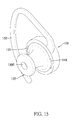
- a sixth embodiment of a multi-channel headphone in accordance with the present invention is an ear hook type headphone, and has a housing 10E and a speaker unit 20E.
- the housing 10E is disc-shaped, and has a compartment 11E, an ear plug 12E, a second audio output hole 13E, a third audio output hole 14E, and an ear hook 15E.
- the compartment 11E is formed in an inner side of the housing 10E with an opening at the inner side.
- the ear plug 12E is mounted in the compartment 11E through the opening, and has a first audio output hole 120E formed through the ear plug 12E to communicate with the compartment 11E.
- the second audio output hole 13E and the third audio output hole 14E are oppositely formed in a circumferential wall of the housing 10E to communicate with the compartment 11E.
- the ear hook 15E is connected with the housing 10E.
- the speaker unit 20E is a moving-coil speaker, is mounted inside the compartment 11E of the housing 10E and is located at an inner end of the ear plug 12E, is disc-shaped, and has a first sound-generating part 21E and a second sound-generating part 22E. Sound produced by the first sound-generating part 21E directly travels through the opening of the compartment 11E and an opening of the first audio output hole 120E.
- the second sound-generating part 22E and an inner wall of the compartment 11E are spaced apart.
- a sound wall 110E is formed on the inner wall of the compartment 11E.
- the sound wall 110E faces the second sound-generating part 22E, the second audio output hole 13E and the third audio output hole 14E. Sound produced by the second sound-generating part 22E is refracted by the sound wall 110E before travelling through the second audio output hole 13E and the third audio output hole 14E instead of directly travelling through the second audio output hole 13E and the third audio output hole 14E.
- the ear plug 12E When the present embodiment is in use, the ear plug 12E is inserted into the outer ear of a user's ear with an opening of the first audio output hole 120E directly facing the auditory canal of the outer ear and the second audio output hole 13E and the third audio output hole 14E located in the pinna of the outer ear and facing an inner wall of the pinna.
- the sound produced by the first sound-generating part 21E travels to the auditory canal through the first audio output hole 120E, and the sound produced by the second sound-generating part 22E is first refracted by the sound wall 110E and then travels to the auditory canal through the second audio output hole 13E and the third audio output hole 14E.
- the travelling speed of the sound produced by the second sound-generating part 22E to the auditory cannel is slower than that of the sound produced by the first sound-generating part 21E such that multiple layers of auditory feeling can be provided.
- first audio output hole 12E and the second audio output hole 13E and the third audio output hole 14E are independently formed and sound-travelling paths in the first, second and third audio output holes 12E, 13E, 14E differ from one another, a stereo sound effect can be generated for users to enjoy better auditory feeling.
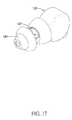
- a seventh embodiment of a multi-channel headphone in accordance with the present invention is canal type headphone, and has a housing 10F and a speaker unit 20F.
- the housing 10F has a cylindrical portion and a canal insertion tube 13F connected with a curve surface of the cylindrical portion.
- the cylindrical portion has a compartment 11F, an opening, and a lid 12F.
- the compartment 11F is formed on and recessed inwards from one of two bases of the cylindrical portion.
- the opening of the cylindrical portion communicates with the compartment 11F.
- the lid 12F covers the opening of the cylindrical portion.
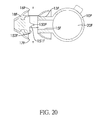
- the canal insertion tube 13F has a first audio output hole 14F, a sound-guiding channel 15F, a second audio output hole 16F, a third audio output hole 17F, and a cap 18F.
- the first audio output hole 14F is formed in an inner end of the canal insertion tube 13F to communicate with the compartment 11F through one sidewall of the compartment 11F.
- the sound-guiding channel 15F is formed inside the canal insertion tube 13F.
- One end of the sound-guiding channel 15F communicate with the compartment 11F through another sidewall of the compartment 11F, and the other end of the sound-guiding channel 15F is located inside the canal insertion tube 13F, is adjacent to an opening of the first audio output hole 14F, and has a dividing wall 150F and two blocking walls 152F.
- the dividing wall 150F has two bevel surfaces 151F formed on two sides of the dividing wall 150F.
- the blocking walls 152F are respectively formed on the bevel surfaces 151F of the dividing wall 150F.
- the second audio output hole 16F and the third audio output hole 17F are oppositely formed through a peripheral wall of the canal insertion tube 13F to both communicate with the sound-guiding channel 15F. Openings of the second audio output hole 16F and the third audio output hole 17F respectively face the bevel surfaces 151F of the dividing wall 150F.
- the cap 18F is mounted around the inner end of the canal insertion tube 13F, is made of rubber and has openings formed through the cap 18F to respectively correspond to the first audio output hole 14F, the second audio output hole 16F and the third audio output hole 17F.
- the speaker unit 20F is a moving-coil speaker, is disc-shaped, is mounted inside the compartment 11F of the housing 10F and has a first sound-generating part 21F and a second sound-generating part 22F mounted on two sides of the speaker unit 20F.
- the first sound-generating part 21F and the lid 12F are spaced apart, and sound produced by the first sound-generating part 21F is refracted by an inner wall of the lid 12F.
- the second sound-generating part 22F and the inner wall of the housing 10F are spaced apart, and sound produced by the second sound-generating part 22F is refracted by an inner wall of the housing 10F.
- the canal insertion tube 16F and the cap 18F are placed in the outer ear of a user's ear with the opening of the first audio output hole 14f directly facing the auditory canal of the outer ear and the second audio output hole 16F and the third audio output hole 17F located in the pinna of the outer ear and facing an inner wall of the pinna.
- the sound produced by the second sound-generating part 22F is refracted by the inner wall of the housing 10F and then directly travels to the auditory canal through the first audio output hole 14F, and the sound produced by the first sound-generating part 21F is refracted by the inner wall of the lid 12F, is then guided to the sound-guiding channel 15F, and travels to the auditory canal after being further refracted by the dividing wall 150F, two bevel surfaces 151F of the dividing wall and the blocking walls 152F.
- the travelling speed of the sound produced by the first sound-generating part 21F to the auditory cannel is slower than that of the sound produced by the second sound-generating part 22F such that multiple layers of auditory feeling can be provided.
- the first audio output hole 14F and the second audio output hole 16F and the third audio output hole 17F are independently formed and sound-travelling paths in the first, second and third audio output holes 14F, 15F, 16F differ from one another, a stereo sound effect can be generated for users to enjoy better auditory feeling.
- an eighth embodiment of a multi-channel headphone in accordance with the present invention is an on-ear type headphone, and has a left speaker unit 10G, a right speaker unit 20G and a headband 30G.
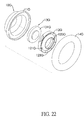
- the left speaker unit 10G has a housing 11G, a sound-guiding member 12G, a speaker unit 13G and an ear cushion 14G.
- the housing 11G is hollow and disc-shaped, and has a compartment 110G defined inside the housing 11G.
- the sound-guiding member 12G has a mounting portion 120G, a sound-guiding piece 121G and multiple second audio output holes 123G.
- the mounting portion 120G is centrally formed in the sound-guiding member 12G and has a chamber defined therein.
- the sound-guiding piece 121G is dish-shaped, and is formed on the mounting portion 120G with a tapered peripheral wall, and has a first audio output hole 122G and multiple second audio output holes 123G.
- the first audio output hole 122G is formed through an inner side of the sound-guiding piece 121G and communicates with the chamber of the mounting portion 120G.
- the second audio output holes 123G are formed in a circumferential edge portion of the sound-guiding member 12G and are spaced apart from each other.
- the speaker unit 13G is a moving-coil speaker, is disc-shaped, is mounted inside the mounting portion 120G of the sound-guiding member 12G and has a first sound-generating part 130G and a second sound-generating part 131G. Sound produced by the second sound-generating part 131 G directly travels through the first audio output hole 122G.
- the first sound-generating part 130G is spaced apart from an inner wall of the compartment 110G, and is refracted by the inner wall of the compartment 110G
- a sound wall 111G is formed on the inner wall of the compartment 110G,
- a central portion of the sound wall 111G faces an opening of the first sound-generating part 130G of the speaker unit 13G.
- a bordering portion of the sound wall 111G faces openings of the second audio output holes 123G.
- the ear cushion 14G is mounted around an edge portion of the housing 11G.
- the right speaker unit 20G is structurally the same as the left speaker unit and is thus not repeated.
- the headband 30G is a resilient and arc-shaped plate and is connected between the left speaker unit 10G and the right speaker unit 20G.
- the left speaker unit 10G and the right speaker unit 20G are respectively placed on the left ear and the right ear of a user.
- the headband 30G provides a suitable holding force for respectively holding the left speaker unit 10G and the right speaker unit 20G on the left ear and the right ear.
- the travelling direction of sound produced by the present embodiment given the left speaker unit 10G as an example, sound produced by the second sound-generating part 131 G directly travels to the auditory canal through the first audio output hole 122G, and sound produced by the first sound-generating part 130G is refracted by the sound wall and travels to the auditory canal through the second audio output holes 123G.
- the travelling speed of the sound produced by the first sound-generating part 130G to the auditory cannel is slower than that of the sound produced by the second sound-generating part 131 G such that multiple layers of auditory feeling can be provided. Because the first audio output hole 130F and the second audio output hole 131F are independently formed and sound-travelling paths in the first and second audio output holes 130F, 131F differ from each other, a stereo sound effect can be generated for users to enjoy better auditory feeling.
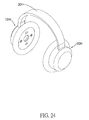
- a ninth embodiment of a multi-channel headphone in accordance with the present invention has a left speaker unit 10H, a right speaker unit 20H and a headband 30H.
- the left speaker unit 10H has a housing 11H, a blocking plate 12H, a sound-guiding piece 13H, a mounting frame 14H, three speaker units 15H, 16H, 17H, a covering plate 18H and an ear cushion 19H.
- the housing 11H is hollow and disc-shaped, and has a compartment 110H and two guiding walls 111H.
- the compartment 110H is defined within the housing 11H.
- the guiding walls 111H are respectively and oppositely mounted on an inner wall of the housing 11H.
- Each guiding wall 111H has a through hole 112H formed through the guiding wall 111H and spaced apart from the inner wall of the housing 11H.
- a sound wall 113H is formed on a position on the inner wall of the housing 11H corresponding to each guiding wall 111H.
- the blocking plate 12H is mounted inside the compartment 110H.
- the sound-guiding piece 13H is disc-shaped with one side opened, is mounted on one side of the blocking plate 12H, and has two ears oppositely formed on and protrudes radially from a periphery of the sound-guiding piece 13H. Each ear has a guiding hole 130H formed through the ear.
- the mounting frame 14H is mounted on the sound-guiding piece 13H, and has a first mounting portion 140H, a first sound-guiding tube 141H, a second mounting portion 143H and a third mounting portion 144H.
- the first mounting portion 140H is annular and is centrally formed on the mounting frame 14H.
- the first sound-guiding tube 141H is formed on and protrudes inwards from an inner side of the first mounting portion 140H and has a first guiding hole 142H formed through the first sound-guiding tube 141H.
- the second mounting portion 143H and the third mounting portion 144H are oppositely formed on a peripheral wall of the first mounting portion 140H.
- the speaker units 15H, 16H, 17H include a first speaker unit 15H, a second speaker unit 16H and a third speaker unit 17H.
- the first speaker unit 15H is a moving-coil speaker, is disc-shaped, is mounted inside the first mounting portion 140H of the mounting frame 14H, and has a first sound-generating part 150H and a second sound-generating part 151H respectively formed on two opposite sides of the first speaker unit 15H. Sound produced by the first sound-generating part 150H directly travels through the first guiding hole 142H. Sound produced by the second sound-generating part 151H is refracted by an inner wall of the sound-guiding piece 13H and then travels through the guiding holes 130H of the sound-guiding piece 13H.
- the second speaker unit 16H is mounted on the second mounting portion 143H, and has a sound-generating part facing the through hole 112H of one of the guiding walls 111H in the housing 11H.
- the third speaker unit 17H is mounted on the third mounting portion 144H, and has a sound-generating part facing the through hole 112H of the other guiding wall 111H in the housing 11 H.
- the covering plate 18H is mounted on the housing 11H, and has a first audio output hole 180H, two second audio output holes 181H and two third audio output holes 182H.
- the first audio output hole 180H is centrally formed through the covering plate 18H.
- the two second audio output holes 181H are formed through two opposite positions on the covering plate 18H with respect to the first audio output hole 180H.
- the two third audio output holes 182H are formed through another two opposite positions on the covering plate 18H with respect to the first audio output hole 180H.
- the first audio output hole 180H communicates with the first guiding hole 142H.
- the second audio output holes 181H respectively communicates with the guiding holes 130H of the sound-guiding piece 13H.
- the guiding holes 130H constitute the second guiding holes.
- Each third audio output hole 182H communicates with a space between one of the guiding walls 111H and one of the sound walls 113H, which constitutes a third guiding hole.
- the ear cushion 19H is mounted around
- the right speaker unit 20H has similar internal structure as the left speaker unit 10H, and is not repeated.
- the headband 30H is a resilient and arc-shaped plate, and is connected between the left speaker unit 10H and the right speaker unit 20H.
- sound produced by the first sound-generating part 150H of the first speaker unit 15H directly travels to the auditory canal of a user through the guidance of the first guiding hole 142H and the first audio output hole 180H.
- Sound produced by the second sound-generating part 151H of the first speaker unit 15H is refracted by the sound-guiding piece 13H and then travels to the auditory canal through the two second guiding holes 130H and the two second audio output holes 181H.
- Sound produced by the sound-generating parts of the second speaker unit 16H and the third speaker unit 17H is refracted and then travels to the auditory canal through the two third guiding holes of the housing 11H and the two third audio output holes 182H.
- the travelling speed of the sound produced by the first speaker unit 15H to the auditory cannel is slower than that of the sound produced by the second sound-generating part 150H of the first speaker unit 15H such that multiple layers of auditory feeling can be provided.
- the first audio output hole 180H, the second audio output holes 181H and the third audio output holes 182H are independently formed and sound-travelling paths in the first, second and third audio output holes 180H, 181H, 182H differ from one another, a stereo sound effect can be generated for users to enjoy better auditory feeling.
- a tenth embodiment of a multi-channel headphone in accordance with the present invention is a redesign of the ninth embodiment and differs from the ninth embodiment in that each of the left speaker unit 10K and the right speaker unit further has a preliminary speaker unit 40K.
- the housing 11K of the left speaker unit 10K has a mounting chamber 12K and two fourth guiding holes 120K.
- the mounting chamber 12K is formed on and recessed inwards from an inner side of the housing 11K.
- the two fourth guiding holes 120K are oppositely formed between the mounting chamber 12K and the first mounting portion 140H of the support frame 14H.
- the preliminary speaker unit 40K is mounted inside the mounting chamber 12K, and has a first sound-generating part 400K and a second sound-generating part 401K. Sound produced by the first sound-generating part 400K directly travels to the auditory canal of a user through the inner side of the housing 11K.
- Sound produced by the second sound-generating part 401K travels outside the housing 11K through the two fourth guiding holes 120K for the preliminary speaker unit 40K to serve as a preliminary sound source.
- the rest of speaker units can serve as a center sound source, an outer sound source and a bass sound source to constitute a real multi-channel headphone.
Landscapes
- Engineering & Computer Science (AREA)
- Physics & Mathematics (AREA)
- Acoustics & Sound (AREA)
- Signal Processing (AREA)
- Manufacturing & Machinery (AREA)
- Health & Medical Sciences (AREA)
- Otolaryngology (AREA)
- Headphones And Earphones (AREA)
Abstract

Description
- The present invention relates to a headphone, and more particularly to a multi-channel headphone with a stereo sound effect through multiple sound guiding channels.
- Headphones are connected to audio source devices for users to listen audio information outputted from the audio source devices after users wear the headphones, the audio source devices output electronic signals to the headphones, and the headphones convert the electronic signals into audible sound.
- As disclosed in a Taiwanese Patent Publication No.
201216725 - Sound generated by the first speaker unit propagates to the main audio output channel through the central hole, and sound generated by the second speaker unit propagates to the main audio output channel through the surrounding holes. Sound generated by the first and second speaker units are mixed in the main audio output channel before propagating to a user's ears so as to provide a wider audio output frequency and a uniform frequency response.
- However, despite a choice of a wider audio output frequency, the foregoing conventional headphone still has the structure that one audio output channel is available at only one side of the headphone. It means that users can only listen two-channel audio output instead of a stereo sound effect provided by more than two audio output channels.
- An objective of the present invention is to provide a multi-channel headphone providing multiple layers of auditory feeling and a stereo sound effect with sound travelling through direct and indirect sound channels.
- To achieve the foregoing objective, the multi-channel headphone has a housing and a speaker unit.
- The housing has two audio output holes formed in the housing.
- The speaker unit is mounted inside the housing and has two sound-generating parts mounted on the speaker unit. Sound produced by one of the sound-generating parts directly travels through one of the audio output holes, and sound produced by the other sound-generating part indirectly travels through the other audio output hole.
- To achieve the foregoing objective, the multi-channel headphone has a housing and multiple speaker units.
- The housing has multiple audio output holes formed in the housing.
- The speaker units are mounted inside the housing. Each speaker unit has a sound-generating part mounted thereon. Sound produced by one of the sound-generating parts directly travels through one of the audio output holes, and sound produced by the rest of sound-generating parts indirectly travels through the rest of the audio output holes.
- To achieve the foregoing objective, the multi-channel headphone has two speaker units and a headband.
- Each speaker unit has a housing and a speaker.
- The housing has multiple audio output holes formed in the housing. The speaker is mounted inside the housing and has two sound-generating parts. The sound produced by one of the sound-generating parts directly travels through one of the audio output holes, and sound produced by the other sound-generating part indirectly travels through the other audio output hole.
- The headband is connected between the two speaker units with the speaker units symmetrically arranged.
- To achieve the foregoing objective, the multi-channel headphone has a housing and a speaker unit.
- The housing having two audio output holes formed in the housing.
- The speaker unit is mounted inside the housing and has two sound-generating parts mounted in the speaker unit. The sound produced by one of the sound-generating parts indirectly travels through one of the audio output holes, and sound produced by the other sound-generating part indirectly travels through the other audio output hole.
- Given the foregoing multi-channel headphones, sound produced by one or more speaker units can travel to the auditory canal of the outer ear of a user through multiple independent sound channels for the produced sound to directly travel through or to be refracted and then travel through. Accordingly, multiple layers of auditory feeling and a stereo sound effect can be achieved for the sake of varying time for sound to reach the auditory canal through the different sound channels.
- Other objectives, advantages and novel features of the invention will become more apparent from the following detailed description when taken in conjunction with the accompanying drawings.
-
-
Fig. 1 is a perspective view of a first embodiment of a multi-channel headphone in accordance with the present invention; -
Fig. 2A is a side view in section of the multi-channel headphone inFig. 1 ; -
Fig. 2B is a side view in section of the multi-channel headphone inFig. 1 with different layout in a speaker unit; -
Fig. 3 is a perspective view of a second embodiment of a multi-channel headphone in accordance with the present invention; -
Fig. 4 is an enlarged cross-sectional view of the multi-channel headphone inFig. 3 ; -
Fig. 5 is a perspective view of a third embodiment of a multi-channel headphone in accordance with the present invention; -
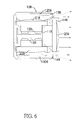
Fig. 6 is an enlarged cross-sectional view of the multi-channel headphone inFig. 5 ; -
Fig. 7 is a perspective view of a fourth embodiment of a multi-channel headphone in accordance with the present invention; -
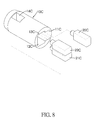
Fig. 8 is an exploded perspective view of the multi-channel headphone inFig. 7 ; -
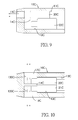
Fig. 9 is a cross-sectional view of the multi-channel headphone inFig. 7 ; -
Fig. 10 is another cross-sectional view of the multi-channel headphone inFig. 7 ; -
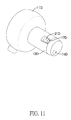
Fig. 11 is a perspective view of a fifth embodiment of a multi-channel headphone in accordance with the present invention; -
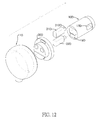
Fig. 12 is an exploded perspective view of the multi-channel headphone inFig. 11 ; -
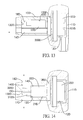
Fig. 13 is a cross-sectional view of the multi-channel headphone inFig. 11 ; -
Fig. 14 is another cross-sectional view of the multi-channel headphone inFig. 11 ; -
Fig. 15 is a perspective view of a sixth embodiment of a multi-channel headphone in accordance with the present invention; -
Fig. 16 is a cross-sectional view of the multi-channel headphone inFig. 15 ; -
Fig. 17 is a perspective view of a seventh embodiment of a multi-channel headphone in accordance with the present invention; -
Fig. 18 is an exploded perspective view of the multi-channel headphone inFig. 17 ; -
Fig. 19 is a cross-sectional view of the multi-channel headphone inFig. 17 ; -
Fig. 20 is another cross-sectional view of the multi-channel headphone inFig. 17 ; -
Fig. 21 is a perspective view of an eighth embodiment of a multi-channel headphone in accordance with the present invention; -
Fig. 22 is an exploded perspective view of the multi-channel headphone inFig. 21 ; -
Fig. 23 is a cross-sectional view of the multi-channel headphone inFig. 21 ; -
Fig. 24 is a perspective view of a ninth embodiment of a multi-channel headphone in accordance with the present invention; -
Fig. 25 is an exploded perspective view of the multi-channel headphone inFig. 24 ; -
Fig. 26 is a cross-sectional view of the multi-channel headphone inFig. 24 ; -
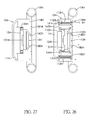
Fig. 27 is another cross-sectional view of the multi-channel headphone inFig. 24 ; -
Fig. 28 is a cross-sectional view of a tenth embodiment of a multi-channel headphone in accordance with the present invention; and -
Fig. 29 is another cross-sectional view of the multi-channel headphone inFig. 28 . - To define necessary directions in the following description, "inner" direction specifies a direction proximal to the auditory canal of an outer ear of a user, and "outer" direction specifies a direction distal to the auditory canal of the outer ear of the user.
- With reference to
Figs. 1 and2A , a first embodiment of a multi-channel headphone in accordance with the present invention has ahousing 10 and aspeaker unit 20. - The
housing 10 is cylindrical and has acompartment 11, a firstaudio output hole 12 and a secondaudio output hole 13 and awire hole 14. Thecompartment 11 is defined inside thehousing 10. The firstaudio output hole 12, the secondaudio output hole 13 and thewire hole 14 are formed on and recessed inwards from a curve surface of thehousing 10 to communicate with thecompartment 11. Thespeaker unit 20 is a moving-coil speaker and has a first sound-generatingpart 21 and a second sound-generatingpart 22 respectively formed on two opposite sides of thespeaker unit 20. Thespeaker unit 20 is mounted inside thecompartment 11 so that the firstaudio output hole 12 and the secondaudio output hole 13 do not communicate with each other. Circuitry of thespeaker unit 20 extends beyond thehousing 10 through thewire hole 14. Sound produced by the second sound-generatingpart 22 directly travels through an opening of the secondaudio output hole 13. Asound wall 110 is formed on an inner wall of thecompartment 11 being opposite to and spaced apart from the first sound-generatingpart 21. Sound produced by the first sound-generatingpart 21 is retracted by thesound wall 110 first and then travels through the firstaudio output hole 12 instead of directly travelling the firstaudio output hole 12. - When the present embodiment is in use, the
housing 10 is placed in the outer ear of a user's ear with the opening of the secondaudio output hole 13 directly facing the auditory canal of the outer ear and the firstaudio output hole 13 located in the pinna of the outer ear and facing an inner wall of the pinna. When the first sound-generatingpart 21 and the second sound-generatingpart 22 of thespeaker unit 20 simultaneously produce sound, the sound produced by the second sound-generatingpart 22 travels to the auditory canal through the secondaudio output hole 13, and the sound produced by the first sound-generatingpart 21 is first refracted by thesound wall 110 and then travels to the auditory canal through the firstaudio output hole 12. As the sound produced by the first sound-generatingpart 21 is refracted before travelling to the auditory canal, the travelling speed of the sound produced by the first sound-generatingpart 21 to the auditory cannel is slower than that of the sound produced by the second sound-generatingpart 22 such that multiple layers of auditory feeling can be provided. Because the firstaudio output hole 12 and the secondaudio output hole 13 are independently formed and sound-travelling paths in the first and second audio output holes 12, 13 differ from each other, a stereo sound effect can be generated for users to enjoy better auditory feeling. - With reference to
Fig. 2B , the second sound-generating part 22' may be arranged to face the opening of the secondaudio output hole 13. Afirst sound wall 110 is formed on an inner wall of the firstaudio output hole 12 and faces the first sound-generatingpart 21. Sound produced by the first sound-generatingpart 21 is refracted by thefirst sound wall 110 and then travels through an opening of the firstaudio output hole 12. Asecond sound wall 120 is formed on an inner wall of the secondaudio output hole 13 and faces the second sound-generating part 22'. Sound produced by the second sound-generating part 22' is retracted by thesecond sound wall 120 first and then travels through the secondaudio output hole 13. - When the present embodiment is in use, the
housing 10 is placed in the outer ear of a user's ear with the opening of the firstaudio output hole 12 directly facing the auditory canal of the outer ear and the secondaudio output hole 13 located in the pinna of the outer ear and facing an inner wall of the pinna. When the first sound-generatingpart 21 and the second sound-generating part 22' of thespeaker unit 20 simultaneously produce sound, the sound produced by the first sound-generatingpart 21 is refracted by thefirst sound wall 110 and then travels to the auditory canal through the firstaudio output hole 12, and the sound produced by the second sound-generating part 22' is first refracted by thesecond sound wall 120 and then travels to the auditory canal through the secondaudio output hole 13. As the sounds produced by the first sound-generatingpart 21 and the second sound-generating part 22' travel to the auditory canal through different paths, multiple layers of auditory feeling can be provided. - With reference to
Figs. 3 and4 , a second embodiment of the multi-channel headphone in accordance with the present invention has ahousing 10A and aspeaker unit 20A. - The
housing 10A is disc-shaped, and has a compartment 11A, a firstaudio output hole 12A, two secondaudio output holes 13A, and awire hole 14A. The compartment 11A is defined inside thehousing 10A. The firstaudio output hole 12A is formed on and recessed inwards from one of two end faces of thehousing 10A. The secondaudio output holes 13A are laterally formed through thehousing 10A with two openings oppositely located on an outer circumferential surface of thehousing 10A. Thewire hole 14A is formed on and recessed inwards from the outer circumferential surface of thehousing 10A. The firstaudio output hole 12A, the secondaudio output holes 13A and thewire hole 14A communicate with the compartment 11A. - The
speaker unit 20A is a moving-coil speaker, and has a first sound-generatingpart 22A and a second sound-generatingpart 21A respectively formed on two opposite sides of thespeaker unit 20A. Thespeaker unit 20A is mounted inside the compartment 11A so that the firstaudio output hole 12A and the secondaudio output hole 13A do not communicate with each other. Circuitry of thespeaker unit 20A extends beyond thehousing 10A through thewire hole 14A. Sound produced by the first sound-generatingpart 22A directly travels through an opening of the firstaudio output hole 12A. An external side of the second sound-generatingpart 21A and an opposite inner wall of the compartment 11A are spaced apart. Asound wall 110A is formed on the opposite inner wall of the compartment 11A. Sound produced by the second sound-generatingpart 21A is refracted by thesound wall 110A first and then travels through the secondaudio output hole 13A instead of directly travelling through the secondaudio output hole 13A. - When the present embodiment is in use, the
housing 10A is placed in the outer ear of a user's ear with the opening of the firstaudio output hole 12A directly facing the auditory canal of the outer ear and the secondaudio output hole 13A located in the pinna of the outer ear and facing an inner wall of the pinna. When the first sound-generatingpart 22A and the second sound-generatingpart 21A of thespeaker unit 20 simultaneously produce sound, the sound produced by the first sound-generatingpart 22A travels to the auditory canal through the firstaudio output hole 12, and the sound produced by the second sound-generatingpart 21A is first refracted by thesound wall 110A and then travels to the auditory canal through the secondaudio output hole 13A. As the sound produced by the second sound-generatingpart 21A is refracted before travelling to the auditory canal, the travelling speed of the sound produced by the second sound-generatingpart 21A to the auditory cannel is slower than that of the sound produced by the first sound-generatingpart 22A such that multiple layers of auditory feeling can be provided. Because the firstaudio output hole 12 and the secondaudio output hole 13 are independently formed and sound-travelling paths in the first and second audio output holes 12, 13 differ from each other, a stereo sound effect can be generated for users to enjoy better auditory feeling. - With reference to
Figs. 5 and6 , a third embodiment of a multi-channel headphone in accordance with the present invention is an earplug type headphone, and has ahousing 10B and threespeaker units - The
housing 10B is cylindrical, and has afirst compartment 11B, asecond compartment 12B, athird compartment 13B, a firstaudio output hole 14B, a secondaudio output hole 15B, a thirdaudio output hole 16B, and awire hole 17B. Thefirst compartment 11B, thesecond compartment 12B and thethird compartment 13B are partitioned inside thehousing 10B. Thefirst compartment 11B is adjacent to one of two end faces of thehousing 10B. Thesecond compartment 12B and thethird compartment 13B are adjacent to a curve surface of thehousing 10B. The firstaudio output hole 14B, the secondaudio output hole 15B and the thirdaudio output hole 16B are formed on and recessed inwards from the end face adjacent to the first compartment, and the secondaudio output hole 15B and the thirdaudio output hole 16B are formed beside the firstaudio output hole 14B. The firstaudio output hole 14B, the secondaudio output hole 15B and the thirdaudio output hole 16B respectively communicate with thefirst compartment 11B, thesecond compartment 12B and thethird compartment 13B. Thewire hole 17B also communicates with thefirst compartment 11B, thesecond compartment 12B and thethird compartment 13B. - A first sound-generating part is mounted on one side of each of the
speaker units speaker units speaker units first speaker unit 20B, asecond speaker unit 21B and athird speaker unit 22B. Thefirst speaker unit 20B is mounted inside thefirst compartment 11B. Thesecond speaker unit 21B is mounted inside thesecond compartment 12B. Thethird speaker unit 22B is mounted inside thethird compartment 13B. Circuitries of the first, second andthird speaker units housing 10B through thewire hole 17B. Sound produced by the first sound-generating part of thefirst speaker unit 20B directly travels through an opening of the firstaudio output hole 14B. The first sound-generating part of thesecond speaker unit 21 B and an inner wall of thesecond compartment 12B are spaced apart. Afirst sound wall 120B is formed on the inner wall of thesecond compartment 12B and faces the first sound-generating part of thesecond speaker unit 21B. Sound produced by the first sound-generating part of the second speaker unit 2 1 B is refracted by thesound wall 120B before travelling through the secondaudio output hole 15B instead of directly travelling through the secondaudio output hole 15B. The first sound-generating part of thethird speaker unit 22B and an inner wall of thethird compartment 13B are spaced apart. Asecond sound wall 130B is formed on the inner wall of thethird compartment 13B and faces the first sound-generating part of thethird speaker unit 22B. Sound produced by the first sound-generating part of thethird speaker unit 22B is refracted by thesecond sound wall 130B before travelling through the thirdaudio output hole 16B instead of directly travelling through the thirdaudio output hole 16B. The second sound-generating parts of the first, second andthird speaker units - When the present embodiment is in use, the
housing 10B is placed in the outer ear of a user's ear with the opening of the firstaudio output hole 14B directly facing the auditory canal of the outer ear and the secondaudio output hole 15B and the thirdaudio output hole 16B located in the pinna of the outer ear and facing an inner wall of the pinna. When the first sound-generating part of thefirst speaker unit 20B produces sound, the produced sound travels to the auditory canal through the firstaudio output hole 14B. The sound produced by the first sound-generating part of the second speaker unit 2 1 B is first refracted by thefirst sound wall 120B and then travels to the auditory canal through the secondaudio output hole 15B. The sound produced by the first sound-generating part of thethird speaker unit 22B is first refracted by thesecond sound wall 130B and then travels to the auditory canal through the thirdaudio output hole 16B. As the sound produced by thesecond speaker unit 21B and thethird speaker unit 22B is refracted before travelling to the auditory canal, the travelling speed of the sound produced by the second speaker unit 2 1 B and thethird speaker unit 22B to the auditory cannel is slower than that of the sound produced by thefirst speaker unit 20B such that multiple layers of auditory feeling can be provided. Because the firstaudio output hole 14B, the secondaudio output hole 15B and the thirdaudio output hole 16B are independently formed and sound-travelling paths in the first, second and thirdaudio output holes - With reference to
Figs. 7 to 10 , a fourth embodiment of a multi-channel headphone in accordance with the present invention has ahousing 10C and threespeaker units - The
housing 10C is cylindrical and has afirst compartment 11C, asecond compartment 12C, athird compartment 13C, a firstaudio output hole 15C, a secondaudio output hole 16C, and a thirdaudio output hole 17C. Thefirst compartment 11C, thesecond compartment 12C and thethird compartment 13 are mutually separated bypartition walls 14C located adjacent to a first end of thehousing 10C. The firstaudio output hole 15C is formed on and recessed inwards from the first end of thehousing 10C, and longitudinally communicates with thefirst compartment 11C. The secondaudio output hole 16C and the thirdaudio output hole 17C are radially and oppositely formed through a curve surface of thehousing 10C, the secondaudio output hole 16C communicates with thesecond compartment 12C, and the thirdaudio output hole 17C communicates with thethird compartment 13C. - The
speaker units first speaker unit 20C, asecond speaker unit 21C and athird speaker unit 22C. A sound-generating part is mounted on a reduced neck end of each of thespeaker units first speaker unit 20C, thesecond speaker unit 21 C and thethird speaker unit 22C are respectively mounted inside thefirst compartment 11C, thesecond compartment 12C and thethird compartment 13C. The sound-generating parts of the first, second andthird speaker units partition walls 14C and do not communicate with one another. Circuitries of the first, second andthird speaker units housing 10C through a second end of the housing opposite to the first end. - With further reference to
Fig. 9 , sound produced by the sound-generating part of thefirst speaker unit 20C directly travels through the firstaudio output hole 15C. With further reference toFig. 10 , an external side of the sound-generating part of thesecond speaker unit 21C and an opposite inner wall of thesecond compartment 12C are spaced apart. Afirst sound wall 120C is formed on the opposite inner wall of thesecond compartment 12C. The sound-generating part of thesecond speaker unit 21 C faces thefirst sound wall 120C instead of directly facing the secondaudio output hole 16C. An external side of the sound-generating part of thethird speaker unit 22C and an opposite inner wall of thethird compartment 13C are spaced apart. Asecond sound wall 130C is formed on the opposite inner wall of thethird compartment 13C. Sound produced by the sound-generating part of thethird speaker unit 22C is refracted by thesecond sound wall 130C before travelling through the secondaudio output hole 17C instead of directly travelling through the secondaudio output hole 17C. - When the present embodiment is in use, the
housing 10C is placed in the outer ear of a user's ear with the opening of the firstaudio output hole 15C directly facing the auditory canal of the outer ear and the secondaudio output hole 16C and the thirdaudio output hole 17C located in the pinna of the outer ear and facing an inner wall of the pinna. When the sound-generating part of thefirst speaker unit 20C produces sound, the produced sound travels to the auditory canal through the firstaudio output hole 15C. The sound produced by thesecond speaker unit 21C is first refracted by thefirst sound wall 120C and then travels to the auditory canal through the secondaudio output hole 16C. The sound produced by thethird speaker unit 22C is first refracted by thesecond sound wall 130C and then travels to the auditory canal through the thirdaudio output hole 17C. As the sound produced by thesecond speaker unit 21 C and thethird speaker unit 22C is refracted before travelling to the auditory canal, the travelling speed of the sound produced by thesecond speaker unit 21C and thethird speaker unit 22C to the auditory cannel is slower than that of the sound produced by thefirst speaker unit 20C such that multiple layers of auditory feeling can be provided. Because the firstaudio output hole 15C, the secondaudio output hole 16C and the thirdaudio output hole 17C are independently formed and sound-travelling paths in the first, second and thirdaudio output holes - With reference to
Figs. 11 to 14 , a fifth embodiment of a multi-channel headphone in accordance with the present invention is an earplug type headphone, and has a housing and threespeaker units - The housing has an
inner housing 10D and anouter housing 11D. Theinner housing 10D is cylindrical. Theinner housing 10D has asecond compartment 13D, athird compartment 14D, a firstaudio output hole 16D, a secondaudio output hole 17D, and a thirdaudio output hole 18D. Thesecond compartment 13D and thethird compartment 14D are formed in an outer end of theinner housing 10D, and apartition wall 15D is formed between thesecond compartment 13D and thethird compartment 14D to separate thesecond compartment 13D and thethird compartment 14D. Thesecond compartment 13D and thethird compartment 14D respectively have a second opening and a third opening at the outer end of theinner housing 10D. The firstaudio output hole 16D is longitudinally formed through theinner housing 10D. The secondaudio output hole 17D and the thirdaudio output hole 18D are oppositely and radially formed on and recessed inwards from a curve surface of theinner housing 10D, and respectively communicate with thesecond compartment 13D and thethird compartment 14D. Theouter housing 11D is disc-shaped, is connected to theinner housing 10D, and has afirst compartment 12D. Thefirst compartment 12D is formed in an inner side of theouter housing 11D with afirst opening 120D located at the inner side of theouter housing 11D. Thefirst opening 120D of theouter housing 11D is connected to the outer end of theinner housing 10D. Thefirst compartment 12D communicates with the firstaudio output hole 16D through thefirst opening 120D. - The
speaker units first speaker unit 20D, asecond speaker unit 21D, and athird speaker unit 22D. Thefirst speaker unit 20D is a moving-coil speaker, is disc-shaped, and has a first sound-generatingpart 200D and a second sound-generatingpart 201D respectively formed on two opposite sides of thefirst speaker unit 20D. Thefirst speaker unit 20D is mounted inside thefirst compartment 12D with the first sound-generatingpart 200D facing thefirst opening 120D of thefirst compartment 12D and an opening of the secondaudio output hole 17D. - The
second speaker unit 21D and thethird speaker unit 22D are balanced-armature speakers, are cylindrical, and are respectively mounted inside thesecond compartment 13D and thethird compartment 14D of theinner housing 10D. Thesecond speaker unit 21D has a sound-generatingpart 210D mounted on one end thereof. Thethird speaker unit 22D has a sound-generatingpart 220D mounted on one end thereof. The sound-generatingparts third speaker units partition wall 15D without communicating with each other. - The
second speaker unit 21D and an inner wall of thesecond compartment 13D is spaced apart. Afirst sound wall 130D is formed on the inner wall of thesecond compartment 13D. Sound produced by the sound-generatingpart 210D of thesecond speaker unit 21D is refracted by thefirst sound wall 130D before travelling through the secondaudio output hole 17D instead of directly travelling through the opening of the secondaudio output hole 17D. Thethird speaker unit 22D and an inner wall of thethird compartment 14D is spaced apart. Asecond sound wall 140D is formed on the inner wall of thethird compartment 14D. Sound produced by the sound-generatingpart 220D of thethird speaker unit 22D is refracted by thesecond sound wall 140D before travelling through the thirdaudio output hole 18D instead of directly travelling through the thirdaudio output hole 18D. - When the present embodiment is in use, the
housing 10D is placed in the outer ear of a user's ear with the opening of the firstaudio output hole 16D directly facing the auditory canal of the outer ear and the secondaudio output hole 17D and the thirdaudio output hole 18D located in the pinna of the outer ear and facing an inner wall of the pinna. When the first sound-generatingpart 200D of thefirst speaker unit 20D produces sound, the produced sound travels to the auditory canal through the firstaudio output hole 16D. The sound produced by the sound-generatingpart 210D of thesecond speaker unit 21D is first refracted by thefirst sound wall 130D and then travels to the auditory canal through the secondaudio output hole 17D. The sound produced by the sound-generatingpart 220D of thethird speaker unit 22D is first refracted by thesecond sound wall 140D and then travels to the auditory canal through the thirdaudio output hole 18D. As the sound produced by thesecond speaker unit 21D and thethird speaker unit 22D is refracted before travelling to the auditory canal, the travelling speed of the sound produced by thesecond speaker unit 21D and thethird speaker unit 22D to the auditory cannel is slower than that of the sound produced by thefirst speaker unit 20D such that multiple layers of auditory feeling can be provided. Because the firstaudio output hole 16D, the secondaudio output hole 17D and the thirdaudio output hole 18D are independently formed and sound-travelling paths in the first, second and thirdaudio output holes - With reference to
Figs. 15 and16 , a sixth embodiment of a multi-channel headphone in accordance with the present invention is an ear hook type headphone, and has ahousing 10E and aspeaker unit 20E. - The
housing 10E is disc-shaped, and has acompartment 11E, anear plug 12E, a secondaudio output hole 13E, a thirdaudio output hole 14E, and anear hook 15E. Thecompartment 11E is formed in an inner side of thehousing 10E with an opening at the inner side. Theear plug 12E is mounted in thecompartment 11E through the opening, and has a firstaudio output hole 120E formed through the ear plug 12E to communicate with thecompartment 11E. The secondaudio output hole 13E and the thirdaudio output hole 14E are oppositely formed in a circumferential wall of thehousing 10E to communicate with thecompartment 11E. Theear hook 15E is connected with thehousing 10E. - The
speaker unit 20E is a moving-coil speaker, is mounted inside thecompartment 11E of thehousing 10E and is located at an inner end of theear plug 12E, is disc-shaped, and has a first sound-generatingpart 21E and a second sound-generatingpart 22E. Sound produced by the first sound-generatingpart 21E directly travels through the opening of thecompartment 11E and an opening of the firstaudio output hole 120E. The second sound-generatingpart 22E and an inner wall of thecompartment 11E are spaced apart. Asound wall 110E is formed on the inner wall of thecompartment 11E. Thesound wall 110E faces the second sound-generatingpart 22E, the secondaudio output hole 13E and the thirdaudio output hole 14E. Sound produced by the second sound-generatingpart 22E is refracted by thesound wall 110E before travelling through the secondaudio output hole 13E and the thirdaudio output hole 14E instead of directly travelling through the secondaudio output hole 13E and the thirdaudio output hole 14E. - When the present embodiment is in use, the
ear plug 12E is inserted into the outer ear of a user's ear with an opening of the firstaudio output hole 120E directly facing the auditory canal of the outer ear and the secondaudio output hole 13E and the thirdaudio output hole 14E located in the pinna of the outer ear and facing an inner wall of the pinna. When the first sound-generatingpart 21E and the second sound-generatingpart 22E of thespeaker unit 20 simultaneously produce sound, the sound produced by the first sound-generatingpart 21E travels to the auditory canal through the firstaudio output hole 120E, and the sound produced by the second sound-generatingpart 22E is first refracted by thesound wall 110E and then travels to the auditory canal through the secondaudio output hole 13E and the thirdaudio output hole 14E. As the sound produced by the second sound-generatingpart 22E is refracted before travelling to the auditory canal, the travelling speed of the sound produced by the second sound-generatingpart 22E to the auditory cannel is slower than that of the sound produced by the first sound-generatingpart 21E such that multiple layers of auditory feeling can be provided. Because the firstaudio output hole 12E and the secondaudio output hole 13E and the thirdaudio output hole 14E are independently formed and sound-travelling paths in the first, second and thirdaudio output holes - With reference to
Figs. 17 and18 , a seventh embodiment of a multi-channel headphone in accordance with the present invention is canal type headphone, and has ahousing 10F and aspeaker unit 20F. - The
housing 10F has a cylindrical portion and acanal insertion tube 13F connected with a curve surface of the cylindrical portion. The cylindrical portion has acompartment 11F, an opening, and alid 12F. Thecompartment 11F is formed on and recessed inwards from one of two bases of the cylindrical portion. The opening of the cylindrical portion communicates with thecompartment 11F. Thelid 12F covers the opening of the cylindrical portion. With reference toFigs. 19 and20 , thecanal insertion tube 13F has a firstaudio output hole 14F, a sound-guidingchannel 15F, a secondaudio output hole 16F, a thirdaudio output hole 17F, and acap 18F. The firstaudio output hole 14F is formed in an inner end of thecanal insertion tube 13F to communicate with thecompartment 11F through one sidewall of thecompartment 11F. The sound-guidingchannel 15F is formed inside thecanal insertion tube 13F. One end of the sound-guidingchannel 15F communicate with thecompartment 11F through another sidewall of thecompartment 11F, and the other end of the sound-guidingchannel 15F is located inside thecanal insertion tube 13F, is adjacent to an opening of the firstaudio output hole 14F, and has a dividingwall 150F and two blockingwalls 152F. The dividingwall 150F has twobevel surfaces 151F formed on two sides of the dividingwall 150F. The blockingwalls 152F are respectively formed on the bevel surfaces 151F of the dividingwall 150F. The secondaudio output hole 16F and the thirdaudio output hole 17F are oppositely formed through a peripheral wall of thecanal insertion tube 13F to both communicate with the sound-guidingchannel 15F. Openings of the secondaudio output hole 16F and the third audio output hole 17F respectively face the bevel surfaces 151F of the dividingwall 150F. Thecap 18F is mounted around the inner end of thecanal insertion tube 13F, is made of rubber and has openings formed through thecap 18F to respectively correspond to the firstaudio output hole 14F, the secondaudio output hole 16F and the thirdaudio output hole 17F. - The
speaker unit 20F is a moving-coil speaker, is disc-shaped, is mounted inside thecompartment 11F of thehousing 10F and has a first sound-generatingpart 21F and a second sound-generatingpart 22F mounted on two sides of thespeaker unit 20F. The first sound-generatingpart 21F and thelid 12F are spaced apart, and sound produced by the first sound-generatingpart 21F is refracted by an inner wall of thelid 12F. The second sound-generatingpart 22F and the inner wall of thehousing 10F are spaced apart, and sound produced by the second sound-generatingpart 22F is refracted by an inner wall of thehousing 10F. - When the present embodiment is in use, the
canal insertion tube 16F and thecap 18F are placed in the outer ear of a user's ear with the opening of the first audio output hole 14f directly facing the auditory canal of the outer ear and the secondaudio output hole 16F and the thirdaudio output hole 17F located in the pinna of the outer ear and facing an inner wall of the pinna. When the first sound-generatingpart 21F and the second sound-generatingpart 22F of thespeaker unit 20F simultaneously produce sound, the sound produced by the second sound-generatingpart 22F is refracted by the inner wall of thehousing 10F and then directly travels to the auditory canal through the firstaudio output hole 14F, and the sound produced by the first sound-generatingpart 21F is refracted by the inner wall of thelid 12F, is then guided to the sound-guidingchannel 15F, and travels to the auditory canal after being further refracted by the dividingwall 150F, twobevel surfaces 151F of the dividing wall and the blockingwalls 152F. As the sound produced by the first sound-generatingpart 21F is retracted a couple of times, the travelling speed of the sound produced by the first sound-generatingpart 21F to the auditory cannel is slower than that of the sound produced by the second sound-generatingpart 22F such that multiple layers of auditory feeling can be provided. Because the firstaudio output hole 14F and the secondaudio output hole 16F and the thirdaudio output hole 17F are independently formed and sound-travelling paths in the first, second and thirdaudio output holes - With reference to
Figs. 21 to 23 , an eighth embodiment of a multi-channel headphone in accordance with the present invention is an on-ear type headphone, and has aleft speaker unit 10G, aright speaker unit 20G and aheadband 30G. - The
left speaker unit 10G has ahousing 11G, a sound-guidingmember 12G, aspeaker unit 13G and anear cushion 14G. Thehousing 11G is hollow and disc-shaped, and has acompartment 110G defined inside thehousing 11G. The sound-guidingmember 12G has a mountingportion 120G, a sound-guidingpiece 121G and multiple second audio output holes 123G. The mountingportion 120G is centrally formed in the sound-guidingmember 12G and has a chamber defined therein. The sound-guidingpiece 121G is dish-shaped, and is formed on the mountingportion 120G with a tapered peripheral wall, and has a firstaudio output hole 122G and multiple second audio output holes 123G. The firstaudio output hole 122G is formed through an inner side of the sound-guidingpiece 121G and communicates with the chamber of the mountingportion 120G. The secondaudio output holes 123G are formed in a circumferential edge portion of the sound-guidingmember 12G and are spaced apart from each other. Thespeaker unit 13G is a moving-coil speaker, is disc-shaped, is mounted inside the mountingportion 120G of the sound-guidingmember 12G and has a first sound-generatingpart 130G and a second sound-generatingpart 131G. Sound produced by the second sound-generatingpart 131 G directly travels through the firstaudio output hole 122G. The first sound-generatingpart 130G is spaced apart from an inner wall of thecompartment 110G, and is refracted by the inner wall of thecompartment 110G Asound wall 111G is formed on the inner wall of thecompartment 110G, A central portion of thesound wall 111G faces an opening of the first sound-generatingpart 130G of thespeaker unit 13G. A bordering portion of thesound wall 111G faces openings of the second audio output holes 123G. Theear cushion 14G is mounted around an edge portion of thehousing 11G. - The
right speaker unit 20G is structurally the same as the left speaker unit and is thus not repeated. - The
headband 30G is a resilient and arc-shaped plate and is connected between theleft speaker unit 10G and theright speaker unit 20G. - When the present embodiment is in use, the
left speaker unit 10G and theright speaker unit 20G are respectively placed on the left ear and the right ear of a user. Theheadband 30G provides a suitable holding force for respectively holding theleft speaker unit 10G and theright speaker unit 20G on the left ear and the right ear. - As to the travelling direction of sound produced by the present embodiment, given the
left speaker unit 10G as an example, sound produced by the second sound-generatingpart 131 G directly travels to the auditory canal through the firstaudio output hole 122G, and sound produced by the first sound-generatingpart 130G is refracted by the sound wall and travels to the auditory canal through the second audio output holes 123G. As the sound produced by the first sound-generatingpart 130G is retracted before reaching the auditory canal, the travelling speed of the sound produced by the first sound-generatingpart 130G to the auditory cannel is slower than that of the sound produced by the second sound-generatingpart 131 G such that multiple layers of auditory feeling can be provided. Because the first audio output hole 130F and the second audio output hole 131F are independently formed and sound-travelling paths in the first and second audio output holes 130F, 131F differ from each other, a stereo sound effect can be generated for users to enjoy better auditory feeling. - With reference to
Figs. 24 to 27 , a ninth embodiment of a multi-channel headphone in accordance with the present invention has aleft speaker unit 10H, aright speaker unit 20H and aheadband 30H. - The
left speaker unit 10H has ahousing 11H, a blockingplate 12H, a sound-guidingpiece 13H, a mountingframe 14H, threespeaker units covering plate 18H and anear cushion 19H. - The
housing 11H is hollow and disc-shaped, and has acompartment 110H and two guidingwalls 111H. Thecompartment 110H is defined within thehousing 11H. The guidingwalls 111H are respectively and oppositely mounted on an inner wall of thehousing 11H. Each guidingwall 111H has a throughhole 112H formed through the guidingwall 111H and spaced apart from the inner wall of thehousing 11H. Asound wall 113H is formed on a position on the inner wall of thehousing 11H corresponding to each guidingwall 111H. - The blocking
plate 12H is mounted inside thecompartment 110H. The sound-guidingpiece 13H is disc-shaped with one side opened, is mounted on one side of the blockingplate 12H, and has two ears oppositely formed on and protrudes radially from a periphery of the sound-guidingpiece 13H. Each ear has a guidinghole 130H formed through the ear. The mountingframe 14H is mounted on the sound-guidingpiece 13H, and has a first mountingportion 140H, a first sound-guidingtube 141H, a second mountingportion 143H and a third mountingportion 144H. The first mountingportion 140H is annular and is centrally formed on the mountingframe 14H. The first sound-guidingtube 141H is formed on and protrudes inwards from an inner side of the first mountingportion 140H and has afirst guiding hole 142H formed through the first sound-guidingtube 141H. Thesecond mounting portion 143H and the third mountingportion 144H are oppositely formed on a peripheral wall of the first mountingportion 140H. - The
speaker units first speaker unit 15H, asecond speaker unit 16H and athird speaker unit 17H. Thefirst speaker unit 15H is a moving-coil speaker, is disc-shaped, is mounted inside the first mountingportion 140H of the mountingframe 14H, and has a first sound-generatingpart 150H and a second sound-generatingpart 151H respectively formed on two opposite sides of thefirst speaker unit 15H. Sound produced by the first sound-generatingpart 150H directly travels through thefirst guiding hole 142H. Sound produced by the second sound-generatingpart 151H is refracted by an inner wall of the sound-guidingpiece 13H and then travels through the guidingholes 130H of the sound-guidingpiece 13H. - The
second speaker unit 16H is mounted on the second mountingportion 143H, and has a sound-generating part facing the throughhole 112H of one of the guidingwalls 111H in thehousing 11H. - The
third speaker unit 17H is mounted on the third mountingportion 144H, and has a sound-generating part facing the throughhole 112H of the other guidingwall 111H in thehousing 11 H. - The covering
plate 18H is mounted on thehousing 11H, and has a firstaudio output hole 180H, two secondaudio output holes 181H and two thirdaudio output holes 182H. The firstaudio output hole 180H is centrally formed through the coveringplate 18H. The two secondaudio output holes 181H are formed through two opposite positions on thecovering plate 18H with respect to the firstaudio output hole 180H. The two thirdaudio output holes 182H are formed through another two opposite positions on thecovering plate 18H with respect to the firstaudio output hole 180H. The firstaudio output hole 180H communicates with thefirst guiding hole 142H. The secondaudio output holes 181H respectively communicates with the guidingholes 130H of the sound-guidingpiece 13H. The guiding holes 130H constitute the second guiding holes. Each thirdaudio output hole 182H communicates with a space between one of the guidingwalls 111H and one of thesound walls 113H, which constitutes a third guiding hole. Theear cushion 19H is mounted around a peripheral wall of thehousing 11H. - The
right speaker unit 20H has similar internal structure as theleft speaker unit 10H, and is not repeated. - The
headband 30H is a resilient and arc-shaped plate, and is connected between theleft speaker unit 10H and theright speaker unit 20H. - When the present embodiment is in use, sound produced by the first sound-generating
part 150H of thefirst speaker unit 15H directly travels to the auditory canal of a user through the guidance of thefirst guiding hole 142H and the firstaudio output hole 180H. Sound produced by the second sound-generatingpart 151H of thefirst speaker unit 15H is refracted by the sound-guidingpiece 13H and then travels to the auditory canal through the twosecond guiding holes 130H and the two secondaudio output holes 181H. - Sound produced by the sound-generating parts of the
second speaker unit 16H and thethird speaker unit 17H is refracted and then travels to the auditory canal through the two third guiding holes of thehousing 11H and the two thirdaudio output holes 182H. As the sound produced by the first sound-generatingpart 151H of thefirst speaker unit 15H is retracted before travelling to the auditory canal, the travelling speed of the sound produced by thefirst speaker unit 15H to the auditory cannel is slower than that of the sound produced by the second sound-generatingpart 150H of thefirst speaker unit 15H such that multiple layers of auditory feeling can be provided. Because the firstaudio output hole 180H, the secondaudio output holes 181H and the thirdaudio output holes 182H are independently formed and sound-travelling paths in the first, second and thirdaudio output holes - With reference to
Figs. 28 and 29 , a tenth embodiment of a multi-channel headphone in accordance with the present invention is a redesign of the ninth embodiment and differs from the ninth embodiment in that each of theleft speaker unit 10K and the right speaker unit further has apreliminary speaker unit 40K. - The
housing 11K of theleft speaker unit 10K has a mountingchamber 12K and two fourth guiding holes 120K. The mountingchamber 12K is formed on and recessed inwards from an inner side of thehousing 11K. The two fourth guiding holes 120K are oppositely formed between the mountingchamber 12K and the first mountingportion 140H of thesupport frame 14H. Thepreliminary speaker unit 40K is mounted inside the mountingchamber 12K, and has a first sound-generating part 400K and a second sound-generatingpart 401K. Sound produced by the first sound-generating part 400K directly travels to the auditory canal of a user through the inner side of thehousing 11K. Sound produced by the second sound-generatingpart 401K travels outside thehousing 11K through the two fourth guiding holes 120K for thepreliminary speaker unit 40K to serve as a preliminary sound source. The rest of speaker units can serve as a center sound source, an outer sound source and a bass sound source to constitute a real multi-channel headphone. - Even though numerous characteristics and advantages of the present invention have been set forth in the foregoing description, together with details of the structure and function of the invention, the disclosure is illustrative only. Changes may be made in detail, especially in matters of shape, size, and arrangement of parts within the principles of the invention to the full extent indicated by the broad general meaning of the terms in which the appended claims are expressed.
Claims (24)
- A multi-channel headphone, characterized by comprising:a housing (10, 10A, 10E, 10F), having two audio output holes (12, 13, 12A, 13A, 13E, 120E, 14F, 16F) formed in the housing (10, 10A, 10E, 10F); anda speaker unit (20, 20A, 20E, 20F) mounted inside the housing (10, 10A, 10E, 10F) and having two sound-generating parts (21, 22, 21A, 22A, 21E, 22E, 21F, 22F) mounted in the speaker unit (20, 20A, 20E, 20F), wherein sound produced by one of the sound-generating parts (22, 22A, 21E, 22F) directly travels through one of the audio output holes (13, 12A, 120E, 14F), and sound produced by the other sound-generating part (21, 21A, 22E, 22F) indirectly travels through the other audio output hole (12, 13A, 13E, 16F).
- The multi-channel headphone as claimed in claim 1, wherein
the audio output holes include a first audio output hole (13) and a second audio output hole (12), wherein sound produced by one of the sound-generating parts (22) directly travels through the first audio output hole (13); and
the housing (10) has
a compartment (11) formed on and recessed inwards from an inner side of the housing (10); and
a sound wall (110) formed on a position on an inner wall of the compartment (11) corresponding to the other sound-generating part (21), which produces sound refracted by the sound wall and then travelling through the second audio output hole (12). - The multi-channel headphone as claimed in claim 2, wherein
the housing (10) is cylindrical and having a curve surface; and
the first audio output hole (13) and the second audio output hole (12) are formed on and recessed inwards from the curve surface of the housing (10), and are spaced apart from each other. - The multi-channel headphone as claimed in claim 2, further comprising an ear hook (15E) connected with the housing (10E).
- The multi-channel headphone as claimed in claim 4, wherein
the housing (10E) is disc-shaped and has:a circumferential wall; andan earplug (12E) mounted in the compartment (11E);the first audio output hole (120E) is formed through the ear plug (12E) to communicate with the compartment (11E); and
the audio output holes further include a third audio output hole (14E), and the second audio output hole (13E) and the third audio output hole (14E) are oppositely formed in the circumferential wall of the housing (10E) to communicate with the compartment (11E). - The multi-channel headphone as claimed in claim 1, wherein
the audio output holes include a first audio output hole (12A) and two second audio output holes (13A), wherein the two second audio output holes (13A) are formed in two opposite sides of the housing (10A), sound produced by one of the sound-generating part (22A) directly travels through the first audio output hole (12A); and
the housing (10A) has
a compartment (11A) formed on and recessed inwards from an inner side of the housing (10A); and
a sound wall (110A) formed on a position on an inner wall of the compartment (11A) corresponding to the other sound-generating part (21A), which produces sound refracted by the sound wall (110A) and then travelling through the second audio output holes (13A). - The multi-channel headphone as claimed in claim 1, wherein
the housing (10F) has:a compartment (11F) formed on and recessed inwards from an inner side of the housing (10F); anda canal insertion tube (13F) formed on the housing (10F) and having a sound-guiding channel (15F) formed inside the canal insertion tube (13F), wherein a first end of the sound-guiding channel (15F) communicates with the compartment (11F), and the other end of the sound-guiding channel (15F) is located inside the canal insertion tube (13F);the audio output holes include
a first audio output hole (14F) formed in an inner end of the canal insertion tube (13F); and
a second audio output holes (16F) and a third audio output hole (17F) oppositely formed through a peripheral wall of the canal insertion tube (13F) and communicate with the sound-guiding channel (15F), wherein sound produced by one of the sound-generating parts (22F) directly travels through the first audio output hole (14F), and sound produced by the other sound-generating part (21F) travels through the second audio output hole (16F), the third audio output hole (17F) and the sound-guiding channel (15F). - The multi-channel headphone as claimed in claim 7, wherein
the sound-guiding channel has:a dividing wall (150F) formed on an inner wall and at the second end of the sound-guiding channel (15F), and having two bevel surfaces (151F) formed on two sides of the dividing wall (150F), wherein the openings of the second audio output hole (16F) and the third audio output hole (17F) respectively face the bevel surfaces (151F) of the dividing wall (150F); andtwo blocking walls (152F) respectively formed on the bevel surfaces (151F) of the dividing wall (150F). - The multi-channel headphone as claimed in claim 8, wherein the canal insertion tube (13F) has a cap (18F) mounted around the inner end of the canal insertion tube (13F), made of rubber and having openings formed through the cap (18F) to respectively correspond to the first audio output hole (14F), the second audio output hole (15F) and the third audio output hole (16F).
- A multi-channel headphone, characterized by comprising:a housing (10C, 10D) having multiple audio output holes (15C, 16C, 17C, 16D, 17D, 18D) formed in the housing (10C, 10D);multiple speaker units (20C-22C, 20D-22D) mounted inside the housing (10C, 10D), each having a sound-generating part (200D, 210D, 220D) mounted thereon, wherein sound produced by one of the sound-generating parts (200D) directly travels through one of the audio output holes (15C, 16D), and sound produced by the rest of sound-generating parts (210D, 220D) indirectly travels through the rest of the audio output holes (16C, 17C, 17D, 18D).
- The multi-channel headphone as claimed in claim 10, wherein
the housing has
a first compartment (12D), a second compartment (13D) and a third compartment (14D) defined inside the housing (10D, 11D), wherein the second compartment (13D) and the third compartment (14D) are located at two sides of the first compartment (12D);
a first sound wall (130D) formed on the inner wall of the second compartment (13D); and
a second sound wall (140D) formed on the inner wall of the third compartment (14D);
the audio output holes include a first audio output hole (16D), a second audio output hole (17D) and a third audio output hole (18D) respectively communicating with the first compartment (12D), the second compartment (13D) and the third compartment (14D); and
the speaker units include
a first speaker unit (20D) mounted inside the first compartment (12D), wherein sound produced by a sound-generating part (200D) of the first speaker unit (20D) directly travels through the first audio output hole (16D);
a second speaker unit (21D) mounted inside the second compartment (13D), spaced apart from an inner wall of the second compartment (13D) and corresponding to the first sound wall (130D), wherein sound produced by a sound-generating part (210D) of the second speaker unit (21D) is refracted by the first sound wall (130D); and
a third speaker unit (22D) mounted inside the third compartment (14D), spaced apart from an inner wall of the third compartment (14D) corresponding to the second sound wall (140D), wherein sound produced by a sound-generating part (220D) of the third speaker unit (22D) is refracted by the second sound wall (140D). - The multi-channel headphone as claimed in claim 11, wherein the housing is cylindrical and having two bases (10D, 11D), the first audio output hole (16D) is centrally formed in one of the bases (10D), the second audio output hole (17D) and the third audio output hole (18D) are located on two positions of an inner wall of the first audio output hole (16D).
- The multi-channel headphone as claimed in claim 11, wherein
the housing (10C) is cylindrical and having a curve surface, a first end and a second end, and the first compartment (11C), and the second compartment (12C) and the third compartment (13C) are partitioned by partition walls (14C) located adjacent to the first end of the housing (10C);
the first audio output hole (15C) is formed on and recessed inwards from the first end of the housing (10C);
the second audio output hole (16C) and the third audio output hole (17C) are radially and oppositely formed through the curve surface of the housing (10C); and
sound produced by the sound-generating parts of the speaker units (20C, 21C, 22C) are blocked by the partition walls (14C) of the housing (10C). - The multi-channel headphone as claimed in claim 13, wherein the speaker units (20C, 21C, 22C) are all balanced-armature speakers.
- The multi-channel headphone as claimed in claim 13, wherein the first speaker unit (20D) is a moving-coil speaker, and the second speaker unit (21D) and the third speaker unit (22D) are balanced-armature speakers.
- A multi-channel headphone, characterized by comprising:two speaker units (10G, 20G), each speaker unit (10G, 20G) having:a housing (11G) having multiple audio output holes (122G, 123G) formed in the housing (11G); anda speaker (13G) mounted inside the housing (11G) and having two sound-generating parts (130G, 131G), wherein sound produced by one of the sound-generating parts (131G) directly travels through one of the audio output holes (122G), and sound produced by the other sound-generating part (130G) indirectly travels through the other audio output hole (123G); anda headband (30G) connected between the two speaker units (10G, 20G) with the speaker units (10G, 20G) symmetrically arranged.
- The multi-channel as claimed in claim 16, wherein
the housing (11G) of each speaker unit (10G, 20G) is hollow and disc-shaped, and has
a compartment (110G) defined inside the housing (11G); and
a sound wall (111G) formed on an inner wall of the compartment (110G);
the audio output holes include a first audio output hole (122G) and multiple second audio output holes (123G); and
each speaker unit (10G, 20G) further has:a sound-guiding member (12G) being dish-shaped, mounted inside the compartment (110G), and having:a mounting portion (120G) centrally formed in the sound-guiding member (12G); anda sound-guiding piece (121G) formed on one side of mounting portion (120G), wherein the first audio output hole (122G) is formed through the sound-guiding piece (121G) and communicates with the mounting portion (120G), and the second audio output holes (123G) are formed in a circumferential edge portion of the sound-guiding member (12G) and are spaced apart from each other; andan ear cushion (14G) mounted on the housing (11G); andthe speaker (13G) is mounted inside the mounting portion (120G) of the sound-guiding member (12G) and has a first sound-generating part (130G) and a second sound-generating part (131G), wherein sound produced by the second sound-generating part (131G) directly travels through the first audio output hole (122G), the second sound-generating part (131G) is spaced apart from the inner wall of the compartment (110G) and sound produced by the second sound-generating part (131G) is refracted by the inner wall of the compartment (110G) and. - The multi-channel as claimed in claim 17, wherein sound produced by the first sound-generating part (131G) is refracted by the sound wall (111G), and then travels through the second audio output holes (123G).
- A multi-channel headphone, characterized by comprising:two speaker units (10H, 20H), each speaker (10H, 20H) unit having:a housing (11H) having multiple audio output holes (180H-182H) formed in the housing (11H); andmultiple speakers (15H, 16H, 17H), each speaker mounted inside the housing (11H) and having at least one sound-generating part (150H, 151H), wherein sound produced by one of the sound-generating parts (150H) of each speaker unit (10H, 20H) directly travels through one of the audio output holes (142H), and sound produced by the rest of sound-generating parts of the speaker unit indirectly travels through the other audio output hole (130H); anda headband (30H) connected between the two speaker units (10H, 20H) with the speaker units (10H, 20H) symmetrically arranged.
- The multi-channel as claimed in claim 19, wherein
the housing (11H) of each speaker unit (10H, 20H) has:a compartment (110H) defined within the housing (11H);two guiding walls (111H) respectively and oppositely mounted on an inner wall of the housing (1H), each guiding wall (111H) having a through hole (112H) formed through the guiding wall (111H) and spaced apart from the inner wall of the housing (11H); anda sound wall (113H) formed on a position on the inner wall of the housing (11H) corresponding to each guiding wall (111H);each speaker unit (10H, 20H) further has:a sound-guiding piece (13H) mounted inside the compartment (110H) of the housing (11H) and having:an open end;a closed end; andtwo ears oppositely formed on and protruding radially from a periphery of the sound-guiding piece (13H), and each ear having a guiding hole (130H) formed through the ear;a mounting frame (14H) mounted on the sound-guiding piece (13H), and having:a covering plate (18H) mounted on the housing (11H), and having:a first mounting portion (140H) centrally formed on the mounting frame (14H);a first sound-guiding tube (141H) formed on and protruding inwards from an inner side of the first mounting portion (140H), and having a first guiding hole (142H) formed through the first sound-guiding tube (141H);a second mounting portion (143H) and a third mounting portion (144H) oppositely formed on a peripheral wall of the first mounting portion (140H); anda first audio output hole (180H) centrally formed through the covering plate (18H);two second audio output holes (181H) formed through two opposite positions on the covering plate (18H) with respect to the first audio output hole (180H); andtwo third audio output holes (182H) formed through another two opposite positions on the covering plate (18H) with respect to the first audio output hole (180H);wherein the first audio output hole (180H) communicates with the first guiding hole (142H) of the mounting frame (14H), the second audio output holes (181H) respectively communicates with the guiding holes (130H) of the sound-guiding piece (13H), and each third audio output hole (182H) communicates with a space between corresponding guiding wall (111H) and sound wall (113H); and
the speakers of each speaker unit (10H, 20H) includes:a first speaker (15H) mounted inside the first mounting portion (140H) of the mounting frame (14H), and having a first sound-generating part (150H) and a second sound-generating part (151H) respectively formed on two opposite sides of the first speaker (15H), wherein sound produced by the first sound-generating part (150H) directly travels through the first guiding hole (142H), sound produced by the second sound-generating part (151H) is refracted by an inner wall of the sound-guiding piece (13H) and then travels through the guiding holes (130H) of the sound-guiding piece (13H);a second speaker (16H) mounted on the second mounting portion (143H), and having a sound-generating part facing the through hole (112H) of one of the guiding walls (111H) in the housing (11H); anda third speaker (17H) mounted on the third mounting portion (144H), and having a sound-generating part facing the through hole (112H) of the other guiding wall (111H) in the housing (11H). - The multi-channel as claimed in claim 20, wherein
the housing (11K) of each speaker unit (10K) has:a mounting chamber (12K) formed on and recessed inwards from an inner side of the housing (11K); andtwo fourth guiding holes (120K) oppositely formed between the first mounting portion (140H) of the support frame (14H) and the mounting chamber (12K); andeach speaker unit (10K) further has a preliminary speaker unit (40K) mounted inside the mounting chamber (12K), the preliminary speaker unit (40K) has:a first sound-generating part (400K) producing sound passing through the inner side of the housing (11K); anda second sound-generating part (40 1 K) producing sound travelling outside the housing (11K) through the two fourth guiding holes (120K). - A multi-channel headphone, characterized by comprising:a housing (10) having two audio output holes (12, 13) formed in the housing (10); anda speaker unit (20) mounted inside the housing (10) and having two sound-generating parts (21, 22) mounted in the speaker unit (20), wherein sound produced by one of the sound-generating parts (22) indirectly travels through one of the audio output holes (13), and sound produced by the other sound-generating part (21) indirectly travels through the other audio output hole (12).
- The multi-channel headphone as claimed in claim 22, wherein
the audio output holes include a first audio output hole (13) and a second audio output hole (12), wherein sound produced by one of the sound-generating parts (22) indirectly travels through the first audio output hole (13); and
the housing (10) has
a compartment (11) formed on and recessed inwards from an inner side of the housing (10);
a first sound wall (110) formed on a position on an inner wall of the compartment (11) corresponding to one of the sound-generating parts (21), which produces sound refracted by the first sound wall (110) and then travelling through the second audio output hole (12); and
a second sound wall (120) formed on a position on an inner wall of the compartment (11) corresponding to the other sound-generating part (22), which produces sound refracted by the second sound wall (120) and then travelling through the first audio output hole (13). - The multi-channel headphone as claimed in claim 23, wherein
the housing (10) is cylindrical and having a curve surface; and
the first audio output hole (13) and the second audio output hole (12) are formed on and recessed inwards from the curve surface of the housing (10), and are spaced apart from each other.
Applications Claiming Priority (1)
| Application Number | Priority Date | Filing Date | Title |
|---|---|---|---|
| TW102105156A TWI535302B (en) | 2013-02-08 | 2013-02-08 | Multi-channel headphones |
Publications (3)
| Publication Number | Publication Date |
|---|---|
| EP2765788A2 true EP2765788A2 (en) | 2014-08-13 |
| EP2765788A3 EP2765788A3 (en) | 2015-04-22 |
| EP2765788B1 EP2765788B1 (en) | 2016-08-31 |
Family
ID=50002605
Family Applications (1)
| Application Number | Title | Priority Date | Filing Date |
|---|---|---|---|
| EP14153015.4A Active EP2765788B1 (en) | 2013-02-08 | 2014-01-29 | Multi-channel headphone |
Country Status (6)
| Country | Link |
|---|---|
| US (3) | US9571933B2 (en) |
| EP (1) | EP2765788B1 (en) |
| JP (1) | JP6005676B2 (en) |
| CN (1) | CN103986989B (en) |
| DK (1) | DK2765788T3 (en) |
| TW (1) | TWI535302B (en) |
Cited By (11)
| Publication number | Priority date | Publication date | Assignee | Title |
|---|---|---|---|---|
| EP3276980A1 (en) * | 2016-07-29 | 2018-01-31 | Audio-Technica Corporation | Earphone |
| EP3429221A3 (en) * | 2017-07-11 | 2019-02-20 | I-Hung Tu | Earphone |
| WO2020220722A1 (en) * | 2019-04-30 | 2020-11-05 | 深圳市韶音科技有限公司 | Acoustic output device |
| WO2022035701A1 (en) * | 2020-08-11 | 2022-02-17 | Bose Corporation | Earpiece porting |
| US11523230B2 (en) | 2020-12-14 | 2022-12-06 | Bose Corporation | Earpiece with moving coil transducer and acoustic back volume |
| US11570556B2 (en) | 2014-01-06 | 2023-01-31 | Shenzhen Shokz Co., Ltd. | Systems and methods for suppressing sound leakage |
| US11582563B2 (en) | 2014-01-06 | 2023-02-14 | Shenzhen Shokz Co., Ltd. | Systems and methods for suppressing sound leakage |
| US11582564B2 (en) | 2014-01-06 | 2023-02-14 | Shenzhen Shokz Co., Ltd. | Systems and methods for suppressing sound leakage |
| US11617045B2 (en) | 2014-01-06 | 2023-03-28 | Shenzhen Shokz Co., Ltd. | Systems and methods for suppressing sound leakage |
| US11706574B2 (en) | 2014-01-06 | 2023-07-18 | Shenzhen Shokz Co., Ltd. | Systems and methods for suppressing sound leakage |
| US12069442B2 (en) | 2020-08-11 | 2024-08-20 | Bose Corporation | Earpieces |
Families Citing this family (21)
| Publication number | Priority date | Publication date | Assignee | Title |
|---|---|---|---|---|
| US11483661B2 (en) | 2011-12-23 | 2022-10-25 | Shenzhen Shokz Co., Ltd. | Bone conduction speaker and compound vibration device thereof |
| TWI535302B (en) * | 2013-02-08 | 2016-05-21 | 潘建全 | Multi-channel headphones |
| EP3211917B1 (en) * | 2014-10-24 | 2020-02-26 | Sony Corporation | Earphone |
| WO2016171250A1 (en) * | 2015-04-23 | 2016-10-27 | 日本電気株式会社 | Earphone, sound reproduction device and sound reproduction method |
| CN105848036B (en) * | 2016-05-06 | 2018-12-18 | 袁丹 | Three-dimensional five notes of traditional Chinese music road In-Ear Headphones |
| CN108781322B (en) * | 2016-07-23 | 2021-07-13 | 1964易耳思有限责任公司 | Direct Radiating In-Ear Headphone Drivers |
| CN106488364A (en) * | 2016-12-16 | 2017-03-08 | 袁丹 | A kind of headband receiver and its go out sound seat |
| JP6205668B1 (en) * | 2017-03-06 | 2017-10-04 | 自在設計合同会社 | Speaker device |
| USD860974S1 (en) * | 2017-11-03 | 2019-09-24 | Robert Gordon | Earbud tip |
| EP3744110B1 (en) * | 2018-01-24 | 2025-05-28 | Harman Becker Automotive Systems GmbH | Headphone arrangements for generating natural directional pinna cues |
| US10306395B1 (en) | 2018-02-05 | 2019-05-28 | Philip Scott Lyren | Emoji that indicates a location of binaural sound |
| US10063990B1 (en) | 2018-02-18 | 2018-08-28 | Philip Scott Lyren | Altering emoji to indicate sound will externally localize as binaural sound |
| KR20210042901A (en) * | 2018-08-07 | 2021-04-20 | 소니 주식회사 | Audio output device |
| US10154364B1 (en) | 2018-09-09 | 2018-12-11 | Philip Scott Lyren | Moving an emoji to move a location of binaural sound |
| US10993054B2 (en) * | 2018-11-21 | 2021-04-27 | Starkey Laboratories, Inc. | Wax protection for in-canal hearing device |
| US10499179B1 (en) | 2019-01-01 | 2019-12-03 | Philip Scott Lyren | Displaying emojis for binaural sound |
| CN109963221A (en) * | 2019-01-02 | 2019-07-02 | 艾维克科技股份有限公司 | Headphone structure that stretches and boosts resonance |
| US11595755B1 (en) * | 2020-02-06 | 2023-02-28 | Epix Audio, LLC | In-ear audio system |
| CN114286243B (en) * | 2020-07-29 | 2025-04-11 | 深圳市韶音科技有限公司 | A headset |
| CN116419109B (en) * | 2021-12-30 | 2026-01-30 | 华为技术有限公司 | Headphones and terminal devices |
| CN114710722A (en) * | 2021-12-31 | 2022-07-05 | 联想(北京)有限公司 | An electronic device and information processing method |
Citations (1)
| Publication number | Priority date | Publication date | Assignee | Title |
|---|---|---|---|---|
| TW201216725A (en) | 2010-10-06 | 2012-04-16 | Cotron Corp | Earphone |
Family Cites Families (43)
| Publication number | Priority date | Publication date | Assignee | Title |
|---|---|---|---|---|
| JPS4966403U (en) * | 1972-09-20 | 1974-06-11 | ||
| JPS5354013U (en) * | 1976-10-12 | 1978-05-09 | ||
| JPS53131003A (en) * | 1978-01-13 | 1978-11-15 | Satoru Osada | Phase difference headset |
| JPS62178689U (en) * | 1986-05-06 | 1987-11-13 | ||
| JPH0244898A (en) * | 1988-08-04 | 1990-02-14 | Matsushita Electric Ind Co Ltd | headphone |
| US4993065A (en) * | 1989-04-04 | 1991-02-12 | Gamma Inc. | Accessory communication device for telephone sets |
| JPH07274276A (en) * | 1994-03-30 | 1995-10-20 | Sony Corp | Stereo earphone device |
| JP4151157B2 (en) * | 1999-05-31 | 2008-09-17 | ソニー株式会社 | earphone |
| TW522748B (en) * | 2001-05-29 | 2003-03-01 | Yau-Sheng Shen | Structure of earphone with a plurality of speakers |
| KR20010103813A (en) * | 2001-08-24 | 2001-11-24 | 김성일 | Bass reflex-type headphone |
| EP1582049A2 (en) * | 2003-01-09 | 2005-10-05 | Etymotic Research, Inc | Two-way voice communication device having external acoustic noise reduction |
| TWI239784B (en) * | 2004-03-22 | 2005-09-11 | Cotron Corp | Earphone structure with a composite sound field |
| US7317806B2 (en) * | 2004-12-22 | 2008-01-08 | Ultimate Ears, Llc | Sound tube tuned multi-driver earpiece |
| US7263195B2 (en) * | 2004-12-22 | 2007-08-28 | Ultimate Ears, Llc | In-ear monitor with shaped dual bore |
| JP2006287674A (en) * | 2005-04-01 | 2006-10-19 | Victor Co Of Japan Ltd | Bass reflex headphone |
| US7436973B2 (en) * | 2005-05-12 | 2008-10-14 | Sheng-Hsin Liao | Structure for earphones with multiple sound tracks |
| US7634099B2 (en) * | 2005-07-22 | 2009-12-15 | Logitech International, S.A. | High-fidelity earpiece with adjustable frequency response |
| US7489794B2 (en) * | 2005-09-07 | 2009-02-10 | Ultimate Ears, Llc | Earpiece with acoustic vent for driver response optimization |
| TWI323617B (en) * | 2006-02-20 | 2010-04-11 | Cotron Corp | Multiple channel earphone |
| WO2008028136A2 (en) * | 2006-09-01 | 2008-03-06 | Etymotic Research, Inc. | Improved antenna for miniature wireless devices and improved wireless earphones supported entirely by the ear canal |
| WO2009015032A2 (en) * | 2007-07-20 | 2009-01-29 | Intuitive Devices, Inc. | Earbud keeper |
| US8660289B2 (en) * | 2008-02-29 | 2014-02-25 | Apple Inc. | Multiple receiver venting system |
| TWM337208U (en) * | 2008-03-17 | 2008-07-21 | Jen-Han Yang | Speaker having earphone function |
| TWM344699U (en) * | 2008-05-08 | 2008-11-11 | Jetvox Acoustic Corp | Dual band coaxial earphone |
| WO2010013145A1 (en) * | 2008-08-01 | 2010-02-04 | Canon Kabushiki Kaisha | Speaker system with at least two codirectional channels |
| CN102440001B (en) * | 2009-05-21 | 2014-08-20 | 欧力天工股份有限公司 | Earphone |
| TW201106719A (en) * | 2009-08-12 | 2011-02-16 | Cotron Corp | Earphone |
| JP5666797B2 (en) * | 2009-10-05 | 2015-02-12 | フォスター電機株式会社 | earphone |
| US8515103B2 (en) * | 2009-12-29 | 2013-08-20 | Cyber Group USA Inc. | 3D stereo earphone with multiple speakers |
| JP5449122B2 (en) * | 2010-01-02 | 2014-03-19 | ファイナル・オーディオデザイン事務所株式会社 | Drum air power system |
| CN102428714B (en) * | 2010-03-18 | 2015-08-19 | 松下电器产业株式会社 | Loud speaker, hearing aids, earphone and mobile terminal device |
| JP2012244350A (en) * | 2011-05-18 | 2012-12-10 | Yamaha Corp | Canal-type earphone |
| JP5914887B2 (en) * | 2011-07-22 | 2016-05-11 | パナソニックIpマネジメント株式会社 | earphone |
| JP5811705B2 (en) * | 2011-09-05 | 2015-11-11 | ソニー株式会社 | Earphone device |
| JP4953490B1 (en) * | 2011-09-12 | 2012-06-13 | 音茶楽株式会社 | Twin Driver Earphone |
| CN104272765B (en) * | 2012-10-16 | 2017-09-15 | 田中贤太 | earphone |
| TWM453318U (en) * | 2012-11-21 | 2013-05-11 | Ozaki Int Co Ltd | Insert earphone |
| CN203378015U (en) * | 2012-12-13 | 2014-01-01 | 捷音特科技股份有限公司 | Double-frequency coaxial earphone |
| US9055366B2 (en) * | 2013-01-22 | 2015-06-09 | Apple Inc. | Multi-driver earbud |
| TWI535302B (en) * | 2013-02-08 | 2016-05-21 | 潘建全 | Multi-channel headphones |
| KR101423881B1 (en) * | 2013-05-24 | 2014-07-25 | 부전전자 주식회사 | Micro Speaker Unit for Earphone |
| KR101693268B1 (en) * | 2015-04-10 | 2017-01-05 | 해보라 주식회사 | Earset |
| TWM508868U (en) * | 2015-04-24 | 2015-09-11 | Jetvox Acoustic Corp | Reverse acoustic earphone |
-
2013
- 2013-02-08 TW TW102105156A patent/TWI535302B/en not_active IP Right Cessation
-
2014
- 2014-01-29 EP EP14153015.4A patent/EP2765788B1/en active Active
- 2014-01-29 DK DK14153015.4T patent/DK2765788T3/en active
- 2014-01-30 CN CN201410044227.6A patent/CN103986989B/en active Active
- 2014-01-31 US US14/169,562 patent/US9571933B2/en not_active Expired - Fee Related
- 2014-02-07 JP JP2014022815A patent/JP6005676B2/en active Active
-
2016
- 2016-12-30 US US15/394,818 patent/US20170111730A1/en not_active Abandoned
- 2016-12-30 US US15/394,815 patent/US9913038B2/en not_active Expired - Fee Related
Patent Citations (1)
| Publication number | Priority date | Publication date | Assignee | Title |
|---|---|---|---|---|
| TW201216725A (en) | 2010-10-06 | 2012-04-16 | Cotron Corp | Earphone |
Cited By (24)
| Publication number | Priority date | Publication date | Assignee | Title |
|---|---|---|---|---|
| US11570556B2 (en) | 2014-01-06 | 2023-01-31 | Shenzhen Shokz Co., Ltd. | Systems and methods for suppressing sound leakage |
| US11706574B2 (en) | 2014-01-06 | 2023-07-18 | Shenzhen Shokz Co., Ltd. | Systems and methods for suppressing sound leakage |
| US11617045B2 (en) | 2014-01-06 | 2023-03-28 | Shenzhen Shokz Co., Ltd. | Systems and methods for suppressing sound leakage |
| US11582564B2 (en) | 2014-01-06 | 2023-02-14 | Shenzhen Shokz Co., Ltd. | Systems and methods for suppressing sound leakage |
| US11582563B2 (en) | 2014-01-06 | 2023-02-14 | Shenzhen Shokz Co., Ltd. | Systems and methods for suppressing sound leakage |
| US10149034B2 (en) | 2016-07-29 | 2018-12-04 | Audio-Technica Corporation | Earphone |
| EP3276980A1 (en) * | 2016-07-29 | 2018-01-31 | Audio-Technica Corporation | Earphone |
| EP3429221A3 (en) * | 2017-07-11 | 2019-02-20 | I-Hung Tu | Earphone |
| US10582294B2 (en) | 2017-07-11 | 2020-03-03 | I-Hung TU | Earphone |
| US11122359B2 (en) | 2019-04-30 | 2021-09-14 | Shenzhen Voxtech Co., Ltd. | Acoustic output apparatus and method thereof |
| US11540038B2 (en) | 2019-04-30 | 2022-12-27 | Shenzhen Shokz Co., Ltd. | Acoustic device |
| US11425481B2 (en) | 2019-04-30 | 2022-08-23 | Shenzhen Shokz Co., Ltd. | Open earphone |
| US11445281B2 (en) | 2019-04-30 | 2022-09-13 | Shenzhen Shokz Co., Ltd. | Acoustic output apparatus |
| US11496824B2 (en) | 2019-04-30 | 2022-11-08 | Shenzhen Shokz Co., Ltd. | Acoustic output apparatus with drivers in multiple frequency ranges and bluetooth low energy receiver |
| US11516572B2 (en) | 2019-04-30 | 2022-11-29 | Shenzhen Shokz Co., Ltd. | Acoustic output device |
| WO2020220722A1 (en) * | 2019-04-30 | 2020-11-05 | 深圳市韶音科技有限公司 | Acoustic output device |
| US11425482B2 (en) | 2019-04-30 | 2022-08-23 | Shenzhen Shokz Co., Ltd. | Acoustic output apparatus |
| US11678098B2 (en) | 2019-04-30 | 2023-06-13 | Shenzhen Shokz Co., Ltd. | Acoustic output apparatus |
| US11178477B2 (en) | 2019-04-30 | 2021-11-16 | Shenzhen Voxtech Co., Ltd. | Acoustic output apparatus with a plurality of acoustic drivers and methods thereof |
| US11159870B2 (en) | 2019-04-30 | 2021-10-26 | Shenzhen Voxtech Co., Ltd. | Acoustic output apparatus |
| US11115774B2 (en) | 2019-04-30 | 2021-09-07 | Shenzhen Voxtech Co., Ltd. | Acoustic output apparatus |
| WO2022035701A1 (en) * | 2020-08-11 | 2022-02-17 | Bose Corporation | Earpiece porting |
| US12069442B2 (en) | 2020-08-11 | 2024-08-20 | Bose Corporation | Earpieces |
| US11523230B2 (en) | 2020-12-14 | 2022-12-06 | Bose Corporation | Earpiece with moving coil transducer and acoustic back volume |
Also Published As
| Publication number | Publication date |
|---|---|
| TWI535302B (en) | 2016-05-21 |
| US9571933B2 (en) | 2017-02-14 |
| DK2765788T3 (en) | 2016-12-12 |
| CN103986989A (en) | 2014-08-13 |
| TW201433183A (en) | 2014-08-16 |
| US20140226843A1 (en) | 2014-08-14 |
| US20170111730A1 (en) | 2017-04-20 |
| US9913038B2 (en) | 2018-03-06 |
| JP6005676B2 (en) | 2016-10-12 |
| EP2765788B1 (en) | 2016-08-31 |
| JP2014155229A (en) | 2014-08-25 |
| CN103986989B (en) | 2017-11-17 |
| EP2765788A3 (en) | 2015-04-22 |
| US20170111741A1 (en) | 2017-04-20 |
Similar Documents
| Publication | Publication Date | Title |
|---|---|---|
| EP2765788A2 (en) | Multi-channel headphone | |
| TWI657701B (en) | Headphone device | |
| CN107079215B (en) | Earphone | |
| CN107592584B (en) | earphone | |
| JP6621166B1 (en) | Earpiece and earphone using the same | |
| TW201914317A (en) | Speaker and headphone layout for locating sound signals in space | |
| CN102761799A (en) | Earphone | |
| JP6631530B2 (en) | Sound output device | |
| US11134322B2 (en) | Wearable speaker system | |
| KR102053263B1 (en) | Earphone having structure for improving quality of sound | |
| JP2017135700A (en) | Headphone | |
| EP3766258B1 (en) | Headphone speaker system with inner-ear and over-the-ear speakers | |
| TW201637461A (en) | Multi-way earphone | |
| TWI602439B (en) | Headphone | |
| TWM565926U (en) | Headphone | |
| TW201728188A (en) | Headphone | |
| HK1213122A1 (en) | Multi-driver earbud | |
| CN102685646A (en) | Head phone with good stress-accent effect |
Legal Events
| Date | Code | Title | Description |
|---|---|---|---|
| PUAI | Public reference made under article 153(3) epc to a published international application that has entered the european phase |
Free format text: ORIGINAL CODE: 0009012 |
|
| 17P | Request for examination filed |
Effective date: 20140129 |
|
| AK | Designated contracting states |
Kind code of ref document: A2 Designated state(s): AL AT BE BG CH CY CZ DE DK EE ES FI FR GB GR HR HU IE IS IT LI LT LU LV MC MK MT NL NO PL PT RO RS SE SI SK SM TR |
|
| AX | Request for extension of the european patent |
Extension state: BA ME |
|
| REG | Reference to a national code |
Ref country code: DE Ref legal event code: R079 Ref document number: 602014003321 Country of ref document: DE Free format text: PREVIOUS MAIN CLASS: H04R0005033000 Ipc: H04R0001100000 |
|
| PUAL | Search report despatched |
Free format text: ORIGINAL CODE: 0009013 |
|
| AK | Designated contracting states |
Kind code of ref document: A3 Designated state(s): AL AT BE BG CH CY CZ DE DK EE ES FI FR GB GR HR HU IE IS IT LI LT LU LV MC MK MT NL NO PL PT RO RS SE SI SK SM TR |
|
| AX | Request for extension of the european patent |
Extension state: BA ME |
|
| RIC1 | Information provided on ipc code assigned before grant |
Ipc: H04R 1/10 20060101AFI20150317BHEP Ipc: H04R 5/033 20060101ALI20150317BHEP |
|
| R17P | Request for examination filed (corrected) |
Effective date: 20151020 |
|
| RBV | Designated contracting states (corrected) |
Designated state(s): AL AT BE BG CH CY CZ DE DK EE ES FI FR GB GR HR HU IE IS IT LI LT LU LV MC MK MT NL NO PL PT RO RS SE SI SK SM TR |
|
| RAP1 | Party data changed (applicant data changed or rights of an application transferred) |
Owner name: PAN, CHIEN-CHUAN |
|
| RIN1 | Information on inventor provided before grant (corrected) |
Inventor name: PAN, CHIEN-CHUAN |
|
| GRAP | Despatch of communication of intention to grant a patent |
Free format text: ORIGINAL CODE: EPIDOSNIGR1 |
|
| INTG | Intention to grant announced |
Effective date: 20160212 |
|
| GRAS | Grant fee paid |
Free format text: ORIGINAL CODE: EPIDOSNIGR3 |
|
| GRAA | (expected) grant |
Free format text: ORIGINAL CODE: 0009210 |
|
| AK | Designated contracting states |
Kind code of ref document: B1 Designated state(s): AL AT BE BG CH CY CZ DE DK EE ES FI FR GB GR HR HU IE IS IT LI LT LU LV MC MK MT NL NO PL PT RO RS SE SI SK SM TR |
|
| REG | Reference to a national code |
Ref country code: CH Ref legal event code: EP Ref country code: GB Ref legal event code: FG4D |
|
| REG | Reference to a national code |
Ref country code: IE Ref legal event code: FG4D |
|
| REG | Reference to a national code |
Ref country code: DE Ref legal event code: R096 Ref document number: 602014003321 Country of ref document: DE |
|
| REG | Reference to a national code |
Ref country code: AT Ref legal event code: REF Ref document number: 825887 Country of ref document: AT Kind code of ref document: T Effective date: 20161015 |
|
| REG | Reference to a national code |
Ref country code: NL Ref legal event code: FP |
|
| REG | Reference to a national code |
Ref country code: FR Ref legal event code: PLFP Year of fee payment: 4 |
|
| REG | Reference to a national code |
Ref country code: DK Ref legal event code: T3 Effective date: 20161208 |
|
| REG | Reference to a national code |
Ref country code: SE Ref legal event code: TRGR |
|
| REG | Reference to a national code |
Ref country code: LT Ref legal event code: MG4D |
|
| REG | Reference to a national code |
Ref country code: AT Ref legal event code: MK05 Ref document number: 825887 Country of ref document: AT Kind code of ref document: T Effective date: 20160831 |
|
| PG25 | Lapsed in a contracting state [announced via postgrant information from national office to epo] |
Ref country code: LT Free format text: LAPSE BECAUSE OF FAILURE TO SUBMIT A TRANSLATION OF THE DESCRIPTION OR TO PAY THE FEE WITHIN THE PRESCRIBED TIME-LIMIT Effective date: 20160831 Ref country code: NO Free format text: LAPSE BECAUSE OF FAILURE TO SUBMIT A TRANSLATION OF THE DESCRIPTION OR TO PAY THE FEE WITHIN THE PRESCRIBED TIME-LIMIT Effective date: 20161130 Ref country code: RS Free format text: LAPSE BECAUSE OF FAILURE TO SUBMIT A TRANSLATION OF THE DESCRIPTION OR TO PAY THE FEE WITHIN THE PRESCRIBED TIME-LIMIT Effective date: 20160831 Ref country code: FI Free format text: LAPSE BECAUSE OF FAILURE TO SUBMIT A TRANSLATION OF THE DESCRIPTION OR TO PAY THE FEE WITHIN THE PRESCRIBED TIME-LIMIT Effective date: 20160831 Ref country code: HR Free format text: LAPSE BECAUSE OF FAILURE TO SUBMIT A TRANSLATION OF THE DESCRIPTION OR TO PAY THE FEE WITHIN THE PRESCRIBED TIME-LIMIT Effective date: 20160831 |
|
| PG25 | Lapsed in a contracting state [announced via postgrant information from national office to epo] |
Ref country code: GR Free format text: LAPSE BECAUSE OF FAILURE TO SUBMIT A TRANSLATION OF THE DESCRIPTION OR TO PAY THE FEE WITHIN THE PRESCRIBED TIME-LIMIT Effective date: 20161201 Ref country code: AT Free format text: LAPSE BECAUSE OF FAILURE TO SUBMIT A TRANSLATION OF THE DESCRIPTION OR TO PAY THE FEE WITHIN THE PRESCRIBED TIME-LIMIT Effective date: 20160831 Ref country code: LV Free format text: LAPSE BECAUSE OF FAILURE TO SUBMIT A TRANSLATION OF THE DESCRIPTION OR TO PAY THE FEE WITHIN THE PRESCRIBED TIME-LIMIT Effective date: 20160831 Ref country code: ES Free format text: LAPSE BECAUSE OF FAILURE TO SUBMIT A TRANSLATION OF THE DESCRIPTION OR TO PAY THE FEE WITHIN THE PRESCRIBED TIME-LIMIT Effective date: 20160831 |
|
| PG25 | Lapsed in a contracting state [announced via postgrant information from national office to epo] |
Ref country code: RO Free format text: LAPSE BECAUSE OF FAILURE TO SUBMIT A TRANSLATION OF THE DESCRIPTION OR TO PAY THE FEE WITHIN THE PRESCRIBED TIME-LIMIT Effective date: 20160831 Ref country code: EE Free format text: LAPSE BECAUSE OF FAILURE TO SUBMIT A TRANSLATION OF THE DESCRIPTION OR TO PAY THE FEE WITHIN THE PRESCRIBED TIME-LIMIT Effective date: 20160831 |
|
| PG25 | Lapsed in a contracting state [announced via postgrant information from national office to epo] |
Ref country code: PT Free format text: LAPSE BECAUSE OF FAILURE TO SUBMIT A TRANSLATION OF THE DESCRIPTION OR TO PAY THE FEE WITHIN THE PRESCRIBED TIME-LIMIT Effective date: 20170102 Ref country code: SK Free format text: LAPSE BECAUSE OF FAILURE TO SUBMIT A TRANSLATION OF THE DESCRIPTION OR TO PAY THE FEE WITHIN THE PRESCRIBED TIME-LIMIT Effective date: 20160831 Ref country code: PL Free format text: LAPSE BECAUSE OF FAILURE TO SUBMIT A TRANSLATION OF THE DESCRIPTION OR TO PAY THE FEE WITHIN THE PRESCRIBED TIME-LIMIT Effective date: 20160831 Ref country code: BE Free format text: LAPSE BECAUSE OF FAILURE TO SUBMIT A TRANSLATION OF THE DESCRIPTION OR TO PAY THE FEE WITHIN THE PRESCRIBED TIME-LIMIT Effective date: 20160831 Ref country code: CZ Free format text: LAPSE BECAUSE OF FAILURE TO SUBMIT A TRANSLATION OF THE DESCRIPTION OR TO PAY THE FEE WITHIN THE PRESCRIBED TIME-LIMIT Effective date: 20160831 Ref country code: BG Free format text: LAPSE BECAUSE OF FAILURE TO SUBMIT A TRANSLATION OF THE DESCRIPTION OR TO PAY THE FEE WITHIN THE PRESCRIBED TIME-LIMIT Effective date: 20161130 Ref country code: SM Free format text: LAPSE BECAUSE OF FAILURE TO SUBMIT A TRANSLATION OF THE DESCRIPTION OR TO PAY THE FEE WITHIN THE PRESCRIBED TIME-LIMIT Effective date: 20160831 |
|
| REG | Reference to a national code |
Ref country code: DE Ref legal event code: R097 Ref document number: 602014003321 Country of ref document: DE |
|
| PLBE | No opposition filed within time limit |
Free format text: ORIGINAL CODE: 0009261 |
|
| STAA | Information on the status of an ep patent application or granted ep patent |
Free format text: STATUS: NO OPPOSITION FILED WITHIN TIME LIMIT |
|
| 26N | No opposition filed |
Effective date: 20170601 |
|
| PG25 | Lapsed in a contracting state [announced via postgrant information from national office to epo] |
Ref country code: SI Free format text: LAPSE BECAUSE OF FAILURE TO SUBMIT A TRANSLATION OF THE DESCRIPTION OR TO PAY THE FEE WITHIN THE PRESCRIBED TIME-LIMIT Effective date: 20160831 |
|
| REG | Reference to a national code |
Ref country code: CH Ref legal event code: PL |
|
| PG25 | Lapsed in a contracting state [announced via postgrant information from national office to epo] |
Ref country code: MC Free format text: LAPSE BECAUSE OF FAILURE TO SUBMIT A TRANSLATION OF THE DESCRIPTION OR TO PAY THE FEE WITHIN THE PRESCRIBED TIME-LIMIT Effective date: 20160831 |
|
| PG25 | Lapsed in a contracting state [announced via postgrant information from national office to epo] |
Ref country code: CH Free format text: LAPSE BECAUSE OF NON-PAYMENT OF DUE FEES Effective date: 20170131 Ref country code: LI Free format text: LAPSE BECAUSE OF NON-PAYMENT OF DUE FEES Effective date: 20170131 |
|
| REG | Reference to a national code |
Ref country code: IE Ref legal event code: MM4A |
|
| PG25 | Lapsed in a contracting state [announced via postgrant information from national office to epo] |
Ref country code: LU Free format text: LAPSE BECAUSE OF NON-PAYMENT OF DUE FEES Effective date: 20170129 |
|
| REG | Reference to a national code |
Ref country code: FR Ref legal event code: PLFP Year of fee payment: 5 |
|
| PG25 | Lapsed in a contracting state [announced via postgrant information from national office to epo] |
Ref country code: IE Free format text: LAPSE BECAUSE OF NON-PAYMENT OF DUE FEES Effective date: 20170129 |
|
| PG25 | Lapsed in a contracting state [announced via postgrant information from national office to epo] |
Ref country code: MT Free format text: LAPSE BECAUSE OF NON-PAYMENT OF DUE FEES Effective date: 20170129 |
|
| PG25 | Lapsed in a contracting state [announced via postgrant information from national office to epo] |
Ref country code: AL Free format text: LAPSE BECAUSE OF FAILURE TO SUBMIT A TRANSLATION OF THE DESCRIPTION OR TO PAY THE FEE WITHIN THE PRESCRIBED TIME-LIMIT Effective date: 20160831 |
|
| PG25 | Lapsed in a contracting state [announced via postgrant information from national office to epo] |
Ref country code: HU Free format text: LAPSE BECAUSE OF FAILURE TO SUBMIT A TRANSLATION OF THE DESCRIPTION OR TO PAY THE FEE WITHIN THE PRESCRIBED TIME-LIMIT; INVALID AB INITIO Effective date: 20140129 |
|
| PG25 | Lapsed in a contracting state [announced via postgrant information from national office to epo] |
Ref country code: CY Free format text: LAPSE BECAUSE OF NON-PAYMENT OF DUE FEES Effective date: 20160831 |
|
| PG25 | Lapsed in a contracting state [announced via postgrant information from national office to epo] |
Ref country code: MK Free format text: LAPSE BECAUSE OF FAILURE TO SUBMIT A TRANSLATION OF THE DESCRIPTION OR TO PAY THE FEE WITHIN THE PRESCRIBED TIME-LIMIT Effective date: 20160831 |
|
| PG25 | Lapsed in a contracting state [announced via postgrant information from national office to epo] |
Ref country code: IS Free format text: LAPSE BECAUSE OF FAILURE TO SUBMIT A TRANSLATION OF THE DESCRIPTION OR TO PAY THE FEE WITHIN THE PRESCRIBED TIME-LIMIT Effective date: 20161231 |
|
| PGFP | Annual fee paid to national office [announced via postgrant information from national office to epo] |
Ref country code: NL Payment date: 20210126 Year of fee payment: 8 |
|
| PGFP | Annual fee paid to national office [announced via postgrant information from national office to epo] |
Ref country code: DK Payment date: 20210119 Year of fee payment: 8 Ref country code: TR Payment date: 20210129 Year of fee payment: 8 Ref country code: SE Payment date: 20210121 Year of fee payment: 8 |
|
| REG | Reference to a national code |
Ref country code: DK Ref legal event code: EBP Effective date: 20220131 |
|
| REG | Reference to a national code |
Ref country code: SE Ref legal event code: EUG |
|
| REG | Reference to a national code |
Ref country code: NL Ref legal event code: MM Effective date: 20220201 |
|
| PG25 | Lapsed in a contracting state [announced via postgrant information from national office to epo] |
Ref country code: SE Free format text: LAPSE BECAUSE OF NON-PAYMENT OF DUE FEES Effective date: 20220130 Ref country code: NL Free format text: LAPSE BECAUSE OF NON-PAYMENT OF DUE FEES Effective date: 20220201 |
|
| PG25 | Lapsed in a contracting state [announced via postgrant information from national office to epo] |
Ref country code: DK Free format text: LAPSE BECAUSE OF NON-PAYMENT OF DUE FEES Effective date: 20220131 |
|
| PGFP | Annual fee paid to national office [announced via postgrant information from national office to epo] |
Ref country code: DE Payment date: 20240124 Year of fee payment: 11 |
|
| PGFP | Annual fee paid to national office [announced via postgrant information from national office to epo] |
Ref country code: IT Payment date: 20240124 Year of fee payment: 11 |
|
| PG25 | Lapsed in a contracting state [announced via postgrant information from national office to epo] |
Ref country code: TR Free format text: LAPSE BECAUSE OF NON-PAYMENT OF DUE FEES Effective date: 20220129 |
|
| REG | Reference to a national code |
Ref country code: DE Ref legal event code: R119 Ref document number: 602014003321 Country of ref document: DE |
|
| PG25 | Lapsed in a contracting state [announced via postgrant information from national office to epo] |
Ref country code: DE Free format text: LAPSE BECAUSE OF NON-PAYMENT OF DUE FEES Effective date: 20250801 |
|
| PG25 | Lapsed in a contracting state [announced via postgrant information from national office to epo] |
Ref country code: IT Free format text: LAPSE BECAUSE OF NON-PAYMENT OF DUE FEES Effective date: 20250129 |
|
| PGFP | Annual fee paid to national office [announced via postgrant information from national office to epo] |
Ref country code: GB Payment date: 20260129 Year of fee payment: 13 |
|
| PGFP | Annual fee paid to national office [announced via postgrant information from national office to epo] |
Ref country code: FR Payment date: 20260129 Year of fee payment: 13 |