EP2765152A1 - Cardo copolybenzimidazoles, gas separation membranes and preparation method thereof - Google Patents
Cardo copolybenzimidazoles, gas separation membranes and preparation method thereof Download PDFInfo
- Publication number
- EP2765152A1 EP2765152A1 EP13163853.8A EP13163853A EP2765152A1 EP 2765152 A1 EP2765152 A1 EP 2765152A1 EP 13163853 A EP13163853 A EP 13163853A EP 2765152 A1 EP2765152 A1 EP 2765152A1
- Authority
- EP
- European Patent Office
- Prior art keywords
- cardo
- copolybenzimidazoles
- gas separation
- acid
- separation membrane
- Prior art date
- Legal status (The legal status is an assumption and is not a legal conclusion. Google has not performed a legal analysis and makes no representation as to the accuracy of the status listed.)
- Granted
Links
- WVDRSXGPQWNUBN-UHFFFAOYSA-N OC(c(cc1)ccc1Oc(cc1)ccc1C(O)=O)=O Chemical compound OC(c(cc1)ccc1Oc(cc1)ccc1C(O)=O)=O WVDRSXGPQWNUBN-UHFFFAOYSA-N 0.000 description 1
Images




Classifications
-
- B—PERFORMING OPERATIONS; TRANSPORTING
- B01—PHYSICAL OR CHEMICAL PROCESSES OR APPARATUS IN GENERAL
- B01D—SEPARATION
- B01D71/00—Semi-permeable membranes for separation processes or apparatus characterised by the material; Manufacturing processes specially adapted therefor
- B01D71/06—Organic material
- B01D71/58—Other polymers having nitrogen in the main chain, with or without oxygen or carbon only
- B01D71/62—Polycondensates having nitrogen-containing heterocyclic rings in the main chain
-
- B—PERFORMING OPERATIONS; TRANSPORTING
- B01—PHYSICAL OR CHEMICAL PROCESSES OR APPARATUS IN GENERAL
- B01D—SEPARATION
- B01D53/00—Separation of gases or vapours; Recovering vapours of volatile solvents from gases; Chemical or biological purification of waste gases, e.g. engine exhaust gases, smoke, fumes, flue gases, aerosols
- B01D53/22—Separation of gases or vapours; Recovering vapours of volatile solvents from gases; Chemical or biological purification of waste gases, e.g. engine exhaust gases, smoke, fumes, flue gases, aerosols by diffusion
-
- B—PERFORMING OPERATIONS; TRANSPORTING
- B01—PHYSICAL OR CHEMICAL PROCESSES OR APPARATUS IN GENERAL
- B01D—SEPARATION
- B01D53/00—Separation of gases or vapours; Recovering vapours of volatile solvents from gases; Chemical or biological purification of waste gases, e.g. engine exhaust gases, smoke, fumes, flue gases, aerosols
- B01D53/22—Separation of gases or vapours; Recovering vapours of volatile solvents from gases; Chemical or biological purification of waste gases, e.g. engine exhaust gases, smoke, fumes, flue gases, aerosols by diffusion
- B01D53/228—Separation of gases or vapours; Recovering vapours of volatile solvents from gases; Chemical or biological purification of waste gases, e.g. engine exhaust gases, smoke, fumes, flue gases, aerosols by diffusion characterised by specific membranes
-
- B—PERFORMING OPERATIONS; TRANSPORTING
- B01—PHYSICAL OR CHEMICAL PROCESSES OR APPARATUS IN GENERAL
- B01D—SEPARATION
- B01D67/00—Processes specially adapted for manufacturing semi-permeable membranes for separation processes or apparatus
- B01D67/0002—Organic membrane manufacture
-
- B—PERFORMING OPERATIONS; TRANSPORTING
- B01—PHYSICAL OR CHEMICAL PROCESSES OR APPARATUS IN GENERAL
- B01D—SEPARATION
- B01D67/00—Processes specially adapted for manufacturing semi-permeable membranes for separation processes or apparatus
- B01D67/0081—After-treatment of organic or inorganic membranes
- B01D67/0095—Drying
-
- C—CHEMISTRY; METALLURGY
- C01—INORGANIC CHEMISTRY
- C01B—NON-METALLIC ELEMENTS; COMPOUNDS THEREOF; METALLOIDS OR COMPOUNDS THEREOF NOT COVERED BY SUBCLASS C01C
- C01B13/00—Oxygen; Ozone; Oxides or hydroxides in general
- C01B13/02—Preparation of oxygen
- C01B13/0229—Purification or separation processes
- C01B13/0248—Physical processing only
- C01B13/0251—Physical processing only by making use of membranes
-
- C—CHEMISTRY; METALLURGY
- C08—ORGANIC MACROMOLECULAR COMPOUNDS; THEIR PREPARATION OR CHEMICAL WORKING-UP; COMPOSITIONS BASED THEREON
- C08G—MACROMOLECULAR COMPOUNDS OBTAINED OTHERWISE THAN BY REACTIONS ONLY INVOLVING UNSATURATED CARBON-TO-CARBON BONDS
- C08G73/00—Macromolecular compounds obtained by reactions forming a linkage containing nitrogen with or without oxygen or carbon in the main chain of the macromolecule, not provided for in groups C08G12/00 - C08G71/00
- C08G73/06—Polycondensates having nitrogen-containing heterocyclic rings in the main chain of the macromolecule
- C08G73/18—Polybenzimidazoles
-
- B—PERFORMING OPERATIONS; TRANSPORTING
- B01—PHYSICAL OR CHEMICAL PROCESSES OR APPARATUS IN GENERAL
- B01D—SEPARATION
- B01D2256/00—Main component in the product gas stream after treatment
- B01D2256/12—Oxygen
-
- B—PERFORMING OPERATIONS; TRANSPORTING
- B01—PHYSICAL OR CHEMICAL PROCESSES OR APPARATUS IN GENERAL
- B01D—SEPARATION
- B01D2257/00—Components to be removed
- B01D2257/10—Single element gases other than halogens
- B01D2257/102—Nitrogen
-
- Y—GENERAL TAGGING OF NEW TECHNOLOGICAL DEVELOPMENTS; GENERAL TAGGING OF CROSS-SECTIONAL TECHNOLOGIES SPANNING OVER SEVERAL SECTIONS OF THE IPC; TECHNICAL SUBJECTS COVERED BY FORMER USPC CROSS-REFERENCE ART COLLECTIONS [XRACs] AND DIGESTS
- Y02—TECHNOLOGIES OR APPLICATIONS FOR MITIGATION OR ADAPTATION AGAINST CLIMATE CHANGE
- Y02C—CAPTURE, STORAGE, SEQUESTRATION OR DISPOSAL OF GREENHOUSE GASES [GHG]
- Y02C20/00—Capture or disposal of greenhouse gases
- Y02C20/40—Capture or disposal of greenhouse gases of CO2
Definitions
- the following disclosure relates to cardo copolybenzimidazoles, a gas separation membrane using the same and a method for preparing the same. More particularly, the following disclosure relates to cardo copolybenzimidazoles obtained by introducing cardo groups and aromatic ether groups to a polybenzimidazole backbone, a gas separation membrane having significantly improved oxygen permeability by using the same, and a method for preparing the same.
- polybenzimidazole-based polymers have higher density as compared to other aromatic polymers, and exhibit a thermal decomposition temperature of 500°C or higher and a glass transition temperature of 400° or higher.
- thermal decomposition temperature 500°C or higher
- glass transition temperature 400° or higher.
- polybenzimidazoles are highly crystalline and have excellent mechanical strength, they show poor solubility to organic solvents and low permeability to substantially all types of gases, and thus are limited in application to gas separation membranes. It is known that this is because the hydrogen molecules present on the polymeric chain cause hydrogen bonding between one chain and another, so that the polymer structure becomes rigid and the polymeric chains are packed closely. Therefore, some researchers have conducted many studies to inhibit such packing of polymeric chains and to reduce the rotational movement of polymeric chains. Additional studies have conducted about modification of the polymeric backbone to increase the free volume between one polymeric chain and another, and thus to improve gas permeability.
- Non-Patent Document 2 a composite membrane obtained by coating polybenzimidazole onto the outer surface of a steel support layer (intermediate layer: zirconia) is used to determine the gas permeability.
- this is merely about permeability-selectivity of hydrogen and carbon dioxide from hot syngas, and there is no suggestion about oxygen permeability using a polybenzimidazole-based monolayer membrane.
- Non-Patent Document 3 there is no suggestion or disclosure about the use of polymer as a gas separation membrane.
- the present disclosure provides a gas separation membrane obtained by forming a membrane from polybenzimidazole having significantly improved oxygen permeability by virtue of an increased distance between one polybenzimidazole chain and another, while maintaining high anticorrosive property and thermal/chemical stability.
- OBIGGS On Board Inert Gas Generation System
- the polybenzimidazole gas separation membrane disclosed herein may be used as a material suitable for OBIGGS.
- Patent Document 1 EP1213049
- An embodiment of the present invention is directed to providing cardo copolybenzimidazoles which have improved solubility as compared to the polybenzimidazole according to the related art, maintain thermal stability and show excellent mechanical properties so as to be formed into a film shape, and solve the problem of low gas permeability of the polybenzimidazole according to the related art to provide significantly improved gas permeability, particularly, oxygen permeability so as to be used as a gas separation membrane.
- Another embodiment of the present invention is directed to providing a gas separation membrane using the cardo copolybenzimidazoles.
- Still another embodiment of the present invention is directed to providing a method for preparing the cardo copolybenzimidazoles.
- the aromatic dicarboxylic acid used as a comonomer in i) may be any one selected from the group consisting of 4,4'-oxybis(benzoic acid), diphenic acid, biphenyl-4,4'-dicarboxylic acid, 4,4'-sulfonyldibenzoic acid, 4,4'-(hexafluoroisopropylidene)bis(benzoic acid), terephthalic acid and isophthalic acid.
- the polymerization solvent used in i) may be polyphosphoric acid, or a mixed solvent of phosphorus pentaoxide with methanesulfonic acid.
- the residual phosphoric acid may be removed in iii) by washing the precipitate with 12% aqueous ammonia at 40-50°C for 2-3 days, followed by washing with deionized water to a neutral pH.
- the organic solvent used in i) may be any one selected from the group consisting of dimethyl sulfoxide (DMSO), dimethyl acetamide (DMAC), dimethyl formamide (DMF) and N-methylpyrrolidone (NMP).
- DMSO dimethyl sulfoxide
- DMAC dimethyl acetamide
- DMF dimethyl formamide
- NMP N-methylpyrrolidone
- the solution of cardo copolybenzimidazoles may have a concentration of 2-15 wt%.
- the transparent cardo copolybenzimidazole-based membrane obtained from iv) may have a thickness of 30-60 ⁇ m.
- the cardo copolybenzimidazoles disclosed herein have improved solubility as compared to the polybenzimidazole polymers according to the related art, show excellent mechanical properties while maintaining thermal stability so as to be formed into a film shape, and provide a gas separation membrane having significantly improved gas permeability, particularly, oxygen permeability.
- 3,3'-diaminobenzidine represented by the following Chemical Formula I and 9,9-bis(4-carboxyphenyl)fluorene represented by the following Chemical Formula II are used as a tetramine monomer reactant and as an aromatic dicarboxylic acid monomer reactant, respectively.
- 9,9-bis(4-carboxyphenyl)fluorene is a cardo group in polybenzimidazole repeating units, and serves to increase the distance between one polybenzimidazole chain and another, thereby contributing to improvement in solubility and gas permeability.
- 4,4'-oxybis(benzoic acid) represented by the following Chemical Formula III is used as a comonomer reactant to provide the cardo copolybenzimidazoles disclosed herein.
- Aromatic ether groups are introduced to the polybenzimidazole backbone from 4,4'-oxybis(benzoic acid) of Chemical Formula III, thereby improving the brittleness unique to polybenzimidazole. In this manner, the resultant copolybenzimidazoles have significantly improved mechanical properties.
- each of x and y represents the molar content of each structural unit in the repeating units of cardo copolybenzimidazoles, and corresponds to the molar ratio of 4,4'-oxybis(benzoic acid) of Chemical Formula III and 9,9-bis(4-carboxyphenyl)fluorene of Chemical Formula II that react with 1 mole of 3,3'-diaminobenzidine of Chemical Formula I.
- the present disclosure provides copolybenzimidazoles.
- it is important to control the molar content of x derived from 4,4'-oxybis(benzoic acid) of Chemical Formula III.
- x is less than 0.05, the resultant cardo copolybenzimidazoles show poor mechanical properties.
- the aromatic dicarboxylic acid used as a comonomer in i) may be any one selected from the group consisting of 4,4'-oxybis(benzoic acid), diphenic acid, biphenyl-4,4'-dicarboxylic acid, 4,4'-sulfonyldibenzoic acid, 4,4'-(hexafluoroisopropylidene)bis(benzoic acid), terephthalic acid and isophthalic acid.
- the polymerization solvent used in i) may be polyphosphoric acid.
- a mixed solvent of phosphorus pentaoxide with methanesulfonic acid may be used.
- the residual phosphoric acid may be removed in iii) by washing the precipitate with 12% aqueous ammonia at 40-50°C for 2-3 days, followed by washing with deionized water to a neutral pH.
- a method for producing a cardo copolybenzimidazole-based gas separation membrane comprising the steps of:
- the organic solvent used in i) may be any one selected from the group consisting of dimethyl sulfoxide (DMSO), dimethyl acetamide (DMAC), dimethyl formamide (DMF) and N-methylpyrrolidone (NMP). There is no particular limitation in selection of the organic solvent.
- DMSO dimethyl sulfoxide
- DMAC dimethyl acetamide
- DMF dimethyl formamide
- NMP N-methylpyrrolidone
- the solution of cardo copolybenzimidazoles may have a concentration of 2-15 wt%.
- concentration is less than 2 wt%, film-forming properties may be degraded.
- concentration depends on the molecular weight of the resultant cardo copolybenzimidazoles, it is difficult to prepare a solution having a concentration higher than 15 wt%.
- such a high-concentration solution causes a significant drop in gas permeability due to a large thickness, even if it may be formed into a film shape.
- the transparent cardo copolybenzimidazole-based membrane obtained from iv) may have a thickness of 30-60 ⁇ m.
- the gas separation membrane may not serve as a separator due to a decrease in mechanical strength.
- the thickness is greater than 60 ⁇ m, the membrane is too thick to provide sufficient gas permeability.
- the polymer solution is allowed to precipitate in deionized water and the residual phosphoric acid is removed by washing the precipitate with 12% aqueous ammonia at 50°C for 3 days. Finally, the precipitate is washed with deionized water to a neutral pH and dried in a vacuum oven at 60°C to obtain cardo copolybenzimidazoles.
- the reaction scheme for preparing the cardo copolybenzimidazoles according to Example 1 is shown below.
- Example 1 is repeated to provide cardo copolybenzimidazoles, except that 3.0 g (14 mmol) of 3,3'-diaminobenzidine and 5.13 g (12.6 mmol) of 9,9-bis(4-carboxyphenyl)fluorene are used as monomers, and 0.36 g (1.4 mmol) of 4,4'-oxybis(benzoic acid) is used as a comonomer.
- the reaction scheme for preparing the cardo copolybenzimidazoles according to Example 2 is shown below.
- Example 1 is repeated to provide cardo polybenzimidazole homopolymer, except that 3.0 g (14 mmol) of 3,3'-diaminobenzidine and 5.6 g (14 mmol) of 9,9-bis(4-carboxyphenyl)fluorene are used as monomers, and no comonomer is used.
- the reaction scheme for preparing the cardo polybenzimidazole homopolymer according to Comparative Example 1 is shown below.
- Comparative Example 1 is repeated to provide polybenzimidazole homopolymer, except that 2.33 g (14 mmol) of isophthalic acid is used instead of 5.6 g (14 mmol) of 9,9-bis(4-carboxyphenyl)fluorene.
- the reaction scheme for preparing the polybenzimidazole homopolymer according to Comparative Example 2 is shown below.
- FIG. 1 shows 1 H-NMR spectrum of cardo copolybenzimidazoles obtained from Example 1. It can be seen that the characteristic peaks of hydrogen atoms present in 4,4'-oxybis(benzoic acid) are identified at a chemical shift of 7.86 ppm and 8.3 ppm, suggesting that the copolybenzimidazoles are synthesized. In addition, the characteristic peaks of hydrogen atoms present in 4,4'-oxybis(benzoic acid) are identified in the 1 H-NMR spectrum of the cardo copolybenzimidazoles obtained from Example 2.
- Example 3 is repeated to provide a cardo copolybenzimidazole-based gas separation membrane, except that the cardo copolybenzimidazole obtained from Example 2 is used.
- Example 3 is repeated to provide a cardo polybenzimidazole homopolymer-based gas separation membrane, except that the cardo polybenzimidazole homopolymer obtained from Comparative Example 1 is used.
- Example 3 is repeated to provide a polybenzimidazole homopolymer-based gas separation membrane, except that the polybenzimidazole homopolymer obtained from Comparative Example 2 is used.
- FIG. 3 shows Fourier Transform-Infrared spectrometry (FT-IR) spectrum of the cardo copolybenzimidazole-based gas separation membrane obtained from Example 3.
- FT-IR Fourier Transform-Infrared spectrometry
- FIG. 4 shows FT-IR spectrum of the cardo polybenzimidazole homopolymer-based gas separation membrane obtained from Comparative Example 3.
- FIG. 5 shows the results of thermogravimetric analysis (TGA) of each of the cardo copolybenzimidazole-based gas separation membranes obtained from Examples 3 and 4 and the cardo polybenzimidazole homopolymer-based gas separation membrane obtained from Comparative Example 3.
- TGA thermogravimetric analysis
- Example 3 to Comparative Example 3 show an initial thermal decomposition temperature of 300°C-350°C.
- the cardo copolybenzimidazole-based gas separation membrane disclosed herein tend to show a decrease in initial thermal decomposition temperature in accordance with an increase in the molar content of aromatic ether groups derived from the comonomer, 4,4'-oxybis(benzoic acid) in the repeating units of copolymer. Therefore, it can be seen that the copolybenzimidazoles still maintain overall thermal stability although they show a slightly lower initial thermal decomposition temperature as compared to the cardo polybenzimidazole homopolymer according to the related art.
- the gas permeability of the cardo copolybenzimidazole-based gas separation membrane disclosed herein is determined by using the gas permeability measuring system as shown in FIG. 6 .
- permeation of gas through a polymeric membrane may be understood by a function of diffusibility D and solubility S.
- the diffusibility is determined by the fractional free volume (FFV) inside a polymeric membrane and chain mobility.
- the solubility is determined by the interaction between gas molecules and polymer molecules.
- FFV is a space participating in transport of gas molecules and is defined as a ratio of the space non-occupied by the polymer in the total volume of polymeric membrane.
- FFV is affected by a variation in chain mobility, polymer packing density and side groups of a chain, and is related directly with diffusibility.
- the solubility shows an increase with an increase in FFV, and undergoes a change depending on side groups.
- the function of diffusibility is predominant in view of the overall permeability.
- a polymeric membrane is mounted to a permeation cell and all of the residual gas in the membrane is removed under reduced pressure applied by a vacuum pump at both sides of the membrane.
- the pressure at the bottom portion of the membrane is measured as a function of time to obtain a time-lag graph.
- Time-lag ⁇ is obtained from the steady-state portion of the graph as depicted below by extrapolation, and diffusibility D is calculated by using the membrane thickness d according to the following Formula (1).
- D d 2 / 6 ⁇ ⁇
- Gas permeability P is calculated by using the slope of the linear steady-state region of the time-lag graph and the following Formula (2).
- P feed represents the gas pressure (cmHg) applied to the top portion of the membrane
- V d represents the volume of the gas permeation system at the bottom portion of the membrane
- M gas represents the molecular weight (g/mol) of the gas permeating through the membrane
- ⁇ represents the density (cm 3 /g) of the gas permeating through the membrane
- A represents the area (cm 2 ) of the membrane through which the gas permeates.
- P 1 / P feed ⁇ V d ⁇ M gas ⁇ d / ⁇ ⁇ RTA ⁇ dp d / dt
- the solubility of a gas, S is calculated from the following Formula (3) by using the relationship between diffusibility D and permeability P, and the permeability is represented in the unit of Barrer [10 -10 cm 3 (STP)cmcm -2 s -1 cmHg -1 ].
- P D ⁇ S
- selectivity of gas A over gas B ( ⁇ AB ) is defined according to the following Formula (4).
- P A and P B represents the permeability of gas A and that of gas B, respectively.
- ⁇ AB P A / P B
- the permeability of a gas is affected by operating conditions (temperature, pressure, etc.), solubility of gas (solubility of gas increases as condensability of gas increases), reactivity between polymer and permeating gas, polymer morphology (crystallinity, orientation, etc.), or the like. Therefore, all of the separation membrane samples used in the following test and the permeation experiment are provided under the same conditions by the same procedure.
- a gas permeation cell having an effective membrane area of 14.52 cm 2 is installed in an oven, and a vacuum pump is used for depression in order to remove the gas molecules totally at the top and bottom portions of a separation membrane.
- gas is introduced to the gas storage container at an applicable pressure of 1000 torr and time-lag measurement is started at the same time.
- the pressure difference varied by the pressure of the permeating gas is recorded automatically every unit time by a computer linked to MKS Baratron gauge. If the pressure of the bottom portion of the membrane is low sufficient to be ignored as compared to the pressure of the top portion of the membrane, it can be assumed that any reaction between gases permeating through the membrane does not occur and plasticization of the membrane material is not induced.
- Table 1 shows the gas permeability of each gas separation membranes using the cardo copolybenzimidazoles and cardo polybenzimidazole homopolymer, obtained from Examples 3 and 4 and Comparative Example 4.
- Test Permeability coefficient (unit: Barrer) Selectivity O 2 N 2 CO 2 O 2 /N 2 Ex. 3 3.92 0.61 18.23 6.43 Ex. 4 10.68 1.98 49.41 5.39 Comp. Ex. 3 - - - - Comp. Ex. 4 0.23 0.03 ND* 7.66 ND*: Not determined
- Comparative Example 3 the membrane is too brittle to perform the test for determination of gas permeability.
- the cardo copolybenzimidazole-based gas separation membrane provides oxygen permeability and nitrogen permeability approximately 17 times and 20 times higher than the oxygen permeability and nitrogen permeability of the polybenzimidazole homopolymer-based gas separation membrane having no cardo group according to Comparative Example 4, respectively.
- oxygen permeability and nitrogen permeability are improved by a factor of approximately 46 and 66, respectively.
- the cardo copolybenzimidazole-based gas separation membrane disclosed herein provides significantly improved oxygen permeability, and thus may be used as a material suitable for O 2 /N 2 separation in OBIGGS.
Landscapes
- Chemical & Material Sciences (AREA)
- Chemical Kinetics & Catalysis (AREA)
- Organic Chemistry (AREA)
- Engineering & Computer Science (AREA)
- Analytical Chemistry (AREA)
- Inorganic Chemistry (AREA)
- Polymers & Plastics (AREA)
- General Chemical & Material Sciences (AREA)
- Oil, Petroleum & Natural Gas (AREA)
- Health & Medical Sciences (AREA)
- Medicinal Chemistry (AREA)
- Manufacturing & Machinery (AREA)
- Separation Using Semi-Permeable Membranes (AREA)
- Macromolecular Compounds Obtained By Forming Nitrogen-Containing Linkages In General (AREA)
- Manufacture Of Macromolecular Shaped Articles (AREA)
- Polyoxymethylene Polymers And Polymers With Carbon-To-Carbon Bonds (AREA)
Abstract
Description
- The following disclosure relates to cardo copolybenzimidazoles, a gas separation membrane using the same and a method for preparing the same. More particularly, the following disclosure relates to cardo copolybenzimidazoles obtained by introducing cardo groups and aromatic ether groups to a polybenzimidazole backbone, a gas separation membrane having significantly improved oxygen permeability by using the same, and a method for preparing the same.
- In general, polybenzimidazole-based polymers have higher density as compared to other aromatic polymers, and exhibit a thermal decomposition temperature of 500°C or higher and a glass transition temperature of 400° or higher. Thus, such polybenzimidazole-based polymers having the highest thermal, chemical and physical stability among the polymers known to date have been used in various industrial fields.
- However, while such polybenzimidazoles are highly crystalline and have excellent mechanical strength, they show poor solubility to organic solvents and low permeability to substantially all types of gases, and thus are limited in application to gas separation membranes. It is known that this is because the hydrogen molecules present on the polymeric chain cause hydrogen bonding between one chain and another, so that the polymer structure becomes rigid and the polymeric chains are packed closely. Therefore, some researchers have conducted many studies to inhibit such packing of polymeric chains and to reduce the rotational movement of polymeric chains. Additional studies have conducted about modification of the polymeric backbone to increase the free volume between one polymeric chain and another, and thus to improve gas permeability.
- One of the above studies has made an attempt to increase solubility of polybenzimidazole in order to overcome the problem of poor processability and limited application of polybenzimidazole caused by low solubility characteristics unique to polybenzimidazole. Particularly, P. R. Srinivasan et al. have reported that polybenzimidazole obtained by introducing fluorene as a cardo group to the backbone of polybenzimidazole realizes improved solubility, while maintaining thermal stability thereof (Non-patent Document 1). However, there is no disclosure about forming the polybenzimidazole into a film shape and using the same as a gas separation membrane. It is thought that even though polybenzimidazole may be formed into a film shape, the resultant film is too brittle to apply it to industrial applications due to the structural characteristics of polybenzimidazole.
- In addition, it is reported that a composite membrane obtained by coating polybenzimidazole onto the outer surface of a steel support layer (intermediate layer: zirconia) is used to determine the gas permeability (Non-Patent Document 2). However, this is merely about permeability-selectivity of hydrogen and carbon dioxide from hot syngas, and there is no suggestion about oxygen permeability using a polybenzimidazole-based monolayer membrane.
- Meanwhile, Guey-Sheng Liou et al. have reported that wholly aromatic polyamide (aramid), polyester (polyarylate) and poly(1,3,4-oxadiazole) having a polymeric backbone to which fluorene is introduced as a cardo group is prepared to improve the solubility of polymer, and the resultant polymer formed into a film shape provides excellent light-emitting properties and may be used as a blue light-emitting material of a polymeric light-emitting device (Non-Patent Document 3). However, there is no suggestion or disclosure about the use of polymer as a gas separation membrane.
- Further, a polyimide-based single membrane including cardo groups introduced to a polyimide backbone having thermal properties and mechanical properties similar to those of polybenzimidazole has been determined for its gas permeability. However, this is merely about permeability-selectivity of nitrogen and carbon dioxide (Patent Document 1).
- Therefore, the present disclosure provides a gas separation membrane obtained by forming a membrane from polybenzimidazole having significantly improved oxygen permeability by virtue of an increased distance between one polybenzimidazole chain and another, while maintaining high anticorrosive property and thermal/chemical stability. Particularly, it is required that polymers for use in On Board Inert Gas Generation System (OBIGGS) have heat resistance at 90°C or higher, which is the air temperature of an aircraft engine, and provide excellent oxygen permeability and selectivity over nitrogen, which is inert gas in the fuel tank of an aircraft. Thus, the polybenzimidazole gas separation membrane disclosed herein may be used as a material suitable for OBIGGS.
- (Patent Document 1)
EP1213049 -
- (Non-patent Document 1) P. R. Srinivasan et al., J. Polym. Sci. Polym. Chem. Ed., 20, 3095-3105(1982)
- (Non-patent Document 2) Kathryn A. Berchtold et al., J. Membr. Sci. 415-416(2012) 265-270
- (Non-patent Document 3) Guey-Sheng Liou et al., J. Polym. Sci. Polym. Chem. Ed., 45, 4352-4363(2007)
- An embodiment of the present invention is directed to providing cardo copolybenzimidazoles which have improved solubility as compared to the polybenzimidazole according to the related art, maintain thermal stability and show excellent mechanical properties so as to be formed into a film shape, and solve the problem of low gas permeability of the polybenzimidazole according to the related art to provide significantly improved gas permeability, particularly, oxygen permeability so as to be used as a gas separation membrane. Another embodiment of the present invention is directed to providing a gas separation membrane using the cardo copolybenzimidazoles. Still another embodiment of the present invention is directed to providing a method for preparing the cardo copolybenzimidazoles.
- In one general aspect, there are provided cardo copolybenzimidazoles having repeating units represented by the following Chemical Formula 1:

- In another general aspect, there is provided a method for preparing cardo copolybenzimidazoles, comprising the steps of:
- i) dissolving 3,3'-diaminobenzidine and 9,9-bis(4-carboxyphenyl)fluorene as monomers and an aromatic dicarboxylic acid as a comonomer into a polymerization solvent under argon atmosphere and agitating them at 130-150°C for 2-5 hours;
- ii) heating the reaction mixture of i) to 170-180°C to carry out polycondensation for 12-15 hours;
- iii) carrying out precipitation of the polymer solution obtained from ii) in deionized water and removing the residual phosphoric acid; and
- iv) carrying out drying in a vacuum oven at 60-100°C to obtain polymer powder.
- According to an embodiment, the aromatic dicarboxylic acid used as a comonomer in i) may be any one selected from the group consisting of 4,4'-oxybis(benzoic acid), diphenic acid, biphenyl-4,4'-dicarboxylic acid, 4,4'-sulfonyldibenzoic acid, 4,4'-(hexafluoroisopropylidene)bis(benzoic acid), terephthalic acid and isophthalic acid.
- According to another embodiment, the polymerization solvent used in i) may be polyphosphoric acid, or a mixed solvent of phosphorus pentaoxide with methanesulfonic acid.
- According to still another embodiment, the residual phosphoric acid may be removed in iii) by washing the precipitate with 12% aqueous ammonia at 40-50°C for 2-3 days, followed by washing with deionized water to a neutral pH.
- In still another general aspect, there is provided a gas separation membrane using the cardo copolybenzimidazoles having the repeating units represented by the above Chemical Formula 1.
- In yet another general aspect there is provided a method for producing a cardo copolybenzimidazole-based gas separation membrane, comprising the steps of:
- i) dissolving powder of cardo copolybenzimidazoles into an organic solvent to provide a solution of cardo copolybenzimidazoles;
- ii) filtering the solution of cardo copolybenzimidazoles through a porous syringe filter;
- iii) applying the solution obtained from ii) on a flat glass plate; and iv) drying the solution in a vacuum oven at 60-100°C to obtain a transparent cardo copolybenzimidazole-based membrane.
- According to an embodiment, the organic solvent used in i) may be any one selected from the group consisting of dimethyl sulfoxide (DMSO), dimethyl acetamide (DMAC), dimethyl formamide (DMF) and N-methylpyrrolidone (NMP).
- According to another embodiment, the solution of cardo copolybenzimidazoles may have a concentration of 2-15 wt%.
- According to still another embodiment, the transparent cardo copolybenzimidazole-based membrane obtained from iv) may have a thickness of 30-60 µm.
- The cardo copolybenzimidazoles disclosed herein have improved solubility as compared to the polybenzimidazole polymers according to the related art, show excellent mechanical properties while maintaining thermal stability so as to be formed into a film shape, and provide a gas separation membrane having significantly improved gas permeability, particularly, oxygen permeability.
- The above and other aspects, features and advantages of the disclosed exemplary embodiments will be more apparent from the following detailed description taken in conjunction with the accompanying drawings in which:
-
FIG. 1 shows 1H-NMR spectrum of cardo copolybenzimidazoles obtained from Example 1; -
FIG. 2 shows 1H-NMR spectrum of cardo polybenzimidazole homopolymer obtained from Comparative Example 1; -
FIG. 3 shows FT-IR spectrum of the cardo copolybenzimidazole-based gas separation membrane obtained from Example 3; -
FIG. 4 shows FT-IR spectrum of the cardo polybenzimidazole homopolymer-based gas separation membrane obtained from Comparative Example 3; -
FIG. 5 shows the results of thermogravimetric analysis of each of the cardo copolybenzimidazole-based gas separation membranes obtained from Examples 3 and 4 and the cardo polybenzimidazole homopolymer-based gas separation membrane obtained from Comparative Example 3; and -
FIG. 6 is a schematic view illustrating a system for determining gas permeability used herein. - Hereinafter, the cardo copolybenzimidazoles and the method for preparing the same will be explained in detail.
- First, to form polybenzimidazole repeating units according to an embodiment, 3,3'-diaminobenzidine represented by the following Chemical Formula I and 9,9-bis(4-carboxyphenyl)fluorene represented by the following Chemical Formula II are used as a tetramine monomer reactant and as an aromatic dicarboxylic acid monomer reactant, respectively.


- In Chemical Formula II, 9,9-bis(4-carboxyphenyl)fluorene is a cardo group in polybenzimidazole repeating units, and serves to increase the distance between one polybenzimidazole chain and another, thereby contributing to improvement in solubility and gas permeability.
- In addition, 4,4'-oxybis(benzoic acid) represented by the following Chemical Formula III is used as a comonomer reactant to provide the cardo copolybenzimidazoles disclosed herein.
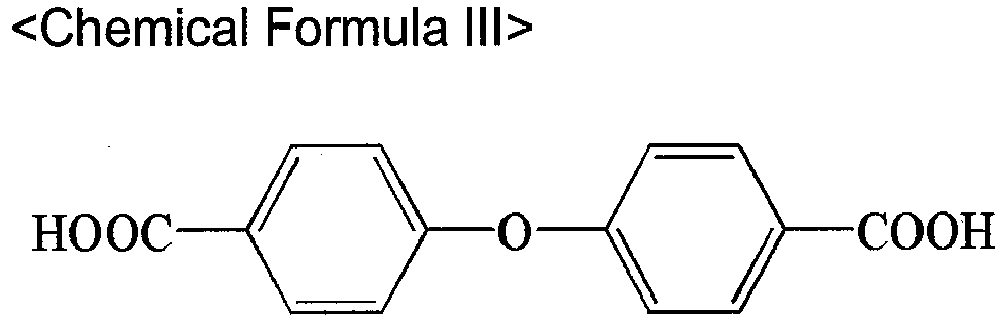
- Aromatic ether groups are introduced to the polybenzimidazole backbone from 4,4'-oxybis(benzoic acid) of Chemical Formula III, thereby improving the brittleness unique to polybenzimidazole. In this manner, the resultant copolybenzimidazoles have significantly improved mechanical properties.
- In one aspect, there are provided cardo copolybenzimidazoles having repeating units represented by the following Chemical Formula 1:

- In
Chemical Formula 1, each of x and y represents the molar content of each structural unit in the repeating units of cardo copolybenzimidazoles, and corresponds to the molar ratio of 4,4'-oxybis(benzoic acid) of Chemical Formula III and 9,9-bis(4-carboxyphenyl)fluorene of Chemical Formula II that react with 1 mole of 3,3'-diaminobenzidine of Chemical Formula I. - Unlike the polybenzimidazole homopolymer according to the related art, the present disclosure provides copolybenzimidazoles. Thus, it is important to control the molar content of x derived from 4,4'-oxybis(benzoic acid) of Chemical Formula III. When x is less than 0.05, the resultant cardo copolybenzimidazoles show poor mechanical properties. On the other hand, when x is greater than 0.5, mechanical properties may be improved but gas permeability may be degraded. Therefore, x and y have the range as defined in Chemical Formula 1 (y is determined according to x, because x+y = 1).
- Next, the method for preparing cardo copolybenzimidazoles disclosed herein will be explained in detail.
- In another aspect, there is provided a method for preparing cardo copolybenzimidazoles, comprising the steps of:
- i) dissolving 3,3'-diaminobenzidine and 9,9-bis(4-carboxyphenyl)fluorene as monomers and an aromatic dicarboxylic acid as a comonomer into a polymerization solvent under argon atmosphere and agitating them at 130-150°C for 2-5 hours;
- ii) heating the reaction mixture of i) to 170-180°C to carry out polycondensation for 12-15 hours;
- iii) carrying out precipitation of the polymer solution obtained from ii) in deionized water and removing the residual phosphoric acid; and
- iv) carrying out drying in a vacuum oven at 60-100°C to obtain polymer powder.
- According to an embodiment, the aromatic dicarboxylic acid used as a comonomer in i) may be any one selected from the group consisting of 4,4'-oxybis(benzoic acid), diphenic acid, biphenyl-4,4'-dicarboxylic acid, 4,4'-sulfonyldibenzoic acid, 4,4'-(hexafluoroisopropylidene)bis(benzoic acid), terephthalic acid and isophthalic acid.
- According to another embodiment, the polymerization solvent used in i) may be polyphosphoric acid. In a variant, a mixed solvent of phosphorus pentaoxide with methanesulfonic acid may be used.
- According to still another embodiment, the residual phosphoric acid may be removed in iii) by washing the precipitate with 12% aqueous ammonia at 40-50°C for 2-3 days, followed by washing with deionized water to a neutral pH.
- In still another aspect, there is provided a gas separation membrane using the cardo copolybenzimidazoles having the repeating units represented by the above
Chemical Formula 1. - In yet another aspect, there is provided a method for producing a cardo copolybenzimidazole-based gas separation membrane, comprising the steps of:
- i) dissolving powder of cardo copolybenzimidazoles into an organic solvent to provide a solution of cardo copolybenzimidazoles;
- ii) filtering the solution of cardo copolybenzimidazoles through a porous syringe filter;
- iii) applying the solution obtained from ii) on a flat glass plate; and
- iv) drying the solution in a vacuum oven at 60-80°C to obtain a transparent cardo copolybenzimidazole-based membrane.
- According to an embodiment, the organic solvent used in i) may be any one selected from the group consisting of dimethyl sulfoxide (DMSO), dimethyl acetamide (DMAC), dimethyl formamide (DMF) and N-methylpyrrolidone (NMP). There is no particular limitation in selection of the organic solvent.
- According to another embodiment, the solution of cardo copolybenzimidazoles may have a concentration of 2-15 wt%. When the concentration is less than 2 wt%, film-forming properties may be degraded. Although the concentration depends on the molecular weight of the resultant cardo copolybenzimidazoles, it is difficult to prepare a solution having a concentration higher than 15 wt%. Moreover, such a high-concentration solution causes a significant drop in gas permeability due to a large thickness, even if it may be formed into a film shape.
- According to still another embodiment, the transparent cardo copolybenzimidazole-based membrane obtained from iv) may have a thickness of 30-60 µm. When the thickness is less than 30 µm, the gas separation membrane may not serve as a separator due to a decrease in mechanical strength. On the other hand, when the thickness is greater than 60 µm, the membrane is too thick to provide sufficient gas permeability.
- The examples and comparative examples related to the method for preparing cardo copolybenzimidazoles and the method for producing gas separation membranes using the same will now be described. The following examples and experiments are for illustrative purposes only and not intended to limit the scope of this disclosure.
- First, 3.0 g (14 mmol) of 3,3'-diaminobenzidine and 2.85 g (7 mmol) of 9,9-bis(4-carboxyphenyl)fluorene as monomers, 1.81 g (7 mmol) of 4,4'-oxybis(benzoic acid) as a comonomer, and 125 g of polyphosphoric acid as a polymerization solvent are introduced to a round-bottom flask, and agitated at 150°C under argon gas atmosphere for 5 hours. After the monomers and comonomer are dissolved sufficiently, the reaction mixture is heated gradually to 180°C to carry out reaction for 15 hours. Then, the polymer solution is allowed to precipitate in deionized water and the residual phosphoric acid is removed by washing the precipitate with 12% aqueous ammonia at 50°C for 3 days. Finally, the precipitate is washed with deionized water to a neutral pH and dried in a vacuum oven at 60°C to obtain cardo copolybenzimidazoles. The reaction scheme for preparing the cardo copolybenzimidazoles according to Example 1 is shown below.

- Example 1 is repeated to provide cardo copolybenzimidazoles, except that 3.0 g (14 mmol) of 3,3'-diaminobenzidine and 5.13 g (12.6 mmol) of 9,9-bis(4-carboxyphenyl)fluorene are used as monomers, and 0.36 g (1.4 mmol) of 4,4'-oxybis(benzoic acid) is used as a comonomer. The reaction scheme for preparing the cardo copolybenzimidazoles according to Example 2 is shown below.

- Example 1 is repeated to provide cardo polybenzimidazole homopolymer, except that 3.0 g (14 mmol) of 3,3'-diaminobenzidine and 5.6 g (14 mmol) of 9,9-bis(4-carboxyphenyl)fluorene are used as monomers, and no comonomer is used. The reaction scheme for preparing the cardo polybenzimidazole homopolymer according to Comparative Example 1 is shown below.

- Comparative Example 1 is repeated to provide polybenzimidazole homopolymer, except that 2.33 g (14 mmol) of isophthalic acid is used instead of 5.6 g (14 mmol) of 9,9-bis(4-carboxyphenyl)fluorene. The reaction scheme for preparing the polybenzimidazole homopolymer according to Comparative Example 2 is shown below.

-
FIG. 1 shows 1H-NMR spectrum of cardo copolybenzimidazoles obtained from Example 1. It can be seen that the characteristic peaks of hydrogen atoms present in 4,4'-oxybis(benzoic acid) are identified at a chemical shift of 7.86 ppm and 8.3 ppm, suggesting that the copolybenzimidazoles are synthesized. In addition, the characteristic peaks of hydrogen atoms present in 4,4'-oxybis(benzoic acid) are identified in the 1H-NMR spectrum of the cardo copolybenzimidazoles obtained from Example 2. - As shown in
FIG. 2 with regard to Comparative Example 1, the characteristic peaks of polybenzimidazole chains corresponding to N-H hydrogen atoms of imidazole ring are identified at a chemical shift of 12.99 ppm, and aromatic protons of benzene ring are identified at a chemical shift of 7.38-8.15 ppm, suggesting that polybenzimidazole homopolymer is synthesized. - First, 1 g of the cardo copolybenzimidazoles obtained from Example 1 is dissolved into 49 g of dimethyl sulfoxide (DMSO) as an organic solvent to provide a solution of cardo copolybenzimidazoles having a concentration of 2 wt%. The polymer solution is filtered through a syringe filter having a pore size of 0.45 µm, applied to a flat glass plate, and dried in an oven at 80°C to obtain a transparent cardo copolybenzimidazole-based gas separation membrane having a thickness of 40-50 µm.
- Example 3 is repeated to provide a cardo copolybenzimidazole-based gas separation membrane, except that the cardo copolybenzimidazole obtained from Example 2 is used.
- Example 3 is repeated to provide a cardo polybenzimidazole homopolymer-based gas separation membrane, except that the cardo polybenzimidazole homopolymer obtained from Comparative Example 1 is used.
- Example 3 is repeated to provide a polybenzimidazole homopolymer-based gas separation membrane, except that the polybenzimidazole homopolymer obtained from Comparative Example 2 is used.
-
FIG. 3 shows Fourier Transform-Infrared spectrometry (FT-IR) spectrum of the cardo copolybenzimidazole-based gas separation membrane obtained from Example 3. The stretching vibration peaks of aromatic ether groups are identified at approximately 1241 cm-1, and they are derived from the comonomer, 4,4'-oxybis(benzoic acid). This suggests that the target copolybenzimidazole-based gas separation membrane is obtained. The same results are obtained from the FT-IR spectrum of the cardo copolybenzimidazole-based gas separation membrane according to Example 4. -
FIG. 4 shows FT-IR spectrum of the cardo polybenzimidazole homopolymer-based gas separation membrane obtained from Comparative Example 3. The characteristic peaks of imidazole groups are identified approximately at 3300 cm-1 (NH), 1610 cm-1 (C=N), 1250 cm-1 and 810 cm-1, suggesting that the cardo polybenzimidazole homopolymer-based gas separation membrane is obtained. - Meanwhile,
FIG. 5 shows the results of thermogravimetric analysis (TGA) of each of the cardo copolybenzimidazole-based gas separation membranes obtained from Examples 3 and 4 and the cardo polybenzimidazole homopolymer-based gas separation membrane obtained from Comparative Example 3. After carrying out TGA to 1,000°C, it is determined that the ratio of residual weight of Example 3 is 70.07 wt%, that of Example 4 is 69.41 wt%, and that of Comparative Example 3 is 74 wt%. - Example 3 to Comparative Example 3 show an initial thermal decomposition temperature of 300°C-350°C. Thus, the cardo copolybenzimidazole-based gas separation membrane disclosed herein tend to show a decrease in initial thermal decomposition temperature in accordance with an increase in the molar content of aromatic ether groups derived from the comonomer, 4,4'-oxybis(benzoic acid) in the repeating units of copolymer. Therefore, it can be seen that the copolybenzimidazoles still maintain overall thermal stability although they show a slightly lower initial thermal decomposition temperature as compared to the cardo polybenzimidazole homopolymer according to the related art.
- Further, the gas permeability of the cardo copolybenzimidazole-based gas separation membrane disclosed herein is determined by using the gas permeability measuring system as shown in
FIG. 6 . - In general, permeation of gas through a polymeric membrane may be understood by a function of diffusibility D and solubility S. The diffusibility is determined by the fractional free volume (FFV) inside a polymeric membrane and chain mobility. The solubility is determined by the interaction between gas molecules and polymer molecules. FFV is a space participating in transport of gas molecules and is defined as a ratio of the space non-occupied by the polymer in the total volume of polymeric membrane. In addition, FFV is affected by a variation in chain mobility, polymer packing density and side groups of a chain, and is related directly with diffusibility. The solubility shows an increase with an increase in FFV, and undergoes a change depending on side groups. However, it is known that the function of diffusibility is predominant in view of the overall permeability.
- A polymeric membrane is mounted to a permeation cell and all of the residual gas in the membrane is removed under reduced pressure applied by a vacuum pump at both sides of the membrane. At the initial time of the experiment, t=0, determination of gas permeability is started, while a specific gas (oxygen or nitrogen) is introduced to the top portion of the membrane under a constant pressure, Pfeed. The pressure at the bottom portion of the membrane is measured as a function of time to obtain a time-lag graph. Time-lag θ is obtained from the steady-state portion of the graph as depicted below by extrapolation, and diffusibility D is calculated by using the membrane thickness d according to the following Formula (1).


- Gas permeability P is calculated by using the slope of the linear steady-state region of the time-lag graph and the following Formula (2). Pfeed represents the gas pressure (cmHg) applied to the top portion of the membrane, Vd represents the volume of the gas permeation system at the bottom portion of the membrane, Mgas represents the molecular weight (g/mol) of the gas permeating through the membrane, ρ represents the density (cm3/g) of the gas permeating through the membrane, and A represents the area (cm2) of the membrane through which the gas permeates.

- The solubility of a gas, S, is calculated from the following Formula (3) by using the relationship between diffusibility D and permeability P, and the permeability is represented in the unit of Barrer [10-10cm3(STP)cmcm-2s-1cmHg-1].

- When two kinds of gases (gas A and gas B) form a mixed gas and the mixed gas permeates through a separation membrane, selectivity of gas A over gas B (α AB) is defined according to the following Formula (4). In Formula (4), PA and PB represents the permeability of gas A and that of gas B, respectively.

- The permeability of a gas is affected by operating conditions (temperature, pressure, etc.), solubility of gas (solubility of gas increases as condensability of gas increases), reactivity between polymer and permeating gas, polymer morphology (crystallinity, orientation, etc.), or the like. Therefore, all of the separation membrane samples used in the following test and the permeation experiment are provided under the same conditions by the same procedure.
- In this test for determination of gas permeability, a gas permeation cell having an effective membrane area of 14.52 cm2 is installed in an oven, and a vacuum pump is used for depression in order to remove the gas molecules totally at the top and bottom portions of a separation membrane. At the top portion of the separation membrane, gas is introduced to the gas storage container at an applicable pressure of 1000 torr and time-lag measurement is started at the same time. The pressure difference varied by the pressure of the permeating gas is recorded automatically every unit time by a computer linked to MKS Baratron gauge. If the pressure of the bottom portion of the membrane is low sufficient to be ignored as compared to the pressure of the top portion of the membrane, it can be assumed that any reaction between gases permeating through the membrane does not occur and plasticization of the membrane material is not induced.
- The following Table 1 shows the gas permeability of each gas separation membranes using the cardo copolybenzimidazoles and cardo polybenzimidazole homopolymer, obtained from Examples 3 and 4 and Comparative Example 4.
[Table 1] Test Permeability coefficient (unit: Barrer) Selectivity O2 N2 CO2 O2/N2 Ex. 3 3.92 0.61 18.23 6.43 Ex. 4 10.68 1.98 49.41 5.39 Comp. Ex. 3 - - - - Comp. Ex. 4 0.23 0.03 ND* 7.66 ND*: Not determined - Comparative Example 3: the membrane is too brittle to perform the test for determination of gas permeability.
- As can be seen from Table 1, the cardo copolybenzimidazole-based gas separation membrane provides oxygen permeability and nitrogen permeability approximately 17 times and 20 times higher than the oxygen permeability and nitrogen permeability of the polybenzimidazole homopolymer-based gas separation membrane having no cardo group according to Comparative Example 4, respectively.
- Particularly, in the case of the cardo copolybenzimidazole-based gas separation membrane obtained from Example 4, oxygen permeability and nitrogen permeability are improved by a factor of approximately 46 and 66, respectively.
- It is thought that such a significant improvement in oxygen permeability of the cardo copolybenzimidazole-based gas separation membrane disclosed herein results from introduction of fluorene units to the polybenzimidazole backbone as cardo groups and additional introduction of aromatic ether groups derived from a comonomer, 4,4'-oxybis(benzoic acid), leading to improvement in mechanical properties and induction of bending and distortion of polybenzimidazole chain structures, and thus an increase in space between chains, i.e., free volume.
- Therefore, the cardo copolybenzimidazole-based gas separation membrane disclosed herein provides significantly improved oxygen permeability, and thus may be used as a material suitable for O2/N2 separation in OBIGGS.
- While the present invention has been described with respect to the specific embodiments, it will be apparent to those skilled in the art that various changes and modifications may be made without departing from the spirit and scope of the invention as defined in the following claims.
Claims (10)
- Cardo copolybenzimidazoles having repeating units represented by the following Chemical Formula 1:

- A method for preparing cardo copolybenzimidazoles, comprising the steps of:i) dissolving 3,3'-diaminobenzidine and 9,9-bis(4-carboxyphenyl)fluorene as monomers and an aromatic dicarboxylic acid as a comonomer into a polymerization solvent under argon atmosphere and agitating them at 130-150°C for 2-5 hours;ii) heating the reaction mixture of i) to 170-180°C to carry out polycondensation for 12-15 hours;iii) carrying out precipitation of the polymer solution obtained from ii) in deionized water and removing the residual phosphoric acid; andiv) carrying out drying in a vacuum oven at 60-100°C to obtain polymer powder.
- The method for preparing cardo copolybenzimidazoles according to claim 2, wherein the aromatic dicarboxylic acid used as a comonomer in i) is any one selected from the group consisting of 4,4'-oxybis(benzoic acid), diphenic acid, biphenyl-4,4'-dicarboxylic acid, 4,4'-sulfonyldibenzoic acid, 4,4'-(hexafluoroisopropylidene)bis(benzoic acid), terephthalic acid and isophthalic acid.
- The method for preparing cardo copolybenzimidazoles according to claim 2 or 3, wherein the polymerization solvent used in i) is polyphosphoric acid, or a mixed solvent of phosphorus pentaoxide with methanesulfonic acid.
- The method for preparing cardo copolybenzimidazoles according to one of claims 2 to 4, wherein the residual phosphoric acid is removed in iii) by washing the precipitate with 12% aqueous ammonia at 40-50°C for 2-3 days, followed by washing with deionized water to a neutral pH.
- A gas separation membrane using the cardo copolybenzimidazoles having the repeating units represented by the above Chemical Formula 1.
- A method for producing a cardo copolybenzimidazole-based gas separation membrane, comprising the steps of:i) dissolving powder of cardo copolybenzimidazoles into an organic solvent to provide a solution of cardo copolybenzimidazoles;ii) filtering the solution of cardo copolybenzimidazoles through a porous syringe filter;iii) applying the solution obtained from ii) on a flat glass plate; andiv) drying the solution in a vacuum oven at 60-100°C to obtain a transparent cardo copolybenzimidazole-based membrane.
- The method for producing a cardo copolybenzimidazole-based gas separation membrane according to claim 7, wherein the organic solvent used in i) is any one selected from the group consisting of dimethyl sulfoxide (DMSO), dimethyl acetamide (DMAC), dimethyl formamide (DMF) and N-methylpyrrolidone (NMP).
- The method for producing a cardo copolybenzimidazole-based gas separation membrane according to claim 7 or 8, wherein the solution of cardo copolybenzimidazoles has a concentration of 2-15 wt%.
- The method for producing a cardo copolybenzimidazole-based gas separation membrane according to one of claims 7 to 9, wherein the transparent cardo copolybenzimidazole-based membrane obtained from iv) has a thickness of 30-60 µm.
Applications Claiming Priority (1)
| Application Number | Priority Date | Filing Date | Title |
|---|---|---|---|
| KR1020130014948A KR101411464B1 (en) | 2013-02-12 | 2013-02-12 | Cardo Copolybenzimidazoles, Gas Separation Membranes and preparation method thereof |
Publications (2)
| Publication Number | Publication Date |
|---|---|
| EP2765152A1 true EP2765152A1 (en) | 2014-08-13 |
| EP2765152B1 EP2765152B1 (en) | 2020-03-25 |
Family
ID=48087468
Family Applications (1)
| Application Number | Title | Priority Date | Filing Date |
|---|---|---|---|
| EP13163853.8A Active EP2765152B1 (en) | 2013-02-12 | 2013-04-16 | Cardo copolybenzimidazoles, gas separation membranes and preparation method thereof |
Country Status (4)
| Country | Link |
|---|---|
| US (1) | US9156008B2 (en) |
| EP (1) | EP2765152B1 (en) |
| JP (1) | JP5661138B2 (en) |
| KR (1) | KR101411464B1 (en) |
Families Citing this family (1)
| Publication number | Priority date | Publication date | Assignee | Title |
|---|---|---|---|---|
| CN105111736A (en) * | 2015-08-26 | 2015-12-02 | 苏州卓伟企业管理咨询有限公司 | Preparation method of graphene oxide/polyether type benzimidazole composite material |
Citations (1)
| Publication number | Priority date | Publication date | Assignee | Title |
|---|---|---|---|---|
| US20120231253A1 (en) * | 2011-03-10 | 2012-09-13 | Battelle Energy Alliance, Llc | Polymer compositions, polymer films and methods and precursors for forming same |
Family Cites Families (15)
| Publication number | Priority date | Publication date | Assignee | Title |
|---|---|---|---|---|
| US5091500A (en) * | 1990-09-21 | 1992-02-25 | The Dow Chemical Company | Polybenzazole polymer containing perfluorocyclobutane rings |
| US5516874A (en) * | 1994-06-30 | 1996-05-14 | Ibm Corporation | Poly(aryl ether benzimidazoles) |
| EP1213049B8 (en) | 1999-03-23 | 2007-02-14 | National Institute of Advanced Industrial Science and Technology | Gas separation membrane and process for producing a polymer |
| DE10239701A1 (en) * | 2002-08-29 | 2004-03-11 | Celanese Ventures Gmbh | Production of polymer membrane, used in membrane electrode unit for fuel cell, uses phosphorus and/or sulfur oxy-acid in liquid for hydrolyzing membrane made by heating mixture of polyphosphoric acid and polyazole or precursors |
| EP1468724A1 (en) * | 2003-04-15 | 2004-10-20 | Board Of Regents, The University Of Texas System | Dithiolene functionalized polymer membrane for olefin/paraffin separation |
| KR100644856B1 (en) * | 2005-03-17 | 2006-11-24 | 한국과학기술연구원 | Fuel cell membrane and its manufacturing method |
| JP2006265385A (en) * | 2005-03-24 | 2006-10-05 | Fuji Photo Film Co Ltd | Polybenzazole, film and image display device using the same |
| US20070087248A1 (en) * | 2005-10-18 | 2007-04-19 | Samsung Sdi Co., Ltd. | Proton conductive electrolyte membrane, method of preparing the same and fuel cell including the proton conductive electrolyte membrane |
| KR101082672B1 (en) * | 2007-07-27 | 2011-11-15 | 재단법인서울대학교산학협력재단 | Polybenzimidazole copolymer containing arylene ether group and electrolyte membrane comprising the same |
| US8623124B2 (en) * | 2008-10-07 | 2014-01-07 | National University Of Singapore | Polymer blends and carbonized polymer blends |
| JP5747730B2 (en) * | 2010-08-11 | 2015-07-15 | 宇部興産株式会社 | Polyimide gas separation membrane and gas separation method |
| KR101232277B1 (en) * | 2010-11-04 | 2013-02-12 | 한국과학기술연구원 | Method for in-situ preparing polybenzimidazole based electrolyte membrane and polybenzimidazole based electrolyte membrane prepared thereby |
| KR101293196B1 (en) * | 2011-04-11 | 2013-08-05 | 한국과학기술연구원 | Polybenzimidazolium based solid electrolytes |
| WO2012148360A1 (en) * | 2011-04-29 | 2012-11-01 | National University Of Singapore | Cardo-polybenzoxazole polymer/copolymer membranes for improved permeability and method for fabricating the same |
| JP6282585B2 (en) * | 2012-05-14 | 2018-02-21 | 東レ株式会社 | Semipermeable membrane and method for producing the same, concentration difference power generation method using semipermeable membrane |
-
2013
- 2013-02-12 KR KR1020130014948A patent/KR101411464B1/en active Active
- 2013-04-12 JP JP2013083958A patent/JP5661138B2/en active Active
- 2013-04-16 EP EP13163853.8A patent/EP2765152B1/en active Active
- 2013-05-13 US US13/892,548 patent/US9156008B2/en active Active
Patent Citations (1)
| Publication number | Priority date | Publication date | Assignee | Title |
|---|---|---|---|---|
| US20120231253A1 (en) * | 2011-03-10 | 2012-09-13 | Battelle Energy Alliance, Llc | Polymer compositions, polymer films and methods and precursors for forming same |
Non-Patent Citations (5)
| Title |
|---|
| GUEY-SHENG LIOU ET AL., J. POLYM. SCI. POLYM. CHEM. ED., vol. 45, 2007, pages 4352 - 4363 |
| JUN YOUNG HAN ET AL: "Synthesis and characterization of fluorene-based polybenzimidazole copolymer for gas separation", JOURNAL OF APPLIED POLYMER SCIENCE, 1 February 2014 (2014-02-01), pages n/a - n/a, XP055116321, ISSN: 0021-8995, DOI: 10.1002/app.40521 * |
| KATHRYN A. BERCHTOLD ET AL., J. MEMBR. SCI., vol. 415-416, 2012, pages 265 - 270 |
| P. R. SRINIVASAN ET AL., J. POLYM. SCI. POLYM. CHEM. ED., vol. 20, 1982, pages 3095 - 3105 |
| TWIEG R ET AL: "POLY(ARYL ETHER BENZIMIDAZOLES)", MACROMOLECULES, AMERICAN CHEMICAL SOCIETY, US, vol. 29, no. 23, 4 November 1996 (1996-11-04), pages 7335 - 7341, XP000631104, ISSN: 0024-9297, DOI: 10.1021/MA9608277 * |
Also Published As
| Publication number | Publication date |
|---|---|
| US9156008B2 (en) | 2015-10-13 |
| JP2014152326A (en) | 2014-08-25 |
| EP2765152B1 (en) | 2020-03-25 |
| JP5661138B2 (en) | 2015-01-28 |
| US20140224124A1 (en) | 2014-08-14 |
| KR101411464B1 (en) | 2014-06-27 |
Similar Documents
| Publication | Publication Date | Title |
|---|---|---|
| Hu et al. | Thermally rearranged polybenzoxazole copolymers incorporating Tröger's base for high flux gas separation membranes | |
| Wang et al. | Recent progress on polymers of intrinsic microporosity and thermally modified analogue materials for membrane‐based fluid separations | |
| Liu et al. | Gas permeation and mechanical properties of thermally rearranged (TR) copolyimides | |
| Li et al. | Influence of polybenzimidazole main chain structure on H2/CO2 separation at elevated temperatures | |
| EP2345685B1 (en) | Polymer and preparation method thereof | |
| Gupta et al. | Enhanced permeability of polyaniline based nano-membranes for gas separation | |
| Xie et al. | Highly selective benzimidazole-based polyimide/ionic polyimide membranes for pure-and mixed-gas CO2/CH4 separation | |
| WO2012166153A1 (en) | Thermally rearranged (tr) polymers as membranes for ethanol dehydration | |
| Li et al. | Simultaneously enhanced gas permeability, selectivity and aging stability of carbon molecular sieve membranes by the molecule doping of silicon | |
| CN106795180A (en) | The mixed substrate membrane containing nano-grade molecular sieve of the modified and prepared therefrom azide crosslinking of zeolite imidazole ester skeleton | |
| Jiao et al. | Finely tuning the microporosity in phosphoric acid doped triptycene-containing polybenzimidazole membranes for highly permselective helium and hydrogen recovery | |
| Yong et al. | Mechanically strong and flexible hydrolyzed polymers of intrinsic microporosity (PIM‐1) membranes | |
| EP3050614A1 (en) | Method of producing a thermally rearranged PBX, thermally rearranged PBX and membrane | |
| Lee et al. | Fine-tuning ultramicroporosity in PIM-1 membranes by aldehyde functionalization for efficient hydrogen separation | |
| KR101523263B1 (en) | Polyimide-poly(ethylene glycol) copolymer membrane for separating carbon dioxide and method of manufacturing the same | |
| KR20180030571A (en) | Composite membranes and methods for their preparation | |
| Zhang et al. | Effect of free volume and hydrophilicity on dehumidification performance of 6FDA-Based polyimide membranes | |
| Rewar et al. | Polybenzimidazole based polymeric ionic liquids possessing partial ionic character: effects of anion exchange on their gas permeation properties | |
| KR101392829B1 (en) | Polybenzimidazole based separation membrane | |
| EP2765152B1 (en) | Cardo copolybenzimidazoles, gas separation membranes and preparation method thereof | |
| Kammakakam et al. | Synthesis and characterization of imidazolium-mediated Tröger's base containing poly (amide)-ionenes and composites with ionic liquids for CO 2 separation membranes | |
| KR101477710B1 (en) | Novel polyimide derivatives, preparation method thereof and polymer gas separation membrane comprising the same | |
| KR20150144848A (en) | Gas separation membrane for oxygen gas and nitrogen gas, and the method for preparing thereof | |
| JP4647431B2 (en) | Cross-linked gas separation membrane | |
| KR101441344B1 (en) | Co- POLYIMIDES WITH HIGH GAS PERMEABILITY AND SELECTIVITY AND METHODS OF SYNTHESIS THEREOF |
Legal Events
| Date | Code | Title | Description |
|---|---|---|---|
| PUAI | Public reference made under article 153(3) epc to a published international application that has entered the european phase |
Free format text: ORIGINAL CODE: 0009012 |
|
| 17P | Request for examination filed |
Effective date: 20130507 |
|
| AK | Designated contracting states |
Kind code of ref document: A1 Designated state(s): AL AT BE BG CH CY CZ DE DK EE ES FI FR GB GR HR HU IE IS IT LI LT LU LV MC MK MT NL NO PL PT RO RS SE SI SK SM TR |
|
| AX | Request for extension of the european patent |
Extension state: BA ME |
|
| RBV | Designated contracting states (corrected) |
Designated state(s): AL AT BE BG CH CY CZ DE DK EE ES FI FR GB GR HR HU IE IS IT LI LT LU LV MC MK MT NL NO PL PT RO RS SE SI SK SM TR |
|
| STAA | Information on the status of an ep patent application or granted ep patent |
Free format text: STATUS: EXAMINATION IS IN PROGRESS |
|
| 17Q | First examination report despatched |
Effective date: 20181115 |
|
| GRAP | Despatch of communication of intention to grant a patent |
Free format text: ORIGINAL CODE: EPIDOSNIGR1 |
|
| STAA | Information on the status of an ep patent application or granted ep patent |
Free format text: STATUS: GRANT OF PATENT IS INTENDED |
|
| INTG | Intention to grant announced |
Effective date: 20191009 |
|
| GRAS | Grant fee paid |
Free format text: ORIGINAL CODE: EPIDOSNIGR3 |
|
| GRAA | (expected) grant |
Free format text: ORIGINAL CODE: 0009210 |
|
| STAA | Information on the status of an ep patent application or granted ep patent |
Free format text: STATUS: THE PATENT HAS BEEN GRANTED |
|
| AK | Designated contracting states |
Kind code of ref document: B1 Designated state(s): AL AT BE BG CH CY CZ DE DK EE ES FI FR GB GR HR HU IE IS IT LI LT LU LV MC MK MT NL NO PL PT RO RS SE SI SK SM TR |
|
| REG | Reference to a national code |
Ref country code: GB Ref legal event code: FG4D |
|
| REG | Reference to a national code |
Ref country code: AT Ref legal event code: REF Ref document number: 1248473 Country of ref document: AT Kind code of ref document: T Effective date: 20200415 Ref country code: IE Ref legal event code: FG4D |
|
| REG | Reference to a national code |
Ref country code: DE Ref legal event code: R096 Ref document number: 602013067090 Country of ref document: DE |
|
| PG25 | Lapsed in a contracting state [announced via postgrant information from national office to epo] |
Ref country code: RS Free format text: LAPSE BECAUSE OF FAILURE TO SUBMIT A TRANSLATION OF THE DESCRIPTION OR TO PAY THE FEE WITHIN THE PRESCRIBED TIME-LIMIT Effective date: 20200325 Ref country code: FI Free format text: LAPSE BECAUSE OF FAILURE TO SUBMIT A TRANSLATION OF THE DESCRIPTION OR TO PAY THE FEE WITHIN THE PRESCRIBED TIME-LIMIT Effective date: 20200325 Ref country code: NO Free format text: LAPSE BECAUSE OF FAILURE TO SUBMIT A TRANSLATION OF THE DESCRIPTION OR TO PAY THE FEE WITHIN THE PRESCRIBED TIME-LIMIT Effective date: 20200625 |
|
| PG25 | Lapsed in a contracting state [announced via postgrant information from national office to epo] |
Ref country code: HR Free format text: LAPSE BECAUSE OF FAILURE TO SUBMIT A TRANSLATION OF THE DESCRIPTION OR TO PAY THE FEE WITHIN THE PRESCRIBED TIME-LIMIT Effective date: 20200325 Ref country code: GR Free format text: LAPSE BECAUSE OF FAILURE TO SUBMIT A TRANSLATION OF THE DESCRIPTION OR TO PAY THE FEE WITHIN THE PRESCRIBED TIME-LIMIT Effective date: 20200626 Ref country code: SE Free format text: LAPSE BECAUSE OF FAILURE TO SUBMIT A TRANSLATION OF THE DESCRIPTION OR TO PAY THE FEE WITHIN THE PRESCRIBED TIME-LIMIT Effective date: 20200325 Ref country code: LV Free format text: LAPSE BECAUSE OF FAILURE TO SUBMIT A TRANSLATION OF THE DESCRIPTION OR TO PAY THE FEE WITHIN THE PRESCRIBED TIME-LIMIT Effective date: 20200325 Ref country code: BG Free format text: LAPSE BECAUSE OF FAILURE TO SUBMIT A TRANSLATION OF THE DESCRIPTION OR TO PAY THE FEE WITHIN THE PRESCRIBED TIME-LIMIT Effective date: 20200625 |
|
| REG | Reference to a national code |
Ref country code: NL Ref legal event code: MP Effective date: 20200325 |
|
| REG | Reference to a national code |
Ref country code: LT Ref legal event code: MG4D |
|
| PG25 | Lapsed in a contracting state [announced via postgrant information from national office to epo] |
Ref country code: NL Free format text: LAPSE BECAUSE OF FAILURE TO SUBMIT A TRANSLATION OF THE DESCRIPTION OR TO PAY THE FEE WITHIN THE PRESCRIBED TIME-LIMIT Effective date: 20200325 |
|
| PG25 | Lapsed in a contracting state [announced via postgrant information from national office to epo] |
Ref country code: CZ Free format text: LAPSE BECAUSE OF FAILURE TO SUBMIT A TRANSLATION OF THE DESCRIPTION OR TO PAY THE FEE WITHIN THE PRESCRIBED TIME-LIMIT Effective date: 20200325 Ref country code: IS Free format text: LAPSE BECAUSE OF FAILURE TO SUBMIT A TRANSLATION OF THE DESCRIPTION OR TO PAY THE FEE WITHIN THE PRESCRIBED TIME-LIMIT Effective date: 20200725 Ref country code: SK Free format text: LAPSE BECAUSE OF FAILURE TO SUBMIT A TRANSLATION OF THE DESCRIPTION OR TO PAY THE FEE WITHIN THE PRESCRIBED TIME-LIMIT Effective date: 20200325 Ref country code: RO Free format text: LAPSE BECAUSE OF FAILURE TO SUBMIT A TRANSLATION OF THE DESCRIPTION OR TO PAY THE FEE WITHIN THE PRESCRIBED TIME-LIMIT Effective date: 20200325 Ref country code: LT Free format text: LAPSE BECAUSE OF FAILURE TO SUBMIT A TRANSLATION OF THE DESCRIPTION OR TO PAY THE FEE WITHIN THE PRESCRIBED TIME-LIMIT Effective date: 20200325 Ref country code: PT Free format text: LAPSE BECAUSE OF FAILURE TO SUBMIT A TRANSLATION OF THE DESCRIPTION OR TO PAY THE FEE WITHIN THE PRESCRIBED TIME-LIMIT Effective date: 20200818 Ref country code: SM Free format text: LAPSE BECAUSE OF FAILURE TO SUBMIT A TRANSLATION OF THE DESCRIPTION OR TO PAY THE FEE WITHIN THE PRESCRIBED TIME-LIMIT Effective date: 20200325 Ref country code: EE Free format text: LAPSE BECAUSE OF FAILURE TO SUBMIT A TRANSLATION OF THE DESCRIPTION OR TO PAY THE FEE WITHIN THE PRESCRIBED TIME-LIMIT Effective date: 20200325 |
|
| REG | Reference to a national code |
Ref country code: AT Ref legal event code: MK05 Ref document number: 1248473 Country of ref document: AT Kind code of ref document: T Effective date: 20200325 |
|
| REG | Reference to a national code |
Ref country code: CH Ref legal event code: PL |
|
| PG25 | Lapsed in a contracting state [announced via postgrant information from national office to epo] |
Ref country code: MC Free format text: LAPSE BECAUSE OF FAILURE TO SUBMIT A TRANSLATION OF THE DESCRIPTION OR TO PAY THE FEE WITHIN THE PRESCRIBED TIME-LIMIT Effective date: 20200325 |
|
| REG | Reference to a national code |
Ref country code: DE Ref legal event code: R097 Ref document number: 602013067090 Country of ref document: DE |
|
| PG25 | Lapsed in a contracting state [announced via postgrant information from national office to epo] |
Ref country code: DK Free format text: LAPSE BECAUSE OF FAILURE TO SUBMIT A TRANSLATION OF THE DESCRIPTION OR TO PAY THE FEE WITHIN THE PRESCRIBED TIME-LIMIT Effective date: 20200325 Ref country code: ES Free format text: LAPSE BECAUSE OF FAILURE TO SUBMIT A TRANSLATION OF THE DESCRIPTION OR TO PAY THE FEE WITHIN THE PRESCRIBED TIME-LIMIT Effective date: 20200325 Ref country code: LU Free format text: LAPSE BECAUSE OF NON-PAYMENT OF DUE FEES Effective date: 20200416 Ref country code: IT Free format text: LAPSE BECAUSE OF FAILURE TO SUBMIT A TRANSLATION OF THE DESCRIPTION OR TO PAY THE FEE WITHIN THE PRESCRIBED TIME-LIMIT Effective date: 20200325 Ref country code: LI Free format text: LAPSE BECAUSE OF NON-PAYMENT OF DUE FEES Effective date: 20200430 Ref country code: CH Free format text: LAPSE BECAUSE OF NON-PAYMENT OF DUE FEES Effective date: 20200430 Ref country code: AT Free format text: LAPSE BECAUSE OF FAILURE TO SUBMIT A TRANSLATION OF THE DESCRIPTION OR TO PAY THE FEE WITHIN THE PRESCRIBED TIME-LIMIT Effective date: 20200325 |
|
| REG | Reference to a national code |
Ref country code: BE Ref legal event code: MM Effective date: 20200430 |
|
| PLBE | No opposition filed within time limit |
Free format text: ORIGINAL CODE: 0009261 |
|
| STAA | Information on the status of an ep patent application or granted ep patent |
Free format text: STATUS: NO OPPOSITION FILED WITHIN TIME LIMIT |
|
| PG25 | Lapsed in a contracting state [announced via postgrant information from national office to epo] |
Ref country code: BE Free format text: LAPSE BECAUSE OF NON-PAYMENT OF DUE FEES Effective date: 20200430 Ref country code: PL Free format text: LAPSE BECAUSE OF FAILURE TO SUBMIT A TRANSLATION OF THE DESCRIPTION OR TO PAY THE FEE WITHIN THE PRESCRIBED TIME-LIMIT Effective date: 20200325 |
|
| 26N | No opposition filed |
Effective date: 20210112 |
|
| GBPC | Gb: european patent ceased through non-payment of renewal fee |
Effective date: 20200625 |
|
| PG25 | Lapsed in a contracting state [announced via postgrant information from national office to epo] |
Ref country code: IE Free format text: LAPSE BECAUSE OF NON-PAYMENT OF DUE FEES Effective date: 20200416 Ref country code: FR Free format text: LAPSE BECAUSE OF NON-PAYMENT OF DUE FEES Effective date: 20200525 Ref country code: GB Free format text: LAPSE BECAUSE OF NON-PAYMENT OF DUE FEES Effective date: 20200625 |
|
| PG25 | Lapsed in a contracting state [announced via postgrant information from national office to epo] |
Ref country code: SI Free format text: LAPSE BECAUSE OF FAILURE TO SUBMIT A TRANSLATION OF THE DESCRIPTION OR TO PAY THE FEE WITHIN THE PRESCRIBED TIME-LIMIT Effective date: 20200325 |
|
| PG25 | Lapsed in a contracting state [announced via postgrant information from national office to epo] |
Ref country code: TR Free format text: LAPSE BECAUSE OF FAILURE TO SUBMIT A TRANSLATION OF THE DESCRIPTION OR TO PAY THE FEE WITHIN THE PRESCRIBED TIME-LIMIT Effective date: 20200325 Ref country code: MT Free format text: LAPSE BECAUSE OF FAILURE TO SUBMIT A TRANSLATION OF THE DESCRIPTION OR TO PAY THE FEE WITHIN THE PRESCRIBED TIME-LIMIT Effective date: 20200325 Ref country code: CY Free format text: LAPSE BECAUSE OF FAILURE TO SUBMIT A TRANSLATION OF THE DESCRIPTION OR TO PAY THE FEE WITHIN THE PRESCRIBED TIME-LIMIT Effective date: 20200325 |
|
| PG25 | Lapsed in a contracting state [announced via postgrant information from national office to epo] |
Ref country code: MK Free format text: LAPSE BECAUSE OF FAILURE TO SUBMIT A TRANSLATION OF THE DESCRIPTION OR TO PAY THE FEE WITHIN THE PRESCRIBED TIME-LIMIT Effective date: 20200325 Ref country code: AL Free format text: LAPSE BECAUSE OF FAILURE TO SUBMIT A TRANSLATION OF THE DESCRIPTION OR TO PAY THE FEE WITHIN THE PRESCRIBED TIME-LIMIT Effective date: 20200325 |
|
| PGFP | Annual fee paid to national office [announced via postgrant information from national office to epo] |
Ref country code: DE Payment date: 20250617 Year of fee payment: 13 |