EP2763769B1 - Treatment of aqueous solutions - Google Patents
Treatment of aqueous solutions Download PDFInfo
- Publication number
- EP2763769B1 EP2763769B1 EP12780308.8A EP12780308A EP2763769B1 EP 2763769 B1 EP2763769 B1 EP 2763769B1 EP 12780308 A EP12780308 A EP 12780308A EP 2763769 B1 EP2763769 B1 EP 2763769B1
- Authority
- EP
- European Patent Office
- Prior art keywords
- scale
- process according
- compounds
- crystallizable
- water
- Prior art date
- Legal status (The legal status is an assumption and is not a legal conclusion. Google has not performed a legal analysis and makes no representation as to the accuracy of the status listed.)
- Active
Links
Images
Classifications
-
- C—CHEMISTRY; METALLURGY
- C02—TREATMENT OF WATER, WASTE WATER, SEWAGE, OR SLUDGE
- C02F—TREATMENT OF WATER, WASTE WATER, SEWAGE, OR SLUDGE
- C02F1/00—Treatment of water, waste water, or sewage
- C02F1/22—Treatment of water, waste water, or sewage by freezing
-
- B—PERFORMING OPERATIONS; TRANSPORTING
- B01—PHYSICAL OR CHEMICAL PROCESSES OR APPARATUS IN GENERAL
- B01D—SEPARATION
- B01D9/00—Crystallisation
- B01D9/0004—Crystallisation cooling by heat exchange
- B01D9/0013—Crystallisation cooling by heat exchange by indirect heat exchange
-
- B—PERFORMING OPERATIONS; TRANSPORTING
- B01—PHYSICAL OR CHEMICAL PROCESSES OR APPARATUS IN GENERAL
- B01D—SEPARATION
- B01D9/00—Crystallisation
- B01D9/0036—Crystallisation on to a bed of product crystals; Seeding
-
- C—CHEMISTRY; METALLURGY
- C02—TREATMENT OF WATER, WASTE WATER, SEWAGE, OR SLUDGE
- C02F—TREATMENT OF WATER, WASTE WATER, SEWAGE, OR SLUDGE
- C02F5/00—Softening water; Preventing scale; Adding scale preventatives or scale removers to water, e.g. adding sequestering agents
- C02F5/02—Softening water by precipitation of the hardness
-
- C—CHEMISTRY; METALLURGY
- C02—TREATMENT OF WATER, WASTE WATER, SEWAGE, OR SLUDGE
- C02F—TREATMENT OF WATER, WASTE WATER, SEWAGE, OR SLUDGE
- C02F1/00—Treatment of water, waste water, or sewage
- C02F1/28—Treatment of water, waste water, or sewage by sorption
Definitions
- the present invention is directed to the treatment of aqueous solutions and more in particular to a process for the recovery or removal of one or more crystallizable compounds from an aqueous solution.
- Scale deposition is a phenomenon that can occur in all kinds of processes. It is an unwanted occurrence that causes a number of operational problems such as plugging of equipment, inefficient usage of chemicals, increased utility costs, lost production due to downtime, corrosion, and downgraded products from increased dirt counts.
- Scale deposits that have been identified include complexes of calcium (carbonate, oxalate, sulfate, silicates), aluminum (silicates, hydroxides, phosphates), barium, such as barium sulfate, iron, such as hydroxides, and magnesium, such as sulphates or silicates.
- US 2011/0129409 describes a process for producing sodium chloride, including a step of eutectic freeze crystallization of a brine containing at least 150 g/l sodium chloride.
- the present invention is based on the discovery that the use of a eutectic freeze crystallization step in the treatment of such aqueous streams, or in the recovery of crystallizable compounds from such aqueous streams makes it possible to reduce or prevent scale deposition.
- the process of the present invention is accordingly directed to a process for the recovery or removal of one or more crystallizable compounds from an aqueous solution containing, apart from the said crystallizable compounds, one or more organic or inorganic scale-forming or scale-inducing materials having a lower solubility in water than the said crystallizable compounds, wherein the said scale-forming or scale-inducing material is selected from the group of salts, preferably phosphates, sulfates or silicates, oxides and hydroxides of calcium, barium, magnesium, aluminum and iron, said process comprising subjecting the said solution to a reverse osmosis step and the retentate thereof is subjected to at least one eutectic freeze crystallization step with recovery of ice and said one or more crystallizable compounds in crystalline form, recycling at least part of the mother liquor formed in the said eutectic crystallization step and subjecting the said recycle to a treatment with seed crystals for said scale forming or scale inducing compounds, removing at least part of
- the scale forming or inducing components are efficiently removed from the system by treatment of the mother liquor in a suitable way, thereby keeping the concentration of the said components below the level at which they precipitate in the system.
- the scale-forming or scale-inducing compounds are in the broadest sense defined as organic or inorganic compounds that have a lower solubility in water than the said crystallizable compound. More in particular, the said scale-forming or scale-inducing compounds are sparingly soluble, i.e. have a solubility below 6.5 wt.%, more in particular below 1 wt.%. In general, the said crystallizable compounds have a solubility in water of more than 10 wt.%.
- the scale-forming or scale-inducing compounds are generally inorganic salts, acids or bases, such as salts, oxides and hydroxides of calcium, barium, magnesium, aluminum and iron. More in particular the said compounds are phosphates, sulfates, silicates, oxides and hydroxides of calcium, barium, magnesium, aluminum and iron. It is also possible that the salt is a mixed salt, such as magnesium-ammonium sulfate.
- the one or more crystallizable compounds to be recovered or removed from the aqueous solution can be almost any compound, crystallizable from water.
- the said compounds are organic or inorganic salts, acids or bases, such as sodium chloride, nitric acid, soda, magnesium sulfate, sodium sulfate, acetic acid, sodium bicarbonate and barium chloride.
- both the crystallizable compound and the scale-forming or scale-inducing compound are of commercial value and will be recovered.
- An example is the production of soda and sodium bicarbonate from a mixture thereof, wherein during the eutectic freeze crystallization the soda is recovered and the sodium bicarbonate is recovered from the mother liquor recycle stream.
- the invention is based on the surprising discovery that in a eutectic freeze crystallization system the second component, i.e. the so-called scale-forming or scale-inducing compound, is present in the crystallizer, in a supersaturated, meta stable condition. Due to the specific characteristics of a eutectic freeze crystallization system, said compound does not precipitate in the crystallizer, but only in the treatment step with seed crystals in a separate step.
- the scale forming components are precipitated using a fluidized bed of seed material (crystals).
- a fluidized bed of seed material crystals
- other unit operations for precipitating the said components may also be used, such as a stirred tank crystallizer or a forced circulation crystallizer.
- seed crystals will depend on the components to be removed and will, in general, be the same as the component to be removed. However, it is also possible to use other seed crystals, provided they provide an efficient seeding for the precipitation.
- the precipitate produced is removed from the mother liquor, which is recycled.
- the precipitate may be discarded, or in case it is of sufficient commercial value, used as such, optionally after subsequent treatment.
- the process of the invention may be used in various configurations.
- the aim is to remove salts and/or other contaminating compounds from water, for example in the production of pure water from seawater or ground water.
- the dissolved component(s) may be the intended product of the process, water or ice being the less important product.
- the process of the invention may be used to process a side stream from another process, such as reverse osmosis, to overcome problems that are inherent to said other process.
- An important embodiment of the invention is in the production of pure water from ground water or seawater by reverse osmosis (RO).
- RO processes are limited by the scale formation in the system, as the concentration of the scale forming compounds increases in the recycle over the membrane, resulting in an increase in membrane pressure.
- the retentate is namely processed in an EFC into three streams, namely pure ice, a salt stream (usually sodium chloride, optionally in combination with other salts, or as separate salt product) and a mother liquor containing the scale forming or inducing components.
- aqueous solutions to be treated in the process of the invention are waste water streams from paper making, mining industry or oil and/or gas production.
- the present invention is i.a. based on the use of a eutectic freeze crystallization step. This is a well-known process, for example described in US patent specification No. 7,127,913 , the contents of which is incorporated herein by way of reference.
- Eutectic freeze crystallisation is a process based on separation of components at a eutectic freezing point. Eutectic freeze crystallisation has been described in EP-A 1,230,194 and in Chem.Eng.Proc. 37, (1998), pp 207-213 .
- EFC is based on the principle that a solution of a salt in water exhibits a eutectic freezing point.
- phase diagram water-salt it can be seen that in case an undersaturated water salt mixture is cooled down to the freezing point thereof, ice crystals form first. This increases the salt concentration in the solution and decreases the temperature along the freezing point depression line, until the solution is saturated. At this composition the eutectic freezing point is reached. Further heat withdrawal results in simultaneous formation of both ice crystals and crystals of salt.
- the solution becomes (or is) saturated first the salt will crystallise and the temperature will decrease along the solubility line, until an eutectic freezing point is reached. Then simultaneous formation of both ice crystals and crystals of salt occurs again at or near the eutectic point of the specific combination of compounds. In continuous operation, the operation point will therefore lie close to the eutectic point, irrespective of the feed composition.
- the crystals of salt and the ice can be recovered separately.
- the retentate consisted of a solution containing 1% of sodium chloride and 200 ppm of calcium carbonate. In a continuous process the retentate was fed at 200 liter/hour into a cooling scraped wall crystallizer with a volume of 200 liter. Inside the crystallizer, ice and sodium chloride as a dihydrate crystallized at the surface of the heat exchangers at -23C. The crystals were removed from the heat exchanger surface by scraping. From the crystallizer a slurry containing sodium chloride and ice crystals was transferred into a separator with a volume of 150 liter.
Landscapes
- Chemical & Material Sciences (AREA)
- Chemical Kinetics & Catalysis (AREA)
- Crystallography & Structural Chemistry (AREA)
- Thermal Sciences (AREA)
- Physics & Mathematics (AREA)
- Environmental & Geological Engineering (AREA)
- Organic Chemistry (AREA)
- Water Supply & Treatment (AREA)
- Life Sciences & Earth Sciences (AREA)
- Engineering & Computer Science (AREA)
- Hydrology & Water Resources (AREA)
- Separation Using Semi-Permeable Membranes (AREA)
- Removal Of Specific Substances (AREA)
Description
- The present invention is directed to the treatment of aqueous solutions and more in particular to a process for the recovery or removal of one or more crystallizable compounds from an aqueous solution.
- When producing, removing or recovering crystallizable compounds from aqueous solutions, often the problem of scale deposition in the equipment occurs.
- Scale deposition is a phenomenon that can occur in all kinds of processes. It is an unwanted occurrence that causes a number of operational problems such as plugging of equipment, inefficient usage of chemicals, increased utility costs, lost production due to downtime, corrosion, and downgraded products from increased dirt counts.
- Scale deposits that have been identified include complexes of calcium (carbonate, oxalate, sulfate, silicates), aluminum (silicates, hydroxides, phosphates), barium, such as barium sulfate, iron, such as hydroxides, and magnesium, such as sulphates or silicates.
- An example of a process wherein scale deposition is a problem is the reverse osmosis of water to produce purified water. In case the water to be treated contains amounts of scale forming components, in due time the reverse osmosis membrane gets clogged by scale and becomes damaged. Accordingly, the equipment has to be taken out of production in order to remove the scale. This has a negative influence on the economics of the process.
-
US 2011/0129409 describes a process for producing sodium chloride, including a step of eutectic freeze crystallization of a brine containing at least 150 g/l sodium chloride. - It is an object of the present invention to provide a process for treating aqueous streams containing scale forming or scale inducing components, in which process the scale deposition is strongly reduced or even completely prevented. Also the scale forming component can be isolated separately in its pure form.
- The present invention is based on the discovery that the use of a eutectic freeze crystallization step in the treatment of such aqueous streams, or in the recovery of crystallizable compounds from such aqueous streams makes it possible to reduce or prevent scale deposition.
- The process of the present invention is accordingly directed to a process for the recovery or removal of one or more crystallizable compounds from an aqueous solution containing, apart from the said crystallizable compounds, one or more organic or inorganic scale-forming or scale-inducing materials having a lower solubility in water than the said crystallizable compounds, wherein the said scale-forming or scale-inducing material is selected from the group of salts, preferably phosphates, sulfates or silicates, oxides and hydroxides of calcium, barium, magnesium, aluminum and iron, said process comprising subjecting the said solution to a reverse osmosis step and the retentate thereof is subjected to at least one eutectic freeze crystallization step with recovery of ice and said one or more crystallizable compounds in crystalline form, recycling at least part of the mother liquor formed in the said eutectic crystallization step and subjecting the said recycle to a treatment with seed crystals for said scale forming or scale inducing compounds, removing at least part of the solid material obtained in said treatment step and recycle of the aqueous liquid thus obtained to the eutectic freeze crystallization step or to the feed thereto.
- In the present invention the scale forming or inducing components are efficiently removed from the system by treatment of the mother liquor in a suitable way, thereby keeping the concentration of the said components below the level at which they precipitate in the system.
- The scale-forming or scale-inducing compounds are in the broadest sense defined as organic or inorganic compounds that have a lower solubility in water than the said crystallizable compound. More in particular, the said scale-forming or scale-inducing compounds are sparingly soluble, i.e. have a solubility below 6.5 wt.%, more in particular below 1 wt.%. In general, the said crystallizable compounds have a solubility in water of more than 10 wt.%.
- The scale-forming or scale-inducing compounds are generally inorganic salts, acids or bases, such as salts, oxides and hydroxides of calcium, barium, magnesium, aluminum and iron. More in particular the said compounds are phosphates, sulfates, silicates, oxides and hydroxides of calcium, barium, magnesium, aluminum and iron. It is also possible that the salt is a mixed salt, such as magnesium-ammonium sulfate.
- The one or more crystallizable compounds to be recovered or removed from the aqueous solution can be almost any compound, crystallizable from water. Preferably the said compounds are organic or inorganic salts, acids or bases, such as sodium chloride, nitric acid, soda, magnesium sulfate, sodium sulfate, acetic acid, sodium bicarbonate and barium chloride.
- It is also possible that both the crystallizable compound and the scale-forming or scale-inducing compound are of commercial value and will be recovered. An example is the production of soda and sodium bicarbonate from a mixture thereof, wherein during the eutectic freeze crystallization the soda is recovered and the sodium bicarbonate is recovered from the mother liquor recycle stream.
- The invention is based on the surprising discovery that in a eutectic freeze crystallization system the second component, i.e. the so-called scale-forming or scale-inducing compound, is present in the crystallizer, in a supersaturated, meta stable condition. Due to the specific characteristics of a eutectic freeze crystallization system, said compound does not precipitate in the crystallizer, but only in the treatment step with seed crystals in a separate step.
- In a preferred embodiment, the scale forming components are precipitated using a fluidized bed of seed material (crystals). However, other unit operations for precipitating the said components may also be used, such as a stirred tank crystallizer or a forced circulation crystallizer.
- The nature of the seed crystals will depend on the components to be removed and will, in general, be the same as the component to be removed. However, it is also possible to use other seed crystals, provided they provide an efficient seeding for the precipitation.
- The precipitate produced is removed from the mother liquor, which is recycled. The precipitate may be discarded, or in case it is of sufficient commercial value, used as such, optionally after subsequent treatment.
- In case other contaminants are present in the system that tend to accumulate in the mother liquor recycle, a small bleed stream may be needed, to keep the level of those other contaminants at an acceptable level.
- The process of the invention may be used in various configurations. In a first embodiment, the aim is to remove salts and/or other contaminating compounds from water, for example in the production of pure water from seawater or ground water. In a further embodiment, the dissolved component(s) may be the intended product of the process, water or ice being the less important product. In a third embodiment, the process of the invention may be used to process a side stream from another process, such as reverse osmosis, to overcome problems that are inherent to said other process.
- An important embodiment of the invention is in the production of pure water from ground water or seawater by reverse osmosis (RO). RO processes are limited by the scale formation in the system, as the concentration of the scale forming compounds increases in the recycle over the membrane, resulting in an increase in membrane pressure. By the process of the invention, the problem of membrane pressure increase and scale formation is substantially prevented. The retentate is namely processed in an EFC into three streams, namely pure ice, a salt stream (usually sodium chloride, optionally in combination with other salts, or as separate salt product) and a mother liquor containing the scale forming or inducing components.
- Other possible sources of aqueous solutions to be treated in the process of the invention are waste water streams from paper making, mining industry or oil and/or gas production.
- The present invention is i.a. based on the use of a eutectic freeze crystallization step. This is a well-known process, for example described in
US patent specification No. 7,127,913 , the contents of which is incorporated herein by way of reference. - Eutectic freeze crystallisation is a process based on separation of components at a eutectic freezing point. Eutectic freeze crystallisation has been described in
EP-A 1,230,194 and in Chem.Eng.Proc. 37, (1998), pp 207-213. - In freeze crystallisation at a eutectic freezing point (Eutectic freeze crystallisation; EFC) on the one hand crystalline material is obtained, and on the other hand ice crystals.
- As has been described in the cited references, EFC is based on the principle that a solution of a salt in water exhibits a eutectic freezing point. In the phase diagram water-salt, it can be seen that in case an undersaturated water salt mixture is cooled down to the freezing point thereof, ice crystals form first. This increases the salt concentration in the solution and decreases the temperature along the freezing point depression line, until the solution is saturated. At this composition the eutectic freezing point is reached. Further heat withdrawal results in simultaneous formation of both ice crystals and crystals of salt. In case the solution becomes (or is) saturated, first the salt will crystallise and the temperature will decrease along the solubility line, until an eutectic freezing point is reached. Then simultaneous formation of both ice crystals and crystals of salt occurs again at or near the eutectic point of the specific combination of compounds. In continuous operation, the operation point will therefore lie close to the eutectic point, irrespective of the feed composition.
- Due to the difference in density and/or particle size, the crystals of salt and the ice can be recovered separately.
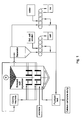
- The invention is now described in the following figure and nonlimiting example.
- In the figure a process for the recovery of sodium chloride from saline groundwater containing calcium carbonate is described.
- Saline groundwater was concentrated by reverse osmosis. The retentate consisted of a solution containing 1% of sodium chloride and 200 ppm of calcium carbonate. In a continuous process the retentate was fed at 200 liter/hour into a cooling scraped wall crystallizer with a volume of 200 liter. Inside the crystallizer, ice and sodium chloride as a dihydrate crystallized at the surface of the heat exchangers at -23C. The crystals were removed from the heat exchanger surface by scraping. From the crystallizer a slurry containing sodium chloride and ice crystals was transferred into a separator with a volume of 150 liter. Over the top of the separator ice slurry was removed with a flow rate of 140 liter/hour and filtered over a belt filter. The ice was washed with 20% water and molten down to yield pure water. The mother liquor from the belt filter was fed into a floating bed crystallizer containing calcium carbonate. The supernatant of the floating bed crystallizer was recycled into the scraped wall crystallizer. From the bottom of the separator sodium chloride crystal slurry was removed with a flow rate of 60 liter/hour and filtered over a belt filter. The sodium chloride crystals were washed with 1 cake volume of saturated sodium chloride solution yielding pure sodium chloride. The mother liquor of the belt filter was fed into the floating bed crystallizer. From the floating bed crystallizer a small stream of calcium carbonate was obtained.
Claims (8)
- Process for the recovery or removal of one or more crystallizable compounds from an aqueous solution containing, apart from the said crystallizable compounds, one or more organic or inorganic scale-forming or scale-inducing materials having a lower solubility in water than the said crystallizable compounds, wherein the said scale-forming or scale-inducing material is selected from the group of salts, preferably phosphates, sulfates or silicates, oxides and hydroxides of calcium, barium, magnesium, aluminum and iron, said process comprising subjecting the said solution to a reverse osmosis step and the retentate thereof is subjected to at least one eutectic freeze crystallization step with recovery of ice and said one or more crystallizable compounds in crystalline form, recycling at least part of the mother liquor formed in the said eutectic crystallization step and subjecting the said recycle to a treatment with seed crystals for said scale forming or scale inducing compounds, removing at least part of the solid material obtained in said treatment step and recycle of the aqueous liquid thus obtained to the eutectic freeze crystallization step or to the feed thereto.
- Process according to claim 1, wherein the mother liquor is treated in a fluidized bed of seed crystals.
- Process according to claim 1 or 2, wherein the mother liquor, after treatment with the seed crystals is recycled to the feed to the reverse osmosis step.
- Process according to claim 1 or 2, wherein the aqueous solution is a waste water streams from paper making, mining industry oil and/or gas production.
- Process according to claim 1 or 2, wherein the aqueous solution is a feed stream to produce water from seawater and the ice produced is further processed to produce potable water.
- Process according to claims 1-5, wherein the solubility in water of the said scale-forming or scale-inducing material is lower than 6.5 wt.%, preferably lower than 1 wt.%.
- Process according to claims 1-6, wherein the said crystallizable compound is selected from the group of inorganic salts, acids and bases.
- Process according to claim 7, wherein the said crystallizable compound is selected from the group of sodium chloride, nitric acid, soda, magnesium sulfate, sodium sulfate, acetic acid, sodium bicarbonate and barium chloride.
Priority Applications (1)
| Application Number | Priority Date | Filing Date | Title |
|---|---|---|---|
| PL12780308T PL2763769T3 (en) | 2011-10-04 | 2012-10-04 | Treatment of aqueous solutions |
Applications Claiming Priority (2)
| Application Number | Priority Date | Filing Date | Title |
|---|---|---|---|
| NL2007531A NL2007531C2 (en) | 2011-10-04 | 2011-10-04 | Treatment of aqueous solutions. |
| PCT/NL2012/050693 WO2013051935A1 (en) | 2011-10-04 | 2012-10-04 | Treatment of aqueous solutions |
Publications (2)
| Publication Number | Publication Date |
|---|---|
| EP2763769A1 EP2763769A1 (en) | 2014-08-13 |
| EP2763769B1 true EP2763769B1 (en) | 2015-12-30 |
Family
ID=47116216
Family Applications (1)
| Application Number | Title | Priority Date | Filing Date |
|---|---|---|---|
| EP12780308.8A Active EP2763769B1 (en) | 2011-10-04 | 2012-10-04 | Treatment of aqueous solutions |
Country Status (7)
| Country | Link |
|---|---|
| US (1) | US9371242B2 (en) |
| EP (1) | EP2763769B1 (en) |
| CA (1) | CA2851085A1 (en) |
| ES (1) | ES2562014T3 (en) |
| NL (1) | NL2007531C2 (en) |
| PL (1) | PL2763769T3 (en) |
| WO (1) | WO2013051935A1 (en) |
Cited By (1)
| Publication number | Priority date | Publication date | Assignee | Title |
|---|---|---|---|---|
| EP4232411B1 (en) * | 2020-10-23 | 2025-02-12 | Cool Separations B.V. | Purification method for landfill leachate |
Families Citing this family (6)
| Publication number | Priority date | Publication date | Assignee | Title |
|---|---|---|---|---|
| NL2016952B1 (en) * | 2016-06-13 | 2017-12-21 | Univ Delft Tech | Recovery of Lactose from an Aqueous Solution |
| CN111606380A (en) * | 2020-05-20 | 2020-09-01 | 自然资源部天津海水淡化与综合利用研究所 | A fluidized bed type seawater ice-making desalination system and its desalination method |
| CN111924992A (en) * | 2020-08-25 | 2020-11-13 | 江苏博斯福环境科技有限公司 | Treatment method of salt-containing industrial sewage |
| NL2028588B1 (en) * | 2021-06-30 | 2023-01-09 | Cool Separations B V | Density-based separator |
| CN115140750A (en) * | 2022-06-14 | 2022-10-04 | 浙江世贝恩环保工程有限公司 | Method for classifying and extracting single chloride solution from fly ash washing mixed salt wastewater |
| CN115259316B (en) * | 2022-08-05 | 2023-12-12 | 广东邦普循环科技有限公司 | Treatment method of wastewater |
Family Cites Families (9)
| Publication number | Priority date | Publication date | Assignee | Title |
|---|---|---|---|---|
| FR2217273A1 (en) * | 1972-08-22 | 1974-09-06 | Commissariat Energie Atomique | Brine treated to prevent scaling in desalination plant - by crystalisation of scale forming salts on anhydrite seeds |
| US4392959A (en) * | 1981-05-15 | 1983-07-12 | Coillet Dudley W | Process for sterilization and removal of inorganic salts from a water stream |
| US4654064A (en) * | 1986-01-31 | 1987-03-31 | Cheng Chen Yen | Primary refrigerant eutectic freezing process [PREUF Process] |
| FR2634665B1 (en) * | 1988-07-29 | 1991-12-13 | Solvay | PROCESS AND PLANT FOR CRYSTALLIZATION OF A MINERAL SUBSTANCE AND CRYSTALS OF SODIUM CHLORIDE |
| GB9914398D0 (en) * | 1999-06-22 | 1999-08-18 | Bp Exploration Operating | Reduction in solids deposition |
| EP1094047A1 (en) | 1999-10-22 | 2001-04-25 | Technische Universiteit Delft | Crystallisation of materials from aqueous solutions |
| EP1974783A1 (en) * | 2007-03-22 | 2008-10-01 | Holding AVR-Bedrijven B.V. | Treatment of molybdate containing waste streams |
| US8268136B2 (en) * | 2007-12-20 | 2012-09-18 | McCutchen, Co. | Electrohydraulic and shear cavitation radial counterflow liquid processor |
| US8771380B2 (en) * | 2008-07-22 | 2014-07-08 | Akzo Nobel N.V. | Sodium chloride production process |
-
2011
- 2011-10-04 NL NL2007531A patent/NL2007531C2/en not_active IP Right Cessation
-
2012
- 2012-10-04 ES ES12780308.8T patent/ES2562014T3/en active Active
- 2012-10-04 EP EP12780308.8A patent/EP2763769B1/en active Active
- 2012-10-04 US US14/349,381 patent/US9371242B2/en active Active
- 2012-10-04 PL PL12780308T patent/PL2763769T3/en unknown
- 2012-10-04 CA CA2851085A patent/CA2851085A1/en not_active Abandoned
- 2012-10-04 WO PCT/NL2012/050693 patent/WO2013051935A1/en not_active Ceased
Cited By (1)
| Publication number | Priority date | Publication date | Assignee | Title |
|---|---|---|---|---|
| EP4232411B1 (en) * | 2020-10-23 | 2025-02-12 | Cool Separations B.V. | Purification method for landfill leachate |
Also Published As
| Publication number | Publication date |
|---|---|
| US9371242B2 (en) | 2016-06-21 |
| CA2851085A1 (en) | 2013-04-11 |
| PL2763769T3 (en) | 2016-05-31 |
| NL2007531C2 (en) | 2013-04-08 |
| ES2562014T3 (en) | 2016-03-02 |
| EP2763769A1 (en) | 2014-08-13 |
| US20140374361A1 (en) | 2014-12-25 |
| WO2013051935A1 (en) | 2013-04-11 |
Similar Documents
| Publication | Publication Date | Title |
|---|---|---|
| US9371242B2 (en) | Treatment of aqueous solutions | |
| EP2300371B1 (en) | Sodium chloride production process | |
| EP2349928B1 (en) | Sodium chloride production process | |
| US6667021B2 (en) | Method for producing enhanced sodium carbonate crystals for making sodium bicarbonate | |
| EP2435367B1 (en) | Method of producing naturally purified salt products | |
| JP2008516883A5 (en) | ||
| US20100115988A1 (en) | Treatment of Molybdate Containing Waste Streams | |
| CN222204983U (en) | Treatment system for wastewater containing inorganic salt | |
| KR101237829B1 (en) | Method and apparatus for treating an inorganic salt-containing waste liquid | |
| CN118026455B (en) | A treatment system and method for wastewater containing inorganic salts. |
Legal Events
| Date | Code | Title | Description |
|---|---|---|---|
| PUAI | Public reference made under article 153(3) epc to a published international application that has entered the european phase |
Free format text: ORIGINAL CODE: 0009012 |
|
| 17P | Request for examination filed |
Effective date: 20140502 |
|
| AK | Designated contracting states |
Kind code of ref document: A1 Designated state(s): AL AT BE BG CH CY CZ DE DK EE ES FI FR GB GR HR HU IE IS IT LI LT LU LV MC MK MT NL NO PL PT RO RS SE SI SK SM TR |
|
| DAX | Request for extension of the european patent (deleted) | ||
| REG | Reference to a national code |
Ref country code: DE Ref legal event code: R079 Ref document number: 602012013467 Country of ref document: DE Free format text: PREVIOUS MAIN CLASS: B01D0009000000 Ipc: C02F0001220000 |
|
| GRAP | Despatch of communication of intention to grant a patent |
Free format text: ORIGINAL CODE: EPIDOSNIGR1 |
|
| RIC1 | Information provided on ipc code assigned before grant |
Ipc: B01D 9/00 20060101ALI20150528BHEP Ipc: C02F 1/22 20060101AFI20150528BHEP |
|
| INTG | Intention to grant announced |
Effective date: 20150619 |
|
| GRAS | Grant fee paid |
Free format text: ORIGINAL CODE: EPIDOSNIGR3 |
|
| GRAA | (expected) grant |
Free format text: ORIGINAL CODE: 0009210 |
|
| AK | Designated contracting states |
Kind code of ref document: B1 Designated state(s): AL AT BE BG CH CY CZ DE DK EE ES FI FR GB GR HR HU IE IS IT LI LT LU LV MC MK MT NL NO PL PT RO RS SE SI SK SM TR |
|
| REG | Reference to a national code |
Ref country code: GB Ref legal event code: FG4D |
|
| REG | Reference to a national code |
Ref country code: CH Ref legal event code: EP |
|
| REG | Reference to a national code |
Ref country code: AT Ref legal event code: REF Ref document number: 767384 Country of ref document: AT Kind code of ref document: T Effective date: 20160115 |
|
| REG | Reference to a national code |
Ref country code: IE Ref legal event code: FG4D |
|
| REG | Reference to a national code |
Ref country code: DE Ref legal event code: R096 Ref document number: 602012013467 Country of ref document: DE |
|
| REG | Reference to a national code |
Ref country code: ES Ref legal event code: FG2A Ref document number: 2562014 Country of ref document: ES Kind code of ref document: T3 Effective date: 20160302 |
|
| REG | Reference to a national code |
Ref country code: NL Ref legal event code: FP |
|
| REG | Reference to a national code |
Ref country code: LT Ref legal event code: MG4D |
|
| PG25 | Lapsed in a contracting state [announced via postgrant information from national office to epo] |
Ref country code: NO Free format text: LAPSE BECAUSE OF FAILURE TO SUBMIT A TRANSLATION OF THE DESCRIPTION OR TO PAY THE FEE WITHIN THE PRESCRIBED TIME-LIMIT Effective date: 20160330 Ref country code: HR Free format text: LAPSE BECAUSE OF FAILURE TO SUBMIT A TRANSLATION OF THE DESCRIPTION OR TO PAY THE FEE WITHIN THE PRESCRIBED TIME-LIMIT Effective date: 20151230 Ref country code: LT Free format text: LAPSE BECAUSE OF FAILURE TO SUBMIT A TRANSLATION OF THE DESCRIPTION OR TO PAY THE FEE WITHIN THE PRESCRIBED TIME-LIMIT Effective date: 20151230 |
|
| REG | Reference to a national code |
Ref country code: AT Ref legal event code: MK05 Ref document number: 767384 Country of ref document: AT Kind code of ref document: T Effective date: 20151230 |
|
| PG25 | Lapsed in a contracting state [announced via postgrant information from national office to epo] |
Ref country code: LV Free format text: LAPSE BECAUSE OF FAILURE TO SUBMIT A TRANSLATION OF THE DESCRIPTION OR TO PAY THE FEE WITHIN THE PRESCRIBED TIME-LIMIT Effective date: 20151230 Ref country code: SE Free format text: LAPSE BECAUSE OF FAILURE TO SUBMIT A TRANSLATION OF THE DESCRIPTION OR TO PAY THE FEE WITHIN THE PRESCRIBED TIME-LIMIT Effective date: 20151230 Ref country code: GR Free format text: LAPSE BECAUSE OF FAILURE TO SUBMIT A TRANSLATION OF THE DESCRIPTION OR TO PAY THE FEE WITHIN THE PRESCRIBED TIME-LIMIT Effective date: 20160331 Ref country code: FI Free format text: LAPSE BECAUSE OF FAILURE TO SUBMIT A TRANSLATION OF THE DESCRIPTION OR TO PAY THE FEE WITHIN THE PRESCRIBED TIME-LIMIT Effective date: 20151230 Ref country code: RS Free format text: LAPSE BECAUSE OF FAILURE TO SUBMIT A TRANSLATION OF THE DESCRIPTION OR TO PAY THE FEE WITHIN THE PRESCRIBED TIME-LIMIT Effective date: 20151230 |
|
| PG25 | Lapsed in a contracting state [announced via postgrant information from national office to epo] |
Ref country code: CZ Free format text: LAPSE BECAUSE OF FAILURE TO SUBMIT A TRANSLATION OF THE DESCRIPTION OR TO PAY THE FEE WITHIN THE PRESCRIBED TIME-LIMIT Effective date: 20151230 |
|
| PG25 | Lapsed in a contracting state [announced via postgrant information from national office to epo] |
Ref country code: SM Free format text: LAPSE BECAUSE OF FAILURE TO SUBMIT A TRANSLATION OF THE DESCRIPTION OR TO PAY THE FEE WITHIN THE PRESCRIBED TIME-LIMIT Effective date: 20151230 Ref country code: AT Free format text: LAPSE BECAUSE OF FAILURE TO SUBMIT A TRANSLATION OF THE DESCRIPTION OR TO PAY THE FEE WITHIN THE PRESCRIBED TIME-LIMIT Effective date: 20151230 Ref country code: PT Free format text: LAPSE BECAUSE OF FAILURE TO SUBMIT A TRANSLATION OF THE DESCRIPTION OR TO PAY THE FEE WITHIN THE PRESCRIBED TIME-LIMIT Effective date: 20160502 Ref country code: RO Free format text: LAPSE BECAUSE OF FAILURE TO SUBMIT A TRANSLATION OF THE DESCRIPTION OR TO PAY THE FEE WITHIN THE PRESCRIBED TIME-LIMIT Effective date: 20151230 Ref country code: EE Free format text: LAPSE BECAUSE OF FAILURE TO SUBMIT A TRANSLATION OF THE DESCRIPTION OR TO PAY THE FEE WITHIN THE PRESCRIBED TIME-LIMIT Effective date: 20151230 Ref country code: IS Free format text: LAPSE BECAUSE OF FAILURE TO SUBMIT A TRANSLATION OF THE DESCRIPTION OR TO PAY THE FEE WITHIN THE PRESCRIBED TIME-LIMIT Effective date: 20160430 Ref country code: SK Free format text: LAPSE BECAUSE OF FAILURE TO SUBMIT A TRANSLATION OF THE DESCRIPTION OR TO PAY THE FEE WITHIN THE PRESCRIBED TIME-LIMIT Effective date: 20151230 |
|
| REG | Reference to a national code |
Ref country code: DE Ref legal event code: R097 Ref document number: 602012013467 Country of ref document: DE |
|
| REG | Reference to a national code |
Ref country code: FR Ref legal event code: PLFP Year of fee payment: 5 |
|
| PG25 | Lapsed in a contracting state [announced via postgrant information from national office to epo] |
Ref country code: DK Free format text: LAPSE BECAUSE OF FAILURE TO SUBMIT A TRANSLATION OF THE DESCRIPTION OR TO PAY THE FEE WITHIN THE PRESCRIBED TIME-LIMIT Effective date: 20151230 |
|
| PLBE | No opposition filed within time limit |
Free format text: ORIGINAL CODE: 0009261 |
|
| STAA | Information on the status of an ep patent application or granted ep patent |
Free format text: STATUS: NO OPPOSITION FILED WITHIN TIME LIMIT |
|
| 26N | No opposition filed |
Effective date: 20161003 |
|
| PG25 | Lapsed in a contracting state [announced via postgrant information from national office to epo] |
Ref country code: SI Free format text: LAPSE BECAUSE OF FAILURE TO SUBMIT A TRANSLATION OF THE DESCRIPTION OR TO PAY THE FEE WITHIN THE PRESCRIBED TIME-LIMIT Effective date: 20151230 |
|
| REG | Reference to a national code |
Ref country code: CH Ref legal event code: PL |
|
| REG | Reference to a national code |
Ref country code: IE Ref legal event code: MM4A |
|
| PG25 | Lapsed in a contracting state [announced via postgrant information from national office to epo] |
Ref country code: LI Free format text: LAPSE BECAUSE OF NON-PAYMENT OF DUE FEES Effective date: 20161031 Ref country code: CH Free format text: LAPSE BECAUSE OF NON-PAYMENT OF DUE FEES Effective date: 20161031 |
|
| PG25 | Lapsed in a contracting state [announced via postgrant information from national office to epo] |
Ref country code: LU Free format text: LAPSE BECAUSE OF NON-PAYMENT OF DUE FEES Effective date: 20161004 |
|
| REG | Reference to a national code |
Ref country code: FR Ref legal event code: PLFP Year of fee payment: 6 |
|
| PG25 | Lapsed in a contracting state [announced via postgrant information from national office to epo] |
Ref country code: IE Free format text: LAPSE BECAUSE OF NON-PAYMENT OF DUE FEES Effective date: 20161004 |
|
| PG25 | Lapsed in a contracting state [announced via postgrant information from national office to epo] |
Ref country code: HU Free format text: LAPSE BECAUSE OF FAILURE TO SUBMIT A TRANSLATION OF THE DESCRIPTION OR TO PAY THE FEE WITHIN THE PRESCRIBED TIME-LIMIT; INVALID AB INITIO Effective date: 20121004 |
|
| PG25 | Lapsed in a contracting state [announced via postgrant information from national office to epo] |
Ref country code: MK Free format text: LAPSE BECAUSE OF FAILURE TO SUBMIT A TRANSLATION OF THE DESCRIPTION OR TO PAY THE FEE WITHIN THE PRESCRIBED TIME-LIMIT Effective date: 20151230 Ref country code: MC Free format text: LAPSE BECAUSE OF FAILURE TO SUBMIT A TRANSLATION OF THE DESCRIPTION OR TO PAY THE FEE WITHIN THE PRESCRIBED TIME-LIMIT Effective date: 20151230 Ref country code: MT Free format text: LAPSE BECAUSE OF NON-PAYMENT OF DUE FEES Effective date: 20161031 Ref country code: CY Free format text: LAPSE BECAUSE OF FAILURE TO SUBMIT A TRANSLATION OF THE DESCRIPTION OR TO PAY THE FEE WITHIN THE PRESCRIBED TIME-LIMIT Effective date: 20151230 |
|
| PG25 | Lapsed in a contracting state [announced via postgrant information from national office to epo] |
Ref country code: BG Free format text: LAPSE BECAUSE OF FAILURE TO SUBMIT A TRANSLATION OF THE DESCRIPTION OR TO PAY THE FEE WITHIN THE PRESCRIBED TIME-LIMIT Effective date: 20151230 |
|
| REG | Reference to a national code |
Ref country code: FR Ref legal event code: PLFP Year of fee payment: 7 |
|
| PG25 | Lapsed in a contracting state [announced via postgrant information from national office to epo] |
Ref country code: AL Free format text: LAPSE BECAUSE OF FAILURE TO SUBMIT A TRANSLATION OF THE DESCRIPTION OR TO PAY THE FEE WITHIN THE PRESCRIBED TIME-LIMIT Effective date: 20151230 |
|
| PGFP | Annual fee paid to national office [announced via postgrant information from national office to epo] |
Ref country code: TR Payment date: 20180927 Year of fee payment: 7 |
|
| PG25 | Lapsed in a contracting state [announced via postgrant information from national office to epo] |
Ref country code: TR Free format text: LAPSE BECAUSE OF NON-PAYMENT OF DUE FEES Effective date: 20191004 |
|
| P01 | Opt-out of the competence of the unified patent court (upc) registered |
Effective date: 20230526 |
|
| PGFP | Annual fee paid to national office [announced via postgrant information from national office to epo] |
Ref country code: PL Payment date: 20250930 Year of fee payment: 14 |
|
| PGFP | Annual fee paid to national office [announced via postgrant information from national office to epo] |
Ref country code: NL Payment date: 20251027 Year of fee payment: 14 |
|
| PGFP | Annual fee paid to national office [announced via postgrant information from national office to epo] |
Ref country code: DE Payment date: 20251028 Year of fee payment: 14 |
|
| PGFP | Annual fee paid to national office [announced via postgrant information from national office to epo] |
Ref country code: GB Payment date: 20251021 Year of fee payment: 14 |
|
| PGFP | Annual fee paid to national office [announced via postgrant information from national office to epo] |
Ref country code: IT Payment date: 20251024 Year of fee payment: 14 |
|
| PGFP | Annual fee paid to national office [announced via postgrant information from national office to epo] |
Ref country code: FR Payment date: 20251027 Year of fee payment: 14 |
|
| PGFP | Annual fee paid to national office [announced via postgrant information from national office to epo] |
Ref country code: BE Payment date: 20251027 Year of fee payment: 14 |
|
| PGFP | Annual fee paid to national office [announced via postgrant information from national office to epo] |
Ref country code: ES Payment date: 20251118 Year of fee payment: 14 |