EP2762472B1 - Selenophene-fused aromatic compound and manufacturing method thereof - Google Patents
Selenophene-fused aromatic compound and manufacturing method thereof Download PDFInfo
- Publication number
- EP2762472B1 EP2762472B1 EP12835538.5A EP12835538A EP2762472B1 EP 2762472 B1 EP2762472 B1 EP 2762472B1 EP 12835538 A EP12835538 A EP 12835538A EP 2762472 B1 EP2762472 B1 EP 2762472B1
- Authority
- EP
- European Patent Office
- Prior art keywords
- substitutable
- group
- chemical formula
- selenophene
- entry
- Prior art date
- Legal status (The legal status is an assumption and is not a legal conclusion. Google has not performed a legal analysis and makes no representation as to the accuracy of the status listed.)
- Active
Links
- 0 C1[C@]2[C@@]1C*C*2 Chemical compound C1[C@]2[C@@]1C*C*2 0.000 description 17
- CDIPIUYXKRCNLQ-CMDGGOBGSA-N CCOC(/C(/C)=C/c1cccnc1C)=O Chemical compound CCOC(/C(/C)=C/c1cccnc1C)=O CDIPIUYXKRCNLQ-CMDGGOBGSA-N 0.000 description 1
- PPBKHVFBLRLXNY-UHFFFAOYSA-N [CH2+]C1=CCC(CCl)CC1 Chemical compound [CH2+]C1=CCC(CCl)CC1 PPBKHVFBLRLXNY-UHFFFAOYSA-N 0.000 description 1
Images


Classifications
-
- C—CHEMISTRY; METALLURGY
- C07—ORGANIC CHEMISTRY
- C07D—HETEROCYCLIC COMPOUNDS
- C07D517/00—Heterocyclic compounds containing in the condensed system at least one hetero ring having selenium, tellurium, or halogen atoms as ring hetero atoms
- C07D517/02—Heterocyclic compounds containing in the condensed system at least one hetero ring having selenium, tellurium, or halogen atoms as ring hetero atoms in which the condensed system contains two hetero rings
- C07D517/04—Ortho-condensed systems
-
- C—CHEMISTRY; METALLURGY
- C07—ORGANIC CHEMISTRY
- C07D—HETEROCYCLIC COMPOUNDS
- C07D345/00—Heterocyclic compounds containing rings having selenium or tellurium atoms as the only ring hetero atoms
-
- A—HUMAN NECESSITIES
- A61—MEDICAL OR VETERINARY SCIENCE; HYGIENE
- A61P—SPECIFIC THERAPEUTIC ACTIVITY OF CHEMICAL COMPOUNDS OR MEDICINAL PREPARATIONS
- A61P35/00—Antineoplastic agents
-
- C—CHEMISTRY; METALLURGY
- C07—ORGANIC CHEMISTRY
- C07D—HETEROCYCLIC COMPOUNDS
- C07D421/00—Heterocyclic compounds containing two or more hetero rings, at least one ring having selenium, tellurium, or halogen atoms as ring hetero atoms
- C07D421/02—Heterocyclic compounds containing two or more hetero rings, at least one ring having selenium, tellurium, or halogen atoms as ring hetero atoms containing two hetero rings
- C07D421/06—Heterocyclic compounds containing two or more hetero rings, at least one ring having selenium, tellurium, or halogen atoms as ring hetero atoms containing two hetero rings linked by a carbon chain containing only aliphatic carbon atoms
-
- C—CHEMISTRY; METALLURGY
- C09—DYES; PAINTS; POLISHES; NATURAL RESINS; ADHESIVES; COMPOSITIONS NOT OTHERWISE PROVIDED FOR; APPLICATIONS OF MATERIALS NOT OTHERWISE PROVIDED FOR
- C09K—MATERIALS FOR MISCELLANEOUS APPLICATIONS, NOT PROVIDED FOR ELSEWHERE
- C09K11/00—Luminescent materials, e.g. electroluminescent or chemiluminescent
- C09K11/06—Luminescent materials, e.g. electroluminescent or chemiluminescent containing organic luminescent materials
-
- C—CHEMISTRY; METALLURGY
- C09—DYES; PAINTS; POLISHES; NATURAL RESINS; ADHESIVES; COMPOSITIONS NOT OTHERWISE PROVIDED FOR; APPLICATIONS OF MATERIALS NOT OTHERWISE PROVIDED FOR
- C09K—MATERIALS FOR MISCELLANEOUS APPLICATIONS, NOT PROVIDED FOR ELSEWHERE
- C09K2211/00—Chemical nature of organic luminescent or tenebrescent compounds
- C09K2211/10—Non-macromolecular compounds
- C09K2211/1018—Heterocyclic compounds
- C09K2211/1025—Heterocyclic compounds characterised by ligands
- C09K2211/1029—Heterocyclic compounds characterised by ligands containing one nitrogen atom as the heteroatom
-
- C—CHEMISTRY; METALLURGY
- C09—DYES; PAINTS; POLISHES; NATURAL RESINS; ADHESIVES; COMPOSITIONS NOT OTHERWISE PROVIDED FOR; APPLICATIONS OF MATERIALS NOT OTHERWISE PROVIDED FOR
- C09K—MATERIALS FOR MISCELLANEOUS APPLICATIONS, NOT PROVIDED FOR ELSEWHERE
- C09K2211/00—Chemical nature of organic luminescent or tenebrescent compounds
- C09K2211/10—Non-macromolecular compounds
- C09K2211/1018—Heterocyclic compounds
- C09K2211/1025—Heterocyclic compounds characterised by ligands
- C09K2211/1088—Heterocyclic compounds characterised by ligands containing oxygen as the only heteroatom
-
- C—CHEMISTRY; METALLURGY
- C09—DYES; PAINTS; POLISHES; NATURAL RESINS; ADHESIVES; COMPOSITIONS NOT OTHERWISE PROVIDED FOR; APPLICATIONS OF MATERIALS NOT OTHERWISE PROVIDED FOR
- C09K—MATERIALS FOR MISCELLANEOUS APPLICATIONS, NOT PROVIDED FOR ELSEWHERE
- C09K2211/00—Chemical nature of organic luminescent or tenebrescent compounds
- C09K2211/10—Non-macromolecular compounds
- C09K2211/1018—Heterocyclic compounds
- C09K2211/1025—Heterocyclic compounds characterised by ligands
- C09K2211/1092—Heterocyclic compounds characterised by ligands containing sulfur as the only heteroatom
-
- C—CHEMISTRY; METALLURGY
- C09—DYES; PAINTS; POLISHES; NATURAL RESINS; ADHESIVES; COMPOSITIONS NOT OTHERWISE PROVIDED FOR; APPLICATIONS OF MATERIALS NOT OTHERWISE PROVIDED FOR
- C09K—MATERIALS FOR MISCELLANEOUS APPLICATIONS, NOT PROVIDED FOR ELSEWHERE
- C09K2211/00—Chemical nature of organic luminescent or tenebrescent compounds
- C09K2211/10—Non-macromolecular compounds
- C09K2211/1018—Heterocyclic compounds
- C09K2211/1025—Heterocyclic compounds characterised by ligands
- C09K2211/1096—Heterocyclic compounds characterised by ligands containing other heteroatoms
Definitions
- the embodiments described herein pertain generally to a selenophene-fused aromatic compound, and a producing method of the selenophene-fused aromatic compound.
- Benzoselenophene as a kind of compound containing selenium (Se) at an aromatic ring is a substance having a similar structure to that of indole, benzothiophene, and benzofuran.
- a "selenophene-fused aromatic compound” herein refers to benzoselenophene, pyridoselenophene, thiazoloselenophene, furanoselenophene, and the like. That is, the benzoselenophene is a substance included in the "selenophene-fused aromatic compound".
- the selenophene-fused aromatic compound including the benzoselenophene is a highly applicable material in various fields.
- indole or benzothiophene structurally similar to the benzoselenophene have already been developed, and the indole and benzothiophene have reached commercialization as medicines for various diseases, such as anticancer drugs, hormone replacement drugs, immunomodulators, diet pills, anti-diabetic drugs, and the like.
- the benzoselenophene is expected to be highly effective in preventing cancer due to the similarity in structure with the indole or benzothiophene and availability thereof as a photochemotherapeutic agent used for treating achromoderma or psoriasis has been highly valued. However, it has not reached commercialization due to lack of development of a synthesis method.
- Some methods for synthesizing derivatives of the selenophene-fused aromatic compound including the benzoselenophene have been known. By way of example, they are disclosed in "Substituted benzodithiophenes and benzodiselenophenes (Korean Patent Laid-open Publication No. 10-2009-0033909 ), etc.
- benzodithiophene derivatives are synthesized by using the conventionally known methods, the benzodithiophene derivatives can be synthesized through multiple reactions.
- a kind of derivative which can be synthesized is very limited. P.
- Arsenyan et al. describe in "Synthesis, structure and cytotoxicity of 3-C,N,S,Se substituted benzo[b]selenophene derivatives", European Journal of Medicinal Chemistry, 46, 8, 2011, pp. 3434-3443 the synthesis, structure and cytotoxicity of a series of 3-C,N,S,Se substituted benzo[b]selenophene derivatives on human fibrosarcoma HT-1080, mouse heptatoma MG-22A, and mouse fibroblasts 3T3 cell lines. M.K. Staples et al.
- Baiwir et al. "NMR Studies of the Chalcogen Analogues of Benzofuran IV-Proton, Carbon-13 and Selenium-77 Magnetic Resonance in Nitrobenzo[b]selenophenes", Organic Magnetic Resonance, 18, 1, 1982, pp. 33-37 , describe the measurements of 1 H, 13 C and 77 Se chemical shifts for mononitrobenzo[b]selenophenes. Furthermore, M.
- Baiwir et al. "Selenium-77 Nuclear Magnetic Resonance in Mono- and Disubstituted Benz[b]selenophenes", Organic Magnetic Resonance, 16, 1, 1981, pp 14-16 also describe the 77 Se chemical shifts of 79 mono- or disubstituted benzo[b]selenophenes. In Science of Synthesis, Georg Thieme Verlag, Vol. 10, 2000, pp. 265 - 299 syntheses of benzo[b]selenophenes are disclosed. A. Croisy et al.
- example embodiments provide a method for more easily and economically producing a selenophene-fused aromatic compound derivative containing various substituents.
- the example embodiments provide the selenophene-fused aromatic compound produced according to the example embodiments, and the selenophene-fused aromatic compound can be used for various purposes such as an intermediate of an anti-bacterial or anticancer substance, an indicator of which color is changed depending on a solvent, or a fluorescent substance.
- a first aspect of example embodiments provides a selenophene-fused aromatic compound represented by the following Chemical Formula 1, 11 or 12: wherein in the formula,
- a further aspect of the example embodiments provides a producing method of a selenophene-fused aromatic compound represented by the following Chemical Formula 10, the method including:
- Another aspect of the example embodiments provides a producing method of a selenophene-fused aromatic compound represented by the following Chemical Formula 11, the method including:
- An even further aspect of the example embodiments provides an anti-bacterial composition including a selenophene-fused aromatic compound according to the first aspect of the example embodiments.
- a further aspect of the example embodiments provides an indicator composition including a selenophene-fused aromatic compound according to the first aspect of the example embodiments, wherein the indicator composition may be used as an indicator of which color is changed depending on a solvent.
- Another aspect of the example embodiments provides a fluorescent composition including a selenophene-fused aromatic compound according to the first aspect of the example embodiments.
- An aspect of the example embodiments provides an anticancer composition including a selenophene-fused aromatic compound according to the first aspect of the example embodiments.
- the selenophene-fused aromatic compound can be obtained at a high yield. Further, by diversifying kinds of aromatic starting materials for producing the selenophene-fused aromatic compound, kinds of the obtained selenophene-fused aromatic compound can also be diversified.
- the selenophene-fused aromatic compound produced in accordance with to the example embodiments may have various useful properties depending on a specific chemical formula.
- a selenophene-fused aromatic compound having an anti-bacterial property can be synthesized, and in this case, it can be used as a medical material.
- a selenophene-fused aromatic compound having a property that causes a change in color formation depending on a solvent can be synthesized, and in this case, it can be used as an indicator.
- some selenophene-fused aromatic compounds may have a fluorescent property, and in this case, they can be used as an intermediate for synthesizing organic semiconductors by using the fluorescent property.
- the selenophene-fused aromatic compound can be usefully used as an anticancer drug or a precursor thereof.
- the selenophene-fused aromatic compound may exhibit an anticancer effect through DNA alkylation. It is confirmed that as a result of cytotoxicity tests carried out to various cancer cells, the selenophene-fused aromatic compound has an IC 50 value in nM or pM exhibits a potent anticancer effect.
- the selenophene-fused aromatic compound can be applied to various cancers such as breast cancer, central nervous system cancer, colorectal cancer, non-small cell lung cancer, renal cancer, prostate cancer, ovarian cancer, etc., and, thus, the selenophene-fused aromatic compound in accordance with the example embodiments is expected to be usefully used as an anticancer drug for various cancers.
- step of does not mean “step for”.
- the term "on” that is used to designate a position of one element with respect to another element includes both a case that the one element is adjacent to the another element and a case that any other element exists between these two elements.
- halo or halo group refers to, but not limited to F, Cl, Br, or I.
- alkyl refers to a linear or branched saturated or unsaturated alkyl group having 1 to 10, 1 to 7, or 1 to 5 carbon atoms, and may include, for example, but not limited to, methyl, ethyl, propyl, butyl, pentyl, hexyl, heptyl, octyl, nonyl, decyl, or isomers thereof.
- alkyl group When the alkyl group is substituted, it may be substituted with four or less substituents as listed below at any binding point (any carbon atom).
- the alkyl group may be substituted with one or more substances of a hydroxyl group, carboxylate, oxo, halogen (for example, F, Cl, Br, I), haloalkyl (for example, CCl 3 or CF 3 ), alkyloxycarbonyl (-C(O)R), alkylcarbonyloxy (-OCOR), carbamoyl (-NHCOOR- or -OCONHR-), urea (-NHCONHR-), thiol, cyano, nitro, amino, acylamino, C 1 -C 6 alkylthio, arylthio, C 1 -C 6 alkyl, C 1 -C 6 alkoxy, aryloxy, alkylcarbonyloxy, arylcarbonyloxy, C 3 -C 6 cycloalkyl, C 3 -C 6 cycloalkyloxy, Cry6 alkenyl, C 3 -C 6 alkynyl, aryl, amino carbon
- alkyl group when the alkyl group is substituted with another alkyl group, this is used to refer to "branched alkyl group". Desirably, the alkyl group contains 1 to 6 carbon atoms.
- An alkylene used herein refers to a cross-linked alkyl group having a chemical formula (CH 2 ) n .
- the alkylene may include CH 2 , -CH 2 CH 2 -, -CH 2 CH 2 CH 2 -, etc.
- aryl or “aryl group” used herein alone or as part of another group includes a monocyclic or bicyclic aromatic ring, for example, phenyl and substituted phenyl and a fused group, for example, naphthyl, phenanthrenyl, indenyl, tetrahydronaphthyl, indanyl, and the like.
- the "aryl” or “aryl group” may contain at least one ring having 6 or more atoms and may contain 5 or less rings having 22 or less atoms, and double bonds may exist alternately (resonantly) between adjacent carbon atoms or appropriate hetero atoms.
- halogen for example, F, Br, Cl, or I
- alkyl for example, methyl, ethyl, propyl
- alkoxy for example, methoxy or ethoxy, hydroxy, carboxy, carbamoyl, alkyloxy carbonyl, nitro, alkenyloxy, trifluoromethyl, amino, cycloalkyl
- aryl or “aryl group” may be phenyl, substituted phenyl as described above, phenyl, naphthyl, or substituted naphthyl as described above, but may not be limited thereto.
- alkoxy or “alkoxy group” may include, but is not limited to, an alkoxy group in which the above-defined "alkyl group” is bonded to an oxygen atom.
- the alkoxy group is bonded to a main chain, aryl, or heteroaryl group through an oxygen bridge.
- the alkoxy group may be a straight chained or branched although the straight-chain is preferred.
- Examples of the alkoxy group may include methoxy, ethyloxy, propoxy, butyloxy, t-butyloxy, i-propoxy, and the like.
- the alkoxy group may contain 1 to 6 carbon atoms, and especially desirably, the alkoxy group may contain 1 to 3 carbon atoms.
- alkylene-dioxy group may include an alkylene group between two oxygen atoms.
- the "alkylene group” may be an alkylene group having 1 to 10, 1 to 7, or 1 to 5 carbon atoms, and may include, for example, but not limited to, methylene, ethylene, propylene, butylene, pentylene, hexylene, heptylene, octylene, nonylene, decylene, or isomers thereof.
- amine group or “amino group” used herein alone or as part of another group refers to -NH 2 .
- the "amine group” or “amino group” may be optionally substituted with 1 or 2 substituents, which may be identical with or different from each other, such as alkyl, aryl, arylalkyl, alkenyl, alkynyl, heteroaryl, heteroarylalkyl, cycloheteroalkyl, cycloheteroalkylalkyl, cycloalkyl, cycloalkylalkyl, haloalkyl, hydroxyalkyl, alkoxyalkyl, thioalkyl, carbonyl, or carboxyl.
- amino acid group means an amino acid including ⁇ -amino acid, ⁇ -amino acid, and ⁇ -amino acid.
- the amino acid may be a L-isomer or a D-isomer although the L-isomer is preferred.
- amino acid may include, but may not be limited to, glycine, alanine, valine, leucine, isoleucine, methionine, proline, phenylalanine, tryptophan, serine, threonine, cysteine, thirosine, asparagine, glutamine, aspartic acid, glutamic acid, lysine, arginine, histidine, ⁇ -alanine, and ornithine.
- peptide group means a group generated through a reaction between lots of natural and/or non-natural amino acids.
- carbohydrate or “carbohydrate derivative” may be, for example, polyhydroxy aldehyde, polyhydroxy ketone, or polyol, or may be an organic group derived therefrom, and means a compound which can be changed into such a group through a simple chemical modification such as hydrolysis, oxidation, or reduction.
- a group may include, for example, but not limited to, sugar, starch, cellulose, and gum.
- substitution is intended to include all permissible substituents of organic compounds.
- the allowable substituents may include acyclic or cyclic, branched or unbranched, carbocyclic or heterocyclic, aromatic or nonaromatic substituents of organic compounds, and the permissible substituents may be one or more.
- substituted when in association with any of the foregoing groups, refers to a group substituted at one or more positions with substituents such as acyl, amino (including simple amino, mono and dialkylamino, mono and diarylamino, and alkylarylamino), acylamino (including carbamoyl, and ureido), alkylcarbonyloxy, aryl, arylcarbonyloxy, alkoxycarbonyloxy, alkoxycarbonyl, carboxy, carboxylate, aminocarbonyl, mono and dialkylaminocarbonyl, cyano, azido, halogen, hydroxyl, nitro, trifluoromethyl, thio, alkylthio, arylthio, alkylthiocarbonyl, thiocarboxylate, lower alkyl, lower alkenyl, lower alkynyl, cycloalkyl, heterocycloalkyl, aryl, heteroaryl, lower alk
- substituents such as
- a first aspect of example embodiments provides a selenophene-fused aromatic compound represented by the following Chemical Formula 1, 11 or 12: wherein in the formula,
- R 1 represents -CO 2 H -CO 2 R, 4-NO 2 -Ph 4-CN-Ph, 4-RO 2 C-Ph, or 4-X-Ph
- R 2 represents H, -NO 2 , -NHCOR, CX 3 , -OR, -diOR, a substitutable alkyl group, a substitutable alkoxy group, a substitutable alkylene-dioxy group, a substitutable amino group, a halo group, or a substituent represented by the following Chemical Formula B:
- X represents a halo group
- R 3 represents -H, -OH, -NH 2 , a substitutable alkyl group, or a substitutable aryl group
- each of R 4 and R 5 independently represents a substitutable N, O, S, C, or bond
- R 9 represents O, NH, S, or Se
- R 10 represents a substitutable alkyl group, a substitutable alkoxy group, a halo group, -NO 2 , or-NHCOR
- R represents H, a substitutable alkyl group, a substitutable aryl group, a substitutable amino group, a substitutable amino acid group, a substitutable peptide group, a substitutable C 1-7 alkoxy group, or a residue of a substitutable carbohydrate or carbohydrate derivative.
- Chemical Formula 1 may be selected from, but not limited to, the following Chemical Formula 2 to Chemical Formula 6:
- Chemical Formula 1 may be selected from, but not limited to, the following Chemical Formula 7 to Chemical Formula 9:
- each of R 4 and R 5 independently represents a substitutable N, O, S, C, or bond
- R 11 represents -CO 2 H, -CO 2 R, 4-NO 2 -Ph, 4-CN-Ph, 4-RO 2 C-Ph, or 4-X-Ph
- R 12 represents H, -NO 2 , -NHCOR, CX 3 , -OR, -diOR, a substitutable alkoxy group, a substitutable alkylene-dioxy group, a substitutable amino group, or a halo group
- X represents a halo group
- R represents H, a substitutable alkyl group, a substitutable aryl group, a substitutable amino group, a substitutable amino acid group, a substitutable peptide group, a substitutable C 1-7 alkoxy group, or a residue of a substitutable carbohydrate or carbohydrate derivative.
- Chemical Formula 1, Chemical Formula 11 and Chemical Formula 12 may be selected from, but not limited to, the following Chemical Formula 10 to Chemical Formula 12:
- R 2 represents H, -NO 2 , -NHCOR, CX 3 , -OR, -diOR, a substitutable alkyl group, a substitutable alkoxy group, a substitutable alkylene-dioxy group, a substitutable amino group, a halo group, or a substituent represented by the following Chemical Formula B: each of R 4 and R 5 independently represents a substitutable C, O, N, S, or bond, R 6 represents H, or a substitutable alkoxy group, R 7 represents H, -CONR 17 R 20 , or each of R 17 and R 20 independently represents H, or a substitutable alkyl group, R 21 represents C, O, N, or S, R 8 represents a halo group, R 9 represents O, NH, S, or Se, R 10 represents a substitutable alkyl group, a substitutable alkoxy group, a halo group, -NO 2 , or-NHCOR, L represents a linker, X represents
- the linker includes -NHCO-R 19 -CONH-, and in Chemical Formulas above, R 19 may be a C 1-7 alkyl group, but may not be limited thereto.
- the linker may be -NHCO-CH 2 -CONH-, -NHCO-CH 2 CH 2 -CONH-, -NHCO-CH 2 CH 2 CH 2 -CONH-, -NHCO-CH 2 CH 2 CH 2 CH 2 -CONH-, -NHCO-CH 2 CH 2 CH 2 CH 2 CH 2 -CONH-, -NHCO-CH 2 CH 2 CH 2 CH 2 CH 2 -CONH-, or -NHCO-CH 2 CH 2 CH 2 CH 2 CH 2 CH 2 -CONH-, but may not be limited thereto.
- the selenophene-fused aromatic compound represented by Chemical Formula 12 above may be produced by, but not limited to, linking the two symmetric selenophene-fused aromatic compounds represented by Chemical Formula 10 above by the linker.
- a producing method of a selenophene-fused aromatic compound represented by the following Chemical Formula 2 including: preparing a reaction mixture containing a diselenide compound represented by a general formula R 11 -CH 2 -Se-Se-CH 2 -R 11 , a solvent, and a reducing agent; and adding an aromatic starting material represented by the following Chemical Formula 2a and a base to the reaction mixture to be reacted:
- Z represents -COR 15 , or -CN
- R 15 represents -H, a substitutable alkyl group, a substitutable aryl group, or a substitutable alkoxy group
- R 3 represents -H, -OH, -NH 2 , a substitutable alkyl group, or a substitutable aryl group
- R 11 represents -CO 2 H, -CO 2 R, 4-NO 2 -Ph, 4-CN-Ph, 4-RO 2 C-Ph, or 4-X-Ph
- R 12 represents H, -NO 2 , -NHCOR, CX 3 , -OR, -diOR, a substitutable alkoxy group, a substitutable alkylene-dioxy group, a substitutable amino group, or a halo group
- X represents a halo group
- R represents H, a substitutable alkyl group, a substitutable aryl group, a substitutable amino group, a substitutable amino acid group, a substitu
- Chemical Formula 2a may include, but may not be limited to, the following Chemical Formula 3a, and Chemical Formula 2 may include, but may not be limited to, the following Chemical Formula 3: in the formulas, each of X, R 11 and R 12 is the same as defined above in Chemical Formula 2a and Chemical Formula 2.
- Chemical Formula 2a may include, but may not be limited to, the following Chemical Formula 4a and Chemical Formula 2 may include, but may not be limited to, the following Chemical Formula 4: In the formulas, Each of X, R 11 and R 12 is the same as defined above in Chemical Formula 2a and Chemical Formula 2.
- Chemical Formula 2a may include, but may not be limited to, the following Chemical Formula 5a
- Chemical Formula 2 may include, but may not be limited to, the following Chemical Formula 5: in the formulas, each of X, R 11 and R 12 is the same as defined above in Chemical Formula 2a and Chemical Formula 2.
- Chemical Formula 2a may include, but may not be limited to, Chemical Formula 6a below, and Chemical Formula 2 may include, but may not be limited to, Chemical Formula 6 below: in the formulas, each of X, R 11 and R 12 is the same as defined above in Chemical Formula 2a and Chemical Formula 2.
- the base may be added subsequently after the aromatic starting material is added to the reaction mixture, but may not be limited thereto.
- the base used for producing the selenophene-fused aromatic compound may be added subsequently after the aromatic starting material is added to the reaction mixture with stirring, but may not be limited thereto.
- the time for stirring may be about 10 minutes or more, but may not be limited thereto.
- reaction of producing the negatively charged thiolate anion by using a reducing agent containing a thiol group as the reducing agent can be schematized by the following reaction mechanism shown:
- the negatively charged thiolate anion may compete with a selenolate nucleophile and cause a substitution reaction. Therefore, if the base is added from the first step of the reaction, i.e. the step where the reaction mixture is prepared, or if the base is added to the reaction mixture together with the aromatic starting material, the negatively charged thiolate anion reacts first with the diselenide compound rather than the aromatic starting material. Thus, a yield of a final target product may be decreased. Therefore, the aromatic starting material is added with stirring for a certain period of time, and then the base is added during the reaction, so that the above-described problem can be solved. Thus, the negatively charged thiolate anion can selectively make a nucleophilic substitution reaction first with the aromatic starting material, and a yield of the final target product can be improved.
- a producing method of a selenophene-fused aromatic compound including adding the aromatic starting material to the reaction mixture with stirring, and subsequently adding the base thereto, but may not be limited thereto.
- a nucleophilic substitution reaction was preferably performed within a few minutes at a position of a halo group contained in the aromatic starting material and a desired reaction product, i.e. a selenophene-fused aromatic compound, was formed.
- the solvent may be selected from the group consisting of dimethylformaldehyde (DMF), dimethylsulfoxide (DMSO), tetrahydrofuran (THF), CH 2 Cl 2 , CH 3 CN, CH 3 NO 2 , CHCl 3 , ClCH 2 CH 2 Cl, alcohols, an aromatic solvent, and combinations thereof, but may not be limited thereto.
- the alcohols may include, but may not be limited to, methanol, ethanol, propanol, or butanol
- the aromatic solvent may include, but may not be limited to, benzene, toluene, or derivatives thereof.
- the solvent can be selectively used without particular limitation as long as it can easily dissolve the diselenide compound and the reducing agent contained in the reaction mixture.
- the reducing agent may contain a thiol group, but may not be limited thereto.
- the reducing agent may include a material containing one thiol group or more, but may not be limited thereto.
- the reducing agent may include a material containing one or two thiol groups, and may include, for example, but not limited to, dithiothreitol (DTT), an isomer of dithiothreitol, cysteine, N-acetylcysteine, cysteine derivatives similar to N-Boc-cysteine, or alkandithiol such as 1,4-butandithiol or 1,6-hexandithiol.
- DTT dithiothreitol
- an isomer of dithiothreitol an isomer of dithiothreitol, cysteine, N-acetylcysteine, cysteine derivatives similar to N-Boc-cysteine
- the base may be selected from the group consisting of K 2 CO 3 , KHCO 3 , Na 2 CO 3 , NaHCO 3 , NaOEt, NH 4 OH, DBU (1,8-diazabicyclo[5,4,0]undec-7-ene), KOH, NaOH, Ca(OH) 2 , Ba(OH) 2 , KOtBu, and combinations thereof, but may not be limited thereto.
- the base may be a strong base selected from the group consisting of DBU(1,8-diazabicyclo[5,4,0]undec-7-ene), KOH, NaOH, Ca(OH) 2 , Ba(OH) 2 , KOtBu, and combinations thereof, but may not be limited thereto.
- the base may be a weak base selected from the group consisting of K 2 CO 3 , KHCO 3 , Na 2 CO 3 , NaHCO 3 , NaOEt, NH 4 OH, or combinations thereof, but may not be limited thereto.
- the selection of a base may affect a yield of the selenophene-fused aromatic compound.
- a weak base such as NaOEt
- a strong base such as DBU
- Preparing the reaction mixture and adding the aromatic starting material and the base to the reaction mixture to be reacted may be performed independently at a temperature of, but not limited to, from room temperature to about 100°C.
- the selection of a reaction temperature does not directly affect a high yield of the desired reaction product. Therefore, the reaction temperature can be selected without particular limitation as long it is in a range which does not greatly affect reactivity.
- the reaction mixture is prepared and stirred at room temperature, the aromatic starting material is added to the reaction mixture with stirring at room temperature for a certain period of time, and then, the base is added thereto with stirring at room temperature, so that the selenophene-fused aromatic compound can be produced, but the example embodiment may not be limited thereto.
- the diselenide compound as represented by the general formula R 11 -CH 2 -Se-Se-CH 2 -R 11 is reduced by the reducing agent to form a selenolate nucleophile as represented by R 11 -CH 2 -Se - , and the selenolate nucleophile makes a nucleophilic substitution reaction with the aromatic starting material to form the selenophene-fused aromatic compound, but the example embodiment may not be limited thereto.
- the reaction in which the diselenide compound is reduced by the reducing agent and the selenolate nucleophile is formed has a reaction mechanism as represented by the following reaction formula.
- DMDS dimethyldiselenide
- DTT dithiothreitol
- a producing method of a selenophene-fused aromatic compound represented by the following Chemical Formula 7 including: reacting an aromatic starting material represented by the following Chemical Formula 7a and R 11 CH 2 X via heating to form a reaction intermediate represented by the following Chemical Formula 7b; and adding a solvent and a base to the reaction intermediate to be reacted: in the formulas, each of R 4 and R 5 independently represents a substitutable N, O, S, C, or bond, R 11 represents -CO 2 H, -CO 2 R, 4-NO 2 -Ph, 4-CN-Ph, 4-RO 2 C-Ph, or 4-X-Ph, R 12 represents H, -NO 2 , -NHCOR, CX 3 , -OR, -diOR, a substitutable alkoxy group, a substitutable alkylene-dioxy group, a substitutable amino group, or a halo group, X represents a halo group,
- Chemical Formula 7a may include, but may not be limited to, the following Chemical Formula 8a
- Chemical Formula 7b may include, but may not be limited to, the following Chemical Formula 8b
- Chemical Formula 7 may include, but may not be limited to, the following Chemical Formula 8: in the formulas, each of R 11 , R 12 and R 13 is the same as defined above in Chemical Formula 7a, Chemical Formula 7b, and Chemical Formula 7.
- Chemical Formula 7a may include, but may not be limited to, the following Chemical Formula 9a
- Chemical Formula 7b may include, but may not be limited to, the following Chemical Formula 9b
- Chemical Formula 7 may include, but may not be limited to, the following Chemical Formula 9: in the formulas, each of R 4 , R 5 , R 11 , R 12 and R 13 is the same as defined above in Chemical Formula 7a, Chemical Formula 7b and Chemical Formula 7.
- the base may be added subsequently after the solvent is added to the reaction intermediate, but may not be limited thereto. As such, since the base is added after the solvent is added to the reaction intermediate, side reactions in which a thiol group is substituted with the starting material can be reduced.
- the solvent may be selected from the group consisting of dimethylformaldehyde (DMF), dimethylsulfoxide (DMSO), tetrahydrofuran (THF), CH 2 Cl 2 , CH 3 CN, CH 3 NO 2 , CHCl 3 , ClCH 2 CH 2 Cl, alcohols, an aromatic solvent, and combinations thereof, but may not be limited thereto.
- the alcohols may include, but may not be limited to, methanol, ethanol, propanol, or butanol
- the aromatic solvent may include, but may not be limited to, benzene, toluene, or derivatives thereof.
- the solvent can be selectively used without particular limitation as long as it can easily dissolve the reaction intermediate and the base.
- the base may be selected from the group consisting of K 2 CO 3 , KHCO 3 , Na 2 CO 3 , NaHCO 3 , NaOEt, NH 4 OH, DBU (1,8-diazabicyclo[5,4,0]undec-7-ene), KOH, NaOH, Ca(OH) 2 , Ba(OH) 2 , KOtBu, and combinations thereof, but may not be limited thereto.
- the base may be a strong base selected from the group consisting of DBU(1,8-diazabicyclo[5,4,0]undec-7-ene), KOH, NaOH, Ca(OH) 2 , Ba(OH) 2 , KOtBu, and combinations thereof, but may not be limited thereto.
- the base may be a weak base selected from the group consisting of K 2 CO 3 , KHCO 3 , Na 2 CO 3 , NaHCO 3 , NaOEt, NH 4 OH, and combinations thereof, but may not be limited thereto.
- the selection of a base may affect a yield of the selenophene-fused aromatic compound.
- a weak base such as NaOEt
- a strong base such as DBU
- it is possible to manufacture a desired product at a high yield but the example embodiment may not be limited thereto.
- the heating reaction to form the reaction intermediate may be performed at a temperature of, but not limited to, from about 100°C to about 150°C.
- the heating reaction to form the reaction intermediate is performed at a temperature of, but not limited to, from about 100°C to about 150°C in order to form the reaction intermediate through an active reaction, the example embodiment may not be limited thereto.
- a fourth aspect, of the example embodiments provides a producing method of a selenophene-fused aromatic compound represented by the following Chemical Formula 10, the method including: reacting a MCBI (7-methoxy-1,2,9,9a-tetrahydrocyclopropa[c]benz[e]indol-4-one) compound represented by the following Chemical Formula 10a and a selenium-containing aromatic compound represented by the following Chemical Formula 10b: in the formulas,
- the selenophene-fused aromatic compound represented by Chemical Formula 10 above of the example embodiments may be easily produced by making a condensation polymerization reaction between NH of the MCBI represented by Chemical Formula 10a above and a carboxy group of the selenium-containing aromatic compound represented by Chemical Formula 10b in the presence of EDCI and a solvent, but may not be limited thereto. Since the selenophene-fused aromatic compound is easily and economically produced in accordance with the example embodiments, it is possible to promote commercialization of the selenophene-fused aromatic compound.
- the MCBI compound represented by Chemical Formula 10a above may be produced from a MCBI compound represented by the following Chemical Formula 10c in an acidic condition, but may not be limited thereto: in the formula, each of R 6 , R 7 and R 8 is the same as defined above in Chemical Formula 10a.
- the MCBI compound represented by Chemical Formula 10c above is included in a "Boc-MCBI compound", and the MCBI compound represented by Chemical Formula 10a above is included in a "seco-MCBI compound".
- the seco-MCBI compound may be produced by a typical method using the Boc-MCBI compound as a starting material, but may not be limited thereto.
- the seco-MCBI compound may be easily produced by treating and reacting the the Boc-MCBI compound with HCl and EtOAc, but may not be limited thereto.
- the MCBI compound represented by Chemical Formula 10a above may be produced from the MCBI compound represented by Chemical Formula 10c above in an acidic condition, but may not be limited thereto.
- the acidic condition may be formed through a treatment with an organic acid such as HCl or the like, but may not be limited thereto.
- the selenium-containing aromatic compound represented by Chemical Formula 10b above may be produced from a selenium-containing aromatic compound represented by the following Chemical Formula 10d in a basic condition, but may not be limited thereto: in the formula,
- the selenium-containing aromatic compound represented by Chemical Formula 10b above may be produced from the selenium-containing aromatic compound represented by Chemical Formula 10d above in a basic condition, but may not be limited thereto.
- the basic condition may be formed through a treatment with a basic material such as LiOH or the like, but may not be limited thereto.
- reaction between the MCBI compound represented by Chemical Formula 10a above and the selenium-containing aromatic compound represented by Chemical Formula 10b above may be performed in the presence of EDCI, but may not be limited thereto.
- the reaction between the MCBI compound represented by Chemical Formula 10a above and the selenium-containing aromatic compound represented by Chemical Formula 10b above may be performed after the MCBI compound is dissolved in a solvent, but may not be limited thereto.
- the solvent may be selected from the group consisting of dimethylformaldehyde (DMF), dimethylsulfoxide (DMSO), tetrahydrofuran (THF), CH 2 Cl 2 , CH 3 CN, CH 3 NO 2 , CHCl 3 , ClCH 2 CH 2 Cl, alcohols, an aromatic solvent, and combinations thereof, but may not be limited thereto.
- the alcohols may include, but may not be limited to, methanol, ethanol, propanol, or butanol
- the aromatic solvent may include, but may not be limited to, benzene, toluene, or derivatives thereof.
- the solvent can be selectively used without particular limitation as long as it can easily dissolve the MCBI compound.
- a fifth aspect, of the example embodiments provides a producing method of a selenophene-fused aromatic compound represented by the following Chemical Formula 11, the method including: reacting a MCBI compound represented by the following Chemical Formula 11a and a selenium-containing aromatic compound represented by the following Chemical Formula 11b:
- R 9 represents O, NH, S, or Se
- R 10 represents a substitutable alkyl group, a substitutable alkoxy group, a halo group, -NO 2 , or -NHCOR
- R represents H, a substitutable alkyl group, a substitutable aryl group, a substitutable amino group, a substitutable amino acid group, a substitutable peptide group, a substitutable C 1-7 alkoxy group, or a residue of a substitutable carbohydrate or carbohydrate derivative.
- the selenophene-fused aromatic compound represented by Chemical Formula 11 above of the fifth aspect of the example embodiments may be easily produced by making a condensation polymerization reaction between NH of the MCBI represented by Chemical Formula 11a above and a carboxy group of the selenium-containing aromatic compound represented by Chemical Formula 11b in the presence of EDCI and a solvent, but may not be limited thereto. Since the selenophene-fused aromatic compound is easily and economically produced in accordance with the example embodiments, it is possible to promote commercialization of the selenophene-fused aromatic compound.
- the MCBI compound represented by Chemical Formula 11a above may be produced from a MCBI compound represented by the following Chemical Formula 11c in an acidic condition, but may not be limited thereto:
- R 6 is the same as defined above in Chemical Formula 11a.
- the MCBI compound represented by Chemical Formula 11c above is included in the "Boc-MCBI compound", and the MCBI compound represented by Chemical Formula 11a above is included in the "seco-MCBI compound".
- the seco-MCBI compound may be produced by a typical method using the Boc-MCBI compound as a starting material, but may not be limited thereto.
- the seco-MCBI compound may be easily produced by treating and reacting the Boc-MCBI compound with HCl and EtOAc, but may not be limited thereto.
- the MCBI compound represented by Chemical Formula 11a above may be produced from the MCBI compound represented by Chemical Formula 11c above in an acidic condition, but may not be limited thereto.
- the acidic condition may be formed through a treatment with an organic acid such as HCl or the like, but may not be limited thereto.
- the selenium-containing aromatic compound represented by Chemical Formula 11b above may be produced from a selenium-containing aromatic compound represented by the following Chemical Formula 11d in a basic condition, but may not be limited thereto: in the formula,
- the selenium-containing aromatic compound represented by Chemical Formula 11b above may be produced from the selenium-containing aromatic compound represented by Chemical Formula 11d above in a basic condition, but may not be limited thereto.
- the basic condition may be formed through a treatment with a basic material such as LiOH or the like, but may not be limited thereto.
- reaction between the MCBI compound represented by Chemical Formula 11a above and the selenium-containing aromatic compound represented by Chemical Formula 11b above may be performed in the presence of EDCI, but may not be limited thereto.
- the reaction between the MCBI compound represented by Chemical Formula 11a above and the selenium-containing aromatic compound represented by Chemical Formula 11b above may be performed after the MCBI compound is dissolved in a solvent, but may not be limited thereto.
- the solvent may include a member selected from the group consisting of dimethylformaldehyde (DMF), dimethylsulfoxide (DMSO), tetrahydrofuran (THF), CH 2 Cl 2 , CH 3 CN, CH 3 NO 2 , CHCl 3 , ClCH 2 CH 2 Cl, alcohols, an aromatic solvent, and combinations thereof, but may not be limited thereto.
- the alcohols may include, but may not be limited to, methanol, ethanol, propanol, or butanol
- the aromatic solvent may include, but may not be limited to, benzene, toluene, or derivatives thereof.
- the solvent can be selectively used without particular limitation as long as it can easily dissolve the MCBI compound.
- a sixth aspect, of the example embodiments provides an anti-bacterial composition including a selenophene-fused aromatic compound in accordance with the first aspect of the example embodiments. If the selenophene-fused aromatic compound has an anti-bacterial property, it can be used as an intermediate of a drug or a finished product.
- a seventh aspect, of the example embodiments provides an indicator composition including a selenophene-fused aromatic compound in accordance with the first aspect of the example embodiments, and the indicator may be used as an indicator of which color is changed depending on a solvent.
- a property of a substance to change color depending on a solvent is referred to as "solvatochromic", and a substance having the solvatochromic property can be used as an indicator, a solvatochromic ink, or the like.
- the selenophene-fused aromatic compound having the solvatochromic property may include, for example, the following compound.
- the following compound which has the solvatochromic property and thus can be used as an indicator corresponds to Entry 17 of [Table 1] shown in Example:
- FIG. 4 is an absorption spectrum showing a solvatochromic property of a selenophene-fused aromatic compound produced according to Entry 17 of Example, and a concentration of the compound at the time of measuring the spectrum was about 60.4 ⁇ M.
- An eighth aspect, of the example embodiments provides a fluorescent composition including a selenophene-fused aromatic compound in accordance with the first aspect of the example embodiments.
- the selenophene-fused aromatic compound having a fluorescent property can be used as an intermediate for synthesizing organic semiconductors.
- the selenophene-fused aromatic compound having the fluorescent property may include, for example, the following compounds.
- the following compounds which have the fluorescent property and thus can be used as an intermediate for synthesizing organic semiconductors correspond to Entry 26, Entry 27, and Entry 30 of [Table 2] shown in Example:
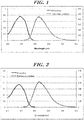
- FIG. 1 to FIG. 3 are spectra showing a fluorescent property of respective selenophene-fused aromatic compounds produced according to Entry 26, Entry 27, and Entry 30 of Example.
- a ninth aspect, of the example embodiments provides an anticancer composition including a selenophene-fused aromatic compound in accordance with the first aspect of the example embodiments. If the selenophene-fused aromatic compound has an anticancer property, it can be used as an intermediate of a drug or a finished product. The selenophene-fused aromatic compound can exhibit an anticancer effect though DNA alkylation. It is confirmed that as a result of cytotoxicity tests carried out to various cancer cells, the selenophene-fused aromatic compound has an IC 50 value in nM or pM exhibits a potent anticancer effect.
- the selenophene-fused aromatic compound can be applied to various cancers such as breast cancer, central nervous system cancer, colorectal cancer, non-small cell lung cancer, renal cancer, prostate cancer, ovarian cancer, etc., and, thus, the selenophene-fused aromatic compound in accordance with the example embodiments is expected to be usefully used as an anticancer drug for various cancers.
- a diselenide compound represented by a general formula R 11 -CH 2 -Se-Se-CH 2 -R 11 a solvent, and a reducing agent were prepared.
- the diselenide compound represented by the general formula R 11 -CH 2 -Se-Se-CH 2 -R 11 of the reaction mixture various substances such as (SeCH 2 COOEt) 2 , (p-NO 2 PhCH 2 Se) 2 , (p-CNPhCH 2 Se) 2 , and the like were used.
- the diselenide compounds were as shown in [Table 1]. About 0.6 eq. of the diselenide compound was used.
- the solvent anhydrous dimethylformaldehyde (DMF) was used.
- DTT dithiothreitol
- reaction mixture was prepared by adding the diselenide compound represented by the general formula R 11 -CH 2 -Se-Se-CH 2 -R 11 and the reducing agent to 2 mL of the solvent. The reaction mixture was stirred for 1 hour at a constant temperature of 60°C.
- reaction mixture After the reaction mixture was prepared, an aromatic compound as a starting material for producing the selenophene-fused aromatic compound was added to the reaction mixture at a time. Then, the reaction mixture was stirred for 30 minutes at a constant temperature of 60°C.
- an aromatic starting material and R 11 CH 2 X were prepared. 1 eq. of the aromatic starting material was used, and 20 eq. of the R 11 CH 2 X was used.
- the aromatic starting materials and the diselenide compounds used herein were as shown in [Table 2].
- reaction intermediate a mixture of the aromatic starting material and the R 11 CH 2 X was put in a heating box and heated at 130°C for 17 hours. Then, the solution was cooled and the solvent was removed in a vacuum condition, so that the reaction intermediate in a sold form was obtained.
- reaction intermediate was dissolved in anhydrous dimethylformaldehyde (DMF) as a solvent, and 2.5 eq. of a weak base K 2 CO 3 was added thereto, and stirred at room temperature for 24 hours.
- DMF dimethylformaldehyde
- the selenophene-fused aromatic compounds corresponding to Entry 38 to Entry 41 were produced by performing an additional reaction to compounds containing a nitro group among the selenophene-fused aromatic compounds corresponding to Entry 1 to Entry 37, and a producing method was performed as follows.
- reaction solution was depressurized to remove MeOH and adjusted to be acidic by using a 2N HCl solution and then, the reaction product was extracted by using dichloromethane. Then, an organic solvent layer was concentrated, and by silica gel chromatography using EA/Hex (1:1), the compound corresponding to Entry 39 was obtained at a yield of 89%.
- the selenophene-fused aromatic compounds corresponding to Entry 42 and Entry 43 were produced by performing an additional reaction to the selenophene-fused aromatic compounds corresponding to Entry 1 to Entry 37, and a producing method was performed as follows.
- This intermediate was dissolved in 1.5 mL of THF-MeOH-H 2 O (4:1:1), and LiOH (3 eq.) was added thereto with stirring at room temperature for 18 hours. 6 mL of water was added thereto, and the reaction solution was acidified with a 10% HCl solution, and then, the reaction product was extracted by using methylene chloride. Then, an organic solvent layer was concentrated and separated by a silica gel chromatography using MeOH-CH 2 Cl 2 (1:20), and 49 mg of the compound corresponding to Entry 42 was obtained at a yield of 91%.
- This reaction solution was depressurized and concentrated, and dissolved in 20 mL of MeOH-H 2 O (9:1), and then, NaOH (5 eq.) was added thereto with stirring at room temperature for 24 hours.
- the reaction solution was acidified with 2 mL of a 20% HCl solution and concentrated by using a lyophilizer and then separated by silica gel chromatography using MeOH-CH 2 Cl 2 (1:4). As a result, 20 mg of the compound corresponding to Entry 45 was obtained.
- reaction solution was acidified with 2 mL of a 20% HCl solution and concentrated by using a lyophilizer and then separated by a silica gel chromatography using MeOH-CH 2 Cl 2 (1:1). As a result, 275 mg of the compound corresponding to Entry 46 was obtained.
- Table 1 shows aromatic starting materials and diselenide compounds used herein for producing a selenophene-fused aromatic compound in accordance with the method of the second aspect and yields (%) of the selenophene-fused aromatic compound depending thereon:
- [Table 1] Selenophene-fused aromatic compound produced in accordance with the second aspect Entry (example) Aromatic starting material Diselenide compound Selenophene-fused aromatic compound Yield (%) 1 (SeCH 2 COOEt) 2 94 2 (p-NO 2 PhCH 2 Se) 2 85 3 (p-CNPhCH 2 Se) 2 65 4 (p-EtO 2 CPhCH 2 Se) 2 31 5 (SeCH 2 COOEt) 2 67 6 (p-NO 2 PhCH 2 Se) 2 50 7 (p-CNPhCH 2 Se) 2 83 8 (SeCH 2 COOEt) 2 68 9 (p-NO 2 PhCH 2 Se) 2 65 10 (p-CHPhCH 2 Se) 2 63 11 (p
- the selenophene-fused aromatic compound corresponding to Entry 17 among the selenophene-fused aromatic compounds shown in Table 1 exhibited a solvatochromic property.
- a concentration of the compound corresponding to Entry 17 is 60.4 ⁇ M, an absorption spectrum was as shown in FIG. 4 .
- Table 2 shows aromatic starting materials and R 11 CH 2 X used herein for producing a selenophene-fused aromatic compound in accordance with the third aspect and yields (%) of the selenophene-fused aromatic compound depending thereon.
- Yield 1 represents a yield of a reaction intermediate
- Yield 2 represents a yield of a selenophene-fused aromatic compound as a reaction product:
- [Table 2] Selenophene-fused aromatic compound produced in accordance with the third aspect Entry (example)
- Aromatic starting material R 1 CH 2 X Yield 1 (%) Selenophene-fused aromatic compound Yield 2 (%) 21 BrCH 2 COOEt 77 68 22 79 72 23 BrCH 2 COOEt 63 79 24 BrCH 2 COOEt 95 86 25 72 72 26 60 92 27 94 91 28 BrCH 2 COOEt 86 87 29 65 50 30 69 54 31 BrCH 2 COOEt 77 86 32 64 68 33 94 77 34 BrCH
- the selenophene-fused aromatic compounds corresponding to Entry 26, Entry 27, and Entry 30 among the selenophene-fused aromatic compounds shown in Table 2 exhibited a fluorescent property. Spectra showing a fluorescent property of the compounds were as shown in FIG. 1 to FIG. 3 , respectively.
- Table 3 shows selenophene-fused aromatic compounds produced by performing an additional reaction to the selenophene-fused aromatic compounds corresponding to Entry 1 to Entry 37 and produced in accordance with the second aspect or the third aspect: [Table 3] ⁇ Selenophene-fused aromatic compounds produced by performing an additional reaction to selenophene-fused aromatic compounds corresponding to Entry 1 to Entry 37> Entry (example) Selenophene-fused aromatic compound 38 39 40 41 42 43 44 45 46 47 48 49 50 51 52 53 54 55 56 57 58 ⁇ 1 H NMR and 13 C NMR data of selenophene-fused aromatic compounds corresponding to Entry 1 to Entry 58 shown in Table 1 to Table 3>
- (+)-Boc-MCBI and (+)-Boc-CBI were synthesized by the method as reported in J. Org. Chem. 1996, 61, 1710 .
- 30 mg or 50 mg of a starting material was mixed with 3 mL of 4N HCl-EtOAc and stirred at -40°C for 30 minutes and then left as it was at room temperature for 30 minutes. Thereafter, nitrogen gas was added thereto to concentrate the reaction solution, and the residue was dried for 15 minutes or more under a depressurized condition.
- SK-OV-3 cells floated on McCoy's 5A Medium in which 10% FBS and 1% P/S were added were inoculated into a 96-Well plate at a concentration of 3 ⁇ 10 4 /100 ⁇ l per Well and cultured at 37°C for 4 hours and then, treated with 100 ⁇ l of each compound, so that a final concentration of 10 nM was attained. Then, the cells were cultured at 37°C for 72 hours. As a control, the cells were treated with DMSO as a solvent of the compounds to attain a final concentration of 0.1%. Each well was treated with 10 ⁇ l of a WST-1 assay reagent (iTSBio, Korea), and cultured at 37°C for 2 hours.
- a WST-1 assay reagent iTSBio, Korea
Landscapes
- Chemical & Material Sciences (AREA)
- Organic Chemistry (AREA)
- Health & Medical Sciences (AREA)
- Life Sciences & Earth Sciences (AREA)
- General Health & Medical Sciences (AREA)
- Nuclear Medicine, Radiotherapy & Molecular Imaging (AREA)
- General Chemical & Material Sciences (AREA)
- Pharmacology & Pharmacy (AREA)
- Chemical Kinetics & Catalysis (AREA)
- Animal Behavior & Ethology (AREA)
- Medicinal Chemistry (AREA)
- Public Health (AREA)
- Veterinary Medicine (AREA)
- Engineering & Computer Science (AREA)
- Materials Engineering (AREA)
- Heterocyclic Carbon Compounds Containing A Hetero Ring Having Oxygen Or Sulfur (AREA)
- Pharmaceuticals Containing Other Organic And Inorganic Compounds (AREA)
- Organic Low-Molecular-Weight Compounds And Preparation Thereof (AREA)
Description
- The embodiments described herein pertain generally to a selenophene-fused aromatic compound, and a producing method of the selenophene-fused aromatic compound.
- "Benzoselenophene" as a kind of compound containing selenium (Se) at an aromatic ring is a substance having a similar structure to that of indole, benzothiophene, and benzofuran. A "selenophene-fused aromatic compound" herein refers to benzoselenophene, pyridoselenophene, thiazoloselenophene, furanoselenophene, and the like. That is, the benzoselenophene is a substance included in the "selenophene-fused aromatic compound". The selenophene-fused aromatic compound including the benzoselenophene is a highly applicable material in various fields. However, according to a conventional technology, it is not easy to synthesize derivatives thereof. Thus, it has been difficult to use the selenophene-fused aromatic compound as an intermediate or a material of drugs or as a material having a semiconducting property.
- A lot of synthesis methods of indole or benzothiophene structurally similar to the benzoselenophene have already been developed, and the indole and benzothiophene have reached commercialization as medicines for various diseases, such as anticancer drugs, hormone replacement drugs, immunomodulators, diet pills, anti-diabetic drugs, and the like. The benzoselenophene is expected to be highly effective in preventing cancer due to the similarity in structure with the indole or benzothiophene and availability thereof as a photochemotherapeutic agent used for treating achromoderma or psoriasis has been highly valued. However, it has not reached commercialization due to lack of development of a synthesis method.
- Some methods for synthesizing derivatives of the selenophene-fused aromatic compound including the benzoselenophene have been known. By way of example, they are disclosed in "Substituted benzodithiophenes and benzodiselenophenes (Korean Patent Laid-open Publication No.
10-2009-0033909
P. Arsenyan et al. describe in "Synthesis, structure and cytotoxicity of 3-C,N,S,Se substituted benzo[b]selenophene derivatives", European Journal of Medicinal Chemistry, 46, 8, 2011, pp. 3434-3443 the synthesis, structure and cytotoxicity of a series of 3-C,N,S,Se substituted benzo[b]selenophene derivatives on human fibrosarcoma HT-1080, mouse heptatoma MG-22A, and mouse fibroblasts 3T3 cell lines.
M.K. Staples et al. disclose in "Tandem-fre-radical addition/substitution chemistry and its application to the preparation of novel AT1 receptor antagonists", Organic & Biomolecular Chemistry, 9, 2, 2011, pp. 473-379 the preparation of benzothiophene and benzoselenophene analogues of the thiophene-containing antihypertensives mifasartan and eprosartan and the test thereof for AT1 receptor antagonist properties.
WO 2006/084338 discloses tubulin polymerization inhibitors and methods for preparing such compounds.WO 2007/087684 relates to substituted benzofurans, benzothiophenes, and indoles and their use as tubulin polymerisation inhibitors.
M. Baiwir et al., "NMR Studies of the Chalcogen Analogues of Benzofuran IV-Proton, Carbon-13 and Selenium-77 Magnetic Resonance in Nitrobenzo[b]selenophenes", Organic Magnetic Resonance, 18, 1, 1982, pp. 33-37, describe the measurements of 1H, 13C and 77Se chemical shifts for mononitrobenzo[b]selenophenes.
Furthermore, M. Baiwir et al., "Selenium-77 Nuclear Magnetic Resonance in Mono- and Disubstituted Benz[b]selenophenes", Organic Magnetic Resonance, 16, 1, 1981, pp 14-16 also describe the 77Se chemical shifts of 79 mono- or disubstituted benzo[b]selenophenes.
In Science of Synthesis, Georg Thieme Verlag, Vol. 10, 2000, pp. 265 - 299 syntheses of benzo[b]selenophenes are disclosed.
A. Croisy et al. report in "Spectrométrie de masse d'hétérocycles séléniés III*-etude de la fragmentation de quelques selenolo[2,3-b]pyridines", Organic Mass Spectrometry, 9, 10, 1974, pp. 970-980 the mass spectra of thirteen selenolo[2,3-b]pyridine derivatives and the comparison thereof with those of benzo[b]selenophene, quinolone and thieno[2,3-c]pyridine.
P. Pirson and L. Christiaens discuss in "N0 106. - Synthèse de la sélénolo(2,3-b), pyridine" Bulletin de la société chimique de France, 2, 1, 1973, pp. 704-707 the synthesis of selenolo[2,3-b]pyridine.
P. Thibaut et al. describe in "Chimie organique. - Le dihydro-2,3 [1] benzosélénophene", Compte rendus des séances de l'academie des science, serie C: sciences chimiques, 281, 1, 1975, pp 937-939 the synthesis of benzoselenophene derivatives.
A. Dari et al., "Synthesis of selenopsilocine (3-Dimethylaminoethyl-4-hydroxybenzo[b]selenophene", Heterocycles, 34, 9, 1992, pp. 1737-1748 discuss the synthesis of the selenium analogue of psilocine. - In view of the foregoing problems, example embodiments provide a method for more easily and economically producing a selenophene-fused aromatic compound derivative containing various substituents.
- Further, the example embodiments provide the selenophene-fused aromatic compound produced according to the example embodiments, and the selenophene-fused aromatic compound can be used for various purposes such as an intermediate of an anti-bacterial or anticancer substance, an indicator of which color is changed depending on a solvent, or a fluorescent substance.
- However, problems to be solved by the present disclosure are not limited to the above-described problems. Although not described herein, other problems to be solved by the present disclosure can be clearly understood by those skilled in the art from the following descriptions.
- A first aspect of example embodiments provides a selenophene-fused aromatic compound represented by the following Chemical Formula 1, 11 or 12:


- R1 represents the following Chemical

- R2 represents H, -NO2, -NHCOR, CX3, -OR, -diOR, a substitutable alkyl group, a substitutable alkoxy group, a substitutable alkylene-dioxy group, a substitutable amino group, a halo group, or a substituent represented by the following Chemical Formula B:

- X represents a halo group,
- R3 represents -H, -OH, -NH2, a substitutable alkyl group, or a substitutable aryl group, each of R4 and R5 independently represents a substitutable N, O, S, C, or bond,
- R6 represents H, or a substitutable alkoxy group,
- R7 represents H, -CONR17R20, or

- each of R17 and R20 independently represents H, or a substitutable alkyl group,
- R21 represents C, O, N, or S,
- R8 represents a halo group,
- R9 represents O, NH, S, or Se,
- R10 represents a substitutable alkyl group, a substitutable alkoxy group, a halo group, -NO2, or -NHCOR,
- L represents a linker, and
- R represents H, a substitutable alkyl group, a substitutable aryl group, a substitutable amino group, a substitutable amino acid group, a substitutable peptide group, a substitutable C1-7 alkoxy group, or a residue of a substitutable carbohydrate or carbohydrate derivative.
- Described is a producing method of a selenophene-fused aromatic compound represented by the following Chemical Formula 2, the method including:
- preparing a reaction mixture containing a diselenide compound represented by a general formula of R11-CH2-Se-Se-CH2-R11, a solvent, and a reducing agent; and
- adding an aromatic starting material represented by the following Chemical Formula 2a and a base to the reaction mixture to be reacted:



- Z represents -COR15, or -CN,
- R15 represents -H, a substitutable alkyl group, a substitutable aryl group, or a substitutable alkoxy group,
- R3 represents -H, -OH, -NH2, a substitutable alkyl group, or a substitutable aryl group,
- R11 represents -CO2H, -CO2R, 4-NO2-Ph, 4-CN-Ph, 4-RO2C-Ph, or 4-X-Ph,
- R12 represents H, -NO2, -NHCOR, CX3, -OR, -diOR, a substitutable alkoxy group, a substitutable alkylene-dioxy group, a substitutable amino group, or a halo group,
- X represents a halo group, and
- R represents H, a substitutable alkyl group, a substitutable aryl group, a substitutable amino group, a substitutable amino acid group, a substitutable peptide group, a substitutable C1-7 alkoxy group, or a residue of a substitutable carbohydrate or carbohydrate derivative.
- Further described is a producing method of a selenophene-fused aromatic compound represented by the following Chemical Formula 7, the method including:
- reacting an aromatic starting material represented by the following Chemical Formula 7a and R11CH2X via heating to form a reaction intermediate represented by the following Chemical Formula 7b; and
- adding a solvent and a base to the reaction intermediate to be reacted:


- each of R4 and R5 independently represents a substitutable N, O, S, C, or bond,
- R11 represents -CO2H, -CO2R, 4-NO2-Ph, 4-CN-Ph, 4-RO2C-Ph, or 4-X-Ph,
- R12 represents H, -NO2, -NHCOR, CX3, -OR, -diOR, a substitutable alkoxy group, a substitutable alkylene-dioxy group, a substitutable amino group, or a halo group,
- X represents a halo group,
- R13 represents a substitutable alkyl group, and
- R represents H, a substitutable alkyl group, a substitutable aryl group, a substitutable amino group, a substitutable amino acid group, a substitutable peptide group, a substitutable C1-7 alkoxy group, or a residue of a substitutable carbohydrate or carbohydrate derivative.
- A further aspect of the example embodiments provides a producing method of a selenophene-fused aromatic compound represented by the following
Chemical Formula 10, the method including: - reacting a MCBI (7-methoxy-1,2,9,9a-tetrahydrocyclopropa[c]benz[e]indol-4-one) compound represented by the following Chemical Formula 10a and a selenium-containing aromatic compound represented by the following Chemical Formula 10b:


- R2 represents a substitutable alkyl group, a substitutable alkoxy group, a halo group, -NO2, NHCOR, or a substituent represented by the following Chemical Formula B,
- each of R4 and R5 independently represents a substitutable C, O, N, S, or bond,
- R6 represents H, or a substitutable alkoxy group,
- R7 represents H, -CONR17R20, or

- each of R17 and R20 independently represents H, or a substitutable alkyl group,
- R21 represents C, O, N, or S,
- R8 represents a halo group, and
- R represents H, a substitutable alkyl group, a substitutable aryl group, a substitutable amino group, a substitutable amino acid group, a substitutable peptide group, a substitutable C1-7 Alkoxy group, or a residue of a substitutable carbohydrate or carbohydrate derivative:


- R9 represents O, NH, S, or Se,
- R10 represents a substitutable alkyl group, a substitutable alkoxy group, a halo group, -NO2, or-NHCOR, and
- R represents H, a substitutable alkyl group, a substitutable aryl group, a substitutable amino group, a substitutable amino acid group, a substitutable peptide group, a substitutable C1-7 alkoxy group, or a residue of a substitutable carbohydrate or carbohydrate derivative.
- Another aspect of the example embodiments provides a producing method of a selenophene-fused aromatic compound represented by the following Chemical Formula 11, the method including:
- reacting a MCBI compound represented by the following Chemical Formula 11a and a selenium-containing aromatic compound represented by the following Chemical Formula 11b:


- R2 represents a substitutable alkyl group, a substitutable alkoxy group, a halo group, -NO2, -NHCOR, or a substituent represented by the following Chemical Formula B,
- each of R4 and R5 independently represents a substitutable C, O, N, S, or bond,
- R6 represents H, or a substitutable alkoxy group, and
- R represents H, a substitutable alkyl group, a substitutable aryl group, a substitutable amino group, a substitutable amino acid group, a substitutable peptide group, a substitutable C1-7 alkoxy group, or a residue of a substitutable carbohydrate or carbohydrate derivative:

- R9 represents O, NH, S, or Se,
- R10 represents a substitutable alkyl group, a substitutable alkoxy group, a halo group, -NO2, or -NHCOR, and
- R represents H, a substitutable alkyl group, a substitutable aryl group, a substitutable amino group, a substitutable amino acid group, a substitutable peptide group, a substitutable C1-7 Alkoxy group, or a residue of a substitutable carbohydrate or carbohydrate derivative.
- An even further aspect of the example embodiments provides an anti-bacterial composition including a selenophene-fused aromatic compound according to the first aspect of the example embodiments.
- A further aspect of the example embodiments provides an indicator composition including a selenophene-fused aromatic compound according to the first aspect of the example embodiments,
wherein the indicator composition may be used as an indicator of which color is changed depending on a solvent. - Another aspect of the example embodiments provides a fluorescent composition including a selenophene-fused aromatic compound according to the first aspect of the example embodiments.
- An aspect of the example embodiments provides an anticancer composition including a selenophene-fused aromatic compound according to the first aspect of the example embodiments.
- In accordance with the example embodiments, it is possible to more easily and economically produce a benzoselenophene derivative containing various substituents. Further, since it is possible to easily and economically produce a selenophene-fused aromatic compound according to the example embodiments, the possibility of commercialization of the selenophene-fused aromatic compound as an anti-bacterial composition, an anticancer drug, and the like can be increased.
- Meanwhile, by appropriately selecting a diselenide compound, a solvent, a reducing agent, and a base as materials required for producing the selenophene-fused aromatic compound, the selenophene-fused aromatic compound can be obtained at a high yield. Further, by diversifying kinds of aromatic starting materials for producing the selenophene-fused aromatic compound, kinds of the obtained selenophene-fused aromatic compound can also be diversified.
- The selenophene-fused aromatic compound produced in accordance with to the example embodiments may have various useful properties depending on a specific chemical formula. By way of example, a selenophene-fused aromatic compound having an anti-bacterial property can be synthesized, and in this case, it can be used as a medical material. Further, a selenophene-fused aromatic compound having a property that causes a change in color formation depending on a solvent can be synthesized, and in this case, it can be used as an indicator. Furthermore, some selenophene-fused aromatic compounds may have a fluorescent property, and in this case, they can be used as an intermediate for synthesizing organic semiconductors by using the fluorescent property. Moreover, the selenophene-fused aromatic compound can be usefully used as an anticancer drug or a precursor thereof. The selenophene-fused aromatic compound may exhibit an anticancer effect through DNA alkylation. It is confirmed that as a result of cytotoxicity tests carried out to various cancer cells, the selenophene-fused aromatic compound has an IC50 value in nM or pM exhibits a potent anticancer effect. Further, the selenophene-fused aromatic compound can be applied to various cancers such as breast cancer, central nervous system cancer, colorectal cancer, non-small cell lung cancer, renal cancer, prostate cancer, ovarian cancer, etc., and, thus, the selenophene-fused aromatic compound in accordance with the example embodiments is expected to be usefully used as an anticancer drug for various cancers.
-
-
Fig. 1 is a spectra showing a fluorescent property of a selenophene-fused aromatic compound produced according to Entry 26 of Example. -
Fig. 2 is a spectra showing a fluorescent property of a selenophene-fused aromatic compound produced according to Entry 27 of Example. -
Fig. 3 is a spectra showing a fluorescent property of a selenophene-fused aromatic compound produced according toEntry 30 of Example. -
Fig. 4 is a spectra showing a solvatochromic property of a selenophene-fused aromatic compound produced according to Entry 17 of Example. - Hereinafter, example embodiments of the present disclosure will be described in detail with reference to the accompanying drawings so that the present disclosure may be readily implemented by those skilled in the art. However, it is to be noted that the present disclosure is not limited to the example embodiments but can be embodied in various other ways. In drawings, parts irrelevant to the description are omitted for the simplicity of explanation, and like reference numerals denote like parts through the whole document.
- Through the whole document, the term "comprises or includes" and/or "comprising or including" used in the document means that one or more other components, steps, operation and/or existence or addition of elements are not excluded in addition to the described components, steps, operation and/or elements unless context dictates otherwise.
- The term "about or approximately" or "substantially" is intended to have meanings close to numerical values or ranges specified with an allowable error and intended to prevent accurate or absolute numerical values disclosed for understanding of the present disclosure from being illegally or unfairly used by any unconscionable third party. Through the whole document, the term "step of" does not mean "step for".
- Through the whole document, the term "on" that is used to designate a position of one element with respect to another element includes both a case that the one element is adjacent to the another element and a case that any other element exists between these two elements.
- Through the whole document, the term "combination of" included in Markush type description means mixture or combination of one or more components, steps, operations and/or elements selected from a group consisting of components, steps, operation and/or elements described in Markush type and thereby means that the disclosure includes one or more components, steps, operations and/or elements selected from the Markush group.
- Through the whole document, the term "halo" or "halo group" refers to, but not limited to F, Cl, Br, or I.
- Through the whole document, the term "alkyl" or "alkyl group" refers to a linear or branched saturated or unsaturated alkyl group having 1 to 10, 1 to 7, or 1 to 5 carbon atoms, and may include, for example, but not limited to, methyl, ethyl, propyl, butyl, pentyl, hexyl, heptyl, octyl, nonyl, decyl, or isomers thereof. When the alkyl group is substituted, it may be substituted with four or less substituents as listed below at any binding point (any carbon atom). The alkyl group may be substituted with one or more substances of a hydroxyl group, carboxylate, oxo, halogen (for example, F, Cl, Br, I), haloalkyl (for example, CCl3 or CF3), alkyloxycarbonyl (-C(O)R), alkylcarbonyloxy (-OCOR), carbamoyl (-NHCOOR- or -OCONHR-), urea (-NHCONHR-), thiol, cyano, nitro, amino, acylamino, C1-C6 alkylthio, arylthio, C1-C6 alkyl, C1-C6 alkoxy, aryloxy, alkylcarbonyloxy, arylcarbonyloxy, C3-C6 cycloalkyl, C3-C6 cycloalkyloxy, Cry6 alkenyl, C3-C6 alkynyl, aryl, amino carbonyl, C1-C6 alkyl carbonyl, C3-C6 cycloalkyl carbonyl, heterocyclyl carbonyl, aryl carbonyl, aryloxy carbonyl, C1-C6 alkoxy carbonyl, C3-C6 cycloalkyloxy carbonyl, heterocyclyloxy carbonyl, C1-C6 alkylsulfonyl, arylsulfonyl, a heterocyclyl group, etc. Meanwhile, when the alkyl group is substituted with another alkyl group, this is used to refer to "branched alkyl group". Desirably, the alkyl group contains 1 to 6 carbon atoms. An alkylene used herein refers to a cross-linked alkyl group having a chemical formula (CH2)n. By way of example, the alkylene may include CH2, -CH2CH2-, -CH2CH2CH2-, etc.
- The term "aryl" or "aryl group" used herein alone or as part of another group includes a monocyclic or bicyclic aromatic ring, for example, phenyl and substituted phenyl and a fused group, for example, naphthyl, phenanthrenyl, indenyl, tetrahydronaphthyl, indanyl, and the like. By way of example, the "aryl" or "aryl group" may contain at least one ring having 6 or more atoms and may contain 5 or less rings having 22 or less atoms, and double bonds may exist alternately (resonantly) between adjacent carbon atoms or appropriate hetero atoms. The "aryl" or "aryl group" may be optionally substituted with one or more groups including, but not limited to, halogen, for example, F, Br, Cl, or I, alkyl, for example, methyl, ethyl, propyl, and alkoxy, for example, methoxy or ethoxy, hydroxy, carboxy, carbamoyl, alkyloxy carbonyl, nitro, alkenyloxy, trifluoromethyl, amino, cycloalkyl, aryl, heteroaryl, cyano, alkyl S(O)m (m=0, 1, 2), or thiol. By way of example, the "aryl" or "aryl group" may be phenyl, substituted phenyl as described above, phenyl, naphthyl, or substituted naphthyl as described above, but may not be limited thereto.
- Through the whole document, the term "alkoxy" or "alkoxy group" may include, but is not limited to, an alkoxy group in which the above-defined "alkyl group" is bonded to an oxygen atom. The alkoxy group is bonded to a main chain, aryl, or heteroaryl group through an oxygen bridge. The alkoxy group may be a straight chained or branched although the straight-chain is preferred. Examples of the alkoxy group may include methoxy, ethyloxy, propoxy, butyloxy, t-butyloxy, i-propoxy, and the like. Desirably, the alkoxy group may contain 1 to 6 carbon atoms, and especially desirably, the alkoxy group may contain 1 to 3 carbon atoms.
- Through the whole document, the term "alkylene-dioxy group" may include an alkylene group between two oxygen atoms. The "alkylene group" may be an alkylene group having 1 to 10, 1 to 7, or 1 to 5 carbon atoms, and may include, for example, but not limited to, methylene, ethylene, propylene, butylene, pentylene, hexylene, heptylene, octylene, nonylene, decylene, or isomers thereof.
- The term "amine group" or "amino group" used herein alone or as part of another group refers to -NH2. Further, the "amine group" or "amino group" may be optionally substituted with 1 or 2 substituents, which may be identical with or different from each other, such as alkyl, aryl, arylalkyl, alkenyl, alkynyl, heteroaryl, heteroarylalkyl, cycloheteroalkyl, cycloheteroalkylalkyl, cycloalkyl, cycloalkylalkyl, haloalkyl, hydroxyalkyl, alkoxyalkyl, thioalkyl, carbonyl, or carboxyl.
- Through the whole document, the term "amino acid group" means an amino acid including α-amino acid, β-amino acid, and γ-amino acid. The amino acid may be a L-isomer or a D-isomer although the L-isomer is preferred. Examples of the amino acid may include, but may not be limited to, glycine, alanine, valine, leucine, isoleucine, methionine, proline, phenylalanine, tryptophan, serine, threonine, cysteine, thirosine, asparagine, glutamine, aspartic acid, glutamic acid, lysine, arginine, histidine, β-alanine, and ornithine. The term "peptide group" means a group generated through a reaction between lots of natural and/or non-natural amino acids.
- Through the whole document, the term "carbohydrate" or "carbohydrate derivative" may be, for example, polyhydroxy aldehyde, polyhydroxy ketone, or polyol, or may be an organic group derived therefrom, and means a compound which can be changed into such a group through a simple chemical modification such as hydrolysis, oxidation, or reduction. Such a group may include, for example, but not limited to, sugar, starch, cellulose, and gum.
- Through the whole document, the term "diOR" may include

- Through the whole document, the term "substitution" is intended to include all permissible substituents of organic compounds. The allowable substituents may include acyclic or cyclic, branched or unbranched, carbocyclic or heterocyclic, aromatic or nonaromatic substituents of organic compounds, and the permissible substituents may be one or more. The term "substituted" ", when in association with any of the foregoing groups, refers to a group substituted at one or more positions with substituents such as acyl, amino (including simple amino, mono and dialkylamino, mono and diarylamino, and alkylarylamino), acylamino (including carbamoyl, and ureido), alkylcarbonyloxy, aryl, arylcarbonyloxy, alkoxycarbonyloxy, alkoxycarbonyl, carboxy, carboxylate, aminocarbonyl, mono and dialkylaminocarbonyl, cyano, azido, halogen, hydroxyl, nitro, trifluoromethyl, thio, alkylthio, arylthio, alkylthiocarbonyl, thiocarboxylate, lower alkyl, lower alkenyl, lower alkynyl, cycloalkyl, heterocycloalkyl, aryl, heteroaryl, lower alkoxy, aryloxy, aryloxycarbonyloxy, benzyloxy, benzyl, sulfinyl, alkylsulfinyl, sulfonyl, sulfate, sulfonate, sulfonamide, phosphate, phosphonato, phosphinato, oxo, guanidine, imino, formyl, and the like, but may not be limited thereto. Any of the above-described substituents can be further substituted if permissible, for example, if the group contains an alkyl group, an aryl group, or other, but may not be limited thereto.
- A first aspect of example embodiments provides a selenophene-fused aromatic compound represented by the following
Chemical Formula 1, 11 or 12:


- R1 represents the following Chemical Formula A:

- R2 represents H, -NO2, -NHCOR, CX3, -OR, -diOR, a substitutable alkyl group, a substitutable alkoxy group, a substitutable alkylene-dioxy group, a substitutable amino group, a halo group, or a substituent represented by the following Chemical Formula B:

- X represents a halo group,
- R3 represents -H, -OH, -NH2, a substitutable alkyl group, or a substitutable aryl group, each of R4 and R5 independently represents a substitutable N, O, S, C, or bond,
- R6 represents H, or a substitutable alkoxy group,
- R7 represents H, -CONR17R20, or

- each of R17 and R20 independently represents H, or a substitutable alkyl group,
- R21 represents C, O, N, or S,
- R8 represents a halo group,
- R9 represents O, NH, S, or Se,
- R10 represents a substitutable alkyl group, a substitutable alkoxy group, a halo group, -NO2, or-NHCOR,
- L represents a linker, and
- R represents H, a substitutable alkyl group, a substitutable aryl group, a substitutable amino group, a substitutable amino acid group, a substitutable peptide group, a substitutable C1-7 alkoxy group, or a residue of a substitutable carbohydrate or carbohydrate derivative.
- In the Formula,
R1 represents -CO2H -CO2R, 4-NO2-Ph 4-CN-Ph, 4-RO2C-Ph, or 4-X-Ph,
R2 represents H, -NO2, -NHCOR, CX3, -OR, -diOR, a substitutable alkyl group, a substitutable alkoxy group, a substitutable alkylene-dioxy group, a substitutable amino group, a halo group, or a substituent represented by the following Chemical Formula B:

- X represents a halo group
R3 represents -H, -OH, -NH2, a substitutable alkyl group, or a substitutable aryl group,
each of R4 and R5 independently represents a substitutable N, O, S, C, or bond,
R9 represents O, NH, S, or Se,
R10 represents a substitutable alkyl group, a substitutable alkoxy group, a halo group, -NO2, or-NHCOR, and
R represents H, a substitutable alkyl group, a substitutable aryl group, a substitutable amino group, a substitutable amino acid group, a substitutable peptide group, a substitutable C1-7 alkoxy group, or a residue of a substitutable carbohydrate or carbohydrate derivative. -
Chemical Formula 1 may be selected from, but not limited to, the following Chemical Formula 2 to Chemical Formula 6:


- In the formulas,
- R3 is the same as defined above in
Chemical Formula 1, - R11 represents -CO2H, -CO2R, 4-NO2-Ph, 4-CN-Ph, 4-RO2C-Ph, or 4-X-Ph,
- R12 represents H, -NO2, -NHCOR, CX3, -OR, -diOR, a substitutable alkoxy group, a substitutable alkylene-dioxy group, a substitutable amino group, or a halo group,
- X represents a halo group, and
- R represents H, a substitutable alkyl group, a substitutable aryl group, a substitutable amino group, a substitutable amino acid group, a substitutable peptide group, a substitutable Alkoxy group, or a residue of a substitutable carbohydrate or carbohydrate derivative.
-
Chemical Formula 1 may be selected from, but not limited to, the following Chemical Formula 7 to Chemical Formula 9:


- In the formulas,
each of R4 and R5 independently represents a substitutable N, O, S, C, or bond,
R11 represents -CO2H, -CO2R, 4-NO2-Ph, 4-CN-Ph, 4-RO2C-Ph, or 4-X-Ph,
R12 represents H, -NO2, -NHCOR, CX3, -OR, -diOR, a substitutable alkoxy group, a substitutable alkylene-dioxy group, a substitutable amino group, or a halo group,
X represents a halo group, and
R represents H, a substitutable alkyl group, a substitutable aryl group, a substitutable amino group, a substitutable amino acid group, a substitutable peptide group, a substitutable C1-7 alkoxy group, or a residue of a substitutable carbohydrate or carbohydrate derivative. - In accordance with an example embodiment,
Chemical Formula 1, Chemical Formula 11 and Chemical Formula 12 may be selected from, but not limited to, the followingChemical Formula 10 to Chemical Formula 12:


- In the formulas,
R2 represents H, -NO2, -NHCOR, CX3, -OR, -diOR, a substitutable alkyl group, a substitutable alkoxy group, a substitutable alkylene-dioxy group, a substitutable amino group, a halo group, or a substituent represented by the following Chemical Formula B:

R6 represents H, or a substitutable alkoxy group,
R7 represents H, -CONR17R20, or
R21 represents C, O, N, or S,
R8 represents a halo group,
R9 represents O, NH, S, or Se,
R10 represents a substitutable alkyl group, a substitutable alkoxy group, a halo group, -NO2, or-NHCOR,
L represents a linker,
X represents a halo group, and
R represents H, a substitutable alkyl group, a substitutable aryl group, a substitutable amino group, a substitutable amino acid group, a substitutable peptide group, a substitutable Alkoxy group, or a residue of a substitutable carbohydrate or carbohydrate derivative. - In accordance with an example embodiment, the linker includes -NHCO-R19-CONH-, and in Chemical Formulas above, R19 may be a C1-7 alkyl group, but may not be limited thereto. By way of example, the linker may be -NHCO-CH2-CONH-, -NHCO-CH2CH2-CONH-, -NHCO-CH2CH2CH2-CONH-, -NHCO-CH2CH2CH2CH2-CONH-, -NHCO-CH2CH2CH2CH2CH2-CONH-, -NHCO-CH2CH2CH2CH2CH2CH2-CONH-, or -NHCO-CH2CH2CH2CH2CH2CH2CH2-CONH-, but may not be limited thereto.
- By way of example, the selenophene-fused aromatic compound represented by Chemical Formula 12 above may be produced by, but not limited to, linking the two symmetric selenophene-fused aromatic compounds represented by
Chemical Formula 10 above by the linker. - In a second aspect, which is not according to the invention, a producing method of a selenophene-fused aromatic compound represented by the following Chemical Formula 2 is described, the method including: preparing a reaction mixture containing a diselenide compound represented by a general formula R11-CH2-Se-Se-CH2-R11, a solvent, and a reducing agent; and adding an aromatic starting material represented by the following Chemical Formula 2a and a base to the reaction mixture to be reacted:


- In the formulas,
Z represents -COR15, or -CN,
R15 represents -H, a substitutable alkyl group, a substitutable aryl group, or a substitutable alkoxy group,
R3 represents -H, -OH, -NH2, a substitutable alkyl group, or a substitutable aryl group,
R11 represents -CO2H, -CO2R, 4-NO2-Ph, 4-CN-Ph, 4-RO2C-Ph, or 4-X-Ph,
R12 represents H, -NO2, -NHCOR, CX3, -OR, -diOR, a substitutable alkoxy group, a substitutable alkylene-dioxy group, a substitutable amino group, or a halo group,
X represents a halo group, and
R represents H, a substitutable alkyl group, a substitutable aryl group, a substitutable amino group, a substitutable amino acid group, a substitutable peptide group, a substitutable C1-7 alkoxy group, or a residue of a substitutable carbohydrate or carbohydrate derivative. - Chemical Formula 2a may include, but may not be limited to, the following Chemical Formula 3a, and Chemical Formula 2 may include, but may not be limited to, the following Chemical Formula 3:


each of X, R11 and R12 is the same as defined above in Chemical Formula 2a and Chemical Formula 2. - Chemical Formula 2a may include, but may not be limited to, the following Chemical Formula 4a and Chemical Formula 2 may include, but may not be limited to, the following Chemical Formula 4:


Each of X, R11 and R12 is the same as defined above in Chemical Formula 2a and Chemical Formula 2. - Chemical Formula 2a may include, but may not be limited to, the following Chemical Formula 5a, and Chemical Formula 2 may include, but may not be limited to, the following Chemical Formula 5:


each of X, R11 and R12 is the same as defined above in Chemical Formula 2a and Chemical Formula 2. - Chemical Formula 2a may include, but may not be limited to, Chemical Formula 6a below, and Chemical Formula 2 may include, but may not be limited to, Chemical Formula 6 below:


each of X, R11 and R12 is the same as defined above in Chemical Formula 2a and Chemical Formula 2. - The base may be added subsequently after the aromatic starting material is added to the reaction mixture, but may not be limited thereto. By way of example, the base used for producing the selenophene-fused aromatic compound may be added subsequently after the aromatic starting material is added to the reaction mixture with stirring, but may not be limited thereto. The time for stirring may be about 10 minutes or more, but may not be limited thereto. By adding the base, the reducing agent containing a thiol group can be converted into a negatively charged thiolate anion(RS-) and a reducing power thereof can be improved.
- By way of example, the reaction of producing the negatively charged thiolate anion by using a reducing agent containing a thiol group as the reducing agent can be schematized by the following reaction mechanism shown:

- Meanwhile, if the negatively charged thiolate anion exists together with the aromatic starting material, it may compete with a selenolate nucleophile and cause a substitution reaction. Therefore, if the base is added from the first step of the reaction, i.e. the step where the reaction mixture is prepared, or if the base is added to the reaction mixture together with the aromatic starting material, the negatively charged thiolate anion reacts first with the diselenide compound rather than the aromatic starting material. Thus, a yield of a final target product may be decreased. Therefore, the aromatic starting material is added with stirring for a certain period of time, and then the base is added during the reaction, so that the above-described problem can be solved. Thus, the negatively charged thiolate anion can selectively make a nucleophilic substitution reaction first with the aromatic starting material, and a yield of the final target product can be improved.
- For the reason described above, a producing method of a selenophene-fused aromatic compound including adding the aromatic starting material to the reaction mixture with stirring, and subsequently adding the base thereto, but may not be limited thereto. By way of example, it was observed that when the aromatic starting material was added to the reaction mixture containing the diselenide compound, the solvent, and the reducing agent with stirring for a certain period of time and then the base was added, a nucleophilic substitution reaction was preferably performed within a few minutes at a position of a halo group contained in the aromatic starting material and a desired reaction product, i.e. a selenophene-fused aromatic compound, was formed.
- The solvent may be selected from the group consisting of dimethylformaldehyde (DMF), dimethylsulfoxide (DMSO), tetrahydrofuran (THF), CH2Cl2, CH3CN, CH3NO2, CHCl3, ClCH2CH2Cl, alcohols, an aromatic solvent, and combinations thereof, but may not be limited thereto. By way of example, the alcohols may include, but may not be limited to, methanol, ethanol, propanol, or butanol, and the aromatic solvent may include, but may not be limited to, benzene, toluene, or derivatives thereof. The solvent can be selectively used without particular limitation as long as it can easily dissolve the diselenide compound and the reducing agent contained in the reaction mixture.
- The reducing agent may contain a thiol group, but may not be limited thereto. By way of example, the reducing agent may include a material containing one thiol group or more, but may not be limited thereto. By way of example, the reducing agent may include a material containing one or two thiol groups, and may include, for example, but not limited to, dithiothreitol (DTT), an isomer of dithiothreitol, cysteine, N-acetylcysteine, cysteine derivatives similar to N-Boc-cysteine, or alkandithiol such as 1,4-butandithiol or 1,6-hexandithiol. In order to prepare the selenophene-fused aromatic compound, in conventional methods, some reducing agents such as NaBH4 or LiEt3BH that does not contain a thiol group have been used. Further, metals such as indium, lanthanum, and samarium, and salts thereof have been used for reducing a Se-Se bond of the diselenide compound to form a selenolate nucleophile. However, it is difficult to obtain the selenophene-fused aromatic compound by the above-described conventional methods. That is because according to the conventional methods, another functional group of the aromatic starting material may be reduced or converted at the same time when the Se-Se bond of the diselenide compound is reduced. In the example embodiments, instead of the above-described conventional methods, another functional group of the aromatic starting material was suppressed from being reduced or converted and the Se-Se bond of the diselenide compound was selectively reduced by using a material containing a thiol group as a reducing agent as described above, and, thus, a yield of the desired reaction product could be remarkably increased. That is, since the material containing a thiol group is used as the reducing agent, a yield of the selenophene-fused aromatic compound can be increased and unnecessary side reactions can be minimized.
- The base may be selected from the group consisting of K2CO3, KHCO3, Na2CO3, NaHCO3, NaOEt, NH4OH, DBU (1,8-diazabicyclo[5,4,0]undec-7-ene), KOH, NaOH, Ca(OH)2, Ba(OH)2, KOtBu, and combinations thereof, but may not be limited thereto. By way of example, the base may be a strong base selected from the group consisting of DBU(1,8-diazabicyclo[5,4,0]undec-7-ene), KOH, NaOH, Ca(OH)2, Ba(OH)2, KOtBu, and combinations thereof, but may not be limited thereto. By way of example, the base may be a weak base selected from the group consisting of K2CO3, KHCO3, Na2CO3, NaHCO3, NaOEt, NH4OH, or combinations thereof, but may not be limited thereto. The selection of a base may affect a yield of the selenophene-fused aromatic compound. By way of example, if a material containing an electron donating substituent is used as the aromatic starting material, when a weak base such as NaOEt is used, it is difficult to obtain a desired product, whereas when a strong base such as DBU is used, it is possible to produce a desired product at a high yield, but the example embodiment may not be limited thereto.
- Preparing the reaction mixture and adding the aromatic starting material and the base to the reaction mixture to be reacted may be performed independently at a temperature of, but not limited to, from room temperature to about 100°C. The selection of a reaction temperature does not directly affect a high yield of the desired reaction product. Therefore, the reaction temperature can be selected without particular limitation as long it is in a range which does not greatly affect reactivity. By way of example, the reaction mixture is prepared and stirred at room temperature, the aromatic starting material is added to the reaction mixture with stirring at room temperature for a certain period of time, and then, the base is added thereto with stirring at room temperature, so that the selenophene-fused aromatic compound can be produced, but the example embodiment may not be limited thereto.
- The diselenide compound as represented by the general formula R11-CH2-Se-Se-CH2-R11 is reduced by the reducing agent to form a selenolate nucleophile as represented by R11-CH2-Se-, and the selenolate nucleophile makes a nucleophilic substitution reaction with the aromatic starting material to form the selenophene-fused aromatic compound, but the example embodiment may not be limited thereto. In the above-described, the reaction in which the diselenide compound is reduced by the reducing agent and the selenolate nucleophile is formed has a reaction mechanism as represented by the following reaction formula. By way of example, in the following reaction formula, dimethyldiselenide (DMDS) is used as the diselenide compound and dithiothreitol (DTT) is used as the reducing agent, but may not be limited thereto:

- In a third aspect, which is not according to the invention, a producing method of a selenophene-fused aromatic compound represented by the following Chemical Formula 7 is provided, the method including: reacting an aromatic starting material represented by the following Chemical Formula 7a and R11CH2X via heating to form a reaction intermediate represented by the following Chemical Formula 7b; and adding a solvent and a base to the reaction intermediate to be reacted:

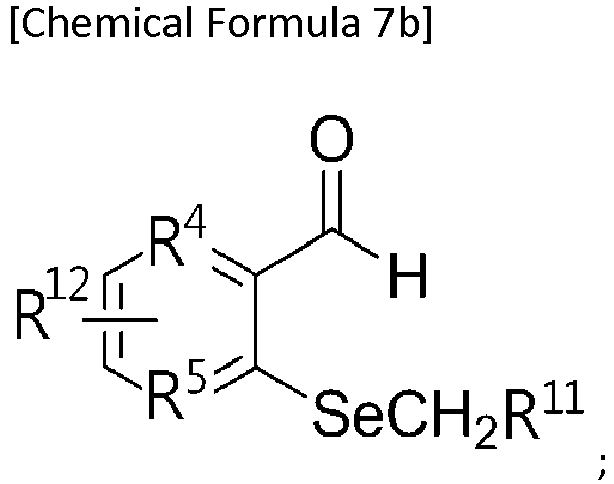

each of R4 and R5 independently represents a substitutable N, O, S, C, or bond,
R11 represents -CO2H, -CO2R, 4-NO2-Ph, 4-CN-Ph, 4-RO2C-Ph, or 4-X-Ph,
R12 represents H, -NO2, -NHCOR, CX3, -OR, -diOR, a substitutable alkoxy group, a substitutable alkylene-dioxy group, a substitutable amino group, or a halo group,
X represents a halo group,
R13 represents a substitutable alkyl group, and
R represents H, a substitutable alkyl group, a substitutable aryl group, a substitutable amino group, a substitutable amino acid group, a substitutable peptide group, a substitutable C1-7 alkoxy group, or a residue of a substitutable carbohydrate or carbohydrate derivative. - Herein, if the R4 is a "bond", two carbon atoms positioned on both sides of the R4 are connected with each other through a direct carbon bond, and if the R5 is a "bond", two carbon atoms positioned on both sides of the R5 are connected with each other through a direct carbon bond.
- Noticeable differences between the producing method in accordance of the third aspect and the producing method in accordance with the second aspect are that the reaction intermediate is formed in the producing method in accordance of the third aspect and a reducing agent is not needed in the producing method in accordance of the third aspect.
- Chemical Formula 7a may include, but may not be limited to, the following Chemical Formula 8a, Chemical Formula 7b may include, but may not be limited to, the following Chemical Formula 8b, and Chemical Formula 7 may include, but may not be limited to, the following Chemical Formula 8:


each of R11, R12 and R13 is the same as defined above in Chemical Formula 7a, Chemical Formula 7b,
and Chemical Formula 7. - Chemical Formula 7a may include, but may not be limited to, the following Chemical Formula 9a, Chemical Formula 7b may include, but may not be limited to, the following Chemical Formula 9b, and Chemical Formula 7 may include, but may not be limited to, the following Chemical Formula 9:


each of R4, R5, R11, R12 and R13 is the same as defined above in Chemical Formula 7a, Chemical Formula 7b and Chemical Formula 7. - The base may be added subsequently after the solvent is added to the reaction intermediate, but may not be limited thereto. As such, since the base is added after the solvent is added to the reaction intermediate, side reactions in which a thiol group is substituted with the starting material can be reduced.
- The solvent may be selected from the group consisting of dimethylformaldehyde (DMF), dimethylsulfoxide (DMSO), tetrahydrofuran (THF), CH2Cl2, CH3CN, CH3NO2, CHCl3, ClCH2CH2Cl, alcohols, an aromatic solvent, and combinations thereof, but may not be limited thereto. By way of example, the alcohols may include, but may not be limited to, methanol, ethanol, propanol, or butanol, and the aromatic solvent may include, but may not be limited to, benzene, toluene, or derivatives thereof. The solvent can be selectively used without particular limitation as long as it can easily dissolve the reaction intermediate and the base.
- The base may be selected from the group consisting of K2CO3, KHCO3, Na2CO3, NaHCO3, NaOEt, NH4OH, DBU (1,8-diazabicyclo[5,4,0]undec-7-ene), KOH, NaOH, Ca(OH)2, Ba(OH)2, KOtBu, and combinations thereof, but may not be limited thereto. By way of example, the base may be a strong base selected from the group consisting of DBU(1,8-diazabicyclo[5,4,0]undec-7-ene), KOH, NaOH, Ca(OH)2, Ba(OH)2, KOtBu, and combinations thereof, but may not be limited thereto. By way of example, the base may be a weak base selected from the group consisting of K2CO3, KHCO3, Na2CO3, NaHCO3, NaOEt, NH4OH, and combinations thereof, but may not be limited thereto. The selection of a base may affect a yield of the selenophene-fused aromatic compound. By way of example, if a material containing an electron donating substituent is used as the aromatic starting material, when a weak base such as NaOEt is used, it is difficult to obtain a desired product, whereas when a strong base such as DBU is used, it is possible to manufacture a desired product at a high yield, but the example embodiment may not be limited thereto.
- The heating reaction to form the reaction intermediate may be performed at a temperature of, but not limited to, from about 100°C to about 150°C. The heating reaction to form the reaction intermediate is performed at a temperature of, but not limited to, from about 100°C to about 150°C in order to form the reaction intermediate through an active reaction, the example embodiment may not be limited thereto.
- A fourth aspect, of the example embodiments, provides a producing method of a selenophene-fused aromatic compound represented by the following
Chemical Formula 10, the method including: reacting a MCBI (7-methoxy-1,2,9,9a-tetrahydrocyclopropa[c]benz[e]indol-4-one) compound represented by the following Chemical Formula 10a and a selenium-containing aromatic compound represented by the following Chemical Formula 10b:


- R2 represents a substitutable alkyl group, a substitutable alkoxy group, a halo group, -NO2, - NHCOR, or a substituent represented by the following Chemical Formula B,
- each of R4 and R5 independently represents a substitutable C, O, N, S, or bond,
- R6 represents H, or a substitutable alkoxy group,
- R7 represents H, -CONR17R20, or

- each of R17 and R20 independently represents H, or a substitutable alkyl group,
- R21 represents C, O, N, or S,
- R8 represents a halo group, and
- R represents H, a substitutable alkyl group, a substitutable aryl group, a substitutable amino group, a substitutable amino acid group, a substitutable peptide group, a substitutable Alkoxy group, or a residue of a substitutable carbohydrate or carbohydrate derivative:

- R9 represents O, NH, S, or Se,
- R10 represents a substitutable alkyl group, a substitutable alkoxy group, a halo group, -NO2, or-NHCOR, and
- R represents H, a substitutable alkyl group, a substitutable aryl group, a substitutable amino group, a substitutable amino acid group, a substitutable peptide group, a substitutable Alkoxy group, or a residue of a substitutable carbohydrate or carbohydrate derivative.
- By way of example, the selenophene-fused aromatic compound represented by
Chemical Formula 10 above of the example embodiments may be easily produced by making a condensation polymerization reaction between NH of the MCBI represented by Chemical Formula 10a above and a carboxy group of the selenium-containing aromatic compound represented by Chemical Formula 10b in the presence of EDCI and a solvent, but may not be limited thereto. Since the selenophene-fused aromatic compound is easily and economically produced in accordance with the example embodiments, it is possible to promote commercialization of the selenophene-fused aromatic compound. - In accordance with an example embodiment, the MCBI compound represented by Chemical Formula 10a above may be produced from a MCBI compound represented by the following Chemical Formula 10c in an acidic condition, but may not be limited thereto:

each of R6, R7 and R8 is the same as defined above in Chemical Formula 10a. - The MCBI compound represented by Chemical Formula 10c above is included in a "Boc-MCBI compound", and the MCBI compound represented by Chemical Formula 10a above is included in a "seco-MCBI compound". By way of example, the seco-MCBI compound may be produced by a typical method using the Boc-MCBI compound as a starting material, but may not be limited thereto. By way of example, the seco-MCBI compound may be easily produced by treating and reacting the the Boc-MCBI compound with HCl and EtOAc, but may not be limited thereto.
- In accordance with an example embodiment, the MCBI compound represented by Chemical Formula 10a above may be produced from the MCBI compound represented by Chemical Formula 10c above in an acidic condition, but may not be limited thereto. By way of example, the acidic condition may be formed through a treatment with an organic acid such as HCl or the like, but may not be limited thereto.
- In accordance with an example embodiment, the selenium-containing aromatic compound represented by Chemical Formula 10b above may be produced from a selenium-containing aromatic compound represented by the following Chemical Formula 10d in a basic condition, but may not be limited thereto:

- R2, R4 and R5 are the same as defined above in Chemical Formula 10b, and
- R18 represents a substitutable alkyl group, a substitutable alkoxy group, -NO2, or -NHCO2H.
- R18 may be an alkyl group, an alkoxy group, -NO2, or -NHCO2H, but may not be limited thereto. By way of example, the selenium-containing aromatic compound represented by Chemical Formula 10b above may be easily produced by hydrolyzing -CO2R18 of the selenium-containing aromatic compound represented by Chemical Formula 10d above, but may not be limited thereto. By way of example, in order to perform the hydrolysis, LiOH and THF-H2O-MeOH may be treated and reacted, but the example embodiment may not be limited thereto.
- In accordance with an example embodiment, the selenium-containing aromatic compound represented by Chemical Formula 10b above may be produced from the selenium-containing aromatic compound represented by Chemical Formula 10d above in a basic condition, but may not be limited thereto. By way of example, the basic condition may be formed through a treatment with a basic material such as LiOH or the like, but may not be limited thereto.
- In accordance with an example embodiment, the reaction between the MCBI compound represented by Chemical Formula 10a above and the selenium-containing aromatic compound represented by Chemical Formula 10b above may be performed in the presence of EDCI, but may not be limited thereto.
- In accordance with an example embodiment, the reaction between the MCBI compound represented by Chemical Formula 10a above and the selenium-containing aromatic compound represented by Chemical Formula 10b above may be performed after the MCBI compound is dissolved in a solvent, but may not be limited thereto.
- In accordance with an example embodiment, the solvent may be selected from the group consisting of dimethylformaldehyde (DMF), dimethylsulfoxide (DMSO), tetrahydrofuran (THF), CH2Cl2, CH3CN, CH3NO2, CHCl3, ClCH2CH2Cl, alcohols, an aromatic solvent, and combinations thereof, but may not be limited thereto. By way of example, the alcohols may include, but may not be limited to, methanol, ethanol, propanol, or butanol, and the aromatic solvent may include, but may not be limited to, benzene, toluene, or derivatives thereof. The solvent can be selectively used without particular limitation as long as it can easily dissolve the MCBI compound.
- A fifth aspect, of the example embodiments, provides a producing method of a selenophene-fused aromatic compound represented by the following Chemical Formula 11, the method including: reacting a MCBI compound represented by the following Chemical Formula 11a and a selenium-containing aromatic compound represented by the following Chemical Formula 11b:


- In the formulas,
- R2 represents a substitutable alkyl group, a substitutable alkoxy group, a halo group, -NO2, - NHCOR, or a substituent represented by the following Chemical Formula B,
- each of R4 and R5 independently represents a substitutable C, O, N, S, or bond,
- R6 represents H, or a substitutable alkoxy group, and
- R represents H, a substitutable alkyl group, a substitutable aryl group, a substitutable amino group, a substitutable amino acid group, a substitutable peptide group, a substitutable C1-7 alkoxy group, or a residue of a substitutable carbohydrate or carbohydrate derivative:


- In the formula,
R9 represents O, NH, S, or Se,
R10 represents a substitutable alkyl group, a substitutable alkoxy group, a halo group, -NO2, or -NHCOR, and
R represents H, a substitutable alkyl group, a substitutable aryl group, a substitutable amino group, a substitutable amino acid group, a substitutable peptide group, a substitutable C1-7 alkoxy group, or a residue of a substitutable carbohydrate or carbohydrate derivative. - By way of example, the selenophene-fused aromatic compound represented by Chemical Formula 11 above of the fifth aspect of the example embodiments may be easily produced by making a condensation polymerization reaction between NH of the MCBI represented by Chemical Formula 11a above and a carboxy group of the selenium-containing aromatic compound represented by Chemical Formula 11b in the presence of EDCI and a solvent, but may not be limited thereto. Since the selenophene-fused aromatic compound is easily and economically produced in accordance with the example embodiments, it is possible to promote commercialization of the selenophene-fused aromatic compound.
- In accordance with an example embodiment, the MCBI compound represented by Chemical Formula 11a above may be produced from a MCBI compound represented by the following Chemical Formula 11c in an acidic condition, but may not be limited thereto:


- In the formula,
R6 is the same as defined above in Chemical Formula 11a. - The MCBI compound represented by Chemical Formula 11c above is included in the "Boc-MCBI compound", and the MCBI compound represented by Chemical Formula 11a above is included in the "seco-MCBI compound". By way of example, the seco-MCBI compound may be produced by a typical method using the Boc-MCBI compound as a starting material, but may not be limited thereto. By way of example, the seco-MCBI compound may be easily produced by treating and reacting the Boc-MCBI compound with HCl and EtOAc, but may not be limited thereto.
- In accordance with an example embodiment, the MCBI compound represented by Chemical Formula 11a above may be produced from the MCBI compound represented by Chemical Formula 11c above in an acidic condition, but may not be limited thereto. By way of example, the acidic condition may be formed through a treatment with an organic acid such as HCl or the like, but may not be limited thereto.
- In accordance with an example embodiment, the selenium-containing aromatic compound represented by Chemical Formula 11b above may be produced from a selenium-containing aromatic compound represented by the following Chemical Formula 11d in a basic condition, but may not be limited thereto:


- each of R2, R4 and R5 is the same as defined above in Chemical Formula 11b, and
- R18 represents a substitutable alkyl group, a substitutable alkoxy group, -NO2, or -NHCO2H.
- R18 may be an alkyl group, an alkoxy group, -NO2, or -NHCO2H, but may not be limited thereto. By way of example, the selenium-containing aromatic compound represented by Chemical Formula 11b above may be easily produced by hydrolyzing -CO2R18 of the selenium-containing aromatic compound represented by Chemical Formula 11d above, but may not be limited thereto. By way of example, in order to perform the hydrolysis, LiOH and THF-H2O-MeOH may be treated and reacted, but the example embodiment may not be limited thereto.
- In accordance with an example embodiment, the selenium-containing aromatic compound represented by Chemical Formula 11b above may be produced from the selenium-containing aromatic compound represented by Chemical Formula 11d above in a basic condition, but may not be limited thereto. By way of example, the basic condition may be formed through a treatment with a basic material such as LiOH or the like, but may not be limited thereto.
- In accordance with an example embodiment, the reaction between the MCBI compound represented by Chemical Formula 11a above and the selenium-containing aromatic compound represented by Chemical Formula 11b above may be performed in the presence of EDCI, but may not be limited thereto.
- In accordance with an example embodiment, the reaction between the MCBI compound represented by Chemical Formula 11a above and the selenium-containing aromatic compound represented by Chemical Formula 11b above may be performed after the MCBI compound is dissolved in a solvent, but may not be limited thereto.
- In accordance with an example embodiment, the solvent may include a member selected from the group consisting of dimethylformaldehyde (DMF), dimethylsulfoxide (DMSO), tetrahydrofuran (THF), CH2Cl2, CH3CN, CH3NO2, CHCl3, ClCH2CH2Cl, alcohols, an aromatic solvent, and combinations thereof, but may not be limited thereto. By way of example, the alcohols may include, but may not be limited to, methanol, ethanol, propanol, or butanol, and the aromatic solvent may include, but may not be limited to, benzene, toluene, or derivatives thereof. The solvent can be selectively used without particular limitation as long as it can easily dissolve the MCBI compound.
- A sixth aspect, of the example embodiments, provides an anti-bacterial composition including a selenophene-fused aromatic compound in accordance with the first aspect of the example embodiments. If the selenophene-fused aromatic compound has an anti-bacterial property, it can be used as an intermediate of a drug or a finished product.
- A seventh aspect, of the example embodiments, provides an indicator composition including a selenophene-fused aromatic compound in accordance with the first aspect of the example embodiments, and the indicator may be used as an indicator of which color is changed depending on a solvent. A property of a substance to change color depending on a solvent is referred to as "solvatochromic", and a substance having the solvatochromic property can be used as an indicator, a solvatochromic ink, or the like. The selenophene-fused aromatic compound having the solvatochromic property may include, for example, the following compound. The following compound which has the solvatochromic property and thus can be used as an indicator corresponds to Entry 17 of [Table 1] shown in Example:

- In this regard,
FIG. 4 is an absorption spectrum showing a solvatochromic property of a selenophene-fused aromatic compound produced according to Entry 17 of Example, and a concentration of the compound at the time of measuring the spectrum was about 60.4 µM. - An eighth aspect, of the example embodiments, provides a fluorescent composition including a selenophene-fused aromatic compound in accordance with the first aspect of the example embodiments. The selenophene-fused aromatic compound having a fluorescent property can be used as an intermediate for synthesizing organic semiconductors. The selenophene-fused aromatic compound having the fluorescent property may include, for example, the following compounds. The following compounds which have the fluorescent property and thus can be used as an intermediate for synthesizing organic semiconductors correspond to Entry 26, Entry 27, and
Entry 30 of [Table 2] shown in Example:


- In this regard,
FIG. 1 to FIG. 3 are spectra showing a fluorescent property of respective selenophene-fused aromatic compounds produced according to Entry 26, Entry 27, andEntry 30 of Example. - A ninth aspect, of the example embodiments, provides an anticancer composition including a selenophene-fused aromatic compound in accordance with the first aspect of the example embodiments. If the selenophene-fused aromatic compound has an anticancer property, it can be used as an intermediate of a drug or a finished product. The selenophene-fused aromatic compound can exhibit an anticancer effect though DNA alkylation. It is confirmed that as a result of cytotoxicity tests carried out to various cancer cells, the selenophene-fused aromatic compound has an IC50 value in nM or pM exhibits a potent anticancer effect. Further, the selenophene-fused aromatic compound can be applied to various cancers such as breast cancer, central nervous system cancer, colorectal cancer, non-small cell lung cancer, renal cancer, prostate cancer, ovarian cancer, etc., and, thus, the selenophene-fused aromatic compound in accordance with the example embodiments is expected to be usefully used as an anticancer drug for various cancers.
- Hereinafter, the example embodiments of the present disclosure will be described in more detail with reference to Example, but the present disclosure may not be limited thereto.
- All reagents used in the present Example are commercially available and used as being unprocessed unless specific description is provided to contrary.
- In the present Example, a selenophene-fused aromatic compound in accordance with the second aspect was produced as follows.
- In order to prepare a reaction mixture, a diselenide compound represented by a general formula R11-CH2-Se-Se-CH2-R11, a solvent, and a reducing agent were prepared. As the diselenide compound represented by the general formula R11-CH2-Se-Se-CH2-R11 of the reaction mixture, various substances such as (SeCH2COOEt)2, (p-NO2PhCH2Se)2, (p-CNPhCH2Se)2, and the like were used. The diselenide compounds were as shown in [Table 1]. About 0.6 eq. of the diselenide compound was used. As the solvent, anhydrous dimethylformaldehyde (DMF) was used. Further, as the reducing agent, about 0.6 eq. of dithiothreitol (DTT) was used.
- To be specific, the reaction mixture was prepared by adding the diselenide compound represented by the general formula R11-CH2-Se-Se-CH2-R11 and the reducing agent to 2 mL of the solvent. The reaction mixture was stirred for 1 hour at a constant temperature of 60°C.
- After the reaction mixture was prepared, an aromatic compound as a starting material for producing the selenophene-fused aromatic compound was added to the reaction mixture at a time. Then, the reaction mixture was stirred for 30 minutes at a constant temperature of 60°C.
- As the base to be added after the starting material is added to the reaction mixture with stirring, a weak base K2CO3 was used. 2.5 eq. of the base was added to the reaction mixture at room temperature with stirring for 24 hours at a constant temperature of 60°C.
- After the base was added and the stirring was finished, it was observed that the starting material was completely consumed by using a thin layer chromatography in a mixture of ethyl acetate:hexane (EA:Hex). The solvent contained in the reaction mixture was removed in a vacuum, and a crude solid was extracted 3 times by using about 25 mL of a solvent including dichloromethane:water (1:1). An organic phase collected through the extraction process was dried in an anhydrous environment by using MgSO4, and the solvent was evaporated in a vacuum. The residue was refined by column chromatography using a silica gel column. A pure product, i.e. the selenophene-fused aromatic compound produced in the present Example, was eluted by using ethyl acetate and hexane, and recrystallized by using methanol and then filtered.
- In the present Example, a producing process of selenophene-fused aromatic compounds corresponding to
Entry 1 to Entry 17 is shown in the following schemes. Herein, the term "Entry" refers to subdivision of the present Example according to the aromatic starting material and the diselenide compound used herein. The aromatic starting materials and the diselenide compounds used herein were as shown in [Table 1].


- In the present Example, a selenophene-fused aromatic compound in accordance with the third aspect was produced as follows.
- In order to form a reaction intermediate, an aromatic starting material and R11CH2X were prepared. 1 eq. of the aromatic starting material was used, and 20 eq. of the R11CH2X was used. The aromatic starting materials and the diselenide compounds used herein were as shown in [Table 2].
- In order to form the reaction intermediate, a mixture of the aromatic starting material and the R11CH2X was put in a heating box and heated at 130°C for 17 hours. Then, the solution was cooled and the solvent was removed in a vacuum condition, so that the reaction intermediate in a sold form was obtained.
- Thereafter, the reaction intermediate was dissolved in anhydrous dimethylformaldehyde (DMF) as a solvent, and 2.5 eq. of a weak base K2CO3 was added thereto, and stirred at room temperature for 24 hours.
- After the base was added and the stirring was finished, it was observed that the starting material was completely consumed by using a thin layer chromatography in a mixture of ethyl acetate : hexane (EA : Hex). The solvent contained in the reaction mixture was removed in a vacuum, and a crude solid was extracted 3 times by using 25 mL of a solvent including dichloromethane : water (1 : 1). An organic phase collected through the extraction process was dried in an anhydrous environment by using MgSO4, and the solvent was evaporated in a vacuum. The residue was refined by a column chromatography using a silica gel column. A pure product, i.e. the selenophene-fused aromatic compound produced in the present Example, was eluted by using ethyl acetate and hexane, and recrystallized by using methanol and then filtered.
- In the present Example, a producing process of selenophene-fused aromatic compounds corresponding to Entry 21 to Entry 37 is shown in the following scheme. Herein, the term "Entry" refers to subdivision of the present Example according to an aromatic starting material and R11CH2X used herein. The aromatic starting materials and the R11CH2X used herein were as shown in [Table 2].


- In the present Example, a producing process of selenophene-fused aromatic compounds corresponding to Entry 38 to Entry 41 was as shown in the following scheme.

- The selenophene-fused aromatic compounds corresponding to Entry 38 to Entry 41 were produced by performing an additional reaction to compounds containing a nitro group among the selenophene-fused aromatic compounds corresponding to
Entry 1 to Entry 37, and a producing method was performed as follows. - In order to produce the selenophene-fused aromatic compound corresponding to Entry 38, 1.3 g of the compound corresponding to
Entry 1 as a starting material was put into a 250 mL R.B. flask, and 100 mL of anhydrous ethyl acetate was added thereto, and then, the flask was filled with a nitrogen gas. 350 mg of 10% Pd/C was added to the compound, and a hydrogen gas was added with stirring for 24 hours. A catalyst was removed from the reaction compound through a silica pad, and the reaction compound was washed with ethyl acetate. Then, the obtained solution was concentrated under a depressurized condition. As a result, 1.11 g of a pure amino derivative was obtained. In this case, a yield was 98%. - Then, in order to produce the selenophene-fused aromatic compound corresponding to Entry 39, 0.691 g of the selenophene-fused aromatic compound corresponding to Entry 38 was dissolved in 10 mL of pyridine, and 0.48 mL of acetic anhydride was added thereto with stirring at room temperature. The reaction was checked by using a thin layer chromatography. The solvent was depressurized and removed, and the residue passed through a silica gel column, so that 765 mg of an amide derivative was obtained. This substance was hydrolyzed by using 20 mL of a mixed solution including a 2N-NaOH aqueous solution and MeOH at a ratio of 1:1. After the reaction was finished, the reaction solution was depressurized to remove MeOH and adjusted to be acidic by using a 2N HCl solution and then, the reaction product was extracted by using dichloromethane. Then, an organic solvent layer was concentrated, and by silica gel chromatography using EA/Hex (1:1), the compound corresponding to Entry 39 was obtained at a yield of 89%.
- In order to produce the compound corresponding to
Entry 40, a reaction was performed in a similar manner to the method for synthesizing the compound corresponding to Entry 39 from the compound corresponding to Entry 38. That is, 200 mg of an amine derivative was dissolved in 10 mL of pyridine, and 0.184 mL (1.5 eq.) of butyric anhydride was added thereto and reacted at room temperature, and then, the reaction product was refined. Thus, 227 mg of a butylamide derivative was obtained at a yield of 89%. 166 mg thereof was hydrolyzed by the same method as the synthesis of the compound corresponding to Entry 39. As a result, 150 mg of the compound corresponding toEntry 40 was obtained. - In order to produce the compound corresponding to
Entry 41, 300 mg of an amine derivative was dissolved in 10 mL of pyridine, and 0.424 mL (3.0 eq.) of hexaenoic acid and 347 mg (1.5 eq.) of DCC were added thereto and reacted at room temperature for 4 hours, and then, extracted and refined in a similar manner to the synthesis of the compound corresponding to Entry 39. Thus, 264 mg of a hexyl amide derivative was obtained at a yield of 64%. This compound was hydrolyzed and refined by the same method as the synthesis of the compound corresponding to Entry 39. As a result, 232 mg of the compound corresponding to Entry 41 was obtained at a yield of 95%. - In the present Example, a producing process of selenophene-fused aromatic compounds corresponding to Entry 42 and Entry 43 was as shown in the following scheme.

- The selenophene-fused aromatic compounds corresponding to Entry 42 and Entry 43 were produced by performing an additional reaction to the selenophene-fused aromatic compounds corresponding to
Entry 1 to Entry 37, and a producing method was performed as follows. - In order to synthesize the selenophene-fused aromatic compound corresponding to Entry 42, 50 mg of the compound corresponding to Entry 38 as an amine derivative was dissolved in 10 mL of anhydrous methylene chloride and nitrogen gas was added and then, cooled to 0°C. A solution in which 55 mg (3 eq.) of butyl isocyanate was dissolved in 60 mL of anhydrous methylene chloride was added to the reaction solution for 20 minutes with stirring at room temperature for 12 hours. The solvent was depressurized and removed, and a yellow solid was obtained and washed with a solution including pentane and ether (7:1), so that 55 mg of a yellow solid was obtained at a yield of 87%. This intermediate was dissolved in 1.5 mL of THF-MeOH-H2O (4:1:1), and LiOH (3 eq.) was added thereto with stirring at room temperature for 18 hours. 6 mL of water was added thereto, and the reaction solution was acidified with a 10% HCl solution, and then, the reaction product was extracted by using methylene chloride. Then, an organic solvent layer was concentrated and separated by a silica gel chromatography using MeOH-CH2Cl2 (1:20), and 49 mg of the compound corresponding to Entry 42 was obtained at a yield of 91%.
- In order to synthesize the selenophene-fused aromatic compound corresponding to Entry 43, 145 mg of urea as a brown solid intermediate was obtained by using 100 mg of the compound corresponding to Entry 38 and 4-fluorophenyl isocyanate (153 mg, 3 eq.) in a similar manner to the synthesis of the compound corresponding to Entry 42, and a reaction similar to the above-described hydrolysis was performed. Then, through a separation and refinement process, 105 mg of the compound corresponding to Entry 43 was obtained in a brown solid form at a yield of 79%.
- In the present Example, a producing process of selenophene-fused aromatic compounds corresponding to Entry 44 to Entry 46 was as shown in the following scheme.


- In order to synthesize the selenophene-fused aromatic compound corresponding to
Entry 44, 300 mg (3 eq.) of N,N-dimethylglycine was dissolved in 20 mL of anhydrous methylene chloride and DCC (206 mg, 4 eq.), DMAP (119 mg, 1 eq.), and pyridine (0.47 mL, 6 eq.) were added with stirring for 15 minutes. The compound (260 mg, 1 eq.) corresponding to Entry 38 as an amine derivative was added with stirring for 24 hours, and 50 mL of water was added, and then, the reaction product was extracted by using 200 mL of methylene chloride. Then, an organic solvent layer was concentrated and separated by a silica gel chromatography using EA-hex (1:1), and 420 mg of an intermediate was obtained at a yield of 80%. 400 mg of this intermediate was dissolved in 20 mL of MeOH-H2O (9:1) and NaOH (5 eq.) was added thereto with stirring at room temperature for 24 hours. The reaction solution was acidified with 2 mL of a 20% HCl solution and concentrated by using a lyophilizer and then separated by silica gel chromatography using MeOH-CH2Cl2 (1:4). As a result, 220 mg of the compound corresponding to Entry 44 was obtained at a yield of 60%. - In order to synthesize the selenophene-fused aromatic compound corresponding to Entry 45, 18 mL of methanol and 2 mL of water were added to Fmoc-Lys(Boc)-OH (436 mg) and amino benzoselenophene (300 mg, 1.2 eq.) with stirring for 15 minutes. Then, DMT-MM (385 mg, 1.5 eq.) was added thereto and reacted for 8 hours. 50 mL of water was added , and then, the reaction product was extracted by using 200 mL of methylene chloride. Then, an organic solvent layer was concentrated and separated by silica gel chromatography using EA-hex (1:1), and 586 mg of an intermediate was obtained at a yield of 88%. This intermediate was dissolved in 10 mL of a 20% TFA-methylene chloride (1:4) solution and reacted at 0°C for 2 hours. The solvent was depressurized and concentrated and then dissolved in 50 mL of a DEA-methylene chloride (1:1) solution with stirring for about 2 hours. After the solvent was depressurized and concentrated, the solvent was dissolved in 10 mL of pyridine, and 0.24 mL (3 eq.) of anhydrous acetic acid was added thereto with stirring at room temperature for 3 hours. This reaction solution was depressurized and concentrated, and dissolved in 20 mL of MeOH-H2O (9:1), and then, NaOH (5 eq.) was added thereto with stirring at room temperature for 24 hours. The reaction solution was acidified with 2 mL of a 20% HCl solution and concentrated by using a lyophilizer and then separated by silica gel chromatography using MeOH-CH2Cl2 (1:4). As a result, 20 mg of the compound corresponding to Entry 45 was obtained.
- In order to synthesize the selenophene-fused aromatic compound corresponding to Entry 46, 18 mL of methanol and 2 mL of water were added to Fmoc-Arg(Pmc)-OH (824 mg) and amino benzoselenophene (400 mg, 1.2 eq.) with stirring for 15 minutes. Then, DMT-MM (520 mg, 1.5 eq.) was added thereto and reacted for 8 hours. 50 mL of water was added, and then, the reaction product was extracted by using 200 mL of methylene chloride. Then, an organic solvent layer was concentrated and separated by silica gel chromatography using EA-hex (1:2), and 870 mg of an intermediate was obtained at a yield of 73%. 611 mg of this intermediate was dissolved in 10 mL of a DEA-methylene chloride (1:1) solution and reacted for 2 hours. The solvent was depressurized and concentrated and then dissolved in 10 mL of pyridine and 0.095 mL (1.5 eq.) of anhydrous acetic acid was added thereto with stirring at room temperature for 4 hours. This reaction solution was depressurized and concentrated, and dissolved in 10 mL of a 98% TFA-methylene chloride solution and reacted at 0°C for 2 hours. The solvent was depressurized and concentrated and then dissolved in 20 mL of MeOH-H2O (9:1), and then, NaOH (5 eq.) was added thereto with stirring at room temperature for 24 hours. The reaction solution was acidified with 2 mL of a 20% HCl solution and concentrated by using a lyophilizer and then separated by a silica gel chromatography using MeOH-CH2Cl2(1:1). As a result, 275 mg of the compound corresponding to Entry 46 was obtained.
- In the present Example, a producing process of selenophene-fused aromatic compounds corresponding to Entry 47 to Entry 49 was as shown in the following scheme.
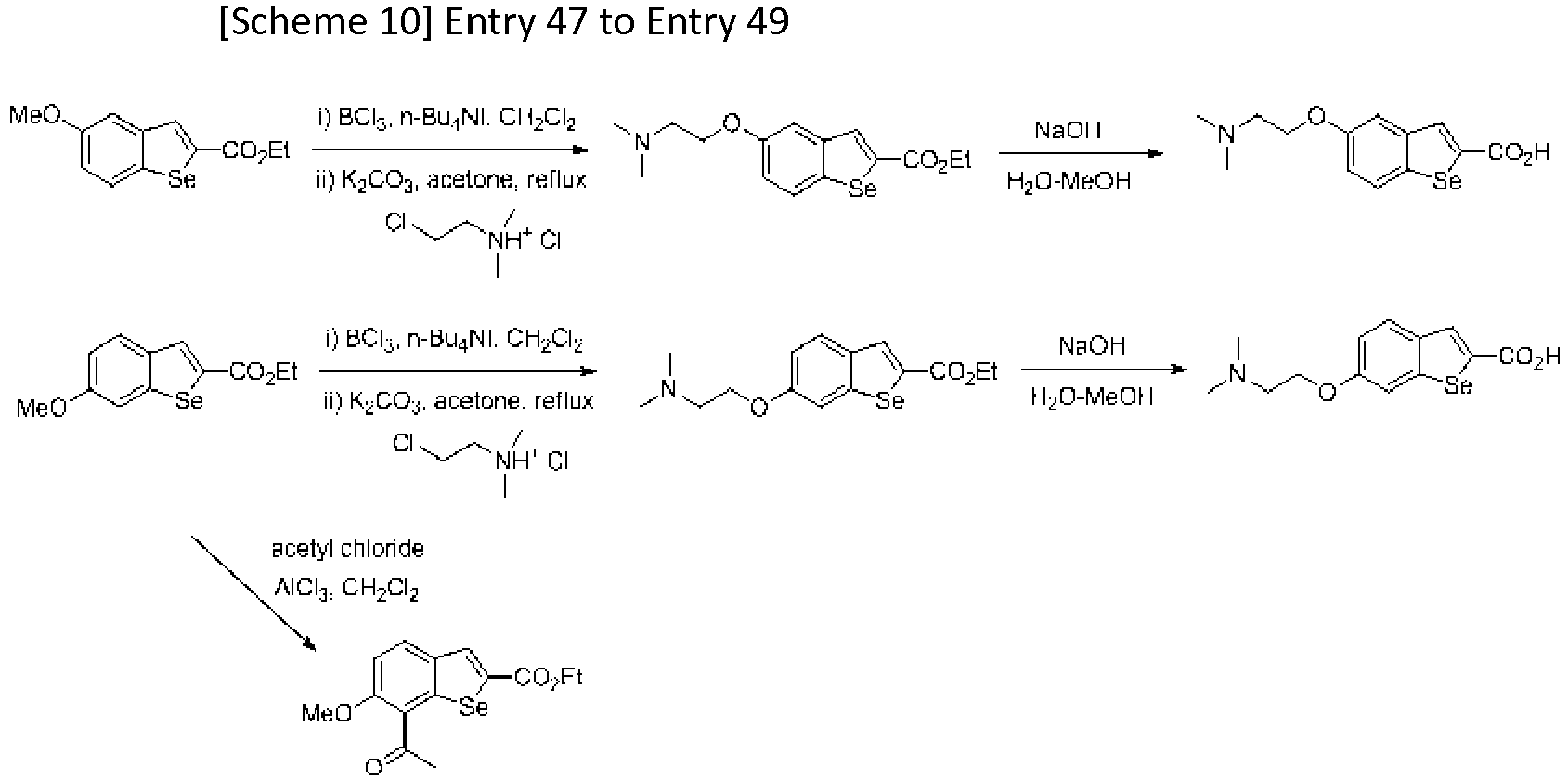
- In order to synthesize the selenophene-fused aromatic compound corresponding to Entry 47, 770 mg of a 5-methoxy benzoselenophene derivative and 2.65 g (2.5 eq.) of tetrabutyl ammonium iodide were dissolved in 10 mL of anhydrous methylene chloride, and nitrogen was added thereto with stirring at -78°C for 2 minutes. 7.7 mL of BCl3 (1 M methylene chloride solution, 2.5 eq.) was added to this solution and then, reacted at 0°C for 2 hours. 20 mL of ice water was added to this solution and then extracted 3 times by using 200 mL of methylene chloride. Then, an organic solvent layer was depressurized and concentrated and then dissolved in 50 mL of acetone. 988 mg (3 eq.) of N,N-dimethylethylamine and 2.13 g (5 eq.) of potassium carbonate were added to this solution with stirring at 65°C for 7 hours. This solution was depressurized and concentrated and then extracted 3 times by using 200 mL of methylene chloride. An organic layer was concentrated and separated by silica gel chromatography using EA-hex (1:1), and 472 mg of an intermediate was obtained at a yield of 43%. 160 mg of this intermediate was dissolved in 20 mL of MeOH-H2O (9:1), and NaOH (5 eq.) was added with stirring at room temperature for 24 hours. The reaction solution was acidified with 2 mL of a 20% HCl solution and concentrated by using a lyophilizer and then separated by a silica gel chromatography using MeOH-CH2Cl2 (1:4). As a result, 153 mg of the compound corresponding to Entry 47 was obtained at a yield of 93%.
- In order to synthesize the selenophene-fused aromatic compound corresponding to Entry 48, 167 mg of an intermediate was obtained at a yield of 77% by performing a reaction similar to the synthesis of the compound corresponding to Entry 47 by using 231 mg of a 6-methoxy benzoselenophene derivative and 864 mg (2.5 eq.) of tetrabutyl ammonium iodide. 160 mg of this intermediate was hydrolyzed in a similar manner to the synthesis of the compound corresponding to Entry 47 and refined. As a result, 148 mg of the compound corresponding to Entry 48 was obtained at a yield of 90%.
- In order to synthesize the selenophene-fused aromatic compound corresponding to Entry 49, 50 mg of a 6-methoxy benzoselenophene derivative was dissolved in 10 mL of anhydrous methylene chloride, and 94 mg (4 eq.) of aluminum chloride and 0.037 mL (3 eq.) of acetyl chloride were added thereto with stirring for 3 hours. Water was added to the reaction solution, and the reaction product was extracted 3 times by using 200 mL of methylene chloride. An organic layer was concentrated and separated by silica gel chromatography using EA-hex (1:4). As a result, 8.7 mg of the compound corresponding to Entry 49 was obtained.
- In the present Example, a producing process of selenophene-fused aromatic compounds corresponding to Entry 50 to Entry 58 was as shown in the following scheme.

- General producing method by hydrolysis of benzoselenophene ethylester derivative
- An ethylester derivative was dissolved in 20 mL of MeOH-H2O (9:1), and NaOH (5 eq.) was added thereto with stirring at room temperature for 24 hours. After the reaction was finished, MeOH was depressurized and concentrated and 20 mL of water was added. The reaction solution was adjusted to be acidic by adding 2 mL of a 20% HCl solution. A solid produced was filtered and separated by silica gel chromatography using MeOH-CH2Cl2 (1:4). As a result, the compounds corresponding to Entry 50 to Entry 58 were obtained at a yield in a range of from 49% to 98%.
- The following Table 1 shows aromatic starting materials and diselenide compounds used herein for producing a selenophene-fused aromatic compound in accordance with the method of the second aspect and yields (%) of the selenophene-fused aromatic compound depending thereon:
[Table 1] Selenophene-fused aromatic compound produced in accordance with the second aspect Entry (example) Aromatic starting material Diselenide compound Selenophene-fused aromatic compound Yield (%) 1 
(SeCH2COOEt)2 
94 2 (p-NO2PhCH2Se)2 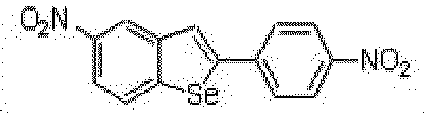
85 3 (p-CNPhCH2Se)2 
65 4 (p-EtO2CPhCH2Se)2 
31 5 
(SeCH2COOEt)2 
67 6 (p-NO2PhCH2Se)2 
50 7 (p-CNPhCH2Se)2 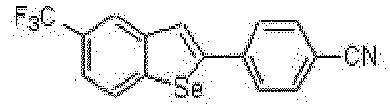
83 8 
(SeCH2COOEt)2 
68 9 (p-NO2PhCH2Se)2 
65 10 (p-CHPhCH2Se)2 
63 11 (p-EtO2CPhCH2Se)2 
62 12 
(SeCH2COOEt)2 
71 13 (p-NO2PhCH2Se)2 
68 14 
(SeCH2COOEt)2 
70 15 (p-NO2PhCH2Se)2 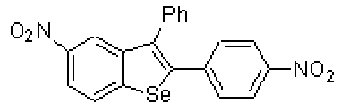
69 16 
(SeCH2COOEt)2 
62 17 (p-NO2PhCH2Se)2 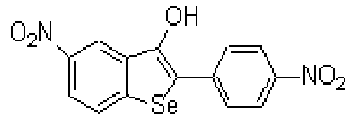
60 18 
(SeCH2COOEt)2 
80 19 
(SeCH2COOEt)2 
31 20 
(P-NO2PhCH2Se)2 
59 - The selenophene-fused aromatic compound corresponding to Entry 17 among the selenophene-fused aromatic compounds shown in Table 1 exhibited a solvatochromic property. When a concentration of the compound corresponding to Entry 17 is 60.4 µM, an absorption spectrum was as shown in
FIG. 4 . - Further, Table 2 below shows aromatic starting materials and R11CH2X used herein for producing a selenophene-fused aromatic compound in accordance with the third aspect and yields (%) of the selenophene-fused aromatic compound depending thereon. In Table 2,
Yield 1 represents a yield of a reaction intermediate, and Yield 2 represents a yield of a selenophene-fused aromatic compound as a reaction product:[Table 2] Selenophene-fused aromatic compound produced in accordance with the third aspect Entry (example) Aromatic starting material R1CH2X Yield 1 (%) Selenophene-fused aromatic compound Yield 2 (%) 21 
BrCH2COOEt 77 
68 22 
79 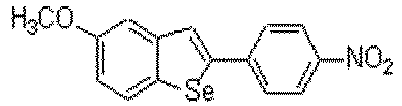
72 23 
BrCH2COOEt 63 
79 24 
BrCH2COOEt 95 
86 25 
72 
72 26 
60 
92 27 
94 
91 28 
BrCH2COOEt 86 
87 29 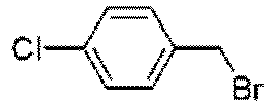
65 
50 30 
69 
54 31 
BrCH2COOEt 77 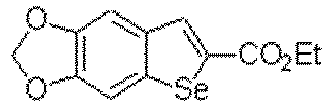
86 32 
64 
68 33 
94 
77 34 
BrCH2COOEt 88 
97 35 
84 
91 36 
BrCH2COOEt 90 
73 37 
BrCH2COOEt 98 
95 - The selenophene-fused aromatic compounds corresponding to Entry 26, Entry 27, and
Entry 30 among the selenophene-fused aromatic compounds shown in Table 2 exhibited a fluorescent property. Spectra showing a fluorescent property of the compounds were as shown inFIG. 1 to FIG. 3 , respectively. - Further, Table 3 below shows selenophene-fused aromatic compounds produced by performing an additional reaction to the selenophene-fused aromatic compounds corresponding to
Entry 1 to Entry 37 and produced in accordance with the second aspect or the third aspect:[Table 3] < Selenophene-fused aromatic compounds produced by performing an additional reaction to selenophene-fused aromatic compounds corresponding to Entry 1 to Entry 37>Entry (example) Selenophene-fused aromatic compound 38 
39 
40 
41 
42 
43 
44 
45 
46 
47 
48 
49 
50 
51 
52 
53 
54 
55 
56 
57 
58 
Entry 1 to Entry 58 shown in Table 1 to Table 3> - 1H NMR (500.1 MHz, CDCl3) ∂ 1.42 (t, 3H), 4.42 (q, 2H), 8.04 (d, 1H, J = 9), 8.21 (dd, 1H, J = 8.5, 2), 8.38 (s, 1H), 8.74 (d, 1H, J = 2); 13C NMR (125.7 MHz, CDCl3) ∂; LCMS (ESI); m/z calcd for C9H11NO4Se [M+]: 298.97; found: 300.2.
- 1H NMR (500.1 MHz, CDCl3) ∂ 8.02 (d, 2H, J = 9), 8.15 (dd, 1H, J = 8.5, 2), 8.33 (d, 2H, J = 9), 8.44 (d, 1H, J = 9), 8.50 (s, 1H), 8.79 (d, 1H, J = 2.5); 13C NMR (125.7 MHz, CDCl3) ∂; 119.05, 120.97, 124.54, 126.92, 127.31, 127.72, 140.89, 142.80, 145.79, 147.22, 148.03, 148.55.
- 1H NMR (500.1 MHz, CDCl3) ∂ 1.39 (t, 3H, J = 7.0), 3.87 (s, 3H), 4.36 (q, 2H, J = 2.5, 8.5), 6.99 (dd, 1H, J = 2.5, 9.0), 7.36 (d, 1H, J = 1.5), 7.74 (d, 1H, J = 8.5), 8.19 (s, 1H); 13C NMR (125.7 MHz, CDCl3) ∂ 12.60, 53.80, 59.68, 106.49, 113.37, 126.30, 131.53, 132.27, 133.30, 144.16, 157.47, 162.24.
- 1H NMR (500.1 MHz, CDCl3) ∂ 3.90 (s, 3H), 7.01 (dd, 1H, J = 2.0, 8.5), 7.40 (d, 1H, J = 2.0), 7.71-7.72 (m, 3H), 7.80 (s, 1H), 8.24-8.26 (m, 2H); 13C NMR (125.7 MHz, CDCl3) ∂ 54.54, 107.69, 114.44, 123.33, 124.99, 125.10, 126.08, 132.44, 141.53, 142.73, 144.59, 146.13, 157.23.
- 1H NMR (500.1 MHz, CDCl3) ∂ 1.42 (t, 3H), 4.41 (q, 2H), 7.58 (dd, 1H, J = 8, 1.5), 8.02 (t, 1H), 8.14 (s, 1H), 8.33 (s, 1H); 13C NMR (125.7 MHz, CDCl3) ∂ 13.28, 60.98, 121.77, 121.80, 123.24, 123.28, 125.50, 132.64, 138.05, 139.90, 146.32, 162.37; LCMS (ESI); m/z calcd for C12H9F3O2Se [M+]: 321.97; found: 323.2
- 1H NMR (500.1 MHz, CDCl3) ∂ 7.54 (d, 1H, J = 8.5), 7.77 (d, 2H, J = 8.5), 7.91 (s, 1H), 8.01 (d, 1H, J = 8.0), 8.09 (s, 1H), 8.29 (d, 2H, J = 7.5); 13C NMR (125.7 MHz, CDCl3) ∂ 119.67, 119.70, 119.73, 119.76, 120.93, 120.96, 120.14, 121.03, 121. 35, 122.54, 123.51, 123.72, 124.14, 125.53, 126.06, 126.31, 139.78, 140.53, 143.26, 144.93, 145.67.
- 1H NMR (500.1 MHz, CDCl3) ∂ 7.51 (d, 1H, J = 8.0), 7.69 (s, 4H), 7.83 (s, 1H), 7.97 (d, 1H, J = 8.0), 8.05 (s, 1H); 13C NMR (125.7 MHz, CDCl3) ∂ 112.06, 118.49, 121.18, 121.44, 121.47, 121.49, 121.53, 122.72, 122.76, 122.79, 122.82, 123.34, 125.05, 125.50, 126.04, 127.33, 127.60, 127.67, 127.86, 128.12, 128.38, 132.85, 139.79, 142.49, 144.97, 147.42.
- 1H NMR (500.1 MHz, CDCl3) ∂ 1.41 (t, 3H), 4.40 (q, 2H), 7.28 (t, 1H), 7.38 (d, 1H, J = 8), 7.76 (d, 1H, J = 8), 8.47 (s, 1H); 13C NMR (125.7 MHz, CDCl3) ∂ 14.44, 62.01, 124.42, 125.29, 127.56, 132.10, 132.35, 137.76, 139.61, 145.08, 163.66.
- 1H NMR (500.1 MHz, CDCl3) ∂ 7.40 (d, 1H, J = 8), 7.79 (t, 3H), 8.09 (s, 1H), 8.29 (d, 2H, J = 8.5); 13C NMR (125.7 MHz, CDCl3) ∂ 123.97, 124.15, 124.45, 125.43, 126.23, 127.44, 130.98, 140.87, 142.01, 142.68, 145.51, 147.47.
- 1H NMR (500.1 MHz, CDCl3) ∂ 7.23 (t, 1H, J = 8.0), 7.38 (d, 1H, J = 7.5), 7.67 (d, 2H, J = 8.0), 7.71 (d, 2H, J = 8.5), 7.75 (d, 1H, J = 8.0), 8.01 (s, 1H); 13C NMR (125.7 MHz, CDCl3) ∂ 111.87, 118.61, 123.52, 123.99, 125.40, 126.13, 127.34, 130.83, 132.81, 140.08, 140.87, 142.49, 146.12.
- 1H NMR (500.1 MHz, CDCl3) ∂ 1.42 (t, 3H, J = 7.0), 4.41 (q, 2H, J = 7.0), 7.20 (t, 1H, J = 7.5), 7.36 (d, 1H, J 8.0), 7.70 (d, 2H, J = 8.0), 7.75 (d, 1H, J = 8.0), 8.02 (s, 1H), 8.08 (d, 2H, J = 8.0); 13C NMR (125.7 MHz, CDCl3) ∂ 13.17 59.97 121.43 122.72 123.98 124.46 125.52 129.09 129.11 129.35 138.67 139.82 141.09 146.21 164.91.
- 1H NMR (500.1 MHz, CDCl3) ∂ 1.39 (t, 3H), 4.36 (q, 2H), 6.12 (bs, 2H, NH), 7.94 (d, 1H, J = 8.5), 8.25 (dd, 1H, J = 9, 2), 8.53 (d, 1H, J = 2.5); 13C NMR (125.7 MHz, acetone-D6) ∂ 14.81, 61.21, 98.63, 120.45, 122.67, 128.53, 135.97, 146.77, 147.81, 152.15, 166.52.
- 1H NMR (500.1 MHz, CDCl3) ∂ 7.89-7.92 (m, 2H), 8.20 (dd, 1H, J = 8.5, 2), 8.27 (d, 2H, J = 8.5), 8.30-8.32 (m, 2H), 8.86 (d, 1H, J = 2); 13C NMR (125.7 MHz, CDCl3) ∂ 111.84, 117.90, 118.90, 123.63, 126.24, 128.10, 136.81, 139.38, 142.36, 145.03, 145.07, 145.44.
- 1H NMR (500.1 MHz, CDCl3) ∂ 1.66 (t, 3H), 4.21 (q, 2H), 7.34 (dd, 2H, J = 6.5,4), 7.51-7.53 (m, 3H), 8.06 (d, 1H, J = 8.5), 8.24 (dd, 1H, J = 9, 2.5), 8.30 (d, 1H, J = 2.5); 13C NMR (125.7 MHz, CDCl3) ∂ 11.64, 59.63, 118.68, 120.66, 124.17, 126.21, 126.46, 127.09, 132.45, 133.00, 141.00, 143.00, 143.21, 144.00, 161.00; LCMS (ESI); m/z calcd for C17H13NO4Se [M+]: 375.00; found: 376.2.
- 1H NMR (500.1 MHz, CDCl3) ∂ 7.60 (t, 2H), 7.72 (t, 1H), 7.82 (d, 2H, J = 7.5), 8.15-8.21 (m, 2H), 8.54 (d, 1H, J = 2.5); 13C NMR (125.7 MHz, CDCl3) ∂ 125.20, 126.08, 127.89, 129.01, 131.74, 132.57, 134.91, 135.26, 143.55, 145.07, 194.34.
- 1H NMR (500.1 MHz, CDCl3) ∂ 1.42 (t, 3H), 4.43 (q, 2H), 7.95 (d, 1H, J = 9), 8.28 (dd, 1H, J = 8.5, 2), 8.82 (d, 1H, J = 2.5), 10.47 (bs, 1H, OH); 13C NMR (125.7 MHz, CDCl3) ∂ 13.42, 60.95, 119.51, 121.49, 126.06, 132.55, 144.30, 144.92, 159.63, 166.74; LCMS (ESI); m/z calcd for C11H9NO5Se [M+]: 314.96; found: 316.3.
- 1H NMR (500.1 MHz, CDCl3) ∂ 8.11 (d, 1H, J = 2), 8.13 (d, 1H, J = 2), 8.20 (dd, 1H, J = 8, 2), 8.28 (d, 1H, J = 2), 8.3 (d, 1H, J = 2), 8.86 (d, 1H, J = 2); 13C NMR (125.7 MHz, CDCl3) ∂ 119.35, 120.82, 121.21, 124.80, 128.11, 129.68, 137.76, 142.24, 144.26, 147.14, 147.17, 148.92.
- 1H NMR (500.1 MHz, CDCl3) ∂ 1.42 (t, 3H, J = 7), 4.40 (q, 2H, J = 7.0), 7.06 (dd, 1H, J = 8, 10), 7.36 (td, 1H, J = 5.5, 8), 7.66 (d, 1H, J = 8), 8.41 (s, 1H); 13C NMR (125.7 MHz, CDCl3) ∂14.32, 61.87, 110.09, 110.24, 121.60, 121.63, 128.02, 128.08, 128.57, 130.59, 130.73, 137.25, 145.80, 145.84, 158.98, 161.02, 163.53.
- 1H NMR (500.1 MHz, CDCl3) ∂ 1.41 (t, 3H, J = 7.5), 4.39 (q, 2H, J = 7.5), 7.46 (dd, 1H, J = 2.0, 8.5), 7.75 (d, 1H, J = 8.5), 8.01 (d, 1H, J = 1.5), 8.19 (s, 1H); 13C NMR (125.7 MHz, CDCl3) ∂ 12.31, 59.89, 117.17, 125.21, 127.80, 127.84, 130.97, 136.56, 140.41, 140.84, 161.48.
- 1H NMR (500.1 MHz, CDCl3) ∂ 7.36 (dd, 1H, J = 4.5, 8.0), 7.76 (s, 1H), 7.79 (d, 2H, J = 8.5), 8.06 (dd, 1H, J = 1.5, 8.0), 8.30 (d, 2H, J = 8.5), 8.54 (dd, 1H, J = 1.5, 4.5); 13C NMR (125.7 MHz, CDCl3) ∂ 118.68, 121.26, 122.61, 125.66, 131.05, 135.37, 140.28, 143.85, 145.29, 145.75, 163.59.
- 1H NMR (500.1 MHz, CDCl3) ∂ 1.39 (t, 3H), 3.84 (s, 3H), 4.37 (q, 2H), 7.02 (dd, 1H, J = 8.5, 2.5), 7.31 (d, 1H, J = 2), 7.72 (d, 1H, J = 8.5), 8.20 (s, 1H); 13C NMR (125.7 MHz, CDCl3) ∂ 12.04, 53.18, 59.29, 106.95, 114.95, 124.14, 131.72, 133.56, 135.27, 139.88, 155.72, 161.56; LCMS (ESI); m/z calcd for C12H12O3Se [M+]: 284.00; found: 285.2.
- 1H NMR (500.1 MHz, CDCl3) ∂ 3.88 (s, 3H), 6.97 (d, 1H, J = 9), 7.31 (s, 1H), 7.74 (d, 3H, J = 9), 7.80 (s, 1H), 8.26 (d, 2H, J = 8.5); 13C NMR (125.7 MHz, CDCl3) ∂ 54.54, 107.69, 114.44, 123.33, 124.99, 125.10, 126.08, 132.44, 141.53, 142.73, 144.59, 146.13, 157.23.
- 1H NMR (500.1 MHz, CDCl3) ∂ 1.40 (t, 3H), 3.99 (s, 3H), 4.38 (q, 2H), 6.81 (d, 1H, J = 8), 7.37 (t, 1H), 7.50 (d, 1H, J = 7.5), 8.29 (s, 1H); 13C NMR (125.7 MHz, CDCl3) d 14.61, 56.03, 61.89, 106.39, 120.06, 126.87, 133.38, 134.78, 137.21, 142.89, 156.51, 164.34.
- 1H NMR (500.1 MHz, CDCl3) ∂ 1.39 (t, 3H), 3.86 (s, 3H), 4.36 (q, 2H), 6.99 (dd, 1H, J = 9, 2.5), 7.35 (d, 1H, J = 1.5), 7.74 (d, 1H, J = 8.5), 8.18 (s, 1H); 13C NMR (125.7 MHz, CDCl3) ∂ 12.60, 53.80, 59.68, 106.49, 113.37, 126.30, 131.53, 132.27, 133.30, 144.16, 157.47, 162.24.
- 1H NMR (500.1 MHz, CDCl3) ∂ 3.89 (s, 3H), 7.01 (dd, 1H, J = 8.5, 2), 7.39 (d, 1H, J = 2), 7.70 (s, 1H), 7.72 (d, 2H, J = 2.0), 7.80 (s, 1H), 8.24 (s, 1H), 8.25 (d, 1H, J = 1.5); 13C NMR (125.7 MHz, CDCl3) ∂ 54.23, 107.06, 113.42, 122.81, 124.37, 125.21, 135.25, 140.01, 141.27, 141.97, 145.45, 156.91.
- 1H NMR (500.1 MHz, CDCl3) ∂ 3.87 (s, 3H), 6.99 (dd, 1H, J = 8.5, 2), 7.37 (d, 1H, J = 1.5), 7.63 (s, 4H), 7.67 (d, 1H, J = 8.5), 7.71 (s, 1H); 13C NMR (125.7 MHz, CDCl3) ∂ 55.63, 108.55, 110.76, 114.71, 118.82, 125.08, 126.53, 126.75, 132.67, 136.61, 140.69, 141.86, 143.07, 158.14.
- 1H NMR (500.1 MHz, CDCl3) ∂ 1.41 (t, 3H), 3.87 (s, 3H), 4.39 (q, 2H), 6.97 (dd, 1H, J = 8.5, 2), 7.37 (d, 1H, J = 1.5), 7.62 (d, 2H, J = 8), 7.66 (d, 1H, J = 8.5), 7.71 (s, 1H), 8.04 (d, 2H, J = 8); 13C NMR (125.7 MHz, CDCl3) ∂ 12.92, 54.15, 59.58, 107.10, 113.01, 112.76, 124.72, 124.87, 127.97, 128.75, 135.41, 139.07, 141.69, 156.40, 164.77.
- 1H NMR (500.1 MHz, CDCl3) ∂ 1.39 (t, 3H), 3.93 (s, 3H), 3.96 (s, 3H), 4.36 (q, 2H), 7.27 (s, 1H), 7.31 (s, 1H), 8.17 (s, 1H); 13C NMR (125.7 MHz, CDCl3) ∂ 14.41, 56.03, 56.17, 61.42, 134.07, 134.18, 134.62, 137.31, 146.66, 150.28, 164.02.
- 1H NMR (500.1 MHz, CDCl3) ∂ 3.94 (s, 3H), 3.95 (s, 3H), 7.21 (s, 1H), 7.30 (s, 1H), 7.34 (d, 2H, J = 8), 7.49 (d, 2H, J = 8), 7.55 (s, 1H); 13C NMR (125.7 MHz, CDCl3) ∂ 56.18, 56.31, 107.14, 107.33, 123.34, 127.72, 129.17, 133.35, 133.66, 135.11, 136.54, 144.36, 148.46, 148.57.
- 1H NMR (500.1 MHz, CDCl3) ∂ 3.95 (s, 3H), 3.97 (s, 3H), 7.26 (s, 1H), 7.34 (s, 1H), 7.70 (d, 2H, J = 9), 7.77 (s, 1H), 8.24 (d, 2H, J = 8.5); 13C NMR (125.7 MHz, CDCl3) ∂ 56.09, 56.22, 107.06, 107.06, 107.31, 124.40, 125.91, 126.63, 134.51, 136.15, 142.40, 142.73, 146.74, 148.71, 149.13.
- 1H NMR (500.1 MHz, CDCl3) ∂ 1.37 (t, 3H), 4.34 (q, 2H), 6.01 (s, 2H), 6.99 (dd, 1H, J = 9, 2.5), 7.20 (s, 1H), 7.23 (s, 1H), 8.10 (s, 1H); 13C NMR (125.7 MHz, CDCl3) ∂ 14.43, 32.31, 60.95, 102.33, 110.00, 113.79, 128.82, 129.37, 129.87, 130.75, 131.23, 142.60, 148.12, 152.89, 166.37, 191.35.
- 1H NMR (500.1 MHz, CDCl3) ∂ 6.03 (s, 2H), 7.02 (s, 1H), 7.27 (s, 1H), 7.65 (d, 4H, J = 2), 7.69 (s, 1H); 13C NMR (125.7 MHz, CDCl3) ∂ 99.49, 102.64, 102.79, 108.81, 116.76, 123.11, 124.63, 130.69, 133.04, 134.87, 138.59, 141.12, 145.26, 145.40.
- 1H NMR (500.1 MHz, CDCl3) ∂ 1.41 (t, 3H), 4.39 (q, 2H), 6.02 (s, 2H), 7.18 (s, 1H), 7.27 (s, 1H), 7.60 (s, 1H), 7.61 (d, 1H, J = 1.5), 7.67 (s, 1H), 8.03 (s, 1H), 8.04 (d, 1H, J = 2); 13C NMR (125.7 MHz, CDCl3) ∂ 14.27, 60.96, 101.31, 104.46, 104.74, 124.25, 125.97, 129.36, 130.15, 134.61, 137.00, 140.34, 144.36, 147.00, 147.03, 166.15.
- 1H NMR (500.1 MHz, CDCl3) ∂ 1.39 (t, 3H, J = 7.0), 4.38 (q, 2H, J = 7.0), 7.33 (dd, 1H, J = 4.5, 8.0), 8.09 (dd, 1H, J = 2.0, 8.0), 8.16 (s, 1H), 8.58 (dd, 1H, J = 1.5, 4.5); 13C NMR (125.7 MHz, CDCl3) ∂ 14.31, 61.94, 120.29, 131.34, 134.39, 135.63, 137.47, 148.62, 163.62, 166.95.
- 1H NMR (500.1 MHz, CDCl3) ∂ 7.35 (dd, 1H, J = 5.0, 7.5), 7.75 (s, 1H), 7.78 (d, 1H, J = 8.0), 8.05 (d, 1H, J = 7.5), 8.28 (d, 1H, J = 8.0); 13C NMR (125.7 MHz, CDCl3) ∂ 118.68, 121.26, 122.61, 125.66, 131.05, 135.37, 140.28, 143.85, 145.29, 145.75, 163.59.
- 1H NMR (500.1 MHz, CDCl3) ∂ 1.37 (t, 3H, J = 7.0), 4.35 (q, 2H, J = 7.5), 6.81 (s, 1H), 7.63 (d, 1H, J = 1.0), 8.06 (s, 1H); 13C NMR (125.7 MHz, CDCl3) ∂ 14.38 1.40 109.39 119.38 128.64 136.03 147.83 157.43 163.81.
- 1H NMR (500.1 MHz, CDCl3) ∂ 1.39 (t, 3H, J = 7.0), 4.37 (q, 2H, J = 7.0), 7.33 (d, 1H, J = 5.5), 7.55 (d, 1H, J = 5.0), 8.24 (s, 1H); 13C NMR (125.7 MHz, CDCl3) ∂ 14.39, 61.49, 123.01, 128.30, 131.00, 138.52, 140.18, 143.77, 163.76.
- M.P. 78-80 °C; 1H NMR (500.1 MHz, CDCl3) ∂ 1.39 (t, 3H), 3.74 (s, 1H), 4.36 (q, 2H), 6.81 (dd, 1H, J= 5.7, 3.6), 7.16 (d, 1H, J= 1.2), 7.63 (d, 1H, J= 5.1), 8.11 (s, 1H); 13C NMR (125.7 MHz, CDCl3) ∂ 14.35, 61.51, 111.78, 117.32, 126.32, 133.65, 136.03, 136.98, 137.34, 142.38, 144.33, 164.09. HRMS (ESI); m/z calcd for C11H11NO2Se [M+]: 269; found: 270.0017 (M+1).
- M.P. 160 °C; 1H NMR (500.1 MHz, CDCl3) ∂ 1.40 (t, 3H), 2.22 (s, 3H), 4.38 (q, 2H), 7.40 (d, 1H, J= 5.1), 7.81 (d, 1H, J= 5.1), 8.20 (s, 1H), 8.23 (s, 1H); 13C NMR (125.7 MHz, CDCl3) ∂ 14.43, 24.75, 61.82, 118.20, 120.02, 126.23, 134.16, 135.56, 137.89, 139.42, 141.90, 163.88, 168.47. HRMS (ESI); m/z calcd for C11H11NO2Se [M+]: 311.0061; found: 312.0114 (M+1).
- 1H NMR (500.1 MHz, MeOD-d4) ∂ 2.16 (s, 3H), 7.50 (dd, 1H, J = 2.0, 8.0), 7.88 (d, 1H, J = 8.5), 8.17 (s, 1H), 8.22 (d, 1H, J = 2.0); 13C NMR (125.7 MHz, MeOD-d4) ∂ 23.83, 119.13, 121.28, 127.20, 134.80, 134.82, 137.70, 140.54, 143.43, 171.79, 175.67.
- 1H NMR (500.1 MHz, CDCl3) ∂ 0.95 (t, 3H, J = 7.0), 1.36 (t, 3H, J = 7.0), 1.74 (q, 2H, J = 7.0), 2.34 (t, 2H, J = 7.0), 4.34 (q, 2H, J = 7.5), 7.40 (d, 1H, J = 8.5), 7.66 (d, 1H, J = 8.5), 8.04 (s, 1H), 8.15 (s, 1H), 8.40 (bs, 1H, NH); 13C NMR (125.7 MHz, CDCl3) ∂ 11.92, 12.48, 17.30, 37.56, 59.90, 116.65, 118.71, 124.07, 132.27, 134.02, 135.57, 137.36, 139.77, 162.10, 170.42.
- 1H NMR (500.1 MHz, MeOD-d4) ∂ 0.96 (t, 3H, J = 7.5), 1.69 (q, 2H, J = 7.0), 2.33 (t, 2H, J = 7.0), 7.42 (d, 1H, J = 8.5), 7.77 (d, 1H, J = 8.5), 8.07 (s, 1H), 8.16 (s, 1H); 13C NMR (125.7 MHz, MeOD-d4) ∂ 14.11, 20.39, 39.92, 119.10, 121.23, 127.16, 134.86, 137.64, 140.44, 140.88, 143.37, 167.71, 174.72.
- 1H NMR (500.1 MHz, CDCl3) ∂ 0.87 (s, 3H), 1.32 (s, 4H), 1.38 (t, 3H, J = 7.0), 1.72 (s, 2H), 2.36 (t, 2H, J = 7.5), 4.36 (q, 2H, J = 8.5), 7.41 (d, 1H, J = 8.5), 7.72 (d, 1H, J = 8.5), 7.95 (s, 1H), 8.12 (s, 1H), 8.18 (s, 1H, NH); 13C NMR (125.7 MHz, CDCl3) ∂ 13.94, 14.33, 22.45, 25.37, 31.47, 37.66, 61.74, 118.27, 120.30, 126.00, 134.14, 135.82, 137.55, 139.20, 141.71, 163.93, 172.09.
- 1H NMR (500.1 MHz, MeOD-d4) ∂ 0.94 (t, 3H, J = 8.5), 1.38-1.40 (m, 4H), 1.72 (t, 2H, J = 7.0), 2.40 (t, 2H, J = 7.5), 7.46 (dd, 1H, J = 1.5, 8.5), 7.83 (d, 1H, J = 9.0), 8.05 (s, 1H), 8.17 (s, 1H); 13C NMR (125.7 MHz, MeOD-d4) ∂ 14.32, 23.51, 26.70, 32.63, 38.04, 118.94, 120.70, 127.04, 132.83, 133.65, 137.38, 140.19, 143.87, 174.87.
- 1H NMR (500.1 MHz, DMSO) ∂8.55 (s, 1H), 8.297 (s, 1H), 8.107(s, 1H), 7.930 (d, 1H, J = 9Hz), 7.39 (d, 1H,10.5Hz), 6.150(d, 1H, J = 5.5 Hz), 4.318 (qr, 2H, J = 6.75Hz),3.096 (qr, 2H, J = 6.5 Hz), 1.425 (t ,2H, J = 6.5Hz),1.32 (t, 5H, J = 7.5 Hz ,0.90 (t ,3H, 7Hz).
- 1H NMR (500.1 MHz, DMSO) ∂8.55 (s, 1H), 8.297 (s, 1H), 8.107(s, 1H), 7.930 (d, 1H, J = 9Hz), 7.39 (d, 1H,10.5Hz), 6.150(d, 1H, J = 5.5 Hz), 3.096 (qr, 2H, J = 6.5 Hz), 1.425 (t ,2H, J = 6.5Hz),1.32 (t, 2H, J = 7.5 Hz ,0.90 (t, 3H, 7Hz).
- 1H NMR (500.1 MHz, DMSO) ∂8.353 (s, 1H), 8.182 (s, 1H), 8.008(d, 1H, J = 8Hz), 7.494 (t, 3H, J = 9Hz), 7.125 (t, 2H, J = 8.5Hz), 4.327 (qr, 2H, J = 7.5Hz), 1.327 (t, 3H, J = 7.0 Hz)
- 1H NMR (500.1 MHz, DMSO) ∂8.78 (s, 1H), 8.75 (s, 1H), 8.158 (s, 1H), 7.974 (d, 1H, J = 7.5Hz), 7.480 (m, 4H), 7.132 (d, 2H, J = 9.0 Hz)
- 13C NMR (125.7 MHz, ACETONE-d6) ∂ 23.23, 65.12, 113.26, 113.44, 114.0, 117.14, 118.01, 118.07, 124.42, 134.31, 135.62,140.13, 150.96
- 1H NMR (500.1 MHz, CDCl3) ∂ 1.40 (t, 3H, J = 7.5), 2.40 (s, 6H), 3.11 (s, 2H), 4.39 (q, 2H, J = 7.0), 7.51 (dd, 1H, J = 1.5, 8.5), 7.82 (d, 1H, J = 9.0), 8.24 (s, 1H), 8.30 (d, 1H, J = 1.5), 9.23 (bs, 1H, NH); 13C NMR (125.7 MHz, CDCl3) ∂ 14.34, 46.06, 61.69, 63.67, 117.49, 119.63, 126.13, 134.17, 135.50, 137.67, 139.09, 141.82, 163.82, 168.96.
- 1H NMR (500.1 MHz, MeOD-d4) ∂ 2.43 (s, 6H), 3.26 (s, 2H), 7.45 (dd, 1H, J = 1.5, 8.5), 7.80 (d, 1H, J = 8.5), 8.01 (s, 1H), 8.15 (s, 1H); 13C NMR (125.7 MHz, MeOD-d4) ∂ 45.84, 63.68, 118.90, 120.29, 127.12, 131.69, 136.47, 140.44, 144.10, 148.63, 170.39, 172.00.
- 1H NMR (500.1 MHz, CDCl3) ∂ 1.38-1.41 (m, 12H), 1.51 (s, 2H), 1.77 (s, 1H), 1.97-2.04 (m, 2H), 3.06-3.14 (m, 2H), 4.16 (t, 1H, J = 7.0), 4.35-4.39 (m, 5H), 4.72 (bs, 1H, NH), 5.91 (bs, 1H, NH), 7.24 (d, 2H, J = 6.0), 7.34 (d, 3H, J = 7.5), 7.52 (d, 1H, J = 7.5), 7.55 (d, 1H, J = 7.5), 7.67 (d, 1H, J = 8.0), 7.72 (d, 2H, J = 7.5), 8.10 (s, 1H), 8.18 (s, 1H), 8.92 (bs, 1H, NH); 13C NMR (125.7 MHz, CDCl3) ∂ 14.36, 22.55, 28.46, 29.53, 31.80, 39.63, 47.08, 55.61, 61.72, 67.35, 79.38, 118.16, 120.03, 120.08, 125.03, 126.04, 127.13, 127.80, 134.12, 135.46, 137.66, 139.44, 141.29, 141.66, 143.61, 143.68, 156.42, 163.84, 170.69.
- 1H NMR (500.1 MHz, CDCl3) ∂ 1.25 (s, 6H), 1.38 (t, 3H, J = 7.5), 1.72 (t, 2H, J = 7.0), 1.74-1.81 (m, 1H), 1.98-2.00 (m, 1H), 2.06 (s, 3H), 2.53 (s, 6H), 2.57 (s, 3H), 3.29-3.39 (m, 2H), 4.11 (t, 1H, J = 7.0), 4.34-4.38 (m, 5H), 4.52 (bs, 1H, NH), 6.08 (bs, 1H), 6.23 (s, 2H), 7.20-7.24 (m, 2H), 7.34 (d, 2H, J = 3.0), 7.53 (d, 3H, J = 7.0), 7.65 (d, 1H, J = 9.0), 7.71 (d, 2H, J = 7.5), 8.09 (s, 1H), 8.22 (s, 1H), 9.27 (bs, 1H, NH); 13C NMR (125.7 MHz, CDCl3) ∂ 12.16, 14.35, 17.63, 18.65, 21.46, 25.47, 26.73, 30.99, 32.73, 33.08, 40.63, 47.15, 56.17, 61.70, 68.42, 73.87, 118.21, 118.60, 119.99, 120.60, 124.36, 125.11, 125.93, 127.03, 127.71, 130.36, 132.77, 134.27, 135.02, 135.54, 135.64, 137.39, 139.46, 141.25, 141.29, 141.58, 143.63, 143.75, 153.95, 156.75, 163.86.
- 1H NMR (500.1 MHz, MeOD-d4) ∂ 1.28 (t, 2H, J =7.5), 1.78-1.97 (m, 2H), 2.05 (s, 3H), 3.26 (t, 2H, J =7.0), 4.53 (dd, 1H, J =5.5, 8.5), 7.47 (dd, 1H, J = 2.0, 9.0), 7.83 (d, 1H, J = 9.0), 7.99 (s, 1H), 8.17 (d, 1H, J = 2.0).
- 1H NMR (500.1 MHz, CDCl3) ∂ 1.39 (t, 3H, J = 7.0), 2.34 (s, 6H), 2.75 (t, 2H, J = 5.5), 4.10 (t, 2H, J = 5.5), 4.37 (q, 2H, J = 7.0), 7.06 (dd, 1H, J = 2.5, 9.0), 7.34 (d, 1H, J = 2.0), 7.73 (d, 1H, J = 8.5), 8.19 (s, 1H); 13C NMR (125.7 MHz, CDCl3) ∂ 14.34, 45.94, 58.30, 61.62, 66.39, 110.17, 117.78, 126.47, 134.06, 135.98, 137.53, 142.16, 157.27, 163.95.
- 1H NMR (500.1 MHz, DMSO-d6) ∂ 2.82 (s, 6H), 3.50 (t, 2H, J = 4.0), 4.43 (t, 2H, J = 4.0), 7.14 (dd, 1H, J = 1.5, 8.5), 7.64 (d, 1H, J = 2.0), 7.99 (d, 1H, J = 8.5), 8.21 (s, 1H); 13C NMR (125.7 MHz, DMSO-d6) ∂ 42.71, 55.07, 62.77, 110.83, 117.03, 127.12, 133.12, 135.68, 140.19, 142.32, 155.82, 164.85.
- 1H NMR (500.1 MHz, CDCl3) ∂ 1.37 (t, 3H, J = 7.0), 2.33 (s, 6H), 2.74 (t, 2H, J = 5.5), 4.10 (t, 2H, J = 5.5), 4.34 (q, 2H, J = 7.0), 7.01 (dd, 1H, J = 2.5, 9.0), 7.35 (d, 1H, J = 2.0), 7.72 (d, 1H, J = 9.0), 8.16 (s, 1H); 13C NMR (125.7 MHz, CDCl3) ∂ 15.34, 46.87, 59.17, 62.40, 67.38, 109.97, 116.56, 129.01, 134.29, 135.00, 136.07, 146.80, 159.46, 164.96.
- 1H NMR (500.1 MHz, MeOD-d4) ∂ 2.98 (s, 6H), 3.64 (s, 2H), 4.43 (s, 2H), 7.09 (d, 1H, J = 8.0), 7.60 (s, 1H), 7.76 (d, 1H, J = 7.0), 8.04 (s, 1H); 13C NMR (125.7 MHz, MeOD-d4) ∂ 44.18, 57.68, 63.84, 111.00, 116.25, 129.08, 133.57, 137.89, 139.87, 146.89, 158.29, 169.32.
- 1H NMR (500.1 MHz, CDCl3) ∂ 1.40 (t, 3H, J = 7.5), 2.79 (s, 3H), 4.06 (s, 3H), 4.37 (q, 2H, J = 7.0), 7.18 (d, 1H, J = 8.5), 8.01 (d, 1H, J = 9.0), 8.27 (s, 1H); 13C NMR (125.7 MHz, CDCl3) ∂ 14.37, 32.80, 56.23, 61.27, 110.58, 121.67, 132.77, 133.07, 135.72, 138.31, 146.50, 161.18, 164.71, 196.75.
- 1H NMR (CDCl3, 500 MHz) ∂ 8.20 (d, J = 7 Hz, 1H), 7.79 (d, J = 9, 1H), 7.43 (d, J = 2.5 Hz, 1H), 7.04 (dd, J = 9.0, 2.5 Hz, 1H), 3.84 (s, 3H); 13C NMR (125.7 MHz, CDCl3), ∂ 167.18, 159.61, 143.87, 139.54, 137.22, 135.39, 127.55, 118.37, 110.27, 55.98.
- 1H NMR (500.1 MHz, DMSO-d6) ∂ 3.87 (s, 3H), 7.03 (dd, 1H, J = 2.0, 8.5), 7.67 (d, 1H, J = 2.0), 7.86 (d, 1H, J = 9.0), 8.16 (s, 1H); 13C NMR (125.7 MHz, DMSO-d6) ∂ 55.48, 108.90, 114.84, 128.06, 132.83, 135.11, 136.32, 145.14, 158.56, 165.17.
- 1H NMR (500.1 MHz, MeOD-d4) ∂ 3.87 (s, 3H), 3.90 (s, 3H), 7.40 (s, 1H), 7.48 (s, 1H), 8.10 (s, 1H); 13C NMR (125.7 MHz, MeOD-d4) ∂ 56.53, 56.64, 108.56, 109.55, 134.79, 134.93, 136.49, 138.81, 150.07, 151.56, 168.46.
- 1H NMR (500.1 MHz, MeOD-d4) ∂ 6.02 (s, 2H), 7.30 (s, 1H), 7.37 (s, 1H), 8.11 (s, 1H); 13C NMR (125.7 MHz, MeOD-d4) ∂ 103.26, 105.82, 106.41, 135.30, 136.17, 137.03, 140.02, 148.90, 150.35, 166.97.
- 1H NMR (500.1 MHz, MeOD-d4) ∂ 7.48 (dd, 1H, J = 5.0, 8.0), 8.18 (s, 1H), 8.31 (d, 1H, J = 8.0), 8.56 (d, 1H, J = 9.5); 13C NMR (125.7 MHz, MeOD-d4) ∂ 121.43, 129.10, 135.78, 148.20, 148.35, 166.87, 170.94.
- 1H NMR (500.1 MHz, MeOD-d4) ∂ 6.85 (s, 1H), 7.70 (s, 1H), 7.94 (s, 1H); 13C NMR (125.7 MHz, MeOD-d4) ∂ 110.51, 119.76, 129.76, 140.01, 149.31, 158.81, 168.25.
- 1H NMR (500.1 MHz, MeOD-d4) ∂ 7.34 (d, 1H, J = 5.0), 7.63 (d, 1H, J = 5.0), 8.17 (s, 1H); 13C NMR (125.7 MHz, MeOD-d4) ∂ 124.27, 129.65, 132.43, 140.26, 141.54, 145.42, 167.01.
- 1H NMR (500.1 MHz, MeOD-d4) ∂ 3.99 (s, 3H), 7.01 (d, 1H, J = 7.5), 7.41-7.44 (m, 1H), 7.60 (d, 1H, J = 7.5), 8.28 (s, 1H); 13C NMR (125.7 MHz, MeOD-d4) ∂ 55.85, 106.79, 119.89, 126.92, 131.36, 133.73, 139.11, 142.62, 155.68, 164.82.
- 1H NMR (500.1 MHz, MeOD-d4) ∂ 8.22-8.23 (m, 2H), 8.42 (s, 1H), 8.85 (d, 1H, J = 1.5); 13C NMR (125.7 MHz, MeOD-d4) ∂ 118.80, 121.04, 125.76, 140.74, 145.22, 147.80, 149.50, 153.14, 171.24.
- The producing method of selenophene-fused aromatic compounds in accordance with the fourth aspect of the example embodiments has been explained in detail, but the example embodiments may not be limited thereto.
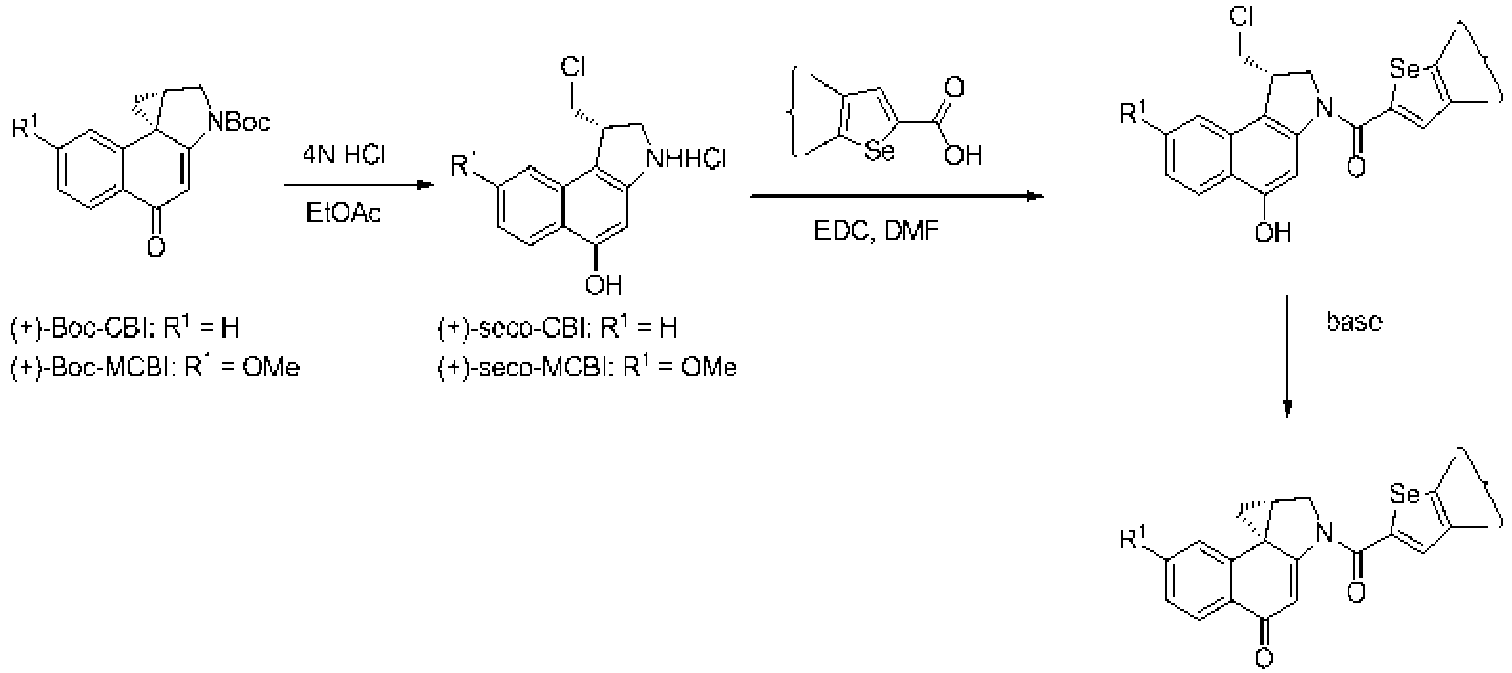
- Selenophene-fused aromatic compounds corresponding to Entry 59 to Entry 84 were produced in accordance with the fourth aspect of the example embodiments as follows.
- (+)-Boc-MCBI and (+)-Boc-CBI were synthesized by the method as reported in J. Org. Chem. 1996, 61, 1710. 30 mg or 50 mg of a starting material was mixed with 3 mL of 4N HCl-EtOAc and stirred at -40°C for 30 minutes and then left as it was at room temperature for 30 minutes. Thereafter, nitrogen gas was added thereto to concentrate the reaction solution, and the residue was dried for 15 minutes or more under a depressurized condition.
- 1.0 mL of DMF was added thereto with addition of 1.1 eq. of benzoselenophene-2-carboxylic acid and 3.0 eq. of EDCI to produce a reaction mixture. The reaction mixture was stirred at 25 °C for 10 hours. After the stirring, 3 mL of water was added to the reaction mixture, the reaction product was extracted by using 4 x 5 mL of EtOAc. During this process, an organic layer was collected and dried by using Na2SO4 and then concentrated under a depressurized condition.
- Selenophene-fused aromatic compounds corresponding to Entry 59 to Entry 84 as reaction products were refined by a thin layer chromatography (methanol-methylene chloride developing solvent) and synthesized at a yield of from 15% to 55 %. Structures of the compounds were as shown in Table 4 below. Further, NMR experiments were performed to the respective compounds, and data thereof were as described under Table 4.
[Table 4] <Structures of compound in accordance with Comparative Example 1 and selenophene-fused aromatic compounds corresponding to Entry 59 to Entry 84> Selenophene-fused aromatic compound Comparative Example 1 
Entry 59 
Entry 60 
Entry 61 
Entry 62 
Entry 63 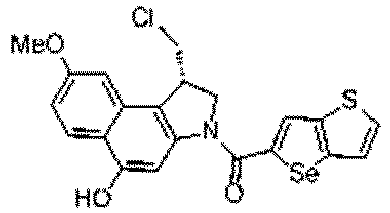
Entry 64 
Entry 65 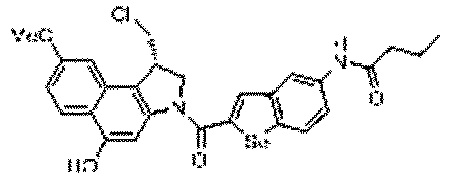
Entry 66 
Entry 67 
Entry 68 
Entry 69 
Enrty 70
Comparative Example 2
(CBI-TMI)
Entry 71 
Entry 72 
Entry 73 
Entry 74 
Entry 75 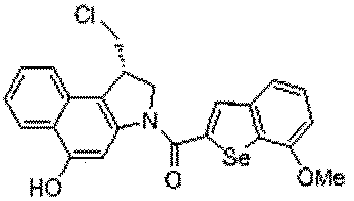
Entry 76 
Entry 77 
Entry 78 
Entry 79 
Entry 80 
Entry 81 
Entry 82 
Entry 83 
Enrty 84 
- 1H NMR (DMSO-d6, 500 MHz) ∂ 11.41 (s, 1H, NH), 10.35 (s, 1H, OH), 8.02 (d, J = 9.0 Hz, 1H), 7.72 (br s, 1H), 7.10 (d, J = 2.5 Hz, 1H), 7.05 (d, J = 2.0 Hz, 1H), 6.99 (dd, J = 9.2, 2.4 Hz, 1H), 6.96 (s, 1H), 4.71 (t, J = 10 Hz, 1H), 4.46 (d, J = 10 Hz, 1H), 4.15-4.10 (m, 1H), 4.05 (dd, J = 11.0, 3.5 Hz, 1H), 3.94 (s, 3H, OCH3), 3.91 (s, 3H, OCH3), 3.82 (s, 3H, OCH3), 3.80 (s, 3H, OCH3), 3.78 - 3.80 (m, 1H); LCMS, m/e 497.1 (M+ + H).
- 1H NMR (DMSO-d6, 500 MHz) ∂ 10.36 (s, 1H, OH), 8.93 (d, J = 2.5 Hz, 1H), 8.54 (s, 1H), 8.45 (d, J = 9.0 Hz, 1H), 8.23 (dd, J = 9.0, 2.5 Hz, 1H), 8.03 (d, J = 9.5 Hz, 1H), 7.72 (br s, 1H), 7.13 (d, J = 2.0 Hz, 1H), 7.02 (dd, J = 9.5, 2.5 Hz, 1H), 4.72 (m, 1H), 4.47 (d, J = 10 Hz, 1H), 4.22 (m, 1H), 4.04 (dd, J = 11.0, 3.0 Hz, 1H), 3.92 (s, 3H, OCH3), 3.92 - 3.88 (m, 1H); LCMS, m/e 517.1 (M+ + H).
- 1H NMR (DMSO-d6, 500 MHz) ∂ 10.34 (s, 1H, OH), 8.23 (s, 1H), 8.02 (d, J = 9.0 Hz, 1H), 7.99 (d, J = 8.5 Hz, 1H), 7.67 (br s, 1H), 7.56 (d, J = 2.5 Hz, 1H), 7.12 (d, J = 2.0 Hz, 1H), 7.08 (dd, J = 9.0, 2.5 Hz, 1H), 7.01 (dd, J = 9.0, 2.0 Hz, 1H), 4.73 (t, J = 9.5 Hz, 1H), 4.48 (m, 1H), 4.18 (m, 1H), 4.04 (dd, J = 14.5, 7.0 Hz, 1H), 3.91 (s, 3H, OCH3), 3.82- (s, 3H, OCH3), 3.85 3.81 (m, 1H); LCMS, m/e 502.2 (M+ + H).
- 1H NMR (DMSO-d6, 500 MHz) ∂ 10.32 (s, 1H, OH), 10.09 (s, 1H, NH), 8.44 (s, 1H), 8.27 (s, 1H), 8.02 (d, J = 4.5 Hz, 1H), 8.01 (d, 4.5 Hz, 1H), 7.68 (br s, 1H), 7.46 (dd, J = 8.5, 2 Hz, 1H), 7.12 (d, J = 2.0 Hz, 1H), 7.01 (dd, J = 9.0, 2.5 Hz, 1H), 4.77 (t, J = 9.5 Hz, 1H), 4.45 (d, J = 11.5 Hz, 1H), 4.17 (m, 1H), 4.03 (dd, J = 11.5, 3.5 Hz, 1H), 3.91 (s, 3H, OCH3), 3.89-3.80 (dd, J = 11.0, 4.0 Hz, 1H); LCMS, m/e 529.2 (M+ + H).
- 1H NMR (500.1 MHz, ACETONE-d6) ∂ 9.32 (s, 1H), 8.508 (d, 1H, J = 2.0 Hz), 8.22 (s, 1H), 8.025 (d, 1H, J = 8.5 Hz), 7.98 (d, 1H, J = 9.0 Hz), 7.509 (dd, 1H, J = 2,8.5 Hz), 6.98 (dd, 1H, J = 2.5,9 Hz), 6.765 (s , 1H), 6.68 (dd, 1H, J = 2.5Hz), 4.6 (dd, 1H, J = 5.0, 10.0 Hz), 4.44 (d, 1H, J = 10.5 Hz), 3.9 (s, 3H), 3.18 (m, 1H), 2.08 (s, 3H), 1.82 (dd, 2H,J=4Hz, 7.5Hz)
- 1H NMR (500.1 MHz, CDCl3) ∂ 3.43 (t, 1H, J = 11.3), 3.88 (m, 1H), 3.90 (s, 3H), 3.98 (m, 1H), 4.56 (m, 1H), 4.64 (d, 1H, J = 11.3), 6.85 (d, 1H, J = 2.8), 7.02 (dd, 1H, J = 2.8, 9.4), 7.31 (s, 1H), 7.34 (s, 1H), 7.96 (s, 1H), 8.07 (s, 1H), 8.21 (d, 1H, J = 9.4), 8.94 (s, 1H); 13C NMR (125.7 MHz, CDCl3) ∂ 42.82, 45.60, 55.35, 56.17, 99.07, 100.93, 106.39, 114.97, 115.60, 118.20, 125.78, 130.77, 131.22, 134.63, 136.11, 138.80, 141.81, 148.50, 149.76, 155.01, 164.30.
- 1H NMR (500.1 MHz, CDCl3) ∂ 3.48 (t, 1H, J = 11.3), 3.90 (m, 1H), 3.91 (s, 3H), 3.95 (s, 3H), 4.00 (m, 1H), 4.60 (t, 1H, J = 9.4), 4.69 (d, 1H, J = 10.7), 6.92 (s, 1H), 7.05 (m, 2H), 7.43 (d, 1H, J = 1.6), 7.79 (d, 1H, J = 8.8), 7.82 (m, 1H), 7.97 (s, 1H), 8.17 (d, 1H, J = 10.1)
- 1H NMR (500.1 MHz, CDCl3) ∂ 1.05 (t, 3H, J = 7.6), 1.81 (m, 2H), 2.39 (t, 2H, J = 7.9), 3.36 (m, 1H), 3.79 (m, 1H), 3.86 (m, 1H), 3.91 (s, 3H), 4.18 (m, 1H), 4.38 (d, 1H, J = 7.8), 6.7 (dd, 1H, J = 2.8, 36.5), 7.02 (m, 1H), 7.34 (d, 1H, J = 8.8), 7.49 (s, 1H) 7.75 (d, 1H, J = 9.1), 7.87 (s, 1H), 8.11 (s, 1H), 8.21 (d, 1H, J = 9.4)
- 1H NMR (500.1 MHz, CDCl3) ∂ 0.94 (t, 3H, J = 7.6), 1.40 (m, 4H), 1.79 (m, 2H), 2.41 (t, 2H, J = 8.1), 3.35 (m, 1H), 3.66 (m, 1H), 3.80 (d, 1H, J = 12.6), 3.91 (s, 3H), 4.39 (m, 2H), 6.76 (s, 1H), 7.03 (d, 1H, J = 9.4), 7.34 (d, 1H, J = 8.5), 7.49 (m, 1H) 7.74 (d, 1H, J = 11.9), 7.88 (s, 1H), 8.13 (s, 1H), 8.20 (d, 1H, J = 9.4)
- 1H NMR (500.1 MHz, CDCl3) ∂ 3.46 (t, 1H, J = 11.3), 3.90 (d, 1H, J = 3.1), 3.93 (s, 3H), 3.96 (s, 3H), 3.97 (m, 1H), 3.99 (s, 3H), 4.58 (m, 1H), 4.67 (dd, 1H, J = 1.6, 11.0), 6.89 (d, 1H, J = 2.8), 7.04 (dd, 1H, J = 2.8, 9.4), 7.32 (s, 1H), 7.36 (s, 1H), 7.97 (s, 1H), 7.98 (d, 1H, J = 9.4), 8.20 (d, 1H, J = 9.4)
- 1H NMR (500.1 MHz, ACETONE-d6) ∂ 9.4 (s, 1H), 8.605 (dd, 1H, J = 4.5,1Hz), 8.32 (dd, 1H, J = 1,8 Hz), 8.162 (d, 1H, J = 2Hz), 7.65 (brs, 1H), 7.492(dd, 1H, J = 4.5, 8.0Hz), 7.187 (d, 1H, J = 2.5 Hz),7.035 (dd, 1H, J = 2.5, 9), 4.717 (t, 1H, J = 10.0Hz),4.635 (d, 1H, J = 11.0 Hz), 4.18 (m, 1H), 4.048 (dd , 1H, J = 3.5, 11.5Hz), 3.9 (s , 3H), 3.832 (m, 1H). 13C NMR (125.7 MHz, ACETONE-d6) ∂ 42.85, 47.39, 55.76, 56.50, 99.50, 102.27, 116.01, 116.28, 116.67, 118.73, 121.43,125.99, 128.31,132.80,135.29,137.25,143.53,149.03,155.34,160.19,162.83,163.08,166.26
- 1H NMR (500.1 MHz, CDCl3) ∂ 3.47 (m, 1H), 3.92 (m, 1H), 3.94 (s, 3H), 4.02 (t, 1H, J = 11.0), 4.60 (m, 1H), 4.68 (d, 1H, J = 11.0), 6.88 (d, 1H, J = 2.2), 6.91 (d, 1H, J = 2.8), 7.05 (m, 1H), 7.66 (d, 1H, J = 2.5), 7.79 (s, 1H), 7.93 (s, 1H), 8.15 (d, 1H, J = 9.1)
- 1H NMR (500.1 MHz, DMSO) ∂ 10.46 (s, 1H,OH), 8.12 (d, 1H, J = 8.5Hz, C6-H), 7.90 (br s, 1H, C4-H), 7.84 (d, 1H, J = 8.5 Hz,C9-H), 7.52 (t, 1H,J =8.0Hz,C8-H), 7.36 (t, 1H,J= 8.0 Hz,C7-H), 7.06 (s, 1H, ,C3'-H), 6.97 (s, 1H,C4'-H), 4.74(apparent t,1H,J= 10.4Hz,C2-H), 4.46(d,1H, J= 11.2Hz,C2-H), 4.17 (m, 1H, C1-H), 4.01 (d, 1H, J= 10.6 Hz,CHHCl),3.94 (s,3H,OCH3), 3.83 (s,3H,OCH3), 3.82 (d ,1H , J= 11.2 Hz, CHHCl), 3.79 (s, 3H, OCH3)
- 1H NMR (500.1 MHz, DMSO) ∂ 10.4 (s, 1H), 10.0 (s, 1H), 8.48 (s, 1H),8.3 (s, 1H), 8.15 (d, 1H, J = 8.5 Hz), 8.05 (d, 1H, J = 8.5 Hz),7.88 (d, 1H, J = 8 Hz), 7.86 (brs 1H), 7.56 (t,1H, J = 8 Hz),7.5 (dd, 1H, J = 8.5,2 Hz), 7.4 (t, 1H, J = 8.0 Hz), 7.4 (t,1H, J = 8.0 Hz), 4.8 (t,1H, J = 9.5 Hz),4.45 (dd, 1H, J = 11.0,2.0 Hz), 4.2 (m, 1H,) 4.01(dd,1H, 3.0, J =11.0 Hz), 3.89 (m,1H),2.3 (t d, 2H, J = 7.5,1.5 Hz), 1.6 (qr, 2H, J = 7.5 Hz), 0.9 (t, 1H, J = 3.0,11.0 Hz), 13C NMR (125.7 MHz, Acetone) ∂ 13.96, 14.11, 19.72, 24.41,42.75,47.91, 54.67, 101.58, 115.48, 117.07, 118.01, 120.03, 123.35, 123.62, 123.76, 124.34, 128.21, 128.40, 143.0, 130.92, 137.44, 143.66, 155.22, 163.58, 169.85, 172.13
- 1H NMR (500.1 MHz, ACETONE-d6) ∂ 9.26 (s, 1H), 8.537 (d, 1H, J =8.5Hz), 8.23 (s, 1H), 8.1 (d, 1H, J =1.0Hz), 7.98 (d, 1H, J =8.5Hz), 7.55 (m, 2H), 7.4 (m, 1H), 7.2 (d, 1H, J = 8 Hz), 6.834 (s,1H), 4.621 (dd, 1H, J = 10.5, 5 Hz), 4.46 (d, 1H, J = 10.5Hz), 3.17 (m, 1H), 2.366(t, 1H, J = 7.5 Hz), 1.81 (t, 2H, J =2 Hz), 1.69 (m, 2H), 0.96 (t, 3H, J = 7.5 Hz). 13C NMR (125.7 MHz, Acetone) ∂ 14.14, 19.75, 25.32, 33.60, 39.78, 55.72, 112.31, 117.57, 118.22, 120.52, 123.00, 123.22, 126.71, 126.95, 127.04, 127.30, 132.56, 132.93, 133.79, 138.55, 141.74, 143.13, 143.45, 161.44, 165.22, 172.15, 185.56
- 1H NMR (500.1 MHz, Acetone) ∂ 10.4 (s, 1H), 8.2 (s, 1H), 8.1 (d, 1H, J = 8.0 Hz), 8.0 (d,1H, J = 8.5 Hz), 7.8 (d, 1H, J = 8.5 Hz), 7.58 (s, 1H),7.56 (t, 1H, J = 8.5 Hz), 7.4 (t, 1H, J =8Hz),7.1 (d, 1H, J = 9.0 Hz), 4.8 (t, 1H, J = 10.0 Hz),4.45 (d, 1H, J = 11.0 Hz), 4.2 (m, 1H) 4.01(qr,1H, J = 7 Hz), 3.89 (m,1H), 3.80 (s, 3H). 13C NMR (125.7 MHz, Acetone) ∂ 43.14, 47.72, 55.96, 56.77, 101.64, 110.34, 117.54, 123.67, 123.75, 124.38, 124.40, 127.26, 128.49, 130.74, 131.43, 143.29, 144.36, 155.24, 159.34, 163.57
- 1H NMR (500.1 MHz, Acetone) ∂ 9.4 (s, 1H), 8.25 (d, 1H, J = 8.5 Hz), 8.2 (s, 1H),7.9 (m, 4H), 7.68 (s, 1H), 7.54 (td, 1H, J = 6.5,1Hz),7.4 (td 1H, J = 10,1Hz), 7.01 (dd, 1H, J = 2, 8.5 Hz), 4.8 (t, 1H, J = 10.0 Hz),4.7 (dd, 1H, J = 1.5,10.5 Hz), 4.2 (m, 1H) 4.01(dd,1H, J = 3.5, 11.5Hz), 3.90 (s, 3H), 3.80 (m,1H). 13C NMR (125.7 MHz, Acetone) ∂ 43.21, 47.73, 56.13, 56.17, 101.69, 109.18, 115.93, 116.92, 123.64, 124.30, 124.38, 128.45, 129.05, 130.77, 137.13, 137.39, 143.46, 145.4, 155.19, 160.16, 163.49
- 1H NMR (500.1 MHz, Acetone) ∂ 9.5 (s, 1H), 8.25 (d, 1H, J = 5Hz), 8.23 (s, 1H), 7.9 (s, 1H), 7.9 (d, 1H, J = 8.5 Hz), 7.6 (d, 1H, J= 7.5 Hz), 7.5 (t, 1H, J = 8.0 Hz), 7.43 (t, 1H, J = 8.0 Hz) 7.4 (t, 1H, J = 7.0 Hz), 4.8 (t, 1H, J = 10.5 Hz), 4.68 (dd, 1H, J = 1.5, 10.5 Hz), 4.25 (m, 1H) 4.01(dd,1H, J = 3.5, 11.5Hz), 4.01 (s, 3H), 3.82 (dd,1H, J = 8.5, 11 Hz). 13C NMR (125.7 MHz, Acetone) ∂ 43.14, 47.74, 56.47, 56.79, 107.13, 117.13, 120.72, 123.69, 124.41, 127.89, 128.50, 131.05, 131.44, 131.89, 143.28, 144.67, 155.25, 157.31, 163.55
- 1H NMR (500.1 MHz, Acetone) ∂ 9.25 (s, 1H), 8.3 (d, 1H, J = 8.5Hz), 8.2 (s, 1H), 7.9 (s, 1H), 7.8 (d, 1H, J = 8.5 Hz), 7.68 (s, 1H),7.55 (m, 1H), 7.52 (s, 1H) 7.4 (m, 1H), 4.8 (t, 1H, J = 11.0 Hz),4.7 (dd, 1H, J = 2,11.0 Hz), 4.3 (m, 1H) 4.05(dd,1H, J = 3.5, 11.5Hz), 3.94 (s, 3H), 3.89 (s, 3H), 3.8 (dd,1H, J = 9, 11.5Hz). 13C NMR (125.7 MHz, Acetone) ∂ 41.71, 46.17, 54.77, 54.88, 54.93, 100.18, 101.99, 106.74, 108.12, 115.32, 122.08, 122.73, 122.84, 126.9, 129.46, 135.08, 141.98, 148.55, 149.86, 153.65, 162.01
- 1H NMR (500.1 MHz, ACETONE-d6) ∂ 8.17 (s, 1H), 8.099 (dd, 1H, J =7.5,1Hz), 7.64 (s, 1H), 7.60 (m,1H), 7.489 (s, 1H), 7.422 (m,1H), 7.18 (d, 1H, 7.5Hz), 6.78(s, 1H), 4.58 (dd, 1H, J = 10.5, 5 Hz), 4.42 (d, 1H, J = 10.0Hz), 3.92 (s, 3H), 3.86(s, 3H),3.16 (m, 1H), 1.802 (m, 2H)
- 1H NMR (500.1 MHz, Acetone) ∂ 9.3 (s, 1H), 8.5 (s, 1H), 8.22 (d, 1H, J = 8.5 Hz), 8.2 (s, 1H), 7.98 (d, 1H, J = 9 Hz), 7.9 (d, 1H, J = 8.5 Hz), 7.58 (m, 2H), 7.4 (t, 1H, J = 8.0 Hz), 4.8 (t, 1H, J = 11.0 Hz), 4.7 (dd, 1H, J = 2, 11.0 Hz), 4.24 (m, 1H) 4.05(dd,1H, J = 3.5, 11.5 Hz), 3.85 (dd, 3H, , J = 9, 11.5 Hz), 2.1 (s, 3H). 13C NMR (125.7 MHz, Acetone) ∂ 24.11, 43.53, 48.13, 57.17, 102.99, 117.18, 118.39, 120.64, 123.30, 124.38, 126.45, 128.45, 131.05, 132.77, 137.13, 138.39, 143.46, 144.4, 155.29, 164.16, 168.49
- 1H NMR (505.1 MHz, ACETONE-d6) ∂ 9.32 (d, 1H, J = 7), 8.51 (s, 1H), 8.24 (s, 1H), 8.09 (d, 1H, J = 8.0), 7.98 (d, 1H, 8.5 Hz), 7.581(t, 1H, J = 7.5 Hz), 7.51 (d, 1H, J = 8.5 Hz), 7.428 (t, 1H, 7.5Hz), 7.198 (d,1H, J = 8Hz), 6.82 (s, 1H), 4.63 (dd, 1H, J = 5.5, 10.5 Hz), 4.47 (d, 1H, J = 10.5 Hz), 3.175 (d, 1H, J = 5.5 Hz), 2.109 (s, 3H), 1.8 (d, 2H, J = 5.5Hz)
- 1H NMR (500.1 MHz, Acetone) ∂ 9.8 (bs, 1H), 9.3(s, 1H), 8.5 (s, 1H), 8.2 (d, 2H, J = 9.5 Hz), 8.0 (d, 1H, J = 8.5 Hz), 7.9 (s, 1H), 7.85 (d, 2H, J = 8.5 Hz), 7.7 (dd, 1H, J = 2,8.5 Hz), 7.4 (t, 1H, J = 8 Hz), 4.8 (t, 1H, J = 11.0 Hz), 4.7 (dd, 1H, J = 2, 11.0 Hz), 4.24 (m, 1H) 4.05(dd,1H, J = 3.5, 11.5 Hz), 3.85 (m, 1H),3.25 (s ,2H), 2.5 (s, 6H).
- 1H NMR (500.1 MHz, Acetone) ∂ 9.3 (s, 1H), 8.32 (s, 1H), 8.28 (d, 1H, J = 8.5 Hz), 8.18 (s, 1H), 8.10 (s, 1H), 7.9 (dd, 3H, J = 4,9Hz), 7.53 (t, 1H, J = 7 Hz), 7.52 (m, 1H), 5.85 (bs, 1H), 4.8 (t, 1H, J = 11.0 Hz), 4.68 (dd, 1H, J = 2,11.0 Hz), 4.24 (m, 1H), 4.05 (dd,1H, J = 3.5, 11.5Hz), 3.8 (dd, 1H, J = 8.5, 11.5 Hz), 3.25 (q,2H, J = 7 Hz), 1.5 (m , 2H),1.38 (m, 2H), 0.92 (t, 3H, J = 7.5Hz)
- 1H NMR (500.1 MHz, Acetone) ∂ 9.3 (s, 1H), 8.92 (s, 1H), 8.86 (s, 1H), 8.37 (s, 1H), 8.25(d, 1H, J = 8.5Hz), 8.20 (s, 1H),7.94 (d, 1H, J = 8.5Hz), 7.88 (d, 1H, J = 8.5Hz), 7.618 (dd, 3H, J = 5, 9 Hz), 7.542 (m, 2H), 7.4 (t, 1H, J = 7 Hz), 7.043 (t, 1H, 9Hz) 4.8 (t, 1H, J = 11.0 Hz), 4.67 (d, 1H, J = 11.5 Hz), 4.24 (t, 1H, J = 8.5Hz), 4.05 (dd , 1H, J = 3, 11Hz), 3.848 (dd, 1H, J = 8.5, 11 Hz).
- 1H NMR (500.1 MHz, ACETONE-d6) ∂ 9.25 (s, 1H), 8.527 (s, 1H), 8.25 (d, 1H, J =8.5Hz), 8.21 (s,1H), 7.97 (d, 1H, J = 9 Hz), 7.88 (d, 1H, J = 8.5Hz), 7.54 (t, 2H, J = 8 Hz), 7.40 (t, 1H, J = 8 Hz), 4.8 (t, 1H, J = 11.0Hz), 4.67 (d, 1H, J = 11.0 Hz), 4.23 (m, 1H), 4.04 (dd , 1H, J = 3, 11 Hz), 3.82 (dd, 1H, J = 8.5 , 11 Hz), (t, 2H, J = 7.5Hz), 1.7 (t, 2H, J = 7.0 Hz), 1.4 (m, 4H), 0.9 (m, 3H)
- 1H NMR (500.1 MHz, ACETONE-d6) ∂ 9.6 (s, 1H), 8.44 (s, 1H), 8.238 (d, 1H, J = 8.5 Hz), 8.19 (s,1H), 7.97 (d, 1H, J =8.5Hz), 7.87 (d, 1H, J = 8.5Hz), 7.597 (d, 1H, J = 1.5 Hz), 7.53 (d, 1H, J = 7 Hz), 7.4 (d, 1H, J = 7.5 Hz), 7.2 (s, 1H), 4.87 (t, 1H, J = 11.0Hz), 4.65 (d, 1H, J = 11.0 Hz), 4.523 (dd, 1H, J = 8, 13 Hz), 4.21(t , 1H, J = 8.5 Hz), 4.03 (dd, 1H, J = 3.5, 11 Hz), 3.8 (m, 1H), 3.76 (t, 1H, J = 6.5 Hz), 3.183 (m, 2H), 2.08 (s, 3H), 1.99 (s, 3H), 1.51-1.44 (m, 6 H)
- Meanwhile, in the present Example, proliferation inhibition effect of the compound in accordance with Comparative Example 1 and the compounds corresponding to Entry 59 to Entry 72 on SK-OV-3 cancer cells were checked, and a result thereof was as shown in Table 5.
- SK-OV-3 cells floated on McCoy's 5A Medium in which 10% FBS and 1% P/S were added were inoculated into a 96-Well plate at a concentration of 3×10⁴/100 µl per Well and cultured at 37°C for 4 hours and then, treated with 100 µl of each compound, so that a final concentration of 10 nM was attained. Then, the cells were cultured at 37°C for 72 hours. As a control, the cells were treated with DMSO as a solvent of the compounds to attain a final concentration of 0.1%. Each well was treated with 10 µl of a WST-1 assay reagent (iTSBio, Korea), and cultured at 37°C for 2 hours. Then, absorbance was measured with an automatic Microplate Reader at 450 nm. A cell growth inhibition level was calculated by {(A450control-A450compound)/A450control}*100.
[Table 5] SK-OV-3 cell proliferation inhibition effect of compound in accordance with Comparative Example 1 and selenophene-fused aromatic compounds corresponding to Entry 59 to Entry 72 (IC50) Material Proliferation inhibition effect (10 nM; %) Comparative Example 1 80 Entry 59 74 Entry 60 78 Entry 61 81 Entry 62 86 Entry 63 78 Entry 64 85 Entry 65 85 Entry 66 87 Entry 67 78 Entry 68 82 Entry 69 73 Entry 70 80 Entry 71 73 Entry 72 75 - The above description of the present disclosure is provided for the purpose of illustration, and it would be understood by those skilled in the art that various changes and modifications may be made without changing technical conception and essential features of the present disclosure. Thus, it is clear that the above-described example embodiments are illustrative in all aspects and do not limit the present disclosure. For example, each component described to be of a single type can be implemented in a distributed manner. Likewise, components described to be distributed can be implemented in a combined manner.
- The scope of the present disclosure is defined by the following claims rather than by the detailed description of the embodiment.

Claims (9)
- A selenophene-fused aromatic compound represented by the following Chemical Formula 1, 11 or 12:


 R1 represents the following Chemical Formula A:
 R2 represents H, -NO2, -NHCOR, CX3, -OR, -diOR, a substitutable alkyl group, a substitutable alkoxy group, a substitutable alkylene-dioxy group, a substitutable amino group, a halo group, or a substituent represented by the following Chemical Formula B:
 X represents a halo group,R3 represents -H, -OH, -NH2, a substitutable alkyl group, or a substitutable aryl group,each of R4 and R5 independently represents a substitutable N, O, S, C, or bond,R6 represents H, or a substitutable alkoxy group,R7 represents H, -CONR17R20, or
 each of R17 and R20 independently represents H, or a substitutable alkyl group,R21 represents C, O, N, or S,R8 represents a halo group,R9 represents O, NH, S, or Se,R10 represents a substitutable alkyl group, a substitutable alkoxy group, a halo group, -NO2, or-NHCOR,L represents a linker, andR represents H, a substitutable alkyl group, a substitutable aryl group, a substitutable amino group, a substitutable amino acid group, a substitutable peptide group, a substitutable C1-7 alkoxy group, or a residue of a substitutable carbohydrate or carbohydrate derivative.
 - The selenophene-fused aromatic compound of Claim 1,
wherein the selenophene-fused aromatic compound is selected from the following Chemical Formulas 10 to 12:


 R2 represents H, -NO2, -NHCOR, CX3, -OR, -diOR, a substitutable alkyl group, a substitutable alkoxy group, a substitutable alkylene-dioxy group, a substitutable amino group, a halo group, or a substituent represented by the following Chemical Formula B:
 X represents a halo group,each of R4 and R5 independently represents a substitutable C, O, N, S, or bond,R6 represents H, or a substitutable alkoxy group,R7 represents H, -CONR17R20, or
 each of R17 and R20 independently represents H, or a substitutable alkyl group,R21 represents C, O, N, or S,R8 represents a halo group,R9 represents O, NH, S, or Se,R10 represents a substitutable alkyl group, a substitutable alkoxy group, a halo group, -NO2, or-NHCOR,L represents a linker, andR represents H, a substitutable alkyl group, a substitutable aryl group, a substitutable amino group, a substitutable amino acid group, a substitutable peptide group, a substitutable C1-7 alkoxy group, or a residue of a substitutable carbohydrate or carbohydrate derivative.
 - A producing method of a selenophene-fused aromatic compound represented by the following Chemical Formula 10, the method comprising:reacting a MCBI (7-methoxy-1,2,9,9a-tetrahydrocyclopropa[c]benz[e]indol-4-one) compound represented by the following Chemical Formula 10a and a selenium-containing aromatic compound represented by the following Chemical Formula 10b:


 R2 represents a substitutable alkyl group, a substitutable alkoxy group, a halo group, -NO2,-NHCOR, or a substituent represented by the following Chemical Formula B,each of R4 and R5 independently represents a substitutable C, O, N, S, or bond,R6 represents H, or a substitutable alkoxy group,R7 represents H, -CONR17R20, or
 each of R17 and R20 independently represents H, or a substitutable alkyl group,R21 represents C, O, N, or S,R8 represents a halo group, andR represents H, a substitutable alkyl group, a substitutable aryl group, a substitutable amino group, a substitutable amino acid group, a substitutable peptide group, a substitutable C1-7 alkoxy group, or a residue of a substitutable carbohydrate or carbohydrate derivative:
 R9 represents O, NH, S, or Se,R10 represents a substitutable alkyl group, a substitutable alkoxy group, a halo group, -NO2, or -NHCOR,R represents H, a substitutable alkyl group, a substitutable aryl group, a substitutable amino group, a substitutable amino acid group, a substitutable peptide group, a substitutable Alkoxy group, or a residue of a substitutable carbohydrate or carbohydrate derivative.
 - The producing method of a selenophene-fused aromatic compound represented by Chemical Formula 10 of Claim 3,
wherein the MCBI compound represented by Chemical Formula 10a above is produced from a MCBI compound represented by the following Chemical Formula 10c in an acidic condition:
each of R6, R7 and R8 is the same as defined above in Chemical Formula 10a. - The producing method of a selenophene-fused aromatic compound represented by Chemical Formula 10 of Claim 3,
wherein the selenium-containing aromatic compound represented by Chemical Formula 10b above is produced from a selenium-containing aromatic compound represented by the following Chemical Formula 10d in a basic condition: R2, R4, and R5 are the same as defined above in Chemical Formula 10b, andR18 represents a substitutable alkyl group, a substitutable alkoxy group, -NO2, or -NHCO2H.
 - A producing method of a selenophene-fused aromatic compound represented by the following Chemical Formula 11, the method comprising:reacting a MCBI compound represented by the following Chemical Formula 11a and a selenium-containing aromatic compound represented by the following Chemical Formula 11b:


 R2 represents a substitutable alkyl group, a substitutable alkoxy group, a halo group, -NO2,-NHCOR, or a substituent represented by the following Chemical Formula B,each of R4 and R5 independently represents a substitutable C, O, N, S, or bond,R6 represents H, or a substitutable alkoxy group, andR represents H, a substitutable alkyl group, a substitutable aryl group, a substitutable amino group, a substitutable amino acid group, a substitutable peptide group, a substitutable C1-7 alkoxy group, or a residue of a substitutable carbohydrate or carbohydrate derivative:
 R9 represents O, NH, S, or Se,R10 represents a substitutable alkyl group, a substitutable alkoxy group, a halo group, -NO2, or -NHCORR represents H, a substitutable alkyl group, a substitutable aryl group, a substitutable amino group, a substitutable amino acid group, a substitutable peptide group, a substitutable C1-7 alkoxy group, or a residue of a substitutable carbohydrate or carbohydrate derivative.
 - The producing method of a selenophene-fused aromatic compound represented by Chemical Formula 11 of Claim 6,
wherein the MCBI compound represented by Chemical Formula 11a above is produced from a MCBI compound represented by the following Chemical Formula 11c in an acidic condition:
R6 is the same as defined above in Chemical Formula 11a - The producing method of a selenophene-fused aromatic compound represented by Chemical Formula 11 of Claim 6,
wherein the selenium-containing aromatic compound represented by Chemical Formula 11b above is produced from a selenium-containing aromatic compound represented by the following Chemical Formula 11d in a basic condition: each of R2, R4 and R5 is the same as defined above in Chemical Formula 11b, andR18 represents a substitutable alkyl group, a substitutable alkoxy group, -NO2, or -NHCO2H.
 - An anti-bacterial composition, an indicator composition, a fluorescent composition or an anticancer composition comprising a selenophene-fused aromatic compound according to Claim 1 or 2.
Applications Claiming Priority (3)
| Application Number | Priority Date | Filing Date | Title |
|---|---|---|---|
| KR20110098603 | 2011-09-28 | ||
| KR20110130059 | 2011-12-07 | ||
| PCT/KR2012/007905 WO2013048177A2 (en) | 2011-09-28 | 2012-09-28 | Selenophene-fused aromatic compound and manufacturing method thereof |
Publications (3)
| Publication Number | Publication Date |
|---|---|
| EP2762472A2 EP2762472A2 (en) | 2014-08-06 |
| EP2762472A4 EP2762472A4 (en) | 2015-09-02 |
| EP2762472B1 true EP2762472B1 (en) | 2017-05-24 |
Family
ID=47996644
Family Applications (1)
| Application Number | Title | Priority Date | Filing Date |
|---|---|---|---|
| EP12835538.5A Active EP2762472B1 (en) | 2011-09-28 | 2012-09-28 | Selenophene-fused aromatic compound and manufacturing method thereof |
Country Status (4)
| Country | Link |
|---|---|
| US (1) | US9365590B2 (en) |
| EP (1) | EP2762472B1 (en) |
| CN (1) | CN103906742A (en) |
| WO (1) | WO2013048177A2 (en) |
Families Citing this family (10)
| Publication number | Priority date | Publication date | Assignee | Title |
|---|---|---|---|---|
| CN104672047B (en) * | 2015-03-20 | 2016-08-24 | 中国石油大学(华东) | A method for converting olefins with four to six carbon atoms to produce propylene |
| KR101775440B1 (en) | 2015-10-07 | 2017-09-06 | 세종대학교산학협력단 | Benzoselnophene-based compound and antibody-drug conjugate containing the same |
| LV15485B (en) * | 2018-09-13 | 2020-06-20 | Latvijas Organiskās Sintēzes Institūts | Selenophenhromenon hydroxamic acids, their preparation and use in angiogenesis inhibition |
| KR102894542B1 (en) * | 2020-01-30 | 2025-12-03 | (주)에임드바이오 | Benzoselenophene-based compounds, pharmaceutical compositions and antibody-drug conjugates including the same |
| CN111925355B (en) * | 2020-05-26 | 2021-05-14 | 绍兴文理学院 | A kind of benzoselenophenol compound and preparation method thereof |
| CN113429387B (en) * | 2021-07-27 | 2022-10-28 | 中国药科大学 | Benzo [ b ] selenophen STING regulating agent, preparation method and application thereof |
| KR20240058859A (en) | 2021-08-12 | 2024-05-03 | 쿨레온 엘엘씨 | Hallucinogenic and non-hallucinogenic serotonin receptor agonists and methods for making and using the same |
| CN116396270B (en) * | 2023-03-29 | 2025-02-25 | 中国药科大学 | A benzo[b]selenophene STING agonist fluorescent probe molecule and its use |
| CN116874517B (en) * | 2023-09-08 | 2023-12-01 | 浙江华显光电科技有限公司 | Selenophene-containing compound and application thereof in organic light-emitting device |
| CN118388461B (en) * | 2024-04-28 | 2025-02-14 | 山东第一医科大学附属省立医院(山东省立医院) | A 3-selenobenzofuran derivative and its preparation method and application |
Family Cites Families (6)
| Publication number | Priority date | Publication date | Assignee | Title |
|---|---|---|---|---|
| EP0888301B1 (en) * | 1996-03-08 | 2005-08-10 | The Scripps Research Institute | Mcbi analogs of cc-1065 and the duocarmycins |
| WO2004101767A2 (en) * | 2003-05-13 | 2004-11-25 | The Scripps Research Institute | Cbi analogues of the duocarmycins and cc-1065 |
| EP1848704A4 (en) * | 2005-02-14 | 2011-05-11 | Bionomics Ltd | NEW TUBULIN POLYMERIZATION INHIBITORS |
| PT1984333E (en) * | 2006-02-03 | 2012-07-16 | Bionomics Ltd | Substituted benzofurans, benzothiophenes, benzoselenophenes and indoles and their use as tubulin polymerisation inhibitors |
| CN101495487A (en) | 2006-07-26 | 2009-07-29 | 默克专利有限公司 | Substituted benzodithiophenes and benzodiselenophenes |
| CN102438449B (en) * | 2009-04-27 | 2014-06-18 | 卡斯娜莱拉伊诺制药私人有限公司 | Anti-cancer drugs, and uses relating for malignant melanoma and other cancers |
-
2012
- 2012-09-28 WO PCT/KR2012/007905 patent/WO2013048177A2/en not_active Ceased
- 2012-09-28 CN CN201280047757.5A patent/CN103906742A/en active Pending
- 2012-09-28 EP EP12835538.5A patent/EP2762472B1/en active Active
-
2014
- 2014-03-28 US US14/228,493 patent/US9365590B2/en active Active
Also Published As
| Publication number | Publication date |
|---|---|
| US9365590B2 (en) | 2016-06-14 |
| WO2013048177A2 (en) | 2013-04-04 |
| WO2013048177A3 (en) | 2013-05-23 |
| CN103906742A (en) | 2014-07-02 |
| EP2762472A4 (en) | 2015-09-02 |
| EP2762472A2 (en) | 2014-08-06 |
| US20140213790A1 (en) | 2014-07-31 |
Similar Documents
| Publication | Publication Date | Title |
|---|---|---|
| EP2762472A2 (en) | Selenophene-fused aromatic compound and manufacturing method thereof | |
| NZ250998A (en) | 2-debenzoyl-2-acyltaxol derivatives, preparation and medicaments | |
| KR20120024715A (en) | Hydrochloride salt of ((1s,2s,4r)-4-{4-[(1s)-2,3-dihydro-1h-inden-1-ylamino]-7h-pyrrolo[2,3-d]pyrimidin-7-yl}-2-hydroxycyclopentyl)methyl sulfamate | |
| CN112851663B (en) | Parallel heterocyclic compound and application thereof | |
| CN104356072A (en) | 5-fluorouracil drug eutectic crystal and preparation method thereof | |
| Baji et al. | Multicomponent access to androstano-arylpyrimidines under microwave conditions and evaluation of their anti-cancer activity in vitro | |
| Al-Talib et al. | Synthesis and biological evaluation of new benzothiazoles as antimicrobial agents | |
| US20210115009A1 (en) | Method for synthesis of deuterated amide and deuterated sulfonamide | |
| CN112979571A (en) | AKR1C3 selective inhibitor, preparation method and application thereof | |
| Hsieh et al. | Structural tuning enables piezochromic and photochemical properties in N-aryl-β-enaminones | |
| Yu et al. | Trace water in a BF 3· OEt 2 system: A facile access to sulfinyl alkenylsulfones from alkynes and sodium sulfinates | |
| CZ301764B6 (en) | Taxane derivatives and process of their preparation | |
| CN107056680B (en) | Spiro[cyclopropane-1,3'-indoline]-2'-one compound containing difluoromethyl group and its medicinal use | |
| CN104650109B (en) | Bearing taxanes | |
| TWI466872B (en) | A process for preparing quinazoline derivatives | |
| CN110483469B (en) | A kind of method for synthesizing iodobenzoxeptanone seven-membered ring lactone without metal catalysis | |
| CN106977524A (en) | A kind of synthetic method of phenanthro- furans and azoles | |
| KR101418776B1 (en) | Selenophene-fused aromatic compounds, and preparing method of the same | |
| EP2597093B1 (en) | Benzofuranone compound and pharmaceutical composition containing same | |
| KR101518980B1 (en) | Anticancer agents containing selenophene-fused aromatic compounds | |
| CN110511197B (en) | A kind of N-furanonyl arylsulfonyl hydrazone compound and its synthesis method and application | |
| Liu et al. | Visible-light-induced three-component reactions of α-diazoesters, quinazolinones and cyclic ethers toward quinazoline-based hybrids | |
| Gao et al. | Metal-free synthesis of 1, 1-dimethyl-2, 2, 2-trifluoroethyl substituted quinazolinones via tandem radical cyclization of quinazolin-4 (3 H)-ones with 3, 3, 3-trifluoro-2, 2-dimethylpropanoic acid | |
| CN103159814B (en) | A kind of morellic acid ester derivative and its production and use | |
| CN107459489A (en) | Amino-quinazoline compound of 2 alkylthio group of polyhalo 4 and preparation method thereof and antitumor application thereof |
Legal Events
| Date | Code | Title | Description |
|---|---|---|---|
| PUAI | Public reference made under article 153(3) epc to a published international application that has entered the european phase |
Free format text: ORIGINAL CODE: 0009012 |
|
| 17P | Request for examination filed |
Effective date: 20140328 |
|
| AK | Designated contracting states |
Kind code of ref document: A2 Designated state(s): AL AT BE BG CH CY CZ DE DK EE ES FI FR GB GR HR HU IE IS IT LI LT LU LV MC MK MT NL NO PL PT RO RS SE SI SK SM TR |
|
| DAX | Request for extension of the european patent (deleted) | ||
| RIC1 | Information provided on ipc code assigned before grant |
Ipc: A61P 35/00 20060101ALI20150304BHEP Ipc: C07D 517/04 20060101ALI20150304BHEP Ipc: C07D 421/12 20060101ALI20150304BHEP Ipc: A61K 31/095 20060101ALI20150304BHEP Ipc: C07D 345/00 20060101AFI20150304BHEP |
|
| A4 | Supplementary search report drawn up and despatched |
Effective date: 20150731 |
|
| RIC1 | Information provided on ipc code assigned before grant |
Ipc: C07D 517/04 20060101ALI20150727BHEP Ipc: C07D 345/00 20060101AFI20150727BHEP Ipc: A61P 35/00 20060101ALI20150727BHEP Ipc: A61K 31/095 20060101ALI20150727BHEP Ipc: C07D 421/12 20060101ALI20150727BHEP |
|
| 17Q | First examination report despatched |
Effective date: 20160713 |
|
| GRAP | Despatch of communication of intention to grant a patent |
Free format text: ORIGINAL CODE: EPIDOSNIGR1 |
|
| STAA | Information on the status of an ep patent application or granted ep patent |
Free format text: STATUS: GRANT OF PATENT IS INTENDED |
|
| INTG | Intention to grant announced |
Effective date: 20161223 |
|
| GRAS | Grant fee paid |
Free format text: ORIGINAL CODE: EPIDOSNIGR3 |
|
| GRAA | (expected) grant |
Free format text: ORIGINAL CODE: 0009210 |
|
| STAA | Information on the status of an ep patent application or granted ep patent |
Free format text: STATUS: THE PATENT HAS BEEN GRANTED |
|
| AK | Designated contracting states |
Kind code of ref document: B1 Designated state(s): AL AT BE BG CH CY CZ DE DK EE ES FI FR GB GR HR HU IE IS IT LI LT LU LV MC MK MT NL NO PL PT RO RS SE SI SK SM TR |
|
| REG | Reference to a national code |
Ref country code: GB Ref legal event code: FG4D |
|
| REG | Reference to a national code |
Ref country code: CH Ref legal event code: EP |
|
| REG | Reference to a national code |
Ref country code: IE Ref legal event code: FG4D |
|
| REG | Reference to a national code |
Ref country code: AT Ref legal event code: REF Ref document number: 895967 Country of ref document: AT Kind code of ref document: T Effective date: 20170615 |
|
| REG | Reference to a national code |
Ref country code: DE Ref legal event code: R096 Ref document number: 602012032856 Country of ref document: DE |
|
| REG | Reference to a national code |
Ref country code: NL Ref legal event code: MP Effective date: 20170524 |
|
| REG | Reference to a national code |
Ref country code: FR Ref legal event code: PLFP Year of fee payment: 6 |
|
| REG | Reference to a national code |
Ref country code: LT Ref legal event code: MG4D |
|
| REG | Reference to a national code |
Ref country code: AT Ref legal event code: MK05 Ref document number: 895967 Country of ref document: AT Kind code of ref document: T Effective date: 20170524 |
|
| PG25 | Lapsed in a contracting state [announced via postgrant information from national office to epo] |
Ref country code: AT Free format text: LAPSE BECAUSE OF FAILURE TO SUBMIT A TRANSLATION OF THE DESCRIPTION OR TO PAY THE FEE WITHIN THE PRESCRIBED TIME-LIMIT Effective date: 20170524 Ref country code: FI Free format text: LAPSE BECAUSE OF FAILURE TO SUBMIT A TRANSLATION OF THE DESCRIPTION OR TO PAY THE FEE WITHIN THE PRESCRIBED TIME-LIMIT Effective date: 20170524 Ref country code: NO Free format text: LAPSE BECAUSE OF FAILURE TO SUBMIT A TRANSLATION OF THE DESCRIPTION OR TO PAY THE FEE WITHIN THE PRESCRIBED TIME-LIMIT Effective date: 20170824 Ref country code: HR Free format text: LAPSE BECAUSE OF FAILURE TO SUBMIT A TRANSLATION OF THE DESCRIPTION OR TO PAY THE FEE WITHIN THE PRESCRIBED TIME-LIMIT Effective date: 20170524 Ref country code: ES Free format text: LAPSE BECAUSE OF FAILURE TO SUBMIT A TRANSLATION OF THE DESCRIPTION OR TO PAY THE FEE WITHIN THE PRESCRIBED TIME-LIMIT Effective date: 20170524 Ref country code: LT Free format text: LAPSE BECAUSE OF FAILURE TO SUBMIT A TRANSLATION OF THE DESCRIPTION OR TO PAY THE FEE WITHIN THE PRESCRIBED TIME-LIMIT Effective date: 20170524 Ref country code: GR Free format text: LAPSE BECAUSE OF FAILURE TO SUBMIT A TRANSLATION OF THE DESCRIPTION OR TO PAY THE FEE WITHIN THE PRESCRIBED TIME-LIMIT Effective date: 20170825 |
|
| PG25 | Lapsed in a contracting state [announced via postgrant information from national office to epo] |
Ref country code: LV Free format text: LAPSE BECAUSE OF FAILURE TO SUBMIT A TRANSLATION OF THE DESCRIPTION OR TO PAY THE FEE WITHIN THE PRESCRIBED TIME-LIMIT Effective date: 20170524 Ref country code: SE Free format text: LAPSE BECAUSE OF FAILURE TO SUBMIT A TRANSLATION OF THE DESCRIPTION OR TO PAY THE FEE WITHIN THE PRESCRIBED TIME-LIMIT Effective date: 20170524 Ref country code: NL Free format text: LAPSE BECAUSE OF FAILURE TO SUBMIT A TRANSLATION OF THE DESCRIPTION OR TO PAY THE FEE WITHIN THE PRESCRIBED TIME-LIMIT Effective date: 20170524 Ref country code: RS Free format text: LAPSE BECAUSE OF FAILURE TO SUBMIT A TRANSLATION OF THE DESCRIPTION OR TO PAY THE FEE WITHIN THE PRESCRIBED TIME-LIMIT Effective date: 20170524 Ref country code: IS Free format text: LAPSE BECAUSE OF FAILURE TO SUBMIT A TRANSLATION OF THE DESCRIPTION OR TO PAY THE FEE WITHIN THE PRESCRIBED TIME-LIMIT Effective date: 20170924 Ref country code: BG Free format text: LAPSE BECAUSE OF FAILURE TO SUBMIT A TRANSLATION OF THE DESCRIPTION OR TO PAY THE FEE WITHIN THE PRESCRIBED TIME-LIMIT Effective date: 20170824 |
|
| PG25 | Lapsed in a contracting state [announced via postgrant information from national office to epo] |
Ref country code: RO Free format text: LAPSE BECAUSE OF FAILURE TO SUBMIT A TRANSLATION OF THE DESCRIPTION OR TO PAY THE FEE WITHIN THE PRESCRIBED TIME-LIMIT Effective date: 20170524 Ref country code: CZ Free format text: LAPSE BECAUSE OF FAILURE TO SUBMIT A TRANSLATION OF THE DESCRIPTION OR TO PAY THE FEE WITHIN THE PRESCRIBED TIME-LIMIT Effective date: 20170524 Ref country code: EE Free format text: LAPSE BECAUSE OF FAILURE TO SUBMIT A TRANSLATION OF THE DESCRIPTION OR TO PAY THE FEE WITHIN THE PRESCRIBED TIME-LIMIT Effective date: 20170524 Ref country code: DK Free format text: LAPSE BECAUSE OF FAILURE TO SUBMIT A TRANSLATION OF THE DESCRIPTION OR TO PAY THE FEE WITHIN THE PRESCRIBED TIME-LIMIT Effective date: 20170524 Ref country code: SK Free format text: LAPSE BECAUSE OF FAILURE TO SUBMIT A TRANSLATION OF THE DESCRIPTION OR TO PAY THE FEE WITHIN THE PRESCRIBED TIME-LIMIT Effective date: 20170524 |
|
| REG | Reference to a national code |
Ref country code: DE Ref legal event code: R097 Ref document number: 602012032856 Country of ref document: DE |
|
| PG25 | Lapsed in a contracting state [announced via postgrant information from national office to epo] |
Ref country code: PL Free format text: LAPSE BECAUSE OF FAILURE TO SUBMIT A TRANSLATION OF THE DESCRIPTION OR TO PAY THE FEE WITHIN THE PRESCRIBED TIME-LIMIT Effective date: 20170524 Ref country code: SM Free format text: LAPSE BECAUSE OF FAILURE TO SUBMIT A TRANSLATION OF THE DESCRIPTION OR TO PAY THE FEE WITHIN THE PRESCRIBED TIME-LIMIT Effective date: 20170524 Ref country code: IT Free format text: LAPSE BECAUSE OF FAILURE TO SUBMIT A TRANSLATION OF THE DESCRIPTION OR TO PAY THE FEE WITHIN THE PRESCRIBED TIME-LIMIT Effective date: 20170524 |
|
| PLBE | No opposition filed within time limit |
Free format text: ORIGINAL CODE: 0009261 |
|
| STAA | Information on the status of an ep patent application or granted ep patent |
Free format text: STATUS: NO OPPOSITION FILED WITHIN TIME LIMIT |
|
| REG | Reference to a national code |
Ref country code: CH Ref legal event code: PL |
|
| 26N | No opposition filed |
Effective date: 20180227 |
|
| PG25 | Lapsed in a contracting state [announced via postgrant information from national office to epo] |
Ref country code: MC Free format text: LAPSE BECAUSE OF FAILURE TO SUBMIT A TRANSLATION OF THE DESCRIPTION OR TO PAY THE FEE WITHIN THE PRESCRIBED TIME-LIMIT Effective date: 20170524 Ref country code: SI Free format text: LAPSE BECAUSE OF FAILURE TO SUBMIT A TRANSLATION OF THE DESCRIPTION OR TO PAY THE FEE WITHIN THE PRESCRIBED TIME-LIMIT Effective date: 20170524 |
|
| REG | Reference to a national code |
Ref country code: IE Ref legal event code: MM4A |
|
| REG | Reference to a national code |
Ref country code: BE Ref legal event code: MM Effective date: 20170930 |
|
| PG25 | Lapsed in a contracting state [announced via postgrant information from national office to epo] |
Ref country code: LU Free format text: LAPSE BECAUSE OF NON-PAYMENT OF DUE FEES Effective date: 20170928 |
|
| PG25 | Lapsed in a contracting state [announced via postgrant information from national office to epo] |
Ref country code: LI Free format text: LAPSE BECAUSE OF NON-PAYMENT OF DUE FEES Effective date: 20170930 Ref country code: IE Free format text: LAPSE BECAUSE OF NON-PAYMENT OF DUE FEES Effective date: 20170928 Ref country code: CH Free format text: LAPSE BECAUSE OF NON-PAYMENT OF DUE FEES Effective date: 20170930 |
|
| PG25 | Lapsed in a contracting state [announced via postgrant information from national office to epo] |
Ref country code: BE Free format text: LAPSE BECAUSE OF NON-PAYMENT OF DUE FEES Effective date: 20170930 |
|
| REG | Reference to a national code |
Ref country code: FR Ref legal event code: PLFP Year of fee payment: 7 |
|
| PG25 | Lapsed in a contracting state [announced via postgrant information from national office to epo] |
Ref country code: MT Free format text: LAPSE BECAUSE OF NON-PAYMENT OF DUE FEES Effective date: 20170928 |
|
| PG25 | Lapsed in a contracting state [announced via postgrant information from national office to epo] |
Ref country code: HU Free format text: LAPSE BECAUSE OF FAILURE TO SUBMIT A TRANSLATION OF THE DESCRIPTION OR TO PAY THE FEE WITHIN THE PRESCRIBED TIME-LIMIT; INVALID AB INITIO Effective date: 20120928 |
|
| PG25 | Lapsed in a contracting state [announced via postgrant information from national office to epo] |
Ref country code: CY Free format text: LAPSE BECAUSE OF NON-PAYMENT OF DUE FEES Effective date: 20170524 |
|
| PG25 | Lapsed in a contracting state [announced via postgrant information from national office to epo] |
Ref country code: MK Free format text: LAPSE BECAUSE OF FAILURE TO SUBMIT A TRANSLATION OF THE DESCRIPTION OR TO PAY THE FEE WITHIN THE PRESCRIBED TIME-LIMIT Effective date: 20170524 |
|
| PG25 | Lapsed in a contracting state [announced via postgrant information from national office to epo] |
Ref country code: TR Free format text: LAPSE BECAUSE OF FAILURE TO SUBMIT A TRANSLATION OF THE DESCRIPTION OR TO PAY THE FEE WITHIN THE PRESCRIBED TIME-LIMIT Effective date: 20170524 |
|
| PG25 | Lapsed in a contracting state [announced via postgrant information from national office to epo] |
Ref country code: PT Free format text: LAPSE BECAUSE OF FAILURE TO SUBMIT A TRANSLATION OF THE DESCRIPTION OR TO PAY THE FEE WITHIN THE PRESCRIBED TIME-LIMIT Effective date: 20170524 |
|
| PG25 | Lapsed in a contracting state [announced via postgrant information from national office to epo] |
Ref country code: AL Free format text: LAPSE BECAUSE OF FAILURE TO SUBMIT A TRANSLATION OF THE DESCRIPTION OR TO PAY THE FEE WITHIN THE PRESCRIBED TIME-LIMIT Effective date: 20170524 |
|
| REG | Reference to a national code |
Ref country code: DE Ref legal event code: R081 Ref document number: 602012032856 Country of ref document: DE Owner name: AIMED BIO INC., KR Free format text: FORMER OWNERS: INDUSTRY-ACADEMIA COOPERATION GROUP OF SEJONG UNIVERSITY, SEOUL, KR; SAMSUNG LIFE PUBLIC WELFARE FOUNDATION, SEOUL, KR |
|
| REG | Reference to a national code |
Ref country code: GB Ref legal event code: 732E Free format text: REGISTERED BETWEEN 20221201 AND 20221207 |
|
| P01 | Opt-out of the competence of the unified patent court (upc) registered |
Effective date: 20230512 |
|
| PGFP | Annual fee paid to national office [announced via postgrant information from national office to epo] |
Ref country code: GB Payment date: 20250918 Year of fee payment: 14 |
|
| PGFP | Annual fee paid to national office [announced via postgrant information from national office to epo] |
Ref country code: FR Payment date: 20250922 Year of fee payment: 14 |
|
| PGFP | Annual fee paid to national office [announced via postgrant information from national office to epo] |
Ref country code: DE Payment date: 20250930 Year of fee payment: 14 |