EP2759849A1 - Method, network of reference stations and mobile navigation device for determining at least one real valued parameter of a receiver, in particular an absolute or relative position of the receiver, by means of a satellite navigation system - Google Patents
Method, network of reference stations and mobile navigation device for determining at least one real valued parameter of a receiver, in particular an absolute or relative position of the receiver, by means of a satellite navigation system Download PDFInfo
- Publication number
- EP2759849A1 EP2759849A1 EP13152931.5A EP13152931A EP2759849A1 EP 2759849 A1 EP2759849 A1 EP 2759849A1 EP 13152931 A EP13152931 A EP 13152931A EP 2759849 A1 EP2759849 A1 EP 2759849A1
- Authority
- EP
- European Patent Office
- Prior art keywords
- ambiguity
- ambiguities
- resolved
- real
- float solution
- Prior art date
- Legal status (The legal status is an assumption and is not a legal conclusion. Google has not performed a legal analysis and makes no representation as to the accuracy of the status listed.)
- Granted
Links
- 238000000034 method Methods 0.000 title claims abstract description 59
- 238000005259 measurement Methods 0.000 claims abstract description 56
- 239000011159 matrix material Substances 0.000 claims abstract description 31
- 238000013507 mapping Methods 0.000 claims abstract description 17
- 239000000969 carrier Substances 0.000 claims abstract description 5
- 238000012545 processing Methods 0.000 claims description 17
- 230000001143 conditioned effect Effects 0.000 claims description 13
- 230000003750 conditioning effect Effects 0.000 claims description 7
- 230000009466 transformation Effects 0.000 claims description 7
- 230000007613 environmental effect Effects 0.000 claims description 6
- 239000013598 vector Substances 0.000 description 10
- 101100228469 Caenorhabditis elegans exp-1 gene Proteins 0.000 description 7
- 238000004088 simulation Methods 0.000 description 5
- 230000008901 benefit Effects 0.000 description 4
- 238000000354 decomposition reaction Methods 0.000 description 4
- 238000013459 approach Methods 0.000 description 3
- 230000001934 delay Effects 0.000 description 3
- 230000001419 dependent effect Effects 0.000 description 3
- 230000006870 function Effects 0.000 description 3
- 230000008569 process Effects 0.000 description 3
- 239000000654 additive Substances 0.000 description 2
- 230000000996 additive effect Effects 0.000 description 2
- 230000005540 biological transmission Effects 0.000 description 2
- 238000012937 correction Methods 0.000 description 2
- 230000007423 decrease Effects 0.000 description 2
- 238000010586 diagram Methods 0.000 description 2
- 230000000694 effects Effects 0.000 description 2
- 238000012935 Averaging Methods 0.000 description 1
- 238000000342 Monte Carlo simulation Methods 0.000 description 1
- 230000003247 decreasing effect Effects 0.000 description 1
- 230000007812 deficiency Effects 0.000 description 1
- 230000008030 elimination Effects 0.000 description 1
- 238000003379 elimination reaction Methods 0.000 description 1
- 238000011156 evaluation Methods 0.000 description 1
- 238000009472 formulation Methods 0.000 description 1
- 230000010354 integration Effects 0.000 description 1
- 239000000203 mixture Substances 0.000 description 1
- 230000008450 motivation Effects 0.000 description 1
- 230000009467 reduction Effects 0.000 description 1
- 238000011160 research Methods 0.000 description 1
- 230000009897 systematic effect Effects 0.000 description 1
- 230000002123 temporal effect Effects 0.000 description 1
- 238000010200 validation analysis Methods 0.000 description 1
Images


Classifications
-
- G—PHYSICS
- G01—MEASURING; TESTING
- G01S—RADIO DIRECTION-FINDING; RADIO NAVIGATION; DETERMINING DISTANCE OR VELOCITY BY USE OF RADIO WAVES; LOCATING OR PRESENCE-DETECTING BY USE OF THE REFLECTION OR RERADIATION OF RADIO WAVES; ANALOGOUS ARRANGEMENTS USING OTHER WAVES
- G01S19/00—Satellite radio beacon positioning systems; Determining position, velocity or attitude using signals transmitted by such systems
- G01S19/38—Determining a navigation solution using signals transmitted by a satellite radio beacon positioning system
- G01S19/39—Determining a navigation solution using signals transmitted by a satellite radio beacon positioning system the satellite radio beacon positioning system transmitting time-stamped messages, e.g. GPS [Global Positioning System], GLONASS [Global Orbiting Navigation Satellite System] or GALILEO
- G01S19/42—Determining position
- G01S19/43—Determining position using carrier phase measurements, e.g. kinematic positioning; using long or short baseline interferometry
- G01S19/44—Carrier phase ambiguity resolution; Floating ambiguity; LAMBDA [Least-squares AMBiguity Decorrelation Adjustment] method
Definitions
- the invention relates to a method for determining at least one real-valued parameter, in particular an absolute or relative position of a receiver, by means of a satellite navigation system comprising a plurality of satellites, which emit navigation signals on carrier signals, the method comprising the steps:
- the invention further relates to a reference station and a mobile navigation device.
- a float solution is determined for the real-valued parameters and phase ambiguities.
- a mapping is performed, in which the float ambiguity estimate is used to compute the corresponding integer ambiguity estimate.
- the integer ambiguities are used in a third and final step to correct the float estimate of real-valued parameters.
- GNSS global navigation satellite systems
- carrier-phase measurements which can be tracked with millimeter accuracy, but are ambiguous.
- the key to high precision parameter estimation is to take into account the integer nature of the ambiguities, or when the correct integer values cannot be determined, to provide sufficiently precise estimates for the phase ambiguities.
- BS integer bootstrapping
- ILS integer least-squares estimator
- MSE mean-squared error
- the BIE estimator comprises a search in the integer space of ambiguities, whose complexity grows exponentially with the number of ambiguities.
- the search in the integer space of ambiguities constitutes a major drawback of this estimator and disqualifies its use for a joint network parameter estimation with a large number of ambiguities and, therefore, for satellite bias estimation.
- the present invention seeks to provide a method for a joint estimation of real-valued parameters, such as biases, and of ambiguities of a GNSS, in a situation where a large number of parameters has to be determined.
- a sequential resolution of the phase ambiguities is performed.
- the mapping of a particular ambiguity to be resolved within the sequence of ambiguities to the resolved is performed by setting the fixed ambiguity equal to a weighted sum of integer candidates for the particular ambiguity.
- the integer candidates are selected from a one-dimensional range around the float solution for the particular ambiguity, and the weighting coefficients are proportional to the values of a probability distribution of the float solution for the particular ambiguity at the locations of the integer candidates.
- n one-dimensional searches are performed, which means that a separate BIE estimation is done for each ambiguity.
- Numerical simulation demonstrate that the method has a close to optimal performance, similar to a conventional BIE method. That means that the method also outperforms conventional BS.
- a decomposition of the covariance matrix of the float solution can be used, wherein the inverted covariance matrix is decomposed into a product of a triangular matrix, a diagonal matrix and the transposed triangular matrix, and wherein the diagonal matrix and the triangular matrix are used for a sequential resolution of the phase ambiguities.
- the decomposition is usually performed in connection with an integer decorrelation.
- Code measurements on the navigation signal are usually performed besides the phase measurements on the carriers of the navigation signals, and the code measurements and phase measurements are used for determining the real-valued float solution for the at least one real-valued parameter and for the phase ambiguities.
- the float solution for the at least one real-valued parameter and for the phase ambiguities is generally determined by a least-square method, whose result can also be used for initializing a recursive state estimator, for instance a Kalman filter for increasing the precision of the float solution.
- the at least one real-valued parameter is the actual absolute or relative position of a navigation device.
- the float solution can include a real-valued solution for instrumental biases of the code measurements and/or phase measurements, and/or environmental errors.
- a number of unknown parameters is mapped to the parameters of the float solution before the float solution is determined.
- the conditioning can be performed by projecting the differences between the previously resolved ambiguities and the float solution of the previously resolved ambiguities in the space of the particular ambiguity to be resolved, by summing up the contribution of each individual projection, and by correcting the float solution for the ambiguity to be resolved by the resulting sum.
- the one-dimensional range and the probability distribution can be centered on the conditioned float solution of the particular ambiguity to be resolved, and the width of the probability distribution can depend on the variance of the conditioned float solution to be resolved.
- the probability distribution may further be assumed to be a Gaussian distribution. It should be noted that the probability distribution of the float solution is not completely known. Only the covariance matrix is known from the determination of the float solution, but the mean value of the float solution, which is the unknown integer ambiguity vector, is unknown. As an approximation, the probability distribution can therefore be centered on the conditioned float solution.
- the boundaries of the one-dimensional range can depend on the variance of the conditioned float solution of the particular ambiguity to be resolved. Thus, an appropriate number of integer candidates will be taken into account in the mapping and the range of the mapping will be sufficiently large.
- the integer decorrelation can be performed before the sequential resolution of the phase ambiguities by an integer preserving transformation of the ambiguities.
- the integer preserving transformation is chosen such, that an inverse transformation applied to the resolved ambiguities also preservers integers.
- phase ambiguities to be resolved can be sorted according to their respectively associated variances, which depend on the variances of the float solutions for the phase ambiguity.
- the phase ambiguities will in most cases sorted such that the phase ambiguities are resolved proceeding from an ambiguity having a smaller associated variance to an ambiguity having a bigger associated variance.
- the float solution of the at least one real-valued parameter is finally adjusted by correcting the float solution of the at least one real-valued parameter by a projection of the fixed ambiguities in the space of the at least one real-valued parameter.
- a computational unit of a network of reference stations and a computational unit of a navigation device can be arranged for performing the method.
- a large number of satellite biases can be determined at a reduced computational burden. Due to the reduced requirements on the computational power, a mobile navigation device may also be capable for performing the method described herein.
- GNSS Global Navigation Satellite System
- a plurality of stationary reference station 6 is distributed over the earth 3.
- the reference stations 6 are each provided with reveivers 7, for performing code measurements on the navigations signal 4 and for further perfoming phase measurements on the carrier signals 5.
- the measurements of the reference stations 6 are transmitted to a central processing unit 8, which uses the measurements for determining systematic instrumental errors, such as satellites biases and reveiver biases, and also uses the measurments for determining environmental errors, such as ionospheric errors or tropospheric errors.
- the central processing unit 8 can perform the method described therein. In this case, the method will be used for determining the real-valued instrumental and environmental errors, since the positions of the reference stations 6 are already precisely known. For determining the instrumental and environmental errors the phase ambiguities have also to be resolved.
- central processing unit 8 can also form an integral part of one of the reference stations 6.
- the navigation signal 4 can also be received by a mobile object 9, which is provided with a receiver 10 for performing code measurements on the navigation signals 4 and for performing phase measurements on the carrier signal 5. These code measurements and phase measurements are processed by a processing unit 11 of the mobile object 9.
- the mobile object 9 can be a mobile navigation device or a vehicle provided with navigation means.
- the errors determined by the central processing unit 8 can be transmitted to the mobile object 9.
- the processing unit 11 can then use the code measurements on the navigation signals 4 and the phase measurements on the carrier signals 5, and the error values determined by the central processing unit 8 and transmitted to the processing unit 11 as well as the method described therein for performing a PPP, in order to determine the absolute position of the mobile object 9.
- the method is used for determining the absolute position of the receiver 10, the instrumental errors of the receiver 10, and the phase ambiguities, since the satellite biases, and the ionospheric and tropospheric error have already been determined by the network of reference stations 6 and are provided by the network of reference stations 6.
- the processing unit 11 can use the code measurements on the navigation signals 4 and the phase measurements on the carrier signals 5, which have been performed by the mobile object 9, the code and phase measurements, which have been performed by at least one of the reference stations 6, and the error values determined by the central processing unit 8 and transmitted to the processing unit 11 as well as the method described therein for differential positioning, in which the relative position of the mobile object 9 with respect to the at least one reference station 6 is determined based on double-differences of the code and phase measurements of the at least one reference station 6 and the mobile object 9.
- the method is used for determining the relative position of the receiver 10, the instrumental errors of the receiver 10, and the phase ambiguities, since the satellite biases, the ionospheric and tropospheric error have already been determined by the network of reference stations 6.
- the method described herein can finally also be used for PPP based on measurements performed exclusively by the mobile object 9.
- the absolute position of the receiver 10 as well as all relevant instrumental and environmental errors are determined by the processing unit 11 of the mobile object 9.
- Figure 2 shows a flow diagram of the method described herein.
- the method starts with a measurement 12, generally a code and phase measurement.
- the measurement is followed by a mapping 13, in which the number of parameters is reduced.
- a real-valued float solution for at least one real-valued parameter and for the phase ambiguities is determined by a inital estimation 14, such as a least-square estimation.
- the initial estimation 14 may be used for initializing a recursive state estimator 15, such as a Kalman filter.
- predictions 16 based on previous measurements 12 at previous epochs are repeatedly updated by an Update 17, which compares the prediction with a current measurement 12 and refines the prediction 16.
- the epochs are the instants of time, at which the measurements 12 are performed.
- the time period between epochs is typically 10 sec.
- Applying the recursive state estimator on the measurements 12 of several epochs result in a float solution of the at least one real-valued parameter and the phase ambiguities.
- SBIE Sequential Best Integer-Equivariant Estimation
- an integer decorrelation 19 is performed.
- the ambiguities are sequentially resolved by a one-dimensional BIE estimation 20.
- the ambiguity to be determined is fixed based on a mapping.
- the ambiguity, which has to be determined is set euqal to a weighted sum of integer candidates from a one-dimensional range around the float solution for the particular ambiguity to be resolved.
- the one-dimensional BIE estimation 20 is followed by a conditioning 21, in which the float solutions and the boundaries for the ambiguities, which must subsequently be determined, are adapted to the already fixed ambiguities.
- the BIE estimation 20 and the conditioning 21 are repeated until all ambiguities, which have to be fixed, are actually resolved.
- GNSS problems e.g., positioning or the estimation of code- and phase-biases
- the vectors N ⁇ n and ⁇ ⁇ p denote the unknown integer ambiguities and real valued parameters, respectively, and the corresponding matrices H N ⁇ q ⁇ n and H ⁇ ⁇ q ⁇ p represent the linear system model.
- ⁇ ⁇ ⁇ q is an additive Gaussian noise with zero mean and covariance matrix Q ⁇ ⁇ ⁇ q ⁇ q .
- the method described herein used the class of integer-equivaraint estimators.
- the class of integer-equivariant estimators is characterized by the integer remove-restore property, i.e., if the measurements are perturbed by an arbitrary number of cycles H N z , ⁇ z ⁇ n , the solution for the ambiguity estimate is shifted by z .
- H ⁇ ⁇ , ⁇ ⁇ p results in a shift of the real valued parameter vector by ⁇ , while the integer part is not affected. It can easily be shown, that all linear unbiased estimators fulfill this property [11], which makes the float estimator part of this class.
- N BIE ⁇ BIE arg ⁇ min N , ⁇ ⁇ E ⁇ ⁇ N ⁇ - N ⁇ ⁇ Q - 1 2 s . t . Q ⁇ R n + p ⁇ n + p , Q ⁇ ⁇ ⁇ ⁇ 0 , where is defined is the sense of positive semi-defineteness, and the estimates and result from an integer-equivariant estimator.
- the BIE estimator can be derived for an arbitrary noise contribution ⁇ ⁇ in (1) [11], we restrict our to Gaussian noise in this work. That being the case, the BIE estimator follows the three-step procedure, which is well known from integer (aperture) estimators [12, 13, 10]:
- the integer property of the ambiguities N is discarded, i.e., a standard linear weighted least-squares adjustment is performed, which leads to the unbiased, Gaussian distributed float solutions N ⁇ and ⁇ with the respective covariance matrices Q N ⁇ ⁇ n ⁇ n and Q ⁇ ⁇ p ⁇ p , and cross-covariance matrix Q ⁇ N ⁇ ⁇ p ⁇ n .
- a mapping is introduced, that allocates to each N the BIE ambiguity solution BIE .
- the resulting BIE is real-valued.
- the real-valued BIE ambiguity solution is a better estimation than any integer ambiguity estimation.
- ⁇ BIE ⁇ ⁇ - Q ⁇ ⁇ ⁇ N ⁇ ⁇ Q N ⁇ - 1 ⁇ N ⁇ - N BIE .
- the computation of the true BIE ambiguity estimates is not feasible.
- the sums are constrained to the set ⁇ N ⁇ d , which contains all integer vectors within an ellipsoidal region around the float solution N ⁇ with radius d defined in the metric of the covariance matrix Q N ⁇ .
- This choice preserves the integer-equivariance property of the estimator.
- the size of the search space is set according to a probabilistic criterion in [9], which is possible through exploiting the fact, that ⁇ N ⁇ - N ⁇ Q N ⁇ - 1 2 follows a central ⁇ 2 distribution with n degrees of freedom.
- the ambiguities can be sequentially estimated, starting with the first ambiguity and conditioning each ambiguity on the ones, that have already been estimated.
- the j -th conditioned ambiguity is given by N ⁇ j
- the conditioning is performed by projecting the differences between the previously resolved ambiguities l ,SBIE and the float solution N ⁇ l
- phase ambiguities to be resolved can be sorted according to their respectively associated variances, which depend on the variances of the float solutions N ⁇ j for the phase ambiguity.
- the phase ambiguities will in most cases sorted such that the phase ambiguities are resolved proceeding from an ambiguity having a smaller associated variance to an ambiguity having a bigger associated variance, so that the most reliable estimates are performed first.
- the final SBIE ambiguity estimates are computed from (4) and (5), adjusted to the one-dimensional case, from the conditional float ambiguity estimates N ⁇ l
- 2 for all l ⁇ ⁇ 1 ,...,n ⁇ , as N l , SBIE ⁇ z ⁇ ⁇ N ⁇ l
- the normalized size of the search interval d does not depend on the variance of the conditioned float solution and -- as already mentioned -- can be derived from the probabilistic criterion Pr ⁇ N l - N ⁇ l
- L 2 ⁇ d 2 1 - ⁇ for a fixed value of c, as N l - N ⁇ l
- N SBIE N 1 , SBIE ... N n , SBIE T , which is then used to adjust the float solution of the real valued parameters ⁇ according to the third step of the three-step framework.
- SBIE ambiguity estimates are not unique, but depend on the ordering of the (decorrelated) ambiguities. In the simulations below, the order is chosen such, that the precision of the float ambiguity estimates "decreases" with increasing index, i.e., in each step the ambiguity with the float solution showing the smallest conditional variance is chosen next.
- the SBIE algorithm can be shown to be equivalent to the true BIE algorithm.
- the sequential estimation of the ambiguities gets a separate estimation, which should be intuitive to be optimal.
- This property represents a further motivation for a prior integer decorrelation, which diagonalizes Q N ⁇ as far as possible.
- the integer grid is very dense compared to the probability density of the float solution N. Therefore, in the limit case, for each ambiguity there exists an integer larger than the float solution corresponding to each integer smaller than the float solution with the same distance to N ⁇ l
- the probability density of the float solution N is very peaked compared to the integer grid, which causes a SBIE solution, that automatically converges to the BS solution, as the weighting coefficients in (10) approach binary values.
- the BS solution is also MSE optimal.
- the constant code- and phase-biases on each frequency are given by b r , m , b m k , ⁇ r,m and ⁇ m k for receivers and satellites, respectively, and the integer ambiguities for each link are N r , m k .
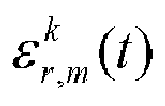
- the additive noise contributions ⁇ r , m k t and ⁇ r , m k t for code- and carrier-phase measurements are modeled as zero mean white Gaussian processes, i.e., a possible multipath effect is already corrrected for [16].
- the clock offsets of receiver and satellite are denoted by ⁇ r (t) and ⁇ ⁇ ⁇ r k t at the time of reception and transmission, respectively, and the tropospheric delay is modeled as the product of the zenith delay T z,r (t) at receiver r and the mapping function M E r k t depending on the elevation angle E r k t between satellite k and user r .
- one of the satellites is chosen as a reference satellite.
- the phase bias of that satellite is absorbed in the receiver phase-biases ⁇ r,m , and all satellite phase-biases ⁇ m k are only estimated as the offset to the bias of that reference satellite.
- the same strategy is applied to the receiver and satellite clock errors ⁇ r (t) and ⁇ ⁇ ⁇ r k t .
- the linear dependencies between the remaining phase-biases and the integer ambiguities N r , m k are removed via a Gaussian elimination. Thereby, one set of ambiguities is mapped to the phase-biases and becomes real valued, while a second set of ambiguities is exclusively mapped to other ambiguities, which preserves the integer property.
- system model (14) can be written in the form of (1), and the presented three-step framework can be applied, either with BS, ILS, BIE or SBIE.
- the temporal evolution of the parameters in the state vector can be modeled as a Gauss-Markov process with white Gaussian process noise. Hence, for all constant parameters, like biases and integer ambiguities, no noise is present.
- the MSE-optimal estimates can be computed recursively with a Kalman filter, which minimizes the MSE for the class of linear estimators.
- non-linear estimators like SBIE can be applied, i.e., the outcome of the Kalman filter serves as the float solution of the three-step framework of Section 2.
- SBIE non-linear estimators
- the MSE curves resulting from Monte-Carlo simulations with 10 4 realizations are plotted against epochs in Figure 5 . Due to the high probability of wrong fixing, the performance of ILS and BS is worse compared to the float solution in the first epochs, but will converge to the optimal BIE solution with vanishing probability of wrong fixing (not depicted here).
- the increase of the MSE in the first epochs can be ascribed to the weighting with the inverse covariance matrix with decreasing variances.
- the BIE solution is optimal, though it appears to be worse than the float solution at very low precision, which is caused by the sloppy approximation of the ambiguity estimate N BIE in that regime (not critical for higher precision, where a smaller number of candidates is required).
- the SBIE estimator shows (quasi-) optimal performance for low and high precision. The only penalty appears -- as expected -- in between these two cases, yet it is small enough, that SBIE is still superior to ILS. Note, that approximating the SBIE ambiguity estimates in the first epochs is much easier and, thus, can be done more precisely than the approximation of the BIE ambiguity estimates.
- a global network of R 20 reference stations is considered for satellite bias estimation, and the satellite constellation is assumed to follow a Walker 27/3/1 constellation, i.e., the Galileo setup.
- the elevation mask is set to 5deg, and Niell's model [18] is used for modeling tropospheric slant delays.
- satellite orbit errors and error rates are included in the parameter vector, which are described in the RIC coordinate frame (radial, in-track, and cross-track) [16], and follow Newton's laws of motion.
- n 228 is reached, considering only those satellites at each receiver, which are visible over the whole period. Therefore, ILS and BIE are excluded in the analysis, as their respective searches are too complex.
- L ⁇ d ⁇ z N ⁇ l
- ⁇ d ⁇ z 1 by definition and w z N ⁇ l
- N l , SBIE N l , ⁇ l ⁇ 1 ... n , which concludes the proof, as the float solution is optimal.
- SBIE is optimal for very high precision of N : according to (5), the weighting coefficients w z N ⁇ l
- L exp - 1 2 ⁇ ⁇ N ⁇ l
- L 2 1 1 + ⁇ z ⁇ ⁇ Z z ⁇ ⁇ z exp - 1 2 ⁇ ⁇ N ⁇ l
Landscapes
- Engineering & Computer Science (AREA)
- Radar, Positioning & Navigation (AREA)
- Remote Sensing (AREA)
- Computer Networks & Wireless Communication (AREA)
- Physics & Mathematics (AREA)
- General Physics & Mathematics (AREA)
- Position Fixing By Use Of Radio Waves (AREA)
Abstract
- phase measurements on the carriers of the navigation signals are performed (12),
- a real-valued float solution for at least one real-valued parameter and for phase ambiguities of the phase measurements and a corresponding covariance matrix are determined,
- a sequential resolution of the phase ambiguities is performed, wherein a particular ambiguity to be resolved is mapped on a fixed ambiguity in dependency of the previously fixed ambiguities, wherein the mapping of a particular ambiguity to be resolved to the fixed ambiguity is performed by setting the fixed ambiguity equal to a weighted sum of integer candidates for the particular ambiguity, and
- the float solution of the at least one real-valued parameter is adjusted to the fixed ambiguities
Description
- The invention relates to a method for determining at least one real-valued parameter, in particular an absolute or relative position of a receiver, by means of a satellite navigation system comprising a plurality of satellites, which emit navigation signals on carrier signals, the method comprising the steps:
- phase measurements on the carriers of the navigation signals are performed,
- a real-valued float solution for the at least one real-valued parameter and for phase ambiguities of the phase measurements and a corresponding covariance matrix are determined,
- a sequential resolution of the phase ambiguities is performed, wherein a particular ambiguity to be resolved is mapped on a fixed ambiguity in dependency of the previously fixed ambiguities, and
- the float solution of the at least one real-valued parameter is adjusted to the fixed ambiguities.
- The invention further relates to a reference station and a mobile navigation device.
- Such a method is known from [6]. In a first step, disregarding the integer nature of the phase ambiguities, a float solution is determined for the real-valued parameters and phase ambiguities. In a second step, a mapping is performed, in which the float ambiguity estimate is used to compute the corresponding integer ambiguity estimate. Once the integer ambiguities are computed, the integer ambiguities are used in a third and final step to correct the float estimate of real-valued parameters. The mapping of the float ambiguity estimate on the integer ambiguity estimate is performed by using a method called ambiguity bootstrapping (= BS), in which the ambiguities are sequentially determined by a rounding operation followed by a conditioning operation of the unresolved ambiguities.
- The use of such a method is motivated by the desire to increase the precision of conventional global navigation satellite systems (= GNSS), whose precision can be considerably increased through the use of carrier-phase measurements, which can be tracked with millimeter accuracy, but are ambiguous. When using carrier-phase measurements in GNSS applications, the key to high precision parameter estimation (e.g., positioning), is to take into account the integer nature of the ambiguities, or when the correct integer values cannot be determined, to provide sufficiently precise estimates for the phase ambiguities.
- In the past two decades, research focussing on the estimation of these integer valued ambiguities was of great interest, reaching from the theoretical concept of estimation [12] over ambiguity validation [13] to highly reliable estimation schemes [4, 5]. As the reliability of integer ambiguity estimation strongly depends on the precise knowledge of error sources like atmospheric delays or instrumental hardware biases, one usually uses double difference measurements for differential positioning, which strongly suppresses most of the error sources. However, the availability of highly precise satellite clock and orbit corrections enables the use of an absolute positioning strategy with undifferenced measurements [2], referred to as precise point positioning (= PPP). Obviously, in such an absolute positioning scheme, the above mentioned error sources are all present and have to be estimated in advance in order to adjust the GNSS measurements. For the joint estimation of satellite biases or orbit corrections, a large-scale network of reference stations with precisely know coordinates is required.
- There exists a great variety of integer ambiguity estimators, reaching from a standard linear least-squares estimator, which generates a so called float solution, to a class of integer estimators like integer bootstrapping (= BS) [6], integer aperture estimators [13, 8], and the integer least-squares (= ILS) estimator, which minimizes the squared norm of the residuals of the linear GNSS model under the constraint of the ambiguity estimates being integer valued. A very efficient implementation of the latter scheme is given by the famous Least-Squares AMBiguity Decorrelation Adjustment (= LAMBDA) method [10]. Often, an integer valued ambiguity estimate resulting from BS or ILS is called fixed solution.
- The class of integer estimators, like integer bootstrapping (= BS) or integer least-squares (= ILS), fixes the ambiguities to integer values, but can also decrease the precision of the estimates of the non-ambiguity parameters, if the probability of wrong fixing is not sufficiently small.
- A further, very promising estimator is the best integer-equivariant (= BIE) estimator [7], which results from a joint minimization of the MSE of both integer ambiguities and real valued parameters over a more general class of estimators, which includes both float and fixed solution, and also the class of integer aperture estimators.
- The BIE estimator is optimal in the sense of minimizing the mean-squared error (= MSE) of both the integer and real valued parameters, regardless of the precision of the float solution. However, like ILS, the BIE estimator comprises a search in the integer space of ambiguities, whose complexity grows exponentially with the number of ambiguities. The search in the integer space of ambiguities constitutes a major drawback of this estimator and disqualifies its use for a joint network parameter estimation with a large number of ambiguities and, therefore, for satellite bias estimation.
- In order to overcome this complexity problem, a suboptimal estimation scheme based on the BIE estimator can be used. In [15], a partial BIE estimation scheme was proposed, which combines BS, BIE and float solution, and uses each of them in the respective regime, where it performs close to optimum.
- Proceeding from this related art, the present invention seeks to provide a method for a joint estimation of real-valued parameters, such as biases, and of ambiguities of a GNSS, in a situation where a large number of parameters has to be determined.
- This object is achieved by a method having the features of the independent claim. Advantageous embodiments and refinements are specified in claims dependent thereon.
- In the method, a sequential resolution of the phase ambiguities is performed. The mapping of a particular ambiguity to be resolved within the sequence of ambiguities to the resolved is performed by setting the fixed ambiguity equal to a weighted sum of integer candidates for the particular ambiguity. The integer candidates are selected from a one-dimensional range around the float solution for the particular ambiguity, and the weighting coefficients are proportional to the values of a probability distribution of the float solution for the particular ambiguity at the locations of the integer candidates. Thus, instead of performing one n -dimensional search in the integer space of ambiguities as in the conventional BIE method, n one-dimensional searches are performed, which means that a separate BIE estimation is done for each ambiguity. Thus the complexity of the search and the computational burden is significantly reduced in comparison with conventional BIE. Numerical simulation demonstrate that the method has a close to optimal performance, similar to a conventional BIE method. That means that the method also outperforms conventional BS.
- For the sequential resolution, a decomposition of the covariance matrix of the float solution can be used, wherein the inverted covariance matrix is decomposed into a product of a triangular matrix, a diagonal matrix and the transposed triangular matrix, and wherein the diagonal matrix and the triangular matrix are used for a sequential resolution of the phase ambiguities. The decomposition is usually performed in connection with an integer decorrelation.
- Code measurements on the navigation signal are usually performed besides the phase measurements on the carriers of the navigation signals, and the code measurements and phase measurements are used for determining the real-valued float solution for the at least one real-valued parameter and for the phase ambiguities.
- The float solution for the at least one real-valued parameter and for the phase ambiguities is generally determined by a least-square method, whose result can also be used for initializing a recursive state estimator, for instance a Kalman filter for increasing the precision of the float solution.
- In most embodiments, the at least one real-valued parameter is the actual absolute or relative position of a navigation device. Besides or instead of the actual or relative position of a navigation device, the float solution can include a real-valued solution for instrumental biases of the code measurements and/or phase measurements, and/or environmental errors.
- For reducing the number of unknown parameters, a number of unknown parameters is mapped to the parameters of the float solution before the float solution is determined.
- Fixing a particular ambiguity affects also the resolution of the subsequent unresolved ambiguities. Therefore the float solution of the particular ambiguity to be resolved is conditioned in dependency of the previously resolved ambiguities.
- The conditioning can be performed by projecting the differences between the previously resolved ambiguities and the float solution of the previously resolved ambiguities in the space of the particular ambiguity to be resolved, by summing up the contribution of each individual projection, and by correcting the float solution for the ambiguity to be resolved by the resulting sum.
- The one-dimensional range and the probability distribution can be centered on the conditioned float solution of the particular ambiguity to be resolved, and the width of the probability distribution can depend on the variance of the conditioned float solution to be resolved. The probability distribution may further be assumed to be a Gaussian distribution. It should be noted that the probability distribution of the float solution is not completely known. Only the covariance matrix is known from the determination of the float solution, but the mean value of the float solution, which is the unknown integer ambiguity vector, is unknown. As an approximation, the probability distribution can therefore be centered on the conditioned float solution.
- The boundaries of the one-dimensional range can depend on the variance of the conditioned float solution of the particular ambiguity to be resolved. Thus, an appropriate number of integer candidates will be taken into account in the mapping and the range of the mapping will be sufficiently large.
- The integer decorrelation can be performed before the sequential resolution of the phase ambiguities by an integer preserving transformation of the ambiguities. In this case, the integer preserving transformation is chosen such, that an inverse transformation applied to the resolved ambiguities also preservers integers.
- Instead of or in addition to the integer preserving transformation, the phase ambiguities to be resolved can be sorted according to their respectively associated variances, which depend on the variances of the float solutions for the phase ambiguity. The phase ambiguities will in most cases sorted such that the phase ambiguities are resolved proceeding from an ambiguity having a smaller associated variance to an ambiguity having a bigger associated variance.
- The float solution of the at least one real-valued parameter is finally adjusted by correcting the float solution of the at least one real-valued parameter by a projection of the fixed ambiguities in the space of the at least one real-valued parameter.
- A computational unit of a network of reference stations and a computational unit of a navigation device can be arranged for performing the method. In the network, a large number of satellite biases can be determined at a reduced computational burden. Due to the reduced requirements on the computational power, a mobile navigation device may also be capable for performing the method described herein.
- Further advantages and properties of the present invention are disclosed in the following description, in which exemplary embodiments of the present invention are explained in detail based on the drawings:
- Figure 1
- illustrates a satellite navigation system;
- Figure 2
- depicts a flow diagram of the method;
- Figure 3
- illustrates weights of integer candidates in the low precision case;
- Figure 4
- illustrates weights of the integer candidates in the high precision case;
- Figure 5
- is a diagramm containing MSE curves of a float solution, and BS, ILS, SBIE and BIE estimates plotted agains epochs t; and
- Figure 6
- is a digramm showing mean standard deviations of the satellite phase-bias estimates for float solution, BS, and SBIE plotted agains epochs t.
-
Figure 1 shows a Global Navigation Satellite System ( = GNSS) 1, which comprisessatellites 2, which are orbiting around the earth 3 and emitsatellite signals 4, which are modulated on a number of carrier signals 5. - A plurality of
stationary reference station 6 is distributed over the earth 3. Thereference stations 6 are each provided withreveivers 7, for performing code measurements on the navigations signal 4 and for further perfoming phase measurements on the carrier signals 5. The measurements of thereference stations 6 are transmitted to a central processing unit 8, which uses the measurements for determining systematic instrumental errors, such as satellites biases and reveiver biases, and also uses the measurments for determining environmental errors, such as ionospheric errors or tropospheric errors. For determining these errors, the central processing unit 8 can perform the method described therein. In this case, the method will be used for determining the real-valued instrumental and environmental errors, since the positions of thereference stations 6 are already precisely known. For determining the instrumental and environmental errors the phase ambiguities have also to be resolved. - It should be noted that the central processing unit 8 can also form an integral part of one of the
reference stations 6. - The
navigation signal 4 can also be received by amobile object 9, which is provided with areceiver 10 for performing code measurements on the navigation signals 4 and for performing phase measurements on thecarrier signal 5. These code measurements and phase measurements are processed by aprocessing unit 11 of themobile object 9. Themobile object 9 can be a mobile navigation device or a vehicle provided with navigation means. - The errors determined by the central processing unit 8 can be transmitted to the
mobile object 9. Theprocessing unit 11 can then use the code measurements on the navigation signals 4 and the phase measurements on the carrier signals 5, and the error values determined by the central processing unit 8 and transmitted to theprocessing unit 11 as well as the method described therein for performing a PPP, in order to determine the absolute position of themobile object 9. In this case, the method is used for determining the absolute position of thereceiver 10, the instrumental errors of thereceiver 10, and the phase ambiguities, since the satellite biases, and the ionospheric and tropospheric error have already been determined by the network ofreference stations 6 and are provided by the network ofreference stations 6. - Alternatively the
processing unit 11 can use the code measurements on the navigation signals 4 and the phase measurements on the carrier signals 5, which have been performed by themobile object 9, the code and phase measurements, which have been performed by at least one of thereference stations 6, and the error values determined by the central processing unit 8 and transmitted to theprocessing unit 11 as well as the method described therein for differential positioning, in which the relative position of themobile object 9 with respect to the at least onereference station 6 is determined based on double-differences of the code and phase measurements of the at least onereference station 6 and themobile object 9. In this case, the method is used for determining the relative position of thereceiver 10, the instrumental errors of thereceiver 10, and the phase ambiguities, since the satellite biases, the ionospheric and tropospheric error have already been determined by the network ofreference stations 6. - The method described herein can finally also be used for PPP based on measurements performed exclusively by the
mobile object 9. In this case, the absolute position of thereceiver 10 as well as all relevant instrumental and environmental errors are determined by theprocessing unit 11 of themobile object 9. -
Figure 2 shows a flow diagram of the method described herein. The method starts with ameasurement 12, generally a code and phase measurement. The measurement is followed by amapping 13, in which the number of parameters is reduced. Then a real-valued float solution for at least one real-valued parameter and for the phase ambiguities is determined by ainital estimation 14, such as a least-square estimation. Theinitial estimation 14 may be used for initializing arecursive state estimator 15, such as a Kalman filter. Within such arecursive state estimator 15predictions 16 based onprevious measurements 12 at previous epochs are repeatedly updated by anUpdate 17, which compares the prediction with acurrent measurement 12 and refines theprediction 16. The epochs are the instants of time, at which themeasurements 12 are performed. The time period between epochs is typically 10 sec. Applying the recursive state estimator on themeasurements 12 of several epochs result in a float solution of the at least one real-valued parameter and the phase ambiguities. - The float solution is subjected to a Sequential Best Integer-Equivariant Estimation (= SBIE) 18. In a first step, an
integer decorrelation 19 is performed. Then the ambiguities are sequentially resolved by a one-dimensional BIE estimation 20. In the one-dimensional BIE estimation 20, the ambiguity to be determined is fixed based on a mapping. In this mapping the ambiguity, which has to be determined, is set euqal to a weighted sum of integer candidates from a one-dimensional range around the float solution for the particular ambiguity to be resolved. The one-dimensional BIE estimation 20 is followed by aconditioning 21, in which the float solutions and the boundaries for the ambiguities, which must subsequently be determined, are adapted to the already fixed ambiguities. TheBIE estimation 20 and theconditioning 21 are repeated until all ambiguities, which have to be fixed, are actually resolved. - The fixed ambiguities are then subjected to an
inverse integer decorrelation 22. Finally anestimation 23 of the real-valued parameters is performed. - In principle, all GNSS problems (e.g., positioning or the estimation of code- and phase-biases) that include carrier-phase and, optionally, also code measurements or combinations thereof, can be cast as a system of linear equations in the form

where Ψ ∈q is the measurement vector, which contains undifferenced measurements, single- or double-difference combinations. The vectors N ∈ n and ξ ∈
 p denote the unknown integer ambiguities and real valued parameters, respectively, and the corresponding matrices H N ∈
 q×n and H ξ ∈
 q×p represent the linear system model.
- Finally, η Ψ ∈q is an additive Gaussian noise with zero mean and covariance matrix Qη

Ψ ∈q×q .
- The method described herein used the class of integer-equivaraint estimators. The class of integer-equivariant estimators is characterized by the integer remove-restore property, i.e., if the measurements are perturbed by an arbitrary number of cycles H N z, ∀z ∈n , the solution for the ambiguity estimate is shifted by z. Likewise a perturbation by H ξξ, ∀ξ ∈
 p , results in a shift of the real valued parameter vector by ξ, while the integer part is not affected. It can easily be shown, that all linear unbiased estimators fulfill this property [11], which makes the float estimator part of this class. Furthermore, admissible integer estimators [12] like BS or ILS are also part of this class by definition. Minimizing the MSE over the class of integer-equivariant estimators thus leads to an estimator (the BIE estimator) with at least equal performance compared to both the float and fixed solution [14].
- From the definiton of the MSE criterion in [7] it follows, that the BIE estimator not only minimizes the mean-squared error in the Euclidean sense, but also in the metric of an arbitrary covariance matrix. Hence, the BIE estimates for ambiguities and real valued parameters are given by

whereis defined is the sense of positive semi-defineteness, and the estimates and
and result from an integer-equivariant estimator.
- Although the BIE estimator can be derived for an arbitrary noise contribution ηΨ in (1) [11], we restrict ourselves to Gaussian noise in this work. That being the case, the BIE estimator follows the three-step procedure, which is well known from integer (aperture) estimators [12, 13, 10]:
- The integer property of the ambiguities N is discarded, i.e., a standard linear weighted least-squares adjustment is performed, which leads to the unbiased, Gaussian distributed float solutions N̂ and ξ̂ with the respective covariance matrices Q N̂ ∈n×n and Q ξ̂ ∈
 p×p , and cross-covariance matrix Q ξ̂N̂ ∈
 p×n .
p×n .
- A mapping is introduced, that allocates to each N the BIE ambiguity solutionBIE. Note that the resulting
 BIE is real-valued. In cases of a low success rate for estimating the integer ambiguity, the real-valued BIE ambiguity solution is a better estimation than any integer ambiguity estimation.
- This ambiguity estimate is then used to adjust the float solution of the real valued parameters ξ in a least-squares sense, i.e.,

- Note that in (6) the differences between the fixed ambiguitiesBIE and the float solution N̂ are projected in the space of the real-valued parameters and that the real parameters are corrected by the projected difference.

- The crucial point in the above procedure is the second step, which is given by

i.e., the BIE ambiguity solution N BIE is a weighted sum of all vectors in the n -dimensional space of integers. The weighting coefficients in (4) are computed as
- Because of the infinite sums in (4) and (5), the computation of the true BIE ambiguity estimates is not feasible. As a consequence, the sums are constrained to the set


- Although the integer decorrelation and tree-search reformulation dramatically reduce the complexity of finding the integer candidates within the search space

- The method described herein offers a suboptimal, but from a computational point of view less demanding approach, which combines the optimal BIE estimator with a sequential processing strategy, similar to the bootstrapping (= BS) method [6]. Instead of performing one n -dimensional search in the integer space of ambiguities, n one-dimensional searches are performed, i.e., a separate BIE estimation is done for each ambiguity. Note, that only the second step of the three-step framework is affected.
- Like in BS, the BSIE solution can be determined sequentially, since for a Z to be determined:

- The correlation matrix


- This decomposition can be the result of an integer decorrelation [6]. Thus equation (6) can be written as:

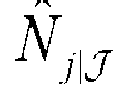
- Since the inverted triangular matrix is also a triangular matrix, as in the BS method, the ambiguities can be sequentially estimated, starting with the first ambiguity and conditioning each ambiguity on the ones, that have already been estimated. The j -th conditioned ambiguity is given by

where
 ={1,...,j-1} for j>0 and
 =∅ for j=0, and the set
 is defined accordingly. The variances and covariances are accessible from the LTDL decomposition of Q N̂ [6], which is already available from the integer decorrelation.
- Note that, according to (9), the conditioning is performed by projecting the differences between the previously resolved ambiguitiesl,SBIE and the float solution


- It should further be noted that instead of or in addition to the integer decorrelation, the phase ambiguities to be resolved can be sorted according to their respectively associated variances, which depend on the variances of the float solutions N̂j for the phase ambiguity. The phase ambiguities will in most cases sorted such that the phase ambiguities are resolved proceeding from an ambiguity having a smaller associated variance to an ambiguity having a bigger associated variance, so that the most reliable estimates are performed first.
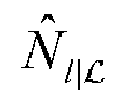
- The final SBIE ambiguity estimates, also required for (9) itself, are computed from (4) and (5), adjusted to the one-dimensional case, from the conditional float ambiguity estimates


- In contrast to the multivariate case, the search for the integer candidates itself is a trivial task in one-dimensional space, as one simply has to find all scalar integers within a given interval

- The normalized size of the search interval d does not depend on the variance of the conditioned float solution and -- as already mentioned -- can be derived from the probabilistic criterion

for a fixed value of c, as
 .
.
- After the sequential estimation, the ambiguities are stacked into a vector

which is then used to adjust the float solution of the real valued parameters ξ̂ according to the third step of the three-step framework. - Obviously, this SBIE estimation allows for a complexity reduction from exponential order for the true BIE estimator to linear order. Therefore, the complexity of SBIE is comparable to the one of the BS algorithm, and, coming along with that, also much lower than the one of ILS. The loss of performance resulting from the suboptimality is to be numerically evaluated in
Section 4. - Note, that the resulting SBIE ambiguity estimates are not unique, but depend on the ordering of the (decorrelated) ambiguities. In the simulations below, the order is chosen such, that the precision of the float ambiguity estimates "decreases" with increasing index, i.e., in each step the ambiguity with the float solution showing the smallest conditional variance is chosen next.
- Despite its general suboptimality, there exist three cases, in which the SBIE estimator is equal to or converges to the MSE optimal BIE solution.
- In that case the SBIE algorithm can be shown to be equivalent to the true BIE algorithm. As the single ambiguities are uncorrelated, the sequential estimation of the ambiguities gets a separate estimation, which should be intuitive to be optimal. This property represents a further motivation for a prior integer decorrelation, which diagonalizes Q N̂ as far as possible.
- The integer grid is very dense compared to the probability density of the float solution N. Therefore, in the limit case, for each ambiguity there exists an integer larger than the float solution corresponding to each integer smaller than the float solution with the same distance to

- This can also be regonized from
Figure 3 , which shows the weights of the integer candidates (dotted lines), which are directly proportional to the value of the Gauss-curve centered around the float solution.Figure 3 illustrates the case for low precision. We can see, that for low precision there is always a pair of candidates with approximately the same weights averaging to the float solution itself. - The probability density of the float solution N is very peaked compared to the integer grid, which causes a SBIE solution, that automatically converges to the BS solution, as the weighting coefficients in (10) approach binary values. For vanishing probability of wrong fixing, i.e., in the high precision regime, the BS solution is also MSE optimal.
- This can also be recognized from
Figure 4 , which corresponds toFigure 3 , but illustrates the situation for high precision. In this case, the weights approach binary values. - The optimality of SBIE for these three cases is proven analytically in the Appendix.
- Assuming, that the hardware biases of the GNSS measurements are not link dependent, but can rather be modeled as a sum of satellite and receiver specific biases, the absolute code-


- The ionospheric slant delay (phase advance) on the first frequency is denoted by


- The geometry terms


with 3 the receiver position at the time of reception t, and


- Further effects like phase-wind-up and phase-center variations are assumed to be completely compensated for in advance.
- A joint estimation of all hardware biases, ambiguities, clock offsets and atmospheric errors is not feasible due to the rank deficiency of the system of equations (14). Therefore, the three-step parameter mapping strategy from [17] is applied before the parameter estimation. Firstly, the code-biases br,m and

- In the second step, one of the satellites is chosen as a reference satellite. The phase bias of that satellite is absorbed in the receiver phase-biases βr,m, and all satellite phase-biases


- As a last step, the linear dependencies between the remaining phase-biases and the integer ambiguities

- After all parameter mappings the system model (14) can be written in the form of (1), and the presented three-step framework can be applied, either with BS, ILS, BIE or SBIE.
- Besides the measurement model (14), the temporal evolution of the parameters in the state vector can be modeled as a Gauss-Markov process with white Gaussian process noise. Apparently, for all constant parameters, like biases and integer ambiguities, no noise is present. After a least-squares initialization the MSE-optimal estimates can be computed recursively with a Kalman filter, which minimizes the MSE for the class of linear estimators. Based on the Gaussian distributed estimates resulting from the update-step of the Kalman filter, further, non-linear estimators like SBIE can be applied, i.e., the outcome of the Kalman filter serves as the float solution of the three-step framework of
Section 2. As the BIE (and also SBIE) estimates do not follow a Gaussian distribution, a feedback-loop to the Kalman filter cannot be set up to fasten the convergence. - The great advantage of using a Kalman filter for evaluating the performance of the SBIE estimator compared to other schemes is, that it offers a wide range of precision characteristics of the float solution, starting with very low precision and ending up at very high precision after sufficient convergence. Thus, evaluating the performance of the different estimators as a function of the epochs of the Kalman filter also allows for an interpretation of the performance depending on the precision of the float solution.
- For all simulations, pseudorange and carrier-phase measurements on the two frequencies f 1 = 154·10.23MHz and f 2 = 120·10.23MHz are modeled, where the measurement noise is chosen as σρ = 1m and σϕ = 2cm, respectively. The time interval between two subsequent epochs is chosen as Δt = 1s.
- A small toy-example with only R = 2 reference stations, each having a line of sight connection to K = 6 satellites is considered. After the parameter mappings this results in n =10 ambiguities and p = 35 real valued parameters, which also allows for applying the two search-based estimators, namely BIE and ILS, due to the small number of ambiguities. The performance of the different estimation schemes is compared via the weighted MSE

where QF (t) ∈(n+p)×(n+p) is the covariance matrix of the float solution at time t. By definition, the MSE of the float solution is constant with the number of unknowns

- The MSE curves resulting from Monte-Carlo simulations with 104 realizations are plotted against epochs in
Figure 5 . Due to the high probability of wrong fixing, the performance of ILS and BS is worse compared to the float solution in the first epochs, but will converge to the optimal BIE solution with vanishing probability of wrong fixing (not depicted here). The increase of the MSE in the first epochs can be ascribed to the weighting with the inverse covariance matrix with decreasing variances. By definition, the BIE solution is optimal, though it appears to be worse than the float solution at very low precision, which is caused by the sloppy approximation of the ambiguity estimate
- A global network of R = 20 reference stations is considered for satellite bias estimation, and the satellite constellation is assumed to follow a Walker 27/3/1 constellation, i.e., the Galileo setup. The elevation mask is set to 5deg, and Niell's model [18] is used for modeling tropospheric slant delays. Compared to the previous toy-example, satellite orbit errors and error rates are included in the parameter vector, which are described in the RIC coordinate frame (radial, in-track, and cross-track) [16], and follow Newton's laws of motion. For the simulated time span of 30min , a total number of ambiguities n = 228 is reached, considering only those satellites at each receiver, which are visible over the whole period. Therefore, ILS and BIE are excluded in the analysis, as their respective searches are too complex.
- As the float solution as well as BS and SBIE are unbiased estimators, their performance can be compared using the mean (with respect to different satellites and frequencies) standard deviation of the satellite phase-bias estimates

- One obvious result from
Figure 6 is, that by somehow taking into consideration the integer nature of the ambiguities, the accuracy of the float bias estimates can be considerably improved, if the precision of the float solution itself is not too low. A great advantage of SBIE (and also BIE) is, that one does not have to think about which ambiguities to fix or when to fix a certain ambiguity, and setting up some decision criterion, as SBIE automatically converges to the respective best solution. - A novel GNSS parameter estimation scheme was proposed, which combines the MSE-optimal BIE estimator with the sequential estimation strategy known from BS. Thereby, the complexity was reduced from exponential to linear order, as the computationally demanding search operation was replaced by trivial, one-dimensional searches. In numerical simulations the close to optimum performance of SBIE was proven true. These properties not only provide for an applicability in large-scale networks, but also for applications, which require low complexity, such as in smartphones, automobile or maritime devices for carrier-phase based positioning.
- Throughout the description and claims of this specification, the singular encompasses the plural unless the context otherwise requires. In particular, where the indefinite article is used, the specification is to be understood as contemplating plurality as well as singularity, unless the context requires otherwise.
- Features, integers, characteristics, or groups described in conjunction with a particular aspect, embodiment or example of the invention are to be understood to be applicable to any other aspect, embodiment or example described herein unless incompatible therewith.
- SBIE is optimal for QN diagonal: the exponential function in the computation of the BIE ambiguity estimate (5) can be split to

which is a product of factors el (zl ) only depending on the l th ambiguity. Hence, the BIE estimate for the j th ambiguity according to (4), (5) and (19) is given by
which corresponds to a separate estimation of all ambiguities with a one-dimensional BIE estimator, which is again equal to the SBIE estimator for uncorrelated float ambiguity estimates. - SBIE is optimal for very low precision of N : as the integer grid gets very dense compared to the probability density of the float solution, the summation in (10) can be replaced by proper integration in the limit case (an infinite search space is assumed)

which is equal to the conditioned float solution



which concludes the proof, as the float solution is optimal. - SBIE is optimal for very high precision of N : according to (5), the weighting coefficients


- Let the rounding operator be denoted by [·]. From (23) it follows, that

as


- Inserting (24) and (25) in (10) proves the equivalence of SBIE and conditional rounding (i.e., BS) for the high precision regime, which is optimal there.
-
- [1] C. Günther and P. Henkel. Integer Ambiguity Estimation for Satellite Navigation. IEEE Transactions on Signal Processing, 60(7):3387--3393, 2012.
- [2] J. F. Zumberge and M. B. Heflin and D. C. Jefferson and M. M. Watkins and F. H. Webb. Precise point positioning for the efficient and robust analysis of GPS data from large networks. J. Geophys. Res., 102:5005--5018, 1997.
- [3] P. De Jonge and C. Tiberius. The LAMBDA method for integer ambiguity estimation: implementation aspects. Delft Geodetic Computing Centre LGR Series, 12, 1996.
- [4] P. Henkel. Reliable Carrier Phase Positioning. Dissertation, Technische Universität München, 2010.
- [5] P. Henkel and C. Günther. Reliable Integer Ambiguity Resolution with MultiFrequency Code Carrier Linear Combinations. Journal of Global Positioning Systems, 9(2):90--103, 2010.
- [6] P. J. G. Teunissen. GNSS ambiguity bootstrapping: Theory and application. Proceedings of Int. Symp. on Kinematic Systems in Geodesy, Geomatics and Navigation, pages 246--254, Banff, Canada, 2001.
- [7] P. J. G. Teunissen. GNSS Best Integer Equivariant Estimation. A Window on the Future of Geodesy in International Association of Geodesy Symposia, pages 422-427. 2005.
- [8] P. J. G. Teunissen. Integer aperture GNSS ambiguity resolution. Artificial Satellites, 38(3):79--88, 2003.
- [9] P. J. G. Teunissen. On the Computation of the Best Integer Equivariant Estimator. Artificial Satellites, 40(3):161--171, 2005.
- [10] P. J. G. Teunissen. The least-squares ambiguity decorrelation adjustment: a method for fast GPS integer ambiguity estimation. Journal of Geodesy, 70:65--82, 1995.
- [11] P. J. G. Teunissen. Theory of integer equivariant estimation with application to GNSS. Journal of Geodesy, 77:402-410, 2003.
- [12] P. J. G. Teunissen. Towards a unified theory of GNSS ambiguity resolution. Journal of Global Positioning Systems, 2(1):1--12, 2003.
- [13] S. Verhagen. The GNSS integer ambiguities: estimation and validation. Dissertation, Technische Universiteit Delft, 2004.
- [14] S. Verhagen and P. J. G. Teunissen. Performance comparison of the BIE estimator with the float and fixed GNSS ambiguity estimators. A Window on the Future of Geodesy in International Association of Geodesy Symposia, pages 428-433. 2005.
- [15] Zhibo Wen and Patrick Henkel and Andreas Brack and Christoph Gunther. Satellite Bias Determination with Global Station Network and Best Integer-Equivariant Estimation. Proceedings of the ION GNSS International Technical Meeting 2012, Nashville, Tennessee, US, 2012.
- [16] Z. Wen, P. Henkel, M. Davaine, and C. Günther, Satellite Phase and Code Bias Estimation with Cascaded Kalman Filter, in Proceedings of European Navigation Conference (ENC), London, U.K., 2011.
- [17] P. Henkel, Z. Wen, and C. Günther, Estimation of satellite and receiver biases on multiple Galileo frequencies with a Kalman filter, in Proceedings of the ION ITM 2010, 2010, pp. 1067-1074.
- [18] A. E. Niell, Global mapping functions for the atmosphere delay at radio wavelengths, Journal of Geophysical Research, vol. 101, no. B2, pp. 3227-3246, Feb. 1996.
Claims (15)
- A method for determining at least one real-valued parameter, in particular an absolute or relative position of a receiver (7, 10), by means of a satellite navigation system (1) comprising a plurality of satellites (2), which emit navigation signals (4) on carrier signals (5), the method comprising the steps:- phase measurements (12) on the carriers (5) of the navigation signals (4) are performed,- a real-valued float solution for the at least one real-valued parameter and for phase ambiguities of the phase measurements and a corresponding covariance matrix are determined,- a sequential resolution of the phase ambiguities is performed, wherein a particular ambiguity to be resolved is mapped on a fixed ambiguity in dependency of the previously fixed ambiguities, and- the float solution of the at least one real-valued parameter is adjusted to the fixed ambiguities,characterized in that- the mapping of a particular ambiguity to be resolved to the fixed ambiguity is performed by setting the fixed ambiguity equal to a weighted sum of integer candidates for the particular ambiguity, that- the integer candidates are selected from a one-dimensional range around the float solution for the particular ambiguity, and that- the weighting coefficients are proportional to the values of a probability distribution of the float solution for the particular ambiguity at the locations of the integer candidates.
- The method according to Claim 1,- wherein the inverted covariance matrix is decomposed into a product of a triangular matrix, a diagonal matrix and the transposed triangular matrix, and- wherein the diagonal matrix and the triangular matrix are used for a sequential resolution of the phase ambiguities.
- The method according to Claim 1 or 2,
wherein code measurements on the navigation signal (4) are performed besides the phase measurements on the carriers (5) of the navigation signals (4) and wherein the code measurements and phase measurements are used for determining the real-valued float solution for the at least one real-valued parameter and for the phase ambiguities. - The method according to any one of Claims 1 to 3,
wherein the float solution for the at least one real-valued parameter and for the phase ambiguities is determined by a least-square method and/or a recursive state estimator (15) applied to measurements of different epochs. - The method according to any one of Claims 1 to 4,
wherein the at least one real-valued parameter is the actual absolute or relative position of a navigation device and/or wherein the float solution includes a real-valued solution for instrumental biases of the code measurements and/or phase measurements, and/or environmental errors. - The method according to any one of Claims 1 to 5,
wherein the number of unknown parameter to be determined is reduced by mapping (13) a selection of the unknown parameters to the parameters of the float solution before the float solution is determined. - The method according to any one of Claims 1 to 6,
wherein the float solution of the particular ambiguity to be resolved is conditioned (21) in dependency of the previously resolved ambiguities. - The method according to Claim 7,
wherein the conditioning (21) is performed by projecting the differences between the previously resolved ambiguities and the float solution of the previously resolved ambiguities in the space of the particular ambiguity to be resolved, by summing up the contribution of each individual projections, and by correcting the float solution for the ambiguity to be resolved by the resulting sum. - The method according to any one of Claims 1 to 8,
wherein the one-dimensional range and the probability distribution is centered on the conditioned float solution of the particular ambiguity to be resolved, and wherein the width of the probability distribution depends on the variance of the conditioned float solution to be resolved. - The method according to any one of Claims 1 to 9,
wherein the boundaries of the one-dimensional range depend on the variance of the conditioned float solution of the particular ambiguity to be resolved. - The method according to any one of Claims 1 to 10,
wherein an integer decorrelation (19) is performed by a integer preserving transformation of the ambiguities, before the phase ambiguities are sequentially resolved (20, 21), and wherein the integer preserving inverse transformation (22) is applied to the resolved ambiguities. - The method according to any one of Claims 1 to 11,
wherein the phase ambiguities to be resolved are sorted according to their respectively associated variances, which depend on the variances of the float solutions for the phase ambiguity, and wherein the phase ambiguities are resolved proceeding from a ambiguity having a smaller associated variance to a ambiguity having a bigger associated variance. - The method according to any one of Claims 1 to 12,
wherein the float solution of the at least one real-valued parameter is adjusted (22) by correcting the float solution of the at least one real-valued parameter by a projection of the fixed ambiguities in the space of the at least one real-valued parameter. - A network of reference stations (6) connected to a central processing unit (8), the reference station (6) being provided with receivers (7) for measuring navigation signals emitted by satellites (2) of satellite navigation system (1),
characterized in that
the central processing unit (8) is arranged for performing a method according to any one of claims 1 to 13. - A mobile navigation device (9) having a receiver (10) for measuring navigation signals emitted by satellites (2) of satellite navigation system (1) and having a processing unit (11),
characterized in that
the central processing unit (11) is arranged for performing a method according to any one of claims 1 to 13.
Priority Applications (1)
| Application Number | Priority Date | Filing Date | Title |
|---|---|---|---|
| EP13152931.5A EP2759849B1 (en) | 2013-01-28 | 2013-01-28 | Method, network of reference stations and mobile navigation device for determining at least one real valued parameter of a receiver, in particular an absolute or relative position of the receiver, by means of a satellite navigation system |
Applications Claiming Priority (1)
| Application Number | Priority Date | Filing Date | Title |
|---|---|---|---|
| EP13152931.5A EP2759849B1 (en) | 2013-01-28 | 2013-01-28 | Method, network of reference stations and mobile navigation device for determining at least one real valued parameter of a receiver, in particular an absolute or relative position of the receiver, by means of a satellite navigation system |
Publications (2)
| Publication Number | Publication Date |
|---|---|
| EP2759849A1 true EP2759849A1 (en) | 2014-07-30 |
| EP2759849B1 EP2759849B1 (en) | 2018-01-17 |
Family
ID=47740792
Family Applications (1)
| Application Number | Title | Priority Date | Filing Date |
|---|---|---|---|
| EP13152931.5A Not-in-force EP2759849B1 (en) | 2013-01-28 | 2013-01-28 | Method, network of reference stations and mobile navigation device for determining at least one real valued parameter of a receiver, in particular an absolute or relative position of the receiver, by means of a satellite navigation system |
Country Status (1)
| Country | Link |
|---|---|
| EP (1) | EP2759849B1 (en) |
Cited By (22)
| Publication number | Priority date | Publication date | Assignee | Title |
|---|---|---|---|---|
| CN107562694A (en) * | 2017-08-23 | 2018-01-09 | 维沃移动通信有限公司 | A kind of data processing method and mobile terminal |
| CN108267763A (en) * | 2017-01-03 | 2018-07-10 | 华为技术有限公司 | Method and apparatus used for positioning |
| CN109196379A (en) * | 2016-03-18 | 2019-01-11 | 迪尔公司 | Satellite navigation receiver with improved ambiguity resolution |
| US10191157B2 (en) | 2016-03-18 | 2019-01-29 | Deere & Company | Precise low-latency GNSS satellite clock estimation |
| US10222484B2 (en) | 2016-03-18 | 2019-03-05 | Deere & Company | Satellite navigation receiver with improved ambiguity resolution |
| CN109884677A (en) * | 2019-03-07 | 2019-06-14 | 成都纵横融合科技有限公司 | Post-process the optimization method of RTK positioning calculation |
| US10393882B2 (en) | 2016-03-18 | 2019-08-27 | Deere & Company | Estimation of inter-frequency bias for ambiguity resolution in global navigation satellite system receivers |
| US10422885B2 (en) | 2016-03-18 | 2019-09-24 | Deere & Company | Rapid recovery of precise position after temporary signal loss |
| US10605926B2 (en) | 2015-06-29 | 2020-03-31 | Deere & Company | Satellite navigation receiver and method for switching between real-time kinematic mode and relative positioning mode |
| US10627528B2 (en) | 2015-06-29 | 2020-04-21 | Deere & Company | Satellite navigation receiver and method for switching between real-time kinematic mode and precise positioning mode |
| US10802160B2 (en) | 2016-03-18 | 2020-10-13 | Deere & Company | Rapid determination of precise position by aiding data |
| US10809391B2 (en) | 2015-06-29 | 2020-10-20 | Deere & Company | Satellite navigation receiver and method for switching between real-time kinematic mode and precise positioning mode |
| CN111886519A (en) * | 2018-03-28 | 2020-11-03 | 三菱电机株式会社 | Positioning system, method and medium |
| CN112904385A (en) * | 2021-01-26 | 2021-06-04 | 桂林电子科技大学 | Novel double-difference integer ambiguity resolution method |
| US11150352B2 (en) | 2016-09-06 | 2021-10-19 | Deere & Company | Method and system for providing satellite correction signal with warm start |
| US11175414B2 (en) | 2015-06-29 | 2021-11-16 | Deere & Company | Satellite navigation receiver for relative positioning with bias estimation |
| US11808861B2 (en) | 2021-01-31 | 2023-11-07 | Deere & Company | Adaptive estimation of GNSS satellite biases |
| US12099125B2 (en) | 2018-06-25 | 2024-09-24 | Deere & Company | Adaptive estimation of GNSS satellite biases |
| CN118707559A (en) * | 2024-05-24 | 2024-09-27 | 中国人民解放军军事航天部队航天工程大学 | A satellite space-time benchmark performance comprehensive analysis method, system, device and medium |
| US12210107B2 (en) | 2015-06-29 | 2025-01-28 | Deere & Company | Satellite navigation receiver for relative positioning with bias estimation |
| CN120276004A (en) * | 2025-03-31 | 2025-07-08 | 武汉大学 | Ambiguity self-adaptive resolving method and system based on ILS and BIE estimation |
| EP4682589A1 (en) * | 2024-07-17 | 2026-01-21 | Veripos Limited | Systems, methods, and media for resolving floating-point ambiguities to their correct integer values for use with a positioning technique |
Citations (1)
| Publication number | Priority date | Publication date | Assignee | Title |
|---|---|---|---|---|
| WO2010021656A2 (en) * | 2008-08-19 | 2010-02-25 | Trimble Navigation Limited | Gnss signal processing methods and apparatus with ambiguity selection |
-
2013
- 2013-01-28 EP EP13152931.5A patent/EP2759849B1/en not_active Not-in-force
Patent Citations (1)
| Publication number | Priority date | Publication date | Assignee | Title |
|---|---|---|---|---|
| WO2010021656A2 (en) * | 2008-08-19 | 2010-02-25 | Trimble Navigation Limited | Gnss signal processing methods and apparatus with ambiguity selection |
Non-Patent Citations (18)
| Title |
|---|
| A. E. NIELL: "Global mapping functions for the atmosphere delay at radio wavelengths", JOURNAL OF GEOPHYSICAL RESEARCH, vol. 101, no. B2, February 1996 (1996-02-01), pages 3227 - 3246, XP009034847 |
| C. GUNTHER; P. HENKEL.: "Integer Ambiguity Estimation for Satellite Navigation.", IEEE TRANSACTIONS ON SIGNAL PROCESSING, vol. 60, no. 7, 2012, pages 3387 - 3393, XP011447351, DOI: doi:10.1109/TSP.2012.2191549 |
| J. F. ZUMBERGE; M. B. HEFLIN; D. C. JEFFERSON; M. M. WATKINS; F. H. WEBB.: "Precise point positioning for the efficient and robust analysis of GPS data from large networks", J GEOPHYS. RES., vol. 102, 1997, pages 5005 - 5018 |
| P. DE JONGE; C. TIBERIUS: "The LAMBDA method for integer ambiguity estimation: implementation aspects.", DELFT GEODETIC COMPUTING CENTRE LGR SERIES, 1996, pages 12 |
| P. HENKEL.: "Dissertation", 2010, TECHNISCHE UNIVERSITÄT MÜNCHEN, article "Reliable Carrier Phase Positioning." |
| P. HENKEL; C. GUNTHER: "Reliable Integer Ambiguity Resolution with MultiFrequency Code Carrier Linear Combinations", JOURNAL OF GLOBAL POSITIONING SYSTEMS, vol. 9, no. 2, 2010, pages 90 - 103 |
| P. HENKEL; Z. WEN; C. GÜNTHER: "Estimation of satellite and receiver biases on multiple Galileo frequencies with a Kalman filter", PROCEEDINGS OF THE ION ITM, vol. 2010, 2010, pages 1067 - 1074 |
| P. J. G. TEUNISSEN.: "A Window on the Future of Geodesy", 2005, INTERNATIONAL ASSOCIATION OF GEODESY SYMPOSIA, article "GNSS Best Integer Equivariant Estimation.", pages: 422 - 427 |
| P. J. G. TEUNISSEN.: "GNSS ambiguity bootstrapping: Theory and application", PROCEEDINGS OF INT. SYMP. ON KINEMATIC SYSTEMS IN GEODESY, GEOMATICS AND NAVIGATION, 2001, pages 246 - 254 |
| P. J. G. TEUNISSEN.: "Integer aperture GNSS ambiguity resolution.", ARTIFICIAL SATELLITES, vol. 38, no. 3, 2003, pages 79 - 88 |
| P. J. G. TEUNISSEN.: "Theory of integer equivariant estimation with application to GNSS.", JOURNAL OF GEODESY, vol. 77, 2003, pages 402 - 410 |
| P. J. G. TEUNISSEN.: "Towards a unified theory of GNSS ambiguity resolution", JOURNAL OF GLOBAL POSITIONING SYSTEMS, vol. 2, no. 1, 2003, pages 1 - 12 |
| P. J. G. TEUNISSEN: "On the Computation of the Best Integer Equivariant Estimator", ARTIFICIAL SATELLITES, vol. 40, no. 3, 2005, pages 161 - 171 |
| P. J. G. TEUNISSEN: "The least-squares ambiguity decorrelation adjustment: a method for fast GPS integer ambiguity estimation.", JOURNAL OF GEODESY, vol. 70, 1995, pages 65 - 82 |
| S. VERHAGEN.: "Dissertation", 2004, TECHNISCHE UNIVERSITEIT DELFT, article "The GNSS integer ambiguities: estimation and validation" |
| S. VERHAGEN; P. J. G. TEUNISSEN.: "Performance comparison of the BIE estimator with the float and fixed GNSS ambiguity estimators", A WINDOW ON THE FUTURE OF GEODESY IN INTERNATIONAL ASSOCIATION OF GEODESY SYMPOSIA, 2005, pages 428 - 433 |
| Z. WEN; P. HENKEL; M. DAVAINE; C. GÜNTHER: "Satellite Phase and Code Bias Estimation with Cascaded Kalman Filter", PROCEEDINGS OF EUROPEAN NAVIGATION CONFERENCE (ENC, 2011 |
| ZHIBO WEN; PATRICK HENKEL; ANDREAS BRACK; CHRISTOPH GUNTHER: "Satellite Bias Determination with Global Station Network and Best Integer-Equivariant Estimation", PROCEEDINGS OF THE ION GNSS INTERNATIONAL TECHNICAL MEETING 2012, 2012 |
Cited By (31)
| Publication number | Priority date | Publication date | Assignee | Title |
|---|---|---|---|---|
| US10605926B2 (en) | 2015-06-29 | 2020-03-31 | Deere & Company | Satellite navigation receiver and method for switching between real-time kinematic mode and relative positioning mode |
| US12210107B2 (en) | 2015-06-29 | 2025-01-28 | Deere & Company | Satellite navigation receiver for relative positioning with bias estimation |
| US11175414B2 (en) | 2015-06-29 | 2021-11-16 | Deere & Company | Satellite navigation receiver for relative positioning with bias estimation |
| US10809391B2 (en) | 2015-06-29 | 2020-10-20 | Deere & Company | Satellite navigation receiver and method for switching between real-time kinematic mode and precise positioning mode |
| US10627528B2 (en) | 2015-06-29 | 2020-04-21 | Deere & Company | Satellite navigation receiver and method for switching between real-time kinematic mode and precise positioning mode |
| CN109196379B (en) * | 2016-03-18 | 2023-08-04 | 迪尔公司 | Satellite navigation receiver with improved ambiguity resolution |
| CN109196379A (en) * | 2016-03-18 | 2019-01-11 | 迪尔公司 | Satellite navigation receiver with improved ambiguity resolution |
| US10379225B2 (en) | 2016-03-18 | 2019-08-13 | Deere & Company | Satellite navigation receiver with improved ambiguity resolution |
| US10393882B2 (en) | 2016-03-18 | 2019-08-27 | Deere & Company | Estimation of inter-frequency bias for ambiguity resolution in global navigation satellite system receivers |
| US10422885B2 (en) | 2016-03-18 | 2019-09-24 | Deere & Company | Rapid recovery of precise position after temporary signal loss |
| US10222483B2 (en) | 2016-03-18 | 2019-03-05 | Deere & Company | Satellite navigation receiver with improved ambiguity resolution |
| US10222484B2 (en) | 2016-03-18 | 2019-03-05 | Deere & Company | Satellite navigation receiver with improved ambiguity resolution |
| US10802160B2 (en) | 2016-03-18 | 2020-10-13 | Deere & Company | Rapid determination of precise position by aiding data |
| US10191157B2 (en) | 2016-03-18 | 2019-01-29 | Deere & Company | Precise low-latency GNSS satellite clock estimation |
| US11150352B2 (en) | 2016-09-06 | 2021-10-19 | Deere & Company | Method and system for providing satellite correction signal with warm start |
| CN108267763B (en) * | 2017-01-03 | 2021-01-15 | 华为技术有限公司 | Method and device for positioning |
| US12216218B2 (en) | 2017-01-03 | 2025-02-04 | Huawei Technologies Co., Ltd. | Positioning method and apparatus |
| CN108267763A (en) * | 2017-01-03 | 2018-07-10 | 华为技术有限公司 | Method and apparatus used for positioning |
| CN107562694A (en) * | 2017-08-23 | 2018-01-09 | 维沃移动通信有限公司 | A kind of data processing method and mobile terminal |
| CN111886519A (en) * | 2018-03-28 | 2020-11-03 | 三菱电机株式会社 | Positioning system, method and medium |
| CN111886519B (en) * | 2018-03-28 | 2023-05-23 | 三菱电机株式会社 | Positioning system, method and medium |
| US12099125B2 (en) | 2018-06-25 | 2024-09-24 | Deere & Company | Adaptive estimation of GNSS satellite biases |
| CN109884677A (en) * | 2019-03-07 | 2019-06-14 | 成都纵横融合科技有限公司 | Post-process the optimization method of RTK positioning calculation |
| CN109884677B (en) * | 2019-03-07 | 2023-03-28 | 成都纵横融合科技有限公司 | Optimization method for post-processing RTK positioning solution |
| CN112904385B (en) * | 2021-01-26 | 2024-06-11 | 桂林电子科技大学 | A new double-difference integer ambiguity resolution method |
| CN112904385A (en) * | 2021-01-26 | 2021-06-04 | 桂林电子科技大学 | Novel double-difference integer ambiguity resolution method |
| US11808861B2 (en) | 2021-01-31 | 2023-11-07 | Deere & Company | Adaptive estimation of GNSS satellite biases |
| CN118707559A (en) * | 2024-05-24 | 2024-09-27 | 中国人民解放军军事航天部队航天工程大学 | A satellite space-time benchmark performance comprehensive analysis method, system, device and medium |
| EP4682589A1 (en) * | 2024-07-17 | 2026-01-21 | Veripos Limited | Systems, methods, and media for resolving floating-point ambiguities to their correct integer values for use with a positioning technique |
| CN120276004A (en) * | 2025-03-31 | 2025-07-08 | 武汉大学 | Ambiguity self-adaptive resolving method and system based on ILS and BIE estimation |
| CN120276004B (en) * | 2025-03-31 | 2025-12-23 | 武汉大学 | Ambiguity self-adaptive resolving method and system based on ILS and BIE estimation |
Also Published As
| Publication number | Publication date |
|---|---|
| EP2759849B1 (en) | 2018-01-17 |
Similar Documents
| Publication | Publication Date | Title |
|---|---|---|
| EP2759849B1 (en) | Method, network of reference stations and mobile navigation device for determining at least one real valued parameter of a receiver, in particular an absolute or relative position of the receiver, by means of a satellite navigation system | |
| CN114502987B (en) | System and method for GNSS correction generation for Gaussian process augmentation | |
| EP2336807B1 (en) | Method and software product for determining code and phase biases of satellite signals | |
| US10883829B2 (en) | Systems and methods for GNSS SNR probabilistic localization and 3-D mapping | |
| US8659474B2 (en) | Navigation system and method for resolving integer ambiguities using double difference ambiguity constraints | |
| Teunissen et al. | The GNSS ambiguity ratio-test revisited: a better way of using it | |
| US20200209406A1 (en) | Error Correction in GPS Signal | |
| US8704709B2 (en) | GNSS signal processing methods and apparatus with tracking interruption | |
| Teunissen | Carrier phase integer ambiguity resolution | |
| EP2320246B1 (en) | Partial ambiguity fixing for multi-frequency ionospheric delay estimation | |
| US20110181462A1 (en) | System and Method for Positioning with GNSS Using Multiple Integer Candidates | |
| Brack et al. | Generalized integer aperture estimation for partial GNSS ambiguity fixing | |
| Verhagen et al. | GNSS ambiguity resolution: which subset to fix | |
| Brack | Optimal estimation of a subset of integers with application to GNSS | |
| Duong et al. | GNSS best integer equivariant estimation using multivariant t-distribution: a case study for precise point positioning: V. Duong et al. | |
| Wen et al. | Best integer equivariant estimation for precise point positioning | |
| Brack et al. | Sequential Best Integer‐Equivariant Estimation for GNSS | |
| Xu et al. | Mixed integer programming for the resolution of GPS carrier phase ambiguities | |
| Teunissen et al. | On GNSS ambiguity acceptance tests | |
| Henkel et al. | Partial integer decorrelation: optimum trade-off between variance reduction and bias amplification | |
| Teunissen | Some remarks on GPS ambiguity resolution | |
| Fallahi et al. | Robust positioning systems in the presence of outliers under weak GPS signal conditions | |
| Silva et al. | Cooperative-based augmentation system using Bayesian filtering | |
| CN114397684B (en) | Ambiguity fixing method and related equipment | |
| Wen et al. | Reliable estimation of phase biases of GPS satellites with a local reference network |
Legal Events
| Date | Code | Title | Description |
|---|---|---|---|
| PUAI | Public reference made under article 153(3) epc to a published international application that has entered the european phase |
Free format text: ORIGINAL CODE: 0009012 |
|
| 17P | Request for examination filed |
Effective date: 20130128 |
|
| AK | Designated contracting states |
Kind code of ref document: A1 Designated state(s): AL AT BE BG CH CY CZ DE DK EE ES FI FR GB GR HR HU IE IS IT LI LT LU LV MC MK MT NL NO PL PT RO RS SE SI SK SM TR |
|
| AX | Request for extension of the european patent |
Extension state: BA ME |
|
| R17P | Request for examination filed (corrected) |
Effective date: 20141230 |
|
| RBV | Designated contracting states (corrected) |
Designated state(s): AL AT BE BG CH CY CZ DE DK EE ES FI FR GB GR HR HU IE IS IT LI LT LU LV MC MK MT NL NO PL PT RO RS SE SI SK SM TR |
|
| GRAP | Despatch of communication of intention to grant a patent |
Free format text: ORIGINAL CODE: EPIDOSNIGR1 |
|
| STAA | Information on the status of an ep patent application or granted ep patent |
Free format text: STATUS: GRANT OF PATENT IS INTENDED |
|
| INTG | Intention to grant announced |
Effective date: 20170727 |
|
| GRAS | Grant fee paid |
Free format text: ORIGINAL CODE: EPIDOSNIGR3 |
|
| GRAA | (expected) grant |
Free format text: ORIGINAL CODE: 0009210 |
|
| STAA | Information on the status of an ep patent application or granted ep patent |
Free format text: STATUS: THE PATENT HAS BEEN GRANTED |
|
| AK | Designated contracting states |
Kind code of ref document: B1 Designated state(s): AL AT BE BG CH CY CZ DE DK EE ES FI FR GB GR HR HU IE IS IT LI LT LU LV MC MK MT NL NO PL PT RO RS SE SI SK SM TR |
|
| REG | Reference to a national code |
Ref country code: GB Ref legal event code: FG4D |
|
| REG | Reference to a national code |
Ref country code: CH Ref legal event code: EP |
|
| REG | Reference to a national code |
Ref country code: IE Ref legal event code: FG4D |
|
| REG | Reference to a national code |
Ref country code: AT Ref legal event code: REF Ref document number: 964789 Country of ref document: AT Kind code of ref document: T Effective date: 20180215 |
|
| REG | Reference to a national code |
Ref country code: DE Ref legal event code: R096 Ref document number: 602013032258 Country of ref document: DE |
|
| REG | Reference to a national code |
Ref country code: FR Ref legal event code: PLFP Year of fee payment: 6 |
|
| REG | Reference to a national code |
Ref country code: NL Ref legal event code: MP Effective date: 20180117 |
|
| REG | Reference to a national code |
Ref country code: LT Ref legal event code: MG4D |
|
| REG | Reference to a national code |
Ref country code: AT Ref legal event code: MK05 Ref document number: 964789 Country of ref document: AT Kind code of ref document: T Effective date: 20180117 |
|
| PG25 | Lapsed in a contracting state [announced via postgrant information from national office to epo] |
Ref country code: NL Free format text: LAPSE BECAUSE OF FAILURE TO SUBMIT A TRANSLATION OF THE DESCRIPTION OR TO PAY THE FEE WITHIN THE PRESCRIBED TIME-LIMIT Effective date: 20180117 |
|
| PG25 | Lapsed in a contracting state [announced via postgrant information from national office to epo] |
Ref country code: LT Free format text: LAPSE BECAUSE OF FAILURE TO SUBMIT A TRANSLATION OF THE DESCRIPTION OR TO PAY THE FEE WITHIN THE PRESCRIBED TIME-LIMIT Effective date: 20180117 Ref country code: ES Free format text: LAPSE BECAUSE OF FAILURE TO SUBMIT A TRANSLATION OF THE DESCRIPTION OR TO PAY THE FEE WITHIN THE PRESCRIBED TIME-LIMIT Effective date: 20180117 Ref country code: CY Free format text: LAPSE BECAUSE OF FAILURE TO SUBMIT A TRANSLATION OF THE DESCRIPTION OR TO PAY THE FEE WITHIN THE PRESCRIBED TIME-LIMIT Effective date: 20180117 Ref country code: FI Free format text: LAPSE BECAUSE OF FAILURE TO SUBMIT A TRANSLATION OF THE DESCRIPTION OR TO PAY THE FEE WITHIN THE PRESCRIBED TIME-LIMIT Effective date: 20180117 Ref country code: NO Free format text: LAPSE BECAUSE OF FAILURE TO SUBMIT A TRANSLATION OF THE DESCRIPTION OR TO PAY THE FEE WITHIN THE PRESCRIBED TIME-LIMIT Effective date: 20180417 Ref country code: HR Free format text: LAPSE BECAUSE OF FAILURE TO SUBMIT A TRANSLATION OF THE DESCRIPTION OR TO PAY THE FEE WITHIN THE PRESCRIBED TIME-LIMIT Effective date: 20180117 |
|
| PG25 | Lapsed in a contracting state [announced via postgrant information from national office to epo] |
Ref country code: LV Free format text: LAPSE BECAUSE OF FAILURE TO SUBMIT A TRANSLATION OF THE DESCRIPTION OR TO PAY THE FEE WITHIN THE PRESCRIBED TIME-LIMIT Effective date: 20180117 Ref country code: SE Free format text: LAPSE BECAUSE OF FAILURE TO SUBMIT A TRANSLATION OF THE DESCRIPTION OR TO PAY THE FEE WITHIN THE PRESCRIBED TIME-LIMIT Effective date: 20180117 Ref country code: RS Free format text: LAPSE BECAUSE OF FAILURE TO SUBMIT A TRANSLATION OF THE DESCRIPTION OR TO PAY THE FEE WITHIN THE PRESCRIBED TIME-LIMIT Effective date: 20180117 Ref country code: AT Free format text: LAPSE BECAUSE OF FAILURE TO SUBMIT A TRANSLATION OF THE DESCRIPTION OR TO PAY THE FEE WITHIN THE PRESCRIBED TIME-LIMIT Effective date: 20180117 Ref country code: BG Free format text: LAPSE BECAUSE OF FAILURE TO SUBMIT A TRANSLATION OF THE DESCRIPTION OR TO PAY THE FEE WITHIN THE PRESCRIBED TIME-LIMIT Effective date: 20180417 Ref country code: IS Free format text: LAPSE BECAUSE OF FAILURE TO SUBMIT A TRANSLATION OF THE DESCRIPTION OR TO PAY THE FEE WITHIN THE PRESCRIBED TIME-LIMIT Effective date: 20180517 Ref country code: PL Free format text: LAPSE BECAUSE OF FAILURE TO SUBMIT A TRANSLATION OF THE DESCRIPTION OR TO PAY THE FEE WITHIN THE PRESCRIBED TIME-LIMIT Effective date: 20180117 Ref country code: GR Free format text: LAPSE BECAUSE OF FAILURE TO SUBMIT A TRANSLATION OF THE DESCRIPTION OR TO PAY THE FEE WITHIN THE PRESCRIBED TIME-LIMIT Effective date: 20180418 |
|
| REG | Reference to a national code |
Ref country code: CH Ref legal event code: PL |
|
| REG | Reference to a national code |
Ref country code: DE Ref legal event code: R097 Ref document number: 602013032258 Country of ref document: DE |
|
| PG25 | Lapsed in a contracting state [announced via postgrant information from national office to epo] |
Ref country code: AL Free format text: LAPSE BECAUSE OF FAILURE TO SUBMIT A TRANSLATION OF THE DESCRIPTION OR TO PAY THE FEE WITHIN THE PRESCRIBED TIME-LIMIT Effective date: 20180117 Ref country code: MC Free format text: LAPSE BECAUSE OF FAILURE TO SUBMIT A TRANSLATION OF THE DESCRIPTION OR TO PAY THE FEE WITHIN THE PRESCRIBED TIME-LIMIT Effective date: 20180117 Ref country code: RO Free format text: LAPSE BECAUSE OF FAILURE TO SUBMIT A TRANSLATION OF THE DESCRIPTION OR TO PAY THE FEE WITHIN THE PRESCRIBED TIME-LIMIT Effective date: 20180117 Ref country code: LU Free format text: LAPSE BECAUSE OF NON-PAYMENT OF DUE FEES Effective date: 20180128 Ref country code: EE Free format text: LAPSE BECAUSE OF FAILURE TO SUBMIT A TRANSLATION OF THE DESCRIPTION OR TO PAY THE FEE WITHIN THE PRESCRIBED TIME-LIMIT Effective date: 20180117 Ref country code: IT Free format text: LAPSE BECAUSE OF FAILURE TO SUBMIT A TRANSLATION OF THE DESCRIPTION OR TO PAY THE FEE WITHIN THE PRESCRIBED TIME-LIMIT Effective date: 20180117 |
|
| REG | Reference to a national code |
Ref country code: IE Ref legal event code: MM4A |
|
| REG | Reference to a national code |
Ref country code: BE Ref legal event code: MM Effective date: 20180131 |
|
| PLBE | No opposition filed within time limit |
Free format text: ORIGINAL CODE: 0009261 |
|
| STAA | Information on the status of an ep patent application or granted ep patent |
Free format text: STATUS: NO OPPOSITION FILED WITHIN TIME LIMIT |
|
| PG25 | Lapsed in a contracting state [announced via postgrant information from national office to epo] |
Ref country code: SM Free format text: LAPSE BECAUSE OF FAILURE TO SUBMIT A TRANSLATION OF THE DESCRIPTION OR TO PAY THE FEE WITHIN THE PRESCRIBED TIME-LIMIT Effective date: 20180117 Ref country code: SK Free format text: LAPSE BECAUSE OF FAILURE TO SUBMIT A TRANSLATION OF THE DESCRIPTION OR TO PAY THE FEE WITHIN THE PRESCRIBED TIME-LIMIT Effective date: 20180117 Ref country code: DK Free format text: LAPSE BECAUSE OF FAILURE TO SUBMIT A TRANSLATION OF THE DESCRIPTION OR TO PAY THE FEE WITHIN THE PRESCRIBED TIME-LIMIT Effective date: 20180117 Ref country code: BE Free format text: LAPSE BECAUSE OF NON-PAYMENT OF DUE FEES Effective date: 20180131 Ref country code: LI Free format text: LAPSE BECAUSE OF NON-PAYMENT OF DUE FEES Effective date: 20180131 Ref country code: CH Free format text: LAPSE BECAUSE OF NON-PAYMENT OF DUE FEES Effective date: 20180131 Ref country code: CZ Free format text: LAPSE BECAUSE OF FAILURE TO SUBMIT A TRANSLATION OF THE DESCRIPTION OR TO PAY THE FEE WITHIN THE PRESCRIBED TIME-LIMIT Effective date: 20180117 |
|
| 26N | No opposition filed |
Effective date: 20181018 |
|
| PG25 | Lapsed in a contracting state [announced via postgrant information from national office to epo] |
Ref country code: IE Free format text: LAPSE BECAUSE OF NON-PAYMENT OF DUE FEES Effective date: 20180128 |
|
| PG25 | Lapsed in a contracting state [announced via postgrant information from national office to epo] |
Ref country code: SI Free format text: LAPSE BECAUSE OF FAILURE TO SUBMIT A TRANSLATION OF THE DESCRIPTION OR TO PAY THE FEE WITHIN THE PRESCRIBED TIME-LIMIT Effective date: 20180117 |
|
| PG25 | Lapsed in a contracting state [announced via postgrant information from national office to epo] |
Ref country code: MT Free format text: LAPSE BECAUSE OF NON-PAYMENT OF DUE FEES Effective date: 20180128 |
|
| PG25 | Lapsed in a contracting state [announced via postgrant information from national office to epo] |
Ref country code: TR Free format text: LAPSE BECAUSE OF FAILURE TO SUBMIT A TRANSLATION OF THE DESCRIPTION OR TO PAY THE FEE WITHIN THE PRESCRIBED TIME-LIMIT Effective date: 20180117 |
|
| PG25 | Lapsed in a contracting state [announced via postgrant information from national office to epo] |
Ref country code: HU Free format text: LAPSE BECAUSE OF FAILURE TO SUBMIT A TRANSLATION OF THE DESCRIPTION OR TO PAY THE FEE WITHIN THE PRESCRIBED TIME-LIMIT; INVALID AB INITIO Effective date: 20130128 Ref country code: PT Free format text: LAPSE BECAUSE OF FAILURE TO SUBMIT A TRANSLATION OF THE DESCRIPTION OR TO PAY THE FEE WITHIN THE PRESCRIBED TIME-LIMIT Effective date: 20180117 |
|
| PG25 | Lapsed in a contracting state [announced via postgrant information from national office to epo] |
Ref country code: MK Free format text: LAPSE BECAUSE OF NON-PAYMENT OF DUE FEES Effective date: 20180117 |
|
| PGFP | Annual fee paid to national office [announced via postgrant information from national office to epo] |
Ref country code: FR Payment date: 20210128 Year of fee payment: 9 |
|
| PGFP | Annual fee paid to national office [announced via postgrant information from national office to epo] |
Ref country code: DE Payment date: 20210126 Year of fee payment: 9 Ref country code: GB Payment date: 20210222 Year of fee payment: 9 |
|
| REG | Reference to a national code |
Ref country code: DE Ref legal event code: R119 Ref document number: 602013032258 Country of ref document: DE |
|
| GBPC | Gb: european patent ceased through non-payment of renewal fee |
Effective date: 20220128 |
|
| PG25 | Lapsed in a contracting state [announced via postgrant information from national office to epo] |
Ref country code: GB Free format text: LAPSE BECAUSE OF NON-PAYMENT OF DUE FEES Effective date: 20220128 Ref country code: DE Free format text: LAPSE BECAUSE OF NON-PAYMENT OF DUE FEES Effective date: 20220802 |
|
| PG25 | Lapsed in a contracting state [announced via postgrant information from national office to epo] |
Ref country code: FR Free format text: LAPSE BECAUSE OF NON-PAYMENT OF DUE FEES Effective date: 20220131 |