EP2759536A1 - Oxidisable pyridine derivatives, their preparation and use as anti-Alzheimer agents - Google Patents
Oxidisable pyridine derivatives, their preparation and use as anti-Alzheimer agents Download PDFInfo
- Publication number
- EP2759536A1 EP2759536A1 EP13305088.0A EP13305088A EP2759536A1 EP 2759536 A1 EP2759536 A1 EP 2759536A1 EP 13305088 A EP13305088 A EP 13305088A EP 2759536 A1 EP2759536 A1 EP 2759536A1
- Authority
- EP
- European Patent Office
- Prior art keywords
- alkyl
- aryl
- formula
- compound
- mmol
- Prior art date
- Legal status (The legal status is an assumption and is not a legal conclusion. Google has not performed a legal analysis and makes no representation as to the accuracy of the status listed.)
- Withdrawn
Links
- 238000002360 preparation method Methods 0.000 title claims description 14
- 150000003222 pyridines Chemical class 0.000 title claims description 6
- 239000003795 chemical substances by application Substances 0.000 title description 4
- 230000007131 anti Alzheimer effect Effects 0.000 title 1
- 150000001875 compounds Chemical class 0.000 claims abstract description 83
- 125000003118 aryl group Chemical group 0.000 claims abstract description 28
- 125000001072 heteroaryl group Chemical group 0.000 claims abstract description 17
- 125000006575 electron-withdrawing group Chemical group 0.000 claims abstract description 15
- 125000004432 carbon atom Chemical group C* 0.000 claims abstract description 9
- 150000003839 salts Chemical class 0.000 claims abstract description 8
- 125000000217 alkyl group Chemical group 0.000 claims abstract description 7
- 229910052736 halogen Inorganic materials 0.000 claims abstract description 7
- BGTOWKSIORTVQH-UHFFFAOYSA-N cyclopentanone Chemical compound O=C1CCCC1 BGTOWKSIORTVQH-UHFFFAOYSA-N 0.000 claims abstract description 6
- 150000002367 halogens Chemical class 0.000 claims abstract description 6
- JCXJVPUVTGWSNB-UHFFFAOYSA-N Nitrogen dioxide Chemical compound O=[N]=O JCXJVPUVTGWSNB-UHFFFAOYSA-N 0.000 claims abstract description 4
- 229940002612 prodrug Drugs 0.000 claims description 30
- 239000000651 prodrug Substances 0.000 claims description 30
- 125000004209 (C1-C8) alkyl group Chemical group 0.000 claims description 29
- 238000000034 method Methods 0.000 claims description 25
- -1 thioalkoxyalkyl Chemical group 0.000 claims description 21
- 125000000172 C5-C10 aryl group Chemical group 0.000 claims description 18
- JUJWROOIHBZHMG-UHFFFAOYSA-N Pyridine Chemical compound C1=CC=NC=C1 JUJWROOIHBZHMG-UHFFFAOYSA-N 0.000 claims description 17
- 125000003545 alkoxy group Chemical group 0.000 claims description 17
- 229910052757 nitrogen Inorganic materials 0.000 claims description 14
- 239000000544 cholinesterase inhibitor Substances 0.000 claims description 10
- 125000001997 phenyl group Chemical group [H]C1=C([H])C([H])=C(*)C([H])=C1[H] 0.000 claims description 10
- 125000002877 alkyl aryl group Chemical group 0.000 claims description 9
- 210000003169 central nervous system Anatomy 0.000 claims description 9
- 239000003814 drug Substances 0.000 claims description 9
- 230000008569 process Effects 0.000 claims description 9
- 125000004435 hydrogen atom Chemical group [H]* 0.000 claims description 8
- YNGDWRXWKFWCJY-UHFFFAOYSA-N 1,4-Dihydropyridine Chemical compound C1C=CNC=C1 YNGDWRXWKFWCJY-UHFFFAOYSA-N 0.000 claims description 7
- 125000003178 carboxy group Chemical group [H]OC(*)=O 0.000 claims description 7
- 229940079593 drug Drugs 0.000 claims description 7
- 125000005843 halogen group Chemical group 0.000 claims description 7
- QNXSIUBBGPHDDE-UHFFFAOYSA-N indan-1-one Chemical compound C1=CC=C2C(=O)CCC2=C1 QNXSIUBBGPHDDE-UHFFFAOYSA-N 0.000 claims description 7
- 230000009467 reduction Effects 0.000 claims description 7
- 125000004433 nitrogen atom Chemical group N* 0.000 claims description 6
- 229920000858 Cyclodextrin Polymers 0.000 claims description 5
- 239000002168 alkylating agent Substances 0.000 claims description 5
- 229940100198 alkylating agent Drugs 0.000 claims description 5
- 125000000753 cycloalkyl group Chemical group 0.000 claims description 5
- 239000001257 hydrogen Substances 0.000 claims description 5
- 229910052739 hydrogen Inorganic materials 0.000 claims description 5
- 229910052760 oxygen Inorganic materials 0.000 claims description 5
- UMJSCPRVCHMLSP-UHFFFAOYSA-N pyridine Natural products COC1=CC=CN=C1 UMJSCPRVCHMLSP-UHFFFAOYSA-N 0.000 claims description 5
- 125000004178 (C1-C4) alkyl group Chemical group 0.000 claims description 4
- UWYZHKAOTLEWKK-UHFFFAOYSA-N 1,2,3,4-tetrahydroisoquinoline Chemical compound C1=CC=C2CNCCC2=C1 UWYZHKAOTLEWKK-UHFFFAOYSA-N 0.000 claims description 4
- 239000001202 beta-cyclodextrine Substances 0.000 claims description 4
- 125000000623 heterocyclic group Chemical group 0.000 claims description 4
- 125000002887 hydroxy group Chemical group [H]O* 0.000 claims description 4
- 150000002500 ions Chemical class 0.000 claims description 4
- 230000003647 oxidation Effects 0.000 claims description 4
- 238000007254 oxidation reaction Methods 0.000 claims description 4
- 239000008194 pharmaceutical composition Substances 0.000 claims description 4
- 229910052717 sulfur Inorganic materials 0.000 claims description 4
- CPELXLSAUQHCOX-UHFFFAOYSA-M Bromide Chemical compound [Br-] CPELXLSAUQHCOX-UHFFFAOYSA-M 0.000 claims description 3
- VEXZGXHMUGYJMC-UHFFFAOYSA-M Chloride anion Chemical compound [Cl-] VEXZGXHMUGYJMC-UHFFFAOYSA-M 0.000 claims description 3
- UFHFLCQGNIYNRP-UHFFFAOYSA-N Hydrogen Chemical compound [H][H] UFHFLCQGNIYNRP-UHFFFAOYSA-N 0.000 claims description 3
- 125000003710 aryl alkyl group Chemical group 0.000 claims description 3
- 125000001797 benzyl group Chemical group [H]C1=C([H])C([H])=C(C([H])=C1[H])C([H])([H])* 0.000 claims description 3
- 235000011175 beta-cyclodextrine Nutrition 0.000 claims description 3
- 125000001559 cyclopropyl group Chemical group [H]C1([H])C([H])([H])C1([H])* 0.000 claims description 3
- 239000003085 diluting agent Substances 0.000 claims description 3
- 238000005956 quaternization reaction Methods 0.000 claims description 3
- 125000000229 (C1-C4)alkoxy group Chemical group 0.000 claims description 2
- 125000002373 5 membered heterocyclic group Chemical group 0.000 claims description 2
- 125000004070 6 membered heterocyclic group Chemical group 0.000 claims description 2
- SIKJAQJRHWYJAI-UHFFFAOYSA-N Indole Chemical compound C1=CC=C2NC=CC2=C1 SIKJAQJRHWYJAI-UHFFFAOYSA-N 0.000 claims description 2
- 239000002671 adjuvant Substances 0.000 claims description 2
- 125000004183 alkoxy alkyl group Chemical group 0.000 claims description 2
- 125000004171 alkoxy aryl group Chemical group 0.000 claims description 2
- 125000000278 alkyl amino alkyl group Chemical group 0.000 claims description 2
- 125000005213 alkyl heteroaryl group Chemical group 0.000 claims description 2
- 125000004103 aminoalkyl group Chemical group 0.000 claims description 2
- 125000005001 aminoaryl group Chemical group 0.000 claims description 2
- 125000005214 aminoheteroaryl group Chemical group 0.000 claims description 2
- 125000005160 aryl oxy alkyl group Chemical group 0.000 claims description 2
- 125000005325 aryloxy aryl group Chemical group 0.000 claims description 2
- WHGYBXFWUBPSRW-FOUAGVGXSA-N beta-cyclodextrin Chemical compound OC[C@H]([C@H]([C@@H]([C@H]1O)O)O[C@H]2O[C@@H]([C@@H](O[C@H]3O[C@H](CO)[C@H]([C@@H]([C@H]3O)O)O[C@H]3O[C@H](CO)[C@H]([C@@H]([C@H]3O)O)O[C@H]3O[C@H](CO)[C@H]([C@@H]([C@H]3O)O)O[C@H]3O[C@H](CO)[C@H]([C@@H]([C@H]3O)O)O3)[C@H](O)[C@H]2O)CO)O[C@@H]1O[C@H]1[C@H](O)[C@@H](O)[C@@H]3O[C@@H]1CO WHGYBXFWUBPSRW-FOUAGVGXSA-N 0.000 claims description 2
- 238000010276 construction Methods 0.000 claims description 2
- 125000000392 cycloalkenyl group Chemical group 0.000 claims description 2
- 125000001301 ethoxy group Chemical group [H]C([H])([H])C([H])([H])O* 0.000 claims description 2
- 125000001188 haloalkyl group Chemical group 0.000 claims description 2
- 125000004446 heteroarylalkyl group Chemical group 0.000 claims description 2
- 125000005326 heteroaryloxy alkyl group Chemical group 0.000 claims description 2
- 125000005842 heteroatom Chemical group 0.000 claims description 2
- 125000002768 hydroxyalkyl group Chemical group 0.000 claims description 2
- 125000005027 hydroxyaryl group Chemical group 0.000 claims description 2
- GWVMLCQWXVFZCN-UHFFFAOYSA-N isoindoline Chemical compound C1=CC=C2CNCC2=C1 GWVMLCQWXVFZCN-UHFFFAOYSA-N 0.000 claims description 2
- 125000000956 methoxy group Chemical group [H]C([H])([H])O* 0.000 claims description 2
- 210000001428 peripheral nervous system Anatomy 0.000 claims description 2
- 125000004001 thioalkyl group Chemical group 0.000 claims description 2
- 229940100578 Acetylcholinesterase inhibitor Drugs 0.000 claims 1
- 239000003638 chemical reducing agent Substances 0.000 claims 1
- 208000024827 Alzheimer disease Diseases 0.000 abstract description 15
- 208000015122 neurodegenerative disease Diseases 0.000 abstract description 9
- 230000004770 neurodegeneration Effects 0.000 abstract description 8
- 230000003389 potentiating effect Effects 0.000 abstract description 2
- HEDRZPFGACZZDS-MICDWDOJSA-N Trichloro(2H)methane Chemical compound [2H]C(Cl)(Cl)Cl HEDRZPFGACZZDS-MICDWDOJSA-N 0.000 description 106
- YMWUJEATGCHHMB-UHFFFAOYSA-N Dichloromethane Chemical compound ClCCl YMWUJEATGCHHMB-UHFFFAOYSA-N 0.000 description 67
- XEKOWRVHYACXOJ-UHFFFAOYSA-N Ethyl acetate Chemical compound CCOC(C)=O XEKOWRVHYACXOJ-UHFFFAOYSA-N 0.000 description 39
- 239000000243 solution Substances 0.000 description 36
- 238000003786 synthesis reaction Methods 0.000 description 36
- 230000015572 biosynthetic process Effects 0.000 description 32
- FVAUCKIRQBBSSJ-UHFFFAOYSA-M sodium iodide Chemical compound [Na+].[I-] FVAUCKIRQBBSSJ-UHFFFAOYSA-M 0.000 description 30
- 238000005160 1H NMR spectroscopy Methods 0.000 description 29
- 238000001644 13C nuclear magnetic resonance spectroscopy Methods 0.000 description 26
- RTZKZFJDLAIYFH-UHFFFAOYSA-N Diethyl ether Chemical compound CCOCC RTZKZFJDLAIYFH-UHFFFAOYSA-N 0.000 description 26
- 239000000203 mixture Substances 0.000 description 25
- OKKJLVBELUTLKV-UHFFFAOYSA-N Methanol Chemical compound OC OKKJLVBELUTLKV-UHFFFAOYSA-N 0.000 description 21
- YXFVVABEGXRONW-UHFFFAOYSA-N Toluene Chemical compound CC1=CC=CC=C1 YXFVVABEGXRONW-UHFFFAOYSA-N 0.000 description 21
- 230000000694 effects Effects 0.000 description 20
- 102100033639 Acetylcholinesterase Human genes 0.000 description 17
- 108010022752 Acetylcholinesterase Proteins 0.000 description 17
- 229940022698 acetylcholinesterase Drugs 0.000 description 17
- 230000002829 reductive effect Effects 0.000 description 16
- VYPSYNLAJGMNEJ-UHFFFAOYSA-N Silicium dioxide Chemical compound O=[Si]=O VYPSYNLAJGMNEJ-UHFFFAOYSA-N 0.000 description 15
- ADEBPBSSDYVVLD-UHFFFAOYSA-N donepezil Chemical compound O=C1C=2C=C(OC)C(OC)=CC=2CC1CC(CC1)CCN1CC1=CC=CC=C1 ADEBPBSSDYVVLD-UHFFFAOYSA-N 0.000 description 15
- 235000019439 ethyl acetate Nutrition 0.000 description 15
- 239000011541 reaction mixture Substances 0.000 description 15
- 238000010992 reflux Methods 0.000 description 14
- 238000006243 chemical reaction Methods 0.000 description 13
- XLYOFNOQVPJJNP-UHFFFAOYSA-N water Substances O XLYOFNOQVPJJNP-UHFFFAOYSA-N 0.000 description 13
- XKRFYHLGVUSROY-UHFFFAOYSA-N Argon Chemical compound [Ar] XKRFYHLGVUSROY-UHFFFAOYSA-N 0.000 description 12
- IJGRMHOSHXDMSA-UHFFFAOYSA-N Atomic nitrogen Chemical compound N#N IJGRMHOSHXDMSA-UHFFFAOYSA-N 0.000 description 12
- OFBQJSOFQDEBGM-UHFFFAOYSA-N Pentane Chemical compound CCCCC OFBQJSOFQDEBGM-UHFFFAOYSA-N 0.000 description 12
- 238000001914 filtration Methods 0.000 description 10
- 230000002093 peripheral effect Effects 0.000 description 10
- BWHMMNNQKKPAPP-UHFFFAOYSA-L potassium carbonate Chemical compound [K+].[K+].[O-]C([O-])=O BWHMMNNQKKPAPP-UHFFFAOYSA-L 0.000 description 10
- 235000009518 sodium iodide Nutrition 0.000 description 10
- CSCPPACGZOOCGX-UHFFFAOYSA-N Acetone Chemical compound CC(C)=O CSCPPACGZOOCGX-UHFFFAOYSA-N 0.000 description 9
- LFQSCWFLJHTTHZ-UHFFFAOYSA-N Ethanol Chemical compound CCO LFQSCWFLJHTTHZ-UHFFFAOYSA-N 0.000 description 9
- 239000007832 Na2SO4 Substances 0.000 description 9
- KWYUFKZDYYNOTN-UHFFFAOYSA-M Potassium hydroxide Chemical compound [OH-].[K+] KWYUFKZDYYNOTN-UHFFFAOYSA-M 0.000 description 9
- PMZURENOXWZQFD-UHFFFAOYSA-L Sodium Sulfate Chemical compound [Na+].[Na+].[O-]S([O-])(=O)=O PMZURENOXWZQFD-UHFFFAOYSA-L 0.000 description 9
- 210000004556 brain Anatomy 0.000 description 9
- 239000003480 eluent Substances 0.000 description 9
- 239000003208 petroleum Substances 0.000 description 9
- 238000000746 purification Methods 0.000 description 9
- 229910052938 sodium sulfate Inorganic materials 0.000 description 9
- 238000010898 silica gel chromatography Methods 0.000 description 8
- FYSNRJHAOHDILO-UHFFFAOYSA-N thionyl chloride Chemical compound ClS(Cl)=O FYSNRJHAOHDILO-UHFFFAOYSA-N 0.000 description 8
- 229960003530 donepezil Drugs 0.000 description 7
- 239000000047 product Substances 0.000 description 7
- 150000003254 radicals Chemical class 0.000 description 7
- 239000002904 solvent Substances 0.000 description 7
- 239000000126 substance Substances 0.000 description 7
- 239000000725 suspension Substances 0.000 description 7
- CMNUYDSETOTBDE-UHFFFAOYSA-N 1-benzyl-4h-pyridine-3-carboxamide Chemical compound C1=CCC(C(=O)N)=CN1CC1=CC=CC=C1 CMNUYDSETOTBDE-UHFFFAOYSA-N 0.000 description 6
- CSNNHWWHGAXBCP-UHFFFAOYSA-L Magnesium sulfate Chemical compound [Mg+2].[O-][S+2]([O-])([O-])[O-] CSNNHWWHGAXBCP-UHFFFAOYSA-L 0.000 description 6
- 229910052786 argon Inorganic materials 0.000 description 6
- AGEZXYOZHKGVCM-UHFFFAOYSA-N benzyl bromide Chemical compound BrCC1=CC=CC=C1 AGEZXYOZHKGVCM-UHFFFAOYSA-N 0.000 description 6
- 230000008499 blood brain barrier function Effects 0.000 description 6
- 210000001218 blood-brain barrier Anatomy 0.000 description 6
- 239000012267 brine Substances 0.000 description 6
- 238000001035 drying Methods 0.000 description 6
- HPALAKNZSZLMCH-UHFFFAOYSA-M sodium;chloride;hydrate Chemical compound O.[Na+].[Cl-] HPALAKNZSZLMCH-UHFFFAOYSA-M 0.000 description 6
- 239000007787 solid Substances 0.000 description 6
- QCQCHGYLTSGIGX-GHXANHINSA-N 4-[[(3ar,5ar,5br,7ar,9s,11ar,11br,13as)-5a,5b,8,8,11a-pentamethyl-3a-[(5-methylpyridine-3-carbonyl)amino]-2-oxo-1-propan-2-yl-4,5,6,7,7a,9,10,11,11b,12,13,13a-dodecahydro-3h-cyclopenta[a]chrysen-9-yl]oxy]-2,2-dimethyl-4-oxobutanoic acid Chemical compound N([C@@]12CC[C@@]3(C)[C@]4(C)CC[C@H]5C(C)(C)[C@@H](OC(=O)CC(C)(C)C(O)=O)CC[C@]5(C)[C@H]4CC[C@@H]3C1=C(C(C2)=O)C(C)C)C(=O)C1=CN=CC(C)=C1 QCQCHGYLTSGIGX-GHXANHINSA-N 0.000 description 5
- OKTJSMMVPCPJKN-UHFFFAOYSA-N Carbon Chemical group [C] OKTJSMMVPCPJKN-UHFFFAOYSA-N 0.000 description 5
- 102000004190 Enzymes Human genes 0.000 description 5
- 108090000790 Enzymes Proteins 0.000 description 5
- 238000004891 communication Methods 0.000 description 5
- 239000013078 crystal Substances 0.000 description 5
- 229940088598 enzyme Drugs 0.000 description 5
- 238000001727 in vivo Methods 0.000 description 5
- 229910000027 potassium carbonate Inorganic materials 0.000 description 5
- 239000000843 powder Substances 0.000 description 5
- LQBUZBOVEZBDEB-UHFFFAOYSA-N (3-bromopyridin-4-yl)methanol Chemical compound OCC1=CC=NC=C1Br LQBUZBOVEZBDEB-UHFFFAOYSA-N 0.000 description 4
- CSCFSQIZOMSYPP-UHFFFAOYSA-N 3,4-dimethoxy-N-(4-oxobut-2-enyl)-N-phenylbenzamide Chemical compound COC=1C=C(C(=O)N(C2=CC=CC=C2)CC=CC=O)C=CC1OC CSCFSQIZOMSYPP-UHFFFAOYSA-N 0.000 description 4
- CQWWYPKMJPSBJK-UHFFFAOYSA-N 4-(benzylamino)but-3-en-2-one Chemical compound CC(=O)C=CNCC1=CC=CC=C1 CQWWYPKMJPSBJK-UHFFFAOYSA-N 0.000 description 4
- XMGVMOVUVZVEJU-UHFFFAOYSA-N 4-(chloromethyl)pyridine-3-carbonitrile Chemical compound ClCC1=CC=NC=C1C#N XMGVMOVUVZVEJU-UHFFFAOYSA-N 0.000 description 4
- CDBYLPFSWZWCQE-UHFFFAOYSA-L Sodium Carbonate Chemical compound [Na+].[Na+].[O-]C([O-])=O CDBYLPFSWZWCQE-UHFFFAOYSA-L 0.000 description 4
- ZMANZCXQSJIPKH-UHFFFAOYSA-N Triethylamine Chemical compound CCN(CC)CC ZMANZCXQSJIPKH-UHFFFAOYSA-N 0.000 description 4
- 239000004480 active ingredient Substances 0.000 description 4
- WGQKYBSKWIADBV-UHFFFAOYSA-N benzylamine Chemical compound NCC1=CC=CC=C1 WGQKYBSKWIADBV-UHFFFAOYSA-N 0.000 description 4
- 229910052799 carbon Inorganic materials 0.000 description 4
- 230000001713 cholinergic effect Effects 0.000 description 4
- 239000000706 filtrate Substances 0.000 description 4
- 238000002290 gas chromatography-mass spectrometry Methods 0.000 description 4
- 238000010438 heat treatment Methods 0.000 description 4
- FMOUEDXIDMVMJW-UHFFFAOYSA-N n-benzyl-1,4-dihydropyridine-3-carboxamide Chemical compound C=1NC=CCC=1C(=O)NCC1=CC=CC=C1 FMOUEDXIDMVMJW-UHFFFAOYSA-N 0.000 description 4
- 239000012074 organic phase Substances 0.000 description 4
- 239000000741 silica gel Substances 0.000 description 4
- 229910002027 silica gel Inorganic materials 0.000 description 4
- 229910000033 sodium borohydride Inorganic materials 0.000 description 4
- 239000012279 sodium borohydride Substances 0.000 description 4
- JVBXVOWTABLYPX-UHFFFAOYSA-L sodium dithionite Chemical compound [Na+].[Na+].[O-]S(=O)S([O-])=O JVBXVOWTABLYPX-UHFFFAOYSA-L 0.000 description 4
- 230000001225 therapeutic effect Effects 0.000 description 4
- RIOQSEWOXXDEQQ-UHFFFAOYSA-N triphenylphosphine Chemical compound C1=CC=CC=C1P(C=1C=CC=CC=1)C1=CC=CC=C1 RIOQSEWOXXDEQQ-UHFFFAOYSA-N 0.000 description 4
- HGMMYCIYJGGSMB-UHFFFAOYSA-N 1-benzyl-4-[(5,6-dimethoxy-3-oxo-1,2-dihydroinden-2-yl)methyl]-4h-pyridine-3-carbonitrile Chemical compound O=C1C=2C=C(OC)C(OC)=CC=2CC1CC(C(=C1)C#N)C=CN1CC1=CC=CC=C1 HGMMYCIYJGGSMB-UHFFFAOYSA-N 0.000 description 3
- QTBSBXVTEAMEQO-UHFFFAOYSA-N Acetic acid Chemical compound CC(O)=O QTBSBXVTEAMEQO-UHFFFAOYSA-N 0.000 description 3
- 0 COc(cc(CC(Cc1ccncc1*=C)C1=O)c1c1)c1OC Chemical compound COc(cc(CC(Cc1ccncc1*=C)C1=O)c1c1)c1OC 0.000 description 3
- 208000026139 Memory disease Diseases 0.000 description 3
- UIIMBOGNXHQVGW-UHFFFAOYSA-M Sodium bicarbonate Chemical compound [Na+].OC([O-])=O UIIMBOGNXHQVGW-UHFFFAOYSA-M 0.000 description 3
- HEMHJVSKTPXQMS-UHFFFAOYSA-M Sodium hydroxide Chemical compound [OH-].[Na+] HEMHJVSKTPXQMS-UHFFFAOYSA-M 0.000 description 3
- QAOWNCQODCNURD-UHFFFAOYSA-L Sulfate Chemical compound [O-]S([O-])(=O)=O QAOWNCQODCNURD-UHFFFAOYSA-L 0.000 description 3
- OIPILFWXSMYKGL-UHFFFAOYSA-N acetylcholine Chemical compound CC(=O)OCC[N+](C)(C)C OIPILFWXSMYKGL-UHFFFAOYSA-N 0.000 description 3
- 229960004373 acetylcholine Drugs 0.000 description 3
- 150000007942 carboxylates Chemical class 0.000 description 3
- 239000000460 chlorine Substances 0.000 description 3
- 238000006073 displacement reaction Methods 0.000 description 3
- 125000001495 ethyl group Chemical group [H]C([H])([H])C([H])([H])* 0.000 description 3
- RAXXELZNTBOGNW-UHFFFAOYSA-N imidazole Natural products C1=CNC=N1 RAXXELZNTBOGNW-UHFFFAOYSA-N 0.000 description 3
- 230000002401 inhibitory effect Effects 0.000 description 3
- 229910052943 magnesium sulfate Inorganic materials 0.000 description 3
- 230000006984 memory degeneration Effects 0.000 description 3
- VLKZOEOYAKHREP-UHFFFAOYSA-N n-Hexane Chemical compound CCCCCC VLKZOEOYAKHREP-UHFFFAOYSA-N 0.000 description 3
- 239000012044 organic layer Substances 0.000 description 3
- 239000000546 pharmaceutical excipient Substances 0.000 description 3
- 230000002265 prevention Effects 0.000 description 3
- XJMOSONTPMZWPB-UHFFFAOYSA-M propidium iodide Chemical compound [I-].[I-].C12=CC(N)=CC=C2C2=CC=C(N)C=C2[N+](CCC[N+](C)(CC)CC)=C1C1=CC=CC=C1 XJMOSONTPMZWPB-UHFFFAOYSA-M 0.000 description 3
- 239000000377 silicon dioxide Substances 0.000 description 3
- JOXIMZWYDAKGHI-UHFFFAOYSA-N toluene-4-sulfonic acid Chemical compound CC1=CC=C(S(O)(=O)=O)C=C1 JOXIMZWYDAKGHI-UHFFFAOYSA-N 0.000 description 3
- AXYVQBLACOPVEM-UHFFFAOYSA-N (3-bromopyridin-4-yl)methoxy-tert-butyl-dimethylsilane Chemical compound CC(C)(C)[Si](C)(C)OCC1=CC=NC=C1Br AXYVQBLACOPVEM-UHFFFAOYSA-N 0.000 description 2
- VLLHEPHWWIDUSS-ONEGZZNKSA-N (e)-4-methoxybut-3-en-2-one Chemical compound CO\C=C\C(C)=O VLLHEPHWWIDUSS-ONEGZZNKSA-N 0.000 description 2
- SQGMRMOPTFCLKQ-UHFFFAOYSA-N 2-(pyridin-4-ylmethyl)-2,3-dihydroinden-1-one Chemical class C1C2=CC=CC=C2C(=O)C1CC1=CC=NC=C1 SQGMRMOPTFCLKQ-UHFFFAOYSA-N 0.000 description 2
- IMNHWIUDQYKBGI-UHFFFAOYSA-M 2-[3-acetyl-1-(1-phenylpropan-2-yl)pyridin-1-ium-4-yl]-5,6-dimethoxy-2,3-dihydroinden-1-one;bromide Chemical compound [Br-].O=C1C=2C=C(OC)C(OC)=CC=2CC1C(C(=C1)C(C)=O)=CC=[N+]1C(C)CC1=CC=CC=C1 IMNHWIUDQYKBGI-UHFFFAOYSA-M 0.000 description 2
- NOBDKWLIAQKADB-UHFFFAOYSA-N 3-bromopyridine-4-carbaldehyde Chemical compound BrC1=CN=CC=C1C=O NOBDKWLIAQKADB-UHFFFAOYSA-N 0.000 description 2
- WZIYCIBURCPKAR-UHFFFAOYSA-N 4-(chloromethyl)pyridine Chemical compound ClCC1=CC=NC=C1 WZIYCIBURCPKAR-UHFFFAOYSA-N 0.000 description 2
- VHYFNPMBLIVWCW-UHFFFAOYSA-N 4-Dimethylaminopyridine Chemical compound CN(C)C1=CC=NC=C1 VHYFNPMBLIVWCW-UHFFFAOYSA-N 0.000 description 2
- 208000000044 Amnesia Diseases 0.000 description 2
- HEDRZPFGACZZDS-UHFFFAOYSA-N Chloroform Chemical compound ClC(Cl)Cl HEDRZPFGACZZDS-UHFFFAOYSA-N 0.000 description 2
- 208000031124 Dementia Alzheimer type Diseases 0.000 description 2
- OIFBSDVPJOWBCH-UHFFFAOYSA-N Diethyl carbonate Chemical compound CCOC(=O)OCC OIFBSDVPJOWBCH-UHFFFAOYSA-N 0.000 description 2
- YNQLUTRBYVCPMQ-UHFFFAOYSA-N Ethylbenzene Chemical compound CCC1=CC=CC=C1 YNQLUTRBYVCPMQ-UHFFFAOYSA-N 0.000 description 2
- VEXZGXHMUGYJMC-UHFFFAOYSA-N Hydrochloric acid Chemical compound Cl VEXZGXHMUGYJMC-UHFFFAOYSA-N 0.000 description 2
- DFPAKSUCGFBDDF-UHFFFAOYSA-N Nicotinamide Chemical compound NC(=O)C1=CC=CN=C1 DFPAKSUCGFBDDF-UHFFFAOYSA-N 0.000 description 2
- ZLMJMSJWJFRBEC-UHFFFAOYSA-N Potassium Chemical compound [K] ZLMJMSJWJFRBEC-UHFFFAOYSA-N 0.000 description 2
- RVOLLAQWKVFTGE-UHFFFAOYSA-N Pyridostigmine Chemical compound CN(C)C(=O)OC1=CC=C[N+](C)=C1 RVOLLAQWKVFTGE-UHFFFAOYSA-N 0.000 description 2
- 150000001299 aldehydes Chemical class 0.000 description 2
- XXROGKLTLUQVRX-UHFFFAOYSA-N allyl alcohol Chemical compound OCC=C XXROGKLTLUQVRX-UHFFFAOYSA-N 0.000 description 2
- DZHSAHHDTRWUTF-SIQRNXPUSA-N amyloid-beta polypeptide 42 Chemical compound C([C@@H](C(=O)N[C@@H](C)C(=O)N[C@@H](CCC(O)=O)C(=O)N[C@@H](CC(O)=O)C(=O)N[C@H](C(=O)NCC(=O)N[C@@H](CO)C(=O)N[C@@H](CC(N)=O)C(=O)N[C@@H](CCCCN)C(=O)NCC(=O)N[C@@H](C)C(=O)N[C@H](C(=O)N[C@@H]([C@@H](C)CC)C(=O)NCC(=O)N[C@@H](CC(C)C)C(=O)N[C@@H](CCSC)C(=O)N[C@@H](C(C)C)C(=O)NCC(=O)NCC(=O)N[C@@H](C(C)C)C(=O)N[C@@H](C(C)C)C(=O)N[C@@H]([C@@H](C)CC)C(=O)N[C@@H](C)C(O)=O)[C@@H](C)CC)C(C)C)NC(=O)[C@H](CC=1C=CC=CC=1)NC(=O)[C@@H](NC(=O)[C@H](CC(C)C)NC(=O)[C@H](CCCCN)NC(=O)[C@H](CCC(N)=O)NC(=O)[C@H](CC=1N=CNC=1)NC(=O)[C@H](CC=1N=CNC=1)NC(=O)[C@@H](NC(=O)[C@H](CCC(O)=O)NC(=O)[C@H](CC=1C=CC(O)=CC=1)NC(=O)CNC(=O)[C@H](CO)NC(=O)[C@H](CC(O)=O)NC(=O)[C@H](CC=1N=CNC=1)NC(=O)[C@H](CCCNC(N)=N)NC(=O)[C@H](CC=1C=CC=CC=1)NC(=O)[C@H](CCC(O)=O)NC(=O)[C@H](C)NC(=O)[C@@H](N)CC(O)=O)C(C)C)C(C)C)C1=CC=CC=C1 DZHSAHHDTRWUTF-SIQRNXPUSA-N 0.000 description 2
- 230000008901 benefit Effects 0.000 description 2
- WPYMKLBDIGXBTP-UHFFFAOYSA-N benzoic acid Chemical compound OC(=O)C1=CC=CC=C1 WPYMKLBDIGXBTP-UHFFFAOYSA-N 0.000 description 2
- 125000002619 bicyclic group Chemical group 0.000 description 2
- 239000002775 capsule Substances 0.000 description 2
- 229940110456 cocoa butter Drugs 0.000 description 2
- 235000019868 cocoa butter Nutrition 0.000 description 2
- 229910052681 coesite Inorganic materials 0.000 description 2
- 239000006071 cream Substances 0.000 description 2
- 229910052906 cristobalite Inorganic materials 0.000 description 2
- MLUCVPSAIODCQM-NSCUHMNNSA-N crotonaldehyde Chemical compound C\C=C\C=O MLUCVPSAIODCQM-NSCUHMNNSA-N 0.000 description 2
- MLUCVPSAIODCQM-UHFFFAOYSA-N crotonaldehyde Natural products CC=CC=O MLUCVPSAIODCQM-UHFFFAOYSA-N 0.000 description 2
- 230000006866 deterioration Effects 0.000 description 2
- ZUOUZKKEUPVFJK-UHFFFAOYSA-N diphenyl Chemical compound C1=CC=CC=C1C1=CC=CC=C1 ZUOUZKKEUPVFJK-UHFFFAOYSA-N 0.000 description 2
- 201000010099 disease Diseases 0.000 description 2
- 208000037265 diseases, disorders, signs and symptoms Diseases 0.000 description 2
- IDGUHHHQCWSQLU-UHFFFAOYSA-N ethanol;hydrate Chemical compound O.CCO IDGUHHHQCWSQLU-UHFFFAOYSA-N 0.000 description 2
- MHNGDAMDDQGRJJ-UHFFFAOYSA-N ethyl 5,6-dimethoxy-3-oxo-1,2-dihydroindene-2-carboxylate Chemical compound COC1=C(OC)C=C2C(=O)C(C(=O)OCC)CC2=C1 MHNGDAMDDQGRJJ-UHFFFAOYSA-N 0.000 description 2
- 238000001704 evaporation Methods 0.000 description 2
- 230000008020 evaporation Effects 0.000 description 2
- 230000006870 function Effects 0.000 description 2
- ASUTZQLVASHGKV-JDFRZJQESA-N galanthamine Chemical compound O1C(=C23)C(OC)=CC=C2CN(C)CC[C@]23[C@@H]1C[C@@H](O)C=C2 ASUTZQLVASHGKV-JDFRZJQESA-N 0.000 description 2
- 230000001771 impaired effect Effects 0.000 description 2
- 230000001939 inductive effect Effects 0.000 description 2
- 239000003112 inhibitor Substances 0.000 description 2
- 230000005764 inhibitory process Effects 0.000 description 2
- 239000010410 layer Substances 0.000 description 2
- 239000007788 liquid Substances 0.000 description 2
- HQKMJHAJHXVSDF-UHFFFAOYSA-L magnesium stearate Chemical compound [Mg+2].CCCCCCCCCCCCCCCCCC([O-])=O.CCCCCCCCCCCCCCCCCC([O-])=O HQKMJHAJHXVSDF-UHFFFAOYSA-L 0.000 description 2
- 239000000463 material Substances 0.000 description 2
- 208000023060 memory loss Diseases 0.000 description 2
- BDAGIHXWWSANSR-UHFFFAOYSA-N methanoic acid Natural products OC=O BDAGIHXWWSANSR-UHFFFAOYSA-N 0.000 description 2
- OKKJLVBELUTLKV-VMNATFBRSA-N methanol-d1 Chemical compound [2H]OC OKKJLVBELUTLKV-VMNATFBRSA-N 0.000 description 2
- 125000002496 methyl group Chemical group [H]C([H])([H])* 0.000 description 2
- 125000002950 monocyclic group Chemical group 0.000 description 2
- RHBRDTJXGNWOGY-UHFFFAOYSA-N n,n-di(propan-2-yl)pyridine-3-carboxamide Chemical compound CC(C)N(C(C)C)C(=O)C1=CC=CN=C1 RHBRDTJXGNWOGY-UHFFFAOYSA-N 0.000 description 2
- 210000002569 neuron Anatomy 0.000 description 2
- 230000007935 neutral effect Effects 0.000 description 2
- QJGQUHMNIGDVPM-UHFFFAOYSA-N nitrogen group Chemical group [N] QJGQUHMNIGDVPM-UHFFFAOYSA-N 0.000 description 2
- 239000012188 paraffin wax Substances 0.000 description 2
- 230000006919 peptide aggregation Effects 0.000 description 2
- 239000011591 potassium Substances 0.000 description 2
- 229910052700 potassium Inorganic materials 0.000 description 2
- ODLMAHJVESYWTB-UHFFFAOYSA-N propylbenzene Chemical compound CCCC1=CC=CC=C1 ODLMAHJVESYWTB-UHFFFAOYSA-N 0.000 description 2
- 229960002290 pyridostigmine Drugs 0.000 description 2
- 229910000029 sodium carbonate Inorganic materials 0.000 description 2
- 239000007858 starting material Substances 0.000 description 2
- 238000003756 stirring Methods 0.000 description 2
- 229910052682 stishovite Inorganic materials 0.000 description 2
- 229910021653 sulphate ion Inorganic materials 0.000 description 2
- 239000000829 suppository Substances 0.000 description 2
- 208000024891 symptom Diseases 0.000 description 2
- 210000000225 synapse Anatomy 0.000 description 2
- FPGGTKZVZWFYPV-UHFFFAOYSA-M tetrabutylammonium fluoride Chemical compound [F-].CCCC[N+](CCCC)(CCCC)CCCC FPGGTKZVZWFYPV-UHFFFAOYSA-M 0.000 description 2
- 229910052905 tridymite Inorganic materials 0.000 description 2
- ITMCEJHCFYSIIV-UHFFFAOYSA-M triflate Chemical compound [O-]S(=O)(=O)C(F)(F)F ITMCEJHCFYSIIV-UHFFFAOYSA-M 0.000 description 2
- 238000005406 washing Methods 0.000 description 2
- UAOUIVVJBYDFKD-XKCDOFEDSA-N (1R,9R,10S,11R,12R,15S,18S,21R)-10,11,21-trihydroxy-8,8-dimethyl-14-methylidene-4-(prop-2-enylamino)-20-oxa-5-thia-3-azahexacyclo[9.7.2.112,15.01,9.02,6.012,18]henicosa-2(6),3-dien-13-one Chemical compound C([C@@H]1[C@@H](O)[C@@]23C(C1=C)=O)C[C@H]2[C@]12C(N=C(NCC=C)S4)=C4CC(C)(C)[C@H]1[C@H](O)[C@]3(O)OC2 UAOUIVVJBYDFKD-XKCDOFEDSA-N 0.000 description 1
- GLGNXYJARSMNGJ-VKTIVEEGSA-N (1s,2s,3r,4r)-3-[[5-chloro-2-[(1-ethyl-6-methoxy-2-oxo-4,5-dihydro-3h-1-benzazepin-7-yl)amino]pyrimidin-4-yl]amino]bicyclo[2.2.1]hept-5-ene-2-carboxamide Chemical compound CCN1C(=O)CCCC2=C(OC)C(NC=3N=C(C(=CN=3)Cl)N[C@H]3[C@H]([C@@]4([H])C[C@@]3(C=C4)[H])C(N)=O)=CC=C21 GLGNXYJARSMNGJ-VKTIVEEGSA-N 0.000 description 1
- IWZSHWBGHQBIML-ZGGLMWTQSA-N (3S,8S,10R,13S,14S,17S)-17-isoquinolin-7-yl-N,N,10,13-tetramethyl-2,3,4,7,8,9,11,12,14,15,16,17-dodecahydro-1H-cyclopenta[a]phenanthren-3-amine Chemical compound CN(C)[C@H]1CC[C@]2(C)C3CC[C@@]4(C)[C@@H](CC[C@@H]4c4ccc5ccncc5c4)[C@@H]3CC=C2C1 IWZSHWBGHQBIML-ZGGLMWTQSA-N 0.000 description 1
- ZRPFJAPZDXQHSM-UHFFFAOYSA-L 1,3-bis(2,4,6-trimethylphenyl)-4,5-dihydroimidazole;dichloro-[(2-propan-2-yloxyphenyl)methylidene]ruthenium Chemical compound CC(C)OC1=CC=CC=C1C=[Ru](Cl)(Cl)=C1N(C=2C(=CC(C)=CC=2C)C)CCN1C1=C(C)C=C(C)C=C1C ZRPFJAPZDXQHSM-UHFFFAOYSA-L 0.000 description 1
- ONBQEOIKXPHGMB-VBSBHUPXSA-N 1-[2-[(2s,3r,4s,5r)-3,4-dihydroxy-5-(hydroxymethyl)oxolan-2-yl]oxy-4,6-dihydroxyphenyl]-3-(4-hydroxyphenyl)propan-1-one Chemical compound O[C@@H]1[C@H](O)[C@@H](CO)O[C@H]1OC1=CC(O)=CC(O)=C1C(=O)CCC1=CC=C(O)C=C1 ONBQEOIKXPHGMB-VBSBHUPXSA-N 0.000 description 1
- RAXATAREUNZYQV-UHFFFAOYSA-N 1-benzyl-4-(5,6-dimethoxy-3-oxo-1,2-dihydroinden-2-yl)-2-methyl-4h-pyridine-3-carbonitrile Chemical compound O=C1C=2C=C(OC)C(OC)=CC=2CC1C(C(=C1C)C#N)C=CN1CC1=CC=CC=C1 RAXATAREUNZYQV-UHFFFAOYSA-N 0.000 description 1
- XVJNXNZAQFEGOL-UHFFFAOYSA-M 1-benzyl-4-[(5,6-dimethoxy-3-oxo-1,2-dihydroinden-2-yl)methyl]-n,n-di(propan-2-yl)pyridin-1-ium-3-carboxamide;iodide Chemical compound [I-].O=C1C=2C=C(OC)C(OC)=CC=2CC1CC(C(=C1)C(=O)N(C(C)C)C(C)C)=CC=[N+]1CC1=CC=CC=C1 XVJNXNZAQFEGOL-UHFFFAOYSA-M 0.000 description 1
- NLWXGRFRPNMSDB-UHFFFAOYSA-M 1-benzyl-4-[(5,6-dimethoxy-3-oxo-1,2-dihydroinden-2-yl)methyl]pyridin-1-ium-3-carbonitrile;iodide Chemical compound [I-].O=C1C=2C=C(OC)C(OC)=CC=2CC1CC(C(=C1)C#N)=CC=[N+]1CC1=CC=CC=C1 NLWXGRFRPNMSDB-UHFFFAOYSA-M 0.000 description 1
- NDZFNTHGIIQMQI-UHFFFAOYSA-N 1-benzylpyridin-1-ium Chemical compound C=1C=CC=C[N+]=1CC1=CC=CC=C1 NDZFNTHGIIQMQI-UHFFFAOYSA-N 0.000 description 1
- YTLBETDXAXQVCV-UHFFFAOYSA-N 1-benzylpyridin-1-ium-3-carboxamide;iodide Chemical compound [I-].NC(=O)C1=CC=C[N+](CC=2C=CC=CC=2)=C1 YTLBETDXAXQVCV-UHFFFAOYSA-N 0.000 description 1
- GNPSDJOWGWWXSS-UHFFFAOYSA-M 1-benzylpyridin-1-ium;chloride Chemical compound [Cl-].C=1C=CC=C[N+]=1CC1=CC=CC=C1 GNPSDJOWGWWXSS-UHFFFAOYSA-M 0.000 description 1
- MCMFEZDRQOJKMN-UHFFFAOYSA-N 1-butylimidazole Chemical compound CCCCN1C=CN=C1 MCMFEZDRQOJKMN-UHFFFAOYSA-N 0.000 description 1
- RKMGAJGJIURJSJ-UHFFFAOYSA-N 2,2,6,6-Tetramethylpiperidine Substances CC1(C)CCCC(C)(C)N1 RKMGAJGJIURJSJ-UHFFFAOYSA-N 0.000 description 1
- NJWIMFZLESWFIM-UHFFFAOYSA-N 2-(chloromethyl)pyridine Chemical compound ClCC1=CC=CC=N1 NJWIMFZLESWFIM-UHFFFAOYSA-N 0.000 description 1
- CAOURNJSPQNRSU-UHFFFAOYSA-M 2-[(1-benzyl-3-bromopyridin-1-ium-4-yl)methyl]-5,6-dimethoxy-2,3-dihydroinden-1-one;iodide Chemical compound [I-].O=C1C=2C=C(OC)C(OC)=CC=2CC1CC(C(=C1)Br)=CC=[N+]1CC1=CC=CC=C1 CAOURNJSPQNRSU-UHFFFAOYSA-M 0.000 description 1
- YUZKQAJSUIUWHE-UHFFFAOYSA-N 2-[(3-bromopyridin-4-yl)methyl]-5,6-dimethoxy-2,3-dihydroinden-1-one Chemical compound O=C1C=2C=C(OC)C(OC)=CC=2CC1CC1=CC=NC=C1Br YUZKQAJSUIUWHE-UHFFFAOYSA-N 0.000 description 1
- NTBLZMAMTZXLBP-UHFFFAOYSA-M 2-acetylsulfanylethyl(trimethyl)azanium;iodide Chemical compound [I-].CC(=O)SCC[N+](C)(C)C NTBLZMAMTZXLBP-UHFFFAOYSA-M 0.000 description 1
- TVTJUIAKQFIXCE-HUKYDQBMSA-N 2-amino-9-[(2R,3S,4S,5R)-4-fluoro-3-hydroxy-5-(hydroxymethyl)oxolan-2-yl]-7-prop-2-ynyl-1H-purine-6,8-dione Chemical compound NC=1NC(C=2N(C(N(C=2N=1)[C@@H]1O[C@@H]([C@H]([C@H]1O)F)CO)=O)CC#C)=O TVTJUIAKQFIXCE-HUKYDQBMSA-N 0.000 description 1
- NPRYCHLHHVWLQZ-TURQNECASA-N 2-amino-9-[(2R,3S,4S,5R)-4-fluoro-3-hydroxy-5-(hydroxymethyl)oxolan-2-yl]-7-prop-2-ynylpurin-8-one Chemical compound NC1=NC=C2N(C(N(C2=N1)[C@@H]1O[C@@H]([C@H]([C@H]1O)F)CO)=O)CC#C NPRYCHLHHVWLQZ-TURQNECASA-N 0.000 description 1
- BSKHPKMHTQYZBB-UHFFFAOYSA-N 2-methylpyridine Chemical compound CC1=CC=CC=N1 BSKHPKMHTQYZBB-UHFFFAOYSA-N 0.000 description 1
- PDPYCYLWYYIAGX-UHFFFAOYSA-N 2-pyridin-2-ylinden-1-one Chemical class C=1C2=CC=CC=C2C(=O)C=1C1=CC=CC=N1 PDPYCYLWYYIAGX-UHFFFAOYSA-N 0.000 description 1
- DAUAQNGYDSHRET-UHFFFAOYSA-N 3,4-dimethoxybenzoic acid Chemical compound COC1=CC=C(C(O)=O)C=C1OC DAUAQNGYDSHRET-UHFFFAOYSA-N 0.000 description 1
- VXINHFGHWYFFSP-UHFFFAOYSA-N 3-bromo-4-(chloromethyl)pyridine Chemical compound ClCC1=CC=NC=C1Br VXINHFGHWYFFSP-UHFFFAOYSA-N 0.000 description 1
- HVVDOVGTIKBHCI-UHFFFAOYSA-N 3-bromo-4-(chloromethyl)pyridine;hydrochloride Chemical compound Cl.ClCC1=CC=NC=C1Br HVVDOVGTIKBHCI-UHFFFAOYSA-N 0.000 description 1
- NYPYPOZNGOXYSU-UHFFFAOYSA-N 3-bromopyridine Chemical compound BrC1=CC=CN=C1 NYPYPOZNGOXYSU-UHFFFAOYSA-N 0.000 description 1
- OSWFIVFLDKOXQC-UHFFFAOYSA-N 4-(3-methoxyphenyl)aniline Chemical compound COC1=CC=CC(C=2C=CC(N)=CC=2)=C1 OSWFIVFLDKOXQC-UHFFFAOYSA-N 0.000 description 1
- IETQPWOAULSIPB-UHFFFAOYSA-N 4-(chloromethyl)-n,n-di(propan-2-yl)pyridine-3-carboxamide Chemical compound CC(C)N(C(C)C)C(=O)C1=CN=CC=C1CCl IETQPWOAULSIPB-UHFFFAOYSA-N 0.000 description 1
- CVNQBYYJWFUNDI-UHFFFAOYSA-N 4-(chloromethyl)-n,n-di(propan-2-yl)pyridine-3-carboxamide;hydrochloride Chemical compound Cl.CC(C)N(C(C)C)C(=O)C1=CN=CC=C1CCl CVNQBYYJWFUNDI-UHFFFAOYSA-N 0.000 description 1
- IPMAQNBYPCLRTA-UHFFFAOYSA-N 4-(chloromethyl)pyridine-3-carbonitrile;hydrochloride Chemical compound Cl.ClCC1=CC=NC=C1C#N IPMAQNBYPCLRTA-UHFFFAOYSA-N 0.000 description 1
- HXEFYCZWBJQTHL-UHFFFAOYSA-N 4-(hydroxymethyl)pyridine-3-carbonitrile Chemical compound OCC1=CC=NC=C1C#N HXEFYCZWBJQTHL-UHFFFAOYSA-N 0.000 description 1
- CNCZOAMEKQQFOA-HZQGBTCBSA-N 4-[(2s,3s,4r,5r,6r)-4,5-bis(3-carboxypropanoyloxy)-2-methyl-6-[[(2r,3r,4s,5r,6s)-3,4,5-tris(3-carboxypropanoyloxy)-6-[2-(3,4-dihydroxyphenyl)-5,7-dihydroxy-4-oxochromen-3-yl]oxyoxan-2-yl]methoxy]oxan-3-yl]oxy-4-oxobutanoic acid Chemical compound OC(=O)CCC(=O)O[C@@H]1[C@H](OC(=O)CCC(O)=O)[C@@H](OC(=O)CCC(O)=O)[C@H](C)O[C@H]1OC[C@@H]1[C@@H](OC(=O)CCC(O)=O)[C@H](OC(=O)CCC(O)=O)[C@@H](OC(=O)CCC(O)=O)[C@H](OC=2C(C3=C(O)C=C(O)C=C3OC=2C=2C=C(O)C(O)=CC=2)=O)O1 CNCZOAMEKQQFOA-HZQGBTCBSA-N 0.000 description 1
- NRWDZGXLWDFLJA-UHFFFAOYSA-N 4-[(3-oxo-1,2-dihydroinden-2-yl)methyl]pyridine-3-carbonitrile Chemical compound C1C2=CC=CC=C2C(=O)C1CC1=CC=NC=C1C#N NRWDZGXLWDFLJA-UHFFFAOYSA-N 0.000 description 1
- MAAVVMQLJXXWFY-UHFFFAOYSA-N 4-[(5,6-dimethoxy-3-oxo-1,2-dihydroinden-2-yl)methyl]-n,n-di(propan-2-yl)pyridine-3-carboxamide Chemical compound O=C1C=2C=C(OC)C(OC)=CC=2CC1CC1=CC=NC=C1C(=O)N(C(C)C)C(C)C MAAVVMQLJXXWFY-UHFFFAOYSA-N 0.000 description 1
- OZSSUCLPFPRDNS-UHFFFAOYSA-N 4-[(5,6-dimethoxy-3-oxo-1,2-dihydroinden-2-yl)methyl]pyridine-3-carbonitrile Chemical compound O=C1C=2C=C(OC)C(OC)=CC=2CC1CC1=CC=NC=C1C#N OZSSUCLPFPRDNS-UHFFFAOYSA-N 0.000 description 1
- BPEHWTLIGNVCFJ-UHFFFAOYSA-N 4-[[tert-butyl(dimethyl)silyl]oxymethyl]pyridine-3-carbonitrile Chemical compound CC(C)(C)[Si](C)(C)OCC1=CC=NC=C1C#N BPEHWTLIGNVCFJ-UHFFFAOYSA-N 0.000 description 1
- 229960000549 4-dimethylaminophenol Drugs 0.000 description 1
- BQMDQEACORECHN-UHFFFAOYSA-N 4-formyl-n,n-di(propan-2-yl)pyridine-3-carboxamide Chemical compound CC(C)N(C(C)C)C(=O)C1=CN=CC=C1C=O BQMDQEACORECHN-UHFFFAOYSA-N 0.000 description 1
- RGPDMDJBVKHZFW-UHFFFAOYSA-N 5,6-dimethoxy-2-(pyridin-4-ylmethyl)-2,3-dihydroinden-1-one Chemical compound O=C1C=2C=C(OC)C(OC)=CC=2CC1CC1=CC=NC=C1 RGPDMDJBVKHZFW-UHFFFAOYSA-N 0.000 description 1
- ZCYVEMRRCGMTRW-UHFFFAOYSA-N 7553-56-2 Chemical compound [I] ZCYVEMRRCGMTRW-UHFFFAOYSA-N 0.000 description 1
- 229940124596 AChE inhibitor Drugs 0.000 description 1
- NLXLAEXVIDQMFP-UHFFFAOYSA-N Ammonia chloride Chemical compound [NH4+].[Cl-] NLXLAEXVIDQMFP-UHFFFAOYSA-N 0.000 description 1
- 239000005711 Benzoic acid Substances 0.000 description 1
- 229910014265 BrCl Inorganic materials 0.000 description 1
- WKBOTKDWSSQWDR-UHFFFAOYSA-N Bromine atom Chemical compound [Br] WKBOTKDWSSQWDR-UHFFFAOYSA-N 0.000 description 1
- 108010053652 Butyrylcholinesterase Proteins 0.000 description 1
- KXDHJXZQYSOELW-UHFFFAOYSA-M Carbamate Chemical compound NC([O-])=O KXDHJXZQYSOELW-UHFFFAOYSA-M 0.000 description 1
- 208000024172 Cardiovascular disease Diseases 0.000 description 1
- ZAMOUSCENKQFHK-UHFFFAOYSA-N Chlorine atom Chemical compound [Cl] ZAMOUSCENKQFHK-UHFFFAOYSA-N 0.000 description 1
- 108010058699 Choline O-acetyltransferase Proteins 0.000 description 1
- 102100023460 Choline O-acetyltransferase Human genes 0.000 description 1
- 102100032404 Cholinesterase Human genes 0.000 description 1
- 102000003914 Cholinesterases Human genes 0.000 description 1
- 108090000322 Cholinesterases Proteins 0.000 description 1
- 208000028698 Cognitive impairment Diseases 0.000 description 1
- KCXVZYZYPLLWCC-UHFFFAOYSA-N EDTA Chemical compound OC(=O)CN(CC(O)=O)CCN(CC(O)=O)CC(O)=O KCXVZYZYPLLWCC-UHFFFAOYSA-N 0.000 description 1
- VWLHWLSRQJQWRG-UHFFFAOYSA-O Edrophonum Chemical compound CC[N+](C)(C)C1=CC=CC(O)=C1 VWLHWLSRQJQWRG-UHFFFAOYSA-O 0.000 description 1
- PXGOKWXKJXAPGV-UHFFFAOYSA-N Fluorine Chemical compound FF PXGOKWXKJXAPGV-UHFFFAOYSA-N 0.000 description 1
- 239000001828 Gelatine Substances 0.000 description 1
- 239000006130 Kanger Substances 0.000 description 1
- GUBGYTABKSRVRQ-QKKXKWKRSA-N Lactose Natural products OC[C@H]1O[C@@H](O[C@H]2[C@H](O)[C@@H](O)C(O)O[C@@H]2CO)[C@H](O)[C@@H](O)[C@H]1O GUBGYTABKSRVRQ-QKKXKWKRSA-N 0.000 description 1
- 239000002841 Lewis acid Substances 0.000 description 1
- AFVFQIVMOAPDHO-UHFFFAOYSA-N Methanesulfonic acid Chemical compound CS(O)(=O)=O AFVFQIVMOAPDHO-UHFFFAOYSA-N 0.000 description 1
- 206010027951 Mood swings Diseases 0.000 description 1
- MZRVEZGGRBJDDB-UHFFFAOYSA-N N-Butyllithium Chemical compound [Li]CCCC MZRVEZGGRBJDDB-UHFFFAOYSA-N 0.000 description 1
- 238000005481 NMR spectroscopy Methods 0.000 description 1
- 239000005662 Paraffin oil Substances 0.000 description 1
- 208000037273 Pathologic Processes Diseases 0.000 description 1
- 208000001431 Psychomotor Agitation Diseases 0.000 description 1
- 206010038743 Restlessness Diseases 0.000 description 1
- XSVMFMHYUFZWBK-NSHDSACASA-N Rivastigmine Chemical compound CCN(C)C(=O)OC1=CC=CC([C@H](C)N(C)C)=C1 XSVMFMHYUFZWBK-NSHDSACASA-N 0.000 description 1
- 229920002472 Starch Polymers 0.000 description 1
- GPVDHNVGGIAOQT-UHFFFAOYSA-N Veratric acid Natural products COC1=CC=C(C(O)=O)C(OC)=C1 GPVDHNVGGIAOQT-UHFFFAOYSA-N 0.000 description 1
- LJOOWESTVASNOG-UFJKPHDISA-N [(1s,3r,4ar,7s,8s,8as)-3-hydroxy-8-[2-[(4r)-4-hydroxy-6-oxooxan-2-yl]ethyl]-7-methyl-1,2,3,4,4a,7,8,8a-octahydronaphthalen-1-yl] (2s)-2-methylbutanoate Chemical compound C([C@H]1[C@@H](C)C=C[C@H]2C[C@@H](O)C[C@@H]([C@H]12)OC(=O)[C@@H](C)CC)CC1C[C@@H](O)CC(=O)O1 LJOOWESTVASNOG-UFJKPHDISA-N 0.000 description 1
- LNUFLCYMSVYYNW-ZPJMAFJPSA-N [(2r,3r,4s,5r,6r)-2-[(2r,3r,4s,5r,6r)-6-[(2r,3r,4s,5r,6r)-6-[(2r,3r,4s,5r,6r)-6-[[(3s,5s,8r,9s,10s,13r,14s,17r)-10,13-dimethyl-17-[(2r)-6-methylheptan-2-yl]-2,3,4,5,6,7,8,9,11,12,14,15,16,17-tetradecahydro-1h-cyclopenta[a]phenanthren-3-yl]oxy]-4,5-disulfo Chemical compound O([C@@H]1[C@@H](COS(O)(=O)=O)O[C@@H]([C@@H]([C@H]1OS(O)(=O)=O)OS(O)(=O)=O)O[C@@H]1[C@@H](COS(O)(=O)=O)O[C@@H]([C@@H]([C@H]1OS(O)(=O)=O)OS(O)(=O)=O)O[C@@H]1[C@@H](COS(O)(=O)=O)O[C@H]([C@@H]([C@H]1OS(O)(=O)=O)OS(O)(=O)=O)O[C@@H]1C[C@@H]2CC[C@H]3[C@@H]4CC[C@@H]([C@]4(CC[C@@H]3[C@@]2(C)CC1)C)[C@H](C)CCCC(C)C)[C@H]1O[C@H](COS(O)(=O)=O)[C@@H](OS(O)(=O)=O)[C@H](OS(O)(=O)=O)[C@H]1OS(O)(=O)=O LNUFLCYMSVYYNW-ZPJMAFJPSA-N 0.000 description 1
- 230000002159 abnormal effect Effects 0.000 description 1
- 235000010489 acacia gum Nutrition 0.000 description 1
- 239000001785 acacia senegal l. willd gum Substances 0.000 description 1
- 230000004913 activation Effects 0.000 description 1
- 125000005073 adamantyl group Chemical group C12(CC3CC(CC(C1)C3)C2)* 0.000 description 1
- 230000002411 adverse Effects 0.000 description 1
- 230000032683 aging Effects 0.000 description 1
- 125000001931 aliphatic group Chemical group 0.000 description 1
- 230000029936 alkylation Effects 0.000 description 1
- 238000005804 alkylation reaction Methods 0.000 description 1
- 125000000129 anionic group Chemical group 0.000 description 1
- 125000005428 anthryl group Chemical group [H]C1=C([H])C([H])=C2C([H])=C3C(*)=C([H])C([H])=C([H])C3=C([H])C2=C1[H] 0.000 description 1
- 239000008135 aqueous vehicle Substances 0.000 description 1
- 239000012300 argon atmosphere Substances 0.000 description 1
- 238000003556 assay Methods 0.000 description 1
- 125000004429 atom Chemical group 0.000 description 1
- 230000004888 barrier function Effects 0.000 description 1
- 235000010233 benzoic acid Nutrition 0.000 description 1
- KGNDCEVUMONOKF-UGPLYTSKSA-N benzyl n-[(2r)-1-[(2s,4r)-2-[[(2s)-6-amino-1-(1,3-benzoxazol-2-yl)-1,1-dihydroxyhexan-2-yl]carbamoyl]-4-[(4-methylphenyl)methoxy]pyrrolidin-1-yl]-1-oxo-4-phenylbutan-2-yl]carbamate Chemical compound C1=CC(C)=CC=C1CO[C@H]1CN(C(=O)[C@@H](CCC=2C=CC=CC=2)NC(=O)OCC=2C=CC=CC=2)[C@H](C(=O)N[C@@H](CCCCN)C(O)(O)C=2OC3=CC=CC=C3N=2)C1 KGNDCEVUMONOKF-UGPLYTSKSA-N 0.000 description 1
- 230000004071 biological effect Effects 0.000 description 1
- 239000004305 biphenyl Substances 0.000 description 1
- 235000010290 biphenyl Nutrition 0.000 description 1
- 210000004369 blood Anatomy 0.000 description 1
- 239000008280 blood Substances 0.000 description 1
- GDTBXPJZTBHREO-UHFFFAOYSA-N bromine Substances BrBr GDTBXPJZTBHREO-UHFFFAOYSA-N 0.000 description 1
- CODNYICXDISAEA-UHFFFAOYSA-N bromine monochloride Chemical compound BrCl CODNYICXDISAEA-UHFFFAOYSA-N 0.000 description 1
- 229910052794 bromium Inorganic materials 0.000 description 1
- HGXJOXHYPGNVNK-UHFFFAOYSA-N butane;ethenoxyethane;tin Chemical compound CCCC[Sn](CCCC)(CCCC)C(=C)OCC HGXJOXHYPGNVNK-UHFFFAOYSA-N 0.000 description 1
- 125000000484 butyl group Chemical group [H]C([*])([H])C([H])([H])C([H])([H])C([H])([H])[H] 0.000 description 1
- 150000004657 carbamic acid derivatives Chemical class 0.000 description 1
- ZRVFBMJRSGKWEO-UHFFFAOYSA-N carbamic acid;pyridine Chemical class NC(O)=O.C1=CC=NC=C1 ZRVFBMJRSGKWEO-UHFFFAOYSA-N 0.000 description 1
- 230000021235 carbamoylation Effects 0.000 description 1
- 230000015556 catabolic process Effects 0.000 description 1
- 229910052801 chlorine Inorganic materials 0.000 description 1
- 229910001914 chlorine tetroxide Inorganic materials 0.000 description 1
- 230000000718 cholinopositive effect Effects 0.000 description 1
- 238000004587 chromatography analysis Methods 0.000 description 1
- 230000019771 cognition Effects 0.000 description 1
- 208000010877 cognitive disease Diseases 0.000 description 1
- 229940125758 compound 15 Drugs 0.000 description 1
- 229940126142 compound 16 Drugs 0.000 description 1
- 229940125782 compound 2 Drugs 0.000 description 1
- 229940125833 compound 23 Drugs 0.000 description 1
- 229940125851 compound 27 Drugs 0.000 description 1
- 229940127204 compound 29 Drugs 0.000 description 1
- 229940125898 compound 5 Drugs 0.000 description 1
- 238000001816 cooling Methods 0.000 description 1
- GBRBMTNGQBKBQE-UHFFFAOYSA-L copper;diiodide Chemical compound I[Cu]I GBRBMTNGQBKBQE-UHFFFAOYSA-L 0.000 description 1
- 238000005686 cross metathesis reaction Methods 0.000 description 1
- 238000006880 cross-coupling reaction Methods 0.000 description 1
- 238000002425 crystallisation Methods 0.000 description 1
- 230000008025 crystallization Effects 0.000 description 1
- 125000004093 cyano group Chemical group *C#N 0.000 description 1
- 125000006165 cyclic alkyl group Chemical group 0.000 description 1
- 125000004122 cyclic group Chemical group 0.000 description 1
- 125000001995 cyclobutyl group Chemical group [H]C1([H])C([H])([H])C([H])(*)C1([H])[H] 0.000 description 1
- 125000000582 cycloheptyl group Chemical group [H]C1([H])C([H])([H])C([H])([H])C([H])([H])C([H])(*)C([H])([H])C1([H])[H] 0.000 description 1
- 125000000113 cyclohexyl group Chemical group [H]C1([H])C([H])([H])C([H])([H])C([H])(*)C([H])([H])C1([H])[H] 0.000 description 1
- 125000000640 cyclooctyl group Chemical group [H]C1([H])C([H])([H])C([H])([H])C([H])([H])C([H])(*)C([H])([H])C([H])([H])C1([H])[H] 0.000 description 1
- 125000001511 cyclopentyl group Chemical group [H]C1([H])C([H])([H])C([H])([H])C([H])(*)C1([H])[H] 0.000 description 1
- 238000006731 degradation reaction Methods 0.000 description 1
- 238000010511 deprotection reaction Methods 0.000 description 1
- 238000013461 design Methods 0.000 description 1
- 239000002027 dichloromethane extract Substances 0.000 description 1
- KPUWHANPEXNPJT-UHFFFAOYSA-N disiloxane Chemical compound [SiH3]O[SiH3] KPUWHANPEXNPJT-UHFFFAOYSA-N 0.000 description 1
- 239000002270 dispersing agent Substances 0.000 description 1
- 229960003748 edrophonium Drugs 0.000 description 1
- 239000003995 emulsifying agent Substances 0.000 description 1
- 239000000839 emulsion Substances 0.000 description 1
- 125000005610 enamide group Chemical group 0.000 description 1
- 238000001952 enzyme assay Methods 0.000 description 1
- 210000003617 erythrocyte membrane Anatomy 0.000 description 1
- LIPJLHFYENGQHG-UHFFFAOYSA-N ethyl 2-[[3-[di(propan-2-yl)carbamoyl]pyridin-4-yl]methyl]-5,6-dimethoxy-3-oxo-1h-indene-2-carboxylate Chemical compound C1C2=CC(OC)=C(OC)C=C2C(=O)C1(C(=O)OCC)CC1=CC=NC=C1C(=O)N(C(C)C)C(C)C LIPJLHFYENGQHG-UHFFFAOYSA-N 0.000 description 1
- CRUSDTXUTKVYLW-UHFFFAOYSA-N ethyl 3-oxo-1,2-dihydroindene-2-carboxylate Chemical compound C1=CC=C2C(=O)C(C(=O)OCC)CC2=C1 CRUSDTXUTKVYLW-UHFFFAOYSA-N 0.000 description 1
- XVVDJGXQQDCIGD-UHFFFAOYSA-N ethyl 3-oxo-2-(pyridin-4-ylmethyl)-1H-indene-2-carboxylate Chemical class C(=O)(OCC)C1(C(C2=CC=CC=C2C1)=O)CC1=CC=NC=C1 XVVDJGXQQDCIGD-UHFFFAOYSA-N 0.000 description 1
- 125000004494 ethyl ester group Chemical group 0.000 description 1
- 238000002474 experimental method Methods 0.000 description 1
- 239000000284 extract Substances 0.000 description 1
- 239000000835 fiber Substances 0.000 description 1
- 238000003818 flash chromatography Methods 0.000 description 1
- 239000011737 fluorine Substances 0.000 description 1
- 229910052731 fluorine Inorganic materials 0.000 description 1
- 235000019253 formic acid Nutrition 0.000 description 1
- 230000022244 formylation Effects 0.000 description 1
- 238000006170 formylation reaction Methods 0.000 description 1
- 229960003980 galantamine Drugs 0.000 description 1
- ASUTZQLVASHGKV-UHFFFAOYSA-N galanthamine hydrochloride Natural products O1C(=C23)C(OC)=CC=C2CN(C)CCC23C1CC(O)C=C2 ASUTZQLVASHGKV-UHFFFAOYSA-N 0.000 description 1
- 239000000499 gel Substances 0.000 description 1
- 229920000159 gelatin Polymers 0.000 description 1
- 235000019322 gelatine Nutrition 0.000 description 1
- 125000005456 glyceride group Chemical group 0.000 description 1
- 150000002334 glycols Chemical class 0.000 description 1
- 239000008187 granular material Substances 0.000 description 1
- 125000006277 halobenzyl group Chemical group 0.000 description 1
- XMBWDFGMSWQBCA-UHFFFAOYSA-N hydrogen iodide Chemical compound I XMBWDFGMSWQBCA-UHFFFAOYSA-N 0.000 description 1
- 125000004029 hydroxymethyl group Chemical group [H]OC([H])([H])* 0.000 description 1
- 229950005422 hydroxymethylnicotinamide Drugs 0.000 description 1
- 238000000338 in vitro Methods 0.000 description 1
- 238000011065 in-situ storage Methods 0.000 description 1
- 238000011534 incubation Methods 0.000 description 1
- 125000003392 indanyl group Chemical group C1(CCC2=CC=CC=C12)* 0.000 description 1
- 238000007918 intramuscular administration Methods 0.000 description 1
- 238000001990 intravenous administration Methods 0.000 description 1
- 150000004694 iodide salts Chemical class 0.000 description 1
- 239000011630 iodine Substances 0.000 description 1
- 229910052740 iodine Inorganic materials 0.000 description 1
- 125000001449 isopropyl group Chemical group [H]C([H])([H])C([H])(*)C([H])([H])[H] 0.000 description 1
- 239000008101 lactose Substances 0.000 description 1
- 150000007517 lewis acids Chemical class 0.000 description 1
- 230000000670 limiting effect Effects 0.000 description 1
- ANYSGBYRTLOUPO-UHFFFAOYSA-N lithium tetramethylpiperidide Chemical compound [Li]N1C(C)(C)CCCC1(C)C ANYSGBYRTLOUPO-UHFFFAOYSA-N 0.000 description 1
- 239000006210 lotion Substances 0.000 description 1
- 239000011777 magnesium Substances 0.000 description 1
- 235000019359 magnesium stearate Nutrition 0.000 description 1
- 238000005259 measurement Methods 0.000 description 1
- 206010027175 memory impairment Diseases 0.000 description 1
- 230000002503 metabolic effect Effects 0.000 description 1
- 238000006263 metalation reaction Methods 0.000 description 1
- 230000004048 modification Effects 0.000 description 1
- 238000012986 modification Methods 0.000 description 1
- 210000004400 mucous membrane Anatomy 0.000 description 1
- LQFLWKPCQITJIH-UHFFFAOYSA-N n-allyl-aniline Chemical compound C=CCNC1=CC=CC=C1 LQFLWKPCQITJIH-UHFFFAOYSA-N 0.000 description 1
- KJVRLFWTIGWXFK-UHFFFAOYSA-N n-prop-2-enylbenzamide Chemical compound C=CCNC(=O)C1=CC=CC=C1 KJVRLFWTIGWXFK-UHFFFAOYSA-N 0.000 description 1
- 125000001624 naphthyl group Chemical group 0.000 description 1
- 229960002362 neostigmine Drugs 0.000 description 1
- LULNWZDBKTWDGK-UHFFFAOYSA-M neostigmine bromide Chemical compound [Br-].CN(C)C(=O)OC1=CC=CC([N+](C)(C)C)=C1 LULNWZDBKTWDGK-UHFFFAOYSA-M 0.000 description 1
- 210000000653 nervous system Anatomy 0.000 description 1
- 230000000626 neurodegenerative effect Effects 0.000 description 1
- 229960003966 nicotinamide Drugs 0.000 description 1
- 235000005152 nicotinamide Nutrition 0.000 description 1
- 239000011570 nicotinamide Substances 0.000 description 1
- 239000002687 nonaqueous vehicle Substances 0.000 description 1
- 238000009206 nuclear medicine Methods 0.000 description 1
- 235000015097 nutrients Nutrition 0.000 description 1
- 239000002674 ointment Substances 0.000 description 1
- 210000000056 organ Anatomy 0.000 description 1
- 125000005968 oxazolinyl group Chemical group 0.000 description 1
- 230000001590 oxidative effect Effects 0.000 description 1
- 239000001301 oxygen Substances 0.000 description 1
- KDLHZDBZIXYQEI-UHFFFAOYSA-N palladium Substances [Pd] KDLHZDBZIXYQEI-UHFFFAOYSA-N 0.000 description 1
- YJVFFLUZDVXJQI-UHFFFAOYSA-L palladium(ii) acetate Chemical compound [Pd+2].CC([O-])=O.CC([O-])=O YJVFFLUZDVXJQI-UHFFFAOYSA-L 0.000 description 1
- 230000009054 pathological process Effects 0.000 description 1
- 230000037361 pathway Effects 0.000 description 1
- 125000001147 pentyl group Chemical group C(CCCC)* 0.000 description 1
- VLTRZXGMWDSKGL-UHFFFAOYSA-M perchlorate Chemical compound [O-]Cl(=O)(=O)=O VLTRZXGMWDSKGL-UHFFFAOYSA-M 0.000 description 1
- 238000005191 phase separation Methods 0.000 description 1
- 125000005561 phenanthryl group Chemical group 0.000 description 1
- 125000000286 phenylethyl group Chemical group [H]C1=C([H])C([H])=C(C([H])=C1[H])C([H])([H])C([H])([H])* 0.000 description 1
- 125000004344 phenylpropyl group Chemical group 0.000 description 1
- 239000008363 phosphate buffer Substances 0.000 description 1
- 239000006187 pill Substances 0.000 description 1
- 125000003367 polycyclic group Chemical group 0.000 description 1
- 229920001223 polyethylene glycol Polymers 0.000 description 1
- 239000003755 preservative agent Substances 0.000 description 1
- 208000037821 progressive disease Diseases 0.000 description 1
- 230000000750 progressive effect Effects 0.000 description 1
- 125000001436 propyl group Chemical group [H]C([*])([H])C([H])([H])C([H])([H])[H] 0.000 description 1
- 102000004169 proteins and genes Human genes 0.000 description 1
- 108090000623 proteins and genes Proteins 0.000 description 1
- BJDYCCHRZIFCGN-UHFFFAOYSA-N pyridin-1-ium;iodide Chemical compound I.C1=CC=NC=C1 BJDYCCHRZIFCGN-UHFFFAOYSA-N 0.000 description 1
- SHNUBALDGXWUJI-UHFFFAOYSA-N pyridin-2-ylmethanol Chemical compound OCC1=CC=CC=N1 SHNUBALDGXWUJI-UHFFFAOYSA-N 0.000 description 1
- 230000035484 reaction time Effects 0.000 description 1
- 229960004136 rivastigmine Drugs 0.000 description 1
- 238000002390 rotary evaporation Methods 0.000 description 1
- 229920006395 saturated elastomer Polymers 0.000 description 1
- 239000011986 second-generation catalyst Substances 0.000 description 1
- 229920002545 silicone oil Polymers 0.000 description 1
- 238000006884 silylation reaction Methods 0.000 description 1
- 239000002002 slurry Substances 0.000 description 1
- 229910000030 sodium bicarbonate Inorganic materials 0.000 description 1
- 239000007909 solid dosage form Substances 0.000 description 1
- 239000008247 solid mixture Substances 0.000 description 1
- 239000007921 spray Substances 0.000 description 1
- 239000008107 starch Substances 0.000 description 1
- 235000019698 starch Nutrition 0.000 description 1
- 238000006467 substitution reaction Methods 0.000 description 1
- 239000000758 substrate Substances 0.000 description 1
- 239000006188 syrup Substances 0.000 description 1
- 235000020357 syrup Nutrition 0.000 description 1
- 229960001685 tacrine Drugs 0.000 description 1
- YLJREFDVOIBQDA-UHFFFAOYSA-N tacrine Chemical compound C1=CC=C2C(N)=C(CCCC3)C3=NC2=C1 YLJREFDVOIBQDA-UHFFFAOYSA-N 0.000 description 1
- 239000000454 talc Substances 0.000 description 1
- 229910052623 talc Inorganic materials 0.000 description 1
- BCNZYOJHNLTNEZ-UHFFFAOYSA-N tert-butyldimethylsilyl chloride Chemical compound CC(C)(C)[Si](C)(C)Cl BCNZYOJHNLTNEZ-UHFFFAOYSA-N 0.000 description 1
- 238000012360 testing method Methods 0.000 description 1
- 125000001712 tetrahydronaphthyl group Chemical group C1(CCCC2=CC=CC=C12)* 0.000 description 1
- 229940126585 therapeutic drug Drugs 0.000 description 1
- 125000002769 thiazolinyl group Chemical group 0.000 description 1
- 238000011200 topical administration Methods 0.000 description 1
- 230000000699 topical effect Effects 0.000 description 1
- 125000001425 triazolyl group Chemical group 0.000 description 1
- WARKYKQCOXTIAO-UHFFFAOYSA-N tributyl(2-ethoxyethenyl)stannane Chemical compound CCCC[Sn](CCCC)(CCCC)\C=C/OCC WARKYKQCOXTIAO-UHFFFAOYSA-N 0.000 description 1
- JLTRXTDYQLMHGR-UHFFFAOYSA-N trimethylaluminium Chemical compound C[Al](C)C JLTRXTDYQLMHGR-UHFFFAOYSA-N 0.000 description 1
- 235000013311 vegetables Nutrition 0.000 description 1
- 230000000007 visual effect Effects 0.000 description 1
- 238000009736 wetting Methods 0.000 description 1
- 239000000080 wetting agent Substances 0.000 description 1
Classifications
-
- C—CHEMISTRY; METALLURGY
- C07—ORGANIC CHEMISTRY
- C07D—HETEROCYCLIC COMPOUNDS
- C07D213/00—Heterocyclic compounds containing six-membered rings, not condensed with other rings, with one nitrogen atom as the only ring hetero atom and three or more double bonds between ring members or between ring members and non-ring members
- C07D213/02—Heterocyclic compounds containing six-membered rings, not condensed with other rings, with one nitrogen atom as the only ring hetero atom and three or more double bonds between ring members or between ring members and non-ring members having three double bonds between ring members or between ring members and non-ring members
- C07D213/04—Heterocyclic compounds containing six-membered rings, not condensed with other rings, with one nitrogen atom as the only ring hetero atom and three or more double bonds between ring members or between ring members and non-ring members having three double bonds between ring members or between ring members and non-ring members having no bond between the ring nitrogen atom and a non-ring member or having only hydrogen or carbon atoms directly attached to the ring nitrogen atom
- C07D213/24—Heterocyclic compounds containing six-membered rings, not condensed with other rings, with one nitrogen atom as the only ring hetero atom and three or more double bonds between ring members or between ring members and non-ring members having three double bonds between ring members or between ring members and non-ring members having no bond between the ring nitrogen atom and a non-ring member or having only hydrogen or carbon atoms directly attached to the ring nitrogen atom with substituted hydrocarbon radicals attached to ring carbon atoms
- C07D213/44—Radicals substituted by doubly-bound oxygen, sulfur, or nitrogen atoms, or by two such atoms singly-bound to the same carbon atom
- C07D213/46—Oxygen atoms
- C07D213/50—Ketonic radicals
-
- A—HUMAN NECESSITIES
- A61—MEDICAL OR VETERINARY SCIENCE; HYGIENE
- A61P—SPECIFIC THERAPEUTIC ACTIVITY OF CHEMICAL COMPOUNDS OR MEDICINAL PREPARATIONS
- A61P25/00—Drugs for disorders of the nervous system
- A61P25/28—Drugs for disorders of the nervous system for treating neurodegenerative disorders of the central nervous system, e.g. nootropic agents, cognition enhancers, drugs for treating Alzheimer's disease or other forms of dementia
-
- C—CHEMISTRY; METALLURGY
- C07—ORGANIC CHEMISTRY
- C07D—HETEROCYCLIC COMPOUNDS
- C07D211/00—Heterocyclic compounds containing hydrogenated pyridine rings, not condensed with other rings
- C07D211/04—Heterocyclic compounds containing hydrogenated pyridine rings, not condensed with other rings with only hydrogen or carbon atoms directly attached to the ring nitrogen atom
- C07D211/80—Heterocyclic compounds containing hydrogenated pyridine rings, not condensed with other rings with only hydrogen or carbon atoms directly attached to the ring nitrogen atom having two double bonds between ring members or between ring members and non-ring members
- C07D211/82—Heterocyclic compounds containing hydrogenated pyridine rings, not condensed with other rings with only hydrogen or carbon atoms directly attached to the ring nitrogen atom having two double bonds between ring members or between ring members and non-ring members with only hydrogen atoms, hydrocarbon or substituted hydrocarbon radicals, directly attached to ring carbon atoms
-
- C—CHEMISTRY; METALLURGY
- C07—ORGANIC CHEMISTRY
- C07D—HETEROCYCLIC COMPOUNDS
- C07D211/00—Heterocyclic compounds containing hydrogenated pyridine rings, not condensed with other rings
- C07D211/04—Heterocyclic compounds containing hydrogenated pyridine rings, not condensed with other rings with only hydrogen or carbon atoms directly attached to the ring nitrogen atom
- C07D211/80—Heterocyclic compounds containing hydrogenated pyridine rings, not condensed with other rings with only hydrogen or carbon atoms directly attached to the ring nitrogen atom having two double bonds between ring members or between ring members and non-ring members
- C07D211/84—Heterocyclic compounds containing hydrogenated pyridine rings, not condensed with other rings with only hydrogen or carbon atoms directly attached to the ring nitrogen atom having two double bonds between ring members or between ring members and non-ring members with hetero atoms or with carbon atoms having three bonds to hetero atoms, with at the most one bond to halogen directly attached to ring carbon atoms
-
- C—CHEMISTRY; METALLURGY
- C07—ORGANIC CHEMISTRY
- C07D—HETEROCYCLIC COMPOUNDS
- C07D211/00—Heterocyclic compounds containing hydrogenated pyridine rings, not condensed with other rings
- C07D211/04—Heterocyclic compounds containing hydrogenated pyridine rings, not condensed with other rings with only hydrogen or carbon atoms directly attached to the ring nitrogen atom
- C07D211/80—Heterocyclic compounds containing hydrogenated pyridine rings, not condensed with other rings with only hydrogen or carbon atoms directly attached to the ring nitrogen atom having two double bonds between ring members or between ring members and non-ring members
- C07D211/84—Heterocyclic compounds containing hydrogenated pyridine rings, not condensed with other rings with only hydrogen or carbon atoms directly attached to the ring nitrogen atom having two double bonds between ring members or between ring members and non-ring members with hetero atoms or with carbon atoms having three bonds to hetero atoms, with at the most one bond to halogen directly attached to ring carbon atoms
- C07D211/90—Carbon atoms having three bonds to hetero atoms with at the most one bond to halogen
-
- C—CHEMISTRY; METALLURGY
- C07—ORGANIC CHEMISTRY
- C07D—HETEROCYCLIC COMPOUNDS
- C07D213/00—Heterocyclic compounds containing six-membered rings, not condensed with other rings, with one nitrogen atom as the only ring hetero atom and three or more double bonds between ring members or between ring members and non-ring members
- C07D213/02—Heterocyclic compounds containing six-membered rings, not condensed with other rings, with one nitrogen atom as the only ring hetero atom and three or more double bonds between ring members or between ring members and non-ring members having three double bonds between ring members or between ring members and non-ring members
- C07D213/04—Heterocyclic compounds containing six-membered rings, not condensed with other rings, with one nitrogen atom as the only ring hetero atom and three or more double bonds between ring members or between ring members and non-ring members having three double bonds between ring members or between ring members and non-ring members having no bond between the ring nitrogen atom and a non-ring member or having only hydrogen or carbon atoms directly attached to the ring nitrogen atom
- C07D213/24—Heterocyclic compounds containing six-membered rings, not condensed with other rings, with one nitrogen atom as the only ring hetero atom and three or more double bonds between ring members or between ring members and non-ring members having three double bonds between ring members or between ring members and non-ring members having no bond between the ring nitrogen atom and a non-ring member or having only hydrogen or carbon atoms directly attached to the ring nitrogen atom with substituted hydrocarbon radicals attached to ring carbon atoms
- C07D213/54—Radicals substituted by carbon atoms having three bonds to hetero atoms with at the most one bond to halogen, e.g. ester or nitrile radicals
- C07D213/56—Amides
-
- C—CHEMISTRY; METALLURGY
- C07—ORGANIC CHEMISTRY
- C07D—HETEROCYCLIC COMPOUNDS
- C07D213/00—Heterocyclic compounds containing six-membered rings, not condensed with other rings, with one nitrogen atom as the only ring hetero atom and three or more double bonds between ring members or between ring members and non-ring members
- C07D213/02—Heterocyclic compounds containing six-membered rings, not condensed with other rings, with one nitrogen atom as the only ring hetero atom and three or more double bonds between ring members or between ring members and non-ring members having three double bonds between ring members or between ring members and non-ring members
- C07D213/04—Heterocyclic compounds containing six-membered rings, not condensed with other rings, with one nitrogen atom as the only ring hetero atom and three or more double bonds between ring members or between ring members and non-ring members having three double bonds between ring members or between ring members and non-ring members having no bond between the ring nitrogen atom and a non-ring member or having only hydrogen or carbon atoms directly attached to the ring nitrogen atom
- C07D213/24—Heterocyclic compounds containing six-membered rings, not condensed with other rings, with one nitrogen atom as the only ring hetero atom and three or more double bonds between ring members or between ring members and non-ring members having three double bonds between ring members or between ring members and non-ring members having no bond between the ring nitrogen atom and a non-ring member or having only hydrogen or carbon atoms directly attached to the ring nitrogen atom with substituted hydrocarbon radicals attached to ring carbon atoms
- C07D213/54—Radicals substituted by carbon atoms having three bonds to hetero atoms with at the most one bond to halogen, e.g. ester or nitrile radicals
- C07D213/57—Nitriles
-
- C—CHEMISTRY; METALLURGY
- C07—ORGANIC CHEMISTRY
- C07D—HETEROCYCLIC COMPOUNDS
- C07D213/00—Heterocyclic compounds containing six-membered rings, not condensed with other rings, with one nitrogen atom as the only ring hetero atom and three or more double bonds between ring members or between ring members and non-ring members
- C07D213/02—Heterocyclic compounds containing six-membered rings, not condensed with other rings, with one nitrogen atom as the only ring hetero atom and three or more double bonds between ring members or between ring members and non-ring members having three double bonds between ring members or between ring members and non-ring members
- C07D213/04—Heterocyclic compounds containing six-membered rings, not condensed with other rings, with one nitrogen atom as the only ring hetero atom and three or more double bonds between ring members or between ring members and non-ring members having three double bonds between ring members or between ring members and non-ring members having no bond between the ring nitrogen atom and a non-ring member or having only hydrogen or carbon atoms directly attached to the ring nitrogen atom
- C07D213/60—Heterocyclic compounds containing six-membered rings, not condensed with other rings, with one nitrogen atom as the only ring hetero atom and three or more double bonds between ring members or between ring members and non-ring members having three double bonds between ring members or between ring members and non-ring members having no bond between the ring nitrogen atom and a non-ring member or having only hydrogen or carbon atoms directly attached to the ring nitrogen atom with hetero atoms or with carbon atoms having three bonds to hetero atoms with at the most one bond to halogen, e.g. ester or nitrile radicals, directly attached to ring carbon atoms
- C07D213/61—Halogen atoms or nitro radicals
-
- C—CHEMISTRY; METALLURGY
- C07—ORGANIC CHEMISTRY
- C07D—HETEROCYCLIC COMPOUNDS
- C07D213/00—Heterocyclic compounds containing six-membered rings, not condensed with other rings, with one nitrogen atom as the only ring hetero atom and three or more double bonds between ring members or between ring members and non-ring members
- C07D213/02—Heterocyclic compounds containing six-membered rings, not condensed with other rings, with one nitrogen atom as the only ring hetero atom and three or more double bonds between ring members or between ring members and non-ring members having three double bonds between ring members or between ring members and non-ring members
- C07D213/04—Heterocyclic compounds containing six-membered rings, not condensed with other rings, with one nitrogen atom as the only ring hetero atom and three or more double bonds between ring members or between ring members and non-ring members having three double bonds between ring members or between ring members and non-ring members having no bond between the ring nitrogen atom and a non-ring member or having only hydrogen or carbon atoms directly attached to the ring nitrogen atom
- C07D213/60—Heterocyclic compounds containing six-membered rings, not condensed with other rings, with one nitrogen atom as the only ring hetero atom and three or more double bonds between ring members or between ring members and non-ring members having three double bonds between ring members or between ring members and non-ring members having no bond between the ring nitrogen atom and a non-ring member or having only hydrogen or carbon atoms directly attached to the ring nitrogen atom with hetero atoms or with carbon atoms having three bonds to hetero atoms with at the most one bond to halogen, e.g. ester or nitrile radicals, directly attached to ring carbon atoms
- C07D213/62—Oxygen or sulfur atoms
- C07D213/70—Sulfur atoms
-
- C—CHEMISTRY; METALLURGY
- C07—ORGANIC CHEMISTRY
- C07D—HETEROCYCLIC COMPOUNDS
- C07D213/00—Heterocyclic compounds containing six-membered rings, not condensed with other rings, with one nitrogen atom as the only ring hetero atom and three or more double bonds between ring members or between ring members and non-ring members
- C07D213/02—Heterocyclic compounds containing six-membered rings, not condensed with other rings, with one nitrogen atom as the only ring hetero atom and three or more double bonds between ring members or between ring members and non-ring members having three double bonds between ring members or between ring members and non-ring members
- C07D213/04—Heterocyclic compounds containing six-membered rings, not condensed with other rings, with one nitrogen atom as the only ring hetero atom and three or more double bonds between ring members or between ring members and non-ring members having three double bonds between ring members or between ring members and non-ring members having no bond between the ring nitrogen atom and a non-ring member or having only hydrogen or carbon atoms directly attached to the ring nitrogen atom
- C07D213/60—Heterocyclic compounds containing six-membered rings, not condensed with other rings, with one nitrogen atom as the only ring hetero atom and three or more double bonds between ring members or between ring members and non-ring members having three double bonds between ring members or between ring members and non-ring members having no bond between the ring nitrogen atom and a non-ring member or having only hydrogen or carbon atoms directly attached to the ring nitrogen atom with hetero atoms or with carbon atoms having three bonds to hetero atoms with at the most one bond to halogen, e.g. ester or nitrile radicals, directly attached to ring carbon atoms
- C07D213/62—Oxygen or sulfur atoms
- C07D213/70—Sulfur atoms
- C07D213/71—Sulfur atoms to which a second hetero atom is attached
-
- C—CHEMISTRY; METALLURGY
- C07—ORGANIC CHEMISTRY
- C07D—HETEROCYCLIC COMPOUNDS
- C07D213/00—Heterocyclic compounds containing six-membered rings, not condensed with other rings, with one nitrogen atom as the only ring hetero atom and three or more double bonds between ring members or between ring members and non-ring members
- C07D213/02—Heterocyclic compounds containing six-membered rings, not condensed with other rings, with one nitrogen atom as the only ring hetero atom and three or more double bonds between ring members or between ring members and non-ring members having three double bonds between ring members or between ring members and non-ring members
- C07D213/04—Heterocyclic compounds containing six-membered rings, not condensed with other rings, with one nitrogen atom as the only ring hetero atom and three or more double bonds between ring members or between ring members and non-ring members having three double bonds between ring members or between ring members and non-ring members having no bond between the ring nitrogen atom and a non-ring member or having only hydrogen or carbon atoms directly attached to the ring nitrogen atom
- C07D213/60—Heterocyclic compounds containing six-membered rings, not condensed with other rings, with one nitrogen atom as the only ring hetero atom and three or more double bonds between ring members or between ring members and non-ring members having three double bonds between ring members or between ring members and non-ring members having no bond between the ring nitrogen atom and a non-ring member or having only hydrogen or carbon atoms directly attached to the ring nitrogen atom with hetero atoms or with carbon atoms having three bonds to hetero atoms with at the most one bond to halogen, e.g. ester or nitrile radicals, directly attached to ring carbon atoms
- C07D213/78—Carbon atoms having three bonds to hetero atoms, with at the most one bond to halogen, e.g. ester or nitrile radicals
- C07D213/79—Acids; Esters
- C07D213/80—Acids; Esters in position 3
-
- C—CHEMISTRY; METALLURGY
- C07—ORGANIC CHEMISTRY
- C07D—HETEROCYCLIC COMPOUNDS
- C07D213/00—Heterocyclic compounds containing six-membered rings, not condensed with other rings, with one nitrogen atom as the only ring hetero atom and three or more double bonds between ring members or between ring members and non-ring members
- C07D213/02—Heterocyclic compounds containing six-membered rings, not condensed with other rings, with one nitrogen atom as the only ring hetero atom and three or more double bonds between ring members or between ring members and non-ring members having three double bonds between ring members or between ring members and non-ring members
- C07D213/04—Heterocyclic compounds containing six-membered rings, not condensed with other rings, with one nitrogen atom as the only ring hetero atom and three or more double bonds between ring members or between ring members and non-ring members having three double bonds between ring members or between ring members and non-ring members having no bond between the ring nitrogen atom and a non-ring member or having only hydrogen or carbon atoms directly attached to the ring nitrogen atom
- C07D213/60—Heterocyclic compounds containing six-membered rings, not condensed with other rings, with one nitrogen atom as the only ring hetero atom and three or more double bonds between ring members or between ring members and non-ring members having three double bonds between ring members or between ring members and non-ring members having no bond between the ring nitrogen atom and a non-ring member or having only hydrogen or carbon atoms directly attached to the ring nitrogen atom with hetero atoms or with carbon atoms having three bonds to hetero atoms with at the most one bond to halogen, e.g. ester or nitrile radicals, directly attached to ring carbon atoms
- C07D213/78—Carbon atoms having three bonds to hetero atoms, with at the most one bond to halogen, e.g. ester or nitrile radicals
- C07D213/79—Acids; Esters
- C07D213/803—Processes of preparation
-
- C—CHEMISTRY; METALLURGY
- C07—ORGANIC CHEMISTRY
- C07D—HETEROCYCLIC COMPOUNDS
- C07D213/00—Heterocyclic compounds containing six-membered rings, not condensed with other rings, with one nitrogen atom as the only ring hetero atom and three or more double bonds between ring members or between ring members and non-ring members
- C07D213/02—Heterocyclic compounds containing six-membered rings, not condensed with other rings, with one nitrogen atom as the only ring hetero atom and three or more double bonds between ring members or between ring members and non-ring members having three double bonds between ring members or between ring members and non-ring members
- C07D213/04—Heterocyclic compounds containing six-membered rings, not condensed with other rings, with one nitrogen atom as the only ring hetero atom and three or more double bonds between ring members or between ring members and non-ring members having three double bonds between ring members or between ring members and non-ring members having no bond between the ring nitrogen atom and a non-ring member or having only hydrogen or carbon atoms directly attached to the ring nitrogen atom
- C07D213/60—Heterocyclic compounds containing six-membered rings, not condensed with other rings, with one nitrogen atom as the only ring hetero atom and three or more double bonds between ring members or between ring members and non-ring members having three double bonds between ring members or between ring members and non-ring members having no bond between the ring nitrogen atom and a non-ring member or having only hydrogen or carbon atoms directly attached to the ring nitrogen atom with hetero atoms or with carbon atoms having three bonds to hetero atoms with at the most one bond to halogen, e.g. ester or nitrile radicals, directly attached to ring carbon atoms
- C07D213/78—Carbon atoms having three bonds to hetero atoms, with at the most one bond to halogen, e.g. ester or nitrile radicals
- C07D213/81—Amides; Imides
- C07D213/82—Amides; Imides in position 3
-
- C—CHEMISTRY; METALLURGY
- C07—ORGANIC CHEMISTRY
- C07D—HETEROCYCLIC COMPOUNDS
- C07D213/00—Heterocyclic compounds containing six-membered rings, not condensed with other rings, with one nitrogen atom as the only ring hetero atom and three or more double bonds between ring members or between ring members and non-ring members
- C07D213/02—Heterocyclic compounds containing six-membered rings, not condensed with other rings, with one nitrogen atom as the only ring hetero atom and three or more double bonds between ring members or between ring members and non-ring members having three double bonds between ring members or between ring members and non-ring members
- C07D213/04—Heterocyclic compounds containing six-membered rings, not condensed with other rings, with one nitrogen atom as the only ring hetero atom and three or more double bonds between ring members or between ring members and non-ring members having three double bonds between ring members or between ring members and non-ring members having no bond between the ring nitrogen atom and a non-ring member or having only hydrogen or carbon atoms directly attached to the ring nitrogen atom
- C07D213/60—Heterocyclic compounds containing six-membered rings, not condensed with other rings, with one nitrogen atom as the only ring hetero atom and three or more double bonds between ring members or between ring members and non-ring members having three double bonds between ring members or between ring members and non-ring members having no bond between the ring nitrogen atom and a non-ring member or having only hydrogen or carbon atoms directly attached to the ring nitrogen atom with hetero atoms or with carbon atoms having three bonds to hetero atoms with at the most one bond to halogen, e.g. ester or nitrile radicals, directly attached to ring carbon atoms
- C07D213/78—Carbon atoms having three bonds to hetero atoms, with at the most one bond to halogen, e.g. ester or nitrile radicals
- C07D213/84—Nitriles
- C07D213/85—Nitriles in position 3
-
- C—CHEMISTRY; METALLURGY
- C07—ORGANIC CHEMISTRY
- C07D—HETEROCYCLIC COMPOUNDS
- C07D401/00—Heterocyclic compounds containing two or more hetero rings, having nitrogen atoms as the only ring hetero atoms, at least one ring being a six-membered ring with only one nitrogen atom
- C07D401/02—Heterocyclic compounds containing two or more hetero rings, having nitrogen atoms as the only ring hetero atoms, at least one ring being a six-membered ring with only one nitrogen atom containing two hetero rings
- C07D401/06—Heterocyclic compounds containing two or more hetero rings, having nitrogen atoms as the only ring hetero atoms, at least one ring being a six-membered ring with only one nitrogen atom containing two hetero rings linked by a carbon chain containing only aliphatic carbon atoms
-
- C—CHEMISTRY; METALLURGY
- C07—ORGANIC CHEMISTRY
- C07D—HETEROCYCLIC COMPOUNDS
- C07D405/00—Heterocyclic compounds containing both one or more hetero rings having oxygen atoms as the only ring hetero atoms, and one or more rings having nitrogen as the only ring hetero atom
- C07D405/02—Heterocyclic compounds containing both one or more hetero rings having oxygen atoms as the only ring hetero atoms, and one or more rings having nitrogen as the only ring hetero atom containing two hetero rings
- C07D405/06—Heterocyclic compounds containing both one or more hetero rings having oxygen atoms as the only ring hetero atoms, and one or more rings having nitrogen as the only ring hetero atom containing two hetero rings linked by a carbon chain containing only aliphatic carbon atoms
Definitions
- the invention relates to oxidisable pyridine derivatives which are useful in the treatment of neurodegenerative diseases such as Alzheimer disease.
- the present invention thus relates to these compounds per se, their preparation, pharmaceutical compositions comprising them as well as their use as a medicament, i.e. for the treatment of neurodegenerative diseases.
- the present invention relates to the prevention, treatment and amelioration of neurodegenerative or Alzheimer's disease, and more particularly to the prevention, treatment and amelioration of Alzheimer's disease with new donepezil like compounds which act as inhibitors of central cholinesterase enzyme following the indirect cholinomimetic pathway.
- AD Alzheimer's disease
- Age is the most important factor for AD since the number of people afflicted with the disease doubles every 5 years in those over 65 years old.
- Symptoms of AD include memory loss, language deterioration and impaired ability to memory loss, language deterioration, and impaired ability to mentally manipulate visual information, poor judgment, confusion, restlessness, and mood swings.
- Eventually AD destroys cognition, personality, and the ability to function.
- the early symptoms of AD which include forgetfulness and loss of concentration, are often missed because they resemble natural signs of aging.
- Acetylcholine is involved in sending many types of messages throughout the brain, including those involving memory and learning. It carries a message once released into the synapse of a neuron towards a specific sites located on the next neuron. This message is sent until another enzyme (acetylcholinesterase, AChE) enters the synapse to break down acetylcholine. Damages to the cholinergic system in the brain, i.e. a decrease in the choline acetyltransferase activity, has been suggested to play a role in the memory losses that are associated with AD. Therefore, it has been established that the inhibition of AChE allows preventing a too early break down of the few amount of acetylcholine that is still formed in the patients afflicted with AD.
- AChE acetylcholinesterase
- acetylcholinesterase inhibitors AChEi
- donepezil tacrine, rivastigmine and galantamine are indicated.
- Donepezil also known as 1-benzyl-4-(5,6-dimethoxy-1-oxoindan-2-ylmethyl)piperidine, is disclosed in the European patent EP 296 560 .
- the manifestation of peripheral activity in the course of the treatment causes serious adverse effects on peripheral organs which limits the therapeutic potential of these cholinesterase inhibitors.
- these drugs loose their therapeutical efficacy with time which requires increased daily dosages with the associated side effects.
- BBB Blood Brain Barrier
- Patent application WO 2006/103120 provides prodrugs which appeared to be particularly efficient in the treatment of neurodegenerative diseases.
- the prodrugs In their oxidizable and non protonable (neutral nitrogen) forms, the prodrugs are deprived of activity against central or peripheral acetylcholinesterase but have the ability to easily pass through the blood brain barrier into the central nervous system (CNS) where they become active upon oxidation.
- CNS central nervous system
- These prodrugs have the further advantage of being entrapped into the CNS once in their oxidized form, which avoids any side effect into the peripherical nervous system (PNS).
- PNS peripherical nervous system
- the molecules After having completed their anticholinesterase activity, the molecules are inactivated and degraded in situ, which allows their degradation. Nevertheless, the document focuses on carbamate prodrugs and thus differs from the compounds of the instant invention.
- donezepil like drugs could be afforded into a prodrug form which travels efficiently through the blood brain barrier. Once into the brain, the prodrug form can be easily transformed (through an oxidative activation step) into a more active compound (at least 10-fold more active than the prodrug form).
- these new AChE inhibitors are expected to display less peripheral side effects. This improves their therapeutical efficiency and patient compliance.
- prodrugs of the instant invention exhibit improved travelling into the brain, but they also exhibited a substantial improved stability and efficacy over the marketed drug and the existing prodrugs that could not have been envisaged from the prior art documents.
- compounds of the instant invention act at both the midgorge and more importantly at the peripheral active site (PAS) which has been identified as playing a key role in the pathological process of the ⁇ -amyloid peptide aggregation.
- PAS peripheral active site
- An object of the invention is a pyridine derivative which should be considered as a prodrug when it is in its oxidisable and non protonable or neutral nitrogen form.
- This prodrug per se has no activity against central or peripheral acetylcholinesterase, because the oxidisable nitrogen atom is non protonable at physiological pH.
- Oxidation of the prodrugs in CNS induce the recognition by CNS receptors and the central activity, therefore inducing enhanced bioavailability.
- the prodrugs can be administered in lower dose, inducing less side effects, and they can be easier to formulate into solid dosage forms and thus facilitate their administration to the patients in need thereof.
- alkyl radicals are linear or branched and contain 1 to 8 carbon atoms. More specifically, methyl, ethyl, propyl, isopropyl, as well as butyl, pentyl or hexyl radicals.
- aryl is intended to mean any stable monocyclic or bicyclic carbon ring up to 7 atoms in each ring, wherein at least one ring is aromatic.
- aryl elements include, but are not limited to, phenyl, naphthyl, tetrahydronaphthyl, indanyl, biphenyl, phenanthryl, anthryl or acenaphthyl.
- the aryl substituent is bicyclic and one ring is non-aromatic, it is understood that attachment is via the aromatic ring.
- aryl akyl or "alkyl aryl” radical, include an alkyl portion where alkyl is as defined above and aryl portion where aryl are as defined above.
- aryl alkyl include, but are not limited to: benzyl, halobenzyl, phenylethyl, phenylpropyl, halophenylethyl, thienylethyl, thienylpropyl.
- alkylaryl include toluene, ethylbenzene, propylbenzene.
- halo or halogen radical or by halogen atom is intended to mean in a non limited manner; fluorine, chlorine, bromine or iodine.
- Cycloalkyl as used herein is intended to include non-aromatic cyclic hydrocarbon groups, having the specified number of carbon atoms, which may or may not be bridged or structurally constrained. Examples of such cycloalkyls include, but are not limited to, cyclopropyl, cyclobutyl, cyclopentyl, cyclohexyl, adamantyl, cyclooctyl, cycloheptyl.
- Alkoxy represents either a cyclic or non-cyclic alkyl group of indicated number of carbon atoms, linear or branched, and attached through an oxygen bridge. "Alkoxy” therefore encompasses the definitions of alkyl and cycloalkyl above.
- Heteroaryl means a mono or polycyclic system of at least 5 members by cycle combining aliphatic and aromatic rings and may be selected among thienyle, furyle, pyrrolyle, imidazolyle, thiazolyle, thiazolinyl, oxazolyle, oxazolinyl, thiadiazolyle, oxadiazolyle, tetrazolyle, pyridyle, pyridazinyle, pyrazinyle, pyrimidinyle, indolyle, benzothienyle, benzofuranyle indazolyle, benzothiazolyle, naphtyridinyle, quinolyle, isoquinolyle, cinnolyle, quinazolyle, quinoxalyle, benzoxazolyle, benzimidazolyle, or triazolyl, optionally substituted by one or more groups as defined above.
- the counter ion X can be chosen from a halogen atom, or sulphate, triflate, carboxylate, tosylate, or mesylate ion. More specifically, it can be chosen through chloride, bromide or iodide ions.
- This prodrug comprises at least one electron withdrawing group (EWG).
- EWG electron withdrawing group
- the presence of the EWG increases the stability of the prodrug form.
- the ability of the uncharged or oxidisable nitrogen of being non protonable is enhanced by the presence in the compound of the invention of this electron withdrawing group (EWG) which draws electrons away from a reaction center. This results in a non protonable compound with an enhanced stability in vivo and specifically in the PNS before the passage through the BBB towards the CNS.
- the dotted line in formula (I) indicates the presence of double bonds.
- one double bond may be localized either between the carbon bearing R 7 and the carbon bearing R 6 or between the carbon bearing R 6 and the carbon bearing the linkage to the rest of the molecule.
- the prodrug according to the present invention may be represented by any of the following chemical formula (Ia) or (Ib):
- An object of the present invention is directed to the quaternarized oxidized forms of the above family of prodrugs, represented by the following structure: wherein R 1 , R 2 , R 3 , R 4 , R 5 , R 6 , R 7 , R 8 , Z, m,n and EWG have the same meaning as above.
- X represents a counterion.
- the counterion can be chosen from a chloride, bromide or iodide, sulphate, triflate, carboxylate, tosylate, mesylate ion.
- R 1 and R 2 are independently a (C 1 -C 8 )alkoxy, preferably a (C 1 -C 4 ) alkoxy, or more preferably ethoxy or methoxy.
- R 8 is a (C 1 -C 8 )alkyl(C 4 -C 10 )aryl, preferably a (C 1 -C 4 )alkyl(C 4 -C 6 )aryl, or (C 1 -C 4 )alkyl phenyl preferably benzyl.
- EWG can be chosen from COOR, CONRR' in which R and R' are defined as in formula (I) or from CN radicals.
- oxidized compounds are active in vivo into the Central Nervous Sytem. Once oxidized, they cannot go back to the peripheral system and are thus devoid of the side effects usually associated with the prior art cholinesterase inhibitors compounds. In addition, these oxidized compounds appeared to be particularly efficient.
- These compounds are either the starting product for obtaining the prodrug of formula (I) by a step of reduction or the active drug which is liberated in vivo in the CNS.
- the compounds of the invention are potent central or peripheral acetylcholinesterase inhibitors, that can be used in the treatment of neurodegenerative diseases such as Alzheimer's disease or in the prevention of cardiovascular diseases or in the treatment of myasteny disease.
- the biological activities of the products encompassed by the general formulae (I) and (I+) have been tested.
- the acetylcholinesterase (AChE) activity was determined by a modification of the Ellman method ( Ellman, G.L., Courtney, K.D., Andres, V., Featherstone, R.M. A new and rapid colorimetric determination of acetylcholinesterase activity. Biochem. Pharmacol. 7: 88-95, 1961 ) using acetylthiocholine iodide as substrate.
- the 10.0 minutes incubation time at room temperature was selected for the enzyme assay after preliminary experiments performed to ensure that the enzyme activity is linear with respect to the reaction time and the enzyme concentration employed.
- the blank was also run at the same conditions and with the same components except that the enzyme was omitted.
- the compounds according to the invention can also inhibit the butyrylcholinesterase activity following the description of J. Med. Chem., 52(22), 7255, (2009 ).
- the compounds of the invention are acetylcholinesterase inhibitors, at least 10 times, preferably at least 100 times, more active in central nervous system CNS under their oxidized form than in peripheral nervous system PNS under their non oxidized form.
- More preferred compounds within the scope of the present invention are the prodrugs and oxidized forms of donepezil, as in the following formula (IIa) and related quaternarized oxidized form of formula (II + ) wherein EWG has the same meaning as above.
- the compounds of the invention provide substantially higher activity for inhibiting acetylcholinesterase in comparison to the existing donezepil and some prodrugs mentioned in the art.
- the data below reports the inhibitory concentration IC 50 as measured according to the modified Ellman method described above.
- Compound No (structure hereafter described) 24
- Example 4.2 26
- Example 4.4 33
- Example 6 Donepezil IC 50 (nM) 11.5 11.3 18 60 Binding to the PAS measured by propidium iodide displacement 23% 24%
- the compounds of the present invention include the conventional pharmaceutically acceptable salts and isomers thereof.
- the invention is directed to a process for the preparation of the prodrugs and oxidized compounds within the scope of the invention.
- the group -CH 2 - between the indanone and either the ethylenyle chain or the pyridine group can be understood as meaning indifferently -CH 2 - or -(CHR 3 ) n -CHR 4 -.
- the oxidized compounds may be obtained starting from a prodrug form with a step of quaternization involving an alkylating agent in an appropriate solvant to provide the compounds of formula (I+).
- alkylating agents are of the type Rx-W, wherein Rx is (C 1 -C 8 ) alkyl, aryl, (C 1 -C 8 ) alkylaryl, aryl (C 1 -C 8 ) alkyl, alkoxy, hydroxy (C 1 -C 8 ) alkyl, alkoxy (C 1 -C 8 ) alkyl, phenyl, (CH 2 )n-COOH; W being a leaving group, preferably selected from halogen, O-triflate, carboxylate, sulfate, tosylate, mesylate.
- 2-carbethoxy-5,6-dimethoxyindanone 2 may be prepared as a first starting material from commercial indanone material 1 according to the following scheme by carbethoxylation using diethylcarbonate under basic conditions (as described in Haadsma-Svensson et al. J. Med. Chem., 2001, 44(26), 4716-4732 and Kaspi et al., Eur. Pat. Appl., 2004 ).
- 3-substituted 4-chloromethylpyridines may also be prepared as the second starting material.
- 3-bromo-4-chloromethylpyridine 5 may be obtained quantitatively according to the following scheme by reduction of commercial 3-bromo-4-pyridinecarboxaldehyde 3 using sodium borohydride in methanol quantitatively afforded 3-bromo-4-hydroxymethylpyridine 4 .
- Treatment of 4 by thionyl chloride in dichloromethane gave the expected chloromethylpyridine which could be isolated as its hydrochloride salt.
- N,N-diisopropyl-4-chloromethylnicotinamide 9 may be prepared according to the following scheme by formylation of N,N-diisopropylnicotinamide 6 (obtained from nicotinamide in 2 steps as taugh by Broussy et al., Org. Biomol. Chem., 2005, 3, 666 ) following a metalation strategy.
- the resulting aldehyde 7 was reduced to the hydroxymethyl pyridine 8 which could be conveniently transformed into the 4-chloromethyl compound 9 isolated as its hydrochloride salt.
- 3-cyano-4-chloromethylpyridine 13 may be prepared according to the following scheme by silylation of the hydroxymethyl group of 4 using tertio-butyldimethylsilylchloride allowed the further substitution of the 3-bromo atom by a cyano function following the Rutan and Heldrich procedure ( J. Org. Chem., 1995, 60, 2948 ). Deprotection of the silylether 11 and treatment of 12 with thionyl chloride led to the hydrochloride salt of 3-cyano-4-chloromethylpyridine 13 .
- the 2-(3-cyano-4-pyridylmethyl)indanone 21 may be afforded using the 3-cyano-4-chloromethylpyridine 13 prepared above.
- the ethyl ester 2 is transesterified to the corresponding allyl ester 22 which is then alkylated with the hydrochloride salt of 4-chloromethyl-3-cyanopyridine 13 using potassium carbonate in the presence of sodium iodide.
- the reaction is summarized in the following scheme.
- Compound 32 was prepared by palladium-catalysed cross-coupling reaction from the 3-bromopyridine 19 and 1-(ethoxyvinyl)tri(n-butyl)stannane following the method taught in Legros et al.; Tetrahedron, 2001, 2507 .
- the indanone derivatives may finally be transformed into the desired prodrugs.
- Substituted 2-(4-pyridylmethyl)indanones 18-21, 32 may be quaternized according to the following scheme using the method taught in Rama et al.., Synthetic Communication, 2007, 37, 2847 by reaction of benzyl bromide in the presence of sodium iodide to afford the corresponding iodides of N-benzylpyridinium 23-26, 33 .
- the salts are isolated by crystallization after addition of pentane.
- Compound 23 has been already described by Limura et al. in WO 99/36405 : Clark et al., Bioorganic & Medicinal Chemistry Letters, 2002, 256 .
- Another object of the invention is the preparation of the prodrugs of the invention starting from the oxidized compounds (I+).
- prodrugs may be reduced regioselectively to afford prodrugs (Ia).
- the reduction of pyridinium salts into 1,4-dihydropyridines could be achieved according to the following scheme using either N-benzyl-1,4-dihydronicotinamide (BNAH) or sodium dithionite (Na 2 S 2 O 4 ) as already disclosed in Gaillard et al. Synlett, 2005, 3, 441 ; Carelli et al. Tetrahedron, 2005, 61, 10331 ; Gomez et al. Tet. Lett., 2005, 46, 3513 and Lavilla et al. J. Org. Chem., 2001, 66, 1487 .
- BNAH N-benzyl-1,4-dihydronicotinamide
- Na 2 S 2 O 4 sodium dithionite
- BNAH was previously prepared by reduction of N-benzylpyridinium chloride with sodium dithionite in a Na 2 CO 3 /H 2 O solution, see Mauzerall et al., J. Am. Chem. Soc., 1955, 77, 2261 .
- these pyridinium salts may be reduced by NaBH 4 to give rise to a mixture of prodrugs (Ia) and (Ib).
- the desired compound 29 was obtained by a cross-metathesis process between compound 28 and crotonaldehyde using the method taught in Roe et al.; Chemical Communication, 2009, 4399 .
- the required allyl benzamide 28 was prepared using the method disclosed by Li at al.; Organic Letters, 2012, 14, 214 .
- the enamide 30 was obtained from 4-methoxybut-3-en-2-one and benzylamine using the method taught in Girling et al.; Chemical Communication, 2012, 48, 4893 .
- the 1,4-dihydropyridine 31 was obtained by reacting both compounds 29 and 30 in the presence of a Lewis acid under the reaction conditions developed by Bartoli et al. SYNLETT, 2007, 2897 ; Renaud and al., Advanced Synthesis and Catalalysis, 2006, 2571 .
- the 1,4-dihydropyridine 31 may be obtained enantioenriched by reacting compounds 29 and 30 under the reaction conditions reported by Jorgensen et al., Chemistry : an Asian Journal, 2008, 3, 216 ; Kanger et al, The journal of Organic Chemistry, 2011, 76, 1538 ; Takemoto et al. SYNLETT, 2010,1865 .
- An object of the invention is also the pharmaceutical compositions comprising at least one of the compounds of formula (I) or (I+) according to the invention and/or their salts or tautomers or isomers, as active ingredient, in a safe and effective amount, in the pure state or in a combined form with one or more compatible and pharmaceutically acceptable diluents or adjuvants. Due to their specific structural design, the compounds of the invention and more particularly those of formula (II) are very convenient and stable enough to be formulated and stored.
- compositions can be administered by oral, rectal, parenteral or by local route such as a topical application on the skin and the mucous membranes.
- the compositions according to the invention can be solids or liquids.
- the solid compositions are for example in the form of tablets, coated tablets, of pills, gelatine capsules, powders to be placed in solution or in suspension, or granules.
- the liquid compositions are for example injectable solutions or suspensions, drinkable solutions or suspensions, syrups, emulsions, elixirs containing diluents such as water or paraffin oil or in the form of suppositories, creams, ointments and lotions or also in the form of spray compositions.
- the rectal compositions are suppositories or rectal capsules, containing, apart from the active ingredient, excipients such as cocoa butter, semi-synthetic glycerides or polyethylene glycols.
- compositions for topical administration can be for example patches transdermal patches creams, gels, containing compatible excipients such as silicone oil, paraffin, as well as the active ingredient.
- the active ingredient(s) can be incorporated with excipients usually used in pharmaceutical compositions, such as talc, arabic gum, lactose, starch, magnesium stearate, cocoa butter, aqueous or non-aqueous vehicles, fatty substances of animal or vegetable origin, paraffin derivatives, glycols, various wetting, dispersing or emulsifying agents, preservatives.
- excipients usually used in pharmaceutical compositions, such as talc, arabic gum, lactose, starch, magnesium stearate, cocoa butter, aqueous or non-aqueous vehicles, fatty substances of animal or vegetable origin, paraffin derivatives, glycols, various wetting, dispersing or emulsifying agents, preservatives.
- the compounds of the invention can also be formulated in the form of inclusion complex into beta-cyclodextrines, for instance into hydroxypropyl-betacyclodextrine.
- the inclusion complexes comprise at least one compound according to the invention with
- a safe an effective amount can be, for example, comprised between 0.01 mg and 300 mg, preferably between 0.1 mg and 100 mg per day by oral, intramuscular or intravenous route in adults or also comprised between 0.01 mg and 1mg per hour by percutaneous route.
- IR (KBr, v, cm -1 ): 3046, 2953, 2887, 2857, 2709, 1926, 1789, 1737, 1587, 1472, 1445, 1397, 1373, 1360, 1261, 1172, 1114, 1079, 839, 778, 706, 673.
- K 4 [Fe(CN) 6 ].3H 2 O is grounded to a fine powder and dried under vacuum at 80°C overnight. Then (0.366 g, 0.99 mmol) dry K 4 [Fe(CN) 6 ], (0.094 g, 0.49 mmol) copper iodide, (1.3 mL, 9.92 mmol) n-butylimidazole, toluene (7 mL) and (1.5 g, 4.96 mmol) 3-bromo-4-(( tert- butyldimethylsilyloxy)methyl)pyridine 10 are placed in a pressure tube under argon. The pressure tube is sealed and heated at 160°C for 3 days.
- the pyridine 32 (45 mg, 0.14 mmol) was dissolved in dichloromethane (1 mL). Benzyl bromide (17 ⁇ L, 0.14 mmol) was added and the solution was heated under reflux for 12 h. Concentration under reduced pressure and washings with n-pentane afforded the product 33 as a pale brown powder in 95% yield.
- IR 1693, 1584, 1500, 1463, 1266, 1246, 1205, 1115, 04, 1018, 848, 799, 721, 697.
- IC50 18 nM. Binding to the PAS : 23% of Propidium Iodide Displacement (donepezil 24%)
- This compound was prepared using the method taught in Li at al.; Organic Letters, 2012, 14, 214.
- N-allylaniline (2 mL, 15 mmol) and dry toluene (10 mL).
- N-allylaniline 2 mL, 15 mmol
- dry toluene 10 mL
- a solution of trimethylaluminium 2M, 7.5 mL, 15 mmol
- 3,4-dimethoxybenzoic acid was added in one-portion.
- the reaction mixture was then heated at 80°C for 18 hours. After the reaction mixture was quenched with MeOH (5 mL) dropwise followed by addition of a saturated NaHCO 3 solution (50 mL).
- This compound was prepared using the method taught in Roe et al.; Chemical Communication, 2009,4399.
- N -allyl- N -phenyl-3,4-dimethoxybenzamide 28 (567 mg, 1.91 mmol) in dichloromethane (15 mL) under argon was added sequentially crotonaldehyde (0.47 mL, 5.73 mmol) and Hoveyda-Grubbs second generation catalyst (31 mg, 0.05 mmol). The mixture was then heated at 50°C and stirred for 22 hours. Then, the solution was filtered on a Celite pad and the solvent was evaporated under reduced pressure. The resulting oil was purified on silica gel (petroleum ether/EtOAc : 7/3 to 5/5) to afford the product 29 (330 mg, 53%).
- This compound was prepared using the method taught in Girling et al.; Chemical Communication, 2012, 48, 4893 .
Landscapes
- Organic Chemistry (AREA)
- Chemical & Material Sciences (AREA)
- Health & Medical Sciences (AREA)
- Neurosurgery (AREA)
- Engineering & Computer Science (AREA)
- Bioinformatics & Cheminformatics (AREA)
- Biomedical Technology (AREA)
- Neurology (AREA)
- Chemical Kinetics & Catalysis (AREA)
- Psychiatry (AREA)
- Hospice & Palliative Care (AREA)
- General Chemical & Material Sciences (AREA)
- Medicinal Chemistry (AREA)
- Nuclear Medicine, Radiotherapy & Molecular Imaging (AREA)
- Pharmacology & Pharmacy (AREA)
- Life Sciences & Earth Sciences (AREA)
- Animal Behavior & Ethology (AREA)
- General Health & Medical Sciences (AREA)
- Public Health (AREA)
- Veterinary Medicine (AREA)
- Pharmaceuticals Containing Other Organic And Inorganic Compounds (AREA)
Abstract
Description
- The invention relates to oxidisable pyridine derivatives which are useful in the treatment of neurodegenerative diseases such as Alzheimer disease. The present invention thus relates to these compounds per se, their preparation, pharmaceutical compositions comprising them as well as their use as a medicament, i.e. for the treatment of neurodegenerative diseases.
- The present invention relates to the prevention, treatment and amelioration of neurodegenerative or Alzheimer's disease, and more particularly to the prevention, treatment and amelioration of Alzheimer's disease with new donepezil like compounds which act as inhibitors of central cholinesterase enzyme following the indirect cholinomimetic pathway.
- Alzheimer's disease (AD) is a progressive and neurodegenerative disease in the brain characterized by abnormal clumps and tangled bundles of fibers composed of misplaced proteins. Age is the most important factor for AD since the number of people afflicted with the disease doubles every 5 years in those over 65 years old. Symptoms of AD include memory loss, language deterioration and impaired ability to memory loss, language deterioration, and impaired ability to mentally manipulate visual information, poor judgment, confusion, restlessness, and mood swings. Eventually AD destroys cognition, personality, and the ability to function. The early symptoms of AD, which include forgetfulness and loss of concentration, are often missed because they resemble natural signs of aging.
- Acetylcholine is involved in sending many types of messages throughout the brain, including those involving memory and learning. It carries a message once released into the synapse of a neuron towards a specific sites located on the next neuron. This message is sent until another enzyme (acetylcholinesterase, AChE) enters the synapse to break down acetylcholine. Damages to the cholinergic system in the brain, i.e. a decrease in the choline acetyltransferase activity, has been suggested to play a role in the memory losses that are associated with AD. Therefore, it has been established that the inhibition of AChE allows preventing a too early break down of the few amount of acetylcholine that is still formed in the patients afflicted with AD.
- The patent application
WO 97/08146 - Similarly, Wuest et al (JACS Vol.73, 1951 pp1210-1216) discloses positively charged pyridine carbamates; Wang et al. (Nuclear Medicine and Biology 31 (2004)), discloses pyridostigmine, edrophonium and neostigmine agents as AChE. However none of the reported compounds have the same structure as the compounds of the instant invention and these are deprived of the withdrawing electron group attached to the ring.
- In fact there are only few acetylcholinesterase inhibitors (AChEi) that have been useful in the treatment of neurodegenerative diseases. For example, donepezil, tacrine, rivastigmine and galantamine are indicated. Donepezil, also known as 1-benzyl-4-(5,6-dimethoxy-1-oxoindan-2-ylmethyl)piperidine, is disclosed in the European patent
EP 296 560 - There is thus a need for new cholinesterase inhibitors agent which could act against neurodegenerative diseases having a higher affinity for inhibiting central AChE instead of peripheral AChE. These agents should also be able to cross the Blood Brain Barrier (BBB) which protects the brain from harmful substances in the blood stream, while at the same time supplying the brain with the required nutrients for proper function. The BBB strictly limits passages to the brain through both physical and metabolic barriers and is often the rate limiting factor in determining permeation of therapeutic drugs into the brain.
- Patent application
WO 2006/103120 provides prodrugs which appeared to be particularly efficient in the treatment of neurodegenerative diseases. In their oxidizable and non protonable (neutral nitrogen) forms, the prodrugs are deprived of activity against central or peripheral acetylcholinesterase but have the ability to easily pass through the blood brain barrier into the central nervous system (CNS) where they become active upon oxidation. These prodrugs have the further advantage of being entrapped into the CNS once in their oxidized form, which avoids any side effect into the peripherical nervous system (PNS). After having completed their anticholinesterase activity, the molecules are inactivated and degraded in situ, which allows their degradation. Nevertheless, the document focuses on carbamate prodrugs and thus differs from the compounds of the instant invention. - The patent application
WO 99/36405 - It has now been discovered that donezepil like drugs could be afforded into a prodrug form which travels efficiently through the blood brain barrier. Once into the brain, the prodrug form can be easily transformed (through an oxidative activation step) into a more active compound (at least 10-fold more active than the prodrug form). Thus, these new AChE inhibitors are expected to display less peripheral side effects. This improves their therapeutical efficiency and patient compliance.
- Furthermore, not only did the prodrugs of the instant invention exhibit improved travelling into the brain, but they also exhibited a substantial improved stability and efficacy over the marketed drug and the existing prodrugs that could not have been envisaged from the prior art documents.
- In contrast to compounds presented in
WO 2006/103120 which act mainly at the esterasic site by carbamylation of the enzyme, compounds of the instant invention act at both the midgorge and more importantly at the peripheral active site (PAS) which has been identified as playing a key role in the pathological process of the β-amyloid peptide aggregation. Thus, compounds of the present invention may not only restore the cholinergic balance but may also prevent the β-amyloid peptide aggregation. - An object of the invention is a pyridine derivative which should be considered as a prodrug when it is in its oxidisable and non protonable or neutral nitrogen form. This prodrug per se has no activity against central or peripheral acetylcholinesterase, because the oxidisable nitrogen atom is non protonable at physiological pH.
- Oxidation of the prodrugs in CNS, induce the recognition by CNS receptors and the central activity, therefore inducing enhanced bioavailability. As a consequence the prodrugs can be administered in lower dose, inducing less side effects, and they can be easier to formulate into solid dosage forms and thus facilitate their administration to the patients in need thereof.
- The pyridine derivatives of the invention are represented by the following formula (I):

- the dotted lines in the pyridine cycle indicate the presence of at least one double bond,
- R1 and R2 are independently chosen between a hydrogen atom, a halogen atom, hydroxy, CN, CF3, a (C1-C8) alkyl, a (C4-C10) aryl, a (C1-C8) alkoxy;
- n is an integer from 0 to 4 and
- R3 and R4 are a hydrogen atom, or when n=1, R3 and R4 can also form together a double bond between the carbon atoms to which they are attached so that the radical -CHR3-CHR4- form a vinylenyl group -CH=CH-, and
- either m is 0, 1 or 2, and
- Z is CH or N; or Z is C and -CHR- is =CH- linked to the cyclopentanone by the double bond;
- or --(--)m -- is absent and Z is NH, >N-alkyl (C1-C8), >N-phenyle, >N-benzyle or >N-heteroaryle;
- R5 is chosen from a hydrogen atom, a halogen atom, hydroxy, CN, CF3, a (C1-C8) alkyl, a (C4-C10) aryl, a (C1-C8) alkoxy; or
- R6 and R7 which may be identical or different are hydrogen, OH, (C1-C8) alkyl, aryl, heteroaryl, (C1-C8) alkylaryl, aryl (C1-C8) alkyl, (C1-C8) alkoxy, hydroxyl (C1-C8) alkyl, (C1-C8) alkoxy (C1-C8) alkyl, phenyl, -(CH2)n-COOH, Z', Z1; or
- R6 and R7 taken together with the carbon atoms to which they are attached form a (C5-C10) cycloalkenyl, a 6-membered aromatic ring or a 5- or 10-membered heterocyclic ring comprising 1 to 4 heteroatoms identical or different chosen between N, S and O, being optionally substituted by one or more identical or different group defined as OH, (C1-C8) alkyl, aryl, heteroaryl, (C1-C8) alkylaryl, aryl (C1-C8) alkyl, (C1-C8) alkoxy, hydroxyl (C1-C8) alkyl, (C1-C8) alkoxy (C1-C8) alkyl, phenyl, (CH2)n-COOH, Z', Z1;
- Z' is a group defined by formula -(L)p-Z1, L is (C1-C8)alkyl, a (C5-C10)aryl, (C5-C10)heteroaryl, phenyl, (C1-C8)alkyl(C5-C10)aryl, (C5-C10)aryl(C1-C8)alkyl;
- Z1 is defined by formula : -X-C(Y1)-NR9R10 wherein X and Y1 are O or S, R9 and R10 may be identical or different and represent hydrogen, (C1-C8)alkyl, a (C5-C10)aryl, (C5-C10)heteroaryl, phenyl, (C1-C8)alkyl(C5-C10)aryl, cyclopropyl, -(CH2)p,-COOH; and wherein p and p' are integers ≥ 1, preferably p is comprised between 1 and 6 and p' is comprised between 1 and 4;
- R8 is a (C1-C8)alkyl, a (C5-C10)aryl, (C5-C10)heteroaryl, a (C1-C8)alkyl(C5-C10)aryl or a (C1-C8)alkyl(C5-C10)aryl which can be optionally substituted by at least one group from OH, NO2 halogen, (C1-C8)alkyl, (C1-C8)alkoxy, or (C1-C8)alkoxy(C5-C10)aryl;
- EWG represents an electron withdrawing group selected from the group comprising COOR, COSR, CONRR', CN, COR, CF3, SOR, SO2R, SONRR', SO2NRR', NO2, halogen, heteroaryl, wherein R and R' are independently chosen from H, alkyl, cycloalkyl, arylalkyl, heteroarylalkyl, hydroxyalkyl, alkoxyalkyl, aryloxyalkyl, alkylaminoalkyl, aminoalkyl, heteroaryloxyalkyl, halogenoalkyl, thioalkyl, thioalkoxyalkyl, aryl, alkylaryl, hydroxyaryl, alkoxyaryl, aryloxyaryl, aminoaryl, alkylaminoaryl, halogenoaryl, heteroaryl, alkylheteroaryl, alkoxyheteroaryl, aminoheteroaryl, alkylaminoheteroaryl, halogenoheteroaryl, or
- R and R' taken together with the nitrogen atom to which they are attached either form an heterocyclic ring of at least 3 members, preferably a 5 or 6 membered heterocyclic ring, optionally substituted by one or more groups being as defined for R5, or form a fused polyheterocyclic system, preferably tetrahydroisoquinoline, indoline, isoindoline, optionally substituted by one or more group being as defined for R5,
- and the pharmaceutical salts or tautomers or isomers thereof
- or the quaternarized oxidized forms of said family of prodrugs, it being understood that when the nitrogen atom of formula (I) is quaternarized, there is a counter ion X.
- Unless more limited, the "alkyl" radicals are linear or branched and contain 1 to 8 carbon atoms. More specifically, methyl, ethyl, propyl, isopropyl, as well as butyl, pentyl or hexyl radicals.
- As used herein, "aryl" is intended to mean any stable monocyclic or bicyclic carbon ring up to 7 atoms in each ring, wherein at least one ring is aromatic. Examples of such aryl elements include, but are not limited to, phenyl, naphthyl, tetrahydronaphthyl, indanyl, biphenyl, phenanthryl, anthryl or acenaphthyl. In cases where the aryl substituent is bicyclic and one ring is non-aromatic, it is understood that attachment is via the aromatic ring..
- The terms "aryl akyl" or "alkyl aryl" radical, include an alkyl portion where alkyl is as defined above and aryl portion where aryl are as defined above. Examples of aryl alkyl include, but are not limited to: benzyl, halobenzyl, phenylethyl, phenylpropyl, halophenylethyl, thienylethyl, thienylpropyl. Examples of alkylaryl include toluene, ethylbenzene, propylbenzene.
- By "halo" or "halogen" radical or by halogen atom is intended to mean in a non limited manner; fluorine, chlorine, bromine or iodine.
- "Cycloalkyl" as used herein is intended to include non-aromatic cyclic hydrocarbon groups, having the specified number of carbon atoms, which may or may not be bridged or structurally constrained. Examples of such cycloalkyls include, but are not limited to, cyclopropyl, cyclobutyl, cyclopentyl, cyclohexyl, adamantyl, cyclooctyl, cycloheptyl.
- "Alkoxy" represents either a cyclic or non-cyclic alkyl group of indicated number of carbon atoms, linear or branched, and attached through an oxygen bridge. "Alkoxy" therefore encompasses the definitions of alkyl and cycloalkyl above.
- "Heteroaryl" means a mono or polycyclic system of at least 5 members by cycle combining aliphatic and aromatic rings and may be selected among thienyle, furyle, pyrrolyle, imidazolyle, thiazolyle, thiazolinyl, oxazolyle, oxazolinyl, thiadiazolyle, oxadiazolyle, tetrazolyle, pyridyle, pyridazinyle, pyrazinyle, pyrimidinyle, indolyle, benzothienyle, benzofuranyle indazolyle, benzothiazolyle, naphtyridinyle, quinolyle, isoquinolyle, cinnolyle, quinazolyle, quinoxalyle, benzoxazolyle, benzimidazolyle, or triazolyl, optionally substituted by one or more groups as defined above.
- When the pyridine derivative of the formula (I) is quaternarized, the counter ion X can be chosen from a halogen atom, or sulphate, triflate, carboxylate, tosylate, or mesylate ion. More specifically, it can be chosen through chloride, bromide or iodide ions.
- This prodrug comprises at least one electron withdrawing group (EWG). The presence of the EWG increases the stability of the prodrug form. Moreover the ability of the uncharged or oxidisable nitrogen of being non protonable is enhanced by the presence in the compound of the invention of this electron withdrawing group (EWG) which draws electrons away from a reaction center. This results in a non protonable compound with an enhanced stability in vivo and specifically in the PNS before the passage through the BBB towards the CNS.
- The dotted line in formula (I) indicates the presence of double bonds. In the non-protonated form, one double bond may be localized either between the carbon bearing R7 and the carbon bearing R6 or between the carbon bearing R6 and the carbon bearing the linkage to the rest of the molecule. Thus, the prodrug according to the present invention may be represented by any of the following chemical formula (Ia) or (Ib):

- An object of the present invention is directed to the quaternarized oxidized forms of the above family of prodrugs, represented by the following structure:

- The counterion can be chosen from a chloride, bromide or iodide, sulphate, triflate, carboxylate, tosylate, mesylate ion.
- Among preferred compounds are compounds of formula (I) where R1 and R2 are independently a (C1-C8)alkoxy, preferably a (C1-C4) alkoxy, or more preferably ethoxy or methoxy. Also preferred are compounds in which R8 is a (C1-C8)alkyl(C4-C10)aryl, preferably a (C1-C4)alkyl(C4-C6)aryl, or (C1-C4)alkyl phenyl preferably benzyl.
- According to a preferred embodiment EWG can be chosen from COOR, CONRR' in which R and R' are defined as in formula (I) or from CN radicals.
- These oxidized compounds are active in vivo into the Central Nervous Sytem. Once oxidized, they cannot go back to the peripheral system and are thus devoid of the side effects usually associated with the prior art cholinesterase inhibitors compounds. In addition, these oxidized compounds appeared to be particularly efficient.
- Although it appeared that the EWG group plays a role in the prodrug stability, it has further been discovered that the compounds wherein EWG is replaced by hydrogen also proved to be particularly efficient in the inhibition of acetylcholinesterase. Their use as a medicament is also comprised within the scope of the invention.
- These compounds are either the starting product for obtaining the prodrug of formula (I) by a step of reduction or the active drug which is liberated in vivo in the CNS.
- The compounds of the invention are potent central or peripheral acetylcholinesterase inhibitors, that can be used in the treatment of neurodegenerative diseases such as Alzheimer's disease or in the prevention of cardiovascular diseases or in the treatment of myasteny disease.
- The biological activities of the products encompassed by the general formulae (I) and (I+) have been tested. The acetylcholinesterase (AChE) activity was determined by a modification of the Ellman method (Ellman, G.L., Courtney, K.D., Andres, V., Featherstone, R.M. A new and rapid colorimetric determination of acetylcholinesterase activity. Biochem. Pharmacol. 7: 88-95, 1961) using acetylthiocholine iodide as substrate. The assay mixture (Phosphate buffer, pH = 7.4, 52 mM, 3 mL) contained 5,5'-dithiobis-(2-nitro) benzoic acid (0.5 mM), human erythrocyte membranes as a AChE source and compounds at various concentrations. The 10.0 minutes incubation time at room temperature was selected for the enzyme assay after preliminary experiments performed to ensure that the enzyme activity is linear with respect to the reaction time and the enzyme concentration employed. The blank was also run at the same conditions and with the same components except that the enzyme was omitted. An apparent IC50 can be determined for compounds and expressed by comparison to that of Donepezil (IC50=60 nM).
- The compounds according to the invention can also inhibit the butyrylcholinesterase activity following the description of J. Med. Chem., 52(22), 7255, (2009).
- Considering the determined activity as acetylcholinesterase inhibitors, and according to Current Medicinal Chemistry, 7, 303-339, (2000) there is a correlation between the in vitro test and the in vivo activity on central cholinergic activity: "A wide range of evidence shows that acetylcholinesterase (AChE) inhibitors can interfere with the progression of Alzheimer's disease (AD)". This is predictive of the in vivo activity of the compounds of the invention, particularly on the progression of Alzheimer's disease.
- According to an embodiment of the invention, the compounds of the invention are acetylcholinesterase inhibitors, at least 10 times, preferably at least 100 times, more active in central nervous system CNS under their oxidized form than in peripheral nervous system PNS under their non oxidized form.
- More preferred compounds within the scope of the present invention are the prodrugs and oxidized forms of donepezil, as in the following formula (IIa) and related quaternarized oxidized form of formula (II+) wherein EWG has the same meaning as above.


- Additionally to the advantage of being deprived of side effects, the compounds of the invention provide substantially higher activity for inhibiting acetylcholinesterase in comparison to the existing donezepil and some prodrugs mentioned in the art. The data below reports the inhibitory concentration IC50 as measured according to the modified Ellman method described above.
Compound No (structure hereafter described) 24 Example 4.2 26 Example 4.4 33 Example 6 Donepezil IC50 (nM) 11.5 11.3 18 60 Binding to the PAS measured by propidium iodide displacement 23% 24% - The compounds of the present invention include the conventional pharmaceutically acceptable salts and isomers thereof.
- According to another aspect, the invention is directed to a process for the preparation of the prodrugs and oxidized compounds within the scope of the invention.
- According to the invention, compounds of formula (I) and (I+) can be prepared through the following schemes:
- route A: is illustrative of the process for the preparation of the compounds where Z is CH: the quaternisation of a compound of the structure

The quaternization involves the reaction of an alkylating agent on the compound of formula (I').
- route B: is illustrative of the process for the preparation of the compounds where Z is CH or N, and where a compound of the formula


- it being understood that in the scheme of route B above, the group -CH2- between the indanone and either the ethylenyle chain or the pyridine group, can be understood as meaning indifferently -CH2- or -(CHR3)n-CHR4-.
- According to Route A, the oxidized compounds may be obtained starting from a prodrug form with a step of quaternization involving an alkylating agent in an appropriate solvant to provide the compounds of formula (I+). Appropriate alkylating agents are of the type Rx-W, wherein Rx is (C1-C8) alkyl, aryl, (C1-C8) alkylaryl, aryl (C1-C8) alkyl, alkoxy, hydroxy (C1-C8) alkyl, alkoxy (C1-C8) alkyl, phenyl, (CH2)n-COOH; W being a leaving group, preferably selected from halogen, O-triflate, carboxylate, sulfate, tosylate, mesylate.
- The prodrug forms may be reached using elements of synthesis that are reported in the literature. For instance, 2-carbethoxy-5,6-dimethoxyindanone 2 may be prepared as a first starting material from commercial indanone material 1 according to the following scheme by carbethoxylation using diethylcarbonate under basic conditions (as described in Haadsma-Svensson et al. J. Med. Chem., 2001, 44(26), 4716-4732 and Kaspi et al., Eur. Pat. Appl., 2004).
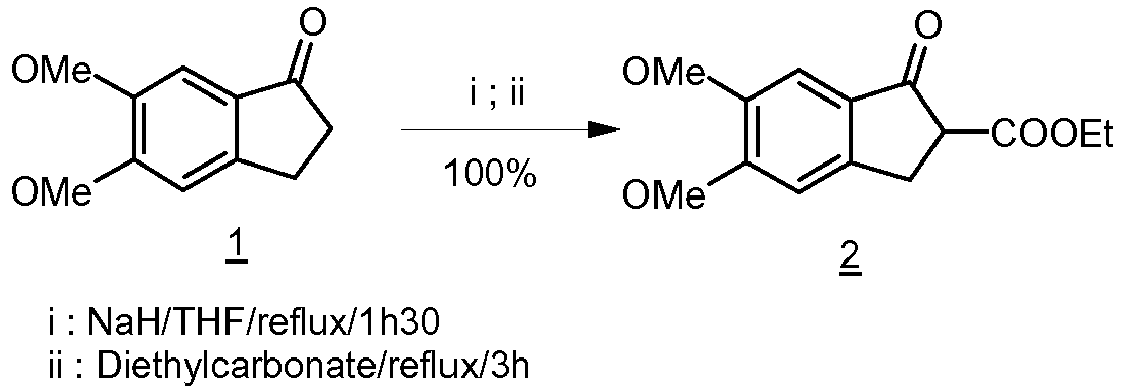
- On the second hand, several 3-substituted 4-chloromethylpyridines may also be prepared as the second starting material. For instance, 3-bromo-4-chloromethylpyridine 5 may be obtained quantitatively according to the following scheme by reduction of commercial 3-bromo-4-pyridinecarboxaldehyde 3 using sodium borohydride in methanol quantitatively afforded 3-bromo-4-hydroxymethylpyridine 4. Treatment of 4 by thionyl chloride in dichloromethane gave the expected chloromethylpyridine which could be isolated as its hydrochloride salt.
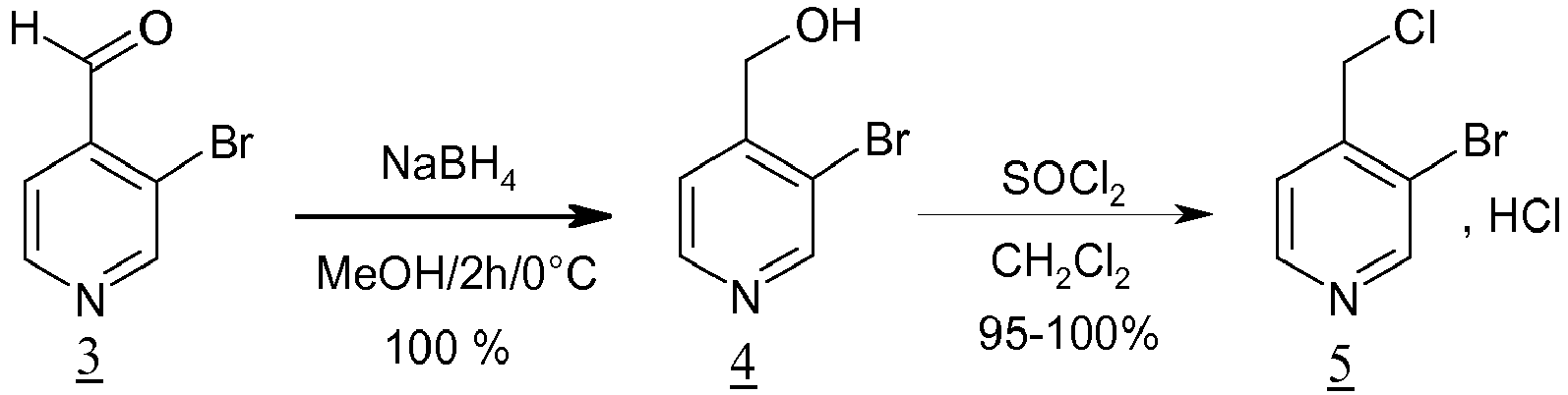
- Alternatively, N,N-diisopropyl-4-chloromethylnicotinamide 9 may be prepared according to the following scheme by formylation of N,N-diisopropylnicotinamide 6 (obtained from nicotinamide in 2 steps as taugh by Broussy et al., Org. Biomol. Chem., 2005, 3, 666) following a metalation strategy. The resulting aldehyde 7 was reduced to the hydroxymethyl pyridine 8 which could be conveniently transformed into the 4-chloromethyl compound 9 isolated as its hydrochloride salt.

- Still alternatively, 3-cyano-4-chloromethylpyridine 13 may be prepared according to the following scheme by silylation of the hydroxymethyl group of 4 using tertio-butyldimethylsilylchloride allowed the further substitution of the 3-bromo atom by a cyano function following the Rutan and Heldrich procedure (J. Org. Chem., 1995, 60, 2948). Deprotection of the silylether 11 and treatment of 12 with thionyl chloride led to the hydrochloride salt of 3-cyano-4-chloromethylpyridine 13.

- Starting from these above 4-chloromethylpyridine alkylating agents, the 2-(4-pyridylmethyl)indanones compounds can be afforded. Alkylation of 2-carbethoxyindanone 2 by the hydrochloride salt of 4-chloromethylpyridines using potassium carbonate in the presence of sodium iodide led to the corresponding 2-carbethoxy-2-(4-pyridylmethyl)indanones 14-16 which were decarboxylated by treatment with potassium hydroxyde in ethanol-water to give compounds 18-20. The reaction is illustrated as follows:

- The 2-(3-cyano-4-pyridylmethyl)indanone 21 may be afforded using the 3-cyano-4-chloromethylpyridine 13 prepared above. The ethyl ester 2 is transesterified to the corresponding allyl ester 22 which is then alkylated with the hydrochloride salt of 4-chloromethyl-3-cyanopyridine 13 using potassium carbonate in the presence of sodium iodide. This leads to the corresponding 2-allyloxycarbonyl-2-(4-pyridyhnethyl)indanones 17 that may be further decarboxylated by treatment with potassium hydroxyde in ethanol-water to give compounds 21. The reaction is summarized in the following scheme.

- Compound 32 was prepared by palladium-catalysed cross-coupling reaction from the 3-bromopyridine 19 and 1-(ethoxyvinyl)tri(n-butyl)stannane following the method taught in Legros et al.; Tetrahedron, 2001, 2507.

- Once prepared, the indanone derivatives may finally be transformed into the desired prodrugs. Substituted 2-(4-pyridylmethyl)indanones 18-21, 32 may be quaternized according to the following scheme using the method taught in Rama et al.., Synthetic Communication, 2007, 37, 2847 by reaction of benzyl bromide in the presence of sodium iodide to afford the corresponding iodides of N-benzylpyridinium 23-26, 33. The salts are isolated by crystallization after addition of pentane. Compound 23 has been already described by Limura et al. in
WO 99/36405 
- Another object of the invention is the preparation of the prodrugs of the invention starting from the oxidized compounds (I+).
- These may be reduced regioselectively to afford prodrugs (Ia). For instance, the reduction of pyridinium salts into 1,4-dihydropyridines could be achieved according to the following scheme using either N-benzyl-1,4-dihydronicotinamide (BNAH) or sodium dithionite (Na2S2O4) as already disclosed in Gaillard et al. Synlett, 2005, 3, 441; Carelli et al. Tetrahedron, 2005, 61, 10331; Gomez et al. Tet. Lett., 2005, 46, 3513 and Lavilla et al. J. Org. Chem., 2001, 66, 1487. BNAH was previously prepared by reduction of N-benzylpyridinium chloride with sodium dithionite in a Na2CO3/H2O solution, see Mauzerall et al., J. Am. Chem. Soc., 1955, 77, 2261. Alternatively, these pyridinium salts may be reduced by NaBH4 to give rise to a mixture of prodrugs (Ia) and (Ib).

- According to route B, the desired compound 29 was obtained by a cross-metathesis process between compound 28 and crotonaldehyde using the method taught in Roe et al.; Chemical Communication, 2009, 4399. The required allyl benzamide 28 was prepared using the method disclosed by Li at al.; Organic Letters, 2012, 14, 214.

- The enamide 30 was obtained from 4-methoxybut-3-en-2-one and benzylamine using the method taught in Girling et al.; Chemical Communication, 2012, 48, 4893. The 1,4-dihydropyridine 31 was obtained by reacting both compounds 29 and 30 in the presence of a Lewis acid under the reaction conditions developed by Bartoli et al. SYNLETT, 2007, 2897; Renaud and al., Advanced Synthesis and Catalalysis, 2006, 2571. Alternatively, the 1,4-dihydropyridine 31 may be obtained enantioenriched by reacting compounds 29 and 30 under the reaction conditions reported by Jorgensen et al., Chemistry : an Asian Journal, 2008, 3, 216; Kanger et al, The journal of Organic Chemistry, 2011, 76, 1538; Takemoto et al. SYNLETT, 2010,1865.

- An object of the invention is also the pharmaceutical compositions comprising at least one of the compounds of formula (I) or (I+) according to the invention and/or their salts or tautomers or isomers, as active ingredient, in a safe and effective amount, in the pure state or in a combined form with one or more compatible and pharmaceutically acceptable diluents or adjuvants. Due to their specific structural design, the compounds of the invention and more particularly those of formula (II) are very convenient and stable enough to be formulated and stored.
- These compositions can be administered by oral, rectal, parenteral or by local route such as a topical application on the skin and the mucous membranes. The compositions according to the invention can be solids or liquids. The solid compositions, are for example in the form of tablets, coated tablets, of pills, gelatine capsules, powders to be placed in solution or in suspension, or granules. The liquid compositions are for example injectable solutions or suspensions, drinkable solutions or suspensions, syrups, emulsions, elixirs containing diluents such as water or paraffin oil or in the form of suppositories, creams, ointments and lotions or also in the form of spray compositions.
- The rectal compositions are suppositories or rectal capsules, containing, apart from the active ingredient, excipients such as cocoa butter, semi-synthetic glycerides or polyethylene glycols.
- The compositions for topical administration can be for example patches transdermal patches creams, gels, containing compatible excipients such as silicone oil, paraffin, as well as the active ingredient.
- These pharmaceutical forms are prepared according to the usual methods. Depending upon the composition, the active ingredient(s) can be incorporated with excipients usually used in pharmaceutical compositions, such as talc, arabic gum, lactose, starch, magnesium stearate, cocoa butter, aqueous or non-aqueous vehicles, fatty substances of animal or vegetable origin, paraffin derivatives, glycols, various wetting, dispersing or emulsifying agents, preservatives. The compounds of the invention can also be formulated in the form of inclusion complex into beta-cyclodextrines, for instance into hydroxypropyl-betacyclodextrine. The inclusion complexes comprise at least one compound according to the invention with a beta-cyclodextrine.
- The dose administered is variable according to the condition treated, the patient in question, the administration route and the product considered. A safe an effective amount can be, for example, comprised between 0.01 mg and 300 mg, preferably between 0.1 mg and 100 mg per day by oral, intramuscular or intravenous route in adults or also comprised between 0.01 mg and 1mg per hour by percutaneous route.
- The compounds of the present invention have been prepared according to the procedures described below in the examples section.
-

- To a suspension of NaH 60 % (1.37 g, 34.2 mmol) in THF (50 mL) was added diethylcarbonate (4.15 mL, 34.2 mmol). The mixture was stirred at reflux for 1h30 before indanone (3.29 g, 17.1 mmol) in THF (100 mL) was added at room temperature. The reaction was further stirred at reflux under argon for 3 h. At room temperature, ethyl acetate was then added, and the mixture was washed with a solution of acetic acid. The oganic layer was dried over Na2SO4. Filtration and evaporation of the solvent under reduced pressure gave a residue, which was purified by flash silica chromatography (CH2Cl2/MeOH: 99.5/0.5). Evaporation of the solvent gave compound 2 as a white solid (3.5 g, 78%).
1H NMR (CDCl3, 300 MHz, 298 K, δ ppm): 7.17 (s, 1 H), 6.90 (s, 1 H), 4.23 (q, J = 7.2 Hz, 2 H), 3.97 (s, 3 H), 3.89 (s, 3 H), 3.69 (m, 1 H), 3.48-3.22 (m, 2H), 1.3 (t, J = 7.2 Hz, 3 H).
13C NMR (CDCl3, 75.5 MHz, 298 K, δ ppm): 198.26, 169.62, 156.17, 149.87, 149.42, 128.14, 107.38, 104.94, 61.83, 56.47, 56.28, 53.73, 30.19, 14.36. -

- To a solution of 3-bromo-4-pyridinecarboxaldehyde 3 (3.0 g, 16.2 mmol) in absolute methanol (40 mL) was added NaBH4 (0.736 g 19.5 mmol) at 0°C. The mixture was stirred at 0°C for 2 hours under nitrogen. The solvent was then removed under vacuum. Water and ethyl acetate were added and the organic layer was washed with water, dried over Na2SO4 and evaporated under vacuum to afford the compound 4 (3.021 g, 100%) as a white powder.
1H NMR (CDCl3, 300 MHz, 298 K, δ ppm): 8.61 (s, 1 H), 8.51 (d, 1H, J = 4.8 Hz), 7.55 (d, 1H, J = 4.8 Hz), 4.76 (s, 2 H), 2.89 (s, 1H).
13C NMR (CDCl3, 75.5 MHz, 298 K, δ ppm): 151.14, 149.45, 148.54, 122.47, 119.90, 63.47.
GC/MS (m/z): 188
IR (KBr, v, cm-1): 3152, 2894, 2829, 1593, 1447, 1401, 1333, 1223, 1170, 1070, 1024, 834, 705, 599 -
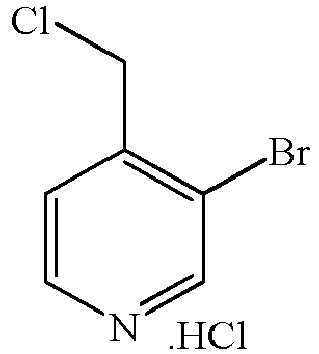
- To a solution of 3-bromo-4-(hydroxymethyl)pyridine (1,6 g, 8.4 mmol) in methylene chloride (90 mL) was added thionyl dichloride (1.6 mL, 22.0 mmol) dropwise over at 0°C. The reaction was stirred at room temperature for 2 h and then concentrated. The yellow solid was dried in a vacuum to afford the compound 5 (2.05 g, 100%).
1H NMR (CDCl3, 300 MHz, 298 K, δ ppm): 8.96 (s, 1H), 8.88 (d, 1H, J = 6Hz), 8.17 (d, 1H, J = 6 Hz), 4.81 (s, 2H).
13C NMR (CDCl3, 75.5 MHz, 298 K, δ ppm): 155.56, 143.52, 140.61, 127.14, 123.20, 43.88 -
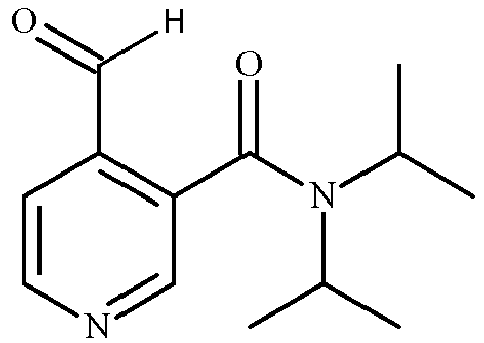
- To a LiTMP solution prepared from BuLi (hexane solution,5.02 mL, 10 mmol) and TMPH (1.7 mL, 10 mmol) in THF (24 mL) at -78°C for 1 hour under an argon atmosphere, was slowly added N,N-diisopropylnicotinamide 6 (0.691g, 3.3 mmol) and the mixture was stirred at -78°C for 1 hour. After addition of DMF (1.03 mL, 13.3 mmol) the mixture was stirred for 1 hour. The mixture was allowed to warm at room temperature and stirred for an additional 30 mn. Saturated aqueous NH4Cl solution was added and the mixture was extracted with DCM. The DCM extract was washed with brine and dried (Na2SO4). The residue was purified by silica gel column chromatography using EtOAc/Petroleum ether (3/7) as eluent to afford 7 (0.55 g, 70 %).
1H NMR (CDCl3, 300 MHz, 298 K, δ ppm): 10.03 (s, 1H), 8.74 (d, 1 H, J = 4.8 Hz), 8.57 (s, 1 H), 7.65 (d, 1H, J = 4.8 Hz), 1.50 (d, 6 H, J = 6.7 Hz), 1.05 (d, 6 H, J = 6.7 Hz).
13C NMR (CDCl3, 75.5 MHz, 298 K, δ ppm): 189.77, 165.33, 150.40, 147.23, 137.42, 133.38, 121.67, 51.24, 46.04, 20.24, 19.97. -

- To a solution of 7 (1.43 g, 6.1 mmol) in absolute methanol (15 mL) was added NaBH4 (0.278 g, 7.3 mmol) at 0°C. The mixture was stirred at 0°C for 2 hours under nitrogen. The solvent was then removed under vacuum. Water and CH2Cl2 were added and the organic layer was washed with water, dried over Na2SO4 and evaporated under vacuum to afford 8 (1.33 g, 92%) as a white powder.
1H NMR (CDCl3, 300 MHz, 298 K, δ ppm): 8.35 (d, 1H, J = 5.1 Hz), 8.16 (s, 1H), 7.28 (d, 1H, J = 8.4 Hz), 4.41 (m, 2 H), 3.45 (m, 2H), 1.40 (s, 6 H). -

- To a solution of 8 (1,32 g, 5.6 mmol) in methylene chloride (90 mL) was added thionyl dichloride (1.06 mL, 14.6 mmol) dropwise over at 0°C. The reaction was stirred at room temperature for 2 h and then concentrated. The yellow solid was dried in a vacuum to afford 9 (1.59 g, 100%).
1H NMR (CDCl3, 300 MHz, 298 K, δ ppm): 8.50 (d, 1H, J = 5.1 Hz), 8.36 (s, 1H), 7.32 (d, 1H, J = 5.1 Hz), 4.54 (m, 2H), 3.55 (m, 2H), 1.47 (m, 6H), 1.09 (m, 6H).
13C NMR (CDCl3, 75.5 MHz, 298 K, δ ppm): 149.64, 145.82, 142.78, 133.10, 124.10, 20.10, 51.02, 45.99, 41.16, 20.61, 21.16, 20.08 -

- To a solution of 3-bromo-4-(hydroxymethyl)pyridine 4 (1.593 g, 8.47 mmol) in dichloromethane (20 mL) was added imidazole (0.692 g, 10.17 mmol) and tert-butyldimethylsilyl chloride (1.534 g, 10.17 mmol) at 0°C and the reaction mixture was stirred for 18 h at rt. The solution was extracted with DCM and the organic phase was washed with brine, dried and concentrated under vacuum. Purification by silica gel column chromatography using EtOAc/DCM (1/9) as eluent gave 10 (2.518 g, 98 %).
1 H NMR (CDCl3, 300 MHz, 298 K, δ ppm): 8.60 (s, 1H), 8.52 (d, 1H, J = 4.8 Hz), 7.52 (d, 1H, J = 4.8 Hz), 4.71 (s, 2 H), 0.97 (s, 9 H), 0.15 (s, 6H).
13C NMR (CDCl3, 75.5 MHz, 298 K, δ ppm): 150.90, 149.67, 148.54, 122.19, 119.20, 63.78, 25.96, 18.43, -5.31.
GC/MS (m/z): [M-t-Butyl] 244.
IR (KBr, v, cm-1): 3046, 2953, 2887, 2857, 2709, 1926, 1789, 1737, 1587, 1472, 1445, 1397, 1373, 1360, 1261, 1172, 1114, 1079, 839, 778, 706, 673. -

- First, K4[Fe(CN)6].3H2O is grounded to a fine powder and dried under vacuum at 80°C overnight. Then (0.366 g, 0.99 mmol) dry K4[Fe(CN)6], (0.094 g, 0.49 mmol) copper iodide, (1.3 mL, 9.92 mmol) n-butylimidazole, toluene (7 mL) and (1.5 g, 4.96 mmol) 3-bromo-4-((tert-butyldimethylsilyloxy)methyl)pyridine 10 are placed in a pressure tube under argon. The pressure tube is sealed and heated at 160°C for 3 days. After cooling to room temperature, CH2Cl2 and water are added. The solution is extracted with DCM and the organic phase is washed with EDTA, brine, dried on Na2SO4 and concentrated under vacuum. Purification by silica gel column chromatography using petroleum ether/DCM (3/7) as eluent gave 11 (0.937 g, 76 %).
1H NMR (CDCl3, 300 MHz, 298 K, δ ppm): 8.81 (s, 2 H), 7.64 (s, 1H), 4.90 (s, 2 H), 0.95 (s, 9 H), 0.14 (s, 6H).
13C NMR (CDCl3, 75.5 MHz, 298 K, δ ppm): 154.24, 153.28, 152.34, 120.99, 115.09, 25.88, 18.38, -5.38.
MS (ESI+, MW g.mol-1, m/z): [M+H+] 249.13
IR (KBr, v, cm-1): 2955, 2938, 2858, 2360, 2228, 1590, 1471, 1404, 1257, 1159, 1110, 1006, 842, 779. -

- To a solution of 11 (1.161 g, 4.67 mmol) in THF (16 mL) was added a tetrabutylammonium fluoride solution in THF (7.01 mL, 7.01 mmol). After stirring for 1 h, ethyl acetate was added to the solution which was then washed with brine, dried on Na2SO4. Ethyl acetate was then removed under vacuum. Purification by silica gel column chromatography using DCM/MeOH (97/3) as eluent gave 12 (0.566 g, 91 %).
1H NMR (CDCl3, 300 MHz, 298 K, δ ppm): 8.61 (s, 1H), 8.51 (d, 1H, J = 5.1 Hz), 7.55 (d, 1H, J = 5.1 Hz), 4.77 (s, 2 H), 3.07 (s, 1 H).
13C NMR (MeOH, 75.5 MHz, 298 K, δ ppm): 156.62, 153.89, 153.31, 122.81, 115.86, 109.10, 61.89.
GC/MS (m/z): 134
IR (KBr, v, cm-1): 3152, 2894, 2829, 1593, 1447, 1401, 1333, 1223, 1170, 1070, 1024,834. -

- To a solution of 12 (1,06 g, 7.93 mmol) in methylene chloride (150 mL) was added thionyl chloride (1.5 mL, 20.6 mmol) dropwise over at 0°C. The reaction was stirred at room temperature for 18 h and then concentrated. The brown solid was dried under vacuum to afford 13 (1.47 g, 100%).
1H NMR (MeOD, 300 MHz, 298 K, δ ppm): 9.44 (s, 1H), 9.17 (d, 1H, J = 6 Hz), 8.37 (d, 1H, J = 6 Hz), 5.10 (s, 2H).
13C NMR (MeOD, 75.5 MHz, 298 K, δ ppm): 159.52, 148.67, 148.29, 128.20, 113.65, 113.37, 42.62
GC/MS (m/z): [M-HCl] 152.
IR (KBr, v, cm-1): 3021, 2966, 2928, 2247, 2102, 1996, 1927, 1635, 1599, 1533, 1407, 1345, 1050, 840. -

- A suspension of 2 (0.431 g, 1.64 mmol), potassium carbonate (0.614 g, 4.45 mmol), sodium iodide (0.123 g, 0.5 mmol) and 5 (0.480 g, 1.97 mmol) in 45 mL of acetone was refluxed for 6 hours and then diluted with ether at room temperature. After filtration over Celite, the filtrate was evaporated under vacuum to afford 15 (0.71 g, 100%)
1H NMR (CDCl3, 300 MHz, 298 K, δ ppm): 8.66 (s, 1H), 8.29 (d, 1 H, J= 5.1 Hz,), 7.18 (s, 1 H), 7.14 (d, 1 H, J = 5.1 Hz), 6.80 (s, 1 H), 4.20 (q, 2 H, J = 7.1 Hz), 3.95 (s, 3 H), 3.92 (s, 3 H), 3.75 (d, 1 H, J = 14.7 Hz), 3.60 (d, 1 H, J = 17.2 Hz), 3.42 (d, 1 H, J = 14.7 Hz), 2.97 (d, J = 17.2 Hz, 1 H), 1.22 (t, 3 H, J = 7.1 Hz).
13C NMR (CDCl3, 75.5 MHz, 298 K, δ ppm): 199.97, 170.65, 156.45, 152.26, 149.95, 149.13, 148.29, 145.84, 128.47, 125.73, 124.73, 107.17, 103.96, 62.29, 61.10, 56.44, 56.25, 37.61, 35.23
MS (ESI+, MW g.mol-1, m/z): [M+H+] 436 -

- A suspension of 2 (0.100 g, 0.38 mmol), potassium carbonate (0.142 g, 1.03 mmol), sodium iodide (0.028 g, 0.19 mmol) and 9 (0.133 g, 0.45 mmol) in 5 mL of acetone was refluxed for 6 hours and then diluted with ether at room temperature. After filtration over Celite, the filtrate was evaporated under vacuum to afford 16 (0.095 g, 51 %)
1H NMR (CDCl3, 300 MHz, 298 K, δ ppm): 8.50-8.18 (m, 2 H), 7.16 (m, 1 H), 6.88 (m, 1 H), 6.71 (s, 1 H), 4.22-4.10 (m, 2 H), 3.97 (s, 3 H), 3.86 (s, 3 H), 3.81-2.76 (m, 6 H), 1.60-1.08 (m, 15H)
13C NMR (CDCl3, 75.5 MHz, 298 K, δ ppm): 202.04, 199.51, 171.42, 170.50, 167.75, 167.47, 156.51, 156.22, 150.43, 149.86, 149.74, 149.67, 149.50, 149.07, 146.17, 146.01, 143.72, 141.50, 135.44, 128.68, 125.96, 124.31, 107.53, 107.29, 105.07, 104.44, 62.16, 61.90, 61.14, 60.46, 56.45, 56.28, 56.19, 56.15, 51.28, 46.30, 46.19, 35.82, 35.67, 35.20, 34.56, 20.97, 20.92, 20.88, 20.79, 20.71, 20.63, 20.35, 20.03, 14.13, 14.06
MS (ESI+, MW g.mol-1, m/z): [M+H+] 483 -
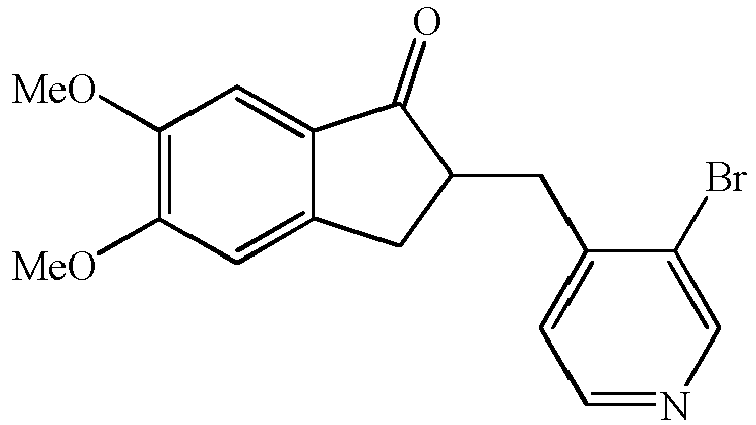
- Compound 15 (3.06 g, 7 mmol) was dissolved in 45 mL of ethanol, then 9 mL of water and (1.86 g, 28.15 mmol) of 85 % potassium hydroxide were added hereinto, and was heated under reflux for 30 mn. The reaction mixture was cooled to room temperature, and was concentrated under reduced pressure, then 45 mL of water was added. Filtration of the precipitated solid and drying under vacuum afforded 19 (0.91 g, 36 %).
1H NMR (CDCl3, 300 MHz, 298 K, δ ppm): 8.71 (s, 1 H), 8.43 (d, 1 H, J = 5.0 Hz), 7.23 (d, 1 H, J = 5.0 Hz), 7.21 (s, 1 H), 6.84 (s, 1 H), 3.96 (s, 3 H), 3.93 (s, 3 H), 3.47 (m, 1 H), 3.11 (m, 1 H), 2.81(m, 1H).
13C NMR (CDCl3, 75.5 MHz, 298 K, δ ppm): 205.13, 158.26, 152.15, 149.68, 148.51, 148.33, 128.89, 125.57, 107.41, 104.46, 56.33, 56.19, 46.78, 36.42, 31.80
MS (ESI+, MW g.mol-1, m/z): [M+H+] 363 -

- Compound 16 (0.874 g, 1.8 mmol) was dissolved in 12 mL of ethanol, then 2.40 mL of water and (0.478 g, 7.24 mmol) of 85 % potassium hydroxide were added hereinto, and was heated under reflux for 30 mn. The reaction mixture was cooled to room temperature, and was concentrated under reduced pressure, then 12 mL of water was added. Ethyl acetate was added to the solution which was then washed with brine, dried on Na2SO4. Ethyl acetate was then removed under vacuum. Purification by silica gel column chromatography using EtOAc/petroleum ether (90/10) as eluent gave 20 (0.301 g, 41 %).
1H NMR (CDCl3, 300 MHz, 298 K, δ ppm): 8.57-8.34 (m, 2 H), 7.36 (d, 0.5 H, J = 5.1 Hz), 7.18 (s, 1 H): 7.12 (s, 0.5 H, J = 5.1 Hz), 6.83 (d, 1 H, 15.9 Hz), 3.92 (m, 6 H), 3.63-2.33 (m, 7 H), 1.63-1.08 (m, 12H)
13C NMR (CDCl3, 75.5 MHz, 298 K, δ ppm): 205.75, 205.72, 167.65, 155.92, 155,72, 149.56, 149.48, 149.44,148.96, 146.24, 146.16, 145.88, 144.77, 134.93, 134.87, 129.16, 128.53; 124.98, 123.76, 107.71, 107.48, 104.34, 56.33, 56.31, 56.15, 51.31, 51.26, 48.35, 47.62, 46.33, 46.21, 33.86, 33.37, 32.27, 31.62,21.0, 20.88, 20.71, 20.59, 20.49, 20.41. -

- Ethyl 2-(3-bromopyridin-4-yl)methyl)-5,6-dimethoxy-1-oxo-2,3-dihydro-1H-indene-2-carboxylate 14 (0.134 g, 0.37 mmol) was dissolved in 5 mL of ethanol, then 1 mL of water and (0.099 g, 1.51 mmol) of 85 % potassium hydroxide were added hereinto, and was heated under reflux for 30 mn. The reaction mixture was cooled to room temperature, and was concentrated under reduced pressure, then 5 mL of water was added. Filtration of the precipitated crystal and drying afforded 18 (0.03 g, 29 %).
1H NMR (CDCl3, 300 MHz, 298 K, δ ppm): 8.52 (s, 2 H), 7.18 (s, 3 H), 6.81 (s, 1 H), 3.94 (s, 3 H), 3 92 (s, 3 H), 3.34 (m, 1 H), 3.16-2.98 (m, 2 H), 2.73-2.65 (m, 2H)
13C NMR (CDCl3, 75.5 MHz, 298 K, δ ppm): 205.66, 155.89, 149.97, 149.71, 148.91, 148.71, 129.06, 124.42, 107.44, 104.46, 56.22, 56.21, 48.03, 39.35, 36.59, 31.89. -

- A solution 2 (1 g, 3.78 mmol), DMAP (46 mg, 0.37 mmol), and allyl alcohol (2.59 mL, 37.8 mmol) in dry toluene (20 mL) was heated at 100°C for 24 h. The cooled solution was evaporated to dryness. Purification by silica gel column chromatography using petroleum ether/AcOEt (7/3) as eluent gave 22 (0.742 g, 71 %).
1H NMR (CDCl3, 300 MHz, 298 K, δ ppm): 7.17 (s, 1 H), 6.91 (s, 1 H), 5.93 (m, 1 H), 5.31 (m, 2 H), 4.69 (m, 2 H), 3.98 (s, 3 H), 3.90 (s, 3 H), 3.75 (m, 1H), 3.44 (m, 1 H), 3.28 (m, 1H).
13C NMR (CDCl3, 75.5 MHz, 298 K, δ ppm): 197.89, 169.10, 156.10, 149.78, 149.26, 131.75, 127.95, 118.59, 107.29, 104.80, 66.13, 56.37, 56.15, 53.54, 30.08. -

- A suspension of 22 (0.670 g, 2.42 mmol), potassium carbonate (0.905 g, 6.54 mmol), sodium iodide (0.181 g, 1.21 mmol) and 13 (0.550 g, 2.9 mmol) in 97 mL of acetone was refluxed for 3 hours and then diluted with ether at room temperature. After filtration over Celite, the filtrate was evaporated under vacuum. Purification by silica gel column chromatography using petroleum ether/AcOEt (1/1) as eluent gave 17 (0.789 g, 83 %).
1H NMR (CDCl3, 300 MHz, 298 K, δ ppm): 8.69 (s, 1H), 8.47 (d, 1 H, J= 5.4 Hz), 7.23 (d, 1 H, J= 5.4 Hz), 7.06 (s, 1 H), 6.74 (s, 1 H), 5.72 (m, 1 H), 5.12 (m, 2 H), 4.53 (d, 2 H, J= 5.4 Hz), 3.85 (s, 3 H), 3.80 (s, 3 H), 3.58 (m, 3 H), 2.91 (d, 1 H, J = 17.42 Hz).
13C NMR (CDCl3, 75.5 MHz, 298 K, δ ppm): 198.82, 169.73, 156.43, 152.93, 152.46, 149.91, 149.57, 148.37, 131.08, 127.13, 124.91, 118.67, 115.97, 111.77, 107.01, 104.73, 66.41, 60.91, 56.26, 56.02, 36.63, 35.44.
MS (ESI+, MW g.mol-1, m/z): [M+Na+] 415.0
IR (KBr, v, cm-1): 3418, 2941, 2838, 2228, 1696, 1592, 1504, 1463, 1366, 1315, 1272, 1222, 1190, 1113, 1042, 996, 922, 866, 795, 516, 472. -

- To a stirred solution of palladium acetate (3.136 mg, 0.014 mmol) and PPh3 (7.3 mg, 0.028 mmol) in dry THF (1.2 mL) was added in one portion a mixture of formic acid (42.1 µL, 1.1 mmol) and Et3N (0.194 mL, 1.39 mmol) in THF (0.6 mL) at room temperature under argon. The mixture was vigorously stirred and a solution of 17 (0.219 g, 0.55 mmol) in dry THF (0.3 mL) was added. The resulting mixture was stirred for additional 30 mn at rt and was heated at 70°C for 2 h. The mixture was passed through a short SiO2 column, followed by ether washing and EtOAc. After the filtrate was concentrated in vacuum, the residue was chromatographied on SiO2 with EtOAc/petroleum ether (70/30) to afford 21 (0.116 g, 69 %).
1H NMR (CDCl3, 300 MHz, 298 K, δ ppm): 8.84 (s, 1 H), 8.69 (d, 1 H, J = 5.10 Hz), 7.38 d, 1 H, J = 5.10 Hz), 7.18 (s, 1 H), 6.83 (s, 1 H), 3.95 (s, 3 H), 3 91 (s, 3 H), 3.46 (m, 1 H), 3.21 (m, 1 H), 3.08 (m, 2H), 2.76 (m, 1H).
13C NMR (CDCl3, 75.5 MHz, 298 K, δ ppm): 204.28, 156.02, 153.13, 152.82, 152.68, 149.79, 148.24, 128.64, 124.48, 116.08, 110.98, 107.40, 104.44, 56.35, 56.17, 47.57, 34.92, 31.81
MS (ESI+, MW g.mol-1, m/z): [M+H+] 309.2
IR (KBr, v, cm-1): 2932, 2837, 2227, 1690, 1590, 1502, 1463, 1319, 1264, 1220, 1118, 1036, 839. -

- Compound 18 (0.030 g, 0.10 mmol) was dissolved in 6 mL of dichloromethane under reflux condition, (12.6 µL, 0.10 mmol) of benzyl bromide and (15.9 mg, 0.10 mmol) of sodium iodide were added hereinto. After keeping heating under reflux for 18 h, reaction mixture was cooled to room temperature, followed by concentration under reduced pressure. Pentane was added to the residue. Filtration of the precipitated crystal and drying afforded 23 (0.044 g, 83 %).
1H NMR (CDCl3, 300 MHz, 298 K, δ ppm): 9.24 (s, 1 H), 9.22 (s, 1 H), 7.93 (s, 1 H), 7.90 (s, 1 H), 7.63 (m, 2 H), 7.41 (m, 3H), 7.11 (s, 1 H), 6.87 (s, 1 H), 6.17 (s, 2 H), 3.96 (s, 3 H), 3.89 (s, 3 H), 3.32 (m, 2 H), 3.11 (m, 2 H), 2.75 (m, 1H)
13C NMR (CDCl3, 75.5 MHz, 298 K, δ ppm): 204.23, 161.20, 156.37, 149.96, 148.56, 144.05, 132.37, 130.33, 129.94, 129.89, 129.84, 128.78, 128.37, 107.73, 104.37, 63.89, 58.68, 56.60, 56.26, 47.17, 37.20, 32.29.
MS (ESI+, MW g.mol-1, m/z): [M-I-]+ 374.2
IC50: 36.8 nM -

- 19 (0.290 g, 0.80 mmol) was dissolved in 41 mL of dichloromethane under reflux condition, (95.1 µL, 0.80 mmol) of benzyl bromide and (0.120 g, 0.80 mmol) of sodium iodide were added hereinto. After keeping heating under reflux for 18 h, reaction mixture was cooled to room temperature, followed by concentration under reduced pressure. Pentane was added to the residue. Filtration of the precipitated crystal and drying afforded 24 (0.371 g, 80 %).
1H NMR (CDCl3, 300 MHz, 298 K, δ ppm): 9.59 (s, 1 H), 9.39 (d, 1 H, J = 6.3 Hz), 8.07 (d, 1 H, J = 6.3 Hz), 7.72 (s, 2 H), 7.38 (s, 3 H), 7.07 (s, 1 H), 6.85 (s, 1 H), 6.27 (s, 2 H), 3.93 (s, 3 H), 3.86 (s, 3H), 3.39 (m, 2 H), 3.05 (m, 2 H), 2.75 (d, 1 H, J = 16.5 Hz).
13C NMR (CDCl3, 75.5 MHz, 298 K, δ ppm): 203.84, 160.57, 156.17, 149.79, 148.43, 145.33, 142.78, 132.11, 130.29, 129.76, 128.90, 128.15, 125.54, 107.62, 104.29, 63.34, 56.52, 56.18, 45.73, 37.65, 32.52.
MS (ESI+, MW g.mol-1, m/z): [M-I-]+ 454.3
IC50: 11.5 nM -
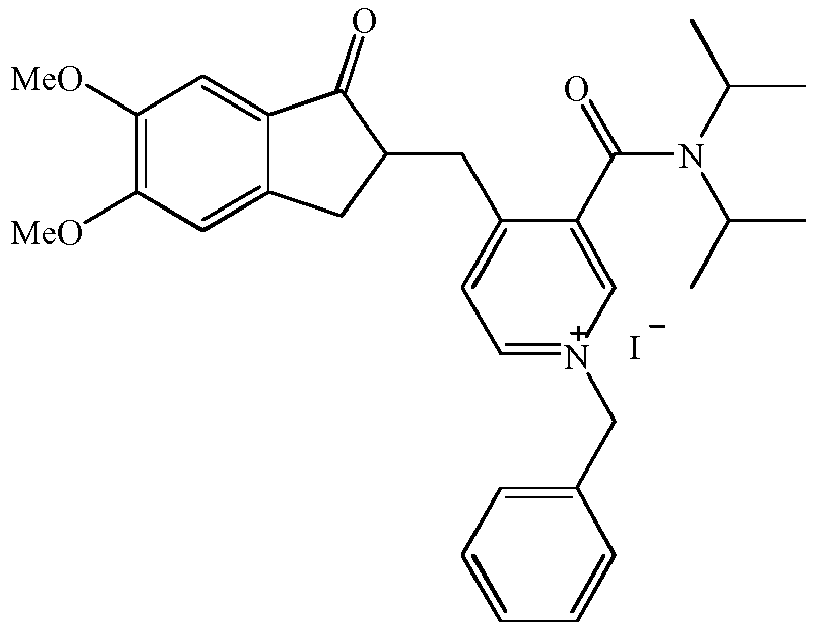
- 20 (0.150 g, 0.36 mmol) was dissolved in 19 mL of dichloromethane under reflux condition, (43.4 µL, 0.36 mmol) of benzyl bromide and (54.7 mg, 0.36 mmol) of sodium iodide were added hereinto. After keeping heating under reflux for 18 h, reaction mixture was cooled to room temperature, followed by concentration under reduced pressure. Pentane was added to the residue. Filtration of the precipitated crystal and drying afforded 25 (0.186 g, 81 %).
1H NMR (CDCl3, 300 MHz, 298 K, δ ppm): 8.81 (s, 2 H), 8.04 (dd, 1 H, J = 24.9 et 6.9 Hz), 7.51 (m, 5 Hz), 7.02 (m, 2 H), 5.77 (s, 2 H), 3.88 (s, 3 H), 3.82 (s, 3 H), 3.53-2.79 (m, 7 H), 1.48 (m, 6 H), 1.11 (m, 6 H).
13C NMR (CDCl3, 75.5 MHz, 298 K, δ ppm): 204.80, 204.69, 163.39, 163.32, 159.23, 158.72, 157.04, 156.97, 150.68, 149.69, 149.58, 144.32, 144.17, 141.01, 139.48, 134.27, 134.22, 130.74, 130.53, 130.58, 130.36, 130.18, 129.18, 128.94, 108.87, 104.92, 64.31, 56.81, 56.44, 55.33, 52.51, 47.61, 47.47, 47.34, 47.28, 35.26, 34.90, 32.92, 32.62, 21.00, 20.79, 20.72, 20.61, 20.55, 20.39, 20.33.
MS (ESI+, MW g.mol-1, m/z): [M-I-]+ 501.4 -

- 21 (0.050 g, 0.16 mmol) was dissolved in 8 mL of dichloromethane under reflux condition, (19.1 µL, 0.16 mmol) of benzyl bromide and (24.2 mg, 0.16 mmol) of sodium iodide were added hereinto. After keeping heating under reflux for 18 h, reaction mixture was cooled to room temperature, followed by concentration under reduced pressure. Pentane was added to the residue. Filtration of the precipitated crystal and drying afforded 26 (0.077 g, 92 %).
1H NMR (CDCl3, 300 MHz, 298 K, δ ppm): 9.53 (s, 1 H), 9.47 (s, 1 H), 8.33 (s, 1 H), 7.68 (s, 2 H), 7.48 (s, 3 H), 7.07 (s, 1 H), 6.89 (s, 1 H), 6.24 (s, 2 H), 3.99 (s, 3 H), 3.90 (s, 3 H), 3.6-3.2 (m, 4 H), 2.85(m, 1H)
13C NMR (CDCl3, 75.5 MHz, 298 K, δ ppm): 203.79, 164.02, 156.37, 149.91, 148.51, 147.64, 147.32, 131.96, 130.51, 130.35, 129.97, 129.62, 128.02, 114.74, 112.52, 107.66, 104.40, 64.52, 56.56, 56.24, 46.99, 36.50, 32.70.
MS (ESI+, MW g.mol-1, m/z): [M-I-]+ 399.1
IR (KBr, v, cm-1): 3400, 2928, 2243, 1693, 1640, 1589, 1320, 1285, 1267, 1219, 1118, 1045, 1012, 722.
IC50: 11.2 nM -

- To a solution of pyridinium salt 26 (0.100 g, 0.020 mmol) in dichloromethane (10 mL) was added N-benzyl-1,4-dihydronicotinamide (BNAH) (44.7 mg, 0.020 mmol) at room temperature under nitrogen and was stirred in darkness for 1 hour. The reaction mixture was then washed with water. After phase separation, the aqueous layer was extracted with dichloromethane. The combinated organic phases were dried over Na2SO4, filtered and evaporated under reduced pressure at room temperature. Purification by silica gel column chromatography using CH2Cl2/OEt-Ac (92/8) as eluent gave compound 27 (0.019 g, 23 %).
1H NMR (CDCl3, 300 MHz, 298 K, δ ppm): 7.35 (m, 4 H), 7.18 (m, 4 H), 6.85 (s, 1 H), 7.68 (d, 1 H, J = 5.4 Hz), 5.88 (m, 1 H), 4.79 (m, 1 H), 4.32 (d, 2 H, J = 3. 6 Hz), 3.96 (s, 3 H), 3.90 (s, 3 H), 3.51 (m, 1 H), 3.34 (m, 2 H), 2.85 (m, 3 H), 2.14 (m, 1 H), 1.59 (m, 1 H).
13C NMR (CDCl3, 75.5 MHz, 298 K, δ ppm): 207.70, 207.31, 155.69, 155.63, 149.61, 149.54, 149.37, 148.96, 143.42, 143.00, 136.33, 129.27, 129.22, 128.99, 128.53, 128.41, 127.31, 127.29, 121.70, 121,29, 107.52, 107.49, 106.26, 105.12, 104.47, 104.41,82.94,82.61, 64.56, 57.68, 57.64, 56.39, 56.25, 44.38, 43.80, 41.65, 40.07, 33.95, 33.95, 33.18, 32.29, 32.07, 30.30, 30.17, 29.51, 29.46, 27.35, 24.92, 22.84, 22.48, 14.27, 14.21
IC50: 175 nM -

- To a solution of 1-benzylpyridinium-3-carboxamide iodide (1 g, 3.41 mmol) in H2O (15 mL) was added sodium carbonate (1.44 g, 13.64 mmol) and sodium dithionite (2.65 g, 12.96 mmol) at room temperature. The resulting solution was stirred under nitrogen in darkness for 15 mn. The reaction mixture was then extracted with dichloromethane. The combined organic phases were dried over Na2SO4, filtered and evaporated under reduced pressure at room temperature to afford N-benzyl-1,4-dihydronicotinamide (BNAH) (0.530 g, 73%).
1H NMR (CDCl3, 300 MHz, 298 K, δppm): 7.34 (m, 5 H), 7.26 (s, 1 H), 5.75 (d, 1 H, J = 8.10 Hz), 5.38 (s, 2 H), 4.76 (m, 1 H), 4.30 (s, 2 H), 3.19 (s, 2 H).
13C NMR (CDCl3, 75.5 MHz, 298 K, δ ppm): 140.15, 137.37, 129.09, 128.95, 127.92, 127.29, 103.34, 98.75, 57.52, 22.97. - Synthesis of 3-(1-acetyl)-4-(5,6-Dimethoxy-1-oxo-2,3-dihydro-1H-inden-2-yl)methylpyridine (32) This compound was prepared using the method taught in Legros et al.; Tetrahedron, 2001, 2507.

- A solution of compound 19 (181 mg, 0.5 mmol) in toluene (1.5 mL), Pd(dba)2 (12 mg, 0.02 mmol) and PPh3 (11 mg, 0.04 mmol) was stirred at room temperature under argon for 15 min. (1-ethoxyvinyl)tri(n-butyl)stannane (180 mg, 0.5 mmol) in toluene (1 mL) was added and the resulting mixture was stirred at 110°C for 2 h, cooled to room temperature, then 55 mL of HCl (0.1 N) were added. After 3h stirring, the reaction mixture was neutralized with NaHCO3 until pH = 7-8 and extracted three times with AcOEt. The combined organic layers were dried (MgSO4), filtered and concentrated. Purification on silica gel afforded the product 32 in 65% yield.
1H NMR (300 MHz, CDCl3, δ) : 2.67 (s, 3H), 2.74-2.80 (m, 1H), 3.05-3.18 (m, 3H), 3.48-3.53 (s, 1H), 3.91 (s, 3H), 3.95 (s, 3H), 6.82 (s, 1H), 7.18 (s, 1H), 7.30 (d, 1H, J= 5.1 Hz), 8.60 (d, 1H, J= 5.1 Hz), 8.97 (s, 1H). -

- The pyridine 32 (45 mg, 0.14 mmol) was dissolved in dichloromethane (1 mL). Benzyl bromide (17 µL, 0.14 mmol) was added and the solution was heated under reflux for 12 h. Concentration under reduced pressure and washings with n-pentane afforded the product 33 as a pale brown powder in 95% yield.
1H NMR (300 MHz, CDCl3, δ) : 2.72-2.79 (m, 1H), 3.01-3.07 (m, 4H), 3.30-3.47 (m, 3H), 3.88 (s, 3H), 3.96 (s, 3H), 6.46 (s, 2H), 6.84 (s, 1H), 7.06 (s, 1H), 7.39-7.41 (m, 3H), 7.72-7.75 (m, 2H), 7.96 (d, 1H, J= 6.4 Hz), 9.18 (d, 1H, J= 6.2 Hz), 10.4 (s, 1H).
HRMS (ESI) : calcd. For C26H26NO4 416.1862; found 416.1865.
IR : 1693, 1584, 1500, 1463, 1266, 1246, 1205, 1115, 04, 1018, 848, 799, 721, 697.
IC50: 18 nM.
Binding to the PAS : 23% of Propidium Iodide Displacement (donepezil 24%) - Measurement of Propidium Iodide Displacement from the Peripheral Anionic Site (PAS) of AChE was achieved according to the procedure reported in Journal of Medicinal Chemistry ,2009, 52, 7249.
-

- To a solution of pyridinium salt 33 (292 mg, 0.59 mmol) in CH2Cl2 (6 mL) was added N-benzyl-1.4-dihydronicotinamide (BNAH) (126 mg, 0.59 mmol) at room temperature under Argon. The resulting solution was stirred in darkness for 3 h. The reaction mixture was washed with H2O, dried over MgSO4, filtered and concentrated under reduced pressure. Flash chromatography on silica gel afforded the dihydropyridine 34 in 40% yield.
1H NMR (300 MHz, CDCl3, δ) : 1.36-1.46 (m, 0.6H), 1.48-1.58 (m, 0.4H), 1.89-2.03 (m, 1H), 2.15 (s, 1.8H), 2.21 (s, 1.2H), 2.62-2.71 (m, 0.4H), 2.74-2.82 (m, 1H), 3.02-3.09 (m, 0.6H), 3.17-3.3 (m, 1H), 3.58-3.64 (m, 0.6H), 3.71-.377 (m, 0.4H), 3.88 (m, 3H), 3.94-3.95 (m, 3H), 4.46 (s, 2H), 4.92-4.97 (m, 0.4H), 5.08-5.13 (m, 0.6H), 5.92-5.97 (m, 1H), 6.83 (s, 0.4H), 6.88 (s, 0.6H), 7.13-7.41 (m, 7H).
13C NMR (75 MHz, CDCl3, δ) : 24.49, 24.64, 29.18, 29.32, 29.72, 32.62, 33.89, 40.31, 41.16, 44.15, 45.11, 56.10, 56.24, 57.87, 57.96, 104.25, 104.28, 107.43, 107.63, 108.37, 109.99, 113.27, 113.89, 127.02, 128.12, 128.23, 129.07, 129.09, 129.39, 129.41, 136.70, 142.76, 143.25, 149.32, 149.60, 149.66, 155.36, 155.43, 194.87, 195.40, 208.26, 208.37.
HRMS (ESI) : calcd. For C26H28NO4 418.2018; found 416.2014.
IR : 2857,1679, 1573, 1504, 1308, 1261, 1185, 1174, 1119, 981.
IC50 : 528 nM. - This compound was prepared using the method taught in Li at al.; Organic Letters, 2012, 14, 214.

- To a nitrogen flushed, three necked flask equipped with a dropping funnel was added N-allylaniline (2 mL, 15 mmol) and dry toluene (10 mL). To the solution was added a solution of trimethylaluminium (2M, 7.5 mL, 15 mmol) in toluene. The reaction was stirred at room temperature for 30 min. and 3,4-dimethoxybenzoic acid was added in one-portion. The reaction mixture was then heated at 80°C for 18 hours. After the reaction mixture was quenched with MeOH (5 mL) dropwise followed by addition of a saturated NaHCO3 solution (50 mL). The resulting slurry was then extracted with EtOAc and the combined organic extracts were washed with NaOH (1 N), HCl(2 N), brine (20 mL) and then concentrated in vacuo to give a reddish oil (0.57 g) which was subjected to a flash column using petroleum ether/EtOAc as eluent to give the desired N-allyl-N-phenyl-3,4-dimethoxybenzamide 28 in 78% yield.
1H NMR (300 MHz, CDCl3, δ) : 3.65 (s, 3H), 3.81 (s, 3H), 4.53 (dt, 2H, J = 6 Hz, J = 1.5 Hz), 5.15-5.23 (m, 2H), 5.95-6.04 (m, 1H), 6.62 (d, 1H, J = 8.4 Hz), 6.88 (d, 1H, J = 2.1 Hz), 6.94 (dd, 1H, J= 8.4 Hz, J = 2.1 Hz), 7.03-7.06 (m, 2H), 7.15-7.17 (m, 1H), 7.21-7.26 (m, 2H).
13C NMR (75 MHz, CDCl3, δ) : 53.57, 55.76, 55.85, 109.95, 112.59, 117.62, 122.97, 126.52, 127.47, 127.94, 129.19, 133.41, 144.38, 147.97, 150.34, 169.56. - This compound was prepared using the method taught in Roe et al.; Chemical Communication, 2009,4399.

- To a solution of N-allyl-N-phenyl-3,4-dimethoxybenzamide 28 (567 mg, 1.91 mmol) in dichloromethane (15 mL) under argon was added sequentially crotonaldehyde (0.47 mL, 5.73 mmol) and Hoveyda-Grubbs second generation catalyst (31 mg, 0.05 mmol). The mixture was then heated at 50°C and stirred for 22 hours. Then, the solution was filtered on a Celite pad and the solvent was evaporated under reduced pressure. The resulting oil was purified on silica gel (petroleum ether/EtOAc : 7/3 to 5/5) to afford the product 29 (330 mg, 53%).
1H NMR (300 MHz, CDCl3, δ) : 3.65 (s, 3H), 3.82 (s, 3H), 4.79 (dd, 2H, J= 5.4 Hz, J= 1.8 Hz), 6.25 (ddt, 1H, J = 15.9 Hz, J = 7.8 Hz, J = 1.5 Hz), 6.63 (d, 1H, J = 8.4 Hz), 6.87 (d, 1H, J = 1.8 Hz), 6.91-7.05 (m, 4H), 7.15-7.29 (m, 3H), 9.57 (d, 1H, J= 7.8 Hz).
13C NMR (75 MHz, CDCl3, δ) : 52.13, 55.73, 55.85, 109.96, 112.46, 123.18, 126.75, 126.98, 127.04, 129.56, 133.27, 143.95, 148.02, 150.71, 151.83, 169.70, 193.26. - This compound was prepared using the method taught in Girling et al.; Chemical Communication, 2012, 48, 4893.

- A mixture of benzylamine (1.1 mL, 10 mmol) and 4-methoxybut-3-en-2-one (1 mL, 10 mmol) in chloroform (100 mL) was stirred at room temperature until complete conversion. Then, the solvent was evaporated to afford the desired product 30 in 70% yield which was used without additional purification.
1H NMR (300 MHz, CDCl3, δ) : 2.00 (s, 3H), 4.30 (d, 2H, J= 6 Hz), 4.98 (d, 1H, J= 7.5 Hz), 6.64 (dd, 1H, J=12.9 Hz, J= 7.5 Hz), 7.23 (m, 6H). - This compound was prepared using the method taught in Bartoli et al.; SYNLETT, 2007, 2897

- Mg(ClO4)2 (9 mg, 0.04 mmol), MgSO4 (10 mg, 8 mmol) and 4-(benzylamino)but-3-en-2-one 30 (70 mg, 0.4 mmol) was suspended in dry dichloromethane (0.5 mL) and the aldehyde 29 (163 mg, 0.5 mmol) was added. The mixture was stirred at room temperature until completion of the reaction. The crude reaction mixture was filtered on celite and the solvent was removed by rotary evaporation. The dihydropyridine 31was purified on silica gel (petroleum ether/EtOAc/5% Et3N).
Claims (17)
- A pyridine derivative represented by formula (I) :
 the dotted lines in the pyridine cycle indicate the presence of at least one double bond,R1 and R2 are independently chosen between a hydrogen atom, a halogen atom, hydroxy, CN, CF3, a (C1-C8) alkyl, a (C4-C10) aryl, a (C1-C8) alkoxy;n is an integer from 0 to 4; andR3 and R4 are a hydrogen atom, or when n=1, R3 and R4 can also form together a double bond between the carbon atoms to which they are attached so that the radical CHR3 CHR4 form a vinylenyl group -CH=CH-, andeither m is 0, 1 or 2, andZ is CH or N; or Z is C and -CHR3- is =CH- linked to the cyclopentanone by the double bond;or --(--)m--- is absent andZ is NH, >N-alkyl (C1-C8), >N-phenyle, >N-benzyle or >N heteroaryle;R5 is chosen from a hydrogen atom, a halogen atom, hydroxy, CN, CF3, a (C1-C8) alkyl, a (C4-C10) aryl, a (C1-C8) alkoxy; orR6 and R7 which may be identical or different are hydrogen, OH, (C1-C8) alkyl, aryl, heteroaryl, (C1-C8) alkylaryl, aryl (C1-C8) alkyl, (C1-C8) alkoxy, hydroxyl (C1-C8) alkyl, (C1-C8) alkoxy (C1-C8) alkyl, phenyl, -(CH2)n-COOH, Z', Z1; orR6 and R7 taken together with the carbon atoms to which they are attached form a (C5-C10) cycloalkenyl, a 6-membered aromatic ring or a 5- or 10-membered heterocyclic ring comprising 1 to 4 heteroatoms identical or different chosen between N, S and O, being optionally substituted by one or more identical or different group defined as OH, (C1-C8) alkyl, aryl, heteroaryl, (C1-C8) alkylaryl, aryl (C1-C8) alkyl, (C1-C8) alkoxy, hydroxyl (C1-C8) alkyl, (C1-C8) alkoxy (C1-C8) alkyl, phenyl, (CH2)n-COOH, Z', Z1;Z' is a group defined by formula -(L)p-Z1, L is (C1-C8)alkyl, a (C5-C10)aryl, (C5-C10)heteroaryl, phenyl, (C1-C8)alkyl(C5-C10)aryl, (C5-C10)aryl(C1-C8)alkyl;Z1 is defined by formula : -X-C(Y1)-NR9R10 wherein X and Y1 are O or S, R9 and R10 may be identical or different and represent hydrogen, (C1-C8)alkyl, a (C5-C10)aryl, (C5-C10)heteroaryl, phenyl, (C1-C8)alkyl(C5-C10)aryl, cyclopropyl, -(CH2)p'-COOH; and wherein p and p' are integers ≥ 1, preferably p is comprised between 1 and 6 and p' is comprised between 1 and 4;R8 is a (C1-C8)alkyl, a (C5-C10)aryl, (C5-C10)heteroaryl, a (C1-C8)alkyl(C5-C10)aryl or a (C1-C8)alkyl(C5-C10)aryl which can be optionally substituted by at least one group from OH, NO2, halogen, (C1-C8)alkyl, (C1-C8)alkoxy, or (C1-C8)alkoxy(C5-C10)aryl;EWG represents an electron withdrawing group selected from the group comprising COOR, COSR, CONRR', CN, COR, CF3, SOR, SO2R, SONRR', SO2NRR', NO2, halogen, heteroaryl, whereinR and R' are independently chosen from H, alkyl, cycloalkyl, arylalkyl, heteroarylalkyl, hydroxyalkyl, alkoxyalkyl, aryloxyalkyl, alkylaminoalkyl, aminoalkyl, heteroaryloxyalkyl, halogenoalkyl, thioalkyl, thioalkoxyalkyl, aryl, alkylaryl, hydroxyaryl, alkoxyaryl, aryloxyaryl, aminoaryl, alkylaminoaryl, halogenoaryl, heteroaryl, alkylheteroaryl, alkoxyheteroaryl, aminoheteroaryl, alkylaminoheteroaryl, halogenoheteroaryl, orR and R' taken together with the nitrogen atom to which they are attached either form an heterocyclic ring of at least 3 members, preferably a 5 or 6 membered heterocyclic ring, optionally substituted by one or more groups being as defined for R5, or form a fused polyheterocyclic system,preferably tetrahydroisoquinoline, indoline, isoindoline, optionally substituted by one or more group being as defined for R5,and the pharmaceutical salts or tautomers or isomers thereof,or the quaternarized oxidized forms of said family of prodrugs, it being understood that when the nitrogen atom of formula (I) is quaternarized, there is a counter ion X-.
 - A compound represented by the formula (I+)

- A compound according to claim 1,

- A compound according to any one of claims 1 to 3, in which R1 and R2 are independently a (C1-C8)alkoxy, preferably a (C1-C4) alkoxy, or more preferably ethoxy or methoxy.
- A compound according to any one of claims 1 to 4, in which R8 is a (C1-C8)alkyl(C4-C10)aryl, preferably a (C1-C4)alkyl(C4-C6)aryl, or (C1-C4)alkyl phenyl preferably benzyl.
- A compound according to any one of claims 1 to 5, in which EWG represents COOR, CONRR' in which R, R' are defined as in claim 1, or represents CN.
- A compound according to claim 2, wherein X represents a counterion, chosen from chloride, bromide or iodide ions.
- A compound according to any one of claims 1 and 3 to 6, of the formula (IIa):

- A compound according to any one of claims 2 to 6, of the formula (II+):

- A compound according to any of claims 1 to 9, which is an acetylcholinesterase inhibitor, at least 10 times, preferably at least 100 times, more active in central nervous system CNS under its oxidized form than in peripheral nervous system PNS under its non oxidized form.
- Process for the preparation of a compound according to anyone of claim 1 to 9, where Z is a C atom, which comprises the quaternization of the nitrogen atom of a compound of formula (I'):
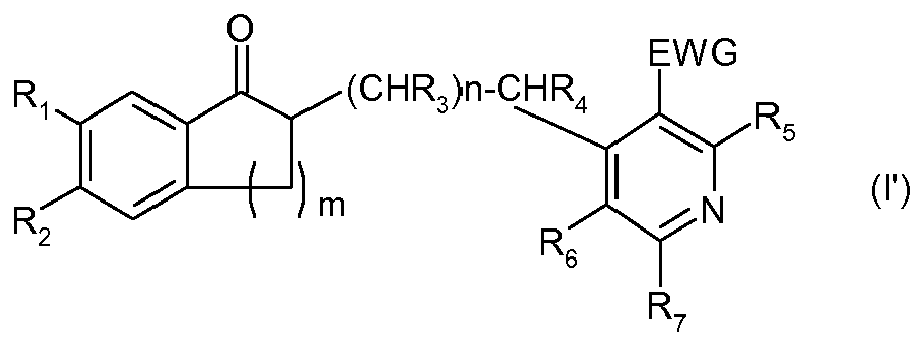
- Process according to claim 11, according to the scheme:

- Process according to claims 11 or 12, for the preparation of a compound according to claim 1 or 3 to 9, which comprises the step of reduction of a compound of formula (I+) in the presence of a reducing agent.
- Process for the preparation of a compound according to anyone of claim 1 to 9, where Z is CH or N, and where a compound of the formula

- Process according to claim 14, which comprise the scheme:
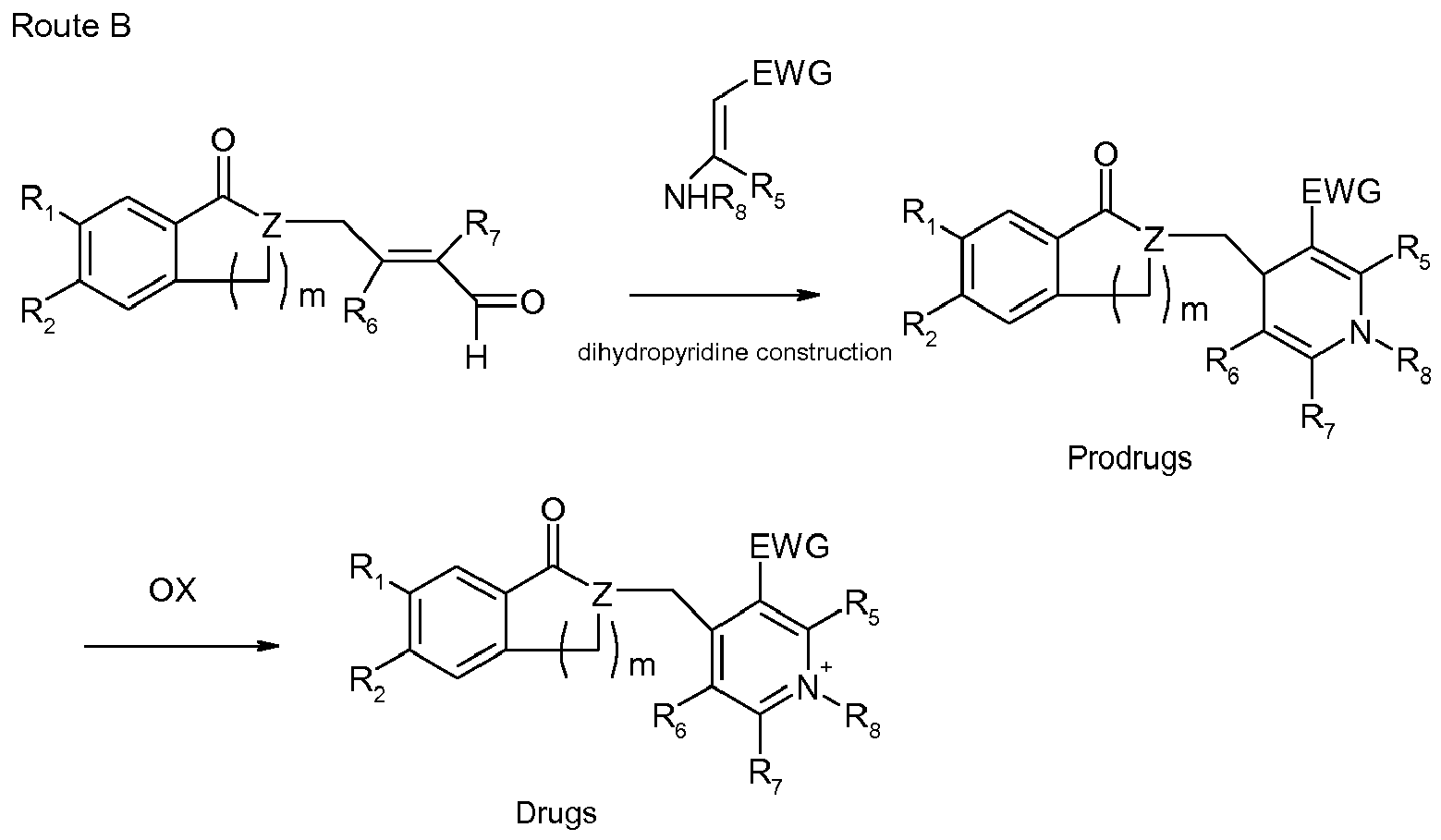
- A pharmaceutical composition comprising at least one compound according to any of claims 1 to 10 in the pure state or in a combined form with one or more compatible and pharmaceutically acceptable diluents or adjuvants.
- Inclusion complex of a compound comprising at least one compound according to any one of claims 1 to 10 with a beta-cyclodextrine, preferably a hydroxypropyl-betacyclodextrine.
Priority Applications (9)
| Application Number | Priority Date | Filing Date | Title |
|---|---|---|---|
| EP13305088.0A EP2759536A1 (en) | 2013-01-25 | 2013-01-25 | Oxidisable pyridine derivatives, their preparation and use as anti-Alzheimer agents |
| CA2898748A CA2898748A1 (en) | 2013-01-25 | 2014-01-24 | Oxidisable pyridine derivatives, their preparation and use as anti-alzheimer agents |
| CN201480018389.0A CN105121408A (en) | 2013-01-25 | 2014-01-24 | Oxidisable pyridine derivatives, preparation thereof and use as anti-alzheimer agents |
| PCT/EP2014/051392 WO2014114742A1 (en) | 2013-01-25 | 2014-01-24 | Oxidisable pyridine derivatives, their preparation and use as anti-alzheimer agents |
| AU2014209909A AU2014209909B2 (en) | 2013-01-25 | 2014-01-24 | Oxidisable pyridine derivatives, their preparation and use as anti-alzheimer agents |
| US14/763,222 US9376387B2 (en) | 2013-01-25 | 2014-01-24 | Oxidisable pyridine derivatives, their preparation and use as anti-alzheimer agents |
| EP14702219.8A EP2948429B1 (en) | 2013-01-25 | 2014-01-24 | Oxidisable pyridine derivatives, their preparation and use as anti-alzheimer agents |
| IL239944A IL239944A0 (en) | 2013-01-25 | 2015-07-15 | Oxidisable pyridine derivatives, their preparation and use as anti-alzheimer agents |
| AU2018203502A AU2018203502A1 (en) | 2013-01-25 | 2018-05-17 | Oxidisable pyridine derivatives, their preparation and use as anti-alzheimer agents |
Applications Claiming Priority (1)
| Application Number | Priority Date | Filing Date | Title |
|---|---|---|---|
| EP13305088.0A EP2759536A1 (en) | 2013-01-25 | 2013-01-25 | Oxidisable pyridine derivatives, their preparation and use as anti-Alzheimer agents |
Publications (1)
| Publication Number | Publication Date |
|---|---|
| EP2759536A1 true EP2759536A1 (en) | 2014-07-30 |
Family
ID=47710065
Family Applications (2)
| Application Number | Title | Priority Date | Filing Date |
|---|---|---|---|
| EP13305088.0A Withdrawn EP2759536A1 (en) | 2013-01-25 | 2013-01-25 | Oxidisable pyridine derivatives, their preparation and use as anti-Alzheimer agents |
| EP14702219.8A Not-in-force EP2948429B1 (en) | 2013-01-25 | 2014-01-24 | Oxidisable pyridine derivatives, their preparation and use as anti-alzheimer agents |
Family Applications After (1)
| Application Number | Title | Priority Date | Filing Date |
|---|---|---|---|
| EP14702219.8A Not-in-force EP2948429B1 (en) | 2013-01-25 | 2014-01-24 | Oxidisable pyridine derivatives, their preparation and use as anti-alzheimer agents |
Country Status (7)
| Country | Link |
|---|---|
| US (1) | US9376387B2 (en) |
| EP (2) | EP2759536A1 (en) |
| CN (1) | CN105121408A (en) |
| AU (2) | AU2014209909B2 (en) |
| CA (1) | CA2898748A1 (en) |
| IL (1) | IL239944A0 (en) |
| WO (1) | WO2014114742A1 (en) |
Cited By (1)
| Publication number | Priority date | Publication date | Assignee | Title |
|---|---|---|---|---|
| WO2018230776A1 (en) * | 2017-06-16 | 2018-12-20 | 주식회사 코팜 | Compositions containing pterosin compound and derivatives thereof active ingredients for prevention or treatment of degenerative brain diseases |
Families Citing this family (2)
| Publication number | Priority date | Publication date | Assignee | Title |
|---|---|---|---|---|
| KR101712708B1 (en) * | 2014-10-08 | 2017-03-07 | 영남대학교 산학협력단 | Composition for preventing or treating inflammatory bowel disease comprising Indeno Pyridinium chloride compound as an active ingredient |
| CN116715627A (en) * | 2023-06-16 | 2023-09-08 | 安徽丰乐农化有限责任公司 | A kind of synthesis method of N,N-dimethyl-2-aminosulfonyl-pyridinamide |
Citations (4)
| Publication number | Priority date | Publication date | Assignee | Title |
|---|---|---|---|---|
| EP0296560A2 (en) | 1987-06-22 | 1988-12-28 | Eisai Co., Ltd. | 1,4-Substituted piperidines as acetylcholinesterase inhibitors and their use for the treatment of Alzheimer's disease |
| WO1997008146A1 (en) | 1995-08-31 | 1997-03-06 | The State Of Israel | Pyridinium derivatives and pharmaceutical compositions containing them |
| WO1999036405A1 (en) | 1998-01-16 | 1999-07-22 | Eisai Co., Ltd. | Process for production of donepezil derivative |
| WO2006103120A2 (en) | 2005-04-01 | 2006-10-05 | Insa Rouen | New heterocyclic compounds, their preparation and their use as medicaments, in particular as anti-alzheimer agents |
Family Cites Families (4)
| Publication number | Priority date | Publication date | Assignee | Title |
|---|---|---|---|---|
| JPH05310696A (en) * | 1992-05-06 | 1993-11-22 | Kotobuki Seiyaku Kk | Pyridine derivative, method for producing the same, and drug containing the same |
| US6048877A (en) | 1997-02-21 | 2000-04-11 | Bristol-Myers Squibb Company | Tetralone derivatives as antiarrhythmic agents |
| US20050107432A1 (en) * | 2002-01-22 | 2005-05-19 | Yoichi Iimura | Sigma receptor binder containing indanone derivative |
| EP1731507A1 (en) * | 2005-04-26 | 2006-12-13 | Institut National des Sciences Appliquees de Rouen (INSA) | New heterocyclic compounds, their preparation and their use as medicaments, in particular as anti-alzheimer agents |
-
2013
- 2013-01-25 EP EP13305088.0A patent/EP2759536A1/en not_active Withdrawn
-
2014
- 2014-01-24 AU AU2014209909A patent/AU2014209909B2/en not_active Expired - Fee Related
- 2014-01-24 US US14/763,222 patent/US9376387B2/en not_active Expired - Fee Related
- 2014-01-24 WO PCT/EP2014/051392 patent/WO2014114742A1/en not_active Ceased
- 2014-01-24 CA CA2898748A patent/CA2898748A1/en not_active Abandoned
- 2014-01-24 EP EP14702219.8A patent/EP2948429B1/en not_active Not-in-force
- 2014-01-24 CN CN201480018389.0A patent/CN105121408A/en active Pending
-
2015
- 2015-07-15 IL IL239944A patent/IL239944A0/en unknown
-
2018
- 2018-05-17 AU AU2018203502A patent/AU2018203502A1/en not_active Abandoned
Patent Citations (4)
| Publication number | Priority date | Publication date | Assignee | Title |
|---|---|---|---|---|
| EP0296560A2 (en) | 1987-06-22 | 1988-12-28 | Eisai Co., Ltd. | 1,4-Substituted piperidines as acetylcholinesterase inhibitors and their use for the treatment of Alzheimer's disease |
| WO1997008146A1 (en) | 1995-08-31 | 1997-03-06 | The State Of Israel | Pyridinium derivatives and pharmaceutical compositions containing them |
| WO1999036405A1 (en) | 1998-01-16 | 1999-07-22 | Eisai Co., Ltd. | Process for production of donepezil derivative |
| WO2006103120A2 (en) | 2005-04-01 | 2006-10-05 | Insa Rouen | New heterocyclic compounds, their preparation and their use as medicaments, in particular as anti-alzheimer agents |
Non-Patent Citations (27)
| Title |
|---|
| BARTOLI ET AL., SYNLETT, 2007, pages 2897 |
| BROUSSY ET AL., ORG. BIOMOL. CHEM., vol. 3, 2005, pages 666 |
| CARELLI ET AL., TETRAHEDRON, vol. 61, 2005, pages 10331 |
| CLARK ET AL., BIOORGANIC & MEDICINAL CHEMISTRY LETTERS, vol. 256, 2002 |
| CURRENT MEDICINAL CHEMISTRY, vol. 7, 2000, pages 303 - 339 |
| ELLMAN, G.L.; COURTNEY, K.D.; ANDRES, V.; FEATHERSTONE, R.M.: "A new and rapid colorimetric determination of acetylcholinesterase activity", BIOCHEM. PHARMACOL., vol. 7, 1961, pages 88 - 95 |
| GAILLARD ET AL., SYNLETT, vol. 3, 2005, pages 441 |
| GIRLING ET AL., CHEMICAL COMMUNICATION, vol. 48, 2012, pages 4893 |
| GOMEZ ET AL., TET. LETT., vol. 46, 2005, pages 3513 |
| HAADSMA-SVENSSON ET AL., J. MED. CHEM., vol. 44, no. 26, 2001, pages 4716 - 4732 |
| J. MED. CHEM., vol. 52, no. 22, 2009, pages 7255 |
| J. ORG. CHEM., vol. 60, 1995, pages 2948 |
| JORGENSEN ET AL., CHEMISTRY : AN ASIAN JOURNAL, vol. 3, 2008, pages 216 |
| JOURNAL OF MEDICINAL CHEMISTRY, vol. 52, 2009, pages 7249 |
| KANGER ET AL., THE JOURNAL OF ORGANIC CHEMISTRY, vol. 76, 2011, pages 1538 |
| KASPI ET AL., EUR. PAT. APPL., 2004 |
| LAVILLA ET AL., J. ORG. CHEM., vol. 66, 2001, pages 1487 |
| LEGROS ET AL., TETRAHEDRON, 2001, pages 2507 |
| LI, ORGANIC LETTERS, vol. 14, 2012, pages 214 |
| MAUZERALL ET AL., J. AM. CHEM. SOC., vol. 77, 1955, pages 2261 |
| RAMA ET AL., SYNTHETIC COMMUNICATION, vol. 37, 2007, pages 2847 |
| RENAUD, ADVANCED SYNTHESIS AND CATALALYSIS, 2006, pages 2571 |
| ROE ET AL., CHEMICAL COMMUNICATION, 2009, pages 4399 |
| RONGYUAN XIE ET AL: "Selective A3 adenosine receptor antagonists: water-soluble 3,5-diacyl-1,2,4-trialkylpyridinium salts and their oxidative generation from dihydropyridine precursors", JOURNAL OF MEDICINAL CHEMISTRY, vol. 42, no. 20, 1999, pages 4232 - 4238, XP000877112, ISSN: 0022-2623, DOI: 10.1021/JM990234X * |
| TAKEMOTO ET AL., SYNLETT, 2010, pages 1865 |
| WANG ET AL., NUCLEAR MEDICINE AND BIOLOGY, vol. 31, 2004 |
| WUEST ET AL., JACS, vol. 73, 1951, pages 1210 - 1216 |
Cited By (1)
| Publication number | Priority date | Publication date | Assignee | Title |
|---|---|---|---|---|
| WO2018230776A1 (en) * | 2017-06-16 | 2018-12-20 | 주식회사 코팜 | Compositions containing pterosin compound and derivatives thereof active ingredients for prevention or treatment of degenerative brain diseases |
Also Published As
| Publication number | Publication date |
|---|---|
| CN105121408A (en) | 2015-12-02 |
| AU2018203502A1 (en) | 2018-06-07 |
| WO2014114742A1 (en) | 2014-07-31 |
| AU2014209909A1 (en) | 2015-07-30 |
| US20150353493A1 (en) | 2015-12-10 |
| IL239944A0 (en) | 2015-08-31 |
| US9376387B2 (en) | 2016-06-28 |
| EP2948429B1 (en) | 2018-08-15 |
| EP2948429A1 (en) | 2015-12-02 |
| AU2014209909B2 (en) | 2018-06-14 |
| CA2898748A1 (en) | 2014-07-31 |
Similar Documents
| Publication | Publication Date | Title |
|---|---|---|
| DK172337B1 (en) | 1- (Aryl or cyclohexyl) alkylpiperidine compounds, pharmaceutical compositions containing them and the use of the compounds for the manufacture of drugs | |
| KR102477481B1 (en) | pyrrolidine compounds | |
| Shan et al. | Synthesis, biological evaluation of 9-N-substituted berberine derivatives as multi-functional agents of antioxidant, inhibitors of acetylcholinesterase, butyrylcholinesterase and amyloid-β aggregation | |
| JP3038016B2 (en) | Carbonyl piperazinyl and carbonyl piperidinyl compounds inhibiting farnesyl protein transferase | |
| US6777414B1 (en) | Nitrogen-containing heterocyclic compounds and benamide compounds and drugs containing the same | |
| JP3579345B2 (en) | Process for producing 4-carboxyamino-2-substituted-1,2,3,4-tetrahydroquinoline | |
| RU2724333C2 (en) | 1,3,5-triazine derivative and a method for use thereof | |
| JP2967990B2 (en) | 1,4-disubstituted-piperidinyl compounds | |
| JPH0631220B2 (en) | Fluorine-substituted benzocycloheptapyridine compound, composition and use thereof | |
| US6878707B2 (en) | Carboxamides useful as inhibitors of microsomal triglyceride transfer protein and of apolipoprotein b secretion | |
| CZ201799A3 (en) | 6-Phenylpyridin-2-ylamine derivatives, pharmaceutical composition based thereon and treatment methods | |
| FR2640266A2 (en) | DERIVATIVES OF (1-HYDROXY PIPERIDINYL-2 ALKYL) INDOLONES-2, QUINOLININES-2, BENZO (B) AZEPINONES-2 AND BENZIMIDAZOLONES-2, THEIR PREPARATION AND THEIR THERAPEUTIC USE | |
| WO2012012320A1 (en) | Substituted hydroxamic acids and uses thereof | |
| EP0460062A1 (en) | Method for the synthesis of huperzine a and analogs thereof and compounds useful therein | |
| EA006101B1 (en) | Biphenylcarboxamides useful as lipid lowering agents | |
| JP2017523966A (en) | Pyridine derivatives and their use in antimycobacteria | |
| JP2002508359A (en) | Heterocyclic cytotoxic agent | |
| AU2018203502A1 (en) | Oxidisable pyridine derivatives, their preparation and use as anti-alzheimer agents | |
| JPS6123790B2 (en) | ||
| KR20000070756A (en) | 2-Amino Substituted Pyridines for Use in The Treatment of Arteriosclerosis and Hyperlipoproteinaemia | |
| JP3075566B2 (en) | Optically active indanone derivative | |
| JPH1180098A (en) | Amine derivatives, their production methods and agents | |
| RU2189975C2 (en) | 1-phenylalkyl-1,2,3,6-tetrahydropyridines, method of their synthesis and pharmaceutical composition based on thereof | |
| Ullah et al. | Synthesis of new 4-aryl-1-(biarylmethylene) piperidines. Structural analogs of adoprazine (SLV313) | |
| EP0035819A1 (en) | Quinoline derivatives, pharmaceutical compositions containing such compounds, and methods for the preparation of these compounds |
Legal Events
| Date | Code | Title | Description |
|---|---|---|---|
| PUAI | Public reference made under article 153(3) epc to a published international application that has entered the european phase |
Free format text: ORIGINAL CODE: 0009012 |
|
| 17P | Request for examination filed |
Effective date: 20130125 |
|
| AK | Designated contracting states |
Kind code of ref document: A1 Designated state(s): AL AT BE BG CH CY CZ DE DK EE ES FI FR GB GR HR HU IE IS IT LI LT LU LV MC MK MT NL NO PL PT RO RS SE SI SK SM TR |
|
| AX | Request for extension of the european patent |
Extension state: BA ME |
|
| R17P | Request for examination filed (corrected) |
Effective date: 20150129 |
|
| RBV | Designated contracting states (corrected) |
Designated state(s): AL AT BE BG CH CY CZ DE DK EE ES FI FR GB GR HR HU IE IS IT LI LT LU LV MC MK MT NL NO PL PT RO RS SE SI SK SM TR |
|
| STAA | Information on the status of an ep patent application or granted ep patent |
Free format text: STATUS: THE APPLICATION IS DEEMED TO BE WITHDRAWN |
|
| 18D | Application deemed to be withdrawn |
Effective date: 20150131 |