EP2757502A1 - Image processing apparatus, image processing method, and image processing program - Google Patents
Image processing apparatus, image processing method, and image processing program Download PDFInfo
- Publication number
- EP2757502A1 EP2757502A1 EP12832626.1A EP12832626A EP2757502A1 EP 2757502 A1 EP2757502 A1 EP 2757502A1 EP 12832626 A EP12832626 A EP 12832626A EP 2757502 A1 EP2757502 A1 EP 2757502A1
- Authority
- EP
- European Patent Office
- Prior art keywords
- image
- designation area
- unit configured
- segment
- display
- Prior art date
- Legal status (The legal status is an assumption and is not a legal conclusion. Google has not performed a legal analysis and makes no representation as to the accuracy of the status listed.)
- Granted
Links
Images




Classifications
-
- G—PHYSICS
- G06—COMPUTING OR CALCULATING; COUNTING
- G06F—ELECTRIC DIGITAL DATA PROCESSING
- G06F3/00—Input arrangements for transferring data to be processed into a form capable of being handled by the computer; Output arrangements for transferring data from processing unit to output unit, e.g. interface arrangements
- G06F3/01—Input arrangements or combined input and output arrangements for interaction between user and computer
- G06F3/048—Interaction techniques based on graphical user interfaces [GUI]
- G06F3/0487—Interaction techniques based on graphical user interfaces [GUI] using specific features provided by the input device, e.g. functions controlled by the rotation of a mouse with dual sensing arrangements, or of the nature of the input device, e.g. tap gestures based on pressure sensed by a digitiser
- G06F3/0488—Interaction techniques based on graphical user interfaces [GUI] using specific features provided by the input device, e.g. functions controlled by the rotation of a mouse with dual sensing arrangements, or of the nature of the input device, e.g. tap gestures based on pressure sensed by a digitiser using a touch-screen or digitiser, e.g. input of commands through traced gestures
- G06F3/04886—Interaction techniques based on graphical user interfaces [GUI] using specific features provided by the input device, e.g. functions controlled by the rotation of a mouse with dual sensing arrangements, or of the nature of the input device, e.g. tap gestures based on pressure sensed by a digitiser using a touch-screen or digitiser, e.g. input of commands through traced gestures by partitioning the display area of the touch-screen or the surface of the digitising tablet into independently controllable areas, e.g. virtual keyboards or menus
-
- G—PHYSICS
- G06—COMPUTING OR CALCULATING; COUNTING
- G06V—IMAGE OR VIDEO RECOGNITION OR UNDERSTANDING
- G06V30/00—Character recognition; Recognising digital ink; Document-oriented image-based pattern recognition
- G06V30/10—Character recognition
- G06V30/14—Image acquisition
- G06V30/142—Image acquisition using hand-held instruments; Constructional details of the instruments
-
- G—PHYSICS
- G06—COMPUTING OR CALCULATING; COUNTING
- G06V—IMAGE OR VIDEO RECOGNITION OR UNDERSTANDING
- G06V30/00—Character recognition; Recognising digital ink; Document-oriented image-based pattern recognition
- G06V30/10—Character recognition
- G06V30/14—Image acquisition
- G06V30/1444—Selective acquisition, locating or processing of specific regions, e.g. highlighted text, fiducial marks or predetermined fields
- G06V30/1456—Selective acquisition, locating or processing of specific regions, e.g. highlighted text, fiducial marks or predetermined fields based on user interactions
-
- H—ELECTRICITY
- H04—ELECTRIC COMMUNICATION TECHNIQUE
- H04N—PICTORIAL COMMUNICATION, e.g. TELEVISION
- H04N23/00—Cameras or camera modules comprising electronic image sensors; Control thereof
- H04N23/60—Control of cameras or camera modules
- H04N23/63—Control of cameras or camera modules by using electronic viewfinders
- H04N23/631—Graphical user interfaces [GUI] specially adapted for controlling image capture or setting capture parameters
- H04N23/632—Graphical user interfaces [GUI] specially adapted for controlling image capture or setting capture parameters for displaying or modifying preview images prior to image capturing, e.g. variety of image resolutions or capturing parameters
-
- H—ELECTRICITY
- H04—ELECTRIC COMMUNICATION TECHNIQUE
- H04N—PICTORIAL COMMUNICATION, e.g. TELEVISION
- H04N23/00—Cameras or camera modules comprising electronic image sensors; Control thereof
- H04N23/80—Camera processing pipelines; Components thereof
-
- G—PHYSICS
- G06—COMPUTING OR CALCULATING; COUNTING
- G06F—ELECTRIC DIGITAL DATA PROCESSING
- G06F2203/00—Indexing scheme relating to G06F3/00 - G06F3/048
- G06F2203/048—Indexing scheme relating to G06F3/048
- G06F2203/04803—Split screen, i.e. subdividing the display area or the window area into separate subareas
-
- G—PHYSICS
- G06—COMPUTING OR CALCULATING; COUNTING
- G06V—IMAGE OR VIDEO RECOGNITION OR UNDERSTANDING
- G06V30/00—Character recognition; Recognising digital ink; Document-oriented image-based pattern recognition
- G06V30/10—Character recognition
Definitions
- the present invention relates to an image processing apparatus, an image processing method, and an image processing program.
- This image information processing apparatus determines whether a recognition target is appropriate as an image used to recognize a character string and performs a character recognition process on the image obtained by the determination in order to reduce erroneous recognition of a character string due to, for example, camera shake.
- An object of the present invention is to provide an image processing apparatus, an image processing method, and an image processing program capable of solving the above-described problems.
- an image processing apparatus in an embodiment of the present invention includes: a camera configured to acquire image data by photoelectrically converting an optical image incident from a lens; a display unit configured to display a camera image based on the image data; an operation unit configured to detect a designation area designated on a display screen of the display unit; a specifying unit configured to acquire designation area image position information representing a position of an image corresponding to the designation area in the camera image for each detected designation area; an image segmentation processing unit configured to segment the image corresponding to the designation area from the camera image based on the designation area image position information; a memory unit configured to save image data of a segment image corresponding to the designation area segmented from the camera image; and a processing control unit configured to cause each of a program constituting the specifying unit configured to acquire the designation area image position information of the designation area and a program constituting the image segmentation processing unit configured to segment the image corresponding to the designation area to be executed for each designation area when the designation area has been
- an image processing method in an embodiment of the present invention includes the steps of: acquiring image data by photoelectrically converting an optical image incident from a lens; displaying a camera image based on the image data on a display unit; detecting a designation area designated on a display screen of the display unit; causing each of a program constituting a specifying unit configured to acquire the designation area image position information of the designation area and a program constituting an image segmentation processing unit configured to segment an image corresponding to the designation area to be executed for each designation area when the designation area has been designated; acquiring, by the specifying unit, the designation area image position information representing a position of the image corresponding to the designation area in the camera image; segmenting, by the image segmentation processing unit, the image corresponding to the designation area from the camera image based on the designation area image position information; and saving image data of a segment image corresponding to the designation area segmented from the camera image in a memory unit.
- An image processing program in an embodiment of the present invention causes a computer to function as: a camera unit configured to acquire image data by photoelectrically converting an optical image incident from a lens; a display unit configured to display a camera image based on the image data; an operation unit configured to detect a designation area designated on a display screen of the display unit; a specifying unit configured to acquire designation area image position information representing a position of an image corresponding to the designation area in the camera image for each detected designation area; an image segmentation processing unit configured to segment the image corresponding to the designation area from the camera image based on the designation area image position information; a memory unit configured to save image data of a segment image corresponding to the designation area segmented from the camera image; and a processing control unit configured to cause each of a program constituting the specifying unit configured to acquire the designation area image position information of the designation area and a program constituting the image segmentation processing unit configured to segment the image corresponding to the designation area to be executed for each designation area when the designation area has been designated.
- the operability of a user can be improved when an image recognition process is executed on an image captured by a camera.
- FIG. 1 is a diagram illustrating an outline of an information processing apparatus (portable terminal) according to the embodiment of the present invention. Also, in the embodiment of the present invention, an example in which the information processing apparatus is a portable terminal with a camera will be described hereinafter. However, the present invention is not limited thereto.
- the information processing apparatus may be a smartphone, a portable game machine, a tablet type personal computer (PC), a notebook type PC, or the like.
- the portable terminal 100 When an execution target area (hereinafter referred to as a designation area) of an image recognition process for a live view captured by a camera is designated by a user, the portable terminal 100 according to the embodiment of the present invention segments an image corresponding to the designation area designated by the user from the live view and saves the segmented image in a memory unit. Then, when an instruction for the image recognition process on the segmented image (hereinafter referred to as a segment image) has been issued, the segment image is read from the memory unit and the image recognition process is executed. Also, the live view is a video input from a lens of the camera and is a video displayed on a monitor based on image data continuously output by an imaging element based on an optical image incident on the lens.
- the portable terminal 100 may segment a designation area designated on the captured image.
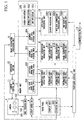
- the portable terminal 100 includes a camera 1, an image processing unit 2, a memory unit 3, a display control unit 4, a touch panel 5, a processing control unit 6, an information source specifying unit 7, an image segmentation processing unit 8, an image recognition processing unit 9, an application processing unit 10, a camera control unit 11, an operation button 12, and a communication unit 13.
- the touch panel 5 includes a display unit 501 and an operation unit 502.
- the camera 1 includes an optical system 101, an imaging element 102 configured to generate image data from an optical image incident via the optical system 101, and an analog-to-digital (A/D) conversion unit 103 configured to convert an analog signal of image data output from the imaging element 102 into a digital signal and output the digital signal of the image data.
- A/D analog-to-digital
- the camera 1 when a power source is supplied via a switch button included in the operation button 12, the camera 1, for example, generates image data from the incident optical image and continuously outputs the generated image data to the image processing unit 2.
- the portable terminal 100 displays a live view on the display unit 501 of the touch panel 5 based on continuous image data generated in a state in which the camera 1 can perform imaging.
- the user can determine an image to be captured while viewing the live view.
- the image processing unit 2 executes image processing on image data output from the camera 1 and saves the image data after the image processing in a live view image data storage area 301 of the memory unit 3.
- the memory unit 3 saves data of a program or application to be used in each process of the portable terminal 100 and temporarily saves information to be used in various types of processes of the portable terminal 100.
- the memory unit 3 includes the live view image data storage area 301, a captured image data storage area 302, a segment image data storage area 303, a segment text data storage area 304, and an application storage area 305.
- the live view image data storage area 301 is a storage area in which image data of a live view acquired by the camera 1 is temporarily saved.
- the captured image data storage area 302 is a storage area in which image data of a captured image captured by the camera 1 is saved by the user pressing a shutter button included in the operation button 12.
- the segment image data storage area 303 is a storage area in which the segment image segmented by the image segmentation processing unit 8 is saved.
- the segment text data storage area 304 is a storage area in which a recognition result representing image content of the segment image on which the image recognition processing unit 9 has performed image recognition is saved.
- the application storage area 305 is a storage area in which an application installed by the portable terminal 100 is saved.
- the display control unit 4 controls the display unit 501 of the touch panel 5.
- the display control unit 4 controls the display unit 501 to display a segment image segmented by the image segmentation processing unit 8 on one screen along with a live view.
- the display control unit 4 controls the display unit 501 to perform a display to distinguish each display aspect according to processing progress of the image recognition process. For example, the display control unit 4 displays a peripheral part of a segment image before the image recognition process in red, displays a peripheral part of a segment image during the image recognition process in purple, and displays a peripheral part of a segment image after the image recognition process in blue.
- the display unit 501 of the touch panel 5 displays display content according to control of the display control unit 4.
- the display unit 501 is provided as a display screen of the touch panel 5 integrally with the operation unit 502.
- the display screen of the display unit 501 also functions as an operation screen when the operation unit 502 receives an operation.
- an XY coordinate system in which a predetermined reference point (for example, the top left corner of the screen) is designated as the origin is defined on the display screen of the display unit 501.
- a coordinate value (X, Y) in the XY coordinate system is allocated for each pixel included in the display unit 501.
- the XY coordinate system in the display screen of the display unit 501 is consistent with that of the operation screen.
- the operation unit 502 of the touch panel 5 includes a sensor configured to receive an operation from the user, and outputs a detection result by the sensor to the processing control unit 6, the information source specifying unit 7, and the image recognition processing unit 9.
- the operation unit 502 detects a contact position of the user's finger in contact with the display screen of the display unit 501 using the sensor at predetermined fixed time intervals and outputs a detection result of the sensor.
- the contact position of the user's finger is represented by a coordinate value of the XY coordinate system in the operation screen (display screen).
- the portable terminal according to the present invention is not limited thereto.
- positions of the user's finger close to the display screen of the display unit 501, an operation instruction unit, etc. may be detected by a non-contact sensor.
- the display unit 501 and the operation unit 502 may not be the touch panel 5, and may be an operation unit such as a button or a keyboard connected to a computer, an external keyboard, a display of an external monitor, or the like.
- FIGS. 2A and 2B reference diagrams each illustrating an example of a method by which the information processing apparatus (portable terminal) according to the embodiment of the present invention detects a designation area E(i) are illustrated.
- the processing control unit 6 determines whether the designation area E(i) has been designated based on the detection result of the sensor of the operation unit 502. Also, i is an identification number which distinguishes each designation area. Upon determining that the designation area E(i) has been designated, the processing control unit 6 may allocate a different identification number i to each designation area E(i).
- this processing control unit 6 determines that a touch operation has been input. In addition, based on the detection result of the operation unit 502 of the touch panel 5, the processing control unit 6 determines that a slide operation has been input upon detecting that the finger has been moved in a state in which the finger is in contact with the display screen of the touch panel 5. Further, based on the detection result of the operation unit 502 of the touch panel 5, the processing control unit 6 determines that a touch release operation has been input upon detecting that the finger has been separated from the display screen in a state in which the finger was in contact with the display screen of the touch panel 5.
- the processing control unit 6 determines that a start point Ps(i) of the designation area E(i) has been designated and acquires a position in the display screen to which the touch operation has been input as a position of the start point Ps(i) ( FIG. 2A ). This processing control unit 6 detects an XY coordinate value (Xs i , Ys i ) representing the position in the display screen of the detected start point Ps(i).
- the processing control unit 6 determines that an end point Pe(i) of the designation area E(i) has been designated and acquires a position in the display screen to which the touch release operation has been input as a position of the end point Pe(i). This processing control unit 6 detects an XY coordinate value (Xe i , Ye i ) representing the position in the display screen of the detected end point Pe(i) ( FIG. 2B ).
- this processing control unit 6 determines a rectangular area in which the start point Ps(i) and the end point Pe(i) serve as vertices on a diagonal line as the designation area E(i). That is, the processing control unit 6 determines that the designation area E(i) has been designated by determining that the start point Ps(i) and the end point Pe(i) have been designated. Also, the present invention is not limited thereto.
- the processing control unit 6 may detect an area which includes the start point Ps(i) and the end point Pe(i) in both ends and is determined according to pressure of the finger in contact with a display surface of the touch panel 5 or a thickness of the finger and a length in which a slide operation has been input as the designation area E(i).
- the processing control unit 6 executes a program constituting an (i) th information source specifying unit 7(i) used to detect designation area image position information J(i) representing a position of an image corresponding to the designation area E(i) in a live view.
- this processing control unit 6 executes a program constituting the information source specifying unit 7(i) for each designated designation area E(i).
- each information source specifying unit 7(i) can independently detect designation area image position information J(i) representing a position on a live view of an image corresponding to the designation area E(i).
- the processing control unit 6 executes a program constituting an (i) th image segmentation processing unit 8(i) which segments a segment image G(i) corresponding to the designation area E(i).
- this processing control unit 6 executes a program constituting the image segmentation processing unit 8(i) for each designated designation area E(i).
- each image segmentation processing unit 8(i) can independently segment the segment image G(i) corresponding to the designation area E(i).
- the information source designation unit 7 acquires designation area image position information J(i) representing a position of the segment image G(i) on the live view corresponding to the designation area E(i) based on the XY coordinate value (Xs i , Ys i ) of the start point Ps(i) and the XY coordinate value (Xe i , Ye i ) of the end point Pe(i) of the designation area E(i) detected by the processing control unit 6.
- This information source specifying unit 7 includes information source specifying units 7(i) activated by the processing control unit 6 for every designation area E(i).
- the respective information source specifying units 7(i) can execute a process of detecting the above-described designation area image position information J(i) in parallel.
- the image segmentation processing unit 8 segments the segment image G(i) corresponding to the designation area E(i) from image data of the live view corresponding to the designation area E(i) based on the designation area image position information J(i) acquired by the information source specifying unit 7(i). Also, the live view is a video to be displayed based on a plurality of pieces of continuous image data.
- the display unit 501 of the touch panel 5 displays the live view by sequentially displaying images acquired in time series one by one. Consequently, an image based on a plurality of pieces of image data is displayed on the display unit 501 of the touch panel 5 from when the start point Ps(i) is designated to when the end point Pe(i) is designated.
- the image segmentation processing unit 8 segments the segment image G(i) from the image data of the live view displayed on the display unit 501 when the end point Pe(i) has been detected among the plurality of pieces of image data of the live view displayed on the display unit 501 when the designation area E(i) has been designated.
- the present invention is not limited thereto.
- the image segmentation processing unit 8 may segment the segment image G(i) from image data with largest contrast among the plurality of pieces of image data displayed on the display unit 501 of the touch panel 5 from when the start point Ps(i) is designated to when the end point Pe(i) is designated.
- This image segmentation processing unit 8 includes image segmentation processing units 8(i) activated by the processing control unit 6.
- the respective image segmentation processing units 8(i) can execute a process of segmenting the above-described segment image G(i) in parallel.
- the image recognition processing unit 9 reads the designated segment image G(i) from a segment text data storage area 304 of the memory unit 3. In this manner, it is also possible to instruct the image segmentation processing unit 8 to execute an image segmentation operation during a recognition process by the image recognition processing unit 9 by executing the operation of the image recognition processing unit 9 independent of a process of the image segmentation processing unit 8.
- the image recognition processing unit 9 may automatically execute the image recognition process. For example, during an operation in which a processing load is low such as a state in which a shooting operation by the camera 1 is not executed, the image recognition process may be predetermined to be executed. In this case, in the state in which the processing load is low, the image recognition processing unit 9 may be an image recognition processing unit which sequentially reads the image segment image G(i) on which the image recognition process is not executed from the segment text data storage area 304.
- the image recognition processing unit 9 may be an image recognition processing unit which executes an image recognition process on an image segment image G(i) on which the image recognition process has not been executed read from the segment text data storage area 304 at a predetermined timing as follows.
- This predetermined timing may be a timing at which shooting by the camera 1 stops or ends.
- it may be a timing at which the image segmentation operation is not input for a predetermined time or more and the image segmentation process by the image segmentation processing unit 8 is not executed for a predetermined time or more.
- it may be a timing at which the user has performed a predetermined operation on the segment image G(i) segmented by the image segmentation processing unit 8.
- the user has issued an operation instruction to display the segment image G(i) on the display unit 501 of the touch panel 5, a case in which display magnification of the displayed segment image G(i) has been enlarged or reduced, or the like.
- it may be a timing at which a predetermined time or more has elapsed after the image segmentation process by the image segmentation processing unit 8 has been executed.
- it may be a timing at which the application processing unit 10 uses the segment image G(i) according to another application.
- the image recognition processing unit 9 executes an image recognition process on the read segment image G(i). For example, the image recognition processing unit 9 matches predetermined pattern data against the segment image G(i), recognizes a character string (including hiragana, katakana, kanji, letters, numbers, etc.) included in the segment image G(i), and extracts text data of the recognized character string.
- a recognition result K(i) information representing image content of the segment image G(i) acquired by the image recognition processing unit 9 according to the image recognition process or the text data used here is referred to as a recognition result K(i).
- the image recognition processing unit 9 may be an image recognition processing unit which performs an image recognition process of recognizing a graphic such as a logo or a pictograph, an image recognition process of reading code information from a one-dimensional code, a two-dimensional code, or the like.
- This image recognition processing unit 9 saves the recognition result K(i) acquired by the image recognition process in the segment text data storage area 304 of the memory unit 3.
- the application processing unit 10 executes an application stored in the application storage area 305 of the memory unit 3 according to the recognition result K(i) and starts up a processing unit responsible for a process of each application. For example, when the recognition result K(i) has been designated according to a touch operation from the user via the operation unit 502 of the touch panel 5 in a state in which the recognition result K(i) is displayed on the display unit 501 of the touch panel 5, the application processing unit 10 determines that an instruction has been issued to execute the application for the designated recognition result K(i). In this case, the application processing unit 10 executes a predetermined application as an executable application related to the designated recognition result K(i), and starts up a processing unit corresponding to the application.
- the application processing unit 10 executes a search application 351 predetermined as an executable application corresponding to the character string. Thereby, the application processing unit 10 starts up the search processing unit 1001.
- the search processing unit 1001 transmits information for an instruction used to search for information related to a character string of the designated recognition result K(i) in a keyword search engine to a server (not illustrated) connected by a network via the communication unit 13.
- the display control unit 4 Upon receiving the search result by the keyword search engine from the server, the display control unit 4 causes the display unit 501 of the touch panel 5 to display the received search result.
- the application processing unit 10 executes a browser application 352 predetermined as an executable application corresponding to the URL. Thereby, the application processing unit 10 starts up a WEB site connection processing unit 1002.
- the WEB site connection processing unit 1002 transmits the URL of the designated recognition result K(i) to a server (not illustrated) connected by a network via the communication unit 13.
- the display control unit 4 causes the display unit 50 of the touch panel 5 to display the received WEB image.
- the application processing unit 10 executes a map application 353 predetermined as an executable application corresponding to the information representing the place. Thereby, the application processing unit 10 starts up a map display processing unit 1003.
- the map display processing unit 1003 transmits information for an instruction used to search for a place of the designated recognition result K(i) in the map search engine to the server (not illustrated) connected by the network via the communication unit 13.
- the display control unit 4 causes the display unit 501 of the touch panel 5 to display the received search result.
- the camera control unit 11 controls the camera 1 so that image data of a captured image is acquired based on an optical image incident on the camera 1. Also, it is preferable that the captured image be an image having higher image quality than the live view.
- the operation button 12 for example, is an input unit of an operation from the user including a power-source switch button, a shutter button, or the like. Also, in addition thereto, the operation button 12 may be an operation button including an operation input unit such as a directional pad. This operation button 12 receives an operation from the user and outputs operation information representing the received operation.
- the communication unit 13 is communicably connected to an external device such as the server via the network and performs transmission and reception of information.
- FIGS. 2A and 2B are reference diagrams each illustrating an example of the method by which the processing control unit 6 according to the embodiment of the present invention detects the designation area E(i).
- the processing control unit 6 determines that the touch operation has been input and detects the start point Ps(i) of the designation area E(i).
- the user causes a slide operation to be performed in a state in which the finger is touching the display screen of the touch panel 5.
- a display is performed on the touch panel 5, for example, by adding color thereto, so that it can be seen that a rectangular area in which a point currently in contact with the user's finger and the start point Ps(i) are vertices on a diagonal line is a user-designated area.
- the processing control unit 6 determines that the touch release operation has been input and detects the end point Pe(i) of the designation area E(i). Thereby, the designation area E(i) is determined. This designation area E(i) is illustrated in FIG. 2B .
- an image including information representing a URL is designated as the designation area E(i).
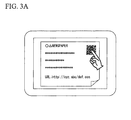
- FIGS. 3A and 3B are reference diagrams illustrating the example of the display control method by the display control unit 4.
- the user designates the designation area E(i) from the top of the display screen of the touch panel 5 which displays a live view.
- the processing control unit 6 detects a rectangular area in which the start point Ps(i) and the end point Pe(i) serve as vertices on a diagonal line.
- the user designates an image including a two-dimensional code as the designation area E(i).
- the processing control unit 6 executes each of a program constituting the information source specifying unit 7(i) and a program constituting the image segmentation processing unit 8(i) corresponding to the designation area E(i). Thereby, the information source specifying unit 7(i) and the image segmentation processing unit 8(i) start up.
- the information source specifying unit 7 detects the designation area image position information J(i) representing a position of an image corresponding to the designation area E(i).
- the image segmentation processing unit 8 segments the segment image G(i) corresponding to the designation area E(i). Thereby, the segment image G(i) is saved in the segment image data storage area 303 of the memory unit 3.
- the processing control unit 6 notifies the display control unit 4 of the segmentation.
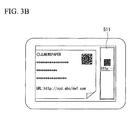
- the display control unit 4 creates a stock segment image display area 511 on which a thumbnail of the segment image G(i) is displayed along with the live view on the display unit 501 of the touch panel 5.
- An example in which the stock segment image display area 511 is displayed on the touch panel 5 is illustrated in FIG. 3B .
- the live view and the thumbnail of the segment image G(i) of the designation area E(i) are displayed on the display screen of the touch panel 5.
- the display control unit 4 causes the thumbnail of the segment image G(i) of the designation area E(i) and a thumbnail of a segment image G(i+1) of a designation area E(i+1) to be displayed on the stock segment image display area 511.
- the user can recognize that the image of the designated designation area E(i) is saved in the memory unit 3 by displaying the thumbnail of the segment image G(i) on the stock segment image display area 511 of the touch panel 5.
- the image recognition processing unit 9 executes an image recognition process of the segment image G(i) designated by the touch operation.
- the image recognition processing unit 9 recognizes a figure of the two-dimensional code from the segment image G(i) and reads code information included in the two-dimensional code. Then, the image recognition processing unit 9 saves the read code information as the recognition result K(i) in a segment text data storage area 304 of the memory unit 3.
- the application processing unit 10 executes the browser application 352 and starts up the WEB site connection processing unit 1002. Then, the WEB site connection processing unit 1002 transmits the URL of the WEB site of the restaurant to the server (not illustrated) connected by the network via the communication unit 13. Then, upon receiving a WEB image of the WEB site represented by the URL from the server, the display control unit 4 causes the received WEB image to be displayed on the touch panel 5.
- FIG. 4 is a flowchart illustrating the example in which the portable terminal 100 according to the embodiment of the present invention acquires the segment image.
- an optical image incident on the optical system 101 of the camera 1 is photoelectrically converted by the imaging element 102 and the photoelectrically converted image is output by the A/D conversion unit 103 as image data. That is, the camera 1 acquires image data of a continuous live view based on the incident optical image.
- the camera 1 outputs the image data of the live view to the image processing unit 2.
- the image processing unit 2 converts the input image data into an image size or image quality of a live view and stores the converted image data in the live view image data storage area 301 of the memory unit 3.
- the display control unit 4 reads the image data of the live view from the live view image data storage area 301 and causes the read image data to be displayed on the display unit 501 of the touch panel 5. Thereby, it is possible to cause the touch panel 5 to display a current video (live view) captured by the camera 1.
- the operation unit 502 of the touch panel 5 determines whether an operation of designating the start point Ps(i) of the designation area has been received. For example, the operation unit 502 determines whether a touch operation of touching an operation screen of the touch panel 5 has been detected.
- the processing control unit 6 Upon determining that the operation of designating the start point Ps(i) of the designation area has been received, the processing control unit 6 detects a position (Xs i , Ys i ) of the start point Ps(i) which is a position of the display screen that the user's finger came in contact with in the touch operation.
- the operation unit 502 continuously determines whether an operation of designating the end point Pe(i) of the designation area has been received. For example, after a touch operation of touching the display screen of the touch panel 5 has been detected, the operation unit 502 continuously determines whether the slide operation for movement has been detected in a state in which the finger is touching the display screen and the touch release operation in which the finger in the touching state is separated from the display screen has been further detected.
- the processing control unit 6 Upon determining that an operation of designating the end point Pe(i) of the designation area has been received, the processing control unit 6 detects a position (Xe i , Ye i ) of the end point Pe(i) which is a position at which the finger in the touching state is separated from the display screen.
- the processing control unit 6 executes a program constituting the (i) th information source specifying unit 7(i) used to detect the designation area image position information J(i) representing a position of an image on a live view corresponding to the designation area E(i) defined by the start point Ps(i) and the end point Pe(i). Thereby, the information source specifying unit 7(i) is activated.
- the activated information source specifying unit 7(i) acquires the designation area image position information J(i) representing a position of an image corresponding to the designation area E(i) in the live view.
- the information source specifying unit 7(i) acquires a position (x1 i , y1 i ) of a first vertex P1(i) corresponding to the start point Ps(i) on the live view based on the position (Xs i , Ys i ) of the start point Ps(i) on the display screen acquired by the processing control unit 6.
- the information source specifying unit 7(i) acquires a position (x2 i , y2 i ) of a second vertex P2(i) corresponding to the end point Pe(i) on the live view based on the position (Xe i , Ye i ) of the end point Pe(i) on the display screen acquired by the processing control unit 6.
- the information source specifying unit 7(i) acquires the designation area image position information J(i) representing a position of a rectangular image area on the live view in which the first vertex P1(i) and the second vertex P2(i) serve as vertices on a diagonal line.
- This information source specifying unit 7(i) may be an information source specifying unit which acquires a third vertex P3(i) and a fourth vertex P4(i) different from the first vertex P1(i) and the second vertex P2(i).
- the third vertex P3(i) is a vertex adjacent to the first vertex P1(i) and the second vertex P2(i) and its coordinate value is (x1 i , y2 i ).
- the fourth vertex P4(i) is a vertex adjacent to the first vertex P1(i) and the second vertex P2(i) and its coordinate value is (x2 i , y1 i ).
- the information source specifying unit 7(i) outputs the coordinate value (x1 i , y1 i ) of the first vertex P1(i), the coordinate value (x2 i , y2 i ) of the second vertex P2(i), and the coordinate value (x1 i , y2 i ) of the third vertex P3(i), and the coordinate value (x2 i , y1 i ) of the fourth vertex P4(i) as the designation area image position information J(i) of the designation area E(i) to the image segmentation processing unit 8(i).
- the processing control unit 6 executes a program constituting the (i) th image segmentation processing unit 8(i) used to segment the segment image G(i) corresponding to the designation area E(i) defined by the start point Ps(i) and the end point Pe(i). Thereby, the image segmentation processing unit 8(i) is activated.
- the activated image segmentation processing unit 8(i) segments the segment image G(i) from the live view based on the designation area image position information J(i) acquired by the information source specifying unit 7(i). Also, in the embodiment of the present invention, the image segmentation processing unit 8(i) segments the segment image G(i) from the live view from which the end point Pe(i) has been detected.
- the image segmentation processing unit 8 saves the segmented segment image G(i) in the segment text data storage area 304 of the memory unit 3.
- FIG. 5 is a flowchart illustrating the example of the image recognition processing method by the portable terminal 100 according to the embodiment of the present invention.
- the image recognition processing unit 9 determines whether to perform the image recognition process. For example, when an instruction to execute the image recognition process on the segment image G(i) designated via the operation unit 502 has been issued, the image recognition processing unit 9 determines to perform the image recognition process.
- the image recognition processing unit 9 reads the designated segment image G(i) from the segment text data storage area 304.
- the image recognition processing unit 9 executes the image recognition process on the read segment image G(i). For example, the image recognition processing unit 9 executes the image recognition process of recognizing a character included in the segment image G(i).
- the image recognition processing unit 9 extracts a character string included in the segment image G(i) according to the image recognition process, and acquires the extracted character string as a recognition result K(i).
- the image recognition processing unit 9 saves the acquired recognition result K(i) in the segment text data storage area 304 of the memory unit 3.
- the portable terminal 100 segments the segment image G(i) corresponding to the designation area E(i) designated in the live view and saves the segmented segment image G(i) in the segment image data storage area 303 of the memory unit 3.
- the processing control unit 6 determines that the designation area E(i) has been designated
- the information source specifying unit 7 executes a program constituting the information source specifying unit 7(i) for each designation area E(i).
- the image segmentation processing unit 8 executes a program constituting the image segmentation processing unit 8(i) for each designation area E(i).
- the portable terminal 100 can execute processes until the segment image G(i) is segmented in parallel for every designation area E(i) and E(i+1) even when the next designation area E(i+1) has been designated. Consequently, even when a plurality of designation areas E(i) have been continuously designated, it is possible to save the segment image G(i) in the memory unit 3 by continuously receiving the designation of the designation area E(i) from the user.
- the portable terminal 100 saves the segment image G(i) corresponding to the designation area E(i) in the segment image data storage area 303 of the memory unit 3.
- the image recognition processing unit 9 sequentially executes the image recognition process on the segment image G(i) read from the segment image data storage area 303.
- the portable terminal 100 internally has a computer system.
- operation processes may be stored in a computer-readable recording medium in the form of a program, and the above-described processes are performed by causing the computer system to read and execute the program.
- the "computer system” used here is a computer system including a CPU, various memories, an operating system (OS), and hardware such as peripheral devices.
- the "computer system” is assumed to include a homepage providing environment (or displaying environment) when a World Wide Web (WWW) system is used.
- WWW World Wide Web
- the "computer-readable recording medium” refers to a storage device, including a flexible disk, a magneto-optical disc, a read only memory (ROM), a writable nonvolatile memory such as a flash memory, a portable medium such as a compact disc (CD)-ROM, and a hard disk embedded in the computer system.
- ROM read only memory
- CD compact disc
- the "computer-readable recording medium” may include a medium that holds a program for a constant period of time, such as a volatile memory (e.g., dynamic random access memory (DRAM)) inside a computer system serving as a server or a client when the program is transmitted via a network such as the Internet or a communication line such as a telephone line.
- a volatile memory e.g., dynamic random access memory (DRAM)
- DRAM dynamic random access memory
- the above-described program may be transmitted from a computer system storing the program in a storage device or the like via a transmission medium or transmitted to another computer system by transmission waves in a transmission medium.
- the "transmission medium” refers to a medium having a function of transmitting information, such as a network (communication network) like the Internet or a communication circuit (communication line) like a telephone line.
- the above-described program may be a program used to implement some of the above-described functions.
- the above-described program may be a program, i.e., a so-called differential file (differential program), capable of implementing the above-described functions in combination with a program already recorded on the computer system.
- a program i.e., a so-called differential file (differential program)
- an image processing apparatus related to the present invention it is possible to improve operability of a user when an image recognition process is executed on an image captured by a camera.
Landscapes
- Engineering & Computer Science (AREA)
- Theoretical Computer Science (AREA)
- Multimedia (AREA)
- Human Computer Interaction (AREA)
- Physics & Mathematics (AREA)
- General Physics & Mathematics (AREA)
- General Engineering & Computer Science (AREA)
- Computer Vision & Pattern Recognition (AREA)
- Signal Processing (AREA)
- Studio Devices (AREA)
- Character Input (AREA)
- Image Input (AREA)
Abstract
Description
- The present invention relates to an image processing apparatus, an image processing method, and an image processing program.
- There is an image information processing apparatus which recognizes a character string within an image based on the image captured by a camera and converts the recognized character string into text data (for example, see Patent Document 1).
- This image information processing apparatus determines whether a recognition target is appropriate as an image used to recognize a character string and performs a character recognition process on the image obtained by the determination in order to reduce erroneous recognition of a character string due to, for example, camera shake.
- Japanese Unexamined Patent Application, First Publication No.
2004-206548 - However, when the character recognition process is executed on all images, there is a problem in that the processing load of the overall apparatus increases with the increase of a data processing amount in which the character recognition process should be executed and another process to be performed within the same apparatus is delayed. In this case, there is a problem in that the reaction of the apparatus to an operation instruction from a user is deteriorated and the operability of the apparatus is deteriorated.
- An object of the present invention is to provide an image processing apparatus, an image processing method, and an image processing program capable of solving the above-described problems.
- The present invention has been made to solve the above-described problems, and an image processing apparatus in an embodiment of the present invention includes: a camera configured to acquire image data by photoelectrically converting an optical image incident from a lens; a display unit configured to display a camera image based on the image data; an operation unit configured to detect a designation area designated on a display screen of the display unit; a specifying unit configured to acquire designation area image position information representing a position of an image corresponding to the designation area in the camera image for each detected designation area; an image segmentation processing unit configured to segment the image corresponding to the designation area from the camera image based on the designation area image position information; a memory unit configured to save image data of a segment image corresponding to the designation area segmented from the camera image; and a processing control unit configured to cause each of a program constituting the specifying unit configured to acquire the designation area image position information of the designation area and a program constituting the image segmentation processing unit configured to segment the image corresponding to the designation area to be executed for each designation area when the designation area has been designated.
- The present invention has been made to solve the above-described problems, and an image processing method in an embodiment of the present invention includes the steps of: acquiring image data by photoelectrically converting an optical image incident from a lens; displaying a camera image based on the image data on a display unit; detecting a designation area designated on a display screen of the display unit; causing each of a program constituting a specifying unit configured to acquire the designation area image position information of the designation area and a program constituting an image segmentation processing unit configured to segment an image corresponding to the designation area to be executed for each designation area when the designation area has been designated; acquiring, by the specifying unit, the designation area image position information representing a position of the image corresponding to the designation area in the camera image; segmenting, by the image segmentation processing unit, the image corresponding to the designation area from the camera image based on the designation area image position information; and saving image data of a segment image corresponding to the designation area segmented from the camera image in a memory unit.
- An image processing program in an embodiment of the present invention causes a computer to function as: a camera unit configured to acquire image data by photoelectrically converting an optical image incident from a lens; a display unit configured to display a camera image based on the image data; an operation unit configured to detect a designation area designated on a display screen of the display unit; a specifying unit configured to acquire designation area image position information representing a position of an image corresponding to the designation area in the camera image for each detected designation area; an image segmentation processing unit configured to segment the image corresponding to the designation area from the camera image based on the designation area image position information; a memory unit configured to save image data of a segment image corresponding to the designation area segmented from the camera image; and a processing control unit configured to cause each of a program constituting the specifying unit configured to acquire the designation area image position information of the designation area and a program constituting the image segmentation processing unit configured to segment the image corresponding to the designation area to be executed for each designation area when the designation area has been designated.
- According to image processing related to the present invention, the operability of a user can be improved when an image recognition process is executed on an image captured by a camera.
-
-
FIG. 1 is a block diagram illustrating an example of a configuration of an information processing apparatus (portable terminal) according to an embodiment of the present invention. -
FIG. 2A is a reference diagram illustrating an example of a method by which the information processing apparatus (portable terminal) according to the embodiment of the present invention detects a designation area E(i). -
FIG. 2B is a reference diagram illustrating an example of the method by which the information processing apparatus (portable terminal) according to the embodiment of the present invention detects the designation area E(i). -
FIG. 3A is a reference diagram illustrating an example of a display control method by the information processing apparatus (portable terminal) according to the embodiment of the present invention. -
FIG. 3B is a reference diagram illustrating an example of the display control method by the information processing apparatus (portable terminal) according to the embodiment of the present invention. -
FIG. 4 is a flowchart illustrating an example of a method by which the information processing apparatus (portable terminal) according to the embodiment of the present invention acquires a segment image. -
FIG. 5 is a flowchart illustrating an example of an image recognition processing method by the information processing apparatus (portable terminal) according to the embodiment of the present invention. - Hereinafter, an embodiment of the present invention will be described with reference to the drawings.
FIG. 1 is a diagram illustrating an outline of an information processing apparatus (portable terminal) according to the embodiment of the present invention. Also, in the embodiment of the present invention, an example in which the information processing apparatus is a portable terminal with a camera will be described hereinafter. However, the present invention is not limited thereto. The information processing apparatus may be a smartphone, a portable game machine, a tablet type personal computer (PC), a notebook type PC, or the like. - When an execution target area (hereinafter referred to as a designation area) of an image recognition process for a live view captured by a camera is designated by a user, the
portable terminal 100 according to the embodiment of the present invention segments an image corresponding to the designation area designated by the user from the live view and saves the segmented image in a memory unit. Then, when an instruction for the image recognition process on the segmented image (hereinafter referred to as a segment image) has been issued, the segment image is read from the memory unit and the image recognition process is executed. Also, the live view is a video input from a lens of the camera and is a video displayed on a monitor based on image data continuously output by an imaging element based on an optical image incident on the lens. - Also, although the embodiment of the present invention will be described below using an example in which the
portable terminal 100 segments the segment image from the live view, the present invention is not limited thereto. For example, in a state in which a shutter button is pressed and a captured image is reproduced, theportable terminal 100 may segment a designation area designated on the captured image. - As illustrated in
FIG. 1 , theportable terminal 100 according to the embodiment of the present invention includes acamera 1, animage processing unit 2, amemory unit 3, adisplay control unit 4, atouch panel 5, aprocessing control unit 6, an informationsource specifying unit 7, an imagesegmentation processing unit 8, an image recognition processing unit 9, anapplication processing unit 10, acamera control unit 11, anoperation button 12, and acommunication unit 13. Also, thetouch panel 5 includes adisplay unit 501 and anoperation unit 502. - The
camera 1 includes anoptical system 101, animaging element 102 configured to generate image data from an optical image incident via theoptical system 101, and an analog-to-digital (A/D)conversion unit 103 configured to convert an analog signal of image data output from theimaging element 102 into a digital signal and output the digital signal of the image data. For example, when a power source is supplied via a switch button included in theoperation button 12, thecamera 1, for example, generates image data from the incident optical image and continuously outputs the generated image data to theimage processing unit 2. In this manner, theportable terminal 100 displays a live view on thedisplay unit 501 of thetouch panel 5 based on continuous image data generated in a state in which thecamera 1 can perform imaging. - The user can determine an image to be captured while viewing the live view.
- The
image processing unit 2 executes image processing on image data output from thecamera 1 and saves the image data after the image processing in a live view imagedata storage area 301 of thememory unit 3. - The
memory unit 3 saves data of a program or application to be used in each process of theportable terminal 100 and temporarily saves information to be used in various types of processes of theportable terminal 100. In the portable terminal according to the embodiment of the present invention, thememory unit 3 includes the live view imagedata storage area 301, a captured imagedata storage area 302, a segment imagedata storage area 303, a segment textdata storage area 304, and anapplication storage area 305. - The live view image
data storage area 301 is a storage area in which image data of a live view acquired by thecamera 1 is temporarily saved. - The captured image
data storage area 302 is a storage area in which image data of a captured image captured by thecamera 1 is saved by the user pressing a shutter button included in theoperation button 12. - The segment image
data storage area 303 is a storage area in which the segment image segmented by the imagesegmentation processing unit 8 is saved. - The segment text
data storage area 304 is a storage area in which a recognition result representing image content of the segment image on which the image recognition processing unit 9 has performed image recognition is saved. - The
application storage area 305 is a storage area in which an application installed by theportable terminal 100 is saved. - The
display control unit 4 controls thedisplay unit 501 of thetouch panel 5. For example, thedisplay control unit 4 controls thedisplay unit 501 to display a segment image segmented by the imagesegmentation processing unit 8 on one screen along with a live view. In addition, when the segment image becomes a target of the image recognition process by the image recognition processing unit 9, thedisplay control unit 4 controls thedisplay unit 501 to perform a display to distinguish each display aspect according to processing progress of the image recognition process. For example, thedisplay control unit 4 displays a peripheral part of a segment image before the image recognition process in red, displays a peripheral part of a segment image during the image recognition process in purple, and displays a peripheral part of a segment image after the image recognition process in blue. - The
display unit 501 of thetouch panel 5 displays display content according to control of thedisplay control unit 4. - In the portable terminal according to the embodiment of the present invention, the
display unit 501 is provided as a display screen of thetouch panel 5 integrally with theoperation unit 502. The display screen of thedisplay unit 501 also functions as an operation screen when theoperation unit 502 receives an operation. Also, an XY coordinate system in which a predetermined reference point (for example, the top left corner of the screen) is designated as the origin is defined on the display screen of thedisplay unit 501. In the portable terminal according to the embodiment of the present invention, a coordinate value (X, Y) in the XY coordinate system is allocated for each pixel included in thedisplay unit 501. Also, the XY coordinate system in the display screen of thedisplay unit 501 is consistent with that of the operation screen. - The
operation unit 502 of thetouch panel 5 includes a sensor configured to receive an operation from the user, and outputs a detection result by the sensor to theprocessing control unit 6, the informationsource specifying unit 7, and the image recognition processing unit 9. In the portable terminal according to the embodiment of the present invention, theoperation unit 502 detects a contact position of the user's finger in contact with the display screen of thedisplay unit 501 using the sensor at predetermined fixed time intervals and outputs a detection result of the sensor. Also, the contact position of the user's finger is represented by a coordinate value of the XY coordinate system in the operation screen (display screen). - Also, the portable terminal according to the present invention is not limited thereto. For example, positions of the user's finger close to the display screen of the
display unit 501, an operation instruction unit, etc. may be detected by a non-contact sensor. In addition, thedisplay unit 501 and theoperation unit 502 may not be thetouch panel 5, and may be an operation unit such as a button or a keyboard connected to a computer, an external keyboard, a display of an external monitor, or the like. - In
FIGS. 2A and2B , reference diagrams each illustrating an example of a method by which the information processing apparatus (portable terminal) according to the embodiment of the present invention detects a designation area E(i) are illustrated. - The
processing control unit 6 determines whether the designation area E(i) has been designated based on the detection result of the sensor of theoperation unit 502. Also, i is an identification number which distinguishes each designation area. Upon determining that the designation area E(i) has been designated, theprocessing control unit 6 may allocate a different identification number i to each designation area E(i). - For example, upon detecting that the finger is in contact with the display screen of the
touch panel 5 based on the detection result of theoperation unit 502 of thetouch panel 5, thisprocessing control unit 6 determines that a touch operation has been input. In addition, based on the detection result of theoperation unit 502 of thetouch panel 5, theprocessing control unit 6 determines that a slide operation has been input upon detecting that the finger has been moved in a state in which the finger is in contact with the display screen of thetouch panel 5. Further, based on the detection result of theoperation unit 502 of thetouch panel 5, theprocessing control unit 6 determines that a touch release operation has been input upon detecting that the finger has been separated from the display screen in a state in which the finger was in contact with the display screen of thetouch panel 5. - In addition, upon determining that the touch operation has been input, the
processing control unit 6 determines that a start point Ps(i) of the designation area E(i) has been designated and acquires a position in the display screen to which the touch operation has been input as a position of the start point Ps(i) (FIG. 2A ). Thisprocessing control unit 6 detects an XY coordinate value (Xsi, Ysi) representing the position in the display screen of the detected start point Ps(i). - Further, upon determining that the touch release operation has been input, the
processing control unit 6 determines that an end point Pe(i) of the designation area E(i) has been designated and acquires a position in the display screen to which the touch release operation has been input as a position of the end point Pe(i). Thisprocessing control unit 6 detects an XY coordinate value (Xei, Yei) representing the position in the display screen of the detected end point Pe(i) (FIG. 2B ). - For example, upon detecting the start point Ps(i) and the end point Pe(i) of the designation area E(i), this
processing control unit 6 determines a rectangular area in which the start point Ps(i) and the end point Pe(i) serve as vertices on a diagonal line as the designation area E(i). That is, theprocessing control unit 6 determines that the designation area E(i) has been designated by determining that the start point Ps(i) and the end point Pe(i) have been designated. Also, the present invention is not limited thereto. Theprocessing control unit 6 may detect an area which includes the start point Ps(i) and the end point Pe(i) in both ends and is determined according to pressure of the finger in contact with a display surface of thetouch panel 5 or a thickness of the finger and a length in which a slide operation has been input as the designation area E(i). - Furthermore, upon determining that the designation area E(i) has been designated, the
processing control unit 6 executes a program constituting an (i)th information source specifying unit 7(i) used to detect designation area image position information J(i) representing a position of an image corresponding to the designation area E(i) in a live view. Thereby, a processing unit which functions as the (i)th information source specifying unit 7(i) starts up (is activated). In other words, when the designation area E(i) has been designated, thisprocessing control unit 6 executes a program constituting the information source specifying unit 7(i) for each designated designation area E(i). Thereby, each information source specifying unit 7(i) can independently detect designation area image position information J(i) representing a position on a live view of an image corresponding to the designation area E(i). - In addition, upon determining that the designation area E(i) has been designated, the
processing control unit 6 executes a program constituting an (i)th image segmentation processing unit 8(i) which segments a segment image G(i) corresponding to the designation area E(i). In other words, when the designation area E(i) has been designated, thisprocessing control unit 6 executes a program constituting the image segmentation processing unit 8(i) for each designated designation area E(i). Thereby, each image segmentation processing unit 8(i) can independently segment the segment image G(i) corresponding to the designation area E(i). - The information
source designation unit 7 acquires designation area image position information J(i) representing a position of the segment image G(i) on the live view corresponding to the designation area E(i) based on the XY coordinate value (Xsi, Ysi) of the start point Ps(i) and the XY coordinate value (Xei, Yei) of the end point Pe(i) of the designation area E(i) detected by theprocessing control unit 6. - This information
source specifying unit 7 includes information source specifying units 7(i) activated by theprocessing control unit 6 for every designation area E(i). The respective information source specifying units 7(i) can execute a process of detecting the above-described designation area image position information J(i) in parallel. - The image
segmentation processing unit 8 segments the segment image G(i) corresponding to the designation area E(i) from image data of the live view corresponding to the designation area E(i) based on the designation area image position information J(i) acquired by the information source specifying unit 7(i). Also, the live view is a video to be displayed based on a plurality of pieces of continuous image data. When the designation area E(i) is designated, thedisplay unit 501 of thetouch panel 5 displays the live view by sequentially displaying images acquired in time series one by one. Consequently, an image based on a plurality of pieces of image data is displayed on thedisplay unit 501 of thetouch panel 5 from when the start point Ps(i) is designated to when the end point Pe(i) is designated. - In the embodiment of the present invention, the image
segmentation processing unit 8 segments the segment image G(i) from the image data of the live view displayed on thedisplay unit 501 when the end point Pe(i) has been detected among the plurality of pieces of image data of the live view displayed on thedisplay unit 501 when the designation area E(i) has been designated. Also, the present invention is not limited thereto. For example, the imagesegmentation processing unit 8 may segment the segment image G(i) from image data with largest contrast among the plurality of pieces of image data displayed on thedisplay unit 501 of thetouch panel 5 from when the start point Ps(i) is designated to when the end point Pe(i) is designated. - This image
segmentation processing unit 8 includes image segmentation processing units 8(i) activated by theprocessing control unit 6. The respective image segmentation processing units 8(i) can execute a process of segmenting the above-described segment image G(i) in parallel. - For example, when an instruction has been issued to execute an image recognition process on the segment image G(i) designated via the
operation unit 502, the image recognition processing unit 9 reads the designated segment image G(i) from a segment textdata storage area 304 of thememory unit 3. In this manner, it is also possible to instruct the imagesegmentation processing unit 8 to execute an image segmentation operation during a recognition process by the image recognition processing unit 9 by executing the operation of the image recognition processing unit 9 independent of a process of the imagesegmentation processing unit 8. - Also, when a predetermined timing has been reached, the image recognition processing unit 9 may automatically execute the image recognition process. For example, during an operation in which a processing load is low such as a state in which a shooting operation by the
camera 1 is not executed, the image recognition process may be predetermined to be executed. In this case, in the state in which the processing load is low, the image recognition processing unit 9 may be an image recognition processing unit which sequentially reads the image segment image G(i) on which the image recognition process is not executed from the segment textdata storage area 304. - In addition, the image recognition processing unit 9 may be an image recognition processing unit which executes an image recognition process on an image segment image G(i) on which the image recognition process has not been executed read from the segment text
data storage area 304 at a predetermined timing as follows. This predetermined timing, for example, may be a timing at which shooting by thecamera 1 stops or ends. In addition, it may be a timing at which the image segmentation operation is not input for a predetermined time or more and the image segmentation process by the imagesegmentation processing unit 8 is not executed for a predetermined time or more. Further, it may be a timing at which the user has performed a predetermined operation on the segment image G(i) segmented by the imagesegmentation processing unit 8. For example, there is a case in which the user has issued an operation instruction to display the segment image G(i) on thedisplay unit 501 of thetouch panel 5, a case in which display magnification of the displayed segment image G(i) has been enlarged or reduced, or the like. Furthermore, it may be a timing at which a predetermined time or more has elapsed after the image segmentation process by the imagesegmentation processing unit 8 has been executed. In addition, it may be a timing at which theapplication processing unit 10 uses the segment image G(i) according to another application. - In addition, the image recognition processing unit 9 executes an image recognition process on the read segment image G(i). For example, the image recognition processing unit 9 matches predetermined pattern data against the segment image G(i), recognizes a character string (including hiragana, katakana, kanji, letters, numbers, etc.) included in the segment image G(i), and extracts text data of the recognized character string. Hereinafter, information representing image content of the segment image G(i) acquired by the image recognition processing unit 9 according to the image recognition process or the text data used here is referred to as a recognition result K(i).
- Also, the image recognition processing unit 9 may be an image recognition processing unit which performs an image recognition process of recognizing a graphic such as a logo or a pictograph, an image recognition process of reading code information from a one-dimensional code, a two-dimensional code, or the like.
- This image recognition processing unit 9 saves the recognition result K(i) acquired by the image recognition process in the segment text
data storage area 304 of thememory unit 3. - The
application processing unit 10 executes an application stored in theapplication storage area 305 of thememory unit 3 according to the recognition result K(i) and starts up a processing unit responsible for a process of each application. For example, when the recognition result K(i) has been designated according to a touch operation from the user via theoperation unit 502 of thetouch panel 5 in a state in which the recognition result K(i) is displayed on thedisplay unit 501 of thetouch panel 5, theapplication processing unit 10 determines that an instruction has been issued to execute the application for the designated recognition result K(i). In this case, theapplication processing unit 10 executes a predetermined application as an executable application related to the designated recognition result K(i), and starts up a processing unit corresponding to the application. - For example, when the user has designated information representing a character string as the recognition result K(i), the
application processing unit 10 executes asearch application 351 predetermined as an executable application corresponding to the character string. Thereby, theapplication processing unit 10 starts up thesearch processing unit 1001. Thesearch processing unit 1001 transmits information for an instruction used to search for information related to a character string of the designated recognition result K(i) in a keyword search engine to a server (not illustrated) connected by a network via thecommunication unit 13. Upon receiving the search result by the keyword search engine from the server, thedisplay control unit 4 causes thedisplay unit 501 of thetouch panel 5 to display the received search result. - In addition, when the user has designated information representing a uniform resource locator (URL) as the recognition result K(i), the
application processing unit 10 executes abrowser application 352 predetermined as an executable application corresponding to the URL. Thereby, theapplication processing unit 10 starts up a WEB siteconnection processing unit 1002. The WEB siteconnection processing unit 1002 transmits the URL of the designated recognition result K(i) to a server (not illustrated) connected by a network via thecommunication unit 13. When a WEB image of a WEB site represented by the URL has been received from the server, thedisplay control unit 4 causes the display unit 50 of thetouch panel 5 to display the received WEB image. - Further, when the user has designated information representing a place such as an address, a place name, or a facility name as the recognition result K(i), the
application processing unit 10 executes amap application 353 predetermined as an executable application corresponding to the information representing the place. Thereby, theapplication processing unit 10 starts up a mapdisplay processing unit 1003. The mapdisplay processing unit 1003 transmits information for an instruction used to search for a place of the designated recognition result K(i) in the map search engine to the server (not illustrated) connected by the network via thecommunication unit 13. When a search result by the map search engine has been received from the server, thedisplay control unit 4 causes thedisplay unit 501 of thetouch panel 5 to display the received search result. - When the shutter button included in the
operation button 12 has been pressed, thecamera control unit 11 controls thecamera 1 so that image data of a captured image is acquired based on an optical image incident on thecamera 1. Also, it is preferable that the captured image be an image having higher image quality than the live view. - The
operation button 12, for example, is an input unit of an operation from the user including a power-source switch button, a shutter button, or the like. Also, in addition thereto, theoperation button 12 may be an operation button including an operation input unit such as a directional pad. Thisoperation button 12 receives an operation from the user and outputs operation information representing the received operation. - The
communication unit 13 is communicably connected to an external device such as the server via the network and performs transmission and reception of information. - Next, examples of a method by which the
processing control unit 6 according to the embodiment of the present invention detects the designation area E(i) will be described with reference toFigs. 2A and2B .FIGS. 2A and2B are reference diagrams each illustrating an example of the method by which theprocessing control unit 6 according to the embodiment of the present invention detects the designation area E(i). - When the finger of the user comes in contact with a display screen of the
touch panel 5 as illustrated inFIG. 2A , theprocessing control unit 6 determines that the touch operation has been input and detects the start point Ps(i) of the designation area E(i). - Then, the user causes a slide operation to be performed in a state in which the finger is touching the display screen of the
touch panel 5. Thereby, for example, a display is performed on thetouch panel 5, for example, by adding color thereto, so that it can be seen that a rectangular area in which a point currently in contact with the user's finger and the start point Ps(i) are vertices on a diagonal line is a user-designated area. - When the user separates the finger from the display screen of the
touch panel 5, theprocessing control unit 6 determines that the touch release operation has been input and detects the end point Pe(i) of the designation area E(i). Thereby, the designation area E(i) is determined. This designation area E(i) is illustrated inFIG. 2B . - Thereby, an image including information representing a URL is designated as the designation area E(i).
- Next, an example of a display control method by the
display control unit 4 will be described with reference toFIGS. 3A and3B .
FIGS. 3A and3B are reference diagrams illustrating the example of the display control method by thedisplay control unit 4. - As illustrated in
FIG. 3A , the user designates the designation area E(i) from the top of the display screen of thetouch panel 5 which displays a live view. For example, as described with reference toFIGS. 2A and2B , theprocessing control unit 6 detects a rectangular area in which the start point Ps(i) and the end point Pe(i) serve as vertices on a diagonal line. In an illustrated example, the user designates an image including a two-dimensional code as the designation area E(i). - Thereby, the
processing control unit 6 executes each of a program constituting the information source specifying unit 7(i) and a program constituting the image segmentation processing unit 8(i) corresponding to the designation area E(i). Thereby, the information source specifying unit 7(i) and the image segmentation processing unit 8(i) start up. - Then, the information
source specifying unit 7 detects the designation area image position information J(i) representing a position of an image corresponding to the designation area E(i). The imagesegmentation processing unit 8 segments the segment image G(i) corresponding to the designation area E(i). Thereby, the segment image G(i) is saved in the segment imagedata storage area 303 of thememory unit 3. - Subsequently, when the image segmentation processing unit 8(i) has segmented the segment image G(i), the
processing control unit 6 notifies thedisplay control unit 4 of the segmentation. Upon receiving the notification representing that the segment image G(i) has been segmented from theprocessing control unit 6, thedisplay control unit 4 creates a stock segmentimage display area 511 on which a thumbnail of the segment image G(i) is displayed along with the live view on thedisplay unit 501 of thetouch panel 5. An example in which the stock segmentimage display area 511 is displayed on thetouch panel 5 is illustrated inFIG. 3B . - When the designation area E(i) is designated as illustrated in
FIG. 3B , the live view and the thumbnail of the segment image G(i) of the designation area E(i) are displayed on the display screen of thetouch panel 5. - Also, next, when a designation area E(i+1) including the URL has been designated, the
display control unit 4 causes the thumbnail of the segment image G(i) of the designation area E(i) and a thumbnail of a segment image G(i+1) of a designation area E(i+1) to be displayed on the stock segmentimage display area 511. - In this manner, the user can recognize that the image of the designated designation area E(i) is saved in the
memory unit 3 by displaying the thumbnail of the segment image G(i) on the stock segmentimage display area 511 of thetouch panel 5. - In addition, when the thumbnail displayed on the stock segment
image display area 511 has been designated according to a touch operation, the image recognition processing unit 9 executes an image recognition process of the segment image G(i) designated by the touch operation. - For example, when the segment image G(i) of the designation area E(i) including a two-dimensional code has been designated, the image recognition processing unit 9 recognizes a figure of the two-dimensional code from the segment image G(i) and reads code information included in the two-dimensional code. Then, the image recognition processing unit 9 saves the read code information as the recognition result K(i) in a segment text
data storage area 304 of thememory unit 3. - Here, when the code information read from the two-dimensional code, for example, is a URL of a WEB site of a restaurant, the
application processing unit 10 executes thebrowser application 352 and starts up the WEB siteconnection processing unit 1002. Then, the WEB siteconnection processing unit 1002 transmits the URL of the WEB site of the restaurant to the server (not illustrated) connected by the network via thecommunication unit 13. Then, upon receiving a WEB image of the WEB site represented by the URL from the server, thedisplay control unit 4 causes the received WEB image to be displayed on thetouch panel 5. - In this manner, by designating the segment image G(i) displayed on the stock segment
image display area 511, the image recognition process by the image recognition processing unit 9 is executed and an application according to an acquired recognition result K(i) is executed. Thereby, it is possible to use information acquired from the designation area E(i) soon after designating the designation area E(i). - Next, an example in which the
portable terminal 100 according to the embodiment of the present invention acquires a segment image will be described with reference toFIG. 4. FIG. 4 is a flowchart illustrating the example in which theportable terminal 100 according to the embodiment of the present invention acquires the segment image. - When the
operation button 12 is pressed and the power source is turned on in theportable terminal 100, an optical image incident on theoptical system 101 of thecamera 1 is photoelectrically converted by theimaging element 102 and the photoelectrically converted image is output by the A/D conversion unit 103 as image data. That is, thecamera 1 acquires image data of a continuous live view based on the incident optical image. - Then, the
camera 1 outputs the image data of the live view to theimage processing unit 2. Theimage processing unit 2 converts the input image data into an image size or image quality of a live view and stores the converted image data in the live view imagedata storage area 301 of thememory unit 3. Then, thedisplay control unit 4 reads the image data of the live view from the live view imagedata storage area 301 and causes the read image data to be displayed on thedisplay unit 501 of thetouch panel 5. Thereby, it is possible to cause thetouch panel 5 to display a current video (live view) captured by thecamera 1. - Subsequently, the
operation unit 502 of thetouch panel 5 determines whether an operation of designating the start point Ps(i) of the designation area has been received. For example, theoperation unit 502 determines whether a touch operation of touching an operation screen of thetouch panel 5 has been detected. - Upon determining that the operation of designating the start point Ps(i) of the designation area has been received, the
processing control unit 6 detects a position (Xsi, Ysi) of the start point Ps(i) which is a position of the display screen that the user's finger came in contact with in the touch operation. - In addition, upon determining that the operation of designating the start point Ps(i) of the designation area has been received, the
operation unit 502 continuously determines whether an operation of designating the end point Pe(i) of the designation area has been received. For example, after a touch operation of touching the display screen of thetouch panel 5 has been detected, theoperation unit 502 continuously determines whether the slide operation for movement has been detected in a state in which the finger is touching the display screen and the touch release operation in which the finger in the touching state is separated from the display screen has been further detected. - Upon determining that an operation of designating the end point Pe(i) of the designation area has been received, the
processing control unit 6 detects a position (Xei, Yei) of the end point Pe(i) which is a position at which the finger in the touching state is separated from the display screen. - In addition, when the start point Ps(i) and the end point Pe(i) have been detected, the
processing control unit 6 executes a program constituting the (i)th information source specifying unit 7(i) used to detect the designation area image position information J(i) representing a position of an image on a live view corresponding to the designation area E(i) defined by the start point Ps(i) and the end point Pe(i). Thereby, the information source specifying unit 7(i) is activated. - Then, the activated information source specifying unit 7(i) acquires the designation area image position information J(i) representing a position of an image corresponding to the designation area E(i) in the live view. For example, the information source specifying unit 7(i) acquires a position (x1i, y1i) of a first vertex P1(i) corresponding to the start point Ps(i) on the live view based on the position (Xsi, Ysi) of the start point Ps(i) on the display screen acquired by the
processing control unit 6. In addition, the information source specifying unit 7(i) acquires a position (x2i, y2i) of a second vertex P2(i) corresponding to the end point Pe(i) on the live view based on the position (Xei, Yei) of the end point Pe(i) on the display screen acquired by theprocessing control unit 6. - Then, the information source specifying unit 7(i) acquires the designation area image position information J(i) representing a position of a rectangular image area on the live view in which the first vertex P1(i) and the second vertex P2(i) serve as vertices on a diagonal line. This information source specifying unit 7(i) may be an information source specifying unit which acquires a third vertex P3(i) and a fourth vertex P4(i) different from the first vertex P1(i) and the second vertex P2(i). In the embodiment of the present invention, the third vertex P3(i) is a vertex adjacent to the first vertex P1(i) and the second vertex P2(i) and its coordinate value is (x1i, y2i). In addition, the fourth vertex P4(i) is a vertex adjacent to the first vertex P1(i) and the second vertex P2(i) and its coordinate value is (x2i, y1i).
- The information source specifying unit 7(i) outputs the coordinate value (x1i, y1i) of the first vertex P1(i), the coordinate value (x2i, y2i) of the second vertex P2(i), and the coordinate value (x1i, y2i) of the third vertex P3(i), and the coordinate value (x2i, y1i) of the fourth vertex P4(i) as the designation area image position information J(i) of the designation area E(i) to the image segmentation processing unit 8(i).
- In addition, when the start point Ps(i) and the end point Pe(i) have been detected, the
processing control unit 6 executes a program constituting the (i)th image segmentation processing unit 8(i) used to segment the segment image G(i) corresponding to the designation area E(i) defined by the start point Ps(i) and the end point Pe(i). Thereby, the image segmentation processing unit 8(i) is activated. - Then, the activated image segmentation processing unit 8(i) segments the segment image G(i) from the live view based on the designation area image position information J(i) acquired by the information source specifying unit 7(i). Also, in the embodiment of the present invention, the image segmentation processing unit 8(i) segments the segment image G(i) from the live view from which the end point Pe(i) has been detected.
- Subsequently, the image
segmentation processing unit 8 saves the segmented segment image G(i) in the segment textdata storage area 304 of thememory unit 3. - Next, an example of an image recognition processing method by the
portable terminal 100 according to the embodiment of the present invention will be described with reference toFIG. 5. FIG. 5 is a flowchart illustrating the example of the image recognition processing method by theportable terminal 100 according to the embodiment of the present invention. - The image recognition processing unit 9 determines whether to perform the image recognition process. For example, when an instruction to execute the image recognition process on the segment image G(i) designated via the
operation unit 502 has been issued, the image recognition processing unit 9 determines to perform the image recognition process. - Then, upon determining that the instruction to execute the image recognition process has been issued, the image recognition processing unit 9 reads the designated segment image G(i) from the segment text
data storage area 304. - Next, the image recognition processing unit 9 executes the image recognition process on the read segment image G(i). For example, the image recognition processing unit 9 executes the image recognition process of recognizing a character included in the segment image G(i).
- Then, the image recognition processing unit 9 extracts a character string included in the segment image G(i) according to the image recognition process, and acquires the extracted character string as a recognition result K(i).
- Subsequently, the image recognition processing unit 9 saves the acquired recognition result K(i) in the segment text
data storage area 304 of thememory unit 3. - In this manner, the
portable terminal 100 according to the embodiment of the present invention segments the segment image G(i) corresponding to the designation area E(i) designated in the live view and saves the segmented segment image G(i) in the segment imagedata storage area 303 of thememory unit 3. In addition, when theprocessing control unit 6 determines that the designation area E(i) has been designated, the informationsource specifying unit 7 executes a program constituting the information source specifying unit 7(i) for each designation area E(i). Further, when theprocessing control unit 6 determines that the designation area E(i) has been designated, the imagesegmentation processing unit 8 executes a program constituting the image segmentation processing unit 8(i) for each designation area E(i). - Thereby, before a process of segmenting the segment image G(i) of the designation area E(i) is completed, the
portable terminal 100 can execute processes until the segment image G(i) is segmented in parallel for every designation area E(i) and E(i+1) even when the next designation area E(i+1) has been designated. Consequently, even when a plurality of designation areas E(i) have been continuously designated, it is possible to save the segment image G(i) in thememory unit 3 by continuously receiving the designation of the designation area E(i) from the user. - In addition, the
portable terminal 100 according to the embodiment of the present invention saves the segment image G(i) corresponding to the designation area E(i) in the segment imagedata storage area 303 of thememory unit 3. In addition, when a timing of executing the image recognition process has been reached, the image recognition processing unit 9 sequentially executes the image recognition process on the segment image G(i) read from the segment imagedata storage area 303. Thereby, even when the user has not yet determined whether to execute the image recognition process, it is possible to save the designated segment image G(i) by immediately designating an image including an information source which is necessary thereafter. Consequently, the user can more easily use theportable terminal 100 which executes the image recognition process using a camera. - In addition, the
portable terminal 100 according to this embodiment internally has a computer system. Thus, operation processes may be stored in a computer-readable recording medium in the form of a program, and the above-described processes are performed by causing the computer system to read and execute the program. The "computer system" used here is a computer system including a CPU, various memories, an operating system (OS), and hardware such as peripheral devices. - In addition, the "computer system" is assumed to include a homepage providing environment (or displaying environment) when a World Wide Web (WWW) system is used.
- The "computer-readable recording medium" refers to a storage device, including a flexible disk, a magneto-optical disc, a read only memory (ROM), a writable nonvolatile memory such as a flash memory, a portable medium such as a compact disc (CD)-ROM, and a hard disk embedded in the computer system.
- In addition, the "computer-readable recording medium" may include a medium that holds a program for a constant period of time, such as a volatile memory (e.g., dynamic random access memory (DRAM)) inside a computer system serving as a server or a client when the program is transmitted via a network such as the Internet or a communication line such as a telephone line.
- In addition, the above-described program may be transmitted from a computer system storing the program in a storage device or the like via a transmission medium or transmitted to another computer system by transmission waves in a transmission medium. Here, the "transmission medium" refers to a medium having a function of transmitting information, such as a network (communication network) like the Internet or a communication circuit (communication line) like a telephone line.
- In addition, the above-described program may be a program used to implement some of the above-described functions.
- Further, the above-described program may be a program, i.e., a so-called differential file (differential program), capable of implementing the above-described functions in combination with a program already recorded on the computer system.
- Priority is claimed on Japanese Patent Application No.
2011-202860, filed September 16, 2011 - According to an image processing apparatus related to the present invention, it is possible to improve operability of a user when an image recognition process is executed on an image captured by a camera.
-
- 1
- Camera
- 2
- Image processing apparatus
- 3
- Memory unit
- 4
- Display control unit
- 5
- Touch panel
- 6
- Processing control unit
- 7
- Information source specifying unit
- 8
- Image segmentation processing unit
- 9
- Image recognition processing unit
- 10
- Application processing unit
- 11
- Camera control unit
- 12
- Operation button
- 100
- Portable terminal
Claims (9)
- An image processing apparatus comprising:a camera configured to acquire image data by photoelectrically converting an optical image incident from a lens;a display unit configured to display a camera image based on the image data;an operation unit configured to detect a designation area designated on a display screen of the display unit;a specifying unit configured to acquire designation area image position information representing a position of an image corresponding to the designation area in the camera image for each detected designation area;an image segmentation processing unit configured to segment the image corresponding to the designation area from the camera image based on the designation area image position information;a memory unit configured to save image data of a segment image corresponding to the designation area segmented from the camera image; anda processing control unit configured to cause each of a program constituting the specifying unit configured to acquire the designation area image position information of the designation area and a program constituting the image segmentation processing unit configured to segment the image corresponding to the designation area to be executed for each designation area when the designation area has been designated.
- The image processing apparatus according to claim 1, further comprising:an image recognition processing unit configured to read the image data designated via the operation unit from among the image data saved in the memory unit and execute an image recognition process of recognizing image content included in the image data.
- The image processing apparatus according to claim 2, wherein, when a predetermined timing has been reached, the image recognition processing unit reads the image data that has not been executed by the image recognition process from among the image data saved in the memory unit and executes the image recognition process of recognizing the image content included in the image data.
- The image processing apparatus according to claim 2 or 3, further comprising:an application processing unit configured to execute an application corresponding to a recognition result by the image recognition processing unit.
- The image processing apparatus according to any one of claims 2 to 4, wherein the image recognition processing unit acquires character information included in the image data based on the image data of the segment image saved in the memory unit.
- The image processing apparatus according to any one of claims 1 to 5, further comprising:a display control unit configured to control the display unit to display the image segmented by the image segmentation processing unit along with the camera image.
- The image processing apparatus according to claim 6, wherein, when the image recognition processing unit performs an image recognition process on the segment image segmented by the image segmentation processing unit, the display control unit controls the display unit to display an image before the image recognition process, an image during the image recognition process, and an image after the image recognition process so that each display aspect differs according to progress of the image recognition process.
- An image processing method comprising the steps of:acquiring image data by photoelectrically converting an optical image incident from a lens;displaying a camera image based on the image data on a display unit;detecting a designation area designated on a display screen of the display unit;causing each of a program constituting a specifying unit configured to acquire the designation area image position information of the designation area and a program constituting an image segmentation processing unit configured to segment an image corresponding to the designation area to be executed for each designation area when the designation area has been designated;acquiring, by the specifying unit, the designation area image position information representing a position of the image corresponding to the designation area in the camera image;segmenting, by the image segmentation processing unit, the image corresponding to the designation area from the camera image based on the designation area image position information; andsaving image data of a segment image corresponding to the designation area segmented from the camera image in a memory unit.
- A computer readable recording medium having stored thereon an image processing program that, when executed by a computer, causes the computer to function as:a camera unit configured to acquire image data by photoelectrically converting an optical image incident from a lens;a display unit configured to display a camera image based on the image data;an operation unit configured to detect a designation area designated on a display screen of the display unit;a specifying unit configured to acquire designation area image position information representing a position of an image corresponding to the designation area in the camera image for each detected designation area;an image segmentation processing unit configured to segment the image corresponding to the designation area from the camera image based on the designation area image position information;a memory unit configured to save image data of a segment image corresponding to the designation area segmented from the camera image; anda processing control unit configured to cause each of a program constituting the specifying unit configured to acquire the designation area image position information of the designation area and a program constituting the image segmentation processing unit configured to segment the image corresponding to the designation area to be executed for each designation area when the designation area has been designated.
Applications Claiming Priority (2)
| Application Number | Priority Date | Filing Date | Title |
|---|---|---|---|
| JP2011202860 | 2011-09-16 | ||
| PCT/JP2012/070973 WO2013038872A1 (en) | 2011-09-16 | 2012-08-20 | Image processing apparatus, image processing method, and image processing program |
Publications (3)
| Publication Number | Publication Date |
|---|---|
| EP2757502A1 true EP2757502A1 (en) | 2014-07-23 |
| EP2757502A4 EP2757502A4 (en) | 2015-07-01 |
| EP2757502B1 EP2757502B1 (en) | 2017-04-12 |
Family
ID=47883106
Family Applications (1)
| Application Number | Title | Priority Date | Filing Date |
|---|---|---|---|
| EP12832626.1A Not-in-force EP2757502B1 (en) | 2011-09-16 | 2012-08-20 | Image processing apparatus, image processing method, and image processing program |
Country Status (4)
| Country | Link |
|---|---|
| US (1) | US9396405B2 (en) |
| EP (1) | EP2757502B1 (en) |
| JP (1) | JP5991323B2 (en) |
| WO (1) | WO2013038872A1 (en) |
Families Citing this family (3)
| Publication number | Priority date | Publication date | Assignee | Title |
|---|---|---|---|---|
| JP7363767B2 (en) * | 2018-03-29 | 2023-10-18 | ソニーグループ株式会社 | Image processing device, image processing method, and program |
| CN112740273B (en) * | 2018-09-20 | 2025-05-02 | 富士胶片株式会社 | Image processing device, method, portable terminal device and recording medium |
| JP2021111157A (en) * | 2020-01-10 | 2021-08-02 | 富士フイルムビジネスイノベーション株式会社 | Information processing equipment and information processing programs |
Family Cites Families (11)
| Publication number | Priority date | Publication date | Assignee | Title |
|---|---|---|---|---|
| JPH06119486A (en) * | 1992-10-02 | 1994-04-28 | Seiko Epson Corp | Character recognition device and display method |
| JPH0728946A (en) * | 1993-07-15 | 1995-01-31 | Hitachi Eng Co Ltd | Character recognition apparatus and method |
| JP2000251012A (en) | 1999-03-01 | 2000-09-14 | Hitachi Ltd | Form processing method and system |
| JP4704601B2 (en) * | 2000-11-01 | 2011-06-15 | 富士通株式会社 | Character recognition method, program, and recording medium |
| JP2002352190A (en) * | 2001-05-28 | 2002-12-06 | Kenwood Corp | Mobile terminal device |
| JP4199535B2 (en) * | 2002-12-26 | 2008-12-17 | シャープ株式会社 | Image information processing apparatus, image information processing program, and program recording medium |
| JP4038771B2 (en) * | 2003-10-28 | 2008-01-30 | ソニー株式会社 | Portable information terminal device, information processing method, recording medium, and program |
| JP2007133701A (en) * | 2005-11-10 | 2007-05-31 | Pfu Ltd | Computer program for causing computer to realize automatic character recognition system and its functions |
| US20080267504A1 (en) * | 2007-04-24 | 2008-10-30 | Nokia Corporation | Method, device and computer program product for integrating code-based and optical character recognition technologies into a mobile visual search |
| JP2010244211A (en) * | 2009-04-02 | 2010-10-28 | Nippon Telegr & Teleph Corp <Ntt> | Information input device and information input method |
| JP2011050038A (en) * | 2009-07-27 | 2011-03-10 | Sanyo Electric Co Ltd | Image reproducing apparatus and image sensing apparatus |
-
2012
- 2012-08-20 US US14/343,027 patent/US9396405B2/en not_active Expired - Fee Related
- 2012-08-20 EP EP12832626.1A patent/EP2757502B1/en not_active Not-in-force
- 2012-08-20 JP JP2013533583A patent/JP5991323B2/en not_active Expired - Fee Related
- 2012-08-20 WO PCT/JP2012/070973 patent/WO2013038872A1/en not_active Ceased
Also Published As
| Publication number | Publication date |
|---|---|
| JPWO2013038872A1 (en) | 2015-03-26 |
| US9396405B2 (en) | 2016-07-19 |
| EP2757502B1 (en) | 2017-04-12 |
| EP2757502A4 (en) | 2015-07-01 |
| WO2013038872A1 (en) | 2013-03-21 |
| US20140226037A1 (en) | 2014-08-14 |
| JP5991323B2 (en) | 2016-09-14 |
Similar Documents
| Publication | Publication Date | Title |
|---|---|---|
| KR102812010B1 (en) | On-device classification of fingertip motion patterns into gestures in real-time | |
| CN104123520B (en) | Two-dimensional code scanning method and device | |
| KR102462644B1 (en) | Electronic apparatus and operating method thereof | |
| KR20150105479A (en) | Realization method and device for two-dimensional code augmented reality | |
| EP3831044B1 (en) | Multi-region detection for images | |
| US20130250379A1 (en) | System and method for scanning printed material | |
| US10452943B2 (en) | Information processing apparatus, control method of information processing apparatus, and storage medium | |
| CN104090761A (en) | Screenshot application device and method | |
| CN104778195A (en) | Terminal and touch operation-based searching method | |
| JP2015069365A (en) | Information processing equipment and control program | |
| US10129457B2 (en) | Control apparatus, method of controlling shooting apparatus, and computer-readable storage medium | |
| CN112749769B (en) | Graphic code detection method, device, computer equipment and storage medium | |
| JP5887264B2 (en) | Object recognition apparatus, method, program, and computer-readable medium storing the software | |
| EP2757502B1 (en) | Image processing apparatus, image processing method, and image processing program | |
| JP6170241B2 (en) | Character identification device and control program | |
| JP2014219822A (en) | Content display device, content display method, program, and content display system | |
| CN107357424B (en) | Gesture operation recognition method and device and computer readable storage medium | |
| US20220027111A1 (en) | Adjusting camera operation for encoded images | |
| CN108052525B (en) | Method, device, storage medium and electronic device for acquiring audio information | |
| EP2336975A1 (en) | Apparatus and method for image registration in portable terminal | |
| JP2020013488A5 (en) | ||
| CN107124553A (en) | Filming control method and device, computer installation and readable storage medium storing program for executing | |
| CN109062403B (en) | a PDA device | |
| US9940510B2 (en) | Device for identifying digital content | |
| JP6603178B2 (en) | Display control system, display control method, and display control program |
Legal Events
| Date | Code | Title | Description |
|---|---|---|---|
| PUAI | Public reference made under article 153(3) epc to a published international application that has entered the european phase |
Free format text: ORIGINAL CODE: 0009012 |
|
| 17P | Request for examination filed |
Effective date: 20140319 |
|
| AK | Designated contracting states |
Kind code of ref document: A1 Designated state(s): AL AT BE BG CH CY CZ DE DK EE ES FI FR GB GR HR HU IE IS IT LI LT LU LV MC MK MT NL NO PL PT RO RS SE SI SK SM TR |
|
| DAX | Request for extension of the european patent (deleted) | ||
| RA4 | Supplementary search report drawn up and despatched (corrected) |
Effective date: 20150601 |
|
| RIC1 | Information provided on ipc code assigned before grant |
Ipc: H04N 5/225 20060101ALI20150526BHEP Ipc: G06K 9/22 20060101ALI20150526BHEP Ipc: G06F 3/0488 20130101ALI20150526BHEP Ipc: H04N 5/232 20060101ALI20150526BHEP Ipc: G06K 9/20 20060101AFI20150526BHEP |
|
| RAP1 | Party data changed (applicant data changed or rights of an application transferred) |
Owner name: NEC CORPORATION |
|
| GRAP | Despatch of communication of intention to grant a patent |
Free format text: ORIGINAL CODE: EPIDOSNIGR1 |
|
| INTG | Intention to grant announced |
Effective date: 20161109 |
|
| GRAS | Grant fee paid |
Free format text: ORIGINAL CODE: EPIDOSNIGR3 |
|
| GRAA | (expected) grant |
Free format text: ORIGINAL CODE: 0009210 |
|
| AK | Designated contracting states |
Kind code of ref document: B1 Designated state(s): AL AT BE BG CH CY CZ DE DK EE ES FI FR GB GR HR HU IE IS IT LI LT LU LV MC MK MT NL NO PL PT RO RS SE SI SK SM TR |
|
| REG | Reference to a national code |
Ref country code: GB Ref legal event code: FG4D |
|
| REG | Reference to a national code |
Ref country code: CH Ref legal event code: EP |
|
| REG | Reference to a national code |
Ref country code: IE Ref legal event code: FG4D |
|
| REG | Reference to a national code |
Ref country code: AT Ref legal event code: REF Ref document number: 884567 Country of ref document: AT Kind code of ref document: T Effective date: 20170515 |
|
| REG | Reference to a national code |
Ref country code: DE Ref legal event code: R096 Ref document number: 602012031158 Country of ref document: DE |
|
| REG | Reference to a national code |
Ref country code: NL Ref legal event code: MP Effective date: 20170412 |
|
| REG | Reference to a national code |
Ref country code: LT Ref legal event code: MG4D |
|
| REG | Reference to a national code |
Ref country code: AT Ref legal event code: MK05 Ref document number: 884567 Country of ref document: AT Kind code of ref document: T Effective date: 20170412 |
|
| PG25 | Lapsed in a contracting state [announced via postgrant information from national office to epo] |
Ref country code: NL Free format text: LAPSE BECAUSE OF FAILURE TO SUBMIT A TRANSLATION OF THE DESCRIPTION OR TO PAY THE FEE WITHIN THE PRESCRIBED TIME-LIMIT Effective date: 20170412 |
|
| PG25 | Lapsed in a contracting state [announced via postgrant information from national office to epo] |
Ref country code: ES Free format text: LAPSE BECAUSE OF FAILURE TO SUBMIT A TRANSLATION OF THE DESCRIPTION OR TO PAY THE FEE WITHIN THE PRESCRIBED TIME-LIMIT Effective date: 20170412 Ref country code: LT Free format text: LAPSE BECAUSE OF FAILURE TO SUBMIT A TRANSLATION OF THE DESCRIPTION OR TO PAY THE FEE WITHIN THE PRESCRIBED TIME-LIMIT Effective date: 20170412 Ref country code: GR Free format text: LAPSE BECAUSE OF FAILURE TO SUBMIT A TRANSLATION OF THE DESCRIPTION OR TO PAY THE FEE WITHIN THE PRESCRIBED TIME-LIMIT Effective date: 20170713 Ref country code: AT Free format text: LAPSE BECAUSE OF FAILURE TO SUBMIT A TRANSLATION OF THE DESCRIPTION OR TO PAY THE FEE WITHIN THE PRESCRIBED TIME-LIMIT Effective date: 20170412 Ref country code: FI Free format text: LAPSE BECAUSE OF FAILURE TO SUBMIT A TRANSLATION OF THE DESCRIPTION OR TO PAY THE FEE WITHIN THE PRESCRIBED TIME-LIMIT Effective date: 20170412 Ref country code: HR Free format text: LAPSE BECAUSE OF FAILURE TO SUBMIT A TRANSLATION OF THE DESCRIPTION OR TO PAY THE FEE WITHIN THE PRESCRIBED TIME-LIMIT Effective date: 20170412 Ref country code: NO Free format text: LAPSE BECAUSE OF FAILURE TO SUBMIT A TRANSLATION OF THE DESCRIPTION OR TO PAY THE FEE WITHIN THE PRESCRIBED TIME-LIMIT Effective date: 20170712 |
|
| PG25 | Lapsed in a contracting state [announced via postgrant information from national office to epo] |
Ref country code: PL Free format text: LAPSE BECAUSE OF FAILURE TO SUBMIT A TRANSLATION OF THE DESCRIPTION OR TO PAY THE FEE WITHIN THE PRESCRIBED TIME-LIMIT Effective date: 20170412 Ref country code: IS Free format text: LAPSE BECAUSE OF FAILURE TO SUBMIT A TRANSLATION OF THE DESCRIPTION OR TO PAY THE FEE WITHIN THE PRESCRIBED TIME-LIMIT Effective date: 20170812 Ref country code: SE Free format text: LAPSE BECAUSE OF FAILURE TO SUBMIT A TRANSLATION OF THE DESCRIPTION OR TO PAY THE FEE WITHIN THE PRESCRIBED TIME-LIMIT Effective date: 20170412 Ref country code: BG Free format text: LAPSE BECAUSE OF FAILURE TO SUBMIT A TRANSLATION OF THE DESCRIPTION OR TO PAY THE FEE WITHIN THE PRESCRIBED TIME-LIMIT Effective date: 20170712 Ref country code: LV Free format text: LAPSE BECAUSE OF FAILURE TO SUBMIT A TRANSLATION OF THE DESCRIPTION OR TO PAY THE FEE WITHIN THE PRESCRIBED TIME-LIMIT Effective date: 20170412 Ref country code: RS Free format text: LAPSE BECAUSE OF FAILURE TO SUBMIT A TRANSLATION OF THE DESCRIPTION OR TO PAY THE FEE WITHIN THE PRESCRIBED TIME-LIMIT Effective date: 20170412 |
|
| REG | Reference to a national code |
Ref country code: DE Ref legal event code: R097 Ref document number: 602012031158 Country of ref document: DE |
|
| PG25 | Lapsed in a contracting state [announced via postgrant information from national office to epo] |
Ref country code: SK Free format text: LAPSE BECAUSE OF FAILURE TO SUBMIT A TRANSLATION OF THE DESCRIPTION OR TO PAY THE FEE WITHIN THE PRESCRIBED TIME-LIMIT Effective date: 20170412 Ref country code: CZ Free format text: LAPSE BECAUSE OF FAILURE TO SUBMIT A TRANSLATION OF THE DESCRIPTION OR TO PAY THE FEE WITHIN THE PRESCRIBED TIME-LIMIT Effective date: 20170412 Ref country code: RO Free format text: LAPSE BECAUSE OF FAILURE TO SUBMIT A TRANSLATION OF THE DESCRIPTION OR TO PAY THE FEE WITHIN THE PRESCRIBED TIME-LIMIT Effective date: 20170412 Ref country code: DK Free format text: LAPSE BECAUSE OF FAILURE TO SUBMIT A TRANSLATION OF THE DESCRIPTION OR TO PAY THE FEE WITHIN THE PRESCRIBED TIME-LIMIT Effective date: 20170412 Ref country code: EE Free format text: LAPSE BECAUSE OF FAILURE TO SUBMIT A TRANSLATION OF THE DESCRIPTION OR TO PAY THE FEE WITHIN THE PRESCRIBED TIME-LIMIT Effective date: 20170412 |
|
| PLBE | No opposition filed within time limit |
Free format text: ORIGINAL CODE: 0009261 |
|
| STAA | Information on the status of an ep patent application or granted ep patent |
Free format text: STATUS: NO OPPOSITION FILED WITHIN TIME LIMIT |
|
| PG25 | Lapsed in a contracting state [announced via postgrant information from national office to epo] |
Ref country code: IT Free format text: LAPSE BECAUSE OF FAILURE TO SUBMIT A TRANSLATION OF THE DESCRIPTION OR TO PAY THE FEE WITHIN THE PRESCRIBED TIME-LIMIT Effective date: 20170412 Ref country code: SM Free format text: LAPSE BECAUSE OF FAILURE TO SUBMIT A TRANSLATION OF THE DESCRIPTION OR TO PAY THE FEE WITHIN THE PRESCRIBED TIME-LIMIT Effective date: 20170412 |
|
| 26N | No opposition filed |
Effective date: 20180115 |
|
| REG | Reference to a national code |
Ref country code: CH Ref legal event code: PL |
|
| PG25 | Lapsed in a contracting state [announced via postgrant information from national office to epo] |
Ref country code: MC Free format text: LAPSE BECAUSE OF FAILURE TO SUBMIT A TRANSLATION OF THE DESCRIPTION OR TO PAY THE FEE WITHIN THE PRESCRIBED TIME-LIMIT Effective date: 20170412 |
|
| PG25 | Lapsed in a contracting state [announced via postgrant information from national office to epo] |
Ref country code: LI Free format text: LAPSE BECAUSE OF NON-PAYMENT OF DUE FEES Effective date: 20170831 Ref country code: CH Free format text: LAPSE BECAUSE OF NON-PAYMENT OF DUE FEES Effective date: 20170831 |
|
| REG | Reference to a national code |
Ref country code: FR Ref legal event code: ST Effective date: 20180430 |
|
| REG | Reference to a national code |
Ref country code: IE Ref legal event code: MM4A |
|
| PG25 | Lapsed in a contracting state [announced via postgrant information from national office to epo] |
Ref country code: SI Free format text: LAPSE BECAUSE OF FAILURE TO SUBMIT A TRANSLATION OF THE DESCRIPTION OR TO PAY THE FEE WITHIN THE PRESCRIBED TIME-LIMIT Effective date: 20170412 |
|
| REG | Reference to a national code |
Ref country code: BE Ref legal event code: MM Effective date: 20170831 |
|
| PG25 | Lapsed in a contracting state [announced via postgrant information from national office to epo] |
Ref country code: LU Free format text: LAPSE BECAUSE OF NON-PAYMENT OF DUE FEES Effective date: 20170820 |
|
| PG25 | Lapsed in a contracting state [announced via postgrant information from national office to epo] |
Ref country code: IE Free format text: LAPSE BECAUSE OF NON-PAYMENT OF DUE FEES Effective date: 20170820 |
|
| PG25 | Lapsed in a contracting state [announced via postgrant information from national office to epo] |
Ref country code: BE Free format text: LAPSE BECAUSE OF NON-PAYMENT OF DUE FEES Effective date: 20170831 Ref country code: FR Free format text: LAPSE BECAUSE OF NON-PAYMENT OF DUE FEES Effective date: 20170831 |
|
| PG25 | Lapsed in a contracting state [announced via postgrant information from national office to epo] |
Ref country code: MT Free format text: LAPSE BECAUSE OF NON-PAYMENT OF DUE FEES Effective date: 20170820 |
|
| PGFP | Annual fee paid to national office [announced via postgrant information from national office to epo] |
Ref country code: DE Payment date: 20180807 Year of fee payment: 7 |
|
| PGFP | Annual fee paid to national office [announced via postgrant information from national office to epo] |
Ref country code: GB Payment date: 20180815 Year of fee payment: 7 |
|
| PG25 | Lapsed in a contracting state [announced via postgrant information from national office to epo] |
Ref country code: HU Free format text: LAPSE BECAUSE OF FAILURE TO SUBMIT A TRANSLATION OF THE DESCRIPTION OR TO PAY THE FEE WITHIN THE PRESCRIBED TIME-LIMIT; INVALID AB INITIO Effective date: 20120820 |
|
| PG25 | Lapsed in a contracting state [announced via postgrant information from national office to epo] |
Ref country code: CY Free format text: LAPSE BECAUSE OF NON-PAYMENT OF DUE FEES Effective date: 20170412 |
|
| PG25 | Lapsed in a contracting state [announced via postgrant information from national office to epo] |
Ref country code: MK Free format text: LAPSE BECAUSE OF FAILURE TO SUBMIT A TRANSLATION OF THE DESCRIPTION OR TO PAY THE FEE WITHIN THE PRESCRIBED TIME-LIMIT Effective date: 20170412 |
|
| REG | Reference to a national code |
Ref country code: DE Ref legal event code: R119 Ref document number: 602012031158 Country of ref document: DE |
|
| PG25 | Lapsed in a contracting state [announced via postgrant information from national office to epo] |
Ref country code: TR Free format text: LAPSE BECAUSE OF FAILURE TO SUBMIT A TRANSLATION OF THE DESCRIPTION OR TO PAY THE FEE WITHIN THE PRESCRIBED TIME-LIMIT Effective date: 20170412 |
|
| GBPC | Gb: european patent ceased through non-payment of renewal fee |
Effective date: 20190820 |
|
| PG25 | Lapsed in a contracting state [announced via postgrant information from national office to epo] |
Ref country code: PT Free format text: LAPSE BECAUSE OF FAILURE TO SUBMIT A TRANSLATION OF THE DESCRIPTION OR TO PAY THE FEE WITHIN THE PRESCRIBED TIME-LIMIT Effective date: 20170412 |
|
| PG25 | Lapsed in a contracting state [announced via postgrant information from national office to epo] |
Ref country code: AL Free format text: LAPSE BECAUSE OF FAILURE TO SUBMIT A TRANSLATION OF THE DESCRIPTION OR TO PAY THE FEE WITHIN THE PRESCRIBED TIME-LIMIT Effective date: 20170412 Ref country code: DE Free format text: LAPSE BECAUSE OF NON-PAYMENT OF DUE FEES Effective date: 20200303 |
|
| PG25 | Lapsed in a contracting state [announced via postgrant information from national office to epo] |
Ref country code: GB Free format text: LAPSE BECAUSE OF NON-PAYMENT OF DUE FEES Effective date: 20190820 |