EP2757482A1 - Electronic device and security control method - Google Patents
Electronic device and security control method Download PDFInfo
- Publication number
- EP2757482A1 EP2757482A1 EP20120831900 EP12831900A EP2757482A1 EP 2757482 A1 EP2757482 A1 EP 2757482A1 EP 20120831900 EP20120831900 EP 20120831900 EP 12831900 A EP12831900 A EP 12831900A EP 2757482 A1 EP2757482 A1 EP 2757482A1
- Authority
- EP
- European Patent Office
- Prior art keywords
- application
- security
- setting
- electronic device
- communication
- Prior art date
- Legal status (The legal status is an assumption and is not a legal conclusion. Google has not performed a legal analysis and makes no representation as to the accuracy of the status listed.)
- Granted
Links
Images



Classifications
-
- G—PHYSICS
- G06—COMPUTING OR CALCULATING; COUNTING
- G06F—ELECTRIC DIGITAL DATA PROCESSING
- G06F21/00—Security arrangements for protecting computers, components thereof, programs or data against unauthorised activity
- G06F21/60—Protecting data
- G06F21/606—Protecting data by securing the transmission between two devices or processes
-
- G—PHYSICS
- G06—COMPUTING OR CALCULATING; COUNTING
- G06F—ELECTRIC DIGITAL DATA PROCESSING
- G06F21/00—Security arrangements for protecting computers, components thereof, programs or data against unauthorised activity
- G06F21/60—Protecting data
- G06F21/62—Protecting access to data via a platform, e.g. using keys or access control rules
- G06F21/6218—Protecting access to data via a platform, e.g. using keys or access control rules to a system of files or objects, e.g. local or distributed file system or database
-
- H—ELECTRICITY
- H04—ELECTRIC COMMUNICATION TECHNIQUE
- H04L—TRANSMISSION OF DIGITAL INFORMATION, e.g. TELEGRAPHIC COMMUNICATION
- H04L63/00—Network architectures or network communication protocols for network security
- H04L63/20—Network architectures or network communication protocols for network security for managing network security; network security policies in general
-
- H—ELECTRICITY
- H04—ELECTRIC COMMUNICATION TECHNIQUE
- H04W—WIRELESS COMMUNICATION NETWORKS
- H04W12/00—Security arrangements; Authentication; Protecting privacy or anonymity
- H04W12/08—Access security
-
- H—ELECTRICITY
- H04—ELECTRIC COMMUNICATION TECHNIQUE
- H04W—WIRELESS COMMUNICATION NETWORKS
- H04W12/00—Security arrangements; Authentication; Protecting privacy or anonymity
- H04W12/30—Security of mobile devices; Security of mobile applications
-
- H—ELECTRICITY
- H04—ELECTRIC COMMUNICATION TECHNIQUE
- H04W—WIRELESS COMMUNICATION NETWORKS
- H04W12/00—Security arrangements; Authentication; Protecting privacy or anonymity
- H04W12/30—Security of mobile devices; Security of mobile applications
- H04W12/37—Managing security policies for mobile devices or for controlling mobile applications
-
- G—PHYSICS
- G06—COMPUTING OR CALCULATING; COUNTING
- G06F—ELECTRIC DIGITAL DATA PROCESSING
- G06F2221/00—Indexing scheme relating to security arrangements for protecting computers, components thereof, programs or data against unauthorised activity
- G06F2221/21—Indexing scheme relating to G06F21/00 and subgroups addressing additional information or applications relating to security arrangements for protecting computers, components thereof, programs or data against unauthorised activity
- G06F2221/2111—Location-sensitive, e.g. geographical location, GPS
-
- G—PHYSICS
- G06—COMPUTING OR CALCULATING; COUNTING
- G06F—ELECTRIC DIGITAL DATA PROCESSING
- G06F2221/00—Indexing scheme relating to security arrangements for protecting computers, components thereof, programs or data against unauthorised activity
- G06F2221/21—Indexing scheme relating to G06F21/00 and subgroups addressing additional information or applications relating to security arrangements for protecting computers, components thereof, programs or data against unauthorised activity
- G06F2221/2137—Time limited access, e.g. to a computer or data
-
- H—ELECTRICITY
- H04—ELECTRIC COMMUNICATION TECHNIQUE
- H04W—WIRELESS COMMUNICATION NETWORKS
- H04W12/00—Security arrangements; Authentication; Protecting privacy or anonymity
- H04W12/60—Context-dependent security
- H04W12/61—Time-dependent
-
- H—ELECTRICITY
- H04—ELECTRIC COMMUNICATION TECHNIQUE
- H04W—WIRELESS COMMUNICATION NETWORKS
- H04W12/00—Security arrangements; Authentication; Protecting privacy or anonymity
- H04W12/60—Context-dependent security
- H04W12/63—Location-dependent; Proximity-dependent
Definitions
- the present invention relates to an electronic device and a security control method.
- Patent Document 1 Japanese Unexamined Patent Application, First Publication No. 2007-94548
- setting e.g., access permission
- An exemplary object of the present invention is to provide an electronic device and a security control method capable of solving the above-described problems.
- the present invention has been made to solve the problems described above, and it is an electronic device including: a communication unit which communicates with another electronic device; a storage unit which stores setting information of security for communication corresponding to each application; an execution control unit which starts up and executes one application among a plurality of applications used to communicate with the other electronic device and recruit a participant of a community; and a security control unit which reads the setting information corresponding to the application which has been started up from the storage unit and controls security for communication using the communication unit based on the read setting information when the execution control unit starts up the application.
- an exemplary aspect of the present invention is a security control method including: starting up and executing, by an electronic device, one application among a plurality of applications used to communicate with another electronic device and recruit a participant of a community; reading, by the electronic device, setting information corresponding to the application that has been started up from a storage unit which stores setting information of security for communication corresponding to each application; and controlling security for communication based on the read setting information.
- an exemplary aspect of the present invention is a program which causes a computer of an electronic device to execute: an execution control function which starts up and executes one application among a plurality of applications used to communicate with another electronic device and recruit a participant of a community; and a security control function which reads setting information corresponding to the application that has been started up from a storage unit which stores setting information of security for communication corresponding to each application and controls security for communication based on the read setting information.
- settings of security for communication can be automatically changed for each application to be started up.
- FIG. 1 is a block diagram illustrating a configuration of a temporary community system in the present exemplary embodiment.
- the temporary community system is a system which forms a temporary community and it is configured to include a host device (electronic device) 1 and one or a plurality of client devices (other electronic devices) 2.
- the temporary community refers to an ad hoc (temporarily local) community, and, for example, includes a community for co-buyers to shop, a community for sharing of a taxi, a community for sports and games, a community used to exchange information at a live performance or a sporting arena, or the like.
- a function of forming the temporary community is a function of recruiting participants of the temporary community, and includes a function of looking for a co-buyer during shopping, a function of looking for a partner for sharing of a taxi, a function of looking for a partner for a sport or game on the spot, a function of looking for a partner with whom to exchange information at a live performance or a sporting arena, or the like.
- the host device 1 is a terminal apparatus having a function which forms the temporary community and it is, for example, a mobile phone, a PHS (Personal Handy-phone System), a smartphone, a personal computer, or the like.
- the host device 1 is configured to include a manipulation unit 101, a display unit 102, a communication unit 103, a temporary community control unit (execution control unit) 104, a security control unit 105, an application storage unit 106, a security setting storage unit 107, a speed detection unit 108, and an acceleration detection unit 109.
- the manipulation unit 101 receives a manipulation from a user. For example, the manipulation unit 101 receives a manipulation to designate an application for forming a temporary community and start up and execute this application.
- the application which forms a temporary community is an application which communicates with the client device 2 and recruits participants of the temporary community. Furthermore, the manipulation unit 101 receives an input of a message to be transmitted to the client device 2 through the application. Furthermore, the manipulation unit 101 receives a manipulation to end the application (dissolve the temporary community).
- the display unit 102 is, for example, a liquid crystal display and displays various pieces of information. For example, the display unit 102 displays a message or the like received from the client device 2.
- the communication unit 103 communicates with the client device 2 using, for example, short-distance wireless communication such as a wireless LAN (Local Area Network) or Bluetooth (registered trademark).
- short-distance wireless communication such as a wireless LAN (Local Area Network) or Bluetooth (registered trademark).
- the temporary community control unit 104 starts up and executes the application designated through the manipulation unit 101 to form a temporary community. For example, the temporary community control unit 104 transmits a message for recruiting participants of the temporary community to the client device 2 through the communication unit 103. In other words, the temporary community control unit 104 performs recruitment of participants of the temporary community only for the client device 2 with which the temporary community control unit 104 can communicate using short-distance wireless communication (i.e., the client device 2 within a predetermined distance from the host device 1).
- the security control unit 105 controls security of the communication in the communication unit 103. For example, when the temporary community control unit 104 starts up the application, the security control unit 105 reads setting information of security corresponding to the application that has been started up from the security setting storage unit 107 and controls the security of the communication using the communication unit 103 based on the read setting information. Furthermore, when a predetermined condition is satisfied after the application has been started up, the security control unit 105 returns the settings for security to a state before the application is started up.
- the predetermined condition refers to, for example, the fact that a predetermined time has passed from when the application starts recruitment, the fact that a user has performed a manipulation to end the recruitment of the application, the fact that the number of participants of the temporary community has reached a predetermined number, the fact that the host device 1 has moved a predetermined distance or more from a position at which the application started the recruitment, the fact that acceleration detected using the acceleration detection unit 109 has satisfied a predetermined condition (e.g., the acceleration has exceeded a predetermined value), the fact that a speed detected using the speed detection unit 108 has satisfied a predetermined condition (e.g., the speed has exceeded a predetermined value), the fact that access to data other than data for the recruitment from the client device 2 has been detected, or the like.
- the security control unit 105 includes a clock unit which counts a time and counts the time from when the application started the recruitment. Furthermore, the security control unit 105 calculates a movement distance based on the acceleration detected by the acceleration detection unit 109.
- the application storage unit 106 stores a plurality of applications used to form a temporary community.
- the applications are different depending on use of the temporary communities, and the applications include, for example, an application which forms a community of co-buyers during shopping, an application which forms a community for sharing of a taxi, an application which forms a community for sports or games, an application which forms a community for information exchange at a live performance or sporting arena, or the like.
- the security setting storage unit 107 stores the setting information of security for communication corresponding to each application. Details of the setting information of security will be described below.
- the speed detection unit 108 detects the speed of the host device 1.
- the acceleration detection unit 109 detects the acceleration of the host device 1.
- the client device 2 is a terminal apparatus which participates in the temporary community and it is, for example, a mobile phone, a PHS, a smartphone, a personal computer, or the like.
- the client device 2 is configured to include a manipulation unit 201, a control unit 202, a display unit 203, a communication unit 204, and an application storage unit 205.
- the manipulation unit 201 receives a manipulation from a user. For example, the manipulation unit 201 receives an input of a message to be transmitted to the host device 1.
- the display unit 203 is, for example, a liquid crystal display and it displays various pieces of information. For example, the display unit 203 displays a message or the like received from the host device 1.
- the communication unit 204 communicates with the host device 1 using, for example, short-distance wireless communication such as a wireless LAN or Bluetooth (registered trademark).
- short-distance wireless communication such as a wireless LAN or Bluetooth (registered trademark).
- the application storage unit 205 stores an application for participation in the temporary community.
- control unit 202 When the control unit 202 receives a message from the host device 1 through the communication unit 204, the control unit 202 starts up and executes an application to perform a process of participating in the temporary community. For example, the control unit 202 displays a message for recruitment of participation in the temporary community received from the host device 1 on the display unit 203. Furthermore, the control unit 202 transmits a message for participation in the temporary community to the host device 1 through the communication unit 204.
- one electronic device may include both a function of the host device 1 and a function of the client device 2.
- FIG. 2 is a schematic diagram illustrating a data structure and a data example of a security setting table stored in the security setting storage unit 107 in the present exemplary embodiment.
- the security setting table is data of a two-dimensional table format including rows and columns and it includes items of application identification information and security settings, as illustrated in FIG. 2 . This table includes a row for each piece of the application identification information.
- the application identification information is identification information for identifying each application.
- the security setting is setting information of security for communication.
- the security setting corresponding to application identification information "application A” is “security setting A”
- the security setting corresponding to application identification information "application B” is “security setting B”
- the security setting corresponding to application identification information "application C” is "security setting C.”
- FIG. 3 is a schematic diagram illustrating a data structure and a data example of a detailed security setting table stored in the security setting storage unit 107 in the present exemplary embodiment.
- the detailed security setting table is data of a two-dimensional table format including rows and columns and it includes items of a security setting, a stealth setting, an access setting, a communication speed setting, a connected device number setting, a connection time setting, and a connection distance setting, as illustrated in FIG. 3 .
- This table includes a row for each security setting.
- the stealth setting is a setting which prevents existence of the host device 1 from being detected by the client device 2. For example, when the stealth setting is "ON (set)," the security control unit 105 of the host device 1 communicates with only the client device 2 which holds information for connection to the host device 1 in advance. In other words, if the stealth setting is "ON (set),” the security control unit 105 of the host device 1 does not reply to a connection request from the client device 2 which does not hold the information for connection to the host device 1. In contrast, when the stealth setting is "OFF (reset),” the security control unit 105 of the host device 1 replies to connection requests from all the client devices 2. If the stealth setting is "ON,” the host device 1 can prevent connection with the client device 2 looking for an indefinite connection partner.
- the access setting is a setting requiring a password or an encryption key for access to the host device 1.
- the security control unit 105 of the host device 1 communicates with only the client device 2 authenticated using a predetermined password.
- the security control unit 105 of the host device 1 transmits or receives only data encrypted using a predetermined encryption key.
- the security control unit 105 of the host device 1 communicates with only the client device 2 having an access right set in advance. If the access setting is "ON,” the host device 1 can prevent connection from an indefinite client device 2.
- the communication speed setting is a setting which prevents a speed of communication with the client device 2 from exceeding a predetermined value.
- the security control unit 105 of the host device 1 performs control so that the speed of the communication with the communicating client device 2 is smaller than the predetermined value. For example, when communication is performed using a wireless LAN, the security control unit 105 limits the communication speed (band) by determining the number of channels to be allocated to the client device 2 which is a communication partner. If the communication speed setting is "ON,” the host device 1 can efficiently perform communication, for example, when the host device 1 is connected to a plurality of client devices 2.
- the connected device number setting is a setting which prevents the number of client devices 2 which can be connected at the same time from exceeding a predetermined value. For example, if the connected device number setting is "ON (set)," the security control unit 105 of the host device 1 replies to a connection request from another client device 2 only if the number of communicating client devices 2 is smaller than the predetermined value. In other words, the security control unit 105 does not reply to the connection request from the other client devices 2 if the number of communicating client devices 2 is the predetermined value. If the connected device number setting is "ON,” the host device 1 can secure the speeds of the communication with the connected client devices 2. Furthermore, if the connected device number setting is "ON,” the client device 1 can prevent the client device 1 from connecting to a required number of client devices 2 or more.
- the connection time setting is a setting which prevents a connection time of the client device 2 from exceeding a predetermined value. For example, when the connection time setting is "ON (set)," the security control unit 105 of the host device 1 counts a time of communication with each communicating client device 2 and disconnects the communication with the client device 2 if the counted connection time is greater than or equal to the predetermined value. If the connection time setting is "ON,” the host device 1 can prevent the host device 1 from connecting to a specific client device 2 unnecessarily for a long period of time.
- the connection distance setting is a setting which prevents a distance to the client device 2 from exceeding a predetermined value. For example, when the connection distance setting is "ON (set)," the security control unit 105 of the host device 1 communicates with only the client device 2 whose distance from the host device 1 is within the predetermined value. Furthermore, when the connection distance setting is "ON (set),” the security control unit 105 of the host device 1 disconnects the communication with the communicating client device 2 if the distance from the communicating client device 2 exceeds the predetermined value.
- the host device 1 measures the distance between the apparatus itself and the client device 2 based on an electric field strength of the communication between the apparatus itself and the client device 2.
- each of the host device 1 and the client device 2 may include a positional information detection unit such as a GPS (Global Positioning System).
- the host device 1 acquires positional information of the client device 2 from the client device 2 and measures the distance between the apparatus itself and the client device 2 based on the acquired positional information of the client device 2 and the positional information of the apparatus itself. If the connection distance setting is "ON," the host device 1 can prevent connection from the client device 2 at a position unnecessarily far from the apparatus itself.
- FIG. 4 is an image diagram illustrating an example of the application which forms the temporary community in the present exemplary embodiment.
- the application in this example is an application having a function of looking for a co-buyer during shopping (hereinafter referred to as an application A).
- an application A For example, a user A of the host device 1 finds a bag with 36 loaves of bread on a sales floor of a supermarket. The user A desires to buy the bread but only wants ten loaves, and looks for a co-buyer who also wants to buy the bread. Therefore, the user A starts up the application A in the host device 1 and inputs a message A, "Somebody please buy a bag of 36 loaves of bread with me. I only want ten loaves," for recruiting a co-buyer of the bread from the manipulation unit 101.
- the temporary community control unit 104 transmits the input message A to the client device 2.
- the control unit 202 of the client device 2 When the control unit 202 of the client device 2 receives the message A, the control unit 202 displays the received message A, a "buy together” button B1 for participating in the temporary community, and a “talk with this person” button B2 for transmitting a message to the host device 1 on the display unit 203. If the "buy together" button B1 is pressed, the control unit 202 of the client device 2 transmits a message for participation in the temporary community to the host device 1 through the communication unit 204. When the temporary community control unit 104 of the host device 1 receives the message for participation in the temporary community from the client device 2, the temporary community control unit 104 sets a user B of the client device 2 as a participant of the temporary community.
- the control unit 202 of the client device 2 displays a screen used to input a message on the display unit 203 and transmits a message B input by the user B on this screen to the host device 1.
- the temporary community control unit 104 of the host device 1 receives the message B from the client device 2, the temporary community control unit 104 displays the received message B on the display unit 102.
- the client device 2 can participate in the temporary community formed by the host device 1.
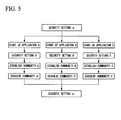
- FIG. 5 is a descriptive diagram describing a security setting changing operation in the present exemplary embodiment.
- the normal security setting of the host device 1 is "security setting ⁇ .”
- the security control unit 105 changes the security setting from “security setting ⁇ " to "security setting A.”
- "Security setting A” is setting information on security corresponding to the "application A.”
- "Application A” to be executed by the temporary community control unit 104 then establishes a community A. Thereafter, when the predetermined condition described above is satisfied and the community A is dissolved, the security control unit 105 returns the security setting from “security setting A” to "security setting ⁇ .”
- the security control unit 105 changes the security setting from “security setting ⁇ ” to “security setting B” of "application B.” Thereafter, if a community B of "application B” is dissolved, the security control unit 105 returns the security setting from “security setting B” to "security setting ⁇ .” Furthermore, similarly, if "application C” is started up, the security control unit 105 changes the security setting from “security setting ⁇ ” to “security setting C” of "application C.” Thereafter, if a community C of "application C” is dissolved, the security control unit 105 returns the security setting from “security setting C” to "security setting ⁇ .”
- FIG. 6 is a flowchart illustrating a procedure of the security setting changing operation in the present exemplary embodiment.
- an example in which the application A is started up will be described by way of example.
- the temporary community control unit 104 starts up an application (application A) designated through the manipulation unit 101 (step S101).
- the security control unit 105 reads "security setting A", which is a security setting corresponding to the application A which has been started up, from the security setting storage unit 107 and controls communication in the communication unit 103 based on the read "security setting A” (step S102).
- the temporary community control unit 104 then executes the application A, which has been started up, and establishes a temporary community (step S103). It is to be noted that personal information and device information of a user participating in the established temporary community are written to a storage unit (not illustrated) of the host device 1.
- the security control unit 105 determines whether the temporary community established in step S103 has been dissolved (step S104). For example, when any of conditions 1 to 6 shown below is satisfied, the security control unit 105 determines that the temporary community has been dissolved.
- step S104 If the temporary community is not dissolved (step S104: No), the process returns to step S104. In contrast, if the temporary community is dissolved (step S104: Yes), the security control unit 105 returns the security setting to "security setting ⁇ ," which is a state before the application is started up (step S105).
- the temporary community control unit 104 terminates the application A, deletes the personal information and the device information of the participant (information on the client device 2) of the temporary community established in step S103 from the storage unit of the host device 1, and terminates the process (step S106).
- the host device 1 changes the setting of security for communication for each application which has been started up. Accordingly, the setting for security can be automatically changed in accordance with a function and a use of the application which has been started up without performing a complex manipulation.
- the host device 1 when any one of conditions 1 to 6 described above is satisfied (when the temporary community is dissolved), the host device 1 returns the setting for security to a state before the application is started up. In other words, after the application is terminated, the setting for security automatically returns to a state before the application is started up. Accordingly, to return the setting for security is never forgotten.
- a program for realizing each step illustrated in FIG. 6 may be recorded in a computer-readable recording medium, and the program recorded in this recording medium may be loaded and executed on a computer system to perform a process of changing the security settings in accordance with the application that is started up.
- the computer system stated herein may include an OS (operating system) and hardware such as a peripheral device.
- the "computer system” also includes a homepage providing environment (or display environment) if a WWW (World Wide Web) system is being used.
- a WWW World Wide Web
- the "computer-readable recording medium” refers to a flexible disk, a magnetic optical disc, a ROM (Read Only Memory), a writable nonvolatile memory such as a flash memory, or a portable medium such as a CD (Compact Disc)-ROM, or a storage apparatus such as a hard disk built into a computer system.
- the "computer-readable recording medium” also includes a recording medium that holds a program for a predetermined time, such as a volatile memory (e.g., a DRAM (Dynamic Random Access Memory)) inside a computer system serving as a server or a client when the program is transmitted via a network such as the Internet or a communication line such as a telephone line.
- a volatile memory e.g., a DRAM (Dynamic Random Access Memory)
- a network such as the Internet
- a communication line such as a telephone line.
- the above-described program may be transmitted from a computer system in which the program is stored in a storage apparatus or the like to other computer systems via a transmission medium or by transmission waves in the transmission medium.
- the "transmission medium” used to transmit the program refers to a medium having a function of transmitting information, such as a network (communication network) such as the Internet or a communication line such as a telephone line.
- the above-described program may be a program for realizing some of the above-described functions.
- the program may be a program capable of realizing the above-described functions through a combination with a program previously stored in a computer system, i.e., a so-called differential file (a differential program).
- the host device 1 and the client device 2 in the present exemplary embodiment form a temporary community using short-distance wireless communication
- the temporary community may be formed using communication using a wide area network such as a mobile telephone network.
- the host device 1 and each client device 2 include a positional information detection unit such as a GPS device. The host device 1 performs search and connection distance setting of the client device 2 near the host device 1 based on the positional information detected by the host device 1 and each client device 2.
- the present invention is applicable to, for example, security control in an electronic device. With the present invention, it is possible to automatically change settings of security for communication for each application to be started up.
Landscapes
- Engineering & Computer Science (AREA)
- Computer Security & Cryptography (AREA)
- Computer Networks & Wireless Communication (AREA)
- Signal Processing (AREA)
- Theoretical Computer Science (AREA)
- Computer Hardware Design (AREA)
- General Engineering & Computer Science (AREA)
- Health & Medical Sciences (AREA)
- Software Systems (AREA)
- Physics & Mathematics (AREA)
- General Health & Medical Sciences (AREA)
- General Physics & Mathematics (AREA)
- Bioethics (AREA)
- Computing Systems (AREA)
- Databases & Information Systems (AREA)
- Information Transfer Between Computers (AREA)
- Mobile Radio Communication Systems (AREA)
Abstract
Description
- The present invention relates to an electronic device and a security control method.
- Currently, there is a system which changes a function (e.g., access permission) to be provided to a user terminal in accordance with positional information of the user terminal (e.g., see Patent Document 1).
- Patent Document 1: Japanese Unexamined Patent Application, First Publication No.
2007-94548 - Incidentally, current electronic devices such as mobile phones can execute a variety of applications and have complex forms of use. Therefore, it may be necessary to change settings of security for communication for each application to be executed. However, in technology disclosed in Patent Document 1, setting (e.g., access permission) of security for communication is uniquely determined in accordance with positional information of a user terminal regardless of what application the user terminal is executing.
- An exemplary object of the present invention is to provide an electronic device and a security control method capable of solving the above-described problems.
- The present invention has been made to solve the problems described above, and it is an electronic device including: a communication unit which communicates with another electronic device; a storage unit which stores setting information of security for communication corresponding to each application; an execution control unit which starts up and executes one application among a plurality of applications used to communicate with the other electronic device and recruit a participant of a community; and a security control unit which reads the setting information corresponding to the application which has been started up from the storage unit and controls security for communication using the communication unit based on the read setting information when the execution control unit starts up the application.
- Furthermore, an exemplary aspect of the present invention is a security control method including: starting up and executing, by an electronic device, one application among a plurality of applications used to communicate with another electronic device and recruit a participant of a community; reading, by the electronic device, setting information corresponding to the application that has been started up from a storage unit which stores setting information of security for communication corresponding to each application; and controlling security for communication based on the read setting information.
- Furthermore, an exemplary aspect of the present invention is a program which causes a computer of an electronic device to execute: an execution control function which starts up and executes one application among a plurality of applications used to communicate with another electronic device and recruit a participant of a community; and a security control function which reads setting information corresponding to the application that has been started up from a storage unit which stores setting information of security for communication corresponding to each application and controls security for communication based on the read setting information.
- With the present invention, settings of security for communication can be automatically changed for each application to be started up.
-
-
FIG. 1 is a block diagram illustrating a configuration of a temporary community system in an exemplary embodiment of the present invention. -
FIG. 2 is a schematic diagram illustrating a data structure and a data example of a security setting table stored in a security setting storage unit in the present exemplary embodiment. -
FIG. 3 is a schematic diagram illustrating a data structure and a data example of a detailed security setting table stored in the security setting storage unit in the present exemplary embodiment. -
FIG. 4 is an image diagram illustrating an example of an application which forms a temporary community in the present exemplary embodiment. -
FIG. 5 is a descriptive diagram describing a security setting changing operation in the present exemplary embodiment. -
FIG. 6 is a flowchart illustrating a procedure of the security setting changing operation in the present exemplary embodiment. - Hereinafter, exemplary embodiments of the present invention will be described in detail with reference to the drawings.
-
FIG. 1 is a block diagram illustrating a configuration of a temporary community system in the present exemplary embodiment. The temporary community system is a system which forms a temporary community and it is configured to include a host device (electronic device) 1 and one or a plurality of client devices (other electronic devices) 2. The temporary community refers to an ad hoc (temporarily local) community, and, for example, includes a community for co-buyers to shop, a community for sharing of a taxi, a community for sports and games, a community used to exchange information at a live performance or a sporting arena, or the like. A function of forming the temporary community is a function of recruiting participants of the temporary community, and includes a function of looking for a co-buyer during shopping, a function of looking for a partner for sharing of a taxi, a function of looking for a partner for a sport or game on the spot, a function of looking for a partner with whom to exchange information at a live performance or a sporting arena, or the like. - The host device 1 is a terminal apparatus having a function which forms the temporary community and it is, for example, a mobile phone, a PHS (Personal Handy-phone System), a smartphone, a personal computer, or the like. The host device 1 is configured to include a
manipulation unit 101, adisplay unit 102, acommunication unit 103, a temporary community control unit (execution control unit) 104, asecurity control unit 105, anapplication storage unit 106, a securitysetting storage unit 107, aspeed detection unit 108, and anacceleration detection unit 109. - The
manipulation unit 101 receives a manipulation from a user. For example, themanipulation unit 101 receives a manipulation to designate an application for forming a temporary community and start up and execute this application. The application which forms a temporary community is an application which communicates with theclient device 2 and recruits participants of the temporary community. Furthermore, themanipulation unit 101 receives an input of a message to be transmitted to theclient device 2 through the application. Furthermore, themanipulation unit 101 receives a manipulation to end the application (dissolve the temporary community). - The
display unit 102 is, for example, a liquid crystal display and displays various pieces of information. For example, thedisplay unit 102 displays a message or the like received from theclient device 2. - The
communication unit 103 communicates with theclient device 2 using, for example, short-distance wireless communication such as a wireless LAN (Local Area Network) or Bluetooth (registered trademark). - The temporary
community control unit 104 starts up and executes the application designated through themanipulation unit 101 to form a temporary community. For example, the temporarycommunity control unit 104 transmits a message for recruiting participants of the temporary community to theclient device 2 through thecommunication unit 103. In other words, the temporarycommunity control unit 104 performs recruitment of participants of the temporary community only for theclient device 2 with which the temporarycommunity control unit 104 can communicate using short-distance wireless communication (i.e., theclient device 2 within a predetermined distance from the host device 1). - The
security control unit 105 controls security of the communication in thecommunication unit 103. For example, when the temporarycommunity control unit 104 starts up the application, thesecurity control unit 105 reads setting information of security corresponding to the application that has been started up from the securitysetting storage unit 107 and controls the security of the communication using thecommunication unit 103 based on the read setting information. Furthermore, when a predetermined condition is satisfied after the application has been started up, thesecurity control unit 105 returns the settings for security to a state before the application is started up. The predetermined condition refers to, for example, the fact that a predetermined time has passed from when the application starts recruitment, the fact that a user has performed a manipulation to end the recruitment of the application, the fact that the number of participants of the temporary community has reached a predetermined number, the fact that the host device 1 has moved a predetermined distance or more from a position at which the application started the recruitment, the fact that acceleration detected using theacceleration detection unit 109 has satisfied a predetermined condition (e.g., the acceleration has exceeded a predetermined value), the fact that a speed detected using thespeed detection unit 108 has satisfied a predetermined condition (e.g., the speed has exceeded a predetermined value), the fact that access to data other than data for the recruitment from theclient device 2 has been detected, or the like. Here, thesecurity control unit 105 includes a clock unit which counts a time and counts the time from when the application started the recruitment. Furthermore, thesecurity control unit 105 calculates a movement distance based on the acceleration detected by theacceleration detection unit 109. - The
application storage unit 106 stores a plurality of applications used to form a temporary community. The applications are different depending on use of the temporary communities, and the applications include, for example, an application which forms a community of co-buyers during shopping, an application which forms a community for sharing of a taxi, an application which forms a community for sports or games, an application which forms a community for information exchange at a live performance or sporting arena, or the like. - The security
setting storage unit 107 stores the setting information of security for communication corresponding to each application. Details of the setting information of security will be described below. - The
speed detection unit 108 detects the speed of the host device 1. - The
acceleration detection unit 109 detects the acceleration of the host device 1. - The
client device 2 is a terminal apparatus which participates in the temporary community and it is, for example, a mobile phone, a PHS, a smartphone, a personal computer, or the like. Theclient device 2 is configured to include amanipulation unit 201, acontrol unit 202, adisplay unit 203, acommunication unit 204, and anapplication storage unit 205. - The
manipulation unit 201 receives a manipulation from a user. For example, themanipulation unit 201 receives an input of a message to be transmitted to the host device 1. - The
display unit 203 is, for example, a liquid crystal display and it displays various pieces of information. For example, thedisplay unit 203 displays a message or the like received from the host device 1. - The
communication unit 204 communicates with the host device 1 using, for example, short-distance wireless communication such as a wireless LAN or Bluetooth (registered trademark). - The
application storage unit 205 stores an application for participation in the temporary community. - When the
control unit 202 receives a message from the host device 1 through thecommunication unit 204, thecontrol unit 202 starts up and executes an application to perform a process of participating in the temporary community. For example, thecontrol unit 202 displays a message for recruitment of participation in the temporary community received from the host device 1 on thedisplay unit 203. Furthermore, thecontrol unit 202 transmits a message for participation in the temporary community to the host device 1 through thecommunication unit 204. - It is to be noted that one electronic device may include both a function of the host device 1 and a function of the
client device 2. -
FIG. 2 is a schematic diagram illustrating a data structure and a data example of a security setting table stored in the securitysetting storage unit 107 in the present exemplary embodiment. The security setting table is data of a two-dimensional table format including rows and columns and it includes items of application identification information and security settings, as illustrated inFIG. 2 . This table includes a row for each piece of the application identification information. The application identification information is identification information for identifying each application. The security setting is setting information of security for communication. - In the illustrated example, the security setting corresponding to application identification information "application A" is "security setting A," the security setting corresponding to application identification information "application B" is "security setting B," and the security setting corresponding to application identification information "application C" is "security setting C."
-
FIG. 3 is a schematic diagram illustrating a data structure and a data example of a detailed security setting table stored in the securitysetting storage unit 107 in the present exemplary embodiment. The detailed security setting table is data of a two-dimensional table format including rows and columns and it includes items of a security setting, a stealth setting, an access setting, a communication speed setting, a connected device number setting, a connection time setting, and a connection distance setting, as illustrated inFIG. 3 . This table includes a row for each security setting. - The stealth setting is a setting which prevents existence of the host device 1 from being detected by the
client device 2. For example, when the stealth setting is "ON (set)," thesecurity control unit 105 of the host device 1 communicates with only theclient device 2 which holds information for connection to the host device 1 in advance. In other words, if the stealth setting is "ON (set)," thesecurity control unit 105 of the host device 1 does not reply to a connection request from theclient device 2 which does not hold the information for connection to the host device 1. In contrast, when the stealth setting is "OFF (reset)," thesecurity control unit 105 of the host device 1 replies to connection requests from all theclient devices 2. If the stealth setting is "ON," the host device 1 can prevent connection with theclient device 2 looking for an indefinite connection partner. - The access setting is a setting requiring a password or an encryption key for access to the host device 1. For example, when the access setting is "ON (set)," the
security control unit 105 of the host device 1 communicates with only theclient device 2 authenticated using a predetermined password. Furthermore, when the access setting is "ON (set)," thesecurity control unit 105 of the host device 1 transmits or receives only data encrypted using a predetermined encryption key. Alternatively, when the access setting is "ON (set)," thesecurity control unit 105 of the host device 1 communicates with only theclient device 2 having an access right set in advance. If the access setting is "ON," the host device 1 can prevent connection from anindefinite client device 2. - The communication speed setting is a setting which prevents a speed of communication with the
client device 2 from exceeding a predetermined value. When the communication speed setting is "ON (set)," thesecurity control unit 105 of the host device 1 performs control so that the speed of the communication with the communicatingclient device 2 is smaller than the predetermined value. For example, when communication is performed using a wireless LAN, thesecurity control unit 105 limits the communication speed (band) by determining the number of channels to be allocated to theclient device 2 which is a communication partner. If the communication speed setting is "ON," the host device 1 can efficiently perform communication, for example, when the host device 1 is connected to a plurality ofclient devices 2. - The connected device number setting is a setting which prevents the number of
client devices 2 which can be connected at the same time from exceeding a predetermined value. For example, if the connected device number setting is "ON (set)," thesecurity control unit 105 of the host device 1 replies to a connection request from anotherclient device 2 only if the number of communicatingclient devices 2 is smaller than the predetermined value. In other words, thesecurity control unit 105 does not reply to the connection request from theother client devices 2 if the number of communicatingclient devices 2 is the predetermined value. If the connected device number setting is "ON," the host device 1 can secure the speeds of the communication with the connectedclient devices 2. Furthermore, if the connected device number setting is "ON," the client device 1 can prevent the client device 1 from connecting to a required number ofclient devices 2 or more. - The connection time setting is a setting which prevents a connection time of the
client device 2 from exceeding a predetermined value. For example, when the connection time setting is "ON (set)," thesecurity control unit 105 of the host device 1 counts a time of communication with each communicatingclient device 2 and disconnects the communication with theclient device 2 if the counted connection time is greater than or equal to the predetermined value. If the connection time setting is "ON," the host device 1 can prevent the host device 1 from connecting to aspecific client device 2 unnecessarily for a long period of time. - The connection distance setting is a setting which prevents a distance to the
client device 2 from exceeding a predetermined value. For example, when the connection distance setting is "ON (set)," thesecurity control unit 105 of the host device 1 communicates with only theclient device 2 whose distance from the host device 1 is within the predetermined value. Furthermore, when the connection distance setting is "ON (set)," thesecurity control unit 105 of the host device 1 disconnects the communication with the communicatingclient device 2 if the distance from the communicatingclient device 2 exceeds the predetermined value. Here, the host device 1 measures the distance between the apparatus itself and theclient device 2 based on an electric field strength of the communication between the apparatus itself and theclient device 2. Alternatively, each of the host device 1 and theclient device 2 may include a positional information detection unit such as a GPS (Global Positioning System). In this case, the host device 1 acquires positional information of theclient device 2 from theclient device 2 and measures the distance between the apparatus itself and theclient device 2 based on the acquired positional information of theclient device 2 and the positional information of the apparatus itself. If the connection distance setting is "ON," the host device 1 can prevent connection from theclient device 2 at a position unnecessarily far from the apparatus itself. - Next, operation of forming a temporary community in the present exemplary embodiment will be described with reference to
FIG. 4. FIG. 4 is an image diagram illustrating an example of the application which forms the temporary community in the present exemplary embodiment. - The application in this example is an application having a function of looking for a co-buyer during shopping (hereinafter referred to as an application A). For example, a user A of the host device 1 finds a bag with 36 loaves of bread on a sales floor of a supermarket. The user A desires to buy the bread but only wants ten loaves, and looks for a co-buyer who also wants to buy the bread. Therefore, the user A starts up the application A in the host device 1 and inputs a message A, "Somebody please buy a bag of 36 loaves of bread with me. I only want ten loaves," for recruiting a co-buyer of the bread from the
manipulation unit 101. The temporarycommunity control unit 104 transmits the input message A to theclient device 2. - When the
control unit 202 of theclient device 2 receives the message A, thecontrol unit 202 displays the received message A, a "buy together" button B1 for participating in the temporary community, and a "talk with this person" button B2 for transmitting a message to the host device 1 on thedisplay unit 203. If the "buy together" button B1 is pressed, thecontrol unit 202 of theclient device 2 transmits a message for participation in the temporary community to the host device 1 through thecommunication unit 204. When the temporarycommunity control unit 104 of the host device 1 receives the message for participation in the temporary community from theclient device 2, the temporarycommunity control unit 104 sets a user B of theclient device 2 as a participant of the temporary community. Furthermore, if the "talk with this person" button B2 is pressed, thecontrol unit 202 of theclient device 2 displays a screen used to input a message on thedisplay unit 203 and transmits a message B input by the user B on this screen to the host device 1. When the temporarycommunity control unit 104 of the host device 1 receives the message B from theclient device 2, the temporarycommunity control unit 104 displays the received message B on thedisplay unit 102. - If the host device 1 and the
client device 2 perform communication in this way, theclient device 2 can participate in the temporary community formed by the host device 1. - Next, a security setting changing operation performed by the host device 1 of the present exemplary embodiment will be described with reference to
FIGS. 5 and6 .FIG. 5 is a descriptive diagram describing a security setting changing operation in the present exemplary embodiment. Here, the normal security setting of the host device 1 is "security setting α." - When the temporary
community control unit 104 of the host device 1 starts up an application "application A," thesecurity control unit 105 changes the security setting from "security setting α" to "security setting A." "Security setting A" is setting information on security corresponding to the "application A." "Application A" to be executed by the temporarycommunity control unit 104 then establishes a community A. Thereafter, when the predetermined condition described above is satisfied and the community A is dissolved, thesecurity control unit 105 returns the security setting from "security setting A" to "security setting α." - Similarly, if "application B" is started up, the
security control unit 105 changes the security setting from "security setting α" to "security setting B" of "application B." Thereafter, if a community B of "application B" is dissolved, thesecurity control unit 105 returns the security setting from "security setting B" to "security setting α." Furthermore, similarly, if "application C" is started up, thesecurity control unit 105 changes the security setting from "security setting α" to "security setting C" of "application C." Thereafter, if a community C of "application C" is dissolved, thesecurity control unit 105 returns the security setting from "security setting C" to "security setting α." -
FIG. 6 is a flowchart illustrating a procedure of the security setting changing operation in the present exemplary embodiment. Hereinafter, an example in which the application A is started up will be described by way of example. - First, the temporary
community control unit 104 starts up an application (application A) designated through the manipulation unit 101 (step S101). - Then, the
security control unit 105 reads "security setting A", which is a security setting corresponding to the application A which has been started up, from the securitysetting storage unit 107 and controls communication in thecommunication unit 103 based on the read "security setting A" (step S102). - The temporary
community control unit 104 then executes the application A, which has been started up, and establishes a temporary community (step S103). It is to be noted that personal information and device information of a user participating in the established temporary community are written to a storage unit (not illustrated) of the host device 1. - The
security control unit 105 then determines whether the temporary community established in step S103 has been dissolved (step S104). For example, when any of conditions 1 to 6 shown below is satisfied, thesecurity control unit 105 determines that the temporary community has been dissolved. - (Condition 1) A user has performed an end manipulation for participant recruitment for the temporary community (an end manipulation for application A has been performed).
- (Condition 2) A predetermined time has passed since the application started recruitment (the predetermined time has passed since application A has been started up).
- (Condition 3) The number of participants of the temporary community has reached a predetermined number.
- (Condition 4) The host device 1 has moved a predetermined distance or more since the participant recruitment of the temporary community began (since application A has been started up).
- (Condition 5) A movement state (acceleration or speed) of the host device 1 has satisfied a predetermined condition.
- (Condition 6) Access from the
client device 2 to data other than data for participant recruitment of the temporary community has been detected. - If the temporary community is not dissolved (step S104: No), the process returns to step S104. In contrast, if the temporary community is dissolved (step S104: Yes), the
security control unit 105 returns the security setting to "security setting α," which is a state before the application is started up (step S105). - Finally, the temporary
community control unit 104 terminates the application A, deletes the personal information and the device information of the participant (information on the client device 2) of the temporary community established in step S103 from the storage unit of the host device 1, and terminates the process (step S106). - In this way, in the present exemplary embodiment, the host device 1 changes the setting of security for communication for each application which has been started up. Accordingly, the setting for security can be automatically changed in accordance with a function and a use of the application which has been started up without performing a complex manipulation.
- Furthermore, in the present exemplary embodiment, when any one of conditions 1 to 6 described above is satisfied (when the temporary community is dissolved), the host device 1 returns the setting for security to a state before the application is started up. In other words, after the application is terminated, the setting for security automatically returns to a state before the application is started up. Accordingly, to return the setting for security is never forgotten.
- Furthermore, a program for realizing each step illustrated in
FIG. 6 may be recorded in a computer-readable recording medium, and the program recorded in this recording medium may be loaded and executed on a computer system to perform a process of changing the security settings in accordance with the application that is started up. It is to be noted that "the computer system" stated herein may include an OS (operating system) and hardware such as a peripheral device. - Furthermore, the "computer system" also includes a homepage providing environment (or display environment) if a WWW (World Wide Web) system is being used.
- Furthermore, the "computer-readable recording medium" refers to a flexible disk, a magnetic optical disc, a ROM (Read Only Memory), a writable nonvolatile memory such as a flash memory, or a portable medium such as a CD (Compact Disc)-ROM, or a storage apparatus such as a hard disk built into a computer system.
- Furthermore, the "computer-readable recording medium" also includes a recording medium that holds a program for a predetermined time, such as a volatile memory (e.g., a DRAM (Dynamic Random Access Memory)) inside a computer system serving as a server or a client when the program is transmitted via a network such as the Internet or a communication line such as a telephone line.
- Furthermore, the above-described program may be transmitted from a computer system in which the program is stored in a storage apparatus or the like to other computer systems via a transmission medium or by transmission waves in the transmission medium. Here, the "transmission medium" used to transmit the program refers to a medium having a function of transmitting information, such as a network (communication network) such as the Internet or a communication line such as a telephone line.
- Also, the above-described program may be a program for realizing some of the above-described functions. Alternatively, the program may be a program capable of realizing the above-described functions through a combination with a program previously stored in a computer system, i.e., a so-called differential file (a differential program).
- While the exemplary embodiments of the present invention have been described in detail with reference to drawings, a specific configuration is not limited to the foregoing configuration, and various design changes or the like can be performed without departing from the gist of the present invention.
- For example, while the host device 1 and the
client device 2 in the present exemplary embodiment form a temporary community using short-distance wireless communication, the temporary community may be formed using communication using a wide area network such as a mobile telephone network. In this case, the host device 1 and eachclient device 2 include a positional information detection unit such as a GPS device. The host device 1 performs search and connection distance setting of theclient device 2 near the host device 1 based on the positional information detected by the host device 1 and eachclient device 2. - This application is based upon and claims the benefit of priority from Japanese Patent Application No.
2011-202864, filed on September 16, 2011 - The present invention is applicable to, for example, security control in an electronic device. With the present invention, it is possible to automatically change settings of security for communication for each application to be started up.
-
- 1
- host device (electronic device)
- 2
- client device (another electronic device)
- 101
- manipulation unit
- 102
- display unit
- 103
- communication unit
- 104
- temporary community control unit (execution control unit)
- 105
- security control unit
- 106
- application storage unit
- 107
- security setting storage unit
- 108
- speed detection unit
- 109
- acceleration detection unit
- 201
- manipulation unit
- 202
- control unit
- 203
- display unit
- 204
- communication unit
- 205
- application storage unit
Claims (12)
- An electronic device comprising:a communication unit which communicates with another electronic device;a storage unit which stores setting information of security for communication corresponding to each application;an execution control unit which starts up and executes one application among a plurality of applications used to communicate with the other electronic device and recruit a participant of a community; anda security control unit which reads the setting information corresponding to the application which has been started up from the storage unit and controls security for communication using the communication unit based on the read setting information when the execution control unit starts up the application.
- The electronic device according to claim 1, wherein the security control unit returns a setting of security for the communication to a setting before the application is started up when a predetermined condition is satisfied after the application is started up.
- The electronic device according to claim 2, wherein the security control unit returns the setting of security for the communication to the setting before the application is started up when a predetermined time passes after the application starts recruitment.
- The electronic device according to claim 2 or 3, wherein the security control unit returns the setting of security for the communication to the setting before the application is started up when a manipulation used to terminate recruitment of the application is performed.
- The electronic device according to any one of claims 2 to 4, wherein the security control unit returns the setting of security for the communication to the setting before the application is started up when the number of participants of the community reaches a predetermined number.
- The electronic device according to any one of claims 2 to 5, wherein the security control unit returns the setting of security for the communication to the setting before the application is started up when the electronic device moves a predetermined distance or more from a position at which the application starts recruitment.
- The electronic device according to any one of claims 2 to 6, comprising an acceleration detection unit which detects acceleration of the electronic device,
wherein the security control unit returns the setting of security for the communication to the setting before the application is started up when the acceleration detected using the acceleration detection unit satisfies a predetermined condition. - The electronic device according to any one of claims 2 to 7, comprising a speed detection unit which detects a speed of the electronic device,
wherein the security control unit returns the setting of security for the communication to the setting before the application is started up when the speed detected using the speed detection unit satisfies a predetermined condition. - The electronic device according to any one of claims 2 to 8, wherein the security control unit returns the setting of security for the communication to the setting before the application is started up when access from the other electronic device to data other than data for recruitment is detected.
- The electronic device according to any one of claims 1 to 9, wherein the storage unit stores a connection distance setting which communicate with only another electronic device present within a predetermined distance from the electronic device as the setting information of security, and
when the execution control unit starts up the application, the security control unit performs control to communicate with only the other electronic device present within the predetermined distance from the electronic device in a case in which the connection distance setting is set for the application that has been started up. - A security control method comprising:starting up and executing, by an electronic device, one application among a plurality of applications used to communicate with another electronic device and recruit a participant of a community;reading, by the electronic device, setting information corresponding to the application that has been started up from a storage unit which stores setting information of security for communication corresponding to each application; andcontrolling security for communication based on the read setting information.
- A program which causes a computer of an electronic device to execute:an execution control function which starts up and executes one application among a plurality of applications used to communicate with another electronic device and recruit a participant of a community; anda security control function which reads setting information corresponding to the application that has been started up from a storage unit which stores setting information of security for communication corresponding to each application and controls security for communication based on the read setting information.
Applications Claiming Priority (2)
| Application Number | Priority Date | Filing Date | Title |
|---|---|---|---|
| JP2011202864 | 2011-09-16 | ||
| PCT/JP2012/070934 WO2013038871A1 (en) | 2011-09-16 | 2012-08-17 | Electronic device and security control method |
Publications (3)
| Publication Number | Publication Date |
|---|---|
| EP2757482A1 true EP2757482A1 (en) | 2014-07-23 |
| EP2757482A4 EP2757482A4 (en) | 2015-05-20 |
| EP2757482B1 EP2757482B1 (en) | 2019-03-13 |
Family
ID=47883105
Family Applications (1)
| Application Number | Title | Priority Date | Filing Date |
|---|---|---|---|
| EP12831900.1A Not-in-force EP2757482B1 (en) | 2011-09-16 | 2012-08-17 | Electronic device and security control method |
Country Status (4)
| Country | Link |
|---|---|
| US (1) | US20140237619A1 (en) |
| EP (1) | EP2757482B1 (en) |
| JP (1) | JP6020453B2 (en) |
| WO (1) | WO2013038871A1 (en) |
Family Cites Families (13)
| Publication number | Priority date | Publication date | Assignee | Title |
|---|---|---|---|---|
| US7545941B2 (en) * | 2003-09-16 | 2009-06-09 | Nokia Corporation | Method of initializing and using a security association for middleware based on physical proximity |
| US20050100166A1 (en) * | 2003-11-10 | 2005-05-12 | Parc Inc. | Systems and methods for authenticating communications in a network medium |
| US7675903B2 (en) * | 2004-02-06 | 2010-03-09 | Alcatel Lucent | Dynamic contact list management system and method |
| US7187952B2 (en) * | 2005-03-07 | 2007-03-06 | Benq Corporation | Method of accepting a phone call based on motion properties of the phone and related device |
| US20070061460A1 (en) * | 2005-03-24 | 2007-03-15 | Jumpnode Systems,Llc | Remote access |
| JP2007094548A (en) | 2005-09-27 | 2007-04-12 | Softbank Telecom Corp | Access control system |
| JP5190800B2 (en) * | 2006-02-21 | 2013-04-24 | 日本電気株式会社 | Program execution control system, execution control method, and computer program for execution control |
| JP2010034904A (en) * | 2008-07-29 | 2010-02-12 | Kyocera Corp | Mobile terminal device |
| US8095112B2 (en) * | 2008-08-21 | 2012-01-10 | Palo Alto Research Center Incorporated | Adjusting security level of mobile device based on presence or absence of other mobile devices nearby |
| JP2010198384A (en) * | 2009-02-25 | 2010-09-09 | Kyocera Corp | Communication terminal apparatus |
| US8429398B2 (en) * | 2009-05-08 | 2013-04-23 | Nokia Corporation | Method and apparatus of providing personalized virtual environment |
| US8966595B1 (en) * | 2010-12-15 | 2015-02-24 | A9.Com, Inc. | Techniques for peer-to-peer communication using a “shared secret” |
| US8405729B2 (en) * | 2011-05-11 | 2013-03-26 | Sony Corporation | System and method for pairing hand-held devices utilizing a front-facing camera |
-
2012
- 2012-08-17 JP JP2013533582A patent/JP6020453B2/en not_active Expired - Fee Related
- 2012-08-17 WO PCT/JP2012/070934 patent/WO2013038871A1/en not_active Ceased
- 2012-08-17 EP EP12831900.1A patent/EP2757482B1/en not_active Not-in-force
- 2012-08-17 US US14/344,030 patent/US20140237619A1/en not_active Abandoned
Also Published As
| Publication number | Publication date |
|---|---|
| WO2013038871A1 (en) | 2013-03-21 |
| EP2757482B1 (en) | 2019-03-13 |
| JPWO2013038871A1 (en) | 2015-03-26 |
| JP6020453B2 (en) | 2016-11-02 |
| US20140237619A1 (en) | 2014-08-21 |
| EP2757482A4 (en) | 2015-05-20 |
Similar Documents
| Publication | Publication Date | Title |
|---|---|---|
| EP2965546B1 (en) | Method and apparatus for peer-2-peer wi-fi ranging using near field communication | |
| CN104969591B (en) | Pass through near-field communication(NFC)The common information of two mobile device users of link sharing | |
| US11259064B2 (en) | Device pairing | |
| US9936476B2 (en) | System and method for providing social network service and for setting relationship between users | |
| US8923760B2 (en) | Orientational collaboration of data between multiple devices | |
| JP5702493B1 (en) | Control method, control program, and computer | |
| US20190037611A1 (en) | Intuitive inter-device connectivity for data sharing and collaborative resource usage | |
| US20140315487A1 (en) | System, an Apparatus, a Device, a Computer Program and a Method for Device with Short Range Communication Capabilities | |
| JP2015535361A (en) | Online social networking interaction methods and related devices and systems | |
| EP2757482B1 (en) | Electronic device and security control method | |
| US9351107B2 (en) | Location relevant data communication | |
| US8572216B2 (en) | Social network building | |
| WO2013114161A1 (en) | Method and apparatus for facilitating remote participance in a community | |
| JP7168712B2 (en) | Control method, control program and computer | |
| CN112822790B (en) | Data transmission method and device, electronic equipment and computer readable storage medium | |
| US20160335444A1 (en) | Proximity based digital rights management method and system | |
| CN113630755A (en) | Information synchronization method, mobile terminal and storage medium | |
| EP2865206B1 (en) | Method and apparatus for apparatus coupling | |
| KR20140115289A (en) | Social network service providing system, user terminal and relationship setting method for setting relationship between users of mobile terminal | |
| EP2899999A1 (en) | Location relevant data communication | |
| HK1256926A1 (en) | Method and device for establishing a secret shared between devices | |
| HK1256926B (en) | Method and device for establishing a secret shared between devices | |
| KR20160053365A (en) | Method for providing closed social network service based on user behavior |
Legal Events
| Date | Code | Title | Description |
|---|---|---|---|
| PUAI | Public reference made under article 153(3) epc to a published international application that has entered the european phase |
Free format text: ORIGINAL CODE: 0009012 |
|
| 17P | Request for examination filed |
Effective date: 20140328 |
|
| AK | Designated contracting states |
Kind code of ref document: A1 Designated state(s): AL AT BE BG CH CY CZ DE DK EE ES FI FR GB GR HR HU IE IS IT LI LT LU LV MC MK MT NL NO PL PT RO RS SE SI SK SM TR |
|
| DAX | Request for extension of the european patent (deleted) | ||
| RA4 | Supplementary search report drawn up and despatched (corrected) |
Effective date: 20150421 |
|
| RIC1 | Information provided on ipc code assigned before grant |
Ipc: H04W 12/08 20090101AFI20150415BHEP Ipc: H04W 84/18 20090101ALI20150415BHEP Ipc: G06F 21/62 20130101ALI20150415BHEP Ipc: G06F 21/60 20130101ALI20150415BHEP Ipc: H04L 29/06 20060101ALI20150415BHEP |
|
| RAP1 | Party data changed (applicant data changed or rights of an application transferred) |
Owner name: NEC CORPORATION |
|
| STAA | Information on the status of an ep patent application or granted ep patent |
Free format text: STATUS: EXAMINATION IS IN PROGRESS |
|
| 17Q | First examination report despatched |
Effective date: 20170127 |
|
| GRAP | Despatch of communication of intention to grant a patent |
Free format text: ORIGINAL CODE: EPIDOSNIGR1 |
|
| STAA | Information on the status of an ep patent application or granted ep patent |
Free format text: STATUS: GRANT OF PATENT IS INTENDED |
|
| INTG | Intention to grant announced |
Effective date: 20180924 |
|
| GRAS | Grant fee paid |
Free format text: ORIGINAL CODE: EPIDOSNIGR3 |
|
| GRAA | (expected) grant |
Free format text: ORIGINAL CODE: 0009210 |
|
| STAA | Information on the status of an ep patent application or granted ep patent |
Free format text: STATUS: THE PATENT HAS BEEN GRANTED |
|
| AK | Designated contracting states |
Kind code of ref document: B1 Designated state(s): AL AT BE BG CH CY CZ DE DK EE ES FI FR GB GR HR HU IE IS IT LI LT LU LV MC MK MT NL NO PL PT RO RS SE SI SK SM TR |
|
| REG | Reference to a national code |
Ref country code: GB Ref legal event code: FG4D |
|
| REG | Reference to a national code |
Ref country code: CH Ref legal event code: EP Ref country code: AT Ref legal event code: REF Ref document number: 1109371 Country of ref document: AT Kind code of ref document: T Effective date: 20190315 |
|
| REG | Reference to a national code |
Ref country code: DE Ref legal event code: R096 Ref document number: 602012057856 Country of ref document: DE |
|
| REG | Reference to a national code |
Ref country code: IE Ref legal event code: FG4D |
|
| REG | Reference to a national code |
Ref country code: NL Ref legal event code: MP Effective date: 20190313 |
|
| REG | Reference to a national code |
Ref country code: LT Ref legal event code: MG4D |
|
| PG25 | Lapsed in a contracting state [announced via postgrant information from national office to epo] |
Ref country code: FI Free format text: LAPSE BECAUSE OF FAILURE TO SUBMIT A TRANSLATION OF THE DESCRIPTION OR TO PAY THE FEE WITHIN THE PRESCRIBED TIME-LIMIT Effective date: 20190313 Ref country code: LT Free format text: LAPSE BECAUSE OF FAILURE TO SUBMIT A TRANSLATION OF THE DESCRIPTION OR TO PAY THE FEE WITHIN THE PRESCRIBED TIME-LIMIT Effective date: 20190313 Ref country code: SE Free format text: LAPSE BECAUSE OF FAILURE TO SUBMIT A TRANSLATION OF THE DESCRIPTION OR TO PAY THE FEE WITHIN THE PRESCRIBED TIME-LIMIT Effective date: 20190313 Ref country code: NO Free format text: LAPSE BECAUSE OF FAILURE TO SUBMIT A TRANSLATION OF THE DESCRIPTION OR TO PAY THE FEE WITHIN THE PRESCRIBED TIME-LIMIT Effective date: 20190613 |
|
| PG25 | Lapsed in a contracting state [announced via postgrant information from national office to epo] |
Ref country code: GR Free format text: LAPSE BECAUSE OF FAILURE TO SUBMIT A TRANSLATION OF THE DESCRIPTION OR TO PAY THE FEE WITHIN THE PRESCRIBED TIME-LIMIT Effective date: 20190614 Ref country code: BG Free format text: LAPSE BECAUSE OF FAILURE TO SUBMIT A TRANSLATION OF THE DESCRIPTION OR TO PAY THE FEE WITHIN THE PRESCRIBED TIME-LIMIT Effective date: 20190613 Ref country code: RS Free format text: LAPSE BECAUSE OF FAILURE TO SUBMIT A TRANSLATION OF THE DESCRIPTION OR TO PAY THE FEE WITHIN THE PRESCRIBED TIME-LIMIT Effective date: 20190313 Ref country code: HR Free format text: LAPSE BECAUSE OF FAILURE TO SUBMIT A TRANSLATION OF THE DESCRIPTION OR TO PAY THE FEE WITHIN THE PRESCRIBED TIME-LIMIT Effective date: 20190313 Ref country code: LV Free format text: LAPSE BECAUSE OF FAILURE TO SUBMIT A TRANSLATION OF THE DESCRIPTION OR TO PAY THE FEE WITHIN THE PRESCRIBED TIME-LIMIT Effective date: 20190313 Ref country code: NL Free format text: LAPSE BECAUSE OF FAILURE TO SUBMIT A TRANSLATION OF THE DESCRIPTION OR TO PAY THE FEE WITHIN THE PRESCRIBED TIME-LIMIT Effective date: 20190313 |
|
| REG | Reference to a national code |
Ref country code: AT Ref legal event code: MK05 Ref document number: 1109371 Country of ref document: AT Kind code of ref document: T Effective date: 20190313 |
|
| PG25 | Lapsed in a contracting state [announced via postgrant information from national office to epo] |
Ref country code: SK Free format text: LAPSE BECAUSE OF FAILURE TO SUBMIT A TRANSLATION OF THE DESCRIPTION OR TO PAY THE FEE WITHIN THE PRESCRIBED TIME-LIMIT Effective date: 20190313 Ref country code: RO Free format text: LAPSE BECAUSE OF FAILURE TO SUBMIT A TRANSLATION OF THE DESCRIPTION OR TO PAY THE FEE WITHIN THE PRESCRIBED TIME-LIMIT Effective date: 20190313 Ref country code: IT Free format text: LAPSE BECAUSE OF FAILURE TO SUBMIT A TRANSLATION OF THE DESCRIPTION OR TO PAY THE FEE WITHIN THE PRESCRIBED TIME-LIMIT Effective date: 20190313 Ref country code: CZ Free format text: LAPSE BECAUSE OF FAILURE TO SUBMIT A TRANSLATION OF THE DESCRIPTION OR TO PAY THE FEE WITHIN THE PRESCRIBED TIME-LIMIT Effective date: 20190313 Ref country code: ES Free format text: LAPSE BECAUSE OF FAILURE TO SUBMIT A TRANSLATION OF THE DESCRIPTION OR TO PAY THE FEE WITHIN THE PRESCRIBED TIME-LIMIT Effective date: 20190313 Ref country code: PT Free format text: LAPSE BECAUSE OF FAILURE TO SUBMIT A TRANSLATION OF THE DESCRIPTION OR TO PAY THE FEE WITHIN THE PRESCRIBED TIME-LIMIT Effective date: 20190713 Ref country code: EE Free format text: LAPSE BECAUSE OF FAILURE TO SUBMIT A TRANSLATION OF THE DESCRIPTION OR TO PAY THE FEE WITHIN THE PRESCRIBED TIME-LIMIT Effective date: 20190313 Ref country code: AL Free format text: LAPSE BECAUSE OF FAILURE TO SUBMIT A TRANSLATION OF THE DESCRIPTION OR TO PAY THE FEE WITHIN THE PRESCRIBED TIME-LIMIT Effective date: 20190313 |
|
| PGFP | Annual fee paid to national office [announced via postgrant information from national office to epo] |
Ref country code: FR Payment date: 20190711 Year of fee payment: 8 Ref country code: DE Payment date: 20190806 Year of fee payment: 8 |
|
| PG25 | Lapsed in a contracting state [announced via postgrant information from national office to epo] |
Ref country code: PL Free format text: LAPSE BECAUSE OF FAILURE TO SUBMIT A TRANSLATION OF THE DESCRIPTION OR TO PAY THE FEE WITHIN THE PRESCRIBED TIME-LIMIT Effective date: 20190313 Ref country code: SM Free format text: LAPSE BECAUSE OF FAILURE TO SUBMIT A TRANSLATION OF THE DESCRIPTION OR TO PAY THE FEE WITHIN THE PRESCRIBED TIME-LIMIT Effective date: 20190313 |
|
| REG | Reference to a national code |
Ref country code: DE Ref legal event code: R097 Ref document number: 602012057856 Country of ref document: DE |
|
| PG25 | Lapsed in a contracting state [announced via postgrant information from national office to epo] |
Ref country code: IS Free format text: LAPSE BECAUSE OF FAILURE TO SUBMIT A TRANSLATION OF THE DESCRIPTION OR TO PAY THE FEE WITHIN THE PRESCRIBED TIME-LIMIT Effective date: 20190713 Ref country code: AT Free format text: LAPSE BECAUSE OF FAILURE TO SUBMIT A TRANSLATION OF THE DESCRIPTION OR TO PAY THE FEE WITHIN THE PRESCRIBED TIME-LIMIT Effective date: 20190313 |
|
| PGFP | Annual fee paid to national office [announced via postgrant information from national office to epo] |
Ref country code: GB Payment date: 20190816 Year of fee payment: 8 |
|
| PLBE | No opposition filed within time limit |
Free format text: ORIGINAL CODE: 0009261 |
|
| STAA | Information on the status of an ep patent application or granted ep patent |
Free format text: STATUS: NO OPPOSITION FILED WITHIN TIME LIMIT |
|
| PG25 | Lapsed in a contracting state [announced via postgrant information from national office to epo] |
Ref country code: DK Free format text: LAPSE BECAUSE OF FAILURE TO SUBMIT A TRANSLATION OF THE DESCRIPTION OR TO PAY THE FEE WITHIN THE PRESCRIBED TIME-LIMIT Effective date: 20190313 |
|
| 26N | No opposition filed |
Effective date: 20191216 |
|
| PG25 | Lapsed in a contracting state [announced via postgrant information from national office to epo] |
Ref country code: SI Free format text: LAPSE BECAUSE OF FAILURE TO SUBMIT A TRANSLATION OF THE DESCRIPTION OR TO PAY THE FEE WITHIN THE PRESCRIBED TIME-LIMIT Effective date: 20190313 |
|
| PG25 | Lapsed in a contracting state [announced via postgrant information from national office to epo] |
Ref country code: TR Free format text: LAPSE BECAUSE OF FAILURE TO SUBMIT A TRANSLATION OF THE DESCRIPTION OR TO PAY THE FEE WITHIN THE PRESCRIBED TIME-LIMIT Effective date: 20190313 |
|
| PG25 | Lapsed in a contracting state [announced via postgrant information from national office to epo] |
Ref country code: CH Free format text: LAPSE BECAUSE OF NON-PAYMENT OF DUE FEES Effective date: 20190831 Ref country code: LU Free format text: LAPSE BECAUSE OF NON-PAYMENT OF DUE FEES Effective date: 20190817 Ref country code: LI Free format text: LAPSE BECAUSE OF NON-PAYMENT OF DUE FEES Effective date: 20190831 Ref country code: MC Free format text: LAPSE BECAUSE OF FAILURE TO SUBMIT A TRANSLATION OF THE DESCRIPTION OR TO PAY THE FEE WITHIN THE PRESCRIBED TIME-LIMIT Effective date: 20190313 |
|
| REG | Reference to a national code |
Ref country code: BE Ref legal event code: MM Effective date: 20190831 |
|
| PG25 | Lapsed in a contracting state [announced via postgrant information from national office to epo] |
Ref country code: IE Free format text: LAPSE BECAUSE OF NON-PAYMENT OF DUE FEES Effective date: 20190817 |
|
| PG25 | Lapsed in a contracting state [announced via postgrant information from national office to epo] |
Ref country code: BE Free format text: LAPSE BECAUSE OF NON-PAYMENT OF DUE FEES Effective date: 20190831 |
|
| REG | Reference to a national code |
Ref country code: DE Ref legal event code: R119 Ref document number: 602012057856 Country of ref document: DE |
|
| GBPC | Gb: european patent ceased through non-payment of renewal fee |
Effective date: 20200817 |
|
| PG25 | Lapsed in a contracting state [announced via postgrant information from national office to epo] |
Ref country code: CY Free format text: LAPSE BECAUSE OF FAILURE TO SUBMIT A TRANSLATION OF THE DESCRIPTION OR TO PAY THE FEE WITHIN THE PRESCRIBED TIME-LIMIT Effective date: 20190313 |
|
| PG25 | Lapsed in a contracting state [announced via postgrant information from national office to epo] |
Ref country code: MT Free format text: LAPSE BECAUSE OF FAILURE TO SUBMIT A TRANSLATION OF THE DESCRIPTION OR TO PAY THE FEE WITHIN THE PRESCRIBED TIME-LIMIT Effective date: 20190313 Ref country code: HU Free format text: LAPSE BECAUSE OF FAILURE TO SUBMIT A TRANSLATION OF THE DESCRIPTION OR TO PAY THE FEE WITHIN THE PRESCRIBED TIME-LIMIT; INVALID AB INITIO Effective date: 20120817 Ref country code: DE Free format text: LAPSE BECAUSE OF NON-PAYMENT OF DUE FEES Effective date: 20210302 Ref country code: FR Free format text: LAPSE BECAUSE OF NON-PAYMENT OF DUE FEES Effective date: 20200831 |
|
| PG25 | Lapsed in a contracting state [announced via postgrant information from national office to epo] |
Ref country code: GB Free format text: LAPSE BECAUSE OF NON-PAYMENT OF DUE FEES Effective date: 20200817 |
|
| PG25 | Lapsed in a contracting state [announced via postgrant information from national office to epo] |
Ref country code: MK Free format text: LAPSE BECAUSE OF FAILURE TO SUBMIT A TRANSLATION OF THE DESCRIPTION OR TO PAY THE FEE WITHIN THE PRESCRIBED TIME-LIMIT Effective date: 20190313 |