EP2757098A1 - Compounds for Functionalizing Biomaterials - Google Patents
Compounds for Functionalizing Biomaterials Download PDFInfo
- Publication number
- EP2757098A1 EP2757098A1 EP20130151702 EP13151702A EP2757098A1 EP 2757098 A1 EP2757098 A1 EP 2757098A1 EP 20130151702 EP20130151702 EP 20130151702 EP 13151702 A EP13151702 A EP 13151702A EP 2757098 A1 EP2757098 A1 EP 2757098A1
- Authority
- EP
- European Patent Office
- Prior art keywords
- substituent
- formula
- substituents
- heteroatoms
- moiety
- Prior art date
- Legal status (The legal status is an assumption and is not a legal conclusion. Google has not performed a legal analysis and makes no representation as to the accuracy of the status listed.)
- Withdrawn
Links
- 150000001875 compounds Chemical class 0.000 title claims abstract description 88
- 239000012620 biological material Substances 0.000 title abstract description 47
- 239000000463 material Substances 0.000 claims abstract description 31
- 239000007943 implant Substances 0.000 claims abstract description 27
- 238000004873 anchoring Methods 0.000 claims abstract description 22
- 125000001424 substituent group Chemical group 0.000 claims description 162
- 125000005842 heteroatom Chemical group 0.000 claims description 68
- 125000004432 carbon atom Chemical group C* 0.000 claims description 42
- 108090000765 processed proteins & peptides Proteins 0.000 claims description 39
- 229910052736 halogen Inorganic materials 0.000 claims description 24
- 150000002367 halogens Chemical class 0.000 claims description 23
- 229910052799 carbon Inorganic materials 0.000 claims description 22
- OKTJSMMVPCPJKN-UHFFFAOYSA-N Carbon Chemical compound [C] OKTJSMMVPCPJKN-UHFFFAOYSA-N 0.000 claims description 20
- 150000001720 carbohydrates Chemical class 0.000 claims description 19
- 108010015899 Glycopeptides Proteins 0.000 claims description 18
- 102000002068 Glycopeptides Human genes 0.000 claims description 18
- MSFSPUZXLOGKHJ-UHFFFAOYSA-N Muraminsaeure Natural products OC(=O)C(C)OC1C(N)C(O)OC(CO)C1O MSFSPUZXLOGKHJ-UHFFFAOYSA-N 0.000 claims description 17
- 108010013639 Peptidoglycan Proteins 0.000 claims description 17
- 125000003118 aryl group Chemical group 0.000 claims description 16
- DQJCDTNMLBYVAY-ZXXIYAEKSA-N (2S,5R,10R,13R)-16-{[(2R,3S,4R,5R)-3-{[(2S,3R,4R,5S,6R)-3-acetamido-4,5-dihydroxy-6-(hydroxymethyl)oxan-2-yl]oxy}-5-(ethylamino)-6-hydroxy-2-(hydroxymethyl)oxan-4-yl]oxy}-5-(4-aminobutyl)-10-carbamoyl-2,13-dimethyl-4,7,12,15-tetraoxo-3,6,11,14-tetraazaheptadecan-1-oic acid Chemical compound NCCCC[C@H](C(=O)N[C@@H](C)C(O)=O)NC(=O)CC[C@H](C(N)=O)NC(=O)[C@@H](C)NC(=O)C(C)O[C@@H]1[C@@H](NCC)C(O)O[C@H](CO)[C@H]1O[C@H]1[C@H](NC(C)=O)[C@@H](O)[C@H](O)[C@@H](CO)O1 DQJCDTNMLBYVAY-ZXXIYAEKSA-N 0.000 claims description 14
- IYMAXBFPHPZYIK-BQBZGAKWSA-N Arg-Gly-Asp Chemical compound NC(N)=NCCC[C@H](N)C(=O)NCC(=O)N[C@@H](CC(O)=O)C(O)=O IYMAXBFPHPZYIK-BQBZGAKWSA-N 0.000 claims description 14
- 125000005647 linker group Chemical group 0.000 claims description 14
- 108090000623 proteins and genes Proteins 0.000 claims description 14
- 239000011203 carbon fibre reinforced carbon Substances 0.000 claims description 13
- 102000004169 proteins and genes Human genes 0.000 claims description 13
- 230000015572 biosynthetic process Effects 0.000 claims description 12
- 238000003786 synthesis reaction Methods 0.000 claims description 12
- 150000001413 amino acids Chemical group 0.000 claims description 10
- 125000003178 carboxy group Chemical group [H]OC(*)=O 0.000 claims description 9
- 239000006260 foam Substances 0.000 claims description 9
- 102000004196 processed proteins & peptides Human genes 0.000 claims description 9
- 108010035532 Collagen Proteins 0.000 claims description 8
- 102000008186 Collagen Human genes 0.000 claims description 8
- 108010072041 arginyl-glycyl-aspartic acid Proteins 0.000 claims description 8
- 229920001436 collagen Polymers 0.000 claims description 8
- 125000002887 hydroxy group Chemical group [H]O* 0.000 claims description 8
- 125000004043 oxo group Chemical group O=* 0.000 claims description 8
- 239000000919 ceramic Substances 0.000 claims description 7
- RTZKZFJDLAIYFH-UHFFFAOYSA-N ether Substances CCOCC RTZKZFJDLAIYFH-UHFFFAOYSA-N 0.000 claims description 7
- 125000001997 phenyl group Chemical group [H]C1=C([H])C([H])=C(*)C([H])=C1[H] 0.000 claims description 7
- 108010085895 Laminin Proteins 0.000 claims description 6
- 125000003277 amino group Chemical group 0.000 claims description 6
- 125000004435 hydrogen atom Chemical group [H]* 0.000 claims description 6
- 102000000905 Cadherin Human genes 0.000 claims description 5
- 108050007957 Cadherin Proteins 0.000 claims description 5
- PNEYBMLMFCGWSK-UHFFFAOYSA-N aluminium oxide Inorganic materials [O-2].[O-2].[O-2].[Al+3].[Al+3] PNEYBMLMFCGWSK-UHFFFAOYSA-N 0.000 claims description 5
- 102000016362 Catenins Human genes 0.000 claims description 4
- 108010067316 Catenins Proteins 0.000 claims description 4
- 229910052760 oxygen Inorganic materials 0.000 claims description 4
- 229920000642 polymer Polymers 0.000 claims description 4
- 102000016942 Elastin Human genes 0.000 claims description 3
- 108010014258 Elastin Proteins 0.000 claims description 3
- 108010067306 Fibronectins Proteins 0.000 claims description 3
- 102000016359 Fibronectins Human genes 0.000 claims description 3
- 229920002549 elastin Polymers 0.000 claims description 3
- 108010044426 integrins Proteins 0.000 claims description 3
- 102000006495 integrins Human genes 0.000 claims description 3
- 125000006239 protecting group Chemical group 0.000 claims description 3
- QVGXLLKOCUKJST-UHFFFAOYSA-N atomic oxygen Chemical compound [O] QVGXLLKOCUKJST-UHFFFAOYSA-N 0.000 claims description 2
- 229910010293 ceramic material Inorganic materials 0.000 claims description 2
- 239000001301 oxygen Substances 0.000 claims description 2
- 125000004430 oxygen atom Chemical group O* 0.000 claims description 2
- 239000001506 calcium phosphate Substances 0.000 claims 1
- 125000005843 halogen group Chemical group 0.000 claims 1
- 229910052588 hydroxylapatite Inorganic materials 0.000 claims 1
- 150000002772 monosaccharides Chemical group 0.000 claims 1
- XYJRXVWERLGGKC-UHFFFAOYSA-D pentacalcium;hydroxide;triphosphate Chemical compound [OH-].[Ca+2].[Ca+2].[Ca+2].[Ca+2].[Ca+2].[O-]P([O-])([O-])=O.[O-]P([O-])([O-])=O.[O-]P([O-])([O-])=O XYJRXVWERLGGKC-UHFFFAOYSA-D 0.000 claims 1
- QORWJWZARLRLPR-UHFFFAOYSA-H tricalcium bis(phosphate) Chemical compound [Ca+2].[Ca+2].[Ca+2].[O-]P([O-])([O-])=O.[O-]P([O-])([O-])=O QORWJWZARLRLPR-UHFFFAOYSA-H 0.000 claims 1
- 229940078499 tricalcium phosphate Drugs 0.000 claims 1
- 229910000391 tricalcium phosphate Inorganic materials 0.000 claims 1
- 235000019731 tricalcium phosphate Nutrition 0.000 claims 1
- 210000004027 cell Anatomy 0.000 abstract description 67
- 230000027455 binding Effects 0.000 abstract description 33
- 210000002889 endothelial cell Anatomy 0.000 abstract description 11
- 238000000034 method Methods 0.000 abstract description 11
- 210000000963 osteoblast Anatomy 0.000 abstract description 11
- 239000002243 precursor Substances 0.000 abstract description 8
- 230000002194 synthesizing effect Effects 0.000 abstract description 2
- 210000000988 bone and bone Anatomy 0.000 description 26
- OKKJLVBELUTLKV-UHFFFAOYSA-N Methanol Chemical compound OC OKKJLVBELUTLKV-UHFFFAOYSA-N 0.000 description 18
- 125000003275 alpha amino acid group Chemical group 0.000 description 18
- -1 linker compound Chemical class 0.000 description 13
- OAKJQQAXSVQMHS-UHFFFAOYSA-N Hydrazine Chemical compound NN OAKJQQAXSVQMHS-UHFFFAOYSA-N 0.000 description 12
- ZMXDDKWLCZADIW-UHFFFAOYSA-N N,N-Dimethylformamide Chemical compound CN(C)C=O ZMXDDKWLCZADIW-UHFFFAOYSA-N 0.000 description 12
- 230000001605 fetal effect Effects 0.000 description 10
- 239000000047 product Substances 0.000 description 10
- RIOQSEWOXXDEQQ-UHFFFAOYSA-N triphenylphosphine Chemical compound C1=CC=CC=C1P(C=1C=CC=CC=1)C1=CC=CC=C1 RIOQSEWOXXDEQQ-UHFFFAOYSA-N 0.000 description 10
- 150000001408 amides Chemical class 0.000 description 9
- 229940024606 amino acid Drugs 0.000 description 9
- QTBSBXVTEAMEQO-UHFFFAOYSA-N Acetic acid Chemical compound CC(O)=O QTBSBXVTEAMEQO-UHFFFAOYSA-N 0.000 description 8
- 125000003545 alkoxy group Chemical group 0.000 description 8
- 238000012650 click reaction Methods 0.000 description 8
- 239000011148 porous material Substances 0.000 description 8
- 125000004122 cyclic group Chemical group 0.000 description 7
- 230000006870 function Effects 0.000 description 7
- 239000011541 reaction mixture Substances 0.000 description 7
- 239000002904 solvent Substances 0.000 description 7
- 239000007858 starting material Substances 0.000 description 7
- XYFCBTPGUUZFHI-UHFFFAOYSA-N Phosphine Chemical compound P XYFCBTPGUUZFHI-UHFFFAOYSA-N 0.000 description 6
- ZMANZCXQSJIPKH-UHFFFAOYSA-N Triethylamine Chemical compound CCN(CC)CC ZMANZCXQSJIPKH-UHFFFAOYSA-N 0.000 description 6
- 125000005262 alkoxyamine group Chemical group 0.000 description 6
- 238000006243 chemical reaction Methods 0.000 description 6
- 239000003446 ligand Substances 0.000 description 6
- OKKJLVBELUTLKV-VMNATFBRSA-N methanol-d1 Chemical compound [2H]OC OKKJLVBELUTLKV-VMNATFBRSA-N 0.000 description 6
- 229910052757 nitrogen Inorganic materials 0.000 description 6
- 210000005009 osteogenic cell Anatomy 0.000 description 6
- UHOVQNZJYSORNB-UHFFFAOYSA-N Benzene Chemical compound C1=CC=CC=C1 UHOVQNZJYSORNB-UHFFFAOYSA-N 0.000 description 5
- RYGMFSIKBFXOCR-UHFFFAOYSA-N Copper Chemical compound [Cu] RYGMFSIKBFXOCR-UHFFFAOYSA-N 0.000 description 5
- 125000003342 alkenyl group Chemical group 0.000 description 5
- 125000000217 alkyl group Chemical group 0.000 description 5
- 125000000304 alkynyl group Chemical group 0.000 description 5
- 229910052802 copper Inorganic materials 0.000 description 5
- 239000010949 copper Substances 0.000 description 5
- 125000004093 cyano group Chemical group *C#N 0.000 description 5
- 230000007547 defect Effects 0.000 description 5
- 125000006527 (C1-C5) alkyl group Chemical group 0.000 description 4
- WEVYAHXRMPXWCK-UHFFFAOYSA-N Acetonitrile Chemical compound CC#N WEVYAHXRMPXWCK-UHFFFAOYSA-N 0.000 description 4
- IJGRMHOSHXDMSA-UHFFFAOYSA-N Atomic nitrogen Chemical compound N#N IJGRMHOSHXDMSA-UHFFFAOYSA-N 0.000 description 4
- KXDHJXZQYSOELW-UHFFFAOYSA-M Carbamate Chemical compound NC([O-])=O KXDHJXZQYSOELW-UHFFFAOYSA-M 0.000 description 4
- JGFZNNIVVJXRND-UHFFFAOYSA-N N,N-Diisopropylethylamine (DIPEA) Chemical compound CCN(C(C)C)C(C)C JGFZNNIVVJXRND-UHFFFAOYSA-N 0.000 description 4
- 125000006575 electron-withdrawing group Chemical group 0.000 description 4
- 238000003818 flash chromatography Methods 0.000 description 4
- 125000001072 heteroaryl group Chemical group 0.000 description 4
- 230000003993 interaction Effects 0.000 description 4
- 239000000203 mixture Substances 0.000 description 4
- 230000009257 reactivity Effects 0.000 description 4
- 238000001356 surgical procedure Methods 0.000 description 4
- 210000001519 tissue Anatomy 0.000 description 4
- 230000017423 tissue regeneration Effects 0.000 description 4
- 210000005167 vascular cell Anatomy 0.000 description 4
- 125000006729 (C2-C5) alkenyl group Chemical group 0.000 description 3
- 238000001644 13C nuclear magnetic resonance spectroscopy Methods 0.000 description 3
- IAZDPXIOMUYVGZ-UHFFFAOYSA-N Dimethylsulphoxide Chemical compound CS(C)=O IAZDPXIOMUYVGZ-UHFFFAOYSA-N 0.000 description 3
- XEKOWRVHYACXOJ-UHFFFAOYSA-N Ethyl acetate Chemical compound CCOC(C)=O XEKOWRVHYACXOJ-UHFFFAOYSA-N 0.000 description 3
- 241001465754 Metazoa Species 0.000 description 3
- 208000001132 Osteoporosis Diseases 0.000 description 3
- 125000000539 amino acid group Chemical group 0.000 description 3
- 125000004429 atom Chemical group 0.000 description 3
- 239000003462 bioceramic Substances 0.000 description 3
- 210000002449 bone cell Anatomy 0.000 description 3
- 125000000484 butyl group Chemical group [H]C([*])([H])C([H])([H])C([H])([H])C([H])([H])[H] 0.000 description 3
- 239000003054 catalyst Substances 0.000 description 3
- 229910052801 chlorine Inorganic materials 0.000 description 3
- 230000008878 coupling Effects 0.000 description 3
- 238000010168 coupling process Methods 0.000 description 3
- 238000005859 coupling reaction Methods 0.000 description 3
- 108010045325 cyclic arginine-glycine-aspartic acid peptide Proteins 0.000 description 3
- 230000003511 endothelial effect Effects 0.000 description 3
- 229910052731 fluorine Inorganic materials 0.000 description 3
- LNTHITQWFMADLM-UHFFFAOYSA-N gallic acid Chemical group OC(=O)C1=CC(O)=C(O)C(O)=C1 LNTHITQWFMADLM-UHFFFAOYSA-N 0.000 description 3
- 108010088381 isoleucyl-lysyl-valyl-alanyl-valine Proteins 0.000 description 3
- 125000003588 lysine group Chemical group [H]N([H])C([H])([H])C([H])([H])C([H])([H])C([H])([H])C([H])(N([H])[H])C(*)=O 0.000 description 3
- 229910000073 phosphorus hydride Inorganic materials 0.000 description 3
- 230000001737 promoting effect Effects 0.000 description 3
- 238000000746 purification Methods 0.000 description 3
- 239000000243 solution Substances 0.000 description 3
- 238000001228 spectrum Methods 0.000 description 3
- 239000000126 substance Substances 0.000 description 3
- NQRYJNQNLNOLGT-UHFFFAOYSA-N tetrahydropyridine hydrochloride Natural products C1CCNCC1 NQRYJNQNLNOLGT-UHFFFAOYSA-N 0.000 description 3
- 239000003643 water by type Substances 0.000 description 3
- YBJHBAHKTGYVGT-ZKWXMUAHSA-N (+)-Biotin Chemical compound N1C(=O)N[C@@H]2[C@H](CCCCC(=O)O)SC[C@@H]21 YBJHBAHKTGYVGT-ZKWXMUAHSA-N 0.000 description 2
- SKRPDWWWUARZIW-QMMMGPOBSA-N (2s)-6-azido-2-[(2-methylpropan-2-yl)oxycarbonylamino]hexanoic acid Chemical compound CC(C)(C)OC(=O)N[C@H](C(O)=O)CCCCN=[N+]=[N-] SKRPDWWWUARZIW-QMMMGPOBSA-N 0.000 description 2
- 125000006730 (C2-C5) alkynyl group Chemical group 0.000 description 2
- POILWHVDKZOXJZ-ARJAWSKDSA-M (z)-4-oxopent-2-en-2-olate Chemical compound C\C([O-])=C\C(C)=O POILWHVDKZOXJZ-ARJAWSKDSA-M 0.000 description 2
- 0 *NC(C(O)=O)INN=[N+]=N Chemical compound *NC(C(O)=O)INN=[N+]=N 0.000 description 2
- 238000005160 1H NMR spectroscopy Methods 0.000 description 2
- YBYIRNPNPLQARY-UHFFFAOYSA-N 1H-indene Chemical compound C1=CC=C2CC=CC2=C1 YBYIRNPNPLQARY-UHFFFAOYSA-N 0.000 description 2
- SQDAZGGFXASXDW-UHFFFAOYSA-N 5-bromo-2-(trifluoromethoxy)pyridine Chemical compound FC(F)(F)OC1=CC=C(Br)C=N1 SQDAZGGFXASXDW-UHFFFAOYSA-N 0.000 description 2
- 208000010392 Bone Fractures Diseases 0.000 description 2
- 125000006374 C2-C10 alkenyl group Chemical group 0.000 description 2
- 101150041968 CDC13 gene Proteins 0.000 description 2
- 229920001287 Chondroitin sulfate Polymers 0.000 description 2
- 229920002971 Heparan sulfate Polymers 0.000 description 2
- WMFOQBRAJBCJND-UHFFFAOYSA-M Lithium hydroxide Chemical compound [Li+].[OH-] WMFOQBRAJBCJND-UHFFFAOYSA-M 0.000 description 2
- UFWIBTONFRDIAS-UHFFFAOYSA-N Naphthalene Chemical compound C1=CC=CC2=CC=CC=C21 UFWIBTONFRDIAS-UHFFFAOYSA-N 0.000 description 2
- 108010038807 Oligopeptides Proteins 0.000 description 2
- 102000015636 Oligopeptides Human genes 0.000 description 2
- 229910018828 PO3H2 Inorganic materials 0.000 description 2
- ISWSIDIOOBJBQZ-UHFFFAOYSA-N Phenol Chemical compound OC1=CC=CC=C1 ISWSIDIOOBJBQZ-UHFFFAOYSA-N 0.000 description 2
- HEDRZPFGACZZDS-MICDWDOJSA-N Trichloro(2H)methane Chemical compound [2H]C(Cl)(Cl)Cl HEDRZPFGACZZDS-MICDWDOJSA-N 0.000 description 2
- 238000004833 X-ray photoelectron spectroscopy Methods 0.000 description 2
- RSAQDHXDKUUCQI-GOSISDBHSA-N [2,3-diacetyloxy-5-[4-[[(2r)-2-amino-6-azidohexanoyl]amino]butylcarbamoyl]phenyl] acetate Chemical compound CC(=O)OC1=CC(C(=O)NCCCCNC(=O)[C@H](N)CCCCN=[N+]=[N-])=CC(OC(C)=O)=C1OC(C)=O RSAQDHXDKUUCQI-GOSISDBHSA-N 0.000 description 2
- 125000001931 aliphatic group Chemical group 0.000 description 2
- 150000001336 alkenes Chemical group 0.000 description 2
- 125000006242 amine protecting group Chemical group 0.000 description 2
- MWPLVEDNUUSJAV-UHFFFAOYSA-N anthracene Chemical compound C1=CC=CC2=CC3=CC=CC=C3C=C21 MWPLVEDNUUSJAV-UHFFFAOYSA-N 0.000 description 2
- 208000037873 arthrodesis Diseases 0.000 description 2
- CUFNKYGDVFVPHO-UHFFFAOYSA-N azulene Chemical compound C1=CC=CC2=CC=CC2=C1 CUFNKYGDVFVPHO-UHFFFAOYSA-N 0.000 description 2
- 230000008901 benefit Effects 0.000 description 2
- 229910052794 bromium Inorganic materials 0.000 description 2
- 238000000451 chemical ionisation Methods 0.000 description 2
- 239000003153 chemical reaction reagent Substances 0.000 description 2
- 229940059329 chondroitin sulfate Drugs 0.000 description 2
- 230000003013 cytotoxicity Effects 0.000 description 2
- 231100000135 cytotoxicity Toxicity 0.000 description 2
- 230000006378 damage Effects 0.000 description 2
- 238000010511 deprotection reaction Methods 0.000 description 2
- 238000011161 development Methods 0.000 description 2
- 230000018109 developmental process Effects 0.000 description 2
- 238000007306 functionalization reaction Methods 0.000 description 2
- 230000012010 growth Effects 0.000 description 2
- 238000004128 high performance liquid chromatography Methods 0.000 description 2
- 229910052739 hydrogen Inorganic materials 0.000 description 2
- 239000003550 marker Substances 0.000 description 2
- 239000011159 matrix material Substances 0.000 description 2
- 230000001404 mediated effect Effects 0.000 description 2
- 230000004048 modification Effects 0.000 description 2
- 238000012986 modification Methods 0.000 description 2
- 125000001483 monosaccharide substituent group Chemical group 0.000 description 2
- 238000010899 nucleation Methods 0.000 description 2
- 210000004663 osteoprogenitor cell Anatomy 0.000 description 2
- 201000008968 osteosarcoma Diseases 0.000 description 2
- ACVYVLVWPXVTIT-UHFFFAOYSA-N phosphinic acid Chemical compound O[PH2]=O ACVYVLVWPXVTIT-UHFFFAOYSA-N 0.000 description 2
- 229910052698 phosphorus Inorganic materials 0.000 description 2
- 230000004962 physiological condition Effects 0.000 description 2
- 229920001184 polypeptide Polymers 0.000 description 2
- 238000001556 precipitation Methods 0.000 description 2
- 125000002924 primary amino group Chemical group [H]N([H])* 0.000 description 2
- 102000005962 receptors Human genes 0.000 description 2
- 108020003175 receptors Proteins 0.000 description 2
- 230000008439 repair process Effects 0.000 description 2
- 150000003839 salts Chemical class 0.000 description 2
- 238000011894 semi-preparative HPLC Methods 0.000 description 2
- 210000000130 stem cell Anatomy 0.000 description 2
- 229910052717 sulfur Inorganic materials 0.000 description 2
- 230000003407 synthetizing effect Effects 0.000 description 2
- WEVWXBXFAAQLPP-GFCCVEGCSA-N tert-butyl n-[(2r)-1-(4-aminobutylamino)-6-azido-1-oxohexan-2-yl]carbamate Chemical compound [N-]=[N+]=NCCCC[C@@H](NC(=O)OC(C)(C)C)C(=O)NCCCCN WEVWXBXFAAQLPP-GFCCVEGCSA-N 0.000 description 2
- GLGNXYJARSMNGJ-VKTIVEEGSA-N (1s,2s,3r,4r)-3-[[5-chloro-2-[(1-ethyl-6-methoxy-2-oxo-4,5-dihydro-3h-1-benzazepin-7-yl)amino]pyrimidin-4-yl]amino]bicyclo[2.2.1]hept-5-ene-2-carboxamide Chemical compound CCN1C(=O)CCCC2=C(OC)C(NC=3N=C(C(=CN=3)Cl)N[C@H]3[C@H]([C@@]4([H])C[C@@]3(C=C4)[H])C(N)=O)=CC=C21 GLGNXYJARSMNGJ-VKTIVEEGSA-N 0.000 description 1
- VLQOCPXVAZTWQR-UHFFFAOYSA-N (2,5-dioxopyrrolidin-1-yl) pent-4-ynoate Chemical compound C#CCCC(=O)ON1C(=O)CCC1=O VLQOCPXVAZTWQR-UHFFFAOYSA-N 0.000 description 1
- KIUKXJAPPMFGSW-DNGZLQJQSA-N (2S,3S,4S,5R,6R)-6-[(2S,3R,4R,5S,6R)-3-Acetamido-2-[(2S,3S,4R,5R,6R)-6-[(2R,3R,4R,5S,6R)-3-acetamido-2,5-dihydroxy-6-(hydroxymethyl)oxan-4-yl]oxy-2-carboxy-4,5-dihydroxyoxan-3-yl]oxy-5-hydroxy-6-(hydroxymethyl)oxan-4-yl]oxy-3,4,5-trihydroxyoxane-2-carboxylic acid Chemical compound CC(=O)N[C@H]1[C@H](O)O[C@H](CO)[C@@H](O)[C@@H]1O[C@H]1[C@H](O)[C@@H](O)[C@H](O[C@H]2[C@@H]([C@@H](O[C@H]3[C@@H]([C@@H](O)[C@H](O)[C@H](O3)C(O)=O)O)[C@H](O)[C@@H](CO)O2)NC(C)=O)[C@@H](C(O)=O)O1 KIUKXJAPPMFGSW-DNGZLQJQSA-N 0.000 description 1
- XQQUSYWGKLRJRA-RABCQHRBSA-N (2s)-2-[[(2s)-2-[[(2s)-2-[[(2s)-6-amino-2-[[(2s,3s)-2-amino-3-methylpentanoyl]amino]hexanoyl]amino]-3-methylbutanoyl]amino]propanoyl]amino]-3-methylbutanoic acid Chemical compound CC[C@H](C)[C@H](N)C(=O)N[C@@H](CCCCN)C(=O)N[C@@H](C(C)C)C(=O)N[C@@H](C)C(=O)N[C@@H](C(C)C)C(O)=O XQQUSYWGKLRJRA-RABCQHRBSA-N 0.000 description 1
- MWOGMBZGFFZBMK-LJZWMIMPSA-N (2s)-2-[[(2s)-2-[[2-[[(2s,3s)-2-[[(2s)-2-amino-3-(4-hydroxyphenyl)propanoyl]amino]-3-methylpentanoyl]amino]acetyl]amino]-3-hydroxypropanoyl]amino]-5-(diaminomethylideneamino)pentanoic acid Chemical compound NC(N)=NCCC[C@@H](C(O)=O)NC(=O)[C@H](CO)NC(=O)CNC(=O)[C@H]([C@@H](C)CC)NC(=O)[C@@H](N)CC1=CC=C(O)C=C1 MWOGMBZGFFZBMK-LJZWMIMPSA-N 0.000 description 1
- 125000000008 (C1-C10) alkyl group Chemical group 0.000 description 1
- 125000006273 (C1-C3) alkyl group Chemical group 0.000 description 1
- RYHBNJHYFVUHQT-UHFFFAOYSA-N 1,4-Dioxane Chemical compound C1COCCO1 RYHBNJHYFVUHQT-UHFFFAOYSA-N 0.000 description 1
- LMDZBCPBFSXMTL-UHFFFAOYSA-N 1-Ethyl-3-(3-dimethylaminopropyl)carbodiimide Substances CCN=C=NCCCN(C)C LMDZBCPBFSXMTL-UHFFFAOYSA-N 0.000 description 1
- NPSWHDAHNWWMEG-UHFFFAOYSA-N 2-aminohex-5-enoic acid Chemical compound OC(=O)C(N)CCC=C NPSWHDAHNWWMEG-UHFFFAOYSA-N 0.000 description 1
- FPQQSJJWHUJYPU-UHFFFAOYSA-N 3-(dimethylamino)propyliminomethylidene-ethylazanium;chloride Chemical compound Cl.CCN=C=NCCCN(C)C FPQQSJJWHUJYPU-UHFFFAOYSA-N 0.000 description 1
- FWMNVWWHGCHHJJ-SKKKGAJSSA-N 4-amino-1-[(2r)-6-amino-2-[[(2r)-2-[[(2r)-2-[[(2r)-2-amino-3-phenylpropanoyl]amino]-3-phenylpropanoyl]amino]-4-methylpentanoyl]amino]hexanoyl]piperidine-4-carboxylic acid Chemical compound C([C@H](C(=O)N[C@H](CC(C)C)C(=O)N[C@H](CCCCN)C(=O)N1CCC(N)(CC1)C(O)=O)NC(=O)[C@H](N)CC=1C=CC=CC=1)C1=CC=CC=C1 FWMNVWWHGCHHJJ-SKKKGAJSSA-N 0.000 description 1
- JLJZRAUDCHWQPS-NYONGVCJSA-N 4-oxo-n-[(3s,4r,5s,6r)-2,4,5-trihydroxy-6-(hydroxymethyl)oxan-3-yl]pentanamide Chemical group CC(=O)CCC(=O)N[C@@H]1C(O)O[C@H](CO)[C@@H](O)[C@@H]1O JLJZRAUDCHWQPS-NYONGVCJSA-N 0.000 description 1
- 102000003730 Alpha-catenin Human genes 0.000 description 1
- 108090000020 Alpha-catenin Proteins 0.000 description 1
- 102000015735 Beta-catenin Human genes 0.000 description 1
- 108060000903 Beta-catenin Proteins 0.000 description 1
- 206010005949 Bone cancer Diseases 0.000 description 1
- 208000018084 Bone neoplasm Diseases 0.000 description 1
- 125000005865 C2-C10alkynyl group Chemical group 0.000 description 1
- 125000000041 C6-C10 aryl group Chemical group 0.000 description 1
- 102100033781 Collagen alpha-2(IV) chain Human genes 0.000 description 1
- 102100033780 Collagen alpha-3(IV) chain Human genes 0.000 description 1
- 102100033779 Collagen alpha-4(IV) chain Human genes 0.000 description 1
- 102100033775 Collagen alpha-5(IV) chain Human genes 0.000 description 1
- 102100033773 Collagen alpha-6(IV) chain Human genes 0.000 description 1
- COLNVLDHVKWLRT-MRVPVSSYSA-N D-phenylalanine Chemical compound OC(=O)[C@H](N)CC1=CC=CC=C1 COLNVLDHVKWLRT-MRVPVSSYSA-N 0.000 description 1
- 108010016626 Dipeptides Proteins 0.000 description 1
- 229920002683 Glycosaminoglycan Polymers 0.000 description 1
- 101000901150 Homo sapiens Collagen alpha-1(IV) chain Proteins 0.000 description 1
- 101000710876 Homo sapiens Collagen alpha-2(IV) chain Proteins 0.000 description 1
- 101000710873 Homo sapiens Collagen alpha-3(IV) chain Proteins 0.000 description 1
- 101000710870 Homo sapiens Collagen alpha-4(IV) chain Proteins 0.000 description 1
- 101000710886 Homo sapiens Collagen alpha-5(IV) chain Proteins 0.000 description 1
- 101000710885 Homo sapiens Collagen alpha-6(IV) chain Proteins 0.000 description 1
- 238000006736 Huisgen cycloaddition reaction Methods 0.000 description 1
- 108010057281 Lipocalin 1 Proteins 0.000 description 1
- NQTADLQHYWFPDB-UHFFFAOYSA-N N-Hydroxysuccinimide Chemical compound ON1C(=O)CCC1=O NQTADLQHYWFPDB-UHFFFAOYSA-N 0.000 description 1
- OPFJDXRVMFKJJO-ZHHKINOHSA-N N-{[3-(2-benzamido-4-methyl-1,3-thiazol-5-yl)-pyrazol-5-yl]carbonyl}-G-dR-G-dD-dD-dD-NH2 Chemical compound S1C(C=2NN=C(C=2)C(=O)NCC(=O)N[C@H](CCCN=C(N)N)C(=O)NCC(=O)N[C@H](CC(O)=O)C(=O)N[C@H](CC(O)=O)C(=O)N[C@H](CC(O)=O)C(N)=O)=C(C)N=C1NC(=O)C1=CC=CC=C1 OPFJDXRVMFKJJO-ZHHKINOHSA-N 0.000 description 1
- 206010028980 Neoplasm Diseases 0.000 description 1
- 206010031243 Osteogenesis imperfecta Diseases 0.000 description 1
- 206010031252 Osteomyelitis Diseases 0.000 description 1
- 101710093543 Probable non-specific lipid-transfer protein Proteins 0.000 description 1
- 102000016611 Proteoglycans Human genes 0.000 description 1
- 108010067787 Proteoglycans Proteins 0.000 description 1
- 102000008790 VE-cadherin Human genes 0.000 description 1
- 239000000370 acceptor Substances 0.000 description 1
- 239000002253 acid Substances 0.000 description 1
- 230000002378 acidificating effect Effects 0.000 description 1
- 125000002252 acyl group Chemical group 0.000 description 1
- 230000032683 aging Effects 0.000 description 1
- 150000001338 aliphatic hydrocarbons Chemical class 0.000 description 1
- 150000001345 alkine derivatives Chemical class 0.000 description 1
- 150000001412 amines Chemical class 0.000 description 1
- 239000002870 angiogenesis inducing agent Substances 0.000 description 1
- 238000013459 approach Methods 0.000 description 1
- 239000007864 aqueous solution Substances 0.000 description 1
- 150000004945 aromatic hydrocarbons Chemical group 0.000 description 1
- 238000011882 arthroplasty Methods 0.000 description 1
- 229940009098 aspartate Drugs 0.000 description 1
- IVRMZWNICZWHMI-UHFFFAOYSA-N azide group Chemical group [N-]=[N+]=[N-] IVRMZWNICZWHMI-UHFFFAOYSA-N 0.000 description 1
- 150000001540 azides Chemical class 0.000 description 1
- 125000000852 azido group Chemical group *N=[N+]=[N-] 0.000 description 1
- 229960002685 biotin Drugs 0.000 description 1
- 235000020958 biotin Nutrition 0.000 description 1
- 239000011616 biotin Substances 0.000 description 1
- 229910052796 boron Inorganic materials 0.000 description 1
- 108010018828 cadherin 5 Proteins 0.000 description 1
- XFWJKVMFIVXPKK-UHFFFAOYSA-N calcium;oxido(oxo)alumane Chemical compound [Ca+2].[O-][Al]=O.[O-][Al]=O XFWJKVMFIVXPKK-UHFFFAOYSA-N 0.000 description 1
- 201000011510 cancer Diseases 0.000 description 1
- BVKZGUZCCUSVTD-UHFFFAOYSA-N carbonic acid Chemical compound OC(O)=O BVKZGUZCCUSVTD-UHFFFAOYSA-N 0.000 description 1
- 125000002915 carbonyl group Chemical group [*:2]C([*:1])=O 0.000 description 1
- 230000003197 catalytic effect Effects 0.000 description 1
- 230000021164 cell adhesion Effects 0.000 description 1
- 239000006143 cell culture medium Substances 0.000 description 1
- 230000012292 cell migration Effects 0.000 description 1
- 230000003833 cell viability Effects 0.000 description 1
- 238000003570 cell viability assay Methods 0.000 description 1
- 230000036755 cellular response Effects 0.000 description 1
- 239000003795 chemical substances by application Substances 0.000 description 1
- 238000003776 cleavage reaction Methods 0.000 description 1
- 229940125758 compound 15 Drugs 0.000 description 1
- 229940125810 compound 20 Drugs 0.000 description 1
- 229940126086 compound 21 Drugs 0.000 description 1
- ARUVKPQLZAKDPS-UHFFFAOYSA-L copper(II) sulfate Chemical compound [Cu+2].[O-][S+2]([O-])([O-])[O-] ARUVKPQLZAKDPS-UHFFFAOYSA-L 0.000 description 1
- 229910000366 copper(II) sulfate Inorganic materials 0.000 description 1
- 239000012043 crude product Substances 0.000 description 1
- 108010060999 cyclic (arginyl-glycyl-aspartyl-phenylalanyl-lysyl) Proteins 0.000 description 1
- 230000002950 deficient Effects 0.000 description 1
- 230000001419 dependent effect Effects 0.000 description 1
- 238000009792 diffusion process Methods 0.000 description 1
- IJKVHSBPTUYDLN-UHFFFAOYSA-N dihydroxy(oxo)silane Chemical compound O[Si](O)=O IJKVHSBPTUYDLN-UHFFFAOYSA-N 0.000 description 1
- 201000010099 disease Diseases 0.000 description 1
- 208000037265 diseases, disorders, signs and symptoms Diseases 0.000 description 1
- 230000000694 effects Effects 0.000 description 1
- 238000005516 engineering process Methods 0.000 description 1
- 230000001747 exhibiting effect Effects 0.000 description 1
- 238000002474 experimental method Methods 0.000 description 1
- 238000001914 filtration Methods 0.000 description 1
- 239000012467 final product Substances 0.000 description 1
- 238000000806 fluorine-19 nuclear magnetic resonance spectrum Methods 0.000 description 1
- 210000001650 focal adhesion Anatomy 0.000 description 1
- 230000004927 fusion Effects 0.000 description 1
- 229940074391 gallic acid Drugs 0.000 description 1
- 235000004515 gallic acid Nutrition 0.000 description 1
- 238000007429 general method Methods 0.000 description 1
- 150000004676 glycans Chemical class 0.000 description 1
- PCHJSUWPFVWCPO-UHFFFAOYSA-N gold Chemical compound [Au] PCHJSUWPFVWCPO-UHFFFAOYSA-N 0.000 description 1
- 239000003102 growth factor Substances 0.000 description 1
- JAXFJECJQZDFJS-XHEPKHHKSA-N gtpl8555 Chemical compound OC(=O)C[C@H](N)C(=O)N[C@@H](CCC(O)=O)C(=O)N[C@@H](C(C)C)C(=O)N[C@@H](C(C)C)C(=O)N1CCC[C@@H]1C(=O)N[C@H](B1O[C@@]2(C)[C@H]3C[C@H](C3(C)C)C[C@H]2O1)CCC1=CC=C(F)C=C1 JAXFJECJQZDFJS-XHEPKHHKSA-N 0.000 description 1
- 210000004394 hip joint Anatomy 0.000 description 1
- 229920002674 hyaluronan Polymers 0.000 description 1
- 229960003160 hyaluronic acid Drugs 0.000 description 1
- 150000007857 hydrazones Chemical class 0.000 description 1
- 238000002513 implantation Methods 0.000 description 1
- 150000002467 indacenes Chemical class 0.000 description 1
- 230000001939 inductive effect Effects 0.000 description 1
- 208000015181 infectious disease Diseases 0.000 description 1
- 238000002329 infrared spectrum Methods 0.000 description 1
- 208000014674 injury Diseases 0.000 description 1
- 230000010354 integration Effects 0.000 description 1
- 229910052740 iodine Inorganic materials 0.000 description 1
- 210000000629 knee joint Anatomy 0.000 description 1
- 230000000873 masking effect Effects 0.000 description 1
- 238000001819 mass spectrum Methods 0.000 description 1
- 230000005541 medical transmission Effects 0.000 description 1
- 210000002901 mesenchymal stem cell Anatomy 0.000 description 1
- 229910052751 metal Inorganic materials 0.000 description 1
- 239000002184 metal Substances 0.000 description 1
- 150000002739 metals Chemical class 0.000 description 1
- 230000001617 migratory effect Effects 0.000 description 1
- 230000003278 mimic effect Effects 0.000 description 1
- 238000012544 monitoring process Methods 0.000 description 1
- FEMOMIGRRWSMCU-UHFFFAOYSA-N ninhydrin Chemical compound C1=CC=C2C(=O)C(O)(O)C(=O)C2=C1 FEMOMIGRRWSMCU-UHFFFAOYSA-N 0.000 description 1
- 125000004433 nitrogen atom Chemical group N* 0.000 description 1
- 102000039446 nucleic acids Human genes 0.000 description 1
- 108020004707 nucleic acids Proteins 0.000 description 1
- 150000007523 nucleic acids Chemical class 0.000 description 1
- 150000002482 oligosaccharides Polymers 0.000 description 1
- 230000000399 orthopedic effect Effects 0.000 description 1
- 201000008482 osteoarthritis Diseases 0.000 description 1
- 230000002188 osteogenic effect Effects 0.000 description 1
- 230000002138 osteoinductive effect Effects 0.000 description 1
- 150000002923 oximes Chemical class 0.000 description 1
- 239000002245 particle Substances 0.000 description 1
- MLBYLEUJXUBIJJ-UHFFFAOYSA-N pent-4-ynoic acid Chemical compound OC(=O)CCC#C MLBYLEUJXUBIJJ-UHFFFAOYSA-N 0.000 description 1
- GUVXZFRDPCKWEM-UHFFFAOYSA-N pentalene Chemical compound C1=CC2=CC=CC2=C1 GUVXZFRDPCKWEM-UHFFFAOYSA-N 0.000 description 1
- 230000000737 periodic effect Effects 0.000 description 1
- 229960003742 phenol Drugs 0.000 description 1
- 230000035479 physiological effects, processes and functions Effects 0.000 description 1
- 229920001223 polyethylene glycol Polymers 0.000 description 1
- 229920001282 polysaccharide Polymers 0.000 description 1
- 239000005017 polysaccharide Substances 0.000 description 1
- 239000012286 potassium permanganate Substances 0.000 description 1
- 238000002360 preparation method Methods 0.000 description 1
- 230000035755 proliferation Effects 0.000 description 1
- 125000001325 propanoyl group Chemical group O=C([*])C([H])([H])C([H])([H])[H] 0.000 description 1
- 238000000425 proton nuclear magnetic resonance spectrum Methods 0.000 description 1
- YGSDEFSMJLZEOE-UHFFFAOYSA-N salicylic acid Chemical compound OC(=O)C1=CC=CC=C1O YGSDEFSMJLZEOE-UHFFFAOYSA-N 0.000 description 1
- 230000007017 scission Effects 0.000 description 1
- 229910052711 selenium Inorganic materials 0.000 description 1
- 235000010378 sodium ascorbate Nutrition 0.000 description 1
- PPASLZSBLFJQEF-RKJRWTFHSA-M sodium ascorbate Substances [Na+].OC[C@@H](O)[C@H]1OC(=O)C(O)=C1[O-] PPASLZSBLFJQEF-RKJRWTFHSA-M 0.000 description 1
- 229960005055 sodium ascorbate Drugs 0.000 description 1
- PPASLZSBLFJQEF-RXSVEWSESA-M sodium-L-ascorbate Chemical compound [Na+].OC[C@H](O)[C@H]1OC(=O)C(O)=C1[O-] PPASLZSBLFJQEF-RXSVEWSESA-M 0.000 description 1
- 239000000725 suspension Substances 0.000 description 1
- 229920002994 synthetic fiber Polymers 0.000 description 1
- 125000004213 tert-butoxy group Chemical group [H]C([H])([H])C(O*)(C([H])([H])[H])C([H])([H])[H] 0.000 description 1
- 238000004809 thin layer chromatography Methods 0.000 description 1
- 230000009772 tissue formation Effects 0.000 description 1
- 230000008467 tissue growth Effects 0.000 description 1
- 230000000472 traumatic effect Effects 0.000 description 1
- 230000008736 traumatic injury Effects 0.000 description 1
- 108010052768 tyrosyl-isoleucyl-glycyl-seryl-arginine Proteins 0.000 description 1
- 210000003606 umbilical vein Anatomy 0.000 description 1
- 230000002792 vascular Effects 0.000 description 1
Images
Classifications
-
- A—HUMAN NECESSITIES
- A61—MEDICAL OR VETERINARY SCIENCE; HYGIENE
- A61L—METHODS OR APPARATUS FOR STERILISING MATERIALS OR OBJECTS IN GENERAL; DISINFECTION, STERILISATION OR DEODORISATION OF AIR; CHEMICAL ASPECTS OF BANDAGES, DRESSINGS, ABSORBENT PADS OR SURGICAL ARTICLES; MATERIALS FOR BANDAGES, DRESSINGS, ABSORBENT PADS OR SURGICAL ARTICLES
- A61L27/00—Materials for grafts or prostheses or for coating grafts or prostheses
- A61L27/50—Materials characterised by their function or physical properties, e.g. injectable or lubricating compositions, shape-memory materials, surface modified materials
- A61L27/56—Porous materials, e.g. foams or sponges
-
- A—HUMAN NECESSITIES
- A61—MEDICAL OR VETERINARY SCIENCE; HYGIENE
- A61L—METHODS OR APPARATUS FOR STERILISING MATERIALS OR OBJECTS IN GENERAL; DISINFECTION, STERILISATION OR DEODORISATION OF AIR; CHEMICAL ASPECTS OF BANDAGES, DRESSINGS, ABSORBENT PADS OR SURGICAL ARTICLES; MATERIALS FOR BANDAGES, DRESSINGS, ABSORBENT PADS OR SURGICAL ARTICLES
- A61L27/00—Materials for grafts or prostheses or for coating grafts or prostheses
- A61L27/50—Materials characterised by their function or physical properties, e.g. injectable or lubricating compositions, shape-memory materials, surface modified materials
- A61L27/54—Biologically active materials, e.g. therapeutic substances
-
- C—CHEMISTRY; METALLURGY
- C07—ORGANIC CHEMISTRY
- C07D—HETEROCYCLIC COMPOUNDS
- C07D403/00—Heterocyclic compounds containing two or more hetero rings, having nitrogen atoms as the only ring hetero atoms, not provided for by group C07D401/00
- C07D403/02—Heterocyclic compounds containing two or more hetero rings, having nitrogen atoms as the only ring hetero atoms, not provided for by group C07D401/00 containing two hetero rings
- C07D403/12—Heterocyclic compounds containing two or more hetero rings, having nitrogen atoms as the only ring hetero atoms, not provided for by group C07D401/00 containing two hetero rings linked by a chain containing hetero atoms as chain links
-
- C—CHEMISTRY; METALLURGY
- C07—ORGANIC CHEMISTRY
- C07K—PEPTIDES
- C07K7/00—Peptides having 5 to 20 amino acids in a fully defined sequence; Derivatives thereof
- C07K7/50—Cyclic peptides containing at least one abnormal peptide link
- C07K7/52—Cyclic peptides containing at least one abnormal peptide link with only normal peptide links in the ring
-
- A—HUMAN NECESSITIES
- A61—MEDICAL OR VETERINARY SCIENCE; HYGIENE
- A61L—METHODS OR APPARATUS FOR STERILISING MATERIALS OR OBJECTS IN GENERAL; DISINFECTION, STERILISATION OR DEODORISATION OF AIR; CHEMICAL ASPECTS OF BANDAGES, DRESSINGS, ABSORBENT PADS OR SURGICAL ARTICLES; MATERIALS FOR BANDAGES, DRESSINGS, ABSORBENT PADS OR SURGICAL ARTICLES
- A61L2300/00—Biologically active materials used in bandages, wound dressings, absorbent pads or medical devices
- A61L2300/20—Biologically active materials used in bandages, wound dressings, absorbent pads or medical devices containing or releasing organic materials
- A61L2300/252—Polypeptides, proteins, e.g. glycoproteins, lipoproteins, cytokines
-
- A—HUMAN NECESSITIES
- A61—MEDICAL OR VETERINARY SCIENCE; HYGIENE
- A61L—METHODS OR APPARATUS FOR STERILISING MATERIALS OR OBJECTS IN GENERAL; DISINFECTION, STERILISATION OR DEODORISATION OF AIR; CHEMICAL ASPECTS OF BANDAGES, DRESSINGS, ABSORBENT PADS OR SURGICAL ARTICLES; MATERIALS FOR BANDAGES, DRESSINGS, ABSORBENT PADS OR SURGICAL ARTICLES
- A61L2300/00—Biologically active materials used in bandages, wound dressings, absorbent pads or medical devices
- A61L2300/40—Biologically active materials used in bandages, wound dressings, absorbent pads or medical devices characterised by a specific therapeutic activity or mode of action
- A61L2300/412—Tissue-regenerating or healing or proliferative agents
-
- A—HUMAN NECESSITIES
- A61—MEDICAL OR VETERINARY SCIENCE; HYGIENE
- A61L—METHODS OR APPARATUS FOR STERILISING MATERIALS OR OBJECTS IN GENERAL; DISINFECTION, STERILISATION OR DEODORISATION OF AIR; CHEMICAL ASPECTS OF BANDAGES, DRESSINGS, ABSORBENT PADS OR SURGICAL ARTICLES; MATERIALS FOR BANDAGES, DRESSINGS, ABSORBENT PADS OR SURGICAL ARTICLES
- A61L2400/00—Materials characterised by their function or physical properties
- A61L2400/18—Modification of implant surfaces in order to improve biocompatibility, cell growth, fixation of biomolecules, e.g. plasma treatment
-
- A—HUMAN NECESSITIES
- A61—MEDICAL OR VETERINARY SCIENCE; HYGIENE
- A61L—METHODS OR APPARATUS FOR STERILISING MATERIALS OR OBJECTS IN GENERAL; DISINFECTION, STERILISATION OR DEODORISATION OF AIR; CHEMICAL ASPECTS OF BANDAGES, DRESSINGS, ABSORBENT PADS OR SURGICAL ARTICLES; MATERIALS FOR BANDAGES, DRESSINGS, ABSORBENT PADS OR SURGICAL ARTICLES
- A61L2430/00—Materials or treatment for tissue regeneration
- A61L2430/02—Materials or treatment for tissue regeneration for reconstruction of bones; weight-bearing implants
Definitions
- the present invention relates to the field of prosthetics, biomaterials and implant materials, in particular bone implant materials. More specifically, the invention relates to novel biomaterials and implant materials, to compounds that can be used for functionalization of biomaterials and implants materials, to various methods of using the compounds of the invention, and to compounds for use as starting material and/or for synthesizing compounds.
- bone related diseases such as osteogenesis imperfecta, osteoarthritis, osteomyelitis, and osteoporosis, traumatic injuries and orthopedic surgeries have dramatically increased.
- Reasons for this drastic development can be found in the ageing of the population and the democratization of high-risk sports.
- the number of total joint arthroplasties and revision surgeries in the US has increased from 700'000 in 1998 to over 1.1 million in 2005.
- Medical expenses related to fracture, reattachment, and replacement of hip and knee joints were estimated to be over $20 billion in 2003, and predicted to increase to over $74 billion by the year 2015.
- Spinal arthrodesis is another example of a surgery typically requiring substantial bone repair/replacement.
- the present inventors have found that it may be necessary to provide ways for promoting efficient tissue regeneration within the biomaterial.
- a close interaction and continuous interface between the biomaterial and natural tissue could be advantageous for achieving a functional implant and efficient tissue repair.
- biomaterials, implant materials and prosthetics for treating bone damages, in particular synthetic materials.
- biomaterials that can be seeded with osteogenic cells or osteoinductive growth factors in general. It is an objective of the invention to provide a biomaterial that is functionalized so as to interact or bind to osteogenic cells, for example human fetal osteoblasts.
- a linker or ligand compound that can be used to functionalize biomaterials, which is biocompatible and well tolerated in a patient's body, which can be synthesized rapidly and in high yields on the basis of available starting materials, and which is capable of promoting tissue regeneration and vascularization of implants and biomaterials in the body of a patient without any cytotoxicity.
- functionalized bone implant materials in particular functionalized ceramic foams and porous materials, which allow for vascularization across pores of the material and/or which allow seeding with fetal cells. This approach would allow the colonization of the entire implant especially the inner part, which is often critical for the treatment of large bone defects.
- the covalent linkage of cells with the biomaterial may avoid cell migration to the surface.
- the present invention addresses the problems depicted above.
- the invention provides a compound of formula (I) below: wherein M 1 , M 2 , M 3 , M 4 , M 5 , R 1 , R 2 , R 3 and n are as defined elsewhere in this specification.
- the invention provides a compound of formula (I) above, wherein:
- the invention provides a biomaterial and/or implant material comprising a compound of the invention.
- the invention provides the use of a compound of formula (XX), or of a derivative thereof, in the synthesis of an organic linker, wherein R 20 is H or a protective group, in particular an amine protecting group; and M 1 is an organic moieties comprising from 1 to 21 carbon atoms and from 0 to 15 heteroatoms.
- R 20 is H or a protective group, in particular an amine protecting group
- M 1 is an organic moieties comprising from 1 to 21 carbon atoms and from 0 to 15 heteroatoms.
- the invention provides a method of preparing an organic linker, the method comprising the steps of providing a compound of formula (XX), or of a derivative thereof, and reacting said compound, or said derivative thereof, with at least one compound selected from the group consisting of:
- the present invention provides compounds that are able to promote the adhesion and proliferation of both bone cell precursors and vascular cell precursors, and that can be conveniently conjugated to biomaterials so as to obtain functionalized implant materials, for example.
- the compounds can be synthesized conveniently and in high yields from commercially available starting materials.
- the implant materials of the invention are particularly suitable as bone implants.
- the compound of the invention comprises at least three substituents R 1 , R 2 , R 3 , which fulfill different functions and/or purposes.
- a first substituent selected from said substituents R 1 , R 2 or R 3 preferably functions as an anchoring group.
- a second substituent selected from of said substituents R 1, R 2 or R 3 preferably functions as a group allowing for binding to a particular type of cells, for example a first type of cells, for example by covalent binding to cells that were modified or adapted to be able to bind to the substituent.
- a third of said substituents R 1 , R 2 or R 3 preferably functions for binding to another, for example a second type of cells, for example by noncovalent, affinity binding.
- Said third of said substituents preferably comprises a peptide or a saccharide having an affinity with a receptor or another cell-surface molecule.
- any one of R 1 , R 2 or R 3 may be an anchoring group, as long as any other one of said three substituents comprises a group allowing for binding to said first type of cells and the remaining substituent allows for binding to said second type of cells.
- the anchoring group is preferably adapted for binding to or capable of being bound to the surface of a biomaterial.
- Said first type of cells is preferably selected from bone cells, osteogenic cells, or progenitors of the aforementioned, such as fetal osteoblasts or other types of osteoblast precursor cells.
- Said second or other type of cells is preferably selected from endothelial cells or progenitors of endothelial, in particular vascular cells.
- the compound of the invention comprises at least three substituents R 1 , R 2 , R 3 , wherein one of said three substituents, for example a first substituent, comprises an anchoring group.
- one other of said three substituents for example a second substituent, comprises structure, group and/or functionality selected from the group consisting of: a structure having from 3 to 35 carbons and from 0 to 15 heteroatoms and comprising at least one carbon-carbon triple bond, an ortho substituated triphenylphosphine, a hydrazine, a hydrazide, an alkoxyamine and a biaryltetrazole.
- One other of said three substituents for example a third substituent, comprises one selected from a saccharide, a peptide, a peptidoglycan, a glycopeptide, and an analogue of any one of the three aforementioned.
- said substituent comprising said second substituent allows for covalent binding to said osteogenic cells or progenitor cells thereof, and said third substituent is capable of binding to endothelial cells or progenitors thereof, as specified in more detail elsewhere in this specification.
- R 1 will be taken as an exemplary substituent containing an anchoring group
- R 2 will be taken as an exemplary substituent capable of binding, preferably covalently, to a first type of cells
- R 3 will be taken as an exemplary substituent capable of binding, preferably non-covalently, to a second type of cells.
- Specific, exemplary structures that fulfill these functions and further exemplary functional definitions of these substituents will be given below and elsewhere in this specification, while it has to be kept in mind that the positions of R 1 , R 2 or R 3 in the compound of formula (I), (II), (IIa), (III), and (IIIa), for example, may be exchanged in accordance with the above.
- M 1 , M 2 and M 4 are, independently, selected from organic moieties consisting of 1 to 21 carbon atoms and 0 to 15 heteroatoms, preferably 1 to 17 carbons and 0 to 8 heteroatoms, and most preferably 1 to 5 carbons and 0 to 3 heteroatoms.
- a “moiety”, for the purpose of the present specification, is a multivalent, in particular a bivalent radical or moiety. It is generally bound with two separate bonds, preferably two separate single bonds, to two neighboring radicals, moieties and/or substituents.
- a “substituent” is a monovalent radical or substituent, generally bound by way of one single or, possibly, double bound to a neighboring structure or substituent, unless otherwise indicated.
- heteroatoms may be present, for example in moieties or substituents of the compounds of the invention.
- a heteroatom is any atom other than H and C.
- Metals are also heteroatoms.
- a heteroatom is any atom selected from any one of groups 13 to 17 of the periodic table with the exception of H and C.
- the heteroatoms are selected from halogen (F, Cl, Br, I), B, N, P, O, S, Se, more preferably from F, Cl, Br, N, P, O, and S and most preferably from F, Cl, N, and O.
- the heteroatom may be present in the form of a substituent, for example basically substituting a hydrogen atom such as in the case of halogen, -OH, -NH 2 , or may replace one or more carbon atoms in a chain of atoms, for example R-O-R, R-O-NH-R, R-O-CO-R, R-O-CO-NH-R, R-NRR, R-O-CO-R R-S-R, R-S-S-R, R-CO-NH-R and the like.
- the moieties M 1 , M 2 and M 4 are, independently, selected from aliphatic and/or aromatic hydrocarbon moieties consisting of 1 to 15 carbon atoms, preferably 1 to 10 and most preferably 1 to 6 carbon atoms.
- M 1 , M 2 and M 4 are, independently, selected from (-CH 2 ) r -, (-CH 2 -CH 2 -O) r -CH 2 - and -CH 2 (-O-CH 2 -CH 2 ) r -, and M 1 and M 2 are further selected from (-CH 2 -CH 2 -O) r , wherein r is, independently for M 1 , M 2 and M 4 , an integer of 1 to 10.
- r is an integer from 1 to 8, preferably from 1 to 6, most preferably from 1 to 4.
- M 1 , M 2 and M 4 are (-CH 2 ) r -, with r being, independently for M 1 , M 2 and M 4 , an integer of 1 to 5.
- the moiety M 3 is preferably selected in dependence of the substituent R 3 .
- the moiety M 3 preferably represents the bond by which M 2 is connected to substituent R 3 .
- R 3 is a substituent that favors the interaction or binding of the compound of the invention to cells of interest.
- the compound of the invention when bound to a biomaterial by way of its anchoring group, favors colonization of the biomaterial, in particular on its surface, by cells of interest.
- substituent R 3 favors or allows binding or interaction to endothelial cells and/or endothelial precursor cells.
- substituent R 3 favors or supports the colonization of a biomaterial containing the compound of the invention by endothelial cells or progenitors thereof, more preferably by vascular cells or progenitors thereof.
- substituent R 3 favors or promotes the vascularization of the biomaterial functionalized on the surface by the compound of the invention.
- R 3 promotes colonization of the biomaterial by Human umbilical vein endothelial cells (HUVECs).
- R 3 comprises a substituent that is recognized and/or that binds with molecules on the surface of endothelial cells or progenitors thereof, in particular vascular cells or progenitors thereof.
- the binding is preferably not covalent and/or is based on affinity binding between R 3 and molecules, such as receptors, saccharides, and so forth, present on the surface of said endothelial cells.
- R 3 is preferably selected from substituents comprising peptides, peptidoglycans, glycopeptides, saccharides, preferably oligo- and/or polysaccharides, and analogues of the aforementioned.
- said analogues are preferably analogues of the peptide part of said peptides, peptidoglycans and glycopeptides.
- R 3 may be selected from saccharides, peptides, peptide analogues, peptidoglycans, peptide analogues of peptidoglycans, glycopeptides and peptide analogues of glycopeptides.
- said analogues are analogues of the saccharide part of said saccharides, peptidoglycans and glycopeptides.
- R 3 is or comprises a peptide, peptidoglycan, glycopeptides or an analogue thereof, it may be bound by way of a peptide bond with or to M 2 .
- M 3 preferably is -NH-CO-, wherein the nitrogen in said peptide bond stems from a free amino group of an amino acid in said peptide, peptidoglycan, glycopeptides or an analogue thereof.
- R 3 is a peptidoglycan, glycopeptide or saccharide, it may be bound by way of an ether bond with or to M 2 .
- M 3 preferably is -O-, formed with a primary hydroxyl group of a monosaccharide moiety or substituent of said peptidoglycan, glycopeptide or saccharide.
- R 3 comprises a peptide substituent selected from the group consisting of: an RGD peptide, a cadherin, a catenin, an integrin, collagen IV, an elastin, a fibronectin, a laminin and a peptide sequence of at least three continuous amino acid moieties taken from the amino acid sequence of any one of the aforementioned peptides and/or proteins, and analogues of any one of the aforementioned.
- R 3 comprises a peptide substituent selected from the group consisting of: (a) an RGD peptide or an analogue thereof, (b) a peptide comprising an amino acid sequence of at least three, preferably at least 4, 5, 6, 7, 8, 9, or at least 10 continuous amino acid moieties of an amino acid sequence of a peptide selected from the group consisting of: a cadherin, integrin, collagen IV, an elastin, a fibronectin, and a laminin, and (c) an amino acid sequence having at least 60% sequence identity with the amino acid sequence defined in (b).
- said sequence identity is at least 70%, more preferably at least 80%, even more preferably at least 90% and most preferably at least 95%.
- sequence identity percentage is determined by using the basic protein blast on the internet (http://blast.ncbi.nlm.nih.gov) with preset standard parameters and database selections.
- This sequence comparison tool is based on algorithms detailed in the following publications: Stephen F. Altschul, Thomas L. Madden, Alejandro A. Schffer, Jinghui Zhang, Zheng Zhang, Webb Miller, and David J. Lipman (1997), "Gapped BLAST and PSI-BLAST: a new generation of protein database search programs", Nucleic Acids Res. 25:3389-3402 .
- Standard parameters include the selection of blastp (protein-protein BLAST, automatic adjustment of parameters to short input sequences; expect threshold 10, word size 3, use of the matrix BLOSUM62; Gap costs: existence: 11, extension 1; conditional compositional score matrix adjustment, no filters and no masking). For short sequences parameters may be adjusted.
- Sequence identity of a sequence of comparison with respect to an original sequence is reduced when, for example, any one of the compared or the original sequence lacks amino acid residues, has additional amino acid residues and/or has one or more amino acid residue substituted by another residue. Sequences having as little as 50% sequence identity with any sequence as defined herein may still be functional.
- R 3 comprises a peptide
- it comprises preferably a stretch of from 2 to 200, preferably from 3 to 100, even more preferably from 3 to 50 and most preferably from 3 to 20 amino acid moieties forming said peptide.
- Said peptide may thus be an oligopeptide, such as a dipeptide, a tripeptide, etc. or a peptide comprising up to 10 amino acids, or a polypeptide, containing a stretch of more than 10 amino acids.
- R 3 comprises from 8 to 400 carbon atoms and from 8 to 300 heteroatoms, preferably from 8 to 300 carbon atoms and from 8 to 200 heteroatoms, more preferably from 8 to 200 carbon atoms and from 8 to 150 heteroatoms, even more preferably from 10 to 100 carbons and from 10 to 50 heteroatoms, and most preferably from 10 to 50 carbons and from 10 to 40 heteroatoms.
- R 3 comprises an RGD peptide or analogue.
- RGD peptides are peptides comprising at least the tripeptide amino acid sequence Arg-Gly-Asp, as such or embedded in a larger peptide, for example in an oligo- or polypeptide.
- RGD peptides may be cyclic or linear, for example. Many different forms of RGD peptides are commercially available.
- M 3 is -NH-CO-
- R 3 is a cyclic RGD-peptide substituent of formula (30) below: wherein the dotted line in formula (30) represents the single bond by which R 3 is connected to the -NH- moiety of M 3 .
- This cyclic RGD peptide comprises, besides the RGD sequence, a D-Phe and a Lysine moiety, resulting in a cyclic(Arg-Gly-Asp-D-Phe-Lys) peptide.
- the cyclic RGD peptide is preferably bound by the free amino group at the ⁇ carbon in the side chain of the lysine moiety in the compound of the invention, forming said substituent as R 3 , wherein the nitrogen atom of this amino group, not shown in substituent (30), is the nitrogen in the peptide bond of M 3 .
- R 3 comprises (a) an amino acid sequence stretch of at least 8, preferably at least 10, most preferably at least 15 continuous amino acids taken from a collagen IV or (b) a an amino acid sequence having at least 70%, 80%, preferably at least 90% and most preferably at least 95% sequence identity with said amino acid stretch (a).
- said collagen IV is a proteins encoded by any one of the human genes COL4A1, COL4A2, COL4A3, COL4A4, COL4A5, and COL4A6, but said collagen IV may also be a collagen IV encoded by an animal gene.
- R 3 comprises at least the amino acid sequence (SEQ ID NO: 1) GVKGDKGNPGWPGAP of collagen IV, or an amino acid sequence having at least 70%, 80%, preferably at least 90% and most preferably at least 95% sequence identity with SEQ ID NO: 1.
- R 3 comprises (a) an amino acid sequence stretch of at least 3, preferably at least 4, most preferably at least 5 continuous amino acids taken from a laminin or (b) a an amino acid sequence having at least 70%, 8%, preferably at least 90% and most preferably at least 95% sequence identity with said amino acid stretch (a).
- R 3 comprises at least the amino acid sequence YIGSR (SEQ ID NO: 2) or IKVAV (SEQ ID NO: 3) of laminin.
- R 3 comprises (a) an amino acid sequence stretch of at least 5, preferably at least 10, most preferably at least 15 continuous amino acids taken from a cadherin or a catenin, or (b) a an amino acid sequence having at least 70%, 80%, preferably at least 90% and most preferably at least 95% sequence identity with said amino acid stretch (a).
- Said cadherin or catenin peptide is preferably selected from an ⁇ -catenin, ⁇ -catenin and VE-cadherin.
- R 3 is a saccharide, it may be selected from hyaluronic acid, heparan sulfate, and chondroitin sulfate, for example.
- R 3 may also be selected from proteoglycans comprising saccharide chains, such as peptides bound to heparan sulfate, and chondroitin sulfate, glycosaminoglycan chains in general, for example.
- R 1 is preferably an organic substituent comprising from 1 to 20 carbon atoms and 1 to 10 heteroatoms, said organic substituent comprising at least one anchoring group.
- the anchoring group is suitable to anchor or bind said compound on the surface of a biomaterial, for example.
- any anchoring group is selected from -OH, -COOH, -PO 3 H 2 , - PO 4 H 2 , -P(R 4 )O 2 H (phosphinic acid); -SO 3 H 2 , -SO 4 H 2 , -CONHOH - , 1,2 hydroxy benzene, 1-hydroxy-2-carboxy benzene, acetylacetonate, deprotonated forms of the aforementioned, organic and/or inorganic salts of said deprotonated forms, and chelating groups with ⁇ -conducting character.
- R 4 is preferably H or an organic substituent comprising from 1-20 carbons and 0-10 heteroatoms, preferably 1-10 carbons and 0 to 5 heteroatoms.
- R 4 is an aliphatic or aromatic substituent comprising from 1-20, preferably 1-10 carbon atoms.
- R 1 comprises an aromatic moiety on which is provided one or more anchoring groups selected, independently, from -OH, -COOH, -PO 3 H 2 , -PO 4 H 2 , - P(R 4 )O 2 H (phosphinic acid); -SO 3 H 2 , -SO 4 H 2 , -CONHOH - , acetylacetonate, deprotonated forms of the aforementioned, organic and/or inorganic salts of said deprotonated forms.
- the aromatic moiety may comprise one or more rings, for example a combination of several fused rings forming an aromatic ring system.
- the ring or ring system of said aromatic moiety is free of a ring heteroatom.
- preferred aromatic moieties are benzene, pentalene, indene, naphthalene, azulene, indacene, and anthracene.
- said aromatic moiety is benzene.
- said one or more anchoring groups are two or more - OH provided on said aromatic moiety.
- R 1 is a substituent of formulae (20) below: wherein:
- R 1 is selected from substituents of formulae (21) and (22) below:
- R 2 is a substituent that allows the binding of the compound of the invention to cells of interest.
- the compound of the invention when bound to a biomaterial by way of its anchoring group, favors colonization of the biomaterial, in particular on its surface, by cells of interest.
- R 2 allows, favors or promotes binding and/or interacting to cells that promote bone tissue growth and/or bone tissue formation, and/or precursor cells of such cells.
- the compound of the invention contributes to the integration of the biomaterial in natural bone tissue and/or favors bone repair.
- R 2 allows, favors or promotes binding to bone cells, bone progenitor cells, osteogenic or osteoprogenitor cells and/or mesenchymal stem cells. According to an embodiment, R 2 allows, favors or promotes binding to osteoprogenitor cells, in particular to bone fetal osteoblasts.
- said cells of interest that can bind to R 2 are treated and/or modified so as to bind to said substituent.
- said cells contain modifications at their surface, so as to allow interaction and/or chemical reaction with R 2 .
- M 5 is selected from moieties of formulae (1) and (2) below: wherein, in the substituents of formulae (1) and (2) the dotted line on the right side represents the bond by which M 5 is bound to the respective -NH- moiety in the structure of formula (I).
- R 2 is the substituent that fulfills the functionality of binding to cells of interest, as detailed elsewhere in this specification.
- Formulae (1) and/or (2) represent the bond or a part thereof by which R 2 is bound to the general structure of formula (I).
- R 2 is bound by way of an amide (1) or carbamate (2) bond, respectively, to the general structure of formula (I).
- R 2 allows for covalent binding to said cells of interest.
- R 2 allows for covalent binding to cells expressing azido-modified proteins, for example osteogenic cells or progenitors thereof expressing azido-modified proteins.
- R 2 is selected from organic substituents comprising from 3 to 35 carbons and from 0 to 15 heteroatoms and comprising at least one carbon-carbon triple bond.
- R 2 allows for covalent binding to cells expressing azido-modified proteins, in particular by click-reaction, for example copper-mediated or copper-free click reaction.
- the carbon-carbon triple bond in R 2 is suitable to allow for copper-free click reaction with cells expressing azido-modified proteins, preferably under physiological conditions, thereby creating a covalent bond with said cells.
- said substituent (R 2 ) comprising from 3 to 35 carbons and from 0 to 15 heteroatoms and comprising at least one carbon-carbon triple bond comprises a structure of formula (6) below: wherein:
- substituents on ring carbons next to the triple bond do not carry an -OH or -NH 2 group
- R 13-18 preferably R 15-16 may be selected from -OH, -NH 2 , besides the organic substituents comprising from 1 to 20 carbon atoms and 0 to 15 heteroatoms, as specified above.
- the reactivity of the triple bond is increased, allowing for binding to cells by click reaction as described below, preferably in the absence of a (copper) catalyst.
- An electron withdrawing group or function is a group that has an electron pulling character, a region of low electron density and/or an electron poor group, so that the group is capable of taking an electron up, thereby becoming less electron poor, reducing the electron density.
- Preferred examples of electron acceptors are halogen, -CN, and substituents that are in a ⁇ -conjugated connection with the structure of formula (6), in particular with the triple bond in said structure. If any one or more of R 11 /R 12 and R 19 /R 20 contain an electron withdrawing group, the reactivity of the triple bond is increased.
- M 9 is absent or an organic moiety comprising from 1 to 11 carbon atoms and from 0 to 5 heteroatoms, more preferably 1 to 5 carbons. According to an embodiment, M 9 is absent or an aliphatic moiety of 1-15, preferably 1-11, and most preferably 1- 5 carbon atoms.
- M 9 is selected from (-CH 2 ) s -, (-CH 2 -CH 2 -O) s -CH 2 - and - CH 2 (-O-CH 2 -CH 2 ) s -,wherein s is 0 or an integer of 1 to 10, preferably 1 to 5 and most preferably 1 to 3.
- m is 0 (not in (16) or (17)) or an integer of 1 to
- substituents on carbons next to the triple bond are preferably different from -OH, and -NH 2 .
- these substituents comprise and/or consist of an electron withdrawing group, other substituents suitable to increase the reactivity of the triple bond, or H or other substituents as defined but different from -OH and -NH 2 .
- R 30 to R 43 in any one of said substituents of formulae (8) to (12) and (13) to (18), in as far as present, are independently selected from H, halogen, hydroxyl, carboxyl, -CN, C1-C10 alkyl, C2-C10 alkenyl, C2-C10 alkynyl, C6-C10 aryl, C4-C10 heteroaryl, C1-C10 alkoxyl, C1-C10 alkoxenyl, C6-C10 aroxyl, wherein said alkyl, alkenyl, alkynyl, aryl, heteroaryl, alkoxyl, alkoxenyl, and aroxyl may or may not be further substituted, and wherein said alkyl, alkenyl, alkynyl may be linear, branched and/or cyclic.
- substituents may be selected, for example, from halogen, oxo, hydroxyl, carboxyl, - CN, C1-C5 alkyl, C1-C5 alkoxyl, C2-C5 alkenyl, C2-C5 alkenoxyl, and C2-C5 alkynyl.
- R 30 to R 43 in any one of said substituents of formulae (8) to (12) and (13) to (18), in as far as present, are independently selected from H, halogen, hydroxyl, carboxyl, -CN, C1-C5 alkyl, C2-C5 alkenyl, C2-C5 alkynyl, C6-C8 aryl, C4-C8 heteroaryl, C1-C5 alkoxyl, C2-C5 alkoxenyl, C6-C8 aroxyl, wherein said alkyl, alkenyl, alkynyl, aryl, heteroaryl, alkoxyl, alkoxenyl, and aroxyl may or may not be further substituted, and wherein said alkyl, alkenyl, alkynyl may be linear, branched and/or cyclic.
- substituents may be selected from halogen, oxo, hydroxyl, carboxyl, -CN, C1-C3 alkyl, C1-C3 alkoxyl, C2-C3 alkenyl, C2-C3 alkenoxyl, and C2-C3 alkynyl.
- R 30 to R 43 in any one of said substituents of formulae (8) to (12) and (13) to (18), in as far as present, are independently selected from H, halogen, hydroxyl, carboxyl, -CN, C1-C5 alkyl and C1-C5 alkoxyl, wherein said alkyl and alkoxyl may be linear, branched or cyclic.
- R 40 and R 41 are halogen, preferably F.
- R 2 is a substituent allowing for binding to cells expressing azido-modified proteins by way of Staudinger ligation.
- R 2 is a substituent comprising a triaryl phosphine on which an electrophilic trap is provided.
- the triaryl phosphine can bind by way of a Staudinger ligation to the azido group expressed on the surface of a cell, forming an amide bond.
- said triaryl phosphine is an ortho substituated triphenylphosphine comprising an electrophilic trap.
- R 2 is a substituent of formula (3) below: wherein the dotted line represents the bond by which R 2 is connected to the -CO- or -O-CO- group of the moiety of formulae (1) or (2), respectively;
- M 6 is an organic moiety consisting of 1 to 30 carbon atoms and 0 to 20 heteroatoms
- R 5 is or an organic substituent comprising from 1 to 20 carbons and from 0 to 10 heteroatoms, preferably an organic substituent comprising from 1 to 10 carbons and from 0 to 5 heteroatoms.
- R 5 is an aliphatic substituent.
- R 5 is a linear, branched and or cyclic C1-C10 alkyl or C2-C10 alkenyl, more preferably a C1-C5 alkyl or C2-C5 alkenyl, which may be linear, branched and/or cyclic.
- M 6 is an organic moiety consisting of from 1 to 20 carbon atoms and from 0 to 15 heteroatoms, more preferably consisting of 1 to 10 carbon atoms and from 0 to 5 heteroatoms.
- t is an integer of 1 to 10.
- t is an integer from 1 to 8, preferably from 1 to 6, most preferably from 1 to 5.
- M 6 is (-CH 2 ) t -, with t being an integer of 1 to 4.
- R 2 is a substituent allowing for binding to cells that are modified with N-levulinoyl mannosamine, a sugar that can be inserted on the cell surface, instead of the azide as shown above.
- N-levulinoyl mannosamine-modified cells can react with a hydrazide, a hydrazine and/or a alkoxyamine group present according to an embodiment of the compound of the invention.
- R 2 is a substituent of formula (4) below: wherein -X- is selected from -NH- and from -O-, and M 7 is an organic moiety consisting of 1 to 20 carbon atoms and 0 to 15 heteroatoms, preferably 1 to 11 carbons and 0 to 7 heteroatoms, most preferably 1 to 7 carbons and 0 to 4 heteroatoms.
- M 7 is a hydrazine and/or an alkoxyamine
- M 7 is preferably selected from (-CH 2 ) u -, (-CH 2 -CH 2 -O) u -CH 2 - and -CH 2 (-O-CH 2 CH 2 ) u -, u being an integer from 1 to 8, preferably from 1 to 5, most preferably from 1 to 3.
- substituent (4) is a hydrazide
- -X- is -NH- and M 7 starts with an acyl group, being - CO-M 7' -, wherein M 7' , is an organic moiety consisting of 1 to 19 carbon atoms and 0 to 14 heteroatoms.
- M 7' is preferably (-CH 2 ) u -, (-CH 2 -CH 2 -O) u -CH 2 - and -CH 2 (-O-CH 2 -CH 2 ) u -, u being an integer from 1 to 7, preferably from 1 to 4, most preferably from 1 to 2.
- R 2 is a substituent allowing for binding to cells exhibiting a terminal alkene on their surface after modification with homoallylglycine, as disclosed, for example, in Chem Commun (Camb). 2010 March 14; 46(10): 1589-1600 . doi:10.1039/b925931g.
- homoallylglycine-modified cells are allowed to react wiwith the compound of the invention comprising a biaryltetrazole, a single bond is formed by a 1,3 dipolar cycloaddition, by which the compound of the invention is covalently bound to the cells.
- R 2 is a substituent of formula (5) below: wherein M 8 is an organic moiety comprising from 1 to 10 carbon atoms and from 0 to 5 heteroatoms and any one or more of the hydrogens of the phenyl moieties and/or substituents in the structure of formula (5) may be substituted by halogen or C1-C8 linear, branched and/or cyclic alkyl, preferably C1-C4 linear, branched and/or cyclic alkyl, and most preferably said hydrogens are not substituted or are partially or totally substituted by halogen.
- the dotted line on the right represents the bond by which substituent (5) is bound to moiety M 5 in formulae (I), (II), (IIa), (III), and (IIIa), for example.
- the compound of the invention is a compound of any one formulae (II), (IIa), (III) and (IIIa) below: wherein o, p and q are, independently, selected from an integer of 1 to 10; and R 1 , R 2 and R 3 are as defined elsewhere in this specification. Preferably, o, p and q are, independently, selected from an integer of 1-7, more preferably 1-5.
- the compound of the invention is a compound of formula (IV) below:
- the invention encompasses a method of preparing, in particular synthetizing an organic linker, the method comprising the steps of providing a compound of formula (XX), or of a derivative thereof, and reacting said compound, or a derivative thereof, with at least one compound selected from the group consisting of: a first compound comprising an anchoring group; a second compound comprising one selected from a saccharide, a peptide, a peptidoglycan or a glycopeptide; and a third compound selected from: a compound comprising from 3 to 35 carbons and from 0 to 15 heteroatoms and comprising at least one carbon-carbon triple bond, a compound comprising an ortho substituated triphenylphosphine, a hydrazine, a hydrazide, an alkoxyamine and a biaryltetrazole.
- said compound (XX) or said derivative is reacted with all three of said compounds, preferably successively, thereby providing three different substituents at carboxy, amino and azide
- An example of a derivative of a compound of formula (XX) is, for example, a compound of formula (XXI) below: wherein M 1 and M 4 and n are as defined elsewhere in this specification, in particular with respect to the compound of formula (I) above, and, by analogy, in the compounds of formulae (II), (IIa), (III), and (IIIa); and R 20 and R 21 are selected, independently, from H and from amine protecting groups.
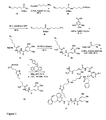
- An example of a derivative of a compound of formula (XX) is the compound 15 in the scheme shown in Fig. 1 .
- the method preferably comprises reacting the compound of formula (XX), or of a derivative thereof, with all three selected from said first, second and third compounds, one after the other in any desired or convenient order, or simultaneously, so that covalent bonds or moieties connecting the starting material of formula (XX), or the derivative thereof, and said first, second and third compounds are formed.
- the present invention provides biomaterials, implant materials, prosthetics and the like.
- the biomaterials preferably comprise the compound of the invention.
- the compound of the invention is bound and/or attached to the biomaterial, in particular to the surface of the biomaterial.
- the compounds of the invention are preferably used to modify the surface of said biomaterials and/or to functionalize said biomaterials. In this way, the objectives underlying the present invention are addressed.
- biomaterial encompasses any material to be intended for use in a human or animal body, such as implant materials, prosthetic materials, and the like.
- the biomaterial is an implant material, which is a material intended for implantation in the human or animal body.
- the biomaterial is a bone implant material.
- the said biomaterial comprises or consists essentially of a polymer and/or a ceramic comprising alumina.
- the said implant material comprises or consists essentially of a porous polymer, ceramic foam, a porous ceramic material and/or a combination comprising two or more of the aforementioned.
- X-ray Photoelectron Spectroscopy (XPS) data were collected by Axis Ultra and Axis Nova instruments (Kratos analytical, Manchester, UK) under ultra-high vacuum condition ( ⁇ 10-8 Torr) and using a monochromatic A1 K ⁇ X-ray source (1486.6 eV).
- the source power was maintained at 225 or 150 W and the emitted photoelectrons were sampled from a 750 ⁇ m X 300 ⁇ m area.
- the analyzer pass energy was 160 or 80 eV for survey spectra and 40 eV for high-resolution spectra.
- the adventitious carbon Is peak was calibrated at 285 eV and used as an internal standard to compensate for any charging effects.
- MS Nermag R-10-10C, chemical ionization (NH3) mode m/z (amu) [% relative base peak (100%)].
- Semi-preparative HPLC XTerra Prep RP C18 (19 x 150).
- a linker containing the required moieties for the biomaterial attachment, covalent binding of the human fetal osteoblasts by click reaction and the adhesion of the endothelial cells by ligand-protein recognition is synthezised.
- the synthesis of the final linker was presented in the scheme shown in Figure 1 .
- the numbers used to refer to specific compound correspond to those shown in Figure 1 .
- the N-Boc-azidonorleucine was coupled to a mono-protected diaminoalkane in presence of PyBOP as coupling reagent.
- the gallic acid was added under the same coupling conditions.
- the intermediate 18 reacted with RGD-derivative 19 by click reaction in presence of a copper catalyst.
- the activated DIBO was coupled to compound 20, which was deprotected under basic conditions to afford the final linker 21.
- N-Boc-azidonorleucine (0.3 g, 0.7 mmol, 1 equiv) was dissolved in dry DCM (15 mL). PyBOP (0.34 g, 0.8 mmol, 1.2 equiv) and diisopropylethylamine (0.3 mL, 2.0 mmol, 3 equiv) were added and the reaction mixture was stirred for 15 min at rt. Finally Fmoc-aminobutanediamine (0.26 g, 0.7 mmol, 1 equiv) was added and the mixture was stirred overnight at rt. The product was concentrated under reduced pressure and purified by flash column chromatography (AcOEt/EP 1:1).
- Acetoxygallic acid (61 mg, 0.2 mmol, 1 equiv) was dissolved in dry DCM (1 mL) in presence of PyBOP (125 mg, 0.3 mmol, 1.2 equiv) and stirred for 15 min at rt. Then a second solution containing N -(4-aminobutyl)-6-azido- N 2 -( tert -butoxycarbonyl)-D-norleucinamide (70 mg, 0.2 mmol, 1 equiv) and diisopropylethylamine (51 ⁇ l, 0.3 mmol, 1.5 equiv) in dry DCM (1 mL) was added and the reaction mixture was stirred overnight at rt.
- PyBOP 125 mg, 0.3 mmol, 1.2 equiv
- IR (film): 3265, 2935, 2865, 2380, 2095, 1775, 1660, 1585, 1490, 1435, 1370, 1320, 1180, 1115, 1050, 1010, 975, 895, 845, 780, 745, 700, 640, 615, 590, 555, 535 cm- 1 .
- the product was concentrated under reduced pressure and purified by precipitation in DCM (mass 35 mg, yield: 56 %).
- the resulting product was dissolved in a mixture of THF/DMF (1:1) in presence of a 1 M LiOH solution (72 ⁇ L, 0.07 mmol, 3 equiv) and ultrasonicated for 3 h until total deprotection of the starting material.
- the product was purified by HPLC ((XTerra Prep RP C18, (25x150 mm Waters)) to give the final product (masse: 5 mg, yield: 15 %).
- Open porous, alumina scaffold materials are produced as described in F. Krauss Juillerat et al. J. Am. Ceram. Soc. 2011, 94, 77-83 .
- Calcium aluminate is used as setting agent in order to solidify the wet foams and stop bubble coarsening.
- Foam microstructure was determined by controlling of the bubble growth in the wet stage. Particle concentration in suspension is the most suitable parameter for inducing and controlling bubble growth.
- Three different scaffolds S1-S3 are produced, with scaffolds 1 and 2 having average pore diameters of 170 ⁇ m and an average window size of 50 to 60 ⁇ m. Scaffold 3 had a average pore diameter of 460 ⁇ m and windows of almost 100 ⁇ m.
- Scaffolds S1-S3 produced in Example 2 are all immersed in cell culture medium containing different cell types (human fetal osteoblasts, human U 2 O s , SaOs osteosarcoma cells) and cultured during 37 days. It is found that the different foam microstructures influence the migratory potential of the cells but not the cell viability, permitting either localized (S 1 and S2) or widespread (S3) colonization of the scaffold. This demonstrated that scaffolds with larger average pore sizes (S3) are more permissive for the trans-scaffold passage of cells across the entire structure than the scaffolds showing smaller average pore sizes. Furthermore, the cell viability assays also showed that the chemical composition did not influence the cell response to the different scaffolds.
- Ceramic scaffold S1-S3 of Example 2 are immersed in a 1 nm aqueous solution of compound 21 at room temperature for 16 hours, in accordance with the procedure disclosed in H. Comas et al, ACS Appl. Mater. Interfaces 2012, 4, 573-573 (Supporting Information). In this way, functionalized biomaterials are obtained.
- Example 5 Seeding of functionalized biomaterials with human fetal osteoblasts
- Example 4 The functionalized biomaterials of Example 4 were seeded with human fetal osteoblasts as disclosed in Borcard, F.; Krauss Juillerat, F.; Staedler, D., Scaletta, C.; Applegate. L. A.; Comas, H.; Gauckler, L. J. ,Gerber-Lemaire, S; Juillerat-Jeanneret, L.; Gonzenbach, U. Bioconjugate Chem., 2012, 23, 2278-2290 .
Landscapes
- Chemical & Material Sciences (AREA)
- Health & Medical Sciences (AREA)
- Organic Chemistry (AREA)
- Life Sciences & Earth Sciences (AREA)
- Medicinal Chemistry (AREA)
- General Health & Medical Sciences (AREA)
- Veterinary Medicine (AREA)
- Animal Behavior & Ethology (AREA)
- Molecular Biology (AREA)
- Public Health (AREA)
- Dermatology (AREA)
- Oral & Maxillofacial Surgery (AREA)
- Transplantation (AREA)
- Epidemiology (AREA)
- Biophysics (AREA)
- Dispersion Chemistry (AREA)
- Biochemistry (AREA)
- Proteomics, Peptides & Aminoacids (AREA)
- Genetics & Genomics (AREA)
- Engineering & Computer Science (AREA)
- Biomedical Technology (AREA)
- Peptides Or Proteins (AREA)
Abstract
The present invention provides compounds suitable for functionalizing biomaterials, in particular prosthetics and implant materials, functionalized biomaterials, and methods for synthesizing the compound. The compounds contain an anchoring group, a group for covalent binding to modified osteoblast precursor cells and a group for binding to endothelial cells or precursor cells.
Description
- The present invention relates to the field of prosthetics, biomaterials and implant materials, in particular bone implant materials. More specifically, the invention relates to novel biomaterials and implant materials, to compounds that can be used for functionalization of biomaterials and implants materials, to various methods of using the compounds of the invention, and to compounds for use as starting material and/or for synthesizing compounds.
- Over the last decade, bone related diseases such as osteogenesis imperfecta, osteoarthritis, osteomyelitis, and osteoporosis, traumatic injuries and orthopedic surgeries have dramatically increased. Reasons for this drastic development can be found in the ageing of the population and the democratization of high-risk sports. For example, the number of total joint arthroplasties and revision surgeries in the US has increased from 700'000 in 1998 to over 1.1 million in 2005. Medical expenses related to fracture, reattachment, and replacement of hip and knee joints were estimated to be over $20 billion in 2003, and predicted to increase to over $74 billion by the year 2015. Spinal arthrodesis is another example of a surgery typically requiring substantial bone repair/replacement. Since 1997, spinal arthrodesis has seen the highest percentage of increase for all muscoskeletal surgeries requiring hospitalization. In 2005 alone, over 300'000 spinal fusions were conducted costing over $20 billion. Traumatic bone fractures accounted for 8.5 million physicians visits, almost 1 million of which required hospitalization in 2005. Also, in 2005, there were over 3000 pediatric hospitalizations for bone cancer costing over $70 million.
- There exist various ways of treating tissue defects in the art. For treating bone defects, for example, today's gold standard is still autologous iliac crest bone grafting.
- There are advantages but also several important inconveniences associated with the removal of bone tissue from a patient or from a donor for grafting it to damaged bone. Success in both allografts and autografts are dependent on the physical and biological similarity between the donor and host tissue. One inconvenience is that removal of bone from a subject is itself an invasive procedure, resulting in an increased risk of infections, pain, morbidity, the risk of disease transmission, and rejection. Furthermore, bone removal inevitably weakens bone structure at the site of removal, which may be a severe problem in patients suffering from osteoporosis, for example, or can transmit defective bone tissue for example in osteoporosis or cancer. Moreover, the availability of healthy bone substance in a subject is limited, and may not suffice to accommodate needs in case of extensive defects and/or for treating defects repeatedly and at different locations, for example. Similar problems exist in the case of other tissue materials.
- There is thus a need for providing artificial or synthetic biomaterials, implant materials and prosthetics. While such materials have been suggested, they may suffer from low biocompatibility. In many cases, the understanding of the biology and physiology of the bone is insufficient and does not mimic the bone structure and functions as close as possible.
- Therefore, the present inventors have found that it may be necessary to provide ways for promoting efficient tissue regeneration within the biomaterial. A close interaction and continuous interface between the biomaterial and natural tissue could be advantageous for achieving a functional implant and efficient tissue repair.
- In accordance with the invention, it is an objective to provide biomaterials, implant materials and prosthetics for treating bone damages, in particular synthetic materials.
- In particular, it is an objective to provide ways for promoting efficient tissue regeneration within biomaterials and implants. It is an objective of the invention to provide biomaterials that can be seeded with osteogenic cells or osteoinductive growth factors in general. It is an objective of the invention to provide a biomaterial that is functionalized so as to interact or bind to osteogenic cells, for example human fetal osteoblasts.
- It is also an objective of the invention to promote vascularisation of a biomaterial that can be used for treating bone damages. It is an objective of the invention to provide biomaterials that promote the development of a vascular system on and/or even inside the biomaterial. It is an objective of the invention to provide a biomaterial that is functionalized so as to interact or bind to angiogenic factors and/or cells, for example endothelial cells or endothelial precursor cells.
- H. Comas et al, ACS Appl. Mater. Interfaces 2012, 4, 573-573, disclose the functionalization of alumina ceramic foams with linker compounds. However, these linker compounds do not address the objectives set out above.
- F. Borcard et al, Bioconjugate Chem. 2011, 22, 1422-1432 disclose compounds that contain a biotin marker moiety as well as a moiety containing an alkyne derivative. These marker compounds can be coupled to cells expressing azido-modified proteins by way of a copper-mediated or copper-free click reaction. This reference does not address the objectives put forward above.
- F. Borcard et al, J. Med. Chem. 2012, 55 (18) 1988-7997 disclose a multifunctional ligand containing a cyclic arginine-glycine-aspartate (RGD) peptide, a tetraethylene glycol spacer and a gallate moiety. The binding of this ligand to dense bioceramics and its ability to increase the endothelial cell adhesion were demonstrated. However, for binding this multifunctional ligand to cells expressing azido-modified proteins, a copper catalyst is required, which is disadvantageous due to high risk of cytotoxicity. Furthermore, the yields of the synthesis of this ligand are not satisfactory. It is thus an objective to provide a ligand or linker compound that can be produced in high yields and which can effectively be bound to cells under mild, physiological conditions.
- In view of the above, it is an objective to provide a linker or ligand compound that can be used to functionalize biomaterials, which is biocompatible and well tolerated in a patient's body, which can be synthesized rapidly and in high yields on the basis of available starting materials, and which is capable of promoting tissue regeneration and vascularization of implants and biomaterials in the body of a patient without any cytotoxicity. It an objective to provide functionalized bone implant materials, in particular functionalized ceramic foams and porous materials, which allow for vascularization across pores of the material and/or which allow seeding with fetal cells. This approach would allow the colonization of the entire implant especially the inner part, which is often critical for the treatment of large bone defects. The covalent linkage of cells with the biomaterial may avoid cell migration to the surface.
- The present invention addresses the problems depicted above.
- In an aspect, the invention provides a compound of formula (I) below:

- In an aspect, the invention provides a compound of formula (I) above, wherein:
- M1, M2 and M4 are, independently, selected from organic moieties consisting of 1 to 21 carbon atoms and from 0 to 15 heteroatoms;
- R3 is selected from a substituent comprising a peptide, saccharide, peptidoglycan, glycopeptides, and/or analogues of any one of the aforementioned;
- M3 is selected from:
- NH-CO- if R3 comprises a peptide, peptidoglycan or glycopeptide substituent, bound by way of amide bond M3 formed with a free amino group of said peptide, peptidoglycan or glycopeptide, respectively; and
- O-, if R3 comprises a saccharide, a peptidoglycan or a glycopeptide substituent, bound by way of a ether bond formed with a primary hydroxyl group of a monosaccharide moiety of said saccharide, peptidoglycan or glycopeptide, respectively;
- n is 0 or an integer from 1 to 3;
- R1 is an organic substituent comprising from 1 to 20 carbon atoms and 1 to 10 heteroatoms, said organic substituent comprising at least one anchoring group;
- M5 is selected from moieties of formulae (1) and (2) below:

- wherein
in the moieties of formulae (1) and (2) the dotted line on the right represents the bond by which M5 is bound to the -NH- moiety in the structure of formula (I) and the dotted line on the left represents the bond to R2; - R2 is selected from any one of substituents (i) to (iv) below:
- i. organic substituents comprising from 3 to 35 carbons and from 0 to 15 heteroatoms and comprising at least one carbon-carbon triple bond;
- ii. a substituent of formula (3) below:

M6 is an organic moiety consisting of 1 to 30 carbon atoms and 0 to 20 heteroatoms; and, R5 is an organic substituent comprising from 1 to 20 carbons and from 0 to 10 heteroatoms; - iii. a substituent of formula (4) below:

- iv. a substituent of formula (5) below:

- In another aspect, the invention provides a biomaterial and/or implant material comprising a compound of the invention.
- In another aspect, the invention provides the use of a compound of formula (XX), or of a derivative thereof, in the synthesis of an organic linker,

- In an aspect, the invention provides a method of preparing an organic linker, the method comprising the steps of providing a compound of formula (XX), or of a derivative thereof, and reacting said compound, or said derivative thereof, with at least one compound selected from the group consisting of:
- a compound comprising an anchoring group;
- a compound comprising one selected from a saccharide, a peptide, a peptidoglycan, a glycopeptide, and an analogue of any one of the aforementioned; and
- Remarkably, the present invention provides compounds that are able to promote the adhesion and proliferation of both bone cell precursors and vascular cell precursors, and that can be conveniently conjugated to biomaterials so as to obtain functionalized implant materials, for example. The compounds can be synthesized conveniently and in high yields from commercially available starting materials. The implant materials of the invention are particularly suitable as bone implants.
- Further aspects and preferred embodiments of the invention are defined herein below and in the appended claims. Further features and advantages of the invention will become apparent to the skilled person from the description of the preferred embodiments given below. The problems, objectives and goals underlying the invention discussed in the previous chapter are also part of the present invention.
-
-
Figure 1 shows the reaction scheme for the synthesis of an exemplary linker compound (21) as described in Example 1 in accordance with an embodiment of the invention. - The compound of the invention comprises at least three substituents R1, R2, R3, which fulfill different functions and/or purposes.
- For the purpose of the present specification, the expression "comprising" and various grammatical forms thereof is intended to mean "includes, amongst other". It is not intended to mean "consists only of".
- In principle, it is not relevant, which of the three substituents R1, R2, R3, fulfills which functionality. It is preferred that all three different functionalities are present and/or accomplished in the compound of the invention.
- A first substituent selected from said substituents R1, R2 or R3 preferably functions as an anchoring group. A second substituent selected from of said substituents R1, R2 or R3 preferably functions as a group allowing for binding to a particular type of cells, for example a first type of cells, for example by covalent binding to cells that were modified or adapted to be able to bind to the substituent. A third of said substituents R1, R2 or R3 preferably functions for binding to another, for example a second type of cells, for example by noncovalent, affinity binding. Said third of said substituents preferably comprises a peptide or a saccharide having an affinity with a receptor or another cell-surface molecule. For example, any one of R1, R2 or R3 may be an anchoring group, as long as any other one of said three substituents comprises a group allowing for binding to said first type of cells and the remaining substituent allows for binding to said second type of cells.
- The anchoring group is preferably adapted for binding to or capable of being bound to the surface of a biomaterial. Said first type of cells is preferably selected from bone cells, osteogenic cells, or progenitors of the aforementioned, such as fetal osteoblasts or other types of osteoblast precursor cells. Said second or other type of cells is preferably selected from endothelial cells or progenitors of endothelial, in particular vascular cells.
- According to an embodiment, the compound of the invention comprises at least three substituents R1, R2, R3, wherein one of said three substituents, for example a first substituent, comprises an anchoring group. One other of said three substituents, for example a second substituent, comprises structure, group and/or functionality selected from the group consisting of: a structure having from 3 to 35 carbons and from 0 to 15 heteroatoms and comprising at least one carbon-carbon triple bond, an ortho substituated triphenylphosphine, a hydrazine, a hydrazide, an alkoxyamine and a biaryltetrazole. One other of said three substituents, for example a third substituent, comprises one selected from a saccharide, a peptide, a peptidoglycan, a glycopeptide, and an analogue of any one of the three aforementioned. Preferably, said substituent comprising said second substituent allows for covalent binding to said osteogenic cells or progenitor cells thereof, and said third substituent is capable of binding to endothelial cells or progenitors thereof, as specified in more detail elsewhere in this specification.
- Herein below, R1 will be taken as an exemplary substituent containing an anchoring group, R2 will be taken as an exemplary substituent capable of binding, preferably covalently, to a first type of cells, and R3 will be taken as an exemplary substituent capable of binding, preferably non-covalently, to a second type of cells. Specific, exemplary structures that fulfill these functions and further exemplary functional definitions of these substituents will be given below and elsewhere in this specification, while it has to be kept in mind that the positions of R1, R2 or R3 in the compound of formula (I), (II), (IIa), (III), and (IIIa), for example, may be exchanged in accordance with the above.
- In the compound of formula (I) and other formulae disclosed in this specification, M1, M2 and M4 are, independently, selected from organic moieties consisting of 1 to 21 carbon atoms and 0 to 15 heteroatoms, preferably 1 to 17 carbons and 0 to 8 heteroatoms, and most preferably 1 to 5 carbons and 0 to 3 heteroatoms.
- A "moiety", for the purpose of the present specification, is a multivalent, in particular a bivalent radical or moiety. It is generally bound with two separate bonds, preferably two separate single bonds, to two neighboring radicals, moieties and/or substituents. Generally, for the purpose of this specification, a "substituent" is a monovalent radical or substituent, generally bound by way of one single or, possibly, double bound to a neighboring structure or substituent, unless otherwise indicated.
- One or more "heteroatoms" may be present, for example in moieties or substituents of the compounds of the invention. For the purpose of the present specification, a heteroatom is any atom other than H and C. Metals are also heteroatoms. According to a preferred embodiment of the invention, a heteroatom is any atom selected from any one of groups 13 to 17 of the periodic table with the exception of H and C. Preferably, the heteroatoms are selected from halogen (F, Cl, Br, I), B, N, P, O, S, Se, more preferably from F, Cl, Br, N, P, O, and S and most preferably from F, Cl, N, and O. In an organic moiety or substituent of the compounds and structures of the invention, the heteroatom may be present in the form of a substituent, for example basically substituting a hydrogen atom such as in the case of halogen, -OH, -NH2, or may replace one or more carbon atoms in a chain of atoms, for example R-O-R, R-O-NH-R, R-O-CO-R, R-O-CO-NH-R, R-NRR, R-O-CO-R R-S-R, R-S-S-R, R-CO-NH-R and the like.
- According to an embodiment, the moieties M1, M2 and M4 are, independently, selected from aliphatic and/or aromatic hydrocarbon moieties consisting of 1 to 15 carbon atoms, preferably 1 to 10 and most preferably 1 to 6 carbon atoms.
- According to an embodiment, M1, M2 and M4 are, independently, selected from (-CH2)r-, (-CH2-CH2-O)r-CH2- and -CH2(-O-CH2-CH2)r-, and M1 and M2 are further selected from (-CH2-CH2-O)r, wherein r is, independently for M1, M2 and M4, an integer of 1 to 10. Preferably, r is an integer from 1 to 8, preferably from 1 to 6, most preferably from 1 to 4. According to a preferred embodiment, M1, M2 and M4 are (-CH2)r-, with r being, independently for M1, M2 and M4, an integer of 1 to 5.
- According to an embodiment, the moiety M3 is preferably selected in dependence of the substituent R3. The moiety M3 preferably represents the bond by which M2 is connected to substituent R3.
- According to a preferred embodiment, R3 is a substituent that favors the interaction or binding of the compound of the invention to cells of interest. In this way, the compound of the invention, when bound to a biomaterial by way of its anchoring group, favors colonization of the biomaterial, in particular on its surface, by cells of interest. Preferably, substituent R3 favors or allows binding or interaction to endothelial cells and/or endothelial precursor cells. Preferably, substituent R3 favors or supports the colonization of a biomaterial containing the compound of the invention by endothelial cells or progenitors thereof, more preferably by vascular cells or progenitors thereof. Preferably, substituent R3 favors or promotes the vascularization of the biomaterial functionalized on the surface by the compound of the invention. For example, R3 promotes colonization of the biomaterial by Human umbilical vein endothelial cells (HUVECs).
- Preferably, R3 comprises a substituent that is recognized and/or that binds with molecules on the surface of endothelial cells or progenitors thereof, in particular vascular cells or progenitors thereof. The binding is preferably not covalent and/or is based on affinity binding between R3 and molecules, such as receptors, saccharides, and so forth, present on the surface of said endothelial cells.
- R3 is preferably selected from substituents comprising peptides, peptidoglycans, glycopeptides, saccharides, preferably oligo- and/or polysaccharides, and analogues of the aforementioned. According to an embodiment, said analogues are preferably analogues of the peptide part of said peptides, peptidoglycans and glycopeptides. For example, R3 may be selected from saccharides, peptides, peptide analogues, peptidoglycans, peptide analogues of peptidoglycans, glycopeptides and peptide analogues of glycopeptides. According to another embodiment, said analogues are analogues of the saccharide part of said saccharides, peptidoglycans and glycopeptides.
- If R3 is or comprises a peptide, peptidoglycan, glycopeptides or an analogue thereof, it may be bound by way of a peptide bond with or to M2. In this case, M3 preferably is -NH-CO-, wherein the nitrogen in said peptide bond stems from a free amino group of an amino acid in said peptide, peptidoglycan, glycopeptides or an analogue thereof. If R3 is a peptidoglycan, glycopeptide or saccharide, it may be bound by way of an ether bond with or to M2. In this case, M3 preferably is -O-, formed with a primary hydroxyl group of a monosaccharide moiety or substituent of said peptidoglycan, glycopeptide or saccharide.
- According to an embodiment, R3 comprises a peptide substituent selected from the group consisting of: an RGD peptide, a cadherin, a catenin, an integrin, collagen IV, an elastin, a fibronectin, a laminin and a peptide sequence of at least three continuous amino acid moieties taken from the amino acid sequence of any one of the aforementioned peptides and/or proteins, and analogues of any one of the aforementioned.
- According to an embodiment, R3 comprises a peptide substituent selected from the group consisting of: (a) an RGD peptide or an analogue thereof, (b) a peptide comprising an amino acid sequence of at least three, preferably at least 4, 5, 6, 7, 8, 9, or at least 10 continuous amino acid moieties of an amino acid sequence of a peptide selected from the group consisting of: a cadherin, integrin, collagen IV, an elastin, a fibronectin, and a laminin, and (c) an amino acid sequence having at least 60% sequence identity with the amino acid sequence defined in (b). Preferably, said sequence identity is at least 70%, more preferably at least 80%, even more preferably at least 90% and most preferably at least 95%.
- For the purpose of the present specification, sequence identity percentage is determined by using the basic protein blast on the internet (http://blast.ncbi.nlm.nih.gov) with preset standard parameters and database selections. This sequence comparison tool is based on algorithms detailed in the following publications: Stephen F. Altschul, Thomas L. Madden, Alejandro A. Schäffer, Jinghui Zhang, Zheng Zhang, Webb Miller, and David J. Lipman (1997), "Gapped BLAST and PSI-BLAST: a new generation of protein database search programs", Nucleic Acids Res. 25:3389-3402. Stephen F. Altschul, John C. Wootton, E. Michael Gertz, Richa Agarwala, Aleksandr Morgulis, Alejandro A. Schäffer, and Yi-Kuo Yu (2005) "Protein database searches using compositionally adjusted substitution matrices", FEBS J. 272:5101-5109.
- Standard parameters include the selection of blastp (protein-protein BLAST, automatic adjustment of parameters to short input sequences; expect threshold 10, word size 3, use of the matrix BLOSUM62; Gap costs: existence: 11,
extension 1; conditional compositional score matrix adjustment, no filters and no masking). For short sequences parameters may be adjusted. - Sequence identity of a sequence of comparison with respect to an original sequence is reduced when, for example, any one of the compared or the original sequence lacks amino acid residues, has additional amino acid residues and/or has one or more amino acid residue substituted by another residue. Sequences having as little as 50% sequence identity with any sequence as defined herein may still be functional.
- According to an embodiment, if R3 comprises a peptide, it comprises preferably a stretch of from 2 to 200, preferably from 3 to 100, even more preferably from 3 to 50 and most preferably from 3 to 20 amino acid moieties forming said peptide. Said peptide may thus be an oligopeptide, such as a dipeptide, a tripeptide, etc. or a peptide comprising up to 10 amino acids, or a polypeptide, containing a stretch of more than 10 amino acids.
- According to an embodiment, R3 comprises from 8 to 400 carbon atoms and from 8 to 300 heteroatoms, preferably from 8 to 300 carbon atoms and from 8 to 200 heteroatoms, more preferably from 8 to 200 carbon atoms and from 8 to 150 heteroatoms, even more preferably from 10 to 100 carbons and from 10 to 50 heteroatoms, and most preferably from 10 to 50 carbons and from 10 to 40 heteroatoms.
- According to an embodiment, R3 comprises an RGD peptide or analogue. RGD peptides are peptides comprising at least the tripeptide amino acid sequence Arg-Gly-Asp, as such or embedded in a larger peptide, for example in an oligo- or polypeptide. RGD peptides may be cyclic or linear, for example. Many different forms of RGD peptides are commercially available.
- According to an embodiment, M3 is -NH-CO-, and R3 is a cyclic RGD-peptide substituent of formula (30) below:

- According to an embodiment, R3 comprises (a) an amino acid sequence stretch of at least 8, preferably at least 10, most preferably at least 15 continuous amino acids taken from a collagen IV or (b) a an amino acid sequence having at least 70%, 80%, preferably at least 90% and most preferably at least 95% sequence identity with said amino acid stretch (a).
- Preferably, said collagen IV is a proteins encoded by any one of the human genes COL4A1, COL4A2, COL4A3, COL4A4, COL4A5, and COL4A6, but said collagen IV may also be a collagen IV encoded by an animal gene.
- According to an embodiment, R3 comprises at least the amino acid sequence (SEQ ID NO: 1) GVKGDKGNPGWPGAP of collagen IV, or an amino acid sequence having at least 70%, 80%, preferably at least 90% and most preferably at least 95% sequence identity with SEQ ID NO: 1.
- According to an embodiment, R3 comprises (a) an amino acid sequence stretch of at least 3, preferably at least 4, most preferably at least 5 continuous amino acids taken from a laminin or (b) a an amino acid sequence having at least 70%, 8%, preferably at least 90% and most preferably at least 95% sequence identity with said amino acid stretch (a).
- According to an embodiment, R3 comprises at least the amino acid sequence YIGSR (SEQ ID NO: 2) or IKVAV (SEQ ID NO: 3) of laminin.
- According to an embodiment, R3 comprises (a) an amino acid sequence stretch of at least 5, preferably at least 10, most preferably at least 15 continuous amino acids taken from a cadherin or a catenin, or (b) a an amino acid sequence having at least 70%, 80%, preferably at least 90% and most preferably at least 95% sequence identity with said amino acid stretch (a). Said cadherin or catenin peptide is preferably selected from an α-catenin, β-catenin and VE-cadherin.
- If R3 is a saccharide, it may be selected from hyaluronic acid, heparan sulfate, and chondroitin sulfate, for example.
- R3 may also be selected from proteoglycans comprising saccharide chains, such as peptides bound to heparan sulfate, and chondroitin sulfate, glycosaminoglycan chains in general, for example.
- R1 is preferably an organic substituent comprising from 1 to 20 carbon atoms and 1 to 10 heteroatoms, said organic substituent comprising at least one anchoring group. The anchoring group is suitable to anchor or bind said compound on the surface of a biomaterial, for example.
- According to an embodiment, any anchoring group is selected from -OH, -COOH, -PO3H2, - PO4H2, -P(R4)O2H (phosphinic acid); -SO3H2, -SO4H2, -CONHOH-, 1,2 hydroxy benzene, 1-hydroxy-2-carboxy benzene, acetylacetonate, deprotonated forms of the aforementioned, organic and/or inorganic salts of said deprotonated forms, and chelating groups with π-conducting character. R4 is preferably H or an organic substituent comprising from 1-20 carbons and 0-10 heteroatoms, preferably 1-10 carbons and 0 to 5 heteroatoms. Preferably, R4 is an aliphatic or aromatic substituent comprising from 1-20, preferably 1-10 carbon atoms. According to an embodiment, R1 comprises an aromatic moiety on which is provided one or more anchoring groups selected, independently, from -OH, -COOH, -PO3H2, -PO4H2, - P(R4)O2H (phosphinic acid); -SO3H2, -SO4H2, -CONHOH-, acetylacetonate, deprotonated forms of the aforementioned, organic and/or inorganic salts of said deprotonated forms. The aromatic moiety may comprise one or more rings, for example a combination of several fused rings forming an aromatic ring system. Preferably, the ring or ring system of said aromatic moiety is free of a ring heteroatom. Examples of preferred aromatic moieties are benzene, pentalene, indene, naphthalene, azulene, indacene, and anthracene. Preferably, said aromatic moiety is benzene.
- According to a preferred embodiment, said one or more anchoring groups are two or more - OH provided on said aromatic moiety.
- According to an embodiment, R1 is a substituent of formulae (20) below:

- R6 to R10 are independently selected from H, halogens, and from C1-C10 substituents comprising from 0 to 5 heteroatoms, with the proviso that at least one and, in the case of the anchoring group -OH: at least two of R6 to R10 comprises or consists of an anchoring group,
- as defined above. Preferably said anchoring group is selected from -OH and -COOH, most preferably said anchoring group is -OH.
- According to an embodiment, R1 is selected from substituents of formulae (21) and (22) below:

- According to a preferred embodiment, R2 is a substituent that allows the binding of the compound of the invention to cells of interest. In this way, the compound of the invention, when bound to a biomaterial by way of its anchoring group, favors colonization of the biomaterial, in particular on its surface, by cells of interest.
- According to an embodiment, R2 allows, favors or promotes binding and/or interacting to cells that promote bone tissue growth and/or bone tissue formation, and/or precursor cells of such cells. By favoring colonization of the biomaterial with such cells, the compound of the invention contributes to the integration of the biomaterial in natural bone tissue and/or favors bone repair.
- According to an embodiment, R2 allows, favors or promotes binding to bone cells, bone progenitor cells, osteogenic or osteoprogenitor cells and/or mesenchymal stem cells. According to an embodiment, R2 allows, favors or promotes binding to osteoprogenitor cells, in particular to bone fetal osteoblasts.
- According to an embodiment, said cells of interest that can bind to R2 are treated and/or modified so as to bind to said substituent. Preferably, said cells contain modifications at their surface, so as to allow interaction and/or chemical reaction with R2.
- According to an embodiment, M5 is selected from moieties of formulae (1) and (2) below:
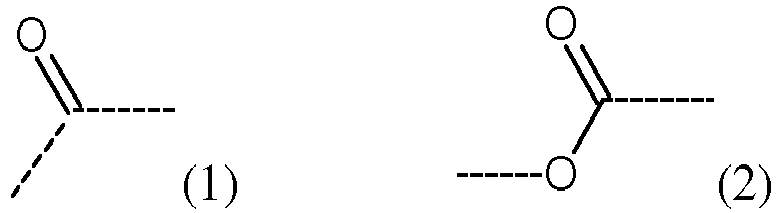
- According to an embodiment, R2 allows for covalent binding to said cells of interest. According to an embodiment, R2 allows for covalent binding to cells expressing azido-modified proteins, for example osteogenic cells or progenitors thereof expressing azido-modified proteins.
- According to an embodiment, R2 is selected from organic substituents comprising from 3 to 35 carbons and from 0 to 15 heteroatoms and comprising at least one carbon-carbon triple bond. In accordance with this embodiment, R2 allows for covalent binding to cells expressing azido-modified proteins, in particular by click-reaction, for example copper-mediated or copper-free click reaction. Preferably, the carbon-carbon triple bond in R2 is suitable to allow for copper-free click reaction with cells expressing azido-modified proteins, preferably under physiological conditions, thereby creating a covalent bond with said cells.
- According to an embodiment, said substituent (R2) comprising from 3 to 35 carbons and from 0 to 15 heteroatoms and comprising at least one carbon-carbon triple bond comprises a structure of formula (6) below:

- Y is N or CR22, R22 being selected, independently, as defined for substituents R11 to R21, with the proviso that if Y is N, R21 is selected from H and substituents -CH2-R22;
- R11 to R21 are independently selected from H, halogen, -OH, -NH2, and organic substituents comprising from 1 to 20 carbon atoms and 0 to 15 heteroatoms, wherein, a substituent pair of substituents on the same ring carbon (for example, R11 and R12) can form any one selected from: an =O (oxo group), a carbon-carbon double bond (such as =CR11'R12', in case of R11 and R12, for example), and a substituent comprising a delocalized π-bond; wherein R11' and R12', and so forth, as applicable, are independently selected from H, halogen, and from organic substituents comprising from 1 to 19 carbon atoms and 0 to 15 heteroatoms, wherein substituents on neighbouring ring carbons, including a substituent =CR11'R12' and so forth, as applicable, with one or two substituents on a neighbouring ring carbon, may form a ring fused to the 8-atom ring in formula (6);
- wherein said combined dotted and solid lines in the 8-atom ring each represent, independently, a single bond, a single bond and a delocalized π-bond, or a double bond, wherein, if any one or both of said dotted and solid lines are double bonds, the substituents R12 and R14, and/or R18 and R20, respectively, are absent, so as to observe to an applicable valence, and wherein, if any one or both of said dotted and solid lines contain delocalized π-bonds, at least one of the substituent pairs R11/R12 and R13/R14, and/or, respectively, R17/R18 and R19/R20, also contain delocalized π-bonds and substituent pairs on neighbouring ring carbons may be connected with each other to form an aromatic system fused to the 8-atom ring of formula (6); and,
- wherein at least one of said substituents R11 to R21 and R22 is a either moiety of formula (7) below:
- -------M9------- (7), or directly connects the structure of formula (6) by way of single bond of a ring carbon of the 8-atom ring or of a -CH2- moiety in said structure (in case of -CH2-R22), to the carbon or oxygen, respectively, in the moieties of formulae (1) and (2);
- In accordance with the above, substituent pairs on a given ring carbon may be provided in the form of =CR11'R12', in case of R11 and R12; =CR13'R14', in case of R13 and R14; =CR15'R16' in case of R15 and R16; =CR17'R18', in case of R17 and R18; and =CR19'R20', in case of R19 and R20, wherein R13' to R20' are defined, independently, as R11' and R12'.
- Preferably, in the substituent of formula (6), substituents on ring carbons next to the triple bond (R11/R12 and R19/R20) do not carry an -OH or -NH2 group, whereas R13-18, preferably R15-16 may be selected from -OH, -NH2, besides the organic substituents comprising from 1 to 20 carbon atoms and 0 to 15 heteroatoms, as specified above.
- Preferably, the substituents on ring carbons next to the triple bond (R11/R12 and R19/R20) contain or consist of an electron withdrawing group and/or contain a double bond (C=O; =CR11'R12' or a bond containing a delocalized π-bond, so as to increase the reactivity and/or the ring strain in the 8-membered ring of formula (6). In this way, the reactivity of the triple bond is increased, allowing for binding to cells by click reaction as described below, preferably in the absence of a (copper) catalyst.
- An electron withdrawing group or function is a group that has an electron pulling character, a region of low electron density and/or an electron poor group, so that the group is capable of taking an electron up, thereby becoming less electron poor, reducing the electron density. Preferred examples of electron acceptors are halogen, -CN, and substituents that are in a π-conjugated connection with the structure of formula (6), in particular with the triple bond in said structure. If any one or more of R11/R12 and R19/R20 contain an electron withdrawing group, the reactivity of the triple bond is increased.
- When reacting with cells expressing azido-modified proteins by click-reaction, the cells are preferably bound to said substituent of formula (6) as shown in scheme (6a) below:

- According to an embodiment, said substituent R2 comprising from 3 to 35 carbons and from 0 to 15 heteroatoms and comprising at least one carbon-carbon triple bond comprises and/or consists of any one selected from the structures of formulae (8) to (12) below:


------M9------ (7)
, or ,
directly connects the structure of formula (8), (9), (10), (11) or (12), by way of single bond of a ring carbon or of a -CH2- moiety in said structures (in case of -CH2-R43), to the carbon or oxygen atom, respectively, in the moieties of formulae (1) and (2);
wherein, in the moiety of formula (7), M9 is an organic moiety comprising from 1 to 15 carbon atoms and from 0 to 10 heteroatoms, and the dotted lines connected on the left and right sides to M9 represent the bonds by which M9 is connected to one of the structures of any one of formulae (8) to (12) and, on the other hand, to the moiety of formula (1) or (2), respectively. - According to an embodiment of the substituent of any one of formulae (6) and (8) to (12), in said moiety of formula (7), M9 is absent or an organic moiety comprising from 1 to 11 carbon atoms and from 0 to 5 heteroatoms, more preferably 1 to 5 carbons. According to an embodiment, M9 is absent or an aliphatic moiety of 1-15, preferably 1-11, and most preferably 1- 5 carbon atoms.
- According to an embodiment, M9 is selected from (-CH2)s-, (-CH2-CH2-O)s-CH2- and - CH2(-O-CH2-CH2)s-,wherein s is 0 or an integer of 1 to 10, preferably 1 to 5 and most preferably 1 to 3.
- According to an embodiment, said substituent R2 comprises and/or consists of any one selected from the structures of formulae (13) to (18) below:


m is an integer of 1 to 5 and, in formulae (13), (14), (15), and (18) may also be 0 (zero), and R30 to R41, in as far as present, are independently selected from H, halogen, -OH, -NH2, and organic substituents comprising from 1 to 10 carbon atoms and 0 to 5 heteroatoms, wherein a pair of substituents on the same ring carbon (for example R30 and R31 in the structure of formula (18) or R34 and R35 in the structures of formulae (13), (15), (16), and (18)) may form an oxo group (=O), and wherein the dotted line represents the bond or radical by which the structure of any one of formulae (13) to (18) is connected to the moiety of formula (1) or (2). Preferably, m is 0 (not in (16) or (17)) or an integer of 1 to 3, most preferably m is 0 or 1. - As mentioned above with respect to the structure of formula (6), in the structures of formulae (9), (14), (15), and (18) substituents on carbons next to the triple bond are preferably different from -OH, and -NH2. Preferably, these substituents comprise and/or consist of an electron withdrawing group, other substituents suitable to increase the reactivity of the triple bond, or H or other substituents as defined but different from -OH and -NH2.
- According to an embodiment, R30 to R43 in any one of said substituents of formulae (8) to (12) and (13) to (18), in as far as present, are independently selected from H, halogen, hydroxyl, carboxyl, -CN, C1-C10 alkyl, C2-C10 alkenyl, C2-C10 alkynyl, C6-C10 aryl, C4-C10 heteroaryl, C1-C10 alkoxyl, C1-C10 alkoxenyl, C6-C10 aroxyl, wherein said alkyl, alkenyl, alkynyl, aryl, heteroaryl, alkoxyl, alkoxenyl, and aroxyl may or may not be further substituted, and wherein said alkyl, alkenyl, alkynyl may be linear, branched and/or cyclic. Further substituents may be selected, for example, from halogen, oxo, hydroxyl, carboxyl, - CN, C1-C5 alkyl, C1-C5 alkoxyl, C2-C5 alkenyl, C2-C5 alkenoxyl, and C2-C5 alkynyl.
- According to a preferred embodiment, R30 to R43 in any one of said substituents of formulae (8) to (12) and (13) to (18), in as far as present, are independently selected from H, halogen, hydroxyl, carboxyl, -CN, C1-C5 alkyl, C2-C5 alkenyl, C2-C5 alkynyl, C6-C8 aryl, C4-C8 heteroaryl, C1-C5 alkoxyl, C2-C5 alkoxenyl, C6-C8 aroxyl, wherein said alkyl, alkenyl, alkynyl, aryl, heteroaryl, alkoxyl, alkoxenyl, and aroxyl may or may not be further substituted, and wherein said alkyl, alkenyl, alkynyl may be linear, branched and/or cyclic. Further substituents may be selected from halogen, oxo, hydroxyl, carboxyl, -CN, C1-C3 alkyl, C1-C3 alkoxyl, C2-C3 alkenyl, C2-C3 alkenoxyl, and C2-C3 alkynyl.
- According to a still preferred embodiment, R30 to R43 in any one of said substituents of formulae (8) to (12) and (13) to (18), in as far as present, are independently selected from H, halogen, hydroxyl, carboxyl, -CN, C1-C5 alkyl and C1-C5 alkoxyl, wherein said alkyl and alkoxyl may be linear, branched or cyclic.
- Most preferably, there are no further substituents (besides H) on the fused phenyl rings in the structures of formulae (13), (14), (16) and (17).
- Most preferably, in the structures of formulae (14), (15) and (18), R40 and R41 are halogen, preferably F.
- According to another embodiment, R2 is a substituent allowing for binding to cells expressing azido-modified proteins by way of Staudinger ligation. In particular, R2 is a substituent comprising a triaryl phosphine on which an electrophilic trap is provided. In this case, the triaryl phosphine can bind by way of a Staudinger ligation to the azido group expressed on the surface of a cell, forming an amide bond. Preferably, said triaryl phosphine is an ortho substituated triphenylphosphine comprising an electrophilic trap.
- In accordance with an embodiment, R2 is a substituent of formula (3) below:
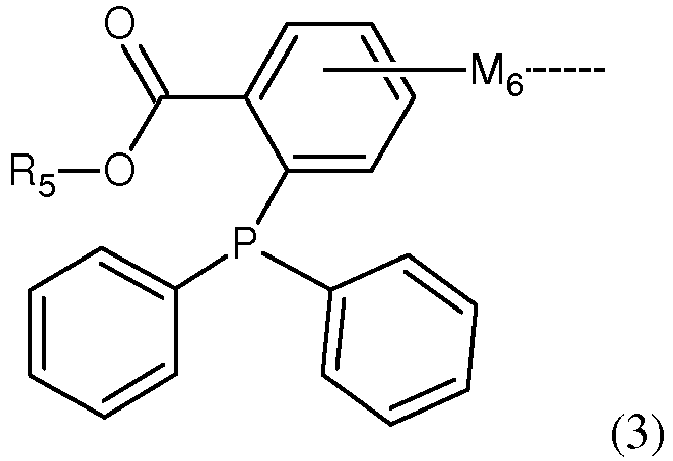
M6 is an organic moiety consisting of 1 to 30 carbon atoms and 0 to 20 heteroatoms, and R5 is or an organic substituent comprising from 1 to 20 carbons and from 0 to 10 heteroatoms, preferably an organic substituent comprising from 1 to 10 carbons and from 0 to 5 heteroatoms. Preferably, R5 is an aliphatic substituent. Preferably, R5 is a linear, branched and or cyclic C1-C10 alkyl or C2-C10 alkenyl, more preferably a C1-C5 alkyl or C2-C5 alkenyl, which may be linear, branched and/or cyclic. - When reacting with cells expressing azido-modified proteins by Staudinger ligation, the cells are bound to said substituent of formula (3) as shown in scheme (3a) below:

- According to an embodiment, M6 is an organic moiety consisting of from 1 to 20 carbon atoms and from 0 to 15 heteroatoms, more preferably consisting of 1 to 10 carbon atoms and from 0 to 5 heteroatoms.
- According to an embodiment, selected from (-CH2)t-, (-CH2-CH2-O)t-CH2-, -CH2(-O-CH2-CH2)t-, and (-O-CH2-CH2)t-, wherein t is an integer of 1 to 10. Preferably, t is an integer from 1 to 8, preferably from 1 to 6, most preferably from 1 to 5. According to a preferred embodiment, M6 is (-CH2)t-, with t being an integer of 1 to 4.
- According to another embodiment, R2 is a substituent allowing for binding to cells that are modified with N-levulinoyl mannosamine, a sugar that can be inserted on the cell surface, instead of the azide as shown above. Such N-levulinoyl mannosamine-modified cells can react with a hydrazide, a hydrazine and/or a alkoxyamine group present according to an embodiment of the compound of the invention.
- According to an embodiment, R2 is a substituent of formula (4) below:

- In case substituent (4) is a hydrazide, -X- is -NH- and M7 starts with an acyl group, being - CO-M7'-, wherein M7', is an organic moiety consisting of 1 to 19 carbon atoms and 0 to 14 heteroatoms. In this case, M7' is preferably (-CH2)u-, (-CH2-CH2-O)u-CH2- and -CH2(-O-CH2-CH2)u-, u being an integer from 1 to 7, preferably from 1 to 4, most preferably from 1 to 2.
- When N-levulinoyl mannosamine-modified cells react with the compound of the invention in accordance with the embodiment above, a hydrazone or oxime derivative is formed, by which the compound of the invention is covalently bound to the cells. This is disclosed, for example, in Chem Commun (Camb). 2010 March 14; 46(10): 1589-1600. doi:10.1039/b925931g.

- According to another embodiment, R2 is a substituent allowing for binding to cells exhibiting a terminal alkene on their surface after modification with homoallylglycine, as disclosed, for example, in Chem Commun (Camb). 2010 March 14; 46(10): 1589-1600. doi:10.1039/b925931g. When homoallylglycine-modified cells are allowed to react wiwith the compound of the invention comprising a biaryltetrazole, a single bond is formed by a 1,3 dipolar cycloaddition, by which the compound of the invention is covalently bound to the cells.
- According to an embodiment, R2 is a substituent of formula (5) below:

- The dotted line on the right represents the bond by which substituent (5) is bound to moiety M5 in formulae (I), (II), (IIa), (III), and (IIIa), for example.
- When reacting with said terminal alkene on the surface of a cell of interest in presence of light, a single bond is formed, binding the cell of interest to substituent R2 as shown in the structure of formula (5a) below. This is mentioned in in Chem Commun (Camb). 2010 March 14; 46(10): 1589-1600. doi:10.1039/b925931g.

- According to an embodiment, the compound of the invention is a compound of any one formulae (II), (IIa), (III) and (IIIa) below:


- According to an embodiment, the compound of the invention is a compound of formula (IV) below:

- The invention encompasses a method of preparing, in particular synthetizing an organic linker, the method comprising the steps of providing a compound of formula (XX), or of a derivative thereof, and reacting said compound, or a derivative thereof, with at least one compound selected from the group consisting of: a first compound comprising an anchoring group; a second compound comprising one selected from a saccharide, a peptide, a peptidoglycan or a glycopeptide; and a third compound selected from: a compound comprising from 3 to 35 carbons and from 0 to 15 heteroatoms and comprising at least one carbon-carbon triple bond, a compound comprising an ortho substituated triphenylphosphine, a hydrazine, a hydrazide, an alkoxyamine and a biaryltetrazole. Preferably, said compound (XX) or said derivative, is reacted with all three of said compounds, preferably successively, thereby providing three different substituents at carboxy, amino and azide group of said compound (XX) or said derivative.
- An example of a derivative of a compound of formula (XX) is, for example, a compound of formula (XXI) below:
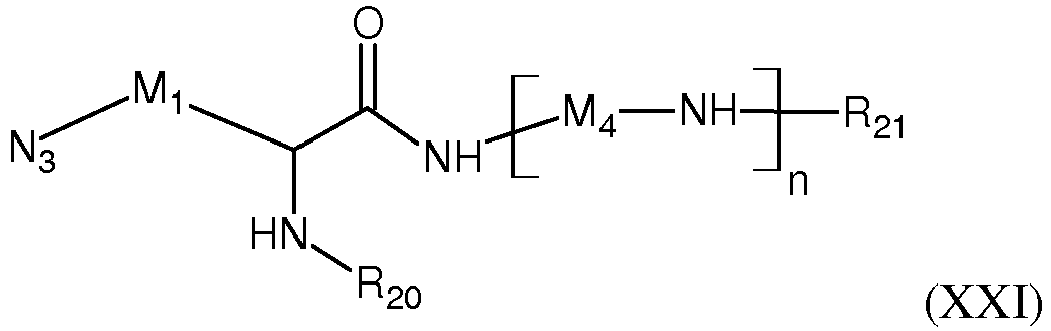
compound 15 in the scheme shown inFig. 1 . - According to an embodiment of the method of synthetizing an organic linker, the method preferably comprises reacting the compound of formula (XX), or of a derivative thereof, with all three selected from said first, second and third compounds, one after the other in any desired or convenient order, or simultaneously, so that covalent bonds or moieties connecting the starting material of formula (XX), or the derivative thereof, and said first, second and third compounds are formed.
- The present invention provides biomaterials, implant materials, prosthetics and the like. The biomaterials preferably comprise the compound of the invention. Preferably, the compound of the invention is bound and/or attached to the biomaterial, in particular to the surface of the biomaterial. The compounds of the invention are preferably used to modify the surface of said biomaterials and/or to functionalize said biomaterials. In this way, the objectives underlying the present invention are addressed.
- For the purpose of the present specification, the expression "biomaterial" encompasses any material to be intended for use in a human or animal body, such as implant materials, prosthetic materials, and the like. According to a preferred embodiment, the biomaterial is an implant material, which is a material intended for implantation in the human or animal body. Preferably, the biomaterial is a bone implant material.
- According to a preferred embodiment, the said biomaterial comprises or consists essentially of a polymer and/or a ceramic comprising alumina.
- According to a preferred embodiment, the said implant material comprises or consists essentially of a porous polymer, ceramic foam, a porous ceramic material and/or a combination comprising two or more of the aforementioned.
- The present invention will now be illustrated by way of examples. These examples do not limit the scope of this invention, which is defined by the appended claims.
- Commercial reagents (Fluka, Aldrich, VWR, Switzerland) were used without further purification. Anhydrous solvents were obtained by filtration (PureSolv MD Series, Innovative Technology). TLCs for reaction monitoring were performed on Merck silica gel 60 F254 plates, and spots were revealed with UV light and reaction with KMnO4 or ninhydrine. IR spectra were recorded on a Perkin-Elmer-1420 spectrometer. 1H-NMR spectra were recorded on a Bruker ARX-400 spectrometer (400 MHz) using CDC13 or MeOD as solvent and calibrated using the solvent's residual signal at 7.27 or 3.31 ppm as an internal reference. 13CNMR spectra were recorded on a Bruker ARX-400 spectrometer (100.6 MHz) using CDC13 or MeOD as solvent and calibrated using the solvent's residual signal at 77.0 or 49.0 ppm as an internal reference. 19F NMR spectra: same instrument as above (376 MHz) using CFC13 as solvent and calibrated using the solvent's residual signal at 0 ppm as an internal reference.
- Chemical shifts are expressed in parts per million (ppm) and coupling constants (J) in hertz. Mass spectra were obtained on a Nermag R-10-10C spectrometer with chemical ionization (NH3) and mode m/z (amu) [% relative base peak (100%)]. Semi-preparative HPLC was performed on a Waters Autopurification ZQ System equipped with a 2767 Sample Manager, a 2525 Binary Gradient Module and a 2996 Photodiode Array Detector, coupled to Waters Micromass ZQ analyzer. The HPLC purifications were performed on XTerra Prep RP C18 (19 x 150 mm) columns, using reverse-phase conditions (2 to 100% acetonitrile with 0.1% TFA over 20 min). X-ray Photoelectron Spectroscopy (XPS) data were collected by Axis Ultra and Axis Nova instruments (Kratos analytical, Manchester, UK) under ultra-high vacuum condition (<10-8 Torr) and using a monochromatic A1 Kα X-ray source (1486.6 eV).
- The source power was maintained at 225 or 150 W and the emitted photoelectrons were sampled from a 750 µm X 300 µm area. The analyzer pass energy was 160 or 80 eV for survey spectra and 40 eV for high-resolution spectra. The adventitious carbon Is peak was calibrated at 285 eV and used as an internal standard to compensate for any charging effects. MS: Nermag R-10-10C, chemical ionization (NH3) mode m/z (amu) [% relative base peak (100%)]. Semi-preparative HPLC: XTerra Prep RP C18 (19 x 150).
- A linker containing the required moieties for the biomaterial attachment, covalent binding of the human fetal osteoblasts by click reaction and the adhesion of the endothelial cells by ligand-protein recognition is synthezised. The synthesis of the final linker was presented in the scheme shown in
Figure 1 . In the present examples, the numbers used to refer to specific compound correspond to those shown inFigure 1 . - In a first synthetic step, the N-Boc-azidonorleucine was coupled to a mono-protected diaminoalkane in presence of PyBOP as coupling reagent. After deprotection of the amine under basic conditions, the gallic acid was added under the same coupling conditions. After cleavage of the Boc protecting group under acidic conditions, the intermediate 18 reacted with RGD-
derivative 19 by click reaction in presence of a copper catalyst. Finally the activated DIBO was coupled tocompound 20, which was deprotected under basic conditions to afford thefinal linker 21. - N-Boc-azidonorleucine (0.3 g, 0.7 mmol, 1 equiv) was dissolved in dry DCM (15 mL). PyBOP (0.34 g, 0.8 mmol, 1.2 equiv) and diisopropylethylamine (0.3 mL, 2.0 mmol, 3 equiv) were added and the reaction mixture was stirred for 15 min at rt. Finally Fmoc-aminobutanediamine (0.26 g, 0.7 mmol, 1 equiv) was added and the mixture was stirred overnight at rt. The product was concentrated under reduced pressure and purified by flash column chromatography (AcOEt/EP 1:1). The resulting product was dissolved in 20 % piperidine in DMF and stirred until total conversion of the starting material. The product was concentrated under reduced pressure and purified by flash column chromatography (DCM/MeOH 8:2 followed by CH3CN/25 % NH3 5: 1) to give the desired compound (mass: 195 mg, yield: 86 % for 2 steps). IR (film): 3300, 2930, 2865, 2465, 2090, 1650, 1525, 1455, 1390, 1365, 1245, 1165, 1045, 1015, 860, 820, 640, 605, 545, 535, 525, 515, 505 cm-1. 1H NMR (400 MHz, MeOD): δ=3.97 (m, 1H, CH), 3.21 (m, 2H, CH2 ), 2.70 (t, 2H, 2 J= 6.6 Hz, CH2 ), 1.75-1.48 (m, 12H, (CH2 )6), 1.45 (s, 9H, (CH3 )3).13C NMR (101 MHz, MeOD): δ=173.73 (Cq), 156.41 (Cq), 79.24 (Cq), 54.66 (CH), 50.28 (CH2), 40.24 (CH2), 38.55 (CH2), 31.66 (CH2), 28.11 (CH2), 27.37 (CH3)3, 26.24 (CH2), 22.83 (CH2). HRMS (ESI): (m/z): calcd for C15H30N6O3+H: 343.2458, found: 343.2454. [α]D 25 = -82 (c=0.005, MeOH).
- Acetoxygallic acid (61 mg, 0.2 mmol, 1 equiv) was dissolved in dry DCM (1 mL) in presence of PyBOP (125 mg, 0.3 mmol, 1.2 equiv) and stirred for 15 min at rt. Then a second solution containing N-(4-aminobutyl)-6-azido-N 2-(tert-butoxycarbonyl)-D-norleucinamide (70 mg, 0.2 mmol, 1 equiv) and diisopropylethylamine (51 µl, 0.3 mmol, 1.5 equiv) in dry DCM (1 mL) was added and the reaction mixture was stirred overnight at rt. The product was concentrated under reduced pressure and purified by flash column chromatography (AcOEt/EP 3 : 1). The product was then dissolved into a solution of 4N HCl in dioxane (2 mL). The reaction mixture was stirred for 30 min and then concentrated under reduced pressure. HCl was coevaporated three times with Et2O (mass : 44 mg, yield : 43 % for 2 steps). IR (film): 3265, 2935, 2865, 2380, 2095, 1775, 1660, 1585, 1490, 1435, 1370, 1320, 1180, 1115, 1050, 1010, 975, 895, 845, 780, 745, 700, 640, 615, 590, 555, 535 cm-1.1H NMR (400 MHz, MeOD): δ=7.65 (s, 2H, aromatics) 3.84 (m, 1H, CH), 3.39 (t, 2H, 2 J= 6.6 Hz, CH2 ), 3.27 (m, 2H, CH2 ), 2.30 (s, 9H, (CH3 )3), 1.88-1.45 (m, 12H, (CH2 )6). 13C NMR (101 MHz, MeOD): δ=168.65 (Cq), 168.33 (Cq), 167.15 (Cq), 143.54 (C (aromatic)), 127.11 (C (aromatic)), 126.43 (C (aromatic)), 119.77 (C (aromatic)), 53.07 (CH), 50.63 (CH2), 39.32 (CH2), 38.85 (CH2), 30.80 (CH2), 28.03 (CH2), 26.31 (CH2), 26.19 (CH2), 21.77 (CH2), 19.15 (CH3)3. HRMS (ESI): (m/z): calcd for C23H32N6O8+H: 521.2360, found: 521.2373. [α]D 25 = -73 (c=0.004, MeOH).
- 4-pentynoic acid (1 g, 10 mmol, 1 equiv), was dissolved in DMF (20 mL) in presence of N-hydroxysuccinimide (1.77 g, 15 mmol, 1.5 equiv) and EDCI (2.93, 15 mmol, 1.5 equiv). The reaction mixture was stirred overnight at rt, concentrated under reduced pressure and finally purified by flash column chromatography (EP/AcOEt 3:2 then 1:1) to give the desired intermediate (mass: 1.67 g, yield: 84 %). 1-(pent-4-ynoyloxy)pyrrolidine-2,5-dione (74 mg, 0.38 mmol, 1 equiv) and Cyclo(Arg(Pbf)-Gly-Asp(OtBu)-D-Phe-Lys) (230 mg, 0.38 mmol, 1 equiv) were dissolved in DMF. Triethylamine (79 µl, 0.57 mmol, 1.5 equiv) was added and the reaction mixture was stirred until total conversion of the starting material. The product was concentrated under reduced pressure, dissolved in MeOH followed by precipitation by slow adding of diethyl ether to afford the pure product (mass : 181 mg, yield : 70 %). IR (film): 3265, 2935, 1635, 1540, 1435, 1370, 1200, 1080, 840, 650, 600 cm-1. HRMS (ESI): (m/z): calcd for C32H45N9O8+H: 684.3469, found: 684.3489. [α]D 25 = -4.8 (c=0.001, MeOH).
- [(2S,5R,8S,11S)-8-[4-({3-[1-(5-amino-6-oxo-6-{[4-({[3,4,5-tris(acetyloxy)phenyl]carbonyl} amino)butyl]amino}hexyl)-1H-1,2,3-triazol-4-yl]propanoyl}amino)butyl]-5-benzyl-11-(3-carbamimidamidopropyl)-3,6,9,12,15-pentaoxo-1,4,7,10,13-pentaazacyclopentadecan-2-yl] acetic acid
- Cyclo(L-arginylglycyl-L-α-aspartyl-D-phenylalanyl-N 6-pent-4-ynoyl-L-lysyl) and 5-({4-[(6-azido-D-norleucyl)amino]butyl}carbamoyl)benzene-1,2,3-triyl triacetate were dissolved in a mixture of H2O/DMF (3 :1, 180:60 µL) in presence of a catalytic amount of CuSO4 and sodium ascorbate. The reaction mixture was ultrasonicated for 6 h and then concentrated under reduced pressure. The crude product was used without further purification (quantitative yield). IR (film): 3275, 2930, 1770, 1635, 1520, 1435, 1320 1180, 1095, 1050, 845, 650, 605 cm-1 HRMS (ESI): (m/z): calcd for C55H77N15O16+H: 1204.5751, found: 1204.5715. [α]D 25= -26 (c=0.001, MeOH).
- {[(2S,5R,8S,11S)-5-benzyl-11-(3-carbamimidamidopropyl)-8-[4-({3-[1-(5-{[11, 12-didehydro-5,6-dihydrodibenzo[a,e] [8] annulen-5-yloxy) carbonyl]amino}-6-oxo-6-[(4-{[(3,4,5-trihydroxyphenyl)carbonyl]amino}butyl)amino]hexyl)-1H-1,2,3-triazol-4-yl] propanoyl}amino)butyl]-3,6,9,12,15-pentaoxo-1,4,7,10,13-pentaazacyclopentadecan-2-yl} acetic acid
- [(2S,5R,8S,11S)-8-[4-({3-[1-(5-amino-6-oxo-6-{[4-({[3,4,5-tris(acetyloxy)phenyl]carbonyl}amino)butyl]amino}hexyl)-1H-1,2,3-triazol-4-yl]propanoyl}amino)butyl]-5-benzyl-11-(3-carbamimidamidopropyl)-3,6,9,12,15-pentaoxo-1,4,7,10,13-pentaazacyclopentadecan-2-yl] acetic acid (52 mg, 0.04 mmol, 1 equiv) was dissolved in dry DMF, carbonic acid, 5,6-dihydro-11,12-didehydro-dibenzo[a, e]cycloocten-5-yl ester, 4-nitrophenyl ester (17 mg, 0.04 mmol, 1 equiv) followed by triethylamine (18 µL, 0.13 mmol, 3 equiv) were added and the reaction mixture was stirred overnight at rt. The product was concentrated under reduced pressure and purified by precipitation in DCM (mass 35 mg, yield: 56 %). The resulting product was dissolved in a mixture of THF/DMF (1:1) in presence of a 1 M LiOH solution (72 µL, 0.07 mmol, 3 equiv) and ultrasonicated for 3 h until total deprotection of the starting material. The product was purified by HPLC ((XTerra Prep RP C18, (25x150 mm Waters)) to give the final product (masse: 5 mg, yield: 15 %). IR (film): 3670, 3020, 2170, 2160, 1730, 1490, 1435, 1366, 1231, 1015, 950, 875, 655, 600 cm-1. HRMS (ESI): (m/z): calcd for C66H81N15O15+H: 662.8096, found: 662.8085. [α]D 25 = -8.3 (c=0.001, DMSO).
- Open porous, alumina scaffold materials are produced as described in F. Krauss Juillerat et al. J. Am. Ceram. Soc. 2011, 94, 77-83.
- Calcium aluminate is used as setting agent in order to solidify the wet foams and stop bubble coarsening. Foam microstructure was determined by controlling of the bubble growth in the wet stage. Particle concentration in suspension is the most suitable parameter for inducing and controlling bubble growth. Three different scaffolds S1-S3 are produced, with
scaffolds 1 and 2 having average pore diameters of 170 µm and an average window size of 50 to 60 µm. Scaffold 3 had a average pore diameter of 460 µm and windows of almost 100 µm. - Scaffolds S1-S3 produced in Example 2 are all immersed in cell culture medium containing different cell types (human fetal osteoblasts, human U2Os, SaOs osteosarcoma cells) and cultured during 37 days. It is found that the different foam microstructures influence the migratory potential of the cells but not the cell viability, permitting either localized (
S 1 and S2) or widespread (S3) colonization of the scaffold. This demonstrated that scaffolds with larger average pore sizes (S3) are more permissive for the trans-scaffold passage of cells across the entire structure than the scaffolds showing smaller average pore sizes. Furthermore, the cell viability assays also showed that the chemical composition did not influence the cell response to the different scaffolds. The cell-loaded and incubated scaffolds as prepared by the team of MER Dr Lucienne Juillerat, CHUV where analyzed by means of SEM. To do so, the foam discs where broken in half and the cross-sections scanned for cells. It could be shown that cells where found throughout the entire scaffold cross-sections for all combinations of cells (human fetal osteoblasts, human U2Os, SaOs osteosarcoma cells) and scaffold types (S1-S3). Hence, the interconnecting pore networks of all three scaffold types are permissive for cell diffusion and suitable for cell colonization. For example, human fetal osteoblasts are spread out on the scaffold surface of S3 and/or spanning over pore interconnections, showing focal adhesion. These results are indicating a good acceptance of the living cells towards the scaffold material. - Ceramic scaffold S1-S3 of Example 2 are immersed in a 1 nm aqueous solution of
compound 21 at room temperature for 16 hours, in accordance with the procedure disclosed in H. Comas et al, ACS Appl. Mater. Interfaces 2012, 4, 573-573 (Supporting Information). In this way, functionalized biomaterials are obtained. - The functionalized biomaterials of Example 4 were seeded with human fetal osteoblasts as disclosed in Borcard, F.; Krauss Juillerat, F.; Staedler, D., Scaletta, C.; Applegate. L. A.; Comas, H.; Gauckler, L. J. ,Gerber-Lemaire, S; Juillerat-Jeanneret, L.; Gonzenbach, U. Bioconjugate Chem., 2012, 23, 2278-2290.
- Using the same general experimental procedure as set out in Example 1 (
Figure 1 ), a compound is synthesized in which the cyclic RGD peptide is replaced by a IKVAV peptide (SEQ ID NO: 3) of laminin. Instead of intermediate 19 inFig. 1 , the intermediate of formula (V) below is used:
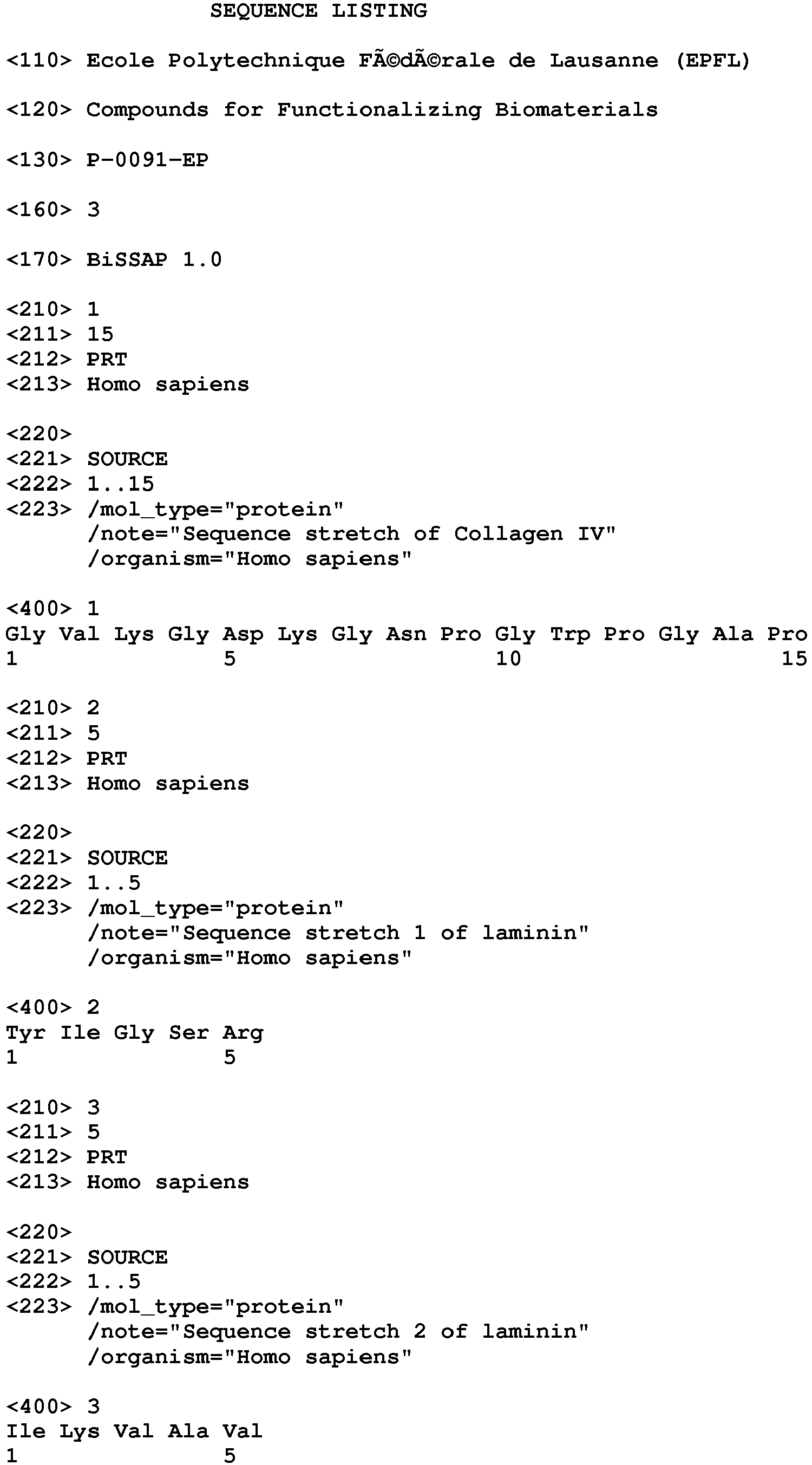
Claims (15)
- A compound of formula (I) below:

M1, M2 and M4 are, independently, selected from organic moieties consisting of 1 to 21 carbon atoms and from 0 to 15 heteroatoms;
R3 is selected from a substituent comprising a peptide, saccharide, peptidoglycan, glycopeptide, and/or analogues of any one of the aforementioned;
M3 is selected from:-NH-CO- if R3 comprises a peptide, peptidoglycan or glycopeptide substituent, bound by way of amide bond M3 formed with a free amino group of said peptide, peptidoglycan or glycopeptide, respectively; and-O-, if R3 comprises a saccharide, a peptidoglycan or a glycopeptide substituent, bound by way of a ether bond formed with a primary hydroxyl group of a monosaccharide moiety of said saccharide, peptidoglycan or glycopeptide, respectively;n is 0 or an integer from 1 to 3;
R1 is an organic substituent comprising from 1 to 20 carbon atoms and 1 to 10 heteroatoms,
said organic substituent comprising at least one anchoring group;
M5 is selected from moieties of formulae (1) and (2) below: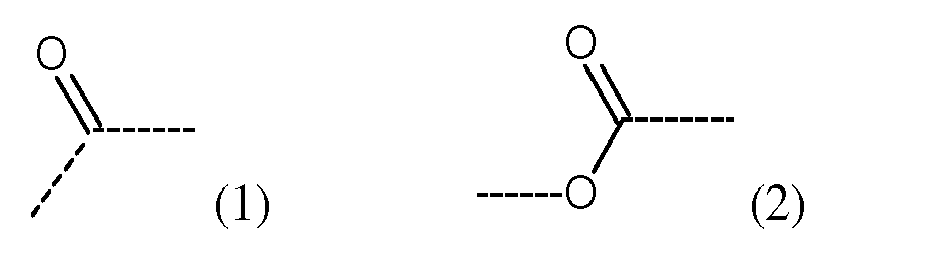
in the moieties of formulae (1) and (2) the dotted line on the right represents the bond by which M5 is bound to the -NH- moiety in the structure of formula (I) and the dotted line on the left represents the bond to R2;
R2 is selected from any one of substituents (i) to (iv) below:i. organic substituents comprising from 3 to 35 carbons and from 0 to 15 heteroatoms and comprising at least one carbon-carbon triple bond;ii. a substituent of formula (3) below:
M6 is an organic moiety consisting of 1 to 30 carbon atoms and 0 to 20 heteroatoms; and R5 is an organic substituent comprising from 1 to 20 carbons and from 0 to 10 heteroatoms;iii. a substituent of formula (4) below: iv. a substituent of formula (5) below:
any one or more of the hydrogens of the phenyl moiety and/or the phenyl substituent in the structure of formula (5) may be substituted by halogen or C1-C8 linear, branched and/or cyclic alkyl, preferably C1-C4, linear, branched and/or cyclic alkyl, and most preferably said hydrogens are not substituted or may be substituented totally or partially by halogen. - The compound of claim 1, wherein said substituent (i) (R2) comprising from 3 to 35 carbons and from 0 to 15 heteroatoms and comprising at least one carbon-carbon triple bond comprises a structure of formula (6) below:
 Y is N or CR22, R22 being selected, independently, as defined for substituents R11 to R21, with the proviso that if Y is N, R21 is selected from H and substituents -CH2-R22;R11 to R21 are independently selected from H, halogen, -OH, -NH2, and organic substituents comprising from 1 to 20 carbon atoms and 0 to 15 heteroatoms, wherein, a substituent pair of substituents on the same ring carbon (for example, R11 and R12) can form any one selected from: an =O (oxo group), a carbon-carbon double bond, such as =CR11'R12', in case of R11 and R12, and a substituent comprising a delocalized π-bond; wherein R11' and R12', and so forth, as applicable, are independently selected from H, halogen, and from organic substituents comprising from 1 to 19 carbon atoms and 0 to 15 heteroatoms, wherein substituents on neighbouring ring carbons, including a substituent =CR11'R12' and so forth, as applicable, with one or two substituents on a neighbouring ring carbon, may form a ring fused to the 8-atom ring in formula (6);wherein M9 is an organic moiety comprising from 1 to 10 carbon atoms and from 0 to 5 heteroatoms, and the dotted lines connected on the left and right sides to M9 represent the bonds by which M9 is connected to the structure of formula (6) and to the substituent of formula (1) or (2).
wherein said combined dotted and solid lines in the 8-atom ring each represent, independently, a single bond, a single bond and a delocalized π-bond, or a double bond, wherein, if any one or both of said dotted and solid lines are double bonds, the substituents R12 and R14, and/or R18 and R20, respectively, are absent, so as to observe to an applicable valence, and wherein, if any one or both of said dotted and solid lines contain delocalized π-bonds, at least one of the substituent pairs R11/R12 and R13/R14, and/or, respectively, R17/R18 and R19/R20, also contain delocalized π-bonds and substituent pairs on neighbouring ring carbons may be connected with each other to form an aromatic system fused to the 8-atom ring of formula (6); and,
wherein at least one of said substituents R11 to R21 and R22 is either a moiety of formula (7) below:
-------M9------- (7), or directly connects the structure of formula (6) by way of single bond of a ring carbon of the 8-atom ring or of a -CH2- moiety in said structure (in case of -CH2-R22), to the carbon or oxygen, respectively, in the moieties of formulae (1) and (2); - The compound of claim 1 or claim 2, wherein said substituent (i) (R2) comprising from 3 to 35 carbons and from 0 to 15 heteroatoms and comprising at least one carbon-carbon triple bond comprises and/or consists of any one selected of the structures of formulae (8) to (12) below:


wherein at least one of said substituents R30-41; R30-41; R30-39 and R43; R30-37 and R43; and R30-40 in formulae (8); (9); (10); (11); and (12), respectively, is either a linker moiety of formula (7) below:
-------M9------- (7), or directly connects the structure of formula (8), (9), (10), (11) or (12), by way of single bond of a ring carbon or of a -CH2- moiety in said structures, to the carbon or oxygen atom, respectively, in the moieties of formulae (1) and (2);
wherein, in the moiety of formula (7), M9 is an organic moiety comprising from 1 to 15 carbon atoms and from 0 to 10 heteroatoms, and the dotted lines connected on the left and right sides to M9 represent the bonds by which M9 is connected to one of the structures of any one of formulae (8) to (12) and, on the other hand, to the moiety of formula (1) or (2), respectively. - The compound of any one of claims 1 to 3, wherein said substituent (i) (R2) comprises any one selected from the structures of formulae (13) to (18) below:


m is an integer of 1 to 5 and, in formulae (13), (14), (15), and (18) may also be 0 (zero), and
R30 to R41, in as far as present, are independently selected from H, halogen, -OH, -NH2, and organic substituents comprising from 1 to 10 carbon atoms and 0 to 5 heteroatoms, wherein, a pair of substituents on the same ring carbon may form an oxo group (=O), and wherein the dotted line represents the bond by which the structure of any one of formulae (13) to (18) is connected to the moiety of formula (1) or (2). - The compound of any one of the preceding claims, wherein M1, M2, M4 and M9 are, independently, selected from (-CH2)r-, (-CH2-CH2-O)r-CH2- and -CH2(-O-CH2-CH2)r-, and M1 and M2 are further selected from (-CH2-CH2-O)r, wherein r is, independently for M1, M2 and M4, an integer of 1 to 10.
- The compound of any one of the preceding claims, wherein R3 comprises a peptide substituent selected from the group consisting of: an RGD peptide, a cadherin, a catenin, an integrin, collagen IV, an elastin, a fibronectin, a laminin, a peptide sequence of at least three amino acid moieties taken from any one of the aforementioned peptides/proteins, and analogues of any one of the aforementioned.
- The compound of any one of the preceding claims, wherein R1 is a substituent of formulae (20) below:
 R6 to R10 are independently selected from H, halogens and from C1-C10 substituents comprising from 0 to 5 heteroatoms, with the proviso that at least one of R6 to R10 comprises or consists of an anchoring group, preferably selected from-OH and -COOH.
 - The compound of any one of the preceding claims, wherein said substituent R1 is selected from substituents of formulae (21) and (22) below:

- The compound of any one of the preceding claims, wherein M3 is -NH-CO-, and R3 is a RGD-peptide substituent of formula (30) below:

- The compound of any one of the preceding claims, which is a compound of any one of formulae (II), (IIa), (III) and (IIIa) below:


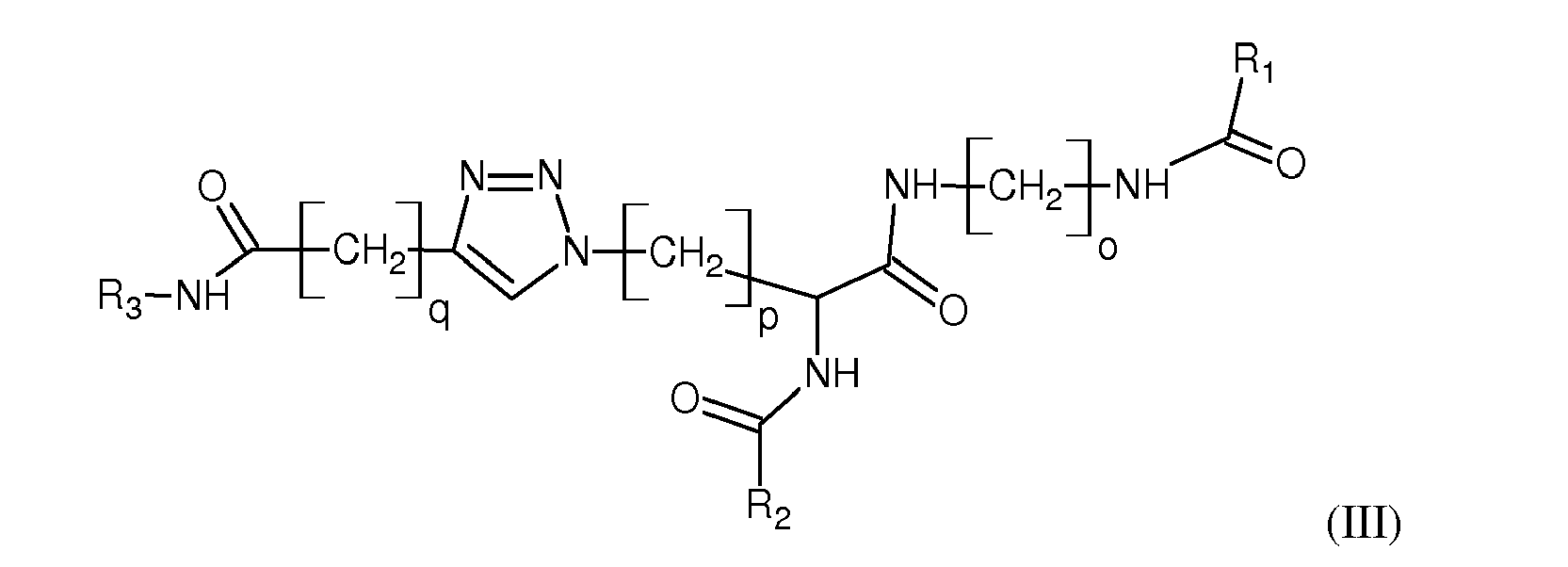
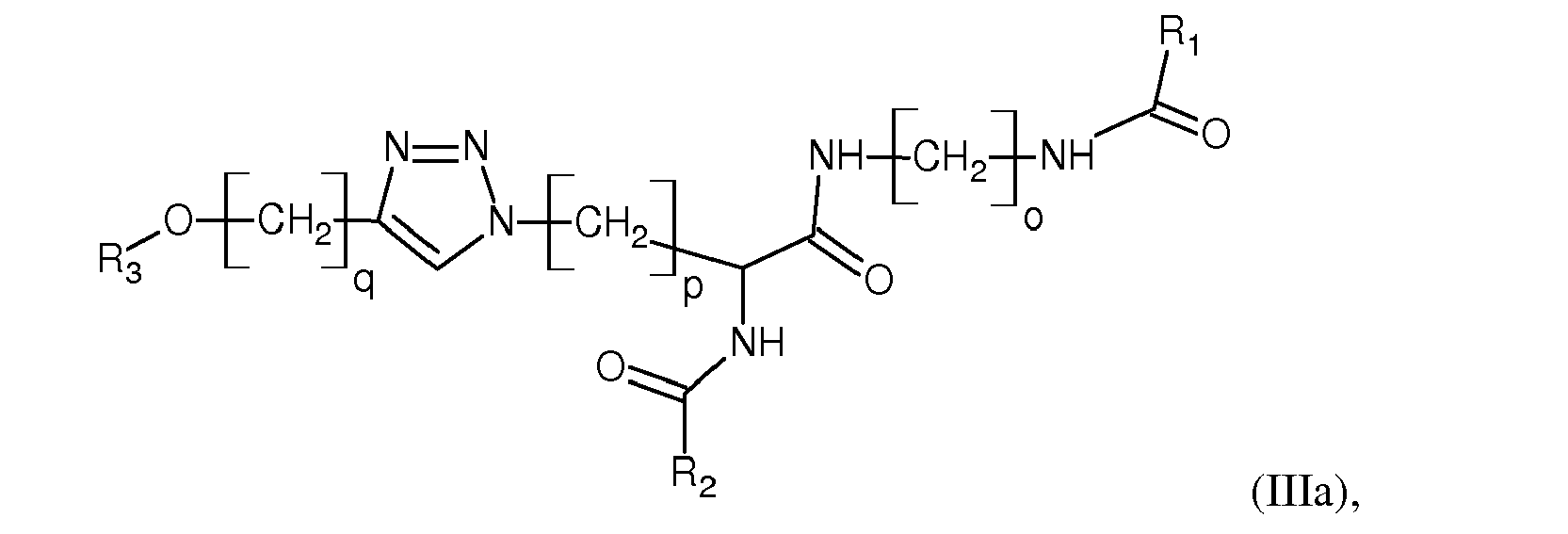
- A compound comprising a structure of formula (IV) below:

- An implant material wherein a compound of any one of claims 1 to 11 is bound to said implant material.
- The implant material of claim 12, wherein said implant material comprises a polymer and/or a ceramic selected from the group consisting of alumina, hydroxyapatite and tricalcium phosphate, and a combination comprising two or more of these materials.
- The implant material of claim 12 or claim 13, which comprises a porous polymer, a ceramic foam, a porous ceramic material and/or a combination comprising two or more of the aforementioned.
- Use of a compound of formula (XX) in the synthesis of an organic linker suitable to functionalize an implant material,

M1 is an organic moieties comprising from 1 to 21 carbon atoms and from 0 to 15 heteroatoms.
Priority Applications (2)
| Application Number | Priority Date | Filing Date | Title |
|---|---|---|---|
| EP20130151702 EP2757098A1 (en) | 2013-01-17 | 2013-01-17 | Compounds for Functionalizing Biomaterials |
| PCT/EP2014/050947 WO2014111545A1 (en) | 2013-01-17 | 2014-01-17 | Compounds for functionalizing biomaterials |
Applications Claiming Priority (1)
| Application Number | Priority Date | Filing Date | Title |
|---|---|---|---|
| EP20130151702 EP2757098A1 (en) | 2013-01-17 | 2013-01-17 | Compounds for Functionalizing Biomaterials |
Publications (1)
| Publication Number | Publication Date |
|---|---|
| EP2757098A1 true EP2757098A1 (en) | 2014-07-23 |
Family
ID=47623928
Family Applications (1)
| Application Number | Title | Priority Date | Filing Date |
|---|---|---|---|
| EP20130151702 Withdrawn EP2757098A1 (en) | 2013-01-17 | 2013-01-17 | Compounds for Functionalizing Biomaterials |
Country Status (2)
| Country | Link |
|---|---|
| EP (1) | EP2757098A1 (en) |
| WO (1) | WO2014111545A1 (en) |
Citations (1)
| Publication number | Priority date | Publication date | Assignee | Title |
|---|---|---|---|---|
| WO2005081926A2 (en) * | 2004-02-20 | 2005-09-09 | Emory University | Thrombomodulin derivatives and conjugates |
-
2013
- 2013-01-17 EP EP20130151702 patent/EP2757098A1/en not_active Withdrawn
-
2014
- 2014-01-17 WO PCT/EP2014/050947 patent/WO2014111545A1/en not_active Ceased
Patent Citations (1)
| Publication number | Priority date | Publication date | Assignee | Title |
|---|---|---|---|---|
| WO2005081926A2 (en) * | 2004-02-20 | 2005-09-09 | Emory University | Thrombomodulin derivatives and conjugates |
Non-Patent Citations (4)
| Title |
|---|
| FRANÇOISE BORCARD ET AL: "Chemical Functionalization of Bioceramics To Enhance Endothelial Cells Adhesion for Tissue Engineering", JOURNAL OF MEDICINAL CHEMISTRY, vol. 55, no. 18, 27 September 2012 (2012-09-27), pages 7988 - 7997, XP055055269, ISSN: 0022-2623, DOI: 10.1021/jm301092r * |
| FRANCOISE BORCARD ET AL: "Covalent Cell Surface Functionalization of Human Fetal Osteoblasts for Tissue Engineering", BIOCONJUGATE CHEMISTRY, vol. 22, no. 7, 20 July 2011 (2011-07-20), pages 1422 - 1432, XP055055267, ISSN: 1043-1802, DOI: 10.1021/bc200147m * |
| FRANZISKA KRAUSS JUILLERAT ET AL: "Functionalization of Microstructured Open-Porous Bioceramic Scaffolds with Human Fetal Bone Cells", BIOCONJUGATE CHEMISTRY, vol. 23, no. 11, 21 November 2012 (2012-11-21), pages 2278 - 2290, XP055055387, ISSN: 1043-1802, DOI: 10.1021/bc300407x * |
| RAFFAELE COLOMBO ET AL: "Synthesis and Biological Evaluation (in Vitro and in Vivo) of Cyclic Arginine-Glycine-Aspartate (RGD) Peptidomimetic-Paclitaxel Conjugates Targeting Integrin [alpha] V [beta] 3", JOURNAL OF MEDICINAL CHEMISTRY, vol. 55, no. 23, 13 December 2012 (2012-12-13), pages 10460 - 10474, XP055055271, ISSN: 0022-2623, DOI: 10.1021/jm301058f * |
Also Published As
| Publication number | Publication date |
|---|---|
| WO2014111545A1 (en) | 2014-07-24 |
Similar Documents
| Publication | Publication Date | Title |
|---|---|---|
| JP5105360B2 (en) | Bone graft material on which bone tissue formation-promoting peptide is fixed, and support for tissue engineering | |
| JP4503825B2 (en) | Methods and compositions for preventing adhesion formation in biological tissues | |
| US20100098761A1 (en) | Polymer Compositions For Biomedical And Material Applications | |
| WO2006031388A2 (en) | Dentritic polymers, crosslinked gels, and their uses in orthopedic applications | |
| WO2011063165A1 (en) | Methods and compositions for capture of cells | |
| WO2005040224A1 (en) | Hyaluronic acid compound, hydrogel thereof and material for treating joint | |
| JP5339534B2 (en) | Novel polypeptide and method for producing the same | |
| WO2012158169A1 (en) | Methods and compositions for tissue repair | |
| EP2749300A1 (en) | Modified polyaryletherketone polymer (PAEK) and process to obtain it | |
| US8575311B2 (en) | Collagen peptide conjugates and uses therefor | |
| WO2022105838A1 (en) | Use of amino acid polymer or polypeptide analog polymer in bone repair | |
| EP2813516B1 (en) | Peptide having the ability to regenerate bone tissue and for binding to apatite | |
| US20130337028A1 (en) | Biomimetic peptides for bone augmentation | |
| JP2010088933A (en) | Peptide-coated implant and method for preparing the same | |
| US8222216B2 (en) | Mesenchymal cell proliferation promoter and skeletal system biomaterial | |
| EP2547690B1 (en) | Affinity peptides toward bmp-2 | |
| WO2014111545A1 (en) | Compounds for functionalizing biomaterials | |
| EP4384540B1 (en) | Biomimetic peptides and their use in bone regeneration | |
| CN120617300A (en) | Application of BSP-MA/HA-NB hydrogel in preparation of medicines for treating bone defect, cartilage injury or articular cartilage degenerative diseases | |
| EP2749298B1 (en) | A 1,4,5-TRISUBSTITUTED1,2,3-TRIAZOLE MIMETIC OF RGD and/or OGP10-14, PROCESS TO OBTAIN IT AND USES THEREOF | |
| Salinas | Photoinitiated thiol-acrylate polymerizations to tailor PEG microenvironments with peptide moieties to direct chondrogenic differentiation of hMSCs | |
| Borcard et al. | Surface modification of biomaterials for conjugation with human fetal osteoblasts | |
| JP2001526935A (en) | Tissue-reactive adhesive composition |
Legal Events
| Date | Code | Title | Description |
|---|---|---|---|
| PUAI | Public reference made under article 153(3) epc to a published international application that has entered the european phase |
Free format text: ORIGINAL CODE: 0009012 |
|
| 17P | Request for examination filed |
Effective date: 20130117 |
|
| AK | Designated contracting states |
Kind code of ref document: A1 Designated state(s): AL AT BE BG CH CY CZ DE DK EE ES FI FR GB GR HR HU IE IS IT LI LT LU LV MC MK MT NL NO PL PT RO RS SE SI SK SM TR |
|
| AX | Request for extension of the european patent |
Extension state: BA ME |
|
| STAA | Information on the status of an ep patent application or granted ep patent |
Free format text: STATUS: THE APPLICATION IS DEEMED TO BE WITHDRAWN |
|
| 18D | Application deemed to be withdrawn |
Effective date: 20150124 |