EP2756697B1 - Authentication mechanism - Google Patents
Authentication mechanism Download PDFInfo
- Publication number
- EP2756697B1 EP2756697B1 EP11872330.3A EP11872330A EP2756697B1 EP 2756697 B1 EP2756697 B1 EP 2756697B1 EP 11872330 A EP11872330 A EP 11872330A EP 2756697 B1 EP2756697 B1 EP 2756697B1
- Authority
- EP
- European Patent Office
- Prior art keywords
- machine
- platform
- application
- notification
- device application
- Prior art date
- Legal status (The legal status is an assumption and is not a legal conclusion. Google has not performed a legal analysis and makes no representation as to the accuracy of the status listed.)
- Active
Links
- 238000000034 method Methods 0.000 claims description 15
- 238000004590 computer program Methods 0.000 claims description 2
- 238000004891 communication Methods 0.000 description 5
- 238000010586 diagram Methods 0.000 description 5
- 238000012986 modification Methods 0.000 description 2
- 230000004048 modification Effects 0.000 description 2
- 230000004044 response Effects 0.000 description 2
- 238000012550 audit Methods 0.000 description 1
- 230000006399 behavior Effects 0.000 description 1
- 230000005611 electricity Effects 0.000 description 1
- 230000007257 malfunction Effects 0.000 description 1
- 238000010295 mobile communication Methods 0.000 description 1
- 238000000926 separation method Methods 0.000 description 1
Images


Classifications
-
- H—ELECTRICITY
- H04—ELECTRIC COMMUNICATION TECHNIQUE
- H04L—TRANSMISSION OF DIGITAL INFORMATION, e.g. TELEGRAPHIC COMMUNICATION
- H04L63/00—Network architectures or network communication protocols for network security
- H04L63/08—Network architectures or network communication protocols for network security for authentication of entities
-
- H—ELECTRICITY
- H04—ELECTRIC COMMUNICATION TECHNIQUE
- H04L—TRANSMISSION OF DIGITAL INFORMATION, e.g. TELEGRAPHIC COMMUNICATION
- H04L63/00—Network architectures or network communication protocols for network security
- H04L63/08—Network architectures or network communication protocols for network security for authentication of entities
- H04L63/0815—Network architectures or network communication protocols for network security for authentication of entities providing single-sign-on or federations
-
- H—ELECTRICITY
- H04—ELECTRIC COMMUNICATION TECHNIQUE
- H04L—TRANSMISSION OF DIGITAL INFORMATION, e.g. TELEGRAPHIC COMMUNICATION
- H04L67/00—Network arrangements or protocols for supporting network services or applications
- H04L67/01—Protocols
- H04L67/10—Protocols in which an application is distributed across nodes in the network
-
- H—ELECTRICITY
- H04—ELECTRIC COMMUNICATION TECHNIQUE
- H04W—WIRELESS COMMUNICATION NETWORKS
- H04W12/00—Security arrangements; Authentication; Protecting privacy or anonymity
- H04W12/06—Authentication
-
- H—ELECTRICITY
- H04—ELECTRIC COMMUNICATION TECHNIQUE
- H04W—WIRELESS COMMUNICATION NETWORKS
- H04W4/00—Services specially adapted for wireless communication networks; Facilities therefor
- H04W4/70—Services for machine-to-machine communication [M2M] or machine type communication [MTC]
-
- H—ELECTRICITY
- H04—ELECTRIC COMMUNICATION TECHNIQUE
- H04L—TRANSMISSION OF DIGITAL INFORMATION, e.g. TELEGRAPHIC COMMUNICATION
- H04L63/00—Network architectures or network communication protocols for network security
- H04L63/08—Network architectures or network communication protocols for network security for authentication of entities
- H04L63/0807—Network architectures or network communication protocols for network security for authentication of entities using tickets, e.g. Kerberos
Definitions
- the present invention relates to authentication.
- the invention relates to authentication in machine-to-machine (M2M) applications.
- M2M machine-to-machine
- ETSI TS 102 690 "Machine- to- Machine communications (M2M); Functional architecture . Version 0.2.1., XP014165271 , comprises a description of the M2M communications, especially the functional entities of an M2M system and the relationships of the entities.
- INTERDIGITAL ET AL "Ticket #12: Gateway 1-17 and Device Protection; M2M(10)0269 Ticket12 discussion doc", ETSI DRAFT; M2M(10)0269 TICKET12 DISCUSSION DOC, EUROPEAN TELECOMMUNICATIONS STANDARDS INSTITUTE (ETSI), 650, ROUTE DES LUCIOLES ; F-06921 H04L SOPHIA-ANTIPOLIS ; FRANCE, vol. SmartM2M, 8 September 2010 (2010-09-08), pages 1-29, XP014165448, [retrieved on 2010-09-08 ] discloses description of gateway and device protection.*
- FIG. 1 is a block diagram of a system, indicated generally by the reference numeral 1.
- the system 1 comprises a first M2M device 2, a second M2M device 4, a third M2M device 6, a network 8 and a network application 10.
- Machine-to-machine (M2M) devices such as the devices 2, 4 and 6 in the system 1, are used to provide data to other machines or applications, such as the network application 10. This data is transmitted over a network, such as the network 8.
- the network 8 may be a wireless network.
- the network 8 may be provided by a mobile network provider.
- M2M applications in which devices, such as sensors, provided data to applications, such as software programs, are becoming well established.
- M2M systems can build on existing mobile communication infrastructure to provide simple, efficient and reliable data reporting and recording systems.
- the system 1 may be a smart metering system.
- the devices 2, 4 and 6 may be sensors that obtain data relating to the amount of a metered resource (such as electricity) that is consumed at a particular site (such as a user's home). This data is transmitted via the network 8 to the application 10.
- the application 10 may be a billing system that bills the users of the metered resource accordingly.
- FIG. 2 shows a system, indicated generally by the reference numeral 20, comprising an M2M device 22, an M2M platform 24 and a network application 26.
- the M2M device 22 is logically split into two parts: a service capabilities (SC) part 28 and one or multiple device application (DA) parts 30.
- SC service capabilities
- DA device application
- the latter is built on the former, which means that the DA part 30 can only communicate with M2M platform 24 or the NA 26 via the SC part 28.
- a SC layer 28 provides a communication channel and other core M2M services between the M2M device 22 and the M2M platform 24.
- a metering application component is responsible for reporting metering data to the M2M platform 24 and a Smart Grid network application 26.
- M2M platforms might typically be run by a communication service provider (CSP)
- Smart Grid network application might typically be run by power grid enterprises.
- Authentication is required before an M2M device (including its application part) is allowed to access an M2M platform. This enables an M2M platform (such as the platform 24) to reject requests from invalid M2M devices and accept requests from valid M2M devices and provide subscribed platform services based on attributes or configuration of those devices and applications running on them.
- an M2M platform such as the platform 24
- DAs such as DA 30
- service providers which is out of the M2M platform operator's control.
- both the SC part 28 and the DA part 30 of the M2M device 22 should be authenticated.
- the system 20 includes a single M2M device 22 and a single network application 26. Many real systems will include multiple M2M devices and/or multiple network applications and can provide substantial flexibility.
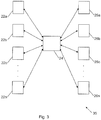
- Figure 3 shows a system, indicated generally by the reference numeral 35, comprising a plurality of M2M devices 22a, 22b, 22c...22n, an M2M platform 24 and a plurality of network applications 26a, 26b, 26c...26n.
- a system indicated generally by the reference numeral 35, comprising a plurality of M2M devices 22a, 22b, 22c...22n, an M2M platform 24 and a plurality of network applications 26a, 26b, 26c...26n.
- Each of the plurality of M2M devices and each of the network applications is in two-way communication with the M2M platform 24.
- the M2M platform 24 is designed to have service capabilities such as collecting and caching data sent from the plurality of M2M devices. This data will be consumed by one or more of the network applications. It is possible that a malicious or mal-functioned DA running on a M2M device produces data but without having a network application to consume that data. Thus, resources, such as Central Processing Unit (CPU), network bandwidth and data cache, are wasted. Moreover, malicious M2M devices may attack the network, network application or M2M platform, which are not foreseen when the M2M platform is developed.
- service capabilities such as collecting and caching data sent from the plurality of M2M devices. This data will be consumed by one or more of the network applications. It is possible that a malicious or mal-functioned DA running on a M2M device produces data but without having a network application to consume that data. Thus, resources, such as Central Processing Unit (CPU), network bandwidth and data cache, are wasted. Moreover, malicious M2M devices may attack the network, network application or M2
- Different device applications provided by the various M2M devices in the system 35 may provide data to different network applications and may have different access rights or charging schemes (even if supplying data to the same network application). Accordingly, the M2M platform 24 needs to treat different device applications (DAs) differently.
- DAs device applications
- the M2M platform 24 typically needs to trace or audit the behaviours of each device application (DA) to enable the provision of value-added services (like accounting, billing, etc). In order to do this, M2M platform needs to identify DAs, especially those sharing the same SC.
- DA device application
- the present invention seeks to address at least in part some or all of the disadvantages and/or problems of the conventional systems described hereinabove.
- a method of operating a machine-to-machine platform comprising the steps of: authenticating a service capability portion of a machine-to-machine device in order to enter a partially authenticated state; and receiving a notification from a network application wherein the notification informs the machine-to-machine platform of the authentication of a device application portion of the machine-to-machine device at the network application in order to enter a fully authenticated state and comprises one or more parameters relating to the device application to enable the machine-to-machine platform to apply control to the device application.
- the machine-to-machine platform authenticates the service capability portion of a machine-to-machine device but is also notified of the authentication of one or more device application portion(s) of the machine-to-machine device. Once the machine-to-machine platform is aware of the authentication of both portions the fully authenticated state is entered enabling the machine-to-machine platform to fulfil the service requests of the machine-to-machine device.
- the method may further comprise the steps of receiving a service request from the device application; and requesting the notification for the device application from the network application.
- the method may further comprise the step of providing services to the device application once the fully authenticated state has been entered.
- a machine-to-machine platform comprising: a processor adapted to authenticate a service capability portion of a machine-to-machine device in order to enter a partially authenticated state; and a first input adapted to receive a notification from a network application wherein the notification informs the machine-to-machine platform of the authentication of a device application portion of the machine-to-machine device at the network application in order to enter a fully authenticated state and comprises one or more parameters relating to the device application, the machine-to-machine platform being configured to control the device application based on the parameters.
- the machine-to-machine platform may further comprise a second input adapted to receive a service request from the device application; and a first output adapted to request the notification for the device application from the network application.
- the machine-to-machine platform may further comprise a second output adapted to provide services to the device application once the fully authenticated state has been entered.
- the first input and the second input may be the same input or different inputs.
- the first output and the second output may be the same outputs or different outputs.
- the machine-to-machine platform may be adapted using hardware, software or any combination thereof.
- a method of operating a network application comprising the steps of: authenticating a device application portion of a machine-to-machine device; determining one or more parameters relating to the device application portion and transmitting a notification to a machine-to-machine platform to inform the machine-to-machine platform of the authentication of the device application portion of the machine-to-machine device at the network application such that the machine-to-machine platform can enter a fully authenticated state the notification comprising the one or more parameters relating to the device application.
- a network application authenticates a device application portion of a machine-to-machine device and informs the machine-to-machine platform of the authentication so that the machine-to-machine platform may enter a fully authenticated state enabling the machine-to-machine platform to provide services to the machine-to-machine device.
- the method may further comprise the step of receiving a request from the machine-to-machine platform for the notification.
- a device comprising: a first processor adapted to authenticate a device application portion of the machine-to-machine device; and determining one or more parameters relating to the device application portion and an output adapted to transmit a notification to a machine-to-machine platform to inform the machine-to-machine platform of the authentication of the device application portion of the machine-to-machine device at the network application such that the machine-to-machine platform can enter a fully authenticated state, the notification comprising the one or more parameters relating to the device application.
- the device may further comprise an input adapted to receive a request from the machine-to-machine platform for the notification.
- the device may further comprise a second processor adapted to determine one or more parameters relating to the device application portion; and a third processor adapted to include the one or more parameters in the notification.
- the first processor, second processor and third processor may be the same processor, different processors or any combination thereof.
- the network application may be adapted by hardware, software or any combination thereof.
- a computer program product comprising computer readable executable code which, when run on a computer, causes the computer to execute the methods of the first aspect and the third aspect of the present invention.
- a machine-to-machine system comprising: a machine-to-machine platform according to the second aspect of the present invention; and the device according to the fifth aspect of the present invention.
- this invention proposes a process to make the M2M platform (such as the platform 24) aware of device application identities (such as the DA 30) and then be able to impose control over them. This is achieved by adding a notification process between NA and M2M platform as described further below.
- FIG. 4 shows an algorithm, indicated generally by the reference numeral 40, in accordance with an aspect of the present invention.
- the algorithm 40 starts at step 42, where a service capabilities part 28 of a M2M device is authenticated at an M2M platform 32.
- the authentication step 42 can be carried out in many different ways and is conventional in the art.
- the M2M device In response to the authentication of the SC part in step 42, the M2M device enters a "partially authenticated state" (step 44 of the algorithm 40). In the partially authenticated state, the device may have limited access to the network and platform services.
- the M2M platform may request (message 45) a notification of authentication of the one or more DAs 30 from the network application 26.
- the device application 30 is authenticated at the network application 26 (step 46). As with the authentication step 42, the authentication step 46 is itself conventional. With the DA 30 authenticated, the network application 26 sends a notification message to the M2M platform 32 (the message 48).
- the notification message may include one or more parameters (where parameters includes attributes) to enable the M2M platform to apply control and/or control the DA 30.
- both the SC part 28 and the DA part(s) 30 of the M2M device are authenticated at the M2M platform. Accordingly, the M2M device enters a "fully authenticated state" (step 50) with the M2M platform. The M2M platform is then able to provide services to the DA 30 (message 52).
- the M2M platform in the partially authenticated state, when the DA layer of the client wants to access services, the M2M platform will request it to be authenticated by an associated network application. After the DA is authenticated by NA and this has been notified to the M2M platform, the platform changes the M2M device to the fully authenticated state. The M2M platform can then provide services to this fully authenticated DA. Otherwise, future service requests from the DA will be rejected.
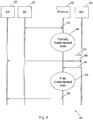
- FIG. 5 is a message sequence, indicated generally by the reference numeral 60, showing an exemplary implementation of the algorithm 40 using the well-known security assertion markup language (SAML).
- SAML security assertion markup language
- the message sequence 60 starts at step 62 with the service capabilities (SC) part 28 of the M2M device authenticating at the M2M platform 32.
- the step 62 corresponds with the step 42 of the algorithm 40.
- the M2M device enters the partially authenticated state discussed above.
- the device application 30 makes a service request to the M2M platform 32.
- the M2M platform 32 responds to the request 64 by sending an authentication request message 66 to the device application 30, which message is forwarded directly to the network application 26.
- the message 66 may, for example, be a SAML authentication request.
- the network application authenticates the device application 30 (step 68 of the message sequence 60).
- the step 68 therefore corresponds with step 46 of the algorithm 40.
- the network application (NA) 26 sends a SAML assertion to the M2M platform via the device application (DA) 30 in a message 70.
- the SAML assertion contains the DA's attributes trusted in the NA domain.
- the M2M platform is made aware that the DA has been authenticated.
- the message 70 implements step 48 of the algorithm 40.
- the M2M device On receipt of the message 70 at the M2M platform, the M2M device enters the fully authenticated state described above and can enjoy services from M2M platform (as indicated by the message 72 in the message sequence 70).
- EAP Extensible Authentication Protocol
Landscapes
- Engineering & Computer Science (AREA)
- Computer Networks & Wireless Communication (AREA)
- Signal Processing (AREA)
- Computer Security & Cryptography (AREA)
- Computer Hardware Design (AREA)
- Computing Systems (AREA)
- General Engineering & Computer Science (AREA)
- Computer And Data Communications (AREA)
- Mobile Radio Communication Systems (AREA)
- Data Exchanges In Wide-Area Networks (AREA)
- Small-Scale Networks (AREA)
Description
- The present invention relates to authentication. In particular, the invention relates to authentication in machine-to-machine (M2M) applications.
- ETSI TS 102 690, "Machine- to- Machine communications (M2M); Functional architecture . Version 0.2.1., XP014165271, comprises a description of the M2M communications, especially the functional entities of an M2M system and the relationships of the entities.
- INTERDIGITAL ET AL: "Ticket #12: Gateway 1-17 and Device Protection; M2M(10)0269 Ticket12 discussion doc", ETSI DRAFT; M2M(10)0269 TICKET12 DISCUSSION DOC, EUROPEAN TELECOMMUNICATIONS STANDARDS INSTITUTE (ETSI), 650, ROUTE DES LUCIOLES ; F-06921 H04L SOPHIA-ANTIPOLIS ; FRANCE, vol. SmartM2M, 8 September 2010 (2010-09-08), pages 1-29, XP014165448, [retrieved on 2010-09-08] discloses description of gateway and device protection.*
-
Figure 1 is a block diagram of a system, indicated generally by thereference numeral 1. Thesystem 1 comprises afirst M2M device 2, asecond M2M device 4, athird M2M device 6, anetwork 8 and anetwork application 10. - Machine-to-machine (M2M) devices, such as the
devices system 1, are used to provide data to other machines or applications, such as thenetwork application 10. This data is transmitted over a network, such as thenetwork 8. Thenetwork 8 may be a wireless network. For example, thenetwork 8 may be provided by a mobile network provider. - M2M applications in which devices, such as sensors, provided data to applications, such as software programs, are becoming well established. M2M systems can build on existing mobile communication infrastructure to provide simple, efficient and reliable data reporting and recording systems.
- By way of example, the
system 1 may be a smart metering system. Thedevices network 8 to theapplication 10. Theapplication 10 may be a billing system that bills the users of the metered resource accordingly. -
Figure 2 shows a system, indicated generally by thereference numeral 20, comprising anM2M device 22, anM2M platform 24 and anetwork application 26. TheM2M device 22 is logically split into two parts: a service capabilities (SC)part 28 and one or multiple device application (DA)parts 30. - The latter is built on the former, which means that the
DA part 30 can only communicate with M2Mplatform 24 or the NA 26 via the SCpart 28. - One exemplary use case of the
system 20 is smart metering. In a smart meter (the M2M device 22), aSC layer 28 provides a communication channel and other core M2M services between theM2M device 22 and the M2Mplatform 24. In theDA layer 30, a metering application component is responsible for reporting metering data to the M2Mplatform 24 and a Smart Gridnetwork application 26. Here, M2M platforms might typically be run by a communication service provider (CSP), and Smart Grid network application might typically be run by power grid enterprises. - Authentication is required before an M2M device (including its application part) is allowed to access an M2M platform. This enables an M2M platform (such as the platform 24) to reject requests from invalid M2M devices and accept requests from valid M2M devices and provide subscribed platform services based on attributes or configuration of those devices and applications running on them.
- Most network applications are provided by service providers other than the M2M platform operator, so DAs (such as DA 30) may be provided by service providers, which is out of the M2M platform operator's control. In the
exemplary system 20, both theSC part 28 and theDA part 30 of theM2M device 22 should be authenticated. - The
system 20 includes asingle M2M device 22 and asingle network application 26. Many real systems will include multiple M2M devices and/or multiple network applications and can provide substantial flexibility. - By way of example,
Figure 3 shows a system, indicated generally by thereference numeral 35, comprising a plurality ofM2M devices M2M platform 24 and a plurality ofnetwork applications platform 24. - The M2M
platform 24 is designed to have service capabilities such as collecting and caching data sent from the plurality of M2M devices. This data will be consumed by one or more of the network applications. It is possible that a malicious or mal-functioned DA running on a M2M device produces data but without having a network application to consume that data. Thus, resources, such as Central Processing Unit (CPU), network bandwidth and data cache, are wasted. Moreover, malicious M2M devices may attack the network, network application or M2M platform, which are not foreseen when the M2M platform is developed. - Different device applications provided by the various M2M devices in the
system 35 may provide data to different network applications and may have different access rights or charging schemes (even if supplying data to the same network application). Accordingly, the M2Mplatform 24 needs to treat different device applications (DAs) differently. - The M2M
platform 24 typically needs to trace or audit the behaviours of each device application (DA) to enable the provision of value-added services (like accounting, billing, etc). In order to do this, M2M platform needs to identify DAs, especially those sharing the same SC. - It is conventional in the art that DA authentication to a network application happens separately after SC authentication to the M2M platform. Due to the separation an SC is unaware of DA(s) on it or associated with it and can not therefore have control of the DA(s).
- Accordingly, the present invention seeks to address at least in part some or all of the disadvantages and/or problems of the conventional systems described hereinabove.
- According to a first aspect of the present invention there is provided a method of operating a machine-to-machine platform comprising the steps of: authenticating a service capability portion of a machine-to-machine device in order to enter a partially authenticated state; and receiving a notification from a network application wherein the notification informs the machine-to-machine platform of the authentication of a device application portion of the machine-to-machine device at the network application in order to enter a fully authenticated state and comprises one or more parameters relating to the device application to enable the machine-to-machine platform to apply control to the device application.
- Therefore, the machine-to-machine platform authenticates the service capability portion of a machine-to-machine device but is also notified of the authentication of one or more device application portion(s) of the machine-to-machine device. Once the machine-to-machine platform is aware of the authentication of both portions the fully authenticated state is entered enabling the machine-to-machine platform to fulfil the service requests of the machine-to-machine device.
- The method may further comprise the steps of receiving a service request from the device application; and requesting the notification for the device application from the network application.
- The method may further comprise the step of providing services to the device application once the fully authenticated state has been entered.
- According to a second aspect of the present invention there is provided a machine-to-machine platform comprising: a processor adapted to authenticate a service capability portion of a machine-to-machine device in order to enter a partially authenticated state; and a first input adapted to receive a notification from a network application wherein the notification informs the machine-to-machine platform of the authentication of a device application portion of the machine-to-machine device at the network application in order to enter a fully authenticated state and comprises one or more parameters relating to the device application, the machine-to-machine platform being configured to control the device application based on the parameters.
- The machine-to-machine platform may further comprise a second input adapted to receive a service request from the device application; and a first output adapted to request the notification for the device application from the network application.
- The machine-to-machine platform may further comprise a second output adapted to provide services to the device application once the fully authenticated state has been entered.
- The first input and the second input may be the same input or different inputs. The first output and the second output may be the same outputs or different outputs.
- The machine-to-machine platform may be adapted using hardware, software or any combination thereof.
- According to a third aspect of the present invention there is provided a method of operating a network application comprising the steps of: authenticating a device application portion of a machine-to-machine device; determining one or more parameters relating to the device application portion and transmitting a notification to a machine-to-machine platform to inform the machine-to-machine platform of the authentication of the device application portion of the machine-to-machine device at the network application such that the machine-to-machine platform can enter a fully authenticated state the notification comprising the one or more parameters relating to the device application.
- Accordingly, a network application authenticates a device application portion of a machine-to-machine device and informs the machine-to-machine platform of the authentication so that the machine-to-machine platform may enter a fully authenticated state enabling the machine-to-machine platform to provide services to the machine-to-machine device.
- The method may further comprise the step of receiving a request from the machine-to-machine platform for the notification.
- According to a fourth aspect of the present invention there is provided a device comprising: a first processor adapted to authenticate a device application portion of the machine-to-machine device; and determining one or more parameters relating to the device application portion and an output adapted to transmit a notification to a machine-to-machine platform to inform the machine-to-machine platform of the authentication of the device application portion of the machine-to-machine device at the network application such that the machine-to-machine platform can enter a fully authenticated state, the notification comprising the one or more parameters relating to the device application.
- The device may further comprise an input adapted to receive a request from the machine-to-machine platform for the notification.
- The device may further comprise a second processor adapted to determine one or more parameters relating to the device application portion; and a third processor adapted to include the one or more parameters in the notification.
- The first processor, second processor and third processor may be the same processor, different processors or any combination thereof. The network application may be adapted by hardware, software or any combination thereof.
- According to a fifth aspect of the present invention there is provided a computer program product comprising computer readable executable code which, when run on a computer, causes the computer to execute the methods of the first aspect and the third aspect of the present invention.
- According to a sixth aspect of the present invention there is provided a machine-to-machine system comprising: a machine-to-machine platform according to the second aspect of the present invention; and the device according to the fifth aspect of the present invention.
- Exemplary embodiments of the invention are described below, by way of example only, with reference to the following numbered drawings.
-
Figure 1 is a block diagram of a machine-to-machine system; -
Figure 2 is a block diagram of a machine-to-machine system; -
Figure 3 is a block diagram of a machine-to-machine system; -
Figure 4 shows an algorithm in accordance with an aspect of the present invention; and -
Figure 5 is a message flow diagram in accordance with an aspect of the present invention. - To address the problems mentioned above, this invention proposes a process to make the M2M platform (such as the platform 24) aware of device application identities (such as the DA 30) and then be able to impose control over them. This is achieved by adding a notification process between NA and M2M platform as described further below.
-
Figure 4 shows an algorithm, indicated generally by thereference numeral 40, in accordance with an aspect of the present invention. - The
algorithm 40 starts atstep 42, where aservice capabilities part 28 of a M2M device is authenticated at anM2M platform 32. Theauthentication step 42 can be carried out in many different ways and is conventional in the art. - In response to the authentication of the SC part in
step 42, the M2M device enters a "partially authenticated state" (step 44 of the algorithm 40). In the partially authenticated state, the device may have limited access to the network and platform services. - In many of the embodiments, the M2M platform may request (message 45) a notification of authentication of the one or
more DAs 30 from thenetwork application 26. - Next, whether or not the M2M platform requested a notification of the authentication of the DA(s) 30 at the
network application 26, thedevice application 30 is authenticated at the network application 26 (step 46). As with theauthentication step 42, theauthentication step 46 is itself conventional. With theDA 30 authenticated, thenetwork application 26 sends a notification message to the M2M platform 32 (the message 48). The notification message may include one or more parameters (where parameters includes attributes) to enable the M2M platform to apply control and/or control theDA 30. - At this stage, both the
SC part 28 and the DA part(s) 30 of the M2M device are authenticated at the M2M platform. Accordingly, the M2M device enters a "fully authenticated state" (step 50) with the M2M platform. The M2M platform is then able to provide services to the DA 30 (message 52). - Thus, in the partially authenticated state, when the DA layer of the client wants to access services, the M2M platform will request it to be authenticated by an associated network application. After the DA is authenticated by NA and this has been notified to the M2M platform, the platform changes the M2M device to the fully authenticated state. The M2M platform can then provide services to this fully authenticated DA. Otherwise, future service requests from the DA will be rejected.
-
Figure 5 is a message sequence, indicated generally by thereference numeral 60, showing an exemplary implementation of thealgorithm 40 using the well-known security assertion markup language (SAML). - The
message sequence 60 starts atstep 62 with the service capabilities (SC)part 28 of the M2M device authenticating at theM2M platform 32. Thus, thestep 62 corresponds with thestep 42 of thealgorithm 40. Following thestep 42, the M2M device enters the partially authenticated state discussed above. - Next, at
step 64, thedevice application 30 makes a service request to theM2M platform 32. As thedevice application 30 has not yet been authenticated (i.e. is only partially authenticated by virtue of the authentication of the SC part 28) theM2M platform 32 responds to therequest 64 by sending anauthentication request message 66 to thedevice application 30, which message is forwarded directly to thenetwork application 26. Themessage 66 may, for example, be a SAML authentication request. - In response to the
authentication request 66, the network application authenticates the device application 30 (step 68 of the message sequence 60). Thestep 68 therefore corresponds withstep 46 of thealgorithm 40. - With the device application authenticated, the network application (NA) 26 sends a SAML assertion to the M2M platform via the device application (DA) 30 in a
message 70. The SAML assertion contains the DA's attributes trusted in the NA domain. Using themessage 70, the M2M platform is made aware that the DA has been authenticated. Thus, themessage 70 implements step 48 of thealgorithm 40. - On receipt of the
message 70 at the M2M platform, the M2M device enters the fully authenticated state described above and can enjoy services from M2M platform (as indicated by themessage 72 in the message sequence 70). - It should be noted that the present invention is not limited to specific authentication protocols. Hence, the invention may also be implemented with Extensible Authentication Protocol (EAP) or any other authentication protocols.
- Advantages of the present invention include (but are not limited to) the following:
- M2M platform is aware of the authenticated identity of DA.
- Prevent malicious or mal-function application DA since requests from a DA that is not authenticated will be rejected.
- Differentiated services based on different DAs from different network applications are possible, even if they are running on the same M2M device or behind a M2M gateway.
- Enhanced security.
- Network applications may assert attributes of a DA instance and inform the M2M platform accordingly.
- Easy to incorporate network applications with little or no changes on them.
- Enable the platform to trace DAs running on a given M2M device, which extends the service capabilities of the M2M platform.
- Both the service capabilities portion of an M2M device and the device application portions of the M2M device are authenticated to the M2M platform enabling the M2M platform to have control over device applications accessing its services.
- The embodiments of the invention described above are illustrative rather than restrictive. It will be apparent to those skilled in the art that the above devices and methods may incorporate a number of modifications without departing from the general scope of the invention. It is intended to include all such modifications within the scope of the invention insofar as they fall within the scope of the appended claims.
Claims (13)
- A method of operating a machine-to-machine platform, comprising:authenticating (42) a service capability portion of a machine-to-machine device in order to enter a partially authenticated state; characterised by the step ofreceiving (48) a notification from a network application wherein the notification informs the machine-to-machine platform of the authentication of a device application portion of the machine-to-machine device at the network application in order to enter a fully authenticated state and comprises one or more parameters relating to the device application to enable the machine-to-machine platform to apply control to the device application.
- The method as claimed in claim 1 further comprising the steps of:receiving a service request from the device application; andrequesting the notification for the device application from the network application.
- The method as claimed in any one of the preceding claims further comprising the step of:
providing (52) services to the device application once the fully authenticated state has been entered. - A machine-to-machine platform (32) comprising:
a processor adapted to authenticate a service capability portion (28) of a machine-to-machine device in order to enter a partially authenticated state; characterised in that the platform comprises:a first input adapted to receive a notification from a network application (26) wherein the notification informs the machine-to-machine platform of the authentication of a device application portion (30) of the machine-to-machine device at the network application in order to enter a fully authenticated state and comprises one or more parameters relating to the device application,the machine-to-machine platform being configured to control the device application based on the parameters. - The machine-to-machine platform as claimed in claim 4 further comprising:a second input adapted to receive a service request from the device application; anda first output adapted to request the notification for the device application from the network application.
- The machine-to-machine platform as claimed in claim 4 or 5 further comprising:
a second output adapted to provide services to the device application once the fully authenticated state has been entered. - A method of operating a network application, comprising the steps of:authenticating (46) a device application portion of a machine-to-machine device; characterised bydetermining one or more parameters relating to the device application portion; andtransmitting (48) a notification to a machine-to-machine platform to inform the machine-to-machine platform of the authentication of the device application portion of the machine-to-machine device at the network application such that the machine-to-machine platform can enter a fully authenticated state, the notification comprising the one or more parameters relating to the device application.
- The method as claimed in claim 7 further comprising the step of:
receiving (45) a request from the machine-to-machine platform for the notification. - A device comprising:
a first processor adapted to authenticate a device application portion (30) of a machine-to-machine device and determining one or more parameters relating to the device application portion; characterised in that the device comprises:
an output adapted to transmit a notification (48) to a machine-to-machine platform to inform the machine-to-machine platform of the authentication of the device application portion of the machine-to-machine device at the network application such that the machine-to-machine platform can enter a fully authenticated state, the notification comprising the one or more parameters relating to the device application. - The device as claimed in claim 9 further comprising:
an input adapted to receive a request from the machine-to-machine platform for the notification. - The device as claimed in claim 9 or 10 further comprising:a second processor adapted to determine one or more parameters relating to the device application portion; anda third processor adapted to include the one or more parameters in the notification.
- A computer program product comprising computer readable executable code which, when run on a computer, causes the computer to execute the methods of claims 1 and 7.
- A machine-to-machine system comprising:the machine-to-machine platform of claim 4; andthe device of claim 9.
Applications Claiming Priority (1)
| Application Number | Priority Date | Filing Date | Title |
|---|---|---|---|
| PCT/CN2011/079574 WO2013037101A1 (en) | 2011-09-13 | 2011-09-13 | Authentication mechanism |
Publications (3)
| Publication Number | Publication Date |
|---|---|
| EP2756697A1 EP2756697A1 (en) | 2014-07-23 |
| EP2756697A4 EP2756697A4 (en) | 2015-04-29 |
| EP2756697B1 true EP2756697B1 (en) | 2019-04-17 |
Family
ID=47882521
Family Applications (1)
| Application Number | Title | Priority Date | Filing Date |
|---|---|---|---|
| EP11872330.3A Active EP2756697B1 (en) | 2011-09-13 | 2011-09-13 | Authentication mechanism |
Country Status (5)
| Country | Link |
|---|---|
| US (1) | US20140351903A1 (en) |
| EP (1) | EP2756697B1 (en) |
| KR (1) | KR101578089B1 (en) |
| CN (1) | CN104041096B (en) |
| WO (1) | WO2013037101A1 (en) |
Families Citing this family (2)
| Publication number | Priority date | Publication date | Assignee | Title |
|---|---|---|---|---|
| KR20190119193A (en) | 2018-03-29 | 2019-10-22 | 주식회사 스마트엠투엠 | Authentication and Authorization System and Method for interworking between heterogeneous IoT platform and Blockchain |
| US11269839B2 (en) * | 2018-06-05 | 2022-03-08 | Oracle International Corporation | Authenticated key-value stores supporting partial state |
Family Cites Families (28)
| Publication number | Priority date | Publication date | Assignee | Title |
|---|---|---|---|---|
| JP2004500612A (en) * | 1999-03-12 | 2004-01-08 | グラビトン・インコーポレイテッド | Systems and methods for network-based sensing and distributed sensors, data and memory management |
| AU2003226079A1 (en) * | 2002-04-09 | 2003-10-27 | Sapias, Inc. | Asset management platform |
| US8316152B2 (en) * | 2005-02-15 | 2012-11-20 | Qualcomm Incorporated | Methods and apparatus for machine-to-machine communications |
| CA2615659A1 (en) * | 2005-07-22 | 2007-05-10 | Yogesh Chunilal Rathod | Universal knowledge management and desktop search system |
| US20070055752A1 (en) * | 2005-09-08 | 2007-03-08 | Fiberlink | Dynamic network connection based on compliance |
| US20070294209A1 (en) * | 2006-06-20 | 2007-12-20 | Lyle Strub | Communication network application activity monitoring and control |
| WO2008111067A1 (en) * | 2007-03-12 | 2008-09-18 | Joliper Ltd. | Method of providing a service over a hybrid network and system thereof |
| WO2010102259A2 (en) * | 2009-03-06 | 2010-09-10 | Interdigital Patent Holdings, Inc. | Platform validation and management of wireless devices |
| CN102025496B (en) * | 2009-09-14 | 2015-06-03 | 中兴通讯股份有限公司 | System and method for providing machine communication identity module for machine to machine equipment |
| US20110182177A1 (en) * | 2009-12-08 | 2011-07-28 | Ivo Sedlacek | Access control of Machine-to-Machine Communication via a Communications Network |
| CN102804882B (en) * | 2009-12-22 | 2015-12-16 | 交互数字专利控股公司 | Group-based machine-to-machine communication |
| JP5678094B2 (en) * | 2009-12-28 | 2015-02-25 | インターデイジタル パテント ホールディングス インコーポレイテッド | MACHINE-TO-MACHINE gateway architecture |
| CN102149084B (en) * | 2010-02-09 | 2015-05-20 | 中兴通讯股份有限公司 | Method and system for identifying M2M (machine-to-machine) terminal |
| EP2360871B1 (en) * | 2010-02-15 | 2016-04-06 | Accenture Global Services Limited | Machine to machine architecture |
| EP2375849B1 (en) * | 2010-03-29 | 2015-08-12 | Vodafone Holding GmbH | Connection management for M2M device in a mobile communication network |
| CN102238571B (en) * | 2010-04-27 | 2014-01-01 | 中兴通讯股份有限公司 | Apparatus of Internet of Things machine to machine/man (M2M) business processing, system and method thereof |
| CN102238573A (en) * | 2010-04-30 | 2011-11-09 | 中兴通讯股份有限公司 | Machine-to-machine/machine-to-man/man-to-machine (M2M) service structure and M2M service realization method |
| US8929339B2 (en) * | 2010-05-04 | 2015-01-06 | Lg Electronics Inc. | M2M device which performs communication during network entry and handover, and corresponding method for performing communication |
| WO2012018893A1 (en) * | 2010-08-03 | 2012-02-09 | Interdigital Patent Holdings, Inc, | Machine-to-machine (m2m) call flow security |
| CN103155613B (en) * | 2010-10-21 | 2016-09-07 | 诺基亚技术有限公司 | Method and apparatus for providing access credentials |
| WO2012061678A1 (en) * | 2010-11-05 | 2012-05-10 | Interdigital Patent Holdings, Inc. | Device validation, distress indication, and remediation |
| US9071925B2 (en) * | 2011-01-05 | 2015-06-30 | Alcatel Lucent | System and method for communicating data between an application server and an M2M device |
| US8898268B2 (en) * | 2011-01-28 | 2014-11-25 | Arm Finland Oy | Method and apparatus for network management |
| CN102136976B (en) * | 2011-02-24 | 2014-12-31 | 华为技术有限公司 | Machine transaction control method, device and system |
| US20120284777A1 (en) * | 2011-04-15 | 2012-11-08 | Eugenio Caballero Herrero Jose | Method for managing data in m2m systems |
| CN103548392B (en) * | 2011-07-01 | 2018-07-06 | 诺基亚技术有限公司 | For providing the method and apparatus of network access to attachment device |
| WO2014127512A1 (en) * | 2013-02-20 | 2014-08-28 | 华为技术有限公司 | Operation trigger method and device for machine-to-machine communications |
| TWI526960B (en) * | 2013-12-23 | 2016-03-21 | 財團法人工業技術研究院 | Method and system for brokering between devices and network services |
-
2011
- 2011-09-13 WO PCT/CN2011/079574 patent/WO2013037101A1/en not_active Ceased
- 2011-09-13 EP EP11872330.3A patent/EP2756697B1/en active Active
- 2011-09-13 KR KR1020147009729A patent/KR101578089B1/en not_active Expired - Fee Related
- 2011-09-13 CN CN201180074817.8A patent/CN104041096B/en active Active
- 2011-09-13 US US14/344,785 patent/US20140351903A1/en not_active Abandoned
Non-Patent Citations (1)
| Title |
|---|
| None * |
Also Published As
| Publication number | Publication date |
|---|---|
| CN104041096B (en) | 2018-06-26 |
| WO2013037101A1 (en) | 2013-03-21 |
| KR20140072890A (en) | 2014-06-13 |
| EP2756697A1 (en) | 2014-07-23 |
| CN104041096A (en) | 2014-09-10 |
| US20140351903A1 (en) | 2014-11-27 |
| KR101578089B1 (en) | 2015-12-16 |
| EP2756697A4 (en) | 2015-04-29 |
Similar Documents
| Publication | Publication Date | Title |
|---|---|---|
| Chen et al. | Lightweight authentication protocol in edge-based smart grid environment | |
| CN102457507B (en) | Cloud computing resources secure sharing method, Apparatus and system | |
| CN101478396B (en) | Uni-directional cross-domain identity verification based on low correlation of private cipher key and application thereof | |
| CN103888265B (en) | A kind of application login system and method based on mobile terminal | |
| DE60312911T2 (en) | Mobile authentication system with reduced authentication delay | |
| CN101873331B (en) | Safety authentication method and system | |
| US20130174239A1 (en) | Reinforced authentication system and method using context information at the time of access to mobile cloud service | |
| Li et al. | Providing privacy-aware incentives in mobile sensing systems | |
| CN104980434A (en) | Security Key Management In IMS-based Multimedia Broadcast And Multicast Services (MBMS) | |
| EP3777111A1 (en) | Interworking between iot service layer systems and distributed ledger systems | |
| CN101729541B (en) | Method and system for accessing resources of multi-service platform | |
| CN103229560A (en) | Automatic remote access to IEEE 802.11 networks | |
| CN105262717A (en) | Network service security management method and device | |
| CN101968838A (en) | Browser and method for configuring safe browser | |
| WO2015180364A1 (en) | Network access point hosting method and system | |
| CN109962892A (en) | A kind of authentication method and client, server logging in application | |
| CN103546290B (en) | Third Party Authentication system or method with user group | |
| CN102412969B (en) | Method for carrying out authentication by remotely using certificate and secret key, apparatus and system thereof | |
| JP4979723B2 (en) | COMMUNICATION METHOD, COMMUNICATION SYSTEM, SERVICE PROVIDING BASE ACCESS METHOD | |
| CN102055764A (en) | Method and device for monitoring operation of accessing business system | |
| CN114567600B (en) | Traffic management method and related equipment | |
| CN113542242B (en) | Equipment management method and equipment management device | |
| US20140351903A1 (en) | Authentication mechanism | |
| CN114301967A (en) | Narrow-band Internet of things control method, device and equipment | |
| EP4446912A1 (en) | Controlling authorization through licensing and policy enforcement of attributes |
Legal Events
| Date | Code | Title | Description |
|---|---|---|---|
| PUAI | Public reference made under article 153(3) epc to a published international application that has entered the european phase |
Free format text: ORIGINAL CODE: 0009012 |
|
| 17P | Request for examination filed |
Effective date: 20140414 |
|
| AK | Designated contracting states |
Kind code of ref document: A1 Designated state(s): AL AT BE BG CH CY CZ DE DK EE ES FI FR GB GR HR HU IE IS IT LI LT LU LV MC MK MT NL NO PL PT RO RS SE SI SK SM TR |
|
| DAX | Request for extension of the european patent (deleted) | ||
| RA4 | Supplementary search report drawn up and despatched (corrected) |
Effective date: 20150327 |
|
| RIC1 | Information provided on ipc code assigned before grant |
Ipc: H04W 12/06 20090101AFI20150323BHEP |
|
| STAA | Information on the status of an ep patent application or granted ep patent |
Free format text: STATUS: EXAMINATION IS IN PROGRESS |
|
| 17Q | First examination report despatched |
Effective date: 20180220 |
|
| GRAP | Despatch of communication of intention to grant a patent |
Free format text: ORIGINAL CODE: EPIDOSNIGR1 |
|
| STAA | Information on the status of an ep patent application or granted ep patent |
Free format text: STATUS: GRANT OF PATENT IS INTENDED |
|
| INTG | Intention to grant announced |
Effective date: 20190103 |
|
| GRAS | Grant fee paid |
Free format text: ORIGINAL CODE: EPIDOSNIGR3 |
|
| GRAA | (expected) grant |
Free format text: ORIGINAL CODE: 0009210 |
|
| STAA | Information on the status of an ep patent application or granted ep patent |
Free format text: STATUS: THE PATENT HAS BEEN GRANTED |
|
| AK | Designated contracting states |
Kind code of ref document: B1 Designated state(s): AL AT BE BG CH CY CZ DE DK EE ES FI FR GB GR HR HU IE IS IT LI LT LU LV MC MK MT NL NO PL PT RO RS SE SI SK SM TR |
|
| REG | Reference to a national code |
Ref country code: GB Ref legal event code: FG4D |
|
| REG | Reference to a national code |
Ref country code: CH Ref legal event code: EP |
|
| REG | Reference to a national code |
Ref country code: DE Ref legal event code: R096 Ref document number: 602011058231 Country of ref document: DE |
|
| REG | Reference to a national code |
Ref country code: AT Ref legal event code: REF Ref document number: 1122885 Country of ref document: AT Kind code of ref document: T Effective date: 20190515 Ref country code: IE Ref legal event code: FG4D |
|
| REG | Reference to a national code |
Ref country code: NL Ref legal event code: MP Effective date: 20190417 |
|
| RAP2 | Party data changed (patent owner data changed or rights of a patent transferred) |
Owner name: NOKIA SOLUTIONS AND NETWORKS OY |
|
| REG | Reference to a national code |
Ref country code: LT Ref legal event code: MG4D |
|
| PG25 | Lapsed in a contracting state [announced via postgrant information from national office to epo] |
Ref country code: NL Free format text: LAPSE BECAUSE OF FAILURE TO SUBMIT A TRANSLATION OF THE DESCRIPTION OR TO PAY THE FEE WITHIN THE PRESCRIBED TIME-LIMIT Effective date: 20190417 |
|
| PG25 | Lapsed in a contracting state [announced via postgrant information from national office to epo] |
Ref country code: AL Free format text: LAPSE BECAUSE OF FAILURE TO SUBMIT A TRANSLATION OF THE DESCRIPTION OR TO PAY THE FEE WITHIN THE PRESCRIBED TIME-LIMIT Effective date: 20190417 Ref country code: PT Free format text: LAPSE BECAUSE OF FAILURE TO SUBMIT A TRANSLATION OF THE DESCRIPTION OR TO PAY THE FEE WITHIN THE PRESCRIBED TIME-LIMIT Effective date: 20190817 Ref country code: FI Free format text: LAPSE BECAUSE OF FAILURE TO SUBMIT A TRANSLATION OF THE DESCRIPTION OR TO PAY THE FEE WITHIN THE PRESCRIBED TIME-LIMIT Effective date: 20190417 Ref country code: LT Free format text: LAPSE BECAUSE OF FAILURE TO SUBMIT A TRANSLATION OF THE DESCRIPTION OR TO PAY THE FEE WITHIN THE PRESCRIBED TIME-LIMIT Effective date: 20190417 Ref country code: HR Free format text: LAPSE BECAUSE OF FAILURE TO SUBMIT A TRANSLATION OF THE DESCRIPTION OR TO PAY THE FEE WITHIN THE PRESCRIBED TIME-LIMIT Effective date: 20190417 Ref country code: NO Free format text: LAPSE BECAUSE OF FAILURE TO SUBMIT A TRANSLATION OF THE DESCRIPTION OR TO PAY THE FEE WITHIN THE PRESCRIBED TIME-LIMIT Effective date: 20190717 Ref country code: SE Free format text: LAPSE BECAUSE OF FAILURE TO SUBMIT A TRANSLATION OF THE DESCRIPTION OR TO PAY THE FEE WITHIN THE PRESCRIBED TIME-LIMIT Effective date: 20190417 Ref country code: ES Free format text: LAPSE BECAUSE OF FAILURE TO SUBMIT A TRANSLATION OF THE DESCRIPTION OR TO PAY THE FEE WITHIN THE PRESCRIBED TIME-LIMIT Effective date: 20190417 |
|
| PG25 | Lapsed in a contracting state [announced via postgrant information from national office to epo] |
Ref country code: LV Free format text: LAPSE BECAUSE OF FAILURE TO SUBMIT A TRANSLATION OF THE DESCRIPTION OR TO PAY THE FEE WITHIN THE PRESCRIBED TIME-LIMIT Effective date: 20190417 Ref country code: RS Free format text: LAPSE BECAUSE OF FAILURE TO SUBMIT A TRANSLATION OF THE DESCRIPTION OR TO PAY THE FEE WITHIN THE PRESCRIBED TIME-LIMIT Effective date: 20190417 Ref country code: PL Free format text: LAPSE BECAUSE OF FAILURE TO SUBMIT A TRANSLATION OF THE DESCRIPTION OR TO PAY THE FEE WITHIN THE PRESCRIBED TIME-LIMIT Effective date: 20190417 Ref country code: BG Free format text: LAPSE BECAUSE OF FAILURE TO SUBMIT A TRANSLATION OF THE DESCRIPTION OR TO PAY THE FEE WITHIN THE PRESCRIBED TIME-LIMIT Effective date: 20190717 Ref country code: GR Free format text: LAPSE BECAUSE OF FAILURE TO SUBMIT A TRANSLATION OF THE DESCRIPTION OR TO PAY THE FEE WITHIN THE PRESCRIBED TIME-LIMIT Effective date: 20190718 |
|
| REG | Reference to a national code |
Ref country code: AT Ref legal event code: MK05 Ref document number: 1122885 Country of ref document: AT Kind code of ref document: T Effective date: 20190417 |
|
| PG25 | Lapsed in a contracting state [announced via postgrant information from national office to epo] |
Ref country code: IS Free format text: LAPSE BECAUSE OF FAILURE TO SUBMIT A TRANSLATION OF THE DESCRIPTION OR TO PAY THE FEE WITHIN THE PRESCRIBED TIME-LIMIT Effective date: 20190817 |
|
| REG | Reference to a national code |
Ref country code: DE Ref legal event code: R097 Ref document number: 602011058231 Country of ref document: DE |
|
| PG25 | Lapsed in a contracting state [announced via postgrant information from national office to epo] |
Ref country code: CZ Free format text: LAPSE BECAUSE OF FAILURE TO SUBMIT A TRANSLATION OF THE DESCRIPTION OR TO PAY THE FEE WITHIN THE PRESCRIBED TIME-LIMIT Effective date: 20190417 Ref country code: AT Free format text: LAPSE BECAUSE OF FAILURE TO SUBMIT A TRANSLATION OF THE DESCRIPTION OR TO PAY THE FEE WITHIN THE PRESCRIBED TIME-LIMIT Effective date: 20190417 Ref country code: RO Free format text: LAPSE BECAUSE OF FAILURE TO SUBMIT A TRANSLATION OF THE DESCRIPTION OR TO PAY THE FEE WITHIN THE PRESCRIBED TIME-LIMIT Effective date: 20190417 Ref country code: EE Free format text: LAPSE BECAUSE OF FAILURE TO SUBMIT A TRANSLATION OF THE DESCRIPTION OR TO PAY THE FEE WITHIN THE PRESCRIBED TIME-LIMIT Effective date: 20190417 Ref country code: DK Free format text: LAPSE BECAUSE OF FAILURE TO SUBMIT A TRANSLATION OF THE DESCRIPTION OR TO PAY THE FEE WITHIN THE PRESCRIBED TIME-LIMIT Effective date: 20190417 Ref country code: SK Free format text: LAPSE BECAUSE OF FAILURE TO SUBMIT A TRANSLATION OF THE DESCRIPTION OR TO PAY THE FEE WITHIN THE PRESCRIBED TIME-LIMIT Effective date: 20190417 |
|
| PLBE | No opposition filed within time limit |
Free format text: ORIGINAL CODE: 0009261 |
|
| STAA | Information on the status of an ep patent application or granted ep patent |
Free format text: STATUS: NO OPPOSITION FILED WITHIN TIME LIMIT |
|
| PG25 | Lapsed in a contracting state [announced via postgrant information from national office to epo] |
Ref country code: IT Free format text: LAPSE BECAUSE OF FAILURE TO SUBMIT A TRANSLATION OF THE DESCRIPTION OR TO PAY THE FEE WITHIN THE PRESCRIBED TIME-LIMIT Effective date: 20190417 Ref country code: SM Free format text: LAPSE BECAUSE OF FAILURE TO SUBMIT A TRANSLATION OF THE DESCRIPTION OR TO PAY THE FEE WITHIN THE PRESCRIBED TIME-LIMIT Effective date: 20190417 |
|
| 26N | No opposition filed |
Effective date: 20200120 |
|
| PG25 | Lapsed in a contracting state [announced via postgrant information from national office to epo] |
Ref country code: TR Free format text: LAPSE BECAUSE OF FAILURE TO SUBMIT A TRANSLATION OF THE DESCRIPTION OR TO PAY THE FEE WITHIN THE PRESCRIBED TIME-LIMIT Effective date: 20190417 |
|
| PG25 | Lapsed in a contracting state [announced via postgrant information from national office to epo] |
Ref country code: MC Free format text: LAPSE BECAUSE OF FAILURE TO SUBMIT A TRANSLATION OF THE DESCRIPTION OR TO PAY THE FEE WITHIN THE PRESCRIBED TIME-LIMIT Effective date: 20190417 Ref country code: SI Free format text: LAPSE BECAUSE OF FAILURE TO SUBMIT A TRANSLATION OF THE DESCRIPTION OR TO PAY THE FEE WITHIN THE PRESCRIBED TIME-LIMIT Effective date: 20190417 |
|
| REG | Reference to a national code |
Ref country code: CH Ref legal event code: PL |
|
| PG25 | Lapsed in a contracting state [announced via postgrant information from national office to epo] |
Ref country code: IE Free format text: LAPSE BECAUSE OF NON-PAYMENT OF DUE FEES Effective date: 20190913 Ref country code: LU Free format text: LAPSE BECAUSE OF NON-PAYMENT OF DUE FEES Effective date: 20190913 Ref country code: CH Free format text: LAPSE BECAUSE OF NON-PAYMENT OF DUE FEES Effective date: 20190930 Ref country code: LI Free format text: LAPSE BECAUSE OF NON-PAYMENT OF DUE FEES Effective date: 20190930 |
|
| REG | Reference to a national code |
Ref country code: BE Ref legal event code: MM Effective date: 20190930 |
|
| PG25 | Lapsed in a contracting state [announced via postgrant information from national office to epo] |
Ref country code: BE Free format text: LAPSE BECAUSE OF NON-PAYMENT OF DUE FEES Effective date: 20190930 |
|
| PG25 | Lapsed in a contracting state [announced via postgrant information from national office to epo] |
Ref country code: CY Free format text: LAPSE BECAUSE OF FAILURE TO SUBMIT A TRANSLATION OF THE DESCRIPTION OR TO PAY THE FEE WITHIN THE PRESCRIBED TIME-LIMIT Effective date: 20190417 |
|
| PG25 | Lapsed in a contracting state [announced via postgrant information from national office to epo] |
Ref country code: HU Free format text: LAPSE BECAUSE OF FAILURE TO SUBMIT A TRANSLATION OF THE DESCRIPTION OR TO PAY THE FEE WITHIN THE PRESCRIBED TIME-LIMIT; INVALID AB INITIO Effective date: 20110913 Ref country code: MT Free format text: LAPSE BECAUSE OF FAILURE TO SUBMIT A TRANSLATION OF THE DESCRIPTION OR TO PAY THE FEE WITHIN THE PRESCRIBED TIME-LIMIT Effective date: 20190417 |
|
| PG25 | Lapsed in a contracting state [announced via postgrant information from national office to epo] |
Ref country code: MK Free format text: LAPSE BECAUSE OF FAILURE TO SUBMIT A TRANSLATION OF THE DESCRIPTION OR TO PAY THE FEE WITHIN THE PRESCRIBED TIME-LIMIT Effective date: 20190417 |
|
| P01 | Opt-out of the competence of the unified patent court (upc) registered |
Effective date: 20230527 |
|
| PGFP | Annual fee paid to national office [announced via postgrant information from national office to epo] |
Ref country code: DE Payment date: 20240730 Year of fee payment: 14 |
|
| PGFP | Annual fee paid to national office [announced via postgrant information from national office to epo] |
Ref country code: GB Payment date: 20240801 Year of fee payment: 14 |
|
| PGFP | Annual fee paid to national office [announced via postgrant information from national office to epo] |
Ref country code: FR Payment date: 20240808 Year of fee payment: 14 |