EP2755129A1 - Memory allocation method, program, and system - Google Patents
Memory allocation method, program, and system Download PDFInfo
- Publication number
- EP2755129A1 EP2755129A1 EP12829322.2A EP12829322A EP2755129A1 EP 2755129 A1 EP2755129 A1 EP 2755129A1 EP 12829322 A EP12829322 A EP 12829322A EP 2755129 A1 EP2755129 A1 EP 2755129A1
- Authority
- EP
- European Patent Office
- Prior art keywords
- class
- buffer
- memory space
- address
- access
- Prior art date
- Legal status (The legal status is an assumption and is not a legal conclusion. Google has not performed a legal analysis and makes no representation as to the accuracy of the status listed.)
- Granted
Links
Images



Classifications
-
- G—PHYSICS
- G06—COMPUTING OR CALCULATING; COUNTING
- G06F—ELECTRIC DIGITAL DATA PROCESSING
- G06F9/00—Arrangements for program control, e.g. control units
- G06F9/06—Arrangements for program control, e.g. control units using stored programs, i.e. using an internal store of processing equipment to receive or retain programs
- G06F9/46—Multiprogramming arrangements
- G06F9/50—Allocation of resources, e.g. of the central processing unit [CPU]
- G06F9/5005—Allocation of resources, e.g. of the central processing unit [CPU] to service a request
- G06F9/5011—Allocation of resources, e.g. of the central processing unit [CPU] to service a request the resources being hardware resources other than CPUs, Servers and Terminals
- G06F9/5016—Allocation of resources, e.g. of the central processing unit [CPU] to service a request the resources being hardware resources other than CPUs, Servers and Terminals the resource being the memory
-
- G—PHYSICS
- G06—COMPUTING OR CALCULATING; COUNTING
- G06F—ELECTRIC DIGITAL DATA PROCESSING
- G06F12/00—Accessing, addressing or allocating within memory systems or architectures
- G06F12/02—Addressing or allocation; Relocation
- G06F12/0223—User address space allocation, e.g. contiguous or non contiguous base addressing
- G06F12/023—Free address space management
-
- G—PHYSICS
- G06—COMPUTING OR CALCULATING; COUNTING
- G06F—ELECTRIC DIGITAL DATA PROCESSING
- G06F9/00—Arrangements for program control, e.g. control units
- G06F9/06—Arrangements for program control, e.g. control units using stored programs, i.e. using an internal store of processing equipment to receive or retain programs
- G06F9/44—Arrangements for executing specific programs
- G06F9/455—Emulation; Interpretation; Software simulation, e.g. virtualisation or emulation of application or operating system execution engines
- G06F9/45504—Abstract machines for programme code execution, e.g. Java virtual machine [JVM], interpreters, emulators
-
- G—PHYSICS
- G06—COMPUTING OR CALCULATING; COUNTING
- G06F—ELECTRIC DIGITAL DATA PROCESSING
- G06F12/00—Accessing, addressing or allocating within memory systems or architectures
- G06F12/14—Protection against unauthorised use of memory or access to memory
- G06F12/1416—Protection against unauthorised use of memory or access to memory by checking the object accessibility, e.g. type of access defined by the memory independently of subject rights
- G06F12/1425—Protection against unauthorised use of memory or access to memory by checking the object accessibility, e.g. type of access defined by the memory independently of subject rights the protection being physical, e.g. cell, word, block
Definitions
- the present invention relates to a computer memory allocation technique, and more specifically to a technique for Java (R) processor or the like to perform memory allocation in a memory area managed by another processor.
- R Java
- Java has heretofore been used as processors for constructing systems.
- KVS Key-value store
- many key-and-value combinations are stored as an associative array using hash (Hash Map).
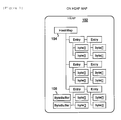
- FIG. 1 shows such data structure implemented in Java (R) in an ordinary way.
- values saved in KVS are stored as a HashMap 104 containing multiple entries in a Java(R) heap 102 in a server system implementing KVS.
- the server system Upon receipt of a request from a client system, the server system constructs a ByteBuffer object 106 in the heap 102. For this reason, the type of each data piece stored in the HashMap is the ByteBuffer itself, or a byte array (byte[]) which is actual data of the ByteBuffer object, as shown in FIG. 1 .
- an effective method is to use a mechanism shown in FIG. 2 , in which entities of objects are located on a memory area (off heap 202) outside the control by Java (R), and an off heap map 204 containing pointers to anchors for the entities is located on the heap 102.
- an object entity of a byte buffer 206 created when the server system receives a request from a client system, is also located on the off heap 202.
- Java uses a mechanism called Java (R) Native Interface (JNI) to handle objects in the off heap 202 with a standard API.
- JNI Java Native Interface
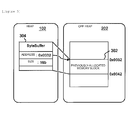
- JNIEnv->NewDirectByteBuffer(address,size) is called to create a ByteBuffer which points to a previously-allocated memory block 302 in the off heap 202.
- address is the absolute address of a memory block in the off heap
- size is the size of the memory block.
- JNIEnv->NewDirectByteBuffer(address,size) includes the following steps.
- the above problem can be solved by previously creating one or multiple ByteBuffers, which are particularly referred to as phantom ByteBuffers in this invention, of sizes as large as possible within the range of the specification.
- JNIEnv->NewDirectByteBuffer(address,size) is similarly called to create the phantom ByteBuffers, and the processing itself requires the aforementioned overhead.
- the range specified by the address and size of the phantom ByteBuffer is set so as to cover an assumed range of memory block addresses in an off heap.
- the predetermined specification of Java (R) nio limits the size of a ByteBuffer to 2 GB, and thus a single phantom ByteBuffer may not be large enough to cover the assumed range of memory block addresses in the off heap.
- a ByteBuffer subsequently requested by the system can be created, just by slicing the phantom ByteBuffer by use of a method of the ByteBuffer with relatively low overhead.
- the present invention it is possible to reduce overhead for creation of a buffer for accessing an off heap by Java (R) processor or the like using a predetermined interface such as JNI.
- the overhead is reduced because the buffer is created in response to a request only by slicing off a portion of a phantom ByteBuffer previously created.
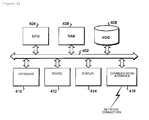
- FIG. 4 shows a block diagram of computer hardware for implementing a system configuration and processing of an embodiment of the present invention.
- a system bus 402 connected to a system bus 402 are: a CPU 404, a main memory (RAM) 406, a hard disk drive (HDD) 408, a keyboard 410, a mouse 412 and a display 414.
- the CPU 404 is preferably based on a 32-bit or 64-bit architecture, and Pentium (trademark) 4 of Intel Corporation, Core (trademark) 2 Duo of Intel Corporation, Athlon (trademark) of AMD or the like may be used, for example.
- Capacity of the main memory 406 is preferably not less than 4 GB, or more preferably not less than 8 GB.
- An operating system is stored in the hard disk drive 408. Any of operating systems such as Linux (trademark), Windows (trademark) 7, Windows (trademark) XP, Windows (trademark) 2003 server of Microsoft Corporation, and Mac OS (trademark) of Apple Inc., may be used as long as it is compatible with the CPU 404.
- a program, such as Apache, which causes the system to operate as a web server is also saved in the hard disk drive 408, and is loaded into the main memory 406 upon startup of the system.
- a Java (R) Runtime Environment program for implementing a Java (R) virtual machine (VM) is also saved in the hard disk drive 408, and is loaded into the main memory 406 upon startup of the system.
- the hard disk drive 408 may also include a JIT compiler which converts a bytecode application program into an operating system-native code and runs the program.
- the hard disk drive 408 also stores therein a library to be called by JNI, which is preferably a binary program written in C or C++ and compiled.
- the keyboard 410 and the mouse 412 are used to operate graphic objects such as an icon, a taskbar, a textbox and the like displayed on the display 414 in accordance with a graphic user interface provided by the operating system.
- the display 414 is preferably a 32 bit true color LCD monitor with a resolution not lower than 1024 ⁇ 768.
- the display 414 is used, for example, to display a start up screen of a program implementing the present invention.
- a communication interface 416 is preferably connected to a network with an Ethernet (R) protocol.
- R Ethernet
- the communication interface 416 receives a processing request according to a communication protocol such as TCP/IP from a client computer (not shown), or returns a processing result to the client computer (not shown).
- FIG. 5 is a diagram showing layers of a program or a process.
- An operating system (OS) 502 runs on the hardware shown in FIG. 4
- a Java (R) virtual machine (JVM) 504 runs on the OS 502
- an application program 506 runs on the JVM 504.
- the source code of the application program 506 is compiled with javac or the like and is saved in the hard disk drive 408 in the form of bytecode.
- the JVM 504 includes a JNI interface and its library, and the application program 506 of the invention uses the JNI interface.
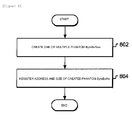
- the flowchart in FIG. 6 relates preferably to processing executed by the application program 506 upon startup of the application program 506.
- the application program 506 creates one or multiple phantom ByteBuffers.
- a phantom ByteBuffer will be referred to as a ByteBuffer pointing to a memory space which may include an area to which the JVM is not allowed access.
- address is selected so as to cover the range of addresses allocated to memory blocks in the memory in the off heap.
- size is preferably set to 2 GB which is the maximum value that can be set within the range of the specification of java. nio.
- the processing for creating a phantom ByteBuffer is the same as that shown in steps 712 to 720 in the later-described flowchart shown in FIG. 7 .
- the range of off heap memory to be pointed to by a single phantom ByteBuffer is limited to 2 GB. Therefore, if the assumed range of off heap memory of the application program 506 exceeds 2 GB, a single phantom ByteBuffer is insufficient to cover the assumed range of off heap memory of the application program 506. In this case, multiple phantom ByteBuffers of different addresses are created so as to cover as much as possible the entire assumed range of the off heap memory of the application program 506.
- step 604 the application program 506 registers values of address and size of the created phantom ByteBuffer, preferably to a predetermined region in the heap, as table data such as a hash table.
- the flowchart in FIG. 7 relates to processing of the application program 506 for creating a ByteBuffer in response to a request from the system.
- Step 702 is initiated when the application program 506 receives, from the system, a request for creating a ByteBuffer of a specific address and size.
- step 704 the application program 506 accesses the information registered in step 604 of FIG. 6 , and searches for a phantom ByteBuffer which includes the range indicated by the specified address and size.
- step 706 the application program 506 determines whether or not a phantom ByteBuffer fulfilling the condition specified in step 704 is found, and if so, slices the found out phantom ByteBuffer according to the specified address and size. position () , limit () and slice () methods of the ByteBuffer are used for this operation. More specifically, a ByteBuffer of the required address and size is cut out by: invoking position () with the requested address as an argument; invoking limit () with the requested size as an argument; and invoking slice () . Thus in step 710, the cut out ByteBuffer can be used as a buffer for the specified memory block in the off heap. Hence, the processing for creating the ByteBuffer is terminated.
- step 706 if no phantom ByteBuffer fulfilling the condition specified in step 704 is found, the application program 506 creates a phantom ByteBuffer of a range starting from the specified address. To be more precise, in this processing, the application program 506 calls JNI from Java (R) in step 712.
- step 714 the application program 506 calls JNIEnv->NewDirectByteBuffer(address,size) with the specified address and maximum size (2 GB).
- step 716 the application program 506 constructs some objects for creating a ByteBuffer.
- step 718 the created ByteBuffer is returned to Java (R) .
- step 720 the application program 506 registers the created ByteBuffer as a phantom ByteBuffer.
- step 704. since the phantom ByteBuffer is newly registered, the corresponding phantom ByteBuffer is found in step 704, the determination in step 706 turns positive, and in step 708 the ByteBuffer is created by slicing in the aforementioned manner.
- step 706 The steps 712 to 720 carried out when determined in step 706 that no phantom ByteBuffer is found have high overhead. However, a corresponding phantom ByteBuffer is found in most cases if phantom ByteBuffers are prepared so as to cover the memory addresses of a previously assumed range. Accordingly, the determination in step 706 turns positive and the process proceeds to step 708, so that the problem of overhead hardly arises.
- FIG. 8 is a diagram showing a schematic representation of how a phantom ByteBuffer is sliced and actual ByteBuffers are cut out therefrom.
- a phantom ByteBuffer 802 is created in advance in step 602 of FIG. 6 .
- an actual (i.e., other than phantom) ByteBuffer 804 is created by slicing the phantom ByteBuffer in step 708, and the actual ByteBuffer 804 points to a memory block 808 in the off heap.
- an actual ByteBuffer 806 is created by slicing the phantom ByteBuffer in step 708, and the actual ByteBuffer 806 points to a memory block 810 in the off heap.
Landscapes
- Engineering & Computer Science (AREA)
- Software Systems (AREA)
- Theoretical Computer Science (AREA)
- Physics & Mathematics (AREA)
- General Engineering & Computer Science (AREA)
- General Physics & Mathematics (AREA)
- Devices For Executing Special Programs (AREA)
Abstract
Description
- The present invention relates to a computer memory allocation technique, and more specifically to a technique for Java (R) processor or the like to perform memory allocation in a memory area managed by another processor.
- Thanks to beneficial advantages such as multi-platform compatibility, Java (R) has heretofore been used as processors for constructing systems.
- Meanwhile, large scale-distributed processing systems have employed the Key-value store (KVS) technique in recent years. In the KVS technique, many key-and-value combinations are stored as an associative array using hash (Hash Map).
FIG. 1 shows such data structure implemented in Java (R) in an ordinary way. In this structure, values saved in KVS are stored as a HashMap 104 containing multiple entries in a Java(R)heap 102 in a server system implementing KVS. - Upon receipt of a request from a client system, the server system constructs a ByteBuffer
object 106 in theheap 102. For this reason, the type of each data piece stored in the HashMap is the ByteBuffer itself, or a byte array (byte[]) which is actual data of the ByteBuffer object, as shown inFIG. 1 . - However, locating many objects on the
heap 102 in this manner reduces space in the heap and causes frequent garbage collection. Since overhead of garbage collection increases along with an increase in the number of objects in the heap, overhead of garbage collection in JVM running KVS inevitably becomes high. - As a solution to this problem, an effective method is to use a mechanism shown in
FIG. 2 , in which entities of objects are located on a memory area (off heap 202) outside the control by Java (R), and an offheap map 204 containing pointers to anchors for the entities is located on theheap 102. In this mechanism, an object entity of abyte buffer 206, created when the server system receives a request from a client system, is also located on the offheap 202. By thus locating the object entities on the offheap 202, memory consumption and the number of objects in theheap 102 can be reduced, and overhead of garbage collection can also be reduced. - Java (R) uses a mechanism called Java (R) Native Interface (JNI) to handle objects in the off
heap 202 with a standard API. For details on JNI, refer to Rob Gordon, "Essential JNI: Java Native Interface," 1998, Prentice Hall, for example. - To be more concrete, JNIEnv->NewDirectByteBuffer(address,size) is called to create a ByteBuffer which points to a previously-allocated
memory block 302 in the offheap 202. Here, address is the absolute address of a memory block in the off heap, and size is the size of the memory block. For details on ByteBuffers of Java (R), refer to Ron Hitchens, "Java Nio", 2002, O'Reilly, for example. - Although it is possible to create the ByteBuffer pointing to the
memory block 302 at the previously-allocated address in the offheap 202 by calling JNIEnv->NewDirectByteBuffer(address,size), there is a problem that overhead of the creation processing is practically very high. - To put it more specifically, JNIEnv->NewDirectByteBuffer(address,size) includes the following steps.
- 1. Java (R) processor calls JNI library processor with address and size required by Java (R).
- 2. JNI library (C, C++) processor executes JNIEnv->NewDirectByteBuffer(address,size).
- 3. JNI library processor calls Java (R) processor that constructs and initializes some Java (R) objects for creating ByteBuffer.
- 4. Java (R) processor returns created ByteBuffer to JNI library processor.
- 5. JNI library processor returns returned ByteBuffer to Java(R) processor.
- 6. Java (R) processor uses available ByteBuffer.
- Since each of these steps has high overhead, the entire overhead is extremely high.
- In a conventional system, every time a server system receives a request from a client system and needs to create a ByteBuffer, for example, the aforementioned processing JNIEnv->NewDirectByteBuffer(address,size) of high overhead has to be executed. This causes a problem of degradation in overall performance.
-
- [Non-Patent Literature 1] Rob Gordon, "Essential JNI: Java Native Interface", 1998, Prentice Hall
- [Non-patent Literature 2] RonHitchens, "Java Nio", 2002, O'Reilly
- It is an objective of the present invention to reduce overhead for creation of a buffer for accessing an off heap by Java (R) processor or the like using a predetermined interface such as JNI.
- According to the present invention, the above problem can be solved by previously creating one or multiple ByteBuffers, which are particularly referred to as phantom ByteBuffers in this invention, of sizes as large as possible within the range of the specification.
- In a preferable embodiment, JNIEnv->NewDirectByteBuffer(address,size) is similarly called to create the phantom ByteBuffers, and the processing itself requires the aforementioned overhead. At this time, the range specified by the address and size of the phantom ByteBuffer is set so as to cover an assumed range of memory block addresses in an off heap. Note, however, that the predetermined specification of Java (R) nio limits the size of a ByteBuffer to 2 GB, and thus a single phantom ByteBuffer may not be large enough to cover the assumed range of memory block addresses in the off heap.
- For this reason, it is preferable that multiple phantom ByteBuffers of different addresses be created so as to widely cover the assumed range of memory block addresses in the off heap.
- In the above-mentioned state where multiple phantom ByteBuffers are ensured so as to widely cover the assumed range of memory block addresses in the off heap, upon receipt of a request from the system for creating a ByteBuffer with an address and size, the program having prepared the phantom ByteBuffers finds the phantom ByteBuffer including the range specified by the address and size, and calls position (), limit () and slice () which are methods of the ByteBuffer. In other words, a ByteBuffer of the required address and size is cut out by: invoking position () with the requested address as an argument; invoking limit () with the requested size as an argument; and invoking slice (). The ByteBuffer thus cut out can be used as a buffer for the specified memory block in the off heap. Upon receipt of another request from the system for creating a ByteBuffer using a range specified by an address and size, the same processing is repeated.
- That is, once the phantom ByteBuffer is created, a ByteBuffer subsequently requested by the system can be created, just by slicing the phantom ByteBuffer by use of a method of the ByteBuffer with relatively low overhead.
- Note that if there is no phantom ByteBuffer including the range specified by the address and size required by the system, a phantom ByteBuffer including the range specified by the address and size needs to be created with predetermined overhead. However, such processing may be almost unnecessary and may rarely happen if phantom ByteBuffers are previously created according to a cautious forecast.
- In addition, if a large number of phantom ByteBuffers are prepared, high overhead may be required to identify a phantom ByteBuffer including a specified range for creating each ByteBuffer. However, this overhead can be reduced by deleting a specific phantom ByteBuffer that frequently fails to include a range specified by a requested address and size.
- According to the present invention, it is possible to reduce overhead for creation of a buffer for accessing an off heap by Java (R) processor or the like using a predetermined interface such as JNI. The overhead is reduced because the buffer is created in response to a request only by slicing off a portion of a phantom ByteBuffer previously created.
-
- [
FIG. 1] FIG. 1 is a diagram showing an example of an on heap map. - [
FIG. 2] FIG. 2 is a diagram showing an example of an off heap map. - [
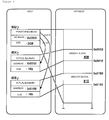
FIG. 3] FIG. 3 is a diagram showing a correspondence between a ByteBuffer in a heap and a memory block in an off heap. - [
FIG. 4] FIG. 4 is a block diagram showing an example of hardware for carrying out the invention. - [
FIG. 5] FIG. 5 is a diagram showing layers of a software configuration. - [
FIG. 6] FIG. 6 is a diagram showing a flowchart of processing of the invention. - [
FIG. 7] FIG. 7 is a diagram showing another flowchart of processing of the invention. - [
FIG. 8] FIG. 8 is a diagram showing a correspondence between a phantom ByteBuffer in a heap and memory blocks in an off heap. - Hereinafter, embodiments of the present invention will be described with reference to the drawings. It should be noted that the embodiments are aimed to describe a preferred aspect of the present invention, and are not intended to limit the scope of the invention. Additionally, in the following drawings, the same numerals indicate the same objects if not stated otherwise.
-
FIG. 4 shows a block diagram of computer hardware for implementing a system configuration and processing of an embodiment of the present invention. InFIG. 4 , connected to a system bus 402 are: a CPU 404, a main memory (RAM) 406, a hard disk drive (HDD) 408, akeyboard 410, amouse 412 and adisplay 414. The CPU 404 is preferably based on a 32-bit or 64-bit architecture, and Pentium (trademark) 4 of Intel Corporation, Core (trademark) 2 Duo of Intel Corporation, Athlon (trademark) of AMD or the like may be used, for example. Capacity of the main memory 406 is preferably not less than 4 GB, or more preferably not less than 8 GB. - An operating system is stored in the
hard disk drive 408. Any of operating systems such as Linux (trademark), Windows (trademark) 7, Windows (trademark) XP, Windows (trademark) 2003 server of Microsoft Corporation, and Mac OS (trademark) of Apple Inc., may be used as long as it is compatible with the CPU 404. - A program, such as Apache, which causes the system to operate as a web server is also saved in the
hard disk drive 408, and is loaded into the main memory 406 upon startup of the system. - A Java (R) Runtime Environment program for implementing a Java (R) virtual machine (VM) is also saved in the
hard disk drive 408, and is loaded into the main memory 406 upon startup of the system. - The
hard disk drive 408 may also include a JIT compiler which converts a bytecode application program into an operating system-native code and runs the program. - The
hard disk drive 408 also stores therein a library to be called by JNI, which is preferably a binary program written in C or C++ and compiled. - The
keyboard 410 and themouse 412 are used to operate graphic objects such as an icon, a taskbar, a textbox and the like displayed on thedisplay 414 in accordance with a graphic user interface provided by the operating system. - Although not limited to this, the
display 414 is preferably a 32 bit true color LCD monitor with a resolution not lower than 1024×768. Thedisplay 414 is used, for example, to display a start up screen of a program implementing the present invention. - A
communication interface 416 is preferably connected to a network with an Ethernet (R) protocol. By use of a function provided by Apache, thecommunication interface 416 receives a processing request according to a communication protocol such as TCP/IP from a client computer (not shown), or returns a processing result to the client computer (not shown). -
FIG. 5 is a diagram showing layers of a program or a process. An operating system (OS) 502 runs on the hardware shown inFIG. 4 , a Java (R) virtual machine (JVM) 504 runs on theOS 502, and anapplication program 506 runs on theJVM 504. The source code of theapplication program 506 is compiled with javac or the like and is saved in thehard disk drive 408 in the form of bytecode. TheJVM 504 includes a JNI interface and its library, and theapplication program 506 of the invention uses the JNI interface. - Next, processing executed by the
application program 506 will be described with reference to flowcharts shown inFIGs. 6 and7 . - The flowchart in
FIG. 6 relates preferably to processing executed by theapplication program 506 upon startup of theapplication program 506. Instep 602, theapplication program 506 creates one or multiple phantom ByteBuffers. Particularly in this invention, a phantom ByteBuffer will be referred to as a ByteBuffer pointing to a memory space which may include an area to which the JVM is not allowed access. Here, address is selected so as to cover the range of addresses allocated to memory blocks in the memory in the off heap. size is preferably set to 2 GB which is the maximum value that can be set within the range of the specification of java. nio. The processing for creating a phantom ByteBuffer is the same as that shown in steps 712 to 720 in the later-described flowchart shown inFIG. 7 . - The range of off heap memory to be pointed to by a single phantom ByteBuffer is limited to 2 GB. Therefore, if the assumed range of off heap memory of the
application program 506 exceeds 2 GB, a single phantom ByteBuffer is insufficient to cover the assumed range of off heap memory of theapplication program 506. In this case, multiple phantom ByteBuffers of different addresses are created so as to cover as much as possible the entire assumed range of the off heap memory of theapplication program 506. - In
step 604, theapplication program 506 registers values of address and size of the created phantom ByteBuffer, preferably to a predetermined region in the heap, as table data such as a hash table. - The flowchart in
FIG. 7 relates to processing of theapplication program 506 for creating a ByteBuffer in response to a request from the system. - Step 702 is initiated when the
application program 506 receives, from the system, a request for creating a ByteBuffer of a specific address and size. - Subsequently, in
step 704, theapplication program 506 accesses the information registered instep 604 ofFIG. 6 , and searches for a phantom ByteBuffer which includes the range indicated by the specified address and size. - In
step 706, theapplication program 506 determines whether or not a phantom ByteBuffer fulfilling the condition specified instep 704 is found, and if so, slices the found out phantom ByteBuffer according to the specified address and size. position () , limit () and slice () methods of the ByteBuffer are used for this operation. More specifically, a ByteBuffer of the required address and size is cut out by: invoking position () with the requested address as an argument; invoking limit () with the requested size as an argument; and invoking slice (). Thus in step 710, the cut out ByteBuffer can be used as a buffer for the specified memory block in the off heap. Hence, the processing for creating the ByteBuffer is terminated. - Returning to step 706, if no phantom ByteBuffer fulfilling the condition specified in
step 704 is found, theapplication program 506 creates a phantom ByteBuffer of a range starting from the specified address. To be more precise, in this processing, theapplication program 506 calls JNI from Java (R) in step 712. - Then in step 714, the
application program 506 calls JNIEnv->NewDirectByteBuffer(address,size) with the specified address and maximum size (2 GB). - Next in
step 716, theapplication program 506 constructs some objects for creating a ByteBuffer. - In
step 718, the created ByteBuffer is returned to Java (R) . - Thereafter in
step 720, theapplication program 506 registers the created ByteBuffer as a phantom ByteBuffer. - Hence, the processing returns to step 704. Then, since the phantom ByteBuffer is newly registered, the corresponding phantom ByteBuffer is found in
step 704, the determination instep 706 turns positive, and instep 708 the ByteBuffer is created by slicing in the aforementioned manner. - The steps 712 to 720 carried out when determined in
step 706 that no phantom ByteBuffer is found have high overhead. However, a corresponding phantom ByteBuffer is found in most cases if phantom ByteBuffers are prepared so as to cover the memory addresses of a previously assumed range. Accordingly, the determination instep 706 turns positive and the process proceeds to step 708, so that the problem of overhead hardly arises. -
FIG. 8 is a diagram showing a schematic representation of how a phantom ByteBuffer is sliced and actual ByteBuffers are cut out therefrom. InFIG. 8 , aphantom ByteBuffer 802 is created in advance instep 602 ofFIG. 6 . - Then as shown in
step 702 ofFIG. 7 , upon receipt of a request for creating a ByteBuffer from the system, an actual (i.e., other than phantom) ByteBuffer 804 is created by slicing the phantom ByteBuffer instep 708, and the actual ByteBuffer 804 points to amemory block 808 in the off heap. - Subsequently, upon receipt of another ByteBuffer creation request from the system, an
actual ByteBuffer 806 is created by slicing the phantom ByteBuffer instep 708, and theactual ByteBuffer 806 points to amemory block 810 in the off heap. - As has been described, once a phantom ByteBuffer is created at the cost of the overhead, any number of desired actual ByteBuffers can thereafter be created just by slicing the phantom ByteBuffer. The processing of slicing the ByteBuffer is completed within Java (R), which, unlike JNI, has relatively low overhead.
- Hereinabove, an embodiment of the present invention has been described in an example of creating a buffer pointing from Java (R), by way of JNI, to a memory block in the off heap. It should however be noted that the invention is not limited to specific hardware and Operating system, processor or application program, as long as it is a processor including a native interface for another system.
- 404 CPU, 406 main memory, 408 hard disk drive, 502 OS, 504 JVM, 506 application program, 802 phantom ByteBuffer, 804 actual ByteBuffer, 806 actual ByteBuffer
Claims (13)
- A method for a system running a program on a language processor which includes a special class for a buffer for accessing a memory space specified by an absolute address and has a function to create the class by slicing off a portion of the memory space specified by the class, the method being implemented by a computer to create a buffer of the class for accessing the specified memory space, the method comprising the steps of:creating a buffer of the class by the computer, the buffer being one which may include a memory space that the language processor is not permitted to access; andin response to designation of an access-permitted memory space and size, slicing off a portion of the created buffer of the class by the computer to create an accessible buffer of the class in the access-permitted memory space.
- The method according to claim 1 further comprising the step of creating a plurality of buffers of the class in a memory space which may include an area that the language processor is not permitted to access, and recording an address and size of each of the buffers of the class.
- The method according to claim 2, wherein the step of creating the accessible buffer of the class in the access-permitted memory space includes searching the created plurality of buffers of the class whose addresses are recorded to find a certain buffer including a range indicated by the designated address and size, and slicing the found buffer.
- The method according to claim 3, wherein when the processing of finding and slicing the certain buffer of the class including the address fails to find the certain buffer of the class including the address, the processing further includes processing for creating an additional buffer of the class which includes an address of a memory space that the language processor is not permitted to access.
- The method according to claim 1, wherein in the step of creating the buffer of the class which may include a memory space that the language processor is not permitted to access, the buffer is created in the maximum allowable size.
- The method according to claim 1, wherein the language processor is Java (R), the class of the buffer is ByteBuffer, the processing for creating the buffer of the class is executed by calling a JNI interface, and the processing for slicing off the buffer of the class is executed by: designating a starting point with position (), designating a size with limit (), and then invoking the slice () method.
- A program for a system running a program on a language processor which includes a special class for a buffer for accessing a memory space specified by an absolute address and has a function to create the class by slicing off a portion of the memory space specified by the class, the program being executed by a computer to create a buffer of the class for accessing the specified memory space, the program causing the computer to execute the steps of:creating a buffer of the class, the buffer being one which may include a memory space that the language processor is not permitted to access; andin response to designation of an access-permitted memory space and size, slicing off a portion of the created buffer of the class to create an accessible buffer of the class in the access-permitted memory space.
- The program according to claim 7 further comprising the step of creating a plurality of buffers of the class in a memory space which may include an area that the language processor is not permitted to access, and recording an address and size of each of the buffers of the class.
- The program according to claim 8, wherein the step of creating the accessible buffer of the class in the access-permitted memory space includes searching the created plurality of buffers of the class whose addresses are recorded to find a certain buffer including a range indicated by the designated address and size, and slicing the found buffer.
- The program according to claim 9, wherein when the processing of finding and slicing the certain buffer of the class including the address fails to find the certain buffer of the class including the address, the processing further includes processing for creating an additional buffer of the class which includes an address of a memory space that the language processor is not permitted to access.
- The program according to claim 7, wherein in the step of creating the buffer of the class which may include a memory space that the language processor is not permitted to access, the buffer is created in the maximum allowable size.
- The program according to claim 7, wherein the language processor is Java (R), the class of the buffer is ByteBuffer, the processing for creating the buffer of the class is executed by calling a JNI interface, and the processing for slicing off the buffer of the class is executed by: designating a starting point with position (), designating a size with limit (), and then invoking the slice () method.
- A system running a program on a language processor which includes a special class for a buffer for accessing a memory space specified by an absolute address and has a function to create the class by slicing off a portion of the memory space specified by the class, comprising:means for creating a buffer of the class, the buffer being one which may include a memory space that the language processor is not permitted to access; andmeans for slicing off, in response to designation of an access-permitted memory space and size, a portion of the created buffer of the class by the computer to create an accessible buffer of the class in the access-permitted memory space.
Applications Claiming Priority (2)
| Application Number | Priority Date | Filing Date | Title |
|---|---|---|---|
| JP2011197051 | 2011-09-09 | ||
| PCT/JP2012/067326 WO2013035420A1 (en) | 2011-09-09 | 2012-07-06 | Memory allocation method, program, and system |
Publications (4)
| Publication Number | Publication Date |
|---|---|
| EP2755129A1 true EP2755129A1 (en) | 2014-07-16 |
| EP2755129A4 EP2755129A4 (en) | 2014-07-30 |
| EP2755129B1 EP2755129B1 (en) | 2016-10-12 |
| EP2755129B8 EP2755129B8 (en) | 2017-02-22 |
Family
ID=47830902
Family Applications (1)
| Application Number | Title | Priority Date | Filing Date |
|---|---|---|---|
| EP12829322.2A Not-in-force EP2755129B8 (en) | 2011-09-09 | 2012-07-06 | Memory allocation method, program, and system |
Country Status (5)
| Country | Link |
|---|---|
| US (1) | US20130067190A1 (en) |
| EP (1) | EP2755129B8 (en) |
| JP (1) | JP5588072B2 (en) |
| CN (1) | CN103782273A (en) |
| WO (1) | WO2013035420A1 (en) |
Cited By (2)
| Publication number | Priority date | Publication date | Assignee | Title |
|---|---|---|---|---|
| US11243876B2 (en) | 2019-11-06 | 2022-02-08 | Oracle International Corporation | Techniques for accessing off-heap memory |
| US12242394B2 (en) | 2019-11-06 | 2025-03-04 | Oracle International Corporation | Transitioning between thread-confined memory segment views and shared memory segment views |
Families Citing this family (5)
| Publication number | Priority date | Publication date | Assignee | Title |
|---|---|---|---|---|
| US9697220B2 (en) * | 2013-12-13 | 2017-07-04 | Oracle International Corporation | System and method for supporting elastic data metadata compression in a distributed data grid |
| US9424147B2 (en) | 2013-12-13 | 2016-08-23 | Oracle International Corporation | System and method for supporting memory allocation control with push-back in a distributed data grid |
| EP4386577A3 (en) | 2017-03-10 | 2024-08-14 | Visa International Service Association | Techniques for in-memory data searching |
| CN113835989B (en) * | 2020-06-08 | 2024-11-26 | 武汉斗鱼鱼乐网络科技有限公司 | A performance statistics method and device |
| CN117251120B (en) * | 2023-11-17 | 2024-03-01 | 杭州乒乓智能技术有限公司 | Accounting system optimization method, device, equipment and medium based on jvm out-of-heap memory |
Family Cites Families (3)
| Publication number | Priority date | Publication date | Assignee | Title |
|---|---|---|---|---|
| CN1248465C (en) * | 2002-11-01 | 2006-03-29 | 华为技术有限公司 | Management method of data fransmission/receiving butter region in network communication |
| US7720802B2 (en) * | 2007-01-03 | 2010-05-18 | International Business Machines Corporation | Reclaiming resident buffers when a reclaim threshold has been exceeded by swapping the oldest in use buffer and a new buffer, and referencing the new buffer via an updated set of read and write pointers |
| CN101714096A (en) * | 2009-12-02 | 2010-05-26 | 浙江中控技术股份有限公司 | Method and device for updating configuration information |
-
2012
- 2012-07-06 JP JP2013532484A patent/JP5588072B2/en not_active Expired - Fee Related
- 2012-07-06 EP EP12829322.2A patent/EP2755129B8/en not_active Not-in-force
- 2012-07-06 CN CN201280043905.6A patent/CN103782273A/en active Pending
- 2012-07-06 WO PCT/JP2012/067326 patent/WO2013035420A1/en not_active Ceased
- 2012-09-07 US US13/606,513 patent/US20130067190A1/en not_active Abandoned
Cited By (3)
| Publication number | Priority date | Publication date | Assignee | Title |
|---|---|---|---|---|
| US11243876B2 (en) | 2019-11-06 | 2022-02-08 | Oracle International Corporation | Techniques for accessing off-heap memory |
| US12242394B2 (en) | 2019-11-06 | 2025-03-04 | Oracle International Corporation | Transitioning between thread-confined memory segment views and shared memory segment views |
| US12242395B2 (en) | 2019-11-06 | 2025-03-04 | Oracle International Corporation | Transitioning between thread-confined memory segment views and shared memory segment views |
Also Published As
| Publication number | Publication date |
|---|---|
| US20130067190A1 (en) | 2013-03-14 |
| EP2755129A4 (en) | 2014-07-30 |
| JPWO2013035420A1 (en) | 2015-03-23 |
| JP5588072B2 (en) | 2014-09-10 |
| EP2755129B1 (en) | 2016-10-12 |
| CN103782273A (en) | 2014-05-07 |
| EP2755129B8 (en) | 2017-02-22 |
| WO2013035420A1 (en) | 2013-03-14 |
Similar Documents
| Publication | Publication Date | Title |
|---|---|---|
| EP2755129B1 (en) | Memory allocation method, program, and system | |
| US8261267B2 (en) | Virtual machine monitor having mapping data generator for mapping virtual page of the virtual memory to a physical memory | |
| US6134601A (en) | Computer resource management system | |
| US7472249B2 (en) | Kernel memory free algorithm | |
| EP2017735B1 (en) | Efficient chunked java object heaps | |
| US20240330199A1 (en) | Secure memory access in a virtualized computing environment | |
| US7925818B1 (en) | Expansion of virtualized physical memory of virtual machine | |
| US20120304171A1 (en) | Managing Data Input/Output Operations | |
| US11010355B2 (en) | Layer-based file access method and apparatus of virtualization instance | |
| US11994988B2 (en) | Multi-ring shared, traversable, and dynamic advanced database | |
| US11256677B2 (en) | Method, device, and computer program product for managing storage system | |
| US20210294686A1 (en) | Fast memory mapped io support by register switch | |
| US20200341894A1 (en) | Reclaiming storage resources | |
| US12326809B2 (en) | Dynamically allocatable physically addressed metadata storage | |
| US6874076B2 (en) | Method, system, and computer program product for migrating data from one real page to another | |
| US11157415B2 (en) | Operation of a multi-slice processor implementing a unified page walk cache | |
| CN102662857A (en) | Apparatus and method for virtualizing memory | |
| US7444636B2 (en) | Method and system of determining attributes of a functional unit in a multiple processor computer system | |
| US12367059B2 (en) | Efficient memory swap for virtual machines | |
| US7500074B2 (en) | Identifying relocatable kernel mappings | |
| US12511150B2 (en) | Fast memory mapped IO support by register switch | |
| Paging | Memory Management | |
| Chu et al. | Page fault frequency (PFF) replacement algorithms |
Legal Events
| Date | Code | Title | Description |
|---|---|---|---|
| PUAI | Public reference made under article 153(3) epc to a published international application that has entered the european phase |
Free format text: ORIGINAL CODE: 0009012 |
|
| 17P | Request for examination filed |
Effective date: 20140304 |
|
| AK | Designated contracting states |
Kind code of ref document: A1 Designated state(s): AL AT BE BG CH CY CZ DE DK EE ES FI FR GB GR HR HU IE IS IT LI LT LU LV MC MK MT NL NO PL PT RO RS SE SI SK SM TR |
|
| A4 | Supplementary search report drawn up and despatched |
Effective date: 20140701 |
|
| RIC1 | Information provided on ipc code assigned before grant |
Ipc: G06F 12/02 20060101ALI20140625BHEP Ipc: G06F 9/455 20060101ALI20140625BHEP Ipc: G06F 9/44 20060101AFI20140625BHEP Ipc: G06F 9/50 20060101ALI20140625BHEP |
|
| RIN1 | Information on inventor provided before grant (corrected) |
Inventor name: HORII HIROSHI Inventor name: THOMAS R GISSEL |
|
| DAX | Request for extension of the european patent (deleted) | ||
| 17Q | First examination report despatched |
Effective date: 20150811 |
|
| GRAP | Despatch of communication of intention to grant a patent |
Free format text: ORIGINAL CODE: EPIDOSNIGR1 |
|
| INTG | Intention to grant announced |
Effective date: 20160610 |
|
| GRAS | Grant fee paid |
Free format text: ORIGINAL CODE: EPIDOSNIGR3 |
|
| GRAA | (expected) grant |
Free format text: ORIGINAL CODE: 0009210 |
|
| AK | Designated contracting states |
Kind code of ref document: B1 Designated state(s): AL AT BE BG CH CY CZ DE DK EE ES FI FR GB GR HR HU IE IS IT LI LT LU LV MC MK MT NL NO PL PT RO RS SE SI SK SM TR |
|
| REG | Reference to a national code |
Ref country code: GB Ref legal event code: FG4D |
|
| REG | Reference to a national code |
Ref country code: CH Ref legal event code: EP |
|
| REG | Reference to a national code |
Ref country code: AT Ref legal event code: REF Ref document number: 837079 Country of ref document: AT Kind code of ref document: T Effective date: 20161015 |
|
| REG | Reference to a national code |
Ref country code: IE Ref legal event code: FG4D |
|
| REG | Reference to a national code |
Ref country code: DE Ref legal event code: R084 Ref document number: 602012024167 Country of ref document: DE |
|
| REG | Reference to a national code |
Ref country code: CH Ref legal event code: NV Representative=s name: IBM RESEARCH GMBH ZURICH RESEARCH LABORATORY I, CH |
|
| REG | Reference to a national code |
Ref country code: GB Ref legal event code: 746 Effective date: 20161102 |
|
| REG | Reference to a national code |
Ref country code: DE Ref legal event code: R096 Ref document number: 602012024167 Country of ref document: DE |
|
| GRAT | Correction requested after decision to grant or after decision to maintain patent in amended form |
Free format text: ORIGINAL CODE: EPIDOSNCDEC |
|
| RAP2 | Party data changed (patent owner data changed or rights of a patent transferred) |
Owner name: INTERNATIONAL BUSINESS MACHINES CORPORATION |
|
| REG | Reference to a national code |
Ref country code: DE Ref legal event code: R082 Ref document number: 602012024167 Country of ref document: DE Representative=s name: DUSCHER, REINHARD, DIPL.-PHYS. DR. RER. NAT., DE Ref country code: DE Ref legal event code: R081 Ref document number: 602012024167 Country of ref document: DE Owner name: INTERNATIONAL BUSINESS MACHINES CORPORATION, A, US Free format text: FORMER OWNER: INTELLECTUAL BUSINESS MACHINES CORP., ARMONK, N.Y., US |
|
| REG | Reference to a national code |
Ref country code: LT Ref legal event code: MG4D |
|
| REG | Reference to a national code |
Ref country code: NL Ref legal event code: MP Effective date: 20161012 |
|
| PG25 | Lapsed in a contracting state [announced via postgrant information from national office to epo] |
Ref country code: LV Free format text: LAPSE BECAUSE OF FAILURE TO SUBMIT A TRANSLATION OF THE DESCRIPTION OR TO PAY THE FEE WITHIN THE PRESCRIBED TIME-LIMIT Effective date: 20161012 |
|
| REG | Reference to a national code |
Ref country code: AT Ref legal event code: MK05 Ref document number: 837079 Country of ref document: AT Kind code of ref document: T Effective date: 20161012 |
|
| PG25 | Lapsed in a contracting state [announced via postgrant information from national office to epo] |
Ref country code: NO Free format text: LAPSE BECAUSE OF FAILURE TO SUBMIT A TRANSLATION OF THE DESCRIPTION OR TO PAY THE FEE WITHIN THE PRESCRIBED TIME-LIMIT Effective date: 20170112 Ref country code: GR Free format text: LAPSE BECAUSE OF FAILURE TO SUBMIT A TRANSLATION OF THE DESCRIPTION OR TO PAY THE FEE WITHIN THE PRESCRIBED TIME-LIMIT Effective date: 20170113 Ref country code: SE Free format text: LAPSE BECAUSE OF FAILURE TO SUBMIT A TRANSLATION OF THE DESCRIPTION OR TO PAY THE FEE WITHIN THE PRESCRIBED TIME-LIMIT Effective date: 20161012 Ref country code: LT Free format text: LAPSE BECAUSE OF FAILURE TO SUBMIT A TRANSLATION OF THE DESCRIPTION OR TO PAY THE FEE WITHIN THE PRESCRIBED TIME-LIMIT Effective date: 20161012 |
|
| PG25 | Lapsed in a contracting state [announced via postgrant information from national office to epo] |
Ref country code: HR Free format text: LAPSE BECAUSE OF FAILURE TO SUBMIT A TRANSLATION OF THE DESCRIPTION OR TO PAY THE FEE WITHIN THE PRESCRIBED TIME-LIMIT Effective date: 20161012 Ref country code: FI Free format text: LAPSE BECAUSE OF FAILURE TO SUBMIT A TRANSLATION OF THE DESCRIPTION OR TO PAY THE FEE WITHIN THE PRESCRIBED TIME-LIMIT Effective date: 20161012 Ref country code: NL Free format text: LAPSE BECAUSE OF FAILURE TO SUBMIT A TRANSLATION OF THE DESCRIPTION OR TO PAY THE FEE WITHIN THE PRESCRIBED TIME-LIMIT Effective date: 20161012 Ref country code: ES Free format text: LAPSE BECAUSE OF FAILURE TO SUBMIT A TRANSLATION OF THE DESCRIPTION OR TO PAY THE FEE WITHIN THE PRESCRIBED TIME-LIMIT Effective date: 20161012 Ref country code: AT Free format text: LAPSE BECAUSE OF FAILURE TO SUBMIT A TRANSLATION OF THE DESCRIPTION OR TO PAY THE FEE WITHIN THE PRESCRIBED TIME-LIMIT Effective date: 20161012 Ref country code: RS Free format text: LAPSE BECAUSE OF FAILURE TO SUBMIT A TRANSLATION OF THE DESCRIPTION OR TO PAY THE FEE WITHIN THE PRESCRIBED TIME-LIMIT Effective date: 20161012 Ref country code: PT Free format text: LAPSE BECAUSE OF FAILURE TO SUBMIT A TRANSLATION OF THE DESCRIPTION OR TO PAY THE FEE WITHIN THE PRESCRIBED TIME-LIMIT Effective date: 20170213 Ref country code: IS Free format text: LAPSE BECAUSE OF FAILURE TO SUBMIT A TRANSLATION OF THE DESCRIPTION OR TO PAY THE FEE WITHIN THE PRESCRIBED TIME-LIMIT Effective date: 20170212 Ref country code: PL Free format text: LAPSE BECAUSE OF FAILURE TO SUBMIT A TRANSLATION OF THE DESCRIPTION OR TO PAY THE FEE WITHIN THE PRESCRIBED TIME-LIMIT Effective date: 20161012 Ref country code: BE Free format text: LAPSE BECAUSE OF FAILURE TO SUBMIT A TRANSLATION OF THE DESCRIPTION OR TO PAY THE FEE WITHIN THE PRESCRIBED TIME-LIMIT Effective date: 20161012 |
|
| REG | Reference to a national code |
Ref country code: DE Ref legal event code: R097 Ref document number: 602012024167 Country of ref document: DE |
|
| PG25 | Lapsed in a contracting state [announced via postgrant information from national office to epo] |
Ref country code: SK Free format text: LAPSE BECAUSE OF FAILURE TO SUBMIT A TRANSLATION OF THE DESCRIPTION OR TO PAY THE FEE WITHIN THE PRESCRIBED TIME-LIMIT Effective date: 20161012 Ref country code: RO Free format text: LAPSE BECAUSE OF FAILURE TO SUBMIT A TRANSLATION OF THE DESCRIPTION OR TO PAY THE FEE WITHIN THE PRESCRIBED TIME-LIMIT Effective date: 20161012 Ref country code: DK Free format text: LAPSE BECAUSE OF FAILURE TO SUBMIT A TRANSLATION OF THE DESCRIPTION OR TO PAY THE FEE WITHIN THE PRESCRIBED TIME-LIMIT Effective date: 20161012 Ref country code: EE Free format text: LAPSE BECAUSE OF FAILURE TO SUBMIT A TRANSLATION OF THE DESCRIPTION OR TO PAY THE FEE WITHIN THE PRESCRIBED TIME-LIMIT Effective date: 20161012 Ref country code: CZ Free format text: LAPSE BECAUSE OF FAILURE TO SUBMIT A TRANSLATION OF THE DESCRIPTION OR TO PAY THE FEE WITHIN THE PRESCRIBED TIME-LIMIT Effective date: 20161012 |
|
| PLBE | No opposition filed within time limit |
Free format text: ORIGINAL CODE: 0009261 |
|
| STAA | Information on the status of an ep patent application or granted ep patent |
Free format text: STATUS: NO OPPOSITION FILED WITHIN TIME LIMIT |
|
| PG25 | Lapsed in a contracting state [announced via postgrant information from national office to epo] |
Ref country code: SM Free format text: LAPSE BECAUSE OF FAILURE TO SUBMIT A TRANSLATION OF THE DESCRIPTION OR TO PAY THE FEE WITHIN THE PRESCRIBED TIME-LIMIT Effective date: 20161012 Ref country code: BG Free format text: LAPSE BECAUSE OF FAILURE TO SUBMIT A TRANSLATION OF THE DESCRIPTION OR TO PAY THE FEE WITHIN THE PRESCRIBED TIME-LIMIT Effective date: 20170112 Ref country code: IT Free format text: LAPSE BECAUSE OF FAILURE TO SUBMIT A TRANSLATION OF THE DESCRIPTION OR TO PAY THE FEE WITHIN THE PRESCRIBED TIME-LIMIT Effective date: 20161012 |
|
| 26N | No opposition filed |
Effective date: 20170713 |
|
| PGFP | Annual fee paid to national office [announced via postgrant information from national office to epo] |
Ref country code: DE Payment date: 20170718 Year of fee payment: 6 Ref country code: GB Payment date: 20170728 Year of fee payment: 6 |
|
| PG25 | Lapsed in a contracting state [announced via postgrant information from national office to epo] |
Ref country code: SI Free format text: LAPSE BECAUSE OF FAILURE TO SUBMIT A TRANSLATION OF THE DESCRIPTION OR TO PAY THE FEE WITHIN THE PRESCRIBED TIME-LIMIT Effective date: 20161012 |
|
| REG | Reference to a national code |
Ref country code: CH Ref legal event code: PL |
|
| REG | Reference to a national code |
Ref country code: IE Ref legal event code: MM4A |
|
| REG | Reference to a national code |
Ref country code: FR Ref legal event code: ST Effective date: 20180330 |
|
| PG25 | Lapsed in a contracting state [announced via postgrant information from national office to epo] |
Ref country code: IE Free format text: LAPSE BECAUSE OF NON-PAYMENT OF DUE FEES Effective date: 20170706 Ref country code: CH Free format text: LAPSE BECAUSE OF NON-PAYMENT OF DUE FEES Effective date: 20170731 Ref country code: LI Free format text: LAPSE BECAUSE OF NON-PAYMENT OF DUE FEES Effective date: 20170731 |
|
| PG25 | Lapsed in a contracting state [announced via postgrant information from national office to epo] |
Ref country code: FR Free format text: LAPSE BECAUSE OF NON-PAYMENT OF DUE FEES Effective date: 20170731 |
|
| PG25 | Lapsed in a contracting state [announced via postgrant information from national office to epo] |
Ref country code: LU Free format text: LAPSE BECAUSE OF NON-PAYMENT OF DUE FEES Effective date: 20170706 |
|
| PG25 | Lapsed in a contracting state [announced via postgrant information from national office to epo] |
Ref country code: MT Free format text: LAPSE BECAUSE OF NON-PAYMENT OF DUE FEES Effective date: 20170706 |
|
| REG | Reference to a national code |
Ref country code: DE Ref legal event code: R119 Ref document number: 602012024167 Country of ref document: DE |
|
| GBPC | Gb: european patent ceased through non-payment of renewal fee |
Effective date: 20180706 |
|
| PG25 | Lapsed in a contracting state [announced via postgrant information from national office to epo] |
Ref country code: DE Free format text: LAPSE BECAUSE OF NON-PAYMENT OF DUE FEES Effective date: 20190201 Ref country code: GB Free format text: LAPSE BECAUSE OF NON-PAYMENT OF DUE FEES Effective date: 20180706 |
|
| PG25 | Lapsed in a contracting state [announced via postgrant information from national office to epo] |
Ref country code: MC Free format text: LAPSE BECAUSE OF FAILURE TO SUBMIT A TRANSLATION OF THE DESCRIPTION OR TO PAY THE FEE WITHIN THE PRESCRIBED TIME-LIMIT Effective date: 20161012 Ref country code: HU Free format text: LAPSE BECAUSE OF FAILURE TO SUBMIT A TRANSLATION OF THE DESCRIPTION OR TO PAY THE FEE WITHIN THE PRESCRIBED TIME-LIMIT; INVALID AB INITIO Effective date: 20120706 |
|
| PG25 | Lapsed in a contracting state [announced via postgrant information from national office to epo] |
Ref country code: CY Free format text: LAPSE BECAUSE OF NON-PAYMENT OF DUE FEES Effective date: 20161012 |
|
| PG25 | Lapsed in a contracting state [announced via postgrant information from national office to epo] |
Ref country code: MK Free format text: LAPSE BECAUSE OF FAILURE TO SUBMIT A TRANSLATION OF THE DESCRIPTION OR TO PAY THE FEE WITHIN THE PRESCRIBED TIME-LIMIT Effective date: 20161012 |
|
| PG25 | Lapsed in a contracting state [announced via postgrant information from national office to epo] |
Ref country code: TR Free format text: LAPSE BECAUSE OF FAILURE TO SUBMIT A TRANSLATION OF THE DESCRIPTION OR TO PAY THE FEE WITHIN THE PRESCRIBED TIME-LIMIT Effective date: 20161012 |
|
| PG25 | Lapsed in a contracting state [announced via postgrant information from national office to epo] |
Ref country code: AL Free format text: LAPSE BECAUSE OF FAILURE TO SUBMIT A TRANSLATION OF THE DESCRIPTION OR TO PAY THE FEE WITHIN THE PRESCRIBED TIME-LIMIT Effective date: 20161012 |