EP2755024A1 - Hydrophilic thiol probe - Google Patents
Hydrophilic thiol probe Download PDFInfo
- Publication number
- EP2755024A1 EP2755024A1 EP12830678.4A EP12830678A EP2755024A1 EP 2755024 A1 EP2755024 A1 EP 2755024A1 EP 12830678 A EP12830678 A EP 12830678A EP 2755024 A1 EP2755024 A1 EP 2755024A1
- Authority
- EP
- European Patent Office
- Prior art keywords
- group
- protein
- probe
- thiol
- mass spectrometry
- Prior art date
- Legal status (The legal status is an assumption and is not a legal conclusion. Google has not performed a legal analysis and makes no representation as to the accuracy of the status listed.)
- Granted
Links
- 0 CN*[N+]([O-])O** Chemical compound CN*[N+]([O-])O** 0.000 description 1
Images


Classifications
-
- G—PHYSICS
- G01—MEASURING; TESTING
- G01N—INVESTIGATING OR ANALYSING MATERIALS BY DETERMINING THEIR CHEMICAL OR PHYSICAL PROPERTIES
- G01N33/00—Investigating or analysing materials by specific methods not covered by groups G01N1/00 - G01N31/00
- G01N33/48—Biological material, e.g. blood, urine; Haemocytometers
- G01N33/50—Chemical analysis of biological material, e.g. blood, urine; Testing involving biospecific ligand binding methods; Immunological testing
- G01N33/68—Chemical analysis of biological material, e.g. blood, urine; Testing involving biospecific ligand binding methods; Immunological testing involving proteins, peptides or amino acids
- G01N33/6803—General methods of protein analysis not limited to specific proteins or families of proteins
- G01N33/6848—Methods of protein analysis involving mass spectrometry
-
- Y—GENERAL TAGGING OF NEW TECHNOLOGICAL DEVELOPMENTS; GENERAL TAGGING OF CROSS-SECTIONAL TECHNOLOGIES SPANNING OVER SEVERAL SECTIONS OF THE IPC; TECHNICAL SUBJECTS COVERED BY FORMER USPC CROSS-REFERENCE ART COLLECTIONS [XRACs] AND DIGESTS
- Y10—TECHNICAL SUBJECTS COVERED BY FORMER USPC
- Y10T—TECHNICAL SUBJECTS COVERED BY FORMER US CLASSIFICATION
- Y10T436/00—Chemistry: analytical and immunological testing
- Y10T436/14—Heterocyclic carbon compound [i.e., O, S, N, Se, Te, as only ring hetero atom]
- Y10T436/145555—Hetero-N
-
- Y—GENERAL TAGGING OF NEW TECHNOLOGICAL DEVELOPMENTS; GENERAL TAGGING OF CROSS-SECTIONAL TECHNOLOGIES SPANNING OVER SEVERAL SECTIONS OF THE IPC; TECHNICAL SUBJECTS COVERED BY FORMER USPC CROSS-REFERENCE ART COLLECTIONS [XRACs] AND DIGESTS
- Y10—TECHNICAL SUBJECTS COVERED BY FORMER USPC
- Y10T—TECHNICAL SUBJECTS COVERED BY FORMER US CLASSIFICATION
- Y10T436/00—Chemistry: analytical and immunological testing
- Y10T436/14—Heterocyclic carbon compound [i.e., O, S, N, Se, Te, as only ring hetero atom]
- Y10T436/145555—Hetero-N
- Y10T436/147777—Plural nitrogen in the same ring [e.g., barbituates, creatinine, etc.]
-
- Y—GENERAL TAGGING OF NEW TECHNOLOGICAL DEVELOPMENTS; GENERAL TAGGING OF CROSS-SECTIONAL TECHNOLOGIES SPANNING OVER SEVERAL SECTIONS OF THE IPC; TECHNICAL SUBJECTS COVERED BY FORMER USPC CROSS-REFERENCE ART COLLECTIONS [XRACs] AND DIGESTS
- Y10—TECHNICAL SUBJECTS COVERED BY FORMER USPC
- Y10T—TECHNICAL SUBJECTS COVERED BY FORMER US CLASSIFICATION
- Y10T436/00—Chemistry: analytical and immunological testing
- Y10T436/17—Nitrogen containing
- Y10T436/173845—Amine and quaternary ammonium
-
- Y—GENERAL TAGGING OF NEW TECHNOLOGICAL DEVELOPMENTS; GENERAL TAGGING OF CROSS-SECTIONAL TECHNOLOGIES SPANNING OVER SEVERAL SECTIONS OF THE IPC; TECHNICAL SUBJECTS COVERED BY FORMER USPC CROSS-REFERENCE ART COLLECTIONS [XRACs] AND DIGESTS
- Y10—TECHNICAL SUBJECTS COVERED BY FORMER USPC
- Y10T—TECHNICAL SUBJECTS COVERED BY FORMER US CLASSIFICATION
- Y10T436/00—Chemistry: analytical and immunological testing
- Y10T436/19—Halogen containing
-
- Y—GENERAL TAGGING OF NEW TECHNOLOGICAL DEVELOPMENTS; GENERAL TAGGING OF CROSS-SECTIONAL TECHNOLOGIES SPANNING OVER SEVERAL SECTIONS OF THE IPC; TECHNICAL SUBJECTS COVERED BY FORMER USPC CROSS-REFERENCE ART COLLECTIONS [XRACs] AND DIGESTS
- Y10—TECHNICAL SUBJECTS COVERED BY FORMER USPC
- Y10T—TECHNICAL SUBJECTS COVERED BY FORMER US CLASSIFICATION
- Y10T436/00—Chemistry: analytical and immunological testing
- Y10T436/20—Oxygen containing
- Y10T436/200833—Carbonyl, ether, aldehyde or ketone containing
-
- Y—GENERAL TAGGING OF NEW TECHNOLOGICAL DEVELOPMENTS; GENERAL TAGGING OF CROSS-SECTIONAL TECHNOLOGIES SPANNING OVER SEVERAL SECTIONS OF THE IPC; TECHNICAL SUBJECTS COVERED BY FORMER USPC CROSS-REFERENCE ART COLLECTIONS [XRACs] AND DIGESTS
- Y10—TECHNICAL SUBJECTS COVERED BY FORMER USPC
- Y10T—TECHNICAL SUBJECTS COVERED BY FORMER US CLASSIFICATION
- Y10T436/00—Chemistry: analytical and immunological testing
- Y10T436/24—Nuclear magnetic resonance, electron spin resonance or other spin effects or mass spectrometry
Definitions
- the present invention belongs to the field of life science, especially proteomics, and relates to a mass spectrometry technique applicable to clinical diagnosis and the like. Specifically, the present invention relates to a reagent for mass spectrometry useful for LC/MS or MALDI-TOF MS. More specifically, the present invention relates to a novel hydrophilic thiol probe that improves the sensitivity of mass spectrometry of biomolecules.
- a probe whose additional site is a thiol group has also been commercialized as, for example, a labeling kit using biotin, a fluorescent indicator, alkaline phosphatase, or the like.
- a probe can be utilized also in biochemical assays (e.g., western blotting, ELISA, intracellular fluorescent labeling) or HPLC of proteins or peptides.
- proteomics there is also a methodology in which a protein or peptide is derivatized using a probe that can label a specific amino acid residue to analyze the protein or peptide with high sensitivity.
- probe addition to a specific amino acid residue is a methodology essential for enhancing ionization in mass spectrometry and reliably improving analytical accuracy.
- an N-terminal amino group or an amino group of a lysine residue is utilized as an additional site for a probe.
- TMPP reagent Anal. Biochem. 2008, 380(2), 291-296 (Non-Patent Document 1)
- SPITC reagent RCM. 2004, 18(1), 96-102 (Non-Patent Document 2)
- MS/MS ion series of a peptide is utilized as an additional site for a probe.
- ICAT Isotope-Coated Affinity Tag
- iTRAQ ® Isobaric tag for relative and absolute quantitation
- Mol Cell Proteomics. 2004, 3, 1154-1169 Non-Patent Document 5
- Non-Patent Document 6 Anal. Chem. 1998, 70, 1544-1554 (Non-patent Document 6), Rapid Commun. Mass Spectrom. 2009; 23: 1483-1492 (Non-Patent Document 7), J. Anal. At. Spectrom., 2008, 23, 1063-1067 (Non-Patent Document 8), Anal. Chem. 1997, 69, 1315-1319 (Non-Patent Document 9), and Anal. Chem. 2004, 76, 728-735 (Non-Patent Document 10)).
- a reductive alkylation method is conventionally performed after denaturation of a protein as pretreatment for effective digestion of the protein so that reoxidation of cysteine residues is prevented.
- a protein that has been subjected to, for example, electrophoretic separation or denaturation with a denaturing urea solution is reduced with dithiothreitol to generate thiol groups of cysteine residues.
- the thiol groups are alkylated with iodoacetamide, iodoacetic acid, vinylpyridine, acrylamide, or the like to block reoxidation of the thiol groups.
- a probe that promotes peptide ionization makes it possible to detect a peptide having low sensitivity, but such a probe that promotes ionization has been conventionally used for a digested peptide of a protein to be identified.
- Such a digested peptide is characteristic in that its C-terminal inevitably has a basic amino acid such as lysine or arginine. It is empirically understood that such a characteristic sequence achieves high sensitivity in mass spectrometry.
- biologically- or clinically-important proteins or peptides are not digested peptides but functional peptides typified by hormones, amyloids, cytokines, and the like.
- Such functional peptides do not always have a characteristic sequence that enzymatically-digested peptides have.
- many of the functional peptides are difficult to be detected even by using a conventional probe due to their high hydrophobicity or quick turnover. Therefore, it is required to achieve favorable detection sensitivity and obtain meaningful results even when such functional proteins are analyzed by mass spectrometry.
- an object of the present invention is to provide a probe that further promotes ionization in proteomic analysis using mass spectrometry, and a high-sensitive mass spectrometry method for a protein using such a probe.
- Another object of the present invention is to provide an ionization-enhancing probe that can be used even for a protein that has a high degree of hydrophobicity and quickly turns over, and a high-sensitive mass spectrometry method for a protein using such a probe.
- the present inventors have found that the above objects of the present invention are achieved by a probe that is molecularly designed so as to have a structure that can be introduced into a thiol group and a structure that promotes ionization, which has led to the completion of the present invention.
- the present invention includes the followings.
- protein broadly refers to an amino acid polymer, and the amino acid polymer is not limited by the number of amino acids polymerized. Therefore, the term “protein” used herein includes all oligopeptides, polypeptides, and proteins.
- the protein to be reacted with the thiol probe may be a protein having a thiol group generated by reduction treatment.
- the present invention it is possible to provide a probe that further promotes ionization in mass spectrometry, and a high-sensitive mass spectrometry method for a protein. According to the present invention, it is also possible to provide an ionization-enhancing probe that can be used even for a protein that has a high degree of hydrophobicity and quickly turns over, and a high-sensitive mass spectrometry method for a protein using such a probe.
- the probe according to the present invention is molecularly designed so as to reduce the degree of hydrophobicity of the whole molecule, and therefore a protein modified with the probe according to the present invention is more hydrophilic than before modification. Therefore, the probe according to the present invention can be used for a protein having a high degree of hydrophobicity.
- the probe according to the present invention can be applied also to a low-abundance peptide that quickly turns over or a hydrophobic protein.
- a thiol probe according to the present invention has characteristics such that the thiol probe has a structure having reactivity to a thiol group, a structure for reducing the degree of hydrophobicity of the whole molecule, and a structure that is easily protonated, and has no amide group that is a structure complicating a mass spectrum due to the cleavage of a probe itself in multi-stage mass spectrometry.
- the structure having reactivity to a thiol group is an iodoacetyl group that minimizes a side reaction to a functional group other than a thiol group (e.g., an amino group) and has high reaction rate selectivity.
- the structure for reducing the degree of hydrophobicity of the whole molecule is an oxygen-containing group.
- the structure that is easily protonated is a nitrogen-containing group.
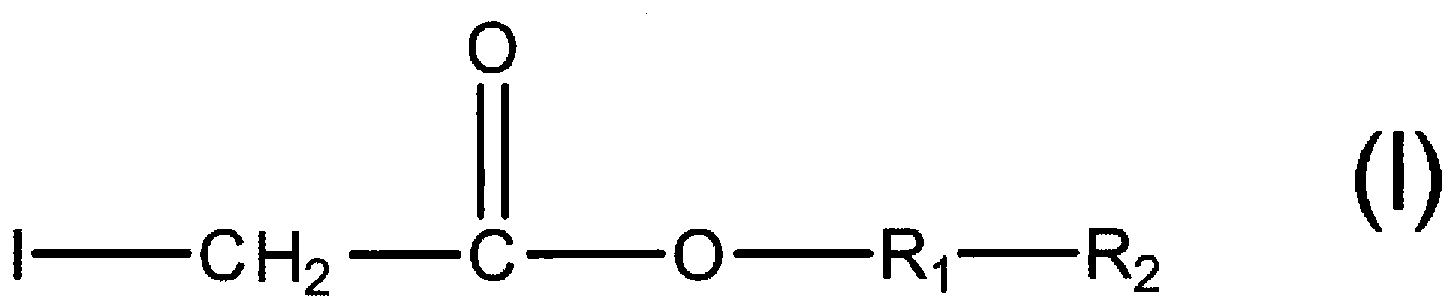
- the thiol probe according to the present invention is represented by the following formula (I), that is, a structural formula having an iodoacetamide group (ICH 3 CO-), an oxygen-containing group (-OR 1 -), and a nitrogen-containing group (-R 2 ).
- R 1 represents a linker group.
- the linker group is, i.e., a bivalent linking group, and is usually a bivalent organic group.
- the bivalent organic group may be a hydrocarbon group having 1 or 2 carbon atoms. If the number of carbon atoms exceeds the above range, the degree of hydrophobicity of the whole molecule becomes high, which tends to make it difficult to sufficiently obtain the effect of enhancing ionization.
- the bivalent organic group may be an alkylene oxide-containing group having 2 to 6 carbon atoms.
- the alkylene oxide-containing group is preferably a polyalkylene oxide-containing group. More specifically, an alkylene oxide in the alkylene oxide-containing group is ethylene oxide or propylene oxide.
- the group represented by OR 1 is preferably a polyalkylene glycol group.
- the polyalkylene glycol group may be a group formed by the polymerization of an alkylene glycol having 2 to 6 carbon atoms.
- the polyalkylene glycol group may be selected from the group consisting of a polyethylene glycol group (a group formed by the polymerization of ethylene glycol) and a polypropylene glycol group (a group formed by the polymerization of 1,2-propanediol or 1,3-propanediol). It is to be noted that the degree of polymerization of glycol in the polyalkylene glycol group may be 2 to 6.
- R 2 represents a nitrogen-containing group.
- the nitrogen-containing group is a proton acceptor group, and is specifically a substituted ammonium group or a substituted amino group.
- the substituted ammonium group may be a tertiary ammonium group or a quaternary ammonium group.
- a substituent group in the substituted ammonium group may be an alkyl group having 1 or 2 carbon atoms, or the like.
- the counter anion of the substituted ammonium group shall be a monovalent halogen anion.
- the monovalent halogen anion may be Cl - , Br - , I - , or the like.
- the substituted amino group may be a group represented by -NHR 3 .
- R 3 may be a hydrocarbon group having 1 or 2 carbon atoms or a nitrogen-containing group.
- R 3 may be an optionally substituted amidino group or an optionally substituted triazino group.
- R 3 is an optionally substituted amidino group, i.e., the group represented by -NHR 3 is an optionally substituted guanidino group.
- a substituent group in the optionally substituted amidino group may be an alkyl group having 1 or 2 carbon atoms, or the like.
- a substituent group in the optionally substituted triazino group may be selected from the group consisting of an amino group and an alkoxy group having 1 or 2 carbon atoms.
- the probe according to the present invention is hydrophilic as the whole molecule, and is soluble in water, methanol, and ethanol. Specifically, the probe is preferably soluble in the above solvents at room temperature (e.g., 20°C ⁇ 10°C) at a concentration of 10 mM to 500 mM, 20 mM to 500 mM, or 10 mM to 100 mM.
- room temperature e.g., 20°C ⁇ 10°C
- probes More specific examples of the probe are represented by the following formulas (i), (ii), (iii), (iv), (v), (vii), and (vii).
- a protein as an object to which the thiol probe is added is not particularly limited.
- the protein as an object to which the thiol probe is added broadly refers to an amino acid polymer, and the amino acid polymer is not limited by the number of amino acids polymerized, and therefore the range of molecular weight of the amino acid polymer is not particularly limited.
- the protein is preferably a functional protein.
- the functional protein is a protein having a specific bioactivity, and examples thereof include hormones, amyloids, cytokines, and the like.
- the present invention is useful also when the protein as an object to which the thiol probe is added is a protein that has not been subjected to a fragmentation process such as digestion.
- the molecular weight of the object to which the thiol probe is added may usually be in the range of 1 kDa or larger, but may be in the range of, for example, 1.4 kDa or larger, 2 kDa or larger, 2.4 kDa or larger, or 3 kDa or larger.
- the upper limit of the above range is not particularly limited, but is, for example, 150 kDa.
- the protein as an object to which the thiol probe is added naturally has a thiol group.
- the thiol group in the protein is usually derived from a cysteine residue.
- the thiol group is often oxidized to be a sulfino group (-SO 2 H) or a salt thereof, a sulfo group (-SO 3 H) or a salt thereof, a disulfide group (-SS-), or the like, and therefore reduction treatment is usually performed to generate a thiol group before the thiol probe is introduced.
- a disulfide group (SS bonding), an SO 2 - group, or an SO 3 - group may be generated.
- Such a cysteine residue is subjected to, for example, reduction with a reducing agent such as dithiothreitol to generate a thiol group (-SH group), and further the thiol probe (ICH 2 CO 2 R 1 R 2 ) according to the present invention is attached to the thiol group. In this way, a probe-modified protein can be obtained.
- the specific protocol of the above process of reduction and modification with the thiol probe can be easily determined by those skilled in the art in accordance with conventional reductive alkylation. That is, the same protocol as the conventional reductive alkylation can be used except that the thiol probe according to the present invention is used instead of iodoacetamide used in an alkylation process in the conventional method. Specifically, a reaction can be performed using the probe at a concentration of 20 mM to 50 mM at room temperature (e.g., 20°C ⁇ 10°C) for 30 minutes to 60 minutes.
- the protein modified with the thiol probe according to the present invention is subjected to mass spectrometry.
- an ion source of a device used in mass spectrometry include an electrospray ion source, a matrix-assisted laser desorption/ionization ion source, and the like.
- an analyzer a magnetic deflection-type analyzer, a quadrupole-type analyzer, an ion trap-type analyzer, a time of flight-type analyzer, a Fourier transform ion cyclotron resonance-type analyzer, or the like can be appropriately combined.
- a matrix-assisted laser desorption/ionization ion source is used as the ion source
- a conventionally-used matrix for a protein such as ⁇ -cyano-4-hydroxycinnamic acid, sinapic acid, or 2,5-dihydroxybenzoic acid, can be used as a matrix.
- tandem mass spectrometer that can perform multi-stage MS n (n is 2 or more) mass spectrometry is preferably used.
- the thiol probe according to the present invention has the effect of enhancing ionization and is therefore excellent in quantitative property. Therefore, the thiol probe according to the present invention can be also used as a quantification reagent that is a combination of a molecule having a predetermined structure (unlabeled probe) and a molecule having a structure in which some of the constituent atoms of the above molecule are replaced with stable isotopes (stable isotope-labeled probe). Such a quantification reagent can be used for differential analysis.
- Insulin Sigma-Aldrich in which an alpha chain and a beta chain are linked via SS bonds of cysteine:
- NC4 CLAC-P (Anaspec) LGPDGLPMPG CWQK (SEQ ID NO: 3)
- PSA2 Anaspec) KLQCVDLHV (SEQ ID NO: 4)
- S26C Amyloid-beta (17-40) (Anaspec) LVFFAEDVGC NKGAIIGLMV GGVV (SEQ ID NO: 5)
- the following thiol probes were prepared.
- the compound ID (compound id), proton acceptor group (group), molecular formula (formula), molecular weight (MW), molecular weight shift by binding to the peptide; delta mass (dM), and structure (structure) of each of the prepared thiol probes are shown below.
- the peptide was dissolved in an aqueous solution containing 0.05% TFA and 50% acetonitrile, and 200-pmol (100 pmol/ ⁇ L, 2 ⁇ L) aliquots were dispensed.
- Mass spectrometry was performed by automatic measurement using raster scanning (300 profile/run).
- the measurement was performed in linear positive mode.
- a peak in which mass number shift was caused by probe addition was defined as a target peak, and the intensity of the target peak was corrected for the peak intensity of the internal standard P14R.
- the first and second highest values and the first and second lowest values were eliminated as abnormal values (35% trim-mean). It is empirically known that in MALDI MS analysis, a hot spot where an ion is very easily generated is present, and on the other hand, a spot where an ion is hardly generated is present depending on the spot irradiated with laser light. Therefore, it is necessary to determine how to analyze MALDI MS data on the assumption that abnormal values are always present.
- SD value The variation of data (SD value) was determined and the degree of ionization promotion was statistically evaluated (p-value).
- Figs. 1 to 5 The analysis results of the alpha chain of Insulin, the beta chain of Insulin, NC4 CLAC-P, PSA2, and S26C Amyloid-beta are shown in Figs. 1 to 5 , respectively.
- Each of Figs. 1 to 5 is a graph showing the variation of relative peak intensities observed in each sample for each of the probes used, and a table showing a peak intensity ratio of each sample relative to the control (IAA) (Enhanced ratio) and a p-value determined by statistically evaluating the degree of ionization promotion (p-value).
- IAA peak intensity ratio of each sample relative to the control
- p-value a p-value determined by statistically evaluating the degree of ionization promotion
- SEQ ID NO: 6 is an artificial polypeptide.
Landscapes
- Life Sciences & Earth Sciences (AREA)
- Health & Medical Sciences (AREA)
- Engineering & Computer Science (AREA)
- Molecular Biology (AREA)
- Physics & Mathematics (AREA)
- Bioinformatics & Cheminformatics (AREA)
- Bioinformatics & Computational Biology (AREA)
- Chemical & Material Sciences (AREA)
- Urology & Nephrology (AREA)
- Immunology (AREA)
- Biomedical Technology (AREA)
- Hematology (AREA)
- Cell Biology (AREA)
- Medicinal Chemistry (AREA)
- Proteomics, Peptides & Aminoacids (AREA)
- Microbiology (AREA)
- Biophysics (AREA)
- Spectroscopy & Molecular Physics (AREA)
- Food Science & Technology (AREA)
- Biotechnology (AREA)
- Analytical Chemistry (AREA)
- Biochemistry (AREA)
- General Health & Medical Sciences (AREA)
- General Physics & Mathematics (AREA)
- Pathology (AREA)
- Other Investigation Or Analysis Of Materials By Electrical Means (AREA)
Abstract
A thiol probe for a protein, which is represented by the following formula (I): [Chemical Formula 1]
Description
- The present invention belongs to the field of life science, especially proteomics, and relates to a mass spectrometry technique applicable to clinical diagnosis and the like. Specifically, the present invention relates to a reagent for mass spectrometry useful for LC/MS or MALDI-TOF MS. More specifically, the present invention relates to a novel hydrophilic thiol probe that improves the sensitivity of mass spectrometry of biomolecules.
- In proteomics, there are many methodologies using, as an additional site for a probe, a thiol group of a cysteine residue of a protein or peptide. A probe whose additional site is a thiol group has also been commercialized as, for example, a labeling kit using biotin, a fluorescent indicator, alkaline phosphatase, or the like. Such a probe can be utilized also in biochemical assays (e.g., western blotting, ELISA, intracellular fluorescent labeling) or HPLC of proteins or peptides.
- Further, in proteomics, there is also a methodology in which a protein or peptide is derivatized using a probe that can label a specific amino acid residue to analyze the protein or peptide with high sensitivity. Applying to the technique of mass spectrometry, probe addition to a specific amino acid residue, is a methodology essential for enhancing ionization in mass spectrometry and reliably improving analytical accuracy.
- For example, an N-terminal amino group or an amino group of a lysine residue is utilized as an additional site for a probe. There is a methodology in which, as such a probe, for example, TMPP reagent (Anal. Biochem. 2008, 380(2), 291-296 (Non-Patent Document 1)), SPITC reagent (RCM. 2004, 18(1), 96-102 (Non-Patent Document 2)), or the like is used to make it possible to select the MS/MS ion series of a peptide.
- Further, a revolutionary method for quantitative analysis has been developed in which labeling using a stable isotope reagent, ICAT (Isotope-Coated Affinity Tag) is performed when an alkyl group is introduced into a thiol group of a protein or peptide (Anal. Biochem. 2001, 297, 25-31 (Non-Patent Document 3)), and the reagent has also been modified as cleavable ICAT (Mol Cell Proteomics. 2003, 2, 1198-1204 (Non-Patent Document 4)).
- Further, a method for simultaneous quantitation of proteins has also been modified as iTRAQ® (Isobaric tag for relative and absolute quantitation) (Mol Cell Proteomics. 2004, 3, 1154-1169 (Non-Patent Document 5)) to analyze changes in protein or peptide expression by mass spectrometry.
- In addition to the above, methods for derivatizing proteins or peptides with various probes in mass spectrometry have been reported (Anal. Chem. 1998, 70, 1544-1554 (Non-patent Document 6), Rapid Commun. Mass Spectrom. 2009; 23: 1483-1492 (Non-Patent Document 7), J. Anal. At. Spectrom., 2008, 23, 1063-1067 (Non-Patent Document 8), Anal. Chem. 1997, 69, 1315-1319 (Non-Patent Document 9), and Anal. Chem. 2004, 76, 728-735 (Non-Patent Document 10)).
- On the other hand, in proteomics, a reductive alkylation method is conventionally performed after denaturation of a protein as pretreatment for effective digestion of the protein so that reoxidation of cysteine residues is prevented. Specifically, a protein that has been subjected to, for example, electrophoretic separation or denaturation with a denaturing urea solution is reduced with dithiothreitol to generate thiol groups of cysteine residues. Then, the thiol groups are alkylated with iodoacetamide, iodoacetic acid, vinylpyridine, acrylamide, or the like to block reoxidation of the thiol groups. It is understood that derivatization of cysteine residues by such a method makes it easy to unfold the chain of a protein, and as a result, enzymatic digestion as a next step easily occurs and the efficiency of the digestion is increased.
-
- Non-Patent Document 1: Analytical Biochemistry, 2008, Vol. 380, No. 2, pp. 291-296
- Non-Patent Document 2: Rapid Communications in Mass Spectrometry, 2004, Vol. 18, No. 1, pp. 96-102
- Non-Patent Document 3: Analytical Biochemistry, 2001, Vol. 297, pp. 25-31
- Non-Patent Document 4: Molecular & Cellular Proteomics, 2003, Vol. 2, pp. 1198-1204
- Non-Patent Document 5: Molecular & Cellular Proteomics, 2004, Vol. 3, pp. 1154-1169
- Non-Patent Document 6: Analytical Chemistry, 1998, Vol. 70, pp. 1544-1554
- Non-Patent Document 7: Rapid Communications in Mass Spectrometry, 2009, Vol. 23, pp. 1483-1492
- Non-Patent Document 8: Journal of Analytical Atomic Spectrometry, 2008, Vol. 23, pp. 1063-1067
- Non-Patent Document 9: Analytical Chemistry, 1997, Vol. 69, pp. 1315-1319
- Non-Patent Document 10: Analytical Chemistry, 2004, Vol. 76, pp. 728-735
- However, the above-described reductive alkylation method has been performed only for the purpose of preventing reoxidation of cysteine, and has not been used for other purposes.
- On the other hand, use of a probe that promotes peptide ionization makes it possible to detect a peptide having low sensitivity, but such a probe that promotes ionization has been conventionally used for a digested peptide of a protein to be identified. Such a digested peptide is characteristic in that its C-terminal inevitably has a basic amino acid such as lysine or arginine. It is empirically understood that such a characteristic sequence achieves high sensitivity in mass spectrometry.
- However, biologically- or clinically-important proteins or peptides are not digested peptides but functional peptides typified by hormones, amyloids, cytokines, and the like. Such functional peptides do not always have a characteristic sequence that enzymatically-digested peptides have. Further, many of the functional peptides are difficult to be detected even by using a conventional probe due to their high hydrophobicity or quick turnover. Therefore, it is required to achieve favorable detection sensitivity and obtain meaningful results even when such functional proteins are analyzed by mass spectrometry.
- Therefore, an object of the present invention is to provide a probe that further promotes ionization in proteomic analysis using mass spectrometry, and a high-sensitive mass spectrometry method for a protein using such a probe. Another object of the present invention is to provide an ionization-enhancing probe that can be used even for a protein that has a high degree of hydrophobicity and quickly turns over, and a high-sensitive mass spectrometry method for a protein using such a probe.
- The present inventors have found that the above objects of the present invention are achieved by a probe that is molecularly designed so as to have a structure that can be introduced into a thiol group and a structure that promotes ionization, which has led to the completion of the present invention.
- The present invention includes the followings.
-
- (1) A thiol probe for a protein, which is represented by the following formula (I):

- In the present invention, the term "protein" broadly refers to an amino acid polymer, and the amino acid polymer is not limited by the number of amino acids polymerized. Therefore, the term "protein" used herein includes all oligopeptides, polypeptides, and proteins.
- (2) The thiol probe for a protein according to (1), wherein the linker group is a hydrocarbon group having 1 to 3 carbon atoms or an alkylene oxide-containing group having 2 to 6 carbon atoms.
- (3) The thiol probe for a protein according to (2), wherein an alkylene oxide in the alkylene oxide-containing group is ethylene oxide or propylene oxide.
- (4) The thiol probe for a protein according to any one of (1) to (3), wherein the substituted amino group is a group represented by -NHR3, wherein R3 represents a hydrocarbon group or a nitrogen-containing group.
- (5) The thiol probe for a protein according to (4), wherein R3 is an amidino group which may be substituted, or a triazino group which may be substituted.
- (6) The thiol probe for a protein according to (5), wherein a substituent group in the triazino group which may be substituted is selected from the group consisting of an amino group and an alkoxy group having 1 or 2 carbon atoms.
- (7) The thiol probe for a protein according to (5), wherein a substituent group in the amidino group which may be substituted is an alkyl group having 1 or 2 carbon atoms.
- (8) The thiol probe for a protein according to any one of (1) and (2), wherein the substituted ammonium group is a tertiary or quaternary ammonium group substituted by an alkyl group having 1 or 2 carbon atoms.
- (9) The thiol probe for a protein according to (8), which is represented by the following formula (i):

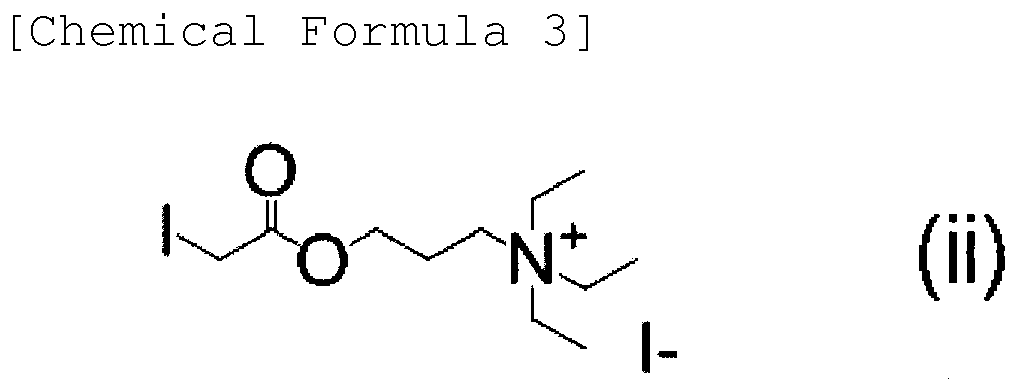
- (10) The thiol probe for a protein according to (8), which is represented by the following formula (ii):

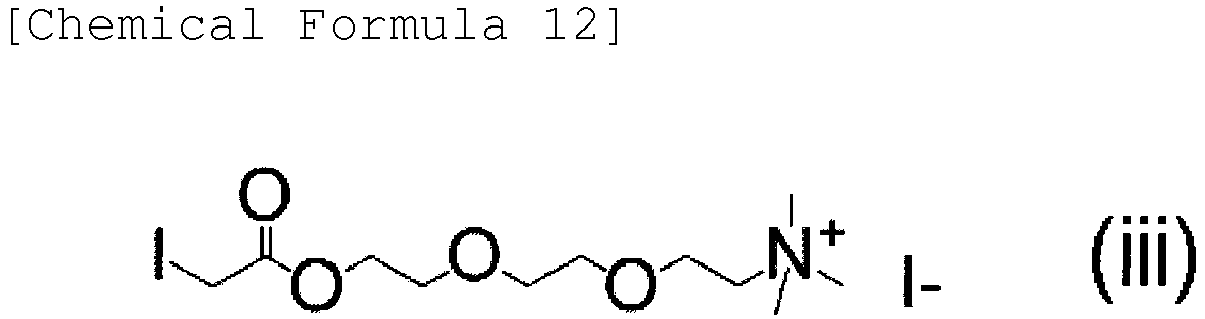
- (11) The thiol probe for a protein according to (8), which is represented by the following formula (iii):

- (12) The thiol probe for a protein according to (5), which is represented by the following formula (iv):

- (13) The thiol probe for a protein according to (5), which is represented by the following formula (v):

- (14) The thiol probe for a protein according to (6), which is represented by the following formula (vi):

- (15) The thiol probe for a protein according to (6), which is represented by the following formula (vii):


- (16) A mass spectrometry method for a protein, comprising the steps of:
- obtaining a modified protein by reacting the thiol probe according to any one of (1) to (15) with a protein; and
- subjecting the modified protein to mass spectrometry.
- In (16), the protein to be reacted with the thiol probe may be a protein having a thiol group generated by reduction treatment.
- According to the present invention, it is possible to provide a probe that further promotes ionization in mass spectrometry, and a high-sensitive mass spectrometry method for a protein. According to the present invention, it is also possible to provide an ionization-enhancing probe that can be used even for a protein that has a high degree of hydrophobicity and quickly turns over, and a high-sensitive mass spectrometry method for a protein using such a probe.
- Specifically, according to the present invention, it is possible to achieve about 2-fold to 200-fold improvement in sensitivity as compared to when only a reductive alkylation step using iodoacetamide, which is used in conventional proteomics to prevent oxidation of thiol groups, is performed.
- Further, unlike a conventional probe having a high degree of hydrophobicity such as ICAT reagent, the probe according to the present invention is molecularly designed so as to reduce the degree of hydrophobicity of the whole molecule, and therefore a protein modified with the probe according to the present invention is more hydrophilic than before modification. Therefore, the probe according to the present invention can be used for a protein having a high degree of hydrophobicity. In addition to this, prevention of oxidation of thiol groups and treatment for enhancing ionization can be achieved at the same time by using, instead of an alkylation agent used in the conventional reductive alkylation step, the probe molecularly designed from the viewpoint of enhancing ionization and improving sensitivity, and a conventional protocol does not need to be changed. Further, the probe according to the present invention can be applied also to a low-abundance peptide that quickly turns over or a hydrophobic protein.
-
- [
Fig.1] Fig. 1 is a graph showing the relative intensities of peaks of an alpha chain detected by mass spectrometry of Insulin samples with addition of each of thiol probes according to the present invention in comparison with a control (peptide with addition of IAA); and a table showing both a ratio relative to the control (Enhanced ratio) and a p-value obtained by statistically evaluating the degree of ionization promotion. - [
Fig.2] Fig. 2 is a graph showing the relative intensities of peaks of a beta chain detected by mass spectrometry of Insulin samples with addition of each of thiol probes according to the present invention in comparison with a control (peptide with addition of IAA); and a table showing both a ratio relative to the control (Enhanced ratio) and a p-value obtained by statistically evaluating the degree of ionization promotion. - [
Fig.3] Fig. 3 is a graph showing the relative intensities of peaks detected by mass spectrometry of NC4 CLAC-P samples with addition of each of thiol probes according to the present invention in comparison with a control (peptide with addition of IAA) ; and a table showing both a ratio relative to the control (Enhanced ratio) and a p-value obtained by statistically evaluating the degree of ionization promotion. - [
Fig.4] Fig. 4 is a graph showing the relative intensities of peaks detected by mass spectrometry of PSA2 samples with addition of each of thiol probes according to the present invention in comparison with a control (peptide with addition of IAA) ; and a table showing both a ratio relative to the control (Enhanced ratio) and a p-value obtained by statistically evaluating the degree of ionization promotion. - [
Fig.5] Fig. 5 is a graph showing the relative intensities of peaks detected by mass spectrometry of S26C Amyloid-beta samples with addition of each of thiol probes according to the present invention in comparison with a control (peptide with addition of IAA); and a table showing both a ratio relative to the control (Enhanced ratio) and a p-value obtained by statistically evaluating the degree of ionization promotion. - A thiol probe according to the present invention has characteristics such that the thiol probe has a structure having reactivity to a thiol group, a structure for reducing the degree of hydrophobicity of the whole molecule, and a structure that is easily protonated, and has no amide group that is a structure complicating a mass spectrum due to the cleavage of a probe itself in multi-stage mass spectrometry.
- Specifically, the structure having reactivity to a thiol group is an iodoacetyl group that minimizes a side reaction to a functional group other than a thiol group (e.g., an amino group) and has high reaction rate selectivity.
- The structure for reducing the degree of hydrophobicity of the whole molecule is an oxygen-containing group.
- The structure that is easily protonated is a nitrogen-containing group.
- More specifically, the thiol probe according to the present invention is represented by the following formula (I), that is, a structural formula having an iodoacetamide group (ICH3CO-), an oxygen-containing group (-OR1-), and a nitrogen-containing group (-R2).

- In the formula (I), R1 represents a linker group. The linker group is, i.e., a bivalent linking group, and is usually a bivalent organic group.
- The bivalent organic group may be a hydrocarbon group having 1 or 2 carbon atoms. If the number of carbon atoms exceeds the above range, the degree of hydrophobicity of the whole molecule becomes high, which tends to make it difficult to sufficiently obtain the effect of enhancing ionization. Alternatively, the bivalent organic group may be an alkylene oxide-containing group having 2 to 6 carbon atoms. The alkylene oxide-containing group is preferably a polyalkylene oxide-containing group. More specifically, an alkylene oxide in the alkylene oxide-containing group is ethylene oxide or propylene oxide.
- For example, the group represented by OR1 is preferably a polyalkylene glycol group. The polyalkylene glycol group may be a group formed by the polymerization of an alkylene glycol having 2 to 6 carbon atoms. In the present invention, the polyalkylene glycol group may be selected from the group consisting of a polyethylene glycol group (a group formed by the polymerization of ethylene glycol) and a polypropylene glycol group (a group formed by the polymerization of 1,2-propanediol or 1,3-propanediol). It is to be noted that the degree of polymerization of glycol in the polyalkylene glycol group may be 2 to 6.
- In the formula (I), R2 represents a nitrogen-containing group. The nitrogen-containing group is a proton acceptor group, and is specifically a substituted ammonium group or a substituted amino group.
- The substituted ammonium group may be a tertiary ammonium group or a quaternary ammonium group. A substituent group in the substituted ammonium group may be an alkyl group having 1 or 2 carbon atoms, or the like. The counter anion of the substituted ammonium group shall be a monovalent halogen anion. For example, the monovalent halogen anion may be Cl-, Br-, I-, or the like.
- The substituted amino group may be a group represented by -NHR3.
- In the group represented by -NHR3, R3 may be a hydrocarbon group having 1 or 2 carbon atoms or a nitrogen-containing group.
- Preferably, R3 may be an optionally substituted amidino group or an optionally substituted triazino group.
- When R3 is an optionally substituted amidino group, i.e., the group represented by -NHR3 is an optionally substituted guanidino group. A substituent group in the optionally substituted amidino group may be an alkyl group having 1 or 2 carbon atoms, or the like.
- A substituent group in the optionally substituted triazino group may be selected from the group consisting of an amino group and an alkoxy group having 1 or 2 carbon atoms.
- The probe according to the present invention is hydrophilic as the whole molecule, and is soluble in water, methanol, and ethanol. Specifically, the probe is preferably soluble in the above solvents at room temperature (e.g., 20°C ± 10°C) at a concentration of 10 mM to 500 mM, 20 mM to 500 mM, or 10 mM to 100 mM.
- More specific examples of the probe are represented by the following formulas (i), (ii), (iii), (iv), (v), (vii), and (vii).




- A protein as an object to which the thiol probe is added is not particularly limited. The protein as an object to which the thiol probe is added broadly refers to an amino acid polymer, and the amino acid polymer is not limited by the number of amino acids polymerized, and therefore the range of molecular weight of the amino acid polymer is not particularly limited. Particularly, in the present invention, the protein is preferably a functional protein. The functional protein is a protein having a specific bioactivity, and examples thereof include hormones, amyloids, cytokines, and the like. The present invention is useful also when the protein as an object to which the thiol probe is added is a protein that has not been subjected to a fragmentation process such as digestion. Further, the effect of the present invention tends to be easily obtained when the molecular weight of the protein is large to some extent or when the protein contains a larger number of cysteine residues. The molecular weight of the object to which the thiol probe is added may usually be in the range of 1 kDa or larger, but may be in the range of, for example, 1.4 kDa or larger, 2 kDa or larger, 2.4 kDa or larger, or 3 kDa or larger. The upper limit of the above range is not particularly limited, but is, for example, 150 kDa.
- The protein as an object to which the thiol probe is added naturally has a thiol group. The thiol group in the protein is usually derived from a cysteine residue. The thiol group is often oxidized to be a sulfino group (-SO2H) or a salt thereof, a sulfo group (-SO3H) or a salt thereof, a disulfide group (-SS-), or the like, and therefore reduction treatment is usually performed to generate a thiol group before the thiol probe is introduced.
- Hereinbelow, the process of modifying a protein with the thiol probe according to the present invention will be illustrated.

- In a cysteine residue, as shown by X in the above formula, a disulfide group (SS bonding), an SO2 - group, or an SO3 - group may be generated. Such a cysteine residue is subjected to, for example, reduction with a reducing agent such as dithiothreitol to generate a thiol group (-SH group), and further the thiol probe (ICH2CO2R1R2) according to the present invention is attached to the thiol group. In this way, a probe-modified protein can be obtained.
- The specific protocol of the above process of reduction and modification with the thiol probe can be easily determined by those skilled in the art in accordance with conventional reductive alkylation. That is, the same protocol as the conventional reductive alkylation can be used except that the thiol probe according to the present invention is used instead of iodoacetamide used in an alkylation process in the conventional method. Specifically, a reaction can be performed using the probe at a concentration of 20 mM to 50 mM at room temperature (e.g., 20°C ± 10°C) for 30 minutes to 60 minutes.
- The protein modified with the thiol probe according to the present invention is subjected to mass spectrometry. Examples of an ion source of a device used in mass spectrometry include an electrospray ion source, a matrix-assisted laser desorption/ionization ion source, and the like. As an analyzer, a magnetic deflection-type analyzer, a quadrupole-type analyzer, an ion trap-type analyzer, a time of flight-type analyzer, a Fourier transform ion cyclotron resonance-type analyzer, or the like can be appropriately combined.
- When a matrix-assisted laser desorption/ionization ion source is used as the ion source, a conventionally-used matrix for a protein, such as α-cyano-4-hydroxycinnamic acid, sinapic acid, or 2,5-dihydroxybenzoic acid, can be used as a matrix.
- Further, a tandem mass spectrometer that can perform multi-stage MSn (n is 2 or more) mass spectrometry is preferably used.
- The thiol probe according to the present invention has the effect of enhancing ionization and is therefore excellent in quantitative property. Therefore, the thiol probe according to the present invention can be also used as a quantification reagent that is a combination of a molecule having a predetermined structure (unlabeled probe) and a molecule having a structure in which some of the constituent atoms of the above molecule are replaced with stable isotopes (stable isotope-labeled probe). Such a quantification reagent can be used for differential analysis.
- Specifically, (1) two protein samples different in state, e.g., protein samples in two different states of a protein sample I to be analyzed and a control protein sample II are prepared, (2) the protein sample I is modified with any one of the unlabeled probe and the stable isotope-labeled probe, and the protein sample II is separately modified with the other of the unlabeled probe and the stable isotope-labeled probe, (3) the modified protein sample I and the modified protein sample II are mixed with each other, and (4) the thus obtained modified protein mixture can be subjected to mass spectrometry without being subjected to a digestion process.
- Hereinbelow, the present invention will be specifically described with reference to an example, but is not limited to the following example.
- 1. The following samples (protein or peptides), reagents, and device were prepared.
- One protein widely used as a model for reductive alkylation of protein; Insulin (Sigma-Aldrich) in which an alpha chain and a beta chain are linked via SS bonds of cysteine:
- alpha chain: GIVEQC CASVCSLYQL ENYCN (SEQ ID NO: 1)
- beta chain: FVNQHL CGSHLVEALY LVCGERGFFY TPKA (SEQ ID NO: 2)
- Three models of a peptide containing only one cysteine;
NC4 CLAC-P (Anaspec)
LGPDGLPMPG CWQK (SEQ ID NO: 3)
PSA2 (Anaspec)
KLQCVDLHV (SEQ ID NO: 4)
S26C Amyloid-beta (17-40) (Anaspec)
LVFFAEDVGC NKGAIIGLMV GGVV (SEQ ID NO: 5) - One internal standard peptide;
P14R (Sigma-Aldrich)
PPPPPPPPPP PPPPR (SEQ ID NO: 6) - Other general-purpose reagents;
ammonium bicarbonate (Fluka)
dithiothreitol (Wako Pure Chemical Industries, Ltd.)
iodoacetamide (Wako Pure Chemical Industries, Ltd.)
α-cyano-4-hydroxycinnamic acid (CHCA) (SHIMADZU GLC Ltd.)
trifluoroacetic acid (Wako Pure Chemical Industries, Ltd.)
acetonitrile (Wako Pure Chemical Industries, Ltd.)
ZipTip C18 (Millipore) - AXIMA® Performance (SHIMADZU CORPORATION)
- 2. The following thiol probes were prepared. The compound ID (compound id), proton acceptor group (group), molecular formula (formula), molecular weight (MW), molecular weight shift by binding to the peptide; delta mass (dM), and structure (structure) of each of the prepared thiol probes are shown below.
[Table 1] compound id group formula MW dM structure CC-02 HI DEAE C9H19I2NO2 427.06 171.24 
CC-02 Q Quaternary-amine C11H23I2NO2 455.11 200.30 
CC-03 Q Quaternary-amine C11H23I2NO4 487.11 232.30 
CC-10 HI Gaunidine C9H19I2N3O4 487.07 231.25 
TOC-06 Triazine C11H17IN4O4 396.18 268.27 
TOC-07 Triazine C11H19IN6O4 426.21 298.30 
TOC-08 Triazine C13H21IN4O6 456.23 328.32 
IAA control C2H4INO 184.96 57.05 
- 2. Each of the protein and peptide samples was treated in the following manner. It is to be noted that amounts expressed as % are based on volume.
- The peptide was dissolved in an aqueous solution containing 0.05% TFA and 50% acetonitrile, and 200-pmol (100 pmol/µL, 2 µL) aliquots were dispensed.
- Ten microliters (10 µL) of an aqueous solution containing 100 mM NH4HCO3 and 10 mM Dithiothreitol was added, and pH was confirmed (the pH was about 8.3).
- Incubation was performed at 56°C for 30 minutes.
- Fifteen microliters (15 µL) of a 50 mM probe solution was added, and the mixture was stirred at room temperature for 30 minutes in a dark place. The solvent of the probe solution was as follows:
- water in the case of CC-02 HI, CC-02 Q, CC-03 Q, CC-10 HI, and IAA and;
- methanol in the case of TOC-06, TOC-07, and TOC-08.
- Five microliters (5 µL) of a 10% aqueous TFA solution was added to terminate reaction.
- Two microliters (2 µL) of the reaction solution was diluted with the following amount of a 0.1% aqueous TFA solution, and then purified by desalting using ZipTip C18:
- twenty microliters (20 µL) of an aqueous TFA solution in the case of CC-02 HI, CC-02 Q, CC-03 Q, CC-10 HI, and IAA and;
- two hundred microliters (200 µL) of an aqueous TFA solution in the case of TOC-06, TOC-07, and TOC-08.
- 3. MS analysis was performed under the following conditions. It is to be noted that amounts expressed as % are based on volume.
- For each of the probes, 12 samples to be subjected to MS were prepared.
- As an internal standard, 0.3 pmol of P14R was added.
- As a matrix, 1 µL of a solution in which 5 mg/ml of CHCA was dissolved in an aqueous solution containing 0.1% TFA and 50% acetonitrile was added per well.
- Mass spectrometry was performed by automatic measurement using raster scanning (300 profile/run).
- The measurement was performed in linear positive mode.
- 4. Data analysis was performed in the following manner.
- A peak in which mass number shift was caused by probe addition was defined as a target peak, and the intensity of the target peak was corrected for the peak intensity of the internal standard P14R.
- The first and second highest values and the first and second lowest values were eliminated as abnormal values (35% trim-mean). It is empirically known that in MALDI MS analysis, a hot spot where an ion is very easily generated is present, and on the other hand, a spot where an ion is hardly generated is present depending on the spot irradiated with laser light. Therefore, it is necessary to determine how to analyze MALDI MS data on the assumption that abnormal values are always present.
- The variation of data (SD value) was determined and the degree of ionization promotion was statistically evaluated (p-value).
- The analysis results of the alpha chain of Insulin, the beta chain of Insulin, NC4 CLAC-P, PSA2, and S26C Amyloid-beta are shown in
Figs. 1 to 5 , respectively. Each ofFigs. 1 to 5 is a graph showing the variation of relative peak intensities observed in each sample for each of the probes used, and a table showing a peak intensity ratio of each sample relative to the control (IAA) (Enhanced ratio) and a p-value determined by statistically evaluating the degree of ionization promotion (p-value). It is to be noted that in each of the tables, E refers to a power of 10, and a negative integer following E is the exponent to thebase 10. - SEQ ID NO: 6 is an artificial polypeptide.


Claims (16)
- A thiol probe for a protein, which is represented by the following formula (I):

- The thiol probe for a protein according to claim 1, wherein the linker group is a hydrocarbon group having 1 to 3 carbon atoms or an alkylene oxide-containing group having 2 to 6 carbon atoms.
- The thiol probe for a protein according to claim 2, wherein an alkylene oxide in the alkylene oxide-containing group is ethylene oxide or propylene oxide.
- The thiol probe for a protein according to any one of claims 1 to 3, wherein the substituted amino group is a group represented by -NHR3, wherein R3 represents a hydrocarbon group or a nitrogen-containing group.
- The thiol probe for a protein according to claim 4, wherein R3 is an amidino group which may be substituted, or a triazino group which may be substituted.
- The thiol probe for a protein according to claim 5, wherein a substituent group in the triazino group which may be substituted is selected from the group consisting of an amino group and an alkoxy group having 1 or 2 carbon atoms.
- The thiol probe for a protein according to claim 5, wherein a substituent group in the amidino group which may be substituted is an alkyl group having 1 or 2 carbon atoms.
- The thiol probe for a protein according to any one of claims 1 to 3, wherein the substituted ammonium group is a tertiary or quaternary ammonium group substituted by an alkyl group having 1 or 2 carbon atoms.
- The thiol probe for a protein according to claim 8, which is represented by the following formula (i):

- The thiol probe for a protein according to claim 8, which is represented by the following formula (ii):
- The thiol probe for a protein according to claim 8, which is represented by the following formula (iii):

- The thiol probe for a protein according to claim 5, which is represented by the following formula (iv):

- The thiol probe for a protein according to claim 5, which is represented by the following formula (v):

- The thiol probe for a protein according to claim 6, which is represented by the following formula (vi):

- The thiol probe for a protein according to claim 6, which is represented by the following formula (vii):

- A mass spectrometry method for a protein, comprising the steps of:obtaining a modified protein by reacting the thiol probe according to any one of claims 1 to 15 with a protein; andsubjecting the modified protein to mass spectrometry.
Applications Claiming Priority (2)
| Application Number | Priority Date | Filing Date | Title |
|---|---|---|---|
| JP2011196958 | 2011-09-09 | ||
| PCT/JP2012/070924 WO2013035513A1 (en) | 2011-09-09 | 2012-08-17 | Hydrophilic thiol probe |
Publications (3)
| Publication Number | Publication Date |
|---|---|
| EP2755024A1 true EP2755024A1 (en) | 2014-07-16 |
| EP2755024A4 EP2755024A4 (en) | 2014-12-24 |
| EP2755024B1 EP2755024B1 (en) | 2019-05-01 |
Family
ID=47831963
Family Applications (1)
| Application Number | Title | Priority Date | Filing Date |
|---|---|---|---|
| EP12830678.4A Not-in-force EP2755024B1 (en) | 2011-09-09 | 2012-08-17 | Hydrophilic thiol probe |
Country Status (4)
| Country | Link |
|---|---|
| US (1) | US9448240B2 (en) |
| EP (1) | EP2755024B1 (en) |
| JP (2) | JP6134646B2 (en) |
| WO (1) | WO2013035513A1 (en) |
Families Citing this family (2)
| Publication number | Priority date | Publication date | Assignee | Title |
|---|---|---|---|---|
| CN103601679B (en) * | 2013-12-04 | 2015-04-22 | 山东大学 | Reduced glutathione fluorescent probe with pyrazoline as maternal body |
| JP2015121500A (en) * | 2013-12-25 | 2015-07-02 | 株式会社島津製作所 | Mass spectroscopy method and mass spectroscope apparatus |
Family Cites Families (6)
| Publication number | Priority date | Publication date | Assignee | Title |
|---|---|---|---|---|
| US6268131B1 (en) * | 1997-12-15 | 2001-07-31 | Sequenom, Inc. | Mass spectrometric methods for sequencing nucleic acids |
| CA2426728A1 (en) * | 2000-10-23 | 2002-06-13 | Genetics Institute, Llc. | Isotope-coded ionization-enhancing reagents (icier) for high-throughput protein identification and quantitation using matrix-assisted laser desorption ionization mass spectrometry |
| WO2002042427A2 (en) * | 2000-10-25 | 2002-05-30 | Surromed, Inc. | Mass tags for quantitative analysis |
| US7563891B2 (en) | 2004-05-21 | 2009-07-21 | Becton, Dickinson & Company | Long wavelength thiol-reactive fluorophores |
| US20110039277A1 (en) * | 2008-04-18 | 2011-02-17 | Pier Mastroberardino | Methods of Labeling Proteins |
| GB0914110D0 (en) * | 2009-08-12 | 2009-09-16 | Medical Res Council | Peptide libraries |
-
2012
- 2012-08-17 EP EP12830678.4A patent/EP2755024B1/en not_active Not-in-force
- 2012-08-17 JP JP2013532520A patent/JP6134646B2/en active Active
- 2012-08-17 US US14/241,728 patent/US9448240B2/en active Active
- 2012-08-17 WO PCT/JP2012/070924 patent/WO2013035513A1/en not_active Ceased
-
2016
- 2016-08-10 JP JP2016157274A patent/JP6135814B2/en active Active
Also Published As
| Publication number | Publication date |
|---|---|
| WO2013035513A1 (en) | 2013-03-14 |
| JP2016212118A (en) | 2016-12-15 |
| US9448240B2 (en) | 2016-09-20 |
| JPWO2013035513A1 (en) | 2015-03-23 |
| US20140212980A1 (en) | 2014-07-31 |
| EP2755024A4 (en) | 2014-12-24 |
| JP6135814B2 (en) | 2017-05-31 |
| EP2755024B1 (en) | 2019-05-01 |
| JP6134646B2 (en) | 2017-05-24 |
Similar Documents
| Publication | Publication Date | Title |
|---|---|---|
| Hardouin | Protein sequence information by matrix‐assisted laser desorption/ionization in‐source decay mass spectrometry | |
| Ashcroft | Protein and peptide identification: the role of mass spectrometry in proteomics | |
| Keller et al. | Interferences and contaminants encountered in modern mass spectrometry | |
| Rebecchi et al. | Label-free quantitation: a new glycoproteomics approach | |
| US20080242838A1 (en) | Labeling reagent and methods of use | |
| Reid et al. | Selective identification and quantitative analysis of methionine containing peptides by charge derivatization and tandem mass spectrometry | |
| US8455818B2 (en) | Mass spectrometry data acquisition mode for obtaining more reliable protein quantitation | |
| US20100093011A1 (en) | Amine-containing compound analysis methods | |
| CN105699476B (en) | A kind of polypeptide deriving method and its application in MALDI TOF MS detect micromolecular compound | |
| EP1415161B1 (en) | Isotope-coded ionization-enhancing reagents (icier) for high-throughput protein identification and quantification using mass spectrometry | |
| US20020001814A1 (en) | Sequencing of peptides by mass spectrometry | |
| Yuan et al. | Detection and analysis of the cyanobacterial peptide hepatotoxins microcystin and nodularin using SELDI-TOF mass spectrometry | |
| US20050224710A1 (en) | Method for measuring hydrophobic peptides using maldi mass spectrometer | |
| EP2755024B1 (en) | Hydrophilic thiol probe | |
| Yang et al. | A new method for analysis of disulfide-containing proteins by matrix-assisted laser desorption ionization (MALDI) mass spectrometry | |
| Bordini et al. | Probing the reactivity of S–S bridges to acrylamide in some proteins under high pH conditions by matrix‐assisted laser desorption/ionisation | |
| Sandoval | Matrix‐assisted laser desorption/ionization time‐of‐flight mass analysis of peptides | |
| EP3109630B1 (en) | Protein detection method using mass spectrometry | |
| Henzel et al. | Matrix‐assisted laser desorption/ionization time‐of‐flight mass analysis of peptides | |
| Liao et al. | Strategy combining separation of isotope-labeled unfolded proteins and matrix-assisted laser desorption/ionization mass spectrometry analysis enables quantification of a wide range of serum proteins | |
| Zhou et al. | A binary matrix for improved detection of phosphopeptides in matrix‐assisted laser desorption/ionization mass spectrometry | |
| EP2529233B1 (en) | Mass spectrometry-based protein identification | |
| EP2950092A1 (en) | Mass spectrometry method using matrix | |
| CN117417405B (en) | Peptide segment labeling method based on tyrosine derivatization and application of peptide segment labeling method in protein detection | |
| Happersberger et al. | A mass spectrometric approach to the characterization of protein folding reactions |
Legal Events
| Date | Code | Title | Description |
|---|---|---|---|
| PUAI | Public reference made under article 153(3) epc to a published international application that has entered the european phase |
Free format text: ORIGINAL CODE: 0009012 |
|
| 17P | Request for examination filed |
Effective date: 20140221 |
|
| AK | Designated contracting states |
Kind code of ref document: A1 Designated state(s): AL AT BE BG CH CY CZ DE DK EE ES FI FR GB GR HR HU IE IS IT LI LT LU LV MC MK MT NL NO PL PT RO RS SE SI SK SM TR |
|
| DAX | Request for extension of the european patent (deleted) | ||
| RIC1 | Information provided on ipc code assigned before grant |
Ipc: G01N 27/62 20060101AFI20141113BHEP |
|
| A4 | Supplementary search report drawn up and despatched |
Effective date: 20141124 |
|
| 17Q | First examination report despatched |
Effective date: 20160223 |
|
| STAA | Information on the status of an ep patent application or granted ep patent |
Free format text: STATUS: EXAMINATION IS IN PROGRESS |
|
| GRAP | Despatch of communication of intention to grant a patent |
Free format text: ORIGINAL CODE: EPIDOSNIGR1 |
|
| STAA | Information on the status of an ep patent application or granted ep patent |
Free format text: STATUS: GRANT OF PATENT IS INTENDED |
|
| INTG | Intention to grant announced |
Effective date: 20181017 |
|
| GRAS | Grant fee paid |
Free format text: ORIGINAL CODE: EPIDOSNIGR3 |
|
| GRAJ | Information related to disapproval of communication of intention to grant by the applicant or resumption of examination proceedings by the epo deleted |
Free format text: ORIGINAL CODE: EPIDOSDIGR1 |
|
| GRAL | Information related to payment of fee for publishing/printing deleted |
Free format text: ORIGINAL CODE: EPIDOSDIGR3 |
|
| STAA | Information on the status of an ep patent application or granted ep patent |
Free format text: STATUS: EXAMINATION IS IN PROGRESS |
|
| GRAR | Information related to intention to grant a patent recorded |
Free format text: ORIGINAL CODE: EPIDOSNIGR71 |
|
| STAA | Information on the status of an ep patent application or granted ep patent |
Free format text: STATUS: GRANT OF PATENT IS INTENDED |
|
| INTC | Intention to grant announced (deleted) | ||
| RAP1 | Party data changed (applicant data changed or rights of an application transferred) |
Owner name: SHIMADZU CORPORATION |
|
| RIN1 | Information on inventor provided before grant (corrected) |
Inventor name: TANAKA, KOICHI Inventor name: SHIMADA, TAKASHI Inventor name: SATO, TAKA-AKI |
|
| GRAA | (expected) grant |
Free format text: ORIGINAL CODE: 0009210 |
|
| STAA | Information on the status of an ep patent application or granted ep patent |
Free format text: STATUS: THE PATENT HAS BEEN GRANTED |
|
| AK | Designated contracting states |
Kind code of ref document: B1 Designated state(s): AL AT BE BG CH CY CZ DE DK EE ES FI FR GB GR HR HU IE IS IT LI LT LU LV MC MK MT NL NO PL PT RO RS SE SI SK SM TR |
|
| INTG | Intention to grant announced |
Effective date: 20190325 |
|
| REG | Reference to a national code |
Ref country code: GB Ref legal event code: FG4D |
|
| RIN1 | Information on inventor provided before grant (corrected) |
Inventor name: TANAKA, KOICHI Inventor name: SHIMADA, TAKASHI Inventor name: SATO, TAKA-AKI |
|
| REG | Reference to a national code |
Ref country code: CH Ref legal event code: EP Ref country code: AT Ref legal event code: REF Ref document number: 1127615 Country of ref document: AT Kind code of ref document: T Effective date: 20190515 |
|
| REG | Reference to a national code |
Ref country code: DE Ref legal event code: R096 Ref document number: 602012059688 Country of ref document: DE |
|
| REG | Reference to a national code |
Ref country code: IE Ref legal event code: FG4D |
|
| REG | Reference to a national code |
Ref country code: NL Ref legal event code: MP Effective date: 20190501 |
|
| REG | Reference to a national code |
Ref country code: LT Ref legal event code: MG4D |
|
| PG25 | Lapsed in a contracting state [announced via postgrant information from national office to epo] |
Ref country code: PT Free format text: LAPSE BECAUSE OF FAILURE TO SUBMIT A TRANSLATION OF THE DESCRIPTION OR TO PAY THE FEE WITHIN THE PRESCRIBED TIME-LIMIT Effective date: 20190901 Ref country code: ES Free format text: LAPSE BECAUSE OF FAILURE TO SUBMIT A TRANSLATION OF THE DESCRIPTION OR TO PAY THE FEE WITHIN THE PRESCRIBED TIME-LIMIT Effective date: 20190501 Ref country code: AL Free format text: LAPSE BECAUSE OF FAILURE TO SUBMIT A TRANSLATION OF THE DESCRIPTION OR TO PAY THE FEE WITHIN THE PRESCRIBED TIME-LIMIT Effective date: 20190501 Ref country code: HR Free format text: LAPSE BECAUSE OF FAILURE TO SUBMIT A TRANSLATION OF THE DESCRIPTION OR TO PAY THE FEE WITHIN THE PRESCRIBED TIME-LIMIT Effective date: 20190501 Ref country code: SE Free format text: LAPSE BECAUSE OF FAILURE TO SUBMIT A TRANSLATION OF THE DESCRIPTION OR TO PAY THE FEE WITHIN THE PRESCRIBED TIME-LIMIT Effective date: 20190501 Ref country code: NO Free format text: LAPSE BECAUSE OF FAILURE TO SUBMIT A TRANSLATION OF THE DESCRIPTION OR TO PAY THE FEE WITHIN THE PRESCRIBED TIME-LIMIT Effective date: 20190801 Ref country code: FI Free format text: LAPSE BECAUSE OF FAILURE TO SUBMIT A TRANSLATION OF THE DESCRIPTION OR TO PAY THE FEE WITHIN THE PRESCRIBED TIME-LIMIT Effective date: 20190501 Ref country code: LT Free format text: LAPSE BECAUSE OF FAILURE TO SUBMIT A TRANSLATION OF THE DESCRIPTION OR TO PAY THE FEE WITHIN THE PRESCRIBED TIME-LIMIT Effective date: 20190501 Ref country code: NL Free format text: LAPSE BECAUSE OF FAILURE TO SUBMIT A TRANSLATION OF THE DESCRIPTION OR TO PAY THE FEE WITHIN THE PRESCRIBED TIME-LIMIT Effective date: 20190501 |
|
| PGFP | Annual fee paid to national office [announced via postgrant information from national office to epo] |
Ref country code: FR Payment date: 20190726 Year of fee payment: 8 Ref country code: DE Payment date: 20190828 Year of fee payment: 8 |
|
| PG25 | Lapsed in a contracting state [announced via postgrant information from national office to epo] |
Ref country code: RS Free format text: LAPSE BECAUSE OF FAILURE TO SUBMIT A TRANSLATION OF THE DESCRIPTION OR TO PAY THE FEE WITHIN THE PRESCRIBED TIME-LIMIT Effective date: 20190501 Ref country code: LV Free format text: LAPSE BECAUSE OF FAILURE TO SUBMIT A TRANSLATION OF THE DESCRIPTION OR TO PAY THE FEE WITHIN THE PRESCRIBED TIME-LIMIT Effective date: 20190501 Ref country code: BG Free format text: LAPSE BECAUSE OF FAILURE TO SUBMIT A TRANSLATION OF THE DESCRIPTION OR TO PAY THE FEE WITHIN THE PRESCRIBED TIME-LIMIT Effective date: 20190801 Ref country code: GR Free format text: LAPSE BECAUSE OF FAILURE TO SUBMIT A TRANSLATION OF THE DESCRIPTION OR TO PAY THE FEE WITHIN THE PRESCRIBED TIME-LIMIT Effective date: 20190802 |
|
| REG | Reference to a national code |
Ref country code: AT Ref legal event code: MK05 Ref document number: 1127615 Country of ref document: AT Kind code of ref document: T Effective date: 20190501 |
|
| PG25 | Lapsed in a contracting state [announced via postgrant information from national office to epo] |
Ref country code: IS Free format text: LAPSE BECAUSE OF FAILURE TO SUBMIT A TRANSLATION OF THE DESCRIPTION OR TO PAY THE FEE WITHIN THE PRESCRIBED TIME-LIMIT Effective date: 20190901 |
|
| PGFP | Annual fee paid to national office [announced via postgrant information from national office to epo] |
Ref country code: GB Payment date: 20190725 Year of fee payment: 8 |
|
| PG25 | Lapsed in a contracting state [announced via postgrant information from national office to epo] |
Ref country code: AT Free format text: LAPSE BECAUSE OF FAILURE TO SUBMIT A TRANSLATION OF THE DESCRIPTION OR TO PAY THE FEE WITHIN THE PRESCRIBED TIME-LIMIT Effective date: 20190501 Ref country code: EE Free format text: LAPSE BECAUSE OF FAILURE TO SUBMIT A TRANSLATION OF THE DESCRIPTION OR TO PAY THE FEE WITHIN THE PRESCRIBED TIME-LIMIT Effective date: 20190501 Ref country code: DK Free format text: LAPSE BECAUSE OF FAILURE TO SUBMIT A TRANSLATION OF THE DESCRIPTION OR TO PAY THE FEE WITHIN THE PRESCRIBED TIME-LIMIT Effective date: 20190501 Ref country code: SK Free format text: LAPSE BECAUSE OF FAILURE TO SUBMIT A TRANSLATION OF THE DESCRIPTION OR TO PAY THE FEE WITHIN THE PRESCRIBED TIME-LIMIT Effective date: 20190501 Ref country code: RO Free format text: LAPSE BECAUSE OF FAILURE TO SUBMIT A TRANSLATION OF THE DESCRIPTION OR TO PAY THE FEE WITHIN THE PRESCRIBED TIME-LIMIT Effective date: 20190501 Ref country code: CZ Free format text: LAPSE BECAUSE OF FAILURE TO SUBMIT A TRANSLATION OF THE DESCRIPTION OR TO PAY THE FEE WITHIN THE PRESCRIBED TIME-LIMIT Effective date: 20190501 |
|
| REG | Reference to a national code |
Ref country code: DE Ref legal event code: R097 Ref document number: 602012059688 Country of ref document: DE |
|
| PG25 | Lapsed in a contracting state [announced via postgrant information from national office to epo] |
Ref country code: IT Free format text: LAPSE BECAUSE OF FAILURE TO SUBMIT A TRANSLATION OF THE DESCRIPTION OR TO PAY THE FEE WITHIN THE PRESCRIBED TIME-LIMIT Effective date: 20190501 Ref country code: SM Free format text: LAPSE BECAUSE OF FAILURE TO SUBMIT A TRANSLATION OF THE DESCRIPTION OR TO PAY THE FEE WITHIN THE PRESCRIBED TIME-LIMIT Effective date: 20190501 |
|
| PLBE | No opposition filed within time limit |
Free format text: ORIGINAL CODE: 0009261 |
|
| STAA | Information on the status of an ep patent application or granted ep patent |
Free format text: STATUS: NO OPPOSITION FILED WITHIN TIME LIMIT |
|
| PG25 | Lapsed in a contracting state [announced via postgrant information from national office to epo] |
Ref country code: TR Free format text: LAPSE BECAUSE OF FAILURE TO SUBMIT A TRANSLATION OF THE DESCRIPTION OR TO PAY THE FEE WITHIN THE PRESCRIBED TIME-LIMIT Effective date: 20190501 |
|
| 26N | No opposition filed |
Effective date: 20200204 |
|
| PG25 | Lapsed in a contracting state [announced via postgrant information from national office to epo] |
Ref country code: PL Free format text: LAPSE BECAUSE OF FAILURE TO SUBMIT A TRANSLATION OF THE DESCRIPTION OR TO PAY THE FEE WITHIN THE PRESCRIBED TIME-LIMIT Effective date: 20190501 |
|
| PG25 | Lapsed in a contracting state [announced via postgrant information from national office to epo] |
Ref country code: SI Free format text: LAPSE BECAUSE OF FAILURE TO SUBMIT A TRANSLATION OF THE DESCRIPTION OR TO PAY THE FEE WITHIN THE PRESCRIBED TIME-LIMIT Effective date: 20190501 Ref country code: CH Free format text: LAPSE BECAUSE OF NON-PAYMENT OF DUE FEES Effective date: 20190831 Ref country code: LI Free format text: LAPSE BECAUSE OF NON-PAYMENT OF DUE FEES Effective date: 20190831 Ref country code: LU Free format text: LAPSE BECAUSE OF NON-PAYMENT OF DUE FEES Effective date: 20190817 Ref country code: MC Free format text: LAPSE BECAUSE OF FAILURE TO SUBMIT A TRANSLATION OF THE DESCRIPTION OR TO PAY THE FEE WITHIN THE PRESCRIBED TIME-LIMIT Effective date: 20190501 |
|
| REG | Reference to a national code |
Ref country code: BE Ref legal event code: MM Effective date: 20190831 |
|
| PG25 | Lapsed in a contracting state [announced via postgrant information from national office to epo] |
Ref country code: IE Free format text: LAPSE BECAUSE OF NON-PAYMENT OF DUE FEES Effective date: 20190817 |
|
| PG25 | Lapsed in a contracting state [announced via postgrant information from national office to epo] |
Ref country code: BE Free format text: LAPSE BECAUSE OF NON-PAYMENT OF DUE FEES Effective date: 20190831 |
|
| REG | Reference to a national code |
Ref country code: DE Ref legal event code: R119 Ref document number: 602012059688 Country of ref document: DE |
|
| GBPC | Gb: european patent ceased through non-payment of renewal fee |
Effective date: 20200817 |
|
| PG25 | Lapsed in a contracting state [announced via postgrant information from national office to epo] |
Ref country code: CY Free format text: LAPSE BECAUSE OF FAILURE TO SUBMIT A TRANSLATION OF THE DESCRIPTION OR TO PAY THE FEE WITHIN THE PRESCRIBED TIME-LIMIT Effective date: 20190501 |
|
| PG25 | Lapsed in a contracting state [announced via postgrant information from national office to epo] |
Ref country code: HU Free format text: LAPSE BECAUSE OF FAILURE TO SUBMIT A TRANSLATION OF THE DESCRIPTION OR TO PAY THE FEE WITHIN THE PRESCRIBED TIME-LIMIT; INVALID AB INITIO Effective date: 20120817 Ref country code: MT Free format text: LAPSE BECAUSE OF FAILURE TO SUBMIT A TRANSLATION OF THE DESCRIPTION OR TO PAY THE FEE WITHIN THE PRESCRIBED TIME-LIMIT Effective date: 20190501 Ref country code: DE Free format text: LAPSE BECAUSE OF NON-PAYMENT OF DUE FEES Effective date: 20210302 Ref country code: FR Free format text: LAPSE BECAUSE OF NON-PAYMENT OF DUE FEES Effective date: 20200831 |
|
| PG25 | Lapsed in a contracting state [announced via postgrant information from national office to epo] |
Ref country code: GB Free format text: LAPSE BECAUSE OF NON-PAYMENT OF DUE FEES Effective date: 20200817 |
|
| PG25 | Lapsed in a contracting state [announced via postgrant information from national office to epo] |
Ref country code: MK Free format text: LAPSE BECAUSE OF FAILURE TO SUBMIT A TRANSLATION OF THE DESCRIPTION OR TO PAY THE FEE WITHIN THE PRESCRIBED TIME-LIMIT Effective date: 20190501 |