EP2754655A2 - Novel compound having angiogenesis inhibitory activity, method for preparing same, and pharmaceutical composition comprising same - Google Patents
Novel compound having angiogenesis inhibitory activity, method for preparing same, and pharmaceutical composition comprising same Download PDFInfo
- Publication number
- EP2754655A2 EP2754655A2 EP20120816890 EP12816890A EP2754655A2 EP 2754655 A2 EP2754655 A2 EP 2754655A2 EP 20120816890 EP20120816890 EP 20120816890 EP 12816890 A EP12816890 A EP 12816890A EP 2754655 A2 EP2754655 A2 EP 2754655A2
- Authority
- EP
- European Patent Office
- Prior art keywords
- ylamino
- nicotinamide
- benzylpiperidin
- chlorophenyl
- pyridine
- Prior art date
- Legal status (The legal status is an assumption and is not a legal conclusion. Google has not performed a legal analysis and makes no representation as to the accuracy of the status listed.)
- Withdrawn
Links
- 150000001875 compounds Chemical class 0.000 title claims abstract description 221
- 230000033115 angiogenesis Effects 0.000 title claims abstract description 24
- 238000000034 method Methods 0.000 title claims description 28
- 239000008194 pharmaceutical composition Substances 0.000 title claims description 12
- 230000002401 inhibitory effect Effects 0.000 title description 9
- 108010073929 Vascular Endothelial Growth Factor A Proteins 0.000 claims abstract description 89
- 102000005789 Vascular Endothelial Growth Factors Human genes 0.000 claims abstract description 89
- 108010019530 Vascular Endothelial Growth Factors Proteins 0.000 claims abstract description 89
- 239000000126 substance Substances 0.000 claims abstract description 54
- 150000003839 salts Chemical class 0.000 claims abstract description 30
- 201000010099 disease Diseases 0.000 claims abstract description 25
- 208000037265 diseases, disorders, signs and symptoms Diseases 0.000 claims abstract description 25
- 230000001594 aberrant effect Effects 0.000 claims abstract description 11
- 230000002265 prevention Effects 0.000 claims abstract description 7
- -1 phenyloxy Chemical group 0.000 claims description 149
- DFPAKSUCGFBDDF-UHFFFAOYSA-N Nicotinamide Chemical compound NC(=O)C1=CC=CN=C1 DFPAKSUCGFBDDF-UHFFFAOYSA-N 0.000 claims description 124
- 235000005152 nicotinamide Nutrition 0.000 claims description 62
- 239000011570 nicotinamide Substances 0.000 claims description 62
- 229960003966 nicotinamide Drugs 0.000 claims description 62
- HEMHJVSKTPXQMS-UHFFFAOYSA-M Sodium hydroxide Chemical compound [OH-].[Na+] HEMHJVSKTPXQMS-UHFFFAOYSA-M 0.000 claims description 35
- 125000004178 (C1-C4) alkyl group Chemical group 0.000 claims description 30
- YNBADRVTZLEFNH-UHFFFAOYSA-N Methyl nicotinate Natural products COC(=O)C1=CC=CN=C1 YNBADRVTZLEFNH-UHFFFAOYSA-N 0.000 claims description 30
- 206010028980 Neoplasm Diseases 0.000 claims description 27
- CTQNGGLPUBDAKN-UHFFFAOYSA-N O-Xylene Chemical compound CC1=CC=CC=C1C CTQNGGLPUBDAKN-UHFFFAOYSA-N 0.000 claims description 22
- BWHMMNNQKKPAPP-UHFFFAOYSA-L potassium carbonate Chemical compound [K+].[K+].[O-]C([O-])=O BWHMMNNQKKPAPP-UHFFFAOYSA-L 0.000 claims description 22
- 201000011510 cancer Diseases 0.000 claims description 19
- ZMANZCXQSJIPKH-UHFFFAOYSA-N Triethylamine Chemical compound CCN(CC)CC ZMANZCXQSJIPKH-UHFFFAOYSA-N 0.000 claims description 18
- 125000005843 halogen group Chemical group 0.000 claims description 15
- 125000001424 substituent group Chemical group 0.000 claims description 15
- OISVCGZHLKNMSJ-UHFFFAOYSA-N 2,6-dimethylpyridine Chemical compound CC1=CC=CC(C)=N1 OISVCGZHLKNMSJ-UHFFFAOYSA-N 0.000 claims description 13
- FJLKVQYKXSXIPA-UHFFFAOYSA-N 2-[(1-benzylpiperidin-4-yl)amino]-n-(3-chlorophenyl)pyridine-3-carboxamide Chemical compound ClC1=CC=CC(NC(=O)C=2C(=NC=CC=2)NC2CCN(CC=3C=CC=CC=3)CC2)=C1 FJLKVQYKXSXIPA-UHFFFAOYSA-N 0.000 claims description 13
- UIIMBOGNXHQVGW-UHFFFAOYSA-M Sodium bicarbonate Chemical compound [Na+].OC([O-])=O UIIMBOGNXHQVGW-UHFFFAOYSA-M 0.000 claims description 13
- 125000001797 benzyl group Chemical group [H]C1=C([H])C([H])=C(C([H])=C1[H])C([H])([H])* 0.000 claims description 12
- 125000001997 phenyl group Chemical group [H]C1=C([H])C([H])=C(*)C([H])=C1[H] 0.000 claims description 12
- 229910000027 potassium carbonate Inorganic materials 0.000 claims description 11
- 235000011121 sodium hydroxide Nutrition 0.000 claims description 11
- 235000011181 potassium carbonates Nutrition 0.000 claims description 10
- KWYUFKZDYYNOTN-UHFFFAOYSA-M Potassium hydroxide Chemical compound [OH-].[K+] KWYUFKZDYYNOTN-UHFFFAOYSA-M 0.000 claims description 9
- YZGIPFORIFDXOR-UHFFFAOYSA-N n-(3-chlorophenyl)-2-[(2,2,6,6-tetramethylpiperidin-4-yl)amino]pyridine-3-carboxamide Chemical compound C1C(C)(C)NC(C)(C)CC1NC1=NC=CC=C1C(=O)NC1=CC=CC(Cl)=C1 YZGIPFORIFDXOR-UHFFFAOYSA-N 0.000 claims description 9
- JUJWROOIHBZHMG-UHFFFAOYSA-N pyridine Substances C1=CC=NC=C1 JUJWROOIHBZHMG-UHFFFAOYSA-N 0.000 claims description 9
- 208000024891 symptom Diseases 0.000 claims description 9
- GQHTUMJGOHRCHB-UHFFFAOYSA-N 2,3,4,6,7,8,9,10-octahydropyrimido[1,2-a]azepine Chemical compound C1CCCCN2CCCN=C21 GQHTUMJGOHRCHB-UHFFFAOYSA-N 0.000 claims description 8
- XHAZLDDYFFJAFK-AWEZNQCLSA-N n-(3-chlorophenyl)-2-[[(3s)-piperidin-3-yl]amino]pyridine-3-carboxamide Chemical compound ClC1=CC=CC(NC(=O)C=2C(=NC=CC=2)N[C@@H]2CNCCC2)=C1 XHAZLDDYFFJAFK-AWEZNQCLSA-N 0.000 claims description 8
- 239000002246 antineoplastic agent Substances 0.000 claims description 7
- JLTDJTHDQAWBAV-UHFFFAOYSA-N N,N-dimethylaniline Chemical compound CN(C)C1=CC=CC=C1 JLTDJTHDQAWBAV-UHFFFAOYSA-N 0.000 claims description 6
- SJRJJKPEHAURKC-UHFFFAOYSA-N N-Methylmorpholine Chemical compound CN1CCOCC1 SJRJJKPEHAURKC-UHFFFAOYSA-N 0.000 claims description 6
- WQDUMFSSJAZKTM-UHFFFAOYSA-N Sodium methoxide Chemical compound [Na+].[O-]C WQDUMFSSJAZKTM-UHFFFAOYSA-N 0.000 claims description 6
- 125000004453 alkoxycarbonyl group Chemical group 0.000 claims description 6
- 125000000217 alkyl group Chemical group 0.000 claims description 6
- GIWCIHLOMDULFX-UHFFFAOYSA-N methyl 2-[[2-[(1-benzylpiperidin-4-yl)amino]-6-chloropyridine-3-carbonyl]amino]-4,5,6,7-tetrahydrothieno[2,3-c]pyridine-3-carboxylate Chemical compound S1C=2CNCCC=2C(C(=O)OC)=C1NC(=O)C1=CC=C(Cl)N=C1NC(CC1)CCN1CC1=CC=CC=C1 GIWCIHLOMDULFX-UHFFFAOYSA-N 0.000 claims description 6
- UPXBEVSWVJASMX-UHFFFAOYSA-N n-(3-chlorophenyl)-2-[[1-(2-hydroxyethyl)piperidin-4-yl]amino]pyridine-3-carboxamide Chemical compound C1CN(CCO)CCC1NC1=NC=CC=C1C(=O)NC1=CC=CC(Cl)=C1 UPXBEVSWVJASMX-UHFFFAOYSA-N 0.000 claims description 6
- 125000004193 piperazinyl group Chemical group 0.000 claims description 6
- UMJSCPRVCHMLSP-UHFFFAOYSA-N pyridine Natural products COC1=CC=CN=C1 UMJSCPRVCHMLSP-UHFFFAOYSA-N 0.000 claims description 6
- 125000004076 pyridyl group Chemical group 0.000 claims description 6
- 125000000714 pyrimidinyl group Chemical group 0.000 claims description 6
- NKSBGDCSEDUUSH-NRFANRHFSA-N 2-[[(3s)-1-benzylpiperidin-3-yl]amino]-n-(3-chlorophenyl)pyridine-3-carboxamide Chemical compound ClC1=CC=CC(NC(=O)C=2C(=NC=CC=2)N[C@@H]2CN(CC=3C=CC=CC=3)CCC2)=C1 NKSBGDCSEDUUSH-NRFANRHFSA-N 0.000 claims description 5
- XWKFPIODWVPXLX-UHFFFAOYSA-N 2-methyl-5-methylpyridine Natural products CC1=CC=C(C)N=C1 XWKFPIODWVPXLX-UHFFFAOYSA-N 0.000 claims description 5
- 208000005590 Choroidal Neovascularization Diseases 0.000 claims description 5
- 206010060823 Choroidal neovascularisation Diseases 0.000 claims description 5
- 206010055665 Corneal neovascularisation Diseases 0.000 claims description 5
- 206010012689 Diabetic retinopathy Diseases 0.000 claims description 5
- 208000010412 Glaucoma Diseases 0.000 claims description 5
- 206010020565 Hyperaemia Diseases 0.000 claims description 5
- 208000008589 Obesity Diseases 0.000 claims description 5
- 201000004681 Psoriasis Diseases 0.000 claims description 5
- 201000000159 corneal neovascularization Diseases 0.000 claims description 5
- 125000001495 ethyl group Chemical group [H]C([H])([H])C([H])([H])* 0.000 claims description 5
- 201000011066 hemangioma Diseases 0.000 claims description 5
- 229910052740 iodine Inorganic materials 0.000 claims description 5
- 206010023332 keratitis Diseases 0.000 claims description 5
- 208000002780 macular degeneration Diseases 0.000 claims description 5
- RHZYSFNZOVGYRI-UHFFFAOYSA-N n-(3-chlorophenyl)-2-(piperidin-4-ylamino)pyridine-3-carboxamide Chemical compound ClC1=CC=CC(NC(=O)C=2C(=NC=CC=2)NC2CCNCC2)=C1 RHZYSFNZOVGYRI-UHFFFAOYSA-N 0.000 claims description 5
- 201000003142 neovascular glaucoma Diseases 0.000 claims description 5
- 235000020824 obesity Nutrition 0.000 claims description 5
- 125000003386 piperidinyl group Chemical group 0.000 claims description 5
- 206010039073 rheumatoid arthritis Diseases 0.000 claims description 5
- 229910000030 sodium bicarbonate Inorganic materials 0.000 claims description 5
- 235000017557 sodium bicarbonate Nutrition 0.000 claims description 5
- PAMIQIKDUOTOBW-UHFFFAOYSA-N 1-methylpiperidine Chemical compound CN1CCCCC1 PAMIQIKDUOTOBW-UHFFFAOYSA-N 0.000 claims description 4
- YXEGDMHWZZQEFR-UHFFFAOYSA-N 2-[[2-[(1-benzylpiperidin-4-yl)amino]pyridine-3-carbonyl]amino]-4,5,6,7-tetrahydrothieno[2,3-c]pyridine-3-carboxylic acid Chemical compound C(C1=CC=CC=C1)N1CCC(CC1)NC1=NC=CC=C1C(=O)NC1=C(C2=C(CNCC2)S1)C(=O)O YXEGDMHWZZQEFR-UHFFFAOYSA-N 0.000 claims description 4
- 125000004179 3-chlorophenyl group Chemical group [H]C1=C([H])C(*)=C([H])C(Cl)=C1[H] 0.000 claims description 4
- VHYFNPMBLIVWCW-UHFFFAOYSA-N 4-Dimethylaminopyridine Chemical compound CN(C)C1=CC=NC=C1 VHYFNPMBLIVWCW-UHFFFAOYSA-N 0.000 claims description 4
- JGFZNNIVVJXRND-UHFFFAOYSA-N N,N-Diisopropylethylamine (DIPEA) Chemical compound CCN(C(C)C)C(C)C JGFZNNIVVJXRND-UHFFFAOYSA-N 0.000 claims description 4
- CDBYLPFSWZWCQE-UHFFFAOYSA-L Sodium Carbonate Chemical compound [Na+].[Na+].[O-]C([O-])=O CDBYLPFSWZWCQE-UHFFFAOYSA-L 0.000 claims description 4
- 210000004072 lung Anatomy 0.000 claims description 4
- OFYAEOQTEDAKMU-UHFFFAOYSA-N methyl 6-[[2-[(1-benzylpiperidin-4-yl)amino]pyridine-3-carbonyl]amino]pyridine-3-carboxylate Chemical compound N1=CC(C(=O)OC)=CC=C1NC(=O)C1=CC=CN=C1NC1CCN(CC=2C=CC=CC=2)CC1 OFYAEOQTEDAKMU-UHFFFAOYSA-N 0.000 claims description 4
- SEBNWISBTCULDK-UHFFFAOYSA-N n-(3,3-dimethyl-1,2-dihydroindol-6-yl)-2-(4-phenoxyanilino)pyridine-3-carboxamide Chemical compound C=1C=C2C(C)(C)CNC2=CC=1NC(=O)C1=CC=CN=C1NC(C=C1)=CC=C1OC1=CC=CC=C1 SEBNWISBTCULDK-UHFFFAOYSA-N 0.000 claims description 4
- XHAZLDDYFFJAFK-CQSZACIVSA-N n-(3-chlorophenyl)-2-[[(3r)-piperidin-3-yl]amino]pyridine-3-carboxamide Chemical compound ClC1=CC=CC(NC(=O)C=2C(=NC=CC=2)N[C@H]2CNCCC2)=C1 XHAZLDDYFFJAFK-CQSZACIVSA-N 0.000 claims description 4
- PIYAVZJWTDEPQP-UHFFFAOYSA-N n-(3-chlorophenyl)-2-[[1-(2-hydroxyethyl)-2,2,6,6-tetramethylpiperidin-4-yl]amino]pyridine-3-carboxamide Chemical compound C1C(C)(C)N(CCO)C(C)(C)CC1NC1=NC=CC=C1C(=O)NC1=CC=CC(Cl)=C1 PIYAVZJWTDEPQP-UHFFFAOYSA-N 0.000 claims description 4
- NBVPPFJFAATNQZ-UHFFFAOYSA-N n-(3-chlorophenyl)-2-[[1-[(2-methylpropan-2-yl)oxycarbamoyl]piperidin-4-yl]amino]pyridine-3-carboxamide Chemical compound C1CN(C(=O)NOC(C)(C)C)CCC1NC1=NC=CC=C1C(=O)NC1=CC=CC(Cl)=C1 NBVPPFJFAATNQZ-UHFFFAOYSA-N 0.000 claims description 4
- 230000000414 obstructive effect Effects 0.000 claims description 4
- 125000004483 piperidin-3-yl group Chemical group N1CC(CCC1)* 0.000 claims description 4
- 125000004482 piperidin-4-yl group Chemical group N1CCC(CC1)* 0.000 claims description 4
- MFRIHAYPQRLWNB-UHFFFAOYSA-N sodium tert-butoxide Chemical compound [Na+].CC(C)(C)[O-] MFRIHAYPQRLWNB-UHFFFAOYSA-N 0.000 claims description 4
- 125000003396 thiol group Chemical group [H]S* 0.000 claims description 4
- 230000007998 vessel formation Effects 0.000 claims description 4
- 239000008096 xylene Substances 0.000 claims description 4
- PGNRLPTYNKQQDY-UHFFFAOYSA-N 2,3-dihydroxyindole Chemical group C1=CC=C2C(O)=C(O)NC2=C1 PGNRLPTYNKQQDY-UHFFFAOYSA-N 0.000 claims description 3
- NKSBGDCSEDUUSH-OAQYLSRUSA-N 2-[[(3r)-1-benzylpiperidin-3-yl]amino]-n-(3-chlorophenyl)pyridine-3-carboxamide Chemical compound ClC1=CC=CC(NC(=O)C=2C(=NC=CC=2)N[C@H]2CN(CC=3C=CC=CC=3)CCC2)=C1 NKSBGDCSEDUUSH-OAQYLSRUSA-N 0.000 claims description 3
- WBWBXIMGJPMJHT-UHFFFAOYSA-N 2-[[2-[(1-benzylpiperidin-3-yl)amino]pyridine-3-carbonyl]amino]-4,5,6,7-tetrahydrothieno[2,3-c]pyridine-3-carboxylic acid Chemical compound C(C1=CC=CC=C1)N1CC(CCC1)NC1=NC=CC=C1C(=O)NC1=C(C2=C(CNCC2)S1)C(=O)O WBWBXIMGJPMJHT-UHFFFAOYSA-N 0.000 claims description 3
- 150000001336 alkenes Chemical class 0.000 claims description 3
- 125000004466 alkoxycarbonylamino group Chemical group 0.000 claims description 3
- 229910052794 bromium Inorganic materials 0.000 claims description 3
- 229910052801 chlorine Inorganic materials 0.000 claims description 3
- 229910052731 fluorine Inorganic materials 0.000 claims description 3
- 229910052736 halogen Inorganic materials 0.000 claims description 3
- 150000002367 halogens Chemical group 0.000 claims description 3
- 125000004435 hydrogen atom Chemical group [H]* 0.000 claims description 3
- 125000002887 hydroxy group Chemical group [H]O* 0.000 claims description 3
- 125000002757 morpholinyl group Chemical group 0.000 claims description 3
- RKLDPFJBWGDIBT-MRXNPFEDSA-N n-(3-chlorophenyl)-2-[[(3r)-1-(2-hydroxyethyl)piperidin-3-yl]amino]pyridine-3-carboxamide Chemical compound C1N(CCO)CCC[C@H]1NC1=NC=CC=C1C(=O)NC1=CC=CC(Cl)=C1 RKLDPFJBWGDIBT-MRXNPFEDSA-N 0.000 claims description 3
- RKLDPFJBWGDIBT-INIZCTEOSA-N n-(3-chlorophenyl)-2-[[(3s)-1-(2-hydroxyethyl)piperidin-3-yl]amino]pyridine-3-carboxamide Chemical compound C1N(CCO)CCC[C@@H]1NC1=NC=CC=C1C(=O)NC1=CC=CC(Cl)=C1 RKLDPFJBWGDIBT-INIZCTEOSA-N 0.000 claims description 3
- 125000000449 nitro group Chemical group [O-][N+](*)=O 0.000 claims description 3
- 125000000951 phenoxy group Chemical group [H]C1=C([H])C([H])=C(O*)C([H])=C1[H] 0.000 claims description 3
- 235000011118 potassium hydroxide Nutrition 0.000 claims description 3
- 125000002924 primary amino group Chemical group [H]N([H])* 0.000 claims description 3
- 125000000719 pyrrolidinyl group Chemical group 0.000 claims description 3
- 239000012279 sodium borohydride Substances 0.000 claims description 3
- 229910000033 sodium borohydride Inorganic materials 0.000 claims description 3
- WNFDWTMSUKSINL-UHFFFAOYSA-N tert-butyl n-[[2-[(1-benzylpiperidin-4-yl)amino]pyridine-3-carbonyl]amino]carbamate Chemical compound CC(C)(C)OC(=O)NNC(=O)C1=CC=CN=C1NC1CCN(CC=2C=CC=CC=2)CC1 WNFDWTMSUKSINL-UHFFFAOYSA-N 0.000 claims description 3
- 125000000335 thiazolyl group Chemical group 0.000 claims description 3
- IMALCIGSHZIPCJ-UHFFFAOYSA-N 2-[[2-[(1-benzylpiperidin-3-yl)amino]-6-chloro-5-fluoropyridine-3-carbonyl]amino]-4,5,6,7-tetrahydrothieno[2,3-c]pyridine-3-carboxylic acid Chemical compound C(C1=CC=CC=C1)N1CC(CCC1)NC1=NC(=C(C=C1C(=O)NC1=C(C2=C(CNCC2)S1)C(=O)O)F)Cl IMALCIGSHZIPCJ-UHFFFAOYSA-N 0.000 claims description 2
- FEKPWGPTJNHISC-UHFFFAOYSA-N 2-[[2-[(1-benzylpiperidin-3-yl)amino]-6-chloropyridine-3-carbonyl]amino]-4,5,6,7-tetrahydrothieno[2,3-c]pyridine-3-carboxylic acid Chemical compound C(C1=CC=CC=C1)N1CC(CCC1)NC1=NC(=CC=C1C(=O)NC1=C(C2=C(CNCC2)S1)C(=O)O)Cl FEKPWGPTJNHISC-UHFFFAOYSA-N 0.000 claims description 2
- DUGOVMMSTTVOBN-UHFFFAOYSA-N 2-[[2-[(1-benzylpiperidin-4-yl)amino]-6-chloropyridine-3-carbonyl]amino]-4,5,6,7-tetrahydrothieno[2,3-c]pyridine-3-carboxylic acid Chemical compound C(C1=CC=CC=C1)N1CCC(CC1)NC1=NC(=CC=C1C(=O)NC1=C(C2=C(CNCC2)S1)C(=O)O)Cl DUGOVMMSTTVOBN-UHFFFAOYSA-N 0.000 claims description 2
- YMJKDOAFVNFKDY-UHFFFAOYSA-N 2-[[2-[(2,2,6,6-tetramethylpiperidin-4-yl)amino]pyridine-3-carbonyl]amino]-4,5,6,7-tetrahydrothieno[2,3-c]pyridine-3-carboxylic acid Chemical compound CC1(NC(CC(C1)NC1=NC=CC=C1C(=O)NC1=C(C2=C(CNCC2)S1)C(=O)O)(C)C)C YMJKDOAFVNFKDY-UHFFFAOYSA-N 0.000 claims description 2
- ZRYADICXXMYUQX-UHFFFAOYSA-N 2-[[2-[[1-(2-hydroxyethyl)piperidin-4-yl]amino]pyridine-3-carbonyl]amino]-4,5,6,7-tetrahydrothieno[2,3-c]pyridine-3-carboxylic acid Chemical compound OCCN1CCC(CC1)NC1=NC=CC=C1C(=O)NC1=C(C2=C(CNCC2)S1)C(=O)O ZRYADICXXMYUQX-UHFFFAOYSA-N 0.000 claims description 2
- IYICFHJJZMKOHV-UHFFFAOYSA-N 2-[[6-chloro-2-[(2,2,6,6-tetramethylpiperidin-4-yl)amino]pyridine-3-carbonyl]amino]-4,5,6,7-tetrahydrothieno[2,3-c]pyridine-3-carboxylic acid Chemical compound CC1(NC(CC(C1)NC1=NC(=CC=C1C(=O)NC1=C(C2=C(CNCC2)S1)C(=O)O)Cl)(C)C)C IYICFHJJZMKOHV-UHFFFAOYSA-N 0.000 claims description 2
- QSEHWMZULCYDRP-UHFFFAOYSA-N 2-[[6-chloro-2-[[1-(2-hydroxyethyl)piperidin-4-yl]amino]pyridine-3-carbonyl]amino]-4,5,6,7-tetrahydrothieno[2,3-c]pyridine-3-carboxylic acid Chemical compound ClC1=CC=C(C(=N1)NC1CCN(CC1)CCO)C(=O)NC1=C(C2=C(CNCC2)S1)C(=O)O QSEHWMZULCYDRP-UHFFFAOYSA-N 0.000 claims description 2
- ABQSJCRDYGDEGU-UHFFFAOYSA-N 2-[[6-chloro-5-fluoro-2-[(2,2,6,6-tetramethylpiperidin-4-yl)amino]pyridine-3-carbonyl]amino]-4,5,6,7-tetrahydrothieno[2,3-c]pyridine-3-carboxylic acid Chemical compound ClC1=C(C=C(C(=N1)NC1CC(NC(C1)(C)C)(C)C)C(=O)NC1=C(C2=C(CNCC2)S1)C(=O)O)F ABQSJCRDYGDEGU-UHFFFAOYSA-N 0.000 claims description 2
- MCVIBTAGWDJXLV-UHFFFAOYSA-N 2-[[6-chloro-5-fluoro-2-[[1-(2-hydroxyethyl)piperidin-4-yl]amino]pyridine-3-carbonyl]amino]-4,5,6,7-tetrahydrothieno[2,3-c]pyridine-3-carboxylic acid Chemical compound ClC1=C(C=C(C(=N1)NC1CCN(CC1)CCO)C(=O)NC1=C(C2=C(CNCC2)S1)C(=O)O)F MCVIBTAGWDJXLV-UHFFFAOYSA-N 0.000 claims description 2
- 125000004200 2-methoxyethyl group Chemical group [H]C([H])([H])OC([H])([H])C([H])([H])* 0.000 claims description 2
- 125000004176 4-fluorobenzyl group Chemical group [H]C1=C([H])C(=C([H])C([H])=C1F)C([H])([H])* 0.000 claims description 2
- GIULFQVEZHVPKG-UHFFFAOYSA-N 6-benzyl-2-[[2-[(1-benzylpiperidin-4-yl)amino]pyridine-3-carbonyl]amino]-5,7-dihydro-4H-thieno[2,3-c]pyridine-3-carboxylic acid Chemical compound C(C1=CC=CC=C1)N1CC2=C(CC1)C(=C(S2)NC(=O)C=1C(=NC=CC=1)NC1CCN(CC1)CC1=CC=CC=C1)C(=O)O GIULFQVEZHVPKG-UHFFFAOYSA-N 0.000 claims description 2
- KEAYESYHFKHZAL-UHFFFAOYSA-N Sodium Chemical compound [Na] KEAYESYHFKHZAL-UHFFFAOYSA-N 0.000 claims description 2
- RQPZNWPYLFFXCP-UHFFFAOYSA-L barium dihydroxide Chemical compound [OH-].[OH-].[Ba+2] RQPZNWPYLFFXCP-UHFFFAOYSA-L 0.000 claims description 2
- 229910001863 barium hydroxide Inorganic materials 0.000 claims description 2
- 125000001246 bromo group Chemical group Br* 0.000 claims description 2
- AXCZMVOFGPJBDE-UHFFFAOYSA-L calcium dihydroxide Chemical compound [OH-].[OH-].[Ca+2] AXCZMVOFGPJBDE-UHFFFAOYSA-L 0.000 claims description 2
- 239000000920 calcium hydroxide Substances 0.000 claims description 2
- 229910001861 calcium hydroxide Inorganic materials 0.000 claims description 2
- 235000011116 calcium hydroxide Nutrition 0.000 claims description 2
- 125000001309 chloro group Chemical group Cl* 0.000 claims description 2
- 230000005764 inhibitory process Effects 0.000 claims description 2
- 229940078552 o-xylene Drugs 0.000 claims description 2
- 239000011736 potassium bicarbonate Substances 0.000 claims description 2
- 235000015497 potassium bicarbonate Nutrition 0.000 claims description 2
- 229910000028 potassium bicarbonate Inorganic materials 0.000 claims description 2
- NTTOTNSKUYCDAV-UHFFFAOYSA-N potassium hydride Chemical compound [KH] NTTOTNSKUYCDAV-UHFFFAOYSA-N 0.000 claims description 2
- 229910000105 potassium hydride Inorganic materials 0.000 claims description 2
- TYJJADVDDVDEDZ-UHFFFAOYSA-M potassium hydrogencarbonate Chemical compound [K+].OC([O-])=O TYJJADVDDVDEDZ-UHFFFAOYSA-M 0.000 claims description 2
- 229940086066 potassium hydrogencarbonate Drugs 0.000 claims description 2
- LPNYRYFBWFDTMA-UHFFFAOYSA-N potassium tert-butoxide Chemical compound [K+].CC(C)(C)[O-] LPNYRYFBWFDTMA-UHFFFAOYSA-N 0.000 claims description 2
- 229910000029 sodium carbonate Inorganic materials 0.000 claims description 2
- 235000017550 sodium carbonate Nutrition 0.000 claims description 2
- BEOOHQFXGBMRKU-UHFFFAOYSA-N sodium cyanoborohydride Chemical compound [Na+].[B-]C#N BEOOHQFXGBMRKU-UHFFFAOYSA-N 0.000 claims description 2
- QDRKDTQENPPHOJ-UHFFFAOYSA-N sodium ethoxide Chemical compound [Na+].CC[O-] QDRKDTQENPPHOJ-UHFFFAOYSA-N 0.000 claims description 2
- 239000012312 sodium hydride Substances 0.000 claims description 2
- 229910000104 sodium hydride Inorganic materials 0.000 claims description 2
- 150000002148 esters Chemical class 0.000 claims 1
- 238000002360 preparation method Methods 0.000 abstract description 206
- 239000000203 mixture Substances 0.000 abstract description 14
- 239000004037 angiogenesis inhibitor Substances 0.000 abstract description 11
- 230000001772 anti-angiogenic effect Effects 0.000 abstract description 2
- HEDRZPFGACZZDS-MICDWDOJSA-N Trichloro(2H)methane Chemical compound [2H]C(Cl)(Cl)Cl HEDRZPFGACZZDS-MICDWDOJSA-N 0.000 description 168
- 238000005160 1H NMR spectroscopy Methods 0.000 description 98
- XEKOWRVHYACXOJ-UHFFFAOYSA-N Ethyl acetate Chemical compound CCOC(C)=O XEKOWRVHYACXOJ-UHFFFAOYSA-N 0.000 description 45
- 210000004027 cell Anatomy 0.000 description 42
- 239000000243 solution Substances 0.000 description 40
- YMWUJEATGCHHMB-UHFFFAOYSA-N Dichloromethane Chemical compound ClCCl YMWUJEATGCHHMB-UHFFFAOYSA-N 0.000 description 30
- XLYOFNOQVPJJNP-UHFFFAOYSA-N water Chemical compound O XLYOFNOQVPJJNP-UHFFFAOYSA-N 0.000 description 29
- 239000011541 reaction mixture Substances 0.000 description 26
- 230000002829 reductive effect Effects 0.000 description 25
- 238000010992 reflux Methods 0.000 description 25
- YUBDLZGUSSWQSS-UHFFFAOYSA-N 1-benzylpiperidin-4-amine Chemical compound C1CC(N)CCN1CC1=CC=CC=C1 YUBDLZGUSSWQSS-UHFFFAOYSA-N 0.000 description 24
- LFQSCWFLJHTTHZ-UHFFFAOYSA-N Ethanol Chemical compound CCO LFQSCWFLJHTTHZ-UHFFFAOYSA-N 0.000 description 24
- 239000002147 L01XE04 - Sunitinib Substances 0.000 description 24
- WINHZLLDWRZWRT-ATVHPVEESA-N sunitinib Chemical compound CCN(CC)CCNC(=O)C1=C(C)NC(\C=C/2C3=CC(F)=CC=C3NC\2=O)=C1C WINHZLLDWRZWRT-ATVHPVEESA-N 0.000 description 24
- 229960001796 sunitinib Drugs 0.000 description 24
- JHSPPBBJOLKJDH-UHFFFAOYSA-N [4-[(4-fluorophenyl)methyl]morpholin-2-yl]methanamine Chemical compound C1COC(CN)CN1CC1=CC=C(F)C=C1 JHSPPBBJOLKJDH-UHFFFAOYSA-N 0.000 description 21
- IAZDPXIOMUYVGZ-WFGJKAKNSA-N Dimethyl sulfoxide Chemical compound [2H]C([2H])([2H])S(=O)C([2H])([2H])[2H] IAZDPXIOMUYVGZ-WFGJKAKNSA-N 0.000 description 18
- VLKZOEOYAKHREP-UHFFFAOYSA-N n-Hexane Chemical compound CCCCCC VLKZOEOYAKHREP-UHFFFAOYSA-N 0.000 description 18
- 238000012360 testing method Methods 0.000 description 18
- CSCPPACGZOOCGX-UHFFFAOYSA-N Acetone Chemical compound CC(C)=O CSCPPACGZOOCGX-UHFFFAOYSA-N 0.000 description 15
- 230000000694 effects Effects 0.000 description 15
- 229940093499 ethyl acetate Drugs 0.000 description 15
- 235000019439 ethyl acetate Nutrition 0.000 description 15
- NMWIFNPFFNFXPB-UHFFFAOYSA-N 2-(4-aminopiperidin-1-yl)ethanol Chemical compound NC1CCN(CCO)CC1 NMWIFNPFFNFXPB-UHFFFAOYSA-N 0.000 description 14
- VEXZGXHMUGYJMC-UHFFFAOYSA-N Hydrochloric acid Chemical compound Cl VEXZGXHMUGYJMC-UHFFFAOYSA-N 0.000 description 14
- 238000006243 chemical reaction Methods 0.000 description 14
- WEVYAHXRMPXWCK-UHFFFAOYSA-N Acetonitrile Chemical compound CC#N WEVYAHXRMPXWCK-UHFFFAOYSA-N 0.000 description 12
- HEDRZPFGACZZDS-UHFFFAOYSA-N Chloroform Chemical compound ClC(Cl)Cl HEDRZPFGACZZDS-UHFFFAOYSA-N 0.000 description 12
- OKKJLVBELUTLKV-UHFFFAOYSA-N Methanol Chemical compound OC OKKJLVBELUTLKV-UHFFFAOYSA-N 0.000 description 12
- 230000005012 migration Effects 0.000 description 11
- 238000013508 migration Methods 0.000 description 11
- OKKJLVBELUTLKV-MZCSYVLQSA-N Deuterated methanol Chemical compound [2H]OC([2H])([2H])[2H] OKKJLVBELUTLKV-MZCSYVLQSA-N 0.000 description 10
- ZMXDDKWLCZADIW-UHFFFAOYSA-N N,N-Dimethylformamide Chemical compound CN(C)C=O ZMXDDKWLCZADIW-UHFFFAOYSA-N 0.000 description 10
- FAPWRFPIFSIZLT-UHFFFAOYSA-M Sodium chloride Chemical compound [Na+].[Cl-] FAPWRFPIFSIZLT-UHFFFAOYSA-M 0.000 description 10
- 230000015572 biosynthetic process Effects 0.000 description 10
- 239000002274 desiccant Substances 0.000 description 10
- 229940073584 methylene chloride Drugs 0.000 description 10
- YFGNIWLKSIIHMZ-UHFFFAOYSA-N 2-chloro-n-(3-chlorophenyl)pyridine-3-carboxamide Chemical compound ClC1=CC=CC(NC(=O)C=2C(=NC=CC=2)Cl)=C1 YFGNIWLKSIIHMZ-UHFFFAOYSA-N 0.000 description 9
- PNPCRKVUWYDDST-UHFFFAOYSA-N 3-chloroaniline Chemical compound NC1=CC=CC(Cl)=C1 PNPCRKVUWYDDST-UHFFFAOYSA-N 0.000 description 9
- RTZKZFJDLAIYFH-UHFFFAOYSA-N Diethyl ether Chemical compound CCOCC RTZKZFJDLAIYFH-UHFFFAOYSA-N 0.000 description 9
- 239000007864 aqueous solution Substances 0.000 description 9
- 239000012071 phase Substances 0.000 description 9
- 238000000746 purification Methods 0.000 description 9
- 239000002904 solvent Substances 0.000 description 9
- FTVFPPFZRRKJIH-UHFFFAOYSA-N 2,2,6,6-tetramethylpiperidin-4-amine Chemical compound CC1(C)CC(N)CC(C)(C)N1 FTVFPPFZRRKJIH-UHFFFAOYSA-N 0.000 description 8
- 229940121369 angiogenesis inhibitor Drugs 0.000 description 8
- 230000012010 growth Effects 0.000 description 8
- 230000035755 proliferation Effects 0.000 description 8
- HARWNWOLWMTQCC-UHFFFAOYSA-N 1-benzylpiperidin-3-amine Chemical compound C1C(N)CCCN1CC1=CC=CC=C1 HARWNWOLWMTQCC-UHFFFAOYSA-N 0.000 description 7
- RXTRRIFWCJEMEL-UHFFFAOYSA-N 2-chloropyridine-3-carbonyl chloride Chemical compound ClC(=O)C1=CC=CN=C1Cl RXTRRIFWCJEMEL-UHFFFAOYSA-N 0.000 description 7
- 239000010410 layer Substances 0.000 description 7
- 239000012528 membrane Substances 0.000 description 7
- 238000010898 silica gel chromatography Methods 0.000 description 7
- 238000003756 stirring Methods 0.000 description 7
- OQMHOEPQPXSZDQ-UHFFFAOYSA-N 6-o-tert-butyl 3-o-methyl 2-[(2,6-dichloropyridine-3-carbonyl)amino]-5,7-dihydro-4h-thieno[2,3-c]pyridine-3,6-dicarboxylate Chemical compound S1C=2CN(C(=O)OC(C)(C)C)CCC=2C(C(=O)OC)=C1NC(=O)C1=CC=C(Cl)N=C1Cl OQMHOEPQPXSZDQ-UHFFFAOYSA-N 0.000 description 6
- KFZMGEQAYNKOFK-UHFFFAOYSA-N Isopropanol Chemical compound CC(C)O KFZMGEQAYNKOFK-UHFFFAOYSA-N 0.000 description 6
- 102100033177 Vascular endothelial growth factor receptor 2 Human genes 0.000 description 6
- 230000012292 cell migration Effects 0.000 description 6
- VEEGZPWAAPPXRB-BJMVGYQFSA-N (3e)-3-(1h-imidazol-5-ylmethylidene)-1h-indol-2-one Chemical compound O=C1NC2=CC=CC=C2\C1=C/C1=CN=CN1 VEEGZPWAAPPXRB-BJMVGYQFSA-N 0.000 description 5
- WWHRLJBKSQUGHN-UHFFFAOYSA-N 2,6-dichloro-n-(2-ethylhexyl)pyridine-3-carboxamide Chemical compound CCCCC(CC)CNC(=O)C1=CC=C(Cl)N=C1Cl WWHRLJBKSQUGHN-UHFFFAOYSA-N 0.000 description 5
- LDLCZOVUSADOIV-UHFFFAOYSA-N 2-bromoethanol Chemical compound OCCBr LDLCZOVUSADOIV-UHFFFAOYSA-N 0.000 description 5
- 206010027476 Metastases Diseases 0.000 description 5
- 102100028452 Nitric oxide synthase, endothelial Human genes 0.000 description 5
- 230000004913 activation Effects 0.000 description 5
- 150000001499 aryl bromides Chemical class 0.000 description 5
- LOKCTEFSRHRXRJ-UHFFFAOYSA-I dipotassium trisodium dihydrogen phosphate hydrogen phosphate dichloride Chemical compound P(=O)(O)(O)[O-].[K+].P(=O)(O)([O-])[O-].[Na+].[Na+].[Cl-].[K+].[Cl-].[Na+] LOKCTEFSRHRXRJ-UHFFFAOYSA-I 0.000 description 5
- 239000003814 drug Substances 0.000 description 5
- 239000002953 phosphate buffered saline Substances 0.000 description 5
- 235000018102 proteins Nutrition 0.000 description 5
- 102000004169 proteins and genes Human genes 0.000 description 5
- 108090000623 proteins and genes Proteins 0.000 description 5
- YLOJXVHUQSXVDK-UHFFFAOYSA-N 2,6-dichloro-3-(chloromethyl)-5-fluoropyridine Chemical compound FC1=CC(CCl)=C(Cl)N=C1Cl YLOJXVHUQSXVDK-UHFFFAOYSA-N 0.000 description 4
- CMPPTKONDXHDBF-UHFFFAOYSA-N 2,6-dichloro-3-(chloromethyl)pyridine Chemical compound ClCC1=CC=C(Cl)N=C1Cl CMPPTKONDXHDBF-UHFFFAOYSA-N 0.000 description 4
- YMNMHGLGOCGHMD-UHFFFAOYSA-N 2,6-dichloro-n-(3-chlorophenyl)-5-fluoropyridine-3-carboxamide Chemical compound N1=C(Cl)C(F)=CC(C(=O)NC=2C=C(Cl)C=CC=2)=C1Cl YMNMHGLGOCGHMD-UHFFFAOYSA-N 0.000 description 4
- LTHNHFOGQMKPOV-UHFFFAOYSA-N 2-ethylhexan-1-amine Chemical compound CCCCC(CC)CN LTHNHFOGQMKPOV-UHFFFAOYSA-N 0.000 description 4
- WOYZXEVUWXQVNV-UHFFFAOYSA-N 4-phenoxyaniline Chemical compound C1=CC(N)=CC=C1OC1=CC=CC=C1 WOYZXEVUWXQVNV-UHFFFAOYSA-N 0.000 description 4
- LGHKBJKZINPCMI-UHFFFAOYSA-N 6-o-tert-butyl 3-o-methyl 2-amino-5,7-dihydro-4h-thieno[2,3-c]pyridine-3,6-dicarboxylate Chemical compound C1N(C(=O)OC(C)(C)C)CCC2=C1SC(N)=C2C(=O)OC LGHKBJKZINPCMI-UHFFFAOYSA-N 0.000 description 4
- 102000007665 Extracellular Signal-Regulated MAP Kinases Human genes 0.000 description 4
- 108010007457 Extracellular Signal-Regulated MAP Kinases Proteins 0.000 description 4
- 101000851007 Homo sapiens Vascular endothelial growth factor receptor 2 Proteins 0.000 description 4
- VYPSYNLAJGMNEJ-UHFFFAOYSA-N Silicium dioxide Chemical compound O=[Si]=O VYPSYNLAJGMNEJ-UHFFFAOYSA-N 0.000 description 4
- PMZURENOXWZQFD-UHFFFAOYSA-L Sodium Sulfate Chemical compound [Na+].[Na+].[O-]S([O-])(=O)=O PMZURENOXWZQFD-UHFFFAOYSA-L 0.000 description 4
- 108010053099 Vascular Endothelial Growth Factor Receptor-2 Proteins 0.000 description 4
- HPYNZHMRTTWQTB-UHFFFAOYSA-N dimethylpyridine Natural products CC1=CC=CN=C1C HPYNZHMRTTWQTB-UHFFFAOYSA-N 0.000 description 4
- 229940079593 drug Drugs 0.000 description 4
- 238000000605 extraction Methods 0.000 description 4
- 239000000706 filtrate Substances 0.000 description 4
- 239000004615 ingredient Substances 0.000 description 4
- 230000009401 metastasis Effects 0.000 description 4
- 239000012044 organic layer Substances 0.000 description 4
- 239000008188 pellet Substances 0.000 description 4
- YBYRMVIVWMBXKQ-UHFFFAOYSA-N phenylmethanesulfonyl fluoride Chemical compound FS(=O)(=O)CC1=CC=CC=C1 YBYRMVIVWMBXKQ-UHFFFAOYSA-N 0.000 description 4
- XESLSYPFOYZAPG-UHFFFAOYSA-N piperidin-1-ium-2-one;chloride Chemical compound Cl.O=C1CCCCN1 XESLSYPFOYZAPG-UHFFFAOYSA-N 0.000 description 4
- 239000002244 precipitate Substances 0.000 description 4
- 229910052938 sodium sulfate Inorganic materials 0.000 description 4
- 235000011152 sodium sulphate Nutrition 0.000 description 4
- 230000001629 suppression Effects 0.000 description 4
- 238000003786 synthesis reaction Methods 0.000 description 4
- FYSNRJHAOHDILO-UHFFFAOYSA-N thionyl chloride Chemical compound ClS(Cl)=O FYSNRJHAOHDILO-UHFFFAOYSA-N 0.000 description 4
- DVUREGQUGQDKLA-UHFFFAOYSA-N 2,6-dichloro-n-(3-chlorophenyl)pyridine-3-carboxamide Chemical compound ClC1=CC=CC(NC(=O)C=2C(=NC(Cl)=CC=2)Cl)=C1 DVUREGQUGQDKLA-UHFFFAOYSA-N 0.000 description 3
- FGUDHXMGKIHBBP-UHFFFAOYSA-N 2-[(1-benzylpiperidin-4-yl)amino]-n-(3,3-dimethyl-1,2-dihydroindol-6-yl)pyridine-3-carboxamide Chemical compound C=1C=C2C(C)(C)CNC2=CC=1NC(=O)C1=CC=CN=C1NC(CC1)CCN1CC1=CC=CC=C1 FGUDHXMGKIHBBP-UHFFFAOYSA-N 0.000 description 3
- FJXMSOCEFWPDQG-UHFFFAOYSA-N 2-[(1-benzylpiperidin-4-yl)amino]-n-[[4-[(4-fluorophenyl)methyl]morpholin-2-yl]methyl]pyridine-3-carboxamide Chemical compound C1=CC(F)=CC=C1CN1CC(CNC(=O)C=2C(=NC=CC=2)NC2CCN(CC=3C=CC=CC=3)CC2)OCC1 FJXMSOCEFWPDQG-UHFFFAOYSA-N 0.000 description 3
- YPLHKSQHGXSTKO-UHFFFAOYSA-N 2-[(1-benzylpiperidin-4-yl)amino]pyridine-3-carboxylic acid Chemical compound OC(=O)C1=CC=CN=C1NC1CCN(CC=2C=CC=CC=2)CC1 YPLHKSQHGXSTKO-UHFFFAOYSA-N 0.000 description 3
- LYCVALXUNPXHBT-UHFFFAOYSA-N 2-chloro-n-(4-phenoxyphenyl)pyridine-3-carboxamide Chemical compound ClC1=NC=CC=C1C(=O)NC(C=C1)=CC=C1OC1=CC=CC=C1 LYCVALXUNPXHBT-UHFFFAOYSA-N 0.000 description 3
- IBRSSZOHCGUTHI-UHFFFAOYSA-N 2-chloropyridine-3-carboxylic acid Chemical compound OC(=O)C1=CC=CN=C1Cl IBRSSZOHCGUTHI-UHFFFAOYSA-N 0.000 description 3
- AAESVRBYUDTWKH-UHFFFAOYSA-N 4-(1-bromoethyl)-6-chloro-5-fluoropyrimidine Chemical compound CC(Br)C1=NC=NC(Cl)=C1F AAESVRBYUDTWKH-UHFFFAOYSA-N 0.000 description 3
- MCLKNDZKKLNGSK-UHFFFAOYSA-N 6-amino-3-methyl-2-methylsulfanylquinazolin-4-one Chemical compound C1=C(N)C=C2C(=O)N(C)C(SC)=NC2=C1 MCLKNDZKKLNGSK-UHFFFAOYSA-N 0.000 description 3
- DKFLHNMUARVAPS-UHFFFAOYSA-N 6-o-tert-butyl 3-o-methyl 2-[(2,6-dichloro-5-fluoropyridine-3-carbonyl)amino]-5,7-dihydro-4h-thieno[2,3-c]pyridine-3,6-dicarboxylate Chemical compound S1C=2CN(C(=O)OC(C)(C)C)CCC=2C(C(=O)OC)=C1NC(=O)C1=CC(F)=C(Cl)N=C1Cl DKFLHNMUARVAPS-UHFFFAOYSA-N 0.000 description 3
- QTBSBXVTEAMEQO-UHFFFAOYSA-N Acetic acid Chemical compound CC(O)=O QTBSBXVTEAMEQO-UHFFFAOYSA-N 0.000 description 3
- 102000012936 Angiostatins Human genes 0.000 description 3
- 108010079709 Angiostatins Proteins 0.000 description 3
- 238000010599 BrdU assay Methods 0.000 description 3
- 0 Cc(cc12)ccc1N=C(*)N(*)C2=O Chemical compound Cc(cc12)ccc1N=C(*)N(*)C2=O 0.000 description 3
- 102100031162 Collagen alpha-1(XVIII) chain Human genes 0.000 description 3
- IAZDPXIOMUYVGZ-UHFFFAOYSA-N Dimethylsulphoxide Chemical compound CS(C)=O IAZDPXIOMUYVGZ-UHFFFAOYSA-N 0.000 description 3
- 108010079505 Endostatins Proteins 0.000 description 3
- PEDCQBHIVMGVHV-UHFFFAOYSA-N Glycerine Chemical compound OCC(O)CO PEDCQBHIVMGVHV-UHFFFAOYSA-N 0.000 description 3
- 241000124008 Mammalia Species 0.000 description 3
- 206010029113 Neovascularisation Diseases 0.000 description 3
- MUBZPKHOEPUJKR-UHFFFAOYSA-N Oxalic acid Chemical compound OC(=O)C(O)=O MUBZPKHOEPUJKR-UHFFFAOYSA-N 0.000 description 3
- 108091008611 Protein Kinase B Proteins 0.000 description 3
- 102100033810 RAC-alpha serine/threonine-protein kinase Human genes 0.000 description 3
- YXFVVABEGXRONW-UHFFFAOYSA-N Toluene Chemical compound CC1=CC=CC=C1 YXFVVABEGXRONW-UHFFFAOYSA-N 0.000 description 3
- 239000002253 acid Substances 0.000 description 3
- FZCSTZYAHCUGEM-UHFFFAOYSA-N aspergillomarasmine B Natural products OC(=O)CNC(C(O)=O)CNC(C(O)=O)CC(O)=O FZCSTZYAHCUGEM-UHFFFAOYSA-N 0.000 description 3
- 238000003556 assay Methods 0.000 description 3
- KCXMKQUNVWSEMD-UHFFFAOYSA-N benzyl chloride Chemical compound ClCC1=CC=CC=C1 KCXMKQUNVWSEMD-UHFFFAOYSA-N 0.000 description 3
- 229940073608 benzyl chloride Drugs 0.000 description 3
- 239000003153 chemical reaction reagent Substances 0.000 description 3
- 239000007810 chemical reaction solvent Substances 0.000 description 3
- KRKNYBCHXYNGOX-UHFFFAOYSA-N citric acid Chemical compound OC(=O)CC(O)(C(O)=O)CC(O)=O KRKNYBCHXYNGOX-UHFFFAOYSA-N 0.000 description 3
- 238000004440 column chromatography Methods 0.000 description 3
- 229960004132 diethyl ether Drugs 0.000 description 3
- 239000012153 distilled water Substances 0.000 description 3
- 239000000284 extract Substances 0.000 description 3
- 238000010232 migration assay Methods 0.000 description 3
- IQGZOUDZZCSPEM-UHFFFAOYSA-N n-(1-acetyl-3,3-dimethyl-2h-indol-6-yl)-2-chloropyridine-3-carboxamide Chemical compound C1=C2N(C(=O)C)CC(C)(C)C2=CC=C1NC(=O)C1=CC=CN=C1Cl IQGZOUDZZCSPEM-UHFFFAOYSA-N 0.000 description 3
- 229940127084 other anti-cancer agent Drugs 0.000 description 3
- 230000004614 tumor growth Effects 0.000 description 3
- BPPZXJZYCOETDA-UHFFFAOYSA-N 1-benzylpiperidin-4-ol Chemical compound C1CC(O)CCN1CC1=CC=CC=C1 BPPZXJZYCOETDA-UHFFFAOYSA-N 0.000 description 2
- YMDNODNLFSHHCV-UHFFFAOYSA-N 1-chloro-2-(diethylamino)ethane Natural products CCN(CC)CCCl YMDNODNLFSHHCV-UHFFFAOYSA-N 0.000 description 2
- JYYNAJVZFGKDEQ-UHFFFAOYSA-N 2,4-Dimethylpyridine Chemical compound CC1=CC=NC(C)=C1 JYYNAJVZFGKDEQ-UHFFFAOYSA-N 0.000 description 2
- ISTWPMGLBNBNEI-UHFFFAOYSA-N 2,6-dichloro-n-(2-ethylhexyl)-5-fluoropyridine-3-carboxamide Chemical compound CCCCC(CC)CNC(=O)C1=CC(F)=C(Cl)N=C1Cl ISTWPMGLBNBNEI-UHFFFAOYSA-N 0.000 description 2
- YQOPJPKBAKTIKP-UHFFFAOYSA-N 2-(1-azabicyclo[2.2.2]octan-3-ylamino)-n-(3-chlorophenyl)pyridine-3-carboxamide Chemical compound ClC1=CC=CC(NC(=O)C=2C(=NC=CC=2)NC2C3CCN(CC3)C2)=C1 YQOPJPKBAKTIKP-UHFFFAOYSA-N 0.000 description 2
- WNDIOTLHIFSIDP-UHFFFAOYSA-N 2-(1-benzylpiperidin-4-yl)oxy-n-(3-chlorophenyl)pyridine-3-carboxamide Chemical compound ClC1=CC=CC(NC(=O)C=2C(=NC=CC=2)OC2CCN(CC=3C=CC=CC=3)CC2)=C1 WNDIOTLHIFSIDP-UHFFFAOYSA-N 0.000 description 2
- JBETYFBDVNRVCD-UHFFFAOYSA-N 2-(1-benzylpiperidin-4-yl)sulfanyl-n-(3-chlorophenyl)pyridine-3-carboxamide Chemical compound ClC1=CC=CC(NC(=O)C=2C(=NC=CC=2)SC2CCN(CC=3C=CC=CC=3)CC2)=C1 JBETYFBDVNRVCD-UHFFFAOYSA-N 0.000 description 2
- MEHHGNLVKFENOQ-UHFFFAOYSA-N 2-(4-phenoxyanilino)-n-(4-phenoxyphenyl)pyridine-3-carboxamide Chemical compound C=1C=CN=C(NC=2C=CC(OC=3C=CC=CC=3)=CC=2)C=1C(=O)NC(C=C1)=CC=C1OC1=CC=CC=C1 MEHHGNLVKFENOQ-UHFFFAOYSA-N 0.000 description 2
- XOWPCYYLVGPQNA-UHFFFAOYSA-N 2-[(1-benzylpiperidin-3-yl)amino]-6-chloro-n-(2-ethylhexyl)-5-fluoropyridine-3-carboxamide Chemical compound CCCCC(CC)CNC(=O)C1=CC(F)=C(Cl)N=C1NC1CN(CC=2C=CC=CC=2)CCC1 XOWPCYYLVGPQNA-UHFFFAOYSA-N 0.000 description 2
- LCPSRLSMQGTJHU-UHFFFAOYSA-N 2-[(1-benzylpiperidin-3-yl)amino]-n-(2-ethylhexyl)pyridine-3-carboxamide Chemical compound CCCCC(CC)CNC(=O)C1=CC=CN=C1NC1CN(CC=2C=CC=CC=2)CCC1 LCPSRLSMQGTJHU-UHFFFAOYSA-N 0.000 description 2
- UIWYKWYQMLTJPO-UHFFFAOYSA-N 2-[(1-benzylpiperidin-4-yl)amino]-n-(1,2-diphenylethyl)pyridine-3-carboxamide Chemical compound C=1C=CN=C(NC2CCN(CC=3C=CC=CC=3)CC2)C=1C(=O)NC(C=1C=CC=CC=1)CC1=CC=CC=C1 UIWYKWYQMLTJPO-UHFFFAOYSA-N 0.000 description 2
- OYLGXTWNGPPSPF-UHFFFAOYSA-N 2-[(1-benzylpiperidin-4-yl)amino]-n-(1h-1,2,4-triazol-5-yl)pyridine-3-carboxamide Chemical compound C=1C=CN=C(NC2CCN(CC=3C=CC=CC=3)CC2)C=1C(=O)NC1=NN=CN1 OYLGXTWNGPPSPF-UHFFFAOYSA-N 0.000 description 2
- HJVFMHUHEYJGGZ-UHFFFAOYSA-N 2-[(1-benzylpiperidin-4-yl)amino]-n-(2-ethylhexyl)pyridine-3-carboxamide Chemical compound CCCCC(CC)CNC(=O)C1=CC=CN=C1NC1CCN(CC=2C=CC=CC=2)CC1 HJVFMHUHEYJGGZ-UHFFFAOYSA-N 0.000 description 2
- OLUYLYAORJMTIX-UHFFFAOYSA-N 2-[(1-benzylpiperidin-4-yl)amino]-n-(2-methoxyethyl)pyridine-3-carboxamide Chemical compound COCCNC(=O)C1=CC=CN=C1NC1CCN(CC=2C=CC=CC=2)CC1 OLUYLYAORJMTIX-UHFFFAOYSA-N 0.000 description 2
- QJGAGUIGCXGYNJ-UHFFFAOYSA-N 2-[(1-benzylpiperidin-4-yl)amino]-n-(2-oxoazepan-3-yl)pyridine-3-carboxamide Chemical compound C=1C=CN=C(NC2CCN(CC=3C=CC=CC=3)CC2)C=1C(=O)NC1CCCCNC1=O QJGAGUIGCXGYNJ-UHFFFAOYSA-N 0.000 description 2
- GSLJVNOAVSMXHG-UHFFFAOYSA-N 2-[(1-benzylpiperidin-4-yl)amino]-n-(3,4-dimethoxyphenyl)pyridine-3-carboxamide Chemical compound C1=C(OC)C(OC)=CC=C1NC(=O)C1=CC=CN=C1NC1CCN(CC=2C=CC=CC=2)CC1 GSLJVNOAVSMXHG-UHFFFAOYSA-N 0.000 description 2
- HNENLGHFLXVZBB-UHFFFAOYSA-N 2-[(1-benzylpiperidin-4-yl)amino]-n-(3-methyl-2-methylsulfanyl-4-oxoquinazolin-6-yl)pyridine-3-carboxamide Chemical compound C1=C2C(=O)N(C)C(SC)=NC2=CC=C1NC(=O)C1=CC=CN=C1NC(CC1)CCN1CC1=CC=CC=C1 HNENLGHFLXVZBB-UHFFFAOYSA-N 0.000 description 2
- DRBBTOPFABKREF-UHFFFAOYSA-N 2-[(1-benzylpiperidin-4-yl)amino]-n-(3-methylpyridin-2-yl)pyridine-3-carboxamide Chemical compound CC1=CC=CN=C1NC(=O)C1=CC=CN=C1NC1CCN(CC=2C=CC=CC=2)CC1 DRBBTOPFABKREF-UHFFFAOYSA-N 0.000 description 2
- JTCFLZKGOFZPSU-UHFFFAOYSA-N 2-[(1-benzylpiperidin-4-yl)amino]-n-(4,6-dimethylpyrimidin-2-yl)pyridine-3-carboxamide Chemical compound CC1=CC(C)=NC(NC(=O)C=2C(=NC=CC=2)NC2CCN(CC=3C=CC=CC=3)CC2)=N1 JTCFLZKGOFZPSU-UHFFFAOYSA-N 0.000 description 2
- WCFWBZRLBRGGQV-UHFFFAOYSA-N 2-[(1-benzylpiperidin-4-yl)amino]-n-(5-methyl-1,3-thiazol-2-yl)pyridine-3-carboxamide Chemical compound S1C(C)=CN=C1NC(=O)C1=CC=CN=C1NC1CCN(CC=2C=CC=CC=2)CC1 WCFWBZRLBRGGQV-UHFFFAOYSA-N 0.000 description 2
- JPNGXFDXQZDNDD-UHFFFAOYSA-N 2-[(1-benzylpiperidin-4-yl)amino]-n-(pyridin-4-ylmethyl)pyridine-3-carboxamide Chemical compound C=1C=CN=C(NC2CCN(CC=3C=CC=CC=3)CC2)C=1C(=O)NCC1=CC=NC=C1 JPNGXFDXQZDNDD-UHFFFAOYSA-N 0.000 description 2
- CZHLAZZUBRRCHF-UHFFFAOYSA-N 2-[(1-benzylpiperidin-4-yl)amino]-n-[(4-fluorophenyl)methyl]pyridine-3-carboxamide Chemical compound C1=CC(F)=CC=C1CNC(=O)C1=CC=CN=C1NC1CCN(CC=2C=CC=CC=2)CC1 CZHLAZZUBRRCHF-UHFFFAOYSA-N 0.000 description 2
- BIWCHTNDZQRMSV-UHFFFAOYSA-N 2-[(1-benzylpiperidin-4-yl)amino]pyridine-3-carbonitrile Chemical compound N#CC1=CC=CN=C1NC1CCN(CC=2C=CC=CC=2)CC1 BIWCHTNDZQRMSV-UHFFFAOYSA-N 0.000 description 2
- JKMHFZQWWAIEOD-UHFFFAOYSA-N 2-[4-(2-hydroxyethyl)piperazin-1-yl]ethanesulfonic acid Chemical compound OCC[NH+]1CCN(CCS([O-])(=O)=O)CC1 JKMHFZQWWAIEOD-UHFFFAOYSA-N 0.000 description 2
- YJJYIHMTCKPBCS-UHFFFAOYSA-N 2-[4-[[3-[(3-chlorophenyl)carbamoyl]pyridin-2-yl]amino]piperidin-1-yl]-2-hydroxybutanedioic acid Chemical compound C1CN(C(O)(CC(=O)O)C(O)=O)CCC1NC1=NC=CC=C1C(=O)NC1=CC=CC(Cl)=C1 YJJYIHMTCKPBCS-UHFFFAOYSA-N 0.000 description 2
- PYAKNKCRPFDLKS-UHFFFAOYSA-N 2-[4-[[3-[(3-chlorophenyl)carbamoyl]pyridin-2-yl]amino]piperidin-1-yl]propanedioic acid Chemical compound C1CN(C(C(=O)O)C(O)=O)CCC1NC1=NC=CC=C1C(=O)NC1=CC=CC(Cl)=C1 PYAKNKCRPFDLKS-UHFFFAOYSA-N 0.000 description 2
- DODPJFJLRYYOPX-UHFFFAOYSA-N 2-chloro-n-(2-ethylhexyl)pyridine-3-carboxamide Chemical compound CCCCC(CC)CNC(=O)C1=CC=CN=C1Cl DODPJFJLRYYOPX-UHFFFAOYSA-N 0.000 description 2
- NURQLCJSMXZBPC-UHFFFAOYSA-N 3,4-dimethylpyridine Chemical compound CC1=CC=NC=C1C NURQLCJSMXZBPC-UHFFFAOYSA-N 0.000 description 2
- DABAVPWDBHPDFM-UHFFFAOYSA-N 3-methyl-2-methylsulfanyl-6-nitroquinazolin-4-one Chemical compound C1=C([N+]([O-])=O)C=C2C(=O)N(C)C(SC)=NC2=C1 DABAVPWDBHPDFM-UHFFFAOYSA-N 0.000 description 2
- VTGLRXGMWWGGNL-UHFFFAOYSA-N 3-methyl-6-nitro-2-sulfanylidene-1h-quinazolin-4-one Chemical compound C1=C([N+]([O-])=O)C=C2C(=O)N(C)C(=S)NC2=C1 VTGLRXGMWWGGNL-UHFFFAOYSA-N 0.000 description 2
- LKTGVRWVTAJGMS-UHFFFAOYSA-N 4-chloro-6-ethyl-5-fluoropyrimidine Chemical compound CCC1=NC=NC(Cl)=C1F LKTGVRWVTAJGMS-UHFFFAOYSA-N 0.000 description 2
- WOVKYSAHUYNSMH-RRKCRQDMSA-N 5-bromodeoxyuridine Chemical compound C1[C@H](O)[C@@H](CO)O[C@H]1N1C(=O)NC(=O)C(Br)=C1 WOVKYSAHUYNSMH-RRKCRQDMSA-N 0.000 description 2
- UVLFHJXKQRSTSP-UHFFFAOYSA-N 6-chloro-n-(2-ethylhexyl)-2-[[1-(2-hydroxyethyl)piperidin-4-yl]amino]pyridine-3-carboxamide Chemical compound CCCCC(CC)CNC(=O)C1=CC=C(Cl)N=C1NC1CCN(CCO)CC1 UVLFHJXKQRSTSP-UHFFFAOYSA-N 0.000 description 2
- WBLQPVHKDNZAIL-UHFFFAOYSA-N 6-chloro-n-(2-ethylhexyl)-5-fluoro-2-[(2,2,6,6-tetramethylpiperidin-4-yl)amino]pyridine-3-carboxamide Chemical compound CCCCC(CC)CNC(=O)C1=CC(F)=C(Cl)N=C1NC1CC(C)(C)NC(C)(C)C1 WBLQPVHKDNZAIL-UHFFFAOYSA-N 0.000 description 2
- RVUOJWXRRBIUFH-UHFFFAOYSA-N 6-chloro-n-(3-chlorophenyl)-5-fluoro-2-[[1-(2-hydroxyethyl)piperidin-4-yl]amino]pyridine-3-carboxamide Chemical compound C1CN(CCO)CCC1NC1=NC(Cl)=C(F)C=C1C(=O)NC1=CC=CC(Cl)=C1 RVUOJWXRRBIUFH-UHFFFAOYSA-N 0.000 description 2
- YYMWWBSMGRVGOB-UHFFFAOYSA-N 6-o-ethyl 3-o-methyl 2-amino-5,7-dihydro-4h-thieno[2,3-c]pyridine-3,6-dicarboxylate Chemical compound C1N(C(=O)OCC)CCC2=C1SC(N)=C2C(=O)OC YYMWWBSMGRVGOB-UHFFFAOYSA-N 0.000 description 2
- 108010039627 Aprotinin Proteins 0.000 description 2
- RGHNJXZEOKUKBD-SQOUGZDYSA-N D-gluconic acid Chemical compound OC[C@@H](O)[C@@H](O)[C@H](O)[C@@H](O)C(O)=O RGHNJXZEOKUKBD-SQOUGZDYSA-N 0.000 description 2
- 230000006820 DNA synthesis Effects 0.000 description 2
- KCXVZYZYPLLWCC-UHFFFAOYSA-N EDTA Chemical compound OC(=O)CN(CC(O)=O)CCN(CC(O)=O)CC(O)=O KCXVZYZYPLLWCC-UHFFFAOYSA-N 0.000 description 2
- 108091008794 FGF receptors Proteins 0.000 description 2
- 102000044168 Fibroblast Growth Factor Receptor Human genes 0.000 description 2
- 102000003974 Fibroblast growth factor 2 Human genes 0.000 description 2
- 108090000379 Fibroblast growth factor 2 Proteins 0.000 description 2
- VZCYOOQTPOCHFL-OWOJBTEDSA-N Fumaric acid Chemical compound OC(=O)\C=C\C(O)=O VZCYOOQTPOCHFL-OWOJBTEDSA-N 0.000 description 2
- AEMRFAOFKBGASW-UHFFFAOYSA-N Glycolic acid Chemical compound OCC(O)=O AEMRFAOFKBGASW-UHFFFAOYSA-N 0.000 description 2
- 239000007995 HEPES buffer Substances 0.000 description 2
- 102000003745 Hepatocyte Growth Factor Human genes 0.000 description 2
- 108090000100 Hepatocyte Growth Factor Proteins 0.000 description 2
- 108010001336 Horseradish Peroxidase Proteins 0.000 description 2
- 206010021143 Hypoxia Diseases 0.000 description 2
- GDBQQVLCIARPGH-UHFFFAOYSA-N Leupeptin Natural products CC(C)CC(NC(C)=O)C(=O)NC(CC(C)C)C(=O)NC(C=O)CCCN=C(N)N GDBQQVLCIARPGH-UHFFFAOYSA-N 0.000 description 2
- 231100000070 MTS assay Toxicity 0.000 description 2
- 238000000719 MTS assay Methods 0.000 description 2
- AFVFQIVMOAPDHO-UHFFFAOYSA-N Methanesulfonic acid Chemical compound CS(O)(=O)=O AFVFQIVMOAPDHO-UHFFFAOYSA-N 0.000 description 2
- LGDSHSYDSCRFAB-UHFFFAOYSA-N Methyl isothiocyanate Chemical compound CN=C=S LGDSHSYDSCRFAB-UHFFFAOYSA-N 0.000 description 2
- SECXISVLQFMRJM-UHFFFAOYSA-N N-Methylpyrrolidone Chemical compound CN1CCCC1=O SECXISVLQFMRJM-UHFFFAOYSA-N 0.000 description 2
- 108010075520 Nitric Oxide Synthase Type III Proteins 0.000 description 2
- 239000002033 PVDF binder Substances 0.000 description 2
- URLKBWYHVLBVBO-UHFFFAOYSA-N Para-Xylene Chemical group CC1=CC=C(C)C=C1 URLKBWYHVLBVBO-UHFFFAOYSA-N 0.000 description 2
- NBIIXXVUZAFLBC-UHFFFAOYSA-N Phosphoric acid Chemical compound OP(O)(O)=O NBIIXXVUZAFLBC-UHFFFAOYSA-N 0.000 description 2
- NQRYJNQNLNOLGT-UHFFFAOYSA-N Piperidine Chemical compound C1CCNCC1 NQRYJNQNLNOLGT-UHFFFAOYSA-N 0.000 description 2
- 229920001213 Polysorbate 20 Polymers 0.000 description 2
- QAOWNCQODCNURD-UHFFFAOYSA-N Sulfuric acid Chemical compound OS(O)(=O)=O QAOWNCQODCNURD-UHFFFAOYSA-N 0.000 description 2
- WYURNTSHIVDZCO-UHFFFAOYSA-N Tetrahydrofuran Chemical compound C1CCOC1 WYURNTSHIVDZCO-UHFFFAOYSA-N 0.000 description 2
- DTQVDTLACAAQTR-UHFFFAOYSA-N Trifluoroacetic acid Chemical compound OC(=O)C(F)(F)F DTQVDTLACAAQTR-UHFFFAOYSA-N 0.000 description 2
- 102000016549 Vascular Endothelial Growth Factor Receptor-2 Human genes 0.000 description 2
- 206010052428 Wound Diseases 0.000 description 2
- 208000027418 Wounds and injury Diseases 0.000 description 2
- 239000004480 active ingredient Substances 0.000 description 2
- 239000002870 angiogenesis inducing agent Substances 0.000 description 2
- 229960004405 aprotinin Drugs 0.000 description 2
- 239000012223 aqueous fraction Substances 0.000 description 2
- WPYMKLBDIGXBTP-UHFFFAOYSA-N benzoic acid Chemical compound OC(=O)C1=CC=CC=C1 WPYMKLBDIGXBTP-UHFFFAOYSA-N 0.000 description 2
- 230000000903 blocking effect Effects 0.000 description 2
- 230000004663 cell proliferation Effects 0.000 description 2
- 238000005119 centrifugation Methods 0.000 description 2
- 238000010790 dilution Methods 0.000 description 2
- 239000012895 dilution Substances 0.000 description 2
- XBDQKXXYIPTUBI-UHFFFAOYSA-N dimethylselenoniopropionate Natural products CCC(O)=O XBDQKXXYIPTUBI-UHFFFAOYSA-N 0.000 description 2
- XEYBRNLFEZDVAW-ARSRFYASSA-N dinoprostone Chemical compound CCCCC[C@H](O)\C=C\[C@H]1[C@H](O)CC(=O)[C@@H]1C\C=C/CCCC(O)=O XEYBRNLFEZDVAW-ARSRFYASSA-N 0.000 description 2
- 230000002222 downregulating effect Effects 0.000 description 2
- 239000003937 drug carrier Substances 0.000 description 2
- 230000002124 endocrine Effects 0.000 description 2
- 210000002889 endothelial cell Anatomy 0.000 description 2
- 230000003511 endothelial effect Effects 0.000 description 2
- NGGMYCMLYOUNGM-CSDLUJIJSA-N fumagillin Chemical compound C([C@H]([C@H]([C@@H]1[C@]2(C)[C@H](O2)CC=C(C)C)OC)OC(=O)\C=C\C=C\C=C\C=C\C(O)=O)C[C@@]21CO2 NGGMYCMLYOUNGM-CSDLUJIJSA-N 0.000 description 2
- 239000003102 growth factor Substances 0.000 description 2
- 230000007954 hypoxia Effects 0.000 description 2
- 238000010348 incorporation Methods 0.000 description 2
- ZPNFWUPYTFPOJU-LPYSRVMUSA-N iniprol Chemical compound C([C@H]1C(=O)NCC(=O)NCC(=O)N[C@H]2CSSC[C@H]3C(=O)N[C@@H](CCCCN)C(=O)N[C@@H](C)C(=O)N[C@@H](CCCNC(N)=N)C(=O)N[C@H](C(N[C@H](C(=O)N[C@@H](CCCNC(N)=N)C(=O)N[C@@H](CC=4C=CC(O)=CC=4)C(=O)N[C@@H](CC=4C=CC=CC=4)C(=O)N[C@@H](CC=4C=CC(O)=CC=4)C(=O)N[C@@H](CC(N)=O)C(=O)N[C@@H](C)C(=O)N[C@@H](CCCCN)C(=O)N[C@@H](C)C(=O)NCC(=O)N[C@@H](CC(C)C)C(=O)N[C@@H](CSSC[C@H](NC(=O)[C@H](CC(O)=O)NC(=O)[C@H](CCC(O)=O)NC(=O)[C@H](C)NC(=O)[C@H](CO)NC(=O)[C@H](CCCCN)NC(=O)[C@H](CC=4C=CC=CC=4)NC(=O)[C@H](CC(N)=O)NC(=O)[C@H](CC(N)=O)NC(=O)[C@H](CCCNC(N)=N)NC(=O)[C@H](CCCCN)NC(=O)[C@H](C)NC(=O)[C@H](CCCNC(N)=N)NC2=O)C(=O)N[C@@H](CCSC)C(=O)N[C@@H](CCCNC(N)=N)C(=O)N[C@@H]([C@@H](C)O)C(=O)N[C@@H](CSSC[C@H](NC(=O)[C@H](CC=2C=CC=CC=2)NC(=O)[C@H](CC(O)=O)NC(=O)[C@H]2N(CCC2)C(=O)[C@@H](N)CCCNC(N)=N)C(=O)N[C@@H](CC(C)C)C(=O)N[C@@H](CCC(O)=O)C(=O)N2[C@@H](CCC2)C(=O)N2[C@@H](CCC2)C(=O)N[C@@H](CC=2C=CC(O)=CC=2)C(=O)N[C@@H]([C@@H](C)O)C(=O)NCC(=O)N2[C@@H](CCC2)C(=O)N3)C(=O)NCC(=O)NCC(=O)N[C@@H](C)C(O)=O)C(=O)N[C@@H](CCC(N)=O)C(=O)N[C@H](C(=O)N[C@@H](CC=2C=CC=CC=2)C(=O)N[C@H](C(=O)N1)C(C)C)[C@@H](C)O)[C@@H](C)CC)=O)[C@@H](C)CC)C1=CC=C(O)C=C1 ZPNFWUPYTFPOJU-LPYSRVMUSA-N 0.000 description 2
- JVTAAEKCZFNVCJ-UHFFFAOYSA-N lactic acid Chemical compound CC(O)C(O)=O JVTAAEKCZFNVCJ-UHFFFAOYSA-N 0.000 description 2
- GDBQQVLCIARPGH-ULQDDVLXSA-N leupeptin Chemical compound CC(C)C[C@H](NC(C)=O)C(=O)N[C@@H](CC(C)C)C(=O)N[C@H](C=O)CCCN=C(N)N GDBQQVLCIARPGH-ULQDDVLXSA-N 0.000 description 2
- 108010052968 leupeptin Proteins 0.000 description 2
- 238000002796 luminescence method Methods 0.000 description 2
- 239000012139 lysis buffer Substances 0.000 description 2
- IVSZLXZYQVIEFR-UHFFFAOYSA-N m-xylene Chemical group CC1=CC=CC(C)=C1 IVSZLXZYQVIEFR-UHFFFAOYSA-N 0.000 description 2
- 108010082117 matrigel Proteins 0.000 description 2
- 238000005259 measurement Methods 0.000 description 2
- 230000007246 mechanism Effects 0.000 description 2
- BDAGIHXWWSANSR-UHFFFAOYSA-N methanoic acid Natural products OC=O BDAGIHXWWSANSR-UHFFFAOYSA-N 0.000 description 2
- RNXRSZDVVJJIKX-UHFFFAOYSA-N methyl 2-[[2-[(1-benzylpiperidin-3-yl)amino]-6-chloro-5-fluoropyridine-3-carbonyl]amino]-4,5,6,7-tetrahydrothieno[2,3-c]pyridine-3-carboxylate Chemical compound S1C=2CNCCC=2C(C(=O)OC)=C1NC(=O)C1=CC(F)=C(Cl)N=C1NC(C1)CCCN1CC1=CC=CC=C1 RNXRSZDVVJJIKX-UHFFFAOYSA-N 0.000 description 2
- KHEGKRDTTWZNJC-UHFFFAOYSA-N methyl 2-[[2-[(1-benzylpiperidin-3-yl)amino]-6-chloropyridine-3-carbonyl]amino]-4,5,6,7-tetrahydrothieno[2,3-c]pyridine-3-carboxylate Chemical compound S1C=2CNCCC=2C(C(=O)OC)=C1NC(=O)C1=CC=C(Cl)N=C1NC(C1)CCCN1CC1=CC=CC=C1 KHEGKRDTTWZNJC-UHFFFAOYSA-N 0.000 description 2
- WUFMJOMHSYYXBM-UHFFFAOYSA-N methyl 2-[[2-[(1-benzylpiperidin-3-yl)amino]pyridine-3-carbonyl]amino]-4,5,6,7-tetrahydrothieno[2,3-c]pyridine-3-carboxylate Chemical compound S1C=2CNCCC=2C(C(=O)OC)=C1NC(=O)C1=CC=CN=C1NC(C1)CCCN1CC1=CC=CC=C1 WUFMJOMHSYYXBM-UHFFFAOYSA-N 0.000 description 2
- UEYCPARXTBDHNW-UHFFFAOYSA-N methyl 2-[[2-[(1-benzylpiperidin-4-yl)amino]pyridine-3-carbonyl]amino]-4,5,6,7-tetrahydrothieno[2,3-c]pyridine-3-carboxylate Chemical compound S1C=2CNCCC=2C(C(=O)OC)=C1NC(=O)C1=CC=CN=C1NC(CC1)CCN1CC1=CC=CC=C1 UEYCPARXTBDHNW-UHFFFAOYSA-N 0.000 description 2
- DGJBNDXYQZRGSS-UHFFFAOYSA-N methyl 2-[[2-[(2,2,6,6-tetramethylpiperidin-4-yl)amino]pyridine-3-carbonyl]amino]-4,5,6,7-tetrahydrothieno[2,3-c]pyridine-3-carboxylate Chemical compound S1C=2CNCCC=2C(C(=O)OC)=C1NC(=O)C1=CC=CN=C1NC1CC(C)(C)NC(C)(C)C1 DGJBNDXYQZRGSS-UHFFFAOYSA-N 0.000 description 2
- MVZPYYLMDDTCFG-UHFFFAOYSA-N methyl 2-[[2-[[1-(2-hydroxyethyl)piperidin-4-yl]amino]pyridine-3-carbonyl]amino]-4,5,6,7-tetrahydrothieno[2,3-c]pyridine-3-carboxylate Chemical compound S1C=2CNCCC=2C(C(=O)OC)=C1NC(=O)C1=CC=CN=C1NC1CCN(CCO)CC1 MVZPYYLMDDTCFG-UHFFFAOYSA-N 0.000 description 2
- KUQGNEWINUFEDA-UHFFFAOYSA-N methyl 2-[[6-chloro-2-[(2,2,6,6-tetramethylpiperidin-4-yl)amino]pyridine-3-carbonyl]amino]-4,5,6,7-tetrahydrothieno[2,3-c]pyridine-3-carboxylate Chemical compound S1C=2CNCCC=2C(C(=O)OC)=C1NC(=O)C1=CC=C(Cl)N=C1NC1CC(C)(C)NC(C)(C)C1 KUQGNEWINUFEDA-UHFFFAOYSA-N 0.000 description 2
- VOOZSRKGJCCVCU-UHFFFAOYSA-N methyl 2-[[6-chloro-2-[[1-(2-hydroxyethyl)piperidin-4-yl]amino]pyridine-3-carbonyl]amino]-4,5,6,7-tetrahydrothieno[2,3-c]pyridine-3-carboxylate Chemical compound S1C=2CNCCC=2C(C(=O)OC)=C1NC(=O)C1=CC=C(Cl)N=C1NC1CCN(CCO)CC1 VOOZSRKGJCCVCU-UHFFFAOYSA-N 0.000 description 2
- QGCGXQXZSCUKHN-UHFFFAOYSA-N methyl 2-[[6-chloro-5-fluoro-2-[(2,2,6,6-tetramethylpiperidin-4-yl)amino]pyridine-3-carbonyl]amino]-4,5,6,7-tetrahydrothieno[2,3-c]pyridine-3-carboxylate Chemical compound S1C=2CNCCC=2C(C(=O)OC)=C1NC(=O)C1=CC(F)=C(Cl)N=C1NC1CC(C)(C)NC(C)(C)C1 QGCGXQXZSCUKHN-UHFFFAOYSA-N 0.000 description 2
- TXTJUKIIAAZRAB-UHFFFAOYSA-N methyl 2-[[6-chloro-5-fluoro-2-[[1-(2-hydroxyethyl)piperidin-4-yl]amino]pyridine-3-carbonyl]amino]-4,5,6,7-tetrahydrothieno[2,3-c]pyridine-3-carboxylate Chemical compound S1C=2CNCCC=2C(C(=O)OC)=C1NC(=O)C1=CC(F)=C(Cl)N=C1NC1CCN(CCO)CC1 TXTJUKIIAAZRAB-UHFFFAOYSA-N 0.000 description 2
- QKWWVWMPMBDFBM-UHFFFAOYSA-N methyl 2-amino-6-benzyl-5,7-dihydro-4h-thieno[2,3-c]pyridine-3-carboxylate Chemical compound C1CC=2C(C(=O)OC)=C(N)SC=2CN1CC1=CC=CC=C1 QKWWVWMPMBDFBM-UHFFFAOYSA-N 0.000 description 2
- AFSJUNMFBWSZLS-UHFFFAOYSA-N methyl 6-benzyl-2-[[2-[(1-benzylpiperidin-4-yl)amino]pyridine-3-carbonyl]amino]-5,7-dihydro-4h-thieno[2,3-c]pyridine-3-carboxylate Chemical compound S1C=2CN(CC=3C=CC=CC=3)CCC=2C(C(=O)OC)=C1NC(=O)C1=CC=CN=C1NC(CC1)CCN1CC1=CC=CC=C1 AFSJUNMFBWSZLS-UHFFFAOYSA-N 0.000 description 2
- 125000002496 methyl group Chemical group [H]C([H])([H])* 0.000 description 2
- 150000007522 mineralic acids Chemical class 0.000 description 2
- 238000012544 monitoring process Methods 0.000 description 2
- YRQROJXQMWMITQ-UHFFFAOYSA-N n-(2-ethylhexyl)-2-[(2,2,6,6-tetramethylpiperidin-4-yl)amino]pyridine-3-carboxamide Chemical compound CCCCC(CC)CNC(=O)C1=CC=CN=C1NC1CC(C)(C)NC(C)(C)C1 YRQROJXQMWMITQ-UHFFFAOYSA-N 0.000 description 2
- ARMHEUSNJYLXHF-UHFFFAOYSA-N n-(3-chlorophenyl)-2-(4-phenoxyanilino)pyridine-3-carboxamide Chemical compound ClC1=CC=CC(NC(=O)C=2C(=NC=CC=2)NC=2C=CC(OC=3C=CC=CC=3)=CC=2)=C1 ARMHEUSNJYLXHF-UHFFFAOYSA-N 0.000 description 2
- PVNIIMVLHYAWGP-UHFFFAOYSA-M nicotinate Chemical compound [O-]C(=O)C1=CC=CN=C1 PVNIIMVLHYAWGP-UHFFFAOYSA-M 0.000 description 2
- 150000007524 organic acids Chemical class 0.000 description 2
- 150000007530 organic bases Chemical group 0.000 description 2
- 230000037361 pathway Effects 0.000 description 2
- 239000000256 polyoxyethylene sorbitan monolaurate Substances 0.000 description 2
- 235000010486 polyoxyethylene sorbitan monolaurate Nutrition 0.000 description 2
- 229920002981 polyvinylidene fluoride Polymers 0.000 description 2
- 239000000047 product Substances 0.000 description 2
- 238000002731 protein assay Methods 0.000 description 2
- 238000012552 review Methods 0.000 description 2
- 239000000377 silicon dioxide Substances 0.000 description 2
- 239000002356 single layer Substances 0.000 description 2
- 235000020183 skimmed milk Nutrition 0.000 description 2
- 239000011734 sodium Substances 0.000 description 2
- 239000011780 sodium chloride Substances 0.000 description 2
- 238000002415 sodium dodecyl sulfate polyacrylamide gel electrophoresis Methods 0.000 description 2
- 239000007787 solid Substances 0.000 description 2
- 239000007858 starting material Substances 0.000 description 2
- 239000006228 supernatant Substances 0.000 description 2
- AKQXKEBCONUWCL-MRVPVSSYSA-N tert-butyl (3r)-3-aminopiperidine-1-carboxylate Chemical compound CC(C)(C)OC(=O)N1CCC[C@@H](N)C1 AKQXKEBCONUWCL-MRVPVSSYSA-N 0.000 description 2
- DDAYUMXPDZXTIO-UHFFFAOYSA-N tert-butyl n-[1-(2-hydroxyethyl)piperidin-4-yl]carbamate Chemical compound CC(C)(C)OC(=O)NC1CCN(CCO)CC1 DDAYUMXPDZXTIO-UHFFFAOYSA-N 0.000 description 2
- 230000001225 therapeutic effect Effects 0.000 description 2
- 238000002560 therapeutic procedure Methods 0.000 description 2
- VZCYOOQTPOCHFL-UHFFFAOYSA-N trans-butenedioic acid Natural products OC(=O)C=CC(O)=O VZCYOOQTPOCHFL-UHFFFAOYSA-N 0.000 description 2
- 239000003656 tris buffered saline Substances 0.000 description 2
- LSGOVYNHVSXFFJ-UHFFFAOYSA-N vanadate(3-) Chemical compound [O-][V]([O-])([O-])=O LSGOVYNHVSXFFJ-UHFFFAOYSA-N 0.000 description 2
- 230000002792 vascular Effects 0.000 description 2
- 230000035899 viability Effects 0.000 description 2
- 238000001262 western blot Methods 0.000 description 2
- 230000029663 wound healing Effects 0.000 description 2
- NGGMYCMLYOUNGM-UHFFFAOYSA-N (-)-fumagillin Natural products O1C(CC=C(C)C)C1(C)C1C(OC)C(OC(=O)C=CC=CC=CC=CC(O)=O)CCC21CO2 NGGMYCMLYOUNGM-UHFFFAOYSA-N 0.000 description 1
- NYEMOPFWNPFXFM-UHFFFAOYSA-N (2-oxopiperidin-1-yl) n-[(2-methylpropan-2-yl)oxy]carbamate Chemical compound CC(C)(C)ONC(=O)ON1CCCCC1=O NYEMOPFWNPFXFM-UHFFFAOYSA-N 0.000 description 1
- WJPKHTFQZKFFBD-UHFFFAOYSA-N (2-oxopiperidin-1-yl) n-ethoxycarbamate Chemical compound CCONC(=O)ON1CCCCC1=O WJPKHTFQZKFFBD-UHFFFAOYSA-N 0.000 description 1
- NGXSWUFDCSEIOO-BYPYZUCNSA-N (3s)-pyrrolidin-3-amine Chemical compound N[C@H]1CCNC1 NGXSWUFDCSEIOO-BYPYZUCNSA-N 0.000 description 1
- IIFVWLUQBAIPMJ-UHFFFAOYSA-N (4-fluorophenyl)methanamine Chemical compound NCC1=CC=C(F)C=C1 IIFVWLUQBAIPMJ-UHFFFAOYSA-N 0.000 description 1
- DTGGNTMERRTPLR-UHFFFAOYSA-N 1,2-diphenylethanamine Chemical compound C=1C=CC=CC=1C(N)CC1=CC=CC=C1 DTGGNTMERRTPLR-UHFFFAOYSA-N 0.000 description 1
- RYHBNJHYFVUHQT-UHFFFAOYSA-N 1,4-Dioxane Chemical compound C1COCCO1 RYHBNJHYFVUHQT-UHFFFAOYSA-N 0.000 description 1
- FDFKETITWKJRNI-UHFFFAOYSA-N 1-(6-amino-3,3-dimethyl-2h-indol-1-yl)ethanone Chemical compound C1=C(N)C=C2N(C(=O)C)CC(C)(C)C2=C1 FDFKETITWKJRNI-UHFFFAOYSA-N 0.000 description 1
- REUAXQZIRFXQML-UHFFFAOYSA-N 1-azabicyclo[2.2.2]octan-3-amine Chemical compound C1CC2C(N)CN1CC2 REUAXQZIRFXQML-UHFFFAOYSA-N 0.000 description 1
- MLEGMEBCXGDFQT-UHFFFAOYSA-N 1-benzylpiperidin-2-one Chemical compound O=C1CCCCN1CC1=CC=CC=C1 MLEGMEBCXGDFQT-UHFFFAOYSA-N 0.000 description 1
- YOZROYVCQMOCRW-UHFFFAOYSA-N 1-benzylpiperidine-4-thiol Chemical compound C1CC(S)CCN1CC1=CC=CC=C1 YOZROYVCQMOCRW-UHFFFAOYSA-N 0.000 description 1
- ALOCUZOKRULSAA-UHFFFAOYSA-N 1-methylpiperidin-4-amine Chemical compound CN1CCC(N)CC1 ALOCUZOKRULSAA-UHFFFAOYSA-N 0.000 description 1
- SPXOTSHWBDUUMT-UHFFFAOYSA-N 138-42-1 Chemical compound OS(=O)(=O)C1=CC=C([N+]([O-])=O)C=C1 SPXOTSHWBDUUMT-UHFFFAOYSA-N 0.000 description 1
- AJPKQSSFYHPYMH-UHFFFAOYSA-N 2,6-dichloropyridine-3-carboxylic acid Chemical compound OC(=O)C1=CC=C(Cl)N=C1Cl AJPKQSSFYHPYMH-UHFFFAOYSA-N 0.000 description 1
- WEEMDRWIKYCTQM-UHFFFAOYSA-N 2,6-dimethoxybenzenecarbothioamide Chemical compound COC1=CC=CC(OC)=C1C(N)=S WEEMDRWIKYCTQM-UHFFFAOYSA-N 0.000 description 1
- OZAIFHULBGXAKX-UHFFFAOYSA-N 2-(2-cyanopropan-2-yldiazenyl)-2-methylpropanenitrile Chemical compound N#CC(C)(C)N=NC(C)(C)C#N OZAIFHULBGXAKX-UHFFFAOYSA-N 0.000 description 1
- XAOHWSFGKCJOGT-UHFFFAOYSA-N 2-(4-aminopiperazin-1-yl)ethanol Chemical compound NN1CCN(CCO)CC1 XAOHWSFGKCJOGT-UHFFFAOYSA-N 0.000 description 1
- SXGZJKUKBWWHRA-UHFFFAOYSA-N 2-(N-morpholiniumyl)ethanesulfonate Chemical compound [O-]S(=O)(=O)CC[NH+]1CCOCC1 SXGZJKUKBWWHRA-UHFFFAOYSA-N 0.000 description 1
- NJWIMFZLESWFIM-UHFFFAOYSA-N 2-(chloromethyl)pyridine Chemical compound ClCC1=CC=CC=N1 NJWIMFZLESWFIM-UHFFFAOYSA-N 0.000 description 1
- IDQNBVFPZMCDDN-UHFFFAOYSA-N 2-Amino-4,6-dimethylpyrimidine Chemical compound CC1=CC(C)=NC(N)=N1 IDQNBVFPZMCDDN-UHFFFAOYSA-N 0.000 description 1
- NKSBGDCSEDUUSH-UHFFFAOYSA-N 2-[(1-benzylpiperidin-3-yl)amino]-n-(3-chlorophenyl)pyridine-3-carboxamide Chemical compound ClC1=CC=CC(NC(=O)C=2C(=NC=CC=2)NC2CN(CC=3C=CC=CC=3)CCC2)=C1 NKSBGDCSEDUUSH-UHFFFAOYSA-N 0.000 description 1
- BOWUOGIPSRVRSJ-UHFFFAOYSA-N 2-aminohexano-6-lactam Chemical compound NC1CCCCNC1=O BOWUOGIPSRVRSJ-UHFFFAOYSA-N 0.000 description 1
- JAUPUQRPBNDMDT-UHFFFAOYSA-N 2-chloropyridine-3-carbonitrile Chemical compound ClC1=NC=CC=C1C#N JAUPUQRPBNDMDT-UHFFFAOYSA-N 0.000 description 1
- ASUDFOJKTJLAIK-UHFFFAOYSA-N 2-methoxyethanamine Chemical compound COCCN ASUDFOJKTJLAIK-UHFFFAOYSA-N 0.000 description 1
- LGDHZCLREKIGKJ-UHFFFAOYSA-N 3,4-dimethoxyaniline Chemical compound COC1=CC=C(N)C=C1OC LGDHZCLREKIGKJ-UHFFFAOYSA-N 0.000 description 1
- YLZOPXRUQYQQID-UHFFFAOYSA-N 3-(2,4,6,7-tetrahydrotriazolo[4,5-c]pyridin-5-yl)-1-[4-[2-[[3-(trifluoromethoxy)phenyl]methylamino]pyrimidin-5-yl]piperazin-1-yl]propan-1-one Chemical compound N1N=NC=2CN(CCC=21)CCC(=O)N1CCN(CC1)C=1C=NC(=NC=1)NCC1=CC(=CC=C1)OC(F)(F)F YLZOPXRUQYQQID-UHFFFAOYSA-N 0.000 description 1
- CNQCWYFDIQSALX-UHFFFAOYSA-N 3-(chloromethyl)pyridine Chemical compound ClCC1=CC=CN=C1 CNQCWYFDIQSALX-UHFFFAOYSA-N 0.000 description 1
- RGDQRXPEZUNWHX-UHFFFAOYSA-N 3-methylpyridin-2-amine Chemical compound CC1=CC=CN=C1N RGDQRXPEZUNWHX-UHFFFAOYSA-N 0.000 description 1
- OSWFIVFLDKOXQC-UHFFFAOYSA-N 4-(3-methoxyphenyl)aniline Chemical compound COC1=CC=CC(C=2C=CC(N)=CC=2)=C1 OSWFIVFLDKOXQC-UHFFFAOYSA-N 0.000 description 1
- APRZHQXAAWPYHS-UHFFFAOYSA-N 4-[5-[3-(carboxymethoxy)phenyl]-3-(4,5-dimethyl-1,3-thiazol-2-yl)tetrazol-3-ium-2-yl]benzenesulfonate Chemical compound S1C(C)=C(C)N=C1[N+]1=NC(C=2C=C(OCC(O)=O)C=CC=2)=NN1C1=CC=C(S([O-])(=O)=O)C=C1 APRZHQXAAWPYHS-UHFFFAOYSA-N 0.000 description 1
- RJWLLQWLBMJCFD-UHFFFAOYSA-N 4-methylpiperazin-1-amine Chemical compound CN1CCN(N)CC1 RJWLLQWLBMJCFD-UHFFFAOYSA-N 0.000 description 1
- GUABFMPMKJGSBQ-UHFFFAOYSA-N 5-methyl-1,3-thiazol-2-amine Chemical compound CC1=CN=C(N)S1 GUABFMPMKJGSBQ-UHFFFAOYSA-N 0.000 description 1
- RXGJTUSBYWCRBK-UHFFFAOYSA-M 5-methylphenazinium methyl sulfate Chemical compound COS([O-])(=O)=O.C1=CC=C2[N+](C)=C(C=CC=C3)C3=NC2=C1 RXGJTUSBYWCRBK-UHFFFAOYSA-M 0.000 description 1
- RUCHWTKMOWXHLU-UHFFFAOYSA-N 5-nitroanthranilic acid Chemical compound NC1=CC=C([N+]([O-])=O)C=C1C(O)=O RUCHWTKMOWXHLU-UHFFFAOYSA-N 0.000 description 1
- NZDVQIKGLZNHOC-UHFFFAOYSA-N 5h-benzo[d][1,2]benzodiazepine Chemical compound N1N=CC2=CC=CC=C2C2=CC=CC=C12 NZDVQIKGLZNHOC-UHFFFAOYSA-N 0.000 description 1
- BLLPQURIUASPNL-UHFFFAOYSA-N 6-o-tert-butyl 3-o-methyl 2-[(2-chloropyridine-3-carbonyl)amino]-5,7-dihydro-4h-thieno[2,3-c]pyridine-3,6-dicarboxylate Chemical compound S1C=2CN(C(=O)OC(C)(C)C)CCC=2C(C(=O)OC)=C1NC(=O)C1=CC=CN=C1Cl BLLPQURIUASPNL-UHFFFAOYSA-N 0.000 description 1
- OZAIFHULBGXAKX-VAWYXSNFSA-N AIBN Substances N#CC(C)(C)\N=N\C(C)(C)C#N OZAIFHULBGXAKX-VAWYXSNFSA-N 0.000 description 1
- KLSJWNVTNUYHDU-UHFFFAOYSA-N Amitrole Chemical compound NC1=NC=NN1 KLSJWNVTNUYHDU-UHFFFAOYSA-N 0.000 description 1
- VHUUQVKOLVNVRT-UHFFFAOYSA-N Ammonium hydroxide Chemical compound [NH4+].[OH-] VHUUQVKOLVNVRT-UHFFFAOYSA-N 0.000 description 1
- 102000009840 Angiopoietins Human genes 0.000 description 1
- 108010009906 Angiopoietins Proteins 0.000 description 1
- 239000005711 Benzoic acid Substances 0.000 description 1
- 238000011740 C57BL/6 mouse Methods 0.000 description 1
- HEGGVLXITHWBPL-UHFFFAOYSA-N CC(C)(C)OC(N(CC1)Cc2c1c(C(OC)=S=C(c(c(Cl)n1)ccc1Cl)N1)c1[s]2)=O Chemical compound CC(C)(C)OC(N(CC1)Cc2c1c(C(OC)=S=C(c(c(Cl)n1)ccc1Cl)N1)c1[s]2)=O HEGGVLXITHWBPL-UHFFFAOYSA-N 0.000 description 1
- RCSTVMXLLWUVME-UHFFFAOYSA-N CC(C)(C1)NC(C)(C)CC1Nc(nccc1)c1C(Nc1c2c(CCNC3)c3[s]1)=S=C2OC Chemical compound CC(C)(C1)NC(C)(C)CC1Nc(nccc1)c1C(Nc1c2c(CCNC3)c3[s]1)=S=C2OC RCSTVMXLLWUVME-UHFFFAOYSA-N 0.000 description 1
- 101100381481 Caenorhabditis elegans baz-2 gene Proteins 0.000 description 1
- RGHNJXZEOKUKBD-UHFFFAOYSA-N D-gluconic acid Natural products OCC(O)C(O)C(O)C(O)C(O)=O RGHNJXZEOKUKBD-UHFFFAOYSA-N 0.000 description 1
- 101100481404 Danio rerio tie1 gene Proteins 0.000 description 1
- 101100481408 Danio rerio tie2 gene Proteins 0.000 description 1
- IAJILQKETJEXLJ-UHFFFAOYSA-N Galacturonsaeure Natural products O=CC(O)C(O)C(O)C(O)C(O)=O IAJILQKETJEXLJ-UHFFFAOYSA-N 0.000 description 1
- WQZGKKKJIJFFOK-GASJEMHNSA-N Glucose Chemical compound OC[C@H]1OC(O)[C@H](O)[C@@H](O)[C@@H]1O WQZGKKKJIJFFOK-GASJEMHNSA-N 0.000 description 1
- WHUUTDBJXJRKMK-UHFFFAOYSA-N Glutamic acid Natural products OC(=O)C(N)CCC(O)=O WHUUTDBJXJRKMK-UHFFFAOYSA-N 0.000 description 1
- 208000008839 Kidney Neoplasms Diseases 0.000 description 1
- CKLJMWTZIZZHCS-REOHCLBHSA-N L-aspartic acid Chemical compound OC(=O)[C@@H](N)CC(O)=O CKLJMWTZIZZHCS-REOHCLBHSA-N 0.000 description 1
- WHUUTDBJXJRKMK-VKHMYHEASA-N L-glutamic acid Chemical compound OC(=O)[C@@H](N)CCC(O)=O WHUUTDBJXJRKMK-VKHMYHEASA-N 0.000 description 1
- 208000006552 Lewis Lung Carcinoma Diseases 0.000 description 1
- 239000005913 Maltodextrin Substances 0.000 description 1
- 229920002774 Maltodextrin Polymers 0.000 description 1
- 241000699666 Mus <mouse, genus> Species 0.000 description 1
- 101100335081 Mus musculus Flt3 gene Proteins 0.000 description 1
- 101100481410 Mus musculus Tek gene Proteins 0.000 description 1
- 101100481406 Mus musculus Tie1 gene Proteins 0.000 description 1
- 229930182555 Penicillin Natural products 0.000 description 1
- JGSARLDLIJGVTE-MBNYWOFBSA-N Penicillin G Chemical compound N([C@H]1[C@H]2SC([C@@H](N2C1=O)C(O)=O)(C)C)C(=O)CC1=CC=CC=C1 JGSARLDLIJGVTE-MBNYWOFBSA-N 0.000 description 1
- OFOBLEOULBTSOW-UHFFFAOYSA-N Propanedioic acid Natural products OC(=O)CC(O)=O OFOBLEOULBTSOW-UHFFFAOYSA-N 0.000 description 1
- 102100038280 Prostaglandin G/H synthase 2 Human genes 0.000 description 1
- 108050003267 Prostaglandin G/H synthase 2 Proteins 0.000 description 1
- 108090000412 Protein-Tyrosine Kinases Proteins 0.000 description 1
- 102000004022 Protein-Tyrosine Kinases Human genes 0.000 description 1
- 241000700159 Rattus Species 0.000 description 1
- 101100372762 Rattus norvegicus Flt1 gene Proteins 0.000 description 1
- 206010038389 Renal cancer Diseases 0.000 description 1
- 101710150709 Serine/threonine-protein kinase B Proteins 0.000 description 1
- KDYFGRWQOYBRFD-UHFFFAOYSA-N Succinic acid Natural products OC(=O)CCC(O)=O KDYFGRWQOYBRFD-UHFFFAOYSA-N 0.000 description 1
- NINIDFKCEFEMDL-UHFFFAOYSA-N Sulfur Chemical compound [S] NINIDFKCEFEMDL-UHFFFAOYSA-N 0.000 description 1
- 206010054094 Tumour necrosis Diseases 0.000 description 1
- 238000002835 absorbance Methods 0.000 description 1
- 239000000654 additive Substances 0.000 description 1
- IAJILQKETJEXLJ-RSJOWCBRSA-N aldehydo-D-galacturonic acid Chemical compound O=C[C@H](O)[C@@H](O)[C@@H](O)[C@H](O)C(O)=O IAJILQKETJEXLJ-RSJOWCBRSA-N 0.000 description 1
- 229910000147 aluminium phosphate Inorganic materials 0.000 description 1
- 150000001408 amides Chemical class 0.000 description 1
- 235000011114 ammonium hydroxide Nutrition 0.000 description 1
- 238000000540 analysis of variance Methods 0.000 description 1
- 230000002491 angiogenic effect Effects 0.000 description 1
- 238000010171 animal model Methods 0.000 description 1
- 230000001093 anti-cancer Effects 0.000 description 1
- 230000001740 anti-invasion Effects 0.000 description 1
- 239000003963 antioxidant agent Substances 0.000 description 1
- 210000000709 aorta Anatomy 0.000 description 1
- 239000007900 aqueous suspension Substances 0.000 description 1
- 235000003704 aspartic acid Nutrition 0.000 description 1
- 239000012298 atmosphere Substances 0.000 description 1
- QVGXLLKOCUKJST-UHFFFAOYSA-N atomic oxygen Chemical compound [O] QVGXLLKOCUKJST-UHFFFAOYSA-N 0.000 description 1
- 239000000022 bacteriostatic agent Substances 0.000 description 1
- 230000008901 benefit Effects 0.000 description 1
- SRSXLGNVWSONIS-UHFFFAOYSA-N benzenesulfonic acid Chemical compound OS(=O)(=O)C1=CC=CC=C1 SRSXLGNVWSONIS-UHFFFAOYSA-N 0.000 description 1
- 229940092714 benzenesulfonic acid Drugs 0.000 description 1
- 235000010233 benzoic acid Nutrition 0.000 description 1
- OQFSQFPPLPISGP-UHFFFAOYSA-N beta-carboxyaspartic acid Natural products OC(=O)C(N)C(C(O)=O)C(O)=O OQFSQFPPLPISGP-UHFFFAOYSA-N 0.000 description 1
- 239000011230 binding agent Substances 0.000 description 1
- 230000036770 blood supply Effects 0.000 description 1
- SXDBWCPKPHAZSM-UHFFFAOYSA-N bromic acid Chemical compound OBr(=O)=O SXDBWCPKPHAZSM-UHFFFAOYSA-N 0.000 description 1
- 239000000872 buffer Substances 0.000 description 1
- 239000007975 buffered saline Substances 0.000 description 1
- KDYFGRWQOYBRFD-NUQCWPJISA-N butanedioic acid Chemical compound O[14C](=O)CC[14C](O)=O KDYFGRWQOYBRFD-NUQCWPJISA-N 0.000 description 1
- 230000036952 cancer formation Effects 0.000 description 1
- 230000005907 cancer growth Effects 0.000 description 1
- 239000002775 capsule Substances 0.000 description 1
- 230000003833 cell viability Effects 0.000 description 1
- 230000008859 change Effects 0.000 description 1
- 238000004587 chromatography analysis Methods 0.000 description 1
- 239000012141 concentrate Substances 0.000 description 1
- 231100000135 cytotoxicity Toxicity 0.000 description 1
- 230000003013 cytotoxicity Effects 0.000 description 1
- 230000003247 decreasing effect Effects 0.000 description 1
- 230000018044 dehydration Effects 0.000 description 1
- 238000006297 dehydration reaction Methods 0.000 description 1
- 238000011161 development Methods 0.000 description 1
- 230000018109 developmental process Effects 0.000 description 1
- SALVHVNECODMJP-GNUCVDFRSA-N diazepinomicin Chemical compound O=C1N(C/C=C(C)/CC/C=C(C)/CCC=C(C)C)C2=CC(O)=CC(O)=C2NC2=C(O)C=CC=C21 SALVHVNECODMJP-GNUCVDFRSA-N 0.000 description 1
- SALVHVNECODMJP-UHFFFAOYSA-N diazepinomicin Natural products O=C1N(CC=C(C)CCC=C(C)CCC=C(C)C)C2=CC(O)=CC(O)=C2NC2=C(O)C=CC=C21 SALVHVNECODMJP-UHFFFAOYSA-N 0.000 description 1
- 235000005911 diet Nutrition 0.000 description 1
- 230000037213 diet Effects 0.000 description 1
- XPJXZXNWUHXJIF-UHFFFAOYSA-N diethyl 2-[4-[[3-[(3-chlorophenyl)carbamoyl]pyridin-2-yl]amino]piperidin-1-yl]propanedioate Chemical compound C1CN(C(C(=O)OCC)C(=O)OCC)CCC1NC1=NC=CC=C1C(=O)NC1=CC=CC(Cl)=C1 XPJXZXNWUHXJIF-UHFFFAOYSA-N 0.000 description 1
- FNJVDWXUKLTFFL-UHFFFAOYSA-N diethyl 2-bromopropanedioate Chemical compound CCOC(=O)C(Br)C(=O)OCC FNJVDWXUKLTFFL-UHFFFAOYSA-N 0.000 description 1
- HPNMFZURTQLUMO-UHFFFAOYSA-N diethylamine Chemical compound CCNCC HPNMFZURTQLUMO-UHFFFAOYSA-N 0.000 description 1
- 239000003085 diluting agent Substances 0.000 description 1
- 239000002270 dispersing agent Substances 0.000 description 1
- 231100000673 dose–response relationship Toxicity 0.000 description 1
- 239000000839 emulsion Substances 0.000 description 1
- 230000008472 epithelial growth Effects 0.000 description 1
- 230000029142 excretion Effects 0.000 description 1
- 230000001747 exhibiting effect Effects 0.000 description 1
- 238000002474 experimental method Methods 0.000 description 1
- 235000019253 formic acid Nutrition 0.000 description 1
- 238000009472 formulation Methods 0.000 description 1
- 229960000936 fumagillin Drugs 0.000 description 1
- 239000001530 fumaric acid Substances 0.000 description 1
- 235000011087 fumaric acid Nutrition 0.000 description 1
- 230000006870 function Effects 0.000 description 1
- 230000002068 genetic effect Effects 0.000 description 1
- 239000000174 gluconic acid Substances 0.000 description 1
- 235000012208 gluconic acid Nutrition 0.000 description 1
- 235000013922 glutamic acid Nutrition 0.000 description 1
- 239000004220 glutamic acid Substances 0.000 description 1
- 239000008187 granular material Substances 0.000 description 1
- 230000003862 health status Effects 0.000 description 1
- 238000001794 hormone therapy Methods 0.000 description 1
- 150000004677 hydrates Chemical class 0.000 description 1
- OAKJQQAXSVQMHS-UHFFFAOYSA-N hydrazine Substances NN OAKJQQAXSVQMHS-UHFFFAOYSA-N 0.000 description 1
- 238000011534 incubation Methods 0.000 description 1
- 239000003112 inhibitor Substances 0.000 description 1
- 238000002347 injection Methods 0.000 description 1
- 239000007924 injection Substances 0.000 description 1
- 150000007529 inorganic bases Chemical class 0.000 description 1
- 239000000543 intermediate Substances 0.000 description 1
- 230000003834 intracellular effect Effects 0.000 description 1
- 238000007912 intraperitoneal administration Methods 0.000 description 1
- 238000001990 intravenous administration Methods 0.000 description 1
- 201000010982 kidney cancer Diseases 0.000 description 1
- 239000004310 lactic acid Substances 0.000 description 1
- 235000014655 lactic acid Nutrition 0.000 description 1
- 230000000670 limiting effect Effects 0.000 description 1
- 239000000314 lubricant Substances 0.000 description 1
- VZCYOOQTPOCHFL-UPHRSURJSA-N maleic acid Chemical compound OC(=O)\C=C/C(O)=O VZCYOOQTPOCHFL-UPHRSURJSA-N 0.000 description 1
- 239000011976 maleic acid Substances 0.000 description 1
- 229940035034 maltodextrin Drugs 0.000 description 1
- 238000004519 manufacturing process Methods 0.000 description 1
- 239000000463 material Substances 0.000 description 1
- 210000002752 melanocyte Anatomy 0.000 description 1
- 201000001441 melanoma Diseases 0.000 description 1
- 230000005906 menstruation Effects 0.000 description 1
- PKAUVIXBZJUYRV-UHFFFAOYSA-N methane;hydroiodide Chemical compound C.I PKAUVIXBZJUYRV-UHFFFAOYSA-N 0.000 description 1
- 229940098779 methanesulfonic acid Drugs 0.000 description 1
- JACPDLJUQLKABC-UHFFFAOYSA-N methyl 6-aminopyridine-3-carboxylate Chemical compound COC(=O)C1=CC=C(N)N=C1 JACPDLJUQLKABC-UHFFFAOYSA-N 0.000 description 1
- ANGDWNBGPBMQHW-UHFFFAOYSA-N methyl cyanoacetate Chemical compound COC(=O)CC#N ANGDWNBGPBMQHW-UHFFFAOYSA-N 0.000 description 1
- 230000000813 microbial effect Effects 0.000 description 1
- 210000004088 microvessel Anatomy 0.000 description 1
- VMGAPWLDMVPYIA-HIDZBRGKSA-N n'-amino-n-iminomethanimidamide Chemical compound N\N=C\N=N VMGAPWLDMVPYIA-HIDZBRGKSA-N 0.000 description 1
- MGMMIBRHDAZBAU-UHFFFAOYSA-N n-(1-acetyl-3,3-dimethyl-2h-indol-6-yl)-2-[(1-benzylpiperidin-4-yl)amino]pyridine-3-carboxamide Chemical compound C1=C2N(C(=O)C)CC(C)(C)C2=CC=C1NC(=O)C1=CC=CN=C1NC(CC1)CCN1CC1=CC=CC=C1 MGMMIBRHDAZBAU-UHFFFAOYSA-N 0.000 description 1
- HUPZPZYGIKSBKZ-UHFFFAOYSA-N n-(1-benzylpiperidin-4-yl)-3-(chloromethyl)pyridin-2-amine Chemical compound ClCC1=CC=CN=C1NC1CCN(CC=2C=CC=CC=2)CC1 HUPZPZYGIKSBKZ-UHFFFAOYSA-N 0.000 description 1
- XHAZLDDYFFJAFK-UHFFFAOYSA-N n-(3-chlorophenyl)-2-(piperidin-3-ylamino)pyridine-3-carboxamide Chemical compound ClC1=CC=CC(NC(=O)C=2C(=NC=CC=2)NC2CNCCC2)=C1 XHAZLDDYFFJAFK-UHFFFAOYSA-N 0.000 description 1
- KNBBBSUVYOGOSM-QGZVFWFLSA-N n-(3-chlorophenyl)-2-[[(3r)-1-[(2-methylpropan-2-yl)oxycarbamoyl]piperidin-3-yl]amino]pyridine-3-carboxamide Chemical compound C1N(C(=O)NOC(C)(C)C)CCC[C@H]1NC1=NC=CC=C1C(=O)NC1=CC=CC(Cl)=C1 KNBBBSUVYOGOSM-QGZVFWFLSA-N 0.000 description 1
- KNBBBSUVYOGOSM-KRWDZBQOSA-N n-(3-chlorophenyl)-2-[[(3s)-1-[(2-methylpropan-2-yl)oxycarbamoyl]piperidin-3-yl]amino]pyridine-3-carboxamide Chemical compound C1N(C(=O)NOC(C)(C)C)CCC[C@@H]1NC1=NC=CC=C1C(=O)NC1=CC=CC(Cl)=C1 KNBBBSUVYOGOSM-KRWDZBQOSA-N 0.000 description 1
- RKLDPFJBWGDIBT-UHFFFAOYSA-N n-(3-chlorophenyl)-2-[[1-(2-hydroxyethyl)piperidin-3-yl]amino]pyridine-3-carboxamide Chemical compound C1N(CCO)CCCC1NC1=NC=CC=C1C(=O)NC1=CC=CC(Cl)=C1 RKLDPFJBWGDIBT-UHFFFAOYSA-N 0.000 description 1
- KNBBBSUVYOGOSM-UHFFFAOYSA-N n-(3-chlorophenyl)-2-[[1-[(2-methylpropan-2-yl)oxycarbamoyl]piperidin-3-yl]amino]pyridine-3-carboxamide Chemical compound C1N(C(=O)NOC(C)(C)C)CCCC1NC1=NC=CC=C1C(=O)NC1=CC=CC(Cl)=C1 KNBBBSUVYOGOSM-UHFFFAOYSA-N 0.000 description 1
- RWIVICVCHVMHMU-UHFFFAOYSA-N n-aminoethylmorpholine Chemical compound NCCN1CCOCC1 RWIVICVCHVMHMU-UHFFFAOYSA-N 0.000 description 1
- 239000013642 negative control Substances 0.000 description 1
- 230000014399 negative regulation of angiogenesis Effects 0.000 description 1
- 230000003287 optical effect Effects 0.000 description 1
- 239000003960 organic solvent Substances 0.000 description 1
- 235000006408 oxalic acid Nutrition 0.000 description 1
- 229910052760 oxygen Inorganic materials 0.000 description 1
- 239000001301 oxygen Substances 0.000 description 1
- WLJNZVDCPSBLRP-UHFFFAOYSA-N pamoic acid Chemical compound C1=CC=C2C(CC=3C4=CC=CC=C4C=C(C=3O)C(=O)O)=C(O)C(C(O)=O)=CC2=C1 WLJNZVDCPSBLRP-UHFFFAOYSA-N 0.000 description 1
- 230000003950 pathogenic mechanism Effects 0.000 description 1
- 230000007170 pathology Effects 0.000 description 1
- 229940049954 penicillin Drugs 0.000 description 1
- FHHJDRFHHWUPDG-UHFFFAOYSA-N peroxysulfuric acid Chemical compound OOS(O)(=O)=O FHHJDRFHHWUPDG-UHFFFAOYSA-N 0.000 description 1
- 239000006187 pill Substances 0.000 description 1
- 239000011148 porous material Substances 0.000 description 1
- 239000013641 positive control Substances 0.000 description 1
- 238000010149 post-hoc-test Methods 0.000 description 1
- 230000003389 potentiating effect Effects 0.000 description 1
- 230000008569 process Effects 0.000 description 1
- 235000019260 propionic acid Nutrition 0.000 description 1
- TXQWFIVRZNOPCK-UHFFFAOYSA-N pyridin-4-ylmethanamine Chemical compound NCC1=CC=NC=C1 TXQWFIVRZNOPCK-UHFFFAOYSA-N 0.000 description 1
- 238000011002 quantification Methods 0.000 description 1
- IUVKMZGDUIUOCP-BTNSXGMBSA-N quinbolone Chemical compound O([C@H]1CC[C@H]2[C@H]3[C@@H]([C@]4(C=CC(=O)C=C4CC3)C)CC[C@@]21C)C1=CCCC1 IUVKMZGDUIUOCP-BTNSXGMBSA-N 0.000 description 1
- 108020003175 receptors Proteins 0.000 description 1
- 102000005962 receptors Human genes 0.000 description 1
- 230000001105 regulatory effect Effects 0.000 description 1
- BOLDJAUMGUJJKM-LSDHHAIUSA-N renifolin D Natural products CC(=C)[C@@H]1Cc2c(O)c(O)ccc2[C@H]1CC(=O)c3ccc(O)cc3O BOLDJAUMGUJJKM-LSDHHAIUSA-N 0.000 description 1
- 238000011160 research Methods 0.000 description 1
- 239000011369 resultant mixture Substances 0.000 description 1
- 229920006395 saturated elastomer Polymers 0.000 description 1
- HRZFUMHJMZEROT-UHFFFAOYSA-L sodium disulfite Chemical compound [Na+].[Na+].[O-]S(=O)S([O-])(=O)=O HRZFUMHJMZEROT-UHFFFAOYSA-L 0.000 description 1
- 229940001584 sodium metabisulfite Drugs 0.000 description 1
- 235000010262 sodium metabisulphite Nutrition 0.000 description 1
- 239000007790 solid phase Substances 0.000 description 1
- 239000012453 solvate Substances 0.000 description 1
- 238000001228 spectrum Methods 0.000 description 1
- 239000008223 sterile water Substances 0.000 description 1
- 229960002385 streptomycin sulfate Drugs 0.000 description 1
- 238000007920 subcutaneous administration Methods 0.000 description 1
- 229910052717 sulfur Inorganic materials 0.000 description 1
- 239000011593 sulfur Substances 0.000 description 1
- 239000004094 surface-active agent Substances 0.000 description 1
- 238000001356 surgical procedure Methods 0.000 description 1
- 239000003826 tablet Substances 0.000 description 1
- GCRNGPNGNJSZCC-UHFFFAOYSA-N tert-butyl 3-amino-3a,4,6,6a-tetrahydro-1h-pyrrolo[3,4-c]pyrazole-5-carboxylate Chemical compound N1N=C(N)C2CN(C(=O)OC(C)(C)C)CC21 GCRNGPNGNJSZCC-UHFFFAOYSA-N 0.000 description 1
- LZRDHSFPLUWYAX-UHFFFAOYSA-N tert-butyl 4-aminopiperidine-1-carboxylate Chemical compound CC(C)(C)OC(=O)N1CCC(N)CC1 LZRDHSFPLUWYAX-UHFFFAOYSA-N 0.000 description 1
- 125000000999 tert-butyl group Chemical group [H]C([H])([H])C(*)(C([H])([H])[H])C([H])([H])[H] 0.000 description 1
- DKACXUFSLUYRFU-UHFFFAOYSA-N tert-butyl n-aminocarbamate Chemical compound CC(C)(C)OC(=O)NN DKACXUFSLUYRFU-UHFFFAOYSA-N 0.000 description 1
- CKXZPVPIDOJLLM-UHFFFAOYSA-N tert-butyl n-piperidin-4-ylcarbamate Chemical compound CC(C)(C)OC(=O)NC1CCNCC1 CKXZPVPIDOJLLM-UHFFFAOYSA-N 0.000 description 1
- YLQBMQCUIZJEEH-UHFFFAOYSA-N tetrahydrofuran Natural products C=1C=COC=1 YLQBMQCUIZJEEH-UHFFFAOYSA-N 0.000 description 1
- 150000003573 thiols Chemical class 0.000 description 1
- GZNAASVAJNXPPW-UHFFFAOYSA-M tin(4+) chloride dihydrate Chemical compound O.O.[Cl-].[Sn+4] GZNAASVAJNXPPW-UHFFFAOYSA-M 0.000 description 1
- FWPIDFUJEMBDLS-UHFFFAOYSA-L tin(II) chloride dihydrate Substances O.O.Cl[Sn]Cl FWPIDFUJEMBDLS-UHFFFAOYSA-L 0.000 description 1
- JOXIMZWYDAKGHI-UHFFFAOYSA-N toluene-4-sulfonic acid Chemical compound CC1=CC=C(S(O)(=O)=O)C=C1 JOXIMZWYDAKGHI-UHFFFAOYSA-N 0.000 description 1
- 230000000699 topical effect Effects 0.000 description 1
- 230000001988 toxicity Effects 0.000 description 1
- 231100000419 toxicity Toxicity 0.000 description 1
- 230000005747 tumor angiogenesis Effects 0.000 description 1
- 210000003556 vascular endothelial cell Anatomy 0.000 description 1
- 210000005166 vasculature Anatomy 0.000 description 1
- 210000003462 vein Anatomy 0.000 description 1
Images


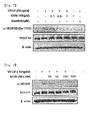

Classifications
-
- C—CHEMISTRY; METALLURGY
- C07—ORGANIC CHEMISTRY
- C07D—HETEROCYCLIC COMPOUNDS
- C07D401/00—Heterocyclic compounds containing two or more hetero rings, having nitrogen atoms as the only ring hetero atoms, at least one ring being a six-membered ring with only one nitrogen atom
- C07D401/14—Heterocyclic compounds containing two or more hetero rings, having nitrogen atoms as the only ring hetero atoms, at least one ring being a six-membered ring with only one nitrogen atom containing three or more hetero rings
-
- C—CHEMISTRY; METALLURGY
- C07—ORGANIC CHEMISTRY
- C07D—HETEROCYCLIC COMPOUNDS
- C07D401/00—Heterocyclic compounds containing two or more hetero rings, having nitrogen atoms as the only ring hetero atoms, at least one ring being a six-membered ring with only one nitrogen atom
- C07D401/02—Heterocyclic compounds containing two or more hetero rings, having nitrogen atoms as the only ring hetero atoms, at least one ring being a six-membered ring with only one nitrogen atom containing two hetero rings
- C07D401/12—Heterocyclic compounds containing two or more hetero rings, having nitrogen atoms as the only ring hetero atoms, at least one ring being a six-membered ring with only one nitrogen atom containing two hetero rings linked by a chain containing hetero atoms as chain links
-
- A—HUMAN NECESSITIES
- A61—MEDICAL OR VETERINARY SCIENCE; HYGIENE
- A61K—PREPARATIONS FOR MEDICAL, DENTAL OR TOILETRY PURPOSES
- A61K31/00—Medicinal preparations containing organic active ingredients
- A61K31/33—Heterocyclic compounds
- A61K31/395—Heterocyclic compounds having nitrogen as a ring hetero atom, e.g. guanethidine or rifamycins
- A61K31/435—Heterocyclic compounds having nitrogen as a ring hetero atom, e.g. guanethidine or rifamycins having six-membered rings with one nitrogen as the only ring hetero atom
- A61K31/44—Non condensed pyridines; Hydrogenated derivatives thereof
- A61K31/4427—Non condensed pyridines; Hydrogenated derivatives thereof containing further heterocyclic ring systems
- A61K31/444—Non condensed pyridines; Hydrogenated derivatives thereof containing further heterocyclic ring systems containing a six-membered ring with nitrogen as a ring heteroatom, e.g. amrinone
-
- A—HUMAN NECESSITIES
- A61—MEDICAL OR VETERINARY SCIENCE; HYGIENE
- A61P—SPECIFIC THERAPEUTIC ACTIVITY OF CHEMICAL COMPOUNDS OR MEDICINAL PREPARATIONS
- A61P11/00—Drugs for disorders of the respiratory system
-
- A—HUMAN NECESSITIES
- A61—MEDICAL OR VETERINARY SCIENCE; HYGIENE
- A61P—SPECIFIC THERAPEUTIC ACTIVITY OF CHEMICAL COMPOUNDS OR MEDICINAL PREPARATIONS
- A61P17/00—Drugs for dermatological disorders
- A61P17/06—Antipsoriatics
-
- A—HUMAN NECESSITIES
- A61—MEDICAL OR VETERINARY SCIENCE; HYGIENE
- A61P—SPECIFIC THERAPEUTIC ACTIVITY OF CHEMICAL COMPOUNDS OR MEDICINAL PREPARATIONS
- A61P19/00—Drugs for skeletal disorders
- A61P19/02—Drugs for skeletal disorders for joint disorders, e.g. arthritis, arthrosis
-
- A—HUMAN NECESSITIES
- A61—MEDICAL OR VETERINARY SCIENCE; HYGIENE
- A61P—SPECIFIC THERAPEUTIC ACTIVITY OF CHEMICAL COMPOUNDS OR MEDICINAL PREPARATIONS
- A61P27/00—Drugs for disorders of the senses
- A61P27/02—Ophthalmic agents
-
- A—HUMAN NECESSITIES
- A61—MEDICAL OR VETERINARY SCIENCE; HYGIENE
- A61P—SPECIFIC THERAPEUTIC ACTIVITY OF CHEMICAL COMPOUNDS OR MEDICINAL PREPARATIONS
- A61P27/00—Drugs for disorders of the senses
- A61P27/02—Ophthalmic agents
- A61P27/06—Antiglaucoma agents or miotics
-
- A—HUMAN NECESSITIES
- A61—MEDICAL OR VETERINARY SCIENCE; HYGIENE
- A61P—SPECIFIC THERAPEUTIC ACTIVITY OF CHEMICAL COMPOUNDS OR MEDICINAL PREPARATIONS
- A61P27/00—Drugs for disorders of the senses
- A61P27/02—Ophthalmic agents
- A61P27/14—Decongestants or antiallergics
-
- A—HUMAN NECESSITIES
- A61—MEDICAL OR VETERINARY SCIENCE; HYGIENE
- A61P—SPECIFIC THERAPEUTIC ACTIVITY OF CHEMICAL COMPOUNDS OR MEDICINAL PREPARATIONS
- A61P29/00—Non-central analgesic, antipyretic or antiinflammatory agents, e.g. antirheumatic agents; Non-steroidal antiinflammatory drugs [NSAID]
-
- A—HUMAN NECESSITIES
- A61—MEDICAL OR VETERINARY SCIENCE; HYGIENE
- A61P—SPECIFIC THERAPEUTIC ACTIVITY OF CHEMICAL COMPOUNDS OR MEDICINAL PREPARATIONS
- A61P3/00—Drugs for disorders of the metabolism
- A61P3/04—Anorexiants; Antiobesity agents
-
- A—HUMAN NECESSITIES
- A61—MEDICAL OR VETERINARY SCIENCE; HYGIENE
- A61P—SPECIFIC THERAPEUTIC ACTIVITY OF CHEMICAL COMPOUNDS OR MEDICINAL PREPARATIONS
- A61P35/00—Antineoplastic agents
-
- A—HUMAN NECESSITIES
- A61—MEDICAL OR VETERINARY SCIENCE; HYGIENE
- A61P—SPECIFIC THERAPEUTIC ACTIVITY OF CHEMICAL COMPOUNDS OR MEDICINAL PREPARATIONS
- A61P43/00—Drugs for specific purposes, not provided for in groups A61P1/00-A61P41/00
-
- A—HUMAN NECESSITIES
- A61—MEDICAL OR VETERINARY SCIENCE; HYGIENE
- A61P—SPECIFIC THERAPEUTIC ACTIVITY OF CHEMICAL COMPOUNDS OR MEDICINAL PREPARATIONS
- A61P9/00—Drugs for disorders of the cardiovascular system
- A61P9/10—Drugs for disorders of the cardiovascular system for treating ischaemic or atherosclerotic diseases, e.g. antianginal drugs, coronary vasodilators, drugs for myocardial infarction, retinopathy, cerebrovascula insufficiency, renal arteriosclerosis
-
- A—HUMAN NECESSITIES
- A61—MEDICAL OR VETERINARY SCIENCE; HYGIENE
- A61P—SPECIFIC THERAPEUTIC ACTIVITY OF CHEMICAL COMPOUNDS OR MEDICINAL PREPARATIONS
- A61P9/00—Drugs for disorders of the cardiovascular system
- A61P9/14—Vasoprotectives; Antihaemorrhoidals; Drugs for varicose therapy; Capillary stabilisers
-
- C—CHEMISTRY; METALLURGY
- C07—ORGANIC CHEMISTRY
- C07D—HETEROCYCLIC COMPOUNDS
- C07D213/00—Heterocyclic compounds containing six-membered rings, not condensed with other rings, with one nitrogen atom as the only ring hetero atom and three or more double bonds between ring members or between ring members and non-ring members
- C07D213/02—Heterocyclic compounds containing six-membered rings, not condensed with other rings, with one nitrogen atom as the only ring hetero atom and three or more double bonds between ring members or between ring members and non-ring members having three double bonds between ring members or between ring members and non-ring members
- C07D213/04—Heterocyclic compounds containing six-membered rings, not condensed with other rings, with one nitrogen atom as the only ring hetero atom and three or more double bonds between ring members or between ring members and non-ring members having three double bonds between ring members or between ring members and non-ring members having no bond between the ring nitrogen atom and a non-ring member or having only hydrogen or carbon atoms directly attached to the ring nitrogen atom
- C07D213/60—Heterocyclic compounds containing six-membered rings, not condensed with other rings, with one nitrogen atom as the only ring hetero atom and three or more double bonds between ring members or between ring members and non-ring members having three double bonds between ring members or between ring members and non-ring members having no bond between the ring nitrogen atom and a non-ring member or having only hydrogen or carbon atoms directly attached to the ring nitrogen atom with hetero atoms or with carbon atoms having three bonds to hetero atoms with at the most one bond to halogen, e.g. ester or nitrile radicals, directly attached to ring carbon atoms
- C07D213/78—Carbon atoms having three bonds to hetero atoms, with at the most one bond to halogen, e.g. ester or nitrile radicals
- C07D213/81—Amides; Imides
- C07D213/82—Amides; Imides in position 3
-
- C—CHEMISTRY; METALLURGY
- C07—ORGANIC CHEMISTRY
- C07D—HETEROCYCLIC COMPOUNDS
- C07D413/00—Heterocyclic compounds containing two or more hetero rings, at least one ring having nitrogen and oxygen atoms as the only ring hetero atoms
- C07D413/14—Heterocyclic compounds containing two or more hetero rings, at least one ring having nitrogen and oxygen atoms as the only ring hetero atoms containing three or more hetero rings
-
- C—CHEMISTRY; METALLURGY
- C07—ORGANIC CHEMISTRY
- C07D—HETEROCYCLIC COMPOUNDS
- C07D417/00—Heterocyclic compounds containing two or more hetero rings, at least one ring having nitrogen and sulfur atoms as the only ring hetero atoms, not provided for by group C07D415/00
- C07D417/14—Heterocyclic compounds containing two or more hetero rings, at least one ring having nitrogen and sulfur atoms as the only ring hetero atoms, not provided for by group C07D415/00 containing three or more hetero rings
-
- C—CHEMISTRY; METALLURGY
- C07—ORGANIC CHEMISTRY
- C07D—HETEROCYCLIC COMPOUNDS
- C07D453/00—Heterocyclic compounds containing quinuclidine or iso-quinuclidine ring systems, e.g. quinine alkaloids
- C07D453/02—Heterocyclic compounds containing quinuclidine or iso-quinuclidine ring systems, e.g. quinine alkaloids containing not further condensed quinuclidine ring systems
-
- C—CHEMISTRY; METALLURGY
- C07—ORGANIC CHEMISTRY
- C07D—HETEROCYCLIC COMPOUNDS
- C07D495/00—Heterocyclic compounds containing in the condensed system at least one hetero ring having sulfur atoms as the only ring hetero atoms
- C07D495/02—Heterocyclic compounds containing in the condensed system at least one hetero ring having sulfur atoms as the only ring hetero atoms in which the condensed system contains two hetero rings
- C07D495/04—Ortho-condensed systems
Definitions
- the present invention relates to a novel compo;;;;und having inhibitory activity against angiogenesis, a method for preparing the same, and a pharmaceutical composition comprising the same.
- the present invention relates to a pharmaceutical composition for the prevention or treatment of a disease or symptom caused by aberrant activity of VEGF (vascular endothelial growth factor).
- VEGF vascular endothelial growth factor
- a tumor expresses proteins necessary for the formation of new vessels to encourage angiogenesis therefore.
- angiogenic factors such as VEGF (vascular endothelial growth factor), bFGF (basic fibroblast growth factor), HGF (hepatocyte growth factor), EGF (epithelial growth factor), and angiopoietin
- angiogenic factor receptors with tyrosine kinase activity such as FGFR (fibroblast growth factor receptor), Flk-1/KDR, Flt-1, Flt-3, Tie-1, Tie-2/Tek, and Eph
- endogenous angiogenesis inhibitors such as angiostatin and endostatin, giving an insight into relationship between angiogenesis or neovascularization and human diseases as well as the mechanism of angiogenesis and neovascularization, and suggesting various methods for regulating angiogenesis.
- VEGF has aroused a great interest as a target for the selective inhibition of angiogenesis because it is found to have a close correlation with cancer progression and cure rate and its receptor Flk-1/KDR is expressed on endothelial cells with high specificity.
- angiostatin M. S. O'Reilly, L. Holmgren, Y. Shing, C. Chen, R. A. Rosenthal, M. Moses, W. S. Lane, Y. Cao, E. H. Sago and J. Forkman.
- Angiostatin a novel angiogenesis inhibitor that mediates the suppression of metastases by a Lewis Lung Carcinoma, Cell, 79, 315-328, 1994
- endostatin M. S. O'Reilly, T. Boehm, C. Chen, et al ., Endostatin: an endogenous inhibitor of angiogenesis and tumor growth. Cell, 88, 277-285, 1997
- endostatin an endogenous inhibitor of angiogenesis and tumor growth.
- angiogenesis inhibitors have advantages as anticancer agents over other anticancer agents in the following aspects: because angiogenesis is essential for the growth and metastasis of cancer, an angiogenesis inhibitor can block cancer growth and metastasis, simultaneously; and an angiogenesis inhibitor targets normal diploid vascular endothelial cells rather than aueuploid, cancer cells, entailing no problems with resistance attributed to the heterogeneity and genetic instability of cancer cells; an angiogenesis inhibitor can exert inhibitory activity against any kind of cancers for the growth of which angiogenesis is indispensible while other anticancer agents show a narrow therapeutic spectrum of specific or several cancers; and since angiogenesis is rare in adults, except for several cases, such as wound healing, menstruation, etc., side effects incurred by other anticancer agents would be greatly reduced upon the use of an angiogenesis inhibitor.
- angiogenesis is a direct cause of various angiogenic diseases, including rheumatoid arthritis [ Kwon, Ho-Jung, Journal of the Korean Endocrine Society, Vol 16, No. 3, 2001 ], diabetic retinopathy [ Kwoak, No-Hoon, Journal of the Korean Endocrine Society, Vol. 16, No. 3, 2001 ], ophthalmic diseases such as keratitis, hyperemia, macular degeneration, choroidal neovascularization, and neovascular glaucoma [ YS Kwon, HS Hong, JC Kim, JS Shin, YS Son. Invest. Ophthalmol. Vis. Sci. February 2005 vol. 46 no.
- the present invention addresses a compound represented by the following Chemical Formula I, or a pharmaceutically acceptable salt thereof: wherein,
- R 1 is 1-benzylpiperidin-4-yl; 1-benzylpiperidin-3-yl; 4-phenoxyphenyl; 1-(2-hydroxyethyl)-piperidin-4-yl; 1-(2-hydroxyethyl)-piperidin-3-yl; 1-(2-hydroxyethyl)-piperazin-4-yl; 2,2,6,6-tetramethylpiperidin-4-yl; t-butoxycarbonylpiperidin-4-yl; t-butoxycarbonylpiperidin-3-yl; 1-azabicyclo[2.2.2]oct-3-yl; methylpiperidin-4-yl; methylpiperazin-4-yl; piperidin-4-yl; piperidin-3-yl; 1-(2-hydroxyethyl)-2,2,6,6-tetramethylpiperidin-4-yl;1-arylpiperidin-4-yl(1-allylic piperidine-4-yl); [2-(N,N-di
- R 1 is 1-benzylpiperidin-4-yl; 1-benzylpiperidin-3-yl; 1-(2-hydroxyethyl)-piperidin-4-yl; piperidin-3-yl; or t-butoxycarbonylpiperidin-3-yl.
- R 2 is 3-chlorophenyl; 4-phenoxyphenyl; 3,3-dimethyl-2,3-dihydro-1H-indol-6-yl; 4-(4-fluorobenzyl)-morpholin-2-ylmethyl; 1,3,4-triazol-2-yl; 4,6-dimethylpyrimidin-2-yl; (S)-pyrrolidin-3yl; 2-(morpholin-1-yl)ethyl; t-butoxycarbonylamino; (3-methoxycarbonyl)pyridin-6-yl; p-toluenesulfonamino; pyridin-4-ylmethyl; 1,2-diphenylethyl; 2-methoxyethyl; 5-methylthiazol-2-yl; 3-methylpyridin-2-yl; azepan-2-on-3-yl; 4-fluorobenzyl; 2-ethylhexyl; 3-methyl-2-methylsulfanyl-3
- the term "pharmaceutically acceptable salt” is intended to refer to a salt of an inorganic or organic acid typically used in the preparation of medicines in the art.
- the inorganic acid may be hydrochloric acid, bromic acid, sulfuric acid, or phosphoric acid while examples of the organic acid include citric acid, acetic acid, lactic acid, stannic acid, fumaric acid, formic acid, propionic acid, oxalic acid, trifluoroacetic acid, methanesulfonic acid, benzenesulfonic acid, maleic acid, benzoic acid, gluconic acid, glycolic acid, succinic acid, 4-morpholineethane sulfonic acid, caphorsulfonic acid, 4-nitrobenzenesulfonic acid, hydroxyl-O-sulfonic acid, 4-toluenesulfonic acid, galacturonic acid, embonic acid, glutamic acid, aspartic acid.
- the present invention addresses a method for preparing the compound of Chemical Formula I, comprising reacting a compound represented by the following Chemical Formula II with a compound represented by Chemical Formula III in the presence of a base (hereinafter referred to as "Preparation Method 1"): [Chemical Formula III] H 2 N-R 2 wherein,
- the compound of Chemical Formula II and the compound of Chemical Formula III may be commercially available ones, or may be synthesized using known methods.
- the compound of Chemical Formula II may be synthesized according to the teachings of Organic Synthesis Collective Volume 1,(1941) 12 [F. K. Thayer ], Organic Synthesis Collective Volume 1, 147 (1941) [B. Helferich and W. Schaefer ], and Organic Synthesis Collective Volumn 2, 292 (1943) [John R. Ruhoff ].
- the base used in Preparation Method 1 may be appropriately selected from among those known to those skilled in the art. It is preferably, for example, a tertiary organic base selected from among triethylamine, N,N-diisopropylethylamine, N-methylmorpholine, DBU (1,8-Diazabicyclo[5.4.0]undec-7-ene), N-methylpiperidine, 4-dimethylaminopyridine, N,N-dimethylaniline, 2,6-lutidine, 4-N,N-dimethylaminopyridine, and pyridine.
- the base is used at a molar ratio of 1 ⁇ 5: 1 to the compound of Chemical Formula II, and preferably used at a molar ratio of 3:1.
- any solvent may be adopted as the reaction solvent of Preparation Method 1.
- acetonitrile, chloroform, methylenechloride, tetrahydrofuran, N,N-dimethylformamide, and N-methylpyrrolidinone may be preferably used alone or in combination.
- the reaction of Preparation Method 1 may be carried out at various temperatures, but preferably at -10 to room temperature (30°C). More preferably, after addition of the base at 0 to 10°C, the reaction may be performed at room temperature or ambient temperature. However, the reaction temperature may depend on kinds of the base used, reaction solvents, and amounts thereof.
- the present invention addresses a method for preparing the compound of Chemical Formula I, comprising a compound represented by the following Chemical Formula IV with a compound represented by the following Chemical Formula V in the presence of a base (hereinafter referred to "Preparation Method 2"): [Chemical Formula V] Y-R 1 wherein,
- the base may be an inorganic base typically available for those skilled in the art or an organic base existing as a solid phase at ordinary temperature.
- it is selected from the group consisting of potassium carbonate, potassium hydrogen carbonate, sodium carbonate, sodium hydrogen carbonate, sodium hydroxide, potassium hydroxide, calcium hydroxide, barium hydroxide, sodium methoxide, sodium ethoxide, sodium-t-butoxide, potassium-t-butoxide, sodium hydride, potassium hydride, sodium borohydride, sodium cyanoborohydride, and 4-N,N-dimethylaminopyridine.
- the base is used at a molar ratio of 1 ⁇ 2: 1 to the compound of Chemical Formula IV, and preferably used at a molar ratio of 1.2 ⁇ 1.5:1.
- the reaction solvent useful in Preparation Method 2 is an organic solvent available for those skilled in the art to perform reflux at 100°C or higher.
- xylene, toluene, DMF, DMSO, dioxane, lutidine, pyridine, and N,N-dimethylaniline may be used alone or in combination.
- Xylene means any of ortho-xylene, meta-xylene, and para-xylene.
- lutidine fall 2,3-lutidine, 2,4-lutidine, 2,5-lutidine, 2,6-lutidine, 3,4-lutidine, and 3,5-lutidinel. More preferable is ortho-xylene (o-xylene).
- the reaction of Preparation Method 2 may be carried out at room temperature or in a range of reflux temperatures, with the latter being preferred.
- the present invention addresses a pharmaceutical composition for the prevention or treatment of a disease caused by the aberrant activity of vascular endothelial growth factor, comprising the compound of Chemical Formula I or a pharmaceutically acceptable salt thereof.
- the pharmaceutically acceptable salt is as described above.
- contemplated in accordance with still another aspect thereof is a method for preventing or treating a disease or symptom caused by aberrant activity of vascular endothelial growth factor (VEGF), comprising administering a therapeutically effective amount of the compound of Chemical Formula I or a pharmaceutically acceptable salt thereof to a mammal in need thereof, including a human.
- VEGF vascular endothelial growth factor
- the disease or symptom caused by the aberrant activity of vascular endothelial growth factor includes cancer, rheumatoid arthritis, diabetic retinopathy, keratitis, hyperemia, macular degeneration, choroidal neovascularization, neovascular glaucoma, ophthalmic diseases of corneal neovascularization, psoriasis, airway obstructive hemangiomas in lung, and obesity by angiogenesis.
- the disease or symptom caused by the aberrant activity of vascular endothelial growth factor is cancer.
- the preset invention addresses a pharmaceutical composition for the suppression of vessel formation, comprising a compound of Chemical Formula I or a pharmaceutically acceptable salt thereof.
- the pharmaceutical composition for the suppression of vessel formation in accordance with the present invention is preferably an anticancer agent.
- composition of the present invention may further comprise one or more active ingredients exhibiting an activity equal to or similar to that of the compound of Chemical Formula I or a pharmaceutically acceptable salt thereof.
- the composition in accordance with the present invention may comprise at least one pharmaceutically acceptable carrier.
- the pharmaceutically acceptable carrier include saline solution, sterile water, Ringer's solution, buffered saline solution, dextrose solution, maltodextrin solution, glycerol, ethanol, and a mixture of two or more thereof.
- the composition may further include other conventional additives, such as antioxidants, buffers, and bacteriostatic agents.
- the composition may additionally include diluents, dispersants, surfactants, binders and lubricants in order to be formulated into injection formulations, such as aqueous solution, suspension and emulsion, pills, capsules, granules or tablets.
- the composition may be preferably formulated depending on its components or purposes, using a suitable method known in the art, for example, the method described in Remington's Pharmaceutical Science (latest edition), Mack Publishing Company, Easton PA .
- the composition may be administered orally or via parenteral routes (e.g., intravenous, subcutaneous, intraperitoneal or topical).
- parenteral routes e.g., intravenous, subcutaneous, intraperitoneal or topical.
- the specific therapeutically effective dose level for any particular patient may vary depending on a variety of factors, including the patient's weight, age, gender, general health status and diet, the time of administration, route of administration, rate of excretion of the composition, and severity of the illness.
- the compound of Chemical Formula I or a pharmaceutically acceptable salt thereof may be administered in a daily dosage ranging from about 5 to 75 mg, and preferably 5 to 50 mg.
- the daily dosage can be preferably given in a single dose.
- the composition may be used alone or in combination with other therapies including surgery, hormonal therapy, chemical therapy and/or biological reaction regulators.
- the present invention addresses a method for preventing or treating a disease, comprising administering a compound of Chemical Formula I, at least one of the enumerated compounds above, or a pharmaceutically acceptable salt thereof to a subject including a mammal.
- the present invention addresses a method for preventing or treating a disease, comprising administering a compound of Chemical Formula I, at least one of the enumerated compounds above, or a pharmaceutically acceptable salt thereof to a subject including a mammal, wherein the disease is selected from the group consisting of cancer, rheumatoid arthritis, diabetic retinopathy, keratitis, hyperemia, macular degeneration, choroidal neovascularization, neovascular glaucoma, ophthalmic diseases of corneal neovascularization, psoriasis, airway obstructive hemangiomas in lung, and obesity by angiogenesis.
- the disease is selected from the group consisting of cancer, rheumatoid arthritis, diabetic retinopathy, keratitis, hyperemia, macular degeneration, choroidal neovascularization, neovascular glaucoma, ophthalmic diseases of corneal neovascularization, p
- the present invention is capable of potently suppressing the activity of vascular endothelial growth factor
- the compounds of the present invention are applicable to the prevention and treatment of diseases caused by aberrant activity of vascular endothelial growth factor, and available as an anti-angiogenic agent.
- the dissicant used in the Examples was 'sodium sulfate' unless otherwise stated.
- step 1 The solution obtained in step 1 was placed in an ice bath and added with triethylamine (152.32 mmol, 2.4eq) for 30 min at room temperature. Again, 3-chloroaniline (76.16mmol, 1.2eq) was added to the reaction mixture for 30 min, followed by stirring under reflux for 3 hrs. When the reaction was completed under the monitoring of thin layer silica chromatography, the reaction mixture was cooled to room temperature and the reaction was terminated using with pure water. Then resultant solution was extracted two or three times with MC (methylene chloride, 50 ml). A pool of the organic layers was washed with 70 ml of 1N-HCl and neutralized with sodium bicarbonate.
- MC methylene chloride
- the title compound was prepared in the same manner as in step 2 of Preparation Example 5, with the exception that 2,6-dichloro-5-fluoronicotinyl chloride obtained in Preparation Example 9, instead of 2-chloronicotinyl chloride, and 2-amino-4,7-dihydro-5H-thieno[2,3-c]pyridine-3,6-dicarboxylic acid 6-tert-butyl ester 3-methyl ester obtained in Preparation Example 4, instead of 3-chloroaniline, were used in the same molar amounts.
- Precipitates were formed during stirring for an additional 1 hr, and washed with pure water.
- the precipitates were slurried with 300 ml of pure water, stirred for 30 min, and filtered.
- the filtrate was again slurried with 150 ml of acetone, stirred for 30 min, and filtered. This filtrate was washed with a small amount of acetone and hot air dried to afford 93.7 g of the title compound (Yield: 88.1%).
- the title compound was prepared in the same manner as in Example 1, with the exception that 2,6-dichloro-N-(3-chlorophenyl)-5-fluoronicotinamide obtained in Preparation Example 9, instead of 2-chloro-N-(3-chlorophenyl)nicotinamide, and 4-amino-1-(2-hydroxyethyl)piperidine obtained in Preparation Example 17, instead of 4-amino-1-benzylpiperidine, were used in the same molar amounts (Yield: 81.1%).
- step 1 The residue obtained in step 1 was placed in 10 ml of ethanol and stirred for 4 hrs in conc. HCl aqueous solution (excess) under reflux. The reaction mixture was cooled to a room temperature, and concentrated in a reduced pressure to remove the solvent. The residue was dissolved in 10 ml of distilled water, and adjusted to a pH of 9 ⁇ 10 by dropwise adding a 20(wt/wt)% sodium hydroxide aqueous solution. This mixture was extracted with 20 ml of chloroform, dried over sodium sulfate to remove water, and concentrated in a reduced pressure. Purification through column chromatography (mobile phase: 10(v/v)% acetone in chloroform) afforded the title compound.
- step 1 The mixture obtained in step 1 was added with 0.16 g of sodium hydroxide, and heated at 50°C for 3 hrs while stirring. The reaction mixture was cooled to a room temperature, and extracted three times with 10 ml of ethyl acetate. After two rounds of extraction with saturated saline, water was removed using a desiccant. The resulting solution was concentrated in a reduced pressure and purified by silica gel chromatography (mobile phase: 30(v/v)% hexane in EA) to afford 0.05 g of the title compound (Total yield: 15%).
- Step 2 Preparation of 2-(1-benzylpiperidin-4-ylamino)-N-[4-(4-fluorobenzyl)morpholin-2-ylmethyl]nicotinamide
- step 1 The solution obtained in step 1 was cooled to 4 ⁇ 5°C in an ice bath, followed by dropwise adding triethylamine (0.42ml), 3.0mmol) for 5 min.
- To the reaction solution was added with 4-(4-fluorobenzyl)morpholin-2-ylmethylamine (1.2mmol), and stirred for 30 min at a room temperature and then for an additional 4 hrs under reflux.
- the reaction mixture was cooled to a room temperature, and washed with saturated aqueous sodium hydrogen carbonate solution and then with saturated saline. After water was removed with a desiccant, the resulting solution was concentrated in a reduced pressure.
- the title compound was prepared in the same manner as in Example 32, with the exception that methyl 2-amino-4,5,6,7-tetrahydro-thien[2,3-c]pyridine-3-carboxylate hydrochloride obtained in Preparation Example 1, instead of 4-(4-fluorobenzyl)morpholin-2-ylmethylamine, was used in the same molar amount while the amount of triethylamine was increased to 4.0eq (Total yield: 83.1%).
- the reaction mixture was cooled to a room temperature, added with 10 ml of ethylacetate, and extracted twice with 20 ml of distilled water per round. Thereafter, the aqueous layer was again washed 20 ml of ethylacetate, and adjusted to a pH of about 9 ⁇ 10 with a 2 N sodium hydroxide aqueous solution.
- the resulting mixture was extracted twice with 20 ml of methylene chloride per round, washed with 30 ml of saturated saline, and dried over a desiccant to remove water. Then the solvent was removed by concentration in a reduced pressure.
- EXAMPLE 54 Preparation of 2- ⁇ [2-(1-Benzylpiperidin-4-ylamino)-6-chloropyridine-3-carbonyl]amino ⁇ -4,5,6,7-tetrahydrothieno[2,3-c]pyridine-3-carboxylic acid methyl ester [502]
- the title compound was prepared in the same manner as in Example 53, with the exception that 2-[(2,6-dichloro-5-fluoro-pyridine-3-carbonyl)amino]-4,7-dihydro-5H-thieno[2,3-c]pyridine-3,6-dicarboxylic acid 6-tert-butyl ester 3-methyl ester obtained in Preparation Example 12, instead of 2-[(2,6-dichloropyridine-3-carbonyl)amino]-4,7-dihydro-5H-thieno[2,3-c]pyridine-3,6-dicarboxylic acid 6-tert-butyl ester 3-methyl ester, was used in the same molar amount.
- the title compound was prepared in the same manner as in Example 53, with the exception that 2-[(2-chloropyridine-3-carbonyl)-amino]-4,7-dihydro-5H-thieno[2,3-c]pyridine-3,6-dicarboxylic acid 6-tert-butyl ester 3-methyl ester obtained in Preparation Example 10, instead of 2-[(2,6-dichloropyridine-3-carbonyl)amino]-4,7-dihydro-5H-thieno[2,3-c]pyridine-3,6-dicarboxylic acid 6-tert-butyl ester 3-methyl ester, and 4-amino-1-(2-hydroxyethyl)piperidine obtained in Preparation Example 17, instead of 4-amino-1-benzylpiperidine, were used in the same molar amounts.
- the title compound was prepared in the same manner as in Example 53, with the exception that 2-[(2,6-dichloro-5-fluoro-pyridine-3-carbonyl)amino]-4,7-dihydro-5H-thieno[2,3-c]pyridine-3,6-dicarboxylic acid 6-tert-butyl ester 3-methyl ester obtained in Preparation Example 12, instead of 2-[(2,6-dichloropyridine-3-carbonyl)amino]-4,7-dihydro-5H-thieno[2,3-c]pyridine-3,6-dicarboxylic acid 6-tert-butyl ester 3-methyl ester, and 4-amino-1-(2-hydroxyethyl)piperidine obtained in Preparation Example 17, instead of 4-amino-1-benzylpiperidine, were used in the same molar amounts.
- the title compound was prepared in the same manner as in Example 53, with the exception that 2-[(2,6-dichloro-5-fluoro-pyridine-3-carbonyl)amino]-4,7-dihydro-5H-thieno[2,3-c]pyridine-3,6-dicarboxylic acid 6-tert-butyl ester 3-methyl ester obtained in Preparation Example 12, instead of 2-[(2,6-dichloropyridine-3-carbonyl)amino]-4,7-dihydro-5H-thieno[2,3-c]pyridine-3,6-dicarboxylic acid 6-tert-butyl ester 3-methyl ester, and 4-amino-2,2,6,6-tetramethylpiperidine, instead of 4-amino-1-benzylpiperidine, were used in the same molar amounts.
- the aqueous layer thus obtained was again washed with ethylacetate and adjusted to a pH of about 9 ⁇ 10 with a 2 N aqueous sodium hydroxide solution. Subsequently, the reaction mixture was extracted twice with 20 ml of methylene chloride, washed with saturated saline, and water was removed by a desiccant. In order to obtain a desired fraction, the solvent was removed by concentration in a reduced pressure. The purification through silica gel column chromatography (mobile phase: 20(v/v)% EA in hexane) was performed to afford the title compound.
- the title compound was prepared in the same manner as in Example 64, with the exception that 2-chloro-N-(2-ethylhexyl)nicotinamide obtained in Preparation Example 13, instead of 2,6-dichloro-N-(2-ethylhexyl)nicotinamide, and 4-amino-2,2,6,6-tetramethylpiperidine, instead of 4-amino-1-(2-hydroxyethyl)piperidine, were used in the same molar amounts.
- the title compound was prepared in the same manner as in Example 64, with the exception that 2,6-dichloro-N-(2-ethylhexyl)-5-fluoronicotinamide obtained in Preparation Example 15, instead of 2,6-dichloro-N-(2-ethylhexyl)nicotinamide, and 4-amino-2,2,6,6-tetramethylpiperidine, instead of 4-amino-1-(2-hydroxyethyl)piperidine, were used in the same molar amounts.
- the mark “#” is provided to denote significance with p ⁇ 0.05 relative to a non-treated control
- the mark “*” to denote significance with p ⁇ 0.05 relative to a VEGF-stimulated HUVEC group
- the mark “**” to denote significance with p ⁇ 0.01 relative to a VEGF-stimulated HUVEC group
- the mark “***” to denote significance with p ⁇ 0.001 relative to a VEGF-stimulated HUVEC group.
- A-431 (melanoma, human, ATCC CRL-1555TM) cells grown in DMEM (Dulbeco's Modified Eagle's Medium, Gibco #11885 ) were seeded at a density of 1x10 4 cells/well into 96-well plates and incubated at 37°C for 18 hrs under the supply of 5% CO 2 until the cells stably adhered to the bottom.
- DMEM Dulbeco's Modified Eagle's Medium, Gibco #11885
- test substance sunitinib (synthesized by Boryung Pharmaceutical Synthesis Institute) (100, 50, 25, 12.5, 6.25, 3.125, 1.56, 0.78 ⁇ M), compounds of Chemical Formula I (100, 50, 25, 12.5, 6.25, 3.125, 1.56, 0.78 ⁇ M), and the control (medium) were serially diluted and applied to the 96-well plates. After incubation for 48 hrs in the presence of the test compound, the cells were assayed for viability.
- the cells in each well was added with 21 ⁇ l of a mixture of 20:1 (v/v) of an MTS solution [(3-(4,5-dimethylthiazol-2-yl)-5-(3-carboxymethoxyphenyl)-2-(4-sulfophenyl)-2H-tetrazolium, Promega, Cat# G5421; 2mg/ml] and a PMS solution [Phenazine methosulfate, Sigma #P9625; 1 mg/ml], and incubated for 2 hrs, followed by measuring absorbance at 490 nm on a microplate reader (Molecular device, spectraMax M2). Relative to the control (media), viability by drug concentration was determined from the measurements of formazan, and the results are given in Table 2, below.
- MTS solution ((3-(4,5-dimethylthiazol-2-yl)-5-(3-carboxymethoxyphenyl)-2-(4-sulfophenyl)-2
- Test materials and their concentrations - Negative control: medium - Positive control: sunitinib, 100, 50, 25, 12.5, 6.25, 3.125, 1.56, 0.78 ⁇ M, - Compound of Chemical Formula I: 100, 50, 25, 12.5, 6.25, 3.125, 1.56, 0.78 ⁇ M.
- Test Compound IC 50 ( ⁇ M) Test Compound IC 50 ( ⁇ M) Control - 267 20.9 Sunitinib 22 269 88.9 103 40.6 273 40.9 104 28.6 274 110.9 110 22.2 275 94.6 111 135 290 54.8 117 91.1 301 67.6 201 54.5 302 38.1 208 86.1 311 62.3 241 164 312 20.68 242 81.9 426 39.7 243 170 428 125 244 94.6 436 34 246 100.7 443 140 249 102.5 515 23.8 250 26.1 517 50.7
- compounds of Chemical Formula I have IC 50 values similar to or higher than that of sunitinib, an anticancer agent currently used for endstage renal cancer, demonstrating that they are of lower toxicity and higher safety.
- VEGF Vascular endothelial growth factor
- HUVECs human umbelical vein endothelial cells
- HUVECs provided from ATCC (American Type Culture Collection), were incubated in EGM-2 (Endothelial growth Medium-2 Medium) including 10% FBS, penicillin (100 unit/ml) and 100 ⁇ g/ml streptomycin sulfate plus various growth factors at 37°C in an atmosphere of 5% CO 2 . After the change of the medium with growth factor-free EBM-2 (Endothelial Basal Medium-2 Medium), the cells were subjected to transwell assay. Various concentrations of test compounds (Compounds 103, 110, 218, 275, 276, 290, 312, 428, 442 and 509, and sunitinib) in DMSO (dimethylsulfoxide) were added together with VEGF.
- EGM-2 Endothelial growth Medium-2 Medium
- penicillin 100 unit/ml
- streptomycin sulfate 100 ⁇ g/ml
- streptomycin sulfate 100 ⁇ g/ml
- various growth factors at 37°
- HUVECs were seeded at a density of 2x10 5 cells/well to 24-transwell plates, and incubated with Sunitinib (1 ⁇ M) and various concentrations of compounds of Chemical Formula I for 1 hr, and then for 24 hrs with 10 ng/ml VEGF, which functions to induce the growth and proliferation of cells.
- a monolayer of HUVECs was scraped, and the cells were gently washed with PBS.
- the cells were treated with sunitinib (1 ⁇ M) or Compound 103 (0.1, 0.5, 1 ⁇ M) for 1 hr and then with 10ng/ml VEGF for 24 hrs. After 24 hours, the cell migration were monitored through the scraped monolayer of the cell and photographed under a microscope equipped with a camera (Canon Powershot640).
- Compound 250 (Example 26) was applied at various concentrations shown in Table 6 in the same manner as Compound 103, followed by monitoring and photographing the migration of the cells under the microscope. For comparison, the cells were not treated (control) or were treated with 10ng/mL VEGF, alone.
- Results are shown in Table 5 and FIG. 1 for Compound 103 and in Table 6 and FIG. 2 for Compound 250.
- TABLE 5 Test Compound Wound closure ( ⁇ m) Control 110 VEGF (10ng/ml) 380 # VEGF+ 103 (0.1 ⁇ M) 200*** VEGF+ 103 (0.5 ⁇ M) 180*** VEGF+ 103 (1 ⁇ m) 155*** VEGF+ Sunitinib (1 ⁇ M) 210*** TABLE 6 Test Compound Wound Closure(uM) Control 120 VEGF (10ng/ml) 290 # VEGF + 250 (25nM) 210** VEGF + 250 (50nM) 765*** VEGF + 250 (100nM) 120*** 250 (100nM) 125
- Compound 103 has the suppression effects on VEGF-induced migration of HUVECs and suppresses VEGF-induced migration of HUVECs at higher efficiency than Sunitinib.
- Compound 250 was highly suppresses VEGF-induced migration of HUVECs even at as low concentrations as nM levels.
- a BrdU incorporation assay was carried out to examine whether the proliferation of HUVECs through VEGF-induced DNA synthesis is suppressed by BRN-103.
- HUVECs grown as in Experimental Example 2 were seeded at a density of 1x10 4 cells/well into 96-well plates. The cells were incubated with Sunitinib (1 ⁇ M), or Compound 103 (0.1, 0.5, or 1 ⁇ M) for 1 hr and then with 10 ng/ml VEGF for 24 hrs. Thereafter, DNA synthesis in the cells was fluorescently measured using a BrdU incorporation assay kit (Roche).
- the cells were treated with various concentrations of Compound 250 (Example 26) given in Table 8, and then with VEGF, as the same manner of that of Compound 103. Intracellular DNA was also quantified , as the same manner of that of Compound 103. For comparison, the cells were not treated (control), or were treated with 10 ng/mL VEGF, alone.
- Compound 103 of the present invention inhibited VEGF-induced proliferation in HUVECs in a dose-dependent manner.
- Compound 103 of the present invention showed higher efficacy than Sunitinib.
- Compound 250 also inhibited VEGF-induced proliferation in HUVECs. Additionally, Compound 250 has excellent suppressive effects on VEGF-induced proliferation of HUVECs even at a very low concentration.
- HUVECs were pretreated with Sunitinib (1 ⁇ M) or Compound 103 (0.1, 0.5, or 1 ⁇ M) for 1 hr. After HUVECs were seeded at a density of 3x10 5 cells/well into Matrigel-coated 48-well plates, HUVECs were with 10 ng/ml VEGF for 4hrs. The HUVECs where tubes were formed were monitored and photographed under a microscope equipped with a camera to count cells.
- HUVECs were also treated with Compound 250 (Example 26) at various concentrations given in Table 10, The HUVECs where tubes were formed were monitored and photographed under a microscope equipped with a camera, like Compound 103.
- Results are summarized in FIG. 4 and in Table 9 for Compound 103 and shown in FIG. 4 and Table 10 for Compound 250.
- TABLE 9 Test Compound Number of tubes/Field Control 50 VEGF (10 ng/ml) 140 # VEGF+ 103 (0.1 ⁇ M) 90** VEGF+ 103 (0.5 ⁇ M) 80*** VEGS+ 103 (1 ⁇ M) 60*** VEGF+ Sunitinib (1 ⁇ M) 100*** TABLE 10 Test Compound Number of tubes/field Control 30+5 VEGF (10ng/ml) 60 ⁇ 4 # VEGF + 250 (25nM) 45 ⁇ 6** VEGF + 250 (50nM) 35 ⁇ 2*** VEGF + 250 (100nM) 28 ⁇ 4*** 250 (100nM) 27 ⁇ 2
- VEGF-induced tube formation was suppressed by Compound 103, indicating that the compound of the present invention blocks VEGF-induced angiogenesis. Also, Compound 103 was more efficient in the inhibition of tube formation than Sunitinib.
- VEGF-induced tube formation was also suppressed by Compound 103, indicating that the compound of the present invention blocks VEGF-induced angiogenesis.
- Compound 250 retains high suppressive effect on tube formation even at a low concentration.
- Aortic rings excised from 5-week-old C57BL/6 mice were placed in Matrigel-coated 48-well plates, and incubated with Sunitinib (1 ⁇ M) or Compound 103 (0.1, 0.5, 1 ⁇ M) for 1 hr and then with 10 ng/ml VEGF for 7 days. Sprouts from margins of the aortic rings were photographed under a microscope equipped with a camera.
- Compounds 103 and 250 inhibited VEGF-induced aortic sprouting.
- Compound 250 has effective, inhibitory activity against aortic sprouting even at as low concentrations as nM levels.
- HUVECs were pretreated with for 1 hr with Sunitinib (1 ⁇ M) or Compound 103 (0.1, 0.5, 1 ⁇ M) and then treated with VEGF (10 ng/ml) of 5 min. After 3 min of centrifugation at 4000 rpm to collect the cells, the cell pellet was washed once with PBS (phosphate buffered saline).
- Sunitinib (1 ⁇ M) or Compound 103 (0.1, 0.5, 1 ⁇ M) and then treated with VEGF (10 ng/ml) of 5 min. After 3 min of centrifugation at 4000 rpm to collect the cells, the cell pellet was washed once with PBS (phosphate buffered saline).
- PBS phosphate buffered saline
- the washed cell pellet was suspended in a lysis buffer (50mM HEPES pH 7.0, 250mM NaCl, 5mM EDTA, 0.1% Nonidet P-40, 1 mM phenylmethylsulfonyl fluoride and 0.5 mM Na orthovanadate) containing 5 ⁇ l/mL of leupeptin and aprotinin, each and reaction was performed. at 4°C for 20. After the cell debris was removed by microcentrifugation , the supernatant was swiftly cooled, and quantified for protein level using a Bio-Rad protein assay reagent. 40 ⁇ g of the cell protein from each test group was run by 10% SDS-PAGE, and transferred onto a PVDF membrane.
- a lysis buffer 50mM HEPES pH 7.0, 250mM NaCl, 5mM EDTA, 0.1% Nonidet P-40, 1 mM phenylmethylsulfonyl fluoride and 0.5 mM Na
- the membrane was incubated overnight at 4°C in a blocking solution (5% skim milk), and reacted with a primary antibody for 4 hrs. After 4 washes with Tween 20/Tris-buffered saline (TTBS), the membrane was reacted with a 1:1000 (v/v) dilution of a horseradish peroxidase-conjugated secondary antibody at room temperature for 1 hr, washed three times with TTBS, and identified by a chemical luminescence method (Amersham Life Science).
- TTBS Tris-buffered saline
- HUVECs were treated with various concentrations (10nM, 50nM, 100nM) of Compound 250 (Example 26) and then with VEGF, and analyzed for inhibitory activity against VEGF-induced VEGFR2 activation.
- Results are given in FIG. 7 for Compound 103 and in FIG. 8 for Compound 250.
- HUVECs were pretreated with for 1 hr with Sunitinib (1 ⁇ M) or Compound 103 (0.1, 0.5, 1 ⁇ M) and then treated with VEGF (10 ng/ml) for 10 min (p-ERK), 30 min (p-AKT), and 1 hr (p-eNOS). After 3 min of centrifugation at 4000 rpm to collect the cells, the cell pellet was washed once with PBS (phosphate buffered saline).
- PBS phosphate buffered saline
- the cell pellet suspended in a lysis buffer (50mM HEPES pH 7.0, 250mM NaCl, 5mM EDTA, 0.1% Nonidet P-40, 1 mM phenylmethylsulfonyl fluoride and 0.5 mM Na orthovanadate) containing 5 ⁇ l/mL of leupeptin and aprotinin, each and the reaction was performed at 4°C for 20 min. After the cell debris was removed by microcentrifugation, the supernatant was swiftly cooled.
- a lysis buffer 50mM HEPES pH 7.0, 250mM NaCl, 5mM EDTA, 0.1% Nonidet P-40, 1 mM phenylmethylsulfonyl fluoride and 0.5 mM Na orthovanadate
- Protein quantification was carried out using a Bio-Rad protein assay reagent. 40 ⁇ g of the cell protein from each test group was run by 10% SDS-PAGE, and transferred onto a PVDF membrane.
- the membrane was incubated overnight at 4°C in a blocking solution (5% skim milk), and reacted with a primary antibody for 4 hrs. After 4 washes with Tween 20/Tris-buffered saline (TTBS), the membrane was reacted with a 1:1000 (v/v) dilution of a horseradish peroxidase-conjugated secondary antibody at room temperature for 1 hr, washed three times with TTBS, and visualized by a chemical luminescence method (Amersham Life Science). Of measurements from three independent experiments, a representative is shown in FIG. 5 .
- TTBS Tris-buffered saline
- VEGF induced the expression of p-ERK at 10 min and p-AKT at 30 min.
- Compound 103 decreased the expression of p-AKT, but did not suppress the expression of p-ERK.
- Sunitinib was observed to decrease levels of both p-AKT and p-ERK.
- p-eNOS a factor downstream of AKT and ERK, was downregualted in both the groups treated with Compound 103 or Sunitinib. Consequently, compounds of Chemical Formula I according to the present invention inhibit the migration and proliferation of cells by downregulating eNOS, which is involved in cell migration and proliferation in HUVECs, in a different pathway from that of Sunitinib.
Landscapes
- Chemical & Material Sciences (AREA)
- Organic Chemistry (AREA)
- Health & Medical Sciences (AREA)
- Medicinal Chemistry (AREA)
- Veterinary Medicine (AREA)
- Public Health (AREA)
- General Health & Medical Sciences (AREA)
- Animal Behavior & Ethology (AREA)
- Life Sciences & Earth Sciences (AREA)
- Pharmacology & Pharmacy (AREA)
- General Chemical & Material Sciences (AREA)
- Bioinformatics & Cheminformatics (AREA)
- Chemical Kinetics & Catalysis (AREA)
- Nuclear Medicine, Radiotherapy & Molecular Imaging (AREA)
- Engineering & Computer Science (AREA)
- Ophthalmology & Optometry (AREA)
- Heart & Thoracic Surgery (AREA)
- Vascular Medicine (AREA)
- Cardiology (AREA)
- Rheumatology (AREA)
- Dermatology (AREA)
- Orthopedic Medicine & Surgery (AREA)
- Obesity (AREA)
- Diabetes (AREA)
- Pain & Pain Management (AREA)
- Child & Adolescent Psychology (AREA)
- Urology & Nephrology (AREA)
- Pulmonology (AREA)
- Immunology (AREA)
- Hematology (AREA)
- Physical Education & Sports Medicine (AREA)
- Epidemiology (AREA)
- Pharmaceuticals Containing Other Organic And Inorganic Compounds (AREA)
- Plural Heterocyclic Compounds (AREA)
- Pyridine Compounds (AREA)
- Nitrogen Condensed Heterocyclic Rings (AREA)
- Heterocyclic Carbon Compounds Containing A Hetero Ring Having Oxygen Or Sulfur (AREA)
- Peptides Or Proteins (AREA)
Abstract
Description
- The present invention relates to a novel compo;;;;und having inhibitory activity against angiogenesis, a method for preparing the same, and a pharmaceutical composition comprising the same.
- The present invention relates to a pharmaceutical composition for the prevention or treatment of a disease or symptom caused by aberrant activity of VEGF (vascular endothelial growth factor).
- In spite of extensive worldwide studies conducted on cancer, it is in practice difficult to cure cancer because of the diversity of cancer itself and the variable pathogenic mechanisms of cancer. There have been incessant attempts made to develop new anti-cancer agents that can overcome the problem with chemoresistance without causing side effects. However, pertinent, efficient drugs still remain in need of development.
- The growth of a tumor is incapacitated without the formation of new vessels which supports the growth. As a tumor grows, it rapidly outgrows its blood supply, becoming oxygen insufficient therein. This tumor hypoxia leads to tumor necrosis. In addition, tumor vasculature is destroyed by the pressure of the tumor itself, aggravating the hypoxia. To detour the problem therewith, a tumor expresses proteins necessary for the formation of new vessels to encourage angiogenesis therefore.
- So far, much research into the formation of new vessels has resulted in the appearance of various factors involved in angiogenesis or neovascularization, including angiogenic factors, such as VEGF (vascular endothelial growth factor), bFGF (basic fibroblast growth factor), HGF (hepatocyte growth factor), EGF (epithelial growth factor), and angiopoietin, angiogenic factor receptors with tyrosine kinase activity, such as FGFR (fibroblast growth factor receptor), Flk-1/KDR, Flt-1, Flt-3, Tie-1, Tie-2/Tek, and Eph, and endogenous angiogenesis inhibitors, such as angiostatin and endostatin, giving an insight into relationship between angiogenesis or neovascularization and human diseases as well as the mechanism of angiogenesis and neovascularization, and suggesting various methods for regulating angiogenesis. Inter alia, VEGF has aroused a great interest as a target for the selective inhibition of angiogenesis because it is found to have a close correlation with cancer progression and cure rate and its receptor Flk-1/KDR is expressed on endothelial cells with high specificity.
- With regard to the relationship between cancer and vessel formation, it was first hypothesized in 1971 by Dr. Folkman that angiogenesis would play an essential role in tumor growth (J. Folkman, Tumor Angiogenesis: Therapeutic Implications. New England Journal of Medicine, 285, 1182-1186, 1971). Since the report on the selective inhibitory effect of fumagillin, a complex biomolecule from a microbial organism, on angiogenesis in 1990, keen attention has been paid to anti-angiogenic agents as therapeutics for caner (D. Ingber, T. Fujita, et al. Synthetic analogues of fumagillin that inhibit angiogenesis and suppress tumor growth. Nature, 348, 555-557, 1990). In addition, endogenous angiogenesis inhibitors, such as angiostatin (M. S. O'Reilly, L. Holmgren, Y. Shing, C. Chen, R. A. Rosenthal, M. Moses, W. S. Lane, Y. Cao, E. H. Sago and J. Forkman., Angiostatin: a novel angiogenesis inhibitor that mediates the suppression of metastases by a Lewis Lung Carcinoma, Cell, 79, 315-328, 1994), and endostatin (M. S. O'Reilly, T. Boehm, C. Chen, et al ., Endostatin: an endogenous inhibitor of angiogenesis and tumor growth. Cell, 88, 277-285, 1997) have recently been verified to have potent anticancer activity in animal models, attracting great attention to the use thereof as anticancer agents.
- Moreover, angiogenesis inhibitors have advantages as anticancer agents over other anticancer agents in the following aspects: because angiogenesis is essential for the growth and metastasis of cancer, an angiogenesis inhibitor can block cancer growth and metastasis, simultaneously; and an angiogenesis inhibitor targets normal diploid vascular endothelial cells rather than aueuploid, cancer cells, entailing no problems with resistance attributed to the heterogeneity and genetic instability of cancer cells; an angiogenesis inhibitor can exert inhibitory activity against any kind of cancers for the growth of which angiogenesis is indispensible while other anticancer agents show a narrow therapeutic spectrum of specific or several cancers; and since angiogenesis is rare in adults, except for several cases, such as wound healing, menstruation, etc., side effects incurred by other anticancer agents would be greatly reduced upon the use of an angiogenesis inhibitor.
- In addition to involvement in the growth and metastasis of cancer, angiogenesis is a direct cause of various angiogenic diseases, including rheumatoid arthritis [Kwon, Ho-Jung, Journal of the Korean Endocrine Society, Vol 16, No. 3, 2001], diabetic retinopathy [Kwoak, No-Hoon, Journal of the Korean Endocrine Society, Vol. 16, No. 3, 2001], ophthalmic diseases such as keratitis, hyperemia, macular degeneration, choroidal neovascularization, and neovascular glaucoma [YS Kwon, HS Hong, JC Kim, JS Shin, YS Son. Invest. Ophthalmol. Vis. Sci. February 2005 vol. 46 no. 2 454-460], and corneal neovascularization [Kim, J. H., Lee J. Y., Chung S. K., and Joo C. K. Journal of the Korean Ophthalmological Society, Vol. 40, No. 3, 662-666], psoriasis [D. Creamer, D. Sullivan, R. Bicknell and J. Barker. Angiogenesis Volume 5, ], hemangiomas, which may cause the blockage of the airway in lung, threatening life [Birgit M. Kraling et al. American Journal of Pathology, Vol. 148, No. 4, April 1996], and obesity, and thus is expected to be usefully applicable to the prevention and treatment of diseases associated with vascular proliferation as well as cancer.
-
- (Non-patent document 1)1. Angiogenesis in cancer, vascular, rheumatoid and other disease. Folkman J. Nat Med. 1995 1(1) 27-31. Review.
- (Non-patent document 2)2. General mechanisms of metastasis. Woodhouse E.C., Chuaqui R.F., Liotta L.A.. Cancer. 1997, Vol 80 (8 Suppl) 1529-1537. Review.
- (Non-patent document 3)3. Anti-invasive and anti-angiogenic activities of naturally occurring dibenzodiazepine BU-4664L and its derivatives. Miyanaga S., Sakurai H., Saiki I., Onaka H., Igarashi Y. Bioorg. Med. Chem. Lett. 2010 20 (3) 963-965
- (Non-patent document 4)4. Tumor Angiogenesis: Therapeutic Implications. J. Folkman. New England Journal of Medicine, 285, 1182-1186, 1971
- (Non-patent document 5)5. Synthetic analogues of fumagillin that inhibit angiogenesis and suppress tumor growth. D. Ingber, T. Fujita, et al. Nature , 348, 555-557, 1990
- (Non-patent document 6)6. Angiostatin: a novel angiogenesis inhibitor that mediates the suppression of metastases by a Lewis Lung Carcinoma. M. S. O'Reilly, L. Holmgren, Y. Shing, C. Chen, R. A. Rosenthal, M. Moses, W. S. Lane, Y. Cao, E. H. Sago and J. Forkman. Cell , 79, 315-328, 1994
- (Non-patent document 7)7. Endostatin: an endogenous inhibitor of angiogenesis and tumor growth. M. S. O'Reilly, T. Boehm, C. Chen, et al . Cell , 88, 277-285, 1997
- (Non-patent document 8)8. Angiogenesis Regulation Low-Molecular Compounds. Journal of the Korean Endocrine Society, Vol. 16, No. 3, 2001
- (Non-patent document 9)9. Study on Neovascularization in Diabetic Retinopathy. Journal of the Korean Endocrine Society, Kwoak, No-Hoon, Vol. 6, No. 3, 2001
- (Non-patent document 10)10. Inhibitory Effect of Rapamycin on Corneal Neovascularization In Vitro and In Vivo. YS Kwon, HS Hong, JC Kim, JS Shin, YS Son. Invest. Ophthalmol. Vis. Sci. February 2005 vol. 46 no. 2 454-460
- (Non-patent document 11)11. Angiogenesis in psoriasis. D. Creamer, D. Sullivan, R. Bicknell and J. Barker. Angiogenesis Volume 5, (6)
- (Non-patent document 12)12. E-Selectin Is Present in Proliferating Endothelial Cells in Human Hemangiomas. Birgit M. Kraling et al. American Journal of Pathology, Vol. 148, No. 4, April 1996
- It is an object of the present invention to provide a novel compound with anti-angiogenic activity, a method for preparing the same, and a pharmaceutical composition comprising the same.
- In accordance with an aspect thereof, the present invention addresses a compound represented by the following Chemical Formula I, or a pharmaceutically acceptable salt thereof:
 wherein,
- X1 and X2 are independently a halogen atom (F, Cl, Br, I) or a hydrogen atom,
- Y is -NH-; -S-; or -O-,
- R1 represents piperidinyl, piperazinyl, azabicyclo[2.2.2]octanyl, or phenyl with 1 to 5 substituents selected from the group consisting of benzyl, phenyloxy, 1,1-pyrimidinethyl, pyridine methyl, C1-4 alkyl, C3-6 alkene, and t-butoxycarboxyl and malon-2-yl,
- wherein the C1-4 alkyl is substituted with 0 to 3 substituents selected from the group consisting of R3R4N-, hydroxyl, and a halogen atom, wherein R3 and R4 are independently a C1-4 alkyl,
- wherein the benzyl, the phenyloxy, the pyrimidinemethyl and the pyrimidinemethyl are independently substituted with 0 to 4 halogen atoms,
- R2 represents C1-4 alkyl with 1 or 2 substituents selected from among morpholinyl substituted with 0 to 3 benzyl groups having 0 to 3 halogen substituents, phenyl substituted with 0 to 3 halogen atoms, pyridinyl, pyrimidinyl, and piperazinyl; C5-10 alkyl; C1-4 alkyloxycarbonylamino; C1-4alkoxyC1-4 alkyl; toluenesulfonamino; phenyl with 0 to 3 substituents selected from among C1-4 alkyl, halogen, nitro and phenoxy; pyridinyl with 0 to 3 substituents selected from among C1-4 alkyloxycarbonyl and C1-4 alkyl; azepan-2-onyl; 1,3,4-triazolyl; pyrimidinyl substituted with 0 to 3 C1-4 alkyl groups; pyrrolidinyl; thiazolyl substituted with 0 to 2 C1-4 alkyl groups; 2,3-dihydroxy indole substituted with 0 to 3 C1-4 alkyl groups; or

- wherein R5 and R6 are each independently C1-4alkyl, C14alkyl sulfanyl or thiol, and
- R7 and R8 are each independently C1-4 alkyloxycarbonyl, phenyl or benzyl.
- In one preferred embodiment, R1 is 1-benzylpiperidin-4-yl; 1-benzylpiperidin-3-yl; 4-phenoxyphenyl; 1-(2-hydroxyethyl)-piperidin-4-yl; 1-(2-hydroxyethyl)-piperidin-3-yl; 1-(2-hydroxyethyl)-piperazin-4-yl; 2,2,6,6-tetramethylpiperidin-4-yl; t-butoxycarbonylpiperidin-4-yl; t-butoxycarbonylpiperidin-3-yl; 1-azabicyclo[2.2.2]oct-3-yl; methylpiperidin-4-yl; methylpiperazin-4-yl; piperidin-4-yl; piperidin-3-yl; 1-(2-hydroxyethyl)-2,2,6,6-tetramethylpiperidin-4-yl;1-arylpiperidin-4-yl(1-allylic piperidine-4-yl); [2-(N,N-dimethylamino)ethyl]piperidin-4-yl; (t-butyloxycarbonyl)piperidin-3-yl: (malon-2-yl)piperidin-4-yl; (pyridin-2-yl)methylpiperidin-4-yl; (pyridin-3-yl)methylpiperidin-4-yl; or 1-(6-chloro-5-fluoropyrimidin-4-yl) ethyl piperidin-4-yl. More preferably, R1 is 1-benzylpiperidin-4-yl; 1-benzylpiperidin-3-yl; 1-(2-hydroxyethyl)-piperidin-4-yl; piperidin-3-yl; or t-butoxycarbonylpiperidin-3-yl.
- In one preferred embodiment, R2 is 3-chlorophenyl; 4-phenoxyphenyl; 3,3-dimethyl-2,3-dihydro-1H-indol-6-yl; 4-(4-fluorobenzyl)-morpholin-2-ylmethyl; 1,3,4-triazol-2-yl; 4,6-dimethylpyrimidin-2-yl; (S)-pyrrolidin-3yl; 2-(morpholin-1-yl)ethyl; t-butoxycarbonylamino; (3-methoxycarbonyl)pyridin-6-yl; p-toluenesulfonamino; pyridin-4-ylmethyl; 1,2-diphenylethyl; 2-methoxyethyl; 5-methylthiazol-2-yl; 3-methylpyridin-2-yl; azepan-2-on-3-yl; 4-fluorobenzyl; 2-ethylhexyl; 3-methyl-2-methylsulfanyl-3,4-dihydroquinazolin-4-on-6-yl; (3,4-dimethoxy)phenyl;


- Unless otherwise stated, "compounds of Chemical Formula I" include all racemates thereof, optical isomers thereof, and solvates (hydrates) thereof, whether crystalline or amorphous.
- Representative, concrete examples of the compounds of Chemical Formula I or pharmaceutically acceptable salts thereof include:
- 2-((1-benzylpiperidin-4-ylamino)-N-(3-chlorophenyl)nicotinamide[103],
- N-(3-chlorophenyl)-2-(4-phenoxyanilino)nicotinamide[104],
- 2-((1-benzylpiperidin-4-ylamino)-N-(4-phenoxyphenyl)nicotinamide[110],
- 2-((4-phenoxyanilino)-N-(4-phenoxyphenyl)nicotinamide[111],
- N-(3-chlorophenyl)-2-(2,2,6,6-tetramethylpiperidin-4-ylamino)nicotinamide[201],
- N-(3-chlorophenyl)-2-(1-tert-butoxycarbamoylpiperidin-4-ylamino)nicotinamide[208],
- 2-((1-azabicyclo[2.2.2]oct-3-ylamino)-N-(3-chlorophenyl) nicotinamide[210],
- N-(3-chlorophenyl)-2-(1-methylpiperidin-4-ylamino)nicotinamide[214],
- N-(3-chlorophenyl)-2-[1-(2-hydroxyethyl)piperidin-4-ylamino]nicotinamide [218],
- N-(3-chlorophenyl)-2-(4-methylpiperazin-1-ylamino)nicotinamide[240],
- N -(3-chlorophenyl)-2-[4-(2-hydroxyethyl)piperazin-1-ylamino)nicotinamide[241],
- (R)-2-(1-benzylpiperidin-3-ylamino)-N-(3-chlorophenyl)nicotinamide[267]
- (S)-2-(1-benzylpiperidin-3-ylamino)-N-(3-chlorophenyl)nicotinamide[273],
- (R)-N-(3-chlorophenyl)-2-(1-tert-butoxycarbamoylpiperidin-3-ylamino)nicotinamide[270],
- (S)-N-(3-chlorophenyl)-2-(1-tert-butoxycarbamoylpiperidin-3-ylamino)nicotinamide[276],
- 2-((1-benzylpiperidin-4-ylamino)-6-chloro-N-(3-chlorophenyl)nicotinamide[301],
- 2-((1-benzylpiperidin-4-ylamino)-6-chloro-N-(3-chlorophenyl)-5-fluoronicotinamide[302],
- 6-chloro-N-(3-chlorophenyl)-2-[1-(2-hydroxyethyl)benzylpiperidin-4-ylamino]nicotinamide[311],
- 6-chloro-N-(3-chlorophenyl)-5-fluoro-2-[1-(2-hydroxyethyl)piperidin-4-ylamino]nicotinamide[312],
- 2-((1-benzylpiperidin-4-ylamino)-N-(3,3-dimethyl-2,3-dihydro-1H-indol-6-yl)nicotinamide[117],
- N-(3,3-dimethyl-2,3-dihydro-1H-indol-6-yl)-2-(4-phenoxyanilino)nicotinamide [118],
- N-(3-chlorophenyl)-2-(4-piperidylamino)nicotinamide[224],
- (R)-N-(3-chlorophenyl)-2-(3-piperidylamino)nicotinamide[269],
- (S)-N-(3-chlorophenyl)-2-(3-piperidylamino)nicotinamide[275],
- N-(3-chlorophenyl)-2-(1-(2-hydroxyethyl)-2,2,6,6-tetramethylpiperidin-4-ylamino)nicotinamide[242],
- 2-((1-arylpiperidin-4-ylamino)-N-(3-chlorophenyl)nicotinamide[243],
- N-(3-chlorophenyl)-2-[1-(2-N,N-diethylaminoethyl)piperidin-4-ylamino]nicotinamide[244],
- N-(3-chlorophenyl)-2-[1-(pyridin-2-ylmethyl)piperidin-4-ylamino] nicotinamide[248],
- N-(3-chlorophenyl)-2-[1-(pyridin-3-ylmethyl)piperidin-4-ylamino]nicotinamide[249],
- 2-{1-[1-(6-chloro-5-fluoropyrimidin-2-yl)ethyl]piperidin-4-ylamino}-N-(3-chlorophenyl)nicotinamide[250],
- (R)-N-(3-chlorophenyl)-2-[1-(2-hydroxyethyl)piperidin-3-ylamino]nicotinamide[268],
- (S)-N-(3-chlorophenyl)-2-[1-(2-hydroxyethyl)piperidin-3-ylamino]nicotinamide[274],
- 2-{4-[3-(3-chlorophenylcarbamoyl)pyridin-2-ylamino]piperidin-1-yl}malonic acid[246],
- 2-((1-benzylpiperidin-4-yloxy)-N-(3-chlorophenyl)nicotinamide[289],
- 2-((1-benzylpiperidin-4-ylsulfanyl)-N-(3-chlorophenyl)nicotinamide[290],
- 2-((1-benzylpiperidin-4-ylamino)-N-[4-(4-fluorobenzyl)morpholin-2-ylmethyl]nicotinamide[404],
- 2-((1-benzylpiperidin-4-ylamino)-N-(1,3,4-triazol-2-yl)nicotinamide[406],
- 2-((1-benzylpiperidin-4-ylamino)-N-(4,6-dimethylpyrimidin-2-yl)nicotinamide[407],
- 2-((1-benzylpiperidin-4-ylamino)-N-(S)-pyrrolidin-3-ylnicotinamide[408],
- 2-((1-benzylpiperidin-4-ylamino)-N-2-(morpholin-1-yl)ethylnicotinamide[409],
- N'-[2-(1-benzylpiperidin-4-ylamino)pyridine-3-carbonyl]hydrazine carboxylic acid tert-butyl ester[410],
- Methyl 6-{[2-(1-benzylpiperidin-4-ylamino)pyridine-3-carbonyl]amino}nicotinate[412],
- 2-((1-benzylpiperidin-4-ylamino)-N-(para-toluenesulfonamino)nicotinamide[424],
- 2-((1-benzylpiperidin-4-ylamino)-N-(pyridin-4-ylmethyl)nicotinamide[425],
- 2-((1-benzylpiperidin-4-ylamino)-N-(1,2-diphenylethyl)nicotinamide[426],
- 2-((1-benzylpiperidin-4-ylamino)-N-(2-methoxyethyl)nicotinamide[427],
- 2-((1-benzylpiperidin-4-ylamino)-N-(5-methylthiazol-2-yl)nicotinamide[428],
- 2-((1-benzylpiperidin-4-ylamino)-N-(3-methylpyridin-2-yl)nicotinamide[429],
- 2-((1-benzylpiperidin-4-ylamino)-N-(azepan-2-on-3-yl)nicotinamide[430],
- 2-((1-benzylpiperidin-4-ylamino)-N-(4-fluorobenzyl)nicotinamide[431],
- 2-((1-benzylpiperidin-4-ylamino)-N-(2-ethylhexyl)nicotinamide[436],
- 2-((1-benzylpiperidin-4-ylamino)-N-(3-methyl-2-methylsulfanyl-3,4-dihydroquinazolin-4-on-6-yl)nicotinamide[439],
- 6-benzyl-2-{[2-(1-benzylpiperidin-4-ylamino)pyridine-3-carbonyl]amino}-4,5,6,7-tetrahydro-thieno[2,3-c]pyridine-3-carboxylic acid methyl ester[440],
- 6-ethoxycarbamaate-2-{[2-(1-benzylpiperidin-4-ylamino)pyridine-3-carbonyl]amino}-4,5,6,7-tetrahydro-thieno[2,3-c]pyridine-3-carboxylic acid methyl ester[441],
- 2-{[2-(1-benzylpiperidin-4-ylamino)pyridine-3-carbonyl]amino}-4,5,6,7-tetrahydro-thieno[2,3-c]pyridine-3-carboxylic acid methyl ester[442],
- 2-((1-benzyl piperidin-4-ylamino)-N-(3,4-dimethoxyphenyl)nicotinamide[443],
- 2-{[2-(1-benzylpiperidin-4-ylamino)-6-chloropyridine-3-carbonyl]amino}-4,5,6,7-tetrahydrothieno[2,3-c]pyridine-3-carboxylic acid methyl ester [501],
- 2-{[2-(1-benzylpiperidin-4-ylamino)-6-chloropyridine-3-carbonyl]amino}-4,5,6,7-tetrahydrothieno[2,3-c]pyridine-3-carboxylic acid methyl ester[502],
- 2-{[2-(1-(2-hydroxyethyl)piperidin-4-ylamino)pyridine-3-carbonyl]amino}-4,5,6,7-tetrahydrothieno[2,3-c]pyridine-3-carboxylic acid methyl ester[503],
- 2-{[6-chloro-2-(1-(2-hydroxyethyl)piperidin-4-ylamino)pyridine-3-carbonyl]amino}-4,5,6,7-tetrahydrothieno[2,3-c]pyridine-3-carboxylic acid methyl ester[504],
- 2-{[6-chloro-5-fluoro-2-(1-(2-hydroxyethyl)piperidin-4-ylamino)pyridine-3-carbonyl]amino}-4,5,6,7-tetrahydrothieno[2,3-c]pyridine-3-carboxylic acid methyl ester[505],
- 2-{[2-(2,2,6,6-tetramethylpiperidin-4-ylamino)pyridine-3-carbonyl]amino}-4,5,6,7-tetrahydrothieno[2,3-c]pyridine-3-carboxylic acid methyl ester[506],
- 2-{[2-(2,2,6,6-tetramethylpiperidin-4-ylamino)6-chloropyridine-3-carbonyl]amino}-4,5,6,7-tetrahydrothieno[2,3-c]pyridine-3-carboxylic acid methyl ester[507],
- 2-{[6-chloro-5-fluoro-2-(2,2,6,6-tetramethylpiperidin-4-ylamino)pyridine-3-carbonyl]amino}-4,5,6,7-tetrahydrothieno[2,3-c]pyridine-3-carboxylic acid methyl ester[508],
- 2-{[2-(1-benzylpiperidin-3-ylamino)pyridine-3-carbonyl]amino}-4,5,6,7-tetrahydrothieno[2,3-c]pyridine-3-carboxylic acid methyl ester[509],
- 2-{[2-(1-benzylpiperidin-3-ylamino)-6-chloropyridine-3-carbonyl]amino}-4,5,6,7-tetrahydrothieno[2,3-c]pyridine-3-carboxylic acid methyl ester[510],
- 2-{[2-(1-benzylpiperidin-3-ylamino)-6-chloro-5-fluoropyridine-3-carbonyl]amino}-4,5,6,7-tetrahydrothieno[2,3-c]pyridine-3-carboxylic acid methyl ester[511],
- 6-chloro-N-(2-ethylhexyl)-2-[1-(2-hydroxyethyl)piperidin-4-ylamino]nicotinamide[515],
- N-(2-ethylhexyl)-2-(2,2,6,6-tetramethylpiperidin-4-ylamino)nicotinamide[517],
- 6-chloro-N-(2-ethylhexyl)-5-fluoro-2-(2,2,6,6-tetramethylpiperidin-4-ylamino)nicotinamide[519],
- 2-((1-benzylpiperidin-3-ylamino)-N-(2-ethylhexyl)nicotinamide[520],
- 2-((1-benzylpiperidin-3-ylamino)-6-chloro-N-(2-ethylhexyl)-5-fluoronicotinamide[522], and pharmaceutically acceptable salts thereof.
- The representative compounds of Chemical Formula I have the following structural formulas:


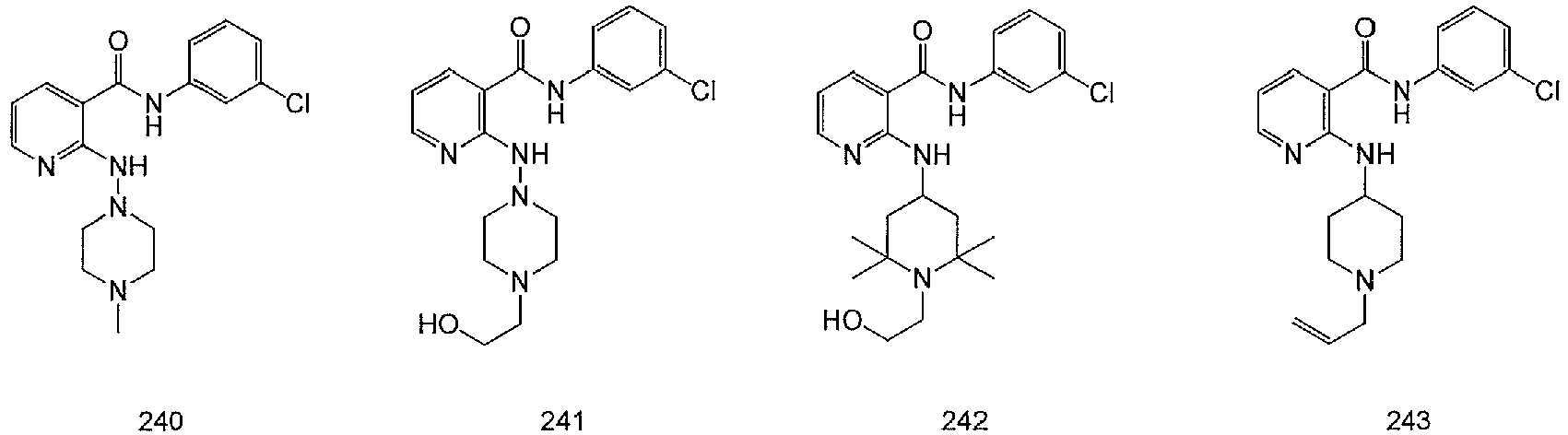
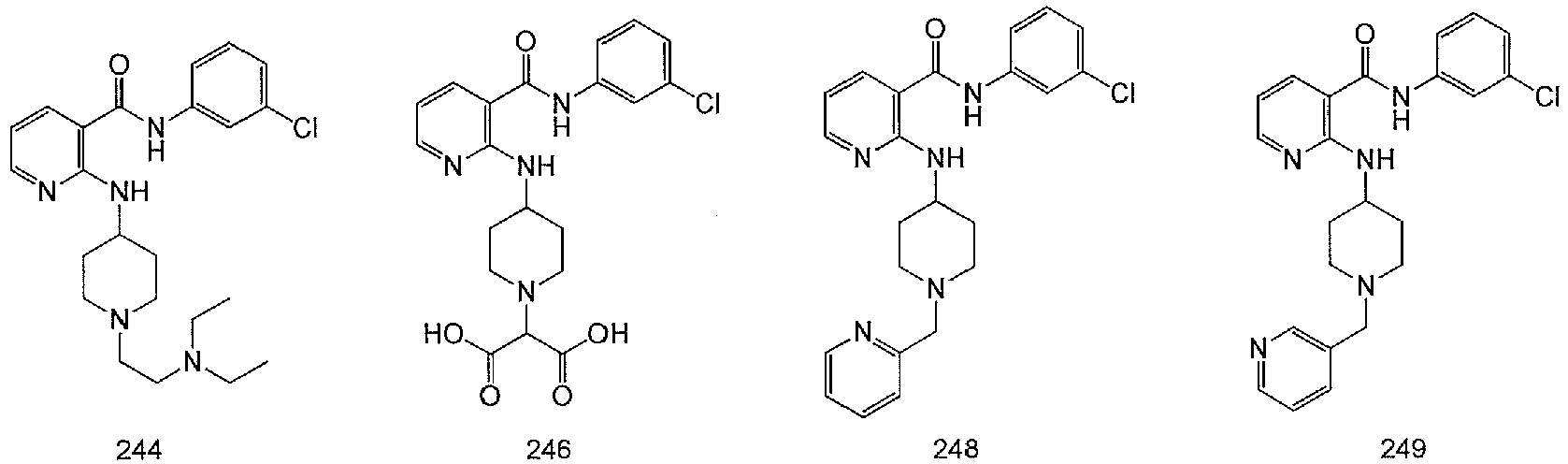


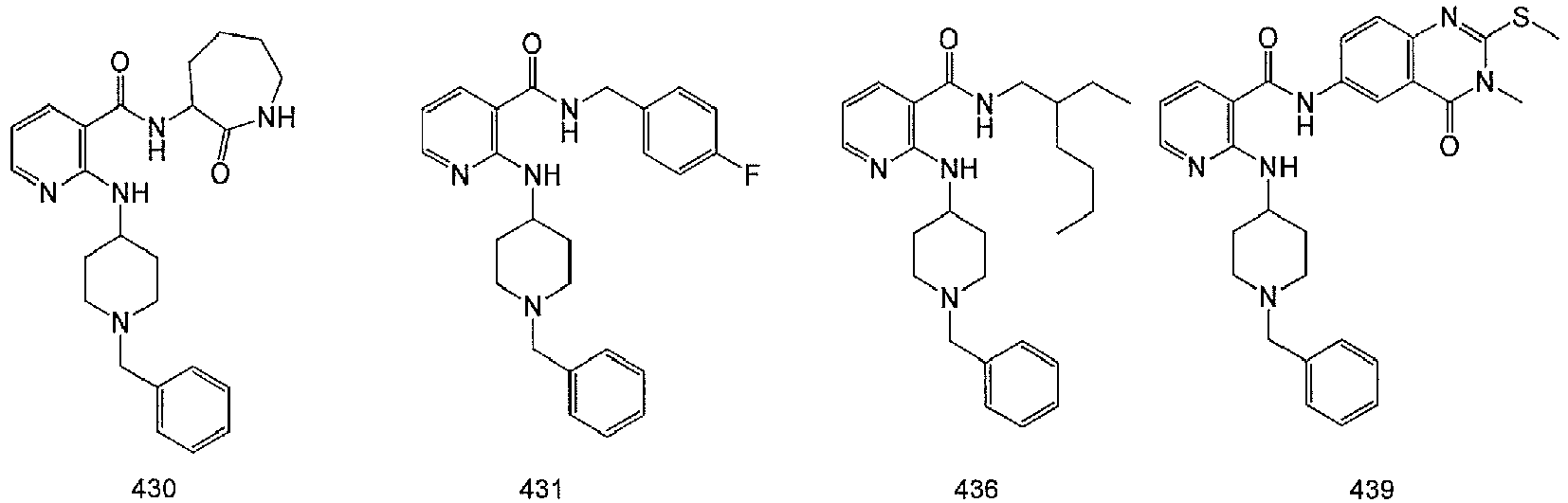


- More preferable compounds of Chemical Formula I in accordance with the present invention or pharmaceutically acceptable salts thereof are:
- 2-((1-benzylpiperidin-4-ylamino)-N-(3-chlorophenyl)nicotinamide[103],
- 2-((1-benzylpiperidin-4-ylamino)-N-(4-phenoxyphenyl)nicotinamide[110],
- N-(3-chlorophenyl)-2-[1-(2-hydroxyethyl)piperidin-4-ylamino]nicotinamide [218],
- (S)-2-(1-benzylpiperidin-3-ylamino)-N-(3-chlorophenyl)nicotinamide[273],
- (S)-N-(3-chlorophenyl)-2-(1-tert-butoxycarbamoylpiperidin-3-ylamino)nicotinamide[276],
- 6-chloro-N-(3-chlorophenyl)-5-fluoro-2-[1-(2-hydroxyethyl)piperidin-4-ylamino]nicotinamide[312],
- (S)-N-(3-chlorophenyl)-2-(3-piperidylamino)nicotinamide[275],
- 2-((1-benzylpiperidin-4-ylsulfanyl)-N-(3-chlorophenyl)nicotinamide[290],
- 2-((1-benzylpiperidin-4-ylamino)-N-(5-methylthiazol-2-yl)nicotinamide[428],
- 2-{[2-(1-benzylpiperidin-4-ylamino)pyridine-3-carbonyl]amino}-4,5,6,7-tetrahydro-thieno[2,3-c]pyridine-3-carboxylic acid methyl ester[442],
- 2-{[2-(1-benzylpiperidin-3-ylamino)pyridine-3-carbonyl]amino}-4,5,6,7-tetrahydrothieno[2,3-c]pyridine-3-carboxylic acid methyl ester[509], and pharmaceutically acceptable salts thereof.
- Higher preference would be made for 2-(1-benzylpiperidin-4-ylamino)-N-(3-chlorophenyl)nicotinamide[103] or a pharmaceutically acceptable salt thereof.
- As used herein, the term "pharmaceutically acceptable salt" is intended to refer to a salt of an inorganic or organic acid typically used in the preparation of medicines in the art. The inorganic acid may be hydrochloric acid, bromic acid, sulfuric acid, or phosphoric acid while examples of the organic acid include citric acid, acetic acid, lactic acid, stannic acid, fumaric acid, formic acid, propionic acid, oxalic acid, trifluoroacetic acid, methanesulfonic acid, benzenesulfonic acid, maleic acid, benzoic acid, gluconic acid, glycolic acid, succinic acid, 4-morpholineethane sulfonic acid, caphorsulfonic acid, 4-nitrobenzenesulfonic acid, hydroxyl-O-sulfonic acid, 4-toluenesulfonic acid, galacturonic acid, embonic acid, glutamic acid, aspartic acid.
- In accordance with another aspect thereof, the present invention addresses a method for preparing the compound of Chemical Formula I, comprising reacting a compound represented by the following Chemical Formula II with a compound represented by Chemical Formula III in the presence of a base (hereinafter referred to as "
Preparation Method 1"):
[Chemical Formula III] H2N-R2
wherein, - X1, X2, R1 and R2 are respectively as defined hereinbefore,
- Z is chloro or bromo.
- In
Preparation Method 1, the compound of Chemical Formula II and the compound of Chemical Formula III may be commercially available ones, or may be synthesized using known methods. For example, the compound of Chemical Formula II may be synthesized according to the teachings of Organic ], Organic ], and Organic Synthesis Collective Volumn 2, 292 (1943) [John R. Ruhoff]. For the compound of Chemical Formula III, reference may be made to Journal of medicinal chemistry, vol 22, 1171 (1979) [E. W. Byrnes and et al], and Journal of the Chemical Society. and et al.]. - The base used in
Preparation Method 1 may be appropriately selected from among those known to those skilled in the art. It is preferably, for example, a tertiary organic base selected from among triethylamine, N,N-diisopropylethylamine, N-methylmorpholine, DBU (1,8-Diazabicyclo[5.4.0]undec-7-ene), N-methylpiperidine, 4-dimethylaminopyridine, N,N-dimethylaniline, 2,6-lutidine, 4-N,N-dimethylaminopyridine, and pyridine. InPreparation Method 1, the base is used at a molar ratio of 1∼5: 1 to the compound of Chemical Formula II, and preferably used at a molar ratio of 3:1. - So long as it is typically used for amide reaction in the art, any solvent may be adopted as the reaction solvent of
Preparation Method 1. To quote an example, acetonitrile, chloroform, methylenechloride, tetrahydrofuran, N,N-dimethylformamide, and N-methylpyrrolidinone may be preferably used alone or in combination. - The reaction of
Preparation Method 1 may be carried out at various temperatures, but preferably at -10 to room temperature (30°C). More preferably, after addition of the base at 0 to 10°C, the reaction may be performed at room temperature or ambient temperature. However, the reaction temperature may depend on kinds of the base used, reaction solvents, and amounts thereof. - In accordance with a further aspect thereof, the present invention addresses a method for preparing the compound of Chemical Formula I, comprising a compound represented by the following Chemical Formula IV with a compound represented by the following Chemical Formula V in the presence of a base (hereinafter referred to "Preparation Method 2"):

[Chemical Formula V] Y-R1
wherein, - X1, X2, R1, and R2 are respectively as defined hereinbefore, and
- Y is -NH2, -SH, or -OH.
- In Preparation Method 2, the base may be an inorganic base typically available for those skilled in the art or an organic base existing as a solid phase at ordinary temperature. Preferably, it is selected from the group consisting of potassium carbonate, potassium hydrogen carbonate, sodium carbonate, sodium hydrogen carbonate, sodium hydroxide, potassium hydroxide, calcium hydroxide, barium hydroxide, sodium methoxide, sodium ethoxide, sodium-t-butoxide, potassium-t-butoxide, sodium hydride, potassium hydride, sodium borohydride, sodium cyanoborohydride, and 4-N,N-dimethylaminopyridine.
- In Preparation Method 2, the base is used at a molar ratio of 1∼2: 1 to the compound of Chemical Formula IV, and preferably used at a molar ratio of 1.2∼1.5:1.
- The reaction solvent useful in Preparation Method 2 is an organic solvent available for those skilled in the art to perform reflux at 100°C or higher. Preferably, xylene, toluene, DMF, DMSO, dioxane, lutidine, pyridine, and N,N-dimethylaniline may be used alone or in combination. Xylene means any of ortho-xylene, meta-xylene, and para-xylene. Within the scope of lutidine fall 2,3-lutidine, 2,4-lutidine, 2,5-lutidine, 2,6-lutidine, 3,4-lutidine, and 3,5-lutidinel. More preferable is ortho-xylene (o-xylene).
- The reaction of Preparation Method 2 may be carried out at room temperature or in a range of reflux temperatures, with the latter being preferred.
- In accordance with a still further aspect thereof, the present invention addresses a pharmaceutical composition for the prevention or treatment of a disease caused by the aberrant activity of vascular endothelial growth factor, comprising the compound of Chemical Formula I or a pharmaceutically acceptable salt thereof. The pharmaceutically acceptable salt is as described above.
- Also, contemplated in accordance with still another aspect thereof is a method for preventing or treating a disease or symptom caused by aberrant activity of vascular endothelial growth factor (VEGF), comprising administering a therapeutically effective amount of the compound of Chemical Formula I or a pharmaceutically acceptable salt thereof to a mammal in need thereof, including a human.
- The disease or symptom caused by the aberrant activity of vascular endothelial growth factor includes cancer, rheumatoid arthritis, diabetic retinopathy, keratitis, hyperemia, macular degeneration, choroidal neovascularization, neovascular glaucoma, ophthalmic diseases of corneal neovascularization, psoriasis, airway obstructive hemangiomas in lung, and obesity by angiogenesis.
- In a preferred embodiment, the disease or symptom caused by the aberrant activity of vascular endothelial growth factor is cancer.
- In accordance with a still further aspect thereof, the preset invention addresses a pharmaceutical composition for the suppression of vessel formation, comprising a compound of Chemical Formula I or a pharmaceutically acceptable salt thereof. The pharmaceutical composition for the suppression of vessel formation in accordance with the present invention is preferably an anticancer agent.
- In addition, the pharmaceutical composition of the present invention may further comprise one or more active ingredients exhibiting an activity equal to or similar to that of the compound of Chemical Formula I or a pharmaceutically acceptable salt thereof.
- In addition to the active ingredient, the composition in accordance with the present invention may comprise at least one pharmaceutically acceptable carrier. Examples of the pharmaceutically acceptable carrier include saline solution, sterile water, Ringer's solution, buffered saline solution, dextrose solution, maltodextrin solution, glycerol, ethanol, and a mixture of two or more thereof. If necessary, the composition may further include other conventional additives, such as antioxidants, buffers, and bacteriostatic agents. Also, the composition may additionally include diluents, dispersants, surfactants, binders and lubricants in order to be formulated into injection formulations, such as aqueous solution, suspension and emulsion, pills, capsules, granules or tablets. Furthermore, the composition may be preferably formulated depending on its components or purposes, using a suitable method known in the art, for example, the method described in Remington's Pharmaceutical Science (latest edition), Mack Publishing Company, Easton PA.
- According to the intended use, the composition may be administered orally or via parenteral routes (e.g., intravenous, subcutaneous, intraperitoneal or topical). The specific therapeutically effective dose level for any particular patient may vary depending on a variety of factors, including the patient's weight, age, gender, general health status and diet, the time of administration, route of administration, rate of excretion of the composition, and severity of the illness. The compound of Chemical Formula I or a pharmaceutically acceptable salt thereof may be administered in a daily dosage ranging from about 5 to 75 mg, and preferably 5 to 50 mg. The daily dosage can be preferably given in a single dose.
- For application to the prevention and treatment of a disease caused by aberrant activity of vascular endothelial growth factor, the composition may be used alone or in combination with other therapies including surgery, hormonal therapy, chemical therapy and/or biological reaction regulators.
- In accordance with a yet further aspect thereof, the present invention addresses a method for preventing or treating a disease, comprising administering a compound of Chemical Formula I, at least one of the enumerated compounds above, or a pharmaceutically acceptable salt thereof to a subject including a mammal.
- In accordance with yet another aspect thereof, the present invention addresses a method for preventing or treating a disease, comprising administering a compound of Chemical Formula I, at least one of the enumerated compounds above, or a pharmaceutically acceptable salt thereof to a subject including a mammal, wherein the disease is selected from the group consisting of cancer, rheumatoid arthritis, diabetic retinopathy, keratitis, hyperemia, macular degeneration, choroidal neovascularization, neovascular glaucoma, ophthalmic diseases of corneal neovascularization, psoriasis, airway obstructive hemangiomas in lung, and obesity by angiogenesis.
- Because the present invention is capable of potently suppressing the activity of vascular endothelial growth factor, the compounds of the present invention are applicable to the prevention and treatment of diseases caused by aberrant activity of vascular endothelial growth factor, and available as an anti-angiogenic agent.
-
-
FIGS. 1 and 2 are photographs showing results of Experimental Example 2-2. -
FIGS. 3 and 4 are photographs showing results of Experimental Example 4. -
FIGS. 5 and 6 are photographs showing results of Experimental Example 5. -
FIGS. 7 and 8 are photographs showing results of Experimental Example 6. -
FIG. 9 is a photograph showing results of Experimental Example 7. - A better understanding of the present invention may be obtained through the following examples which are set forth to illustrate, but are not to be construed as limiting the present invention.
- In the following Examples, unless specifically stated, all reagents and solvents were purchased from Aldrich, TCI, Wako or Junsei, and 1H-NMR and Mass data were measured using Gemini 200 (Verian) and 1100MSD (Hewlett Packard), respectively.
- The dissicant used in the Examples was 'sodium sulfate' unless otherwise stated.
- Intermediates for the preparation of compounds of Table 1 were synthesized in the following Preparation Examples.
-

- To a solution of piperidin-2-one hydrochloride (5g, 37.43mmol, 1.05eq), methyl cyanoacetate (37.43mmol, 1.05eq), and sulfur (35.65mmol 1.05eq) in methanol (20ml) was added diethylamine (35.65mmol). The reaction mixture was stirred at room temperature for 5 hrs, and the precipitate thus formed was washed with isopropanol (10 ml) and methanol (20 ml) and hot-air dried to afford the title compound. Yield 42.6%, basified Cpd 1H NMR (CDCl3) δ 6.01 (s, 2H), 3.79-3.77 (m, 5H), 3.07(t, 2H), 2.72(m, 2H) ppm
-

- The title compound was prepared in the same manner as in Preparation Example 1, with the exception that 1-benzylpiperidin-2-one, instead of piperidin-2-one hydrochloride, was used in the same molar amount. Yield 81.4% 1H NMR (CDCl3) δ 7.37-7.30 (m, 5H), 6. 01 (s, 2H), 3.78(s, 3H), 3.68(s, 2H), 3.41(s, 2H), 2.85-2.75(m, 4H) ppm
-

- The title compound was prepared in the same manner as in Preparation Example 1, with the exception that piperidin-2-one-1-yl ethoxycarbamate, instead of piperidin-2-one hydrochloride, was used in the same molar amount. Yield: 78.1%, 1H NMR (CDCl3) δ 6.05 (s, 2H), 4.40 (s, 2H), 4.17 (q, 2H), 3.80(s, 3H), 3.67(t, 2H), 2.81(t, 2H), 1.28(t, 3H) ppm
-
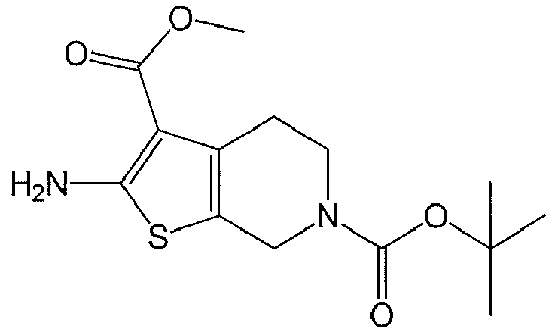
- The title compound was prepared in the same manner as in Preparation Example 1, with the exception that piperidin-2-one-1-yl tert-butoxycarbamate, instead of piperidin-2-one hydrochloride, was used in the same molar amount. Yield: 80.9%, 1H NMR (CDCl3) 5 6.07 (s, 2H), 4.35 (s, 2H), 3.79(s, 3H), 3.61(t, 2H), 2.78 (t, 2H), 1.47 (s, 9H) ppm
-

- A solution of 2-chloronicotinic acid (10g, 63.47mmol, 1eq) in 70 ml of methylene chloride was stirred in an ice bath. After dropwise addition of thionyl chloride (76.16 mmol, 1.2 eq) for 30 min to the solution, the ice bath was removed, and the solution was stirred at room temperature for 30 min and then under reflux for 1 hr. The reaction mixture was cooled and used in the next step without further purification.
- The solution obtained in
step 1 was placed in an ice bath and added with triethylamine (152.32 mmol, 2.4eq) for 30 min at room temperature. Again, 3-chloroaniline (76.16mmol, 1.2eq) was added to the reaction mixture for 30 min, followed by stirring under reflux for 3 hrs. When the reaction was completed under the monitoring of thin layer silica chromatography, the reaction mixture was cooled to room temperature and the reaction was terminated using with pure water. Then resultant solution was extracted two or three times with MC (methylene chloride, 50 ml). A pool of the organic layers was washed with 70 ml of 1N-HCl and neutralized with sodium bicarbonate. After being dried over sodium sulfate, the organic layer pool was concentrated in reduced pressure. Purification by column chromatography (mobile phase; 30(v/v)% EA in hexane) afforded the title compound. Total yield: 81.6% 1H NMR (CDCl3+4drop CD3OD) δ 8.41(dd, 1H), 8.00(dd, 1H), 7.74 (st, 1H), 7.49(d, 1H), 7.35(dd, 1H), 7.27(t, 1H), 7.13(d, 1H) ppm -

- The title compound was synthesized in the same manner as in step 2 of Preparation Example 5, with the exception that 4-phenoxyaniline, instead of 3-chloroaniline, was used in the same molar amount. Total yield: 91.2% 1H NMR (CDCl3) 5 8.52(dd, 1H), 8.22(dd, 1H), 8.17 (s, 1H), 7.62(d, 2H), 7.46-7.32(m, 3H), 7.15-7.0(m, 5H) ppm
-

- The title compound was prepared in the same manner as in step 2 of Preparation Example 5, with the exception that 1-acetyl-6-amino-3,3-dimethyl-2,3-dihydro-1H-indole, instead of 3-chloroaniline, was used in the same molar amount. Total yield: 80.4% 1H NMR (CDCl3) δ 9.01 (s, 1H), 8.42(d, 1H), 8.07 (d, 1H), 8.05(s, 1H), 7.93(d, 1H), 7.33(dd, 1H), 7.14(d, 1H), 3.75(s, 2H), 2.07(s, 3H), 1.37(s, 6H) ppm
-

- The title compound was prepared in the same manner as in
step 1 of Preparation Example 5, with the exception that 2,6-dichloronicotinic acid, instead of 2-chloronicotinic acid, was used in the same molar amount. - The title compound was prepared in the same manner as in step 2 of Preparation Example 5, with the exception that 2,6-dichloronicotinyl chloride obtained in
step 1, instead of 2-chloronicotinyl chloride, was used in the same molar amount.Yield: 75.3% 1H NMR (CDCl3+ 2 drops DMSO-d6) δ 9.82 (s, 1H), 7.89(d, 1H), 7.77(st, 1H), 7.52(dt, 1H), 7.34(d, 1H), 7.23(t, 1H), 7.08(dq, 1H) ppm
-

- The title compound was prepared in the same manner as in
step 1 of Preparation Example 5, with the exception that 2,6-dichloro-5-fluoronicotinic acid, instead of 2-chloronicotinic acid, was used in the same molar amount. - The title compound was prepared in the same manner as in step 2 of Preparation Example 5, with the exception that 2,6-dichloro-5-fluoronicotinyl chloride obtained in
step 1, instead of 2-chloronicotinyl chloride, was used in the same molar amount. Total yield: 78.4% 1H NMR (CDCl3) δ 8.35(s, 1H), 8.08(d, 1H), 7.76(s, 1H), 7.48-7.19(m, 3H) ppm -
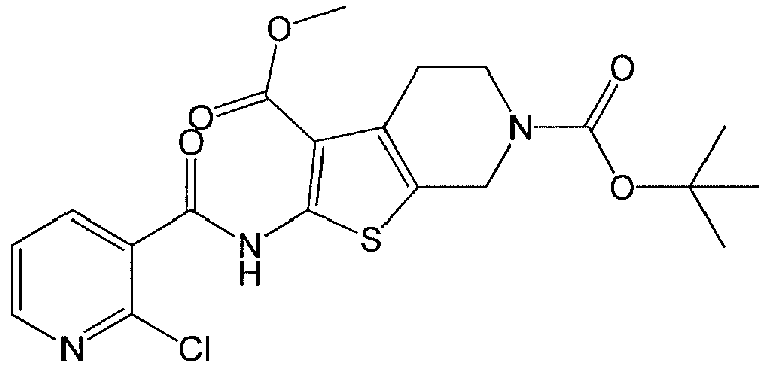
- The title compound was prepared in the same manner as in step 2 of Preparation Example 5, with the exception that 2-amino-4,7-dihydro-5H-thieno[2,3-c]pyridine-3,6-dicarboxylic acid 6-tert-butyl ester 3-methyl ester obtained Preparation Example 4, instead of 3-chloroaniline, was used in the same molar amount. Total yield: 56.7% 1H NMR (CDCl3) δ 8.58(d, 1H), 8.23(d, 1H), 7.44(m, 1H), 4.57(s, 2H), 3.92(s, 3H), 3.69(t, 2H), 2.92 (t, 2H), 1.49(s, 9H) ppm
-

- The title compound was prepared in the same manner as in step 2 of Preparation Example 5, with the exception that 2,6-dichloronicotinyl chloride, instead of 2-chloronicotinyl chloride, and 2-amino-4,7-dihydro-5H-thieno[2,3-c]pyridine-3,6-dicarboxylic acid 6-tert-butyl ester 3-methyl ester obtained in Preparation Example 4, instead of 3-chloroaniline, were used in the same molar amounts. Total yield: 43.4% 1H NMR (CDCl3) 5 7.65 (d, 1H), 7.39 (m, 1H), 3.82 (s, 2H), 3.78(s, 3H), 3.48(t, 2H), 2.98(t, 2H), 1.60(s, 9H) ppm
-

- The title compound was prepared in the same manner as in step 2 of Preparation Example 5, with the exception that 2,6-dichloro-5-fluoronicotinyl chloride obtained in Preparation Example 9, instead of 2-chloronicotinyl chloride, and 2-amino-4,7-dihydro-5H-thieno[2,3-c]pyridine-3,6-dicarboxylic acid 6-tert-butyl ester 3-methyl ester obtained in Preparation Example 4, instead of 3-chloroaniline, were used in the same molar amounts. Yield: 49.7% 1H NMR (CDCl3) δ 8.12(d, 1H), 4.56(s, 2H), 3.92(s, 3H), 3.69(t, 2H), 2.92 (t, 2H), 1.50(s, 9H) ppm
-
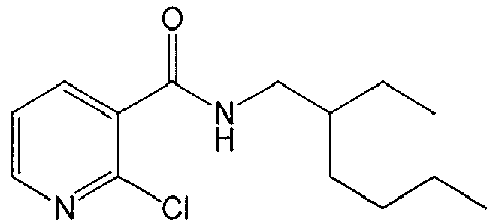
- The title compound was prepared in the same manner as in step 2 of Preparation Example 5, with the exception that 2-ethylhexylamine, instead of 3-chloroaniline, was used in the same molar amount. Total yield: 92.4% 1H NMR (CDCl3) 5 8.41(d, 1H), 8.04(d, 1H), 7.31(m, 1H), 6.50(br, 1H), 3.41(t, 2H), 1.58(m, 1H), 1.48-1.28 (m, 8H), 0.97-0.88(m, 6H) ppm
-
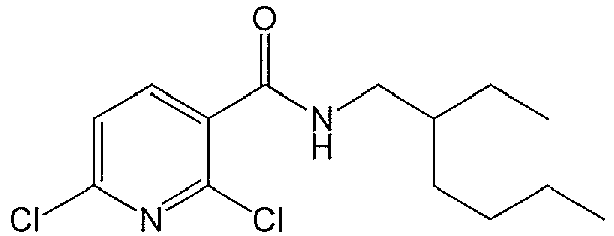
- The title compound was prepared in the same manner as in step 2 of Preparation Example 5, with the exception that 2,6-dichloronicotinyl chloride of Preparation Example 8, instead of 2-chloronicotinyl chloride, and 2-ethylhexylamine, instead of 3-chloroaniline, were used in the same molar amounts. Total yield: 89.6% 1H NMR (CDCl3) 5 8.09(d, 1H), 7.37(d, 1H), 6.55(br, 1H), 3.43(t, 2H), 1.59(m, 1H), 1.49-1.29(m, 8H), 0.97-0.88(m, 6H) ppm
-

- The title compound was prepared in the same manner as in step 2 of Preparation Example 5, with the exception that 2,6-dichloro-5-fluoronicotinyl chloride of Preparation Example 8, instead of 2-chloronicotinyl chloride, and 2-ethylhexylamine, instead of 3-chloroaniline, were used in the same molar amounts. Total yield: 90.1% 1H NMR (CDCl3) δ 8.0(d, 1H), 6.65(br, 1H), 3.44(t, 2H), 1.58(m, 1H), 1.48-1.27(m, 8H), 0.97-0.88(m, 6H) ppm
-

- In 500 ml of ortho-xylene, 100 g of 2-chloronicotinonitrile 100 g, 108.82 g of anhydrous potassium carbonate, and 133.83 ml of 4-amino-1-benzylpiperidine were together stirred for 24 hrs under reflux. This reaction mixture was cooled to room temperature, added with 500 ml of ethyl acetate and 1,000 ml of pure water, and adjusted to a pH of about 2∼3 with conc. HCl. The aqueous fraction thus formed was obtained, washed again with 300 ml of ethylacetate, and adjusted to a pH of about 9∼10 with sodium hydroxide in an ice bath while stirring. After completion of sodium hydroxide, the fraction was stirred for an additional 1 hr, filtered, washed with water, and hot air dried to afford 137.4 g of the title compound (yield: 71.5%). 1H NMR (CDCl3) δ 8.26(dd, 1H), 7.63 (dd, 1H), 7.36-7.28(m, 5H), 6.59(m, 1H), 5.0(d, 1H), 4.14-3.97 (m, 1H), 3.53(s, 2H), 2.88 (d, 2H), 2.22(t, 2H), 2.1-1.98(m, 2H), 1.68-1.47(m, 2H) ppm
- To a solution of 100 g of 2-(1-benzylpiperidin-4-ylamino)nicotinonitrile obtained in
step 1 in 200 ml of isopropanol was added 63.22 g of potassium hydroxide, followed by stirring for 12 hrs under reflux. The reaction mixture was cooled to a room temperature, mixed with 800 ml of pure water and 500 ml of ethylacetate, and adjusted to a pH of 2∼3 with conc. HCl. The aqueous layer was obtained, washed with 500 ml of ethylacetate, and adjusted to a pH of 6∼8 with sodium hydroxide in an ice bath while stirring. Precipitates were formed during stirring for an additional 1 hr, and washed with pure water. The precipitates were slurried with 300 ml of pure water, stirred for 30 min, and filtered. The filtrate was again slurried with 150 ml of acetone, stirred for 30 min, and filtered. This filtrate was washed with a small amount of acetone and hot air dried to afford 93.7 g of the title compound (Yield: 88.1%). 1H NMR (CDCl3) δ 8.89 (d, 1H), 8.29(d, 1H), 8.10 (d, 1H), 7.57-7.42(m, 5H), 4.35(s, 2H), 4.30(m, 1H), 3.47(d, 2H), 2.73(t, 2H), 2.39(d, 2H), 2.01-1.80(m, 2H) ppm -

- A solution of 0.5 g of tert-butyl 4-piperidinylcarbamate, 0.21 ml of 2-bromoethanol and 2.76 g of K2CO3 in 10 ml of acetonitrile was stirred for 5 hrs under reflux. The reaction mixture was cooled to a room temperature, filtered to remove solids, and concentrated. The concentrate was purified by silica gel column chromatography (mobile phase: 20(v/v)% EA in hexane) to afford 0.58 g of the title compound (Yield: 94%). 1H NMR (CDCl3) δ 4.76(d, 1H), 3.65 (t, 2H), 3.48(m, 1H), 2.92(m, 2H), 2.59(t, 2H), 2.26(m, 2H), 1.94(m, 2H), 1.52(m, 2H), 1. 44 (s, 9H) ppm
- To a solution of 0.58 g of tert-butyl 1-(2-hydroxyethyl)piperidin-4-ylcarbamate obtained in
step 1 in 10 ml of ethanol was added 1 ml of conc. HCl, followed by stirring for 2 hrs under reflux. The reaction mixture was cooled to room temperature, and concentrated in a reduced pressure to remove solvent.. The residue was added with 10 ml of distilled water, neutralized with saturated sodium hydrogen carbonate aqueous solution, and extracted twice with 10 ml of methylene chloride. After being dried over a desiccant, the fraction was concentrated in a reduced pressure to afford 0.33 g of the title compound (Yield: 95%). 1H NMR (CDCl3) δ 3.68(s, 2H), 3.60(t, 2H), 2.86(d, 2H), 2.69(m, 1H), 2.53(t, 2H), 2.11 (t, 2H), 1.82(d, 2H), 1.42(t, 2H) ppm - Reference: J. Med. Chem. 23 (1980) 848

- A solution of 2 g of 3-(N-acetamino)piperidine and 1.3 g of sodium bicarbonate in 7 ml of DMF (dimethylformamide) was stirred for 30 min in an ice bath. To the reaction mixture was dropwise added 1.7 ml of benzyl chloride for 15 min, and stirred at room temperature for 15 hrs. The solvent was removed by concentration in a reduced pressure, followed by adding pure water. The solid thus formed was filtered to be obtained and recrystallized using diethylether to afford 2.13 g of the title compound (Yield: 87.5%). 1H NMR (CDCl3) δ 7.31(m, 5H), 4.15-4.03 (m, 1H), 3.49(s, 2H), 2.59(d, 1H), 2.43(d, 2H), 2.19 (m, 1H), 1.98(s, 3H), 1.92(d, 2H), 1.74-1.52(m, 4H) ppm
- A solution of 2.13 g of 3-(N-acetamido)-1-benzylpiperidine in 10 ml of 6 N HCl was stirred for 1 hr under reflux. The reaction mixture was cooled to room temperature, and added with 6 N ammonia water until the pH was adjusted to 9∼10. After 4 rounds of extraction with 15 ml of chloroform per round, the extract was dried over sodium sulfate and concentrated in a reduced pressure to afford 1.21 g of the title compound (Yield: 96.3%). 1H NMR (CDCl3) 5 7.31(m, 5H), 3.51(s, 2H), 2.93-2.61(m, 3H), 2.06(t, 1H), 1.90-1.52(m, 4H), 1.20-1.02(m, 1H) ppm
-
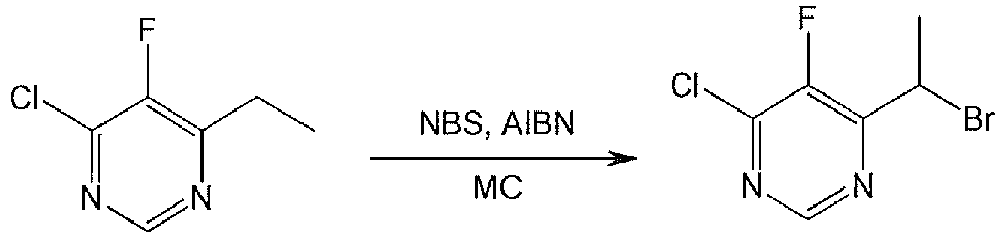
- A solution of 5 g of 6-chloro-4-ethyl-5-fluoropyrimidine, 6.65 g of NBS, and 0.51 g of AIBN in 50 ml of methylene chloride was stirred for 12 hrs under reflux. The reaction was cooled to room temperature and added with 30 ml of pure water. The organic layer was obtained, and the aqueous fraction was extracted with 30 ml of methylene chloride. The organic layers thus obtained were pooled and washed with 30 ml of 10 % sodium metabisulfite, and then with pure water. After dehydration with a desiccant, the obtained product was concentrated under reduced pressure to afford 6.95 g of the title compound (Yield: 95.1%). 1H NMR (CDCl3) δ 8.80(s, 1H), 5.35(q, 1H), 2.08(d, 3H) ppm
- Reference: Bioorg. Med. Chem. 14 (2006) 8608

- A solution of 3.48 g of 5-nitroanthranilic acid, 1.68 g of methylisothiocyanate, and 3.72 ml of triethylamine in 70 ml of ethanol was stirred for 4 hrs under reflux. The reaction mixture was cooled to room temperature, and concentrated in a reduced pressure to remove the solvent. The residue was recrystallized in diethyl ether to afford 3.91 g of the title compound (Yield 86.2%) 1H NMR (DMSO-d6) δ 8.19 (d, 1H), 8.16(sd, 1H), 8.05(dd, 1H), 3.67(s, 3H) ppm
- A solution of 3.91 g of 3-methyl-6-nitro-2-thioxo-2,3-dihydro-1H-quinazolin-4-one obtained in
step 1, 8.24 ml of methane iodide, and 2.73 g of anhydrous potassium carbonate in 82 ml of acetone was stirred for 8 hrs under reflux. While remaining hot, the reaction mixture was filtered to remove precipitates, and washed with acetone. The filtrate was concentrated in a reduced pressure, and the residue was slurried with 20 ml of isopropanol and stirred for 30 min. The resultant mixture was filtered and dried to afford 2.84 g of the title compound (yield: 68.7 %). 1H NMR (DMSO-d6) 5 8.30 (d, 1H), 8.26 (sd, 1H), 8.16 (dd, 1H), 3.56 (s, 3H), 2.71 (s, 3H) ppm - A solution of 1.5 g of 2-methylthio-3-methyl-6-nitro-3H-quinazolin-4-one obtained in step 2, 6.73 g of tin (II) chloride dihydrate, and 0.11 g of sodium borohydride in 10 ml of ethanol was stirred for 3 hrs under reflux. The reaction mixture was added with 20 ml of pure water, and neutralized with an aqueous 2N-sodium hydroxide solution. After removal of ethanol by concentrating in reduced pressure, the residue was extracted twice with 15 ml of diethyl ether. The extract was dried over a desiccant and concentrated in a reduced pressure to afford 0.55g of the title compound (Yield: 41.7%). 1H NMR (CDCl3) δ 8.02(d, 1H), 6.71(s, 1H), 6.68 (d, 1H), 3.57(s, 3H), 2.62(s, 3H) ppm
- Compounds of Table 1 were synthesized in the following Examples.
-

- A solution of 2-chloro-(N-3-chlorophenyl)nicotinamide (280mg, 1.05mmol, 1.05eq) prepared in Preparation Example 5, 4-amino-1-benzylpiperidine (1.0 mmol), and anhydrous potassium carbonate (1.3 mmol) in ortho-xylene was stirred for 24 hrs under reflux. The reaction mixture was cooled to a room temperature, added with ethylacetate, and extracted twice with 1N HCl. The aqueous layer thus formed was washed with 30 ml of ethylacetate, adjusted to a pH of about 9∼10 by adding 2 N sodium hydroxide, and extracted two or three times with 20 ml of methylene chloride. The aqueous layer was dried over a desiccant, and concentrated in a reduced pressure. A desired fraction obtained by purification through silica gel chromatography was concentrated in a reduced pressure and dried in a vacuum to afford the title compound. Yield: 66.5% 1H NMR (DMSO-d6) δ8.15∼8.30 (m, 2H), 8.03(d, 1H), 7.90(s, 1H), 7.66(d, 1H), 7.60(d, 1H), 7.30∼7.60 (m, 6H), 7.19 (d, 1H), 6.70(m, 1H), 4.10(bs, 1H), 3.95(s, 1H), 2.85∼3.15 (m, 2H), 2.70∼2.85 (m, 2H), 1.90∼2.15 (m, 2H), 1.60∼1.85(m, 2H) ppm
-

- The title compound was prepared in the same manner as in Example 1, with the exception that 4-phenoxyaniline, instead of 4-amino-1-benzylpiperidine, was used in the same molar amount (Yield: 72.3%). 1H NMR (DMSO-d6) δ 8.37(d, 1H), 8.21 (d, 1H), 7.92 (s, 1H), 7.60∼7.76 (m, 3H), 7.30∼7.43 (m, 3H), 7.21 (d, 1H), 7.06(t, 1H), 6.90∼7.05 (m, 5H) ppm
-

- The title compound was prepared in the same manner as in Example 1, with the exception that 2-chloro-(N-4-phenoxyphenyl)nicotinamide of Preparation Example 6, instead of 2-chloro-(N-3-chlorophenyl)nicotinamide, was used in the same molar amount (Yield: 69.1%). 1H NMR (DMSO-d6) δ 10.23 (s, 1H), 8.32(s, 1H), 8.21(d, 1H), 8.09(d, 2H), 7.66(d, 1H), 7.70 (d, 2H), 7.20∼7.45 (m, 6H), 6.95∼7.18 (m, 5H), 3.90∼4.10 (m, 1H), 3.47(s, 2H), 2.675 ∼2.80(m, 2H), 2.05∼2.25 (m, 2H), 1.95∼ 2.05(m, 2H), 1.35∼1.60 (m, 2H) ppm
-

- The title compound was prepared in the same manner as in Example 1, with the exception that 2-chloro-(N-4-phenoxyphenyl)nicotinamide of Preparation Example 6, instead of 2-chloro-(N-3-chlorophenyl)nicotinamide, and 4-phenoxyaniline, instead of 4-amino-1-benzylpiperidine, were used in the same molar amounts (Yield: 77.8%). 1H NMR (DMSO-d6) 5 10.50(s, 1H), 10.33(s, 1H), 8.35(d, 1H), 8.25(d, 1H), 7.69∼7.82 (m, 4H), 7.30∼7.46(m, 4H), 6.88∼7.18 (m, 11H) ppm
-
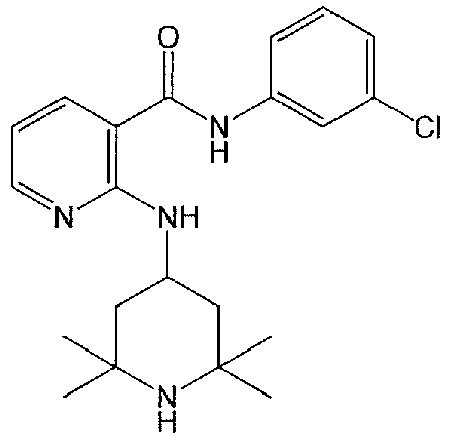
- The title compound was prepared in the same manner as in Example 1, with the exception that 4-amino-2,2,6,6-tetramethylpiperidine, instead of 4-amino-1-benzylpiperidine, was used (Yield: 82.1%). 1H NMR (CDCl3) δ 8.26(d, 1H), 7.80(d, 1H), 7.68∼7.63 (m, 2H), 7.35(d, 1H), 7.28(t, 1H), 7.13(d, 1H), 6.56-6.47(m, 1H), 4.65-4.46(m, 1H), 2.05(d, 2H), 1.30(s, 6H), 1.14 (s, 6H), 1.02(t, 2H) ppm
-
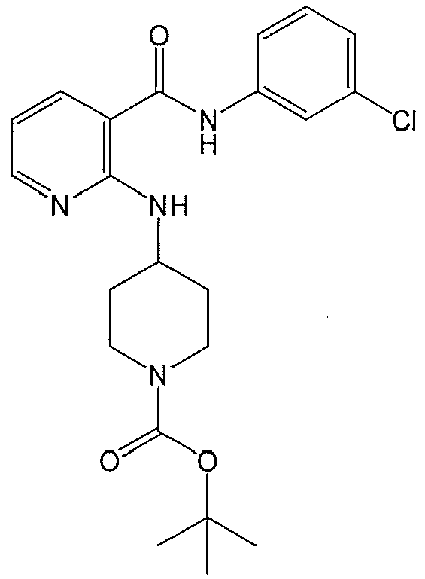
- The title compound was prepared in the same manner as in Example 1, with the exception that 4-amino-1-Boc-piperidine, instead of 4-amino-1-benzylpiperidine, was used in the same molar amount (Yield: 42.3%). 1H NMR (CDCl3) δ 8.23(d, 1H), 8.03(d, 1H), 7.75(d, 1H), 7.63(s, 1H), 7.40 (d, 1H), 7.27 (t, 1H), 7.12 (d, 1H), 4.26-4.10(m, 1H), 3.96(d, 2H), 2.98(t, 2H), 1.98(d, 2H), 1.50-1.36(m, 11H) ppm
-

- The title compound was prepared in the same manner as in Example 1, with the exception that 3-amino-1-azabicyclo[2.2.2]octane, instead of 4-amino-1-benzylpiperidine, was used in the same molar amount (Yield: 24.5%). 1H NMR (CDCl3) δ 8.19 (d, 1H), 7.95 (d, 1H), 7.86 (d, 1H), 7.10-7.03 (m, 2H), 6.86-6.79(m, 1H), 6.58-6.50(m, 1H), 4.40(s, 1H), 4.03 (d, 1H), 3.80-3.61 (m, 2H), 3.33 (d, 1H), 3.18- 2.95(m, 2H), 2.47-2.36(m, 1H), 1.95-1.69 (m, 4H) ppm
-

- The title compound was prepared in the same manner as in Example 1, with the exception that 4-amino-1-methylpiperidine, instead of 4-amino-1-benzylpiperidine, was used in the same molar amount (Yield: 87.3%). 1H NMR (CDCl3) δ 8.26(d, 1H), 8.01 (d, 1H), 7.75- 7.65(m, 2H), 7.41-7.12 (m, 3H), 6.68-6.62 (m, 1H), 4.16-4.05(m, 1H), 3.75-3.4(m, 2H), 2.86(d, 2H), 2.37(s, 3H), 2.15-2.05 (m, 2H), 1.76-1.60(m, 2H) ppm
-

- The title compound was prepared in the same manner as in Example 1, with the exception that 4-amino-1-(2-hydroxyethyl)piperidine obtained in Preparation Example 17, instead of 4-amino-1-benzylpiperidine, was used in the same molar amount (Yield: 64.6%). 1H NMR (CDCl3) δ 8.18 (d, 1H), 7.96(d, 1H), 7.74(d, 1H), 7.61(s, 1H), 7.47(d, 1H), 7.22(t, 1H), 7.06(d, 1H), 6.48-6.41(m, 1H), 3.54(t, 2H), 3.03(d, 2H), 2.74(t, 2H), 2.48(t, 2H), 2.22(t, 1H), 2.05-1.94(m, 2H), 1.59-1.35(m, 2H) ppm
-

- The title compound was prepared in the same manner as in Example 1, with the exception that 1-amino-4-methylpiperazine, instead of 4-amino-1-benzylpiperidine, was used in the same molar amount(Yield: 93.8%). 1H NMR (CDCl3) δ 8.47-8.37(m, 2H), 7.93(s, 1H), 7.51(d, 1H), 7.28(t, 1H), 7.21-7.08(m, 2H), 3.27(t, 4H), 2.62(t, 4H), 2.37(s, 3H) ppm
-

- The title compound was prepared in the same manner as in Example 1, with the exception that 1-amino-4-(2-hydroxyethyl)piperazine, instead of 4-amino-1-benzylpiperidine, was used in the same molar amount (Yield: 77.3%). 1H NMR (CDCl3) δ 8.47-8.37 (m, 2H), 7.91(s, 1H), 7.51(d, 1H), 7.28(t, 1H), 7.21-7.08(m, 2H), 3.66(t, 2H), 3.29(t, 4H), 2.75(t, 2H), 2.65(t, 2H) ppm
-

- The title compound was prepared in the same manner as in Example 1, with the exception that (R)-3-amino-1-Boc-piperidine, instead of 4-amino-1-benzylpiperidine, was used in the same molar amount (Yield: 43.8%). 1H NMR (CDCl3) δ 8.24(br, 2H), 8.08(d, 1H), 7.78(d, 1H), 7.70(s, 1H), 7.39(d, 1H), 7.25(t, 1H), 7.12(d, 1H), 6.57-6.51(m, 1H), 4.21-4.06(m, 1H), 3.95-3.86(m, 1H), 3.62-3.49(m, 2H), 3.30-3.18(m, 2H), 2.04-1.86(m, 1H), 1.68-1.56(m, 2H), 1.42(s, 9H) ppm
- 12-B) Preparation of (S)-N-(3-chlorophenyl)-2-(1-tert-butoxycarbamoylpiperidin-3-ylamino)nicotinamide[276]
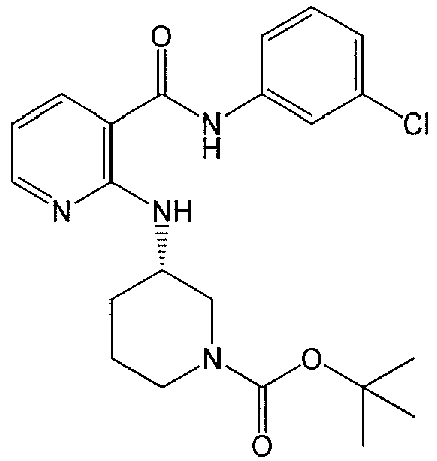
- The title compound was prepared in the same manner as in Example 1, with the exception that (S)-3-amino-1-Boc-piperidine, instead of 4-amino-1-benzylpiperidine, was used in the same molar amount (Yield: 51.7%). 1H NMR (CDCl3) δ 8.24 (d, 1H), 8.08(d, 1H), 7.71(d, 1H), 7.69(s, 1H), 7.16(d, 1H), 7.27(t, 1H), 7.12(d, 1H), 6.59-6.51(m, 1H), 4.21-4.06(m, 1H), 3.95-3.86(m, 1H), 3.62-3.52(m, 1H), 3.30-3.18(m, 2H), 2.04-1.96(m, 1H), 1.98-1.56(m, 3H), 1.42(s, 9H) ppm
-
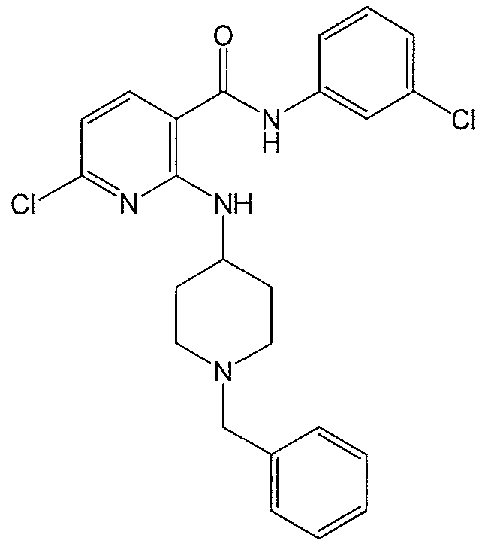
- The title compound was prepared in the same manner as in Example 1, with the exception that 2,6-dichloro-N-(3-chlorophenyl)nicotinamide obtained in Preparation Example 8, instead of 2-chloro-N-(3-chlorophenyl)nicotinamide, was used in the same molar amount (Yield: 48.7%). 1H NMR (CDCl3) δ 8.21(d, 1H), 7.75(s, 1H), 7.64(s, 1H), 7.60(d, 1H), 7.39-7.25(m, 6H), 7.14(d, 1H), 4.15-3.98(m, 1H), 3.53(s, 2H), 2.79(d, 2H), 2.21(t, 2H), 2.06-1.93(m, 2H), 1.67-1.48(m, 2H) ppm
-
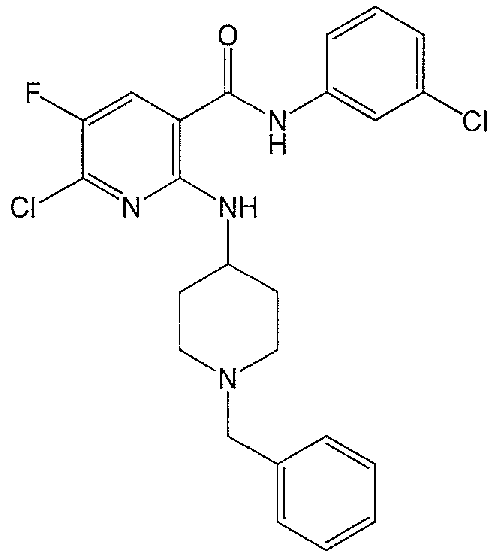
- The title compound was prepared in the same manner as in Example 1, with the exception that 2,6-dichloro-N-(3-chlorophenyl)-5-fluoronicotinamide obtained in Preparation Example 9, instead of 2-chloro-N-(3-chlorophenyl)nicotinamide, was used in the same molar amount (Yield: 66.6%). 1H NMR (CDCl3) δ 8.73(s, 1H), 7.88(d, 1H), 7.76(s, 1H), 7.48(d, 1H), 7.27(t, 1H), 7.12(d, 1H), 4.96(d, 1H), 4.02(m, 1H), 3.56(s, 2H), 2.89(d, 2H), 2.22(t, 2H), 2.09(d, 2H), 1.59(m, 2H) ppm
-

- The title compound was prepared in the same manner as in Example 13, with the exception that 4-amino-1-(2-hydroxyethyl)piperidine obtained in Preparation Example 17, instead of 4-amino-1-benzylpiperidine, was used in the same molar amount. (Yield: 74.5%). 1H NMR (CDCl3) δ 8.32(d, 1H), 7.78(d, 1H), 7.67(s, 1H), 7.41(d, 1H), 7.27(t, 1H), 7.13(d, 1H), 6.53(d, 1H), 4.17-4.08(m, 1H), 3.74(t, 2H), 3.12(d, 2H), 2.78(t, 2H), 2.61(t, 2H), 2.12(d, 2H), 1.88-1.68(m, 2H) ppm
-

- The title compound was prepared in the same manner as in Example 1, with the exception that 2,6-dichloro-N-(3-chlorophenyl)-5-fluoronicotinamide obtained in Preparation Example 9, instead of 2-chloro-N-(3-chlorophenyl)nicotinamide, and 4-amino-1-(2-hydroxyethyl)piperidine obtained in Preparation Example 17, instead of 4-amino-1-benzylpiperidine, were used in the same molar amounts (Yield: 81.1%). 1H NMR (CDCl3) δ 8.73(s, 1H), 7.88(d, 1H), 7.76(s, 1H), 7.48(d, 1H), 7.29(t, 1H), 7.12(d, 1H), 4.98(d, 1H), 4.04(m, 1H), 3.62(t, 2H), 2.92 (d, 2H), 2.59(t, 2H), 2.32(t, 2H), 2.12(d, 2H), 1.62(m, 2H) ppm
-
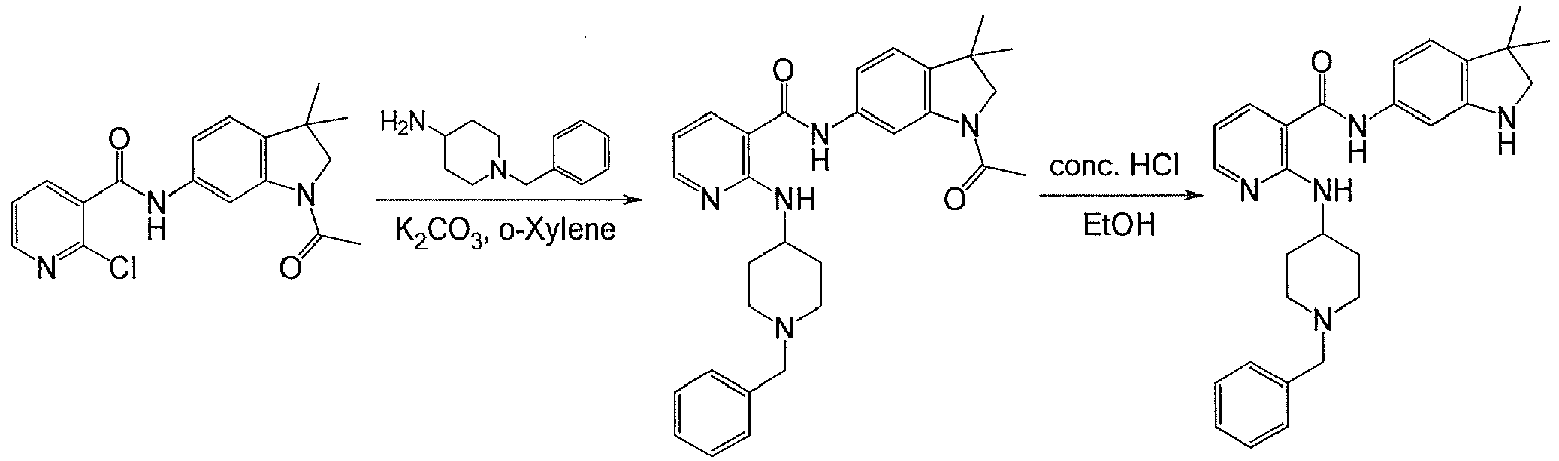
- A solution of N-(1-acetyl-3,3-dimethyl-2,3-dihydro-1H-indol-6-yl)-2-chloronicotinamide (361 mg, 1.05 mmol, 1.05eq), prepared in Preparation Example 7, 4-amino-1-benzylpiperidine (1.0mmol), and anhydrous potassium carbonate (1.3 mmol) in ortho-xylene was stirred for 24 hrs under reflux. The reaction mixture was cooled to a room temperature, concentrated in a reduced pressure, and immediately used in the next step without further purification.
- The residue obtained in
step 1 was placed in 10 ml of ethanol and stirred for 4 hrs in conc. HCl aqueous solution (excess) under reflux. The reaction mixture was cooled to a room temperature, and concentrated in a reduced pressure to remove the solvent. The residue was dissolved in 10 ml of distilled water, and adjusted to a pH of 9∼10 by dropwise adding a 20(wt/wt)% sodium hydroxide aqueous solution. This mixture was extracted with 20 ml of chloroform, dried over sodium sulfate to remove water, and concentrated in a reduced pressure. Purification through column chromatography (mobile phase: 10(v/v)% acetone in chloroform) afforded the title compound. (Total yield: 46.1%) 1H NMR (CDCl3), δ 8.21(d, 1H), 7.97(d, 1H), 7.64(d, 1H), 7.20∼7.40(m, 4H), 6.99(d, 2H), 6.67(d, 1H), 6.49(dd, 1H), 4.06(bs, 1H), 3.52(s, 2H), 3.32(s, 2H), 2.85(d, 2H), 2.25(t, 2H), 1.95∼2.10(m, 2H), 1.48∼1.72(m, 2H), 1.29 (s, 6H) ppm -

- The title compound was prepared in the same manner as in
steps 1 and 2 of Example 17, with the exception that 4-phenoxyaniline, instead of 4-amino-1-benzylpiperidine, was used in the same molar amount (Total yield: 54.3%). 1H NMR (CDCl3), δ 10.20(s, 1H), 8.32(d, 1H), 7.78 (d, 1H), 7.72(s, 1H), 7.62(d, 3H), 7.31(t, 3H), 6.95∼7.11(m, 5H), 6.68∼6.85(m, 1H), 3.34(s, 2H), 1.32(s, 6H) ppm -
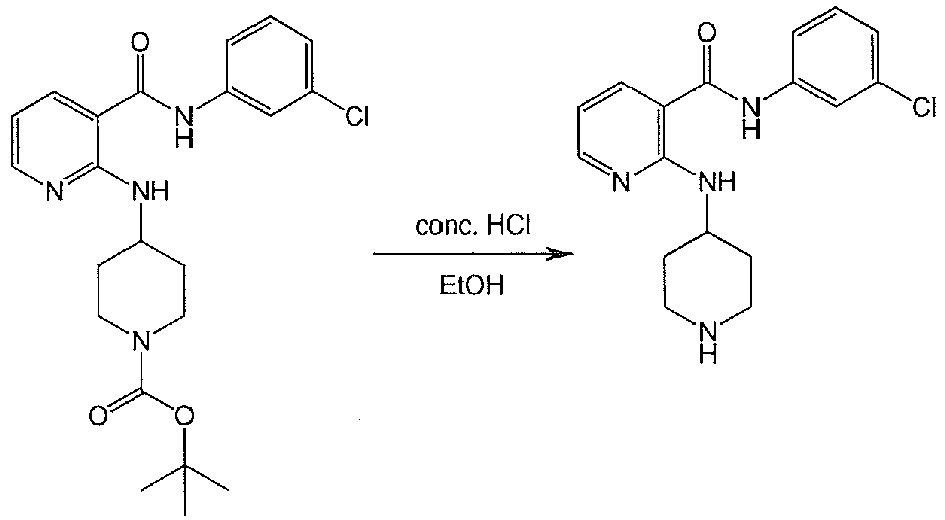
- A solution of 1.0 g of N-(3-chlorophenyl)-2-(1-tert-butoxycarbamoylpiperidin-4-ylamino)nicotinamide obtained in Example 6, in 10 ml of ethanol was mixed with 5 ml of a conc. HCl aqueous solution and stirred for 8 hrs under reflux. The reaction solution was cooled to a room temperature, concentrated in a reduced pressure to remove the solvent, and adjusted to a pH of 9∼10 by dropwise adding saturated sodium hydrogen carbonate aqueous solution. After three rounds of extraction with 30 ml of ethylacetate per round, the extracts were dried over a desiccant to remove water, and concentrated in a reduced pressure and dried in vacuum to afford 0.69 g of the title compound (Yield: 89.9%). 1H NMR (CDCl3) δ 8.23(d, 1H), 7.99(d, 2H), 7.7(d, 1H), 7.66(s, 1H), 7.36(d, 1H), 7.27(t, 1H), 7.10(d, 1H), 6.53-5.45(m, 1H), 4.18-4.05(m, 1H), 3.43(t, 1H), 3.09(d, 2H), 2.74(t, 2H), 2.15-2.01(m, 2H), 1.57-1.36(m, 2H) ppm
-

- The title compound was prepared in the same manner as in steps of Example 19 with the exception that 0.5 g of (R)-N-(3-chlorophenyl)-2-(1-tert-butoxycarbamoylpiperidin-3-ylamino)nicotinamide prepared in Example 12-A as a starting material to afford 0.35 g of the title compound (Yield: 91.2%). 1H NMR 8.26(d, 1H), 8.08(d, 1H), 7.72(d, 1H), 7.67(s, 1H), 7.37(d, 1H), 7.26(t, 1H), 7.11(d, 1H), 6.57-6.51(m, 1H), 4.18-4.08(m, 1H), 3.72(br, 1H), 3.21(d, 1H), 2.97-2.88(m, 1H), 2.79-2.60(m, 2H), 2.14-1.96(m, 2H), 1.82-1.68(m, 1H), 1.66-1.48(m, 2H) ppm
- The title compound was prepared in the same manner as in steps of Example 19 with the exception that 0.5 g of (S)-N-(3-chlorophenyl)-2-(1-tert-butoxycarbamoylpiperidin-3-ylamino)nicotinamide prepared in Example 12-B as a starting material to afford 0.34g of the title compound (Yield: 88.6%). 1H NMR 8.22(d, 1H), 8.03(d, 1H), 7.71(d, 1H), 7.67(s, 1H), 7.37(d, 1H), 7.26(t, 1H), 7.11(d, 1H), 6.52-6.46(m, 1H), 4.18-4.08(m, 1H), 3.17 (d, 1H), 2.95(m, 1H), 2.74-2.53(m, 2H), 2.14-1.96(m, 2H), 1.82-1.68(m, 1H), 1.66-1.48(m, 2H) ppm
-

- A solution of N-(3-chlorophenyl)-2-(2,2,6,6-tetramethylpiperidin-4-ylamino)nicotinamide (330mg, 1mmol, 1eq), 2-bromoethanol (1.2mmol), and anhydrous potassium carbonate (1.2mmol) in 5 ml of acetonitrile was stirred for 18 hrs under reflux. The reaction mixture was cooled to a room temperature and filtered. The filtrate was concentrated in a reduced pressure. Silica gel column chromatography (mobile phase: 10(v/v)% methanol in chloroform) afforded the title compound. Yield: 37.1% 1H NMR (CDCl3) δ 8.22(d, 1H), 7.79(d, 1H), 7.69(d, 1H), 7.65(s, 1H), 7.37(d, 1H), 7.27(t, 1H), 7.10(d, 1H), 6.51-6.45(m, 1H), 4.64-4.45(m, 1H), 3.88(t, 2H), 3.49(t, 2H), 2.08-1.96(m, 3H), 1.28(s, 6H), 1.13(s, 6H), 1.0(t, 2H) ppm
-

- The title compound was prepared in the same manner as in Example 21, with the exception that N-(3-chlorophenyl)-2-(4-piperidylamino)nicotinamide of Example 19, instead of N-(3-chlorophenyl)-2-(2,2,6,6-tetramethylpiperidin-4-ylamino)nicotinamide, and arylbromide, instead of 2-bromoethanol, were used in the same molar amounts (Yield: 36.8%). 1H NMR (CD3OD) δ 8.22(d, 1H), 8.08(d, 1H), 7.86(s, 1H), 7.53(d, 1H), 7.34(t, 1H), 7.15(d, 1H), 6.76-6.68(m, 1H), 5.79(t, 1H), 4.72-4.62(m, 2H), 4.33-4.20(m, 1H), 4.07(dd, 1H), 3.58-3.4(m, 3H), 3.19(t, 2H), 2.32(d, 2H), 1.89-1.68(m, 2H) ppm
-

- The title compound was prepared in the same manner as in Example 22, with the exception that 2-chloroethyl-N,N-diethylamine, instead of arylbromide, was used in the same molar amount (Yield: 47.5%). 1H NMR (CDCl3) 5 8.19(d, 1H), 8.06(s, 1H), 7.93(d, 1H), 7.65(d, 1H), 7.59(s, 1H), 7.33(d, 1H), 7.21(s, 1H), 7.06(d, 1H), 6.48-6.40(m, 1H), 4.07-3.93(m, 1H), 2.79(d, 2H), 2.59-2.40(m, 8H), 2.18(t, 2H), 1.98(d, 2H), 1.62-1.46 (m, 2H), 0.97(t, 6H) ppm
-

- The title compound was prepared in the same manner as in Example 22, with the exception that 2-chloromethylpyridine, instead of arylbromide, was used in the same molar amount (Yield: 56.6%). 1H NMR (CD3OD) δ 8.49(d, 1H), 8.26(d, 1H), 8.02(d, 1H), 7.89-7.80(m, 2H), 7.59-7.52(m, 2H), 7.37-7.31(m, 2H), 7.14(d, 1H), 6.68-6.60(m, 1H), 4.09-3.97(m, 1H), 3.71(s, 2H), 2.88(d, 2H), 2.39(t, 2H), 2.12-2.01(m, 2H), 1.73-1.57(m, 2H) ppm
-

- The title compound was prepared in the same manner as in Example 22, with the exception that 3-chloromethylpyridine, instead of arylbromide, was used in the same molar amount (Yield: 43.8%). 1H NMR (CDCl3) δ 8.49(m, 1H), 8.26(d, 1H), 7.99(d, 1H), 7.77-7.65(m, 3H), 7.41-7.25(m, 3H), 7.17-7.11(m, 1H), 6.55-6.49(m, 1H), 4.23-4.08(m, 1H), 3.10(d, 2H), 2.76(d, 2H), 2.06(d, 2H), 1.68(s, 2H), 1.43(q, 2H)ppm
-
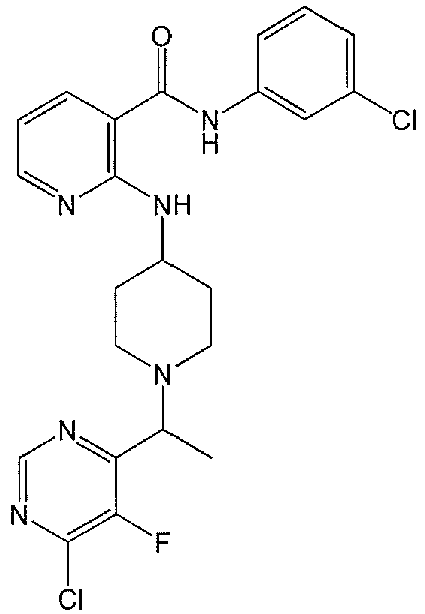
- The title compound was prepared in the same manner as in Example 22, with the exception that 4-(1-bromoethyl)-6-chloro-5-fluoropyrimidine prepared in Preparation Example 19, instead of arylbromide, was used in the same molar amount (Yield: 44.9%). 1H NMR (CDCl3) δ 8.22(d, 1H), 8.18(s, 1H), 8.06(d, 1H), 7.72(d, 1H), 7.61(s, 1H), 7.33(d, 1H), 7.22(t, 1H), 7.08(d, 1H), 6.55-6.47(m, 1H), 5.34(q, 1H), 4.43-4.23(m, 3H), 3.28(t, 2H), 2.13(d, 2H), 1.98(d, 3H), 1.67-1.46(m, 2H) ppm
-

- The title compound was prepared in the same manner as in Example 21, with the exception that (R)-N-(3-chlorophenyl)-2-(3-piperidylamino)nicotinamide of Example 20-A, instead of N-(3-chlorophenyl)-2-(2,2,6,6-tetramethylpiperidin-4-ylamino)nicotinamide, was used in the same molar amount (Yield: 64.7%). 1H NMR (CDCl3) δ 8.48(br, 1H), 8.40(s, 1H), 8.17(d, 1H), 7.76(d, 1H), 7.59(s, 1H), 7.42(d, 1H), 7.19(t, 1H), 7.03(d, 1H), 6.48-6.40(m, 1H), 4.35-4.23(m, 1H), 3.61(t, 2H), 3.13(br, 2H), 2.69(d, 1H), 2.60-2.36(m, 4H), 1.85-1.58(m, 3H) ppm
-

- The title compound was prepared in the same manner as in Example 21, with the exception that (S)-N-(3-chlorophenyl)-2-(3-piperidylamino)nicotinamide of Example 20-B, instead of N-(3-chlorophenyl)-2-(2,2,6,6-tetramethylpiperidin-4-ylamino)nicotinamide, was used in the same molar amount (Yield: 60.8%). 1H NMR (CDCl3) δ 8.50(br, 1H), 8.22(d, 1H), 7.97(s, 1H), 7.73(d, 1H), 7.61(s, 1H), 7.45(d, 1H), 7.25(t, 1H), 7.09(d, 1H), 6.53-6.47(m, 1H), 4.33(br, 1H), 3.61(t, 2H), 2.76-2.45(m, 6H), 1.85-1.58(m, 4H) ppm
-
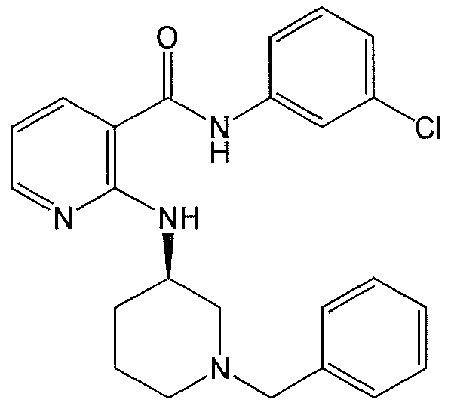
- The title compound was prepared in the same manner as in Example 21, with the exception that (S)-N-(3-chlorophenyl)-2-(3-piperidylamino)nicotinamide of Example 20-A, instead of N-(3-chlorophenyl)-2-(2,2,6,6-tetramethylpiperidin-4-ylamino)nicotinamide, and benzylchloride, instead of 2-bromoethanol, were used in the same molar amounts (Yield: 64.4%). 1H NMR (CDCl3) δ 8.33(d, 1H), 8.24(d, 1H), 7.83(s, 1H), 7.74(s, 1H), 7.68(d, 1H), 7.47-7.13(m, 7H), 6.53-6.46(m, 1H), 4.39-4.27(m, 1H), 2.69(d, 1H), 2.53-2.34(m, 3H), 1.85-1.58(m, 6H) ppm
-
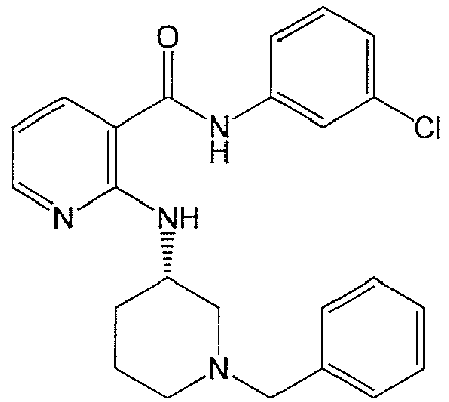
- The title compound was prepared in the same manner as in Example 21, with the exception that (S)-N-(3-chlorophenyl)-2-(3-piperidylamino)nicotinamide of Example 20-B, instead of N-(3-chlorophenyl)-2-(2,2,6,6-tetramethylpiperidin-4-ylamino)nicotinamide, and benzylchloride, instead of 2-bromoethanol, were used in the same molar amounts (Yield: 68.2%).
- 1H NMR (CDCl3) δ 8.33(d, 1H), 8.22(d, 1H), 7.86(s, 1H), 7.82(s, 1H), 7.71(d, 1H), 7.45-7.12(m, 7H), 6.53-6.46(m, 1H), 4.32(br, 1H), 2.68(d, 1H), 2.53-2.34(m, 3H), 1.97(s, 2H), 1.81-1.55(m, 4H) ppm
-
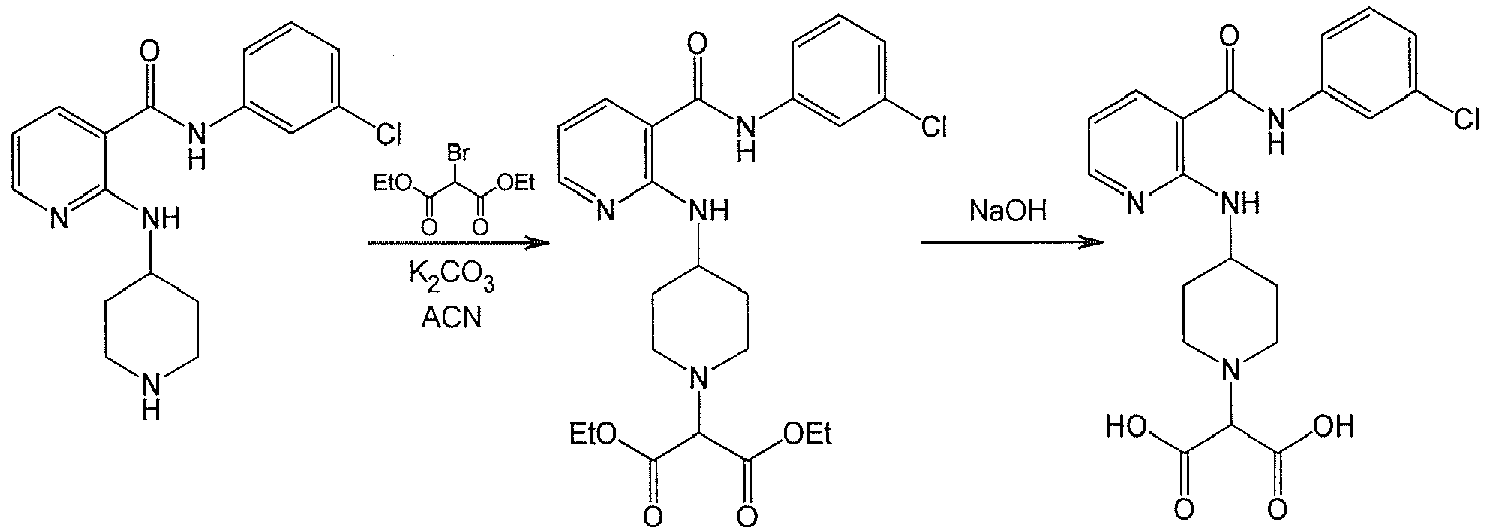
- A solution of 0.25 g of N-(3-chlorophenyl)-2-(4-piperidylamino)nicotinamide obtained in Example 19, 0.2 ml of diethyl 2-bromomalonate, and 0.16 g of anhydrous potassium carbonate in 5 ml of acetonitrile was stirred for 24 hrs under reflux. The reaction mixture was cooled to a room temperature, mixed with 10 ml of ethylacetate, and extracted three times with 1N aqueous HCl solution. The aqueous layer thus obtained was washed again with 15 ml of ethylacetate, adjusted to a pH of about 9 with saturated sodium hydrogen carbonate aqueous solution, and used in the next step without further purification.
- The mixture obtained in
step 1 was added with 0.16 g of sodium hydroxide, and heated at 50°C for 3 hrs while stirring. The reaction mixture was cooled to a room temperature, and extracted three times with 10 ml of ethyl acetate. After two rounds of extraction with saturated saline, water was removed using a desiccant. The resulting solution was concentrated in a reduced pressure and purified by silica gel chromatography (mobile phase: 30(v/v)% hexane in EA) to afford 0.05 g of the title compound (Total yield: 15%). 1H NMR (CDCl3 + 4 drops CD3OD) δ 8.12(d, 1H) 7.80(d, 1H), 7.63(s, 1H), 7.4(d, 1H), 7.22(t, 1H), 7.05(d, 1H), 6.53-6.47(m, 1H), 4.12-3.98(m, 1H), 3.10-3.0(m, 2H), 2.71(t, 2H), 2.03(d, 2H), 1.99(s, 1H), 1.49-1.3(m, 2H) ppm -

- A solution of 1-benzyl-4-hydroxypiperidine(209mg, 1.1mmol, 1.1eq) and 95w% sodium hydroxide (1.2mmol) in 5 ml of dimethylformamide was stirred at a room temperature for 30 min, mixed with 2-chloro-N-(3-chlorophenyl)nicotinamide (1.0mmol), and stirred for 20 hrs under reflux. The reaction mixture was cooled to a room temperature, and added with 20 ml of pure water to terminate the reaction. After two rounds of extraction with 20 ml of ethylacetate per round, water was removed with a desiccant and the resulting product was concentrated under reduced pressure. Then, the residue obtained by the concentration was subjected to silica gel column chromatography (mobile phase: 30(v/v)% hexane in EA) to obtain the desired fraction. The desired fraction was dried in a reduced pressure to afford 0.25 g of the title compound (Yield: 33.7%). 1H NMR (CDCl3) δ 8.60(d, 1H), 8.29(d, 1H), 7.88(s, 1H), 7.48(d, 1H), 7.36-7.27(m, 6H), 7.17-7.05(m, 2H), 5.51-5.38(m, 1H), 3.59(s, 2H), 2.89-2.80(m, 2H), 2.42(t, 2H), 2.29-2.23(m, 2H), 2.06-1.87(m, 2H) ppm
-

- The title compound was prepared in the same manner as in Example 30, with the exception that 1-benzyl-4-mercaptopiperidine, instead of 1-benzyl-4-hydroxypiperidine, was used in the same molar amount while sodium methoxide serving as a base. Yield: 42.8%, 1H NMR (CDCl3) δ 8.52-8.46(m, 2H), 7.88(d, 1H), 7.46(d, 1H), 7.32-7.25(m, 6H), 7.18, 7.02(m, 2H), 4.08-3.96(m, 1H), 2.52(s, 2H), 2.88-2.82(m, 2H), 2.25(t, 2H), 2.16-1.97(m, 2H), 1.88-1.68(m, 2H)
-

- A solution of 2-(1-benzylpiperidin-4-ylamino)nicotinic acid (311 mg, 1.0mmol, 1.0eq) prepared in Preparation Example 16, and thionyl chloride (1.5mmol) in 5 ml of methylene chloride was stirred for 1 hr under reflux. The reaction mixture was cooled to a room temperature and immediately used in the next step without further purification.
- The solution obtained in
step 1 was cooled to 4∼5°C in an ice bath, followed by dropwise adding triethylamine (0.42ml), 3.0mmol) for 5 min. To the reaction solution was added with 4-(4-fluorobenzyl)morpholin-2-ylmethylamine (1.2mmol), and stirred for 30 min at a room temperature and then for an additional 4 hrs under reflux. The reaction mixture was cooled to a room temperature, and washed with saturated aqueous sodium hydrogen carbonate solution and then with saturated saline. After water was removed with a desiccant, the resulting solution was concentrated in a reduced pressure. In order to obtain a desired fraction, the residue was subjected to silica column chromatography (mobile phase: 30(v/v)% Hexane in EA) to afford the title compound (Total yield: 53.0%) 1H NMR (CDCl3) 5 8.20(d, 1H), 8.12(d, 1H), 7.54(d, 1H), 7.36-7.24(m, 7H), 7.01(t, 2H), 6.46-6.38(m, 1H), 4.08-3.98(m, 1H), 3.87(d, 1H), 3.73-3.61(m, 4H), 3.53(s, 2H), 3.45(s, 2H), 3.32-3.19(m, 2H), 2.85-2.61(m, 4H), 2.32-2.14(m, 3H), 2.08-1.88(m, 3H) ppm -

- The title compound was prepared in the same manner as in Example 32, with the exception that 2-amino-1,3,4-triazole, instead of 4-(4-fluorobenzyl)morpholin-2-ylmethylamine, was used in the same molar amount (Total yield: 20.8%). 1H NMR (CDCl3) δ 8.57(m, 1H), 8.23(m, 1H), 7.97(m, 2H), 7.32(m, 5H), 6.47(m, 1H), 6.14(br, 1H), 3.92(m, 1H), 3.52(s, 2H), 2.86(m, 2H), 2.25(m, 2H), 1.97(m, 2H), 1.56(m, 2H) ppm
-

- The title compound was prepared in the same manner as in Example 32, with the exception that 2-amino-4,6-dimethylpyrimidine, instead of 4-(4-fluorobenzyl)morpholin-2-ylmethylamine, was used in the same molar amount (Total yield: 19.3%). 1H NMR (CDCl3) δ 8.26(d, 1H), 8.10(m, 1H), 8.05(m, 1H), 7.36(m, 6H), 6.50(m, 1H), 4.12(m, 1H), 3.57(s, 2H), 2.83(m, 2H), 2.29(m, 2H), 2.05(m, 2H), 1.64(m, 2H), 1.28(s, 6H) ppm
-

- The title compound was prepared in the same manner as in Example 32, with the exception that (S)-3-amino-pyrrolidine, instead of 4-(4-fluorobenzyl)morpholin-2-ylmethylamine, was used in the same molar amount (Total yield: 13.4%). 1H NMR (CDCl3) δ 8.19(d, 1H), 8.05(d, 1H), 7.44(d, 1H), 7.11(m, 5H), 6.50(m, 1H), 4.12(m, 1H), 3.53(s, 2H), 2.82(m, 4H), 2.32-1.93(m, 9H), 1.61(m, 4H) ppm
-

- The title compound was prepared in the same manner as in Example 32, with the exception that 1-(2-aminoethyl)morpholine, instead of 4-(4-fluorobenzyl)morpholin-2-ylmethylamine, was used in the same molar amount (Total yield: 74.8%). 1H NMR (CD3OD) δ 8.12(d, 1H), 7.97(d, 1H), 7.86(d, 1H), 7.35(m, 5H), 6.54(m, 1H), 4.95(m, 1H), 3.71(t, 2H), 3.56(s, 2H), 3.38(d, 2H), 2.83(d, 2H), 2.53(m, 4H), 2.31(m, 2H), 2.02(d, 2H), 1.61(m, 2H) ppm
-

- The title compound was prepared in the same manner as in Example 32, with the exception that Boc-hydrazine, instead of 4-(4-fluorobenzyl)morpholin-2-ylmethylamine, was used in the same molar amount (Total yield: 19.3%). 1H NMR (CDCl3) 5 8.13(m, 1H), 7.92(m, 1H), 7.36(m, 5H), 6.52(m, 1H), 3.98(m, 1H), 3.56(s, 2H), 2.86(d, 2H), 2.31(m, 2H), 2.02(m, 2H), 1.51(m, 11H) ppm
-

- The title compound was prepared in the same manner as in Example 32, with the exception that methyl 6-aminonicotinate, instead of 4-(4-fluorobenzyl)morpholin-2-ylmethylamine, was used in the same molar amount (Total yield: 28.6%). 1H NMR (CDCl3) δ 8.92(s, 1H), 8.63(s, 1H), 8.35(s, 1H), 8.29(d, 1H), 8.18(d, 1H), 7.78(d, 1H), 7.35(m, 5H), 6.53(m, 1H), 4.13(m, 1H), 3.97(s, 3H), 3.56(s, 2H), 2.86(d, 2H), 2.28(t, 2H), 2.09(d, 2H), 1.65(m, 2H) ppm
-

- The title compound was prepared in the same manner as in Example 32, with the exception that para-toluenesulfonyl hydrazine, instead of 4-(4-fluorobenzyl)morpholin-2-ylmethylamine, was used in the same molar amount (Total yield: 37.4%). 1H NMR (CDCl3) δ 8.15 (d, 1H), 7.82(d, 2H), 7.41-7.12(m, 7H), 6.35-6.27(m, 1H), 3.91-3.78(m, 1H), 3.51(s, 2H), 2.28(d, 2H), 2.41(s, 3H), 2.13(t, 2H), 1.89(d, 2H), 1.37-1.18(m, 2H) ppm
-

- The title compound was prepared in the same manner as in Example 32, with the exception that 4-aminomethylpyridine, instead of 4-(4-fluorobenzyl)morpholin-2-ylmethylamine, was used in the same molar amount (Total Yield: 67.8%). 1H NMR (CDCl3) 5 8.46(m, 3H), 8.16(m, 2H), 7.72(m, 2H), 7.32-7.17(m, 5H), 6.39(m, 1H), 4.51(d, 2H), 4.01(m, 1H), 3.48(s, 2H), 2.78(d, 2H), 2.21(t, 2H), 1.98(d, 2H), 1.59 (m, 2H) ppm
-
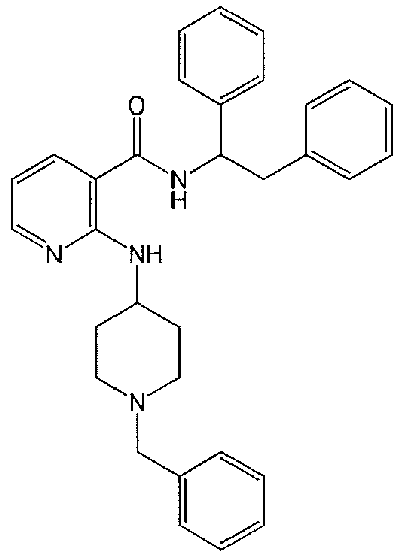
- The title compound was prepared in the same manner as in Example 32, with the exception that 1,2-diphenylethylamine, instead of 4-(4-fluorobenzyl)morpholin-2-ylmethylamine, was used in the same molar amount (Total yield: 84.3%). 1H NMR (CDCl3) δ 8.19(d, 1H), 7.98(d, 1H), 7.46-7.22(m, 15H), 7.11(d, 1H), 6.44(m, 1H), 6.25(d, 1H), 5.43(q, 1H), 4.01(m, 1H), 3.52(s, 2H), 3.20(dd, 2H), 2.81(d, 2H), 2.23(t, 2H), 2.02(d, 2H), 1.59(m, 2H) ppm
-

- The title compound was prepared in the same manner as in Example 32, with the exception that 2-methoxyethylamine, instead of 4-(4-fluorobenzyl)morpholin-2-ylmethylamine, was used in the same molar amount (Total yield: 77.4%). 1H NMR (CDCl3) δ 8.17(s, 1H), 8.16(s, 1H), 7.55(d, 1H), 7.31(m, 5H), 6.60(br, 1H), 6.42(m, 1H), 4.02(m, 1H), 3.58-3.50(m, 6H), 3.35 (s, 3H), 2.79(d, 2H), 2.22(t, 2H), 2.01(d, 2H), 1.61(m, 2H) ppm
-

- The title compound was prepared in the same manner as in Example 32, with the exception that 2-amino-5-methylthiazole, instead of 4-(4-fluorobenzyl)morpholin-2-ylmethylamine, was used in the same molar amount (Total yield: 12.1%). 1H NMR (CDCl3) δ 8.73(d, 1H), 8.19(d, 1H), 7.59(s, 1H), 7.32(m, 5H), 6.53(d, 1H), 4.19(m, 1H), 3.47(s, 2H), 2.82(d, 2H), 2.42(s, 3H), 2.24(t, 2H), 2.10(d, 2H), 1.70(m, 2H) ppm
-
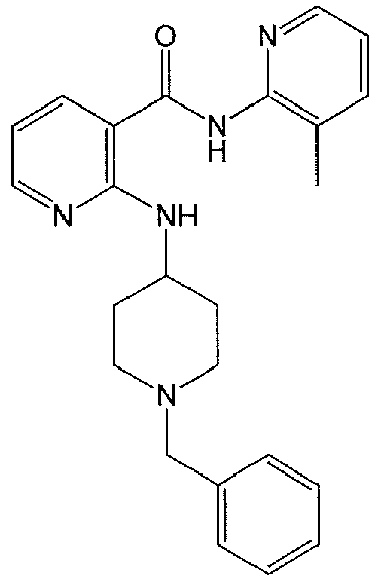
- The title compound was prepared in the same manner as in Example 32, with the exception that 2-amino-3-methylpyridine, instead of 4-(4-fluorobenzyl)morpholin-2-ylmethylamine, was used in the same molar amount (Total yield: 9.4%). 1H NMR (CDCl3) δ 8.28(d, 1H), 8.27(s, 1H), 8.11(m, 1H), 7.89(m, 1H), 7.64(d, 1H), 7.32(m, 5H), 7.11(m, 1H), 6.52(m, 1H), 4.08(m, 1H), 3.54(s, 2H), 2.83(d, 2H), 2.34(s, 3H), 2.26(t, 2H), 2.06(d, 2H), 1.58(m, 2H) ppm
-

- The title compound was prepared in the same manner as in Example 32, with the exception that 3-amino-azepan-2-one, instead of 4-(4-fluorobenzyl)morpholin-2-ylmethylamine, was used in the same molar amount (Total yield: 50.1%). 1H NMR (CDCl3) δ 8.20(m, 2H), 7.69(d, 1H), 7.55(d, 1H), 7.33(m, 5H), 6.48(m, 1H), 6.14(m, 1H), 4.64(m, 1H), 4.06(m, 1H), 3.54(s, 2H), 3.32(m, 2H), 2.85(d, 2H), 2.32-1.43 (m, 12H) ppm
-

- The title compound was prepared in the same manner as in Example 32, with the exception that 4-fluorobenzylamine, instead of 4-(4-fluorobenzyl)morpholin-2-ylmethylamine, was used in the same molar amount (Total yield: 81.1%). 1H NMR (CDCl3) δ 8.19(m, 2H), 7.54(d, 1H), 7.30(m, 6H), 7.03(t, 2H), 6.50(br, 1H), 6.42(m, 1H), 4.05(m, 1H), 3.55(s, 2H), 2.83(d, 2H), 2.25(t, 2H), 2.05(d, 2H), 1.63(m, 2H) ppm
-
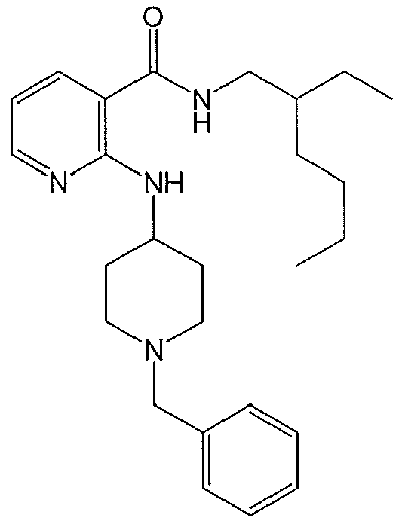
- The title compound was prepared in the same manner as in Example 32, with the exception that 2-ethylhexylamine, instead of 4-(4-fluorobenzyl)morpholin-2-ylmethylamine, was used in the same molar amount (Total yield: 89.4%). 1H NMR (CDCl3) δ 8.27(d, 1H), 8.08(d, 1H), 7.51(d, 1H), 7.30(m, 5H), 6.44(m, 1H), 6.05(m, 1H), 4.02(m, 1H), 3.52(s, 2H), 3.34(t, 2H), 2.27(t, 2H), 2.06(d, 2H), 1.62(m, 2H), 1.45-1.36(m, 8H), 0.93(m, 6H) ppm
-

- The title compound was prepared in the same manner as in Example 32, with the exception that 6-amino-3-methyl-2-methylsulfanyl-3H-quinazolin-4-one obtained in Preparation Example 20, instead of 4-(4-fluorobenzyl)morpholin-2-ylmethylamine, was used in the same molar amount (Total yield: 77.0%). 1H NMR (DMSO-d6) δ 8.28-7.95(m, 5H), 7.73-7.46(m, 6H), 6.72(m, 1H), 4.31(m, 1H), 3.53(s, 3H), 3.47(s, 2H), 3.24-3.11(m, 2H), 2.66(s, 3H), 2.58(m, 2H), 2.20(m, 2H), 1.78(m, 2H) ppm
-

- The title compound was prepared in the same manner as in Example 32, with the exception that methyl 2-amino-6-benzyl-4,5,6,7-tetrahydro-thieno[2,3-c]pyridine-3-carboxylate obtained in Preparation Example 2, instead of 4-(4-fluorobenzyl)morpholin-2-ylmethylamine, was used in the same molar amount (Total yield: 84.4%). 1H NMR (CDCl3) δ 8.42 (d, 1H), 8.28(d, 1H), 7.88(d, 1H), 7.35(m, 10H), 6.57(m, 1H), 4.12(m, 1H), 3.91(s, 3H), 3.72(s, 2H), 3.61(s, 2H), 3.55(s, 2H), 2.93-2.82(m, 6H), 2.27(t, 2H), 2.07(d, 2H), 1.67(m, 2H) ppm
-

- The title compound was prepared in the same manner as in Example 32, with the exception that 2-amino-4,7-dihydro-5H-thieno[2,3-c]pyridine-3,6-dicarboxylic acid 6-ethyl ester 3-methyl ester obtained in Preparation Example 3, instead of 4-(4-fluorobenzyl)morpholin-2-ylmethylamine, was used in the same molar amount (Total yield: 81.1%). 1H NMR (CDCl3) δ 8.43(d, 1H), 8.26(d, 2H), 7.88(d, 1H), 7.41(m, 5H), 6.61(m, 1H), 4.58(s, 2H), 4.23-4.15(m, 3H), 3.91(s, 3H), 3.82(s, 2H), 3.73(st, 2H), 3.09(d, 2H), 2.90(t, 2H), 2.57(t, 2H), 2.20(d, 2H), 1.91(m, 2H) ppm
-

- The title compound was prepared in the same manner as in Example 32, with the exception that methyl 2-amino-4,5,6,7-tetrahydro-thien[2,3-c]pyridine-3-carboxylate hydrochloride obtained in Preparation Example 1, instead of 4-(4-fluorobenzyl)morpholin-2-ylmethylamine, was used in the same molar amount while the amount of triethylamine was increased to 4.0eq (Total yield: 83.1%). 1H NMR (CDCl3) δ 8.40 (d, 1H), 8.20(d, 1H), 7.75(d, 1H), 7.25-7.18(m, 5H), 6.49(m, 1H), 4.07 (m, 1H), 3.82(m, 5H), 3.09-2.72(m, 6H), 2.22(t, 2H), 2.07(d, 2H), 1.64(m, 2H) ppm
-

- The title compound was prepared in the same manner as in Example 32, with the exception that 3,4-dimethoxyaniline, instead of 4-(4-fluorobenzyl)morpholin-2-ylmethylamine, was used in the same molar amount (Total yield: 89.9%). 1H NMR (CDCl3) δ 8.23(d, 1H), 8.01(d, 1H), 7.68(d, 1H), 7.59(s, 1H), 7.34-7.25(m, 5H), 6.90(m, 2H), 6.51(m, 1H), 4.06(m, 1H), 3.91(s, 3H), 3.89(s, 3H), 3.52(s, 2H), 2.82(d, 2H), 2.24(t, 2H), 2.03(t, 2H), 1.61(m, 2H) ppm
-

- A solution of 2-[(2,6-dichloropyridine-3-carbonyl)amino]-4,7-dihydro-5H-thieno[2,3-c]pyridine-3,6-dicarboxylic acid 6-tert-butyl ester 3-methyl ester (510 mg, 1.05 mmol, 1.05 eq) obtained in Preparation Example 11, 4-amino-1-benzylpiperidine (1.0 mmol), and anhydrous potassium carbonate (1.2 mmol) in ortho-xylene was stirred for 24 hrs under reflux. The reaction mixture was cooled to a room temperature, and further stirred for 3 hrs in conc. HCl aqueous solution (excess) under reflux. The reaction mixture was cooled to a room temperature, added with 10 ml of ethylacetate, and extracted twice with 20 ml of distilled water per round. Thereafter, the aqueous layer was again washed 20 ml of ethylacetate, and adjusted to a pH of about 9~10 with a 2 N sodium hydroxide aqueous solution. The resulting mixture was extracted twice with 20 ml of methylene chloride per round, washed with 30 ml of saturated saline, and dried over a desiccant to remove water. Then the solvent was removed by concentration in a reduced pressure. In order to a desired fraction, purification through silica gel column chromatography (mobile phase=10 (v/v)% methanol in chloroform) was performed to afford the title compound. Yield: 72.3% 1H NMR (DMSO-d6) δ 7.46(d, 1H), 7.39(d, 1H), 7.32(m, 5H), 6.62(d, 1H), 6.41(d, 1H), 4.43(s, 2H), 3.83(m, 1H), 3.69(s, 2H), 3.59(m, 2H), 2.73(m, 4H), 2.08(t, 2H), 1.82(d, 2H), 1.51(m, 2H) ppm
-

- The title compound was prepared in the same manner as in Example 53, with the exception that 2-[(2,6-dichloro-5-fluoro-pyridine-3-carbonyl)amino]-4,7-dihydro-5H-thieno[2,3-c]pyridine-3,6-dicarboxylic acid 6-tert-butyl ester 3-methyl ester obtained in Preparation Example 12, instead of 2-[(2,6-dichloropyridine-3-carbonyl)amino]-4,7-dihydro-5H-thieno[2,3-c]pyridine-3,6-dicarboxylic acid 6-tert-butyl ester 3-methyl ester, was used in the same molar amount. Yield: 51.4%, 1H NMR (CDCl3) δ 7.83(d, 1H), 7.34(m, 5H), 5.04(m, 1H), 4.06(m, 1H), 3.92(m, 5H), 3.54(s, 3H), 3.12(t, 2H), 2.88(m, 4H), 2.21(m, 2H), 2.07(m, 2H), 1.59(m, 2H) ppm
-
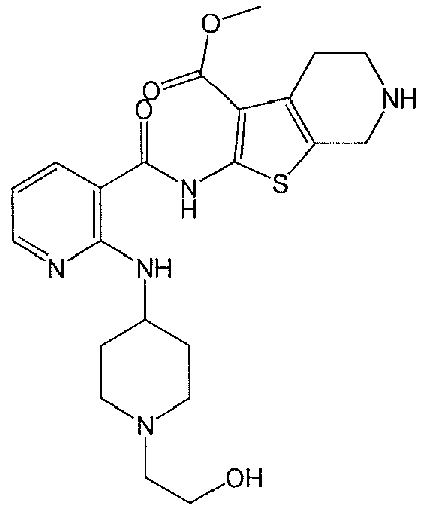
- The title compound was prepared in the same manner as in Example 53, with the exception that 2-[(2-chloropyridine-3-carbonyl)-amino]-4,7-dihydro-5H-thieno[2,3-c]pyridine-3,6-dicarboxylic acid 6-tert-butyl ester 3-methyl ester obtained in Preparation Example 10, instead of 2-[(2,6-dichloropyridine-3-carbonyl)amino]-4,7-dihydro-5H-thieno[2,3-c]pyridine-3,6-dicarboxylic acid 6-tert-butyl ester 3-methyl ester, and 4-amino-1-(2-hydroxyethyl)piperidine obtained in Preparation Example 17, instead of 4-amino-1-benzylpiperidine, were used in the same molar amounts. Yield: 67.7%, 1H NMR (CDCl3) δ 8.52(m, 1H),8.26(d, 1H), 7.88(d, 1H), 6.61(m, 1H), 4.26(m, 1H), 3.99-3.87(m, 5H), 3.73(t, 2H), 3.12(m, 2H), 2.98-2.80(m, 4H), 2.59-2.12(m, 6H), 1.68(m, 2H) ppm
-

- The title compound was prepared in the same manner as in Example 53, with the exception that 4-amino-1-(2-hydroxyethyl)piperidine obtained in Preparation Example 17, instead of 4-amino-1-benzylpiperidine, was used in the same molar amount. Yield: 74.4%, 1H NMR (CDCl3) 5 7.31(d, 1H), 6.55(d, 1H), 6.23(m, 1H), 6.09(br, 1H), 4.02(m, 1H), 4.82(s, 3H), 3.77(t, 2H), 3.64(t, 2H), 2.93-2.82(m, 4H), 2.58(d, 2H), 2.33(t, 2H), 2.11-1.75(m, 4H), 1.54(m, 2H) ppm
-

- The title compound was prepared in the same manner as in Example 53, with the exception that 2-[(2,6-dichloro-5-fluoro-pyridine-3-carbonyl)amino]-4,7-dihydro-5H-thieno[2,3-c]pyridine-3,6-dicarboxylic acid 6-tert-butyl ester 3-methyl ester obtained in Preparation Example 12, instead of 2-[(2,6-dichloropyridine-3-carbonyl)amino]-4,7-dihydro-5H-thieno[2,3-c]pyridine-3,6-dicarboxylic acid 6-tert-butyl ester 3-methyl ester, and 4-amino-1-(2-hydroxyethyl)piperidine obtained in Preparation Example 17, instead of 4-amino-1-benzylpiperidine, were used in the same molar amounts. Yield: 50.3%, 1H NMR (CDCl3) δ 7.83(d, 1H), 5.02(m, 1H), 4.06(m, 1H), 3.92(m, 5H), 3.62(t, 2H), 3.13(t, 2H), 2.96-2.81(m, 4H), 2.58(t, 2H), 2.34(t, 2H), 2.11(d, 2H), 1.58(m, 2H) ppm
-

- The title compound was prepared in the same manner as in Example 55, with the exception that 4-amino-2,2,6,6-tetramethylpiperidine, instead of 4-amino-1-(2-hydroxyethyl)piperidine, was used in the same molar amount. Yield: 86.0%, 1H NMR (CDCl3) δ 8.33-8.24(m, 2H), 7.88(d, 1H), 6.58(m, 1H), 4.59(m, 1H), 3.92(m, 5H), 3.11(t, 2H), 2.78(st, 2H), 2.08(d, 2H), 1.33(s, 6H), 1.26-1.1(m, 8H) ppm
-

- The title compound was prepared in the same manner as in Example 53, with the exception that 4-amino-2,2,6,6-tetramethylpiperidine, instead of 4-amino-1-benzylpiperidine, was used in the same molar amount. Yield: 77.9%, 1H NMR (CDCl3) δ 8.28(d, 1H), 7.42(d, 1H) 6.39(m, 1H), 6.15(m, 1H), 5.99(br, 1H), 4.39(m, 1H), 3.97-3.75(m, 5H), 3.52(m, 2H), 2.03 (m, 2H), 1.68(m, 2H), 1.42(s, 6H), 1.18(s, 6H) ppm
-

- The title compound was prepared in the same manner as in Example 53, with the exception that 2-[(2,6-dichloro-5-fluoro-pyridine-3-carbonyl)amino]-4,7-dihydro-5H-thieno[2,3-c]pyridine-3,6-dicarboxylic acid 6-tert-butyl ester 3-methyl ester obtained in Preparation Example 12, instead of 2-[(2,6-dichloropyridine-3-carbonyl)amino]-4,7-dihydro-5H-thieno[2,3-c]pyridine-3,6-dicarboxylic acid 6-tert-butyl ester 3-methyl ester, and 4-amino-2,2,6,6-tetramethylpiperidine, instead of 4-amino-1-benzylpiperidine, were used in the same molar amounts. Yield: 49.2%, 1H NMR (CDCl3) δ 7.83(d, 1H), 4.91(m, 1H), 4.48(m, 1H), 3.92(m, 5H), 3.12(d, 2H), 2.80(m, 2H), 2.06(d, 2H), 1.33(s, 6H), 1.25(m, 2H), 1.17(s, 6H) ppm
-

- The title compound was prepared in the same manner as in Example 55, with the exception that 3-amino-1-benzylpiperidine obtained in Preparation Example 18, instead of 4-amino-1-(2-hydroxyethyl)piperidine, was used in the same molar amount. Yield: 80.1%, 1H NMR (CDCl3) δ 8.52(m, 1H) 8.26(d, 1H), 7.83(d, 1H), 7.51- 7.11(m, 5H), 6.54(m, 1H), 4.38(m, 1H), 4.18(s, 2H), 3.89(s, 3H), 3.59(m, 2H), 3.33(d, 2H), 3.04(m, 2H), 2.74-2.43 (m, 4H), 1.89-1.64(m, 4H) ppm
-

- The title compound was prepared in the same manner as in Example 53, with the exception that 3-amino-1-benzylpiperidine obtained in Preparation Example 18, instead of 4-amino-1-benzylpiperidine, was used in the same molar amount. Yield: 73.5%, 1H NMR (CDCl3) δ 7.30(m, 6H), 6.55(m, 1H), 6.51(d, 1H), 6.09(br, 1H), 4.54(s, 2H), 4.23(m, 1H), 3.86-3.72(m, 5H), 3.49(m, 2H), 2.92 (t, 2H), 2.63-2.28(m, 4H), 1.80-1.59(m, 6H) ppm
-
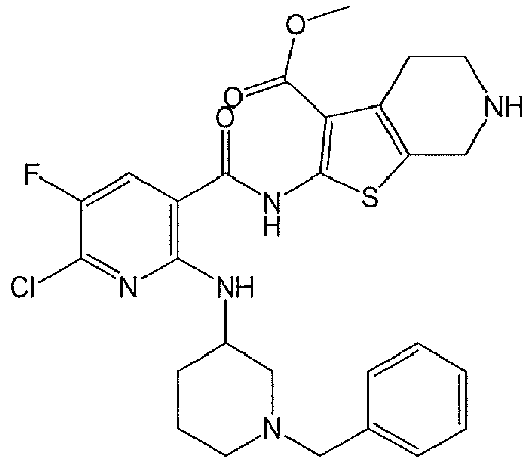
- The title compound was prepared in the same manner as in Example 57, with the exception that 3-amino-1-benzylpiperidine obtained in Preparation Example 18, instead of 4-amino-1-(2-hydroxyethyl)piperidine, was used in the same molar amount. Yield: 53.7%, 1H NMR (CDCl3) δ 7.83(d, 1H), 7.34(m, 5H), 5.89(m, 1H), 4.33(m, 1H), 3.92(m, 5H), 3.51(m, 2H), 3.12(t, 2H), 2.81(t, 2H), 2.74-2.48(m, 2H), 2.34-2.15(m, 2H), 1.80-1. 62 (m, 4H) ppm
-

- A solution of 2,6-dichloro-N-(2-ethylhexyl)-nicotinamide (318mg, 1.05mmol, 1.05eq) prepared in Preparation Example 14, 4-amino-1-(2-hydroxyethyl)piperidine (1.0mmol) obtained in Preparation Example 17, and anhydrous potassium carbonate (1.2mmol) in 5 ml of ortho-xylene was stirred for 24 hrs under reflux. The reaction mixture was cooled to a room temperature, added with 15 ml of ethylacetate, and extracted twice with 30 ml of 1 N aqueous HCl solution per round. The aqueous layer thus obtained was again washed with ethylacetate and adjusted to a pH of about 9~10 with a 2 N aqueous sodium hydroxide solution. Subsequently, the reaction mixture was extracted twice with 20 ml of methylene chloride, washed with saturated saline, and water was removed by a desiccant. In order to obtain a desired fraction, the solvent was removed by concentration in a reduced pressure. The purification through silica gel column chromatography (mobile phase: 20(v/v)% EA in hexane) was performed to afford the title compound. Yield: 77.9% 1H NMR (CDCl3) δ 8.35(d, 1H), 7.45(d, 1H), 6.44(d, 1H), 6.01(br, 1H), 4.03(m, 1H), 3.62(t, 2H), 3.32(t, 2H), 2.87(d, 2H), 2.56(t, 2H), 2.33(t, 2H), 2.07(d, 2H), 1.59(m, 2H), 1.42-1.16(m, 8H), 0.98-0.91(m, 6H) ppm
-

- The title compound was prepared in the same manner as in Example 64, with the exception that 2-chloro-N-(2-ethylhexyl)nicotinamide obtained in Preparation Example 13, instead of 2,6-dichloro-N-(2-ethylhexyl)nicotinamide, and 4-amino-2,2,6,6-tetramethylpiperidine, instead of 4-amino-1-(2-hydroxyethyl)piperidine, were used in the same molar amounts. Yield: 84.4% 1H NMR (CDCl3) δ 8.13 (d, 1H), 7.82(d, 1H), 7.49(d, 1H), 6.40(m, 1H), 6.21(br, 1H), 4.44(m, 1H), 3.26(t, 2H), 1.98(dd, 2H), 1.49(m, 1H), 1.22(m, 14H), 1.07(m, 8H), 0.89-0.81(m, 6H) ppm
-

- The title compound was prepared in the same manner as in Example 64, with the exception that 2,6-dichloro-N-(2-ethylhexyl)-5-fluoronicotinamide obtained in Preparation Example 15, instead of 2,6-dichloro-N-(2-ethylhexyl)nicotinamide, and 4-amino-2,2,6,6-tetramethylpiperidine, instead of 4-amino-1-(2-hydroxyethyl)piperidine, were used in the same molar amounts. Yield: 61.7% 1H NMR (CDCl3) δ 7.85(d, 1H), 7.34(d, 1H), 4.37(m, 1H), 3.42-3.28(m, 2H), 2.02(dd, 2H), 1.53(m, 1H), 1.30(m, 14H), 1.13(m, 8H), 1.01-0.87(m, 6H) ppm
-

- The title compound was prepared in the same manner as in Example 65, with the exception that 3-amino-1-benzylpiperidine obtained in Preparation Example 18, instead of 4-amino-2,2,6,6-tetramethylpiperidine, was used in the same molar amount. Yield: 87.3% 1H NMR (CDCl3) δ 8.29(d, 1H), 8.15(d, 1H), 7.53(d, 1H), 7.41-7.21(m, 5H), 6.40(m, 1H), 6.31(br, 1H), 4.28(m, 1H), 3.48(s, 2H), 3.34(m, 2H), 2.90-2.27(m, 5H), 1.86-1.54(m, 4H), 1.41-1.22(m, 8H), 0.95-0.90(m, 6H) ppm
-

- The title compound was prepared in the same manner as in Example 66, with the exception that 3-amino-1-benzylpiperidine obtained in Preparation Example 18, instead of 4-amino-2,2,6,6-tetramethylpiperidine, was used in the same molar amount. Yield: 70.2% 1H NMR (CDCl3) δ 7.83(d, 1H), 7.31(m, 5H), 6.94(m, 1H), 5.70(br, 1H), 4.29(m, 1H), 3.52(d, 2H), 3.41(t, 2H), 2.68-2.52(m, 3H), 1.73-1.56(m, 4H), 1.33-1.21(m, 8H), 0.93-0.87(m, 6H) ppm
- For test results of the following Experimental Examples, the mark "#" is provided to denote significance with p<0.05 relative to a non-treated control, the mark "*" to denote significance with p<0.05 relative to a VEGF-stimulated HUVEC group, the mark "**" to denote significance with p<0.01 relative to a VEGF-stimulated HUVEC group, the mark "***" to denote significance with p<0.001 relative to a VEGF-stimulated HUVEC group. These statistical significance levels were determined using ANOVA and Dunnett's post-hoc test.
- A-431 (melanoma, human, ATCC CRL-1555™) cells grown in DMEM (Dulbeco's Modified Eagle's Medium, Gibco #11885 ) were seeded at a density of 1x10⁴ cells/well into 96-well plates and incubated at 37°C for 18 hrs under the supply of 5% CO2 until the cells stably adhered to the bottom. The test substance sunitinib (synthesized by Boryung Pharmaceutical Synthesis Institute) (100, 50, 25, 12.5, 6.25, 3.125, 1.56, 0.78 µM), compounds of Chemical Formula I (100, 50, 25, 12.5, 6.25, 3.125, 1.56, 0.78 µM), and the control (medium) were serially diluted and applied to the 96-well plates. After incubation for 48 hrs in the presence of the test compound, the cells were assayed for viability.
- The cells in each well was added with 21 µl of a mixture of 20:1 (v/v) of an MTS solution [(3-(4,5-dimethylthiazol-2-yl)-5-(3-carboxymethoxyphenyl)-2-(4-sulfophenyl)-2H-tetrazolium, Promega, Cat# G5421; 2mg/ml] and a PMS solution [Phenazine methosulfate, Sigma #P9625; 1 mg/ml], and incubated for 2 hrs, followed by measuring absorbance at 490 nm on a microplate reader (Molecular device, spectraMax M2). Relative to the control (media), viability by drug concentration was determined from the measurements of formazan, and the results are given in Table 2, below.
- Test materials and their concentrations:
- Negative control: medium
- Positive control: sunitinib, 100, 50, 25, 12.5, 6.25, 3.125, 1.56, 0.78 µM,
- Compound of Chemical Formula I: 100, 50, 25, 12.5, 6.25, 3.125, 1.56, 0.78 µM.TABLE 2 MTS Assay of Compounds of Chemical Formula I and Sunitinib for Cytotoxicity against Human Melanocyte (A-431) Test Compound IC50 (µM) Test Compound IC50 (µM) Control - 267 20.9 Sunitinib 22 269 88.9 103 40.6 273 40.9 104 28.6 274 110.9 110 22.2 275 94.6 111 135 290 54.8 117 91.1 301 67.6 201 54.5 302 38.1 208 86.1 311 62.3 241 164 312 20.68 242 81.9 426 39.7 243 170 428 125 244 94.6 436 34 246 100.7 443 140 249 102.5 515 23.8 250 26.1 517 50.7 - As can be seen in Table 2, compounds of Chemical Formula I have IC50 values similar to or higher than that of sunitinib, an anticancer agent currently used for endstage renal cancer, demonstrating that they are of lower toxicity and higher safety.
- To examine the inhibitory effect of the compounds obtained in the Examples on VEGF (Vascular endothelial growth factor)-induced cell migration in HUVECs (human umbelical vein endothelial cells), a transwell assay was performed as follows.
- HUVECs, provided from ATCC (American Type Culture Collection), were incubated in EGM-2 (Endothelial growth Medium-2 Medium) including 10% FBS, penicillin (100 unit/ml) and 100 µg/ml streptomycin sulfate plus various growth factors at 37°C in an atmosphere of 5% CO2. After the change of the medium with growth factor-free EBM-2 (Endothelial Basal Medium-2 Medium), the cells were subjected to transwell assay. Various concentrations of test compounds (Compounds 103, 110, 218, 275, 276, 290, 312, 428, 442 and 509, and sunitinib) in DMSO (dimethylsulfoxide) were added together with VEGF.
- The HUVECs were seeded at a density of 2x10⁵ cells/well to 24-transwell plates, and incubated with Sunitinib (1 µM) and various concentrations of compounds of Chemical Formula I for 1 hr, and then for 24 hrs with 10 ng/ml VEGF, which functions to induce the growth and proliferation of cells.
- After for 24 hours, the cells were fixed for 1 min with ethanol and were stained with a dye. Cell migration was evaluated by counting cells which moved through the pores.
- In addition, cells were treated with Compound No. 250 (Example 26) at various concentrations given in Table 3, and assayed for cell migration, as conducted with Compounds 103, 110, 218, 273, 275, 276, 290, 312, 428, 442, and 509. The results were compared with those obtained after non-treatment (no treat) or treatment with 10 ng/mL VEGF.
- Results were expressed as average numbers (n=3) of HUVECs which moved cross the membrane. Test results are summarized in Table 3 for compounds 103, 110, 218, 273, 275, 276, 290, 312, 428, 442, and 509, and in Table 4 for
compound 250.TABLE 3 Test Compound No. of migration cells/field No treat 7 VEGF treated control 22# 103 (0.1 µM) 16*** 103 (0.5 µM) 12*** 103 (1 µM) 8*** 110 (25 µM) 10*** 218 (25 µM) 7.5*** 273 (50 µM) 12*** 275 (50 µM) 11*** 276 (50 µM) 12.5*** 290 (50 µM) 14.5*** 312 (50 µM) 14*** 428 (25 µM) 14.5*** 442 (25 µM) 15*** 509 (25 µM) 7*** Sunitinib (1µM) 16.5*** TABLE 4 Test Compound No. of migration cells/field no treat 3.8±1.29 VEGF(10ng/ml) 42.5±2.69# VEGF + 250 (25nM) 33±2.54** VEGF + 250 (50nM) 20.3±1.08*** VEGF + 250 (100nM) 12.5±2.5*** 250 (100nM) 4.5±1.11 - As is apparent from the data of Tables 3 and 4, compounds of Chemical Formula I suppressed VEGF-induced migration of HUVECs. Compound 103 was, inter alia, more suppressive than the anticancer agent Sunitinib in VEGF-induced migration of HUVECs. Moreover,
Compound 250 showed a remarkable suppressive effect on the VEGF-induced HUVEC migration even at a low concentration. - Using a sterile, disposable cell scraper (BD Falcon, Bedford, USA), a monolayer of HUVECs was scraped, and the cells were gently washed with PBS. The cells were treated with sunitinib (1 µM) or Compound 103 (0.1, 0.5, 1 µM) for 1 hr and then with 10ng/ml VEGF for 24 hrs. After 24 hours, the cell migration were monitored through the scraped monolayer of the cell and photographed under a microscope equipped with a camera (Canon Powershot640).
- Also, Compound 250 (Example 26) was applied at various concentrations shown in Table 6 in the same manner as Compound 103, followed by monitoring and photographing the migration of the cells under the microscope. For comparison, the cells were not treated (control) or were treated with 10ng/mL VEGF, alone.
- Results are shown in Table 5 and
FIG. 1 for Compound 103 and in Table 6 andFIG. 2 forCompound 250.TABLE 5 Test Compound Wound closure (µm) Control 110 VEGF (10ng/ml) 380# VEGF+ 103 (0.1µM) 200*** VEGF+ 103 (0.5µM) 180*** VEGF+ 103 (1µm) 155*** VEGF+ Sunitinib (1µM) 210*** TABLE 6 Test Compound Wound Closure(uM) Control 120 VEGF (10ng/ml) 290# VEGF + 250 (25nM) 210** VEGF + 250 (50nM) 765*** VEGF + 250 (100nM) 120*** 250 (100nM) 125 - As illustrated in Table 5, it is confirmed that Compound 103 has the suppression effects on VEGF-induced migration of HUVECs and suppresses VEGF-induced migration of HUVECs at higher efficiency than Sunitinib.
- Also, as can be seen in Table 6,
Compound 250 was highly suppresses VEGF-induced migration of HUVECs even at as low concentrations as nM levels. - A BrdU incorporation assay was carried out to examine whether the proliferation of HUVECs through VEGF-induced DNA synthesis is suppressed by BRN-103. HUVECs grown as in Experimental Example 2 were seeded at a density of 1x10⁴ cells/well into 96-well plates. The cells were incubated with Sunitinib (1 µM), or Compound 103 (0.1, 0.5, or 1 µM) for 1 hr and then with 10 ng/ml VEGF for 24 hrs. Thereafter, DNA synthesis in the cells was fluorescently measured using a BrdU incorporation assay kit (Roche).
- Likewise, the cells were treated with various concentrations of Compound 250 (Example 26) given in Table 8, and then with VEGF, as the same manner of that of Compound 103. Intracellular DNA was also quantified , as the same manner of that of Compound 103. For comparison, the cells were not treated (control), or were treated with 10 ng/mL VEGF, alone.
- Results are given in Table 7 for Compound 103 and in Table 8 for
Compound 250.TABLE 7 Test Compound BrdU incorporation(OD 450nm) Control 0.65 VEGF (10 ng/ml) 1.3# VEGF+ 103 (0.1µM) 1.0*** VEGF+ 103 (0.5nM) 0.8*** VEGF+ 103 (1µM) 0.7*** 103 (1µM) 0.7 VEGF+ Sunitinib (1µM) 0.84*** TABLE 8 Test Compound BrdU incorporation (OD 450nM) Control 0.65±0.05 VEGF (10ng/ml) 0.9±0.01# VEGF + 250 (25nM) 0.79±0.02** VEGF + 250 (50nM) 0.75+0.03*** VEGF + 250 (100nM) 0.7±0.05*** 250 (100nM) 0.7±0.05 - As can be seen in Table 7, Compound 103 of the present invention inhibited VEGF-induced proliferation in HUVECs in a dose-dependent manner. Compound 103 of the present invention showed higher efficacy than Sunitinib.
- As can be seen in Table 8,
Compound 250 also inhibited VEGF-induced proliferation in HUVECs. Additionally,Compound 250 has excellent suppressive effects on VEGF-induced proliferation of HUVECs even at a very low concentration. - HUVECs were pretreated with Sunitinib (1 µM) or Compound 103 (0.1, 0.5, or 1 µM) for 1 hr. After HUVECs were seeded at a density of 3x10⁵ cells/well into Matrigel-coated 48-well plates, HUVECs were with 10 ng/ml VEGF for 4hrs. The HUVECs where tubes were formed were monitored and photographed under a microscope equipped with a camera to count cells.
- HUVECs were also treated with Compound 250 (Example 26) at various concentrations given in Table 10, The HUVECs where tubes were formed were monitored and photographed under a microscope equipped with a camera, like Compound 103.
- Results are summarized in
FIG. 4 and in Table 9 for Compound 103 and shown inFIG. 4 and Table 10 forCompound 250.TABLE 9 Test Compound Number of tubes/ Field Control 50 VEGF (10 ng/ml) 140# VEGF+ 103 (0.1µM) 90** VEGF+ 103 (0.5µM) 80*** VEGS+ 103 (1µM) 60*** VEGF+ Sunitinib (1µM) 100*** TABLE 10 Test Compound Number of tubes/field Control 30+5 VEGF (10ng/ml) 60±4# VEGF + 250 (25nM) 45±6** VEGF + 250 (50nM) 35±2*** VEGF + 250 (100nM) 28±4*** 250 (100nM) 27±2 - As is appararent from data of Table 9, VEGF-induced tube formation was suppressed by Compound 103, indicating that the compound of the present invention blocks VEGF-induced angiogenesis. Also, Compound 103 was more efficient in the inhibition of tube formation than Sunitinib.
- As is apparent from data of Table 10, VEGF-induced tube formation was also suppressed by Compound 103, indicating that the compound of the present invention blocks VEGF-induced angiogenesis. Particularly,
Compound 250 retains high suppressive effect on tube formation even at a low concentration. - Aortic rings excised from 5-week-old C57BL/6 mice were placed in Matrigel-coated 48-well plates, and incubated with Sunitinib (1 µM) or Compound 103 (0.1, 0.5, 1 µM) for 1 hr and then with 10 ng/ml VEGF for 7 days. Sprouts from margins of the aortic rings were photographed under a microscope equipped with a camera.
- Likewise, after the aortic rings excised from six-week-old Spague-Dawley rats were treated with various concentrations (10nM, 50nM, 100nM) of Compound 250 (Example 26) and then with VEGF, Sprouts from margins of the aortic rings were photographed under a microscope equipped with a camera, like Compound 103.
- As is illustrated in
FIGS. 5 and 6 ,Compounds 103 and 250 inhibited VEGF-induced aortic sprouting. - Particularly, it is confirmed that
Compound 250 has effective, inhibitory activity against aortic sprouting even at as low concentrations as nM levels. - An examination was made to see the effect of compounds of Chemical Formula I on VEGF-induced VEGFR2 activation, as follows.
- HUVECs were pretreated with for 1 hr with Sunitinib (1 µM) or Compound 103 (0.1, 0.5, 1 µM) and then treated with VEGF (10 ng/ml) of 5 min. After 3 min of centrifugation at 4000 rpm to collect the cells, the cell pellet was washed once with PBS (phosphate buffered saline). The washed cell pellet was suspended in a lysis buffer (50mM HEPES pH 7.0, 250mM NaCl, 5mM EDTA, 0.1% Nonidet P-40, 1 mM phenylmethylsulfonyl fluoride and 0.5 mM Na orthovanadate) containing 5 µl/mL of leupeptin and aprotinin, each and reaction was performed. at 4°C for 20. After the cell debris was removed by microcentrifugation , the supernatant was swiftly cooled, and quantified for protein level using a Bio-Rad protein assay reagent. 40 µg of the cell protein from each test group was run by 10% SDS-PAGE, and transferred onto a PVDF membrane.
- For Immunoblottig, the membrane was incubated overnight at 4°C in a blocking solution (5% skim milk), and reacted with a primary antibody for 4 hrs. After 4 washes with Tween 20/Tris-buffered saline (TTBS), the membrane was reacted with a 1:1000 (v/v) dilution of a horseradish peroxidase-conjugated secondary antibody at room temperature for 1 hr, washed three times with TTBS, and identified by a chemical luminescence method (Amersham Life Science).
- As with Compound 103, HUVECs were treated with various concentrations (10nM, 50nM, 100nM) of Compound 250 (Example 26) and then with VEGF, and analyzed for inhibitory activity against VEGF-induced VEGFR2 activation.
- Results are given in
FIG. 7 for Compound 103 and inFIG. 8 forCompound 250. - In
FIGS. 7 and 8 , the mark "-" denotes the absence of the corresponding ingredients listed left while the mark "+" denotes the presence of the corresponding ingredients listed left. As can be seen inFIGS. 7 and 8 , VEGF induced the expression of p-VEGFR (Tyr-1175) whereas compounds of Chemical Formula I, like Sunitibib, inhibited the expression of p-VEGFR (Tyr-1175). Accordingly, 6-HMA is found to inhibit the production of PGE2 by down-regulating the expression of COX-2, a PGE2 synthase. Therefore, compounds of Chemical Formula I according to the present invention act against the VEGFR2 pathway which has important influences on the migration and proliferation of cells. - An examination was made to see the effect of compounds of Chemical Formula I, prepared in the Examples above, on VEGF-induced activation of AKT(serine/threonine protein kinase B)/ERK(Extracellular signal-regulated kinases) and eNOS(endothelial nitric oxide synthase) in HUVECs, as follows (endothelial nitric oxide synthase).
- HUVECs were pretreated with for 1 hr with Sunitinib (1 µM) or Compound 103 (0.1, 0.5, 1 µM) and then treated with VEGF (10 ng/ml) for 10 min (p-ERK), 30 min (p-AKT), and 1 hr (p-eNOS). After 3 min of centrifugation at 4000 rpm to collect the cells, the cell pellet was washed once with PBS (phosphate buffered saline). The cell pellet suspended in a lysis buffer (50mM HEPES pH 7.0, 250mM NaCl, 5mM EDTA, 0.1% Nonidet P-40, 1 mM phenylmethylsulfonyl fluoride and 0.5 mM Na orthovanadate) containing 5 µl/mL of leupeptin and aprotinin, each and the reaction was performed at 4°C for 20 min. After the cell debris was removed by microcentrifugation, the supernatant was swiftly cooled.
- Protein quantification was carried out using a Bio-Rad protein assay reagent. 40 µg of the cell protein from each test group was run by 10% SDS-PAGE, and transferred onto a PVDF membrane.
- For Immunoblottig, the membrane was incubated overnight at 4°C in a blocking solution (5% skim milk), and reacted with a primary antibody for 4 hrs. After 4 washes with Tween 20/Tris-buffered saline (TTBS), the membrane was reacted with a 1:1000 (v/v) dilution of a horseradish peroxidase-conjugated secondary antibody at room temperature for 1 hr, washed three times with TTBS, and visualized by a chemical luminescence method (Amersham Life Science). Of measurements from three independent experiments, a representative is shown in
FIG. 5 . - In
FIG. 9 , the mark "-" denotes the absence of the corresponding ingredients listed left while the mark "+" denotes the presence of the corresponding ingredients listed left. As can be seen inFIG. 5 , VEGF induced the expression of p-ERK at 10 min and p-AKT at 30 min. Compound 103 decreased the expression of p-AKT, but did not suppress the expression of p-ERK. In contrast, Sunitinib was observed to decrease levels of both p-AKT and p-ERK. In addition, p-eNOS, a factor downstream of AKT and ERK, was downregualted in both the groups treated with Compound 103 or Sunitinib. Consequently, compounds of Chemical Formula I according to the present invention inhibit the migration and proliferation of cells by downregulating eNOS, which is involved in cell migration and proliferation in HUVECs, in a different pathway from that of Sunitinib.
Claims (21)
- A compound, represented by the following Chemical Formula I, or a pharmaceutically acceptable salt thereof:
 X1 and X2, are independently a halogen atom (F, Cl, Br, I) or a hydrogen atom,Y is -NH-; -S-; or -O-,R1 represents piperidinyl, piperazinyl, azabicyclo[2.2.2]octanyl, or phenyl having 1 to 5 substituents selected from the group consisting of benzyl, phenyloxy, 1,1-pyrimidinethyl, pyridine methyl, C1-4 alkyl, C3-6 alkene, and t-butoxycarboxyl and malon-2-yl,wherein the C1-4 alkyl is substituted with 0 to 3 substituents selected from among R3R4N-, hydroxyl, and a halogen atom, wherein R3 and R4 are independently a C1-4 alkyl,wherein the benzyl, the phenyloxy, the pyrimidinemethyl and the pyrimidinemethyl are independently substituted with 0 to 4 halogen atoms,R2 represents C1-4 alkyl with 1 or 2 substituents selected from the group consisting of morpholinyl substituted with 0 to 3 benzyl groups having 0 to 3 halogen substituents, phenyl substituted with 0 to 3 halogen atoms, pyridinyl, pyrimidinyl, piperidinyl and piperazinyl; C5-10 alkyl; C1-4 alkyloxycarbonylamino; C1-4alkoxyC1-4 alkyl; toluenesulfonamino; phenyl with 0 to 3 substituents selected from the group consisting of C1-4 alkyl, halogen, nitro and phenoxy; pyridinyl with 0 to 3 substituents selected from the group consisting of C1-4 alkyloxycarbonyl and C1-4 alkyl; azepan-2-onyl; 1,3,4-triazolyl; pyrimidinyl substituted with 0 to 3 C1-4 alkyl groups; pyrrolidinyl; thiazolyl substituted with 0 to 2 C1-4 alkyl groups; 2,3-dihydroxy indole substituted with 0 to 3 C1-4 alkyl groups; or
 wherein R5 and R6 are each independently C1-4alkyl, C14alkyl sulfanyl or thiol, andR7 and R8 are each independently C1-4 alkyloxycarbonyl, phenyl or benzyl.
 - The compound or the pharmaceutically acceptable salt thereof according to claim 1, wherein R1 is 1-benzylpiperidin-4-yl; 1-benzylpiperidin-3-yl; 4-phenoxyphenyl; 1-(2-hydroxyethyl)-piperidine-4-yl; 1-(2-hydroxyethyl)-piperidin-3-yl; 1-(2-hydroxyethyl)-piperazin-4-yl; 2,2,6,6-tetramethylpiperidine-4-yl; t-butoxycarbonylpiperidin-4-yl; t-butoxycarbonylpiperidin-3-yl; 1-azabicyclo[2.2.2]oct-3-yl; methylpiperidin-4-yl; methylpiperazin-4-yl; piperidin-4-yl; piperidin-3-yl; 1-(2-hydroxyethyl)-2,2,6,6-tetra methylpiperidin-4-y1;1-arylpiperidin-4-yl; [2-(N,N-dimethylamino)ethyl]piperidine-4-yl; (t-butyloxycarbonyl)piperidin-3-yl: (malon-2-yl)piperidin-4-yl; (pyridin-2-yl)methylpiperidin-4-yl; (pyridin-3-yl)methylpiperidin-4-yl; or 1-(6-chloro-5-fluoropyrimidin-4-yl)ethyl piperidin-4-yl
- The compound or the pharmaceutically acceptable salt thereof according to claim 2, wherein R1 is 1-benzylpiperidin-4-yl; 1-benzylpiperidin-3-yl; 1-(2-hydroxyethyl)- piperidin-4-yl; piperidin-3-yl; or t-butoxycarbonylpiperidin-3-yl.
- The compound or the pharmaceutically acceptable salt thereof according to claim 1, wherein R2 is 3-chlorophenyl; 4-phenoxyphenyl; 3,3-dimethyl-2,3-dihydro-1H-indol-6-yl; 4-(4-fluorobenzyl)-morpholin-2-ylmethyl; 1,3,4-triazol-2-yl; 4,6-dimethylpyrimidin-2-yl; (S)-pyrrolidin-3y1; 2-(morpholin-1-yl)ethyl; t-butoxycarbonylamino; (3-methoxycarbonyl)pyridin-6-yl; p-toluenesulfonamino; pyridine-4-ylmethyl; 1,2-diphenylethyl; 2-methoxyethyl; 5-methylthiazol-2-yl; 3-methylpyridin-2-yl; azepan-2-on-3-yl; 4-fluorobenzyl; 2-ethylhexyl; 3-methyl-2-methylsulfanyl-3,4-dihydroquinazolin-4-on-6-yl; (3,4-dimethoxy)phenyl;


- The compound or the pharmaceutically acceptable salt thereof according to claim 4, wherein R2 is 3-chlorophenyl; 4-phenoxyphenyl; 5-methylthiazol-2-yl; or
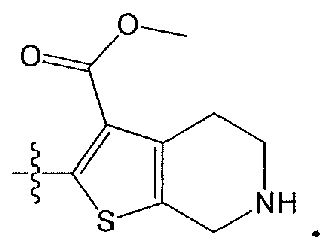
- The compound or the pharmaceutically acceptable salt thereof according to claim 1, being selected from the group consisting of:2-((1-benzylpiperidin-4-ylamino)-N-(3-chlorophenyl)nicotinamide[103],N-(3-chlorophenyl)-2-(4-phenoxyanilino)nicotinamide[104],2-((1-benzylpiperidin-4-ylamino)-N-(4-phenoxyphenyl)nicotinamide[110],2-((4-phenoxyanilino)-N-(4-phenoxyphenyl)nicotinamide[111],N-(3-chlorophenyl)-2-(2,2,6,6-tetramethylpiperidin-4-ylamino)nicotinamide[201],N-(3-chlorophenyl)-2-(1-tert-butoxycarbamoylpiperidin-4-ylamino)nicotinamide [208],2-((1-azabicyclo[2.2.2]oct-3-ylamino)-N-(3-chlorophenyl)nicotinamide[210],N-(3-chlorophenyl)-2-(1-methylpiperidin-4-ylamino)nicotinamide[214],N-(3-chlorophenyl)-2-[1-(2-hydroxyethyl)piperidin-4-ylamino]nicotinamide [218],N-(3-chlorophenyl)-2-(4-methylpiperazin-1-ylamino)nicotinamide[240],N-(3-chlorophenyl)-2-[4-(2-hydroxyethyl)piperazin-1-ylamino)nicotinamide[241],(R)-2-(1-benzylpiperidin-3-ylamino)-N-(3-chlorophenyl)nicotinamide[267],(S)-2-(1-benzylpiperidin-3-ylamino)-N-(3-chlorophenyl)nicotinamide[273],(R)-N-(3-chlorophenyl)-2-(1-tert-butoxycarbamoylpiperidin-3-ylamino)nicotinamide[270],(S)-N-(3-chlorophenyl)-2-(1-tert-butoxycarbamoylpiperidin-3-ylamino)nicotinamide[276],2-((1-benzylpiperidin-4-ylamino)-6-chloro-N-(3-chlorophenyl)nicotinamide[301],2-((1-benzylpiperidin-4-ylamino)-6-chloro-N-(3-chlorophenyl)-5-fluoronicotinamide[302],6-chloro-N-(3-chlorophenyl)-2-[1-(2-hydroxyethyl)benzylpiperidin-4-ylamino]nicotinamide[311],6-chloro-N-(3-chlorophenyl)-5-fluoro-2-[1-(2-hydroxyethyl)piperidin-4-ylamino]nicotinamide[312],2-((1-benzylpiperidin-4-ylamino)-N-(3,3-dimethyl-2,3-dihydro-1H-indol-6-yl)nicotinamide[117],N-(3,3-dimethyl-2,3-dihydro-1H-indol-6-yl)-2-(4-phenoxyanilino)nicotinamide [118],N-(3-chlorophenyl)-2-(4-piperidylamino)nicotinamide[224],(R)-N-(3-chlorophenyl)-2-(3-piperidylamino)nicotinamide[269],(S)-N-(3-chlorophenyl)-2-(3-piperidylamino)nicotinamide[275],N-(3-chlorophenyl)-2-(1-(2-hydroxyethyl)-2,2,6,6-tetramethylpiperidin-4-ylamino)nicotinamide[242],2-((1-arylpiperidin-4-ylamino)-N-(3-chlorophenyl)nicotinamide [243],N-(3-chlorophenyl)-2-[1-(2-N,N-diethylamino-ethyl)piperidin-4-ylamino]nicotinamide[244],N-(3-chlorophenyl)-2-[1-(pyridin-2-ylmethyl)piperidin-4-ylamino]nicotinamide[248],N-(3-chlorophenyl)-2-[1-(pyridin-3-ylmethyl)piperidin-4-ylamino]nicotinamide[249],2-{1-[1-(6-chloro-5-fluoropyrimidin-2-yl)ethyl]piperidin-4-ylamino}-N-(3-chlorophenyl)nicotinamide[250],(R)-N-(3-chlorophenyl)-2-[1-(2-hydroxyethyl)piperidin-3-ylamino]nicotinamide[268],(S)-N-(3-chlorophenyl)-2-[1-(2-hydroxyethyl)piperidin-3-ylamino]nicotinamide[274],2-((4-(3-(3-chlorophenylcarbamoyl)pyridin-2-ylamino)piperidin-1-yl)malonic acid [246],2-((1-benzylpiperidin-4-yloxy)-N-(3-chlorophenyl)nicotinamide[289],2-((1-benzylpiperidin-4-ylsulfanyl)-N-(3-chlorophenyl)nicotinamide[290],2-((1-benzylpiperidin-4-ylamino)-N-[4-(4-fluorobenzyl)morpholin-2-ylmethyl]nicotinamide[404],2-((1-benzylpiperidin-4-ylamino)-N-(1,3,4-triazol-2-yl)nicotinamide[406],2-((1-benzylpiperidin-4-ylamino)-N-(4,6-dimethylpyrimidin-2-yl)nicotinamide[407],2-((1-benzylpiperidin-4-ylamino) -N-(S)-pyrrolidin-3-ylnicotinamide[408],2-((1-benzylpiperidin-4-ylamino)-N-2-(morpholin-1-yl)ethylnicotinamide[409],N'-[2-(1-benzylpiperidin-4-ylamino)pyridine-3-carbonyl]hydrazine carboxylic acid tert-butyl ester [410],methyl 6-{[2-(1-benzylpiperidin-4-ylamino)pyridine-3-carbonyl]amino }nicotinate[412],2-((1-benzylpiperidin-4-ylamino)-N-(para-toluenesulfonamino)nicotinamide[424],2-((1-benzylpiperidin-4-ylamino)-N-(pyridin-4-ylmethyl)nicotinamide[425],2-((1-benzylpiperidin-4-ylamino)-N-(1,2-diphenylethyl)nicotinamide[426],2-((1-benzylpiperidin-4-ylamino)-N-(2-methoxyethyl)nicotinamide [427],2-((1-benzylpiperidin-4-ylamino)-N-(5-methylthiazol-2-yl)nicotinamide[428],2-((1-benzylpiperidin-4-ylamino)-N-(3-methylpyridin-2-yl)nicotinamide[429],2-((1-benzylpiperidin-4-ylamino)-N-(azepan-2-on-3-yl)nicotinamide[430],2-((1-benzylpiperidin-4-ylamino)-N-(4-fluorobenzyl)nicotinamide[431],2-((1-benzylpiperidin-4-ylamino)-N-(2-ethylhexyl)nicotinamide[436],2-((1-benzylpiperidin-4-ylamino)-N-(3-methyl-2-methylsulfanyl-3,4-dihydroquinazolin-4-on-6-yl)nicotinamide[439],6-benzyl-2-{[2-(1-benzylpiperidin-4-ylamino)pyridine-3-carbonyl]amino}-4,5,6,7-tetrahydro-thieno[2,3-c]pyridine-3-carboxylic acid methyl ester[440],6-ethoxycarbamate-2-{[2-(1-benzylpiperidin-4-ylamino)pyridine-3-carbonyl]amino}-4,5,6,7-tetrahydro-thieno[2,3-c]pyridine-3-carboxylic acid methyl ester[441],2-{[2-(1-benzylpiperidin-4-ylamino)pyridine-3-carbonyl]amino}-4,5,6,7-tetrahydro-thieno[2,3-c]pyridine-3-carboxylic acid methyl ester[442],2-((1-benzylpiperidin-4-ylamino)-N-(3,4-dimethoxyphenyl)nicotinamide[443],2-{[2-(1-benzylpiperidin-4-ylamino)-6-chloropyridine-3-carbonyl]amino}-4,5,6,7-tetrahydrothieno[2,3-c]pyridine-3-carboxylic acid methyl ester [501],2-{[2-(1-benzylpiperidin-4-ylamino)-6-chloropyridine-3-carbonyl]amino}-4,5,6,7-tetrahydrothieno[2,3-c]pyridine-3-carboxylic acid methyl ester[502],2-{[2-(1-(2-hydroxyethyl)piperidin-4-ylamino)pyridine-3-carbonyl]amino}-4,5,6,7-tetrahydrothieno[2,3-c]pyridine-3-carboxylic acid methyl ester[503],2-{[6-chloro-2-(1-(2-hydroxyethyl)piperidin-4-ylamino)pyridine-3-carbonyl]amino}-4,5,6,7-tetrahydrothieno[2,3-c]pyridine-3-carboxylic acid methyl ester[504],2-{[6-chloro-5-fluoro-2-(1-(2-hydroxyethyl)piperidin-4-ylamino)pyridine-3-carbonyl]amino}-4,5,6,7-tetrahydrothieno[2,3-c]pyridine-3-carboxylic acid methyl ester[505],2-{[2-(2,2,6,6-tetramethylpiperidin-4-ylamino)pyridine-3-carbonyl]amino}-4,5,6,7-tetrahydrothieno[2,3-c]pyridine-3-carboxylic acid methyl ester[506],2-{[2-(2,2,6,6-tetramethylpiperidin-4-ylamino)6-chloropyridine-3-carbonyl]amino}-4,5,6,7-tetrahydrothieno[2,3-c]pyridine-3-carboxylic acid methyl ester[507],2-{[6-chloro-5-fluoro-2-(2,2,6,6-tetramethylpiperidin-4-ylamino)pyridine-3-carbonyl]amino}-4,5,6,7-tetrahydrothieno[2,3-c]pyridine-3-carboxylic acid methyl ester[508],2-{[2-(1-benzylpiperidin-3-ylamino)pyridine-3-carbonyl]amino}-4,5,6,7-tetrahydrothieno[2,3-c]pyridine-3-carboxylic acid methyl ester[509],2-{[2-(1-benzylpiperidin-3-ylamino)-6-chloropyridine-3-carbonyl]amino}-4,5,6,7-tetrahydrothieno[2,3-c]pyridine-3-carboxylic acid methyl ester[510],2-{[2-(1-benzylpiperidin-3-ylamino)-6-chloro-5-fluoropyridine-3-carbonyl]amino}-4,5,6,7-tetrahydrothieno[2,3-c]pyridine-3-carboxylic acid methyl ester[511],6-chloro-N-(2-ethylhexyl)-2-[1-(2-hydroxyethyl)piperidin-4-ylamino]nicotinamide[515],N-(2-ethylhexyl)-2-(2,2,6,6-tetramethylpiperidin-4-ylamino)nicotinamide[517],6-chloro-N-(2-ethylhexyl)-5-fluoro-2-(2,2,6,6-tetramethyl piperidin-4-ylamino)nicotinamide[519],2-((1-benzylpiperidin-3-ylamino)-N-(2-ethylhexyl)nicotinamide[ 520],2-((1-benzylpiperidin-3-ylamino)-6-chloro-N-(2-ethylhexyl)-5-fluoronicotinamide[522], and pharmaceutically acceptable salts thereof.
- The compound or the pharmaceutically acceptable salt according to claim 6, being selected from the group consisting of:2-((1-benzylpiperidin-4-ylamino)-N-(3-chlorophenyl)nicotinamide[103],2-((1-benzylpiperidin-4-ylamino)-N-(4-phenoxy phenyl)nicotinamide[110],N-(3-chlorophenyl)-2-[1-(2-hydroxyethyl)piperidin-4-ylamino]nicotinamide [ 218],(S)-2-(1-benzylpiperidin-3-ylamino)-N-(3-chlorophenyl)nicotinamide[273],(S)-N-(3-chlorophenyl)-2-(1-tert-butoxycarbamoylpiperidin-3-ylamino)nicotinamide[276],6-chloro-N-(3-chlorophenyl)-5-fluoro-2-[1-(2-hydroxyethyl)piperidin-4-ylamino]nicotinamide[312],(S)-N-(3-chlorophenyl)-2-(3-piperidylamino)nicotinamide[275],2-((1-benzylpiperidin-4-ylsulfanyl)-N-(3-chlorophenyl)nicotinamide [290],2-((1-benzylpiperidin-4-ylamino)-N-(5-methylthiazol-2-yl)nicotinamide[428],2-{[2-(1-benzylpiperidin-4-ylamino)pyridine-3-carbonyl]amino}-4,5,6,7-tetrahydro-thieno[2,3-c]pyridine-3-carboxylic acid methyl ester[442],2-{[2-(1-benzylpiperidin-3-ylamino)pyridine-3-carbonyl]amino}-4,5,6,7-tetrahydrothieno[2,3-c]pyridine-3-carboxylic acid methyl ester[509], and pharmaceutically acceptable salts thereof.
- The compound or the pharmaceutically acceptable salt thereof according to claim 7, being 2-(1-benzylpiperidin-4-ylamino)-N-(3-chlorophenyl)nicotinamide [103] or a pharmaceutically acceptable salt thereof.
- A method for preparing the compound, represented by Chemical Formula I, of claim 1, comprising reacting a compound, represented by the following Chemical Formula II, with a compound, represented by the following Chemical Formula III, in the presence of a base;

wherein,X1, X2, R1, and R 2 are respectively as defined in claim 1, andZ is chloro or bromo. - The method of claim 9, wherein the base is selected from the group consisting of triethylamine, N,N-diisopropylethylamine, N-methylmorpholine, DBU (1,8-Diazabicyclo[5.4.0]undec-7-ene), N-methylpiperidine, 4-dimethylaminopyridine, N,N-dimethylaniline, 2,6-lutidine, 4-N,N-dimethylaminopyridine and pyridine.
- The method of preparing the compound, represented by Chemical Formula I, of claim 1, comprising reacting a compound, represented by the following Chemical Formula IV, with a compound, represented by the following Chemical Formula V, in the presence of a base:

[Chemical Formula V] Y-R1
wherein,X1, X2, R1, and R2 are respectively as defined in claim 1, andY is -NH2, -SH or -OH. - The method of claim 11, wherein the base is selected from the group consisting of potassium carbonate, potassium hydrogen carbonate, sodium carbonate, sodium hydrogen carbonate, sodium hydroxide, potassium hydroxide, calcium hydroxide, barium hydroxide, sodium methoxide, sodium ethoxide, sodium-t-butoxide, potassium-t-butoxide, sodium hydride, potassium hydride, sodium borohydride, sodium cyanoborohydride, and 4-N,N-dimethylaminopyridine.
- The method of claim 11, wherein the reacting is carried out in xylene.
- The method of claim 11, wherein the xylene is o-xylene.
- A pharmaceutical composition for prevention or treatment of a disease or symptom caused by aberrant activity of vascular endothelial growth factor (VEGF), comprising the compound of any one of claims 1 to 8, or a pharmaceutically acceptable salt thereof.
- The pharmaceutical composition of claim 15, wherein the disease or symptom is selected from among cancer, rheumatoid arthritis, diabetic retinopathy, keratitis, hyperemia, macular degeneration, choroidal neovascularization, neovascular glaucoma, ophthalmic diseases of corneal neovascularization, psoriasis, airway obstructive hemangiomas in lung, and obesity by angiogenesis.
- The pharmaceutical composition of claim 16, wherein the disease or symptom is cancer.
- A pharmaceutical composition for inhibition of vessel formation, comprising the compound of any one of claims 1 to 8, or a pharmaceutically acceptable salt thereof.
- The pharmaceutical composition of claim 18, being an anticancer agent.
- A method for preventing or treating a disease or symptom caused by aberrant activity of vascular endothelial growth factor (VEGF), comprising administering a compound, represented by the following Chemical Formula I, or a pharmaceutically acceptable salt thereof to a subject:

 X1 and X2 are independently a halogen atom (F, Cl, Br, I) or a hydrogen atom,Y is -NH-; -S-; or -O-,R1 represents piperidinyl, piperazinyl, azabicyclo[2.2.2]octanyl, or phenyl with 1 to 5 substituents selected from the group consisting of benzyl, phenyloxy, 1,1-pyrimidinethyl, pyridine methyl, C1-4 alkyl, C3-6 alkene, and t-butoxycarboxyl and malon-2-yl,wherein the C1-4 alkyl is substituted with 0 to 3 substituents selected from among R3R4N-, hydroxyl, and a halogen atom, wherein R3 and R4 are independently a C1-4 alkyl,wherein the benzyl, the phenyloxy, the pyrimidinemethyl and the pyrimidinemethyl are independently substituted with 0 to 4 halogen atoms,R2 represents C1-4 alkyl with 1 or 2 substituents selected from among morpholinyl substituted with 0 to 3 benzyl groups having 0 to 3 halogen substituents, phenyl substituted with 0 to 3 halogen atoms, pyridinyl, pyrimidinyl, piperidinyl and piperazinyl; C5-10 alkyl; C1-4 alkyloxycarbonylamino; C1-4alkoxyCl-4 alkyl; toluenesulfonamino; phenyl with 0 to 3 substituents selected from among C1-4 alkyl, halogen, nitro and phenoxy; pyridinyl with 0 to 3 substituents selected from among C1-4 alkyloxycarbonyl and C1-4 alkyl; azepan-2-onyl; 1,3,4-triazolyl; pyrimidinyl substituted with 0 to 3 C1-4 alkyl groups; pyrrolidinyl; thiazolyl substituted with 0 to 2 C1-4 alkyl groups; 2,3-dihydroxy indole substituted with 0 to 3 C1-4 alkyl groups; or
 wherein R5 and R6 are each independently C1-4alkyl, C1-4alkyl sulfanyl or thiol, andR7 and R8 are each independently C1-4 alkyloxycarbonyl, phenyl or benzyl.
 - The method of claim 20, wherein the disease or symptom caused by aberrant activity of vascular endothelial growth factor is selected from among cancer, rheumatoid arthritis, diabetic retinopathy, keratitis, hyperemia, macular degeneration, choroidal neovascularization, neovascular glaucoma, ophthalmic diseases of corneal neovascularization, psoriasis, airway obstructive hemangiomas, and obesity by angiogenesis.
Applications Claiming Priority (2)
| Application Number | Priority Date | Filing Date | Title |
|---|---|---|---|
| KR1020110074638A KR101412794B1 (en) | 2011-07-27 | 2011-07-27 | New compound, the preparation thereof and the pharmaceutical composition comprising the same for anti-angiogenic drug |
| PCT/KR2012/006037 WO2013015657A2 (en) | 2011-07-27 | 2012-07-27 | Novel compound having angiogenesis inhibitory activity, method for preparing same, and pharmaceutical composition comprising same |
Publications (2)
| Publication Number | Publication Date |
|---|---|
| EP2754655A2 true EP2754655A2 (en) | 2014-07-16 |
| EP2754655A4 EP2754655A4 (en) | 2015-05-20 |
Family
ID=47601684
Family Applications (1)
| Application Number | Title | Priority Date | Filing Date |
|---|---|---|---|
| EP12816890.3A Withdrawn EP2754655A4 (en) | 2011-07-27 | 2012-07-27 | Novel compound having angiogenesis inhibitory activity, method for preparing same, and pharmaceutical composition comprising same |
Country Status (9)
| Country | Link |
|---|---|
| US (1) | US9227955B2 (en) |
| EP (1) | EP2754655A4 (en) |
| JP (1) | JP5894669B2 (en) |
| KR (1) | KR101412794B1 (en) |
| CN (1) | CN103827089A (en) |
| BR (1) | BR112014001963A2 (en) |
| MX (1) | MX2014001052A (en) |
| RU (2) | RU2014107488A (en) |
| WO (1) | WO2013015657A2 (en) |
Families Citing this family (2)
| Publication number | Priority date | Publication date | Assignee | Title |
|---|---|---|---|---|
| US20170020958A1 (en) * | 2015-07-23 | 2017-01-26 | Cryocord Sdn. Bhd. | Stem cells for anti-angiogenic therapy in age-related macular degeneration, diabetic retinopathy, corneal vascularisation and cancer |
| CN111909167B (en) * | 2019-05-07 | 2021-11-19 | 华东师范大学 | Piperidinothiophene derivative and application thereof in preparation of medicine for treating psoriasis |
Family Cites Families (11)
| Publication number | Priority date | Publication date | Assignee | Title |
|---|---|---|---|---|
| JPS5069096A (en) * | 1973-10-25 | 1975-06-09 | ||
| JPS612667B2 (en) * | 1973-11-20 | 1986-01-27 | Hisamitsu Pharmaceutical Co | |
| GB9715584D0 (en) * | 1997-07-23 | 1997-10-01 | Eisai Co Ltd | Compounds |
| GB0001930D0 (en) * | 2000-01-27 | 2000-03-22 | Novartis Ag | Organic compounds |
| US6995162B2 (en) * | 2001-01-12 | 2006-02-07 | Amgen Inc. | Substituted alkylamine derivatives and methods of use |
| US7105682B2 (en) | 2001-01-12 | 2006-09-12 | Amgen Inc. | Substituted amine derivatives and methods of use |
| US6878714B2 (en) * | 2001-01-12 | 2005-04-12 | Amgen Inc. | Substituted alkylamine derivatives and methods of use |
| KR100747401B1 (en) | 2003-09-03 | 2007-08-08 | 화이자 인코포레이티드 | Phenyl or pyridyl amide compounds as prostaglandin E2 antagonists |
| US7507748B2 (en) | 2004-07-22 | 2009-03-24 | Amgen Inc. | Substituted aryl-amine derivatives and methods of use |
| EP2008658A1 (en) | 2007-06-28 | 2008-12-31 | Bayer Schering Pharma Aktiengesellschaft | Synergistic combination of anthranilamide pyridinureas and benzamide derivatives |
| JP2012529512A (en) * | 2009-06-08 | 2012-11-22 | アブラクシス バイオサイエンス リミテッド ライアビリティー カンパニー | Triazine derivatives and their therapeutic applications |
-
2011
- 2011-07-27 KR KR1020110074638A patent/KR101412794B1/en not_active Expired - Fee Related
-
2012
- 2012-07-27 RU RU2014107488/04A patent/RU2014107488A/en not_active Application Discontinuation
- 2012-07-27 JP JP2014522758A patent/JP5894669B2/en not_active Expired - Fee Related
- 2012-07-27 CN CN201280046679.7A patent/CN103827089A/en active Pending
- 2012-07-27 RU RU2015140132A patent/RU2015140132A/en unknown
- 2012-07-27 EP EP12816890.3A patent/EP2754655A4/en not_active Withdrawn
- 2012-07-27 BR BR112014001963A patent/BR112014001963A2/en not_active IP Right Cessation
- 2012-07-27 MX MX2014001052A patent/MX2014001052A/en not_active Application Discontinuation
- 2012-07-27 US US14/235,439 patent/US9227955B2/en not_active Expired - Fee Related
- 2012-07-27 WO PCT/KR2012/006037 patent/WO2013015657A2/en not_active Ceased
Also Published As
| Publication number | Publication date |
|---|---|
| WO2013015657A2 (en) | 2013-01-31 |
| JP2014521640A (en) | 2014-08-28 |
| KR101412794B1 (en) | 2014-07-01 |
| US20140256711A1 (en) | 2014-09-11 |
| RU2015140132A3 (en) | 2018-12-26 |
| BR112014001963A2 (en) | 2017-02-21 |
| EP2754655A4 (en) | 2015-05-20 |
| US9227955B2 (en) | 2016-01-05 |
| RU2014107488A (en) | 2015-09-10 |
| JP5894669B2 (en) | 2016-03-30 |
| KR20130013163A (en) | 2013-02-06 |
| WO2013015657A3 (en) | 2013-06-13 |
| RU2015140132A (en) | 2018-12-26 |
| CN103827089A (en) | 2014-05-28 |
| MX2014001052A (en) | 2014-09-01 |
Similar Documents
| Publication | Publication Date | Title |
|---|---|---|
| CN107922431B (en) | HPK1 inhibitors and methods of use | |
| CA2702647C (en) | Thiopyrimidine-based compounds and uses thereof | |
| EP2314586B1 (en) | 2-Acylaminothiazole derivative or salt thereof | |
| ES2318649T3 (en) | PROCEDURE FOR PREPARATION OF DERIVATIVES OF 4-FENOXI QUINOLINAS. | |
| AU2022210800A1 (en) | Combination of a 3-(imidazol-4-yl)-4-(amino)-benzenesulfonamide tead inhibitor with an egfr inhibitor and/or mek inhibitor for use in the treatment of lung cancer | |
| KR20170094263A (en) | Amido thiadiazole derivatives as nadph oxidase inhibitors | |
| CA2437409C (en) | Azoles as malonyl-coa decarboxylase inhibitors useful as metabolic modulators | |
| MXPA05009102A (en) | Substituted pyridine derivatives useful in the treatment of cancer and other disorders. | |
| RS51548B (en) | PYRIMIDINE DERIVATIVES USED AS PI-3 KINASE INHIBITORS | |
| CA2734415A1 (en) | Picolinamide derivatives as kinase inhibitors | |
| RU2741000C2 (en) | 1,4-disubstituted imidazole derivative | |
| KR20120083292A (en) | Glycine compound | |
| JP2014509616A (en) | Therapeutic imidazo [1,2-a] pyridine compounds | |
| CN114929673B (en) | Isoquinolinone derivatives, preparation methods and uses thereof | |
| EA036542B1 (en) | Halo-substituted piperidines as orexin receptor modulators | |
| AU2015218775C1 (en) | Antimitotic amides for the treatment of cancer and proliferative disorders | |
| TW202521528A (en) | Compounds, compositions, and methods | |
| JP2014518281A (en) | Voltage-gated sodium channel blocker | |
| JP7763538B2 (en) | PARP7 inhibitors and uses thereof | |
| EP2754655A2 (en) | Novel compound having angiogenesis inhibitory activity, method for preparing same, and pharmaceutical composition comprising same | |
| ES2445517T3 (en) | Pyridine derivatives as inhibitors of VEGFR-2 receptor and protein tyrosine kinase | |
| WO2011057892A1 (en) | 2,3-dihydrobenzoxazine and 2,3-dihydrobenzothiazine derivates as hif-inhibitors for the treatment of cancer and inflammatory diseases | |
| AU2011265439B2 (en) | Picolinamide derivatives as kinase inhibitors | |
| US20230080054A1 (en) | Inhibitors of anoctamin 6 protein and uses thereof | |
| HK40057478A (en) | Hpk1 inhibitors and methods of using same |
Legal Events
| Date | Code | Title | Description |
|---|---|---|---|
| PUAI | Public reference made under article 153(3) epc to a published international application that has entered the european phase |
Free format text: ORIGINAL CODE: 0009012 |
|
| 17P | Request for examination filed |
Effective date: 20140221 |
|
| AK | Designated contracting states |
Kind code of ref document: A2 Designated state(s): AL AT BE BG CH CY CZ DE DK EE ES FI FR GB GR HR HU IE IS IT LI LT LU LV MC MK MT NL NO PL PT RO RS SE SI SK SM TR |
|
| DAX | Request for extension of the european patent (deleted) | ||
| A4 | Supplementary search report drawn up and despatched |
Effective date: 20150417 |
|
| RIC1 | Information provided on ipc code assigned before grant |
Ipc: C07D 401/12 20060101ALI20150413BHEP Ipc: A61P 35/00 20060101ALI20150413BHEP Ipc: A61K 31/444 20060101ALI20150413BHEP Ipc: C07D 213/82 20060101AFI20150413BHEP |
|
| STAA | Information on the status of an ep patent application or granted ep patent |
Free format text: STATUS: REQUEST FOR EXAMINATION WAS MADE |
|
| STAA | Information on the status of an ep patent application or granted ep patent |
Free format text: STATUS: THE APPLICATION IS DEEMED TO BE WITHDRAWN |
|
| 18D | Application deemed to be withdrawn |
Effective date: 20170201 |