EP2754436B1 - Biodegradable high-efficiency dengue vaccine, method for making the same, and pharmaceutical composition comprising the same - Google Patents
Biodegradable high-efficiency dengue vaccine, method for making the same, and pharmaceutical composition comprising the same Download PDFInfo
- Publication number
- EP2754436B1 EP2754436B1 EP13177251.9A EP13177251A EP2754436B1 EP 2754436 B1 EP2754436 B1 EP 2754436B1 EP 13177251 A EP13177251 A EP 13177251A EP 2754436 B1 EP2754436 B1 EP 2754436B1
- Authority
- EP
- European Patent Office
- Prior art keywords
- biodegradable
- dengue
- nanocomplex
- vaccine
- viral protein
- Prior art date
- Legal status (The legal status is an assumption and is not a legal conclusion. Google has not performed a legal analysis and makes no representation as to the accuracy of the status listed.)
- Not-in-force
Links
- 208000025729 dengue disease Diseases 0.000 title claims description 101
- 206010012310 Dengue fever Diseases 0.000 title claims description 100
- 208000001490 Dengue Diseases 0.000 title claims description 99
- 229960005486 vaccine Drugs 0.000 title claims description 60
- 238000000034 method Methods 0.000 title claims description 12
- 239000008194 pharmaceutical composition Substances 0.000 title claims description 12
- 108010067390 Viral Proteins Proteins 0.000 claims description 41
- 238000002255 vaccination Methods 0.000 claims description 28
- 229920001661 Chitosan Polymers 0.000 claims description 27
- 229920002521 macromolecule Polymers 0.000 claims description 26
- 239000000203 mixture Substances 0.000 claims description 23
- 229920002643 polyglutamic acid Polymers 0.000 claims description 23
- 108010020346 Polyglutamic Acid Proteins 0.000 claims description 22
- 208000009714 Severe Dengue Diseases 0.000 claims description 11
- 102000037865 fusion proteins Human genes 0.000 claims description 7
- 108020001507 fusion proteins Proteins 0.000 claims description 7
- 150000003839 salts Chemical class 0.000 claims description 6
- 206010037660 Pyrexia Diseases 0.000 claims description 5
- 201000009892 dengue shock syndrome Diseases 0.000 claims description 5
- 229940079593 drug Drugs 0.000 claims description 3
- 239000003814 drug Substances 0.000 claims description 3
- 239000000546 pharmaceutical excipient Substances 0.000 claims description 3
- 239000002671 adjuvant Substances 0.000 description 20
- 101710128560 Initiator protein NS1 Proteins 0.000 description 13
- 101710144127 Non-structural protein 1 Proteins 0.000 description 13
- 229940037003 alum Drugs 0.000 description 13
- 239000000427 antigen Substances 0.000 description 10
- 102000036639 antigens Human genes 0.000 description 10
- 108091007433 antigens Proteins 0.000 description 10
- 108010073443 Ribi adjuvant Proteins 0.000 description 8
- 230000005875 antibody response Effects 0.000 description 8
- 241000699670 Mus sp. Species 0.000 description 7
- 241000725619 Dengue virus Species 0.000 description 5
- 210000000612 antigen-presenting cell Anatomy 0.000 description 5
- 230000028993 immune response Effects 0.000 description 5
- 239000002773 nucleotide Substances 0.000 description 5
- 125000003729 nucleotide group Chemical group 0.000 description 5
- 102000004169 proteins and genes Human genes 0.000 description 5
- 108090000623 proteins and genes Proteins 0.000 description 5
- QTBSBXVTEAMEQO-UHFFFAOYSA-N Acetic acid Chemical compound CC(O)=O QTBSBXVTEAMEQO-UHFFFAOYSA-N 0.000 description 4
- HTTJABKRGRZYRN-UHFFFAOYSA-N Heparin Chemical compound OC1C(NC(=O)C)C(O)OC(COS(O)(=O)=O)C1OC1C(OS(O)(=O)=O)C(O)C(OC2C(C(OS(O)(=O)=O)C(OC3C(C(O)C(O)C(O3)C(O)=O)OS(O)(=O)=O)C(CO)O2)NS(O)(=O)=O)C(C(O)=O)O1 HTTJABKRGRZYRN-UHFFFAOYSA-N 0.000 description 4
- 229920000669 heparin Polymers 0.000 description 4
- 229960002897 heparin Drugs 0.000 description 4
- 230000016784 immunoglobulin production Effects 0.000 description 4
- 229960001438 immunostimulant agent Drugs 0.000 description 4
- 239000003022 immunostimulating agent Substances 0.000 description 4
- 230000003308 immunostimulating effect Effects 0.000 description 4
- 239000002245 particle Substances 0.000 description 4
- 241000710842 Japanese encephalitis virus Species 0.000 description 3
- 241000699666 Mus <mouse, genus> Species 0.000 description 3
- 230000003247 decreasing effect Effects 0.000 description 3
- 239000008367 deionised water Substances 0.000 description 3
- 201000002950 dengue hemorrhagic fever Diseases 0.000 description 3
- 238000000502 dialysis Methods 0.000 description 3
- 201000010099 disease Diseases 0.000 description 3
- 208000037265 diseases, disorders, signs and symptoms Diseases 0.000 description 3
- 230000000694 effects Effects 0.000 description 3
- 229910001385 heavy metal Inorganic materials 0.000 description 3
- 238000007911 parenteral administration Methods 0.000 description 3
- 239000000843 powder Substances 0.000 description 3
- 238000013268 sustained release Methods 0.000 description 3
- 239000012730 sustained-release form Substances 0.000 description 3
- 230000003612 virological effect Effects 0.000 description 3
- XLYOFNOQVPJJNP-UHFFFAOYSA-N water Substances O XLYOFNOQVPJJNP-UHFFFAOYSA-N 0.000 description 3
- 125000001433 C-terminal amino-acid group Chemical group 0.000 description 2
- 208000032843 Hemorrhage Diseases 0.000 description 2
- XEEYBQQBJWHFJM-UHFFFAOYSA-N Iron Chemical class [Fe] XEEYBQQBJWHFJM-UHFFFAOYSA-N 0.000 description 2
- 241001465754 Metazoa Species 0.000 description 2
- 125000001429 N-terminal alpha-amino-acid group Chemical group 0.000 description 2
- 229960000583 acetic acid Drugs 0.000 description 2
- AZDRQVAHHNSJOQ-UHFFFAOYSA-N alumane Chemical class [AlH3] AZDRQVAHHNSJOQ-UHFFFAOYSA-N 0.000 description 2
- WNROFYMDJYEPJX-UHFFFAOYSA-K aluminium hydroxide Chemical compound [OH-].[OH-].[OH-].[Al+3] WNROFYMDJYEPJX-UHFFFAOYSA-K 0.000 description 2
- 229940024545 aluminum hydroxide Drugs 0.000 description 2
- 125000000539 amino acid group Chemical group 0.000 description 2
- 150000001875 compounds Chemical class 0.000 description 2
- 230000002708 enhancing effect Effects 0.000 description 2
- 239000012362 glacial acetic acid Substances 0.000 description 2
- 239000004220 glutamic acid Substances 0.000 description 2
- 230000036039 immunity Effects 0.000 description 2
- 230000001965 increasing effect Effects 0.000 description 2
- 230000001939 inductive effect Effects 0.000 description 2
- 238000004519 manufacturing process Methods 0.000 description 2
- 230000007246 mechanism Effects 0.000 description 2
- 238000011034 membrane dialysis Methods 0.000 description 2
- 238000001000 micrograph Methods 0.000 description 2
- 238000012986 modification Methods 0.000 description 2
- 230000004048 modification Effects 0.000 description 2
- 239000002105 nanoparticle Substances 0.000 description 2
- 238000002360 preparation method Methods 0.000 description 2
- 230000002265 prevention Effects 0.000 description 2
- 230000008569 process Effects 0.000 description 2
- 208000004998 Abdominal Pain Diseases 0.000 description 1
- 241000256173 Aedes albopictus Species 0.000 description 1
- 206010063659 Aversion Diseases 0.000 description 1
- 208000008035 Back Pain Diseases 0.000 description 1
- 208000035143 Bacterial infection Diseases 0.000 description 1
- OYPRJOBELJOOCE-UHFFFAOYSA-N Calcium Chemical class [Ca] OYPRJOBELJOOCE-UHFFFAOYSA-N 0.000 description 1
- 229910052684 Cerium Inorganic materials 0.000 description 1
- VYZAMTAEIAYCRO-UHFFFAOYSA-N Chromium Chemical class [Cr] VYZAMTAEIAYCRO-UHFFFAOYSA-N 0.000 description 1
- 102000008186 Collagen Human genes 0.000 description 1
- 108010035532 Collagen Proteins 0.000 description 1
- 102000004127 Cytokines Human genes 0.000 description 1
- 108090000695 Cytokines Proteins 0.000 description 1
- 238000002965 ELISA Methods 0.000 description 1
- 101710091045 Envelope protein Proteins 0.000 description 1
- 208000010201 Exanthema Diseases 0.000 description 1
- 206010015958 Eye pain Diseases 0.000 description 1
- 206010019233 Headaches Diseases 0.000 description 1
- 208000005176 Hepatitis C Diseases 0.000 description 1
- 241000701085 Human alphaherpesvirus 3 Species 0.000 description 1
- 241000701024 Human betaherpesvirus 5 Species 0.000 description 1
- 241000725303 Human immunodeficiency virus Species 0.000 description 1
- DGAQECJNVWCQMB-PUAWFVPOSA-M Ilexoside XXIX Chemical compound C[C@@H]1CC[C@@]2(CC[C@@]3(C(=CC[C@H]4[C@]3(CC[C@@H]5[C@@]4(CC[C@@H](C5(C)C)OS(=O)(=O)[O-])C)C)[C@@H]2[C@]1(C)O)C)C(=O)O[C@H]6[C@@H]([C@H]([C@@H]([C@H](O6)CO)O)O)O.[Na+] DGAQECJNVWCQMB-PUAWFVPOSA-M 0.000 description 1
- 208000000112 Myalgia Diseases 0.000 description 1
- 206010028980 Neoplasm Diseases 0.000 description 1
- 206010068319 Oropharyngeal pain Diseases 0.000 description 1
- 201000007100 Pharyngitis Diseases 0.000 description 1
- 101710188315 Protein X Proteins 0.000 description 1
- 102100021696 Syncytin-1 Human genes 0.000 description 1
- 208000036142 Viral infection Diseases 0.000 description 1
- 241000700605 Viruses Species 0.000 description 1
- 206010047700 Vomiting Diseases 0.000 description 1
- HCHKCACWOHOZIP-UHFFFAOYSA-N Zinc Chemical class [Zn] HCHKCACWOHOZIP-UHFFFAOYSA-N 0.000 description 1
- 230000009471 action Effects 0.000 description 1
- 230000001154 acute effect Effects 0.000 description 1
- 230000000240 adjuvant effect Effects 0.000 description 1
- ILRRQNADMUWWFW-UHFFFAOYSA-K aluminium phosphate Chemical compound O1[Al]2OP1(=O)O2 ILRRQNADMUWWFW-UHFFFAOYSA-K 0.000 description 1
- 229940024546 aluminum hydroxide gel Drugs 0.000 description 1
- SMYKVLBUSSNXMV-UHFFFAOYSA-K aluminum;trihydroxide;hydrate Chemical compound O.[OH-].[OH-].[OH-].[Al+3] SMYKVLBUSSNXMV-UHFFFAOYSA-K 0.000 description 1
- 238000010171 animal model Methods 0.000 description 1
- 230000005784 autoimmunity Effects 0.000 description 1
- 208000019804 backache Diseases 0.000 description 1
- 230000001580 bacterial effect Effects 0.000 description 1
- 208000022362 bacterial infectious disease Diseases 0.000 description 1
- 229910052790 beryllium Chemical class 0.000 description 1
- ATBAMAFKBVZNFJ-UHFFFAOYSA-N beryllium atom Chemical class [Be] ATBAMAFKBVZNFJ-UHFFFAOYSA-N 0.000 description 1
- 230000000740 bleeding effect Effects 0.000 description 1
- 238000009395 breeding Methods 0.000 description 1
- 230000001488 breeding effect Effects 0.000 description 1
- 239000011575 calcium Chemical class 0.000 description 1
- 229910052791 calcium Inorganic materials 0.000 description 1
- ZMIGMASIKSOYAM-UHFFFAOYSA-N cerium Chemical class [Ce][Ce][Ce][Ce][Ce][Ce][Ce][Ce][Ce][Ce][Ce][Ce][Ce][Ce][Ce][Ce][Ce][Ce][Ce][Ce][Ce][Ce][Ce][Ce][Ce][Ce][Ce][Ce][Ce][Ce][Ce][Ce][Ce][Ce][Ce][Ce][Ce][Ce] ZMIGMASIKSOYAM-UHFFFAOYSA-N 0.000 description 1
- 229910052804 chromium Inorganic materials 0.000 description 1
- 239000011651 chromium Chemical class 0.000 description 1
- 229920001436 collagen Polymers 0.000 description 1
- 230000037029 cross reaction Effects 0.000 description 1
- 230000007812 deficiency Effects 0.000 description 1
- 238000001514 detection method Methods 0.000 description 1
- 206010013023 diphtheria Diseases 0.000 description 1
- 229960003983 diphtheria toxoid Drugs 0.000 description 1
- 230000002500 effect on skin Effects 0.000 description 1
- 239000000839 emulsion Substances 0.000 description 1
- 210000002889 endothelial cell Anatomy 0.000 description 1
- 201000005884 exanthem Diseases 0.000 description 1
- 238000002474 experimental method Methods 0.000 description 1
- 238000004108 freeze drying Methods 0.000 description 1
- 208000013088 frontal headache Diseases 0.000 description 1
- 208000005252 hepatitis A Diseases 0.000 description 1
- 208000002672 hepatitis B Diseases 0.000 description 1
- 201000010284 hepatitis E Diseases 0.000 description 1
- SPSXSWRZQFPVTJ-ZQQKUFEYSA-N hepatitis b vaccine Chemical compound C([C@H](NC(=O)[C@H]([C@@H](C)O)NC(=O)[C@H]([C@@H](C)O)NC(=O)[C@H](CO)NC(=O)[C@H](CC(N)=O)NC(=O)[C@H](CC=1C2=CC=CC=C2NC=1)NC(=O)[C@H](CCC(N)=O)NC(=O)[C@@H](N)CCSC)C(=O)N[C@@H](CC1N=CN=C1)C(=O)N[C@@H](CCC(N)=O)C(=O)N[C@@H]([C@@H](C)O)C(=O)N[C@@H](CC(C)C)C(=O)N[C@@H](CCC(N)=O)C(=O)N[C@@H](CC(O)=O)C(=O)N1[C@@H](CCC1)C(=O)N[C@@H](CCCNC(N)=N)C(=O)N[C@@H](C(C)C)C(=O)OC(=O)CNC(=O)CNC(=O)[C@H](C)NC(=O)[C@H]1N(CCC1)C(=O)[C@H](CC=1C=CC=CC=1)NC(=O)[C@H](CC=1C=CC(O)=CC=1)NC(=O)[C@H](CC(C)C)NC(=O)CNC(=O)[C@@H](N)CCCNC(N)=N)C1=CC=CC=C1 SPSXSWRZQFPVTJ-ZQQKUFEYSA-N 0.000 description 1
- 229940124736 hepatitis-B vaccine Drugs 0.000 description 1
- 230000004957 immunoregulator effect Effects 0.000 description 1
- 239000012535 impurity Substances 0.000 description 1
- 208000015181 infectious disease Diseases 0.000 description 1
- 229910052500 inorganic mineral Inorganic materials 0.000 description 1
- 238000007918 intramuscular administration Methods 0.000 description 1
- 238000007912 intraperitoneal administration Methods 0.000 description 1
- 238000001990 intravenous administration Methods 0.000 description 1
- 229910052742 iron Inorganic materials 0.000 description 1
- 229910052751 metal Inorganic materials 0.000 description 1
- 239000002184 metal Substances 0.000 description 1
- 239000011707 mineral Substances 0.000 description 1
- 238000010172 mouse model Methods 0.000 description 1
- 208000013465 muscle pain Diseases 0.000 description 1
- 230000003472 neutralizing effect Effects 0.000 description 1
- 231100000252 nontoxic Toxicity 0.000 description 1
- 230000003000 nontoxic effect Effects 0.000 description 1
- 244000052769 pathogen Species 0.000 description 1
- 230000001717 pathogenic effect Effects 0.000 description 1
- 108700022290 poly(gamma-glutamic acid) Proteins 0.000 description 1
- 206010037844 rash Diseases 0.000 description 1
- 230000035939 shock Effects 0.000 description 1
- 231100000046 skin rash Toxicity 0.000 description 1
- 239000011734 sodium Substances 0.000 description 1
- 229910052708 sodium Inorganic materials 0.000 description 1
- 241000894007 species Species 0.000 description 1
- 238000007920 subcutaneous administration Methods 0.000 description 1
- 208000024891 symptom Diseases 0.000 description 1
- 206010042772 syncope Diseases 0.000 description 1
- 229960000814 tetanus toxoid Drugs 0.000 description 1
- 230000000699 topical effect Effects 0.000 description 1
- 230000008673 vomiting Effects 0.000 description 1
- 229910052725 zinc Inorganic materials 0.000 description 1
- 239000011701 zinc Substances 0.000 description 1
Images
Classifications
-
- A—HUMAN NECESSITIES
- A61—MEDICAL OR VETERINARY SCIENCE; HYGIENE
- A61K—PREPARATIONS FOR MEDICAL, DENTAL OR TOILETRY PURPOSES
- A61K39/00—Medicinal preparations containing antigens or antibodies
- A61K39/12—Viral antigens
-
- A—HUMAN NECESSITIES
- A61—MEDICAL OR VETERINARY SCIENCE; HYGIENE
- A61K—PREPARATIONS FOR MEDICAL, DENTAL OR TOILETRY PURPOSES
- A61K39/00—Medicinal preparations containing antigens or antibodies
- A61K39/39—Medicinal preparations containing antigens or antibodies characterised by the immunostimulating additives, e.g. chemical adjuvants
-
- A—HUMAN NECESSITIES
- A61—MEDICAL OR VETERINARY SCIENCE; HYGIENE
- A61K—PREPARATIONS FOR MEDICAL, DENTAL OR TOILETRY PURPOSES
- A61K47/00—Medicinal preparations characterised by the non-active ingredients used, e.g. carriers or inert additives; Targeting or modifying agents chemically bound to the active ingredient
- A61K47/50—Medicinal preparations characterised by the non-active ingredients used, e.g. carriers or inert additives; Targeting or modifying agents chemically bound to the active ingredient the non-active ingredient being chemically bound to the active ingredient, e.g. polymer-drug conjugates
- A61K47/69—Medicinal preparations characterised by the non-active ingredients used, e.g. carriers or inert additives; Targeting or modifying agents chemically bound to the active ingredient the non-active ingredient being chemically bound to the active ingredient, e.g. polymer-drug conjugates the conjugate being characterised by physical or galenical forms, e.g. emulsion, particle, inclusion complex, stent or kit
- A61K47/6921—Medicinal preparations characterised by the non-active ingredients used, e.g. carriers or inert additives; Targeting or modifying agents chemically bound to the active ingredient the non-active ingredient being chemically bound to the active ingredient, e.g. polymer-drug conjugates the conjugate being characterised by physical or galenical forms, e.g. emulsion, particle, inclusion complex, stent or kit the form being a particulate, a powder, an adsorbate, a bead or a sphere
-
- A—HUMAN NECESSITIES
- A61—MEDICAL OR VETERINARY SCIENCE; HYGIENE
- A61K—PREPARATIONS FOR MEDICAL, DENTAL OR TOILETRY PURPOSES
- A61K47/00—Medicinal preparations characterised by the non-active ingredients used, e.g. carriers or inert additives; Targeting or modifying agents chemically bound to the active ingredient
- A61K47/50—Medicinal preparations characterised by the non-active ingredients used, e.g. carriers or inert additives; Targeting or modifying agents chemically bound to the active ingredient the non-active ingredient being chemically bound to the active ingredient, e.g. polymer-drug conjugates
- A61K47/69—Medicinal preparations characterised by the non-active ingredients used, e.g. carriers or inert additives; Targeting or modifying agents chemically bound to the active ingredient the non-active ingredient being chemically bound to the active ingredient, e.g. polymer-drug conjugates the conjugate being characterised by physical or galenical forms, e.g. emulsion, particle, inclusion complex, stent or kit
- A61K47/6921—Medicinal preparations characterised by the non-active ingredients used, e.g. carriers or inert additives; Targeting or modifying agents chemically bound to the active ingredient the non-active ingredient being chemically bound to the active ingredient, e.g. polymer-drug conjugates the conjugate being characterised by physical or galenical forms, e.g. emulsion, particle, inclusion complex, stent or kit the form being a particulate, a powder, an adsorbate, a bead or a sphere
- A61K47/6927—Medicinal preparations characterised by the non-active ingredients used, e.g. carriers or inert additives; Targeting or modifying agents chemically bound to the active ingredient the non-active ingredient being chemically bound to the active ingredient, e.g. polymer-drug conjugates the conjugate being characterised by physical or galenical forms, e.g. emulsion, particle, inclusion complex, stent or kit the form being a particulate, a powder, an adsorbate, a bead or a sphere the form being a solid microparticle having no hollow or gas-filled cores
- A61K47/6929—Medicinal preparations characterised by the non-active ingredients used, e.g. carriers or inert additives; Targeting or modifying agents chemically bound to the active ingredient the non-active ingredient being chemically bound to the active ingredient, e.g. polymer-drug conjugates the conjugate being characterised by physical or galenical forms, e.g. emulsion, particle, inclusion complex, stent or kit the form being a particulate, a powder, an adsorbate, a bead or a sphere the form being a solid microparticle having no hollow or gas-filled cores the form being a nanoparticle, e.g. an immuno-nanoparticle
- A61K47/6931—Medicinal preparations characterised by the non-active ingredients used, e.g. carriers or inert additives; Targeting or modifying agents chemically bound to the active ingredient the non-active ingredient being chemically bound to the active ingredient, e.g. polymer-drug conjugates the conjugate being characterised by physical or galenical forms, e.g. emulsion, particle, inclusion complex, stent or kit the form being a particulate, a powder, an adsorbate, a bead or a sphere the form being a solid microparticle having no hollow or gas-filled cores the form being a nanoparticle, e.g. an immuno-nanoparticle the material constituting the nanoparticle being a polymer
- A61K47/6933—Medicinal preparations characterised by the non-active ingredients used, e.g. carriers or inert additives; Targeting or modifying agents chemically bound to the active ingredient the non-active ingredient being chemically bound to the active ingredient, e.g. polymer-drug conjugates the conjugate being characterised by physical or galenical forms, e.g. emulsion, particle, inclusion complex, stent or kit the form being a particulate, a powder, an adsorbate, a bead or a sphere the form being a solid microparticle having no hollow or gas-filled cores the form being a nanoparticle, e.g. an immuno-nanoparticle the material constituting the nanoparticle being a polymer the polymer being obtained by reactions only involving carbon to carbon, e.g. poly(meth)acrylate, polystyrene, polyvinylpyrrolidone or polyvinylalcohol
-
- A—HUMAN NECESSITIES
- A61—MEDICAL OR VETERINARY SCIENCE; HYGIENE
- A61K—PREPARATIONS FOR MEDICAL, DENTAL OR TOILETRY PURPOSES
- A61K47/00—Medicinal preparations characterised by the non-active ingredients used, e.g. carriers or inert additives; Targeting or modifying agents chemically bound to the active ingredient
- A61K47/50—Medicinal preparations characterised by the non-active ingredients used, e.g. carriers or inert additives; Targeting or modifying agents chemically bound to the active ingredient the non-active ingredient being chemically bound to the active ingredient, e.g. polymer-drug conjugates
- A61K47/69—Medicinal preparations characterised by the non-active ingredients used, e.g. carriers or inert additives; Targeting or modifying agents chemically bound to the active ingredient the non-active ingredient being chemically bound to the active ingredient, e.g. polymer-drug conjugates the conjugate being characterised by physical or galenical forms, e.g. emulsion, particle, inclusion complex, stent or kit
- A61K47/6921—Medicinal preparations characterised by the non-active ingredients used, e.g. carriers or inert additives; Targeting or modifying agents chemically bound to the active ingredient the non-active ingredient being chemically bound to the active ingredient, e.g. polymer-drug conjugates the conjugate being characterised by physical or galenical forms, e.g. emulsion, particle, inclusion complex, stent or kit the form being a particulate, a powder, an adsorbate, a bead or a sphere
- A61K47/6927—Medicinal preparations characterised by the non-active ingredients used, e.g. carriers or inert additives; Targeting or modifying agents chemically bound to the active ingredient the non-active ingredient being chemically bound to the active ingredient, e.g. polymer-drug conjugates the conjugate being characterised by physical or galenical forms, e.g. emulsion, particle, inclusion complex, stent or kit the form being a particulate, a powder, an adsorbate, a bead or a sphere the form being a solid microparticle having no hollow or gas-filled cores
- A61K47/6929—Medicinal preparations characterised by the non-active ingredients used, e.g. carriers or inert additives; Targeting or modifying agents chemically bound to the active ingredient the non-active ingredient being chemically bound to the active ingredient, e.g. polymer-drug conjugates the conjugate being characterised by physical or galenical forms, e.g. emulsion, particle, inclusion complex, stent or kit the form being a particulate, a powder, an adsorbate, a bead or a sphere the form being a solid microparticle having no hollow or gas-filled cores the form being a nanoparticle, e.g. an immuno-nanoparticle
- A61K47/6931—Medicinal preparations characterised by the non-active ingredients used, e.g. carriers or inert additives; Targeting or modifying agents chemically bound to the active ingredient the non-active ingredient being chemically bound to the active ingredient, e.g. polymer-drug conjugates the conjugate being characterised by physical or galenical forms, e.g. emulsion, particle, inclusion complex, stent or kit the form being a particulate, a powder, an adsorbate, a bead or a sphere the form being a solid microparticle having no hollow or gas-filled cores the form being a nanoparticle, e.g. an immuno-nanoparticle the material constituting the nanoparticle being a polymer
- A61K47/6939—Medicinal preparations characterised by the non-active ingredients used, e.g. carriers or inert additives; Targeting or modifying agents chemically bound to the active ingredient the non-active ingredient being chemically bound to the active ingredient, e.g. polymer-drug conjugates the conjugate being characterised by physical or galenical forms, e.g. emulsion, particle, inclusion complex, stent or kit the form being a particulate, a powder, an adsorbate, a bead or a sphere the form being a solid microparticle having no hollow or gas-filled cores the form being a nanoparticle, e.g. an immuno-nanoparticle the material constituting the nanoparticle being a polymer the polymer being a polysaccharide, e.g. starch, chitosan, chitin, cellulose or pectin
-
- A—HUMAN NECESSITIES
- A61—MEDICAL OR VETERINARY SCIENCE; HYGIENE
- A61P—SPECIFIC THERAPEUTIC ACTIVITY OF CHEMICAL COMPOUNDS OR MEDICINAL PREPARATIONS
- A61P31/00—Antiinfectives, i.e. antibiotics, antiseptics, chemotherapeutics
- A61P31/12—Antivirals
- A61P31/14—Antivirals for RNA viruses
-
- A—HUMAN NECESSITIES
- A61—MEDICAL OR VETERINARY SCIENCE; HYGIENE
- A61K—PREPARATIONS FOR MEDICAL, DENTAL OR TOILETRY PURPOSES
- A61K39/00—Medicinal preparations containing antigens or antibodies
- A61K2039/555—Medicinal preparations containing antigens or antibodies characterised by a specific combination antigen/adjuvant
- A61K2039/55511—Organic adjuvants
- A61K2039/55555—Liposomes; Vesicles, e.g. nanoparticles; Spheres, e.g. nanospheres; Polymers
-
- A—HUMAN NECESSITIES
- A61—MEDICAL OR VETERINARY SCIENCE; HYGIENE
- A61K—PREPARATIONS FOR MEDICAL, DENTAL OR TOILETRY PURPOSES
- A61K39/00—Medicinal preparations containing antigens or antibodies
- A61K2039/60—Medicinal preparations containing antigens or antibodies characteristics by the carrier linked to the antigen
- A61K2039/6031—Proteins
-
- A—HUMAN NECESSITIES
- A61—MEDICAL OR VETERINARY SCIENCE; HYGIENE
- A61K—PREPARATIONS FOR MEDICAL, DENTAL OR TOILETRY PURPOSES
- A61K39/00—Medicinal preparations containing antigens or antibodies
- A61K2039/60—Medicinal preparations containing antigens or antibodies characteristics by the carrier linked to the antigen
- A61K2039/6093—Synthetic polymers, e.g. polyethyleneglycol [PEG], Polymers or copolymers of (D) glutamate and (D) lysine
-
- A—HUMAN NECESSITIES
- A61—MEDICAL OR VETERINARY SCIENCE; HYGIENE
- A61K—PREPARATIONS FOR MEDICAL, DENTAL OR TOILETRY PURPOSES
- A61K39/00—Medicinal preparations containing antigens or antibodies
- A61K2039/64—Medicinal preparations containing antigens or antibodies characterised by the architecture of the carrier-antigen complex, e.g. repetition of carrier-antigen units
-
- C—CHEMISTRY; METALLURGY
- C12—BIOCHEMISTRY; BEER; SPIRITS; WINE; VINEGAR; MICROBIOLOGY; ENZYMOLOGY; MUTATION OR GENETIC ENGINEERING
- C12N—MICROORGANISMS OR ENZYMES; COMPOSITIONS THEREOF; PROPAGATING, PRESERVING, OR MAINTAINING MICROORGANISMS; MUTATION OR GENETIC ENGINEERING; CULTURE MEDIA
- C12N2770/00—MICROORGANISMS OR ENZYMES; COMPOSITIONS THEREOF; PROPAGATING, PRESERVING, OR MAINTAINING MICROORGANISMS; MUTATION OR GENETIC ENGINEERING; CULTURE MEDIA ssRNA viruses positive-sense
- C12N2770/00011—Details
- C12N2770/24011—Flaviviridae
- C12N2770/24111—Flavivirus, e.g. yellow fever virus, dengue, JEV
- C12N2770/24134—Use of virus or viral component as vaccine, e.g. live-attenuated or inactivated virus, VLP, viral protein
-
- Y—GENERAL TAGGING OF NEW TECHNOLOGICAL DEVELOPMENTS; GENERAL TAGGING OF CROSS-SECTIONAL TECHNOLOGIES SPANNING OVER SEVERAL SECTIONS OF THE IPC; TECHNICAL SUBJECTS COVERED BY FORMER USPC CROSS-REFERENCE ART COLLECTIONS [XRACs] AND DIGESTS
- Y02—TECHNOLOGIES OR APPLICATIONS FOR MITIGATION OR ADAPTATION AGAINST CLIMATE CHANGE
- Y02A—TECHNOLOGIES FOR ADAPTATION TO CLIMATE CHANGE
- Y02A50/00—TECHNOLOGIES FOR ADAPTATION TO CLIMATE CHANGE in human health protection, e.g. against extreme weather
- Y02A50/30—Against vector-borne diseases, e.g. mosquito-borne, fly-borne, tick-borne or waterborne diseases whose impact is exacerbated by climate change
Definitions
- the present invention relates a biodegradable high-efficiency dengue vaccine. More particularly, a biodegradable nanocomplex with electric property holds a dengue viral protein inside, after vaccination with the foregoing biodegradable nanocomplex twice, an organism has an antibody response, and the antibody production is increased widely for inducing immune responses efficiently.
- Dengue fever also known as breakbone fever, is an acute viral disease transmitted by Adeds aegypti or Aedes albopictus, and its symptoms include fever (39 °C - 40 °C) or aversion to cold, skin rash with fatigue in limb, muscle pains, frontal headache, orbital pain, abdominal pain, backache (i.e. the origin of the term "breakbone fever"), sore throat, and maybe vomiting, fainting, etc..
- the commonly mentioned dengue fever is classic dengue fever, also called as primary dengue fever.
- dengue hemorrhagic fever DHF
- DSS dengue shock syndrome
- Taiwan Patent Publication No. 201210614 Dengue vaccine, medicinal composition comprising the same, and nucleotide sequence
- Taiwan Patent Publication No. 201210615 Dengue vaccine, medicinal composition comprising the same, nucleotide sequence, and antibody composition
- a dengue vaccine causing no autoimmunity to avoid the cross-reaction between endothelial cell and platelets and being able to shorten the bleeding time is disclosed in the foregoing applications.
- the foregoing dengue vaccine has prospective effect in actual operation, but there is deficiency due to the aluminum hydroxide gel (also called as immunostimulant) as an adjuvant in the foregoing dengue vaccine.
- the ability of the aluminum hydroxide is undesired to enhance the immune response in the organism.
- the adjuvant action mechanism generally comprises: (a) increasing the life or the immunity of an antigen in the vaccine, (b) delivering antigen to the antigen-presenting cell, (c) improving antigen display in antigen-presenting cell, and (d) inducing the production of immunoregulatory cytokine.
- the mineral adjuvant is one of the common adjuvant, such as metal salts of zinc, calcium, cerium, chromium, iron, and beryllium.
- the aluminum salts such as aluminum hydroxide and aluminum phosphate, is the most commonly used, and is also called as Alum adjuvant.
- the mechanism of the Alum adjuvant refers to the antigen being absorbed on the aluminum salt, which is also used as the immunostimulant, and when the antigen is taken up by antigen-presenting cell, the immunostimulant absorbed by the antigen stimulates the antigen-presenting cell at the same time.
- an adjuvant composition containing an immunostimulant adsorbed onto a first metallic salt particle substantially free of antigen is mixed with an antigen adsorbed onto a second metallic salt particle.
- the antigen is derived from human immunodeficiency virus, varicella zoster virus, human cytomegalovirus, dengue virus, hepatitis A, B, C or E virus.
- the Alum adjuvant is applied to over 50% of the commercial vaccine product, including hepatitis B vaccine (Alum-HBsAg), diphtheria and tetanus toxoid vaccine (Alum-DT), etc..
- the foregoing antigen-metal complex vaccine is used for years and it is proved that the complex is absorbed easily by the antigen-presenting cell, but it is doubted that the safety of the heavy metal. Accordingly, the safety adjuvant used in the vaccine application should be developed to avoid the unsafe problems resulting from the Alum adjuvant and to enhance the antibody production for better immune responses and lowering the vaccination times and the cost.
- EP 2 428 221 A1 refers to a dengue vaccine including chimeric nonstructural protein 1, which comprises the N-terminus of DV NS1 from amino-acid residues 1 to 270 and C-terminus of JEV NS1 from amino acid residues 271 to 352 (designated DJ NS1).
- EP 2 446 899 A1 discloses an adjuvant composition containing poly-gamma-glutamic acid-chitosan nanoparticles and a vaccine composition containing the adjuvant composition useful for the treatment of viral and bacterial infections and cancers.
- a poly-gamma-glutamic acid solution and a chitosan solution with each other at a ratio of 1:1-8:1 (poly-gamma-glutamic acid: chitosan), poly-gamma-glutamic acid-chitosan nanoparticles having a negatively charged surface are prepared.
- the object of the present invention is to provide a biodegradable high-efficiency dengue vaccine, comprising a biodegradable nanocomplex with an electric property holding a dengue viral protein inside, wherein the dengue viral protein is held in a positively charged biodegradable nanocomplex.
- a biodegradable high-efficiency dengue vaccine which comprises a biodegradable nanocomplex with an electric property holding a dengue viral protein inside, wherein the biodegradable nanocomplex is made from a chitosan with positive charge and a polyglutamic acid with negative charge and the biodegradable nanocomplex having an electric property of positive charge, wherein a charge ratio of the chitosan to the polyglutamic acid is 4:1, and wherein the dengue viral protein comprises a nonstructural chimeric protein DJ NS1 of SEQ.ID. NO:1.
- the nonstructural chimeric protein DJ NS1 comprises N-terminal amino acid 1-270 of a dengue virus nonstructural protein (DV NS1) and C-terminal amino acid 271-352 of a Japanese encephalitis virus nonstructural protein (JEV NS1).
- the dose of the biodegradable nanocomplex is no more than 25 ⁇ g for the first vaccination.
- a method for making a biodegradable high-efficiency dengue vaccine is also provided. The method comprises the following steps.
- a dengue viral protein is added into a first solution to form a mixture solution, followed by adding said mixture solution into a second solution to form a biodegradable nanocomplex with positive charge by attraction force between the different electric properties, wherein the first solution comprises a first biodegradable macromolecule with a first electric property that is the same as an electric property of the dengue viral protein.
- the first electric property is a negative charge and the first biodegradable macromolecule is polyglutamic acid.
- the second solution comprises a second biodegradable macromolecule with a second electric property that is opposite to the first electric property.
- the second biodegradable macromolecule is chitosan. and a charge ratio of the chitosan to the polyglutamic acid is 4:1, and the dengue viral protein is held in the biodegradable nanocomplex.
- a pharmaceutical composition comprising the foregoing biodegradable high-efficiency dengue vaccine is also provided.
- the pharmaceutical composition comprises a biodegradable high-efficiency dengue vaccine as aforementioned or an addition salt thereof with a pharmaceutically acceptable base, and at least one pharmaceutically acceptable excipient and is used for producing a vaccine or a drug for treating or preventing hemorrhagic dengue fever or dengue shock syndrome.
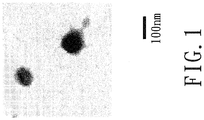
- Fig. 1 is an electron microscope image of a biodegradable nanocomplex holding a dengue viral protein inside according to an embodiment of the present invention.
- a biodegradable high-efficiency dengue vaccine which comprises a biodegradable nanocomplex with electric properties holding a dengue viral protein inside. After vaccination with the biodegradable nanocomplex twice, an organism has antibody responses. The dose of the biodegradable nanocomplex is no more than 25 ⁇ g for the first vaccination.
- the foregoing dengue viral protein can be dengue envelope protein or dengue nonstructural protein.
- the dengue viral protein is disclosed in the Taiwan Patent Publication No. 201210614 "Dengue vaccine, medicinal composition comprising the same, and nucleotide sequence".
- the dengue viral protein comprises a nonstructural chimeric protein DJ NS1.
- the nonstructural chimeric protein DJ NS1 comprises N-terminal amino acid 1-270 of a dengue virus nonstructural protein (DV NS1) and C-terminal amino acid 271-352 of a Japanese encephalitis virus nonstructural protein (JEV NS1).
- the dengue viral protein comprises a nonstructural chimeric protein DJ NS1 of SEQ.ID. NO:1.
- the method for making a biodegradable high-efficiency dengue vaccine of the present invention which allows an organism to have an antigen tilter of 1:256000 after the second vaccination. Accordingly, in comparison with the prior art, the dengue vaccine of the present invention sharply increases the antibody production to induce the immune responses efficiently for enhancing the protection effect of the vaccine, and it could be performed by the following examples to further show the range of the actual application:
- Example 1 Prepare a first solution comprising a first biodegradable macromolecule
- the first solution comprises a first biodegradable macromolecule with first electric property
- the first biodegradable macromolecule is polyglutamic acid ( ⁇ -PGA) or heparin and the first electric property is negative charge, for example.
- ⁇ -PGA polyglutamic acid
- heparin polyglutamic acid
- the first electric property is negative charge, for example.
- a proper amount of polyglutamic acid was added into de-ionized water and stirred by electromagnetic stirrer until the polyglutamic acid was totally dissolved.
- the sodium in the polyglutamic acid solution was removed by membrane dialysis. The dialysis process was accomplished at 4 °C for preventing bacterial growth. After dialysis, the polyglutamic acid solution was put at -20 °C for being totally frozen.
- the water content of the frozen polyglutamic acid solution was removed by lyophilization to obtain the crystallized powder of the polyglutamic acid.
- the crystallized powder of the polyglutamic acid was stored in a sterilized tube and put in a moisture-proof box. Finally, a proper amount of crystallized powder of the polyglutamic acid was taken and dissolved in the de-ionized water in a desired concentration, which was the first solution comprising the first biodegradable macromolecule with negative charge.
- Example 2 Prepare a mixture solution containing a dengue viral protein and the first solution
- a dengue viral protein with the same electric property as the first biodegradable macromolecule was dissolved in the first solution to form a mixture solution with negative charge.
- the dengue viral protein was disclosed in the Taiwan Patent Publication No. 201210614 "Dengue vaccine, medicinal composition comprising the same, and nucleotide sequence.”
- the dose of the dengue viral protein was 100 ⁇ ⁇ g, 200 ⁇ ⁇ g, or 400 ⁇ g, and it is not limited here.
- Example 3 Prepare a second solution comprising a second biodegradable macromolecule
- a second solution comprising a second biodegradable macromolecule with a second electric property is prepared, and the first electric property is opposite to the second electric property.
- the second biodegradable macromolecule is chitosan or collagen, for example, and the second electric property is positive charge.
- the second biodegradable macromolecule was chitosan. 5g low-viscous chitosan was added into 495 ml de-ionized water with 5 ml glacial acetic acid and stirred by electromagnetic stirrer until the chitosan solution stays in a yellow and pellucid state.
- the glacial acetic acid in the chitosan solution was removed by membrane dialysis, and the pH of the chitosan solution was about 6.5 after dialysis. Then, the chitosan solution was filtrated by air suction filter to remove the impurity. Finally, the chitosan solution was heated and stirred at 135°C for being concentrated until the concentration of the chitosan solution reaches 20-30 mg/ml, which was the second solution comprising the second biodegradable macromolecule with positive charge.
- first and second biodegradable macromolecule can be natural macromolecules, such as heparin or polyglutamic acid, and chitosan or collgen, respectively.
- the foregoing first and second biodegradable macromolecule also can be artificially biodegradable macromolecules.
- Example 4 Form a biodegradable nanocomplex
- Fig. 1 is an electron microscope image of a biodegradable nanocomplex holding a dengue viral protein inside according to an embodiment of the present invention. It is worth noted that the dengue viral protein with negative charge is mixed with the polyglutamic acid solution with negative charge to form a mixture solution first, and then the mixture solution is mixed with the chitosan solution with positive charge to form the biodegradable nanocomplex solution, in which the structure of the biodegradable nanocomplex is more stable.
- the dengue viral protein with negative charge also can be mixed with the chitosan solution with positive charge first to form a mixture solution, and then the mixture solution is mixed with the polyglutamic acid solution.
- the nanocomplex formed from the first and second macromolecule has biodegradability as well.
- the biodegradability means that the nanocomplex is decomposed, absorbed and removed easily and naturally by the human body after it enters the human body, and the dengue viral protein held in the nanocomplex is released slowly for the sustained release.
- Table 1 is the particle size and the zeta potential of the biodegradable nanocomplex with and without holding the dengue viral protein.
- the charge ratio of the chitosan with positive charge to the polyglutamic acid with negative charge is preferably 4:1 because the structure of the biodegradable nanocomplex stays in a most stable state under this condition.
- the results of the particle size and zeta potential are the average value of three biodegradable nanocomplexes. Table 1 without holding dengue viral protien with holding dengue viral protein Size (nm) 126.4 ⁇ 5.1 124.5 ⁇ 1.8 Zeta potential (mV) 83.5 ⁇ 6.2 15.4 ⁇ 0.7
- Example 5 Vaccination with the biodegradable nanocomplex holding dengue viral protein inside on a mouse model
- mice are vaccinated with the biodegradable nanocomplex holding the dengue viral protein inside as a model compound.
- C3H/HeN mice were obtained from the Jackson Laboratory, and maintained on standard laboratory food and water in the Laboratory Animal Center of National Cheng Kung University Medical College in Taiwan (R.O.C.). Housing, breeding, and experimental use of the animals were performed in strict accordance with the Experimental Animal Committee in the laboratory animal center of National Cheng Kung University.
- Table 2 is the results of a titer of a neutralizing antibody in the mice vaccinated by the biodegradable nanocomplex holding the dengue viral protein inside of the present invention, by the traditional Alum adjuvant, or by the traditional Ribi adjuvant.
- the mice had the antibody titer of 1:256000 when the dose of the biodegradable nanocomplex in the dengue vaccine is 25 ⁇ g per vaccination. Accordingly, the vaccination times of the biodegradable high-efficiency dengue vaccine in the present invention is decreased, so the biodegradable high-efficiency dengue vaccine is good for being a commercial vaccine.
- the ND means that the antibody titer is non-detectable.
- the antibody titer was measured by an ELISA standard protocol. The time of antibody response induced by the biodegradable nanocomplex was faster than that induced by the traditional Alum adjuvant and Ribi adjuvant.
- the vaccination times of the biodegradable high-efficiency dengue vaccine in the present invention is decreased to reduce the vaccination cost, so the biodegradable high-efficiency dengue vaccine is good for being a commercial vaccine.
- the dengue vaccine is decomposed, absorbed and removed easily and naturally by the human body after it enters the human body, after the third vaccination, the antibody titer induced by the biodegradable nanocomplex of the present invention was higher than that induced by the foregoing Alum adjuvant and Ribi adjuvant. It resolves the unsafe problem resulting from the heavy metal of the Alum adjuvant, and the dengue viral protein held in the biodegradable nanocomplex is released slowly for the sustained release. It is suggested that the biodegradable nanocomplex holding dengue viral protein inside enhanced the adjuvant effect in the dengue vaccine.
- the foregoing Ribi adjuvant was non-toxic and non-immunity oil-in-water emulsions in Ribi adjuvant system (RAS) developed by the Ribi Immunochem Research Inc. in 1985.
- the biodegradable nanocomplex made from heparin as the first biodegradable macromolecule and chitosan as the second biodegradable macromolecule also induced the specific antibody response to the dengue viral protein in mice after the second vaccination, and the dose of the biodegradable nanocomplex in the dengue vaccine is 25 ⁇ g per vaccination.
- the organism had the antibody titer of 1:32000 at least after the second vaccination.
- a pharmaceutical composition comprising the dengue vaccine comprising the foregoing biodegradable nanocomplex is also provided, which is used for producing a vaccine or a drug for treating or preventing hemorrhagic dengue fever or dengue shock syndrome.
- the pharmaceutical composition comprises the foregoing biodegradable high-efficiency dengue vaccine or an addition salts thereof with a pharmaceutically acceptable base, and at least one pharmaceutically acceptable excipient.
- the pharmaceutical composition of the present invention can be administered to animals in any existing ways, i.e. oral, nasal, mucosal, topical, dermal, and parenteral administration, wherein parenteral administration is intravenous, intraperitoneal, intradermal, subcutaneous, or intramuscular administration.
- the pharmaceutical composition of the present invention also can be administered via the combination of the foregoing administrations.
- the first vaccination is via parenteral administration
- the second vaccination is via mucosal administration.
- the dose of the pharmaceutical composition varies depending on the species, age, weight, and status of individuals, the disease to be prevented or treated, the seriousness of the disease, the specific compound use in the pharmaceutical composition, and administration methods.
- a proper dose can be decided by the routine experiment, and after the first vaccination, the organism can be decided to receive one or more additional vaccinations at a proper interval.
- the method for making the same and the pharmaceutical composition of the same according to the present invention has the advantages as following:
Landscapes
- Health & Medical Sciences (AREA)
- Chemical & Material Sciences (AREA)
- Life Sciences & Earth Sciences (AREA)
- Pharmacology & Pharmacy (AREA)
- General Health & Medical Sciences (AREA)
- Veterinary Medicine (AREA)
- Public Health (AREA)
- Animal Behavior & Ethology (AREA)
- Medicinal Chemistry (AREA)
- Epidemiology (AREA)
- Engineering & Computer Science (AREA)
- Immunology (AREA)
- Nanotechnology (AREA)
- Bioinformatics & Cheminformatics (AREA)
- Mycology (AREA)
- Microbiology (AREA)
- Virology (AREA)
- General Chemical & Material Sciences (AREA)
- Chemical Kinetics & Catalysis (AREA)
- Oncology (AREA)
- Organic Chemistry (AREA)
- Communicable Diseases (AREA)
- Nuclear Medicine, Radiotherapy & Molecular Imaging (AREA)
- Molecular Biology (AREA)
- Medicines Containing Antibodies Or Antigens For Use As Internal Diagnostic Agents (AREA)
Description
- The present invention relates a biodegradable high-efficiency dengue vaccine. More particularly, a biodegradable nanocomplex with electric property holds a dengue viral protein inside, after vaccination with the foregoing biodegradable nanocomplex twice, an organism has an antibody response, and the antibody production is increased widely for inducing immune responses efficiently.
- Dengue fever, also known as breakbone fever, is an acute viral disease transmitted by Adeds aegypti or Aedes albopictus, and its symptoms include fever (39 °C - 40 °C) or aversion to cold, skin rash with fatigue in limb, muscle pains, frontal headache, orbital pain, abdominal pain, backache (i.e. the origin of the term "breakbone fever"), sore throat, and maybe vomiting, fainting, etc.. The commonly mentioned dengue fever is classic dengue fever, also called as primary dengue fever. In addition, severe and life-threatening dengue fever characterized by hemorrhage or shock may be developed, also called dengue hemorrhagic fever (DHF) or dengue shock syndrome (DSS), or secondary dengue fever. It is estimated that there are about 50 million to 100 million cases of dengue infection worldwide each year, with about 250,000 to 500,000 cases of dengue hemorrhagic fever. Hence, the prevention and treatment of dengue fever is an important issue for the governments of many countries. Since dengue virus is the major pathogen of dengue disease, the early detection or prevention with effective vaccine can efficiently control morbidity and death rates of dengue fever.
- Please refer to the Taiwan Patent Publication No.
201210614 201210615 - Commonly, the adjuvant action mechanism generally comprises: (a) increasing the life or the immunity of an antigen in the vaccine, (b) delivering antigen to the antigen-presenting cell, (c) improving antigen display in antigen-presenting cell, and (d) inducing the production of immunoregulatory cytokine. The mineral adjuvant is one of the common adjuvant, such as metal salts of zinc, calcium, cerium, chromium, iron, and beryllium. The aluminum salts, such as aluminum hydroxide and aluminum phosphate, is the most commonly used, and is also called as Alum adjuvant. The mechanism of the Alum adjuvant refers to the antigen being absorbed on the aluminum salt, which is also used as the immunostimulant, and when the antigen is taken up by antigen-presenting cell, the immunostimulant absorbed by the antigen stimulates the antigen-presenting cell at the same time.
- Please refer to the
US Patent No. 7357963 . It disclosed a process for the manufacture of a vaccine, in which an adjuvant composition containing an immunostimulant adsorbed onto a first metallic salt particle substantially free of antigen is mixed with an antigen adsorbed onto a second metallic salt particle. The antigen is derived from human immunodeficiency virus, varicella zoster virus, human cytomegalovirus, dengue virus, hepatitis A, B, C or E virus. Actually, the Alum adjuvant is applied to over 50% of the commercial vaccine product, including hepatitis B vaccine (Alum-HBsAg), diphtheria and tetanus toxoid vaccine (Alum-DT), etc.. The foregoing antigen-metal complex vaccine is used for years and it is proved that the complex is absorbed easily by the antigen-presenting cell, but it is doubted that the safety of the heavy metal. Accordingly, the safety adjuvant used in the vaccine application should be developed to avoid the unsafe problems resulting from the Alum adjuvant and to enhance the antibody production for better immune responses and lowering the vaccination times and the cost. -
EP 2 428 221 A1 refers to a dengue vaccine including chimeric nonstructural protein 1, which comprises the N-terminus of DV NS1 from amino-acid residues 1 to 270 and C-terminus of JEV NS1 from amino acid residues 271 to 352 (designated DJ NS1). -
EP 2 446 899 A1 discloses an adjuvant composition containing poly-gamma-glutamic acid-chitosan nanoparticles and a vaccine composition containing the adjuvant composition useful for the treatment of viral and bacterial infections and cancers. By mixing a poly-gamma-glutamic acid solution and a chitosan solution with each other at a ratio of 1:1-8:1 (poly-gamma-glutamic acid: chitosan), poly-gamma-glutamic acid-chitosan nanoparticles having a negatively charged surface are prepared. - In view of the foregoing disadvantages of the traditional dengue vaccine in actual operation, the object of the present invention is to provide a biodegradable high-efficiency dengue vaccine, comprising a biodegradable nanocomplex with an electric property holding a dengue viral protein inside, wherein the dengue viral protein is held in a positively charged biodegradable nanocomplex.
- Accordingly, a biodegradable high-efficiency dengue vaccine is provided, which comprises a biodegradable nanocomplex with an electric property holding a dengue viral protein inside, wherein the biodegradable nanocomplex is made from a chitosan with positive charge and a polyglutamic acid with negative charge and the biodegradable nanocomplex having an electric property of positive charge, wherein a charge ratio of the chitosan to the polyglutamic acid is 4:1, and wherein the dengue viral protein comprises a nonstructural chimeric protein DJ NS1 of SEQ.ID. NO:1.
- The nonstructural chimeric protein DJ NS1 comprises N-terminal amino acid 1-270 of a dengue virus nonstructural protein (DV NS1) and C-terminal amino acid 271-352 of a Japanese encephalitis virus nonstructural protein (JEV NS1). According to another embodiment of the present invention, the dose of the biodegradable nanocomplex is no more than 25 µg for the first vaccination. A method for making a biodegradable high-efficiency dengue vaccine is also provided. The method comprises the following steps. A dengue viral protein is added into a first solution to form a mixture solution, followed by adding said mixture solution into a second solution to form a biodegradable nanocomplex with positive charge by attraction force between the different electric properties, wherein the first solution comprises a first biodegradable macromolecule with a first electric property that is the same as an electric property of the dengue viral protein. According to the invention, the first electric property is a negative charge and the first biodegradable macromolecule is polyglutamic acid.. The second solution comprises a second biodegradable macromolecule with a second electric property that is opposite to the first electric property. According to the present invention, the second biodegradable macromolecule is chitosan. and a charge ratio of the chitosan to the polyglutamic acid is 4:1, and the dengue viral protein is held in the biodegradable nanocomplex.
- A pharmaceutical composition comprising the foregoing biodegradable high-efficiency dengue vaccine is also provided. The pharmaceutical composition comprises a biodegradable high-efficiency dengue vaccine as aforementioned or an addition salt thereof with a pharmaceutically acceptable base, and at least one pharmaceutically acceptable excipient and is used for producing a vaccine or a drug for treating or preventing hemorrhagic dengue fever or dengue shock syndrome.
-
Fig. 1 is an electron microscope image of a biodegradable nanocomplex holding a dengue viral protein inside according to an embodiment of the present invention. - A biodegradable high-efficiency dengue vaccine is disclosed, which comprises a biodegradable nanocomplex with electric properties holding a dengue viral protein inside. After vaccination with the biodegradable nanocomplex twice, an organism has antibody responses. The dose of the biodegradable nanocomplex is no more than 25 µg for the first vaccination. It is noted that the foregoing dengue viral protein can be dengue envelope protein or dengue nonstructural protein. According to an embodiment of the present invention, the dengue viral protein is disclosed in the Taiwan Patent Publication No.
201210614 - The method for making a biodegradable high-efficiency dengue vaccine of the present invention, which allows an organism to have an antigen tilter of 1:256000 after the second vaccination. Accordingly, in comparison with the prior art, the dengue vaccine of the present invention sharply increases the antibody production to induce the immune responses efficiently for enhancing the protection effect of the vaccine, and it could be performed by the following examples to further show the range of the actual application:
- The first solution comprises a first biodegradable macromolecule with first electric property, and the first biodegradable macromolecule is polyglutamic acid (γ-PGA) or heparin and the first electric property is negative charge, for example. In detail, a proper amount of polyglutamic acid was added into de-ionized water and stirred by electromagnetic stirrer until the polyglutamic acid was totally dissolved. Then, the sodium in the polyglutamic acid solution was removed by membrane dialysis. The dialysis process was accomplished at 4 °C for preventing bacterial growth. After dialysis, the polyglutamic acid solution was put at -20 °C for being totally frozen. Then, the water content of the frozen polyglutamic acid solution was removed by lyophilization to obtain the crystallized powder of the polyglutamic acid. The crystallized powder of the polyglutamic acid was stored in a sterilized tube and put in a moisture-proof box. Finally, a proper amount of crystallized powder of the polyglutamic acid was taken and dissolved in the de-ionized water in a desired concentration, which was the first solution comprising the first biodegradable macromolecule with negative charge.
- However, one skilled in the art will readily recognize that the foregoing method for preparation of the first solution is one of embodiments. After reading and understanding the descriptions of the present invention, it will be obvious to those skilled in the art that various modifications may be made and not limited to the foregoing embodiment.
- A dengue viral protein with the same electric property as the first biodegradable macromolecule was dissolved in the first solution to form a mixture solution with negative charge. The dengue viral protein was disclosed in the Taiwan Patent Publication No.
201210614 - A second solution comprising a second biodegradable macromolecule with a second electric property is prepared, and the first electric property is opposite to the second electric property. The second biodegradable macromolecule is chitosan or collagen, for example, and the second electric property is positive charge. In detail, the second biodegradable macromolecule was chitosan. 5g low-viscous chitosan was added into 495 ml de-ionized water with 5 ml glacial acetic acid and stirred by electromagnetic stirrer until the chitosan solution stays in a yellow and pellucid state. Next, the glacial acetic acid in the chitosan solution was removed by membrane dialysis, and the pH of the chitosan solution was about 6.5 after dialysis. Then, the chitosan solution was filtrated by air suction filter to remove the impurity. Finally, the chitosan solution was heated and stirred at 135°C for being concentrated until the concentration of the chitosan solution reaches 20-30 mg/ml, which was the second solution comprising the second biodegradable macromolecule with positive charge.
- Similarly, one skilled in the art will readily recognize that the foregoing method of preparation of the second solution is one of embodiments. After reading and understanding the descriptions of the present invention, it will be obvious to those skilled in the art that various modifications may be made and not limited to the foregoing embodiment.
- It is noted that the foregoing first and second biodegradable macromolecule can be natural macromolecules, such as heparin or polyglutamic acid, and chitosan or collgen, respectively. The foregoing first and second biodegradable macromolecule also can be artificially biodegradable macromolecules.
- The mixture solution was added into the second solution to form a biodegradable nanocomplex by attraction force between the different electric properties, and the dengue viral protein was held in the biodegradable nanocomplex.
Fig. 1 is an electron microscope image of a biodegradable nanocomplex holding a dengue viral protein inside according to an embodiment of the present invention. It is worth noted that the dengue viral protein with negative charge is mixed with the polyglutamic acid solution with negative charge to form a mixture solution first, and then the mixture solution is mixed with the chitosan solution with positive charge to form the biodegradable nanocomplex solution, in which the structure of the biodegradable nanocomplex is more stable. However, the dengue viral protein with negative charge also can be mixed with the chitosan solution with positive charge first to form a mixture solution, and then the mixture solution is mixed with the polyglutamic acid solution. Because of the biodegradability of the first and second macromolecule, the nanocomplex formed from the first and second macromolecule has biodegradability as well. The biodegradability means that the nanocomplex is decomposed, absorbed and removed easily and naturally by the human body after it enters the human body, and the dengue viral protein held in the nanocomplex is released slowly for the sustained release. Table 1 is the particle size and the zeta potential of the biodegradable nanocomplex with and without holding the dengue viral protein. The charge ratio of the chitosan with positive charge to the polyglutamic acid with negative charge is preferably 4:1 because the structure of the biodegradable nanocomplex stays in a most stable state under this condition. The results of the particle size and zeta potential are the average value of three biodegradable nanocomplexes.Table 1 without holding dengue viral protien with holding dengue viral protein Size (nm) 126.4±5.1 124.5±1.8 Zeta potential (mV) 83.5±6.2 15.4±0.7 - Mice are vaccinated with the biodegradable nanocomplex holding the dengue viral protein inside as a model compound. C3H/HeN mice were obtained from the Jackson Laboratory, and maintained on standard laboratory food and water in the Laboratory Animal Center of National Cheng Kung University Medical College in Taiwan (R.O.C.). Housing, breeding, and experimental use of the animals were performed in strict accordance with the Experimental Animal Committee in the laboratory animal center of National Cheng Kung University. Table 2 is the results of a titer of a neutralizing antibody in the mice vaccinated by the biodegradable nanocomplex holding the dengue viral protein inside of the present invention, by the traditional Alum adjuvant, or by the traditional Ribi adjuvant.
Table 2 Vaccination time Antibody titer to the DJ NS 1(x103) Nanocomplex (µg/mouse) Alum (µg/mouse) Ribi (µg/mouse) 25 50 25 50 25 50 First ND ND ND ND ND ND Second 28 29 ND ND ND ND Third 210 211 26 28 27 28 - According to Table 2, after vaccination twice, a specific antibody response was induced by the dengue vaccine comprising the biodegradable nanocomplex of the present invention, and the mice had the antibody titer of 1:256000 when the dose of the biodegradable nanocomplex in the dengue vaccine is 25 µg per vaccination. Accordingly, the vaccination times of the biodegradable high-efficiency dengue vaccine in the present invention is decreased, so the biodegradable high-efficiency dengue vaccine is good for being a commercial vaccine. The ND means that the antibody titer is non-detectable. The antibody titer was measured by an ELISA standard protocol. The time of antibody response induced by the biodegradable nanocomplex was faster than that induced by the traditional Alum adjuvant and Ribi adjuvant. In detail, after vaccination with the biodegradable nanocomplex twice, an organism has antibody responses, but the traditional Alum adjuvant and Ribi adjuvant induced the specific antibody response to the dengue viral protein in the mice until the third vaccination. In comparison with the Alum adjuvant and Ribi adjuvant used in the traditional dengue vaccine of the prior art, the vaccination times of the biodegradable high-efficiency dengue vaccine in the present invention is decreased to reduce the vaccination cost, so the biodegradable high-efficiency dengue vaccine is good for being a commercial vaccine. Moreover, because of the biodegradability of the nanocomplex, the dengue vaccine is decomposed, absorbed and removed easily and naturally by the human body after it enters the human body, after the third vaccination, the antibody titer induced by the biodegradable nanocomplex of the present invention was higher than that induced by the foregoing Alum adjuvant and Ribi adjuvant. It resolves the unsafe problem resulting from the heavy metal of the Alum adjuvant, and the dengue viral protein held in the biodegradable nanocomplex is released slowly for the sustained release. It is suggested that the biodegradable nanocomplex holding dengue viral protein inside enhanced the adjuvant effect in the dengue vaccine. The foregoing Ribi adjuvant was non-toxic and non-immunity oil-in-water emulsions in Ribi adjuvant system (RAS) developed by the Ribi Immunochem Research Inc. in 1985.
- In the other embodiment of the present invention, the biodegradable nanocomplex made from heparin as the first biodegradable macromolecule and chitosan as the second biodegradable macromolecule also induced the specific antibody response to the dengue viral protein in mice after the second vaccination, and the dose of the biodegradable nanocomplex in the dengue vaccine is 25 µg per vaccination. The organism had the antibody titer of 1:32000 at least after the second vaccination.
- A pharmaceutical composition comprising the dengue vaccine comprising the foregoing biodegradable nanocomplex is also provided, which is used for producing a vaccine or a drug for treating or preventing hemorrhagic dengue fever or dengue shock syndrome. The pharmaceutical composition comprises the foregoing biodegradable high-efficiency dengue vaccine or an addition salts thereof with a pharmaceutically acceptable base, and at least one pharmaceutically acceptable excipient. Moreover, the pharmaceutical composition of the present invention can be administered to animals in any existing ways, i.e. oral, nasal, mucosal, topical, dermal, and parenteral administration, wherein parenteral administration is intravenous, intraperitoneal, intradermal, subcutaneous, or intramuscular administration. The pharmaceutical composition of the present invention also can be administered via the combination of the foregoing administrations. For example, the first vaccination is via parenteral administration, and the second vaccination is via mucosal administration. In addition, the dose of the pharmaceutical composition varies depending on the species, age, weight, and status of individuals, the disease to be prevented or treated, the seriousness of the disease, the specific compound use in the pharmaceutical composition, and administration methods. One skilled in the art will readily recognize the publication content of the present invention, a proper dose can be decided by the routine experiment, and after the first vaccination, the organism can be decided to receive one or more additional vaccinations at a proper interval.
- According to the above description, in comparison with the traditional technique, the biodegradable high-efficiency dengue vaccine, the method for making the same and the pharmaceutical composition of the same according to the present invention has the advantages as following:
- 1. The dengue vaccine comprising the biodegradable nanocomplex of the present invention can induce a specific antibody response to the dengue viral protein in mice after vaccination twice. In comparison with the Alum adjuvant and Ribi adjuvant used in the traditional dengue vaccine of the prior art, the vaccination times of the biodegradable high-efficiency dengue vaccine in the present invention is decreased to further reduce the vaccination cost, so the biodegradable high-efficiency dengue vaccine is good for being a commercial vaccine.
- 2. After vaccination with the dengue vaccine of the present invention twice, the organism has the antibody titer of 32000 at least. In comparison with the prior art, the dengue vaccine of the present invention substantially increases the antibody production to induce the immune response efficiently for enhancing the protection effect of the vaccine.
- 3. The biodegradable nanocomplex of the dengue vaccine of the present invention is made from the mix of the biodegradable polyglutamic acid (or heparin) and chitosan to hold the dengue viral protein inside. Accordingly, the dengue vaccine is decomposed, absorbed and removed easily and naturally by the human body after it enters the human body. It resolves the unsafe problems resulting from the heavy metal of the Alum adjuvant, and the dengue viral protein held in the nanocomplex is released slowly for the sustained release.
-
- <110> National Cheng Kung University
- <120> Dengue Vaccine, Medicinal Composition Comprising the Same, Nucleotide Sequence, and Antibody Composition
- <130> N/A
- <160> 1
- <170> PatentIn version 3.5
- <210> 1
<211> 352
<212> PRT
<213> Dengue Virus & Japanese Encephalitis Virus - <400> 1


Claims (5)
- A biodegradable high-efficiency dengue vaccine, comprising :a biodegradable nanocomplex with an electric property holding a dengue viral protein inside, wherein the biodegradable nanocomplex is made from a chitosan with positive charge and a polyglutamic acid with negative charge and the biodegradable nanocomplex having an electric property of positive charge, wherein a charge ratio of the chitosan to the polyglutamic acid is 4:1, andwherein the dengue viral protein comprises a nonstructural chimeric protein DJ NS1 of SEQ.ID. NO:1.
- The biodegradable high-efficiency dengue vaccine as claimed in claim 1, wherein the dose of the biodegradable nanocomplex is no more than 25 µg for a first vaccination.
- A method for making a biodegradable high-efficiency dengue vaccine, comprising the steps of:adding a dengue viral protein into a first solution to form a mixture solution, followed by adding said mixture solution into a second solution to form a biodegradable nanocomplex with positive charge by attraction force between the different electric properties, wherein the first solution comprises a first biodegradable macromolecule with a first electric property that is the same as an electric property of the dengue viral protein, the first electric property is a negative charge, the first macromolecule is polyglutamic acid, the dengue viral protein has a nonstructural chimeric protein DJ NS1 of SEQ.ID. NO:1,the second solution comprising a second biodegradable macromolecule with a second electric property that is opposite to the first electric property, wherein the second macromolecule is chitosan, wherein a charge ratio of the chitosan to the polyglutamic acid is 4:1, andthe dengue viral protein is held in the positively charged biodegradable nanocomplex.
- A pharmaceutical composition comprising:a biodegradable high-efficiency dengue vaccine as claimed in claim 1 or a salt thereof with a pharmaceutically acceptable base; andat least one pharmaceutically acceptable excipient.
- The pharmaceutical composition as claimed in claim 4 which is used for producing a drug for treating or preventing hemorrhagic dengue fever or dengue shock syndrome.
Applications Claiming Priority (1)
| Application Number | Priority Date | Filing Date | Title |
|---|---|---|---|
| TW102100790A TW201427990A (en) | 2013-01-09 | 2013-01-09 | High efficient dengue vaccine with biodegradability, preparing method and pharmaceutical composition of the same |
Publications (2)
| Publication Number | Publication Date |
|---|---|
| EP2754436A1 EP2754436A1 (en) | 2014-07-16 |
| EP2754436B1 true EP2754436B1 (en) | 2018-05-16 |
Family
ID=48795505
Family Applications (1)
| Application Number | Title | Priority Date | Filing Date |
|---|---|---|---|
| EP13177251.9A Not-in-force EP2754436B1 (en) | 2013-01-09 | 2013-07-19 | Biodegradable high-efficiency dengue vaccine, method for making the same, and pharmaceutical composition comprising the same |
Country Status (4)
| Country | Link |
|---|---|
| US (1) | US20140193446A1 (en) |
| EP (1) | EP2754436B1 (en) |
| CN (1) | CN103908662A (en) |
| TW (1) | TW201427990A (en) |
Families Citing this family (3)
| Publication number | Priority date | Publication date | Assignee | Title |
|---|---|---|---|---|
| US10052390B2 (en) * | 2013-01-09 | 2018-08-21 | National Cheng Kung University | Immunostimulatory nanocomplex |
| US10456464B2 (en) | 2014-08-04 | 2019-10-29 | Nitto Denko Corporation | Liquid immunity induction-promoting composition and vaccine pharmaceutical composition that include thrombosis treatment drug |
| TW202202169A (en) * | 2020-04-02 | 2022-01-16 | 中央研究院 | Biodegradable nanocomplex vaccines, methods for prevention of severe acute respiratory syndrome coronavirus 2 (sars-cov-2) infection |
Family Cites Families (6)
| Publication number | Priority date | Publication date | Assignee | Title |
|---|---|---|---|---|
| KR100400510B1 (en) | 2000-12-28 | 2003-10-08 | 엘지.필립스 엘시디 주식회사 | A machine for Si crystallization and method of crystallizing Si |
| US7993625B1 (en) * | 2005-01-04 | 2011-08-09 | Gp Medical, Inc. | Pharmaceutical composition of nanoparticles |
| EP2446899B1 (en) * | 2009-06-25 | 2020-09-30 | Bioleaders Corporation | Adjuvant composition comprising (poly-gamma-glutamate)-chitosan nanoparticles |
| CN101744789B (en) * | 2010-01-21 | 2011-11-23 | 上海大学 | Biodegradable nanoporous poly-L-glutamic acid/chitosan drug-loaded microcapsules and preparation method thereof |
| TWI481411B (en) * | 2010-09-13 | 2015-04-21 | 國立成功大學 | Dengue vaccine, pharmaceutical composition containing the same, nucleotide sequence, and method for producing the same |
| TW201210614A (en) | 2010-09-13 | 2012-03-16 | Univ Nat Cheng Kung | Dengue vaccine, medicinal composition comprising the same, and nucleotide sequence |
-
2013
- 2013-01-09 TW TW102100790A patent/TW201427990A/en unknown
- 2013-06-24 US US13/924,793 patent/US20140193446A1/en not_active Abandoned
- 2013-07-19 EP EP13177251.9A patent/EP2754436B1/en not_active Not-in-force
- 2013-07-22 CN CN201310308184.3A patent/CN103908662A/en active Pending
Non-Patent Citations (1)
| Title |
|---|
| None * |
Also Published As
| Publication number | Publication date |
|---|---|
| US20140193446A1 (en) | 2014-07-10 |
| CN103908662A (en) | 2014-07-09 |
| TW201427990A (en) | 2014-07-16 |
| EP2754436A1 (en) | 2014-07-16 |
Similar Documents
| Publication | Publication Date | Title |
|---|---|---|
| JP7308562B2 (en) | Manganese composition for enhancing immunity | |
| ES2562456T3 (en) | Use of an adjuvant that induces a Th1 immune response to improve immune responses | |
| EP3888676A1 (en) | Immunogenic combinations | |
| CN1238696A (en) | Vaccines | |
| CN109701010B (en) | Vaccine composite adjuvant system and application thereof in antigen | |
| WO2024179043A1 (en) | Truncated varicella-zoster virus ge protein and use thereof | |
| CN104755100A (en) | Method for eliciting in infants an immune response against RSV and b. pertussis | |
| BG66038B1 (en) | Purification of hbv antigens for use in vaccines | |
| CN105555304A (en) | Combination immunogenic compositions | |
| JP5804278B2 (en) | Mucosal vaccine | |
| ES2351489T3 (en) | IMPROVED VACCINES. | |
| EP2754436A1 (en) | Biodegradable high-efficiency dengue vaccine, method for making the same, and pharmaceutical composition comprising the same | |
| US10052390B2 (en) | Immunostimulatory nanocomplex | |
| CN111420043A (en) | Pharmaceutical composition for treating hepatitis B, preparation method and application thereof | |
| CN101115503A (en) | Peptides for mucosal vaccine delivery | |
| CN118873646A (en) | A recombinant protein vaccine for inhibiting group A streptococcal infection and its application | |
| CN109701011B (en) | Vaccine Compound Adjuvant System and Its Application in Antigen | |
| TWI240628B (en) | Formulation | |
| WO2025147496A1 (en) | Combination vaccines and methods of use | |
| CN117462667B (en) | A composite adjuvant and its application in vaccine preparation | |
| WO2026085700A1 (en) | Cpg oligodeoxyribonucleotide and use thereof in vaccine adjuvant | |
| Christensen | Adjuvants, immunomodulators | |
| CA2525615C (en) | Vaccine composition comprising iron phosphate as a pharmaceutical aid to said vaccine | |
| CN118001387A (en) | Hepatitis B vaccine composition and its preparation method and application | |
| WO2025054577A1 (en) | Nanoparticle based subunit vaccine for african swine fever virus |
Legal Events
| Date | Code | Title | Description |
|---|---|---|---|
| PUAI | Public reference made under article 153(3) epc to a published international application that has entered the european phase |
Free format text: ORIGINAL CODE: 0009012 |
|
| 17P | Request for examination filed |
Effective date: 20130719 |
|
| AK | Designated contracting states |
Kind code of ref document: A1 Designated state(s): AL AT BE BG CH CY CZ DE DK EE ES FI FR GB GR HR HU IE IS IT LI LT LU LV MC MK MT NL NO PL PT RO RS SE SI SK SM TR |
|
| AX | Request for extension of the european patent |
Extension state: BA ME |
|
| R17P | Request for examination filed (corrected) |
Effective date: 20141211 |
|
| RBV | Designated contracting states (corrected) |
Designated state(s): AL AT BE BG CH CY CZ DE DK EE ES FI FR GB GR HR HU IE IS IT LI LT LU LV MC MK MT NL NO PL PT RO RS SE SI SK SM TR |
|
| 17Q | First examination report despatched |
Effective date: 20150622 |
|
| RIC1 | Information provided on ipc code assigned before grant |
Ipc: C07K 14/18 20060101ALI20171017BHEP Ipc: A61K 47/51 20170101ALI20171017BHEP Ipc: A61K 9/00 20060101AFI20171017BHEP Ipc: A61P 31/14 20060101ALI20171017BHEP Ipc: A61K 39/12 20060101ALI20171017BHEP |
|
| GRAP | Despatch of communication of intention to grant a patent |
Free format text: ORIGINAL CODE: EPIDOSNIGR1 |
|
| INTG | Intention to grant announced |
Effective date: 20171124 |
|
| GRAS | Grant fee paid |
Free format text: ORIGINAL CODE: EPIDOSNIGR3 |
|
| GRAA | (expected) grant |
Free format text: ORIGINAL CODE: 0009210 |
|
| AK | Designated contracting states |
Kind code of ref document: B1 Designated state(s): AL AT BE BG CH CY CZ DE DK EE ES FI FR GB GR HR HU IE IS IT LI LT LU LV MC MK MT NL NO PL PT RO RS SE SI SK SM TR |
|
| REG | Reference to a national code |
Ref country code: GB Ref legal event code: FG4D |
|
| REG | Reference to a national code |
Ref country code: CH Ref legal event code: EP |
|
| REG | Reference to a national code |
Ref country code: IE Ref legal event code: FG4D |
|
| REG | Reference to a national code |
Ref country code: DE Ref legal event code: R096 Ref document number: 602013037446 Country of ref document: DE |
|
| REG | Reference to a national code |
Ref country code: AT Ref legal event code: REF Ref document number: 998909 Country of ref document: AT Kind code of ref document: T Effective date: 20180615 |
|
| REG | Reference to a national code |
Ref country code: CH Ref legal event code: NV Representative=s name: LANGPATENT ANWALTSKANZLEI IP LAW FIRM, CH |
|
| REG | Reference to a national code |
Ref country code: FR Ref legal event code: PLFP Year of fee payment: 6 |
|
| REG | Reference to a national code |
Ref country code: NL Ref legal event code: MP Effective date: 20180516 |
|
| REG | Reference to a national code |
Ref country code: LT Ref legal event code: MG4D |
|
| PG25 | Lapsed in a contracting state [announced via postgrant information from national office to epo] |
Ref country code: SE Free format text: LAPSE BECAUSE OF FAILURE TO SUBMIT A TRANSLATION OF THE DESCRIPTION OR TO PAY THE FEE WITHIN THE PRESCRIBED TIME-LIMIT Effective date: 20180516 Ref country code: ES Free format text: LAPSE BECAUSE OF FAILURE TO SUBMIT A TRANSLATION OF THE DESCRIPTION OR TO PAY THE FEE WITHIN THE PRESCRIBED TIME-LIMIT Effective date: 20180516 Ref country code: LT Free format text: LAPSE BECAUSE OF FAILURE TO SUBMIT A TRANSLATION OF THE DESCRIPTION OR TO PAY THE FEE WITHIN THE PRESCRIBED TIME-LIMIT Effective date: 20180516 Ref country code: BG Free format text: LAPSE BECAUSE OF FAILURE TO SUBMIT A TRANSLATION OF THE DESCRIPTION OR TO PAY THE FEE WITHIN THE PRESCRIBED TIME-LIMIT Effective date: 20180816 Ref country code: FI Free format text: LAPSE BECAUSE OF FAILURE TO SUBMIT A TRANSLATION OF THE DESCRIPTION OR TO PAY THE FEE WITHIN THE PRESCRIBED TIME-LIMIT Effective date: 20180516 Ref country code: NO Free format text: LAPSE BECAUSE OF FAILURE TO SUBMIT A TRANSLATION OF THE DESCRIPTION OR TO PAY THE FEE WITHIN THE PRESCRIBED TIME-LIMIT Effective date: 20180816 |
|
| PGFP | Annual fee paid to national office [announced via postgrant information from national office to epo] |
Ref country code: FR Payment date: 20180723 Year of fee payment: 6 Ref country code: DE Payment date: 20180724 Year of fee payment: 6 |
|
| PG25 | Lapsed in a contracting state [announced via postgrant information from national office to epo] |
Ref country code: HR Free format text: LAPSE BECAUSE OF FAILURE TO SUBMIT A TRANSLATION OF THE DESCRIPTION OR TO PAY THE FEE WITHIN THE PRESCRIBED TIME-LIMIT Effective date: 20180516 Ref country code: GR Free format text: LAPSE BECAUSE OF FAILURE TO SUBMIT A TRANSLATION OF THE DESCRIPTION OR TO PAY THE FEE WITHIN THE PRESCRIBED TIME-LIMIT Effective date: 20180817 Ref country code: NL Free format text: LAPSE BECAUSE OF FAILURE TO SUBMIT A TRANSLATION OF THE DESCRIPTION OR TO PAY THE FEE WITHIN THE PRESCRIBED TIME-LIMIT Effective date: 20180516 Ref country code: LV Free format text: LAPSE BECAUSE OF FAILURE TO SUBMIT A TRANSLATION OF THE DESCRIPTION OR TO PAY THE FEE WITHIN THE PRESCRIBED TIME-LIMIT Effective date: 20180516 Ref country code: RS Free format text: LAPSE BECAUSE OF FAILURE TO SUBMIT A TRANSLATION OF THE DESCRIPTION OR TO PAY THE FEE WITHIN THE PRESCRIBED TIME-LIMIT Effective date: 20180516 |
|
| PGFP | Annual fee paid to national office [announced via postgrant information from national office to epo] |
Ref country code: GB Payment date: 20180725 Year of fee payment: 6 |
|
| REG | Reference to a national code |
Ref country code: AT Ref legal event code: MK05 Ref document number: 998909 Country of ref document: AT Kind code of ref document: T Effective date: 20180516 |
|
| PG25 | Lapsed in a contracting state [announced via postgrant information from national office to epo] |
Ref country code: RO Free format text: LAPSE BECAUSE OF FAILURE TO SUBMIT A TRANSLATION OF THE DESCRIPTION OR TO PAY THE FEE WITHIN THE PRESCRIBED TIME-LIMIT Effective date: 20180516 Ref country code: CZ Free format text: LAPSE BECAUSE OF FAILURE TO SUBMIT A TRANSLATION OF THE DESCRIPTION OR TO PAY THE FEE WITHIN THE PRESCRIBED TIME-LIMIT Effective date: 20180516 Ref country code: EE Free format text: LAPSE BECAUSE OF FAILURE TO SUBMIT A TRANSLATION OF THE DESCRIPTION OR TO PAY THE FEE WITHIN THE PRESCRIBED TIME-LIMIT Effective date: 20180516 Ref country code: PL Free format text: LAPSE BECAUSE OF FAILURE TO SUBMIT A TRANSLATION OF THE DESCRIPTION OR TO PAY THE FEE WITHIN THE PRESCRIBED TIME-LIMIT Effective date: 20180516 Ref country code: SK Free format text: LAPSE BECAUSE OF FAILURE TO SUBMIT A TRANSLATION OF THE DESCRIPTION OR TO PAY THE FEE WITHIN THE PRESCRIBED TIME-LIMIT Effective date: 20180516 Ref country code: AT Free format text: LAPSE BECAUSE OF FAILURE TO SUBMIT A TRANSLATION OF THE DESCRIPTION OR TO PAY THE FEE WITHIN THE PRESCRIBED TIME-LIMIT Effective date: 20180516 Ref country code: DK Free format text: LAPSE BECAUSE OF FAILURE TO SUBMIT A TRANSLATION OF THE DESCRIPTION OR TO PAY THE FEE WITHIN THE PRESCRIBED TIME-LIMIT Effective date: 20180516 |
|
| REG | Reference to a national code |
Ref country code: DE Ref legal event code: R097 Ref document number: 602013037446 Country of ref document: DE |
|
| PG25 | Lapsed in a contracting state [announced via postgrant information from national office to epo] |
Ref country code: IT Free format text: LAPSE BECAUSE OF FAILURE TO SUBMIT A TRANSLATION OF THE DESCRIPTION OR TO PAY THE FEE WITHIN THE PRESCRIBED TIME-LIMIT Effective date: 20180516 Ref country code: SM Free format text: LAPSE BECAUSE OF FAILURE TO SUBMIT A TRANSLATION OF THE DESCRIPTION OR TO PAY THE FEE WITHIN THE PRESCRIBED TIME-LIMIT Effective date: 20180516 |
|
| PGFP | Annual fee paid to national office [announced via postgrant information from national office to epo] |
Ref country code: CH Payment date: 20181022 Year of fee payment: 6 |
|
| PLBE | No opposition filed within time limit |
Free format text: ORIGINAL CODE: 0009261 |
|
| STAA | Information on the status of an ep patent application or granted ep patent |
Free format text: STATUS: NO OPPOSITION FILED WITHIN TIME LIMIT |
|
| PG25 | Lapsed in a contracting state [announced via postgrant information from national office to epo] |
Ref country code: MC Free format text: LAPSE BECAUSE OF FAILURE TO SUBMIT A TRANSLATION OF THE DESCRIPTION OR TO PAY THE FEE WITHIN THE PRESCRIBED TIME-LIMIT Effective date: 20180516 Ref country code: LU Free format text: LAPSE BECAUSE OF NON-PAYMENT OF DUE FEES Effective date: 20180719 |
|
| REG | Reference to a national code |
Ref country code: BE Ref legal event code: MM Effective date: 20180731 |
|
| REG | Reference to a national code |
Ref country code: IE Ref legal event code: MM4A |
|
| 26N | No opposition filed |
Effective date: 20190219 |
|
| PG25 | Lapsed in a contracting state [announced via postgrant information from national office to epo] |
Ref country code: IE Free format text: LAPSE BECAUSE OF NON-PAYMENT OF DUE FEES Effective date: 20180719 |
|
| PG25 | Lapsed in a contracting state [announced via postgrant information from national office to epo] |
Ref country code: BE Free format text: LAPSE BECAUSE OF NON-PAYMENT OF DUE FEES Effective date: 20180731 Ref country code: SI Free format text: LAPSE BECAUSE OF FAILURE TO SUBMIT A TRANSLATION OF THE DESCRIPTION OR TO PAY THE FEE WITHIN THE PRESCRIBED TIME-LIMIT Effective date: 20180516 |
|
| PG25 | Lapsed in a contracting state [announced via postgrant information from national office to epo] |
Ref country code: AL Free format text: LAPSE BECAUSE OF FAILURE TO SUBMIT A TRANSLATION OF THE DESCRIPTION OR TO PAY THE FEE WITHIN THE PRESCRIBED TIME-LIMIT Effective date: 20180516 |
|
| PG25 | Lapsed in a contracting state [announced via postgrant information from national office to epo] |
Ref country code: MT Free format text: LAPSE BECAUSE OF NON-PAYMENT OF DUE FEES Effective date: 20180719 |
|
| REG | Reference to a national code |
Ref country code: DE Ref legal event code: R119 Ref document number: 602013037446 Country of ref document: DE |
|
| REG | Reference to a national code |
Ref country code: CH Ref legal event code: PL |
|
| GBPC | Gb: european patent ceased through non-payment of renewal fee |
Effective date: 20190719 |
|
| PG25 | Lapsed in a contracting state [announced via postgrant information from national office to epo] |
Ref country code: TR Free format text: LAPSE BECAUSE OF FAILURE TO SUBMIT A TRANSLATION OF THE DESCRIPTION OR TO PAY THE FEE WITHIN THE PRESCRIBED TIME-LIMIT Effective date: 20180516 |
|
| PG25 | Lapsed in a contracting state [announced via postgrant information from national office to epo] |
Ref country code: GB Free format text: LAPSE BECAUSE OF NON-PAYMENT OF DUE FEES Effective date: 20190719 Ref country code: DE Free format text: LAPSE BECAUSE OF NON-PAYMENT OF DUE FEES Effective date: 20200201 |
|
| PG25 | Lapsed in a contracting state [announced via postgrant information from national office to epo] |
Ref country code: CH Free format text: LAPSE BECAUSE OF NON-PAYMENT OF DUE FEES Effective date: 20190731 Ref country code: HU Free format text: LAPSE BECAUSE OF FAILURE TO SUBMIT A TRANSLATION OF THE DESCRIPTION OR TO PAY THE FEE WITHIN THE PRESCRIBED TIME-LIMIT; INVALID AB INITIO Effective date: 20130719 Ref country code: LI Free format text: LAPSE BECAUSE OF NON-PAYMENT OF DUE FEES Effective date: 20190731 Ref country code: PT Free format text: LAPSE BECAUSE OF FAILURE TO SUBMIT A TRANSLATION OF THE DESCRIPTION OR TO PAY THE FEE WITHIN THE PRESCRIBED TIME-LIMIT Effective date: 20180516 |
|
| PG25 | Lapsed in a contracting state [announced via postgrant information from national office to epo] |
Ref country code: CY Free format text: LAPSE BECAUSE OF FAILURE TO SUBMIT A TRANSLATION OF THE DESCRIPTION OR TO PAY THE FEE WITHIN THE PRESCRIBED TIME-LIMIT Effective date: 20180516 Ref country code: MK Free format text: LAPSE BECAUSE OF NON-PAYMENT OF DUE FEES Effective date: 20180516 Ref country code: FR Free format text: LAPSE BECAUSE OF NON-PAYMENT OF DUE FEES Effective date: 20190731 |
|
| PG25 | Lapsed in a contracting state [announced via postgrant information from national office to epo] |
Ref country code: IS Free format text: LAPSE BECAUSE OF FAILURE TO SUBMIT A TRANSLATION OF THE DESCRIPTION OR TO PAY THE FEE WITHIN THE PRESCRIBED TIME-LIMIT Effective date: 20180916 |