EP2753618B1 - Heterocyclic-substitued benzofuran derivatives and methods of use thereof for the treatment of viral diseases - Google Patents
Heterocyclic-substitued benzofuran derivatives and methods of use thereof for the treatment of viral diseases Download PDFInfo
- Publication number
- EP2753618B1 EP2753618B1 EP12829730.6A EP12829730A EP2753618B1 EP 2753618 B1 EP2753618 B1 EP 2753618B1 EP 12829730 A EP12829730 A EP 12829730A EP 2753618 B1 EP2753618 B1 EP 2753618B1
- Authority
- EP
- European Patent Office
- Prior art keywords
- compound
- mmol
- hcv
- group
- another embodiment
- Prior art date
- Legal status (The legal status is an assumption and is not a legal conclusion. Google has not performed a legal analysis and makes no representation as to the accuracy of the status listed.)
- Active
Links
- 0 CC1N(*)CC[Si](C)(C)C1 Chemical compound CC1N(*)CC[Si](C)(C)C1 0.000 description 2
- FCEUQWHXZYPYMD-DNVGVPOPSA-N C/C=C\C=C(/C)\F Chemical compound C/C=C\C=C(/C)\F FCEUQWHXZYPYMD-DNVGVPOPSA-N 0.000 description 1
- SRCPPIPXSXRRAA-ITJRZJFHSA-N CC(C)C(CC1)[C@@H](C(N[C@H](CC(CC2)C2=C2N)C2=O)=O)N1C([C@H](C(C)(C)C)NC(NC(C)(C)C)=O)=O Chemical compound CC(C)C(CC1)[C@@H](C(N[C@H](CC(CC2)C2=C2N)C2=O)=O)N1C([C@H](C(C)(C)C)NC(NC(C)(C)C)=O)=O SRCPPIPXSXRRAA-ITJRZJFHSA-N 0.000 description 1
- BMHCDUSYXVPPGM-UHFFFAOYSA-N CC(C1)N(C)CS1(F)F Chemical compound CC(C1)N(C)CS1(F)F BMHCDUSYXVPPGM-UHFFFAOYSA-N 0.000 description 1
- JVJHPFLZMKKTHZ-UHFFFAOYSA-N CC[Si]1(CC)CN(C)C(C)C1 Chemical compound CC[Si]1(CC)CN(C)C(C)C1 JVJHPFLZMKKTHZ-UHFFFAOYSA-N 0.000 description 1
- IRWORCJNQXIMDY-UHFFFAOYSA-N CN(C[Si](C)(C)C1)C1S Chemical compound CN(C[Si](C)(C)C1)C1S IRWORCJNQXIMDY-UHFFFAOYSA-N 0.000 description 1
- LGPLLMKAJBJECD-UHFFFAOYSA-N CNC(c(c1c2)c(-c(cc3)ccc3F)[o]c1cc(N(C)S(C)(=O)=O)c2-c(cn1)cc(-c2cc3ccccc3[nH]2)c1OC)=O Chemical compound CNC(c(c1c2)c(-c(cc3)ccc3F)[o]c1cc(N(C)S(C)(=O)=O)c2-c(cn1)cc(-c2cc3ccccc3[nH]2)c1OC)=O LGPLLMKAJBJECD-UHFFFAOYSA-N 0.000 description 1
- MQAKDZYYUYNMTA-UHFFFAOYSA-N CNC(c(c1c2)c(-c(cc3)ccc3F)[o]c1cc(N(C)S(C)(=O)=O)c2-c1cc(-c2nc(CCOC3)c3[s]2)cnc1)=O Chemical compound CNC(c(c1c2)c(-c(cc3)ccc3F)[o]c1cc(N(C)S(C)(=O)=O)c2-c1cc(-c2nc(CCOC3)c3[s]2)cnc1)=O MQAKDZYYUYNMTA-UHFFFAOYSA-N 0.000 description 1
- NGTIYHMJITYSCY-UHFFFAOYSA-N CNC(c(c1c2)c(-c(cc3)ccc3F)[o]c1cc(N(C)S(C)(=O)=O)c2-c1nnc(-c([nH]c2ccc3)cc2c3F)[o]1)=O Chemical compound CNC(c(c1c2)c(-c(cc3)ccc3F)[o]c1cc(N(C)S(C)(=O)=O)c2-c1nnc(-c([nH]c2ccc3)cc2c3F)[o]1)=O NGTIYHMJITYSCY-UHFFFAOYSA-N 0.000 description 1
- RNVFSJWVNIEGEQ-UHFFFAOYSA-N Clc1cncc(-c2cc3ccccc3[s]2)c1 Chemical compound Clc1cncc(-c2cc3ccccc3[s]2)c1 RNVFSJWVNIEGEQ-UHFFFAOYSA-N 0.000 description 1
- BELDOPUBSLPBCQ-UHFFFAOYSA-N Clc1cncc(Br)c1 Chemical compound Clc1cncc(Br)c1 BELDOPUBSLPBCQ-UHFFFAOYSA-N 0.000 description 1
- VEMKUBXFVDXVLU-UHFFFAOYSA-N Fc1cccc(F)c1NC(c1cncc(Br)c1)=S Chemical compound Fc1cccc(F)c1NC(c1cncc(Br)c1)=S VEMKUBXFVDXVLU-UHFFFAOYSA-N 0.000 description 1
- BLFBWSSUVPBTTA-UHFFFAOYSA-N Fc1cccc2c1nc(-c1cncc(Br)c1)[s]2 Chemical compound Fc1cccc2c1nc(-c1cncc(Br)c1)[s]2 BLFBWSSUVPBTTA-UHFFFAOYSA-N 0.000 description 1
- ODUZJBKKYBQIBX-UHFFFAOYSA-N Nc(c(F)ccc1)c1F Chemical compound Nc(c(F)ccc1)c1F ODUZJBKKYBQIBX-UHFFFAOYSA-N 0.000 description 1
- PPVCOUROZLLKDS-UHFFFAOYSA-N O=C(c1ccnc(Br)c1)Nc(c(F)ccc1)c1F Chemical compound O=C(c1ccnc(Br)c1)Nc(c(F)ccc1)c1F PPVCOUROZLLKDS-UHFFFAOYSA-N 0.000 description 1
- YNCYPMUJDDXIRH-UHFFFAOYSA-N OB(c1cc2ccccc2[s]1)O Chemical compound OB(c1cc2ccccc2[s]1)O YNCYPMUJDDXIRH-UHFFFAOYSA-N 0.000 description 1
- FQIUCPGDKPXSLL-UHFFFAOYSA-N OC(c1cncc(Br)c1)=O Chemical compound OC(c1cncc(Br)c1)=O FQIUCPGDKPXSLL-UHFFFAOYSA-N 0.000 description 1
Classifications
-
- A—HUMAN NECESSITIES
- A61—MEDICAL OR VETERINARY SCIENCE; HYGIENE
- A61K—PREPARATIONS FOR MEDICAL, DENTAL OR TOILETRY PURPOSES
- A61K31/00—Medicinal preparations containing organic active ingredients
- A61K31/33—Heterocyclic compounds
- A61K31/395—Heterocyclic compounds having nitrogen as a ring hetero atom, e.g. guanethidine or rifamycins
- A61K31/41—Heterocyclic compounds having nitrogen as a ring hetero atom, e.g. guanethidine or rifamycins having five-membered rings with two or more ring hetero atoms, at least one of which being nitrogen, e.g. tetrazole
- A61K31/4245—Oxadiazoles
-
- A—HUMAN NECESSITIES
- A61—MEDICAL OR VETERINARY SCIENCE; HYGIENE
- A61K—PREPARATIONS FOR MEDICAL, DENTAL OR TOILETRY PURPOSES
- A61K31/00—Medicinal preparations containing organic active ingredients
- A61K31/33—Heterocyclic compounds
- A61K31/395—Heterocyclic compounds having nitrogen as a ring hetero atom, e.g. guanethidine or rifamycins
- A61K31/41—Heterocyclic compounds having nitrogen as a ring hetero atom, e.g. guanethidine or rifamycins having five-membered rings with two or more ring hetero atoms, at least one of which being nitrogen, e.g. tetrazole
- A61K31/433—Thidiazoles
-
- A—HUMAN NECESSITIES
- A61—MEDICAL OR VETERINARY SCIENCE; HYGIENE
- A61K—PREPARATIONS FOR MEDICAL, DENTAL OR TOILETRY PURPOSES
- A61K31/00—Medicinal preparations containing organic active ingredients
- A61K31/33—Heterocyclic compounds
- A61K31/395—Heterocyclic compounds having nitrogen as a ring hetero atom, e.g. guanethidine or rifamycins
- A61K31/435—Heterocyclic compounds having nitrogen as a ring hetero atom, e.g. guanethidine or rifamycins having six-membered rings with one nitrogen as the only ring hetero atom
- A61K31/44—Non condensed pyridines; Hydrogenated derivatives thereof
- A61K31/4427—Non condensed pyridines; Hydrogenated derivatives thereof containing further heterocyclic ring systems
- A61K31/4439—Non condensed pyridines; Hydrogenated derivatives thereof containing further heterocyclic ring systems containing a five-membered ring with nitrogen as a ring hetero atom, e.g. omeprazole
-
- A—HUMAN NECESSITIES
- A61—MEDICAL OR VETERINARY SCIENCE; HYGIENE
- A61K—PREPARATIONS FOR MEDICAL, DENTAL OR TOILETRY PURPOSES
- A61K31/00—Medicinal preparations containing organic active ingredients
- A61K31/33—Heterocyclic compounds
- A61K31/395—Heterocyclic compounds having nitrogen as a ring hetero atom, e.g. guanethidine or rifamycins
- A61K31/435—Heterocyclic compounds having nitrogen as a ring hetero atom, e.g. guanethidine or rifamycins having six-membered rings with one nitrogen as the only ring hetero atom
- A61K31/44—Non condensed pyridines; Hydrogenated derivatives thereof
- A61K31/4427—Non condensed pyridines; Hydrogenated derivatives thereof containing further heterocyclic ring systems
- A61K31/444—Non condensed pyridines; Hydrogenated derivatives thereof containing further heterocyclic ring systems containing a six-membered ring with nitrogen as a ring heteroatom, e.g. amrinone
-
- A—HUMAN NECESSITIES
- A61—MEDICAL OR VETERINARY SCIENCE; HYGIENE
- A61K—PREPARATIONS FOR MEDICAL, DENTAL OR TOILETRY PURPOSES
- A61K31/00—Medicinal preparations containing organic active ingredients
- A61K31/33—Heterocyclic compounds
- A61K31/395—Heterocyclic compounds having nitrogen as a ring hetero atom, e.g. guanethidine or rifamycins
- A61K31/495—Heterocyclic compounds having nitrogen as a ring hetero atom, e.g. guanethidine or rifamycins having six-membered rings with two or more nitrogen atoms as the only ring heteroatoms, e.g. piperazine or tetrazines
- A61K31/4965—Non-condensed pyrazines
- A61K31/497—Non-condensed pyrazines containing further heterocyclic rings
-
- A—HUMAN NECESSITIES
- A61—MEDICAL OR VETERINARY SCIENCE; HYGIENE
- A61K—PREPARATIONS FOR MEDICAL, DENTAL OR TOILETRY PURPOSES
- A61K31/00—Medicinal preparations containing organic active ingredients
- A61K31/33—Heterocyclic compounds
- A61K31/395—Heterocyclic compounds having nitrogen as a ring hetero atom, e.g. guanethidine or rifamycins
- A61K31/495—Heterocyclic compounds having nitrogen as a ring hetero atom, e.g. guanethidine or rifamycins having six-membered rings with two or more nitrogen atoms as the only ring heteroatoms, e.g. piperazine or tetrazines
- A61K31/50—Pyridazines; Hydrogenated pyridazines
- A61K31/501—Pyridazines; Hydrogenated pyridazines not condensed and containing further heterocyclic rings
-
- A—HUMAN NECESSITIES
- A61—MEDICAL OR VETERINARY SCIENCE; HYGIENE
- A61K—PREPARATIONS FOR MEDICAL, DENTAL OR TOILETRY PURPOSES
- A61K31/00—Medicinal preparations containing organic active ingredients
- A61K31/33—Heterocyclic compounds
- A61K31/395—Heterocyclic compounds having nitrogen as a ring hetero atom, e.g. guanethidine or rifamycins
- A61K31/495—Heterocyclic compounds having nitrogen as a ring hetero atom, e.g. guanethidine or rifamycins having six-membered rings with two or more nitrogen atoms as the only ring heteroatoms, e.g. piperazine or tetrazines
- A61K31/505—Pyrimidines; Hydrogenated pyrimidines, e.g. trimethoprim
- A61K31/506—Pyrimidines; Hydrogenated pyrimidines, e.g. trimethoprim not condensed and containing further heterocyclic rings
-
- A—HUMAN NECESSITIES
- A61—MEDICAL OR VETERINARY SCIENCE; HYGIENE
- A61K—PREPARATIONS FOR MEDICAL, DENTAL OR TOILETRY PURPOSES
- A61K31/00—Medicinal preparations containing organic active ingredients
- A61K31/33—Heterocyclic compounds
- A61K31/395—Heterocyclic compounds having nitrogen as a ring hetero atom, e.g. guanethidine or rifamycins
- A61K31/535—Heterocyclic compounds having nitrogen as a ring hetero atom, e.g. guanethidine or rifamycins having six-membered rings with at least one nitrogen and one oxygen as the ring hetero atoms, e.g. 1,2-oxazines
- A61K31/5365—Heterocyclic compounds having nitrogen as a ring hetero atom, e.g. guanethidine or rifamycins having six-membered rings with at least one nitrogen and one oxygen as the ring hetero atoms, e.g. 1,2-oxazines ortho- or peri-condensed with heterocyclic ring systems
-
- A—HUMAN NECESSITIES
- A61—MEDICAL OR VETERINARY SCIENCE; HYGIENE
- A61K—PREPARATIONS FOR MEDICAL, DENTAL OR TOILETRY PURPOSES
- A61K31/00—Medicinal preparations containing organic active ingredients
- A61K31/33—Heterocyclic compounds
- A61K31/395—Heterocyclic compounds having nitrogen as a ring hetero atom, e.g. guanethidine or rifamycins
- A61K31/535—Heterocyclic compounds having nitrogen as a ring hetero atom, e.g. guanethidine or rifamycins having six-membered rings with at least one nitrogen and one oxygen as the ring hetero atoms, e.g. 1,2-oxazines
- A61K31/5375—1,4-Oxazines, e.g. morpholine
- A61K31/5377—1,4-Oxazines, e.g. morpholine not condensed and containing further heterocyclic rings, e.g. timolol
-
- A—HUMAN NECESSITIES
- A61—MEDICAL OR VETERINARY SCIENCE; HYGIENE
- A61K—PREPARATIONS FOR MEDICAL, DENTAL OR TOILETRY PURPOSES
- A61K31/00—Medicinal preparations containing organic active ingredients
- A61K31/33—Heterocyclic compounds
- A61K31/395—Heterocyclic compounds having nitrogen as a ring hetero atom, e.g. guanethidine or rifamycins
- A61K31/535—Heterocyclic compounds having nitrogen as a ring hetero atom, e.g. guanethidine or rifamycins having six-membered rings with at least one nitrogen and one oxygen as the ring hetero atoms, e.g. 1,2-oxazines
- A61K31/5375—1,4-Oxazines, e.g. morpholine
- A61K31/5383—1,4-Oxazines, e.g. morpholine ortho- or peri-condensed with heterocyclic ring systems
-
- A—HUMAN NECESSITIES
- A61—MEDICAL OR VETERINARY SCIENCE; HYGIENE
- A61K—PREPARATIONS FOR MEDICAL, DENTAL OR TOILETRY PURPOSES
- A61K31/00—Medicinal preparations containing organic active ingredients
- A61K31/695—Silicon compounds
-
- A—HUMAN NECESSITIES
- A61—MEDICAL OR VETERINARY SCIENCE; HYGIENE
- A61K—PREPARATIONS FOR MEDICAL, DENTAL OR TOILETRY PURPOSES
- A61K45/00—Medicinal preparations containing active ingredients not provided for in groups A61K31/00 - A61K41/00
- A61K45/06—Mixtures of active ingredients without chemical characterisation, e.g. antiphlogistics and cardiaca
-
- A—HUMAN NECESSITIES
- A61—MEDICAL OR VETERINARY SCIENCE; HYGIENE
- A61P—SPECIFIC THERAPEUTIC ACTIVITY OF CHEMICAL COMPOUNDS OR MEDICINAL PREPARATIONS
- A61P31/00—Antiinfectives, i.e. antibiotics, antiseptics, chemotherapeutics
- A61P31/12—Antivirals
-
- A—HUMAN NECESSITIES
- A61—MEDICAL OR VETERINARY SCIENCE; HYGIENE
- A61P—SPECIFIC THERAPEUTIC ACTIVITY OF CHEMICAL COMPOUNDS OR MEDICINAL PREPARATIONS
- A61P31/00—Antiinfectives, i.e. antibiotics, antiseptics, chemotherapeutics
- A61P31/12—Antivirals
- A61P31/14—Antivirals for RNA viruses
-
- C—CHEMISTRY; METALLURGY
- C07—ORGANIC CHEMISTRY
- C07D—HETEROCYCLIC COMPOUNDS
- C07D405/00—Heterocyclic compounds containing both one or more hetero rings having oxygen atoms as the only ring hetero atoms, and one or more rings having nitrogen as the only ring hetero atom
- C07D405/14—Heterocyclic compounds containing both one or more hetero rings having oxygen atoms as the only ring hetero atoms, and one or more rings having nitrogen as the only ring hetero atom containing three or more hetero rings
-
- C—CHEMISTRY; METALLURGY
- C07—ORGANIC CHEMISTRY
- C07D—HETEROCYCLIC COMPOUNDS
- C07D409/00—Heterocyclic compounds containing two or more hetero rings, at least one ring having sulfur atoms as the only ring hetero atoms
- C07D409/14—Heterocyclic compounds containing two or more hetero rings, at least one ring having sulfur atoms as the only ring hetero atoms containing three or more hetero rings
-
- C—CHEMISTRY; METALLURGY
- C07—ORGANIC CHEMISTRY
- C07D—HETEROCYCLIC COMPOUNDS
- C07D413/00—Heterocyclic compounds containing two or more hetero rings, at least one ring having nitrogen and oxygen atoms as the only ring hetero atoms
- C07D413/14—Heterocyclic compounds containing two or more hetero rings, at least one ring having nitrogen and oxygen atoms as the only ring hetero atoms containing three or more hetero rings
-
- C—CHEMISTRY; METALLURGY
- C07—ORGANIC CHEMISTRY
- C07D—HETEROCYCLIC COMPOUNDS
- C07D417/00—Heterocyclic compounds containing two or more hetero rings, at least one ring having nitrogen and sulfur atoms as the only ring hetero atoms, not provided for by group C07D415/00
- C07D417/14—Heterocyclic compounds containing two or more hetero rings, at least one ring having nitrogen and sulfur atoms as the only ring hetero atoms, not provided for by group C07D415/00 containing three or more hetero rings
-
- C—CHEMISTRY; METALLURGY
- C07—ORGANIC CHEMISTRY
- C07D—HETEROCYCLIC COMPOUNDS
- C07D471/00—Heterocyclic compounds containing nitrogen atoms as the only ring hetero atoms in the condensed system, at least one ring being a six-membered ring with one nitrogen atom, not provided for by groups C07D451/00 - C07D463/00
- C07D471/02—Heterocyclic compounds containing nitrogen atoms as the only ring hetero atoms in the condensed system, at least one ring being a six-membered ring with one nitrogen atom, not provided for by groups C07D451/00 - C07D463/00 in which the condensed system contains two hetero rings
- C07D471/04—Ortho-condensed systems
-
- C—CHEMISTRY; METALLURGY
- C07—ORGANIC CHEMISTRY
- C07D—HETEROCYCLIC COMPOUNDS
- C07D498/00—Heterocyclic compounds containing in the condensed system at least one hetero ring having nitrogen and oxygen atoms as the only ring hetero atoms
- C07D498/02—Heterocyclic compounds containing in the condensed system at least one hetero ring having nitrogen and oxygen atoms as the only ring hetero atoms in which the condensed system contains two hetero rings
- C07D498/04—Ortho-condensed systems
-
- C—CHEMISTRY; METALLURGY
- C07—ORGANIC CHEMISTRY
- C07D—HETEROCYCLIC COMPOUNDS
- C07D513/00—Heterocyclic compounds containing in the condensed system at least one hetero ring having nitrogen and sulfur atoms as the only ring hetero atoms, not provided for in groups C07D463/00, C07D477/00 or C07D499/00 - C07D507/00
- C07D513/02—Heterocyclic compounds containing in the condensed system at least one hetero ring having nitrogen and sulfur atoms as the only ring hetero atoms, not provided for in groups C07D463/00, C07D477/00 or C07D499/00 - C07D507/00 in which the condensed system contains two hetero rings
- C07D513/04—Ortho-condensed systems
-
- C—CHEMISTRY; METALLURGY
- C07—ORGANIC CHEMISTRY
- C07F—ACYCLIC, CARBOCYCLIC OR HETEROCYCLIC COMPOUNDS CONTAINING ELEMENTS OTHER THAN CARBON, HYDROGEN, HALOGEN, OXYGEN, NITROGEN, SULFUR, SELENIUM OR TELLURIUM
- C07F7/00—Compounds containing elements of Groups 4 or 14 of the Periodic Table
- C07F7/02—Silicon compounds
- C07F7/08—Compounds having one or more C—Si linkages
- C07F7/10—Compounds having one or more C—Si linkages containing nitrogen having a Si-N linkage
-
- Y—GENERAL TAGGING OF NEW TECHNOLOGICAL DEVELOPMENTS; GENERAL TAGGING OF CROSS-SECTIONAL TECHNOLOGIES SPANNING OVER SEVERAL SECTIONS OF THE IPC; TECHNICAL SUBJECTS COVERED BY FORMER USPC CROSS-REFERENCE ART COLLECTIONS [XRACs] AND DIGESTS
- Y02—TECHNOLOGIES OR APPLICATIONS FOR MITIGATION OR ADAPTATION AGAINST CLIMATE CHANGE
- Y02A—TECHNOLOGIES FOR ADAPTATION TO CLIMATE CHANGE
- Y02A50/00—TECHNOLOGIES FOR ADAPTATION TO CLIMATE CHANGE in human health protection, e.g. against extreme weather
- Y02A50/30—Against vector-borne diseases, e.g. mosquito-borne, fly-borne, tick-borne or waterborne diseases whose impact is exacerbated by climate change
Definitions
- the present invention relates to novel Heterocyclic-Substituted Benzofuran Derivatives, compositions comprising at least one Heterocyclic-Substituted Benzofuran Derivative, and the Heterocyclic-Substituted Benzofuran Derivatives for use in treating or preventing HCV infection in a patient.
- HCV infection is a major health problem that leads to chronic liver disease, such as cirrhosis and hepatocellular carcinoma, in a substantial number of infected individuals.
- Current treatments for HCV infection include immunotherapy with recombinant interferon- ⁇ alone or in combination with the nucleoside analog ribavirin.
- RNA-dependent RNA polymerase RNA-dependent RNA polymerase
- HCV NS5B polymerase is described, for example, in Behrens et al., EMBO J. 15(1) 12-22 (1996 ). Antagonists of NS5B activity are known to be inhibitors of HCV replication. See Carroll et al., J. Biol. Chem.. 278(14) 11979-84 (2003 ).
- the present invention provides Compounds of Formula (I): or a pharmaceutically acceptable salt thereof, wherein:
- the Compounds of Formula (I) (also referred to herein as the "Heterocyclic-Substituted Benzofuran Derivatives”) and pharmaceutically acceptable salts thereof can be useful, for example, for inhibiting HCV viral replication or replicon activity, and for treating or preventing HCV infection in a patient. Without being bound by any specific theory, it is believed that the Heterocyclic-Substituted Benzofuran Derivatives inhibit HCV viral replication by inhibiting HCV NS5B.
- the present invention provides at least one Heterocyclic-Substituted Benzofuran Derivative for use treating or preventing HCV infection in a patient.
- the present invention relates to novel Heterocyclic-Substituted Benzofuran Derivatives, compositions comprising at least one Heterocyclic-Substituted Benzofuran Derivative, and the Heterocyclic-Substituted Benzofuran Derivatives for use in treating or preventing HCV infection in a patient.
- the term "effective amount” as used herein means that amount of active compound or pharmaceutical agent that elicits the biological or medicinal response in a tissue, system, animal or human that is being sought by a researcher, veterinarian, medical doctor or other clinician.
- the effective amount is a "therapeutically effective amount” for the alleviation of one or more symptoms of the disease or condition being treated.
- the effective amount is a "prophylactically effective amount” for reduction of the severity or likelihood of one or more symptoms of the disease or condition.
- the effective amount is a "therapeutically effective amount” for inhibition of HCV viral replication and/or HCV viral production.
- the term also includes herein the amount of active compound sufficient to inhibit HCV NS5B activity and thereby elicit the response being sought (i.e ., an "inhibition effective amount").
- an "inhibition effective amount” When the active compound (i.e ., active ingredient) is administered as the salt, references to the amount of active ingredient are to the free acid or free base form of the compound.
- preventing refers to reducing the likelihood of HCV infection.
- alkyl refers to an aliphatic hydrocarbon group having one of its hydrogen atoms replaced with a bond.
- An alkyl group may be straight or branched. In one embodiment, an alkyl group contains from about 1 to about 12 carbon atoms. In different embodiments, an alkyl group contains from 1 to 6 carbon atoms (C 1 -C 6 alkyl) or from about 1 to about 3 carbon atoms (C 1 -C 3 alkyl).
- alkyl groups include methyl, ethyl, n-propyl, isopropyl, n-butyl, sec-butyl, isobutyl, tert-butyl, n-pentyl, neopentyl, isopentyl, n-hexyl, isohexyl and neohexyl.
- An alkyl group may be unsubstituted or substituted by one or more substituents which may be the same or different, each substituent being independently selected from the group consisting of halo, alkenyl, alkynyl, aryl, cycloalkyl, cyano, hydroxy, -O-alkyl, -O-aryl, -alkylene-O-alkyl, alkylthio, -NH 2 , -NH(alkyl), -N(alkyl) 2 , -NH(cycloalkyl), -O-C(O)-alkyl, -O-C(O)-aryl, -O-C(O)-cycloalkyl, -C(O)OH and -C(O)O-alkyl.
- an alkyl group is linear.
- an alkyl group is branched. Unless otherwise indicated, an alkyl group is unsubstituted.
- alkenyl refers to an aliphatic hydrocarbon group containing at least one carbon-carbon double bond and having one of its hydrogen atoms replaced with a bond.
- An alkenyl group may be straight or branched and contain from about 2 to about 15 carbon atoms. In one embodiment, an alkenyl group contains from about 2 to about 12 carbon atoms. In another embodiment, an alkenyl group contains from about 2 to about 6 carbon atoms. Examples of alkenyl groups include ethenyl, propenyl, n-butenyl, 3-methylbut-2-enyl, n-pentenyl, octenyl and decenyl.
- alkenyl group may be unsubstituted or substituted by one or more substituents which may be the same or different, each substituent being independently selected from the group consisting of halo, alkenyl, alkynyl, aryl, cycloalkyl, cyano, hydroxy, - O-alkyl, -O-aryl, -alkylene-O-alkyl, alkylthio, -NH 2 , -NH(alkyl), -N(alkyl) 2 , -NH(cycloalkyl), - O-C(O)-alkyl, -O-C(O)-aryl, -O-C(O)-cycloalkyl, -C(O)OH and -C(O)O-alkyl.
- C 2 -C 6 alkenyl refers to an alkenyl group having from 2 to 6 carbon atoms. Unless otherwise indicated, an alkenyl group is unsubstitute
- alkynyl refers to an aliphatic hydrocarbon group containing at least one carbon-carbon triple bond and having one of its hydrogen atoms replaced with a bond.
- An alkynyl group may be straight or branched and contain from about 2 to about 15 carbon atoms. In one embodiment, an alkynyl group contains from about 2 to about 12 carbon atoms. In another embodiment, an alkynyl group contains from about 2 to about 6 carbon atoms. Examples of alkynyl groups include ethynyl, propynyl, 2-butynyl and 3-methylbutynyl.
- alkynyl group may be unsubstituted or substituted by one or more substituents which may be the same or different, each substituent being independently selected from the group consisting of halo, alkenyl, alkynyl, aryl, cycloalkyl, cyano, hydroxy, -O-alkyl, -O-aryl, -alkylene-O-alkyl, alkylthio, -NH 2 , -NH(alkyl), -N(alkyl) 2 , -NH(cycloalkyl), -O-C(O)-alkyl, -O-C(O)-aryl, -O-C(O)-cycloalkyl, -C(O)OH and -C(O)O-alkyl.
- C 2 -C 6 alkynyl refers to an alkynyl group having from 2 to 6 carbon atoms. Unless otherwise indicated, an alkynyl group is un
- alkylene refers to an alkyl group, as defined above, wherein one of the alkyl group's hydrogen atoms has been replaced with a bond.
- alkylene groups include -CH 2 -, -CH 2 CH 2 -, -CH 2 CH 2 CH 2 -, -CH 2 CH 2 CH 2 CH 2 -,-CH(CH 3 )CH 2 CH 2 -, -CH(CH 3 )- and -CH 2 CH(CH 3 )CH 2 -.
- an alkylene group has from 1 to about 6 carbon atoms.
- an alkylene group is branched.
- an alkylene group is linear.
- an alkylene group is - CH 2 -.
- C 1 -C 6 alkylene refers to an alkylene group having from 1 to 6 carbon atoms.
- aryl refers to an aromatic monocyclic or multicyclic ring system comprising from about 6 to about 14 carbon atoms. In one embodiment, an aryl group contains from about 6 to about 10 carbon atoms. An aryl group can be optionally substituted with one or more "ring system substituents" which may be the same or different, and are as defined herein below. In one embodiment, an aryl group can be optionally fused to a cycloalkyl or cycloalkanoyl group. Examples of aryl groups include phenyl and naphthyl. In one embodiment, an aryl group is phenyl. Unless otherwise indicated, an aryl group is unsubstituted.
- cycloalkyl refers to a non-aromatic mono- or multicyclic ring system comprising from about 3 to about 10 ring carbon atoms. In one embodiment, a cycloalkyl contains from about 5 to about 10 ring carbon atoms. In another embodiment, a cycloalkyl contains from about 3 to about 7 ring atoms. In another embodiment, a cycloalkyl contains from about 5 to about 7 ring atoms. In another embodiment, a cycloalkyl contains from about 5 to about 6 ring atoms.
- cycloalkyl also encompasses a cycloalkyl group, as defined above, which is fused to an aryl ( e.g ., benzene) or heteroaryl ring.
- aryl e.g ., benzene
- heteroaryl ring e.g ., benzene
- monocyclic cycloalkyls include cyclopropyl, cyclobutyl, cyclopentyl, cyclohexyl, cycloheptyl and cyclooctyl.
- multicyclic cycloalkyls include 1-decalinyl, norbornyl and adamantyl.
- a cycloalkyl group can be optionally substituted with one or more "ring system substituents" which may be the same or different, and are as defined herein below.
- a cycloalkyl group is unsubstituted.
- the term "3 to 7-membered cycloalkyl” refers to a cycloalkyl group having from 3 to 7 ring carbon atoms. Unless otherwise indicated, a cycloalkyl group is unsubstituted.
- a ring carbon atom of a cycloalkyl group may be functionalized as a carbonyl group.
- An illustrative example of such a cycloalkyl group (also referred to herein as a "cycloalkanoyl” group) includes, but is not limited to, cyclobutanoyl:
- cycloalkenyl refers to a non-aromatic mono- or multicyclic ring system comprising from about 4 to about 10 ring carbon atoms and containing at least one endocyclic double bond. In one embodiment, a cycloalkenyl contains from about 4 to about 7 ring carbon atoms. In another embodiment, a cycloalkenyl contains 5 or 6 ring atoms. Examples ofmonocyclic cycloalkenyls include cyclopentenyl, cyclohexenyl, cyclohepta-1,3-dienyl, and the like.
- a cycloalkenyl group can be optionally substituted with one or more "ring system substituents" which may be the same or different, and are as defined herein below.
- a ring carbon atom of a cycloalkyl group may be functionalized as a carbonyl group.
- a cycloalkenyl group is cyclopentenyl.
- a cycloalkenyl group is cyclohexenyl.
- the term "4 to 7-membered cycloalkenyl” refers to a cycloalkenyl group having from 4 to 7 ring carbon atoms. Unless otherwise indicated, a cycloalkenyl group is unsubstituted.
- halo means -F, -Cl, -Br or -I. In one embodiment, halo is -Cl. In another embodiment, halo is -F.
- haloalkyl refers to an alkyl group as defined above, wherein one or more of the alkyl group's hydrogen atoms has been replaced with a halogen.
- a haloalkyl group has from 1 to 6 carbon atoms.
- a haloalkyl group is substituted with from 1 to 3 F atoms. Examples of haloalkyl groups include - CH 2 F, -CHF 2 , -CF 3 , -CH 1 Cl and -CCl 3 .
- C 1 -C 6 haloalkyl refers to a haloalkyl group having from 1 to 6 carbon atoms.
- hydroxyalkyl refers to an alkyl group as defined above, wherein one or more of the alkyl group's hydrogen atoms has been replaced with an -OH group. In one embodiment, a hydroxyalkyl group has from 1 to 6 carbon atoms. Examples of hydroxyalkyl groups include -CH 2 OH, -CH 2 CH 2 OH, -CH 2 CH 2 CH 2 OH and -CH 2 CH(OH)CH 3 .
- C 1 -C 6 hydroxyalkyl refers to a hydroxyalkyl group having from 1 to 6 carbon atoms.
- heteroaryl refers to an aromatic monocyclic or multicyclic ring system comprising about 5 to about 14 ring atoms, wherein from 1 to 4 of the ring atoms is independently O, N or S and the remaining ring atoms are carbon atoms.
- a heteroaryl group has 5 to 10 ring atoms.
- a heteroaryl group is monocyclic and has 5 or 6 ring atoms.
- a heteroaryl group is bicyclic and has 9 or 10 ring atoms.
- a heteroaryl group can be optionally substituted by one or more "ring system substituents" which may be the same or different, and are as defined herein below.
- heteroaryl group is joined via a ring carbon atom, and any nitrogen atom of a heteroaryl can be optionally oxidized to the corresponding N-oxide.
- heteroaryl also encompasses a heteroaryl group, as defined above, which is fused to a benzene ring.
- heteroaryl also encompasses any fused polycyclic ring system containing at least one ring heteroatom selected from N, O and S, wherein at least one ring of the fused polycyclic ring system is aromatic.
- 9 to 10-membered bicyclic heteroaryl encompasses a non-aromatic 5 membered heterocyclic ring that is fused to a benzene or pyridyl ring and a 5 membered aromatic heterocycle group fused to a cyclohexyl group.
- heteroaryls include pyridyl, pyrazinyl, furanyl, thienyl, pyrimidinyl, pyridone (including N-substituted pyridones), isoxazolyl, isothiazolyl, oxazolyl, oxadiazolyl, thiazolyl, pyrazolyl, furazanyl, pyrrolyl, triazolyl, 1,2,4-thiadiazolyl, pyrazinyl, pyridazinyl, quinoxalinyl, phthalazinyl, oxindolyl, imidazo[1,2-a]pyridinyl, imidazo[2,1-b]thiazolyl, benzofurazanyl, indolyl, azaindolyl, benzimidazolyl, benzothienyl, quinolinyl, imidazolyl, benzimidazolyl, thienopyri
- heteroaryl also refers to partially saturated heteroaryl moieties such as, for example, tetrahydroisoquinolyl, tetrahydroquinolyl and the like.
- a heteroaryl group is a 5-membered heteroaryl.
- a heteroaryl group is a 6-membered heteroaryl.
- a heteroaryl group comprises a 5- to 6-membered heteroaryl group fused to a benzene ring. Unless otherwise indicated, a heteroaryl group is unsubstituted.
- 5 or 6-membered monocyclic heteroarylene refers to an aromatic monocyclic ring system comprising 5 or 6 ring atoms, wherein from 1 to 4 of the ring atoms is independently O, N or S and the remaining ring atoms are carbon atoms.
- a 5 or 6-membered monocyclic heteroarylene group has 5 ring atoms.
- a 5 or 6-membered monocyclic heteroarylene group is monocyclic and has 6 ring atoms.
- a heteroaryl group can be optionally substituted by one or more "ring system substituents" which may be the same or different, and are as defined herein below.
- a heteroaryl group is joined via a ring carbon atom, and any nitrogen atom of a heteroaryl can be optionally oxidized to the corresponding N-oxide.
- the term "5 or 6-membered monocyclic heteroarylene” also encompasses a 5 or 6-membered monocyclic heteroarylene group, as defined above, which is fused to a benzene ring.
- Examples of 5 or 6-membered monocyclic heteroarylenes include pyridyl, pyrazinyl, furanyl, thienyl, pyrimidinyl, pyridone (including N-substituted pyridones), isoxazolyl, isothiazolyl, oxazolyl, oxadiazolyl, thiazolyl, pyrazolyl, furazanyl, pyrrolyl, triazolyl, 1,2,4-thiadiazolyl, pyrazinyl, pyridazinyl, quinoxalinyl, phthalazinyl, oxindolyl, imidazo[1,2-a]pyridinyl, imidazo[2,1-b]thiazolyl, benzofurazanyl, indolyl, azaindolyl, benzimidazolyl, benzothienyl, quinolinyl, imidazolyl, benzimid
- 5 or 6-membered monocyclic heteroarylene also refers to partially saturated heteroaryl moieties such as, for example, tetrahydroisoquinolyl, tetrahydroquinolyl and the like.
- a 5 or 6-membered monocyclic heteroarylene group is a 5-membered monocyclic heteroarylene.
- a 5 or 6-membered monocyclic heteroarylene group is a 6-membered monocyclic heteroarylene.
- a 5 or 6-membered monocyclic heteroarylene group comprises a 5 or 6-membered heteroarylene group fused to a benzene ring. Unless otherwise indicated, a 5 or 6-membered monocyclic heteroarylene group is unsubstituted.
- heterocycloalkyl refers to a non-aromatic saturated monocyclic or multicyclic ring system comprising 3 to about 11 ring atoms, wherein from 1 to 4 of the ring atoms are independently O, S, N or Si, and the remainder of the ring atoms are carbon atoms.
- a heterocycloalkyl group can be joined via a ring carbon, ring silicon atom or ring nitrogen atom.
- a heterocycloalkyl group is monocyclic and has from about 3 to about 7 ring atoms.
- a heterocycloalkyl group is monocyclic has from about 4 to about 7 ring atoms.
- a heterocycloalkyl group is monocyclic has from about 5 to about 7 ring atoms. In another embodiment, a heterocycloalkyl group is bicyclic and has from about 7 to about 11 ring atoms. In still another embodiment, a heterocycloalkyl group is monocyclic and has 5 or 6 ring atoms. In one embodiment, a heterocycloalkyl group is monocyclic. In another embodiment, a heterocycloalkyl group is bicyclic. There are no adjacent oxygen and/or sulfur atoms present in the ring system.
- heterocycloalkyl any -NH group in a heterocycloalkyl ring may exist protected such as, for example, as an -N(BOC), - N(Cbz), -N(Tos) group and the like; such protected heterocycloalkyl groups are considered part of this invention.
- heterocycloalkyl also encompasses a heterocycloalkyl group, as defined above, which is fused to an aryl ( e.g ., benzene) or heteroaryl ring.
- a heterocycloalkyl group can be optionally substituted by one or more "ring system substituents" which may be the same or different, and are as defined herein below.
- the nitrogen or sulfur atom of the heterocycloalkyl can be optionally oxidized to the corresponding N-oxide, S-oxide or S,S-dioxide.
- monocyclic heterocycloalkyl rings include oxetanyl, piperidyl, pyrrolidinyl, piperazinyl, morpholinyl, thiomorpholinyl, thiazolidinyl, 1,4-dioxanyl, tetrahydrofuranyl, tetrahydrothiophenyl, delta-lactam, delta-lactone, silacyclopentane, silapyrrolidine and the like, and all isomers thereof.
- silyl-containing heterocycloalkyl group include:
- a ring carbon atom of a heterocycloalkyl group may be functionalized as a carbonyl group.
- An illustrative example of such a heterocycloalkyl group is:
- a heterocycloalkyl group is a 5-membered monocyclic heterocycloalkyl. In another embodiment, a heterocycloalkyl group is a 6-membered monocyclic heterocycloalkyl.
- the term "3 to 7-membered monocyclic cycloalkyl” refers to a monocyclic heterocycloalkyl group having from 3 to 7 ring atoms.
- the term "4 to 7-membered monocyclic cycloalkyl” refers to a monocyclic heterocycloalkyl group having from 4 to 7 ring atoms.
- the term "5 to 7-membered monocyclic cycloalkyl” refers to a monocyclic heterocycloalkyl group having from 5 to 7 ring atoms.
- the term "7 to 11-membered bicyclic heterocycloalkyl” refers to a bicyclic heterocycloalkyl group having from 7 to 11 ring atoms. Unless otherwise indicated, an heterocycloalkyl group is unsubstituted.
- heterocycloalkenyl refers to a heterocycloalkyl group, as defined above, wherein the heterocycloalkyl group contains from 4 to 10 ring atoms, and at least one endocyclic carbon-carbon or carbon-nitrogen double bond.
- a heterocycloalkenyl group can be joined via a ring carbon or ring nitrogen atom.
- a heterocycloalkenyl group has from 4 to 7 ring atoms.
- a heterocycloalkenyl group is monocyclic and has 5 or 6 ring atoms.
- a heterocycloalkenyl group is bicyclic.
- a heterocycloalkenyl group can optionally substituted by one or more ring system substituents, wherein "ring system substituent" is as defined above.
- the nitrogen or sulfur atom of the heterocycloalkenyl can be optionally oxidized to the corresponding N-oxide, S-oxide or S,S-dioxide.
- heterocycloalkenyl groups include 1,2,3,4-tetrahydropyridinyl, 1,2-dihydropyridinyl, 1,4-dihydropyridinyl, 1,2,3,6-tetrahydropyridinyl, 1,4,5,6-tetrahydropyrimidinyl, 2-pyrrolinyl, 3-pyrrolinyl, 2-imidazolinyl, 2-pyrazolinyl, dihydroimidazolyl, dihydrooxazolyl, dihydrooxadiazolyl, dihydrothiazolyl, 3,4-dihydro-2H-pyranyl, dihydrofuranyl, fluoro-substituted dihydrofuranyl, 7-oxabicyclo[2.2.1]heptenyl, dihydrothiophenyl, dihydrothiopyranyl, and the like and the like.
- a ring carbon atom of a heterocycloalkenyl group may be functionalized as a carbonyl group.
- a heterocycloalkenyl group is a 5-membered heterocycloalkenyl.
- a heterocycloalkenyl group is a 6-membered heterocycloalkenyl.
- the term "4 to 7-membered heterocycloalkenyl" refers to a heterocycloalkenyl group having from 4 to 7 ring atoms. Unless otherwise indicated, a heterocycloalkenyl group is unsubstituted.
- Ring system substituent refers to a substituent group attached to an aromatic or non-aromatic ring system which, for example, replaces an available hydrogen on the ring system.
- Ring system substituents may be the same or different, each being independently selected from the group consisting of alkyl, alkenyl, alkynyl, aryl, heteroaryl, - alkylene-aryl, -arylene-alkyl, -alkylene-heteroaryl, -alkenylene-heteroaryl, -alkynylene-heteroaryl, -OH, hydroxyalkyl, haloalkyl, -O-alkyl, -O-haloalkyl, -alkylene-O-alkyl, -O-aryl, -O-alkylene-aryl, acyl, -C(O)-aryl, halo, -NO 2 , -CN, -SF 5 , -C(O)-aryl,
- Ring system substituent may also mean a single moiety which simultaneously replaces two available hydrogens on two adjacent carbon atoms (one H on each carbon) on a ring system.
- Examples of such moiety are methylenedioxy, ethylenedioxy, -C(CH 3 ) 2 - and the like which form moieties such as, for example:
- silylalkyl refers to an alkyl group as defined above, wherein one or more of the alkyl group's hydrogen atoms has been replaced with a -Si(R x ) 3 group, wherein each occurrence of R x is independently C 1 -C 6 alkyl, phenyl or a 3- to 6-membered cycloalkyl group.
- a silylalkyl group has from 1 to 6 carbon atoms.
- a silyl alkyl group contains a -Si(CH 3 ) 3 moiety. Examples of silylalkyl groups include -CH 2 -Si(CH 3 ) 3 and -CH 2 CH 2 -Si(CH 3 ) 3 .
- substituted means that one or more hydrogens on the designated atom is replaced with a selection from the indicated group, provided that the designated atom's normal valency under the existing circumstances is not exceeded, and that the substitution results in a stable compound. Combinations of substituents and/or variables are permissible only if such combinations result in stable compounds.
- stable compound' or “stable structure” is meant a compound that is sufficiently robust to survive isolation to a useful degree of purity from a reaction mixture.
- substantially purified form refers to the physical state of a compound after the compound is isolated from a synthetic process (e.g ., from a reaction mixture), a natural source, or a combination thereof.
- substantially purified form also refers to the physical state of a compound after the compound is obtained from a purification process or processes described herein or well-known to the skilled artisan ( e.g ., chromatography, recrystallization and the like), in sufficient purity to be characterizable by standard analytical techniques described herein or well-known to the skilled artisan.
- protecting groups When a functional group in a compound is termed "protected", this means that the group is in modified form to preclude undesired side reactions at the protected site when the compound is subjected to a reaction. Suitable protecting groups will be recognized by those with ordinary skill in the art as well as by reference to standard textbooks such as, for example, T. W. Greene et al, Protective Groups in Organic Synthesis (1991), Wiley, New York .
- any substituent or variable e.g ., alkyl, R 6 , R a , etc.
- its definition on each occurrence is independent of its definition at every other occurrence, unless otherwise indicated.
- composition is intended to encompass a product comprising the specified ingredients in the specified amounts, as well as any product which results, directly or indirectly, from combination of the specified ingredients in the specified amounts.
- Prodrugs and solvates of the compounds of the invention are also described herein.
- a discussion of prodrugs is provided in T. Higuchi and V. Stella, Pro-drugs as Novel Delivery Systems (1987) 14 of the A.C.S. Symposium Series, and in Bioreversible Carriers in Drug Design, (1987) Edward B. Roche, ed., American Pharmaceutical Association and Pergamon Press .
- the term "prodrug” means a compound (e.g ., a drug precursor) that is transformed in vivo to provide a Heterocyclic-Substituted Benzofuran Derivative or a pharmaceutically acceptable salt or solvate of the compound. The transformation may occur by various mechanisms ( e.g ., by metabolic or chemical processes), such as, for example, through hydrolysis in blood.
- a prodrug can comprise an ester formed by the replacement of the hydrogen atom of the acid group with a group such as, for example, (C 1 -C 8 )alkyl, (C 2 -C 12 )alkanoyloxymethyl, 1-(alkanoyloxy)ethyl having from 4 to 9 carbon atoms, 1-methyl-1-(alkanoyloxy)-ethyl having from 5 to 10 carbon atoms, alkoxycarbonyloxymethyl having from 3 to 6 carbon atoms, 1-(alkoxycarbonyloxy)ethyl having from 4 to 7 carbon atoms, 1-methyl-1-(alkoxycarbonyloxy)ethyl having from 5 to 8 carbon atoms, N-(alkoxycarbonyl)aminomethyl having from 3 to 9 carbon
- a prodrug can be formed by the replacement of the hydrogen atom of the alcohol group with a group such as, for example, (C 1 -C 6 )alkanoyloxymethyl, 1-((C 1 -C 6 )alkanoyloxy)ethyl, 1-methyl-1-((C 1 -C 6 )alkanoyloxy)ethyl, (C 1 -C 6 )alkoxycarbonyloxymethyl, N-(C 1 -C 6 )alkoxycarbonylaminomethyl, succinoyl, (C 1 -C 6 )alkanoyl, ⁇ -amino(C 1 -C 4 )alkyl, ⁇ -amino(C 1 -C 4 )alkylene-aryl, arylacyl and ⁇ -aminoacyl, or ⁇ -aminoacyl- ⁇ -
- a prodrug can be formed by the replacement of a hydrogen atom in the amine group with a group such as, for example, R-carbonyl-, RO-carbonyl-, NRR'-carbonyl- wherein R and R' are each independently (C 1 -C 10 )alkyl, (C 3 -C 7 ) cycloalkyl, benzyl, a natural ⁇ -aminoacyl, -C(OH)C(O)OY 1 wherein Y 1 is H, (C 1 -C 6 )alkyl or benzyl, -C(OY 2 )Y 3 wherein Y 2 is (C 1 -C 4 ) alkyl and Y 3 is (C 1 -C 6 )alkyl; carboxy (C 1 -C 6 )alkyl; amino(C 1 -C 4 )alkyl or mono
- esters of the present compounds include the following groups: (1) carboxylic acid esters obtained by esterification of the hydroxy group of a hydroxyl compound, in which the non-carbonyl moiety of the carboxylic acid portion of the ester grouping is selected from straight or branched chain alkyl (e.g ., methyl, ethyl, n-propyl, isopropyl, t-butyl, sec-butyl or n-butyl), alkoxyalkyl ( e.g ., methoxymethyl), aralkyl ( e.g ., benzyl), aryloxyalkyl (for example, phenoxymethyl), aryl ( e.g ., phenyl optionally substituted with, for example, halogen, C 1 - 4 alkyl, -O-(C 1-4 alkyl) or amino); (2) sulfonate esters, such as alkyl- or aralkylsulfon
- One or more compounds of the invention may exist in unsolvated as well as solvated forms with pharmaceutically acceptable solvents such as water, ethanol, and the like.
- “Solvate” means a physical association of a compound of this invention with one or more solvent molecules. This physical association involves varying degrees of ionic and covalent bonding, including hydrogen bonding. In certain instances the solvate will be capable of isolation, for example when one or more solvent molecules are incorporated in the crystal lattice of the crystalline solid.
- “Solvate” encompasses both solution-phase and isolatable solvates. Examples of solvates include ethanolates, methanolates, and the like.
- a "hydrate” is a solvate wherein the solvent molecule is water.
- One or more compounds of the invention may optionally be converted to a solvate.
- Preparation of solvates is generally known.
- M. Caira et al, J. Pharmaceutical Sci., 93(3), 601-611 (2004 ) describe the preparation of the solvates of the antifungal fluconazole in ethyl acetate as well as from water.
- Similar preparations of solvates, hemisolvate, hydrates and the like are described by E. C. van Tonder et al, AAPS PharmSciTechours. , 5(1), article 12 (2004 ); and A. L. Bingham et al, Chem. Commun., 603-604 (2001 ).
- a typical, non-limiting, process involves dissolving the inventive compound in desired amounts of the desired solvent (organic or water or mixtures thereof) at a higher than room temperature, and cooling the solution at a rate sufficient to form crystals which are then isolated by standard methods.
- Analytical techniques such as, for example IR spectroscopy, show the presence of the solvent (or water) in the crystals as a solvate (or hydrate).
- the Heterocyclic-Substituted Benzofuran Derivatives can form salts which are also within the scope of this invention.
- Reference to a Heterocyclic-Substituted Benzofuran Derivative herein is understood to include reference to salts thereof, unless otherwise indicated.
- the term "salt(s)", as employed herein, denotes acidic salts formed with inorganic and/or organic acids, as well as basic salts formed with inorganic and/or organic bases.
- a Heterocyclic-Substituted Benzofuran Derivative contains both a basic moiety, such as, a pyridine or imidazole, and an acidic moiety, such as, a carboxylic acid, zwitterions ("inner salts") may be formed and are included within the term "salt(s)" as used herein.
- the salt is a pharmaceutically acceptable (i.e ., non-toxic, physiologically acceptable) salt.
- the salt is other than a pharmaceutically acceptable salt.
- Salts of the Compounds of Formula (I) may be formed, for example, by reacting a Heterocyclic-Substituted Benzofuran Derivative with an amount of acid or base, such as an equivalent amount, in a medium such as one in which the salt precipitates or in an aqueous medium followed by lyophilization.
- Exemplary acid addition salts include acetates, ascorbates, benzoates, benzenesulfonates, bisulfates, borates, butyrates, citrates, camphorates, camphorsulfonates, fumarates, hydrochlorides, hydrobromides, hydroiodides, lactates, maleates, methanesulfonates ("mesylates"), naphthalenesulfonates, nitrates, oxalates, phosphates, propionates, salicylates, succinates, sulfates, tartarates, thiocyanates, toluenesulfonates (also known as tosylates) and the like.
- a compound of formula (I) is present as its dihydrochloride salt. In another embodiment, a compound of formula (I) is present as its dimesylate salt.
- acids which are generally considered suitable for the formation of pharmaceutically useful salts from basic pharmaceutical compounds are discussed, for example, by P. Stahl et al, Camille G. (eds.) Handbook of Pharmaceutical Salts. Properties, Selection and Use. (2002) Zurich: Wiley-VCH ; S. Berge et al, Journal of Pharmaceutical Sciences (1977) 66(1) 1-19 ; P. Gould, International J. of Pharmaceutics (1986) 33 201-217 ; Anderson et al, The Practice of Medicinal Chemistry (1996), Academic Press, New York ; and in The Orange Book (Food & Drug Administration, Washington, D.C . on their website).
- Exemplary basic salts include ammonium salts, alkali metal salts such as sodium, lithium, and potassium salts, alkaline earth metal salts such as calcium and magnesium salts, salts with organic bases (for example, organic amines) such as dicyclohexylamine, t-butyl amine, choline, and salts with amino acids such as arginine, lysine and the like.
- alkali metal salts such as sodium, lithium, and potassium salts
- alkaline earth metal salts such as calcium and magnesium salts
- salts with organic bases for example, organic amines
- organic bases for example, organic amines
- amino acids such as arginine, lysine and the like.
- Basic nitrogen-containing groups may be quarternized with agents such as lower alkyl halides (e.g ., methyl, ethyl, and butyl chlorides, bromides and iodides), dialkyl sulfates (e.g ., dimethyl, diethyl, and dibutyl sulfates), long chain halides (e.g ., decyl, lauryl, and stearyl chlorides, bromides and iodides), aralkyl halides ( e.g. , benzyl and phenethyl bromides), and others.
- agents such as lower alkyl halides (e.g ., methyl, ethyl, and butyl chlorides, bromides and iodides), dialkyl sulfates (e.g ., dimethyl, diethyl, and dibutyl sulfates), long chain halides (e.g ., dec
- Diastereomeric mixtures can be separated into their individual diastereomers on the basis of their physical chemical differences by methods well-known to those skilled in the art, such as, for example, by chromatography and/or fractional crystallization.
- Enantiomers can be separated by converting the enantiomeric mixture into a diastereomeric mixture by reaction with an appropriate optically active compound (e.g ., chiral auxiliary such as a chiral alcohol or Mosher's acid chloride), separating the diastereomers and converting ( e.g ., hydrolyzing) the individual diastereomers to the corresponding pure enantiomers.
- an appropriate optically active compound e.g ., chiral auxiliary such as a chiral alcohol or Mosher's acid chloride
- Sterochemically pure compounds may also be prepared by using chiral starting materials or by employing salt resolution techniques.
- Heterocyclic-Substituted Benzofuran Derivatives may be atropisomers (e.g ., substituted biaryls) and are considered as part of this invention. Enantiomers can also be directly separated using chiral chromatographic techniques.
- Heterocyclic-Substituted Benzofuran Derivatives may exist in different tautomeric forms, and all such forms are embraced within the scope of the invention.
- keto-enol and imine-enamine forms of the compounds are included in the invention.
- Individual stereoisomers of the compounds of the invention may, for example, be substantially free of other isomers, or may be admixed, for example, as racemates or with all other, or other selected, stereoisomers.
- the chiral centers of the present invention can have the S or R configuration as defined by the IUPAC 1974 Recommendations.
- the use of the terms "salt”, “solvate”, “ester”, “prodrug” and the like, is intended to apply equally to the salt of enantiomers, stereoisomers, rotamers, tautomers or racemates of the inventive compounds.
- the atoms may exhibit their natural isotopic abundances, or one or more of the atoms may be artificially enriched in a particular isotope having the same atomic number, but an atomic mass or mass number different from the atomic mass or mass number predominantly found in nature.
- the present invention is meant to include all suitable isotopic variations of the compounds of generic Formula I.
- different isotopic forms of hydrogen (H) include protium ( 1 H) and deuterium ( 2 H).
- Protium is the predominant hydrogen isotope found in nature. Enriching for deuterium may afford certain therapeutic advantages, such as increasing in vivo half-life or reducing dosage requirements, or may provide a compound useful as a standard for characterization of biological samples.
- Isotopically-enriched Compounds of Formula (I) can be prepared without undue experimentation by conventional techniques well known to those skilled in the art or by processes analogous to those described in the Schemes and Examples herein using appropriate isotopically-enriched reagents and/or intermediates.
- a Compound of Formula (I) has one or more of its hydrogen atoms replaced with deuterium.
- the present invention provides Heterocyclic-Substituted Benzofuran Derivatives of Formula (I): wherein A, B and R 4 are as defined above for the compounds of formula (I).
- R 4 is -N(CH 3 )SO 2 CH 3 .
- the compound of the invention is one of compounds 1-297 , as depicted in the Examples below, or a pharmaceutically acceptable salt thereof.
- the present invention also includes a compound of the present invention for use (i) in, (ii) as a medicament for, or (iii) in the preparation of a medicament for: (a) inhibiting HCV NS5B activity, or (b) inhibiting HCV viral replication, or (c) treating HCV infection and/or reducing the likelihood or severity of symptoms of HCV infection, or (d) use in medicine.
- the compounds of the present invention can optionally be employed in combination with one or more second therapeutic agents selected from HCV antiviral agents, anti-infective agents, and immunomodulators.
- each embodiment may be combined with one or more other embodiments, to the extent that such a combination provides a stable compound or salt and is consistent with the description of the embodiments. It is further to be understood that the embodiments of compositions and uses provided as (a) through (n) above are understood to include all embodiments of the compounds and/or salts, including such embodiments as result from combinations of embodiments.
- Additional embodiments of the invention include the pharmaceutical compositions, combinations and uses set forth in (a) through (n) above, wherein the compound of the present invention employed therein is a compound of one of the embodiments, aspects, classes, sub-classes, or features of the compounds described above. In all of these embodiments, the compound may optionally be used in the form of a pharmaceutically acceptable salt as appropriate.
- the Compounds of Formula (I) may be prepared from known or readily prepared starting materials, following methods known to one skilled in the art of organic synthesis. Methods useful for making the Compounds of Formula (I) are set forth in the Examples below and generalized in Schemes 1-4 below. Alternative synthetic pathways and analogous structures will be apparent to those skilled in the art of organic synthesis. All stereoisomers and tautomeric forms of the compounds are contemplated.
- Scheme 1 shows a method useful for making compounds of formula K , which correspond to the Compounds of Formula (I), wherein R 4 is -N(CH 3 )SO 2 CH 3 .
- Ms is -SO 2 CH 3 ("mesyl");
- X is Cl, Br, I, OTs or OMs; and
- a and B are each defined above for the Compounds of Formula (I).
- compound A can be cyclized with 4-bromophenol to provide benzofuran compound B. Nitration of compound B provides nitrocompound C , which can be reduced to provide amine compound D. Mesylation of the amino group of D provides compound E , which can then be hydrolyzed using LiOH, for example, to provide the carboxylic acid compound F. is generated by reduction of the nitro group in compound C , and the amino group in compound D is then sulfonylated with MsCl to furnish compound E. The ester functionality in compound E is readily hydrolyzed by aqueous base to afford compound F.
- the carboxylic acid of compound F is then condensed with methanamine using common amide forming reagents such as EDCI and HOBT to provide compound G.
- the sulfonamide group of G can be coupled with MeI in the presence of potassium carbonate to provide compound H.
- Compound H can be converted to corresponding boronic ester I using bis(pinacolato)diboron in the presence of a palladium catalyst.
- compound I can be reacted with substituted bicyclic heteroaryl halides of formula J to provide the compounds of formula K.
- Scheme 2 shows an alternate method useful for making compounds of formula K , which correspond to the Compounds of Formula (I), wherein R 4 is -N(CH 3 )SO 2 CH 3 .
- Ms is -SO 2 CH 3 ("mesyl");
- X is Cl, Br, I, OTs or OMs; and
- a and B are each defined above for the Compounds of Formula (I).
- a bicyclic heteroaryl halides of formula J (X could be Cl, Br, I, OTs or OMs) can be converted to the corresponding boronic esters of formula L using bis(pinacolato)diboron in the presence of a palladium catalyst.
- a palladium-catalyzed coupling reaction e.g. Suzuki coupling
- Suzuki coupling could then be performed to couple a compound of formula L with compound H to provide the compounds of formula K.
- Scheme 3 shows methods useful for making compounds of formula J , which are intermediates useful for making the Compounds of Formula (I).
- -B(R 20 ) 2 is -B(OH) 2 or pinacolato borane
- X is Cl, Br, I, OTs or OMs
- a and B are each defined above for the Compounds of Formula (I).
- a bicyclic heteroaryl boronate compound of formula M can be coupled in the presence of a palladium catalyst with a monocyclic heteroaryl derivative of formula N or to provide compounds of formula J (as shown in reaction (i)).
- a bicyclic heteroaryl derivative of formula O can be coupled in the presence of a palladium catalyst with a monocyclic heteroaryl boronate compound of formula P or to provide compounds of formula J (as shown in reaction (ii)) .
- Scheme 4 shows a method useful for making compounds of formula T , which correspond to the Compounds of Formula (I), wherein R 4 is pyrrolidinone.
- Compound D can be reacted with 4-chlorobutanoyl chloride to provide the pyrrolidinone compound of formula Q.
- the ester moiety of Q can be hydrolyzed using base to provide the carboxylic acid compound of formula R.
- Methylation of the amino group of R using iodomethane, for example, provides compound S.
- a palladium-catalyzed coupling reaction e.g ., Suzuki coupling
- the starting materials used and the intermediates prepared using the methods set forth above in Schemes 1-4 may be isolated and purified if desired using conventional techniques, including but not limited to filtration, distillation, crystallization, chromatography and alike. Such materials can be characterized using conventional means, including physical constants and spectral data.
- the compounds described herein can be prepared according to the procedures of the following schemes and examples, using appropriate materials and are further exemplified by the following specific examples.
- the compounds illustrated in the examples are not, however, to be construed as forming the only genus that is considered as the invention.
- the examples further illustrate details for the preparation of the compounds of the present invention. Those skilled in the art will readily understand that known variations of the conditions and processes of the following preparative procedures can be used to prepare these compounds. All temperatures are degrees Celsius unless otherwise noted.
- Mass spectra (MS) were measured by electrospray ion-mass spectroscopy (ESI). 1 H NMR spectra were recorded at 400-500 MHz. Compounds described herein were synthesized as a racemic mixture unless otherwise stated in the experimental procedures.
- Step B Synthesis of 2-(5-bromo-2-methoxypyridin-3-yl)-4-fluorobenzo[d]oxazole
- Step C Synthesis of 5-(5-(4-fluorobenzo[d]oxazol-2-yl)-6-methoxypyridin-3-yl)-2-(4-fluorophenyl)-N-methyl-6-(N-methylmethylsulfonamido)benzofuran-3-carboxamide (Compound 1)
- Step B Synthesis of 5-(6-(benzo[b]thiophen-2-yl)pyridin-2-yl)-2-(4-fluorophenyl)- N-methyl-6-(N-methylmethylsulfonamido)benzofuran-3-carboxamide (Compound 23)
- Step D Synthesis of 5-(5-(4-fluorobenzo[d]thiazol-2-yl)pyridin-3-yl)-2-(4-fluorophenyl)-N-methyl-6-(N-methylmethylsulfonamido)benzofuran-3-carboxamide
- Step B Synthesis of 2-(4-fluorophenyl)-5-(6-methoxy-5-(thieno[2,3-c]pyridin-2-yl)pyridin-3-yl)-N-methyl-6-(N-methylmethylsulfonamido)benzofuran-3-carboxamide (Compound 68 )
- Step C Synthesis of 5-(5-(6,7-dihydro-4H-pyrano[4,3-d]thiazol-2-yl)pyridin-3-yl)-2-(4-fluorophenyl)-N-methyl-6-(N-methylmethylsulfonamido)benzofuran- 3 -carboxamide (Compound 79 )
- Step B Synthesis of 2-(5-bromo-2-methoxypyridin-3-yl)-6,7-dihydrothiazolo[4,5-b]pyridin-5(4H)-one
- Step C Synthesis of 2-(4-fluorophenyl)-5-(6-methoxy-5-(5-oxo-4,5,6,7-tetrahydrothiazolo[4,5-b]pyridin-2-yl)pyridin-3-yl)-N-methyl-6-(N-methylmethylsulfonamido) Benzofuran-3-carboxamide (Compound 85)
- Step B Synthesis of 2-(4-fluorophenyl)-5-(6-methoxy-5-(4,5,6,7-tetrahydrothiazolo[4,5-b]pyridin-2-yl)pyridin-3-yl)-N-methyl-6-(N-methylmethylsulfonamido)benzofuran-3-carboxamide (Compound 88 )
- Step 1 Synthesis of 1-(2-(5-bromo-2-methoxypyridin-3-yl)-6,7-dihydrothiazolo[4,5-b]pyridin-4(5H)-yl)ethanone
- Step B Synthesis of 5-(5-(4-acetyl-4,5,6,7-tetrahydrothiazolo[4,5-b]pyridin-2-yl)-6-methoxypyridin-3-yl)-2-(4-fluoroophenyl)-N-methyl-6-(N-methylmethylsulfonamido)benzofuran-3-carboxamide (Compound 90 )
- Step B Synthesis of 2-(5-bromopyridin-3-yl)-4,4-difluoro-4,5,6,7-tetrahydrobenzo[d]thiazole
- Step C Synthesis of 5-(5-(4,4-difluoro-4,5,6,7-tetrahydrobenzo[d]thiazol-2-yl)pyridin-3-yl)-2-(4-fluorophenyl)-N-methyl-6-(N-methylmethylsulfonamido)benzofuran-3-carboxamide (Compound 92 )
- Step D Synthesis of 5-(5-(6,7-dihydro-5H-pyrazolo[5,1-b][1,3]oxazin-2-yl)pyridin-3-yl)-2-(4-fluorophenyl)-N-methyl-6-(N-methylmethylsulfonamido)benzofuran-3-carboxamide (Compound 96 )
- Step B Synthesis of 5-(4-(7-fluoro-1H-benzo[d]imidazol-2-yl)pyridin-2-yl)-2-(4-fluorophenyl)-N-methyl-6-(N-methylmethylsulfonamido)benzofuran-3-carboxamide (Compound 98 )
- Step C Synthesis of 5-(6-(1H-indol-2-yl)pyrimidin-4-yl)-2-(4-fluorophenyl)-N-methyl-6-(N-methylmethylsulfonamido)benzofuran-3-carboxamide (Compound 108 )
- Step B Synthesis of tert-butyl 2-(2-chloro-6-(2-(4-fluorophenyl)-3-(methylcarbamoyl)-6-(N-methylmethylsulfonamido) benzofuran-5-yl)pyrimidin-4-yl)-1H-indole-1-carboxylate
- Step C Synthesis of 5-(6-(1H-indol-2-yl)-2-methoxypyrimidin-4-yl)-2-(4-fluorophenyl)-N-methyl-6-(N-methylmethylsulfonamido)benzofuran-3-carboxamide (Compound 150 )
- Step B Synthesis of 5-(6-(1H-indol-2-yl)-2-(methylsulfonyl)pyrimidin-4-yl)-2-(4-fluorophenyl)-N-methyl-6-(N-methylmethylsulfonamido)benzofuran-3-carboxamide (Compound 153 ) and 5-(6-(1H-indol-2-yl)-2-(methylsulfinyl)pyrimidin-4-yl)-2-(4-fluorophenyl)-N-methyl-6-(N-methylmethylsulfonamido)benzofuran-3-carboxamide (Compound 154 )
- Step B Synthesis of 5-bromo-2-(4-fluorophenyl)-6-(2-oxopyrrolidin-1-yl)benzofuran-3-carboxylic acid
- Step D Synthesis of 4,4-difluoro-2-(5-(4,4,5,5-tetramethyl-1,3,2-dioxaborolan-2-yl)pyridin-3-yl)-4,5,6,7-tetrahydrobenzo[d]thiazole
- Step E Synthesis of 5-(5-(4,4-difluoro-4,5,6,7-tetrahydrobenzo[d]thiazol-2-yl)pyridin-3-yl)-2-(4-fluorophenyl)-N-methyl-6-(2-oxopyrrolidin-1-yl)benzofuran-3-carboxamide (Compound 155 )
- Step B Synthesis of 5-(2-(1H-indazol-1-yl)pyridin-4-yl)-2-(4-fluorophenyl)-N-methyl-6-(N-methylmethylsulfonamido)benzofuran-3-carboxamide(Compound 251 )
- Step B Synthesis of 2-(4-fluorophenyl)-5-(5-methoxy-6-(pyrazolo[1,5-a]pyridin-2-yl)pyridin-2-yl)-N-methyl-6-(N-methylmethylsulfonamido)benzofuran-3-carboxamide (Compound 254 )
- Step B Synthesis of 5-(2-(4-fluoro-1H-indole-2-carbonyl)hydrazinecarbonyl)-2-(4-fluorophenyl)-N-methyl-6-(N-methylmethylsulfonamido)benzofuran-3-carboxamide
- Step C Synthesis of 5-(5-(4-fluoro-1H-indol-2-yl)-1,3,4-oxadiazol-2-yl)-2-(4-fluorophenyl)-N-methyl-6-(N-methylmethylsulfonamido)benzofuran-3-carboxamide (Compound 256)
- Step C Synthesis of 5-(6-(4-fluoroindolin-2-yl)-5-hydroxypyridin-2-yl)-2-(4-fluorophenyl)-N-methyl-6-(N-methylmethylsulfonamido)benzofuran-3-carboxamide (Compound 257 )
- Stable neomycin phosphotransferase encoding replicons-harboring cell lines were used, so all cell lines were maintained under G418 selection prior to the assay. Potency was deteremined using a cell ELISA assay with an antibody to the replicons encoded NS3/4a protease. See Caterina Trozzi et al., In Vitro Selection and Characterization of Hepatitis C Virus Serine Protease Variants Resistant to an Active-Site Peptide Inhibitor, 77(6) J. Virol. 3669 (2003 ). To initiate an assay, replicon cells were plated in the presence of a dilution series of test compound in the absence of G418.
- the assays were performed in a 96-well plate formate for manual operation, or a 384-well plate format for automated assay. Replicon cells and compound were incubated for 96 hours. At the end of the assay, cells were washed free of media and compound, and the cells were then lysed. RNA was quantified indirectly through detection of replicon-encoded NS3/4A protein levels, through an ELISA-based assay with an antibody specific for NS3/4A. IC 50 determinations were calculated as a percentage of a DMSO control by fitting the data to a four-parameter fit function and the data obtained is provided in the table below.
- the Heterocyclic-Substituted Benzofuran Derivatives are useful in human and veterinary medicine for treating or preventing a viral infection in a patient.
- the Heterocyclic-Substituted Benzofuran Derivatives can be inhibitors of viral replication.
- the Heterocyclic-Substituted Benzofuran Derivatives can be inhibitors of HCV replication. Accordingly, the Heterocyclic-Substituted Benzofuran Derivatives are useful for treating viral infections, such as HCV.
- the Heterocyclic-Substituted Benzofuran Derivatives can be administered to a patient in need of treatment or prevention of a viral infection.
- the invention provides at least one Heterocyclic-Substituted Benzofuran Derivative or a pharmaceutically acceptable salt thereof, for use in treating a viral infection in a patient.
- the Heterocyclic-Substituted Benzofuran Derivatives may be useful for treating or preventing a viral infection caused by the Flaviviridae family of viruses.
- Flaviviridae infections include but are not limited to, Japanese encephalitis, Kyasanur Forest disease, Murray Valley encephalitis, St. Louis encephalitis, Tick-borne encephalitis, West Nile encephalitis, yellow fever and Hepatitis C Virus (HCV) infection.
- HCV Hepatitis C Virus
- the Flaviviridae infection being treated is hepatitis C virus infection.
- the Heterocyclic-Substituted Benzofuran Derivatives are useful in the inhibition of HCV (e.g., HCV NS5B), the treatment of HCV infection and/or reduction of the likelihood or severity of symptoms of HCV infection and the inhibition of HCV viral replication and/or HCV viral production in a cell-based system.
- HCV e.g., HCV NS5B
- the Heterocyclic-Substituted Benzofuran Derivatives are useful in treating infection by HCV after suspected past exposure to HCV by such means as blood transfusion, exchange of body fluids, bites, accidental needle stick, or exposure to patient blood during surgery or other medical procedures.
- the hepatitis C infection is acute hepatitis C. In another embodiment, the hepatitis C infection is chronic hepatitis C.
- the invention provides at least one Heterocyclic-Substituted Benzofuran Derivative or a pharmaceutically acceptable salt thereof for use in treating HCV infection in a patient.
- the amount administered is effective to treat or prevent infection by HCV in the patient.
- the amount administered is effective to inhibit HCV viral replication and/or viral production in the patient.
- the Heterocyclic-Substituted Benzofuran Derivatives are also useful in the preparation and execution of screening assays for antiviral compounds.
- the Heterocyclic-Substituted Benzofuran Derivatives are useful for identifying resistant HCV replicon cell lines harboring mutations within NS5B, which are excellent screening tools for more powerful antiviral compounds.
- the Heterocyclic-Substituted Benzofuran Derivatives are useful in establishing or determining the binding site of other antivirals to the HCV replicase.
- compositions and combinations of the present invention can be useful for treating a patient suffering from infection related to any HCV genotype.
- HCV types and subtypes may differ in their antigenicity, level of viremia, severity of disease produced, and response to interferon therapy as described in Holland et al., Pathology, 30(2):192-195 (1998 ).
- the nomenclature set forth in Simmonds et al., J Gen Virol, 74(Pt11):2391-2399 (1993 ) is widely used and classifies isolates into six major genotypes, 1 through 6, with two or more related subtypes, e.g ., 1a and 1b.
- genotypes 7-10 and 11 have been proposed, however the phylogenetic basis on which this classification is based has been questioned, and thus types 7, 8, 9 and 11 isolates have been reassigned as type 6, and type 10 isolates as type 3 (see Lamballerie et al., J Gen Virol, 78(Pt1):45-51 (1997 )).
- the major genotypes have been defined as having sequence similarities of between 55 and 72% (mean 64.5%), and subtypes within types as having 75%-86% similarity (mean 80%) when sequenced in the NS-5 region (see Simmonds et al., J Gen Virol, 75(Pt 5):1053-1061 (1994 )).
- the present uses for treating or preventing HCV infection can further comprise the administration of one or more additional therapeutic agents which are not Heterocyclic-Substituted Benzofuran Derivatives.
- the additional therapeutic agent is an antiviral agent.
- the additional therapeutic agent is an immunomodulatory agent, such as an immunosuppressive agent.
- the present invention provides at least one Heterocyclic-Substituted Benzofuran Derivative or a pharmaceutically acceptable salt thereof, For use in treating a viral infection in a patient, comprising administering to the patient: (i) at least one Heterocyclic-Substituted Benzofuran Derivative, or a pharmaceutically acceptable salt thereof, and (ii) at least one additional therapeutic agent that is other than a Heterocyclic-Substituted Benzofuran Derivative, wherein the amounts administered are together effective to treat or prevent a viral infection.
- therapeutic agents in the combination may be administered in any order such as, for example, sequentially, concurrently, together, simultaneously and the like.
- the amounts of the various actives in such combination therapy may be different amounts (different dosage amounts) or same amounts (same dosage amounts).
- a Heterocyclic-Substituted Benzofuran Derivative and an additional therapeutic agent may be present in fixed amounts (dosage amounts) in a single dosage unit ( e.g., a capsule, a tablet and the like).
- the at least one Heterocyclic-Substituted Benzofuran Derivative is administered during a time when the additional therapeutic agent(s) exert their prophylactic or therapeutic effect, or vice versa.
- the at least one Heterocyclic-Substituted Benzofuran Derivative and the additional therapeutic agent(s) are administered in doses commonly employed when such agents are used as monotherapy for treating a viral infection.
- the at least one Heterocyclic-Substituted Benzofuran Derivative and the additional therapeutic agent(s) are administered in doses lower than the doses commonly employed when such agents are used as monotherapy for treating a viral infection.
- the at least one Heterocyclic-Substituted Benzofuran Derivative and the additional therapeutic agent(s) act synergistically and are administered in doses lower than the doses commonly employed when such agents are used as monotherapy for treating a viral infection.
- the at least one Heterocyclic-Substituted Benzofuran Derivative and the additional therapeutic agent(s) are present in the same composition.
- this composition is suitable for oral administration.
- this composition is suitable for intravenous administration.
- this composition is suitable for subcutaneous administration.
- this composition is suitable for parenteral administration.
- Viral infections and virus-related disorders that can be treated or prevented using the combination therapies of the present invention include those listed above.
- the viral infection is HCV infection.
- the at least one Heterocyclic-Substituted Benzofuran Derivative and the additional therapeutic agent(s) can act additively or synergistically.
- a synergistic combination may allow the use of lower dosages of one or more agents and/or less frequent administration of one or more agents of a combination therapy.
- a lower dosage or less frequent administration of one or more agents may lower toxicity of therapy without reducing the efficacy of therapy.
- the administration of at least one Heterocyclic-Substituted Benzofuran Derivative and the additional therapeutic agent(s) may inhibit the resistance of a viral infection to these agents.
- additional therapeutic agents useful in the present compositions and methods include an interferon, an immunomodulator, a viral replication inhibitor, an antisense agent, a therapeutic vaccine, a viral polymerase inhibitor, a nucleoside inhibitor, a viral protease inhibitor, a viral helicase inhibitor, a virion production inhibitor, a viral entry inhibitor, a viral assembly inhibitor, an antibody therapy (monoclonal or polyclonal), and any agent useful for treating an RNA-dependent polymerase-related disorder.
- the additional therapeutic agent is a viral protease inhibitor.
- the additional therapeutic agent is a viral replication inhibitor.
- the additional therapeutic agent is an HCV NS3 protease inhibitor.
- the additional therapeutic agent is an HCV NS5B polymerase inhibitor.
- the additional therapeutic agent is a nucleoside inhibitor.
- the additional therapeutic agent is an interferon.
- the additional therapeutic agent is an HCV replicase inhibitor.
- the additional therapeutic agent is an antisense agent.
- the additional therapeutic agent is a therapeutic vaccine.
- the additional therapeutic agent is a virion production inhibitor.
- the additional therapeutic agent is an antibody therapy.
- the additional therapeutic agent is an HCV NS2 inhibitor.
- the additional therapeutic agent is an HCV NS4A inhibitor.
- the additional therapeutic agent is an HCV NS4B inhibitor.
- the additional therapeutic agent is an HCV NS5A inhibitor
- the additional therapeutic agent is an HCV NS3 helicase inhibitor.
- the additional therapeutic agent is an HCV IRES inhibitor.
- the additional therapeutic agent is an HCV p7 inhibitor.
- the additional therapeutic agent is an HCV entry inhibitor.
- the additional therapeutic agent is an HCV assembly inhibitor.
- the additional therapeutic agents comprise a viral protease inhibitor and a viral polymerase inhibitor.
- the additional therapeutic agents comprise a viral protease inhibitor and an immunomodulatory agent.
- the additional therapeutic agents comprise a polymerase inhibitor and an immunomodulatory agent.
- the additional therapeutic agents comprise a viral protease inhibitor and a nucleoside.
- the additional therapeutic agents comprise an immunomodulatory agent and a nucleoside.
- the additional therapeutic agents comprise an HCV protease inhibitor and an HCV polymerase inhibitor.
- the additional therapeutic agents comprise a nucleoside and an HCV NS5A inhibitor.
- the additional therapeutic agents comprise a viral protease inhibitor, an immunomodulatory agent and a nucleoside.
- the additional therapeutic agents comprise a viral protease inhibitor, a viral polymerase inhibitor and an immunomodulatory agent.
- the additional therapeutic agent is ribavirin.
- HCV polymerase inhibitors useful in the present compositions and treatments include, VP-19744 (Wyeth/ViroPharma), PSI-7851 (Pharmasset), RG7128 (Roche/Pharmasset), PSI-7977 (Pharmasset), PSI-938 (Pharmasset), PSI-879 (Pharmasset), PSI-661 (Pharmasset), PF-868554/filibuvir (Pfizer), VCH-759/VX-759 (ViroChem Pharma/Vertex), HCV-371 (Wyeth/VirroPharma), HCV-796 (Wyeth/ViroPharma), IDX-184 (Idenix), IDX-375 (Idenix), NM-283 (Idenix/Novartis), GL-60667 (Genelabs), JTK-109 (Japan Tobacco), PSI-6130 (Pharmasset), R1479 (Roche), R-1626 (Roche), R-7128 (Roche),
- Additional HCV polymerase inhibitors useful in the present compositions and treatments include, nucleoside compounds such as those disclosed in International Application Nos. PCT/US12/032991 , PCT/US12/033017 and PCT/US12/033028 .
- HCV polymerase inhibitors useful in the present compositions and treatments include, those disclosed in International Publication Nos. WO 08/082484 , WO 08/082488 , WO 08/083351 , WO 08/136815 , WO 09/032116 , WO 09/032123 , WO 09/032124 and WO 09/032125 .
- Interferons useful in the present compositions and treatments include, interferon alfa-2a, interferon alfa-2b, interferon alfacon-1 and PEG-interferon alpha conjugates.
- PEG-interferon alpha conjugates are interferon alpha molecules covalently attached to a PEG molecule.
- Illustrative PEG-interferon alpha conjugates include interferon alpha-2a (RoferonTM, Hoffman La-Roche, Nutley, New Jersey) in the form of pegylated interferon alpha-2a (e.g., as sold under the trade name PegasysTM), interferon alpha-2b (IntronTM, from Schering-Plough Corporation) in the form of pegylated interferon alpha-2b (e.g ., as sold under the trade name PEG-IntronTM from Schering-Plough Corporation), interferon alpha-2b-XL ( e.g ., as sold under the trade name PEG-IntronTM), interferon alpha-2c (Berofor AlphaTM, Boehringer Ingelheim, Ingelheim, Germany), PEG-interferon lambda (Bristol-Myers Squibb and ZymoGenetics), interferon alfa-2b alpha fusion polypeptides, interferon fused with the
- viral protease inhbitors useful in the present compositions and treatments include, an HCV protease inhibitor.
- HCV protease inhibitors useful in the present compositions and treatments include, those disclosed in U.S. Patent Nos. 7,494,988 , 7,485,625 , 7,449,447 , 7,442,695 , 7,425,576 , 7,342,041 , 7,253,160 , 7,244,721 , 7,205,330 , 7,192,957 , 7,186,747 , 7,173,057 , 7,169,760 , 7,012,066 , 6,914,122 , 6,911,428 , 6,894,072 , 6,846,802 , 6,838,475 , 6,800,434 , 6,767,991 , 5,017,380 , 4,933,443 , 4,812,561 and 4,634,697 ; U.S.
- HCV protease inhibitors useful in the present compositions and methods include, VX-950 (Telaprevir, Vertex), VX-500 (Vertex), VX-813 (Vertex), VBY-376 (Virobay), BI-201335 (Boehringer Ingelheim), TMC-435 (Medivir/Tibotec), ABT-450 (Abbott/Enanta), TMC-435350 (Medivir), RG7227 (Danoprevir, InterMune/Roche), EA-058 (Abbott/Enanta), EA-063 (Abbott/Enanta), GS-9256 (Gilead), IDX-320 (Idenix), ACH-1625 (Achillion), ACH-2684 (Achillion), GS-9132 (Gilead/Achillion), ACH-1095 (Gilead/Achillon), IDX-136 (Idenix), IDX-316 (Idenix), ITMN-8356 (InterMune), ITMN
- HCV protease inhbitors useful in the present compositions and treatments include, those disclosed in Landro et al., Biochemistry, 36(31):9340-9348 (1997 ); Ingallinella et al., Biochemistry, 37(25):8906-8914 (1998 ); Llinàs-Brunet et al., Bioorg Med Chem Lett, 8(13):1713-1718 (1998 ); Martin et al., Biochemistry, 37(33):11459-11468 (1998 ); Dimasi et al., J Virol, 71(10):7461-7469 (1997 ); Martin et al., Protein Eng, 10(5):607-614 (1997 ); Elzouki et al., J Hepat, 27(1):42-48 (1997 ); BioWorld Today, 9(217):4 (November 10, 1998 ); U.S.
- HCV protease inhibitors useful in the present compositions and treatments include, the following compounds: and pharmaceutically acceptable salts thereof.
- Viral replication inhibitors useful in the present compositions and treatments include, HCV replicase inhibitors, IRES inhibitors, NS4A inhibitors, NS3 helicase inhibitors, NS5A inhibitors, NS5B inhibitors, ribavirin, AZD-2836 (Astra Zeneca), viramidine, A-831 (Arrow Therapeutics), EDP-239 (Enanta), ACH-2928 (Achillion), GS-5885 (Gilead); an antisense agent or a therapeutic vaccine.
- Viral entry inhibitors useful as second additional therapeutic agents in the present compositions and treatments include, PRO-206 (Progenics), REP-9C (REPICor), SP-30 (Samaritan Pharmaceuticals) and ITX-5061 (iTherx).
- HCV NS4A inhibitors useful in the useful in the present compositions and treatments include, those disclosed in U.S. Patent Nos. 7,476,686 and 7,273,885 ; U.S. Patent Publication No. US20090022688 ; and International Publication Nos. WO 2006/019831 and WO 2006/019832 .
- Additional HCV NS4A inhibitors useful as second additional therapeutic agents in the present compositions and methods include, AZD2836 (Astra Zeneca), ACH-1095 (Achillion) and ACH-806 (Achillion).
- HCV NS5A inhibitors useful in the present compositions and treatments include, ACH-2928 (Achillon), AZD-7295 (Astra Zeneca), A-832 (Arrow Therpeutics), PPI-461 (Presidio), PPI-1301 (Presidio), GS-5885 (Gilead) and BMS-790052 (Bristol-Myers Squibb).
- HCV replicase inhibitors useful in the present compositions and treatments include, those disclosed in U.S. Patent Publication No. US20090081636 .
- Therapeutic vaccines useful in the present compositions and methods include, IC41 (Intercell Novartis), CSL123 (Chiron/CSL), GI 5005 (Glo situmune), TG-4040 (Transgene), GNI-103 (GENimmune), Hepavaxx C (ViRex Medical), ChronVac-C (Inovio/Tripep), PeviPROTM (Pevion Biotect), HCV/MF59 (Chiron/Novartis), MBL-HCV1 (MassBiologics), GI-5005 (GlobeImmune), CT-011 (CureTech/Teva) and Civacir (NABI).
- Examples of further additional therapeutic agents useful in the present compositions and treatments include, Ritonavir (Abbott), TT033 (Benitec/Tacere Bio/Pfizer), Sirna-034 (Sirna Therapeutics), GNI-104 (GENimmune), GI-5005 (GlobeImmune), IDX-102 (Idenix), LevovirinTM (ICN Pharmaceuticals, Costa Mesa, California); Humax (Genmab), ITX-2155 (Ithrex/Novartis), PRO 206 (Progenics), HepaCide-I (NanoVirocides), MX3235 (Migenix), SCY-635 (Scynexis); KPE02003002 (Kemin Pharma), Lenocta (VioQuest Pharmaceuticals), IET - Interferon Enhancing Therapy (Transition Therapeutics), Zadaxin (SciClone Pharma), VP 50406TM (Viropharma, Incorporated, Exton, Pennsylvania); Taribavirin (
- the doses and dosage regimen of the other agents used in the combination therapies of the present invention for the treatment or prevention of HCV infection can be determined by the attending clinician, taking into consideration the approved doses and dosage regimen in the package insert; the age, sex and general health of the patient; and the type and severity of the viral infection or related disease or disorder.
- the Heterocyclic-Substituted Benzofuran Derivative(s) and the other agent(s) can be administered simultaneously ( i.e. , in the same composition or in separate compositions one right after the other) or sequentially.
- kits comprising the separate dosage forms is therefore advantageous.
- a total daily dosage of the at least one Heterocyclic-Substituted Benzofuran Derivative(s) alone, or when administered as combination therapy can range from about 1 to about 2500 mg per day, although variations will necessarily occur depending on the target of therapy, the patient and the route of administration.
- the dosage is from about 10 to about 1000 mg/day, administered in a single dose or in 2-4 divided doses.
- the dosage is from about 1 to about 500 mg/day, administered in a single dose or in 2-4 divided doses.
- the dosage is from about 1 to about 100 mg/day, administered in a single dose or in 2-4 divided doses.
- the dosage is from about 1 to about 50 mg/day, administered in a single dose or in 2-4 divided doses. In another embodiment, the dosage is from about 500 to about 1500 mg/day, administered in a single dose or in 2-4 divided doses. In still another embodiment, the dosage is from about 500 to about 1000 mg/day, administered in a single dose or in 2-4 divided doses. In yet another embodiment, the dosage is from about 100 to about 500 mg/day, administered in a single dose or in 2-4 divided doses.
- the additional therapeutic agent is INTRON-A interferon alpha 2b (commercially available from Schering-Plough Corp.)
- this agent is administered by subcutaneous injection at 3MIU(12 mcg)/0.5mL/TIW for 24 weeks or 48 weeks for first time treatment.
- the additional therapeutic agent is PEG-INTRON interferon alpha 2b pegylated (commercially available from Schering-Plough Corp.)
- this agent is administered by subcutaneous injection at 1.5 mcg/kg/week, within a range of 40 to 150 mcg/week, for at least 24 weeks.
- the additional therapeutic agent is ROFERON A interferon alpha 2a (commercially available from Hoffmann-La Roche)
- this agent is administered by subcutaneous or intramuscular injection at 3MIU(11.1 mcg/mL)/TIW for at least 48 to 52 weeks, or alternatively 6MIU/TIW for 12 weeks followed by 3MIU/TIW for 36 weeks.
- the additional therapeutic agent is PEGASUS interferon alpha 2a pegylated (commercially available from Hoffmann-La Roche)
- this agent is administered by subcutaneous injection at 180 mcg/1mL or 180 mcg/0.5mL, once a week for at least 24 weeks.
- the additional therapeutic agent is INFERGEN interferon alphacon-1 (commercially available from Amgen)
- this agent is administered by subcutaneous injection at 9 mcg/TIW is 24 weeks for first time treatment and up to 15 mcg/TIW for 24 weeks for non-responsive or relapse treatment.
- the additional therapeutic agent is Ribavirin (commercially available as REBETOL ribavirin from Schering-Plough or COPEGUS ribavirin from Hoffmann-La Roche)
- this agent is administered at a daily dosage of from about 600 to about 1400 mg/day for at least 24 weeks.
- one or more compounds of the present invention are administered with one or more additional therapeutic agents selected from: an interferon, an immunomodulator, a viral replication inhibitor, an antisense agent, a therapeutic vaccine, a viral polymerase inhibitor, a nucleoside inhibitor, a viral protease inhibitor, a viral helicase inhibitor, a viral polymerase inhibitor a virion production inhibitor, a viral entry inhibitor, a viral assembly inhibitor, an antibody therapy (monoclonal or polyclonal), and any agent useful for treating an RNA-dependent polymerase-related disorder.
- additional therapeutic agents selected from: an interferon, an immunomodulator, a viral replication inhibitor, an antisense agent, a therapeutic vaccine, a viral polymerase inhibitor, a nucleoside inhibitor, a viral protease inhibitor, a viral helicase inhibitor, a viral polymerase inhibitor a virion production inhibitor, a viral entry inhibitor, a viral assembly inhibitor, an antibody therapy (monoclonal or polyclonal), and any agent useful for treating
- one or more compounds of the present invention are administered with one or more additional therapeutic agents selected from an HCV protease inhibitor, an HCV polymerase inhibitor, an HCV replication inhibitor, a nucleoside, an interferon, a pegylated interferon and ribavirin.
- the combination therapies can include any combination of these additional therapeutic agents.
- one or more compounds of the present invention are administered with one additional therapeutic agent selected from an HCV protease inhibitor, an interferon, a pegylated interferon and ribavirin.
- one or more compounds of the present invention are administered with two additional therapeutic agents selected from an HCV protease inhibitor, an HCV replication inhibitor, a nucleoside, an interferon, a pegylated interferon and ribavirin.
- one or more compounds of the present invention are administered with an HCV protease inhibitor and ribavirin. In another specific embodiment, one or more compounds of the present invention are administered with a pegylated interferon and ribavirin.
- one or more compounds of the present invention are administered with three additional therapeutic agents selected from an HCV protease inhibitor, an HCV replication inhibitor, a nucleoside, an interferon, a pegylated interferon and ribavirin.
- one or more compounds of the present invention are administered with one or more additional therapeutic agents selected from an HCV polymerase inhibitor, a viral protease inhibitor, an interferon, and a viral replication inhibitor. In another embodiment, one or more compounds of the present invention are administered with one or more additional therapeutic agents selected from an HCV polymerase inhibitor, a viral protease inhibitor, an interferon, and a viral replication inhibitor. In another embodiment, one or more compounds of the present invention are administered with one or more additional therapeutic agents selected from an HCV polymerase inhibitor, a viral protease inhibitor, an interferon, and ribavirin.
- one or more compounds of the present invention are administered with one additional therapeutic agent selected from an HCV polymerase inhibitor, a viral protease inhibitor, an interferon, and a viral replication inhibitor. In another embodiment, one or more compounds of the present invention are administered with ribavirin.
- one or more compounds of the present invention are administered with two additional therapeutic agents selected from an HCV polymerase inhibitor, a viral protease inhibitor, an interferon, and a viral replication inhibitor.
- one or more compounds of the present invention are administered with ribavirin, interferon and another therapeutic agent.
- one or more compounds of the present invention are administered with ribavirin, interferon and another therapeutic agent, wherein the additional therapeutic agent is selected from an HCV polymerase inhibitor, a viral protease inhibitor, and a viral replication inhibitor.
- one or more compounds of the present invention are administered with ribavirin, interferon and a viral protease inhibitor.
- one or more compounds of the present invention are administered with ribavirin, interferon and an HCV protease inhibitor.
- one or more compounds of the present invention are administered with ribavirin, interferon and boceprevir or telaprevir.
- one or more compounds of the present invention are administered with ribavirin, interferon and an HCV polymerase inhibitor.
- one or more compounds of the present invention are administered with pegylated-interferon alpha and ribavirin.
- the Heterocyclic-Substituted Benzofuran Derivatives are useful in veterinary and human medicine. As described above, the Heterocyclic-Substituted Benzofuran Derivatives are useful for treating or preventing HCV infection in a patient.
- the Heterocyclic-Substituted Benzofuran Derivatives can be administered as a component of a composition that comprises a pharmaceutically acceptable carrier or vehicle.
- the present invention provides pharmaceutical compositions comprising an effective amount of at least one Heterocyclic-Substituted Benzofuran Derivative and a pharmaceutically acceptable carrier.
- the active ingredients will typically be administered in admixture with suitable carrier materials suitably selected with respect to the intended form of administration, i.e., oral tablets, capsules (either solid-filled, semi-solid filled or liquid filled), powders for constitution, oral gels, elixirs, dispersible granules, syrups, suspensions, and the like, and consistent with conventional pharmaceutical practices.
- suitable carrier materials suitably selected with respect to the intended form of administration, i.e., oral tablets, capsules (either solid-filled, semi-solid filled or liquid filled), powders for constitution, oral gels, elixirs, dispersible granules, syrups, suspensions, and the like, and consistent with conventional pharmaceutical practices.
- the active drug component may be combined with any oral non-toxic pharmaceutically acceptable inert carrier, such as lactose, starch, sucrose, cellulose, magnesium stearate, dicalcium phosphate, calcium sulfate, talc, mannitol, ethyl alcohol (liquid forms) and the like.
- Solid form preparations include powders, tablets, dispersible granules, capsules, cachets and suppositories. Powders and tablets may be comprised of from about 0.5 to about 95 percent inventive composition. Tablets, powders, cachets and capsules can be used as solid dosage forms suitable for oral administration.
- suitable binders include starch, gelatin, natural sugars, corn sweeteners, natural and synthetic gums such as acacia, sodium alginate, carboxymethylcellulose, polyethylene glycol and waxes.
- lubricants there may be mentioned for use in these dosage forms, boric acid, sodium benzoate, sodium acetate, sodium chloride, and the like.
- Disintegrants include starch, methylcellulose, guar gum, and the like. Sweetening and flavoring agents and preservatives may also be included where appropriate.
- Liquid form preparations include solutions, suspensions and emulsions and may include water or water-propylene glycol solutions for parenteral injection.
- Liquid form preparations may also include solutions for intranasal administration.
- solid form preparations which are intended to be converted, shortly before use, to liquid form preparations for either oral or parenteral administration.
- liquid forms include solutions, suspensions and emulsions.
- a low melting wax such as a mixture of fatty acid glycerides or cocoa butter is first melted, and the active ingredient is dispersed homogeneously therein as by stirring. The molten homogeneous mixture is then poured into convenient sized molds, allowed to cool and thereby solidify.
- compositions of the present invention may be formulated in sustained release form to provide the rate controlled release of any one or more of the components or active ingredients to optimize therapeutic effects, i.e., antiviral activity and the like.
- Suitable dosage forms for sustained release include layered tablets containing layers of varying disintegration rates or controlled release polymeric matrices impregnated with the active components and shaped in tablet form or capsules containing such impregnated or encapsulated porous polymeric matrices.
- the one or more Heterocyclic-Substituted Benzofuran Derivatives are administered orally.
- the one or more Heterocyclic-Substituted Benzofuran Derivatives are administered intravenously.
- a pharmaceutical preparation comprising at least one Heterocyclic-Substituted Benzofuran Derivative is in unit dosage form.
- the preparation is subdivided into unit doses containing effective amounts of the active components.
- compositions can be prepared according to conventional mixing, granulating or coating methods, respectively, and the present compositions can contain, in one embodiment, from about 0.1% to about 99% of the Heterocyclic-Substituted Benzofuran Derivative(s) by weight or volume. In various embodiments, the present compositions can contain, in one embodiment, from about 1% to about 70% or from about 5% to about 60% of the Heterocyclic-Substituted Benzofuran Derivative(s) by weight or volume.
- the quantity of Heterocyclic-Substituted Benzofuran Derivative in a unit dose of preparation may be varied or adjusted from about 1 mg to about 2500 mg. In various embodiment, the quantity is from about 10 mg to about 1000 mg, 1 mg to about 500 mg, 1 mg to about 100 mg, and 1 mg to about 100 mg.
- the total daily dosage may be divided and administered in portions during the day if desired. In one embodiment, the daily dosage is administered in one portion. In another embodiment, the total daily dosage is administered in two divided doses over a 24 hour period. In another embodiment, the total daily dosage is administered in three divided doses over a 24 hour period. In still another embodiment, the total daily dosage is administered in four divided doses over a 24 hour period.
- a total daily dosage of the Heterocyclic-Substituted Benzofuran Derivatives range from about 0.1 to about 2000 mg per day, although variations will necessarily occur depending on the target of therapy, the patient and the route of administration.
- the dosage is from about 1 to about 200 mg/day, administered in a single dose or in 2-4 divided doses.
- the dosage is from about 10 to about 2000 mg/day, administered in a single dose or in 2-4 divided doses.
- the dosage is from about 100 to about 2000 mg/day, administered in a single dose or in 2-4 divided doses.
- the dosage is from about 500 to about 2000 mg/day, administered in a single dose or in 2-4 divided doses.
- compositions of the invention can further comprise one or more additional therapeutic agents, selected from those listed above herein. Accordingly, in one embodiment, the present invention provides compositions comprising: (i) at least one Heterocyclic-Substituted Benzofuran Derivative or a pharmaceutically acceptable salt thereof; (ii) one or more additional therapeutic agents that are not a Heterocyclic-Substituted Benzofuran Derivative; and (iii) a pharmaceutically acceptable carrier, wherein the amounts in the composition are together effective to treat HCV infection.
- the present invention provides compositions comprising a Compound of Formula (I) and a pharmaceutically acceptable carrier.
- compositions comprising a Compound of Formula (I), a pharmaceutically acceptable carrier, and a second therapeutic agent selected from the group consisting of HCV antiviral agents, immunomodulators, and anti-infective agents.
- compositions comprising a Compound of Formula (I), a pharmaceutically acceptable carrier, and wto additional therapeutic agents, each of which are independently selected from the group consisting of HCV antiviral agents, immunomodulators, and anti-infective agents.
- the present invention provides a kit comprising a therapeutically effective amount of at least one Heterocyclic-Substituted Benzofuran Derivative, or a pharmaceutically acceptable salt, solvate, ester or prodrug of said compound and a pharmaceutically acceptable carrier, vehicle or diluent.
- the present invention provides a kit comprising an amount of at least one Heterocyclic-Substituted Benzofuran Derivative, or a pharmaceutically acceptable salt, solvate, ester or prodrug of said compound and an amount of at least one additional therapeutic agent listed above, wherein the amounts of the two or more active ingredients result in a desired therapeutic effect.
- the one or more Heterocyclic-Substituted Benzofuran Derivatives and the one or more additional therapeutic agents are provided in the same container.
- the one or more Heterocyclic-Substituted Benzofuran Derivatives and the one or more additional therapeutic agents are provided in separate containers.
Landscapes
- Health & Medical Sciences (AREA)
- Chemical & Material Sciences (AREA)
- Organic Chemistry (AREA)
- Life Sciences & Earth Sciences (AREA)
- Pharmacology & Pharmacy (AREA)
- Veterinary Medicine (AREA)
- Public Health (AREA)
- General Health & Medical Sciences (AREA)
- Medicinal Chemistry (AREA)
- Animal Behavior & Ethology (AREA)
- Epidemiology (AREA)
- Virology (AREA)
- Oncology (AREA)
- Nuclear Medicine, Radiotherapy & Molecular Imaging (AREA)
- General Chemical & Material Sciences (AREA)
- Chemical Kinetics & Catalysis (AREA)
- Communicable Diseases (AREA)
- Molecular Biology (AREA)
- Pharmaceuticals Containing Other Organic And Inorganic Compounds (AREA)
- Plural Heterocyclic Compounds (AREA)
Description
- The present invention relates to novel Heterocyclic-Substituted Benzofuran Derivatives, compositions comprising at least one Heterocyclic-Substituted Benzofuran Derivative, and the Heterocyclic-Substituted Benzofuran Derivatives for use in treating or preventing HCV infection in a patient.
- Hepatitis C virus (HCV) infection is a major health problem that leads to chronic liver disease, such as cirrhosis and hepatocellular carcinoma, in a substantial number of infected individuals. Current treatments for HCV infection include immunotherapy with recombinant interferon-α alone or in combination with the nucleoside analog ribavirin.
- Several virally-encoded enzymes are putative targets for therapeutic intervention, including a metalloprotease (NS2-3), a serine protease (NS3, amino acid residues 1-180), a helicase (NS3, full length), an NS3 protease cofactor (NS4A), a membrane protein (NS4B), a zinc metalloprotein (NS5A) and an RNA-dependent RNA polymerase (NS5B).
- HCV NS5B polymerase is described, for example, in Behrens et al., EMBO J. 15(1) 12-22 (1996). Antagonists of NS5B activity are known to be inhibitors of HCV replication. See Carroll et al., J. Biol. Chem.. 278(14) 11979-84 (2003).
- There is a clear and long-felt need to develop effective therapeutics for treatment of HCV infection. Specifically, there is a need to develop compounds that selectively inhibit HCV viral replication and that would be useful for treating HCV-infected patients.
- In one aspect, the present invention provides Compounds of Formula (I):

- the group


R7 is independently C1-C6 alkyl. - The Compounds of Formula (I) (also referred to herein as the "Heterocyclic-Substituted Benzofuran Derivatives") and pharmaceutically acceptable salts thereof can be useful, for example, for inhibiting HCV viral replication or replicon activity, and for treating or preventing HCV infection in a patient. Without being bound by any specific theory, it is believed that the Heterocyclic-Substituted Benzofuran Derivatives inhibit HCV viral replication by inhibiting HCV NS5B.
- Accordingly, the present invention provides at least one Heterocyclic-Substituted Benzofuran Derivative for use treating or preventing HCV infection in a patient.
- The details of the invention are set forth in the accompanying detailed description below.
- The present invention relates to novel Heterocyclic-Substituted Benzofuran Derivatives, compositions comprising at least one Heterocyclic-Substituted Benzofuran Derivative, and the Heterocyclic-Substituted Benzofuran Derivatives for use in treating or preventing HCV infection in a patient.
- The terms used herein have their ordinary meaning and the meaning of such terms is independent at each occurrence thereof. That notwithstanding and except where stated otherwise, the following definitions apply throughout the specification and claims. Chemical names, common names, and chemical structures may be used interchangeably to describe the same structure. If a chemical compound is referred to using both a chemical structure and a chemical name and an ambiguity exists between the structure and the name, the structure predominates. These definitions apply regardless of whether a term is used by itself or in combination with other terms, unless otherwise indicated. Hence, the definition of "alkyl" applies to "alkyl" as well as the "alkyl" portions of "hydroxyalkyl," "haloalkyl," "-O-alkyl," etc...
- As used herein, and throughout this disclosure, the following terms, unless otherwise indicated, shall be understood to have the following meanings:
- A "patient" is a human or non-human mammal. In one embodiment, a patient is a human. In another embodiment, a patient is a chimpanzee.
- The term "effective amount" as used herein means that amount of active compound or pharmaceutical agent that elicits the biological or medicinal response in a tissue, system, animal or human that is being sought by a researcher, veterinarian, medical doctor or other clinician. In one embodiment, the effective amount is a "therapeutically effective amount" for the alleviation of one or more symptoms of the disease or condition being treated. In another embodiment, the effective amount is a "prophylactically effective amount" for reduction of the severity or likelihood of one or more symptoms of the disease or condition. In another embodiment, the effective amount is a "therapeutically effective amount" for inhibition of HCV viral replication and/or HCV viral production. The term also includes herein the amount of active compound sufficient to inhibit HCV NS5B activity and thereby elicit the response being sought (i.e., an "inhibition effective amount"). When the active compound (i.e., active ingredient) is administered as the salt, references to the amount of active ingredient are to the free acid or free base form of the compound.
- The term "preventing," as used herein with respect to an HCV viral infection or HCV-virus related disorder, refers to reducing the likelihood of HCV infection.
- The term "alkyl," as used herein, refers to an aliphatic hydrocarbon group having one of its hydrogen atoms replaced with a bond. An alkyl group may be straight or branched. In one embodiment, an alkyl group contains from about 1 to about 12 carbon atoms. In different embodiments, an alkyl group contains from 1 to 6 carbon atoms (C1-C6 alkyl) or from about 1 to about 3 carbon atoms (C1-C3 alkyl). Examples of alkyl groups include methyl, ethyl, n-propyl, isopropyl, n-butyl, sec-butyl, isobutyl, tert-butyl, n-pentyl, neopentyl, isopentyl, n-hexyl, isohexyl and neohexyl. An alkyl group may be unsubstituted or substituted by one or more substituents which may be the same or different, each substituent being independently selected from the group consisting of halo, alkenyl, alkynyl, aryl, cycloalkyl, cyano, hydroxy, -O-alkyl, -O-aryl, -alkylene-O-alkyl, alkylthio, -NH2, -NH(alkyl), -N(alkyl)2, -NH(cycloalkyl), -O-C(O)-alkyl, -O-C(O)-aryl, -O-C(O)-cycloalkyl, -C(O)OH and -C(O)O-alkyl. In one embodiment, an alkyl group is linear. In another embodiment, an alkyl group is branched. Unless otherwise indicated, an alkyl group is unsubstituted.
- The term "alkenyl," as used herein, refers to an aliphatic hydrocarbon group containing at least one carbon-carbon double bond and having one of its hydrogen atoms replaced with a bond. An alkenyl group may be straight or branched and contain from about 2 to about 15 carbon atoms. In one embodiment, an alkenyl group contains from about 2 to about 12 carbon atoms. In another embodiment, an alkenyl group contains from about 2 to about 6 carbon atoms. Examples of alkenyl groups include ethenyl, propenyl, n-butenyl, 3-methylbut-2-enyl, n-pentenyl, octenyl and decenyl. An alkenyl group may be unsubstituted or substituted by one or more substituents which may be the same or different, each substituent being independently selected from the group consisting of halo, alkenyl, alkynyl, aryl, cycloalkyl, cyano, hydroxy, - O-alkyl, -O-aryl, -alkylene-O-alkyl, alkylthio, -NH2, -NH(alkyl), -N(alkyl)2, -NH(cycloalkyl), - O-C(O)-alkyl, -O-C(O)-aryl, -O-C(O)-cycloalkyl, -C(O)OH and -C(O)O-alkyl. The term "C2-C6 alkenyl" refers to an alkenyl group having from 2 to 6 carbon atoms. Unless otherwise indicated, an alkenyl group is unsubstituted.
- The term "alkynyl," as used herein, refers to an aliphatic hydrocarbon group containing at least one carbon-carbon triple bond and having one of its hydrogen atoms replaced with a bond. An alkynyl group may be straight or branched and contain from about 2 to about 15 carbon atoms. In one embodiment, an alkynyl group contains from about 2 to about 12 carbon atoms. In another embodiment, an alkynyl group contains from about 2 to about 6 carbon atoms. Examples of alkynyl groups include ethynyl, propynyl, 2-butynyl and 3-methylbutynyl. An alkynyl group may be unsubstituted or substituted by one or more substituents which may be the same or different, each substituent being independently selected from the group consisting of halo, alkenyl, alkynyl, aryl, cycloalkyl, cyano, hydroxy, -O-alkyl, -O-aryl, -alkylene-O-alkyl, alkylthio, -NH2, -NH(alkyl), -N(alkyl)2, -NH(cycloalkyl), -O-C(O)-alkyl, -O-C(O)-aryl, -O-C(O)-cycloalkyl, -C(O)OH and -C(O)O-alkyl. The term "C2-C6 alkynyl" refers to an alkynyl group having from 2 to 6 carbon atoms. Unless otherwise indicated, an alkynyl group is unsubstituted.
- The term "alkylene," as used herein, refers to an alkyl group, as defined above, wherein one of the alkyl group's hydrogen atoms has been replaced with a bond. Non-limiting examples of alkylene groups include -CH2-, -CH2CH2-, -CH2CH2CH2-, -CH2CH2CH2CH2-,-CH(CH3)CH2CH2-, -CH(CH3)- and -CH2CH(CH3)CH2-. In one embodiment, an alkylene group has from 1 to about 6 carbon atoms. In another embodiment, an alkylene group is branched. In another embodiment, an alkylene group is linear. In one embodiment, an alkylene group is - CH2-. The term "C1-C6 alkylene" refers to an alkylene group having from 1 to 6 carbon atoms.
- The term "aryl," as used herein, refers to an aromatic monocyclic or multicyclic ring system comprising from about 6 to about 14 carbon atoms. In one embodiment, an aryl group contains from about 6 to about 10 carbon atoms. An aryl group can be optionally substituted with one or more "ring system substituents" which may be the same or different, and are as defined herein below. In one embodiment, an aryl group can be optionally fused to a cycloalkyl or cycloalkanoyl group. Examples of aryl groups include phenyl and naphthyl. In one embodiment, an aryl group is phenyl. Unless otherwise indicated, an aryl group is unsubstituted.
- The term "cycloalkyl," as used herein, refers to a non-aromatic mono- or multicyclic ring system comprising from about 3 to about 10 ring carbon atoms. In one embodiment, a cycloalkyl contains from about 5 to about 10 ring carbon atoms. In another embodiment, a cycloalkyl contains from about 3 to about 7 ring atoms. In another embodiment, a cycloalkyl contains from about 5 to about 7 ring atoms. In another embodiment, a cycloalkyl contains from about 5 to about 6 ring atoms. The term "cycloalkyl" also encompasses a cycloalkyl group, as defined above, which is fused to an aryl (e.g., benzene) or heteroaryl ring. Non-limiting examples of monocyclic cycloalkyls include cyclopropyl, cyclobutyl, cyclopentyl, cyclohexyl, cycloheptyl and cyclooctyl. Examples of multicyclic cycloalkyls include 1-decalinyl, norbornyl and adamantyl. A cycloalkyl group can be optionally substituted with one or more "ring system substituents" which may be the same or different, and are as defined herein below. In one embodiment, a cycloalkyl group is unsubstituted. The term "3 to 7-membered cycloalkyl" refers to a cycloalkyl group having from 3 to 7 ring carbon atoms. Unless otherwise indicated, a cycloalkyl group is unsubstituted. A ring carbon atom of a cycloalkyl group may be functionalized as a carbonyl group. An illustrative example of such a cycloalkyl group (also referred to herein as a "cycloalkanoyl" group) includes, but is not limited to, cyclobutanoyl:

- The term "cycloalkenyl," as used herein, refers to a non-aromatic mono- or multicyclic ring system comprising from about 4 to about 10 ring carbon atoms and containing at least one endocyclic double bond. In one embodiment, a cycloalkenyl contains from about 4 to about 7 ring carbon atoms. In another embodiment, a cycloalkenyl contains 5 or 6 ring atoms. Examples ofmonocyclic cycloalkenyls include cyclopentenyl, cyclohexenyl, cyclohepta-1,3-dienyl, and the like. A cycloalkenyl group can be optionally substituted with one or more "ring system substituents" which may be the same or different, and are as defined herein below. A ring carbon atom of a cycloalkyl group may be functionalized as a carbonyl group. In one embodiment, a cycloalkenyl group is cyclopentenyl. In another embodiment, a cycloalkenyl group is cyclohexenyl. The term "4 to 7-membered cycloalkenyl" refers to a cycloalkenyl group having from 4 to 7 ring carbon atoms. Unless otherwise indicated, a cycloalkenyl group is unsubstituted.
- The term "halo," as used herein, means -F, -Cl, -Br or -I. In one embodiment, halo is -Cl. In another embodiment, halo is -F.
- The term "haloalkyl," as used herein, refers to an alkyl group as defined above, wherein one or more of the alkyl group's hydrogen atoms has been replaced with a halogen. In one embodiment, a haloalkyl group has from 1 to 6 carbon atoms. In another embodiment, a haloalkyl group is substituted with from 1 to 3 F atoms. Examples of haloalkyl groups include - CH2F, -CHF2, -CF3, -CH1Cl and -CCl3. The term "C1-C6 haloalkyl" refers to a haloalkyl group having from 1 to 6 carbon atoms.
- The term "hydroxyalkyl," as used herein, refers to an alkyl group as defined above, wherein one or more of the alkyl group's hydrogen atoms has been replaced with an -OH group. In one embodiment, a hydroxyalkyl group has from 1 to 6 carbon atoms. Examples of hydroxyalkyl groups include -CH2OH, -CH2CH2OH, -CH2CH2CH2OH and -CH2CH(OH)CH3. The term "C1-C6 hydroxyalkyl" refers to a hydroxyalkyl group having from 1 to 6 carbon atoms.
- The term "heteroaryl," as used herein, refers to an aromatic monocyclic or multicyclic ring system comprising about 5 to about 14 ring atoms, wherein from 1 to 4 of the ring atoms is independently O, N or S and the remaining ring atoms are carbon atoms. In one embodiment, a heteroaryl group has 5 to 10 ring atoms. In another embodiment, a heteroaryl group is monocyclic and has 5 or 6 ring atoms. In another embodiment, a heteroaryl group is bicyclic and has 9 or 10 ring atoms. A heteroaryl group can be optionally substituted by one or more "ring system substituents" which may be the same or different, and are as defined herein below. A heteroaryl group is joined via a ring carbon atom, and any nitrogen atom of a heteroaryl can be optionally oxidized to the corresponding N-oxide. The term "heteroaryl" also encompasses a heteroaryl group, as defined above, which is fused to a benzene ring. The term "heteroaryl" also encompasses any fused polycyclic ring system containing at least one ring heteroatom selected from N, O and S, wherein at least one ring of the fused polycyclic ring system is aromatic. For example, the term "9 to 10-membered bicyclic heteroaryl" encompasses a non-aromatic 5 membered heterocyclic ring that is fused to a benzene or pyridyl ring and a 5 membered aromatic heterocycle group fused to a cyclohexyl group. Examples of heteroaryls include pyridyl, pyrazinyl, furanyl, thienyl, pyrimidinyl, pyridone (including N-substituted pyridones), isoxazolyl, isothiazolyl, oxazolyl, oxadiazolyl, thiazolyl, pyrazolyl, furazanyl, pyrrolyl, triazolyl, 1,2,4-thiadiazolyl, pyrazinyl, pyridazinyl, quinoxalinyl, phthalazinyl, oxindolyl, imidazo[1,2-a]pyridinyl, imidazo[2,1-b]thiazolyl, benzofurazanyl, indolyl, azaindolyl, benzimidazolyl, benzothienyl, quinolinyl, imidazolyl, benzimidazolyl, thienopyridyl, quinazolinyl, thienopyrimidyl, pyrrolopyridyl, imidazopyridyl, isoquinolinyl, benzoazaindolyl, 1,2,4-triazinyl, benzothiazolyl and the like, and all isomeric forms thereof. The term "heteroaryl" also refers to partially saturated heteroaryl moieties such as, for example, tetrahydroisoquinolyl, tetrahydroquinolyl and the like. In one embodiment, a heteroaryl group is a 5-membered heteroaryl. In another embodiment, a heteroaryl group is a 6-membered heteroaryl. In another embodiment, a heteroaryl group comprises a 5- to 6-membered heteroaryl group fused to a benzene ring. Unless otherwise indicated, a heteroaryl group is unsubstituted.
- The term "5 or 6-membered monocyclic heteroarylene," as used herein, refers to an aromatic monocyclic ring system comprising 5 or 6 ring atoms, wherein from 1 to 4 of the ring atoms is independently O, N or S and the remaining ring atoms are carbon atoms. In one embodiment, a 5 or 6-membered monocyclic heteroarylene group has 5 ring atoms. In another embodiment, a 5 or 6-membered monocyclic heteroarylene group is monocyclic and has 6 ring atoms. A heteroaryl group can be optionally substituted by one or more "ring system substituents" which may be the same or different, and are as defined herein below. A heteroaryl group is joined via a ring carbon atom, and any nitrogen atom of a heteroaryl can be optionally oxidized to the corresponding N-oxide. The term "5 or 6-membered monocyclic heteroarylene" also encompasses a 5 or 6-membered monocyclic heteroarylene group, as defined above, which is fused to a benzene ring. Examples of 5 or 6-membered monocyclic heteroarylenes include pyridyl, pyrazinyl, furanyl, thienyl, pyrimidinyl, pyridone (including N-substituted pyridones), isoxazolyl, isothiazolyl, oxazolyl, oxadiazolyl, thiazolyl, pyrazolyl, furazanyl, pyrrolyl, triazolyl, 1,2,4-thiadiazolyl, pyrazinyl, pyridazinyl, quinoxalinyl, phthalazinyl, oxindolyl, imidazo[1,2-a]pyridinyl, imidazo[2,1-b]thiazolyl, benzofurazanyl, indolyl, azaindolyl, benzimidazolyl, benzothienyl, quinolinyl, imidazolyl, benzimidazolyl, thienopyridyl, quinazolinyl, thienopyrimidyl, pyrrolopyridyl, imidazopyridyl, isoquinolinyl, benzoazaindolyl, 1,2,4-triazinyl, benzothiazolyl and the like, and all isomeric forms thereof. The term "5 or 6-membered monocyclic heteroarylene" also refers to partially saturated heteroaryl moieties such as, for example, tetrahydroisoquinolyl, tetrahydroquinolyl and the like. In one embodiment, a 5 or 6-membered monocyclic heteroarylene group is a 5-membered monocyclic heteroarylene. In another embodiment, a 5 or 6-membered monocyclic heteroarylene group is a 6-membered monocyclic heteroarylene. In another embodiment, a 5 or 6-membered monocyclic heteroarylene group comprises a 5 or 6-membered heteroarylene group fused to a benzene ring. Unless otherwise indicated, a 5 or 6-membered monocyclic heteroarylene group is unsubstituted.
- The term "heterocycloalkyl," as used herein, refers to a non-aromatic saturated monocyclic or multicyclic ring system comprising 3 to about 11 ring atoms, wherein from 1 to 4 of the ring atoms are independently O, S, N or Si, and the remainder of the ring atoms are carbon atoms. A heterocycloalkyl group can be joined via a ring carbon, ring silicon atom or ring nitrogen atom. In one embodiment, a heterocycloalkyl group is monocyclic and has from about 3 to about 7 ring atoms. In another embodiment, a heterocycloalkyl group is monocyclic has from about 4 to about 7 ring atoms. In another embodiment, a heterocycloalkyl group is monocyclic has from about 5 to about 7 ring atoms. In another embodiment, a heterocycloalkyl group is bicyclic and has from about 7 to about 11 ring atoms. In still another embodiment, a heterocycloalkyl group is monocyclic and has 5 or 6 ring atoms. In one embodiment, a heterocycloalkyl group is monocyclic. In another embodiment, a heterocycloalkyl group is bicyclic. There are no adjacent oxygen and/or sulfur atoms present in the ring system. Any -NH group in a heterocycloalkyl ring may exist protected such as, for example, as an -N(BOC), - N(Cbz), -N(Tos) group and the like; such protected heterocycloalkyl groups are considered part of this invention. The term "heterocycloalkyl" also encompasses a heterocycloalkyl group, as defined above, which is fused to an aryl (e.g., benzene) or heteroaryl ring. A heterocycloalkyl group can be optionally substituted by one or more "ring system substituents" which may be the same or different, and are as defined herein below. The nitrogen or sulfur atom of the heterocycloalkyl can be optionally oxidized to the corresponding N-oxide, S-oxide or S,S-dioxide. Non-limiting examples of monocyclic heterocycloalkyl rings include oxetanyl, piperidyl, pyrrolidinyl, piperazinyl, morpholinyl, thiomorpholinyl, thiazolidinyl, 1,4-dioxanyl, tetrahydrofuranyl, tetrahydrothiophenyl, delta-lactam, delta-lactone, silacyclopentane, silapyrrolidine and the like, and all isomers thereof. Illustrative examples of a silyl-containing heterocycloalkyl group include:


- A ring carbon atom of a heterocycloalkyl group may be functionalized as a carbonyl group. An illustrative example of such a heterocycloalkyl group is:

- In one embodiment, a heterocycloalkyl group is a 5-membered monocyclic heterocycloalkyl. In another embodiment, a heterocycloalkyl group is a 6-membered monocyclic heterocycloalkyl. The term "3 to 7-membered monocyclic cycloalkyl" refers to a monocyclic heterocycloalkyl group having from 3 to 7 ring atoms. The term "4 to 7-membered monocyclic cycloalkyl" refers to a monocyclic heterocycloalkyl group having from 4 to 7 ring atoms. The term "5 to 7-membered monocyclic cycloalkyl" refers to a monocyclic heterocycloalkyl group having from 5 to 7 ring atoms. The term "7 to 11-membered bicyclic heterocycloalkyl" refers to a bicyclic heterocycloalkyl group having from 7 to 11 ring atoms. Unless otherwise indicated, an heterocycloalkyl group is unsubstituted.
- The term "heterocycloalkenyl," as used herein, refers to a heterocycloalkyl group, as defined above, wherein the heterocycloalkyl group contains from 4 to 10 ring atoms, and at least one endocyclic carbon-carbon or carbon-nitrogen double bond. A heterocycloalkenyl group can be joined via a ring carbon or ring nitrogen atom. In one embodiment, a heterocycloalkenyl group has from 4 to 7 ring atoms. In another embodiment, a heterocycloalkenyl group is monocyclic and has 5 or 6 ring atoms. In another embodiment, a heterocycloalkenyl group is bicyclic. A heterocycloalkenyl group can optionally substituted by one or more ring system substituents, wherein "ring system substituent" is as defined above. The nitrogen or sulfur atom of the heterocycloalkenyl can be optionally oxidized to the corresponding N-oxide, S-oxide or S,S-dioxide. Examples of heterocycloalkenyl groups include 1,2,3,4-tetrahydropyridinyl, 1,2-dihydropyridinyl, 1,4-dihydropyridinyl, 1,2,3,6-tetrahydropyridinyl, 1,4,5,6-tetrahydropyrimidinyl, 2-pyrrolinyl, 3-pyrrolinyl, 2-imidazolinyl, 2-pyrazolinyl, dihydroimidazolyl, dihydrooxazolyl, dihydrooxadiazolyl, dihydrothiazolyl, 3,4-dihydro-2H-pyranyl, dihydrofuranyl, fluoro-substituted dihydrofuranyl, 7-oxabicyclo[2.2.1]heptenyl, dihydrothiophenyl, dihydrothiopyranyl, and the like and the like. A ring carbon atom of a heterocycloalkenyl group may be functionalized as a carbonyl group. In one embodiment, a heterocycloalkenyl group is a 5-membered heterocycloalkenyl. In another embodiment, a heterocycloalkenyl group is a 6-membered heterocycloalkenyl. The term "4 to 7-membered heterocycloalkenyl" refers to a heterocycloalkenyl group having from 4 to 7 ring atoms. Unless otherwise indicated, a heterocycloalkenyl group is unsubstituted.
- The term "ring system substituent," as used herein, refers to a substituent group attached to an aromatic or non-aromatic ring system which, for example, replaces an available hydrogen on the ring system. Ring system substituents may be the same or different, each being independently selected from the group consisting of alkyl, alkenyl, alkynyl, aryl, heteroaryl, - alkylene-aryl, -arylene-alkyl, -alkylene-heteroaryl, -alkenylene-heteroaryl, -alkynylene-heteroaryl, -OH, hydroxyalkyl, haloalkyl, -O-alkyl, -O-haloalkyl, -alkylene-O-alkyl, -O-aryl, -O-alkylene-aryl, acyl, -C(O)-aryl, halo, -NO2, -CN, -SF5, -C(O)OH, -C(O)O-alkyl, -C(O)O-aryl, - C(O)O-alkylene-aryl, -S(O)-alkyl, -S(O)2-alkyl, -S(O)-aryl, -S(O)2-aryl, -S(O)-heteroaryl, - S(O)2-heteroaryl, -S-alkyl, -S-aryl, -S-heteroaryl, -S-alkylene-aryl, -S-alkylene-heteroaryl, - S(O)2-alkylene-aryl, -S(O)2-alkylene-heteroaryl, -Si(alkyl)2, -Si(aryl)2, -Si(heteroaryl)2,-Si(alkyl)(aryl), -Si(alkyl)(cycloalkyl), - Si(alkyl)(heteroaryl), cycloalkyl, heterocycloalkyl, -O-C(O)-alkyl, -O-C(O)-aryl, -O-C(O)-cycloalkyl, -C(=N-CN)-NH2, -C(=NH)-NH2, -C(=NH)-NH(alkyl), -N(Y1)(Y2), -alkylene-N(Y1)(Y2), -C(O)N(Y1)(Y2) and -S(O)2N(Y1)(Y2), wherein Y1 and Y2 can be the same or different and are independently selected from the group consisting of hydrogen, alkyl, aryl, cycloalkyl, and -alkylene-aryl. "Ring system substituent" may also mean a single moiety which simultaneously replaces two available hydrogens on two adjacent carbon atoms (one H on each carbon) on a ring system. Examples of such moiety are methylenedioxy, ethylenedioxy, -C(CH3)2- and the like which form moieties such as, for example:
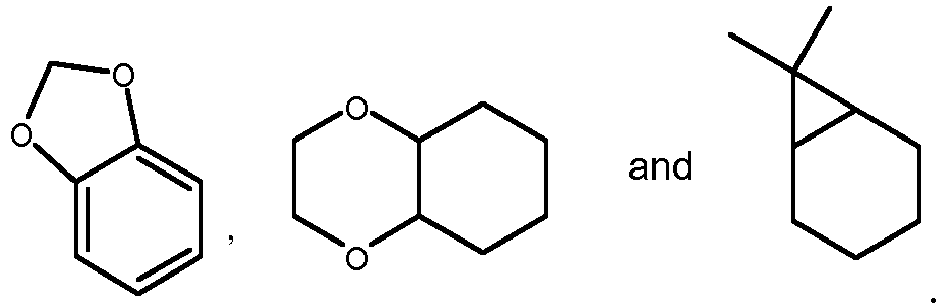
- The term "silylalkyl," as used herein, refers to an alkyl group as defined above, wherein one or more of the alkyl group's hydrogen atoms has been replaced with a -Si(Rx)3 group, wherein each occurrence of Rx is independently C1-C6 alkyl, phenyl or a 3- to 6-membered cycloalkyl group. In one embodiment, a silylalkyl group has from 1 to 6 carbon atoms. In another embodiment, a silyl alkyl group contains a -Si(CH3)3 moiety. Examples of silylalkyl groups include -CH2-Si(CH3)3 and -CH2CH2-Si(CH3)3.
- The term "substituted" means that one or more hydrogens on the designated atom is replaced with a selection from the indicated group, provided that the designated atom's normal valency under the existing circumstances is not exceeded, and that the substitution results in a stable compound. Combinations of substituents and/or variables are permissible only if such combinations result in stable compounds. By "stable compound' or "stable structure" is meant a compound that is sufficiently robust to survive isolation to a useful degree of purity from a reaction mixture.
- The term "in substantially purified form," as used herein, refers to the physical state of a compound after the compound is isolated from a synthetic process (e.g., from a reaction mixture), a natural source, or a combination thereof. The term "in substantially purified form," also refers to the physical state of a compound after the compound is obtained from a purification process or processes described herein or well-known to the skilled artisan (e.g., chromatography, recrystallization and the like), in sufficient purity to be characterizable by standard analytical techniques described herein or well-known to the skilled artisan.
- It should also be noted that any carbon as well as heteroatom with unsatisfied valences in the text, schemes, examples and tables herein is assumed to have the sufficient number of hydrogen atom(s) to satisfy the valences.
- When a functional group in a compound is termed "protected", this means that the group is in modified form to preclude undesired side reactions at the protected site when the compound is subjected to a reaction. Suitable protecting groups will be recognized by those with ordinary skill in the art as well as by reference to standard textbooks such as, for example, T. W. Greene et al, Protective Groups in Organic Synthesis (1991), Wiley, New York.
- When any substituent or variable (e.g., alkyl, R6, Ra, etc.) occurs more than one time in any constituent or in Formula (I), its definition on each occurrence is independent of its definition at every other occurrence, unless otherwise indicated.
- As used herein, the term "composition" is intended to encompass a product comprising the specified ingredients in the specified amounts, as well as any product which results, directly or indirectly, from combination of the specified ingredients in the specified amounts.
- Prodrugs and solvates of the compounds of the invention are also described herein. A discussion of prodrugs is provided in T. Higuchi and V. Stella, Pro-drugs as Novel Delivery Systems (1987) 14 of the A.C.S. Symposium Series, and in Bioreversible Carriers in Drug Design, (1987) Edward B. Roche, ed., American Pharmaceutical Association and Pergamon Press. The term "prodrug" means a compound (e.g., a drug precursor) that is transformed in vivo to provide a Heterocyclic-Substituted Benzofuran Derivative or a pharmaceutically acceptable salt or solvate of the compound. The transformation may occur by various mechanisms (e.g., by metabolic or chemical processes), such as, for example, through hydrolysis in blood.
- For example, if a Heterocyclic-Substituted Benzofuran Derivative or a pharmaceutically acceptable salt, hydrate or solvate of the compound contains a carboxylic acid functional group, a prodrug can comprise an ester formed by the replacement of the hydrogen atom of the acid group with a group such as, for example, (C1-C8)alkyl, (C2-C12)alkanoyloxymethyl, 1-(alkanoyloxy)ethyl having from 4 to 9 carbon atoms, 1-methyl-1-(alkanoyloxy)-ethyl having from 5 to 10 carbon atoms, alkoxycarbonyloxymethyl having from 3 to 6 carbon atoms, 1-(alkoxycarbonyloxy)ethyl having from 4 to 7 carbon atoms, 1-methyl-1-(alkoxycarbonyloxy)ethyl having from 5 to 8 carbon atoms, N-(alkoxycarbonyl)aminomethyl having from 3 to 9 carbon atoms, 1-(N-(alkoxycarbonyl)amino)ethyl having from 4 to 10 carbon atoms, 3-phthalidyl, 4-crotonolactonyl, gamma-butyrolacton-4-yl, di-N,N-(C1-C2)alkylamino(C2-C3)alkyl (such as β-dimethylaminoethyl), carbamoyl-(C1-C2)alkyl, N,N-di (C1-C2)alkylcarbamoyl-(C1-C2)alkyl and piperidino-, pyrrolidino- or morpholino(C2-C3)alkyl, and the like.
- Similarly, if a Heterocyclic-Substituted Benzofuran Derivative contains an alcohol functional group, a prodrug can be formed by the replacement of the hydrogen atom of the alcohol group with a group such as, for example, (C1-C6)alkanoyloxymethyl, 1-((C1-C6)alkanoyloxy)ethyl, 1-methyl-1-((C1-C6)alkanoyloxy)ethyl, (C1-C6)alkoxycarbonyloxymethyl, N-(C1-C6)alkoxycarbonylaminomethyl, succinoyl, (C1-C6)alkanoyl, α-amino(C1-C4)alkyl, α-amino(C1-C4)alkylene-aryl, arylacyl and α-aminoacyl, or α-aminoacyl-α-aminoacyl, where each α-aminoacyl group is independently selected from the naturally occurring L-amino acids, - P(O)(OH)2, -P(O)(O(C1-C6)alkyl)2 or glycosyl (the radical resulting from the removal of a hydroxyl group of the hemiacetal form of a carbohydrate), and the like.
- If a Heterocyclic-Substituted Benzofuran Derivative incorporates an amine functional group, a prodrug can be formed by the replacement of a hydrogen atom in the amine group with a group such as, for example, R-carbonyl-, RO-carbonyl-, NRR'-carbonyl- wherein R and R' are each independently (C1-C10)alkyl, (C3-C7) cycloalkyl, benzyl, a natural α-aminoacyl, -C(OH)C(O)OY1 wherein Y1 is H, (C1-C6)alkyl or benzyl, -C(OY2)Y3 wherein Y2 is (C1-C4) alkyl and Y3 is (C1-C6)alkyl; carboxy (C1-C6)alkyl; amino(C1-C4)alkyl or mono-N- or di-N,N-(C1-C6)alkylaminoalkyl; -C(Y4)Y5 wherein Y4 is H or methyl and Y5 is mono-N- or di-N,N-(C1-C6)alkylamino morpholino; piperidin-1-yl or pyrrolidin-1-yl, and the like.
- Pharmaceutically acceptable esters of the present compounds include the following groups: (1) carboxylic acid esters obtained by esterification of the hydroxy group of a hydroxyl compound, in which the non-carbonyl moiety of the carboxylic acid portion of the ester grouping is selected from straight or branched chain alkyl (e.g., methyl, ethyl, n-propyl, isopropyl, t-butyl, sec-butyl or n-butyl), alkoxyalkyl (e.g., methoxymethyl), aralkyl (e.g., benzyl), aryloxyalkyl (for example, phenoxymethyl), aryl (e.g., phenyl optionally substituted with, for example, halogen, C1-4alkyl, -O-(C1-4alkyl) or amino); (2) sulfonate esters, such as alkyl- or aralkylsulfonyl (for example, methanesulfonyl); (3) amino acid esters (e.g., L-valyl or L-isoleucyl); (4) phosphonate esters and (5) mono-, di- or triphosphate esters. The phosphate esters may be further esterified by, for example, a C1-20 alcohol or reactive derivative thereof, or by a 2,3-di (C6-24)acyl glycerol.
- One or more compounds of the invention may exist in unsolvated as well as solvated forms with pharmaceutically acceptable solvents such as water, ethanol, and the like. "Solvate" means a physical association of a compound of this invention with one or more solvent molecules. This physical association involves varying degrees of ionic and covalent bonding, including hydrogen bonding. In certain instances the solvate will be capable of isolation, for example when one or more solvent molecules are incorporated in the crystal lattice of the crystalline solid. "Solvate" encompasses both solution-phase and isolatable solvates. Examples of solvates include ethanolates, methanolates, and the like. A "hydrate" is a solvate wherein the solvent molecule is water.
- One or more compounds of the invention may optionally be converted to a solvate. Preparation of solvates is generally known. Thus, for example, M. Caira et al, J. Pharmaceutical Sci., 93(3), 601-611 (2004) describe the preparation of the solvates of the antifungal fluconazole in ethyl acetate as well as from water. Similar preparations of solvates, hemisolvate, hydrates and the like are described by E. C. van Tonder et al, AAPS PharmSciTechours. , 5(1), article 12 (2004); and A. L. Bingham et al, Chem. Commun., 603-604 (2001). A typical, non-limiting, process involves dissolving the inventive compound in desired amounts of the desired solvent (organic or water or mixtures thereof) at a higher than room temperature, and cooling the solution at a rate sufficient to form crystals which are then isolated by standard methods. Analytical techniques such as, for example IR spectroscopy, show the presence of the solvent (or water) in the crystals as a solvate (or hydrate).
- The Heterocyclic-Substituted Benzofuran Derivatives can form salts which are also within the scope of this invention. Reference to a Heterocyclic-Substituted Benzofuran Derivative herein is understood to include reference to salts thereof, unless otherwise indicated. The term "salt(s)", as employed herein, denotes acidic salts formed with inorganic and/or organic acids, as well as basic salts formed with inorganic and/or organic bases. In addition, when a Heterocyclic-Substituted Benzofuran Derivative contains both a basic moiety, such as, a pyridine or imidazole, and an acidic moiety, such as, a carboxylic acid, zwitterions ("inner salts") may be formed and are included within the term "salt(s)" as used herein. In one embodiment, the salt is a pharmaceutically acceptable (i.e., non-toxic, physiologically acceptable) salt. In another embodiment, the salt is other than a pharmaceutically acceptable salt. Salts of the Compounds of Formula (I) may be formed, for example, by reacting a Heterocyclic-Substituted Benzofuran Derivative with an amount of acid or base, such as an equivalent amount, in a medium such as one in which the salt precipitates or in an aqueous medium followed by lyophilization.
- Exemplary acid addition salts include acetates, ascorbates, benzoates, benzenesulfonates, bisulfates, borates, butyrates, citrates, camphorates, camphorsulfonates, fumarates, hydrochlorides, hydrobromides, hydroiodides, lactates, maleates, methanesulfonates ("mesylates"), naphthalenesulfonates, nitrates, oxalates, phosphates, propionates, salicylates, succinates, sulfates, tartarates, thiocyanates, toluenesulfonates (also known as tosylates) and the like. In one embodiment, a compound of formula (I) is present as its dihydrochloride salt. In another embodiment, a compound of formula (I) is present as its dimesylate salt. Additionally, acids which are generally considered suitable for the formation of pharmaceutically useful salts from basic pharmaceutical compounds are discussed, for example, by P. Stahl et al, Camille G. (eds.) Handbook of Pharmaceutical Salts. Properties, Selection and Use. (2002) Zurich: Wiley-VCH; S. Berge et al, Journal of Pharmaceutical Sciences (1977) 66(1) 1-19; P. Gould, International J. of Pharmaceutics (1986) 33 201-217; Anderson et al, The Practice of Medicinal Chemistry (1996), Academic Press, New York; and in The Orange Book (Food & Drug Administration, Washington, D.C. on their website).
- Exemplary basic salts include ammonium salts, alkali metal salts such as sodium, lithium, and potassium salts, alkaline earth metal salts such as calcium and magnesium salts, salts with organic bases (for example, organic amines) such as dicyclohexylamine, t-butyl amine, choline, and salts with amino acids such as arginine, lysine and the like. Basic nitrogen-containing groups may be quarternized with agents such as lower alkyl halides (e.g., methyl, ethyl, and butyl chlorides, bromides and iodides), dialkyl sulfates (e.g., dimethyl, diethyl, and dibutyl sulfates), long chain halides (e.g., decyl, lauryl, and stearyl chlorides, bromides and iodides), aralkyl halides (e.g., benzyl and phenethyl bromides), and others.
- All such acid salts and base salts are intended to be pharmaceutically acceptable salts within the scope of the invention and all acid and base salts are considered equivalent to the free forms of the corresponding compounds for purposes of the invention.
- Diastereomeric mixtures can be separated into their individual diastereomers on the basis of their physical chemical differences by methods well-known to those skilled in the art, such as, for example, by chromatography and/or fractional crystallization. Enantiomers can be separated by converting the enantiomeric mixture into a diastereomeric mixture by reaction with an appropriate optically active compound (e.g., chiral auxiliary such as a chiral alcohol or Mosher's acid chloride), separating the diastereomers and converting (e.g., hydrolyzing) the individual diastereomers to the corresponding pure enantiomers. Sterochemically pure compounds may also be prepared by using chiral starting materials or by employing salt resolution techniques. Also, some of the Heterocyclic-Substituted Benzofuran Derivatives may be atropisomers (e.g., substituted biaryls) and are considered as part of this invention. Enantiomers can also be directly separated using chiral chromatographic techniques.
- It is also possible that the Heterocyclic-Substituted Benzofuran Derivatives may exist in different tautomeric forms, and all such forms are embraced within the scope of the invention. For example, all keto-enol and imine-enamine forms of the compounds are included in the invention.
- All stereoisomers (for example, geometric isomers, optical isomers and the like) of the present compounds (including those of the salts of the compounds), such as those which may exist due to asymmetric carbons on various substituents, including enantiomeric forms (which may exist even in the absence of asymmetric carbons), rotameric forms, atropisomers, and diastereomeric forms, are contemplated within the scope of this invention. If a Heterocyclic-Substituted Benzofuran Derivative incorporates a double bond or a fused ring, both the cis- and trans-forms, as well as mixtures, are embraced within the scope of the invention.
- Individual stereoisomers of the compounds of the invention may, for example, be substantially free of other isomers, or may be admixed, for example, as racemates or with all other, or other selected, stereoisomers. The chiral centers of the present invention can have the S or R configuration as defined by the IUPAC 1974 Recommendations. The use of the terms "salt", "solvate", "ester", "prodrug" and the like, is intended to apply equally to the salt of enantiomers, stereoisomers, rotamers, tautomers or racemates of the inventive compounds.
- In the Compounds of Formula (I), the atoms may exhibit their natural isotopic abundances, or one or more of the atoms may be artificially enriched in a particular isotope having the same atomic number, but an atomic mass or mass number different from the atomic mass or mass number predominantly found in nature. The present invention is meant to include all suitable isotopic variations of the compounds of generic Formula I. For example, different isotopic forms of hydrogen (H) include protium (1H) and deuterium (2H). Protium is the predominant hydrogen isotope found in nature. Enriching for deuterium may afford certain therapeutic advantages, such as increasing in vivo half-life or reducing dosage requirements, or may provide a compound useful as a standard for characterization of biological samples. Isotopically-enriched Compounds of Formula (I) can be prepared without undue experimentation by conventional techniques well known to those skilled in the art or by processes analogous to those described in the Schemes and Examples herein using appropriate isotopically-enriched reagents and/or intermediates. In one embodiment, a Compound of Formula (I) has one or more of its hydrogen atoms replaced with deuterium.
- Polymorphic forms of the Heterocyclic-Substituted Benzofuran Derivatives, and of the salts, solvates, hydrates, esters and prodrugs of the Heterocyclic-Substituted Benzofuran Derivatives, are intended to be included in the present invention.
- The following abbreviations are used below and have the following meanings: Ac is acyl; AcOH is acetic acid; BF3•OEt2 is boron trifluoride etherate; BOC or Boc is tert-butyloxycarbonyl; Boc2O is Boc anhydride; Boc-Pro-OH is Boc protected proline; L-Boc-Val-OH is Boc protected L-valine; n-BuLi is n-butyllithium; dba is dibenzylideneacetone; DCM is dichloromethane; DIPEA is diisopropylethylamine; DME is dimethoxyethane; DMF is N,N-dimethylformamide; dppf is diphenylphosphinoferrocene; DMSO is dimethylsulfoxide; EtOAc is ethyl acetate; Et2O is diethyl ether; Et3N is triethylamine; HATU is O-(7-azabenzotriazol-1-yl)-N,N,N',N'-tetramethyluronium hexafluorophosphate; Hg(OAc)2 is mercuric acetate; HPLC is high performance liquid chromatography; HRMS is high resolution mass spectrometry; KOAc is potassium acetate; Lawesson's Reagent is 2,4-Bis(4-methoxyphenyl)-1,3-dithiadiphosphetane-2,4-disulfide; LCMS is liquid chromatography/mass spectrometry; LRMS is low resolution mass spectrometry; mCPBA is m-chloroperbenzoic acid; MeOH is methanol; Ms is -SO2CH3 (or "mesyl"); MTBE is tert-butylmethyl ether; NBS is N-bromosuccinimide; NH4OAc is ammonium acetate; Pd(PPh3)4 is tetrakis(triphenylphosphine) palladium(O); PdCl2(dppf)2 is [1,1'-Bis(diphenylphosphino)ferrocene]dichloro palladium(II); PdCh(dpPf)2•CH2Cl2 is [1,1'-Bis(diphenylphosphino)ferrocene] dichloro palladium(II) complex with dichloromethane; pinacol2B2 is bis(pinacolato)diboron; PPTS is pyridinium p-toluene sulfonate; RPLC is reverse-phase liquid chromatography; SEM-Cl is 2-(trimethylsilyl)ethoxymethyl chloride; TBAF is tetrabutylammonium fluoride; TBAI is tetrabutylammonium iodide; TBDMSCl is tertbutyldimethylsilyl chloride; TFA is trifluoroacetic acid; THF is tetrahydrofuran; TLC is thin-layer chromatography; XPhos is 2-dicyclohexylphosphino-2',4',6'-triisopropylbiphenyl; and Z-Pro-OH is N-Benzyloxycarbonyl-L-proline.
- The present invention provides Heterocyclic-Substituted Benzofuran Derivatives of Formula (I):

- In one embodiment, R4 is -N(CH3)SO2CH3.
- In another embodiment of the invention, the compound of the invention is one of compounds 1-297, as depicted in the Examples below, or a pharmaceutically acceptable salt thereof.
- Other embodiments of the present invention include the following:
- (a) A pharmaceutical composition comprising an effective amount of a compound of formula (I) and a pharmaceutically acceptable carrier.
- (b) The pharmaceutical composition of (a), further comprising a second therapeutic agent selected from the group consisting of HCV antiviral agents, immunomodulators, and anti-infective agents.
- (c) The pharmaceutical composition of (b), wherein the HCV antiviral agent is an antiviral selected from the group consisting of direct inhibitors of HCV, including but not limited to NS3 and NS3/4A protease inhibitors, NS5A inhibitors and HCV NS5B polymerase inhibitors.
- (d) A pharmaceutical combination that is (i) a compound of formula (I) and (ii) a second therapeutic agent selected from the group consisting of HCV antiviral agents, immunomodulators, and anti-infective agents; wherein the compound of formula (I) and the second therapeutic agent are each employed in an amount that renders the combination effective for inhibiting HCV NS5B activity, or for inhibiting HCV viral replication, or for treating HCV infection and/or reducing the likelihood or severity of symptoms of HCV infection.
- (e) The combination of (d), wherein the HCV antiviral agents are one or more antiviral agents selected from the group consisting of direct inhibitors of HCV, including NS3 and NS3/4A protease inhibitors, NS5A inhibitors and HCV NS5B polymerase inhibitors.
- (f) A use of a compound of formula (I) in the preparation of a medicament for inhibiting HCV NS5B activity in a subject in need thereof.
- (g) A use of a compound of formula (I) in the preparation of a medicament for preventing and/or treating infection by HCV in a subject in need thereof.
- (h) A compound of formula (I) for use in treating HCV infection and/or reducing the likelihood or severity of symptoms of HCV infection in a subject.
- (i) The compound for use of (h), wherein the compound of formula (I) is administered in combination with an effective amount of at least one second therapeutic agent selected from the group consisting of HCV antiviral agents, immunomodulators, and anti-infective agents.
- (j) The compound for use of (i), wherein the HCV antiviral agent is an antiviral selected from the group consisting of direct inhibitors of HCV, including but not limited to NS3 and NS3/4A protease inhibitors, NS5A inhibitors and HCV NS5B polymerase inhibitors.
- (k) A compound of formula (I) for use in inhibiting HCV viral replication and/or HCV viral production in a cell-based system, which comprises administering to the subject an effective amount of a compound of formula (I) in combination with an effective amount of at least one second therapeutic agent selected from the group consisting of HCV antiviral agents, immunomodulators, and anti-infective agents.
- (l) The compound for use of (k), wherein the HCV antiviral agent is an antiviral selected from the group consisting of direct inhibitors of HCV, including NS3 and NS3/4A protease inhibitors, NS5A inhibitors and HCV NS5B polymerase inhibitors.
- (m) A compound of formula (I) for use in inhibiting HCV NS5B activity in a subject, which comprises administering to the subject the pharmaceutical composition of (a), (b), or (c) or the combination of (d) or (e).
- (n) A compound of formula (I) for use in treating HCV infection and/or reducing the likelihood or severity of symptoms of HCV infection in a subject, which comprises administering to the subject the pharmaceutical composition of (a), (b), or (c) or the combination of (d) or (e).
- The present invention also includes a compound of the present invention for use (i) in, (ii) as a medicament for, or (iii) in the preparation of a medicament for: (a) inhibiting HCV NS5B activity, or (b) inhibiting HCV viral replication, or (c) treating HCV infection and/or reducing the likelihood or severity of symptoms of HCV infection, or (d) use in medicine. In these uses, the compounds of the present invention can optionally be employed in combination with one or more second therapeutic agents selected from HCV antiviral agents, anti-infective agents, and immunomodulators.
- In the embodiments of the compounds and salts provided above, it is to be understood that each embodiment may be combined with one or more other embodiments, to the extent that such a combination provides a stable compound or salt and is consistent with the description of the embodiments. It is further to be understood that the embodiments of compositions and uses provided as (a) through (n) above are understood to include all embodiments of the compounds and/or salts, including such embodiments as result from combinations of embodiments.
- Additional embodiments of the invention include the pharmaceutical compositions, combinations and uses set forth in (a) through (n) above, wherein the compound of the present invention employed therein is a compound of one of the embodiments, aspects, classes, sub-classes, or features of the compounds described above. In all of these embodiments, the compound may optionally be used in the form of a pharmaceutically acceptable salt as appropriate.
- The Compounds of Formula (I) may be prepared from known or readily prepared starting materials, following methods known to one skilled in the art of organic synthesis. Methods useful for making the Compounds of Formula (I) are set forth in the Examples below and generalized in Schemes 1-4 below. Alternative synthetic pathways and analogous structures will be apparent to those skilled in the art of organic synthesis. All stereoisomers and tautomeric forms of the compounds are contemplated.
- Scheme 1 shows a method useful for making compounds of formula K, which correspond to the Compounds of Formula (I), wherein R4 is -N(CH3)SO2CH3.

- Commercially available compound A can be cyclized with 4-bromophenol to provide benzofuran compound B. Nitration of compound B provides nitrocompound C, which can be reduced to provide amine compound D. Mesylation of the amino group of D provides compound E, which can then be hydrolyzed using LiOH, for example, to provide the carboxylic acid compound F. is generated by reduction of the nitro group in compound C, and the amino group in compound D is then sulfonylated with MsCl to furnish compound E. The ester functionality in compound E is readily hydrolyzed by aqueous base to afford compound F. The carboxylic acid of compound F is then condensed with methanamine using common amide forming reagents such as EDCI and HOBT to provide compound G. The sulfonamide group of G can be coupled with MeI in the presence of potassium carbonate to provide compound H. Compound H can be converted to corresponding boronic ester I using bis(pinacolato)diboron in the presence of a palladium catalyst. Finally, compound I can be reacted with substituted bicyclic heteroaryl halides of formula J to provide the compounds of formula K.
- Scheme 2 shows an alternate method useful for making compounds of formula K, which correspond to the Compounds of Formula (I), wherein R4 is -N(CH3)SO2CH3.

- A bicyclic heteroaryl halides of formula J (X could be Cl, Br, I, OTs or OMs) can be converted to the corresponding boronic esters of formula L using bis(pinacolato)diboron in the presence of a palladium catalyst. A palladium-catalyzed coupling reaction (e.g. Suzuki coupling) could then be performed to couple a compound of formula L with compound H to provide the compounds of formula K.
- Scheme 3 shows methods useful for making compounds of formula J, which are intermediates useful for making the Compounds of Formula (I).

- A bicyclic heteroaryl boronate compound of formula M can be coupled in the presence of a palladium catalyst with a monocyclic heteroaryl derivative of formula N or to provide compounds of formula J (as shown in reaction (i)). Alternatively, a bicyclic heteroaryl derivative of formula O can be coupled in the presence of a palladium catalyst with a monocyclic heteroaryl boronate compound of formula P or to provide compounds of formula J (as shown in reaction (ii)) .
- Scheme 4 shows a method useful for making compounds of formula T, which correspond to the Compounds of Formula (I), wherein R4 is pyrrolidinone.


- Compound D can be reacted with 4-chlorobutanoyl chloride to provide the pyrrolidinone compound of formula Q. The ester moiety of Q can be hydrolyzed using base to provide the carboxylic acid compound of formula R. Methylation of the amino group of R using iodomethane, for example, provides compound S. A palladium-catalyzed coupling reaction (e.g., Suzuki coupling) could then be performed to couple a boronate compound of formula L with bromo compound S to provide the compounds of formula T.
- One skilled in the art of organic synthesis will recognize that the synthesis of compounds with multiple reactive functional groups, such as -OH and NH2, may require protection of certain functional groups (i.e., derivatization for the purpose of chemical compatibility with a particular reaction condition). Suitable protecting groups for the various functional groups of these compounds and methods for their installation and removal are well-known in the art of organic chemistry. A summary of many of these methods can be found in Greene & Wuts, Projecting Groups in Organic Synthesis, John Wiley & Sons, 3rd edition (1999).
- One skilled in the art of organic synthesis will also recognize that one route for the synthesis of the Compounds of Formula (I) may be more desirable depending on the choice of appendage substituents. Additionally, one skilled in the relevant art will recognize that in some cases the order of reactions may differ from that presented herein to avoid functional group incompatibilities and thus adjust the synthetic route accordingly.
- Compounds of formula K and T may be further elaborated using methods that would be well-known to those skilled in the art of organic synthesis or, for example, the methods described in the Examples below, to make the full scope of the Compounds of Formula (I).
- The starting materials used and the intermediates prepared using the methods set forth above in Schemes 1-4 may be isolated and purified if desired using conventional techniques, including but not limited to filtration, distillation, crystallization, chromatography and alike. Such materials can be characterized using conventional means, including physical constants and spectral data.
- The compounds described herein can be prepared according to the procedures of the following schemes and examples, using appropriate materials and are further exemplified by the following specific examples. The compounds illustrated in the examples are not, however, to be construed as forming the only genus that is considered as the invention. The examples further illustrate details for the preparation of the compounds of the present invention. Those skilled in the art will readily understand that known variations of the conditions and processes of the following preparative procedures can be used to prepare these compounds. All temperatures are degrees Celsius unless otherwise noted. Mass spectra (MS) were measured by electrospray ion-mass spectroscopy (ESI). 1H NMR spectra were recorded at 400-500 MHz. Compounds described herein were synthesized as a racemic mixture unless otherwise stated in the experimental procedures.
-

-

- To a solution of 5-bromo-2-methoxynicotinic acid (650 mg, 2.8 mmol) in anhydrous DCM (15 mL), SOCl2 (1 mL) was added dropwise and the mixture was heated to reflux and allowed to stir at this temperature for 2 hours. The reaction mixture was concentrated in vacuo, then anhydrous DCM (10 mL) was added and the solvent was evaporated again. The crude product was dissolved in anhydrous DCM (3 mL), and added dropwise to a solution of the 2-amino-3-fluorophenol (256 mg, 2.8 mmol) and Et3N (1 mL) in DCM (10 mL) at ice-bath. The mixture was allowed to stir at room temperature for 3 hours, then was poured into water, extracted with DCM. The organic phase was washed with brine, dried over Na2SO4, and concentrated in vacuo. The resulting residue was purified using column chromatography (eluted with PE : EtOAc = 10 : 1) to provide 5-bromo-N-(2-fluoro-6-hydroxyphenyl)-2-methoxynicotinamide (820 mg, yield: 75.0%). 1H-NMR (CDCl3, 400 MHz) δ 10.39 (s, 1H), 9.89 (s, 1H), 8.61 (d, J = 2.0 Hz, 1H), 8.34 (d, J = 4.0 Hz, 1H), 7.00∼7.06 (m, 1H), 6.77∼6.79 (m, 1H), 6.62∼6.66 (m, 1H), 4.14 (s, 3H). MS (M+H)+: 341 / 343.
-

- A solution of 5-bromo-N-(2-fluoro-6-hydroxyphenyl)-2- methoxynicotinamide (350 mg, 1.0 mmol) in POCl3 (5 mL) and toluene (5 mL) was heated to reflux for 8 hours. After being cooled to room temperature, the reaction mixture was poured into ice-water, and extracted with DCM. The organic phase was washed with H2O and brine, concentrated in vacuo. The resulting residue was purified using column chromatography (eluted with PE : EtOAc = 20 : 1) to provide 2-(5-bromo- 2-methoxypyridin-3-yl)-4-fluorobenzo[d]oxazole (200 mg, yield: 62.3%) as a white solid. 1H-NMR (CDCl3, 400 MHz) δ 8.59 (d, J = 4.0 Hz, 1H), 8.36 (d, J = 4.0 Hz, 1H), 7.04∼7.08 (m, 1H), 6.76∼6.79 (m, 1H), 6.68∼6.70 (m, 1H), 4.18 (s, 3H). MS (M+H)+: 323 / 325.
-

- To a degassed solution of 2-(4-fluorophenyl)-N-methyl-6-(N-methylmethylsulfonamido)-5-(4,4,5,5-tetramethyl-1,3,2-dioxaborolan-2-yl)benzofuran-3-carboxamide (Compound I, 100 mg, 0.2 mmol) and 2-(5-bromo-2- methoxypyridin-3-yl)-4-fluorobenzo[d]oxazole (65 mg, 0.2 mmol) in dry DMF (3 mL) was added Pd(dppf)Cl2 (10 mg) and K3PO4 (120 mg, 0.4 mmol) under N2 protection. The mixture was heated to 100 °C and allowed to stir at this temperature for about 15 hours and then was to room temperature and filtered. The filtrate was washed with H2O, brine, dried over Na2SO4. After being concentrated in vacuo, the resulting residue was purified using prep-HPLC to provide Compound 1 (68 mg, yield: 57.6%). 1H-NMR (CDCl3, 400 MHz) δ 8.57 (d, J = 2.0 Hz, 1H), 8.41 (d, J = 1.6 Hz, 1H), 7.90∼7.93 (m, 2H), 7.86 (s, 1H), 7.63 (s, 1H), 7.40∼7.42 (m, 1H), 7.30∼7.34 (m, 1H), 7.18 (t, J = 4.8 Hz, 2H), 7.05∼7.09 (m, 1H), 5.98 (d, J = 3.2 Hz, 1H), 3.20 (s, 3H), 3.00 (d, J = 4.4 Hz, 3H), 2.83 (s, 3H). MS (M+H)+: 619. The compounds depicted in the table below, were prepared using the method described in Example 1 and substituting the appropriate reactants and/or reagents.
No. Structure NMR MS (M+H)+ 2 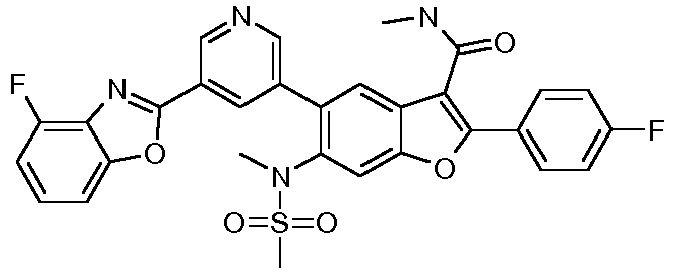
1H-NMR (CDCl3, 400 MHz) δ 9.42 (s, 1H), 8.77(s, 1H), 8.58 (s, 1H), 7.85∼7.89 (m, 3H), 7.61 (s, 1H), 7.38 (d, J = 8.0 Hz, 1H), 7.27∼7.33 (m, 1H), 7.15 (t, J = 8.0 Hz, 2H), 7.06 (t, J = 8.0 Hz, 1H), 5.89 (s, 1H), 3.18 (s, 3H), 2.95 (d, J = 4.0 Hz, 3H), 2.72 (s, 3H). 589 4 
1H-NMR (CDCl3, 400 MHz) δ 9.27 (s, 1H), 8.60 (s, 1H), 7.90∼7.93 (m, 2H), 7.79 (s, 1H), 7.65 (s, 1H), 7.30∼7.36 (m, 2H), 7.13∼7.17 (m, 2H), 7.05 (t, J = 8.4 Hz, 1H), 5.96 (d, J = 4.4 Hz, 1H), 3.22 (s, 3H), 2.91 (s, 3H), 2.88 (d, J = 4.8 Hz, 3H). 590 15 
1H-NMR (CDCl3, 400 MHz) δ 9.52 (s, 1H), 8.92 (s, 1H), 8.83 (s, 1H), 8.66 (s, 1H), 7.92∼7.99 (m, 4H), 7.68 (s, 1H), 7.39∼7.43 (m, 1H), 7.20∼7.24 (m, 2H), 6.02 (d, J = 2.0 Hz, 1H), 3.29 (s, 3H), 3.01 (d, J = 8.0 Hz, 3H), 2.83 (s, 3H). 572 16 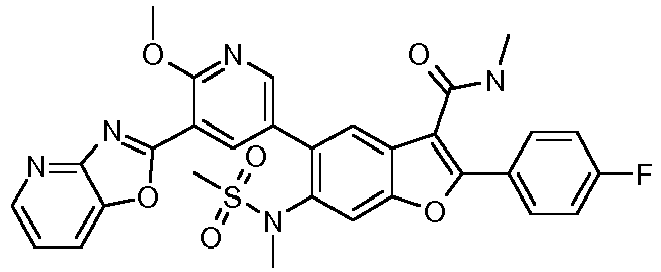
1H-NMR (CDCl3, 400 MHz) δ 8.61 (d, J = 2.4 Hz, 1H), 8.54 (d, J = 3.6 Hz, 1H), 8.40 (s, 1H), 7.87∼7.90 (m, 3H), 7.84 (d, J = 4.0 Hz, 1H), 7.60 (s, 1H), 7.25∼7.28 (m, 1H), 7.15 (t, J = 8.8 Hz, 2H), 5.82 (d, J = 4.8 Hz, 1H), 4.16 (s, 3H), 3.18 (s, 3H), 2.95 (d, J = 4.8 Hz, 3H), 2.79 (s, 3H). 602 -

-

- To a degassed solution of benzo[b]thiophen-2-ylboronic acid (300 mg, 1.69 mmol) and 3-bromo-5-chloropyridine (270 mg, 1.40 mmol) in 1, 4-Dioxane (20 mL) was added K3PO4·3H2O (900 mg, 3.37 mmol) under N2. Then Pd(dppf)Cl2 (10 mg) was added. After being allowed to stir at 100 °C and allowed to stir at this temperature for about 15 hours, the reaction mixture was cooled to room temperature and concentrated and extracted with EtOAc. The organic layers were washed with brine, dried over Na2SO4. After being concentrated in vacuo, the resulting residue was purified using column chromatography (eluted with PE : EtOAc = 5 : 1) to provide 3-(benzo[b]thiophen-2-yl)-5-chloropyridine as white solid (160 mg, yield: 38.6%). 1H-NMR (CDCl3, 400 MHz) δ 8.43∼8.45 (m, 1H), 7.71∼7.78 (m, 4H), 7.27∼7.32 (m, 2H), 7.13∼7.14 (m, 1H). MS (M+H)+: 246.
-

- To a degassed solution of 2-(4-fluorophenyl)-N-methyl-6-(N-methylmethylsulfonamido)-5-(4,4,5,5-tetramethyl-1,3,2-dioxaborolan-2-yl)benzofuran-3-carboxamide (Compound I, 100 mg, 0.2 mmol) and 3-(benzo[b]thiophen- 2-yl)-5-chloropyridine (50 mg, 0.2 mmol) in 1, 4-Dioxane / H2O (5 : 1,3 mL) were added Pd2(dba)3 (10 mg), X-Phos (5 mg) and K3PO4 (120 mg, 0.4 mmol) under N2 protection. The mixture was heated to 100 °C and allowed to stir at this temperature for about 15 hours and then was to room temperature and filtered. The filtrate was washed with H2O, brine, dried over Na2SO4. After being concentrated in vacuo, the resulting residue was purified using prep-HPLC to provide Compound 23 (35 mg, yield: 42.8%). 1H-NMR (CDCl3, 400 MHz) δ 8.70∼8.78 (m, 1H), 8.05 (s, 1H), 8.01 (s, 1H), 7.87∼7.93 (m, 3H), 7.84∼7.86 (m, 2H), 7.64 (s, 1H), 7.41∼7.42 (m, 1H), 7.35∼7.39 (m, 2H), 7.20∼7.24 (m, 2H), 5.91 (d, J = 4.8 Hz, 1H), 3.18 (s, 3H), 2.99 (d, J = 4.8 Hz, 3H), 2.87 (s, 3H). MS (M+H)+: 586.
-

-

- 5-bromonicotinic acid (2.0 g, 10 mmol) was dissolved in DCM (5 mL), then SOCl2 (1 mL) was added dropwise to this mixture. The reaction mixture was heated to reflux and allowed to stir at this temperature for 2 hours. The reaction mixture was concentrated in vacuo, then DCM (2 mL) was added and the resulting solution was concentrated in vacuo again. The resulting residue was diluted with DCM (30 mL) and the resulting solution was added to a solution of 2,6-difluoro aniline (1.05 g, 9.48 mmol) and TEA (1.05 g, 10.34 mmol) in DCM (20 mL) at 0 °C dropwise. The mixture was allowed to stir at room temperature for 2 hours, and then diluted with DCM. The diluted mixture was washed with water and brine, dried over Na2SO4, filtered and concentrated in vacuo. The resulting residue was purified using column chromatography (eluted with PE : EtOAc = 10 : 1) to provide 2-bromo-N-2,6-difluorophenyl)isonicotinamide (1.4 g, yield: 64.0%) as a white solid. 1H-NMR (CDCl3, 400 MHz) δ 9.07 (s, 1H), 8.89 (s, 1H), 8.80∼8.84 (m, 1H), 8.40∼8.42 (m, 1H), 7.62∼7.64 (m, 2H), 7.02∼7.06 (m, 1H). MS (M+H)+: 313 / 315.
-
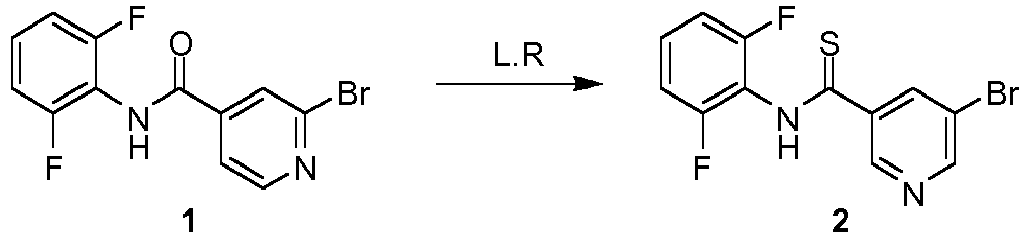
- A mixture of 2-bromo-N-(2,6-difluorophenyl)isonicotinamide (300 mg, 0.96 mmol) and L.R (387 mg, 0.96 mmol) in anhydrous toluene (10 mL) was heated to reflux with stirring for about 15 hours. After the reaction mixture was concentrated in vacuo, the resulting residue was purified using column chromatography (eluted with PE : EtOAc = 10 : 1) to provide 5-bromo-N-(2,6-difluorophenyl)pyridine-3- carbothioamide (200 mg, yield: 63.3%) as yellow solid, which was used in the next step without purification.
-
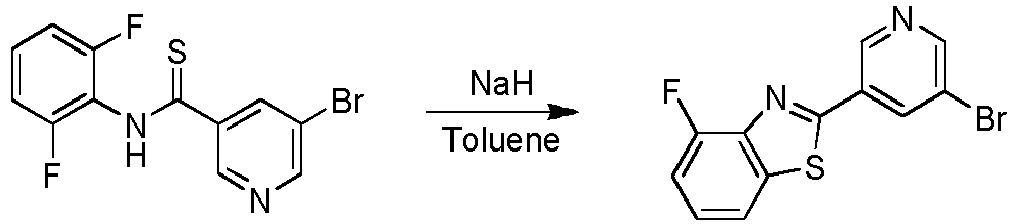
- To a solution of sodium hydride (140 mg, 0.17 mmol) in anhydrous toluene (2 mL) at 0°C, 5-bromo-N-(2,6-difluorophenyl)pyridine-3-carbothioamide (100 mg, 0.15 mmol) in one portion was added. The solution was warmed to room temperature over 1 hour and then heated to a gentle reflux. After 30 minutes, DMF (0.2 mL) was carefully added and the mixture was allowed to stir for an addition 2 hours. The solution was quenched with ice-water. The solution was extracted with EtOAc, the organic phase was dried (Na2SO4) and concentrated and the resulting residue was purified using prep-TLC (eluted with PE : EtOAc = 3 : 1) to provide 2-(5-bromopyridin-3-yl)-4- fluorobenzo[d]thiazole (30 mg, yield: 31.3%). 1H-NMR (CDCl3, 400 MHz) δ 9.09 (s, 1H), 8.72 (s, 1H), 8.56 (s, 1H), 7.64∼7.66 (m, 1H), 7.32∼7.38 (m, 1H), 7.16∼7.20 (m, 1H). MS (M+H)+: 309 / 311.
-
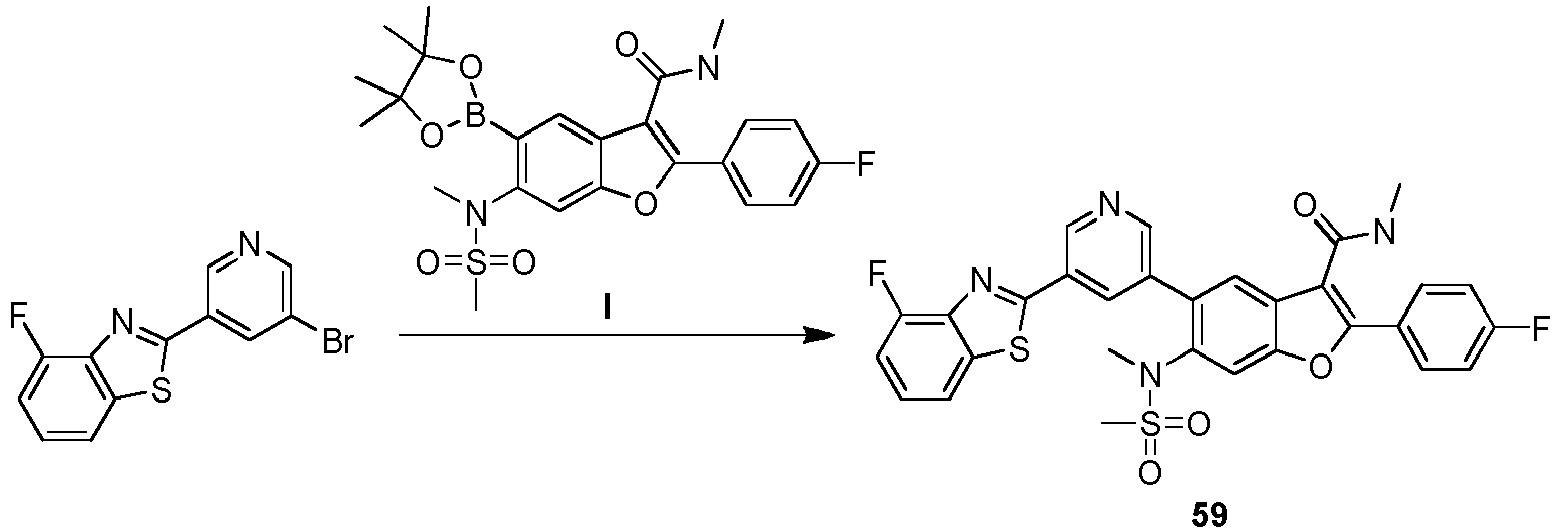
- To a degassed solution of 2-(4-fluorophenyl)-N-methyl-6- (N-methylmethylsulfonamido)-5-(4,4,5,5-tetramethyl-1,3,2-dioxaborolan-2-yl)benzofuran-3-carboxamide (Compound I, 100 mg, 0.2 mmol) and 3-(benzo[b]thiophen-2-yl)-5-chloropyridine (62 mg, 0.2 mmol) in 1, 4-Dioxane / H2O (5 : 1, 3 mL) were added Pd(dppf)Cl2 (10 mg) and K3PO4 (120 mg, 0.4 mmol) under N2 protection. The mixture was heated to 100 °C and allowed to stir at this temperature for about 15 hours and then cooled to room temperature and filtered. The filtrate was washed with H2O, brine, dried over Na2SO4. After being concentrated in vacuo, the resulting residue was purified using prep-HPLC to provide 5-(5-(4-fluorobenzo[d]thiazol-2-yl)pyridin-3-yl)-2-(4- fluorophenyl)-N-methyl-6-(N-methylmethylsulfonamido) benzofuran-3-carboxamide (35 mg, yield: 29.1%). 1H-NMR (CDCl3, 400 MHz) δ 9.33 (s, 1H), 8.83 (s, 1H), 8.71 (s, 1H), 7.91∼7.95 (m, 3H), 7.72 (d, J = 8.0 Hz, 1H), 7.53 (s, 1H), 7.39∼7.44 (m, 1H), 7.19∼7.23 (m, 3H), 5.96 (d, J = 4.8 Hz, 1H), 3.22 (s, 3H), 3.01 (d, J = 4.8 Hz, 3H), 2.89 (s, 3H). MS (M+H)+: 605.
-
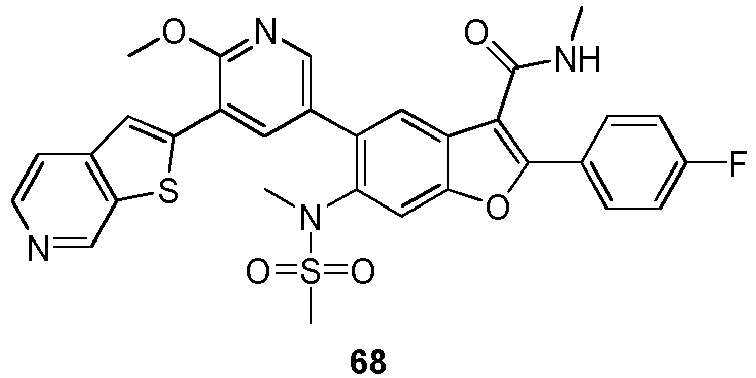
-

- To a degassed mixture of 5-bromo-2-methoxypyridine-3-boronic acid (232 mg, 1 mmol) and 2-bromo-thieno[2,3-C]pyridine (214 mg, 1 mmol) in 1,4-dioxane (10 mL) was added Pd(dppf)Cl2 (73 mg) and K3PO4 (800 mg, 3 mmol) under N2. The mixture was heated to 90 °C and allowed to stir at this temperature for about 15 hours. After being cooled to room temperature and filtered, the filtrate was concentrated in vacuo, and the resulting residue was purified using flash chromatography on silica gel (eluted with PE : EtOAc = 2 : 1) to provide 2-(5-bromo-2-methoxypyridin-3-yl)thieno[2,3-c]pyridine (120 mg, yield: 37.4 %). 1H-NMR (CDCl3, 400 MHz) δ 9.17 (s, 1H), 8.55 (d, J = 5.6 Hz, 1H), 8.41 (s, 1H), 7.72 (d, J = 4.8 Hz, 1H), 7.66 (s, 1H), 6.97 (s, 1H), 3.97 (s, 3H). MS (M+H)+: 321 / 323.
-

- Compound 68 was made from the indicated starting material using the methods described in Example 1. 1H-NMR (CDCl3, 400 MHz) δ 9.39 (s, 1H), 8.48 (s, 1H), 8.31 (s, 1H), 7.88∼7.92 (m, 4H), 7.53 (s, 1H), 7.49 (s, 1H), 7.21∼7.26 (m, 2H), 7.10 (s, 1H), 5.85 (s, 1H), 4.07 (s, 3H), 2.95 (d, J = 4.4 Hz, 3H), 2.70 (s, 6H). MS (M+H)+: 617.
-

-

- To a solution of 5-bromonicotinonitrile (8 g, 53 mmol) in 34 mL of pyridine was added Et3N at 15 °C, and then H2S was passed through this solution for 1 hour. After being allowed to stir at 15 °C for 12 hours, the mixture was poured into ice water and the resulting residue was washed by water to provide 5-bromopyridine- 3-carbothioamide (6.5 g, yield: 66.3%). 1H-NMR (DMSO-d6, 300 MHz) δ 10.19 (s, 1H), 9.78 (s, 1H), 8.93 (d, J = 8.0 Hz, 1H), 8.77 (d, J = 8.0 Hz, 1H), 8.34 (s, 1H).
-

- A solution of 5-bromopyridine-3-carbothioamide (570 mg, 2.6 mmol), 3-bromodihydro-2H-pyran-4(3H)-one (470 mg, 2.6 mmol) in 20 mL of EtOH was heated to reflux and allowed to stir at this temperature for 12 hours The reaction mixture was concentrated in vacuo, and the resulting residue was purified using silica gel chromatograph (eluted with PE : EtOAc = 10 : 1) to provide 2-(5-bromopyridin- 3-yl)- 6,7-dihydro-4H-pyrano[4,3-d]thiazole (50 mg, yield: 6.4%). 1H-NMR (CDCl3, 300 MHz) δ 8.98 (d, J = 3.0 Hz, 1H), 8.67 (s, 1H), 8.36∼8.36 (m, 1H), 4.88 (s, 2H), 3.65∼3.67 (m, 2H), 2.68∼2.70 (m, 2H).
-

- Compound 79 was made from the indicated starting material using methods described in Example 1. 1H-NMR (CDCl3, 300 MHz) δ 9.23 (s, 1H), 8.84 (s, 1H), 8.73 (s, 1H), 7.98 (s, 1H), 7.90∼7.94 (m, 2H), 7.65 (s, 1H), 7.23 (s, 1H), 7.20 (s, 1H), 6.00∼6.01 (m, 1H), 4.91 (s, 2H), 4.07∼4.10 (m, 2H), 3.25 (s, 3H), 3.01 (s, 3H), 3.00 (s, 2H), 2.90 (s, 3H). MS (M+H)+: 593.
-

-

- Bromine (6.4 g, 0.04 mol) was added to a solution of piperidine-2,6-dione (4.5 g, 0.04 mol) in 14 mL of 1,1,2-trichloroethane at room temperature. The mixture was allowed to stir for 2 hours at 110 °C and then for 1 hour at room temperature. The reaction mixture was concentrated in vacuo and the resulting residue was purified using flash chromatography on silica gel (eluted with PE : EtOAc = 5 : 1 ∼ 2 : 1) to provide 3.4 g of 3-bromopiperidine-2,6-dione (yield: 44.3 %) as white solid. 1H-NMR (CDCl3, 400 MHz) δ 8.34 (s, 1H), 4.64 (t, J = 3.6 Hz, 1H), 2.91∼3.00 (m, 1H), 2.66∼2.73 (m, 1H), 2.28∼2.47 (m, 2H).
-
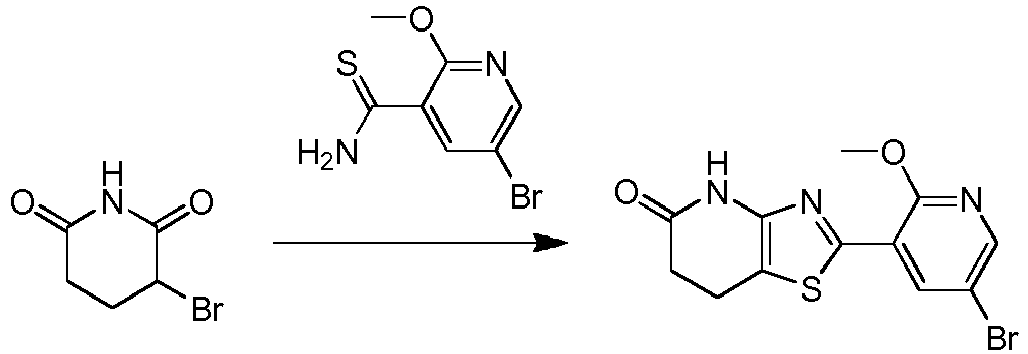
- A mixture of 3-bromopiperidine-2,6-dione (3.84 g, 20 mmol) and 5-bromo-2-methoxypyridine-3-carbothioamide (3.71 g, 15 mmol) in 100 mL of dry ethanol was heated to reflux and allowed to stir at this temperature for 48 hours After being cooled to room temperature, the precipitate was collected by filtration, washed with cooled ethanol, and dried to provide 2-(5-bromo-2-methoxypyridin- 3-yl)-6,7-dihydrothiazolo[4,5-b]pyridin-5(4H)-one (2.6 g, yield: 51%). 1H-NMR (DMSO-d6, 300 MHz) δ 10.75 (s, 1H), 8.47 (d, J = 2.4 Hz, 1H), 8.38 (d, J = 2.4 Hz, 1H), 4.09 (s, 3H), 3.02 (t, J = 7.6 Hz, 2H), 2.62 (t, J = 7.6 Hz, 2H). MS (M+H)+: 340 / 342.
-

- A mixture of 2-(5-bromo-2-methoxypyridin-3-yl)-6,7-dihydrothiazolo [4,5-b]pyridin-5(4H)-one (68 mg, 0.2 mmol), 2-(4-fluorophenyl)-N-methyl-6- (N-methylmethylsulfonamido)-5-(4,4,5,5-tetramethyl-1,3,2-dioxaborolan-2-yl)benzofuran-3-carboxamide (Compound I, 101 mg, 0.2 mmol), K3PO4·3H2O (160 mg, 0.6 mmol) and Pd(dppf)Cl2 (15 mg, 0.02 mmol) in 4 mL of dry dioxane was allowed to stir at 90 °C under N2 for about 15 hours. The reaction mixture was concentrated in vacuo and the resulting residue was purified using prep-HPLC to provide Compound 85 (12 mg, yield: 9.4%). 1H-NMR (CDCl3, 400 MHz) δ 8.54 (s, 1H), 8.22 (s, 1H), 8.06 (s, 1H), 7.86∼7.89 (m, 2H), 7.80 (s, 1H), 7.59 (s, 1H), 7.13∼7.17 (m, 2H), 5.84 (s, 1H), 4.15 (s, 3H), 3.13 (s, 3H), 3.01 (t, J = 7.6 Hz, 2H), 2.93 (t, J = 4.4 Hz, 3H), 2.72∼2.78 (m, 5H). MS (M+H)+: 636.
-

-

- To a solution of 2-(5-bromo-2-methoxypyridin-3-yl)-6,7- dihydrothiazolo[4,5-b]pyridin-5(4H)-one (2.04 g, 6 mmol) in 60 mL of dry THF was added BH3-SMe2 (912 mg, 12 mmol) at 0 °C. The reaction mixture was allowed to stir at room temperature for about 15 hours, and then quenched with water and aqueous H2SO4 (5 M). The resulting solution was filtered, aqueous NaOH was added to the filtrate until pH to 14 and this aqueous layer was extracted with EtOAc. The organic layer was washed with brine, dried over Na2SO4, concentrated and purified using flash chromatography on silica gel (eluted with PE : EtOAc = 1) to provide 2-(5-bromo-2- methoxypyridin-3-yl)-4,5,6,7-tetrahydrothiazolo [4,5-b]pyridine (1.6 g, yield: 81.6%) as yellow solid. 1H-NMR (CDCl3, 300 MHz) δ 8.63 (s, 1H), 8.17 (s, 1H), 4.12 (s, 3H), 3.39 (t, J = 5.2 Hz, 2H), 2.84 (t, J = 6.4 Hz, 2H), 2.01∼2.07 (m, 2H). MS (M+H)+: 326 / 328.
-

- A mixture of 2-(5-bromo-2-methoxypyridin-3-yl)-4,5,6,7- tetrahydrothiazolo[4,5-b]pyridine (66 mg, 0.2 mmol), 2-(4-fluorophenyl)-N- methyl-6-(N-methylmethylsulfonamido)-5-(4,4,5,5-tetramethyl-1,3,2-dioxaborolan-2-yl)benzofuran-3-carboxamide (Compound I, 101 mg, 0.2 mmol), K3PO4·3H2O (160 mg, 0.6 mmol) and Pd(dppf)Cl2 (15 mg, 0.02 mmol) in 4 mL of dry dioxane was allowed to stir at 90 °C under N2 for about 15 hours. The reaction mixture was concentrated in vacuo and the resulting residue was purified using prep-HPLC to provide Compound 88 (39 mg, yield: 31.4%). 1H-NMR (CDCl3, 400 MHz) δ 8.62 (s, 1H), 8.25 (s, 1H), 7.98∼8.01 (m, 2H), 7.84 (s, 1H), 7.69 (s, 1H), 7.20∼7.25 (m, 2H), 5.90 (s, 1H), 4.21 (s, 3H), 3.38 (t, J = 5.2 Hz, 2H), 3.19 (s, 3H), 3.03 (t, J = 5.2 Hz, 3H), 2.85 (t, J = 6.4 Hz, 2H), 2.81 (s, 3H), 2.02∼2.08 (m, 2H). MS (M+H)+: 622.
-

-

- To a mixture of 2-(5-bromo-2-methoxypyridin-3-yl)-4,5,6,7-tetrahydrothiazolo[4,5-b]pyridine (326 mg, 1.0 mmol) in 6 mL of dry DCM was added Et3N (202 mg, 2 mmol), after stirred for 20 minutes, acetyl chloride (118 mg, 1.5 mmol) was added at 0 °C. The reaction mixture was allowed to stir at room temperature for about 15 hours, and then partitioned between DCM and water. The organic layer was washed with brine, dried over Na2SO4, concentrated and purified using flash chromatography on silica gel (eluted with PE : EtOAc = 2 : 1) to provide 1-(2-(5-bromo-2-methoxypyridin-3-yl)-6,7-dihydrothiazolo[4,5-b]pyridin-4(5H)-yl)ethanone (340 mg, yield: 92.4%). 1H-NMR (CDCl3, 400 MHz) δ 8.56 (d, J = 2.4 Hz, 1H), 8.22 (d, J = 2.4 Hz, 1H), 4.13 (s, 3H), 3.97 (t, J = 5.2 Hz, 2H), 2.91 (t, J = 6.4 Hz, 2H), 2.64 (s, 3H), 2.01∼2.07 (m, 2H).
-

- Compound 90 was made from the indicated starting material using methods described in Example 1. 1H-NMR (CDCl3, 400 MHz) δ 8.64 (s, 1H), 8.26 (s, 1H), 7.92∼7.96 (m, 2H), 7.86 (s, 1H), 7.65 (s, 1H), 7.19∼7.24 (m, 2H), 5.85 (d, J = 5.2 Hz, 1H), 4.22 (s, 3H), 3.92∼3.98 (m, 2H), 3.18 (s, 3H), 2.99 (t, J = 4.8 Hz, 3H), 2.92 (t, J = 6.4 Hz, 2H), 2.82 (s, 3H), 2.60 (s, 3H), 2.02∼2.08 (m, 2H). MS (M+H)+: 664.
-

-

- To a solution of cyclohexane-1,2-dione (1.5 g, 13.5 mmol) in THF (20 mL) was added Br2 (2.5 g, 13.5 mmol) dropwise at 0 °C. The mixture was allowed to stir for 1 hour at room temperature, then 5-bromopyridine-3-carbothioamide (2.5 g, 13.5 mmol) was added and the mixture was allowed to stir at 50 °C for about 15 hours. The reaction mixture was concentrated in vacuo and the resulting residue was purified using column chromatography on silica gel (eluted with PE : EtOAc = 1 : 1) to provide 2-(5-bromopyridin-3-yl)-6,7-dihydrobenzo[d]thiazol- 4(5H)-one as yellow solid (1 g, yield: 24.0%). 1H-NMR (CDCl3, 400 MHz) δ 9.02 (s, 1H), 8.73 (s, 1H), 8.57 (s, 1H), 3.20 (t, J = 6.0 Hz, 2H), 2.75 (t, J = 6.0 Hz, 2H), 2.29∼2.36 (m, 2H).
-

- A solution of 2-(5-bromopyridin-3-yl)-6,7-dihydrobenzo[d]thiazol-4(5H)-one (0.6 g, 1.94 mmol) and BAST (2 mL) in THF (5 mL) was added to a sealed tube under N2. The resulting mixture was allowed to stir at 80 °C for 10 hours, then was cooled to room temperature. The reaction mixture was poured into NaHCO3 (saturated aqueous, 10 mL) slowly and extracted with EtOAc (20 mL * 3). The combined organic extracts were washed with brine, dried over Na2SO4, and concentrated in vacuo. The resulting residue was purified using column chromatography on silica gel (eluted with PE : EtOAc = 15:1 ∼ 10:1) to provide 2-(5-bromopyridin-3-yl)-4,4-difluoro-4,5,6,7- tetrahydrobenzo[d]thiazole as yellow oil (0.47 g, yield: 74.7%). 1H-NMR (400MHz, CDCl3) δ 9.00 (s, 1H), 8.72 (s, 1H), 8.49 (s, 1H), 2.94∼2.99 (m, 2H), 2.33∼2.44 (m, 2H), 2.06∼2.19 (m, 2H).
-

- Compound 92 was made from the indicated starting material using methods described in Example 1. 1H-NMR (CDCl3, 400 MHz) δ 9.23 (s, 1H), 8.87 (s, 1H), 8.80 (s, 1H), 7.91∼7.95 (m, 3H), 7.66 (s, 1H), 7.23 (t, J = 8.8 Hz, 2H), 6.12 (d, J = 4.4 Hz, 1H), 3.24 (s, 3H), 2.99∼3.05 (m, 5H), 2.93 (s, 3H), 2.34∼2.43 (m, 2H), 2.16∼2.20 (m, 2H). MS (M+H)+: 627.
-

-

- A solution of dimethyl carbonate (2 g, 10 mmol) and NaH (720 mg, 30 mmol) in 50 mL of THF was allowed to stir at 70 °C for 2 hours. Then, 1-(5-bromopyridin- 3-yl)ethanone (2.36 g, 20 mmol) was added slowly and the reaction mixture was allowed to stir at 70 °C for 12 hours. The mixture was concentrated in vacuo, and the resulting residue was purified using flash silica gel column chromatography (eluted with PE : EtOAc = 3 : 1) to provide methyl 3-(5-bromopyridin-3-yl)- 3-oxopropanoate (1.6 g, yield: 62%). 1H-NMR (CDCl3, 400 MHz) δ 12.45 (s, 0.5H), 9.04 (d, J = 2.0 Hz, 0.5H), 8.88 (s, 1H), 8.74 (d, J = 2.0 Hz, 0.5H), 8.37 (s, 0.5H), 8.20 (t, J = 2.0 Hz, 0.5H), 5.71 (s, 0.5H), 4.01 (s, 1H), 3.83 (s, 1.5H), 3.77 (s, 1.5H).
-

- A mixture of methyl 3-(5-bromopyridin-3-yl)-3-oxopropanoate (0.8 g, 3.1 mmol) and N2H4 (0.497 g, 15.5 mmol) in 12 mL of MeOH was heated under reflux for 12 hours. The resulting solution was filtered and concentrated in vacuo and the resulting residue was washed with hexane, dissolved in EtOAc, dried over Na2SO4, filtered and concentrated in vacuo to provide 3-(5-bromopyridin-3-yl)-1H-pyrazol- 5-ol (0.4 g, 53.8%), which was used without further purification.
-

- A mixture of 3-(5-bromopyridin-3-yl)-1H-pyrazol-5-ol (0.2 g, 0.833 mmol), 1,3-dibromopropane (0.2 g, 1 mmol) and K2CO3 (0.3452 g, 2.5 mmol) in 5 mL of CH3CN was heated under reflux for 12 hours. The reaction mixture was then cooled to room temperature and concentrated in vacuo. The resulting residue was partitioned between EtOAc and water, the organic layer was washed with brine, dried over Na2SO4, concentrated in vacuo to provide a residue which was purified using silica gel column chromatography (eluted with PE : EtOAc = 3 : 1) to provide 2-(5-bromopyridin-3-yl)-6,7-dihydro-5H-pyrazolo[5,1-b][1,3]oxazine (0.13 g, yield: 55.8%).
-

- Compound 96 was made from the indicated starting material using methods described in Example 1. 1H-NMR (CDCl3, 400 MHz) δ 9.04 (s, 1H), 8.75 (s, 1H), 8.63 (s, 1H), 7.92∼7.96 (m, 3H), 7.65 (s, 1H), 7.20∼7.25 (m, 2H), 6.09 (s, 1H), 5.96 (s, 1H), 4.35 (t, J = 4.0 Hz, 2H), 4.23 (t, J = 4.0 Hz, 2H), 3.24 (s, 3H), 3.02 (d, J = 4.0 Hz, 3H), 2.87 (s, 3H), 2.33 (t, J = 8.0 Hz, 2H). MS (M+H)+: 576.
-

-

- A mixture of 3-fluorobenzene-1,2-diamine (0.50 g, 3.96 mmol), 2-chloroisonicotinic acid (0.63 g, 4.00 mmol) and PPA (5 mL) was heated to 160 °C and allowed to stir at this temperature for 3 hours. The reaction mixture was added to water and basified with NaOH until pH ∼7. The solution was extracted with EtOAc, the organic extract was washed with brine, dried over Na2SO4 and concentrated in vacuo. The resulting residue was purified using column chromatography (eluted with PE : EtOAc = 1:1) to provide 2-(2-chloropyridin-4-yl)-7-fluoro-1H-benzo[d]imidazole (600 mg, yield: 61%). 1H-NMR (CDCl3, 400 MHz) δ 8.56 (d, J = 5.2 Hz, 1H), 8.01 (s, 1H), 7.86∼7.88 (m, 1H), 7.42∼7.46 (br s, 1H), 7.27∼7.32 (m, 1H), 7.04∼7.09 (m, 1H), 6.52∼6.65 (m, 1H).
-

- To a solution of 2-(2-chloropyridin-4-yl)-7-fluoro-1H-benzo[d]imidazole (40 mg, 0.16 mmol), K3PO4·H2O (70 mg, 0.26 mmol) and 2-(4-fluorophenyl)-N-methyl-6-(N-methylmethylsulfonamido)-5-(4,4,5,5-tetramethyl-1,3,2-dioxaborolan-2-yl)benzofuran-3-carboxamide (Compound I, 60 mg, 0.12 mmol) in DMF (5 mL) were added Pd2(dba)3 (5 mg) and X-Phos (10 mg) under N2 protection. The mixture was allowed to stir at 100 °C for about 15 hours, then the reaction mixture was concentrated in vacuo and the resulting residue was suspended in water and extracted with EtOAc. The organic layer was washed with brine, dried over Na2SO4 and concentrated in vacuo. The resulting residue was purified using prep-TLC (eluted with PE : EtOAc = 1 : 1) to provide Compound 98 (50 mg, yield: 71%). 1H-NMR (CDCl3, 400 MHz) δ 8.58∼8.63 (br s, 1H), 8.35∼8.39 (br s, 1H), 8.04∼8.12 (m, 2H), 7.83∼7.87 (br s, 2H), 7.49 (s, 1H), 7.33∼7.35 (m, 1H), 7.18∼7.24 (m, 1H), 6.93∼7.04 (m, 3H), 3.25 (s, 3H), 3.07 (d, J = 4.8 Hz, 3H), 2.89 (s, 3H). MS (M+H)+: 588.
-

-

- To a solution of 3-acetyl-5-bromopyridine (1.0 g, 5.0 mmol) in HBr (10 mL, HOAc solution), Br2 (800 mg, 5.01 mmol) was added dropwise at room temperature. The reaction mixture was allowed to stir at room temperature for 3 hours. Then the reaction mixture was filtered and the collected solid was suspended with Na2CO3 solution and extracted with EtOAc. The combined organic extracts were washed with brine, dried over Na2SO4, filtered and concentrated in vacuo to providepure 2-bromo-1-(5-bromopyridin-3-yl)ethanone (1.2 g, yield: 86.0%). 1H-NMR (CDCl3, 400 MHz) δ 9.09 (d, J = 1.6 Hz, 1H), 8.88 (d, J = 2.4 Hz, 1H), 8.40 (t, J = 2.0 Hz, 1H), 4.40 (s, 2H).
-

- A mixture of 2-bromo-1-(5-bromopyridin-3-yl)ethanone (300 mg, 1.08 mmol) and 2-aminopyridine (110 mg, 1.17 mmol) in EtOH (10 mL) was allowed to stir at reflux for about 15 hours. The reaction mixture was concentrated in vacuo and the resulting residue was diuted with H2O. The resulting solution was extracted with EtOAc and the organic extract was washed with brine, dried over Na2SO4, filtered and concentrated in vacuo. The resulting residue was purified using column chromatography (eluted with DCM : MeOH = 50 : 1) to provide 2-(5-bromopyridin-3-yl)imidazo[1,2-a]pyridine (200 mg, yield: 68.0%). 1H-NMR (CDCl3, 400 MHz) δ 9.03 (d, J = 2.0 Hz, 1H), 8.61 (d, J = 2.0 Hz, 1H), 8.47 (t, J = 2.0 Hz, 1H), 8.15 (d, J = 6.8 Hz, 1H), 7.94 (s, 1H), 7.62∼7.65 (m, 1H), 7.21∼7.25 (m, 1H), 6.82∼6.86 (m, 1H). (M+H)+: 274 / 276.
-

- To a degassed solution of 2-(5-bromopyridin-3-yl)imidazo[1,2-a] pyridine (50 mg, 0.18 mmol) and 2-(4-fluorophenyl)-N-methyl-6-(N- methylmethylsulfonamido)-5-(4,4,5,5-tetramethyl-1,3,2-dioxaborolan-2-yl)
benzofuran-3-carboxamide (Compound I, 80 mg, 0.15 mmol) in 1,4-dioxane (2 mL) was added Pd(dppf)Cl2 (10 mg) and K3PO4 (90 mg, 0.33 mmol) under N2. The mixture was heated to 80 °C and allowed to stir at this temperature for about 15 hours. The reaction mixture was cooled to room temperature, filtered and washed with EtOAc. The filtrate was washed with H2O, brine, dried over Na2SO4, filtered and concentrated in vacuo. The resulting residue was purified using prep-TLC (eluted with PE : EtOAc = 1 : 1) to provide Compound 103 (31 mg, yield: 34.1%). 1H-NMR (CDCl3, 400 MHz) δ 9.16 (s, 1H), 8.57 (s, 1H), 8.39 (s, 1H), 8.14 (d, J = 6.8 Hz, 1H), 7.92∼7.99 (m, 3H), 7.83 (d, J = 1.2 Hz, 1H), 7.56∼7.60 (m, 2H), 7.16∼7.20 (m, 3H), 6.79∼6.83 (m, 1H), 6.35∼6.40 (br s, 1H), 3.12 (s, 3H), 3.02 (d, J = 4.8 Hz, 3H), 2.79 (s, 3H). (M+H)+: 570. -
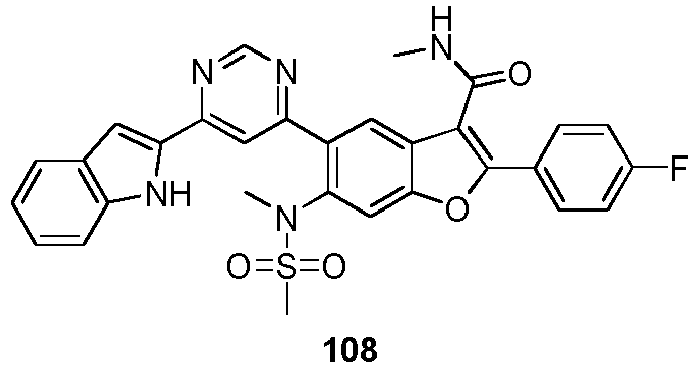
-

- To a mixture of 1-(tert-butoxycarbonyl)-1H-indol-2-ylboronic acid (100 mg, 0.39 mmol), 4,6-dichloropyrimidine (290 mg, 1.9 mmol) and K3PO4·3H2O (310 mg, 1.2 mmol) in DMF (2 mL), Pd(dppf)Cl2 (28 mg, 0.04 mmol) was added under N2 atmosphere. The mixture was allowed to stir at 25 °C for 12 hours. Water was added, and then extracted with EtOAc. The combined organic layers were washed with brine, dried over Na2SO4. After being concentrated in vacuo, the resulting residue was purified using prep-TLC (eluted with PE : EtOAc = 4:1) to provide 2-(6-chloropyrimidin-4-yl)-1H-indole-1-carboxylate (100 mg, yield: 80%). 1H-NMR (CDCl3, 400 MHz) δ 9.01 (s, 1H), 8.16 (d, J = 4.8 Hz, 1H), 7.63 (d, J = 7.6 Hz, 1H), 7.53 (s, 1H), 7.41∼7.45 (m, 1H), 7.29∼7.31 (m, 1H), 7.02 (s, 1H), 1.54 (s, 9H).
-

- To a mixture of 2-(6-chloropyrimidin-4-yl)-1H-indole-1-carboxylate (91 mg, 0.28 mmol) in MeOH (1 mL), 4 N HCl in MeOH (2 mL) was added at 0 °C. The mixture was allowed to stir at 25 °C for 1 hour, then the reaction mixture was concentrated in vacuo. The resulting residue was purified using prep-TLC (eluted with PE : EtOAc = 4 : 1) to provide 2-(6-chloropyrimidin-4-yl)-1H-indole (60 mg, yield: 90%).
-

- A mixture of 2-(6-chloropyrimidin-4-yl)-1H-indole (72 mg, 0.3 mmol), 2-(4-fluorophenyl)-N-methyl-6-(N-methylmethylsulfonamido)-5-(4,4,5,5-tetramethyl-1,3,2-dioxaborolan-2-yl)benzofuran-3-carboxamide (Compound I, 174 mg, 0.3 mmol), K3PO4·3H2O (250 mg, 0.9 mmol), Pd2(dba)3 (14 mg, 0.016 mmol), X-Phos (15 mg, 0.032 mmol) was allowed to stir in dioxane / H2O (5 mL, 4 / 1) at 110 °C for 12 hours. The reaction mixture was cooled to 25 °C, diluted with water and extracted with ethyl acetate. The organic extract was washed with brine, dried over Na2SO4, filtered and concentrated in vacuo. The resulting residue was purified using prep-HPLC to provide Compound 108 (35 mg, yield: 18%). 1H-NMR (CDCl3, 400 MHz) δ 9.65 (s, 1H), 9.25 (s, 1H), 8.25 (s, 1H), 8.13 (s, 1H), 7.95∼7.99 (m, 2H), 7.60∼7.65 (m, 2H), 7.38∼7.45 (m, 2H), 7.28 (m, 1H), 7.09∼7.16 (m, 3H), 6.35 (s, 1H), 3.23 (s, 3H), 2.97 (d, J= 4.8 Hz, 3H), 2.95 (s, 3H). MS (M+H) +: 570.
- Compounds 136, depicted in the table below, was prepared using the method described in Example 13 and substituting the appropriate reactants and/or reagents.
No. Structure NMR MS (M+H) + 136 
1H-NMR (EDCl3, 400 MHz) δ 9.83 (s, 1H), 7.86∼7.90 (m, 3H), 7.60 (d, J = 8.0 Hz, 1H), 7.52 (s, 1H), 7.28∼7.40 (m, 3H), 7.10∼7.14 (m, 4H), 7.02 (t, J = 7.2 Hz, 1H), 5.95 (d, J = 4.4 Hz, 1H), 4.00 (s, 3H), 3.07 (s, 3H), 2.88 (d, J = 4.8 Hz, 3H), 2.72 (s, 3H). 599 -

-

- To a mixture of 1-(tert-butoxycarbonyl)-1H-indol-2-ylboronic acid (200 mg, 0.78 mmol), 2,4,6-trichloropyrimidine (436 mg, 2.4 mmol) and K3PO4·3H2O (620 mg, 2.4 mmol) in DMF (4 mL), under N2 atmosphere, was added Pd(dppf)Cl2 (56 mg, 0.08 mmol). The reaction was heated to 80 °C and allowed to stir at this temperature for 12 hours. Water was added, and the resulting solution was extracted with EtOAc. The organic extract was washed with brine, dried over Na2SO4, filtere and concentrated in vacuo and the resulting residue was purified using prep-TLC (eluted with PE : EtOAc = 5 : 1) to provide tert-butyl 2-(2,6-dichloropyrimidin-4-yl)-1H-indole-1-carboxylate (142 mg, yield: 50%). 1H-NMR (Methanol-d4, 400 MHz) δ 8.09 (d, J = 7.6 Hz, 1H), 7.55∼7.58 (m, 1H), 7.40 (s, 1H), 7.21∼7.25 (m, 1H), 7.09 (s, 1H), 7.01 (s, 1H), 1.43 (s, 9H).
-

- To a mixture of tert-butyl 2-(2,6-dichloropyrimidin-4-yl)-1H-indole-1-carboxylate (110 mg, 0.3 mmol), 2-(4-fluorophenyl)-N-methyl-6-(N-methylmethylsulfonamido)-5-(4,4,5,5-tetramethyl-1,3,2-dioxaborolan-2-yl)benzofuran-3-carboxamide (Compound I, 151 mg, 0.3 mmol) and K3PO4·3H2O (310 mg, 1.2 mmol) in DMF (4 mL), under N2 atmosphere, was added Pd(dppf)Cl2(28 mg, 0.04 mmol). The reaction was heated to 80 °C and allowed to stir at this temperature for 12 hours. Water was added, and the aqueous solution was extracted with EtOAc. The combined organic layers were washed with brine, dried over Na2SO4, filtered and concentrated in vacuo and the resulting residue was purified using prep-TLC (eluted with PE : EtOAc = 4 : 1) to provide tert-butyl 2-(2-chloro-6-(2-(4-fluorophenyl)-3-(methylcarbamoyl)-6-(N-methylmethylsulfonamido)benzofuran-5-yl)pyrimidin-4-yl)-1H-indole-1-carboxylate (115 mg, yield: 55%).
-

- To a solution of tert-butyl 2-(2-chloro-6-(2-(4-fluorophenyl)-3-(methylcarbamoyl)-6-(N-methylmethylsulfonamido)benzofuran-5-yl)pyrimidin-4-yl)-1H-indole-1-carboxylate (35 mg, 0.05 mmol) in MeOH (2 mL), NaOCH3 (8 mg, 0.15 mmol) in MeOH (0.1 mL) was added by dropwise at 25 °C. The mixture was allowed to stir at 60 °C for 3 hours, Then cooled to 25 °C and H2O (5 mL) was added to the mixture. Then the mixture was extracted with ethyl acetate and washed with brine, dried over Na2SO4. After being concentrated in vacuo, the resulting residue was purified using prep-HPLC to provide Compound 150 (20 mg, yield: 70%). 1H-NMR (CDCl3, 400 MHz) δ 9.50 (s, 1H), 8.16 (s, 1H), 7.94∼7.98 (m, 2H), 7.78 (s, 1H), 7.64∼7.68 (m, 2H), 7.44∼7.46 (m, 1H), 7.28∼7.31 (m, 2H), 7.12∼7.23 (m, 3H), 5.96 (s, 1H), 4.15 (s, 3H), 3.28 (s, 3H), 3.01 (d, J = 4.8 Hz, 3H), 2.96 (s, 3H). MS (M+H) +: 600.
-

-
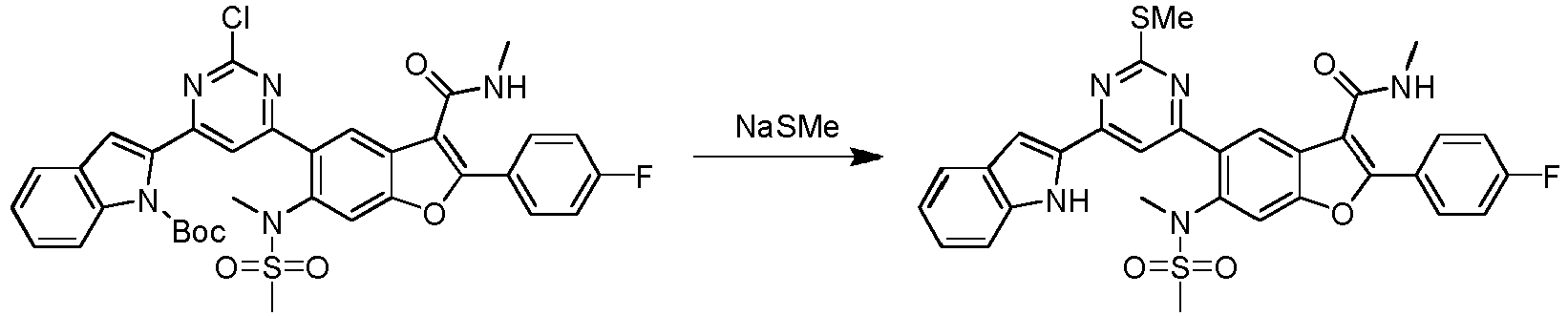
- To a solution of tert-butyl 2-(2-chloro-6-(2-(4-fluorophenyl)-3-(methylcarbamoyl)- 6-(N-methylmethylsulfonamido)benzofuran-5- yl)pyrimidin- 4-yl)-1H-indole-1-carboxylate (57 mg, 0.08 mmol) in CH3CN (2 mL), was added NaSMe (70 mg, 1 mmol). The reaction was allowed to stir at reflux for about 15 hours, then the reaction mixture was directly purified using prep-TLC (eluted with PE : EtOAc = 1:1) to provide 5-(6-(1H-indol-2-yl)-2-(methylthio)pyrimidin-4-yl)-2-(4-fluorophenyl)-N-methyl-6-(N-methylmethylsulfonamido)benzofuran-3-carboxamide (40 mg, yield: 80%). 1H-NMR (CDCl3, 400 MHz) δ 9.37 (s, 1H), 8.09 (s, 1H), 7.88∼7.92 (m, 2H), 7.71 (s, 1H), 7.60∼7.63 (m, 2H), 7.40∼7.42 (m, 1H), 7.21∼7.28 (m, 2H), 7.06∼7.15 (m, 3H), 5.81∼5.82 (m, 1H), 3.21 (s, 3H), 2.95 (d, J= 4.8 Hz, 3H), 2.87 (s, 3H), 2.64 (s, 3H).
-
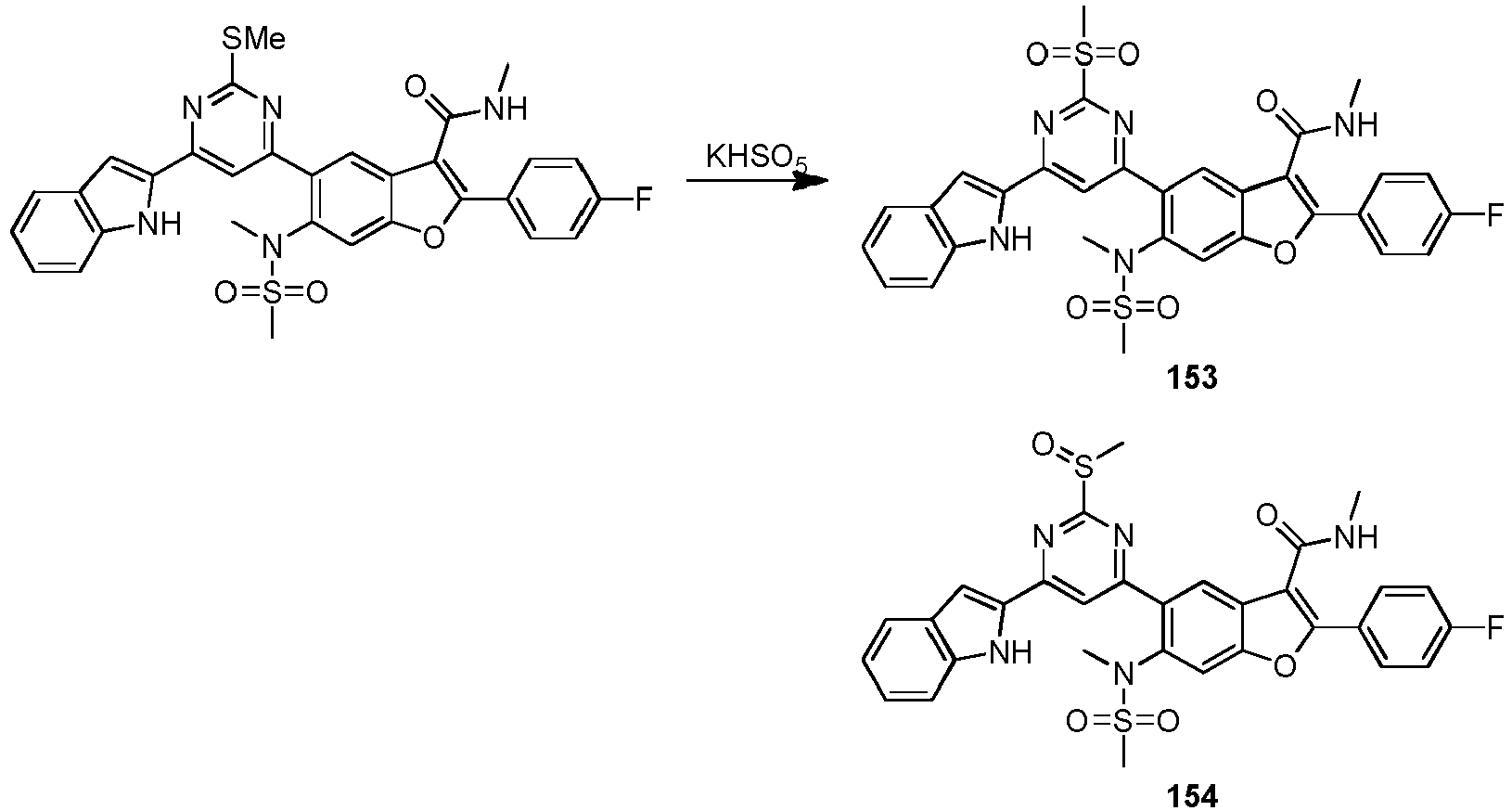
- To a mixture of 5-(6-(1H-indol-2-yl)-2-(methylthio)pyrimidin-4-yl)-2-(4-fluorophenyl)-N-methyl-6-(N-methylmethylsulfonamido)benzofuran-3-carboxamide (20 mg, 0.033 mmol) in DCM (2 mL), was added KHSO5 (0.02 mL, 0.13 mmol). The reaction was allowed to stir at 25 °C for 12 hours, then the reaction mixture was poured into water and extracted with ethyl acetate. The organic extract was washed with brine, dried over Na2SO4, filtered and concentrated in vacuo, and the resulting residue was purified using prep-TLC (eluted with PE : EtOAc = 1:1) to provide Compound 153 (10 mg, yield: 50%) and Compound 154 (5 mg, yield: 25%).
- Compound 153: 1H-NMR (CDCl3, 400 MHz) δ 9.73 (s, 1H), 8.24 (d, J = 6.4 Hz, 2H), 7.91∼7.95 (m, 2H), 7.65∼7.71 (m, 2H), 7.31∼7.49 (m, 3H), 7.14∼7.24 (m, 3H), 5.90 (s, 1H), 3.43 (s, 3H), 3.36 (s, 3H), 3.01 (d, J = 4.8 Hz, 3H), 2.97 (s, 3H). MS (M+H)+: 647.
- Compound 154: 1H-NMR (CDCl3, 400 MHz) δ 10.18 (s, 1H), 8.25 (s, 1H), 8.12 (s, 1H), 7.93∼7.97 (m, 2H), 7.65∼7.71 (m, 2H), 7.47∼7.49 (m, 1H), 7.38 (s, 1H), 7.30∼7.34 (m, 1H), 7.14∼7.24 (m, 3H), 5.94 (s, 1H), 3.36 (s, 3H), 3.06 (s, 3H), 3.02 (d, J = 4.8 Hz, 3H), 2.98 (s, 3H). MS (M+H)+: 632.
-

-

- 4-chlorobutanoyl chloride (670 mg, 4.76 mmol) was added dropwise to a 0 °C solution of ethyl 6-amino-5-bromo-2-(4-fluorophenyl)benzofuran-3- carboxylate and Et3N (1.0 mL) in CH2Cl2 (10 mL) under N2 atmosphere. The resulting reaction was allowed to stir at room temperature for 16 hours, then the reaction mixture was concentrated in vacuo. The resulting residue was dissolved in CH3CN (10 mL), and then K2CO3 (658 mg, 4.76 mmol) and KI (263 mg, 1.59 mmol) was added and the mixture was heated to reflux and allowed to stir at this temperature for 16 hours. After being cooled to room temperature, the mixture was diluted with water and extracted with EtOAc. The organic extract was washed with brine, dried over Na2SO4, filtered and concentrated in vacuo. The residue obtained was purified using column chromatography (eluted with PE : EtOAc = 2:1) to provide ethyl 5-bromo-2-(4-fluorophenyl)-6-(2-oxopyrrolidin-1-yl)benzofuran-3-carboxylate (280 mg, yield: 40%). 1H-NMR (CDCl3, 400 MHz) δ 8.32 (s, 1H), 8.04∼8.07 (m, 2H), 7.48 (s, 1H), 7.17∼7.21 (m, 2H), 4.42∼4.43 (m, 2H), 3.82∼3.86 (m, 2H), 2.61∼2.65 (m, 2H), 2.27∼2.31 (m, 2H), 1.40∼1.44 (m, 3H).
-

- A solution of ethyl 5-bromo-2-(4-fluorophenyl)-6-(2-oxopyrrolidin-1-yl)benzofuran-3-carboxylate (2.5 g, 5.8 mmol) and LiOH (0.5 g, 21.0 mmol) in dioxane (30 mL) and water (10 mL) was allowed to stir at 90 °C for 1 hour. The mixture was cooled to room temperature and extracted with DCM, the organic extract was washed with brine, dried over Na2SO4 and concentrated to provide 5-bromo-2-(4-fluorophenyl)-6-(2-oxopyrrolidin-1-yl)benzofuran-3-carboxylic acid (2.2 g, yield: 91%). 1H-NMR (CDCl3, 400 MHz) δ 8.08 (s, 1H), 7.81∼7.84 (m, 2H), 7.34 (s, 1H), 6.89∼6.93 (m, 2H), 3.79∼3.82 (m, 2H), 2.66∼2.70 (m, 2H), 2.26∼2.31 (m, 2H).
-

- A solution of 5-bromo-2-(4-fluorophenyl)-6-(2-oxopyrrolidin-1-yl)benzofuran-3-carboxylic acid (280 mg, 0.67 mmol), HOBT (150 mg, 1.11 mmol) and EDCI (280 mg, 1.47 mmol) in dry DMF (2 mL) was allowed to stir at room temperature for 1 hour. Then Et3N (0.2 mL) and CH3NH2 (HCl salt, 100 mg, 1.48 mmol) was added to the mixture, and the reaction was allowed to stir for about 15 hours. After being concentrated in vacuo, water was added and the mixture was extracted with ethyl acetate. The organic extract was washed with brine, dried and concentrated in vacuo and the resulting residue was purified using column chromatography (eluted with PE : EtOAc = 1 : 1) to provide 5-bromo-2-(4-fluorophenyl-N-methyl-6-(2-oxopyrrolidin-1-yl)benzofuran-3-carboxamide (Compound W, 220 mg, yield: 73%). 1H-NMR (CDCl3, 400 MHz) δ 7.94 (s, 1H), 7.82∼7.86 (m, 2H), 7.32 (s, 1H), 7.09∼7.14 (m, 2H), 6.29 (s, 1H), 3.75∼3.78 (m, 2H), 2.97 (d, J = 4.8 Hz, 3H), 2.56∼2.60 (m, 2H), 2.24∼2.26 (m, 2H).
-

- To a solution of 2-(5-bromopyridin-3-yl)-4,4-difluoro-4,5,6,7-tetrahydrobenzo[d]thiazole (intermediate of Compound 92, described in step 2 of Example 9, 270 mg, 0.82 mmol), 4,4,4',4',5,5,5',5'-octamethyl-2,2'- bis(1,3,2-dioxaborolane) (625 mg, 2.46 mmol) and KOAc (322 mg, 3.28 mmol) in dioxane (15 mL), under N2 atmosphere, was added Pd(dppf)Cl2 (30 mg, 0.04 mmol). The reaction was heated to 80∼90 °C and allowed to stir at this temperature for about 15 hours. The reaction mixture was filtered and the filtrated was concentrated in vacuo. The resulting residue was purified using column chromatography on silica gel (eluted with PE : EtOAc = 5 : 1 ∼ 2 : 1) to provide 4,4-difluoro-2-(5-(4,4,5,5-tetramethyl-1,3,2-dioxaborolan-2-yl)pyridin-3-yl)-4,5,6,7-tetrahydrobenzo[d]thiazole as light yellow solid (100 mg, yield: 32.2%). 1H-NMR (CDCl3, 400 MHz) δ 9.20 (s, 1H), 8.97 (s, 1H), 8.16 (s, 1H), 2.93∼2.98 (m, 2H), 2.33∼2.44 (m, 2H), 2.07∼2.19 (m, 2H), 1.35 (s, 12H).
-

- Compound 155 was made from the indicated starting material using methods described in Example 1. 1H-NMR (CDCl3, 400 MHz) δ 9.20 (s, 1H), 8.79 (s, 1H), 8.63 (s, 1H), 7.91∼7.96 (m, 3H), 7.54 (s, 1H), 7.22 (t, J = 8.8 Hz, 2H), 5.98 (d, J = 4.0 Hz, 1H), 3.68 (t, J = 6.8 Hz, 2H), 2.99∼3.03 (m, 5H), 2.38∼2.44 (m, 4H), 2.09∼2.19 (m, 4H). MS (M+H)+: 603.
-

-

- NaH in oil (120 mg, 3.1 mmol) was added to a solution of 1H-indazole (300 mg, 2.5 mmol) in THF (10 mL) at 0 °C in portions. The mixture was stirred at 0 °C for 10 min, and then 2-fluoro-4-iodopyridine (680 mg, 3.1 mmol) was added to the mixture. The mixture was stirred at 80 °C for 6 h. After concentrated, the mixture was diluted with water and extracted with EtOAc. The combined organic layers were wahed with brine, dried over Na2SO4, filtered and concentrated. The residue was purified by column chromatography (PE : EA = 100 : 1) to give 1-(4-iodopyridin-2-yl)-1H-indazole (280 mg, yield: 34.4%) as a white solid. 1H-NMR (CDCl3, 400 MHz) δ 8.97 (s, 1H), 8.64 (s, 1H), 8.06 (d, J = 5.2 Hz, 1H), 7.61∼7.67 (m, 2H), 7.57 (d, J = 5.2 Hz, 1H), 7.23∼7.27 (m, 1H), 7.00∼7.04 (m, 1H). MS (M+H)+: 119.
-

- To a degassed solution of 2-(4-fluorophenyl)-N-methyl-6-(N-methylmethylsulfonamido)-5-(4,4,5,5-tetramethyl-1,3,2-dioxaborolan-2-yl)benzofuran-3-carboxamide (Compound I, 80 mg, 0.2 mmol) and 2-(5-bromo-2-methoxypyridin-3-yl)-4-fluorobenzo[d]oxazole (50 mg, 0.2 mmol) in dry DMF (3 mL) were added Pd(dppf)Cl2 (10 mg) and K3PO4 (120 mg, 0.4 mmol) under N2 protection. The mixture was heated to 100 °C and allowed to stir at this temperature for about 2 hours and then it was cooled to room temperature and filtered. The filtrate was washed with H2O, brine, dried over Na2SO4. After concentrated in vacuo, the resulting residue was purified using prep-HPLC to provide Compound 251 (60 mg, yield: 65.9%). 1H-NMR (CDCl3, 400 MHz) δ 9.15 (s, 1H), 8.31 (d, J = 8.4 Hz, 1H), 8.11 (s, 1H), 7.94∼7.98 (m, 3H), 7.75∼7.77 (m, 1H), 7.71 (d, J = 8.8 Hz, 1H), 7.67 (s, 1H), 7.61 (d, J = 8.8 Hz, 1H), 7.35 (t, J = 6.0 Hz, 1H), 7.32∼7.33 (m, 2H), 7.08∼7.22 (m, 1H), 5.92 (d, J = 4.4 Hz, 1H), 3.30 (s, 3H), 3.00 (d, J = 4.8 Hz, 3H), 2.73 (s, 3H). MS (M+H)+: 570.
-
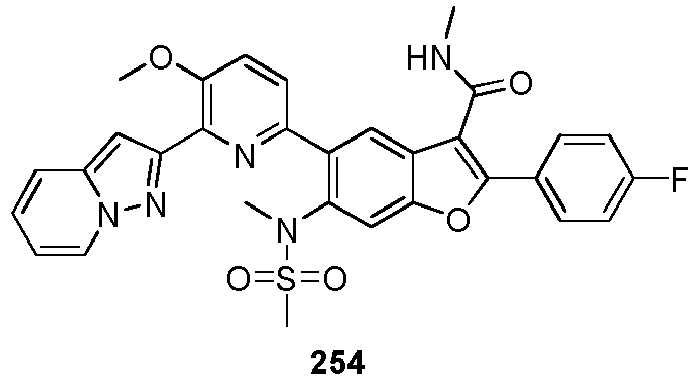
-
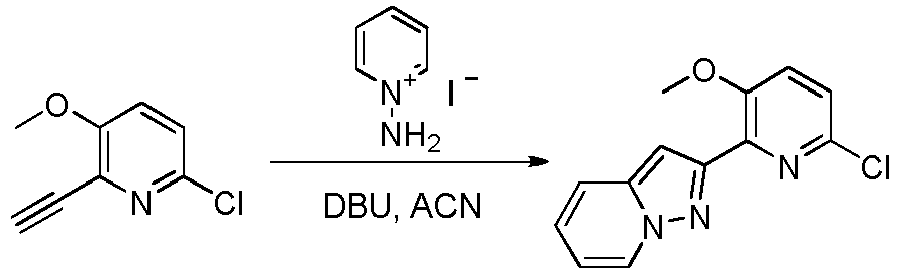
- A mixture of 6-chloro-2-ethynyl-3-methoxypyridine (38 mg, 0.2 mmol), 1-aminopyridinium iodide (50 mg, 0.2 mmol) and DBU (67 mg, 0.4 mmol) in MeCN (2 mL) was stirred at 80 °C for 2 h. Then, water (10 mL) was added and the mixture was extracted with ethyl acetate. The organic layer was washed with brine and dried over Na2SO4. After concentrated, the residue was purified by prep-TLC (PE : EA = 2 : 1) to give the product of 2-(6-chloro-3-methoxypyridin-2-yl) pyrazolo [1,5-a]pyridine (25 mg, yield: 45%). 1H-NMR (Methanol-d4, 400 MHz) δ 8.67 (d, J = 9.2 Hz, 2H), 8.57 (d, J = 7.2 Hz, 1H), 7.45 (d, J = 8.4 Hz, 1H), 7.38∼7.45 (m, 1H), 7.15 (d, J = 8.4 Hz, 1H), 7.00∼7.04 (m, 1H), 4.01 (s, 3H). MS (M+H)+: 260.
-

- To a degassed solution of 2-(4-fluorophenyl)-N-methyl-6-(N-methylmethylsulfonamido)-5-(4,4,5,5-tetramethyl-1,3,2-dioxaborolan-2-yl)benzofuran-3-carboxamide (Compound I, 140 mg, 0.3 mmol) and 2-(6-chloro-3-methoxypyridin-2-yl) pyrazolo [1,5-a]pyridine (60 mg, 0.2 mmol) in dioxane/H2O (2 mL/0.5 mL) were added Pd2(dba)3 (21 mg), X-Phos (22 mg) and K3PO4 (180 mg, 0.7 mmol) under N2 protection. The mixture was heated to 100 °C and allowed to stir at this temperature for about 2 hours and then it was cooled to room temperature and filtered. The filtrate was washed with H2O, brine, dried over Na2SO4. After concentrated in vacuo, the resulting residue was purified using prep-HPLC to provide Compound 254 (70 mg, yield: 50.0%). 1H-NMR (DMSO-d6 , 400 MHz) δ 8.69 (d, J = 7.2 Hz, 1H), 8.55 (s, 1H), 8.11∼8.07 (m, 3H), 8.03 (s, 1H), 7.96 (dd, J = 8.8, 5.2 Hz, 2H), 7.82 (d, J = 8.8 Hz, 1H), 7.48 (t, J = 7.6 Hz, 1H), 7.3 0 (t, J = 8.8 Hz, 2H), 7.11 (t, J = 6.8 Hz, 1H), 4.12 (s, 3H), 3.43 (s, 3H), 2.98 (s, 3H), 2.93 (s, 3H). MS (M+H)+: 600.
-

-

- To a solution of 2-(4-fluorophenyl)-5-formyl-N-methyl-6-(N-methylmethylsulfonamido)benzofuran-3-carboxamide (100 mg, 0.3 mmol) in THF / H2O (2:1, 15 mL), NaH2PO4·3H2O (200 mg, 1.2 mmol) and sulfamic acid (50 mg, 0.5 mmol) were added at room temperature and the resulting mixture was stirred at 0 °C for 10 mins. Then a solution of NaClO2 (30 mg, 0.3 mmol) in H2O was added dropwise and the mixture was stirred at 0 °C for 2 hours. After NaHSO3 (aq) was added, the mixture was stirred at room temperature for 10 mins and extracted with EtOAc. The combined organic phases were washed with brine, dried over Na2SO4, filtered and evaporated to give 2-(4-fluorophenyl)-3-(methylcarbamoyl)-6-(N-methylmethylsulfonamido)benzofuran-5-carboxylic acid (100 mg, yield: 96%).1H-NMR (DMSO-d6 , 400 MHz) δ 13.02 (br s, 1H), 8.58 (br s, 1H), 7.96∼8.01 (m, 4H), 7.39∼7.45 (m, 2H), 3.28 (s, 3H), 3.04 (s, 3H), 2.85 (d, J = 4.4 Hz, 3H). MS (M+H)+: 421.
-

- 2-(4-fluorophenyl)-3-(methylcarbamoyl)-6-(N-methylmethylsulfonamido)benzofuran-5-carboxylic acid (50 mg, 0.1 mmol), HOBT (20 mg, 0.2 mmol) and EDCI (50 mg, 0.3 mmol) were dissolved in dry DMF (2 mL). The resulting solution was stirred for 2 hours. And then 4-fluoro-1H-indole-2-carbohydrazide (25 mg, 0.1 mmol) and Et3N (0.1 mL) were added to the mixture. The mixture was stirred at RT overnight. Then H2O was added, and the mixture was extracted with EtOAc. The combined organic phases were washed with brine, dried over Na2SO4, filtered and evaporated. The crude product was purified by prep-HPLC to give the product 5-(2-(4-fluoro-1H-indole-2-carbonyl)hydrazinecarbonyl)-2-(4-fluorophenyl)-N-methyl-6-(N-methylmethylsulfonamido)benzofuran-3-carboxamide (60 mg, yield: 82%). 1H-NMR (DMSO-d6 , 400 MHz) δ 12.16 (s, 1H), 10.77 (br s, 1H), 10.44 (br s, 1H), 8.62 (d, J = 4.8 Hz, 1H), 7.99∼8.03 (m, 2H), 7.92 (s, 2H), 7.40∼7.46 (m, 3H), 7.32 (d, J = 8.4 Hz, 1H), 7.18∼7.24 (m, 1H), 6.84∼6.89 (m, 1H), 3.33 (s, 3H), 3.17 (s, 3H), 2.88 (d, J = 4.4 Hz, 3H). MS (M+H)+: 596.
-

- To a solution of 5-(2-(4-fluoro-1H-indole-2-carbonyl)hydrazinecarbonyl)-2-(4-fluorophenyl)-N-methyl-6-(N-methylmethylsulfonamido)benzofuran-3-carboxamide (90 mg, 0.2 mmol) in ACN (5 mL), PPh3 (80 mg, 0.3 mmol) and DIPEA (150 mg, 1.2 mmol) were added. The reaction mixture was stirred at RT for 2 mins. Then Cl3CCCl3 (70 mg, 0.3 mmol) was added and the mixture was stirred at RT overnight. After concentrated, the residue was suspended in water and extracted with EtOAc. The combined organic phases were washed with brine, dried over Na2SO4, filtered and evaporated. The residue was purified by prep-HPLC to give the product of Compound 256 (10 mg, yield: 11%). 1H-NMR (DMSO-d6 , 400 MHz) δ 12.72 (s, 1H), 8.66 (d, J = 4.4 Hz, 1H), 8.39 (s, 1H), 8.25 (s, 1H), 7.99∼8.03 (m, 2H), 7.42∼7.47 (m, 2H), 7.35∼7.37 (m, 2H), 7.24∼7.29 (m, 1H), 6.89∼6.94 (m, 1H), 3.43 (s, 3H), 3.14 (s, 3H), 2.88 (d, J = 4.4 Hz, 3H). MS (M+H)+: 578.
-

-

- To a solution of (1-(tert-butoxycarbonyl)-4-fluoro-1H-indol-2-yl) boronic acid (126 g, 0.45 mol, 1.2 eq) and 6-chloro-2-iodopyridin-3-ol (96 g, 0.37 mmol, 1 eq) in 1, 4-dioxane (1.8 L) and water (0.2 L) were added Pd(PPh3)2Cl2 (13.2 g, 18.6 mmol, 0.05 eq) and NaHCO3 (94.8 g, 1.13 mol, 3 eq) under nitrogen atmosphere, and the mixture was heated at 90 °C under N2 for 16 h. The reaction mixture was cooled to room temperature, diluted with EtOAc (900 mL), filtered and concentrated. The residue was diluted with H2O (400 mL) and EtOAc (800 mL), and the layer was separated, the aqueous layer was extracted with EtOAc (3 × 400 mL). The combined organic layers were washed with brine (800 mL), dried over Na2SO4, filtered and concentrated. The residue was purified by column chromatography (PE: EtOAc = 20 : 1 ∼ 3 : 1) to give 6-chloro-2-(4-fluoro-1H-indol-2-yl)pyridin-3-ol (70 g, yield: 70.1%). 1H-NMR (Methanol-d4, 400 MHz) δ 7.36 (s, 1H), 7.23∼7.27 (m, 2H), 7.03∼7.11 (m, 2H), 6.63∼6.68 (m, 1H). MS (M+H)+: 263.
-

- A solution of 6-chloro-2-(4-fluoro-1H-indol-2-yl)pyridin-3-ol (10 g, 38 mmol) and Sn (23 g, 190 mmol) in CH3CH2OH / con. HCl (60 mL / 40 mL) was stirred under reflux for 3 h. The mixture was cooled to room temperature and adjusted to pH = 7 by saturated NaOH and filtered though a Celit pad. The filtrate was extracted with EtOAc, washed by brine, dried over Na2SO4 and concentrated. The residue was purified by silica gel chromatography (PE : EA = 10 : 1) to get 6-chloro-2-(4-fluoroindolin-2-yl) pyridin-3-ol (8 g, yield: 80%). 1H-NMR (CDCl3, 400 MHz) δ 9.86 (s, 1H), 7.10∼7.20 (m, 3H), 6.33∼6.91 (m, 2H), 5.15∼5.21 (m, 1H), 4.61 (s, 1H), 3.65∼3.71 (m, 1H), 3.04∼3.11 (m, 1H). MS (M+H)+: 265.
-

- The procedure of Compound 257 (50 mg, yield: 57%) was similar to step 3 of Example 1. 1H-NMR (CDCl3, 400 MHz) δ 7.93∼7.98 (m, 3H), 7.62 (s, 1H), 7.42 (d, J = 8.4 Hz, 1H), 7.29 (d, J = 8.4 Hz, 1H), 7.17-7.23 (m, 2H), 7.09-7.15 (m, 1H), 6.61∼6.69 (m, 2H), 5.94 (br s, 1H), 5.28 (dd, J = 9.2 Hz, 11.6 Hz 1H), 3.68 (dd, J = 9.2 Hz, 15.6 Hz 1H), 3.29 (s, 3H), 3.16 (dd, J=15.6, 11.6 Hz, 1H), 2.99 (d, J=4.8 Hz, 3H), 2.78 (s, 3H). (M+H)+: 605.
-

-

- A mixture of 6-bromopyrazine-2-carboxylic acid (404 mg, 1.99 mmol), 2-(4-fluorophenyl)-N-methyl-6-(N-methylmethylsulfonamido)-5-(4,4,5,5-tetramethyl-1,3,2-dioxaborolan-2-yl)benzofuran-3-carboxamide (1 g, 1.99 mmol), 2M sodium carbonate (4 ml, 8 mmol), Bis(triphenylphosphine)palladium(II) dichloride (70 mg, 0.1 mmol) was suspended in DME (7 ml), DMF (2 ml), water (3 ml) and EtOH (2 ml) in a sealed tube and heated in a microwave oven at 120°C for 20 min.. Then concentrated under vacuum, applied onto Prep HPLC and eluted with H2O (0.1%TFA) and Acetonitrile(0.1%TFA). This resulted in 0.96g (95 %) of 6-(2-(4-fluorophenyl)-3-(methylcarbamoyl)-6-(N-methylmethylsulfonamido)benzofuran-5-yl)pyrazine-2-carboxylic acid as a white solid. LC-MS (ES, m/z) C23H19FN4O6S: 498; Found: 499 [M+H]+.
-
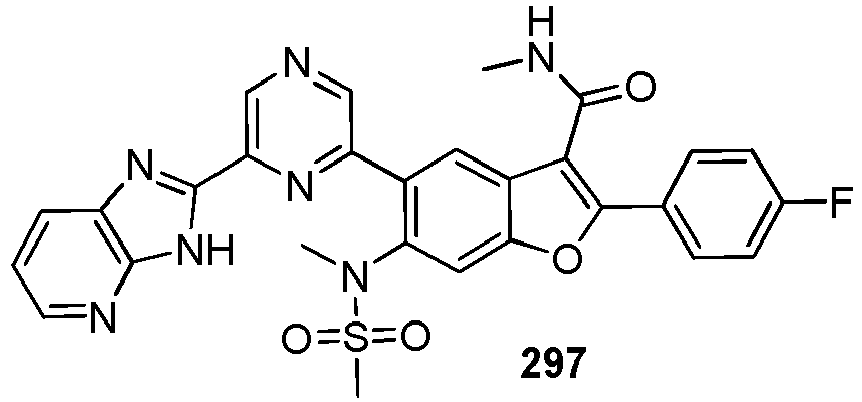
- A mixture of Int-21a (10.95 mg, 0.100 mmol), diethyl cyanophosphonate (18.00 mg, 0.110 mmol) and triethylamine (0.042 ml, 0.301 mmol) was dissolved in DME (2 ml) in a sealed tube and heated in a microwave oven at 170°C for 1 hour. The reaction mixture was then concentrated under vacuum and the residue obtained was purified using Prep HPLC and eluting with H2O (0.1 %TFA) and acetonitrile(0.1%TFA) to provide 14 mg (20.4 %) of Compound 297 as a white solid. LC-MS (ES, m/z) C28H22FN7O4S : 571; Found: 572 [M+H]+.
- Measurement of inhibition by compounds was performed using the HCV replicon system. Several different replicons encoding different HCV genotypes or mutations were used. In addition, potency measurements were made using different formats of the replicon assay, including different ways of measurements and different plating formats. See Jan M. Vrolijk et al., A replicons-based bioassay for the measurement of interferons in patients with chronic hepatitis C, 110 J. VIROLOGICAL METHODS 201 (2003); Steven S. Carroll et al., Inhibition of Hepatitis C Virus RNA Replication by 2'-Modified Nucleoside Analogs, 278(14) J. BIOLOGICAL CHEMISTRY 11979 (2003). However, the underlying principles are common to all of these determinations, and are outlined below.
- Stable neomycin phosphotransferase encoding replicons-harboring cell lines were used, so all cell lines were maintained under G418 selection prior to the assay. Potency was deteremined using a cell ELISA assay with an antibody to the replicons encoded NS3/4a protease. See Caterina Trozzi et al., In Vitro Selection and Characterization of Hepatitis C Virus Serine Protease Variants Resistant to an Active-Site Peptide Inhibitor, 77(6) J. Virol. 3669 (2003). To initiate an assay, replicon cells were plated in the presence of a dilution series of test compound in the absence of G418. Typically, the assays were performed in a 96-well plate formate for manual operation, or a 384-well plate format for automated assay. Replicon cells and compound were incubated for 96 hours. At the end of the assay, cells were washed free of media and compound, and the cells were then lysed. RNA was quantified indirectly through detection of replicon-encoded NS3/4A protein levels, through an ELISA-based assay with an antibody specific for NS3/4A. IC50 determinations were calculated as a percentage of a DMSO control by fitting the data to a four-parameter fit function and the data obtained is provided in the table below.
- Data for selected compounds of the present invention was obtained for genotypes 1a and 1b using this method and is provided in the table below:
Compound No. 1a IC50 (nM) 1b IC50 (nM) 2 0.3 0.8 - The Heterocyclic-Substituted Benzofuran Derivatives are useful in human and veterinary medicine for treating or preventing a viral infection in a patient. In one embodiment, the Heterocyclic-Substituted Benzofuran Derivatives can be inhibitors of viral replication. In another embodiment, the Heterocyclic-Substituted Benzofuran Derivatives can be inhibitors of HCV replication. Accordingly, the Heterocyclic-Substituted Benzofuran Derivatives are useful for treating viral infections, such as HCV. In accordance with the invention, the Heterocyclic-Substituted Benzofuran Derivatives can be administered to a patient in need of treatment or prevention of a viral infection.
- Accordingly, in one embodiment, the invention provides at least one Heterocyclic-Substituted Benzofuran Derivative or a pharmaceutically acceptable salt thereof, for use in treating a viral infection in a patient.
- The Heterocyclic-Substituted Benzofuran Derivatives may be useful for treating or preventing a viral infection caused by the Flaviviridae family of viruses.
- Examples of Flaviviridae infections include but are not limited to, Japanese encephalitis, Kyasanur Forest disease, Murray Valley encephalitis, St. Louis encephalitis, Tick-borne encephalitis, West Nile encephalitis, yellow fever and Hepatitis C Virus (HCV) infection.
- In one embodiment, the Flaviviridae infection being treated is hepatitis C virus infection.
- The Heterocyclic-Substituted Benzofuran Derivatives are useful in the inhibition of HCV (e.g., HCV NS5B), the treatment of HCV infection and/or reduction of the likelihood or severity of symptoms of HCV infection and the inhibition of HCV viral replication and/or HCV viral production in a cell-based system. For example, the Heterocyclic-Substituted Benzofuran Derivatives are useful in treating infection by HCV after suspected past exposure to HCV by such means as blood transfusion, exchange of body fluids, bites, accidental needle stick, or exposure to patient blood during surgery or other medical procedures.
- In one embodiment, the hepatitis C infection is acute hepatitis C. In another embodiment, the hepatitis C infection is chronic hepatitis C.
- Accordingly, in one embodiment, the invention provides at least one Heterocyclic-Substituted Benzofuran Derivative or a pharmaceutically acceptable salt thereof for use in treating HCV infection in a patient. In a specific embodiment, the amount administered is effective to treat or prevent infection by HCV in the patient. In another specific embodiment, the amount administered is effective to inhibit HCV viral replication and/or viral production in the patient.
- The Heterocyclic-Substituted Benzofuran Derivatives are also useful in the preparation and execution of screening assays for antiviral compounds. For example the Heterocyclic-Substituted Benzofuran Derivatives are useful for identifying resistant HCV replicon cell lines harboring mutations within NS5B, which are excellent screening tools for more powerful antiviral compounds. Furthermore, the Heterocyclic-Substituted Benzofuran Derivatives are useful in establishing or determining the binding site of other antivirals to the HCV replicase.
- The compositions and combinations of the present invention can be useful for treating a patient suffering from infection related to any HCV genotype. HCV types and subtypes may differ in their antigenicity, level of viremia, severity of disease produced, and response to interferon therapy as described in Holland et al., Pathology, 30(2):192-195 (1998). The nomenclature set forth in Simmonds et al., J Gen Virol, 74(Pt11):2391-2399 (1993) is widely used and classifies isolates into six major genotypes, 1 through 6, with two or more related subtypes, e.g., 1a and 1b. Additional genotypes 7-10 and 11 have been proposed, however the phylogenetic basis on which this classification is based has been questioned, and thus types 7, 8, 9 and 11 isolates have been reassigned as type 6, and type 10 isolates as type 3 (see Lamballerie et al., J Gen Virol, 78(Pt1):45-51 (1997)). The major genotypes have been defined as having sequence similarities of between 55 and 72% (mean 64.5%), and subtypes within types as having 75%-86% similarity (mean 80%) when sequenced in the NS-5 region (see Simmonds et al., J Gen Virol, 75(Pt 5):1053-1061 (1994)).
- In another embodiment, the present uses for treating or preventing HCV infection can further comprise the administration of one or more additional therapeutic agents which are not Heterocyclic-Substituted Benzofuran Derivatives.
- In one embodiment, the additional therapeutic agent is an antiviral agent.
- In another embodiment, the additional therapeutic agent is an immunomodulatory agent, such as an immunosuppressive agent.
- Accordingly, in one embodiment, the present invention provides at least one Heterocyclic-Substituted Benzofuran Derivative or a pharmaceutically acceptable salt thereof, For use in treating a viral infection in a patient, comprising administering to the patient: (i) at least one Heterocyclic-Substituted Benzofuran Derivative, or a pharmaceutically acceptable salt thereof, and (ii) at least one additional therapeutic agent that is other than a Heterocyclic-Substituted Benzofuran Derivative, wherein the amounts administered are together effective to treat or prevent a viral infection.
- When administering a combination therapy of the invention to a patient, therapeutic agents in the combination, or a pharmaceutical composition or compositions comprising therapeutic agents, may be administered in any order such as, for example, sequentially, concurrently, together, simultaneously and the like. The amounts of the various actives in such combination therapy may be different amounts (different dosage amounts) or same amounts (same dosage amounts). Thus, for illustration purposes, a Heterocyclic-Substituted Benzofuran Derivative and an additional therapeutic agent may be present in fixed amounts (dosage amounts) in a single dosage unit (e.g., a capsule, a tablet and the like).
- In one embodiment, the at least one Heterocyclic-Substituted Benzofuran Derivative is administered during a time when the additional therapeutic agent(s) exert their prophylactic or therapeutic effect, or vice versa.
- In another embodiment, the at least one Heterocyclic-Substituted Benzofuran Derivative and the additional therapeutic agent(s) are administered in doses commonly employed when such agents are used as monotherapy for treating a viral infection.
- In another embodiment, the at least one Heterocyclic-Substituted Benzofuran Derivative and the additional therapeutic agent(s) are administered in doses lower than the doses commonly employed when such agents are used as monotherapy for treating a viral infection.
- In still another embodiment, the at least one Heterocyclic-Substituted Benzofuran Derivative and the additional therapeutic agent(s) act synergistically and are administered in doses lower than the doses commonly employed when such agents are used as monotherapy for treating a viral infection.
- In one embodiment, the at least one Heterocyclic-Substituted Benzofuran Derivative and the additional therapeutic agent(s) are present in the same composition. In one embodiment, this composition is suitable for oral administration. In another embodiment, this composition is suitable for intravenous administration. In another embodiment, this composition is suitable for subcutaneous administration. In still another embodiment, this composition is suitable for parenteral administration.
- Viral infections and virus-related disorders that can be treated or prevented using the combination therapies of the present invention include those listed above.
- In one embodiment, the viral infection is HCV infection.
- The at least one Heterocyclic-Substituted Benzofuran Derivative and the additional therapeutic agent(s) can act additively or synergistically. A synergistic combination may allow the use of lower dosages of one or more agents and/or less frequent administration of one or more agents of a combination therapy. A lower dosage or less frequent administration of one or more agents may lower toxicity of therapy without reducing the efficacy of therapy.
- In one embodiment, the administration of at least one Heterocyclic-Substituted Benzofuran Derivative and the additional therapeutic agent(s) may inhibit the resistance of a viral infection to these agents.
- Examples of additional therapeutic agents useful in the present compositions and methods include an interferon, an immunomodulator, a viral replication inhibitor, an antisense agent, a therapeutic vaccine, a viral polymerase inhibitor, a nucleoside inhibitor, a viral protease inhibitor, a viral helicase inhibitor, a virion production inhibitor, a viral entry inhibitor, a viral assembly inhibitor, an antibody therapy (monoclonal or polyclonal), and any agent useful for treating an RNA-dependent polymerase-related disorder.
- In one embodiment, the additional therapeutic agent is a viral protease inhibitor.
- In another embodiment, the additional therapeutic agent is a viral replication inhibitor.
- In another embodiment, the additional therapeutic agent is an HCV NS3 protease inhibitor.
- In still another embodiment, the additional therapeutic agent is an HCV NS5B polymerase inhibitor.
- In another embodiment, the additional therapeutic agent is a nucleoside inhibitor.
- In another embodiment, the additional therapeutic agent is an interferon.
- In yet another embodiment, the additional therapeutic agent is an HCV replicase inhibitor.
- In another embodiment, the additional therapeutic agent is an antisense agent.
- In another embodiment, the additional therapeutic agent is a therapeutic vaccine.
- In a further embodiment, the additional therapeutic agent is a virion production inhibitor.
- In another embodiment, the additional therapeutic agent is an antibody therapy.
- In another embodiment, the additional therapeutic agent is an HCV NS2 inhibitor.
- In still another embodiment, the additional therapeutic agent is an HCV NS4A inhibitor.
- In another embodiment, the additional therapeutic agent is an HCV NS4B inhibitor.
- In another embodiment, the additional therapeutic agent is an HCV NS5A inhibitor
- In yet another embodiment, the additional therapeutic agent is an HCV NS3 helicase inhibitor.
- In another embodiment, the additional therapeutic agent is an HCV IRES inhibitor.
- In another embodiment, the additional therapeutic agent is an HCV p7 inhibitor.
- In a further embodiment, the additional therapeutic agent is an HCV entry inhibitor.
- In another embodiment, the additional therapeutic agent is an HCV assembly inhibitor.
- In one embodiment, the additional therapeutic agents comprise a viral protease inhibitor and a viral polymerase inhibitor.
- In still another embodiment, the additional therapeutic agents comprise a viral protease inhibitor and an immunomodulatory agent.
- In yet another embodiment, the additional therapeutic agents comprise a polymerase inhibitor and an immunomodulatory agent.
- In another embodiment, the additional therapeutic agents comprise a viral protease inhibitor and a nucleoside.
- In another embodiment, the additional therapeutic agents comprise an immunomodulatory agent and a nucleoside.
- In one embodiment, the additional therapeutic agents comprise an HCV protease inhibitor and an HCV polymerase inhibitor.
- In another embodiment, the additional therapeutic agents comprise a nucleoside and an HCV NS5A inhibitor.
- In another embodiment, the additional therapeutic agents comprise a viral protease inhibitor, an immunomodulatory agent and a nucleoside.
- In a further embodiment, the additional therapeutic agents comprise a viral protease inhibitor, a viral polymerase inhibitor and an immunomodulatory agent.
- In another embodiment, the additional therapeutic agent is ribavirin.
- HCV polymerase inhibitors useful in the present compositions and treatments include, VP-19744 (Wyeth/ViroPharma), PSI-7851 (Pharmasset), RG7128 (Roche/Pharmasset), PSI-7977 (Pharmasset), PSI-938 (Pharmasset), PSI-879 (Pharmasset), PSI-661 (Pharmasset), PF-868554/filibuvir (Pfizer), VCH-759/VX-759 (ViroChem Pharma/Vertex), HCV-371 (Wyeth/VirroPharma), HCV-796 (Wyeth/ViroPharma), IDX-184 (Idenix), IDX-375 (Idenix), NM-283 (Idenix/Novartis), GL-60667 (Genelabs), JTK-109 (Japan Tobacco), PSI-6130 (Pharmasset), R1479 (Roche), R-1626 (Roche), R-7128 (Roche), MK-0608 (Isis/Merck), INX-8014 (Inhibitex), INX-8018 (Inhibitex), INX-189 (Inhibitex), GS 9190 (Gilead), A-848837 (Abbott), ABT-333 (Abbott), ABT-072 (Abbott), A-837093 (Abbott), BI-207127 (Boehringer-Ingelheim), BILB-1941 (Boehringer-Ingelheim), MK-3281 (Merck), VCH-222/VX-222 (ViroChem/Vertex), VCH-916 (ViroChem), VCH-716(ViroChem), GSK-71185 (Glaxo SmithKline), ANA598 (Anadys), GSK-625433 (Glaxo SmithKline), XTL-2125 (XTL Biopharmaceuticals), and those disclosed in Ni et al., Current Opinion in Drug Discovery and Development, 7(4):446 (2004); Tan et al., Nature Reviews, 1:867 (2002); and Beaulieu et al., Current Opinion in Investigational Drugs, 5:838 (2004).
- Additional HCV polymerase inhibitors useful in the present compositions and treatments include, nucleoside compounds such as those disclosed in International Application Nos.
PCT/US12/032991 PCT/US12/033017 PCT/US12/033028 - Other HCV polymerase inhibitors useful in the present compositions and treatments include, those disclosed in International Publication Nos.
WO 08/082484 WO 08/082488 WO 08/083351 WO 08/136815 WO 09/032116 WO 09/032123 WO 09/032124 WO 09/032125 - Interferons useful in the present compositions and treatments include, interferon alfa-2a, interferon alfa-2b, interferon alfacon-1 and PEG-interferon alpha conjugates. "PEG-interferon alpha conjugates" are interferon alpha molecules covalently attached to a PEG molecule. Illustrative PEG-interferon alpha conjugates include interferon alpha-2a (Roferon™, Hoffman La-Roche, Nutley, New Jersey) in the form of pegylated interferon alpha-2a (e.g., as sold under the trade name Pegasys™), interferon alpha-2b (Intron™, from Schering-Plough Corporation) in the form of pegylated interferon alpha-2b (e.g., as sold under the trade name PEG-Intron™ from Schering-Plough Corporation), interferon alpha-2b-XL (e.g., as sold under the trade name PEG-Intron™), interferon alpha-2c (Berofor Alpha™, Boehringer Ingelheim, Ingelheim, Germany), PEG-interferon lambda (Bristol-Myers Squibb and ZymoGenetics), interferon alfa-2b alpha fusion polypeptides, interferon fused with the human blood protein albumin (Albuferon™, Human Genome Sciences), Omega Interferon (Intarcia), Locteron controlled release interferon (Biolex/OctoPlus), Biomed-510 (omega interferon), Peg-IL-29 (ZymoGenetics), Locteron CR (Octoplus), R-7025 (Roche), IFN-α-2b-XL (Flamel Technologies), belerofon (Nautilus) and consensus interferon as defined by determination of a consensus sequence of naturally occurring interferon alphas (Infergen™, Amgen, Thousand Oaks, California).
- Examples of viral protease inhbitors useful in the present compositions and treatments include, an HCV protease inhibitor.
- HCV protease inhibitors useful in the present compositions and treatments include, those disclosed in
U.S. Patent Nos. 7,494,988 ,7,485,625 ,7,449,447 ,7,442,695 ,7,425,576 ,7,342,041 ,7,253,160 ,7,244,721 ,7,205,330 ,7,192,957 ,7,186,747 ,7,173,057 ,7,169,760 ,7,012,066 ,6,914,122 ,6,911,428 ,6,894,072 ,6,846,802 ,6,838,475 ,6,800,434 ,6,767,991 ,5,017,380 ,4,933,443 ,4,812,561 and4,634,697 ; U.S. Patent Publication Nos.US20020068702 ,US20020160962 ,US20050119168 ,US20050176648 ,US20050209164 ,US20050249702 andUS20070042968 ; and International Publication Nos.WO 03/006490 WO 03/087092 WO 04/092161 WO 08/124148 - Additional HCV protease inhibitors useful in the present compositions and methods include, VX-950 (Telaprevir, Vertex), VX-500 (Vertex), VX-813 (Vertex), VBY-376 (Virobay), BI-201335 (Boehringer Ingelheim), TMC-435 (Medivir/Tibotec), ABT-450 (Abbott/Enanta), TMC-435350 (Medivir), RG7227 (Danoprevir, InterMune/Roche), EA-058 (Abbott/Enanta), EA-063 (Abbott/Enanta), GS-9256 (Gilead), IDX-320 (Idenix), ACH-1625 (Achillion), ACH-2684 (Achillion), GS-9132 (Gilead/Achillion), ACH-1095 (Gilead/Achillon), IDX-136 (Idenix), IDX-316 (Idenix), ITMN-8356 (InterMune), ITMN-8347 (InterMune), ITMN-8096 (InterMune), ITMN-7587 (InterMune), BMS-650032 (Bristol-Myers Squibb), VX-985 (Vertex) and PHX1766 (Phenomix).
- Further examples of HCV protease inhbitors useful in the present compositions and treatments include, those disclosed in Landro et al., Biochemistry, 36(31):9340-9348 (1997); Ingallinella et al., Biochemistry, 37(25):8906-8914 (1998); Llinàs-Brunet et al., Bioorg Med Chem Lett, 8(13):1713-1718 (1998); Martin et al., Biochemistry, 37(33):11459-11468 (1998); Dimasi et al., J Virol, 71(10):7461-7469 (1997); Martin et al., Protein Eng, 10(5):607-614 (1997); Elzouki et al., J Hepat, 27(1):42-48 (1997); BioWorld Today, 9(217):4 (November 10, 1998); U.S. Patent Publication Nos.
US2005/0249702 andUS 2007/0274951 ; and International Publication Nos.WO 98/14181 WO 98/17679 WO 98/17679 WO 98/22496 WO 99/07734 WO 05/087731 - Further examples of HCV protease inhibitors useful in the present compositions and treatments include, the following compounds:


- Viral replication inhibitors useful in the present compositions and treatments include, HCV replicase inhibitors, IRES inhibitors, NS4A inhibitors, NS3 helicase inhibitors, NS5A inhibitors, NS5B inhibitors, ribavirin, AZD-2836 (Astra Zeneca), viramidine, A-831 (Arrow Therapeutics), EDP-239 (Enanta), ACH-2928 (Achillion), GS-5885 (Gilead); an antisense agent or a therapeutic vaccine.
- Viral entry inhibitors useful as second additional therapeutic agents in the present compositions and treatments include, PRO-206 (Progenics), REP-9C (REPICor), SP-30 (Samaritan Pharmaceuticals) and ITX-5061 (iTherx).
- HCV NS4A inhibitors useful in the useful in the present compositions and treatments include, those disclosed in
U.S. Patent Nos. 7,476,686 and7,273,885 ; U.S. Patent Publication No.US20090022688 ; and International Publication Nos.WO 2006/019831 andWO 2006/019832 . Additional HCV NS4A inhibitors useful as second additional therapeutic agents in the present compositions and methods include, AZD2836 (Astra Zeneca), ACH-1095 (Achillion) and ACH-806 (Achillion). - HCV NS5A inhibitors useful in the present compositions and treatments include, ACH-2928 (Achillon), AZD-7295 (Astra Zeneca), A-832 (Arrow Therpeutics), PPI-461 (Presidio), PPI-1301 (Presidio), GS-5885 (Gilead) and BMS-790052 (Bristol-Myers Squibb).
- HCV replicase inhibitors useful in the present compositions and treatments include, those disclosed in U.S. Patent Publication No.
US20090081636 . - Therapeutic vaccines useful in the present compositions and methods include, IC41 (Intercell Novartis), CSL123 (Chiron/CSL), GI 5005 (Globeimmune), TG-4040 (Transgene), GNI-103 (GENimmune), Hepavaxx C (ViRex Medical), ChronVac-C (Inovio/Tripep), PeviPROTM (Pevion Biotect), HCV/MF59 (Chiron/Novartis), MBL-HCV1 (MassBiologics), GI-5005 (GlobeImmune), CT-011 (CureTech/Teva) and Civacir (NABI).
- Examples of further additional therapeutic agents useful in the present compositions and treatments include, Ritonavir (Abbott), TT033 (Benitec/Tacere Bio/Pfizer), Sirna-034 (Sirna Therapeutics), GNI-104 (GENimmune), GI-5005 (GlobeImmune), IDX-102 (Idenix), Levovirin™ (ICN Pharmaceuticals, Costa Mesa, California); Humax (Genmab), ITX-2155 (Ithrex/Novartis), PRO 206 (Progenics), HepaCide-I (NanoVirocides), MX3235 (Migenix), SCY-635 (Scynexis); KPE02003002 (Kemin Pharma), Lenocta (VioQuest Pharmaceuticals), IET - Interferon Enhancing Therapy (Transition Therapeutics), Zadaxin (SciClone Pharma), VP 50406™ (Viropharma, Incorporated, Exton, Pennsylvania); Taribavirin (Valeant Pharmaceuticals); Nitazoxanide (Romark); Debio 025 (Debiopharm); GS-9450 (Gilead); PF-4878691 (Pfizer); ANA773 (Anadys); SCV-07 (SciClone Pharmaceuticals); NIM-881 (Novartis); ISIS 14803™ (ISIS Pharmaceuticals, Carlsbad, California); Heptazyme™ (Ribozyme Pharmaceuticals, Boulder, Colorado); Thymosin™ (SciClone Pharmaceuticals, San Mateo, California); Maxamine™ (Maxim Pharmaceuticals, San Diego, California); NKB-122 (JenKen Bioscience Inc., North Carolina); Alinia (Romark Laboratories), INFORM-1 (a combination of R7128 and ITMN-191); and mycophenolate mofetil (Hoffman-LaRoche, Nutley, New Jersey).
- The doses and dosage regimen of the other agents used in the combination therapies of the present invention for the treatment or prevention of HCV infection can be determined by the attending clinician, taking into consideration the approved doses and dosage regimen in the package insert; the age, sex and general health of the patient; and the type and severity of the viral infection or related disease or disorder. When administered in combination, the Heterocyclic-Substituted Benzofuran Derivative(s) and the other agent(s) can be administered simultaneously (i.e., in the same composition or in separate compositions one right after the other) or sequentially. This particularly useful when the components of the combination are given on different dosing schedules, e.g., one component is administered once daily and another component is administered every six hours, or when the preferred pharmaceutical compositions are different, e.g., one is a tablet and one is a capsule. A kit comprising the separate dosage forms is therefore advantageous.
- Generally, a total daily dosage of the at least one Heterocyclic-Substituted Benzofuran Derivative(s) alone, or when administered as combination therapy, can range from about 1 to about 2500 mg per day, although variations will necessarily occur depending on the target of therapy, the patient and the route of administration. In one embodiment, the dosage is from about 10 to about 1000 mg/day, administered in a single dose or in 2-4 divided doses. In another embodiment, the dosage is from about 1 to about 500 mg/day, administered in a single dose or in 2-4 divided doses. In still another embodiment, the dosage is from about 1 to about 100 mg/day, administered in a single dose or in 2-4 divided doses. In yet another embodiment, the dosage is from about 1 to about 50 mg/day, administered in a single dose or in 2-4 divided doses. In another embodiment, the dosage is from about 500 to about 1500 mg/day, administered in a single dose or in 2-4 divided doses. In still another embodiment, the dosage is from about 500 to about 1000 mg/day, administered in a single dose or in 2-4 divided doses. In yet another embodiment, the dosage is from about 100 to about 500 mg/day, administered in a single dose or in 2-4 divided doses.
- In one embodiment, when the additional therapeutic agent is INTRON-A interferon alpha 2b (commercially available from Schering-Plough Corp.), this agent is administered by subcutaneous injection at 3MIU(12 mcg)/0.5mL/TIW for 24 weeks or 48 weeks for first time treatment.
- In another embodiment, when the additional therapeutic agent is PEG-INTRON interferon alpha 2b pegylated (commercially available from Schering-Plough Corp.), this agent is administered by subcutaneous injection at 1.5 mcg/kg/week, within a range of 40 to 150 mcg/week, for at least 24 weeks.
- In another embodiment, when the additional therapeutic agent is ROFERON A interferon alpha 2a (commercially available from Hoffmann-La Roche), this agent is administered by subcutaneous or intramuscular injection at 3MIU(11.1 mcg/mL)/TIW for at least 48 to 52 weeks, or alternatively 6MIU/TIW for 12 weeks followed by 3MIU/TIW for 36 weeks.
- In still another embodiment, when the additional therapeutic agent is PEGASUS interferon alpha 2a pegylated (commercially available from Hoffmann-La Roche), this agent is administered by subcutaneous injection at 180 mcg/1mL or 180 mcg/0.5mL, once a week for at least 24 weeks.
- In yet another embodiment, when the additional therapeutic agent is INFERGEN interferon alphacon-1 (commercially available from Amgen), this agent is administered by subcutaneous injection at 9 mcg/TIW is 24 weeks for first time treatment and up to 15 mcg/TIW for 24 weeks for non-responsive or relapse treatment.
- In a further embodiment, when the additional therapeutic agent is Ribavirin (commercially available as REBETOL ribavirin from Schering-Plough or COPEGUS ribavirin from Hoffmann-La Roche), this agent is administered at a daily dosage of from about 600 to about 1400 mg/day for at least 24 weeks.
- In one embodiment, one or more compounds of the present invention are administered with one or more additional therapeutic agents selected from: an interferon, an immunomodulator, a viral replication inhibitor, an antisense agent, a therapeutic vaccine, a viral polymerase inhibitor, a nucleoside inhibitor, a viral protease inhibitor, a viral helicase inhibitor, a viral polymerase inhibitor a virion production inhibitor, a viral entry inhibitor, a viral assembly inhibitor, an antibody therapy (monoclonal or polyclonal), and any agent useful for treating an RNA-dependent polymerase-related disorder.
- In another embodiment, one or more compounds of the present invention are administered with one or more additional therapeutic agents selected from an HCV protease inhibitor, an HCV polymerase inhibitor, an HCV replication inhibitor, a nucleoside, an interferon, a pegylated interferon and ribavirin. The combination therapies can include any combination of these additional therapeutic agents.
- In another embodiment, one or more compounds of the present invention are administered with one additional therapeutic agent selected from an HCV protease inhibitor, an interferon, a pegylated interferon and ribavirin.
- In still another embodiment, one or more compounds of the present invention are administered with two additional therapeutic agents selected from an HCV protease inhibitor, an HCV replication inhibitor, a nucleoside, an interferon, a pegylated interferon and ribavirin.
- In another embodiment, one or more compounds of the present invention are administered with an HCV protease inhibitor and ribavirin. In another specific embodiment, one or more compounds of the present invention are administered with a pegylated interferon and ribavirin.
- In another embodiment, one or more compounds of the present invention are administered with three additional therapeutic agents selected from an HCV protease inhibitor, an HCV replication inhibitor, a nucleoside, an interferon, a pegylated interferon and ribavirin.
- In one embodiment, one or more compounds of the present invention are administered with one or more additional therapeutic agents selected from an HCV polymerase inhibitor, a viral protease inhibitor, an interferon, and a viral replication inhibitor. In another embodiment, one or more compounds of the present invention are administered with one or more additional therapeutic agents selected from an HCV polymerase inhibitor, a viral protease inhibitor, an interferon, and a viral replication inhibitor. In another embodiment, one or more compounds of the present invention are administered with one or more additional therapeutic agents selected from an HCV polymerase inhibitor, a viral protease inhibitor, an interferon, and ribavirin.
- In one embodiment, one or more compounds of the present invention are administered with one additional therapeutic agent selected from an HCV polymerase inhibitor, a viral protease inhibitor, an interferon, and a viral replication inhibitor. In another embodiment, one or more compounds of the present invention are administered with ribavirin.
- In one embodiment, one or more compounds of the present invention are administered with two additional therapeutic agents selected from an HCV polymerase inhibitor, a viral protease inhibitor, an interferon, and a viral replication inhibitor.
- In another embodiment, one or more compounds of the present invention are administered with ribavirin, interferon and another therapeutic agent.
- In another embodiment, one or more compounds of the present invention are administered with ribavirin, interferon and another therapeutic agent, wherein the additional therapeutic agent is selected from an HCV polymerase inhibitor, a viral protease inhibitor, and a viral replication inhibitor.
- In still another embodiment, one or more compounds of the present invention are administered with ribavirin, interferon and a viral protease inhibitor.
- In another embodiment, one or more compounds of the present invention are administered with ribavirin, interferon and an HCV protease inhibitor.
- In another embodiment, one or more compounds of the present invention are administered with ribavirin, interferon and boceprevir or telaprevir.
- In a further embodiment, one or more compounds of the present invention are administered with ribavirin, interferon and an HCV polymerase inhibitor.
- In another embodiment, one or more compounds of the present invention are administered with pegylated-interferon alpha and ribavirin.
- Due to their activity, the Heterocyclic-Substituted Benzofuran Derivatives are useful in veterinary and human medicine. As described above, the Heterocyclic-Substituted Benzofuran Derivatives are useful for treating or preventing HCV infection in a patient.
- When administered to a patient, the Heterocyclic-Substituted Benzofuran Derivatives can be administered as a component of a composition that comprises a pharmaceutically acceptable carrier or vehicle. The present invention provides pharmaceutical compositions comprising an effective amount of at least one Heterocyclic-Substituted Benzofuran Derivative and a pharmaceutically acceptable carrier. In the pharmaceutical compositions and methods of the present invention, the active ingredients will typically be administered in admixture with suitable carrier materials suitably selected with respect to the intended form of administration, i.e., oral tablets, capsules (either solid-filled, semi-solid filled or liquid filled), powders for constitution, oral gels, elixirs, dispersible granules, syrups, suspensions, and the like, and consistent with conventional pharmaceutical practices. For example, for oral administration in the form of tablets or capsules, the active drug component may be combined with any oral non-toxic pharmaceutically acceptable inert carrier, such as lactose, starch, sucrose, cellulose, magnesium stearate, dicalcium phosphate, calcium sulfate, talc, mannitol, ethyl alcohol (liquid forms) and the like. Solid form preparations include powders, tablets, dispersible granules, capsules, cachets and suppositories. Powders and tablets may be comprised of from about 0.5 to about 95 percent inventive composition. Tablets, powders, cachets and capsules can be used as solid dosage forms suitable for oral administration.
- Moreover, when desired or needed, suitable binders, lubricants, disintegrating agents and coloring agents may also be incorporated in the mixture. Suitable binders include starch, gelatin, natural sugars, corn sweeteners, natural and synthetic gums such as acacia, sodium alginate, carboxymethylcellulose, polyethylene glycol and waxes. Among the lubricants there may be mentioned for use in these dosage forms, boric acid, sodium benzoate, sodium acetate, sodium chloride, and the like. Disintegrants include starch, methylcellulose, guar gum, and the like. Sweetening and flavoring agents and preservatives may also be included where appropriate.
- Liquid form preparations include solutions, suspensions and emulsions and may include water or water-propylene glycol solutions for parenteral injection.
- Liquid form preparations may also include solutions for intranasal administration.
- Also included are solid form preparations which are intended to be converted, shortly before use, to liquid form preparations for either oral or parenteral administration. Such liquid forms include solutions, suspensions and emulsions.
- For preparing suppositories, a low melting wax such as a mixture of fatty acid glycerides or cocoa butter is first melted, and the active ingredient is dispersed homogeneously therein as by stirring. The molten homogeneous mixture is then poured into convenient sized molds, allowed to cool and thereby solidify.
- Additionally, the compositions of the present invention may be formulated in sustained release form to provide the rate controlled release of any one or more of the components or active ingredients to optimize therapeutic effects, i.e., antiviral activity and the like. Suitable dosage forms for sustained release include layered tablets containing layers of varying disintegration rates or controlled release polymeric matrices impregnated with the active components and shaped in tablet form or capsules containing such impregnated or encapsulated porous polymeric matrices.
- In one embodiment, the one or more Heterocyclic-Substituted Benzofuran Derivatives are administered orally.
- In another embodiment, the one or more Heterocyclic-Substituted Benzofuran Derivatives are administered intravenously.
- In one embodiment, a pharmaceutical preparation comprising at least one Heterocyclic-Substituted Benzofuran Derivative is in unit dosage form. In such form, the preparation is subdivided into unit doses containing effective amounts of the active components.
- Compositions can be prepared according to conventional mixing, granulating or coating methods, respectively, and the present compositions can contain, in one embodiment, from about 0.1% to about 99% of the Heterocyclic-Substituted Benzofuran Derivative(s) by weight or volume. In various embodiments, the present compositions can contain, in one embodiment, from about 1% to about 70% or from about 5% to about 60% of the Heterocyclic-Substituted Benzofuran Derivative(s) by weight or volume.
- The quantity of Heterocyclic-Substituted Benzofuran Derivative in a unit dose of preparation may be varied or adjusted from about 1 mg to about 2500 mg. In various embodiment, the quantity is from about 10 mg to about 1000 mg, 1 mg to about 500 mg, 1 mg to about 100 mg, and 1 mg to about 100 mg.
- For convenience, the total daily dosage may be divided and administered in portions during the day if desired. In one embodiment, the daily dosage is administered in one portion. In another embodiment, the total daily dosage is administered in two divided doses over a 24 hour period. In another embodiment, the total daily dosage is administered in three divided doses over a 24 hour period. In still another embodiment, the total daily dosage is administered in four divided doses over a 24 hour period.
- The amount and frequency of administration of the Heterocyclic-Substituted Benzofuran Derivatives will be regulated according to the judgment of the attending clinician considering such factors as age, condition and size of the patient as well as severity of the symptoms being treated. Generally, a total daily dosage of the Heterocyclic-Substituted Benzofuran Derivatives range from about 0.1 to about 2000 mg per day, although variations will necessarily occur depending on the target of therapy, the patient and the route of administration. In one embodiment, the dosage is from about 1 to about 200 mg/day, administered in a single dose or in 2-4 divided doses. In another embodiment, the dosage is from about 10 to about 2000 mg/day, administered in a single dose or in 2-4 divided doses. In another embodiment, the dosage is from about 100 to about 2000 mg/day, administered in a single dose or in 2-4 divided doses. In still another embodiment, the dosage is from about 500 to about 2000 mg/day, administered in a single dose or in 2-4 divided doses.
- The compositions of the invention can further comprise one or more additional therapeutic agents, selected from those listed above herein. Accordingly, in one embodiment, the present invention provides compositions comprising: (i) at least one Heterocyclic-Substituted Benzofuran Derivative or a pharmaceutically acceptable salt thereof; (ii) one or more additional therapeutic agents that are not a Heterocyclic-Substituted Benzofuran Derivative; and (iii) a pharmaceutically acceptable carrier, wherein the amounts in the composition are together effective to treat HCV infection.
- In one embodiment, the present invention provides compositions comprising a Compound of Formula (I) and a pharmaceutically acceptable carrier.
- In another embodiment, the present invention provides compositions comprising a Compound of Formula (I), a pharmaceutically acceptable carrier, and a second therapeutic agent selected from the group consisting of HCV antiviral agents, immunomodulators, and anti-infective agents.
- In another embodiment, the present invention provides compositions comprising a Compound of Formula (I), a pharmaceutically acceptable carrier, and wto additional therapeutic agents, each of which are independently selected from the group consisting of HCV antiviral agents, immunomodulators, and anti-infective agents.
- In one aspect, the present invention provides a kit comprising a therapeutically effective amount of at least one Heterocyclic-Substituted Benzofuran Derivative, or a pharmaceutically acceptable salt, solvate, ester or prodrug of said compound and a pharmaceutically acceptable carrier, vehicle or diluent.
- In another aspect the present invention provides a kit comprising an amount of at least one Heterocyclic-Substituted Benzofuran Derivative, or a pharmaceutically acceptable salt, solvate, ester or prodrug of said compound and an amount of at least one additional therapeutic agent listed above, wherein the amounts of the two or more active ingredients result in a desired therapeutic effect. In one embodiment, the one or more Heterocyclic-Substituted Benzofuran Derivatives and the one or more additional therapeutic agents are provided in the same container. In one embodiment, the one or more Heterocyclic-Substituted Benzofuran Derivatives and the one or more additional therapeutic agents are provided in separate containers.
Claims (7)
- A compound having the formula:
 the group
 is selected from:

 R4 is H, -N(R6)SO2R7 or
 R6 is C1-C6 alkyl or C1-C6 haloalkyl andR7 is independently C1-C6 alkyl.
- The compound of claim 1, wherein R4 is -N(CH3)SO2CH3.
- The compound of claim 1 or claim 2 having the structure:
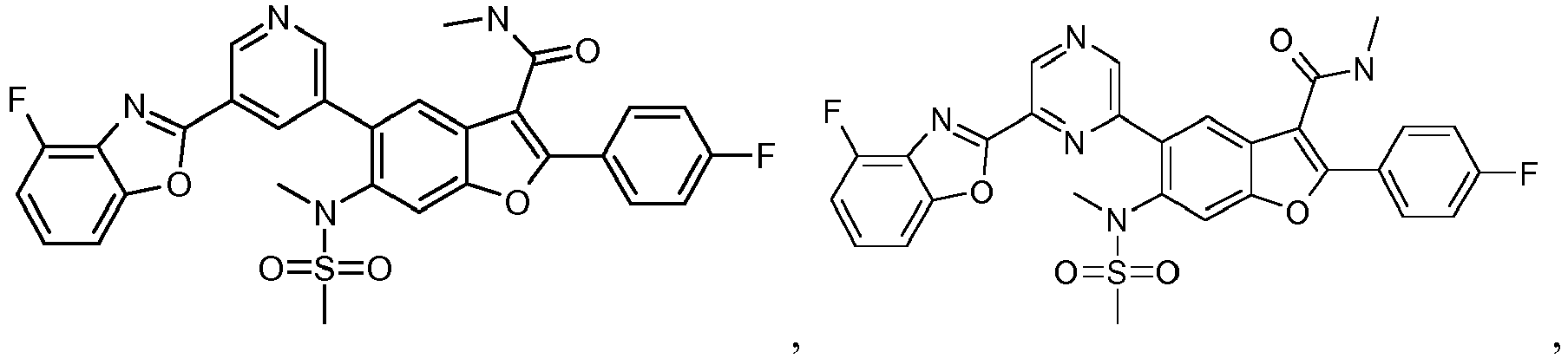


- A pharmaceutical composition comprising a pharmaceutically acceptable carrier and an effective amount of the compound of any one of claims 1-3 or a pharmaceutically acceptable salt thereof.
- The pharmaceutical composition of claim 4, further comprising a second therapeutic agent selected from the group consisting of HCV antiviral agents, immunomodulators, and anti-infective agents.
- The pharmaceutical composition of claim 5, wherein the second therapeutic agent is selected from the group consisting of HCV protease inhibitors, HCV NS5A inhibitors and HCV NS5B polymerase inhibitors.
- A compound of any one of claims 1-3 for use in inhibiting HCV NS5B activity or for use in preventing and/or treating infection by HCV in a patient.
Applications Claiming Priority (2)
| Application Number | Priority Date | Filing Date | Title |
|---|---|---|---|
| PCT/CN2011/079467 WO2013033901A1 (en) | 2011-09-08 | 2011-09-08 | Heterocyclic-substituted benzofuran derivatives and methods of use thereof for the treatment of viral diseases |
| PCT/CN2012/080214 WO2013034047A1 (en) | 2011-09-08 | 2012-08-16 | Heterocyclic-substitued benzofuran derivatives and methods of use thereof for the treatment of viral diseases |
Publications (3)
| Publication Number | Publication Date |
|---|---|
| EP2753618A1 EP2753618A1 (en) | 2014-07-16 |
| EP2753618A4 EP2753618A4 (en) | 2015-03-18 |
| EP2753618B1 true EP2753618B1 (en) | 2018-04-11 |
Family
ID=47831445
Family Applications (1)
| Application Number | Title | Priority Date | Filing Date |
|---|---|---|---|
| EP12829730.6A Active EP2753618B1 (en) | 2011-09-08 | 2012-08-16 | Heterocyclic-substitued benzofuran derivatives and methods of use thereof for the treatment of viral diseases |
Country Status (5)
| Country | Link |
|---|---|
| US (1) | US9549917B2 (en) |
| EP (1) | EP2753618B1 (en) |
| AR (1) | AR087791A1 (en) |
| TW (1) | TW201317231A (en) |
| WO (2) | WO2013033901A1 (en) |
Families Citing this family (34)
| Publication number | Priority date | Publication date | Assignee | Title |
|---|---|---|---|---|
| CN103501610A (en) * | 2011-03-09 | 2014-01-08 | 西建阿维拉米斯研究公司 | PI3 kinase inhibitors and uses thereof |
| WO2013033899A1 (en) | 2011-09-08 | 2013-03-14 | Merck Sharp & Dohme Corp. | Substituted benzofuran compounds and methods of use thereof for the treatment of viral diseases |
| WO2013033900A1 (en) | 2011-09-08 | 2013-03-14 | Merck Sharp & Dohme Corp. | Tetracyclic heterocycle compounds and methods of use thereof for the treatment of viral diseases |
| WO2013043518A1 (en) | 2011-09-22 | 2013-03-28 | Merck Sharp & Dohme Corp. | Imidazopyridyl compounds as aldosterone synthase inhibitors |
| WO2014205594A1 (en) * | 2013-06-24 | 2014-12-31 | Merck Sharp & Dohme Corp. | Substituted benzofuran compounds and methods of use thereof for treatment of viral diseases |
| US9920036B2 (en) * | 2014-03-21 | 2018-03-20 | Bristol-Myers Squibb Company | Cyanoamino (aza)benzofuran compounds for the treatment of hepatitis C |
| EP3283475B1 (en) | 2015-04-16 | 2019-10-16 | Merck Patent GmbH | 3-(1h-benzimidazol-2-yl)-1h-pyridin-2-one derivatives |
| US20170107216A1 (en) | 2015-10-19 | 2017-04-20 | Incyte Corporation | Heterocyclic compounds as immunomodulators |
| MD3377488T2 (en) * | 2015-11-19 | 2023-02-28 | Incyte Corp | Heterocyclic compounds as immunomodulators |
| ES2916874T3 (en) | 2015-12-17 | 2022-07-06 | Incyte Corp | N-phenyl-pyridine-2-carboxamide derivatives and their use as modulators of the PD-1/PD-L1 protein/protein interaction |
| CA3009474A1 (en) | 2015-12-22 | 2017-06-29 | Incyte Corporation | Heterocyclic compounds as immunomodulators |
| ES2906460T3 (en) | 2016-05-06 | 2022-04-18 | Incyte Corp | Heterocyclic compounds as immunomodulators |
| EP3464279B1 (en) | 2016-05-26 | 2021-11-24 | Incyte Corporation | Heterocyclic compounds as immunomodulators |
| SG11201811414TA (en) | 2016-06-20 | 2019-01-30 | Incyte Corp | Heterocyclic compounds as immunomodulators |
| MA45669A (en) | 2016-07-14 | 2019-05-22 | Incyte Corp | HETEROCYCLIC COMPOUNDS USED AS IMMUNOMODULATORS |
| US20180057486A1 (en) | 2016-08-29 | 2018-03-01 | Incyte Corporation | Heterocyclic compounds as immunomodulators |
| CN106632278A (en) * | 2016-12-16 | 2017-05-10 | 黄子为 | Heterocyclic nitrogen compound and application thereof |
| WO2018119221A1 (en) | 2016-12-22 | 2018-06-28 | Incyte Corporation | Pyridine derivatives as immunomodulators |
| WO2018119286A1 (en) | 2016-12-22 | 2018-06-28 | Incyte Corporation | Bicyclic heteroaromatic compounds as immunomodulators |
| US10308644B2 (en) | 2016-12-22 | 2019-06-04 | Incyte Corporation | Heterocyclic compounds as immunomodulators |
| WO2018119236A1 (en) | 2016-12-22 | 2018-06-28 | Incyte Corporation | Triazolo[1,5-a]pyridine derivatives as immunomodulators |
| EP4223369A1 (en) | 2016-12-22 | 2023-08-09 | Incyte Corporation | Immunomodulator compounds and methods of use |
| WO2018125799A2 (en) | 2016-12-29 | 2018-07-05 | Viamet Pharmaceuticals (Bermuda), Ltd. | Metalloenzyme inhibitor compounds |
| CA3055292A1 (en) | 2016-12-29 | 2018-07-05 | Selenity Therapeutics (Bermuda), Ltd. | Metalloenzyme inhibitor compounds |
| SMT202300065T1 (en) | 2018-03-30 | 2023-05-12 | Incyte Corp | Heterocyclic compounds as immunomodulators |
| CN112752756B (en) | 2018-05-11 | 2024-06-25 | 因赛特公司 | Tetrahydro-imidazo[4,5-c]pyridine derivatives as PD-L1 immunomodulators |
| MX2020013767A (en) * | 2018-06-26 | 2021-03-02 | Bayer Ag | Heterocyclene derivatives as pest control agents. |
| CA3126224A1 (en) | 2019-01-08 | 2020-07-16 | Corxel Pharmaceuticals Hong Kong Limited | Metalloenzyme inhibitor compounds |
| TW202115059A (en) | 2019-08-09 | 2021-04-16 | 美商英塞特公司 | Salts of a pd-1/pd-l1 inhibitor |
| JP7559059B2 (en) | 2019-09-30 | 2024-10-01 | インサイト・コーポレイション | Pyrido[3,2-D]pyrimidine compounds as immunomodulators - Patents.com |
| EP4058461A1 (en) | 2019-11-11 | 2022-09-21 | Incyte Corporation | Salts and crystalline forms of a pd-1/pd-l1 inhibitor |
| US11760756B2 (en) | 2020-11-06 | 2023-09-19 | Incyte Corporation | Crystalline form of a PD-1/PD-L1 inhibitor |
| IL302590A (en) | 2020-11-06 | 2023-07-01 | Incyte Corp | Process for making a pd-1/pd-l1 inhibitor and salts and crystalline forms thereof |
| US11780836B2 (en) | 2020-11-06 | 2023-10-10 | Incyte Corporation | Process of preparing a PD-1/PD-L1 inhibitor |
Family Cites Families (61)
| Publication number | Priority date | Publication date | Assignee | Title |
|---|---|---|---|---|
| AU575854B2 (en) | 1983-10-04 | 1988-08-11 | Shionogi & Co., Ltd. | 7beta-(carboxyalkenamido) cephalosporins |
| NZ220764A (en) | 1986-07-02 | 1989-09-27 | Shionogi & Co | Crystalline form of 7beta((z)-2-(2-aminothiazol-4-yl)-4- carboxybut-2-enoylamino)-3-cephem-4-carboxylic acid and pharmaceutical compositions |
| US5017380A (en) | 1986-07-02 | 1991-05-21 | Shionogi & Co., Ltd. | Gelatin hard capsule containing crystalline hydrate of oral cephalosporin |
| US6428571B1 (en) | 1996-01-22 | 2002-08-06 | Scimed Life Systems, Inc. | Self-sealing PTFE vascular graft and manufacturing methods |
| US5922757A (en) | 1996-09-30 | 1999-07-13 | The Regents Of The University Of California | Treatment and prevention of hepatic disorders |
| NZ335276A (en) | 1996-10-18 | 2000-09-29 | Vertex Pharma | Inhibitors of serine proteases, particularly hepatitis C virus (HCV) NS3 (Non Structural Protein 3) protease |
| GB9623908D0 (en) | 1996-11-18 | 1997-01-08 | Hoffmann La Roche | Amino acid derivatives |
| US6767991B1 (en) | 1997-08-11 | 2004-07-27 | Boehringer Ingelheim (Canada) Ltd. | Hepatitis C inhibitor peptides |
| PT1012180E (en) | 1997-08-11 | 2005-04-29 | Boehringer Ingelheim Ca Ltd | ANALYSIS OF HEPATITIS C INHIBITING PEPTIDES |
| AU2001251165A1 (en) | 2000-04-03 | 2001-10-15 | Vertex Pharmaceuticals Incorporated | Inhibitors of serine proteases, particularly hepatitis c virus ns3 protease |
| HK1047947A1 (en) | 2000-04-05 | 2003-03-14 | Schering Corporation | Macrocyclic ns3-serine protease inhibitors of hepatitis c virus comprising n-cyclic p2 moietes |
| AU2001253621A1 (en) | 2000-04-19 | 2001-11-07 | Schering Corporation | Macrocyclic NS3-serine protease inhibitors of hepatitis C virus comprising alkyl and aryl alanine P2 moieties |
| US7012066B2 (en) | 2000-07-21 | 2006-03-14 | Schering Corporation | Peptides as NS3-serine protease inhibitors of hepatitis C virus |
| AR029851A1 (en) | 2000-07-21 | 2003-07-16 | Dendreon Corp | NEW PEPTIDES AS INHIBITORS OF NS3-SERINA PROTEASA DEL VIRUS DE HEPATITIS C |
| AR034127A1 (en) | 2000-07-21 | 2004-02-04 | Schering Corp | IMIDAZOLIDINONES AS INHIBITORS OF NS3-SERINA PROTEASA OF THE HEPATITIS C VIRUS, PHARMACEUTICAL COMPOSITION, A METHOD FOR THEIR PREPARATION, AND THE USE OF THE SAME FOR THE MANUFACTURE OF A MEDICINAL PRODUCT |
| SK742003A3 (en) | 2000-07-21 | 2003-06-03 | Schering Corp | Novel peptides as NS3-serine protease inhibitors of hepatitis C virus |
| US20020068702A1 (en) | 2000-07-21 | 2002-06-06 | Marguerita Lim-Wilby | Novel peptides as NS3-serine protease inhibitors of hepatitis C virus |
| US7244721B2 (en) | 2000-07-21 | 2007-07-17 | Schering Corporation | Peptides as NS3-serine protease inhibitors of hepatitis C virus |
| AU3659102A (en) | 2000-12-12 | 2002-06-24 | Schering Corp | Diaryl peptides as ns3-serine protease inhibitors of hepatits c virus |
| KR100926244B1 (en) | 2001-07-11 | 2009-11-12 | 버텍스 파마슈티칼스 인코포레이티드 | Bridged Bicyclic Serine Protease Inhibitors |
| MXPA04007163A (en) | 2002-01-23 | 2004-10-29 | Schering Corp | Proline compounds as ns3-serine protease inhibitors for use in treatment of hepatites c virus infection. |
| EP1497282A2 (en) | 2002-04-11 | 2005-01-19 | Vertex Pharmaceuticals Incorporated | Inhibitors of serine protease, particularly hepatitis c virus ns3-ns4 protease |
| US7265152B2 (en) | 2002-11-01 | 2007-09-04 | Viropharma Incorporated | Benzofuran compounds, compositions and methods for treatment and prophylaxis of hepatitis C viral infections and associated diseases |
| CN1738797A (en) | 2002-11-19 | 2006-02-22 | 阿基里昂药品公司 | Substituted aryl thioureas and related compounds, inhibitors of viral replication |
| US20050090450A1 (en) | 2003-04-11 | 2005-04-28 | Farmer Luc J. | Inhibitors of serine proteases, particularly HCV NS3-NS4A protease |
| MXPA06002250A (en) | 2003-08-26 | 2006-05-17 | Schering Corp | Novel peptidomimetic ns3-serine protease inhibitors of hepatitis c virus. |
| CN1894274A (en) | 2003-09-26 | 2007-01-10 | 先灵公司 | Macrocyclic inhibitors of hepatitis C virus NS3-serine protease |
| US7365092B2 (en) | 2003-10-10 | 2008-04-29 | Vertex Pharmaceuticals Incorporated | Inhibitors of serine proteases, particularly HCV NS3-NS4A protease |
| MXPA06005683A (en) | 2003-11-20 | 2006-12-14 | Schering Corp | Depeptidized inhibitors of hepatitis c virus ns3 protease. |
| KR20060118532A (en) | 2003-12-11 | 2006-11-23 | 쉐링 코포레이션 | Inhibitor of hepatitis C virus NS3 / NS4A serine protease |
| US7635694B2 (en) | 2004-02-27 | 2009-12-22 | Schering Corporation | Cyclobutenedione-containing compounds as inhibitors of hepatitis C virus NS3 serine protease |
| RU2006134002A (en) | 2004-02-27 | 2008-04-10 | Шеринг Корпорейшн (US) | NEW COMPOUNDS OPERATING AS NS3 SERIN PROTEASE INHIBITORS HEPATITIS C VIRUS |
| CN1950393A (en) | 2004-02-27 | 2007-04-18 | 先灵公司 | Novel inhibitors of hepatitis c virus ns3 protease |
| US7816326B2 (en) | 2004-02-27 | 2010-10-19 | Schering Corporation | Sulfur compounds as inhibitors of hepatitis C virus NS3 serine protease |
| RU2428428C9 (en) | 2004-02-27 | 2012-03-10 | Шеринг Корпорейшн | Sulphur-containing compounds as hepatitis c virus ns3 serine protease inhibitors |
| ATE438622T1 (en) | 2004-02-27 | 2009-08-15 | Schering Corp | 3,4-(CYCLOPENTYL)CONDENSED PROLINE COMPOUNDS AS INHIBITORS OF THE NS3 SERINE PROTEASE OF THE HEPATITIS C VIRUS |
| US7173057B2 (en) | 2004-02-27 | 2007-02-06 | Schering Corporation | Ketoamides with cyclic P4'S as inhibitors of NS3 protease of hepatitis C virus |
| RU2006134005A (en) | 2004-02-27 | 2008-04-10 | Шеринг Корпорейшн (US) | NEW COMPOUNDS OPERATING AS NS3 SERIN PROTEASE INHIBITORS HEPATITIS C VIRUS |
| WO2005107745A1 (en) | 2004-05-06 | 2005-11-17 | Schering Corporation | An inhibitor of hepatitis c |
| EA200700243A1 (en) | 2004-07-14 | 2007-08-31 | ПиТиСи ТЕРАПЬЮТИКС, ИНК. | METHODS OF TREATMENT OF HEPATITIS C |
| EP1781289A1 (en) | 2004-07-22 | 2007-05-09 | PTC Therapeutics, Inc. | Thienopyridines for treating hepatitis c |
| US20090081636A1 (en) | 2005-04-11 | 2009-03-26 | Mingjun Huang | Pharmaceutical compositions for and methods of inhibiting HCV replication |
| MX2008010355A (en) | 2006-02-09 | 2008-10-31 | Schering Corp | Combinations comprising hcv protease inhibitor(s) and hcv polymerase inhibitor(s), and methods of treatment related thereto. |
| JP5079818B2 (en) | 2006-12-22 | 2012-11-21 | メルク・シャープ・アンド・ドーム・コーポレーション | 4,5-cyclic indole derivatives for the treatment or prevention of HCV and related viral diseases |
| KR20090106539A (en) | 2006-12-22 | 2009-10-09 | 쉐링 코포레이션 | 4,5-cyclic cyclic indole derivatives for the treatment or prevention of HCV and related viral infections |
| JP5055377B2 (en) | 2006-12-22 | 2012-10-24 | シェーリング コーポレイション | [5,6-Ring] Ring-forming indole derivatives and methods of use thereof |
| WO2008083351A2 (en) | 2006-12-29 | 2008-07-10 | Genifuel Corporation | Controlled growth environments for algae cultivation |
| EP2195317B1 (en) | 2007-08-29 | 2012-01-18 | Schering Corporation | 2,3-substituted azaindole derivatives for treating viral infections |
| RU2010111550A (en) | 2007-08-29 | 2011-10-10 | Шеринг Корпорейшн (US) | 2,3-SUBSTITUTED INDOLIC DERIVATIVES FOR TREATING VIRAL INFECTIONS |
| JP5179585B2 (en) | 2007-08-29 | 2013-04-10 | メルク・シャープ・アンド・ドーム・コーポレーション | Tetracyclic indole derivatives and uses thereof |
| WO2009032124A1 (en) | 2007-08-29 | 2009-03-12 | Schering Corporation | Substituted indole derivatives and methods of use thereof |
| ATE539070T1 (en) | 2008-02-14 | 2012-01-15 | Hoffmann La Roche | HETEROCYCLIC ANTIVIRAL COMPOUNDS |
| US8048887B2 (en) * | 2008-09-11 | 2011-11-01 | Bristol-Myers Squibb Company | Compounds for the treatment of hepatitis C |
| AR080185A1 (en) | 2010-02-19 | 2012-03-21 | Glaxo Group Ltd | DERIVATIVES OF BORONIC AND BENZOFURAN ACID, PHARMACEUTICAL COMPOSITIONS CONTAINING THEM, AND USE OF THE SAME IN THE TREATMENT AND / OR PREVENTION OF VIRAL INFECTIONS, IN PARTICULAR BY HEPATITIS C (HCV) VIRUSES. |
| US8324212B2 (en) | 2010-02-25 | 2012-12-04 | Bristol-Myers Squibb Company | Compounds for the treatment of hepatitis C |
| TW201136919A (en) * | 2010-03-02 | 2011-11-01 | Merck Sharp & Amp Dohme Corp | Inhibitors of hepatitis C virus NS5B polymerase |
| EP2696679B1 (en) | 2011-04-13 | 2017-08-02 | Merck Sharp & Dohme Corp. | 2'-cyano substituted nucleoside derivatives and methods of use thereof for the treatment of viral diseases |
| WO2012142085A1 (en) | 2011-04-13 | 2012-10-18 | Merck Sharp & Dohme Corp. | 2'-substituted nucleoside derivatives and methods of use thereof for the treatment of viral diseases |
| EP2697242B1 (en) | 2011-04-13 | 2018-10-03 | Merck Sharp & Dohme Corp. | 2'-azido substituted nucleoside derivatives and methods of use thereof for the treatment of viral diseases |
| WO2013033900A1 (en) | 2011-09-08 | 2013-03-14 | Merck Sharp & Dohme Corp. | Tetracyclic heterocycle compounds and methods of use thereof for the treatment of viral diseases |
| WO2013033899A1 (en) | 2011-09-08 | 2013-03-14 | Merck Sharp & Dohme Corp. | Substituted benzofuran compounds and methods of use thereof for the treatment of viral diseases |
-
2011
- 2011-09-08 WO PCT/CN2011/079467 patent/WO2013033901A1/en not_active Ceased
-
2012
- 2012-08-16 EP EP12829730.6A patent/EP2753618B1/en active Active
- 2012-08-16 US US14/343,448 patent/US9549917B2/en active Active
- 2012-08-16 WO PCT/CN2012/080214 patent/WO2013034047A1/en not_active Ceased
- 2012-09-06 AR ARP120103284A patent/AR087791A1/en not_active Application Discontinuation
- 2012-09-07 TW TW101132849A patent/TW201317231A/en unknown
Non-Patent Citations (1)
| Title |
|---|
| None * |
Also Published As
| Publication number | Publication date |
|---|---|
| AR087791A1 (en) | 2014-04-16 |
| US20140199263A1 (en) | 2014-07-17 |
| EP2753618A4 (en) | 2015-03-18 |
| EP2753618A1 (en) | 2014-07-16 |
| WO2013033901A1 (en) | 2013-03-14 |
| TW201317231A (en) | 2013-05-01 |
| US9549917B2 (en) | 2017-01-24 |
| WO2013034047A1 (en) | 2013-03-14 |
Similar Documents
| Publication | Publication Date | Title |
|---|---|---|
| US9549917B2 (en) | Heterocyclic-substituted benzofuran derivatives and methods of use thereof for the treatment of viral diseases | |
| EP2753325B1 (en) | Tetracyclic heterocycle compounds and methods of use thereof for the treatment of viral diseases | |
| EP2685984B1 (en) | Tetracyclic xanthene derivatives and methods of use thereof for the treatment of viral diseases | |
| EP2753611B1 (en) | Substituted benzofuran compounds and methods of use thereof for the treatment of viral diseases | |
| EP2909209B1 (en) | 2'-cyano substituted nucleoside derivatives and methods of use thereof for treatment of viral diseases | |
| JP6417380B2 (en) | Heterocyclic substituted tetracyclic compounds and their use to treat viral diseases | |
| EP3013334A1 (en) | Substituted benzofuran compounds and methods of use thereof for the treatment of viral diseases | |
| WO2015089810A1 (en) | Fused tetracyclic heterocyclic compounds and methods of use thereof for the treatment of viral diseases | |
| WO2018035005A1 (en) | Heterocycle-substituted tetracyclic compounds and methods of use thereof for the treatment of viral diseases | |
| WO2017112531A1 (en) | Silane-containing heterocyclic compounds and methods of use thereof for the treatment of viral diseases |
Legal Events
| Date | Code | Title | Description |
|---|---|---|---|
| PUAI | Public reference made under article 153(3) epc to a published international application that has entered the european phase |
Free format text: ORIGINAL CODE: 0009012 |
|
| 17P | Request for examination filed |
Effective date: 20140408 |
|
| AK | Designated contracting states |
Kind code of ref document: A1 Designated state(s): AL AT BE BG CH CY CZ DE DK EE ES FI FR GB GR HR HU IE IS IT LI LT LU LV MC MK MT NL NO PL PT RO RS SE SI SK SM TR |
|
| DAX | Request for extension of the european patent (deleted) | ||
| A4 | Supplementary search report drawn up and despatched |
Effective date: 20150218 |
|
| RIC1 | Information provided on ipc code assigned before grant |
Ipc: C07D 413/14 20060101AFI20150212BHEP Ipc: A61K 31/343 20060101ALI20150212BHEP Ipc: A61P 31/14 20060101ALI20150212BHEP Ipc: C07D 405/14 20060101ALI20150212BHEP |
|
| 17Q | First examination report despatched |
Effective date: 20151118 |
|
| GRAP | Despatch of communication of intention to grant a patent |
Free format text: ORIGINAL CODE: EPIDOSNIGR1 |
|
| INTG | Intention to grant announced |
Effective date: 20171108 |
|
| GRAS | Grant fee paid |
Free format text: ORIGINAL CODE: EPIDOSNIGR3 |
|
| GRAA | (expected) grant |
Free format text: ORIGINAL CODE: 0009210 |
|
| AK | Designated contracting states |
Kind code of ref document: B1 Designated state(s): AL AT BE BG CH CY CZ DE DK EE ES FI FR GB GR HR HU IE IS IT LI LT LU LV MC MK MT NL NO PL PT RO RS SE SI SK SM TR |
|
| REG | Reference to a national code |
Ref country code: GB Ref legal event code: FG4D |
|
| REG | Reference to a national code |
Ref country code: CH Ref legal event code: EP |
|
| REG | Reference to a national code |
Ref country code: AT Ref legal event code: REF Ref document number: 987904 Country of ref document: AT Kind code of ref document: T Effective date: 20180415 |
|
| REG | Reference to a national code |
Ref country code: IE Ref legal event code: FG4D |
|
| REG | Reference to a national code |
Ref country code: DE Ref legal event code: R096 Ref document number: 602012045146 Country of ref document: DE |
|
| REG | Reference to a national code |
Ref country code: FR Ref legal event code: PLFP Year of fee payment: 7 |
|
| REG | Reference to a national code |
Ref country code: NL Ref legal event code: MP Effective date: 20180411 |
|
| REG | Reference to a national code |
Ref country code: LT Ref legal event code: MG4D |
|
| PG25 | Lapsed in a contracting state [announced via postgrant information from national office to epo] |
Ref country code: NL Free format text: LAPSE BECAUSE OF FAILURE TO SUBMIT A TRANSLATION OF THE DESCRIPTION OR TO PAY THE FEE WITHIN THE PRESCRIBED TIME-LIMIT Effective date: 20180411 |
|
| PG25 | Lapsed in a contracting state [announced via postgrant information from national office to epo] |
Ref country code: BG Free format text: LAPSE BECAUSE OF FAILURE TO SUBMIT A TRANSLATION OF THE DESCRIPTION OR TO PAY THE FEE WITHIN THE PRESCRIBED TIME-LIMIT Effective date: 20180711 Ref country code: PL Free format text: LAPSE BECAUSE OF FAILURE TO SUBMIT A TRANSLATION OF THE DESCRIPTION OR TO PAY THE FEE WITHIN THE PRESCRIBED TIME-LIMIT Effective date: 20180411 Ref country code: LT Free format text: LAPSE BECAUSE OF FAILURE TO SUBMIT A TRANSLATION OF THE DESCRIPTION OR TO PAY THE FEE WITHIN THE PRESCRIBED TIME-LIMIT Effective date: 20180411 Ref country code: FI Free format text: LAPSE BECAUSE OF FAILURE TO SUBMIT A TRANSLATION OF THE DESCRIPTION OR TO PAY THE FEE WITHIN THE PRESCRIBED TIME-LIMIT Effective date: 20180411 Ref country code: SE Free format text: LAPSE BECAUSE OF FAILURE TO SUBMIT A TRANSLATION OF THE DESCRIPTION OR TO PAY THE FEE WITHIN THE PRESCRIBED TIME-LIMIT Effective date: 20180411 Ref country code: NO Free format text: LAPSE BECAUSE OF FAILURE TO SUBMIT A TRANSLATION OF THE DESCRIPTION OR TO PAY THE FEE WITHIN THE PRESCRIBED TIME-LIMIT Effective date: 20180711 Ref country code: AL Free format text: LAPSE BECAUSE OF FAILURE TO SUBMIT A TRANSLATION OF THE DESCRIPTION OR TO PAY THE FEE WITHIN THE PRESCRIBED TIME-LIMIT Effective date: 20180411 Ref country code: ES Free format text: LAPSE BECAUSE OF FAILURE TO SUBMIT A TRANSLATION OF THE DESCRIPTION OR TO PAY THE FEE WITHIN THE PRESCRIBED TIME-LIMIT Effective date: 20180411 |
|
| PG25 | Lapsed in a contracting state [announced via postgrant information from national office to epo] |
Ref country code: GR Free format text: LAPSE BECAUSE OF FAILURE TO SUBMIT A TRANSLATION OF THE DESCRIPTION OR TO PAY THE FEE WITHIN THE PRESCRIBED TIME-LIMIT Effective date: 20180712 Ref country code: RS Free format text: LAPSE BECAUSE OF FAILURE TO SUBMIT A TRANSLATION OF THE DESCRIPTION OR TO PAY THE FEE WITHIN THE PRESCRIBED TIME-LIMIT Effective date: 20180411 Ref country code: HR Free format text: LAPSE BECAUSE OF FAILURE TO SUBMIT A TRANSLATION OF THE DESCRIPTION OR TO PAY THE FEE WITHIN THE PRESCRIBED TIME-LIMIT Effective date: 20180411 Ref country code: LV Free format text: LAPSE BECAUSE OF FAILURE TO SUBMIT A TRANSLATION OF THE DESCRIPTION OR TO PAY THE FEE WITHIN THE PRESCRIBED TIME-LIMIT Effective date: 20180411 |
|
| REG | Reference to a national code |
Ref country code: AT Ref legal event code: MK05 Ref document number: 987904 Country of ref document: AT Kind code of ref document: T Effective date: 20180411 |
|
| PG25 | Lapsed in a contracting state [announced via postgrant information from national office to epo] |
Ref country code: PT Free format text: LAPSE BECAUSE OF FAILURE TO SUBMIT A TRANSLATION OF THE DESCRIPTION OR TO PAY THE FEE WITHIN THE PRESCRIBED TIME-LIMIT Effective date: 20180813 |
|
| REG | Reference to a national code |
Ref country code: DE Ref legal event code: R097 Ref document number: 602012045146 Country of ref document: DE |
|
| PG25 | Lapsed in a contracting state [announced via postgrant information from national office to epo] |
Ref country code: AT Free format text: LAPSE BECAUSE OF FAILURE TO SUBMIT A TRANSLATION OF THE DESCRIPTION OR TO PAY THE FEE WITHIN THE PRESCRIBED TIME-LIMIT Effective date: 20180411 Ref country code: DK Free format text: LAPSE BECAUSE OF FAILURE TO SUBMIT A TRANSLATION OF THE DESCRIPTION OR TO PAY THE FEE WITHIN THE PRESCRIBED TIME-LIMIT Effective date: 20180411 Ref country code: EE Free format text: LAPSE BECAUSE OF FAILURE TO SUBMIT A TRANSLATION OF THE DESCRIPTION OR TO PAY THE FEE WITHIN THE PRESCRIBED TIME-LIMIT Effective date: 20180411 Ref country code: CZ Free format text: LAPSE BECAUSE OF FAILURE TO SUBMIT A TRANSLATION OF THE DESCRIPTION OR TO PAY THE FEE WITHIN THE PRESCRIBED TIME-LIMIT Effective date: 20180411 Ref country code: SK Free format text: LAPSE BECAUSE OF FAILURE TO SUBMIT A TRANSLATION OF THE DESCRIPTION OR TO PAY THE FEE WITHIN THE PRESCRIBED TIME-LIMIT Effective date: 20180411 Ref country code: RO Free format text: LAPSE BECAUSE OF FAILURE TO SUBMIT A TRANSLATION OF THE DESCRIPTION OR TO PAY THE FEE WITHIN THE PRESCRIBED TIME-LIMIT Effective date: 20180411 |
|
| PLBE | No opposition filed within time limit |
Free format text: ORIGINAL CODE: 0009261 |
|
| STAA | Information on the status of an ep patent application or granted ep patent |
Free format text: STATUS: NO OPPOSITION FILED WITHIN TIME LIMIT |
|
| PG25 | Lapsed in a contracting state [announced via postgrant information from national office to epo] |
Ref country code: SM Free format text: LAPSE BECAUSE OF FAILURE TO SUBMIT A TRANSLATION OF THE DESCRIPTION OR TO PAY THE FEE WITHIN THE PRESCRIBED TIME-LIMIT Effective date: 20180411 Ref country code: IT Free format text: LAPSE BECAUSE OF FAILURE TO SUBMIT A TRANSLATION OF THE DESCRIPTION OR TO PAY THE FEE WITHIN THE PRESCRIBED TIME-LIMIT Effective date: 20180411 |
|
| 26N | No opposition filed |
Effective date: 20190114 |
|
| PG25 | Lapsed in a contracting state [announced via postgrant information from national office to epo] |
Ref country code: MC Free format text: LAPSE BECAUSE OF FAILURE TO SUBMIT A TRANSLATION OF THE DESCRIPTION OR TO PAY THE FEE WITHIN THE PRESCRIBED TIME-LIMIT Effective date: 20180411 |
|
| REG | Reference to a national code |
Ref country code: CH Ref legal event code: PL |
|
| PG25 | Lapsed in a contracting state [announced via postgrant information from national office to epo] |
Ref country code: LI Free format text: LAPSE BECAUSE OF NON-PAYMENT OF DUE FEES Effective date: 20180831 Ref country code: CH Free format text: LAPSE BECAUSE OF NON-PAYMENT OF DUE FEES Effective date: 20180831 Ref country code: LU Free format text: LAPSE BECAUSE OF NON-PAYMENT OF DUE FEES Effective date: 20180816 |
|
| REG | Reference to a national code |
Ref country code: BE Ref legal event code: MM Effective date: 20180831 |
|
| REG | Reference to a national code |
Ref country code: IE Ref legal event code: MM4A |
|
| PG25 | Lapsed in a contracting state [announced via postgrant information from national office to epo] |
Ref country code: SI Free format text: LAPSE BECAUSE OF FAILURE TO SUBMIT A TRANSLATION OF THE DESCRIPTION OR TO PAY THE FEE WITHIN THE PRESCRIBED TIME-LIMIT Effective date: 20180411 |
|
| PG25 | Lapsed in a contracting state [announced via postgrant information from national office to epo] |
Ref country code: IE Free format text: LAPSE BECAUSE OF NON-PAYMENT OF DUE FEES Effective date: 20180816 |
|
| PG25 | Lapsed in a contracting state [announced via postgrant information from national office to epo] |
Ref country code: BE Free format text: LAPSE BECAUSE OF NON-PAYMENT OF DUE FEES Effective date: 20180831 |
|
| PG25 | Lapsed in a contracting state [announced via postgrant information from national office to epo] |
Ref country code: MT Free format text: LAPSE BECAUSE OF NON-PAYMENT OF DUE FEES Effective date: 20180816 |
|
| PG25 | Lapsed in a contracting state [announced via postgrant information from national office to epo] |
Ref country code: TR Free format text: LAPSE BECAUSE OF FAILURE TO SUBMIT A TRANSLATION OF THE DESCRIPTION OR TO PAY THE FEE WITHIN THE PRESCRIBED TIME-LIMIT Effective date: 20180411 |
|
| PG25 | Lapsed in a contracting state [announced via postgrant information from national office to epo] |
Ref country code: HU Free format text: LAPSE BECAUSE OF FAILURE TO SUBMIT A TRANSLATION OF THE DESCRIPTION OR TO PAY THE FEE WITHIN THE PRESCRIBED TIME-LIMIT; INVALID AB INITIO Effective date: 20120816 |
|
| PG25 | Lapsed in a contracting state [announced via postgrant information from national office to epo] |
Ref country code: CY Free format text: LAPSE BECAUSE OF FAILURE TO SUBMIT A TRANSLATION OF THE DESCRIPTION OR TO PAY THE FEE WITHIN THE PRESCRIBED TIME-LIMIT Effective date: 20180411 Ref country code: MK Free format text: LAPSE BECAUSE OF NON-PAYMENT OF DUE FEES Effective date: 20180411 |
|
| PG25 | Lapsed in a contracting state [announced via postgrant information from national office to epo] |
Ref country code: IS Free format text: LAPSE BECAUSE OF FAILURE TO SUBMIT A TRANSLATION OF THE DESCRIPTION OR TO PAY THE FEE WITHIN THE PRESCRIBED TIME-LIMIT Effective date: 20180811 |
|
| REG | Reference to a national code |
Ref country code: DE Ref legal event code: R081 Ref document number: 602012045146 Country of ref document: DE Owner name: MSD ITALIA S.R.L., IT Free format text: FORMER OWNERS: MERCK SHARP & DOHME CORP., RAHWAY, N.J., US; MSD ITALIA S.R.L., ROME, IT Ref country code: DE Ref legal event code: R081 Ref document number: 602012045146 Country of ref document: DE Owner name: MERCK SHARP & DOHME LLC, RAHWAY, US Free format text: FORMER OWNERS: MERCK SHARP & DOHME CORP., RAHWAY, N.J., US; MSD ITALIA S.R.L., ROME, IT |
|
| REG | Reference to a national code |
Ref country code: GB Ref legal event code: 732E Free format text: REGISTERED BETWEEN 20221013 AND 20221019 |
|
| PGFP | Annual fee paid to national office [announced via postgrant information from national office to epo] |
Ref country code: DE Payment date: 20250709 Year of fee payment: 14 |
|
| PGFP | Annual fee paid to national office [announced via postgrant information from national office to epo] |
Ref country code: GB Payment date: 20250710 Year of fee payment: 14 |
|
| PGFP | Annual fee paid to national office [announced via postgrant information from national office to epo] |
Ref country code: FR Payment date: 20250709 Year of fee payment: 14 |