EP2753077A1 - Content delivering system, cache server, and content delivering method - Google Patents
Content delivering system, cache server, and content delivering method Download PDFInfo
- Publication number
- EP2753077A1 EP2753077A1 EP20120834192 EP12834192A EP2753077A1 EP 2753077 A1 EP2753077 A1 EP 2753077A1 EP 20120834192 EP20120834192 EP 20120834192 EP 12834192 A EP12834192 A EP 12834192A EP 2753077 A1 EP2753077 A1 EP 2753077A1
- Authority
- EP
- European Patent Office
- Prior art keywords
- mobile terminal
- content
- time
- bandwidth
- cache server
- Prior art date
- Legal status (The legal status is an assumption and is not a legal conclusion. Google has not performed a legal analysis and makes no representation as to the accuracy of the status listed.)
- Withdrawn
Links
Images



Classifications
-
- H—ELECTRICITY
- H04—ELECTRIC COMMUNICATION TECHNIQUE
- H04W—WIRELESS COMMUNICATION NETWORKS
- H04W4/00—Services specially adapted for wireless communication networks; Facilities therefor
- H04W4/06—Selective distribution of broadcast services, e.g. multimedia broadcast multicast service [MBMS]; Services to user groups; One-way selective calling services
-
- H—ELECTRICITY
- H04—ELECTRIC COMMUNICATION TECHNIQUE
- H04L—TRANSMISSION OF DIGITAL INFORMATION, e.g. TELEGRAPHIC COMMUNICATION
- H04L65/00—Network arrangements, protocols or services for supporting real-time applications in data packet communication
- H04L65/60—Network streaming of media packets
- H04L65/61—Network streaming of media packets for supporting one-way streaming services, e.g. Internet radio
- H04L65/611—Network streaming of media packets for supporting one-way streaming services, e.g. Internet radio for multicast or broadcast
-
- H—ELECTRICITY
- H04—ELECTRIC COMMUNICATION TECHNIQUE
- H04L—TRANSMISSION OF DIGITAL INFORMATION, e.g. TELEGRAPHIC COMMUNICATION
- H04L69/00—Network arrangements, protocols or services independent of the application payload and not provided for in the other groups of this subclass
- H04L69/30—Definitions, standards or architectural aspects of layered protocol stacks
- H04L69/32—Architecture of open systems interconnection [OSI] 7-layer type protocol stacks, e.g. the interfaces between the data link level and the physical level
- H04L69/322—Intralayer communication protocols among peer entities or protocol data unit [PDU] definitions
- H04L69/329—Intralayer communication protocols among peer entities or protocol data unit [PDU] definitions in the application layer [OSI layer 7]
-
- H—ELECTRICITY
- H04—ELECTRIC COMMUNICATION TECHNIQUE
- H04N—PICTORIAL COMMUNICATION, e.g. TELEVISION
- H04N21/00—Selective content distribution, e.g. interactive television or video on demand [VOD]
- H04N21/20—Servers specifically adapted for the distribution of content, e.g. VOD servers; Operations thereof
- H04N21/21—Server components or server architectures
- H04N21/222—Secondary servers, e.g. proxy server, cable television Head-end
- H04N21/2225—Local VOD servers
-
- H—ELECTRICITY
- H04—ELECTRIC COMMUNICATION TECHNIQUE
- H04N—PICTORIAL COMMUNICATION, e.g. TELEVISION
- H04N21/00—Selective content distribution, e.g. interactive television or video on demand [VOD]
- H04N21/20—Servers specifically adapted for the distribution of content, e.g. VOD servers; Operations thereof
- H04N21/23—Processing of content or additional data; Elementary server operations; Server middleware
- H04N21/231—Content storage operation, e.g. caching movies for short term storage, replicating data over plural servers, prioritizing data for deletion
- H04N21/23106—Content storage operation, e.g. caching movies for short term storage, replicating data over plural servers, prioritizing data for deletion involving caching operations
-
- H—ELECTRICITY
- H04—ELECTRIC COMMUNICATION TECHNIQUE
- H04N—PICTORIAL COMMUNICATION, e.g. TELEVISION
- H04N21/00—Selective content distribution, e.g. interactive television or video on demand [VOD]
- H04N21/20—Servers specifically adapted for the distribution of content, e.g. VOD servers; Operations thereof
- H04N21/23—Processing of content or additional data; Elementary server operations; Server middleware
- H04N21/234—Processing of video elementary streams, e.g. splicing of video streams or manipulating encoded video stream scene graphs
- H04N21/23406—Processing of video elementary streams, e.g. splicing of video streams or manipulating encoded video stream scene graphs involving management of server-side video buffer
-
- H—ELECTRICITY
- H04—ELECTRIC COMMUNICATION TECHNIQUE
- H04N—PICTORIAL COMMUNICATION, e.g. TELEVISION
- H04N21/00—Selective content distribution, e.g. interactive television or video on demand [VOD]
- H04N21/20—Servers specifically adapted for the distribution of content, e.g. VOD servers; Operations thereof
- H04N21/23—Processing of content or additional data; Elementary server operations; Server middleware
- H04N21/24—Monitoring of processes or resources, e.g. monitoring of server load, available bandwidth, upstream requests
- H04N21/2401—Monitoring of the client buffer
-
- H—ELECTRICITY
- H04—ELECTRIC COMMUNICATION TECHNIQUE
- H04N—PICTORIAL COMMUNICATION, e.g. TELEVISION
- H04N21/00—Selective content distribution, e.g. interactive television or video on demand [VOD]
- H04N21/60—Network structure or processes for video distribution between server and client or between remote clients; Control signalling between clients, server and network components; Transmission of management data between server and client, e.g. sending from server to client commands for recording incoming content stream; Communication details between server and client
- H04N21/61—Network physical structure; Signal processing
- H04N21/6106—Network physical structure; Signal processing specially adapted to the downstream path of the transmission network
- H04N21/6131—Network physical structure; Signal processing specially adapted to the downstream path of the transmission network involving transmission via a mobile phone network
-
- H—ELECTRICITY
- H04—ELECTRIC COMMUNICATION TECHNIQUE
- H04N—PICTORIAL COMMUNICATION, e.g. TELEVISION
- H04N21/00—Selective content distribution, e.g. interactive television or video on demand [VOD]
- H04N21/60—Network structure or processes for video distribution between server and client or between remote clients; Control signalling between clients, server and network components; Transmission of management data between server and client, e.g. sending from server to client commands for recording incoming content stream; Communication details between server and client
- H04N21/63—Control signaling related to video distribution between client, server and network components; Network processes for video distribution between server and clients or between remote clients, e.g. transmitting basic layer and enhancement layers over different transmission paths, setting up a peer-to-peer communication via Internet between remote STB's; Communication protocols; Addressing
- H04N21/647—Control signaling between network components and server or clients; Network processes for video distribution between server and clients, e.g. controlling the quality of the video stream, by dropping packets, protecting content from unauthorised alteration within the network, monitoring of network load, bridging between two different networks, e.g. between IP and wireless
- H04N21/64723—Monitoring of network processes or resources, e.g. monitoring of network load
- H04N21/64738—Monitoring network characteristics, e.g. bandwidth, congestion level
-
- H—ELECTRICITY
- H04—ELECTRIC COMMUNICATION TECHNIQUE
- H04N—PICTORIAL COMMUNICATION, e.g. TELEVISION
- H04N21/00—Selective content distribution, e.g. interactive television or video on demand [VOD]
- H04N21/60—Network structure or processes for video distribution between server and client or between remote clients; Control signalling between clients, server and network components; Transmission of management data between server and client, e.g. sending from server to client commands for recording incoming content stream; Communication details between server and client
- H04N21/63—Control signaling related to video distribution between client, server and network components; Network processes for video distribution between server and clients or between remote clients, e.g. transmitting basic layer and enhancement layers over different transmission paths, setting up a peer-to-peer communication via Internet between remote STB's; Communication protocols; Addressing
- H04N21/647—Control signaling between network components and server or clients; Network processes for video distribution between server and clients, e.g. controlling the quality of the video stream, by dropping packets, protecting content from unauthorised alteration within the network, monitoring of network load, bridging between two different networks, e.g. between IP and wireless
- H04N21/64746—Control signals issued by the network directed to the server or the client
- H04N21/64761—Control signals issued by the network directed to the server or the client directed to the server
- H04N21/64769—Control signals issued by the network directed to the server or the client directed to the server for rate control
Definitions
- the present invention relates to a content distribution system, a cache server and a content distribution method, and in particular, to a content distribution system, a cache server and a content distribution method, by which video content is distributed to various kinds of terminal (for example, mobile telephone, smart phone, PC (Personal Computer), game apparatus and the like), after being cached in a mobile network.
- terminal for example, mobile telephone, smart phone, PC (Personal Computer), game apparatus and the like
- Patent Literature 1 describes a system in which servers storing identical content, created with a plurality of bit rates, switch bit rates in accordance with an instruction from a receiving terminal, to provide distribution.
- Patent Literature 2 describes a video data transmission method in which, in a network environment where the bandwidth of a transmission channel between server and client is not guaranteed, in order to deliver the video without interruption, the client makes data transmission requests to the server as long as there is space in its own buffer.
- Patent Literatures 1 and 2 it is necessary to improve an apparatus on a mobile terminal (receiving terminal, client) side, and it is not possible to handle cases where the content distribution system distributes content to various types of mobile terminals.
- a content distribution system comprising a plurality of cache servers in a mobile network.
- Each of the plurality of cache servers comprises: a content temporary storage unit that temporarily stores at least part of the managed content(s) that is held by a storage apparatus in the mobile network; a determination unit that determines from among the plurality of cache servers a cache server that stores content(s) requested by a mobile terminal, using information included in a content request message from the mobile terminal; and a distribution unit that estimates a bandwidth of the mobile network based on a prescribed signal from the mobile terminal, reads a file with a bit rate not exceeding the bandwidth from among a plurality of files having the requested content(s) with different bit rates, from the determined cache server, and transmits the read file to the mobile terminal while controlling timing of transmission in accordance with a buffer capacity of the mobile terminal for at least some period of time.
- a cache server comprising: a content temporary storage unit that temporarily stores at least part of the managed content(s) that is held by a storage apparatus in a mobile network; a determination unit that determines, from among a plurality of cache servers provided in the mobile network, a cache server that stores content(s) requested by a mobile terminal, using information included in a content request message from the mobile terminal; and a distribution unit that estimates a bandwidth of the mobile network based on a prescribed signal from the mobile terminal, reads a file with a bit rate not exceeding the bandwidth from among a plurality of files having the requested content(s) with different bit rates, from the determined cache server, and transmits the read file to the mobile terminal while controlling timing of transmission in accordance with a buffer capacity of the mobile terminal for at least some period of time.
- a content distribution method comprising: by a cache server, temporarily storing, in itself, at least part of the managed content(s) that is held by a storage apparatus in a mobile network; determining, from among a plurality of cache servers provided in the mobile network, a cache server that stores content(s) requested by a mobile terminal, using information included in a content request message from the mobile terminal; estimating a bandwidth of the mobile network based on a prescribed signal from the mobile terminal; reading a file with a bit rate not exceeding the bandwidth from among a plurality of files having the requested content(s) with different bit rates, from the determined cache server; and transmitting the read file to the mobile terminal while controlling timing of transmission in accordance with a buffer capacity of the mobile terminal for at least some period of time.
- the cache server and the content distribution method of the present invention it is possible to prevent degradation of user QoE due to variation of bandwidth in a mobile network, when content is distributed via the mobile network.
- a content distribution system in the present invention comprises a plurality of cache servers (110_1 to 110_N) in a mobile network (150).
- Each of the plurality of cache servers (110_1 to 110_N) comprises: a content temporary storage unit (113) that temporarily stores at least part of the managed content(s) that is held by a storage apparatus (121) in the mobile network (150); a determination unit (117) that determines from among the plurality of cache servers (110_1 to 110_N) a cache server that stores content(s) requested by a mobile terminal (170), using information included in a content request message from the mobile terminal (170); and a distribution unit (114) that estimates a bandwidth of the mobile network (150) based on a prescribed signal from the mobile terminal
- the distribution unit (114) may calculate a time-period until the buffer amount reaches the buffer capacity of the mobile terminal (170), based on the bit rate in question and the buffer capacity, and not transmit the read packet in a time-period until the buffer amount decided in accordance with the calculated time-period becomes zero.
- the distribution unit (114) may calculate a time-period until the buffer amount of the mobile terminal (170) becomes zero, based on the bit rate with which the mobile terminal (170) plays content and the buffer capacity, and not transmit the read packet in the time-period in question.
- the distribution unit (114) may estimate a bandwidth of the mobile network (150) in accordance with difference between time of transmission of the transmitted packet and time of reception of the response packet, and a size of the transmitted packet.
- the distribution unit (114) may not transmit a read file in a prescribed time-period.
- the abovementioned plurality of cache servers may be transparent or fully transparent proxy servers (120_1 to 120_N).
- the mobile network may be a 3G (3rd Generation) mobile network or an LTE (Long Term Evolution) / EPC (Evolved Packet Core) network (250).
- 3G 3rd Generation
- LTE Long Term Evolution
- EPC Evolved Packet Core
- a content distribution system may be the content distribution system according to the first aspect.
- the distribution unit in a case where a bit rate of the read file is lower than the bandwidth, may calculate a time-period until a buffer amount of the mobile terminal reaches the buffer capacity, based on the bit rate and the buffer capacity, and not transmit the read packet in a time-period until the buffer amount decided in accordance with the calculated time-period becomes zero.
- the distribution unit in a case where a bit rate of the read file equals the bandwidth, may calculate a time-period until the buffer amount of the mobile terminal becomes zero, based on a bit rate at which the mobile terminal plays content(s), and the buffer capacity, and not transmit the read packet in the time-period.
- the distribution unit in a case of receiving a response packet with respect to a transmitted packet that is transmitted to the mobile terminal, from the mobile terminal, may estimate the bandwidth of the mobile network in accordance with the difference between the time of transmission of the transmitted packet and the time of reception of the response packet, and a size of the transmitted packet.
- the distribution unit in a case of receiving a signal indicating that the mobile network is in a congested state from the mobile terminal, may not transmit the read file in a prescribed time-period.
- the plurality of cache servers may be transparent or fully transparent proxy servers.
- the mobile network may be a 3G mobile network or an LTE (Long Term Evolution) / EPC (Evolved Packet Core) network.
- LTE Long Term Evolution
- EPC Evolved Packet Core
- a cache server may be the cache server according to the second aspect.
- the distribution unit in a case where a bit rate of the read file is lower than the bandwidth, may calculate a time-period until a buffer amount of the mobile terminal reaches the buffer capacity, based on the bit rate and the buffer capacity, and not transmit the read packet in a time-period until the buffer amount decided in accordance with the calculated time-period becomes zero.
- the distribution unit calculates a time-period until a buffer amount of the mobile terminal becomes zero, based on a bit rate at which the mobile terminal plays content(s), and the buffer capacity, and not transmit the read packet in the time-period.
- the distribution unit in a case of receiving a response packet with respect to a transmitted packet that is transmitted to the mobile terminal, from the mobile terminal, may estimate the bandwidth of the mobile network in accordance with the difference between the time of transmission of the transmitted packet and the time of reception of the response packet, and a size of the transmitted packet.
- the distribution unit in a case of receiving a signal indicating that the mobile network is in a congested state from the mobile terminal, may not transmit the read file in a prescribed time-period.
- a content distribution method may be the content distribution method according to the third aspect.
- the cache server in a case where a bit rate of the read file is lower than the bandwidth, may calculate a time-period until a buffer amount of the mobile terminal reaches the buffer capacity, based on the bit rate and the buffer capacity, and not transmit the read packet in a time-period until the buffer amount decided in accordance with the calculated time-period becomes zero.
- the cache server in a case where a bit rate of the read file equals the bandwidth, may calculate a time-period until a buffer amount of the mobile terminal becomes zero, based on a bit rate at which the mobile terminal plays content(s), and the buffer capacity, and not transmit the read packet in the time-period.
- the cache server in a case of receiving a response packet with respect to a transmitted packet that is transmitted to the mobile terminal, from the mobile terminal, may estimate the bandwidth of the mobile network in accordance with the difference between the time of transmission of the transmitted packet and the time of reception of the response packet, and a size of the transmitted packet.
- the cache server in a case of receiving a signal indicating that the mobile network is in a congested state from the mobile terminal, may not transmit the read file in a prescribed time-period.
- a program that causes a computer provided in a cache server to execute: temporarily storing at least part of the managed content(s) that is held by a storage apparatus in the mobile network; determining, from among a plurality of cache servers provided in the mobile network, a cache server that stores content(s) requested by a mobile terminal, using information included in a content request message from the mobile terminal; estimating a bandwidth of the mobile network based on a prescribed signal from the mobile terminal; reading a file with a bit rate not exceeding the bandwidth from among a plurality of files having the requested content(s) with different bit rates, from the determined cache server; and transmitting the read file to the mobile terminal while controlling timing of transmission in accordance with a buffer capacity of the mobile terminal for at least some period of time.
- the program may be provided as a program product recorded on a non-transient computer readable recording medium.
- the program may cause the computer to execute: calculating, in a case where a bit rate of the read file is lower than the bandwidth, a time-period until a buffer amount of the mobile terminal reaches the buffer capacity, based on the bit rate and the buffer capacity, and not transmitting the read packet in a time-period until the buffer amount decided in accordance with the calculated time-period becomes zero.
- the program may cause the computer to execute: calculating, in a case where a bit rate of the read file equals the bandwidth, a time-period until a buffer amount of the mobile terminal becomes zero, based on a bit rate at which the mobile terminal plays content(s), and the buffer capacity, and not transmitting the read packet in the time-period.
- the program may cause the computer to execute: estimating, in a case of receiving a response packet with respect to a transmitted packet that is transmitted to the mobile terminal, from the mobile terminal, the bandwidth of the mobile network in accordance with the difference between the time of transmission of the transmitted packet and the time of reception of the response packet, and a size of the transmitted packet.
- the program may cause the computer to execute: not transmitting, in a case of receiving a signal indicating that the mobile network is in a congested state from the mobile terminal, the read file in a prescribed time-period.
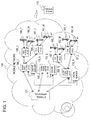
- Fig. 1 is a block diagram showing an example of a configuration of the content distribution system according to the present exemplary embodiment.
- the content distribution system is provided with a storage apparatus 121, SGSN (Serving GPRS Support Node) / GGSN (Gateway GPRS Support Node) apparatuses 190_1 to 190_N, cache servers 110_1 to 110_N, RNC (Radio Network Controller) apparatuses 195_1 to 195_L, and 197_1 to 197_L, and base station apparatuses 180_1 to 180_M, 181_1 to 181_M, 182_1 to 182_M, and 183_1 to 183_M, in a mobile network 150.
- SGSN Server GPRS Support Node
- GGSN Gateway GPRS Support Node
- RNC Radio Network Controller
- Fig. 1 shows a configuration of a case of using a 3G mobile packet network as the mobile network, and SGSN/GGSN apparatuses as packet forwarding apparatuses.
- Fig. 1 shows a configuration using cache servers.
- the storage apparatus 121 stores video content as managed content.
- the storage apparatus 121 stores M (M ⁇ ⁇ 2) files of different bit rates, in advance, as one content item.
- a mobile terminal 170 is used as a terminal. However, it is also possible to use a terminal outside of the mobile terminal 170.
- N N (N ⁇ 2) SGSN/GGSN apparatuses 190_1 to 190_N are provided.
- RNC apparatuses 195_1 to 195_L L ⁇ 2) are connected to the SGSN/GGSN apparatus 190_1.
- RNC apparatuses 197_1 to 197_L are connected to the SGSN/GGSN apparatus 190_N.
- L RNC apparatuses are also connected to the SGSN/GGSN apparatus 190_2, but a description is omitted in Fig. 1 for space considerations.
- M (M ⁇ 2) base station apparatuses are connected to one RNC apparatus.
- M base station apparatuses 180_1 to 180_M are connected to the RNC apparatus 195_1.
- one cache server is connected to a GGSN functional unit of each SGSN/GGSN apparatus.
- a cache server 110_1 is connected to the SGSN/GGSN apparatus 190_1.
- an SGSN/GGSN apparatus indicates an apparatus configuration in which an SGSN functional unit and a GGSN functional unit are arranged in the same location.
- the mobile terminal 170 issues a connection request message for distribution, describing a URL (Uniform Resource Locator) of requested video content.
- a base station apparatus any of the base station apparatuses 181_1 to 181_M in the case of Fig. 1 ), in whose range the mobile terminal 170 is present, receives the connection request message and transmits the connection request message to the RNC apparatus (RNC apparatus 195_L in the case of Fig. 1 ) that manages the base station apparatus.
- RNC apparatus 195_L in the case of Fig. 1
- the RNC apparatus 195_L receives the connection request message from the base station apparatusestores the connection request message, an IP (Internet Protocol) address of the storage apparatus 121 and an IP address of the mobile apparatus 170 in a payload part of a GTP packet (GPRS (General Packet Radio Service) Tunneling Protocol), and forwards the GTP packet to the SGSN/GGSN apparatus 190_1 coordinating the RNC apparatuses 195_1 to 195_L.
- GTP packet GPRS (General Packet Radio Service) Tunneling Protocol
- the SGSN/GGSN apparatus 190_1 receives the GTP packet.
- the cache server 110_1 for example, is connected to a Gi interface of the GGSN functional part of the SGSN/GGSN apparatus 190_1.
- the cache server 110_N is connected to a Gi interface of the GGSN functional part of the SGSN/GGSN apparatus 190_N.
- the cache servers 110_1 to 110_N are connected to each other so as to enable acquisition of content by cooperation between the cache servers when content is acquired from a cache server.
- cooperation between the cache servers means, for example, in a case where a cache server 110_1 receives a request from the mobile terminal 170, that although the content requested by the cache server 110_1 is not cached, when the cache server 110_N has cached the content, the cache server 110_1 reads and secures the requested content that is cached by the cache server 110_N, and the cache server 110_1 performs distribution.
- FIG. 2 is a block diagram showing an example of a configuration of the cache server 110_1. Since configurations of the cache servers 110_2 to 110_N outside of the cache server 110_1 are the same as the configuration of the cache server 110_1, a description thereof is omitted.
- the cache server 110_1 is provided with a control signal transmitting and receiving unit 111, an analysis unit 115, a collection unit 116, a determination unit 117, a content securing unit 112, a content temporary storage unit 113, a content list creation unit 118, and a distribution unit 114.
- the control signal transmitting and receiving unit 111 receives the GTP packet storing the connection request message from the mobile terminal 170, the reception IP address of the mobile terminal 170, the request content URL and the like, from the SGSN/GGSN apparatus 190_1.
- the control signal transmitting and receiving unit 111 receives information of the zone in which the mobile terminal 170 is present, from the SGSN/GGSN apparatus 190_1.
- the analysis unit 115 reads what is contained in the connection request message stored in the payload part of the GTP packet, extracts information such as the reception IP address of the mobile terminal 170, the URL of the requested content and the like, and outputs the requested content URL, the reception IP address of the mobile terminal 170 and the like, to the distribution unit 114 and the determination unit 117.
- the collection unit 116 receives a content list of content stored by the cache server 110_1, and a content list of content stored, outside of the cache server 110_1, by the cache servers 110_2 to 110_N, and outputs to the determination unit 117.
- the determination unit 117 may carry out a collection of the content list each predetermined time interval, or when there is a request for a connection from the mobile terminal 170, or when there is a request for a collection from other cache servers 110_2 to 110_N.
- the determination unit 117 receives information such as the reception IP address of the mobile terminal 170, the URL of the requested content, a content list of content stored by the cache server 110_1, and a content list of content stored outside of the cache server 110_1, by the cache servers 110_2 to 110_N. The determination unit 117 determines whether the content requested by the mobile terminal 170 is stored by the cache server 110_1, or is stored outside of the cache server 110_1, by the cache servers 110_2 to 110_N.
- the determination unit 117 instructs the content temporary storage unit 113 and the distribution unit 114 to perform reading and distribution.
- the determination unit 117 communicates the URL of the requested content and the IP address of the storing cache server to the content securing unit 112, and gives an instruction to secure the content from the relevant cache server by cooperation among the cache servers.
- the determination unit 117 instructs the content securing unit 112 to secure the content from the storage apparatus 121.
- the content securing unit 112 receives the URL of the content requested by the determination unit 117, the content securing instruction, the IP address of the cache server in the case of another cache server, and the IP address of the storage apparatus 121 in the case of the storage apparatus 121, secures duplication for a plurality of files of different bit rates, with regard to the requested content, and outputs to the content temporary storage unit 113.
- the content temporary storage unit 113 stores content outputted from the content securing unit 112.
- the content temporary storage unit 113 receives a content read instruction from the determination unit 117, and a specific bit rate is instructed by the distribution unit 114, a file with the bit rate specified by the distribution unit 114 is read from files of a plurality of bit rates with respect to the content corresponding to the URL of the requested content, and is outputted to the distribution unit 114.
- the content list creation unit 118 creates as needed a list of all content stored by the content temporary storage unit 113, and, each predetermined time interval, when there is a request from another cache server or when there is a request from the collection unit 116, outputs the content list.
- the distribution unit 114 receives URL information for the requested content from the analysis unit 115, and also receives a content distribution instruction and plural types (M types) of bit rate information of the relevant content from the determination unit 117.
- the distribution unit 114 reads a file of a specific bit rate from the plural bit rate files, from the content temporary storage unit 113 with respect to the requested content, generates a packet of a predetermined protocol (for example, TCP (Transmission Control Protocol)), and transmits to the SGSN/GGSN apparatus 190_1.
- TCP Transmission Control Protocol
- Fig. 3 is a block diagram showing an example of a configuration of the distribution unit 114.
- the distribution unit 114 is provided with a receiving unit 201, a bandwidth estimation unit 202, a content acquisition unit 203, a bit rate selection unit 205, a transmission timing control unit 204 and a transmission unit 200.
- the receiving unit 201 receives a packet of a TCP response signal (for example, a TCP Ack signal packet) via a SGSN/GGSN apparatus from the mobile terminal 170, and outputs information of the TCP response signal packet to the bandwidth estimation unit 202.
- a TCP response signal for example, a TCP Ack signal packet
- the receiving unit 201 may output an instruction to rapidly reduce the bandwidth, with regard to the bandwidth estimation unit 202.
- the bandwidth estimation unit 202 receives information of a transmitted packet transmitted by the transmission unit 200 (for example, transmission time of a transmitted packet and the size of a transmitted packet) and receives information of the abovementioned TCP response signal packet.
- the bandwidth estimation unit 202 measures response time T n from equation (1), by associating the TCP response signal packet and the transmitted packet using the transmitted packet number.
- T n T n ack - T n send
- T n represents the response time of an n-th packet
- T n ack represents the time at which the n-th TCP response signal packet is received by the receiving unit 201
- T n send represents the time at which the n-th transmitted packet is transmitted by the transmission unit 200.
- the bandwidth estimation unit 202 estimates bandwidth B n for the n-th packet from equation (2) and equation (3).
- ⁇ is a predetermined constant that satisfies 0 ⁇ ⁇ ⁇ 1.
- the bandwidth estimation unit 202 may perform the calculations of equation (2) and equation (3) each predetermined time interval.
- the bandwidth estimation unit 202 outputs the bandwidth B n estimated by equation (3) to the bit rate selection unit 205 and the transmission timing control unit 204, each predetermined time interval.
- the bit rate selection unit 205 receives plural types (M types) of bit rate information for content requested by the determination unit 117 of Fig. 2 , receives an estimated bandwidth B n each predetermined time interval T from the bandwidth estimation unit 202, and selects a bit rate B s (units of kbps) closest to the estimated bandwidth B n in a range that does not exceed the estimated bandwidth B n .
- the bit rate selection unit 205 instructs the content acquisition unit 203 to output a file at the selected bit rate B s to the transmission timing control unit 204.
- the bit rate selection unit 205 outputs the selected bit rate B s to the transmission timing control unit 204.
- the content acquisition unit 203 receives the URL for requested content from the analysis unit 115 of Fig. 2 , receives a content distribution instruction from the determination unit 117 of Fig. 2 , and receives the selected bit rate B s from the bit rate selection unit 205.
- the content acquisition unit 203 reads a file of content related to the URL, being the file corresponding to the instructed bit rate B s from among plural bit rates, from the content temporary storage unit 113 of Fig. 2 , and outputs to the transmission timing control unit 204.
- the transmission timing control unit 204 receives the bandwidth B n from the bandwidth estimation unit 202, receives the bit rate B s from the bit rate selection unit 205, receives a file corresponding to the specified bit rate B s from the acquisition unit 203, and controls transmission timing as below, for example, with regard to the file in question.
- the transmission timing control unit 204 outputs an inputted file to the transmission unit 200 during a time interval T1 in which buffer capacity L (units are kilobytes) of the mobile terminal 170 is full.
- the time interval T1 is given by equation (4).
- T ⁇ 1 L / B s * 8
- the time interval T is a time interval in which T1 ⁇ T, and the buffer capacity L of the mobile terminal 170 is not empty of data during a time interval T - T1.
- the transmission timing control unit 204 does not output content to the transmission unit 200 during a predetermined time interval T2.
- the time interval T2 is a time interval in which the buffer capacity L of the mobile terminal 170 is not empty of data.
- bit rate B p indicates a bit rate when a video is reproduced by the mobile terminal 170.
- the transmission unit 200 stores the content in TCP packets to be transmitted to the mobile terminal 170 via the SGSN/GGSN apparatus 190_1, an RNC apparatus and a base station apparatus. On the other hand, the transmission unit 200, during the time interval T-T1 and the time interval T2, does not transmit TCP packets.
- the transmission unit 200 outputs a transmitted n-th packet of size S n to the transmission estimation unit 202.
- Fig. 1 shows a configuration in a case where one cache server is connected to one SGSN/GGSN apparatus.
- one cache server may be connected to a plurality of SGSN/GGSN apparatuses.
- a plurality of cache servers may be connected to one SGSN/GGSN apparatus.
- the storage apparatus 121 may be connected to the cache server apparatuses 110_1 to 110_N.
- Fig. 1 shows a configuration of a case of using SGSN/GGSN apparatuses where an SGSN apparatus and an GGSN apparatus are integrated. However, it is also possible to use a configuration in which the SGSN apparatus and the GGSN apparatus are separated. In the case of this configuration, at least one cache server is connected to either the SGSN apparatus or the GGSN apparatus.
- the bandwidth estimation unit 202 may estimate bandwidth based on an equation outside of equation (2) and equation (3).
- the transmission timing control unit 204 can use another method or another equation, as a transmission timing control method.
- the transmission timing control unit 204 may control transmission timing for at least some of a time-period (time interval), and not control transmission timing for other time-periods.
- the mobile terminal 170 may be a mobile telephone, a smart phone, a tablet or a PC in which a data communication card is installed.
- the mobile terminal 170 may be any other terminal, as long as it is a terminal in which communication with a mobile 3G network is possible.
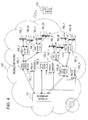
- Fig. 4 is a block diagram showing an example of a configuration of the content distribution system according to the present exemplary embodiment.
- the present exemplary embodiment uses proxy servers 120_1 to 120_N instead of cache servers 110_1 to 110_N.
- proxy servers 120_1 to 120_N instead of cache servers 110_1 to 110_N.
- proxy servers 120_1 to 120_N two types of mode can be considered: transparent and fully transparent.
- a description is given concerning the proxy server 120_1. Since operations of the proxy servers 120_2 to 120_N outside of the proxy server 120_1 are the same as operations of the proxy server 120_1, a description thereof is omitted.
- the proxy server 120_1 temporarily terminates a message signal from a mobile terminal 170 and analyzes the message signal.
- the proxy server 120_1 distributes content(s) temporarily stored in the proxy server 120_1 to the mobile terminal 170.
- the proxy server 120_1 makes requests and performs access with regard to a storage apparatus 121, via the SGSN/GGSN apparatus 190_1, as necessary.
- the proxy server 120_1 does not change the URL for requested content, the IP address of the storage apparatus 121 on the Internet, the mobile terminal IP address and the like, included in a request signal from the mobile terminal 170.
- the proxy server 120_1 does not terminate signals from the mobile terminal 170 but uses DPI (Deep Packet Inspection) technology to check the header part or the like of a packet, and extracts information such as the URL for requested content, the IP address of the mobile terminal 170, and the like.
- DPI Deep Packet Inspection
- the configuration of the proxy server 120_1 is the same as the configuration ( Fig. 2 ) of the cache server 110_1 in the first exemplary embodiment, a detailed description thereof is omitted.
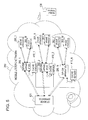
- Fig. 5 is a block diagram showing an example of a configuration of the content distribution system according to the present exemplary embodiment.
- an LTE (Long Term Evolution) / EPC (Evolved Packet Core) network 250 which is a 3.9 generation mobile network, is used.
- LTE Long Term Evolution
- EPC Evolved Packet Core
- functionality of base station apparatuses and RNC apparatuses is reduced, to only have eNodeB (evolved Node B) apparatuses.
- an S/P-GW (Serving/Packet Data-Gateway) apparatus is connected to eNodeB apparatuses.
- An S/P-GW apparatus indicates a configuration in which an S-GW apparatus and a P-GW apparatus are integrated.
- FIG. 5 illustrates a configuration in which M eNodeB apparatuses are connected to one S/P-GW apparatus.
- the eNodeB apparatuses 260_1 to 260_M are connected to an S/P-GW apparatus 290_1.
- One cache server is connected to each S/P-GW apparatus.
- a cache server 410_1 is connected to the S/P-GW apparatus 290_1.
- the cache servers 410_1 to 410_N are connected to each other, to enable cooperation with regard to content.
- a mobile terminal 170 issues a connection request message to a storage apparatus 121, describing the IP address of the storage apparatus 121.
- an eNodeB apparatus in whose zone the mobile terminal 170 is present receives the connection request message.
- Any of the eNodeB apparatuses 261_1 to 261_M stores the connection request message, the IP address of the storage apparatus 121 and the IP address of the mobile terminal 170 in a payload part of a GTP protocol, and forwards a GTP packet to an S/P-GW apparatus 290_2.
- the cache server 410_1 has a configuration similar to the cache server 110_1 ( Fig. 2 ) in the first exemplary embodiment.
- a connection destination of a control signal transmitting and receiving unit 111 is the S/P-GW apparatus 290_1. Therefore, the control signal transmitting and receiving unit 111 receives the GTP packet storing the connection request message and the IP address etc. from the mobile terminal 170, and location information of the mobile terminal 170, from the S/P-GW apparatus 290_1.
- the other cache servers 410_2 to 410_N also perform the abovementioned exchange with S/P-GW apparatuses 290_2 to 290_N connected to each thereof.
- Fig. 5 shows a configuration using S/P-GW apparatuses in which an S-GW apparatus and a P-GW apparatus are integrated. However, it is also possible to use a configuration in which the S-GW apparatus and the P-GW apparatus are separated. In the case of this configuration, at least one cache server is connected to either the S-GW apparatus or the P-GW apparatus.
- the mobile terminal 170 may be a mobile telephone, a smart phone, or a PC in which a data communication card is installed.
- the mobile terminal 170 may be any other terminal, as long as it is a terminal in which communication with a mobile 3.9G network is possible.
- Fig. 6 is a block diagram showing an example of a configuration of the content distribution system according to the present exemplary embodiment.
- Fig. 6 shows a configuration in which cache servers are replaced by proxy servers, with respect to the content distribution system ( Fig. 5 ) according to the third exemplary embodiment. Since operations of the content distribution system in this case are similar to operations of the content distribution system according to the second exemplary embodiment, a description thereof is omitted.
- bandwidth (throughput) of the mobile network is estimated, and file bit rates are switched so that the bit rate of a transmitted file does not exceed the estimated bandwidth.
- the following problems may be overcome, i.e., the problem being such that in a case where the bandwidth of the mobile network is less than the bit rate of a file, the file is not transmitted, data buffered by the mobile terminal is depleted, the video that is being reproduced, stopped for some time, or audio being interrupted.
- QoE Quality of Experience
- the bandwidth (throughput) of the mobile network is estimated and the buffer capacity of the mobile terminal is assumed, and timing of transmission is controlled so as not to exceed the bandwidth of the mobile network or the buffer capacity.
- conventional distribution of data not necessary for current viewing by viewers is no longer performed, and even when viewing is stopped midway by a viewer, the data which is already under distribution will become a distribution at an appropriate data amount based on the estimated bandwidth. That is, according to the content distribution system of the abovementioned exemplary embodiments, it is possible to eliminate the problem of unnecessary consuming of the limited bandwidth of the mobile network by distributing excessive data amounts, as in a conventional content distribution system.
Landscapes
- Engineering & Computer Science (AREA)
- Multimedia (AREA)
- Signal Processing (AREA)
- Computer Networks & Wireless Communication (AREA)
- Computer Security & Cryptography (AREA)
- Information Transfer Between Computers (AREA)
- Two-Way Televisions, Distribution Of Moving Picture Or The Like (AREA)
- Mobile Radio Communication Systems (AREA)
- Data Exchanges In Wide-Area Networks (AREA)
Abstract
Description
- This application is based upon and claims the benefit of the priority of Japanese Patent Application No.
2011-205464 filed on September 21, 2011 - The present invention relates to a content distribution system, a cache server and a content distribution method, and in particular, to a content distribution system, a cache server and a content distribution method, by which video content is distributed to various kinds of terminal (for example, mobile telephone, smart phone, PC (Personal Computer), game apparatus and the like), after being cached in a mobile network.
- It is anticipated that mobile networks will have higher speeds and larger capacities with LTE (Long Term Evolution) and EPC (Evolved Packet Core) technologies and the like. Accompanying this progress, it is expected that henceforth content distribution in which content is distributed to various types of terminal including mobile terminals, via a mobile network, will become popular.
-
Patent Literature 1 describes a system in which servers storing identical content, created with a plurality of bit rates, switch bit rates in accordance with an instruction from a receiving terminal, to provide distribution. -
Patent Literature 2 describes a video data transmission method in which, in a network environment where the bandwidth of a transmission channel between server and client is not guaranteed, in order to deliver the video without interruption, the client makes data transmission requests to the server as long as there is space in its own buffer. -
- [PTL 1]
Japanese Patent Kokai Publication No.JP2004-172830A - [PTL 2]
Japanese Patent Kokai Publication No.JP-H10-336626A - The entire disclosed contents of the Patent Literatures described above are incorporated herein by reference. The following analysis is given by the present invention.
- Henceforth, through 2013, it is expected that traffic volume of data systems in mobile networks will increase by 8 to 10 or more times the current volume, and the greater part of the volume increase will be occupied by video contents. Furthermore, with the enhanced performance of terminals accompanying the rapid popularization of smart phones, there will be further volume increases with regard to size of video contents. Therefore, in the near future it is expected that contents of large volume will be distributed with high vision resolution by mobile networks.
- In the present situation, in a case of performing content distribution by a mobile network, much of the content distribution is done on the Internet. However, it is expected that henceforth high quality content distribution, that is, distribution of managed content that is managed by an operator, or distribution of managed content that is managed by an operator under contract to a CP (Content Provider) will become popular. This type of managed content is basically fee-based. Therefore, a mechanism for ensuring a high QoE (Quality of Experience) for viewers is necessary.
- In light of this situation, in order to distribute managed content, the following problems exist in a conventional content distribution system configuration.
- First, using a conventional content distribution system, in a case of distributing video content as managed content, successive content with a fixed bit rate is continuously distributed irrespective of mobile network bandwidth (throughput). The mobile network bandwidth varies in time in accordance with traffic volume. However, the conventional content distribution system does not perform distribution in correspondence with this variation. Therefore, in a case where the mobile network bandwidth is less than the content bit rate, there is a problem in that the content cannot be transmitted, and due to data buffered by the mobile terminal becoming exhausted, video being reproduced may stop at for some period of time or audio may be interrupted. If such phenomena occur, a viewer's QoE will be greatly impaired.
- Second, in a conventional content distribution system, conventional data that is unnecessary for a viewer's current viewing is delivered. Therefore, in a case where the viewer stops viewing in mid-course, there is a problem in that un-reproduced data that has already been delivered is wasted. That is, in the conventional content distribution system, there is a problem in that limited mobile network bandwidth is unnecessarily consumed.
- According to methods described in
Patent Literatures - Accordingly, there is a need in the art to prevent degradation of user QoE due to bandwidth variation in a mobile network, when content is distributed via the mobile network. It is an object of the present invention to provide a content distribution system, a cache server and a content distribution method, that respond to this need.
- According to a first aspect of the present invention, there is provided a content distribution system, comprising a plurality of cache servers in a mobile network. Each of the plurality of cache servers comprises: a content temporary storage unit that temporarily stores at least part of the managed content(s) that is held by a storage apparatus in the mobile network; a determination unit that determines from among the plurality of cache servers a cache server that stores content(s) requested by a mobile terminal, using information included in a content request message from the mobile terminal; and a distribution unit that estimates a bandwidth of the mobile network based on a prescribed signal from the mobile terminal, reads a file with a bit rate not exceeding the bandwidth from among a plurality of files having the requested content(s) with different bit rates, from the determined cache server, and transmits the read file to the mobile terminal while controlling timing of transmission in accordance with a buffer capacity of the mobile terminal for at least some period of time.
- According to a second aspect of the present invention, there is provided a cache server, comprising: a content temporary storage unit that temporarily stores at least part of the managed content(s) that is held by a storage apparatus in a mobile network; a determination unit that determines, from among a plurality of cache servers provided in the mobile network, a cache server that stores content(s) requested by a mobile terminal, using information included in a content request message from the mobile terminal; and a distribution unit that estimates a bandwidth of the mobile network based on a prescribed signal from the mobile terminal, reads a file with a bit rate not exceeding the bandwidth from among a plurality of files having the requested content(s) with different bit rates, from the determined cache server, and transmits the read file to the mobile terminal while controlling timing of transmission in accordance with a buffer capacity of the mobile terminal for at least some period of time.
- According to a third aspect of the present invention, there is provided a content distribution method, comprising: by a cache server, temporarily storing, in itself, at least part of the managed content(s) that is held by a storage apparatus in a mobile network; determining, from among a plurality of cache servers provided in the mobile network, a cache server that stores content(s) requested by a mobile terminal, using information included in a content request message from the mobile terminal; estimating a bandwidth of the mobile network based on a prescribed signal from the mobile terminal; reading a file with a bit rate not exceeding the bandwidth from among a plurality of files having the requested content(s) with different bit rates, from the determined cache server; and transmitting the read file to the mobile terminal while controlling timing of transmission in accordance with a buffer capacity of the mobile terminal for at least some period of time.
- According to the content distribution system, the cache server and the content distribution method of the present invention, it is possible to prevent degradation of user QoE due to variation of bandwidth in a mobile network, when content is distributed via the mobile network.
-
- [
Fig. 1 ]
FIG. 1 is a block diagram showing an example of a configuration of a content distribution system according to a first exemplary embodiment. - [
Fig. 2 ]
FIG. 2 is a block diagram showing an example of a configuration of a cache server in the content distribution system according to the first exemplary embodiment. - [
Fig. 3 ]
FIG. 3 is a block diagram showing an example of a configuration of a distribution unit in a cache server in the content distribution system according to the first exemplary embodiment. - [
Fig. 4 ]
FIG. 4 is a block diagram showing an example of a configuration of the content distribution system according to a second exemplary embodiment. - [
Fig. 5 ]
FIG. 5 is a block diagram showing an example of a configuration of the content distribution system according to a third exemplary embodiment. - [
Fig. 6 ]
FIG. 6 is a block diagram showing an example of a configuration of the content distribution system according to a fourth exemplary embodiment. - First, a description is given of an outline of the present invention. It is to be noted that reference symbols in the drawings attached to this outline are examples solely in order to aid understanding and are not intended to limit the invention to modes shown in the drawings.
- Referring to
Fig. 1 andFig. 2 , a content distribution system in the present invention comprises a plurality of cache servers (110_1 to 110_N) in a mobile network (150). Each of the plurality of cache servers (110_1 to 110_N) comprises: a content temporary storage unit (113) that temporarily stores at least part of the managed content(s) that is held by a storage apparatus (121) in the mobile network (150); a determination unit (117) that determines from among the plurality of cache servers (110_1 to 110_N) a cache server that stores content(s) requested by a mobile terminal (170), using information included in a content request message from the mobile terminal (170); and a distribution unit (114) that estimates a bandwidth of the mobile network (150) based on a prescribed signal from the mobile terminal - (170), reads a file with a bit rate not exceeding the bandwidth from among a plurality of files having the requested content(s) with different bit rates, from the determined cache server, and transmits the read file to the mobile terminal (170) while controlling timing of transmission in accordance with a buffer capacity of the mobile terminal (170) for at least some period of time.
- In a case where a bit rate of the read file is lower than the bandwidth, the distribution unit (114) may calculate a time-period until the buffer amount reaches the buffer capacity of the mobile terminal (170), based on the bit rate in question and the buffer capacity, and not transmit the read packet in a time-period until the buffer amount decided in accordance with the calculated time-period becomes zero.
- In a case where a bit rate of the read file is equal to the bandwidth, the distribution unit (114) may calculate a time-period until the buffer amount of the mobile terminal (170) becomes zero, based on the bit rate with which the mobile terminal (170) plays content and the buffer capacity, and not transmit the read packet in the time-period in question.
- In a case of receiving a response packet with respect to a transmitted packet that is transmitted to the mobile terminal (170), from the mobile terminal (170), the distribution unit (114) may estimate a bandwidth of the mobile network (150) in accordance with difference between time of transmission of the transmitted packet and time of reception of the response packet, and a size of the transmitted packet. On the other hand, in a case of receiving a signal indicating that the mobile network (150) is in a congested state from the mobile terminal (170), the distribution unit (114) may not transmit a read file in a prescribed time-period.
- Referring to
Fig. 4 , the abovementioned plurality of cache servers may be transparent or fully transparent proxy servers (120_1 to 120_N). - Referring to
Fig. 5 andFig. 6 , the mobile network may be a 3G (3rd Generation) mobile network or an LTE (Long Term Evolution) / EPC (Evolved Packet Core) network (250). - In the present invention, the following modes are possible.
- A content distribution system may be the content distribution system according to the first aspect.
- The distribution unit, in a case where a bit rate of the read file is lower than the bandwidth, may calculate a time-period until a buffer amount of the mobile terminal reaches the buffer capacity, based on the bit rate and the buffer capacity, and not transmit the read packet in a time-period until the buffer amount decided in accordance with the calculated time-period becomes zero.
- The distribution unit, in a case where a bit rate of the read file equals the bandwidth, may calculate a time-period until the buffer amount of the mobile terminal becomes zero, based on a bit rate at which the mobile terminal plays content(s), and the buffer capacity, and not transmit the read packet in the time-period.
- The distribution unit, in a case of receiving a response packet with respect to a transmitted packet that is transmitted to the mobile terminal, from the mobile terminal, may estimate the bandwidth of the mobile network in accordance with the difference between the time of transmission of the transmitted packet and the time of reception of the response packet, and a size of the transmitted packet.
- The distribution unit, in a case of receiving a signal indicating that the mobile network is in a congested state from the mobile terminal, may not transmit the read file in a prescribed time-period.
- The plurality of cache servers may be transparent or fully transparent proxy servers.
- The mobile network may be a 3G mobile network or an LTE (Long Term Evolution) / EPC (Evolved Packet Core) network.
- A cache server may be the cache server according to the second aspect.
- The distribution unit, in a case where a bit rate of the read file is lower than the bandwidth, may calculate a time-period until a buffer amount of the mobile terminal reaches the buffer capacity, based on the bit rate and the buffer capacity, and not transmit the read packet in a time-period until the buffer amount decided in accordance with the calculated time-period becomes zero.
- The distribution unit, in a case where a bit rate of the read file equals the bandwidth, calculates a time-period until a buffer amount of the mobile terminal becomes zero, based on a bit rate at which the mobile terminal plays content(s), and the buffer capacity, and not transmit the read packet in the time-period.
- The distribution unit, in a case of receiving a response packet with respect to a transmitted packet that is transmitted to the mobile terminal, from the mobile terminal, may estimate the bandwidth of the mobile network in accordance with the difference between the time of transmission of the transmitted packet and the time of reception of the response packet, and a size of the transmitted packet.
- The distribution unit, in a case of receiving a signal indicating that the mobile network is in a congested state from the mobile terminal, may not transmit the read file in a prescribed time-period.
- A content distribution method may be the content distribution method according to the third aspect.
- In the content distribution method, the cache server, in a case where a bit rate of the read file is lower than the bandwidth, may calculate a time-period until a buffer amount of the mobile terminal reaches the buffer capacity, based on the bit rate and the buffer capacity, and not transmit the read packet in a time-period until the buffer amount decided in accordance with the calculated time-period becomes zero.
- In the content distribution method, the cache server, in a case where a bit rate of the read file equals the bandwidth, may calculate a time-period until a buffer amount of the mobile terminal becomes zero, based on a bit rate at which the mobile terminal plays content(s), and the buffer capacity, and not transmit the read packet in the time-period.
- In the content distribution method, the cache server, in a case of receiving a response packet with respect to a transmitted packet that is transmitted to the mobile terminal, from the mobile terminal, may estimate the bandwidth of the mobile network in accordance with the difference between the time of transmission of the transmitted packet and the time of reception of the response packet, and a size of the transmitted packet.
- In the content distribution method, the cache server, in a case of receiving a signal indicating that the mobile network is in a congested state from the mobile terminal, may not transmit the read file in a prescribed time-period.
- There is provided a program that causes a computer provided in a cache server to execute: temporarily storing at least part of the managed content(s) that is held by a storage apparatus in the mobile network; determining, from among a plurality of cache servers provided in the mobile network, a cache server that stores content(s) requested by a mobile terminal, using information included in a content request message from the mobile terminal; estimating a bandwidth of the mobile network based on a prescribed signal from the mobile terminal; reading a file with a bit rate not exceeding the bandwidth from among a plurality of files having the requested content(s) with different bit rates, from the determined cache server; and transmitting the read file to the mobile terminal while controlling timing of transmission in accordance with a buffer capacity of the mobile terminal for at least some period of time. It is to be noted that the program may be provided as a program product recorded on a non-transient computer readable recording medium.
- The program may cause the computer to execute: calculating, in a case where a bit rate of the read file is lower than the bandwidth, a time-period until a buffer amount of the mobile terminal reaches the buffer capacity, based on the bit rate and the buffer capacity, and not transmitting the read packet in a time-period until the buffer amount decided in accordance with the calculated time-period becomes zero.
- The program may cause the computer to execute: calculating, in a case where a bit rate of the read file equals the bandwidth, a time-period until a buffer amount of the mobile terminal becomes zero, based on a bit rate at which the mobile terminal plays content(s), and the buffer capacity, and not transmitting the read packet in the time-period.
- The program may cause the computer to execute: estimating, in a case of receiving a response packet with respect to a transmitted packet that is transmitted to the mobile terminal, from the mobile terminal, the bandwidth of the mobile network in accordance with the difference between the time of transmission of the transmitted packet and the time of reception of the response packet, and a size of the transmitted packet.
- The program may cause the computer to execute: not transmitting, in a case of receiving a signal indicating that the mobile network is in a congested state from the mobile terminal, the read file in a prescribed time-period.
- A detailed description is given concerning configurations and operations of the content distribution system according to exemplary embodiments, making reference to
Fig. 1 to Fig. 6 . It is to be noted that in the following exemplary embodiments, configurations of a case where the content is a video image are shown as an example. - A description is given concerning the content distribution system according to a first exemplary embodiment, making reference to the drawings.
Fig. 1 is a block diagram showing an example of a configuration of the content distribution system according to the present exemplary embodiment. Referring toFig. 1 , the content distribution system is provided with astorage apparatus 121, SGSN (Serving GPRS Support Node) / GGSN (Gateway GPRS Support Node) apparatuses 190_1 to 190_N, cache servers 110_1 to 110_N, RNC (Radio Network Controller) apparatuses 195_1 to 195_L, and 197_1 to 197_L, and base station apparatuses 180_1 to 180_M, 181_1 to 181_M, 182_1 to 182_M, and 183_1 to 183_M, in amobile network 150. -
Fig. 1 shows a configuration of a case of using a 3G mobile packet network as the mobile network, and SGSN/GGSN apparatuses as packet forwarding apparatuses.Fig. 1 shows a configuration using cache servers. - In
Fig. 1 , thestorage apparatus 121 stores video content as managed content. Thestorage apparatus 121 stores M (M ≥ ≥ 2) files of different bit rates, in advance, as one content item. Amobile terminal 170 is used as a terminal. However, it is also possible to use a terminal outside of themobile terminal 170. - In the
mobile network 150, N (N ≥ 2) SGSN/GGSN apparatuses 190_1 to 190_N are provided. RNC apparatuses 195_1 to 195_L (L ≥ 2) are connected to the SGSN/GGSN apparatus 190_1. Similarly, RNC apparatuses 197_1 to 197_L are connected to the SGSN/GGSN apparatus 190_N. It is to be noted that L RNC apparatuses are also connected to the SGSN/GGSN apparatus 190_2, but a description is omitted inFig. 1 for space considerations. - M (M ≥ 2) base station apparatuses are connected to one RNC apparatus. For example, M base station apparatuses 180_1 to 180_M are connected to the RNC apparatus 195_1.
- In
Fig. 1 , one cache server is connected to a GGSN functional unit of each SGSN/GGSN apparatus. For example, a cache server 110_1 is connected to the SGSN/GGSN apparatus 190_1. Here, an SGSN/GGSN apparatus indicates an apparatus configuration in which an SGSN functional unit and a GGSN functional unit are arranged in the same location. - The
mobile terminal 170 issues a connection request message for distribution, describing a URL (Uniform Resource Locator) of requested video content. Thereupon, a base station apparatus (any of the base station apparatuses 181_1 to 181_M in the case ofFig. 1 ), in whose range themobile terminal 170 is present, receives the connection request message and transmits the connection request message to the RNC apparatus (RNC apparatus 195_L in the case ofFig. 1 ) that manages the base station apparatus. - The RNC apparatus 195_L receives the connection request message from the base station apparatusestores the connection request message, an IP (Internet Protocol) address of the
storage apparatus 121 and an IP address of themobile apparatus 170 in a payload part of a GTP packet (GPRS (General Packet Radio Service) Tunneling Protocol), and forwards the GTP packet to the SGSN/GGSN apparatus 190_1 coordinating the RNC apparatuses 195_1 to 195_L. - Next, the SGSN/GGSN apparatus 190_1 receives the GTP packet.
- The cache server 110_1, for example, is connected to a Gi interface of the GGSN functional part of the SGSN/GGSN apparatus 190_1. Similarly, the cache server 110_N is connected to a Gi interface of the GGSN functional part of the SGSN/GGSN apparatus 190_N. The cache servers 110_1 to 110_N are connected to each other so as to enable acquisition of content by cooperation between the cache servers when content is acquired from a cache server.
- Here, cooperation between the cache servers means, for example, in a case where a cache server 110_1 receives a request from the
mobile terminal 170, that although the content requested by the cache server 110_1 is not cached, when the cache server 110_N has cached the content, the cache server 110_1 reads and secures the requested content that is cached by the cache server 110_N, and the cache server 110_1 performs distribution. - A description is given concerning a configuration of the cache server 110_1 connected to the SGSN/GGSN apparatus 190_1, making reference to the drawings.
Fig. 2 is a block diagram showing an example of a configuration of the cache server 110_1. Since configurations of the cache servers 110_2 to 110_N outside of the cache server 110_1 are the same as the configuration of the cache server 110_1, a description thereof is omitted. - Referring to
Fig. 2 , the cache server 110_1 is provided with a control signal transmitting and receivingunit 111, ananalysis unit 115, acollection unit 116, adetermination unit 117, acontent securing unit 112, a contenttemporary storage unit 113, a contentlist creation unit 118, and adistribution unit 114. - The control signal transmitting and receiving
unit 111 receives the GTP packet storing the connection request message from themobile terminal 170, the reception IP address of themobile terminal 170, the request content URL and the like, from the SGSN/GGSN apparatus 190_1. The control signal transmitting and receivingunit 111 receives information of the zone in which themobile terminal 170 is present, from the SGSN/GGSN apparatus 190_1. - The
analysis unit 115 reads what is contained in the connection request message stored in the payload part of the GTP packet, extracts information such as the reception IP address of themobile terminal 170, the URL of the requested content and the like, and outputs the requested content URL, the reception IP address of themobile terminal 170 and the like, to thedistribution unit 114 and thedetermination unit 117. - The
collection unit 116 receives a content list of content stored by the cache server 110_1, and a content list of content stored, outside of the cache server 110_1, by the cache servers 110_2 to 110_N, and outputs to thedetermination unit 117. Thedetermination unit 117 may carry out a collection of the content list each predetermined time interval, or when there is a request for a connection from themobile terminal 170, or when there is a request for a collection from other cache servers 110_2 to 110_N. - The
determination unit 117 receives information such as the reception IP address of themobile terminal 170, the URL of the requested content, a content list of content stored by the cache server 110_1, and a content list of content stored outside of the cache server 110_1, by the cache servers 110_2 to 110_N. Thedetermination unit 117 determines whether the content requested by themobile terminal 170 is stored by the cache server 110_1, or is stored outside of the cache server 110_1, by the cache servers 110_2 to 110_N. - In a case where the content requested by the
mobile terminal 170 is stored by the cache server 110_1, thedetermination unit 117 instructs the contenttemporary storage unit 113 and thedistribution unit 114 to perform reading and distribution. On the other hand, in a case where the content requested by themobile terminal 170 is stored by any cache server among the cache servers 110_2 to 110_N, thedetermination unit 117 communicates the URL of the requested content and the IP address of the storing cache server to thecontent securing unit 112, and gives an instruction to secure the content from the relevant cache server by cooperation among the cache servers. It is to be noted that in a case where none of the cache server 110_1 and the cache servers 110_2 to 110_N outside of the cache server 110_1 stores the content requested by themobile terminal 170, thedetermination unit 117 instructs thecontent securing unit 112 to secure the content from thestorage apparatus 121. - The
content securing unit 112 receives the URL of the content requested by thedetermination unit 117, the content securing instruction, the IP address of the cache server in the case of another cache server, and the IP address of thestorage apparatus 121 in the case of thestorage apparatus 121, secures duplication for a plurality of files of different bit rates, with regard to the requested content, and outputs to the contenttemporary storage unit 113. - The content
temporary storage unit 113 stores content outputted from thecontent securing unit 112. When the contenttemporary storage unit 113 receives a content read instruction from thedetermination unit 117, and a specific bit rate is instructed by thedistribution unit 114, a file with the bit rate specified by thedistribution unit 114 is read from files of a plurality of bit rates with respect to the content corresponding to the URL of the requested content, and is outputted to thedistribution unit 114. - The content
list creation unit 118 creates as needed a list of all content stored by the contenttemporary storage unit 113, and, each predetermined time interval, when there is a request from another cache server or when there is a request from thecollection unit 116, outputs the content list. - The
distribution unit 114 receives URL information for the requested content from theanalysis unit 115, and also receives a content distribution instruction and plural types (M types) of bit rate information of the relevant content from thedetermination unit 117. Thedistribution unit 114 reads a file of a specific bit rate from the plural bit rate files, from the contenttemporary storage unit 113 with respect to the requested content, generates a packet of a predetermined protocol (for example, TCP (Transmission Control Protocol)), and transmits to the SGSN/GGSN apparatus 190_1. The SGSN/GGSN apparatus 190_1 distributes the packet including the content to themobile terminal 170. -
Fig. 3 is a block diagram showing an example of a configuration of thedistribution unit 114. Referring toFig. 3 , thedistribution unit 114 is provided with a receivingunit 201, abandwidth estimation unit 202, acontent acquisition unit 203, a bitrate selection unit 205, a transmissiontiming control unit 204 and atransmission unit 200. - The receiving
unit 201 receives a packet of a TCP response signal (for example, a TCP Ack signal packet) via a SGSN/GGSN apparatus from themobile terminal 170, and outputs information of the TCP response signal packet to thebandwidth estimation unit 202. It is to be noted that as another configuration, in a case of receiving an ECN (Explicit Congestion Notification) signal giving notification of a congestion state from themobile terminal 170, the receivingunit 201 may output an instruction to rapidly reduce the bandwidth, with regard to thebandwidth estimation unit 202. - The
bandwidth estimation unit 202 receives information of a transmitted packet transmitted by the transmission unit 200 (for example, transmission time of a transmitted packet and the size of a transmitted packet) and receives information of the abovementioned TCP response signal packet. Thebandwidth estimation unit 202 measures response time Tn from equation (1), by associating the TCP response signal packet and the transmitted packet using the transmitted packet number.
- Here, Tn represents the response time of an n-th packet, Tn ack represents the time at which the n-th TCP response signal packet is received by the receiving
unit 201, and Tn send represents the time at which the n-th transmitted packet is transmitted by thetransmission unit 200. - With the size of the n-th transmitted packet as Sn the
bandwidth estimation unit 202 estimates bandwidth Bn for the n-th packet from equation (2) and equation (3).

- In equation (3), α is a predetermined constant that satisfies 0 < α < 1.
- It is to be noted that the
bandwidth estimation unit 202 may perform the calculations of equation (2) and equation (3) each predetermined time interval. - The
bandwidth estimation unit 202 outputs the bandwidth Bn estimated by equation (3) to the bitrate selection unit 205 and the transmissiontiming control unit 204, each predetermined time interval. - It is to be noted that in a case where an ECN signal is received from the receiving
unit 201, thebandwidth estimation unit 202 determines that the mobile network is in a congested state and may reduce the bandwidth Bn estimated by equation (2) by a predetermined amount, or may set Bn= 0. Here the setting of Bn= 0 is a setting whereby a packet is not transmitted from thetransmission unit 200 in a predetermined time interval. - The bit
rate selection unit 205 receives plural types (M types) of bit rate information for content requested by thedetermination unit 117 ofFig. 2 , receives an estimated bandwidth Bn each predetermined time interval T from thebandwidth estimation unit 202, and selects a bit rate Bs (units of kbps) closest to the estimated bandwidth Bn in a range that does not exceed the estimated bandwidth Bn. The bitrate selection unit 205 instructs thecontent acquisition unit 203 to output a file at the selected bit rate Bs to the transmissiontiming control unit 204. The bitrate selection unit 205 outputs the selected bit rate Bs to the transmissiontiming control unit 204. - The
content acquisition unit 203 receives the URL for requested content from theanalysis unit 115 ofFig. 2 , receives a content distribution instruction from thedetermination unit 117 ofFig. 2 , and receives the selected bit rate Bs from the bitrate selection unit 205. Thecontent acquisition unit 203 reads a file of content related to the URL, being the file corresponding to the instructed bit rate Bs from among plural bit rates, from the contenttemporary storage unit 113 ofFig. 2 , and outputs to the transmissiontiming control unit 204. - The transmission
timing control unit 204 receives the bandwidth Bn from thebandwidth estimation unit 202, receives the bit rate Bs from the bitrate selection unit 205, receives a file corresponding to the specified bit rate Bs from theacquisition unit 203, and controls transmission timing as below, for example, with regard to the file in question. - In a case where Bs < Bn, the transmission
timing control unit 204 outputs an inputted file to thetransmission unit 200 during a time interval T1 in which buffer capacity L (units are kilobytes) of themobile terminal 170 is full. Here, the time interval T1 is given by equation (4).
- The time interval T is a time interval in which T1 < T, and the buffer capacity L of the
mobile terminal 170 is not empty of data during a time interval T - T1. - On the other hand, in a case where Bs = Bn, the transmission
timing control unit 204 does not output content to thetransmission unit 200 during a predetermined time interval T2. It is to be noted that the time interval T2 is a time interval in which the buffer capacity L of themobile terminal 170 is not empty of data. Here, the maximum value of the time interval T2 is given by equation (5).
- In equation (5), the bit rate Bp indicates a bit rate when a video is reproduced by the
mobile terminal 170. - The
transmission unit 200, during the time interval T1 in which content is outputted from the transmissiontiming control unit 204, stores the content in TCP packets to be transmitted to themobile terminal 170 via the SGSN/GGSN apparatus 190_1, an RNC apparatus and a base station apparatus. On the other hand, thetransmission unit 200, during the time interval T-T1 and the time interval T2, does not transmit TCP packets. Thetransmission unit 200 outputs a transmitted n-th packet of size Sn to thetransmission estimation unit 202. - Various types of modification are possible with regard to the content distribution system according the first exemplary embodiment as described above.
-
Fig. 1 shows a configuration in a case where one cache server is connected to one SGSN/GGSN apparatus. However, one cache server may be connected to a plurality of SGSN/GGSN apparatuses. Furthermore, a plurality of cache servers may be connected to one SGSN/GGSN apparatus. - The
storage apparatus 121 may be connected to the cache server apparatuses 110_1 to 110_N. -
Fig. 1 shows a configuration of a case of using SGSN/GGSN apparatuses where an SGSN apparatus and an GGSN apparatus are integrated. However, it is also possible to use a configuration in which the SGSN apparatus and the GGSN apparatus are separated. In the case of this configuration, at least one cache server is connected to either the SGSN apparatus or the GGSN apparatus. - The
bandwidth estimation unit 202 may estimate bandwidth based on an equation outside of equation (2) and equation (3). In addition, the transmissiontiming control unit 204 can use another method or another equation, as a transmission timing control method. The transmissiontiming control unit 204 may control transmission timing for at least some of a time-period (time interval), and not control transmission timing for other time-periods. - In addition, the
mobile terminal 170 may be a mobile telephone, a smart phone, a tablet or a PC in which a data communication card is installed. Themobile terminal 170 may be any other terminal, as long as it is a terminal in which communication with a mobile 3G network is possible. - A description is given concerning the content distribution system according to a second exemplary embodiment, making reference to the drawings.
Fig. 4 is a block diagram showing an example of a configuration of the content distribution system according to the present exemplary embodiment. - Referring to
Fig. 4 , the present exemplary embodiment, as a modification of the first exemplary embodiment (Fig. 1 ), uses proxy servers 120_1 to 120_N instead of cache servers 110_1 to 110_N. InFig. 4 , since component elements with attached numbers that are the same as inFig. 1 operate in the same way as inFig. 1 , descriptions thereof are omitted. - With regard to the proxy servers 120_1 to 120_N, two types of mode can be considered: transparent and fully transparent. Here a description is given concerning the proxy server 120_1. Since operations of the proxy servers 120_2 to 120_N outside of the proxy server 120_1 are the same as operations of the proxy server 120_1, a description thereof is omitted.
- First a description is given concerning a case where the proxy server 120_1 is a transparent proxy server. The proxy server 120_1 temporarily terminates a message signal from a
mobile terminal 170 and analyzes the message signal. The proxy server 120_1 distributes content(s) temporarily stored in the proxy server 120_1 to themobile terminal 170. The proxy server 120_1 makes requests and performs access with regard to astorage apparatus 121, via the SGSN/GGSN apparatus 190_1, as necessary. - Next, a description is given concerning a case where the proxy server 120_1 is a fully transparent proxy server. The proxy server 120_1 does not change the URL for requested content, the IP address of the
storage apparatus 121 on the Internet, the mobile terminal IP address and the like, included in a request signal from themobile terminal 170. The proxy server 120_1 does not terminate signals from themobile terminal 170 but uses DPI (Deep Packet Inspection) technology to check the header part or the like of a packet, and extracts information such as the URL for requested content, the IP address of themobile terminal 170, and the like. In a case where the requested content is cached in the proxy server 120_1, the proxy server 120_1 distributes the requested content from the proxy server 120_1. - It is to be noted that since the configuration of the proxy server 120_1 is the same as the configuration (
Fig. 2 ) of the cache server 110_1 in the first exemplary embodiment, a detailed description thereof is omitted. - A description is given concerning the content distribution system according to a third exemplary embodiment, making reference to the drawings.
Fig. 5 is a block diagram showing an example of a configuration of the content distribution system according to the present exemplary embodiment. - Referring to
Fig. 5 , in the present exemplary embodiment, as amobile network 250, instead of a3G mobile network 150 as shown inFig. 1 , an LTE (Long Term Evolution) / EPC (Evolved Packet Core)network 250, which is a 3.9 generation mobile network, is used. In LTE, functionality of base station apparatuses and RNC apparatuses is reduced, to only have eNodeB (evolved Node B) apparatuses. - In EPC, an S/P-GW (Serving/Packet Data-Gateway) apparatus is connected to eNodeB apparatuses. An S/P-GW apparatus indicates a configuration in which an S-GW apparatus and a P-GW apparatus are integrated.
FIG. 5 illustrates a configuration in which M eNodeB apparatuses are connected to one S/P-GW apparatus. For example, the eNodeB apparatuses 260_1 to 260_M are connected to an S/P-GW apparatus 290_1. - One cache server is connected to each S/P-GW apparatus. For example, a cache server 410_1 is connected to the S/P-GW apparatus 290_1. The cache servers 410_1 to 410_N are connected to each other, to enable cooperation with regard to content.
- A
mobile terminal 170 issues a connection request message to astorage apparatus 121, describing the IP address of thestorage apparatus 121. Thereupon, an eNodeB apparatus in whose zone themobile terminal 170 is present (any of the eNodeB apparatuses 261_1 to 261_M inFIG. 5 ) receives the connection request message. Any of the eNodeB apparatuses 261_1 to 261_M stores the connection request message, the IP address of thestorage apparatus 121 and the IP address of themobile terminal 170 in a payload part of a GTP protocol, and forwards a GTP packet to an S/P-GW apparatus 290_2. - The cache server 410_1 has a configuration similar to the cache server 110_1 (
Fig. 2 ) in the first exemplary embodiment. However, in the present exemplary embodiment, a connection destination of a control signal transmitting and receivingunit 111 is the S/P-GW apparatus 290_1. Therefore, the control signal transmitting and receivingunit 111 receives the GTP packet storing the connection request message and the IP address etc. from themobile terminal 170, and location information of themobile terminal 170, from the S/P-GW apparatus 290_1. It is to be noted that the other cache servers 410_2 to 410_N also perform the abovementioned exchange with S/P-GW apparatuses 290_2 to 290_N connected to each thereof. - Various types of modification are possible with regard to the content distribution system according the third exemplary embodiment as described above.
-
Fig. 5 shows a configuration using S/P-GW apparatuses in which an S-GW apparatus and a P-GW apparatus are integrated. However, it is also possible to use a configuration in which the S-GW apparatus and the P-GW apparatus are separated. In the case of this configuration, at least one cache server is connected to either the S-GW apparatus or the P-GW apparatus. - The
mobile terminal 170 may be a mobile telephone, a smart phone, or a PC in which a data communication card is installed. Themobile terminal 170 may be any other terminal, as long as it is a terminal in which communication with a mobile 3.9G network is possible. - A description is given concerning the content distribution system according to a fourth exemplary embodiment, making reference to the drawings.
Fig. 6 is a block diagram showing an example of a configuration of the content distribution system according to the present exemplary embodiment. -
Fig. 6 shows a configuration in which cache servers are replaced by proxy servers, with respect to the content distribution system (Fig. 5 ) according to the third exemplary embodiment. Since operations of the content distribution system in this case are similar to operations of the content distribution system according to the second exemplary embodiment, a description thereof is omitted. - According to the content distribution system of the first through fourth exemplary embodiments, the following effects are provided, for example.
- In the content distribution system according to the abovementioned exemplary embodiments, in a case of distributing video content as managed content, bandwidth (throughput) of the mobile network is estimated, and file bit rates are switched so that the bit rate of a transmitted file does not exceed the estimated bandwidth. According to the content distribution system, the following problems may be overcome, i.e., the problem being such that in a case where the bandwidth of the mobile network is less than the bit rate of a file, the file is not transmitted, data buffered by the mobile terminal is depleted, the video that is being reproduced, stopped for some time, or audio being interrupted. In this way, the QoE (Quality of Experience) of viewers can be improved.
- In the content distribution system according to the abovementioned exemplary embodiments, the bandwidth (throughput) of the mobile network is estimated and the buffer capacity of the mobile terminal is assumed, and timing of transmission is controlled so as not to exceed the bandwidth of the mobile network or the buffer capacity. According to the content distribution system, conventional distribution of data not necessary for current viewing by viewers is no longer performed, and even when viewing is stopped midway by a viewer, the data which is already under distribution will become a distribution at an appropriate data amount based on the estimated bandwidth. That is, according to the content distribution system of the abovementioned exemplary embodiments, it is possible to eliminate the problem of unnecessary consuming of the limited bandwidth of the mobile network by distributing excessive data amounts, as in a conventional content distribution system.
- Furthermore, these effects are provided without any remodeling of a terminal.
- It is to be noted that the respective disclosures of the abovementioned Patent Literatures are hereby incorporated by reference into this specification. Modifications and adjustments of exemplary embodiments are possible within the bounds of the entire disclosure (including the scope of the claims) of the present invention and also based on fundamental technological concepts thereof. Furthermore, multiple combinations and selections of various disclosed elements (including respective elements of the respective claims, respective elements of the respective exemplary embodiments, and respective elements of the respective drawings) are possible within the scope of the claims of the present invention. That is, the present invention clearly includes every type of transformation and modification that a person skilled in the art can realize according to the entire disclosure including the scope of the claims and to technological concepts thereof. In particular, with regard to numerical ranges described in the present specification, an arbitrary numerical value or a small range included in the relevant range should be interpreted to be specifically described even where there is no particular description thereof.
-
- 110_1 to 110_N, 410_1 to 410_N cache servers
- 111 control signal transmitting and receiving unit
- 112 content securing unit
- 113 content temporary storage unit
- 114 distribution unit
- 115 analysis unit
- 116 collection unit
- 117 determination unit
- 118 content list creation unit
- 120_1 to 120_N proxy server
- 121 storage apparatus
- 145 Internet
- 150 mobile network
- 170 mobile terminal
- 180_1 to 180_M, 181_1 to 181_M, 182_1 to 182_M, 183_1 to 183_M base station apparatuses
- 190_1 to 190_N SGSN/GGSN apparatuses
- 195_1 to 195_L, 197_1 to 197_L RNC apparatuses
- 200 transmission unit
- 201 receiving unit
- 202 bandwidth estimation unit
- 203 content acquisition unit
- 204 transmission timing control unit
- 205 bit rate selection unit
- 250 mobile LTE/EPC network
- 260_1 to 260_M, 261_1 to 261_M, 262_1 to 262_M eNodeB apparatus
- 290_1 to 290_N SIP-GW apparatus
Claims (17)
- A content distribution system, comprising a plurality of cache servers in a mobile network, wherein each of the plurality of cache servers comprises:a content temporary storage unit that temporarily stores at least part of the managed content(s) that is held by a storage apparatus in the mobile network;a determination unit that determines from among the plurality of cache servers a cache server that stores content(s) requested by a mobile terminal, using information included in a content request message from the mobile terminal; anda distribution unit that estimates a bandwidth of the mobile network based on a prescribed signal from the mobile terminal, reads a file with a bit rate not exceeding the bandwidth from among a plurality of files having the requested content(s) with different bit rates, from the determined cache server, and transmits the read file to the mobile terminal while controlling timing of transmission in accordance with a buffer capacity of the mobile terminal for at least some period of time.
- The content distribution system according to claim 1, wherein the distribution unit, in a case where a bit rate of the read file is lower than the bandwidth, calculates a time-period until a buffer amount of the mobile terminal reaches the buffer capacity, based on the bit rate and the buffer capacity, and does not transmit the read packet in a time-period until the buffer amount decided in accordance with the calculated time-period becomes zero.
- The content distribution system according to claim 1, wherein the distribution unit, in a case where a bit rate of the read file equals the bandwidth, calculates a time-period until a buffer amount of the mobile terminal becomes zero, based on a bit rate at which the mobile terminal plays content(s), and the buffer capacity, and does not transmit the read packet in the time-period.
- The content distribution system according to any one of claims 1 to 3, wherein the distribution unit, in a case of receiving a response packet with respect to a transmitted packet that is transmitted to the mobile terminal, from the mobile terminal, estimates the bandwidth of the mobile network in accordance with difference between time of transmission of the transmitted packet and time of reception of the response packet, and a size of the transmitted packet.
- The content distribution system according to any one of claims 1 to 3, wherein the distribution unit, in a case of receiving a signal indicating that the mobile network is in a congested state from the mobile terminal, does not transmit the read file in a prescribed time-period.
- The content distribution system according to any one of claims 1 to 5, wherein the plurality of cache servers are transparent or fully transparent proxy servers.
- The content distribution system according to any one of claims 1 to 6, wherein the mobile network is a 3G mobile network or an LTE (Long Term Evolution) / EPC (Evolved Packet Core) network.
- A cache server, comprising:a content temporary storage unit that temporarily stores at least part of the managed content(s) that is held by a storage apparatus in a mobile network;a determination unit that determines, from among a plurality of cache servers provided in the mobile network, a cache server that stores content(s) requested by a mobile terminal, using information included in a content request message from the mobile terminal; anda distribution unit that estimates a bandwidth of the mobile network based on a prescribed signal from the mobile terminal, reads a file with a bit rate not exceeding the bandwidth from among a plurality of files having the requested content(s) with different bit rates, from the determined cache server, and transmits the read file to the mobile terminal while controlling timing of transmission in accordance with a buffer capacity of the mobile terminal for at least some period of time.
- The cache server according to claim 8, wherein the distribution unit, in a case where a bit rate of the read file is lower than the bandwidth, calculates a time-period until a buffer amount of the mobile terminal reaches the buffer capacity, based on the bit rate and the buffer capacity, and does not transmit the read packet in a time-period until the buffer amount decided in accordance with the calculated time-period becomes zero.
- The cache server according to claim 8, wherein the distribution unit, in a case where a bit rate of the read file equals the bandwidth, calculates a time-period until a buffer amount of the mobile terminal becomes zero, based on a bit rate at which the mobile terminal plays content(s), and the buffer capacity, and does not transmit the read packet in the time-period.
- The cache server according to any one of claims 8 to 10, wherein the distribution unit, in a case of receiving a response packet with respect to a transmitted packet that is transmitted to the mobile terminal, from the mobile terminal, estimates the bandwidth of the mobile network in accordance with difference between time of transmission of the transmitted packet and time of reception of the response packet, and a size of the transmitted packet.
- The cache server according to any one of claims 8 to 10, wherein the distribution unit, in a case of receiving a signal indicating that the mobile network is in a congested state from the mobile terminal, does not transmit the read file in a prescribed time-period.
- A content distribution method, comprising:by a cache server, temporarily storing, in itself, at least part of the managed content(s) that is held by a storage apparatus in a mobile network;determining, from among a plurality of cache servers provided in the mobile network, a cache server that stores content(s) requested by a mobile terminal, using information included in a content request message from the mobile terminal;estimating a bandwidth of the mobile network based on a prescribed signal from the mobile terminal;reading a file with a bit rate not exceeding the bandwidth from among a plurality of files having the requested content(s) with different bit rates, from the determined cache server; andtransmitting the read file to the mobile terminal while controlling timing of transmission in accordance with a buffer capacity of the mobile terminal for at least some period of time.
- The content distribution method according to claim 13, wherein the cache server, in a case where a bit rate of the read file is lower than the bandwidth, calculates a time-period until a buffer amount of the mobile terminal reaches the buffer capacity, based on the bit rate and the buffer capacity, and does not transmit the read packet in a time-period until the buffer amount decided in accordance with the calculated time-period becomes zero.
- The content distribution method according to claim 13, wherein the cache server, in a case where a bit rate of the read file equals the bandwidth, calculates a time-period until a buffer amount of the mobile terminal becomes zero, based on a bit rate at which the mobile terminal plays content(s), and the buffer capacity, and does not transmit the read packet in the time-period.
- The content distribution method according to any one of claims 13 to 15, wherein the cache server, in a case of receiving a response packet with respect to a transmitted packet that is transmitted to the mobile terminal, from the mobile terminal, estimates the bandwidth of the mobile network in accordance with difference between time of transmission of the transmitted packet and time of reception of the response packet, and a size of the transmitted packet.
- The content distribution method according to any one of claims 13 to 15, wherein the cache server, in a case of receiving a signal indicating that the mobile network is in a congested state from the mobile terminal, does not transmit the read file in a prescribed time-period.
Applications Claiming Priority (2)
| Application Number | Priority Date | Filing Date | Title |
|---|---|---|---|
| JP2011205464 | 2011-09-21 | ||
| PCT/JP2012/073739 WO2013042639A1 (en) | 2011-09-21 | 2012-09-14 | Content delivering system, cache server, and content delivering method |
Publications (2)
| Publication Number | Publication Date |
|---|---|
| EP2753077A1 true EP2753077A1 (en) | 2014-07-09 |
| EP2753077A4 EP2753077A4 (en) | 2015-05-20 |
Family
ID=47914406
Family Applications (1)
| Application Number | Title | Priority Date | Filing Date |
|---|---|---|---|
| EP12834192.2A Withdrawn EP2753077A4 (en) | 2011-09-21 | 2012-09-14 | CONTENT DELIVERY SYSTEM, CACHE SERVER, AND CONTENT DELIVERY METHOD |
Country Status (6)
| Country | Link |
|---|---|
| US (1) | US9479551B2 (en) |
| EP (1) | EP2753077A4 (en) |
| JP (1) | JP5928472B2 (en) |
| KR (1) | KR101613380B1 (en) |
| CN (1) | CN103828378A (en) |
| WO (1) | WO2013042639A1 (en) |
Families Citing this family (7)
| Publication number | Priority date | Publication date | Assignee | Title |
|---|---|---|---|---|
| US9503491B2 (en) * | 2013-03-15 | 2016-11-22 | Echostar Technologies L.L.C. | Playback stall avoidance in adaptive media streaming |
| US9800638B2 (en) * | 2013-11-04 | 2017-10-24 | At&T Intellectual Property I, L.P. | Downstream bandwidth aware adaptive bit rate selection |
| KR102342144B1 (en) * | 2014-12-01 | 2021-12-22 | 삼성전자주식회사 | Method and apparatus for establishing split tcp connention in a communication, and handover method and apparatus |
| JP6485865B2 (en) | 2015-05-15 | 2019-03-20 | 日本電気株式会社 | Delivery control device, relay device, delivery system, delivery control method, and program |
| KR102432460B1 (en) | 2015-10-26 | 2022-08-17 | 삼성전자주식회사 | Level shifting circuit reducing malfuction |
| CN108494720B (en) * | 2017-02-23 | 2021-02-12 | 华为软件技术有限公司 | Scheduling method based on session migration and server |
| JP2021012464A (en) * | 2019-07-04 | 2021-02-04 | 富士通株式会社 | Switching program, device, and method |
Family Cites Families (18)
| Publication number | Priority date | Publication date | Assignee | Title |
|---|---|---|---|---|
| JPH10336626A (en) | 1997-05-30 | 1998-12-18 | Nec Software Ltd | Transfer method and transfer device for video data |
| JP3935419B2 (en) | 2002-11-19 | 2007-06-20 | Kddi株式会社 | Video coding bit rate selection method |
| CN1588909A (en) | 2004-07-15 | 2005-03-02 | 复旦大学 | Method for controlling group broadcast transmission rate of network digital TV programme |
| US8009564B2 (en) * | 2005-08-04 | 2011-08-30 | Panasonic Corporation | Transmitting apparatus and transmission rate control method |
| CN1983907A (en) | 2005-12-13 | 2007-06-20 | 中兴通讯股份有限公司 | Method for controlling flow media transmitting rate |
| CN100573091C (en) | 2006-10-20 | 2009-12-23 | 卜秀侠 | The wrapping method of brick blank mixed heating-value determination |
| US8180283B2 (en) * | 2007-02-14 | 2012-05-15 | Alcatel Lucent | Method of providing feedback to a media server in a wireless communication system |
| DE602007013786D1 (en) * | 2007-12-06 | 2011-05-19 | Alcatel Lucent Usa Inc | Accumulation control in a packet-switched data network |
| US20100128800A1 (en) * | 2008-11-24 | 2010-05-27 | General Instrument Corporation | Method and Apparatus for Closed Caption Transcoding |
| US8838824B2 (en) * | 2009-03-16 | 2014-09-16 | Onmobile Global Limited | Method and apparatus for delivery of adapted media |
| US20100312828A1 (en) * | 2009-06-03 | 2010-12-09 | Mobixell Networks Ltd. | Server-controlled download of streaming media files |
| JP2011009904A (en) * | 2009-06-24 | 2011-01-13 | Hitachi Ltd | Wireless video distribution system, content bit rate control method, and computer readable recording medium having content bit rate control program stored therein |
| JPWO2011024949A1 (en) * | 2009-08-31 | 2013-01-31 | 日本電気株式会社 | Content distribution apparatus, content distribution method, and program |
| US20120210381A1 (en) * | 2009-10-23 | 2012-08-16 | Nec Corporation | Distribution system, gateway, distribution method, and program |
| CN102511035A (en) * | 2009-11-09 | 2012-06-20 | 莫维克网络公司 | Burst packet scheduler for improved RAN efficiency in UMTS/HSPA networks |
| US8681768B2 (en) * | 2010-09-21 | 2014-03-25 | Vantrix Corporation | System and method of pacing real time media transmission over a broadband channel using micro bursting |
| US8812621B2 (en) * | 2011-05-03 | 2014-08-19 | Cisco Technology, Inc. | Reducing fetching load on cache servers in adaptive streaming |
| US8521141B2 (en) * | 2011-09-19 | 2013-08-27 | Verizon Patent And Licensing Inc. | Optimizing delivery of streams |
-
2012
- 2012-09-14 KR KR1020147010269A patent/KR101613380B1/en not_active Expired - Fee Related
- 2012-09-14 CN CN201280046299.3A patent/CN103828378A/en active Pending
- 2012-09-14 US US14/344,501 patent/US9479551B2/en active Active
- 2012-09-14 WO PCT/JP2012/073739 patent/WO2013042639A1/en not_active Ceased
- 2012-09-14 JP JP2013534706A patent/JP5928472B2/en active Active
- 2012-09-14 EP EP12834192.2A patent/EP2753077A4/en not_active Withdrawn
Also Published As
| Publication number | Publication date |
|---|---|
| KR20140064976A (en) | 2014-05-28 |
| EP2753077A4 (en) | 2015-05-20 |
| JP5928472B2 (en) | 2016-06-01 |
| US20140344414A1 (en) | 2014-11-20 |
| CN103828378A (en) | 2014-05-28 |
| US9479551B2 (en) | 2016-10-25 |
| WO2013042639A1 (en) | 2013-03-28 |
| JPWO2013042639A1 (en) | 2015-03-26 |
| KR101613380B1 (en) | 2016-04-18 |
Similar Documents
| Publication | Publication Date | Title |
|---|---|---|
| US9479551B2 (en) | Content distribution system, cache server, and content distribution method | |
| US20140344392A1 (en) | Content delivery system, cache server, and content delivery method | |
| US20140129667A1 (en) | Content delivery system, controller and content delivery method | |
| US20130041943A1 (en) | Distribution system, distribution control device, and distribution control method | |
| JP5720794B2 (en) | Distribution network, server and distribution method | |
| US20140032702A1 (en) | Content distribution system, control apparatus, and content distribution method | |
| EP2731017B1 (en) | Content distribution system, cache server and content distribution method | |
| US11540026B2 (en) | Data relay apparatus, method, delivery system, and program | |
| EP2731016B1 (en) | Content distribution system and content distribution method | |
| US20230066060A1 (en) | Routing of bursty data flows | |
| WO2011152377A1 (en) | Delivery system, gateway apparatus and delivery method | |
| WO2013114819A1 (en) | Delivery system, server, terminal, and communication method | |
| WO2013141343A1 (en) | Controller, control method and program |
Legal Events
| Date | Code | Title | Description |
|---|---|---|---|
| PUAI | Public reference made under article 153(3) epc to a published international application that has entered the european phase |
Free format text: ORIGINAL CODE: 0009012 |
|
| 17P | Request for examination filed |
Effective date: 20140331 |
|
| AK | Designated contracting states |
Kind code of ref document: A1 Designated state(s): AL AT BE BG CH CY CZ DE DK EE ES FI FR GB GR HR HU IE IS IT LI LT LU LV MC MK MT NL NO PL PT RO RS SE SI SK SM TR |
|
| DAX | Request for extension of the european patent (deleted) | ||
| RA4 | Supplementary search report drawn up and despatched (corrected) |
Effective date: 20150417 |
|
| RIC1 | Information provided on ipc code assigned before grant |
Ipc: H04N 21/24 20110101ALI20150413BHEP Ipc: H04N 21/231 20110101ALI20150413BHEP Ipc: H04N 21/61 20110101ALI20150413BHEP Ipc: H04L 12/70 20130101ALI20150413BHEP Ipc: H04N 21/2225 20110101ALI20150413BHEP Ipc: H04W 4/06 20090101ALI20150413BHEP Ipc: H04N 7/173 20110101AFI20150413BHEP Ipc: H04N 21/647 20110101ALI20150413BHEP Ipc: G06F 13/00 20060101ALI20150413BHEP Ipc: H04L 29/06 20060101ALI20150413BHEP |
|
| GRAP | Despatch of communication of intention to grant a patent |
Free format text: ORIGINAL CODE: EPIDOSNIGR1 |
|
| STAA | Information on the status of an ep patent application or granted ep patent |
Free format text: STATUS: GRANT OF PATENT IS INTENDED |
|
| RIC1 | Information provided on ipc code assigned before grant |
Ipc: H04N 21/647 20110101ALI20171101BHEP Ipc: H04W 4/06 20090101ALI20171101BHEP Ipc: H04N 21/24 20110101ALI20171101BHEP Ipc: H04L 29/08 20060101AFI20171101BHEP Ipc: H04N 21/61 20110101ALI20171101BHEP Ipc: H04N 21/2225 20110101ALI20171101BHEP Ipc: H04L 29/06 20060101ALI20171101BHEP Ipc: H04N 21/234 20110101ALI20171101BHEP Ipc: H04N 21/231 20110101ALI20171101BHEP |
|
| INTG | Intention to grant announced |
Effective date: 20171122 |
|
| STAA | Information on the status of an ep patent application or granted ep patent |
Free format text: STATUS: THE APPLICATION IS DEEMED TO BE WITHDRAWN |
|
| 18D | Application deemed to be withdrawn |
Effective date: 20180404 |