EP2753055A2 - Image forming apparatus supporting near field communication (nfc) function and method of setting an image job using nfc device - Google Patents
Image forming apparatus supporting near field communication (nfc) function and method of setting an image job using nfc device Download PDFInfo
- Publication number
- EP2753055A2 EP2753055A2 EP13190919.4A EP13190919A EP2753055A2 EP 2753055 A2 EP2753055 A2 EP 2753055A2 EP 13190919 A EP13190919 A EP 13190919A EP 2753055 A2 EP2753055 A2 EP 2753055A2
- Authority
- EP
- European Patent Office
- Prior art keywords
- setting
- forming apparatus
- image forming
- nfc
- user device
- Prior art date
- Legal status (The legal status is an assumption and is not a legal conclusion. Google has not performed a legal analysis and makes no representation as to the accuracy of the status listed.)
- Ceased
Links
Images










Classifications
-
- H—ELECTRICITY
- H04—ELECTRIC COMMUNICATION TECHNIQUE
- H04N—PICTORIAL COMMUNICATION, e.g. TELEVISION
- H04N1/00—Scanning, transmission or reproduction of documents or the like, e.g. facsimile transmission; Details thereof
- H04N1/32—Circuits or arrangements for control or supervision between transmitter and receiver or between image input and image output device, e.g. between a still-image camera and its memory or between a still-image camera and a printer device
- H04N1/32101—Display, printing, storage or transmission of additional information, e.g. ID code, date and time or title
- H04N1/32106—Display, printing, storage or transmission of additional information, e.g. ID code, date and time or title separate from the image data, e.g. in a different computer file
- H04N1/32117—Display, printing, storage or transmission of additional information, e.g. ID code, date and time or title separate from the image data, e.g. in a different computer file in a separate transmission or protocol signal prior to or subsequent to the image data transmission, e.g. in digital identification signal [DIS], in non standard setup [NSS] or in non standard field [NSF]
-
- H—ELECTRICITY
- H04—ELECTRIC COMMUNICATION TECHNIQUE
- H04B—TRANSMISSION
- H04B5/00—Near-field transmission systems, e.g. inductive or capacitive transmission systems
- H04B5/40—Near-field transmission systems, e.g. inductive or capacitive transmission systems characterised by components specially adapted for near-field transmission
- H04B5/48—Transceivers
-
- G—PHYSICS
- G06—COMPUTING OR CALCULATING; COUNTING
- G06F—ELECTRIC DIGITAL DATA PROCESSING
- G06F3/00—Input arrangements for transferring data to be processed into a form capable of being handled by the computer; Output arrangements for transferring data from processing unit to output unit, e.g. interface arrangements
- G06F3/12—Digital output to print unit, e.g. line printer, chain printer
-
- H—ELECTRICITY
- H04—ELECTRIC COMMUNICATION TECHNIQUE
- H04N—PICTORIAL COMMUNICATION, e.g. TELEVISION
- H04N1/00—Scanning, transmission or reproduction of documents or the like, e.g. facsimile transmission; Details thereof
- H04N1/00127—Connection or combination of a still picture apparatus with another apparatus, e.g. for storage, processing or transmission of still picture signals or of information associated with a still picture
- H04N1/00204—Connection or combination of a still picture apparatus with another apparatus, e.g. for storage, processing or transmission of still picture signals or of information associated with a still picture with a digital computer or a digital computer system, e.g. an internet server
- H04N1/00209—Transmitting or receiving image data, e.g. facsimile data, via a computer, e.g. using e-mail, a computer network, the internet, I-fax
- H04N1/00222—Transmitting or receiving image data, e.g. facsimile data, via a computer, e.g. using e-mail, a computer network, the internet, I-fax details of image data generation or reproduction, e.g. scan-to-email or network printing
- H04N1/00225—Transmitting or receiving image data, e.g. facsimile data, via a computer, e.g. using e-mail, a computer network, the internet, I-fax details of image data generation or reproduction, e.g. scan-to-email or network printing details of image data generation, e.g. scan-to-email or network scanners
-
- H—ELECTRICITY
- H04—ELECTRIC COMMUNICATION TECHNIQUE
- H04N—PICTORIAL COMMUNICATION, e.g. TELEVISION
- H04N1/00—Scanning, transmission or reproduction of documents or the like, e.g. facsimile transmission; Details thereof
- H04N1/00127—Connection or combination of a still picture apparatus with another apparatus, e.g. for storage, processing or transmission of still picture signals or of information associated with a still picture
- H04N1/00281—Connection or combination of a still picture apparatus with another apparatus, e.g. for storage, processing or transmission of still picture signals or of information associated with a still picture with a telecommunication apparatus, e.g. a switched network of teleprinters for the distribution of text-based information, a selective call terminal
- H04N1/00307—Connection or combination of a still picture apparatus with another apparatus, e.g. for storage, processing or transmission of still picture signals or of information associated with a still picture with a telecommunication apparatus, e.g. a switched network of teleprinters for the distribution of text-based information, a selective call terminal with a mobile telephone apparatus
-
- H—ELECTRICITY
- H04—ELECTRIC COMMUNICATION TECHNIQUE
- H04N—PICTORIAL COMMUNICATION, e.g. TELEVISION
- H04N1/00—Scanning, transmission or reproduction of documents or the like, e.g. facsimile transmission; Details thereof
- H04N1/00127—Connection or combination of a still picture apparatus with another apparatus, e.g. for storage, processing or transmission of still picture signals or of information associated with a still picture
- H04N1/00326—Connection or combination of a still picture apparatus with another apparatus, e.g. for storage, processing or transmission of still picture signals or of information associated with a still picture with a data reading, recognizing or recording apparatus, e.g. with a bar-code apparatus
- H04N1/00342—Connection or combination of a still picture apparatus with another apparatus, e.g. for storage, processing or transmission of still picture signals or of information associated with a still picture with a data reading, recognizing or recording apparatus, e.g. with a bar-code apparatus with a radio frequency tag transmitter or receiver
-
- H—ELECTRICITY
- H04—ELECTRIC COMMUNICATION TECHNIQUE
- H04N—PICTORIAL COMMUNICATION, e.g. TELEVISION
- H04N1/00—Scanning, transmission or reproduction of documents or the like, e.g. facsimile transmission; Details thereof
- H04N1/0035—User-machine interface; Control console
- H04N1/00405—Output means
- H04N1/00408—Display of information to the user, e.g. menus
- H04N1/00411—Display of information to the user, e.g. menus the display also being used for user input, e.g. touch screen
-
- H—ELECTRICITY
- H04—ELECTRIC COMMUNICATION TECHNIQUE
- H04N—PICTORIAL COMMUNICATION, e.g. TELEVISION
- H04N1/00—Scanning, transmission or reproduction of documents or the like, e.g. facsimile transmission; Details thereof
- H04N1/0035—User-machine interface; Control console
- H04N1/00405—Output means
- H04N1/00474—Output means outputting a plurality of functional options, e.g. scan, copy or print
-
- H—ELECTRICITY
- H04—ELECTRIC COMMUNICATION TECHNIQUE
- H04N—PICTORIAL COMMUNICATION, e.g. TELEVISION
- H04N1/00—Scanning, transmission or reproduction of documents or the like, e.g. facsimile transmission; Details thereof
- H04N1/0035—User-machine interface; Control console
- H04N1/00405—Output means
- H04N1/00482—Output means outputting a plurality of job set-up options, e.g. number of copies, paper size or resolution
-
- H—ELECTRICITY
- H04—ELECTRIC COMMUNICATION TECHNIQUE
- H04N—PICTORIAL COMMUNICATION, e.g. TELEVISION
- H04N1/00—Scanning, transmission or reproduction of documents or the like, e.g. facsimile transmission; Details thereof
- H04N1/00962—Input arrangements for operating instructions or parameters, e.g. updating internal software
-
- H—ELECTRICITY
- H04—ELECTRIC COMMUNICATION TECHNIQUE
- H04N—PICTORIAL COMMUNICATION, e.g. TELEVISION
- H04N1/00—Scanning, transmission or reproduction of documents or the like, e.g. facsimile transmission; Details thereof
- H04N1/00962—Input arrangements for operating instructions or parameters, e.g. updating internal software
- H04N1/00973—Input arrangements for operating instructions or parameters, e.g. updating internal software from a remote device, e.g. receiving via the internet instructions input to a computer terminal
-
- H—ELECTRICITY
- H04—ELECTRIC COMMUNICATION TECHNIQUE
- H04N—PICTORIAL COMMUNICATION, e.g. TELEVISION
- H04N1/00—Scanning, transmission or reproduction of documents or the like, e.g. facsimile transmission; Details thereof
- H04N1/32—Circuits or arrangements for control or supervision between transmitter and receiver or between image input and image output device, e.g. between a still-image camera and its memory or between a still-image camera and a printer device
- H04N1/32101—Display, printing, storage or transmission of additional information, e.g. ID code, date and time or title
- H04N1/32106—Display, printing, storage or transmission of additional information, e.g. ID code, date and time or title separate from the image data, e.g. in a different computer file
-
- H—ELECTRICITY
- H04—ELECTRIC COMMUNICATION TECHNIQUE
- H04W—WIRELESS COMMUNICATION NETWORKS
- H04W4/00—Services specially adapted for wireless communication networks; Facilities therefor
- H04W4/80—Services using short range communication, e.g. near-field communication [NFC], radio-frequency identification [RFID] or low energy communication
-
- H—ELECTRICITY
- H04—ELECTRIC COMMUNICATION TECHNIQUE
- H04M—TELEPHONIC COMMUNICATION
- H04M2250/00—Details of telephonic subscriber devices
- H04M2250/04—Details of telephonic subscriber devices including near field communication means, e.g. RFID
-
- H—ELECTRICITY
- H04—ELECTRIC COMMUNICATION TECHNIQUE
- H04N—PICTORIAL COMMUNICATION, e.g. TELEVISION
- H04N2201/00—Indexing scheme relating to scanning, transmission or reproduction of documents or the like, and to details thereof
- H04N2201/0008—Connection or combination of a still picture apparatus with another apparatus
- H04N2201/001—Sharing resources, e.g. processing power or memory, with a connected apparatus or enhancing the capability of the still picture apparatus
-
- H—ELECTRICITY
- H04—ELECTRIC COMMUNICATION TECHNIQUE
- H04N—PICTORIAL COMMUNICATION, e.g. TELEVISION
- H04N2201/00—Indexing scheme relating to scanning, transmission or reproduction of documents or the like, and to details thereof
- H04N2201/0008—Connection or combination of a still picture apparatus with another apparatus
- H04N2201/0034—Details of the connection, e.g. connector, interface
- H04N2201/0048—Type of connection
- H04N2201/006—Using near field communication, e.g. an inductive loop
-
- H—ELECTRICITY
- H04—ELECTRIC COMMUNICATION TECHNIQUE
- H04N—PICTORIAL COMMUNICATION, e.g. TELEVISION
- H04N2201/00—Indexing scheme relating to scanning, transmission or reproduction of documents or the like, and to details thereof
- H04N2201/0077—Types of the still picture apparatus
- H04N2201/0094—Multifunctional device, i.e. a device capable of all of reading, reproducing, copying, facsimile transception, file transception
-
- H—ELECTRICITY
- H04—ELECTRIC COMMUNICATION TECHNIQUE
- H04N—PICTORIAL COMMUNICATION, e.g. TELEVISION
- H04N2201/00—Indexing scheme relating to scanning, transmission or reproduction of documents or the like, and to details thereof
- H04N2201/32—Circuits or arrangements for control or supervision between transmitter and receiver or between image input and image output device, e.g. between a still-image camera and its memory or between a still-image camera and a printer device
- H04N2201/3201—Display, printing, storage or transmission of additional information, e.g. ID code, date and time or title
- H04N2201/3204—Display, printing, storage or transmission of additional information, e.g. ID code, date and time or title of data relating to a user, sender, addressee, machine or electronic recording medium
- H04N2201/3205—Display, printing, storage or transmission of additional information, e.g. ID code, date and time or title of data relating to a user, sender, addressee, machine or electronic recording medium of identification information, e.g. name or ID code
-
- H—ELECTRICITY
- H04—ELECTRIC COMMUNICATION TECHNIQUE
- H04N—PICTORIAL COMMUNICATION, e.g. TELEVISION
- H04N2201/00—Indexing scheme relating to scanning, transmission or reproduction of documents or the like, and to details thereof
- H04N2201/32—Circuits or arrangements for control or supervision between transmitter and receiver or between image input and image output device, e.g. between a still-image camera and its memory or between a still-image camera and a printer device
- H04N2201/3201—Display, printing, storage or transmission of additional information, e.g. ID code, date and time or title
- H04N2201/3212—Display, printing, storage or transmission of additional information, e.g. ID code, date and time or title of data relating to a job, e.g. communication, capture or filing of an image
-
- H—ELECTRICITY
- H04—ELECTRIC COMMUNICATION TECHNIQUE
- H04N—PICTORIAL COMMUNICATION, e.g. TELEVISION
- H04N2201/00—Indexing scheme relating to scanning, transmission or reproduction of documents or the like, and to details thereof
- H04N2201/32—Circuits or arrangements for control or supervision between transmitter and receiver or between image input and image output device, e.g. between a still-image camera and its memory or between a still-image camera and a printer device
- H04N2201/3201—Display, printing, storage or transmission of additional information, e.g. ID code, date and time or title
- H04N2201/3212—Display, printing, storage or transmission of additional information, e.g. ID code, date and time or title of data relating to a job, e.g. communication, capture or filing of an image
- H04N2201/3223—Display, printing, storage or transmission of additional information, e.g. ID code, date and time or title of data relating to a job, e.g. communication, capture or filing of an image of type information, e.g. reception or copy job
-
- H—ELECTRICITY
- H04—ELECTRIC COMMUNICATION TECHNIQUE
- H04N—PICTORIAL COMMUNICATION, e.g. TELEVISION
- H04N2201/00—Indexing scheme relating to scanning, transmission or reproduction of documents or the like, and to details thereof
- H04N2201/32—Circuits or arrangements for control or supervision between transmitter and receiver or between image input and image output device, e.g. between a still-image camera and its memory or between a still-image camera and a printer device
- H04N2201/3201—Display, printing, storage or transmission of additional information, e.g. ID code, date and time or title
- H04N2201/3278—Transmission
-
- H—ELECTRICITY
- H04—ELECTRIC COMMUNICATION TECHNIQUE
- H04W—WIRELESS COMMUNICATION NETWORKS
- H04W88/00—Devices specially adapted for wireless communication networks, e.g. terminals, base stations or access point devices
- H04W88/02—Terminal devices
- H04W88/06—Terminal devices adapted for operation in multiple networks or having at least two operational modes, e.g. multi-mode terminals
Definitions
- the present general inventive concept relates to image forming apparatuses supporting a near field communication (NFC) function and methods of performing setting of an image job by using an NFC device.
- NFC near field communication
- NFC Near field communication
- a data transfer rate of NFC is 424 Kbps, and NFC has excellent security due to high proximity and encryption technology.
- NFC forgoes a complicated pairing process of recognition of devices but allows devices to recognize one another within 1/10 second or less.
- NFC is a smart card type contactless wireless communication technology where radio frequency identification (RFID) technology is utilized.
- RFID radio frequency identification
- NFC builds upon RFID technology by allowing two-way communication compared to smart cards.
- NFC has a relatively large memory storage space and offers more variety of services. Accordingly, commercialized electronic devices, such as smartphones and personal computers (PCs), in which the NFC technology is used, have recently been released.
- the present general inventive concept provides an image forming apparatus supporting a near field communication (NFC) function and a method of performing setting an image job by using an NFC device.
- NFC near field communication
- the present general inventive concept also provides a computer-readable recording medium having embodied thereon a program to execute the method on a computer.
- Exemplary embodiments of the present general inventive concept provide an image forming apparatus supporting a near field communication (NFC) function, the image forming apparatus including a control unit configured to execute an application to perform an image job, and an NFC module configured to tag a user device having the NFC function and to receive from the tagged user device a message comprising information stored in the tagged user device, wherein the control unit is configured to analyze setting information regarding a set up of the image job based on the included information in the received message, and the image job is performed by executing the application by using the analyzed setting information.
- NFC near field communication
- the control unit may be configured to use the analyzed setting information to update a setting field of the application that is to be input via a user interface unit.
- the user interface unit may be configured to display the updated setting field, wherein the updated setting field has to be input to execute the application, and wherein the user interface unit be configured to display the analyzed setting information by updating the analyzed setting information in the displayed setting field when the user device is tagged.
- control unit may be configured to update the environment setting of the image forming apparatus by using the analyzed setting information.
- the received message may include address book information stored in the tagged user device, wherein the control unit is configured to update a setting field of the application, and wherein the setting field of the application is to be input via a user interface unit by using the address book information.
- the user interface may be configured to display a setting field for an email address when the image job is an operation of transmitting scan data to the email address, wherein the email address is included in the address book information, and wherein the control unit is configured to control the user interface unit such that the email address that is included in the address book information is input in the displayed setting field and displayed.
- the user interface unit may be configured to display a setting field for a phone number when the image job is a fax operation, wherein the phone number is included in the address book information, and wherein the control unit controls the user interface unit such that the phone number that is included in the address book information is input in the displayed setting field and displayed.
- the received message may include text information written by using the tagged user device, and wherein the control unit is configured to update a setting field for contents of an email by using the text information when the image job is an operation of transmitting scan data to an email address.
- the image job may be an operation of establishing a connection between a network interface unit of the image forming apparatus and an external network
- the NFC module may be configured to receive the message including information about a connection setting to establish a connection between the tagged user device and the external network, wherein the information is stored in the tagged user device, and wherein the control unit is configured to update a setting field for a network connection by using information included in the received message about the connection setting.
- Exemplary embodiments of the present general inventive concept also provide a method of performing setting of an image job by using a near field communication (NFC) device in an image forming apparatus that supports an NFC function, the method including executing an application to perform the image job, tagging a user device having the NFC function to receive a message comprising information stored in the tagged user device, analyzing setting information related to a set up of the image job based on the information in the received message, and controlling the performing of the image job by executing the application by using the analyzed setting information.
- NFC near field communication
- the controlling may include updating, via a user interface unit, a setting field of the application by using the analyzed setting information.
- the method may further include displaying the setting field which has to be input to execute the application, and updating the analyzed setting information in the displayed setting field when the user device is tagged, the display the updated analyzed setting field.
- the displayed setting field is a setting field for an email address when the image job is an operation of transmitting scan data to the email address, and may be a setting field for a phone number when the image job is a fax operation, wherein the updating of the analyzed setting information updates the analyzed setting information with address book information stored in the tagged user device.
- the controlling may include executing the application by updating the environment setting of the image forming apparatus by using the analyzed setting information.
- the analyzed setting information may be information regarding connection setting to establish communication between the image forming apparatus and either the tagged user device or an external network.
- FIG. 1A illustrates a near field communication (NFC) environment according to an exemplary embodiment of the present general inventive concept
- FIG. 1 B illustrates an NFC environment which is similar to that of FIG.1A , according to another exemplary embodiment of the present general inventive concept;
- FIG. 1 C illustrates a wireless communication environment in which an image forming apparatus and a user device are present, according to an exemplary embodiment of the present general inventive concept
- FIG. 2A is a graph comparing data rates and communication ranges of NFC and other wireless communication methods
- FIG. 2B is a view of standards related to NFC technology
- FIGS. 3A and 3B are diagrams to explain three communication modes of NFC
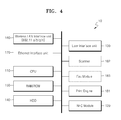
- FIG. 4 is a block diagram illustrating a basic hardware structure of an image forming apparatus supporting an NFC function, according to an exemplary embodiment of the present general inventive concept
- FIG. 5 illustrates an NFC tag and information stored in the NFC tag installed in the image forming apparatus of FIG. 1 B;
- FIG. 6A is a block diagram illustrating a hardware structure of an image forming apparatus that supports a scan-to-NFC function, according to an exemplary embodiment of the present general inventive concept
- FIG. 6B is a block diagram illustrating a hardware structure of an image forming apparatus that performs setting of an image job by using an NFC device according to an exemplary embodiment of the present general inventive concept
- FIG. 7 is a detailed structural diagram illustrating an image forming apparatus that performs setting of an image job by using an NFC device according to an exemplary embodiment of the present general inventive concept
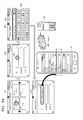
- FIG. 8A illustrates an operation of setting a scan-to-email application of an image forming apparatus by using a user device having an NFC function according to an exemplary embodiment of the present general inventive concept
- FIG. 8B illustrates an operation of setting a scan-to-email application of an image forming apparatus by using a user device having an NFC function according to an exemplary embodiment of the present general inventive concept
- FIG. 8C illustrates an operation of setting a scan-to-email application of an image forming apparatus by using a user device having an NFC function according to an exemplary embodiment of the present general inventive concept
- FIG. 9 illustrates an operation of setting a simple mail transfer protocol (SMTP) server of a network connection application of an image forming apparatus by using a user device having an NFC function according to an exemplary embodiment of the present general inventive concept
- FIG. 10 illustrates an operation of setting a scan-to-fax application of an image forming apparatus by using a user device having an NFC function according to an exemplary embodiment of the present general inventive concept
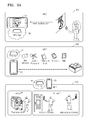
- FIG. 11 illustrates an operation of performing setting of a mobile printing function of an image forming apparatus by using a user device having an NFC function according to an exemplary embodiment of the present general inventive concept
- FIG. 12 is a flowchart illustrating a scan-to-NFC function performed in an image forming apparatus according to an exemplary embodiment of the present general inventive concept
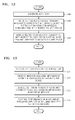
- FIG. 13 is a flowchart illustrating a method of performing setting of an image job in an image forming apparatus by using a user device according to an exemplary embodiment of the present general inventive concept.
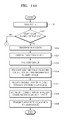
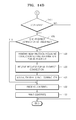
- FIGS. 14A through 14D are detailed flowcharts illustrating a method of setting an image job in an image forming apparatus illustrated in FIG. 12 by using a user device according to an exemplary embodiment of the present general inventive concept.
- FIG. 1A illustrates a near field communication (NFC) environment 1 according to an exemplary embodiment of the present general inventive concept.
- NFC near field communication
- an image forming apparatus 10 and a user device 20 each supporting an NFC function are present in the NFC environment 1.
- An NFC tag 30 (illustrated in FIG. 1 B) is embedded in the image forming apparatus 10 illustrated in FIG. 1 in advance, and thus communication between the image forming apparatus 10 and the user device 20 may be performed via NFC.
- FIG. 1 B illustrates an NFC environment 1 which is similar to the NFC environment 1 FIG. 1A , according to an exemplary embodiment of the present general inventive concept.
- an image forming apparatus 10 and a user device 20 each supporting an NFC function are also present in the NFC environment 1.
- an NFC tag 30 is embedded in advance in the image forming apparatus 10 of FIG. 1A
- no NFC tag 30 is embedded in the image forming apparatus 10 in FIG. 1 B in advance.
- the image forming apparatus 10 of FIG. 1 B may communicate with the user device 20 via NFC only when an NFC tag 30 is installed later in the image forming apparatus 10 of FIG. 1 B .
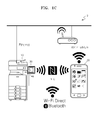
- FIG. 1 C illustrates an alternative wireless communication environment 2 according to another exemplary embodiment of the present general inventive concept, in which an image forming apparatus 10 and a user device 20 are present.
- FIG. 1 C other peripheral wired/wireless networks are illustrated in addition to the NFC environment 1 of FIG. 1A or 1B .
- the NFC environment 1 may operate in combination with peripheral wired/wireless networks, such as Wi-Fi Direct, Bluetooth, Ethernet, 802.11 a/b/g/n, etc.
- NFC technology Before describing the exemplary embodiments of the present general inventive concept in detail, NFC technology will be described.
- NFC is a contactless short-range wireless communication standard between electronic devices within a short distance of 10 cm with low power consumption by using a frequency of 13.56 MHz.
- a data transfer rate of NFC is 424 Kbps, and NFC has excellent security due to high proximity and encryption technology.
- NFC forgoes a complicated pairing process of recognition of devices but allows devices to recognize one another within 1/10 second or less.
- NFC is a smart card type contactless wireless communication technology where radio frequency identification (RFID) technology is utilized.
- RFID radio frequency identification
- NFC builds upon RFID technology by allowing two-way communication whereas conventional smart cards only allow one-way communication.
- NFC has a relatively large memory storage space and offers more variety of services.
- NFC is a wireless communication method in which data is directly exchanged between terminals, for example, between the image forming apparatus 10 and the user device 20, without using a communication network, and is a type of RFID method.
- a wireless communication method using RFID may be classified according to frequencies used. For example, RFID at 13.56 MHz is mainly used for smart cards, such as transit cards or entrance cards, and RFID at 900 MHz is used mainly for logistics.
- NFC corresponds to RFID which, like smartcards, uses a frequency of 13.56 MHz. However, unlike smartcards, which allow only one-way communication, NFC allows two-way communication. Accordingly, NFC is different from smart cards, which function merely as a tag that stores particular information and transmit the same to a reader. NFC allows a tag function according to necessity but also supports a function of recording information on the tag, and may be used in peer to peer (P2P) data exchange between terminals in which NFC is set.
- P2P peer to peer
- NFC which is developed based on RFID may be compared with other wireless communication methods, such as Wi-Fi Bluetooth, ZigBee, etc., as illustrated in FIG. 2A .
- FIG. 2A is a graph comparing data rates and communication ranges of NFC and other wireless communication methods.
- NFC may operate at a distance within about 10 cm.
- Bluetooth or Wi-Fi etc. which allow communication in about several to several tens of meters, NFC allows communication only within an extremely short distance (about 10 cm).
- NFC may be compared to other wireless communication methods, such as Bluetooth, ZigBee, etc., as described in Table 1 below.
- Table 1 Technology Frequency used security Standard range Major service area NFC 13.56 MHz Encryption is applied International Standard contactless payment, RFID, file transmission Bluetooth 2.4 GHz N/A International Standard file transmission ZigBee 2.4 GHz N/A International Standard device control, RFID 900MHz RFID 900 MHz N/A Korean standard RFID
- NFC operates only within a distance of 10 cm and encryption technology is applied thereto, and thus, a security level of NFC is high. Accordingly, when used in combination with other high-speed wireless communication methods, such as 3G or Wi-Fi, communication between devices via NFC may be performed with a higher efficiency. For example, when NFC and Bluetooth technology are combined, NFC may be used in connecting terminals (authorization) and Bluetooth may be used in data transmission between the terminals to thereby enable more efficient communication between the devices.
- FIG. 2B is a view of standards related to NFC technology.
- NFC standard technology follows International Organization for Standardization (ISO) and is also an extension of ISO 14443 Proximity-card Standard, and here, the inclusion relation of NFC IP-1(NFC Interface Protocol-1)(ISO/IEC 18092) and NFC IP-2(ISO/IEC 21481) is illustrated.
- ISO/IEC 14443 Type A and Type B, FeliCa, and ISO/IEC 15693 are international standards of four areas of contactless cards operating at 13.56 MHz.
- ISO/IEC 18092 defines communication modes for NFC interface and protocol.
- FIGS. 3A and 3B are diagrams to explain three communication modes of NFC.
- the NFC Forum has standardized major NFC communication modes, which are a Reader/Writer mode 301, a P2P mode 302, and a Card Emulation mode 303.
- the three communication modes of NFC may be listed as in Table 2 below.
- a VCD Vicinity Coupling Device
- a PCD Proximity Coupling Device
- the Reader/Writer mode 301 supports that the user device 20, in which an NFC tag 30 is embedded, operates as a reader for reading another NFC tag 30 or operates as a writer for inputting information to another NFC tag 30 (ISO/IEC 15693).
- the P2P mode 302 communication at a link level between two NFC terminals, for example, between the image forming apparatus 10 and the user device 20, is supported (ISO/IEC 18092).
- a client NFC P2P initiator, the user device 20
- a host NFC P2P target, the image forming apparatus 10.
- data such as emails, login/password information, schedules, telephone numbers, and XML data, may be exchanged just by touching the image forming apparatus 10 with the user device 20.
- the user device 20 in which an NFC tag 30 is embedded, operates as a smart card (ISO/IEC 14443). Accordingly, NFC is compatible not only with ISO 14443, which is the international standard for contactless cards, but also with FeliCa by Sony and MiFare by Philips.
- FIG. 3B In order to coordinately provide the three communication modes of NFC, a protocol is standardized as illustrated in FIG. 3B .
- a protocol is standardized as illustrated in FIG. 3B .
- FIG. 3B a software structure in an NFC system is illustrated.
- Logical Link Control Protocol is a protocol that sets a communication connection between layers and controls the same.
- An NFC Data Exchange Format (NDEF) message is a basic message structure defined in an NFC communication protocol.
- the NDEF is a standard exchange format for Uniform Resource Identifier (URI), smart posters, and others, which defines a recording format regarding message exchange between NFC Forum-compatible devices and tags.
- An NDEF message includes at least one NDEF record.
- the NDEF record includes a payload that is described according to type, length, and option identifiers.
- An NDEF payload refers to application data included in an NDEF record.
- Record Type Definition (RTD) defines a record type and a type name which may correspond to an NDEF record.
- Card Emulation is a protocol by which a user device 20 having an NFC function, such as a smartphone with an NFC tag 30, can duplicate the functions of a conventional smart card.
- FIG. 4 is a block diagram illustrating a basic hardware structure of the image forming apparatus 10 supporting an NFC function, according to an exemplary embodiment of the present general inventive concept.
- the image forming apparatus 10 may include a central processing unit (CPU) 110, an NFC module 120, a user interface unit 130, a hard disk drive (HDD) 140, a random access memory/read only memory (RAM/ROM) 150, a wireless local area network (WLAN) interface unit 160, an Ethernet interface unit 170, a print engine 181, a scanner 182, and a fax module 183.
- the Ethernet interface unit 170 may not be included.
- the scanner 182 and the fax module 183 may not be included.
- the CPU 110 controls the overall operation of the image forming apparatus 10, and information needed for controlling and print data is stored in the HDD 140 and the RAM/ROM 150 and read therefrom when necessary.
- the user interface unit 130 is hardware used as a medium for the user when the user checks information of the image forming apparatus 10 and inputs a command to the image forming apparatus 10.
- the user interface unit 130 may be designed in various manners according to products. For example, it may be formed in a simple form of two or four lines on a display, such as a liquid crystal display (LCD) or light emitting diode (LED), or as a graphic user interface (GUI), so as to enable various graphical representations.
- LCD liquid crystal display
- LED light emitting diode
- GUI graphic user interface
- the WLAN interface unit 160 refers to hardware that performs IEEE 802.11 a/b/g/n functionality, and may communicate with a main board of the image forming apparatus 10 via a universal serial bus (USB) or the like.
- the WLAN interface unit 160 may also support Wi-Fi Direct at the same time.
- the Ethernet interface unit 170 refers to hardware that performs wired Ethernet communication according to IEEE 802.3.
- the print engine 181, the scanner 182, and the fax module 183 refer to hardware to perform a printing function, a scan function, and a fax function, respectively.
- the image forming apparatus 10 includes the NFC module 120 to thereby communicate with other NFC devices, such as the user device 20, via NFC.
- the NFC module 120 is in charge of the NFC function and may read from or write data to an NFC tag 30.
- communication with the main board of the image forming apparatus 10 is performed by using a Universal Asynchronous Receiver/Transmitter (UART), an Inter Integrated Circuit (12C), a Serial Peripheral Interface Bus (SPI), or the like (not illustrated).
- UART Universal Asynchronous Receiver/Transmitter
- 12C Inter Integrated Circuit
- SPI Serial Peripheral Interface Bus
- the NFC module 120 may be embedded in the image forming apparatus 10 in advance at the time of factory shipment, or may be available when the user installs the NFC tag 30 later.
- the image forming apparatus 10 may also include other wireless communication modules, such as a Bluetooth module or a ZigBee module.
- FIG. 5 illustrates the NFC tag 30 installed in the image forming apparatus 10 of FIG. 1 B and information 510 stored in the NFC tag 30.
- the NFC function may be utilized when the NFC tag 30 is inserted into a slot (not illustrated) that is provided in advance in the image forming apparatus 10.
- the information 510 of the NFC tag 30, for example, performance information of the image forming apparatus 10, may be recorded by other NFC devices in the Reader/Writer mode 301 or may be stored in advance by a manager.
- An image forming apparatus 60 supporting an NFC function according to an exemplary embodiment of the present general inventive concept and detailed functions and operations thereof in regards to a method of performing setting of an image job by using an NFC device and a scan-to-NFC function of the image forming apparatus 60 will be described in detail with reference to the drawings below.
- FIG. 6A is a block diagram illustrating a hardware structure of an image forming apparatus 60 that supports a scan-to-NFC function, according to an exemplary embodiment of the present general inventive concept.
- FIG. 6A only hardware components related to the current exemplary embodiment of the present general inventive concept will be described in order to prevent obscuring the characteristics of the current exemplary embodiment. However, it will be understood by one of ordinary skill in the art that general-use hardware components other than the illustrated hardware components in FIG. 6A may also be included.
- the image forming apparatus 60 is illustrated as including just hardware components related to the current exemplary embodiment from among the hardware components of the image forming apparatus 10 illustrated in FIG. 4 .
- the image forming apparatus 60 may also be applied to the image forming apparatus 60.
- the image forming apparatus 60 includes a control unit 610, an NFC module 620, and a scanning unit 650.
- the control unit 610 corresponds to the CPU 110 of FIG. 4
- the NFC module 620 corresponds to the NFC module 120 of FIG. 4
- the scanning unit 650 corresponds to the scanner 182 illustrated in FIG. 4 .
- the scan-to-NFC function will be understood as a function of transmitting scan data generated by using the scanning unit 650 of the image forming apparatus 60, to an external NFC device (e.g., the user device 20, such as a smartphone) via the NFC module 620.
- an external NFC device e.g., the user device 20, such as a smartphone
- a user interface unit 640 included in the image forming apparatus 60 receives information from a user to execute the scan-to-NFC function.
- the scanning unit 650 scans an original document (not illustrated) placed on the image forming apparatus 60 to generate scan data.
- a scanning function of the image forming apparatus 60 is well-known to one of ordinary skill in the art, and thus, detailed description thereof will be omitted.
- a storage unit (not illustrated, e.g., the HDD 140 of FIG. 4 ) may temporarily store the generated scan data before it is transmitted.
- the user interface unit 640 may display information indicating that tagging of the user device 20 is necessary, for example, a message such as "Tag your device.”
- the NFC module 620 recognizes access by the user device 20 having an NFC function according to an NFC protocol. In order to activate the NFC function and establish a connection, a predetermined NFC device corresponding to a client (e.g., the user device 20) has to access another NFC device corresponding to a host (e.g., the image forming apparatus 60) within a proximity range of 10 cm.
- a predetermined NFC device corresponding to a client e.g., the user device 20
- a host e.g., the image forming apparatus 60
- the NFC module 620 tags the user device 20 by recognizing the access by the user device 20.
- wireless communication may be NFC implemented by using the NFC module 620 or wireless communication via wireless communication modules 6301 (illustrated in FIG. 7 ) other than the NFC module 620, for example, wireless communication via a Wi-Fi Direct module (not illustrated) having a Wi-Fi Direct function.
- Wireless communication modules 6301 other than the NFC module 620 may be used because the other wireless communication modules 6301 such as Wi-Fi Direct modules may be more efficient for data transmission of a large amount data in comparison to the NFC module 620 when considering data size of scan data.
- a wireless communication module 6301 according to the current exemplary embodiment is not limited to any one type of a wireless communication module 6301.
- the control unit 610 controls the NFC module 620 to transmit the generated scan data to the user device 20 via the NFC module 620.
- the NFC module 620 may include scan data in an NDEF message defined according to NFC standards, and transmit the same to the user device 20.
- transmission of scan data by using other wireless communication modules 6301 instead of the NFC module 620 is as follows.
- the NFC module 620 transmits an NDEF message including connection setting information for wireless communication with respect to the user device 20, to the user device 20.
- connection setting information included in the NDEF message includes network information of the image forming apparatus 60 such as a MAC address or an Internet protocol (IP) address of the image forming apparatus 60 needed for Wi-Fi Direct connection between the user device 20 and the image forming apparatus 60.
- network information of the image forming apparatus 60 such as a MAC address or an Internet protocol (IP) address of the image forming apparatus 60 needed for Wi-Fi Direct connection between the user device 20 and the image forming apparatus 60.
- IP Internet protocol
- the NDEF message transmitted to the user device 20 will be described in further detail.
- the NFC module 620 transmits an NDEF message, in which a Type Name Format (TNF) field is set as an unknown type, an Application type field is set as contents, and connection setting information of the image forming apparatus 60 is included in a Payload field, to the user device 20.
- TNF Type Name Format
- the image forming apparatus 60 receives a request for Wi-Fi Direct connection from the user device 20 that has received the NDEF message.
- the image forming apparatus 60 allows the request for Wi-Fi Direct connection of the user device 20, a wireless communication connection between the image forming apparatus 60 and the user device 20 is established.
- control unit 610 controls the NFC module 620 to transmit the generated scan data to the user device 20, thereby completing the scan-to-N FC function of the image forming apparatus 60.
- FIG. 6B is a block diagram illustrating a hardware structure of an image forming apparatus 60 that performs setting of an image job by using an NFC device according to an exemplary embodiment of the present general inventive concept.
- FIG. 6B only hardware components related to the current exemplary embodiment of the present general inventive concept will be described in order to prevent obscuring the characteristics of the current exemplary embodiment. However, it will be understood by one of ordinary skill in the art that general-use hardware components other than the illustrated hardware components of FIG. 6B may also be included.
- the image forming apparatus 60 is illustrated as including just hardware components related to the current exemplary embodiment from among the hardware components of the image forming apparatus 10 illustrated in FIG. 4 .
- elements that are omitted in FIG. 6B but described with reference to the image forming apparatus 10 of FIG. 4 may also be applied to the image forming apparatus 60.
- the image forming apparatus 60 includes a control unit 610 and an NFC module 620.
- the control unit 610 corresponds to the CPU 110 of FIG. 4
- the NFC module 620 corresponds to the NFC module 120 of FIG. 4 .
- the control unit 610 executes an application to perform an image job.
- the NFC module 620 tags the user device 20 having an NFC function. Then, the NFC module 620 receives a message including information stored in the user device 20. As described above, the message is an NDEF message defined according to the NFC standards.
- the control unit 610 analyzes setting information related to a set up of an image job based on the information included in the message received from the NFC module 620. Then, the control unit 610 performs an image job by executing an application by using the analyzed setting information.
- the image forming apparatus 60 may remotely perform a set up related to an image job that is to be performed by using the information that is written by the user device 20 and stored therein.
- FIG. 7 is a detailed structural diagram illustrating the image forming apparatus 60 that performs setting of an image job by using an NFC device according to an exemplary embodiment of the present general inventive concept.
- FIG. 7 is a detailed structural diagram of the image forming apparatus 60 illustrated in FIG. 6B .
- FIG. 7 only hardware components related to the current exemplary embodiment of the present general inventive concept will be described in order to prevent obscuring the characteristics of the current exemplary embodiment. However, it will be understood by one of ordinary skill in the art that general-use hardware components other than the illustrated hardware components of FIG. 7 may also be included.
- the image forming apparatus 60 is illustrated as including just hardware components related to the current exemplary embodiment from among the hardware components of the image forming apparatus 10 illustrated in FIG. 4 .
- the image forming apparatus 60 may also be applied to the image forming apparatus 60.
- the image forming apparatus 60 includes a control unit 610, an NFC module 620, a network interface unit 630, and a user interface unit 640.
- the control unit 610 includes a message analyzing unit 6101 and a setting updating unit 6102
- the network interface unit 630 includes a wireless communication module 6301.
- the control unit 610 corresponds to the CPU 110 illustrated in FIG. 4
- the NFC module 620 corresponds to the NFC module 120 illustrated in FIG. 4
- the network interface unit 630 corresponds to the WLAN interface unit 160 and the Ethernet interface unit 170
- the user interface unit 640 corresponds to the user interface unit 130 illustrated in FIG. 4 .
- the wireless communication module 6301 refers to any hardware that uses wireless communication methods other than NFC, such as a Bluetooth module or a ZigBee module.
- a user directly sets up an image job via an input unit included in an image forming apparatus.
- a desired menu needs to be searched for or a large amount of information has to be input via a conventional user interface screen having a limited size, such as a screen two or four lines high, a 4.3 inch screen or a 7 inch screen, or by using an input device having a limited number of buttons.
- the user is inconvenienced by having to input numbers, alphabets, special characters or the like, in various stages, over a long period of time. That is, to set up an image job, a user either must go through various menu screens or individually input a large amount of information.
- image forming apparatus 60 of the current exemplary embodiment of the present general inventive concept just by tagging the user device 20 via an NFC function, set up of an image job may be performed by using the information stored in the user device 20.
- the function and operation of the image forming apparatus 60 will be described in detail.
- the control unit 610 executes an application installed in the image forming apparatus 60 to perform an image job.
- An application of the image forming apparatus 60 according to the current exemplary embodiment of the present general inventive concept refers to an application used to perform an image job, such as a scan-to-email function, a scan-to-fax function, a scan-to-server function, a document box job, or a server setting operation.
- an application used to perform an image job such as a scan-to-email function, a scan-to-fax function, a scan-to-server function, a document box job, or a server setting operation.
- the application according to the current exemplary embodiment of the present general inventive concept is not limited to the listed operations.
- the user interface unit 640 may display a user interface screen related to driving of the application. On this user interface screen, a setting field which requires a user input to execute an application may be displayed.
- the NFC module 620 recognizes access by the user device 20 according to an NFC protocol.
- the user device 20 corresponding to a client has to access the image forming apparatus 60 corresponding to a host within a proximity range of 10 cm. Accordingly, the NFC module 620 recognizes access by the user device 20 and tags the user device 20.
- the NFC module 620 receives a message including the information stored in the user device 20.
- the message may correspond to an NDEF message defined by the NFC standards.
- a time point when the NFC module 620 tags the user device 20 may be while being on standby waiting for an input of a setting of an image job via a user interface screen of an application after the execution of the application has been initiated.
- the NDEF message transmitted from the user device 20 may include various types of information. For example, if an image job is a scan-to-email operation or a scan-to-fax operation, address book information such as an email address, a phone number or the like stored in the user device 20 may be included in the NDEF message. Also, when an image job requires an environment setting (configuration) for network connection of the image forming apparatus 60, information about a connection setting of the user device 20 stored in the user device 20 may be included in the NDEF message.
- the control unit 610 analyzes setting information related to a set up of an image job from the information included in the received message, and controls an image job to be performed by executing the application by using the analyzed setting information.
- control unit 610 updates, by using the analyzed setting information, a setting field of an application that is to be input via the user interface unit 640.
- control unit 610 may include the message analyzing unit 6101 and the setting updating unit 6102.
- the control unit 610 may be implemented by typically used processors.
- control unit 610 may be implemented as an array of a plurality of logic gates, or as a combination of memories in which a general-use micro-processor and programs that may be executed in the general-use micro-processor are stored. Also, the control unit 610 may be implemented as a module of an application program. Furthermore, it would be understood by one of ordinary skill in the art that the control unit 610 may also be implemented as another type of hardware that may be implemented using operations that will be described with reference to the current exemplary embodiment of the present general inventive concept.
- the message analyzing unit 6101 parses the NDEF message that is received from the user device 20 via the NFC module 620.
- the message analyzing unit 6101 parses a header portion of the received NDEF message. If a TNF field of the header portion is an unknown type, the message analyzing unit 6101 parses a payload of the NDEF message. Otherwise, the message analyzing unit 6101 ignores the received NDEF message.
- the message analyzing unit 6101 parses an Application Type field, and parses a Payload Body field.
- the setting updating unit 6101 updates a setting field of an application by using the setting information included in the parsed Application Type field and the parsed Payload Body field.
- the setting updating unit 6102 updates a setting field related to an address of a scan-to-email application. If the parsed Application Type field is an address book and the parsed Payload Body field is an email address, the setting updating unit 6102 updates a setting field of an email address of a scan-to-email application. Alternatively, when the parsed Application Type field is an address book and the parsed Payload Body field is a fax number, the setting updating unit 6102 updates a setting field of a fax number of a scan-to-fax application. Alternatively, when the parsed Application Type field is an address book and the parsed Payload Body field is text, the setting updating unit 6102 updates a setting field of a subject or an email body of a scan-to-email application.
- parsed Application Type field is an environment setting (Configuration) of a network connection.
- the setting updating unit 6102 updates a setting field related to a connection setting of a network connection application.
- the connection setting may correspond to a set up for connection with respect to a server (not illustrated).
- a server corresponds to a server needed for the image forming apparatus 60 to communicate with an external network, and examples thereof may include a file transfer protocol (FTP) server, a server message block (SMB) server, and also, a simple mail transfer protocol (SMTP) server for email transmission.
- FTP file transfer protocol
- SMB server message block
- SMTP simple mail transfer protocol
- the setting updating unit 6102 updates a setting field regarding a connection setting with respect to wireless communication in, for example, a scan-to-NFC application, a mobile printing application or a mobile scan application in order to transmit or receive contents if the user device 20 and the image forming apparatus 60 are not connected via other wireless communication methods such as Wi-Fi Direct or Bluetooth. This corresponds to a case in which contents are not transmitted or received via the NFC module 620.
- the setting updating unit 6102 may update a connection setting of wireless communication (e.g., a media access control (MAC) address, an Internet protocol (IP) address, or the like) with respect to the user device 20 via Wi-Fi Direct or Bluetooth or the like.
- MAC media access control
- IP Internet protocol
- the user interface unit 640 may display an updated setting field via a user interface screen (not illustrated) of an application.
- the control unit 610 performs an image job based on the updated result once updating of all setting fields of the application has been completed as described above.
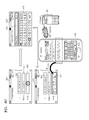
- FIG. 8A illustrates an operation of setting a scan-to-email application of an image forming apparatus 60 by using a user device 20 having an NFC function according to an exemplary embodiment of the present general inventive concept.
- the control unit 610 executes an application to perform a scan-to-email operation.
- the user interface unit 640 displays a user interface screen 801 regarding a scan-to-email application. Setting fields about options in regard to a scan-to-email operation are displayed on the user interface unit 801.
- the user interface unit 640 displays a setting field 805 of a recipient email address ("To email address,” indicated by the gray dot in a user interface screen 802) and setting fields of a subject and a body as illustrated on the user interface screen 802.
- the user interface unit 640 displays a soft keyboard 806 together with the setting field 805 of the recipient email address as illustrated on a user interface screen 803.
- the image forming apparatus 60 waits for an input of a recipient email address from a user via the soft keyboard 806 of the user interface unit 640.
- a user has no other option but to directly input a recipient email address via a soft keyboard 806 according to the conventional art.
- a soft keyboard 806 is not included or if a soft keyboard 806 is small, it is difficult for the user to directly input a recipient email address.
- a user tags the user device 20 to the image forming apparatus via an NFC function.
- an application related to an address book or an application installed in relation to the image forming apparatus 60 may be being executed.
- the NFC module 620 receives an NDEF message including address book information stored in the user device 20.
- the received NDEF message may include address book information stored in the user device 20, for example, an email address of a recipient.
- the message analyzing unit 6101 of the control unit 610 parses the email address of the NDEF message received from the user device 20. Then, the setting updating unit 6102 updates the parsed email address in the setting field 805 of a recipient email address of a scan-to-email application (e.g. "dhkim@samsung.com," as illustrated in FIG. 8A ).
- a scan-to-email application e.g. "dhkim@samsung.com,” as illustrated in FIG. 8A .
- the user interface unit 640 updates the received email address received from the user device 20 in the setting field 805 of the recipient email address and displays the same as illustrated on a user interface screen 804.
- a setting corresponding to the setting field of the application may be performed just by NFC tagging.
- FIG. 8B illustrates an operation of setting a scan-to-email application of an image forming apparatus 60 by using a user device 20 having an NFC function according to an exemplary embodiment of the present general inventive concept.
- the user interface unit 640 displays a setting field 814 of a subject, a body, and the updated recipient email address as illustrated on a user interface screen 811 in FIG. 8B .
- the user interface unit 640 displays a soft keyboard 806 together with the setting field 814 of the subject as illustrated on a user interface screen 812.
- the image forming apparatus 60 waits for an input of a subject from a user via the soft keyboard 806 of the user interface unit 640.
- the user interface screen 812 when the user interface screen 812 is displayed, the user tags the user device 20 to the image forming apparatus 60 via an NFC function.
- an application related to a text input or an application installed in relation to the image forming apparatus 60 may be being executed.
- the NFC module 620 receives an NDEF message including text information written by the user device 20.
- text information about a subject of an email written by the user device 20 e.g., dhkim_scan_file, as illustrated in FIG. 8B .
- the message analyzing unit 6101 parses text information (dhkim_scan_file) of the NDEF message received from the user device 20. Then, the setting updating unit 6102 updates the parsed text information (dhkim_scan_file) in the setting field 814 of a subject of a scan-to-email application.
- the user interface unit 640 updates the text information (dhkim_scan_file) received from the user device 20 in the setting field 814 of the subject and displays the same as illustrated on a user interface screen 813.
- FIG. 8C illustrates an operation of setting a scan-to-email application of an image forming apparatus 60 by using a user device 20 having an NFC function according to an exemplary embodiment of the present general inventive concept.
- the user interface unit 640 displays a setting field 824 of a body and the updated recipient email address and subject as illustrated on a user interface screen 821 in FIG. 8C .
- the user interface unit 640 displays the soft keyboard 806 together with the setting field 824 of the body as illustrated on a user interface screen 822.
- the image forming apparatus 60 waits for an input of an email body by a user via the soft keyboard 806 of the user interface unit 640.
- the user tags the user device 20 to the image forming apparatus 60 via an NFC function.
- an application related to a text input or an application installed in relation to the image forming apparatus 60 may be being executed.
- the NFC module 620 receives an NDEF message including text information written by the user device 20.
- text information about an email body written in the user device 20 e.g., "Dear Bob, " as illustrated in FIG. 8C .
- the message analyzing unit 6101 of the control unit 610 parses text information ("Dear Bob, ") of the NDEF message received from the user device 20. Then, the setting updating unit 6102 updates the parsed text information ("Dear Bob, ") in the setting field 824 of the body of a scan-to-email application.
- the user interface unit 640 updates the text information ("Dear Bob, ##) received from the user device 20 in the setting field 814 of the subject and displays the same as illustrated on a user interface screen 823.
- the control unit 610 performs the scan-to-email operation based on the updated setting fields 805, 814, and 824.
- FIG. 9 illustrates an operation of setting an SMTP server of a network connection application of an image forming apparatus 60 by using a user device 20 having an NFC function according to an exemplary embodiment of the present general inventive concept.
- the control unit 610 executes an application to perform a network connecting operation.
- the user interface unit 640 displays a user interface screen 901 regarding a network connection application.
- the user interface unit 640 displays a message 904 indicating that an environment setting for network connection is necessary, as illustrated on a user interface screen 902.
- the image forming apparatus 60 waits for an input of an environment setting of an SMTP server from a user via the user interface unit 640.
- the user tags the user device 20 to the image forming apparatus 60 via an NFC function.
- an application related to network connection or an application installed in relation to the image forming apparatus 60 may be being executed.
- the NFC module 620 receives an NDEF message including connection setting information of an SMTP server (e.g., IP:123.234.123.234, as illustrated in FIG. 9 ) stored in the user device 20.
- an SMTP server e.g., IP:123.234.123.234, as illustrated in FIG. 9
- the message analyzing unit 6101 of the control unit 610 parses the connection setting information (e.g., IP:123.234.123.234) of the NDEF message received from the user device 20. Then, the setting updating unit 6102 updates the parsed connection setting information (e.g., IP:123.234.123.234) in a setting field of an environment setting of a network connection application.
- the connection setting information e.g., IP:123.234.123.234
- the user interface unit 640 updates the connection setting information (e.g., IP:123.234.123.234) received from the user device 20, in a setting field of an environment setting and displays the same as on illustrated by message 905 on a user interface screen 903.
- connection setting information e.g., IP:123.234.123.234
- a setting corresponding to an environment setting of an SMTP server may be performed just by NFC tagging.
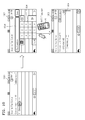
- FIG. 10 illustrates an operation of setting a scan-to-fax application of an image forming apparatus 60 by using a user device 20 having an NFC function according to an exemplary embodiment of the present general inventive concept.
- the control unit 610 executes an application to perform a scan-to-fax operation.
- the user interface unit 640 displays a user interface screen 1001 regarding a scan-to-fax application.
- the user interface unit 640 displays a soft keyboard 806 together with a setting field 1004 of a fax number as illustrated on a user interface screen 1002.
- the image forming apparatus 60 waits for an input of a fax number by a user via the soft keyboard 806 of the user interface unit 640.
- the user tags the user device 20 to the image forming apparatus 60 via an NFC function.
- an application related to address book information or an application installed in relation to the image forming apparatus 60 may be being executed for example.
- the NFC module 620 receives an NDEF message including address book information stored in the user device 20.
- the received NDEF message may include the address book information stored in the user device 20, for example, a fax number of a recipient of a fax (e.g., "0123456789," as illustrated in FIG. 10 ).
- the message analyzing unit 6101 of the control unit 610 parses the fax number ("0123456789") of the NDEF message received from the user device 20. Then, the setting updating unit 6102 updates the parsed fax number ("0123456789") in the setting field 1004 of the fax number of a scan-to-fax application.
- the user interface unit 640 updates the fax number ("0123456789") received from the user device 20 in the setting field 1004 of the fax number and displays the same as illustrated on a user interface screen 1003.
- FIG. 11 illustrates an operation of setting a mobile printing function of an image forming apparatus 60 by using a user device 20 having an NFC function according to an exemplary embodiment of the present general inventive concept.
- a mobile printing operation refers to an operation of printing contents stored in the user device 20, performed by the image forming apparatus 60.
- the control unit 610 executes an application to perform a mobile printing operation.
- the user interface unit 640 displays a user interface screen 1101 regarding a mobile printing application.
- the image forming apparatus 60 waits to receive contents from the user device 20.
- the user tags the user device 20 to the image forming apparatus 60 via an NFC function.
- application related contents or an application installed in relation to the image forming apparatus 60 may be being executed.
- the NFC module 620 may receive an NDEF message including contents, directly from the user device 20.
- the wireless communication module 6301 which is efficient in transmission of files of large amount, may be used instead of the NFC module 620.
- the NFC module 620 may be used simply as a unit to establish a connection between the user device 20 and the wireless communication module 6301.
- the wireless communication module 6301 is a module capable of performing communication via a Wi-Fi Direct or Bluetooth method.
- Wi-Fi Direct will be described as an example below, but the exemplary embodiments of the present general inventive concept are not limited thereto.
- the NFC module 620 transmits an NDEF message including connection setting information for Wi-Fi Direct connection with respect to the user device 20, to the user device 20.
- connection setting information included in the NDEF message includes network information of the image forming apparatus 60 such as a MAC address, an IP address, or security information of the image forming apparatus 60 needed for Wi-Fi Direct connection between the user device 20 and the image forming apparatus 60.
- the NDEF message transmitted to the user device 20 will be described in further detail.
- the NFC module 620 transmits an NDEF message in which a TNF field is set as an unknown type, an Application type is set as contents, and connection setting information of the image forming apparatus 60 is included in a Payload field, to the user device 20.
- the image forming apparatus 60 receives a request for Wi-Fi Direct connection from the user device 20 that has received the NDEF message.
- a Wi-Fi Direct connection between the image forming apparatus 60 and the user device 20 is set.
- the wireless communication module 6301 receives contents from the user device 20 via Wi-Fi Direct connection.
- the control unit 610 controls the received contents to be printed, thereby completing the mobile printing operation of the image forming apparatus 60.
- the user interface unit 640 displays a processing condition of the mobile printing operation as illustrated on a user interface screen 1102.
- the image forming apparatus 60 may also operate in the above manner when a scan-to-NFC operation or the like is performed.
- FIG. 12 is a flowchart illustrating a method of performing a scan-to-NFC function in an image forming apparatus 60 according to an exemplary embodiment of the present general inventive concept.
- the method of performing a scan-to-NFC operation according to the current exemplary embodiment of the present general inventive concept includes operations that are performed in a time series manner in the image forming apparatus 60 illustrated in FIGS. 4 and 6A . Accordingly, descriptions omitted below but described above with reference to FIGS. 4 and 6A may also be applied to the method of performing a scan-to-NFC operation according to the current exemplary embodiment of the present general inventive concept.
- the scanning unit 650 In operation 1201, the scanning unit 650 generates scan data.
- the NFC module 620 transmits a message to the user device 20 including connection setting information for wireless communication with the user device 20.
- control unit 610 controls the generated scan data to be transmitted to the user device 20 when wireless communication connection is set with respect to the user device 20.
- wireless communication may also be performed using a wireless communication method different from that of using an NFC module.
- FIG. 13 is a flowchart illustrating a method of setting an image job in an image forming apparatus 60 by using a user device 20 according to an exemplary embodiment of the present general inventive concept.
- the method of performing setting an image job according to the current exemplary embodiment of the present general inventive concept includes operations that are performed in a time series manner in the image forming apparatus 60 illustrated in FIGS. 4 , 6B , and 6C. Accordingly, description omitted below but described above with reference to FIGS. 4 , 6B , and 6C may also be applied to the method of performing setting of an image job according to the current exemplary embodiment of the present general inventive concept.
- control unit 610 executes an application to perform an image job.
- the NFC module 620 receives a message including information stored in the user device 20 by tagging the user device 20.
- control unit 610 analyzes setting information regarding setting of an image job based on information included in the received message.
- control unit 610 controls performance of an image job by executing an application by using the analyzed setting information.
- FIGS. 14A through 14D are detailed flowcharts illustrating the method of setting an image job in an image forming apparatus 60 illustrated in FIG. 12 by using a user device 20 according to an exemplary embodiment of the present general inventive concept.
- control unit 610 activates the NFC module 620. Then, the NFC module 620 operates in an idle state to wait for access of an NFC device.
- control unit 610 determines whether to start a scan-to-NFC operation.
- the user interface unit 640 displays information indicating that tagging of the user device 20 is necessary, for example, a message such as "Tag your device.”
- the NFC module 620 tags the user device by recognizing access of the user device 20.
- the NFC module 620 transmits to the user device 20 an NDEF message including connection setting information for wireless communication with respect to the user device 20.
- the wireless communication module 6301 receives a request for Wi-Fi Direct connection from the user device 20 that has received the NDEF message.
- control unit 610 allows a request for Wi-Fi Direct connection of the user device 20. Then, connection of wireless communication via Wi-Fi Direct connection is established between the image forming apparatus 60 and the user device 20.
- control unit 610 controls transmission of the generated scan data to the user device 20. Accordingly, the scan-to-NFC function of the image forming apparatus 60 is completed.
- control unit 610 determines whether the user device 20 is tagged or not.
- control unit 610 parses a Header of the NDEF message received from the user device 20.
- control unit 610 determines whether a TNF field of the NDEF message is an Unknown Type field or not.
- control unit 610 parses a Payload field of the NDEF message.
- control unit 610 determines whether the parsed Payload field is a Known Payload Format or not.
- control unit 610 determines whether the Application Type field is a Known Application Type field.
- the process ends. If the user device 20 is not tagged, the TNF field is not an Unknown Type field, the Payload field is not a Known Payload Format, or the Application Type field is not a Known Application Type field (operation 1410-No, operation 1412-No, operation 1414-No, or operation 1415-No), the process ends.
- control unit 610 determines whether the Known Application Type is an address book or not.
- control unit 610 parses a Payload Body of the NDEF message.
- control unit 610 determines whether data included in the parsed Payload Body is an email address or not.
- control unit 610 updates a setting field of an application with the parsed email address.
- control unit 610 determines whether data included in the parsed Payload Body is a fax number or not.
- control unit 610 updates the setting field of the application with the parsed fax number.
- control unit 610 determines whether data included in the parsed Payload Body is text or not.
- control unit 610 updates the setting field of the application with the parsed text.
- control unit 610 determines whether the Known Application Type is an environment setting (Configuration) or not.
- control unit 610 parses a Payload Body.
- control unit 610 updates an environment setting of the network connection of the image forming apparatus 60 according to connection setting information included in the parsed Payload Body. The process then ends.
- control unit 610 determines whether the Known Application Type is contents or not.
- operation 1427-No If it is determined in operation 1427 that the Known Application Type is not contents (operation 1427-No), the process ends.
- control unit 610 determines whether a Wi-Fi Direct connection is established between the current user device 20 and the wireless communication module 6301.
- the NFC module 620 transmits an NDEF message to the user device 20 including connection setting information for Wi-Fi Direct connection with respect to the user device 20.
- the wireless communication module 6301 receives a request for Wi-Fi Direct connection from the user device 20.
- control unit 610 allows the request for Wi-Fi Direct connection received from the user device 20. Then, a Wi-Fi Direct connection is established between the wireless communication module 6301 and the user device 20.
- the wireless communication module 6301 receives contents from the user device 20 via the Wi-Fi Direct connection.
- control unit 610 prints the received contents. The process then ends.
- a set up of an image job may be performed based on setting information stored in the NFC device, and thus, an image forming apparatus may be conveniently used regardless of a screen configuration of a user interface screen included in the image forming apparatus, or a size of an input device.
- the present general inventive concept can also be embodied as computer-readable codes on a computer-readable medium.
- the computer-readable medium can include a computer-readable recording medium and a computer-readable transmission medium.
- the computer-readable recording medium is any data storage device that can store data as a program which can be thereafter read by a computer system. Examples of the computer-readable recording medium include a semiconductor memory, a read-only memory (ROM), a random-access memory (RAM), a USB memory, a memory card, a Blu-Ray disc, CD-ROMs, magnetic tapes, floppy disks, and optical data storage devices.
- the computer-readable recording medium can also be distributed over network coupled computer systems so that the computer-readable code is stored and executed in a distributed fashion.
- the computer-readable transmission medium can transmit carrier waves or signals (e.g., wired or wireless data transmission through the Internet).
- functional programs, codes, and code segments to accomplish the present general inventive concept can be easily construed by programmers skilled in the art to which the present general inventive concept pertains.
Landscapes
- Engineering & Computer Science (AREA)
- Signal Processing (AREA)
- Multimedia (AREA)
- General Engineering & Computer Science (AREA)
- Human Computer Interaction (AREA)
- Computer Networks & Wireless Communication (AREA)
- Computing Systems (AREA)
- Theoretical Computer Science (AREA)
- Physics & Mathematics (AREA)
- General Physics & Mathematics (AREA)
- Facsimiles In General (AREA)
- Accessory Devices And Overall Control Thereof (AREA)
- Astronomy & Astrophysics (AREA)
Abstract

Description
- The present general inventive concept relates to image forming apparatuses supporting a near field communication (NFC) function and methods of performing setting of an image job by using an NFC device.
- Near field communication (NFC) is a contactless short-range wireless communication standard between electronic devices within a short distance of 10 cm with low power consumption by using a frequency of 13.56 MHz, and was developed by the joint work of NXP Semiconductors of Netherlands and Sony of Japan in 2002. A data transfer rate of NFC is 424 Kbps, and NFC has excellent security due to high proximity and encryption technology. NFC forgoes a complicated pairing process of recognition of devices but allows devices to recognize one another within 1/10 second or less.
- In particular, NFC is a smart card type contactless wireless communication technology where radio frequency identification (RFID) technology is utilized. In addition, NFC builds upon RFID technology by allowing two-way communication compared to smart cards. NFC has a relatively large memory storage space and offers more variety of services. Accordingly, commercialized electronic devices, such as smartphones and personal computers (PCs), in which the NFC technology is used, have recently been released.
- The present general inventive concept provides an image forming apparatus supporting a near field communication (NFC) function and a method of performing setting an image job by using an NFC device.
- The present general inventive concept also provides a computer-readable recording medium having embodied thereon a program to execute the method on a computer.
- Additional features and utilities of the present general inventive concept will be set forth in part in the description which follows and, in part, will be obvious from the description, or may be learned by practice of the general inventive concept.
- Exemplary embodiments of the present general inventive concept provide an image forming apparatus supporting a near field communication (NFC) function, the image forming apparatus including a control unit configured to execute an application to perform an image job, and an NFC module configured to tag a user device having the NFC function and to receive from the tagged user device a message comprising information stored in the tagged user device, wherein the control unit is configured to analyze setting information regarding a set up of the image job based on the included information in the received message, and the image job is performed by executing the application by using the analyzed setting information.
- The control unit may be configured to use the analyzed setting information to update a setting field of the application that is to be input via a user interface unit.
- The user interface unit may be configured to display the updated setting field, wherein the updated setting field has to be input to execute the application, and wherein the user interface unit be configured to display the analyzed setting information by updating the analyzed setting information in the displayed setting field when the user device is tagged.
- When an application is executed and requires an environment setting of the image forming apparatus for network connection of the image forming apparatus, the control unit may be configured to update the environment setting of the image forming apparatus by using the analyzed setting information.
- The received message may include address book information stored in the tagged user device, wherein the control unit is configured to update a setting field of the application, and wherein the setting field of the application is to be input via a user interface unit by using the address book information.
- The user interface may be configured to display a setting field for an email address when the image job is an operation of transmitting scan data to the email address, wherein the email address is included in the address book information, and wherein the control unit is configured to control the user interface unit such that the email address that is included in the address book information is input in the displayed setting field and displayed.
- The user interface unit may be configured to display a setting field for a phone number when the image job is a fax operation, wherein the phone number is included in the address book information, and wherein the control unit controls the user interface unit such that the phone number that is included in the address book information is input in the displayed setting field and displayed.
- The received message may include text information written by using the tagged user device, and wherein the control unit is configured to update a setting field for contents of an email by using the text information when the image job is an operation of transmitting scan data to an email address.
- The image job may be an operation of establishing a connection between a network interface unit of the image forming apparatus and an external network, the NFC module may be configured to receive the message including information about a connection setting to establish a connection between the tagged user device and the external network, wherein the information is stored in the tagged user device, and wherein the control unit is configured to update a setting field for a network connection by using information included in the received message about the connection setting.
- Exemplary embodiments of the present general inventive concept also provide a method of performing setting of an image job by using a near field communication (NFC) device in an image forming apparatus that supports an NFC function, the method including executing an application to perform the image job, tagging a user device having the NFC function to receive a message comprising information stored in the tagged user device, analyzing setting information related to a set up of the image job based on the information in the received message, and controlling the performing of the image job by executing the application by using the analyzed setting information.
- The controlling may include updating, via a user interface unit, a setting field of the application by using the analyzed setting information.
- The method may further include displaying the setting field which has to be input to execute the application, and updating the analyzed setting information in the displayed setting field when the user device is tagged, the display the updated analyzed setting field.
- The displayed setting field is a setting field for an email address when the image job is an operation of transmitting scan data to the email address, and may be a setting field for a phone number when the image job is a fax operation, wherein the updating of the analyzed setting information updates the analyzed setting information with address book information stored in the tagged user device.
- When the application, which requires an environment setting of the image forming apparatus for network connection of the image forming apparatus, is executed, the controlling may include executing the application by updating the environment setting of the image forming apparatus by using the analyzed setting information.
- The analyzed setting information may be information regarding connection setting to establish communication between the image forming apparatus and either the tagged user device or an external network.
- These and/or other features and utilities of the present general inventive concept will become apparent and more readily appreciated from the following description of the embodiments, taken in conjunction with the accompanying drawings of which:
-
FIG. 1A illustrates a near field communication (NFC) environment according to an exemplary embodiment of the present general inventive concept; -
FIG. 1 B illustrates an NFC environment which is similar to that ofFIG.1A , according to another exemplary embodiment of the present general inventive concept; -
FIG. 1 C illustrates a wireless communication environment in which an image forming apparatus and a user device are present, according to an exemplary embodiment of the present general inventive concept; -
FIG. 2A is a graph comparing data rates and communication ranges of NFC and other wireless communication methods; -
FIG. 2B is a view of standards related to NFC technology; -
FIGS. 3A and3B are diagrams to explain three communication modes of NFC; -
FIG. 4 is a block diagram illustrating a basic hardware structure of an image forming apparatus supporting an NFC function, according to an exemplary embodiment of the present general inventive concept; -
FIG. 5 illustrates an NFC tag and information stored in the NFC tag installed in the image forming apparatus ofFIG. 1 B; -
FIG. 6A is a block diagram illustrating a hardware structure of an image forming apparatus that supports a scan-to-NFC function, according to an exemplary embodiment of the present general inventive concept; -
FIG. 6B is a block diagram illustrating a hardware structure of an image forming apparatus that performs setting of an image job by using an NFC device according to an exemplary embodiment of the present general inventive concept; -
FIG. 7 is a detailed structural diagram illustrating an image forming apparatus that performs setting of an image job by using an NFC device according to an exemplary embodiment of the present general inventive concept; -
FIG. 8A illustrates an operation of setting a scan-to-email application of an image forming apparatus by using a user device having an NFC function according to an exemplary embodiment of the present general inventive concept; -
FIG. 8B illustrates an operation of setting a scan-to-email application of an image forming apparatus by using a user device having an NFC function according to an exemplary embodiment of the present general inventive concept; -
FIG. 8C illustrates an operation of setting a scan-to-email application of an image forming apparatus by using a user device having an NFC function according to an exemplary embodiment of the present general inventive concept; -
FIG. 9 illustrates an operation of setting a simple mail transfer protocol (SMTP) server of a network connection application of an image forming apparatus by using a user device having an NFC function according to an exemplary embodiment of the present general inventive concept; -
FIG. 10 illustrates an operation of setting a scan-to-fax application of an image forming apparatus by using a user device having an NFC function according to an exemplary embodiment of the present general inventive concept; -
FIG. 11 illustrates an operation of performing setting of a mobile printing function of an image forming apparatus by using a user device having an NFC function according to an exemplary embodiment of the present general inventive concept; -
FIG. 12 is a flowchart illustrating a scan-to-NFC function performed in an image forming apparatus according to an exemplary embodiment of the present general inventive concept; -
FIG. 13 is a flowchart illustrating a method of performing setting of an image job in an image forming apparatus by using a user device according to an exemplary embodiment of the present general inventive concept; and -
FIGS. 14A through 14D are detailed flowcharts illustrating a method of setting an image job in an image forming apparatus illustrated inFIG. 12 by using a user device according to an exemplary embodiment of the present general inventive concept. - Reference will now be made in detail to the embodiments of the present general inventive concept, examples of which are illustrated in the accompanying drawings, wherein like reference numerals refer to the like elements throughout. The embodiments are described below in order to explain the present general inventive concept while referring to the figures. Expressions such as "at least one of," when preceding a list of elements, modify the entire list of elements and do not modify the individual elements of the list.
-
FIG. 1A illustrates a near field communication (NFC)environment 1 according to an exemplary embodiment of the present general inventive concept. Referring toFIG. 1A , animage forming apparatus 10 and a user device 20 (such as a smartphone) each supporting an NFC function are present in theNFC environment 1. An NFC tag 30 (illustrated inFIG. 1 B) is embedded in theimage forming apparatus 10 illustrated inFIG. 1 in advance, and thus communication between theimage forming apparatus 10 and theuser device 20 may be performed via NFC. -
FIG. 1 B illustrates anNFC environment 1 which is similar to theNFC environment 1FIG. 1A , according to an exemplary embodiment of the present general inventive concept. Referring toFIG. 1 B , animage forming apparatus 10 and auser device 20 each supporting an NFC function are also present in theNFC environment 1. In particular, anNFC tag 30 is embedded in advance in theimage forming apparatus 10 ofFIG. 1A , whereas noNFC tag 30 is embedded in theimage forming apparatus 10 inFIG. 1 B in advance. Accordingly, theimage forming apparatus 10 ofFIG. 1 B may communicate with theuser device 20 via NFC only when anNFC tag 30 is installed later in theimage forming apparatus 10 ofFIG. 1 B . - However, it will be understood by one of ordinary skill in the art that if an
NFC tag 30 is installed later in theimage forming apparatus 10 ofFIG. 1 B, then an operation of theNFC environment 1 of the current exemplary embodiment is identical to that of theNFC environment 1 ofFIG. 1A , in which theNFC tag 30 is embedded in advance. - While just one pair of devices, that is, the
image forming apparatus 10 and theuser device 20, is present in theNFC environment 1 illustrated inFIGS. 1A and 1 B for convenience of description, more electronic devices of different types that support an NFC function may also be present in theNFC environment 1. These devices may also operate in the same manner of NFC as in the current exemplary embodiment of the present general inventive concept, which would be understood by one of ordinary skill in the art. -
FIG. 1 C illustrates an alternativewireless communication environment 2 according to another exemplary embodiment of the present general inventive concept, in which animage forming apparatus 10 and auser device 20 are present. Referring toFIG. 1 C , other peripheral wired/wireless networks are illustrated in addition to theNFC environment 1 ofFIG. 1A or 1B . TheNFC environment 1 may operate in combination with peripheral wired/wireless networks, such as Wi-Fi Direct, Bluetooth, Ethernet, 802.11 a/b/g/n, etc. - Before describing the exemplary embodiments of the present general inventive concept in detail, NFC technology will be described.
- NFC is a contactless short-range wireless communication standard between electronic devices within a short distance of 10 cm with low power consumption by using a frequency of 13.56 MHz. A data transfer rate of NFC is 424 Kbps, and NFC has excellent security due to high proximity and encryption technology. NFC forgoes a complicated pairing process of recognition of devices but allows devices to recognize one another within 1/10 second or less. In particular, NFC is a smart card type contactless wireless communication technology where radio frequency identification (RFID) technology is utilized. In addition, NFC builds upon RFID technology by allowing two-way communication whereas conventional smart cards only allow one-way communication. Furthermore, NFC has a relatively large memory storage space and offers more variety of services.
- In detail, NFC is a wireless communication method in which data is directly exchanged between terminals, for example, between the
image forming apparatus 10 and theuser device 20, without using a communication network, and is a type of RFID method. A wireless communication method using RFID may be classified according to frequencies used. For example, RFID at 13.56 MHz is mainly used for smart cards, such as transit cards or entrance cards, and RFID at 900 MHz is used mainly for logistics. NFC corresponds to RFID which, like smartcards, uses a frequency of 13.56 MHz. However, unlike smartcards, which allow only one-way communication, NFC allows two-way communication. Accordingly, NFC is different from smart cards, which function merely as a tag that stores particular information and transmit the same to a reader. NFC allows a tag function according to necessity but also supports a function of recording information on the tag, and may be used in peer to peer (P2P) data exchange between terminals in which NFC is set. - NFC which is developed based on RFID may be compared with other wireless communication methods, such as Wi-Fi Bluetooth, ZigBee, etc., as illustrated in
FIG. 2A . -
FIG. 2A is a graph comparing data rates and communication ranges of NFC and other wireless communication methods. Referring toFIG. 2A , compared to other wireless communication methods, NFC may operate at a distance within about 10 cm. Unlike Bluetooth or Wi-Fi etc., which allow communication in about several to several tens of meters, NFC allows communication only within an extremely short distance (about 10 cm). - In addition, NFC may be compared to other wireless communication methods, such as Bluetooth, ZigBee, etc., as described in Table 1 below.
[Table 1] Technology Frequency used security Standard range Major service area NFC 13.56 MHz Encryption is applied International Standard contactless payment, RFID, file transmission Bluetooth 2.4 GHz N/A International Standard file transmission ZigBee 2.4 GHz N/A International Standard device control, RFID 900MHz RFID 900 MHz N/A Korean standard RFID - In other words, compared to other wireless communication methods, NFC operates only within a distance of 10 cm and encryption technology is applied thereto, and thus, a security level of NFC is high. Accordingly, when used in combination with other high-speed wireless communication methods, such as 3G or Wi-Fi, communication between devices via NFC may be performed with a higher efficiency. For example, when NFC and Bluetooth technology are combined, NFC may be used in connecting terminals (authorization) and Bluetooth may be used in data transmission between the terminals to thereby enable more efficient communication between the devices.
-
FIG. 2B is a view of standards related to NFC technology. - Referring to
FIG. 2B , NFC standard technology follows International Organization for Standardization (ISO) and is also an extension ofISO 14443 Proximity-card Standard, and here, the inclusion relation of NFC IP-1(NFC Interface Protocol-1)(ISO/IEC 18092) and NFC IP-2(ISO/IEC 21481) is illustrated. Here, ISO/IEC 14443 Type A and Type B, FeliCa, and ISO/IEC 15693 are international standards of four areas of contactless cards operating at 13.56 MHz. Also, ISO/IEC 18092 defines communication modes for NFC interface and protocol. -
FIGS. 3A and3B are diagrams to explain three communication modes of NFC. - Referring to
FIG. 3A , the NFC Forum has standardized major NFC communication modes, which are a Reader/Writer mode 301, aP2P mode 302, and aCard Emulation mode 303. In sum, the three communication modes of NFC may be listed as in Table 2 below. For the purposes of Table 2, a VCD (Vicinity Coupling Device) may carry out the function of the Reader/Writer mode, while a PCD (Proximity Coupling Device) may carry out the function of Card Emulation mode.[Table 2] ISO/ IEC 15693ISO/ IEC 18092ISO/ IEC 14443Operational mode communication between reader and tag (VCD, Reader/Writer mode) communication between devices (P2P mode) communication between reader and tag (PCD, Card Emulation mode) Power supply Manual active and manual manual Range of communication 1 m 10-20 cm 10 cm Data rate 26 Kbps or less 106 Kbps, 212 Kbps, 424 Kbps 106 Kbps (PCD: Proximity Coupling Device, VCD: Vicinity Coupling Device) - First, the Reader/
Writer mode 301 supports that theuser device 20, in which anNFC tag 30 is embedded, operates as a reader for reading anotherNFC tag 30 or operates as a writer for inputting information to another NFC tag 30 (ISO/IEC 15693). - In the
P2P mode 302, communication at a link level between two NFC terminals, for example, between theimage forming apparatus 10 and theuser device 20, is supported (ISO/IEC 18092). To establish a connection, a client (NFC P2P initiator, the user device 20) searches for a host (NFC P2P target, the image forming apparatus 10) and transmits data of an NDEF message format. In theP2P mode 302, data, such as emails, login/password information, schedules, telephone numbers, and XML data, may be exchanged just by touching theimage forming apparatus 10 with theuser device 20. - Finally, in the
Card Emulation mode 303, theuser device 20, in which anNFC tag 30 is embedded, operates as a smart card (ISO/IEC 14443). Accordingly, NFC is compatible not only withISO 14443, which is the international standard for contactless cards, but also with FeliCa by Sony and MiFare by Philips. - In order to coordinately provide the three communication modes of NFC, a protocol is standardized as illustrated in
FIG. 3B . Referring toFIG. 3B , a software structure in an NFC system is illustrated. - Logical Link Control Protocol (LLCP) is a protocol that sets a communication connection between layers and controls the same. An NFC Data Exchange Format (NDEF) message is a basic message structure defined in an NFC communication protocol. The NDEF is a standard exchange format for Uniform Resource Identifier (URI), smart posters, and others, which defines a recording format regarding message exchange between NFC Forum-compatible devices and tags. An NDEF message includes at least one NDEF record. The NDEF record includes a payload that is described according to type, length, and option identifiers. An NDEF payload refers to application data included in an NDEF record. Record Type Definition (RTD) defines a record type and a type name which may correspond to an NDEF record. Card Emulation is a protocol by which a
user device 20 having an NFC function, such as a smartphone with anNFC tag 30, can duplicate the functions of a conventional smart card. -
FIG. 4 is a block diagram illustrating a basic hardware structure of theimage forming apparatus 10 supporting an NFC function, according to an exemplary embodiment of the present general inventive concept. Referring toFIG. 4 , theimage forming apparatus 10 may include a central processing unit (CPU) 110, anNFC module 120, auser interface unit 130, a hard disk drive (HDD) 140, a random access memory/read only memory (RAM/ROM) 150, a wireless local area network (WLAN)interface unit 160, anEthernet interface unit 170, aprint engine 181, ascanner 182, and afax module 183. If theimage forming apparatus 10 supports only WLAN, theEthernet interface unit 170 may not be included. Also, if theimage forming apparatus 10 is a printer, thescanner 182 and thefax module 183 may not be included. - The
CPU 110 controls the overall operation of theimage forming apparatus 10, and information needed for controlling and print data is stored in theHDD 140 and the RAM/ROM 150 and read therefrom when necessary. - The
user interface unit 130 is hardware used as a medium for the user when the user checks information of theimage forming apparatus 10 and inputs a command to theimage forming apparatus 10. Theuser interface unit 130 may be designed in various manners according to products. For example, it may be formed in a simple form of two or four lines on a display, such as a liquid crystal display (LCD) or light emitting diode (LED), or as a graphic user interface (GUI), so as to enable various graphical representations. - The
WLAN interface unit 160 refers to hardware that performs IEEE 802.11 a/b/g/n functionality, and may communicate with a main board of theimage forming apparatus 10 via a universal serial bus (USB) or the like. TheWLAN interface unit 160 may also support Wi-Fi Direct at the same time. - The
Ethernet interface unit 170 refers to hardware that performs wired Ethernet communication according to IEEE 802.3. - The
print engine 181, thescanner 182, and thefax module 183 refer to hardware to perform a printing function, a scan function, and a fax function, respectively. - In particular, the
image forming apparatus 10 includes theNFC module 120 to thereby communicate with other NFC devices, such as theuser device 20, via NFC. TheNFC module 120 is in charge of the NFC function and may read from or write data to anNFC tag 30. Also, communication with the main board of theimage forming apparatus 10 is performed by using a Universal Asynchronous Receiver/Transmitter (UART), an Inter Integrated Circuit (12C), a Serial Peripheral Interface Bus (SPI), or the like (not illustrated). As described above with reference toFIGS. 1A and 1B , theNFC module 120 may be embedded in theimage forming apparatus 10 in advance at the time of factory shipment, or may be available when the user installs theNFC tag 30 later. - Although not illustrated in
FIG. 4 , theimage forming apparatus 10 may also include other wireless communication modules, such as a Bluetooth module or a ZigBee module. -
FIG. 5 illustrates theNFC tag 30 installed in theimage forming apparatus 10 ofFIG. 1 B andinformation 510 stored in theNFC tag 30. Referring toFIG. 5 , in the case of theimage forming apparatus 10 ofFIG. 1 B , the NFC function may be utilized when theNFC tag 30 is inserted into a slot (not illustrated) that is provided in advance in theimage forming apparatus 10. Theinformation 510 of theNFC tag 30, for example, performance information of theimage forming apparatus 10, may be recorded by other NFC devices in the Reader/Writer mode 301 or may be stored in advance by a manager. - An
image forming apparatus 60 supporting an NFC function according to an exemplary embodiment of the present general inventive concept and detailed functions and operations thereof in regards to a method of performing setting of an image job by using an NFC device and a scan-to-NFC function of theimage forming apparatus 60 will be described in detail with reference to the drawings below. -
FIG. 6A is a block diagram illustrating a hardware structure of animage forming apparatus 60 that supports a scan-to-NFC function, according to an exemplary embodiment of the present general inventive concept. - In
FIG. 6A , only hardware components related to the current exemplary embodiment of the present general inventive concept will be described in order to prevent obscuring the characteristics of the current exemplary embodiment. However, it will be understood by one of ordinary skill in the art that general-use hardware components other than the illustrated hardware components inFIG. 6A may also be included. - Referring to
FIG. 6A , theimage forming apparatus 60 is illustrated as including just hardware components related to the current exemplary embodiment from among the hardware components of theimage forming apparatus 10 illustrated inFIG. 4 . However, it will be understood by one of ordinary skill in the art that elements that are omitted inFIG. 6A but described with reference to theimage forming apparatus 10 ofFIG. 4 may also be applied to theimage forming apparatus 60. - The
image forming apparatus 60 includes acontrol unit 610, anNFC module 620, and ascanning unit 650. Referring toFIG. 6A , thecontrol unit 610 corresponds to theCPU 110 ofFIG. 4 , theNFC module 620 corresponds to theNFC module 120 ofFIG. 4 , and thescanning unit 650 corresponds to thescanner 182 illustrated inFIG. 4 . - According to the current exemplary embodiment of the present general inventive concept, the scan-to-NFC function will be understood as a function of transmitting scan data generated by using the
scanning unit 650 of theimage forming apparatus 60, to an external NFC device (e.g., theuser device 20, such as a smartphone) via theNFC module 620. - In order to activate a scan-to-NFC function, a
user interface unit 640 included in the image forming apparatus 60 (illustrated inFIG. 7 , and corresponding to theuser interface unit 130 ofFIG. 4 ) receives information from a user to execute the scan-to-NFC function. - The
scanning unit 650 scans an original document (not illustrated) placed on theimage forming apparatus 60 to generate scan data. A scanning function of theimage forming apparatus 60 is well-known to one of ordinary skill in the art, and thus, detailed description thereof will be omitted. - Meanwhile, a storage unit (not illustrated, e.g., the
HDD 140 ofFIG. 4 ) may temporarily store the generated scan data before it is transmitted. - When generation and storage of scan data is completed, the
user interface unit 640 may display information indicating that tagging of theuser device 20 is necessary, for example, a message such as "Tag your device." - The
NFC module 620 recognizes access by theuser device 20 having an NFC function according to an NFC protocol. In order to activate the NFC function and establish a connection, a predetermined NFC device corresponding to a client (e.g., the user device 20) has to access another NFC device corresponding to a host (e.g., the image forming apparatus 60) within a proximity range of 10 cm. - Accordingly, the
NFC module 620 tags theuser device 20 by recognizing the access by theuser device 20. - Here, wireless communication may be NFC implemented by using the
NFC module 620 or wireless communication via wireless communication modules 6301 (illustrated inFIG. 7 ) other than theNFC module 620, for example, wireless communication via a Wi-Fi Direct module (not illustrated) having a Wi-Fi Direct function.Wireless communication modules 6301 other than theNFC module 620 may be used because the otherwireless communication modules 6301 such as Wi-Fi Direct modules may be more efficient for data transmission of a large amount data in comparison to theNFC module 620 when considering data size of scan data. However, it would be understood by one of ordinary skill in the art that awireless communication module 6301 according to the current exemplary embodiment is not limited to any one type of awireless communication module 6301. - Transmission of scan data by using the
NFC module 620 will be described now. When a wireless communication connection between theNFC module 620 and theuser device 20 is set, thecontrol unit 610 controls theNFC module 620 to transmit the generated scan data to theuser device 20 via theNFC module 620. - In this case, the
NFC module 620 may include scan data in an NDEF message defined according to NFC standards, and transmit the same to theuser device 20. - However, transmission of scan data by using other
wireless communication modules 6301 instead of the NFC module 620 (e.g., a Wi-Fi Direct module) is as follows. - When the
user device 20 is tagged, theNFC module 620 transmits an NDEF message including connection setting information for wireless communication with respect to theuser device 20, to theuser device 20. - Here, the connection setting information included in the NDEF message includes network information of the
image forming apparatus 60 such as a MAC address or an Internet protocol (IP) address of theimage forming apparatus 60 needed for Wi-Fi Direct connection between theuser device 20 and theimage forming apparatus 60. - The NDEF message transmitted to the
user device 20 will be described in further detail. TheNFC module 620 transmits an NDEF message, in which a Type Name Format (TNF) field is set as an unknown type, an Application type field is set as contents, and connection setting information of theimage forming apparatus 60 is included in a Payload field, to theuser device 20. - Next, the
image forming apparatus 60 receives a request for Wi-Fi Direct connection from theuser device 20 that has received the NDEF message. When theimage forming apparatus 60 allows the request for Wi-Fi Direct connection of theuser device 20, a wireless communication connection between theimage forming apparatus 60 and theuser device 20 is established. - When wireless communication connection of Wi-Fi Direct is established, the
control unit 610 controls theNFC module 620 to transmit the generated scan data to theuser device 20, thereby completing the scan-to-N FC function of theimage forming apparatus 60. -
FIG. 6B is a block diagram illustrating a hardware structure of animage forming apparatus 60 that performs setting of an image job by using an NFC device according to an exemplary embodiment of the present general inventive concept. - In
FIG. 6B , only hardware components related to the current exemplary embodiment of the present general inventive concept will be described in order to prevent obscuring the characteristics of the current exemplary embodiment. However, it will be understood by one of ordinary skill in the art that general-use hardware components other than the illustrated hardware components ofFIG. 6B may also be included. - Referring to
FIG. 6B , theimage forming apparatus 60 is illustrated as including just hardware components related to the current exemplary embodiment from among the hardware components of theimage forming apparatus 10 illustrated inFIG. 4 . However, it will be understood by one of ordinary skill in the art that elements that are omitted inFIG. 6B but described with reference to theimage forming apparatus 10 ofFIG. 4 may also be applied to theimage forming apparatus 60. - The
image forming apparatus 60 includes acontrol unit 610 and anNFC module 620. Referring toFIG. 6B , thecontrol unit 610 corresponds to theCPU 110 ofFIG. 4 , and theNFC module 620 corresponds to theNFC module 120 ofFIG. 4 . - The
control unit 610 executes an application to perform an image job. - When an application related to a predetermined image job is executed, the
NFC module 620 tags theuser device 20 having an NFC function. Then, theNFC module 620 receives a message including information stored in theuser device 20. As described above, the message is an NDEF message defined according to the NFC standards. - The
control unit 610 analyzes setting information related to a set up of an image job based on the information included in the message received from theNFC module 620. Then, thecontrol unit 610 performs an image job by executing an application by using the analyzed setting information. - That is, the
image forming apparatus 60 may remotely perform a set up related to an image job that is to be performed by using the information that is written by theuser device 20 and stored therein. -
FIG. 7 is a detailed structural diagram illustrating theimage forming apparatus 60 that performs setting of an image job by using an NFC device according to an exemplary embodiment of the present general inventive concept.FIG. 7 is a detailed structural diagram of theimage forming apparatus 60 illustrated inFIG. 6B . - In
FIG. 7 , only hardware components related to the current exemplary embodiment of the present general inventive concept will be described in order to prevent obscuring the characteristics of the current exemplary embodiment. However, it will be understood by one of ordinary skill in the art that general-use hardware components other than the illustrated hardware components ofFIG. 7 may also be included. - Referring to
FIG. 7 , theimage forming apparatus 60 is illustrated as including just hardware components related to the current exemplary embodiment from among the hardware components of theimage forming apparatus 10 illustrated inFIG. 4 . However, it will be understood by one of ordinary skill in the art that elements that are omitted inFIG. 7 but described with reference to theimage forming apparatus 10 ofFIG. 4 may also be applied to theimage forming apparatus 60. - The
image forming apparatus 60 includes acontrol unit 610, anNFC module 620, anetwork interface unit 630, and auser interface unit 640. Thecontrol unit 610 includes amessage analyzing unit 6101 and asetting updating unit 6102, and thenetwork interface unit 630 includes awireless communication module 6301. Referring toFIG. 7 , thecontrol unit 610 corresponds to theCPU 110 illustrated inFIG. 4 , and theNFC module 620 corresponds to theNFC module 120 illustrated inFIG. 4 , and thenetwork interface unit 630 corresponds to theWLAN interface unit 160 and theEthernet interface unit 170, and theuser interface unit 640 corresponds to theuser interface unit 130 illustrated inFIG. 4 . Meanwhile, thewireless communication module 6301 refers to any hardware that uses wireless communication methods other than NFC, such as a Bluetooth module or a ZigBee module. - In general, according to the conventional art, a user directly sets up an image job via an input unit included in an image forming apparatus. However, a desired menu needs to be searched for or a large amount of information has to be input via a conventional user interface screen having a limited size, such as a screen two or four lines high, a 4.3 inch screen or a 7 inch screen, or by using an input device having a limited number of buttons. Accordingly, the user is inconvenienced by having to input numbers, alphabets, special characters or the like, in various stages, over a long period of time. That is, to set up an image job, a user either must go through various menu screens or individually input a large amount of information.
- However, according to the
image forming apparatus 60 of the current exemplary embodiment of the present general inventive concept, just by tagging theuser device 20 via an NFC function, set up of an image job may be performed by using the information stored in theuser device 20. Hereinafter, the function and operation of theimage forming apparatus 60 will be described in detail. - The
control unit 610 executes an application installed in theimage forming apparatus 60 to perform an image job. - An application of the
image forming apparatus 60 according to the current exemplary embodiment of the present general inventive concept refers to an application used to perform an image job, such as a scan-to-email function, a scan-to-fax function, a scan-to-server function, a document box job, or a server setting operation. However, it will be understood by one of ordinary skill in the art that the application according to the current exemplary embodiment of the present general inventive concept is not limited to the listed operations. - When an application is being executed, the
user interface unit 640 may display a user interface screen related to driving of the application. On this user interface screen, a setting field which requires a user input to execute an application may be displayed. - The
NFC module 620 recognizes access by theuser device 20 according to an NFC protocol. In order to activate an NFC function and establish a connection, theuser device 20 corresponding to a client has to access theimage forming apparatus 60 corresponding to a host within a proximity range of 10 cm. Accordingly, theNFC module 620 recognizes access by theuser device 20 and tags theuser device 20. - The
NFC module 620 receives a message including the information stored in theuser device 20. Here, the message may correspond to an NDEF message defined by the NFC standards. - Here, a time point when the
NFC module 620 tags theuser device 20 may be while being on standby waiting for an input of a setting of an image job via a user interface screen of an application after the execution of the application has been initiated. - Meanwhile, the NDEF message transmitted from the
user device 20 may include various types of information. For example, if an image job is a scan-to-email operation or a scan-to-fax operation, address book information such as an email address, a phone number or the like stored in theuser device 20 may be included in the NDEF message. Also, when an image job requires an environment setting (configuration) for network connection of theimage forming apparatus 60, information about a connection setting of theuser device 20 stored in theuser device 20 may be included in the NDEF message. - The
control unit 610 analyzes setting information related to a set up of an image job from the information included in the received message, and controls an image job to be performed by executing the application by using the analyzed setting information. - In particular, the
control unit 610 updates, by using the analyzed setting information, a setting field of an application that is to be input via theuser interface unit 640. - As described above, the
control unit 610 may include themessage analyzing unit 6101 and thesetting updating unit 6102. - The
control unit 610 may be implemented by typically used processors. - That is, the
control unit 610 may be implemented as an array of a plurality of logic gates, or as a combination of memories in which a general-use micro-processor and programs that may be executed in the general-use micro-processor are stored. Also, thecontrol unit 610 may be implemented as a module of an application program. Furthermore, it would be understood by one of ordinary skill in the art that thecontrol unit 610 may also be implemented as another type of hardware that may be implemented using operations that will be described with reference to the current exemplary embodiment of the present general inventive concept. - The
message analyzing unit 6101 parses the NDEF message that is received from theuser device 20 via theNFC module 620. - In detail, the
message analyzing unit 6101 parses a header portion of the received NDEF message. If a TNF field of the header portion is an unknown type, themessage analyzing unit 6101 parses a payload of the NDEF message. Otherwise, themessage analyzing unit 6101 ignores the received NDEF message. - As a result of parsing the payload, if the parsed payload is a recognizable format, the
message analyzing unit 6101 parses an Application Type field, and parses a Payload Body field. - The
setting updating unit 6101 updates a setting field of an application by using the setting information included in the parsed Application Type field and the parsed Payload Body field. - An example where the parsed Application Type field is an address book will be described below.
- The
setting updating unit 6102 updates a setting field related to an address of a scan-to-email application. If the parsed Application Type field is an address book and the parsed Payload Body field is an email address, thesetting updating unit 6102 updates a setting field of an email address of a scan-to-email application. Alternatively, when the parsed Application Type field is an address book and the parsed Payload Body field is a fax number, thesetting updating unit 6102 updates a setting field of a fax number of a scan-to-fax application. Alternatively, when the parsed Application Type field is an address book and the parsed Payload Body field is text, thesetting updating unit 6102 updates a setting field of a subject or an email body of a scan-to-email application. - Alternatively, an example where the parsed Application Type field is an environment setting (Configuration) of a network connection will be described below.
- The
setting updating unit 6102 updates a setting field related to a connection setting of a network connection application. Here, the connection setting may correspond to a set up for connection with respect to a server (not illustrated). According to the current exemplary embodiment of the present general inventive concept, a server corresponds to a server needed for theimage forming apparatus 60 to communicate with an external network, and examples thereof may include a file transfer protocol (FTP) server, a server message block (SMB) server, and also, a simple mail transfer protocol (SMTP) server for email transmission. However, it would be understood by one of ordinary skill in the art that the server according to the current exemplary embodiment of the present general inventive concept is not limited to the listed servers. - Alternatively, an example where the parsed Application Type field is contents will be described below.
- The
setting updating unit 6102 updates a setting field regarding a connection setting with respect to wireless communication in, for example, a scan-to-NFC application, a mobile printing application or a mobile scan application in order to transmit or receive contents if theuser device 20 and theimage forming apparatus 60 are not connected via other wireless communication methods such as Wi-Fi Direct or Bluetooth. This corresponds to a case in which contents are not transmitted or received via theNFC module 620. Here, thesetting updating unit 6102 may update a connection setting of wireless communication (e.g., a media access control (MAC) address, an Internet protocol (IP) address, or the like) with respect to theuser device 20 via Wi-Fi Direct or Bluetooth or the like. - When the update is completed, the
user interface unit 640 may display an updated setting field via a user interface screen (not illustrated) of an application. - The
control unit 610 performs an image job based on the updated result once updating of all setting fields of the application has been completed as described above. - The function and operation of the
image forming apparatus 60 as described above will be further described in detail with reference to a user interface screen of theuser interface unit 640 below. -
FIG. 8A illustrates an operation of setting a scan-to-email application of animage forming apparatus 60 by using auser device 20 having an NFC function according to an exemplary embodiment of the present general inventive concept. - The
control unit 610 executes an application to perform a scan-to-email operation. Theuser interface unit 640 displays auser interface screen 801 regarding a scan-to-email application. Setting fields about options in regard to a scan-to-email operation are displayed on theuser interface unit 801. - When a setting field of an email setting is clicked by a user (as indicated by the gray dot in user interface screen 801), the
user interface unit 640 displays asetting field 805 of a recipient email address ("To email address," indicated by the gray dot in a user interface screen 802) and setting fields of a subject and a body as illustrated on theuser interface screen 802. - First, when the user has clicked the setting
field 805 of the recipient email address on theuser interface screen 802 in order to input a recipient email address, theuser interface unit 640 displays asoft keyboard 806 together with the settingfield 805 of the recipient email address as illustrated on auser interface screen 803. - Here, the
image forming apparatus 60 waits for an input of a recipient email address from a user via thesoft keyboard 806 of theuser interface unit 640. - As described above, a user has no other option but to directly input a recipient email address via a
soft keyboard 806 according to the conventional art. In particular, depending on the type of theimage forming apparatus 60, if asoft keyboard 806 is not included or if asoft keyboard 806 is small, it is difficult for the user to directly input a recipient email address. - According to the current exemplary embodiment of the present general inventive concept, when the
user interface screen 803 is displayed, a user tags theuser device 20 to the image forming apparatus via an NFC function. Here, in theuser device 20, an application related to an address book or an application installed in relation to theimage forming apparatus 60 may be being executed. - The
NFC module 620 receives an NDEF message including address book information stored in theuser device 20. The received NDEF message may include address book information stored in theuser device 20, for example, an email address of a recipient. - The
message analyzing unit 6101 of thecontrol unit 610 parses the email address of the NDEF message received from theuser device 20. Then, thesetting updating unit 6102 updates the parsed email address in thesetting field 805 of a recipient email address of a scan-to-email application (e.g. "dhkim@samsung.com," as illustrated inFIG. 8A ). - The
user interface unit 640 updates the received email address received from theuser device 20 in thesetting field 805 of the recipient email address and displays the same as illustrated on auser interface screen 804. - Accordingly, in an exemplary embodiment of the present general inventive concept, even if contents of a setting field of an application are not directly input by a user, a setting corresponding to the setting field of the application may be performed just by NFC tagging.
-
FIG. 8B illustrates an operation of setting a scan-to-email application of animage forming apparatus 60 by using auser device 20 having an NFC function according to an exemplary embodiment of the present general inventive concept. - When the setting
field 805 of the recipient email address is updated as described above with reference toFIG. 8A , theuser interface unit 640 displays asetting field 814 of a subject, a body, and the updated recipient email address as illustrated on auser interface screen 811 inFIG. 8B . - When the user clicks the setting
field 814 of the subject on theuser interface screen 811 in order to input a subject (indicated by the gray dot on user interface screen 811), theuser interface unit 640 displays asoft keyboard 806 together with the settingfield 814 of the subject as illustrated on auser interface screen 812. - Here, the
image forming apparatus 60 waits for an input of a subject from a user via thesoft keyboard 806 of theuser interface unit 640. - According to the current exemplary embodiment of the present general inventive concept, when the
user interface screen 812 is displayed, the user tags theuser device 20 to theimage forming apparatus 60 via an NFC function. Here, in theuser device 20, an application related to a text input or an application installed in relation to theimage forming apparatus 60 may be being executed. - The
NFC module 620 receives an NDEF message including text information written by theuser device 20. In the received NDEF message, text information about a subject of an email written by the user device 20 (e.g., dhkim_scan_file, as illustrated inFIG. 8B ) may be included. - The
message analyzing unit 6101 parses text information (dhkim_scan_file) of the NDEF message received from theuser device 20. Then, thesetting updating unit 6102 updates the parsed text information (dhkim_scan_file) in thesetting field 814 of a subject of a scan-to-email application. - The
user interface unit 640 updates the text information (dhkim_scan_file) received from theuser device 20 in thesetting field 814 of the subject and displays the same as illustrated on auser interface screen 813. -
FIG. 8C illustrates an operation of setting a scan-to-email application of animage forming apparatus 60 by using auser device 20 having an NFC function according to an exemplary embodiment of the present general inventive concept. - When the setting
field 805 of the recipient email address and the settingfield 814 of the subject are updated as described above with reference toFIGS. 8A and8B , theuser interface unit 640 displays asetting field 824 of a body and the updated recipient email address and subject as illustrated on auser interface screen 821 inFIG. 8C . - When the user clicks the setting
field 824 of the body on the user interface screen 821 (indicated by the gray dot in user interface screen 821) in order to input text in a body, theuser interface unit 640 displays thesoft keyboard 806 together with the settingfield 824 of the body as illustrated on auser interface screen 822. - Here, the
image forming apparatus 60 waits for an input of an email body by a user via thesoft keyboard 806 of theuser interface unit 640. - When the
user interface screen 822 is displayed, the user tags theuser device 20 to theimage forming apparatus 60 via an NFC function. Here, in theuser device 20, an application related to a text input or an application installed in relation to theimage forming apparatus 60 may be being executed. - The
NFC module 620 receives an NDEF message including text information written by theuser device 20. In the received NDEF message, text information about an email body written in the user device 20 (e.g., "Dear Bob, ..." as illustrated inFIG. 8C ) may be included. - The
message analyzing unit 6101 of thecontrol unit 610 parses text information ("Dear Bob, ...") of the NDEF message received from theuser device 20. Then, thesetting updating unit 6102 updates the parsed text information ("Dear Bob, ...") in thesetting field 824 of the body of a scan-to-email application. - The
user interface unit 640 updates the text information ("Dear Bob, ...") received from theuser device 20 in thesetting field 814 of the subject and displays the same as illustrated on auser interface screen 823. - As illustrated on the
user interface screen 823, when all settings of the scan-to-email application are completed by tagging theuser device 20, thecontrol unit 610 performs the scan-to-email operation based on the updated setting fields 805, 814, and 824. -
FIG. 9 illustrates an operation of setting an SMTP server of a network connection application of animage forming apparatus 60 by using auser device 20 having an NFC function according to an exemplary embodiment of the present general inventive concept. - The
control unit 610 executes an application to perform a network connecting operation. Theuser interface unit 640 displays auser interface screen 901 regarding a network connection application. - Currently, if a network connection with respect to an SMTP server is not set in the
image forming apparatus 60, theuser interface unit 640 displays amessage 904 indicating that an environment setting for network connection is necessary, as illustrated on auser interface screen 902. - Here, the
image forming apparatus 60 waits for an input of an environment setting of an SMTP server from a user via theuser interface unit 640. - When the
user interface screen 902 is displayed, the user tags theuser device 20 to theimage forming apparatus 60 via an NFC function. Here, in theuser device 20, an application related to network connection or an application installed in relation to theimage forming apparatus 60 may be being executed. - The
NFC module 620 receives an NDEF message including connection setting information of an SMTP server (e.g., IP:123.234.123.234, as illustrated inFIG. 9 ) stored in theuser device 20. - The
message analyzing unit 6101 of thecontrol unit 610 parses the connection setting information (e.g., IP:123.234.123.234) of the NDEF message received from theuser device 20. Then, thesetting updating unit 6102 updates the parsed connection setting information (e.g., IP:123.234.123.234) in a setting field of an environment setting of a network connection application. - The
user interface unit 640 updates the connection setting information (e.g., IP:123.234.123.234) received from theuser device 20, in a setting field of an environment setting and displays the same as on illustrated bymessage 905 on auser interface screen 903. - Accordingly, even when contents of an environment setting of a network connection application are not directly input by a user, a setting corresponding to an environment setting of an SMTP server may be performed just by NFC tagging.
-
FIG. 10 illustrates an operation of setting a scan-to-fax application of animage forming apparatus 60 by using auser device 20 having an NFC function according to an exemplary embodiment of the present general inventive concept. - The
control unit 610 executes an application to perform a scan-to-fax operation. Theuser interface unit 640 displays auser interface screen 1001 regarding a scan-to-fax application. - When a contact number setting is clicked by a user (indicated by the gray dot in user interface 1001), the
user interface unit 640 displays asoft keyboard 806 together with asetting field 1004 of a fax number as illustrated on auser interface screen 1002. - Here, the
image forming apparatus 60 waits for an input of a fax number by a user via thesoft keyboard 806 of theuser interface unit 640. - When the
user interface screen 1002 is displayed, the user tags theuser device 20 to theimage forming apparatus 60 via an NFC function. Here, in theuser device 20, an application related to address book information or an application installed in relation to theimage forming apparatus 60 may be being executed for example. - The
NFC module 620 receives an NDEF message including address book information stored in theuser device 20. The received NDEF message may include the address book information stored in theuser device 20, for example, a fax number of a recipient of a fax (e.g., "0123456789," as illustrated inFIG. 10 ). - The
message analyzing unit 6101 of thecontrol unit 610 parses the fax number ("0123456789") of the NDEF message received from theuser device 20. Then, thesetting updating unit 6102 updates the parsed fax number ("0123456789") in thesetting field 1004 of the fax number of a scan-to-fax application. - The
user interface unit 640 updates the fax number ("0123456789") received from theuser device 20 in thesetting field 1004 of the fax number and displays the same as illustrated on auser interface screen 1003. -
FIG. 11 illustrates an operation of setting a mobile printing function of animage forming apparatus 60 by using auser device 20 having an NFC function according to an exemplary embodiment of the present general inventive concept. Here, a mobile printing operation refers to an operation of printing contents stored in theuser device 20, performed by theimage forming apparatus 60. - The
control unit 610 executes an application to perform a mobile printing operation. Theuser interface unit 640 displays auser interface screen 1101 regarding a mobile printing application. - Here, the
image forming apparatus 60 waits to receive contents from theuser device 20. - When the
user interface screen 1101 is displayed, the user tags theuser device 20 to theimage forming apparatus 60 via an NFC function. Here, in theuser device 20, application related contents or an application installed in relation to theimage forming apparatus 60 may be being executed. - The
NFC module 620 may receive an NDEF message including contents, directly from theuser device 20. - However, if the amount of data in the contents stored in the
user device 20 is large, a long period of time may be required to receive the contents via theNFC module 620. If the amount of data in the contents is large, thewireless communication module 6301, which is efficient in transmission of files of large amount, may be used instead of theNFC module 620. When thewireless communication module 6301 is used, theNFC module 620 may be used simply as a unit to establish a connection between theuser device 20 and thewireless communication module 6301. - Here, the
wireless communication module 6301 is a module capable of performing communication via a Wi-Fi Direct or Bluetooth method. However, for convenience of description, Wi-Fi Direct will be described as an example below, but the exemplary embodiments of the present general inventive concept are not limited thereto. - When the
user device 20 is tagged, theNFC module 620 transmits an NDEF message including connection setting information for Wi-Fi Direct connection with respect to theuser device 20, to theuser device 20. - Here, the connection setting information included in the NDEF message includes network information of the
image forming apparatus 60 such as a MAC address, an IP address, or security information of theimage forming apparatus 60 needed for Wi-Fi Direct connection between theuser device 20 and theimage forming apparatus 60. - The NDEF message transmitted to the
user device 20 will be described in further detail. TheNFC module 620 transmits an NDEF message in which a TNF field is set as an unknown type, an Application type is set as contents, and connection setting information of theimage forming apparatus 60 is included in a Payload field, to theuser device 20. - Next, the
image forming apparatus 60 receives a request for Wi-Fi Direct connection from theuser device 20 that has received the NDEF message. When theimage forming apparatus 60 allows the request for Wi-Fi Direct connection of theuser device 20, a Wi-Fi Direct connection between theimage forming apparatus 60 and theuser device 20 is set. - When wireless communication of a Wi-Fi Direct connection is established, the
wireless communication module 6301 receives contents from theuser device 20 via Wi-Fi Direct connection. Thecontrol unit 610 controls the received contents to be printed, thereby completing the mobile printing operation of theimage forming apparatus 60. - Meanwhile, while the above operation is being performed, the
user interface unit 640 displays a processing condition of the mobile printing operation as illustrated on auser interface screen 1102. - For convenience of description, a mobile printing operation is described above with reference to
FIG. 11 . However, theimage forming apparatus 60 may also operate in the above manner when a scan-to-NFC operation or the like is performed. -
FIG. 12 is a flowchart illustrating a method of performing a scan-to-NFC function in animage forming apparatus 60 according to an exemplary embodiment of the present general inventive concept. Referring toFIG. 12 , the method of performing a scan-to-NFC operation according to the current exemplary embodiment of the present general inventive concept includes operations that are performed in a time series manner in theimage forming apparatus 60 illustrated inFIGS. 4 and6A . Accordingly, descriptions omitted below but described above with reference toFIGS. 4 and6A may also be applied to the method of performing a scan-to-NFC operation according to the current exemplary embodiment of the present general inventive concept. - In
operation 1201, thescanning unit 650 generates scan data. - In
operation 1202, when theuser device 20 is tagged, theNFC module 620 transmits a message to theuser device 20 including connection setting information for wireless communication with theuser device 20. - In
operation 1203, thecontrol unit 610 controls the generated scan data to be transmitted to theuser device 20 when wireless communication connection is set with respect to theuser device 20. Here, wireless communication may also be performed using a wireless communication method different from that of using an NFC module. -
FIG. 13 is a flowchart illustrating a method of setting an image job in animage forming apparatus 60 by using auser device 20 according to an exemplary embodiment of the present general inventive concept. Referring toFIG. 13 , the method of performing setting an image job according to the current exemplary embodiment of the present general inventive concept includes operations that are performed in a time series manner in theimage forming apparatus 60 illustrated inFIGS. 4 ,6B , and 6C. Accordingly, description omitted below but described above with reference toFIGS. 4 ,6B , and 6C may also be applied to the method of performing setting of an image job according to the current exemplary embodiment of the present general inventive concept. - In
operation 1301, thecontrol unit 610 executes an application to perform an image job. - In
operation 1302, theNFC module 620 receives a message including information stored in theuser device 20 by tagging theuser device 20. - In
operation 1303, thecontrol unit 610 analyzes setting information regarding setting of an image job based on information included in the received message. - In
operation 1304, thecontrol unit 610 controls performance of an image job by executing an application by using the analyzed setting information. -
FIGS. 14A through 14D are detailed flowcharts illustrating the method of setting an image job in animage forming apparatus 60 illustrated inFIG. 12 by using auser device 20 according to an exemplary embodiment of the present general inventive concept. - In
operation 1401, thecontrol unit 610 activates theNFC module 620. Then, theNFC module 620 operates in an idle state to wait for access of an NFC device. - In
operation 1402, thecontrol unit 610 determines whether to start a scan-to-NFC operation. - In
operation 1403, when a scan-to-NFC operation starts (operation 1402-Yes), thescanning unit 650 generates scan data. - In
operation 1404, when generation of the scan data has been completed, theuser interface unit 640 displays information indicating that tagging of theuser device 20 is necessary, for example, a message such as "Tag your device." - In
operation 1405, theNFC module 620 tags the user device by recognizing access of theuser device 20. - In
operation 1406, theNFC module 620 transmits to theuser device 20 an NDEF message including connection setting information for wireless communication with respect to theuser device 20. - In
operation 1407, thewireless communication module 6301 receives a request for Wi-Fi Direct connection from theuser device 20 that has received the NDEF message. - In
operation 1408, thecontrol unit 610 allows a request for Wi-Fi Direct connection of theuser device 20. Then, connection of wireless communication via Wi-Fi Direct connection is established between theimage forming apparatus 60 and theuser device 20. - In
operation 1409, thecontrol unit 610 controls transmission of the generated scan data to theuser device 20. Accordingly, the scan-to-NFC function of theimage forming apparatus 60 is completed. - As illustrated in
FIG. 14B , inoperation 1410, if a corresponding operation is not a scan-to-NFC operation as a result of the determining in operation 1402 (operation 1402-No), thecontrol unit 610 determines whether theuser device 20 is tagged or not. - In
operation 1411, when theuser device 20 is tagged (operation 1410-Yes), thecontrol unit 610 parses a Header of the NDEF message received from theuser device 20. - In
operation 1412, thecontrol unit 610 determines whether a TNF field of the NDEF message is an Unknown Type field or not. - In
operation 1413, when the TNF field is an Unknown Type field (operation 1412-Yes), thecontrol unit 610 parses a Payload field of the NDEF message. - In
operation 1414, thecontrol unit 610 determines whether the parsed Payload field is a Known Payload Format or not. - In
operation 1415, when the Payload field is a Known Payload Format (operation 1414-Yes), thecontrol unit 610 determines whether the Application Type field is a Known Application Type field. - If the
user device 20 is not tagged, the TNF field is not an Unknown Type field, the Payload field is not a Known Payload Format, or the Application Type field is not a Known Application Type field (operation 1410-No, operation 1412-No, operation 1414-No, or operation 1415-No), the process ends. - In
operation 1416, when the Application Type field is a Known Application Type field (operation 1415-Yes), thecontrol unit 610 determines whether the Known Application Type is an address book or not. - In
operation 1417, when the Known Application Type is an address book (operation 1416-Yes), thecontrol unit 610 parses a Payload Body of the NDEF message. - In
operation 1418, thecontrol unit 610 determines whether data included in the parsed Payload Body is an email address or not. - In
operation 1419, when data included in the parsed Payload Body is an email address (operation 1418-Yes), thecontrol unit 610 updates a setting field of an application with the parsed email address. - In
operation 1420, if the data included in the parsed Payload Body is not an email address (operation 1418-No), thecontrol unit 610 determines whether data included in the parsed Payload Body is a fax number or not. - In
operation 1421, when the data included in the parsed Payload Body is a fax number (operation 1420-Yes), thecontrol unit 610 updates the setting field of the application with the parsed fax number. - In
operation 1422, if the data included in the parsed Payload Body is not a fax number (operation 1420-No) thecontrol unit 610 determines whether data included in the parsed Payload Body is text or not. - In
operation 1423, when the data included in the parsed Payload Body is text (operation 1422-Yes), thecontrol unit 610 updates the setting field of the application with the parsed text. - If the data included in the parsed Payload Body is not text (operation 1422-No), the process ends. Similarly, after any of
operations - As illustrated in
FIG. 14C , inoperation 1424, if as a result ofoperation 1416 it is determined that the Known Application Type is not an address book (operation 1416-No), thecontrol unit 610 determines whether the Known Application Type is an environment setting (Configuration) or not. - In
operation 1425, if the Known Application Type is an environment setting (operation 1424-Yes), thecontrol unit 610 parses a Payload Body. - In
operation 1426, thecontrol unit 610 updates an environment setting of the network connection of theimage forming apparatus 60 according to connection setting information included in the parsed Payload Body. The process then ends. - As illustrated in
FIG. 14D , inoperation 1427, if it is determined inoperation 1424 that the Known Application Type is not an environment setting (operation 1424-No), thecontrol unit 610 determines whether the Known Application Type is contents or not. - If it is determined in
operation 1427 that the Known Application Type is not contents (operation 1427-No), the process ends. - In
operation 1428, if it is determined inoperation 1424 that the Known Application Type is contents (operation 1427-Yes), thecontrol unit 610 determines whether a Wi-Fi Direct connection is established between thecurrent user device 20 and thewireless communication module 6301. - In
operation 1429, if a Wi-Fi Direct connection is currently not established (operation 1428-No), theNFC module 620 transmits an NDEF message to theuser device 20 including connection setting information for Wi-Fi Direct connection with respect to theuser device 20. - In
operation 1430, thewireless communication module 6301 receives a request for Wi-Fi Direct connection from theuser device 20. - In
operation 1431, thecontrol unit 610 allows the request for Wi-Fi Direct connection received from theuser device 20. Then, a Wi-Fi Direct connection is established between thewireless communication module 6301 and theuser device 20. - In
operation 1432, after a Wi-Fi Direct connection is determined as established (operation 1431 or operation 1428-Yes), thewireless communication module 6301 receives contents from theuser device 20 via the Wi-Fi Direct connection. - In
operation 1433, thecontrol unit 610 prints the received contents. The process then ends. - According to the exemplary embodiments of the present general inventive concept, just by NFC tagging on an NFC device, a set up of an image job may be performed based on setting information stored in the NFC device, and thus, an image forming apparatus may be conveniently used regardless of a screen configuration of a user interface screen included in the image forming apparatus, or a size of an input device.
- The present general inventive concept can also be embodied as computer-readable codes on a computer-readable medium. The computer-readable medium can include a computer-readable recording medium and a computer-readable transmission medium. The computer-readable recording medium is any data storage device that can store data as a program which can be thereafter read by a computer system. Examples of the computer-readable recording medium include a semiconductor memory, a read-only memory (ROM), a random-access memory (RAM), a USB memory, a memory card, a Blu-Ray disc, CD-ROMs, magnetic tapes, floppy disks, and optical data storage devices. The computer-readable recording medium can also be distributed over network coupled computer systems so that the computer-readable code is stored and executed in a distributed fashion. The computer-readable transmission medium can transmit carrier waves or signals (e.g., wired or wireless data transmission through the Internet). Also, functional programs, codes, and code segments to accomplish the present general inventive concept can be easily construed by programmers skilled in the art to which the present general inventive concept pertains.
- While this present general inventive concept has been particularly illustrated and described with reference to exemplary exemplary embodiments thereof, it will be appreciated by those of ordinary skill in the art that changes may be made in these exemplary embodiments without departing from the principles and spirit of the present general inventive concept, the scope of which is defined in the appended claims and their equivalents. The exemplary embodiments should be considered in descriptive sense only and not for purposes of limitation. Therefore, the scope of the present general inventive concept is defined not by the detailed description of the present general inventive concept but by the appended claims, and all differences within the scope will be construed as being included in the present general inventive concept.
- Attention is directed to all papers and documents which are filed concurrently with or previous to this specification in connection with this application and which are open to public inspection with this specification, and the contents of all such papers and documents are incorporated herein by reference.
- All of the features disclosed in this specification (including any accompanying claims, abstract and drawings), and/or all of the steps of any method or process so disclosed, may be combined in any combination, except combinations where at least some of such features and/or steps are mutually exclusive.
- Each feature disclosed in this specification (including any accompanying claims, abstract and drawings) may be replaced by alternative features serving the same, equivalent or similar purpose, unless expressly stated otherwise. Thus, unless expressly stated otherwise, each feature disclosed is one example only of a generic series of equivalent or similar features.
- The invention is not restricted to the details of the foregoing embodiment(s). The invention extends to any novel one, or any novel combination, of the features disclosed in this specification (including any accompanying claims, abstract and drawings), or to any novel one, or any novel combination, of the steps of any method or process so disclosed.
Claims (15)
- An image forming apparatus (10, 60) supporting a near field communication (NFC) function, the image forming apparatus comprising:a control unit (61 A) configured to execute an application to perform an image job; andan NFC module (620) configured to tag a user device (20) having the NFC function and to receive from the tagged user device a message comprising information stored in the tagged user device,wherein the control unit is configured to analyze setting information regarding a set up of the image job based on the included information in the received message, and the image job is performed by executing the application by using the analyzed setting information.
- The image forming apparatus (10, 60) of claim 1, wherein the control unit (610) is configured to use the analyzed setting information to update a setting field of the application that is to be input via a user interface unit (20).
- The image forming apparatus (10, 60) of claim 2, wherein the user interface unit (20) is configured to display the updated setting field,
wherein the updated setting field has to be input to execute the application, and
wherein the user interface unit is configured to display the analyzed setting information by updating the analyzed setting information in the displayed setting field when the user device is tagged. - The image forming apparatus (10, 60)of claim 1, wherein when the application is executed and requires an environment setting of the image forming apparatus for network connection of the image forming apparatus, the control unit (610) is configured to update the environment setting of the image forming apparatus by using the analyzed setting information.
- The image forming apparatus (10, 60) of claim 1, wherein the received message comprises address book information stored in the tagged user device (20),
wherein the control unit (610) is configured to update a setting field of the application, and wherein the setting field of the application is to be input via a user interface unit by using the address book information. - The image forming apparatus (10, 60) of claim 5, wherein the user interface unit (20) is configured to display a setting field for an email address when the image job is an operation of transmitting scan data to the email address,
wherein the email address is included in the address book information, and
wherein the control unit controls the user interface unit such that the email address that is included in the address book information is input in the displayed setting field and displayed. - The image forming apparatus (10, 60) of claim 5, wherein the user interface unit (20) displays a setting field for a phone number when the image job is a fax operation,
wherein the phone number is included in the address book information, and
wherein the control unit (610) is configured to control the user interface unit (20) such that the phone number that is included in the address book information is input in the displayed setting field and displayed. - The image forming apparatus (10, 60) of claim 1, wherein the received message comprises text information written by using the tagged user device, and
wherein the control unit (610) is configured to update a setting field for contents of an email by using the text information when the image job is an operation of transmitting scan data to an email address. - The image forming apparatus (10, 60) of claim 1, wherein when the image job is an operation of establishing a connection between a network interface unit of the image forming apparatus and an external network, the NFC module receives the message including information about a connection setting to establish a connection between the tagged user device and the external network,
wherein the information is stored in the tagged user device, and
wherein the control unit (610) is configured to update a setting field for a network connection by using information included in the received message about the connection setting. - A method of performing setting of an image job by using a near field communication (NFC) device in an image forming apparatus (10, 60) that supports an NFC function, the method comprising:executing an application to perform the image job;tagging a user device (20) having the NFC function to receive a message comprising information stored in the tagged user device;analyzing setting information related to a set up of the image job based on the information in the received message; andcontrolling the performing of the image job by executing the application by using the analyzed setting information.
- The method of claim 10, wherein the controlling comprises updating, via a user interface unit, a setting field of the application by using the analyzed setting information.
- The method of claim 11, further comprising:displaying the setting field which has to be input to execute the application; andupdating the analyzed setting information in the displayed setting field when the user device is tagged, to display the updated analyzed setting field.
- The method of claim 12, wherein the displayed setting field is a setting field for an email address when the image job is an operation of transmitting scan data to the email address, and is a setting field for a phone number when the image job is a fax operation,
wherein the updating of the analyzed setting information updates the analyzed setting information with address book information stored in the tagged user device. - The method of claim 10, wherein when the application, which requires an environment setting of the image forming apparatus for network connection of the image forming apparatus, is executed, the controlling comprises executing the application by updating the environment setting of the image forming apparatus by using the analyzed setting information.
- The method of claim 14, wherein the analyzed setting information is information regarding connection setting to establish communication between the image forming apparatus and either the tagged user device or an external network.
Applications Claiming Priority (1)
| Application Number | Priority Date | Filing Date | Title |
|---|---|---|---|
| KR1020130000634A KR102041452B1 (en) | 2013-01-03 | 2013-01-03 | Image forming apparatus supporting function of near field communication (NFC) and method for performing setting of image job using NFC device thereof |
Publications (2)
| Publication Number | Publication Date |
|---|---|
| EP2753055A2 true EP2753055A2 (en) | 2014-07-09 |
| EP2753055A3 EP2753055A3 (en) | 2016-03-09 |
Family
ID=49552179
Family Applications (1)
| Application Number | Title | Priority Date | Filing Date |
|---|---|---|---|
| EP13190919.4A Ceased EP2753055A3 (en) | 2013-01-03 | 2013-10-30 | Image forming apparatus supporting near field communication (nfc) function and method of setting an image job using nfc device |
Country Status (4)
| Country | Link |
|---|---|
| US (2) | US9497338B2 (en) |
| EP (1) | EP2753055A3 (en) |
| KR (1) | KR102041452B1 (en) |
| CN (1) | CN103916560B (en) |
Cited By (3)
| Publication number | Priority date | Publication date | Assignee | Title |
|---|---|---|---|---|
| EP2744232B1 (en) * | 2012-12-13 | 2015-11-04 | Nintendo Co., Ltd. | Communication program, information processing apparatus, communication system, communication method, and storage medium |
| EP2981055A1 (en) * | 2014-07-29 | 2016-02-03 | Seiko Epson Corporation | Device control apparatus, device control method and recording medium for recording device control program |
| EP3326353A4 (en) * | 2015-08-21 | 2019-03-27 | HP Printing Korea Co., Ltd. | MOBILE APPARATUS, IMAGE SCANNING APPARATUS, AND METHOD FOR PROCESSING A TASK |
Families Citing this family (29)
| Publication number | Priority date | Publication date | Assignee | Title |
|---|---|---|---|---|
| EP2846472B1 (en) * | 2010-10-25 | 2019-08-28 | Samsung Electronics Co., Ltd | Method and system of communicating data in a near field communication environment |
| KR101886058B1 (en) * | 2012-04-08 | 2018-08-07 | 삼성전자주식회사 | User terminal device and information providing method using the same |
| JP6119555B2 (en) * | 2013-10-25 | 2017-04-26 | ブラザー工業株式会社 | Mobile terminal program and mobile terminal |
| JP2015103975A (en) * | 2013-11-25 | 2015-06-04 | キヤノン株式会社 | Image reading system, image reading apparatus, information processing apparatus, control method of them, and program |
| JP2015133572A (en) * | 2014-01-10 | 2015-07-23 | キヤノン株式会社 | Information processing system and control method of the same, and program |
| JP6452326B2 (en) * | 2014-06-16 | 2019-01-16 | キヤノン株式会社 | Image processing apparatus, control method therefor, and program |
| JP6668610B2 (en) * | 2014-06-19 | 2020-03-18 | 株式会社リコー | Program, information processing apparatus, information processing system, and information processing method |
| JP6401523B2 (en) * | 2014-07-04 | 2018-10-10 | キヤノン株式会社 | COMMUNICATION DEVICE, TERMINAL DEVICE, ITS CONTROL METHOD AND PROGRAM, AND NETWORK PROCESSING SYSTEM |
| CN104103131A (en) * | 2014-07-15 | 2014-10-15 | 希姆通信息技术(上海)有限公司 | Printing method, printing system, printing device and mobile terminal |
| JP6149822B2 (en) * | 2014-08-21 | 2017-06-21 | コニカミノルタ株式会社 | Information processing system, information processing device, portable terminal device, and program |
| JP6366425B2 (en) * | 2014-08-25 | 2018-08-01 | キヤノン株式会社 | Job processing apparatus, control method therefor, and job processing system |
| JP6440480B2 (en) * | 2014-12-11 | 2018-12-19 | キヤノン株式会社 | Image processing apparatus, image processing apparatus control method, and program |
| WO2016092702A1 (en) * | 2014-12-12 | 2016-06-16 | キヤノン株式会社 | Communication device, communication device control method, and program |
| JP6544976B2 (en) | 2015-04-10 | 2019-07-17 | キヤノン株式会社 | Communication system, image processing apparatus and control method therefor, and program |
| JP6428507B2 (en) | 2015-06-29 | 2018-11-28 | 富士ゼロックス株式会社 | Information processing apparatus and information processing system |
| JP6332216B2 (en) * | 2015-09-28 | 2018-05-30 | 京セラドキュメントソリューションズ株式会社 | Electronic device, program and information processing system |
| JP6765827B2 (en) * | 2016-03-11 | 2020-10-07 | キヤノン株式会社 | Image processing system, image processing device, its control method and program |
| CN105933566A (en) * | 2016-04-26 | 2016-09-07 | 冯东瑾 | Image scanning method based on NFC (near field communication) |
| US9756198B1 (en) * | 2016-04-28 | 2017-09-05 | Hewlett-Packard Development Company, L.P. | Coordination of capture and movement of media |
| US20180199259A1 (en) * | 2016-10-18 | 2018-07-12 | Tetherball Technology, LLC | Wi-Fi Signal Sharing Using A Smartphone Network |
| US11169955B2 (en) | 2017-04-05 | 2021-11-09 | Hewlett-Packard Development Company, L.P. | Remote device configurations |
| JP6929735B2 (en) * | 2017-08-09 | 2021-09-01 | キヤノン株式会社 | Communication equipment, control methods and programs |
| CN107678548A (en) * | 2017-09-27 | 2018-02-09 | 歌尔科技有限公司 | Display control method, system and virtual reality device |
| KR20190119476A (en) * | 2018-04-12 | 2019-10-22 | 휴렛-팩커드 디벨롭먼트 컴퍼니, 엘.피. | electronic device providing user interface of image forming apparatus |
| JP7115931B2 (en) * | 2018-08-08 | 2022-08-09 | シャープ株式会社 | IMAGE FORMING APPARATUS, INFORMATION PROCESSING SYSTEM AND INFORMATION PROCESSING METHOD |
| JP7414476B2 (en) * | 2019-11-08 | 2024-01-16 | キヤノン株式会社 | image forming device |
| JP6869314B2 (en) * | 2019-11-21 | 2021-05-12 | キヤノン株式会社 | Communication equipment and its control method and program |
| KR20220034611A (en) * | 2020-09-11 | 2022-03-18 | 휴렛-팩커드 디벨롭먼트 컴퍼니, 엘.피. | Control of Execution of NFC handover Operation For Wi-Fi Direct Connection |
| KR102391876B1 (en) * | 2020-10-16 | 2022-04-27 | 한국기술교육대학교 산학협력단 | Method for changing configuration of consumer electronics based on near field communication and appratus using thereof |
Family Cites Families (30)
| Publication number | Priority date | Publication date | Assignee | Title |
|---|---|---|---|---|
| US20070043594A1 (en) | 2005-08-17 | 2007-02-22 | Lavergne Ken J | National healthcare information/transaction network for interoperability: standardizing delivery of healthcare through biometric smart cards & biometric smart chip-based devices |
| JP5684475B2 (en) | 2006-10-31 | 2015-03-11 | ソリコア インコーポレイテッドSOLICORE,Incorporated | Battery powered devices |
| KR101338002B1 (en) * | 2006-12-22 | 2013-12-09 | 삼성전자주식회사 | Image forming device for processing job using set-up entries of the other image forming device, and, method thereof |
| US8522019B2 (en) | 2007-02-23 | 2013-08-27 | Qualcomm Incorporated | Method and apparatus to create trust domains based on proximity |
| AU2008258342A1 (en) | 2007-06-04 | 2008-12-11 | Ferag Ag | Method for interaction between a user and a receiver of a printed product |
| JP2009135865A (en) * | 2007-07-30 | 2009-06-18 | Ricoh Co Ltd | Information processing device, route search device, home appliance, information processing system, and program |
| EP2026615B1 (en) | 2007-07-30 | 2014-10-29 | Ricoh Company, Ltd. | Information processing apparatus, information processing system, and program product |
| US8159706B2 (en) * | 2007-09-12 | 2012-04-17 | Ricoh Company, Ltd. | Information processing system, information processing apparatus, and information communication method |
| US20090271266A1 (en) | 2008-04-24 | 2009-10-29 | Igcsystems, Inc. | Employing consumer intelligence in promotions |
| US20090287928A1 (en) | 2008-05-15 | 2009-11-19 | Sony Ericsson Mobile Communications Ab | Methods, Portable Electronic Devices, Systems and Computer Program Products for Securing Electronic Conference Room Whiteboards |
| US20090307140A1 (en) | 2008-06-06 | 2009-12-10 | Upendra Mardikar | Mobile device over-the-air (ota) registration and point-of-sale (pos) payment |
| US8279471B2 (en) | 2008-08-28 | 2012-10-02 | Sharp Laboratories Of America, Inc. | Virtual USB over NFC printing method and system |
| KR101297708B1 (en) * | 2008-09-17 | 2013-08-22 | 삼성전자주식회사 | Image forming apparatus, email server, email fax transmission system and email fax setting method thereof |
| JP4766126B2 (en) | 2009-02-20 | 2011-09-07 | コニカミノルタビジネステクノロジーズ株式会社 | Image processing system and operation method thereof, image processing apparatus and operation program thereof |
| JP5234016B2 (en) * | 2009-02-25 | 2013-07-10 | 株式会社リコー | Image forming apparatus and image forming method |
| JP2010211265A (en) * | 2009-03-06 | 2010-09-24 | Seiko Epson Corp | Output apparatus, information processing apparatus, and network system |
| JP5240170B2 (en) | 2009-03-18 | 2013-07-17 | 株式会社リコー | Image forming apparatus, program, and information processing system |
| US8045961B2 (en) | 2009-06-22 | 2011-10-25 | Mourad Ben Ayed | Systems for wireless authentication based on bluetooth proximity |
| JP5676859B2 (en) * | 2009-06-22 | 2015-02-25 | キヤノン株式会社 | Image forming apparatus, image forming apparatus control method, and program |
| KR101590034B1 (en) | 2009-11-18 | 2016-02-01 | 삼성전자주식회사 | Print controling apparatus image forming apparatus image forming system and method for image forming |
| KR20110092057A (en) | 2010-02-08 | 2011-08-17 | 삼성전자주식회사 | Control Point, Image Forming Device, and Fax Transmission Method |
| US20120041823A1 (en) | 2010-08-16 | 2012-02-16 | Mohammad Khan | Methods, systems, and computer readable media for providing an electronic advertisement to a mobile device |
| JP5353922B2 (en) | 2011-02-10 | 2013-11-27 | コニカミノルタ株式会社 | Image forming apparatus, terminal device, image forming system, and control program |
| EP2487875B1 (en) | 2011-02-14 | 2021-08-25 | Quotient Technology Inc. | Identifier-based coupon distribution |
| US8171137B1 (en) | 2011-05-09 | 2012-05-01 | Google Inc. | Transferring application state across devices |
| JP6135055B2 (en) * | 2011-09-16 | 2017-05-31 | 株式会社リコー | Information providing apparatus, transmission system, and program |
| US8189225B1 (en) | 2011-10-04 | 2012-05-29 | Google Inc. | Printing to a cloud printer via NFC |
| JP2013145536A (en) * | 2012-01-16 | 2013-07-25 | Canon Inc | Information processing apparatus, control method of the same, and program |
| EP2817708B1 (en) * | 2012-02-21 | 2020-08-26 | Zebra Technologies Corporation | Method and apparatus for implementing near field communications with a printer |
| US10033531B2 (en) * | 2012-03-21 | 2018-07-24 | Xerox Corporation | Method of wireless fidelity secure authentication |
-
2013
- 2013-01-03 KR KR1020130000634A patent/KR102041452B1/en not_active Expired - Fee Related
- 2013-10-08 US US14/048,084 patent/US9497338B2/en active Active
- 2013-10-30 EP EP13190919.4A patent/EP2753055A3/en not_active Ceased
-
2014
- 2014-01-03 CN CN201410003295.8A patent/CN103916560B/en not_active Expired - Fee Related
-
2016
- 2016-11-15 US US15/352,083 patent/US10033903B2/en active Active
Non-Patent Citations (1)
| Title |
|---|
| TM: "NFC Data Exchange Format (NDEF) Technical Specification NFC Forum", NFC FORUM, 24 July 2006 (2006-07-24), XP055170882 * |
Cited By (5)
| Publication number | Priority date | Publication date | Assignee | Title |
|---|---|---|---|---|
| EP2744232B1 (en) * | 2012-12-13 | 2015-11-04 | Nintendo Co., Ltd. | Communication program, information processing apparatus, communication system, communication method, and storage medium |
| US9307348B2 (en) | 2012-12-13 | 2016-04-05 | Nintendo Co., Ltd. | Storage medium having stored therein communication program, information processing apparatus, communication system, communication method, and storage medium having communication function |
| EP2981055A1 (en) * | 2014-07-29 | 2016-02-03 | Seiko Epson Corporation | Device control apparatus, device control method and recording medium for recording device control program |
| JP2016031668A (en) * | 2014-07-29 | 2016-03-07 | セイコーエプソン株式会社 | Device control unit, device control method, and device control program |
| EP3326353A4 (en) * | 2015-08-21 | 2019-03-27 | HP Printing Korea Co., Ltd. | MOBILE APPARATUS, IMAGE SCANNING APPARATUS, AND METHOD FOR PROCESSING A TASK |
Also Published As
| Publication number | Publication date |
|---|---|
| US20170064129A1 (en) | 2017-03-02 |
| US20140185088A1 (en) | 2014-07-03 |
| EP2753055A3 (en) | 2016-03-09 |
| US10033903B2 (en) | 2018-07-24 |
| KR20140088734A (en) | 2014-07-11 |
| CN103916560B (en) | 2018-06-05 |
| KR102041452B1 (en) | 2019-11-06 |
| CN103916560A (en) | 2014-07-09 |
| US9497338B2 (en) | 2016-11-15 |
Similar Documents
| Publication | Publication Date | Title |
|---|---|---|
| US10033903B2 (en) | Image forming apparatus supporting near field communication (NFC) function and method of setting an image job using NFC device | |
| US20140168687A1 (en) | Image forming apparatus supporting near field communication (nfc) function and method of performing authentication of nfc device thereof | |
| US9311032B2 (en) | Image forming apparatus and near field communication (NFC) device supporting NFC function and method of performing authentication thereof cross-reference to related applications | |
| US9256386B2 (en) | Image forming apparatus supporting function of near field communication and method of setting NFC operation mode thereof | |
| EP2728845B1 (en) | Image forming apparatus supporting near field communication function and method of displaying menu in image forming apparatus | |
| EP2833612A1 (en) | Image forming apparatus and mobile device for forming wireless configuration by using near field communication (NFC) | |
| US9614987B2 (en) | Mobile device and image forming apparatus for providing user interface screen, and method of providing user interface screen in the mobile device and image forming apparatus | |
| US10088788B2 (en) | Image forming apparatus supporting near field communication (NFC) function and method of providing user interface (UI) screen customized to NFC device | |
| EP2833284B1 (en) | Method of controlling NFC-related service provision and apparatus performing the same | |
| US10229297B2 (en) | Method and apparatus to write tag using near field communication | |
| US20150126115A1 (en) | Method of registering use of mobile terminal to image forming apparatus, the image forming apparatus using the method, method of requesting registration of use of the mobile terminal, and the mobile terminal using the method | |
| EP2811720A2 (en) | Method and image forming apparatus using near field communication | |
| US10143026B2 (en) | Communication device |
Legal Events
| Date | Code | Title | Description |
|---|---|---|---|
| 17P | Request for examination filed |
Effective date: 20131030 |
|
| AK | Designated contracting states |
Kind code of ref document: A2 Designated state(s): AL AT BE BG CH CY CZ DE DK EE ES FI FR GB GR HR HU IE IS IT LI LT LU LV MC MK MT NL NO PL PT RO RS SE SI SK SM TR |
|
| AX | Request for extension of the european patent |
Extension state: BA ME |
|
| PUAI | Public reference made under article 153(3) epc to a published international application that has entered the european phase |
Free format text: ORIGINAL CODE: 0009012 |
|
| PUAL | Search report despatched |
Free format text: ORIGINAL CODE: 0009013 |
|
| AK | Designated contracting states |
Kind code of ref document: A3 Designated state(s): AL AT BE BG CH CY CZ DE DK EE ES FI FR GB GR HR HU IE IS IT LI LT LU LV MC MK MT NL NO PL PT RO RS SE SI SK SM TR |
|
| AX | Request for extension of the european patent |
Extension state: BA ME |
|
| RIC1 | Information provided on ipc code assigned before grant |
Ipc: H04N 1/00 20060101AFI20160201BHEP |
|
| 17Q | First examination report despatched |
Effective date: 20160215 |
|
| RBV | Designated contracting states (corrected) |
Designated state(s): AL AT BE BG CH CY CZ DE DK EE ES FI FR GB GR HR HU IE IS IT LI LT LU LV MC MK MT NL NO PL PT RO RS SE SI SK SM TR |
|
| RAP1 | Party data changed (applicant data changed or rights of an application transferred) |
Owner name: S-PRINTING SOLUTION CO., LTD. |
|
| RAP1 | Party data changed (applicant data changed or rights of an application transferred) |
Owner name: HP PRINTING KOREA CO., LTD. |
|
| STAA | Information on the status of an ep patent application or granted ep patent |
Free format text: STATUS: EXAMINATION IS IN PROGRESS |
|
| RAP1 | Party data changed (applicant data changed or rights of an application transferred) |
Owner name: HEWLETT-PACKARD DEVELOPMENT COMPANY, L.P. |
|
| STAA | Information on the status of an ep patent application or granted ep patent |
Free format text: STATUS: THE APPLICATION HAS BEEN REFUSED |
|
| 18R | Application refused |
Effective date: 20200227 |