EP2752867A1 - Adhesive sheet for immobilizing imprint mold, imprint device, and imprint method - Google Patents
Adhesive sheet for immobilizing imprint mold, imprint device, and imprint method Download PDFInfo
- Publication number
- EP2752867A1 EP2752867A1 EP12827231.7A EP12827231A EP2752867A1 EP 2752867 A1 EP2752867 A1 EP 2752867A1 EP 12827231 A EP12827231 A EP 12827231A EP 2752867 A1 EP2752867 A1 EP 2752867A1
- Authority
- EP
- European Patent Office
- Prior art keywords
- pressure
- sensitive adhesive
- imprint mold
- adhesive layer
- imprint
- Prior art date
- Legal status (The legal status is an assumption and is not a legal conclusion. Google has not performed a legal analysis and makes no representation as to the accuracy of the status listed.)
- Granted
Links
Images
Classifications
-
- B—PERFORMING OPERATIONS; TRANSPORTING
- B29—WORKING OF PLASTICS; WORKING OF SUBSTANCES IN A PLASTIC STATE IN GENERAL
- B29C—SHAPING OR JOINING OF PLASTICS; SHAPING OF MATERIAL IN A PLASTIC STATE, NOT OTHERWISE PROVIDED FOR; AFTER-TREATMENT OF THE SHAPED PRODUCTS, e.g. REPAIRING
- B29C59/00—Surface shaping of articles, e.g. embossing; Apparatus therefor
- B29C59/02—Surface shaping of articles, e.g. embossing; Apparatus therefor by mechanical means, e.g. pressing
-
- B—PERFORMING OPERATIONS; TRANSPORTING
- B29—WORKING OF PLASTICS; WORKING OF SUBSTANCES IN A PLASTIC STATE IN GENERAL
- B29C—SHAPING OR JOINING OF PLASTICS; SHAPING OF MATERIAL IN A PLASTIC STATE, NOT OTHERWISE PROVIDED FOR; AFTER-TREATMENT OF THE SHAPED PRODUCTS, e.g. REPAIRING
- B29C59/00—Surface shaping of articles, e.g. embossing; Apparatus therefor
- B29C59/002—Component parts, details or accessories; Auxiliary operations
-
- C—CHEMISTRY; METALLURGY
- C09—DYES; PAINTS; POLISHES; NATURAL RESINS; ADHESIVES; COMPOSITIONS NOT OTHERWISE PROVIDED FOR; APPLICATIONS OF MATERIALS NOT OTHERWISE PROVIDED FOR
- C09J—ADHESIVES; NON-MECHANICAL ASPECTS OF ADHESIVE PROCESSES IN GENERAL; ADHESIVE PROCESSES NOT PROVIDED FOR ELSEWHERE; USE OF MATERIALS AS ADHESIVES
- C09J133/00—Adhesives based on homopolymers or copolymers of compounds having one or more unsaturated aliphatic radicals, each having only one carbon-to-carbon double bond, and at least one being terminated by only one carboxyl radical, or of salts, anhydrides, esters, amides, imides, or nitriles thereof; Adhesives based on derivatives of such polymers
- C09J133/04—Homopolymers or copolymers of esters
- C09J133/06—Homopolymers or copolymers of esters of esters containing only carbon, hydrogen and oxygen, the oxygen atom being present only as part of the carboxyl radical
-
- C—CHEMISTRY; METALLURGY
- C09—DYES; PAINTS; POLISHES; NATURAL RESINS; ADHESIVES; COMPOSITIONS NOT OTHERWISE PROVIDED FOR; APPLICATIONS OF MATERIALS NOT OTHERWISE PROVIDED FOR
- C09J—ADHESIVES; NON-MECHANICAL ASPECTS OF ADHESIVE PROCESSES IN GENERAL; ADHESIVE PROCESSES NOT PROVIDED FOR ELSEWHERE; USE OF MATERIALS AS ADHESIVES
- C09J133/00—Adhesives based on homopolymers or copolymers of compounds having one or more unsaturated aliphatic radicals, each having only one carbon-to-carbon double bond, and at least one being terminated by only one carboxyl radical, or of salts, anhydrides, esters, amides, imides, or nitriles thereof; Adhesives based on derivatives of such polymers
- C09J133/04—Homopolymers or copolymers of esters
- C09J133/06—Homopolymers or copolymers of esters of esters containing only carbon, hydrogen and oxygen, the oxygen atom being present only as part of the carboxyl radical
- C09J133/08—Homopolymers or copolymers of acrylic acid esters
-
- C—CHEMISTRY; METALLURGY
- C09—DYES; PAINTS; POLISHES; NATURAL RESINS; ADHESIVES; COMPOSITIONS NOT OTHERWISE PROVIDED FOR; APPLICATIONS OF MATERIALS NOT OTHERWISE PROVIDED FOR
- C09J—ADHESIVES; NON-MECHANICAL ASPECTS OF ADHESIVE PROCESSES IN GENERAL; ADHESIVE PROCESSES NOT PROVIDED FOR ELSEWHERE; USE OF MATERIALS AS ADHESIVES
- C09J7/00—Adhesives in the form of films or foils
- C09J7/20—Adhesives in the form of films or foils characterised by their carriers
-
- C—CHEMISTRY; METALLURGY
- C09—DYES; PAINTS; POLISHES; NATURAL RESINS; ADHESIVES; COMPOSITIONS NOT OTHERWISE PROVIDED FOR; APPLICATIONS OF MATERIALS NOT OTHERWISE PROVIDED FOR
- C09J—ADHESIVES; NON-MECHANICAL ASPECTS OF ADHESIVE PROCESSES IN GENERAL; ADHESIVE PROCESSES NOT PROVIDED FOR ELSEWHERE; USE OF MATERIALS AS ADHESIVES
- C09J7/00—Adhesives in the form of films or foils
- C09J7/20—Adhesives in the form of films or foils characterised by their carriers
- C09J7/22—Plastics; Metallised plastics
-
- C—CHEMISTRY; METALLURGY
- C09—DYES; PAINTS; POLISHES; NATURAL RESINS; ADHESIVES; COMPOSITIONS NOT OTHERWISE PROVIDED FOR; APPLICATIONS OF MATERIALS NOT OTHERWISE PROVIDED FOR
- C09J—ADHESIVES; NON-MECHANICAL ASPECTS OF ADHESIVE PROCESSES IN GENERAL; ADHESIVE PROCESSES NOT PROVIDED FOR ELSEWHERE; USE OF MATERIALS AS ADHESIVES
- C09J7/00—Adhesives in the form of films or foils
- C09J7/30—Adhesives in the form of films or foils characterised by the adhesive composition
- C09J7/38—Pressure-sensitive adhesives [PSA]
-
- G—PHYSICS
- G03—PHOTOGRAPHY; CINEMATOGRAPHY; ANALOGOUS TECHNIQUES USING WAVES OTHER THAN OPTICAL WAVES; ELECTROGRAPHY; HOLOGRAPHY
- G03F—PHOTOMECHANICAL PRODUCTION OF TEXTURED OR PATTERNED SURFACES, e.g. FOR PRINTING, FOR PROCESSING OF SEMICONDUCTOR DEVICES; MATERIALS THEREFOR; ORIGINALS THEREFOR; APPARATUS SPECIALLY ADAPTED THEREFOR
- G03F7/00—Photomechanical, e.g. photolithographic, production of textured or patterned surfaces, e.g. printing surfaces; Materials therefor, e.g. comprising photoresists; Apparatus specially adapted therefor
- G03F7/0002—Lithographic processes using patterning methods other than those involving the exposure to radiation, e.g. by stamping
-
- G—PHYSICS
- G03—PHOTOGRAPHY; CINEMATOGRAPHY; ANALOGOUS TECHNIQUES USING WAVES OTHER THAN OPTICAL WAVES; ELECTROGRAPHY; HOLOGRAPHY
- G03F—PHOTOMECHANICAL PRODUCTION OF TEXTURED OR PATTERNED SURFACES, e.g. FOR PRINTING, FOR PROCESSING OF SEMICONDUCTOR DEVICES; MATERIALS THEREFOR; ORIGINALS THEREFOR; APPARATUS SPECIALLY ADAPTED THEREFOR
- G03F7/00—Photomechanical, e.g. photolithographic, production of textured or patterned surfaces, e.g. printing surfaces; Materials therefor, e.g. comprising photoresists; Apparatus specially adapted therefor
- G03F7/0017—Photomechanical, e.g. photolithographic, production of textured or patterned surfaces, e.g. printing surfaces; Materials therefor, e.g. comprising photoresists; Apparatus specially adapted therefor for the production of embossing, cutting or similar devices; for the production of casting means
-
- H—ELECTRICITY
- H10—SEMICONDUCTOR DEVICES; ELECTRIC SOLID-STATE DEVICES NOT OTHERWISE PROVIDED FOR
- H10P—GENERIC PROCESSES OR APPARATUS FOR THE MANUFACTURE OR TREATMENT OF DEVICES COVERED BY CLASS H10
- H10P76/00—Manufacture or treatment of masks on semiconductor bodies, e.g. by lithography or photolithography
-
- B—PERFORMING OPERATIONS; TRANSPORTING
- B29—WORKING OF PLASTICS; WORKING OF SUBSTANCES IN A PLASTIC STATE IN GENERAL
- B29C—SHAPING OR JOINING OF PLASTICS; SHAPING OF MATERIAL IN A PLASTIC STATE, NOT OTHERWISE PROVIDED FOR; AFTER-TREATMENT OF THE SHAPED PRODUCTS, e.g. REPAIRING
- B29C59/00—Surface shaping of articles, e.g. embossing; Apparatus therefor
- B29C59/02—Surface shaping of articles, e.g. embossing; Apparatus therefor by mechanical means, e.g. pressing
- B29C59/022—Surface shaping of articles, e.g. embossing; Apparatus therefor by mechanical means, e.g. pressing characterised by the disposition or the configuration, e.g. dimensions, of the embossments or the shaping tools therefor
- B29C2059/023—Microembossing
-
- B—PERFORMING OPERATIONS; TRANSPORTING
- B29—WORKING OF PLASTICS; WORKING OF SUBSTANCES IN A PLASTIC STATE IN GENERAL
- B29C—SHAPING OR JOINING OF PLASTICS; SHAPING OF MATERIAL IN A PLASTIC STATE, NOT OTHERWISE PROVIDED FOR; AFTER-TREATMENT OF THE SHAPED PRODUCTS, e.g. REPAIRING
- B29C59/00—Surface shaping of articles, e.g. embossing; Apparatus therefor
- B29C59/02—Surface shaping of articles, e.g. embossing; Apparatus therefor by mechanical means, e.g. pressing
- B29C59/04—Surface shaping of articles, e.g. embossing; Apparatus therefor by mechanical means, e.g. pressing using rollers or endless belts
-
- C—CHEMISTRY; METALLURGY
- C09—DYES; PAINTS; POLISHES; NATURAL RESINS; ADHESIVES; COMPOSITIONS NOT OTHERWISE PROVIDED FOR; APPLICATIONS OF MATERIALS NOT OTHERWISE PROVIDED FOR
- C09J—ADHESIVES; NON-MECHANICAL ASPECTS OF ADHESIVE PROCESSES IN GENERAL; ADHESIVE PROCESSES NOT PROVIDED FOR ELSEWHERE; USE OF MATERIALS AS ADHESIVES
- C09J2301/00—Additional features of adhesives in the form of films or foils
- C09J2301/10—Additional features of adhesives in the form of films or foils characterized by the structural features of the adhesive tape or sheet
- C09J2301/12—Additional features of adhesives in the form of films or foils characterized by the structural features of the adhesive tape or sheet by the arrangement of layers
- C09J2301/124—Additional features of adhesives in the form of films or foils characterized by the structural features of the adhesive tape or sheet by the arrangement of layers the adhesive layer being present on both sides of the carrier, e.g. double-sided adhesive tape
- C09J2301/1242—Additional features of adhesives in the form of films or foils characterized by the structural features of the adhesive tape or sheet by the arrangement of layers the adhesive layer being present on both sides of the carrier, e.g. double-sided adhesive tape the opposite adhesive layers being different
-
- C—CHEMISTRY; METALLURGY
- C09—DYES; PAINTS; POLISHES; NATURAL RESINS; ADHESIVES; COMPOSITIONS NOT OTHERWISE PROVIDED FOR; APPLICATIONS OF MATERIALS NOT OTHERWISE PROVIDED FOR
- C09J—ADHESIVES; NON-MECHANICAL ASPECTS OF ADHESIVE PROCESSES IN GENERAL; ADHESIVE PROCESSES NOT PROVIDED FOR ELSEWHERE; USE OF MATERIALS AS ADHESIVES
- C09J2433/00—Presence of (meth)acrylic polymer
-
- Y—GENERAL TAGGING OF NEW TECHNOLOGICAL DEVELOPMENTS; GENERAL TAGGING OF CROSS-SECTIONAL TECHNOLOGIES SPANNING OVER SEVERAL SECTIONS OF THE IPC; TECHNICAL SUBJECTS COVERED BY FORMER USPC CROSS-REFERENCE ART COLLECTIONS [XRACs] AND DIGESTS
- Y10—TECHNICAL SUBJECTS COVERED BY FORMER USPC
- Y10T—TECHNICAL SUBJECTS COVERED BY FORMER US CLASSIFICATION
- Y10T428/00—Stock material or miscellaneous articles
- Y10T428/24—Structurally defined web or sheet [e.g., overall dimension, etc.]
- Y10T428/24942—Structurally defined web or sheet [e.g., overall dimension, etc.] including components having same physical characteristic in differing degree
Definitions
- the present invention relates to a pressure-sensitive adhesive double-coated sheet for immobilizing an imprint mold used for imprinting, an imprint apparatus and an imprint method using the pressure-sensitive adhesive sheet.
- imprinting which comprises pressing an imprint mold having a specific pattern profile against a thermoplastic resin or a thermosetting resin and heating it or irradiating it with ultraviolet rays to transfer the pattern profile to the resin, has been carried out in order to form a circuit structure or the like.
- the imprint apparatus For the imprinting operation, an apparatus equipped with a pressure application unit for pressing the imprint mold against the resin is used, and in this apparatus, the imprint mold is immobilized onto the pressure application unit. It is known that as a means to hold them, a pressure-sensitive adhesive double-coated sheet is used. On the other hand, it is necessary in the imprinting operation to replace an imprint mold when the imprint mold is broken or when a semiconductor material or an optical device having a different pattern is produced, and therefore, the imprint apparatus preferably has a structure wherein the imprint mold can be removed from the pressure application unit.
- a pressure-sensitive adhesive sheet for solving such a problem a pressure-sensitive adhesive tape having a pressure-sensitive adhesive layer containing a pressure-sensitive adhesive and a side chain crystalline polymer is used in order to hold the imprint mold, and when the imprint mold is replaced, the temperature of the pressure-sensitive adhesive sheet is raised to a temperature of not lower than Tg of the side chain crystalline polymer to lower the adhesive strength of the pressure-sensitive adhesive layer containing the side chain crystalline polymer, whereby the imprint mold is peeled off from the pressure application unit (see, for example, patent literature 1).
- the radiation heat from the light source reaches a maximum temperature of about 80°C. Therefore, if the imprint mold is held by the use of a pressure-sensitive adhesive tape whose adhesive strength is lowered by heat, there is a possibility of peeling of the imprint mold from the pressure application unit during the imprinting operation. Particularly when a roll type pressure application unit is used as the pressure application unit, it is necessary to take into consideration heat reserve of the radiation heat of the roll.
- Patent literature 1 Japanese Patent Laid-Open Publication No. 2011-1520
- the present invention relates to, for example, the following [1] to [15].
- the pressure-sensitive adhesive sheet for immobilization of an imprint mold of the present invention is capable of immobilizing an imprint mold so that the imprint mold should not peel off or shift during imprinting, and it also has durability. Further, when the imprint mold is replaced, the pressure-sensitive adhesive sheet can be peeled off from the pressure application unit of the imprint apparatus without adhesive residue.
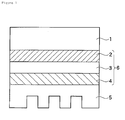
- Fig. 1 is a partial schematic view of an imprint apparatus using the pressure-sensitive adhesive sheet for immobilization of an imprint mold of the present invention.
- the present invention is a pressure-sensitive adhesive sheet for immobilization of an imprint mold, which is a pressure-sensitive adhesive sheet used for integrally immobilizing an imprint mold to a pressure application unit in an imprint apparatus for transferring a profile of a fine pattern formed on the imprint mold to a transfer-receiving body by pressing the imprint mold having the fine pattern thereon against the transfer-receiving body, said pressure-sensitive adhesive sheet having a substrate, a pressure-sensitive adhesive layer (A) provided on one surface of the substrate and a pressure-sensitive adhesive layer (B) provided on the other surface of the substrate, wherein the pressure-sensitive adhesive layer (A) is used for being bonded to the pressure application unit of the imprint apparatus, and the pressure-sensitive adhesive layer (B) is used for being bonded to the imprint mold, the adhesive strength of the pressure-sensitive adhesive layer (B) at 23°C is higher than the adhesive strength of the pressure-sensitive adhesive layer (A) at 23°C, and the pressure-sensitive adhesive layer (A) has an adhesive strength of 1 to
- (meth)acrylate indicates acrylate and/or methacrylate.
- the pressure-sensitive adhesive sheet for immobilization of an imprint mold of the present invention can be used in a usual imprint apparatus, and is used for immobilizing an imprint mold to a pressure application unit of an imprint apparatus wherein the pressure applied to the imprint mold during imprinting is preferably 0.1 to 50 MPa, more preferably 2 to 30 MPa.
- the imprint mold does not peel off from the pressure application unit during imprinting even if the above pressure is applied.
- the pressure-sensitive adhesive sheet for immobilization of an imprint mold of the present invention is preferably used for immobilizing an imprint mold having a pattern of a size of nanometer order formed thereon to a pressure application unit of an imprint apparatus.
- the pattern of a size of nanometer order means a depression-protrusion pattern preferably having a constant pitch of 10 nm to 50 ⁇ m, having a height of 50 nm to 1,000 nm and having a shape of line, column, monolith, circular cone, polygonal pyramid, micro lens or the like.
- the pressure-sensitive adhesive sheet for immobilization of an imprint mold of the present invention can be used for immobilizing an imprint mold to a pressure application unit of any of a pedestal type imprint apparatus and a roll type imprint apparatus, but the pressure-sensitive adhesive sheet is preferably used for immobilizing an imprint mold to a pressure application unit of a roll type imprint apparatus because it can be used even in the presence of radiation heat.
- the reason why the adhesive strength of the pressure-sensitive adhesive layer (A) bonded to the pressure application unit is made lower than the adhesive strength of the pressure-sensitive adhesive layer (B) bonded to the imprint mold is that when imprinting is performed, the pressure-sensitive adhesive sheet needs to be strongly bonded to the imprint mold on which a pressure is applied, but when the pressure-sensitive adhesive sheet is bonded to the pressure application unit, it needs to have removability.
- the pressure-sensitive adhesive layer (A) is used for being bonded to a pressure application unit of an imprint apparatus.
- the adhesive strength of the pressure-sensitive adhesive layer (A) at 23°C is 1 to 10 N/25 mm, and the adhesive strength thereof at 23°C is preferably 2 to 8 N/25 mm.
- the pressure-sensitive adhesive layer can exhibit imprint mold immobilization power so that the imprint mold should not peel off or should not shift even in the imprinting operation wherein a pressure of 0.1 to 50 MPa is applied to the imprint mold.
- the adhesive strength of the pressure-sensitive adhesive layer (A) does not become a value by which immobilization of an imprint mold is made impossible during imprinting, even in the presence of radiation heat from a light source, said radiation having a maximum temperature of 80 °C in the photo imprinting.
- the pressure-sensitive adhesive layer (A) has removability, and the adhesive strength (also referred to as "peel strength") of the pressure-sensitive adhesive layer (A) after the layer is allowed to stand for 7 hours at 80°C and a humidity of 65% is 1 to 30 N/25 mm, preferably 2 to 20 N/25 mm, more preferably 3 to 15 N/25 mm.
- peel strength is in the above range, it is possible to remove the imprint mold from the pressure application unit without adhesive residue in the replacement of the imprint mold.
- the pressure-sensitive adhesive having a low adhesive strength means a pressure-sensitive adhesive having an adhesive strength of 1 to 10 N/25 mm.
- apressure-sensitive adhesive that is generally on the market as a removable pressure-sensitive adhesive
- examples thereof include acrylic polymers obtained by copolymerizing (meth) acrylic monomers, such as butyl (meth)acrylate, 2-ethylhexyl (meth)acrylate, isooctyl (meth)acrylate and benzyl (meth)acrylate, with monomers having crosslinking functional groups such as carboxyl group, hydroxyl group, amino group and amide group.
- the weight-average molecular weight of the polymers is usually 200,000 to 800,000.
- Examples of commercial products of such pressure-sensitive adhesives include SK Dyne 1473H and SK Dyne 1439U available from Soken Chemical & Engineering Co., Ltd.
- the adhesive strength and the peel strength of the pressure-sensitive adhesive layer (A) can be adjusted to the above ranges.
- a weight-average molecular weight there can be used, for example, a method of adjusting the amount of an initiator to more than 0.01 part by weight but not less than or equal to 0.1 part by weight based of 100 parts by weight of the pressure-sensitive adhesive.
- the adhesive strength and the peel strength of the pressure-sensitive adhesive layer (A) can be adjusted to the above ranges.
- the acrylic/silicone-based copolymer can be obtained by copolymerizing 79.5 to 99 parts by weight of a monomer, such as butyl acrylate, 2-ethylhexyl acryalte, isooctyl acrylate or benzyl acrylate, 0.5 to 5 parts by weight of a monomer having a crosslinking functional group such as carboxyl group, hydroxyl group, amino group or amide group, and 0.5 to 20 parts by weight of a silicone-containing monomer, such as a silicone macromer (the total amount of all the monomers used for the polymerization is 100 parts by weight).
- the molecular weight of the silicone macromer is preferably 600 to 10,000.
- the weight-average molecular weight of the acrylic/silicone-based copolymer is preferably 200,000 to 800,000.
- silicone macromers examples include Silaplane FM-0711 (available fromJNCCo. , Ltd.) andX-22-174DX (available from Shin-Etsu Silicone Co., Ltd.).
- the adhesive strength and the peel strength of the pressure-sensitive adhesive layer (A) can be adjusted to the above ranges.
- a publicly known pressure-sensitive adhesive preferably an acrylic pressure-sensitive adhesive (e.g., SK Dyne 1882 available from Soken Chemical & Engineering Co., Ltd.), can be used.
- an acrylic pressure-sensitive adhesive e.g., SK Dyne 1882 available from Soken Chemical & Engineering Co., Ltd.
- the gel fraction of the pressure-sensitive adhesive layer (A) is preferably 70 to 95%, more preferably 80 to 90%. In order to control the gel fraction to a value of the above range, it is preferable to adjust the content of a curing agent to 0.1 to 5.0 parts by weight, preferably 0.5 to 2.5 parts by weight, based on 100 parts by weight of the pressure-sensitive adhesive of the pressure-sensitive adhesive layer (A).
- a curing agent an isocyanate-based curing agent, an epoxy-based curing agent or the like can be used.
- a curing accelerator may be further used, and the content of the curing accelerator is preferably 0.01 to 1.0 part by weight, more preferably 0.05 to 0.5 part by weight, based on 100 parts by weight of the pressure-sensitive adhesive of the pressure-sensitive adhesive layer (A).
- a publicly known organotin compound e.g., Neostan U-860 available from Nitto Kasei Co., Ltd.
- Neostan U-860 available from Nitto Kasei Co., Ltd.
- the adhesive strength and the peel strength of the pressure-sensitive adhesive layer (A) can be adjusted to the above ranges.
- a publicly known pressure-sensitive adhesive preferably an acrylic pressure-sensitive adhesive (e.g., SK Dyne 1882 available from Soken Chemical & Engineering Co., Ltd.), can be used.
- an acrylic pressure-sensitive adhesive e.g., SK Dyne 1882 available from Soken Chemical & Engineering Co., Ltd.
- the silicone oil contained in the pressure-sensitive adhesive layer (A) is not specifically restricted, but silicone oil having compatibility with the pressure-sensitive adhesive is preferable.
- the content of the silicone oil in the pressure-sensitive adhesive layer (A) is preferably 1 to 20 parts by weight, more preferably 2 to 10 parts by weight, based on 100 parts by weight of the pressure-sensitive adhesive of the pressure-sensitive adhesive layer (A).
- Examples of commercial products of the silicone oils include KF-96L-0.65cs and KF-96L-1cs available from Shin-Etsu Silicone Co. Ltd. From the viewpoint of compatibility with the pressure-sensitive adhesive, KF-96L-0.65cs is preferable.
- the pressure-sensitive adhesive layer (B) is used for being bonded to an imprint mold.
- the adhesive strength of the pressure-sensitive adhesive layer (B) at 23°C is 3 to 30 N/25 mm, the adhesive strength thereof at 23°C is preferably 5 to 25 N, and the adhesive strength thereof at 23°C is more preferably 7 to 20 N.
- a usual acrylic pressure-sensitive adhesive or a usual rubber-based pressure-sensitive adhesive can be used as the pressure-sensitive adhesive component to constitute the pressure-sensitive adhesive layer (B).
- the acrylic pressure-sensitive adhesives include polymers obtained by copolymerizing monomers, such as butyl (meth) acrylate, 2-ethylhexyl (meth)acrylate, isooctyl (meth)acrylate and benzyl (meth)acrylate, with monomers having crosslinking functional groups such as carboxyl group, hydroxyl group, amino group and amide group.
- Examples of commercial products of such pressure-sensitive adhesives include SK Dyne 1882 and SK Dyne 1986H available from Soken Chemical & Engineering Co., Ltd.
- the pressure-sensitive adhesive layer (B) preferably contains a light absorber and/or a light stabilizer from the viewpoint of prevention of brittleness of the pressure-sensitive adhesive layer (B) in the photo imprinting.
- the light absorber is used preferably in an amount of 0.1 to 10 parts by weight, more preferably 1 to 5 parts by weight, based on 100 parts by weight of the pressure-sensitive adhesive
- the light stabilizer is used preferably in an amount of 0.1 to 10 parts by weight, more preferably 1 to 5 parts by weight, based on 100 parts by weight of the pressure-sensitive adhesive.
- a publicly known light absorber e.g., TINUVIN 109 and TINUVIN 99-2 available from Ciba Inc.
- a publicly known light stabilizer e.g., TINUVIN 123 and TINUVIN 144 available from Ciba Inc.
- a resin film, paper, a metal foil, cloth, nonwoven fabric or the like can be used as the substrate to constitute the pressure-sensitive adhesive sheet.
- the resin films include polyethylene film, polypropylene film, polybutene film, polybutadiene film, polymethylpentene film, polyvinyl chloride film, vinyl chloride copolymer film, polyethylene terephthalate film, polyethylene naphthalate film, polybutylene terephthalate film, polyurethane film, ethylene/vinyl acetate copolymer film, ionomer resin film, ethylene/ (meth) acrylic acid copolymer film, ethylene/ (meth) acrylic ester copolymer film, polystyrene film, polycarbonate film and polyimide film.
- a resin film is preferable from the viewpoint of handling property, and a polyethylene terephthalate film is more preferable from the viewpoints of heat resistance and material availability.
- the resin film may be subjected to a treatment for improving adhesion to the pressure-sensitive adhesive layer, such as corona treatment or plasma treatment.
- the pressure-sensitive adhesive sheet of the present invention has the substrate, the pressure-sensitive adhesive layer (A) provided on one surface of the substrate and the pressure-sensitive adhesive layer (B) provided on the other surface of the substrate.
- the thickness of the pressure-sensitive adhesive layer (A) is usually 10 to 50 ⁇ m, preferably 15 to 40 ⁇ m.
- the thickness of the pressure-sensitive adhesive layer (B) is usually 10 to 50 ⁇ m, preferably 15 to 40 ⁇ m.
- the thickness of the substrate is usually 10 to 150 ⁇ m, preferably 10 to 100 ⁇ m.
- the adhesive strength of the pressure-sensitive adhesive layer (A) at 23°C is lower than the adhesive strength of the pressure-sensitive adhesive layer (B) at 23°C.
- a protective sheet On the surface of the pressure-sensitive adhesive layer (A), which does not come into contact with the substrate, and on the surface of the pressure-sensitive adhesive layer (B), which does not come into contact with the substrate, a protective sheet may be laminated.
- the protective sheet is preferably a resin film having been subjected to a release treatment.
- All of the components to constitute the pressure-sensitive adhesive layer (A) are mixed, and the mixture is applied to one surface of the substrate by a publicly known method such as bar coating, comma coating or the like. Thereafter, the pressure-sensitive adhesive layer (A) is dried at a temperature of 50 to 120°C for 1 to 10 minutes. Next, to the substrate surface opposite to the surface where the pressure-sensitive adhesive layer is present, a mixture obtained by mixing all of the components to constitute the pressure-sensitive adhesive layer (B) is applied in the same manner as that for the pressure-sensitive adhesive layer (A). Thereafter, the pressure-sensitive adhesive layer (B) is dried at a temperature of 50 to 120°C for 1 to 10 minutes.
- the imprint apparatus means an apparatus for transferring a profile of a fine pattern formed on an imprint mold to a transfer-receiving body by pressing the imprint mold having the fine pattern thereon against the transfer-receiving body.
- the imprint mold is immobilized to a pressure application unit with the pressure-sensitive adhesive sheet of the present invention.
- the pressure-sensitive adhesive layer (B) is positioned on the imprint mold side of the substrate of the pressure-sensitive adhesive sheet, and the pressure-sensitive adhesive layer (A) is positioned on the pressure application unit side of the substrate thereof.
- a sheet type (pedestal type) pressure application unit and a roll type pressure application unit are available without any restriction, but a roll type pressure applicationunitispreferable.
- the pressure-sensitive adhesive layer that comes into contact with the pressure application unit has removability, and the pressure-sensitive adhesive that comes into contact with the imprint mold has high adhesive strength. Therefore, the imprint mold does not peel off from the pressure-sensitive adhesive sheet even by performing the imprinting operation wherein a high pressure is applied to the imprint mold, and the durability of the pressure-sensitive adhesive sheet is also excellent.
- the imprint mold when the imprint mold is replaced, the imprint mold can be removed from the pressure application unit because the pressure-sensitive adhesive layer (A) has removability.
- the method for immobilizing the imprint mold to such an imprint apparatus is carried out by bonding the pressure-sensitive adhesive layer (A) of the pressure-sensitive adhesive sheet for immobilization of an imprint mold of the present invention to the pressure application unit and bonding the imprint mold to the pressure-sensitive adhesive layer (B) of the pressure-sensitive adhesive sheet for immobilization of an imprint mold.
- the pressure-sensitive adhesive layer (A) of the pressure-sensitive adhesive sheet for immobilization of an imprint mold of the present invention is peeled off from the pressure application unit, whereby the imprint mold is removed from the imprint apparatus.
- the imprint mold can be easily replaced when the imprint mold is, for example, broken.
- any one of the pressure-sensitive adhesive layers (a-1) to (a-20) was laminated onto a resin imprint mold (pitch of pattern of mold used: 300 nm, height of pattern: 150 nm) using a transfer roller of 20 kg.
- resin imprint molds laminated with pressure-sensitive adhesive sheets for immobilization of imprint molds were obtained.
- the pressure-sensitive adhesive layer (b-1) or (b-2) of the pressure-sensitive adhesive sheet was laminated onto a roll surface of a roll (made of SUS, width: 250 mm) for roll imprinting using the transfer roller.
- the roll of the imprint apparatus was pressed against a Lexan film (transfer region: width 210 mm, length 420 m) at 1.0 MPa, and the line was run in such a manner that the transfer resin PAK-02 (available from Toyo Gosei Co., Ltd.) could be uniformly applied (feed rate: 1 m/sec, manufactured by Toshiba Machine Co., Ltd.).
- PAK-02 available from Toyo Gosei Co., Ltd.
- Adhesive strength at 23°C and adhesive strength after leaving for 7 hours at 80°C and a humidity of 65% were measured at a tensile angle of 90° and a peel rate of 300 mm/min in accordance with JIS Z0237.
- Mw weight-average molecular weight
- Sample concentration the sample was diluted with tetrahydrofuran so that the concentration might become 1.0 mg/cm 3 .
- Adhesive residue after roll imprinting was visually observed, and evaluation was carried out based on the following criteria. ⁇ : When the resin imprint mold laminated with a pressure-sensitive adhesive sheet for immobilization of an imprint mold is peeled off from the roll after the imprinting operation, the pressure-sensitive adhesive does not remain on the roll surface. ⁇ : When the resin imprint mold laminated with a pressure-sensitive adhesive sheet for immobilization of an imprint mold is peeled off from the roll after the imprinting operation, the pressure-sensitive adhesive remains on the roll surface.
- the resin imprint mold laminated with a pressure-sensitive adhesive sheet for immobilization of an imprint mold was peeled off from the roll, and the condition of the pressure-sensitive adhesive layer having been in contact with the roll surface was visually observed, and evaluation was carried out based on the following criteria.
- ⁇ There is no change in the condition of the pressure-sensitive adhesive layer.
- ⁇ The pressure-sensitive adhesive layer becomes slightly brittle.
- ⁇ The pressure-sensitive adhesive layer becomes brittle.
- a pressure-sensitive adhesive (trade name: SK Dyne 1473H, available from Soken Chemical & Engineering Co., Ltd.) and 0.77 g (amount of solid matter) of an isocyanate-based curing agent (trade name: L-45, available from Soken Chemical & Engineering Co., Ltd.) were placed, then they were well mixed, and the mixture was applied onto a PET separator (trade name: MRF38, available from Mitsubishi Plastics, Inc.) and dried at 90°C for 3 minutes to produce a pressure-sensitive adhesive layer (a-1).
- a pressure-sensitive adhesive trade name: SK Dyne 1473H, available from Soken Chemical & Engineering Co., Ltd.
- an isocyanate-based curing agent (trade name: L-45, available from Soken Chemical & Engineering Co., Ltd.) were placed, then they were well mixed, and the mixture was applied onto a PET separator (trade name: MRF38, available from Mitsubishi Plastics, Inc.) and dried at 90°C for 3 minutes to produce a
- a pressure-sensitive adhesive (trade name: SK Dyne 1882, available from Soken Chemical & Engineering Co., Ltd.), 0.55 g (amount of solid matter) of an isocyanate-based curing agent (L-45) and 0.016 g (amount of solid matter) of an epoxy-based curing agent (trade name: E-5XM, available from Soken Chemical & Engineering Co., Ltd.) were placed, then they were well mixed, and the mixture was applied onto a PET separator (MRF38) and dried at 90°C for 3 minutes to produce a pressure-sensitive adhesive layer (b-1).
- the pressure-sensitive adhesive layer (a-1) was laminated, and onto the other surface, the pressure-sensitive adhesive layer (b-1) was laminated, whereby a pressure-sensitive adhesive sheet for immobilization of an imprint mold was prepared.
- the aforesaid imprinting operation was carried out, and as a result, troubles such as peeling of the resin imprint mold were not observed.
- the resin imprint mold was peeled off from the roll, and as a result, the pressure-sensitive adhesive on the back surface became ragged.
- staining such as transfer of the pressure-sensitive adhesive to the roll was not observed.
- a pressure-sensitive adhesive (trade name: SK Dyne 1473H) and 0.77 g (amount of solid matter) of an isocyanate-based curing agent (L-45) were placed, then they were well mixed, and the mixture was applied onto a PET separator (MRF38) and dried at 90°C for 3 minutes to produce a pressure-sensitive adhesive layer (a-2).
- a pressure-sensitive adhesive (SK Dyne 1882), 0.55 g (amount of solid matter) of an isocyanate-based curing agent (L-45), 0.016 g (amount of solid matter) of an epoxy-based curing agent (E-5XM), 3.0g (amount of solidmatter) of a light absorber (trade name: TINUVIN 109, available from Ciba Inc.) and 3.0g (amount of solid matter) of a light stabilizer (trade name: TINUVIN 123, available from Ciba Inc.) were placed, then they were well mixed, and the mixture was applied onto a PET separator (MRF38) and dried at 90°C for 3 minutes to produce a pressure-sensitive adhesive layer (b-2).
- MRF38 PET separator
- the pressure-sensitive adhesive layer (a-2) was laminated, and onto the other surface, the pressure-sensitive adhesive layer (b-2) was laminated, whereby a pressure-sensitive adhesive sheet for immobilization of an imprint mold was prepared.
- the aforesaid imprinting operation was carried out. After the 14-hour continuous imprinting, the resin imprint mold was peeled off from the roll. As a result, the pressure-sensitive adhesive on the back surface was normal.
- the pressure-sensitive adhesive layer (a-3) was laminated, and onto the other surface, the pressure-sensitive adhesive layer (b-1) obtained in Example 1 was laminated, whereby a pressure-sensitive adhesive sheet for immobilization of an imprint mold was prepared.
- a pressure-sensitive adhesive (SK Dyne 1882), 0.55 g (amount of solid matter) of an isocyanate-based curing agent (L-45), 0.016 g (amount of solid matter) of an epoxy-based curing agent (E-5XM) and 0.1 g of dioctyltin bis(isooctylthioglycolate) (trade name:Neostan U-860, available from Nitto Kasei Co., Ltd.) that is a curing accelerator were placed, then they were well mixed, and the mixture was applied onto a PET separator (MRF38) and dried at 90°C for 3 minutes to produce a pressure-sensitive adhesive layer (a-4).
- MRF38 PET separator
- the pressure-sensitive adhesive layer (a-4) was laminated, and onto the other surface, the pressure-sensitive adhesive layer (b-1) obtained in Example 1 was laminated, whereby a pressure-sensitive adhesive sheet for immobilization of an imprint mold was prepared.
- the pressure-sensitive adhesive layer (a-5) was laminated, and onto the other surface, the pressure-sensitive adhesive layer (b-1) obtained in Example 1 was laminated, whereby a pressure-sensitive adhesive sheet for immobilization of an imprint mold was prepared.
- the pressure-sensitive adhesive layer (a-6) was laminated, and onto the other surface, the pressure-sensitive adhesive layer (b-1) obtained in Example 1 was laminated, whereby a pressure-sensitive adhesive sheet for immobilization of an imprint mold was prepared.
- the pressure-sensitive adhesive layer (a-7) was laminated, and onto the other surface, the pressure-sensitive adhesive layer (b-1) obtained in Example 1 was laminated, whereby a pressure-sensitive adhesive sheet for immobilization of an imprint mold was prepared.
- Apressure-sensitive adhesive layer (a-8) was produced by using SK Dyne 1439U (available from Soken Chemical & Engineering Co., Ltd.) instead of SK Dyne 1473H and using 0.15 g (amount of solid matter) of an epoxy-based curing agent (trade name: E-50C, available from Soken Chemical & Engineering Co. Ltd.) as the curing agent in Example 1. Thereafter, onto one surface of a PET film (Lumiler 60T38), the pressure-sensitive adhesive layer (a-8) was laminated, and onto the other surface, the pressure-sensitive adhesive layer (b-1) obtained in Example 1 was laminated, whereby a pressure-sensitive adhesive sheet for immobilization of an imprint mold was prepared.
- Apressure-sensitive adhesive layer (a-9) was produced by using SK Dyne 1676 (available from Soken Chemical & Engineering Co., Ltd.) instead of SK Dyne 1473H and changing the amount of the curing agent (L-45) to 1.2 g (amount of solid matter) in Example 1. Thereafter, onto one surface of a PET film (Lumiler 60T38), the pressure-sensitive adhesive layer (a-9) was laminated, and onto the other surface, the pressure-sensitive adhesive layer (b-1) obtained in Example 1 was laminated, whereby a pressure-sensitive adhesive sheet for immobilization of an imprint mold was prepared.
- SK Dyne 1676 available from Soken Chemical & Engineering Co., Ltd.
- a pressure-sensitive adhesive layer (a-10) was produced in the same manner as in the production process for the pressure-sensitive adhesive layer (a-1) in Example 1, except that the amount of the isocyanate-based curing agent (L-45) was changed to 6.50 g (amount of solid matter). Thereafter, onto one surface of a PET film (Lumiler 60T38), the pressure-sensitive adhesive layer (a-10) was laminated, and onto the other surface, the pressure-sensitive adhesive layer (b-1) obtained in Example 1 was laminated, wherebyapressure-sensitive adhesive sheet for immobilization of an imprint mold was prepared.
- the aforesaid imprinting operation was carried out.
- the adhesive strength of the pressure-sensitive adhesive layer (a-10) was insufficient, and about 1 hour after the beginning of roll imprinting, peeling was observed.
- a pressure-sensitive adhesive layer (a-11) was produced in the same manner as in the production process for the pressure-sensitive adhesive layer (a-1) in Example 1, except that the amount of the isocyanate-based curing agent (L-45) was changed to 0.05 g (amount of solid matter). Thereafter, onto one surface of a PET film (Lumiler 60T38), the pressure-sensitive adhesive layer (a-11) was laminated, and onto the other surface, the pressure-sensitive adhesive layer (b-1) obtainedinExample 1 was laminated, wherebyapressure-sensitive adhesive sheet for immobilization of an imprint mold was prepared.
- the aforesaid roll imprinting operation for 14 hours was carried out.
- the adhesive strength of the pressure-sensitive adhesive layer (a-11) was too high, and when the imprint mold was peeled off from the roll, the pressure-sensitive adhesive remained on the roll.
- Apressure-sensitive adhesive 1882HH-2 was produced in the same manner as in the production process for the pressure-sensitive adhesive 1882HH in Example 6, except that the amount of the initiator (V-601) was changed to 0.5 part by weight. Then, apressure-sensitive adhesive layer (a-12) was produced in the same manner as in the production process for the pressure-sensitive adhesive layer (a-6) in Example 6, except that the pressure-sensitive adhesive 1882HH-2 was used instead of the pressure-sensitive adhesive 1882HH.
- the pressure-sensitive adhesive layer (a-12) was laminated, and onto the other surface, the pressure-sensitive adhesive layer (b-1) obtained in Example 1 was laminated, whereby a pressure-sensitive adhesive sheet for immobilization of an imprint mold was prepared.
- the aforesaid roll imprinting operation for 14 hours was carried out.
- the adhesive strength of the pressure-sensitive adhesive layer (a-12) was too high, and when the imprint mold was peeled off from the roll, the pressure-sensitive adhesive remained on the roll.
- a pressure-sensitive adhesive layer (a-13) was produced in the same manner as in the production process for the pressure-sensitive adhesive layer (a-4) in Example 4, except that the amount of the curing accelerator (U-860) added was changed to 5.0 g. Thereafter, onto one surface of a PET film (Lumiler 60T38), the pressure-sensitive adhesive layer (a-13) was laminated, and onto the other surface, the pressure-sensitive adhesive layer (b-1) obtained in Example 1 was laminated, whereby a pressure-sensitive adhesive sheet for immobilization of an imprint mold was prepared.
- the aforesaid imprinting operation was carried out.
- the adhesive strength of the pressure-sensitive adhesive layer (a-13) was insufficient, and about 1 hour after the beginning of roll imprinting, peeling was observed.
- a pressure-sensitive adhesive layer (a-14) was produced in the same manner as in the production process for the pressure-sensitive adhesive layer (a-4) in Example 4, except that the amount of the curing accelerator (U-860) added was changed to 0.005 g. Thereafter, onto one surface of a PET film (Lumiler 60T38), the pressure-sensitive adhesive layer (a-14) was laminated, and onto the other surface, the pressure-sensitive adhesive layer (b-1) obtained in Example 1 was laminated, whereby a pressure-sensitive adhesive sheet for immobilization of an imprint mold was prepared.
- a pressure-sensitive adhesive layer (a-15) was produced in the same manner as in the production process for the pressure-sensitive adhesive layer (a-5) in Example 5, except that the amount of the silicone oil (KF-96-10cs) added was changed to 25.0 g. Thereafter, onto one surface of a PET film (Lumiler 60T38), the pressure-sensitive adhesive layer (a-15) was laminated, and onto the other surface, the pressure-sensitive adhesive layer (b-1) obtained in Example 1 was laminated, whereby a pressure-sensitive adhesive sheet for immobilization of an imprint mold was prepared.
- the aforesaid imprinting operation was carried out.
- the adhesive strength of the pressure-sensitive adhesive layer (a-15) was insufficient, and about 1 hour after the beginning of roll imprinting, peeling was observed.
- a pressure-sensitive adhesive layer (a-16) was produced in the same manner as in the production process for the pressure-sensitive adhesive layer (a-5) in Example 5, except that the amount of the silicone oil (KF-96-10cs) added was changed to 0.94 g. Thereafter, onto one surface of a PET film (Lumiler 60T38), the pressure-sensitive adhesive layer (a-16) was laminated, and onto the other surface, the pressure-sensitive adhesive layer (b-1) obtained in Example 1 was laminated, whereby a pressure-sensitive adhesive sheet for immobilization of an imprint mold was prepared.
- the aforesaid roll imprinting operation for 14 hours was carried out.
- the adhesive strength of the pressure-sensitive adhesive layer (a-16) was too high, and when the imprint mold was peeled off from the roll, the pressure-sensitive adhesive remained on the roll.
- Apressure-sensitive adhesive 1882HH-3 was produced in the same manner as in the production process for the pressure-sensitive adhesive 1882HH in Example 6, except that the amount of the initiator (V-601) was changed to 0.01 part by weight. Then, a pressure-sensitive adhesive layer (a-17) was produced in the same manner as in the production process for the pressure-sensitive adhesive layer (a-6) in Example 6, except that the pressure-sensitive adhesive 1882HH-3 was used instead of the pressure-sensitive adhesive 1882HH.
- the pressure-sensitive adhesive layer (a-17) was laminated, and onto the other surface, the pressure-sensitive adhesive layer (b-1) obtained in Example 1 was laminated, whereby a pressure-sensitive adhesive sheet for immobilization of an imprint mold was prepared.
- the aforesaid imprinting operation was carried out.
- the adhesive strength of the pressure-sensitive adhesive layer (a-17) was insufficient, and about 1 hour after the beginning of roll imprinting, peeling was observed.
- a pressure-sensitive adhesive layer (a-18) was produced in the same manner as in the production process for the pressure-sensitive adhesive layer (a-6) in Example 6, except that the pressure-sensitive adhesive 1882SiH was used instead of the pressure-sensitive adhesive 1882HH. Thereafter, onto one surface of a PET film (Lumiler 60T38), the pressure-sensitive adhesive layer (a-18) was laminated, and onto the other surface, the pressure-sensitive adhesive layer (b-1) obtained in Example 1 was laminated, whereby a pressure-sensitive adhesive sheet for immobilization of an imprint mold was prepared.
- the aforesaid imprinting operation was carried out.
- the adhesive strength of the pressure-sensitive adhesive layer (a-18) was insufficient, and about 1 hour after the beginning of roll imprinting, peeling was observed.
- a pressure-sensitive adhesive layer (a-19) was produced in the same manner as in the production process for the pressure-sensitive adhesive layer (a-6) in Example 6, except that the pressure-sensitive adhesive 1882SiL was used instead of the pressure-sensitive adhesive 1882HH. Thereafter, onto one surface of a PET film (Lumiler 60T38), the pressure-sensitive adhesive layer (a-19) was laminated, and onto the other surface, the pressure-sensitive adhesive layer (b-1) obtained in Example 1 was laminated, whereby a pressure-sensitive adhesive sheet for immobilization of an imprint mold was prepared.
- the aforesaid roll imprinting operation for 14 hours was carried out.
- the adhesive strength of the pressure-sensitive adhesive layer (a-19) was too high, and when the imprint mold was peeled off from the roll, the pressure-sensitive adhesive remained on the roll.
- Apressure-sensitive adhesive 1882SiLL was obtained in the same manner as in the production process for the pressure-sensitive adhesive 1882Si in Example 7, except that a long-chain type silicone macromer (trade name: X-22-2426, molecular weight:13000, available from Shinetsu silicon Co.Ltd.) was used instead of the silicone macromer (trade name: Silaplane FM-0711, molecular weight: 1000, available from JNC Co., Ltd.).
- a pressure-sensitive adhesive layer (a-20) was produced in the same manner as in the production process for the pressure-sensitive adhesive layer (a-7) in Example 7, except that the pressure-sensitive adhesive 1882SiLL was used instead of the pressure-sensitive adhesive 1882Si. Thereafter, onto one surface of a PET film (Lumiler 60T38), the pressure-sensitive adhesive layer (a-20) was laminated, and onto the other surface, the pressure-sensitive adhesive layer (b-1) obtained in Example 1 was laminated, whereby a pressure-sensitive adhesive sheet for immobilization of an imprint mold was prepared.
- the aforesaid roll imprinting operation was carried out.
- the adhesive strength of the pressure-sensitive adhesive layer (a-20) was insufficient, and about 1 hour after the beginning of roll imprinting, peeling was observed.
Landscapes
- Chemical & Material Sciences (AREA)
- Organic Chemistry (AREA)
- Physics & Mathematics (AREA)
- General Physics & Mathematics (AREA)
- Engineering & Computer Science (AREA)
- Mechanical Engineering (AREA)
- Shaping Of Tube Ends By Bending Or Straightening (AREA)
- Adhesive Tapes (AREA)
- Adhesives Or Adhesive Processes (AREA)
- Exposure Of Semiconductors, Excluding Electron Or Ion Beam Exposure (AREA)
Abstract
Description
- The present invention relates to a pressure-sensitive adhesive double-coated sheet for immobilizing an imprint mold used for imprinting, an imprint apparatus and an imprint method using the pressure-sensitive adhesive sheet.
- In the production of semiconductors and optical devices, an operation called imprinting, which comprises pressing an imprint mold having a specific pattern profile against a thermoplastic resin or a thermosetting resin and heating it or irradiating it with ultraviolet rays to transfer the pattern profile to the resin, has been carried out in order to form a circuit structure or the like.
- For the imprinting operation, an apparatus equipped with a pressure application unit for pressing the imprint mold against the resin is used, and in this apparatus, the imprint mold is immobilized onto the pressure application unit. It is known that as a means to hold them, a pressure-sensitive adhesive double-coated sheet is used. On the other hand, it is necessary in the imprinting operation to replace an imprint mold when the imprint mold is broken or when a semiconductor material or an optical device having a different pattern is produced, and therefore, the imprint apparatus preferably has a structure wherein the imprint mold can be removed from the pressure application unit. Accordingly, there has been desired a pressure-sensitive adhesive double-coated sheet which exhibits such an adhesive strength that the imprint mold does not peel off or shift from the pressure application unit in the imprinting operation but which can be removed from the pressure application unit without adhesive residue in the replacement of the imprint mold. However, with the passage of time after the pressure-sensitive adhesive is bonded to an adherend, increase in adhesive strength of the pressure-sensitive adhesive tends to occur, and it is difficult to secure removability.
- It is known that as a pressure-sensitive adhesive sheet for solving such a problem, a pressure-sensitive adhesive tape having a pressure-sensitive adhesive layer containing a pressure-sensitive adhesive and a side chain crystalline polymer is used in order to hold the imprint mold, and when the imprint mold is replaced, the temperature of the pressure-sensitive adhesive sheet is raised to a temperature of not lower than Tg of the side chain crystalline polymer to lower the adhesive strength of the pressure-sensitive adhesive layer containing the side chain crystalline polymer, whereby the imprint mold is peeled off from the pressure application unit (see, for example, patent literature 1).
- In the photo imprinting wherein ultraviolet irradiation is carried out, however, the radiation heat from the light source reaches a maximum temperature of about 80°C. Therefore, if the imprint mold is held by the use of a pressure-sensitive adhesive tape whose adhesive strength is lowered by heat, there is a possibility of peeling of the imprint mold from the pressure application unit during the imprinting operation. Particularly when a roll type pressure application unit is used as the pressure application unit, it is necessary to take into consideration heat reserve of the radiation heat of the roll.
- Accordingly, a pressure-sensitive adhesive tape whose adhesive strength is not lowered even in the presence of heat generated in the imprinting operation and which facilitates replacement of an imprint mold has been desired.
- Patent literature 1: Japanese Patent Laid-Open Publication No.
2011-1520 - It is an object of the present invention to provide a pressure-sensitive adhesive sheet for immobilization of an imprint mold, which is a pressure-sensitive adhesive sheet capable of immobilizing an imprint mold so that the imprint mold should not peel off or shift during imprinting and which can be peeled off from a pressure application unit of an imprint apparatus when the imprint mold is replaced.
- The present invention relates to, for example, the following [1] to [15].
- [1] A pressure-sensitive adhesive sheet for immobilization of an imprint mold, which is a pressure-sensitive adhesive sheet used for integrally immobilizing an imprint mold to a pressure application unit in an imprint apparatus for transferring a profile of a fine pattern formed on the imprint mold to a transfer-receiving body by pressing the imprint mold having the fine pattern thereon against the transfer-receiving body,
said pressure-sensitive adhesive sheet having a substrate, a pressure-sensitive adhesive layer (A) provided on one surface of the substrate and a pressure-sensitive adhesive layer (B) provided on the other surface of the substrate,
wherein the pressure-sensitive adhesive layer (A) is used for being bonded to the pressure application unit of the imprint apparatus, and the pressure-sensitive adhesive layer (B) is used for being bonded to the imprint mold,
the adhesive strength of the pressure-sensitive adhesive layer (B) at 23°C is higher than the adhesive strength of the pressure-sensitive adhesive layer (A) at 23°C, and
the pressure-sensitive adhesive layer (A) has an adhesive strength of 1 to 10 N/25 mm at 23°C and an adhesive strength of 1 to 30 N/25 mm after allowed to stand for 7 hours at 80°C and a humidity of 65%, and the pressure-sensitive adhesive layer (B) has an adhesive strength of 3 to 30 N/25 mm at 23°C. - [2] The pressure-sensitive adhesive sheet for immobilization of an imprint mold as stated in [1], which is used in an imprint apparatus wherein the pressure applied to the imprint mold during imprinting is 0.1 to 50 MPa.
- [3] The pressure-sensitive adhesive sheet for immobilization of an imprint mold as stated in [1] or [2], which is used in a roll type imprint apparatus.
- [4] The pressure-sensitive adhesive sheet for immobilization of an imprint mold as stated in any one [1] to [3], which is used for integrally immobilizing an imprint mold having a pattern of a size of nanometer order formed thereon to the pressure application unit.
- [5] The pressure-sensitive adhesive sheet for immobilization of an imprint mold as stated in any one of [1] to [4], wherein the pressure-sensitive adhesive layer (B) contains a light absorber and/or a light stabilizer.
- [6] The pressure-sensitive adhesive sheet for immobilization of an imprint mold as stated in any one of [1] to [5], wherein the adhesive strength of a pressure-sensitive adhesive in the pressure-sensitive adhesive layer (A) is 1 to 10 N/25 mm.
- [7] The pressure-sensitive adhesive sheet for immobilization of an imprint mold as stated in [6], wherein the pressure-sensitive adhesive in the pressure-sensitive adhesive layer (A) is an acrylic copolymer obtained by copolymerizing a (meth)acrylic monomer and a monomer having a crosslinking functional group.
- [8] The pressure-sensitive adhesive sheet for immobilization of an imprint mold as stated in any one of [1] to [5], wherein the weight-average molecular weight of a polymer to constitute the pressure-sensitive adhesive in the pressure-sensitive adhesive layer (A) is 800,000 to 1,800,000.
- [9] The pressure-sensitive adhesive sheet for immobilization of an imprint mold as stated in any one of [1] to [5], wherein the pressure-sensitive adhesive in the pressure-sensitive adhesive layer (A) is an acrylic/silicone-based copolymer obtained by copolymerizing monomers containing 0.5 to 20 parts by weight of a silicone-containing monomer based on 100 parts by weight of all the monomers.
- [10] The pressure-sensitive adhesive sheet for immobilization of an imprint mold as stated in any one of [1] to [5], wherein the gel fraction of the pressure-sensitive adhesive layer (A) is 70 to 95%.
- [11] The pressure-sensitive adhesive sheet for immobilization of an imprint mold as stated in any one of [1] to [5], wherein the pressure-sensitive adhesive layer (A) contains 1 to 20 parts by weight of silicone oil based on 100 parts by weight of the pressure-sensitive adhesive.
- [12] An imprint apparatus for transferring a profile of a fine pattern formed on an imprint mold to a transfer-receiving body by pressing the imprint mold having the fine pattern thereon against the transfer-receiving body, wherein:
- when the imprint mold which comes into direct contact with the transfer-receiving body is integrally immobilized to a pressure application unit, on which a pressure is applied, with the pressure-sensitive adhesive sheet for immobilization of an imprint mold as stated in any one of [1] to [11], the pressure-sensitive adhesive layer (B) is positioned on the imprint mold side of the substrate of the pressure-sensitive adhesive sheet, and the pressure-sensitive adhesive layer (A) is positioned on the pressure application unit side of the substrate thereof.
- [13] The imprint apparatus as stated in [12], wherein the pressure application unit is a roll type pressure application unit.
- [14] A method for immobilizing an imprint mold to an imprint apparatus, comprising bonding the pressure-sensitive adhesive layer (A) of the pressure-sensitive adhesive sheet for immobilization of an imprint mold as stated in any one of [1] to [11] to a pressure application unit and bonding an imprint mold to the pressure-sensitive adhesive layer (B) of the pressure-sensitive adhesive sheet for immobilization of an imprint mold.
- [15] A method for removing an imprint mold from an imprint apparatus, comprising peeling off the pressure-sensitive adhesive layer (A) of the pressure-sensitive adhesive sheet for immobilization of an imprint mold as stated in any one of [1] to [11] from a pressure application unit.
- The pressure-sensitive adhesive sheet for immobilization of an imprint mold of the present invention is capable of immobilizing an imprint mold so that the imprint mold should not peel off or shift during imprinting, and it also has durability. Further, when the imprint mold is replaced, the pressure-sensitive adhesive sheet can be peeled off from the pressure application unit of the imprint apparatus without adhesive residue.
- [
Fig. 1] Fig. 1 is a partial schematic view of an imprint apparatus using the pressure-sensitive adhesive sheet for immobilization of an imprint mold of the present invention. - The present invention will be specifically described below.
- The present invention is a pressure-sensitive adhesive sheet for immobilization of an imprint mold, which is a pressure-sensitive adhesive sheet used for integrally immobilizing an imprint mold to a pressure application unit in an imprint apparatus for transferring a profile of a fine pattern formed on the imprint mold to a transfer-receiving body by pressing the imprint mold having the fine pattern thereon against the transfer-receiving body,
said pressure-sensitive adhesive sheet having a substrate, a pressure-sensitive adhesive layer (A) provided on one surface of the substrate and a pressure-sensitive adhesive layer (B) provided on the other surface of the substrate,
wherein the pressure-sensitive adhesive layer (A) is used for being bonded to the pressure application unit of the imprint apparatus, and the pressure-sensitive adhesive layer (B) is used for being bonded to the imprint mold,
the adhesive strength of the pressure-sensitive adhesive layer (B) at 23°C is higher than the adhesive strength of the pressure-sensitive adhesive layer (A) at 23°C, and
the pressure-sensitive adhesive layer (A) has an adhesive strength of 1 to 10 N/25 mm at 23°C and an adhesive strength of 1 to 30 N/25 mm after allowed to stand for 7 hours at 80°C and a humidity of 65%, and the pressure-sensitive adhesive layer (B) has an adhesive strength of 3 to 30 N/25 mm at 23°C. - In this specification, (meth)acrylate indicates acrylate and/or methacrylate.
- The pressure-sensitive adhesive sheet for immobilization of an imprint mold of the present invention can be used in a usual imprint apparatus, and is used for immobilizing an imprint mold to a pressure application unit of an imprint apparatus wherein the pressure applied to the imprint mold during imprinting is preferably 0.1 to 50 MPa, more preferably 2 to 30 MPa. The imprint mold does not peel off from the pressure application unit during imprinting even if the above pressure is applied.
- The pressure-sensitive adhesive sheet for immobilization of an imprint mold of the present invention is preferably used for immobilizing an imprint mold having a pattern of a size of nanometer order formed thereon to a pressure application unit of an imprint apparatus. The pattern of a size of nanometer order means a depression-protrusion pattern preferably having a constant pitch of 10 nm to 50 µm, having a height of 50 nm to 1,000 nm and having a shape of line, column, monolith, circular cone, polygonal pyramid, micro lens or the like.
- The pressure-sensitive adhesive sheet for immobilization of an imprint mold of the present invention can be used for immobilizing an imprint mold to a pressure application unit of any of a pedestal type imprint apparatus and a roll type imprint apparatus, but the pressure-sensitive adhesive sheet is preferably used for immobilizing an imprint mold to a pressure application unit of a roll type imprint apparatus because it can be used even in the presence of radiation heat.
- The reason why the adhesive strength of the pressure-sensitive adhesive layer (A) bonded to the pressure application unit is made lower than the adhesive strength of the pressure-sensitive adhesive layer (B) bonded to the imprint mold is that when imprinting is performed, the pressure-sensitive adhesive sheet needs to be strongly bonded to the imprint mold on which a pressure is applied, but when the pressure-sensitive adhesive sheet is bonded to the pressure application unit, it needs to have removability.
- The pressure-sensitive adhesive layer (A) is used for being bonded to a pressure application unit of an imprint apparatus.
- The adhesive strength of the pressure-sensitive adhesive layer (A) at 23°C is 1 to 10 N/25 mm, and the adhesive strength thereof at 23°C is preferably 2 to 8 N/25 mm. By allowing the adhesive strength to be in the above range, the pressure-sensitive adhesive layer can exhibit imprint mold immobilization power so that the imprint mold should not peel off or should not shift even in the imprinting operation wherein a pressure of 0.1 to 50 MPa is applied to the imprint mold. By allowing the adhesive strength at the above temperature to be in the above range, further, the adhesive strength of the pressure-sensitive adhesive layer (A) does not become a value by which immobilization of an imprint mold is made impossible during imprinting, even in the presence of radiation heat from a light source, said radiation having a maximum temperature of 80 °C in the photo imprinting.
- Furthermore, the pressure-sensitive adhesive layer (A) has removability, and the adhesive strength (also referred to as "peel strength") of the pressure-sensitive adhesive layer (A) after the layer is allowed to stand for 7 hours at 80°C and a humidity of 65% is 1 to 30 N/25 mm, preferably 2 to 20 N/25 mm, more preferably 3 to 15 N/25 mm. When the peel strength is in the above range, it is possible to remove the imprint mold from the pressure application unit without adhesive residue in the replacement of the imprint mold.
- In order to allow the pressure-sensitive adhesive layer (A) to have an adhesive strength and a peel strength of the above ranges at the above temperatures, there can be used:
- (i) a method of using a pressure-sensitive adhesive having a low adhesive strength as a pressure-sensitive adhesive used for the pressure-sensitive adhesive layer (A),
- (ii) a method of controlling a weight-average molecular weight of a pressure-sensitive adhesive used for the pressure-sensitive adhesive layer (A),
- (iii) a method of using an acrylic/silicone-based copolymer as a pressure-sensitive adhesive used for the pressure-sensitive adhesive layer (A),
- (iv) a method of controlling a gel fraction of the pressure-sensitive adhesive layer (A), and
- (v) a method of incorporating silicone oil into the pressure-sensitive adhesive layer (A).
- These methods may be carried out singly or in combination.
- By using a pressure-sensitive adhesive having a low adhesive strength as a pressure-sensitive adhesive used for the pressure-sensitive adhesive layer (A), the adhesive strength and the peel strength of the pressure-sensitive adhesive layer (A) can be adjusted to the above ranges. The pressure-sensitive adhesive having a low adhesive strength means a pressure-sensitive adhesive having an adhesive strength of 1 to 10 N/25 mm.
- As the pressure-sensitive adhesive having a low adhesive strength, apressure-sensitive adhesive that is generally on the market as a removable pressure-sensitive adhesive can be mentioned, and examples thereof include acrylic polymers obtained by copolymerizing (meth) acrylic monomers, such as butyl (meth)acrylate, 2-ethylhexyl (meth)acrylate, isooctyl (meth)acrylate and benzyl (meth)acrylate, with monomers having crosslinking functional groups such as carboxyl group, hydroxyl group, amino group and amide group. The weight-average molecular weight of the polymers is usually 200,000 to 800,000. Examples of commercial products of such pressure-sensitive adhesives include SK Dyne 1473H and SK Dyne 1439U available from Soken Chemical & Engineering Co., Ltd.
- By controlling the weight-average molecular weight of the pressure-sensitive adhesive to 800,000 to 1,800,000, preferably 1,000,000 to 1,500,000, the adhesive strength and the peel strength of the pressure-sensitive adhesive layer (A) can be adjusted to the above ranges.
- In order to obtain such a weight-average molecular weight, there can be used, for example, a method of adjusting the amount of an initiator to more than 0.01 part by weight but not less than or equal to 0.1 part by weight based of 100 parts by weight of the pressure-sensitive adhesive.
- By using an acrylic/silicone-based copolymer as a pressure-sensitive adhesive used for the pressure-sensitive adhesive layer (A), the adhesive strength and the peel strength of the pressure-sensitive adhesive layer (A) can be adjusted to the above ranges.
- The acrylic/silicone-based copolymer can be obtained by copolymerizing 79.5 to 99 parts by weight of a monomer, such as butyl acrylate, 2-ethylhexyl acryalte, isooctyl acrylate or benzyl acrylate, 0.5 to 5 parts by weight of a monomer having a crosslinking functional group such as carboxyl group, hydroxyl group, amino group or amide group, and 0.5 to 20 parts by weight of a silicone-containing monomer, such as a silicone macromer (the total amount of all the monomers used for the polymerization is 100 parts by weight). The molecular weight of the silicone macromer is preferably 600 to 10,000. The weight-average molecular weight of the acrylic/silicone-based copolymer is preferably 200,000 to 800,000.
- Examples of commercial products of the silicone macromers include Silaplane FM-0711 (available fromJNCCo. , Ltd.) andX-22-174DX (available from Shin-Etsu Silicone Co., Ltd.).
- By controlling the gel fraction of the pressure-sensitive adhesive layer (A), the adhesive strength and the peel strength of the pressure-sensitive adhesive layer (A) can be adjusted to the above ranges.
- As the pressure-sensitive adhesive, a publicly known pressure-sensitive adhesive, preferably an acrylic pressure-sensitive adhesive (e.g., SK Dyne 1882 available from Soken Chemical & Engineering Co., Ltd.), can be used.
- The gel fraction of the pressure-sensitive adhesive layer (A) is preferably 70 to 95%, more preferably 80 to 90%. In order to control the gel fraction to a value of the above range, it is preferable to adjust the content of a curing agent to 0.1 to 5.0 parts by weight, preferably 0.5 to 2.5 parts by weight, based on 100 parts by weight of the pressure-sensitive adhesive of the pressure-sensitive adhesive layer (A). As the curing agent, an isocyanate-based curing agent, an epoxy-based curing agent or the like can be used. A curing accelerator may be further used, and the content of the curing accelerator is preferably 0.01 to 1.0 part by weight, more preferably 0.05 to 0.5 part by weight, based on 100 parts by weight of the pressure-sensitive adhesive of the pressure-sensitive adhesive layer (A). As the curing accelerator, a publicly known organotin compound (e.g., Neostan U-860 available from Nitto Kasei Co., Ltd.) can be used.
- By incorporating silicon oil into the pressure-sensitive adhesive layer (A), the adhesive strength and the peel strength of the pressure-sensitive adhesive layer (A) can be adjusted to the above ranges.
- As the pressure-sensitive adhesive, a publicly known pressure-sensitive adhesive, preferably an acrylic pressure-sensitive adhesive (e.g., SK Dyne 1882 available from Soken Chemical & Engineering Co., Ltd.), can be used.
- The silicone oil contained in the pressure-sensitive adhesive layer (A) is not specifically restricted, but silicone oil having compatibility with the pressure-sensitive adhesive is preferable. The content of the silicone oil in the pressure-sensitive adhesive layer (A) is preferably 1 to 20 parts by weight, more preferably 2 to 10 parts by weight, based on 100 parts by weight of the pressure-sensitive adhesive of the pressure-sensitive adhesive layer (A).
- Examples of commercial products of the silicone oils include KF-96L-0.65cs and KF-96L-1cs available from Shin-Etsu Silicone Co. Ltd. From the viewpoint of compatibility with the pressure-sensitive adhesive, KF-96L-0.65cs is preferable.
- The pressure-sensitive adhesive layer (B) is used for being bonded to an imprint mold.
- The adhesive strength of the pressure-sensitive adhesive layer (B) at 23°C is 3 to 30 N/25 mm, the adhesive strength thereof at 23°C is preferably 5 to 25 N, and the adhesive strength thereof at 23°C is more preferably 7 to 20 N.
- As the pressure-sensitive adhesive component to constitute the pressure-sensitive adhesive layer (B), a usual acrylic pressure-sensitive adhesive or a usual rubber-based pressure-sensitive adhesive can be used. Examples of the acrylic pressure-sensitive adhesives include polymers obtained by copolymerizing monomers, such as butyl (meth) acrylate, 2-ethylhexyl (meth)acrylate, isooctyl (meth)acrylate and benzyl (meth)acrylate, with monomers having crosslinking functional groups such as carboxyl group, hydroxyl group, amino group and amide group. Examples of commercial products of such pressure-sensitive adhesives include SK Dyne 1882 and SK Dyne 1986H available from Soken Chemical & Engineering Co., Ltd.
- The pressure-sensitive adhesive layer (B) preferably contains a light absorber and/or a light stabilizer from the viewpoint of prevention of brittleness of the pressure-sensitive adhesive layer (B) in the photo imprinting.
- The light absorber is used preferably in an amount of 0.1 to 10 parts by weight, more preferably 1 to 5 parts by weight, based on 100 parts by weight of the pressure-sensitive adhesive, and the light stabilizer is used preferably in an amount of 0.1 to 10 parts by weight, more preferably 1 to 5 parts by weight, based on 100 parts by weight of the pressure-sensitive adhesive.
- As the light absorber, a publicly known light absorber (e.g., TINUVIN 109 and TINUVIN 99-2 available from Ciba Inc.) can be used. As the light stabilizer, a publicly known light stabilizer (e.g., TINUVIN 123 and TINUVIN 144 available from Ciba Inc.) can be used.
- As the substrate to constitute the pressure-sensitive adhesive sheet, a resin film, paper, a metal foil, cloth, nonwoven fabric or the like can be used.
- Examples of the resin films include polyethylene film, polypropylene film, polybutene film, polybutadiene film, polymethylpentene film, polyvinyl chloride film, vinyl chloride copolymer film, polyethylene terephthalate film, polyethylene naphthalate film, polybutylene terephthalate film, polyurethane film, ethylene/vinyl acetate copolymer film, ionomer resin film, ethylene/ (meth) acrylic acid copolymer film, ethylene/ (meth) acrylic ester copolymer film, polystyrene film, polycarbonate film and polyimide film.
- As the substrate for use in the present invention, a resin film is preferable from the viewpoint of handling property, and a polyethylene terephthalate film is more preferable from the viewpoints of heat resistance and material availability. The resin film may be subjected to a treatment for improving adhesion to the pressure-sensitive adhesive layer, such as corona treatment or plasma treatment.
- The pressure-sensitive adhesive sheet of the present invention has the substrate, the pressure-sensitive adhesive layer (A) provided on one surface of the substrate and the pressure-sensitive adhesive layer (B) provided on the other surface of the substrate. The thickness of the pressure-sensitive adhesive layer (A) is usually 10 to 50 µm, preferably 15 to 40 µm. The thickness of the pressure-sensitive adhesive layer (B) is usually 10 to 50 µm, preferably 15 to 40 µm. The thickness of the substrate is usually 10 to 150 µm, preferably 10 to 100 µm.
- In the pressure-sensitive adhesive sheet, the adhesive strength of the pressure-sensitive adhesive layer (A) at 23°C is lower than the adhesive strength of the pressure-sensitive adhesive layer (B) at 23°C. By making a difference in adhesive strength between the pressure-sensitive adhesive layers of the pressure-sensitive adhesive sheet and by using the pressure-sensitive adhesive layer (B) of higher adhesive strength for the purpose of being bonded to the imprint mold, the imprint mold can be immobilized so that the imprint mold should not be separated even by the pressure during imprinting, and moreover, by using the pressure-sensitive adhesive layer (A) of lower adhesive strength for the purpose of being bonded to the pressure application unit, the pressure-sensitive adhesive layer on the pressure application unit side can be easily peeled off, and replacement of the imprint mold can be carried out.
- On the surface of the pressure-sensitive adhesive layer (A), which does not come into contact with the substrate, and on the surface of the pressure-sensitive adhesive layer (B), which does not come into contact with the substrate, a protective sheet may be laminated. The protective sheet is preferably a resin film having been subjected to a release treatment.
- (5) Production process for pressure-sensitive adhesive sheet Although the production process for the pressure-sensitive adhesive sheet is not specifically restricted, the production process can be carried out in the following manner.
- All of the components to constitute the pressure-sensitive adhesive layer (A) are mixed, and the mixture is applied to one surface of the substrate by a publicly known method such as bar coating, comma coating or the like. Thereafter, the pressure-sensitive adhesive layer (A) is dried at a temperature of 50 to 120°C for 1 to 10 minutes. Next, to the substrate surface opposite to the surface where the pressure-sensitive adhesive layer is present, a mixture obtained by mixing all of the components to constitute the pressure-sensitive adhesive layer (B) is applied in the same manner as that for the pressure-sensitive adhesive layer (A). Thereafter, the pressure-sensitive adhesive layer (B) is dried at a temperature of 50 to 120°C for 1 to 10 minutes.
- The imprint apparatus means an apparatus for transferring a profile of a fine pattern formed on an imprint mold to a transfer-receiving body by pressing the imprint mold having the fine pattern thereon against the transfer-receiving body.
- In the imprint apparatus of the present invention, the imprint mold is immobilized to a pressure application unit with the pressure-sensitive adhesive sheet of the present invention. Specifically, when the imprint mold which comes into direct contact with the transfer-receiving body is integrally immobilized to the pressure application unit, on which a pressure is applied, with the pressure-sensitive adhesive sheet for immobilization of an imprint mold of the present invention in the imprint apparatus, the pressure-sensitive adhesive layer (B) is positioned on the imprint mold side of the substrate of the pressure-sensitive adhesive sheet, and the pressure-sensitive adhesive layer (A) is positioned on the pressure application unit side of the substrate thereof.
- As the pressure application unit, a sheet type (pedestal type) pressure application unit and a roll type pressure application unit are available without any restriction, but a roll type pressure applicationunitispreferable. Insuch apressure-sensitive adhesive sheet, the pressure-sensitive adhesive layer that comes into contact with the pressure application unit has removability, and the pressure-sensitive adhesive that comes into contact with the imprint mold has high adhesive strength. Therefore, the imprint mold does not peel off from the pressure-sensitive adhesive sheet even by performing the imprinting operation wherein a high pressure is applied to the imprint mold, and the durability of the pressure-sensitive adhesive sheet is also excellent. On the other hand, when the imprint mold is replaced, the imprint mold can be removed from the pressure application unit because the pressure-sensitive adhesive layer (A) has removability.
- The method for immobilizing the imprint mold to such an imprint apparatus is carried out by bonding the pressure-sensitive adhesive layer (A) of the pressure-sensitive adhesive sheet for immobilization of an imprint mold of the present invention to the pressure application unit and bonding the imprint mold to the pressure-sensitive adhesive layer (B) of the pressure-sensitive adhesive sheet for immobilization of an imprint mold. In the replacement of the imprint mold, the pressure-sensitive adhesive layer (A) of the pressure-sensitive adhesive sheet for immobilization of an imprint mold of the present invention is peeled off from the pressure application unit, whereby the imprint mold is removed from the imprint apparatus.
- According to the method for immobilizing an imprint mold and the method for removing an imprint mold of the present invention, the imprint mold can be easily replaced when the imprint mold is, for example, broken.
- The present invention will be described more specifically with reference to the following examples, but it should be construed that the present invention is in no way limited to those examples.
- With regard to each of the pressure-sensitive adhesive sheets for immobilization of imprint molds obtained in the examples and the comparative examples, any one of the pressure-sensitive adhesive layers (a-1) to (a-20) was laminated onto a resin imprint mold (pitch of pattern of mold used: 300 nm, height of pattern: 150 nm) using a transfer roller of 20 kg. Thus, resin imprint molds laminated with pressure-sensitive adhesive sheets for immobilization of imprint molds were obtained.
- With regard to each of the resin imprint molds laminated with pressure-sensitive adhesive sheets for immobilization of imprint molds, the pressure-sensitive adhesive layer (b-1) or (b-2) of the pressure-sensitive adhesive sheet was laminated onto a roll surface of a roll (made of SUS, width: 250 mm) for roll imprinting using the transfer roller.
- The roll of the imprint apparatus was pressed against a Lexan film (transfer region: width 210 mm, length 420 m) at 1.0 MPa, and the line was run in such a manner that the transfer resin PAK-02 (available from Toyo Gosei Co., Ltd.) could be uniformly applied (feed rate: 1 m/sec, manufactured by Toshiba Machine Co., Ltd.). Thereafter, while running the line, ultraviolet irradiation (50 mW/cm2) was continuously carried out, and while curing the resin, continuous roll imprinting (roll surface temperature: 60 to 80°C, measured by infrared radiation thermometer AD-5617WP manufactured by A & D Co.) for 7 hours was carried out to obtain a molded film of 60 m. Thereafter, the resin imprint mold was removed from the roll.
- Further, continuous roll imprinting for 14 hours was carried out in the same manner as above, and thereafter, the resin imprint mold was peeled off from the roll.
- Numerical values of properties in the examples and the specification are values measured by the following measuring methods.
- Adhesive strength at 23°C and adhesive strength after leaving for 7 hours at 80°C and a humidity of 65% were measured at a tensile angle of 90° and a peel rate of 300 mm/min in accordance with JIS Z0237.
- Using gel permeation chromatography (GPC), weight-average molecular weight (Mw) in terms of standard polystyrene was determined.
-
- Apparatus: HLC-8120GPC (manufactured by Tosoh Corporation)
- Column: the following five connected columns were used.
-
- TSK-GEL G7000HXL (available from Tosoh Corporation)
- TSK-GEL GMHXL (available from Tosoh Corporation)
- TSK-GEL GMHXL (available from Tosoh Corporation)
- TSK-GEL G2500HXL (available from Tosoh Corporation)
- Sample concentration: the sample was diluted with tetrahydrofuran so that the concentration might become 1.0 mg/cm3.
- Mobile phase solvent: tetrahydrofuran
- Flow rate: 1.0 cm3/min
- Column temperature: 40°C
- <Gel fraction>
- About 0.1 g (sample weight) of the pressure-sensitive adhesive composition after aging for 7 days at 23°C was withdrawn in a sample bottle, then 30 cc of ethyl acetate was added, and the mixture was shaken for 4 hours. Thereafter, the contents of the sample bottle were filtered through a stainless steel wire cloth of 200 meshes, then the residues on the wire cloth were dried at 100°C for 2 hours, and the dry weight was measured. The gel fraction was determined by the following formula.
[Math. 1]
- Peeling of the imprint mold during the roll imprinting was visually observed, and evaluation was carried out based on the following criteria.
○: The resin imprint mold laminated with a pressure-sensitive adhesive sheet for immobilization of an imprint mold does not peel off from the roll during the imprinting operation.
×: The resin imprint mold laminated with a pressure-sensitive adhesive sheet for immobilization of an imprint mold peels off from the roll during the imprinting operation. - Shifting of the imprint mold during the roll imprinting was visually observed, and evaluation was carried out based on the following criteria.
○: The position of the resin imprint mold laminated with a pressure-sensitive adhesive sheet for immobilization of an imprint mold on the roll surface does not shift during the imprinting operation.
×: The position of the resin imprint mold laminated with a pressure-sensitive adhesive sheet for immobilization of an imprint mold on the roll surface shifts during the imprinting operation. - Adhesive residue after roll imprinting was visually observed, and evaluation was carried out based on the following criteria.
○: When the resin imprint mold laminated with a pressure-sensitive adhesive sheet for immobilization of an imprint mold is peeled off from the roll after the imprinting operation, the pressure-sensitive adhesive does not remain on the roll surface.
×: When the resin imprint mold laminated with a pressure-sensitive adhesive sheet for immobilization of an imprint mold is peeled off from the roll after the imprinting operation, the pressure-sensitive adhesive remains on the roll surface. - After the 7-hour continuous roll imprinting and after the 14-hour continuous roll imprinting, the resin imprint mold laminated with a pressure-sensitive adhesive sheet for immobilization of an imprint mold was peeled off from the roll, and the condition of the pressure-sensitive adhesive layer having been in contact with the roll surface was visually observed, and evaluation was carried out based on the following criteria.
○: There is no change in the condition of the pressure-sensitive adhesive layer.
Δ: The pressure-sensitive adhesive layer becomes slightly brittle.
×: The pressure-sensitive adhesive layer becomes brittle. - In a beaker, 100 g (amount of solid matter) of a pressure-sensitive adhesive (trade name: SK Dyne 1473H, available from Soken Chemical & Engineering Co., Ltd.) and 0.77 g (amount of solid matter) of an isocyanate-based curing agent (trade name: L-45, available from Soken Chemical & Engineering Co., Ltd.) were placed, then they were well mixed, and the mixture was applied onto a PET separator (trade name: MRF38, available from Mitsubishi Plastics, Inc.) and dried at 90°C for 3 minutes to produce a pressure-sensitive adhesive layer (a-1). Likewise, in a beaker, 100 g (amount of solid matter) of a pressure-sensitive adhesive (trade name: SK Dyne 1882, available from Soken Chemical & Engineering Co., Ltd.), 0.55 g (amount of solid matter) of an isocyanate-based curing agent (L-45) and 0.016 g (amount of solid matter) of an epoxy-based curing agent (trade name: E-5XM, available from Soken Chemical & Engineering Co., Ltd.) were placed, then they were well mixed, and the mixture was applied onto a PET separator (MRF38) and dried at 90°C for 3 minutes to produce a pressure-sensitive adhesive layer (b-1). Thereafter, onto one surface of a PET film (Lumiler 60T38 available from Toray Industries, Inc.), the pressure-sensitive adhesive layer (a-1) was laminated, and onto the other surface, the pressure-sensitive adhesive layer (b-1) was laminated, whereby a pressure-sensitive adhesive sheet for immobilization of an imprint mold was prepared.
- Using the pressure-sensitive adhesive sheet for immobilization of an imprint mold, the aforesaid imprinting operation was carried out, and as a result, troubles such as peeling of the resin imprint mold were not observed. After continuous imprinting for 14 hours, the resin imprint mold was peeled off from the roll, and as a result, the pressure-sensitive adhesive on the back surface became ragged. However, staining such as transfer of the pressure-sensitive adhesive to the roll was not observed.
- In a beaker, 100 g (amount of solid matter) of a pressure-sensitive adhesive (trade name: SK Dyne 1473H) and 0.77 g (amount of solid matter) of an isocyanate-based curing agent (L-45) were placed, then they were well mixed, and the mixture was applied onto a PET separator (MRF38) and dried at 90°C for 3 minutes to produce a pressure-sensitive adhesive layer (a-2). Likewise, in a beaker, 100 g (amount of solid matter) of a pressure-sensitive adhesive (SK Dyne 1882), 0.55 g (amount of solid matter) of an isocyanate-based curing agent (L-45), 0.016 g (amount of solid matter) of an epoxy-based curing agent (E-5XM), 3.0g (amount of solidmatter) of a light absorber (trade name: TINUVIN 109, available from Ciba Inc.) and 3.0g (amount of solid matter) of a light stabilizer (trade name: TINUVIN 123, available from Ciba Inc.) were placed, then they were well mixed, and the mixture was applied onto a PET separator (MRF38) and dried at 90°C for 3 minutes to produce a pressure-sensitive adhesive layer (b-2). Thereafter, onto one surface of a PET film (Lumiler 60T38), the pressure-sensitive adhesive layer (a-2) was laminated, and onto the other surface, the pressure-sensitive adhesive layer (b-2) was laminated, whereby a pressure-sensitive adhesive sheet for immobilization of an imprint mold was prepared.
- Using the pressure-sensitive adhesive sheet for immobilization of an imprint mold, the aforesaid imprinting operation was carried out. After the 14-hour continuous imprinting, the resin imprint mold was peeled off from the roll. As a result, the pressure-sensitive adhesive on the back surface was normal.
- In a beaker, 100 g (amount of solid matter) of a pressure-sensitive adhesive (SK Dyne 1882), 0.55 g (amount of solid matter) of an isocyanate-based curing agent (L-45) and 0.032 g (amount of solid matter) of an epoxy-based curing agent (E-5XM) were placed, then they were well mixed, and the mixture was applied onto a PET separator (MRF38) and dried at 90°C for 3 minutes to produce a pressure-sensitive adhesive layer (a-3). Thereafter, onto one surface of a PET film (Lumiler 60T38), the pressure-sensitive adhesive layer (a-3) was laminated, and onto the other surface, the pressure-sensitive adhesive layer (b-1) obtained in Example 1 was laminated, whereby a pressure-sensitive adhesive sheet for immobilization of an imprint mold was prepared.
- In a beaker, 100 g (amount of solid matter) of a pressure-sensitive adhesive (SK Dyne 1882), 0.55 g (amount of solid matter) of an isocyanate-based curing agent (L-45), 0.016 g (amount of solid matter) of an epoxy-based curing agent (E-5XM) and 0.1 g of dioctyltin bis(isooctylthioglycolate) (trade name:Neostan U-860, available from Nitto Kasei Co., Ltd.) that is a curing accelerator were placed, then they were well mixed, and the mixture was applied onto a PET separator (MRF38) and dried at 90°C for 3 minutes to produce a pressure-sensitive adhesive layer (a-4). Thereafter, onto one surface of a PET film (Lumiler 60T38), the pressure-sensitive adhesive layer (a-4) was laminated, and onto the other surface, the pressure-sensitive adhesive layer (b-1) obtained in Example 1 was laminated, whereby a pressure-sensitive adhesive sheet for immobilization of an imprint mold was prepared.
- In a beaker, 100 g (amount of solid matter) of a pressure-sensitive adhesive (SK Dyne 1882), 0.55 g (amount of solid matter) of an isocyanate-based curing agent (L-45), 0.016 g (amount of solid matter) of an epoxy-based curing agent (E-5XM) and 5.0 g of silicone oil (trade name: KF-96-10cs, Shin-Etsu Silicone Co. , Ltd.) were placed, then they were well mixed, and the mixture was applied onto a PET separator (MRF38) and dried at 90°C for 3 minutes to produce a pressure-sensitive adhesive layer (a-5). Thereafter, onto one surface of a PET film (Lumiler 60T38), the pressure-sensitive adhesive layer (a-5) was laminated, and onto the other surface, the pressure-sensitive adhesive layer (b-1) obtained in Example 1 was laminated, whereby a pressure-sensitive adhesive sheet for immobilization of an imprint mold was prepared.
- In a flask equipped with a stirring device, a nitrogen gas feed pipe, a thermometer and a reflux condenser, 96 parts by weight of butyl acrylate, 3.5 parts by weight of 2-hydroxyethyl acrylate, 0.5 part by weight of acrylic acid and 150 parts by weight of ethyl acetate were placed. Thereafter, while feeding nitrogen gas (0.3 l/min) to the flask, the temperature of the contents of the flask was set at 80°C, then 0.05 part by weight of an initiator dimethyl-2,2'-azobis(2-methyl propionate) (trade name: V-601, available from Wako Pure Chemical Industries, Ltd.) was added, and the contents were maintained at 70°C for 6.0 hours. Thereafter, feeding of nitrogen gas was stopped, then 150 parts by weight of ethyl acetate were added, and the temperature was lowered to terminate the reaction, whereby a pressure-sensitive adhesive 1882HH was obtained.
- 100g (amount of solidmatter) ofthepressure-sensitiveadhesive 1882HH, 0.55 g (amount of solid matter) of an isocyanate-based curing agent (L-45) and 0.016 g (amount of solid matter) of an epoxy-based curing agent (E-5XM) were added, then they were well mixed, and the mixture was applied onto a PET separator (MRF38) and dried at 90°C for 3 minutes to produce a pressure-sensitive adhesive layer (a-6). Thereafter, onto one surface of a PET film (Lumiler 60T38), the pressure-sensitive adhesive layer (a-6) was laminated, and onto the other surface, the pressure-sensitive adhesive layer (b-1) obtained in Example 1 was laminated, whereby a pressure-sensitive adhesive sheet for immobilization of an imprint mold was prepared.
- In a flask equipped with a stirring device, a nitrogen gas feed pipe, a thermometer and a reflux condenser, 91 parts by weight of butyl acrylate, 3.5 parts by weight of 2-hydroxyethyl acrylate, 0.5 part by weight of acrylic acid, 5 parts by weight of a silicone macromer (trade name: Silaplane FM-0711, molecular weight: 1000, available from JNC Co., Ltd.) and 150 parts by weight of ethyl acetate were placed. Thereafter, while feeding nitrogen gas (0.3 1/min) to the flask, the temperature of the contents of the flask was set at 80°C, then 0.05 part by weight of an initiator (V-601) was added, and the contents were maintained at 70°C for 6 hours. Thereafter, feeding of nitrogen gas was stopped, then 150 parts by weight of ethyl acetate were added, and the temperature was lowered to terminate the reaction, whereby a pressure-sensitive adhesive 1882Si was obtained.
- 100g (amount of solidmatter) ofthepressure-sensitiveadhesive 1882Si, 0.55 g (amount of solid matter) of an isocyanate-based curing agent (L-45) and 0.016 g (amount of solid matter) of an epoxy-based curing agent (E-5XM) were added, then they were well mixed, and the mixture was applied onto a PET separator (MRF38) and dried at 90°C for 3 minutes to produce a pressure-sensitive adhesive layer (a-7). Thereafter, onto one surface of a PET film (Lumiler 60T38), the pressure-sensitive adhesive layer (a-7) was laminated, and onto the other surface, the pressure-sensitive adhesive layer (b-1) obtained in Example 1 was laminated, whereby a pressure-sensitive adhesive sheet for immobilization of an imprint mold was prepared.
- Apressure-sensitive adhesive layer (a-8) was produced by using SK Dyne 1439U (available from Soken Chemical & Engineering Co., Ltd.) instead of SK Dyne 1473H and using 0.15 g (amount of solid matter) of an epoxy-based curing agent (trade name: E-50C, available from Soken Chemical & Engineering Co. Ltd.) as the curing agent in Example 1. Thereafter, onto one surface of a PET film (Lumiler 60T38), the pressure-sensitive adhesive layer (a-8) was laminated, and onto the other surface, the pressure-sensitive adhesive layer (b-1) obtained in Example 1 was laminated, whereby a pressure-sensitive adhesive sheet for immobilization of an imprint mold was prepared.
- Apressure-sensitive adhesive layer (a-9) was produced by using SK Dyne 1676 (available from Soken Chemical & Engineering Co., Ltd.) instead of SK Dyne 1473H and changing the amount of the curing agent (L-45) to 1.2 g (amount of solid matter) in Example 1. Thereafter, onto one surface of a PET film (Lumiler 60T38), the pressure-sensitive adhesive layer (a-9) was laminated, and onto the other surface, the pressure-sensitive adhesive layer (b-1) obtained in Example 1 was laminated, whereby a pressure-sensitive adhesive sheet for immobilization of an imprint mold was prepared.
- A pressure-sensitive adhesive layer (a-10) was produced in the same manner as in the production process for the pressure-sensitive adhesive layer (a-1) in Example 1, except that the amount of the isocyanate-based curing agent (L-45) was changed to 6.50 g (amount of solid matter). Thereafter, onto one surface of a PET film (Lumiler 60T38), the pressure-sensitive adhesive layer (a-10) was laminated, and onto the other surface, the pressure-sensitive adhesive layer (b-1) obtained in Example 1 was laminated, wherebyapressure-sensitive adhesive sheet for immobilization of an imprint mold was prepared.
- Using the pressure-sensitive adhesive sheet for immobilization of an imprint mold, the aforesaid imprinting operation was carried out. As a result, the adhesive strength of the pressure-sensitive adhesive layer (a-10) was insufficient, and about 1 hour after the beginning of roll imprinting, peeling was observed.
- A pressure-sensitive adhesive layer (a-11) was produced in the same manner as in the production process for the pressure-sensitive adhesive layer (a-1) in Example 1, except that the amount of the isocyanate-based curing agent (L-45) was changed to 0.05 g (amount of solid matter). Thereafter, onto one surface of a PET film (Lumiler 60T38), the pressure-sensitive adhesive layer (a-11) was laminated, and onto the other surface, the pressure-sensitive adhesive layer (b-1) obtainedinExample 1 was laminated, wherebyapressure-sensitive adhesive sheet for immobilization of an imprint mold was prepared.
- Using the pressure-sensitive adhesive sheet for immobilization of an imprint mold, the aforesaid roll imprinting operation for 14 hours was carried out. As a result, the adhesive strength of the pressure-sensitive adhesive layer (a-11) was too high, and when the imprint mold was peeled off from the roll, the pressure-sensitive adhesive remained on the roll.
- Apressure-sensitive adhesive 1882HH-2 was produced in the same manner as in the production process for the pressure-sensitive adhesive 1882HH in Example 6, except that the amount of the initiator (V-601) was changed to 0.5 part by weight. Then, apressure-sensitive adhesive layer (a-12) was produced in the same manner as in the production process for the pressure-sensitive adhesive layer (a-6) in Example 6, except that the pressure-sensitive adhesive 1882HH-2 was used instead of the pressure-sensitive adhesive 1882HH. Thereafter, onto one surface of a PET film (Lumiler 60T38), the pressure-sensitive adhesive layer (a-12) was laminated, and onto the other surface, the pressure-sensitive adhesive layer (b-1) obtained in Example 1 was laminated, whereby a pressure-sensitive adhesive sheet for immobilization of an imprint mold was prepared.
- Using the pressure-sensitive adhesive sheet for immobilization of an imprint mold, the aforesaid roll imprinting operation for 14 hours was carried out. As a result, the adhesive strength of the pressure-sensitive adhesive layer (a-12) was too high, and when the imprint mold was peeled off from the roll, the pressure-sensitive adhesive remained on the roll.
- A pressure-sensitive adhesive layer (a-13) was produced in the same manner as in the production process for the pressure-sensitive adhesive layer (a-4) in Example 4, except that the amount of the curing accelerator (U-860) added was changed to 5.0 g. Thereafter, onto one surface of a PET film (Lumiler 60T38), the pressure-sensitive adhesive layer (a-13) was laminated, and onto the other surface, the pressure-sensitive adhesive layer (b-1) obtained in Example 1 was laminated, whereby a pressure-sensitive adhesive sheet for immobilization of an imprint mold was prepared.
- Using the pressure-sensitive adhesive sheet for immobilization of an imprint mold, the aforesaid imprinting operation was carried out. As a result, the adhesive strength of the pressure-sensitive adhesive layer (a-13) was insufficient, and about 1 hour after the beginning of roll imprinting, peeling was observed.
- A pressure-sensitive adhesive layer (a-14) was produced in the same manner as in the production process for the pressure-sensitive adhesive layer (a-4) in Example 4, except that the amount of the curing accelerator (U-860) added was changed to 0.005 g. Thereafter, onto one surface of a PET film (Lumiler 60T38), the pressure-sensitive adhesive layer (a-14) was laminated, and onto the other surface, the pressure-sensitive adhesive layer (b-1) obtained in Example 1 was laminated, whereby a pressure-sensitive adhesive sheet for immobilization of an imprint mold was prepared.
- Using the pressure-sensitive adhesive sheet for immobilization of an imprint mold, the aforesaid roll imprinting operation for 14 hours was carried out. As a result, the adhesive strength of the pressure-sensitive adhesive layer (a-14) was too high, and the imprint mold could not be removed from the roll.
- A pressure-sensitive adhesive layer (a-15) was produced in the same manner as in the production process for the pressure-sensitive adhesive layer (a-5) in Example 5, except that the amount of the silicone oil (KF-96-10cs) added was changed to 25.0 g. Thereafter, onto one surface of a PET film (Lumiler 60T38), the pressure-sensitive adhesive layer (a-15) was laminated, and onto the other surface, the pressure-sensitive adhesive layer (b-1) obtained in Example 1 was laminated, whereby a pressure-sensitive adhesive sheet for immobilization of an imprint mold was prepared.
- Using the pressure-sensitive adhesive sheet for immobilization of an imprint mold, the aforesaid imprinting operation was carried out. As a result, the adhesive strength of the pressure-sensitive adhesive layer (a-15) was insufficient, and about 1 hour after the beginning of roll imprinting, peeling was observed.
- A pressure-sensitive adhesive layer (a-16) was produced in the same manner as in the production process for the pressure-sensitive adhesive layer (a-5) in Example 5, except that the amount of the silicone oil (KF-96-10cs) added was changed to 0.94 g. Thereafter, onto one surface of a PET film (Lumiler 60T38), the pressure-sensitive adhesive layer (a-16) was laminated, and onto the other surface, the pressure-sensitive adhesive layer (b-1) obtained in Example 1 was laminated, whereby a pressure-sensitive adhesive sheet for immobilization of an imprint mold was prepared.
- Using the pressure-sensitive adhesive sheet for immobilization of an imprint mold, the aforesaid roll imprinting operation for 14 hours was carried out. As a result, the adhesive strength of the pressure-sensitive adhesive layer (a-16) was too high, and when the imprint mold was peeled off from the roll, the pressure-sensitive adhesive remained on the roll.
- Apressure-sensitive adhesive 1882HH-3 was produced in the same manner as in the production process for the pressure-sensitive adhesive 1882HH in Example 6, except that the amount of the initiator (V-601) was changed to 0.01 part by weight. Then, a pressure-sensitive adhesive layer (a-17) was produced in the same manner as in the production process for the pressure-sensitive adhesive layer (a-6) in Example 6, except that the pressure-sensitive adhesive 1882HH-3 was used instead of the pressure-sensitive adhesive 1882HH. Thereafter, onto one surface of a PET film (Lumiler 60T38), the pressure-sensitive adhesive layer (a-17) was laminated, and onto the other surface, the pressure-sensitive adhesive layer (b-1) obtained in Example 1 was laminated, whereby a pressure-sensitive adhesive sheet for immobilization of an imprint mold was prepared.
- Using the pressure-sensitive adhesive sheet for immobilization of an imprint mold, the aforesaid imprinting operation was carried out. As a result, the adhesive strength of the pressure-sensitive adhesive layer (a-17) was insufficient, and about 1 hour after the beginning of roll imprinting, peeling was observed.
- In a flask equipped with a stirring device, a nitrogen gas feed pipe, a thermometer and a reflux condenser, 66 parts by weight of butyl acrylate, 3.5 parts by weight of 2-hydroxyethyl acrylate, 0.5 part by weight of acrylic acid, 30 parts by weight of a silicone macromer (FM-0711) and 150 parts by weight of ethyl acetate were placed. Thereafter, while feeding nitrogen gas (0.3 1/min) to the flask, the temperature of the contents of the flask was set at 80°C, then 0.05 part by weight of an initiator (V-601) was added, and the contents were maintained at 70°C for 6 hours. Thereafter, feeding of nitrogen gas was stopped, then 150 parts by weight of ethyl acetate were added, and the temperature was lowered to terminate the reaction, whereby a pressure-sensitive adhesive 1882SiH was obtained.
- A pressure-sensitive adhesive layer (a-18) was produced in the same manner as in the production process for the pressure-sensitive adhesive layer (a-6) in Example 6, except that the pressure-sensitive adhesive 1882SiH was used instead of the pressure-sensitive adhesive 1882HH. Thereafter, onto one surface of a PET film (Lumiler 60T38), the pressure-sensitive adhesive layer (a-18) was laminated, and onto the other surface, the pressure-sensitive adhesive layer (b-1) obtained in Example 1 was laminated, whereby a pressure-sensitive adhesive sheet for immobilization of an imprint mold was prepared.
- Using the pressure-sensitive adhesive sheet for immobilization of an imprint mold, the aforesaid imprinting operation was carried out. As a result, the adhesive strength of the pressure-sensitive adhesive layer (a-18) was insufficient, and about 1 hour after the beginning of roll imprinting, peeling was observed.
- In a flask equipped with a stirring device, a nitrogen gas feed pipe, a thermometer and a reflux condenser, 95.9 parts by weight of butyl acrylate, 3.5 parts by weight of 2-hydroxyethyl acrylate, 0.5 part by weight of acrylic acid, 0.1 part by weight of a silicone macromer (FM-0711) and 150 parts by weight of ethyl acetate were placed. Thereafter, while feeding nitrogen gas (0.3 l/min) to the flask, the temperature of the contents of the flask was set at 80°C, then 0.05 part by weight of an initiator (V-601) was added, and the contents were maintained at 70°C for 6 hours. Thereafter, feeding of nitrogen gas was stopped, then 150 parts by weight of ethyl acetate were added, and the temperature was lowered to terminate the reaction, whereby a pressure-sensitive adhesive 1882SiL was obtained.
- A pressure-sensitive adhesive layer (a-19) was produced in the same manner as in the production process for the pressure-sensitive adhesive layer (a-6) in Example 6, except that the pressure-sensitive adhesive 1882SiL was used instead of the pressure-sensitive adhesive 1882HH. Thereafter, onto one surface of a PET film (Lumiler 60T38), the pressure-sensitive adhesive layer (a-19) was laminated, and onto the other surface, the pressure-sensitive adhesive layer (b-1) obtained in Example 1 was laminated, whereby a pressure-sensitive adhesive sheet for immobilization of an imprint mold was prepared.
- Using the pressure-sensitive adhesive sheet for immobilization of an imprint mold, the aforesaid roll imprinting operation for 14 hours was carried out. As a result, the adhesive strength of the pressure-sensitive adhesive layer (a-19) was too high, and when the imprint mold was peeled off from the roll, the pressure-sensitive adhesive remained on the roll.
- Apressure-sensitive adhesive 1882SiLL was obtained in the same manner as in the production process for the pressure-sensitive adhesive 1882Si in Example 7, except that a long-chain type silicone macromer (trade name: X-22-2426, molecular weight:13000, available from Shinetsu silicon Co.Ltd.) was used instead of the silicone macromer (trade name: Silaplane FM-0711, molecular weight: 1000, available from JNC Co., Ltd.).
- A pressure-sensitive adhesive layer (a-20) was produced in the same manner as in the production process for the pressure-sensitive adhesive layer (a-7) in Example 7, except that the pressure-sensitive adhesive 1882SiLL was used instead of the pressure-sensitive adhesive 1882Si. Thereafter, onto one surface of a PET film (Lumiler 60T38), the pressure-sensitive adhesive layer (a-20) was laminated, and onto the other surface, the pressure-sensitive adhesive layer (b-1) obtained in Example 1 was laminated, whereby a pressure-sensitive adhesive sheet for immobilization of an imprint mold was prepared.
- Using the pressure-sensitive adhesive sheet for immobilization of an imprint mold, the aforesaid roll imprinting operation was carried out. As a result, the adhesive strength of the pressure-sensitive adhesive layer (a-20) was insufficient, and about 1 hour after the beginning of roll imprinting, peeling was observed.
- [Table 1]
Table 1 Ex. 1 Ex. 2 Ex. 3 Ex. 4 Ex. 5 Ex. 6 Ex. 7 Ex. 8 Ex. 9 Pressure-sensitive adhesive layer (A) Pressure-sensitive adhesive Type 1473H 1473H 1882 1882 1882 1882HH 1882Si 1439U 1676 Amount (g) 100 100 100 100 100 100 100 100 100 Curing agent (g) L-45 0.77 0.77 0.55 0.55 0.55 0.55 0.55 - 1.2 Curing agent (g) E-5XM - - 0.032 0.016 0.016 0.016 0.016 - - Curing agent (g) E-50C - - - - - - - 0.15 - Curing accelerator (g) U-860 - - - 0.1 - - - - - Silicone oil (g) KF-96-10cs - - - - 5.0 - - - - Silicone macromer FM-0711 - - - - - - 5 parts by weight - - Weight-average molecular weight 620,000 620,000 1,000,000 1,000,000 1,000,000 1,400,000 760,000 680,000 720,000 Gel fraction (%) 78 78 72 82 70 74 72 83 84 Adhesive strength at 23°C (N/25mm-width) 3.5 3.5 3.2 3.6 3.4 4.2 3.5 1.2 1.2 Adhesive strength after leaving for 7 hours at 80°C and humidity of 65% (N/25mm-width) 8.2 8.2 7.8 8.6 8.1 9.4 7.6 2.5 6.8 Pressure-sensitive adhesive layer (B) Type of pressure-sensitive adhesive 1882 1882 1882 1882 1882 1882 1882 1882 1882 Light absorber (TINUVIN 109) (g) - 3.0 - - - - - - - Light stabilizer (TINUVIN 123) (g) - 3.0 - - - - - - - Adhesive strength at 23°C (N/25mm-width) 10.5 10.5 10.5 10.5 10.5 10.5 10.5 10.5 10.5 Peeling of mold in roll imprinting ○ ○ ○ ○ ○ ○ ○ ○ ○ Shifting of mold in roll imprinting ○ ○ ○ ○ ○ ○ ○ ○ ○ Adhesive residue after roll imprinting ○ ○ ○ ○ ○ ○ ○ ○ ○ Durability in 7-hour continuous roll imprinting ○ ○ ○ ○ ○ ○ ○ ○ ○ Durability in 14-hour continuous roll imprinting Δ ○ Δ Δ Δ Δ Δ Δ Δ In the table, the mass is an amount of solid matter.
The amount of the silicone macromer is a value based on 100 parts by weight of all the monomers used for the polymerization for the pressure-sensitive adhesive. - [Table 2]


-
- 1:
- pressure application unit
- 2:
- pressure-sensitive adhesive layer (A)
- 3:
- substrate
- 4:
- pressure-sensitive adhesive layer (B)
- 5:
- imprint mold
- 6:
- pressure-sensitive adhesive sheet for immobilization of imprint mold
Claims (15)
- A pressure-sensitive adhesive sheet for immobilization of an imprint mold, which is a pressure-sensitive adhesive sheet used for integrally immobilizing an imprint mold to a pressure application unit in an imprint apparatus for transferring a profile of a fine pattern formed on the imprint mold to a transfer-receiving body by pressing the imprint mold having the fine pattern thereon against the transfer-receiving body,
said pressure-sensitive adhesive sheet having a substrate, a pressure-sensitive adhesive layer (A) provided on one surface of the substrate and a pressure-sensitive adhesive layer (B) provided on the other surface of the substrate,
wherein the pressure-sensitive adhesive layer (A) is used for being bonded to the pressure application unit of the imprint apparatus, and the pressure-sensitive adhesive layer (B) is used for being bonded to the imprint mold,
the adhesive strength of the pressure-sensitive adhesive layer (B) at 23°C is higher than the adhesive strength of the pressure-sensitive adhesive layer (A) at 23°C, and
the pressure-sensitive adhesive layer (A) has an adhesive strength of 1 to 10 N/25 mm at 23°C and an adhesive strength of 1 to 30 N/25 mm after allowed to stand for 7 hours at 80°C and a humidity of 65%, and the pressure-sensitive adhesive layer (B) has an adhesive strength of 3 to 30 N/25 mm at 23°C. - The pressure-sensitive adhesive sheet for immobilization of an imprint mold as claimed in claim 1, which is used in an imprint apparatus wherein the pressure applied to the imprint mold during imprinting is 0.1 to 50 MPa.
- The pressure-sensitive adhesive sheet for immobilization of an imprint mold as claimed in claim 1 or 2, which is used in a roll type imprint apparatus.
- The pressure-sensitive adhesive sheet for immobilization of an imprint mold as claimed in any one of claims 1 to 3, which is used for integrally immobilizing an imprint mold having a pattern of a size of nanometer order formed thereon to the pressure application unit.
- The pressure-sensitive adhesive sheet for immobilization of an imprint mold as claimed in any one of claims 1 to 4, wherein the pressure-sensitive adhesive layer (B) contains a light absorber and/or a light stabilizer.
- The pressure-sensitive adhesive sheet for immobilization of an imprint mold as claimed in any one of claims 1 to 5, wherein the adhesive strength of a pressure-sensitive adhesive in the pressure-sensitive adhesive layer (A) is 1 to 10 N/25 mm.
- The pressure-sensitive adhesive sheet for immobilization of an imprint mold as claimed in claim 6, wherein the pressure-sensitive adhesive in the pressure-sensitive adhesive layer (A) is an acrylic copolymer obtained by copolymerizing a (meth) acrylic monomer and a monomer having a crosslinking functional group.
- The pressure-sensitive adhesive sheet for immobilization of an imprint mold as claimed in any one of claims 1 to 5, wherein the weight-average molecular weight of a polymer to constitute the pressure-sensitive adhesive in the pressure-sensitive adhesive layer (A) is 800,000 to 1,800,000.
- The pressure-sensitive adhesive sheet for immobilization of an imprint mold as claimed in any one of claims 1 to 5, wherein the pressure-sensitive adhesive in the pressure-sensitive adhesive layer (A) is an acrylic/silicone-based copolymer obtained by copolymerizing monomers containing 0.5 to 20 parts by weight of a silicone-containing monomer based on 100 parts by weight of all the monomers.
- The pressure-sensitive adhesive sheet for immobilization of an imprint mold as claimed in any one of claims 1 to 5, wherein the gel fraction of the pressure-sensitive adhesive layer (A) is 70 to 95%.
- The pressure-sensitive adhesive sheet for immobilization of an imprint mold as claimed in any one of claims 1 to 5, wherein the pressure-sensitive adhesive layer (A) contains 1 to 20 parts by weight of silicone oil based on 100 parts by weight of the pressure-sensitive adhesive.
- An imprint apparatus for transferring a profile of a fine pattern formed on an imprint mold to a transfer-receiving body by pressing the imprint mold having the fine pattern thereon against the transfer-receiving body, wherein:when the imprint mold which comes into direct contact with the transfer-receiving body is integrally immobilized to a pressure application unit, on which a pressure is applied, with the pressure-sensitive adhesive sheet for immobilization of an imprint mold as claimed in any one of claims 1 to 11, the pressure-sensitive adhesive layer (B) is positioned on the imprint mold side of the substrate of the pressure-sensitive adhesive sheet, and the pressure-sensitive adhesive layer (A) is positioned on the pressure application unit side of the substrate thereof.
- The imprint apparatus as claimed in claim 12, wherein the pressure application unit is a roll type pressure application unit.
- A method for immobilizing an imprint mold to an imprint apparatus, comprising bonding the pressure-sensitive adhesive layer (A) of the pressure-sensitive adhesive sheet for immobilization of an imprint mold as claimed in any one of claims 1 to 11 to a pressure application unit and bonding an imprint mold to the pressure-sensitive adhesive layer (B) of the pressure-sensitive adhesive sheet for immobilization of an imprint mold.
- A method for removing an imprint mold from an imprint apparatus, comprising peeling off the pressure-sensitive adhesive layer (A) of the pressure-sensitive adhesive sheet for immobilization of an imprint mold as claimed in any one of claims 1 to 11 from a pressure application unit.
Applications Claiming Priority (2)
| Application Number | Priority Date | Filing Date | Title |
|---|---|---|---|
| JP2011189115 | 2011-08-31 | ||
| PCT/JP2012/071540 WO2013031710A1 (en) | 2011-08-31 | 2012-08-27 | Adhesive sheet for immobilizing imprint mold, imprint device, and imprint method |
Publications (3)
| Publication Number | Publication Date |
|---|---|
| EP2752867A1 true EP2752867A1 (en) | 2014-07-09 |
| EP2752867A4 EP2752867A4 (en) | 2015-04-15 |
| EP2752867B1 EP2752867B1 (en) | 2019-01-02 |
Family
ID=47756199
Family Applications (1)
| Application Number | Title | Priority Date | Filing Date |
|---|---|---|---|
| EP12827231.7A Not-in-force EP2752867B1 (en) | 2011-08-31 | 2012-08-27 | Adhesive sheet for immobilizing imprint mold, imprint device, and imprint method |
Country Status (8)
| Country | Link |
|---|---|
| US (1) | US20140191431A1 (en) |
| EP (1) | EP2752867B1 (en) |
| JP (1) | JP5699218B2 (en) |
| KR (1) | KR20140058598A (en) |
| CN (1) | CN103748659B (en) |
| DK (1) | DK2752867T3 (en) |
| TW (1) | TWI580590B (en) |
| WO (1) | WO2013031710A1 (en) |
Cited By (2)
| Publication number | Priority date | Publication date | Assignee | Title |
|---|---|---|---|---|
| JP2016063155A (en) * | 2014-09-19 | 2016-04-25 | 大日本印刷株式会社 | Inspection method of bonded body for nanoimprint, inspection apparatus and manufacturing method thereof |
| EP3125042B1 (en) * | 2015-07-31 | 2024-04-17 | Giesecke+Devrient Currency Technology GmbH | Mold for nanoimprint lithography |
Families Citing this family (12)
| Publication number | Priority date | Publication date | Assignee | Title |
|---|---|---|---|---|
| CN103769996B (en) * | 2012-10-25 | 2017-03-01 | 三芳化学工业股份有限公司 | Adsorption pad, grinding device and method for manufacturing the adsorption pad |
| KR101745849B1 (en) * | 2014-04-22 | 2017-06-12 | 닛토덴코 가부시키가이샤 | Adhesive sheet |
| JP6318840B2 (en) * | 2014-05-19 | 2018-05-09 | 大日本印刷株式会社 | Manufacturing method of substrate for imprint mold |
| TWI663472B (en) * | 2014-07-25 | 2019-06-21 | Soken Chemical & Engineering Co., Ltd. | Manufacturing method of fine structure |
| KR102281850B1 (en) | 2015-02-25 | 2021-07-26 | 삼성디스플레이 주식회사 | Touch sensor, manufacturing method thereof and display device including the same |
| WO2016148118A1 (en) * | 2015-03-17 | 2016-09-22 | 綜研化学株式会社 | Manufacturing method for relief pattern forming body and imprint apparatus |
| KR101780547B1 (en) * | 2015-07-31 | 2017-09-22 | 삼성에스디아이 주식회사 | Adhesive film for polarizing plate, polarizing plate comprising the same and optical display apparatus comprising the same |
| JP6965969B2 (en) * | 2015-12-03 | 2021-11-10 | 大日本印刷株式会社 | Imprint mold |
| WO2017199463A1 (en) * | 2016-05-16 | 2017-11-23 | 株式会社寺岡製作所 | Pressure-sensitive adhesive composition and pressure-sensitive adhesive tape |
| US20180304577A1 (en) | 2017-04-24 | 2018-10-25 | Reed Quinn | High strength adhesive tape |
| JP6856799B1 (en) * | 2019-12-06 | 2021-04-14 | 積水化学工業株式会社 | Silicone-based graft copolymers, adhesive compositions and adhesive tapes |
| JP2024099967A (en) * | 2023-01-13 | 2024-07-26 | デクセリアルズ株式会社 | Method for manufacturing optical member, imprinting mold, and optical member |
Family Cites Families (13)
| Publication number | Priority date | Publication date | Assignee | Title |
|---|---|---|---|---|
| US4871631A (en) * | 1987-10-21 | 1989-10-03 | Basf Aktiengesellschaft | Adhesively securable multilayer relief plate for flexographic printing |
| JP3784202B2 (en) * | 1998-08-26 | 2006-06-07 | リンテック株式会社 | Double-sided adhesive sheet and method of using the same |
| JP2000087004A (en) * | 1998-09-17 | 2000-03-28 | Nitta Ind Corp | Workpiece holding agent and method of attaching and detaching workpiece using the same |
| US20040241434A1 (en) * | 2003-06-02 | 2004-12-02 | Tomoo Yamaguchi | Pressure-sensitive adhesive double-coated sheet |
| DE202004009994U1 (en) * | 2004-06-25 | 2004-09-30 | Henkel Kgaa | Adhesive tape with a polyacrylate foam backing |
| DE202004009995U1 (en) * | 2004-06-25 | 2004-09-30 | Henkel Kgaa | Adhesive tape with a polyurethane foam backing |
| MY143349A (en) * | 2004-11-12 | 2011-04-29 | Mitsui Chemicals Inc | Film adhesive and semiconductor package using the same |
| JP4875357B2 (en) * | 2005-12-19 | 2012-02-15 | リンテック株式会社 | Double-sided adhesive tape |
| JP4500888B2 (en) * | 2007-11-16 | 2010-07-14 | 株式会社タイカ | Optical transparent adhesive, optical transparent adhesive laminate, and method for producing the same |
| JP2010270188A (en) * | 2009-05-20 | 2010-12-02 | Nitto Denko Corp | Pattern transfer adhesive sheet and pattern transfer method |
| JP5463087B2 (en) * | 2009-06-22 | 2014-04-09 | ニッタ株式会社 | Microstructure manufacturing method |
| WO2011004818A1 (en) * | 2009-07-06 | 2011-01-13 | リンテック株式会社 | Energy ray-curable pressure-sensitive adhesive composition and pressure-sensitive adhesive sheet for inspecting stampers |
| KR101341883B1 (en) * | 2009-08-07 | 2013-12-16 | 효고껭 | Adhesive sheet for fixing mold, and adhesive tape for fixing mold, and process for producing fine structure |
-
2012
- 2012-08-27 EP EP12827231.7A patent/EP2752867B1/en not_active Not-in-force
- 2012-08-27 WO PCT/JP2012/071540 patent/WO2013031710A1/en not_active Ceased
- 2012-08-27 KR KR20147005871A patent/KR20140058598A/en not_active Ceased
- 2012-08-27 CN CN201280040911.6A patent/CN103748659B/en not_active Expired - Fee Related
- 2012-08-27 US US14/241,466 patent/US20140191431A1/en not_active Abandoned
- 2012-08-27 DK DK12827231.7T patent/DK2752867T3/en active
- 2012-08-27 JP JP2013531294A patent/JP5699218B2/en not_active Expired - Fee Related
- 2012-08-31 TW TW101131749A patent/TWI580590B/en not_active IP Right Cessation
Cited By (2)
| Publication number | Priority date | Publication date | Assignee | Title |
|---|---|---|---|---|
| JP2016063155A (en) * | 2014-09-19 | 2016-04-25 | 大日本印刷株式会社 | Inspection method of bonded body for nanoimprint, inspection apparatus and manufacturing method thereof |
| EP3125042B1 (en) * | 2015-07-31 | 2024-04-17 | Giesecke+Devrient Currency Technology GmbH | Mold for nanoimprint lithography |
Also Published As
| Publication number | Publication date |
|---|---|
| KR20140058598A (en) | 2014-05-14 |
| EP2752867B1 (en) | 2019-01-02 |
| TW201321211A (en) | 2013-06-01 |
| WO2013031710A1 (en) | 2013-03-07 |
| EP2752867A4 (en) | 2015-04-15 |
| TWI580590B (en) | 2017-05-01 |
| DK2752867T3 (en) | 2019-03-04 |
| CN103748659B (en) | 2016-08-24 |
| CN103748659A (en) | 2014-04-23 |
| JPWO2013031710A1 (en) | 2015-03-23 |
| US20140191431A1 (en) | 2014-07-10 |
| JP5699218B2 (en) | 2015-04-08 |
Similar Documents
| Publication | Publication Date | Title |
|---|---|---|
| EP2752867B1 (en) | Adhesive sheet for immobilizing imprint mold, imprint device, and imprint method | |
| CN111286277B (en) | Adhesive sheet, method for producing same, and method for producing image display device | |
| CN101195734B (en) | Removable pressure-sensitive adhesive composition and pressure-sensitive adhesive tape or sheet | |
| US20090075008A1 (en) | Photocurable composition for the formation of pressure-sensitive adhesive layer and dicing tape produced using the same | |
| CN101861369B (en) | Adhesive, adhesive sheet, multi-layered adhesive sheet, and production method for an electronic part | |
| JP6220487B1 (en) | Adhesive sheet | |
| JP5089710B2 (en) | Adhesive tape or sheet | |
| TW202014490A (en) | Adhesive sheet, and method for manufacturing processed article | |
| KR20190118566A (en) | Adhesive sheet | |
| JP2015193688A (en) | Agent treatment protection sheet | |
| JP2020041058A (en) | Double-sided adhesive sheet and double-sided adhesive sheet with release sheet | |
| CN116082967A (en) | Optical Adhesive Sheets with Release Liners | |
| TW202221070A (en) | Separator-attached optical adhesive sheet | |
| JP7862190B2 (en) | Adhesive sheets for workpiece processing, and semiconductor devices. | |
| JP7862191B2 (en) | Adhesive sheets for workpiece processing, and semiconductor devices. | |
| KR102960646B1 (en) | Separator additional optical adhesive sheet | |
| EP4681919A1 (en) | Laminate, optical member, optical device, and method for producing laminate | |
| JP2023133981A (en) | Adhesive sheets for workpiece processing and semiconductor devices | |
| WO2019199085A1 (en) | Adhesive sheet for temporary attachment and semiconductor device producing method using same | |
| KR20230075430A (en) | Separator Added Optical Adhesive Sheet | |
| TW202542266A (en) | Optical adhesive sheet with peelable backing | |
| JP2023133980A (en) | Adhesive sheets for workpiece processing and semiconductor devices | |
| JP2024065284A (en) | Release Liner | |
| JP2025120050A (en) | Adhesive tape for semiconductor wafer processing | |
| CN117402566A (en) | Adhesive layer with cover film |
Legal Events
| Date | Code | Title | Description |
|---|---|---|---|
| PUAI | Public reference made under article 153(3) epc to a published international application that has entered the european phase |
Free format text: ORIGINAL CODE: 0009012 |
|
| 17P | Request for examination filed |
Effective date: 20140311 |
|
| AK | Designated contracting states |
Kind code of ref document: A1 Designated state(s): AL AT BE BG CH CY CZ DE DK EE ES FI FR GB GR HR HU IE IS IT LI LT LU LV MC MK MT NL NO PL PT RO RS SE SI SK SM TR |
|
| DAX | Request for extension of the european patent (deleted) | ||
| RA4 | Supplementary search report drawn up and despatched (corrected) |
Effective date: 20150318 |
|
| RIC1 | Information provided on ipc code assigned before grant |
Ipc: C09J 7/02 20060101ALI20150312BHEP Ipc: B29C 59/02 20060101ALI20150312BHEP Ipc: C09J 133/14 20060101ALI20150312BHEP Ipc: C09J 133/06 20060101ALI20150312BHEP Ipc: H01L 21/027 20060101AFI20150312BHEP |
|
| REG | Reference to a national code |
Ref country code: DE Ref legal event code: R079 Ref document number: 602012055507 Country of ref document: DE Free format text: PREVIOUS MAIN CLASS: H01L0021027000 Ipc: C09J0007380000 |
|
| GRAP | Despatch of communication of intention to grant a patent |
Free format text: ORIGINAL CODE: EPIDOSNIGR1 |
|
| STAA | Information on the status of an ep patent application or granted ep patent |
Free format text: STATUS: GRANT OF PATENT IS INTENDED |
|
| RIC1 | Information provided on ipc code assigned before grant |
Ipc: B29C 59/02 20060101ALI20180627BHEP Ipc: C09J 7/38 20180101AFI20180627BHEP Ipc: H01L 21/027 20060101ALI20180627BHEP |
|
| INTG | Intention to grant announced |
Effective date: 20180716 |
|
| GRAS | Grant fee paid |
Free format text: ORIGINAL CODE: EPIDOSNIGR3 |
|
| GRAA | (expected) grant |
Free format text: ORIGINAL CODE: 0009210 |
|
| STAA | Information on the status of an ep patent application or granted ep patent |
Free format text: STATUS: THE PATENT HAS BEEN GRANTED |
|
| AK | Designated contracting states |
Kind code of ref document: B1 Designated state(s): AL AT BE BG CH CY CZ DE DK EE ES FI FR GB GR HR HU IE IS IT LI LT LU LV MC MK MT NL NO PL PT RO RS SE SI SK SM TR |
|
| REG | Reference to a national code |
Ref country code: GB Ref legal event code: FG4D |
|
| REG | Reference to a national code |
Ref country code: CH Ref legal event code: EP Ref country code: AT Ref legal event code: REF Ref document number: 1084334 Country of ref document: AT Kind code of ref document: T Effective date: 20190115 |
|
| REG | Reference to a national code |
Ref country code: DE Ref legal event code: R096 Ref document number: 602012055507 Country of ref document: DE |
|
| REG | Reference to a national code |
Ref country code: IE Ref legal event code: FG4D |
|
| REG | Reference to a national code |
Ref country code: DK Ref legal event code: T3 Effective date: 20190225 |
|
| REG | Reference to a national code |
Ref country code: NL Ref legal event code: MP Effective date: 20190102 |
|
| REG | Reference to a national code |
Ref country code: LT Ref legal event code: MG4D |
|
| PG25 | Lapsed in a contracting state [announced via postgrant information from national office to epo] |
Ref country code: NL Free format text: LAPSE BECAUSE OF FAILURE TO SUBMIT A TRANSLATION OF THE DESCRIPTION OR TO PAY THE FEE WITHIN THE PRESCRIBED TIME-LIMIT Effective date: 20190102 |
|
| PG25 | Lapsed in a contracting state [announced via postgrant information from national office to epo] |
Ref country code: ES Free format text: LAPSE BECAUSE OF FAILURE TO SUBMIT A TRANSLATION OF THE DESCRIPTION OR TO PAY THE FEE WITHIN THE PRESCRIBED TIME-LIMIT Effective date: 20190102 Ref country code: LT Free format text: LAPSE BECAUSE OF FAILURE TO SUBMIT A TRANSLATION OF THE DESCRIPTION OR TO PAY THE FEE WITHIN THE PRESCRIBED TIME-LIMIT Effective date: 20190102 Ref country code: PL Free format text: LAPSE BECAUSE OF FAILURE TO SUBMIT A TRANSLATION OF THE DESCRIPTION OR TO PAY THE FEE WITHIN THE PRESCRIBED TIME-LIMIT Effective date: 20190102 Ref country code: NO Free format text: LAPSE BECAUSE OF FAILURE TO SUBMIT A TRANSLATION OF THE DESCRIPTION OR TO PAY THE FEE WITHIN THE PRESCRIBED TIME-LIMIT Effective date: 20190402 Ref country code: SE Free format text: LAPSE BECAUSE OF FAILURE TO SUBMIT A TRANSLATION OF THE DESCRIPTION OR TO PAY THE FEE WITHIN THE PRESCRIBED TIME-LIMIT Effective date: 20190102 Ref country code: PT Free format text: LAPSE BECAUSE OF FAILURE TO SUBMIT A TRANSLATION OF THE DESCRIPTION OR TO PAY THE FEE WITHIN THE PRESCRIBED TIME-LIMIT Effective date: 20190502 Ref country code: FI Free format text: LAPSE BECAUSE OF FAILURE TO SUBMIT A TRANSLATION OF THE DESCRIPTION OR TO PAY THE FEE WITHIN THE PRESCRIBED TIME-LIMIT Effective date: 20190102 |
|
| PG25 | Lapsed in a contracting state [announced via postgrant information from national office to epo] |
Ref country code: HR Free format text: LAPSE BECAUSE OF FAILURE TO SUBMIT A TRANSLATION OF THE DESCRIPTION OR TO PAY THE FEE WITHIN THE PRESCRIBED TIME-LIMIT Effective date: 20190102 Ref country code: GR Free format text: LAPSE BECAUSE OF FAILURE TO SUBMIT A TRANSLATION OF THE DESCRIPTION OR TO PAY THE FEE WITHIN THE PRESCRIBED TIME-LIMIT Effective date: 20190403 Ref country code: LV Free format text: LAPSE BECAUSE OF FAILURE TO SUBMIT A TRANSLATION OF THE DESCRIPTION OR TO PAY THE FEE WITHIN THE PRESCRIBED TIME-LIMIT Effective date: 20190102 Ref country code: IS Free format text: LAPSE BECAUSE OF FAILURE TO SUBMIT A TRANSLATION OF THE DESCRIPTION OR TO PAY THE FEE WITHIN THE PRESCRIBED TIME-LIMIT Effective date: 20190502 Ref country code: BG Free format text: LAPSE BECAUSE OF FAILURE TO SUBMIT A TRANSLATION OF THE DESCRIPTION OR TO PAY THE FEE WITHIN THE PRESCRIBED TIME-LIMIT Effective date: 20190402 Ref country code: RS Free format text: LAPSE BECAUSE OF FAILURE TO SUBMIT A TRANSLATION OF THE DESCRIPTION OR TO PAY THE FEE WITHIN THE PRESCRIBED TIME-LIMIT Effective date: 20190102 |
|
| REG | Reference to a national code |
Ref country code: DE Ref legal event code: R097 Ref document number: 602012055507 Country of ref document: DE |
|
| PG25 | Lapsed in a contracting state [announced via postgrant information from national office to epo] |
Ref country code: SK Free format text: LAPSE BECAUSE OF FAILURE TO SUBMIT A TRANSLATION OF THE DESCRIPTION OR TO PAY THE FEE WITHIN THE PRESCRIBED TIME-LIMIT Effective date: 20190102 Ref country code: AL Free format text: LAPSE BECAUSE OF FAILURE TO SUBMIT A TRANSLATION OF THE DESCRIPTION OR TO PAY THE FEE WITHIN THE PRESCRIBED TIME-LIMIT Effective date: 20190102 Ref country code: CZ Free format text: LAPSE BECAUSE OF FAILURE TO SUBMIT A TRANSLATION OF THE DESCRIPTION OR TO PAY THE FEE WITHIN THE PRESCRIBED TIME-LIMIT Effective date: 20190102 Ref country code: RO Free format text: LAPSE BECAUSE OF FAILURE TO SUBMIT A TRANSLATION OF THE DESCRIPTION OR TO PAY THE FEE WITHIN THE PRESCRIBED TIME-LIMIT Effective date: 20190102 Ref country code: IT Free format text: LAPSE BECAUSE OF FAILURE TO SUBMIT A TRANSLATION OF THE DESCRIPTION OR TO PAY THE FEE WITHIN THE PRESCRIBED TIME-LIMIT Effective date: 20190102 Ref country code: EE Free format text: LAPSE BECAUSE OF FAILURE TO SUBMIT A TRANSLATION OF THE DESCRIPTION OR TO PAY THE FEE WITHIN THE PRESCRIBED TIME-LIMIT Effective date: 20190102 |
|
| PGFP | Annual fee paid to national office [announced via postgrant information from national office to epo] |
Ref country code: DK Payment date: 20190821 Year of fee payment: 8 Ref country code: DE Payment date: 20190822 Year of fee payment: 8 Ref country code: FR Payment date: 20190822 Year of fee payment: 8 |
|
| PLBE | No opposition filed within time limit |
Free format text: ORIGINAL CODE: 0009261 |
|
| STAA | Information on the status of an ep patent application or granted ep patent |
Free format text: STATUS: NO OPPOSITION FILED WITHIN TIME LIMIT |
|
| PG25 | Lapsed in a contracting state [announced via postgrant information from national office to epo] |
Ref country code: SM Free format text: LAPSE BECAUSE OF FAILURE TO SUBMIT A TRANSLATION OF THE DESCRIPTION OR TO PAY THE FEE WITHIN THE PRESCRIBED TIME-LIMIT Effective date: 20190102 |
|
| 26N | No opposition filed |
Effective date: 20191003 |
|
| PGFP | Annual fee paid to national office [announced via postgrant information from national office to epo] |
Ref country code: AT Payment date: 20190822 Year of fee payment: 8 |
|
| PGFP | Annual fee paid to national office [announced via postgrant information from national office to epo] |
Ref country code: CH Payment date: 20190821 Year of fee payment: 8 |
|
| PG25 | Lapsed in a contracting state [announced via postgrant information from national office to epo] |
Ref country code: SI Free format text: LAPSE BECAUSE OF FAILURE TO SUBMIT A TRANSLATION OF THE DESCRIPTION OR TO PAY THE FEE WITHIN THE PRESCRIBED TIME-LIMIT Effective date: 20190102 |
|
| PG25 | Lapsed in a contracting state [announced via postgrant information from national office to epo] |
Ref country code: TR Free format text: LAPSE BECAUSE OF FAILURE TO SUBMIT A TRANSLATION OF THE DESCRIPTION OR TO PAY THE FEE WITHIN THE PRESCRIBED TIME-LIMIT Effective date: 20190102 |
|
| GBPC | Gb: european patent ceased through non-payment of renewal fee |
Effective date: 20190827 |
|
| PG25 | Lapsed in a contracting state [announced via postgrant information from national office to epo] |
Ref country code: LU Free format text: LAPSE BECAUSE OF NON-PAYMENT OF DUE FEES Effective date: 20190827 Ref country code: MC Free format text: LAPSE BECAUSE OF FAILURE TO SUBMIT A TRANSLATION OF THE DESCRIPTION OR TO PAY THE FEE WITHIN THE PRESCRIBED TIME-LIMIT Effective date: 20190102 |
|
| REG | Reference to a national code |
Ref country code: BE Ref legal event code: MM Effective date: 20190831 |
|
| PG25 | Lapsed in a contracting state [announced via postgrant information from national office to epo] |
Ref country code: IE Free format text: LAPSE BECAUSE OF NON-PAYMENT OF DUE FEES Effective date: 20190827 |
|
| PG25 | Lapsed in a contracting state [announced via postgrant information from national office to epo] |
Ref country code: BE Free format text: LAPSE BECAUSE OF NON-PAYMENT OF DUE FEES Effective date: 20190831 Ref country code: GB Free format text: LAPSE BECAUSE OF NON-PAYMENT OF DUE FEES Effective date: 20190827 |
|
| REG | Reference to a national code |
Ref country code: AT Ref legal event code: UEP Ref document number: 1084334 Country of ref document: AT Kind code of ref document: T Effective date: 20190102 |
|
| REG | Reference to a national code |
Ref country code: DE Ref legal event code: R119 Ref document number: 602012055507 Country of ref document: DE |
|
| REG | Reference to a national code |
Ref country code: DK Ref legal event code: EBP Effective date: 20200831 |
|
| REG | Reference to a national code |
Ref country code: CH Ref legal event code: PL |
|
| REG | Reference to a national code |
Ref country code: AT Ref legal event code: MM01 Ref document number: 1084334 Country of ref document: AT Kind code of ref document: T Effective date: 20200827 |
|
| PG25 | Lapsed in a contracting state [announced via postgrant information from national office to epo] |
Ref country code: LI Free format text: LAPSE BECAUSE OF NON-PAYMENT OF DUE FEES Effective date: 20200831 Ref country code: CH Free format text: LAPSE BECAUSE OF NON-PAYMENT OF DUE FEES Effective date: 20200831 |
|
| PG25 | Lapsed in a contracting state [announced via postgrant information from national office to epo] |
Ref country code: CY Free format text: LAPSE BECAUSE OF FAILURE TO SUBMIT A TRANSLATION OF THE DESCRIPTION OR TO PAY THE FEE WITHIN THE PRESCRIBED TIME-LIMIT Effective date: 20190102 Ref country code: AT Free format text: LAPSE BECAUSE OF NON-PAYMENT OF DUE FEES Effective date: 20200827 |
|
| PG25 | Lapsed in a contracting state [announced via postgrant information from national office to epo] |
Ref country code: FR Free format text: LAPSE BECAUSE OF NON-PAYMENT OF DUE FEES Effective date: 20200831 Ref country code: DE Free format text: LAPSE BECAUSE OF NON-PAYMENT OF DUE FEES Effective date: 20210302 Ref country code: MT Free format text: LAPSE BECAUSE OF FAILURE TO SUBMIT A TRANSLATION OF THE DESCRIPTION OR TO PAY THE FEE WITHIN THE PRESCRIBED TIME-LIMIT Effective date: 20190102 Ref country code: HU Free format text: LAPSE BECAUSE OF FAILURE TO SUBMIT A TRANSLATION OF THE DESCRIPTION OR TO PAY THE FEE WITHIN THE PRESCRIBED TIME-LIMIT; INVALID AB INITIO Effective date: 20120827 |
|
| PG25 | Lapsed in a contracting state [announced via postgrant information from national office to epo] |
Ref country code: DK Free format text: LAPSE BECAUSE OF NON-PAYMENT OF DUE FEES Effective date: 20200831 |
|
| PG25 | Lapsed in a contracting state [announced via postgrant information from national office to epo] |
Ref country code: MK Free format text: LAPSE BECAUSE OF FAILURE TO SUBMIT A TRANSLATION OF THE DESCRIPTION OR TO PAY THE FEE WITHIN THE PRESCRIBED TIME-LIMIT Effective date: 20190102 |