EP2752772A1 - Contents distribution system, cache server, and contents distribution method - Google Patents
Contents distribution system, cache server, and contents distribution method Download PDFInfo
- Publication number
- EP2752772A1 EP2752772A1 EP12834074.2A EP12834074A EP2752772A1 EP 2752772 A1 EP2752772 A1 EP 2752772A1 EP 12834074 A EP12834074 A EP 12834074A EP 2752772 A1 EP2752772 A1 EP 2752772A1
- Authority
- EP
- European Patent Office
- Prior art keywords
- content
- stream
- mobile terminal
- packet
- unit
- Prior art date
- Legal status (The legal status is an assumption and is not a legal conclusion. Google has not performed a legal analysis and makes no representation as to the accuracy of the status listed.)
- Withdrawn
Links
Images




Classifications
-
- H—ELECTRICITY
- H04—ELECTRIC COMMUNICATION TECHNIQUE
- H04L—TRANSMISSION OF DIGITAL INFORMATION, e.g. TELEGRAPHIC COMMUNICATION
- H04L67/00—Network arrangements or protocols for supporting network services or applications
- H04L67/50—Network services
- H04L67/56—Provisioning of proxy services
- H04L67/568—Storing data temporarily at an intermediate stage, e.g. caching
-
- H—ELECTRICITY
- H04—ELECTRIC COMMUNICATION TECHNIQUE
- H04N—PICTORIAL COMMUNICATION, e.g. TELEVISION
- H04N21/00—Selective content distribution, e.g. interactive television or video on demand [VOD]
- H04N21/60—Network structure or processes for video distribution between server and client or between remote clients; Control signalling between clients, server and network components; Transmission of management data between server and client, e.g. sending from server to client commands for recording incoming content stream; Communication details between server and client
- H04N21/61—Network physical structure; Signal processing
- H04N21/6106—Network physical structure; Signal processing specially adapted to the downstream path of the transmission network
- H04N21/6131—Network physical structure; Signal processing specially adapted to the downstream path of the transmission network involving transmission via a mobile phone network
-
- H—ELECTRICITY
- H04—ELECTRIC COMMUNICATION TECHNIQUE
- H04L—TRANSMISSION OF DIGITAL INFORMATION, e.g. TELEGRAPHIC COMMUNICATION
- H04L67/00—Network arrangements or protocols for supporting network services or applications
- H04L67/01—Protocols
- H04L67/06—Protocols specially adapted for file transfer, e.g. file transfer protocol [FTP]
-
- H—ELECTRICITY
- H04—ELECTRIC COMMUNICATION TECHNIQUE
- H04N—PICTORIAL COMMUNICATION, e.g. TELEVISION
- H04N21/00—Selective content distribution, e.g. interactive television or video on demand [VOD]
- H04N21/20—Servers specifically adapted for the distribution of content, e.g. VOD servers; Operations thereof
- H04N21/23—Processing of content or additional data; Elementary server operations; Server middleware
- H04N21/231—Content storage operation, e.g. caching movies for short term storage, replicating data over plural servers, prioritizing data for deletion
- H04N21/23106—Content storage operation, e.g. caching movies for short term storage, replicating data over plural servers, prioritizing data for deletion involving caching operations
-
- H—ELECTRICITY
- H04—ELECTRIC COMMUNICATION TECHNIQUE
- H04N—PICTORIAL COMMUNICATION, e.g. TELEVISION
- H04N21/00—Selective content distribution, e.g. interactive television or video on demand [VOD]
- H04N21/20—Servers specifically adapted for the distribution of content, e.g. VOD servers; Operations thereof
- H04N21/23—Processing of content or additional data; Elementary server operations; Server middleware
- H04N21/234—Processing of video elementary streams, e.g. splicing of video streams or manipulating encoded video stream scene graphs
- H04N21/2343—Processing of video elementary streams, e.g. splicing of video streams or manipulating encoded video stream scene graphs involving reformatting operations of video signals for distribution or compliance with end-user requests or end-user device requirements
- H04N21/234381—Processing of video elementary streams, e.g. splicing of video streams or manipulating encoded video stream scene graphs involving reformatting operations of video signals for distribution or compliance with end-user requests or end-user device requirements by altering the temporal resolution, e.g. decreasing the frame rate by frame skipping
-
- H—ELECTRICITY
- H04—ELECTRIC COMMUNICATION TECHNIQUE
- H04N—PICTORIAL COMMUNICATION, e.g. TELEVISION
- H04N21/00—Selective content distribution, e.g. interactive television or video on demand [VOD]
- H04N21/60—Network structure or processes for video distribution between server and client or between remote clients; Control signalling between clients, server and network components; Transmission of management data between server and client, e.g. sending from server to client commands for recording incoming content stream; Communication details between server and client
- H04N21/63—Control signaling related to video distribution between client, server and network components; Network processes for video distribution between server and clients or between remote clients, e.g. transmitting basic layer and enhancement layers over different transmission paths, setting up a peer-to-peer communication via Internet between remote STB's; Communication protocols; Addressing
- H04N21/647—Control signaling between network components and server or clients; Network processes for video distribution between server and clients, e.g. controlling the quality of the video stream, by dropping packets, protecting content from unauthorised alteration within the network, monitoring of network load, bridging between two different networks, e.g. between IP and wireless
- H04N21/64723—Monitoring of network processes or resources, e.g. monitoring of network load
- H04N21/64738—Monitoring network characteristics, e.g. bandwidth, congestion level
-
- H—ELECTRICITY
- H04—ELECTRIC COMMUNICATION TECHNIQUE
- H04N—PICTORIAL COMMUNICATION, e.g. TELEVISION
- H04N21/00—Selective content distribution, e.g. interactive television or video on demand [VOD]
- H04N21/60—Network structure or processes for video distribution between server and client or between remote clients; Control signalling between clients, server and network components; Transmission of management data between server and client, e.g. sending from server to client commands for recording incoming content stream; Communication details between server and client
- H04N21/63—Control signaling related to video distribution between client, server and network components; Network processes for video distribution between server and clients or between remote clients, e.g. transmitting basic layer and enhancement layers over different transmission paths, setting up a peer-to-peer communication via Internet between remote STB's; Communication protocols; Addressing
- H04N21/647—Control signaling between network components and server or clients; Network processes for video distribution between server and clients, e.g. controlling the quality of the video stream, by dropping packets, protecting content from unauthorised alteration within the network, monitoring of network load, bridging between two different networks, e.g. between IP and wireless
- H04N21/64784—Data processing by the network
-
- H—ELECTRICITY
- H04—ELECTRIC COMMUNICATION TECHNIQUE
- H04L—TRANSMISSION OF DIGITAL INFORMATION, e.g. TELEGRAPHIC COMMUNICATION
- H04L67/00—Network arrangements or protocols for supporting network services or applications
- H04L67/2866—Architectures; Arrangements
- H04L67/288—Distributed intermediate devices, i.e. intermediate devices for interaction with other intermediate devices on the same level
Definitions
- the bandwidth (throughput) of a mobile network changes with time, depending on the traffic amount.
- the bandwidth continuously falls below the delivery bit rate, the content cannot be delivered.
- various problems such as freeze-up of the moving image or interruption of voice are caused during reproduction. If these phenomena are caused, QoE (Quality of Experience) of the viewer is significantly deteriorated.
- a content delivery method comprising:
- a content delivery method may be the content delivery method according to the above third aspect.
- the cache server may receive the file corresponding to the requested content from the temporary content accumulation unit in portions, extract a stream from the file divided in portions, and generate a stream by deleting at least one frame whose priority is relatively low from the stream so that a bit rate of the generated stream does not exceed the bandwidth
- the cache server may not transmit the packet for a predetermined period.
- Fig. 1 illustrates a configuration of a content delivery system according to the present exemplary embodiment.
- the content delivery system includes: a delivery server apparatus 121 on the Internet 145; SGSN (Serving GPRS Support Node)/GGSN (Gateway GPRS Support Node) apparatuses 190_1 to 190_N, cache servers 110_1 to 110_N, RNC (Radio Network Controller) apparatuses 195_1 to 195_L and 197_1 to 197_L, and base station apparatuses 180_1 to 180_M, 181_1 to 181_M, 182_1 to 182_M, and 183_1 to 183_M on a mobile network 150.
- SGSN Server GPRS Support Node
- GGSN Gateway GPRS Support Node
- RNC Radio Network Controller
- the delivery server apparatus 121 on the Internet 145 accumulates various contents on the Internet.
- these contents will be referred to as OTT (Over The Top) contents.
- a content is a compressed-and-encoded bit stream of a moving image content or a file storing such compressed-and-encoded bit stream.
- a mobile terminal 170 is used as a terminal. However, a terminal different from the mobile terminal 170 may be used as a terminal.
- the SGSN/GGSN apparatuses 190_1 to 190_N are arranged on the mobile network 150.
- the RNC apparatuses 195_1 to 195_L are connected to the SGSN/GGSN apparatus 190_1.
- the RNC apparatuses 197_1 to 197_L are connected to the SGSN/GGSN apparatus 190_N.
- the L RNC apparatuses are also connected to the SGSN/GGSN apparatus 190_2, illustration thereof is omitted in Fig. 1 due to limitations of the space.
- the M base stations (M ⁇ 2) are connected to each of the RNC apparatuses.
- the M base station apparatuses 180_1 to 180_M are connected to the RNC apparatus 195_1.
- the RNC apparatus 195_L receives the connection request message from the base station apparatus and stores the connection request message, the IP (Internet Protocol) address of the delivery server apparatus 121, the IP address of the mobile terminal 170, and the like in a payload portion of a GTP (GPRS (General Packet Radio Service) Tunneling Protocol) packet, and forwards the GTP packet to the SGSN/GGSN apparatus 190_1 managing the RNC apparatuses 195_1 to 195_L.
- GTP General Packet Radio Service
- the cache server 110_1 is connected to a Gi interface of a GGSN function unit of the SGSN/GGSN apparatus 190_1, for example.
- the cache server 110_N is connected to a Gi interface of a GGSN function unit of the SGSN/GGSN apparatus 190_N.
- the cache servers 110_1 to 110_N are connected to each other so that the cache servers 110_1 to 110_N can coordinate with each other for contents.
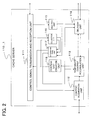
- the cache server 110_1 includes a control signal transmission and reception unit 111, an analysis unit 115, a collection unit 116, a determination unit 117, a content acquisition unit 112, a temporary content accumulation unit 113, a content list creation unit 118, and a delivery unit 114.
- the control signal transmission and reception unit 111 receives a GTP packet, which stores a connection request message, the IP address of the mobile terminal 170, the URL of a requested content, and the like transmitted from the mobile terminal 170, from the SGSN/GGSN apparatus 190_1. In addition, the control signal transmission and reception unit 111 receives information about the area being visited by the mobile terminal 170 from the SGSN/GGSN apparatus 190_1.
- the analysis unit 115 reads the connection request message stored in the payload portion of the GTP packet, extracts information about the IP address of the mobile terminal 170, the URL of the requested content, and the like, and outputs the URL of the requested content, the IP address of the mobile terminal 170, and the like to the delivery unit 114 and the determination unit 117.
- the determination unit 117 instructs the temporary content accumulation unit 113 and the delivery unit 114 to perform reading and delivery, respectively.
- the determination unit 117 notifies the content acquisition unit 112 of the URL of the requested content and the IP address of the cache server in which the requested content is accumulated. In addition, the determination unit 117 instructs the content acquisition unit 112 to acquire the content from the target cache server through inter-cache-server coordination.
- the determination unit 117 instructs the content acquisition unit 112 to acquire the content from the delivery server apparatus 121.
- the content list creation unit 118 creates a list of all the contents accumulated in the temporary content accumulation unit 113.
- the content list creation unit 118 outputs the content list at predetermined time intervals or when a request is made by another cache server or by the collection unit 116.
- the delivery unit 114 receives information about the URL of the requested content from the analysis unit 115 and receives a content delivery instruction from the determination unit 117.
- the delivery unit 114 reads a file corresponding to the requested content from the temporary content accumulation unit 113, generates packets of a predetermined protocol (for example, TCP (Transmission Control Protocol)), and transmits the packets to the SGSN/GGSN apparatus 190_1.
- TCP Transmission Control Protocol
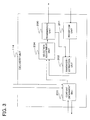
- Fig. 3 is a block diagram illustrating a configuration of the delivery unit 114.
- the delivery unit 114 includes a reception unit 201, a bandwidth estimation unit 202, a content obtainment unit 203, a selection adjustment unit 204, and a transmission unit 200.
- the reception unit 201 receives a TCP response signal packet (for example, a TCP Ack signal packet) from the mobile terminal 170 via the SGSN/GGSN apparatus and outputs information about the TCP response signal packet to the bandwidth estimation unit 202.
- a TCP response signal packet for example, a TCP Ack signal packet
- the reception unit 201 may instruct the bandwidth estimation unit 202 to rapidly reduce the band.
- T n represents the response time of an n-th packet
- T n ack represents time at which the reception unit 201 receives an n-th TCP response signal packet
- T n send represents time at which the transmission unit 200 transmits an n-th transmitted packet.
- the bandwidth estimation unit 202 sets the size of the n-th transmitted packet to S n and estimates a bandwidth B n of the n-th packet based on formula (2) and formula (3).
- the selection adjustment unit 204 extracts a stream from the file inputted in portions, reads a header portion from the stream, and determines whether the picture type of the stream header is an I picture (an Intra Coded Picture), a P picture (a Predictive Coded Picture), or a B picture (a Bidirectional Predictive Coded Picture). In addition, the selection adjustment unit 204 generates a stream obtained by sequentially deleting at least one frame whose priority is relatively low and calculates a bit rate K'. Herein, B pictures have lower priority than P pictures.
- the selection adjustment unit 204 creates a stream by deleting at least one P picture from the stream, calculates a bit rate K' based on formula (6), and compares the bit rate K' with the bandwidth B n , again.
- K ⁇ K ⁇ - ⁇ i ⁇ P i
- P i represents the bit rate of an i-th P picture included in the stream portion.
- the selection adjustment unit 204 outputs the stream created by the above processing to the transmission unit 200.
- Fig. 1 illustrates a configuration in which a single cache server is connected to a single SGSN/GGSN apparatus.
- a single cache server may be connected to a plurality of SGSN/GGSN apparatuses.
- a plurality of cache servers may be connected to a single SGSN/GGSN apparatus.
- an LTE (Long Term Evolution)/EPC (Evolved Packet Core) network which is a 3.9G mobile network, is used as a mobile network 250.
- LTE Long Term Evolution
- EPC Evolved Packet Core
- eNodeB evolved Node B
- the cache server 410_1 has the same configuration as that of the cache server 110_1 ( Fig. 2 ) in the first exemplary embodiment. However, in the present exemplary embodiment, the control signal transmission and reception unit 111 is connected to the S/P-GW apparatus 290_1. Thus, the control signal transmission and reception unit 111 receives the GTP packet, which stores the connection request message, the IP address, and the like and location information about the mobile terminal 170 transmitted from the mobile terminal 170, from the S/P-GW apparatus 290_1. The other cache servers 410_2 to 410_N also perform this exchange with the respective S/P-GW apparatuses 290_2 to 290_N.
- the content delivery systems according to the first to fourth exemplary embodiments provide the following advantageous effects.
- the bandwidth is estimated based on a TCP response signal or an ECN notification signal
- moving image frames are sequentially discarded in ascending order of priority so that the bit rate of a stream extracted from a divided file does not exceed the estimated band
- the adjusted stream is stored in a TCP packet, and the TCP packet is transmitted.
- problems such as freeze-up of a moving image or interruption of voice on the client side during reproduction can be avoided.
- QoE Quality of Experience
- Fig. 7 illustrates a configuration of a content delivery system according to the present exemplary embodiment.
- the content delivery system includes: a delivery server apparatus 121 on the Internet 145; SGSN (Serving GPRS Support Node)/GGSN (Gateway GPRS Support Node) apparatuses 190_1 to 190_N, cache servers 110_1 to 110_N, RNC (Radio Network Controller) apparatuses 195_1 to 195_L and 197_1 to 197_L, and base station apparatuses 180_1 to 180_M, 181_1 to 181_M, 182_1 to 182_M, and 183_1 to 183_M on a mobile network 150.
- SGSN Server GPRS Support Node
- GGSN Gateway GPRS Support Node
- RNC Radio Network Controller
- the SGSN/GGSN apparatuses 190_1 to 190_N are arranged on the mobile network 150.
- the RNC apparatuses 195_1 to 195_L are connected to the SGSN/GGSN apparatus 190_1.
- the RNC apparatuses 197_1 to 197_L are connected to the SGSN/GGSN apparatus 190_N.
- the L RNC apparatuses are also connected to the SGSN/GGSN apparatus 190_2, illustration thereof is omitted in Fig. 7 due to limitations of the space.
- a single cache server is connected to a GGSN function unit of each SGSN/GGSN apparatus.
- the cache server 110_1 is connected to the SGSN/GGSN apparatus 190_1.
- an SGSN/GGSN apparatus is an apparatus in which an SGSN function unit and a GGSN function unit are installed in a single location.
- the mobile terminal 170 transmits a delivery connection request message including the URL (Uniform Resource Locator) of a requested content.
- a base station apparatus in Fig. 7 , one of the base station apparatuses 181_1 to 181_M
- receives the connection request message and transmits the connection request message to an RNC apparatus in Fig. 7 , the RNC apparatus 195_L managing the base station apparatus.
- the RNC apparatus 195_L receives the connection request message from the base station apparatusestores the connection request message, the IP (Internet Protocol) address of the delivery server apparatus 121, the IP address of the mobile terminal 170, and the like in a payload portion of a GTP (GPRS (General Packet Radio Service) Tunneling Protocol) packet, and forwards the GTP packet to the SGSN/GGSN apparatus 190_1 managing the RNC apparatuses 195_1 to 195_L.
- GTP General Packet Radio Service
- the SGSN/GGSN apparatus 190_1 receives the GTP packet.
- the cache server 110_1 is connected to a Gi interface of a GGSN function unit of the SGSN/GGSN apparatus 190_1, for example.
- the cache server 110_N is connected to a Gi interface of a GGSN function unit of the SGSN/GGSN apparatus 190_N.
- the cache servers 110_1 to 110_N are connected to each other so that the cache servers 110_1 to 110_N can coordinate with each other for contents.
- Fig. 8 is a block diagram illustrating a configuration of the cache server 110_1. Since the cache servers 110_2 to 110_N have the same configuration as that of the cache server 110_1, description thereof will be omitted.
- the control signal transmission and reception unit 111 receives a GTP packet, which stores a connection request message, the IP address of the mobile terminal 170, the URL of a requested content, and the like transmitted from the mobile terminal 170, from the SGSN/GGSN apparatus 190_1. In addition, the control signal transmission and reception unit 111 receives information about the area being visited by the mobile terminal 170 from the SGSN/GGSN apparatus 190_1.
- the collection unit 116 receives a list of contents accumulated in the cache server 110_1 and lists of contents accumulated in the cache servers 110_2 to 110_N other than the cache server 110_1. In addition, the collection unit 116 outputs these lists to the determination unit 117.
- the collection unit 116 may collect the content lists at predetermined time intervals or when receiving a connection request from the mobile terminal 170. Alternatively, the collection unit 116 may collect the content lists when a request is made by any one of the other cache servers 110_2 to 110_N to collect the content lists.
- the determination unit 117 notifies the content acquisition unit 112 of the URL of the requested content and the IP address of the cache server in which the requested content is accumulated. In addition, the determination unit 117 instructs the content acquisition unit 112 to acquire the content from the target cache server through inter-cache-server coordination.
- the temporary content accumulation unit 113 accumulates the content outputted from the content acquisition unit 112. In addition, when receiving a content read instruction from the determination unit 117, the temporary content accumulation unit 113 reads a content file corresponding to the requested content and outputs the file to the delivery unit 114.
- the content list creation unit 118 creates a list of all the contents accumulated in the temporary content accumulation unit 113.
- the content list creation unit 118 outputs the content list at predetermined time intervals or when a request is made by another cache server or by the collection unit 116.
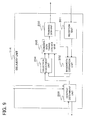
- Fig. 9 is a block diagram illustrating a configuration of the delivery unit 114.
- the delivery unit 114 includes a reception unit 201, a bandwidth estimation unit 202, a content obtainment unit 203, a selection adjustment unit 204, a transmission timing control unit 205, and a transmission unit 200.
- the bandwidth estimation unit 202 receives information about each transmitted packet transmitted from the transmission unit 200 (for example, the transmission time and the packet size of an n-th transmitted packet) and information about a TCP response signal packet (for example, the reception time of an n-th packet). By using the number of each transmitted packet and by associating a transmitted packet with a TCP response signal packet, the bandwidth estimation unit 202 measures a response time T n based on formula (1).
- T n T n ack - T n send
- the bandwidth estimation unit 202 sets the size of the n-th transmitted packet to S n (unit: byte) and estimates a bandwidth B n of the n-th packet based on formula (2) and formula (3).
- ⁇ is a predetermined constant satisfying 0 ⁇ ⁇ ⁇ 1.
- the bandwidth estimation unit 202 may perform these calculations based on formula (2) and formula (3) at predetermined time intervals or when the reception unit 201 receives a TCP response signal.
- the bandwidth estimation unit 202 outputs the bandwidth B n estimated based on formula (3) to the selection adjustment unit 204 at predetermined time intervals T or when a request is made by the selection adjustment unit.
- the content obtainment unit 203 receives information about the requested content from the analysis unit 115 in Fig. 8 and receives a content delivery instruction from the determination unit 117 in Fig. 8 . In addition, the content obtainment unit 203 searches the temporary content accumulation unit 113 in Fig. 8 for a file corresponding to the requested content, obtains the corresponding file or stream and bit rate information K, and outputs the file/stream and information to the selection adjustment unit 204.
- the selection adjustment unit 204 calculates the bit rate K' based on formula (5).
- K ⁇ K - ⁇ j ⁇ B j
- the selection adjustment unit 204 stores the stream created by the processing based on formula (5) in a file again and outputs the file to the transmission timing control unit 205.
- the selection adjustment unit 204 creates a stream by deleting the remaining B pictures from the stream, calculates a bit rate K' based on formula (6), and compares the bit rate K' with the bandwidth B n , again.
- K ⁇ K ⁇ - ⁇ m ⁇ B m
- the selection adjustment unit 204 creates a stream by deleting at least one P picture from the stream, calculates a bit rate K' based on formula (7), and compares the bit rate K' with the bandwidth B n , again.
- K ⁇ K ⁇ - ⁇ i ⁇ P i
- the selection adjustment unit 204 stores the stream created by the processing in a file again and outputs the file to the transmission timing control unit 205.
- the transmission timing control unit 205 outputs an inputted file for a time period T1 that is necessary to occupy the buffer capacity L of the mobile terminal 170 to the transmission unit 200.
- the time period T1 can be set based on formula (8).
- T ⁇ 1 L / K ⁇
- the transmission timing control unit 204 does not output the inputted file to the transmission unit 200 for a predetermined time period T2.
- the time period T2 is a time period during which data in the buffer capacity L of the mobile terminal 170 is not depleted.
- a bit rate B p represents a bit rate used when a moving image is reproduced by the mobile terminal 170.
- Fig. 7 illustrates a configuration in which a single cache server is connected to a single SGSN/GGSN apparatus.
- a single cache server may be connected to a plurality of SGSN/GGSN apparatuses.
- a plurality of cache servers may be connected to a single SGSN/GGSN apparatus.
- the delivery server apparatus 121 may be connected to the cache server apparatuses 110_1 to 110_N.
- Fig. 7 illustrates a configuration using SGSN/GGSN apparatuses, and an SGSN apparatus and a GGSN apparatus are integrated in each of the SGSN/GGSN apparatuses.
- a configuration in which an SGSN apparatus and a GGSN apparatus are separated from each other may be used.
- at least one cache server is connected to either the SGSN apparatus or the GGSN apparatus.
- the delivery unit 114 may estimate the bandwidth based on a formula other than formula (2) and formula (3).
- the selection adjustment unit 204 may use a different bit rate adjustment method.
- the transmission timing control unit 205 may use a different transmission timing control method. The transmission timing control unit 205 may be configured so that the transmission timing control unit 205 controls the transmission timing at least for a certain period (time period) and does not control the transmission timing other than such period.
- the mobile terminal 170 may be a mobile phone, a smartphone, a tablet, or a PC equipped with a data communication card. Alternatively, the mobile terminal 170 may be any terminal, as long as the terminal can communicate with a mobile 3G network.
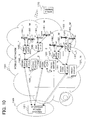
- FIG. 10 is a block diagram illustrating a configuration of a content delivery system according to the present exemplary embodiment.
- Transparent proxy servers and fully transparent proxy servers are two examples of the types of the proxy servers 120_1 to 120_N.
- the proxy server 120_1 will be described. Since the other proxy servers 120_2 to 120_N operate in the same way as the proxy server 120_1, description thereof will be omitted.
- the proxy server 120_1 temporarily terminates a message signal from the mobile terminal 170 and analyzes the message signal.
- the proxy server 120_1 delivers a content temporarily accumulated therein to the mobile terminal 170.
- the proxy server 120_1 transmits a request to or accesses the delivery server apparatus 121 via the SGSN/GGSN apparatus 190_1.
- the proxy server 120_1 does not change the URL of a requested content, the IP address of the delivery server apparatus 121 on the Internet 145, the IP address of the mobile terminal 170, and the like included in a request signal from the mobile terminal 170.
- the proxy server 120_1 uses a DPI (Deep Packet Inspection) technique and checks a packet header portion or the like, without terminating a signal from the mobile terminal 170.
- the proxy server 120_1 extracts information about the URL of the requested content, the IP address of the mobile terminal 170, and the like. If a requested content is cached in the proxy server 120_1, the proxy server 120_1 first transmits a delivery stop instruction to the delivery server apparatus 121 via the SGSN/GGSN apparatus 190_1. Next, the proxy server 120_1 delivers the requested content.
- the proxy server 120_1 has the same configuration as that ( Fig. 8 ) of the cache server 110_1 according to the fifth exemplary embodiment, detailed description thereof will be omitted.
- FIG. 11 is a block diagram illustrating a configuration of a content delivery system according to the present exemplary embodiment.
- an LTE (Long Term Evolution)/EPC (Evolved Packet Core) network which is a 3.9G mobile network, is used as a mobile network 250.
- LTE Long Term Evolution
- EPC Evolved Packet Core
- eNodeB evolved Node B
- the cache server 410_1 has the same configuration as that of the cache server 110_1 ( Fig. 8 ) in the fifth exemplary embodiment. However, in the present exemplary embodiment, the control signal transmission and reception unit 111 is connected to the S/P-GW apparatus 290_1. Thus, the control signal transmission and reception unit 111 receives the GTP packet, which stores the connection request message, the IP address, and the like and location information about the mobile terminal 170 transmitted from the mobile terminal 170, from the S/P-GW apparatus 290_1. The other cache servers 410_2 to 410_N also perform this exchange with the respective S/P-GW apparatuses 290_2 to 290_N.
- Fig. 11 illustrates a configuration using the S/P-GW apparatuses, and an S-GW apparatus and a P-GW apparatus are integrated in each of the S/P-GW apparatuses.
- a configuration in which an S-GW apparatus and a P-GW apparatus are separated from each other may be used.
- at least one cache server is connected to either the S-GW apparatus or the P-GW apparatus.
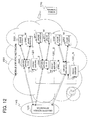
- FIG. 12 is a block diagram illustrating a configuration of a content delivery system according to the present exemplary embodiment.
- Fig. 12 illustrates a configuration in which the cache servers in the content delivery system ( Fig. 11 ) according to the seventh exemplary embodiment are replaced by proxy servers.
- the content delivery system operates in the same way as that according to the sixth exemplary embodiment, description thereof will be omitted.
- the content delivery systems according to the first to eighth exemplary embodiments provide the following advantageous effects.
- the bandwidth is estimated based on a TCP response signal or an ECN notification signal
- moving image frames are sequentially discarded in ascending order of priority so that the bit rate of a stream extracted from a divided file does not exceed the estimated band
- the adjusted stream is stored in a TCP packet, and the TCP packet is transmitted.
- the transmission timing control unit controls transmission timing so that the bandwidth and the buffer capacity are not exceeded.
- future data that is not currently needed by the viewer for viewing is not delivered.
- data that has already been delivered is an appropriate amount of data in view of an estimated band. Namely, unlike the conventional content delivery systems, an excessive amount of data is not delivered and the limited bandwidth of a mobile network is not needlessly consumed.
Landscapes
- Engineering & Computer Science (AREA)
- Signal Processing (AREA)
- Computer Networks & Wireless Communication (AREA)
- Multimedia (AREA)
- Computer Security & Cryptography (AREA)
- Information Transfer Between Computers (AREA)
- Two-Way Televisions, Distribution Of Moving Picture Or The Like (AREA)
- Mobile Radio Communication Systems (AREA)
- Telephonic Communication Services (AREA)
Abstract
Description
- The present invention is based upon and claims the benefit of the priority of Japanese patent application No.
2011-205465, filed on September 21, 2011 2011-205466, filed on September 21, 2011 - The present invention relates to a content delivery system, a cache server, and a content delivery method. In particular, it relates to: a content delivery system in which a moving image content is cached on a mobile network and the content is delivered to various terminals (such as mobile phones, smartphones, PCs (Personal Computers), and game machines); a cache server; and a content delivery method.
- It is predicted that the speed and capacity of mobile networks will be increased further through techniques such as LTE (Long Term Evolution) and EPC (Evolved Packet Core). With such advancement, it is predicted that content delivery will be in widespread use in the future. In content delivery, contents are delivered to various terminals such as mobile terminals via mobile networks.
- For example,
PTL 1 discloses a content delivery method. According toPTL 1, a plurality of cache servers are caused to temporarily store contents stored in a content server connected to the Internet and to deliver contents to an unspecified large number of client terminals. - In addition,
PTL 2 discloses a moving image delivery system for causing a server to deliver video data to clients. According toPTL 2, to enable clients to perform high-quality reproduction of video data, the clients deliver performance information representing performance thereof to the server. -
- [PTL 1]
Japanese Patent Kokai Publication No.2006-171822A - [PTL 2]
Japanese Patent Kokai Publication No.2000-122951A - The entire disclosure of each of the above PTLs is incorporated herein by reference thereto. The following analysis has been made by the present inventor.
- It is predicted that the amount of data system traffic on mobile networks will be increased eight to ten times as large as the current amount by 2013 and that video contents will account for most of the data system traffic. In addition, as smartphones spread rapidly and terminal capabilities improve further, sizes of video contents are increasing more and more. Accordingly, it is predicted that hi-definition, large-capacity contents will also be delivered on mobile networks in the near future.
- However, in conventional content delivery systems, when contents on the Internet are delivered via a mobile network, all the content requests from terminals are transmitted to a delivery server apparatus on the Internet via packet forwarding apparatuses. In addition, the delivery server apparatus delivers the contents to all the terminals via the packet forwarding apparatuses.
- However, such content delivery system has the following problems.
- The bandwidth (throughput) of a mobile network changes with time, depending on the traffic amount. However, in the conventional content delivery systems, when a moving image content on the Internet is delivered, the content of a certain bit rate is continuously delivered, regardless of the above change. Thus, if the bandwidth continuously falls below the delivery bit rate, the content cannot be delivered. As a result, when data buffered in the client is depleted, various problems such as freeze-up of the moving image or interruption of voice are caused during reproduction. If these phenomena are caused, QoE (Quality of Experience) of the viewer is significantly deteriorated.
- In addition, in the conventional content delivery systems, future data that is not currently needed by the viewer for viewing is also delivered. Thus, if the viewer stops viewing the content, data that has already been delivered and that has not been reproduced yet is wasted, counted as a problem. Namely, the conventional content delivery systems have a problem that the limited bandwidth of a mobile network is needlessly consumed.
- Thus, there is a demand for a technique to prevent deterioration of user QoE even when the bandwidth of a mobile network is changed when a content is delivered via the mobile network. An object of the present invention is to provide a content delivery system, a cache server, and a content delivery method that satisfy the demand.
- According to a first aspect of the present invention, there is provided a content delivery system, comprising:
- a plurality of cache servers on a mobile network;
- wherein each of the plurality of cache servers comprises:
- a temporary content accumulation unit that temporarily accumulates at least part of contents stored in a delivery server apparatus delivering a content(s) on the Internet;
- a determination unit that by using information included in a content request message from a mobile terminal determines which one of the plurality of cache servers accumulates a content requested by the mobile terminal;
- a content acquisition unit that reads a file corresponding to the requested content from the determined cache server and outputs the file to the temporary content accumulation unit; and
- a delivery unit that estimates a bandwidth of the mobile network based on a predetermined signal from the mobile terminal, reads the file corresponding to the requested content from the temporary content accumulation unit, extracts a stream from the file, generates a stream by deleting at least part of frames from the stream so that a bit rate of the generated stream does not exceed the bandwidth, stores the generated stream in a packet, and transmits the packet to the mobile terminal.
- According to a second aspect of the present invention, there is provided a cache server, comprising:
- a temporary content accumulation unit that temporarily accumulates at least part of contents stored in a delivery server apparatus delivering a content(s) on the Internet;
- a determination unit that by using information included in a content request message from a mobile terminal determines which one of the plurality of cache servers on a mobile network accumulates a content requested by the mobile terminal;
- a content acquisition unit that reads a file corresponding to the requested content from the determined cache server and outputs the file to the temporary content accumulation unit; and
- a delivery unit that estimates a bandwidth of the mobile network based on a predetermined signal from the mobile terminal, reads the file corresponding to the requested content from the temporary content accumulation unit, extracts a stream from the file, generates a stream by deleting at least part of frames from the stream so that a bit rate of the generated stream does not exceed the bandwidth, stores the generated stream in a packet, and transmits the packet to the mobile terminal.
- According to a third aspect of the present invention, there is provided a content delivery method, comprising:
- by a cache server, temporarily accumulating at least part of contents stored in a delivery server apparatus delivering a content(s) on the Internet in a temporary content accumulation unit provided with the cache server;
- by using information included in a content request message from a mobile terminal, determining which one of the plurality of cache servers on a mobile network accumulates a content requested by the mobile terminal;
- reading a file corresponding to the requested content from the determined cache server and outputting the file to the temporary content accumulation unit;
- estimating a bandwidth of the mobile network based on a predetermined signal from the mobile terminal;
- reading the file corresponding to the requested content from the temporary content accumulation unit; and
- extracting a stream from the read file, generating a stream by deleting at least part of frames from the stream so that a bit rate of the generated stream does not exceed the bandwidth, storing the generated stream in a packet, and transmitting the packet to the mobile terminal.
- According to a fourth aspect of the present invention, there is provided a content delivery system comprising a plurality of cache servers on a mobile network; wherein each of the plurality of cache servers comprises:
- a temporary content accumulation unit that temporarily accumulates at least part of contents stored in a delivery server apparatus delivering a content(s) on the Internet;
- a determination unit that by using information included in a content request message from a mobile terminal determines which one of the plurality of cache servers accumulates a content requested by the mobile terminal;
- a content acquisition unit that reads a file corresponding to the requested content from the determined cache server and outputs the file to the temporary content accumulation unit; and
- a delivery unit that estimates a bandwidth of the mobile network based on a predetermined signal from the mobile terminal, reads the file corresponding to the requested content from the temporary content accumulation unit, extracts a stream from the file, generates a stream by deleting at least part of frames from the stream so that a bit rate of the generated stream does not exceed the bandwidth, stores the generated stream in a file, and transmits a packet including the file storing the adjusted stream to the mobile terminal while controlling transmission timing based on a buffer capacity of the mobile terminal at least for a certain period.
- According to a fifth aspect of the present invention, there is provided a cache server comprising:
- a temporary content accumulation unit that temporarily accumulates at least part of contents stored in a delivery server apparatus delivering a content(s) on the Internet;
- a determination unit that by using information included in a content request message from a mobile terminal determines which one of the plurality of cache servers on a mobile network accumulates a content requested by the mobile terminal;
- a content acquisition unit that reads a file corresponding to the requested content from the determined cache server and outputs the file to the temporary content accumulation unit; and
- a delivery unit that estimates a bandwidth of the mobile network based on a predetermined signal from the mobile terminal, reads the file corresponding to the requested content from the temporary content accumulation unit, extracts a stream from the file, generates a stream by deleting at least part of frames from the stream so that a bit rate of the generated stream does not exceed the bandwidth, stores the stream in a file, and transmits a packet including the file storing the adjusted stream to the mobile terminal while controlling transmission timing based on a buffer capacity of the mobile terminal at least for a certain period.
- According to a sixth aspect of the present invention, there is provided a content delivery method comprising:
- by a cache server, temporarily accumulating at least part of contents stored in a delivery server apparatus delivering a content(s) on the Internet in a temporary content accumulation unit provided with the cache server;
- by using information included in a content request message from a mobile terminal, determining which one of the plurality of cache servers on a mobile network accumulates a content requested by the mobile terminal;
- reading a file corresponding to the requested content from the determined cache server and outputting the file to the temporary content accumulation unit;
- estimating a bandwidth of the mobile network based on a predetermined signal from the mobile terminal;
- reading the file corresponding to the requested content from the temporary content accumulation unit;
- extracting a stream from the read file, generate a stream by deleting at least part of frames from the stream so that a bit rate of the generated stream does not exceed the bandwidth, and storing the generated stream in a file; and
- transmitting a packet including the file storing the adjusted stream to the mobile terminal while controlling transmission timing based on a buffer capacity of the mobile terminal at least for a certain period.
- With a content delivery system, a cache server, and a content delivery method according to the present invention, it is possible to prevent deterioration of user QoE even when the bandwidth of a mobile network is changed when a content is delivered via the mobile network.
-
- [
Fig. 1 ]
Fig. 1 is a block diagram illustrating a configuration of a content delivery system according to a first exemplary embodiment. - [
Fig. 2 ]
Fig. 2 is a block diagram illustrating a configuration of a cache server in the content delivery system according to the first exemplary embodiment. - [
Fig. 3 ]
Fig. 3 is a block diagram illustrating a configuration of a delivery unit of the cache server in the content delivery system according to the first exemplary embodiment. - [
Fig. 4 ]
Fig. 4 is a block diagram illustrating a configuration of a content delivery system according to a second exemplary embodiment. - [
Fig. 5 ]
Fig. 5 is a block diagram illustrating a configuration of a content delivery system according to a third exemplary embodiment. - [
Fig. 6 ]
Fig. 6 is a block diagram illustrating a configuration of a content delivery system according to a fourth exemplary embodiment. - [
Fig. 7 ]
Fig. 7 is a block diagram illustrating a configuration of a content delivery system according to a fifth exemplary embodiment. - [
Fig. 8 ]
Fig. 8 is a block diagram illustrating a configuration of a cache server in the content delivery system according to the fifth exemplary embodiment. - [
Fig. 9 ]
Fig. 9 is a block diagram illustrating a configuration of a delivery unit of the cache server in the content delivery system according to the fifth exemplary embodiment. - [
Fig. 10 ]
Fig. 10 is a block diagram illustrating a configuration of a content delivery system according to a sixth exemplary embodiment. - [
Fig. 11 ]
Fig. 11 is a block diagram illustrating a configuration of a content delivery system according to a seventh exemplary embodiment. - [
Fig. 12 ]
Fig. 12 is a block diagram illustrating a configuration of a content delivery system according to an eighth exemplary embodiment. - First, an outline of the present invention will be described. The reference characters in the following outline are merely used as examples to facilitate understanding of the present invention. Therefore, the reference characters are not intended to limit the present invention to the illustrated modes.
- As illustrated in
Figs. 1 and2 , a content delivery system according to the present invention comprises: a plurality of cache servers (110_1 to 110_N) on a mobile network (150). Each of the plurality of cache servers (110_1 to 110_N) comprises: a temporary content accumulation unit (113) that temporarily accumulates at least part of contents stored in a delivery server apparatus (121) delivering a content(s) on the Internet (145); a determination unit (117) that by using information included in a content request message from a mobile terminal (170) determines which one of the plurality of cache servers (110_1 to 110_N) accumulates a content requested by the mobile terminal (170); a content acquisition unit (112) that reads a file corresponding to the requested content from the determined cache server and outputs the file to the temporary content accumulation unit (113); and a delivery unit (114) that estimates a bandwidth of the mobile network (150) based on a predetermined signal from the mobile terminal (170), reads the file corresponding to the requested content from the temporary content accumulation unit (113), extracts a stream from the file, generates a stream by deleting at least part of frames from the stream so that a bit rate of the generated stream does not exceed the bandwidth, stores the generated stream in a packet, and transmits the packet to the mobile terminal (170). - In addition, the delivery unit (114) may read the file corresponding to the requested content from the temporary content accumulation unit (113) in portions, extract a stream from the file divided in portions, and generates a stream by deleting at least one frame whose priority is relatively low from the stream so that a bit rate of the generated stream does not exceed the bandwidth.
- If the delivery unit (114) receives a response packet from the mobile terminal (170) in response to a transmitted packet transmitted to the mobile terminal (170), the delivery unit may estimate the bandwidth of the mobile network (150) based on a difference between a transmission time of the transmitted packet and a reception time of the response packet and based on a size of the transmitted packet. If the delivery unit (114) receives a signal indicating a congestion state of the mobile network (150) from the mobile terminal (170), the delivery unit (114) may not transmit the packet for a predetermined period.
- As illustrated in
Fig. 4 , the plurality of cache servers may be transparent or fully transparent proxy servers (120_1 to 120_N). - As illustrated in
Figs. 5 and6 , the mobile network may be a 3G (3rd Generation) mobile network or an LTE (Long Term Evolution)/EPC (Evolved Packet Core) network (250). - According to the present invention, the following modes are possible.
- A content delivery system may be the content delivery system according to the above first aspect.
- The delivery unit may read the file corresponding to the requested content from the temporary content accumulation unit in portions, extract a stream from the file divided in portions, and generate a stream by deleting at least one frame whose priority is relatively low from the stream so that a bit rate of the generated stream does not exceed the bandwidth.
- If the delivery unit receives a response packet from the mobile terminal in response to a transmitted packet transmitted to the mobile terminal, the delivery unit may estimate the bandwidth of the mobile network based on a difference between a transmission time of the transmitted packet and a reception time of the response packet and based on a size of the transmitted packet.
- If the delivery unit receives a signal indicating a congestion state of the mobile network from the mobile terminal, the delivery unit may not transmit the packet for a predetermined period.
- The plurality of cache servers may be transparent or fully transparent proxy servers.
- The mobile network may be a 3G mobile network or an LTE (Long Term Evolution)/EPC (Evolved Packet Core) network.
- A cache server may be the cache server according to the above second aspect.
- The delivery unit may read the file corresponding to the requested content from the temporary content accumulation unit in portions, extract a stream from the file divided in portions, and generate a stream by deleting at least one frame whose priority is relatively low from the stream so that a bit rate of the generated stream does not exceed the bandwidth.
- If the delivery unit receives a response packet from the mobile terminal in response to a transmitted packet transmitted to the mobile terminal, the delivery unit may estimate the bandwidth of the mobile network based on a difference between a transmission time of the transmitted packet and a reception time of the response packet and based on a size of the transmitted packet.
- If the delivery unit receives a signal indicating a congestion state of the mobile network from the mobile terminal, the delivery unit may not transmit the packet for a predetermined period.
- A content delivery method may be the content delivery method according to the above third aspect.
- In the above content delivery method, the cache server may receive the file corresponding to the requested content from the temporary content accumulation unit in portions, extract a stream from the file divided in portions, and generate a stream by deleting at least one frame whose priority is relatively low from the stream so that a bit rate of the generated stream does not exceed the bandwidth
- In the above content delivery method, if the cache server receives a response packet from the mobile terminal in response to a transmitted packet transmitted to the mobile terminal, the cache server may estimate the bandwidth of the mobile network based on a difference between a transmission time of the transmitted packet and a reception time of the response packet and based on a size of the transmitted packet.
- In the above content delivery method, if the cache server receives a signal indicating a congestion state of the mobile network from the mobile terminal, the cache server may not transmit the packet for a predetermined period.
- There is provided a program causing a computer provided with a cache server to execute:
- temporarily accumulating at least part of contents stored in a delivery server apparatus delivering a content(s on the Internet in a temporary content accumulation unit provided in the cache server;
- by using information included in a content request message from a mobile terminal, determining which one of the plurality of cache servers on a mobile network accumulates a content requested by the mobile terminal;
- reading a file corresponding to the requested content from the determined cache server and outputting the file to the temporary content accumulation unit;
- estimating a bandwidth of the mobile network based on a predetermined signal from the mobile terminal;
- reading the file corresponding to the requested content from the temporary content accumulation unit;
- extracting a stream from the read file, generating a stream by deleting at least part of frames from the stream so that a bit rate of the generated stream does not exceed the bandwidth, storing the generated stream in a packet, and transmitting the packet to the mobile terminal. The program can be provided as a program product recorded in a non-transient computer-readable recording medium.
- The above program may cause the computer to execute receiving the file corresponding to the requested content from the temporary content accumulation unit in portions, extracting a stream from the file divided in portions, and generating a stream by deleting at least one frame whose priority is relatively low from the stream so that a bit rate of the generated stream does not exceed the bandwidth.
- The above program may cause the computer to execute, upon receiving a response packet from the mobile terminal in response to a transmitted packet transmitted to the mobile terminal, estimating the bandwidth of the mobile network based on a difference between a transmission time of the transmitted packet and a reception time of the response packet and based on a size of the transmitted packet.
- The above program may cause the' computer to execute, upon receiving a signal indicating a congestion state of the mobile network from the mobile terminal, stopping transmission of the packet for a predetermined period.
- Configurations and operations of content delivery systems according to exemplary embodiments will be described in detail with reference to
Figs. 1 to 6 . In the following exemplary embodiments, configurations in which contents are moving images will be described as examples. - A content delivery system according to a first exemplary embodiment will be described with reference to the drawings.
Fig. 1 illustrates a configuration of a content delivery system according to the present exemplary embodiment. As illustrated inFig. 1 , the content delivery system includes: adelivery server apparatus 121 on theInternet 145; SGSN (Serving GPRS Support Node)/GGSN (Gateway GPRS Support Node) apparatuses 190_1 to 190_N, cache servers 110_1 to 110_N, RNC (Radio Network Controller) apparatuses 195_1 to 195_L and 197_1 to 197_L, and base station apparatuses 180_1 to 180_M, 181_1 to 181_M, 182_1 to 182_M, and 183_1 to 183_M on amobile network 150. -
Fig. 1 illustrates a configuration in which a 3G mobile packet network is used as the mobile network and the SGSN/GGSN apparatuses are used as packet forwarding apparatuses. In addition,Fig. 1 illustrates a configuration in which cache servers are used. - The
delivery server apparatus 121 on theInternet 145 accumulates various contents on the Internet. Hereinafter, these contents will be referred to as OTT (Over The Top) contents. In the present exemplary embodiment, a content is a compressed-and-encoded bit stream of a moving image content or a file storing such compressed-and-encoded bit stream. In addition, amobile terminal 170 is used as a terminal. However, a terminal different from themobile terminal 170 may be used as a terminal. - The SGSN/GGSN apparatuses 190_1 to 190_N (N ≥ 2) are arranged on the
mobile network 150. The RNC apparatuses 195_1 to 195_L (L ≥ 2) are connected to the SGSN/GGSN apparatus 190_1. Likewise, the RNC apparatuses 197_1 to 197_L are connected to the SGSN/GGSN apparatus 190_N. While the L RNC apparatuses are also connected to the SGSN/GGSN apparatus 190_2, illustration thereof is omitted inFig. 1 due to limitations of the space. - In addition, the M base stations (M ≥ 2) are connected to each of the RNC apparatuses. For example, the M base station apparatuses 180_1 to 180_M are connected to the RNC apparatus 195_1.
- In
Fig. 1 , a single cache server is connected to a GGSN function unit of each SGSN/GGSN apparatus. For example, the cache server 110_1 is connected to the SGSN/GGSN apparatus 190_1. Herein, an SGSN/GGSN apparatus is an apparatus in which an SGSN function unit and a GGSN function unit are installed in a single location. - The
mobile terminal 170 transmits a delivery connection request message including the URL (Uniform Resource Locator) of a requested content. Next, a base station apparatus (inFig. 1 , one of the base station apparatuses 181_1 to 181_M) whose service area is being visited by themobile terminal 170 receives the connection request message and transmits the connection request message to an RNC apparatus (inFig. 1 , the RNC apparatus 195_L) managing the base station apparatus. - The RNC apparatus 195_L receives the connection request message from the base station apparatus and stores the connection request message, the IP (Internet Protocol) address of the
delivery server apparatus 121, the IP address of themobile terminal 170, and the like in a payload portion of a GTP (GPRS (General Packet Radio Service) Tunneling Protocol) packet, and forwards the GTP packet to the SGSN/GGSN apparatus 190_1 managing the RNC apparatuses 195_1 to 195_L. - Next, the SGSN/GGSN apparatus 190_1 receives the GTP packet.
- The cache server 110_1 is connected to a Gi interface of a GGSN function unit of the SGSN/GGSN apparatus 190_1, for example. Likewise, the cache server 110_N is connected to a Gi interface of a GGSN function unit of the SGSN/GGSN apparatus 190_N. In addition, the cache servers 110_1 to 110_N are connected to each other so that the cache servers 110_1 to 110_N can coordinate with each other for contents.
- Next, a configuration of the cache server 110_1 connected to the SGSN/GGSN apparatus 190_1 will be described with reference to the drawings.
Fig. 2 is a block diagram illustrating a configuration of the cache server 110_1. Since the cache servers 110_2 to 110_N have the same configuration as that of the cache server 110_1, description thereof will be omitted. - As illustrated in
Fig. 2 , the cache server 110_1 includes a control signal transmission andreception unit 111, ananalysis unit 115, acollection unit 116, adetermination unit 117, acontent acquisition unit 112, a temporarycontent accumulation unit 113, a contentlist creation unit 118, and adelivery unit 114. - The control signal transmission and
reception unit 111 receives a GTP packet, which stores a connection request message, the IP address of themobile terminal 170, the URL of a requested content, and the like transmitted from themobile terminal 170, from the SGSN/GGSN apparatus 190_1. In addition, the control signal transmission andreception unit 111 receives information about the area being visited by the mobile terminal 170 from the SGSN/GGSN apparatus 190_1. - The
analysis unit 115 reads the connection request message stored in the payload portion of the GTP packet, extracts information about the IP address of themobile terminal 170, the URL of the requested content, and the like, and outputs the URL of the requested content, the IP address of themobile terminal 170, and the like to thedelivery unit 114 and thedetermination unit 117. - The
collection unit 116 receives a list of contents accumulated in the cache server 110_1 and lists of contents accumulated in the cache servers 110_2 to 110_N other than the cache server 110_1. In addition, thecollection unit 116 outputs these lists to thedetermination unit 117. Thecollection unit 116 may collect the content lists at predetermined time intervals or when receiving a connection request from themobile terminal 170. Alternatively, thecollection unit 116 may collect the content lists when a request is made by any one of the other cache servers 110_2 to 110_N to collect the content lists. - The
determination unit 117 receives information about the IP address of themobile terminal 170, the URL of the requested content, and the like, a list of contents accumulated in the cache server 110_1, and lists of contents accumulated in the cache servers 110_2 to 110_N other than the cache server 110_1. Thedetermination unit 117 determines whether the content requested by themobile terminal 170 is accumulated in the cache server 110_1 or in any one of the cache servers 110_2 to 110_N other than the cache server 110_1. - If the content requested by the
mobile terminal 170 is accumulated in the cache server 110_1, thedetermination unit 117 instructs the temporarycontent accumulation unit 113 and thedelivery unit 114 to perform reading and delivery, respectively. - If the content requested by the
mobile terminal 170 is accumulated in any one of the cache servers 110_2 to 110_N, thedetermination unit 117 notifies thecontent acquisition unit 112 of the URL of the requested content and the IP address of the cache server in which the requested content is accumulated. In addition, thedetermination unit 117 instructs thecontent acquisition unit 112 to acquire the content from the target cache server through inter-cache-server coordination. - If the content requested by the
mobile terminal 170 is not accumulated in the cache server 110_1 or in any one of the cache servers 110_2 to 110_N, thedetermination unit 117 instructs thecontent acquisition unit 112 to acquire the content from thedelivery server apparatus 121. - From the
determination unit 117, thecontent acquisition unit 112 receives the URL of the requested content and the content acquisition instruction. If the content is accumulated in another cache server, thecontent acquisition unit 112 receives the IP address of this cache server. If the content is accumulated in thedelivery server apparatus 121, thecontent acquisition unit 112 receives the IP address of thedelivery server apparatus 121. Thecontent acquisition unit 112 acquires at least one copy of the requested content and outputs the copy to the temporarycontent accumulation unit 113. - The temporary
content accumulation unit 113 accumulates the content outputted from thecontent acquisition unit 112. In addition, when receiving a content read instruction from thedetermination unit 117, the temporarycontent accumulation unit 113 reads a content file corresponding to the URL of the requested content and outputs the file to thedelivery unit 114. - As needed, the content
list creation unit 118 creates a list of all the contents accumulated in the temporarycontent accumulation unit 113. The contentlist creation unit 118 outputs the content list at predetermined time intervals or when a request is made by another cache server or by thecollection unit 116. - The
delivery unit 114 receives information about the URL of the requested content from theanalysis unit 115 and receives a content delivery instruction from thedetermination unit 117. Thedelivery unit 114 reads a file corresponding to the requested content from the temporarycontent accumulation unit 113, generates packets of a predetermined protocol (for example, TCP (Transmission Control Protocol)), and transmits the packets to the SGSN/GGSN apparatus 190_1. The SGSN/GGSN apparatus 190_1 delivers the packets including the content to themobile terminal 170. -
Fig. 3 is a block diagram illustrating a configuration of thedelivery unit 114. As illustrated inFig. 3 , thedelivery unit 114 includes areception unit 201, abandwidth estimation unit 202, acontent obtainment unit 203, aselection adjustment unit 204, and atransmission unit 200. - The
reception unit 201 receives a TCP response signal packet (for example, a TCP Ack signal packet) from themobile terminal 170 via the SGSN/GGSN apparatus and outputs information about the TCP response signal packet to thebandwidth estimation unit 202. Alternatively, when receiving an ECN (Explicit Congestion Notification) signal indicating a congestion state from themobile terminal 170, thereception unit 201 may instruct thebandwidth estimation unit 202 to rapidly reduce the band. - The
bandwidth estimation unit 202 receives informaiton about each transmitted packet transmitted from the transmission unit 200 (for example, the transmission time and the size of each transmitted packet) and information about a TCP response signal packet as described above. By using the number of each transmitted packet and by associating a transmitted packet with a TCP response signal packet, thebandwidth estimation unit 202 measures a response time Tn based on formula (1).
- In the above formula (1), Tn represents the response time of an n-th packet, Tn ack represents time at which the
reception unit 201 receives an n-th TCP response signal packet, and Tn send represents time at which thetransmission unit 200 transmits an n-th transmitted packet. - The
bandwidth estimation unit 202 sets the size of the n-th transmitted packet to Sn and estimates a bandwidth Bn of the n-th packet based on formula (2) and formula (3).

- In formula (3), α is a predetermined constant satisfying 0 < α < 1.
- The
bandwidth estimation unit 202 may perform these calculations based on formula (2) and formula (3) at predetermined time intervals or when a request is made by thecontent obtainment unit 203. - The
bandwidth estimation unit 202 outputs the bandwidth Bn estimated based on formula (3) to theselection adjustment unit 204 at predetermined time intervals T or when a request is made by theselection adjustment unit 204. - When receiving an ECN signal from the
reception unit 201, thebandwidth estimation unit 202 may determine that the mobile network is in a congestion state and reduce the bandwidth Bn estimated based on formula (2) by a predetermined amount or set Bn = 0. If thebandwidth estimation unit 202 sets Bn = 0, no packets are transmitted from thetransmission unit 200 for a predetermined time period. - The
content obtainment unit 203 receives the URL of the requested content from theanalysis unit 115 inFig. 2 and receives a content delivery instruction from thedetermination unit 117 inFig. 2 . In addition, thecontent obtainment unit 203 searches the temporarycontent accumulation unit 113 inFig. 2 for a file corresponding to the requested content, obtains the corresponding file or stream and bit rate information K, and outputs the file/stream and information to theselection adjustment unit 204. - The
selection adjustment unit 204 receives the bandwidth Bn from thebandwidth estimation unit 202 and receives a content file corresponding to the requested URL from thecontent obtainment unit 203 in portions. The content file is divided into portions so that each portion has a predetermined time length τ (the unit thereof is second) or a predetermined size G (the unit thereof is byte). In addition, theselection adjustment unit 204 receives the bit rate K (the unit thereof is bps) of the content from thecontent obtainment unit 203. For example, theselection adjustment unit 204 makes an adjustment to obtain a bit rate K' (the unit thereof is bps) as described by the following processing so that the bit rate of a stream extracted from the file inputted in portions does not exceed the estimated bandwidth Bn. Next, theselection adjustment unit 204 outputs the bit rate K' to thetransmission unit 200. Herein, for example, τ is set to 2 seconds. Namely, theselection adjustment unit 204 receives a file divided into portions every two seconds from thecontent obtainment unit 203. - If K ≤ Bn, the
selection adjustment unit 204 sets K' = K, extracts a stream from the file inputted in portions, and outputs the stream to thetransmission unit 200 without making any adjustment to the stream. - However, if K > Bn, the
selection adjustment unit 204 extracts a stream from the file inputted in portions, reads a header portion from the stream, and determines whether the picture type of the stream header is an I picture (an Intra Coded Picture), a P picture (a Predictive Coded Picture), or a B picture (a Bidirectional Predictive Coded Picture). In addition, theselection adjustment unit 204 generates a stream obtained by sequentially deleting at least one frame whose priority is relatively low and calculates a bit rate K'. Herein, B pictures have lower priority than P pictures. - The
selection adjustment unit 204 calculates the bit rate K' based on formula (4).
- In formula (4), Bj represents the bit rate of a j-th B picture included in a stream of the divided file. After performing the calculation based on formula (4), the
selection adjustment unit 204 compares the bit rate K' with the bandwidth Bn. - If K' ≤ Bn, the
selection adjustment unit 204 outputs the stream obtained by deleting at least one B picture from the stream of the divided file through the above processing to thetransmission unit 200. - However, if K' > Bn and B pictures are still included in the stream of the divided file, the
selection adjustment unit 204 creates a stream by deleting the remaining B pictures from the stream, calculates a bit rate K' based on formula (5), and compares the bit rate K' with the bandwidth Bn, again.
- If no B pictures are included, the
selection adjustment unit 204 creates a stream by deleting at least one P picture from the stream, calculates a bit rate K' based on formula (6), and compares the bit rate K' with the bandwidth Bn, again.
- In formula (6), Pi represents the bit rate of an i-th P picture included in the stream portion.
- As a result of the above processing, if K' ≤ Bn, the
selection adjustment unit 204 outputs the stream created by the above processing to thetransmission unit 200. - The
transmission unit 200 receives the stream whose bit rate has been adjusted based on the divided file outputted from theselection adjustment unit 204, stores the stream in a TCP packet, and transmits the packet to themobile terminal 170 via the SGSN/GGSN apparatus 190_1, a relevant RNC apparatus, and a relevant base station apparatus. - Various variations can be made to the content delivery system according to the first exemplary embodiment described above.
-
Fig. 1 illustrates a configuration in which a single cache server is connected to a single SGSN/GGSN apparatus. However, a single cache server may be connected to a plurality of SGSN/GGSN apparatuses. Alternatively, a plurality of cache servers may be connected to a single SGSN/GGSN apparatus. - The
delivery server apparatus 121 may be connected to the cache server apparatuses 110_1 to 110_N. -
Fig. 1 illustrates a configuration using SGSN/GGSN apparatuses, and an SGSN apparatus and a GGSN apparatus are integrated in each of the SGSN/GGSN apparatuses. However, a configuration in which an SGSN apparatus and a GGSN apparatus are separated from each other may be used. In such case, at least one cache server is connected to either the SGSN apparatus or the GGSN apparatus. - In addition, the
delivery unit 114 may estimate the bandwidth based on a formula other than formula (2) and formula (3). Thedelivery unit 114 may adjust the bit rate based on a method other than the above method. - The
mobile terminal 170 may be a mobile phone, a smartphone, a tablet, or a PC equipped with a data communication card. Alternatively, themobile terminal 170 may be any terminal, as long as the terminal can communicate with a mobile 3G network. - A content delivery system according to a second exemplary embodiment will be described with reference to the drawings.
Fig. 4 is a block diagram illustrating a configuration of a content delivery system according to the present exemplary embodiment. - As illustrated in
Fig. 4 , in the present exemplary embodiment, as a variation of the first exemplary embodiment (Fig. 1 ), proxy servers 120_1 to 120_N are used in place of the cache servers 110_1 to 110_N. InFig. 4 , some components are denoted by the same reference characters as those inFig. 1 . Since these components perform the same operations as those inFig. 1 , description thereof will be omitted. - Transparent proxy servers and fully transparent proxy servers are two examples of the types of the proxy servers 120_1 to 120_N. Hereinafter, the proxy server 120_1 will be described. Since the other proxy servers 120_2 to 120_N operate in the same way as the proxy server 120_1, description thereof will be omitted.
- First, an example where the proxy server 120_1 is a transparent proxy server will be described. The proxy server 120_1 temporarily terminates a message signal from the
mobile terminal 170 and analyzes the message signal. The proxy server 120_1 delivers a content temporarily accumulated therein to themobile terminal 170. As needed, the proxy server 120_1 transmits a request to or accesses thedelivery server apparatus 121 via the SGSN/GGSN apparatus 190_1. - Next, an example where the proxy server 120_1 is a fully transparent proxy server will be described. The proxy server 120_1 does not change the URL of a requested content, the IP address of the
delivery server apparatus 121 on the Internet, the IP address of themobile terminal 170, and the like included in a request signal from themobile terminal 170. The proxy server 120_1 uses a DPI (Deep Packet Inspection) technique and checks a packet header portion or the like, without terminating a signal from themobile terminal 170. In addition, the proxy server 120_1 extracts information about the URL of the requested content, the IP address of themobile terminal 170, and the like. If a requested content is cached in the proxy server 120_1, the proxy server 120_1 first transmits a delivery stop instruction to thedelivery server apparatus 121 via the SGSN/GGSN apparatus 190_1. Next, the proxy server 120_1 delivers the requested content. - Since the proxy server 120_1 has the same configuration as that (
Fig. 2 ) of the cache server 110_1 according to the first exemplary embodiment, detailed description thereof will be omitted. - A content delivery system according to a third exemplary embodiment will be described with reference to the drawings.
Fig. 5 is a block diagram illustrating a configuration of a content delivery system according to the present exemplary embodiment. - In the present exemplary embodiment, as illustrated in
Fig. 5 , in place of a3G mobile network 150 illustrated inFig. 1 , an LTE (Long Term Evolution)/EPC (Evolved Packet Core) network, which is a 3.9G mobile network, is used as amobile network 250. In LTE, while the functions of the base station apparatuses and the RNC apparatuses have been degenerated, eNodeB (evolved Node B) apparatuses are used, instead. - In addition, in EPC, S/P-GW (Serving/Packet Data-Gateway) apparatuses are connected to corresponding eNodeB apparatuses. An S/P-GW apparatus is an apparatus in which an S-GW apparatus and a P-GW apparatus are integrated.
Fig. 5 illustrates a configuration in which M eNodeB apparatuses are connected to a single S/P-GW apparatus. For example, eNodeB apparatuses 260_1 to 260_M are connected to an S/P-GW apparatus 290_1. - A single cache server is connected to each S/P-GW apparatus. For example, a cache server 410_1 is connected to the S/P-GW apparatus 290_1. The cache servers 410_1 to 410_N are connected to each other to achieve coordination for contents.
- The
mobile terminal 170 transmits a delivery connection request message including the IP address of thedelivery server apparatus 121. Next, an eNodeB apparatus (inFig. 5 , one of the eNodeB apparatuses 261_1 to 261_M) whose service area is being visited by themobile terminal 170 receives the connection request message. The one of the eNodeB apparatuses 261_1 to 261M stores the connection request message, the IP address of thedelivery server apparatus 121, the IP address of themobile terminal 170, and the like in a payload portion with a GTP protocol and forwards the GTP packet to an S/P-GW apparatus 290_2. - The cache server 410_1 has the same configuration as that of the cache server 110_1 (
Fig. 2 ) in the first exemplary embodiment. However, in the present exemplary embodiment, the control signal transmission andreception unit 111 is connected to the S/P-GW apparatus 290_1. Thus, the control signal transmission andreception unit 111 receives the GTP packet, which stores the connection request message, the IP address, and the like and location information about themobile terminal 170 transmitted from themobile terminal 170, from the S/P-GW apparatus 290_1. The other cache servers 410_2 to 410_N also perform this exchange with the respective S/P-GW apparatuses 290_2 to 290_N. - Various variations can be made to the content delivery system according to the third exemplary embodiment.
-
Fig. 5 illustrates a configuration using the S/P-GW apparatuses, and an S-GW apparatus and a P-GW apparatus are integrated in each of the S/P-GW apparatuses. However, a configuration in which an S-GW apparatus and a P-GW apparatus are separated from each other may be used. In such case, at least one cache server is connected to either the S-GW apparatus or the P-GW apparatus. - In addition, the
mobile terminal 170 may be a mobile phone, a smartphone, a tablet, or a PC equipped with a data communication card. Alternatively, themobile terminal 170 may be any terminal, as long as the terminal can communicate with a mobile 3.9G (3.9th Generation) network. - A content delivery system according to a fourth exemplary embodiment will be described with reference to the drawings.
Fig. 6 is a block diagram illustrating a configuration of a content delivery system according to the present exemplary embodiment. -
Fig. 6 illustrates a configuration in which the cache servers inFig. 5 are replaced by proxy servers. In this exemplary embodiment, since the content delivery system operates in the same way as that according to the second exemplary embodiment, description thereof will be omitted. - For example, the content delivery systems according to the first to fourth exemplary embodiments provide the following advantageous effects.
- In the content delivery system according to any one of the above exemplary embodiments, when a moving image content of a certain bit rate on the Internet is delivered, even when the bandwidth (throughput) of a mobile network is changed with time by a traffic amount and the bandwidth continuously falls below the delivery bit rate, the bandwidth is estimated based on a TCP response signal or an ECN notification signal, moving image frames are sequentially discarded in ascending order of priority so that the bit rate of a stream extracted from a divided file does not exceed the estimated band, the adjusted stream is stored in a TCP packet, and the TCP packet is transmitted. According to such content delivery system, problems such as freeze-up of a moving image or interruption of voice on the client side during reproduction can be avoided. In addition, as a result, QoE (Quality of Experience) of the viewer can be significantly improved.
- Configurations and operations of content delivery systems according to exemplary embodiments will be described in detail with reference to
Figs. 7 to 12 . In the following exemplary embodiments, configurations in which contents are moving images will be described as examples. - A content delivery system according to a fifth exemplary embodiment will be described with reference to the drawings.
Fig. 7 illustrates a configuration of a content delivery system according to the present exemplary embodiment. As illustrated inFig. 7 , the content delivery system includes: adelivery server apparatus 121 on theInternet 145; SGSN (Serving GPRS Support Node)/GGSN (Gateway GPRS Support Node) apparatuses 190_1 to 190_N, cache servers 110_1 to 110_N, RNC (Radio Network Controller) apparatuses 195_1 to 195_L and 197_1 to 197_L, and base station apparatuses 180_1 to 180_M, 181_1 to 181_M, 182_1 to 182_M, and 183_1 to 183_M on amobile network 150. -
Fig. 7 illustrates a configuration in which a 3G mobile packet network is used as the mobile network and the SGSN/GGSN apparatuses are used as packet forwarding apparatuses. In addition,Fig. 7 illustrates a configuration in which cache servers are used. - The
delivery server apparatus 121 on theInternet 145 accumulates various contents on the Internet. Hereinafter, these contents will be referred to as OTT (Over The Top) contents. In the present exemplary embodiment, a content is a compressed-and-encoded bit stream of a moving image content or a file storing such compressed-and-encoded bit stream. In addition, amobile terminal 170 is used as a terminal. However, a terminal different from themobile terminal 170 may be used as a terminal. - The SGSN/GGSN apparatuses 190_1 to 190_N (N ≥ 2) are arranged on the
mobile network 150. The RNC apparatuses 195_1 to 195_L (L ≥ 2) are connected to the SGSN/GGSN apparatus 190_1. Likewise, the RNC apparatuses 197_1 to 197_L are connected to the SGSN/GGSN apparatus 190_N. While the L RNC apparatuses are also connected to the SGSN/GGSN apparatus 190_2, illustration thereof is omitted inFig. 7 due to limitations of the space. - In addition, the M base stations (M ≥ 2) are connected to each of the RNC apparatuses. For example, the M base station apparatuses 180_1 to 180_M are connected to the RNC apparatus 195_1.
- In
Fig. 7 , a single cache server is connected to a GGSN function unit of each SGSN/GGSN apparatus. For example, the cache server 110_1 is connected to the SGSN/GGSN apparatus 190_1. Herein, an SGSN/GGSN apparatus is an apparatus in which an SGSN function unit and a GGSN function unit are installed in a single location. - The
mobile terminal 170 transmits a delivery connection request message including the URL (Uniform Resource Locator) of a requested content. Next, a base station apparatus (inFig. 7 , one of the base station apparatuses 181_1 to 181_M) whose service area is being visited by themobile terminal 170 receives the connection request message and transmits the connection request message to an RNC apparatus (inFig. 7 , the RNC apparatus 195_L) managing the base station apparatus. - The RNC apparatus 195_L receives the connection request message from the base station apparatusestores the connection request message, the IP (Internet Protocol) address of the
delivery server apparatus 121, the IP address of themobile terminal 170, and the like in a payload portion of a GTP (GPRS (General Packet Radio Service) Tunneling Protocol) packet, and forwards the GTP packet to the SGSN/GGSN apparatus 190_1 managing the RNC apparatuses 195_1 to 195_L. - Next, the SGSN/GGSN apparatus 190_1 receives the GTP packet.
- The cache server 110_1 is connected to a Gi interface of a GGSN function unit of the SGSN/GGSN apparatus 190_1, for example. Likewise, the cache server 110_N is connected to a Gi interface of a GGSN function unit of the SGSN/GGSN apparatus 190_N. In addition, the cache servers 110_1 to 110_N are connected to each other so that the cache servers 110_1 to 110_N can coordinate with each other for contents.
- Next, a configuration of the cache server 110_1 connected to the SGSN/GGSN apparatus 190_1 will be described with reference to the drawings.
Fig. 8 is a block diagram illustrating a configuration of the cache server 110_1. Since the cache servers 110_2 to 110_N have the same configuration as that of the cache server 110_1, description thereof will be omitted. - As illustrated in
Fig. 8 , the cache server 110_1 includes a control signal transmission andreception unit 111, ananalysis unit 115, acollection unit 116, adetermination unit 117, acontent acquisition unit 112, a temporarycontent accumulation unit 113, a contentlist creation unit 118, and adelivery unit 114. - The control signal transmission and
reception unit 111 receives a GTP packet, which stores a connection request message, the IP address of themobile terminal 170, the URL of a requested content, and the like transmitted from themobile terminal 170, from the SGSN/GGSN apparatus 190_1. In addition, the control signal transmission andreception unit 111 receives information about the area being visited by the mobile terminal 170 from the SGSN/GGSN apparatus 190_1. - The
analysis unit 115 reads the connection request message stored in the payload portion of the GTP packet, extracts information about the IP address of themobile terminal 170, the URL of the requested content, and the like, and outputs the URL of the requested content, the IP address of themobile terminal 170, and the like to thedelivery unit 114 and thedetermination unit 117. - The
collection unit 116 receives a list of contents accumulated in the cache server 110_1 and lists of contents accumulated in the cache servers 110_2 to 110_N other than the cache server 110_1. In addition, thecollection unit 116 outputs these lists to thedetermination unit 117. Thecollection unit 116 may collect the content lists at predetermined time intervals or when receiving a connection request from themobile terminal 170. Alternatively, thecollection unit 116 may collect the content lists when a request is made by any one of the other cache servers 110_2 to 110_N to collect the content lists. - The
determination unit 117 receives information about the IP address of themobile terminal 170, the URL of the requested content, and the like, a list of contents accumulated in the cache server 110_1, and lists of contents accumulated in the cache servers 110_2 to 110_N other than the cache server 110_1. Thedetermination unit 117 determines whether the content requested by themobile terminal 170 is accumulated in the cache server 110_1 or in any one of the cache servers 110_2 to 110_N other than the cache server 110_1. - If the content requested by the
mobile terminal 170 is accumulated in the cache server 110_1, thedetermination unit 117 instructs the temporarycontent accumulation unit 113 and thedelivery unit 114 to perform reading and delivery, respectively. - If the content requested by the
mobile terminal 170 is accumulated in any one of the cache servers 110_2 to 110_N, thedetermination unit 117 notifies thecontent acquisition unit 112 of the URL of the requested content and the IP address of the cache server in which the requested content is accumulated. In addition, thedetermination unit 117 instructs thecontent acquisition unit 112 to acquire the content from the target cache server through inter-cache-server coordination. - If the content requested by the
mobile terminal 170 is not accumulated in the cache server 110_1 or in any one of the cache servers 110_2 to 110_N, thedetermination unit 117 instructs thecontent acquisition unit 112 to acquire the content from thedelivery server apparatus 121. - From the
determination unit 117, thecontent acquisition unit 112 receives the URL of the requested content and the content acquisition instruction. If the content is accumulated in another cache server, thecontent acquisition unit 112 receives the IP address of this cache server. If the content is accumulated in thedelivery server apparatus 121, thecontent acquisition unit 112 receives the IP address of thedelivery server apparatus 121. Thecontent acquisition unit 112 acquires at least one copy of the requested content and outputs the copy to the temporarycontent accumulation unit 113. - The temporary
content accumulation unit 113 accumulates the content outputted from thecontent acquisition unit 112. In addition, when receiving a content read instruction from thedetermination unit 117, the temporarycontent accumulation unit 113 reads a content file corresponding to the requested content and outputs the file to thedelivery unit 114. - As needed, the content
list creation unit 118 creates a list of all the contents accumulated in the temporarycontent accumulation unit 113. The contentlist creation unit 118 outputs the content list at predetermined time intervals or when a request is made by another cache server or by thecollection unit 116. -
Fig. 9 is a block diagram illustrating a configuration of thedelivery unit 114. As illustrated inFig. 9 , thedelivery unit 114 includes areception unit 201, abandwidth estimation unit 202, acontent obtainment unit 203, aselection adjustment unit 204, a transmissiontiming control unit 205, and atransmission unit 200. - The
reception unit 201 receives a TCP (Transmission Control Protocol) response signal packet (for example, a TCP Ack signal packet) from themobile terminal 170 via the SGSN/GGSN apparatus and outputs information about the TCP response signal packet to thebandwidth estimation unit 202. Alternatively, when receiving an ECN (Explicit Congestion Notification) signal indicating a congestion state from themobile terminal 170, thereception unit 201 may instruct thebandwidth estimation unit 202 to rapidly reduce the band. - The
bandwidth estimation unit 202 receives information about each transmitted packet transmitted from the transmission unit 200 (for example, the transmission time and the packet size of an n-th transmitted packet) and information about a TCP response signal packet (for example, the reception time of an n-th packet). By using the number of each transmitted packet and by associating a transmitted packet with a TCP response signal packet, thebandwidth estimation unit 202 measures a response time Tn based on formula (1).
- In the above formula (1), Tn represents the response time of an n-th packet, Tn ack represents time at which the
reception unit 201 receives an n-th TCP response signal packet, and Tn send represents time at which thetransmission unit 200 transmits an n-th transmitted packet. - The
bandwidth estimation unit 202 sets the size of the n-th transmitted packet to Sn (unit: byte) and estimates a bandwidth Bn of the n-th packet based on formula (2) and formula (3).

- In formula (3), α is a predetermined constant satisfying 0 < α < 1.
- The
bandwidth estimation unit 202 may perform these calculations based on formula (2) and formula (3) at predetermined time intervals or when thereception unit 201 receives a TCP response signal. - The
bandwidth estimation unit 202 outputs the bandwidth Bn estimated based on formula (3) to theselection adjustment unit 204 at predetermined time intervals T or when a request is made by the selection adjustment unit. - When receiving an ECN signal from the
reception unit 201, thebandwidth estimation unit 202 may determine that the mobile network is in a congestion state and reduce the bandwidth Bn estimated based on formula (2) by a predetermined amount or set Bn = 0. If thebandwidth estimation unit 202 sets Bn = 0, no packets are transmitted from thetransmission unit 200 for a predetermined time period. - The
content obtainment unit 203 receives information about the requested content from theanalysis unit 115 inFig. 8 and receives a content delivery instruction from thedetermination unit 117 inFig. 8 . In addition, thecontent obtainment unit 203 searches the temporarycontent accumulation unit 113 inFig. 8 for a file corresponding to the requested content, obtains the corresponding file or stream and bit rate information K, and outputs the file/stream and information to theselection adjustment unit 204. - The
selection adjustment unit 204 receives the bandwidth Bn from thebandwidth estimation unit 202 at predetermined time intervals and receives a requested content file from thecontent obtainment unit 203 in portions. The content file is divided into portions so that each portion has a predetermined time length τ (the unit thereof is second). In addition, theselection adjustment unit 204 uses formula (4) to calculate the bit rate K of the divided file based on the size Sd (the unit thereof is bit) of the file inputted in portions and the time length τ.
- Next, the
selection adjustment unit 204 determines whether the above bit rate K exceeds the estimated bandwidth Bn. If the bit rate K exceeds the bandwidth Bn, theselection adjustment unit 204 discards moving image frames having lower priority so that an adjusted bit rate K' does not exceed the bandwidth Bn. After making such adjustment, the adjusted divided file is outputted to thetransmission unit 200. Hereinafter, an example of an adjustment operation performed by theselection adjustment unit 204 will be described. Herein, for example, τ is set to 2 seconds. Namely, theselection adjustment unit 204 receives a file divided into portions every two seconds from thecontent obtainment unit 203. - If K ≤ Bn, the
selection adjustment unit 204 sets K' = K and outputs the divided file to the transmissiontiming control unit 205 without making any adjustment to the divided file. - However, if K > Bn, the
selection adjustment unit 204 extracts a stream from the file inputted in portions, reads a header portion from the stream, and determines whether the picture type of the stream header is an I picture (an Intra Coded Picture), a P picture (a Predictive Coded Picture), or a B picture (a Bidirectional Predictive Coded Picture). In addition, theselection adjustment unit 204 generates a stream obtained by sequentially deleting at least one frame whose priority is relatively low and calculates a bit rate K'. Herein, B pictures have lower priority than P pictures. - The
selection adjustment unit 204 calculates the bit rate K' based on formula (5).
- In formula (5), Bj represents the bit rate of a j-th B picture included in a stream of the divided file. After performing the calculation based on formula (5), the
selection adjustment unit 204 compares the bit rate K' with the bandwidth Bn, again. - If K' ≤ Bn, the
selection adjustment unit 204 stores the stream created by the processing based on formula (5) in a file again and outputs the file to the transmissiontiming control unit 205. - However, if K' > Bn and B pictures are still included in the stream of the divided file, the
selection adjustment unit 204 creates a stream by deleting the remaining B pictures from the stream, calculates a bit rate K' based on formula (6), and compares the bit rate K' with the bandwidth Bn, again.
- If no B pictures are included, the
selection adjustment unit 204 creates a stream by deleting at least one P picture from the stream, calculates a bit rate K' based on formula (7), and compares the bit rate K' with the bandwidth Bn, again.
- In formula (7), Pi represents the bit rate of an i-th P picture included in the stream portion.
- Through the processing based on formula (6) and formula (7), if K' ≤ Bn, the
selection adjustment unit 204 stores the stream created by the processing in a file again and outputs the file to the transmissiontiming control unit 205. - The transmission
timing control unit 205 receives the bandwidth Bn from thebandwidth estimation unit 202, receives the bit rate K' from theselection adjustment unit 204, and receives the file portion adjusted so that the bit rate K' thereof does not exceed the bandwidth Bn from theselection adjustment unit 204. In addition, for example, the transmissiontiming control unit 205 controls transmission timing of the file as follows. - If K' < Bn, the transmission
timing control unit 205 outputs an inputted file for a time period T1 that is necessary to occupy the buffer capacity L of themobile terminal 170 to thetransmission unit 200. The time period T1 can be set based on formula (8).
- In addition, a time period T is appropriately set so that T > T1 and data corresponding to the buffer capacity L of the
mobile terminal 170 is not depleted within a time period T - T1. - If K' = Bn, the transmission
timing control unit 204 does not output the inputted file to thetransmission unit 200 for a predetermined time period T2. However, the time period T2 is a time period during which data in the buffer capacity L of themobile terminal 170 is not depleted. The maximum value of the time period T2 is given by formula (9).
- In formula (9), a bit rate Bp represents a bit rate used when a moving image is reproduced by the
mobile terminal 170. - The
transmission unit 200 stores the content in a TCP packet and transmits the packet to themobile terminal 170 via the SGSN/GGSN apparatus 190_1, a relevant RNC apparatus, and a relevant base station apparatus, for the time period T1 during which the content is outputted from the transmissiontiming control unit 204. In contrast, thetransmission unit 200 does not transmit such TCP packet between the time period T - T1 and the time period T2. In addition, thetransmission unit 200 outputs the size Sn of the n-th transmitted packet to thebandwidth estimation unit 202. - Various variations can be made to the content delivery system according to the fifth exemplary embodiment described above.
-
Fig. 7 illustrates a configuration in which a single cache server is connected to a single SGSN/GGSN apparatus. However, a single cache server may be connected to a plurality of SGSN/GGSN apparatuses. Alternatively, a plurality of cache servers may be connected to a single SGSN/GGSN apparatus. - The
delivery server apparatus 121 may be connected to the cache server apparatuses 110_1 to 110_N. -
Fig. 7 illustrates a configuration using SGSN/GGSN apparatuses, and an SGSN apparatus and a GGSN apparatus are integrated in each of the SGSN/GGSN apparatuses. However, a configuration in which an SGSN apparatus and a GGSN apparatus are separated from each other may be used. In such case, at least one cache server is connected to either the SGSN apparatus or the GGSN apparatus. - In addition, the
delivery unit 114 may estimate the bandwidth based on a formula other than formula (2) and formula (3). In addition, theselection adjustment unit 204 may use a different bit rate adjustment method. In addition, the transmissiontiming control unit 205 may use a different transmission timing control method. The transmissiontiming control unit 205 may be configured so that the transmissiontiming control unit 205 controls the transmission timing at least for a certain period (time period) and does not control the transmission timing other than such period. - The
mobile terminal 170 may be a mobile phone, a smartphone, a tablet, or a PC equipped with a data communication card. Alternatively, themobile terminal 170 may be any terminal, as long as the terminal can communicate with a mobile 3G network. - A content delivery system according to a sixth exemplary embodiment will be described with reference to the drawings.
Fig. 10 is a block diagram illustrating a configuration of a content delivery system according to the present exemplary embodiment. - As illustrated in
Fig. 10 , in the present exemplary embodiment, as a variation of the fifth exemplary embodiment (Fig. 7 ), proxy servers 120_1 to 120_N are used in place of the cache servers 110_1 to 110_N. InFig. 10 , some components are denoted by the same reference characters as those inFig. 7 . Since these components perform the same operations as those inFig. 7 , description thereof will be omitted. - Transparent proxy servers and fully transparent proxy servers are two examples of the types of the proxy servers 120_1 to 120_N. Hereinafter, the proxy server 120_1 will be described. Since the other proxy servers 120_2 to 120_N operate in the same way as the proxy server 120_1, description thereof will be omitted.
- First, an example where the proxy server 120_1 is a transparent proxy server will be described. The proxy server 120_1 temporarily terminates a message signal from the
mobile terminal 170 and analyzes the message signal. The proxy server 120_1 delivers a content temporarily accumulated therein to themobile terminal 170. As needed, the proxy server 120_1 transmits a request to or accesses thedelivery server apparatus 121 via the SGSN/GGSN apparatus 190_1. - Next, an example where the proxy server 120_1 is a fully transparent proxy server will be described. The proxy server 120_1 does not change the URL of a requested content, the IP address of the
delivery server apparatus 121 on theInternet 145, the IP address of themobile terminal 170, and the like included in a request signal from themobile terminal 170. The proxy server 120_1 uses a DPI (Deep Packet Inspection) technique and checks a packet header portion or the like, without terminating a signal from themobile terminal 170. In addition, the proxy server 120_1 extracts information about the URL of the requested content, the IP address of themobile terminal 170, and the like. If a requested content is cached in the proxy server 120_1, the proxy server 120_1 first transmits a delivery stop instruction to thedelivery server apparatus 121 via the SGSN/GGSN apparatus 190_1. Next, the proxy server 120_1 delivers the requested content. - Since the proxy server 120_1 has the same configuration as that (
Fig. 8 ) of the cache server 110_1 according to the fifth exemplary embodiment, detailed description thereof will be omitted. - A content delivery system according to a seventh exemplary embodiment will be described with reference to the drawings.
Fig. 11 is a block diagram illustrating a configuration of a content delivery system according to the present exemplary embodiment. - In the present exemplary embodiment, as illustrated in
Fig. 11 , in place of a3G mobile network 150 illustrated inFig. 7 , an LTE (Long Term Evolution)/EPC (Evolved Packet Core) network, which is a 3.9G mobile network, is used as amobile network 250. In LTE, while the functions of the base station apparatuses and the RNC apparatuses have been degenerated, eNodeB (evolved Node B) apparatuses are used, instead. - In addition, in EPC, S/P-GW (Serving/Packet Data-Gateway) apparatuses are connected to corresponding eNodeB apparatuses. An S/P-GW apparatus is an apparatus in which an S-GW apparatus and a P-GW apparatus are integrated.
Fig. 11 illustrates a configuration in which M eNodeB apparatuses are connected to a single S/P-GW apparatus. For example, eNodeB apparatuses 260_1 to 260_M are connected to an S/P-GW apparatus 290_1. - A single cache server is connected to each S/P-GW apparatus. For example, a cache server 410_1 is connected to the S/P-GW apparatus 290_1. The cache servers 410_1 to 410_N are connected to each other to achieve coordination for contents.
- The
mobile terminal 170 transmits a delivery connection request message including the IP address of thedelivery server apparatus 121. Next, an eNodeB apparatus (inFig. 11 , one of the eNodeB apparatuses 261_1 to 261_M) whose service area is being visited by themobile terminal 170 receives the connection request message. The one of the eNodeB apparatuses 261_1 to 261M stores the connection request message, the IP address of thedelivery server apparatus 121, the IP address of themobile terminal 170, and the like in a payload portion with a GTP protocol and forwards the GTP packet to an S/P-GW apparatus 290_2. - The cache server 410_1 has the same configuration as that of the cache server 110_1 (
Fig. 8 ) in the fifth exemplary embodiment. However, in the present exemplary embodiment, the control signal transmission andreception unit 111 is connected to the S/P-GW apparatus 290_1. Thus, the control signal transmission andreception unit 111 receives the GTP packet, which stores the connection request message, the IP address, and the like and location information about themobile terminal 170 transmitted from themobile terminal 170, from the S/P-GW apparatus 290_1. The other cache servers 410_2 to 410_N also perform this exchange with the respective S/P-GW apparatuses 290_2 to 290_N. - Various variations can be made to the content delivery system according to the seventh exemplary embodiment.
-
Fig. 11 illustrates a configuration using the S/P-GW apparatuses, and an S-GW apparatus and a P-GW apparatus are integrated in each of the S/P-GW apparatuses. However, a configuration in which an S-GW apparatus and a P-GW apparatus are separated from each other may be used. In such case, at least one cache server is connected to either the S-GW apparatus or the P-GW apparatus. - The
mobile terminal 170 may be a mobile phone, a smartphone, a tablet, or a PC equipped with a data communication card. Alternatively, themobile terminal 170 may be any terminal, as long as the terminal can communicate with a mobile 3.9G network. - A content delivery system according to an eighth exemplary embodiment will be described with reference to the drawings.
Fig. 12 is a block diagram illustrating a configuration of a content delivery system according to the present exemplary embodiment. -
Fig. 12 illustrates a configuration in which the cache servers in the content delivery system (Fig. 11 ) according to the seventh exemplary embodiment are replaced by proxy servers. In this exemplary embodiment, since the content delivery system operates in the same way as that according to the sixth exemplary embodiment, description thereof will be omitted. - For example, the content delivery systems according to the first to eighth exemplary embodiments provide the following advantageous effects.
- In the content delivery system according to any one of the above exemplary embodiments, when a moving image content of a certain bit rate on the Internet is delivered, the bandwidth is estimated based on a TCP response signal or an ECN notification signal, moving image frames are sequentially discarded in ascending order of priority so that the bit rate of a stream extracted from a divided file does not exceed the estimated band, the adjusted stream is stored in a TCP packet, and the TCP packet is transmitted.
- According to such content delivery system, problems such as freeze-up of a moving image or interruption of voice on the client side during reproduction can be avoided, even when the bandwidth (throughput) of a mobile network is changed with time by a traffic amount and the bandwidth continuously falls below the delivery bit rate. In addition, as a result, QoE (Quality of Experience) of the viewer can be significantly improved.
- In addition, by using an estimated bandwidth value of the mobile network and an estimated buffer amount of the mobile terminal, the transmission timing control unit controls transmission timing so that the bandwidth and the buffer capacity are not exceeded. Thus, future data that is not currently needed by the viewer for viewing is not delivered. Even if the view stops viewing halfway, data that has already been delivered is an appropriate amount of data in view of an estimated band. Namely, unlike the conventional content delivery systems, an excessive amount of data is not delivered and the limited bandwidth of a mobile network is not needlessly consumed.
- In addition, these advantageous effects are provided without making any modifications to terminals.
- The disclosure of prior art including the above PTLs is incorporated herein by reference thereto. Modifications and adjustments of the exemplary embodiments are possible within the scope of the overall disclosure (including the claims) of the present invention and based on the basic technical concept of the present invention. Various combinations and selections of various disclosed elements (including each element in each claim, exemplary embodiment, drawing, etc.) are possible within the scope of the claims of the present invention. That is, the present invention of course includes various variations and modifications that could be made by those skilled in the art according to the overall disclosure including the claims and the technical concept. The present description discloses numerical value ranges. However, even if the description does not particularly disclose arbitrary numerical values or small ranges included in the ranges, these values and ranges should be deemed to have been specifically disclosed.
-
- 110_1 to 110_N, 410_1 to 410_N
- cache server
- 111
- control signal transmission and reception unit
- 112
- content acquisition unit
- 113
- temporary content accumulation unit
- 114
- delivery unit
- 115
- analysis unit
- 116
- collection unit
- 117
- determination unit
- 118
- content list creation unit
- 120_1 to 120_N
- proxy server
- 121
- delivery server apparatus
- 145
- Internet
- 150
- mobile network
- 170
- mobile terminal
- 180_1 to 180_M, 181_1 to 181_M, 182_1 to 182_M, 183_1 to 183_M
- base station apparatus
- 190_1 to 190_N
- SGSN/GGSN apparatus
- 195_1 to 195_L, 197_1 to 197_L
- RNC apparatus
- 200
- transmission unit
- 201
- reception unit
- 202
- bandwidth estimation unit
- 203
- content obtainment unit
- 204
- selection adjustment unit
- 205
- transmission timing control unit
- 250
- mobile LTE/EPC network
- 260_1 to 260_M, 261_1 to 261_M, 262_1 to 262_MeNodeB
- apparatus
- 290_1 to 290_N S/P-GW
- apparatus
Claims (32)
- A content delivery system, comprising:a plurality of cache servers on a mobile network;wherein each of the plurality of cache servers comprises:a temporary content accumulation unit that temporarily accumulates at least part of contents stored in a delivery server apparatus delivering a content(s) on the Internet;a determination unit that by using information included in a content request message from a mobile terminal determines which one of the plurality of cache servers accumulates a content requested by the mobile terminal;a content acquisition unit that reads a file corresponding to the requested content from the determined cache server and outputs the file to the temporary content accumulation unit; anda delivery unit that estimates a bandwidth of the mobile network based on a predetermined signal from the mobile terminal, reads the file corresponding to the requested content from the temporary content accumulation unit, extracts a stream from the file, generates a stream by deleting at least part of frames from the stream so that a bit rate of the generated stream does not exceed the bandwidth, stores the generated stream in a packet, and transmits the packet to the mobile terminal.
- The content delivery system according to claim 1;
wherein the delivery unit reads the file corresponding to the requested content from the temporary content accumulation unit in portions, extracts a stream from the file divided in portions, and generates a stream by deleting at least one frame whose priority is relatively low from the stream so that a bit rate of the generated stream does not exceed the bandwidth. - The content delivery system according to claim 1 or 2;
wherein, if the delivery unit receives a response packet from the mobile terminal in response to a transmitted packet transmitted to the mobile terminal, the delivery unit estimates the bandwidth of the mobile network based on a difference between a transmission time of the transmitted packet and a reception time of the response packet and based on a size of the transmitted packet. - The content delivery system according to claim 1 or 2;
wherein, if the delivery unit receives a signal indicating a congestion state of the mobile network from the mobile terminal, the delivery unit does not transmit the packet for a predetermined period. - The content delivery system according to claim 1;
wherein the delivery unit estimates the bandwidth of the mobile network based on a predetermined signal from the mobile terminal, reads the file corresponding to the requested content from the temporary content accumulation unit, extracts a stream from the file, generates a stream by deleting at least part of frames from the stream so that a bit rate of the generated stream does not exceed the bandwidth, stores the stream in a file, transmits a packet including the file storing the adjusted stream to the mobile terminal while controlling transmission timing based on a buffer capacity of the mobile terminal at least for a certain period. - The content delivery system according to claim 5;
wherein, if a bit rate of the file storing the adjusted stream is lower than the bandwidth, the delivery unit calculates a period that is required for a buffer amount of the mobile terminal to reach the buffer capacity based on the bit rate and the buffer capacity and does not transmit the packet during a period until the buffer amount reaches zero, which period is determined based on the calculated period. - The content delivery system according to claim 5;
wherein, if a bit rate of the file storing the adjusted stream is equal to the bandwidth, the delivery unit calculates a period required for a buffer amount of the mobile terminal to reach zero based on a bit rate at which the mobile terminal reproduces a content and on the buffer capacity and does not transmit the packet for the period. - The content delivery system according to any one of claims 5 to 7;
wherein the delivery unit reads the file corresponding to the requested content from the temporary content accumulation unit in portions, extract a stream from the file divided in portions, and generates a stream by deleting at least one frame whose priority is relatively low from the stream so that a bit rate of the generated stream does not exceed the bandwidth. - The content delivery system according to any one of claims 5 to 8;
wherein, if the delivery unit receives a response packet from the mobile terminal in response to a transmitted packet transmitted to the mobile terminal, the delivery unit estimates the bandwidth of the mobile network based on a difference between a transmission time of the transmitted packet and a reception time of the response packet and based on a size of the transmitted packet. - The content delivery system according to any one of claims 5 to 8;
wherein, if the delivery unit receives a signal indicating a congestion state of the mobile network from the mobile terminal, the delivery unit does not transmit the packet for a predetermined period. - The content delivery system according to any one of claims 1 to 10;
wherein the plurality of cache servers are transparent or fully transparent proxy servers. - The content delivery system according to any one of claims 1 to 11;
wherein the mobile network is a 3G (3rd Generation) mobile network or an LTE (Long Term Evolution)/EPC (Evolved Packet Core) network. - A cache server, comprising:a temporary content accumulation unit that temporarily accumulates at least part of contents stored in a delivery server apparatus delivering a content(s) on the Internet;a determination unit that by using information included in a content request message from a mobile terminal determines which one of the plurality of cache servers on a mobile network accumulates a content requested by the mobile terminal;a content acquisition unit that reads a file corresponding to the requested content from the determined cache server and outputs the file to the temporary content accumulation unit; anda delivery unit that estimates a bandwidth of the mobile network based on a predetermined signal from the mobile terminal, reads the file corresponding to the requested content from the temporary content accumulation unit, extracts a stream from the file, generates a stream by deleting at least part of frames from the stream so that a bit rate of the generated stream does not exceed the bandwidth, stores the generated stream in a packet, and transmits the packet to the mobile terminal.
- The cache server according to claim 13;
wherein the delivery unit reads the file corresponding to the requested content from the temporary content accumulation unit in portions, extracts a stream from the file divided in portions, and generates a stream by deleting at least one frame whose priority is relatively low from the stream so that a bit rate of the generated stream does not exceed the bandwidth. - The cache server according to claim 13 or 14;
wherein, if the delivery unit receives a response packet from the mobile terminal in response to a transmitted packet transmitted to the mobile terminal, the delivery unit estimates the bandwidth of the mobile network based on a difference between a transmission time of the transmitted packet and a reception time of the response packet and based on a size of the transmitted packet. - The cache server according to claim 13 or 14;
wherein, if the delivery unit receives a signal indicating a congestion state of the mobile network from the mobile terminal, the delivery unit does not transmit the packet for a predetermined period. - The cache server according to claim 13;
wherein the delivery unit estimates the bandwidth of the mobile network based on a predetermined signal from the mobile terminal, reads the file corresponding to the requested content from the temporary content accumulation unit, extracts a stream from the file, generates a stream by deleting at least part of frames from the stream so that a bit rate of the generated stream does not exceed the bandwidth, stores the stream in a file, and transmits a packet including the file storing the adjusted stream to the mobile terminal while controlling transmission timing based on a buffer capacity of the mobile terminal at least for a certain period. - The cache server according to claim 17;
wherein, if a bit rate of the file storing the adjusted stream is lower than the bandwidth, the delivery unit calculates a period that is required for a buffer amount of the mobile terminal to reach the buffer capacity based on the bit rate and the buffer capacity and does not transmit the packet during a period until the buffer amount reaches zero, which period is determined based on the calculated period. - The cache server according to claim 17;
wherein, if a bit rate of the file storing the adjusted stream is equal to the bandwidth, the delivery unit calculates a period required for a buffer amount of the mobile terminal to reach zero based on a bit rate at which the mobile terminal reproduces a content and on the buffer capacity and does not transmit the packet for the period. - The cache server according to any one of claims 17 to 19;
wherein the delivery unit reads the file corresponding to the requested content from the temporary content accumulation unit in portions, extracts a stream from the file divided in portions, and generates a stream by deleting at least one frame whose priority is relatively low from the stream so that a bit rate of the generated stream does not exceed the bandwidth. - The cache server according to any one of claims 17 to 20;
wherein, if the delivery unit receives a response packet from the mobile terminal in response to a transmitted packet transmitted to the mobile terminal, the delivery unit estimates the bandwidth of the mobile network based on a difference between a transmission time of the transmitted packet and a reception time of the response packet and based on a size of the transmitted packet. - The cache server according to any one of claims 17 to 20;
wherein, if the delivery unit receives a signal indicating a congestion state of the mobile network from the mobile terminal, the delivery unit does not transmit the packet for a predetermined period. - A content delivery method, comprising:by a cache server, temporarily accumulating at least part of contents stored in a delivery server apparatus delivering a content(s) on the Internet in a temporary content accumulation unit provided with the cache server;by using information included in a content request message from a mobile terminal, determining which one of the plurality of cache servers on a mobile network accumulates a content requested by the mobile terminal;reading a file corresponding to the requested content from the determined cache server and outputting the file to the temporary content accumulation unit;estimating a bandwidth of the mobile network based on a predetermined signal from the mobile terminal;reading the file corresponding to the requested content from the temporary content accumulation unit; andextracting a stream from the read file, generating a stream by deleting at least part of frames from the stream so that a bit rate of the generated stream does not exceed the bandwidth, storing the generated stream in a packet, and transmitting the packet to the mobile terminal.
- The content delivery method according to claim 23;
wherein the cache server receives the file corresponding to the requested content from the temporary content accumulation unit in portions, extracts a stream from the file divided in portions, and generates a stream by deleting at least one frame whose priority is relatively low from the stream so that a bit rate of the generated stream does not exceed the bandwidth. - The content delivery method according to claim 23 or 24;
wherein, if the cache server receives a response packet from the mobile terminal in response to a transmitted packet transmitted to the mobile terminal, the cache server estimates the bandwidth of the mobile network based on a difference between a transmission time of the transmitted packet and a reception time of the response packet and based on a size of the transmitted packet. - The content delivery method according to claim 23 or 24;
wherein, if the cache server receives a signal indicating a congestion state of the mobile network from the mobile terminal, the cache server does not transmit the packet for a predetermined period. - The content delivery method according to claim 23, comprising:reading the file corresponding to the requested content from the temporary content accumulation unit;extracting a stream from the read file, generating a stream by deleting at least part of frames from the stream so that a bit rate of the generated stream does not exceed the bandwidth, and storing the stream in a file; andtransmitting a packet including the file storing the adjusted stream to the mobile terminal while controlling transmission timing based on a buffer capacity of the mobile terminal at least for a certain period.
- The content delivery method according to claim 27;
wherein, if a bit rate of the file storing the adjusted stream is lower than the bandwidth, the cache server calculates a period that is required for a buffer amount of the mobile terminal to reach the buffer capacity based on the bit rate and the buffer capacity and does not transmit the packet during a period until the buffer amount reaches zero, which period is determined based on the calculated period. - The content delivery method according to claim 27;
wherein, if a bit rate of the file storing the adjusted stream is equal to the bandwidth, the cache server calculates a period required for a buffer amount of the mobile terminal to reach zero based on a bit rate at which the mobile terminal reproduces a content and on the buffer capacity and does not transmit the packet for the period. - The content delivery method according to any one of claims 27 to 29;
wherein the cache server reads the file corresponding to the requested content from the temporary content accumulation unit in portions, extracts a stream from the file divided in portions, and generates a stream by deleting at least one frame whose priority is relatively low from the stream so that a bit rate of the generated stream does not exceed the bandwidth. - The content delivery method according to any one of claims 27 to 30;
wherein, if the cache server receives a response packet from the mobile terminal in response to a transmitted packet transmitted to the mobile terminal, the cache server estimates the bandwidth of the mobile network based on a difference between a transmission time of the transmitted packet and a reception time of the response packet and based on a size of the transmitted packet. - The content delivery method according to any one of claims 27 to 30;
wherein, if the cache server receives a signal indicating a congestion state of the mobile network from the mobile terminal, the cache server does not transmit the packet for a predetermined period.
Applications Claiming Priority (3)
| Application Number | Priority Date | Filing Date | Title |
|---|---|---|---|
| JP2011205466 | 2011-09-21 | ||
| JP2011205465 | 2011-09-21 | ||
| PCT/JP2012/074150 WO2013042758A1 (en) | 2011-09-21 | 2012-09-21 | Contents distribution system, cache server, and contents distribution method |
Publications (2)
| Publication Number | Publication Date |
|---|---|
| EP2752772A1 true EP2752772A1 (en) | 2014-07-09 |
| EP2752772A4 EP2752772A4 (en) | 2015-03-25 |
Family
ID=47914518
Family Applications (1)
| Application Number | Title | Priority Date | Filing Date |
|---|---|---|---|
| EP12834074.2A Withdrawn EP2752772A4 (en) | 2011-09-21 | 2012-09-21 | CONTENT DISTRIBUTION SYSTEM, CACHE SERVER, AND CONTENT DISTRIBUTION METHOD |
Country Status (6)
| Country | Link |
|---|---|
| US (1) | US20140344392A1 (en) |
| EP (1) | EP2752772A4 (en) |
| JP (1) | JP5874730B2 (en) |
| KR (1) | KR20140079419A (en) |
| CN (1) | CN103843358A (en) |
| WO (1) | WO2013042758A1 (en) |
Families Citing this family (10)
| Publication number | Priority date | Publication date | Assignee | Title |
|---|---|---|---|---|
| US8867622B2 (en) * | 2008-08-14 | 2014-10-21 | Broadcom Corporation | Method and system for priority-based digital multi-stream decoding |
| EA201590644A1 (en) * | 2012-09-24 | 2015-09-30 | Клермонт Спиде | METHOD AND SYSTEM WITH MANAGED MOBILE SENDER ACCESS TO DATA AND DELETE DATA |
| WO2014073170A1 (en) * | 2012-11-07 | 2014-05-15 | パナソニック株式会社 | Video transmission terminal, video transmission method, video transmission program, and video transfer system |
| WO2016042687A1 (en) * | 2014-09-19 | 2016-03-24 | 日本電気株式会社 | Transmission device and control method therefor |
| US10798149B2 (en) * | 2017-02-24 | 2020-10-06 | Hitachi, Ltd. | File storage, object storage, and storage system |
| WO2019222363A1 (en) | 2018-05-16 | 2019-11-21 | Saudi Arabian Oil Company | Purification of gases containing sulfur compounds |
| US10721323B2 (en) * | 2018-06-19 | 2020-07-21 | Salesforce.Com, Inc. | High-performance data streaming |
| US11317098B2 (en) * | 2018-12-07 | 2022-04-26 | Intel Corporation | System and method for rendered scene change detection with remotely hosted graphics applications |
| US10972761B2 (en) | 2018-12-26 | 2021-04-06 | Purdue Research Foundation | Minimizing stall duration tail probability in over-the-top streaming systems |
| CN113993164A (en) * | 2021-10-29 | 2022-01-28 | 维沃移动通信有限公司 | File transmission method and file transmission device |
Family Cites Families (19)
| Publication number | Priority date | Publication date | Assignee | Title |
|---|---|---|---|---|
| JP2000122951A (en) | 1998-10-14 | 2000-04-28 | Mitsubishi Electric Corp | Video distribution system |
| JP3587352B2 (en) * | 1999-02-04 | 2004-11-10 | 富士通株式会社 | Network communication performance measurement method and apparatus, and computer-readable recording medium storing network communication performance measurement program |
| JP4299911B2 (en) * | 1999-03-24 | 2009-07-22 | 株式会社東芝 | Information transfer system |
| JP3707369B2 (en) * | 2000-08-10 | 2005-10-19 | 日本電気株式会社 | Video phone equipment |
| ATE313900T1 (en) * | 2001-10-08 | 2006-01-15 | Siemens Ag | CHANNEL ALLOCATION OF CONTROL DATA AND USAGE DATA IN WIRELESS COMMUNICATION SYSTEMS |
| JP2004272563A (en) * | 2003-03-07 | 2004-09-30 | Fujitsu Ltd | Communication control program, content distribution program, terminal device, and content server |
| US7571246B2 (en) * | 2004-07-29 | 2009-08-04 | Microsoft Corporation | Media transrating over a bandwidth-limited network |
| US20060168338A1 (en) * | 2004-11-23 | 2006-07-27 | Bruegl Aaron R | Methods and systems for providing data across a network |
| JP2006171822A (en) | 2004-12-13 | 2006-06-29 | Nippon Telegr & Teleph Corp <Ntt> | Content distribution method |
| JP4186935B2 (en) * | 2005-02-14 | 2008-11-26 | ソニー株式会社 | Multiplexer, multiplexing method, and multiplexed data transmission / reception system |
| JP2008085822A (en) * | 2006-09-28 | 2008-04-10 | Kyocera Corp | Communication terminal device and packet transmission control method |
| US7921259B2 (en) * | 2007-09-07 | 2011-04-05 | Edgecast Networks, Inc. | Content network global replacement policy |
| JP2009260719A (en) * | 2008-04-17 | 2009-11-05 | Toshiba Corp | Data transmission terminal device and data transmission method |
| US8838824B2 (en) * | 2009-03-16 | 2014-09-16 | Onmobile Global Limited | Method and apparatus for delivery of adapted media |
| US20120210381A1 (en) * | 2009-10-23 | 2012-08-16 | Nec Corporation | Distribution system, gateway, distribution method, and program |
| CN102511035A (en) * | 2009-11-09 | 2012-06-20 | 莫维克网络公司 | Burst packet scheduler for improved RAN efficiency in UMTS/HSPA networks |
| JP5803056B2 (en) * | 2009-11-16 | 2015-11-04 | ヤマハ株式会社 | Acoustic processing system and acoustic processing method |
| JP5117512B2 (en) * | 2009-11-24 | 2013-01-16 | スキルアップジャパン株式会社 | Method and apparatus for dynamically adapting the number of retransmissions |
| US8892680B2 (en) * | 2011-01-25 | 2014-11-18 | Openwave Mobility, Inc. | System and method for caching content elements with dynamic URLs |
-
2012
- 2012-09-21 JP JP2013534764A patent/JP5874730B2/en not_active Expired - Fee Related
- 2012-09-21 EP EP12834074.2A patent/EP2752772A4/en not_active Withdrawn
- 2012-09-21 WO PCT/JP2012/074150 patent/WO2013042758A1/en not_active Ceased
- 2012-09-21 US US14/345,435 patent/US20140344392A1/en not_active Abandoned
- 2012-09-21 KR KR1020147010485A patent/KR20140079419A/en not_active Ceased
- 2012-09-21 CN CN201280046221.1A patent/CN103843358A/en active Pending
Also Published As
| Publication number | Publication date |
|---|---|
| US20140344392A1 (en) | 2014-11-20 |
| KR20140079419A (en) | 2014-06-26 |
| JPWO2013042758A1 (en) | 2015-03-26 |
| EP2752772A4 (en) | 2015-03-25 |
| CN103843358A (en) | 2014-06-04 |
| JP5874730B2 (en) | 2016-03-02 |
| WO2013042758A1 (en) | 2013-03-28 |
Similar Documents
| Publication | Publication Date | Title |
|---|---|---|
| EP2752772A1 (en) | Contents distribution system, cache server, and contents distribution method | |
| US20120206645A1 (en) | Delivery system, gateway, delivery method, and program | |
| KR101613380B1 (en) | Content delivering system, cache server, and content delivering method | |
| CN110072254B (en) | Data transmission method and related equipment thereof | |
| US9602621B2 (en) | Delivery network, server, and delivery method | |
| EP2701067A1 (en) | Content distribution system, control device, and content distribution method | |
| EP2731017B1 (en) | Content distribution system, cache server and content distribution method | |
| US11540026B2 (en) | Data relay apparatus, method, delivery system, and program | |
| JP2013069073A (en) | Distribution network, server and distribution method | |
| US20140229523A1 (en) | Content delivery system, control apparatus, and content delivery method | |
| EP2731016B1 (en) | Content distribution system and content distribution method | |
| JP7513101B2 (en) | Video quality estimation device, video quality estimation method, and video quality estimation system | |
| JP2013048327A (en) | Distribution network and server, and distribution method | |
| WO2013114819A1 (en) | Delivery system, server, terminal, and communication method | |
| WO2011152377A1 (en) | Delivery system, gateway apparatus and delivery method | |
| WO2013141198A1 (en) | Cache server, content delivery method and program |
Legal Events
| Date | Code | Title | Description |
|---|---|---|---|
| PUAI | Public reference made under article 153(3) epc to a published international application that has entered the european phase |
Free format text: ORIGINAL CODE: 0009012 |
|
| 17P | Request for examination filed |
Effective date: 20140331 |
|
| AK | Designated contracting states |
Kind code of ref document: A1 Designated state(s): AL AT BE BG CH CY CZ DE DK EE ES FI FR GB GR HR HU IE IS IT LI LT LU LV MC MK MT NL NO PL PT RO RS SE SI SK SM TR |
|
| DAX | Request for extension of the european patent (deleted) | ||
| A4 | Supplementary search report drawn up and despatched |
Effective date: 20150223 |
|
| RIC1 | Information provided on ipc code assigned before grant |
Ipc: H04N 21/234 20110101ALI20150217BHEP Ipc: H04N 21/647 20110101ALI20150217BHEP Ipc: H04N 21/231 20110101ALI20150217BHEP Ipc: G06F 13/00 20060101AFI20150217BHEP |
|
| STAA | Information on the status of an ep patent application or granted ep patent |
Free format text: STATUS: EXAMINATION IS IN PROGRESS |
|
| STAA | Information on the status of an ep patent application or granted ep patent |
Free format text: STATUS: THE APPLICATION HAS BEEN WITHDRAWN |
|
| 17Q | First examination report despatched |
Effective date: 20180613 |
|
| 18W | Application withdrawn |
Effective date: 20180702 |