EP2752677A1 - Sample tube for NMR measurements - Google Patents
Sample tube for NMR measurements Download PDFInfo
- Publication number
- EP2752677A1 EP2752677A1 EP14162840.4A EP14162840A EP2752677A1 EP 2752677 A1 EP2752677 A1 EP 2752677A1 EP 14162840 A EP14162840 A EP 14162840A EP 2752677 A1 EP2752677 A1 EP 2752677A1
- Authority
- EP
- European Patent Office
- Prior art keywords
- nmr
- tube
- reference material
- sample
- present
- Prior art date
- Legal status (The legal status is an assumption and is not a legal conclusion. Google has not performed a legal analysis and makes no representation as to the accuracy of the status listed.)
- Granted
Links
- 238000005481 NMR spectroscopy Methods 0.000 title claims abstract description 89
- 239000012925 reference material Substances 0.000 claims abstract description 131
- OKKJLVBELUTLKV-UHFFFAOYSA-N Methanol Chemical compound OC OKKJLVBELUTLKV-UHFFFAOYSA-N 0.000 claims description 26
- JYEUMXHLPRZUAT-UHFFFAOYSA-N 1,2,3-triazine Chemical compound C1=CN=NN=C1 JYEUMXHLPRZUAT-UHFFFAOYSA-N 0.000 claims description 19
- UHOVQNZJYSORNB-UHFFFAOYSA-N Benzene Chemical compound C1=CC=CC=C1 UHOVQNZJYSORNB-UHFFFAOYSA-N 0.000 claims description 12
- 238000000034 method Methods 0.000 claims description 12
- NBIIXXVUZAFLBC-UHFFFAOYSA-N Phosphoric acid Chemical compound OP(O)(O)=O NBIIXXVUZAFLBC-UHFFFAOYSA-N 0.000 claims description 10
- DTQVDTLACAAQTR-UHFFFAOYSA-N Trifluoroacetic acid Chemical compound OC(=O)C(F)(F)F DTQVDTLACAAQTR-UHFFFAOYSA-N 0.000 claims description 10
- UJMDYLWCYJJYMO-UHFFFAOYSA-N benzene-1,2,3-tricarboxylic acid Chemical compound OC(=O)C1=CC=CC(C(O)=O)=C1C(O)=O UJMDYLWCYJJYMO-UHFFFAOYSA-N 0.000 claims description 10
- HEDRZPFGACZZDS-UHFFFAOYSA-N Chloroform Chemical compound ClC(Cl)Cl HEDRZPFGACZZDS-UHFFFAOYSA-N 0.000 claims description 8
- IAZDPXIOMUYVGZ-UHFFFAOYSA-N Dimethylsulphoxide Chemical compound CS(C)=O IAZDPXIOMUYVGZ-UHFFFAOYSA-N 0.000 claims description 8
- XLYOFNOQVPJJNP-UHFFFAOYSA-N water Substances O XLYOFNOQVPJJNP-UHFFFAOYSA-N 0.000 claims description 6
- VEPOHXYIFQMVHW-XOZOLZJESA-N 2,3-dihydroxybutanedioic acid (2S,3S)-3,4-dimethyl-2-phenylmorpholine Chemical compound OC(C(O)C(O)=O)C(O)=O.C[C@H]1[C@@H](OCCN1C)c1ccccc1 VEPOHXYIFQMVHW-XOZOLZJESA-N 0.000 claims description 5
- PCNDJXKNXGMECE-UHFFFAOYSA-N Phenazine Natural products C1=CC=CC2=NC3=CC=CC=C3N=C21 PCNDJXKNXGMECE-UHFFFAOYSA-N 0.000 claims description 5
- OFOBLEOULBTSOW-UHFFFAOYSA-N Propanedioic acid Natural products OC(=O)CC(O)=O OFOBLEOULBTSOW-UHFFFAOYSA-N 0.000 claims description 5
- 229910000147 aluminium phosphate Inorganic materials 0.000 claims description 5
- VZCYOOQTPOCHFL-UPHRSURJSA-N maleic acid Chemical compound OC(=O)\C=C/C(O)=O VZCYOOQTPOCHFL-UPHRSURJSA-N 0.000 claims description 5
- 239000011976 maleic acid Substances 0.000 claims description 5
- CZDYPVPMEAXLPK-UHFFFAOYSA-N tetramethylsilane Chemical compound C[Si](C)(C)C CZDYPVPMEAXLPK-UHFFFAOYSA-N 0.000 claims description 5
- VZCYOOQTPOCHFL-UHFFFAOYSA-N trans-butenedioic acid Natural products OC(=O)C=CC(O)=O VZCYOOQTPOCHFL-UHFFFAOYSA-N 0.000 claims description 5
- NVRBTKMAZQNKPX-UHFFFAOYSA-N trimethyl-(4-trimethylsilylphenyl)silane Chemical compound C[Si](C)(C)C1=CC=C([Si](C)(C)C)C=C1 NVRBTKMAZQNKPX-UHFFFAOYSA-N 0.000 claims description 5
- RYHBNJHYFVUHQT-UHFFFAOYSA-N 1,4-Dioxane Chemical compound C1COCCO1 RYHBNJHYFVUHQT-UHFFFAOYSA-N 0.000 claims description 4
- NONFLFDSOSZQHR-UHFFFAOYSA-N 3-(trimethylsilyl)propionic acid Chemical compound C[Si](C)(C)CCC(O)=O NONFLFDSOSZQHR-UHFFFAOYSA-N 0.000 claims description 3
- DGAQECJNVWCQMB-PUAWFVPOSA-M Ilexoside XXIX Chemical compound C[C@@H]1CC[C@@]2(CC[C@@]3(C(=CC[C@H]4[C@]3(CC[C@@H]5[C@@]4(CC[C@@H](C5(C)C)OS(=O)(=O)[O-])C)C)[C@@H]2[C@]1(C)O)C)C(=O)O[C@H]6[C@@H]([C@H]([C@@H]([C@H](O6)CO)O)O)O.[Na+] DGAQECJNVWCQMB-PUAWFVPOSA-M 0.000 claims 1
- 229910052708 sodium Inorganic materials 0.000 claims 1
- 239000011734 sodium Substances 0.000 claims 1
- 239000000523 sample Substances 0.000 description 120
- 238000005160 1H NMR spectroscopy Methods 0.000 description 84
- 150000001875 compounds Chemical class 0.000 description 30
- -1 nitrogen-containing compound Chemical class 0.000 description 25
- 238000000425 proton nuclear magnetic resonance spectrum Methods 0.000 description 25
- LFQSCWFLJHTTHZ-UHFFFAOYSA-N Ethanol Chemical compound CCO LFQSCWFLJHTTHZ-UHFFFAOYSA-N 0.000 description 22
- 239000000126 substance Substances 0.000 description 19
- 239000011903 deuterated solvents Substances 0.000 description 14
- FLDCGABOSKKJQE-UHFFFAOYSA-N 1-trimethylsilylethanesulfonamide Chemical compound C[Si](C)(C)C(C)S(N)(=O)=O FLDCGABOSKKJQE-UHFFFAOYSA-N 0.000 description 12
- HEDRZPFGACZZDS-MICDWDOJSA-N Trichloro(2H)methane Chemical compound [2H]C(Cl)(Cl)Cl HEDRZPFGACZZDS-MICDWDOJSA-N 0.000 description 12
- 238000004458 analytical method Methods 0.000 description 12
- 239000012488 sample solution Substances 0.000 description 12
- XLYOFNOQVPJJNP-ZSJDYOACSA-N Heavy water Chemical compound [2H]O[2H] XLYOFNOQVPJJNP-ZSJDYOACSA-N 0.000 description 10
- LNBHUCHAFZUEGJ-UHFFFAOYSA-N europium(3+) Chemical compound [Eu+3] LNBHUCHAFZUEGJ-UHFFFAOYSA-N 0.000 description 9
- CSCPPACGZOOCGX-UHFFFAOYSA-N Acetone Chemical compound CC(C)=O CSCPPACGZOOCGX-UHFFFAOYSA-N 0.000 description 8
- ZMXDDKWLCZADIW-UHFFFAOYSA-N N,N-Dimethylformamide Chemical class CN(C)C=O ZMXDDKWLCZADIW-UHFFFAOYSA-N 0.000 description 8
- RTZKZFJDLAIYFH-UHFFFAOYSA-N Diethyl ether Chemical compound CCOCC RTZKZFJDLAIYFH-UHFFFAOYSA-N 0.000 description 7
- QVGXLLKOCUKJST-UHFFFAOYSA-N atomic oxygen Chemical compound [O] QVGXLLKOCUKJST-UHFFFAOYSA-N 0.000 description 7
- 239000001301 oxygen Substances 0.000 description 7
- 229910052760 oxygen Inorganic materials 0.000 description 7
- WCWKKSOQLQEJTE-UHFFFAOYSA-N praseodymium(3+) Chemical compound [Pr+3] WCWKKSOQLQEJTE-UHFFFAOYSA-N 0.000 description 7
- LYCAIKOWRPUZTN-UHFFFAOYSA-N Ethylene glycol Chemical compound OCCO LYCAIKOWRPUZTN-UHFFFAOYSA-N 0.000 description 6
- 238000011156 evaluation Methods 0.000 description 6
- 239000007788 liquid Substances 0.000 description 6
- 231100000989 no adverse effect Toxicity 0.000 description 6
- 239000003579 shift reagent Substances 0.000 description 6
- XEKOWRVHYACXOJ-UHFFFAOYSA-N Ethyl acetate Chemical class CCOC(C)=O XEKOWRVHYACXOJ-UHFFFAOYSA-N 0.000 description 5
- 235000013373 food additive Nutrition 0.000 description 5
- 239000002778 food additive Substances 0.000 description 5
- IWZKICVEHNUQTL-UHFFFAOYSA-M potassium hydrogen phthalate Chemical compound [K+].OC(=O)C1=CC=CC=C1C([O-])=O IWZKICVEHNUQTL-UHFFFAOYSA-M 0.000 description 5
- KFPUQURQTBIGTC-UHFFFAOYSA-M sodium;1-[dimethyl(sulfonato)silyl]butane Chemical compound [Na+].CCCC[Si](C)(C)S([O-])(=O)=O KFPUQURQTBIGTC-UHFFFAOYSA-M 0.000 description 5
- OKKJLVBELUTLKV-MZCSYVLQSA-N Deuterated methanol Chemical compound [2H]OC([2H])([2H])[2H] OKKJLVBELUTLKV-MZCSYVLQSA-N 0.000 description 4
- DKGAVHZHDRPRBM-UHFFFAOYSA-N Tert-Butanol Chemical compound CC(C)(C)O DKGAVHZHDRPRBM-UHFFFAOYSA-N 0.000 description 4
- YRKCREAYFQTBPV-UHFFFAOYSA-N acetylacetone Chemical compound CC(=O)CC(C)=O YRKCREAYFQTBPV-UHFFFAOYSA-N 0.000 description 4
- UHOVQNZJYSORNB-MZWXYZOWSA-N benzene-d6 Chemical compound [2H]C1=C([2H])C([2H])=C([2H])C([2H])=C1[2H] UHOVQNZJYSORNB-MZWXYZOWSA-N 0.000 description 4
- 238000010586 diagram Methods 0.000 description 4
- LFQSCWFLJHTTHZ-LIDOUZCJSA-N ethanol-d6 Chemical compound [2H]OC([2H])([2H])C([2H])([2H])[2H] LFQSCWFLJHTTHZ-LIDOUZCJSA-N 0.000 description 4
- 238000000655 nuclear magnetic resonance spectrum Methods 0.000 description 4
- 238000011002 quantification Methods 0.000 description 4
- QTBSBXVTEAMEQO-UHFFFAOYSA-N Acetic acid Chemical compound CC(O)=O QTBSBXVTEAMEQO-UHFFFAOYSA-N 0.000 description 3
- WFDIJRYMOXRFFG-UHFFFAOYSA-N Acetic anhydride Chemical compound CC(=O)OC(C)=O WFDIJRYMOXRFFG-UHFFFAOYSA-N 0.000 description 3
- 229910052693 Europium Inorganic materials 0.000 description 3
- YLQBMQCUIZJEEH-UHFFFAOYSA-N Furan Chemical compound C=1C=COC=1 YLQBMQCUIZJEEH-UHFFFAOYSA-N 0.000 description 3
- 239000004696 Poly ether ether ketone Substances 0.000 description 3
- 239000004698 Polyethylene Substances 0.000 description 3
- 239000004743 Polypropylene Substances 0.000 description 3
- 229910052777 Praseodymium Inorganic materials 0.000 description 3
- 230000001955 cumulated effect Effects 0.000 description 3
- 239000000645 desinfectant Substances 0.000 description 3
- 239000011521 glass Substances 0.000 description 3
- 238000004519 manufacturing process Methods 0.000 description 3
- 239000000463 material Substances 0.000 description 3
- 125000002496 methyl group Chemical group [H]C([H])([H])* 0.000 description 3
- QVGXLLKOCUKJST-OUBTZVSYSA-N oxygen-17 atom Chemical class [17O] QVGXLLKOCUKJST-OUBTZVSYSA-N 0.000 description 3
- 229920002530 polyetherether ketone Polymers 0.000 description 3
- 229920000573 polyethylene Polymers 0.000 description 3
- 229920000139 polyethylene terephthalate Polymers 0.000 description 3
- 239000005020 polyethylene terephthalate Substances 0.000 description 3
- 229920001155 polypropylene Polymers 0.000 description 3
- 229920001343 polytetrafluoroethylene Polymers 0.000 description 3
- 239000004810 polytetrafluoroethylene Substances 0.000 description 3
- 239000004800 polyvinyl chloride Substances 0.000 description 3
- 229920000915 polyvinyl chloride Polymers 0.000 description 3
- PUDIUYLPXJFUGB-UHFFFAOYSA-N praseodymium atom Chemical compound [Pr] PUDIUYLPXJFUGB-UHFFFAOYSA-N 0.000 description 3
- OIIWPAYIXDCDNL-UHFFFAOYSA-M sodium 3-(trimethylsilyl)propionate Chemical compound [Na+].C[Si](C)(C)CCC([O-])=O OIIWPAYIXDCDNL-UHFFFAOYSA-M 0.000 description 3
- 125000006850 spacer group Chemical group 0.000 description 3
- QVLAWKAXOMEXPM-UHFFFAOYSA-N 1,1,1,2-tetrachloroethane Chemical class ClCC(Cl)(Cl)Cl QVLAWKAXOMEXPM-UHFFFAOYSA-N 0.000 description 2
- DHKHKXVYLBGOIT-UHFFFAOYSA-N 1,1-Diethoxyethane Chemical compound CCOC(C)OCC DHKHKXVYLBGOIT-UHFFFAOYSA-N 0.000 description 2
- CRUILBNAQILVHZ-UHFFFAOYSA-N 1,2,3-trimethoxybenzene Chemical compound COC1=CC=CC(OC)=C1OC CRUILBNAQILVHZ-UHFFFAOYSA-N 0.000 description 2
- YRAJNWYBUCUFBD-UHFFFAOYSA-N 2,2,6,6-tetramethylheptane-3,5-dione Chemical compound CC(C)(C)C(=O)CC(=O)C(C)(C)C YRAJNWYBUCUFBD-UHFFFAOYSA-N 0.000 description 2
- IKHGUXGNUITLKF-UHFFFAOYSA-N Acetaldehyde Chemical compound CC=O IKHGUXGNUITLKF-UHFFFAOYSA-N 0.000 description 2
- DLFVBJFMPXGRIB-UHFFFAOYSA-N Acetamide Chemical compound CC(N)=O DLFVBJFMPXGRIB-UHFFFAOYSA-N 0.000 description 2
- ZMXDDKWLCZADIW-YYWVXINBSA-N DMF-d7 Substances [2H]C(=O)N(C([2H])([2H])[2H])C([2H])([2H])[2H] ZMXDDKWLCZADIW-YYWVXINBSA-N 0.000 description 2
- IAZDPXIOMUYVGZ-WFGJKAKNSA-N Dimethyl sulfoxide Chemical class [2H]C([2H])([2H])S(=O)C([2H])([2H])[2H] IAZDPXIOMUYVGZ-WFGJKAKNSA-N 0.000 description 2
- BAPJBEWLBFYGME-UHFFFAOYSA-N Methyl acrylate Chemical compound COC(=O)C=C BAPJBEWLBFYGME-UHFFFAOYSA-N 0.000 description 2
- SMWDFEZZVXVKRB-UHFFFAOYSA-N Quinoline Chemical compound N1=CC=CC2=CC=CC=C21 SMWDFEZZVXVKRB-UHFFFAOYSA-N 0.000 description 2
- WYURNTSHIVDZCO-UHFFFAOYSA-N Tetrahydrofuran Chemical compound C1CCOC1 WYURNTSHIVDZCO-UHFFFAOYSA-N 0.000 description 2
- FINHMKGKINIASC-UHFFFAOYSA-N Tetramethylpyrazine Chemical compound CC1=NC(C)=C(C)N=C1C FINHMKGKINIASC-UHFFFAOYSA-N 0.000 description 2
- 229910052769 Ytterbium Inorganic materials 0.000 description 2
- 150000007960 acetonitrile Chemical class 0.000 description 2
- MWPLVEDNUUSJAV-UHFFFAOYSA-N anthracene Chemical compound C1=CC=CC2=CC3=CC=CC=C3C=C21 MWPLVEDNUUSJAV-UHFFFAOYSA-N 0.000 description 2
- SESFRYSPDFLNCH-UHFFFAOYSA-N benzyl benzoate Chemical compound C=1C=CC=CC=1C(=O)OCC1=CC=CC=C1 SESFRYSPDFLNCH-UHFFFAOYSA-N 0.000 description 2
- 150000001934 cyclohexanes Chemical class 0.000 description 2
- JHIVVAPYMSGYDF-UHFFFAOYSA-N cyclohexanone Chemical compound O=C1CCCCC1 JHIVVAPYMSGYDF-UHFFFAOYSA-N 0.000 description 2
- CSCPPACGZOOCGX-WFGJKAKNSA-N deuterated acetone Substances [2H]C([2H])([2H])C(=O)C([2H])([2H])[2H] CSCPPACGZOOCGX-WFGJKAKNSA-N 0.000 description 2
- 150000004816 dichlorobenzenes Chemical class 0.000 description 2
- ZUOUZKKEUPVFJK-UHFFFAOYSA-N diphenyl Chemical compound C1=CC=CC=C1C1=CC=CC=C1 ZUOUZKKEUPVFJK-UHFFFAOYSA-N 0.000 description 2
- KBQHZAAAGSGFKK-UHFFFAOYSA-N dysprosium atom Chemical compound [Dy] KBQHZAAAGSGFKK-UHFFFAOYSA-N 0.000 description 2
- FJKIXWOMBXYWOQ-UHFFFAOYSA-N ethenoxyethane Chemical compound CCOC=C FJKIXWOMBXYWOQ-UHFFFAOYSA-N 0.000 description 2
- ZXEKIIBDNHEJCQ-UHFFFAOYSA-N isobutanol Chemical compound CC(C)CO ZXEKIIBDNHEJCQ-UHFFFAOYSA-N 0.000 description 2
- BDAGIHXWWSANSR-UHFFFAOYSA-N methanoic acid Natural products OC=O BDAGIHXWWSANSR-UHFFFAOYSA-N 0.000 description 2
- 125000001570 methylene group Chemical group [H]C([H])([*:1])[*:2] 0.000 description 2
- 150000005181 nitrobenzenes Chemical class 0.000 description 2
- JUJWROOIHBZHMG-RALIUCGRSA-N pyridine-d5 Chemical compound [2H]C1=NC([2H])=C([2H])C([2H])=C1[2H] JUJWROOIHBZHMG-RALIUCGRSA-N 0.000 description 2
- 238000007789 sealing Methods 0.000 description 2
- HHVIBTZHLRERCL-UHFFFAOYSA-N sulfonyldimethane Chemical compound CS(C)(=O)=O HHVIBTZHLRERCL-UHFFFAOYSA-N 0.000 description 2
- 150000003613 toluenes Chemical class 0.000 description 2
- DTQVDTLACAAQTR-DYCDLGHISA-N trifluoroacetic acid-d1 Chemical compound [2H]OC(=O)C(F)(F)F DTQVDTLACAAQTR-DYCDLGHISA-N 0.000 description 2
- PYOKUURKVVELLB-UHFFFAOYSA-N trimethyl orthoformate Chemical compound COC(OC)OC PYOKUURKVVELLB-UHFFFAOYSA-N 0.000 description 2
- GETQZCLCWQTVFV-UHFFFAOYSA-N trimethylamine Chemical compound CN(C)C GETQZCLCWQTVFV-UHFFFAOYSA-N 0.000 description 2
- BYEAHWXPCBROCE-UHFFFAOYSA-N 1,1,1,3,3,3-hexafluoropropan-2-ol Chemical compound FC(F)(F)C(O)C(F)(F)F BYEAHWXPCBROCE-UHFFFAOYSA-N 0.000 description 1
- BGJSXRVXTHVRSN-UHFFFAOYSA-N 1,3,5-trioxane Chemical compound C1OCOCO1 BGJSXRVXTHVRSN-UHFFFAOYSA-N 0.000 description 1
- AZQWKYJCGOJGHM-UHFFFAOYSA-N 1,4-benzoquinone Chemical compound O=C1C=CC(=O)C=C1 AZQWKYJCGOJGHM-UHFFFAOYSA-N 0.000 description 1
- FYFDQJRXFWGIBS-UHFFFAOYSA-N 1,4-dinitrobenzene Chemical compound [O-][N+](=O)C1=CC=C([N+]([O-])=O)C=C1 FYFDQJRXFWGIBS-UHFFFAOYSA-N 0.000 description 1
- 238000001644 13C nuclear magnetic resonance spectroscopy Methods 0.000 description 1
- 238000005165 17O NMR spectroscopy Methods 0.000 description 1
- 238000004293 19F NMR spectroscopy Methods 0.000 description 1
- IGRLELOKIQLMHM-UHFFFAOYSA-N 2,2,5-trimethyloctane-3,4-dione Chemical class CCCC(C)C(=O)C(=O)C(C)(C)C IGRLELOKIQLMHM-UHFFFAOYSA-N 0.000 description 1
- FJSKXQVRKZTKSI-UHFFFAOYSA-N 2,3-dimethylfuran Chemical compound CC=1C=COC=1C FJSKXQVRKZTKSI-UHFFFAOYSA-N 0.000 description 1
- MEBPCBZEIWHESF-UHFFFAOYSA-N 2,5,5,6,6,7,7-heptafluoro-2-methylnonane-3,4-dione Chemical compound CCC(F)(F)C(F)(F)C(F)(F)C(=O)C(=O)C(C)(C)F MEBPCBZEIWHESF-UHFFFAOYSA-N 0.000 description 1
- SMZOUWXMTYCWNB-UHFFFAOYSA-N 2-(2-methoxy-5-methylphenyl)ethanamine Chemical compound COC1=CC=C(C)C=C1CCN SMZOUWXMTYCWNB-UHFFFAOYSA-N 0.000 description 1
- NIXOWILDQLNWCW-UHFFFAOYSA-N 2-Propenoic acid Natural products OC(=O)C=C NIXOWILDQLNWCW-UHFFFAOYSA-N 0.000 description 1
- SZIFAVKTNFCBPC-UHFFFAOYSA-N 2-chloroethanol Chemical compound OCCCl SZIFAVKTNFCBPC-UHFFFAOYSA-N 0.000 description 1
- 238000005133 29Si NMR spectroscopy Methods 0.000 description 1
- 238000004679 31P NMR spectroscopy Methods 0.000 description 1
- OSWFIVFLDKOXQC-UHFFFAOYSA-N 4-(3-methoxyphenyl)aniline Chemical compound COC1=CC=CC(C=2C=CC(N)=CC=2)=C1 OSWFIVFLDKOXQC-UHFFFAOYSA-N 0.000 description 1
- 229940126062 Compound A Drugs 0.000 description 1
- QSJXEFYPDANLFS-UHFFFAOYSA-N Diacetyl Chemical group CC(=O)C(C)=O QSJXEFYPDANLFS-UHFFFAOYSA-N 0.000 description 1
- BUDQDWGNQVEFAC-UHFFFAOYSA-N Dihydropyran Chemical compound C1COC=CC1 BUDQDWGNQVEFAC-UHFFFAOYSA-N 0.000 description 1
- PIICEJLVQHRZGT-UHFFFAOYSA-N Ethylenediamine Chemical compound NCCN PIICEJLVQHRZGT-UHFFFAOYSA-N 0.000 description 1
- GHASVSINZRGABV-UHFFFAOYSA-N Fluorouracil Chemical compound FC1=CNC(=O)NC1=O GHASVSINZRGABV-UHFFFAOYSA-N 0.000 description 1
- NLDMNSXOCDLTTB-UHFFFAOYSA-N Heterophylliin A Natural products O1C2COC(=O)C3=CC(O)=C(O)C(O)=C3C3=C(O)C(O)=C(O)C=C3C(=O)OC2C(OC(=O)C=2C=C(O)C(O)=C(O)C=2)C(O)C1OC(=O)C1=CC(O)=C(O)C(O)=C1 NLDMNSXOCDLTTB-UHFFFAOYSA-N 0.000 description 1
- 229910052689 Holmium Inorganic materials 0.000 description 1
- QNAYBMKLOCPYGJ-REOHCLBHSA-N L-alanine Chemical compound C[C@H](N)C(O)=O QNAYBMKLOCPYGJ-REOHCLBHSA-N 0.000 description 1
- 150000001204 N-oxides Chemical class 0.000 description 1
- JPYHHZQJCSQRJY-UHFFFAOYSA-N Phloroglucinol Natural products CCC=CCC=CCC=CCC=CCCCCC(=O)C1=C(O)C=C(O)C=C1O JPYHHZQJCSQRJY-UHFFFAOYSA-N 0.000 description 1
- VMHLLURERBWHNL-UHFFFAOYSA-M Sodium acetate Chemical compound [Na+].CC([O-])=O VMHLLURERBWHNL-UHFFFAOYSA-M 0.000 description 1
- AWMVMTVKBNGEAK-UHFFFAOYSA-N Styrene oxide Chemical compound C1OC1C1=CC=CC=C1 AWMVMTVKBNGEAK-UHFFFAOYSA-N 0.000 description 1
- RHQDFWAXVIIEBN-UHFFFAOYSA-N Trifluoroethanol Chemical compound OCC(F)(F)F RHQDFWAXVIIEBN-UHFFFAOYSA-N 0.000 description 1
- XTXRWKRVRITETP-UHFFFAOYSA-N Vinyl acetate Chemical compound CC(=O)OC=C XTXRWKRVRITETP-UHFFFAOYSA-N 0.000 description 1
- KOOADCGQJDGAGA-UHFFFAOYSA-N [amino(dimethyl)silyl]methane Chemical compound C[Si](C)(C)N KOOADCGQJDGAGA-UHFFFAOYSA-N 0.000 description 1
- 235000011054 acetic acid Nutrition 0.000 description 1
- 235000004279 alanine Nutrition 0.000 description 1
- 150000001299 aldehydes Chemical class 0.000 description 1
- 150000001412 amines Chemical class 0.000 description 1
- 229960002903 benzyl benzoate Drugs 0.000 description 1
- 239000004305 biphenyl Substances 0.000 description 1
- 235000010290 biphenyl Nutrition 0.000 description 1
- 150000001732 carboxylic acid derivatives Chemical class 0.000 description 1
- 239000003153 chemical reaction reagent Substances 0.000 description 1
- NZZIMKJIVMHWJC-UHFFFAOYSA-N dibenzoylmethane Chemical compound C=1C=CC=CC=1C(=O)CC(=O)C1=CC=CC=C1 NZZIMKJIVMHWJC-UHFFFAOYSA-N 0.000 description 1
- VNGOYPQMJFJDLV-UHFFFAOYSA-N dimethyl benzene-1,3-dicarboxylate Chemical compound COC(=O)C1=CC=CC(C(=O)OC)=C1 VNGOYPQMJFJDLV-UHFFFAOYSA-N 0.000 description 1
- 150000002148 esters Chemical class 0.000 description 1
- AVOLMBLBETYQHX-UHFFFAOYSA-N etacrynic acid Chemical compound CCC(=C)C(=O)C1=CC=C(OCC(O)=O)C(Cl)=C1Cl AVOLMBLBETYQHX-UHFFFAOYSA-N 0.000 description 1
- 229960003199 etacrynic acid Drugs 0.000 description 1
- OGPBJKLSAFTDLK-UHFFFAOYSA-N europium atom Chemical compound [Eu] OGPBJKLSAFTDLK-UHFFFAOYSA-N 0.000 description 1
- 229960002949 fluorouracil Drugs 0.000 description 1
- 235000019253 formic acid Nutrition 0.000 description 1
- RJOJUSXNYCILHH-UHFFFAOYSA-N gadolinium(3+) Chemical compound [Gd+3] RJOJUSXNYCILHH-UHFFFAOYSA-N 0.000 description 1
- 238000004817 gas chromatography Methods 0.000 description 1
- HTDJPCNNEPUOOQ-UHFFFAOYSA-N hexamethylcyclotrisiloxane Chemical compound C[Si]1(C)O[Si](C)(C)O[Si](C)(C)O1 HTDJPCNNEPUOOQ-UHFFFAOYSA-N 0.000 description 1
- UQEAIHBTYFGYIE-UHFFFAOYSA-N hexamethyldisiloxane Chemical compound C[Si](C)(C)O[Si](C)(C)C UQEAIHBTYFGYIE-UHFFFAOYSA-N 0.000 description 1
- 235000010299 hexamethylene tetramine Nutrition 0.000 description 1
- VKYKSIONXSXAKP-UHFFFAOYSA-N hexamethylenetetramine Chemical compound C1N(C2)CN3CN1CN2C3 VKYKSIONXSXAKP-UHFFFAOYSA-N 0.000 description 1
- 238000004128 high performance liquid chromatography Methods 0.000 description 1
- 229940035429 isobutyl alcohol Drugs 0.000 description 1
- 150000002576 ketones Chemical class 0.000 description 1
- 229910021644 lanthanide ion Inorganic materials 0.000 description 1
- CZMAIROVPAYCMU-UHFFFAOYSA-N lanthanum(3+) Chemical compound [La+3] CZMAIROVPAYCMU-UHFFFAOYSA-N 0.000 description 1
- 238000005259 measurement Methods 0.000 description 1
- 229960004011 methenamine Drugs 0.000 description 1
- PYLWMHQQBFSUBP-UHFFFAOYSA-N monofluorobenzene Chemical compound FC1=CC=CC=C1 PYLWMHQQBFSUBP-UHFFFAOYSA-N 0.000 description 1
- 150000002825 nitriles Chemical class 0.000 description 1
- 150000002924 oxiranes Chemical class 0.000 description 1
- QCDYQQDYXPDABM-UHFFFAOYSA-N phloroglucinol Chemical compound OC1=CC(O)=CC(O)=C1 QCDYQQDYXPDABM-UHFFFAOYSA-N 0.000 description 1
- 229960001553 phloroglucinol Drugs 0.000 description 1
- 239000001632 sodium acetate Substances 0.000 description 1
- 235000017281 sodium acetate Nutrition 0.000 description 1
- 229940030010 trimethoxybenzene Drugs 0.000 description 1
- YVWPNDBYAAEZBF-UHFFFAOYSA-N trimethylsilylmethanamine Chemical compound C[Si](C)(C)CN YVWPNDBYAAEZBF-UHFFFAOYSA-N 0.000 description 1
- ZQKNBDOVPOZPLY-UHFFFAOYSA-N trimethylsilylmethanol Chemical compound C[Si](C)(C)CO ZQKNBDOVPOZPLY-UHFFFAOYSA-N 0.000 description 1
Images



Classifications
-
- G—PHYSICS
- G01—MEASURING; TESTING
- G01R—MEASURING ELECTRIC VARIABLES; MEASURING MAGNETIC VARIABLES
- G01R33/00—Arrangements or instruments for measuring magnetic variables
- G01R33/20—Arrangements or instruments for measuring magnetic variables involving magnetic resonance
- G01R33/28—Details of apparatus provided for in groups G01R33/44 - G01R33/64
- G01R33/30—Sample handling arrangements, e.g. sample cells, spinning mechanisms
-
- G—PHYSICS
- G01—MEASURING; TESTING
- G01R—MEASURING ELECTRIC VARIABLES; MEASURING MAGNETIC VARIABLES
- G01R33/00—Arrangements or instruments for measuring magnetic variables
- G01R33/20—Arrangements or instruments for measuring magnetic variables involving magnetic resonance
- G01R33/44—Arrangements or instruments for measuring magnetic variables involving magnetic resonance using nuclear magnetic resonance [NMR]
- G01R33/46—NMR spectroscopy
-
- G—PHYSICS
- G01—MEASURING; TESTING
- G01N—INVESTIGATING OR ANALYSING MATERIALS BY DETERMINING THEIR CHEMICAL OR PHYSICAL PROPERTIES
- G01N24/00—Investigating or analyzing materials by the use of nuclear magnetic resonance, electron paramagnetic resonance or other spin effects
- G01N24/08—Investigating or analyzing materials by the use of nuclear magnetic resonance, electron paramagnetic resonance or other spin effects by using nuclear magnetic resonance
Definitions
- An aspect of the present invention relates to at least one of a reference material for NMR, a sample tube for NMR, a capillary for NMR, and a method for measuring NMR for a sample.
- Japanese Patent Application Publication No. 2004-286712 discloses a method for NMR-measuring a reference material and a sample similarly, using as a reference material a substance with a resonance frequency of oxygen-17 nucleus which is different from that of a sample. Furthermore, a method for conducting measurement using a coaxial double sample tube is disclosed in which a sample and a reference material are put into an inner tube and an outer tube, respectively.
- Patent document 1 Japanese Patent Application Publication No. 2004-286712
- a reference material for NMR including a nitrogen-containing compound or oxygen-containing compound and a reagent for shifting a chemical shift for the nitrogen-containing compound or oxygen-containing compound.
- a sample tube for NMR being obtainable by providing a reference material for NMR to a first tube closed at one end, providing a second tube closed at one end into the first tube, and fusing the other end of the first tube and the other end of the second tube and sealing a gap between the other end of the first tube and the other end of the second tube.
- a sample tube for NMR being obtainable by providing the reference material for NMR as described above to a first tube closed at one end, providing a second tube closed at one end into the first tube, and fusing the other end of the first tube and the other end of the second tube and sealing a gap between the other end of the first tube and the other end of the second tube.
- a capillary for NMR being obtainable by providing the reference material for NMR as described above to a capillary closed at one end, and fusing the other end of the capillary and closing the other end of the capillary.
- a method for measuring NMR for a sample by using a reference material wherein the reference material is the reference material for NMR as described above.
- a method for measuring NMR for a sample by using a sample tube for NMR wherein the sample tube for NMR is the sample tube for NMR as described above.
- a method for measuring NMR for a sample by using a sample tube for NMR wherein the sample tube for NMR includes the capillary for NMR as described above and the sample.
- An external reference material for 1 H-NMR according to a first embodiment of the present invention includes a nitrogen-containing compound or oxygen-containing compound and a shift reagent.
- a lanthanide ion such as an europium ion, a praseodymium, a dysprosium ion, a ytterbium ion, a gadolinium ion, a holmium ion, or a lanthanum ion.
- An europium ion and a ytterbium ion allow a chemical shift of 1 H-NMR for a compound to move to a side of a lower magnetic field and a praseodymium ion and a dysprosium ion allow a chemical shift of 1 H-NMR for a compound to move to a side of a higher magnetic field.
- a shift reagent forms a complex together with a nitrogen-containing compound or oxygen-containing compound such as a nitrile, an amine, an N-oxide, an alcohol, an ether, an aldehyde, a ketone, an ester, a carboxylic acid, or an epoxide, and allows a chemical shift for a nitrogen-containing compound or oxygen-containing compound to be changed.
- a nitrogen-containing compound or oxygen-containing compound such as a nitrile, an amine, an N-oxide, an alcohol, an ether, an aldehyde, a ketone, an ester, a carboxylic acid, or an epoxide
- a nitrogen-containing compound or oxygen-containing compound is not particularly limited, and there is provided, for example, triazine, benzenetricarboxylic acid, phenazine, quinoline, trimethylamine, ethylenediamine, trimethylsilylethanesulfonamide, (trimethylsilyl)methyl alcohol, trimethylsilylmethylamine, acetone, acetylacetone, 1,3-diphenyl-1,3-propanedione, dipivaloylmethane, heptafluorodimethyloctanedione, decafluoroheptanedione, diacetyl, alanine, styreneoxide, ethylene glycol, or the like.
- a chemical shift of 1 H-NMR for a compound is often present at 0 - 9.5 ppm.
- a shift reagent it may be possible to move a chemical shift of 1 H-NMR for a compound to a side of a lower magnetic field or a side of a higher magnetic field with respect to 0 - 9.5 ppm.
- an external reference material for 1 H-NMR according to a first embodiment of the present invention it may be possible for an external reference material for 1 H-NMR according to a first embodiment of the present invention to move a chemical shift of 1 H-NMR to a side of a lower magnetic field or a side of a higher magnetic field with respect to 0 - 9.5 ppm.
- a chemical shift of 1 H-NMR for triazine in deuterated chloroform is present at 9.0 ppm, and hence, when 1 H-NMR is measured by using triazine as an external reference material, a peak of 1 H-NMR spectrum for triazine may overlap with a peak for a sample.
- europium (III) is added to triazine, it may be possible to move a chemical shift of 1 H-NMR for triazine to 9.5 - 12 ppm.
- a chemical shift of 1 H-NMR for a compound is usually present at 0.5 - 9.5 ppm, and hence, it may be possible to ensure a quantitative capability of 1 H-NMR without selecting an external reference material for 1 H-NMR according to a first embodiment of the present invention for each sample.
- an equivalent ratio of europium (III) to triazine is preferably greater than or equal to 0.02, and more preferably, 0.02 - 0.1. If an equivalent ratio of europium (III) to triazine is less than 0.02, a chemical shift of 1 H-NMR for triazine may not move to a side of a magnetic field lower than 9.5 ppm. Also, if an equivalent ratio of europium (III) to triazine is greater than 0.1, a line width of a signal may be broadened so that it may not be possible to obtain an accurate surface area of a peak originating from triazine.
- a chemical shift of 1 H-NMR for trimethylsilylethanesulfonamide in deuterated chloroform is present at 0.06 ppm, and hence, when 1 H-NMR is measured by using trimethylsilylethanesulfonamide as an external reference material, a peak of 1 H-NMR spectrum for trimethylsilylethanesulfonamide may overlap with a peak for a sample.
- praseodymium (III) is added thereto, it may be possible to move a chemical shift of 1 H-NMR for trimethylsilylethanesulfonamide to -2 - 0 ppm.
- a chemical shift of 1 H-NMR for a compound is usually present at 0 - 9.5 ppm, and hence, it may be possible to ensure a quantitative capability of 1 H-NMR without selecting an external reference material for 1 H-NMR according to a first embodiment of the present invention for each sample.
- an equivalent ratio of praseodymium (III) to trimethylsilylethanesulfonamide is preferably greater than or equal to 0.1. If an equivalent ratio of praseodymium (III) to trimethylsilylethanesulfonamide is less than 0.1, a chemical shift of 1 H-NMR for trimethylsilylethanesulfonamide may not move to a side of a magnetic field higher than 0 ppm.
- Europium (III) and praseodymium (III) are not particularly limited, and there are provided, for example, trifluoromethyl-hydroxymethylene-d-camphorato complexes, heptafluoropropyl-hydroxymethylene-d-camphorato complexes, D,D-dicamphoryl methanate complexes, heptafluorodimethyloctanedionate complexes, dipivaloylmethane complexes, tetramethylheptanedione complexes, or decafluoroheptanedione complexes of europium (III) and praseodymium (III), or the like.
- FIG. 1 illustrates one example of an NMR sample tube according to a first embodiment of the present invention.
- An NMR sample tube 10 has a coaxial cylindrical double tube structure, wherein an outer tube 11 and an inner tube 12 are fusion-closed therebetween and an external reference material 13 dissolved in a deuterated solvent is put in between the outer tube 11 and the inner tube 12.
- the external reference material 13 is an external reference material for 1 H-MMR according to a first embodiment of the present invention.
- a deuterated solvent is not particularly limited as long as it is possible to dissolve the external reference material 13, and there is provided, for example, deuterated chloroform, deuterated acetonitrile, deuterated acetone, deuterated benzene, deuterated cyclohexane, heavy water, deuterated dichlorobenzene, deuterated diethyl ether, deuterated dimethylformamide, deuterated dimethyl sulfoxide, deuterated dioxane, deuterated ethyl acetate, deuterated ethanol, deuterated methanol, deuterated nitrobenzene, deuterated pyridine, deuterated tetrachloroethane, deuterated toluene, deuterated trifluoroacetic acid, or the like.
- a length of the NMR sample tube 10 is usually 140 - 220 mm.
- Materials for constituting the outer tube 11 and inner tube 12 are not particularly limited as long as no adverse effect is caused at time of measuring of 1 H-NMR, and there is provided, for example, a glass, a polypropylene, a polyethylene, a polyethylene terephthalate, a polyether ether ketone, a polyvinyl chloride, a polytetrafluoroethylene, or the like.
- a thickness of the outer tube 11 is usually 0.1 - 0.4 mm.
- a thickness of the inner tuber 12 is usually 0.1 - 0.4 mm.
- An inner diameter of the inner tube 12 is usually 1 - 9.5 mm.
- a difference between an inner diameter of the outer tube 11 and an outer diameter of the inner tube 12 is usually 0.1 - 8.2 mm.
- An amount of the external reference material 13 put in between the outer tube 11 and the inner tube 12 is not particularly limited as long as no adverse effect is caused at time of measuring of 1 H-NMR.
- the NMR sample tube 10 may be manufactured by putting the external reference material 13 into a tube closed at one end, subsequently arranging a tube closed at one end therein so as to be coaxial, and conducting fusion-closure between the former tube and the latter tube.
- a top of the inner tube 12 is fusion-closed so as to extend uniformly and contact the outer tube 11, a quantitative capability thereof may be improved.
- a factor for the NMR sample tube 10 is obtained. Specifically, after a predetermined amount of a reference material for factor with a known purity dissolved in a deuterated solvent is put into the inner tube 12 and an attachable and detachable plug is provided, 1 H-NMR is measured.
- a concentration of a reference material for factor put in the inner tube 12 is A 0 [mol/L] and a surface area corresponding to 1 H of a reference material for factor is B 0 in a case where a surface area of the external reference material 13 in a 1 H-NMR spectrum is 1,
- a reference material for factor is not particularly limited, and there is provided, for example, potassium hydrogen phthalate, ethanol, or the like.
- a peak of 1 H-NMR spectrum for the external reference material 13 may be present at a side of a magnetic field lower than 9.5 ppm, and accordingly, does not overlap with a peak of 1 H-NMR spectrum for a reference material for factor, whereby it is possible to ensure a quantitative capability of 1 H-NMR.
- a content of a compound X (molecular weight M) in a sample is obtained. Specifically, after a predetermined amount of a sample dissolved in a deuterated solvent is put into the inner tube 12 and an attachable and detachable plug is provided, 1 H-NMR is measured. Additionally, when a sample is a liquid, it may be possible to use it directly without being dissolved in a deuterated solvent.
- a peak of 1 H-NMR spectrum for the external reference material 13 may be present at a side of a magnetic field lower than 9.5 ppm, and accordingly, does not overlap with a peak of NMR spectrum for a sample, whereby it may be possible to ensure a quantitative capability of 1 H-NMR.
- an amount of a component which is other than a compound X and is contained in a sample may also be obtained simultaneously.
- the NMR sample tube 10 may be used (see, for example, Japanese Patent Application Publication No. H01-302148 ) in which the outer tube 11 and the inner tube 12 are not fusion-closed therebetween and it is possible to fix the inner tube 12 in the outer tube 11.
- the external reference material 13 may be put into either of the outer tube 11 and the inner tube 12 or the inner tube 12 may be fusion-closed.
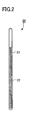
- FIG. 2 illustrates one example of a capillary containing an external reference material for 1 H-NMR according to a first embodiment of the present invention.
- an external reference material 22 dissolved in a deuterated solvent is put in a fusion-closed capillary 21.
- the external reference material 22 is an external reference material for 1 H-NMR according to a first embodiment of the present invention.
- a material for constituting the capillary 21 is not particularly limited as long as no adverse effect is caused at time of measuring of 1 H-NMR, and there is provided, for example, a glass, a polypropylene, a polyethylene, a polyethylene terephthalate, a polyether ether ketone, a polyvinyl chloride, a polytetrafluoroethylene, or the like.
- a length of the capillary 21 is usually 25 - 220 mm.
- a thickness of the capillary 21 is usually 0.1-0.4 mm.
- An inner diameter of the capillary 21 is usually 0.5 - 9.5 mm.
- An amount of the external reference material 22 put into the capillary 21 is not particularly limited as long as no adverse effect is caused at time of measuring of 1 H-NMR.
- the capillary 20 containing an external reference material by putting the external reference material 22 into a capillary closed at one end and subsequently fusion-closing the capillary.
- a spacer 23 is attached to the capillary 21 and arranged such that a capillary 20' containing an external reference material is coaxial with an NMR sample tube, as illustrated in FIG. 3 , its quantitative capability is improved.
- a thread 24 is attached to a top of the capillary 21, and accordingly, it may be possible to remove the capillary 20' containing an external reference material from an NMR sample tube easily. Additionally, the thread 24 may be attached to the spacer 23.
- a factor F for the capillary 20 containing an external reference material is obtained. Specifically, after the capillary 20 containing an external reference material and a predetermined amount of a reference material for factor with a known purity dissolved in a deuterated solvent are put into an NMR sample tube and an attachable and detachable plug is provided, 1 H-NMR is measured.
- F A 0 / B 0
- a reference material for factor is not particularly limited, and there is provided potassium hydrogen phthalate, ethanol, or the like.
- a peak of 1 H-NMR spectrum for the external reference material 22 may be present at a side of a magnetic field lower than 9.5 ppm, and accordingly, does not overlap with a peak of 1 H-NMR spectrum for a reference material for factor, whereby it is possible to ensure a quantitative capability of 1 H-NMR.
- a content of a compound X (molecular weight M) in a sample is obtained. Specifically, after the capillary 20 containing an external reference material and a predetermined amount of a sample dissolved in a deuterated solvent is put into an NMR sample tube and an attachable and detachable plug is provided, 1 H-NMR is measured. Additionally, when a sample is a liquid, it may be possible to use it directly without being dissolved in a deuterated solvent.
- a peak of 1 H-NMR spectrum for the external reference material 22 may be present at a side of a magnetic field lower than 9.5 ppm, and accordingly, does not overlap with a peak of NMR spectrum for a sample, whereby it may be possible to ensure a quantitative capability of 1 H-NMR.
- an amount of a component which is other than a compound X and is contained in a sample may also be obtained simultaneously.
- FIG. 5 illustrates one example of an NMR sample tube according to a second embodiment of the present invention.
- An NMR sample tube 10 has a coaxial cylindrical double tube structure, wherein an outer tube 11 and an inner tube 12 are fusion-closed therebetween and an external reference material 13 dissolved in a deuterated solvent is put in between the outer tube 11 and the inner tube 12.
- an external reference material 13 dissolved in a deuterated solvent is put in between the outer tube 11 and the inner tube 12.
- a deuterated solvent is not particularly limited as long as it is possible to dissolve the external reference material 13, and there is provided, for example, deuterated chloroform, deuterated acetonitrile, deuterated acetone, deuterated benzene, deuterated cyclohexane, heavy water, deuterated dichlorobenzene, deuterated diethyl ether, deuterated dimethylformamide, deuterated dimethyl sulfoxide, deuterated dioxane, deuterated ethyl acetate, deuterated ethanol, deuterated methanol, deuterated nitrobenzene, deuterated pyridine, deuterated tetrachloroethane, deuterated toluene, deuterated trifluoroacetic acid, or the like.
- a length of the NMR sample tube 10 is usually 140 - 220 mm.
- Materials for constituting the outer tube 11 and inner tube 12 are not particularly limited as long as no adverse effect is caused at time of measuring of NMR, and there is provided, for example, a glass, a polypropylene, a polyethylene, a polyethylene terephthalate, a polyether ether ketone, a polyvinyl chloride, a polytetrafluoroethylene, or the like.
- a thickness of the outer tube 11 is usually 0.1-0.4 mm.
- a thickness of the inner tuber 12 is usually 0.1 - 0.4 mm.
- An inner diameter of the inner tube 12 is usually 1 - 9.5 mm.
- a difference between an inner diameter of the outer tube 11 and an outer diameter of the inner tube 12 is usually 0.1 - 8.2 mm.
- the reference material 13 is not particularly limited and there is provided, for example, a reference material for 1 H-NMR and/or 13 C-NMR such as phenazine, triazine, maleic acid, sodium 3-trimethylsilylpropionate, tetramethylsilane, sodium dimethylsilapentanesulfonate, 5-fluorouracil, benzenetricarboxylic acid, hexamethyldisiloxane, benzoquinone, formic acid, acetic acid, sodium acetate, acetic anhydride, acrylic acid, dimethyl sulfone, acetone, acetylacetone, cyclohexanone, diethyl ether, 1,1-diethoxyethane, ethyl vinyl ether, furan, tetrahydrofuran, 1,4-dioxane, dihydropyran, methanol, ethanol, isobutyl alcohol, t-butyl alcohol, ethylene glycol, 2-
- a reference material for 1 H-NMR is preferably maleic acid, tetramethylsilane, 3-trimethylsilylpropionic acid, 1,4-dioxane, 1,4-bis(trimethylsilyl)benzene, benzenetricarboxylic acid, sodium dimethylsilapentanesulfonate, triazine, phenazine, phosphoric acid, trifluoroacetic acid, water, benzene, chloroform, methanol, or dimethyl sulfoxide.
- An amount of the reference material 13 put in between the outer tube 11 and the inner tube 12 is not particularly limited as long as no adverse effect is caused at time of measuring of NMR.
- the NMR sample tube 10 may be manufactured by putting the external reference material 13 into a tube closed at one end, subsequently arranging a tube closed at one end therein so as to be coaxial, and conducting fusion-closure between the former tube and the latter tube.
- a top of the inner tube 12 is fusion-closed so as to extend uniformly and contact the outer tube 11, a quantitative capability thereof may be improved.
- a factor F for the NMR sample tube 10 is obtained. Specifically, after a predetermined amount of a reference material for factor with a known purity dissolved in a deuterated solvent is put into the inner tube 12 and an attachable and detachable plug is provided, 1 H-NMR is measured.
- a concentration of a reference material for factor put in the inner tube 12 is A 0 [mol/L] and a surface area corresponding to 1 H of a reference material for factor is B 0 in a case where a surface area of the reference material 13 in a 1 H-NMR spectrum is 1,
- a reference material for factor is not particularly limited, and there is provided, for example, potassium hydrogen phthalate, ethanol, phosphoric acid, trifluoroacetic acid, sodium dimethylsilapentanesulfonate, sodium 3-trimethylsilylpropionate, water, or the like.
- a peak of 1 H-NMR spectrum for the reference material 13 used for obtaining F does not overlap with a peak of 1 H-NMR spectrum for a reference material for factor and a peak for a reference material for factor used for obtaining F does not overlap with a peak of 1 H-NMR spectrum for the reference material 13.
- a content of a compound X (molecular weight M) in a sample is obtained. Specifically, after a predetermined amount of a sample dissolved in a deuterated solvent is put into the inner tube 12 and an attachable and detachable plug is provided, 1 H-NMR is measured. Additionally, when a sample is a liquid, it may be possible to use it directly without being dissolved in a deuterated solvent.
- a peak of 1 H-NMR spectrum for the reference material 13 used for obtaining D 1 does not overlap with a peak of NMR spectrum for a sample and a peak of 1 H-NMR spectrum for compound X used for obtaining D 1 does not overlap with any of a peak of NMR spectrum for the reference material 13 and a component which is other than compound X and is contained in a sample.
- an amount of a component which is other than a compound X and is contained in a sample may also be obtained simultaneously.
- An embodiment of the present invention may relate to at least one of an external reference material for 1 H-NMR, an NMR sample tube having a double tube structure, a capillary containing an external reference material for 1 H-NMR, and an analysis method.
- An object of an embodiment of the present invention may be to provide at least one of an external reference material for 1 H-NMR capable of ensuring a quantitative capability of 1 H-NMR without being selected for each sample, an NMR sample tube and capillary in which the external reference material for 1 H-NMR is put, and an analysis method using the external reference material for 1 H-NMR.
- An object of an embodiment of the present invention may be to provide at least one of an NMR sample tube capable of measuring NMR by not replacing a reference material but replacing a sample and of conducting its quantification even when a volatile reference material is used, and an analysis method using the NMR sample tube.
- Embodiment (1-1) of the present invention is an external reference material for 1 H-NMR, characterized by including a nitrogen-containing compound or oxygen-containing compound and a shift reagent.
- Embodiment (1-2) of the present invention is the external reference material for 1 H-NMR according to embodiment (1-1) of the present invention, characterized by including triazine and europium (III).
- Embodiment (1-3) of the present invention is an external reference material for 1 H-NMR according to embodiment (1-2) of the present invention, characterized in that an equivalent ratio of the europium (III) to the triazine is greater than or equal to 0.02.
- Embodiment (1-4) of the present invention is the external reference material for 1 H-NMR according to embodiment (1-1) of the present invention, characterized by including trimethylsilylethanesulfonamide and praseodymium (III).
- Embodiment (1-5) of the present invention is the external reference material for 1 H-NMR according to embodiment (1-4) of the present invention, characterized in that an equivalent ratio of the praseodymium (III) to the trimethylsilylethanesulfonamide is greater than or equal to 0.1.
- Embodiment (1-6) of the present invention is an NMR sample tube having a double tube structure, characterized in that an outer tube and an inner tune are fusion-closed therebetween and the external reference material for 1 H-NMR according to any one of embodiments (1-1) to (1-5) of the present invention is put in between the outer tube and the inner tube.
- Embodiment (1-7) of the present invention is a capillary containing an external reference material for 1 H-NMR, characterized in that the external reference material for 1 H-NMR according to any one of embodiments (1-1) to (1-5) of the present invention is put in a fusion-closed capillary.
- Embodiment (1-8) of the present invention is an analysis method characterized by including a step of measuring 1 H-NMR for a sample by using the external reference material for 1 H-NMR according to any one of embodiments (1-1) to (1-5) of the present invention.
- Embodiment (1-9) of the present invention is an analysis method characterized by including a step of putting a sample into an inner tube of the NMR sample tube according to embodiment (1-6) of the present invention and a step of measuring 1 H-NMR for the sample by using the NMR sample tube in which the sample is put.
- Embodiment (1-10) of the present invention is an analysis method characterized by including a step of putting the capillary containing an external reference material for 1 H-NMR according to embodiment (1-7) of the present invention and a sample into an NMR sample tube and a step of measuring 1 H-NMR for the sample by using the capillary containing an external reference material for 1 H-NMR and the NMR sample tube in which a sample is put.
- Embodiment (1-11) of the present invention is an analysis method according to any one of embodiments (1-8) to (1-10) of the present invention, characterized by quantitatively analyzing the sample by measuring 1 H-NMR for the sample.
- Embodiment (2-1) of the present invention is an NMR sample tube having a double tube structure, characterized in that an outer tube and an inner tube are fusion-closed therebetween and a reference material is put in between the outer tube and the inner tube.
- Embodiment (2-2) of the present invention is the NMR sample tube according to embodiment (2-1) of the present invention, characterized in that the reference material is maleic acid, tetramethylsilane, 3-trimethylsilylpropionic acid, 1,4-dioxane, 1,4-bis(trimethylsilyl)benzene, benzenetricarboxylic acid, sodium dimethylsilapentanesulfonate, triazine, phenazine, phosphoric acid, trifluoroacetic acid, water, benzene, chloroform, methanol, or dimethyl sulfoxide.
- the reference material is maleic acid, tetramethylsilane, 3-trimethylsilylpropionic acid, 1,4-dioxane, 1,4-bis(trimethylsilyl)benzene, benzenetricarboxylic acid, sodium dimethylsilapentanesulfonate, triazine, phenazine, phosphoric acid,
- Embodiment (2-3) of the present invention is an analysis method characterized by including a step of putting a sample into an inner tube of the NMR sample tube according to embodiment (2-1) or (2-2) of the present invention and a step of measuring NMR for the sample by using the NMR sample tube in which the sample is put.
- Embodiment (2-4) of the present invention is the analysis method according to embodiment (2-3) of the present invention, characterized by quantitatively analyzing the sample by using the NMR.
- an external reference material for 1 H-NMR capable of ensuring a quantitative capability of 1 H-NMR without being selected for each sample
- an NMR sample tube and capillary in which the external reference material for 1 H-NMR is put and an analysis method using the external reference material for 1 H-NMR.
- an NMR sample tube capable of measuring NMR by not replacing a reference material but replacing a sample and of conducting its quantification even when a volatile reference material is used, and an analysis method using the NMR sample tube.
- a suitable amount of the reference material solution for factor was put into an inner tube 12 of an NMR sample tube 10 (see FIG. 1 ) in which an external reference material 13 dissolved in deuterated chloroform is put in between an outer tube 11 and the inner tube 12 and an attachable and detachable plug was applied thereto.
- the equivalent ratio of europium (III) to triazine was 0.05.
- 1 H-NMR was measured 6 times using ECA-400 (produced by JEOL Ltd.; 400 MHz) in the conditions of a pulse width of 5.35 microseconds, a repetition time of about 60 seconds, and a cumulated number of 16 times.
- B 0 (see Table 1) was obtained from an obtained 1 H-NMR spectrum.
- NMR sample tubes 1 - 3 were used.
- Table 1 B 0 NMR sample tube 1 NMR sample tube 2 NMR sample tube 3 1st time 0.34135 0.32537 0.34818 2nd time 0.34025 0.32867 0.34644 3rd time 0.34068 0.32786 0.34534 4th time 0.34188 0.33119 0.34466 5th time 0.34058 0.32806 0.34747 6th time 0.34301 0.32780 0.34621 Average 0.34129 0.32816 0.34638 Relative standard deviation [%] 0.30 0.57 0.38
- factors F for NMR sample tubes 1 - 3 were calculated by using formula (1), and as a result, were 0.14383 [mol/L], 0.14959 [mol/L], and 0.14172 [mol/L], respectively.
- sample solutions 1 - 3 (see Table 2) were obtained.
- Table 2 Sample solution 1 Sample solution 2 Sample solution 3 Amount of added food additive [mg] 39.5 40.6 41.2 A 1 [g/L] 19.75 20.30 20.60
- Suitable amounts of samples solutions 1 - 3 were put into inner tubes 12 of NMR sample tubes 1 - 3 whose factors had been evaluated, respectively, and attachable and detachable plugs were applied thereto. Then, 1 H-NMR was measured for each 3 times on the conditions identical to those of evaluation of the factors except that the cumulated number was changed to 64 times.
- B 1 (see Table 3) was obtained from a peak originating from a methyl group of methanol in an obtained 1 H-NMR spectrum (see FIG. 4 ).
- a suitable amount of the reference material solution for factor was put into an inner tube 12 of an NMR sample tube 10 (see FIG. 5 ) in which a reference material 13 (maleic acid) dissolved in heavy water was put in between an outer tube 11 and the inner tube 12 and an attachable and detachable plug was applied thereto. Then, 1 H-NMR was measured 3 times by using ECA-400 (produced by JEOL Ltd.; 400 MHz) on the conditions of a pulse width of 5.35 microseconds, a repetition time of about 60 seconds, and a cumulated number of 16 times. B 0 (see Table 5) was obtained from an obtained 1 H-NMR spectrum. Table 5 B 0 1st time 0.22725 2nd time 0.22638 3rd time 0.22460 Average 0.22608 Relative standard deviation [%] 0.60
- a suitable amount of a disinfectant liquid was put into the inner tube 12 of the NMR sample tube 10 whose factor has been evaluated, and an attachable and detachable plug was applied thereto. Then, 1 H-NMR was measured 3 times on the conditions identical to those of evaluation of the factor.
- B 1 (see Table 6) was obtained from a peak originating from a methyl group and a peak originating from a methylene group of ethanol in an obtained 1 H-NMR spectrum (see FIG. 6 ).
Landscapes
- Physics & Mathematics (AREA)
- Condensed Matter Physics & Semiconductors (AREA)
- General Physics & Mathematics (AREA)
- Spectroscopy & Molecular Physics (AREA)
- High Energy & Nuclear Physics (AREA)
- Other Investigation Or Analysis Of Materials By Electrical Means (AREA)
- Sampling And Sample Adjustment (AREA)
- Investigating Or Analyzing Non-Biological Materials By The Use Of Chemical Means (AREA)
Abstract
Description
- An aspect of the present invention relates to at least one of a reference material for NMR, a sample tube for NMR, a capillary for NMR, and a method for measuring NMR for a sample.
- While HPLC, GC, or the like has been known as a method for quantitatively analyzing a sample conventionally, NMR is also being used.
- For a method for quantifying a compound containing an oxygen-17 nucleus, Japanese Patent Application Publication No.
2004-286712 - However, there may be a problem that it is not possible to ensure a quantitative capability of NMR, unless a substance with a resonance frequency of oxygen-17 nucleus which is different from that of a sample is selected for a reference material for each sample.
- Furthermore, there may be a problem that whenever samples are replaced, reference materials have to be replaced accordingly, and additionally, it is not possible to conduct quantification by using a volatile reference material.
- Patent document 1: Japanese Patent Application Publication No.
2004-286712 - According to one aspect of the present invention, there is provided a reference material for NMR, including a nitrogen-containing compound or oxygen-containing compound and a reagent for shifting a chemical shift for the nitrogen-containing compound or oxygen-containing compound.
- According to another aspect of the present invention, there is provided a sample tube for NMR, being obtainable by providing a reference material for NMR to a first tube closed at one end, providing a second tube closed at one end into the first tube, and fusing the other end of the first tube and the other end of the second tube and sealing a gap between the other end of the first tube and the other end of the second tube.
- According to another aspect of the present invention, there is provided a sample tube for NMR, being obtainable by providing the reference material for NMR as described above to a first tube closed at one end, providing a second tube closed at one end into the first tube, and fusing the other end of the first tube and the other end of the second tube and sealing a gap between the other end of the first tube and the other end of the second tube.
- According to another aspect of the present invention, there is provided a capillary for NMR, being obtainable by providing the reference material for NMR as described above to a capillary closed at one end, and fusing the other end of the capillary and closing the other end of the capillary.
- According to another aspect of the present invention, there is provided a method for measuring NMR for a sample by using a reference material, wherein the reference material is the reference material for NMR as described above.
- According to another aspect of the present invention, there is provided a method for measuring NMR for a sample by using a sample tube for NMR, wherein the sample tube for NMR is the sample tube for NMR as described above.
- According to another aspect of the present invention, there is provided a method for measuring NMR for a sample by using a sample tube for NMR, wherein the sample tube for NMR includes the capillary for NMR as described above and the sample.
-
-
FIG. 1 is a diagram illustrating one example of an NMR sample tube according to a first embodiment of the present invention. -
FIG. 2 is a diagram illustrating one example of a capillary containing an external reference material for 1H-NMR according to a first embodiment of the present invention. -
FIG. 3 is a diagram illustrating an example of variation of the capillary containing an external reference material for 1H-NMR inFIG. 2 . -
FIG. 4 is a 1H-NMR spectrum for a sample solution obtained in practical example 1. -
FIG. 5 is a diagram illustrating one example of an NMR sample tube according to a second embodiment of the present invention. -
FIG. 6 is a 1H-NMR spectrum for a disinfectant liquid obtained in practical example 2. -
- 10
- NMR sample tube
- 11
- Outer tube
- 12
- Inner tube
- 13
- External reference material (
FIG. 1 ) /Reference material (FIG. 5 ) - 20, 20'
- Capillary containing an external reference material
- 21
- Capillary
- 22
- External reference material
- 23
- Spacer
- 24
- Thread
- Next, a first embodiment of the present invention will be described in conjunction with the drawings.
- An external reference material for 1H-NMR according to a first embodiment of the present invention includes a nitrogen-containing compound or oxygen-containing compound and a shift reagent.
- For a shift reagent, there is provided, for example, a lanthanide ion such as an europium ion, a praseodymium, a dysprosium ion, a ytterbium ion, a gadolinium ion, a holmium ion, or a lanthanum ion. An europium ion and a ytterbium ion allow a chemical shift of 1H-NMR for a compound to move to a side of a lower magnetic field and a praseodymium ion and a dysprosium ion allow a chemical shift of 1H-NMR for a compound to move to a side of a higher magnetic field.
- In general, a shift reagent forms a complex together with a nitrogen-containing compound or oxygen-containing compound such as a nitrile, an amine, an N-oxide, an alcohol, an ether, an aldehyde, a ketone, an ester, a carboxylic acid, or an epoxide, and allows a chemical shift for a nitrogen-containing compound or oxygen-containing compound to be changed.
- A nitrogen-containing compound or oxygen-containing compound is not particularly limited, and there is provided, for example, triazine, benzenetricarboxylic acid, phenazine, quinoline, trimethylamine, ethylenediamine, trimethylsilylethanesulfonamide, (trimethylsilyl)methyl alcohol, trimethylsilylmethylamine, acetone, acetylacetone, 1,3-diphenyl-1,3-propanedione, dipivaloylmethane, heptafluorodimethyloctanedione, decafluoroheptanedione, diacetyl, alanine, styreneoxide, ethylene glycol, or the like.
- In general, a chemical shift of 1H-NMR for a compound is often present at 0 - 9.5 ppm. On the other hand, when a shift reagent is used, it may be possible to move a chemical shift of 1H-NMR for a compound to a side of a lower magnetic field or a side of a higher magnetic field with respect to 0 - 9.5 ppm. Herein, it may be possible for an external reference material for 1H-NMR according to a first embodiment of the present invention to move a chemical shift of 1H-NMR to a side of a lower magnetic field or a side of a higher magnetic field with respect to 0 - 9.5 ppm. As a result, when 1H-NMR is measured on a condition that an external reference material for 1H-NMR according to a first embodiment of the present invention is not mixed with but is separated from a sample in an NMR sample tube, a shift reagent does not act on a sample, and hence, it may be possible to completely separate a peak originating from an external reference material for 1H-NMR according to a first embodiment of the present invention from a peak originating from a sample.
- In order to move a chemical shift of 1H-NMR for an external reference material for 1H-NMR according to a first embodiment of the present invention to a side of a magnetic field lower than 9.5 ppm, it is preferable to mix, for example, triazine and europium (III) thereto.
- A chemical shift of 1H-NMR for triazine in deuterated chloroform is present at 9.0 ppm, and hence, when 1H-NMR is measured by using triazine as an external reference material, a peak of 1H-NMR spectrum for triazine may overlap with a peak for a sample. On the other hand, when europium (III) is added to triazine, it may be possible to move a chemical shift of 1H-NMR for triazine to 9.5 - 12 ppm. Herein, a chemical shift of 1H-NMR for a compound is usually present at 0.5 - 9.5 ppm, and hence, it may be possible to ensure a quantitative capability of 1H-NMR without selecting an external reference material for 1H-NMR according to a first embodiment of the present invention for each sample.
- Herein, an equivalent ratio of europium (III) to triazine is preferably greater than or equal to 0.02, and more preferably, 0.02 - 0.1. If an equivalent ratio of europium (III) to triazine is less than 0.02, a chemical shift of 1H-NMR for triazine may not move to a side of a magnetic field lower than 9.5 ppm. Also, if an equivalent ratio of europium (III) to triazine is greater than 0.1, a line width of a signal may be broadened so that it may not be possible to obtain an accurate surface area of a peak originating from triazine.
- On the other hand, in order to move a chemical shift of 1H-NMR for an external reference material for 1H-NMR according to a first embodiment of the present invention to a side of a magnetic field higher than 0 ppm, it is preferable to mix, for example, trimethylsilylethanesulfonamide and praseodymium (III) thereto.
- A chemical shift of 1H-NMR for trimethylsilylethanesulfonamide in deuterated chloroform is present at 0.06 ppm, and hence, when 1H-NMR is measured by using trimethylsilylethanesulfonamide as an external reference material, a peak of 1H-NMR spectrum for trimethylsilylethanesulfonamide may overlap with a peak for a sample. When praseodymium (III) is added thereto, it may be possible to move a chemical shift of 1H-NMR for trimethylsilylethanesulfonamide to -2 - 0 ppm. Herein, a chemical shift of 1H-NMR for a compound is usually present at 0 - 9.5 ppm, and hence, it may be possible to ensure a quantitative capability of 1H-NMR without selecting an external reference material for 1H-NMR according to a first embodiment of the present invention for each sample.
- Herein, an equivalent ratio of praseodymium (III) to trimethylsilylethanesulfonamide is preferably greater than or equal to 0.1. If an equivalent ratio of praseodymium (III) to trimethylsilylethanesulfonamide is less than 0.1, a chemical shift of 1H-NMR for trimethylsilylethanesulfonamide may not move to a side of a magnetic field higher than 0 ppm.
- Europium (III) and praseodymium (III) are not particularly limited, and there are provided, for example, trifluoromethyl-hydroxymethylene-d-camphorato complexes, heptafluoropropyl-hydroxymethylene-d-camphorato complexes, D,D-dicamphoryl methanate complexes, heptafluorodimethyloctanedionate complexes, dipivaloylmethane complexes, tetramethylheptanedione complexes, or decafluoroheptanedione complexes of europium (III) and praseodymium (III), or the like.
-
FIG. 1 illustrates one example of an NMR sample tube according to a first embodiment of the present invention. AnNMR sample tube 10 has a coaxial cylindrical double tube structure, wherein anouter tube 11 and aninner tube 12 are fusion-closed therebetween and anexternal reference material 13 dissolved in a deuterated solvent is put in between theouter tube 11 and theinner tube 12. Herein, theexternal reference material 13 is an external reference material for 1H-MMR according to a first embodiment of the present invention. - A deuterated solvent is not particularly limited as long as it is possible to dissolve the
external reference material 13, and there is provided, for example, deuterated chloroform, deuterated acetonitrile, deuterated acetone, deuterated benzene, deuterated cyclohexane, heavy water, deuterated dichlorobenzene, deuterated diethyl ether, deuterated dimethylformamide, deuterated dimethyl sulfoxide, deuterated dioxane, deuterated ethyl acetate, deuterated ethanol, deuterated methanol, deuterated nitrobenzene, deuterated pyridine, deuterated tetrachloroethane, deuterated toluene, deuterated trifluoroacetic acid, or the like. - A length of the
NMR sample tube 10 is usually 140 - 220 mm. - Materials for constituting the
outer tube 11 andinner tube 12 are not particularly limited as long as no adverse effect is caused at time of measuring of 1H-NMR, and there is provided, for example, a glass, a polypropylene, a polyethylene, a polyethylene terephthalate, a polyether ether ketone, a polyvinyl chloride, a polytetrafluoroethylene, or the like. - A thickness of the
outer tube 11 is usually 0.1 - 0.4 mm. - A thickness of the
inner tuber 12 is usually 0.1 - 0.4 mm. - An inner diameter of the
inner tube 12 is usually 1 - 9.5 mm. - A difference between an inner diameter of the
outer tube 11 and an outer diameter of theinner tube 12 is usually 0.1 - 8.2 mm. - An amount of the
external reference material 13 put in between theouter tube 11 and theinner tube 12 is not particularly limited as long as no adverse effect is caused at time of measuring of 1H-NMR. - Additionally, it may be possible to manufacture the
NMR sample tube 10 by putting theexternal reference material 13 into a tube closed at one end, subsequently arranging a tube closed at one end therein so as to be coaxial, and conducting fusion-closure between the former tube and the latter tube. Herein, when a top of theinner tube 12 is fusion-closed so as to extend uniformly and contact theouter tube 11, a quantitative capability thereof may be improved. - Next, a method for quantitatively analyzing a sample by measuring 1H-NMR will be described.
- First, a factor for the
NMR sample tube 10 is obtained. Specifically, after a predetermined amount of a reference material for factor with a known purity dissolved in a deuterated solvent is put into theinner tube 12 and an attachable and detachable plug is provided, 1H-NMR is measured. Herein, when a concentration of a reference material for factor put in theinner tube 12 is A0 [mol/L] and a surface area corresponding to 1 H of a reference material for factor is B0 in a case where a surface area of theexternal reference material 13 in a 1H-NMR spectrum is 1, F [mol/L] is represented by a formula of:
- A reference material for factor is not particularly limited, and there is provided, for example, potassium hydrogen phthalate, ethanol, or the like.
- Herein, a peak of 1H-NMR spectrum for the
external reference material 13 may be present at a side of a magnetic field lower than 9.5 ppm, and accordingly, does not overlap with a peak of 1H-NMR spectrum for a reference material for factor, whereby it is possible to ensure a quantitative capability of 1H-NMR. - Then, a content of a compound X (molecular weight M) in a sample is obtained. Specifically, after a predetermined amount of a sample dissolved in a deuterated solvent is put into the
inner tube 12 and an attachable and detachable plug is provided, 1H-NMR is measured. Additionally, when a sample is a liquid, it may be possible to use it directly without being dissolved in a deuterated solvent. Herein, when a concentration of a sample put in theinner tube 12 is A1 [g/L] and a surface area corresponding to 1 H of a compound X is B1 in a case where a surface area of theexternal reference material 13 in a 1H-NMR spectrum is 1, a concentration C1 [g/L] of a compound X put in theinner tube 12 is represented by a formula of:
- Therefore, a content D1 [mass %] of a compound X in a sample is represented by:

- Herein, a peak of 1H-NMR spectrum for the
external reference material 13 may be present at a side of a magnetic field lower than 9.5 ppm, and accordingly, does not overlap with a peak of NMR spectrum for a sample, whereby it may be possible to ensure a quantitative capability of 1H-NMR. - Additionally, an amount of a component which is other than a compound X and is contained in a sample may also be obtained simultaneously.
- Furthermore, when 1H-NMR for a sample is measured by using the
external reference material 13, theNMR sample tube 10 may be used (see, for example, Japanese Patent Application Publication No.H01-302148 outer tube 11 and theinner tube 12 are not fusion-closed therebetween and it is possible to fix theinner tube 12 in theouter tube 11. Herein, theexternal reference material 13 may be put into either of theouter tube 11 and theinner tube 12 or theinner tube 12 may be fusion-closed. -
FIG. 2 illustrates one example of a capillary containing an external reference material for 1H-NMR according to a first embodiment of the present invention. For a capillary 20 containing an external reference material, anexternal reference material 22 dissolved in a deuterated solvent is put in a fusion-closedcapillary 21. Additionally, theexternal reference material 22 is an external reference material for 1H-NMR according to a first embodiment of the present invention. - A material for constituting the capillary 21 is not particularly limited as long as no adverse effect is caused at time of measuring of 1H-NMR, and there is provided, for example, a glass, a polypropylene, a polyethylene, a polyethylene terephthalate, a polyether ether ketone, a polyvinyl chloride, a polytetrafluoroethylene, or the like.
- A length of the capillary 21 is usually 25 - 220 mm.
- A thickness of the capillary 21 is usually 0.1-0.4 mm.
- An inner diameter of the capillary 21 is usually 0.5 - 9.5 mm.
- An amount of the
external reference material 22 put into the capillary 21 is not particularly limited as long as no adverse effect is caused at time of measuring of 1H-NMR. - Additionally, it is possible to manufacture the capillary 20 containing an external reference material by putting the
external reference material 22 into a capillary closed at one end and subsequently fusion-closing the capillary. - Furthermore, when a
spacer 23 is attached to the capillary 21 and arranged such that a capillary 20' containing an external reference material is coaxial with an NMR sample tube, as illustrated inFIG. 3 , its quantitative capability is improved. Herein, athread 24 is attached to a top of the capillary 21, and accordingly, it may be possible to remove the capillary 20' containing an external reference material from an NMR sample tube easily. Additionally, thethread 24 may be attached to thespacer 23. - Next, a method for quantitatively analyzing a sample by measuring 1H-NMR will be described.
- First, a factor F for the capillary 20 containing an external reference material is obtained. Specifically, after the capillary 20 containing an external reference material and a predetermined amount of a reference material for factor with a known purity dissolved in a deuterated solvent are put into an NMR sample tube and an attachable and detachable plug is provided, 1H-NMR is measured. Herein, when a concentration of a reference material for factor put in an NMR sample tube is A0 [mol/L] and a surface area corresponding to 1 H of a reference material for factor is B0 in a case where a surface area of the
external reference material 22 in a 1H-NMR spectrum is 1, F [mol/L] is represented by a formula of:
- A reference material for factor is not particularly limited, and there is provided potassium hydrogen phthalate, ethanol, or the like.
- Herein, a peak of 1H-NMR spectrum for the
external reference material 22 may be present at a side of a magnetic field lower than 9.5 ppm, and accordingly, does not overlap with a peak of 1H-NMR spectrum for a reference material for factor, whereby it is possible to ensure a quantitative capability of 1H-NMR. - Then, a content of a compound X (molecular weight M) in a sample is obtained. Specifically, after the capillary 20 containing an external reference material and a predetermined amount of a sample dissolved in a deuterated solvent is put into an NMR sample tube and an attachable and detachable plug is provided, 1H-NMR is measured. Additionally, when a sample is a liquid, it may be possible to use it directly without being dissolved in a deuterated solvent. Herein, when a concentration of a sample put in an NMR sample tube is A1 [g/L] and a surface area corresponding to 1 H of a compound X is B1 in a case where a surface area of the
external reference material 22 in a 1H-NMR spectrum is 1, a concentration C1 [g/L] of a compound X put in an NMR sample tube is represented by a formula of:
- Therefore, a content D1 [mass %] of a compound X in a sample is represented by:

- Herein, a peak of 1H-NMR spectrum for the
external reference material 22 may be present at a side of a magnetic field lower than 9.5 ppm, and accordingly, does not overlap with a peak of NMR spectrum for a sample, whereby it may be possible to ensure a quantitative capability of 1H-NMR. - Additionally, an amount of a component which is other than a compound X and is contained in a sample may also be obtained simultaneously.
- Next, a second embodiment of the present invention will be described in conjunction with the drawings.
-
FIG. 5 illustrates one example of an NMR sample tube according to a second embodiment of the present invention. AnNMR sample tube 10 has a coaxial cylindrical double tube structure, wherein anouter tube 11 and aninner tube 12 are fusion-closed therebetween and anexternal reference material 13 dissolved in a deuterated solvent is put in between theouter tube 11 and theinner tube 12. Thereby, when theNMR sample tube 10 is used, it may be possible to measure NMR not by replacing theexternal reference material 13 but instead by replacing a sample, and conduct its quantification even when a volatile reference material is used. - A deuterated solvent is not particularly limited as long as it is possible to dissolve the
external reference material 13, and there is provided, for example, deuterated chloroform, deuterated acetonitrile, deuterated acetone, deuterated benzene, deuterated cyclohexane, heavy water, deuterated dichlorobenzene, deuterated diethyl ether, deuterated dimethylformamide, deuterated dimethyl sulfoxide, deuterated dioxane, deuterated ethyl acetate, deuterated ethanol, deuterated methanol, deuterated nitrobenzene, deuterated pyridine, deuterated tetrachloroethane, deuterated toluene, deuterated trifluoroacetic acid, or the like. - A length of the
NMR sample tube 10 is usually 140 - 220 mm. - Materials for constituting the
outer tube 11 andinner tube 12 are not particularly limited as long as no adverse effect is caused at time of measuring of NMR, and there is provided, for example, a glass, a polypropylene, a polyethylene, a polyethylene terephthalate, a polyether ether ketone, a polyvinyl chloride, a polytetrafluoroethylene, or the like. - A thickness of the
outer tube 11 is usually 0.1-0.4 mm. - A thickness of the
inner tuber 12 is usually 0.1 - 0.4 mm. - An inner diameter of the
inner tube 12 is usually 1 - 9.5 mm. - A difference between an inner diameter of the
outer tube 11 and an outer diameter of theinner tube 12 is usually 0.1 - 8.2 mm. - The reference material 13 is not particularly limited and there is provided, for example, a reference material for 1H-NMR and/or 13C-NMR such as phenazine, triazine, maleic acid, sodium 3-trimethylsilylpropionate, tetramethylsilane, sodium dimethylsilapentanesulfonate, 5-fluorouracil, benzenetricarboxylic acid, hexamethyldisiloxane, benzoquinone, formic acid, acetic acid, sodium acetate, acetic anhydride, acrylic acid, dimethyl sulfone, acetone, acetylacetone, cyclohexanone, diethyl ether, 1,1-diethoxyethane, ethyl vinyl ether, furan, tetrahydrofuran, 1,4-dioxane, dihydropyran, methanol, ethanol, isobutyl alcohol, t-butyl alcohol, ethylene glycol, 2-chloroethanol, ethyl acetate, vinyl acetate, methyl acrylate, methyl orthoformate, acetamide, dimethylformamide, trimethoxybenzene, trioxane, 1,4-bis(trimethylsilyl)benzene, 1,4-dinitrobenzene, anthracene, benzyl benzoate, biphenyl, dimethyl isophthalate, dimethylformamide, hexamethylcyclotrisiloxane, methenamine, phloroglucinol, t-butanol, tetramethylpyrazine, ethacrynic acid, dimethylfuran, chloroform, benzene, dimethyl sulfoxide, water, or acetaldehyde; a reference material for 19F-NMR such as trifluoroethanol, trifluoroacetic acid, fluorobenzene, or hexafluoroisopropanol, a reference material for 29Si-NMR such as tetramethylsilane, sodium dimethylsilapentanesulfonate, sodium 3-trimethylsilylpropionate, 1,4-bis(trimethylsilyl)benzene, trimethylsilylethanesulfonamide, trimethylsilylmethanol, or trimethylsilylamine; a reference material for 17O-NMR such as water; a reference material for 31P-NMR such as phosphoric acid, or the like. Among these, in view of a quantitative capability, a reference material for 1H-NMR is preferably maleic acid, tetramethylsilane, 3-trimethylsilylpropionic acid, 1,4-dioxane, 1,4-bis(trimethylsilyl)benzene, benzenetricarboxylic acid, sodium dimethylsilapentanesulfonate, triazine, phenazine, phosphoric acid, trifluoroacetic acid, water, benzene, chloroform, methanol, or dimethyl sulfoxide.
- An amount of the
reference material 13 put in between theouter tube 11 and theinner tube 12 is not particularly limited as long as no adverse effect is caused at time of measuring of NMR. - Additionally, it may be possible to manufacture the
NMR sample tube 10 by putting theexternal reference material 13 into a tube closed at one end, subsequently arranging a tube closed at one end therein so as to be coaxial, and conducting fusion-closure between the former tube and the latter tube. Herein, when a top of theinner tube 12 is fusion-closed so as to extend uniformly and contact theouter tube 11, a quantitative capability thereof may be improved. - Next, a method for quantitatively analyzing a sample by measuring 1H-NMR will be described.
- First, a factor F for the
NMR sample tube 10 is obtained. Specifically, after a predetermined amount of a reference material for factor with a known purity dissolved in a deuterated solvent is put into theinner tube 12 and an attachable and detachable plug is provided, 1H-NMR is measured. Herein, when a concentration of a reference material for factor put in theinner tube 12 is A0 [mol/L] and a surface area corresponding to 1 H of a reference material for factor is B0 in a case where a surface area of thereference material 13 in a 1H-NMR spectrum is 1, F [mol/L] is represented by a formula of:
- A reference material for factor is not particularly limited, and there is provided, for example, potassium hydrogen phthalate, ethanol, phosphoric acid, trifluoroacetic acid, sodium dimethylsilapentanesulfonate, sodium 3-trimethylsilylpropionate, water, or the like.
- Additionally, in view of a quantitative capability of 1H-NMR, it is preferable that a peak of 1H-NMR spectrum for the
reference material 13 used for obtaining F does not overlap with a peak of 1H-NMR spectrum for a reference material for factor and a peak for a reference material for factor used for obtaining F does not overlap with a peak of 1H-NMR spectrum for thereference material 13. - Then, a content of a compound X (molecular weight M) in a sample is obtained. Specifically, after a predetermined amount of a sample dissolved in a deuterated solvent is put into the
inner tube 12 and an attachable and detachable plug is provided, 1H-NMR is measured. Additionally, when a sample is a liquid, it may be possible to use it directly without being dissolved in a deuterated solvent. Herein, when a concentration of a sample put in theinner tube 12 is A1 [g/L] and a surface area corresponding to 1 H of a compound A is B1 in a case where a surface area of thereference material 13 in a 1H-NMR spectrum is 1, a concentration C1 [g/L] of a compound X put in theinner tube 12 is represented by a formula of:
- Therefore, a content D1 [mass %] of a compound X in a sample is represented by:

- Additionally, in view of a quantitative capability of 1H-MMR, it is preferable that a peak of 1H-NMR spectrum for the
reference material 13 used for obtaining D1 does not overlap with a peak of NMR spectrum for a sample and a peak of 1H-NMR spectrum for compound X used for obtaining D1 does not overlap with any of a peak of NMR spectrum for thereference material 13 and a component which is other than compound X and is contained in a sample. - Additionally, an amount of a component which is other than a compound X and is contained in a sample may also be obtained simultaneously.
- (An example(s) of embodiments of an external reference material for 1H-NMR and an NMR sample tube and an analysis method)
- An embodiment of the present invention may relate to at least one of an external reference material for 1H-NMR, an NMR sample tube having a double tube structure, a capillary containing an external reference material for 1H-NMR, and an analysis method.
- An object of an embodiment of the present invention may be to provide at least one of an external reference material for 1H-NMR capable of ensuring a quantitative capability of 1H-NMR without being selected for each sample, an NMR sample tube and capillary in which the external reference material for 1H-NMR is put, and an analysis method using the external reference material for 1H-NMR.
- An object of an embodiment of the present invention may be to provide at least one of an NMR sample tube capable of measuring NMR by not replacing a reference material but replacing a sample and of conducting its quantification even when a volatile reference material is used, and an analysis method using the NMR sample tube.
- Embodiment (1-1) of the present invention is an external reference material for 1H-NMR, characterized by including a nitrogen-containing compound or oxygen-containing compound and a shift reagent.
- Embodiment (1-2) of the present invention is the external reference material for 1H-NMR according to embodiment (1-1) of the present invention, characterized by including triazine and europium (III).
- Embodiment (1-3) of the present invention is an external reference material for 1H-NMR according to embodiment (1-2) of the present invention, characterized in that an equivalent ratio of the europium (III) to the triazine is greater than or equal to 0.02.
- Embodiment (1-4) of the present invention is the external reference material for 1H-NMR according to embodiment (1-1) of the present invention, characterized by including trimethylsilylethanesulfonamide and praseodymium (III).
- Embodiment (1-5) of the present invention is the external reference material for 1H-NMR according to embodiment (1-4) of the present invention, characterized in that an equivalent ratio of the praseodymium (III) to the trimethylsilylethanesulfonamide is greater than or equal to 0.1.
- Embodiment (1-6) of the present invention is an NMR sample tube having a double tube structure, characterized in that an outer tube and an inner tune are fusion-closed therebetween and the external reference material for 1H-NMR according to any one of embodiments (1-1) to (1-5) of the present invention is put in between the outer tube and the inner tube.
- Embodiment (1-7) of the present invention is a capillary containing an external reference material for 1H-NMR, characterized in that the external reference material for 1H-NMR according to any one of embodiments (1-1) to (1-5) of the present invention is put in a fusion-closed capillary.
- Embodiment (1-8) of the present invention is an analysis method characterized by including a step of measuring 1H-NMR for a sample by using the external reference material for 1H-NMR according to any one of embodiments (1-1) to (1-5) of the present invention.
- Embodiment (1-9) of the present invention is an analysis method characterized by including a step of putting a sample into an inner tube of the NMR sample tube according to embodiment (1-6) of the present invention and a step of measuring 1H-NMR for the sample by using the NMR sample tube in which the sample is put.
- Embodiment (1-10) of the present invention is an analysis method characterized by including a step of putting the capillary containing an external reference material for 1H-NMR according to embodiment (1-7) of the present invention and a sample into an NMR sample tube and a step of measuring 1H-NMR for the sample by using the capillary containing an external reference material for 1H-NMR and the NMR sample tube in which a sample is put.
- Embodiment (1-11) of the present invention is an analysis method according to any one of embodiments (1-8) to (1-10) of the present invention, characterized by quantitatively analyzing the sample by measuring 1H-NMR for the sample.
- Embodiment (2-1) of the present invention is an NMR sample tube having a double tube structure, characterized in that an outer tube and an inner tube are fusion-closed therebetween and a reference material is put in between the outer tube and the inner tube.
- Embodiment (2-2) of the present invention is the NMR sample tube according to embodiment (2-1) of the present invention, characterized in that the reference material is maleic acid, tetramethylsilane, 3-trimethylsilylpropionic acid, 1,4-dioxane, 1,4-bis(trimethylsilyl)benzene, benzenetricarboxylic acid, sodium dimethylsilapentanesulfonate, triazine, phenazine, phosphoric acid, trifluoroacetic acid, water, benzene, chloroform, methanol, or dimethyl sulfoxide.
- Embodiment (2-3) of the present invention is an analysis method characterized by including a step of putting a sample into an inner tube of the NMR sample tube according to embodiment (2-1) or (2-2) of the present invention and a step of measuring NMR for the sample by using the NMR sample tube in which the sample is put.
- Embodiment (2-4) of the present invention is the analysis method according to embodiment (2-3) of the present invention, characterized by quantitatively analyzing the sample by using the NMR.
- According to an embodiment of the present invention, it may be possible to provide at least one of an external reference material for 1H-NMR capable of ensuring a quantitative capability of 1H-NMR without being selected for each sample, an NMR sample tube and capillary in which the external reference material for 1H-NMR is put, and an analysis method using the external reference material for 1H-NMR.
- According to an embodiment of the present invention, it may be possible to provide at least one of an NMR sample tube capable of measuring NMR by not replacing a reference material but replacing a sample and of conducting its quantification even when a volatile reference material is used, and an analysis method using the NMR sample tube.
- 200.5 mg of potassium hydrogen phthalate (molecular weight 204.2212) was weighed precisely and dissolved in heavy water so as to be 20 mL accurately, whereby 0.049089 mol/L of a reference material solution for factor was obtained.
- A suitable amount of the reference material solution for factor was put into an
inner tube 12 of an NMR sample tube 10 (seeFIG. 1 ) in which anexternal reference material 13 dissolved in deuterated chloroform is put in between anouter tube 11 and theinner tube 12 and an attachable and detachable plug was applied thereto. Herein, the equivalent ratio of europium (III) to triazine was 0.05. Then, 1H-NMR was measured 6 times using ECA-400 (produced by JEOL Ltd.; 400 MHz) in the conditions of a pulse width of 5.35 microseconds, a repetition time of about 60 seconds, and a cumulated number of 16 times. B0 (see Table 1) was obtained from an obtained 1H-NMR spectrum. Herein, 3 NMR sample tubes 1 - 3 were used.Table 1 B0 NMR sample tube 1NMR sample tube 2 NMR sample tube 3 1st time 0.34135 0.32537 0.34818 2nd time 0.34025 0.32867 0.34644 3rd time 0.34068 0.32786 0.34534 4th time 0.34188 0.33119 0.34466 5th time 0.34058 0.32806 0.34747 6th time 0.34301 0.32780 0.34621 Average 0.34129 0.32816 0.34638 Relative standard deviation [%] 0.30 0.57 0.38 - Then, factors F for NMR sample tubes 1 - 3 were calculated by using formula (1), and as a result, were 0.14383 [mol/L], 0.14959 [mol/L], and 0.14172 [mol/L], respectively.
- A food additive was weighed precisely and dissolved in deuterated chloroform so as to be accurately 2 mL, whereby sample solutions 1 - 3 (see Table 2) were obtained.
Table 2 Sample solution 1Sample solution 2 Sample solution 3 Amount of added food additive [mg] 39.5 40.6 41.2 A1 [g/L] 19.75 20.30 20.60 - Suitable amounts of samples solutions 1 - 3 were put into
inner tubes 12 of NMR sample tubes 1 - 3 whose factors had been evaluated, respectively, and attachable and detachable plugs were applied thereto. Then, 1H-NMR was measured for each 3 times on the conditions identical to those of evaluation of the factors except that the cumulated number was changed to 64 times. B1 (see Table 3) was obtained from a peak originating from a methyl group of methanol in an obtained 1H-NMR spectrum (seeFIG. 4 ).Table 3 B1 Sample solution 1 Sample solution 2 Sample solution 3 1st time 0.00329 0.00286 0.00315 2nd time 0.00323 0.00258 0.00285 3rd time 0.00310 0.00279 0.00297 Average 0.00321 0.00274 0.00299 Relative standard deviation [%] 3.03 5.31 5.05 - Then, an amount D1 (see Table 4) of methanol (molecular weight 32.04) remaining in the food additive was calculated by using formulas (2) and (3).
Table 4 D1 [mass%] Sample solution 1Sample solution 2 Sample solution 3 1st time 0.0768 0.0675 0.0694 2nd time 0.0754 0..0609 0.0628 3rd time 0.0723 0.0659 0.0655 Average 0.0748 0.0648 0.0659 Relative standard deviation [%] 3.08 5.31 5.04 Gross average 0.0685 Relative standard deviation [%] 7.98 - Herein, an amount of methanol remaining in the food additive was measured by means of gas chromatography, and as a result, was 0.0697 mass%. From this fact, it is found that the quantitative capability of 1H-NMR was ensured in the present practical example.
- 200.2 mg of potassium hydrogen phthalate (molecular weight 204.2212) was weighed precisely and dissolved in heavy water so as to be 20 mL accurately, whereby 0.049015 mol/L of a reference material solution for factor was obtained.
- A suitable amount of the reference material solution for factor was put into an
inner tube 12 of an NMR sample tube 10 (seeFIG. 5 ) in which a reference material 13 (maleic acid) dissolved in heavy water was put in between anouter tube 11 and theinner tube 12 and an attachable and detachable plug was applied thereto. Then, 1H-NMR was measured 3 times by using ECA-400 (produced by JEOL Ltd.; 400 MHz) on the conditions of a pulse width of 5.35 microseconds, a repetition time of about 60 seconds, and a cumulated number of 16 times. B0 (see Table 5) was obtained from an obtained 1H-NMR spectrum.Table 5 B0 1st time 0.22725 2nd time 0.22638 3rd time 0.22460 Average 0.22608 Relative standard deviation [%] 0.60 - Then, a factor F was calculated by using formula (1), and as a result, was 0.21681 [mol/L].
- A suitable amount of a disinfectant liquid was put into the
inner tube 12 of theNMR sample tube 10 whose factor has been evaluated, and an attachable and detachable plug was applied thereto. Then, 1H-NMR was measured 3 times on the conditions identical to those of evaluation of the factor. B1 (see Table 6) was obtained from a peak originating from a methyl group and a peak originating from a methylene group of ethanol in an obtained 1H-NMR spectrum (seeFIG. 6 ).Table 6 B1 Methyl group Methylene group 1st time 24.53601 24.62549 2nd time 23.82240 23.83774 3rd time 24.64078 24.64894 Average 24.33306 24.37072 Relative standard deviation [%] 1.83 1.89 Gross average 24.35189 Relative standard deviation [%] 1.67 - Then, a concentration C1 of ethanol (molecular weight 46.07) put in the
inner tube 12 was calculated by using formula (2), and as a result, was 243.23 [g/L]. - Although some embodiment(s) and practical example(s) of the present invention have been described with preference to the accompanying drawing(s), the present invention is not limited to any of such embodiment(s) and practical example(s), and such embodiment(s) and practical example(s) may be altered, modified, or combined without departing from the scope of the present invention.
- The present application claims its priority based on Japanese patent application No.
2010-001200 filed on January 6, 2010 2010-001201 filed on January 6, 2010
Claims (3)
- A sample tube for NMR measurement, obtainable by providing a reference material for NMR measurement to a first tube closed at one end, providing a second tube closed at one end into the first tube, and fusing the other end of the first tube and the other end of the second tube to seal a gap between the other end of the first tube and the other end of the second tube.
- The sample tube for NMR measurement as claimed in claim 1, wherein the reference material is selected from the group consisting of maleic acid, tetramethylsilane, 3-trimethylsilylpropionic acid, 1,4-dioxane, 1,4-bis(trimethylsilyl)benzene, benzenetricarboxylic acid, sodium dimethylsilapentaneslfonate, triazine, phenazine, phosphoric acid, trifluoroacetic acid, water, benzene, chloroform, methanol, and dimethyl sulfoxide.
- A method for measuring NMR for a sample by using a sample tube for NMR measurement, wherein the sample tube for NMR measurement is the sample tube for NMR measurement as claimed in claim 1.
Applications Claiming Priority (3)
| Application Number | Priority Date | Filing Date | Title |
|---|---|---|---|
| JP2010001201A JP5027891B2 (en) | 2010-01-06 | 2010-01-06 | Analysis method |
| JP2010001200A JP4923112B2 (en) | 2010-01-06 | 2010-01-06 | External standard for 1H NMR |
| EP10842241.1A EP2523010A4 (en) | 2010-01-06 | 2010-12-28 | Reference material for nmr, sample tube for nmr, capillary for nmr, and method for determining nmr spectrum of sample |
Related Parent Applications (1)
| Application Number | Title | Priority Date | Filing Date |
|---|---|---|---|
| EP10842241.1A Division EP2523010A4 (en) | 2010-01-06 | 2010-12-28 | Reference material for nmr, sample tube for nmr, capillary for nmr, and method for determining nmr spectrum of sample |
Publications (2)
| Publication Number | Publication Date |
|---|---|
| EP2752677A1 true EP2752677A1 (en) | 2014-07-09 |
| EP2752677B1 EP2752677B1 (en) | 2015-07-22 |
Family
ID=44305466
Family Applications (2)
| Application Number | Title | Priority Date | Filing Date |
|---|---|---|---|
| EP10842241.1A Withdrawn EP2523010A4 (en) | 2010-01-06 | 2010-12-28 | Reference material for nmr, sample tube for nmr, capillary for nmr, and method for determining nmr spectrum of sample |
| EP14162840.4A Not-in-force EP2752677B1 (en) | 2010-01-06 | 2010-12-28 | Sample tube for NMR measurements |
Family Applications Before (1)
| Application Number | Title | Priority Date | Filing Date |
|---|---|---|---|
| EP10842241.1A Withdrawn EP2523010A4 (en) | 2010-01-06 | 2010-12-28 | Reference material for nmr, sample tube for nmr, capillary for nmr, and method for determining nmr spectrum of sample |
Country Status (6)
| Country | Link |
|---|---|
| US (1) | US9335388B2 (en) |
| EP (2) | EP2523010A4 (en) |
| KR (1) | KR20120116953A (en) |
| CN (1) | CN102741700A (en) |
| TW (1) | TW201132969A (en) |
| WO (1) | WO2011083730A1 (en) |
Families Citing this family (4)
| Publication number | Priority date | Publication date | Assignee | Title |
|---|---|---|---|---|
| JP6019515B2 (en) * | 2012-05-15 | 2016-11-02 | 日本電子株式会社 | NMR sample tube and NMR apparatus |
| CN108593696B (en) * | 2018-04-26 | 2020-11-03 | 南京明捷生物医药检测有限公司 | Method for determining trifluoroacetic acid residue in polypeptide by using quantitative nuclear magnetism |
| KR102205537B1 (en) | 2019-07-24 | 2021-01-21 | 주식회사 케미다스 | Reference material for testing cytotoxicity of biomedical polymer and method for preparing the same |
| KR20240108296A (en) | 2022-12-30 | 2024-07-09 | 한국표준과학연구원 | NMR measurement system and method using microfluidic channel |
Citations (3)
| Publication number | Priority date | Publication date | Assignee | Title |
|---|---|---|---|---|
| US4550082A (en) * | 1981-12-04 | 1985-10-29 | Centre National De La Recherche Scientifique | Process for the detection and the qualitative and quantitative differentiation of naturally deuterated molecules and application thereof more especially to the detection of chaptalization of wines |
| JPH01302148A (en) | 1988-05-31 | 1989-12-06 | Ube Ind Ltd | Assay of oxide compound contained in organic metal compound |
| JP2004286712A (en) | 2003-03-25 | 2004-10-14 | Nihon Medi Physics Co Ltd | Method for quantifying oxygen-17 nuclear labeled compound |
Family Cites Families (8)
| Publication number | Priority date | Publication date | Assignee | Title |
|---|---|---|---|---|
| US3950135A (en) | 1974-07-24 | 1976-04-13 | Massachusetts Institute Of Technology | Method of sepctral analysis using nmr shift reagents |
| JPS60171019A (en) | 1984-02-15 | 1985-09-04 | 象印マホービン株式会社 | Production of stainless steel thermos |
| JPS63100031A (en) | 1986-10-14 | 1988-05-02 | Uemura Mahobin Kogyo Kk | Vacuum double bottle and its production |
| US5122472A (en) * | 1989-10-06 | 1992-06-16 | University Of South Carolina | Chalcogen-based chiral reagents and method for nuclear magnetic resonance detection of stereochemical assignments and enantiomeric ratios |
| DE19942278C2 (en) * | 1999-09-04 | 2001-09-13 | Messer Griesheim Gmbh | Quantitative determination of the xenon content in liquids using NMR spectroscopy |
| EP1331012A1 (en) | 2002-01-29 | 2003-07-30 | BRACCO IMAGING S.p.A. | Responsive paramagnetic MRI contrast agents |
| JP2004122095A (en) | 2002-10-02 | 2004-04-22 | Hiromichi Asano | Cleaning apparatus |
| US20080224703A1 (en) | 2007-03-12 | 2008-09-18 | Technion Research & Development Foundation Ltd. | Method and device for magnetic resonance analysis |
-
2010
- 2010-12-28 CN CN2010800608661A patent/CN102741700A/en active Pending
- 2010-12-28 KR KR1020127017133A patent/KR20120116953A/en not_active Withdrawn
- 2010-12-28 US US13/520,420 patent/US9335388B2/en active Active
- 2010-12-28 EP EP10842241.1A patent/EP2523010A4/en not_active Withdrawn
- 2010-12-28 WO PCT/JP2010/073732 patent/WO2011083730A1/en not_active Ceased
- 2010-12-28 EP EP14162840.4A patent/EP2752677B1/en not_active Not-in-force
- 2010-12-31 TW TW099147364A patent/TW201132969A/en unknown
Patent Citations (3)
| Publication number | Priority date | Publication date | Assignee | Title |
|---|---|---|---|---|
| US4550082A (en) * | 1981-12-04 | 1985-10-29 | Centre National De La Recherche Scientifique | Process for the detection and the qualitative and quantitative differentiation of naturally deuterated molecules and application thereof more especially to the detection of chaptalization of wines |
| JPH01302148A (en) | 1988-05-31 | 1989-12-06 | Ube Ind Ltd | Assay of oxide compound contained in organic metal compound |
| JP2004286712A (en) | 2003-03-25 | 2004-10-14 | Nihon Medi Physics Co Ltd | Method for quantifying oxygen-17 nuclear labeled compound |
Non-Patent Citations (1)
| Title |
|---|
| GRANT D.M., HARRIS R.K.: "Encyclopedia of Nuclear Magnetic Resonance", 1996, JOHN WILEY & SONS, England, ISBN: 0 471 93871 8, article HOWARTH O.W.: "Recording One-Dimensional High Resolution Spectra", pages: 3967 - 3977, XP002712373 * |
Also Published As
| Publication number | Publication date |
|---|---|
| EP2752677B1 (en) | 2015-07-22 |
| TW201132969A (en) | 2011-10-01 |
| CN102741700A (en) | 2012-10-17 |
| EP2523010A4 (en) | 2013-10-23 |
| WO2011083730A1 (en) | 2011-07-14 |
| EP2523010A1 (en) | 2012-11-14 |
| US9335388B2 (en) | 2016-05-10 |
| KR20120116953A (en) | 2012-10-23 |
| US20120313644A1 (en) | 2012-12-13 |
Similar Documents
| Publication | Publication Date | Title |
|---|---|---|
| EP2752677B1 (en) | Sample tube for NMR measurements | |
| JP5027891B2 (en) | Analysis method | |
| US20200173996A1 (en) | Device for diagnosing colorectal cancer and method for providing colorectal cancer diagnosis information | |
| CN102183612A (en) | Method for simultaneously determining content of 2-keto-L-gulonic acid, content of vitamin C and content of 2-keto-L-gulonic acid methyl ester | |
| CN105067727A (en) | Method for measuring content of polyethylene glycol in polycarboxylate superplasticizer macromonomer | |
| CN111896644B (en) | Method for determining specific migration amount of antioxidant in polyethylene terephthalate/polyethylene composite food contact material | |
| Norouzi et al. | Novel neodymium (III) membrane sensor based on N-(2-furylmethylene) pyridine-2, 6-diamine | |
| Bedner et al. | A comparison of measurement methods for alcohol-based hand sanitizers | |
| Ganjali et al. | La (III) selective membrane sensor based on a new NN Schiff’s base | |
| Yordanov et al. | Effect of dielectric constants, sample container dimensions and frequency of magnetic field modulation on the quantitative EPR response | |
| Manandhar et al. | Determination of benzoate in cranberry and lingonberry by using a solid-contact benzoate-selective electrode | |
| JP4923112B2 (en) | External standard for 1H NMR | |
| CN109030537A (en) | A kind of method of nuclear magnetic resonance hydrogen spectruming determining butanetriol trinitrate and nitroglycerine naked nitric acid ester moisture content | |
| JP2016029372A (en) | Method of accurately analyzing alcoholic beverages using nmr | |
| HK1176408A (en) | Reference material for nmr, sample tube for nmr, capillary for nmr, and method for determining nmr spectrum of sample | |
| Li et al. | 1H NMR determination of 1, 3-dicyclohexylurea, glutaric acid and triethylamine in medical four-arm poly (ethylene glycol)-N-hydroxysuccinimide-glutarate for better quality control | |
| Dempsey et al. | Rapid Separation and Quantitation of Cocaine and its Metabolites in Human Serum by Differential Mobility Spectrometry–tandem Mass Spectrometry (DMS–MS-MS) | |
| CN118191163A (en) | A method for determining genotoxic impurities in argatroban raw materials | |
| Öztürk et al. | Electrochemical studies of olmesartan medoxomil and its detection in pharmaceutical dosage forms and biological fluids by cathodic adsorptive stripping voltammetric method | |
| Asakai et al. | Comparison of three electrochemical end-point detection methods to assay potassium dichromate by coulometric titration | |
| JP2004286712A (en) | Method for quantifying oxygen-17 nuclear labeled compound | |
| JP6258065B2 (en) | Radiation measurement equipment | |
| Chen et al. | Determination of total maleic acid, fumaric acid, p-hydroxybenzoic acid and benzoic acid in food by ultra performance liquid chromatography-tandem mass spectrometry | |
| Lu et al. | Electrochemiluminescence detection of melamine with electropolymerized poly (sulfosalicylic acid)/ru (bpy) 32+ modified electrode | |
| CN107153055A (en) | Dissolved Oxygen in Water concentration measuring method based on time-domain fluorescent life-span technology |
Legal Events
| Date | Code | Title | Description |
|---|---|---|---|
| 17P | Request for examination filed |
Effective date: 20140331 |
|
| AC | Divisional application: reference to earlier application |
Ref document number: 2523010 Country of ref document: EP Kind code of ref document: P |
|
| AK | Designated contracting states |
Kind code of ref document: A1 Designated state(s): AL AT BE BG CH CY CZ DE DK EE ES FI FR GB GR HR HU IE IS IT LI LT LU LV MC MK MT NL NO PL PT RO RS SE SI SK SM TR |
|
| PUAI | Public reference made under article 153(3) epc to a published international application that has entered the european phase |
Free format text: ORIGINAL CODE: 0009012 |
|
| GRAP | Despatch of communication of intention to grant a patent |
Free format text: ORIGINAL CODE: EPIDOSNIGR1 |
|
| RIC1 | Information provided on ipc code assigned before grant |
Ipc: G01R 33/30 20060101AFI20150127BHEP Ipc: G01R 33/46 20060101ALI20150127BHEP Ipc: G01N 24/08 20060101ALN20150127BHEP |
|
| RIC1 | Information provided on ipc code assigned before grant |
Ipc: G01R 33/30 20060101AFI20150203BHEP Ipc: G01N 24/08 20060101ALN20150203BHEP Ipc: G01R 33/46 20060101ALI20150203BHEP |
|
| INTG | Intention to grant announced |
Effective date: 20150216 |
|
| GRAS | Grant fee paid |
Free format text: ORIGINAL CODE: EPIDOSNIGR3 |
|
| GRAA | (expected) grant |
Free format text: ORIGINAL CODE: 0009210 |
|
| AC | Divisional application: reference to earlier application |
Ref document number: 2523010 Country of ref document: EP Kind code of ref document: P |
|
| AK | Designated contracting states |
Kind code of ref document: B1 Designated state(s): AL AT BE BG CH CY CZ DE DK EE ES FI FR GB GR HR HU IE IS IT LI LT LU LV MC MK MT NL NO PL PT RO RS SE SI SK SM TR |
|
| REG | Reference to a national code |
Ref country code: GB Ref legal event code: FG4D |
|
| REG | Reference to a national code |
Ref country code: CH Ref legal event code: EP |
|
| REG | Reference to a national code |
Ref country code: IE Ref legal event code: FG4D |
|
| REG | Reference to a national code |
Ref country code: CH Ref legal event code: NV Representative=s name: NOVAGRAAF INTERNATIONAL SA, CH |
|
| REG | Reference to a national code |
Ref country code: AT Ref legal event code: REF Ref document number: 738209 Country of ref document: AT Kind code of ref document: T Effective date: 20150815 |
|
| REG | Reference to a national code |
Ref country code: DE Ref legal event code: R096 Ref document number: 602010026150 Country of ref document: DE |
|
| REG | Reference to a national code |
Ref country code: AT Ref legal event code: MK05 Ref document number: 738209 Country of ref document: AT Kind code of ref document: T Effective date: 20150722 |
|
| REG | Reference to a national code |
Ref country code: FR Ref legal event code: PLFP Year of fee payment: 6 |
|
| REG | Reference to a national code |
Ref country code: LT Ref legal event code: MG4D |
|
| REG | Reference to a national code |
Ref country code: NL Ref legal event code: MP Effective date: 20150722 |
|
| PG25 | Lapsed in a contracting state [announced via postgrant information from national office to epo] |
Ref country code: NO Free format text: LAPSE BECAUSE OF FAILURE TO SUBMIT A TRANSLATION OF THE DESCRIPTION OR TO PAY THE FEE WITHIN THE PRESCRIBED TIME-LIMIT Effective date: 20151022 Ref country code: FI Free format text: LAPSE BECAUSE OF FAILURE TO SUBMIT A TRANSLATION OF THE DESCRIPTION OR TO PAY THE FEE WITHIN THE PRESCRIBED TIME-LIMIT Effective date: 20150722 Ref country code: LT Free format text: LAPSE BECAUSE OF FAILURE TO SUBMIT A TRANSLATION OF THE DESCRIPTION OR TO PAY THE FEE WITHIN THE PRESCRIBED TIME-LIMIT Effective date: 20150722 Ref country code: LV Free format text: LAPSE BECAUSE OF FAILURE TO SUBMIT A TRANSLATION OF THE DESCRIPTION OR TO PAY THE FEE WITHIN THE PRESCRIBED TIME-LIMIT Effective date: 20150722 Ref country code: GR Free format text: LAPSE BECAUSE OF FAILURE TO SUBMIT A TRANSLATION OF THE DESCRIPTION OR TO PAY THE FEE WITHIN THE PRESCRIBED TIME-LIMIT Effective date: 20151023 |
|
| PG25 | Lapsed in a contracting state [announced via postgrant information from national office to epo] |
Ref country code: SE Free format text: LAPSE BECAUSE OF FAILURE TO SUBMIT A TRANSLATION OF THE DESCRIPTION OR TO PAY THE FEE WITHIN THE PRESCRIBED TIME-LIMIT Effective date: 20150722 Ref country code: HR Free format text: LAPSE BECAUSE OF FAILURE TO SUBMIT A TRANSLATION OF THE DESCRIPTION OR TO PAY THE FEE WITHIN THE PRESCRIBED TIME-LIMIT Effective date: 20150722 Ref country code: RS Free format text: LAPSE BECAUSE OF FAILURE TO SUBMIT A TRANSLATION OF THE DESCRIPTION OR TO PAY THE FEE WITHIN THE PRESCRIBED TIME-LIMIT Effective date: 20150722 Ref country code: PL Free format text: LAPSE BECAUSE OF FAILURE TO SUBMIT A TRANSLATION OF THE DESCRIPTION OR TO PAY THE FEE WITHIN THE PRESCRIBED TIME-LIMIT Effective date: 20150722 Ref country code: AT Free format text: LAPSE BECAUSE OF FAILURE TO SUBMIT A TRANSLATION OF THE DESCRIPTION OR TO PAY THE FEE WITHIN THE PRESCRIBED TIME-LIMIT Effective date: 20150722 Ref country code: IS Free format text: LAPSE BECAUSE OF FAILURE TO SUBMIT A TRANSLATION OF THE DESCRIPTION OR TO PAY THE FEE WITHIN THE PRESCRIBED TIME-LIMIT Effective date: 20151122 Ref country code: PT Free format text: LAPSE BECAUSE OF FAILURE TO SUBMIT A TRANSLATION OF THE DESCRIPTION OR TO PAY THE FEE WITHIN THE PRESCRIBED TIME-LIMIT Effective date: 20151123 Ref country code: ES Free format text: LAPSE BECAUSE OF FAILURE TO SUBMIT A TRANSLATION OF THE DESCRIPTION OR TO PAY THE FEE WITHIN THE PRESCRIBED TIME-LIMIT Effective date: 20150722 |
|
| REG | Reference to a national code |
Ref country code: DE Ref legal event code: R097 Ref document number: 602010026150 Country of ref document: DE |
|
| PG25 | Lapsed in a contracting state [announced via postgrant information from national office to epo] |
Ref country code: DK Free format text: LAPSE BECAUSE OF FAILURE TO SUBMIT A TRANSLATION OF THE DESCRIPTION OR TO PAY THE FEE WITHIN THE PRESCRIBED TIME-LIMIT Effective date: 20150722 Ref country code: SK Free format text: LAPSE BECAUSE OF FAILURE TO SUBMIT A TRANSLATION OF THE DESCRIPTION OR TO PAY THE FEE WITHIN THE PRESCRIBED TIME-LIMIT Effective date: 20150722 Ref country code: EE Free format text: LAPSE BECAUSE OF FAILURE TO SUBMIT A TRANSLATION OF THE DESCRIPTION OR TO PAY THE FEE WITHIN THE PRESCRIBED TIME-LIMIT Effective date: 20150722 Ref country code: CZ Free format text: LAPSE BECAUSE OF FAILURE TO SUBMIT A TRANSLATION OF THE DESCRIPTION OR TO PAY THE FEE WITHIN THE PRESCRIBED TIME-LIMIT Effective date: 20150722 |
|
| PLBE | No opposition filed within time limit |
Free format text: ORIGINAL CODE: 0009261 |
|
| STAA | Information on the status of an ep patent application or granted ep patent |
Free format text: STATUS: NO OPPOSITION FILED WITHIN TIME LIMIT |
|
| PG25 | Lapsed in a contracting state [announced via postgrant information from national office to epo] |
Ref country code: BE Free format text: LAPSE BECAUSE OF NON-PAYMENT OF DUE FEES Effective date: 20151231 Ref country code: RO Free format text: LAPSE BECAUSE OF FAILURE TO SUBMIT A TRANSLATION OF THE DESCRIPTION OR TO PAY THE FEE WITHIN THE PRESCRIBED TIME-LIMIT Effective date: 20150722 |
|
| 26N | No opposition filed |
Effective date: 20160425 |
|
| PG25 | Lapsed in a contracting state [announced via postgrant information from national office to epo] |
Ref country code: MC Free format text: LAPSE BECAUSE OF FAILURE TO SUBMIT A TRANSLATION OF THE DESCRIPTION OR TO PAY THE FEE WITHIN THE PRESCRIBED TIME-LIMIT Effective date: 20150722 Ref country code: LU Free format text: LAPSE BECAUSE OF FAILURE TO SUBMIT A TRANSLATION OF THE DESCRIPTION OR TO PAY THE FEE WITHIN THE PRESCRIBED TIME-LIMIT Effective date: 20151228 |
|
| PG25 | Lapsed in a contracting state [announced via postgrant information from national office to epo] |
Ref country code: SI Free format text: LAPSE BECAUSE OF FAILURE TO SUBMIT A TRANSLATION OF THE DESCRIPTION OR TO PAY THE FEE WITHIN THE PRESCRIBED TIME-LIMIT Effective date: 20150722 |
|
| REG | Reference to a national code |
Ref country code: IE Ref legal event code: MM4A |
|
| PG25 | Lapsed in a contracting state [announced via postgrant information from national office to epo] |
Ref country code: IE Free format text: LAPSE BECAUSE OF NON-PAYMENT OF DUE FEES Effective date: 20151228 |
|
| REG | Reference to a national code |
Ref country code: FR Ref legal event code: PLFP Year of fee payment: 7 |
|
| PG25 | Lapsed in a contracting state [announced via postgrant information from national office to epo] |
Ref country code: BE Free format text: LAPSE BECAUSE OF FAILURE TO SUBMIT A TRANSLATION OF THE DESCRIPTION OR TO PAY THE FEE WITHIN THE PRESCRIBED TIME-LIMIT Effective date: 20150722 |
|
| PG25 | Lapsed in a contracting state [announced via postgrant information from national office to epo] |
Ref country code: BG Free format text: LAPSE BECAUSE OF FAILURE TO SUBMIT A TRANSLATION OF THE DESCRIPTION OR TO PAY THE FEE WITHIN THE PRESCRIBED TIME-LIMIT Effective date: 20150722 Ref country code: SM Free format text: LAPSE BECAUSE OF FAILURE TO SUBMIT A TRANSLATION OF THE DESCRIPTION OR TO PAY THE FEE WITHIN THE PRESCRIBED TIME-LIMIT Effective date: 20150722 Ref country code: HU Free format text: LAPSE BECAUSE OF FAILURE TO SUBMIT A TRANSLATION OF THE DESCRIPTION OR TO PAY THE FEE WITHIN THE PRESCRIBED TIME-LIMIT; INVALID AB INITIO Effective date: 20101228 |
|
| PG25 | Lapsed in a contracting state [announced via postgrant information from national office to epo] |
Ref country code: NL Free format text: LAPSE BECAUSE OF FAILURE TO SUBMIT A TRANSLATION OF THE DESCRIPTION OR TO PAY THE FEE WITHIN THE PRESCRIBED TIME-LIMIT Effective date: 20150722 Ref country code: CY Free format text: LAPSE BECAUSE OF FAILURE TO SUBMIT A TRANSLATION OF THE DESCRIPTION OR TO PAY THE FEE WITHIN THE PRESCRIBED TIME-LIMIT Effective date: 20150722 |
|
| PG25 | Lapsed in a contracting state [announced via postgrant information from national office to epo] |
Ref country code: MT Free format text: LAPSE BECAUSE OF FAILURE TO SUBMIT A TRANSLATION OF THE DESCRIPTION OR TO PAY THE FEE WITHIN THE PRESCRIBED TIME-LIMIT Effective date: 20150722 |
|
| REG | Reference to a national code |
Ref country code: FR Ref legal event code: PLFP Year of fee payment: 8 |
|
| PG25 | Lapsed in a contracting state [announced via postgrant information from national office to epo] |
Ref country code: MK Free format text: LAPSE BECAUSE OF FAILURE TO SUBMIT A TRANSLATION OF THE DESCRIPTION OR TO PAY THE FEE WITHIN THE PRESCRIBED TIME-LIMIT Effective date: 20150722 |
|
| PG25 | Lapsed in a contracting state [announced via postgrant information from national office to epo] |
Ref country code: TR Free format text: LAPSE BECAUSE OF FAILURE TO SUBMIT A TRANSLATION OF THE DESCRIPTION OR TO PAY THE FEE WITHIN THE PRESCRIBED TIME-LIMIT Effective date: 20150722 Ref country code: AL Free format text: LAPSE BECAUSE OF FAILURE TO SUBMIT A TRANSLATION OF THE DESCRIPTION OR TO PAY THE FEE WITHIN THE PRESCRIBED TIME-LIMIT Effective date: 20150722 |
|
| PGFP | Annual fee paid to national office [announced via postgrant information from national office to epo] |
Ref country code: IT Payment date: 20191216 Year of fee payment: 10 Ref country code: FR Payment date: 20191219 Year of fee payment: 10 |
|
| PGFP | Annual fee paid to national office [announced via postgrant information from national office to epo] |
Ref country code: CH Payment date: 20191220 Year of fee payment: 10 |
|
| PGFP | Annual fee paid to national office [announced via postgrant information from national office to epo] |
Ref country code: GB Payment date: 20191220 Year of fee payment: 10 Ref country code: DE Payment date: 20191227 Year of fee payment: 10 |
|
| REG | Reference to a national code |
Ref country code: DE Ref legal event code: R119 Ref document number: 602010026150 Country of ref document: DE |
|
| REG | Reference to a national code |
Ref country code: CH Ref legal event code: PL |
|
| GBPC | Gb: european patent ceased through non-payment of renewal fee |
Effective date: 20201228 |
|
| PG25 | Lapsed in a contracting state [announced via postgrant information from national office to epo] |
Ref country code: IT Free format text: LAPSE BECAUSE OF NON-PAYMENT OF DUE FEES Effective date: 20201228 Ref country code: FR Free format text: LAPSE BECAUSE OF NON-PAYMENT OF DUE FEES Effective date: 20201231 |
|
| PG25 | Lapsed in a contracting state [announced via postgrant information from national office to epo] |
Ref country code: LI Free format text: LAPSE BECAUSE OF NON-PAYMENT OF DUE FEES Effective date: 20201231 Ref country code: GB Free format text: LAPSE BECAUSE OF NON-PAYMENT OF DUE FEES Effective date: 20201228 Ref country code: CH Free format text: LAPSE BECAUSE OF NON-PAYMENT OF DUE FEES Effective date: 20201231 Ref country code: DE Free format text: LAPSE BECAUSE OF NON-PAYMENT OF DUE FEES Effective date: 20210701 |