EP2751124B1 - Versatile and stereospecific synthesis of gamma,delta -unsaturated amino acids by wittig reaction - Google Patents
Versatile and stereospecific synthesis of gamma,delta -unsaturated amino acids by wittig reaction Download PDFInfo
- Publication number
- EP2751124B1 EP2751124B1 EP12751338.0A EP12751338A EP2751124B1 EP 2751124 B1 EP2751124 B1 EP 2751124B1 EP 12751338 A EP12751338 A EP 12751338A EP 2751124 B1 EP2751124 B1 EP 2751124B1
- Authority
- EP
- European Patent Office
- Prior art keywords
- trans
- cis
- carom
- group
- compound
- Prior art date
- Legal status (The legal status is an assumption and is not a legal conclusion. Google has not performed a legal analysis and makes no representation as to the accuracy of the status listed.)
- Not-in-force
Links
- 238000007239 Wittig reaction Methods 0.000 title claims description 31
- 238000003786 synthesis reaction Methods 0.000 title description 104
- 230000015572 biosynthetic process Effects 0.000 title description 100
- 150000001413 amino acids Chemical class 0.000 title description 77
- 230000000707 stereoselective effect Effects 0.000 title description 8
- 150000001875 compounds Chemical class 0.000 claims description 120
- 150000004714 phosphonium salts Chemical class 0.000 claims description 96
- HEDRZPFGACZZDS-UHFFFAOYSA-N Chloroform Chemical compound ClC(Cl)Cl HEDRZPFGACZZDS-UHFFFAOYSA-N 0.000 claims description 84
- -1 Boc group Chemical group 0.000 claims description 62
- 125000003118 aryl group Chemical group 0.000 claims description 57
- 125000000217 alkyl group Chemical group 0.000 claims description 49
- OKKJLVBELUTLKV-UHFFFAOYSA-N Methanol Chemical compound OC OKKJLVBELUTLKV-UHFFFAOYSA-N 0.000 claims description 45
- 239000002904 solvent Substances 0.000 claims description 45
- FJDQFPXHSGXQBY-UHFFFAOYSA-L caesium carbonate Chemical compound [Cs+].[Cs+].[O-]C([O-])=O FJDQFPXHSGXQBY-UHFFFAOYSA-L 0.000 claims description 44
- 125000000753 cycloalkyl group Chemical group 0.000 claims description 44
- 125000004435 hydrogen atom Chemical group [H]* 0.000 claims description 44
- 238000000034 method Methods 0.000 claims description 43
- 125000003342 alkenyl group Chemical group 0.000 claims description 42
- MVPPADPHJFYWMZ-UHFFFAOYSA-N chlorobenzene Chemical compound ClC1=CC=CC=C1 MVPPADPHJFYWMZ-UHFFFAOYSA-N 0.000 claims description 42
- HUMNYLRZRPPJDN-UHFFFAOYSA-N benzaldehyde Chemical compound O=CC1=CC=CC=C1 HUMNYLRZRPPJDN-UHFFFAOYSA-N 0.000 claims description 41
- 125000002924 primary amino group Chemical group [H]N([H])* 0.000 claims description 36
- RIOQSEWOXXDEQQ-UHFFFAOYSA-N triphenylphosphine Chemical compound C1=CC=CC=C1P(C=1C=CC=CC=1)C1=CC=CC=C1 RIOQSEWOXXDEQQ-UHFFFAOYSA-N 0.000 claims description 36
- 150000001299 aldehydes Chemical class 0.000 claims description 28
- YMWUJEATGCHHMB-UHFFFAOYSA-N Dichloromethane Chemical compound ClCCl YMWUJEATGCHHMB-UHFFFAOYSA-N 0.000 claims description 24
- XYFCBTPGUUZFHI-UHFFFAOYSA-N Phosphine Chemical compound P XYFCBTPGUUZFHI-UHFFFAOYSA-N 0.000 claims description 24
- 230000032050 esterification Effects 0.000 claims description 24
- 238000005886 esterification reaction Methods 0.000 claims description 24
- 229910000024 caesium carbonate Inorganic materials 0.000 claims description 22
- 125000002346 iodo group Chemical group I* 0.000 claims description 21
- BWHMMNNQKKPAPP-UHFFFAOYSA-L potassium carbonate Chemical compound [K+].[K+].[O-]C([O-])=O BWHMMNNQKKPAPP-UHFFFAOYSA-L 0.000 claims description 20
- 230000008569 process Effects 0.000 claims description 20
- 239000002253 acid Substances 0.000 claims description 16
- QNGNSVIICDLXHT-UHFFFAOYSA-N para-ethylbenzaldehyde Natural products CCC1=CC=C(C=O)C=C1 QNGNSVIICDLXHT-UHFFFAOYSA-N 0.000 claims description 16
- LWIHDJKSTIGBAC-UHFFFAOYSA-K tripotassium phosphate Chemical compound [K+].[K+].[K+].[O-]P([O-])([O-])=O LWIHDJKSTIGBAC-UHFFFAOYSA-K 0.000 claims description 16
- 229910000404 tripotassium phosphate Inorganic materials 0.000 claims description 16
- RYHBNJHYFVUHQT-UHFFFAOYSA-N 1,4-Dioxane Chemical compound C1COCCO1 RYHBNJHYFVUHQT-UHFFFAOYSA-N 0.000 claims description 15
- 125000003903 2-propenyl group Chemical group [H]C([*])([H])C([H])=C([H])[H] 0.000 claims description 15
- 125000003545 alkoxy group Chemical group 0.000 claims description 15
- RAXXELZNTBOGNW-UHFFFAOYSA-N imidazole Natural products C1=CNC=N1 RAXXELZNTBOGNW-UHFFFAOYSA-N 0.000 claims description 15
- 125000004104 aryloxy group Chemical group 0.000 claims description 14
- 125000000000 cycloalkoxy group Chemical group 0.000 claims description 14
- 229910052739 hydrogen Inorganic materials 0.000 claims description 12
- 229910000073 phosphorus hydride Inorganic materials 0.000 claims description 12
- 150000002148 esters Chemical group 0.000 claims description 10
- 150000002576 ketones Chemical class 0.000 claims description 10
- 229910000027 potassium carbonate Inorganic materials 0.000 claims description 10
- HPNMFZURTQLUMO-UHFFFAOYSA-N diethylamine Chemical compound CCNCC HPNMFZURTQLUMO-UHFFFAOYSA-N 0.000 claims description 9
- QFMZQPDHXULLKC-UHFFFAOYSA-N 1,2-bis(diphenylphosphino)ethane Chemical compound C=1C=CC=CC=1P(C=1C=CC=CC=1)CCP(C=1C=CC=CC=1)C1=CC=CC=C1 QFMZQPDHXULLKC-UHFFFAOYSA-N 0.000 claims description 8
- YGCZTXZTJXYWCO-UHFFFAOYSA-N 3-phenylpropanal Chemical compound O=CCCC1=CC=CC=C1 YGCZTXZTJXYWCO-UHFFFAOYSA-N 0.000 claims description 8
- 150000001732 carboxylic acid derivatives Chemical group 0.000 claims description 8
- 150000005690 diesters Chemical class 0.000 claims description 8
- HYBBIBNJHNGZAN-UHFFFAOYSA-N furfural Chemical compound O=CC1=CC=CO1 HYBBIBNJHNGZAN-UHFFFAOYSA-N 0.000 claims description 8
- ZRSNZINYAWTAHE-UHFFFAOYSA-N p-methoxybenzaldehyde Chemical compound COC1=CC=C(C=O)C=C1 ZRSNZINYAWTAHE-UHFFFAOYSA-N 0.000 claims description 8
- DTUQWGWMVIHBKE-UHFFFAOYSA-N phenylacetaldehyde Chemical compound O=CCC1=CC=CC=C1 DTUQWGWMVIHBKE-UHFFFAOYSA-N 0.000 claims description 8
- 238000005956 quaternization reaction Methods 0.000 claims description 8
- WJUFSDZVCOTFON-UHFFFAOYSA-N veratraldehyde Chemical compound COC1=CC=C(C=O)C=C1OC WJUFSDZVCOTFON-UHFFFAOYSA-N 0.000 claims description 8
- CKLJMWTZIZZHCS-REOHCLBHSA-N L-aspartic acid Chemical compound OC(=O)[C@@H](N)CC(O)=O CKLJMWTZIZZHCS-REOHCLBHSA-N 0.000 claims description 7
- UKAUYVFTDYCKQA-VKHMYHEASA-N L-homoserine Chemical class OC(=O)[C@@H](N)CCO UKAUYVFTDYCKQA-VKHMYHEASA-N 0.000 claims description 7
- 229960005261 aspartic acid Drugs 0.000 claims description 7
- 125000001997 phenyl group Chemical group [H]C1=C([H])C([H])=C(*)C([H])=C1[H] 0.000 claims description 7
- ZCYVEMRRCGMTRW-UHFFFAOYSA-N 7553-56-2 Chemical compound [I] ZCYVEMRRCGMTRW-UHFFFAOYSA-N 0.000 claims description 6
- CKLJMWTZIZZHCS-UHFFFAOYSA-N D-OH-Asp Natural products OC(=O)C(N)CC(O)=O CKLJMWTZIZZHCS-UHFFFAOYSA-N 0.000 claims description 6
- 125000001797 benzyl group Chemical group [H]C1=C([H])C([H])=C(C([H])=C1[H])C([H])([H])* 0.000 claims description 6
- 238000010511 deprotection reaction Methods 0.000 claims description 6
- 239000011630 iodine Substances 0.000 claims description 6
- 229910052740 iodine Inorganic materials 0.000 claims description 6
- 239000012279 sodium borohydride Substances 0.000 claims description 6
- 229910000033 sodium borohydride Inorganic materials 0.000 claims description 6
- SEPQTYODOKLVSB-UHFFFAOYSA-N 3-methylbut-2-enal Chemical compound CC(C)=CC=O SEPQTYODOKLVSB-UHFFFAOYSA-N 0.000 claims description 5
- BEOBZEOPTQQELP-UHFFFAOYSA-N 4-(trifluoromethyl)benzaldehyde Chemical compound FC(F)(F)C1=CC=C(C=O)C=C1 BEOBZEOPTQQELP-UHFFFAOYSA-N 0.000 claims description 5
- CKLJMWTZIZZHCS-UWTATZPHSA-N L-Aspartic acid Natural products OC(=O)[C@H](N)CC(O)=O CKLJMWTZIZZHCS-UWTATZPHSA-N 0.000 claims description 5
- SIPUZPBQZHNSDW-UHFFFAOYSA-N bis(2-methylpropyl)aluminum Chemical compound CC(C)C[Al]CC(C)C SIPUZPBQZHNSDW-UHFFFAOYSA-N 0.000 claims description 5
- 150000002466 imines Chemical class 0.000 claims description 5
- 229910001386 lithium phosphate Inorganic materials 0.000 claims description 5
- 230000007704 transition Effects 0.000 claims description 5
- WLPUWLXVBWGYMZ-UHFFFAOYSA-N tricyclohexylphosphine Chemical compound C1CCCCC1P(C1CCCCC1)C1CCCCC1 WLPUWLXVBWGYMZ-UHFFFAOYSA-N 0.000 claims description 5
- TWQULNDIKKJZPH-UHFFFAOYSA-K trilithium;phosphate Chemical compound [Li+].[Li+].[Li+].[O-]P([O-])([O-])=O TWQULNDIKKJZPH-UHFFFAOYSA-K 0.000 claims description 5
- 150000004901 trioxanes Chemical class 0.000 claims description 5
- UYUUAUOYLFIRJG-UHFFFAOYSA-N tris(4-methoxyphenyl)phosphane Chemical compound C1=CC(OC)=CC=C1P(C=1C=CC(OC)=CC=1)C1=CC=C(OC)C=C1 UYUUAUOYLFIRJG-UHFFFAOYSA-N 0.000 claims description 5
- PXYCJKZSCDFXLR-UHFFFAOYSA-N tris[4-(trifluoromethyl)phenyl]phosphane Chemical compound C1=CC(C(F)(F)F)=CC=C1P(C=1C=CC(=CC=1)C(F)(F)F)C1=CC=C(C(F)(F)F)C=C1 PXYCJKZSCDFXLR-UHFFFAOYSA-N 0.000 claims description 5
- KJPRLNWUNMBNBZ-QPJJXVBHSA-N (E)-cinnamaldehyde Chemical compound O=C\C=C\C1=CC=CC=C1 KJPRLNWUNMBNBZ-QPJJXVBHSA-N 0.000 claims description 4
- ALGQVMMYDWQDEC-OWOJBTEDSA-N (e)-3-(4-nitrophenyl)prop-2-enal Chemical compound [O-][N+](=O)C1=CC=C(\C=C\C=O)C=C1 ALGQVMMYDWQDEC-OWOJBTEDSA-N 0.000 claims description 4
- SCYULBFZEHDVBN-UHFFFAOYSA-N 1,1-Dichloroethane Chemical compound CC(Cl)Cl SCYULBFZEHDVBN-UHFFFAOYSA-N 0.000 claims description 4
- OCJBOOLMMGQPQU-UHFFFAOYSA-N 1,4-dichlorobenzene Chemical compound ClC1=CC=C(Cl)C=C1 OCJBOOLMMGQPQU-UHFFFAOYSA-N 0.000 claims description 4
- WJMPDOKHMWXHBO-UHFFFAOYSA-N 2-(furan-2-yl)prop-2-enal Chemical compound O=CC(=C)C1=CC=CO1 WJMPDOKHMWXHBO-UHFFFAOYSA-N 0.000 claims description 4
- LBWMQVOHFPLVBY-UHFFFAOYSA-N 3,3,3-trifluoro-1-phenylpropan-1-one Chemical compound FC(F)(F)CC(=O)C1=CC=CC=C1 LBWMQVOHFPLVBY-UHFFFAOYSA-N 0.000 claims description 4
- DMBMXJJGPXADPO-UHFFFAOYSA-N 4-(4,4,5,5-tetramethyl-1,3,2-dioxaborolan-2-yl)benzaldehyde Chemical compound O1C(C)(C)C(C)(C)OB1C1=CC=C(C=O)C=C1 DMBMXJJGPXADPO-UHFFFAOYSA-N 0.000 claims description 4
- WZWIQYMTQZCSKI-UHFFFAOYSA-N 4-cyanobenzaldehyde Chemical compound O=CC1=CC=C(C#N)C=C1 WZWIQYMTQZCSKI-UHFFFAOYSA-N 0.000 claims description 4
- BXRFQSNOROATLV-UHFFFAOYSA-N 4-nitrobenzaldehyde Chemical compound [O-][N+](=O)C1=CC=C(C=O)C=C1 BXRFQSNOROATLV-UHFFFAOYSA-N 0.000 claims description 4
- 229930040373 Paraformaldehyde Natural products 0.000 claims description 4
- GQPLZGRPYWLBPW-UHFFFAOYSA-N calix[4]arene Chemical compound C1C(C=2)=CC=CC=2CC(C=2)=CC=CC=2CC(C=2)=CC=CC=2CC2=CC=CC1=C2 GQPLZGRPYWLBPW-UHFFFAOYSA-N 0.000 claims description 4
- 229940117389 dichlorobenzene Drugs 0.000 claims description 4
- 229920002866 paraformaldehyde Polymers 0.000 claims description 4
- 229940100595 phenylacetaldehyde Drugs 0.000 claims description 4
- PWWLONFEGRNFNV-UHFFFAOYSA-N prop-2-enal;thiophene Chemical compound C=CC=O.C=1C=CSC=1 PWWLONFEGRNFNV-UHFFFAOYSA-N 0.000 claims description 4
- 230000009466 transformation Effects 0.000 claims description 4
- SVDZDXBQOBWHLE-UHFFFAOYSA-N (4-fluorophenyl)phosphane Chemical compound FC1=CC=C(P)C=C1 SVDZDXBQOBWHLE-UHFFFAOYSA-N 0.000 claims description 3
- ZOIRMVZWDRLJPI-UHFFFAOYSA-N 4-oxobut-2-enoic acid Chemical compound OC(=O)C=CC=O ZOIRMVZWDRLJPI-UHFFFAOYSA-N 0.000 claims description 3
- 239000001257 hydrogen Substances 0.000 claims description 3
- 229910000104 sodium hydride Inorganic materials 0.000 claims description 3
- IQKSLJOIKWOGIZ-UHFFFAOYSA-N tris(4-chlorophenyl)phosphane Chemical compound C1=CC(Cl)=CC=C1P(C=1C=CC(Cl)=CC=1)C1=CC=C(Cl)C=C1 IQKSLJOIKWOGIZ-UHFFFAOYSA-N 0.000 claims description 3
- DLQYXUGCCKQSRJ-UHFFFAOYSA-N tris(furan-2-yl)phosphane Chemical compound C1=COC(P(C=2OC=CC=2)C=2OC=CC=2)=C1 DLQYXUGCCKQSRJ-UHFFFAOYSA-N 0.000 claims description 3
- 229910004664 Cerium(III) chloride Inorganic materials 0.000 claims description 2
- 125000003172 aldehyde group Chemical group 0.000 claims description 2
- VYLVYHXQOHJDJL-UHFFFAOYSA-K cerium trichloride Chemical compound Cl[Ce](Cl)Cl VYLVYHXQOHJDJL-UHFFFAOYSA-K 0.000 claims description 2
- MVPPADPHJFYWMZ-IDEBNGHGSA-N chlorobenzene Chemical group Cl[13C]1=[13CH][13CH]=[13CH][13CH]=[13CH]1 MVPPADPHJFYWMZ-IDEBNGHGSA-N 0.000 claims description 2
- 230000003301 hydrolyzing effect Effects 0.000 claims description 2
- 150000003842 bromide salts Chemical class 0.000 claims 1
- XEKOWRVHYACXOJ-UHFFFAOYSA-N Ethyl acetate Chemical compound CCOC(C)=O XEKOWRVHYACXOJ-UHFFFAOYSA-N 0.000 description 201
- RTZKZFJDLAIYFH-UHFFFAOYSA-N Diethyl ether Chemical compound CCOCC RTZKZFJDLAIYFH-UHFFFAOYSA-N 0.000 description 180
- HEDRZPFGACZZDS-MICDWDOJSA-N Trichloro(2H)methane Chemical compound [2H]C(Cl)(Cl)Cl HEDRZPFGACZZDS-MICDWDOJSA-N 0.000 description 180
- 229940024606 amino acid Drugs 0.000 description 79
- 235000001014 amino acid Nutrition 0.000 description 79
- VLKZOEOYAKHREP-UHFFFAOYSA-N n-Hexane Chemical compound CCCCCC VLKZOEOYAKHREP-UHFFFAOYSA-N 0.000 description 78
- QTBSBXVTEAMEQO-UHFFFAOYSA-N Acetic acid Chemical compound CC(O)=O QTBSBXVTEAMEQO-UHFFFAOYSA-N 0.000 description 66
- 239000003208 petroleum Substances 0.000 description 58
- 239000000203 mixture Substances 0.000 description 57
- 125000000999 tert-butyl group Chemical group [H]C([H])([H])C(*)(C([H])([H])[H])C([H])([H])[H] 0.000 description 48
- CSCPPACGZOOCGX-UHFFFAOYSA-N Acetone Chemical compound CC(C)=O CSCPPACGZOOCGX-UHFFFAOYSA-N 0.000 description 45
- WYURNTSHIVDZCO-UHFFFAOYSA-N Tetrahydrofuran Chemical compound C1CCOC1 WYURNTSHIVDZCO-UHFFFAOYSA-N 0.000 description 44
- XKRFYHLGVUSROY-UHFFFAOYSA-N Argon Chemical compound [Ar] XKRFYHLGVUSROY-UHFFFAOYSA-N 0.000 description 42
- 238000005160 1H NMR spectroscopy Methods 0.000 description 41
- 238000001644 13C nuclear magnetic resonance spectroscopy Methods 0.000 description 37
- CSNNHWWHGAXBCP-UHFFFAOYSA-L Magnesium sulfate Chemical compound [Mg+2].[O-][S+2]([O-])([O-])[O-] CSNNHWWHGAXBCP-UHFFFAOYSA-L 0.000 description 32
- 238000004587 chromatography analysis Methods 0.000 description 29
- 239000000243 solution Substances 0.000 description 29
- 238000004128 high performance liquid chromatography Methods 0.000 description 28
- 125000000956 methoxy group Chemical group [H]C([H])([H])O* 0.000 description 28
- KFZMGEQAYNKOFK-UHFFFAOYSA-N Isopropanol Chemical compound CC(C)O KFZMGEQAYNKOFK-UHFFFAOYSA-N 0.000 description 26
- 229910001868 water Inorganic materials 0.000 description 25
- YXFVVABEGXRONW-UHFFFAOYSA-N Toluene Chemical compound CC1=CC=CC=C1 YXFVVABEGXRONW-UHFFFAOYSA-N 0.000 description 24
- 239000007787 solid Substances 0.000 description 22
- XLYOFNOQVPJJNP-UHFFFAOYSA-N water Substances O XLYOFNOQVPJJNP-UHFFFAOYSA-N 0.000 description 22
- 229910052786 argon Inorganic materials 0.000 description 21
- 239000003480 eluent Substances 0.000 description 21
- WEVYAHXRMPXWCK-UHFFFAOYSA-N Acetonitrile Chemical compound CC#N WEVYAHXRMPXWCK-UHFFFAOYSA-N 0.000 description 20
- 238000006243 chemical reaction Methods 0.000 description 20
- 229910052943 magnesium sulfate Inorganic materials 0.000 description 16
- 238000004458 analytical method Methods 0.000 description 15
- 239000012044 organic layer Substances 0.000 description 14
- 238000004679 31P NMR spectroscopy Methods 0.000 description 13
- ZMXDDKWLCZADIW-UHFFFAOYSA-N N,N-Dimethylformamide Chemical compound CN(C)C=O ZMXDDKWLCZADIW-UHFFFAOYSA-N 0.000 description 13
- 239000012230 colorless oil Substances 0.000 description 13
- 239000012043 crude product Substances 0.000 description 13
- 239000010410 layer Substances 0.000 description 13
- 238000003756 stirring Methods 0.000 description 13
- 0 *C(CCC(C(O*)=O)N=*)=* Chemical compound *C(CCC(C(O*)=O)N=*)=* 0.000 description 10
- VYPSYNLAJGMNEJ-UHFFFAOYSA-N Silicium dioxide Chemical compound O=[Si]=O VYPSYNLAJGMNEJ-UHFFFAOYSA-N 0.000 description 10
- 238000007275 deallylation reaction Methods 0.000 description 10
- 239000011541 reaction mixture Substances 0.000 description 10
- LFQSCWFLJHTTHZ-UHFFFAOYSA-N Ethanol Chemical compound CCO LFQSCWFLJHTTHZ-UHFFFAOYSA-N 0.000 description 9
- 239000003921 oil Substances 0.000 description 9
- 235000019198 oils Nutrition 0.000 description 9
- UBJFKNSINUCEAL-UHFFFAOYSA-N lithium;2-methylpropane Chemical compound [Li+].C[C-](C)C UBJFKNSINUCEAL-UHFFFAOYSA-N 0.000 description 8
- 239000000047 product Substances 0.000 description 8
- DYHSDKLCOJIUFX-UHFFFAOYSA-N tert-butoxycarbonyl anhydride Chemical compound CC(C)(C)OC(=O)OC(=O)OC(C)(C)C DYHSDKLCOJIUFX-UHFFFAOYSA-N 0.000 description 8
- CYPYTURSJDMMMP-WVCUSYJESA-N (1e,4e)-1,5-diphenylpenta-1,4-dien-3-one;palladium Chemical compound [Pd].[Pd].C=1C=CC=CC=1\C=C\C(=O)\C=C\C1=CC=CC=C1.C=1C=CC=CC=1\C=C\C(=O)\C=C\C1=CC=CC=C1.C=1C=CC=CC=1\C=C\C(=O)\C=C\C1=CC=CC=C1 CYPYTURSJDMMMP-WVCUSYJESA-N 0.000 description 7
- RMZIOVJHUJAAEY-UHFFFAOYSA-N Allyl butyrate Chemical compound CCCC(=O)OCC=C RMZIOVJHUJAAEY-UHFFFAOYSA-N 0.000 description 7
- 125000004432 carbon atom Chemical group C* 0.000 description 7
- 238000010438 heat treatment Methods 0.000 description 7
- XYFCBTPGUUZFHI-UHFFFAOYSA-O phosphonium Chemical compound [PH4+] XYFCBTPGUUZFHI-UHFFFAOYSA-O 0.000 description 7
- MTCFGRXMJLQNBG-REOHCLBHSA-N (2S)-2-Amino-3-hydroxypropansäure Chemical compound OC[C@H](N)C(O)=O MTCFGRXMJLQNBG-REOHCLBHSA-N 0.000 description 6
- 150000001371 alpha-amino acids Chemical class 0.000 description 6
- 235000008206 alpha-amino acids Nutrition 0.000 description 6
- 230000005595 deprotonation Effects 0.000 description 6
- 238000010537 deprotonation reaction Methods 0.000 description 6
- CBOIHMRHGLHBPB-UHFFFAOYSA-N hydroxymethyl Chemical compound O[CH2] CBOIHMRHGLHBPB-UHFFFAOYSA-N 0.000 description 6
- 239000000543 intermediate Substances 0.000 description 6
- 125000002496 methyl group Chemical group [H]C([H])([H])* 0.000 description 6
- 239000002244 precipitate Substances 0.000 description 6
- 238000012546 transfer Methods 0.000 description 6
- 241000899717 Itaya Species 0.000 description 5
- KDLHZDBZIXYQEI-UHFFFAOYSA-N Palladium Chemical compound [Pd] KDLHZDBZIXYQEI-UHFFFAOYSA-N 0.000 description 5
- 238000006161 Suzuki-Miyaura coupling reaction Methods 0.000 description 5
- ZMANZCXQSJIPKH-UHFFFAOYSA-N Triethylamine Chemical compound CCN(CC)CC ZMANZCXQSJIPKH-UHFFFAOYSA-N 0.000 description 5
- 238000001704 evaporation Methods 0.000 description 5
- 230000008020 evaporation Effects 0.000 description 5
- YNESATAKKCNGOF-UHFFFAOYSA-N lithium bis(trimethylsilyl)amide Chemical compound [Li+].C[Si](C)(C)[N-][Si](C)(C)C YNESATAKKCNGOF-UHFFFAOYSA-N 0.000 description 5
- OVEHNNQXLPJPPL-UHFFFAOYSA-N lithium;n-propan-2-ylpropan-2-amine Chemical compound [Li].CC(C)NC(C)C OVEHNNQXLPJPPL-UHFFFAOYSA-N 0.000 description 5
- 230000006340 racemization Effects 0.000 description 5
- 239000000376 reactant Substances 0.000 description 5
- WSRXLBRQJBQYQW-NSHDSACASA-N (2S)-2-methoxycarbonyl-2-[(2-methylpropan-2-yl)oxycarbonylamino]butanoic acid Chemical compound CC[C@](NC(=O)OC(C)(C)C)(C(O)=O)C(=O)OC WSRXLBRQJBQYQW-NSHDSACASA-N 0.000 description 4
- VHYFNPMBLIVWCW-UHFFFAOYSA-N 4-Dimethylaminopyridine Chemical compound CN(C)C1=CC=NC=C1 VHYFNPMBLIVWCW-UHFFFAOYSA-N 0.000 description 4
- PNEYBMLMFCGWSK-UHFFFAOYSA-N Alumina Chemical compound [O-2].[O-2].[O-2].[Al+3].[Al+3] PNEYBMLMFCGWSK-UHFFFAOYSA-N 0.000 description 4
- UHOVQNZJYSORNB-UHFFFAOYSA-N Benzene Chemical compound C1=CC=CC=C1 UHOVQNZJYSORNB-UHFFFAOYSA-N 0.000 description 4
- LCGLNKUTAGEVQW-UHFFFAOYSA-N Dimethyl ether Chemical compound COC LCGLNKUTAGEVQW-UHFFFAOYSA-N 0.000 description 4
- WSFSSNUMVMOOMR-UHFFFAOYSA-N Formaldehyde Chemical compound O=C WSFSSNUMVMOOMR-UHFFFAOYSA-N 0.000 description 4
- CDBYLPFSWZWCQE-UHFFFAOYSA-L Sodium Carbonate Chemical compound [Na+].[Na+].[O-]C([O-])=O CDBYLPFSWZWCQE-UHFFFAOYSA-L 0.000 description 4
- FAPWRFPIFSIZLT-UHFFFAOYSA-M Sodium chloride Chemical compound [Na+].[Cl-] FAPWRFPIFSIZLT-UHFFFAOYSA-M 0.000 description 4
- 229910052799 carbon Inorganic materials 0.000 description 4
- 239000003153 chemical reaction reagent Substances 0.000 description 4
- 238000002059 diagnostic imaging Methods 0.000 description 4
- 235000019441 ethanol Nutrition 0.000 description 4
- 230000007062 hydrolysis Effects 0.000 description 4
- 238000006460 hydrolysis reaction Methods 0.000 description 4
- 235000019341 magnesium sulphate Nutrition 0.000 description 4
- 238000005457 optimization Methods 0.000 description 4
- 238000002360 preparation method Methods 0.000 description 4
- 230000009467 reduction Effects 0.000 description 4
- 125000001424 substituent group Chemical group 0.000 description 4
- SJHPCNCNNSSLPL-CSKARUKUSA-N (4e)-4-(ethoxymethylidene)-2-phenyl-1,3-oxazol-5-one Chemical class O1C(=O)C(=C/OCC)\N=C1C1=CC=CC=C1 SJHPCNCNNSSLPL-CSKARUKUSA-N 0.000 description 3
- NOWKCMXCCJGMRR-UHFFFAOYSA-N Aziridine Chemical compound C1CN1 NOWKCMXCCJGMRR-UHFFFAOYSA-N 0.000 description 3
- CFONGAUZFULZPM-GFCCVEGCSA-N CC(C)(C)OC(=O)NC1=CC=CC=C1C[C@@H](CCI)C(O)=O Chemical compound CC(C)(C)OC(=O)NC1=CC=CC=C1C[C@@H](CCI)C(O)=O CFONGAUZFULZPM-GFCCVEGCSA-N 0.000 description 3
- 238000005698 Diels-Alder reaction Methods 0.000 description 3
- IAZDPXIOMUYVGZ-UHFFFAOYSA-N Dimethylsulphoxide Chemical compound CS(C)=O IAZDPXIOMUYVGZ-UHFFFAOYSA-N 0.000 description 3
- WHUUTDBJXJRKMK-UHFFFAOYSA-N Glutamic acid Natural products OC(=O)C(N)CCC(O)=O WHUUTDBJXJRKMK-UHFFFAOYSA-N 0.000 description 3
- XEEYBQQBJWHFJM-UHFFFAOYSA-N Iron Chemical compound [Fe] XEEYBQQBJWHFJM-UHFFFAOYSA-N 0.000 description 3
- WHUUTDBJXJRKMK-VKHMYHEASA-N L-glutamic acid Chemical compound OC(=O)[C@@H](N)CCC(O)=O WHUUTDBJXJRKMK-VKHMYHEASA-N 0.000 description 3
- 238000006845 Michael addition reaction Methods 0.000 description 3
- 235000019502 Orange oil Nutrition 0.000 description 3
- 125000003277 amino group Chemical group 0.000 description 3
- 235000003704 aspartic acid Nutrition 0.000 description 3
- HGFVZEZMIOQOCE-INIZCTEOSA-N benzyl (2s)-2-[bis[(2-methylpropan-2-yl)oxycarbonyl]amino]-4-hydroxybutanoate Chemical compound CC(C)(C)OC(=O)N(C(=O)OC(C)(C)C)[C@@H](CCO)C(=O)OCC1=CC=CC=C1 HGFVZEZMIOQOCE-INIZCTEOSA-N 0.000 description 3
- MPVXNLRYTBJNIC-INIZCTEOSA-N benzyl (2s)-2-[bis[(2-methylpropan-2-yl)oxycarbonyl]amino]-4-iodobutanoate Chemical compound CC(C)(C)OC(=O)N(C(=O)OC(C)(C)C)[C@@H](CCI)C(=O)OCC1=CC=CC=C1 MPVXNLRYTBJNIC-INIZCTEOSA-N 0.000 description 3
- OQFSQFPPLPISGP-UHFFFAOYSA-N beta-carboxyaspartic acid Natural products OC(=O)C(N)C(C(O)=O)C(O)=O OQFSQFPPLPISGP-UHFFFAOYSA-N 0.000 description 3
- 230000004071 biological effect Effects 0.000 description 3
- 239000003054 catalyst Substances 0.000 description 3
- 238000006555 catalytic reaction Methods 0.000 description 3
- 239000002872 contrast media Substances 0.000 description 3
- 238000001816 cooling Methods 0.000 description 3
- 125000001495 ethyl group Chemical group [H]C([H])([H])C([H])([H])* 0.000 description 3
- 238000000605 extraction Methods 0.000 description 3
- 238000001914 filtration Methods 0.000 description 3
- 239000012634 fragment Substances 0.000 description 3
- 235000013922 glutamic acid Nutrition 0.000 description 3
- 239000004220 glutamic acid Substances 0.000 description 3
- 238000012988 high-throughput synthesis Methods 0.000 description 3
- 239000010502 orange oil Substances 0.000 description 3
- NFHFRUOZVGFOOS-UHFFFAOYSA-N palladium;triphenylphosphane Chemical compound [Pd].C1=CC=CC=C1P(C=1C=CC=CC=1)C1=CC=CC=C1.C1=CC=CC=C1P(C=1C=CC=CC=1)C1=CC=CC=C1.C1=CC=CC=C1P(C=1C=CC=CC=1)C1=CC=CC=C1.C1=CC=CC=C1P(C=1C=CC=CC=1)C1=CC=CC=C1 NFHFRUOZVGFOOS-UHFFFAOYSA-N 0.000 description 3
- CHKVPAROMQMJNQ-UHFFFAOYSA-M potassium bisulfate Chemical compound [K+].OS([O-])(=O)=O CHKVPAROMQMJNQ-UHFFFAOYSA-M 0.000 description 3
- 229910000343 potassium bisulfate Inorganic materials 0.000 description 3
- 108090000765 processed proteins & peptides Proteins 0.000 description 3
- 238000001953 recrystallisation Methods 0.000 description 3
- 229960001153 serine Drugs 0.000 description 3
- 239000000377 silicon dioxide Substances 0.000 description 3
- VQVYTMFQCFQNQV-DOFZRALJSA-N (5z,8z,11z,14z)-2-aminoicosa-5,8,11,14-tetraenoic acid Chemical compound CCCCC\C=C/C\C=C/C\C=C/C\C=C/CCC(N)C(O)=O VQVYTMFQCFQNQV-DOFZRALJSA-N 0.000 description 2
- 229960000549 4-dimethylaminophenol Drugs 0.000 description 2
- QHTFEANXLNNBOX-UHFFFAOYSA-N 8-methyl-7-propanoyl-11h-indolizino[1,2-b]quinolin-9-one Chemical compound C1=CC=C2C=C(CN3C4=CC(=C(C3=O)C)C(=O)CC)C4=NC2=C1 QHTFEANXLNNBOX-UHFFFAOYSA-N 0.000 description 2
- IJGRMHOSHXDMSA-UHFFFAOYSA-N Atomic nitrogen Chemical compound N#N IJGRMHOSHXDMSA-UHFFFAOYSA-N 0.000 description 2
- OKTJSMMVPCPJKN-UHFFFAOYSA-N Carbon Chemical compound [C] OKTJSMMVPCPJKN-UHFFFAOYSA-N 0.000 description 2
- YGYAWVDWMABLBF-UHFFFAOYSA-N Phosgene Chemical compound ClC(Cl)=O YGYAWVDWMABLBF-UHFFFAOYSA-N 0.000 description 2
- WNNNWFKQCKFSDK-UHFFFAOYSA-N allylglycine Chemical class OC(=O)C(N)CC=C WNNNWFKQCKFSDK-UHFFFAOYSA-N 0.000 description 2
- 125000003710 aryl alkyl group Chemical group 0.000 description 2
- 125000000852 azido group Chemical group *N=[N+]=[N-] 0.000 description 2
- WTEOIRVLGSZEPR-UHFFFAOYSA-N boron trifluoride Chemical class FB(F)F WTEOIRVLGSZEPR-UHFFFAOYSA-N 0.000 description 2
- 125000005621 boronate group Chemical group 0.000 description 2
- 150000001649 bromium compounds Chemical class 0.000 description 2
- 125000002915 carbonyl group Chemical group [*:2]C([*:1])=O 0.000 description 2
- USJRLGNYCQWLPF-UHFFFAOYSA-N chlorophosphane Chemical compound ClP USJRLGNYCQWLPF-UHFFFAOYSA-N 0.000 description 2
- 230000008878 coupling Effects 0.000 description 2
- 238000010168 coupling process Methods 0.000 description 2
- 238000005859 coupling reaction Methods 0.000 description 2
- 238000011161 development Methods 0.000 description 2
- 239000012153 distilled water Substances 0.000 description 2
- 238000001035 drying Methods 0.000 description 2
- LYCAIKOWRPUZTN-UHFFFAOYSA-N ethylene glycol Natural products OCCO LYCAIKOWRPUZTN-UHFFFAOYSA-N 0.000 description 2
- 125000002485 formyl group Chemical group [H]C(*)=O 0.000 description 2
- 150000002430 hydrocarbons Chemical group 0.000 description 2
- RCBVKBFIWMOMHF-UHFFFAOYSA-L hydroxy-(hydroxy(dioxo)chromio)oxy-dioxochromium;pyridine Chemical compound C1=CC=NC=C1.C1=CC=NC=C1.O[Cr](=O)(=O)O[Cr](O)(=O)=O RCBVKBFIWMOMHF-UHFFFAOYSA-L 0.000 description 2
- 150000007529 inorganic bases Chemical class 0.000 description 2
- 239000000463 material Substances 0.000 description 2
- 238000002844 melting Methods 0.000 description 2
- 230000008018 melting Effects 0.000 description 2
- 238000005649 metathesis reaction Methods 0.000 description 2
- 125000001160 methoxycarbonyl group Chemical group [H]C([H])([H])OC(*)=O 0.000 description 2
- 150000004702 methyl esters Chemical class 0.000 description 2
- 108091005601 modified peptides Proteins 0.000 description 2
- 125000000896 monocarboxylic acid group Chemical group 0.000 description 2
- DNIAPMSPPWPWGF-UHFFFAOYSA-N monopropylene glycol Natural products CC(O)CO DNIAPMSPPWPWGF-UHFFFAOYSA-N 0.000 description 2
- 239000002547 new drug Substances 0.000 description 2
- 229910052757 nitrogen Inorganic materials 0.000 description 2
- PARWUHTVGZSQPD-UHFFFAOYSA-N phenylsilane Chemical compound [SiH3]C1=CC=CC=C1 PARWUHTVGZSQPD-UHFFFAOYSA-N 0.000 description 2
- 125000005499 phosphonyl group Chemical group 0.000 description 2
- IVDFJHOHABJVEH-UHFFFAOYSA-N pinacol Chemical compound CC(C)(O)C(C)(C)O IVDFJHOHABJVEH-UHFFFAOYSA-N 0.000 description 2
- 125000001436 propyl group Chemical group [H]C([*])([H])C([H])([H])C([H])([H])[H] 0.000 description 2
- 125000006239 protecting group Chemical group 0.000 description 2
- 150000003236 pyrrolines Chemical class 0.000 description 2
- 238000011160 research Methods 0.000 description 2
- 150000003355 serines Chemical class 0.000 description 2
- 229910000029 sodium carbonate Inorganic materials 0.000 description 2
- 239000011780 sodium chloride Substances 0.000 description 2
- 239000000126 substance Substances 0.000 description 2
- YLQBMQCUIZJEEH-UHFFFAOYSA-N tetrahydrofuran Natural products C=1C=COC=1 YLQBMQCUIZJEEH-UHFFFAOYSA-N 0.000 description 2
- 238000004809 thin layer chromatography Methods 0.000 description 2
- FYSNRJHAOHDILO-UHFFFAOYSA-N thionyl chloride Chemical compound ClS(Cl)=O FYSNRJHAOHDILO-UHFFFAOYSA-N 0.000 description 2
- 125000002023 trifluoromethyl group Chemical group FC(F)(F)* 0.000 description 2
- GEPJPYNDFSOARB-UHFFFAOYSA-N tris(4-fluorophenyl)phosphane Chemical compound C1=CC(F)=CC=C1P(C=1C=CC(F)=CC=1)C1=CC=C(F)C=C1 GEPJPYNDFSOARB-UHFFFAOYSA-N 0.000 description 2
- JAYMZFYKFCIQCK-ZDUSSCGKSA-N (2S)-2-[(2-methylpropan-2-yl)oxycarbonylamino]-5-(4-nitrophenyl)pent-4-enoic acid Chemical compound CC(C)(C)OC(=O)N[C@@H](CC=Cc1ccc(cc1)[N+]([O-])=O)C(O)=O JAYMZFYKFCIQCK-ZDUSSCGKSA-N 0.000 description 1
- NGIPBCFVAUNCFD-HNNXBMFYSA-N (2S)-2-[(2-methylpropan-2-yl)oxycarbonylamino]-7-(4-nitrophenyl)hepta-4,6-dienoic acid Chemical compound CC(C)(C)OC(=O)N[C@@H](CC=CC=Cc1ccc(cc1)[N+]([O-])=O)C(O)=O NGIPBCFVAUNCFD-HNNXBMFYSA-N 0.000 description 1
- OHUSJUBYTMCHGI-HNNXBMFYSA-N (2S)-2-[(2-methylpropan-2-yl)oxycarbonylamino]-7-phenylhepta-4,6-dienoic acid Chemical compound CC(C)(C)OC(=O)N[C@@H](CC=CC=Cc1ccccc1)C(O)=O OHUSJUBYTMCHGI-HNNXBMFYSA-N 0.000 description 1
- BNLGJECCISIPHX-ZDUSSCGKSA-N (2S)-2-[(2-methylpropan-2-yl)oxycarbonylamino]-7-thiophen-2-ylhepta-4,6-dienoic acid Chemical compound C(C)(C)(C)OC(=O)N[C@H](C(=O)O)CC=CC=CC=1SC=CC1 BNLGJECCISIPHX-ZDUSSCGKSA-N 0.000 description 1
- YJPQTSCUSPJLIH-ZDUSSCGKSA-N (2S)-5-(3,4-dimethoxyphenyl)-2-[(2-methylpropan-2-yl)oxycarbonylamino]pent-4-enoic acid Chemical compound COc1ccc(C=CC[C@H](NC(=O)OC(C)(C)C)C(O)=O)cc1OC YJPQTSCUSPJLIH-ZDUSSCGKSA-N 0.000 description 1
- CATKGOPTFNVPFW-AWEZNQCLSA-N (2S)-5-(4-cyanophenyl)-2-[(2-methylpropan-2-yl)oxycarbonylamino]pent-4-enoic acid Chemical compound CC(C)(C)OC(=O)N[C@@H](CC=Cc1ccc(cc1)C#N)C(O)=O CATKGOPTFNVPFW-AWEZNQCLSA-N 0.000 description 1
- GBURGJLIAXCGAA-AWEZNQCLSA-N (2S)-5-(4-methoxyphenyl)-2-[(2-methylpropan-2-yl)oxycarbonylamino]pent-4-enoic acid Chemical compound COc1ccc(C=CC[C@H](NC(=O)OC(C)(C)C)C(O)=O)cc1 GBURGJLIAXCGAA-AWEZNQCLSA-N 0.000 description 1
- KDOMBUXAFDLXPS-NSHDSACASA-N (2S)-5-(furan-2-yl)-2-[(2-methylpropan-2-yl)oxycarbonylamino]pent-4-enoic acid Chemical compound C(C)(C)(C)OC(=O)N[C@H](C(=O)O)CC=CC=1OC=CC1 KDOMBUXAFDLXPS-NSHDSACASA-N 0.000 description 1
- GUPJZWRCDSMUKP-ZDUSSCGKSA-N (2S)-7-(furan-2-yl)-2-[(2-methylpropan-2-yl)oxycarbonylamino]hepta-4,6-dienoic acid Chemical compound CC(C)(C)OC(=O)N[C@@H](CC=CC=Cc1ccco1)C(O)=O GUPJZWRCDSMUKP-ZDUSSCGKSA-N 0.000 description 1
- OIMOFNCGPRURIA-ZDUSSCGKSA-N (2s)-2-[(2-methylpropan-2-yl)oxycarbonylamino]-5-phenylpent-4-enoic acid Chemical compound CC(C)(C)OC(=O)N[C@H](C(O)=O)CC=CC1=CC=CC=C1 OIMOFNCGPRURIA-ZDUSSCGKSA-N 0.000 description 1
- BUPDPLXLAKNJMI-ZETCQYMHSA-N (2s)-2-[(2-methylpropan-2-yl)oxycarbonylamino]pent-4-enoic acid Chemical compound CC(C)(C)OC(=O)N[C@H](C(O)=O)CC=C BUPDPLXLAKNJMI-ZETCQYMHSA-N 0.000 description 1
- VXWBQOJISHAKKM-UHFFFAOYSA-N (4-formylphenyl)boronic acid Chemical compound OB(O)C1=CC=C(C=O)C=C1 VXWBQOJISHAKKM-UHFFFAOYSA-N 0.000 description 1
- SLUXPOIDTZWGCG-GONBATFASA-N (e,2s)-2-amino-4-[(2r)-2-amino-3-hydroxypropoxy]but-3-enoic acid Chemical compound OC[C@@H](N)CO\C=C\[C@H](N)C(O)=O SLUXPOIDTZWGCG-GONBATFASA-N 0.000 description 1
- DURPTKYDGMDSBL-UHFFFAOYSA-N 1-butoxybutane Chemical compound CCCCOCCCC DURPTKYDGMDSBL-UHFFFAOYSA-N 0.000 description 1
- 125000001637 1-naphthyl group Chemical group [H]C1=C([H])C([H])=C2C(*)=C([H])C([H])=C([H])C2=C1[H] 0.000 description 1
- LJCZNYWLQZZIOS-UHFFFAOYSA-N 2,2,2-trichlorethoxycarbonyl chloride Chemical compound ClC(=O)OCC(Cl)(Cl)Cl LJCZNYWLQZZIOS-UHFFFAOYSA-N 0.000 description 1
- IZXIZTKNFFYFOF-UHFFFAOYSA-N 2-Oxazolidone Chemical class O=C1NCCO1 IZXIZTKNFFYFOF-UHFFFAOYSA-N 0.000 description 1
- 125000001622 2-naphthyl group Chemical group [H]C1=C([H])C([H])=C2C([H])=C(*)C([H])=C([H])C2=C1[H] 0.000 description 1
- ZLHLYESIHSHXGM-UHFFFAOYSA-N 4,6-dimethyl-1h-imidazo[1,2-a]purin-9-one Chemical compound N=1C(C)=CN(C2=O)C=1N(C)C1=C2NC=N1 ZLHLYESIHSHXGM-UHFFFAOYSA-N 0.000 description 1
- 125000001255 4-fluorophenyl group Chemical group [H]C1=C([H])C(*)=C([H])C([H])=C1F 0.000 description 1
- CMFIWMWBTZQTQH-IDTAVKCVSA-N 9-[(2r,3r,4s,5s)-3,4-dihydroxy-5-(2-methylpropylsulfanylmethyl)oxolan-2-yl]-3h-purin-6-one Chemical compound O[C@@H]1[C@H](O)[C@@H](CSCC(C)C)O[C@H]1N1C(NC=NC2=O)=C2N=C1 CMFIWMWBTZQTQH-IDTAVKCVSA-N 0.000 description 1
- WKBOTKDWSSQWDR-UHFFFAOYSA-N Bromine atom Chemical compound [Br] WKBOTKDWSSQWDR-UHFFFAOYSA-N 0.000 description 1
- XQWSSHFLXOLRKK-HNNXBMFYSA-N CC(C)(C)OC(=O)N[C@@H](CC=CCCc1ccccc1)C(O)=O Chemical compound CC(C)(C)OC(=O)N[C@@H](CC=CCCc1ccccc1)C(O)=O XQWSSHFLXOLRKK-HNNXBMFYSA-N 0.000 description 1
- YHLGMAAJBKVKRL-AWEZNQCLSA-N CC(C)(C)OC(=O)N[C@@H](CC=CCc1ccccc1)C(O)=O Chemical compound CC(C)(C)OC(=O)N[C@@H](CC=CCc1ccccc1)C(O)=O YHLGMAAJBKVKRL-AWEZNQCLSA-N 0.000 description 1
- GUPJZWRCDSMUKP-UDALVCHKSA-N CC(C)(C)OC(N[C@@H](C/C=C/C=C/c1ccc[o]1)C(O)=O)=O Chemical compound CC(C)(C)OC(N[C@@H](C/C=C/C=C/c1ccc[o]1)C(O)=O)=O GUPJZWRCDSMUKP-UDALVCHKSA-N 0.000 description 1
- APAOSGZKVLZCQB-GXKRWWSZSA-N COC([C@H](CC=C[C-]1C=CC=C1)NC(=O)OC(C)(C)C)=O.[CH-]1C=CC=C1.[Fe+2] Chemical compound COC([C@H](CC=C[C-]1C=CC=C1)NC(=O)OC(C)(C)C)=O.[CH-]1C=CC=C1.[Fe+2] APAOSGZKVLZCQB-GXKRWWSZSA-N 0.000 description 1
- ZAMOUSCENKQFHK-UHFFFAOYSA-N Chlorine atom Chemical compound [Cl] ZAMOUSCENKQFHK-UHFFFAOYSA-N 0.000 description 1
- VYZAMTAEIAYCRO-UHFFFAOYSA-N Chromium Chemical compound [Cr] VYZAMTAEIAYCRO-UHFFFAOYSA-N 0.000 description 1
- MTCFGRXMJLQNBG-UWTATZPHSA-N D-Serine Chemical compound OC[C@@H](N)C(O)=O MTCFGRXMJLQNBG-UWTATZPHSA-N 0.000 description 1
- 229930195711 D-Serine Natural products 0.000 description 1
- MYMOFIZGZYHOMD-UHFFFAOYSA-N Dioxygen Chemical compound O=O MYMOFIZGZYHOMD-UHFFFAOYSA-N 0.000 description 1
- 229910017147 Fe(CO)5 Inorganic materials 0.000 description 1
- 238000005033 Fourier transform infrared spectroscopy Methods 0.000 description 1
- 238000006546 Horner-Wadsworth-Emmons reaction Methods 0.000 description 1
- 150000008575 L-amino acids Chemical class 0.000 description 1
- 150000008554 L-valines Chemical class 0.000 description 1
- 238000006751 Mitsunobu reaction Methods 0.000 description 1
- 238000005481 NMR spectroscopy Methods 0.000 description 1
- FAFRRYBYQKPKSY-AJSRVUJESA-N Phomopsin A Chemical compound OC(=O)/C=C(C(O)=O)/NC(=O)C(=C(C)/CC)\NC(=O)[C@@H]1C=CCN1C(=O)[C@@H](NC(=O)[C@@H](NC(=O)[C@@H](NC)[C@H]1O)C(C)=C)[C@](CC)(C)OC2=CC1=CC(Cl)=C2O FAFRRYBYQKPKSY-AJSRVUJESA-N 0.000 description 1
- OAICVXFJPJFONN-UHFFFAOYSA-N Phosphorus Chemical compound [P] OAICVXFJPJFONN-UHFFFAOYSA-N 0.000 description 1
- 239000004952 Polyamide Substances 0.000 description 1
- 229910006124 SOCl2 Inorganic materials 0.000 description 1
- 238000007059 Strecker synthesis reaction Methods 0.000 description 1
- ACWQBUSCFPJUPN-UHFFFAOYSA-N Tiglaldehyde Natural products CC=C(C)C=O ACWQBUSCFPJUPN-UHFFFAOYSA-N 0.000 description 1
- 238000007792 addition Methods 0.000 description 1
- 125000004183 alkoxy alkyl group Chemical group 0.000 description 1
- BHELZAPQIKSEDF-UHFFFAOYSA-N allyl bromide Chemical compound BrCC=C BHELZAPQIKSEDF-UHFFFAOYSA-N 0.000 description 1
- 238000005937 allylation reaction Methods 0.000 description 1
- 125000000746 allylic group Chemical group 0.000 description 1
- 150000003863 ammonium salts Chemical class 0.000 description 1
- 239000003242 anti bacterial agent Substances 0.000 description 1
- 229940088710 antibiotic agent Drugs 0.000 description 1
- 239000003443 antiviral agent Substances 0.000 description 1
- 125000002102 aryl alkyloxo group Chemical group 0.000 description 1
- AGEZXYOZHKGVCM-UHFFFAOYSA-N benzyl bromide Chemical compound BrCC1=CC=CC=C1 AGEZXYOZHKGVCM-UHFFFAOYSA-N 0.000 description 1
- 238000007068 beta-elimination reaction Methods 0.000 description 1
- 150000005347 biaryls Chemical group 0.000 description 1
- ZDZHCHYQNPQSGG-UHFFFAOYSA-N binaphthyl group Chemical group C1(=CC=CC2=CC=CC=C12)C1=CC=CC2=CC=CC=C12 ZDZHCHYQNPQSGG-UHFFFAOYSA-N 0.000 description 1
- 230000000975 bioactive effect Effects 0.000 description 1
- 125000006267 biphenyl group Chemical group 0.000 description 1
- GDTBXPJZTBHREO-UHFFFAOYSA-N bromine Substances BrBr GDTBXPJZTBHREO-UHFFFAOYSA-N 0.000 description 1
- 229910052794 bromium Inorganic materials 0.000 description 1
- 244000309464 bull Species 0.000 description 1
- 125000000484 butyl group Chemical group [H]C([*])([H])C([H])([H])C([H])([H])C([H])([H])[H] 0.000 description 1
- 125000001589 carboacyl group Chemical group 0.000 description 1
- PBAYDYUZOSNJGU-UHFFFAOYSA-N chelidonic acid Natural products OC(=O)C1=CC(=O)C=C(C(O)=O)O1 PBAYDYUZOSNJGU-UHFFFAOYSA-N 0.000 description 1
- 125000003636 chemical group Chemical group 0.000 description 1
- 239000007795 chemical reaction product Substances 0.000 description 1
- 239000003795 chemical substances by application Substances 0.000 description 1
- 238000004296 chiral HPLC Methods 0.000 description 1
- 239000000460 chlorine Substances 0.000 description 1
- 229910052801 chlorine Inorganic materials 0.000 description 1
- 238000010668 complexation reaction Methods 0.000 description 1
- 239000008139 complexing agent Substances 0.000 description 1
- 238000007796 conventional method Methods 0.000 description 1
- 125000004093 cyano group Chemical group *C#N 0.000 description 1
- 238000006352 cycloaddition reaction Methods 0.000 description 1
- 125000000113 cyclohexyl group Chemical group [H]C1([H])C([H])([H])C([H])([H])C([H])(*)C([H])([H])C1([H])[H] 0.000 description 1
- 125000000058 cyclopentadienyl group Chemical group C1(=CC=CC1)* 0.000 description 1
- 125000001511 cyclopentyl group Chemical group [H]C1([H])C([H])([H])C([H])([H])C([H])(*)C1([H])[H] 0.000 description 1
- 125000001559 cyclopropyl group Chemical group [H]C1([H])C([H])([H])C1([H])* 0.000 description 1
- 230000007423 decrease Effects 0.000 description 1
- 238000003745 diagnosis Methods 0.000 description 1
- 150000001993 dienes Chemical class 0.000 description 1
- 235000014113 dietary fatty acids Nutrition 0.000 description 1
- SBZXBUIDTXKZTM-UHFFFAOYSA-N diglyme Chemical compound COCCOCCOC SBZXBUIDTXKZTM-UHFFFAOYSA-N 0.000 description 1
- IJKVHSBPTUYDLN-UHFFFAOYSA-N dihydroxy(oxo)silane Chemical compound O[Si](O)=O IJKVHSBPTUYDLN-UHFFFAOYSA-N 0.000 description 1
- IPZJQDSFZGZEOY-UHFFFAOYSA-N dimethylmethylene Chemical compound C[C]C IPZJQDSFZGZEOY-UHFFFAOYSA-N 0.000 description 1
- 239000003814 drug Substances 0.000 description 1
- 230000000694 effects Effects 0.000 description 1
- 238000000921 elemental analysis Methods 0.000 description 1
- 230000002255 enzymatic effect Effects 0.000 description 1
- 239000002532 enzyme inhibitor Substances 0.000 description 1
- 125000004185 ester group Chemical group 0.000 description 1
- VRAYVWUMBAJVGH-UHFFFAOYSA-M ethenyl(triphenyl)phosphanium;bromide Chemical compound [Br-].C=1C=CC=CC=1[P+](C=1C=CC=CC=1)(C=C)C1=CC=CC=C1 VRAYVWUMBAJVGH-UHFFFAOYSA-M 0.000 description 1
- SDGAEBKMHIPSAC-UHFFFAOYSA-N ethyl 4-oxobut-2-enoate Chemical compound CCOC(=O)C=CC=O SDGAEBKMHIPSAC-UHFFFAOYSA-N 0.000 description 1
- 239000000194 fatty acid Substances 0.000 description 1
- 229930195729 fatty acid Natural products 0.000 description 1
- 150000004665 fatty acids Chemical class 0.000 description 1
- 238000003818 flash chromatography Methods 0.000 description 1
- 235000003599 food sweetener Nutrition 0.000 description 1
- 125000000524 functional group Chemical group 0.000 description 1
- 125000001188 haloalkyl group Chemical group 0.000 description 1
- 125000005843 halogen group Chemical group 0.000 description 1
- 125000005842 heteroatom Chemical group 0.000 description 1
- GNOIPBMMFNIUFM-UHFFFAOYSA-N hexamethylphosphoric triamide Chemical compound CN(C)P(=O)(N(C)C)N(C)C GNOIPBMMFNIUFM-UHFFFAOYSA-N 0.000 description 1
- 238000007037 hydroformylation reaction Methods 0.000 description 1
- 238000005984 hydrogenation reaction Methods 0.000 description 1
- 150000001261 hydroxy acids Chemical class 0.000 description 1
- 125000002887 hydroxy group Chemical group [H]O* 0.000 description 1
- 125000002768 hydroxyalkyl group Chemical group 0.000 description 1
- 239000005457 ice water Substances 0.000 description 1
- 238000003384 imaging method Methods 0.000 description 1
- 125000003392 indanyl group Chemical group C1(CCC2=CC=CC=C12)* 0.000 description 1
- 238000002329 infrared spectrum Methods 0.000 description 1
- 239000013067 intermediate product Substances 0.000 description 1
- 150000002496 iodine Chemical class 0.000 description 1
- PNDPGZBMCMUPRI-UHFFFAOYSA-N iodine Chemical compound II PNDPGZBMCMUPRI-UHFFFAOYSA-N 0.000 description 1
- 229910052742 iron Inorganic materials 0.000 description 1
- 125000000959 isobutyl group Chemical group [H]C([H])([H])C([H])(C([H])([H])[H])C([H])([H])* 0.000 description 1
- 125000001449 isopropyl group Chemical group [H]C([H])([H])C([H])(*)C([H])([H])[H] 0.000 description 1
- 239000007788 liquid Substances 0.000 description 1
- DLEDOFVPSDKWEF-UHFFFAOYSA-N lithium butane Chemical compound [Li+].CCC[CH2-] DLEDOFVPSDKWEF-UHFFFAOYSA-N 0.000 description 1
- DBYQHFPBWKKZAT-UHFFFAOYSA-N lithium;benzene Chemical compound [Li+].C1=CC=[C-]C=C1 DBYQHFPBWKKZAT-UHFFFAOYSA-N 0.000 description 1
- WGOPGODQLGJZGL-UHFFFAOYSA-N lithium;butane Chemical compound [Li+].CC[CH-]C WGOPGODQLGJZGL-UHFFFAOYSA-N 0.000 description 1
- 238000004519 manufacturing process Methods 0.000 description 1
- 230000004060 metabolic process Effects 0.000 description 1
- 229910052751 metal Inorganic materials 0.000 description 1
- 239000002184 metal Substances 0.000 description 1
- 238000004452 microanalysis Methods 0.000 description 1
- 230000004048 modification Effects 0.000 description 1
- 238000012986 modification Methods 0.000 description 1
- 125000002950 monocyclic group Chemical group 0.000 description 1
- 239000003471 mutagenic agent Substances 0.000 description 1
- 231100000707 mutagenic chemical Toxicity 0.000 description 1
- 230000003505 mutagenic effect Effects 0.000 description 1
- MZRVEZGGRBJDDB-UHFFFAOYSA-N n-Butyllithium Substances [Li]CCCC MZRVEZGGRBJDDB-UHFFFAOYSA-N 0.000 description 1
- COCAUCFPFHUGAA-MGNBDDOMSA-N n-[3-[(1s,7s)-5-amino-4-thia-6-azabicyclo[5.1.0]oct-5-en-7-yl]-4-fluorophenyl]-5-chloropyridine-2-carboxamide Chemical compound C=1C=C(F)C([C@@]23N=C(SCC[C@@H]2C3)N)=CC=1NC(=O)C1=CC=C(Cl)C=N1 COCAUCFPFHUGAA-MGNBDDOMSA-N 0.000 description 1
- 125000004108 n-butyl group Chemical group [H]C([H])([H])C([H])([H])C([H])([H])C([H])([H])* 0.000 description 1
- 239000002086 nanomaterial Substances 0.000 description 1
- 230000007935 neutral effect Effects 0.000 description 1
- FEMOMIGRRWSMCU-UHFFFAOYSA-N ninhydrin Chemical compound C1=CC=C2C(=O)C(O)(O)C(=O)C2=C1 FEMOMIGRRWSMCU-UHFFFAOYSA-N 0.000 description 1
- 125000000449 nitro group Chemical group [O-][N+](*)=O 0.000 description 1
- 238000000655 nuclear magnetic resonance spectrum Methods 0.000 description 1
- 230000003287 optical effect Effects 0.000 description 1
- 238000013386 optimize process Methods 0.000 description 1
- 150000007530 organic bases Chemical class 0.000 description 1
- 239000007800 oxidant agent Substances 0.000 description 1
- 230000003647 oxidation Effects 0.000 description 1
- 238000007254 oxidation reaction Methods 0.000 description 1
- 229910052760 oxygen Inorganic materials 0.000 description 1
- 239000001301 oxygen Substances 0.000 description 1
- 229910052763 palladium Inorganic materials 0.000 description 1
- 238000010647 peptide synthesis reaction Methods 0.000 description 1
- 229930193498 phomopsin Natural products 0.000 description 1
- PMOIAJVKYNVHQE-UHFFFAOYSA-N phosphanium;bromide Chemical compound [PH4+].[Br-] PMOIAJVKYNVHQE-UHFFFAOYSA-N 0.000 description 1
- FVZVCSNXTFCBQU-UHFFFAOYSA-N phosphanyl Chemical group [PH2] FVZVCSNXTFCBQU-UHFFFAOYSA-N 0.000 description 1
- 125000001476 phosphono group Chemical group [H]OP(*)(=O)O[H] 0.000 description 1
- 229910052698 phosphorus Inorganic materials 0.000 description 1
- 239000011574 phosphorus Substances 0.000 description 1
- 229920002647 polyamide Polymers 0.000 description 1
- 125000003367 polycyclic group Chemical group 0.000 description 1
- IUBQJLUDMLPAGT-UHFFFAOYSA-N potassium bis(trimethylsilyl)amide Chemical compound C[Si](C)(C)N([K])[Si](C)(C)C IUBQJLUDMLPAGT-UHFFFAOYSA-N 0.000 description 1
- 239000012286 potassium permanganate Substances 0.000 description 1
- 102000004196 processed proteins & peptides Human genes 0.000 description 1
- 235000018102 proteins Nutrition 0.000 description 1
- 108090000623 proteins and genes Proteins 0.000 description 1
- 102000004169 proteins and genes Human genes 0.000 description 1
- 239000010453 quartz Substances 0.000 description 1
- 238000010791 quenching Methods 0.000 description 1
- 230000000171 quenching effect Effects 0.000 description 1
- 238000010992 reflux Methods 0.000 description 1
- SLUXPOIDTZWGCG-UHFFFAOYSA-N rhizobitoxine Natural products OCC(N)COC=CC(N)C(O)=O SLUXPOIDTZWGCG-UHFFFAOYSA-N 0.000 description 1
- 238000007363 ring formation reaction Methods 0.000 description 1
- 150000003839 salts Chemical class 0.000 description 1
- 229920006395 saturated elastomer Polymers 0.000 description 1
- 125000002914 sec-butyl group Chemical group [H]C([H])([H])C([H])([H])C([H])(*)C([H])([H])[H] 0.000 description 1
- 239000000741 silica gel Substances 0.000 description 1
- 229910002027 silica gel Inorganic materials 0.000 description 1
- WRIKHQLVHPKCJU-UHFFFAOYSA-N sodium bis(trimethylsilyl)amide Chemical compound C[Si](C)(C)N([Na])[Si](C)(C)C WRIKHQLVHPKCJU-UHFFFAOYSA-N 0.000 description 1
- WBHQBSYUUJJSRZ-UHFFFAOYSA-M sodium bisulfate Chemical compound [Na+].OS([O-])(=O)=O WBHQBSYUUJJSRZ-UHFFFAOYSA-M 0.000 description 1
- 229910000342 sodium bisulfate Inorganic materials 0.000 description 1
- 239000011877 solvent mixture Substances 0.000 description 1
- 238000001228 spectrum Methods 0.000 description 1
- 239000000758 substrate Substances 0.000 description 1
- 229910052717 sulfur Inorganic materials 0.000 description 1
- 125000004434 sulfur atom Chemical group 0.000 description 1
- 239000004094 surface-active agent Substances 0.000 description 1
- 239000003765 sweetening agent Substances 0.000 description 1
- 125000005931 tert-butyloxycarbonyl group Chemical group [H]C([H])([H])C(OC(*)=O)(C([H])([H])[H])C([H])([H])[H] 0.000 description 1
- 125000001712 tetrahydronaphthyl group Chemical group C1(CCCC2=CC=CC=C12)* 0.000 description 1
- 229940124597 therapeutic agent Drugs 0.000 description 1
- 230000001225 therapeutic effect Effects 0.000 description 1
- JOXIMZWYDAKGHI-UHFFFAOYSA-N toluene-4-sulfonic acid Chemical compound CC1=CC=C(S(O)(=O)=O)C=C1 JOXIMZWYDAKGHI-UHFFFAOYSA-N 0.000 description 1
- 125000002088 tosyl group Chemical group [H]C1=C([H])C(=C([H])C([H])=C1C([H])([H])[H])S(*)(=O)=O 0.000 description 1
- 238000006257 total synthesis reaction Methods 0.000 description 1
- 229910052723 transition metal Inorganic materials 0.000 description 1
- 150000003624 transition metals Chemical class 0.000 description 1
- 238000000825 ultraviolet detection Methods 0.000 description 1
Classifications
-
- C—CHEMISTRY; METALLURGY
- C07—ORGANIC CHEMISTRY
- C07F—ACYCLIC, CARBOCYCLIC OR HETEROCYCLIC COMPOUNDS CONTAINING ELEMENTS OTHER THAN CARBON, HYDROGEN, HALOGEN, OXYGEN, NITROGEN, SULFUR, SELENIUM OR TELLURIUM
- C07F9/00—Compounds containing elements of Groups 5 or 15 of the Periodic Table
- C07F9/02—Phosphorus compounds
- C07F9/28—Phosphorus compounds with one or more P—C bonds
- C07F9/54—Quaternary phosphonium compounds
- C07F9/5456—Arylalkanephosphonium compounds
-
- C—CHEMISTRY; METALLURGY
- C07—ORGANIC CHEMISTRY
- C07C—ACYCLIC OR CARBOCYCLIC COMPOUNDS
- C07C229/00—Compounds containing amino and carboxyl groups bound to the same carbon skeleton
- C07C229/02—Compounds containing amino and carboxyl groups bound to the same carbon skeleton having amino and carboxyl groups bound to acyclic carbon atoms of the same carbon skeleton
- C07C229/04—Compounds containing amino and carboxyl groups bound to the same carbon skeleton having amino and carboxyl groups bound to acyclic carbon atoms of the same carbon skeleton the carbon skeleton being acyclic and saturated
- C07C229/22—Compounds containing amino and carboxyl groups bound to the same carbon skeleton having amino and carboxyl groups bound to acyclic carbon atoms of the same carbon skeleton the carbon skeleton being acyclic and saturated the carbon skeleton being further substituted by oxygen atoms
-
- C—CHEMISTRY; METALLURGY
- C07—ORGANIC CHEMISTRY
- C07C—ACYCLIC OR CARBOCYCLIC COMPOUNDS
- C07C227/00—Preparation of compounds containing amino and carboxyl groups bound to the same carbon skeleton
- C07C227/02—Formation of carboxyl groups in compounds containing amino groups, e.g. by oxidation of amino alcohols
-
- C—CHEMISTRY; METALLURGY
- C07—ORGANIC CHEMISTRY
- C07C—ACYCLIC OR CARBOCYCLIC COMPOUNDS
- C07C271/00—Derivatives of carbamic acids, i.e. compounds containing any of the groups, the nitrogen atom not being part of nitro or nitroso groups
- C07C271/06—Esters of carbamic acids
- C07C271/08—Esters of carbamic acids having oxygen atoms of carbamate groups bound to acyclic carbon atoms
- C07C271/10—Esters of carbamic acids having oxygen atoms of carbamate groups bound to acyclic carbon atoms with the nitrogen atoms of the carbamate groups bound to hydrogen atoms or to acyclic carbon atoms
- C07C271/22—Esters of carbamic acids having oxygen atoms of carbamate groups bound to acyclic carbon atoms with the nitrogen atoms of the carbamate groups bound to hydrogen atoms or to acyclic carbon atoms to carbon atoms of hydrocarbon radicals substituted by carboxyl groups
-
- C—CHEMISTRY; METALLURGY
- C07—ORGANIC CHEMISTRY
- C07D—HETEROCYCLIC COMPOUNDS
- C07D307/00—Heterocyclic compounds containing five-membered rings having one oxygen atom as the only ring hetero atom
- C07D307/02—Heterocyclic compounds containing five-membered rings having one oxygen atom as the only ring hetero atom not condensed with other rings
- C07D307/34—Heterocyclic compounds containing five-membered rings having one oxygen atom as the only ring hetero atom not condensed with other rings having two or three double bonds between ring members or between ring members and non-ring members
- C07D307/38—Heterocyclic compounds containing five-membered rings having one oxygen atom as the only ring hetero atom not condensed with other rings having two or three double bonds between ring members or between ring members and non-ring members with substituted hydrocarbon radicals attached to ring carbon atoms
- C07D307/54—Radicals substituted by carbon atoms having three bonds to hetero atoms with at the most one bond to halogen, e.g. ester or nitrile radicals
-
- C—CHEMISTRY; METALLURGY
- C07—ORGANIC CHEMISTRY
- C07D—HETEROCYCLIC COMPOUNDS
- C07D333/00—Heterocyclic compounds containing five-membered rings having one sulfur atom as the only ring hetero atom
- C07D333/02—Heterocyclic compounds containing five-membered rings having one sulfur atom as the only ring hetero atom not condensed with other rings
- C07D333/04—Heterocyclic compounds containing five-membered rings having one sulfur atom as the only ring hetero atom not condensed with other rings not substituted on the ring sulphur atom
- C07D333/06—Heterocyclic compounds containing five-membered rings having one sulfur atom as the only ring hetero atom not condensed with other rings not substituted on the ring sulphur atom with only hydrogen atoms, hydrocarbon or substituted hydrocarbon radicals, directly attached to the ring carbon atoms
- C07D333/24—Radicals substituted by carbon atoms having three bonds to hetero atoms with at the most one bond to halogen, e.g. ester or nitrile radicals
-
- C—CHEMISTRY; METALLURGY
- C07—ORGANIC CHEMISTRY
- C07F—ACYCLIC, CARBOCYCLIC OR HETEROCYCLIC COMPOUNDS CONTAINING ELEMENTS OTHER THAN CARBON, HYDROGEN, HALOGEN, OXYGEN, NITROGEN, SULFUR, SELENIUM OR TELLURIUM
- C07F17/00—Metallocenes
- C07F17/02—Metallocenes of metals of Groups 8, 9 or 10 of the Periodic Table
-
- C—CHEMISTRY; METALLURGY
- C07—ORGANIC CHEMISTRY
- C07F—ACYCLIC, CARBOCYCLIC OR HETEROCYCLIC COMPOUNDS CONTAINING ELEMENTS OTHER THAN CARBON, HYDROGEN, HALOGEN, OXYGEN, NITROGEN, SULFUR, SELENIUM OR TELLURIUM
- C07F5/00—Compounds containing elements of Groups 3 or 13 of the Periodic Table
- C07F5/02—Boron compounds
-
- C—CHEMISTRY; METALLURGY
- C07—ORGANIC CHEMISTRY
- C07F—ACYCLIC, CARBOCYCLIC OR HETEROCYCLIC COMPOUNDS CONTAINING ELEMENTS OTHER THAN CARBON, HYDROGEN, HALOGEN, OXYGEN, NITROGEN, SULFUR, SELENIUM OR TELLURIUM
- C07F5/00—Compounds containing elements of Groups 3 or 13 of the Periodic Table
- C07F5/02—Boron compounds
- C07F5/027—Organoboranes and organoborohydrides
-
- C—CHEMISTRY; METALLURGY
- C07—ORGANIC CHEMISTRY
- C07F—ACYCLIC, CARBOCYCLIC OR HETEROCYCLIC COMPOUNDS CONTAINING ELEMENTS OTHER THAN CARBON, HYDROGEN, HALOGEN, OXYGEN, NITROGEN, SULFUR, SELENIUM OR TELLURIUM
- C07F9/00—Compounds containing elements of Groups 5 or 15 of the Periodic Table
- C07F9/02—Phosphorus compounds
- C07F9/28—Phosphorus compounds with one or more P—C bonds
- C07F9/54—Quaternary phosphonium compounds
- C07F9/5435—Cycloaliphatic phosphonium compounds
-
- C—CHEMISTRY; METALLURGY
- C07—ORGANIC CHEMISTRY
- C07F—ACYCLIC, CARBOCYCLIC OR HETEROCYCLIC COMPOUNDS CONTAINING ELEMENTS OTHER THAN CARBON, HYDROGEN, HALOGEN, OXYGEN, NITROGEN, SULFUR, SELENIUM OR TELLURIUM
- C07F9/00—Compounds containing elements of Groups 5 or 15 of the Periodic Table
- C07F9/02—Phosphorus compounds
- C07F9/28—Phosphorus compounds with one or more P—C bonds
- C07F9/54—Quaternary phosphonium compounds
- C07F9/5442—Aromatic phosphonium compounds (P-C aromatic linkage)
-
- C—CHEMISTRY; METALLURGY
- C40—COMBINATORIAL TECHNOLOGY
- C40B—COMBINATORIAL CHEMISTRY; LIBRARIES, e.g. CHEMICAL LIBRARIES
- C40B40/00—Libraries per se, e.g. arrays, mixtures
- C40B40/04—Libraries containing only organic compounds
-
- C—CHEMISTRY; METALLURGY
- C07—ORGANIC CHEMISTRY
- C07B—GENERAL METHODS OF ORGANIC CHEMISTRY; APPARATUS THEREFOR
- C07B2200/00—Indexing scheme relating to specific properties of organic compounds
- C07B2200/07—Optical isomers
-
- C—CHEMISTRY; METALLURGY
- C07—ORGANIC CHEMISTRY
- C07B—GENERAL METHODS OF ORGANIC CHEMISTRY; APPARATUS THEREFOR
- C07B2200/00—Indexing scheme relating to specific properties of organic compounds
- C07B2200/09—Geometrical isomers
Definitions
- the present invention relates to ⁇ , ⁇ -unsaturated ⁇ -amino acids of general formula (I).
- the present invention also provides a versatile process for the stereospecific synthesis of said compounds of formula (I), involving a Wittig reaction.
- the present invention also relates to intermediate products of general formulae (II) and (III), as shown below, which are involved in the synthesis of compounds (I).
- Compounds of general formula (I) may useful as therapeutic substances, or as reagents or intermediates for fine chemistry.
- ⁇ -amino acids present an important biological interest, because they constitute peptides and proteins. As they play an important role in the organism, the chemist seeks to synthesize structural analogous, in order to obtain new biological properties or modified peptides.
- the use of non-natural amino acids allow for example to conduct studies of metabolism and of enzymatic cycles. Non-natural amino acids are also implied in the development of new drugs.
- the Applicant has focused his interest on ⁇ , ⁇ -unsaturated ⁇ -amino acids.
- an unsaturation into amino acids implies structural modifications that can induce new biological properties.
- peptide chains comprising an unsaturated amino acid present a rigid secondary structure with a ⁇ -turn configuration.
- Such a structure is interesting to develop new drugs or to improve the fixation of bioactive molecules. Consequently, unsaturated amino acids are important for the synthesis of modified peptides, useful in biology or in medicinal chemistry. Unsaturated amino acids may also be used to develop new markers useful in medical imaging or for diagnosis.
- ⁇ , ⁇ -unsaturated ⁇ -amino acids such as trans -3,4-dehydroarginine or rhizobitoxine have been shown to be enzyme inhibitors.
- Unsaturated amino acids have also been used for the preparation of antibiotics, such as Phomopsin (A), which is a hexapeptide constituted by two fragments.
- Fragment A is a cyclodedihydrotripeptide constituted only by non-classical amino acids whose ⁇ , ⁇ -unsaturated L-Valine, and fragment B, which is a linear didehydrotripeptide with exocyclic framework.
- Unsaturated amino acids may also have applications for the preparation of peptide derivatives useful as sweeteners, in polyamide materials, in nanomaterials, as surfactants or as phytosanitary products.
- Amino acids bearing an unsaturation on the lateral chain are also used in organic synthesis, in particular in Diels-Alder reactions, in cyclo-additions or in catalytic reactions (hydroformylation, metathesis, Heck coupling, Suzuki-Miyaura coupling). Especially, metathesis reactions on unsaturated amino acids may be used to obtain higher unsaturated homologues.
- Unsaturated amino acids may also be used in total synthesis of products of biological interest, as it is the case in the synthesis of Nothapodytine B, a compound useful as antiviral drug, or in the case of the synthesis of the ⁇ -amino-arachidonic acid, a fatty acid.
- unsaturated amino acids may be functionalized by transition metals and resulting complexes may be used as contrast agents for medicinal imaging, as therapeutic agents, as synthesis intermediates or as chiral catalysts.
- this method may lead to ⁇ , ⁇ -unsaturated amino acids.
- this strategy presents the inconvenient not to be versatile. Indeed, the introduction of different moieties after the double bond on the lateral chain of the amino acid requires the synthesis of each corresponding phosphonium salts. Therefore, this method is not adapted to synthesize a wide variety of unsaturated amino acid for high throughput synthesis.
- the method developed by Sibi consists in protecting the carboxylic acid function of the amino acid by reduction in alcohol, in order to avoid the deprotonation of the ester in the basic conditions of the Wittig reaction (scheme 4) ( Sibi M.P. and Renhowe P.A., Tetahedron Lett., 1990, 31(51), 7407-7410 ; Sibi M.P., Rutherford D., Renhowe P.A. and Li B., J. Am. Chem. Soc., 1999, 121, 7509-7516 ).
- the L-serine is first protected into an oxazolidinone derivative with phosgene.
- the intermediate is then transformed into iodo-derivative after reduction, and finally in the phosphonium salt represented on scheme 4.
- the ylide reacts with aldehydes to afford the unsaturated derivatives which are then hydrolyzed into amino pillar.
- the ⁇ , ⁇ -unsaturated amino acid is finally obtained after oxidation by pyridinium dichromate (PDC).
- the method of Baldwin to synthesize ⁇ , ⁇ -unsaturated amino acids by Wittig reaction consists in reacting an aziridine derived from L-serine, successively with a stabilized ylide and with an aldehyde (Scheme 5) (Bank J.E., Adlington R.M. and Robinson N.G., JCS Chem. Com., 1987, 153-155 ; Baldwin J.E., Spivey A.C., Schofield C.J. and Sweeney J.B., Tetrahedron, 1993, 43, 6309-6330 ).
- the phosphonium bromide used by Clerici et al. is a derivative of amino acid wherein the alpha carbon is quaternary, which promotes the cyclization by Thorpe Ingold effect.
- the conditions used for the Wittig reaction are harsch, with the use of a strong base and reflux conditions. These conditions are known to be racemizing conditions and there is nothing in this document relative to the stereoselectivity of the reaction.
- compound (I) when R1 is different from a hydrogen atom, compound (I) corresponds to the general formula (I') wherein R5 is not an hydrogen atom and is obtained from compound (II') which is yielded from compound (III).
- R1 is a hydrogen atom
- compound (I) corresponds to the general formula (I") and is obtained from compound (II") which is yielded from compound (II').
- ⁇ , ⁇ -unsaturated amino acids (I) as intermediates in organic synthesis have been explored. Especially, compounds (I) may be used as reactants in Suzuki-Miyaura coupling, Diels Alder reaction, Michael addition or in click chemistry. Compounds (I) may also have applications as contrast agents in medical imaging, especially in IRM or in PET, and may also presents interesting bioactivity.
- the present invention relates to a process for producing a compound of formula (I), comprising performing a Wittig reaction by reacting a phosphonium salt of general formula (II) wherein
- the process of the invention comprises reacting phosphonium salt (II') and leading to compound (I') wherein Ra, Rb, R2, R3, R4 and R5 are as defined above; further comprises a preliminary step comprising the quaternization of a phosphine P(R4) 3 , wherein R4 is as defined above; with a iodo derivative of general formula (III) wherein R2, R3 and R5 are as defined above, resulting in the phosphonium salt of formula (II').
- the process of the invention comprises reacting phosphonium salt (II") and leading to compound (I") wherein Ra, Rb, R2, R3 and R4 are as defined above, further comprises two preliminary steps:
- R2 is a hydrogen atom
- R3 is a Boc group
- R4 is phenyl
- R5 is allyl
- the weak base is K 3 PO 4 , Cs 2 CO 3 or K 2 CO 3 , more preferably the weak base is K 3 PO 4 .
- the solvent suitable for phase transition conditions is selected from the group comprising chlorobenzene, dichloromethane, chloroform, dichlorobenzene, dichloroethane, dioxane, preferably is chlorobenzene or dioxane.
- R1 is selected from the group consisting of hydrogen atom, allyl group and benzyl group.
- R2 is a hydrogen atom or Boc and R3 is Boc.
- phosphine P(R4) 3 is selected from the group comprising tricyclohexylphosphine, triphenylphosphine, trifurylphosphine, tri(4-methoxyphenyl)phosphine, tri(4-trifluoromethylphenyl)phosphine, tri(4-fluorophenylphosphine) and tri(4-chlorophenyl)phosphine, preferably phosphine P(R4) 3 is triphenylphosphine.
- RaCORb is selected from the group comprising benzaldehyde, 4-trifluoromethylbenzaldehyde, 4-nitrobenzaldehyde, 4-cyanobenzaldehyde, 4-methoxybenzaldehyde, 3,4-dimethoxybenzaldehyde, 2-furaldehyde, 3-phenylpropanal, paraformaldehyde, phenylacetaldehyde, 4-(4,4,5,5-tetramethyl-1,3,2-dioxaborolan-2-yl)benzaldehyde, aldehyde derived from calix-[4]-arene, ferrocene-carboxaldehyde, m -phthaldialdehyde, trans -cinnamaldehyde, (E)-4-azidophenylprop-2-enal, 4-oxo-2-butenoate, 3-methylbutenal, 4-nitro- trans- cinnamaldehyde,
- R5 is an allyl group and wherein the deprotection of the carboxylic acid function of compound (II') is performed in presence of Pd 2 (dba) 3 , dppe and HNEt 2 .
- the present invention also relates to a process for manufacturing iodo derivative (III) wherein R2 is hydrogen and R3 is Boc group of general formula (III') wherein R5 is as defined above, comprising:
- the present invention also relates to a compound of general formula (II) wherein
- any reactive group in the substrate molecules may be protected according to conventional chemical practice.
- Suitable protecting groups in any of the mentioned reactions are those used conventionally in the art.
- the methods of formation and removal of such protecting groups are those conventional methods appropriate to the molecule being protected.
- the present invention relates to a process for producing a compound of formula (I), comprising performing a Wittig reaction by reacting a phosphonium salt of general formula (II) wherein
- the synthesis of compound (I) is carried out in presence of 1 to 10 equivalents, preferably of 1 to 5 of compound (IV). According to an embodiment, the synthesis of compound (I) is carried out in presence of 1.5 equivalents of compound (IV). According to another embodiment, the synthesis of compound (I) is carried out in presence of 1.2 equivalents of compound (IV). According to another embodiment, the synthesis of compound (I) is carried out in presence of 2 equivalents of compound (IV).
- compound (IV) is an aldehyde.
- compound (IV) is selected from the group comprising benzaldehyde, 4-trifluoromethylbenzaldehyde, 4-nitrobenzaldehyde, 4-cyanobenzaldehyde, 4-methoxybenzaldehyde, 3,4-dimethoxybenzaldehyde, 2-furaldehyde, 3-phenylpropanal, paraformaldehyde, phenylacetaldehyde, 4-(4,4,5,5-tetramethyl-1,3,2-dioxaborolan-2-yl)benzaldehyde, aldehyde derive from calix-[4]-arene, ferrocene-carboxaldehyde, m -phthaldialdehyde, trans -cinnamaldehyde, (E)-4-azidophenylprop-2-enal, 4-oxo-2-butenoate,
- compound (IV) is a ketone. According to a preferred embodiment, compound (IV) is trifluoromethylacetophenone.
- the synthesis of compound (I) is carried out in presence of a base.
- the base is a strong base selected from the group comprising n -BuLi, t -BuLi, lithium diisopropylamine (LDA), lithium bis(trimethylsilyl)amide (LiHMDS), KHMDS, NaHMDS, sec -BuLi, PhLi.
- the base is a weak inorganic base selected from the group comprising Cs 2 CO 3 , Li 3 PO 4 , NaH, K 3 PO 4 , K 2 CO 3 .
- the base is K 3 PO 4 .
- the weak base is not NEt 3 .
- the synthesis of compound (I) is carried out in presence of 1 to 10 equivalents of base. In one embodiment, the synthesis of compound (I) is carried out in presence of 2 to 6, preferably 6 equivalents of base. In another embodiment, the synthesis is carried out in presence of 1 to 2 equivalents of base, preferably 1.2 equivalents of base.
- the base used in the synthesis of compound (I) is in a solid or liquid form. According to a preferred embodiment, the base is in a solid form.
- the synthesis of compound (I) is carried out in anhydrous conditions. According to another embodiment, the synthesis of compound (I) is carried out in presence of less than 1 equivalent of water, preferably about 0.8 equivalent of water.
- the synthesis of compound (I) is carried out in a solvent selected from the group comprising tetrahydrofuran, ethanol, dimethylformamide, chlorobenzene, dichlorobenzene, dichloromethane, chloroform, dichloroethane, dioxane, dimethylether (DME), ethylene glycol ethers, propylene glycol ethers, diglyme.
- a solvent selected from the group comprising tetrahydrofuran, ethanol, dimethylformamide, chlorobenzene, dichlorobenzene, dichloromethane, chloroform, dichloroethane, dioxane, dimethylether (DME), ethylene glycol ethers, propylene glycol ethers, diglyme.
- DME dimethylether
- ethylene glycol ethers propylene glycol ethers
- diglyme diglyme.
- the synthesis of compound (I) is carried out in a solvent selected from the group comprising chlorobenzene, dichlorobenzene, dichloromethane, chloroform, dichloroethane, dioxane.
- a solvent selected from the group comprising chlorobenzene, dichlorobenzene, dichloromethane, chloroform, dichloroethane, dioxane.
- the solvent used is chlorobenzene.
- the solvent used is dioxane.
- the synthesis of compound (I) is carried out at a temperature ranging from 25 to 140°C, preferably from 50 to 120, more preferably 90°C.
- the synthesis of compound (I) is carried out for a time ranging from 1 to 48 hours, preferably from 12 to 24 hours, more preferably 12 hours.
- the synthesis of compound (I) is carried out in chlorobenzene as solvent, in anhydrous conditions, by heating the reaction at 90°C overnight, using 6 equivalent of K 3 PO 4 , and 1.5 equivalent of aldehyde.
- the synthesis of compound (I) is carried out in dioxane as solvent, in anhydrous conditions, by heating the reaction at 90 °C overnight, using 6 equivalent of K 3 PO 4 , and 1.2 equivalent of aldehyde.
- the yield of the synthesis of compound (I) is ranging from 10 to 100%, preferably from 50 to 100 %.
- the synthesis of compound (I) is stereoselective.
- compound (I) is purified by using chromatographic techniques or by recrystallization.
- substituent R1 is different of a hydrogen atom.
- compounds (I) have the specific general formula (I') wherein R5 is as defined above.
- Compounds (I') are obtained as described above by Wittig reaction from the phosphonium salt of particular formula (II').
- phosphonium salt (II') is obtained by the quaternization of a phosphine P(R4) 3 , wherein R4 is as defined above with a iodo derivative of general formula (III) wherein R2, R3 and R5 are as defined above.
- R5 is allyl or benzyl, more preferably allyl.
- R2 and R3 are each Boc groups.
- R2 is a hydrogen atom and R3 is a Boc groups.
- the phosphine P(R4) 3 is selected from the group comprising tricyclohexylphosphine, triphenylphosphine, trifurylphosphine, tri(4-methoxyphenyl)phosphine, tri(4-trifluoromethylphenyl)phosphine, tri(4-fluorophenylphosphine), tri(4-chlorophenyl)phosphine.
- the phosphine P(R4) 3 is triphenylphosphine.
- the synthesis of compound (II') is carried out in presence of 2 to 5 equivalents, preferably of 2 to 3, more preferably 2 equivalents of phosphine P(R4) 3 .
- the synthesis of compound (II') is performed in a solvent selected from the group comprising tetrahydrofuran, acetonitrile, chloroforme, acetone, or mixtures thereof. According to another embodiment, the synthesis of compound (II') is performed without solvent.
- the synthesis of compound (II') is performed at a temperature ranging from 70 to 120°C, preferably from 70 to 90, more preferably at 80°C.
- the synthesis of compound (II') is performed for a time ranging from 1 to 24 hours, preferably from 1 to 4 hours, more preferably for 2 hours.
- compound (II') is purified by using chromatographic techniques or by recrystallization.
- R4 is phenyl
- the synthesis of the corresponding compound (II') is performed without solvent by heating 2 hours at 80°C, using 2.5 equivalent of PPh 3 .
- the synthesis of compound (II') is stereoselective.
- the yield of the synthesis of compound (II') is ranging from 30 to 80 %, preferably from 40 to 70 %.
- substituent R1 is a hydrogen atom.
- compounds (I) have the general formula (I") and is obtained as described above by Wittig reaction from the phosphonium salt of particular formula (II").
- phosphonium salt (II") is obtained by deprotecting the carboxylic acid function of phosphonium salt (II').
- Protected phosphonium salt (II') may be obtained as described above.
- R2 and R3 are each Boc groups.
- R2 is a hydrogen atom and R3 is a Boc group.
- substituent R5 of compound (II') is a allyl group.
- the deprotection of carboxylic acid function of compound (II') is performed by deallylation with diethylamine.
- the deallylation is performed with diethylamine and is catalyzed by tris(dibenzylideneacetone)dipalladium(0) (Pd 2 (dba) 3 ) in presence of 1,2-bis(diphenylphosphino)ethane (dppe).
- the catalysis is obtained in presence of 2.5% mol of Pd 2 (dba) 3 .
- the deallylation is performed in the conditions described in Guibé, F. Tetrahedron, 1998, 54, 2967-3042 .
- the deallylation is carried out in a solvent selected from the group comprising THF, dioxane, benzene, dichloromethane, chloroforme, DMF, toluene.
- the deallylation is carried out at a temperature ranging from 0 to 50°C, preferably at 25°C.
- the deallylation is carried out for a time ranging from 4 to 48 hours, preferably from 12 to 24 hours.
- the yield of the deallylation is ranging from 30 to 90 %, preferably from 50 to 90 %.
- the deprotection of carboxylic acid function of compound (II') is performed by deallylation reaction with phenylsilane.
- the deallylation is performed with phenylsilane and is catalyzed by tetrakistriphenylphosphinepalladium(0) (Pd(PPh 3 ) 4 ).
- the catalysis is obtained in presence of 3.5% mol of Pd(PPh 3 ) 4 .
- the deallylation is performed according to the procedure described in Vazquez M.E., Blanco J.B. and Imperiali B., J. Am. Chem. Soc. 2005, 127, 1300-1306 .
- the enantiomeric purity of compound (II") is determined by 31 P NMR by comparison with a racemic sample in presence of the commercially available complexing agent (M, R )-BINPHAT, in conditions described in Hebbe V., Londez A., Goujon-Gonglinger C., Meyer F., Uziel J., Jugé S. and Lacour J., Tetrahedron Lett., 2003, 44, 2467-2471 .
- the synthesis of compound (II") is stereoselective.
- compound (II) is purified by using chromatographic techniques or by recrystallization.
- R2 is a hydrogen atom and R3 is a Boc group and compound (III) is of general formula (III').
- compound (III) is of general formula (III').
- the corresponding iodo derivatives (III') may be synthesized according to scheme 12.
- iodo derivative (III) is prepared with an overall yield ranging from 20 to 40%, starting from L-aspartic acid according to Scheme 12.
- the first step consists in protecting the acid function of the lateral chain of L-aspartic acid by transformation into monoester by esterification with methanol ( Brown F.K., Brown P.J., Bickett D.B., Chambers C.L., Davies H.G., Deaton D.N., Drewry D., Foley M., McElroy A.B., Gregson M., McGeehan G.M., Myers P.L., Norton D., Salovich J.M., Schoenen F.J., Ward P., J. Med. Chem., 1994, 37, 674-688 ).
- the second step consists in the protection of the amino group with a t -butyloxycarbonyl group ( Ramalingam K. and Woodard R.W., J. Org. Chem., 1988, 53, 1900-1903 ).
- the third step consists in the protection of the remaining acid function by esterification in the presence of the bromide derivative R5-Br to lead to the corresponding diester ( Stein K.A. and Toogood P.L., J. Org. Chem., 1995, 60, 8110-8112 ).
- the N-protected ⁇ -iodo aminoester (III') is obtained after four supplementary steps according to a strategy described in the literature ( Adamczyk M., Johnson D. and Reddy R.E., Tetrahedron: Asymmetry, 2000, 11, 3063-3068 ).
- the amino group is first further protected with Boc 2 O.
- the terminal ester is then reduced in aldehyde using DIBAL.
- a further reduction with NaBH 4 leads to the N,O protected homoserine derivative.
- the iodo amino ester is finally obtained by reaction with iodine in presence of triphenylphosphine and imidazole.
- the last step consists in the transformation of the N,N-diprotected ⁇ -iodo aminoester into the corresponding N-monoprotected ⁇ -iodo aminoester (III'), by reaction of NaI in presence of CeCl 3 .7H 2 O and further hydrolysis ( Yadav J.S., Dubba Reddy B.V. and Reddy K.S., Synlett, 2002, 3, 468-470 ).
- the analysis of the N-protected ⁇ -iodo aminoester and of the N-monoprotected ⁇ -iodo aminoester (III') by HPLC on chiral column shows that no racemization occurs during all these steps of synthesis.
- ⁇ , ⁇ -unsaturated amino acids (I) as intermediates in organic synthesis have been explored. Especially, compounds (I) may be used as reactants in Suzuki-Miyaura coupling, Diels Alder reaction, Michael addition or in click chemistry. Compounds (I) may also have applications as contrast agents in medical imaging, especially in IRM or in PET, and may also presents interesting bioactivity.
- the aqueous layer was extracted with diethyl ether (3 x 75 mL) and the organic layer dried over MgSO 4 . After filtration and evaporation, the residue was purified by chromatography with ethyl acetate as eluent to afford 2-( S )-( t -butyloxycarbonylamino)-(methoxycarbonyl) butano ⁇ c acid in 75% yield.
- reaction mixture was then hydrolyzed with 100 mL of 20% aqueous NaCl. To the aqueous layer was added 3 x 50 mL of ethyl acetate. After drying over MgSO 4 , filtration and evaporation of the solvent, the crude product was purified by chromatography using a mixture of ethyl acetate / petroleum ether (1 : 9 then 8 : 2) to afford the iodine derivative ( S )-2-[bis( t -butyloxycarbonyl)amino]-4-iodobutanoate benzyl ester (IIIb) in 91 % yield.
- IR (cm -1 ): 3422 (N-H), 3026-2930 (CH 2 , CH 3 ), 1711 (C O), 1496, 1450, 1395, 1368, 1249, 1163, 1053, 1026, 966, 910, 853, 774, 735, 694, 648, 609.
- IR (cm -1 ): 3487 (N-H), 3059-2817 (C-H), 1703 (C O), 1484, 1453, 1436, 1413, 1386, (N-O), 1366 (N-O), 1311, 1220, 1167, 1107, 1064, 1024, 1002, 954, 883, 823, 742, 698.
- IR (cm -1 ): 3346 (N-H), 2979-2931 (C-H), 1714 (C O), 1608, 1515, 1496, 1455, 1397, 1358, 1321, 1270, 1214, 1143 (C-O), 1089, 1052, 1019, 963, 859, 787, 696, 656, 607, 546, 540, 535, 524, 517.
- tricyclohexylphosphine was quaternized by the iodo amino ester (IIIa) in a THF/CH 3 CN mixture at room temperature, to afford the phosphonium salt (II'e) enantiomerically pure with 79% yield (Table 2, entry 1).
- triphenylphosphine is quaternized with iodo amino ester (IIIa)
- the phosphonium salt (II'f) was obtained in 66 % yield (entry 2).
- the phosphonium salt can serve as phase transfer agent able to activate the Wittig reaction with a weak inorganic base
- the reaction with benzaldehyde was studied in these conditions.
- the results obtained depending on the phosphonium salts, base or phase transfer conditions were presented below: Entry P+ salt PhCHO (equiv.) Base (equiv.) Solvent, conditions Yield % (% cis:trans) e.e.
- amino ester phosphonium salt (II'a) reacts also with benzaldehyde to give the corresponding ⁇ - ⁇ unsaturated amino ester (entries 15-17).
- the product After heating overnight in chlorobenzene at 50°C in presence of 6 equivalent of Cs 2 CO 3 , the product is obtained with 86% yield as a trans/cis mixture in 88 : 12 ratio (entry 15).
- HPLC analysis on chiral column shows that in these conditions, ⁇ - ⁇ unsaturated amino ester is obtained with 83% e.e. (entry 15).
- the yield obtained for the product decreases to 39% whereas enantiomeric excess increases to 88% (entry 16).
- the boronato amino acid (I"k) may be used as reactant in Suzuki-Miyaura coupling:
- the boronato amino acid (I"k) may be reacted with fluoride ions to give trifluoroborate derivatives that may be used in IRM or PET medical imaging:
- the azido amino acid (I"p) may be used for drafting functionalized aklynes by click chemistry:
Landscapes
- Chemical & Material Sciences (AREA)
- Organic Chemistry (AREA)
- Molecular Biology (AREA)
- Life Sciences & Earth Sciences (AREA)
- Biochemistry (AREA)
- Health & Medical Sciences (AREA)
- General Health & Medical Sciences (AREA)
- Medicinal Chemistry (AREA)
- General Chemical & Material Sciences (AREA)
- Chemical Kinetics & Catalysis (AREA)
- Organic Low-Molecular-Weight Compounds And Preparation Thereof (AREA)
- Heterocyclic Compounds Containing Sulfur Atoms (AREA)
- Furan Compounds (AREA)
Description
- The present invention relates to γ,δ-unsaturated α-amino acids of general formula (I). The present invention also provides a versatile process for the stereospecific synthesis of said compounds of formula (I), involving a Wittig reaction. The present invention also relates to intermediate products of general formulae (II) and (III), as shown below, which are involved in the synthesis of compounds (I).

- R1 represents a hydrogen atom or R5, wherein R5 is a substituted or unsubstituted group selected from alkyl, cycloalkyl, aryl and alkenyl;
- R2 and R3 may be the same or different and represent each a hydrogen atom or a substituted or unsubsituted group selected from alkyl, cycloalkyl, aryl, alkenyl and -COR, wherein R is a substituted or unsubstituted group selected from alkyl, cycloalkyl, aryl, alkenyl, alkyloxy, cycloalkyloxy and aryloxy;
- R4 represent a substituted or unsubstituted group selected from alkyl, cycloalkyl, aryl and alkenyl;
- Ra and Rb may be the same or different and representent each a hydrogen atom or a substituted or unsubsituted group selected from alkyl, alkenyl, cycloalkyl, aryl, metallocenyl and -COR, wherein R is a substituted or unsubstituted group selected from alkyl, cycloalkyl, aryl, alkenyl, alkyloxy, cycloalkyloxy and aryloxy.
- Compounds of general formula (I) may useful as therapeutic substances, or as reagents or intermediates for fine chemistry.
- α-amino acids present an important biological interest, because they constitute peptides and proteins. As they play an important role in the organism, the chemist seeks to synthesize structural analogous, in order to obtain new biological properties or modified peptides. The use of non-natural amino acids allow for example to conduct studies of metabolism and of enzymatic cycles. Non-natural amino acids are also implied in the development of new drugs.
- Among different strategies to develop analogous of natural amino acids, it is possible to introduce an unsaturation on the lateral chain. The unsaturation may be more or less distant from the alpha carbon. In the present invention, the Applicant has focused his interest on γ,δ-unsaturated α-amino acids.
- The introduction of an unsaturation into amino acids implies structural modifications that can induce new biological properties. Especially, peptide chains comprising an unsaturated amino acid present a rigid secondary structure with a β-turn configuration. Such a structure is interesting to develop new drugs or to improve the fixation of bioactive molecules. Consequently, unsaturated amino acids are important for the synthesis of modified peptides, useful in biology or in medicinal chemistry. Unsaturated amino acids may also be used to develop new markers useful in medical imaging or for diagnosis.
- For example, β,γ-unsaturated α-amino acids such as trans-3,4-dehydroarginine or rhizobitoxine have been shown to be enzyme inhibitors.

- Unsaturated amino acids have also been used for the preparation of antibiotics, such as Phomopsin (A), which is a hexapeptide constituted by two fragments. Fragment A is a cyclodedihydrotripeptide constituted only by non-classical amino acids whose β,γ-unsaturated L-Valine, and fragment B, which is a linear didehydrotripeptide with exocyclic framework.

- Unsaturated amino acids may also have applications for the preparation of peptide derivatives useful as sweeteners, in polyamide materials, in nanomaterials, as surfactants or as phytosanitary products.
- Amino acids bearing an unsaturation on the lateral chain are also used in organic synthesis, in particular in Diels-Alder reactions, in cyclo-additions or in catalytic reactions (hydroformylation, metathesis, Heck coupling, Suzuki-Miyaura coupling). Especially, metathesis reactions on unsaturated amino acids may be used to obtain higher unsaturated homologues.
- Unsaturated amino acids may also be used in total synthesis of products of biological interest, as it is the case in the synthesis of Nothapodytine B, a compound useful as antiviral drug, or in the case of the synthesis of the α-amino-arachidonic acid, a fatty acid.
- Moreover, unsaturated amino acids may be functionalized by transition metals and resulting complexes may be used as contrast agents for medicinal imaging, as therapeutic agents, as synthesis intermediates or as chiral catalysts.
- The presence of a double bond on the lateral chain of amino acid offers the possibility to further functionalize the molecule with a wide variety of chemical groups, such as aryl, alkyl, calixarenyl, azido or boronato groups, and therefore to obtain numerous compounds useful in high throughput synthesis.
- Among the syntheses of unsaturated amino acids described in the literature, allylation of Shiff base with creation of Cα-Cβ carbon bonds, catalyzed by palladium complex or under phase transfer conditions, is one of the methods the most used to access to such compounds (Scheme 1). This strategy allows the highly stereoselective synthesis of allylglycine derivatives, in the presence of an organocatalyst such as the ammonium salt depicted in Scheme 1. However, this method applies only to some allylic groups and it is mainly the Shiff base with a t-butyl ester that is employed. Therefore, this method is not versatile. Moreover, reactants and catalysts used in this method are expensive or difficult to prepare.

- Other routes of synthesis of unsaturated amino acids are available, such as Mitsunobu reactions with hydroxyacid derivatives, beta-elimination reactions, the use of cuprozincic derivatives of serine or Strecker reaction. However, the syntheses require numerous steps with uncertain yields and unguaranteed stereoselectivities. Especially, these methods are often associated with loss of reagents and are dedicated to the synthesis of a single compound. Therefore, these methods are not adapted to the synthesis of series of compounds. In the case of cuprozincic derivatives of serine, the use of cuprozincic products is difficult, depends of the substrats and requires expertise in the manipulation of such reagents.
- The synthesis of γ,δ-unsaturated amino acids has also been envisaged by Wittig reaction. However, up to now, few examples of Wittig reaction involving amino acid moiety were described. Indeed, the basic conditions of reaction cause racemization and are incompatible with the polyfunctionality of an amino acid, even protected.
- One example of synthesis of unsaturated amino acids through a Wittig reaction involves aldehydes derived from aspartic or glutamic acid (Kokotos G., Padron J.M., Martin T., Gibbons W.A. and Martin V.S., J. Org. Chem., 1998, 63, 3741-3744).
- In this synthesis, represented in scheme 2, a Wittig reaction between a phosphonium ylide and the aldehyde derived from glutamic acid affords, after deprotection of acid and amine functions, the enantiomerically pure α-amino-arachidonic acid in 88% yield.

- Starting from aspartic acid instead of glutamic acid, this method may lead to γ,δ-unsaturated amino acids. However, this strategy presents the inconvenient not to be versatile. Indeed, the introduction of different moieties after the double bond on the lateral chain of the amino acid requires the synthesis of each corresponding phosphonium salts. Therefore, this method is not adapted to synthesize a wide variety of unsaturated amino acid for high throughput synthesis.
- An alternative method involving a Wittig reaction was proposed in a pioneering work of Itaya depicted in scheme 3 (Itaya T. and Mizutani A., Tetrahedron Lett., 1985, 26(3), 347-350). In this example, a phosphonium chloride was prepared in seven steps starting from L-serine. The phosphonium chloride was then reacted with an aldehyde, affording the corresponding β,γ-unsaturated amino acid with a yield of 5%, in a stereoselective manner.

- In further work on the synthesis of this particular unsaturated amino acid implied in the synthesis of Wybutine, Itaya improved the yield of the Wittig reaction to modest yields (<30%) by some optimizations of the conditions (Itaya T, Mizutani A. and Iida T., Chem. Pharm. Bull., 1991, 39(6), 1407-1414).
- Therefore the method developed by Itaya does not allow obtaining satisfying yields, as required in high throughput synthesis. Moreover, conditions used by Itaya are drastic and the reaction is performed in presence of HMPT, a solvent suspected to be mutagen.
- Alternatives to Itaya method were proposed by Sibi and by Baldwin to use a Wittig reaction in the synthesis of unsaturated amino acids, starting from a phosphonium salt derivative of amino acid.
- The method developed by Sibi consists in protecting the carboxylic acid function of the amino acid by reduction in alcohol, in order to avoid the deprotonation of the ester in the basic conditions of the Wittig reaction (scheme 4) (Sibi M.P. and Renhowe P.A., Tetahedron Lett., 1990, 31(51), 7407-7410; Sibi M.P., Rutherford D., Renhowe P.A. and Li B., J. Am. Chem. Soc., 1999, 121, 7509-7516). The L-serine is first protected into an oxazolidinone derivative with phosgene. The intermediate is then transformed into iodo-derivative after reduction, and finally in the phosphonium salt represented on scheme 4. After deprotonation of the phosphonium salt, the ylide reacts with aldehydes to afford the unsaturated derivatives which are then hydrolyzed into amino alcool. The β,γ-unsaturated amino acid is finally obtained after oxidation by pyridinium dichromate (PDC).

- The inconvenient of the method developed by Sibi lies in the fact of using phosgene and a chrome oxidizing agent. On the other hand, this reaction leads to unsaturated amino acids with the inverse absolute configuration D. Consequently, the synthesis of unsaturated L-amino acids requires using D-serine which is very expensive.
- The method of Baldwin to synthesize γ,δ-unsaturated amino acids by Wittig reaction consists in reacting an aziridine derived from L-serine, successively with a stabilized ylide and with an aldehyde (Scheme 5) (Baldwin J.E., Adlington R.M. and Robinson N.G., JCS Chem. Com., 1987, 153-155; Baldwin J.E., Spivey A.C., Schofield C.J. and Sweeney J.B., Tetrahedron, 1993, 43, 6309-6330).

- One inconvenient of the synthesis developed by Baldwin lies in the fact that the adequately protected aziridine should first be synthesized. This preliminary step is not easy, all the more that the aziridine is not very stable. Moreover, the reaction implying an ylide stabilized by an ester function is not very general and lead to moderate yields. Another drawback of this method is the presence in all products of an ester group in γ-position.
- Intramolecular Wittig reactions have also been described to yield substituted pyrroline derivatives starting from oxazolone compounds (Scheme 6) (Clerici, F.; Gelmi, M. L.; Pocar, D.; Rondene, R. Tetrahedron 1995, 51, 9985). In this method, oxazolone derivatives are first reacted with triphenylvinylphosphonium bromide to afford the intermediate phosphonium funtionalized oxazolone derivatives through Michael addition. The quenching of the reaction with methanol and p-toluensulfonic acid as catalyst affords the corresponding acylamino methyl ester. In a second step, this latter phosphonium salt undergoes an intramolacular Wittig reaction to yield the expected pyrroline derivatives.

- The phosphonium bromide used by Clerici et al. is a derivative of amino acid wherein the alpha carbon is quaternary, which promotes the cyclization by Thorpe Ingold effect. The conditions used for the Wittig reaction are harsch, with the use of a strong base and reflux conditions. These conditions are known to be racemizing conditions and there is nothing in this document relative to the stereoselectivity of the reaction.
- As shown above, synthesis known in the prior art to obtain unsaturated amino acids are not adapted to the synthesis of libraries of compounds: either they are compound-specific, or involve multiple steps, or are not stereoselective, or have unsatisfying yields and more generally lack of versatility.
- Therefore, there remains a need for the development of new methods of synthesis of libraries of unsaturated α-amino acids, and especially of γ,δ-unsaturated amino acids. Such methods should be versatile enough to easily lead to broad libraries of unnatural amino acids that may be tested for synthetic applications as well as for their biological activity.
- In continuity to the phosphorus chemistry developed by the Applicant, intensive research was conducted on the synthesis of amino acids bearing organophosphorus group or metallophosphorus group on the lateral chain. These syntheses led the Applicant to study their application for the preparation of unsaturated amino acids by creation of a C=C double bond by Wittig or Wittig-Horner reaction.
- As a result, the Applicant found an optimized process of synthesis of γ,δ-unsaturated amino acids of general formula (I) implying a Wittig reaction between a phosphonium salt of general formula (II) derived from aspartic acid and various compounds (IV), said compounds (IV) being ketones or aldehydes of general formula RaCORb or ketones derivatives such as [Ra, Rb]-trisubstituted trioxanes, imines of general formula RaRbC=NRc or bisulfitic combinations of general formula RaRbC(OH)(SO3Na) (Scheme 7).

- As depicted in scheme 8, when R1 is different from a hydrogen atom, compound (I) corresponds to the general formula (I') wherein R5 is not an hydrogen atom and is obtained from compound (II') which is yielded from compound (III). When R1 is a hydrogen atom, compound (I) corresponds to the general formula (I") and is obtained from compound (II") which is yielded from compound (II').

- The process developed by the Applicant for producing compound (I') or (I") from (II') and (II") respectively, involves specific preliminary steps depending on the nature of R1 group. Compound (II') results from the quaternization of a phosphine P(R4)3 by the iodo derivative (III). Compound (II") results from the deprotection of the acid function of compound (II').
- Applications of γ,δ-unsaturated amino acids (I) as intermediates in organic synthesis have been explored. Especially, compounds (I) may be used as reactants in Suzuki-Miyaura coupling, Diels Alder reaction, Michael addition or in click chemistry. Compounds (I) may also have applications as contrast agents in medical imaging, especially in IRM or in PET, and may also presents interesting bioactivity.
- In the present invention, the following terms have the following meanings:
- "alkyl", refers to any saturated linear or branched hydrocarbon chain, with 1 to 12 carbon atoms, preferably 1 to 6 carbon atoms, and more preferably methyl, ethyl, propyl, isopropyl, n-butyl, sec-butyl, isobutyl and tert-butyl. The alkyl group may be substituted by a substituted or unsubstitued aryl group;
- "cycloalkyl", refers to a substituted or not substituted cyclic alkyl substituent such as cyclopropyl, cyclopentyl, or cyclohexyl;
- "aryl", refers to a mono- or polycyclic system of 5 to 20, and preferably 6 to 12, carbon atoms having one or more aromatic rings (when there are two rings, it is called a biaryl) among which it is possible to cite the phenyl group, the biphenyl group, the 1-naphthyl group, the 2-naphthyl group, the tetrahydronaphthyl group, the indanyl group and the binaphthyl group. The term aryl also means any aromatic ring including at least one heteroatom chosen from an oxygen, nitrogen or sulfur atom. The aryl group can be substituted by 1 to 3 substituents chosen independently of one another, among a hydroxyl group, a substituted or unsubstituted linear or branched alkyl group comprising 1, 2, 3, 4, 5 or 6 carbon atoms, in particular methyl, ethyl, propyl, butyl, a cycloakyl group, an alkanoyl, an arylalkyl, an aralkyloxy, an alkoxy group, a halogen atom, in particular bromine, chlorine and iodine, a nitro group, a cyano group, an azido group, an adhehyde group, a boronato group, a phenyl, trifluoromethyl CF3, methylenedioxy, ethylenedioxy, SO2NRR', NRR', COOR (where R and R' are each independently selected from the group consisting of H and alkyl), an second aryl group which may be substituted as above;
- "alkyloxy", refers to any O-alkyl group;
- "cycloalkyloxy", refers to any O-cycloalkyl group;
- "aryloxy", refers to any O-aryl group;
- "alkenyl", refers to any linear or branched hydrocarbon chain having at least one double bond, of 2 to 12 carbon atoms, and preferably 2 to 6 carbon atoms. The alkenyl group may be substituted by a substituted or unsubstitued aryl group;
- "metallocenyl" refers to a group comprising a metal sandwiched between two cyclopentadienyl groups;
- "Boc" refers to tert-butyloxycarbonyl, commonly used to protect the α-amino group in peptide synthesis;
- "electroattractive group" refers to a functional group having the ability to attract electrons, such as - but not limitatively - ester group, tosyl group or phosphonyl group.
- "about" preceding a figure means plus or less 10% of the value of said figure.
- The present invention relates to a process for producing a compound of formula (I),


- R1 represents a hydrogen atom or R5, wherein R5 is a substituted or unsubstituted group selected from alkyl, cycloalkyl, aryl, alkenyl;
- R2 and R3 may be the same or different and represent each a hydrogen atom or a substituted or unsubstituted group selected from alkyl, cycloalkyl, aryl, alkenyl, - COR, wherein R is a substituted or unsubstituted group selected from alkyl, cycloalkyl, aryl, alkenyl, alkyloxy, cycloalkyloxy, aryloxy;
- R4 represents a substituted or unsubstituted group selected from alkyl, cycloalkyl, aryl, alkenyl;
- with compound (IV), wherein compound (IV) is selected in the group consisting of a ketone or aldehyde of formula RaCORb, an imine of formula RaRbC=NRc, a [Ra,Rb]-trisubstituted trioxane and a RaRbC(OH)(SO3Na); wherein Ra and Rb may be the same or different and representent each a hydrogen atom or a substituted or unsubsituted group selected from alkyl, alkenyl, cycloalkyl, aryl, metallocenyl and -COR, wherein R is a substituted or unsubstituted group selected from alkyl, cycloalkyl, aryl, alkenyl, alkyloxy, cycloalkyloxy and aryloxy; and wherein Rc represent a hydrogen atom, a substituted or unsubstituted group selected from alkyl, cycloalkyl, aryl or an electroattractive group;
- in presence of a weak base and of a solvent suitable for phase transition conditions, resulting in compound (I), wherein the weak base is selected in the group comprising Cs2CO3, Li3PO4, NaH, K3PO4 and K2CO3.
- According to one embodiment, the process of the invention comprises reacting phosphonium salt (II') and leading to compound (I')

further comprises a preliminary step comprising the quaternization of a phosphine P(R4)3, wherein R4 is as defined above;
with a iodo derivative of general formula (III)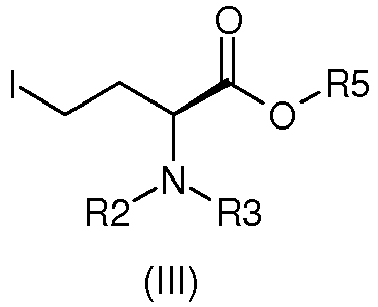
resulting in the phosphonium salt of formula (II'). - According to another embodiment, the process of the invention comprises reacting phosphonium salt (II") and leading to compound (I")

further comprises two preliminary steps: - a) quaternization of a phosphine P(R4)3, wherein R4 is as defined above, with a iodo derivative of general formula (III)

resulting in a phosphonium salt of formula (II')
- b) deprotecting the carboxylic acid function of phosphonium salt (II'), resulting in the corresponding phosphonium salt of formula (II").
- According to one embodiment, R2 is a hydrogen atom, R3 is a Boc group, R4 is phenyl and R5 is allyl.
- According to one preferred embodiment, the weak base is K3PO4, Cs2CO3 or K2CO3, more preferably the weak base is K3PO4.
- According to one embodiment, the solvent suitable for phase transition conditions is selected from the group comprising chlorobenzene, dichloromethane, chloroform, dichlorobenzene, dichloroethane, dioxane, preferably is chlorobenzene or dioxane.
- According to one embodiment, R1 is selected from the group consisting of hydrogen atom, allyl group and benzyl group.
- According to one embodiment, R2 is a hydrogen atom or Boc and R3 is Boc.
- According to one embodiment, phosphine P(R4)3 is selected from the group comprising tricyclohexylphosphine, triphenylphosphine, trifurylphosphine, tri(4-methoxyphenyl)phosphine, tri(4-trifluoromethylphenyl)phosphine, tri(4-fluorophenylphosphine) and tri(4-chlorophenyl)phosphine, preferably phosphine P(R4)3 is triphenylphosphine.
- According to one embodiment, RaCORb is selected from the group comprising benzaldehyde, 4-trifluoromethylbenzaldehyde, 4-nitrobenzaldehyde, 4-cyanobenzaldehyde, 4-methoxybenzaldehyde, 3,4-dimethoxybenzaldehyde, 2-furaldehyde, 3-phenylpropanal, paraformaldehyde, phenylacetaldehyde, 4-(4,4,5,5-tetramethyl-1,3,2-dioxaborolan-2-yl)benzaldehyde, aldehyde derived from calix-[4]-arene, ferrocene-carboxaldehyde, m-phthaldialdehyde, trans-cinnamaldehyde, (E)-4-azidophenylprop-2-enal, 4-oxo-2-butenoate, 3-methylbutenal, 4-nitro-trans-cinnamaldehyde, thiophene propenal, furyl propenal, and trifluoromethylacetophenone.
- According to one embodiment, R5 is an allyl group and wherein the deprotection of the carboxylic acid function of compound (II') is performed in presence of Pd2(dba)3, dppe and HNEt2.
- The present invention also relates to a process for manufacturing iodo derivative (III) wherein R2 is hydrogen and R3 is Boc group of general formula (III')

- protecting the acid function of the lateral chain of L-aspartic acid by transformation into monoester by esterification with methanol;
- protecting the amino function with a Boc group;
- protecting the remaining acid function by esterification in the presence of the bromide derivative R5-Br to lead to the corresponding diester;
- further protecting the amino function with a second Boc group;
- reducing the terminal ester in aldehyde using DIBAL;
- further reducing the aldehyde group with NaBH4 to lead to the N,O protected homoserine derivative;
- reacting with iodine in the presence of triphenylphosphine and imidazole to lead to the N-diprotected amino ester;
- reacting with NaI in presence of CeCl3 and further hydrolysing to obtain the N-monoprotected compound (III').
- Also disclosed is a compound of general formula (I)

- Ra and Rb may be the same or different and representent each a hydrogen atom or a substituted or unsubsituted group selected from alkyl, alkenyl, cycloalkyl, aryl, metallocenyl and -COR, wherein R is a substituted or unsubstituted group selected from alkyl, cycloalkyl, aryl, alkenyl, alkyloxy, cycloalkyloxy and aryloxy;
- R1 represents a hydrogen atom or R5, wherein R5 is a substituted or unsubstituted group selected from alkyl, cycloalkyl, aryl, alkenyl;
- R2 and R3 may be the same or different and represent each a hydrogen atom or a substituted or unsubstituted group selected from alkyl, cycloalkyl, aryl, alkenyl, - COR, wherein R is a substituted or unsubstituted group selected from alkyl, cycloalkyl, aryl, alkenyl, alkyloxy, cycloalkyloxy, aryloxy;
- provided that when R1 is t-butyl and {R2, R3} is {H, PhF} or {PhF, H}, then {Ra, Rb} is not {H, -COOMe}, {-COOMe, H}, {H, -CO(CH2)nCH(NHPhF)(CO2tBu) with n is 1, 2 or 3} or { -CO(CH2)nCH(NHPhF)(CO2tBu) with n is 1, 2 or 3, H};
- provided that when Ra is an aryl group or a group comprising an aryl substituent, Rb is not an aryl group or a group comprising an aryl substituent;
- provided that when Ra is a unsubstitued or alkyl-substituted α,ω-alkylene having from 0 to 3 carbon atoms substituted by a phosphino, phosphonyl or phosphono group, Rb is not selected from the group consisting of hydrogen, alkyl, haloalkyl, hydroxyalkyl, alkoxyalkyl, arylalkyl, akenyl or aryl;
- provided that when R1 is a hydrogen atom and {R2,R3} is {H, H}, then {Ra, Rb} is not {H, H};
- provided that when R1 is a hydrogen atom and {R2,R3} is {Troc, H} or {H, Troc}, then {Ra, Rb} is not {H, -CH=CH-CH(Me)2} or {-CH=CH-CH(Me)2, H};
- provided that when R1 is a methyl group and {R2,R3} is {Boc, H} or {H, Boc}, then {Ra, Rb} is not {H, H};
- provided that when R1 is a methyl group and {R2,R3} is {H, H}, then {Ra, Rb} is not {H, -CH=CH-CH(Me)2} or {-CH=CH-CH(Me)2, H}.
- The present invention also relates to a compound of general formula (II)

- R1 represents a hydrogen atom or R5, wherein R5 is a substituted or unsubstituted group selected from alkyl, cycloalkyl, aryl, alkenyl;
- R2 and R3 may be the same or different and represent each a hydrogen atom or a substituted or unsubstituted group selected from alkyl, cycloalkyl, aryl, alkenyl, - COR, wherein R is a substituted or unsubstituted group selected from alkyl, cycloalkyl, aryl, alkenyl, alkyloxy, cycloalkyloxy, aryloxy;
- R4 represents a substituted or unsubstituted group selected from alkyl, cycloalkyl, aryl, alkenyl.
- R2 and R3 may be the same or different and represent each a hydrogen atom or a substituted or unsubstituted group selected from alkyl, cycloalkyl, aryl, alkenyl, - COR, wherein R is a substituted or unsubstituted group selected from alkyl, cycloalkyl, aryl, alkenyl, alkyloxy, cycloalkyloxy, aryloxy;
- R5 represents a substituted or unsubstituted group selected from alkyl, cycloalkyl, aryl, alkenyl;
- provided that when R5 is methyl, R2 and R3 are not both Boc groups;
- provided that when R5 is benzyl, {R2,R3} is not {H, Boc} or {Boc, H};
- provided that when R5 is ethyl, {R2,R3} is not {H,C(=O)-O-CH2-Ph} or { C(=O)-O-CH2-Ph,H}.
- It is appreciated that in any of the mentioned reactions, any reactive group in the substrate molecules may be protected according to conventional chemical practice. Suitable protecting groups in any of the mentioned reactions are those used conventionally in the art. The methods of formation and removal of such protecting groups are those conventional methods appropriate to the molecule being protected.
-

- In the present invention, γ,δ-unsaturated α-amino acids of general formula (I) are obtained by a Wittig reaction between a phosphonium salt of general formula (II) and a compounds (IV), said compound (IV) being a ketone or aldehyde of general formula RaCORb or ketones derivatives such as [Ra, Rb]-trisubstituted trioxanes, imines of general formula RaRbC=NRc or bisulfitic combinations of general formula RaRbC(OH)(SO3Na).
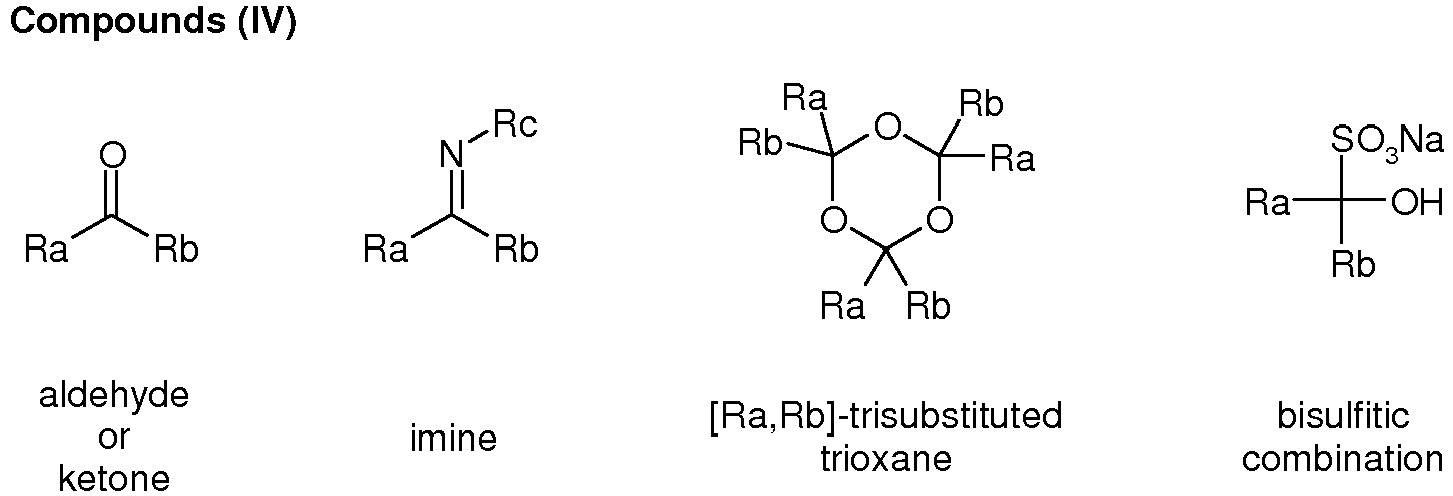
- Classical conditions for Wittig reaction involve a phosphonium salt, an aldehyde or a ketone and a strong base. Therefore, the Applicant first performed the synthesis of compound (I) in classical conditions, using t-BuLi, LDA or LiHMDS as strong base.
- Surprisingly, compound (I) was obtained with yields ranging from 10 to 30% and, in some cases, partial racemization occurred. Optimization of these results was considered necessary in view of developing a process for the synthesis of libraries of compounds (I).
- As a result of intensive research, the Applicant found that phase transfer conditions in combination with the use of a weak base give interesting results with yields over 50% (often over more than 70%) and with very few, if any, racemization. These results are all the more surprising as the phosphonium ylide formed from compound (II) during the Wittig reaction is not stabilized and as it is usually admitted than Wittig reaction implying weak bases are only possible with stabilized ylides.
- Therefore, the present invention relates to a process for producing a compound of formula (I), comprising performing a Wittig reaction by reacting a phosphonium salt of general formula (II)

- R1 represents a hydrogen atom or R5, wherein R5 is a substituted or unsubstituted group selected from alkyl, cycloalkyl, aryl, alkenyl;
- R2 and R3 may be the same or different and represent each a hydrogen atom or a substituted or unsubstituted group selected from alkyl, cycloalkyl, aryl, alkenyl, -COR, wherein R is a substituted or unsubstituted group selected from alkyl, cycloalkyl, aryl, alkenyl, alkyloxy, cycloalkyloxy, aryloxy;
- R4 represents a substituted or unsubstituted group selected from alkyl, cycloalkyl, aryl, alkenyl;
- in presence of a weak base and of a solvent suitable for phase transition conditions, resulting in compound (I).
- According to one embodiment, the synthesis of compound (I) is carried out in presence of 1 to 10 equivalents, preferably of 1 to 5 of compound (IV). According to an embodiment, the synthesis of compound (I) is carried out in presence of 1.5 equivalents of compound (IV). According to another embodiment, the synthesis of compound (I) is carried out in presence of 1.2 equivalents of compound (IV). According to another embodiment, the synthesis of compound (I) is carried out in presence of 2 equivalents of compound (IV).
- According to a preferred embodiment, compound (IV) is an aldehyde. According to a preferred embodiment, compound (IV) is selected from the group comprising benzaldehyde, 4-trifluoromethylbenzaldehyde, 4-nitrobenzaldehyde, 4-cyanobenzaldehyde, 4-methoxybenzaldehyde, 3,4-dimethoxybenzaldehyde, 2-furaldehyde, 3-phenylpropanal, paraformaldehyde, phenylacetaldehyde, 4-(4,4,5,5-tetramethyl-1,3,2-dioxaborolan-2-yl)benzaldehyde, aldehyde derive from calix-[4]-arene, ferrocene-carboxaldehyde, m-phthaldialdehyde, trans-cinnamaldehyde, (E)-4-azidophenylprop-2-enal, 4-oxo-2-butenoate, 3-methylbutenal, 4-nitro-trans-cinnamaldehyde, thiophene propenal, furyl propenal.
- According to another embodiment, compound (IV) is a ketone. According to a preferred embodiment, compound (IV) is trifluoromethylacetophenone.
- According to an embodiment, the synthesis of compound (I) is carried out in presence of a base. According to an embodiment, the base is a strong base selected from the group comprising n-BuLi, t-BuLi, lithium diisopropylamine (LDA), lithium bis(trimethylsilyl)amide (LiHMDS), KHMDS, NaHMDS, sec-BuLi, PhLi. According to another embodiment, the base is a weak inorganic base selected from the group comprising Cs2CO3, Li3PO4, NaH, K3PO4, K2CO3. According to a preferred embodiment, the base is K3PO4. According to a particular embodiment, the weak base is not NEt3.
- According to one embodiment, the synthesis of compound (I) is carried out in presence of 1 to 10 equivalents of base. In one embodiment, the synthesis of compound (I) is carried out in presence of 2 to 6, preferably 6 equivalents of base. In another embodiment, the synthesis is carried out in presence of 1 to 2 equivalents of base, preferably 1.2 equivalents of base.
- According to one embodiment, the base used in the synthesis of compound (I) is in a solid or liquid form. According to a preferred embodiment, the base is in a solid form.
- According to one embodiment, the synthesis of compound (I) is carried out in anhydrous conditions. According to another embodiment, the synthesis of compound (I) is carried out in presence of less than 1 equivalent of water, preferably about 0.8 equivalent of water.
- According to one embodiment, the synthesis of compound (I) is carried out in a solvent selected from the group comprising tetrahydrofuran, ethanol, dimethylformamide, chlorobenzene, dichlorobenzene, dichloromethane, chloroform, dichloroethane, dioxane, dimethylether (DME), ethylene glycol ethers, propylene glycol ethers, diglyme. According to one embodiment, the synthesis of compound (I) is usually carried out in a solvent suitable for phase transfer conditions. According to a preferred embodiment, the synthesis of compound (I) is carried out in a solvent selected from the group comprising chlorobenzene, dichlorobenzene, dichloromethane, chloroform, dichloroethane, dioxane. According to a preferred embodiment the solvent used is chlorobenzene. According to another preferred embodiment, the solvent used is dioxane.
- According to one embodiment, the synthesis of compound (I) is carried out at a temperature ranging from 25 to 140°C, preferably from 50 to 120, more preferably 90°C.
- According to one embodiment, the synthesis of compound (I) is carried out for a time ranging from 1 to 48 hours, preferably from 12 to 24 hours, more preferably 12 hours.
- According to a preferred embodiment, the synthesis of compound (I) is carried out in chlorobenzene as solvent, in anhydrous conditions, by heating the reaction at 90°C overnight, using 6 equivalent of K3PO4, and 1.5 equivalent of aldehyde.
- According to another preferred embodiment, the synthesis of compound (I) is carried out in dioxane as solvent, in anhydrous conditions, by heating the reaction at 90 °C overnight, using 6 equivalent of K3PO4, and 1.2 equivalent of aldehyde.
- According to one embodiment, the yield of the synthesis of compound (I) is ranging from 10 to 100%, preferably from 50 to 100 %.
- According to one embodiment, the synthesis of compound (I) is stereoselective.
- According to one embodiment, compound (I) is purified by using chromatographic techniques or by recrystallization.
-

- In a particular embodiment of the invention, substituent R1 is different of a hydrogen atom. In this specific case, compounds (I) have the specific general formula (I') wherein R5 is as defined above. Compounds (I') are obtained as described above by Wittig reaction from the phosphonium salt of particular formula (II').
- In one embodiment, phosphonium salt (II') is obtained by the quaternization of a phosphine P(R4)3, wherein R4 is as defined above with a iodo derivative of general formula (III) wherein R2, R3 and R5 are as defined above.
- According to a preferred embodiment, R5 is allyl or benzyl, more preferably allyl. According to another preferred embodiment, R2 and R3 are each Boc groups. According to another preferred embodiment, R2 is a hydrogen atom and R3 is a Boc groups.
- According to a preferred embodiment, the phosphine P(R4)3 is selected from the group comprising tricyclohexylphosphine, triphenylphosphine, trifurylphosphine, tri(4-methoxyphenyl)phosphine, tri(4-trifluoromethylphenyl)phosphine, tri(4-fluorophenylphosphine), tri(4-chlorophenyl)phosphine. According to a very preferred embodiment, the phosphine P(R4)3 is triphenylphosphine.
- According to one embodiment, the synthesis of compound (II') is carried out in presence of 2 to 5 equivalents, preferably of 2 to 3, more preferably 2 equivalents of phosphine P(R4)3.
- According to one embodiment, the synthesis of compound (II') is performed in a solvent selected from the group comprising tetrahydrofuran, acetonitrile, chloroforme, acetone, or mixtures thereof. According to another embodiment, the synthesis of compound (II') is performed without solvent.
- According to one embodiment, the synthesis of compound (II') is performed at a temperature ranging from 70 to 120°C, preferably from 70 to 90, more preferably at 80°C.
- According to one embodiment, the synthesis of compound (II') is performed for a time ranging from 1 to 24 hours, preferably from 1 to 4 hours, more preferably for 2 hours.
- According to one embodiment, compound (II') is purified by using chromatographic techniques or by recrystallization.
- According to a preferred embodiment, R4 is phenyl.
- According to a preferred embodiment, when R4 is phenyl, the synthesis of the corresponding compound (II') is performed without solvent by heating 2 hours at 80°C, using 2.5 equivalent of PPh3.
- According to one embodiment, the synthesis of compound (II') is stereoselective.
- According to one embodiment, the yield of the synthesis of compound (II') is ranging from 30 to 80 %, preferably from 40 to 70 %.
-

- In a particular embodiment of the invention, substituent R1 is a hydrogen atom. In this specific case, compounds (I) have the general formula (I") and is obtained as described above by Wittig reaction from the phosphonium salt of particular formula (II").
- In one embodiment, phosphonium salt (II") is obtained by deprotecting the carboxylic acid function of phosphonium salt (II'). Protected phosphonium salt (II') may be obtained as described above.
- According to a preferred embodiment, R2 and R3 are each Boc groups. According to another preferred embodiment, R2 is a hydrogen atom and R3 is a Boc group.
- In a particular embodiment, substituent R5 of compound (II') is a allyl group. In this embodiment, the deprotection of carboxylic acid function of compound (II') is performed by deallylation with diethylamine. According to a preferred embodiment, the deallylation is performed with diethylamine and is catalyzed by tris(dibenzylideneacetone)dipalladium(0) (Pd2(dba)3) in presence of 1,2-bis(diphenylphosphino)ethane (dppe). According to an embodiment, the catalysis is obtained in presence of 2.5% mol of Pd2(dba)3. According to a preferred embodiment, the deallylation is performed in the conditions described in Guibé, F. Tetrahedron, 1998, 54, 2967-3042.
- According to one embodiment, the deallylation is carried out in a solvent selected from the group comprising THF, dioxane, benzene, dichloromethane, chloroforme, DMF, toluene.
- According to one embodiment, the deallylation is carried out at a temperature ranging from 0 to 50°C, preferably at 25°C.
- According to one embodiment, the deallylation is carried out for a time ranging from 4 to 48 hours, preferably from 12 to 24 hours.
- According to one embodiment, the yield of the deallylation is ranging from 30 to 90 %, preferably from 50 to 90 %.
- According to another embodiment, the deprotection of carboxylic acid function of compound (II') is performed by deallylation reaction with phenylsilane. According to a preferred embodiment, the deallylation is performed with phenylsilane and is catalyzed by tetrakistriphenylphosphinepalladium(0) (Pd(PPh3)4). According to an embodiment, the catalysis is obtained in presence of 3.5% mol of Pd(PPh3)4. According to a preferred embodiment, the deallylation is performed according to the procedure described in Vazquez M.E., Blanco J.B. and Imperiali B., J. Am. Chem. Soc. 2005, 127, 1300-1306.
- According to one embodiment, the enantiomeric purity of compound (II") is determined by 31P NMR by comparison with a racemic sample in presence of the commercially available complexing agent (M,R)-BINPHAT, in conditions described in Hebbe V., Londez A., Goujon-Gonglinger C., Meyer F., Uziel J., Jugé S. and Lacour J., Tetrahedron Lett., 2003, 44, 2467-2471.
- According to one embodiment, the synthesis of compound (II") is stereoselective.
- According to one embodiment, compound (II") is purified by using chromatographic techniques or by recrystallization.
- In a particular embodiment of the invention, R2 is a hydrogen atom and R3 is a Boc group and compound (III) is of general formula (III'). In this case, the corresponding iodo derivatives (III') may be synthesized according to scheme 12.

- According to a preferred embodiment of the present invention, iodo derivative (III) is prepared with an overall yield ranging from 20 to 40%, starting from L-aspartic acid according to Scheme 12.
- According to this embodiment, the first step consists in protecting the acid function of the lateral chain of L-aspartic acid by transformation into monoester by esterification with methanol (Brown F.K., Brown P.J., Bickett D.B., Chambers C.L., Davies H.G., Deaton D.N., Drewry D., Foley M., McElroy A.B., Gregson M., McGeehan G.M., Myers P.L., Norton D., Salovich J.M., Schoenen F.J., Ward P., J. Med. Chem., 1994, 37, 674-688).
- The second step consists in the protection of the amino group with a t-butyloxycarbonyl group (Ramalingam K. and Woodard R.W., J. Org. Chem., 1988, 53, 1900-1903).
- The third step consists in the protection of the remaining acid function by esterification in the presence of the bromide derivative R5-Br to lead to the corresponding diester (Stein K.A. and Toogood P.L., J. Org. Chem., 1995, 60, 8110-8112).
- The N-protected γ-iodo aminoester (III') is obtained after four supplementary steps according to a strategy described in the literature (Adamczyk M., Johnson D. and Reddy R.E., Tetrahedron: Asymmetry, 2000, 11, 3063-3068). The amino group is first further protected with Boc2O. The terminal ester is then reduced in aldehyde using DIBAL. A further reduction with NaBH4 leads to the N,O protected homoserine derivative. The iodo amino ester is finally obtained by reaction with iodine in presence of triphenylphosphine and imidazole.
- The last step consists in the transformation of the N,N-diprotected γ-iodo aminoester into the corresponding N-monoprotected γ-iodo aminoester (III'), by reaction of NaI in presence of CeCl3.7H2O and further hydrolysis (Yadav J.S., Dubba Reddy B.V. and Reddy K.S., Synlett, 2002, 3, 468-470).
- According to one embodiment, the analysis of the N-protected γ-iodo aminoester and of the N-monoprotected γ-iodo aminoester (III') by HPLC on chiral column shows that no racemization occurs during all these steps of synthesis.
- Applications of γ,δ-unsaturated amino acids (I) as intermediates in organic synthesis have been explored. Especially, compounds (I) may be used as reactants in Suzuki-Miyaura coupling, Diels Alder reaction, Michael addition or in click chemistry. Compounds (I) may also have applications as contrast agents in medical imaging, especially in IRM or in PET, and may also presents interesting bioactivity.
- The present invention is further illustrated by the following examples which are provided by way of illustration only.
- Chiral HPLC analysis were performed on SHIMADZU 10-series apparatus, using chiral columns (Chiralcel OD-H, Chiralcel AD, Chiralcel OJ, Lux 5µm cellulose-2), and with hexane/propan-2-ol mixtures as the mobile phase (Flow rate 1 mL.min-1; UV detection λ = 254 nm). Thin layer chromatography (TLC) was performed on 0.25 mm E. Merck precoated silica gel plates and exposed by UV, potassium permanganate, ninhydrine or iodine treatment. Flash chromatography was performed with the indicated solvents using silica gel 60 A, (35-70 µm; Acros) or aluminium oxide 90 standardized (Merck). All NMR spectra data were recorded on BRUKER AVANCE 300, 500 and 600 spectrometers at ambient temperature. Data are reported as s = singlet, d = doublet, t = triplet, q = quartet, m = multiplet, brs = broad singlet, brd = broad doublet, dhept = doublet of heptuplet, coupling constant(s) in Hertz. Melting points were measured on a Kofler bench melting point apparatus and are uncorrected. Optical rotations values were recorded at 20°C on a Perkin-Elmer 341 polarimeter, using a 10 cm quartz vessel. Infrared spectra were recorded on a Bruker Vector 22 apparatus. Mass and HRMS spectra were recorded on Mass, Bruker ESI micro TOF-Q apparatus, at the Université de Bourgogne (Dijon). Elemental analyses were measured with a precision superior to 0.3% at the Microanalysis Laboratories of the University of Bourgogne (Analyseur CHNS/O Thermo Electron Flash EA 1112 Serie).
-

- To 3.8 mL (41.2 mmol) of SOCl2 in 26 mL of dry methanol, were added at -10°C, 5 g of L-aspartic acid (37.6 mmol). The mixture was stirred two hours at room temperature and 75 mL of diethyl ether were added. The white solid was filtered and washed with 2 x 50 mL of diethyl ether to afford (S)-aspartate methyl monoester chlorhydrate in 85% yield. White solid. 1H NMR (300 MHz, DMSO): δ (ppm) = 3.05 (dd, J = 3.4, 4.7 Hz, 2H, CH2), 3.78 (s, 3H, OCH3), 4.31-4.35 (m, 1H, CHN).
-

- To a solution of 3.74 g (20.5 mmol) of (S)-aspartate methyl monoester chlorhydrate in 85 mL of a mixture dioxane / H2O (2: 1), were added at 0°C, 2.21 g (20.8 mmol) of Na2CO3. After 30 minutes, 2.21 g (20.8 mmol) of Na2CO3 and 5 g (25.7 mmol) of Boc2O were added to the mixture which was stirred overnight at room temperature. The solvent was concentrated under vacuum, and the residue was poured into a mixture ice-water (60 mL). The aqueous layer was washed with 2 x 25 mL of diethyl ether and acidified until pH = 3 with 100 mL of NaHSO4 (1M). The aqueous layer was extracted with diethyl ether (3 x 75 mL) and the organic layer dried over MgSO4. After filtration and evaporation, the residue was purified by chromatography with ethyl acetate as eluent to afford 2-(S)-(t-butyloxycarbonylamino)-(methoxycarbonyl) butanoïc acid in 75% yield. White solid - Rf : 0.50 (Ethyl acetate) - [α]D = +28.6 (c = 0.3 ; CHCl3). IR (cm-1): 3429 (N-H), 2979 (C-H), 1714 (C=O), 1509, 1438, 1394, 1367, 1156, 1057, 1026, 843, 780, 734. 1H NMR (300 MHz, CDCl3) : δ(ppm) = 1.42 (s, 9H, CH3), 2.82 (dd, J = 4.8, 17.2 Hz, 1H, CH2), 3.02 (dd, J = 17.2, 4.1 Hz, 1H, CH2), 3.69 (s, 3H, OCH3), 4.59-4.62 (m, 1H, CHN), 5.57 (d, J = 8.5 Hz, 1H, NHBoc), 10.8 (sl,1H, COOH ). 13C NMR (75 MHz, CDCl3) : δ(ppm) = 28.2 (CH3), 36.4 (CH2), 49.7 (CHN), 52.1 (OCH3), 80.5 (C(CH3)3), 155.6 (COO), 171.6 (COO), 175.8 (COO). Analysis calculated for C10H17NO6 (337.15) : C 48.58, H 6.93, N 5.67 ; found C 48.64, H 7.04, N 5.68.
-

- To a solution of 5.62 g (22.7 mmol) of 2-(S)-(t-butyloxycarbonylamino)-(methoxycarbonyl) butanoïc acid in 70 mL of DMF, were introduced, under argon, 7.53 g (54.5 mmol) of K2CO3 and 3.9 mL (45.4 mmol) of allyl bromide. After stirring overnight, 70 mL of water were added and the aqueous layer was extracted with 3 x 75 mL of ethyl acetate. The organic layer was dried over MgSO4 and the solvent evaporated to afford a residue which was purified by chromatography with a mixture of petroleum ether / ethyl acetate (4 : 1) as eluent. Compound (S)-2-(t-butyloxycarbonylamino)-4-(methoxycarbonyl) allyl butanoate was isolated in 79% yield. Colorless oil - Rf : 0.29 (Ethyl acetate / petroleum ether 2 : 8) [α]D = + 17.7 (c = 0.7 ; CHCl3). IR (cm-1): 3370 (N-H), 2980 (C-H), 1716 (C=O), 1502, 1439, 1367, 1339, 1286, 1246, 1209, 1161, 1049, 1026, 992. 1H NMR (300 MHz, CDCl3) : δ(ppm) = 1.41 (s, 9H, CH3), 2.79 (dd, J = 17.0, 4.7 Hz, 1H, CH2), 2.98 (dd, J = 17.1, 4.6 Hz, 1H, CH2), 3.65 (s, 3H, OCH3), 4.53-4.57 (m, 1H, CHN), 4.60 (dt, J = 1.3, 5.7 Hz, 2H, OCH2), 5.20 (dq, J = 1.2, 10.4 Hz, 1H, CH2=), 5.28 (dq, J = 1.4, 17.2 Hz, 1H, CH2=), 5.79-5.92 (m, 1H, CH=). 13C NMR (75 MHz, CDCl3) : δ(ppm) = 28.3 (CH3), 36.6 (CH2), 50.0 (CHN), 52.0 (OCH3), 66.2 (OCH2), 80.1 (C(CH3)3), 118.6 (CH2=), 131.5 (CH=), 155.4 (COO), 170.7 (COO), 171.4 (COO). Analysis calculated for C13H21NO6 (227.14) : C 54.35, H 7.37, N 4.88 ; found C 54.50, H 7.38, N 4.93.
-

- To a solution of 4.86 g (16.9 mmol) of diester (S)-2-(t-butyloxycarbonylamino)-4-(methoxycarbonyl) allyl butanoate in 80 mL of acetonitrile, were added successively under argon, 643 mg (5.2 mmol) of DMAP and 9.3 g (42.6 mmol) of Boc2O. After stirring overnight at room temperature, the solvent was removed under vacuum and the residue was purified by chromatography with a mixture ethyl acetate / petroleum ether (1 : 4) to afford the diester N,N-diprotected (S)-2-[bis(t-butyloxycarbonyl)amino]-4-(methoxycarbonyl) allyl butanoate in 88 % yield. Colorless oil - Rf: 0.32 (Ethyl acetate / petroleum ether 1 : 4) - [α]D = -54.1 (c = 0.7 ; CHCl3). IR (cm-1) : 2982-2954 (C-H), 1742 (C=O), 1702 (C=O), 1458, 1439, 1368, 1314, 1269, 1243, 1168, 1142, 1116, 993, 934. 1H NMR (300 MHz, CDCl3) : δ(ppm) = 1.47 (s, 18H, CH3), 2.71 (dd, J = 16.4, 8.5 Hz, 1H, CH2), 3.23 (dd, J = 7.1, 16.4 Hz, 1H, CH2), 3.67 (s, 3H, OCH3), 4.59 (dt, J = 1.3, 5.6 Hz, 2H, OCH2), 5.19 (dq, J = 1.3, 10.5 Hz, 1H, CH2=), 5.28 (dq, J = 1.5, 17.2 Hz, 1H, CH2=), 5.42-5.47 (m, 1H, CHN), 5.79-5.90 (m, 1H, CH=). 13C NMR (75 MHz, CDCl3): δ(ppm) = 27.9 (CH3), 35.6 (CH2), 51.9 (CHN), 55.0 (OCH3), 66.1 (OCH2), 83.5 (C(CH3)3), 118.3 (CH2=), 131.5 (CH=), 151.6 (COO), 169.5 (COO), 171.0 (COO). Analysis calculated for C18H28NO8 (387.19) : C 55.80, H 7.54, N 3.62 ; found C 56.16, H 7.75, N 3.53.
-

- To a solution of 2 g (5.2 mmol) of diester (S)-2-[bis(t-butyloxycarbonyl)amino]-4-(methoxycarbonyl) allyl butanoate in 60 mL of distilled diethyl ether, were introduced under argon, at -78°C, 8.2 mL (8.2 mmol) of DIBAL. The mixture was stirred one hour at - 78°C and hydrolyzed with 10 mL of distilled water at 0°C. After 5 minutes, the mixture was filtered on celite and washed with 3 x 25 mL of diethyl ether. After removing the solvent, the crude product was dried under vacuum, to afford the aldehyde (S)-2-[bis(t-butyloxycarbonyl)amino]allyl-4-oxobutanoate and traces of the corresponding alcohol. This crude mixture was directly used for the second reduction with NaBH4. Colorless oil - Rf: 0.45 (ethyl acetate / petroleum ether 2 : 8).
-

- To a solution of 1.83 g (5.1 mmol) aldehyde (S)-2-[bis(t-butyloxycarbonyl)amino]allyl-4-oxobutanoate in 50 mL of a mixture THF / H2O (4 : 1) under argon, were added 225 mg (5.9 mmol) of NaBH4. The mixture was stirred thirty minutes at 0°C and the aqueous layer extracted with 3 x 75 mL of ethyl acetate. The organic layer was dried over MgSO4, filtered and evaporated. The crude product was purified by chromatography with ethyl acetate / petroleum ether (2 : 8 then 3 : 7 then 5 : 5) as eluent, to afford the homoserine derivative (S)-2-[bis(t-butyloxycarbonyl)amino]allyl-4-hydroxybutanoate in 71 % yield. Colorless oil - Rf: 0.31 (Ethyl acetate / petroleum ester 1 : 2). [α]D = -27.9 (c = 0.7 ; CHCl3). IR (cm-1) : 3524 (OH), 2980-2934 (C-H), 1740 (C=O), 1700 (C=O), 1457, 1368, 1272, 1254, 1144, 1119, 1049, 989, 930, 855. 1H NMR (300 MHz, CDCl3) : δ(ppm) = 1.47 (s, 18H, CH3), 1.97-2.07 (m, 1H, CH2), 2.36-2.44 (m, 1H, CH2), 3.54-3.61 (m, 1H, CH2OH), 3.68-3.73 (m, 1H, CH2OH), 4.59 (dt, J = 1.4, 5.5 Hz, 2H, OCH2), 4.99 (dd, J = 4.7, 9.8 Hz, 1H, CHN), 5.20 (dq, J = 1.3, 10.4 Hz, 1H, CH2=), 5.30 (dq, J = 1.5, 17.2 Hz, 1H, CH2=), 5.81-5.92 (m, 1H, CH=). 13C NMR (75 MHz, CDCl3): δ(ppm) = 27.9 (CH3), 32.8 (CH2), 55.6 (CHN), 59.0 (CH2OH), 65.8 (OCH2), 83.6 (C(CH3)3), 118.2 (CH2=), 131.7 (CH=), 152.5 (COO), 170.5 (COO). Analysis calculated for C17H29NO4 (359.19) : C 56.81, H 8.13, N 3.90 ; found C 56.52, H 8.32, N 3.93.
-
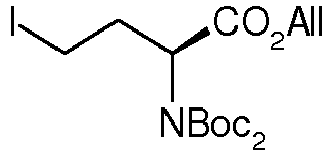
- In a flask, containing a solution of 1.33 g (3.7 mmol) of homoserine derivative (S)-2-[bis(t-butyloxycarbonyl)amino]allyl-4-hydroxybutanoate in 20 mL of dry THF, were added 600 mg (8.8 mmol) of imidazole. In a second flask containing 1.52g (5.8 mmol) of PPh3 in 15 mL of dry THF, were added 1.55 g (6.1 mmol) of iodine. The precedent solution was then added, and the resulting mixture was stirred for two hours at room temperature. The reaction mixture was then hydrolyzed with 100 mL of 20% aqueous NaCl. The aqueous layer was extracted by 3 x 50 mL of ethyl acetate. After drying over MgSO4, filtration and evaporation, the crude product was purified by chromatography using a mixture of ethyl acetate / petroleum ether (1 : 9 then 8 : 2) to afford iodo aminoester (S)-2-[bis(t-butyloxycarbonyl)amino]allyl-4-iodobutanoate (IIIa) in 91 % yield. Pale yellow oil - Rf : 0,75 (Ethyl acetate / petroleum ether 1 : 9)-[α]D = -44.6 (c = 0.7 ; CHCl3). IR (cm-1) : 2981-2936 (C-H), 1747 (C=O), 1704 (C=O), 1479, 1457, 1368, 1236, 1171, 1131, 988, 930, 853. 1H NMR (300 MHz, CDCl3) : δ(ppm) = 1.52 (s, 18H, CH3), 2.36-2.48 (m, 1H, CH2), 2.66-2.78 (m, 1H, CH2), 3.16-3.25 (m, 2H, CH2I), 4.63 (dt, J = 1.4, 5.5 Hz, 2H, OCH2), 5.03 (dd, J = 5.5, 8.5 Hz, 1H, CHN), 5.24 (dq, J = 1.3, 10.5 Hz, 1H, CH2=), 5.33 (dq, J = 1.5, 17.2 Hz, 1H, CH2=), 5.84-5.97 (m, 1H, CH=). 13C NMR (75 MHz, CDCl3) : δ(ppm) = 0.0 (CH2I), 26.2 (CH3), 32.6 (CH2), 52.8 (CHN), 64.1 (OCH2), 87.7 (C(CH3)3), 116.5 (CH2=), 129.8 (CH=), 150.2 (COO), 167.9 (COO). Analysis calculated for C17H29NO6I (469.10) : C 43.51, H 6.01, N 2.98 ; found C 43.31, H 6.24, N 2.92.
-
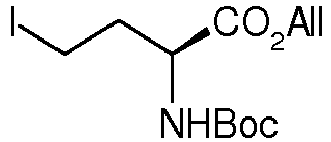
- To a solution of 1.6 g (3.4 mmol) of (S)-2-[bis(t-butyloxycarbonyl)amino]allyl-4-iodobutanoate (IIIa) in 20 mL of acetonitrile, were added 1.3 g (3.4 mmol) of CeCl3.7H2O and 513 mg (3.4 mmol) of NaI. The reaction mixture was stirred overnight at room temperature and hydrolyzed with 20 mL of water. The aqueous layer was extracted with 3 x 20 mL of ethyl acetate and the organic layer was dried over MgSO4. After evaporation, the crude product was purified by chromatography with ethyl acetate / petroleum ether (2 : 8) as eluent to afford the mono N-protected iodo aminoester (S)-2-(t-butyloxycarbonylamino)allyl-4-iodobutanoate (III') in 86% yield. Pale yellow oil - Rf : 0.31 (Ethyl acetate / petroleum ether 1 : 4) [α]D= +11.7 (c = 0.5 ; CHCl3) IR (cm-1): 2981-2936 (C-H), 1747 (C=O), 1704 (C=O), 1479, 1457, 1368, 1236, 1171, 1131, 988, 930, 853. 1H NMR (300 MHz, CDCl3) : δ(ppm) = 1.42 (s, 9H, CH3), 2.10-2.23 (m, 1H, CH2), 2.37-2.43 (m, 1H, CH2) 3.13-3.18 (m, 2H, CH2I) 4.32-4.34 (m, 1H, CHN), 4.62 (d, J = 5.8 Hz, 2H, OCH2), 5.05 (d, J = 6.2 Hz, 1H, NH), 5.24 (dd, J = 1.1, 10.4 Hz, 1H, CH2=), 5.31 (dd, J = 1.4, 17.2 Hz, 1H, CH2=), 5.82-5.95 (m, 1H, CH=). 13C NMR (75 MHz, CDCl3): δ(ppm) = 0.0 (CH2I), 28.9 (CH3), 37.8 (CH2), 55.0 (CHN), 66.9 (OCH2), 80.9 (C(CH3)3), 119.8 (CH2=), 132.0 (CH=), 155.9 (COO), 171.9 (COO). Analysis calculated for C12H20NO4I (369.09) : C 39.04, H 5.46, N 3.79 ; found C 39.14, H 5.59, N 3.84.
-

- To a solution of 1.42 g (5.7 mmol) of diester 2-(S)-(t-butyloxycarbonylamino)-(methoxycarbonyl) butanoïc acid in 50 mL of DMF, were added under argon 1.15 g (8.3 mmol) of K2CO3 and 1.48 mL (12.4 mmol) of benzyl bromide. After stirring overnight at room temperature, 60 mL H2O were added and the aqueous layer was extracted with 3 x 75 mL of ethyl acetate. The organic layer was dried over MgSO4 and the solvent removed under vacuum to afford a residue which was purified by chromatography with a mixture petroleum ether / ethyl acetate (4 : 1) as eluent. The 2-(S)-(t-butyloxycarbonylamino)-4-(methoxycarbonyl)benzyl butanoate diester was isolated in 85 % yield. White solid - Rf : 0.56 (Ethyl acetate / petroleum ether 1 : 4). Enantiomeric excess > 99 %* - [α]D = +4.4 (c = 0.5 ; CHCl3). IR (cm-1) : 3429 (N-H), 2997-2850 (C-H), 1732 (C=O), 1693 (C=O), 1457, 1388, 1320, 1265, 1240, 1220, 1146, 1130, 1098, 1084, 998, 980, 923, 869, 840, 817, 762, 739. 1H NMR (300 MHz, CDCl3): δ(ppm) = 1.36 (s, 9H, CH3), 2.75 (dd, J = 17.0, 4.7 Hz, 1H, CH2), 2.94 (dd, J = 17.1, 4.6 Hz, 1H, CH2), 3.55 (s, 3H, OCH3), 4.51-4.57 (m, 1H, CHN), 5.05-5.16 (m, 2H, OCH2Ph), 5.45 (d, J = 8.4 Hz, 1H, NHBoc), 7.24-7.30 (m, 5H, Harom). 13C NMR (75 MHz, CDCl3) : δ(ppm) = 28.3 (CH3)3, 36.7 (CH2), 48.1 (CHN), 50.1 (OCH3), 67.4 (OCH2Ph), 80.2 (C(CH3)3), 128.3 (Carom), 128.4 (Carom), 128.6 (Carom), 135.3 (C arom), 170.9 (COO), 171.3 (COO). Mass exact calculated for C17H24NO6 [M+H]+ : 338.1598, found 338.1618. Analysis calculated for C17H23NO6 (337.15) : C 60.52, H 6.87, N 4.15 ; found C 60.42, H 6.95, N 4.15. The enantiomeric excess was determined by HPLC (Chiralpack AD, hexane : iPrOH 98:2, 1 mL.min-1, λ = 210 nm, 24°C, tR (R) = 45.8 min, tR (S) = 55.6 min).
-

- To a solution of 1.60 g (4.7 mmol) of 2-(S)-(t-butyloxycarbonylamino)-4-(methoxycarbonyl)benzyl butanoate diester in 50 mL of acetonitrile, were added successively under argon 185 mg (1.5 mmol) of DMAP and 2.5 g (11.6 mmol) of Boc2O. After stirring overnight at room temperature, the solvent was removed under vacuum and the residue purified by chromatography with a solvent mixture ethyl acetate/petroleum ether (1: 4) to afford the diester 2-(S)-[bis(t-butyloxycarbonyl)amino]-4-(methoxy carbonyl) benzyl butanoate diester in 98 % yield. White solid - Rf: 0.60 (Ethyl acetate / petroleum ether 1 : 4). Enantiomeric excess > 99 %* - [α]D = -40,4 (c = 0.2 ; CHCl3). IR (cm-1) : 2982 (C-H), 1732 (C = O), 1693 (C=O), 1457, 1388, 1366, 1320, 1265, 1240, 1220, 1146, 1128, 1098, 1014, 998, 980, 923, 869, 840, 817, 762, 739. 1H NMR (300 MHz, CDCl3) : δ(ppm) = 1.47 (s, 18H, CH3), 2.76 (dd, 1H, J = 16.5, 6.5 Hz, CH2), 3.30 (dd, 1H, J = 16.5, 7.2 Hz, CH2), 3.69 (s, 3H, OCH3), 5.13-5.23 (m, 2H, OCH2Ph), 5.50-5.54 (t, J = 6.8 Hz, 1H, CHN), 7,34-7,35 (m, 5H, Harom). 13C NMR (75 MHz, CDCl3) : δ(ppm) = 27.9 (CH3), 35.5 (CH2), 51.9 (OCH3), 55.0 (CHN), 67.2 (OCH2Ph), 83.5 (C(CH3)3), 128.1 (C arom), 128.2 (C arom), 128.5 (C arom), 135.3 (C arom), 151.7 (COO), 169.7 (COO), 171 (COO). Mass exact calculated for C22H31NO8Na [M+Na]+ : 460.1942, found 460.1963. Analysis calculated for C22H31NO8 (437.20) : C 60.40, H 7.14, N 3.20 ; found C 60.55, H 7.26, N 3.23. * The enantiomeric excess was determined by HPLC (Chiralcel OD, hexane : iPrOH 95 : 5, 0.5 mL. min-1, λ = 210 nm, 24°C, tR (R) = 76,7 min, tR (S) = 83,1 min).
-

- To a solution of 5.57 g (10.8 mmol) of 2-(S)-[bis(t-butyloxycarbonyl)amino]-4-(méthoxy carbonyl) benzyl butanoate diester in 100 mL of distilled diethyl ether, were introduced under argon at -78°C 17.3 mL (17.6 mmol) of DIBAL. The mixture was stirred one hour at - 78°C and hydrolyzed with 17 mL of distilled water at 0°C. After 5 minutes, the mixture was filtered on celite and washed with 3 x 25 mL of diethyl ether. After removing the solvent the crude product was purified by chromatography with a mixture of ethyl acetate / petroleum ether (1 : 9 then 1.5 : 8.5). The aldehyde (S)-2-[bis(t-butyloxycarbonyl)amino]-4-benzyl oxobutanoate ester was isolated in 96 % yield. Colorless oil - Rf : 0.45 (Ethyl acetate / petroleum ether 2 : 8). [α]D = -32,0 (c = 0.1 ; CHCl3). IR (cm-1) : 2982-2936 (C-H), 1741 (C=O), 1703 (C=O), 1457, 1370, 1253, 1146, 1126, 1047, 853, 783, 738, 700. 1H NMR (300 MHz, CDCl3): δ(ppm) = 1.41 (s, 18H, CH3), 2.80 (ddd, 1H, J = 17.4, 6.0, 1.1 Hz, CH2), 3.26 (ddd, 1H, J = 17.9, 6.8, 1.1 Hz, CH2), 5.11 (m, 2H, OCH2Ph), 5.55 (t, J = 6.4 Hz, 1H, CHN), 7.25- 7.29 (m, 5H, Harom), 9.71 (t, 1H, J = 1.1 Hz, CHO). 13C NMR (75 MHz, CDCl3) : δ(ppm) = 27.9 (CH3), 44.7 (CH2), 53.0 (CHN), 67.4 (OCH2Ph), 83.7 (C(CH3)3), 127.0-129.8 (m, Carom), 135.3 (Carom), 151.7 (COO), 169.7 (COO), 198.5 (CHO). Analysis calculated for C21H29NO7 (407.46) : C 61.90, H 7.17, N 3.44 ; found C 62.07, H 7.46, N 3.05.
-

- To a solution of 3.62 g (8.9 mmol) of aldehyde (S)-2-[bis(t-butyloxycarbonyl)amino]-4-benzyl oxobutanoate ester in 100 mL of a mixture THF / H2O (4 : 1) under argon, were added 1.30 g (18.5 mmol) of NaBH4. The mixture was stirred thirty minutes at 0°C and the aqueous layer extracted with 3 x 75 mL of ethyl acetate. The organic layer was dried over MgSO4, filtered and evaporated. The crude product was purified by chromatography with a mixture ethyl acetate / petroleum ether (2 : 8 then 3 : 7 then 5 : 5), to afford the homoserine derivative (S)-2-[bis(t-butyloxycarbonyl)amino]-4-hydroxybutanoate benzyl ester in 83 % yield. Colorless oil - Rf: 0.30 (Ethyl acetate / petroleum ether 3 : 7). Enantiomeric excess > 99 %* - [α]D = -19.8 (c = 0.6 ; CHCl3). IR (cm-1) : 3528 (OH), 2980-2885 (C-H), 1744 (C=O), 1702 (C=O), 1500, 1479, 1457, 1369, 1315, 1274, 1145, 1122, 1047, 904, 853, 783, 750, 698. 1H NMR (300 MHz, CDCl3): δ(ppm) = 1.46 (s, 18H, CH3), 1.99-2.08 (m, 1H, CH2), 2.40-2.53 (m, 1H, CH2), 3.58-3.63 (m, 1H, CH2OH), 3.72-3.76 (m, 1H, CH2OH), 5.03 (dd, 1H, J = 9.7, 4.7 Hz, CHN), 5.14-5.19 (m, 2H, OCH2Ph), 7.26-7.36 (m, 5H, Harom). 13C NMR (75 MHz, CDCl3) : δ(ppm) = 27.9 (CH3)3, 32.6 (CH2), 55.7 (CHN), 59.0 (CH2OH), 66.9 (OCH2Ph), 83.6 (C(CH3)3), 127.0-129.8 (m, Carom), 135.6 (Carom), 152.6 (COO), 170.7 (COO). Mass exact calculated for C21H31NO7Na [M+Na]+: 432.1998, found : 432.2007. Analysis calculated for C21H31NO7 (409.48) : C 61.60, H 7.63, N 3.42 ; found C 61.75, H 7.85, N 3.35. * The enantiomeric excess was determined by HPLC (Chiralcel OD, hexane : iPrOH 90 : 10, 0.5 mL.min-1, λ = 210 nm, 20°C, tR (R) = 16.2 min, tR (S) = 18.4 min).
-

- In a flask, containing a solution of 2.71 g (6.6 mmol) of homoserine derivative (S)-2-[bis(t-butyloxycarbonyl)amino]-4-hydroxybutanoate benzyl ester in 20 mL of dry THF, were added 1.08 g (15.8 mmol) of imidazole. In a second flask containing 3.12 g (11.9 mmol) of PPh3 in 14 mL of dry THF, were added 3.16 g (12.5 mmol) of iodine. The precedent solution was then added, and the resulting mixture was stirred for two hours at room temperature. The reaction mixture was then hydrolyzed with 100 mL of 20% aqueous NaCl. To the aqueous layer was added 3 x 50 mL of ethyl acetate. After drying over MgSO4, filtration and evaporation of the solvent, the crude product was purified by chromatography using a mixture of ethyl acetate / petroleum ether (1 : 9 then 8 : 2) to afford the iodine derivative (S)-2-[bis(t-butyloxycarbonyl)amino]-4-iodobutanoate benzyl ester (IIIb) in 91 % yield. Pale yellow oil - Rf: 0,75 (Ethyl acetate / petroleum ether 1 : 9). Enantiomeric excess > 99 %* - [α]D = -41.9 (c = 0.6 ; CHCl3); IR (cm-1) : 2984-2937 (C-H), 1736 (C=O), 1690 (C=O), 1381, 1366, 1351, 1317, 1264, 1226, 1167, 1150, 1130, 1113, 1056, 976, 955, 896, 866, 851, 831, 789, 763, 752, 722, 700. 1H NMR (300 MHz, CDCl3) : δ(ppm) = 1.46 (s, 18H, CH3), 2.42 (m, 1H, CH2), 2.71 (m, 1H, CH2), 3.16-3.21 (m, 1H, CH2I), 3.27-3.31 (m, 1H, CH2I), 5.04 (dd, 1H, J = 8.6, 5.5 Hz), 5.13-5.18 (m, 2H, CH2Ph), 7.37-7.33 (m, 5H, Harom). 13C NMR (75 MHz, CDCl3) : δ(ppm) = 0.2 (CH2I), 26.2 (CH3), 32.4 (CH2), 56.8 (CHN), 65.2 (OCH2Ph), 81.7 (C(CH3)3), 126.2-126.9 (m, Carom), 133.6 (Carom), 150.2 (COO), 168.1 (COO). Mass exact calculated for C21H31NO6NI [M+H]+: 520.1196, found : 520.1202. Analysis calculated for C21H30NO6I (519.38): C 48.56, H 5.82, N 2.70 ; found C 48.61, H 5.89, N 2.89. * The enantiomeric excess was determined by HPLC (Chiralpack AD, hexane: iPrOH 98: 2, 0.5 mL.min-1, λ = 210 nm, 10°C, tR (S) = 21.7 min, tR (R) = 29.2 min).
-
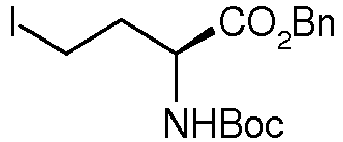
- To a solution of 0.80 g (1.9 mmol) of Synthesis of (S)-2-[bis(t-butyloxycarbonyl)amino]-4-iodobutanoate benzyl ester (IIIb) in 20 mL of acetonitrile, were added 0.70 g (1.9 mmol) of CeCl3.7H2O and 0.28 g (1.9 mmol) of NaI. The reaction mixture was stirred overnight at room temperature and hydrolyzed with 10 mL of water. The aqueous layer was extracted with 3 x 20 mL of ethyl acetate and the organic layer was dried over MgSO4. After evaporation of the solvent, the crude product was purified by chromatography with a mixture of ethyl acetate / petroleum ether (2 : 8) as eluant to afford the mono N-protected iodo derivative (S)-2-(t-butyloxycarbonylamino)benzyl-4-iodobutanoate (III") in 86% yield. Pale yellow oil - Rf : 0.60 (Ethyl acetate / petroleum ether 2 : 8); Enantiomeric excess > 99 %* - [α]D = + 4.8 (c = 0.4 ; CHCl3); IR (cm-1) : 3366 (N-H), 2985 (C-H), 1755 (C=O), 1682 (C=O), 1515, 1453, 1425, 1367, 1349, 1288, 1254, 1225, 1155, 1080, 1047, 1025, 954, 862, 791, 748, 694. 1H NMR (300 MHz, CDCl3) : δ(ppm) = 1.37 (s, 9H, CH3), 2.05-2.18 (m, 1H, CH2), 2.32-2.38 (m, 1H, CH2), 3.04-3.09 (m, 2H, CH2I), 4.30-4.32 (m, 1H, CHN), 5.00-5.16 (m, 3H, OCH2Ph / NH); 7.26-7.31 (m, 5H, Harom). 13C NMR (75 MHz, CDCl3) : δ(ppm) = 0.0 (CH2I), 27.0 (CH3), 32.4 (CH2I), 55.1 (CHN), 68.2 (OCH2Ph), 81.0 (C(CH3)3), 129.1 (Carom), 129.3 (Carom), 129.4 (Carom), 135.8 (Carom), 156.0 (COO), 172.1 (COO). Mass exact calculated for C21H31NO6NI [M+Na]+ : 442.0486, found 442.0507. Analysis calculated for C16H22NO4I (419.06) : C 45.84, H 5.29, N 3.34 ; found C 45.72, H 5.42, N 3.47. * The enantiomeric excess was determined by HPLC (Chiralpack AD, hexane : iPrOH 98 : 2, 0.5 mL.min-1, λ = 210 nm, 10°C, tR (R) = 22.5 min tR (S) = 28.7 min,).
-

- A mixture of 1.1 g (3.1 mmol) of iodo aminoester (S)-2-(t-butyloxycarbonylamino)allyl-4-iodobutanoate (III') and 1.9 g (7.1 mmol) of triphenylphosphine was stirred under argon at 80°C two hours. Then, 5 mL of toluene followed by 30 mL of diethyl ether were added to the mixture after cooling to room temperature. The white precipitate was washed with 2 x 25 mL of diethyl ether and purified by chromatography with a mixture of acetone / petroleum ether (7 : 3) as eluent. The phosphonium salt (II'a) iodo 2-(t-butyloxycarbonyl)amino]-4-triphenyl phosphonium allyl butanoate was isolated in 72% yield. Pale yellow solid - Rf : 0.57 (acetone / petroleum ether 7 : 3) - mp : 84-86°C. Enantiomeric excess = 97 % - [α]D = - 17.5 (c = 0.4 ; CHCl3). IR (cm-1) : 3249 (NH), 3053-2870 (C-H), 1699 (C=O), 1648 (C=O), 1587, 1508, 1486, 1437, 1391, 1366, 1340, 1309, 1251, 1229, 1158, 1111, 1052, 995, 931, 857, 785, 739, 723, 688, 606. 1H NMR (300 MHz, CDCl3) : δ(ppm) = 1.39 (s, 9H, CH3), 2.26-2.30 (m, 2H, CH2), 3.58-3.73 (m, 1H, CH2P), 3.79-3.95 (m, 1H, CH2P), 4.53-4.60 (m, 3H, OCH2 + CHN), 5.15-5.29 (m, 2H, CH2=), 5.78-5.89 (m, 1H, CH=), 6.32 (d, J = 7.5 Hz, 1H, NH), 7.65-7.83 (m, 15H, Harom). 13C NMR (75 MHz, CDCl3) : δ(ppm) = 20.3 (d, J = 53.6 Hz, CH2P), 23.8 (CH2), 28.3 (CH3), 53.2 (d, J = 17.3 Hz, CHN), 66.2 (OCH2), 80.0 (C(CH3)3), 117.8 (d, J = 86 Hz, Carom), 118.6 (CH2=), 130.6 (d, J = 12.8 Hz, Carom), 131.7 (CH=), 133.6 (d, J = 9.8 Hz, Carom), 135.2 (d, J = 3 Hz, Carom), 135.7 (COO), 170.7 (COO). 31P NMR (121 MHz, CDCl3): δ (ppm) = +25.2 (s). Mass exact calculated for C30H35N1O4P1 [M-I]+: 504.2298; found : 504.2278.
-

- A mixture of 0.23 g (0.6 mmol) of iodo aminoester (S)-2-(t-butyloxycarbonylamino)allyl-4-iodobutanoate (III') and 0.56 g (1.2 mmol) of [tri-(4-trifluoromethylphenyl)]phosphine was stirred under argon at 80°C three hours. Then, 3 mL of toluene followed by 30 mL of diethyl ether were added to the mixture after cooling to room temperature. The white precipitate was washed with 2 x 25 mL of diethyl ether and purified by chromatography with a mixture of acetone / petroleum ether (2 : 7) as eluent. The phosphonium salt (II'b) was isolated in 39% yield. 31P NMR (121 MHz, CDCl3) : δ(ppm) = +27 (s).
-
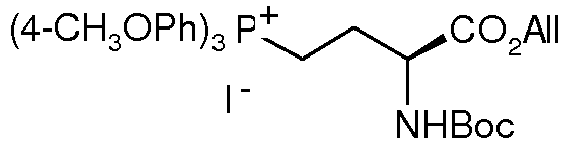
- A mixture of 0.23 g (0.6 mmol) of iodo aminoester (S)-2-(t-butyloxycarbonylamino)allyl-4-iodobutanoate (III') and 0.42 g (1.2 mmol) of [tri-(4-methoxyphenyl)]phosphine in 0.5 mL of dry THF was stirred under argon at 80°C. After three hours, 3 mL of toluene followed by 30 mL of diethyl ether were added to the mixture at room temperature. The white precipitate was washed with 2 x 25 mL of diethyl ether and purified by chromatography with a mixture of acetone / petroleum ether (3 : 7) as eluent. The phosphonium salt (II'c) was isolated in 70% yield. Pale yellow solid 31P NMR (121 MHz, CDCl3) : δ(ppm) = +21 (s).
-

- A mixture of 0.28 g (0.76 mmol) of iodo aminoester (S)-2-(t-butyloxycarbonylamino)allyl-4-iodobutanoate (III') and 0.48 g (1.5 mmol) of [tri-(4-fluorophenyl)]phosphine in THF was stirred 24h under argon at 80°C. Then, 3 mL of toluene followed by 30 mL of diethyl ether were added to the mixture at room temperature. The white precipitate was filtered off and washed with 2 x 25 mL of diethyl ether and purified by chromatography with a mixture of acetone / petroleum ether (2 : 7) as eluent. The phosphonium salt (II'd) was isolated in 63% yield. Pale yellow solid. 31P NMR (121 MHz, CDCl3) : δ(ppm) = +26 (s).
-

- A mixture of 0.20 g (0,43 mmol) of iodo aminoester (IIIa) and 0.24g (0.85 mmol) of tricyclohexylphosphine was stirred under argon in a mixture of acetonitrile / THF (1 : 2). After 5 days stirring, 5 mL of toluene were added followed by 30 mL of diethyl ether. The white precipitate was filtered off and washed with 2 x 25 mL of diethyl ether to afford the phosphonium salt (II'e) in 79 % yield. 1H NMR (300 MHz, CDCl3) : δ(ppm) = 1.22-2.2 (m, 50H, CH2, cHex, Boc), 2.4-2.6 (m, 2H, P+CH2), 2.7-2.9 (m, 3H, P+CH), 4.65 (d, J = 6 Hz, 2H, OCH2), 4.94 (t, J = 7Hz, 1H, CHN), 5.27 (d, J = 11Hz, 1H, CH(H)=), 5.34 (d, J = 17Hz, 1H, C(H)H=), 5.92 (m, 1H, -CH=). 31P NMR (121 MHz, CDCl3) : δ(ppm) = +32.5 (s).
-

- A mixture of 0.12 g (0,26 mmol) of iodo aminoester (IIIa) and 0.17 g (0.65 mmol) of triphenylphosphine was stirred under argon at 55°C. After 16h stirring at this temperature, the residue was purified by chromatography with a mixture of ethyl acetate / petroleum ether (7 : 3) as eluent. The phosphonium salt (II'f) was then obtained in 66% yield. Pale yellow solid - Rf: 0.50 (Ethyl acetate / petroleum ether 7 : 3). Enantiomeric excess > 99%. 1H NMR (300 MHz, CDCl3) : δ(ppm) = 1.48 (s, 18H, CH3), 2.18 (m, 1H, CH(H)), 2.6 (m, 1H, C(H)H), 3.5-3.75 (m, 1H, CH2P), 3.8-3.95 (m, 1H, CH2P), 4.62 (d, 2H, CH2O), 5.15 (t, J = 6Hz, 1H, CHN), 5.21-5.34 (2d, 2H, CH2=), 5.83-5.93 (m, 1H, -CH=).7.71-7.88 (m, 15H, Harom). 31P NMR (121 MHz, CDCl3) : δ(ppm) = +24.1 (s). Mass exact calculated for C35H43NO6PI [M-I] : 604.2855, found 604.2813.
-

- A mixture of 0.60 g (1.4 mmol) of iodo aminoester (III") and 1.0 g (4 mmol) of triphenylphosphine was stirred under argon at 80°C for two hours. Then, 5 mL of toluene followed by 30 mL of diethyl ether were added to the mixture after cooling to room temperature. The white precipitate was washed with 2 x 25 mL of diethyl ether and purified by chromatography with a mixture of acetone / petroleum ether (7:3) as eluent. The phosphonium salt (II'g) was then obtained in 70% yield. Enantiomeric excess = 97 % - [α]D = -15.8 (c = 0.3 ; CHCl3). IR (cm-1) : 3243 (NH), 3057 (C=CH), 2977-2931 (CH2, CH3), 1737 (COO), 1699 (COO), 1500, 1437, 1365, 1158, 1111, 996, 738, 723, 688. 1H NMR (300 MHz, CDCl3) : δ(ppm) = 1.30 (s, 9H, CH3), 2.16-2.28 (m, 2H, CH2), 3.54-3.75 (m, 1H, CH2P), 3.81-3.89 (m, 1H, CH2P), 4.53-4.55 (m, 1H, CHN), 5.09 (sl, 2H, OCH2Ph), 6.28 (d, J = 6.5 Hz, 1H, NH), 7.20-7.26 (m, 5H, Harom), 7.59-7.73 (m, 15H, Harom). 13C NMR (75 MHz, CDCl3) : δ(ppm) = 20.4 (d, J = 53.1 Hz, CH2P), 24.0 (CH2), 28.0 (CH3), 53.3 (d, J = 16.8 Hz, CHN), 67.4 (OCH2Ph), 80.0 (C(CH3)3), 117.8 (d, J = 86.6 Hz, Carom), 128.2 (Carom), 128.5 (Carom), 130.6 (d, J = 12.6 Hz, Carom), 133.6 (d, J = 10.0 Hz, Carom), 135.2 (d, J = 2.9 Hz, Carom), 135.4 (Carom), 155.7 (COO); 170.9 (COO). 31P NMR (121 MHz, CDCl3) : δ(ppm) = +24.7 (s). Mass exact calculated for C34H37NO4PI [M-I] : 554.2455, found 554.2461. Analysis calculated for C34H37NO4I (681.67) : C 59.92, H 5.47 N 2.06, found C 59.20, H 5.68, N 2.05.
-

- To a solution of 1.28 g (2 mmol) of phosphonium salt (II'a) in 20 mL of dry THF, were successively added under argon at room temperature 46 mg (0.05 mmol) of Pd2dba3 and 40 mg (0.1 mmol) of dppe. After five minutes stirring 0.42 mL (4.2 mmol) of HNEt2 was introduced and the mixture was stirred at room temperature overnight. After hydrolysis, extraction with dichloromethane, the combined organic layers were dried over MgSO4, evaporated under vacuum and purified by chromatography with a mixture of acetone / methanol (1 : 1) as eluent to afford the phosphonium salt (II"a) in 80 % yield. White solid - Rf : 0.50 (acetone / MeOH 1 : 1) - mp = 152°C. Enantiomeric excess = 97 % - [α]D = +48.5 (c = 0.4 ; CHCl3); IR (cm-1) : 3387 (NH), 3060-2932 (C-H), 1695 (C=O), 1605 (C=O), 1483, 1438, 1386, 1365, 1251, 1161, 1112, 1053, 1025, 997, 859, 830, 781, 739, 723, 689, 609. 1H NMR (300 MHz, CDCl3): δ(ppm) = 1.33 (s, 9H, CH3), 2.13-2.32 (m, 2H, CH2), 3.13-3.30 (m, 2H, CH2P), 4.08 (t, J = 3.6 Hz, 1H, CHN), 6.27 (dl, J = 2.7 Hz, 1H, NH), 7.52-7.64 (m, 12H, Harom), 7.70-7.77 (m, 3H, Harom). 13C NMR (75 MHz, CDCl3) : δ(ppm) = 18.4 (d, J = 9.8 Hz, CH2P), 25.7 (CH2), 28.4 (CH3)3, 54.9 (d, J = 17.3 Hz, CHN), 78.6 (C(CH3)3), 118.3 (d, J = 86 Hz, Carom), 130.5 (d, J = 12.8 Hz, Carom), 133.3 (d, J = 9.8 Hz, Carom), 135.1 (d, J = 3 Hz, Carom), 156 (COO), 172.6 (COO). 31P NMR (121 MHz, CDCl3): δ(ppm) = +24.3 (s). Mass exact calculated for C27H31N1O4P1 [M-I]+: 464.1985, found: 464.1963.
-
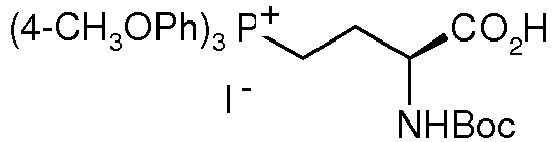
- To a solution of 0.2 g (0.3 mmol) of phosphonium salt (II'c) in 2 mL of dry THF were introduced successively under argon at room temperature, 6 mg (0.006 mmol) of Pd2dba3 and 5 mg (0.013 mmol) of dppe. After five minutes stirring, 0.13 mL (1.2 mmol) of HNEt2 was added and the solution was stirred during 16 hours at room temperature. The solvent was evaporated and the residue was purified by chromatographic column with acetone then a mixture of acetone / methanol (1 : 1) as eluent to afford the phosphonium salt (II"c) with 50% yield. 31P NMR (121 MHz, CDCl3): δ(ppm) =+21 (s).
-

- To a solution of 0.33 g (0.47 mmol) of phosphonium salt (II'd) in 4 mL of dry THF were introduced successively under argon at room temperature, 10 mg (0.011 mmol) of Pd2dba3 and 9 mg (0.022 mmol) of dppe. After two hours stirring, 0.17 mL (1,6 mmol) of HNEt2 was added and the solution was stirred during 16 hours at room temperature. The solvent was evaporated and the residue was purified by chromatographic column using acetone then a mixture of acetone / methanol (1 : 1) as eluent to afford the phosphonium salt (II"d) with 50% yield. 31P NMR (121 MHz, CDCl3) : δ(ppm) =+26 (s).
-

- To a solution of 0.11 g (0.15 mmol) phosphonium salt (II'e) in 3 mL of dry THF, were successively added under argon, at room temperature 3.4 mg (0.004 mmol) of Pd2dba3 and 3 mg (0.007 mmol) of dppe. After five minutes stirring, 0.031 mL (0.3 mmol) of HNEt2 was introduced and the stirring was maintained 16 hours at room temperature. After hydrolysis, extraction with dichloromethane, the combined organic layers were dried over MgSO4, evaporated under vacuum and purified by chromatography with a mixture of acetone / methanol (1 : 1) as eluent to afford the phosphonium salt (II"e) in 50 % yield. 31P NMR (121 MHz, CDCl3) : δ(ppm) = +32 (s).
-

- To a solution of 0.65 mg (0.9 mmol) of phosphonium salt (II'f) in 2 mL of dry THF, were successively added under argon, at room temperature 4.6 mg (0.0025 mmol) of Pd2dba3 and 1.9 mg (0.005 mmol) of dppe. After five minutes stirring 0.022 mL (0.21 mmol) of HNEt2 was introduced and the stirring was maintained for 16 hours at room temperature. After hydrolysis, extraction with dichloromethane, the combined organic layers were dried over MgSO4, evaporated under vacuum and purified by chromatography with a mixture of acetone / methanol (1 : 1) as eluent to afford the phosphonium salt (II"f) in 80 % yield. 31P NMR (121 MHz, CDCl3) : δ(ppm) = +24 (s).
-
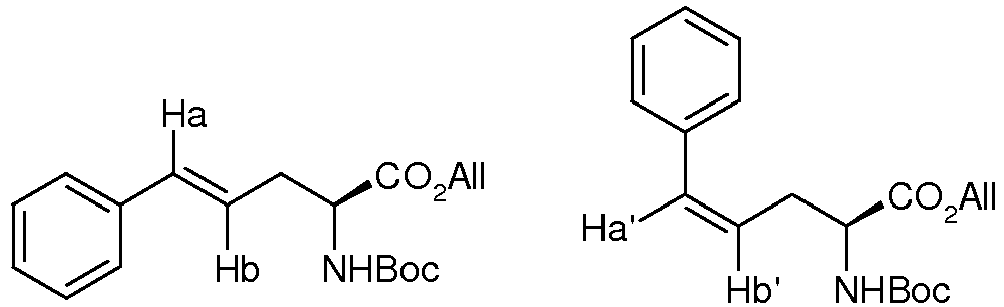
- To a solution of 140 mg (0.2 mmol) of phosphonium (II'a) in chlorobenzene (1,5 mL) were added successively 31 mg of benzaldehyde (0.3 mmol, 1.5eq.) and Cs2CO3 (370 mg, 1.2 mmol, 6 eq.). The reaction mixture was stirred 16 hours at 50°C, hydrolyzed with distillated water (5 mL) and extracted with ethyl acetate (3 x 5 mL). The organic layers were dried over magnesium sulfate, and the solvent evaporated under vacuum. The crude product was then purified by chromatography on silica with a mixture of ethyl acetate / petroleum ether (1 : 9 then 1 : 4) as eluent to afford the corresponding amino ester (I'a) in 83% yield in a ratio cis/trans = 88 : 12. Colorless oil. Enantiomeric excess = 83%*. 1H NMR (300 MHz, CDCl3) : δ(ppm) = 1.45-1.48 (2s, 18H, CH3), 2.87-3.20 (m, 2H, CH2), 5.12-5.18 (m, 1H, CHN), 5.63-5.72 (m, 0.12H, CH= cis), 6.13-6.24 (m, 0.88H, CH= trans), 6.45 (d, J = 15.8 Hz, 0.88H, CH=trans), 6.58 (d, J = 11.6 Hz, 0.12H, CH= cis), 7.18-7.37 (m, 5H, Harom), 10.7 (sl, 1H, COOH). * The enantiomeric purity was determined by HPLC (Lux 5u cellulose-2, hexane :iPrOH 98 : 2, 0.7 mL.min-1, λ = 254 nm, 20°C.
-

- To a solution of 300 mg (0.43 mmol) of phosphonium (II"f) in chlorobenzene (2.5 mL) were added successively 68 mg of benzaldehyde (0.65 mmol, 1.5eq.) and Cs2CO3 (706 mg, 2.2 mmol). The reaction mixture was stirred 16 hours at 50°C, hydrolyzed with distillated water (5 mL) and extracted with ethyl acetate (3 x 5 mL). The aqueous layer was acidified with a solution of KHSO4 (1M) until pH = 3, and extracted with ethyl acetate (3 x 5 mL). The organic layers were dried over magnesium sulfate, and the solvent evaporated under vacuum. The crude product was then purified by chromatography on silica with a mixture of ethyl acetate / petroleum ether (1 : 1) + 1% acetic acid as eluent to afford the corresponding amino acid in 87% yield. Colorless oil. Enantiomeric excess >99%. 1H NMR (300 MHz, CDCl3) : δ(ppm) = 1.53 (s, 9H, CH3), 2.64-2.95 (m, 2H, CH2), 4.42-4.49 (m, 1H, CHN), 4.60-4.62 (m, 2H, OCH2), 5.10-5.12 (m, 1H, NH), 5.22-5.37 (m, 2H, CH2=), 5.47-5.56 (m, 0.85H, CH= CH= cis), 5.80-5.99 (m, 1.15H, CH= + CH=CH= trans), 6.41 (d, J = 15.8 Hz, 0.15H, CH= CH= trans), 6.53 (d, J = 11.6 Hz, 0.85H, CH= CH= cis), 7.18-7.32 (m, 5H, Harom).
- To a solution of 120 mg (0.2 mmol) of phosphonium (II"a) in chlorobenzene (1,5 mL) were added successively aldehyde (0.4 mmol, 2 eq.), and K3PO4 (254 mg, 1.2 mmol, 6 eq.). The reaction mixture was stirred 16 hours at 90°C, hydrolyzed with distillated water (5 mL) and extracted with diethyl ether (3 x 5 mL). The aqueous layer was acidified with a solution of KHSO4 (1M) until pH = 3, and extracted with ethyl acetate (3 x 5 mL). The organic layers were dried over magnesium sulfate, and the solvent evaporated under vacuum. The crude product was then purified by chromatography on silica with a mixture of ethyl acetate / petroleum ether (3 :7) with 1% acetic acid as eluent to afford the corresponding amino acid (I").
Table 1. Wittig reactions of the phosphonium salt (II"a) with various aldehydes RCHO entry RCHO γ,δ-insaturated amino acids (I") Yield (%) a cis/trans (%) 1 
(I"a) 72 30 :70 2 
(I"b) 98 10 : 90 3 
(I"c) 75 15 : 85 4 
(I"d) 96 20 : 80 5 
(I"e) 67 24 : 76 6 
(I"f) 76 20 : 80 7 
(I"g) 80 _b 8 
(I"h) 57 _b 9 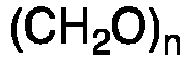
(I"i) 55 - 10 
(I"j) 10 _b 11 
(I"k) 57 25 : 75 12 
(I"l) 25 _b 13 
(I"m) 51c 50 : 50 14 
(I"n) 85 _b 15 
(I"o) 77 _b 16 
(I"p) 57 _b 17 
(I"q) 58 _b 18 
(I"r) 70 _b 19 
(I"s) 70 _b 20 
(I"t) 80 _b 21 
(I"u) 73 _b a isolated yield, e.e. > 98%. b ratio not determined. c isolated as methyl ester product -

- 120 mg of phosphonium salt (II"a) and 42.4 mg of benzaldehyde were used to afford the unsaturated amino acid (I"a) in 72% yield in a ratio cis / trans = 30 : 70. Pale yellow oil - Rf : 0.52 (Ethyl acetate / petroleum ether 3 : 7 + 1% acetic acid). Enantiomeric excess > 98%* - [α]D = +21.5 (c = 0.6 ; CHCl3). IR (cm-1): 3422 (N-H), 3026-2930 (CH2, CH3), 1711 (C=O), 1496, 1450, 1395, 1368, 1249, 1163, 1053, 1026, 966, 910, 853, 774, 735, 694, 648, 609. 1H NMR (300 MHz, CDCl3) : δ(ppm) = 1.45 (s, 9H, CH3), 2.65-2.81 (m, 1.4H, CH2 trans), 2.92-2.98 (m, 0.6H, CH2 cis), 4.28-4.38 (m, 0.3H, CHN cis), 4.49-4.51 (m, 0.7H, CHN trans), 5.05 (d, J = 8.1 Hz, 0.3H, NH cis), 5.12 (d, J = 7.8 Hz, 0.7H, NH trans), 5.60-5.69 (m, 0.3H, Hb'), 6.08-6.23 (m, 0.7H, Hb), 6.5 (d, J = 15.9 Hz, 0.7H, Ha), 6.63 (d, J = 11.7 Hz, 0.3H, Ha'), 7.22-7.38 (m, 5H, Harom). 13C NMR (75 MHz, CDCl3) : δ(ppm) = 28.3 (CH3), 31.1 (CH2 cis), 35.8 (CH2 trans), 53.1 (CHN), 80.2 (C(CH3)3 trans), 80.4 (C(CH3)3 cis), 123.5 (CH=), 125.6 (CH=), 126.3 (Carom), 126.4 (Carom), 127.1 (Carom), 127.6 (Carom), 128.3 (Carom), 128.4 (Carom), 128.5 (Carom), 128.6 (Carom), 128.7 (Carom), 129.7 (Carom), 130.2 (Carom), 132.8 (CH=), 134.2 (CH=), 136.8 (Carom), 155.6 (COO), 176.5 (COO). Mass exact calculated for C6H2NNa1O4 [M+Na]+: 314.1363, found 314.1343. *The enantiomeric purity was determined by HPLC after esterification with TMSCHN2 (Lux 5µm cellulose-2, hexane : iPrOH 98 : 2, 1.3 mL.min-1, λ = 210 nm, 20°C, tR (cis (S)) = 13.1 min, tR (trans (S)) = 16.5 min, tR (cis (R)) = 23.3 min, tR (trans (R) = 32.2 min).
-

- 120 mg of phosphonium salt (II"a) and 69.6 mg of 4-trifluoromethylbenzaldehyde were used to synthesize the unsaturated amino acid (I"b) in 98% yield in a ratio cis / trans = 10 : 90. White solid - Rf : 0.33 (Ethyl acetate / petroleum ether 3 : 7 + 1% acetic acid). Enantiomeric excess > 98%* - [α]D = +40.9 (c = 0.6 ; CHCl3). IR (cm-1) : 3352 (N-H), 2973-2925 (C-H), 1710 (C=O), 1681 (C=O), 1615, 1521, 1433, 1415, 1392, 1367, 1326 (CF3), 1287, 1267, 1252, 1159, 1108, 1084, 1069, 1046, 1025, 1016, 973, 951, 853, 834, 812, 779, 752, 693. 1H NMR (300 MHz, CDCl3) : δ(ppm) = 1.44 (s, 9H, CH3), 2.68-2.70 (m, 1H, CH2), 2.76-2.80 (m, 1H, CH2), 4.21-4.23 (m, 0.1H, CHN cis), 4.30-4.52 (m, 0.89 H CHN trans), 5.17 (d, J = 7.8 Hz, 0.9H, NH trans), 5.71-5.88 (m, 0.1H, Hb'), 6.22-6.27 (m, 0.9H, Hb), 6.52 (d, J = 15.6 Hz, 0.9H, Ha), 6.62 (d, J = 11.4 Hz, 0.1H, Ha'), 7.35 (d, J = 7.8 Hz, 0.2H, NH cis), 7.43 (d, J=8.1 Hz, 2H, Harom), 7.53-7.58 (m, 2H, Harom). 13C NMR (75 MHz, CDCl3) : δ(ppm) = 27.2 (CH2 cis ou trans), 28.2 (CH3),34.3 (CH2 cis or trans), 53.0 (CHN cis or trans), 54.4 (CHN cis or trans), 80.6 (C(CH3)3 cis or trans), 82.1 (C(CH3)3 cis or trans), 125.3 (q, J = 271.7 Hz, CF3), 125.3 (q, J = 6.8 Hz, Carom), 126.4 (Carom), 126.6 (Carom), 127.7 (CH= cis or trans), 128.2 (Carom), 128.6 (CH=), 128.8 (q, J = 31.7 Hz, Carom), 129.5 (CH= cis or trans), 129.6 (CH= cis or trans), 132.8 (Carom). Mass exact calculated for C17H19F3N2Na1O4 [M+H]+ : 358.1272, found 358.1256. The enantiomeric purity was determined by HPLC on chiral column after esterification with TMSCHN2 (Lux 5µm cellulose-2, hexane : iPrOH 95 : 5, 1 mL.min-1, λ = 210 nm, 20°C, tR (cis (S)) = 6.9 min, tR (trans (S)) = 8.2 min, tR (cis (R)) = 10.6 min, tR (trans (R)) = 17.2 min).
-

- 120 mg of phosphonium (II"a) and 60.4 mg of 4-nitrobenzaldehyde were used to afford the unsaturated amino acid (I"c) in 75% yield in a ratio cis / trans = 15 : 85. Orange oil - Rf : 0.33 (Ethyl acetate / petroleum ether 3 : 7 + 1% acetic acid). Enantiomeric excess > 98%* [α]D= +33.8 (c = 0.6 ; CHCl3). IR (cm-1): 3487 (N-H), 3059-2817 (C-H), 1703 (C=O), 1484, 1453, 1436, 1413, 1386, (N-O), 1366 (N-O), 1311, 1220, 1167, 1107, 1064, 1024, 1002, 954, 883, 823, 742, 698. 1H NMR (300 MHz, CDCl3) : δ(ppm) = 1.43 (s, 9H, CH3), 2.65-2.78 (m, 1H, CH2), 2.83-2.89 (m, 1H, CH2), 4.54-4.56 (m, 1H, CHN), 5.2 (m, d, J = 7.8 Hz, 0.85H, NH trans), 5.78-5.82 (m, 0.15H, Hb'), 6.30-6.54 (m, 0.85H, Hb), 6.56 (d, J = 15.6 Hz, 0.85H, Ha), 6.68 (d, J = 11.4 Hz, 0.15H, Ha'), 7.16 (d, J = 7.8 Hz, 0.15H, NH cis), 7.46 (d, J = 8.8 Hz, 2H, Harom), 8.14 (d, J = 8.4 Hz, 2H, Harom). 13C NMR (75 MHz, CDCl3): δ(ppm) = 27.2 (CH3), 28.7 (CH2 cis), 35.1 (CH2 trans), 51.9 (CHN trans), 53.2 (CHN cis), 79.6 (C(CH3)3 trans), 81.3 (C(CH3)3 cis), 122.6 (Carom cis), 122.9 (Carom trans), 125.8 (Carom trans), 128 (CH= trans), 129.8 (CH= cis), 130.2 (Carom cis), 131.1 (CH= trans), 133.8 (CH= cis), 142.2 (Carom trans), 145.6 (Carom cis), 145.9 (Carom trans), 149.9 (Carom cis), 154.4 (COO), 155.8 (COO), 174.9 (COO), 175.3 (COO). Mass exact calculated for C16H20N2NaO6 [M+Na]+ : 359.1214 ; found 359.1228. The enantiomeric purity was determined by HPLC after esterification with TMSCHN2 (Lux 5µm cellulose-2, hexane : iPrOH 90 : 10, 1 mL.min-1, λ = 210 nm, 20°C, tR (cis (S)) = 16.2 min, tR (trans (S)) = 20.4 min, tR (cis (R)) = 22.1 min, tR (trans (R)) = 34.2 min).
-

- 120 mg of phosphonium salt (II"a) and 52 mg of 4-cyanobenzaldehyde were used to synthesize the unsaturated amino acid (I"d) in 96% yield in a ratio cis / trans = 20 : 80. White solid - Rf : 0.31 (Ethyl acetate / petroleum ether 3 : 7 + 1% acetic acid). Enantiomeric excess > 98%* - [α]D = -21.5 (c = 0.3 ; CHCl3). IR (cm-1): 3416 (N-H), 3135-2865 (C-H), 2221 (CN), 1737 (C=O), 1662 (C=O), 1604, 1522, 1457, 1442, 1412, 1396, 1371, 1334, 1305, 1252, 1210, 1157, 1442, 1412, 1396, 1371, 1334, 1305, 1252, 1210, 1086, 1027, 974, 969, 951, 900, 850, 836, 805, 780, 745, 714, 642. 1H NMR (300 MHz, CDCl3) : δ(ppm) = 1.43 (s, 9H, CH3), 2.62-2.72 (m, 1H, CH2), 2.78-2.88 (m, 1H, CH2), 4.30-4.32 (m, 0.2H, CHN cis), 4.48-4.52 (m, 0.8H, CHN trans), 5.21 (d, J = 8.1 Hz, 0.8H, NH trans), 5.73-5.86 (m, 0.2H, Hb'), 6.24-6.34 (m, 0.8H, Hb), 6.50 (d, J = 15.6 Hz, 0.8H, Ha), 6.59 (d, J = 11.4 Hz, 0.2H, Ha'), 6.72 (d, J = 6.3 Hz, 0.2H, NH cis), 7.17-7.20 (m, 2H, Ph), 7.24-7.27 (m, 2H, Ph). 13C NMR (75 MHz, CDCl3) : δ(ppm) = 27.2 (CH3), 29.0 (CH2 cis or trans), 35.0 (CH2 cis or trans), 51.9 (CHN cis or trans), 53.1 (CHN cis or trans), 79.6 (C(CH3)3 cis or trans), 81.0 (C(CH3)3 cis), 109.6 (Carom cis), 109.7 (Carom trans), 117.8 (CN cis ou trans), 117.9 (CN cis or trans), 125.8 (C arom), 126.5 (CH= cis or trans), 127.1 (CH= cis or trans), 127.8 (Carom), 128.3 (Carom), 128.5 (Carom), 130.1 (Carom), 131.1 (Carom), 131.4 (Carom), 131.5 (CH= cis or trans), 132.3 (CH= cis or trans), 140.2 (Carom), 155.4 (COO), 174.9 (COO). Mass exact calculated for C17H20N2NaO4 [M+Na]+ : 339.1315, found 339.1299. The enantiomeric purity was determined by HPLC after esterification with TMSCHN2 (Lux 5µm cellulose-2, hexane : iPrOH 85 : 15, 1 mL.min-1, λ = 210 nm, 20°C, tR (cis (S)) = 16.3 min, tR (trans (S)) = 19.2 min, tR (cis (R)) = 23.8 min, tR (trans (R)) = 32.1 min).
-

- 120 mg of phosphonium salt (II"a) and 136 mg (1 mmol, 5 eq) of 4-methoxybenzaldehyde were used to afford the amino acid (I"e) in 67% yield in a ratio cis / trans = 24 : 76. Pale yellow oil - Rf : 0.42 (Ethyl acetate / petroleum ether 3 : 7 + 1% acetic acid). Enantiomeric excess > 98%* - [α]D = +12.3 (c = 0.5 ; CHCl3). IR (cm-1) : 3288 (N-H), 2978-2838 (C-H), 1713 (C=O), 1578 (C=O), 1512, 1456, 1441, 1394, 1368, 1289, 1248, 1174 (O-CH3), 1111, 1043, 968, 911, 839, 734, 633. 1H NMR (300 MHz, CDCl3) : δ(ppm) = 1.44 (s, 9H, CH3), 2.56-2.79 (m, 1.5H, CH2 trans), 2.94-2.99 (m, 0.5H, CH2 cis), 3.81 (s, 3H, OCH3), 4.33-4.43 (m, 1H, CHN cis + trans), 5.03-5.13 (m, 1H, NH cis + trans), 5.52-5.58 (m, 0.24H, Hb'), 5.93-6.02 (m, 0.76H, Hb), 6.43 (d, J = 15.6 Hz, 0.76H, Ha), 6.54 (d, J = 11.4 Hz, 0.24H, Ha'), 6.83-6.89 (m, 2H, Harom), 7.17-7.22 (m, 1H, Harom), 7.29-7.32 (m, 1H, Harom). 13C NMR (75 MHz, CDCl3) : δ(ppm) = 28.3 (CH3), 31.1 (CH2 cis), 35.7 (CH2 trans), 53.1 (CHN), 55.3 (OCH3), 80.5 (C(CH3)3 trans), 80.6 (C(CH3)3 cis), 113.8 (Carom), 114.0 (Carom), 121.1 (CH=), 123.9 (CH=), 125.3 (Carom), 127.5 (Carom), 128.3 (Carom), 129.0 (Carom), 129.7 (Carom), 130.0 (Carom), 132.2 (CH=), 133.7 (CH=), 137.9 (Carom), 155.8 (COO), 158.6 (Carom-OCH3 cis), 159.2 (Carom-OCH3 trans), 176.8 (COO). Mass exact calculated for C17H23N1Na1O5 [M+Na]+: 344.1468, found 344.1448. *The enantiomeric purity was determined by HPLC on chiral column after esterification with TMSCHN2 (Lux 5µm cellulose-2, hexane : iPrOH 95 : 5, 1.5 mL.min-1, λ = 254 nm, 20°C, tR (cis (R)) = 8.3 min, tR (trans (R)) = 10.4 min, tR (cis (S)) = 13.1 min, tR (trans (S)) = 16.7 min).
-

- 120 mg of phosphonium salt (II"a) and 200 mg (1.2 mmol, 6 eq) of 3,4-dimethoxybenzaldehyde were used to prepare the unsaturated amino acid (I"f) in 76% yield in a ratio cis / trans = 20: 80. Pale yellow oil - Rf : 0.44 (Ethyl acetate / petroleum ether 1 : 1 + 1% acetic acid). Enantiomeric excess > 98%* - [α]D = +52.6 (c = 0.5 ; CHCl3). IR (cm-1) : 3293 (N-H), 2975-2824 (C-H), 1743 (C=O), 1704 (C=O), 1604, 1515, 1463, 1393, 1265 (OCH3), 1088, 1024, 964, 855, 783, 738, 656. 1H NMR (300 MHz, CDCl3): δ(ppm) = 1.43 (s, 9H, CH3), 2.59-2.81 (m, 1.6H, CH2 trans), 2.85-2.99 (m, 0.4H, CH2 cis), 3.88 (s, 3H, OCH3), 3.90 (s, 3H, OCH3), 4.24-4.27 (m, 0.24H, CHN cis), 4.47 (m, 0.74H, CHN trans), 5.07 (d, J = 7.8 Hz, 0.7H, NH trans), 5.52-5.60 (m, 0.2H, Hb'), 5.94-6.04 (m, 0.8H, Hb), 6.2 (sl, 0.2H, NH cis), 6.44 (d, J = 15.6 Hz, 0.8H, Ha), 6.55 (d, J = 11.4 Hz, 0.2H, Ha'), 6.79-6.92 (m, 3H, Harom). 13C NMR (75 MHz, CDCl3) : δ(ppm) = 28.3 (CH3)3, 31.1 (CH2 cis), 35.7 (CH2 trans), 53.1 (CHN), 55.8 (OCH3), 55.9 (OCH3), 80.4 (C(CH3)3 trans), 81.7 (C(CH3)3 cis), 108.8 (Carom), 111.1 (Carom), 121.3 (CH= cis), 121.4 (CH= trans), 125.3 (Carom), 128.2 (Carom), 129 (Carom), 129.6 (Carom), 129.9 (Carom), 132.5 (CH= cis), 133.9 (CH= trans), 148.1 (Carom-OCH3 cis), 148.6 (Carom-OCH3 trans), 148.8 (Carom-OCH3 cis), 149.0 (Carom-OCH3 trans), 155.6 (COO), 176.7 (COO). Mass exact calculated for C18H24NNa2O6 [M+2Na]+ : 396.1393, found 396.1403. *The enantiomeric purity was determined by HPLC after esterification with TMSCHN2 (Lux 5µm cellulose-2, hexane : iPrOH 95 : 5. 1.5 mL.min-1, λ = 254 nm, 20°C, tR (cis (R)) = 8.3 min, tR (trans (R)) = 10.4 min, tR (cis (S)) = 13.1 min, tR (trans (S)) = 16.7 min).
-
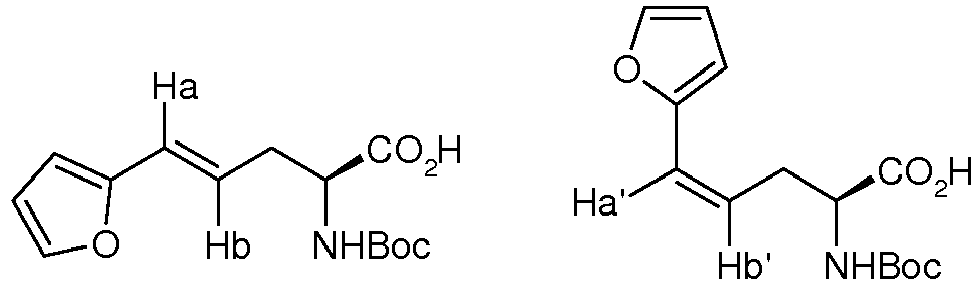
- 120 mg of phosphonium salt (II"a) and 38.4 mg of 2-furaldehyde were used to synthesize the unsaturated amino acid (I"g) in 80% yield. Pale yellow oil - Rf : 0.40 (Ethyl acetate / petroleum ether 3 : 7 + 1% acetic acid). Enantiomeric excess > 98%* - [α]D = +43.3 (c = 0.4 ; CHCl3). IR (cm-1) : 3338 (N-H), 2978-2931 (C-H), 1780, 1694 (C=O), 1511, 1455, 1393, 1367, 1254, 1157 (C-O), 1349, 1017, 925, 863, 811, 735, 702, 653. 1H NMR (300 MHz, CDCl3): δ(ppm) = 1.45 (s, 9H, CH3), 2.58-2.78 (m, 1H, CH2), 2.90-3.16 (m, 1H, CH2), 4.20-4.27 (m, 0.4H, CHN cis or trans), 4.34-4.48 (m, 0.6H, CHN cis or trans), 5.12-5.14 (m, 0.6H, NH cis or trans), 5.45-5.54 (m, 0.4H, Hb or Hb'), 6.00-6.10 (m, 0.6H, Hb or Hb'), 6.21 (d, J = 3.3 Hz, 1H, Hfuryl), 6.35-6.41 (m, 3H, Ha, Ha', Hfuryl), 7.17-7.20 (m, 0.4H, NH cis or trans) 7.36 (dd, J = 21.9, 1.2 Hz, 1H, Hfuryl). 13C NMR (75 MHz, CDCl3) : δ(ppm) = 28.3 (CH3)3, 31.8 (CH2 cis or trans), 35.5 (CH2 cis or trans), 53.1 (CHN cis or trans), 54.5 (CHN cis or trans), 80.4 (C(CH3)3 cis or trans), 81.7 (C(CH3)3 cis or tans), 107.5 (Cfuryl cis or trans), 110.2 (Cfuryl cis or trans), 111.1 (Cfuryl cis or trans), 111.2 (Cfuryl cis or trans), 120.5 (CH= cis or trans), 122.2 (CH= cis or trans), 122.6 (CH= cis or trans), 123.1 (CH= cis or trans), 141.8 (Cfuryl cis or trans), 142.0 (Cfuryl cis or trans), 152.3 (Cfuryl cis or trans), 152.6 (Cfuryl cis or trans), 155.5 (COO), 155.7 (COO), 176.3 (COO), 176.8 (COO). Mass exact calculated for C14H18N1O5 [M+H]+ : 280.1190 ; found 280.1188. * The enantiomeric purity was determined by HPLC after esterification with TMSCHN2 (Lux 5µm cellulose-2, hexane : iPrOH 95 : 5,1 mL.min-1, λ = 254 nm, 20°C, tR (cis + trans (S)) = 10.2 min, tR (cis or trans (R)) = 14.5 min, tR (cis or trans (R)) = 16 min).
-

- 120 mg phosphonium salt (II"a) and 120 mg (0.88 mmol, 4.4 eq) of 3-phenylpropanal were used to afford the unsaturated amino acid (I"h) in 57% yield. Orange solid - Rf : 0.48 (Ethyl acetate / petroleum ether 3 : 7 + 1% acetic acid). Enantiomeric excess > 98%* - [α]D = +54.0 (c = 0.2 ; CHCl3). IR (cm-1): 3235 (N-H), 3077-2808 (C-H), 2326, 1652 (C=O), 1497, 1454, 1394, 1368, 1055, 983, 817, 736, 698, 649. 1H NMR (300 MHz, CDCl3) : δ(ppm) = 1.46 (s, 9H, CH3), 2.34-2.49 (m, 3H, CH2), 2.57-2.72 (m, 3H, CH2), 4.35-4.38 (m, 1H, CHN), 4.95 (d, J = 7.2 Hz, 1H, NH), 5.32-5.40 (m, 1H, CH=), 5.62-5.68 (m, 1H, CH=), 7.11-7.23 (m, 3H, Harom), 7.27-7.34 (m, 2H, Harom). 13C NMR (75 MHz, CDCl3) : δ(ppm) = 28.3 (CH3), 29.2 (CH2 cis or trans), 29.7 (CH2 cis or trans), 30.9 (CH2 cis or trans), 32.0 (CH2 cis or trans), 34.3 (CH2 cis or trans), 35.7 (CH2 cis or trans), 53.0 (CHN), 79.2 (C(CH3)3), 123.3 (CH= cis or trans), 125.9 (CH= cis or trans), 128.3 (Carom), 128.5 (Carom), 128.7 (Carom), 133.4 (CH= cis or trans), 134.8 (CH= cis or trans), 141.6 (Carom), 155.8 (COO), 176.9 (COO). Mass exact calculated for C18H25NNaO4 [M+Na]+: 342.1676; found 342.1647. * The enantiomeric purity was determined by HPLC after esterification with TMSCHN2 (Lux 5µm cellulose-2, hexane : iPrOH 95 : 5, 1 mL.min-1, λ = 254 nm, 20°C, tR (cis or trans (S)) = 6.9 min, tR (cis or trans (S)) = 7.8 min, tR (cis or trans (R)) = 10.2 min, tR (cis or trans (R)) = 12.7 min).
-

- 120 mg of phosphonium salt (II"a) and 12 mg of paraformaldehyde were used to afford the allylglycine (I"i) in 55% yield. Colorless oil - Rf : 0.39 (Ethyl acetate / petroleum ether 3 : 7 + 1% acetic acid). Enantiomeric excess > 98%* - [α]D = + 13.5 (c = 0.2 ; CHCl3). IR (cm-1) : 3313 (N-H), 3082-2932 (C-H), 1703 (C=O), 1662 (C=O), 1509, 1439, 1394, 1368, 1250, 1157, 1050, 1024, 993, 920, 855, 778, 754, 739, 655. 1H NMR (300 MHz, CDCl3) : δ(ppm) = 1.46 (s, 9H, CH3), 2.57-2.67 (m, 2H, CH2), 4.10-4.42 (m, 1H, CHN), 5.04 (d, J = 7.5 Hz, 0.7H, NH), 5.16-5.36 (m, 2H, CH2=), 5.69-5.87 (m, 1H, CH=), 6.12 (d, J = 7.5 Hz, 0.3H, NH). 13C NMR (75 MHz, CDCl3): δ(ppm) = 27.4 (CH3), 35.3 (CH2), 51.8 (CHN), 79.3 (C(CH3)3), 118.4 (CH2=), 131.1 (CH=), 155.5 (COO), 175.7 (COO). Mass exact calculated for C10H17NNaO4 [M+Na]+: 238.1050, found 238.1039. *The enantiomeric purity was determined by HPLC after esterification with TMSCHN2 (Lux 5µm cellulose-2, hexane : iPrOH 98 : 2, 1 mL.min-1, λ = 210 nm, 20°C, tR (S) = 12.2 min, tR (R) = 20.2 min).
-

- 120 mg of phosphonium salt (II"a) and 48 mg of phenylacetaldehyde were used to afford the unsaturated amino acid (I"j) in 10% yield. Colorless oil. Enantiomeric excess > 98%* - [α]D = + 49 (c = 0.2 ; CHCl3). IR (cm-1) : 3446, 3054, 2824, 1714, 1496, 1395, 1368, 1163, 1053, 741, 698, 602. Mass exact calculated for C17H23NNaO4 [M+Na]+ : 328.1519, found 328.1502. * The enantiomeric purity was determined by HPLC after esterification with TMSCHN2 (Lux 5µm cellulose-2, hexane : iPrOH 97 : 3, 1 mL.min-1, λ = 210 nm, 20°C, , tR (cis or trans (S)) = 12.1 min, tR (cis or trans (S)) = 14.7 min, tR (cis or trans (R)) = 21.5 min, tR (cis or trans (R)) = 28.1 min).
-

- 120 mg of phosphonium salt (II"a) and 93 mg of 4-(4,4,5,5-Tetramethyl-1,3,2-dioxaborolan-2-yl)benzaldehyde prepared by reaction of pinacol with 4-formylbenzeneboronic acid, were used to prepare the unsaturated amino acid (I"k) in 57% yield in a ratio cis / trans = 25 : 75. Colorless oil - Rf : 0.40 (Ethyl acetate / petroleum ether 3 : 7 + 1% acetic acid). Enantiomeric excess > 98%* - [α]D = +12.8 (c = 0.6 ; CHCl3). IR (cm-1): 3346 (N-H), 2979-2931 (C-H), 1714 (C=O), 1608, 1515, 1496, 1455, 1397, 1358, 1321, 1270, 1214, 1143 (C-O), 1089, 1052, 1019, 963, 859, 787, 696, 656, 607, 546, 540, 535, 524, 517. 1H NMR (300 MHz, CDCl3) : δ(ppm) = 1.36 (s, 12H, (CH3)2), 1.44 (s, 9H, CH3), 2.67-2.80 (m, 2H, CH2), 4.48-5.13 (m, 1H, CHN), 5.16-6.18 (m, 1H, NH), 5.61-5.73 (m, 0.25H, Hb'), 6.10-6.25 (m, 0.75H, Hb), 6.51 (d, J = 15.6 Hz, 0.75H, Ha), 6.63 (d, J = 12.3 Hz, 0.25H, Ha'), 7.15-7.41 (m, 4H, Harom). 13C NMR (75 MHz, CDCl3): δ(ppm) = 24.8 ((CH3)2), 28.3 (CH3), 31.2 (CH2 cis), 35.9 (CH2 trans), 53.1 (CHN trans), 54.4 (CHN cis), 80.4 (C(CH3)3 trans), 81.7 (C(CH3)3 cis), 83.8 (C(CH3)2), 116.0 (Carom), 124.8 (Carom), 125.3 (CH= cis), 125.6 (CH= trans), 126.4 (Carom), 128.0 (Carom), 128.2 (Carom), 129.0 (Carom), 129.4 (Carom), 131.6 (Carom), 132.5 (Carom), 134.2 (Carom), 134.8 (CH= cis or trans), 135.1 (CH= cis or trans), 137.9 (Carom), 139.5 (Carom), 155.6 (COO), 176.1 (COO). Mass exact calculated for C22H32BNNaO6 [M+Na]+ : 440.2219, found 440.2215. *The enantiomeric purity was determined by HPLC after esterification with TMSCHN2, (Lux 5µm cellulose-2, hexane : iPrOH 90 : 10, 1 mL.min-1, λ = 210 nm, 20°C, tR (trans (S)) = 6.9 min, tR (cis (S)) = 7.8 min, tR (trans (R)) = 10.2 min, tR (cis (R)) = 12.7 min).
-

- 120 mg of phosphonium salt (II"a) and 248 mg aldehyde derived from calix-[4]arene were used to prepare the unsaturated amino acid (I"l) in 25% yield. Colorless oil - Rf : 0.47 (Ethyl acetate / petroleum ether 3 : 7 + 1% acetic acid). Enantiomeric excess > 98%* - [α]D = + 7.5 (c = 0.4 ; CHCl3). IR (cm-1) : 3066 (N-H), 2957-2875 (C-H), 1716 (C=O), 1625, 1499, 1465, 1396, 1393, 1367, 1303, 1275, 1242, 1217, 1167, 1127 (OPr), 1086,1039, 1005, 966, 917, 891, 831, 760, 726, 691, 665. 1H NMR (300 MHz, CDCl3) : δ(ppm) = 0.98-1.03 (m, 12H, CH3, OPr), 1.47 (s, 9H, CH3), 1.94 (m, 8H, CH2, OPr), 2.57-2.72 (m, 2H, CH2), 3.16 (m, 4H, Ar-CH2-Ar), 3.80 (m, 4H, CH2O, OPr), 3.90 (m, 4H, CH2O, OPr), 4.35 (d, J = 3.3 Hz, 1H, CHN cis or trans), 4.45 (m, 4H, ArCH2-Ar), 4.90 (d, J = 7.8 Hz, 1H, NH), 5.03 (d, J = 7.2 Hz, 1H, CHN cis or trans), 5.34 (m, 1H, CH=), 5.80 (m, 1H, CH=), 6.20-6.90 (m, 11H, Harom). 13C NMR (75 MHz, CDCl3) : δ(ppm) = 10.1 (CH3, OPr cis or trans), 10.2 (CH3, OPr cis or trans), 10.4 (CH3, OPr cis or trans), 10.5 (CH3, OPr cis or trans), 23.1 (CH2, OPr cis or trans), 23.2 (CH2, OPr cis or trans), 23.3 (CH2, OPr cis or trans), 23.4 (CH2, OPr cis or trans), 28.3 (CH3), 29.6 (CH2 cis or trans), 29.7 (CH2 cis or trans), 31.0 (Ar-CH2-Ar), 53.1 (CHN cis or trans), 53.1 (CHN cis or trans), 76.7 (OCH2, OPr), 76.8 (OCH2, OPr), 80.4 (C(CH3)3), 115.3 (Carom cis or trans), 121.8 (Carom cis or trans), 121.9 (Carom cis or trans), 126.3 (Carom cis or trans), 126.5 (Carom cis or trans), 127.8-128.7 (m, Carom), 129.6 (Carom cis or trans), 130.1 (Carom cis or trans), 130.4 (Carom cis or trans), 132.8 (Carom cis or trans), 134.4 (Carom cis or trans), 134.5 (Carom cis or trans), 134.7 (Carom cis or trans), 135.5 (Carom cis or trans), 135.7 (Carom cis or trans), 156.3 (COO), 176.7 (COO). Mass exact calculated for C10H17N1Na1O4 [M+Na]+ : 828.4446, found 828.4420. *The enantiomeric purity was determined by HPLC after esterification with TMSCHN2 (Lux 5µm cellulose-2, hexane : iPrOH 98 : 2, 0.8 mL.min-1, λ = 254 nm, 20°C, tR (cis or trans (S)) = 14.6 min, tR (cis or trans (S)) = 21.4 min, tR (cis or trans (R)) = 30.8 min, tR (cis or trans (R)) = 39.2 min).
-

- 120 mg of phosphonium salt (II"a) and 214 mg (1 mmol, 5 eq.) of ferrocene-carboxaldehyde were stirred at 90°C with 254 mg (1.2 mmol, 6 eq) of K3PO4 during 16 hours. The reaction mixture was hydrolyzed by distillated water (5 mL) and extracted with diethyl ether (3 x 5 mL). The aqueous layer was acidified with KHSO4 (1M) until pH = 3, and extracted with ethyl acetate (3x5 mL). The combined organic layers were dried over magnesium sulfate and the solvent was evaporated. The crude product was dissolved in 2 mL of a mixture toluene / methanol (3 : 2), and 0.13 mL (0.25 mmol) TMSCHN2 were added. The reaction mixture was stirred 30 minutes at room temperature, and the solvent evaporated. The residue was purified by chromatography with ethyl acetate / petroleum ether (3 : 7) as eluent. Ferrocenyl amino ester (I"m) was obtained in 51% yield with a ratio cis / trans = 50 : 50. Orange oil - Rf : 0.42 (Ethyl acetate / petroleum ether 1 : 4). [α]D = + 133 (c = 0.1 ; CHCl3). IR (cm-1) : 3390 (N-H), 2927-2854 (C-H), 1779 (C=O), 1695 (C=O), 1509, 1455, 1392, 1366, 1251, 1158, 1106, 1048, 1023, 1001, 821, 734, 662. 1H NMR (300 MHz, CDCl3) : δ(ppm) =1.46-1.47 (2s, 9H, CH3 cis and trans), 2.47-2.87 (2m, 2H, CH2), 3.76-3.79 (2s, 3H, OCH3 cis and trans), 4.12-4.14 (2s, 5H, Fc, cis and trans), 4.20-4.24 (2m, 2H, Fc, cis and trans), 4.30-4.35 (2m, 2H, Fc, cis and trans), 4.38-4.47 (m, 1H, CHN), 5.06-5.12 (m, 1H, NH), 5.33-5.39 (m, 1H, CH=), 5.58-5.68 (m, 1H, CH=), 6.22 (d, J = 15.6 Hz, 0.52H, CH= trans), 6.26 (d, J = 11.8 Hz, CH=, cis). 13C NMR (75 MHz, CDCl3) : δ(ppm) = 28.3 (CH3), 31.7 (CH2), 35.8 (CH2 cis or trans), 52.3 (OCH3 cis or trans), 52.4 (OCH3 cis or trans), 53.0 (CHN, cis or trans), 53.1 (CHN, cis or trans), 66.6 (CH, Fc, cis or trans), 66.7 (CH, Fc, cis or trans), 68.6 (CH, Fc cis or trans), 68.7 (CH, Fc, cis or trans), 68.8 (CH, Fc cis or trans), 68.9 (CH, Fc cis or trans), 69.0 (CH, Fc cis or trans), 69.3 (CH, Fc cis or trans), 81.0 (C(CH3)3), 82.7 (C(CH3)3), 120.4 (CH= cis or trans), 121.7 (CH= cis or trans), 130.1 (CH= cis or trans), 131.8 (CH= cis or trans), 155.2 (COO, cis or trans), 155.3 (COO, cis or trans), 172.6 (COO, cis or trans), 173 (COO, cis or trans). Mass exact calculated for C21H27FeNNaO4 [M+Na]+ : 436.1182, found 436.1193. * The enantiomeric purity was determined by HPLC (Lux 5µm cellulose-2, hexane : iPrOH 97 : 3, 0.8 mL.min-1, λ = 254 nm, 20°C, tR (cis (S)) = 27.4 min, tR (trans (S)) = 30.7 min, tR (cis + trans (R)) = 43.1 min).
-

- 120 mg phosphonium salt (II"a) and 13.4 mg (0.1 mmol, 0.5 eq.) of m-phthaldialdehyde were used to prepare the unsaturated amino acid (I"n) in 85% yield. White solid - Rf : 0.23 (Ethyl acetate / petroleum ether 3 : 7 + 1% acetic acid). Enantiomeric excess > 98%* - [α]D = +82.6 (c = 0.5 ; CHCl3). IR (cm-1) : 3555 (N-H), 3407 (N-H), 3056-3407 (C-H), 2326, 2244, 2030, 1949, 1583 (C=O), 1573 (C=O1493, 1471, 1462, 1431, 1296, 1273, 1241, 1180, 1129, 1108, 1070, 1022, 909, 851, 824, 795, 731, 698. 1H NMR (300 MHz, CDCl3): δ(ppm) = 1.44 (s, 18H, CH3), 2.59-2.89 (m, 4H, CH2), 4.14-4.70 (m, 2H, CHN cis + trans), 5.26-5.32 (m, 1H, NH), 5.63-5.71 (m, 1H, CH=), 6.01-6.06 (m, 1H, CH=), 6.35-6.54 (m, 2H, CH=), 7.01-7.07 (m, 1H, NH), 7.08-7.11 (m, 2H, Harom), 7.14-7.18 (m, 2H, Harom). 13C NMR (75 MHz, CDCl3) : δ(ppm) = 28.3 (CH3), 31.3 (CH2), 35.7 (CH2), 53.1 (CHN cis or trans), 54.5 (CHN cis or trans), 80.4 (C(CH3)3), 125 .3 (Carom), 126.0 (CH= cis or trans), 126.1 (CH= cis or trans), 127.5 (CH= cis or trans), 127.9 (Carom), 128.3 (CH= cis or trans), 128.5 (CH= cis or trans), 129.0 (Carom), 132.4 (CH= cis or trans), 134.1 (CH= cis or trans), 137.0 (Carom), 137.1 (Carom), 137.9 (Carom), 155.6 (COO), 156.8 (COO), 175.9 (COO). Mass exact calculated for C26H36N2NaO8 [M+Na]+ : 527.2364 ; found 527.2372. *The enantiomeric purity was determined by HPLC after esterification with TMSCHN2 and hydrogenation (Lux 5µm cellulose-2, hexane : iPrOH 90 : 10, 1 mL.min-1, λ = 210 nm, 20°C, tR (SS) = 14.3 min, tR (RS + SR) = 21.7 min, tR (RR) = 32.2 min).
-

- 120 mg of phosphonium salt (II"a) and 53 mg of trans-cinnamaldehyde were used to synthesize the unsaturated amino acid (I"o) in 77% yield. White solid - Rf : 0.53 (Ethyl acetate / petroleum ether 3 : 7 + 1% acetic acid). Enantiomeric excess > 98%* - [α]D = +33.6 (c = 0. 8 ; CHCl3). IR (cm-1) : 3319 (N-H), 3083-3853 (C-H), 1710 (C=O), 1496, 1450, 1393, 1368, 1251, 1159, 1056, 1027, 989, 948, 920, 857, 807, 778, 752, 731, 694. 1H NMR (300 MHz, CDCl3) : δ(ppm) = 1.44-1.47 (2s, 9H, CH3 cis or trans), 2.47-2.94 (m, 1H, CH2), 4.14-4.33 (m, 0.3H, CHN cis or trans), 4.45-4.53 (m, 0.7H, CHN cis or trans), 5.04-5.20 (m, 1H, CH= cis or trans or NH), 6.27-6.38 (m, 0.7H, CH= cis or trans or NH), 6.49-6.62 (m, 1H, CH cis or trans or NH), 6.76 (dd, J = 10.2, 15.6 Hz, 0.7H, CH= cis or trans), 7.03 (dd, J = 11.4, 15.6 Hz, 0.3H, CH= cis or trans), 7.18-7.36 (m, 5H, Harom).13C NMR (75 MHz, CDCl3) : δ(ppm) = 27.3 (CH3), 31.9 (CH2 cis or trans), 35.6 (CH2 cis or trans), 53.1 (CHN cis or trans), 54.6 (CHN cis or trans), 79.4 (C(CH3)3 cis or trans), 80.8 (C(CH3)3 ci or trans), 122.5 (Carom), 123.8 (CH= cis or trans), 124.0 (CH= cis or trans), 124.3 (Carom), 125.3 (Carom), 125.5 (Carom), 126.5 (Carom), 126.7 (Carom), 127.2 (Carom), 127.4 (Carom), 127.6 (Carom), 128 (Carom), 130.9 (CH= cis or trans), 131.4 (CH= cis or trans), 131.9 (CH= cis or trans), 133 (CH= cis or trans), 133.5 (CH= cis or trans), 133.6 (CH= cis or trans), 136.1 (Carom), 136.8 (Carom), 154.5 (COO), 155.7 (COO cis or trans), 175.2 (COO cis or trans), 175.5 (COO cis or trans). Mass exact calculated for C17H19F3N2NaO4 [M-H]-: 316.1554, found 316.1560. * The enantiomeric purity was determined by HPLC after esterification with TMSCHN2 (Lux 5µm cellulose-2, hexane : iPrOH 95 : 5, 1 mL.min-1, λ = 210 nm, 20°C, tR (cis or trans (S)) = 20.1 min, tR (cis or trans (S)) = 29 min, tR (cis or trans (R)) = 32.2 min, tR (cis or trans (R)) = 61.2 min).
-

- 120 mg of phosphonium salt (II"a) and 69.2 mg of (E)-4-azidophenylprop-2-enal were used to afford the unsaturated amino acid (I"p) in 56% yield. Red solid - Rf : 0.43 (Ethyl acetate / petroleum ether 3 : 7 + 1% acetic acid). Enantiomeric excess > 98%* - [α]D = +81.6 (c = 0.4 ; CHCl3). IR (cm-1) : 3346 (N-H), 2925-2854 (C-H), 2114 (N3), 1706 (C=O), 1598, 1504, 1454, 1393, 1367, 1284, 1259, 1157, 1127, 1053, 1025, 986, 948, 825, 789, 754, 699. 1H NMR (300 MHz, CDCl3) : δ(ppm) = 1.43-1.46 (2s, 9H, CH3 cis and trans), 2.62-2.90 (m, 2H, CH2), 4.26-4.33 (m, 0.25H, CHN cis or trans), 4.44-4.46 (m, 0.75H, CHN cis or trans or NH), 5.42-5.50 (m, 0.55H, CH= cis or trans or NH), 5.67-5.77 (m, 0.5H, CH= cis or trans or NH), 6.24-6.38 (m, 1H, CH= cis or trans), 6.42-6.56 (m, 1H, CH= cis or trans), 6.65-6.70 (m, 0.53H, CH= cis or trans), 6.97 (dd, J = 8.4, 3.0 Hz, 2H, Harom), 7.38 (dd, J = 8.4, 13.2 Hz, 2H, Harom). 13C NMR (75 MHz, CDCl3) : δ(ppm) = 27.3 (CH3), 28.7 (CH2 cis or trans), 29.5 (CH2 cis or trans), 52.1 (CHN), 79.4 (C(CH3)3), 118.2 (Carom), 122.2 (Carom), 124.0 (CH= cis or trans), 124.3 (CH= cis or trans), 126.5 (Carom), 126.9 (Carom), 127.2 (CH= cis or trans),128.1 (CH= cis or trans), 130.0 (Carom), 131.6 (Carom), 131.7 (Carom), 132.3 (Carom), 133.1 (Carom), 133.5 (Carom), 137.9 (Carom), 138.1 (Carom), 154.5 (COO), 175.3 (COO). Mass exact calculated for C18H21N4Na2O4 [M-H+2Na]+ = 403.1358, found 403.1303. * The enantiomeric purity was determined by HPLC after esterification with TMSCHN2 (Lux 5u cellulose-2, hexane : iPrOH 95 : 5, 1 mL.min-1, λ = 254 nm, 20°C, tR (cis or trans (S)) = 12.2 min, tR (cis or trans (S) + tR (cis or trans (R)) = 16.2 min, tR (cis or trans (R)) = 30.4 min).
-

- 120 mg of phosphonium salt II"a and 26 mg of ethyl 4-oxo-2-butenoate were used to afford unsaturated aminoacid I"q in 58% yield as a pale yellow oil - Rf : 0.36 (Ethyl acetate / petroleum ether 3 : 7 + 1% acetic acid); 1H NMR (300 MHz, CDCl3) : δ(ppm) = 1.22 (t, 3H, J = 36.6 Hz, CH3), 1.45 (s, 9H, (CH3)3), 2.40-2.79 (m, 2H, CH2), 4.12 (q, J = 7.54 Hz, CH2), 4.32-4.39 (m, 1H, CHN), 4.93-4.99 (m, 1H, NH), 5.77 (d, 0.8H, J = 13.9 Hz, CH= cis or trans), 5.87 (d, J = 13.4 Hz, 0.2H, CH= cis or trans), 5.91-6.03 (m, 1H, CH=), 6.15-6.24 (m, 1H, CH=), 6.16-6.24 (m, 1H, CH=); 13C NMR (75 MHz, CDCl3) : δ(ppm) = 14.2 (CH3), 29.3 ((CH3)3), 39.9 (CH2),52.8 (CHN), 60.5 (CH2O), 80.5 (C(CH3)3), 121.1 (CH= cis or trans), 122.9 (CH= cis or trans), 128.8 (CH= cis or trans), 130.9 (CH= cis or trans), 132.1 (CH= cis or trans), 136.6 (CH= cis or trans), 138.5 (CH= cis or trans), 143.8 (CH= cis or trans), 155.5 (COO), 167.1 (COO).
-

- 120 mg of phosphonium salt II"a and 84 mg of 3-methyl-2-butenal were used to afford the unsaturated amino acid I"r in 70% yield as a colorless oil - Rf : 0.51 (Ethyl acetate / petroleum ether 3 : 7 + 1% acetic acid) - [α]D = +70.7 (c = 0.75; CHCl3); 1H NMR (300 MHz, CDCl3) : δ(ppm) = 1.36 (s, 9H, (CH3)3), 1.68 (d, J = 5.82 Hz, 6H, CH3), 2.51-2.66 (m, 2H, CH2), 4.19-4.33 (m, 2H, CHN,) 4.89-5.01 (m, 1H, NH), 5.31-5.49 (m, 1H, CH=), 5.72 (d, 0.8H, J = 11.16 Hz, CH= cis or trans), 5.95 (d, J = 12.1 Hz, CH= cis or trans), 6.21-6.32 (m, 1H, CH=); 13C NMR (75 MHz, CDCl3) : δ(ppm) = 25.9 (CH3), 26.3 (CH3), 28.3 ((CH3)3), 29.7 (CH2 cis or trans), 30.0 (CH2 cis or trans), 53.7 (CHN), 80.1 (C(CH3)3), 119.8 (CH= cis or trans), 121.8 (CH= cis or trans), 124.4 (CH= cis or trans), 124.6 (CH= cis or trans), 128.0 (CH= cis or trans), 128.5 (CH= cis or trans), 130.8 (CH= cis or trans), 134.8 (C= cis or trans), 137.0 (C= cis or trans), 155.8 (COO), 176.7 (COO); Mass exact calculated for C14H22NO4 [M-H]+: 268.1543, found 268.1550.
-

- 120 mg of phosphonium salt II"a and 53 mg of 4-nitro-trans-cinnamaldehyde were used to synthesize the unsaturated amino acid I"s in 70% yield as a yellow solid - Rf : 0.46 (Ethyl acetate / petroleum ether 3 : 7 + 1% acetic acid) - Enantiomeric excess > 98%* - [α]D = +61.6 (c = 0. 25 ; CHCl3); 1H NMR (300 MHz, CDCl3) : δ(ppm) = 1.34-1.7 (2s, 9H, CH3 cis or trans), 2.47-2.94 (m, 1H, CH2), 4.25-4.39 (m, 1H, CHN), 4.99-4.01 (m, 1H, NH), 5.51-5.60 (m, 0.2 H, CH=), 5.75-5.85 (m, 0.8H, CH= cis or trans), 6.21-6.31 (m, 1H, CH= cis or trans), 6.45 (d, 0.8H, J = 15.9 Hz, CH= cis or trans), 6.52 (d, 0.2 H, J = 15.6 Hz, CH= cis or trans), 6.76-6.85 (m, 1H, CH= cis or trans), 7.41 (d, J = 8.7 Hz, 1.6H, Harom cis or trans), 7.45 (d, J = 8.74 Hz, 0.4H, Harom), 8.08-8.10 (2d, 2H, J = 8.7, 9.0 Hz, Harom); 13C NMR (75 MHz, CDCl3) : δ(ppm) = 28.3 (CH3), 35.7 (CH2), 53.0 (CHN), 80.6 (C(CH3)3, 123.6 (CH= cis or trans), 124.1 (CH= cis or trans), 125.3 (CH= cis or trans), 126.6 (CH= cis or trans), 126.9 (CH= cis or trans), 127.8 (CH= cis or trans), 128.2 (CH= cis or trans), 129.0 (CH= cis or trans), 129.6 (CH= cis or trans), 131.3 (CH= cis or trans), 131.5 (CH= cis or trans), 132.8 (Carom), 133.9 (CH= cis or trans), 143.6 (Carom), 143.7 (Carom), 146.7 (Carom), 146.8 (Carom), 155.5 (COO), 176.1 (COO); Mass exact calculated for C18H21N2O6 [M-H]- : 361.1391, found 361.1394.
* The enantiomeric purity was determined by HPLC after esterification with TMSCHN2 (Lux 5µm cellulose-2, hexane : iPrOH 85 : 15, 0.8 mL.min-1, λ = 254 nm, 20°C, tR (cis or trans (S)) = 16.8 min, tR (cis or trans (S)) = 22.2 min, tR (cis or trans (R)) = 30.9 min, tR (cis or trans (R)) = 35.8 min). -

- 120 mg of phosphonium salt II"a and 55 mg of thiophene propenal were used to synthesize the unsaturated amino acid I"t in 80% yield as a pale yellow solid - Rf : 0.40 (Ethyl acetate / petroleum ether 3 : 7 + 1% acetic acid) - Enantiomeric excess > 98%* - [α]D = +61.6 (c = 0.25 ; CHCl3); 1H NMR (300 MHz, CDCl3) : δ(ppm) = 1.37 (s, 9H, CH3), 2.49-2.66 (m, 2H, CH2), 4.34-4.36 (m, 1H, CHN), 4.98-5.01 (m, 1H, NH), 5.54-5.56 (m, 0.17 H, CH=), 5.62-5.65 (m, 0.83H, CH= cis or trans), 6.11-6.19 (m, 1H, CH= cis or trans), 6.42-6.52 (m, 1H, CH= cis or trans), 6.87-6.90 (m, 2H, CH= cis or trans), 7.06-7.08 (m, 1H, CH= cis or trans), 7.10-7.11 (m, 1H, CH= cis or trans); 13C NMR (75 MHz, CDCl3) : δ(ppm) = 28.3 (CH3), 29.7 (CH2), 53.1 (CHN), 80.5 (C(CH3)3 123.2 (CH= cis or trans), 124.3 (CH= cis or trans), 124.7 (CH= cis or trans), 124.9 (CH= cis or trans), 125.3 (CH= cis or trans), 125.8 (CH= cis or trans), 126.2 (CH= cis or trans), 126.9 (CH= cis or trans), 127.5 (CH= cis or trans), 128.1 (CH= cis or trans), 128.2 (CH= cis or trans), 128.9 (CH= cis or trans), 129 (CH= cis or trans), 132.1 (CH= cis or trans), 134.1 (CH= cis or trans), 134.2 (CH= cis or trans), 155.6 (COO), 176.5 (COO); Mass exact calculated for C16H20NO4S [M-H]- : 322.1108, found 322.1111.
* The enantiomeric purity was determined by HPLC after esterification with TMSCHN2 (Lux 5u cellulose-2, hexane : iPrOH 90 : 10, 0.8 mL.min-1, λ = 254 nm, 20°C, tR (cis or trans (S)) = 9.6 min, tR (cis or trans (S)) = 11.4 min, tR (cis or trans (R)) = 13.1 min, tR (cis or trans (R)) = 19.2 min). -

- 120 mg of phosphonium salt II"a and 50 mg of furyl propenal were used to synthesize the unsaturated amino acid I"u in 73% yield as a yellow solid - Rf : 0.50 (Ethyl acetate / petroleum ether 3 : 7 + 1% acetic acid) - Enantiomeric excess > 98%* - [α]D = +236 (c = 0. 12 ; CHCl3); 1H NMR (300 MHz, CDCl3) : δ(ppm) = 1.37 (s, 9H, CH3), 2.52-2.68 (m, 2H, CH2), 4.31-4.33 (m, 1H, CHN), 4.99-5.05 (m, 1H, NH), 5.34-5.37 (m, 0.17 H, CH=), 5.57-5.67 (m, 0.83H, CH= cis or trans), 6.10-6.18 (m, 1H, CH= cis or trans), 6.42-6.52 (m, 1H, CH= cis or trans), 6.87-6.90 (m, 2H, CH= cis or trans), 7.06-7.08 (m, 1H, CH= cis or trans), 7.10-7.11 (m, 1H, CH= cis or trans); 13C NMR (75 MHz, CDCl3) : δ(ppm) = 28.3 (CH3), 29.7 (CH2), 53.1 (CHN), 80.3 (C(CH3)3) 108.3 (CH= cis or trans), 108.9 (CH= cis or trans), 111.5 (CH= cis or trans), 111.6 (CH= cis or trans), 119.3 (CH= cis or trans), 119.6 (CH= cis or trans), 121.4 (CH= cis or trans), 122.1 (CH= cis or trans), 125.2 (CH= cis or trans) 127.0 (CH= cis or trans), 127.9 (CH= cis or trans), 128.2 (CH= cis or trans) 129.0 (CH= cis or trans), 132.2 (CH= cis or trans), 134.2 (CH= cis or trans), 142.1.2 (CH= cis or trans), 142.3 (CH= cis or trans), 153.0 (COO), 176.2 (COO); Mass exact calculated for C16H20NO [M-H]- : 306.1336, found 306.1338.
* The enantiomeric purity was determined by HPLC after esterification with TMSCHN2 (Lux 5µm cellulose-2, hexane : iPrOH 95 : 5, 0.8 mL.min-1, λ = 254 nm, 20°C, tR (cis or trans (S)) = 14.3 min, tR (cis or trans (S)) = 16.9 min, tR (cis or trans (R)) = 21.3 min, tR (cis or trans (R)) = 29.4 min). -

- 120 mg of phosphonium salt (II"a) and 35 mg of trifluoromethylacetophenone were used to afford the unsaturated amino acid I"v as a yellow solid in 81% yield with a cis/trans ratio of 37 : 63 (81% yield); mp = 38-40°C; Rf : 0.62 (Ethyl acetate / petroleum ether 3 : 7 + 1% acetic acid); [α]D = +40.9 (c 0.6 , CHCl3); 1H NMR (300 MHz, CDCl3) : 1.18 (s, 9H, CH3), 2.35-2.38 (m, 0.44H, CH2), 2.0.56 (m, 0.38H, CH2¬), 2.74-2.84 (m, 0.66H, CH2), 2.84-2.99 (m, 0.63H, CH2), 4.17-4.36 (m, 1H, CHN), 5.07 (d, 0.6H, J = 6.3 Hz, NH), 5.90 (t, 0.64H, J =7.5 Hz, CH=), 6.28 (t, 0.31H, J =7.5 Hz, CH=),7.08-7.31 (m, 5H, Harom); 13C NMR (75 MHz, CDCl3) δ 22.7, 28.2, 29.3, 29.7, 31.5, 32, 52.7, 53.0, 80.6, 82.3, 108.7, 125.3 (q, J = 276.2 Hz), 125.5 (q, J = 10.8 Hz), 128.2, 128.3, 128.4, 128.6, 129, 129.1, 129.6, 131.6, 134.7, 135.1, 135.9, 155.5, 156.6, 174.8, 175.7; FTIR cm-1 (neat): 3348, 2965-2918, 1731, 1678, 1587, 1518, 1501, 1432, 1376, 1334,_1319, 1272, 1261, 1244, 1154, 1110, 1080, 1066, 1041, 1018. HRMS (ESI-Orbitrap) Calcd for C17H19F3NO4 [M-H]- = 358.1264, found 358.1261.
- Synthesis of phosphonium salts derivatives (II') was optimized with the following compounds:


entry iodoaminoester R5 (R4)3P R4 Conditions (II') yield % 1 All (IIIa) cHex THF/CH3CN/RT (II'e) 79 2 All (IIIa) Ph no solvent/2h/55°C (II'f) 66 3 All (IIIa) Ph no solvent/2h/ 80°C (II'f):1 70 (85:15) 4 All (III') Ph no solvent/2h/ 80°C (II'a) 72 5 Bn (III") Ph no solvent/2h/ 80°C (II'g) 70 6 All (III') 4-CF3Ph no solvent/3h/ 80°C (II'b) 39 7 All (III') 4-MeOPh THF/2h/ 80°C (II'c) 70 8 All (III') 4-F-Ph no solvent/24h/ 80°C (II'd) 63 - Thus, tricyclohexylphosphine was quaternized by the iodo amino ester (IIIa) in a THF/CH3CN mixture at room temperature, to afford the phosphonium salt (II'e) enantiomerically pure with 79% yield (Table 2, entry 1). When triphenylphosphine is quaternized with iodo amino ester (IIIa), at 50°C under neat conditions during 2h, the phosphonium salt (II'f) was obtained in 66 % yield (entry 2). When this quaternization is carried out at 80°C, a mixture of mono-N-protected phosphonium salt (II'f) and N,N-diprotected phosphonium salt 1 was obtained, in a ratio 85:15 (entry 3).
- When the iodo amino ester mono-N-protected (III') was used to quaternize triphenylphosphine, the corresponding phosphonium salt (II'a) was isolated in 72 % yield, after heating 2h at 80°C without solvent (entry 4). When the iodo amino ester (III") reacts with triphenylphosphine, the corresponding phosphonium salts (II'g) was obtained with 70% yield (entry 5). In the case of the quaternization of tri-(4-trifluoromethylphenyl)phosphine or the tri-(4-methoxyphenyl)phosphine with iodo amino ester (III'), the corresponding phosphonium salt (II'b) (or II'c) were obtained in 39 and 70% yield, respectively (entries, 6 7). Finally, heating at 80°C for 24h iodo derivative (III') reacts with tri-(4-fluorophenyl)phosphine to afford the corresponding phosphonium salt (II'd) in 63 % yield (entry 8).
- Conditions of the Wittig reaction leading to compounds (I) have been explored in presence of a strong base and benzaldehyde (PhCHO) as aldehyde reactant:
Entry Phosphonium salt Conditions of deprotonation PhCHO (equiv.) Conditions of Wittig reaction Product Yield (%) 1 (II'f) t-BuLi (3 eq.) -78°-> 0°C / 1h 0.9 adding PhCHO at 78°C then RT°C/16h 15 2 (II"f) t-BuLi (3 eq.) -78°-> -55°C/1h 1 adding PhCHO at 78°C then RT°C/16h 26 3 (II'a) t-BuLi (1,9 eq.) -78°-> 0°C/ 1h 0.9 adding PhCHO at -78°C, then RT°C/ 2h 15 4 (II'a) LDA (3 eq.) -78°-> 0°C / 1h 0.9 adding PhCHO at -78°C, then RT°C/ 2h 20 5 (II'a) LiHMDS (3 eq.) -78°-> 0°C / 1h 0.9 adding PhCHO at -78°C, hen RT°C/ 2h 30 6 (II"a) t-BuLi (3 eq.) -78°-> -55°C/1h 1 adding PhCHO at 78°C then RT°C/16h 10 - Deprotonation of the phosphonium salt (II'f) (N(Boc)2) with an excess of t-BuLi at - 78°C then at room temperature, before addition of benzaldehyde at -78°C and reaction at room temperature, give the corresponding unsaturated amino ester with 15% yield and 80 : 20 Cis/Trans ratio (Table 3, entry 1). In the case of phosphonium salt (II'a) (NHBoc), deprotonation with t-BuLi, LiHMDS or LDA, in similar conditions, then reaction with benzaldehyde, lead to the corresponding amino ester with yield up to 30% (entries 3-5). In the same conditions, amino acid phosphonium salts (II"f) and (II"a), lead to corresponding γ-δ unsaturated amino acids with respectively 26% and 10% yield (entries 2, 6).
- As it was possible that the phosphonium salt can serve as phase transfer agent able to activate the Wittig reaction with a weak inorganic base, the reaction with benzaldehyde was studied in these conditions. The results obtained depending on the phosphonium salts, base or phase transfer conditions were presented below:
Entry P+ salt PhCHO (equiv.) Base (equiv.) Solvent, conditions Yield % (% cis:trans) e.e. (%) 1 (II"a) 1.5 Cs2CO3 (6 eq.) EtOH 90°C overnight 6 - 2 (II"a) 1.5 Cs2CO3 (6 eq.) THF 67°C overnight 8 - 3 (II"a) 1.5 Cs2CO3 (6 eq.) DMF 90°C overnight 33 - 4 (II"a) 1.5 Cs2CO3 (6 eq.) PhCl 90°C 48h 65 99 5 (II"a) 1.5 Li3PO4 (6 eq.) PhCl 90°C overnight 6 - 6 (II"a) 1.5 NaH (3 eq.) PhCl 90°C overnight 5 - 7 (II"a) 1.5 NEt3 (3 eq.) PhCl 90°C overnight 0 - 8 (II"a) 1.5 k3PO4 (6 eq.) PhCl 90°C overnight 70 (30:70) > 99 9 (II"a) 1.2 k2CO3 (1.2 eq.) 0.8 eq. H2O/ MeOH 65 °C overnight 7 - 10 (II"a) 1.2 k2CO3 (1.2 eq.) 0.8 eq. H2O/ dioxane 90 °C overnight 58 >99 11 (II"a) 1.2 k3PO4 (6 eq.) 0.8 eq. H2O/ MeOH 90 °C overnight 48 (20:80) >99 12 (II"a) 1.2 k3PO4 (6 eq.) dioxane 90 °C overnight 72 (30:70) >99 13 (II"f) 1 Cs2CO3 (5 eq.) PhCl/ 50°C overnight 60 > 99 14 (II"f) 1.5 Cs2CO3 (2 eq.) PhCl/ 50°C overnight 87 > 99 15 (II'a) 1.5 Cs2CO3 (6 eq.) PhCl/ 50°C overnight 86 (12:88) 83 16 (II'a) 1.5 Cs2CO3 (6 eq.) PhCl/ 40°C overnight 39 88 17 (II'a) 1.5 Cs2CO3 (6 eq.) PhCl/ RT°C H2O (1eq.) /3h30 90 83 - When the amino acid phosphonium salt (II"a) is heated overnight in ethyl alcohol (or THF) with the benzaldehyde (1.5 equiv.) in presence of 6 equivalents of Cs2CO3 γ-δ unsaturated aminoacids are obtained with low yields (< 8%, entries 1,2). If the reaction is performed with Cs2CO3 in DMF or chlorobenzene at 90°C, γ-δ unsaturated amino acids are obtained respectively with 33% and 65% yield (entries 3,4). The use of Li3PO4, NaH or triethylamine (weak organic base) in chlorobenzene at 90°C, did not lead to the formation of the product (entries 5-7). Better results were achieved when the amino acid phosphonium salt (II"a) is heated overnight in chlorobenzene with benzaldehyde in presence of 6 equivalents of K3PO4 (entry 8). The γ-δ unsaturated amino acid is then isolated with 70% yield in a 70:30 trans/cis ratio. HPLC analysis on chiral column of the corresponding methyl ester derivative shows that the γ-δ unsaturated amino acids are obtained enantiomerically pure in these conditions (entry 8). Similarly, when the reaction is performed with K3PO4 in dioxane at 90 °C, the expected compound is isolated in 72% yield (70:30 trans:cis ratio) with ee > 99% (entry 12).
- When using K2CO3 as base in presence of a trace of water, using methanol as solvent provides low yields (7%, entry 9). However, when using K2CO3 as base in presence of a trace of water in dioxane as solvent a yield of 58% is obtained (entry 10). When using K3PO4 in place of K2CO3 in dioxane, comparable yields were obtained (48%, entry 11).
- In the case of amino acid phosphonium salt (II"f) (N,N(Boc)2), the heating with benzaldehyde (1 equiv.) overnight in chlorobenzene at 50°C in presence of 5 equivalent of Cs2CO3, give γ-δ unsaturated amino acids enantiomerically pure with 60% yield (entry 13). If this reaction was performed in the same conditions of solvent and temperature, but in presence of 1.5 and 2 equivalents of benzaldehyde and Cs2CO3 respectively, the amino acid is obtained with 87% yield (entry 14).
- In the phase transfer conditions, amino ester phosphonium salt (II'a) reacts also with benzaldehyde to give the corresponding γ-δ unsaturated amino ester (entries 15-17). After heating overnight in chlorobenzene at 50°C in presence of 6 equivalent of Cs2CO3, the product is obtained with 86% yield as a trans/cis mixture in 88 : 12 ratio (entry 15). HPLC analysis on chiral column shows that in these conditions, γ-δ unsaturated amino ester is obtained with 83% e.e. (entry 15). When the reaction was performed at 40°C, the yield obtained for the product decreases to 39% whereas enantiomeric excess increases to 88% (entry 16).
- When the aminoester phosphonium salt (II'a) reacts with benzaldehyde in chlorobenzene in presence of one equivalent of water, γ-δ unsaturated amino ester is obtained after 3h30 in 90% yield and with 83% of enantiomeric excess (entry 17). The partial racemization (83-88% e.e.) observed in the case of the use of amino ester phosphonium salt, can be explained again by a deprotonation in α position of the ester (reagents or procucts), in basic conditions.
- The diene derivatives (I"o) was used for the preparation of a new amino acid pentacarbonyl iron complexe:

- A solution of 62 mg of aminoester (I"o) (0.19 mmol) in 2 mL of dry di-n-butyl ether, were introduced 0.11 mL of Fe(CO)5 (0.85 mol, 4.5 eq). The reaction mixture was heated at 130°C, during 16h under argon, and evaporated under vacuum. The crude product was purified by chromatography on neutral alumina with ethyl acetate / petroleum ether (1: 4) as eluent to afford (S)-2-(t-butyloxycarbonylamino)-7-phenylhept-4,6-dienoate methyl ferricarbonyl in 42% yield. Orange oil - Rf: 0.39 (Ethyl acetate / petroleum ether 1 : 4). [α]D=+23 (c = 0.3; CHCl3). IR (cm-1) : 3499 (N-H), 3028-2927 (C-H), 2363, 2143 (C≡O), 2041 (C≡O), 1749 (C≡O), 1715 (C=O), 1689, 1625, 1599, 1577, 1528, 1493, 1448, 1437, 1348, 1312, 1252, 1212, 1168, 1155, 1119, 1071, 1040, 1012, 989, 947, 912, 861, 794, 757, 732, 694, 622, 609, 559, 540. H NMR (300 MHz, CDCl3) : δ(ppm) = 1.44-1.49 (4s, 9H, CH3), 2.08-2.12 (2m, 1H, CH2), 2.60-2.90 (4m, 1H, CH2), 3.75-3.83 (4s, 3H, OCH3), 4.40-4.56 (2m, 1H, CHN), 5.08-5.22 (2m, 1H, NH), 5.44 (dd, 1H, J = 4.2, 5.1 Hz, CH=), 5.67-5.79 (2m, 1H, CH=), 6.28-6.37 (m, 1H, CH=), 6.55 (2d, 1H, J = 8.1Hz, J = 7.8 Hz, CH=), 6.80 (2dd, J = 2.7, 5.1 Hz, J = 1.8, 5.7 Hz, CH=), 7.18-7.48 (m, 5H, Harom). 13C NMR (75 MHz, CDCl3) : δ(ppm) = 28.3 (CH3), 30.1 (CH2), 30.9 (CH2), 52.4 (CHN), 52.5 (CHN), 123.5 (CH= ou Carom), 123.9 (CH= ou Carom), 125.0 (CH= ou Carom), 126.1 (Carom), 126.3 (Carom), 126.5 (Carom), 127.5 (Carom), 127.8 (Carom), 128.6 (Carom), 132.7 (Carom), 134.5 (CH= ou Carom), 137.2 (Carom). Mass exact calculated or C22H25Fe1N1Na1O7 [M+Na]+: 494.0873, found 494.0843.
- The boronato amino acid (I"k) may be used as reactant in Suzuki-Miyaura coupling:

- The boronato amino acid (I"k) may be reacted with fluoride ions to give trifluoroborate derivatives that may be used in IRM or PET medical imaging:

- The azido amino acid (I"p) may be used for drafting functionalized aklynes by click chemistry:


Claims (13)
- A process for producing a compound of formula (I),

 R1 represents a hydrogen atom or R5, wherein R5 is a substituted or unsubstituted group selected from alkyl, cycloalkyl, aryl, alkenyl;R2 and R3 may be the same or different and represent each a hydrogen atom or a substituted or unsubstituted group selected from alkyl, cycloalkyl, aryl, alkenyl, - COR, wherein R is a substituted or unsubstituted group selected from alkyl, cycloalkyl, aryl, alkenyl, alkyloxy, cycloalkyloxy, aryloxy;R4 represents a substituted or unsubstituted group selected from alkyl, cycloalkyl, aryl, alkenyl;with compound (IV), wherein compound (IV) is selected in the group consisting of a ketone or aldehyde of formula RaCORb, an imine of formula RaRbC=NRc, a [Ra,Rb]-trisubstituted trioxane and a RaRbC(OH)(SO3Na); wherein Ra and Rb may be the same or different and representent each a hydrogen atom or a substituted or unsubsituted group selected from alkyl, alkenyl, cycloalkyl, aryl, metallocenyl and -COR, wherein R is a substituted or unsubstituted group selected from alkyl, cycloalkyl, aryl, alkenyl, alkyloxy, cycloalkyloxy and aryloxy; and wherein Rc represents a hydrogen atom, a substituted or unsubstituted group selected from alkyl, cycloalkyl, aryl or an electroattractive group;in presence of a weak base and of a solvent suitable for phase transition conditions, resulting in compound (I), wherein the weak base is selected in the group comprising Cs2CO3, Li3PO4, NaH, K3PO4 and K2CO3.
 - Process according to claim 1, comprising reacting phosphonium salt (II') and leading to compound (I')

further comprising a preliminary step comprising the quaternization of a phosphine P(R4)3, wherein R4 is as defined in claim 1;
with a iodo derivative of general formula (III)
resulting in the phosphonium salt of formula (II'). - Process according to claim 1, comprising reacting phosphonium salt (II") and leading to compound (I")

further comprising two preliminary steps:a) quaternization of a phosphine P(R4)3, wherein R4 is as defined in claim 1;
with a iodo derivative of general formula (III)
resulting in a phosphonium salt of formula (II')
andb) deprotecting the carboxylic acid function of phosphonium salt (II'), resulting in the corresponding phosphonium salt of formula (II"). - Process according to anyone of claims 1 to 3, wherein R2 is a hydrogen atom, R3 is a Boc group, R4 is phenyl and R5 is allyl.
- Process according to anyone of claims 1 to 4, wherein the weak base is K3PO4, Cs2CO3 or K2CO3, preferably K3PO4.
- Process according to anyone of claims 1 to 5, wherein the solvent suitable for phase transition conditions is selected from the group comprising chlorobenzene, dichloromethane, chloroform, dichlorobenzene, dichloroethane, dioxane, preferably is chlorobenzene or dioxane.
- Process according to anyone of claims 1 to 6, wherein R1 is selected from the group consisting of hydrogen atom, allyl group and benzyl group.
- Process according to anyone of claims 1 to 7, wherein R2 is a hydrogen atom or Boc and R3 is Boc.
- Process according to anyone of claims 1 to 8, wherein the phosphine P(R4)3 is selected from the group comprising tricyclohexylphosphine, triphenylphosphine, trifurylphosphine, tri(4-methoxyphenyl)phosphine, tri(4-trifluoromethylphenyl)phosphine, tri(4-fluorophenylphosphine) and tri(4-chlorophenyl)phosphine, preferably is triphenylphosphine.
- Process according to anyone of claims 1 to 9, wherein RaCORb is selected from the group comprising benzaldehyde, 4-trifluoromethylbenzaldehyde, 4-nitrobenzaldehyde, 4-cyanobenzaldehyde, 4-methoxybenzaldehyde, 3,4-dimethoxybenzaldehyde, 2-furaldehyde, 3-phenylpropanal, paraformaldehyde, phenylacetaldehyde, 4-(4,4,5,5-tetramethyl-1,3,2-dioxaborolan-2-yl)benzaldehyde, aldehyde derived from calix-[4]-arene, ferrocene-carboxaldehyde, m-phthaldialdehyde, trans-cinnamaldehyde, (E)-4-azidophenylprop-2-enal, 4-oxo-2-butenoate, 3-methylbutenal, 4-nitro-trans-cinnamaldehyde, thiophene propenal, furyl propenal, trifluoromethylacetophenone.
- Process according to claim 3, wherein R5 is an allyl group and wherein the deprotection of the carboxylic acid function of compound (II') is performed in presence of Pd2(dba)3, dppe and HNEt2.
- Process according to claim 2 or 3 wherein the compound of formula (III) is a compound of general formula (III')
 - protecting the acid function of the lateral chain of L-aspartic acid by transformation into monoester by esterification with methanol;- protecting the amino function with a Boc group;- protecting the remaining acid function by esterification in the presence of the bromide derivative R5-Br to lead to the corresponding diester;- further protecting the amino function with a second Boc group;- reducing the terminal ester in aldehyde using DIBAL;- further reducing the aldehyde group with NaBH4 to lead to the N,O protected homoserine derivative;- reacting with iodine in the presence of triphenylphosphine and imidazole to lead to the N-diprotected amino ester;- reacting with Nal in presence of CeCl3 and further hydrolysing to obtain the N-monoprotected compound (III').
 - A compound of general formula (II)
 R1 represents a hydrogen atom or R5, wherein R5 is a substituted or unsubstituted group selected from alkyl, cycloalkyl, aryl, alkenyl;R2 and R3 may be the same or different and represent each a hydrogen atom or a substituted or unsubstituted group selected from alkyl, cycloalkyl, aryl, alkenyl, - COR, wherein R is a substituted or unsubstituted group selected from alkyl, cycloalkyl, aryl, alkenyl, alkyloxy, cycloalkyloxy, aryloxy;R4 represents a substituted or unsubstituted group selected from alkyl, cycloalkyl, aryl, alkenyl.
Applications Claiming Priority (3)
| Application Number | Priority Date | Filing Date | Title |
|---|---|---|---|
| US201161528376P | 2011-08-29 | 2011-08-29 | |
| FR1159112A FR2981071B1 (en) | 2011-10-10 | 2011-10-10 | VERSATILE AND STEREOSPECIFIC SYNTHESIS OF AMINO ACIDS GAMMA, DELTA-UNSATURATED BY THE REACTION OF WITTIG |
| PCT/EP2012/066686 WO2013030193A1 (en) | 2011-08-29 | 2012-08-28 | Versatile and stereospecific synthesis of gamma,delta -unsaturated amino acids by wittig reaction |
Publications (2)
| Publication Number | Publication Date |
|---|---|
| EP2751124A1 EP2751124A1 (en) | 2014-07-09 |
| EP2751124B1 true EP2751124B1 (en) | 2018-05-16 |
Family
ID=47755363
Family Applications (1)
| Application Number | Title | Priority Date | Filing Date |
|---|---|---|---|
| EP12751338.0A Not-in-force EP2751124B1 (en) | 2011-08-29 | 2012-08-28 | Versatile and stereospecific synthesis of gamma,delta -unsaturated amino acids by wittig reaction |
Country Status (6)
| Country | Link |
|---|---|
| US (1) | US9242925B2 (en) |
| EP (1) | EP2751124B1 (en) |
| JP (1) | JP6021918B2 (en) |
| CN (2) | CN103889994B (en) |
| FR (1) | FR2981071B1 (en) |
| WO (1) | WO2013030193A1 (en) |
Families Citing this family (3)
| Publication number | Priority date | Publication date | Assignee | Title |
|---|---|---|---|---|
| FR3038605B1 (en) | 2015-07-06 | 2018-08-24 | Universite Amiens Picardie Jules Verne | VICINAL PRIMARY DIAMINS ASSOCIATED WITH CHELATING MOTIFS OF METALS AND / OR FREE RADICALS, ACTIVE AGAINST CARBONYL AND OXIDIZING STRESSES AND THEIR USE |
| CN106518816A (en) * | 2016-08-31 | 2017-03-22 | 浙江安赛生物科技股份有限公司 | 2-phenyl-3-(2-furyl)propyl-2-enaldehyde preparation process |
| CN110330446A (en) * | 2019-07-21 | 2019-10-15 | 滁州学院 | A kind of preparation method of the unnatural amino acid of alkenyl containing γ or β alkenyl |
Citations (3)
| Publication number | Priority date | Publication date | Assignee | Title |
|---|---|---|---|---|
| WO2006074501A1 (en) * | 2005-01-13 | 2006-07-20 | University Of Wollongong | Peptidic compounds |
| US20080044379A1 (en) * | 2006-08-11 | 2008-02-21 | Bristol-Myers Squibb Company | Hepatitis C Virus Inhibitors |
| EP2039687A1 (en) * | 2006-06-19 | 2009-03-25 | Toray Industries, Inc. | Therapeutic or prophylactic agent for multiple sclerosis |
Family Cites Families (9)
| Publication number | Priority date | Publication date | Assignee | Title |
|---|---|---|---|---|
| JPS6133148A (en) * | 1984-07-25 | 1986-02-17 | Suntory Ltd | Preparation of cyclopropylalanine derivative |
| US5559256A (en) * | 1992-07-20 | 1996-09-24 | E. R. Squibb & Sons, Inc. | Aminediol protease inhibitors |
| JP3583928B2 (en) * | 1997-08-15 | 2004-11-04 | 中外製薬株式会社 | Phenethylamine derivative |
| GB9809664D0 (en) * | 1998-05-06 | 1998-07-01 | Hoffmann La Roche | a-Ketoamide derivatives |
| FR2806722B1 (en) * | 2000-03-23 | 2002-05-17 | Sanofi Synthelabo | N- (HETEROCYCLYLBUTYL) BENZENE- OR PYRIDINE SULFONAMIDE DERIVATIVES, THEIR PREPARATION AND THEIR THERAPEUTIC APPLICATION |
| JP4117009B2 (en) * | 2006-11-14 | 2008-07-09 | サントリー株式会社 | Efficient production method of mugineic acids |
| US7772221B2 (en) * | 2007-02-09 | 2010-08-10 | Bristol-Meyers Squibb Company | Diaminopropane derived macrocycles as inhibitors of β amyloid production |
| CN101284797B (en) * | 2008-06-11 | 2010-08-11 | 常州恩滋生物科技有限公司 | Decomposing method of N-protected allyl glycinate |
| US8580998B2 (en) * | 2008-12-11 | 2013-11-12 | University Of Georgia Research Foundation, Inc. | Preparation of alkenes by mild thermolysis of sulfoxides |
-
2011
- 2011-10-10 FR FR1159112A patent/FR2981071B1/en not_active Expired - Fee Related
-
2012
- 2012-08-28 CN CN201280052910.3A patent/CN103889994B/en not_active Expired - Fee Related
- 2012-08-28 US US14/241,561 patent/US9242925B2/en not_active Expired - Fee Related
- 2012-08-28 CN CN201710459607.XA patent/CN107253968B/en not_active Expired - Fee Related
- 2012-08-28 EP EP12751338.0A patent/EP2751124B1/en not_active Not-in-force
- 2012-08-28 JP JP2014527630A patent/JP6021918B2/en not_active Expired - Fee Related
- 2012-08-28 WO PCT/EP2012/066686 patent/WO2013030193A1/en not_active Ceased
Patent Citations (3)
| Publication number | Priority date | Publication date | Assignee | Title |
|---|---|---|---|---|
| WO2006074501A1 (en) * | 2005-01-13 | 2006-07-20 | University Of Wollongong | Peptidic compounds |
| EP2039687A1 (en) * | 2006-06-19 | 2009-03-25 | Toray Industries, Inc. | Therapeutic or prophylactic agent for multiple sclerosis |
| US20080044379A1 (en) * | 2006-08-11 | 2008-02-21 | Bristol-Myers Squibb Company | Hepatitis C Virus Inhibitors |
Non-Patent Citations (16)
| Title |
|---|
| AGAMI C ET AL: "Asymmetric synthesis of N-methyl-@a-amino esters from a glyoxal derived chiral heterocycle", TETRAHEDRON, ELSEVIER SCIENCE PUBLISHERS, AMSTERDAM, NL, vol. 47, no. 25, 1 January 1991 (1991-01-01), pages 4343 - 4354, XP026614937, ISSN: 0040-4020, [retrieved on 19910101], DOI: 10.1016/S0040-4020(01)87103-9 * |
| ANDREA J. ROBINSON ET AL: "A one pot, metathesis-hydrogenation sequence for the selective formation of carbon-carbon bonds", CHEMICAL COMMUNICATIONS - CHEMCOM., no. 44, 1 January 2005 (2005-01-01), pages 5544, XP055349466, ISSN: 1359-7345, DOI: 10.1039/b510420c * |
| ANDREA J. ROBINSON ET AL: "A one pot, metathesis-hydrogenation sequence for the selective formation of carbon-carbon bonds", CHEMICAL COMMUNICATIONS - CHEMCOM., no. 44, 1 January 2005 (2005-01-01), pages 5544, XP055349473, ISSN: 1359-7345, DOI: 10.1039/b510420c * |
| COLOMBO ET AL: "Catalytic, enantioselective allylation of @a-iminoesters promoted by silver(I) complexes of chiral imines", TETRAHEDRON LETTERS, ELSEVIER, AMSTERDAM, NL, vol. 48, no. 15, 15 March 2007 (2007-03-15), pages 2687 - 2690, XP005924245, ISSN: 0040-4039, DOI: 10.1016/J.TETLET.2007.02.071 * |
| DAVID J HALLETT ET AL: "Remote Asymmetric Induction in Reactions between 4-and 5-Benzyloxypent-2-enyl(tributyl)stannanes and Chiral lmines prepared from Butyl Glyoxylate", J. CHEM. SOC., CHEM. COMMUN, 1 January 1995 (1995-01-01), pages 657, XP055349483, Retrieved from the Internet <URL:http://pubs.rsc.org/en/content/articlepdf/1995/c3/c39950000657> * |
| GOUDREAU N ET AL: "Potent inhibitors of the hepatitis C virus NS3 protease: design and synthesis of macrocyclic substrate-based beta-strand mimics", THE JOURNAL OF ORGANIC CHEMISTRY, AMERICAN CHEMICAL SOCIETY ETC.|, vol. 69, no. 19, 17 September 2004 (2004-09-17), pages 6185 - 6201, XP002313531, ISSN: 0022-3263, DOI: 10.1021/JO049288R * |
| GUILLAUME BÉGIS ET AL: "Synthesis of Enantiopure Aminocyclopropanes by Diastereoselective Addition of a Chiral Amino Substituted Organozinc Carbenoid to Alkenes", SYNTHESIS, no. 19, 1 January 2005 (2005-01-01), STUTTGART, DE., pages 3186 - 3188, XP055349457, ISSN: 0039-7881, DOI: 10.1055/s-2005-918469 * |
| JACK E BALDWIN ET AL: "Synthesis of nonproteinogenic amino acids part 3:1 conversion of glutamic acid into [gamma],[delta]-unsaturated [alpha]-amino acids", TETRAHEDRON, 1 January 1989 (1989-01-01), pages 1465 - 1474, XP055349476, Retrieved from the Internet <URL:http://www.sciencedirect.com/science/article/pii/0040402089801450/pdf?md5=c7af52543083441708943772e8e075e0&pid=1-s2.0-0040402089801450-main.pdf> [retrieved on 20170224] * |
| JUAN R. DEL VALLE ET AL: "An Efficient RCM-Based Synthesis of Orthogonally Protected meso -DAP and FK565", THE JOURNAL OF ORGANIC CHEMISTRY, vol. 69, no. 25, 1 December 2004 (2004-12-01), pages 8946 - 8948, XP055349482, ISSN: 0022-3263, DOI: 10.1021/jo0485738 * |
| MUKUND K. GURJAR ET AL: "Heck Reaction of (S)-N-Cbz-Allyl Glycine t-Butyl Ester with Aromatic Halides", SYNTHESIS, vol. 2002, no. 03, 1 January 2002 (2002-01-01), STUTTGART, DE., pages 315 - 316, XP055349462, ISSN: 0039-7881, DOI: 10.1055/s-2002-20046 * |
| RAMESH KAUL ET AL: "Systematic Study of the Synthesis of Macrocyclic Dipeptide [beta]-Turn Mimics Possessing 8-, 9-, and 10- Membered Rings by Ring-Closing Metathesis", THE JOURNAL OF ORGANIC CHEMISTRY, vol. 70, no. 10, 1 May 2005 (2005-05-01), pages 3838 - 3844, XP055349465, ISSN: 0022-3263, DOI: 10.1021/jo0477648 * |
| SCHNEIDER HELMUT ET AL: "Synthesis of modified partial structures of the bacterial cell wall: 1. lipopeptides containing nonproteinogenic amino acids", vol. 58, no. 3, pages 683 - 689, XP008164994, ISSN: 0022-3263, Retrieved from the Internet <URL:http://pubs.acs.org/doi/pdf/10.1021/jo00055a022> [retrieved on 19930101], DOI: 10.1021/JO00055A022 * |
| SIMON SURPRENANT ET AL: "From Macrocycle Dipeptide Lactams To Azabicyclo[X.Y.0]alkanone Amino Acids:? A Transannular Cyclization Route for Peptide Mimic Synthesis", ORGANIC LETTERS , 14(23), 6012-6015 CODEN: ORLEF7; ISSN: 1523-7052, vol. 8, no. 13, 1 June 2006 (2006-06-01), pages 2851 - 2854, XP055349447, ISSN: 1523-7060, DOI: 10.1021/ol0609863 * |
| TANAKA K ET AL: "Asymmetric Synthesis of Uncommon alpha-Amino Acids by Diastereoselective Alkylations of a Chiral Glycine Equivalent", TETRAHEDRON ASYMMETRY, PERGAMON PRESS LTD, OXFORD, GB, vol. 7, no. 6, 1 June 1996 (1996-06-01), pages 1771 - 1782, XP004047665, ISSN: 0957-4166, DOI: 10.1016/0957-4166(96)00212-1 * |
| WENHUA LI ET AL: "Total Synthesis of Piperazimycin A: A Cytotoxic Cyclic Hexadepsipeptide", ANGEWANDTE CHEMIE INTERNATIONAL EDITION, vol. 48, no. 47, 9 November 2009 (2009-11-09), DE, pages 8891 - 8895, XP055262062, ISSN: 1433-7851, DOI: 10.1002/anie.200904603 * |
| Y YAMAMOTO ET AL: "Very High 1,2- and 1,3-Asymmetric Induction in the Reactions of Allylic Boron Compounds with Chiral Imines", J. AM. CHEM. SOC., 1 January 1986 (1986-01-01), pages 7778 - 7786, XP055349471, Retrieved from the Internet <URL:http://pubs.acs.org/doi/pdf/10.1021/ja00284a048> [retrieved on 20170224] * |
Also Published As
| Publication number | Publication date |
|---|---|
| FR2981071B1 (en) | 2014-02-07 |
| CN103889994A (en) | 2014-06-25 |
| EP2751124A1 (en) | 2014-07-09 |
| JP6021918B2 (en) | 2016-11-09 |
| JP2014527539A (en) | 2014-10-16 |
| CN107253968A (en) | 2017-10-17 |
| WO2013030193A1 (en) | 2013-03-07 |
| FR2981071A1 (en) | 2013-04-12 |
| CN103889994B (en) | 2017-07-11 |
| US20140364339A1 (en) | 2014-12-11 |
| CN107253968B (en) | 2020-03-13 |
| US9242925B2 (en) | 2016-01-26 |
Similar Documents
| Publication | Publication Date | Title |
|---|---|---|
| Padrón et al. | Enantiospecific synthesis of α-amino acid semialdehydes: a key step for the synthesis of unnatural unsaturated and saturated α-amino acids | |
| AU2012601A (en) | Novel esters derived from (rr,ss)-2-hydroxybenzoate of 3-(2-dimethylaminomethyl-1-hydroxycyclohexyl)phenyl | |
| JP7759069B2 (en) | Peptides and methods for producing same | |
| Avenoza et al. | Enantioselective synthesis of (S)-and (R)-α-methylserines: application to the synthesis of (S)-and (R)-N-Boc-N, O-isopropylidene-α-methylserinals | |
| ES2909825T3 (en) | Procedures for the preparation of diastereomeric and enantiomerically enriched oxazolines | |
| AU2006310177A1 (en) | Hypophosphorous acid derivatives and their therapeutical applications | |
| US9242925B2 (en) | Versatile and stereospecific synthesis of γ,δ-unsaturated amino acids by Wittig reaction | |
| KR101430116B1 (en) | Method for producing chiral α-aminonitrile using catalyst for streaker reaction | |
| CA2822549A1 (en) | Process for preparing chiral amino acids | |
| CA2793129A1 (en) | Processes and intermediates for preparing a macrocyclic protease inhibitor of hcv | |
| CN104220433A (en) | Process for the preparation of gamma amino acids and intermediates for said process | |
| US8859812B2 (en) | Compound reagents and method for synthesizing enantiomerically enriched amino acids | |
| EP2269979B1 (en) | Diamino acid derivative starting material, manufacturing method thereof, and diamino acid derivative manufacturing method | |
| WO2021002407A1 (en) | Fluoroalkyl group-containing compound and production method therefor | |
| Chung et al. | Synthesis of optically active 2-piperidylglycine | |
| JP6018578B2 (en) | Production of PET precursor | |
| JP5004119B2 (en) | 2-phthalimido-3-phosphonopropionic acid ester compound and method for producing the same | |
| KR20160008873A (en) | Novel beta-sulfinamino malonate derivatives and process for preparing the same, and process for preparing sitagliptin using the same | |
| CN101679223B (en) | Deacetalization of α-Amino Acetal | |
| Palacios et al. | Asymmetric Synthesis of α‐Substituted‐β‐Amino Phosphonates and Phosphinates and β‐Amino Sulfur Analogs | |
| AU2013201895B2 (en) | Hypophosphorous acid derivatives and their therapeutical applications | |
| WO2005095325A1 (en) | PROCESS FOR THE PREPARATION OF β-AMINOCARBOXYLIC ACIDS | |
| JPH0678325B2 (en) | Process for producing sphingosine derivative, intermediate and process for producing the same | |
| PALACIOS et al. | Asymmetric Synthesis of Phosphonates and Phosphinates and ẞ-Amino Sulfur Analogs | |
| JP2001199949A (en) | Method for synthesizing optically active compound |
Legal Events
| Date | Code | Title | Description |
|---|---|---|---|
| PUAI | Public reference made under article 153(3) epc to a published international application that has entered the european phase |
Free format text: ORIGINAL CODE: 0009012 |
|
| 17P | Request for examination filed |
Effective date: 20140331 |
|
| AK | Designated contracting states |
Kind code of ref document: A1 Designated state(s): AL AT BE BG CH CY CZ DE DK EE ES FI FR GB GR HR HU IE IS IT LI LT LU LV MC MK MT NL NO PL PT RO RS SE SI SK SM TR |
|
| DAX | Request for extension of the european patent (deleted) | ||
| 17Q | First examination report despatched |
Effective date: 20170303 |
|
| GRAP | Despatch of communication of intention to grant a patent |
Free format text: ORIGINAL CODE: EPIDOSNIGR1 |
|
| INTG | Intention to grant announced |
Effective date: 20171204 |
|
| GRAS | Grant fee paid |
Free format text: ORIGINAL CODE: EPIDOSNIGR3 |
|
| GRAA | (expected) grant |
Free format text: ORIGINAL CODE: 0009210 |
|
| AK | Designated contracting states |
Kind code of ref document: B1 Designated state(s): AL AT BE BG CH CY CZ DE DK EE ES FI FR GB GR HR HU IE IS IT LI LT LU LV MC MK MT NL NO PL PT RO RS SE SI SK SM TR |
|
| REG | Reference to a national code |
Ref country code: GB Ref legal event code: FG4D |
|
| REG | Reference to a national code |
Ref country code: CH Ref legal event code: EP |
|
| REG | Reference to a national code |
Ref country code: IE Ref legal event code: FG4D |
|
| REG | Reference to a national code |
Ref country code: AT Ref legal event code: REF Ref document number: 999431 Country of ref document: AT Kind code of ref document: T Effective date: 20180615 |
|
| REG | Reference to a national code |
Ref country code: DE Ref legal event code: R096 Ref document number: 602012046395 Country of ref document: DE |
|
| REG | Reference to a national code |
Ref country code: FR Ref legal event code: PLFP Year of fee payment: 7 |
|
| REG | Reference to a national code |
Ref country code: NL Ref legal event code: MP Effective date: 20180516 |
|
| REG | Reference to a national code |
Ref country code: LT Ref legal event code: MG4D |
|
| PG25 | Lapsed in a contracting state [announced via postgrant information from national office to epo] |
Ref country code: LT Free format text: LAPSE BECAUSE OF FAILURE TO SUBMIT A TRANSLATION OF THE DESCRIPTION OR TO PAY THE FEE WITHIN THE PRESCRIBED TIME-LIMIT Effective date: 20180516 Ref country code: NO Free format text: LAPSE BECAUSE OF FAILURE TO SUBMIT A TRANSLATION OF THE DESCRIPTION OR TO PAY THE FEE WITHIN THE PRESCRIBED TIME-LIMIT Effective date: 20180816 Ref country code: FI Free format text: LAPSE BECAUSE OF FAILURE TO SUBMIT A TRANSLATION OF THE DESCRIPTION OR TO PAY THE FEE WITHIN THE PRESCRIBED TIME-LIMIT Effective date: 20180516 Ref country code: SE Free format text: LAPSE BECAUSE OF FAILURE TO SUBMIT A TRANSLATION OF THE DESCRIPTION OR TO PAY THE FEE WITHIN THE PRESCRIBED TIME-LIMIT Effective date: 20180516 Ref country code: ES Free format text: LAPSE BECAUSE OF FAILURE TO SUBMIT A TRANSLATION OF THE DESCRIPTION OR TO PAY THE FEE WITHIN THE PRESCRIBED TIME-LIMIT Effective date: 20180516 Ref country code: BG Free format text: LAPSE BECAUSE OF FAILURE TO SUBMIT A TRANSLATION OF THE DESCRIPTION OR TO PAY THE FEE WITHIN THE PRESCRIBED TIME-LIMIT Effective date: 20180816 |
|
| PG25 | Lapsed in a contracting state [announced via postgrant information from national office to epo] |
Ref country code: NL Free format text: LAPSE BECAUSE OF FAILURE TO SUBMIT A TRANSLATION OF THE DESCRIPTION OR TO PAY THE FEE WITHIN THE PRESCRIBED TIME-LIMIT Effective date: 20180516 Ref country code: RS Free format text: LAPSE BECAUSE OF FAILURE TO SUBMIT A TRANSLATION OF THE DESCRIPTION OR TO PAY THE FEE WITHIN THE PRESCRIBED TIME-LIMIT Effective date: 20180516 Ref country code: LV Free format text: LAPSE BECAUSE OF FAILURE TO SUBMIT A TRANSLATION OF THE DESCRIPTION OR TO PAY THE FEE WITHIN THE PRESCRIBED TIME-LIMIT Effective date: 20180516 Ref country code: GR Free format text: LAPSE BECAUSE OF FAILURE TO SUBMIT A TRANSLATION OF THE DESCRIPTION OR TO PAY THE FEE WITHIN THE PRESCRIBED TIME-LIMIT Effective date: 20180817 Ref country code: HR Free format text: LAPSE BECAUSE OF FAILURE TO SUBMIT A TRANSLATION OF THE DESCRIPTION OR TO PAY THE FEE WITHIN THE PRESCRIBED TIME-LIMIT Effective date: 20180516 |
|
| REG | Reference to a national code |
Ref country code: AT Ref legal event code: MK05 Ref document number: 999431 Country of ref document: AT Kind code of ref document: T Effective date: 20180516 |
|
| PG25 | Lapsed in a contracting state [announced via postgrant information from national office to epo] |
Ref country code: AT Free format text: LAPSE BECAUSE OF FAILURE TO SUBMIT A TRANSLATION OF THE DESCRIPTION OR TO PAY THE FEE WITHIN THE PRESCRIBED TIME-LIMIT Effective date: 20180516 Ref country code: DK Free format text: LAPSE BECAUSE OF FAILURE TO SUBMIT A TRANSLATION OF THE DESCRIPTION OR TO PAY THE FEE WITHIN THE PRESCRIBED TIME-LIMIT Effective date: 20180516 Ref country code: PL Free format text: LAPSE BECAUSE OF FAILURE TO SUBMIT A TRANSLATION OF THE DESCRIPTION OR TO PAY THE FEE WITHIN THE PRESCRIBED TIME-LIMIT Effective date: 20180516 Ref country code: EE Free format text: LAPSE BECAUSE OF FAILURE TO SUBMIT A TRANSLATION OF THE DESCRIPTION OR TO PAY THE FEE WITHIN THE PRESCRIBED TIME-LIMIT Effective date: 20180516 Ref country code: RO Free format text: LAPSE BECAUSE OF FAILURE TO SUBMIT A TRANSLATION OF THE DESCRIPTION OR TO PAY THE FEE WITHIN THE PRESCRIBED TIME-LIMIT Effective date: 20180516 Ref country code: SK Free format text: LAPSE BECAUSE OF FAILURE TO SUBMIT A TRANSLATION OF THE DESCRIPTION OR TO PAY THE FEE WITHIN THE PRESCRIBED TIME-LIMIT Effective date: 20180516 Ref country code: CZ Free format text: LAPSE BECAUSE OF FAILURE TO SUBMIT A TRANSLATION OF THE DESCRIPTION OR TO PAY THE FEE WITHIN THE PRESCRIBED TIME-LIMIT Effective date: 20180516 |
|
| REG | Reference to a national code |
Ref country code: DE Ref legal event code: R097 Ref document number: 602012046395 Country of ref document: DE |
|
| PG25 | Lapsed in a contracting state [announced via postgrant information from national office to epo] |
Ref country code: IT Free format text: LAPSE BECAUSE OF FAILURE TO SUBMIT A TRANSLATION OF THE DESCRIPTION OR TO PAY THE FEE WITHIN THE PRESCRIBED TIME-LIMIT Effective date: 20180516 Ref country code: SM Free format text: LAPSE BECAUSE OF FAILURE TO SUBMIT A TRANSLATION OF THE DESCRIPTION OR TO PAY THE FEE WITHIN THE PRESCRIBED TIME-LIMIT Effective date: 20180516 |
|
| PLBE | No opposition filed within time limit |
Free format text: ORIGINAL CODE: 0009261 |
|
| STAA | Information on the status of an ep patent application or granted ep patent |
Free format text: STATUS: NO OPPOSITION FILED WITHIN TIME LIMIT |
|
| PG25 | Lapsed in a contracting state [announced via postgrant information from national office to epo] |
Ref country code: MC Free format text: LAPSE BECAUSE OF FAILURE TO SUBMIT A TRANSLATION OF THE DESCRIPTION OR TO PAY THE FEE WITHIN THE PRESCRIBED TIME-LIMIT Effective date: 20180516 |
|
| REG | Reference to a national code |
Ref country code: CH Ref legal event code: PL |
|
| 26N | No opposition filed |
Effective date: 20190219 |
|
| PG25 | Lapsed in a contracting state [announced via postgrant information from national office to epo] |
Ref country code: CH Free format text: LAPSE BECAUSE OF NON-PAYMENT OF DUE FEES Effective date: 20180831 Ref country code: LI Free format text: LAPSE BECAUSE OF NON-PAYMENT OF DUE FEES Effective date: 20180831 Ref country code: LU Free format text: LAPSE BECAUSE OF NON-PAYMENT OF DUE FEES Effective date: 20180828 |
|
| REG | Reference to a national code |
Ref country code: BE Ref legal event code: MM Effective date: 20180831 |
|
| PG25 | Lapsed in a contracting state [announced via postgrant information from national office to epo] |
Ref country code: BE Free format text: LAPSE BECAUSE OF NON-PAYMENT OF DUE FEES Effective date: 20180831 |
|
| PG25 | Lapsed in a contracting state [announced via postgrant information from national office to epo] |
Ref country code: AL Free format text: LAPSE BECAUSE OF FAILURE TO SUBMIT A TRANSLATION OF THE DESCRIPTION OR TO PAY THE FEE WITHIN THE PRESCRIBED TIME-LIMIT Effective date: 20180516 |
|
| PG25 | Lapsed in a contracting state [announced via postgrant information from national office to epo] |
Ref country code: MT Free format text: LAPSE BECAUSE OF NON-PAYMENT OF DUE FEES Effective date: 20180828 |
|
| PG25 | Lapsed in a contracting state [announced via postgrant information from national office to epo] |
Ref country code: TR Free format text: LAPSE BECAUSE OF FAILURE TO SUBMIT A TRANSLATION OF THE DESCRIPTION OR TO PAY THE FEE WITHIN THE PRESCRIBED TIME-LIMIT Effective date: 20180516 |
|
| PG25 | Lapsed in a contracting state [announced via postgrant information from national office to epo] |
Ref country code: PT Free format text: LAPSE BECAUSE OF FAILURE TO SUBMIT A TRANSLATION OF THE DESCRIPTION OR TO PAY THE FEE WITHIN THE PRESCRIBED TIME-LIMIT Effective date: 20180516 Ref country code: HU Free format text: LAPSE BECAUSE OF FAILURE TO SUBMIT A TRANSLATION OF THE DESCRIPTION OR TO PAY THE FEE WITHIN THE PRESCRIBED TIME-LIMIT; INVALID AB INITIO Effective date: 20120828 |
|
| PG25 | Lapsed in a contracting state [announced via postgrant information from national office to epo] |
Ref country code: CY Free format text: LAPSE BECAUSE OF FAILURE TO SUBMIT A TRANSLATION OF THE DESCRIPTION OR TO PAY THE FEE WITHIN THE PRESCRIBED TIME-LIMIT Effective date: 20180516 Ref country code: IE Free format text: LAPSE BECAUSE OF NON-PAYMENT OF DUE FEES Effective date: 20180828 Ref country code: MK Free format text: LAPSE BECAUSE OF NON-PAYMENT OF DUE FEES Effective date: 20180516 |
|
| PG25 | Lapsed in a contracting state [announced via postgrant information from national office to epo] |
Ref country code: IS Free format text: LAPSE BECAUSE OF FAILURE TO SUBMIT A TRANSLATION OF THE DESCRIPTION OR TO PAY THE FEE WITHIN THE PRESCRIBED TIME-LIMIT Effective date: 20180916 |
|
| PG25 | Lapsed in a contracting state [announced via postgrant information from national office to epo] |
Ref country code: SI Free format text: LAPSE BECAUSE OF FAILURE TO SUBMIT A TRANSLATION OF THE DESCRIPTION OR TO PAY THE FEE WITHIN THE PRESCRIBED TIME-LIMIT Effective date: 20180516 |
|
| PGFP | Annual fee paid to national office [announced via postgrant information from national office to epo] |
Ref country code: GB Payment date: 20220818 Year of fee payment: 11 Ref country code: DE Payment date: 20220808 Year of fee payment: 11 |
|
| PGFP | Annual fee paid to national office [announced via postgrant information from national office to epo] |
Ref country code: FR Payment date: 20220818 Year of fee payment: 11 |
|
| REG | Reference to a national code |
Ref country code: DE Ref legal event code: R119 Ref document number: 602012046395 Country of ref document: DE |
|
| GBPC | Gb: european patent ceased through non-payment of renewal fee |
Effective date: 20230828 |
|
| PG25 | Lapsed in a contracting state [announced via postgrant information from national office to epo] |
Ref country code: GB Free format text: LAPSE BECAUSE OF NON-PAYMENT OF DUE FEES Effective date: 20230828 |
|
| PG25 | Lapsed in a contracting state [announced via postgrant information from national office to epo] |
Ref country code: GB Free format text: LAPSE BECAUSE OF NON-PAYMENT OF DUE FEES Effective date: 20230828 Ref country code: FR Free format text: LAPSE BECAUSE OF NON-PAYMENT OF DUE FEES Effective date: 20230831 Ref country code: DE Free format text: LAPSE BECAUSE OF NON-PAYMENT OF DUE FEES Effective date: 20240301 |