EP2750418A1 - Location-based service provider method and system having a user controlled location privacy mechanism - Google Patents
Location-based service provider method and system having a user controlled location privacy mechanism Download PDFInfo
- Publication number
- EP2750418A1 EP2750418A1 EP13187862.1A EP13187862A EP2750418A1 EP 2750418 A1 EP2750418 A1 EP 2750418A1 EP 13187862 A EP13187862 A EP 13187862A EP 2750418 A1 EP2750418 A1 EP 2750418A1
- Authority
- EP
- European Patent Office
- Prior art keywords
- mobile device
- location
- user
- server
- current location
- Prior art date
- Legal status (The legal status is an assumption and is not a legal conclusion. Google has not performed a legal analysis and makes no representation as to the accuracy of the status listed.)
- Granted
Links
Images


Classifications
-
- H—ELECTRICITY
- H04—ELECTRIC COMMUNICATION TECHNIQUE
- H04W—WIRELESS COMMUNICATION NETWORKS
- H04W12/00—Security arrangements; Authentication; Protecting privacy or anonymity
- H04W12/02—Protecting privacy or anonymity, e.g. protecting personally identifiable information [PII]
-
- H—ELECTRICITY
- H04—ELECTRIC COMMUNICATION TECHNIQUE
- H04W—WIRELESS COMMUNICATION NETWORKS
- H04W12/00—Security arrangements; Authentication; Protecting privacy or anonymity
- H04W12/30—Security of mobile devices; Security of mobile applications
- H04W12/35—Protecting application or service provisioning, e.g. securing SIM application provisioning
-
- H—ELECTRICITY
- H04—ELECTRIC COMMUNICATION TECHNIQUE
- H04W—WIRELESS COMMUNICATION NETWORKS
- H04W4/00—Services specially adapted for wireless communication networks; Facilities therefor
- H04W4/02—Services making use of location information
-
- H—ELECTRICITY
- H04—ELECTRIC COMMUNICATION TECHNIQUE
- H04W—WIRELESS COMMUNICATION NETWORKS
- H04W4/00—Services specially adapted for wireless communication networks; Facilities therefor
- H04W4/02—Services making use of location information
- H04W4/029—Location-based management or tracking services
Definitions
- the invention disclosed herein relates generally to location-based service provider systems, and more particularly to a location-based service provider methods and system in which the user can control when the location-based service provider can determine the user's location.
- LBS Location-based service providers allow a business to provide a location-based service, e.g., coupon, advertisements, brochures, information, etc., to potential customers that are both timely and relevant.
- a smart-phone (or other networked mobile device) user may register with the LBS provider to be provided with a service when the user is in the proximity of a selected business.
- the user's device can continually broadcast his/her location to the LBS provider or can use his/her device to manually 'check in' and search for nearby selected businesses.
- the first solution is flawed because it offers no location privacy for the user.
- the LBS provider continually receives the user's location, even when the user is nowhere near a selected business. The user is required to place great trust in the LBS provider; if the user does not want to be constantly tracked by the LBS provider, he/she will not sign up for the service.
- the second solution is also less than ideal because it requires the user to actively send his/her location and search for nearby approved locations. This requires work on the part of the user. If the user does not check in frequently, the user may miss out on desired location-based services. Additionally, the LBS provider would receive a user's location only sporadically when the user inputs his/her location. A business that wants to advertise using the LBS provider may determine that it is not worth the fees imposed by the LBS provider if large numbers of potential customers are missed.
- Another possible solution is for the user to download all locations of interest, e.g., all locations of a selected business, from the LBS provider to his/her mobile device. This allows the user to automatically figure out that he/she is near a selected business location without broadcasting his/her location.
- the problem with this solution is that it requires more computation on the mobile device, and reveals the LBS provider's database contents of business locations to the user, thereby preventing the LBS provider from offering an ongoing service.
- the present invention alleviates the problems described above and provides methods and systems that allow a user to receive location-based services for user selected businesses while maintaining the privacy of his/her location when not in the vicinity of a user selected business.
- the LBS provider will know the user's location if and only if the user is near a business selected by the user. If the user is in an area where there are no user selected businesses, the user's location will be protected from the LBS provider. In addition no manual input on the user's side is required, and the user will automatically receive location-based services when near a user selected business.
- the solution also keeps the heavy computation on the LBS provider side and preserves the privacy of the LBS provider database allowing it to offer an ongoing service.
- a user designates selected businesses, also referred to as approved locations, to the LBS provider.
- the LBS provider maintains a database of business locations.
- the user's mobile device sends its location, in encrypted form, to the LBS provider.
- the LBS provider performs a computation on the encrypted location and returns an encrypted result to the user's mobile device.
- the user's mobile device decrypts the result and determines whether the user is near any selected businesses based on the decrypted result. Only if the decrypted result indicates the user is near an approved location will the user's mobile device return its location, in an unencrypted form, to the LBS provider.
- the LBS provider can then return a location-based service, e.g., electronic coupon, advertisement, or the like, to the user's mobile device or forward the user's location to a participating company which sends the location-based service to the user. If the decrypted result indicates the user is not near an approved location, the user's device will not provide its location to the LBS provider and its current location is kept secure. Thus, the LBS provider will only know the user's location if and only if the user is near a business selected by the user.
- a location-based service e.g., electronic coupon, advertisement, or the like
- System 10 includes a server 12 operated by a location-based service provider that is coupled to a communication network 14, such as, for example, a wireless cellular communication network.
- Server 12 may be a mainframe or the like that includes at least one processing device 16.
- Server 12 may be specially constructed for the required purposes, or it may comprise a general purpose computer selectively activated or reconfigured by a computer program (described further below) stored therein.
- Such a computer program may alternatively be stored in a computer readable storage medium, such as, but not limited to, any type of disk including floppy disks, optical disks, CD-ROMs, and magnetic-optical disks, read-only memories (ROMs), random access memories (RAMs), EPROMs, EEPROMs, magnetic or optical cards, or any type of media suitable for storing electronic instructions, which are executable by the processing device 16.
- ROMs read-only memories
- RAMs random access memories
- EPROMs EPROMs
- EEPROMs electrically erasable programmable read-only memories
- Server 12 can communicate with one or more users operating one or more mobile devices 30, 32, 34 via the network 14.
- Mobile devices 30, 32, 34 can include, for example, smart-phones, tablets, personal data assistants, or any other type of electronic device that has network capability and can allow a user to access the network 14 to send and receive data from any other device capable of accessing the network 14. It should be understood that while three devices 30, 32, 34 are illustrated in Fig. 1 , there is no limit to the number of devices and/or users of such devices. Each mobile device 30, 32, 34 is provided with one or more processing devices (not shown) that controls the operation and functions of the mobile device.
- System 10 also includes a database 20 that is in electronic communication with the server 12.
- Database 20 stores locations for one or more businesses that have registered with the LBS provider.
- the present solution utilizes a spatial grid structure having a plurality of cells to quantize and index locations.
- a grid can be defined in many ways, provided that each location with a given latitude/longitude is associated with a unique cell of the grid. For example, the United States can be divided in many 100x100 meter cells that are each associated with a unique identifier. Any building in the United States will be located within one of these cells. It should be understood, of course, that the cell size need not be limited to the example provided above, and could be any size as desired.
- the specific cell into which a specific location falls can be determined, for example, using known geocoding technology.
- Database 20 stores a table that associates each location of a business with a grid cell based on the identifier of the cell.
- the defined grid is also accessible by mobile devices, e.g., mobile devices 30, 32, 34, such that each device is able to determine in which cell of the grid it is currently located (as described further below).
- database 20 stores one or more advertisements provided by the businesses that have registered with the LBS provider for sending to potential customers as described further below.
- FIG. 2 is a flowchart that illustrates an example of the operation of the system 10 shown in Figure 1 according to an embodiment of the present invention.
- a user of a mobile device e.g., mobile device 30
- the user will register with the LBS provider and provide the server 12 with one or more "approved locations.”
- An approved location is a location which the user desires to receive a location-based service, e.g., electronic coupon, offering, advertisement, etc., via a mobile device when the user is physically near such a location.
- An approved location can be as specific as a particular business by name, e.g., Starbucks, or as general as a business type, e.g., retail clothing stores, shopping malls, etc., or refer simply to a physical location, e.g., a town or city.
- the processing device 16 will utilize the information stored in the database 20 to determine the grid cell identifier in which each of an approved location, e.g., store, town, etc., is located for the approved locations provided by the user. This information is then stored in the database 20 in association with the user. Thus, the database 20 will have a listing of all approved locations for a user, along with the grid cell in which an approved location is located.
- the user can operate a mobile device 30 to obtain desired location-based services without having to divulge its current location unless the user is near an approved location.
- the user's mobile device 30 determines its location, using any known technology such as GPS technology or triangulation, and associates its current location with a grid cell identifier (described above). Mobile device 30 will then encrypt the user's current location, and provide the encrypted location to the LBS provider server 12. Encryption of the user's current location by the mobile device 30 can be performed as follows. As described, the processor of the mobile device 30 determines its location and associates it with a grid cell identifier x. The processor of the mobile device 30 then generates k random values r 1.
- the mobile device 30 can also send to the server 12 a cloaking region, which could be, for example, a large area such as a state.
- the server 12 will only test the locations from its database, as described below, which are in the cloaking region instead of every location.
- the LBS provider may know that a user is in a particular region, which is a very large area, it will not know, at this time, the actual location within the region. Because the location is provided only in encrypted form, the user's mobile device 30 can continually broadcast its location to the LBS provider server 12 without the user having to worry about the LBS provider constantly tracking his/her location, even in areas where there are no approved locations.
- the user's mobile device 30 can automatically initiate a broadcast of its location (in encrypted format as described above) according to a specified time interval, e.g., every five minutes, or the user can manually operate the mobile device 30 to initiate a broadcast of its location (in encrypted format as described above) to the server 12. If the location broadcast is continuous or automatically initiated, the amount of communication necessary can be reduced by not sending or initiating the location broadcast if the user's location has not changed, i.e., the user is still located in the same grid cell as the previously sent location broadcast.
- step 54 upon receiving the user's encrypted location (and optional cloaking region), the processing device 16 of the server 12 will process this information and provide an encrypted result back to the mobile device 30. Processing of the received information can be performed as follows. Recall that database 20 stores a listing of all approved locations for a user, along with the grid cell in which an approved location is located. The processing device 16 will retrieve each grid cell identifiers y 1 ...y m in which an approved location is located within the region (if provided). For example, if an approved location is Starbucks stores and the cloaking region is the state of Connecticut, this may be the set of grid cells in Connecticut in which a Starbucks is located.
- Every grid cell identifier in which an approved location for that user is located will have to be retrieved.
- the processing device 16 divides this set of m locations into k subsets Y 1 ...Y k . For every subset Y j , processing device 16 performs the following computation. It takes each location y i in that subset Y j and subtracts it from corresponding s i to get d i . It then computes the product of all d i 's to get p i . The processing device 16 repeats this process for all subsets Y 1 ...Y k to obtain p 1 ...p k . These values represent an encrypted result, which are returned to the mobile device 30.
- the random values selected by the mobile device 30 will result in a value for one or more d j to be equal to zero, resulting in p i being zero, regardless of location of the mobile device 30.
- the server 12 in step 54 can optionally not return such results to the mobile device 30 and instead discard the results and ask the user to send encrypted location again computed with different random values.
- step 56 the mobile device 30 receives the encrypted result from the server 12.
- step 58 the processor of the mobile device 30 processes the returned result by first determining if any p i is zero (unless the processing performed by the server 12 in step 54 discarded such results instead of sending them to the mobile device 30). If any p i is zero, then in step 60 the mobile device 30 will stop processing the returned result, since this means that the random values selected are not appropriate as described above. Preferably, the process can return to step 52 and the mobile device 30 can encrypt its current location using new random values r 1 ...r k and repeat the processing from that point.
- step 62 the processor of the mobile device will compute, for each p i , p i (mod r i ).
- step 64 it is determined if any resulting p i from the computation performed in step 62 is zero. If in step 64 it is determined that there is no p i that is equal to zero, then this means that the mobile device 30, and hence the user, is not near an approved location, and in step 66 the mobile device will not send its location to the server 12. However, if in step 64 it is determined that there is a p i that is equal to zero, then this means that the mobile device 30, and hence the user, is in the same grid cell as an approved location.
- the mobile device 30 will send its location, using the grid cell identifier x in an unencrypted form, to the server 12.
- the LBS provider server 12
- the LBS provider will not learn of the location of the user (mobile device 30) unless the user is close to a user approved location, i.e., within the same grid cell identifier as an approved location.
- the definition of "close" to a user approved location can be adjustable and is not limited to being within the same grid cell as an approved location, but instead can be expanded to include a group of grid cells.
- the processing device 16 of the server 12 when a user provides approved locations (step 50) and the processing device 16 of the server 12 utilizes the information stored in the database 20 to determine the grid cell identifier in which each of an approved location is located, the processing device 16 can expand the number of cells that constitute an approved location by including all cells adjacent to a cell in which an approved location is located. Thus, an approved location could encompass a group of cells instead of just the single cell in which a business is located. The processing device 16 will utilize all of the grid cell identifiers for the group of cells when performing the processing as described above with respect to step 54.
- the LBS provider server 12 can use the location to provide the user with a location-based service.
- the server 12 can retrieve one or more advertisements stored in the database 20 and send it to the user's mobile device 30.
- the LBS provider can choose not to return its own location-based service to the user but to share the location x of the user with any participating companies.
- a participating company can then choose to directly return a location-based service (e.g., an electronic coupon) to the user, or can choose to forward a specific location based service to the LBS provider server 12 which then forwards it to the user.
- a location-based service e.g., an electronic coupon
- the mobile device 30 when the mobile device 30 sends its location to the server 12 in unencrypted form, it will also create a log of the revealed location along with the time and random numbers used and store them locally. This information can be used to check that the LBS provider is not improperly trying to violate a user's privacy by testing grid cells that are not occupied by a user approved location. The user can occasionally check this log to see which locations have been sent to the server 12, and if one of the revealed locations is not among the user's approved locations, the user will know that the LBS provider is violating its agreement and can drop the service.
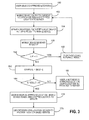
- FIG. 3 is a flowchart that illustrates an example of the operation of the system 10 shown in Figure 1 according to another embodiment of the present invention.
- the user registers with the LBS provider and provides the server 12 with one or more "approved locations" similarly as described with respect to step 50 of Fig. 2 .
- the user's mobile device 30 determines its location, using any known technology such as GPS technology or triangulation, and associates its current location with a grid cell identifier (described above). Mobile device 30 will then encrypt the user's current location, and provide the encrypted location to the LBS provider server 12. Encryption of the user's current location by the mobile device 30 can be performed as follows.
- the processor of the mobile device 30 determines its location and associates it with a grid cell identifier x.
- These values (t, s) represent the user's location in encrypted form, which are sent to the server 12.
- the server 12 is prevented from determining the location x of the user.
- the mobile device 30 can also send to the server 12 a cloaking region as described above with respect to Fig. 2 .
- the initiation and timing of the mobile device 30 communicating this information to the server 12 can be the same as described above with respect to Fig. 2 .
- step 154 upon receiving the user's encrypted location (and optional cloaking region), the processing device 16 of the server 12 will process this information and provide an encrypted result back to the mobile device 30. Processing of the received information can be performed as follows. Recall that database 20 stores a listing of all approved locations for a user, along with the grid cell in which an approved location is located. The processing device 16 will retrieve each grid cell identifiers y,...y m in which an approved location is located within the region (if provided). The processing device 16 computes the difference of t and y i for each i to get the values d 1 . . .d m . The processing device then computes p, the product of all d i .
- the processing device 16 then computes p(mod s) to get the value p'.
- This value represents an encrypted result, which is returned to the mobile device 30. It is possible that the random values selected by the mobile device 30 will result in a value for one or more d j to be equal to zero, resulting in p and thus p' being zero, regardless of location of the mobile device 30.
- the server 12 in step 154 can optionally not return such result to the mobile device 30 and instead discard the result and ask the user to send encrypted location again computed with different random values.
- step 156 the mobile device 30 receives the encrypted result from the server 12.
- step 158 the processor of the mobile device 30 processes the returned result by first determining if p' is zero (unless the processing performed by the server 12 in step 154 discarded such result instead of sending them to the mobile device 30). If p' is zero, then in step 160 the mobile device 30 will stop processing the returned result, since this means that the random values selected are not appropriate as described above. Preferably, the process can return to step 152 and the mobile device 30 can encrypt its current location using new random values r, k 1 , k 2 and repeat the processing from that point. If p' is not zero in step 158, then in step 162 the processor of the mobile device 30 will compute p'(mod r).
- step 164 it is determined if the result from the computation performed in step 162 is zero. If in step 164 it is determined that the result is not zero, then this means that the mobile device 30, and hence the user, is not near an approved location, and in step 166 the mobile device will not send its location to the server 12. However, if in step 164 it is determined that the result is equal to zero, then this means that the mobile device 30, and hence the user, is in the same grid cell as an approved location.
- step 168 the mobile device will send its location, using the grid cell identifier x in an unencrypted form, to the server 12.
- the LBS provider server 12
- the LBS provider will not learn of the location of the user (mobile device 30) unless the user is close to a user approved location, i.e., within the same grid cell identifier as an approved location.
- the definition of "close" to a user approved location can be adjustable and is not limited to being within the same grid cell as an approved location, but instead can be expanded to include a group of grid cells as described above with respect to Fig. 2 .
- the LBS provider server 12 can use the location to provide the user with a location-based service similarly as described above with respect to Fig. 2 .
- the mobile device 30 sends its location to the server 12 in unencrypted form, it will also create a log of the revealed location along with the time and random numbers used and store them locally. This information can be used to check that the LBS provider is not improperly trying to violate a user's privacy by testing grid cells that are not occupied by a user approved location. The user can occasionally check this log to see which locations have been sent to the server 12, and if one of the revealed locations is not among the user's approved locations, the user will know that the LBS provider is violating its agreement and can drop the service.
- the user of a mobile device 30 can receive location based services without having to constantly divulge his/her location to the LBS provider except for those instances in which the user is near a user approved location.
- the LBS provider manages the user's location privacy preferences and the underlying grid structure. It should be understood that the present invention is not so limited and a third party provider can be used for these processes and act as an intermediary between a user and various LBS providers that the user has engaged.
Landscapes
- Engineering & Computer Science (AREA)
- Computer Networks & Wireless Communication (AREA)
- Signal Processing (AREA)
- Computer Security & Cryptography (AREA)
- Mobile Radio Communication Systems (AREA)
- Telephonic Communication Services (AREA)
Abstract
Description
- The invention disclosed herein relates generally to location-based service provider systems, and more particularly to a location-based service provider methods and system in which the user can control when the location-based service provider can determine the user's location.
- In today's highly competitive business world, advertising to customers, both potential and previous, is a necessity. Businesses are always looking for ways to increase revenue, and increasing its sales to customers through advertising plays a large part in many business's plans for growth. Advertising has shown to be an effective method to inform, persuade or remind target buyers of the business's goods, services or goodwill, with the ultimate goal being that an advertisement will result in the sale of the goods or services. Studies have confirmed that the more that an advertisement can be made relevant and timely for a particular intended recipient, the more likely that it is to be successful. Location-based service (LBS) providers allow a business to provide a location-based service, e.g., coupon, advertisements, brochures, information, etc., to potential customers that are both timely and relevant. For example, a smart-phone (or other networked mobile device) user may register with the LBS provider to be provided with a service when the user is in the proximity of a selected business. This requires that the LBS provider be able to determine the location of the user. Typically this is done in one of two ways. The user's device can continually broadcast his/her location to the LBS provider or can use his/her device to manually 'check in' and search for nearby selected businesses. The first solution is flawed because it offers no location privacy for the user. The LBS provider continually receives the user's location, even when the user is nowhere near a selected business. The user is required to place great trust in the LBS provider; if the user does not want to be constantly tracked by the LBS provider, he/she will not sign up for the service.
- The second solution is also less than ideal because it requires the user to actively send his/her location and search for nearby approved locations. This requires work on the part of the user. If the user does not check in frequently, the user may miss out on desired location-based services. Additionally, the LBS provider would receive a user's location only sporadically when the user inputs his/her location. A business that wants to advertise using the LBS provider may determine that it is not worth the fees imposed by the LBS provider if large numbers of potential customers are missed.
- Another possible solution is for the user to download all locations of interest, e.g., all locations of a selected business, from the LBS provider to his/her mobile device. This allows the user to automatically figure out that he/she is near a selected business location without broadcasting his/her location. However the problem with this solution is that it requires more computation on the mobile device, and reveals the LBS provider's database contents of business locations to the user, thereby preventing the LBS provider from offering an ongoing service.
- The present invention alleviates the problems described above and provides methods and systems that allow a user to receive location-based services for user selected businesses while maintaining the privacy of his/her location when not in the vicinity of a user selected business. Thus, the LBS provider will know the user's location if and only if the user is near a business selected by the user. If the user is in an area where there are no user selected businesses, the user's location will be protected from the LBS provider. In addition no manual input on the user's side is required, and the user will automatically receive location-based services when near a user selected business. The solution also keeps the heavy computation on the LBS provider side and preserves the privacy of the LBS provider database allowing it to offer an ongoing service.
- In accordance with embodiments of the present invention, a user designates selected businesses, also referred to as approved locations, to the LBS provider. The LBS provider maintains a database of business locations. The user's mobile device sends its location, in encrypted form, to the LBS provider. The LBS provider performs a computation on the encrypted location and returns an encrypted result to the user's mobile device. The user's mobile device decrypts the result and determines whether the user is near any selected businesses based on the decrypted result. Only if the decrypted result indicates the user is near an approved location will the user's mobile device return its location, in an unencrypted form, to the LBS provider. The LBS provider can then return a location-based service, e.g., electronic coupon, advertisement, or the like, to the user's mobile device or forward the user's location to a participating company which sends the location-based service to the user. If the decrypted result indicates the user is not near an approved location, the user's device will not provide its location to the LBS provider and its current location is kept secure. Thus, the LBS provider will only know the user's location if and only if the user is near a business selected by the user.
- The accompanying drawings illustrate presently preferred embodiments of the invention, and together with the general description given above and the detailed description given below, serve to explain the principles of the invention. As shown throughout the drawings, like reference numerals designate like of corresponding parts.
-
FIG. 1 illustrates in block diagram form a system according to an embodiment of the present invention; -
FIG. 2 illustrates in flow diagram form the processing performed according to an embodiment of the present invention; and -
FIG. 3 illustrates in flow diagram form the processing performed according to another embodiment of the present invention. - In describing the present invention, reference is made to the drawings, wherein there is seen in
Fig. 1 a block diagram of asystem 10 in which the present invention can be implemented.System 10 includes aserver 12 operated by a location-based service provider that is coupled to acommunication network 14, such as, for example, a wireless cellular communication network.Server 12 may be a mainframe or the like that includes at least oneprocessing device 16.Server 12 may be specially constructed for the required purposes, or it may comprise a general purpose computer selectively activated or reconfigured by a computer program (described further below) stored therein. Such a computer program may alternatively be stored in a computer readable storage medium, such as, but not limited to, any type of disk including floppy disks, optical disks, CD-ROMs, and magnetic-optical disks, read-only memories (ROMs), random access memories (RAMs), EPROMs, EEPROMs, magnetic or optical cards, or any type of media suitable for storing electronic instructions, which are executable by theprocessing device 16. One of ordinary skill in the art would be familiar with the general components of a server system upon which the method of the present invention may be performed.Server 12 can communicate with one or more users operating one or moremobile devices network 14.Mobile devices network 14 to send and receive data from any other device capable of accessing thenetwork 14. It should be understood that while threedevices Fig. 1 , there is no limit to the number of devices and/or users of such devices. Eachmobile device -
System 10 also includes adatabase 20 that is in electronic communication with theserver 12.Database 20 stores locations for one or more businesses that have registered with the LBS provider. The present solution utilizes a spatial grid structure having a plurality of cells to quantize and index locations. A grid can be defined in many ways, provided that each location with a given latitude/longitude is associated with a unique cell of the grid. For example, the United States can be divided in many 100x100 meter cells that are each associated with a unique identifier. Any building in the United States will be located within one of these cells. It should be understood, of course, that the cell size need not be limited to the example provided above, and could be any size as desired. The specific cell into which a specific location falls can be determined, for example, using known geocoding technology. Thus, each location of a business will be associated with a unique cell of the grid.Database 20 stores a table that associates each location of a business with a grid cell based on the identifier of the cell. The defined grid is also accessible by mobile devices, e.g.,mobile devices database 20 stores one or more advertisements provided by the businesses that have registered with the LBS provider for sending to potential customers as described further below. -
Figure 2 is a flowchart that illustrates an example of the operation of thesystem 10 shown inFigure 1 according to an embodiment of the present invention. Instep 50, when a user of a mobile device, e.g.,mobile device 30, desires to receive location-based services from the LBS provider, the user will register with the LBS provider and provide theserver 12 with one or more "approved locations." An approved location is a location which the user desires to receive a location-based service, e.g., electronic coupon, offering, advertisement, etc., via a mobile device when the user is physically near such a location. An approved location can be as specific as a particular business by name, e.g., Starbucks, or as general as a business type, e.g., retail clothing stores, shopping malls, etc., or refer simply to a physical location, e.g., a town or city. Theprocessing device 16 will utilize the information stored in thedatabase 20 to determine the grid cell identifier in which each of an approved location, e.g., store, town, etc., is located for the approved locations provided by the user. This information is then stored in thedatabase 20 in association with the user. Thus, thedatabase 20 will have a listing of all approved locations for a user, along with the grid cell in which an approved location is located. - Once a user has registered with the LBS provider, the user can operate a
mobile device 30 to obtain desired location-based services without having to divulge its current location unless the user is near an approved location. Instep 52, the user'smobile device 30 determines its location, using any known technology such as GPS technology or triangulation, and associates its current location with a grid cell identifier (described above).Mobile device 30 will then encrypt the user's current location, and provide the encrypted location to theLBS provider server 12. Encryption of the user's current location by themobile device 30 can be performed as follows. As described, the processor of themobile device 30 determines its location and associates it with a grid cell identifier x. The processor of themobile device 30 then generates k random values r1...rk, and adds location x to each of the random values r1...rk to get k values s1...sk. These values represent the user's location in encrypted form, which are sent to theserver 12. Because the location x is encrypted by combining it with the random values, the values of s look like a random number to theserver 12, thereby preventing theserver 12 from determining the location x of the user. Optionally, to limit the amount of computation that theserver 12 has to perform, themobile device 30 can also send to the server 12 a cloaking region, which could be, for example, a large area such as a state. If a cloaking region is provided, theserver 12 will only test the locations from its database, as described below, which are in the cloaking region instead of every location. Thus, while the LBS provider may know that a user is in a particular region, which is a very large area, it will not know, at this time, the actual location within the region. Because the location is provided only in encrypted form, the user'smobile device 30 can continually broadcast its location to theLBS provider server 12 without the user having to worry about the LBS provider constantly tracking his/her location, even in areas where there are no approved locations. Alternatively, the user'smobile device 30 can automatically initiate a broadcast of its location (in encrypted format as described above) according to a specified time interval, e.g., every five minutes, or the user can manually operate themobile device 30 to initiate a broadcast of its location (in encrypted format as described above) to theserver 12. If the location broadcast is continuous or automatically initiated, the amount of communication necessary can be reduced by not sending or initiating the location broadcast if the user's location has not changed, i.e., the user is still located in the same grid cell as the previously sent location broadcast. - In
step 54, upon receiving the user's encrypted location (and optional cloaking region), theprocessing device 16 of theserver 12 will process this information and provide an encrypted result back to themobile device 30. Processing of the received information can be performed as follows. Recall thatdatabase 20 stores a listing of all approved locations for a user, along with the grid cell in which an approved location is located. Theprocessing device 16 will retrieve each grid cell identifiers y1...ym in which an approved location is located within the region (if provided). For example, if an approved location is Starbucks stores and the cloaking region is the state of Connecticut, this may be the set of grid cells in Connecticut in which a Starbucks is located. If no cloaking region is provided, then every grid cell identifier in which an approved location for that user is located will have to be retrieved. Theprocessing device 16 divides this set of m locations into k subsets Y1...Yk. For every subset Yj,processing device 16 performs the following computation. It takes each location yi in that subset Yj and subtracts it from corresponding si to get di. It then computes the product of all di's to get pi. Theprocessing device 16 repeats this process for all subsets Y1...Yk to obtain p1...pk. These values represent an encrypted result, which are returned to themobile device 30. It is possible that the random values selected by themobile device 30 will result in a value for one or more dj to be equal to zero, resulting in pi being zero, regardless of location of themobile device 30. To reduce the amount of communications between theserver 12 andmobile device 30 in such situations where any of the values p1..pk are zero, theserver 12 instep 54 can optionally not return such results to themobile device 30 and instead discard the results and ask the user to send encrypted location again computed with different random values. - In
step 56 themobile device 30 receives the encrypted result from theserver 12. Instep 58, the processor of themobile device 30 processes the returned result by first determining if any pi is zero (unless the processing performed by theserver 12 instep 54 discarded such results instead of sending them to the mobile device 30). If any pi is zero, then instep 60 themobile device 30 will stop processing the returned result, since this means that the random values selected are not appropriate as described above. Preferably, the process can return to step 52 and themobile device 30 can encrypt its current location using new random values r1...rk and repeat the processing from that point. If all pi are non-zero instep 58, then instep 62 the processor of the mobile device will compute, for each pi, pi (mod ri). Instep 64, it is determined if any resulting pi from the computation performed instep 62 is zero. If instep 64 it is determined that there is no pi that is equal to zero, then this means that themobile device 30, and hence the user, is not near an approved location, and instep 66 the mobile device will not send its location to theserver 12. However, if instep 64 it is determined that there is a pi that is equal to zero, then this means that themobile device 30, and hence the user, is in the same grid cell as an approved location. More specifically, as illustrated by the following equation:
step 68, themobile device 30 will send its location, using the grid cell identifier x in an unencrypted form, to theserver 12. Thus, the LBS provider (server 12) will not learn of the location of the user (mobile device 30) unless the user is close to a user approved location, i.e., within the same grid cell identifier as an approved location. It should be understood that the definition of "close" to a user approved location can be adjustable and is not limited to being within the same grid cell as an approved location, but instead can be expanded to include a group of grid cells. For example, when a user provides approved locations (step 50) and theprocessing device 16 of theserver 12 utilizes the information stored in thedatabase 20 to determine the grid cell identifier in which each of an approved location is located, theprocessing device 16 can expand the number of cells that constitute an approved location by including all cells adjacent to a cell in which an approved location is located. Thus, an approved location could encompass a group of cells instead of just the single cell in which a business is located. Theprocessing device 16 will utilize all of the grid cell identifiers for the group of cells when performing the processing as described above with respect to step 54. - Once the
LBS provider server 12 has the location of themobile device 30, then instep 70 the LBS provider can use the location to provide the user with a location-based service. For example theserver 12 can retrieve one or more advertisements stored in thedatabase 20 and send it to the user'smobile device 30. Alternatively, the LBS provider can choose not to return its own location-based service to the user but to share the location x of the user with any participating companies. A participating company can then choose to directly return a location-based service (e.g., an electronic coupon) to the user, or can choose to forward a specific location based service to theLBS provider server 12 which then forwards it to the user. Other possibilities and combinations exist to provide the location-based service to the user once the user's location is revealed, all of which may be used with the present invention. Preferably, when themobile device 30 sends its location to theserver 12 in unencrypted form, it will also create a log of the revealed location along with the time and random numbers used and store them locally. This information can be used to check that the LBS provider is not improperly trying to violate a user's privacy by testing grid cells that are not occupied by a user approved location. The user can occasionally check this log to see which locations have been sent to theserver 12, and if one of the revealed locations is not among the user's approved locations, the user will know that the LBS provider is violating its agreement and can drop the service. -
Figure 3 is a flowchart that illustrates an example of the operation of thesystem 10 shown inFigure 1 according to another embodiment of the present invention. Instep 150, the user registers with the LBS provider and provides theserver 12 with one or more "approved locations" similarly as described with respect to step 50 ofFig. 2 . Instep 152, the user'smobile device 30 determines its location, using any known technology such as GPS technology or triangulation, and associates its current location with a grid cell identifier (described above).Mobile device 30 will then encrypt the user's current location, and provide the encrypted location to theLBS provider server 12. Encryption of the user's current location by themobile device 30 can be performed as follows. As described, the processor of themobile device 30 determines its location and associates it with a grid cell identifier x. The processor of themobile device 30 then generates three random value r, k1 and k2, and computes the sum of x with the product of r and k1 to get t (t=x+rk1). The processor then computes the product of r and k2 to get s (s=rk2). These values (t, s) represent the user's location in encrypted form, which are sent to theserver 12. Because the location x is encrypted by combining it with the products of r and k1, thereby making the value of t look like a random number to theserver 12, theserver 12 is prevented from determining the location x of the user. Optionally, to limit the amount of computation that theserver 12 has to perform, themobile device 30 can also send to the server 12 a cloaking region as described above with respect toFig. 2 . The initiation and timing of themobile device 30 communicating this information to theserver 12 can be the same as described above with respect toFig. 2 . - In
step 154, upon receiving the user's encrypted location (and optional cloaking region), theprocessing device 16 of theserver 12 will process this information and provide an encrypted result back to themobile device 30. Processing of the received information can be performed as follows. Recall thatdatabase 20 stores a listing of all approved locations for a user, along with the grid cell in which an approved location is located. Theprocessing device 16 will retrieve each grid cell identifiers y,...ym in which an approved location is located within the region (if provided). Theprocessing device 16 computes the difference of t and yi for each i to get the values d1. . .d m . The processing device then computes p, the product of all di. Theprocessing device 16 then computes p(mod s) to get the value p'. This value represents an encrypted result, which is returned to themobile device 30. It is possible that the random values selected by themobile device 30 will result in a value for one or more dj to be equal to zero, resulting in p and thus p' being zero, regardless of location of themobile device 30. To reduce the amount of communications between theserver 12 andmobile device 30 in such situations where the value of p' is zero, theserver 12 instep 154 can optionally not return such result to themobile device 30 and instead discard the result and ask the user to send encrypted location again computed with different random values. - In
step 156 themobile device 30 receives the encrypted result from theserver 12. Instep 158, the processor of themobile device 30 processes the returned result by first determining if p' is zero (unless the processing performed by theserver 12 instep 154 discarded such result instead of sending them to the mobile device 30). If p' is zero, then instep 160 themobile device 30 will stop processing the returned result, since this means that the random values selected are not appropriate as described above. Preferably, the process can return to step 152 and themobile device 30 can encrypt its current location using new random values r, k1, k2 and repeat the processing from that point. If p' is not zero instep 158, then instep 162 the processor of themobile device 30 will compute p'(mod r). Instep 164, it is determined if the result from the computation performed instep 162 is zero. If instep 164 it is determined that the result is not zero, then this means that themobile device 30, and hence the user, is not near an approved location, and instep 166 the mobile device will not send its location to theserver 12. However, if instep 164 it is determined that the result is equal to zero, then this means that themobile device 30, and hence the user, is in the same grid cell as an approved location. More specifically, as illustrated by the following equation:
step 168, the mobile device will send its location, using the grid cell identifier x in an unencrypted form, to theserver 12. Thus, the LBS provider (server 12) will not learn of the location of the user (mobile device 30) unless the user is close to a user approved location, i.e., within the same grid cell identifier as an approved location. It should be understood that the definition of "close" to a user approved location can be adjustable and is not limited to being within the same grid cell as an approved location, but instead can be expanded to include a group of grid cells as described above with respect toFig. 2 . - Once the
LBS provider server 12 has the location of themobile device 30, then instep 170 the LBS provider can use the location to provide the user with a location-based service similarly as described above with respect toFig. 2 . Preferably, when themobile device 30 sends its location to theserver 12 in unencrypted form, it will also create a log of the revealed location along with the time and random numbers used and store them locally. This information can be used to check that the LBS provider is not improperly trying to violate a user's privacy by testing grid cells that are not occupied by a user approved location. The user can occasionally check this log to see which locations have been sent to theserver 12, and if one of the revealed locations is not among the user's approved locations, the user will know that the LBS provider is violating its agreement and can drop the service. - Thus, as described above, the user of a
mobile device 30 can receive location based services without having to constantly divulge his/her location to the LBS provider except for those instances in which the user is near a user approved location. In the description provided above, the LBS provider manages the user's location privacy preferences and the underlying grid structure. It should be understood that the present invention is not so limited and a third party provider can be used for these processes and act as an intermediary between a user and various LBS providers that the user has engaged. - While preferred embodiments of the invention have been described and illustrated above, it should be understood that these are exemplary of the invention and are not to be considered as limiting. Additions, deletions, substitutions, and other modifications can be made without departing from the spirit or scope of the present invention. Accordingly, the invention is not to be considered as limited by the foregoing description but is only limited by the scope of the appended claims.
Claims (9)
- A method for a providing a location based service to a user operating a mobile device (30,32,34), the method comprising:receiving (52,152), by a server (12), a current location of the mobile device (30,32,34) in encrypted form;processing (54,154), by the server (12), the current location of the mobile device (30,32,34) in encrypted form, the processing utilizing at least one previously designated user approved location, for which the user desires to receive a location based service, that is stored in a database (20) accessible by the server (12), to produce a result without having to decrypt the current location of the mobile device (30,32,34);sending (54,154), by the server (12), the result to the mobile device (30,32,34) for processing by the mobile device (30,32,34);receiving, (68,168) by the server (12), the current location of the mobile device (30,32,34) from the mobile device (30,32,34) in unencrypted form only when the mobile device (30,32,34) determines that its current location is near a user approved location based on the result returned to the mobile device (30,32,34); andusing (70, 170) the current location of the mobile device (30,32,34) to provide a location based service to the user operating the mobile device (30,32,34).
- The method of claim 1, wherein the current location of the mobile device (30,32,34) in encrypted form is based on a unique identifier of a grid cell in which the mobile device is located combined with a random value.
- The method of claim 1 or 2, further comprising:receiving, by the server (12), a cloaking region along with the current location of the mobile device in encrypted form;wherein the processing performed by the server (12) utilizes only user approved locations within the cloaking region.
- The method of any preceding claim, wherein the location-based service includes at least one of an electronic coupon and advertisement.
- A method for a user to receive a location-based service on a mobile device (30,32,34), the method comprising:determining (52,152), by the mobile device (30,32,34), a current location based on a grid cell identifier;combining (52,152), by the mobile device (30,32,34), the grid cell identifier with a random number to produce a current location of the mobile device in encrypted form;sending (52,152), by the mobile device (30,32,34), the current location of the mobile device in encrypted form to a server;processing (54,154), by the server (12), the current location of the mobile device in encrypted form, the processing utilizing at least one previously designated user approved location, for which the user desires to receive a location based service, that is stored in a database (20) accessible by the server (12), to produce a result without having to decrypt the current location of the mobile device;sending (54,154), by the server, the result to the mobile device;processing (64,164), by the mobile device, the result to determine that the mobile device is near a user approved location;sending (68,168), by the mobile device (30,32,34), the current location in unencrypted form to the server (12); andusing (70,170) the current location of the mobile device (30,32,34) to provide a location based service to the user on the mobile device.
- The method of claim 5, further comprising:sending to the server (12), by the mobile device (30,32,34), a cloaking region along with the current location of the mobile device (30,32,34) in encrypted form;wherein the processing performed by the server (12) utilizes only user approved locations within the cloaking region.
- The method of claim 5 or 6, wherein the location-based service includes at least one of an electronic coupon and advertisement.
- A system for providing location-based services, the system comprising:a mobile device (30,32,34) adapted to determine a current location based on a grid cell identifier, combine the grid cell identifier with a random number to produce a current location of the mobile device (30,32,34) in encrypted form, and transmit (52,152) the current location of the mobile device in encrypted form; anda server (12) adapted to receive the current location of the mobile device (30,32,34) in encrypted form, process (54,154) the current location of the mobile device in encrypted form utilizing at least one previously designated user approved location, for which the user desires to receive a location based service, that is stored in a database (20) accessible by the server (12), to produce a result without having to decrypt the current location of the mobile device (30,32,34), and send the result to the mobile device;the mobile device (30,32,34) being further adapted to process (64,164) the result to determine that the mobile device is near a user approved location and send (68,168) the current location of the mobile device in unencrypted form to the server (12),wherein the server (12) is further adapted to use the current location of the mobile device (30,32,34) to provide a location based service to the mobile device.
- The system of claim 8, wherein the location-based service includes at least one of an electronic coupon and advertisement
Applications Claiming Priority (1)
| Application Number | Priority Date | Filing Date | Title |
|---|---|---|---|
| US13/727,955 US9137631B2 (en) | 2012-12-27 | 2012-12-27 | Location-based service provider method and system having a user controlled location privacy mechanism |
Publications (2)
| Publication Number | Publication Date |
|---|---|
| EP2750418A1 true EP2750418A1 (en) | 2014-07-02 |
| EP2750418B1 EP2750418B1 (en) | 2015-06-10 |
Family
ID=49354469
Family Applications (1)
| Application Number | Title | Priority Date | Filing Date |
|---|---|---|---|
| EP13187862.1A Not-in-force EP2750418B1 (en) | 2012-12-27 | 2013-10-09 | Location-based service provider method and system having a user controlled location privacy mechanism |
Country Status (2)
| Country | Link |
|---|---|
| US (1) | US9137631B2 (en) |
| EP (1) | EP2750418B1 (en) |
Cited By (2)
| Publication number | Priority date | Publication date | Assignee | Title |
|---|---|---|---|---|
| CN105763594A (en) * | 2014-12-19 | 2016-07-13 | 阿里巴巴集团控股有限公司 | Information push method and device |
| EP3343958A4 (en) * | 2015-08-31 | 2018-07-04 | Samsung Electronics Co., Ltd. | Method and device for position-based service |
Families Citing this family (6)
| Publication number | Priority date | Publication date | Assignee | Title |
|---|---|---|---|---|
| US8954737B2 (en) * | 2013-06-18 | 2015-02-10 | Palo Alto Research Center Incorporated | Method and apparatus for performing distributed privacy-preserving computations on user locations |
| US9549283B2 (en) * | 2014-09-18 | 2017-01-17 | Anaesthesia Associates Of Massachussetts, P.C. | Systems and methods for determining the presence of a person |
| WO2018033870A1 (en) * | 2016-08-16 | 2018-02-22 | Innovative Concepts Inc. | Method and system for facilitating communication based on user interests and location |
| US10333715B2 (en) | 2016-11-14 | 2019-06-25 | International Business Machines Corporation | Providing computation services with privacy |
| US20240283632A1 (en) * | 2023-02-17 | 2024-08-22 | Apple Inc. | Private Retrieval of Location-Based Information |
| US12651085B2 (en) | 2023-06-02 | 2026-06-09 | Apple Inc. | Privacy-preserving recommendation generation |
Citations (2)
| Publication number | Priority date | Publication date | Assignee | Title |
|---|---|---|---|---|
| WO2006046845A1 (en) * | 2004-10-29 | 2006-05-04 | Nextwireless Co., Ltd. | Opt in model service providing system based position of a mobile phone |
| US20070270165A1 (en) * | 2006-05-19 | 2007-11-22 | Viswanath Poosala | Methods and apparatus for providing location-based services in a wireless communication system |
Family Cites Families (8)
| Publication number | Priority date | Publication date | Assignee | Title |
|---|---|---|---|---|
| WO2003081391A2 (en) | 2002-03-19 | 2003-10-02 | Mapinfo Corporation | Location based service provider |
| GB0227027D0 (en) * | 2002-11-20 | 2002-12-24 | Koninkl Philips Electronics Nv | A method of distributing the location of a mobile device |
| US7752209B2 (en) | 2005-09-14 | 2010-07-06 | Jumptap, Inc. | Presenting sponsored content on a mobile communication facility |
| WO2009045262A2 (en) | 2007-10-02 | 2009-04-09 | Jeremy Wood | Method of providing location-based information from portable devices |
| WO2009110471A1 (en) * | 2008-03-07 | 2009-09-11 | 株式会社日立製作所 | Position information system |
| MX2011000733A (en) * | 2008-07-18 | 2011-06-28 | Absolute Software Corp | Privacy management for tracked devices. |
| US8631148B2 (en) * | 2008-12-05 | 2014-01-14 | Lemi Technology, Llc | Method of providing proximity-based quality for multimedia content |
| US8315599B2 (en) | 2010-07-09 | 2012-11-20 | Telecommunication Systems, Inc. | Location privacy selector |
-
2012
- 2012-12-27 US US13/727,955 patent/US9137631B2/en active Active
-
2013
- 2013-10-09 EP EP13187862.1A patent/EP2750418B1/en not_active Not-in-force
Patent Citations (2)
| Publication number | Priority date | Publication date | Assignee | Title |
|---|---|---|---|---|
| WO2006046845A1 (en) * | 2004-10-29 | 2006-05-04 | Nextwireless Co., Ltd. | Opt in model service providing system based position of a mobile phone |
| US20070270165A1 (en) * | 2006-05-19 | 2007-11-22 | Viswanath Poosala | Methods and apparatus for providing location-based services in a wireless communication system |
Non-Patent Citations (1)
| Title |
|---|
| EMMANOUIL MAGKOS: "Cryptographic Approaches for Privacy Preservation in Location-Based Services", INTERNATIONAL JOURNAL OF INFORMATION TECHNOLOGIES AND SYSTEMS APPROACH, vol. 4, no. 2, 1 June 2011 (2011-06-01), pages 48 - 69, XP055095980, ISSN: 1935-570X, DOI: 10.4018/jitsa.2011070104 * |
Cited By (5)
| Publication number | Priority date | Publication date | Assignee | Title |
|---|---|---|---|---|
| CN105763594A (en) * | 2014-12-19 | 2016-07-13 | 阿里巴巴集团控股有限公司 | Information push method and device |
| US10447790B2 (en) | 2014-12-19 | 2019-10-15 | Alibaba Group Holding Limited | Information push |
| CN105763594B (en) * | 2014-12-19 | 2021-05-25 | 阿里巴巴集团控股有限公司 | Information push method and device |
| EP3343958A4 (en) * | 2015-08-31 | 2018-07-04 | Samsung Electronics Co., Ltd. | Method and device for position-based service |
| US10820155B2 (en) | 2015-08-31 | 2020-10-27 | Samsung Electronics Co., Ltd. | Method and device for position-based service |
Also Published As
| Publication number | Publication date |
|---|---|
| EP2750418B1 (en) | 2015-06-10 |
| US20140187266A1 (en) | 2014-07-03 |
| US9137631B2 (en) | 2015-09-15 |
Similar Documents
| Publication | Publication Date | Title |
|---|---|---|
| EP2750418B1 (en) | Location-based service provider method and system having a user controlled location privacy mechanism | |
| EP2806597A2 (en) | Location-based service provider method and system having a user controlled location privacy mechanism | |
| US11973840B2 (en) | Systems and methods for providing location-based cascading displays | |
| US20230057111A1 (en) | Efficient and secure communication using wireless service identifiers | |
| US11334919B2 (en) | Systems and methods for enabling access to digital content based on geographic locations visited by mobile device users | |
| Junglas et al. | Location-based services | |
| US8787929B2 (en) | System and methods for providing location information using location based queues | |
| US8966114B2 (en) | System and method for providing privacy and limited exposure services for location based services | |
| US8224353B2 (en) | Disseminating targeted location-based content to mobile device users | |
| JP5612122B2 (en) | Targeting applications with ads | |
| US10445777B2 (en) | Methods and systems for delivering electronic content to users in population based geographic zones | |
| US8838706B2 (en) | WiFi proximity messaging | |
| KR20170133466A (en) | System and method for improving precision of position sensor | |
| CA2917186A1 (en) | System and method for splitting a fee for an on-demand service | |
| Haddadi et al. | Targeted advertising on the handset: Privacy and security challenges | |
| WO2018232957A1 (en) | Logistics information processing method and system | |
| US9894479B2 (en) | Privacy preservation platform | |
| US20130101110A1 (en) | System and method for attaching geographic information to customer reports | |
| CN109635036A (en) | A blockchain construction model and construction method | |
| JP2016507825A (en) | Location and time recognition system and method for mobile user context detection | |
| Bulander et al. | Enabling personalized and context sensitive mobile advertising while guaranteeing data protection | |
| Bulander et al. | Advertising via mobile terminals–delivering context sensitive and personalized advertising while guaranteeing privacy | |
| AU2015101390A4 (en) | Region based content delivery system and method | |
| CN110851755A (en) | Method and device for acquiring delivery path information and electronic equipment | |
| Arora et al. | Location Based GSM Marketing |
Legal Events
| Date | Code | Title | Description |
|---|---|---|---|
| 17P | Request for examination filed |
Effective date: 20131009 |
|
| AK | Designated contracting states |
Kind code of ref document: A1 Designated state(s): AL AT BE BG CH CY CZ DE DK EE ES FI FR GB GR HR HU IE IS IT LI LT LU LV MC MK MT NL NO PL PT RO RS SE SI SK SM TR |
|
| AX | Request for extension of the european patent |
Extension state: BA ME |
|
| PUAI | Public reference made under article 153(3) epc to a published international application that has entered the european phase |
Free format text: ORIGINAL CODE: 0009012 |
|
| R17P | Request for examination filed (corrected) |
Effective date: 20141023 |
|
| RBV | Designated contracting states (corrected) |
Designated state(s): AL AT BE BG CH CY CZ DE DK EE ES FI FR GB GR HR HU IE IS IT LI LT LU LV MC MK MT NL NO PL PT RO RS SE SI SK SM TR |
|
| GRAP | Despatch of communication of intention to grant a patent |
Free format text: ORIGINAL CODE: EPIDOSNIGR1 |
|
| INTG | Intention to grant announced |
Effective date: 20141217 |
|
| RAP1 | Party data changed (applicant data changed or rights of an application transferred) |
Owner name: PITNEY BOWES INC. |
|
| RIN1 | Information on inventor provided before grant (corrected) |
Inventor name: GESKE, CHRISTIAN A. Inventor name: ZHANG, JUN Inventor name: NAWAZ, YASSIR |
|
| GRAS | Grant fee paid |
Free format text: ORIGINAL CODE: EPIDOSNIGR3 |
|
| GRAA | (expected) grant |
Free format text: ORIGINAL CODE: 0009210 |
|
| AK | Designated contracting states |
Kind code of ref document: B1 Designated state(s): AL AT BE BG CH CY CZ DE DK EE ES FI FR GB GR HR HU IE IS IT LI LT LU LV MC MK MT NL NO PL PT RO RS SE SI SK SM TR |
|
| REG | Reference to a national code |
Ref country code: GB Ref legal event code: FG4D |
|
| REG | Reference to a national code |
Ref country code: CH Ref legal event code: EP |
|
| REG | Reference to a national code |
Ref country code: AT Ref legal event code: REF Ref document number: 731337 Country of ref document: AT Kind code of ref document: T Effective date: 20150715 |
|
| REG | Reference to a national code |
Ref country code: DE Ref legal event code: R096 Ref document number: 602013001971 Country of ref document: DE |
|
| REG | Reference to a national code |
Ref country code: IE Ref legal event code: FG4D |
|
| REG | Reference to a national code |
Ref country code: FR Ref legal event code: PLFP Year of fee payment: 3 |
|
| PG25 | Lapsed in a contracting state [announced via postgrant information from national office to epo] |
Ref country code: NO Free format text: LAPSE BECAUSE OF FAILURE TO SUBMIT A TRANSLATION OF THE DESCRIPTION OR TO PAY THE FEE WITHIN THE PRESCRIBED TIME-LIMIT Effective date: 20150910 Ref country code: LT Free format text: LAPSE BECAUSE OF FAILURE TO SUBMIT A TRANSLATION OF THE DESCRIPTION OR TO PAY THE FEE WITHIN THE PRESCRIBED TIME-LIMIT Effective date: 20150610 Ref country code: FI Free format text: LAPSE BECAUSE OF FAILURE TO SUBMIT A TRANSLATION OF THE DESCRIPTION OR TO PAY THE FEE WITHIN THE PRESCRIBED TIME-LIMIT Effective date: 20150610 Ref country code: ES Free format text: LAPSE BECAUSE OF FAILURE TO SUBMIT A TRANSLATION OF THE DESCRIPTION OR TO PAY THE FEE WITHIN THE PRESCRIBED TIME-LIMIT Effective date: 20150610 |
|
| REG | Reference to a national code |
Ref country code: AT Ref legal event code: MK05 Ref document number: 731337 Country of ref document: AT Kind code of ref document: T Effective date: 20150610 |
|
| REG | Reference to a national code |
Ref country code: NL Ref legal event code: MP Effective date: 20150610 |
|
| PG25 | Lapsed in a contracting state [announced via postgrant information from national office to epo] |
Ref country code: GR Free format text: LAPSE BECAUSE OF FAILURE TO SUBMIT A TRANSLATION OF THE DESCRIPTION OR TO PAY THE FEE WITHIN THE PRESCRIBED TIME-LIMIT Effective date: 20150911 Ref country code: BG Free format text: LAPSE BECAUSE OF FAILURE TO SUBMIT A TRANSLATION OF THE DESCRIPTION OR TO PAY THE FEE WITHIN THE PRESCRIBED TIME-LIMIT Effective date: 20150910 Ref country code: RS Free format text: LAPSE BECAUSE OF FAILURE TO SUBMIT A TRANSLATION OF THE DESCRIPTION OR TO PAY THE FEE WITHIN THE PRESCRIBED TIME-LIMIT Effective date: 20150610 Ref country code: LV Free format text: LAPSE BECAUSE OF FAILURE TO SUBMIT A TRANSLATION OF THE DESCRIPTION OR TO PAY THE FEE WITHIN THE PRESCRIBED TIME-LIMIT Effective date: 20150610 |
|
| PG25 | Lapsed in a contracting state [announced via postgrant information from national office to epo] |
Ref country code: EE Free format text: LAPSE BECAUSE OF FAILURE TO SUBMIT A TRANSLATION OF THE DESCRIPTION OR TO PAY THE FEE WITHIN THE PRESCRIBED TIME-LIMIT Effective date: 20150610 |
|
| PG25 | Lapsed in a contracting state [announced via postgrant information from national office to epo] |
Ref country code: SK Free format text: LAPSE BECAUSE OF FAILURE TO SUBMIT A TRANSLATION OF THE DESCRIPTION OR TO PAY THE FEE WITHIN THE PRESCRIBED TIME-LIMIT Effective date: 20150610 Ref country code: AT Free format text: LAPSE BECAUSE OF FAILURE TO SUBMIT A TRANSLATION OF THE DESCRIPTION OR TO PAY THE FEE WITHIN THE PRESCRIBED TIME-LIMIT Effective date: 20150610 Ref country code: PL Free format text: LAPSE BECAUSE OF FAILURE TO SUBMIT A TRANSLATION OF THE DESCRIPTION OR TO PAY THE FEE WITHIN THE PRESCRIBED TIME-LIMIT Effective date: 20150610 Ref country code: RO Free format text: LAPSE BECAUSE OF NON-PAYMENT OF DUE FEES Effective date: 20150610 Ref country code: IS Free format text: LAPSE BECAUSE OF FAILURE TO SUBMIT A TRANSLATION OF THE DESCRIPTION OR TO PAY THE FEE WITHIN THE PRESCRIBED TIME-LIMIT Effective date: 20151010 Ref country code: CZ Free format text: LAPSE BECAUSE OF FAILURE TO SUBMIT A TRANSLATION OF THE DESCRIPTION OR TO PAY THE FEE WITHIN THE PRESCRIBED TIME-LIMIT Effective date: 20150610 |
|
| REG | Reference to a national code |
Ref country code: DE Ref legal event code: R097 Ref document number: 602013001971 Country of ref document: DE |
|
| PLBE | No opposition filed within time limit |
Free format text: ORIGINAL CODE: 0009261 |
|
| STAA | Information on the status of an ep patent application or granted ep patent |
Free format text: STATUS: NO OPPOSITION FILED WITHIN TIME LIMIT |
|
| PG25 | Lapsed in a contracting state [announced via postgrant information from national office to epo] |
Ref country code: DK Free format text: LAPSE BECAUSE OF FAILURE TO SUBMIT A TRANSLATION OF THE DESCRIPTION OR TO PAY THE FEE WITHIN THE PRESCRIBED TIME-LIMIT Effective date: 20150610 Ref country code: IT Free format text: LAPSE BECAUSE OF FAILURE TO SUBMIT A TRANSLATION OF THE DESCRIPTION OR TO PAY THE FEE WITHIN THE PRESCRIBED TIME-LIMIT Effective date: 20150610 |
|
| 26N | No opposition filed |
Effective date: 20160311 |
|
| PG25 | Lapsed in a contracting state [announced via postgrant information from national office to epo] |
Ref country code: LU Free format text: LAPSE BECAUSE OF FAILURE TO SUBMIT A TRANSLATION OF THE DESCRIPTION OR TO PAY THE FEE WITHIN THE PRESCRIBED TIME-LIMIT Effective date: 20151009 Ref country code: SI Free format text: LAPSE BECAUSE OF FAILURE TO SUBMIT A TRANSLATION OF THE DESCRIPTION OR TO PAY THE FEE WITHIN THE PRESCRIBED TIME-LIMIT Effective date: 20150610 |
|
| PG25 | Lapsed in a contracting state [announced via postgrant information from national office to epo] |
Ref country code: MC Free format text: LAPSE BECAUSE OF FAILURE TO SUBMIT A TRANSLATION OF THE DESCRIPTION OR TO PAY THE FEE WITHIN THE PRESCRIBED TIME-LIMIT Effective date: 20150610 |
|
| REG | Reference to a national code |
Ref country code: IE Ref legal event code: MM4A |
|
| REG | Reference to a national code |
Ref country code: FR Ref legal event code: PLFP Year of fee payment: 4 |
|
| PG25 | Lapsed in a contracting state [announced via postgrant information from national office to epo] |
Ref country code: IE Free format text: LAPSE BECAUSE OF NON-PAYMENT OF DUE FEES Effective date: 20151009 |
|
| PG25 | Lapsed in a contracting state [announced via postgrant information from national office to epo] |
Ref country code: BE Free format text: LAPSE BECAUSE OF FAILURE TO SUBMIT A TRANSLATION OF THE DESCRIPTION OR TO PAY THE FEE WITHIN THE PRESCRIBED TIME-LIMIT Effective date: 20150610 |
|
| PG25 | Lapsed in a contracting state [announced via postgrant information from national office to epo] |
Ref country code: HU Free format text: LAPSE BECAUSE OF FAILURE TO SUBMIT A TRANSLATION OF THE DESCRIPTION OR TO PAY THE FEE WITHIN THE PRESCRIBED TIME-LIMIT; INVALID AB INITIO Effective date: 20131009 |
|
| REG | Reference to a national code |
Ref country code: CH Ref legal event code: PL |
|
| PG25 | Lapsed in a contracting state [announced via postgrant information from national office to epo] |
Ref country code: NL Free format text: LAPSE BECAUSE OF FAILURE TO SUBMIT A TRANSLATION OF THE DESCRIPTION OR TO PAY THE FEE WITHIN THE PRESCRIBED TIME-LIMIT Effective date: 20150610 Ref country code: SE Free format text: LAPSE BECAUSE OF FAILURE TO SUBMIT A TRANSLATION OF THE DESCRIPTION OR TO PAY THE FEE WITHIN THE PRESCRIBED TIME-LIMIT Effective date: 20150610 Ref country code: CY Free format text: LAPSE BECAUSE OF FAILURE TO SUBMIT A TRANSLATION OF THE DESCRIPTION OR TO PAY THE FEE WITHIN THE PRESCRIBED TIME-LIMIT Effective date: 20150610 |
|
| PG25 | Lapsed in a contracting state [announced via postgrant information from national office to epo] |
Ref country code: LI Free format text: LAPSE BECAUSE OF NON-PAYMENT OF DUE FEES Effective date: 20161031 Ref country code: HR Free format text: LAPSE BECAUSE OF FAILURE TO SUBMIT A TRANSLATION OF THE DESCRIPTION OR TO PAY THE FEE WITHIN THE PRESCRIBED TIME-LIMIT Effective date: 20150610 Ref country code: CH Free format text: LAPSE BECAUSE OF NON-PAYMENT OF DUE FEES Effective date: 20161031 |
|
| PG25 | Lapsed in a contracting state [announced via postgrant information from national office to epo] |
Ref country code: MT Free format text: LAPSE BECAUSE OF FAILURE TO SUBMIT A TRANSLATION OF THE DESCRIPTION OR TO PAY THE FEE WITHIN THE PRESCRIBED TIME-LIMIT Effective date: 20150610 |
|
| REG | Reference to a national code |
Ref country code: FR Ref legal event code: PLFP Year of fee payment: 5 |
|
| PG25 | Lapsed in a contracting state [announced via postgrant information from national office to epo] |
Ref country code: SM Free format text: LAPSE BECAUSE OF FAILURE TO SUBMIT A TRANSLATION OF THE DESCRIPTION OR TO PAY THE FEE WITHIN THE PRESCRIBED TIME-LIMIT Effective date: 20150610 |
|
| PG25 | Lapsed in a contracting state [announced via postgrant information from national office to epo] |
Ref country code: PT Free format text: LAPSE BECAUSE OF FAILURE TO SUBMIT A TRANSLATION OF THE DESCRIPTION OR TO PAY THE FEE WITHIN THE PRESCRIBED TIME-LIMIT Effective date: 20150610 Ref country code: MK Free format text: LAPSE BECAUSE OF FAILURE TO SUBMIT A TRANSLATION OF THE DESCRIPTION OR TO PAY THE FEE WITHIN THE PRESCRIBED TIME-LIMIT Effective date: 20150610 |
|
| REG | Reference to a national code |
Ref country code: FR Ref legal event code: PLFP Year of fee payment: 6 |
|
| PG25 | Lapsed in a contracting state [announced via postgrant information from national office to epo] |
Ref country code: AL Free format text: LAPSE BECAUSE OF FAILURE TO SUBMIT A TRANSLATION OF THE DESCRIPTION OR TO PAY THE FEE WITHIN THE PRESCRIBED TIME-LIMIT Effective date: 20150610 Ref country code: TR Free format text: LAPSE BECAUSE OF FAILURE TO SUBMIT A TRANSLATION OF THE DESCRIPTION OR TO PAY THE FEE WITHIN THE PRESCRIBED TIME-LIMIT Effective date: 20150610 |
|
| P01 | Opt-out of the competence of the unified patent court (upc) registered |
Effective date: 20230408 |
|
| PGFP | Annual fee paid to national office [announced via postgrant information from national office to epo] |
Ref country code: DE Payment date: 20241029 Year of fee payment: 12 |
|
| PGFP | Annual fee paid to national office [announced via postgrant information from national office to epo] |
Ref country code: GB Payment date: 20241028 Year of fee payment: 12 |
|
| PGFP | Annual fee paid to national office [announced via postgrant information from national office to epo] |
Ref country code: FR Payment date: 20241025 Year of fee payment: 12 |
|
| REG | Reference to a national code |
Ref country code: DE Ref legal event code: R119 Ref document number: 602013001971 Country of ref document: DE |
|
| GBPC | Gb: european patent ceased through non-payment of renewal fee |
Effective date: 20251009 |
|
| PG25 | Lapsed in a contracting state [announced via postgrant information from national office to epo] |
Ref country code: GB Free format text: LAPSE BECAUSE OF NON-PAYMENT OF DUE FEES Effective date: 20251009 |
|
| PG25 | Lapsed in a contracting state [announced via postgrant information from national office to epo] |
Ref country code: DE Free format text: LAPSE BECAUSE OF NON-PAYMENT OF DUE FEES Effective date: 20260501 |
|
| PG25 | Lapsed in a contracting state [announced via postgrant information from national office to epo] |
Ref country code: FR Free format text: LAPSE BECAUSE OF NON-PAYMENT OF DUE FEES Effective date: 20251031 |