EP2747085A1 - Verfahren zum Betreiben eines Sicherheitselements sowie ein solches Sicherheitselement - Google Patents
Verfahren zum Betreiben eines Sicherheitselements sowie ein solches Sicherheitselement Download PDFInfo
- Publication number
- EP2747085A1 EP2747085A1 EP13005847.2A EP13005847A EP2747085A1 EP 2747085 A1 EP2747085 A1 EP 2747085A1 EP 13005847 A EP13005847 A EP 13005847A EP 2747085 A1 EP2747085 A1 EP 2747085A1
- Authority
- EP
- European Patent Office
- Prior art keywords
- memory
- security element
- operating system
- memory cells
- processor unit
- Prior art date
- Legal status (The legal status is an assumption and is not a legal conclusion. Google has not performed a legal analysis and makes no representation as to the accuracy of the status listed.)
- Granted
Links
Images

Classifications
-
- G—PHYSICS
- G11—INFORMATION STORAGE
- G11C—STATIC STORES
- G11C16/00—Erasable programmable read-only memories
- G11C16/02—Erasable programmable read-only memories electrically programmable
- G11C16/06—Auxiliary circuits, e.g. for writing into memory
- G11C16/34—Determination of programming status, e.g. threshold voltage, overprogramming or underprogramming, retention
- G11C16/349—Arrangements for evaluating degradation, retention or wearout, e.g. by counting erase cycles
- G11C16/3495—Circuits or methods to detect or delay wearout of nonvolatile EPROM or EEPROM memory devices, e.g. by counting numbers of erase or reprogram cycles, by using multiple memory areas serially or cyclically
Definitions
- security elements are in particular subscriber identification modules, such as an eUICC / UICC (embedded universal integrated circuit card), a SIM card (subscriber identification module), an M2M module or the like.
- subscriber identification modules such as an eUICC / UICC (embedded universal integrated circuit card), a SIM card (subscriber identification module), an M2M module or the like.
- Security elements in the form of subscriber identification modules serve to authenticate a subscriber to a mobile radio network.
- a security element is usually part of a mobile terminal, e.g. a mobile telephone, and has a central processing unit (CPU) for performing the authentication and a storage unit for securely storing subscriber identification data, such as an IMSI (International Mobile Subscriber Identity) and an authentication key Ki, which are required for successful authentication ,
- IMSI International Mobile Subscriber Identity
- Ki authentication key
- a security element has a flash memory to store, for example, an operating system, application code and non-volatile data.
- a flash memory to store, for example, an operating system, application code and non-volatile data.
- the space available in a mobile terminal for a security element is usually limited in which it can be installed or plugged in, the area available to the flash memory on a security element is also limited. Consequently, the flash memory built into security elements usually also has a limited storage capacity of the order of a few hundred kilobytes, also for cost reasons.
- Flash Translation Layer (FTL)
- FTL Flash Translation Layer
- a memory cell of a flash memory can complete a maximum of 100,000 writes depending on the quality.
- this effect is counteracted by distributing the FTL writes to the memory cells of the flash memory so that each memory cell is described as frequently as possible frequently, which is known to the person skilled in the art under the term "Wear Leveling".
- some areas of the flash memory for example already very frequently described memory cells, can be transferred by "wear leveling" certain periods are essentially completely blocked by the FTL, with the result that the size of the effectively available logical memory is much smaller than the size of the actual physical memory of a flash memory.
- the existing operating system and the new operating system must coexist on a security element in order to coordinate the download of the new operating system by the existing operating system and, in the case of When loading the new operating system, the possibility of a return to the existing operating system can be prevented, the problem arises that the storage unit managed by the FTL can not provide enough memory to share an existing operating system and a new reloaded operating system on the storage unit save.
- the object of the present invention is to provide a method for operating a security element with a processor unit and a memory unit, preferably in the form of a flash memory in which a "wear leveling" mechanism is implemented, and to provide such a security element which allow reloading of program code, in particular a new operating system of the security element.
- a method of operating a security element for securely storing data and / or identifying a subscriber in a mobile communication network comprising a central processing unit and a nonvolatile rewriteable memory storage unit having a plurality of Memory cells in which existing program code for the operation of the security element is deposited and a "wear leveling" mechanism is implemented such that for equal distribution of the write accesses of the processor unit to the memory cells of the non-volatile memory, the processor unit in any given state always only a part the plurality of memory cells of the non-volatile memory, the method comprising the step of storing new program code for the operation of the security element in the memory cells of the non-volatile memory This memory does not access the processor unit due to the "wear leveling" mechanism in a given state.
- the "wear leveling" mechanism is implemented by means of a flash translation layer (FTL), which is known to be a software layer above the actual memory hardware, in addition to the “wear leveling” usually serves to manage memory cells detected as defective in the non-volatile memory.
- FTL flash translation layer
- the new security code operation program code is downloaded from a background system over a cellular network.
- the nonvolatile memory is an EEPROM memory, preferably a flash EEPROM memory with NOR architecture.
- the existing program code for the operation of the security element is preferably an existing operating system for the security element and the new program code for the operation of the security element is a new operating system for the security element.
- the existing operating system is executed in non-volatile memory in place (execution in place).
- the existing operating system is deposited as a contiguous block in nonvolatile memory starting at a memory cell referenced by a boot loader.
- the boot loader is configured to check upon restart of the security element whether a new operating system is present in the memory cells blocked by the wear leveling mechanism. If so, the boot loader starts installing the new operating system.
- the boot loader can be provided with a list of the memory cells in which the new operating system is stored, and a list of the memory cells or alternatively the start of the area of memory cells in which the new operating system is to be stored. Otherwise, the boot loader refers the processor unit to the memory cell the memory in which the existing operating system is deposited in order to execute the existing operating system at this point.
- the existing and the new operating system are in multiple libraries, i. Groups of functions, divided.
- a security element for securely storing data and / or identifying a subscriber in a mobile communication network
- the security element comprising a central processor unit and a memory unit having a non-volatile, rewritable memory with a plurality of memory cells the existing program code for the operation of the security element is deposited and a "wear leveling" mechanism is implemented such that for equal distribution of the write accesses of the processor unit to the memory cells of the non-volatile memory, the processor unit in any given state always only a part of the plurality of memory cells of the nonvolatile memory, the security element being adapted to operate according to a method according to the first aspect of the invention.
- the security element is preferably an eUICC / UICC, a SIM card or an M2M module.
- FIG. 1 shows a schematic representation of a preferred embodiment of a security element 20 according to the invention, for example in the form of an eUICC / UICC (embedded universal integrated circuit card), a SIM card or an M2M module, which is part of a mobile terminal 10, which for example to be able to trade a mobile phone.
- the mobile terminal 10 is configured to communicate with other mobile terminals and a background system 40 via a mobile network or public land mobile network (PLMN) 30.
- PLMN public land mobile network
- the mobile terminal 10 has a suitable communication interface 12, which may include, for example, a transceiver.
- the security element 20 is configured to exchange data with the mobile terminal 10.
- the mobile terminal 10 usually has a suitable reading device, in which the security element 20 in such a way plugged in that contact surfaces of the security element 20 with corresponding contact surfaces of the reader of the mobile terminal 10 are in galvanic contact.
- the security element 20 may also be an integral part of the mobile terminal 10. It is then called eUICC.
- the security element 20 in the form of a (UICC) comprises a central processing unit (CPU) 22 and a memory unit (memory) 26, which has a random access memory (RAM) 26a and nonvolatile rewritable memory (NVM) 26b.
- the non-volatile memory 26b is an EEPROM memory, and more preferably a flash memory.
- the communication between the central processor unit 22 and the memory unit 26 of the security element 20 can take place, for example, via one or more address, data and / or control bus systems, as shown in FIG. 1 is schematically indicated by a double arrow. If the security element 20 is an integral part of the mobile terminal 10, the communication between the security element 20 and the mobile terminal 10 can also take place via one or more such bus systems.
- the processor unit 22 of the security element 20 is configured such that it can execute at least one application 24, for example, to select, download and install a new operating system for the security element, which could be part of a complete subscription package, for example, which also subscription data or Contains subscriber identification data.
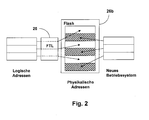
- FIG. 2 shows a schematic detail of the nonvolatile memory 26b of the memory unit 26 of the security element 20.
- the nonvolatile rewritable memory 26b is preferably an EEPROM memory, more preferably a flash memory with a plurality of memory cells .
- a "wear leveling" mechanism is implemented on the nonvolatile memory 26b, which is designed to distribute the write accesses of the processor unit 22 to the memory cells of the nonvolatile memory 26b in such a way that each memory cell is written as frequently as possible.
- the wear leveling mechanism is preferably a flash translation layer (FTL).
- flash translation layer is a software layer above the actual memory hardware, which as a rule serves as a defect in addition to the implementation of a wear leveling mechanism to detect detected memory cells in the nonvolatile memory 26b.
- FIG. 2 Like this in FIG. 2 is shown in the normal operation of the security element 20, the processor unit 22 only the managed by the flash translation layer 25 logical addresses corresponding to certain physical addresses or memory cells of the nonvolatile memory 26b.
- An access of the processor unit 22 to the in FIG. 2 hatched illustrated exemplary physical addresses or memory cells is not supported, since due to the implemented in the form of the Flash Translation Layer (FTL) "wear leveling" mechanism no logical addresses refer to these physical addresses.
- FTL Flash Translation Layer
- the FTL enforced association between logical addresses and physical addresses or memory cells of the nonvolatile memory 26b will typically be constant.
- the logical addresses or the corresponding physical addresses or memory cells of the nonvolatile memory 26b, which can be accessed by the processor unit 22, are preferably deposited, in particular, an existing operating system for the security element 20, preferably as a contiguous block representing the execution of the existing one Operating system in nonvolatile memory 26b, which is known to those skilled in the art as "execution in place”.
- program code stored in the nonvolatile memory 26b is not loaded into the main memory 26a but executed directly in the nonvolatile memory 26b. This usually assumes that the processor unit 22 can directly address the nonvolatile memory 26b and get the program code quickly enough therefrom.
- the addressed non-volatile memory 26b must therefore have a sufficiently short access time, which is given, for example, in the case of a flash memory.
- a new operating system for the security element 20 provided by the background system 40 and downloaded via the mobile radio network 30 is currently being stored at the physical addresses or memory cells of the non-volatile memory 26b, to which the processor unit 22 in the current state does not should access, as in FIG. 2 shown schematically is.
- the "wear leveling" mechanism implemented by the FTL is briefly modified by using more physical pages than recommended by the FTL.
- the reloaded new operating system is currently stored in the memory cells of the non-volatile memory 26b, which in the current state of the security element 20 should not be worn down by accesses of the processor unit 22.
- the security element 20 is preferably restarted, for example by means of a reset process.
- a boot loader is preferably first started, which is configured to check upon restart of the security element 20 whether a new operating system is present in the memory cells of the nonvolatile memory 26b that are not supported due to the "wear leveling" mechanism , If the boot loader does not find a new operating system, the processor unit 22 starts executing the program code of the existing operating system at a memory location or address of the non-volatile memory 26b referred to by the boot loader.
- the existing operating system is preferably stored as a block starting from a permanently defined memory cell or address in the nonvolatile memory 26b, so that it can be executed there in place.
- the boot loader starts with the Installation of the new operating system.
- the boot loader can be provided with a list of the memory cells in which the new operating system is stored, and a list of the memory cells in which the new operating system is to be stored, or alternatively the permanently defined memory cell or start address in which the existing one Operating system is stored as a block and where the new operating system should be stored.
- the new operating system will be exchanged in parts step by step with corresponding parts of the existing operating system.
- the existing operating system may be moved, step by step, into the memory cells of the nonvolatile memory 26b, in which previously the corresponding parts of the new operating system have been deposited, i. in the memory cells, which the processor unit 22 should not access due to the FTL during normal operation.
- the security element 20 can be restarted with the new operating system. If there is an interruption while copying the new operating system, this process can be repeated until it is completely executed.
- the operation deletes the old operating system. In other words, preferably the overwriting of the existing operating system by the new operating system takes place atomically.
- the invention provides a division of the existing and the new operating system in libraries. These can be replaced with sufficient space in the system even without restarting. For this purpose, an indirection is required when entering the libraries.
- the "wear leveling" mechanism is implemented by means of a flash translation layer (FTL), ie essentially in software
- FTL flash translation layer
- the invention also encompasses embodiments in which the "wear leveling" mechanism essentially implemented in hardware.
- a memory management unit can be used for this purpose.
Landscapes
- Mobile Radio Communication Systems (AREA)
Abstract
Description
- Die Erfindung betrifft ein Verfahren zum Betreiben eines Sicherheitselements (Secure Element) sowie ein solches Sicherheitselement. Als Sicherheitselemente werden hier insbesondere Teilnehmeridentifikationsmodule verstanden, wie eine eUICC/UICC (embedded universal integrated circuit card), eine SIM-Karte (subscriber identification module), ein M2M-Modul oder dergleichen.
- Sicherheitselemente (Secure Elements) in Form von Teilnehmeridentifikationsmodulen dienen dazu, einen Teilnehmer gegenüber einem Mobilfunknetzwerk zu authentisieren. Hierzu ist ein solches Sicherheitselement in der Regel Teil eines mobilen Endgeräts, z.B. eines Mobiltelefons, und verfügt über eine zentrale Prozessoreinheit (CPU; central processing unit) zur Durchführung der Authentisierung und eine Speichereinheit zur sicheren Aufbewahrung von Teilnehmeridentifikationsdaten, beispielsweise eine IMSI (international mobile subscriber identity) und ein Authentisierungsschlüssel Ki, die für eine erfolgreiche Authentisierung erforderlich sind.
- In der Vergangenheit war es bei Sicherheitselementen in Form von SIM-Karten in der Regel so, dass bei einem Wechsel des Besitzers eines Mobiltelefons von einem Mobilfunknetzbetreiber zu einem anderen Mobilfunknetzbetreiber die SIM-Karte des bisherigen Mobilfunknetzbetreibers mit der SIM-Karte des neuen Mobilfunknetzbetreibers im Mobiltelefon ausgetauscht werden musste, auf der insbesondere die Teilnehmeridentifikationsdaten hinterlegt sind, die für eine Authentisierung gegenüber dem neuen Mobilfunknetz erforderlich sind. Da in Zukunft jedoch immer mehr Sicherheitselemente fester Bestandteil eines mobilen Endgeräts sein werden, müssen in diesem Fall beim Wechsel zu einem neuen Mobilfunknetzbetreiber derartige Teilnehmeridentifikationsdaten in ein solches Sicherheitselement über die Luftschnittstelle (OTA; over-the-air) nachgeladen werden. In der Regel ist es dabei jedoch mit einem Nachladen von Teilnehmeridentifikationsdaten nicht getan, sondern es müssen oftmals ein neues Betriebssystem des Sicherheitselements und/oder Programmcode für neue Applikationen für das Sicherheitselement nachgeladen werden.
- Herkömmlicherweise weist ein Sicherheitselement einen Flash-Speicher auf, um beispielsweise ein Betriebssystem, Programmcode für Applikationen und nicht-flüchtige Daten zu speichern. Da jedoch in der Regel der in einem mobilen Endgerät für ein Sicherheitselement zur Verfügung stehende Raum beschränkt ist, in dem dieses verbaut bzw. eingesteckt werden kann, ist auch die Fläche beschränkt, die dem Flash-Speicher auf einem Sicherheitselement zur Verfügung steht. Folglich weisen die in Sicherheitselementen verbauten Flash-Speicher auch aus Kostengründen in der Regel eine begrenzte Speicherkapazität in der Größenordnung von einigen hundert Kilobytes auf.
- Bei Sicherheitselementen mit Speichereinheiten in Form von Flash-Speichern wird das Problem des zur Verfügung stehenden begrenzten Speicherplatzes noch dadurch verschärft, dass in der Regel bei einem Flash-Speicher mittels einer Flash-Translation-Layer (FTL) versucht wird, die Lebensdauer des Flash-Speichers zu maximieren. Der Grund hierfür liegt darin, dass eine Speicherzelle eines Flash-Speichers je nach Qualität maximal 100.000 Schreibvorgänge absolvieren kann. Mittels der FTL wird diesem Effekt entgegen gewirkt, indem die FTL Schreibvorgänge auf die Speicherzellen des Flash-Speichers so verteilt, dass jede Speicherzelle möglichst gleich häufig beschrieben wird, was dem Fachmann unter dem Begriff "Wear Leveling" bekannt ist. Dabei können durch das "Wear Leveling" einige Bereiche des Flash-Speichers, z.B. bereits sehr häufig beschriebene Speicherzellen, über bestimmte Zeiträume von der FTL im Wesentlichen vollständig blockiert werden, was zur Folge hat, dass die Größe des effektiv zur Verfügung stehenden logischen Speichers um einiges kleiner als die Größe des tatsächlichen physikalischen Speichers eines Flash-Speichers ist.
- Da beim Herunterladen und beim Installieren insbesondere eines neuen Betriebssystems eines Sicherheitselements zumindest für eine Übergangsphase das bestehende Betriebssystem und das neue Betriebssystem nebeneinander auf einem Sicherheitselement existieren müssen, um zum einen das Herunterladen des neuen Betriebssystem durch das bestehende Betriebssystem zu koordinieren und zum anderen im Falle von Fehlern beim Laden des neuen Betriebssystems die Möglichkeit einer Rückkehr zum bestehenden Betriebssystems offen zu halten, kann das Problem auftreten, dass die von der FTL verwaltete Speichereinheit nicht genügend Speicher zur Verfügung stellen kann, um ein bestehendes Betriebssystem und ein neues nachgeladenes Betriebssystem gemeinsam auf der Speichereinheit zu speichern.
- Vor diesem Hintergrund stellt sich der vorliegenden Erfindung die Aufgabe, ein Verfahren zum Betreiben eines Sicherheitselements mit einer Prozessoreinheit und einer Speichereinheit vorzugsweise in Form eines Flash-Speichers, in dem ein "Wear Leveling"-Mechanismus implementiert ist, sowie ein solches Sicherheitselement bereitzustellen, die ein Nachladen von Programmcode insbesondere eines neuen Betriebssystem des Sicherheitselements erlauben.
- Diese Aufgabe wird erfindungsgemäß durch das Verfahren zum Betreiben eines Sicherheitselements nach Anspruch 1 gelöst. Ein entsprechendes Sicherheitselement ist Gegenstand des unabhängigen Vorrichtungsanspruchs. Vorteilhafte Weiterbildungen der Erfindung sind in den Unteransprüchen definiert.
- Gemäß einem ersten Aspekt der Erfindung wird ein Verfahren zum Betreiben eines Sicherheitselements zur sicheren Aufbewahrung von Daten und/oder zur Identifikation eines Teilnehmers in einem mobilen Kommunikationsnetzwerk bereitgestellt, wobei das Sicherheitselement eine zentrale Prozessoreinheit und eine Speichereinheit mit einem nichtflüchtigen, wiederbeschreibbaren Speicher mit einer Vielzahl von Speicherzellen umfasst, in dem bestehender Programmcode für den Betrieb des Sicherheitselements hinterlegt ist und ein "Wear Leveling"-Mechanismus derart implementiert ist, dass zur Gleichverteilung der Schreibzugriffe der Prozessoreinheit auf die Speicherzellen des nichtflüchtigen Speichers die Prozessoreinheit in jedem gegebenen Zustand immer nur auf einen Teil der Vielzahl von Speicherzellen des nichtflüchtigen Speichers zugreifen kann, wobei das Verfahren den Schritt des Hinterlegens von neuem Programmcode für den Betrieb des Sicherheitselements in den Speicherzellen des nichtflüchtigen Speichers umfasst, auf die die Prozessoreinheit aufgrund des "Wear Leveling"-Mechanismus in einem gegeben Zustand nicht zugreift.
- Gemäß bevorzugter Ausführungsformen der Erfindung ist der "Wear Leveling"-Mechanismus mittels einer Flash-Translatiort-Layer (FTL) implementiert, bei der es sich bekanntermaßen um eine Software-Schicht über der eigentlichen Speicher-Hardware handelt, die neben dem "Wear Leveling" in der Regel dazu dient, als defekt erkannte Speicherzellen im nichtflüchtigen Speicher zu verwalten.
- Vorzugsweise wird der neue Programmcode für den Betrieb des Sicherheitselements von einem Hintergrundsystem über ein Mobilfunknetzwerk heruntergeladen.
- Gemäß bevorzugter Ausführungsformen der Erfindung handelt es sich bei dem nichtflüchtigen Speicher um einen EEPROM-Speicher, vorzugsweise um einen Flash-EEPORM-Speicher mit NOR-Architektur.
- Vorzugsweise handelt es sich bei dem bestehenden Programmcode für den Betrieb des Sicherheitselements um ein bestehendes Betriebssystem für das Sicherheitselement und bei dem neuen Programmcode für den Betrieb des Sicherheitselements um ein neues Betriebssystem für das Sicherheitselement.
- Gemäß bevorzugter Ausführungsformen der Erfindung wird das bestehende Betriebssystem im nichtflüchtigen Speicher vor Ort (execution in place) ausgeführt. Vorzugsweise ist das bestehende Betriebssystem als ein zusammenhängender Block im nichtflüchtigen Speicher hinterlegt, der bei einer Speicherzelle startet, auf die ein Boot-Loader verweist.
- Vorzugsweise ist der Boot-Loader dazu ausgestaltet, bei einem Neustart des Sicherheitselements zu überprüfen, ob ein neues Betriebssystem in den von dem "Wear Leveling"-Mechanismus blockierten Speicherzellen vorliegt. Ist dies der Fall, beginnt der Boot-Loader mit der Installation des neuen Betriebssystems. Hierzu kann dem Boot-Loader eine Liste der Speicherzellen bereitgestellt werden, in denen das neue Betriebssystem abgelegt ist, und eine Liste der Speicherzellen oder alternativ der Beginn des Bereichs von Speicherzellen, in denen/ dem das neue Betriebssystem abgelegt werden soll. Andernfalls verweist der Boot-Loader die Prozessoreinheit auf die Speicherzelle des Speichers, bei der das bestehende Betriebssystem hinterlegt ist, um an dieser Stelle das bestehende Betriebssystem auszuführen.
- Vorzugsweise sind das bestehende und das neue Betriebssystem in mehrere Bibliotheken, d.h. Gruppen von Funktionen, aufgeteilt.
- Gemäß einem zweiten Aspekt der Erfindung wird ein Sicherheitselement zur sicheren Aufbewahrung von Daten und/oder zur Identifikation eines Teilnehmers in einem mobilen Kommunikationsnetzwerk bereitgestellt, wobei das Sicherheitselement eine zentrale Prozessoreinheit und eine Speichereinheit mit einem nichtflüchtigen, wiederbeschreibbaren Speicher mit einer Vielzahl von Speicherzellen umfasst, in dem bestehender Programmcode für den Betrieb des Sicherheitselements hinterlegt ist und ein "Wear Leveling"-Mechanismus derart implementiert ist, dass zur Gleichverteilung der Schreibzugriffe der Prozessoreinheit auf die Speicherzellen des nichtflüchtigen Speichers die Prozessoreinheit in jedem gegebenen Zustand immer nur auf einen Teil der Vielzahl von Speicherzellen des nichtflüchtigen Speichers zugreifen kann, wobei das Sicherheitselement dazu ausgestaltet ist, nach einem Verfahren gemäß dem ersten Aspekt der Erfindung betrieben zu werden.
- Vorzugsweise handelt es sich bei dem Sicherheitselement um eine eUICC/UICC, eine SIM-Karte oder ein M2M-Modul.
- Wie der Fachmann erkennt, lassen sich die vorstehend beschriebenen bevorzugten Ausgestaltungen sowohl im Rahmen des ersten Aspekts der Erfindung, d.h. im Rahmen des Verfahrens zum Betreiben eines Sicherheitselements, als auch im Rahmen des zweiten Aspekts der Erfindung, d.h. im Rahmen des Sicherheitselements, vorteilhaft implementieren.
- Weitere Merkmale, Vorteile und Aufgaben der Erfindung gehen aus der folgenden detaillierten Beschreibung mehrerer Ausführungsbeispiele und Ausführungsalternativen hervor. Es wird auf die Zeichnungen verwiesen, in denen zeigen:
- Fig. 1
- eine schematische Darstellung einer bevorzugten Ausführungsform eines erfindungsgemäßen Sicherheitselements in Form einer eUICC, das über ein Mobilfunknetzwerk in Kommunikation mit einem Hintergrundsystem steht, und
- Fig. 2
- eine schematische Detaildarstellung der nichtflüchtigen Speichereinheit des Sicherheitselements von
Figur 1 und der Arbeitsweise der darin implementierten Flash-Translation-Layer gemäß einer bevorzugten Ausführungsform der Erfindung. -
Figur 1 zeigt eine schematische Darstellung einer bevorzugten Ausführungsform eines erfindungsgemäßen Sicherheitselements 20, beispielsweise in Form einer eUICC/UICC (embedded universal integrated circuit card), einer SIM-Karte oder eines M2M-Moduls, das Teil eines mobilen Endgeräts 10 ist, bei dem es sich beispielsweise um ein Mobiltelefon handeln kann. Das mobile Endgerät 10 ist dazu ausgestaltet über ein Mobilfunknetzwerk oder PLMN (public land mobile network) 30 mit anderen mobilen Endgeräten und einem Hintergrundsystem 40 zu kommunizieren. Hierzu verfügt das mobile Endgerät 10 über eine geeignete Kommunikationsschnittstelle 12, die beispielsweise einen Transceiver umfassen kann. - Das Sicherheitselement 20 ist dazu ausgestaltet, mit dem mobilen Endgerät 10 Daten auszutauschen. Hierzu verfügt das mobile Endgerät 10 in der Regel über ein geeignetes Lesegerät, in welches das Sicherheitselement 20 derart eingesteckt ist, dass Kontaktflächen des Sicherheitselements 20 mit entsprechenden Kontaktflächen des Lesegeräts des mobilen Endgeräts 10 galvanisch in Kontakt sind. Alternativ kann das Sicherheitselement 20 auch fester Bestandteil des mobilen Endgeräts 10 sein. Es wird dann als eUICC bezeichnet.
- Wie sich dies der Detaildarstellung des Sicherheitselements 20 in
Figur 1 entnehmen lässt, umfasst das Sicherheitselement 20 in Form einer (e)UICC eine zentrale Prozessor- bzw. Recheneinheit (CPU; central processing unit) 22 und eine Speichereinheit (memory) 26, die einen flüchtigen Speicher (RAM; random access memory) 26a und einen nichtflüchtigen wieder beschreibbaren Speicher (NVM; non-volatile memory) 26b aufweist. Vorzugsweise handelt es sich bei dem nichtflüchtigen Speicher 26b um einen EEPROM-Speicher und weiter bevorzugt um einen Flash-Speicher. - Wie dies dem Fachmann bekannt ist, kann die Kommunikation zwischen der zentralen Prozessoreinheit 22 und der Speichereinheit 26 des Sicherheitselements 20 beispielsweise über ein oder mehrere Adress-, Daten- und/oder Steuer-Bussysteme erfolgen, wie dies in
Figur 1 schematisch durch einen Doppelpfeil angedeutet ist. Falls das Sicherheitselement 20 fester Bestandteil des mobilen Endgeräts 10 ist, kann auch die Kommunikation zwischen dem Sicherheitselement 20 und dem mobilen Endgerät 10 über ein oder mehrere derartige Bussysteme erfolgen. - Vorzugsweise ist die Prozessoreinheit 22 des Sicherheitselements 20 derart ausgestaltet, dass auf dieser wenigstens eine Applikation 24 ausgeführt werden kann, beispielsweise zum Auswählen, Herunterladen und Installieren eines neuen Betriebssystem für das Sicherheitselement, das beispielsweise Teil eines kompletten Subskriptionspakets sein könnte, welches ferner Subskriptionsdaten bzw. Teilnehmeridentifikationsdaten enthält.
-
Figur 2 zeigt eine schematische Detaildarstellung des nichtflüchtigen Speichers 26b der Speichereinheit 26 des Sicherheitselements 20. Wie bereits vorstehend beschrieben, handelt es sich bei dem nichtflüchtigen wieder beschreibbaren Speicher 26b vorzugsweise um einen EEPROM-Speicher, noch weiter bevorzugt um einen Flash-Speicher mit einer Vielzahl von Speicherzellen. Erfindungsgemäß ist auf dem nichtflüchtigen Speicher 26b ein "Wear Leveling"-Mechanismus implementiert, der dazu ausgestaltet ist, die Schreibzugriffe der Prozessoreinheit 22 auf die Speicherzellen des nichtflüchtigen Speichers 26b so zu verteilen, dass jede Speicherzelle möglichst gleich häufig beschrieben wird. Im bevorzugten Fall eines nichtflüchtigen Speichers 26b in Form eines Flash-Speichers handelt es sich bei dem "Wear Leveling"-Mechanismus vorzugsweise um eine Flash-Translation-Layer (FTL). Dem Fachmann ist bekannt, dass es sich bei einer Flash-Translation-Layer (FTL) um eine Software-Schicht über der eigentlichen Speicher-Hardware handelt, die in der Regel neben der Implementierung eines "Wear Leveling"-Mechanismus dazu dient, als defekt erkannte Speicherzellen im nichtflüchtigen Speicher 26b zu verwalten. - Wie dies in
Figur 2 schematisch dargestellt ist, stehen der Prozessoreinheit 22 im normalen Betrieb des Sicherheitselements 20 lediglich die von der Flash-Translation-Layer 25 verwalteten logischen Adressen zur Verfügung, die bestimmten physikalischen Adressen bzw. Speicherzellen des nichtflüchtigen Speichers 26b entsprechen. Ein Zugriff der Prozessoreinheit 22 auf die inFigur 2 schraffiert dargestellten beispielhaften physikalischen Adressen bzw. Speicherzellen wird nicht unterstützt, da aufgrund des in Form der Flash-Translation-Layer (FTL) implementierten "Wear Leveling"-Mechanismus keine logische Adressen auf diese physikalischen Adressen verweisen. Der Fachmann wird erkennen, dass aufgrund des mittels der FTL implementierten "Wear Leveling"-Mechanismus die Zuordnung von logischen Adressen zu physikalischen Adressen des nichtflüchtigen Speichers 26b durch die FTL nicht konstant, sondern sich mit wachsender Zahl von Zugriffen der Prozessoreinheit 22 auf die logischen Adressen ändern wird. Über eine bestimmte Anzahl von Zugriffen der Prozessoreinheit 22 auf die von der FTL verwalteten logischen Adressen wird die von der FTL durchgesetzte Zuordnung zwischen logischen Adressen und physikalischen Adressen bzw. Speicherzellen des nichtflüchtigen Speichers 26b jedoch in der Regel konstant sein. Bei den logischen Adressen bzw. den entsprechenden physikalischen Adressen bzw. Speicherzellen des nichtflüchtigen Speichers 26b, auf welche die Prozessoreinheit 22 zugreifen kann, ist vorzugsweise insbesondere ein bestehendes Betriebssystem für das Sicherheitselement 20 hinterlegt, und zwar vorzugsweise als zusammenhängender Block, der die Ausführung des bestehenden Betriebssystems im nichtflüchtigen Speicher 26b erlaubt, was dem Fachmann unter dem Begriff "execution in place" bekannt ist. Wie der Name dies andeutet, wird bei der "execution in place" der im nichtflüchtigen Speicher 26b abgelegte Programmcode nicht in den Arbeitsspeicher 26a geladen, sondern direkt im nichtflüchtigen Speicher 26b ausgeführt. Dies setzt in der Regel voraus, dass die Prozessoreinheit 22 den nichtflüchtigen Speicher 26b direkt adressieren und sich den Programmcode schnell genug von dort holen kann. Der adressierte nichtflüchtige Speicher 26b muss also eine ausreichend kurze Zugriffszeit aufweisen, was beispielsweise bei einem Flash-Speicher gegeben ist. - Erfindungsgemäß ist nun vorgesehen, dass ein neues vom Hintergrundsystem 40 bereitgestelltes und über das Mobilfunknetzwerk 30 heruntergeladenes Betriebssystem für das Sicherheitselement 20 gerade an den physikalischen Adressen bzw. Speicherzellen des nichtflüchtigen Speichers 26b gespeichert wird, auf die die Prozessoreinheit 22 im aktuellen Zustand aufgrund der FTL nicht zugreifen soll, wie dies in
Figur 2 schematisch dargestellt ist. Mit anderen Worten, beim Ablegen eines nachgeladenen neuen Betriebssystems auf dem nichtflüchtigen Speicher 26b der Speichereinheit 26 wird kurzzeitig der mittels der FTL implementierte "Wear Leveling"-Mechanismus modifiziert, indem mehr physische Seiten Verwendung finden als dies von der FTL empfohlen bzw. vorgegeben wird. Das nachgeladene neue Betriebssystem wird gerade in den Speicherzellen des nichtflüchtigen Speichers 26b hinterlegt, die im momentanen Zustand des Sicherheitselements 20 durch Zugriffe der Prozessoreinheit 22 nicht weiter abgenutzt werden sollen. - Sobald gemäß dem vorstehend beschriebenen Verfahren das neue Betriebssystem im nichtflüchtigen Speicher 26b hinterlegt worden ist, wird das Sicherheitselement 20 vorzugsweise neu gestartet, beispielsweise mittels eines Reset-Vorgangs. Beim Neustart des Sicherheitselements 20 wird vorzugsweise zunächst ein Boot-Loader gestartet, der dazu ausgestaltet ist, bei einem Neustart des Sicherheitselements 20 zu überprüfen, ob ein neues Betriebssystem in den aufgrund des "Wear Leveling"-Mechanismus nicht unterstützten Speicherzellen des nichtflüchtigen Speichers 26b vorliegt. Falls der Boot-Loader kein neues Betriebssystem findet, startet die Prozessoreinheit 22 mit der Ausführung des Programmcodes des bestehenden Betriebssystems bei einer Speicherzelle bzw. Adresse des nichtflüchtigen Speichers 26b, auf die der Boot-Loader verweist. Wie vorstehend beschrieben, ist das bestehende Betriebssystem vorzugsweise als Block ab einer fest definierten Speicherzelle bzw. Adresse im nichtflüchtigen Speicher 26b hinterlegt, damit es dort an Ort und Stelle ausgeführt werden kann.
- Andernfalls, d.h. falls der Boot-Loader ein neues Betriebssystem in den aufgrund des "Wear Level"-Mechanismus gerade nicht benutzten Speicherzellen des nichtflüchtigen Speichers 26b findet, beginnt der Boot-Loader mit der Installation des neuen Betriebssystems. Hierzu kann dem Boot-Loader eine Liste der Speicherzellen bereitgestellt werden, in denen das neue Betriebssystem abgelegt ist, und eine Liste der Speicherzellen, in denen das neue Betriebssystem abgelegt werden soll, oder alternativ die fest definierte Speicherzelle bzw. Startadresse, bei der das bestehende Betriebssystem als Block abgelegt ist und bei der das neue Betriebssystem abgelegt werden soll.
- Erfindungsgemäß ist nun vorstellbar, dass das neue Betriebssystem in Teilen Schritt für Schritt mit entsprechenden Teilen des bestehenden Betriebssystems ausgetauscht wird. Dies erlaubt es, dass neue Betriebssystem als anwachsenden Block ab der fest definierten Speicherzelle bzw. Adresse in den nicht-flüchtigen Speicher 26b zu schreiben, bei der bisher das bestehenden Betriebssystem als Block hinterlegt gewesen ist. Im Gegenzug kann das bestehende Betriebssystem Schritt für Schritt in die Speicherzellen des nichtflüchtigen Speichers 26b verschoben werden, in denen bisher die entsprechenden Teile des neuen Betriebssystem hinterlegt gewesen sind, d.h. in die Speicherzellen, auf die die Prozessoreinheit 22 aufgrund der FTL im normalen Betrieb nicht zugreifen soll. Sobald der Boot-Loader auf diese Art und Weise erfolgreich alle entsprechenden Speicherzellen des nicht-flüchtigen Speichers 26b ausgetauscht hat, kann das Sicherheitselement 20 mit dem neuen Betriebssystem neu gestartet werden. Falls es beim Kopieren des neuen Betriebssystems zu einer Unterbrechung kommen sollte, kann dieser Vorgang wiederholt werden bis er vollständig ausgeführt wurde. Durch den Vorgang wird das alte Betriebssystem gelöscht. Mit anderen Worten, vorzugsweise erfolgt das Überschreiben des bestehenden Betriebssystems durch das neue Betriebssystem atomar.
- Um die zu ersetzenden Teile des bestehenden Betriebssystems für das Sicherheitselement 20 möglichst klein zu halten, ist gemäß bevorzugter Ausführungsformen der Erfindung eine Aufteilung des bestehenden und des neuen Betriebssystems in Bibliotheken vorgesehen. Diese können bei ausreichend Platz im System auch ohne Neustart ersetzt werden. Dazu ist dann jeweils eine Indirektion beim Einsprung in die Bibliotheken erforderlich.
- Obwohl bei der vorstehend beschriebenen bevorzugten Ausführungsform der Erfindung der "Wear Leveling"-Mechanismus mittels einer Flash-Translation-Layer (FTL), also im Wesentlichen in Software implementiert ist, umfasst die Erfindung ebenfalls Ausgestaltungen, bei denen der "Wear Leveling"-Mechanismus im Wesentlichen in Hardware implementiert ist. Beispielsweise kann hierzu eine Speicherverwaltungseinheit (Memory Management Unit) verwendet werden.
Claims (10)
- Verfahren zum Betreiben eines Sicherheitselements (20) zur sicheren Aufbewahrung von Daten und/ oder zur Identifikation eines Teilnehmers in einem mobilen Kommunikationsnetzwerk (30) bereitgestellt, wobei das Sicherheitselement (20) eine zentrale Prozessoreinheit (22) und eine Speichereinheit (26) mit einem nichtflüchtigen, wiederbeschreibbaren Speicher (26b) mit einer Vielzahl von Speicherzellen umfasst, in dem bestehender Programmcode für den Betrieb des Sicherheitselements hinterlegt ist und ein "Wear Leveling"-Mechanismus derart implementiert ist, dass zur Gleichverteilung der Schreibzugriffe der Prozessoreinheit (22) auf die Speicherzellen des nichtflüchtigen Speichers (26b) die Prozessoreinheit (26) in einem gegebenen Zustand immer nur auf einen Teil der Vielzahl von Speicherzellen des nichtflüchtigen Speichers (26b) zugreifen kann, wobei das Verfahren den Schritt des Hinterlegens von neuem Programmcode für den Betrieb des Sicherheitselements (20) in den Speicherzellen des nichtflüchtigen Speichers (26b) umfasst, auf die die Prozessoreinheit (26) aufgrund des "Wear Leveling"-Mechanismus in einem gegeben Zustand nicht zugreifen soll.
- Verfahren nach Anspruch 1, wobei der "Wear Leveling"-Mechanismus mittels einer Flash-Translation-Layer (FTL) implementiert ist.
- Verfahren nach Anspruch 1, wobei der neue Programmcode für den Betrieb des Sicherheitselements (20) von einem Hintergrundsystem (40) über das Mobilfunknetzwerk (30) heruntergeladen wird.
- Verfahren nach Anspruch 1, wobei es sich bei dem nichtflüchtigen Speicher (26b) um einen EEPROM-Speicher, vorzugsweise um einen Flash-EEPORM-Speicher mit NOR-Architektur.
- Verfahren nach Anspruch 1, wobei es sich bei dem bestehenden Programmcode für den Betrieb des Sicherheitselements (20) um ein bestehendes Betriebssystem für das Sicherheitselement (20) und bei dem neuen Programmcode für den Betrieb des Sicherheitselements (20) um ein neues Betriebssystem für das Sicherheitselement (20) handelt.
- Verfahren nach Anspruch 5, wobei das bestehende Betriebssystem im nichtflüchtigen Speicher (26b) vor Ort (execution in place) ausgeführt wird und als ein zusammenhängender Block im nichtflüchtigen Speicher (26b) hinterlegt ist, der bei einer Speicherzelle des nicht-flüchtigen Speichers (26b) beginnt, auf die ein Boot-Loader verweist.
- Verfahren nach Anspruch 6, wobei der Boot-Loader dazu ausgestaltet ist, bei einem Neustart des Sicherheitselements (20) zu überprüfen, ob das neue Betriebssystem in den von dem "Wear Leveling"-Mechanismus blockierten Speicherzellen vorliegt, und, wenn dies der Fall ist, die Installation des neuen Betriebssystems anzustoßen.
- Verfahren nach Anspruch 7, wobei dem Boot-Loader eine Liste der Speicherzellen des nicht-flüchtigen Speichers (26b) bereitgestellt wird, in denen das neue Betriebssystem abgelegt ist, und eine Liste der Speicherzellen des nicht-flüchtigen Speichers (26b), in denen das neue Betriebssystem abgelegt werden soll.
- Sicherheitselement (20) zur sicheren Aufbewahrung von Daten und/oder zur Identifikation eines Teilnehmers in einem mobilen Kommunikationsnetzwerk (30) bereitgestellt, wobei das Sicherheitselement (20) eine zentrale Prozessoreinheit (22) und eine Speichereinheit (26) mit einem nichtflüchtigen, wiederbeschreibbaren Speicher (26b) mit einer Vielzahl von Speicherzellen umfasst, in dem bestehender Programmcode für den Betrieb des Sicherheitselements hinterlegt ist und ein "Wear Leveling"-Mechanismus derart implementiert ist, dass zur Gleichverteilung der Schreibzugriffe der Prozessoreinheit (22) auf die Speicherzellen des nichtflüchtigen Speichers (26b) die Prozessoreinheit (26) in einem gegebenen Zustand immer nur auf einen Teil der Vielzahl von Speicherzellen des nichtflüchtigen Speichers (26b) zugreifen kann, wobei das Sicherheitselement (20) dazu ausgestaltet ist, nach einem Verfahren gemäß einem der vorhergehenden Ansprüche betrieben zu werden.
- Sicherheitselement (20) nach Anspruch 9, wobei es sich bei dem Sicherheitselement (20) um eine eUICC/UICC, eine SIM-Karte oder ein M2M-Modul handelt.
Applications Claiming Priority (1)
| Application Number | Priority Date | Filing Date | Title |
|---|---|---|---|
| DE201210025261 DE102012025261A1 (de) | 2012-12-21 | 2012-12-21 | Verfahren zum Betreiben eines Sicherheitselements sowie ein solches Sicherheitselement |
Publications (2)
| Publication Number | Publication Date |
|---|---|
| EP2747085A1 true EP2747085A1 (de) | 2014-06-25 |
| EP2747085B1 EP2747085B1 (de) | 2017-04-12 |
Family
ID=49916772
Family Applications (1)
| Application Number | Title | Priority Date | Filing Date |
|---|---|---|---|
| EP13005847.2A Not-in-force EP2747085B1 (de) | 2012-12-21 | 2013-12-16 | Verfahren zum Betreiben eines Sicherheitselements sowie ein solches Sicherheitselement |
Country Status (2)
| Country | Link |
|---|---|
| EP (1) | EP2747085B1 (de) |
| DE (1) | DE102012025261A1 (de) |
Citations (1)
| Publication number | Priority date | Publication date | Assignee | Title |
|---|---|---|---|---|
| DE4312928A1 (de) * | 1992-04-21 | 1993-10-28 | Vaillant Joh Gmbh & Co | Verfahren zum optimalen Ausnutzen der Speicherkapazität eines Eeprom |
-
2012
- 2012-12-21 DE DE201210025261 patent/DE102012025261A1/de not_active Withdrawn
-
2013
- 2013-12-16 EP EP13005847.2A patent/EP2747085B1/de not_active Not-in-force
Patent Citations (1)
| Publication number | Priority date | Publication date | Assignee | Title |
|---|---|---|---|---|
| DE4312928A1 (de) * | 1992-04-21 | 1993-10-28 | Vaillant Joh Gmbh & Co | Verfahren zum optimalen Ausnutzen der Speicherkapazität eines Eeprom |
Also Published As
| Publication number | Publication date |
|---|---|
| DE102012025261A1 (de) | 2014-06-26 |
| EP2747085B1 (de) | 2017-04-12 |
Similar Documents
| Publication | Publication Date | Title |
|---|---|---|
| DE10315490B4 (de) | Verfahren und System zum Wechsel zwischen zwei oder mehreren Firmwareabbildungen auf einer Hostvorrichtung | |
| EP3257219B1 (de) | Verfahren zum betreiben eines sicherheitselements | |
| DE102007003580A1 (de) | Installieren eines Patch in einem Smartcard-Modul | |
| DE102009033961A1 (de) | Emulation eines einmal programmierbaren Speichers | |
| DE102012015573A1 (de) | Verfahren zum Aktivieren eines Betriebssystems in einem Sicherheitsmodul | |
| EP1314135B1 (de) | Verfahren zur virtuellen vergrösserung des stacks eines tragbaren datenträgers | |
| DE102011122242A1 (de) | Verfahren zur Kommunikation mit einer Applikation auf einem portablen Datenträger sowie ein solcher portabler Datenträger | |
| EP2747085B1 (de) | Verfahren zum Betreiben eines Sicherheitselements sowie ein solches Sicherheitselement | |
| EP3452946B1 (de) | Verfahren zur erstmaligen inbetriebnahme eines nicht vollständig personalisierten sicheren elements | |
| WO2010060902A1 (de) | Speicherzugriff auf einen portablen datenträger | |
| DE102019000743A1 (de) | Verfahren und Vorrichtungen zum Verwalten von Subskriptionsprofilen eines Sicherheitselements | |
| EP3754529A1 (de) | Verfahren zum nachladen von software auf eine chipkarte durch einen nachladeautomaten | |
| EP2817804B1 (de) | Verlängerung der betriebszeit eines sicherheitselements | |
| DE19751318A1 (de) | Softwaregesteuertes Teilnehmerendgerät, Server zum Bereitstellen eines Steuerprogrammes und Verfahren zum Betrieb des softwaregesteuerten Teilnehmerendgerätes | |
| EP1999731B1 (de) | Speicherverwaltung von chipkarten | |
| WO2011033030A1 (de) | Verfahren zum installieren und konfigurieren von applikationen auf einem portablen datenträger | |
| DE102010054783B4 (de) | Verfahren zum Speichern einer Datei in einem tragbaren Datenträger | |
| EP3488375B1 (de) | Chipset mit gesicherter firmware | |
| EP3814891A1 (de) | Effiziente firmware-updates | |
| DE102018006208A1 (de) | Chipset, für Endgerät, mit aktualisierbarem Programm | |
| DE102021000077A1 (de) | Integriertes Teilnehmeridentitätsmodul mit Anti-Rollback-Mechanismus | |
| DE102021004912A1 (de) | Universal integrated chip card, uicc, zum verwalten von profilen, sowie verfahren | |
| EP1306759A2 (de) | Programmausführung bei einer Chipkarte | |
| EP3248405A1 (de) | Verfahren und vorrichtungen zum verwalten von subskriptionsprofilen auf einem mobilen endgerät | |
| DE102022001682A1 (de) | Secure Element mit Heap-Speicher |
Legal Events
| Date | Code | Title | Description |
|---|---|---|---|
| PUAI | Public reference made under article 153(3) epc to a published international application that has entered the european phase |
Free format text: ORIGINAL CODE: 0009012 |
|
| 17P | Request for examination filed |
Effective date: 20131216 |
|
| AK | Designated contracting states |
Kind code of ref document: A1 Designated state(s): AL AT BE BG CH CY CZ DE DK EE ES FI FR GB GR HR HU IE IS IT LI LT LU LV MC MK MT NL NO PL PT RO RS SE SI SK SM TR |
|
| AX | Request for extension of the european patent |
Extension state: BA ME |
|
| R17P | Request for examination filed (corrected) |
Effective date: 20150105 |
|
| RBV | Designated contracting states (corrected) |
Designated state(s): AL AT BE BG CH CY CZ DE DK EE ES FI FR GB GR HR HU IE IS IT LI LT LU LV MC MK MT NL NO PL PT RO RS SE SI SK SM TR |
|
| GRAP | Despatch of communication of intention to grant a patent |
Free format text: ORIGINAL CODE: EPIDOSNIGR1 |
|
| INTG | Intention to grant announced |
Effective date: 20161125 |
|
| GRAS | Grant fee paid |
Free format text: ORIGINAL CODE: EPIDOSNIGR3 |
|
| GRAA | (expected) grant |
Free format text: ORIGINAL CODE: 0009210 |
|
| AK | Designated contracting states |
Kind code of ref document: B1 Designated state(s): AL AT BE BG CH CY CZ DE DK EE ES FI FR GB GR HR HU IE IS IT LI LT LU LV MC MK MT NL NO PL PT RO RS SE SI SK SM TR |
|
| REG | Reference to a national code |
Ref country code: GB Ref legal event code: FG4D Free format text: NOT ENGLISH |
|
| REG | Reference to a national code |
Ref country code: CH Ref legal event code: EP |
|
| REG | Reference to a national code |
Ref country code: IE Ref legal event code: FG4D Free format text: LANGUAGE OF EP DOCUMENT: GERMAN |
|
| REG | Reference to a national code |
Ref country code: AT Ref legal event code: REF Ref document number: 884626 Country of ref document: AT Kind code of ref document: T Effective date: 20170515 |
|
| REG | Reference to a national code |
Ref country code: DE Ref legal event code: R096 Ref document number: 502013006906 Country of ref document: DE |
|
| REG | Reference to a national code |
Ref country code: DE Ref legal event code: R081 Ref document number: 502013006906 Country of ref document: DE Owner name: GIESECKE+DEVRIENT MOBILE SECURITY GMBH, DE Free format text: FORMER OWNER: GIESECKE & DEVRIENT GMBH, 81677 MUENCHEN, DE |
|
| RAP2 | Party data changed (patent owner data changed or rights of a patent transferred) |
Owner name: GIESECKE+DEVRIENT MOBILE SECURITY GMBH |
|
| REG | Reference to a national code |
Ref country code: NL Ref legal event code: MP Effective date: 20170412 |
|
| REG | Reference to a national code |
Ref country code: LT Ref legal event code: MG4D |
|
| PG25 | Lapsed in a contracting state [announced via postgrant information from national office to epo] |
Ref country code: NL Free format text: LAPSE BECAUSE OF FAILURE TO SUBMIT A TRANSLATION OF THE DESCRIPTION OR TO PAY THE FEE WITHIN THE PRESCRIBED TIME-LIMIT Effective date: 20170412 |
|
| PG25 | Lapsed in a contracting state [announced via postgrant information from national office to epo] |
Ref country code: GR Free format text: LAPSE BECAUSE OF FAILURE TO SUBMIT A TRANSLATION OF THE DESCRIPTION OR TO PAY THE FEE WITHIN THE PRESCRIBED TIME-LIMIT Effective date: 20170713 Ref country code: FI Free format text: LAPSE BECAUSE OF FAILURE TO SUBMIT A TRANSLATION OF THE DESCRIPTION OR TO PAY THE FEE WITHIN THE PRESCRIBED TIME-LIMIT Effective date: 20170412 Ref country code: NO Free format text: LAPSE BECAUSE OF FAILURE TO SUBMIT A TRANSLATION OF THE DESCRIPTION OR TO PAY THE FEE WITHIN THE PRESCRIBED TIME-LIMIT Effective date: 20170712 Ref country code: LT Free format text: LAPSE BECAUSE OF FAILURE TO SUBMIT A TRANSLATION OF THE DESCRIPTION OR TO PAY THE FEE WITHIN THE PRESCRIBED TIME-LIMIT Effective date: 20170412 Ref country code: HR Free format text: LAPSE BECAUSE OF FAILURE TO SUBMIT A TRANSLATION OF THE DESCRIPTION OR TO PAY THE FEE WITHIN THE PRESCRIBED TIME-LIMIT Effective date: 20170412 Ref country code: ES Free format text: LAPSE BECAUSE OF FAILURE TO SUBMIT A TRANSLATION OF THE DESCRIPTION OR TO PAY THE FEE WITHIN THE PRESCRIBED TIME-LIMIT Effective date: 20170412 |
|
| PG25 | Lapsed in a contracting state [announced via postgrant information from national office to epo] |
Ref country code: SE Free format text: LAPSE BECAUSE OF FAILURE TO SUBMIT A TRANSLATION OF THE DESCRIPTION OR TO PAY THE FEE WITHIN THE PRESCRIBED TIME-LIMIT Effective date: 20170412 Ref country code: LV Free format text: LAPSE BECAUSE OF FAILURE TO SUBMIT A TRANSLATION OF THE DESCRIPTION OR TO PAY THE FEE WITHIN THE PRESCRIBED TIME-LIMIT Effective date: 20170412 Ref country code: IS Free format text: LAPSE BECAUSE OF FAILURE TO SUBMIT A TRANSLATION OF THE DESCRIPTION OR TO PAY THE FEE WITHIN THE PRESCRIBED TIME-LIMIT Effective date: 20170812 Ref country code: BG Free format text: LAPSE BECAUSE OF FAILURE TO SUBMIT A TRANSLATION OF THE DESCRIPTION OR TO PAY THE FEE WITHIN THE PRESCRIBED TIME-LIMIT Effective date: 20170712 Ref country code: RS Free format text: LAPSE BECAUSE OF FAILURE TO SUBMIT A TRANSLATION OF THE DESCRIPTION OR TO PAY THE FEE WITHIN THE PRESCRIBED TIME-LIMIT Effective date: 20170412 Ref country code: PL Free format text: LAPSE BECAUSE OF FAILURE TO SUBMIT A TRANSLATION OF THE DESCRIPTION OR TO PAY THE FEE WITHIN THE PRESCRIBED TIME-LIMIT Effective date: 20170412 |
|
| REG | Reference to a national code |
Ref country code: FR Ref legal event code: PLFP Year of fee payment: 5 |
|
| REG | Reference to a national code |
Ref country code: DE Ref legal event code: R097 Ref document number: 502013006906 Country of ref document: DE |
|
| PG25 | Lapsed in a contracting state [announced via postgrant information from national office to epo] |
Ref country code: CZ Free format text: LAPSE BECAUSE OF FAILURE TO SUBMIT A TRANSLATION OF THE DESCRIPTION OR TO PAY THE FEE WITHIN THE PRESCRIBED TIME-LIMIT Effective date: 20170412 Ref country code: SK Free format text: LAPSE BECAUSE OF FAILURE TO SUBMIT A TRANSLATION OF THE DESCRIPTION OR TO PAY THE FEE WITHIN THE PRESCRIBED TIME-LIMIT Effective date: 20170412 Ref country code: EE Free format text: LAPSE BECAUSE OF FAILURE TO SUBMIT A TRANSLATION OF THE DESCRIPTION OR TO PAY THE FEE WITHIN THE PRESCRIBED TIME-LIMIT Effective date: 20170412 Ref country code: RO Free format text: LAPSE BECAUSE OF FAILURE TO SUBMIT A TRANSLATION OF THE DESCRIPTION OR TO PAY THE FEE WITHIN THE PRESCRIBED TIME-LIMIT Effective date: 20170412 Ref country code: DK Free format text: LAPSE BECAUSE OF FAILURE TO SUBMIT A TRANSLATION OF THE DESCRIPTION OR TO PAY THE FEE WITHIN THE PRESCRIBED TIME-LIMIT Effective date: 20170412 |
|
| PLBE | No opposition filed within time limit |
Free format text: ORIGINAL CODE: 0009261 |
|
| STAA | Information on the status of an ep patent application or granted ep patent |
Free format text: STATUS: NO OPPOSITION FILED WITHIN TIME LIMIT |
|
| PG25 | Lapsed in a contracting state [announced via postgrant information from national office to epo] |
Ref country code: SM Free format text: LAPSE BECAUSE OF FAILURE TO SUBMIT A TRANSLATION OF THE DESCRIPTION OR TO PAY THE FEE WITHIN THE PRESCRIBED TIME-LIMIT Effective date: 20170412 Ref country code: IT Free format text: LAPSE BECAUSE OF FAILURE TO SUBMIT A TRANSLATION OF THE DESCRIPTION OR TO PAY THE FEE WITHIN THE PRESCRIBED TIME-LIMIT Effective date: 20170412 |
|
| 26N | No opposition filed |
Effective date: 20180115 |
|
| PG25 | Lapsed in a contracting state [announced via postgrant information from national office to epo] |
Ref country code: SI Free format text: LAPSE BECAUSE OF FAILURE TO SUBMIT A TRANSLATION OF THE DESCRIPTION OR TO PAY THE FEE WITHIN THE PRESCRIBED TIME-LIMIT Effective date: 20170412 |
|
| REG | Reference to a national code |
Ref country code: FR Ref legal event code: TP Owner name: GIESECKE+DEVRIENT MOBILE SECURITY GMBH, DE Effective date: 20180619 |
|
| REG | Reference to a national code |
Ref country code: CH Ref legal event code: PL |
|
| GBPC | Gb: european patent ceased through non-payment of renewal fee |
Effective date: 20171216 |
|
| REG | Reference to a national code |
Ref country code: IE Ref legal event code: MM4A |
|
| PG25 | Lapsed in a contracting state [announced via postgrant information from national office to epo] |
Ref country code: LU Free format text: LAPSE BECAUSE OF NON-PAYMENT OF DUE FEES Effective date: 20171216 Ref country code: MT Free format text: LAPSE BECAUSE OF FAILURE TO SUBMIT A TRANSLATION OF THE DESCRIPTION OR TO PAY THE FEE WITHIN THE PRESCRIBED TIME-LIMIT Effective date: 20170412 |
|
| REG | Reference to a national code |
Ref country code: BE Ref legal event code: MM Effective date: 20171231 |
|
| PG25 | Lapsed in a contracting state [announced via postgrant information from national office to epo] |
Ref country code: IE Free format text: LAPSE BECAUSE OF NON-PAYMENT OF DUE FEES Effective date: 20171216 |
|
| PG25 | Lapsed in a contracting state [announced via postgrant information from national office to epo] |
Ref country code: LI Free format text: LAPSE BECAUSE OF NON-PAYMENT OF DUE FEES Effective date: 20171231 Ref country code: CH Free format text: LAPSE BECAUSE OF NON-PAYMENT OF DUE FEES Effective date: 20171231 Ref country code: GB Free format text: LAPSE BECAUSE OF NON-PAYMENT OF DUE FEES Effective date: 20171216 Ref country code: BE Free format text: LAPSE BECAUSE OF NON-PAYMENT OF DUE FEES Effective date: 20171231 |
|
| PG25 | Lapsed in a contracting state [announced via postgrant information from national office to epo] |
Ref country code: HU Free format text: LAPSE BECAUSE OF FAILURE TO SUBMIT A TRANSLATION OF THE DESCRIPTION OR TO PAY THE FEE WITHIN THE PRESCRIBED TIME-LIMIT; INVALID AB INITIO Effective date: 20131216 Ref country code: MC Free format text: LAPSE BECAUSE OF FAILURE TO SUBMIT A TRANSLATION OF THE DESCRIPTION OR TO PAY THE FEE WITHIN THE PRESCRIBED TIME-LIMIT Effective date: 20170412 |
|
| PG25 | Lapsed in a contracting state [announced via postgrant information from national office to epo] |
Ref country code: CY Free format text: LAPSE BECAUSE OF NON-PAYMENT OF DUE FEES Effective date: 20170412 |
|
| PG25 | Lapsed in a contracting state [announced via postgrant information from national office to epo] |
Ref country code: MK Free format text: LAPSE BECAUSE OF FAILURE TO SUBMIT A TRANSLATION OF THE DESCRIPTION OR TO PAY THE FEE WITHIN THE PRESCRIBED TIME-LIMIT Effective date: 20170412 |
|
| REG | Reference to a national code |
Ref country code: AT Ref legal event code: MM01 Ref document number: 884626 Country of ref document: AT Kind code of ref document: T Effective date: 20181216 |
|
| PG25 | Lapsed in a contracting state [announced via postgrant information from national office to epo] |
Ref country code: TR Free format text: LAPSE BECAUSE OF FAILURE TO SUBMIT A TRANSLATION OF THE DESCRIPTION OR TO PAY THE FEE WITHIN THE PRESCRIBED TIME-LIMIT Effective date: 20170412 |
|
| PG25 | Lapsed in a contracting state [announced via postgrant information from national office to epo] |
Ref country code: AT Free format text: LAPSE BECAUSE OF NON-PAYMENT OF DUE FEES Effective date: 20181216 |
|
| PG25 | Lapsed in a contracting state [announced via postgrant information from national office to epo] |
Ref country code: PT Free format text: LAPSE BECAUSE OF FAILURE TO SUBMIT A TRANSLATION OF THE DESCRIPTION OR TO PAY THE FEE WITHIN THE PRESCRIBED TIME-LIMIT Effective date: 20170412 |
|
| PG25 | Lapsed in a contracting state [announced via postgrant information from national office to epo] |
Ref country code: AL Free format text: LAPSE BECAUSE OF FAILURE TO SUBMIT A TRANSLATION OF THE DESCRIPTION OR TO PAY THE FEE WITHIN THE PRESCRIBED TIME-LIMIT Effective date: 20170412 |
|
| P01 | Opt-out of the competence of the unified patent court (upc) registered |
Effective date: 20230520 |
|
| REG | Reference to a national code |
Ref country code: DE Ref legal event code: R081 Ref document number: 502013006906 Country of ref document: DE Owner name: GIESECKE+DEVRIENT EPAYMENTS GMBH, DE Free format text: FORMER OWNER: GIESECKE+DEVRIENT MOBILE SECURITY GMBH, 81677 MUENCHEN, DE |
|
| PGFP | Annual fee paid to national office [announced via postgrant information from national office to epo] |
Ref country code: FR Payment date: 20231219 Year of fee payment: 11 Ref country code: DE Payment date: 20231231 Year of fee payment: 11 |
|
| REG | Reference to a national code |
Ref country code: DE Ref legal event code: R119 Ref document number: 502013006906 Country of ref document: DE |
|
| PG25 | Lapsed in a contracting state [announced via postgrant information from national office to epo] |
Ref country code: DE Free format text: LAPSE BECAUSE OF NON-PAYMENT OF DUE FEES Effective date: 20250701 |
|
| PG25 | Lapsed in a contracting state [announced via postgrant information from national office to epo] |
Ref country code: FR Free format text: LAPSE BECAUSE OF NON-PAYMENT OF DUE FEES Effective date: 20241231 |