EP2744797B1 - Dyrk1 inhibitors and uses thereof - Google Patents
Dyrk1 inhibitors and uses thereof Download PDFInfo
- Publication number
- EP2744797B1 EP2744797B1 EP12748470.7A EP12748470A EP2744797B1 EP 2744797 B1 EP2744797 B1 EP 2744797B1 EP 12748470 A EP12748470 A EP 12748470A EP 2744797 B1 EP2744797 B1 EP 2744797B1
- Authority
- EP
- European Patent Office
- Prior art keywords
- quinazoline
- thiazolo
- methyl
- carbimidate
- group
- Prior art date
- Legal status (The legal status is an assumption and is not a legal conclusion. Google has not performed a legal analysis and makes no representation as to the accuracy of the status listed.)
- Active
Links
- 0 CC1=NSSC1=N*(c(C)c1C#N)c(C)c(*)c1N Chemical compound CC1=NSSC1=N*(c(C)c1C#N)c(C)c(*)c1N 0.000 description 12
- BZKUQHPZJOTSFK-UHFFFAOYSA-N CC(C)(C)OC(Nc(c(C#N)c1)ccc1N)=O Chemical compound CC(C)(C)OC(Nc(c(C#N)c1)ccc1N)=O BZKUQHPZJOTSFK-UHFFFAOYSA-N 0.000 description 1
- MJORKIVOQWXLLW-UHFFFAOYSA-N CN(C)CCNC(c1nc(ccc2c3c(Nc(cc4)ccc4OC)ncn2)c3[s]1)=N Chemical compound CN(C)CCNC(c1nc(ccc2c3c(Nc(cc4)ccc4OC)ncn2)c3[s]1)=N MJORKIVOQWXLLW-UHFFFAOYSA-N 0.000 description 1
- VHXLTGATMHJHKQ-UHFFFAOYSA-N CN(c(cc1)ccc1OC)c1ncnc(cc2)c1c1c2nc(C#N)[s]1 Chemical compound CN(c(cc1)ccc1OC)c1ncnc(cc2)c1c1c2nc(C#N)[s]1 VHXLTGATMHJHKQ-UHFFFAOYSA-N 0.000 description 1
- HRFVRXZJGCUSJL-UHFFFAOYSA-N COC(c([s]c1c23)nc1ccc2ncnc3Nc(cc1)cc(O)c1OC)=N Chemical compound COC(c([s]c1c23)nc1ccc2ncnc3Nc(cc1)cc(O)c1OC)=N HRFVRXZJGCUSJL-UHFFFAOYSA-N 0.000 description 1
- WYEVMOFRKALLJA-UHFFFAOYSA-N COC(c1nc(ccc2c3c(Nc(cc4)ccc4OC)ncn2)c3[s]1)=N Chemical compound COC(c1nc(ccc2c3c(Nc(cc4)ccc4OC)ncn2)c3[s]1)=N WYEVMOFRKALLJA-UHFFFAOYSA-N 0.000 description 1
- VUEJIYSQTDBJDH-UHFFFAOYSA-N COC(c1nc(ccc2c3c(Nc4cc(OC)cc(OC)c4)ncn2)c3[s]1)=N Chemical compound COC(c1nc(ccc2c3c(Nc4cc(OC)cc(OC)c4)ncn2)c3[s]1)=N VUEJIYSQTDBJDH-UHFFFAOYSA-N 0.000 description 1
- KVUCECVNHKHMIC-UHFFFAOYSA-N COC(c1nc(ccc2ncnc(Nc(cc3)cc4c3OCO4)c22)c2[s]1)=O Chemical compound COC(c1nc(ccc2ncnc(Nc(cc3)cc4c3OCO4)c22)c2[s]1)=O KVUCECVNHKHMIC-UHFFFAOYSA-N 0.000 description 1
- DCIXNDQTXPYUAV-UHFFFAOYSA-N COc(cc1)ccc1Nc1c(c2c(cc3)nc(C4=NCCO4)[s]2)c3ncn1 Chemical compound COc(cc1)ccc1Nc1c(c2c(cc3)nc(C4=NCCO4)[s]2)c3ncn1 DCIXNDQTXPYUAV-UHFFFAOYSA-N 0.000 description 1
- JTWOXKJJAVFKHP-UHFFFAOYSA-N N#Cc1nc(ccc2c3c(Nc(cc4)ccc4F)ncn2)c3[s]1 Chemical compound N#Cc1nc(ccc2c3c(Nc(cc4)ccc4F)ncn2)c3[s]1 JTWOXKJJAVFKHP-UHFFFAOYSA-N 0.000 description 1
- ZQVUSQHKVLBSEU-UHFFFAOYSA-N N#Cc1nc(ccc2c3c(Nc(ccc(Cl)c4)c4Cl)ncn2)c3[s]1 Chemical compound N#Cc1nc(ccc2c3c(Nc(ccc(Cl)c4)c4Cl)ncn2)c3[s]1 ZQVUSQHKVLBSEU-UHFFFAOYSA-N 0.000 description 1
- KOEGHIMMBHOCOR-UHFFFAOYSA-N N#Cc1nc(ccc2ncnc(Nc(c(F)c3)ccc3Cl)c22)c2[s]1 Chemical compound N#Cc1nc(ccc2ncnc(Nc(c(F)c3)ccc3Cl)c22)c2[s]1 KOEGHIMMBHOCOR-UHFFFAOYSA-N 0.000 description 1
- JDJNSGBCLTVRRN-UHFFFAOYSA-N N#Cc1nc(ccc2ncnc(Nc(ccc3c4OCO3)c4Br)c22)c2[s]1 Chemical compound N#Cc1nc(ccc2ncnc(Nc(ccc3c4OCO3)c4Br)c22)c2[s]1 JDJNSGBCLTVRRN-UHFFFAOYSA-N 0.000 description 1
- FJEZPZIGTZUDAP-UHFFFAOYSA-N N=C(c([s]c1c23)nc1ccc2ncnc3Nc(cc1Cl)ccc1F)NCCN1CCOCC1 Chemical compound N=C(c([s]c1c23)nc1ccc2ncnc3Nc(cc1Cl)ccc1F)NCCN1CCOCC1 FJEZPZIGTZUDAP-UHFFFAOYSA-N 0.000 description 1
- PDXHMPZDRRHXRN-UHFFFAOYSA-N N=C(c1nc(ccc2c3c(Nc(ccc(Br)c4)c4F)ncn2)c3[s]1)NCCN1CCOCC1 Chemical compound N=C(c1nc(ccc2c3c(Nc(ccc(Br)c4)c4F)ncn2)c3[s]1)NCCN1CCOCC1 PDXHMPZDRRHXRN-UHFFFAOYSA-N 0.000 description 1
- FBLSZOZZFJDUBB-UHFFFAOYSA-N N=C(c1nc(ccc2ncnc(Nc(c(F)c3)ccc3Br)c22)c2[s]1)NCc1ccncc1 Chemical compound N=C(c1nc(ccc2ncnc(Nc(c(F)c3)ccc3Br)c22)c2[s]1)NCc1ccncc1 FBLSZOZZFJDUBB-UHFFFAOYSA-N 0.000 description 1
- GDFYUGGDTISZFA-UHFFFAOYSA-N NC(c1nc(ccc2ncnc(Nc(ccc(F)c3)c3Br)c22)c2[s]1)=O Chemical compound NC(c1nc(ccc2ncnc(Nc(ccc(F)c3)c3Br)c22)c2[s]1)=O GDFYUGGDTISZFA-UHFFFAOYSA-N 0.000 description 1
- IOKGSBLCHJSDRC-UHFFFAOYSA-N Nc1ccc2nc(C#N)[s]c2c1C#N Chemical compound Nc1ccc2nc(C#N)[s]c2c1C#N IOKGSBLCHJSDRC-UHFFFAOYSA-N 0.000 description 1
Classifications
-
- A—HUMAN NECESSITIES
- A61—MEDICAL OR VETERINARY SCIENCE; HYGIENE
- A61K—PREPARATIONS FOR MEDICAL, DENTAL OR TOILETRY PURPOSES
- A61K31/00—Medicinal preparations containing organic active ingredients
- A61K31/33—Heterocyclic compounds
- A61K31/395—Heterocyclic compounds having nitrogen as a ring hetero atom, e.g. guanethidine or rifamycins
- A61K31/495—Heterocyclic compounds having nitrogen as a ring hetero atom, e.g. guanethidine or rifamycins having six-membered rings with two or more nitrogen atoms as the only ring heteroatoms, e.g. piperazine or tetrazines
- A61K31/505—Pyrimidines; Hydrogenated pyrimidines, e.g. trimethoprim
- A61K31/519—Pyrimidines; Hydrogenated pyrimidines, e.g. trimethoprim ortho- or peri-condensed with heterocyclic rings
-
- A—HUMAN NECESSITIES
- A61—MEDICAL OR VETERINARY SCIENCE; HYGIENE
- A61K—PREPARATIONS FOR MEDICAL, DENTAL OR TOILETRY PURPOSES
- A61K31/00—Medicinal preparations containing organic active ingredients
- A61K31/33—Heterocyclic compounds
- A61K31/395—Heterocyclic compounds having nitrogen as a ring hetero atom, e.g. guanethidine or rifamycins
- A61K31/535—Heterocyclic compounds having nitrogen as a ring hetero atom, e.g. guanethidine or rifamycins having six-membered rings with at least one nitrogen and one oxygen as the ring hetero atoms, e.g. 1,2-oxazines
- A61K31/5375—1,4-Oxazines, e.g. morpholine
- A61K31/5377—1,4-Oxazines, e.g. morpholine not condensed and containing further heterocyclic rings, e.g. timolol
-
- A—HUMAN NECESSITIES
- A61—MEDICAL OR VETERINARY SCIENCE; HYGIENE
- A61P—SPECIFIC THERAPEUTIC ACTIVITY OF CHEMICAL COMPOUNDS OR MEDICINAL PREPARATIONS
- A61P25/00—Drugs for disorders of the nervous system
- A61P25/28—Drugs for disorders of the nervous system for treating neurodegenerative disorders of the central nervous system, e.g. nootropic agents, cognition enhancers, drugs for treating Alzheimer's disease or other forms of dementia
-
- A—HUMAN NECESSITIES
- A61—MEDICAL OR VETERINARY SCIENCE; HYGIENE
- A61P—SPECIFIC THERAPEUTIC ACTIVITY OF CHEMICAL COMPOUNDS OR MEDICINAL PREPARATIONS
- A61P35/00—Antineoplastic agents
-
- A—HUMAN NECESSITIES
- A61—MEDICAL OR VETERINARY SCIENCE; HYGIENE
- A61P—SPECIFIC THERAPEUTIC ACTIVITY OF CHEMICAL COMPOUNDS OR MEDICINAL PREPARATIONS
- A61P43/00—Drugs for specific purposes, not provided for in groups A61P1/00-A61P41/00
-
- C—CHEMISTRY; METALLURGY
- C07—ORGANIC CHEMISTRY
- C07C—ACYCLIC OR CARBOCYCLIC COMPOUNDS
- C07C219/00—Compounds containing amino and esterified hydroxy groups bound to the same carbon skeleton
- C07C219/02—Compounds containing amino and esterified hydroxy groups bound to the same carbon skeleton having esterified hydroxy groups and amino groups bound to acyclic carbon atoms of the same carbon skeleton
- C07C219/04—Compounds containing amino and esterified hydroxy groups bound to the same carbon skeleton having esterified hydroxy groups and amino groups bound to acyclic carbon atoms of the same carbon skeleton the carbon skeleton being acyclic and saturated
-
- C—CHEMISTRY; METALLURGY
- C07—ORGANIC CHEMISTRY
- C07C—ACYCLIC OR CARBOCYCLIC COMPOUNDS
- C07C271/00—Derivatives of carbamic acids, i.e. compounds containing any of the groups, the nitrogen atom not being part of nitro or nitroso groups
- C07C271/06—Esters of carbamic acids
- C07C271/08—Esters of carbamic acids having oxygen atoms of carbamate groups bound to acyclic carbon atoms
- C07C271/26—Esters of carbamic acids having oxygen atoms of carbamate groups bound to acyclic carbon atoms with the nitrogen atom of at least one of the carbamate groups bound to a carbon atom of a six-membered aromatic ring
- C07C271/28—Esters of carbamic acids having oxygen atoms of carbamate groups bound to acyclic carbon atoms with the nitrogen atom of at least one of the carbamate groups bound to a carbon atom of a six-membered aromatic ring to a carbon atom of a non-condensed six-membered aromatic ring
-
- C—CHEMISTRY; METALLURGY
- C07—ORGANIC CHEMISTRY
- C07D—HETEROCYCLIC COMPOUNDS
- C07D277/00—Heterocyclic compounds containing 1,3-thiazole or hydrogenated 1,3-thiazole rings
- C07D277/60—Heterocyclic compounds containing 1,3-thiazole or hydrogenated 1,3-thiazole rings condensed with carbocyclic rings or ring systems
- C07D277/62—Benzothiazoles
- C07D277/64—Benzothiazoles with only hydrocarbon or substituted hydrocarbon radicals attached in position 2
-
- C—CHEMISTRY; METALLURGY
- C07—ORGANIC CHEMISTRY
- C07D—HETEROCYCLIC COMPOUNDS
- C07D277/00—Heterocyclic compounds containing 1,3-thiazole or hydrogenated 1,3-thiazole rings
- C07D277/60—Heterocyclic compounds containing 1,3-thiazole or hydrogenated 1,3-thiazole rings condensed with carbocyclic rings or ring systems
- C07D277/62—Benzothiazoles
- C07D277/68—Benzothiazoles with hetero atoms or with carbon atoms having three bonds to hetero atoms with at the most one bond to halogen, e.g. ester or nitrile radicals, directly attached in position 2
-
- C—CHEMISTRY; METALLURGY
- C07—ORGANIC CHEMISTRY
- C07D—HETEROCYCLIC COMPOUNDS
- C07D513/00—Heterocyclic compounds containing in the condensed system at least one hetero ring having nitrogen and sulfur atoms as the only ring hetero atoms, not provided for in groups C07D463/00, C07D477/00 or C07D499/00 - C07D507/00
- C07D513/02—Heterocyclic compounds containing in the condensed system at least one hetero ring having nitrogen and sulfur atoms as the only ring hetero atoms, not provided for in groups C07D463/00, C07D477/00 or C07D499/00 - C07D507/00 in which the condensed system contains two hetero rings
- C07D513/04—Ortho-condensed systems
Definitions
- the present invention relates to novel thiazolo[5,4- f ]quinazoline compounds and methods that are useful in the amelioration, treatment or control of Down's syndrome or early Alzheimer's disease or in the amelioration, treatment or control of cancers, especially solid tumors. More specifically, the invention relates to DYRK1A and/or DYRK1B inhibitors and to methods for preparing such compounds.
- Protein kinases are enzymes which catalyze protein phosphorylation, a key cellular regulatory mechanism which is frequently deregulated in human diseases. Consequently, protein kinases represent interesting targets for the pharmaceutical industry in its search for new therapeutic agents. 518 Human protein kinase genes have been identified in the human kinome ( Manning G. et al., Science, 2002, 298, 1912-34 ). It is well known that protein kinases are key elements in intracellular signaling pathways that control many physiological processes. Most kinases act on both serine and threonine, others act on tyrosine, and a number (dual-specificity kinases) act on all three.
- Dual-specificity tyrosine-regulated kinases comprise a family of protein kinases within the CMGC group of the eukaryotic kinome (CMGC: cyclin-dependent kinases (CDKs), mitogen-activated protein kinases (MAPKs), glycogen synthase kinases (GSKs), and CDK-like kinases (CLKs).
- CMGC eukaryotic kinome
- CDKs cyclin-dependent kinases
- MAPKs mitogen-activated protein kinases
- GSKs glycogen synthase kinases
- CLKs CDK-like kinases
- DYRK1A may play a significant role in a signaling pathway regulating cell proliferation and may be involved in brain development.
- Dyrk1A knock-out mice are embryonic lethal and transgenic mice overexpressing Dyrk1A display learning and memory deficiencies.
- the human DYRK1A gene has been implicated in the pathogenesis of Down syndrome due to its location on the Down syndrom (DS) critical region of the human chromosome 21 and is present in three copies in DS patients. Trisomy-driven overexpression in DS patients has been demonstrated and DYRK1A overexpression in DS is also associated with early Alzheimer's disease (AD) phenotype observed in DS patients.
- AD Alzheimer's disease
- DYRK1A In DS, the pathogenetic role of enhanced activity of DYRK1A in both neurodevelopment and neurodegeneration makes it a target for therapeutic intervention for cognitive improvement and neuroprotection.
- a number of studies ( Kimura et al., Hum. Mol. Genet., .2007, 16(1), 15-23 , and Wegiel et al., FEBS J., 2011, 278(2), 236-45 for review) indicate that overexpression of DYRK1A could be a primary risk factor contributing to the enhancement of both amyloidosis and neurofibrillary degeneration seen in DS, but also AD and other neurodegenerative diseases.
- elevated levels of A ⁇ peptide may upregulate DYRK1A expression and enhance the contribution of overexpressed DYRK1A to neurofibrillary degeneration and beta-amyloidosis.
- DYRK1A phosphorylates key players in AD, namely, APP, Tau, presenilin, and septin-4, DYRK1A acts as a priming kinase, allowing its substrates to be further phosphorylated by GSK3, a key kinase in AD.
- Recent studies by Ryoo et al. revealed that DYRK1A phosphorylates APP at Thr668 in vitro and in mammalian cells. Elevated levels of phospho-APP are observed in AD, particularly in the hippocampus.
- the phosphorylation of APP at Thr668 may facilitate the cleavage of APP by BACE1 and gamma-secretase and enhance the production of A ⁇ ( Vingtdeux et al., Neurobiol. Dis., 2005, 20(2), 625-37 ).
- Dyrk1A may also contribute to A ⁇ production by controlling PS1 phosphorylation at Thr(354). Elevated A ⁇ levels are detected in the hippocampus of DYRK1A transgenic mice and in the brain of DS patients, suggesting that DYRK1A overexpression promotes APP cleavage and A ⁇ production.
- DYRK1A Inhibition of DYRK1A may thus be particularly useful for the regulation or reduction of the formation of A ⁇ peptide and consequently, the reduction of beta amyloid plaque formation on the brain. Accordingly, DYRK1A can be useful for the treatment of AD and other amyloid-related disorders.
- DYRK1B The human DYRK1B gene was mapped to chromosome 19 (19q12-13.11) by radiation hybrid analysis ( Leder, S., et al., Biochem. Biophys. Res. Commun., 1999, 254(2), 474-9 ).
- the amino acid sequences of DYRK1A and DYRK1B are 84% identical in the N-terminus and the catalytic domain but show no extended sequence similarity in the C-terminal region.
- DYRK1B contains all motifs characteristic for the DYRK family of protein kinases. In addition, the sequence comprises a bipartite nuclear localization motif.
- DYRK1B is a muscle- and testis- specific isoform of DYRK1A and is involved in the regulation of nuclear functions.
- the protein kinase DYRK1B (also referred to as MIRK) mediates survival and differentiation in many tissues. It is believed to be implicated in certain cancers, particularly solid tumors, see Gao J. et al., Cancer Biology & Therapy, 2009, 8:17, 1671-9 (lung cancer cells), Lee, K. et al., Cancer Research, 2000, 60, 3631-7 (colon cancer cells) and Deng, X. et at., Cancer Research, 2006, 66, 4149-58 (pancreatic cancer cells).
- MIRK/DYRK1B uses several mechanisms to block cell cycling, and MIRK/DYRK1B increases expression of antioxidant genes that decrease reactive oxygen species (ROS) levels and increase quiescent cell viability.
- ROS reactive oxygen species
- MIRK/DYRK1B kinase inhibition elevated ROS levels and DNA damage detected by increased phosphorylation of the histone protein H2AX and by S-phase checkpoints.
- MIRK/DYRK1B kinase inhibitors increased cleavage of the apoptotic proteins PARP and caspase 3, and increased tumor cell kill several-fold by gemcitabine and cisplatin. A phenocopy of these effects occurred following MIRK/DYRK1B depletion, showing drug specificity.
- MIRK/DYRK1B knockout or depletion had no detectable effect on normal tissue, suggesting that the MIRK/DYRK1B kinase inhibitor could have a selective effect on cancer cells expressing elevated levels of MIRK/DYRK1B kinase (e.g. lung cancer cells, colon cancer cells, pancreatic cancer cells, ovarian cancer cells, osteosarcoma cells, and rhabdomyosarcoma cells).
- cancer cells expressing elevated levels of MIRK/DYRK1B kinase e.g. lung cancer cells, colon cancer cells, pancreatic cancer cells, ovarian cancer cells, osteosarcoma cells, and rhabdomyosarcoma cells.
- DYRK1A inhibitors Two plant compounds, epigallocatechin-gallate (EGCG) and harmine, have been identified as DYRK1A inhibitors in selectivity profiling studies ( Brain et al., Biochem., 2003, 371, 199 ) (Table 1). EGCG was used in cell culture studies to confirm the presumed role of DYRK1A in signalling events and to rescue brain defects of DYRK1A-overexpressing mice ( Guedj et al., PLoS ONE, 2009, 4, 4606 ).
- Harmine is a ⁇ -carboline alkaloid that has long been known as a potent inhibitor of monoamine oxidase A. Harmine displays excellent specificity for DYRK1A as a potent ATP competitive inhibitor among 69 protein kinases ( GB2447791A and Brain et al., Biochem., 2007, 408, 297 ). However, harmine also inhibits DYRK1B (5-fold less efficiently) and DYRK2 and DYRK3 (50-fold less efficiently) and its inhibitory effect on monoamine oxidase clearly limits its use as a DYRK1A inhibitor ( Göckler N, et al., FEBS J. 2009, 276(21), 6324-37 ).
- DYRK1A inhibitors will be useful to treat subjects with a central nervous system disease or disorder that is mediated by DYRK1A.
- DYRK1B inhibitors will be useful to treat subjects with cancers since DYRK1B is overexpressed and mediates survival and differentiation in many cancerous tissues.
- the present invention relates to compounds of formula (I): wherein
- the invention further relates to a composition
- a composition comprising, in a pharmaceutically acceptable carrier, a compound of formula (I).
- the invention also relates to a compound of formula (I) or a pharmaceutical composition comprising a compound of formula (I), for use as a medicament.
- the invention also relates to a compound of formula (I), for use in inhibiting DYRK1A in a subject in need thereof.
- a compound of formula (I) is used for the treatment of Down's syndrome or Alzheimer's disease.
- the invention relates to a method for treating, ameliorating or controlling Down's syndrome or Alzheimer's disease in a subject in need thereof, more particularly a human subject, comprising administering a therapeutically effective amount of a compound according to the invention or a pharmaceutically acceptable salt thereof.
- the invention also relates to a compound of formula (I), for use in inhibiting DYRK1B in a subject in need thereof.
- a compound of formula (I) is used for treating, ameliorating or controlling cancers, including specifically solid tumors, for example lung, pancreatic, colon, ovarian, breast, bone (such as osteosarcoma), prostate cancers and rhabdomyosarcoma in a mammal, specifically a human, comprising administering to said mammal a therapeutically effective amount of a compound according to the invention or a pharmaceutically acceptable salt thereof.
- the invention further relates to a process of synthesis of a compound of formula (I).
- an "alkyl” group is a saturated, straight or branched, hydrocarbon group, comprising from 1 to 8 carbon atoms (C1-C8 alkyl group), in particular from 1 to 6, or from 1 to 4 carbons atoms, unless otherwise indicated.
- alkyl groups having from 1 to 6 carbon atoms inclusive are methyl, ethyl, propyl (e.g., n-propyl, iso-propyl), butyl (e.g., tert-butyl, sec-butyl, n-butyl), pentyl (e.g., neo-pentyl), hexyl (e.g., n-hexyl), 2-methylbutyl, 2-methylpentyl and the other isomeric forms thereof.
- propyl e.g., n-propyl, iso-propyl
- butyl e.g., tert-butyl, sec-butyl, n-butyl
- pentyl e.g., neo-pentyl
- hexyl e.g., n-hexyl
- 2-methylbutyl 2-methylpentyl and the other isomeric forms thereof
- Alkyl groups may be unsubstituted or substituted by at least one group chosen from halogen atoms, cycloalkyl, heterocycloalkyl, aryl, heteroaryl, hydroxyl, alkoxyl, alkenyl, alkynyl, CN, nitro and amino groups.
- alkenyl containing from 2 to 6 carbon atoms are vinyl, allyl, 1-propenyl, 2-propenyl, 1-butenyl, 2-butenyl, 3-butenyl, 1-pentenyl, 2-pentenyl, 3-pentenyl, 4-pentenyl, 1-hexenyl, 2-hexenyl, 3-hexenyl, 4-hexenyl, 5-hexenyl and the isomeric forms thereof.
- Alkenyl groups may be unsubstituted, or substituted by at least one group chosen from halogen atoms, cycloalkyl, heterocycloalkyl, aryl, heteroaryl, hydroxyl, alkoxyl, alkenyl, alkynyl, CN, nitro and amino groups.
- Alkynyl groups may be substituted by at least one group chosen from halogen atoms, cycloalkyl, heterocycloalkyl, aryl, heteroaryl, hydroxyl, alkoxyl, alkenyl, alkynyl, CN, nitro and amino groups.
- an "aryl” group is an aromatic hydrocarbon cycle, comprising from 5 to 14 carbon atoms. Most preferred aryl groups are mono- or bi-cyclic and comprises from 6 to 14 carbon atoms, such as phenyl, ⁇ -naphtyl, ⁇ -naphtyl, antracenyl, preferably phenyl. "Aryl” groups also include bicycles or tricycles comprising an aryl cycle fused to at least another aryl, heteroaryl, cycloalkyl or heterocycloalkyl group, such as benzodioxolane, benzodioxane, dihydrobenzofurane or benzimidazole.
- Aryl groups may be unsubstituted, or substituted by at least one (e.g. 1, 2 or 3) group chosen from halogen atoms, cycloalkyl, heterocycloalkyl, aryl, heteroaryl, hydroxyl, alkoxyl, alkenyl, alkynyl, CN, nitro and amino groups.
- aryl groups may be substituted by adjacent substituents which can, taken together with the carbon atom to which they are attached, form a 5- to 6-membered ring which may contain one or more heteroatom(s) selected from N, O and S.
- halogen atom is a Cl, Br, F or I atom.
- an "alkoxyl” group is an alkyl group linked to the rest of the molecule through an oxygen atom, of the formula O-alkyl.
- an "amino" group is a NH 2 , NHalkyl, or N(alkyl) 2 group.
- a "heteroaryl” group is an aryl group whose cycle is interrupted by at least at least one heteroatom, for example a N, O, S or P atom, such as thiophene or pyridine.
- Heteroaryl groups may be unsubstituted, or substituted by at least one (e.g. 1, 2 or 3) group chosen from halogen atoms, cycloalkyl, heterocycloalkyl, aryl, heteroaryl, hydroxyl, alkoxyl, alkenyl, alkynyl, CN, nitro and amino groups.
- Heteroaryl groups may be substituted by adjacent substituents which can, taken together with the carbon atom to which they are attached, form a 5- to 6-membered ring which may contain one or more heteroatom(s) selected from N, O and S.
- a "cycloalkyl” denotes a saturated alkyl group that forms one cycle having preferably from 3 to 14 carbon atoms, and more preferably 3 to 8 carbon atoms, such as cyclopropyl, cyclobutyl, cyclopentyl, cyclohexyl, cycloheptyl, and cyclooctyl.
- cycloalkyl groups may be unsubstituted, or substituted by at least one (e.g.
- 1, 2 or 3 group chosen from halogen atoms, cycloalkyl, heterocycloalkyl, aryl, heteroaryl, hydroxyl, alkoxyl, alkenyl, alkynyl, CN, nitro and amino groups.
- cycloalkyl groups may be substituted by adjacent substituents which can, taken together with the carbon atom to which they are attached, form a 5- to 6-membered ring which may contain one or more heteroatom(s) selected from N, O and S.
- a "heterocycloalkyl” group is a cycloalkyl group comprising at least one heteroatom, such as pyrrolidine, tetrahydrothiophene, tetrahydrofuran, piperidine, pyran, dioxin, morpholine or piperazine.
- a heterocycloalkyl group may in particular comprise from four to fourteen carbon atoms, such as morpholinyl, piperidinyl, pyrrolidinyl, tetrahydropyranyl, dithiolanyl.
- heterocycloalkyl groups may be unsubstituted, or substituted by at least one group chosen from halogen atoms, cycloalkyl, heterocycloalkyl, aryl, heteroaryl, hydroxyl, alkoxyl, alkenyl, alkynyl, CN, nitro and amino groups.
- heterocycloalkyl groups may be substituted by adjacent substituents which can, taken together with the carbon atom to which they are attached, form a 5- to 6-membered ring which may contain one or more heteroatom(s) selected from N, O and S.
- treatment refers generally to obtaining a desired pharmacological and/or physiological effect. These terms include both therapeutic and prophylactic treatments.
- the effect may be prophylactic in terms of completely or partially preventing a disease or symptom thereof and/or may be therapeutic in terms of a partial or complete stabilization or cure for a disease and/or adverse effect attributable to the disease.
- Treatment covers any treatment of a disease in a subject, and includes: (a) preventing the disease or symptom from occurring in a subject which may be predisposed to the disease or symptom, may or may not be diagnosed as having it; (b) inhibiting the disease symptom, i.e., arresting its development; or (c) relieving the disease symptom, i.e., causing regression of the disease or symptom.
- terapéuticaally effective amount refers to an amount of a compound disclosed herein, that is effective for preventing, ameliorating, treating or delaying the onset of a disease or condition.
- the present invention relates to compounds of formula (I): wherein
- the invention also includes isomers, stereoisomers, enantiomers, diastereoisomers, tautomers, pharmaceutically acceptable salts and solvates (e.g. hydrates) of the compounds of formula (I).
- R3 is an unsubstituted or substituted aryl or heteroaryl group.
- the present invention discloses compounds of formula (I) with R3 being a substituted or unsubstituted phenyl group.
- the invention relates to a compound of formula (I) wherein:
- the compounds of the invention are DYRK1A and/or DYRK1B inhibitors. Their activity can be assayed by methods well known in the art. For example, the skilled person can implement the kinase assay provided in example 2 below. However, the present disclosure is not limited to implementation of this specific method.
- the compound of the invention has an IC 50 on DYRK1A activity of about 10000 nM or lower. In another embodument, the compound of the invention has an IC 50 on DYRK1A and/or DYRK1B activity of about 5000 nM or lower. In another embodiment, the compound of the invention has an IC 50 on DYRK1A and/or DYRK1B activity of about 1000 nM or lower. In another embodiment, the compound of the invention has an IC 50 on DYRK1A and/or DYRK1B activity of about 500 nM or lower.
- the compound of the invention has an IC 50 on DYRK1A and/or DYRK1B activity of about 100 nM or lower. In another embodiment, the compound of the invention has an IC 50 on DYRK1A and/or DYRK1B activity of about 10 nM or lower. In another embodiment, the compound of the invention has an IC 50 on DYRK1A and/or DYRK1B activity of about 1 nM or lower. In another embodiment, the compound of the invention has an IC 50 on DYRK1A and/or DYRK1B activity of about 0.5 nM or lower.
- the compounds according to the present invention may be prepared by various methods known to those skilled in the art. More preferably, the following chemical routes were carried out.
- the compounds of Formula I, or pharmaceutically acceptable salts thereof may be prepared by any process known to be applicable for the preparation of chemically-related compounds by one skilled in the art. Such processes, when used to prepare compounds of Formula I, or pharmaceutically-acceptable salts thereof, are provided as further features of the invention and are illustrated by the following schemes. Starting materials are commercially available or may be obtained by standard procedures of organic chemistry. The preparation of such starting materials is described within the accompanying examples. Alternatively starting materials are obtainable by analogous procedures to those illustrated which are within the ordinary skill of an organic chemist.
- the thiazolo[5,4- f ]quinazoline-2-carbonitriles VIIIaa-ib were prepared following scheme 1: N -Boc Protection of 2-amino-5-nitrobenzonitrile using di- tert -butyl dicarbonate in a suitable solvent, such as dichloromethane, in presence of suitable bases such as triethylamine and 4-(dimethylamino)pyridine and preferably at room temperature, provides tert -butyl (2-cyano-4-nitrophenyl)carbamate I in high yield.
- a suitable solvent such as dichloromethane
- nitro intermediate I for example by treatment with ammonium formate and a catalytic amount of 10% palladium charcoal preferably in ethanol under microwave irradiation for preferably 30 min at 600W, provides tert -butyl 4-amino-2-cyanophenylcarbamate II in high yield.
- Treatment of intermediate II by a solution of bromine in dichloromethane in a suitable solvent, such as acetic acid, preferably at room temperature provides tert -butyl 4-amino-3-bromo-2-cyanophenylcarbainate III in a quantitative yield.
- Intermediate III is reacted with Appel's salt (4,5-dichloro-1,2,3-dithiazolium chloride) ( Appel, R.
- N -Boc deprotection of intermediate IV using di- tert -butyl dicarbonate in a suitable solvent, such acetic acid, preferably under microwave irradiation at 118°C provides ( Z )-6-amino-2-bromo-3-(4-chloro-5 H -1,2,3-dithiazol-5-ylideneamino)benzonitrile V in a quantitative yield.
- Cyclization of intermediate V may be accomplished by treatment with copper iodide in a suitable solvent, such as pyridine, preferably under microwave irradiation at 400 W at 130°C for 20 min to obtain 6-aminobenzo[ d ]thiazole-2,7-dicarbonitrile VI in good yield ( Besson, T. et al., J. Chem. Soc., Perkin Trans. 1, 1998, 3925 ).
- Cyclization of intermediate VII in thiazolo[5,4- f ]quinazoline-2-carbonitriles VIIIaa-ib may be accomplished by a Dimroth rearrangement using the appropriate aniline or primary amine R 3 NH 2 (preferably 1.5 equivalent) in a suitable solvent, such acetic acid and preferably under microwave irradiation at 118°C (600 W) ( Foucourt, A. et al., Tetrahedron, 2010, 66, 4495 ).
- the invention relates to a process of synthesis of a thiazoloquinazoline compound of formula I, comprising the steps of:
- R7 and R8 are independently selected from a hydrogen atom or an unsubstituted or substituted C1-C5 alkyl group.
- both R7 and R8 are hydrogen atoms.
- compound of formula (VIII) can be further N-alkylated to obtain a compound of formula (IX) wherein R2 is an unsubstituted C1-C8 alkyl group.
- Another object of the present invention is the intermediate compounds used for the preparation of compounds of formula (I).
- the present invention thus also relates to a compound which is an intermediate in scheme 1 above.
- the present invention relates to a compound of formula III, IV, V, VI or VII as represented in scheme 1 above.
- the present invention relates in particular to the specific intermediate compounds herein below mentioned in the examples.
- the compounds according to the invention can be in the form of salts, particularly acid or base salts, preferably compatible with pharmaceutical use (i.e. pharmaceutically acceptable salts of the compounds of the invention). It will be appreciated by those skilled in the art that non-pharmaceutically acceptable salts of compounds of formula (I) are also part of the present invention, since such non-pharmaceutically acceptable salts can be useful as intermediates in the preparation of pharmaceutycally acceptables salts.
- Salts of compounds of the invention include pharmaceutically acceptable acid addition salts, pharmaceutically acceptable base addition salts, pharmaceutically acceptable metal salts, ammonium and alkylated ammonium salts.
- Acid addition salts include salts of inorganic acids as well as organic acids. Representative examples of suitable inorganic acids include hydrochloric, hydrobromic, hydroiodic, phosphoric, sulfuric, nitric acids and the like.
- suitable organic acids include formic, acetic, trichloroacetic, trifluoroacetic, propionic, benzoic, cinnamic, citric, fumaric, glycolic, lactic, maleic, malic, malonic, mandelic, oxalic, picric, pyruvic, salicylic, succinic, methanesulfonic, ethanesulfonic, tartaric, ascorbic, pamoic, bismethylene salicylic, ethanedisulfonic, gluconic, citraconic, aspartic, stearic, palmitic, EDTA, glycolic, p-aminobenzoic, glutamic, benzenesulfonic, p-toluenesulfonic acids, sulphates, nitrates, phosphates, perchlorates, borates, acetates, benzoates, hydroxynaphthoates, glycerophosphate
- compositions include the pharmaceutically acceptable salts listed in J. Pharm. Sci. 1977, 66, 2 , which is incorporated herein by reference.
- metal salts include lithium, sodium, potassium, magnesium salts and the like.
- Base salts include, but are not limited to, those formed with pharmaceutically acceptable cations, such as sodium, potassium, lithium, calcium, magnesium, ammonium and alkylammonium.
- ammonium and alkylated ammonium salts include ammonium, methylaminonium, dimethylammonium, trimethylammonium, ethylammonium, hydroxyethylammonium, diethylammonium, butylammonium, tetramethylammonium salts and the like.
- organic bases include lysine, arginine, guanidine, diethanolamine, choline and the like.
- the present invention includes in particular cationic salts, for example sodium or potassium salts, or alkyl esters (e.g. methyl or ethyl) of the phosphate group.
- the pharmaceutically acceptable salts can in particular be prepared by reacting the compound of formula (I) with acids such as hydrochloric acid, hydrobromic acid, nitric acid, sulfuric acid, phosphoric acid, p-toluenesulphonic acid, methanesulfonic acid, fonic acid, acetic acid, citric acid, maleic acid, salicylic acid, hydroxynaphthoic acid, ascorbic acid, palmitic acid, succinic acid, benzoic acid, benzenesulfonic acid, tartaric acid and the like in solvents like ethyl acetate, ether, alcohols, acetone, THF, dioxane, etc. Mixture of solvents may also be used.
- acids such as hydrochloric acid, hydrobromic acid, nitric acid, sulfuric acid, phosphoric acid, p-toluenesulphonic acid, methanesulfonic acid, fonic acid, acetic acid, citric acid
- a further object of this invention relates to a pharmaceutical composition
- a pharmaceutical composition comprising a compound of formula (I), as defined above, and a pharmaceutically acceptable carrier.
- the weight ratio of the compound of formula (I) to the carrier is comprised from 1:99 to 99:1.
- the carrier must be pharmaceutically "acceptable” in the sense of being compatible with the other ingredients of the invention, in particular with the compound of formula (I) present in the composition, and not injurious to the subject to be treated.
- the invention relates to a pharmaceutical composition as described above, further comprising another pharmaceutically active drug.
- the compounds are administered in a therapeutically effective amount. Dosages and dosage regimen in which the compounds of formula (I) are administered will vary according to the dosage form, mode of administration, the condition being treated and particulars of the patient being treated. Accordingly, optimal therapeutic concentrations will be best determined at the time and place through routine experimentation.
- the compounds of formula (I) may be administered by different routes including oral, rectal, nasal, topical, vaginal or parenteral (e.g., subcutaneous, intramuscular, intravenous, intra-arterial, intradermal, intraperitoneal) administration.
- parenteral e.g., subcutaneous, intramuscular, intravenous, intra-arterial, intradermal, intraperitoneal
- the compounds of formula (I) can be formulated into conventional oral dosage forms such as solid preparations (for examples capsules, tablets), and liquid preparations (for example as syrups, elixirs and concentrated drops).
- the amounts of various compounds encompassed by formula (I) to be administered can be determined by standard procedures taking into account factors such as the compound IC 50 , EC 50 , the biological half-life of the compound, the age, size and weight of the patient, and the disease or disorder associated with the patient. The importance of these and other factors to be considered are known to those of ordinary skill in the art. Amounts administered also depend on the routes of administration and the degree of oral bioavailability (should the compound be administered via the oral route). For example, for compounds with low oral bioavailability, relatively higher doses may have to be administered.
- the compounds according to the invention can be used enterally or parenterally. Orally, the compounds according to the invention are suitably administered in the amount from about 0.1 mg per day to 1,000 mg per day. For parenteral, sublingual, intranasal, or intrathecal administration, the compounds according to the invention are suitably used in the amount from about 0.5 to about 100 mg/day; for depo administration and implants from about 0.5 mg/day to about 50 mg/day; for topical administration from about 0.5 mg/day to about 200 mg/day; for rectal administration from about 0.5 mg to about 500 mg. In a preferred aspect, the therapeutically effective amounts for oral administration is from about 1 mg/day to about 100 mg/day; and for parenteral administration from about 5 to about 50 mg daily. In a more preferred aspect, the therapeutically effective amounts for oral administration are from about 5 mg/day to about 50 mg/day.
- Compound of the present invention can be administered orally using any pharmaceutically acceptable dosage form known in the art for such administration.
- the vehicle may be any solution, suspension, powder, gel, etc., including isotonic solution, buffered and saline solutions, such as syrups or aqueous suspensions, etc.
- the compounds may be administered by any suitable route, including systemic delivery, intra-venous, intra-arterial, intra-cerebral or intrathecal injections. Repeated injections may be performed, if desired.
- the dosage can vary within wide limits and will have to be adjusted to the individual requirements in each particular case, depending upon several factors known to those of ordinary skill in the art.
- Agents determining the dosage of dosage the active compounds can be the pharmacodynamic characteristics of the particular agent and its mode and route of administration; the age, health and weight of the recipient; the nature and extent of the symptoms; the kind of concurrent treatment; the frequency of treatment; and the effect desired.
- a daily dosage of active ingredient can be expected to be about 0.001 to about 1000 milligrams per kilogram of body weight, with the preferred dose being about 0.1 to about 30 mg/kg.
- the daily oral dosage can vary from about 0.01 mg to 1000 mg, 0.1 mg to 100 mg, or 10 mg to 500 mg per day of a compound.
- the daily dose may be administered as single dose or in divided doses and, in addition, the upper limit can also be exceeded when this is found to be indicated.
- the compounds of the present invention can be administered in such oral dosage forms as tablets, capsules (each of which can include sustained release or timed release formulations), pills, powders, granules, elixirs, tinctures, suspensions, syrups, and emulsions. Likewise, they may also be administered in intravenous (bolus or infusion), intraperitoneal, subcutaneous, or intramuscular form, all using dosage forms well known to those of ordinary skill in the pharmaceutical arts. An effective but non-toxic amount of the compound desired can be employed to treat a disease state for which tubulin polymerisation plays a crucial role.
- Compounds can be administered by any means that produces contact of the active agent with the agent's site of action in the body of a host, such as a human or a mammal. They can be administered by any conventional means available for use in conjunction with pharmaceuticals, either as individual therapeutic agents or in a combination of therapeutic agents, either administered alone, or administered with a pharmaceutical carrier selected on the basis of the chosen route of administration and standard pharmaceutical practice.
- the compound for the present invention can be administered in intranasal form via topical use of suitable intranasal vehicles, or via transdermal routes, using those forms of transdermal skin patches wall known to those of ordinary skill in that art.
- Oral administration in the form of a tablet or capsule containing the active compound can be combined with an oral, non-toxic, pharmaceutically acceptable, inert carrier such as lactose, starch, sucrose, glucose, methyl cellulose, magnesium stearate, dicalcium phosphate, calcium sulfate, mannitol, sorbitol and the like; for oral administration in liquid form, the oral drug components can be combined with any oral, non-toxic, pharmaceutically acceptable inert carrier such as ethanol, glycerol, water, and the like. Moreover, when desired or necessary, suitable binders, lubricants, disintegrating agents, and coloring agents can also be incorporated into the mixture.
- suitable binders, lubricants, disintegrating agents, and coloring agents can also be incorporated into the mixture.
- Sweetening agents such as those set forth above, and flavoring agents may be added to provide a palatable oral preparation. These compositions may be preserved by the addition of an anti-oxidant such as butylated hydroxyanisol or alpha-tocopherol.
- Suitable binders include starch, gelatin, natural sugars such as glucose or beta-lactose, corn sweeteners, natural and synthetic gums such as acacia, tragacanth, or sodium alginate, carboxymethylcellulose, polyethylene glycol, waxes, and the like.
- Lubricants used in these dosage forms include sodium oleate, sodium stearate, magnesium stearate, sodium benzoate, sodium acetate, sodium chloride, and the like.
- Disintegrators include, without limitation, starch, methylcellulose, agar, bentonite, xanthan gum, and the like.
- Liposomes can be formed from a variety of phospholipids, such as cholesterol, stearylamine, or phosphatidylcholines.
- compounds of the present invention may also be coupled with soluble polymers as targetable drug carriers, such as polymers made of polyvinylpyrrolidone, pyran copolymer, polyhydroxypropylmethacrylamide - phenol, polyhydroxyethylaspartamide - phenol, or polyethyleneoxide - polylysine substituted with palmitoyl residues.
- soluble polymers such as polymers made of polyvinylpyrrolidone, pyran copolymer, polyhydroxypropylmethacrylamide - phenol, polyhydroxyethylaspartamide - phenol, or polyethyleneoxide - polylysine substituted with palmitoyl residues.
- Polymers may also belong to the class of biodegradable polymers useful in achieving controlled release of a drug, for examples, polylactic acid, polyglycolic acid, copolymers of polylactic and polyglycolic acid, polyepsilon caprolactone, polycyanoacylates, etc. or block cop
- Compounds of the present invention may be formulated into gelatin capsules with the addition of lactose, starch, cellulose derivatives, magnesium stearate, stearic acid, and the like as powdered carriers. Similar diluents can be used to make compressed tablets. Both tablets and capsules can be manufactured as sustained release products to provide for continuous release of medication over a period of hours. Compressed tablets can be sugar coated or film coated to mask any unpleasant taste and protect the tablet from the atmosphere, or enteric coated for selective disintegration in the gastrointestinal tract. Liquid dosage forms for oral administration can contain coloring and flavoring to increase patient acceptance.
- parenteral solutions In general, water, a suitable oil, saline, aqueous dextrose (glucose), and related sugar solutions and glycols such as propylene glycol or polyethylene glycols are suitable carriers for parenteral solutions.
- Solutions for parenteral administration preferably contain a water soluble salt of the active ingredient, suitable stabilizing agents, and if necessary, buffer substances.
- Antioxidizing agents such as sodium bisulfite, sodium sulfite, or ascorbic acid, either alone or combined, are suitable stabilizing agents.
- citric acid and its salts and sodium EDTA are also used.
- parenteral solutions can contain preservatives, such as benzalkonium chloride, methyl- or propyl-paraben, and chlorobutanol.
- the present invention also relates to a compound of formula (I) as a medicament.
- Compounds of formula (I) are DYRK1A and/or DYRK1B inhibitors. Accordingly, they can be used in a method for the inhibition of DYRK1A and/or DYRK1B.
- the method can be an in vivo or in vitro method.
- the invention relates to a method for inhibiting DYRK1A and/or DYRK1B, either in isolated form or contained in a cell, comprising contacting DYRK1A and/or DYRK1B or a cell containing DYRK1A and/or DYRK1B with a compound of formula (I).
- the method is for inhibiting DYRK1A and/or DYRK1B in a subject in need thereof, comprising administering to said subject a therapeutically effective amount of a compound of formula (I).
- the invention further relates to a compound of formula (I), or a pharmaceutical composition comprising a compound of formula (I), for the inhibition of DYRK1A and/or DYRK1B.
- the invention further relates to a compound of formula (I) or a pharmaceutical composition comprising the same, for the treatment of a disease related to DYRK1A and/or DYRK1B expression or activity.
- DYRK1A kinase has been shown to be involved in a number of diseases. In addition to the information provided above, a summary of different diseases and conditions involving DYRK1A is provided below.
- the present invention thus also relates to compounds for use in a method for the treatment of these specific diseases and conditions, the use comprising administering to a subject in need thereof an effective amount of a compound of formula (I).
- the compounds of formula (I) are expected to be useful for the treatment of any diseases mediated by or involving DYRK1A.
- DYRK1A has been shown to phosphorylate the tau protein at multiple threonine and serine sites including Thr181, Ser202, Thr202, Thr217, Thr231, Ser396, Ser400, Ser404 and Ser422, both in vitro and in cultured cells.
- Evidence has been presented that hyperphosphorylation of Tau by DYRK1A is a causative factor in the early onset of Alzheimer disease (AD) in Down's syndrome (DS) patients.
- DYRK1A immunoreactivity has been reported in the cytoplasm and nuclei of scattered neurons of the entorhinal cortex, hippocampus and neocortex in neurodegenerative diseases associated with tau phosphorylation, including AD, DS and Pick disease ( Feirer et al., Neurobiol. Dis., 2005, 20(2), 392-400 ).
- the elevated activity of DYRK1A contributes to the cognitive deficits in DS and the development of AD. Therefore, it is known that DYRK1A kinase can contribute to DS, AD and Pick disease.
- DYRK1A can also contribute to other forms of neurodegeneration, including ⁇ -synuclein aggregation and fibrillization in Lewy bodies, granulovacuolar degeneration (GVD) in the hippocampal pyramidal neurons, and neuronal and astrocyte degeneration with DYRK1A-positive corpora amylacea deposition in aging, AD, DS/AD and other diseases ( Kim et al., J. Biol. Chem., 2006, 281(44), 33250-7 ). Therefore, compounds of formula (I) will be useful for the treatment of central nervous system diseases such as neurodegenerative and neurological diseases and disorders.
- central nervous system diseases such as neurodegenerative and neurological diseases and disorders.
- neurodegenerative diseases includes but is not limited to DS, AD, Parkinson's disease, Huntington's disease, Pick's disease, Gerstmann-Straussler-Scheinker disease with tangles, amyotrophic-lateral sclerosis, AIDS-related dementia, fragile X-associated tremor/ataxia syndrome (FXTAS), progressive supranuclear palsy (PSP), and striatonigral degeneration (SND), which is included with olivopontocerebellar degeneration (OPCD) and Shy Drager syndrome (SDS) in a syndrome known as multiple syndrome atrophy (MSA), brain injury, amyotrophic lateral sclerosis and inflammatory pain, regenerative (recovery) treatment of CNS disorders such as spinal cord injury, acute neuronal injury (stroke, traumatic brain injury), guam-parkinsonism-dementia complex, corticobasal neurodegeneration, frontotemporal dementia, mood disorders.
- CNS disorders such as spinal cord injury, acute neuronal injury
- the compound of formula (I) is used for treating early onset of AD in DS patients.
- the compounds of the invention can also be used to treat other forms of neurodegeneration, including ⁇ -synuclein aggregation and fibrillization in Lewy bodies, granulovacuolar degeneration (GVD) in the hippocampal pyramidal neurons, and neuronal and astrocyte degeneration. They can also be used to treat corpora amylacea deposition in aging, AD, DS/AD and other diseases.
- the invention also relates to a compound of formula (I) for use for decreasing A ⁇ production.
- the compounds of formula (I) are used to prevent APP cleavage.
- a compound of formula (I) is used to inhibit the formation of A ⁇ peptide and consequently, to reduce beta amyloid plaque formation on the brain.
- a DYRK1A inhibitor of formula (I) thus can be useful for the treatment of AD and other amyloid-related disorders.
- DYRK1A The expression of DYRK1A in mature brain and retinal neurons ( Marti et al., Brain Res., 2003, 964(2), 250-63 , Wegiel et al., Brain Res., 2004, 1010(1-2), 69-80 , and Georgia et al., Dev. Cell., 2008, 15(6), 841-53 ) and the implication in synaptic activity of DYRK1A-regulated transcription factors, NFAT ( Arron et al., Nature, 2006, 441(7093), 595-600 ) and CREB ( Yang et al., J. Biol.
- DYRK1A expression in disease might alter adult neuronal activity in brain and retina.
- Compounds of formula (I) that inhibit DYRK1A will therefore be useful for improving learning and memory and for counteracting neurological disorders and diseases of the brain and retina.
- Neurological disorders and diseases of the retina includes but are not limited to retinitis pigmentosa (RP), glaucoma, retinopathies, age-related macular degeneration (ARMD), myopic macular degeneration and neurological complications associated with diabetes in a diabetic individual (i.e. diabetic neuropathy).
- AD brain has been recently associated with both the onset ( Miller, J. A., S. Horvath, et al., 2010, Proc. Natl. Acad. Sci. USA, 107(28), 12698-12703 ) and risk of developing AD and risk of developing AD ( Avramopoulos, D., M. Szymanski, et al., 2010, Neurobiol. Aging, Jun 4 . [Epub ahead of print]).
- the compounds of the present invention can be used for treating splicing dysregulations observed in diseases such as cancers, muscular dystrophies, premature aging disorders and AD.
- the compounds of the invention can be used for rescuing brain defects and for the treatment of diseases implicating deregulations of the splicing and phosphorylation of the tau protein which have been identified in certain neurodegenerative diseases and disorders called tauopathies.
- Tauopathies are disorders and diseases, and in particular neurological disorders and diseases, characterized by the presence of neuronal tau aggregation, in particular the presence of neurofibrillary tangles.
- the disclosure thus also relates to the treatment of taupathies by administering a compound of formula (I) to a subject in need thereof.
- Elevated DYRK1A may also be playing a pathological role in dividing cells, such as in cancer.
- pancreatic endocrine neoplasms microarray hybridization data showed up-regulation of DYRK1A in metastatic pancreatic endocrine neoplasms when compared with nonmetastatic pancreatic endocrine neoplasms, indicative of a role of the kinase in the disease ( Hansel et al., Clin. Cancer Res., 2004, 10, 6152-8, 2004 ).
- DYRK1A is a potent megakaryoblastic tumor-promoting gene that contributed to leukemogenesis through dysregulation of nuclear factor of activated T cells (NFAT) activation.
- NFAT nuclear factor of activated T cells
- the invention also relates to a compound of formula (I) for use in the treatment of abnormal cell division, such as cancer and leukemias.
- the compound is used in the treatment of metastatic pancreatic endocrine neoplasms or megakaryoblastic leukemia.
- DYRK1A in HPV16 immortalized keratinocytes and cervical lesions may serve as a candidate antiapoptotic factor in the Forkhead (FKHR) regulated pathway and initiate immortalization and tumorigenesis.
- FKHR Forkhead
- knockdown of DYRK1A in the HPV immortalized cells led to increased apoptosis ( Chang et al., Int. J. Cancer., 2007, 120(11), 2377-85 ), indicating that potent and selective inhibitors of DYRK1A may be beneficial for HPV-related cancers.
- the compounds of formula (I) can thus also be used to limit viral infection and cancerous and neurological complications associated with viral infection.
- the compounds of formula (I) can be used to increase apoptosis in HPV-related cancers, in particular in HPV immortalized keratinocytes.
- Polymorphism (SNP) in DYRK1A was also found to be associated with HIV-1 replication in monocyte-derived macrophages, as well as with progression to AIDS in HIV-1-infected individuals ( Bol et al., PLoS One., 2011, 6(2), e17190 ). Therefore, viral infection may include AIDS.
- the compound of the present invention is used to reduce viral replication of HIV.
- Transgenic mice overexpressing DYRK1A exhibit significantly reduced bone mass despite the decreased osteoclastogenesis, which is reminiscent of osteoporotic bone phenotype in Down syndrome patients ( Lee et al., J. Biol. Chem., 2009, 284(48), 33343- 51 ).
- further applications include pharmacological modulation of DYRK1A which might be used as a strategy to treat unregulated bone resorption. Therefore, the invention also relates to a compound of formula (I) for use in the treatment of bone resorption.
- the compounds of the present invention may be used for the treatment of cancer, in particular solid tumor cancers.
- the invention therefore also relates to a compound of formula (I), for use in inhibiting DYRK1B in a subject in need thereof.
- a compound of formula (I) is used for treating, ameliorating or controlling cancers, including specifically solid tumors, for example lung, pancreatic, colon, ovarian, breast, bone (such as osteosarcoma), prostate cancers and rhabdomyosarcoma in a mammal, specifically a human, comprising administering to said mammal a therapeutically effective amount of a compound according to the invention or a pharmaceutically acceptable salt thereof.
- IR spectra were recorded on a Perkin Elmer IRFT 1650 spectrometer. Liquids were applied as a film between KBr windows and solids were dispersed in a KBr pellet. Absorption bands are given in cm -1 .
- Mass spectra analysis was performed by the Mass Spectrometry Laboratory of the University of Rouen. Mass spectra (EI) were recorded with a Waters LCP 1 er XR spectrometer.
- Microwave experiments were conducted in a commercial microwave reactor especially designed for synthetic chemistry.
- RotoSYNTH (Milestone S.r.l. Italy) is a multimode cavity with a microwave power delivery system ranging from 0 to 1200W.
- Open vessel experiments were carried out in a 50-1000 mL round bottom flask fitted with a reflux condenser. The temperature was monitored via a fibre-optic contact thermometer protected in a Teflon coated ceramic well inserted directly in the reaction mixture. The vessel contents were stirred by means of an adjustable rotating magnetic plate located below the floor of the microwave cavity and a Teflon-coated magnetic stir bar inside the vessel. Temperature, pressure and power profiles were monitored in both cases through the EASYControl software provided by the manufacturer.
- Methyl iodide (0.90 mmol) was added dropwise to a stirred suspension of carbonitrile VIIIia, VIIIda, VIIIha (0.60 mmol) and sodium hydride (0.90 mmol, 60% dispersion in mineral oil) in dimethylformamide (4 mL). The mixture was stirred for 1 h at 0 °C and then for 2 h at room temperature. After cooling, the resulting mixture was concentrated under reduced pressure. The crude residue obtained was purified by flash chromatography (DCM-ethyl acetate, 1:9) to give IXa-c.
- DYRK1A and DYRK1B kinase assays to determine IC 50 values were performed by Reaction Biology Corporation using HotSpot technology (www.reactionbiology.com, Malvern, PA).
- Kinase reaction with specific kinase / substrate pair along with required cofactors was carried out in 20 mM Hepes pH 7.5, 10 mM MgCl 2 , 1 mM EGTA, 0.02% Brij35, 0.02 mg/ml BSA, 0.1 mM Na 3 VO 4 , 2 mM DTT, 1% DMSO.
- Purified recombinant kinase was incubated with serial 3-fold dilutions of test compounds starting at a final concentration of 10 ⁇ M. Reaction was initiated by addition of a mixture of ATP (Sigma, St. Louis MO) and 33 P ATP (Perkin Elmer, Waltham MA) to a final concentration of 10 ⁇ M and was carried out at room temperature for 120 min, followed by spotting of the reaction onto P81 ion exchange filter paper (Whatman Inc., Piscataway, NJ). Unbound phosphate was removed by extensive washing of filters in 0.75% Phosphoric acid. Dose response curves were fitted using Prism 5.0 from Graph-Pad Software.
- Harmine, TG003, NCGC-00189310 and Leucettine L41 were also tested has reference DYRK1A and DYRK1B inhibitors. They respectively elicited a DYRK1A IC 50 of 21.83, 24.01 nM, 2.20 nM and 7.60 nM and a DYRK1B IC 50 of 27.87, 34.39 nM, 20.57 nM and 37.00 nM.
Landscapes
- Chemical & Material Sciences (AREA)
- Organic Chemistry (AREA)
- Health & Medical Sciences (AREA)
- Veterinary Medicine (AREA)
- Public Health (AREA)
- Medicinal Chemistry (AREA)
- Pharmacology & Pharmacy (AREA)
- Life Sciences & Earth Sciences (AREA)
- Animal Behavior & Ethology (AREA)
- General Health & Medical Sciences (AREA)
- Epidemiology (AREA)
- Bioinformatics & Cheminformatics (AREA)
- Chemical Kinetics & Catalysis (AREA)
- Engineering & Computer Science (AREA)
- General Chemical & Material Sciences (AREA)
- Nuclear Medicine, Radiotherapy & Molecular Imaging (AREA)
- Biomedical Technology (AREA)
- Neurology (AREA)
- Neurosurgery (AREA)
- Hospice & Palliative Care (AREA)
- Psychiatry (AREA)
- Nitrogen And Oxygen Or Sulfur-Condensed Heterocyclic Ring Systems (AREA)
- Pharmaceuticals Containing Other Organic And Inorganic Compounds (AREA)
- Medicines That Contain Protein Lipid Enzymes And Other Medicines (AREA)
Description
- The present invention relates to novel thiazolo[5,4-f]quinazoline compounds and methods that are useful in the amelioration, treatment or control of Down's syndrome or early Alzheimer's disease or in the amelioration, treatment or control of cancers, especially solid tumors. More specifically, the invention relates to DYRK1A and/or DYRK1B inhibitors and to methods for preparing such compounds.
- Protein kinases are enzymes which catalyze protein phosphorylation, a key cellular regulatory mechanism which is frequently deregulated in human diseases. Consequently, protein kinases represent interesting targets for the pharmaceutical industry in its search for new therapeutic agents. 518 Human protein kinase genes have been identified in the human kinome (Manning G. et al., Science, 2002, 298, 1912-34). It is well known that protein kinases are key elements in intracellular signaling pathways that control many physiological processes. Most kinases act on both serine and threonine, others act on tyrosine, and a number (dual-specificity kinases) act on all three.
- Dual-specificity tyrosine-regulated kinases (DYRKs) comprise a family of protein kinases within the CMGC group of the eukaryotic kinome (CMGC: cyclin-dependent kinases (CDKs), mitogen-activated protein kinases (MAPKs), glycogen synthase kinases (GSKs), and CDK-like kinases (CLKs). The DYRK family comprises five members in humans, DYRK1A, DYRK1B, DYRK2, DYRK3, and DYRK4 (Becker et al., J. Biol. Chem., 1998, 273(40), 25893-902).
- DYRK1A may play a significant role in a signaling pathway regulating cell proliferation and may be involved in brain development.
- Expression of DYRK1A is detected in several regions of the central nervous system, from development to adulthood, especially in the cortex, hippocampus and cerrebrellum. Dyrk1A knock-out mice are embryonic lethal and transgenic mice overexpressing Dyrk1A display learning and memory deficiencies. The human DYRK1A gene has been implicated in the pathogenesis of Down syndrome due to its location on the Down syndrom (DS) critical region of the human chromosome 21 and is present in three copies in DS patients. Trisomy-driven overexpression in DS patients has been demonstrated and DYRK1A overexpression in DS is also associated with early Alzheimer's disease (AD) phenotype observed in DS patients.
- In DS, the pathogenetic role of enhanced activity of DYRK1A in both neurodevelopment and neurodegeneration makes it a target for therapeutic intervention for cognitive improvement and neuroprotection. However, a number of studies (Kimura et al., Hum. Mol. Genet., .2007, 16(1), 15-23, and Wegiel et al., FEBS J., 2011, 278(2), 236-45 for review) indicate that overexpression of DYRK1A could be a primary risk factor contributing to the enhancement of both amyloidosis and neurofibrillary degeneration seen in DS, but also AD and other neurodegenerative diseases. Moreover, elevated levels of Aβ peptide may upregulate DYRK1A expression and enhance the contribution of overexpressed DYRK1A to neurofibrillary degeneration and beta-amyloidosis.
- DYRK1A phosphorylates key players in AD, namely, APP, Tau, presenilin, and septin-4, DYRK1A acts as a priming kinase, allowing its substrates to be further phosphorylated by GSK3, a key kinase in AD.
- Elevated Aβ levels detected in the hippocampus of DYRK1A transgenic mice and in the brain of DS and AD patients suggest that DYRK1A overexpression promotes APP cleavage and Aβ production. Recent studies by Ryoo et al. (J. Neurochem., 2008, 104(5), 1333-44) revealed that DYRK1A phosphorylates APP at Thr668 in vitro and in mammalian cells. Elevated levels of phospho-APP are observed in AD, particularly in the hippocampus. The phosphorylation of APP at Thr668 may facilitate the cleavage of APP by BACE1 and gamma-secretase and enhance the production of Aβ (Vingtdeux et al., Neurobiol. Dis., 2005, 20(2), 625-37). Dyrk1A may also contribute to Aβ production by controlling PS1 phosphorylation at Thr(354). Elevated Aβ levels are detected in the hippocampus of DYRK1A transgenic mice and in the brain of DS patients, suggesting that DYRK1A overexpression promotes APP cleavage and Aβ production. Inhibition of DYRK1A may thus be particularly useful for the regulation or reduction of the formation of Aβ peptide and consequently, the reduction of beta amyloid plaque formation on the brain. Accordingly, DYRK1A can be useful for the treatment of AD and other amyloid-related disorders.
- The hypothesis that the elevated activity of DYRK1A contributes to the cognitive deficits in Down syndrome and the development of Alzheimer's disease has stimulated interest in DYRK1A as a potential target for therapeutic inhibitors.
- The human DYRK1B gene was mapped to chromosome 19 (19q12-13.11) by radiation hybrid analysis (Leder, S., et al., Biochem. Biophys. Res. Commun., 1999, 254(2), 474-9). The amino acid sequences of DYRK1A and DYRK1B are 84% identical in the N-terminus and the catalytic domain but show no extended sequence similarity in the C-terminal region. DYRK1B contains all motifs characteristic for the DYRK family of protein kinases. In addition, the sequence comprises a bipartite nuclear localization motif. DYRK1B is a muscle- and testis- specific isoform of DYRK1A and is involved in the regulation of nuclear functions.
- The protein kinase DYRK1B (also referred to as MIRK) mediates survival and differentiation in many tissues. It is believed to be implicated in certain cancers, particularly solid tumors, see Gao J. et al., Cancer Biology & Therapy, 2009, 8:17, 1671-9 (lung cancer cells), Lee, K. et al., Cancer Research, 2000, 60, 3631-7 (colon cancer cells) and Deng, X. et at., Cancer Research, 2006, 66, 4149-58 (pancreatic cancer cells).
- A major problem in the treatment of cancer arises from quiescent cancer cells that are relatively insensitive to most chemotherapeutic drugs and radiation. Such residual cancer cells can cause tumor regrowth or recurrence when they reenter the cell cycle. Earlier studies showed that levels of the serine/theronine kinase MIRK/DYRK1H are elevated up to 10-fold in quiescent G(0) tumor cells (Ewton, D.Z. et al., Mol. Cancer Ther., 2011, 10(11), 2104-14 and Friedman E., Sarcoma, 2011, 260757. Epub 2011 Apr 13). MIRK/DYRK1B uses several mechanisms to block cell cycling, and MIRK/DYRK1B increases expression of antioxidant genes that decrease reactive oxygen species (ROS) levels and increase quiescent cell viability. MIRK/DYRK1B kinase inhibition elevated ROS levels and DNA damage detected by increased phosphorylation of the histone protein H2AX and by S-phase checkpoints. MIRK/DYRK1B kinase inhibitors increased cleavage of the apoptotic proteins PARP and caspase 3, and increased tumor cell kill several-fold by gemcitabine and cisplatin. A phenocopy of these effects occurred following MIRK/DYRK1B depletion, showing drug specificity. MIRK/DYRK1B knockout or depletion had no detectable effect on normal tissue, suggesting that the MIRK/DYRK1B kinase inhibitor could have a selective effect on cancer cells expressing elevated levels of MIRK/DYRK1B kinase (e.g. lung cancer cells, colon cancer cells, pancreatic cancer cells, ovarian cancer cells, osteosarcoma cells, and rhabdomyosarcoma cells).
- Two plant compounds, epigallocatechin-gallate (EGCG) and harmine, have been identified as DYRK1A inhibitors in selectivity profiling studies (Brain et al., Biochem., 2003, 371, 199) (Table 1). EGCG was used in cell culture studies to confirm the presumed role of DYRK1A in signalling events and to rescue brain defects of DYRK1A-overexpressing mice (Guedj et al., PLoS ONE, 2009, 4, 4606). A clinical trial was set-up to investigate the clinical benefits and safety of EGCG administration in young adults with DS, to establish short-term EGCG effects (three months) on neurocognitive performance, and to determine the persistency or reversibility of EGCG related effects after three months of discontinued use (http://clinicaltrials.gov/ct2/show/NCT01394796?term=EGCG&rank=3). The first results look promising (M. Dierssen, Journées internationales Jérôme- Lejeune, 24 March 2011, Institut Pasteur, Paris).
- Harmine is a β-carboline alkaloid that has long been known as a potent inhibitor of monoamine oxidase A. Harmine displays excellent specificity for DYRK1A as a potent ATP competitive inhibitor among 69 protein kinases (
GB2447791A - A number of inhibitors of DYRK1A/1B have been developed. Table 1 below provides the structures of such inhibitors and relevant references disclosing the same.


- However, there remains a need for new potent and selective inhibitors of DYRK1A and/or DYRK1B. DYRK1A inhibitors will be useful to treat subjects with a central nervous system disease or disorder that is mediated by DYRK1A. DYRK1B inhibitors will be useful to treat subjects with cancers since DYRK1B is overexpressed and mediates survival and differentiation in many cancerous tissues.
- The present invention relates to compounds of formula (I):

- X is a nitrogen atom;
- Y is an oxygen atom, a sulfur atom, a NH group or a N-(Cl-C3)atkyl group;
- R1 is a -C(=A)-B group, wherein
- A is NH or O a
- B is a OR5 or a NR5R6 group, wherein
- R5 and R6 are independently chosen from a hydrogen atom and an unsubstituted or substituted C1-C8 alkyl group;
- A and B can alternatively independently be nitrogen and/or oxygen atoms and form, with the carbon atom to which they are bound, a heterocycloalkyl group such as dihydroimidazole or dihydrooxazole;
- R2 is a hydrogen atom or an unsubstituted C1-C8 alkyl group;
- R3 is an unsubstitued or substituted C1-C8 alkyl or an unsubstituted or substituted aryl or heteroaryl group;
- R4 is a hydrogen atom, a halogen atom, an amino group, a cyano group or an unsubstituted or substituted C1-C5 alkyl group
- R7 and R8 are independently chosen from a hydrogen atom, a halogen atom, a hydroxyl group, or an unsubstituted or substituted C1-C5 alkyl group.
- The invention further relates to a composition comprising, in a pharmaceutically acceptable carrier, a compound of formula (I).
- The invention also relates to a compound of formula (I) or a pharmaceutical composition comprising a compound of formula (I), for use as a medicament.
- The invention also relates to a compound of formula (I), for use in inhibiting DYRK1A in a subject in need thereof. In particular, a compound of formula (I) is used for the treatment of Down's syndrome or Alzheimer's disease. More particularly, the invention relates to a method for treating, ameliorating or controlling Down's syndrome or Alzheimer's disease in a subject in need thereof, more particularly a human subject, comprising administering a therapeutically effective amount of a compound according to the invention or a pharmaceutically acceptable salt thereof.
- The invention also relates to a compound of formula (I), for use in inhibiting DYRK1B in a subject in need thereof. In particular, a compound of formula (I) is used for treating, ameliorating or controlling cancers, including specifically solid tumors, for example lung, pancreatic, colon, ovarian, breast, bone (such as osteosarcoma), prostate cancers and rhabdomyosarcoma in a mammal, specifically a human, comprising administering to said mammal a therapeutically effective amount of a compound according to the invention or a pharmaceutically acceptable salt thereof.
- The invention further relates to a process of synthesis of a compound of formula (I).
- Further applications and uses of the compounds of the invention, and methods of preparation thereof, are provided in the following detailed description.
- In the present invention, an "alkyl" group is a saturated, straight or branched, hydrocarbon group, comprising from 1 to 8 carbon atoms (C1-C8 alkyl group), in particular from 1 to 6, or from 1 to 4 carbons atoms, unless otherwise indicated. Examples of alkyl groups having from 1 to 6 carbon atoms inclusive are methyl, ethyl, propyl (e.g., n-propyl, iso-propyl), butyl (e.g., tert-butyl, sec-butyl, n-butyl), pentyl (e.g., neo-pentyl), hexyl (e.g., n-hexyl), 2-methylbutyl, 2-methylpentyl and the other isomeric forms thereof. Alkyl groups may be unsubstituted or substituted by at least one group chosen from halogen atoms, cycloalkyl, heterocycloalkyl, aryl, heteroaryl, hydroxyl, alkoxyl, alkenyl, alkynyl, CN, nitro and amino groups.
- In the present invention, an "alkenyl" group is a straight or branched hydrocarbon group comprising at least one double C=C bond, comprising from 2 to 8 carbon atoms (unless otherwise indicated). Examples of alkenyl containing from 2 to 6 carbon atoms are vinyl, allyl, 1-propenyl, 2-propenyl, 1-butenyl, 2-butenyl, 3-butenyl, 1-pentenyl, 2-pentenyl, 3-pentenyl, 4-pentenyl, 1-hexenyl, 2-hexenyl, 3-hexenyl, 4-hexenyl, 5-hexenyl and the isomeric forms thereof. Alkenyl groups may be unsubstituted, or substituted by at least one group chosen from halogen atoms, cycloalkyl, heterocycloalkyl, aryl, heteroaryl, hydroxyl, alkoxyl, alkenyl, alkynyl, CN, nitro and amino groups.
- In the present invention, an "alkynyl" group is a straight or branched hydrocarbon group comprising at least one triple C=C bond, comprising from 2 to 8 carbon atoms. Alkynyl groups may be substituted by at least one group chosen from halogen atoms, cycloalkyl, heterocycloalkyl, aryl, heteroaryl, hydroxyl, alkoxyl, alkenyl, alkynyl, CN, nitro and amino groups.
- In the present invention, an "aryl" group is an aromatic hydrocarbon cycle, comprising from 5 to 14 carbon atoms. Most preferred aryl groups are mono- or bi-cyclic and comprises from 6 to 14 carbon atoms, such as phenyl, α-naphtyl, β-naphtyl, antracenyl, preferably phenyl. "Aryl" groups also include bicycles or tricycles comprising an aryl cycle fused to at least another aryl, heteroaryl, cycloalkyl or heterocycloalkyl group, such as benzodioxolane, benzodioxane, dihydrobenzofurane or benzimidazole. Aryl groups may be unsubstituted, or substituted by at least one (e.g. 1, 2 or 3) group chosen from halogen atoms, cycloalkyl, heterocycloalkyl, aryl, heteroaryl, hydroxyl, alkoxyl, alkenyl, alkynyl, CN, nitro and amino groups. In addition, aryl groups may be substituted by adjacent substituents which can, taken together with the carbon atom to which they are attached, form a 5- to 6-membered ring which may contain one or more heteroatom(s) selected from N, O and S.
- In the present invention, a "halogen atom" is a Cl, Br, F or I atom.
- In the present invention, an "alkoxyl" group is an alkyl group linked to the rest of the molecule through an oxygen atom, of the formula O-alkyl.
- In the present invention, an "amino" group is a NH2, NHalkyl, or N(alkyl)2 group.
- In the present invention, a "heteroaryl" group is an aryl group whose cycle is interrupted by at least at least one heteroatom, for example a N, O, S or P atom, such as thiophene or pyridine. Heteroaryl groups may be unsubstituted, or substituted by at least one (e.g. 1, 2 or 3) group chosen from halogen atoms, cycloalkyl, heterocycloalkyl, aryl, heteroaryl, hydroxyl, alkoxyl, alkenyl, alkynyl, CN, nitro and amino groups. In addition, Heteroaryl groups may be substituted by adjacent substituents which can, taken together with the carbon atom to which they are attached, form a 5- to 6-membered ring which may contain one or more heteroatom(s) selected from N, O and S.
- In the present invention, a "cycloalkyl" denotes a saturated alkyl group that forms one cycle having preferably from 3 to 14 carbon atoms, and more preferably 3 to 8 carbon atoms, such as cyclopropyl, cyclobutyl, cyclopentyl, cyclohexyl, cycloheptyl, and cyclooctyl. cycloalkyl groups may be unsubstituted, or substituted by at least one (e.g. 1, 2 or 3) group chosen from halogen atoms, cycloalkyl, heterocycloalkyl, aryl, heteroaryl, hydroxyl, alkoxyl, alkenyl, alkynyl, CN, nitro and amino groups. In addition, cycloalkyl groups may be substituted by adjacent substituents which can, taken together with the carbon atom to which they are attached, form a 5- to 6-membered ring which may contain one or more heteroatom(s) selected from N, O and S.
- In the present invention, a "heterocycloalkyl" group is a cycloalkyl group comprising at least one heteroatom, such as pyrrolidine, tetrahydrothiophene, tetrahydrofuran, piperidine, pyran, dioxin, morpholine or piperazine. A heterocycloalkyl group may in particular comprise from four to fourteen carbon atoms, such as morpholinyl, piperidinyl, pyrrolidinyl, tetrahydropyranyl, dithiolanyl. heterocycloalkyl groups may be unsubstituted, or substituted by at least one group chosen from halogen atoms, cycloalkyl, heterocycloalkyl, aryl, heteroaryl, hydroxyl, alkoxyl, alkenyl, alkynyl, CN, nitro and amino groups. In addition, heterocycloalkyl groups may be substituted by adjacent substituents which can, taken together with the carbon atom to which they are attached, form a 5- to 6-membered ring which may contain one or more heteroatom(s) selected from N, O and S.
- The terms "treatment", "treating" and the like are used herein to refer generally to obtaining a desired pharmacological and/or physiological effect. These terms include both therapeutic and prophylactic treatments. The effect may be prophylactic in terms of completely or partially preventing a disease or symptom thereof and/or may be therapeutic in terms of a partial or complete stabilization or cure for a disease and/or adverse effect attributable to the disease. "Treatment" as used herein covers any treatment of a disease in a subject, and includes: (a) preventing the disease or symptom from occurring in a subject which may be predisposed to the disease or symptom, may or may not be diagnosed as having it; (b) inhibiting the disease symptom, i.e., arresting its development; or (c) relieving the disease symptom, i.e., causing regression of the disease or symptom.
- The expression "therapeutically effective amount" refers to an amount of a compound disclosed herein, that is effective for preventing, ameliorating, treating or delaying the onset of a disease or condition.
- The present invention relates to compounds of formula (I):

- X is a nitrogen atom;
- Y is an oxygen atom, a sulfur atom, a NH group or a N-(C1-C3)alkyl group;
- R1 is a -C(=A)-B group, wherein
- A is NH or O a
- B is a OR5 or a NR5R6 group, wherein
- R5 and R6 are independently chosen from a hydrogen atom and an unsubstituted or substituted C1-C8 alkyl group;
- A and B can alternatively independently be nitrogen and/or oxygen atoms and form, with the carbon atom to which they are bound, a heterocycloalkyl group such as dihydroimidazole or dihydrooxazole;
- R2 is a hydrogen atom or an unsubstituted C1-C8 alkyl group;
- R3 is an unsubstitued or substituted C 1-C8 alkyl or an unsubstituted or substituted aryl or heteroaryl group;
- R4 is a hydrogen atom, a halogen atom, an amino group, a cyano group or an unsubstituted or substituted C1-C5 alkyl group
- R7 and R8 are independently chosen from a hydrogen atom, a halogen atom, a hydroxyl group, or an unsubstituted or substituted C1-C5 alkyl group.
- The invention also includes isomers, stereoisomers, enantiomers, diastereoisomers, tautomers, pharmaceutically acceptable salts and solvates (e.g. hydrates) of the compounds of formula (I).
- In a particular embodiment, R3 is an unsubstituted or substituted aryl or heteroaryl group. In particular, the present invention discloses compounds of formula (I) with R3 being a substituted or unsubstituted phenyl group.
- Particular compounds of the invention are those wherein:
- Y is a sulfur atom;
- A is NH;
- A is NH and B is a NR5R6 group;
- A is NH and B is a OR5 group;
- A is NH and B is a OCH3 group;
- A is O and B is NH2;
- R6 is a hydrogen atom;
- R2 is a hydrogen atom;
- R3 is an unsubstituted alkyl group, an alkyl group substituted by an alkoxyl group, preferably a methoxyl group, an alkyl group substituted by a cycloalkyl group, preferably a cyclohexyl group, or an alkyl group substituted by an aryl or a heteroaryl group;
- R3 is an unsusbtituted aryl group or an aryl group substituted by at least one group selected from halogen atoms and alkoxyl groups, preferably methoxyl groups; or
- R4, R6 and/or R7 are hydrogen atoms; preferably R4, R6 and R7 are hydrogen atoms.
- It should be understood that any combination of at least two of the features presented in the previous paragraph is within the scope of the present invention.
- In a particular embodiment, the invention relates to a compound of formula (I) wherein:
- Y is a sulphur atom;
- A is NH;
- B is a OR5 group wherein R5 is an unsubstituted (C1-C8)alkyl group, in particular a (C1-C4)alkyl group, in particular a methyl or ethyl group;
- R2, R4, R7 and R8 are hydrogen atoms; and
- R3 is an ethyl group substituted by a (C1-C4)alkoxy group (in particular a methoxy group) or an aryl group, in particular a phenyl group substituted with one or two substituents selected from the group consisting of a (C1-C4)alkyl (e.g. methyl or ethyl), a halogen atom (e.g. F or C1) and a (C1-C4)alkoxy group (e.g. a methoxy group).
- The compounds of the invention are DYRK1A and/or DYRK1B inhibitors. Their activity can be assayed by methods well known in the art. For example, the skilled person can implement the kinase assay provided in example 2 below. However, the present disclosure is not limited to implementation of this specific method.
- In a particular embodiment, the compound of the invention has an IC50 on DYRK1A activity of about 10000 nM or lower. In another embodument, the compound of the invention has an IC50 on DYRK1A and/or DYRK1B activity of about 5000 nM or lower. In another embodiment, the compound of the invention has an IC50 on DYRK1A and/or DYRK1B activity of about 1000 nM or lower. In another embodiment, the compound of the invention has an IC50 on DYRK1A and/or DYRK1B activity of about 500 nM or lower. In another embodiment, the compound of the invention has an IC50 on DYRK1A and/or DYRK1B activity of about 100 nM or lower. In another embodiment, the compound of the invention has an IC50 on DYRK1A and/or DYRK1B activity of about 10 nM or lower. In another embodiment, the compound of the invention has an IC50 on DYRK1A and/or DYRK1B activity of about 1 nM or lower. In another embodiment, the compound of the invention has an IC50 on DYRK1A and/or DYRK1B activity of about 0.5 nM or lower.
- Specific examples of compounds of formula (I) which fall within the scope of the present invention include:
- 9-(3-Chloro-4-fluorophenylamino)-N-(2-morpholinoethyl)thiazolo[5,4-f]quinazoline-2-carboximidamide 1,
- 9-(3-Chloro-4-fluorophenylamino)-N-(2-(piperidin-1-yl)ethyl)thiazolo[5,4-f]quinazoline-2-carboximidamide 2,
- 9-(3-Chloro-4-fluorophenylamino)-N-(2-(pyrrolidin-1-yl)ethyl)thiazolo[5,4-f]quinazoline-2-carboximidamide 3,
- 9-(3-Chloro-4-fluorophenylamino)-N-(2-(dimethylamino)ethyl)thiazolo[5,4-f]quinazoline-2-carboximidamide 4,
- 9-(3-Chloro-4-fluorophenylamino)-N-(2-(diethylamino)ethyl)thiazolo[5,4-f]quinazoline-2-carboximidamide 5,
- N-Benzyl-9-(3-chloro-4-fluorophenylamino)thiazolo[5,4-f]quinazoline-2-carboximidamide 6,
- N-(3-Chloro-4-fluorophenylamino)-N,N-dimethylthiazolo[5,4-f]quinazoline-2-carboximidamide 7,
- 9-(4-Bromo-2-fluorophenylamino)-N-(2-motpholinoethyl)thiazolo[5,4-f]quinazoline-2-carboximidamide 8,
- 9-(4-Bromo-2-fluorophenylamino)-N-(2-(piperidin-1-yl)ethyl)thiazolo[5,4-f]quinazoline-2-carboximidamide 9,
- 9-(4-Bromo-2-fluorophenylamino)-N-(2-(dimethylamino)ethyl)thiazolo[5,4-f]quinazoline-2-carboximidamide 10,
- 9-(4-Bromo-2-fluorophenylamino)-N-(2-(diethylamino)ethyl)thiazolo[5,4-f]quinazoline-2-carboximidamide 11,
- 9-(4-Bromo-2-fluorophenylamino)-N-(2-(pyrrolidin-1-yl)ethyl)thiazolo[5,4-f]quinazoline-2-carboximidamide 12,
- N-Benzyl-9-(4-bromo-2-fluorophenylamino)thiazolo[5,4-f]quinazoline-2-carboximidamide 13,
- 9-(4-Bromo-2-fluorophenylamino)-N-(2-(dimethylamino)ethyl)thiazolo[5,4-f]quinazoline-2-carboximidamide 14,
- 9-(4-Bromo-2-fluorophenylamino)-N-isopropylthiazolo[5,4-f]quinazoline-2-carboximidamide 15,
- 9-(4-Bromo-2-fluorophenylamino)-N-(4-fluorobenzyl)thiazolo[5,4-f]quinazoline-2-carboximidamide 16,
- 9-(4-Bromo-2-fluorophenylamino)-N-(3-fluorobenzyl)thiazolo[5,4-f]quinazoline-2-carboximidamide 17,
- 9-(4-Bromo-2-fluorophenylamino)-N-(cyclohexylmethyl)thiazolo[5,4-f]quinazoline-2-carboximidamide 18,
- 9-(4-Bromo-2-fluorophenylamino)-N-(pyridin-4-ylmethyl)thiazolo[5,4-f]quinazoline-2-carboximidamide 19,
- 9-(3-Cyanophenylamino)-N-(2-morpholinoethyl)thiazolo[5,4-f]quinazoline-2-carboximidamide 20,
- 9-(3-Cyanophenylamino)-N-(2-(piperidin-1-yl)ethyl)thiazolo[5,4-f]quinazoline-2-carboximidamide 21,
- N-(2-(Dimethylamino)ethyl)-9-(4-methoxyphenylamino)thiazolo[5,4-f]quinazoline-2-carboximidamide 22,
- N-(2-(Diethylainino)ethyl)-9-(4-methoxyphenylamino)thiazolo[5,4-f]quinazoline-2-carboximidamide 23,
- 9-(4-Methoxyphenylamino)-N-(2-(pyrrolidin-1-yl)ethyl)thiazolo[5,4-f]quinazoline-2-carboximidamide 24,
- N-benzyl-9-(4-methoxyphenylamino)thiazolo[5,4-f]quinazoline-2-carboximidamide 25, 9-(4-Methoxyphenylamino)-N-(2-morpholinoethyl)thiazolo[5,4-f]quinazoline-2-carboximidamide 26,
- 9-(4-Methoxyphenylamino)-N-(2-(piperidin-1-yl)ethyl)thiazolo[5,4-f]quinazoline-2-carboximidamide 27,
- 9-(4-Methoxyphenylamino)-N,N-dimethylthiazolo[5,4-f]quinazoline-2-carboximidamide 28,
- 9-(Benzo[d][1,3]dioxol-5-ylamino)-N-(2-morpholinoethyl)thiazolo[5,4-f]quinazoline-2-carboximidamide 29,
- 9-(Benzo[d][1,3]dioxol-5-ylamino)-N-(2-(piperidin-1-yl)ethyl)thiazolo[5,4-f]quinazoline-2-carboximidamide 30,
- 9-(Benzo[d][1,3]dioxol-5-ylamino)-N-(2-(pyrrolidin-1-yl)ethyl)thiazolo[5,4-f]quinazoline-2-carboximidamide 31,
- 9-(Benzo[d][1,3]dioxol-5-ylamino)-N-benzylthiazolo[5,4-f]quinazoline-2-carboximidamide 32,
- 9-(Benzo[d][1,3]dioxol-5-ylamino)-N-(2-(dimethylamino)ethyl)thiazolo[5,4-f]quinazoline-2-carboximidamide 33,
- 9-(Benzo[d][1,3]dioxoi-5-ylamino)-N-(2-(diethylamino)ethyl)thiazolo[5,4-f]quinazoline-2-carboximidamide 34,
- 9-(3-Chloro-4-fluorophenylamino)thiazolo[5,4-f]quinazoline-2-carboxamide 35,
- 9-(4-Bromo-2-fluorophenylamino)thiazolo[5,4-f]quinazoline-2-carboxamide 36,
- 9-(4-Methoxyphenylamino)thiazolo[5,4-f]quinazoline-2-carboxamide 37,
- 9-(3,4,5-Trimethoxyphenylamino)thiazolo[5,4-f]quinazoline-2-carboxamide 38,
- 9-(Benzo[d][1,3]dioxol-5-ylamino)thiazolo[5,4-f]quinazoline-2-carboxamide 39,
- 9-(3,4-Dimethoxyphenylamino)thiazolo[5,4-f]quinazoline-2-carboxamide 40,
- N-(3-Chloro-4-fluorophenyl)-2-(4,5-dihydro-1H-imidazol-2-yl)thiazolo[5,4-f]quinazolin-9-amine41,
- 2-(4,5-dihydrooxazol-2-yl)-N-(4-methoxyphenyl)thiazolo[5,4-f]quinazolin-9-amine 42,
- Methyl 9-(3-chloro-4-fluorophenylamino)thiazolo[5,4-f]quinazoline-2-carbimidate 43,
- Methyl 9-(4-bromo-2-fluorophenylamino)thiazolo[5,4-f]quinazoline-2-carbimidate 44,
- Methyl 9-(4-methoxyphenylamino)thiazolo[5,4-f]quinazoline-2-carbimidate 45,
- Methyl 9-((4-methoxyphenyl)(methyl)amino)thiazolo[5,4-f]quinazoline-2-carbimidate 46,
- Methyl 9-(7-bromobenzo[d][1,3]dioxol-5-ylamino)thiazolo[5,4-f]quinazoline-2-carbimidate 47,
- Methyl 9-(benzo[d][1,3]dioxol-5-ylamino)thiazolo[5,4-f]quinazoline-2-carbimidate 48,
- Methyl 9-(2,3-dihydrobenzo[b][1,4]dioxin-6-ylamino)thiazolo[5,4-f]quinazoline-2-carbimidate 49,
- Methyl 9-((2,3-dihydrobenzo[b][1,4]dioxin-6-yl)(methyl)amino)thiazolo[5,4-f]quinazoline-2-carbimidate 50,
- Methyl 9-(3,4-dimethoxyphenylamino)thiazolo[5,4-f]quinazoline-2-carbimidate 51,
- Methyl 9-((3,4-dimethoxyphenyl)(methyl)amino)thiazolo[5,4-f]quinazoline-2-carbimidate 52,
- Methyl 9-(4-hydroxyphenylamino)thiazolo[5,4-f]quinazoline-2-carbimidate 53,
- Methyl 9-(3-hydroxy-4-methoxyphenylamino)thiazolo[5,4-f]quinazoline-2-carbimidate 54,
- Methyl 9-(2,3-dihydrobenzofuran-5-ylamino)thiazolo[5,4-f]quinazoline-2-carbimidate 55,
- Methyl 9-(4-chlorophenylamino)thiazolo[5,4-f]quinazoline-2-carbimidate 56,
- Methyl 9-(3,4-dichlorophenylamino)thiazolo[5,4-f]quinazoline-2-carbimidate 57,
- Methyl 9-(3-ethynylphenylamino)thiazolo[5,4-f]quinazoline-2-carbimidate 58,
- Methyl 9-(1H-benzo[d]imidazol-6-ylamino)thiazolo[5,4-f]quinazoline-2-carbimidate 59,
- Methyl 9-(4-hydroxy-3-nitrophenylamino)thiazolo[5,4-f]quinazoline-2-carbimidate 60,
- Methyl 9-(3,4,5-trimethoxyphenylamino)thiazolo[5,4-f]quinazoline-2-carbimidate 61,
- Methyl 9-(2,4-dimethoxyphenylamino)thiazolo[5,4-f]quinazoline-2-carbimidate 62,
- Methyl 9-(3,5-dimethoxyphenylamino)thiazolo[5,4-f]quinazoline-2-carbimidate 63,
- Methyl 9-(phenylamino)thiazolo[5,4-f]quinazoline-2-carbimidate 64,
- Methyl 9-(p-tolylamino)thiazolo[5,4-f]quinazoline-2-carbimidate 65,
- Methyl 9-(4-fluorophenylamino)thiazolo[5,4-f]quinazoline-2-carbimidate 66,
- Methyl 9-(3-cyanophenylamino)thiazolo[5,4-f]quinazoline-2-carbimidate 67,
- Methyl 9-(2-bromo-4-fluorophenylamino)thiazolo[5,4-f]quinazoline-2-carbimidate 68,
- Methyl 9-(2-fluoro-4-methoxypbenylamino)thiazolo[5,4-f]quinazoline-2-carbimidate 69,
- Methyl 9-(4-cyanophenylamino)thiazolo[5,4-f]quinazoline-2-carbimidate 70,
- Methyl 9-(4-chloro-2-fluorophenylamino)thiazolo[5,4-f]quinazoline-2-carbimidate 71,
- Methyl 9-(2,4-dichlorophenylamino)thiazolo[5,4-f]quinazoline-2-carbimidate 72,
- Methyl 9-(4-methoicy-3-nitrophenylamino)thiazolo[5,4-f]quinazoline-2-carbimidate 73,
- Methyl 9-(4-tert-butylphenylamino)thiazolo[5,4-f]quinazoline-2-carbimidate 74,
- Methyl 9-(3-chlorophenylamino)thiazolo[5,4-f]quinazoline-2-carbimidate 75,
- Methyl 9-(4-(dimethylamino)phenylamino)thiazolo[5,4-f]quinazoline-2-carbimidate 76,
- Methyl 9-(4-(pyrrolidin-1-yl)phenylamino)thiazolo[5,4-f]quinazoline-2-carbimidate 77,
- Methyl 9-(2,4-difluorophenylamino)thiazolo[5,4-f]quinazoline-2-carbimidate 78,
- Methyl 9-(3-fluoro-4-hydroxyphenylamino)thiazolo[5,4-f]quinazoline-2-carbimidate 79,
- Methyl 9-(4-(trifluoromethyl)phenylamino)thiazolo[5,4-f]quinazoline-2-carbimidate 80,
- Ethyl 9-(4-bromo-2-fluorophenylamino)thiazolo[5,4-f]quinazoline-2-carbimidate 81,
- Ethyl 9-(benzo[d][1,3]dioxol-5-ylamino)thiazolo[5,4-f]quinazoline-2-carbimidate 82,
- Benzyl 9-(benzo[d][1,3]dioxol-5-ylamino)thiazolo[5,4-f]quinazoline-2-carbimidate 83,
- Methyl 9-(benzo[d][1,3]dioxol-5-ylamino)thiazolo[5,4-f]quinazoline-2-carboxylate 84,
- Isopropyl 9-(benzo[d][1,3]dioxol-5-ylamino)thiazolo[5,4-f]quinazoline-2-carbimidate 85,
- 9-((2-Bromo-4-fluorophenyl)amino)thiazolo[5,4-f]quinazoline-2-carboxamide 86,
- 9-((2,4-Dichlorophenyl)amino)thiazolo[5,4-f]quinazoline-2-carboxamide 87,
- Butyl 9-((2,4-dichlorophenyl)amino)thiazolo[5,4-f]quinazoline-2-carbimidate 88,
- Methyl 9-((2,4-dichlorophenyl)amino)thiazolo[5,4-f]quinazoline-2-carboxylate 89.
- The compounds according to the present invention may be prepared by various methods known to those skilled in the art. More preferably, the following chemical routes were carried out.
- The compounds of Formula I, or pharmaceutically acceptable salts thereof, may be prepared by any process known to be applicable for the preparation of chemically-related compounds by one skilled in the art. Such processes, when used to prepare compounds of Formula I, or pharmaceutically-acceptable salts thereof, are provided as further features of the invention and are illustrated by the following schemes. Starting materials are commercially available or may be obtained by standard procedures of organic chemistry. The preparation of such starting materials is described within the accompanying examples. Alternatively starting materials are obtainable by analogous procedures to those illustrated which are within the ordinary skill of an organic chemist.


- The thiazolo[5,4-f]quinazoline-2-carbonitriles VIIIaa-ib were prepared following scheme 1: N-Boc Protection of 2-amino-5-nitrobenzonitrile using di-tert-butyl dicarbonate in a suitable solvent, such as dichloromethane, in presence of suitable bases such as triethylamine and 4-(dimethylamino)pyridine and preferably at room temperature, provides tert-butyl (2-cyano-4-nitrophenyl)carbamate I in high yield. Reduction of the nitro intermediate I, for example by treatment with ammonium formate and a catalytic amount of 10% palladium charcoal preferably in ethanol under microwave irradiation for preferably 30 min at 600W, provides tert-butyl 4-amino-2-cyanophenylcarbamate II in high yield. Treatment of intermediate II by a solution of bromine in dichloromethane in a suitable solvent, such as acetic acid, preferably at room temperature provides tert-butyl 4-amino-3-bromo-2-cyanophenylcarbainate III in a quantitative yield. Intermediate III is reacted with Appel's salt (4,5-dichloro-1,2,3-dithiazolium chloride) (Appel, R. et al., Chem. Ber., 1985, 118, 1632) preferably in dichloromethane at room temperature to afford (Z)-tert-butyl-3-bromo-4-(4-chloro-5H-1,2,3-dithiazol-5-ylideneamino)-2-cyanophenylcarbamate IV. N-Boc deprotection of intermediate IV using di-tert-butyl dicarbonate in a suitable solvent, such acetic acid, preferably under microwave irradiation at 118°C provides (Z)-6-amino-2-bromo-3-(4-chloro-5H-1,2,3-dithiazol-5-ylideneamino)benzonitrile V in a quantitative yield. Cyclization of intermediate V may be accomplished by treatment with copper iodide in a suitable solvent, such as pyridine, preferably under microwave irradiation at 400 W at 130°C for 20 min to obtain 6-aminobenzo[d]thiazole-2,7-dicarbonitrile VI in good yield (Besson, T. et al., J. Chem. Soc., Perkin Trans. 1, 1998, 3925). Treatment of intermediate VI in a suitable solvent, such as dimethylformamide dimethylacetal, preferably under microwave irradiation at 70°C (600 W) gives (E)-N'-(2,7-dicyanobenzo[d]thiazol-6-yl)-N,N-dimethylformimidamide VII in good yield. Cyclization of intermediate VII in thiazolo[5,4-f]quinazoline-2-carbonitriles VIIIaa-ib may be accomplished by a Dimroth rearrangement using the appropriate aniline or primary amine R3NH2 (preferably 1.5 equivalent) in a suitable solvent, such acetic acid and preferably under microwave irradiation at 118°C (600 W) (Foucourt, A. et al., Tetrahedron, 2010, 66, 4495).
- Accordingly, the invention relates to a process of synthesis of a thiazoloquinazoline compound of formula I, comprising the steps of:
- a) condensing Appel's salt (4,5-dichloro-1,2,3-dithiazol-1-iurn chloride


- b) deprotecting the amino group of the compound of the formula (IV), and cyclising the obtained compound of formula (V)


- c) aminating the compound of the formula (VI) obtained in step b) with dimethylformamide dimethylacetal to form a compound of the formula (VII)

- d) cyclising the compound of the formula (VII) obtained in step c) to form a tricyclic compound of the formula (VIII)

- In a particular embodiment of the process of synthesis of the invention, R7 and R8 are independently selected from a hydrogen atom or an unsubstituted or substituted C1-C5 alkyl group. In particular, both R7 and R8 are hydrogen atoms.
- In a further embodiment, compound of formula (VIII) can be further N-alkylated to obtain a compound of formula (IX) wherein R2 is an unsubstituted C1-C8 alkyl group.


- The compounds 1 to 89 were prepared following scheme 2 starting from the thiazolo[5,4-f]quinazoline-2-carbonitriles VIIIaa-ib:
- The N-methylated-thiazolo[5,4-f]quinazoline-2-carbonitriles IXa-c were obtained by N-alkylation of the thiazolo[5,4-f]quinazoline-2-carbonitriles VIIIja, VIIIda, VIIIha with methyl iodide in a suitable solvent, such as dimethylformamide, in presence of a base, such as sodium hydride and preferably for 1 h at 0°C then for 2 h at room temperature. The amidines 1-34 were prepared from the thiazolo[5,4-f]quinazoline-2-carbonitriles VIIIaa-fa by treatment with the appropriate secondary amine RHN2 (preferably 1.2 equivalent) in a suitable solvent, such as dry THF and preferably for overnight at room temperature (Bénéteau, V., Besson, T. et al., Eur. J. Med. Chem., 1999, 34, 1053). Hydrolysis under basic conditions of thiazolo[5,4-f]quinazoline-2-carbonitriles VIIIaa, VIIIba, VIIIda, VIIIea, VIIIfa, and VIIIia, using preferably a 2.5 N solution of aqueous NaOH in a suitable sovent, such as n-butanol and at reflux preferably for 0.5 h under microwave irradiation, provided respectively amides 35-40 in high yields, and 86 and 87 in modest yields. The imidazoline 41 or oxazole 42 were obtained respectively from thiazolo[5,4-f]quinazoline-2-carbonitriles VIIIaa or VIIIda by treatment by ethylene diamine or ethanolamine, in a suitable solvent, such as dry THF at reflux and preferably under microwave irradiation for 30 min (Testard, A., Besson, T. et al., J. Enz. Inhib. Med. Chem., 2005, 20, 557). The methyl imidates 43-80 were obtained from their corresponding thiazolo[5,4-f]quinazoline-2-carbonitriles VIIIaa-ib or N-methylated-thiazolo[5,4-f]quinazoline-2-carbonitriles IXa-c by treatment with a 0.5 M solution of sodium methoxide in a suitable solvent, such as methanol, and preferably under microwave irradiation at 65°C for 30 min. The ethyl imidates 81-82, the benzyl imidate 83 were prepared similarly to the methyl imidates 43-80 using, respectively, a 0.5 M solution of sodium ethoxide in ethanol or a 1.0 M solution of sodium benzyloxide in benzyl alcohol and preferably under microwave irradiation, at 80°C for 30 min (81-82) or 100°C for 30 min (83). The isopropyl imidate 85 was prepared from carbonitrile VIIIfa with a 2.5 N KOH solution in isopropanol and preferably under microwave irradiation, at 100°C for 2 h. The butyl imidate 88 was prepared from carbonitrile VIIIab with NaOH (2.5 M solution in water) in butanol and preferably under microwave irradiation at 117°C for 30 min. Finally the methyl esters 84 and 89 were prepared in high yield from the methyl imidates 48 and 72 respectively, by treatment, preferably for overnight with a mixture of MeOH/H2O = 60/40 in presence of trifluoroacetic acid (0.1 %) (for 84) or with diluted H2SO4 for 2 h (for 89), and preferably at room temperature.
- It should be understood that other ways of producing these compounds may be designed by the skilled person, based on common general knowledge and following guidance contained in this application.
- Another object of the present invention is the intermediate compounds used for the preparation of compounds of formula (I). The present invention thus also relates to a compound which is an intermediate in scheme 1 above. In particular, the present invention relates to a compound of formula III, IV, V, VI or VII as represented in scheme 1 above. The present invention relates in particular to the specific intermediate compounds herein below mentioned in the examples.
- The compounds according to the invention can be in the form of salts, particularly acid or base salts, preferably compatible with pharmaceutical use (i.e. pharmaceutically acceptable salts of the compounds of the invention). It will be appreciated by those skilled in the art that non-pharmaceutically acceptable salts of compounds of formula (I) are also part of the present invention, since such non-pharmaceutically acceptable salts can be useful as intermediates in the preparation of pharmaceutycally acceptables salts.
- Salts of compounds of the invention include pharmaceutically acceptable acid addition salts, pharmaceutically acceptable base addition salts, pharmaceutically acceptable metal salts, ammonium and alkylated ammonium salts. Acid addition salts include salts of inorganic acids as well as organic acids. Representative examples of suitable inorganic acids include hydrochloric, hydrobromic, hydroiodic, phosphoric, sulfuric, nitric acids and the like. Representative examples of suitable organic acids include formic, acetic, trichloroacetic, trifluoroacetic, propionic, benzoic, cinnamic, citric, fumaric, glycolic, lactic, maleic, malic, malonic, mandelic, oxalic, picric, pyruvic, salicylic, succinic, methanesulfonic, ethanesulfonic, tartaric, ascorbic, pamoic, bismethylene salicylic, ethanedisulfonic, gluconic, citraconic, aspartic, stearic, palmitic, EDTA, glycolic, p-aminobenzoic, glutamic, benzenesulfonic, p-toluenesulfonic acids, sulphates, nitrates, phosphates, perchlorates, borates, acetates, benzoates, hydroxynaphthoates, glycerophosphates, ketoglutarates and the like. Further examples of pharmaceutically acceptable inorganic or organic acid addition salts include the pharmaceutically acceptable salts listed in J. Pharm. Sci. 1977, 66, 2, which is incorporated herein by reference. Examples of metal salts include lithium, sodium, potassium, magnesium salts and the like. Base salts include, but are not limited to, those formed with pharmaceutically acceptable cations, such as sodium, potassium, lithium, calcium, magnesium, ammonium and alkylammonium. Examples of ammonium and alkylated ammonium salts include ammonium, methylaminonium, dimethylammonium, trimethylammonium, ethylammonium, hydroxyethylammonium, diethylammonium, butylammonium, tetramethylammonium salts and the like. Other examples of organic bases include lysine, arginine, guanidine, diethanolamine, choline and the like. The present invention includes in particular cationic salts, for example sodium or potassium salts, or alkyl esters (e.g. methyl or ethyl) of the phosphate group.
- The pharmaceutically acceptable salts can in particular be prepared by reacting the compound of formula (I) with acids such as hydrochloric acid, hydrobromic acid, nitric acid, sulfuric acid, phosphoric acid, p-toluenesulphonic acid, methanesulfonic acid, fonic acid, acetic acid, citric acid, maleic acid, salicylic acid, hydroxynaphthoic acid, ascorbic acid, palmitic acid, succinic acid, benzoic acid, benzenesulfonic acid, tartaric acid and the like in solvents like ethyl acetate, ether, alcohols, acetone, THF, dioxane, etc. Mixture of solvents may also be used.
- The compounds of the invention can be administered alone, but are generally administered with a pharmaceutically acceptable carrier, with respect to standard pharmaceutical practice (such as described in Remington's Pharmaceutical Sciences, Mack Publishing). Accordingly, a further object of this invention relates to a pharmaceutical composition comprising a compound of formula (I), as defined above, and a pharmaceutically acceptable carrier. In a particular embodiment, the weight ratio of the compound of formula (I) to the carrier is comprised from 1:99 to 99:1.
- The carrier must be pharmaceutically "acceptable" in the sense of being compatible with the other ingredients of the invention, in particular with the compound of formula (I) present in the composition, and not injurious to the subject to be treated.
- According to a particular embodiment, the invention relates to a pharmaceutical composition as described above, further comprising another pharmaceutically active drug.
- The compounds are administered in a therapeutically effective amount. Dosages and dosage regimen in which the compounds of formula (I) are administered will vary according to the dosage form, mode of administration, the condition being treated and particulars of the patient being treated. Accordingly, optimal therapeutic concentrations will be best determined at the time and place through routine experimentation.
- The compounds of formula (I) may be administered by different routes including oral, rectal, nasal, topical, vaginal or parenteral (e.g., subcutaneous, intramuscular, intravenous, intra-arterial, intradermal, intraperitoneal) administration. For oral administration, the compounds of formula (I) can be formulated into conventional oral dosage forms such as solid preparations (for examples capsules, tablets), and liquid preparations (for example as syrups, elixirs and concentrated drops).
- They can be presented in unit dosage form and can be prepared by any method well known to those skilled in the art of pharmacy.
- The amounts of various compounds encompassed by formula (I) to be administered can be determined by standard procedures taking into account factors such as the compound IC50, EC50, the biological half-life of the compound, the age, size and weight of the patient, and the disease or disorder associated with the patient. The importance of these and other factors to be considered are known to those of ordinary skill in the art. Amounts administered also depend on the routes of administration and the degree of oral bioavailability (should the compound be administered via the oral route). For example, for compounds with low oral bioavailability, relatively higher doses may have to be administered.
- The compounds according to the invention can be used enterally or parenterally. Orally, the compounds according to the invention are suitably administered in the amount from about 0.1 mg per day to 1,000 mg per day. For parenteral, sublingual, intranasal, or intrathecal administration, the compounds according to the invention are suitably used in the amount from about 0.5 to about 100 mg/day; for depo administration and implants from about 0.5 mg/day to about 50 mg/day; for topical administration from about 0.5 mg/day to about 200 mg/day; for rectal administration from about 0.5 mg to about 500 mg. In a preferred aspect, the therapeutically effective amounts for oral administration is from about 1 mg/day to about 100 mg/day; and for parenteral administration from about 5 to about 50 mg daily. In a more preferred aspect, the therapeutically effective amounts for oral administration are from about 5 mg/day to about 50 mg/day.
- Compound of the present invention can be administered orally using any pharmaceutically acceptable dosage form known in the art for such administration. The vehicle may be any solution, suspension, powder, gel, etc., including isotonic solution, buffered and saline solutions, such as syrups or aqueous suspensions, etc. The compounds may be administered by any suitable route, including systemic delivery, intra-venous, intra-arterial, intra-cerebral or intrathecal injections. Repeated injections may be performed, if desired. The dosage can vary within wide limits and will have to be adjusted to the individual requirements in each particular case, depending upon several factors known to those of ordinary skill in the art. Agents determining the dosage of dosage the active compounds can be the pharmacodynamic characteristics of the particular agent and its mode and route of administration; the age, health and weight of the recipient; the nature and extent of the symptoms; the kind of concurrent treatment; the frequency of treatment; and the effect desired. A daily dosage of active ingredient can be expected to be about 0.001 to about 1000 milligrams per kilogram of body weight, with the preferred dose being about 0.1 to about 30 mg/kg. The daily oral dosage can vary from about 0.01 mg to 1000 mg, 0.1 mg to 100 mg, or 10 mg to 500 mg per day of a compound. The daily dose may be administered as single dose or in divided doses and, in addition, the upper limit can also be exceeded when this is found to be indicated.
- The compounds of the present invention can be administered in such oral dosage forms as tablets, capsules (each of which can include sustained release or timed release formulations), pills, powders, granules, elixirs, tinctures, suspensions, syrups, and emulsions. Likewise, they may also be administered in intravenous (bolus or infusion), intraperitoneal, subcutaneous, or intramuscular form, all using dosage forms well known to those of ordinary skill in the pharmaceutical arts. An effective but non-toxic amount of the compound desired can be employed to treat a disease state for which tubulin polymerisation plays a crucial role.
- Compounds can be administered by any means that produces contact of the active agent with the agent's site of action in the body of a host, such as a human or a mammal. They can be administered by any conventional means available for use in conjunction with pharmaceuticals, either as individual therapeutic agents or in a combination of therapeutic agents, either administered alone, or administered with a pharmaceutical carrier selected on the basis of the chosen route of administration and standard pharmaceutical practice.
- The compound for the present invention can be administered in intranasal form via topical use of suitable intranasal vehicles, or via transdermal routes, using those forms of transdermal skin patches wall known to those of ordinary skill in that art.
- Oral administration in the form of a tablet or capsule containing the active compound can be combined with an oral, non-toxic, pharmaceutically acceptable, inert carrier such as lactose, starch, sucrose, glucose, methyl cellulose, magnesium stearate, dicalcium phosphate, calcium sulfate, mannitol, sorbitol and the like; for oral administration in liquid form, the oral drug components can be combined with any oral, non-toxic, pharmaceutically acceptable inert carrier such as ethanol, glycerol, water, and the like. Moreover, when desired or necessary, suitable binders, lubricants, disintegrating agents, and coloring agents can also be incorporated into the mixture. Sweetening agents such as those set forth above, and flavoring agents may be added to provide a palatable oral preparation. These compositions may be preserved by the addition of an anti-oxidant such as butylated hydroxyanisol or alpha-tocopherol. Suitable binders include starch, gelatin, natural sugars such as glucose or beta-lactose, corn sweeteners, natural and synthetic gums such as acacia, tragacanth, or sodium alginate, carboxymethylcellulose, polyethylene glycol, waxes, and the like. Lubricants used in these dosage forms include sodium oleate, sodium stearate, magnesium stearate, sodium benzoate, sodium acetate, sodium chloride, and the like. Disintegrators include, without limitation, starch, methylcellulose, agar, bentonite, xanthan gum, and the like.
- Compounds of the invention can also be administered in the form of liposomal particulate delivery systems, such as small unilamellar vesicles, large unilamallar vesicles, and multilamellar vesicles. Liposomes can be formed from a variety of phospholipids, such as cholesterol, stearylamine, or phosphatidylcholines. Alternatively, compounds of the present invention may also be coupled with soluble polymers as targetable drug carriers, such as polymers made of polyvinylpyrrolidone, pyran copolymer, polyhydroxypropylmethacrylamide - phenol, polyhydroxyethylaspartamide - phenol, or polyethyleneoxide - polylysine substituted with palmitoyl residues. Polymers may also belong to the class of biodegradable polymers useful in achieving controlled release of a drug, for examples, polylactic acid, polyglycolic acid, copolymers of polylactic and polyglycolic acid, polyepsilon caprolactone, polycyanoacylates, etc. or block copolymers of hydrogels. Compounds of the present invention may be formulated into gelatin capsules with the addition of lactose, starch, cellulose derivatives, magnesium stearate, stearic acid, and the like as powdered carriers. Similar diluents can be used to make compressed tablets. Both tablets and capsules can be manufactured as sustained release products to provide for continuous release of medication over a period of hours. Compressed tablets can be sugar coated or film coated to mask any unpleasant taste and protect the tablet from the atmosphere, or enteric coated for selective disintegration in the gastrointestinal tract. Liquid dosage forms for oral administration can contain coloring and flavoring to increase patient acceptance. In general, water, a suitable oil, saline, aqueous dextrose (glucose), and related sugar solutions and glycols such as propylene glycol or polyethylene glycols are suitable carriers for parenteral solutions. Solutions for parenteral administration preferably contain a water soluble salt of the active ingredient, suitable stabilizing agents, and if necessary, buffer substances. Antioxidizing agents such as sodium bisulfite, sodium sulfite, or ascorbic acid, either alone or combined, are suitable stabilizing agents. Also used are citric acid and its salts and sodium EDTA. In addition, parenteral solutions can contain preservatives, such as benzalkonium chloride, methyl- or propyl-paraben, and chlorobutanol.
- The present invention also relates to a compound of formula (I) as a medicament.
- Compounds of formula (I) are DYRK1A and/or DYRK1B inhibitors. Accordingly, they can be used in a method for the inhibition of DYRK1A and/or DYRK1B. The method can be an in vivo or in vitro method. In vitro, the invention relates to a method for inhibiting DYRK1A and/or DYRK1B, either in isolated form or contained in a cell, comprising contacting DYRK1A and/or DYRK1B or a cell containing DYRK1A and/or DYRK1B with a compound of formula (I). In vivo, the method is for inhibiting DYRK1A and/or DYRK1B in a subject in need thereof, comprising administering to said subject a therapeutically effective amount of a compound of formula (I).
- The invention further relates to a compound of formula (I), or a pharmaceutical composition comprising a compound of formula (I), for the inhibition of DYRK1A and/or DYRK1B. The invention further relates to a compound of formula (I) or a pharmaceutical composition comprising the same, for the treatment of a disease related to DYRK1A and/or DYRK1B expression or activity.
- DYRK1A kinase has been shown to be involved in a number of diseases. In addition to the information provided above, a summary of different diseases and conditions involving DYRK1A is provided below. The present invention thus also relates to compounds for use in a method for the treatment of these specific diseases and conditions, the use comprising administering to a subject in need thereof an effective amount of a compound of formula (I). Of course, the compounds of formula (I) are expected to be useful for the treatment of any diseases mediated by or involving DYRK1A.
- DYRK1A has been shown to phosphorylate the tau protein at multiple threonine and serine sites including Thr181, Ser202, Thr202, Thr217, Thr231, Ser396, Ser400, Ser404 and Ser422, both in vitro and in cultured cells. Evidence has been presented that hyperphosphorylation of Tau by DYRK1A is a causative factor in the early onset of Alzheimer disease (AD) in Down's syndrome (DS) patients. Increased DYRK1A immunoreactivity has been reported in the cytoplasm and nuclei of scattered neurons of the entorhinal cortex, hippocampus and neocortex in neurodegenerative diseases associated with tau phosphorylation, including AD, DS and Pick disease (Feirer et al., Neurobiol. Dis., 2005, 20(2), 392-400). The elevated activity of DYRK1A contributes to the cognitive deficits in DS and the development of AD. Therefore, it is known that DYRK1A kinase can contribute to DS, AD and Pick disease. DYRK1A can also contribute to other forms of neurodegeneration, including α-synuclein aggregation and fibrillization in Lewy bodies, granulovacuolar degeneration (GVD) in the hippocampal pyramidal neurons, and neuronal and astrocyte degeneration with DYRK1A-positive corpora amylacea deposition in aging, AD, DS/AD and other diseases (Kim et al., J. Biol. Chem., 2006, 281(44), 33250-7). Therefore, compounds of formula (I) will be useful for the treatment of central nervous system diseases such as neurodegenerative and neurological diseases and disorders. The term "neurodegenerative diseases" includes but is not limited to DS, AD, Parkinson's disease, Huntington's disease, Pick's disease, Gerstmann-Straussler-Scheinker disease with tangles, amyotrophic-lateral sclerosis, AIDS-related dementia, fragile X-associated tremor/ataxia syndrome (FXTAS), progressive supranuclear palsy (PSP), and striatonigral degeneration (SND), which is included with olivopontocerebellar degeneration (OPCD) and Shy Drager syndrome (SDS) in a syndrome known as multiple syndrome atrophy (MSA), brain injury, amyotrophic lateral sclerosis and inflammatory pain, regenerative (recovery) treatment of CNS disorders such as spinal cord injury, acute neuronal injury (stroke, traumatic brain injury), guam-parkinsonism-dementia complex, corticobasal neurodegeneration, frontotemporal dementia, mood disorders. In a particular embodiment, the compound of formula (I) is used for treating early onset of AD in DS patients. Furthermore, the compounds of the invention can also be used to treat other forms of neurodegeneration, including α-synuclein aggregation and fibrillization in Lewy bodies, granulovacuolar degeneration (GVD) in the hippocampal pyramidal neurons, and neuronal and astrocyte degeneration. They can also be used to treat corpora amylacea deposition in aging, AD, DS/AD and other diseases.
- The invention also relates to a compound of formula (I) for use for decreasing Aβ production. In particular, the compounds of formula (I) are used to prevent APP cleavage. In particular a compound of formula (I) is used to inhibit the formation of Aβ peptide and consequently, to reduce beta amyloid plaque formation on the brain. A DYRK1A inhibitor of formula (I) thus can be useful for the treatment of AD and other amyloid-related disorders.
- The expression of DYRK1A in mature brain and retinal neurons (Marti et al., Brain Res., 2003, 964(2), 250-63, Wegiel et al., Brain Res., 2004, 1010(1-2), 69-80, and Laguna et al., Dev. Cell., 2008, 15(6), 841-53) and the implication in synaptic activity of DYRK1A-regulated transcription factors, NFAT (Arron et al., Nature, 2006, 441(7093), 595-600) and CREB (Yang et al., J. Biol. Chem., 2001, 276(43), 39819-24), indicate that altered DYRK1A expression in disease might alter adult neuronal activity in brain and retina. Compounds of formula (I) that inhibit DYRK1A will therefore be useful for improving learning and memory and for counteracting neurological disorders and diseases of the brain and retina. Neurological disorders and diseases of the retina includes but are not limited to retinitis pigmentosa (RP), glaucoma, retinopathies, age-related macular degeneration (ARMD), myopic macular degeneration and neurological complications associated with diabetes in a diabetic individual (i.e. diabetic neuropathy).
- Alternative splicing is observed with > 95% of the genes and constitutes the main source for protein diversity, generating different protein from the same pre-mRNA by the differential use of splice site. It is estimated that 70 to 95% of the alternative splicing events ultimately result in changes in the protein sequence and that on average, a given gene is subjected to 7 splicing events. This extensive contribution of splicing to the transcriptome's functional diversity also results in a clear implication of splicing dysregulations in the development of the pathophysiology of diseases, such as many human cancers (Venables JP., Cancer Res., 2004, 64(21), 7647-54), muscular dystrophies (Nishida A., Nat. Commun., 2011, 2, 308), premature aging disorders (Koshimizu E., PLoS One., 2011, 6(3), el 7688) and Alzheimer's disease. Splicing diversity in AD brain has been recently associated with both the onset (Miller, J. A., S. Horvath, et al., 2010, Proc. Natl. Acad. Sci. USA, 107(28), 12698-12703) and risk of developing AD and risk of developing AD (Avramopoulos, D., M. Szymanski, et al., 2010, Neurobiol. Aging, Jun 4. [Epub ahead of print]). Therefore, by manipulation of the splicing machinery, it is anticipated that gene translation can be controlled to rectify abnormal splicing. Several kinases including DYRK1A alter the function of the splicesome, controlling the phosphorylation status and activity of splicing factors that control splicesome assembly and are implicated in constitutive and alternative splicing control and splicing site choice. Accordingly, the compounds of the present invention can be used for treating splicing dysregulations observed in diseases such as cancers, muscular dystrophies, premature aging disorders and AD. In particular, the compounds of the invention can be used for rescuing brain defects and for the treatment of diseases implicating deregulations of the splicing and phosphorylation of the tau protein which have been identified in certain neurodegenerative diseases and disorders called tauopathies. Tauopathies are disorders and diseases, and in particular neurological disorders and diseases, characterized by the presence of neuronal tau aggregation, in particular the presence of neurofibrillary tangles. The disclosure thus also relates to the treatment of taupathies by administering a compound of formula (I) to a subject in need thereof.
- Elevated DYRK1A may also be playing a pathological role in dividing cells, such as in cancer. In pancreatic endocrine neoplasms, microarray hybridization data showed up-regulation of DYRK1A in metastatic pancreatic endocrine neoplasms when compared with nonmetastatic pancreatic endocrine neoplasms, indicative of a role of the kinase in the disease (Hansel et al., Clin. Cancer Res., 2004, 10, 6152-8, 2004). Moreover, DYRK1A is a potent megakaryoblastic tumor-promoting gene that contributed to leukemogenesis through dysregulation of nuclear factor of activated T cells (NFAT) activation. Calcineurin/NFAT pathway inhibition has been implicated in the decreased tumor incidence in adults with DS, the same pathway can be both proleukemic in children and antitumorigenic in adults (Malinge S., et al., J. Clin. Invest., 2012, 122(3), 948-962). Accordingly, the invention also relates to a compound of formula (I) for use in the treatment of abnormal cell division, such as cancer and leukemias. In particular, the compound is used in the treatment of metastatic pancreatic endocrine neoplasms or megakaryoblastic leukemia.
- Further applications include limiting viral infection, cancerous and neurological complications associated with viral infection. Immortalization is a critical event in virus-related oncogenesis. HPV16, a high-risk tumorigenic virus, has been identified as one of the causative agents for the development of cervical cancer. Subsequent to viral infection, the constitutive expression of the viral oncoproteins E6 and E7 plays a number of critical roles in maintaining the transformed phenotype. DYRK1A increases the transforming potential of HPV16-infected cells by stabilizing HPV16E7 oncoprotein through phosphorylation of the threonine 5 and threonine 7 residues (Liang et al., Int. J. Biochem. Cell. Biol., 2008, 40, 2431-41). Additionally, increased expression of DYRK1A in HPV16 immortalized keratinocytes and cervical lesions may serve as a candidate antiapoptotic factor in the Forkhead (FKHR) regulated pathway and initiate immortalization and tumorigenesis. Inversely, knockdown of DYRK1A in the HPV immortalized cells led to increased apoptosis (Chang et al., Int. J. Cancer., 2007, 120(11), 2377-85), indicating that potent and selective inhibitors of DYRK1A may be beneficial for HPV-related cancers. The compounds of formula (I) can thus also be used to limit viral infection and cancerous and neurological complications associated with viral infection. In particular, the compounds of formula (I) can be used to increase apoptosis in HPV-related cancers, in particular in HPV immortalized keratinocytes. Polymorphism (SNP) in DYRK1A was also found to be associated with HIV-1 replication in monocyte-derived macrophages, as well as with progression to AIDS in HIV-1-infected individuals (Bol et al., PLoS One., 2011, 6(2), e17190). Therefore, viral infection may include AIDS. In a particular embodiment, the compound of the present invention is used to reduce viral replication of HIV.
- Transgenic mice overexpressing DYRK1A exhibit significantly reduced bone mass despite the decreased osteoclastogenesis, which is reminiscent of osteoporotic bone phenotype in Down syndrome patients (Lee et al., J. Biol. Chem., 2009, 284(48), 33343- 51). Thus, further applications include pharmacological modulation of DYRK1A which might be used as a strategy to treat unregulated bone resorption. Therefore, the invention also relates to a compound of formula (I) for use in the treatment of bone resorption.
- In addition, thanks to their activity on DYRK1B, the compounds of the present invention may be used for the treatment of cancer, in particular solid tumor cancers. The invention therefore also relates to a compound of formula (I), for use in inhibiting DYRK1B in a subject in need thereof. In particular, a compound of formula (I) is used for treating, ameliorating or controlling cancers, including specifically solid tumors, for example lung, pancreatic, colon, ovarian, breast, bone (such as osteosarcoma), prostate cancers and rhabdomyosarcoma in a mammal, specifically a human, comprising administering to said mammal a therapeutically effective amount of a compound according to the invention or a pharmaceutically acceptable salt thereof.
- Further aspects and advantages of this invention will be disclosed in the following examples, which should be regarded as illustrative.
- All reactions were monitored by thin-layer chromatography with silica gel 60 F254 pre-coated aluminium plates (0.25 mm).
- Melting points of solid compounds were measured on a WME Köfler hot-stage with a precision of ±2°C and are uncorrected.
- IR spectra were recorded on a Perkin Elmer IRFT 1650 spectrometer. Liquids were applied as a film between KBr windows and solids were dispersed in a KBr pellet. Absorption bands are given in cm-1.
- 1H, 13C and 19F NMR spectra were recorded on a Brucker DXP300 spectrometer at 300, 75 and 282 MHz respectively. Abbreviations used for peak multiplicities are s: singlet, d: doublet, t: triplet, q: quadruplet and m: multiplet. Coupling constants J are in Hz and chemical shifts are given in ppm and calibrated with DMSO-d6 or D2O (residual solvent signals).
- Mass spectra analysis was performed by the Mass Spectrometry Laboratory of the University of Rouen. Mass spectra (EI) were recorded with a Waters LCP 1er XR spectrometer.
- Microwave experiments were conducted in a commercial microwave reactor especially designed for synthetic chemistry.
- RotoSYNTH (Milestone S.r.l. Italy) is a multimode cavity with a microwave power delivery system ranging from 0 to 1200W. Open vessel experiments were carried out in a 50-1000 mL round bottom flask fitted with a reflux condenser. The temperature was monitored via a fibre-optic contact thermometer protected in a Teflon coated ceramic well inserted directly in the reaction mixture. The vessel contents were stirred by means of an adjustable rotating magnetic plate located below the floor of the microwave cavity and a Teflon-coated magnetic stir bar inside the vessel. Temperature, pressure and power profiles were monitored in both cases through the EASYControl software provided by the manufacturer.
-

- To a solution of 2-amino-5-nitrobenzonitrile (10.0 g, 61.3 mmol) in dichloromethane (100 mL) were added triethylamine (8.50 mL, 61.3 mmol), di-tert-butyl dicarbonate (26.8 g, 123 mmol), and 4-(dimethylamino) pyridine (7.50 g, 61.3 mmol). The solution was stirred for 4 h at room temperature under an argon atmosphere. The solvent was removed in vacuo and the crude residue was purified by flash chromatography (DCM-petroleum ether, 8:2) to afford the expected compound I (14.6 g, 91% yield) as a white solid; mp 134°C; IR (KBr) vmax /cm-1 3412, 3072, 3012, 2982, 2935, 2229, 1735, 1617, 1582, 1543, 1508, 1473, 1455, 1420, 1372, 1350, 1320, 1303, 1257, 1234, 1176, 1143, 1052, 1028, 923, 915, 889, 853; 1H NMR (300MHz, DMSO-d6 ) δ 10.04 (s, 1H, NH), 8.63 (d, 1H, J = 2.7 Hz), 8.44-8.40 (dd, 1H, J 1 = 2.7 Hz, J 2 = 9.3 Hz), 7.85 (d, 1H, J = 9.3 Hz), 1.49 (s, 9H); 13C NMR (75 MHz, DMSO-d6 ) δ 153.1, 146.6, 142.6, 129.3, 128.8, 123.4, 115.2, 105.3, 81.2, 27.3; HRMS calcd for C12H12N3O4 (M + H+): 262.0828, found 262.0831.
-

- A stirred mixture of I (10.0 g, 37.9 mmol), 189.5 mmol of ammonium formate and a catalytic amount of 10% palladium charcoal in 300 mL of ethanol was irradiated under microwaves for 30 min. The irradiation was programmed to obtain a constant temperature (85°C) with a power input of 600W. The catalyst was removed by filtration through Celite ans washed with ethanol. The resulting filtrate was evaporated under reduced pressure. Then the residue was dissolved in EtOAc, washed with water, dried over MgSO4 and concentrated under reduced pressure to give the reduced compound 2 (8.4 g, 95% yield) as a pale yellow solid; mp 126°C; IR (KBr) vmax /cm-1 3476, 3431, 3365, 3398, 2988, 2934, 2222, 1697, 1628, 1587, 1521, 1443, 1429, 1392, 1367, 1324, 1294, 1274, 1250, 1230, 1161, 1053, 1028, 947, 902, 872, 849, 824; 1H NMR (300 MHz, DMSO-d6 ) δ 8.82 (s, 1H, NH), 7.02 (d, 1H, J = 8.1 Hz), 6.81 (s, 1H), 6.78 (d, 1H, J = 2.7 Hz), 5.44 (s, 2H, NH2), 1.43 (s, 9H); 13C NMR (75 MHz, DMSO-d6 ) δ 153.8, 146.7, 128.8, 127.9, 118.7, 117.5, 115.9, 109.8, 79.0, 28.0; HRMS calcd for C12H16N3O2 (M + H+): 234.1243, found 234.1240.
-

- A solution of bromine (25.1 mmol) in dichloromethane (1.3 mL) was added dropwise, under an argon atmosphere, to a solution of amine II (27.9 mmol) in acetic acid (325 mL). After 2.5 h of stirring at room temperature, the solvent was removed in vacuo. The excess of acetic acid was co-evaporated with heptane to afford the expected compound III (10.1 g, quantitative yield) as a beige solid; mp 163°C; IR (KBr) vmax /cm-1 3327, 2826, 2605, 2566, 2236, 1955, 1716, 1610, 1561, 1496, 1481, 1398, 1369, 1280, 1238, 1193, 1153, 1059, 963, 906, 838; 1H NMR (300 MHz, DMSO-d6 ) δ 9.05 (s, 1H, NH), 7.11 (d, 1H, J = 8.7 Hz), 7.05 (d, 1H, J= 8.7 Hz), 6.01 (s, 2H, NH2), 1.43 (s, 9H); 13C NMR (75 MHz, DMSO-d6 ) δ 153.6, 144.1, 131.6, 126.9, 119.6, 116.1, 112.8, 107.8, 79.5, 28.1; HRMS calcd for C12H15N3O2Br (M + H+): 312.0348, found 312.0354.
-

- A suspension of the ortho-brominated amine III (5.0 g, 16.0 mmol), 4,5-dichloro-1,2,3-dithiazolium chloride (7.34 g, 35.2 mmol) in dichloromethane (100 mL) was stirred at room temperature under an argon atmosphere. After 3 h of stirring at room temperature, pyridine (5.7 mL, 70.5 mmol) was added and the mixture was stirred again for 1 h at room temperature and the resulting solution was concentrated under reduced pressure. The obtained crude residue was purified by flash chromatography (DCM-petroleum ether, 5:5) to afford the expected compound IV (3.3 g, 46% yield) as an orange solid; mp 140-160°C; IR (KBr) vmax /cm-1 3366, 2977, 2935, 2227, 1714, 1597, 1570, 1560, 1508, 1392, 1369, 1270, 1238, 1156, 1057, 971, 859, 846, 809; 1H NMR (300 MHz, DMSO-d6 ) δ 9.64 (s, 1H, NH), 7.60 (d, 1H, J = 8.7 Hz), 7.55 (d, 1H, J = 8.7 Hz), 1.48 (s, 9H); 13C NMR (75 MHz, DMSO-d6 ) δ 163.5, 152.9, 147.4, 146.0, 140.0, 126.1, 123.6, 117.7, 115.3, 112.2, 80.4, 27.9; HRMS calcd for C14H13N4O2S2BrCl (M + H+): 446.9352, found 446.9340.
-

- A mixture of (Z)-tert-butyl-3-bromo-4-(4-chloro-5H-1,2,3-dithiazol-5-ylideneamino)-2-cyanophenylcarbamate IV (3.3 g, 7.4 mmol) and acetic acid (100 mL) was irradiated under microwaves at 118°C for 2 h. After cooling, the resulting solution was concentrated under reduced pressure to give the desired compound V (2.8 g, quantitative yield) as an orange solid; mp 188-198°C; IR (KBr) vmax /cm-1 3421, 3340, 3231, 2220, 1701, 1647, 1596, 1575, 1473, 1405, 1291, 1251, 1192, 1137, 973, 869, 847, 804; 1HNMR (300 MHz, DMSO-d6 ) δ 7.36 (d, 1H, J = 9.0 Hz), 6.91 (d, 1H, J = 9.0 Hz), 6.55 (s, 2H, NH2); 13C NMR (75 MHz, DMSO-d6 ) δ 159.6, 151.7, 146.7, 137.8, 124.4, 119.0, 116.4, 115.7, 97.2; HRMS calcd for C9H5N4S2BrCl (M + H+): 346.8828, found 346.8846.
-

- A suspension of imine V (2.5 g, 7.2 mmol), copper iodide (2.7 g, 14.4 mmol) in pyridine (50 mL) was iradiated under microwaves at 130°C (power input: 400 W) for 20 min. After cooling, the mixture was dissolved in EtOAc, washed with sodium thiosulfate solution. The organic layer was dried over MgSO4 and the solvent was removed in vacuo. The crude residue was purified by flash chromatography (DCM-EtOAc, 9:1) to afford the expected compound VI (0.79 g, 55% yield) as a brown solid; mp 248°C; IR (KBr) vmax /cm-1 3433, 3350, 3250, 2225, 1653, 1593, 1487, 1451, 1415, 1330, 1290, 1206, 1161, 1128, 821; 1H NMR (300 MHz, DMSO-d6 ) δ 8.11 (d, 1H, J = 9.3 Hz), 7.31 (s, 2H, NH2), 7.10 (d, 1H, J = 9.3 Hz); 13C NMR (75 MHz, DMSO-d6 ) δ 154.6, 143.7, 141.6, 131.5, 130.9, 119.4, 116.9, 114.3, 83.6; HRMS calcd for C9H3N4S (M + H+): 199.0078, found 199.0076.
-

- A suspension of VI (0.47 g, 2.34 mmol) in dimethylformamide dimethyl acetal (6 mL) was irradiated under microwaves at 70°C (power input: 600 W) during 2 min. After cooling, the brown precipitate formed was filtered, washed with Et2O and dried to afford the expected compound 7 (0.41 g, 68% yield) as a brown solid; mp 185°C; IR (KBr) vmax /cm-1 2932, 2901, 2224, 1622, 1566, 1500, 1450, 1410, 1387, 1368, 1272, 1229, 1173, 1099, 1058, 995, 964, 928, 874, 819; 1H NMR (300MHz, DMSO-d6 ) δ 8.33 (d, 2H, J = 9.3 Hz), 7.62 (d, 1H, J= 9.3 Hz), 3.15 (s, 3H), 3.07 (s, 3H); 13C NMR (75 MHz, DMSO-d6 ) δ 157.3, 156.5, 145.9, 140.2, 133.0, 129.3, 120.3, 116.6, 113.3, 96.4, 34.3; HRMS calcd for C12H10N5S (M + H+): 256.0657, found 256.0644.
- A mixture of (E)-N'-(2,7-dicyanobenzo[d]thiazol-6-yl)-N,N-dimethylformimidamide VII (0.05 g, 0.19 mmol) and the appropriate amine (0.29 mmol, 1.5 equiv) in acetic acid (2 mL) was irradiated under microwaves at 118°C (power input: 600 W). On completion (followed by TLC), the reaction was cooled to ambient temperature. The solvent was removed in vacuo and the crude residue was purified by flash chromatography to afford the expected compounds VIIIaa-ib.
-

- Prepared from VII and 3-chloro-4-fluoroaniline. Flash chromatography eluent (DCM-EtOAc, 8:2). Yield: 64%; yellow solid; mp 252°C; IR (KBr) vmax /cm-1 3456, 3015, 2970, 2946, 2229, 1642, 1441, 1153, 1129, 1051, 968, 903, 817, 774, 695; 19F NMR (282 MHz, DMSO-d6 ) δ-123.8; 1H NMR (300 MHz, DMSO-d6 ) δ 8.43 (d, 1H, J = 9.0 Hz), 8.30 (s, 1H), 7.62 (m, 2H), 7.34 (m, 2H); HRMS calcd for C16H7N5SClF (M + H+): 356.0156, found 356.0167.
-

- Prepared from VII and 4-bromo-2-fluoroaniline. Flash chromatography eluent (DCM-EtOAc, 8:2). Yield: 30%; brown solid; mp >260°C; IR (KBr) vmax /cm-1 3325, 3053, 2230, 1649, 1614, 1582, 1556, 1499, 1462, 1380, 1351, 1250, 1154, 1132, 1052, 969, 904, 875, 817; 19F NMR (282 MHz, DMSO-d6) δ -119.9; 1H NMR (300 MHz, DMSO-d6 ) δ 8.55 (d, 1H, J = 9.0 Hz), 8.26 (d, 1H, J = 9.0 Hz), 7.78 (m, 1H), 7.55-7.52 (m, 1H), 7.38-7.25 (m, 2H); HRMS calcd for C16H8N5SBrF (M + H+): 399.9668, found 399.9662.
-

- Prepared from VII and 3-aminobenzonitrile. Flash chromatography eluent (DCM-EtOAc, 5:5). Yield: 40%; yellow solid; mp>260°C; IR (KBr) vmax /cm-1 3240, 3171, 3088, 2228, 1623, 1591, 1555, 1509, 1465, 1393, 1273, 1229, 1149, 969, 919, 825; 1H NMR (300 MHz, DMSO-d6) δ 8.54 (d, 1H, J = 9.0 Hz), 8.43 (s, 1H), 7.74 (m, 2H), 7.55-7.53 (m, 3H); HRMS calcd for C17H9N6S (M + H+): 329.0609, found 329.0600.
-

- Prepared from VII and 4-methoxyaniline. Flash chromatography eluent (DCM-EtOAc, 8:2). Yield: 20%; orange solid, mp >260°C; IR (KBr) vmax /cm-1 3346, 2977, 2361, 2227, 1644, 1609, 1581, 1503, 1460, 1377, 1354, 1303, 1239, 1164, 1129, 1051, 1032, 975, 829; 1H NMR (300 MHz, DMSO-d6 ) δ 8.44 (s, 1 H), 7.95 (d, 1H, J = 9.0 Hz), 7.70 (d, 1H, J = 9.0 Hz), 7.45 (d, 2H, J= 9.0 Hz), 6.99 (d, 2H, J= 9.0 Hz), 3.76 (s, 3H); HRMS calcd for C17H12N5OS (M + H+): 334.0763, found 334.0758.
-

- Prepared from VII and 3,4,5-trimethoxyaniline. Flash chromatography eluent (DCM-EtOAc, 5:5). Yield: 94%; pale yellow solid, mp 230°C; IR (KBr) vmax /cm-1 3255, 3089, 3001, 2947, 2837, 2230, 1735, 1637, 1613, 1581, 1498, 1458, 1412, 1381, 1352, 1307; 1270, 1229, 1193, 1165, 1122, 1037, 1002, 991, 970, 952, 852, 830; 1H NMR (300 MHz, DMSO-d6 ) δ 8.51 (d, 1H, J = 9.0 Hz), 8.05 (s, 1H), 7.80 (d, 1H, J = 9.0 Hz), 6.46 (s, 2H), 3.77 (s, 6H), 3.67 (s, 3H); HRMS calcd for C19H16N5O3S (M + H+): 394.0974, found 394.0987.
-
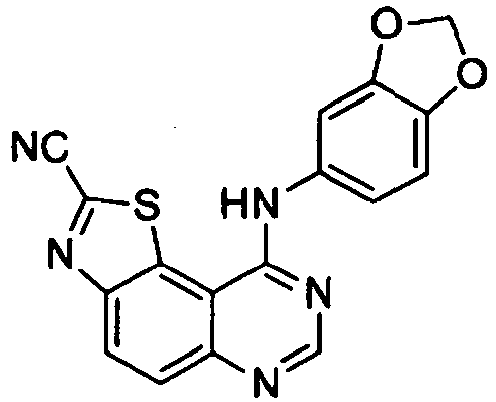
- Prepared from VII and 3,4-(methylenedioxy)aniline. Flash chromatography eluent (DCM-EtOAc, 9:1). Yield: 49%; orange solid; mp >260 °C; IR (KBr) vmax /cm-1 2894, 2226, 1734, 1706, 1645, 1609, 1581, 1555, 1499, 1471, 1377, 1354, 1304, 1264, 1236, 1211, 1188, 1162, 1125, 1086, 1037, 972, 938, 924, 859, 829, 809; 1H NMR (300 MHz, DMSO-d6 ) δ 8.51 (d, 1H, J = 9.0 Hz), 8.14 (m, 1H), 7.76 (m, 1H), 6.94 (d, 2H, J = 9.0 Hz), 6.72 (m, 1H), 6.02 (s, 2H); HRMS calcd for C17H9N5O2S (M + H+): 348.0555, found 348.0566.
-

- Prepared from VII and 2-bromo-3,4-(methylenedioxy)aniline. Flash chromatography eluent (DCM-EtOAc, 5:5). Yield: 21%; yellow solid, mp >260°C; IR (KBr) vmax /cm-1 2887, 2233, 1632, 1610, 1581, 1501, 1484, 1465, 1379, 1348, 1303, 1267, 1232, 1161, 1116, 1034, 970, 929, 829; 1H NMR (300 MHz, DMSO-d6 ) δ 8.49 (d, 1H, J = 9.0 Hz), 8.06 (s, 1H), 7.77 (d, 1H, J = 9.0 Hz), 7.25 (s, 1H), 6.83 (s, 1H), 6.06 (s, 2H); HRMS calcd for C17H9N5O2SBr (M + H+): 425.9660, found 425.9646.
-

- Prepared from VII and 1,4-benzodioxan-6-amine. Flash chromatography eluent (DCM-EtOAc, 8:2). Yield: 33%; yellow solid; mp 180-190°C; IR (KBr) vmax /cm-1 3055, 2978, 2932, 2875, 2230, 1709, 1638, 1609, 1578, 1496, 1460, 1376, 1299, 1281, 1239, 1200, 1151, 1063, 916, 885, 814; 1H NMR (300 MHz, DMSO-d6 ) δ 8.37 (d, 1H, J= 8.4 Hz), 7.85 (m, 1H), 7.76 (m, 1H), 6.88 (d, 1H, J = 8.4 Hz), 6.56 (m, 2H), 4.25 (s, 4H); HRMS calcd for C18H12N5O2S (M + H+): 362.0712, found 362.0696.
-

- Prepared from VII and 3,4-dimethoxyaniline. Flash chromatography eluent (DCM-EtOAc, 8:2). Yield: 74%; yellow solid; mp >260°C; IR (KBr) vmax /cm-1 3267, 2839, 2226, 1644, 1610, 1583, 1507, 1460, 1443, 1379, 1308, 1260, 1227, 1201, 1166, 1150, 1129, 1020, 967, 935, 861, 839; 1H NMR (300 MHz, DMSO-d6 ) δ 8.34 (m, 1H), 7.79 (m, 1H), 7.71 (m, 1H), 6.90 (d, 1H, J = 8.1 Hz), 6.54 (m, 2H), 4.26 (s, 6H); HRMS calcd for C18H14N5O2S (M + H+): 364.0868, found 364.0850.
-
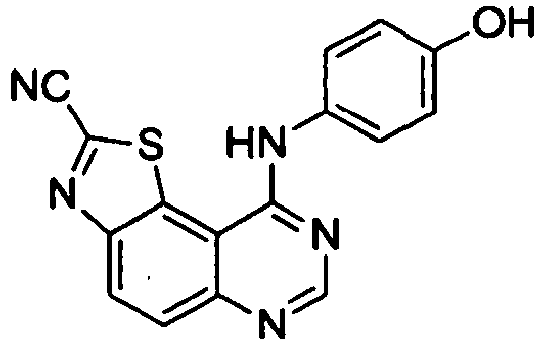
- Prepared from VII and 4-aminophenol. Flash chromatography eluent (EtOAc). Yield: 80%; orange solid; mp 236°C; IR (KBr) vmax /cm-1 3072, 2225, 1641, 1615, 1577, 1503, 1464, 1378, 1350, 1307, 1230, 1212, 1159, 1097, 972, 832; 1H NMR (300 MHz, DMSO-d6 ) δ 8.48 (d, 1H, J= 8.7 Hz), 8.08 (m, 1H), 7.76 (d, 1H, J = 8.7 Hz), 7.15 (m, 2H), 6.79 (m, 2H); HRMS calcd for C16H10N5OS (M + H+): 320.0606, found 320.0619.
-

- Prepared from VII and 5-amino-2-methoxyphenol. Flash chromatography eluent (EtOAc). Yield: 54%; yellow solid; mp 248°C; IR (KBr) vmax /cm-1 2921, 2851, 2227, 1724, 1647, 1616, 1583, 1509, 1460, 1334, 1287, 1263, 1218, 1172, 1148, 1120, 1036, 973, 953, 864, 833; 1H NMR (300 MHz, DMSO-d6 ) δ 8.49 (d, 1H, J = 8.7 Hz), 8.05 (m, 1H), 7.77 (d, 1H, J = 8.7 Hz), 7.94 (d, 2H, J = 8.7 Hz), 6.65 (m, 1H), 3.77 (s, 3H); HRMS calcd for C17H12N5O2S (M + H+): 350.0712, found 350.0715.
-

- Prepared from VII and 2,3-dihydro-l-benzofuran-5-amine. Flash chromatography eluent (EtOAc). Yield: 95%; yellow solid; mp 216°C; IR (KBr) vmax /cm-1 2894, 2853, 2228, 1643, 1609, 1579, 1484, 1467, 1376, 1353, 1306, 1269, 1219, 1192, 1164, 1123, 978, 941, 881, 814; 1H NMR (300 MHz, DMSO-d6 ) δ 8.49 (d, 1H, J = 8.7 Hz), 8.10 (s, 1H), 7.75 (d, 1H, J = 8.7 Hz), 7.22 (m, 1H), 7.04 (s, 1H), 6.78 (m, 1H), 4.53 (t, 2H, J = 8.7 Hz), 3.20 (t, 1H, J = 8.7 Hz); HRMS calcd for C18H12N5OS (M + H+): 346.0763, found 346.0762.
-

- Prepared from VII and 4-chloroaniline. Flash chromatography eluent (DCM-EtOAc, 5:5). Yield: 89%; yellow solid; mp >260°C; IR (KBr) vmax /cm-1 2850, 2229, 1643, 1609, 1583, 1550, 1491, 1480; 1457, 1377, 1355, 1307, 1270, 1214, 1164, 1130, 1092, 1010, 980, 831 ; 1H NMR (300 MHz, DMSO-d6 ) δ 8.51 (d, 1H, J = 8.7 Hz), 8.18 (s, 1H), 7.76 (d, 1H, J = 8.7 Hz), 7.38 (m, 2H), 7.04 (m, 2H); HRMS calcd for C16H9N5SCl (M + H+): 338.0267, found 338.0274.
-

- Prepared from VII and 3,4-dichloroaniline. Flash chromatography eluent (DCM-EtOAc, 7:3). Yield: 42%; yellow solid; mp >260 °C; IR (KBr) vmax /cm-1 2851, 2225, 1644, 1612, 1579, 1456, 1378, 1355, 1308, 1270, 1241, 1168, 1122, 1026, 971, 879, 834, 816; 1H NMR (300 MHz, DMSO-d6 ) δ 8.55 (d, 1H, J = 8.7 Hz), 8.30 (s, 1H), 7.78 (d, 1H, J = 8.7 Hz), 7.63-7.53 (m, 2H), 7.30 (m, 2H); HRMS calcd for C16H8N5SCl2 (M + H+): 371.9877, found 371.9882.
-

- Prepared from VII and 3-ethynylaniline. Flash chromatography eluent (DCM-EtOAc, 7:3). Yield: 84%; yellow solid; mp 182 °C; IR (KBr) vmax /cm-1 3295, 3062, 2846, 2225, 1642, 1612, 1581, 1566, 1458, 1404, 1376, 1348, 1306, 1263, 1229, 1165, 1148, 1126, 971, 910, 888, 835; 1H NMR (300 MHz, DMSO-d6 ) δ 8.53 (d, 1H, J = 8.7 Hz), 8.20 (s, 1H), 7.78 (d, 1H, J = 8.7 Hz), 7.40-7.3 5 (m, 2H), 7.29 (m, 1H), 7.20 (m, 1H), 4.17 (s, 1H) ; HRMS calcd for C18H10N5S (M + H+): 328.0657, found 328.0659.
-

- Prepared from VII and 6-aminobenzimidazole. Flash chromatography eluent (DCM-MeOH 8:2). Yield: 98%; yellow solid; mp >260°C; IR (KBr) vmax /cm-1 3084, 2226, 1615, 1557, 1464, 1376, 1347, 1248, 1147, 967, 939, 809; 1H NMR (300 MHz, DMSO-d6 ) δ 8.48 (d, 1H, J = 8.7 Hz), 8.15-8.10 (m, 2H), 8.02 (m, 1H), 7.75 (d, 1H, J = 8.7 Hz), 7.56 (m, 1H), 7.04 (m, 1H); HRMS calcd for C17H10N7S (M + H+): 344.0718, found 344.0705.
-

- Prepared from VII and 4-amino-2-nitrophenol. Flash chromatography eluent (DCM-EtOAc, 5:5). Yield: 60%; brown solid; mp >260°C; IR (KBr) vmax /cm-1 3334, 3081, 2926, 2225, 1627, 1591, 1569, 1525, 1465, 1419, 1395, 1305, 1237, 1171, 1132, 1070, 966, 930, 834, 819; 1H NMR (300 MHz, DMSO-d6 ) δ 8.52 (d, 1H, J= 8.7 Hz), 8.28 (m, 1H), 8.03 (m, 1H), 7.75 (d, 1H, J = 8.7 Hz), 7.61 (m, 1H), 7.15 (d, 1H, J = 9.0 Hz); HRMS calcd for C16H9N6O3S (M + H+): 365.0457, found 365.0441.
-
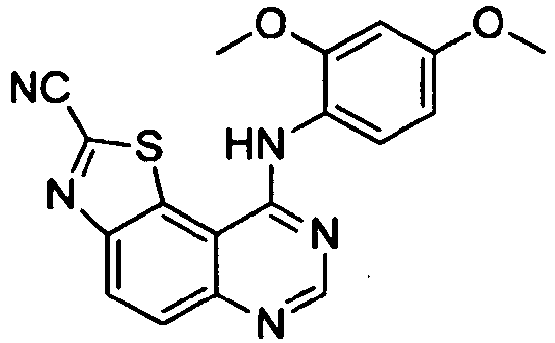
- Prepared from VII and 2,4-dimethoxyaniline. Flash chromatography eluent (DCM-EtOAc, 5:5). Yield: 59%; orange solid; mp 255-257°C; IR (KBr) vmax /cm-1 3401, 3081, 2948, 2837, 2233, 1600, 1565, 1540, 1525, 1505, 1443, 1417, 1329, 1278, 1231, 1203, 1159, 1132, 1088, 1030, 959, 915; 1H NMR (300 MHz, DMSO-d6 ) δ 8.51 (d, 1H, J = 9.0 Hz), 7.98 (s, 1H), 7.83 (d, 1H, J= 9.0 Hz), 6.95 (m, 1H), 6.67 (s, 1H), 6.58 (d, 1H, J = 9.0 Hz), 3.78 (s, 3H), 3.73 (s, 3H); HRMS calcd for C18H14N5O2S (M + H+): 364.0868, found 364.0856.
-

- Prepared from VII and 3,5-dimethoxyaniline. Flash chromatography eluent (DCM-EtOAc, 5:5). Yield: 98%; yellow solid; mp 248°C; IR (KBr) vmax /cm-1 3242, 2940, 2837, 2223, 1711, 1647, 1578, 1455, 1419, 1383, 1357, 1306, 1265, 1205, 1144, 1058, 1046, 968, 943, 917, 833, 806; 1H NMR (300 MHz, DMSO-d6 ) δ 8.51 (d, 1H, J = 9.0 Hz), 8.06 (s, 1H), 7.79 (d, 1H, J = 9.0 Hz), 6.31 (m, 3H), 3.74 (s, 6H); HRMS calcd for C18H14N5O2S (M + H+): 364.0868, found 364.0856.
-

- Prepared from VII and aniline. Flash chromatography eluent (DCM-EtOAc, 5:5). Yield: 67%; yellow solid; mp >260°C; IR (KBr) vmax /cm-1 3395, 3057, 2228, 1731, 1644, 1608, 1577, 1491, 1459, 1378, 1352, 1301, 1255, 1214, 1147, 1128, 1106, 1071, 967, 896, 827; 1H NMR (300 MHz, DMSO-d6 ) δ 8.51 (d, 1H, J = 9.0 Hz), 8.11 (s, 1H), 7.78 (d, 1H, J = 9.0 Hz), 7.40 (t, 2H, J = 7.5 Hz), 7.20 (m, 2H), 7.11 (t, 1H, J = 7.5 Hz); HRMS calcd for C16H10N5S (M + H+): 304.0657, found 304.0657.
-

- Prepared from VII and 4-toluidine. Flash chromatography eluent (DCM-EtOAc, 7:3). Yield: 64%; yellow solid; mp >260°C; IR (KBr) vmax /cm-1 3016, 2853, 2228, 1731, 1641, 1605, 1581, 1554, 1505, 1458, 1376, 1353, 1304, 1268, 1215, 1165, 1130, 976, 831, 811; 1H NMR (300 MHz, DMSO-d6 ) δ 8.49 (d, 1H, J = 9.0 Hz), 8.07 (s, 1H), 7.76 (d, 1H, J = 9.0 Hz), 7.20-7.17 (m, 2H), 7.12-7.05 (m, 2H), 2.32 (s, 3H); HRMS calcd for C17H12N5S (M + H+): 318.0813, found 318.0811.
-

- Prepared from VII and 4-fluoroaniline. Flash chromatography eluent (DCM-EtOAc, 5:5). Yield: 92%; yellow solid; mp >260°C; IR (KBr) vmax /cm-1 3049, 2840, 2226, 1722, 1643, 1610, 1581, 1557, 1502, 1377, 1355, 1305, 1269, 1227, 1208, 1166, 1130, 1090, 981, 846, 829, 818; 19F NMR (282 MHz, DMSO-d6 ) δ -120.31 ; 1H NMR (300 MHz, DMSO-d6 ) δ 8.51 (d, 1H, J = 9.0 Hz), 8.16 (s, 1H), 7.76 (d, 1H, J = 9.0 Hz), 7.26-7.08 (m, 4H); HRMS calcd for C16H9N5SF (M + H+): 322.0563, found 322.0551.
-

- Prepared from VII and 2-bromo-4-fluoroaniline. Flash chromatography eluent (DCM-EtOAc, 95:5). Yield: 44%; yellow solid; mp >260°C; IR (KBr) vmax /cm-1 3068, 2853, 2228, 1736, 1644, 1611, 1582, 1497, 1474, 1459, 1380, 1353, 1309, 1252, 1188, 1171, 1127, 1050, 1031, 980, 881, 860, 826; 19F NMR (282 MHz, DMSO-d6 ) δ -119.33; 1H NMR (300 MHz, DMSO-d6 ) δ 8.56 (d, 1H, J = 9.0 Hz), 8.18 (s, 1H), 7.81 (d, 1H, J = 9.0 Hz), 7.63 (d, 1H, J = 7.8 Hz) 7.24-7.17 (m, 2H); HRMS calcd for C16H8N5SBrF (M + H+): 399.9668, found 399.9675.
-

- Prepared from VII and 2-fluoro-4-methoxyaniline. Flash chromatography eluent (DCM-EtOAc, 5:5). Yield: 85%; yellow solid; mp >260°C; IR (KBr) vmax /cm-1 2844, 2226, 1731, 1649, 1613, 1583, 1507, 1493, 1460, 1445, 1379, 1356, 1305, 1263, 1212, 1168, 1153, 1129, 1090, 1027, 980, 947, 841, 830, 818; 19F NMR (282 MHz, DMSO-d6 ) δ -120.02; 1H NMR (300 MHz, DMSO-d6 ) δ 8.51 (d, 1H, J = 9.0 Hz), 8.15 (s, 1H), 7.77 (d, 1 H, J = 9.0 Hz), 7.30 (s, 1H), 6.92 (m, 1 H), 6.80 (d, 2H, J = 9.0 Hz); HRMS calcd for C17H11N5OSF (M + H+): 352.0668, found 352.0658.
-

- Prepared from VII and 4-aminobenzonitrile. Flash chromatography eluent (DCM-EtOAc, 5:5). Yield: 36%; yellow solid; mp >260°C; IR (KBr) vmax /cm-1 3293, 2225, 2218, 1722, 1628, 1590, 1562, 1495, 1461, 1387, 1261, 1228, 1132, 966, 847, 814; 1H NMR (300 MHz, DMSO-d6 ) δ 8.54 (d, 1H, J = 9.0 Hz), 8.28 (s, 1H), 7.77 (m, 3H), 7.40 (d, 2H, J = 9.0 Hz); HRMS calcd for C17H9N6S (M + H+): 329.0609, found 329.0612.
-

- Prepared from VII and 4-chloro-2-fluoroaniline. Flash chromatography eluent (DCM-EtOAc, 8:2). Yield: 56%; yellow solid; mp >260°C; IR (KBr) vmax /cm-1 2231, 1638, 1614, 1583, 1476, 1413, 1380, 1356, 1309, 1273, 1200, 1170, 1120, 982, 901, 838, 820; 1H NMR (300 MHz, DMSO-d6 ) δ 8.55 (d, 1H, J = 9.0 Hz), 8.24 (s, 1 H), 7.79 (d, 1H, J = 9.0 Hz), 7.45 (d, 1H, J = 9.0 Hz), 7.34 (t, 1H, J = 8.4 Hz), 7.26 (d, 1H, J = 9.0 Hz); HRMS calcd for C16H8N5SCIF (M + H+): 356.0173, found 356.0160.
-

- Prepared from VII and 2,4-dichloroaniline. Flash chromatography eluent (DCM-EtOAc, 5:5). Yield: 32%; yellow solid; mp >260 °C; IR (KBr) vmax /cm-1 3063, 2231, 1736, 1644, 1611, 1577, 1459, 1380, 1355, 1310, 1242, 1173, 1098, 1051, 983, 830, 818; 1H NMR (300 MHz, DMSO-d6 ) δ 8.56 (d, 1H, J = 9.0 Hz), 8.21 (s, 1H), 7.80 (d, 1H, J = 9.0 Hz), 7.63 (s, 1H), 7.39 (d, 1H, J = 8.1 Hz), 7.25 (d, 1H, J = 8.1 Hz); HRMS calcd for C16H8N5SCl2 (M + H+): 371.9877, found 371.9877.
-

- Prepared from VII and 3-nitro-4-methoxyaniline. Flash chromatography eluent (DCM-EtOAc, 7:3). Yield: 61%; yellow solid; mp 200-260°C; IR (KBr) vmax /cm-1 2226, 1644, 1523, 1459, 1346, 1267, 1191, 1155, 1075, 1015, 970, 928, 890, 822; 1H NMR (300 MHz, DMSO-d6) δ 8.47 (d, 1H, J = 9.0 Hz), 8.26 (s, 1H), 7.97 (d, 1H, J= 9.0 Hz), 7.70 (s, 2H), 7.32 (d, 1H, J = 9.0 Hz), 3.93 (s, 3H); HRMS calcd for C17H11N6O3S (M + H+): 379.0613, found 379.0614.
-

- Prepared from VII and 4-tert-butylaniline. Flash chromatography eluent (DCM-EtOAc, 7:3). Yield: 99%; yellow solid; mp 154°C; IR (KBr) vmax /cm-1 2958, 2235, 1693, 1649, 1582, 1505, 1466, 1408, 1349, 1288, 1219, 1155, 1125, 989, 968, 894, 831; 1H NMR (300 MHz, DMSO-d6 ) δ 8.49 (d, 1H, J = 9.0 Hz), 8.07 (s, 1H), 7.76 (d, 1H, J = 9.0 Hz), 7.40 (d, 2H, J = 7.8 Hz), 7.12 (m, 2H), 1.31 (s, 9H); HRMS calcd for C20H18N5S (M + H+): 360.1283, found 360.1273.
-

- Prepared from VII and 3-chloroaniline: Flash chromatography eluent (DCM-EtOAc, 7:3). Yield: 74%; pale yellow solid; mp >260°C; IR (KBr) vmax /cm-1 2849, 2226, 1643, 1611, 1577, 1461, 1377, 1354, 1306, 1218, 1161, 1128, 1070, 974, 875, 833; 1HNMR (300 MHz, DMSO-d6 ) δ 8.49 (d, 1H, J = 9.0 Hz), 8.21 (s, 1H), 7.74 (d, 1H, J = 9.0 Hz), 7.40-7.35 (m, 2H), 7.19-7.11 (m, 2H); HRMS calcd for C16H9N5SCl (M + H+): 338.0267, found 338.0259.
-

- Prepared from VII and N,N-dimethyl-p-phenylene-diamine. Flash chromatography eluent (DCM-EtOAc, 8:2). Yield: 25%; yellow solid; mp >260°C; IR (KBr) vmax /cm-1 3293, 2228, 1609, 1572, 1523, 1460, 1368, 1274, 1229, 1204, 1188, 1163, 1141, 1058, 1009, 948, 842, 811; 1H NMR (300 MHz, DMSO-d6 ) δ 8.52 (d, 1H, J = 9.0 Hz), 8.16 (s, 1H), 7.86 (d, 1H, J = 9.0 Hz), 7.37 (d, 2H, J = 8.7 Hz), 6.92 (d, 2H, J = 8.7 Hz), 3.00 (s, 6H); HRMS calcd for C18H15N6S (M + H+): 347.1079, found 347.1066.
-

- Prepared from VII and 4-(pyrrolidin-1-yl)aniline. Flash chromatography eluent (DCM-EtOAc, 8:2). Yield: 48%; yellow solid; mp >260°C; IR (KBr) vmax /cm-1 3303, 2842, 2233, 1709, 1629, 1613, 1583, 1522, 1466, 1388, 1347, 1275, 1219, 1185, 1166, 1060, 1014, 989, 828, 809; 1H NMR (300 MHz, DMSO-d6 ) δ 8.54 (d, 1H, J= 9.0 Hz), 8.15 (s, 1H), 7.88 (d, 1H, J = 9.0 Hz), 7.35 (d, 2H, J = 8.1 Hz), 6.73 (d, 2H, J = 8.1 Hz), 3.17 (m, 4H), 1.99 (m, 4H); HRMS calcd for C20H17N6S (M + H+): 373.1235, found 373.1218.
-

- Prepared from VII and 2,4-difluoroaniline. Flash chromatography eluent (DCM-EtOAc, 7:3). Yield: 68%; yellow solid; mp >260°C; IR (KBr) vmax /cm-1 2228, 1645, 1611, 1583, 1557, 1488, 1460, 1378, 1357, 1311, 1276, 1260, 1172, 1138, 1091, 962, 854, 831, 818; 19F NMR (282 MHz, DMSO-d6 ) δ -117.6, -118.7; 1H NMR (300 MHz, DMSO-d6 ) δ 8.54 (d, 1H, J= 9.0 Hz), 8.22 (s, 1 H), 7.78 (d, 1H, J = 9.0 Hz), 7.35-7.24 (m, 2H), 7.06 (t, 1H, J = 7.8 Hz); HRMS calcd for C16H8N5SF2 (M + H+): 340.0468, found 340.0458.
-

- Prepared from VII and 4-amino-2-fluorophenol. Flash chromatography eluent (DCM-EtOAc, 5:5). Yield: 58%; orange solid; mp >260°C; IR (KBr) vmax /cm-1 3375, 2228, 1731, 1649, 1619, 1578, 1512, 1470, 1373, 1347, 1292, 1241, 1204, 1150, 1111, 978, 943, 856, 836; 19F NMR (282 MHz, DMSO-d6 ) δ -136.8; 1H NMR (300 MHz, DMSO-d6 ) δ 8.46 (d, 1H, J = 9.0 Hz), 8.15 (s, 1H), 7.69 (d, 1H, J = 9.0 Hz), 6.97-6.81 (m, 3H); HRMS calcd for C16H9N5OSF (M + H+): 338.0512, found 338.0516.
-

- Prepared from VII and 4-aminobenzotrifluoride. Flash chromatography eluent (DCM-EtOAc, 7:3). Yield: 61%; yellow solid; mp >260°C; IR (KBr) vmax /cm-1 2851, 2229, 1649, 1604, 1582, 1512, 1457, 1382, 1318, 1272, 1252, 1221, 1165, 1117, 1101, 1062, 1011, 979, 863, 830; 19F NMR (282 MHz, DMSO-d6 ) δ -60.01; 1H NMR (300 MHz, DMSO-d6 ) δ 8.53 (d, 1H, J = 9.0 Hz), 8.22 (s, 1H), 7.77 (d, 1H, J = 9.0 Hz), 7.70 (d, 2H, J = 8.4 Hz), 7.39 (d, 2H, J = 8.4 Hz); HRMS calcd for C17H9N5SF3 (M + H+): 372.0529, found 372.0535.
- Methyl iodide (0.90 mmol) was added dropwise to a stirred suspension of carbonitrile VIIIia, VIIIda, VIIIha (0.60 mmol) and sodium hydride (0.90 mmol, 60% dispersion in mineral oil) in dimethylformamide (4 mL). The mixture was stirred for 1 h at 0 °C and then for 2 h at room temperature. After cooling, the resulting mixture was concentrated under reduced pressure. The crude residue obtained was purified by flash chromatography (DCM-ethyl acetate, 1:9) to give IXa-c.
-

- Prepared from carbonitrile VIIIia. Flash chromatography eluent (EtOAc). Yield: 74%; orange solid; mp 224°C; IR (KBr) vmax /cm-1 3040, 2988, 2957, 2828, 2225, 1621, 1553, 1501, 1442, 1409, 1392, 1366, 1255, 1227, 1201, 1173, 1142, 1123, 1023, 936, 872, 803; 1H NMR (300 MHz, DMSO-d6 ) .S 8.56 (d, 1H, J = 9.0 Hz), 8.29 (s, 1H), 7.85 (d, 1H, J = 9.0 Hz), 7.17 (d, 1H, J = 2.1 Hz), 7.08 (dd, 1H, J 1 = 2.1 Hz, J 2 = 8.7 Hz), 6.93 (d, 1H, J = 8.7 Hz), 3.77 (m, 9H); HRMS calcd for C19H16N5O2S (M + H+): 378.1025, found 378.1008.
-

- Prepared from carbonitrile VIIIda. Flash chromatography eluent (EtOAc). Yield: 60%; orange solid; mp >260°C; IR (KBr) vmax /cm-1 3073, 2949, 2908, 2835, 2225, 1615, 1551, 1497, 1481, 1461, 1452, 1436, 1362, 1235, 1153, 1060, 1031, 974, 839, 825, 801; 1H NMR (300 MHz, DMSO-d6 ) δ 8.49 (d, 1H, J = 9.0 Hz), 8.23 (s, 1H), 7.88 (d, 1H, J = 9.0 Hz), 7.48 (d, 1H, J = 8.7 Hz), 6.92 (d, 1H, J = 8.7 Hz), 3.77 (s, 3H), 3.73 (s, 3H); HRMS calcd for C18H14N5OS (M + H+): 348.0919, found 348.0908.
-

- Prepared from carbonitrile VIIIha. Flash chromatography eluent (EtOAc). Yield: 30%; orange solid; mp >260°C; IR (KBr) vmax /cm-1 3422, 2932, 2875, 2220, 1612, 1547, 1487, 1455, 1360, 1299, 1253, 1201, 1149, 1065, 914, 877, 811; 1H NMR (300 MHz, DMSO-d6 ) δ 8.54 (d, 1H, J= 9.0 Hz), 8.28 (s, 1H), 7.84 (d, 1H, J = 9.0 Hz), 7.12 (d, 1H, J = 2.4 Hz), 6.98 (dd, 1H, J 1 = 2.4 Hz, J 2 = 8.7 Hz), 6.82 (d, 1H, J = 8.7 Hz), 4.24 (s, 4H), 3.76 (s, 3H); HRMS calcd for C18H14N5OS (M + H+): 348.0919, found 348.0908.
- A stirred mixture of carbonitrile (1 mmol) and appropriate amine (1.2 mmol) in dry THF (7 mL) under argon was stirred overnight at room temperature. The solvent was removed in vacuo and the crude residue purified by flash chromatography to afford the amidines 1 to 36.
-
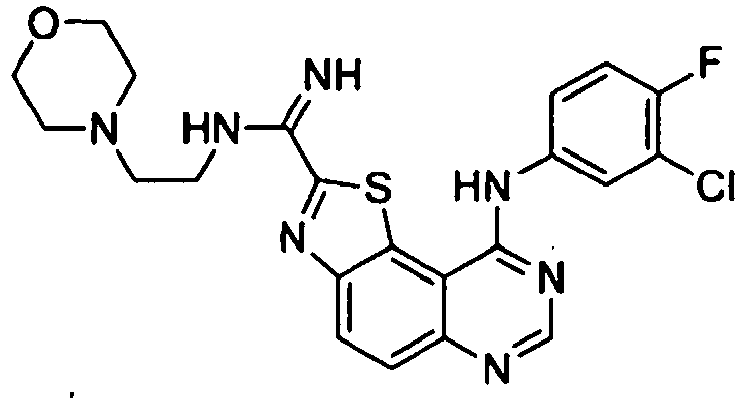
- Prepared from carbonitrile VIIIaa and N-aminoethylmorpholine. Flash chromatography eluent (DCM-MeOH, 5:5). Yield: 71%; yellow solid; mp 158°C; IR (KBr) vmax /cm-1 2956, 2816, 1797, 1614, 1561, 1485, 1256, 1199, 1113, 1069, 966, 916, 816; 19F NMR (282 MHz, DMSO-d6 ) δ -119.1; 1H NMR (300 MHz, DMSO-d6 ) δ 8.87 (s, 1H, NH), 8.43 (d, 1H, J = 7.2 Hz), 8.03 (m, 1H), 7.90 (m, 1H), 7.52 (in, 1H), 7.39 (m, 1H), 7.18 (m, 1H), 3.78-3.75 (m, 4H), 3.52 (m, 2H), 2.76-2.72 (m, 2H), 2.60 (m, 4H); HRMS calcd for C22H22N7OSClF (M + H+): 486.1279, found 486.1292.
-

- Prepared from carbonitrile VIIIaa and N-aminoethylpiperidine. Flash chromatography eluent (DCM-MeOH, 3:7). Yield: 82%; orange solid; mp 147°C; IR (KBr) vmax /cm-1 2928, 2361, 1572, 1483, 1380, 1255, 1201, 1121, 1086, 1051, 964, 879, 818; 19F NMR (282 MHz, CDCl3) δ -123.8; 1H NMR (300 MHz, CDCl3) δ 8.62 (s, 1H), 8.35 (d, 1H, J = 9.0 Hz), 7.90 (d, 1H, J = 9.0 Hz), 7.70 (m, 1H), 7.32 (m, 1H), 7.12 (t, 1H, J = 9.0 Hz), 3.50 (m, 2H), 2.63 (t, 2H, J = 5.7 Hz), 2.49 (m, 4H), 1.63-1.58 (m, 4H), 1.48 (m, 2H); HRMS calcd for C23H24N7SClF (M + H+): 484.1486, found 484.1501.
-

- Prepared from carbonitrile VIIIaa and N-aminoethylpyrrolidine. Flash chromatography eluent (DCM-MeOH, 5:5). Yield: 69%; orange solid; mp 166°C; IR (KBr) vmax /cm-1 3381, 3146, 2965, 2803, 1641, 1617, 1562, 1486, 1383, 1341, 1253, 1200, 1127, 1050, 965, 876, 816; 19F NMR (282 MHz, MeOD-d4 ) δ -125.6; 1H NMR (300 MHz, MeOD-d4 ) δ 8.22 (d, 1H, J = 9.0 Hz), 7.95 (s, 1H), 7.59 (d, 1H, J = 9.0 Hz), 7.31 (m, 1H), 7.18 (t, 1H, J = 9.0 Hz), 7.15-7.12 (m, 1H), 3.45 (m, 2H), 2.85 (m, 2H), 2.67 (m, 4H), 1.83 (m, 4H); HRMS calcd for C22H22N7SClF (M + H+): 470.1330, found 470.1340.
-

- Prepared from carbonitrile VIIIaa and 2-dimethylaminoethylamine. Flash chromatography eluent (DCM-MeOH, 5:5). Yield: 50%; pale yellow solid; mp 173°C; IR (KBr) vmax /cm-1 3224, 3038, 2950, 2861, 2824, 2773, 1618, 1560, 1488, 1386, 1323, 1254, 1195, 1127, 1086, 1052, 967, 816; 19F NMR (282 MHz, MeOD-d4 ) δ -125.5; 1H NMR (300 MHz, MeOD-d4 ) δ 8.34 (d, 1 H, J = 9.0 Hz), 7.93 (s, 1H), 7.67 (d, 1H, J =9.0 Hz), 7.29 (m, 1H), 7.18 (t, 1H, J = 9.0 Hz), 7.10-7.06 (m, 1H), 3.64 (t, 2H, J = 6.0 Hz), 3.27 (t, 2H, J = 6.0 Hz), 2.80 (s, 6H); HRMS calcd for C20H20N7SClF (M + H+): 444.1173, found 444.1155.
-

- Prepared from carbonitrile VIIIaa and diethylethylenediamine. Flash chromatography eluent (DCM-MeOH, 5:5). Yield: 50%; orange solid; mp 140°C; IR (KBr) vmax /cm-1 3295, 2969, 2812, 1671, 1618, 1560, 1489, 1386, 1346, 1254, 1196, 1127, 1052, 966, 817; 19F NMR (282 MHz, MeOD-d4 ) δ -125.3; 1H NMR (300 MHz, MeOD-d4 ) δ 8.29 (d, 1H, J = 9.0 Hz), 7.94 (s, 1H), 7.63 (d, 1H, J = 9.0 Hz), 7.29-7.20 (m, 2H), 7.09 (m, 1H), 3.60-3.56 (m, 2H), 2.90-2.83 (m, 2H), 2.77-2.74 (m, 4H), 1.17-1.06 (m, 6H); HRMS calcd for C22H24N7SClF (M + H+): 472.1486, found 472.1502.
-
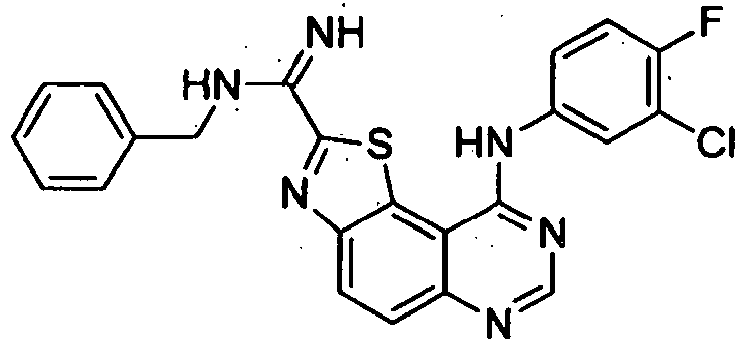
- Prepared from carbonitrile VIIIaa and benzylamine. Flash chromatography eluent (DCM-EtOAc, 2:8). Yield: 69%; yellow solid; mp 232°C; IR (KBr) vmax /cm-1 3057, 1725, 1639, 1490, 1377, 1341, 1252, 1202, 1151, 1121, 1086, 1050, 965, 818; 19F NMR (282 MHz, MeOD-d4 ) δ -125.3; 1H NMR (300 MHz, MeOD-d4 ) δ 8.29 (d, 1H, J= 9.0 Hz), 7.94 (s, 1H), 7.63 (d, 1H, J = 9.0 Hz), 7.43 (m, 2H), 7.35-7.17 (m, 5H), 7.10 (m, 1H), 4.53 (s, 2H); HRMS calcd for C23H17N6SClF (M + H+): 463.0908, found 463.0916.
-

- Prepared from carbonitrile VIIIaa and dimethylamine. Flash chromatography eluent (DCM-MeOH, 5:5). Yield: 43%; yellow solid; mp >260°C; IR (KBr) vmax /cm-1 3411, 3051, 1663, 1623, 1559, 1488, 1383, 1254, 1202, 1150, 1051, 966, 819; 19F NMR (282 MHz,MeOD-d4 ) δ -125.9; 1H NMR (300 MHz, MeOD-d4 ) δ 8.45 (d, 1H, J= 9.0 Hz), 7.98 (s, 1H), 7.75 (d, 1H, J = 9.0 Hz), 7.30-7.21 (m, 2H), 7.12 (t, 1H, J = 9.0 Hz), 3.39 (s, 6H); HRMS calcd for C18H15N6SClF (M + H+): 401.0751, found 401.0742.
-

- Prepared from carbonitrile VIIIba and N-aminoethylmorpholine. Flash chromatography eluent (DCM-MeOH, 5:5). Yield: 85%; yellow solid; mp 190°C; IR (KBr) vmax /cm-1 3374, 2975, 2361, 1645, 1585, 1381, 1265, 1227, 1090, 1053, 973, 916, 882, 825; 19F NMR (282 MHz, DMSO-d6 ) δ -120.0; 1H NMR (300 MHz, DMSO-d6 ) δ 8.52 (d, 1H, J= 9.0 Hz), 8.26 (m, 1H), 7.78 (m, 1H), 7.57 (m, 1H), 7.36 (m, 1H), 7.16 (m, 1H), 3.66 (t, 4H, J = 4.5 Hz), 3.48-3.42 (m, 2H), 2.69 (t, 2H, J = 6.0 Hz), 2.61 (m, 4H) ; HRMS calcd for C22H22N17OSBrF (M + H+): 530.0774, found 530.0782.
-

- Prepared from carbonitrile VIIIba and N-aminoethylpiperidine. Flash chromatography eluent (DCM-MeOH, 5:5). Yield: 72%; yellow solid; mp 143°C; IR (KBr) vmax /cm-1 3340, 2975, 2930, 2361, 1615, 1561, 1476, 1380, 1348, 1262, 1197, 1153, 1114, 1052, 881, 821; 19F NMR (282 MHz, CDCl3) δ -123.8; 1H NMR (300 MHz, CDCl3) δ 8.25 (d, 1H, J= 9.0 Hz), 8.09 (s, 1 H), 7.55 (d, 1H, J = 9.0 Hz), 7.50-7.45 (m, 1H), 7.29 (t, 1H, J = 9.0 Hz), 7.12-7.06 (m, 1H), 3.54 (m, 2H), 2.67 (t, 2H, J = 5.7 Hz), 2.54 (m, 4H), 1.66-1.60 (m, 4H), 1.49 (m, 2H) ; HRMS calcd for C23H24N7SBrF (M + H+): 528.0981, found 528.0986.
-
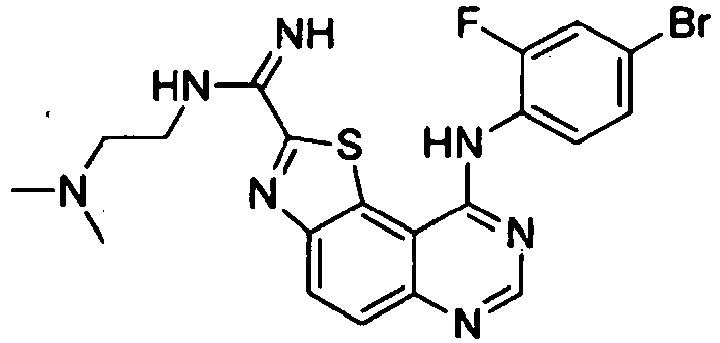
- Prepared from carbonitrile VIIIba and 2-dimethylaminoethylamine. Flash chromatography eluent (DCM-MeOH, 5:5). Yield: 64%; orange solid; mp 128°C; IR (KBr) vmax /cm-1 3274, 3058, 2940, 2861, 2822, 2773, 1618, 1560, 1478, 1380, 1341, 1262, 1197, 1155, 1112, 1038, 965, 881, 823; 19F NMR (282 MHz, MeOD-d4 ) δ -122.3; 1H NMR (300 MHz, MeOD-d4 ) δ 8.33 (d, 1H, J= 9.0 Hz), 7.92 (s, 1H), 7.68 (d, 1H, J = 9.0 Hz), 7.41-7.36 (m, 2H), 7.15 (t, 1H, J = 9.0 Hz), 3.46 (t, 2H, J = 6.6 Hz), 2.76 (t, 2H, J = 6.6 Hz), 2.37 (s, 6H); HRMS calcd for C20H20N7SBrF (M + H+): 488.0668, found 488.0688.
-

- Prepared from carbonitrile VIIIba and diethylethylenediamine. Flash chromatography eluent (DCM-MeOH, 5:5). Yield: 86%; orange solid; mp 88°C; IR (KBr) vmax /cm-1 2965, 2360, 1793, 1619, 1520, 1477, 1378, 1265, 1198, 1067, 966, 880, 822; 19F NMR (282 MHz, MeOD-d4 ) δ -122.1; 1H NMR (300 MHz, MeOD-d4 ) δ 8.30 (d, 1H, J = 9.0 Hz), 7.93 (s, 1 H), 7.66 (d, 1H, J = 9.0 Hz), 7.38-7.33 (m, 2H), 7.13 (t, 1H, J = 9.0 Hz), 3.58 (t, 2H, J = 6.6 Hz), 2.82 (t, 2H, J = 6.6 Hz), 2.68 (m, 4H), 1.09 (m, 6H); HRMS calcd for C22H24N7SBrF (M + H+): 516.0981, found 516.0988.
-

- Prepared from carbonitrile VIIIba and N-aminoethylpyrrolidine. Flash chromatography eluent (DCM-MeOH, 5:5). Yield: 68%; orange solid; mp 139°C; IR (KBr) vmax /cm-1 2968, 2361, 1563, 1476, 1380, 1262, 1223, 1067, 965, 880, 822; 19F NMR (282 MHz, MeOD-d4 ) δ - 123.6; 1H NMR (300 MHz, MeOD-d4 ) δ 8.29 (d, 1H, J = 9.0 Hz), 7.89 (s, 1H), 7.63 (d, 1H, J = 9.0 Hz), 7.35-7.29 (m, 2H), 7.09 (t, 1H, J = 9.0 Hz), 3.46 (t, 2H, J = 6.6 Hz), 2.87 (t, 2H, J = 6.6 Hz), 2.69 (m, 4H), 1.89 (m, 4H); HRMS calcd for C22H22N7SBrF (M + H+): 514.0825, found 514.0825.
-
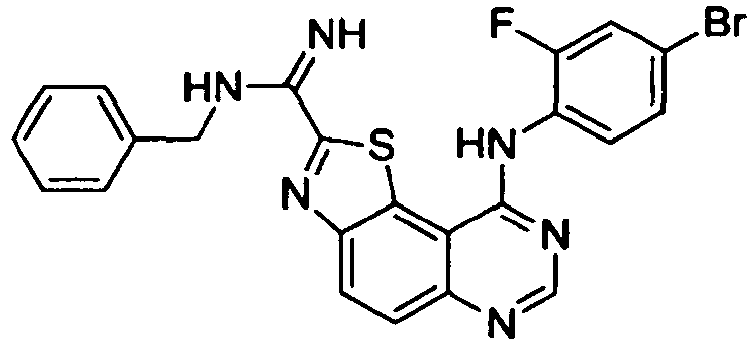
- Prepared from carbonitrile VIIIba and benzylamine. Flash chromatography eluent (DCM-EtOAc, 2:8). Yield: 68%; yellow solid; mp 130°C;; IR (KBr) vmax /cm-1 2964, 2903, 2360, 1815, 1614, 1477, 1379, 1262, 1153, 1113, 1069, 966, 880, 821; 19F NMR (282 MHz, MeOD-d4) δ -122.2; 1H NMR (300 MHz, MeOD-d4 ) δ 8.35 (d, 1H, J = 9.0 Hz), 7.92 (s, 1H), 7.69 (d, 1H, J = 9.0 Hz), 7.43 (m, 3H), 7.39-7.30 (m, 3H), 7.25 (m, 1H), 7.15 (t, 1H, J = 9.0 Hz), 4.53 (s, 2H); HRMS calcd for C23H17N6SBrF (M + H+): 507.0403, found 507.0412.
-

- Prepared from carbonitrile VIIIba and dimethylamine. Flash chromatography eluent (DCM-MeOH, 5:5). Yield: 40%; orange solid; mp 222°C; IR (KBr) vmax /cm-1 3270, 3154, 3061, 2923, 1634, 1584, 1519, 1492, 1410, 1346, 1291, 1226, 1201, 1152, 1116, 1049, 964, 881, 863, 831; 19F NMR (282 MHz, MeOD-d4 ) δ -121.6; 1H NMR (300 MHz, MeOD-d4 ) δ 8.18 (d, 1H, J = 9.0 Hz), 7.87 (s, 1H), 7.53 (d, 1H, J= 9.0 Hz), 7.28-7.19 (m, 2H), 7.12 (t, 1H, J = 9.0 Hz), 3.11 (s, 6H); HRMS calcd for C18H15N6SBrF (M + H+): 445.0246, found 445.0264.
-

- Prepared from carbonitrile VIIIba and isopropylamine. Flash chromatography eluent (DCM-MeOH, 5:5). Yield: 60%; pale yellow solid; mp >260°C; IR (KBr) vmax /cm-1 3326, 3144, 2962, 2864, 2460, 1643, 1585, 1530, 1498, 1482, 1406, 1384, 1351, 1306, 1258, 1226, 1173, 1150, 1121, 1062, 967, 880, 824; 19F NMR (282 MHz, MeOD-d4 ) δ -122.3; 1H NMR (300 MHz, MeOD-d4 ) δ 8.44 (d, 1 H, J = 9.0 Hz), 7.97 (s, 1H), 7.76 (d, 1H, J = 9.0 Hz), 7.43-7.34 (m, 2H), 7.13 (t, 1H, J= 9.0 Hz), 3.64 (s, 1H), 1.35 (s, 6H); HRMS calcd for C19H17N6SBrF (M + H+): 459.0403, found 459.0382.
-

- Prepared from carbonitrile VIIIba and 4-fluorobenzylamine. Flash chromatography eluent (DCM-EtOAc, 2:8). Yield: 28%; pale yellow solid; mp 150-160°C; IR (KBr) vmax /cm-1 3403, 3165, 2853, 1617, 1596, 1570, 1509. 1478, 1413, 1382, 1350, 1300, 1262, 1224, 1181, 1152, 1112, 1085, 962, 879, 815; 19F NMR (282 MHz, MeOD-d4 ) δ -118.5, -122.8; 1H NMR (300 MHz, MeOD-d4 ) δ 8.36 (d, 1H, J = 9.0 Hz), 7.92 (s, 1H), 7.69 (d, 1H, J = 9.0 Hz), 7.46-7.31 (m, 4H), 7.15-7.02 (m, 3H), 4.50 (s, 2H); HRMS calcd for C23H16N6SBrF2 (M + H+): 525.0309, found 525.0303.
-

- Prepared from carbonitrile VIIIba and 3-fluorobenzylamine. Flash chromatography eluent (DCM-EtOAc, 2:8). Yield: 24%; orange solid; mp 168°C; IR (KBr) vmax /cm-1 3165, 3050, 2926, 2853, 2355, 1618, 1594, 1523, 1479, 1446, 1409, 1382, 1350, 1306, 1263, 1185, 1113, 1088, 1067, 962, 879, 834, 811; 19F NMR (282 MHz, MeOD-d4 ) δ -115.6, -122.2; 1H NMR (300 MHz, MeOD-d4 ) δ 8.37 (d, 1H, J = 9.0 Hz), 7.92 (s, 1H), 7.68 (d, 1H, J = 9.0 Hz), 7.41-7.31 (m, 3H), 7.25 (m, 1H), 7.19-7.11 (m, 2H), 6.96 (t, 1H, J= 9.0 Hz), 4.52 (s, 2H); HRMS calcd for C23H16N6SBrF2 (M + H+): 525.0309, found 525.0317.
-

- Prepared from carbonitrile VIIIba and cyclohexanemethylamine. Flash chromatography eluent (DCM-EtOAc, 2:8). Yield: 60%; yellow solid; mp 226°C; IR (KBr) vmax /cm-1 2922, 2848, 2519, 1643, 1598, 1529, 1501, 1477, 1447, 1414, 1383, 1350, 1307, 1258, 1198, 1158, 1123, 1062, 1005, 966, 879, 835, 822; 19F NMR (282 MHz, MeOD-d4) δ -122.1; 1H NMR (300 MHz, MeOD-d4 ) δ 8.44 (d, 1H, J = 9.0 Hz), 7.97 (s, 1H), 7.76 (d, 1H, J = 9.0 Hz), 7.43-7.34 (m, 2H), 7.13 (t, 1H, J = 9.0 Hz), 4.50 (s, 2H), 3.15 (m, 2H), 2.01 (m, 1H), 1.89-1.85 (m, 4H), 1.26-1.23 (m, 4H); HRMS calcd for C23H23N6SBrF (M + H+): 513.0872, found 513.0896.
-

- Prepared from carbonitrile VIIIba and 4-picolylamine. Flash chromatography eluent (DCM-MeOH, 5:5). Yield: 17%; pale yellow solid; mp >260°C; IR (KBr) vmax /cm-1 3165, 3050, 2925, 2843, 1644, 1607, 1503, 1479, 1418, 1382, 1311, 1263, 1224, 1199, 1154, 1112, 1063, 1002, 965, 881, 826; 19F NMR (282 MHz, MeOD-d4 ) δ -123.8; 1H NMR (300 MHz, MeOD-d4 ) δ 8.47 (d, 1H, J = 9.0 Hz), 8.31 (s, 1H), 7.91 (d, 1H, J = 9.0 Hz), 7.65 (m, 1H), 7.51 (m, 2H), 7.39-7.29 (m, 3H), 7.17 (t, 1H, J= 9.0 Hz), 4.57 (s, 2H); HRMS calcd for C22H16N7SBrF (M + H+): 508.0355, found 508.0361.
-

- Prepared from carbonitrile VIIIca and N-aminoethylmorpholine. Flash chromatography eluent (DCM-MeOH, 3:7). Yield: 56%; yellow solid; mp 183°C; IR (KBr) vmax /cm-1 3051, 2922, 2234, 1646, 1572, 1307, 1262, 1140, 1072, 971, 915; 1H NMR (300 MHz, CDCl3) δ 8.26 (d, 1H, J = 9.0 Hz), 8.01 (d, 1H, J = 9.0 Hz), 7.74-7.71 (m, 2H), 7.64-7.54 (m, 2H), 7.47-7.44 (m, 1H), 3.76 (t, 4H, J = 4.5 Hz), 3.52-3.48 (m, 2H), 2.73 (t, 2H, J = 6.0 Hz), 2.60 (m, 4H); HRMS calcd for C23H23N8OS (M + H+): 459.1716, found 459.1713.
-

- Prepared from carbonitrile VIIIca and N-aminoethylpiperidine. Flash chromatography eluent (DCM-MeOH, 3:7). Yield: 38%; yellow solid; mp 159°C; IR (KBr) vmax /cm-1 2923, 2853, 2360, 2226, 1550, 1472, 1378, 1259, 1228, 1074, 966; 1H NMR (300 MHz, CDCl3) δ 8.44 (d, 1H, J = 9.0 Hz), 8.01 (d, 1H, J= 9.0 Hz), 7.74-7.71 (m, 2H), 7.64-7.54 (m, 2H), 7.47-7.44 (m, 1H), 3.54 (m, 2H), 2.67 (t, 2H, J = 5.7 Hz), 2.54 (m, 4H), 1.66-1.60 (m, 4H), 1.49 (m, 2H); HRMS calcd for C24H25N8S (M + H+): 457.1923, found 457.1933.
-

- Prepared from carbonitrile VIIIda and 2-dimethylaminoethylamine. Flash chromatography eluent (DCM-MeOH, 5:5). Yield: 53%; yellow solid; mp 154°C; IR (KBr) vmax /cm-1 2945, 2827, 2773, 1643, 1614, 1572, 1505, 1464, 1379, 1341, 1237, 1177, 1033, 962, 832; 1H NMR (300 MHz, MeOD-d4 ) δ 8.30 (d, 1H, J = 9.0 Hz), 8.06 (s, 1H), 7.69 (d, 1H, J= 9.0 Hz), 7.22 (d, 2H, J = 9.0 Hz), 6.97 (d, 2H, J = 9.0 Hz), 3.81 (s, 3H), 3.43 (t, 2H, J = 7.0 Hz), 2.70 (t, 2H, J = 7.0 Hz), 2.34 (s, 6H); HRMS calcd for C21H24N7OS (M + H+): 422.1763, found 422.1766.
-

- Prepared from carbonitrile VIIIda and diethylethylenediamine. Flash chromatography eluent (DCM-MeOH, 5:5). Yield: 50%; yellow solid; mp 103°C; IR (KBr) vmax /cm-1 2967, 2832, 1641, 1614, 1572, 1507, 1378, 1341, 1285, 1237, 1178, 1086, 1034, 962, 834; 1H NMR (300 MHz, MeOD-d 4) δ 8.35 (d, 1H, J = 9.0 Hz), 8.08 (s, 1H), 7.74 (d, 1H, J = 9.0 Hz), 7.23 (d, 2H, J = 9.0 Hz), 7.01 (d, 2H, J= 9.0 Hz), 3.82 (s, 3H), 3.43 (t, 2H, J = 7.0 Hz), 2.86 (t, 2H, J = 7.0 Hz), 2.71 (q, 4H, J= 7.0 Hz), 1.11 (t, 6H, J = 7.0 Hz); HRMS calcd for C23H28N7OS (M + H+): 450.2076, found 450.2058.
-

- Prepared from carbonitrile VIIIda and N-aminoethylpyrrolidine. Flash chromatography eluent (DCM-MeOH, 5:5). Yield: 47%; orange solid; mp 134°C; IR (KBr) vmax /cm-1 2957, 2798, 1643, 1615, 1573, 1504, 1379, 1341, 1284, 1237, 1147, 1086, 1033, 962, 880, 833; 1H NMR (300 MHz, MeOD-d4) δ 8.34 (d, 1H, J = 9.0 Hz), 8.08 (s, 1H), 7.73 (d, 1H, J = 9.0 Hz), 7.23 (d, 2H, J = 9.0 Hz), 6.99 (d, 2H, J = 9.0 Hz), 3.82 (s, 3H), 3.49 (t, 2H, J = 7.0 Hz), 2.88 (t, 2H, J = 7.0 Hz), 2.67 (m, 4H), 1.85 (m, 4H); HRMS calcd for C23H26N7OS (M + H+): 448.1920, found 448.1926.
-

- Prepared from carbonitrile VIIIda and benzylamine. Flash chromatography eluent (DCM-EtOAc, 2:8). Yield: 28%; yellow solid; mp 130°C; IR (KBr) vmaxlcm -1 3362, 3028, 2832, 1640, 1598, 1572, 1509, 1377, 1356, 1299, 1238, 1177, 1084, 1030, 962, 833; 1H NMR (300 MHz, MeOD-d4 ) δ 8.34 (d, 1H, J = 9.0 Hz), 8.08 (s, 1H), 7.73 (d, 1H, J = 9.0 Hz), 7.35 (m, 4H), 7.26 (m, 3H), 6.99 (d, 2H, J = 9.0 Hz), 4.55 (s, 2H), 3.83 (s, 3H); HRMS calcd for C24H21N6OS (M + H+): 441.1498, found 441.1507.
-

- Prepared from carbonitrile VIIIda and N-aminoethylmorpholine. Flash chromatography eluent (DCM-MeOH, 5:5). Yield: 41%; yellow solid; mp 131°C; IR (KBr) vmax /cm-1 3362, 3175, 2920, 2852, 1643, 1567, 1504, 1469, 1386, 1234, 1111, 1032, 964, 836; 1H NMR (300 MHz, MeOD-d4) δ 8.37 (d, 1H, J = 9.0 Hz), 8.11 (s, 1H), 7.75 (d, 1H, J = 9.0 Hz), 7.26 (d, 2H, J = 9.0 Hz), 7.01 (d, 2H, J = 9.0 Hz), 3.82 (s, 3H), 3.73 (m, 4H), 3.48 (t, 2H, J = 7.0 Hz), 2.76 (t, 2H, J = 7.0 Hz), 2.62 (m, 4H); HRMS calcd for C23H26N7O2S (M + H+): 464.1869, found 464.1874.
-

- Prepared from carbonitrile VIIIda and N-aminoethylpiperidine. Flash chromatography eluent (DCM-MeOH, 3:7). Yield: 43%; yellow solid; mp 132°C; IR (KBr) vmax /cm-1 2933, 2852, 1640, 1613, 1572, 1507, 1376, 1349, 1302, 1283, 1237,1155,1124,1035, 962, 833; 1H NMR (300 MHz, MeOD-d4 ) δ 8.34 (d, 1H, J = 9.0 Hz), 8.08 (s, 1H), 7.73 (d, 1H, J = 9.0 Hz), 7.23 (d, 2H, J = 9.0 Hz), 6.99 (d, 2H, J = 9.0 Hz), 3.82 (s, 3H), 3.49 (t, 2H, J = 7.0 Hz), 2.73 (t, 2H, J = 7.0 Hz), 2.56 (m, 4H), 1.66 (m, 4H), 1.52 (m, 2H); HRMS calcd for C24H28N7OS (M + H+): 462.2076, found 462.2098.
-

- Prepared from carbonitrile VIIIda and dimethylamine. Flash chromatography eluent (DCM-MeOH, 5:5). Yield: 67%; pale yellow solid; mp 152°C; IR (KBr) vmax /cm-1 3139, 2924, 1681, 1644, 1571, 1509, 1383, 1347, 1286, 1237, 1176, 1031, 966, 834; 1H NMR (300 MHz, MeOD-d4 ) δ 8.15 (d, 1H, J = 9.0 Hz), 7.84 (s, 1H), 7.53 (d, 1H, J = 9.0 Hz), 7.08 (d, 2H, J = 9.0 Hz), 6.89 (d, 2H, J= 9.0 Hz), 3.77 (s, 3H), 3.13 (s, 6H); HRMS calcd for C19H19N6OS (M + H+): 379.1341, found 379.1333.
-
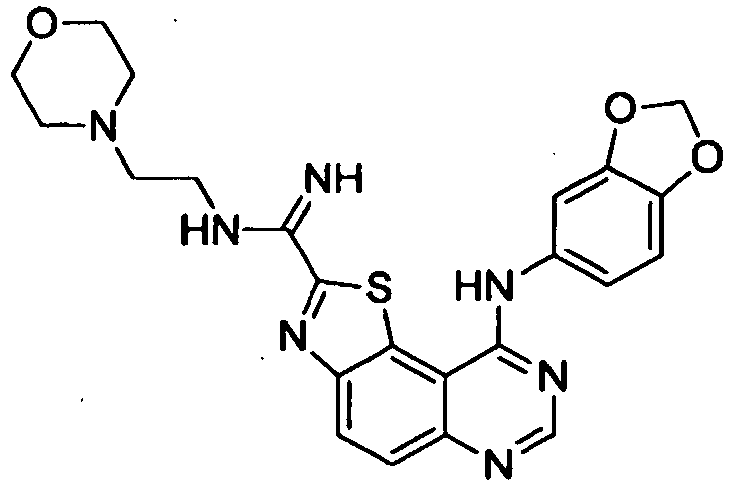
- Prepared from carbonitrile VIIIfa and N-aminoethylmorpholine. Flash chromatography eluent (DCM-MeOH, 5:5). Yield: 41%; yellow solid; mp 169°C; IR (KBr) vmax /cm-1 3324, 2965, 2901, 2861, 2812, 1641, 1616, 1587, 1503, 1468, 1382, 1353, 1304, 1271, 1232, 1180, 1148, 1114, 1067, 1036, 969, 935, 839; 1H NMR (300 MHz, MeOD-d4 ) δ 8.33 (d, 1H, J = 9 Hz), 7.96 (s, 1H), 7.71 (d, 1H, J = 9 Hz), 6.87 (d, 1H, J = 9Hz), 6.74 (s, 1H), 6.64 (d, 1H, J = 9 Hz), 5.96 (s, 2H), 3.74 (m, 4H), 3.55 (t, 2H, J= 7 Hz), 2.75 (t, 2H, J = 7 Hz), 2.61 (m, 4H); HRMS calcd for C23H24N7O3S (M + H+): 478.1661, found 478.1649.
-

- Prepared from carbonitrile VIIIfa and N-aminoethylpiperidine. Flash chromatography eluent (DCM-MeOH, 3:7). Yield: 34%; yellow solid; mp 170°C; IR (KBr) vmaxlcm-1 3350, 2936, 2773, 2482, 2061, 1641, 1613, 1585, 1503, 1462, 1374, 1337, 1304, 1229, 1176, 1141, 1121, 1037, 983, 962, 931, 855, 832; 1H NMR (300 MHz, MeOD-d4 ) δ 8.33 (d, 1H, J = 9 Hz), 7.89 (s, 1H), 7.69 (d, 1H, J = 9 Hz), 6.86 (d, 1H, J = 9Hz), 6.75 (s, 1H), 6.63 (d, 1H, J = 9 Hz), 5.99 (s, 2H), 3.46 (t, 2H, J = 7 Hz), 2.71 (t, 2H, J = 7 Hz), 2.57 (m, 4H), 1.64 (m, 4H), 1.50 (m, 2H); HRMS calcd for C24H26N7O2S (M + H+): 476.1869, found 476.1883.
-

- Prepared from carbonitrile VIIIfa and N-aminoethylpyrrolidine. Flash chromatography eluent (DCM-MeOH, 5:5). Yield: 48%; yellow solid; mp 172°C; IR (KBr) vmax /cm-1 2906, 2803, 1643, 1614, 1573, 1500, 1467, 1377, 1347, 1305, 1265, 1228, 1175, 1121, 1036, 966, 933, 833; 1H NMR (300 MHz, MeOD-d4 ) δ 8.27 (d, 1H, J = 9 Hz), 7.90 (s, 1H), 7.65 (d, 1H, J = 9 Hz), 6.86 (d, 1H, J = 9Hz), 6.75 (s, 1H), 6.63 (d, 1H, J = 9 Hz), 5.97 (s, 2H), 3.46 (t, 2H, J = 7 Hz), 2.85 (t, 2H, J = 7 Hz), 2.67 (m, 4H), 1.83 (m, 4H); HRMS calcd for C23H24N7O2S (M + H+): 462.1712, found 462.1736.
-

- Prepared from carbonitrile VIIIfa and benzylamine. Flash chromatography eluent (DCM-EtOAc, 2:8). Yield: 21%; yellow solid; mp >260°C; IR (KBr) vmax /cm-1 2886, 2447, 1641, 1597, 1497, 1466, 1413, 1384, 1353, 1307, 1266, 1229, 1178, 1122, 1105, 1036, 967, 934, 861, 833; 1H NMR (300 MHz, MeOD-d4 ) δ 8.27 (d, 1H, J = 9 Hz), 7.90 (s, 1H), 7.65 (d, 1H, J = 9 Hz), 6.86 (m, 4H), 6.75 (m, 3H), 6.63 (d, 1H, J = 9 Hz), 5.97 (s, 2H), 4.58 (s, 2H); HRMS calcd for C24H19N6O2S (M + H+): 455.1290, found 455.1287.
-

- Prepared from carbonitrile ,VIIIfa and 2-dimethylaminoethylamine. Flash chromatography eluent (DCM-MeOH, 5:5). Yield: 10%; yellow solid; mp >260°C; IR (KBr) vmax /cm-1 3391, 2923, 2852, 1643, 1615, 1538, 1498, 1467, 1383, 1346, 1302, 1263, 1229, 1178, 1118, 1035, 965, 933, 856, 835; 1H NMR (300 MHz, MeOD-d4 ) δ 8.17 (d, 1H, J = 9 Hz), 7.90 (s, 1H), 7.56 (d, 1H, J= 9 Hz), 6.86 (d, 1H, J = 9Hz), 6.75 (s, 1H), 6.63 (d, 1H, J = 9 Hz), 5.91 (s, 2H), 3.43 (t, 2H, J= 7 Hz), 2.69 (t, 2H, J= 7 Hz), 2.33 (s, 6H); HRMS calcd for C21H22N7O2S (M + H+): 436.1556, found 436.1549.
-

- Prepared from carbonitrile VIIIfa and diethylethylenediamine. Flash chromatography eluent (DCM-MeOH, 5:5). Yield: 66%; yellow solid; mp 144°C; IR (KBr) vmax /cm-1 3333, 2970, 2920, 2832, 1641, 1614, 1585, 1502, 1463, 1421, 1378, 1348, 1303, 1231, 1179, 1145, 1122, 1088, 1037, 965, 933, 858, 831; 1H NMR (300 MHz, MeOD-d4 ) δ 8.23 (d, 1H, J = 9 Hz), 7.89 (s, 1H), 7.62 (d, 1H, J = 9 Hz), 6.86 (d, 1H, J = 9Hz), 6.75 (s, 1H), 6.63 (d, 1H, J = 9 Hz), 5.94 (s, 2H), 3.42 (t, 2H, J = 7 Hz), 2.83 (t, 2H, J = 7 Hz), 2.68 (q, 4H, J = 7 Hz), 1.10 (t, 6H, J = 7 Hz); HRMS calcd for C23H26N7O2S (M + H+): 464.1869, found 464.1896.
- A stirred mixture of carbonitrile (0.13 mmol) and NaOH (2.5 N sol., 50 µL) in butanol (2.5 mL) was irradiated under microwaves at 117°C for 30 min. The solvent was removed in vacuo and the crude residue purified by flash chromatography to afford the amides 37 to 43.
-

- Prepared from carbonitrile VIIIaa. Flash chromatography eluent (DCM-EtOAc, 5:5). Yield: 98%; orange solid; mp >260°C; IR (KBr) vmax /cm-1 3453, 1684, 1624; 1601, 1576, 1534, 1506, 1487, 1376, 1348, 1282, 1260, 1209, 1124, 1085, 1057, 993, 969, 825, 810; 19F NMR (282 MHz, DMSO-d6 ) δ-129.1; 1H NMR (300 MHz, DMSO-d6 ) δ 8.26-8.21 (m, 2H), 8.12 (d, 1H, J = 9.0 Hz), 8.02-7.99 (m, 1H), 7.80 (s, 1H), 7.53 (d, 1H, J = 9.0 Hz), 7.47 (m, 1H), 7.18 (t, 1H, J= 9.0 Hz); HRMS calcd for C16H10N5OSClF (M + H+): 374.0279, found 374.0280.
-

- Prepared from carbonitrile VIIIba. Flash chromatography eluent (DCM-EtOAc, 5:5). Yield: 71%; yellow solid; mp >260°C; IR (KBr) vmax /cm-1 1682, 1645, 1615, 1575, 1557, 1486, 1347, 1254, 1200, 1158, 1118, 1074, 993, 967, 941, 865, 819; 19F NMR (282 MHz, DMSO-d6) δ -120.5; 1H NMR (300 MHz, DMSO-d6 ) δ 8.47 (s, 1H), 8.41 (d, 1H, J = 9.0 Hz), 8.39 (s, 1H), 8.14 (s, 1H), 8.03 (d, 1H, J = 9.0 Hz), 7.53 (m, 1H), 7.36 (m, 1H), 7.21 (t, 1H, J = 9.0 Hz); HRMS calcd for C16H10N5OSBrF (M + H+): 417.9769, found 417.9769.
-

- Prepared from carbonitrile VIIIda. Flash chromatography eluent (DCM-EtOAc, 5:5). Yield: 98%; orange solid; mp 213°C; IR (KBr) vmax /cm-1 3409, 1691, 1638, 1600, 1572, 1509, 1431, 1380, 1349, 1325, 1301, 1237, 1177, 1123, 1085, 1032, 964, 835, 814; 1H NMR (300 MHz, DMSO-d6 ) δ 8.37 (s, 1H), 8.24 (d, 1H, J = 9.0 Hz), 8.06 (s, 1H), 7.92 (s, 1H), 7.61 (d, 1H, J = 9.0 Hz), 7.31 (d, 2H, J = 9.0 Hz), 6.89 (d, 2H; J = 9.0 Hz), 3.74 (s, 3H); HRMS calcd for C17H14N5O2S (M + H+): 352.0868, found 352.0879.
-

- Prepared from carbonitrile VIIIea. Flash chromatography eluent (DCM-EtOAc, 5:5). Yield: 98%; orange solid; mp 202°C; IR (KBr) vmax /cm-1 3466, 2938, 1692, 1641, 1582, 1503, 1413, 1352, 1306, 1225, 1123, 1003, 952, 826; 1H NMR (300 MHz, MeOD-d4 ) δ 8.17 (d, 1H, J = 9.0 Hz), 7.99 (s, 1H), 7.56 (d, 1H, J = 9.0 Hz), 6.59 (m, 2H), 3.85 (s, 6H), 3:76 (s, 3H); HRMS calcd for C19H18N5O4S (M + H+): 412.1080, found 412.1076.
-

- Prepared from carbonitrile VIIIfa. Flash chromatography eluent (DCM-EtOAc, 5:5). Yield: 31%; yellow solid; mp >260°C; IR (KBr) vmax /cm-1 3291, 2915, 1648, 1576, 1532, 1497, 1476, 1376, 1351, 1323, 1272, 1191, 1104, 1035, 965, 923, 830, 815; 1H NMR (300 MHz, DMSO-d6 ) δ 8.05-7.98 (m, 2H), 7.49 (d, 1H, J = 2 Hz), 7.37-7.31 (m, 1H), 6.96 (dd, 1H, J 1 = 2 Hz, J 2 = 9 Hz), 6.73 (dd, 1H, J 1 = 2 Hz, J 2 = 9 Hz), 5.88 (s, 2H); HRMS calcd for C17H12N5O3S (M + H+): 366.0661, found 366.0658.
-
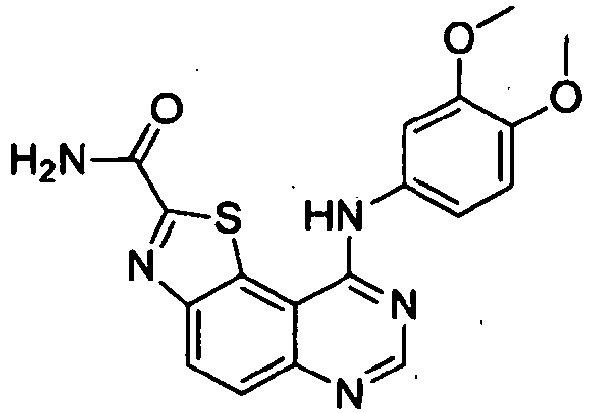
- Prepared from carbonitrile VIIIia. Flash chromatography eluent (DCM-MeOH, 9:1). Yield: 5%; yellow solid; mp >260 °C; IR (KBr) vmax /cm-1 3442, 3275, 2932, 2833, 1638, 1582, 1504, 1463, 1377, 1260, 1226, 1126, 1023, 966, 934, 848, 803; 1H NMR (300 MHz, DMSO-d6 ) δ 8.48 (s, 1H, NH), 8.38 (d, 1H, J = 9 Hz), 8.03 (m, 2H, NH2), 7.72 (d, 1H, J = 9 Hz), 6.99 (d, 2H, J = 8.4 Hz), 6.81 (m, 2H, NH2), 3.76 (s, 6H); HRMS calcd for C18H16N5O3S (M + H+): 382.0974, found 382.0958.
-

- A stirred mixture of carbonitrile VIIIaa (0.14 mmol) and ethylene diamine (5.6 mmol) in dry THF (7 mL) was irradiated under microwaves at 116°C for 30 min. The mixture was dissolved in dichloromethane, washed with water. The organic layer was dried over MgSO4, and the solvent was removed in vacuo to afford the expected compound 41 (31.1 mg, 57% yield) as a yellow solid; mp >260°C; IR (KBr) vmax /cm-1 2924, 1629, 1587, 1493, 1349, 1286, 1258, 1205, 1149, 1080, 1052, 966, 883, 836, 814; 19F NMR (282 MHz, DMSO-d6 ) δ -125.6; 1H NMR (300 MHz, DMSO-d6 ) δ 8.30 (d, 1H, J = 9.0 Hz), 8.15 (s, 1H), 7.62 (d, 1H, J = 9.0 Hz), 7.58-7.55 (m, 1H), 7.33 (t, 1H, J= 9.0 Hz), 7.36-7.21 (m, 1H) 3.69 (s, 4H); HRMS calcd for C18H13N6SClF (M + H+): 399.0595, found 399.0602.
-

- A stirred mixture of carbonitrile VIIIda (0.15 mmol) and ethanolamine (6.0 mmol) in dry THF (2 mL) was irradiated under microwaves at 170°C for 30 min. The solvent was removed in vacuo and the crude residue was purified by flash chromatography (DCM-MeOH, 8:2) to afford the expected compound 42 (49.0 mg, 87% yield) as an orange solid; mp 162°C; IR (KBr) vmax /cm -1 3150, 1639, 1617, 1571, 1500, 1376, 1236, 1166, 1030, 967, 825; 1H NMR (300 MHz, MeOD-d4 ) δ 8.29 (d, 1H, J = 9.0 Hz), 7.99 (s, 1H), 7.67 (d, 1H, J = 9.0 Hz), 7.13 (m, 2H), 6.97 (d, 2H, J= 8.4 Hz), 3.86-3.81 (m, 5H) 3.59 (t, 2H, J= 5.4 Hz); HRMS calcd for C19H16N5O2S (M + H+): 378.1025, found 378.1024.
- A stirred mixture of carbonitrile (0.13 mmol) and NaOCH3 (0.5 M sol. in MeOH, 130 µL) in methanol (4 mL) was irradiated under microwaves at 65°C for 30 min. The solvent was removed in vacuo and the crude residue purified by flash chromatography to afford the imidate 43 to 80.
-

- Prepared from carbonitrile VIIIaa. Flash chromatography eluent (DCM-EtOAc, 5:5). Yield: 98%; orange solid; mp 212°C; IR (KBr) vmax /cm-1 1642, 1559, 1479, 1352, 1260, 1201, 1156, 1073, 942, 817; 19F NMR (282 MHz, DMSO-d6 ) δ -126.9; 1H NMR (300 MHz, DMSO-d6 ) δ 8.29 (d, 1H, J = 9.0 Hz), 8.18 (s, 1H), 7.73 (m, 1H), 7.61 (d, 1H, J = 9.0 Hz), 7.30 (m, 1H), 7.27 (t, 1H, J = 9.0 Hz), 3.95 (s, 3H); HRMS calcd for C17H12N5OSClF (M + H+): 388.0435, found 388.0447.
-

- Prepared from carbonitrile VIIIba. Flash chromatography eluent (DCM-EtOAc, 2:8). Yield: 94%; pale yellow solid; mp >260°C; IR (KBr) vmax /cm-1 2950, 1638, 1617, 1595, 1555, 1507, 1479, 1434, 1398, 1352, 1325, 1288, 1224, 1197, 1159, 1115, 1070, 988, 965, 942, 882, 818; 19F NMR (282 MHz, DMSO-d6 ) δ -119.8; 1H NMR (300 MHz, DMSO-d6 ) δ 8.46 (d, 1H, J = 9.0 Hz), 8.02 (s, 1H), 7.69 (d, 1H, J = 9.0 Hz), 7.53 (m, 1H), 7.35 (m, 1H), 7.20 (t, 1H, J = 9.0 Hz), 3.94 (s, 3H); HRMS calcd for C17H12N5OSBrF (M + H+): 431.9930, found 431.9937.
-

- Prepared from carbonitrile VIIIda. Flash chromatography eluent (DCM-MeOH, 5:5). Yield: 82%; orange solid; mp 241°C; IR (KBr) vmax /cm-1 2833, 2354, 1644, 1614, 1567, 1504, 1439, 1397, 1373, 1349, 1325, 1286, 1240, 1215, 1181, 1155, 1104, 1069, 1033, 965, 935, 859, 832, 814; 1H NMR (300 MHz, MeOD-d4 ) δ 8.09 (d, 1H, J = 9.0 Hz), 7.93 (s, 1H), 7.50 (d, 1H, J = 9.0 Hz), 7.14 (d, 2H, J= 9.0 Hz), 6.82 (d, 2H, J= 9.0 Hz), 3.98 (s, 3H), 3.74 (s, 3H); HRMS calcd for C18H16N5O2S (M + H+): 366.1025, found 366.1034.
-

- Prepared from carbonitrile IXb. Flash chromatography eluent (DCM-MeOH, 9:1). Yield: 93%; yellow solid; mp 248°C; IR (KBr) vmax /cm-1 3267, 3057, 2929, 2837, 1736, 1654, 1613, 1555, 1493, 1434, 1404, 1369, 1330, 1268, 1240, 1219, 1146, 1100, 1058, 1033, 982, 939, 886, 835, 811; 1H NMR (300 MHz, MeOD-d 4) δ 8.42 (d, 1H, J = 9.0 Hz), 8.18 (s, 1H), 7.71 (d, 1H, J = 9.0 Hz), 7.34 (d, 2H, J = 9.0 Hz), 6.91 (d, 2H, J = 9.0 Hz), 3.96 (s, 3H), 3.75 (s, 3H), 3.73 (s, 3H); HRMS calcd for C19H18N5O2S (M + H+): 380.1181, found 380.1179.
-

- Prepared from carbonitrile VIIIga. Flash chromatography eluent (DCM-EtOAc, 5:5). Yield: 77%; yellow solid; mp >260°C; IR (KBr) v max/cm-1 3248, 2919, 2406, 1647, 1617, 1575, 1560, 1519, 1504, 1487, 1424, 1375, 1334, 1300, 1264, 1178, 1147, 1114, 1036, 960, 925, 843; 1H NMR (300 MHz, DMSO-d6 ) δ 8.44 (d, 1H, J = 9.0 Hz), 8.02 (s, 1H), 7.72 (d, 1H, J = 9.0 Hz), 7.26 (s, 1H), 6.77 (s, 1H), 5.06 (s, 2H), 3.94 (s, 3H); HRMS calcd for C18H13N5O3SBr (M + H+): 457.9922, found 457.9937.
-
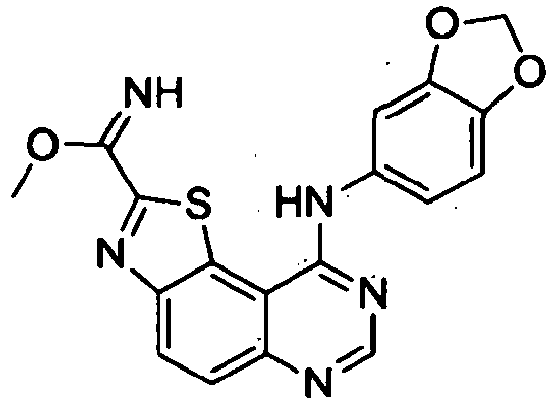
- Prepared from carbonitrile VIIIha. Flash chromatography eluent (DCM-EtOAc, 5:5). Yield: 92%; yellow solid; mp 232°C; IR (KBr) vmax /cm-1 3287, 2902, 1648, 1617, 1575, 1528, 1499, 1483, 1452, 1432, 1385, 1322, 1272, 1196, 1125, 1043, 936, 885, 834, 817; 1H NMR (300 MHz, DMSO-d6 ) δ 8.36 (d, 1H, J = 9 Hz), 7.96 (s, 1H), 7.71 (d, 1H, J = 9 Hz), 6.87 (d, 1H, J = 8 Hz), 6.74 (m, 1H), 6.63 (d, 1H, J = 8 Hz), 5.96 (s, 2H), 4.05 (s, 3H); HRMS calcd for C18H14N5O3S (M + H+): 380.0817, found 380.0805.
-

- Prepared from carbonitrile VIIIha. Flash chromatography eluent (EtOAc). Yield: 80%; yellow solid; mp 194 °C; IR (KBr) v max/cm-1 3575, 3063, 1647, 1578, 1499, 1439, 1347, 1302, 1241, 1199, 1156, 1122, 1062, 948, 915, 836; 1H NMR (300 MHz, DMSO-d6 ) δ 8.40 (d, 1H, J = 9 Hz), 8.01 (s, 1H), 7.69 (d, 1H, J = 9 Hz), 6.87 (d, 1 H, J = 2.1 Hz), 6.67 (m, 2H), 4.24 (s, 4H), 3.94 (s, 3H); HRMS calcd for C19H16N5O3S (M + H+): 394.0974, found 394.0954.
-
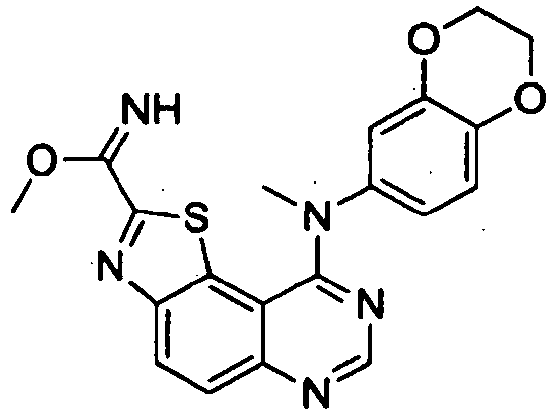
- Prepared from carbonitrile IXc. Flash chromatography eluent (DCM-MeOH, 9:1). Yield: 66%; yellow solid; mp >260°C; IR (KBr) vmax /cm-1 3298, 2973, 2875, 1642, 1620, 1555, 1484, 1435, 1408, 1360, 1298, 1273, 1242, 1203, 1162, 1146, 1065, 939, 878, 847; 1H NMR (300 MHz, DMSO-d6 ) δ 8.45 (d, 1H, J = 9 Hz), 8.21 (s, 1H), 7.74 (d, 1H, J = 9 Hz), 6:97 (d, 1H, J = 2.1 Hz), 6.83 (m, 2H), 4.24 (s, 4H), 3.96 (s, 3H), 3.75 (s, 3H); HRMS calcd for C20H18N5O3S (M + H+): 408.1130, found 408.1111.
-

- Prepared from carbonitrile VIIIia. Flash chromatography eluent (EtOAc). Yield: 89%; yellow solid; mp 218°C; IR (KBr) v max /cm-1 3289, 2921, 2852, 1651, 1613, 1583, 1505, 1466, 1432, 1376, 1348, 1309, 1261, 1226, 1195, 1164, 1146, 1128, 1075, 1027, 968, 945, 924, 854, 832; 1H NMR (300 MHz, DMSO-d6 ) δ 8.44 (d, 1H, J = 9 Hz), 7.92 (s, 1H), 7.72 (d, 1H, J = 9 Hz), 6.99 (d, 1H, J = 2.1 Hz), 6.83 (d, 1H, J = 8.4 Hz), 6.75 (dd, 1H, J 1 = 2.1 Hz, J 2 = 8.4 Hz), 3.94 (s, 3H), 3.76 (s, 6H); HRMS calcd for C19H18N5O3S (M + H+): 396.1130, found 396.1119.
-

- Prepared from carbonitrile IXa. Flash chromatography eluent (DCM-MeOH, 9:1). Yield: 73%; yellow solid; mp 220°C; IR (KBr) vmax /cm-1 3298, 2986, 2832, 1644, 1619, 1555, 1492, 1434, 1361, 1253, 1228, 1162, 1142, 1127, 1069, 1026, 953, 927, 832, 800; 1H NMR (300 MHz, DMSO-d6) δ 8.46 (d, 1H, J = 9 Hz), 8.21 (s, 1H), 7.75 (d, 1H, J = 9 Hz), 7.03 (d, 1H, J = 2.1 Hz), 6.93 (d, 1H, J= 8.4 Hz), 6.84 (dd, 1H, J 1 = 2.1 Hz, J 2 = 8.4 Hz), 3.96 (s, 3H), 3.75 (s, 9H); HRMS calcd for C19H18N5O3S (M + H+): 396.1130, found 396.1119.
-

- Prepared from carbonitrile VIIIja. Flash chromatography eluent (EtOAc). Yield: 81%; yellow solid; mp 196°C; IR (KBr) vmax /cm-1 2953, 2852, 1644, 1619, 1573, 1508, 1477, 1372, 1326, 1235, 1164, 1100, 1077, 968, 940, 835; 1H NMR (300 MHz, DMSO-d6 ) δ 8.38 (d, 1H, J = 9 Hz), 8.02 (s, 1H), 7.69 (d, 1H, J = 9 Hz), 7.04 (m, 2H), 6.80-6.73 (m, 2H), 3.94 (s, 3H); HRMS calcd for C17H14N5O2S (M + H+): 352.0868, found 352.0873.
-

- Prepared from carbonitrile VIIIka. Flash chromatography eluent (EtOAc). Quantitative yield; yellow solid; mp 216°C; IR (KBr) vmax /cm-1 3289, 2921, 2852, 1643, 1611, 1578, 1505, 1441, 1379, 1348, 1281, 1245, 1154, 1128, 1077, 1027, 957, 834; 1H NMR (300 MHz, DMSO-d6 ) δ 8.40 (d, 1H, J = 9 Hz), 7.99 (s, 1H), 7.71 (d, 1H, J = 9 Hz), 6.94 (d, 1H, J = 8.4 Hz), 6.65-6.55 (m, 2H), 3.94 (s, 3H), 3.77 (s, 3H); HRMS calcd for C18H16N5O3S (M + H+): 382.0974, found 382.0957.
-

- Prepared from carbonitrile VIIIIa. Flash chromatography eluent (EtOAc). Yield: 66%; yellow solid; mp 202°C; IR (KBr) vmax /cm-1 3291, 3053, 2911, 1641, 1611, 1573, 1508, 1482, 1437, 1355, 1333, 1287, 1226, 1196, 1158, 1092, 1067, 985, 942, 821; 1H NMR (300 MHz, DMSO-d6) δ 8.39 (d, 1H, J = 9 Hz), 8.01 (s, 1H), 7.69 (d, 1H, J= 9 Hz), 7.12 (m, 1H), 6.92 (m, 1H), 6.78-6.73 (m, 1H), 4.53 (t, 2H, J = 8.7 Hz), 3.95 (s, 3H), 3.19 (t, 2H, J = 8.7 Hz); HRMS calcd for C19H16N5O2S (M + H+): 378.1025, found 378.1006.
-
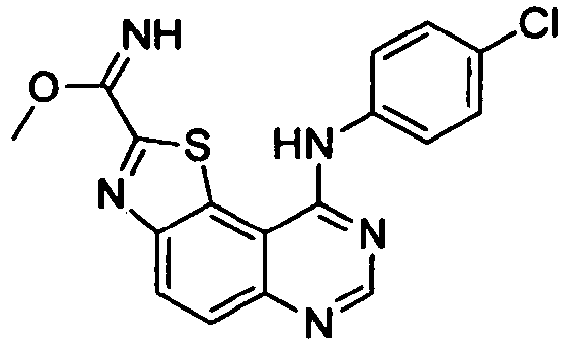
- Prepared from carbonitrile VIIIma. Flash chromatography eluent (EtOAc). Yield: 62%; yellow solid; mp >260°C; IR (KBr) vmax /cm-1 2948, 1644, 1604, 1557, 1509, 1481, 1435, 1401, 1356, 1285, 1240, 1159, 1094, 1074, 992, 943, 816; 1H NMR (300 MHz, DMSO-d6 ) δ 8.42 (d, 1H, J = 9 Hz), 8.08 (s, 1H), 7.70 (d, 1 H, J = 9 Hz), 7.41 (d, 2H, J = 8.1 Hz), 7.20 (m, 2H), 3.95 (s, 3H); HRMS calcd for C17H13N5OSCl (M + H+): 370.0529, found 370.0521.
-

- Prepared from carbonitrile VIIIna. Flash chromatography eluent (DCM-EtOAc, 5:5). Yield: 45%; yellow solid; mp 230°C; IR (KBr) vmax /cm-1 3296, 2920, 1640, 1608, 1588, 1551, 1507, 1491, 1469, 1437, 1397, 1356, 1284, 1158, 1129, 1073, 1023, 942, 860, 821; 1H NMR (300 MHz, DMSO-d6 ) δ 8.42 (d, 1H, J = 9 Hz), 8.19 (s, 1H), 7.69 (d, 1H, J = 9 Hz), 7.56 (d, 2H, J = 9 Hz), 7.22 (m, 1H), 3.95 (s, 3H); HRMS calcd for C17H12N5OSCl2 (M + H+): 404.0140, found 404.0135.
-

- Prepared from carbonitrile VIIIoa. Flash chromatography eluent (EtOAc). Yield: 68%; yellow solid; mp 220°C; yellow solid; mp 220°C; IR (KBr) vmax /cm-1 3293, 2950, 1731, 1644, 1613, 1552, 1489, 1437, 1353, 1286, 1157, 1070, 968, 941, 871, 822; 1H NMR (300 MHz, DMSO-d6 ) δ 8.43 (d, 1H, J = 9 Hz), 8.11 (s, 1H), 7.70 (d, 1H, J = 9 Hz), 7.37 (t, 1H, J = 7.8 Hz), 7.26-7.16 (m, 3H), 4.16 (s, 1H), 3.95 (s, 3H); HRMS calcd for C19H14N5OS (M + H+): 360.0919, found 360.0908.
-

- Prepared from carbonitrile VIIIpa. Flash chromatography eluent (DCM-MeOH, 8:2). Yield: 57%; yellow solid; mp >260°C; IR (KBr) vmax /cm-1 3094, 1641, 1615, 1573, 1479, 1380, 1343, 1294, 1199, 1141, 1070, 947, 824; 1H NMR (300 MHz, DMSO-d6 ) δ 8.46-8.36 (m, 2H), 8.18 (m, 1H), 8.02 (d, 1H, J = 9 Hz), 7.73 (d, 1H, J = 8.1 Hz), 7.65 (d, 1H, J = 8.1 Hz), 7.54 (m, 1H), 3.95 (s, 3H); HRMS calcd for C18H14N7OS (M + H+): 376.0981, found 376.0974.
-

- Prepared from carbonitrile VIIIqa. Flash chromatography eluent (EtOAc). Yield: 34%; orange solid; mp 210°C; IR (KBr) vmax /cm-1 2957,2911, 1724,1622, 1560, 1520, 1476, 1379, 1310, 1243, 1156, 1070, 971, 945, 820; 1H NMR (300 MHz, DMSO-d6 ) δ 8.30 (d, 1H, J = 8.7 Hz), 8.18 (m, 1H), 7.67 (m, 2H), 7.16 (d, 1H, J = 8.7 Hz), 3.96 (s, 3H); HRMS calcd for C17H13N6O4S (M + H+): 397.0719, found 397.0710.
-
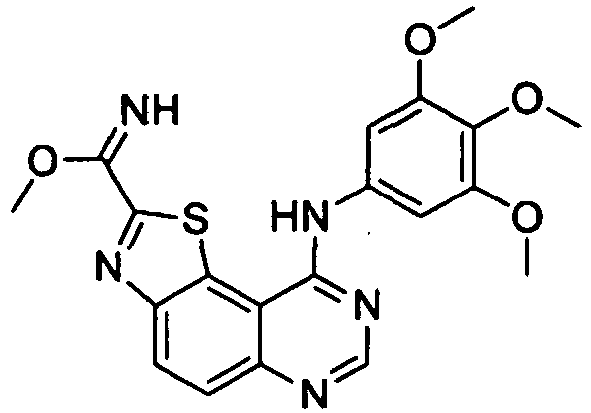
- Prepared from carbonitrile VIIIea. Flash chromatography eluent (EtOAc). Yield: 87%; yellow solid; mp 254°C; IR (KBr) vmax /cm-1 3291, 2941, 2833, 1640, 1583, 1496, 1434, 1415, 1337, 1228, 1164, 1143, 1116, 1073, 993, 975, 954, 861, 844, 822; 1H NMR (300 MHz, DMSO-d6 ) δ 9.34 (s, 1H, NH), 8.42 (d, 1H, J= 9.0 Hz), 7.94 (s, 1H), 7.74 (d, 1H, J= 9.0 Hz), 6.37 (s, 2H), 3.94 (s, 3H), 3.77 (s, 6H), 3.67 (s, 3H); HRMS calcd for C20H20N5O4S (M + H+): 426.1236, found 426.1240.
-

- Prepared from carbonitrile VIIIra. Flash chromatography eluent (EtOAc). Yield: 71%; pale green solid; mp 245°C; IR (KBr) vmax /cm-1 3380, 3277, 2999, 2942, 2828, 1654, 1608, 1566, 1545, 1526, 1506, 1455, 1431, 1332, 1276, 1204, 1152, 1123, 1097, 1063, 1026, 993, 963, 942, 916; 1H NMR (300 MHz, DMSO-d6 ) δ 9.33 (s, 1H, NH), 8.41 (d, 1H, J = 9.0 Hz), 7.84 (s, 1H), 7.73 (d, 1H, J= 9.0 Hz), 6.88 (m, 1H), 6.68 (m, 1H), 6.58 (d, 1H, J= 7.8 Hz), 3.94 (s, 3H), 3.79 (s, 3H), 3.72 (s, 3H); HRMS calcd for C19H18N5O3S (M + H+): 396.1130, found 396.1124.
-

- Prepared from carbonitrile VIIIsa. Flash chromatography eluent (EtOAc). Yield: 58%; pale yellow solid; mp 259°C; IR (KBr) vmax /cm-1 3237, 2955, 2929, 1731, 1660, 1579, 1495, 1440, 1368, 1347, 1301, 1250, 1189, 1149, 1107, 1058, 973, 953, 856, 824; 1H NMR (300 MHz, DMSO-d6 ) δ 9.34 (s, 1H, NH), 8.43 (d, 1H, J= 9.0 Hz), 7.96 (s, 1H), 7.74 (d, 1H, J = 9.0 Hz), 6.25 (m, 3H), 3.94 (s, 3H), 3.74 (s, 6H); HRMS calcd for C19H18N5O3S (M + H+): 396.1130, found 396.1128.
-

- Prepared from carbonitrile VIIIta. Flash chromatography eluent (EtOAc). Yield: 52%; yellow solid; mp >260°C; IR (KBr) vmax /cm-1 3294, 3147, 2950, 2877, 1727, 1640, 1609, 1570, 1552, 1507, 1480, 1434, 1351, 1284, 1210, 1153, 1067, 990, 965, 939, 869, 819; 1H NMR (300 MHz, DMSO-d6 ) δ 9.32 (s, 1H, NH), 8.41 (d, 1H, J = 9.0 Hz), 7.99 (s, 1H), 7.68 (d, 1H, J = 9.0 Hz), 7.38 (m, 2H), 7.09 (m, 3H), 3.94 (s, 3H); HRMS calcd for C17H14N5OS (M + H+): 336.0919, found 336.0904.
-

- Prepared from carbonitrile VIIIua. Flash chromatography eluent (EtOAc). Yield: 88%; yellow solid; mp >260°C; IR (KBr) vmax /cm-1 3292, 3148, 2848, 1725, 1641, 1600, 1557, 1488, 1434, 1351, 1283, 1155, 1068, 990, 966, 939, 820, 804; 1H NMR (300 MHz, DMSO-d6) δ 9.33 (s, 1H, NH), 8.41 (d, 1H, J = 9.0 Hz), 7.95 (s, 1H), 7.69 (d, 1H, J = 9.0 Hz), 7.20 (m, 2H), 7.11 (m, 2H), 3.94 (s, 3H), 2.32 (s, 3H); HRMS calcd for C18H16N5OS (M + H+): 350.1076, found 350.1072.
-
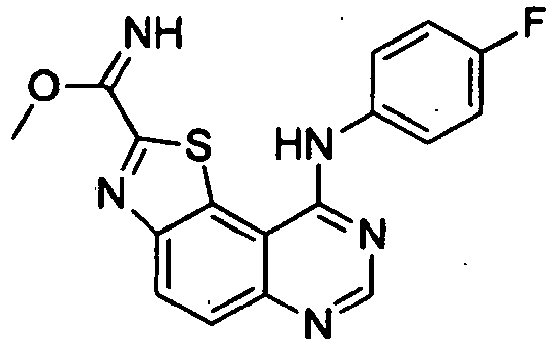
- Prepared from carbonitrile VIIIva. Flash chromatography eluent (EtOAc). Yield: 77%; yellow solid; mp >260°C; IR (KBr) ν max /cm-1 3416, 3298, 3226, 3150, 2950, 1731, 1641, 1611, 1574, 1558, 1506, 1490, 1434, 1460, 1355, 1329, 1285, 1226, 1157, 1103, 1072, 994, 968, 943, 819; 19F NMR (282 MHz, DMSO-d6 ) δ -120.8; 1H NMR (300 MHz, DMSO-d6 ) δ 9.33 (s, 1H, NH), 8.41 (d, 1H, J = 9.0 Hz), 7.93 (s, 1H), 7.68 (d, 1H, J = 9.0 Hz), 7.19 (m, 4H), 3.95 (s, 3H); HRMS calcd for C17H13N5OSF (M + H+): 354.0825, found 354.0811.
-

- Prepared from carbonitrile VIIIca. Flash chromatography eluent (EtOAc). Yield: 33%; pale yellow solid; mp >260°C; IR (KBr) vmax /cm-1 3272, 2235, 1722, 1638, 1615, 1581, 1571, 1491, 1437, 1143, 1109, 1067, 989, 968, 943, 885, 840; 1H NMR (300 MHz, DMSO-d6 ) δ 9.34 (s, 1H, NH), 8.45 (d, 1H, J = 9.0 Hz), 8.20 (s, 1H), 7.68 (d, 1H, J = 9.0 Hz), 7.61 (m, 4H), 3.95 (s, 3H); HRMS calcd for C18H13N6OS (M + H+): 361.0872, found 361.0862.
-

- Prepared from carbonitrile VIIIwa. Flash chromatography eluent (EtOAc). Yield: 69%; yellow solid; mp >260°C; IR (KBr) vmax /cm-1 3150, 3063, 2955, 1726, 1644, 1598, 1566, 1508, 1472, 1436, 1397, 1353, 1324, 1282, 1260, 1185, 1155, 1071, 939, 853, 812; 19F NMR (282 MHz, DMSO-d6 ) δ -120.32; 1H NMR (300 MHz, DMSO-d6 ) δ 9.34 (s, 1H, NH), 8.46 (d, 1H, J = 9.0 Hz), 8.07 (s, 1H), 7.70 (d, 1H, J = 9.0 Hz), 7.62 (m, 1H), 7.24 (m, 1H), 7.13 (m, 1H), 3.93 (s, 3H); HRMS calcd for C17H12N5OSBrF (M + H+): 431.9930, found 431.9909.
-

-

- Prepared from carbonitrile VIIIya. Flash chromatography eluent (EtOAc). Yield: 52%; yellow solid; mp >260 °C; IR (KBr) vmax /cm-1 3264, 2215, 1655, 1625, 1591, 1561, 1493, 1435, 1385, 1335, 1272, 1227, 1146, 1069, 995, 938, 848, 815; 1H NMR (300 MHz, DMSO-d6) δ 9.32 (s, 1H, NH), 8.43 (d, 1H, J = 9.0 Hz), 8.17 (s, 1H), 7.79 (d, 2H, J = 6.9 Hz), 7.68 (d, 1H, J = 7.2 Hz), 7.32 (d, 2H, J = 6.9 Hz), 3.94 (s, 3H); HRMS calcd for C18H13N6OS (M + H+): 361.0872, found 361.0863.
-

- Prepared from carbonitrile VIIIza. Flash chromatography eluent (EtOAc). Yield: 58%; yellow solid; mp >260 °C; IR (KBr) vmax /cm-1 2953, 1641, 1600, 1553, 1507, 1481, 1397, 1355, 1287, 1198, 1159, 1120, 1072, 944, 899, 818; 19F NMR (282 MHz, DMSO-d6 ) δ - 120.1; 1H NMR (300 MHz, DMSO-d6 ) δ 9.34 (s, 1H, NH), 8.45 (d, 1H, J = 9.0 Hz), 8.14 (s, 1H), 7.71 (d, 1H, J = 9.0 Hz), 7.44 (d, 1H, J = 9.0 Hz), 7.24 (m, 2H), 3.94 (s, 3H); HRMS calcd for C17H12N5OSClF (M + H+): 388.0435, found 388.0426.
-

- Prepared from carbonitrile VIIIab. Flash chromatography eluent (EtOAc). Yield: 81%; yellow solid; mp >260 °C; IR (KBr) vmax /cm-1 2953, 1727, 1641, 1586, 1507, 1488, 1464, 1394, 1354, 1284, 1158, 1099, 1073, 1054, 941, 860, 816; 1H NMR (300 MHz, DMSO-d6 ) δ 9.34 (s, 1H, NH), 8.45 (d, 1H, J = 9.0 Hz), 8.10 (s, 1H), 7.71 (d, 1H, J= 9.0 Hz), 7.62 (s, 1H), 7.38 (d, 1H, J = 8.1 Hz), 7.18 (d, 1H, J = 8.1 Hz), 3.93 (s, 3H); HRMS calcd for C17H12N5OSCl2 (M + H+): 404.0140, found 404.0146.
-

- Prepared from carbonitrile VIIIbb. Flash chromatography eluent (DCM-MeOH, 95:5). Yield: 59%; yellow solid; mp 214 °C; IR (KBr) vmax /cm-1 1731, 1643, 1603, 1520, 1489, 1438, 1345, 1266, 1158, 1072, 1014, 946, 870, 821, 810; 1H NMR (300 MHz, DMSO-d6 ) δ 9.32 (s, 1H, NH), 8.40 (d, 1H, J = 9.0 Hz), 8.17 (s, 1H), 7.82 (d, 1H, J = 9.0 Hz), 7.66 (d, 1H, J = 9.0 Hz), 7.55 (d, 1H, J= 8.1 Hz), 7.36 (d, 1H, J = 9.0 Hz), 3.95 (s, 3H), 3.92 (s, 3H); HRMS calcd for C18H15N6O4S (M + H+): 411.0876, found 411.0869.
-

- Prepared from carbonitrile VIIIcb. Flash chromatography eluent (EtOAc). Yield: 69%; yellow solid; mp >260 °C; IR (KBr) vmax /cm-1 3267, 2939, 1731, 1644, 1599, 1580, 1493, 1342, 1269, 1248, 1161, 1114, 1066, 988, 965, 941, 899, 838; 1H NMR (300 MHz, DMSO-d6) δ 9.31 (s, 1H, NH), 8.39 (d, 1H, J = 9.0 Hz), 8.17 (s, 1H), 7.84 (d, 1H, J = 9.0 Hz), 7.41 (d, 2H, J = 7.8 Hz), 7.12 (m, 2H), 3.93 (s, 3H), 1.31 (s, 9H); HRMS calcd for C22H22N5OS (M + H+): 392.1545, found 392.1539.
-
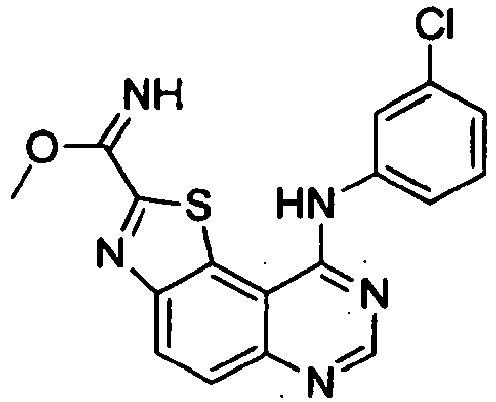
- Prepared from carbonitrile VIIIdb. Flash chromatography eluent (EtOAc). Yield: 78%; pale yellow solid; mp 235 °C; IR (KBr) vmax /cm-1 3293, 2950, 1639, 1593, 1550, 1507, 1470, 1437, 1355, 1286, 1157, 1070, 994, 968, 943, 876, 821; 1H NMR (300 MHz, DMSO-d6 ) δ 9.32 (s, 1H, NH), 8.40 (d, 1H, J = 9.0 Hz), 8.11 (s, 1H), 7.67 (d, 1H, J = 9.0 Hz), 7.37 (t, 1H, J = 7.8 Hz), 7.23 (m, 1H), 7.12-7.08 (m, 2H), 3.94 (s, 3H); HRMS calcd for C17H13N5OSCl (M + H+): 370.0529, found 370.0524.
-

- Prepared from carbonitrile VIIIeb. Flash chromatography eluent (EtOAc). Yield: 94%; beige solid; mp >260°C; IR (KBr) νmax/cm-1 3288, 2945, 1629, 1608, 1577, 1520, 1496, 1444, 1337, 1291, 1275, 1209, 1183, 1167, 1068, 968, 943, 820; 1H NMR (300 MHz, DMSO-d6) δ 9.35 (s, 1H, NH), 8.42 (d, 1H, J = 9.0 Hz), 8.07 (s, 1H), 7.77 (d, 1H, J = 9.0 Hz), 7.36 (d, 2H, J = 8.4 Hz), 6.91 (d, 2H, J= 8.4 Hz), 3.94 (s, 3H), 2.99 (s, 3H); HRMS calcd for C19H19N6OS (M + H+): 379.1341, found 379.1330.
-

- Prepared from carbonitrile VIIIfb. Flash chromatography eluent (DCM-EtOAc, 5:5). Yield: 75%; beige solid; mp >260°C; IR (KBr) νmax/cm-1 3293, 2847, 1632, 1608, 1577, 1520, 1491, 1444, 1388, 1293, 1265, 1209, 1178, 1163, 1107, 1062, 968, 927, 820, 806; 1H NMR (300 MHz, DMSO-d6) δ 9.35 (s, 1H, NH), 8.42 (d, 1H, J= 9.0 Hz), 8.06 (s, 1H), 7.77 (d, 1H, J = 9.0 Hz), 7.34 (d, 2H, J = 8.4 Hz), 6.72 (d, 2H, J = 8.4 Hz), 3.94 (s, 3H), 3.29 (m, 4H), 1.98 (m, 4H); HRMS calcd for C21H21N6OS (M + H+): 405.1457, found 405.1452.
-

- Prepared from carbonitrile VIIIgb. Flash chromatography eluent (EtOAc). Yield: 71%; yellow solid; mp >260°C; IR (KBr) νmax/cm-1 1644, 1608, 1574, 1556, 1509, 1488, 1435, 1357, 1285, 1260, 1188, 1140, 1073, 963, 943, 843, 819; 19F NMR (282 MHz, DMSO-d6) δ-117.6, -118.8; 1H NMR (300 MHz, DMSO-d 6) δ 9.34 (s, 1H, NH), 8.45 (d, 1H, J = 9.0 Hz), 8.12 (s, 1H), 7.70 (d, 1H, J= 9.0 Hz), 7.27 (m, 2H), 7.05 (t, 1H, J= 7.8 Hz), 3.94 (s, 3H); HRMS calcd for C17H12N5OSF2 (M + H+): 372.0731, found 372.0725.
-
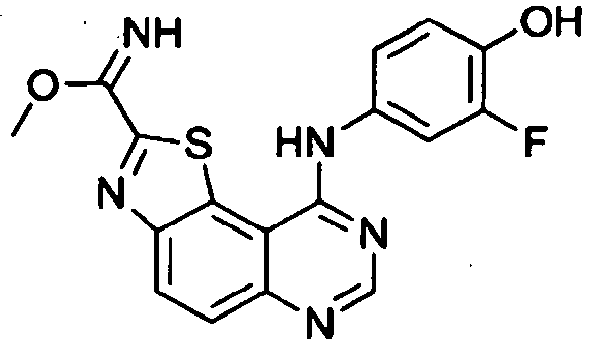
- Prepared from VIIIhb. Flash chromatography eluent (EtOAc). Yield: 70%; pale brown solid; mp >260°C; IR (KBr) νmax/cm-1 3374, 1729, 1652, 1626, 1585, 1519, 1465, 1386, 1352, 1302, 1241, 1209, 1156, 1111, 978, 856, 827; 19F NMR (282 MHz, DMSO-d6) δ -138.5; 1H NMR (300 MHz, DMSO-d 6) δ 8.52 (d, 1H, J = 9.0 Hz), 8.19 (s, 1H), 7.72 (d, 1H, J = 9.0 Hz), 7.04-6.91 (m, 3H), 3.95 (s, 3H); HRMS calcd for C17H13N5O2SF (M + H+): 370.0774, found 370.0762.
-
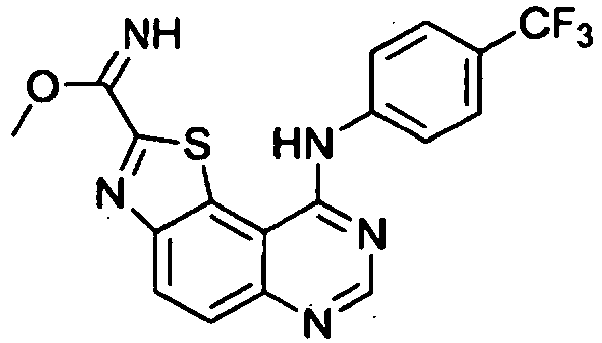
- Prepared from VIIIib. Flash chromatography eluent (EtOAc). Yield: 53%; pale yellow solid; mp >260°C; IR (KBr) νmax/cm-1 3277, 1643, 1601, 1588, 1561, 1509, 1493, 1324, 1284, 1151, 1104, 1065, 1015, 966, 937, 829, 809; 19F NMR (282 MHz, DMSO-d6) δ -59.95; 1H NMR (300 MHz, DMSO-d6) δ 8.42 (d, 1H, J= 9.0 Hz), 8.11 (s, 1H), 7.69 (d, 3H, J= 7.8 Hz), 7.32 (d, 2H, J = 7.8 Hz), 3.93 (s, 3H); HRMS calcd for C18H13N5OSF3 (M + H+): 404.0736, found 404.0742.
- A stirred mixture of carbonitrile (0.13 mmol) and NaOCH2CH3 (0.5 M sol. in EtOH, 130 µL) in ethanol (4 mL) was irradiated under microwaves at 80°C for 30 min. The solvent was removed in vacuo and the crude residue purified by flash chromatography to afford the imidates 81 & 82.
-

- Prepared from carbonitrile VIIIba. Flash chromatography eluent (DCM-EtOAc, 2:8). Yield: 64%; yellow solid; mp 220°C; IR (KBr) νmax/cm-1 3658, 3072, 2360, 1638, 1582, 1494, 1377, 1333, 1309, 1260, 1225, 1197, 1167, 1120, 1088, 1025, 966, 932, 882, 830; 19F NMR (282 MHz, DMSO-d6) δ -122.4; 1H NMR (300 MHz, DMSO-d 6) δ 8.46 (d, 1H, J = 9.0 Hz), 8.15 (s, 1H), 7.72 (d, 1H, J = 9.0 Hz), 7.54-7.39 (m, 2H), 7.20 (t, 1H, J = 9.0 Hz), 4.38 (q, 2H, J = 7.0 Hz), 1.37 (t, 3H, J = 7.0 Hz); HRMS calcd for C18H14N5OSBrF (M + H+): 446.0086, found 446.0082.
-

- Prepared from carbonitrile VIIIfa. Flash chromatography eluent (DCM-EtOAc, 5:5). Yield: 79%; yellow solid; mp 193°C; IR (KBr) νmax/cm-1 3286, 2892, 1722, 1654, 1626, 1579, 1497, 1484, 1465, 1372, 1334, 1242, 1230, 1184, 1159, 1128, 1036, 966, 923, 824; 1H NMR (300 MHz, DMSO-d 6) δ 8.39 (d, 1H, J= 9.0 Hz), 7.94 (s, 1H), 7.68 (d, 1 H, J = 9.0 Hz), 6.94 (d, 1H, J = 8.1 Hz), 6.76-6.46 (m, 2H), 6.01 (s, 2H), 4.38 (q, 2H, J= 6.9 Hz), 1.38 (t, 3H, J = 6.9 Hz); HRMS calcd for C19H16N5O3S (M+ H+): 394.0974, found 394.0967.
-

- A stirred mixture of carbonitrile VIIIfa (0.05 g, 0.14 mmol) and NaOCH2Ph (1.0 M sol. in benzylalcohol, 70 µL) in benzylalcohol (3 mL) was irradiated under microwaves at 100°C for 30 min. The solvent was removed in vacuo and the crude residue purified by flash chromatography (EtOAc) to afford the imidate 83 as a yellow solid (0.018 g, 28% yield); mp 182°C; IR (KBr) νmax/cm-1 3375, 2228, 1726, 1644, 1613, 1575, 1473, 1378, 1327, 1244, 1192, 1151, 1036, 922, 833; 1H NMR (300 MHz, DMSO-d 6) δ 8.42 (d, 1H, J = 9.0 Hz), 7.99 (s, 1H), 7.68 (d, 1H, J = 9.0 Hz), 7.51 (d, 2H, J = 7.5 Hz), 7.43-7.34 (m, 3H), 6.92 (d, 1H, J = 7.5 Hz), 6.78 (m, 1H), 6.59 (m, 1H), 6.01 (s, 2H), 5.45 (s, 2H); HRMS calcd for C24H18N5O3S (M + H+): 456.1130, found 456.1128.
-

- A mixture of methyl 9-(benzo[d][1,3]dioxol-5-ylamino)thiazolo[5,4-f]quinazoline-2-carbimidate 48 (0.017 mmol) and 5 mL of MeOH/H2O+TFA(0.1%)(60/40) under argon was stirred at room temperature overnight. The solvent was removed in vacuo and the crude residue purified by flash chromatography (DCM-EtOAc, 5:5) to afford the ester 84 (5.9 mg, 94 % yield) as a yellow solid; mp > 260°C; IR (KBr) νmax/cm-1 3287, 2902, 1648, 1617, 1575, 1528, 1499, 1483, 1452, 1432, 1385, 1322, 1272, 1196, 1125, 1043, 936, 885, 834, 817; 1H NMR (300 MHz, DMSO-d 6) δ 8.42 (d, 1H, J = 9.0 Hz), 8.03 (s, 1H), 7.95 (d, 1H, J = 9.0 Hz), 6.96 (d, 1H, J = 8.0 Hz), 6.84 (m, 1H), 6.72 (d, 1H, J = 8.0 Hz), 5.94 (s, 2H), 4.05 (s, 3H); HRMS calcd for C18H13N4O4S (M + H+): 381.0658, found 381.0651.
-

- A stirred mixture of carbonitrile VIIIfa (0.078 g, 0.22 mmol) and KOH (2.5 N sol., 78 µL) in isopropanol (3.9 mL) was irradiated under microwaves at 100°C for 2 h. The solvent was removed in vacuo and the crude residue purified by flash chromatography (DCM-EtOAc, 5:5) to afford the imidate 85 as a yellow solid (0.024 g, 27% yield); mp 225°C; IR (KBr) ν max /cm-1 3267, 2977, 2876, 1638, 1613, 1572, 1489, 1475, 1450, 1382, 1369, 1317, 1272, 1244, 1189, 1142, 1112, 1036, 924, 885, 828, 808; 1H NMR (300 MHz, DMSO-d 6) δ 8.40 (d, 1H, J = 9.0 Hz), 7.94 (s, 1H), 7.68 (d, 1H, J = 9.0 Hz), 6.94 (d, 2H, J = 8.1 Hz), 6.75-6.55 (m, 2H), 6.01 (s, 2H), 5.32-5.24 (m, 1H), 1.38 (d, 6H, J = 6.0 Hz). HRMS calcd for C20H18N5O3S (M + H+): 408.0962, found 408.0956.
-

- Prepared from carbonitrile VIIIwa following procedure described for carboxamides 35-40. Flash chromatography eluent (DCM-EtOAc, 5:5). Yield: 44%; yellow solid; mp 210°C; IR (KBr) ν max /cm-1 3150 (NH), 2920,1736 (CO), 1671, 1636, 1606, 1579, 11491, 11460, 1410, 1384, 1254, 1209, 1158, 966, 832, 779; 1H NMR (300 MHz, DMSO-d 6) δ 8.46 (s, 1H), 8.42 (d, 1H, J = 9.0 Hz), 8.01 (s, 1H), 7.72 (d, 1H, J = 9.0 Hz), 7.63 (d, 1H, J = 9.0 Hz), 7.25-7.20 (m, 1H), 7.18-7.13 (m, 1H); HRMS calcd for C16H10N5OSBrF (M + H+): 417.9773, found 417.9760.
-

- Prepared from carbonitrile VIIIab following procedure described for carboxamides 35-40. Flash chromatography eluent (DCM-EtOAc, 5:5). Yield: 22%; yellow solid; mp > 260°C; IR (KBr) ν max /cm-1 3150 (NH),1701 (CO), 1587, 1505, 1470, 1384, 1283, 1099, 808; 1H NMR (300 MHz, DMSO-d 6) δ 8.46 (s, 1 H), 8.42 (d, 1H, J = 9.0 Hz), 8.03 (s, 1H), 7.72 (s, 1H), 7.63 (s, 1H), 7.38 (d, 1H, J = 6 Hz), 7.19 (d, 1H, J = 9Hz).
-

- A stirred mixture of carbonitrile VIIIab (0.05 g, 0.13 mmol) and NaOH (2.5 M sol. in water, 50 µL) in butanol (2.5 mL) was irradiated under microwaves at 117°C for 30 min. The solvent was removed in vacuo and the crude residue purified by flash chromatography (DCM-EtOAc, 7:3) to afford the imidate 88 as a yellow solid (0.058 g, 33% yield); mp 178°C; IR (KBr) ν max /cm-1 2965, 1641 (CO), 1578, 1557, 1504, 1458, 1370, 1325, 1284, 1152, 1099, 1071, 962, 811; 1H NMR (300 MHz, DMSO-d 6) δ 9.28 (s, 1H, NH), 8.45 (d, 1H, J = 9.0 Hz), 8.09 (s, IH), 7.71 (d, 1H, J = 9.0 Hz), 7.60 (d, 1H, J = 2.0 Hz), 7.36 (dd, 1H, J = 9.0 and J 2.0 Hz), 7.22 (d, 1H, J= 9.0 Hz), 4.34 (t, 2H, J = 7.0 Hz), 1.77 (q, 2H, J = 7.0 Hz), 1.47 (q, 2H, J = 7.0 Hz), 0.95 (t, 3H, J = 7.0 Hz); HRMS calcd for C20H18N5OSCl2 (M + H+): 446.0609, found 446.0618.
-

- A mixture of methyl 9-(2,4-dichlorophenylamino)thiazolo[5,4-f]quinazoline-2-carbimidate 72 (0.04 g, 0.01 mmol) in Tetrahydrofurane (THF, 1 mL) and 1 mL of diluted H2SO4 (0.5 mL in 10 mL of water was stirred) under argon at room temperature for 2 h. Water was added and the precipitate formed was filtered and washed with water. The crude residue purified by flash chromatography (DCM-MeOH, 9:1) to afford the ester 89 (19.4 mg, 48 % yield) as a yellow solid; mp 202°C; IR (KBr) ν max /cm-1 1742 (CO), 1584, 1552, 1501, 1482, 1470, 1391, 1296, 1245, 1099, 1080, 1055, 936, 858, 827, 808; 1H NMR (300 MHz, DMSO-d 6) δ 8.52 (d, 1H, J = 9.0 Hz), 8.15 (s, 1H),), 7.75 (d, 1H, J = 9.0 Hz), 7.62 (s, 1H), 7.37 (d, 1H, J = 9.0 Hz), 7.23 (d, 1H, J = 9.0 Hz), 3.99 (s, 3H).
- The biological activity of compounds of formula (I) was evaluated using an in vitro functional assay.
- The DYRK1A and DYRK1B kinase assays to determine IC50 values were performed by Reaction Biology Corporation using HotSpot technology (www.reactionbiology.com, Malvern, PA). Kinase reaction with specific kinase / substrate pair along with required cofactors was carried out in 20 mM Hepes pH 7.5, 10 mM MgCl2, 1 mM EGTA, 0.02% Brij35, 0.02 mg/ml BSA, 0.1 mM Na3VO4, 2 mM DTT, 1% DMSO. Purified recombinant kinase was incubated with serial 3-fold dilutions of test compounds starting at a final concentration of 10 µM. Reaction was initiated by addition of a mixture of ATP (Sigma, St. Louis MO) and 33P ATP (Perkin Elmer, Waltham MA) to a final concentration of 10 µM and was carried out at room temperature for 120 min, followed by spotting of the reaction onto P81 ion exchange filter paper (Whatman Inc., Piscataway, NJ). Unbound phosphate was removed by extensive washing of filters in 0.75% Phosphoric acid. Dose response curves were fitted using Prism 5.0 from Graph-Pad Software.
- Results are reported in table 2.
Table 2 IC50 nM IC50 nM Compound number DYRK1A DYRK1B Compound number DYRK1A DYRK1B 23 1000 < IC50 < 10000 35 1000 < IC50 < 10000 25 1000 < IC50 < 10000 43 1 < IC50 < 1000 29 1000 < IC50 < 10000 7 1000 < IC50 < 10000 30 1000 < IC50 < 10000 28 1 < IC50 < 1000 31 1000 < IC50 < 10000 38 1000 < IC50 < 10000 33 431.2 47 2.76 3.66 34 1000 < IC50 < 10000 39 1 < IC50 < 1000 14 146.6 84 1 < Ic50 < 1000 16 1000 < IC50 < 10000 48 1.65 4.20 81 33.2 34.4 49 8.00 17.60 19 1000 < IC50 < 10000 51 128.80 160.6 44 3.60 6.55 53 1 < IC50 < 1000 36 194.4 40 1000 < IC50 < 10000 45 13.08 19.22 54 4.25 37 142.5 55 17.48 56 1.13 4.74 71 0.99 1.63 57 66.82 99.34 72 0.22 0.28 58 40.76 46.29 73 123.50 599.80 59 4.44 4.65 74 39.03 93.84 60 4.91 5.68 83 33.93 37.34 46 79.85 84.94 82 6.02 7.72 52 3768.00 4458.00 75 13.64 18.78 61 436.10 485.80 76 35.64 64.28 42 11000.00 18720.00 77 54.84 186.40 62 9.53 11.13 78 0.94 1.07 63 298.90 530.90 79 8.63 11.00 64 1.81 3.48 80 18.26 25.21 65 0.98 2.83 85 124.7 217.80 66 6.06 9.64 86 26.2 31.50 67 42.70 71.98 87 34.9 43.4 68 0.16 0.24 88 47.5 69.40 69 0.36 0.59 89 5.1 7.70 70 3.89 7.69 - Harmine, TG003, NCGC-00189310 and Leucettine L41 (see Table 1) were also tested has reference DYRK1A and DYRK1B inhibitors. They respectively elicited a DYRK1A IC50 of 21.83, 24.01 nM, 2.20 nM and 7.60 nM and a DYRK1B IC50 of 27.87, 34.39 nM, 20.57 nM and 37.00 nM.
Claims (15)
- A compound of formula (I):
 X is a nitrogen atom;Y is an oxygen atom, a sulfur atom, a NH group or a N-(C1-C3)alkyl group;R1 is a -C(=A)-B group, whereinA is NH or O andB is a OR5 or a NR5R6 group, whereinR5 and R6 are independently chosen from a hydrogen atom, an unsubstituted C1-C8 alkyl group or a C1-C8 alkyl group substituted by at least one group chosen from halogen atoms, cycloalkyl, heterocycloalkyl, aryl, heteroaryl, hydroxyl, alkoxyl, alkenyl, alkynyl, CN, nitro and amino groups;A and B can alternatively independently be nitrogen and/or oxygen atoms and form, with the carbon atom to which they are bound, a heterocycloalkyl group;R2 is a hydrogen atom or an unsubstituted C1-C8 alkyl group;R3 is an unsubstitued C1-C8 alkyl; a C1-C8 alkyl group substituted by at least one group chosen from halogen atoms, cycloalkyl, heterocycloalkyl, aryl, heteroaryl, hydroxyl, alkoxyl, alkenyl, alkynyl, CN, nitro and amino groups; an unsubstituted aryl or heteroaryl group; or an aryl or heteroaryl group substituted by at least one group chosen from halogen atoms, cycloalkyl, heterocycloalkyl, aryl, heteroaryl, hydroxyl, alkoxyl, alkenyl, alkynyl, CN, nitro and amino groups;R4 is a hydrogen atom, a halogen atom, an amino group, a cyano group, an unsubstituted C1-C5 alkyl group or a C1-C5 alkyl group substituted by at least one group chosen from halogen atoms, cycloalkyl, heterocycloalkyl, aryl, heteroaryl, hydroxyl, alkoxyl, alkenyl, alkynyl, CN, nitro and amino groups;R7 and R8 are independently chosen from a hydrogen atom, a halogen atom, a hydroxyl group, an unsubstituted C1-C5 alkyl group or a C1-C5 alkyl group substituted by at least one group chosen from halogen atoms, cycloalkyl, heterocycloalkyl, aryl, heteroaryl, hydroxyl, alkoxyl, alkenyl, alkynyl, CN, nitro and amino groups.
 - The compound according to claim 1, wherein:- Y is a sulfur atom;- A is NH;- A is NH and B is a NR5R6 group;- A is NH and B is a OR5 group;- A is NH and B is a OCH3 group;- A is O and B is NH2;- R6 is a hydrogen atom;- R2 is a hydrogen atom;- R3 is an unsubstituted alkyl group, an alkyl group substituted by an alkoxyl group, an alkyl group substituted by a cycloalkyl group, or an alkyl group substituted by an aryl or a heteroaryl group;- R3 is an unsusbtituted aryl group or an aryl group substituted by at least one group selected from halogen atoms and alkoxyl groups; or- R4, R6 and/or R7 are hydrogen atoms.
- The compound according to claim 2, wherein:- R3 is an alkyl group substituted by a methoxyl group or a cyclohexyl group; or- R3 is an aryl group substituted by at least one methyl group; or- R4, R6 and R7 are hydrogen atoms.
- The compound according to claim 1 or 2, wherein R3 is a substituted or unsubstituted aryl or heteroaryl group.
- The compound according to anyone of claims 1 to 4, wherein:- Y is a sulphur atom;- A is NH;- B is a OR5 group wherein R5 is an unsubstituted (C1-C8)alkyl group;- R2, R4, R7 and R8 are hydrogen atoms;- R3 is an ethyl group substituted by a (C1-C4)alkoxy group or an aryl group.
- The compound according to claim 5, wherein:- B is a (C1-C4) alkyl group;- R3 is an ethyl group substituted by a methoxy group; or- R3 is a phenyl group substituted with one or two substituents selected from the group consisting of a (C1-C4)alkyl, a halogen atom and a (C1-C4)alkoxy group.
- The compound according to claim 6, wherein R3 is a phenyl group substituted with one or two substituents selected from the group consisting of a methyl or ethyl group, a halogen atom and a methoxy group.
- The compound according to claim 1, selected in the group consisting of:9-(3-Chloro-4-fluorophenylamino)-N-(2-morpholinoethyl)thiazolo[5,4-f]quinazoline-2-carboximidamide 1,9-(3-Chloro-4-fluorophenylamino)-N-(2-(piperidin-1-yl)ethyl)thiazolo[5,4-f]quinazoline-2-carboximidamide 2,9-(3-Chloro-4-fluorophenylamino)-N-(2-(pyrrolidin-1-yl)ethyl)thiazolo[5,4-f]quinazoline-2-carboximidamide 3,9-(3-Chloro-4-fluorophenylamino)-N-(2-(dimethylamino)ethyl)thiazolo[5,4,f]quinazoline-2-carboximidamide 4,9-(3-Chloro-4-fluorophenylamino)-N-(2-(diethylamino)ethyl)thiazolo[5,4-f]quinazoline-2-carboximidamide 5,N-Benzyl-9-(3-chloro-4-fluorophenylamino)thiazolo[5,4-f]quinazoline-2-carboximidamide 6, 9-(3-Chloro-4-fluorophenylamino)-N,N-dimethylthiazolo[5,4-f]quinazoline-2-carboximidamide 7,9-(4-Bromo-2-fluorophenylamino)-N-(2-morpholinoethyl)thiazolo[5,4-f]quinazoline-2-carboximidamide 8,9-(4-Bromo-2-fluorophenylamino)-N-(2-(piperidin-1-yl)ethyl)thiazolo[5,4-f]quinazoline-2-carboximidamide 9,9-(4-Bromo-2-fluorophenylamino)-N-(2-(dimethylamino)ethyl)thiazolo[5,4-f]quinazoline-2-carboximidamide 10,9-(4-Bromo-2-fluorophenylamino)-N-(2-(diethylamino)ethyl)thiazolo[5,4-f]quinazoline-2-carboximidamide 11,9-(4-Bromo-2-fluorophenylamino)-N-(2-(pyrrolidin-1-yl)ethyl)thiazolo[5,4-f]quinazoline-2-carboximidamide 12,N-Benzyl-9-(4-bromo-2-fluorophenylamino)thiazolo[5,4-f]quinazoline-2-carboximidamide 13,9-(4-Bromo-2-fluorophenylamino)-N-(2-(dimethylamino)ethyl)thiazolo[5,4-f]quinazoline-2-carboximidamide 14,9-(4-Bromo-2-fluorophenylamino)-N-isopropylthiazolo[5,4-f]quinazoline-2-carboximidamide 15,9-(4-Bromo-2-fluorophenylamino)-N-(4-fluorobenzyl)thiazolo[5,4-f]quinazoline-2-carboximidamide 16,9-(4-Bromo-2-fluorophenylamino)-N-(3-fluorobenzyl)thiazolo[5,4-f]quinazoline-2-carboximidamide 17,9-(4-Bromo-2-fluorophenylamino)-N-(cyclohexylmethyl)thiazolo[5,4-f]quinazoline-2-carboximidamide 18,9-(4-Bromo-2-fluorophenylamino)-N-(pyridin-4-ylmethyl)thiazolo[5,4-f]quinazoline-2-carboximidamide 19,9-(3-Cyanophenylamino)-N-(2-morpholinoethyl)thiazolo[5,4-f]quinazoline-2-carboximidamide 20,9-(3-Cyanophenylamino)-N-(2-(piperidin-1-yl)ethyl)thiazolo[5,4-f]quinazoline-2-carboximidamide 21,N-(2-(Dimethylamino)ethyl)-9-(4-methoxyphenylamino)thiazolo[5,4-f]quinazoline-2-carboximidamide 22,N-(2-(Diethylamino)ethyl)-9-(4-methoxyphenylamino)thiazolo[5,4-f]quinazoline-2-carboximidamide 23,9-(4-Methoxyphenylamino)-N-(2-(pyrrolidin-1-yl)ethyl)thiazolo[5,4-f]quinazoline-2-carboximidamide 24,N-benzyl-9-(4-methoxyphenylamino)thiazolo[5,4-f]quinazoline-2-carboximidamide 25, 9-(4-Methoxyphenylamino)-N-(2-morpholinoethyl)thiazolo[5,4-f]quinazoline-2-carboximidamide 26,9-(4-Methoxyphenylamino)-N-(2-(piperidin-1-yl)ethyl)thiazolo[5,4-f]quinazoline-2-carboximidamide 27,9-(4-Methoxyphenylamino)-N,N-dimethylthiazolo[5,4-f]quinazoline-2-carboximidamide 28, 9-(Benzo[d][1,3]dioxol-5-ylamino)-N-(2-morpholinoethyl)thiazolo[5,4-f]quinazoline-2-carboximidamide 29,9-(Benzo[d][1,3]dioxol-5-ylamino)-N-(2-(piperidin-1-yl)ethyl)thiazolo[5,4-f]quinazoline-2-carboximidamide 30,9-(Benzo[d][1,3]dioxol-5-ylamino)-N-(2-(pyrrolidin-1-yl)ethyl)thiazolo[5,4-f]quinazoline-2-carboximidamide 31,9-(Benzo[d][1,3]dioxol-5-ylamino)-N-benzylthiazolo[5,4-f]quinazoline-2-carboximidamide 32,9-(Benzo[d][1,3]dioxot-5-ylamino)-N-(2-(dimethylamino)ethyl)thiazolo[5,4-f]quinazoline-2-carboximidamide 33,9-(Benzo[d][1,3]dioxol-5-ylamino)-N-(2-(diethylamino)ethyl)thiazolo[5,4-f]quinazoline-2-carboximidamide 34,9-(3-Chloro-4-fluorophenylamino)thiazolo[5,4-f]quinazoline-2-carboxamide 35, 9-(4-Bromo-2-fluorophenylamino)thiazolo[5,4-f]quinazoline-2-carboxamide 36, 9-(4-Methoxyphenylamino)thiazolo[5,4-f]quinazoline-2-carboxamide 37, 9-(3,4,5-Trimethoxyphenylamino)thiazolo[5,4-f]quinazoline-2-carboxamide 38, 9-(Benzo[d][1,3]dioxol-5-ylamino)thiazolo[5,4-f]quinazoline-2-carboxamide 39, 9-(3,4-Dimethoxyphenylamino)thiazolo[5,4-f]quinazoline-2-carboxamide 40, N-(3-Chloro-4-fluorophenyl)-2-(4,5-dihydro-1H-imidazol-2-yl)thiazolo[5,4-f]quinazolin-9-amine 41,2-(4,5-dihydrooxazol-2-yl)-N-(4-methoxyphenyl)thiazolo[5,4-f]quinazolin-9-amine 42,Methyl 9-(3-chloro-4-fluorophenylamino)thiazolo[5,4-f]quinazoline-2-carbimidate 43,Methyl 9-(4-bromo-2-fluorophenylamino)thiazolo[5,4-f]quinazoline-2-carbimidate 44,Methyl 9-(4-methoxyphenylamino)thiazolo[5,4-f]quinazoline-2-carbimidate 45,Methyl 9-((4-methoxyphenyl)(methyl)amino)thiazolo[5,4-f]quinazoline-2-carbimidate 46,Methyl 9-(7-bromobenzo[d][1,3]dioxol-5-ylamino)thiazolo[5,4-f]quinazoline-2-carbimidate 47,Methyl 9-(benzo[d][1,3]dioxol-5-ylamino)thiazolo[5,4-f]quinazoline-2-carbimidate 48,Methyl 9-(2, 3-dihydrobenzo [b][1,4]dioxin-6-ylamino)thiazolo[5,4-f]quinazoline-2-carbimidate 49,Methyl 9-((2,3-dihydrobenzo[b][1,4]dioxin-6-yl)(methyl)amino)thiazolo[5,4-f]quinazoline-2-carbimidate 50,Methyl 9-(3,4-dimethoxyphenylamino)thiazolo[5,4-f]quinazoline-2-carbimidate 51,Methyl 9-((3,4-dimethoxyphenyl)(methyl)amino)thiazolo[5,4-f]quinazoline-2-carbimidate 52,Methyl 9-(4-hydroxyphenylamino)thiazolo[5,4-f]quinazoline-2-carbimidate 53,Methyl 9-(3-hydroxy-4-methoxyphenylamino)thiazolo[5,4-f]quinazoline-2-carbimidate 54,Methyl 9-(2,3-dihydrobenzofuran-5-ylamino)thiazolo[5,4-f]quinazoline-2-carbimidate 55,Methyl 9-(4-chlorophenylamino)thiazolo[5,4-f]quinazoline-2-carbimidate 56,Methyl 9-(3,4-dichlorophenylamino)thiazolo[5,4-f]quinazoline-2-carbimidate 57,Methyl 9-(3-ethynylphenylamino)thiazolo[5,4-f]quinazoline-2-carbimidate 58,Methyl 9-(1H-benzo[d]imidazol-6-ylamino)thiazolo[5,4-f]quinazoline-2-carbimidate 59,Methyl 9-(4-hydroxy-3-nitrophenylamino)thiazolo[5,4-f]quinazoline-2-carbimidate 60,Methyl 9-(3,4,5-trimethoxyphenylamino)thiazolo[5,4-f]quinazoline-2-carbimidate 61,Methyl 9-(2,4-dimethoxyphenylamino)thiazolo[5,4-f]quinazoline-2-carbimidate 62,Methyl 9-(3,5-dimethoxyphenylamino)thiazolo[5,4-f]quinazoline-2-carbimidate 63,Methyl 9-(phenylamino)thiazolo[5,4-f]quinazoline-2-carbimidate 64,Methyl 9-(p-tolylamino)thiazolo[5,4-f]quinazoline-2-carbimidate 65,Methyl 9-(4-fluorophenylamino)thiazolo[5,4-f]quinazoline-2-carbimidate 66,Methyl 9-(3-cyanophenylamino)thiazolo[5,4-f]quinazoline-2-carbimidate 67,Methyl 9-(2-bromo-4-fluorophenylamino)thiazolo[5,4-f]quinazoline-2-carbimidate 68,Methyl 9-(2-fluoro-4-methoxyphenylamino)thiazolo[5,4-f]quinazoline-2-carbimidate 69,Methyl 9-(4-cyanophenylamino)thiazolo[5,4-f]quinazoline-2-carbimidate 70,Methyl 9-(4-chloro-2-fluorophenylamino)thiazolo[5,4-f]quinazoline-2-carbimidate 71,Methyl 9-(2,4-dichlorophenylamino)thiazolo[5,4-f]quinazoline-2-carbimidate 72,Methyl 9-(4-methoxy-3-nitrophenylamino)thiazolo[5,4-f]quinazoline-2-carbimidate 73,Methyl 9-(4-tert-butylphenylamino)thiazolo[5,4-f]quinazoline-2-carbimidate 74,Methyl 9-(3-chlorophenylamino)thiazolo[5,4-f]quinazoline-2-carbimidate 75,Methyl 9-(4-(dimethylamino)phenylamino)thiazolo[5,4-f]quinazoline-2-carbimidate 76,Methyl 9-(4-(pyrrolidin-1-yl)phenylamino)thiazolo[5,4-f]quinazoline-2-carbimidate 77,Methyl 9-(2,4-difluorophenylamino)thiazolo[5,4-f]quinazoline-2-carbimidate 78,Methyl 9-(3-fluoro-4-hydroxyphenylamino)thiazolo[5,4-f]quinazoline-2-carbimidate 79,Methyl 9-(4-(trifluoromethyl)phenylamino)thiazolo[5,4-f]quinazoline-2-carbimidate 80,Ethyl 9-(4-bromo-2-fluorophenylamino)thiazolo[5,4-f]quinazoline-2-carbimidate 81,Ethyl 9-(benzo[d][1,3]dioxol-5-ylamino)thiazolo[5,4-f]quinazoline-2-carbimidate 82,Benzyl 9-(benzo[d][1,3]dioxol-5-ylamino)thiazolo[5,4-f]quinazoline-2-carbimidate 83,Methyl 9-(benzo[d][1,3]dioxol-5-ylamino)thiazolo[5,4-f]quinazoline-2-carboxylate 84,Isopropyl 9-(benzo[d][1,3]dioxol-5-ylamino)thiazolo[5,4-f]quinazoline-2-carbimidate 85,9-((2-Bromo-4-fluorophenyl)amino)thiazolo[5,4-f]quinazoline-2-carboxamide 86,9-((2,4-Dichlorophenyl)amino)thiazolo[5,4-f]quinazoline-2-carboxamide 87,Butyl 9-((2,4-dichlorophenyl)amino)thiazolo[5,4-f]quinazoline-2-carbimidate 88,Methyl 9-((2,4-dichlorophenyl)amino)thiazolo[5,4-f]quinazoline-2-carboxylate 89.
- A pharmaceutical composition comprising a compound according to any one of claims 1 to 8, and a pharmaceutically acceptable carrier.
- The pharmaceutical composition according to claim 9, further comprising another pharmaceutically active drug.
- A compound according to any one of claims 1 to 8, for use as a medicament.
- A compound according to any one of claims 1 to 8, or a pharmaceutical composition according to claim 9 or 10, for use in the treatment of cancer, Down's syndrome or Alzheimer's disease.
- A process of synthesis of a compound of formula I as defined in any one of claims 1 to 8, comprising the steps of:a) condensing Appel's salt (4,5-dichloro-1,2,3-dithiazol-1-ium chloride


 b) deprotecting the amino group of the compound of the formula (IV), and cyclising the obtained compound of formula (V)
 c) aminating the compound of the formula (VI) obtained in step b) with dimethylformamide dimethylacetal to form a compound of the formula (VII)
 d) cyclising the compound of the formula (VII) obtained in step c) to form a tricyclic compound of the formula (VIII)
- A compound of formula (III), (VI) or (VII):

R7 and R8 are as defined in claim 1,
Hal is an halogen; and
(PG) is a Boc group. - The compound according to claim 14, wherein Hal is a Br atom.
Priority Applications (2)
| Application Number | Priority Date | Filing Date | Title |
|---|---|---|---|
| PL12748470T PL2744797T3 (en) | 2011-08-19 | 2012-08-17 | Dyrk1 inhibitors and uses thereof |
| EP12748470.7A EP2744797B1 (en) | 2011-08-19 | 2012-08-17 | Dyrk1 inhibitors and uses thereof |
Applications Claiming Priority (3)
| Application Number | Priority Date | Filing Date | Title |
|---|---|---|---|
| EP11178190 | 2011-08-19 | ||
| PCT/EP2012/066151 WO2013026806A1 (en) | 2011-08-19 | 2012-08-17 | Dyrk1 inhibitors and uses thereof |
| EP12748470.7A EP2744797B1 (en) | 2011-08-19 | 2012-08-17 | Dyrk1 inhibitors and uses thereof |
Publications (2)
| Publication Number | Publication Date |
|---|---|
| EP2744797A1 EP2744797A1 (en) | 2014-06-25 |
| EP2744797B1 true EP2744797B1 (en) | 2015-09-09 |
Family
ID=46704656
Family Applications (1)
| Application Number | Title | Priority Date | Filing Date |
|---|---|---|---|
| EP12748470.7A Active EP2744797B1 (en) | 2011-08-19 | 2012-08-17 | Dyrk1 inhibitors and uses thereof |
Country Status (15)
| Country | Link |
|---|---|
| US (1) | US9446044B2 (en) |
| EP (1) | EP2744797B1 (en) |
| JP (1) | JP6017559B2 (en) |
| KR (1) | KR102006749B1 (en) |
| CN (1) | CN103797002B (en) |
| AU (1) | AU2012298510B2 (en) |
| BR (1) | BR112014003774B1 (en) |
| CA (1) | CA2848896C (en) |
| DK (1) | DK2744797T3 (en) |
| EA (1) | EA026377B1 (en) |
| ES (1) | ES2551268T3 (en) |
| IL (1) | IL230917A (en) |
| PL (1) | PL2744797T3 (en) |
| PT (1) | PT2744797E (en) |
| WO (1) | WO2013026806A1 (en) |
Families Citing this family (24)
| Publication number | Priority date | Publication date | Assignee | Title |
|---|---|---|---|---|
| JP3374198B2 (en) | 1993-02-23 | 2003-02-04 | 株式会社バルダン | Sewing method |
| JP3374197B2 (en) | 1993-02-24 | 2003-02-04 | 株式会社バルダン | Sewing method |
| US20150292032A1 (en) * | 2012-10-10 | 2015-10-15 | Felicitex Therapeutics, Inc. | Treatment of cancer by targeting quiescent cancer cells |
| FR3002044A1 (en) * | 2013-02-08 | 2014-08-15 | Centre Nat Rech Scient | DYRK1A MARKER FOR ALZHEIMER'S DISEASE |
| CA2854542A1 (en) | 2013-06-18 | 2014-12-18 | 4Sc Discovery Gmbh | Method of inhibiting dyrk1b |
| JP2015107945A (en) * | 2013-12-05 | 2015-06-11 | 国立大学法人京都大学 | Neurogenesis compounds and pharmaceutical compositions |
| JP2018526452A (en) * | 2015-09-03 | 2018-09-13 | アリゾナ ボード オブ リージェンツ オン ビハーフ オブ ザ ユニバーシティー オブ アリゾナ | DYRK1A small molecule inhibitor and use thereof |
| CN109562176A (en) * | 2016-04-15 | 2019-04-02 | 费利克斯疗法公司 | Combination of quiescent cell targeting and EGFR inhibitor for the treatment of tumors |
| BR112018071023A2 (en) * | 2016-04-15 | 2019-02-05 | Felicitex Therapeutics Inc | combinations for treating neoplasms using inactive cell targeting and mitosis inhibitors |
| WO2018119039A1 (en) | 2016-12-23 | 2018-06-28 | Felicitex Therapeutics, Inc. | Derivatives of quinolines as inhibitors of dyrk1a and/or dyrk1b kinases |
| WO2019100062A1 (en) | 2017-11-20 | 2019-05-23 | Ichan School Of Medicine At Mount Sinai | Kinase inhibitor compounds and compositions and methods of use |
| CN111819193A (en) | 2018-01-05 | 2020-10-23 | 西奈山伊坎医学院 | Methods, treatment methods, and compositions for increasing pancreatic beta cell proliferation |
| US12528810B2 (en) | 2018-03-01 | 2026-01-20 | Arizona Board Of Regents On Behalf Of The University Of Arizona | Small molecule inhibitors of DYRK/CLK and uses thereof |
| AU2019240065A1 (en) | 2018-03-20 | 2020-09-24 | Icahn School Of Medicine At Mount Sinai | Kinase inhibitor compounds and compositions and methods of use |
| US12054483B2 (en) | 2018-09-28 | 2024-08-06 | Arizona Board Of Regents On Behalf Of The University Of Arizona | Small molecule inhibitors of DYRK/CLK and uses thereof |
| EP3906028A4 (en) * | 2018-12-31 | 2022-10-12 | Icahn School of Medicine at Mount Sinai | KINASE INHIBITOR COMPOUNDS, COMPOSITIONS AND METHODS OF USE |
| WO2021153665A1 (en) * | 2020-01-30 | 2021-08-05 | カルナバイオサイエンス株式会社 | Novel alkyne derivative |
| US20230365589A1 (en) * | 2020-09-18 | 2023-11-16 | Sumitomo Pharma Co., Ltd. | Novel amine derivatives |
| WO2022059778A1 (en) * | 2020-09-18 | 2022-03-24 | カルナバイオサイエンス株式会社 | Cyclic urea derivative |
| JPWO2023008470A1 (en) * | 2021-07-28 | 2023-02-02 | ||
| JPWO2023008472A1 (en) * | 2021-07-28 | 2023-02-02 | ||
| WO2023140846A1 (en) * | 2022-01-20 | 2023-07-27 | Felicitex Therapeutics, Inc. | Combination cancer therapy with dyrk1 inhibitors and inhibitors of the ras-raf-mek-erk (mapk) pathway |
| WO2024249488A2 (en) * | 2023-05-30 | 2024-12-05 | Beth Israel Deaconess Medical Center, Inc. | Inhibitors of dyrk1a |
| AU2024352423A1 (en) | 2023-09-28 | 2026-05-14 | Graviton Pharmaceuticals B.V. | Therapy for treating type 1 diabetes using rock2 and dyrk1 inhibitors |
Family Cites Families (5)
| Publication number | Priority date | Publication date | Assignee | Title |
|---|---|---|---|---|
| IL112249A (en) * | 1994-01-25 | 2001-11-25 | Warner Lambert Co | Pharmaceutical compositions containing di and tricyclic pyrimidine derivatives for inhibiting tyrosine kinases of the epidermal growth factor receptor family and some new such compounds |
| IL112248A0 (en) * | 1994-01-25 | 1995-03-30 | Warner Lambert Co | Tricyclic heteroaromatic compounds and pharmaceutical compositions containing them |
| GB0705566D0 (en) | 2007-03-23 | 2007-05-02 | Univ Dundee | Method of treating learning impairment in down's syndrome subjects |
| FR2943057B1 (en) * | 2009-03-12 | 2011-06-03 | Centre Nat Rech Scient | 10-AMINO-1,2,3,4-TETRAHYDROPYRIDO-2,1-α-ISOINDOL-6 (10bH) -ONES DERIVATIVES, PROCESS FOR PREPARING THEM AND THERAPEUTIC USES THEREOF |
| WO2011041655A1 (en) * | 2009-10-01 | 2011-04-07 | The United States Of America, As Represented By The Secretary, Department Of Health And Human Services | Quinazolin-4-amine derivatives; and methods of use |
-
2012
- 2012-08-17 PL PL12748470T patent/PL2744797T3/en unknown
- 2012-08-17 BR BR112014003774-4A patent/BR112014003774B1/en active IP Right Grant
- 2012-08-17 CA CA2848896A patent/CA2848896C/en active Active
- 2012-08-17 AU AU2012298510A patent/AU2012298510B2/en active Active
- 2012-08-17 WO PCT/EP2012/066151 patent/WO2013026806A1/en not_active Ceased
- 2012-08-17 JP JP2014525468A patent/JP6017559B2/en active Active
- 2012-08-17 PT PT127484707T patent/PT2744797E/en unknown
- 2012-08-17 EA EA201400245A patent/EA026377B1/en not_active IP Right Cessation
- 2012-08-17 CN CN201280040405.7A patent/CN103797002B/en active Active
- 2012-08-17 US US14/238,925 patent/US9446044B2/en active Active
- 2012-08-17 KR KR1020147007325A patent/KR102006749B1/en active Active
- 2012-08-17 ES ES12748470.7T patent/ES2551268T3/en active Active
- 2012-08-17 EP EP12748470.7A patent/EP2744797B1/en active Active
- 2012-08-17 DK DK12748470.7T patent/DK2744797T3/en active
-
2014
- 2014-02-11 IL IL230917A patent/IL230917A/en active IP Right Grant
Also Published As
| Publication number | Publication date |
|---|---|
| CA2848896C (en) | 2019-10-29 |
| BR112014003774B1 (en) | 2021-12-14 |
| AU2012298510A1 (en) | 2014-04-10 |
| AU2012298510B2 (en) | 2016-10-27 |
| EA201400245A1 (en) | 2014-07-30 |
| KR20140057614A (en) | 2014-05-13 |
| CN103797002B (en) | 2017-02-22 |
| JP6017559B2 (en) | 2016-11-02 |
| PL2744797T3 (en) | 2016-01-29 |
| US9446044B2 (en) | 2016-09-20 |
| KR102006749B1 (en) | 2019-08-02 |
| CN103797002A (en) | 2014-05-14 |
| IL230917A0 (en) | 2014-03-31 |
| PT2744797E (en) | 2015-11-16 |
| EP2744797A1 (en) | 2014-06-25 |
| DK2744797T3 (en) | 2015-10-19 |
| US20140275064A1 (en) | 2014-09-18 |
| CA2848896A1 (en) | 2013-02-28 |
| BR112014003774A2 (en) | 2017-03-07 |
| HK1198827A1 (en) | 2015-06-12 |
| ES2551268T3 (en) | 2015-11-17 |
| IL230917A (en) | 2017-02-28 |
| JP2014525928A (en) | 2014-10-02 |
| WO2013026806A1 (en) | 2013-02-28 |
| EA026377B1 (en) | 2017-04-28 |
Similar Documents
| Publication | Publication Date | Title |
|---|---|---|
| DK2744797T3 (en) | Dyrk1-inhibitors and uses thereof | |
| AU2015284383B2 (en) | Inhibitors of lysine specific demethylase-1 | |
| RU2468026C2 (en) | Purinyl derivatives and use thereof as potassium channel modulators | |
| US20040034078A1 (en) | Benzimidazole inhibitors of poly(ADP-ribosyl) polymerase | |
| EP3725787B1 (en) | Piperidine derivatives as hdac1/2 inhibitors | |
| AU2006243068A1 (en) | Quinoline and quinoxaline derivatives as inhibitors of kinase enzymatic activity | |
| EP2137158A1 (en) | Small molecule inhibitors of protein arginine methyltransferases (prmts) | |
| AU2004220212A1 (en) | Protein kinase inhibitors | |
| WO2003053958A1 (en) | Quinazolinedione derivatives | |
| CN1842529A (en) | Compounds and compositions useful as protein kinase inhibitors | |
| KR20100050485A (en) | 1,2,3,4-tetrahydropyrrolo[1,2-a]pyrazine-6-carboxamide and 2,3,4,5-tetrahydropyrrolo[1,2-a][1,4]-diazepine-7-carboxamide derivatives, preparation and therapeutic use thereof | |
| EP3760633A1 (en) | Oxazino-quinazoline and oxazino-quinazoline type compound, preparation method therefor, and uses thereof | |
| TW202345806A (en) | Thiazolo[5,4-b]pyridine malt-1 inhibitors | |
| JP2011111433A (en) | Uracil compound having ureide structure or salt thereof | |
| WO2003035066A1 (en) | 2-aminoquinolone derivatives for use as impdh inhibitors | |
| HK1198827B (en) | Dyrk1 inhibitors and uses thereof | |
| WO2019106087A1 (en) | Ampk inhibitors | |
| WO2012121168A1 (en) | Kinase inhibitor | |
| CN111630048B (en) | Amidine and guanidine derivatives, their preparation methods and their applications in medicine |
Legal Events
| Date | Code | Title | Description |
|---|---|---|---|
| PUAI | Public reference made under article 153(3) epc to a published international application that has entered the european phase |
Free format text: ORIGINAL CODE: 0009012 |
|
| 17P | Request for examination filed |
Effective date: 20140215 |
|
| AK | Designated contracting states |
Kind code of ref document: A1 Designated state(s): AL AT BE BG CH CY CZ DE DK EE ES FI FR GB GR HR HU IE IS IT LI LT LU LV MC MK MT NL NO PL PT RO RS SE SI SK SM TR |
|
| DAX | Request for extension of the european patent (deleted) | ||
| GRAJ | Information related to disapproval of communication of intention to grant by the applicant or resumption of examination proceedings by the epo deleted |
Free format text: ORIGINAL CODE: EPIDOSDIGR1 |
|
| GRAP | Despatch of communication of intention to grant a patent |
Free format text: ORIGINAL CODE: EPIDOSNIGR1 |
|
| INTG | Intention to grant announced |
Effective date: 20150330 |
|
| RIN1 | Information on inventor provided before grant (corrected) |
Inventor name: DESIRE, LAURENT Inventor name: CASAGRANDE, ANNE-SOPHIE Inventor name: LEBLOND, BERTRAND Inventor name: BESSON, THIERRY Inventor name: FOUCOURT, ALICIA |
|
| REG | Reference to a national code |
Ref country code: HK Ref legal event code: DE Ref document number: 1198827 Country of ref document: HK |
|
| GRAS | Grant fee paid |
Free format text: ORIGINAL CODE: EPIDOSNIGR3 |
|
| GRAA | (expected) grant |
Free format text: ORIGINAL CODE: 0009210 |
|
| AK | Designated contracting states |
Kind code of ref document: B1 Designated state(s): AL AT BE BG CH CY CZ DE DK EE ES FI FR GB GR HR HU IE IS IT LI LT LU LV MC MK MT NL NO PL PT RO RS SE SI SK SM TR |
|
| REG | Reference to a national code |
Ref country code: GB Ref legal event code: FG4D |
|
| REG | Reference to a national code |
Ref country code: AT Ref legal event code: REF Ref document number: 748024 Country of ref document: AT Kind code of ref document: T Effective date: 20150915 Ref country code: CH Ref legal event code: EP |
|
| REG | Reference to a national code |
Ref country code: IE Ref legal event code: FG4D |
|
| REG | Reference to a national code |
Ref country code: DK Ref legal event code: T3 Effective date: 20151016 |
|
| REG | Reference to a national code |
Ref country code: DE Ref legal event code: R096 Ref document number: 602012010462 Country of ref document: DE |
|
| REG | Reference to a national code |
Ref country code: PT Ref legal event code: SC4A Free format text: AVAILABILITY OF NATIONAL TRANSLATION Effective date: 20151023 |
|
| REG | Reference to a national code |
Ref country code: SE Ref legal event code: TRGR Ref country code: ES Ref legal event code: FG2A Ref document number: 2551268 Country of ref document: ES Kind code of ref document: T3 Effective date: 20151117 |
|
| REG | Reference to a national code |
Ref country code: NO Ref legal event code: T2 Effective date: 20150909 |
|
| REG | Reference to a national code |
Ref country code: NL Ref legal event code: FP |
|
| PG25 | Lapsed in a contracting state [announced via postgrant information from national office to epo] |
Ref country code: LV Free format text: LAPSE BECAUSE OF FAILURE TO SUBMIT A TRANSLATION OF THE DESCRIPTION OR TO PAY THE FEE WITHIN THE PRESCRIBED TIME-LIMIT Effective date: 20150909 Ref country code: GR Free format text: LAPSE BECAUSE OF FAILURE TO SUBMIT A TRANSLATION OF THE DESCRIPTION OR TO PAY THE FEE WITHIN THE PRESCRIBED TIME-LIMIT Effective date: 20151210 Ref country code: LT Free format text: LAPSE BECAUSE OF FAILURE TO SUBMIT A TRANSLATION OF THE DESCRIPTION OR TO PAY THE FEE WITHIN THE PRESCRIBED TIME-LIMIT Effective date: 20150909 Ref country code: FI Free format text: LAPSE BECAUSE OF FAILURE TO SUBMIT A TRANSLATION OF THE DESCRIPTION OR TO PAY THE FEE WITHIN THE PRESCRIBED TIME-LIMIT Effective date: 20150909 |
|
| REG | Reference to a national code |
Ref country code: LT Ref legal event code: MG4D |
|
| REG | Reference to a national code |
Ref country code: HK Ref legal event code: GR Ref document number: 1198827 Country of ref document: HK |
|
| PG25 | Lapsed in a contracting state [announced via postgrant information from national office to epo] |
Ref country code: RS Free format text: LAPSE BECAUSE OF FAILURE TO SUBMIT A TRANSLATION OF THE DESCRIPTION OR TO PAY THE FEE WITHIN THE PRESCRIBED TIME-LIMIT Effective date: 20150909 Ref country code: HR Free format text: LAPSE BECAUSE OF FAILURE TO SUBMIT A TRANSLATION OF THE DESCRIPTION OR TO PAY THE FEE WITHIN THE PRESCRIBED TIME-LIMIT Effective date: 20150909 |
|
| PG25 | Lapsed in a contracting state [announced via postgrant information from national office to epo] |
Ref country code: SK Free format text: LAPSE BECAUSE OF FAILURE TO SUBMIT A TRANSLATION OF THE DESCRIPTION OR TO PAY THE FEE WITHIN THE PRESCRIBED TIME-LIMIT Effective date: 20150909 Ref country code: EE Free format text: LAPSE BECAUSE OF FAILURE TO SUBMIT A TRANSLATION OF THE DESCRIPTION OR TO PAY THE FEE WITHIN THE PRESCRIBED TIME-LIMIT Effective date: 20150909 |
|
| PG25 | Lapsed in a contracting state [announced via postgrant information from national office to epo] |
Ref country code: RO Free format text: LAPSE BECAUSE OF FAILURE TO SUBMIT A TRANSLATION OF THE DESCRIPTION OR TO PAY THE FEE WITHIN THE PRESCRIBED TIME-LIMIT Effective date: 20150909 |
|
| REG | Reference to a national code |
Ref country code: DE Ref legal event code: R097 Ref document number: 602012010462 Country of ref document: DE |
|
| PLBE | No opposition filed within time limit |
Free format text: ORIGINAL CODE: 0009261 |
|
| STAA | Information on the status of an ep patent application or granted ep patent |
Free format text: STATUS: NO OPPOSITION FILED WITHIN TIME LIMIT |
|
| 26N | No opposition filed |
Effective date: 20160610 |
|
| REG | Reference to a national code |
Ref country code: FR Ref legal event code: PLFP Year of fee payment: 5 |
|
| PG25 | Lapsed in a contracting state [announced via postgrant information from national office to epo] |
Ref country code: SI Free format text: LAPSE BECAUSE OF FAILURE TO SUBMIT A TRANSLATION OF THE DESCRIPTION OR TO PAY THE FEE WITHIN THE PRESCRIBED TIME-LIMIT Effective date: 20150909 |
|
| REG | Reference to a national code |
Ref country code: FR Ref legal event code: PLFP Year of fee payment: 6 |
|
| REG | Reference to a national code |
Ref country code: AT Ref legal event code: UEP Ref document number: 748024 Country of ref document: AT Kind code of ref document: T Effective date: 20150909 |
|
| PG25 | Lapsed in a contracting state [announced via postgrant information from national office to epo] |
Ref country code: SM Free format text: LAPSE BECAUSE OF FAILURE TO SUBMIT A TRANSLATION OF THE DESCRIPTION OR TO PAY THE FEE WITHIN THE PRESCRIBED TIME-LIMIT Effective date: 20150909 Ref country code: HU Free format text: LAPSE BECAUSE OF FAILURE TO SUBMIT A TRANSLATION OF THE DESCRIPTION OR TO PAY THE FEE WITHIN THE PRESCRIBED TIME-LIMIT; INVALID AB INITIO Effective date: 20120817 Ref country code: CY Free format text: LAPSE BECAUSE OF FAILURE TO SUBMIT A TRANSLATION OF THE DESCRIPTION OR TO PAY THE FEE WITHIN THE PRESCRIBED TIME-LIMIT Effective date: 20150909 |
|
| PG25 | Lapsed in a contracting state [announced via postgrant information from national office to epo] |
Ref country code: MK Free format text: LAPSE BECAUSE OF FAILURE TO SUBMIT A TRANSLATION OF THE DESCRIPTION OR TO PAY THE FEE WITHIN THE PRESCRIBED TIME-LIMIT Effective date: 20150909 Ref country code: MT Free format text: LAPSE BECAUSE OF NON-PAYMENT OF DUE FEES Effective date: 20160831 |
|
| PG25 | Lapsed in a contracting state [announced via postgrant information from national office to epo] |
Ref country code: BG Free format text: LAPSE BECAUSE OF FAILURE TO SUBMIT A TRANSLATION OF THE DESCRIPTION OR TO PAY THE FEE WITHIN THE PRESCRIBED TIME-LIMIT Effective date: 20150909 |
|
| REG | Reference to a national code |
Ref country code: FR Ref legal event code: PLFP Year of fee payment: 7 |
|
| PG25 | Lapsed in a contracting state [announced via postgrant information from national office to epo] |
Ref country code: TR Free format text: LAPSE BECAUSE OF FAILURE TO SUBMIT A TRANSLATION OF THE DESCRIPTION OR TO PAY THE FEE WITHIN THE PRESCRIBED TIME-LIMIT Effective date: 20150909 Ref country code: AL Free format text: LAPSE BECAUSE OF FAILURE TO SUBMIT A TRANSLATION OF THE DESCRIPTION OR TO PAY THE FEE WITHIN THE PRESCRIBED TIME-LIMIT Effective date: 20150909 |
|
| PGFP | Annual fee paid to national office [announced via postgrant information from national office to epo] |
Ref country code: NL Payment date: 20250825 Year of fee payment: 14 Ref country code: LU Payment date: 20250825 Year of fee payment: 14 |
|
| PGFP | Annual fee paid to national office [announced via postgrant information from national office to epo] |
Ref country code: ES Payment date: 20250916 Year of fee payment: 14 Ref country code: PT Payment date: 20250728 Year of fee payment: 14 |
|
| PGFP | Annual fee paid to national office [announced via postgrant information from national office to epo] |
Ref country code: DK Payment date: 20250825 Year of fee payment: 14 Ref country code: DE Payment date: 20250827 Year of fee payment: 14 |
|
| PGFP | Annual fee paid to national office [announced via postgrant information from national office to epo] |
Ref country code: MC Payment date: 20250820 Year of fee payment: 14 Ref country code: NO Payment date: 20250819 Year of fee payment: 14 |
|
| PGFP | Annual fee paid to national office [announced via postgrant information from national office to epo] |
Ref country code: PL Payment date: 20250724 Year of fee payment: 14 Ref country code: IT Payment date: 20250825 Year of fee payment: 14 |
|
| PGFP | Annual fee paid to national office [announced via postgrant information from national office to epo] |
Ref country code: BE Payment date: 20250825 Year of fee payment: 14 Ref country code: GB Payment date: 20250826 Year of fee payment: 14 |
|
| PGFP | Annual fee paid to national office [announced via postgrant information from national office to epo] |
Ref country code: FR Payment date: 20250718 Year of fee payment: 14 Ref country code: AT Payment date: 20250819 Year of fee payment: 14 |
|
| PGFP | Annual fee paid to national office [announced via postgrant information from national office to epo] |
Ref country code: CH Payment date: 20250901 Year of fee payment: 14 Ref country code: SE Payment date: 20250825 Year of fee payment: 14 |
|
| PGFP | Annual fee paid to national office [announced via postgrant information from national office to epo] |
Ref country code: IE Payment date: 20250819 Year of fee payment: 14 Ref country code: CZ Payment date: 20250731 Year of fee payment: 14 |
|
| PGFP | Annual fee paid to national office [announced via postgrant information from national office to epo] |
Ref country code: IS Payment date: 20250827 Year of fee payment: 14 |