EP2744673B1 - Towing hitch assembly - Google Patents
Towing hitch assembly Download PDFInfo
- Publication number
- EP2744673B1 EP2744673B1 EP12751595.5A EP12751595A EP2744673B1 EP 2744673 B1 EP2744673 B1 EP 2744673B1 EP 12751595 A EP12751595 A EP 12751595A EP 2744673 B1 EP2744673 B1 EP 2744673B1
- Authority
- EP
- European Patent Office
- Prior art keywords
- hitch assembly
- towing
- formation
- container
- towing hitch
- Prior art date
- Legal status (The legal status is an assumption and is not a legal conclusion. Google has not performed a legal analysis and makes no representation as to the accuracy of the status listed.)
- Active
Links
Images




Classifications
-
- B—PERFORMING OPERATIONS; TRANSPORTING
- B60—VEHICLES IN GENERAL
- B60D—VEHICLE CONNECTIONS
- B60D1/00—Traction couplings; Hitches; Draw-gear; Towing devices
- B60D1/48—Traction couplings; Hitches; Draw-gear; Towing devices characterised by the mounting
- B60D1/54—Traction couplings; Hitches; Draw-gear; Towing devices characterised by the mounting collapsible or retractable when not in use, e.g. hide-away hitches
-
- B—PERFORMING OPERATIONS; TRANSPORTING
- B60—VEHICLES IN GENERAL
- B60D—VEHICLE CONNECTIONS
- B60D1/00—Traction couplings; Hitches; Draw-gear; Towing devices
- B60D1/48—Traction couplings; Hitches; Draw-gear; Towing devices characterised by the mounting
- B60D1/481—Traction couplings; Hitches; Draw-gear; Towing devices characterised by the mounting adapted for being mounted to the front and back of trailers, carts, trolleys or the like to form a train
-
- B—PERFORMING OPERATIONS; TRANSPORTING
- B60—VEHICLES IN GENERAL
- B60D—VEHICLE CONNECTIONS
- B60D1/00—Traction couplings; Hitches; Draw-gear; Towing devices
- B60D1/14—Draw-gear or towing devices characterised by their type
- B60D1/145—Draw-gear or towing devices characterised by their type consisting of an elongated single bar or tube
- B60D1/155—Draw-gear or towing devices characterised by their type consisting of an elongated single bar or tube comprising telescopic or foldable parts
-
- B—PERFORMING OPERATIONS; TRANSPORTING
- B60—VEHICLES IN GENERAL
- B60D—VEHICLE CONNECTIONS
- B60D1/00—Traction couplings; Hitches; Draw-gear; Towing devices
- B60D1/24—Traction couplings; Hitches; Draw-gear; Towing devices characterised by arrangements for particular functions
- B60D1/36—Traction couplings; Hitches; Draw-gear; Towing devices characterised by arrangements for particular functions for facilitating connection, e.g. hitch catchers
- B60D1/40—Traction couplings; Hitches; Draw-gear; Towing devices characterised by arrangements for particular functions for facilitating connection, e.g. hitch catchers involving a temporarily extensible or alignable member
-
- B—PERFORMING OPERATIONS; TRANSPORTING
- B65—CONVEYING; PACKING; STORING; HANDLING THIN OR FILAMENTARY MATERIAL
- B65F—GATHERING OR REMOVAL OF DOMESTIC OR LIKE REFUSE
- B65F1/00—Refuse receptacles; Accessories therefor
- B65F1/14—Other constructional features; Accessories
- B65F1/1468—Means for facilitating the transport of the receptacle, e.g. wheels, rolls
-
- B—PERFORMING OPERATIONS; TRANSPORTING
- B60—VEHICLES IN GENERAL
- B60D—VEHICLE CONNECTIONS
- B60D1/00—Traction couplings; Hitches; Draw-gear; Towing devices
- B60D2001/001—Traction couplings; Hitches; Draw-gear; Towing devices specially adapted for use on vehicles other than cars
- B60D2001/005—Traction couplings; Hitches; Draw-gear; Towing devices specially adapted for use on vehicles other than cars for carts, scooters or the like
Definitions
- This invention relates to a towing hitch assembly, particularly to a towing hitch assembly for a moveable container, for attaching the moveable container to a vehicle for movement of the container.
- a type of moveable container is used in the waste and recycling industry for containing waste.
- Such containers are used by many people and organisations, for example large industrial sites, railway stations, hospitals, clinical waste producers and in public areas such as exhibitions and parks.
- Such waste containers are generally approximately 1.5 metres tall, approximately 1.25 metres wide at their widest point (usually the top) and approximately 1 metre deep from front to back and weigh approximately 100kg (unladen) and approximately 450kg when full.
- Such waste containers are usually provided with wheels or castors but are awkward to manoeuvre, especially when full. Therefore, it is well known to tow such waste containers into position using a powered towing vehicle, for example an industrial towing tug.
- a towing hitch which can be attached to the towing vehicle.
- a container is disclosed in US 7,185,911 B1 which shows the preamble of claim 1.
- Known towing hitches are generally positioned near to a base part of the waste container, and some are pivotable relative to the waste container, so as to limit the extent to which the towing hitch extends outwardly from the body whilst the waste container is not being towed. This reduces the chances of passers by being injured by walking in to the towing hitch, and reduces the space required to position the waste container during use, i.e. whilst the container is being filled.
- a towing hitch assembly for attachment to a moveable container, the towing hitch assembly including:
- a benefit of the present invention is that it is possible for waste containers which are complete with towing hitch assemblies to be stacked, particularly for transportation or storage, without the towing hitch assembly fouling a side wall of the adjacent waste container. Therefore, each waste container is able to sit further inside the waste container below, thus increasing the maximum number of containers that can be stacked within a certain height, for example the height of a shipping container or transporting vehicle.
- the towing hitch assembly is easily manoeuvrable between the two positions, and the waste container requires no modifications or additions by a distributor or user, thus reducing manufacturing time and the need to instruct additional staff members how to fit a towing hitch.
- an industrial waste container 10 having four generally upright walls 12a, 12b, 12c, 12d. Walls 12a and 12b are generally parallel with one another and are longer than walls 12c and 12d which are also generally parallel with one another. Thus the waste container 10 has a generally rectangular footprint.
- the waste container 10 also includes a base 14 which extends between the walls 12a-d. Each of the walls 12a-12d slopes outwardly from the base, such that the waste container has an inverted truncated pyramid shape. Such a shape facilitates stacking of a plurality of waste containers, but it will be appreciated that the waste container 10 may be any suitable shape.
- the waste container may include a lid 16 which is attached to at least one of the walls 12a-d, and is moveable relative to the walls 12a-d between an open and a closed position, so as to permit access to an interior space of the container 10, and to close or seal the container 10, to conceal waste placed inside the container 10, and to avoid odours escaping from the container 10.
- the waste container 10 includes ground engaging members 18, in this example castors 18, which are positioned one at each corner of the base 14 (only three of the castors are visible in the drawings).
- the waste container 10 is provided with a towing hitch assembly 22 shown in, and described in greater detail with reference to, figures 3 and 4 of the drawings.
- the towing hitch assembly 22 includes a first part 24 which is attachable to the underside of the base 14 of the waste container 10, and extends longitudinally of the waste container along the centre line thereof.
- the first part 24 carries, in slidably extendible and retractable manner, a second part 26 which is connectable to a towing vehicle in the manner of a draw bar.
- the first part 24 of the hitch assembly comprises a pair of spaced parallel guide members 25 each of which is of L-section, and which are disposed so as to define parts of a guidance channel therebetween for receiving the second part 26.
- the guide members 25 are secured to a first mounting part which extends transversely of the guide members 25.
- the mounting part 32 is of sheet metal, welded to the guide members 25, and having end portions 32a, 32b, which are off-set upwardly from the main part of the member 32 and provided with a number of apertures and slots for receiving fasteners such as bolts by which the member 32 can be secured to the underside of the waste container base 14.
- the fasteners which effect such securement may also hold the respective castors to the waste container at that end thereof, and the configuration of the apertures and slots in the end parts 32a, 32b enables those parts to be held between mounting plates of the castors and the base of the waste container, the fasteners passing through selected apertures/slots depending on the spacing of apertures in the mounting plates of the castors.
- a further mounting part 40 is provided extending transversely of the guide members 25, the mounting part 40 having offset end parts 40a, 40b like the end parts 32a, 32b of the mounting member 32.
- a central part 40c of the mounting member 40 is offset below the level of the guide members 25, so as to define a recess in the mid part of the mounting member 40.
- the second part 26 of the hitch assembly is slidably connected to the first part 24 thereof and serves as a drawbar for connection to a towing vehicle. It is an elongate plate having a first end 26a and a second end 26b with flanges along its parallel longitudinal edges. At its first end 26a the part 26 has an offset tapering portions 27 provided with an attachment formation in the form of an aperture 28, e.g. circular. It will be appreciated that an attachment formation may, alternatively, comprise a hook or any other formation suitable for engagement with a towing formation of a towing vehicle.
- a spring-biased retaining member 50 which is a metal plate having two parts 52, 54 which extend substantially at right angles to one another.
- the part 52 lies in face to face relationship with the off-set portion 27 of the part 26, and is secured thereto by two bolts or other fasteners 56 which extend through apertures in the part 27 and through slots 58 in the part 52.
- the fasteners 56 are not tightened, so the member 50 is slidable a short distance in the direction of the length of the part 26.
- An end surface of the part 52 has a part-circular recess 60 which, in the position illustrated of the member 50, encroaches upon the area of the aperture 28.
- a biasing spring whose disposition is indicated at 62 is operative between the member 26 and an abutment 64 on the member 50.
- the part 54 of the member 50 enables the member to be manually moved away from the end of the part 26, against the force of the spring, so that the formation 60 does not encroach on the aperture 28.
- the part 26 Rearwardly of the spring 62, the part 26 has a bracket 66 bolted or otherwise secured thereto, the bracket 66 having an upstanding portion 68 which carries a rearwardly extending engagement member 70 of resilient and slightly flexible material, e.g. a relatively hard rubber.
- This has a conically-tapering nose part 72 with an undercut formation 74 and a stem 76 which is connected to the bracket portion 68.
- the member 70 is engagable within a sleeve 78 of like material, held by a bracket 80 which extends between the guide members 25 and is connected thereto e.g. by welding. Engagement of the member 70 within the sleeve 78 holds the part 26 in the fully retracted position relative to the part 24.
- the part 26 has a transverse member ending in lugs 30 which extend laterally outwardly beyond the edges of the part 26, and which are slidable lengthwise of the guide members 25 in loose contact with the inwardly facing surfaces of the guide members.
- lugs 30 extend laterally outwardly beyond the edges of the part 26, and which are slidable lengthwise of the guide members 25 in loose contact with the inwardly facing surfaces of the guide members.
- catch members indicated generally at 42, 44 with facing walls 42a, 44a each of which has a catch formation 48 in the form of an opening therein whose shape is best seen in figures 3A and 4A in relation to the wall 42a.
- a ramp portion 46 leads from the end of each of the guide members 25, inclined downwardly and forwardly to lead past a retaining lip 48a into the catch formation 48 so the formation 48 is of undercut configuration.
- the part 24 is further provided, within the recess 40c of the member 40 at the rear end thereof, with a towing formation in the form of a towing pin 90 engagable by the towing formation 28 of a towing hitch assembly on a further waste container following the first said waste container.
- the towing pin 90 has the form of an upstanding circular boss, having a smaller-diameter lower portion 92 engagable by the retaining member 50 of the towing hitch assembly of the following waste container, so that the coupling between them remains engaged and requires manual retraction of the retaining member 50 when the coupling is to be disengaged.
- Figures 4A to 4D show, in side view, the end part 24a of the hitch assembly part 24, with the part 26 of the hitch assembly in successive positions between its fully retracted and fully extended conditions.
- the formation 70 is engaged within the sleeve 78 and held frictionally therein, while only the extreme end part of offset portion 28 is accessible beyond the end of the part 24.
- the part 26 To extend the towing hitch assembly, the part 26 must be moved forwardly from the part 24 by grasping the portion 27 and pulling it forwardly to withdraw the formation 70 from the sleeve 78, overcoming the frictional resistance therebetween to such withdrawal. This position is shown in figure 4B , and further forwards sliding movement of the part 26 can be continued until the position shown in figure 4C is reached. At this position, the part 26 is tilted downwardly and the lugs 32 at the second end 26b of the part 26 engage the ramp formations 46. Upon a final forward movement of the part 26, the lugs 32 can fall downwardly ( figure 4D ), past the retaining lip 48a, to enter the undercut retaining formations 48.
- the part 26 When this position has been reached, the part 26 is able to pivot freely upwardly and downwardly about its end part 26b, the lugs 32 moving within the formation 48, thereby enabling, firstly, the offset part 27 at the free end 26a of the part 26 to be moved upwardly and downwardly relatively freely so that it can be hitched to a towing vehicle, and, secondly, so that the towing vehicle and a container hitched thereto can change their relative inclinations when changes in gradient are encountered. If the part 26 is subject to lengthwise compressive forces rather than tensile forces, i.e.
- the lugs 32 are held within the formations 48 by the respective lips 48a, so the part 26 remains in the fully extended condition relative to the part 24 of the hitch assembly.
- the retaining member 50 must manually be moved rearwardly against the force of its biasing spring, to disengage it from the hitch formation and permit the portion 27 to be lifted away from the hitch formation.
- moving the part 26 to its fully extended position relative to the part 24, with the portion 27 of part 26 lowered enables the lugs 32 to be manually lifted past the retaining lips 48a, to a position at which the part 26 can be retracted relative to the part 24 and returned to its figure 4A position.
- FIG. 5 shows a side view of a waste container with the towing hitch assembly fitted to it. It will be apparent that the hitch formation 90 of the hitch assembly is accessible at the rear end of the container, for hitching a further container provided with a similar hitch assembly to the first and second container.
Landscapes
- Engineering & Computer Science (AREA)
- Mechanical Engineering (AREA)
- Transportation (AREA)
- Refuse-Collection Vehicles (AREA)
- Refuse Receptacles (AREA)
- Refuse Collection And Transfer (AREA)
Description
- This invention relates to a towing hitch assembly, particularly to a towing hitch assembly for a moveable container, for attaching the moveable container to a vehicle for movement of the container.
- A type of moveable container is used in the waste and recycling industry for containing waste. Such containers are used by many people and organisations, for example large industrial sites, railway stations, hospitals, clinical waste producers and in public areas such as exhibitions and parks. Such waste containers are generally approximately 1.5 metres tall, approximately 1.25 metres wide at their widest point (usually the top) and approximately 1 metre deep from front to back and weigh approximately 100kg (unladen) and approximately 450kg when full. Such waste containers are usually provided with wheels or castors but are awkward to manoeuvre, especially when full. Therefore, it is well known to tow such waste containers into position using a powered towing vehicle, for example an industrial towing tug.
In order to be able to tow an industrial waste container, it is necessary to provide a towing hitch, which can be attached to the towing vehicle. Such a container is disclosed inUS 7,185,911 B1 which shows the preamble of claim 1. Known towing hitches are generally positioned near to a base part of the waste container, and some are pivotable relative to the waste container, so as to limit the extent to which the towing hitch extends outwardly from the body whilst the waste container is not being towed. This reduces the chances of passers by being injured by walking in to the towing hitch, and reduces the space required to position the waste container during use, i.e. whilst the container is being filled. - It is known to transport new moveable waste containers by stacking several identical or very similarly shaped containers, one inside the other. This reduces the space required in a container for shipping the containers from the manufacturer to a distributor or end user. Moveable waste containers often have sloping sides to aid stacking and unstacking. However, the provision of a towing hitch towards the base of each waste container reduces the depth to which an upper waste container can extend into a lower waste container, as the towing hitch fouls an inside wall of the lower container, completely preventing or inhibiting further downward movement of the upper container into the lower container. In order to avoid this disadvantage, it is usual to transport waste containers without towing hitches attached. However this means that the towing hitches have to be added at a later time, and this usually requires the removal of wheels and chassis parts which have already been attached to the waste container for transportation. This is a time consuming, and labour intensive process, and is undesirable from the point of view of the manufacturer and/or distributor.
- According to a first aspect of the invention, there is provided a towing hitch assembly for attachment to a moveable container, the towing hitch assembly including:
- a first part which is connectable to the moveable container;
- a second part which is attachable to one of an adjacent container and a towing vehicle, the second part being slidably moveable relative to the first part, between a first, retracted configuration and a second, extended configuration; and
- a catch device for holding the second part in the second configuration,
- wherein the catch device comprises at least one catch member on one of the parts, wherein the or each catch member comprises a catch formation with which a formation on the other of the parts engages when in the second configuration, wherein the or each catch formation has a configuration to retain the formation on the other of the parts therein when the second part of the assembly is subject to lengthwise compressive forces,
- characterised in that the or each catch formation has a retaining lip (48a).
- A benefit of the present invention is that it is possible for waste containers which are complete with towing hitch assemblies to be stacked, particularly for transportation or storage, without the towing hitch assembly fouling a side wall of the adjacent waste container. Therefore, each waste container is able to sit further inside the waste container below, thus increasing the maximum number of containers that can be stacked within a certain height, for example the height of a shipping container or transporting vehicle. The towing hitch assembly is easily manoeuvrable between the two positions, and the waste container requires no modifications or additions by a distributor or user, thus reducing manufacturing time and the need to instruct additional staff members how to fit a towing hitch.
- Further features of the invention are as set out in claims 2 to 14.
- These and other features of the invention will now be described, by way of example only, with reference to the accompanying drawings, of which:
-
Figure 1 is a perspective view of a waste container of known type; -
Figure 2 is a side view of a waste container, showing a lid in place; -
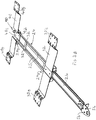
Figures 3A and3B are respectively a perspective view from beneath and a perspective view from above of a towing hitch assembly in accordance with the invention, the latter showing the assembly in a partially extended configuration; -
Figure 3C is a perspective view from beneath of an extendible part of the hitch assembly. -
Figures 4A-4D are side views of a part of the towing hitch assembly, with the assembly respectively in a fully retracted configuration, a partially extended configuration, a further extended configuration, and a fully extended configuration; and -
Figure 5 is a side view of the towing hitch assembly attached to a waste container, with the hitch assembly in the retracted configuration. - Referring to the figures, there is shown an
industrial waste container 10, having four generallyupright walls Walls 12a and 12b are generally parallel with one another and are longer thanwalls 12c and 12d which are also generally parallel with one another. Thus thewaste container 10 has a generally rectangular footprint. - The
waste container 10 also includes abase 14 which extends between thewalls 12a-d. Each of thewalls 12a-12d slopes outwardly from the base, such that the waste container has an inverted truncated pyramid shape. Such a shape facilitates stacking of a plurality of waste containers, but it will be appreciated that thewaste container 10 may be any suitable shape. The waste container may include alid 16 which is attached to at least one of thewalls 12a-d, and is moveable relative to thewalls 12a-d between an open and a closed position, so as to permit access to an interior space of thecontainer 10, and to close or seal thecontainer 10, to conceal waste placed inside thecontainer 10, and to avoid odours escaping from thecontainer 10. - The
waste container 10 includesground engaging members 18, in thisexample castors 18, which are positioned one at each corner of the base 14 (only three of the castors are visible in the drawings). - The
waste container 10 is provided with atowing hitch assembly 22 shown in, and described in greater detail with reference to,figures 3 and4 of the drawings. Thetowing hitch assembly 22 includes afirst part 24 which is attachable to the underside of thebase 14 of thewaste container 10, and extends longitudinally of the waste container along the centre line thereof. Thefirst part 24 carries, in slidably extendible and retractable manner, asecond part 26 which is connectable to a towing vehicle in the manner of a draw bar. - The
first part 24 of the hitch assembly comprises a pair of spacedparallel guide members 25 each of which is of L-section, and which are disposed so as to define parts of a guidance channel therebetween for receiving thesecond part 26. At a first end 24a of thepart 24, theguide members 25 are secured to a first mounting part which extends transversely of theguide members 25. Themounting part 32 is of sheet metal, welded to theguide members 25, and havingend portions 32a, 32b, which are off-set upwardly from the main part of themember 32 and provided with a number of apertures and slots for receiving fasteners such as bolts by which themember 32 can be secured to the underside of thewaste container base 14. The fasteners which effect such securement may also hold the respective castors to the waste container at that end thereof, and the configuration of the apertures and slots in theend parts 32a, 32b enables those parts to be held between mounting plates of the castors and the base of the waste container, the fasteners passing through selected apertures/slots depending on the spacing of apertures in the mounting plates of the castors. At the other end 24b of theguide members 25, a further mountingpart 40 is provided extending transversely of theguide members 25, the mountingpart 40 having offset end parts 40a, 40b like theend parts 32a, 32b of themounting member 32. A central part 40c of themounting member 40 is offset below the level of theguide members 25, so as to define a recess in the mid part of themounting member 40. - The
second part 26 of the hitch assembly, is slidably connected to thefirst part 24 thereof and serves as a drawbar for connection to a towing vehicle. It is an elongate plate having afirst end 26a and a second end 26b with flanges along its parallel longitudinal edges. At itsfirst end 26a thepart 26 has anoffset tapering portions 27 provided with an attachment formation in the form of anaperture 28, e.g. circular. It will be appreciated that an attachment formation may, alternatively, comprise a hook or any other formation suitable for engagement with a towing formation of a towing vehicle. - Associated with the
aperture 28 there is a spring-biased retainingmember 50 which is a metal plate having twoparts part 52 lies in face to face relationship with the off-setportion 27 of thepart 26, and is secured thereto by two bolts orother fasteners 56 which extend through apertures in thepart 27 and through slots 58 in thepart 52. Thefasteners 56 are not tightened, so themember 50 is slidable a short distance in the direction of the length of thepart 26. An end surface of thepart 52 has a part-circular recess 60 which, in the position illustrated of themember 50, encroaches upon the area of theaperture 28. A biasing spring whose disposition is indicated at 62 is operative between themember 26 and anabutment 64 on themember 50. Thepart 54 of themember 50 enables the member to be manually moved away from the end of thepart 26, against the force of the spring, so that the formation 60 does not encroach on theaperture 28. - Rearwardly of the
spring 62, thepart 26 has abracket 66 bolted or otherwise secured thereto, thebracket 66 having anupstanding portion 68 which carries a rearwardly extendingengagement member 70 of resilient and slightly flexible material, e.g. a relatively hard rubber. This has a conically-tapering nose part 72 with anundercut formation 74 and astem 76 which is connected to thebracket portion 68. When thepart 26 is fully retracted relative to thepart 24, themember 70 is engagable within asleeve 78 of like material, held by abracket 80 which extends between theguide members 25 and is connected thereto e.g. by welding. Engagement of themember 70 within thesleeve 78 holds thepart 26 in the fully retracted position relative to thepart 24. - At its second end 26b, the
part 26 has a transverse member ending in lugs 30 which extend laterally outwardly beyond the edges of thepart 26, and which are slidable lengthwise of theguide members 25 in loose contact with the inwardly facing surfaces of the guide members. At the first end 24a of thepart 24, beneath the transverse mountingmember 32 and at the ends of theguide members 25, there are laterally spaced catch members indicated generally at 42, 44 with facingwalls 42a, 44a each of which has acatch formation 48 in the form of an opening therein whose shape is best seen infigures 3A and4A in relation to thewall 42a. Aramp portion 46 leads from the end of each of theguide members 25, inclined downwardly and forwardly to lead past a retaininglip 48a into thecatch formation 48 so theformation 48 is of undercut configuration. - The
part 24 is further provided, within the recess 40c of themember 40 at the rear end thereof, with a towing formation in the form of a towingpin 90 engagable by the towingformation 28 of a towing hitch assembly on a further waste container following the first said waste container. The towingpin 90 has the form of an upstanding circular boss, having a smaller-diameterlower portion 92 engagable by the retainingmember 50 of the towing hitch assembly of the following waste container, so that the coupling between them remains engaged and requires manual retraction of the retainingmember 50 when the coupling is to be disengaged. -
Figures 4A to 4D show, in side view, the end part 24a of thehitch assembly part 24, with thepart 26 of the hitch assembly in successive positions between its fully retracted and fully extended conditions. In the fully-retracted position of thepart 26, shown infigure 4A , theformation 70 is engaged within thesleeve 78 and held frictionally therein, while only the extreme end part of offsetportion 28 is accessible beyond the end of thepart 24. - To extend the towing hitch assembly, the
part 26 must be moved forwardly from thepart 24 by grasping theportion 27 and pulling it forwardly to withdraw theformation 70 from thesleeve 78, overcoming the frictional resistance therebetween to such withdrawal. This position is shown infigure 4B , and further forwards sliding movement of thepart 26 can be continued until the position shown infigure 4C is reached. At this position, thepart 26 is tilted downwardly and thelugs 32 at the second end 26b of thepart 26 engage theramp formations 46. Upon a final forward movement of thepart 26, thelugs 32 can fall downwardly (figure 4D ), past the retaininglip 48a, to enter the undercut retainingformations 48. When this position has been reached, thepart 26 is able to pivot freely upwardly and downwardly about its end part 26b, thelugs 32 moving within theformation 48, thereby enabling, firstly, the offsetpart 27 at thefree end 26a of thepart 26 to be moved upwardly and downwardly relatively freely so that it can be hitched to a towing vehicle, and, secondly, so that the towing vehicle and a container hitched thereto can change their relative inclinations when changes in gradient are encountered. If thepart 26 is subject to lengthwise compressive forces rather than tensile forces, i.e. if a container being towed attempts to overrun the towing vehicle under braking or downhill gradient conditions, thelugs 32 are held within theformations 48 by therespective lips 48a, so thepart 26 remains in the fully extended condition relative to thepart 24 of the hitch assembly. - To unhitch the
part 26 from the towing vehicle, if the hitch formation of the towing vehicle has an undercut configuration such as that shown on thehitch formation 90 described above, the retainingmember 50 must manually be moved rearwardly against the force of its biasing spring, to disengage it from the hitch formation and permit theportion 27 to be lifted away from the hitch formation. When unhitched, moving thepart 26 to its fully extended position relative to thepart 24, with theportion 27 ofpart 26 lowered, enables thelugs 32 to be manually lifted past the retaininglips 48a, to a position at which thepart 26 can be retracted relative to thepart 24 and returned to itsfigure 4A position. -
Figure 5 shows a side view of a waste container with the towing hitch assembly fitted to it. It will be apparent that thehitch formation 90 of the hitch assembly is accessible at the rear end of the container, for hitching a further container provided with a similar hitch assembly to the first and second container. - When used in this specification and claims, the terms "comprises" and "comprising" and variations thereof mean that the specified features, steps or integers are included. The terms are not to be interpreted to exclude the presence of other features, steps or components.
Claims (14)
- A towing hitch assembly (22) for attachment to a moveable container (18), the towing hitch assembly including:a first part (24) which is connectable to the moveable container;a second part (26) which is attachable to one of an adjacent container and a towing vehicle, the second part (26) being slidably moveable relative to the first part (24), between a first, retracted configuration and a second, extended configuration; anda catch device for holding the second part (26) in the second configuration,wherein the catch device comprises at least one catch member (42, 44) on one of the parts (24, 26), wherein the or each catch member (42, 44) comprises a catch formation (48) with which a formation on the other of the parts (24, 26) engages when in the second configuration, wherein the or each catch formation (48) has a configuration to retain the formation on the other of the parts therein when the second part of the assembly is subject to lengthwise compressive forces,characterised in that the or each catch formation (48) has a retaining lip (48a).
- A towing hitch assembly according to claim 1 wherein, when in the first configuration, the towing hitch assembly (22) is positioned within a minimum footprint of a container (10) to which it is attached.
- A towing hitch assembly according to claim 1 or claim 2 wherein the first part (24) includes a guide member (25) and the second part includes a projection which extends outwardly of the second part, and is receivable in the guide member so as to allow sliding movement of the second part relative to the first part.
- A towing hitch assembly according to claim 3 wherein the first part includes a pair of guide members (25) and the projection of the second part includes a pair of lugs (32), each of which is receivable in a respective guide member (25).
- A towing hitch assembly according to any one of the preceding claims having a retaining device (70, 78) for retaining the second part in the first configuration.
- A towing hitch assembly according to claim 4 comprising respective catch formations (48) on the first part (24) of the assembly, within which the lugs (32) engage.
- A towing hitch assembly to claim 6 wherein the lugs (32) enter the catch formations (48) downwardly when the assembly reaches the second configuration.
- A towing hitch assembly according to any one of the preceding claims wherein the second part (26) has an attachment formation (28) for engagement with a towing formation of a towing vehicle or adjacent container.
- A towing hitch assembly according to claim 8 wherein the attachment formation (28) comprises an aperture.
- A towing hitch assembly according to claim 9 comprising a retaining member (50) for holding the attachment formation in engagement with the towing formation.
- A towing hitch assembly according to claim 10 as appendant to claim 8 wherein the towing formation has a recess formation (92) for engagement by the retaining member of the hitch assembly of an adjacent container.
- A moveable container including a towing hitch assembly according to any one of claims 1 to 5.
- A moveable container according to claim 12 which is stackable with other identical or similar moveable containers, by virtue of the ability of the towing hitch to be positioned in the first retracted configuration.
- A moveable container according to claim 13 which is a waste container.
Priority Applications (1)
| Application Number | Priority Date | Filing Date | Title |
|---|---|---|---|
| EP18154996.5A EP3339065B8 (en) | 2011-08-18 | 2012-08-17 | Towing hitch assembly |
Applications Claiming Priority (2)
| Application Number | Priority Date | Filing Date | Title |
|---|---|---|---|
| GB1114249.4A GB2493764B (en) | 2011-08-18 | 2011-08-18 | A Moveable Container comprising a Towing hitch assembly |
| PCT/GB2012/052014 WO2013024303A1 (en) | 2011-08-18 | 2012-08-17 | Towing hitch assembly |
Related Child Applications (1)
| Application Number | Title | Priority Date | Filing Date |
|---|---|---|---|
| EP18154996.5A Division EP3339065B8 (en) | 2011-08-18 | 2012-08-17 | Towing hitch assembly |
Publications (2)
| Publication Number | Publication Date |
|---|---|
| EP2744673A1 EP2744673A1 (en) | 2014-06-25 |
| EP2744673B1 true EP2744673B1 (en) | 2018-03-07 |
Family
ID=44800511
Family Applications (2)
| Application Number | Title | Priority Date | Filing Date |
|---|---|---|---|
| EP12751595.5A Active EP2744673B1 (en) | 2011-08-18 | 2012-08-17 | Towing hitch assembly |
| EP18154996.5A Active EP3339065B8 (en) | 2011-08-18 | 2012-08-17 | Towing hitch assembly |
Family Applications After (1)
| Application Number | Title | Priority Date | Filing Date |
|---|---|---|---|
| EP18154996.5A Active EP3339065B8 (en) | 2011-08-18 | 2012-08-17 | Towing hitch assembly |
Country Status (3)
| Country | Link |
|---|---|
| EP (2) | EP2744673B1 (en) |
| GB (1) | GB2493764B (en) |
| WO (1) | WO2013024303A1 (en) |
Cited By (1)
| Publication number | Priority date | Publication date | Assignee | Title |
|---|---|---|---|---|
| EP4173855A1 (en) | 2021-10-28 | 2023-05-03 | B.Pro GmbH | Towing device and pick-up device |
Families Citing this family (3)
| Publication number | Priority date | Publication date | Assignee | Title |
|---|---|---|---|---|
| EP3090887B1 (en) * | 2015-05-07 | 2019-09-25 | Toyota Material Handling Manufacturing Sweden AB | A towing hitch assembly and a towing system |
| JP6578147B2 (en) * | 2015-07-17 | 2019-09-18 | 岐阜プラスチック工業株式会社 | Transport cart |
| GB2599146B (en) * | 2020-09-28 | 2023-09-06 | Storm Environmental Ltd | Waste container and lid |
Family Cites Families (9)
| Publication number | Priority date | Publication date | Assignee | Title |
|---|---|---|---|---|
| US2425838A (en) * | 1944-12-26 | 1947-08-19 | Henry F Schultz | Trailer hitch |
| US3807768A (en) * | 1972-10-18 | 1974-04-30 | W Jones | Trailer hitch |
| US3860267A (en) * | 1973-09-14 | 1975-01-14 | Donald W Lyons | Trailer hitch bar |
| US6189910B1 (en) * | 1999-05-03 | 2001-02-20 | Transportation Design & Manufacturing Co. | Retractable trailer hitch |
| US6511090B2 (en) * | 2001-02-22 | 2003-01-28 | Sherman A. Quanbeck | Retractable hitch |
| AU2003203578A1 (en) * | 2002-12-11 | 2004-07-01 | Gannaway, Brenda Ann | The Wheelie-Bin Hitch |
| US7185911B1 (en) * | 2004-03-25 | 2007-03-06 | Honda Motor Co., Ltd. | Cart having a retractable tongue coupling system |
| US20070138760A1 (en) * | 2005-11-23 | 2007-06-21 | Richard Granzow | Retractable Boat Trailer |
| DE102007024761A1 (en) * | 2007-05-26 | 2008-04-30 | Daimler Ag | Pulling or steering device for chassis, particularly towing bar device for chassis of driveless trailer or pushcart, has pulling or steering bar and recess connected with chassis |
-
2011
- 2011-08-18 GB GB1114249.4A patent/GB2493764B/en active Active
-
2012
- 2012-08-17 WO PCT/GB2012/052014 patent/WO2013024303A1/en not_active Ceased
- 2012-08-17 EP EP12751595.5A patent/EP2744673B1/en active Active
- 2012-08-17 EP EP18154996.5A patent/EP3339065B8/en active Active
Cited By (2)
| Publication number | Priority date | Publication date | Assignee | Title |
|---|---|---|---|---|
| EP4173855A1 (en) | 2021-10-28 | 2023-05-03 | B.Pro GmbH | Towing device and pick-up device |
| DE102021212210A1 (en) | 2021-10-28 | 2023-05-04 | B.PRO GmbH | Hitch and pick-up device |
Also Published As
| Publication number | Publication date |
|---|---|
| GB2493764B (en) | 2017-10-18 |
| GB201114249D0 (en) | 2011-10-05 |
| WO2013024303A1 (en) | 2013-02-21 |
| GB2493764A (en) | 2013-02-20 |
| EP3339065A1 (en) | 2018-06-27 |
| EP2744673A1 (en) | 2014-06-25 |
| EP3339065B1 (en) | 2019-11-20 |
| EP3339065B8 (en) | 2019-12-25 |
Similar Documents
| Publication | Publication Date | Title |
|---|---|---|
| EP2744673B1 (en) | Towing hitch assembly | |
| US6135701A (en) | Fork lift towing bar for trailers | |
| US6328326B1 (en) | Self-aligning hitch | |
| US6796573B2 (en) | Trailer hitch guide | |
| US7997605B2 (en) | ATV utility trailer with pivoting and extendable tongue and brush guard | |
| US8353521B1 (en) | Trailer caddy | |
| US7140630B2 (en) | Trailer adapter hitch for a barrow | |
| US12344056B2 (en) | Modular non-electric and/or electric powered wheeled cart capable of attaching to a vehicle | |
| US9630464B2 (en) | Trailer tongue alignment assembly | |
| CA2935507C (en) | Fifth wheel ball hitch | |
| CN210970575U (en) | Split type transportation turnover vehicle and traction seat thereof | |
| US20020093173A1 (en) | Coupling for trailer | |
| US11279296B2 (en) | Cargo carrier system | |
| US9434223B1 (en) | Trailer tow ski system | |
| EP1301362A1 (en) | Self-aligning hitch | |
| AU2001272269A1 (en) | Self-aligning hitch | |
| CA3035993C (en) | Quick hitch attachment for gooseneck trailers and other implements | |
| DE202009009055U1 (en) | Coupling rolling device | |
| US11697440B2 (en) | Dual tow ring tongue coupler | |
| CA2299751A1 (en) | Snowmobile dolly | |
| BR102012007214B1 (en) | multipurpose trailer for transporting grains, seeds, fertilizers and the like | |
| AU2015100989A4 (en) | A hitch for towing a wheeled bin | |
| US20120193890A1 (en) | Fifth Wheel Trailer Hitch Cover | |
| US11390127B1 (en) | Garbage can hitch and garbage can having a built-in hitch | |
| US20100178145A1 (en) | Wheel lift container |
Legal Events
| Date | Code | Title | Description |
|---|---|---|---|
| PUAI | Public reference made under article 153(3) epc to a published international application that has entered the european phase |
Free format text: ORIGINAL CODE: 0009012 |
|
| 17P | Request for examination filed |
Effective date: 20140318 |
|
| AK | Designated contracting states |
Kind code of ref document: A1 Designated state(s): AL AT BE BG CH CY CZ DE DK EE ES FI FR GB GR HR HU IE IS IT LI LT LU LV MC MK MT NL NO PL PT RO RS SE SI SK SM TR |
|
| DAX | Request for extension of the european patent (deleted) | ||
| 17Q | First examination report despatched |
Effective date: 20170518 |
|
| GRAP | Despatch of communication of intention to grant a patent |
Free format text: ORIGINAL CODE: EPIDOSNIGR1 |
|
| INTG | Intention to grant announced |
Effective date: 20170913 |
|
| GRAS | Grant fee paid |
Free format text: ORIGINAL CODE: EPIDOSNIGR3 |
|
| GRAA | (expected) grant |
Free format text: ORIGINAL CODE: 0009210 |
|
| AK | Designated contracting states |
Kind code of ref document: B1 Designated state(s): AL AT BE BG CH CY CZ DE DK EE ES FI FR GB GR HR HU IE IS IT LI LT LU LV MC MK MT NL NO PL PT RO RS SE SI SK SM TR |
|
| REG | Reference to a national code |
Ref country code: GB Ref legal event code: FG4D |
|
| REG | Reference to a national code |
Ref country code: CH Ref legal event code: EP Ref country code: AT Ref legal event code: REF Ref document number: 976162 Country of ref document: AT Kind code of ref document: T Effective date: 20180315 |
|
| REG | Reference to a national code |
Ref country code: IE Ref legal event code: FG4D |
|
| REG | Reference to a national code |
Ref country code: DE Ref legal event code: R096 Ref document number: 602012043720 Country of ref document: DE |
|
| REG | Reference to a national code |
Ref country code: NL Ref legal event code: MP Effective date: 20180307 |
|
| REG | Reference to a national code |
Ref country code: LT Ref legal event code: MG4D |
|
| PG25 | Lapsed in a contracting state [announced via postgrant information from national office to epo] |
Ref country code: NO Free format text: LAPSE BECAUSE OF FAILURE TO SUBMIT A TRANSLATION OF THE DESCRIPTION OR TO PAY THE FEE WITHIN THE PRESCRIBED TIME-LIMIT Effective date: 20180607 Ref country code: FI Free format text: LAPSE BECAUSE OF FAILURE TO SUBMIT A TRANSLATION OF THE DESCRIPTION OR TO PAY THE FEE WITHIN THE PRESCRIBED TIME-LIMIT Effective date: 20180307 Ref country code: HR Free format text: LAPSE BECAUSE OF FAILURE TO SUBMIT A TRANSLATION OF THE DESCRIPTION OR TO PAY THE FEE WITHIN THE PRESCRIBED TIME-LIMIT Effective date: 20180307 Ref country code: LT Free format text: LAPSE BECAUSE OF FAILURE TO SUBMIT A TRANSLATION OF THE DESCRIPTION OR TO PAY THE FEE WITHIN THE PRESCRIBED TIME-LIMIT Effective date: 20180307 Ref country code: ES Free format text: LAPSE BECAUSE OF FAILURE TO SUBMIT A TRANSLATION OF THE DESCRIPTION OR TO PAY THE FEE WITHIN THE PRESCRIBED TIME-LIMIT Effective date: 20180307 Ref country code: CY Free format text: LAPSE BECAUSE OF FAILURE TO SUBMIT A TRANSLATION OF THE DESCRIPTION OR TO PAY THE FEE WITHIN THE PRESCRIBED TIME-LIMIT Effective date: 20180307 |
|
| REG | Reference to a national code |
Ref country code: AT Ref legal event code: MK05 Ref document number: 976162 Country of ref document: AT Kind code of ref document: T Effective date: 20180307 |
|
| PG25 | Lapsed in a contracting state [announced via postgrant information from national office to epo] |
Ref country code: BG Free format text: LAPSE BECAUSE OF FAILURE TO SUBMIT A TRANSLATION OF THE DESCRIPTION OR TO PAY THE FEE WITHIN THE PRESCRIBED TIME-LIMIT Effective date: 20180607 Ref country code: LV Free format text: LAPSE BECAUSE OF FAILURE TO SUBMIT A TRANSLATION OF THE DESCRIPTION OR TO PAY THE FEE WITHIN THE PRESCRIBED TIME-LIMIT Effective date: 20180307 Ref country code: SE Free format text: LAPSE BECAUSE OF FAILURE TO SUBMIT A TRANSLATION OF THE DESCRIPTION OR TO PAY THE FEE WITHIN THE PRESCRIBED TIME-LIMIT Effective date: 20180307 Ref country code: GR Free format text: LAPSE BECAUSE OF FAILURE TO SUBMIT A TRANSLATION OF THE DESCRIPTION OR TO PAY THE FEE WITHIN THE PRESCRIBED TIME-LIMIT Effective date: 20180608 Ref country code: RS Free format text: LAPSE BECAUSE OF FAILURE TO SUBMIT A TRANSLATION OF THE DESCRIPTION OR TO PAY THE FEE WITHIN THE PRESCRIBED TIME-LIMIT Effective date: 20180307 |
|
| REG | Reference to a national code |
Ref country code: FR Ref legal event code: PLFP Year of fee payment: 7 |
|
| PG25 | Lapsed in a contracting state [announced via postgrant information from national office to epo] |
Ref country code: NL Free format text: LAPSE BECAUSE OF FAILURE TO SUBMIT A TRANSLATION OF THE DESCRIPTION OR TO PAY THE FEE WITHIN THE PRESCRIBED TIME-LIMIT Effective date: 20180307 Ref country code: EE Free format text: LAPSE BECAUSE OF FAILURE TO SUBMIT A TRANSLATION OF THE DESCRIPTION OR TO PAY THE FEE WITHIN THE PRESCRIBED TIME-LIMIT Effective date: 20180307 Ref country code: PL Free format text: LAPSE BECAUSE OF FAILURE TO SUBMIT A TRANSLATION OF THE DESCRIPTION OR TO PAY THE FEE WITHIN THE PRESCRIBED TIME-LIMIT Effective date: 20180307 Ref country code: AL Free format text: LAPSE BECAUSE OF FAILURE TO SUBMIT A TRANSLATION OF THE DESCRIPTION OR TO PAY THE FEE WITHIN THE PRESCRIBED TIME-LIMIT Effective date: 20180307 Ref country code: IT Free format text: LAPSE BECAUSE OF FAILURE TO SUBMIT A TRANSLATION OF THE DESCRIPTION OR TO PAY THE FEE WITHIN THE PRESCRIBED TIME-LIMIT Effective date: 20180307 Ref country code: RO Free format text: LAPSE BECAUSE OF FAILURE TO SUBMIT A TRANSLATION OF THE DESCRIPTION OR TO PAY THE FEE WITHIN THE PRESCRIBED TIME-LIMIT Effective date: 20180307 |
|
| PG25 | Lapsed in a contracting state [announced via postgrant information from national office to epo] |
Ref country code: CZ Free format text: LAPSE BECAUSE OF FAILURE TO SUBMIT A TRANSLATION OF THE DESCRIPTION OR TO PAY THE FEE WITHIN THE PRESCRIBED TIME-LIMIT Effective date: 20180307 Ref country code: SM Free format text: LAPSE BECAUSE OF FAILURE TO SUBMIT A TRANSLATION OF THE DESCRIPTION OR TO PAY THE FEE WITHIN THE PRESCRIBED TIME-LIMIT Effective date: 20180307 Ref country code: AT Free format text: LAPSE BECAUSE OF FAILURE TO SUBMIT A TRANSLATION OF THE DESCRIPTION OR TO PAY THE FEE WITHIN THE PRESCRIBED TIME-LIMIT Effective date: 20180307 Ref country code: SK Free format text: LAPSE BECAUSE OF FAILURE TO SUBMIT A TRANSLATION OF THE DESCRIPTION OR TO PAY THE FEE WITHIN THE PRESCRIBED TIME-LIMIT Effective date: 20180307 |
|
| REG | Reference to a national code |
Ref country code: DE Ref legal event code: R097 Ref document number: 602012043720 Country of ref document: DE |
|
| PG25 | Lapsed in a contracting state [announced via postgrant information from national office to epo] |
Ref country code: PT Free format text: LAPSE BECAUSE OF FAILURE TO SUBMIT A TRANSLATION OF THE DESCRIPTION OR TO PAY THE FEE WITHIN THE PRESCRIBED TIME-LIMIT Effective date: 20180709 |
|
| PLBE | No opposition filed within time limit |
Free format text: ORIGINAL CODE: 0009261 |
|
| STAA | Information on the status of an ep patent application or granted ep patent |
Free format text: STATUS: NO OPPOSITION FILED WITHIN TIME LIMIT |
|
| PG25 | Lapsed in a contracting state [announced via postgrant information from national office to epo] |
Ref country code: DK Free format text: LAPSE BECAUSE OF FAILURE TO SUBMIT A TRANSLATION OF THE DESCRIPTION OR TO PAY THE FEE WITHIN THE PRESCRIBED TIME-LIMIT Effective date: 20180307 |
|
| 26N | No opposition filed |
Effective date: 20181210 |
|
| PG25 | Lapsed in a contracting state [announced via postgrant information from national office to epo] |
Ref country code: SI Free format text: LAPSE BECAUSE OF FAILURE TO SUBMIT A TRANSLATION OF THE DESCRIPTION OR TO PAY THE FEE WITHIN THE PRESCRIBED TIME-LIMIT Effective date: 20180307 |
|
| PG25 | Lapsed in a contracting state [announced via postgrant information from national office to epo] |
Ref country code: MC Free format text: LAPSE BECAUSE OF FAILURE TO SUBMIT A TRANSLATION OF THE DESCRIPTION OR TO PAY THE FEE WITHIN THE PRESCRIBED TIME-LIMIT Effective date: 20180307 |
|
| REG | Reference to a national code |
Ref country code: CH Ref legal event code: PL |
|
| PG25 | Lapsed in a contracting state [announced via postgrant information from national office to epo] |
Ref country code: LI Free format text: LAPSE BECAUSE OF NON-PAYMENT OF DUE FEES Effective date: 20180831 Ref country code: CH Free format text: LAPSE BECAUSE OF NON-PAYMENT OF DUE FEES Effective date: 20180831 Ref country code: LU Free format text: LAPSE BECAUSE OF NON-PAYMENT OF DUE FEES Effective date: 20180817 |
|
| REG | Reference to a national code |
Ref country code: BE Ref legal event code: MM Effective date: 20180831 |
|
| REG | Reference to a national code |
Ref country code: IE Ref legal event code: MM4A |
|
| PG25 | Lapsed in a contracting state [announced via postgrant information from national office to epo] |
Ref country code: IE Free format text: LAPSE BECAUSE OF NON-PAYMENT OF DUE FEES Effective date: 20180817 |
|
| PG25 | Lapsed in a contracting state [announced via postgrant information from national office to epo] |
Ref country code: BE Free format text: LAPSE BECAUSE OF NON-PAYMENT OF DUE FEES Effective date: 20180831 |
|
| PG25 | Lapsed in a contracting state [announced via postgrant information from national office to epo] |
Ref country code: MT Free format text: LAPSE BECAUSE OF NON-PAYMENT OF DUE FEES Effective date: 20180817 |
|
| PG25 | Lapsed in a contracting state [announced via postgrant information from national office to epo] |
Ref country code: TR Free format text: LAPSE BECAUSE OF FAILURE TO SUBMIT A TRANSLATION OF THE DESCRIPTION OR TO PAY THE FEE WITHIN THE PRESCRIBED TIME-LIMIT Effective date: 20180307 |
|
| PG25 | Lapsed in a contracting state [announced via postgrant information from national office to epo] |
Ref country code: HU Free format text: LAPSE BECAUSE OF FAILURE TO SUBMIT A TRANSLATION OF THE DESCRIPTION OR TO PAY THE FEE WITHIN THE PRESCRIBED TIME-LIMIT; INVALID AB INITIO Effective date: 20120817 |
|
| PG25 | Lapsed in a contracting state [announced via postgrant information from national office to epo] |
Ref country code: MK Free format text: LAPSE BECAUSE OF NON-PAYMENT OF DUE FEES Effective date: 20180307 |
|
| PG25 | Lapsed in a contracting state [announced via postgrant information from national office to epo] |
Ref country code: IS Free format text: LAPSE BECAUSE OF FAILURE TO SUBMIT A TRANSLATION OF THE DESCRIPTION OR TO PAY THE FEE WITHIN THE PRESCRIBED TIME-LIMIT Effective date: 20180707 |
|
| P01 | Opt-out of the competence of the unified patent court (upc) registered |
Effective date: 20230609 |
|
| P02 | Opt-out of the competence of the unified patent court (upc) changed |
Effective date: 20230619 |
|
| PGFP | Annual fee paid to national office [announced via postgrant information from national office to epo] |
Ref country code: DE Payment date: 20250820 Year of fee payment: 14 |
|
| PGFP | Annual fee paid to national office [announced via postgrant information from national office to epo] |
Ref country code: GB Payment date: 20250717 Year of fee payment: 14 |
|
| PGFP | Annual fee paid to national office [announced via postgrant information from national office to epo] |
Ref country code: FR Payment date: 20250829 Year of fee payment: 14 |