EP2743300A1 - Polycarbonate resin composition and molded article produced therefrom - Google Patents
Polycarbonate resin composition and molded article produced therefrom Download PDFInfo
- Publication number
- EP2743300A1 EP2743300A1 EP13192311.2A EP13192311A EP2743300A1 EP 2743300 A1 EP2743300 A1 EP 2743300A1 EP 13192311 A EP13192311 A EP 13192311A EP 2743300 A1 EP2743300 A1 EP 2743300A1
- Authority
- EP
- European Patent Office
- Prior art keywords
- polycarbonate resin
- resin composition
- formula
- unit represented
- repeat unit
- Prior art date
- Legal status (The legal status is an assumption and is not a legal conclusion. Google has not performed a legal analysis and makes no representation as to the accuracy of the status listed.)
- Granted
Links
- 0 C*(C)C(Oc1ccc(C(C)(C)c(cc2)ccc2O*(C)C)cc1)=O Chemical compound C*(C)C(Oc1ccc(C(C)(C)c(cc2)ccc2O*(C)C)cc1)=O 0.000 description 1
- IISBACLAFKSPIT-UHFFFAOYSA-N CC(C)(c(cc1)ccc1O)c(cc1)ccc1O Chemical compound CC(C)(c(cc1)ccc1O)c(cc1)ccc1O IISBACLAFKSPIT-UHFFFAOYSA-N 0.000 description 1
Classifications
-
- C—CHEMISTRY; METALLURGY
- C08—ORGANIC MACROMOLECULAR COMPOUNDS; THEIR PREPARATION OR CHEMICAL WORKING-UP; COMPOSITIONS BASED THEREON
- C08L—COMPOSITIONS OF MACROMOLECULAR COMPOUNDS
- C08L69/00—Compositions of polycarbonates; Compositions of derivatives of polycarbonates
-
- C—CHEMISTRY; METALLURGY
- C08—ORGANIC MACROMOLECULAR COMPOUNDS; THEIR PREPARATION OR CHEMICAL WORKING-UP; COMPOSITIONS BASED THEREON
- C08K—Use of inorganic or non-macromolecular organic substances as compounding ingredients
- C08K5/00—Use of organic ingredients
- C08K5/0008—Organic ingredients according to more than one of the "one dot" groups of C08K5/01 - C08K5/59
- C08K5/0066—Flame-proofing or flame-retarding additives
-
- C—CHEMISTRY; METALLURGY
- C08—ORGANIC MACROMOLECULAR COMPOUNDS; THEIR PREPARATION OR CHEMICAL WORKING-UP; COMPOSITIONS BASED THEREON
- C08K—Use of inorganic or non-macromolecular organic substances as compounding ingredients
- C08K5/00—Use of organic ingredients
- C08K5/49—Phosphorus-containing compounds
- C08K5/51—Phosphorus bound to oxygen
- C08K5/52—Phosphorus bound to oxygen only
- C08K5/521—Esters of phosphoric acids, e.g. of H3PO4
- C08K5/523—Esters of phosphoric acids, e.g. of H3PO4 with hydroxyaryl compounds
Definitions
- the present invention relates to a polycarbonate resin composition and a molded article produced therefrom. More particularly, the present invention relates to a polycarbonate resin composition, which exhibits excellent properties in terms of scratch resistance, flame retardancy and transparency, and a molded article produced therefrom.
- Polycarbonate resins are representative thermoplastic materials having a thermal deformation temperature of 135°C or more, and exhibit excellent mechanical properties such as impact resistance, self extinguishability, dimensional stability, heat resistance and transparency.
- polycarbonate resins are widely applied to exterior materials for electric and electronic products, office equipment, automobile components, and as optical materials, to optical disc substrates, various lenses, prisms, optical fibers, and the like.
- polycarbonate resins are frequently used as materials for housings of electronic products and automobiles, which emit considerable heat and, in this case, excellent flame retardancy is required.
- flame retardant polycarbonate resin compositions prepared by adding flame-retardants and the like to polycarbonate resins, have been continuously developed.
- polycarbonate resins and resin compositions exhibit low scratch resistance, which restricts application thereof to optical films and exterior materials for notebooks, mobile phones, and the like.
- a scratch resistant film may be applied to a polycarbonate film.
- this method has a drawback in that the scratch resistant film is expensive and manufacturing costs can be increased due to an additional coating process.
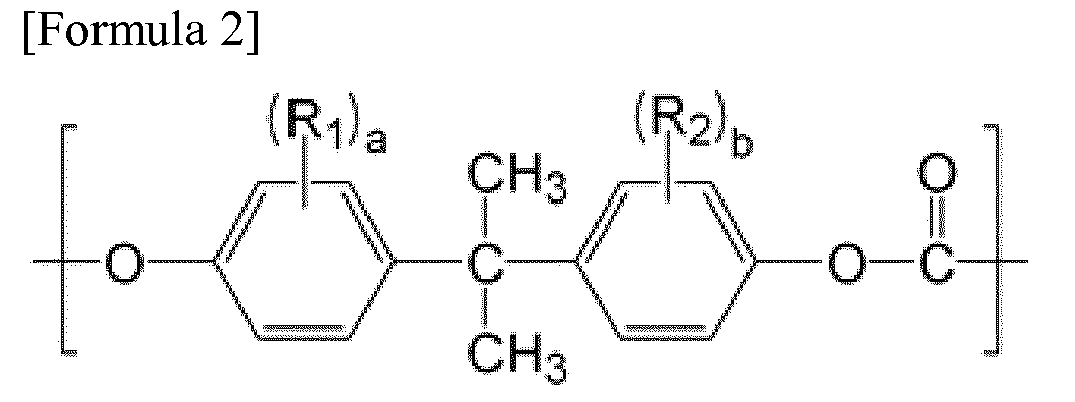
- the polycarbonate resin composition includes: a polycarbonate component, which includes an aromatic polycarbonate resin and a copolymerized polycarbonate resin including a repeat unit represented by Formula 1 and a repeat unit represented by Formula 2; and a flame retardant, and has: a scratch width of 310 ⁇ m or less as measured by Ball-type Scratch Profile (BSP) test; a pencil hardness rating of F or higher; a flame retardancy level of V-0 or higher as measured on a 2.0 mm thick specimen according to UL94; and a transmittance of 80% or more as measured in accordance with ASTM D1003: wherein R 1 and R 2 are each independently a substituted or unsubstituted C 1 to C 6 alkyl group, and a and b are each independently an integer from 1 to 4.
- BSP Ball-type Scratch Profile
- the repeat unit represented by Formula 2 may be a repeat unit represented by Formula 2a:
- the aromatic polycarbonate resin may be present in an amount of 20% by weight (wt%) to 80 wt%, and the copolymerized polycarbonate resin may be present in an amount of 20 wt% to 80 wt%.
- the flame retardant may be present in an amount of 5 parts by weight to 40 parts by weight based on 100 parts by weight of the polycarbonate component.
- the repeat unit represented by Formula 1 may be present in an amount of 5 mol% to 70 mol%, and the repeat unit represented by Formula 2 may be present in an amount of 30 mol% to 95 mol%.
- the copolymerized polycarbonate resin may further include a repeat unit represented by Formula 3: wherein R 3 and R 4 are each independently a substituted or unsubstituted C 1 to C 6 alkyl group, and m and n are each independently an integer from 0 to 4.
- the repeat unit represented by Formula 3 may be present in an amount of 1 part by mole to 30 parts by mole based on 100 parts by mole of the repeat unit represented by Formulae 1 and 2.
- the polycarbonate resin composition may have a Vicat softening temperature (VST) of 100°C or more, as measured in accordance with ASTM D1525.
- VST Vicat softening temperature
- Another aspect of the present invention relates to a molded article produced from the polycarbonate resin composition.
- a polycarbonate resin composition according to embodiments of the present invention includes: (A) a polycarbonate component including (A1) an aromatic polycarbonate resin and (A2) a copolymerized polycarbonate resin; and (B) a flame retardant.
- the aromatic polycarbonate resin of the present invention any typical aromatic polycarbonate resin used in preparation of a thermoplastic resin composition in the art may be used without limitation.
- the aromatic polycarbonate resin may be prepared by condensation or transesterification of a dihydric phenol compound and a carbonate precursor such as phosgene, diaryl carbonate, and the like, in the presence of a molecular weight regulator and a catalyst.
- the dihydric phenol compound may be a bisphenol compound, preferably 2,2-bis(4-hydroxyphenyl)propane ("bisphenol A").
- bisphenol A may be partially or wholly replaced by another type of dihydric phenol compound.
- dihydric phenol compound may include hydroquinone, 4,4'-dihydroxydiphenyl, bis(4-hydroxyphenyl)methane, 1,1-bis(4-hydroxyphenyl)cyclohexane, 2,2-bis(3,5-dimethyl-4-hydroxyphenyl)propane, bis(4-hydroxyphenyl)sulfide, bis(4-hydroxyphenyl)sulfone, bis(4-hydroxyphenyl)sulfoxide, bis(4-hydroxyphenyl)ketone, bis(4-hydroxyphenyl)ether, halogenated bisphenol such as 2,2-bis(3,5-dibromo-4-hydroxyphenyl)propane, and the like.
- aromatic polycarbonate resin may be prepared using any dihydric phenol compound.
- the aromatic polycarbonate resin may be a single polymer using one type of dihydric phenol compound, a copolymer using at least two types of dihydric phenol compound, or a mixture thereof. However, in the case of the copolymer, the aromatic polycarbonate resin is different from the copolymerized polycarbonate resin (A2).
- the aromatic polycarbonate resin may have any form of linear polycarbonate, branched polycarbonate, polyester carbonate copolymer resins, and the like.
- aromatic polycarbonate resin included in the polycarbonate resin composition according to the invention any of these linear polycarbonate resins, branched polycarbonate resins, polyestercarbonate copolymer resins, and the like, may be used without limitation to a specific form.
- the linear polycarbonate resin may be a bisphenol A-based polycarbonate resin
- the branched polycarbonate resin may be a resin prepared by reacting a multifunctional aromatic compound, such as trimellitic anhydride, trimellitic acid, and the like, with a dihydric phenol compound and a carbonate precursor
- the polyester carbonate copolymer resin may employ a resin prepared by reacting a bifunctional carboxylic acid with a dihydric phenol compound and a carbonate precursor.
- any typical linear polycarbonate, branched polycarbonate, and polyester carbonate copolymer resins may be used without limitation.
- the aromatic polycarbonate resin may be present in an amount of 20 wt% to 80 wt%, preferably 30 wt% to 70 wt%. Within this range, the polycarbonate resin composition can exhibit excellent impact resistance, and can be prepared economically.
- the aromatic polycarbonate resin may have a weight average molecular weight (Mw) from 18,000 g/mol to 33,000 g/mol, preferably from 22,000 g/mol to 30,000 g/mol, as measured by Gel Permeation Chromatography (GPC). Within this range, the polycarbonate resin composition can exhibit excellent mechanical properties.
- Mw weight average molecular weight
- the copolymerized polycarbonate resin of the present invention may improve properties of the polycarbonate resin composition, such as scratch resistance, and the like, with minimal or no deterioration of inherent properties, such as transparency, heat resistance, impact resistance, and the like, and includes a repeat unit represented by Formula 1 and a repeat unit represented by Formula 2.
- R 1 and R 2 are each independently a substituted or unsubstituted C 1 to C 6 alkyl group, and a and b are each independently an integer from 1 to 4.
- substituted means that a hydrogen atom is substituted with a halogen, a C 1 to C 10 alkyl group, a C 1 to C 10 haloalkyl group, a C 6 to C 10 aryl group, a C 1 to C 10 alkoxy group, or combinations thereof.
- One example of the repeat unit represented by Formula 2 may be a repeat unit represented by Formula 2a, without being limited thereto.
- the repeat unit represented by Formula 1 may be present in an amount of 5 mol% to 70 mol%, preferably 10 mol% to 50 mol%, and the repeat unit represented by Formula 2 may be present in an amount of 30 mol% to 95 mol%, preferably 50 mol% to 90 mol%. Within this range, the polycarbonate resin composition can exhibit excellent scratch resistance.
- the copolymerized polycarbonate resin may be a terpolymer further including a repeat unit represented by Formula 3.
- R 3 and R 4 are each independently a substituted or unsubstituted C 1 to C 6 alkyl group, and m and n are each independently an integer from 0 to 4.
- the repeat unit represented by Formula 3 may be present in an amount of 1 part by mole to 30 parts by mole, preferably 5 parts by mole to 15 parts by mole, based on 100 parts by mole of the repeat units represented by Formulae 1 and 2. Within this range, the polycarbonate resin composition can exhibit more excellent chemical resistance.
- the copolymerized polycarbonate resin may be present in an amount of 20 wt% to 80 wt%, preferably 30 wt% to 70 wt%. Within this range, the polycarbonate resin composition can exhibit excellent properties in terms of scratch resistance, chemical resistance, and the like, and can be prepared economically.
- the copolymerized polycarbonate resin may have a weight average molecular weight (Mw) from 18,000 g/mol to 33,000 g/mol, preferably from 22,000 g/mol to 30,000 g/mol, as measured by Gel Permeation Chromatography (GPC). Within this range, the polycarbonate resin composition can exhibit excellent mechanical properties.
- Mw weight average molecular weight
- the copolymerized polycarbonate resin may be prepared by any typical method for preparation of polycarbonate resin.
- the copolymerized polycarbonate resin may be prepared by condensation or transesterification of a diol mixture, which includes a diol compound (bisphenol A (BPA)) represented by Formula 4 and a diol compound represented by Formula 5, and a carbonate precursor.
- BPA bisphenol A
- R 1 , R 2 , a and b are the same as defined in Formula 2.
- diol compound represented by Formula 5 may be 3,3'-dimethyl bisphenol A (DMBPA), without being limited thereto.
- DMBPA 3,3'-dimethyl bisphenol A
- the diol compound represented by Formula 4 may be present in an amount of 5 mol% to 70 mol%, preferably 10 mol% to 50 mol%, and the diol compound represented by Formula 5 may be present in an amount of 30 mol% to 95 mol%, preferably 50 mol% to 90 mol%. Within this range, the polycarbonate resin composition can exhibit excellent scratch resistance.
- the diol mixture may be prepared as a terpolymer by further including a biphenol compound represented by Formula 6. wherein R 3 , R 4 , m and n are the same as defined in Formula 3.
- Examples of the biphenol compound represented by Formula 6 may include 4,4'-biphenol, 2,2'-dimethyl 4,4'-biphenyldiol, 3,3-dimethyl 4,4-dihydroxy biphenyl, 2,2',6,6',-tetramethyl-4,4'-biphenol, and the like, without being limited thereto.
- the biphenol compound represented by Formula 6 may be 4,4'-biphenol.
- the biphenol compound represented by Formula 6 may be present in an amount of 1 part by mole to 30 parts by mole, preferably 5 parts by mole to 15 parts by mole, based on 100 parts by mole of the diol compounds represented by Formulae 4 and 5. Within this range, the polycarbonate resin composition can exhibit more excellent chemical resistance.
- Examples of the carbonate precursor may include phosgene, triphosgene, diaryl carbonate, mixtures thereof, and the like.
- examples of the diaryl carbonate may include diphenyl carbonate, ditolyl carbonate, bis(chlorophenyl) carbonate, m-cresyl carbonate, dinaphthylcarbonate, bis(diphenyl) carbonate, diethyl carbonate, dimethyl carbonate, dibutyl carbonate, dicyclohexyl carbonate, and the like, without being limited thereto. These are used alone or in combination thereof.
- diphenyl carbonate is used as the diaryl carbonate.
- a molar ratio (diol mixture/carbonate precursor) of the diol mixture to the carbonate precursor may range from 0.6 to 1.0, preferably from 0.7 to 0.9. Within this range, the polycarbonate resin composition can exhibit excellent mechanical strength.
- the reaction between the diol mixture and the carbonate precursor may be transesterification, which may be performed at a temperature from 150°C to 300°C, preferably from 160°C to 280°C, more preferably from 190°C to 260°C, under reduced pressure. Within this temperature range, the reaction is advantageous in view of reaction rate and decrease in side reaction.
- transesterification is performed under a reduced pressure of 100 torr or less, for example, 75 torr or less, preferably 30 torr or less, more preferably 1 torr or less for 10 minutes or more, preferably 15 minutes to 24 hours, more preferably 15 minutes to 12 hours, which is advantageous in view of reaction rate and decrease in side reaction.
- the transesterification may be performed in the presence of a catalyst.
- a catalyst any typical catalyst used in transesterification may be used.
- the catalyst may include alkali metal catalysts, alkaline earth metal catalysts, and the like.
- the alkali metal catalysts may include LiOH, NaOH, KOH, and the like, without being limited thereto. These may be used alone or in combination thereof.
- the catalyst may be present in an amount of 1 ⁇ 10 -8 mole to 1 ⁇ 10 -3 mole, preferably 1 ⁇ 10 -7 mole to 1 ⁇ 10 -4 mole, per mole of the diol mixture. Within this range, the resin exhibits sufficient reactivity and production of side products due to side reaction can be minimized, thereby obtaining effects of improving thermal stability and color stability.
- any typical flame retardant used in preparation of a thermoplastic resin composition in the art may be used as the flame retardant.
- the flame retardant may include: phosphorus flame retardants such as phosphoric acid, phosphate ester compounds, polyphosphate compounds, red phosphorus compounds, and the like; halogen flame retardants; and mixtures thereof.
- the flame retardant is a phosphorous flame retardant which is environmentally friendly, more preferably a phosphate ester compound.
- Examples of the phosphate ester compound may include bisphenol A diphosphate, diphenylphosphate, triphenylphosphate, tricresylphosphate, trixylenylphosphate, tri(2,6-dimethylphenyl)phosphate, tri(2,4,6-trimethylphenyl)phosphate, tri(2,4-di-tert-butylphenyl)phosphate, tri(2,6-dimethylphenyl)phosphate, resorcinol bis(diphenyl)phosphate, resorcinol bis(2,6-dimethylphenyl)phosphate, resorcinol bis(2,4-di-tert-butylphenyl)phosphate, hydroquinol bis(2,6-dimethylphenyl)phosphate, hydroquinol bis(2,4-di-tert-butylphenyl)phosphate, and the like. These phosphate ester compounds may be used alone or in combination thereof.
- the flame retardant may be present in an amount of 5 parts by weight to 40 parts by weight, preferably 10 parts by weight to 20 parts by weight, based on 100 parts by weight of the polycarbonate component. Within this range, the polycarbonate resin composition can exhibit excellent flame retardancy without deterioration of other inherent properties.
- the polycarbonate resin composition may further include additives such as flame retardation aids, lubricants, surfactants, nucleating agents, coupling agents, fillers, plasticizers, antibacterial agents, release agents, heat stabilizers, antioxidants, photostabilizers, compatibilizers, inorganic additives, antistatic agents, pigments, dyes, and the like, as necessary.
- additives such as flame retardation aids, lubricants, surfactants, nucleating agents, coupling agents, fillers, plasticizers, antibacterial agents, release agents, heat stabilizers, antioxidants, photostabilizers, compatibilizers, inorganic additives, antistatic agents, pigments, dyes, and the like, as necessary.
- additives may be used alone or in combination thereof.
- These additives may be included in the total polycarbonate resin composition by being added thereto during typical pelletization (extrusion), although methods for adding these additives thereto are not particularly limited.
- the additives may be present in an amount of 0.001 parts by weight to 20 parts by
- the polycarbonate resin composition is superior to existing polycarbonate resin compositions, which include only an acrylic resin component instead of the polycarbonate component or employ only a copolymerized polycarbonate resin as the polycarbonate component, in terms of scratch resistance, flame retardancy and impact resistance due to the polycarbonate component and the flame retardant included therein.
- the polycarbonate resin composition has: a scratch width of 310 ⁇ m or less, preferably from 100 ⁇ m to 290 ⁇ m, as measured by Ball-type Scratch Profile (BSP) test; a pencil hardness rating of F or higher, preferably from H to 3H, as measured under a load of 500 g in accordance with ASTM D3362; a flame retardancy level of V-0 or higher, as measured on a 2.0 mm thick specimen according to UL94 VB flame retardancy regulations; and a transmittance of 80% or more, for example, from 80% to 95%, preferably from 85% to 95%, as measured on a 2.0 mm thick specimen in accordance with ASTM D1003.
- the polycarbonate resin composition can be used alone as an exterior material for electronic products without a protective film or coating.
- the polycarbonate resin composition may have a Vicat softening temperature (VST) of 100°C or more, preferably from 100°C to 130°C, as measured in accordance with ASTM D1525. Within this range, the polycarbonate resin composition is applicable to automobile components, and the like.
- VST Vicat softening temperature
- Another aspect of the present invention relates to a molded article produced from the polycarbonate resin composition.
- the polycarbonate resin composition may be prepared in pellet form by melt extrusion in an extruder after mixing the above components and other additives at the same time, and the prepared pellets may be prepared as various molded articles (products) through various molding methods such as injection molding, extrusion, vacuum molding, cast molding, and the like. These molding methods are well known to those skilled in the art.
- the molded articles exhibit excellent properties in terms of heat resistance, scratch resistance, flame retardancy, transparency, and the like, and thus can be widely applied to optical films, components of electric and electronic products, exterior materials, automobile components, miscellaneous goods, structural materials, and the like.
- the components were mixed in amounts as listed in Table 1, followed by melting, kneading and extrusion to prepare pellets.
- a twin-screw extruder having a diameter of 45 mm and L/D 29 was used for extrusion.
- the prepared pellets were dried at 80°C for 6 hours and injection-molded in a 6 ounce injection machine to prepare specimens. Properties of the prepared specimens were evaluated by the following methods, and results are shown in Table 1.
Landscapes
- Chemical & Material Sciences (AREA)
- Health & Medical Sciences (AREA)
- Chemical Kinetics & Catalysis (AREA)
- Medicinal Chemistry (AREA)
- Polymers & Plastics (AREA)
- Organic Chemistry (AREA)
- Compositions Of Macromolecular Compounds (AREA)
- Polyesters Or Polycarbonates (AREA)
Abstract

Description
- The present invention relates to a polycarbonate resin composition and a molded article produced therefrom. More particularly, the present invention relates to a polycarbonate resin composition, which exhibits excellent properties in terms of scratch resistance, flame retardancy and transparency, and a molded article produced therefrom.
- Polycarbonate resins are representative thermoplastic materials having a thermal deformation temperature of 135°C or more, and exhibit excellent mechanical properties such as impact resistance, self extinguishability, dimensional stability, heat resistance and transparency. Thus, polycarbonate resins are widely applied to exterior materials for electric and electronic products, office equipment, automobile components, and as optical materials, to optical disc substrates, various lenses, prisms, optical fibers, and the like. Particularly, polycarbonate resins are frequently used as materials for housings of electronic products and automobiles, which emit considerable heat and, in this case, excellent flame retardancy is required. For this purpose, flame retardant polycarbonate resin compositions, prepared by adding flame-retardants and the like to polycarbonate resins, have been continuously developed.
- However, polycarbonate resins and resin compositions exhibit low scratch resistance, which restricts application thereof to optical films and exterior materials for notebooks, mobile phones, and the like. To supplement scratch resistance of polycarbonate resins, a scratch resistant film may be applied to a polycarbonate film. However, this method has a drawback in that the scratch resistant film is expensive and manufacturing costs can be increased due to an additional coating process.
- Therefore, a variety of research has been devoted to improving scratch resistance of polycarbonate resins. Among methods for improving scratch resistance of polycarbonate resins, a method of blending a polycarbonate resin with a resin having scratch resistance is most widely used.
- However, when a polycarbonate resin is blended with an acrylic resin to improve scratch resistance, there can be risks of drastic deterioration in impact resistance and the like, and significant increase in haze due to poor compatibility between resins to be blended, thereby significantly deteriorating transparency of the polycarbonate resin.
- Therefore, there is a need for polycarbonate resin compositions exhibiting excellent properties in terms of scratch resistance and flame retardancy without deterioration of inherent properties, such as impact resistance, transparency, and the like.
- It is the object of the present invention to provide a polycarbonate resin composition, which is superior to existing polycarbonate resin compositions in terms of scratch resistance and flame retardancy with minimal or no deterioration of inherent properties such as impact resistance, transparency, and the like, and is superior to existing flame retardant thermoplastic resin compositions in terms of impact resistance and chemical resistance, and to provide a molded article produced therefrom.
- This object has been achieved by the provision of a polycarbonate resin composition. The polycarbonate resin composition includes: a polycarbonate component, which includes an aromatic polycarbonate resin and a copolymerized polycarbonate resin including a repeat unit represented by Formula 1 and a repeat unit represented by Formula 2; and a flame retardant, and has: a scratch width of 310 µm or less as measured by Ball-type Scratch Profile (BSP) test; a pencil hardness rating of F or higher; a flame retardancy level of V-0 or higher as measured on a 2.0 mm thick specimen according to UL94; and a transmittance of 80% or more as measured in accordance with ASTM D1003:


- In one embodiment, the repeat unit represented by Formula 2 may be a repeat unit represented by Formula 2a:

- In one embodiment, in the polycarbonate component, the aromatic polycarbonate resin may be present in an amount of 20% by weight (wt%) to 80 wt%, and the copolymerized polycarbonate resin may be present in an amount of 20 wt% to 80 wt%.
- In one embodiment, the flame retardant may be present in an amount of 5 parts by weight to 40 parts by weight based on 100 parts by weight of the polycarbonate component.
- In one embodiment, in the copolymerized polycarbonate resin, the repeat unit represented by Formula 1 may be present in an amount of 5 mol% to 70 mol%, and the repeat unit represented by Formula 2 may be present in an amount of 30 mol% to 95 mol%.
- In one embodiment, the copolymerized polycarbonate resin may further include a repeat unit represented by Formula 3:

- In one embodiment, the repeat unit represented by Formula 3 may be present in an amount of 1 part by mole to 30 parts by mole based on 100 parts by mole of the repeat unit represented by Formulae 1 and 2.
- In one embodiment, the polycarbonate resin composition may have a Vicat softening temperature (VST) of 100°C or more, as measured in accordance with ASTM D1525.
- Another aspect of the present invention relates to a molded article produced from the polycarbonate resin composition.
- Now, embodiments of the present invention will be described in detail.
- A polycarbonate resin composition according to embodiments of the present invention includes: (A) a polycarbonate component including (A1) an aromatic polycarbonate resin and (A2) a copolymerized polycarbonate resin; and (B) a flame retardant.
- As the aromatic polycarbonate resin of the present invention, any typical aromatic polycarbonate resin used in preparation of a thermoplastic resin composition in the art may be used without limitation. For example, according to a typical preparation method, the aromatic polycarbonate resin may be prepared by condensation or transesterification of a dihydric phenol compound and a carbonate precursor such as phosgene, diaryl carbonate, and the like, in the presence of a molecular weight regulator and a catalyst.
- In such a method for preparing the aromatic polycarbonate resin, the dihydric phenol compound may be a bisphenol compound, preferably 2,2-bis(4-hydroxyphenyl)propane ("bisphenol A"). In this case, bisphenol A may be partially or wholly replaced by another type of dihydric phenol compound. Available examples of the other type of dihydric phenol compound may include hydroquinone, 4,4'-dihydroxydiphenyl, bis(4-hydroxyphenyl)methane, 1,1-bis(4-hydroxyphenyl)cyclohexane, 2,2-bis(3,5-dimethyl-4-hydroxyphenyl)propane, bis(4-hydroxyphenyl)sulfide, bis(4-hydroxyphenyl)sulfone, bis(4-hydroxyphenyl)sulfoxide, bis(4-hydroxyphenyl)ketone, bis(4-hydroxyphenyl)ether, halogenated bisphenol such as 2,2-bis(3,5-dibromo-4-hydroxyphenyl)propane, and the like.
- However, it should be understood that applicable dihydric phenol compounds for preparing the aromatic polycarbonate resin are not limited thereto, and the aromatic polycarbonate resin may be prepared using any dihydric phenol compound.
- In addition, the aromatic polycarbonate resin may be a single polymer using one type of dihydric phenol compound, a copolymer using at least two types of dihydric phenol compound, or a mixture thereof. However, in the case of the copolymer, the aromatic polycarbonate resin is different from the copolymerized polycarbonate resin (A2).
- Generally, the aromatic polycarbonate resin may have any form of linear polycarbonate, branched polycarbonate, polyester carbonate copolymer resins, and the like. As the aromatic polycarbonate resin included in the polycarbonate resin composition according to the invention, any of these linear polycarbonate resins, branched polycarbonate resins, polyestercarbonate copolymer resins, and the like, may be used without limitation to a specific form.
- For example, the linear polycarbonate resin may be a bisphenol A-based polycarbonate resin, and the branched polycarbonate resin may be a resin prepared by reacting a multifunctional aromatic compound, such as trimellitic anhydride, trimellitic acid, and the like, with a dihydric phenol compound and a carbonate precursor. In addition, for example, the polyester carbonate copolymer resin may employ a resin prepared by reacting a bifunctional carboxylic acid with a dihydric phenol compound and a carbonate precursor. In addition to these, any typical linear polycarbonate, branched polycarbonate, and polyester carbonate copolymer resins may be used without limitation.
- In the polycarbonate resin composition, the aromatic polycarbonate resin may be present in an amount of 20 wt% to 80 wt%, preferably 30 wt% to 70 wt%. Within this range, the polycarbonate resin composition can exhibit excellent impact resistance, and can be prepared economically.
- The aromatic polycarbonate resin may have a weight average molecular weight (Mw) from 18,000 g/mol to 33,000 g/mol, preferably from 22,000 g/mol to 30,000 g/mol, as measured by Gel Permeation Chromatography (GPC). Within this range, the polycarbonate resin composition can exhibit excellent mechanical properties.
- The copolymerized polycarbonate resin of the present invention may improve properties of the polycarbonate resin composition, such as scratch resistance, and the like, with minimal or no deterioration of inherent properties, such as transparency, heat resistance, impact resistance, and the like, and includes a repeat unit represented by Formula 1 and a repeat unit represented by Formula 2.


- In Formula 2, R1 and R2 are each independently a substituted or unsubstituted C1 to C6 alkyl group, and a and b are each independently an integer from 1 to 4.
- As used herein, the term "substituted" means that a hydrogen atom is substituted with a halogen, a C1 to C10 alkyl group, a C1 to C10 haloalkyl group, a C6 to C10 aryl group, a C1 to C10 alkoxy group, or combinations thereof.
- One example of the repeat unit represented by Formula 2 may be a repeat unit represented by Formula 2a, without being limited thereto.

- In one embodiment, in the copolymerized polycarbonate resin, the repeat unit represented by Formula 1 may be present in an amount of 5 mol% to 70 mol%, preferably 10 mol% to 50 mol%, and the repeat unit represented by Formula 2 may be present in an amount of 30 mol% to 95 mol%, preferably 50 mol% to 90 mol%. Within this range, the polycarbonate resin composition can exhibit excellent scratch resistance.
- The copolymerized polycarbonate resin may be a terpolymer further including a repeat unit represented by Formula 3.

- In Formula 3, R3 and R4 are each independently a substituted or unsubstituted C1 to C6 alkyl group, and m and n are each independently an integer from 0 to 4.
- In the copolymerized polycarbonate resin, the repeat unit represented by Formula 3 may be present in an amount of 1 part by mole to 30 parts by mole, preferably 5 parts by mole to 15 parts by mole, based on 100 parts by mole of the repeat units represented by Formulae 1 and 2. Within this range, the polycarbonate resin composition can exhibit more excellent chemical resistance.
- In the polycarbonate resin composition, the copolymerized polycarbonate resin may be present in an amount of 20 wt% to 80 wt%, preferably 30 wt% to 70 wt%. Within this range, the polycarbonate resin composition can exhibit excellent properties in terms of scratch resistance, chemical resistance, and the like, and can be prepared economically.
- The copolymerized polycarbonate resin may have a weight average molecular weight (Mw) from 18,000 g/mol to 33,000 g/mol, preferably from 22,000 g/mol to 30,000 g/mol, as measured by Gel Permeation Chromatography (GPC). Within this range, the polycarbonate resin composition can exhibit excellent mechanical properties.
- The copolymerized polycarbonate resin may be prepared by any typical method for preparation of polycarbonate resin. For example, the copolymerized polycarbonate resin may be prepared by condensation or transesterification of a diol mixture, which includes a diol compound (bisphenol A (BPA)) represented by Formula 4 and a diol compound represented by Formula 5, and a carbonate precursor.


- One example of the diol compound represented by Formula 5 may be 3,3'-dimethyl bisphenol A (DMBPA), without being limited thereto.
- In the diol mixture, the diol compound represented by Formula 4 may be present in an amount of 5 mol% to 70 mol%, preferably 10 mol% to 50 mol%, and the diol compound represented by Formula 5 may be present in an amount of 30 mol% to 95 mol%, preferably 50 mol% to 90 mol%. Within this range, the polycarbonate resin composition can exhibit excellent scratch resistance.
- In one embodiment, the diol mixture may be prepared as a terpolymer by further including a biphenol compound represented by Formula 6.

- Examples of the biphenol compound represented by Formula 6 may include 4,4'-biphenol, 2,2'-dimethyl 4,4'-biphenyldiol, 3,3-dimethyl 4,4-dihydroxy biphenyl, 2,2',6,6',-tetramethyl-4,4'-biphenol, and the like, without being limited thereto. Preferably, the biphenol compound represented by Formula 6 may be 4,4'-biphenol.
- The biphenol compound represented by Formula 6 may be present in an amount of 1 part by mole to 30 parts by mole, preferably 5 parts by mole to 15 parts by mole, based on 100 parts by mole of the diol compounds represented by Formulae 4 and 5. Within this range, the polycarbonate resin composition can exhibit more excellent chemical resistance.
- Examples of the carbonate precursor may include phosgene, triphosgene, diaryl carbonate, mixtures thereof, and the like. In addition, examples of the diaryl carbonate may include diphenyl carbonate, ditolyl carbonate, bis(chlorophenyl) carbonate, m-cresyl carbonate, dinaphthylcarbonate, bis(diphenyl) carbonate, diethyl carbonate, dimethyl carbonate, dibutyl carbonate, dicyclohexyl carbonate, and the like, without being limited thereto. These are used alone or in combination thereof. Preferably, diphenyl carbonate is used as the diaryl carbonate.
- For example, a molar ratio (diol mixture/carbonate precursor) of the diol mixture to the carbonate precursor may range from 0.6 to 1.0, preferably from 0.7 to 0.9. Within this range, the polycarbonate resin composition can exhibit excellent mechanical strength.
- In one embodiment, the reaction between the diol mixture and the carbonate precursor may be transesterification, which may be performed at a temperature from 150°C to 300°C, preferably from 160°C to 280°C, more preferably from 190°C to 260°C, under reduced pressure. Within this temperature range, the reaction is advantageous in view of reaction rate and decrease in side reaction.
- Further, transesterification is performed under a reduced pressure of 100 torr or less, for example, 75 torr or less, preferably 30 torr or less, more preferably 1 torr or less for 10 minutes or more, preferably 15 minutes to 24 hours, more preferably 15 minutes to 12 hours, which is advantageous in view of reaction rate and decrease in side reaction.
- The transesterification may be performed in the presence of a catalyst. As the catalyst, any typical catalyst used in transesterification may be used. Examples of the catalyst may include alkali metal catalysts, alkaline earth metal catalysts, and the like. Examples of the alkali metal catalysts may include LiOH, NaOH, KOH, and the like, without being limited thereto. These may be used alone or in combination thereof. For example, the catalyst may be present in an amount of 1 × 10⁻⁸ mole to 1 × 10⁻³ mole, preferably 1 × 10⁻⁷ mole to 1 × 10⁻⁴ mole, per mole of the diol mixture. Within this range, the resin exhibits sufficient reactivity and production of side products due to side reaction can be minimized, thereby obtaining effects of improving thermal stability and color stability.
- In embodiments of the present invention, any typical flame retardant used in preparation of a thermoplastic resin composition in the art may be used as the flame retardant. Examples of the flame retardant may include: phosphorus flame retardants such as phosphoric acid, phosphate ester compounds, polyphosphate compounds, red phosphorus compounds, and the like; halogen flame retardants; and mixtures thereof. Preferably, the flame retardant is a phosphorous flame retardant which is environmentally friendly, more preferably a phosphate ester compound. Examples of the phosphate ester compound may include bisphenol A diphosphate, diphenylphosphate, triphenylphosphate, tricresylphosphate, trixylenylphosphate, tri(2,6-dimethylphenyl)phosphate, tri(2,4,6-trimethylphenyl)phosphate, tri(2,4-di-tert-butylphenyl)phosphate, tri(2,6-dimethylphenyl)phosphate, resorcinol bis(diphenyl)phosphate, resorcinol bis(2,6-dimethylphenyl)phosphate, resorcinol bis(2,4-di-tert-butylphenyl)phosphate, hydroquinol bis(2,6-dimethylphenyl)phosphate, hydroquinol bis(2,4-di-tert-butylphenyl)phosphate, and the like. These phosphate ester compounds may be used alone or in combination thereof.
- The flame retardant may be present in an amount of 5 parts by weight to 40 parts by weight, preferably 10 parts by weight to 20 parts by weight, based on 100 parts by weight of the polycarbonate component. Within this range, the polycarbonate resin composition can exhibit excellent flame retardancy without deterioration of other inherent properties.
- In some embodiments, the polycarbonate resin composition may further include additives such as flame retardation aids, lubricants, surfactants, nucleating agents, coupling agents, fillers, plasticizers, antibacterial agents, release agents, heat stabilizers, antioxidants, photostabilizers, compatibilizers, inorganic additives, antistatic agents, pigments, dyes, and the like, as necessary. These additives may be used alone or in combination thereof. These additives may be included in the total polycarbonate resin composition by being added thereto during typical pelletization (extrusion), although methods for adding these additives thereto are not particularly limited. The additives may be present in an amount of 0.001 parts by weight to 20 parts by weight based on 100 parts by weight of the polycarbonate component, without being limited thereto.
- According to the embodiments of the invention, the polycarbonate resin composition is superior to existing polycarbonate resin compositions, which include only an acrylic resin component instead of the polycarbonate component or employ only a copolymerized polycarbonate resin as the polycarbonate component, in terms of scratch resistance, flame retardancy and impact resistance due to the polycarbonate component and the flame retardant included therein. The polycarbonate resin composition has: a scratch width of 310 µm or less, preferably from 100 µm to 290 µm, as measured by Ball-type Scratch Profile (BSP) test; a pencil hardness rating of F or higher, preferably from H to 3H, as measured under a load of 500 g in accordance with ASTM D3362; a flame retardancy level of V-0 or higher, as measured on a 2.0 mm thick specimen according to UL94 VB flame retardancy regulations; and a transmittance of 80% or more, for example, from 80% to 95%, preferably from 85% to 95%, as measured on a 2.0 mm thick specimen in accordance with ASTM D1003. Within this range, the polycarbonate resin composition can be used alone as an exterior material for electronic products without a protective film or coating.
- In addition, the polycarbonate resin composition may have a Vicat softening temperature (VST) of 100°C or more, preferably from 100°C to 130°C, as measured in accordance with ASTM D1525. Within this range, the polycarbonate resin composition is applicable to automobile components, and the like.
- Another aspect of the present invention relates to a molded article produced from the polycarbonate resin composition.
- According to embodiments of the invention, the polycarbonate resin composition may be prepared in pellet form by melt extrusion in an extruder after mixing the above components and other additives at the same time, and the prepared pellets may be prepared as various molded articles (products) through various molding methods such as injection molding, extrusion, vacuum molding, cast molding, and the like. These molding methods are well known to those skilled in the art. The molded articles exhibit excellent properties in terms of heat resistance, scratch resistance, flame retardancy, transparency, and the like, and thus can be widely applied to optical films, components of electric and electronic products, exterior materials, automobile components, miscellaneous goods, structural materials, and the like.
- Next, the present invention will be explained in more detail with reference to some examples. It should be understood that these examples are provided for illustration only and are not to be in any way construed as limiting the present invention.
- Details of components used in the following examples and comparative examples are as follows:
- (A) Aromatic polycarbonate resin
Polycarbonate resin (L-1250WP, TEIJIN Co., Ltd.). - (B) Copolymerized polycarbonate resin
- (B-1) A copolymerized polycarbonate resin (weight average molecular weight: 28,000 g/mol) prepared by condensation polymerization of a diol mixture, which includes 10 mol% of 2,2-bis(4-hydroxyphenyl)propane (BPA) and 90 mol% of 3,3'-dimethylbisphenol A (DMBPA), and a diphenylcarbonate in a molar ratio of 0.9:1.0.
- (B-2) A copolymerized polycarbonate resin (weight average molecular weight: 28,000 g/mol) prepared by condensation polymerization of a diol mixture, which includes 5 mol% of 2,2-bis(4-hydroxyphenyl)propane (BPA), 90 mol% of 3,3'-dimethylbisphenol A (DMBPA) and 5 mol% of 4,4-biphenol (BP), and a diphenylcarbonate in a molar ratio of 0.9:1.0.
- (B-3) A copolymerized polycarbonate resin (weight average molecular weight: 28,000 g/mol) prepared by condensation polymerization of a diol mixture, which includes 45 mol% of 2,2-bis(4-hydroxyphenyl)propane (BPA), 50 mol% of 3,3'-dimethylbisphenol A (DMBPA) and 5 mol% of 4,4-biphenol (BP), and a diphenylcarbonate in a molar ratio of 0.9: 1.0.
- (C) Flame retardant
Bisphenol A diphosphate (CR-741, Daihachi Chemical Industry Co., Ltd.). - (D) As a methacrylic resin, a polymethylmethacrylate (PMMA) resin (L84, LG MMA) was used.
- The components were mixed in amounts as listed in Table 1, followed by melting, kneading and extrusion to prepare pellets. A twin-screw extruder having a diameter of 45 mm and L/D=29 was used for extrusion. The prepared pellets were dried at 80°C for 6 hours and injection-molded in a 6 ounce injection machine to prepare specimens. Properties of the prepared specimens were evaluated by the following methods, and results are shown in Table 1.
TABLE 1 Example Comparative Example 1 2 3 4 5 6 7 8 1 2 (A) (wt%) 50 30 70 50 50 30 70 50 60 70 (B) (wt%) (B-1) 50 70 30 - - - - - - - (B-2) - - - 50 50 70 30 - - - (B-3) - - - - - - - 50 - - (D) (wt%) - - - - - - - - 40 30 (C) (parts by weight) 15 15 15 25 15 15 15 15 25 15 Transmittance (%) 87.4 87.5 87.8 86.9 87.4 87.5 87.8 87.5 5.1 9.9 Flame retardancy V0 V0 V0 V0 V0 V0 V0 V0 V2 V2 Heat resistance (°C) 112.2 107.4 118.6 102.5 112.2 107.4 118.6 119.5 88.0 94.9 BSP (width, µm) 260 226 270 259 260 228 270 269 270 295 Pencil hardness H 2H F H H 2H F F F HB -
- (1) Transparency: To evaluate transparency, transmittance (%) was measured on a 2.0 mm thick specimen using a Hazer meter NDH 2000 (Nippon Denshoku Co., Ltd.) in accordance with ASTM D1003. Transmittance (total light transmittance (total transmitted light (TT)), %) was calculated from the total amount of diffuse transmitted light (DF) and parallel transmitted light (PT).
- (2) Flame retardancy: Flame retardancy was measured on a 2.0 mm thick specimen according to UL94 VB flame retardancy regulations.
- (3) Heat resistance (VST, unit: °C): Vicat softening temperature (VST) was measured under a load of 5 kgf in accordance with ASTM D 1525.
- (4) Ball-type Scratch Profile (BSP): A 10 mm to 20 mm long scratch was applied to a surface of a specimen having a size of L90 mm × W50 mm × t2.5 mm under a load of 1,000 g at a scratch speed of 75 mm/min using a spherical metal tip having a diameter of 0.7 mm. A scratch width (unit: µm), which is an indicator of scratch resistance, was measured by surface scanning of a profile of the applied scratch with a metal stylus tip having a diameter of 2 µm using a contact type surface profile analyzer XP-1 (Ambios Co., Ltd.). Scratch resistance increases with decreasing scratch width.
- (5) Pencil hardness: Pencil hardness was measured under a load of 500 g in accordance with ADTM D3362.
- From the results shown in Table 1, it can be seen that the polycarbonate resin compositions according to embodiments of the invention (Examples 1 to 8) exhibited excellent properties in terms of heat resistance, scratch resistance, flame retardancy, transparency, and the like, while providing good balance therebetween. On the contrary, it can be seen that the polycarbonate resin compositions according to Comparative Examples 1 and 2, which employed an acrylic resin instead of the copolymerized polycarbonate resin according to the inventive examples, exhibited deteriorated properties in terms of heat resistance, flame retardancy, transparency, and the like, and provided poor balance therebetween.
- Although some embodiments have been described herein, it should be understood that various modifications, changes, alterations, and equivalent embodiments can be made without departing from the spirit and scope of the invention. The scope of the invention should be limited only by the accompanying claims and equivalents thereof.
Claims (9)
- A polycarbonate resin composition comprising:a polycarbonate component, which comprises an aromatic polycarbonate resin and a copolymerized polycarbonate resin comprising a repeat unit represented by Formula 1 and a repeat unit represented by Formula 2; anda flame retardant,the polycarbonate resin composition having: a scratch width of 310 µm or less as measured by Ball-type Scratch Profile (BSP) test; a pencil hardness rating of F or higher; a flame retardancy level of V-0 or higher as measured on a 2.0 mm thick specimen according to UL94; and a transmittance of 80% or more as measured in accordance with ASTM D1003,

 wherein R1 and R2 are each independently a substituted or unsubstituted C1 to C6 alkyl group, and a and b are each independently an integer from 1 to 4.
 - The polycarbonate resin composition according to claim 1, wherein the repeat unit represented by Formula 2 is a repeat unit represented by Formula 2a:

- The polycarbonate resin composition according to claim 1 or 2, wherein the polycarbonate component comprises the aromatic polycarbonate resin in an amount of 20 wt% to 80 wt%, and the copolymerized polycarbonate resin in an amount of 20 wt% to 80 wt%.
- The polycarbonate resin composition according to any of claims 1 to 3, comprising the flame retardant in an amount of 5 parts by weight to 40 parts by weight based on 100 parts by weight of the polycarbonate component.
- The polycarbonate resin composition according to any of claims 1 to 4, wherein, in the copolymerized polycarbonate resin, the repeat unit represented by Formula 1 is present in an amount of 5 mol% to 70 mol%, and the repeat unit represented by Formula 2 is present in an amount of 30 mol% to 95 mol%.
- The polycarbonate resin composition according to any of claims 1 to 5, wherein the copolymerized polycarbonate resin further comprises a repeat unit represented by Formula 3:

- The polycarbonate resin composition according to claim 6, wherein the repeat unit represented by Formula 3 is present in an amount of 1 part by mole to 30 parts by mole based on 100 parts by mole of the repeat units represented by Formulae 1 and 2.
- The polycarbonate resin composition according to any of claims 1 to 7, having a Vicat softening temperature (VST) of 100°C or more, as measured in accordance with ASTM D1525.
- A molded article obtainable from the polycarbonate resin composition according to any one of claims 1 to 8.
Applications Claiming Priority (1)
| Application Number | Priority Date | Filing Date | Title |
|---|---|---|---|
| KR1020120146546A KR101557534B1 (en) | 2012-12-14 | 2012-12-14 | Polycarbonate resin composition and article produced therefrom |
Publications (2)
| Publication Number | Publication Date |
|---|---|
| EP2743300A1 true EP2743300A1 (en) | 2014-06-18 |
| EP2743300B1 EP2743300B1 (en) | 2020-04-29 |
Family
ID=49552245
Family Applications (1)
| Application Number | Title | Priority Date | Filing Date |
|---|---|---|---|
| EP13192311.2A Active EP2743300B1 (en) | 2012-12-14 | 2013-11-11 | Polycarbonate resin composition and molded article produced therefrom |
Country Status (4)
| Country | Link |
|---|---|
| US (1) | US9284450B2 (en) |
| EP (1) | EP2743300B1 (en) |
| KR (1) | KR101557534B1 (en) |
| CN (1) | CN103865247B (en) |
Families Citing this family (7)
| Publication number | Priority date | Publication date | Assignee | Title |
|---|---|---|---|---|
| KR20140075520A (en) * | 2012-12-11 | 2014-06-19 | 제일모직주식회사 | Polycarbonate resin, method for preparing the same, and article comprising the same |
| KR101557534B1 (en) | 2012-12-14 | 2015-10-06 | 제일모직주식회사 | Polycarbonate resin composition and article produced therefrom |
| KR101557541B1 (en) * | 2012-12-27 | 2015-10-06 | 제일모직주식회사 | Polycarbonate resin composition and article produced therefrom |
| JP6507033B2 (en) * | 2015-05-26 | 2019-04-24 | 三菱エンジニアリングプラスチックス株式会社 | Polycarbonate resin composition |
| CN105218830A (en) * | 2015-10-30 | 2016-01-06 | 南通龙达生物新材料科技有限公司 | Containing the aliphatic/aromatic copolyester of poly-(carbonic ether-ether) polyvalent alcohol |
| US12584013B2 (en) * | 2021-06-09 | 2026-03-24 | Lg Chem, Ltd. | Polycarbonate compound composition and method for preparing the same |
| KR102824966B1 (en) * | 2021-09-30 | 2025-06-24 | 롯데케미칼 주식회사 | Carbonate phosphonate copolymer and thermoplastic resin composition comprising the same |
Citations (4)
| Publication number | Priority date | Publication date | Assignee | Title |
|---|---|---|---|---|
| US20080015290A1 (en) * | 2006-07-12 | 2008-01-17 | General Electric Company | Flame retardant and scratch resistant thermoplastic polycarbonate compositions |
| EP2199076A1 (en) * | 2008-12-18 | 2010-06-23 | Sabic Innovative Plastics IP B.V. | Methods for the manufacture of polycarbonate compositions, the compositions formed thereby, and articles thereof |
| WO2011125906A1 (en) * | 2010-03-31 | 2011-10-13 | 三菱化学株式会社 | Polycarbonate resin, composition of said resin, and molded body of said resin |
| US20110281995A1 (en) * | 2010-05-17 | 2011-11-17 | Cheil Industries Inc. | Polycarbonate Resin Composition and Molded Product Using the Same |
Family Cites Families (21)
| Publication number | Priority date | Publication date | Assignee | Title |
|---|---|---|---|---|
| JP3770920B2 (en) | 1993-02-24 | 2006-04-26 | 出光興産株式会社 | Biphenol copolymer polycarbonate and electrophotographic photoreceptor using the same |
| US6395364B1 (en) | 2000-07-31 | 2002-05-28 | General Electric Company | Data storage media containing clear polycarbonate terpolymer |
| DE60329374D1 (en) | 2002-03-28 | 2009-11-05 | Teijin Chemicals Ltd | COPOLYCARBONATE AND THE COPOLYMER CONTAINING HEAT-RESISTANT PART |
| US7365125B2 (en) | 2004-08-16 | 2008-04-29 | General Electric Company | Polycarbonate compositions, articles, and method of manufacture |
| KR101093371B1 (en) | 2005-06-10 | 2011-12-14 | 주식회사 히타치엘지 데이터 스토리지 코리아 | Eject Button Grounding Structure for Disk Drives |
| US7759456B2 (en) | 2006-06-30 | 2010-07-20 | Sabic Innovative Plastics Ip B.V. | Branched polycarbonate resins and processes to prepare the same |
| US20080015291A1 (en) | 2006-07-12 | 2008-01-17 | General Electric Company | Flame retardant and scratch resistant thermoplastic polycarbonate compositions |
| US7671169B2 (en) | 2007-05-31 | 2010-03-02 | Sabic Innovative Plastics Ip B.V. | Polycarbonate-polyester block copolymer compositions, methods, and articles |
| JP5398843B2 (en) * | 2008-12-08 | 2014-01-29 | サビック・イノベーティブ・プラスチックス・アイピー・ベスローテン・フェンノートシャップ | Flame retardant polycarbonate composition, method for producing the same, and article thereof |
| US8916259B2 (en) | 2008-12-18 | 2014-12-23 | Sabic Global Technologies B.V. | Multilayer films for insert mold decoration, methods for making the same, and articles made therefrom |
| US8609786B2 (en) | 2008-12-18 | 2013-12-17 | Sabic Innovative Plastics Ip B.V. | Methods for the manufacture of polycarbonate compositions, the compositions formed thereby, and articles thereof |
| US8277936B2 (en) * | 2008-12-22 | 2012-10-02 | E I Du Pont De Nemours And Company | Hexagonal boron nitride compositions characterized by interstitial ferromagnetic layers, process for preparing, and composites thereof with organic polymers |
| WO2010150885A1 (en) | 2009-06-26 | 2010-12-29 | 出光興産株式会社 | Polycarbonate copolymer, coating liquid using same, and electrophotographic photosensitive body |
| JP5668408B2 (en) | 2009-10-22 | 2015-02-12 | 三菱化学株式会社 | Polycarbonate resin |
| WO2011062220A1 (en) | 2009-11-20 | 2011-05-26 | 三菱瓦斯化学株式会社 | Process for production of highly polymerized aromatic polycarbonate resin |
| EP2336245A1 (en) | 2009-12-12 | 2011-06-22 | Bayer MaterialScience AG | Polycarbonate compounds with improved surface hardness |
| JP5492705B2 (en) | 2010-08-30 | 2014-05-14 | 京セラドキュメントソリューションズ株式会社 | Electrophotographic photosensitive member and image forming apparatus |
| KR101453773B1 (en) | 2010-12-27 | 2014-10-21 | 제일모직 주식회사 | Polycarbonate resin composition and molded product using the same |
| KR20140075520A (en) | 2012-12-11 | 2014-06-19 | 제일모직주식회사 | Polycarbonate resin, method for preparing the same, and article comprising the same |
| KR101557534B1 (en) | 2012-12-14 | 2015-10-06 | 제일모직주식회사 | Polycarbonate resin composition and article produced therefrom |
| KR101557541B1 (en) | 2012-12-27 | 2015-10-06 | 제일모직주식회사 | Polycarbonate resin composition and article produced therefrom |
-
2012
- 2012-12-14 KR KR1020120146546A patent/KR101557534B1/en active Active
-
2013
- 2013-10-03 US US14/044,941 patent/US9284450B2/en not_active Expired - Fee Related
- 2013-11-06 CN CN201310546190.2A patent/CN103865247B/en active Active
- 2013-11-11 EP EP13192311.2A patent/EP2743300B1/en active Active
Patent Citations (5)
| Publication number | Priority date | Publication date | Assignee | Title |
|---|---|---|---|---|
| US20080015290A1 (en) * | 2006-07-12 | 2008-01-17 | General Electric Company | Flame retardant and scratch resistant thermoplastic polycarbonate compositions |
| EP2199076A1 (en) * | 2008-12-18 | 2010-06-23 | Sabic Innovative Plastics IP B.V. | Methods for the manufacture of polycarbonate compositions, the compositions formed thereby, and articles thereof |
| WO2011125906A1 (en) * | 2010-03-31 | 2011-10-13 | 三菱化学株式会社 | Polycarbonate resin, composition of said resin, and molded body of said resin |
| EP2557105A1 (en) * | 2010-03-31 | 2013-02-13 | Mitsubishi Chemical Corporation | Polycarbonate resin, composition of said resin, and molded body of said resin |
| US20110281995A1 (en) * | 2010-05-17 | 2011-11-17 | Cheil Industries Inc. | Polycarbonate Resin Composition and Molded Product Using the Same |
Also Published As
| Publication number | Publication date |
|---|---|
| US20140171583A1 (en) | 2014-06-19 |
| CN103865247B (en) | 2018-03-02 |
| US9284450B2 (en) | 2016-03-15 |
| CN103865247A (en) | 2014-06-18 |
| KR20140077581A (en) | 2014-06-24 |
| EP2743300B1 (en) | 2020-04-29 |
| KR101557534B1 (en) | 2015-10-06 |
Similar Documents
| Publication | Publication Date | Title |
|---|---|---|
| EP2743300B1 (en) | Polycarbonate resin composition and molded article produced therefrom | |
| KR101557541B1 (en) | Polycarbonate resin composition and article produced therefrom | |
| CN104854164B (en) | Polycarbonate resin, production method thereof, and molded article comprising same | |
| US10414860B2 (en) | Polycarbonate resin and preparation method therefor | |
| US12180364B2 (en) | Aromatic polycarbonate resin composition | |
| JP5369296B2 (en) | Aromatic polycarbonate resin composition and molded article | |
| KR20130056127A (en) | Polycarbonate, method for preparing the same, optical film comprising the same | |
| CN101198652B (en) | Polycarbonate resin composition and molded article | |
| KR101685245B1 (en) | Copolymerized polycarbonate resin, method for preparing the same and article comprising the same | |
| US9765184B2 (en) | Polycarbonate and method of preparing the same | |
| US20120296019A1 (en) | High heat and flame retardant bio-sourced polycarbonate | |
| KR102907312B1 (en) | Polycarbonate and molded article formed therefrom | |
| KR101447270B1 (en) | Polycarbonate resin composition | |
| KR102913369B1 (en) | Polycarbonate and molded article formed therefrom | |
| KR102885759B1 (en) | Polycarbonate composition | |
| KR20130077704A (en) | High melt flow polycarbonate resin, method for preparing the same and light guide plate comprising thereof | |
| WO2025154717A1 (en) | Polycarbonate-based resin composition and molded article thereof | |
| KR101868672B1 (en) | Thermoplastic resin composition and article produced therefrom | |
| CN115943185A (en) | Polycarbonate composition and molded article thereof | |
| KR20190081325A (en) | Thermoplastic resin composition and article produced therefrom |
Legal Events
| Date | Code | Title | Description |
|---|---|---|---|
| PUAI | Public reference made under article 153(3) epc to a published international application that has entered the european phase |
Free format text: ORIGINAL CODE: 0009012 |
|
| 17P | Request for examination filed |
Effective date: 20131111 |
|
| AK | Designated contracting states |
Kind code of ref document: A1 Designated state(s): AL AT BE BG CH CY CZ DE DK EE ES FI FR GB GR HR HU IE IS IT LI LT LU LV MC MK MT NL NO PL PT RO RS SE SI SK SM TR |
|
| AX | Request for extension of the european patent |
Extension state: BA ME |
|
| RAP1 | Party data changed (applicant data changed or rights of an application transferred) |
Owner name: SAMSUNG SDI CO., LTD. |
|
| RAP1 | Party data changed (applicant data changed or rights of an application transferred) |
Owner name: LOTTE ADVANCED MATERIALS CO., LTD. |
|
| STAA | Information on the status of an ep patent application or granted ep patent |
Free format text: STATUS: EXAMINATION IS IN PROGRESS |
|
| 17Q | First examination report despatched |
Effective date: 20181017 |
|
| GRAP | Despatch of communication of intention to grant a patent |
Free format text: ORIGINAL CODE: EPIDOSNIGR1 |
|
| STAA | Information on the status of an ep patent application or granted ep patent |
Free format text: STATUS: GRANT OF PATENT IS INTENDED |
|
| GRAJ | Information related to disapproval of communication of intention to grant by the applicant or resumption of examination proceedings by the epo deleted |
Free format text: ORIGINAL CODE: EPIDOSDIGR1 |
|
| STAA | Information on the status of an ep patent application or granted ep patent |
Free format text: STATUS: EXAMINATION IS IN PROGRESS |
|
| INTG | Intention to grant announced |
Effective date: 20191122 |
|
| INTC | Intention to grant announced (deleted) | ||
| GRAP | Despatch of communication of intention to grant a patent |
Free format text: ORIGINAL CODE: EPIDOSNIGR1 |
|
| STAA | Information on the status of an ep patent application or granted ep patent |
Free format text: STATUS: GRANT OF PATENT IS INTENDED |
|
| INTG | Intention to grant announced |
Effective date: 20200131 |
|
| GRAS | Grant fee paid |
Free format text: ORIGINAL CODE: EPIDOSNIGR3 |
|
| GRAA | (expected) grant |
Free format text: ORIGINAL CODE: 0009210 |
|
| STAA | Information on the status of an ep patent application or granted ep patent |
Free format text: STATUS: THE PATENT HAS BEEN GRANTED |
|
| AK | Designated contracting states |
Kind code of ref document: B1 Designated state(s): AL AT BE BG CH CY CZ DE DK EE ES FI FR GB GR HR HU IE IS IT LI LT LU LV MC MK MT NL NO PL PT RO RS SE SI SK SM TR |
|
| REG | Reference to a national code |
Ref country code: GB Ref legal event code: FG4D |
|
| REG | Reference to a national code |
Ref country code: CH Ref legal event code: EP |
|
| REG | Reference to a national code |
Ref country code: AT Ref legal event code: REF Ref document number: 1263210 Country of ref document: AT Kind code of ref document: T Effective date: 20200515 |
|
| REG | Reference to a national code |
Ref country code: DE Ref legal event code: R096 Ref document number: 602013068383 Country of ref document: DE |
|
| REG | Reference to a national code |
Ref country code: IE Ref legal event code: FG4D |
|
| REG | Reference to a national code |
Ref country code: NL Ref legal event code: MP Effective date: 20200429 |
|
| REG | Reference to a national code |
Ref country code: LT Ref legal event code: MG4D |
|
| PG25 | Lapsed in a contracting state [announced via postgrant information from national office to epo] |
Ref country code: GR Free format text: LAPSE BECAUSE OF FAILURE TO SUBMIT A TRANSLATION OF THE DESCRIPTION OR TO PAY THE FEE WITHIN THE PRESCRIBED TIME-LIMIT Effective date: 20200730 Ref country code: PT Free format text: LAPSE BECAUSE OF FAILURE TO SUBMIT A TRANSLATION OF THE DESCRIPTION OR TO PAY THE FEE WITHIN THE PRESCRIBED TIME-LIMIT Effective date: 20200831 Ref country code: IS Free format text: LAPSE BECAUSE OF FAILURE TO SUBMIT A TRANSLATION OF THE DESCRIPTION OR TO PAY THE FEE WITHIN THE PRESCRIBED TIME-LIMIT Effective date: 20200829 Ref country code: SE Free format text: LAPSE BECAUSE OF FAILURE TO SUBMIT A TRANSLATION OF THE DESCRIPTION OR TO PAY THE FEE WITHIN THE PRESCRIBED TIME-LIMIT Effective date: 20200429 Ref country code: FI Free format text: LAPSE BECAUSE OF FAILURE TO SUBMIT A TRANSLATION OF THE DESCRIPTION OR TO PAY THE FEE WITHIN THE PRESCRIBED TIME-LIMIT Effective date: 20200429 Ref country code: NO Free format text: LAPSE BECAUSE OF FAILURE TO SUBMIT A TRANSLATION OF THE DESCRIPTION OR TO PAY THE FEE WITHIN THE PRESCRIBED TIME-LIMIT Effective date: 20200729 Ref country code: LT Free format text: LAPSE BECAUSE OF FAILURE TO SUBMIT A TRANSLATION OF THE DESCRIPTION OR TO PAY THE FEE WITHIN THE PRESCRIBED TIME-LIMIT Effective date: 20200429 |
|
| REG | Reference to a national code |
Ref country code: AT Ref legal event code: MK05 Ref document number: 1263210 Country of ref document: AT Kind code of ref document: T Effective date: 20200429 |
|
| PG25 | Lapsed in a contracting state [announced via postgrant information from national office to epo] |
Ref country code: RS Free format text: LAPSE BECAUSE OF FAILURE TO SUBMIT A TRANSLATION OF THE DESCRIPTION OR TO PAY THE FEE WITHIN THE PRESCRIBED TIME-LIMIT Effective date: 20200429 Ref country code: LV Free format text: LAPSE BECAUSE OF FAILURE TO SUBMIT A TRANSLATION OF THE DESCRIPTION OR TO PAY THE FEE WITHIN THE PRESCRIBED TIME-LIMIT Effective date: 20200429 Ref country code: BG Free format text: LAPSE BECAUSE OF FAILURE TO SUBMIT A TRANSLATION OF THE DESCRIPTION OR TO PAY THE FEE WITHIN THE PRESCRIBED TIME-LIMIT Effective date: 20200729 Ref country code: HR Free format text: LAPSE BECAUSE OF FAILURE TO SUBMIT A TRANSLATION OF THE DESCRIPTION OR TO PAY THE FEE WITHIN THE PRESCRIBED TIME-LIMIT Effective date: 20200429 |
|
| PG25 | Lapsed in a contracting state [announced via postgrant information from national office to epo] |
Ref country code: NL Free format text: LAPSE BECAUSE OF FAILURE TO SUBMIT A TRANSLATION OF THE DESCRIPTION OR TO PAY THE FEE WITHIN THE PRESCRIBED TIME-LIMIT Effective date: 20200429 Ref country code: AL Free format text: LAPSE BECAUSE OF FAILURE TO SUBMIT A TRANSLATION OF THE DESCRIPTION OR TO PAY THE FEE WITHIN THE PRESCRIBED TIME-LIMIT Effective date: 20200429 |
|
| PG25 | Lapsed in a contracting state [announced via postgrant information from national office to epo] |
Ref country code: IT Free format text: LAPSE BECAUSE OF FAILURE TO SUBMIT A TRANSLATION OF THE DESCRIPTION OR TO PAY THE FEE WITHIN THE PRESCRIBED TIME-LIMIT Effective date: 20200429 Ref country code: RO Free format text: LAPSE BECAUSE OF FAILURE TO SUBMIT A TRANSLATION OF THE DESCRIPTION OR TO PAY THE FEE WITHIN THE PRESCRIBED TIME-LIMIT Effective date: 20200429 Ref country code: SM Free format text: LAPSE BECAUSE OF FAILURE TO SUBMIT A TRANSLATION OF THE DESCRIPTION OR TO PAY THE FEE WITHIN THE PRESCRIBED TIME-LIMIT Effective date: 20200429 Ref country code: EE Free format text: LAPSE BECAUSE OF FAILURE TO SUBMIT A TRANSLATION OF THE DESCRIPTION OR TO PAY THE FEE WITHIN THE PRESCRIBED TIME-LIMIT Effective date: 20200429 Ref country code: DK Free format text: LAPSE BECAUSE OF FAILURE TO SUBMIT A TRANSLATION OF THE DESCRIPTION OR TO PAY THE FEE WITHIN THE PRESCRIBED TIME-LIMIT Effective date: 20200429 Ref country code: AT Free format text: LAPSE BECAUSE OF FAILURE TO SUBMIT A TRANSLATION OF THE DESCRIPTION OR TO PAY THE FEE WITHIN THE PRESCRIBED TIME-LIMIT Effective date: 20200429 Ref country code: CZ Free format text: LAPSE BECAUSE OF FAILURE TO SUBMIT A TRANSLATION OF THE DESCRIPTION OR TO PAY THE FEE WITHIN THE PRESCRIBED TIME-LIMIT Effective date: 20200429 Ref country code: ES Free format text: LAPSE BECAUSE OF FAILURE TO SUBMIT A TRANSLATION OF THE DESCRIPTION OR TO PAY THE FEE WITHIN THE PRESCRIBED TIME-LIMIT Effective date: 20200429 |
|
| REG | Reference to a national code |
Ref country code: DE Ref legal event code: R097 Ref document number: 602013068383 Country of ref document: DE |
|
| PG25 | Lapsed in a contracting state [announced via postgrant information from national office to epo] |
Ref country code: SK Free format text: LAPSE BECAUSE OF FAILURE TO SUBMIT A TRANSLATION OF THE DESCRIPTION OR TO PAY THE FEE WITHIN THE PRESCRIBED TIME-LIMIT Effective date: 20200429 Ref country code: PL Free format text: LAPSE BECAUSE OF FAILURE TO SUBMIT A TRANSLATION OF THE DESCRIPTION OR TO PAY THE FEE WITHIN THE PRESCRIBED TIME-LIMIT Effective date: 20200429 |
|
| PLBE | No opposition filed within time limit |
Free format text: ORIGINAL CODE: 0009261 |
|
| STAA | Information on the status of an ep patent application or granted ep patent |
Free format text: STATUS: NO OPPOSITION FILED WITHIN TIME LIMIT |
|
| 26N | No opposition filed |
Effective date: 20210201 |
|
| PG25 | Lapsed in a contracting state [announced via postgrant information from national office to epo] |
Ref country code: SI Free format text: LAPSE BECAUSE OF FAILURE TO SUBMIT A TRANSLATION OF THE DESCRIPTION OR TO PAY THE FEE WITHIN THE PRESCRIBED TIME-LIMIT Effective date: 20200429 |
|
| PG25 | Lapsed in a contracting state [announced via postgrant information from national office to epo] |
Ref country code: MC Free format text: LAPSE BECAUSE OF FAILURE TO SUBMIT A TRANSLATION OF THE DESCRIPTION OR TO PAY THE FEE WITHIN THE PRESCRIBED TIME-LIMIT Effective date: 20200429 |
|
| REG | Reference to a national code |
Ref country code: CH Ref legal event code: PL |
|
| GBPC | Gb: european patent ceased through non-payment of renewal fee |
Effective date: 20201111 |
|
| PG25 | Lapsed in a contracting state [announced via postgrant information from national office to epo] |
Ref country code: LU Free format text: LAPSE BECAUSE OF NON-PAYMENT OF DUE FEES Effective date: 20201111 |
|
| REG | Reference to a national code |
Ref country code: BE Ref legal event code: MM Effective date: 20201130 |
|
| PG25 | Lapsed in a contracting state [announced via postgrant information from national office to epo] |
Ref country code: CH Free format text: LAPSE BECAUSE OF NON-PAYMENT OF DUE FEES Effective date: 20201130 Ref country code: LI Free format text: LAPSE BECAUSE OF NON-PAYMENT OF DUE FEES Effective date: 20201130 |
|
| PG25 | Lapsed in a contracting state [announced via postgrant information from national office to epo] |
Ref country code: IE Free format text: LAPSE BECAUSE OF NON-PAYMENT OF DUE FEES Effective date: 20201111 Ref country code: FR Free format text: LAPSE BECAUSE OF NON-PAYMENT OF DUE FEES Effective date: 20201130 |
|
| PG25 | Lapsed in a contracting state [announced via postgrant information from national office to epo] |
Ref country code: GB Free format text: LAPSE BECAUSE OF NON-PAYMENT OF DUE FEES Effective date: 20201111 |
|
| PG25 | Lapsed in a contracting state [announced via postgrant information from national office to epo] |
Ref country code: TR Free format text: LAPSE BECAUSE OF FAILURE TO SUBMIT A TRANSLATION OF THE DESCRIPTION OR TO PAY THE FEE WITHIN THE PRESCRIBED TIME-LIMIT Effective date: 20200429 Ref country code: MT Free format text: LAPSE BECAUSE OF FAILURE TO SUBMIT A TRANSLATION OF THE DESCRIPTION OR TO PAY THE FEE WITHIN THE PRESCRIBED TIME-LIMIT Effective date: 20200429 Ref country code: CY Free format text: LAPSE BECAUSE OF FAILURE TO SUBMIT A TRANSLATION OF THE DESCRIPTION OR TO PAY THE FEE WITHIN THE PRESCRIBED TIME-LIMIT Effective date: 20200429 |
|
| PG25 | Lapsed in a contracting state [announced via postgrant information from national office to epo] |
Ref country code: MK Free format text: LAPSE BECAUSE OF FAILURE TO SUBMIT A TRANSLATION OF THE DESCRIPTION OR TO PAY THE FEE WITHIN THE PRESCRIBED TIME-LIMIT Effective date: 20200429 |
|
| PG25 | Lapsed in a contracting state [announced via postgrant information from national office to epo] |
Ref country code: BE Free format text: LAPSE BECAUSE OF NON-PAYMENT OF DUE FEES Effective date: 20201130 |
|
| P01 | Opt-out of the competence of the unified patent court (upc) registered |
Effective date: 20230528 |
|
| PG25 | Lapsed in a contracting state [announced via postgrant information from national office to epo] |
Ref country code: IS Free format text: LAPSE BECAUSE OF NON-PAYMENT OF DUE FEES Effective date: 20200829 |
|
| PGFP | Annual fee paid to national office [announced via postgrant information from national office to epo] |
Ref country code: DE Payment date: 20251007 Year of fee payment: 13 |