EP2743282A1 - Melamine-aldehyde-condensation product and method obtaining the same - Google Patents
Melamine-aldehyde-condensation product and method obtaining the same Download PDFInfo
- Publication number
- EP2743282A1 EP2743282A1 EP20120196479 EP12196479A EP2743282A1 EP 2743282 A1 EP2743282 A1 EP 2743282A1 EP 20120196479 EP20120196479 EP 20120196479 EP 12196479 A EP12196479 A EP 12196479A EP 2743282 A1 EP2743282 A1 EP 2743282A1
- Authority
- EP
- European Patent Office
- Prior art keywords
- melamine
- aldehyde
- condensation product
- formulae
- product according
- Prior art date
- Legal status (The legal status is an assumption and is not a legal conclusion. Google has not performed a legal analysis and makes no representation as to the accuracy of the status listed.)
- Granted
Links
Classifications
-
- C—CHEMISTRY; METALLURGY
- C07—ORGANIC CHEMISTRY
- C07D—HETEROCYCLIC COMPOUNDS
- C07D251/00—Heterocyclic compounds containing 1,3,5-triazine rings
- C07D251/02—Heterocyclic compounds containing 1,3,5-triazine rings not condensed with other rings
- C07D251/12—Heterocyclic compounds containing 1,3,5-triazine rings not condensed with other rings having three double bonds between ring members or between ring members and non-ring members
- C07D251/26—Heterocyclic compounds containing 1,3,5-triazine rings not condensed with other rings having three double bonds between ring members or between ring members and non-ring members with only hetero atoms directly attached to ring carbon atoms
- C07D251/40—Nitrogen atoms
- C07D251/54—Three nitrogen atoms
- C07D251/64—Condensation products of melamine with aldehydes; Derivatives thereof
-
- C—CHEMISTRY; METALLURGY
- C08—ORGANIC MACROMOLECULAR COMPOUNDS; THEIR PREPARATION OR CHEMICAL WORKING-UP; COMPOSITIONS BASED THEREON
- C08G—MACROMOLECULAR COMPOUNDS OBTAINED OTHERWISE THAN BY REACTIONS ONLY INVOLVING UNSATURATED CARBON-TO-CARBON BONDS
- C08G12/00—Condensation polymers of aldehydes or ketones with only compounds containing hydrogen attached to nitrogen
- C08G12/02—Condensation polymers of aldehydes or ketones with only compounds containing hydrogen attached to nitrogen of aldehydes
- C08G12/26—Condensation polymers of aldehydes or ketones with only compounds containing hydrogen attached to nitrogen of aldehydes with heterocyclic compounds
- C08G12/30—Condensation polymers of aldehydes or ketones with only compounds containing hydrogen attached to nitrogen of aldehydes with heterocyclic compounds with substituted triazines
- C08G12/32—Melamines
-
- C—CHEMISTRY; METALLURGY
- C08—ORGANIC MACROMOLECULAR COMPOUNDS; THEIR PREPARATION OR CHEMICAL WORKING-UP; COMPOSITIONS BASED THEREON
- C08G—MACROMOLECULAR COMPOUNDS OBTAINED OTHERWISE THAN BY REACTIONS ONLY INVOLVING UNSATURATED CARBON-TO-CARBON BONDS
- C08G14/00—Condensation polymers of aldehydes or ketones with two or more other monomers covered by at least two of the groups C08G8/00 - C08G12/00
- C08G14/02—Condensation polymers of aldehydes or ketones with two or more other monomers covered by at least two of the groups C08G8/00 - C08G12/00 of aldehydes
- C08G14/04—Condensation polymers of aldehydes or ketones with two or more other monomers covered by at least two of the groups C08G8/00 - C08G12/00 of aldehydes with phenols
- C08G14/06—Condensation polymers of aldehydes or ketones with two or more other monomers covered by at least two of the groups C08G8/00 - C08G12/00 of aldehydes with phenols and monomers containing hydrogen attached to nitrogen
- C08G14/10—Melamines
Definitions
- the invention relates to a melamine aldehyde condensation product according to the preamble of claim 1, a method for obtaining the same according to claim 10, the use of the melamine aldehyde condensation products according to claim 14 and wood based panels comprising said product according to claim 15.
- Melamine is an important raw material in the production of resins for the manufacture of laminates for surface finishing, moulding compounds, paints and glues.
- Melamine-formaldehyde-resins as products of a condensation of melamine and formaldehyde are characterized by exceptional hardness, high gloss, flame retarded, as well as heat and solvent resistance.
- Melamine formaldehyde resins are mainly used in the wood industry as adhesives in wood panels, as impregnation resin in laminates, as linking agents or as composite material. These conventional resins are highly linked and provide therefore stiff and hard duroplastic materials. An unmodified melamine formaldehyde resin forms a dense network during the condensation. The degree of crosslinking depends thereby on different factors such as the melamine / formaldehyde ratio, temperature and pH-value.
- melamine-formaldehyde resins are stiff, brittle and have a reduced flexibility they often cause problems in the processabilty and postforming or dimensional stability properties of laminates and other melamine-formaldehyde resin containing products. Due to the low flexibility the laminate may crack for instance when bending the laminate over the edge. The smaller the radius the more difficult is the postforming process. As mentioned a high brittleness of the resin may causes problems in processing. For instance, cutting tools are of limited life time due to the exposure by the hard surface and also the edges of the laminate surface can shatter or splinter during processing.
- thermoset material a common way to increase the flexibility of a thermoset material is on the one hand to add plasticisers with a reduced functionality compared to melamine.
- Another approach for increasing flexibility and to reduce the degree of linkage is reducing the ratio of formaldehyde to melamine. This method is however hampered by reduced stability and solubility problems of the aqueous resin.
- DE 10 2006 027 760 A1 describes a melamine derivative formaldehyde condensation product with thermoplastic properties.
- Alkylated melamine such as N,N',N",N"-tetramethyl melamine and N,N',N"-trimethyl melamine are reacted with formaldehyde to condensation products with a high degree of linear structures.
- the melamine derivatives used comprise in particular two secondary amino groups and one tertiary amino group.
- the melamine derivatives do not comprise on the one hand primary amino groups and on the other hand comprise secondary amino groups still having one hydrogen atom.
- the presence of two different secondary amino groups promotes the formation of linear oligomers and polymers in the condensation reaction.
- linear chain molecules can slide along each other at appropriate temperatures, providing a resin which is meltable already at relative low temperatures between 70 to 130 °C and a melt viscosity between 0.1 and 100 Pas. It is also described to add unsubstituted melamine with any of the specifically substituted melamine derivatives providing condensation products having a deviating degree of linear structures.
- EP 852 241 A1 discloses amino resin compositions obtained by reacting one or a mixture of the following triazine derivatives of the following structure wherein R 1 , R 2 , R 3 , R 4 , R 5 and R 6 each represent an independent substituent and 1 to 5 substituents thereof represent for instance a C 1 to C 20 alkyl group or other moieties.
- the resins obtained are characterized by a good post forming ability and high hardness making them usable for laminated sheets, decorative sheets, moulding compounds and such alike.
- DE 102 51 653 A1 also discloses amino triazine copolymers with an improved water solubility wherein aldehydes are reacted with at least one derivative having the following structure wherein R1 and R2 can be hydrogen.
- R1 and R2 can be hydrogen.
- These types of resins are in particular suitable as an adhesive or an impregnating resin due to their high water solubility.
- improved flexibility properties e.g. improved postforming property, improved dimensional stability like reduced warpage and shrinkage, improved micro-scratch resistancy.
- a melamine-aldehyde-condensation product which is obtainable by reacting at least one aldehyde, in particular formaldehyde, with
- melamines with one or two blocked amino groups can be used as comonomers for a melamine-aldehyde resin, in particular melamine-formaldehyde resin, and/or modifier for lowering the network density of the resin and thereby increasing flexibility of the resin.
- the melamine derivatives of formulae (I) comprise two primary amino group and one tertiary amino group and the melamine derivatives of formulae (II) comprise one primary amino group and two tertiary amino groups.
- no melamine derivative having a secondary amino group of the type -NHR is being used for obtaining the melamine-aldehyde condensation product.
- This specific substitutional pattern of the melamine derivatives allows only a reaction of the aldehyde with the primary amino groups either of the melamine or the melamine derivatives. This also allows for adjusting the flexibility by choosing a suitable defined ratio of melamine and the melamine derivatives as well as the ratio of the melamine derivatives of formulae (I) and the melamine derivatives of formulae (II).
- R 1 , R 2 , R 3 and R 4 are selected from a group comprising linear or branched C 1 -C 10 -alkyl, C 5 -C 10 -cycloalkyl, or C 1 -C 10 -alkylsubstituted C 5 -C 10 -aryl or wherein R 1 and R 2 or R 3 and R 4 form in each case together an C 5 -C 10 alkyl ring, wherein in each case one or multiple carbon atoms can be substituted by one or multiple oxygen atoms, sulphur atoms and/or substituted nitrogen atoms and/or can be functionalized by one or multiple hydroxyl groups and/or mercapto groups, such as hydroxyethyl or mercaptoethyl. In the latter case the N-atom is therefore substituted by an ether type moiety. In case R 1 and R 2 or R 3 and R 4 form together an alkyl ring this ring can be a morpholine ring.
- the oxygen atom has at least a distance of (-CH 2 -) n with n ⁇ 2, such as (-CH 2 -CH 2 -) from the N-atom, such as morpholine, ethylenglycol or diethylenglycol,
- the present melamine-aldehyde-condensation comprises moities R 1 , R 2 , R 3 and R 4 which are selected from a group comprising methyl, ethyl, n-propyl, isopropyl, n-butyl, s-butyl, t-butyl, isobutyl, pentyl, cyclopentyl, hexyl, cyclohexyl, 2-ethyl-hexyl, octyl, decyl, stearyl, phenyl, toloyl, xyloyl, hydroxyethyl, hydroxypropyl or wherein R 1 and R 2 or R 3 and R 4 are in each case part of morpholine.
- the melamine derivatives of formulae (I) and (II) are selected from a group comprising N,N-dialkylmelamine and N,N,N',N'-tetralkylmelamine, in particular N,N-dimethylmelamine, N,N,N',N'-tetramethylmelamine, N,N-diethylmelamine, N,N,N',N'-tetraethylmelamine, N,N-n-propylmelamine, N,N,N',N'-n-propylmelamine and others.
- the melamine derivatives of formulae (I) and (II) are selected from a group comprising N-morpholino melamine, N,N'-dimorpholino melamine, N,N-di(hydroxyethyl) melamine, N,N,N',N'-tetra(hydroxyethyl) melamine, N-hydroxyethyl-N-methyl melamine, N,N,N',N'-di-(hydroxyethyl-methyl) melamine, N-hydroxyethyl-N-ethyl melamine, N,N,N',N'-di-(hydroxyethyl-ethyl) melamine.
- the melamine derivatives of formulae (I) and (II) can be obtained using different synthesis reactions. For instance they may be obtained by conversion of melamine with methyl amine salts (IG Weg, Nissan), catalytic hydrogenation of methyl etherified melamine formaldehyde resins using suitable catalysts such as Raney nickel (Casella), reductive alkylation of melamine by converting melamine with aldehydes / ketones in the presence of a suitable catalyst and hydrogen (Nissan), or alkylation of melamine with alkyl halogenids using a basic catalyst (Nissan 1995).
- suitable catalysts such as Raney nickel (Casella)
- Nasan alkylation of melamine with alkyl halogenids using a basic catalyst
- the at least one melamine derivative of formulae (I) is used in an amount of 1 to 45 mol%, preferably 2 to 25 mol%, in particular preferably 3 to 10 mol% in respect to melamine.
- the amount of the melamine derivative of formulae (I) used is less than the amount of melamine used.
- This specific ratio between melamine and melamine derivative of formulae (I) provides a consensus for a resin with an optimum between flexibility of the resin and postforming properties, hardness or scratch resistancy of the final products, like laminates.
- the main reason for this tailor-made property is the relationship to the resin structure regarding the available reactive aminogroups per triazine molecules which provides the right ratio of reactive groups to aldehyde.
- the at least one melamine derivative of formulae (II) is used in an amount of 1 to 45 mol%, preferably 2 to 25 mol%, in particular preferably 2 to 10 mol% in respect to melamine.
- the amount of the melamine derivative of formulae (II) used is less than the amount of melamine, but can be the same, less or even higher than the amount of the melamine derivative of formulae (I).
- the ratio between the melamine derivative of formulae (I) and (II) may be in a range between 9:1 and 1:3, preferably between 4:1 and 1:1, most preferably in a range between 4:1 and 2:1.
- the melamine derivative of formulae (I) may be used in excess to the melamine derivative of formulae (II), but also in equal amounts or lower amounts than the melamine derivative of formulae (II).
- the melamine derivative of formulae (I) and (II) are used in form of a product mixture as obtained after their synthesis by transamination as described above.
- This has the advantage that it is possible to use directly a mixture of melamine derivatives of formulae (I) and (II) the ratio thereof being already adjustable during transamination synthesis by choosing the appropriate transamination conditions. For instance, the ratio of both melamine derivatives may be adjusted during their synthesis by choosing a suitable ratio of reactants, temperature, amount of catalyst or reaction time.
- the molar ratio of aldehyde and melamine / melamine derivatives used in the synthesis is between 1:1 and 6:1, preferably between 1:1 and 3:1, most preferably between 1:1 and 2:1, even more preferably 1.8:1 and 1.3:1.
- the aldehyde to melamine/melamine derivative ratio may be 1.59:1.
- the present melamine aldehyde condensation products used in moulding mass of typ MF 152 according to DIN EN ISO 14528 may have a bending elongation between 2.0 and 3.0 %, preferably between 2.2 and 2.8 %, most preferably between 2.2. and 2.5 %.
- the present melamine aldehyde condensation product may have impact strength between 8.0 and 9.0 kJ/m 2 , preferably between 8.2 and 9.0 kJ/m 2 .
- the notch impact strength is between 1.8 and 2.0 kJ/m 2 .
- the bending elongation and impact strength can be influenced by the amount of melamine derivatives of formulae (I) and/or (II) are added to the product. For instance, the higher the amount of melamine derivative added the higher the bending elongation.
- the moulding shrinkage of the present melamine aldehyde condensation products is between 0.3 and 0.9 %, preferably between 0.3 and 0.7 % and the post shrinkage between 0.5 and 1.2 %, preferably between 0.5 and 1.1 %
- the formability radius of the present melamine aldehyde condensation products as determined by the hot-mandrel test is between 1 an 4 mm, preferably between 1 and 3 mm, most preferably 2 and 3 mm.
- the formability of the present melamine aldehyde condensation products can thereby be influenced by the amount and type of melamine derivative added. For instance, the higher the amount of melamine derivative, the smaller the formability radius. This in turns mean that the melamine aldehyde condensation products with a high amount of melamine derivatives can be easily formed and the more flexible the condensation product is.
- N,N-DMM N,N-dimethylmelamine
- N,N',N'-tetramethylmelamine N,N,N',N'-TMM
- N,N-DMM and N,N,N',N'-TMM obtained from the transamination of melamine with dimethylamine have blocked amino-groups (shown as ellipses) and are used as comonomer for melamine-formaldehyde-resin synthesis.
- the resin formation occurs using the remaining non-blocked amino-groups (shown as circles).
- the flexibility is adjustable by the relation between melamine and methylated melamines.
- the mixture of methylated melamine derivatives (DMM+TMM) are preferably added in a range from 1 % to 25 % to the MF-resin.
- the preferred ratio in percentage between DMM and TMM is between 90:10 and 10:90, most preferred between 80:20 and 50:50. In the particular case shown below the ratio of N,N-DMM and N,N,N',N'-TMM is 1:1.
- the specific substitutional pattern of the melamine derivatives used i.e. no secondary amino groups
- the aldehyde/melamine -melamine derivative ratio provides a resin with a rather low degree of linkage. This is due to the fact that when in particular using a aldehyde/melamine ratio of 1.3:1 to 2:1 the aldehyde reacts preferably only once per amino group. If now one or two of the amino groups are blocked then the aldehyde is not able to react with any of these blocked amino groups and the condensation is simply interrupted.
- the blocked amino groups also function as a type of distance holder due to their steric hindrance or shielding.
- the oligomers can not react as easily with one another during polycondensation and cannot form large networks.
- a further precondensation or polycondensation is only possible via the originally primary amino group and/or the secondary amino groups of the methylene bridges formed from the primary amino groups (shown as circles).
- N,N,N',N'-tetramethylmelamine has a water solubility of 0.4 g/I in water at 20 °C
- N,N,N',N"-tetramethylmelamine has water solubility of 49 g/I in water at 20 °C.
- solubility of melamine with 3.2 g/I in water at 20 °C is slightly higher than the solubility of melamine derivatives of formulae (I) or (II).
- the present melamine-aldehyde-condensation product in particular melamine-aldehyde-precondensation product, may be obtained in a method comprising the steps of
- the melamine derivative of formulae (I) and (II) may be added and mixed simultaneously with the aldehyde and melamine. It is however also possible to add the melamine derivatives at a later stage to the aldehyde-melamine-mixture for instance after adjustment of the pH value or even heating the mixture.
- the solvent is selected from a group comprising water, an alcohol or a mixture thereof, such as a mixture comprising 1-95 wt% water and 99-5 wt% alcohol like methanol, ethanol, isopropanol or such.
- the aldehyde is selected from a group comprising a C 1 -C 8 aldehyde such as formaldehyde, acetaldehyde, glyoxal, dimethoxyethanal.
- auxiliary substances are added to the condensate.
- the auxiliary substances can be selected from a group comprising polyols, like ethylenglycol, diethyleneglycol, polyethyleneglycol, trimethylolpropane, sorbitol, dicyandiamide, urea, triethanolamine, caprolactam, sugar and/or o/p-toluene sulphonamide and others.
- the auxiliary substance may be added simultaneously with the melamine derivatives to the melamine-aldehyde-mixture or at a later stage.
- the pH value is adjusted using an organic or inorganic base, preferably an inorganic base selected from a groups comprising NaOH, Na 2 CO 3 , KOH, K 2 CO 3 , NH 3 or alike.
- the present melamine-aldehyde-condensation product can be used as a cross linker of a coating formulation or a coating such as furniture coating or as impregnation resin for laminate papers or for decor layers of postforming laminates, laminate flooring or 3D laminates, and adhesives such as adhesives for wood based panels.
- These laminates can be processed as a high pressure laminate (HPL), low pressure laminate (LPL) or a continuous pressure laminate (CPL).
- melamine-aldehyde-condensation products of the present invention may be used as glues or binders in wood based panels, such as chipboards or particle boards (PB), OSB, MDF, LDF or HDF and plywood.
- PB chipboards or particle boards
- OSB chipboards or particle boards
- MDF MDF
- LDF LDF
- HDF HDF
- the reaction mixture is cooled to 20 °C after reaching a water tolerance of 2.0.
- the reaction product has a storage stability of 36 days at 25 to 28 °C.
- the resin obtained has a storage stability of 25 days at 25 to 28 °C.
- the fresh prepared resins are used for the production of the laminates.
- Per 400 g of resin solution of each Examples 1 to 10 (55% solid content) 0.5 w% wetting agent DeuroWet MA11 equivalent to 2 g and 0.5 w% parting agent DeuroLease PHE equivalent to 2 g are added.
- the viscosity and the clouding time of the solution were measured.
- the clouding time has to be in a range of 90-110 sec with a viscosity of approximately 100 mPas.
- a white decor paper with a weight of 82 g/m 2 is used for wet paper impregnation.
- the paper was cut to a dimension of 32 x 28 cm per square.
- the impregnation was performed with an impregnation machine of the company Munksjö decor under the following conditions. A simple impregnation with smooth blades was done.
- the impregnated papers were dried in a Mathis lab dryer at 120 °C for 1.5 minutes. The fan speed was set at 1600 rpm while to come to a required moisture content of approximately 6-7%. The resin content on the impregnated paper was determined. For all the papers a resin content of approximately 110 % was achieved.
- the laminates were obtained by one layer impregnated decor paper and on two layers of phenol resin impregnated kraft papers (Hans Schmid KG; 155/228-233 postforming kraft paper). The papers have been pressed at 160 °C at a pressure of 67 bars for 30 seconds.
- test specimen 200 mm x 50 mm
- hot mandrel 170 °C
- Different mandrels with radii between 10 and 2 mm were used.
- the sample was removed after forming and cooled, dried and inspected for signs of failure. The evaluation of the performance is described by the radius which is the first with visible signs of failure.
- the moulding compounds were prepared by using a lab kneader of ThermoElectron with the kneading chamber 3000p at 120 °C using Banbury rotor at a speed of 70 rpm.
- the moulding is pre-mixed at a lab blender based on a recipe of 51 mass-% of melamine resin of Example 1 to 10, 30 mass-% of cellulose fibre Arbocel FD-00, 15 mass-% Calcium carbonate and 4 mass-% of a mixture of lubricant, mould release agent and curing agent.
- This mixture is added into the kneading chamber during a time frame of 2-3 min and subsequently kneaded for 4-5 min.
- the kneaded moulding mass is taken out, cooled down and milled in an impact mill SM 2000 of company Retsch.
- test specimens of these moulding masses are prepared in an injection moulding machine of Thermo Electron, Minijet.
- the powder is molden in the injection unit at 70 ⁇ °C for 1 min.
- the molden material is injected into a 180 °C hot tool (specimen dimension 80x10x2mm). After 60 s the tool was opened and the test specimen is removed.
- These test specimens are now tested, for each test 10 specimens were used and the average value calculated.
Landscapes
- Chemical & Material Sciences (AREA)
- Organic Chemistry (AREA)
- Health & Medical Sciences (AREA)
- Chemical Kinetics & Catalysis (AREA)
- Medicinal Chemistry (AREA)
- Polymers & Plastics (AREA)
- Laminated Bodies (AREA)
- Phenolic Resins Or Amino Resins (AREA)
- Compositions Of Macromolecular Compounds (AREA)
Abstract
b) at least one melamine derivative of the general structure (I)

c) at least one melamine derivative of the general structure (II)
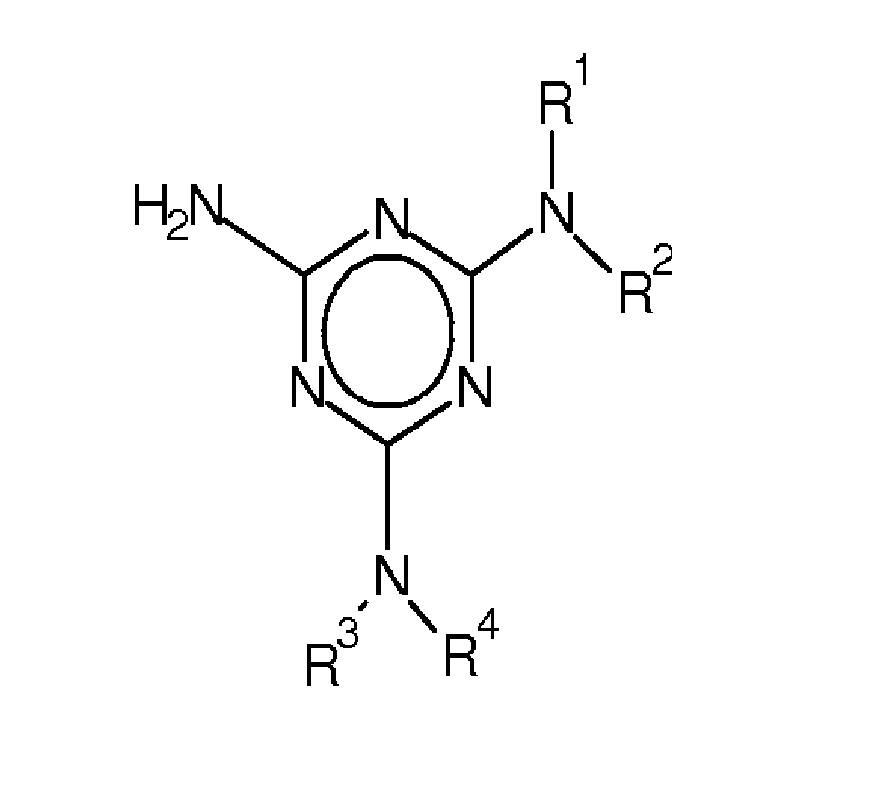
wherein R1, R2, R3 and R4 mean independently from each other linear or branched C1-C20-alkyl, C5-C20-cyclo alkyl, C5-C20-aryl, C1-C20-alkylsubstituted C5-C20-aryl or cyclic amines, or wherein R1 and R2 or R3 and R4 form in each case together an alkyl ring, wherein in each case one or multiple carbon atoms can be substituted by one or multiple oxygen atoms, sulphur atoms and/or substituted nitrogen atoms and/or by one or multiple groups of the type -C(O)O-, -OC(O)-, -C(O)- and/or -OC(O)O-, and/or can be functionalized by one or multiple hydroxyl groups and/or mercapto groups; or an amide of a carboxylic acid or an imide of a cyclic dicarboxylic acid, and wherein R1, R2, R3 and R4 can be the same or different. The present invention relates also to a method for obtaining said melamine-aldehyde-condensation products and their use.
Description
- The invention relates to a melamine aldehyde condensation product according to the preamble of claim 1, a method for obtaining the same according to claim 10, the use of the melamine aldehyde condensation products according to claim 14 and wood based panels comprising said product according to claim 15.
- Melamine is an important raw material in the production of resins for the manufacture of laminates for surface finishing, moulding compounds, paints and glues. Melamine-formaldehyde-resins as products of a condensation of melamine and formaldehyde are characterized by exceptional hardness, high gloss, flame retarded, as well as heat and solvent resistance.
- Melamine formaldehyde resins are mainly used in the wood industry as adhesives in wood panels, as impregnation resin in laminates, as linking agents or as composite material. These conventional resins are highly linked and provide therefore stiff and hard duroplastic materials. An unmodified melamine formaldehyde resin forms a dense network during the condensation. The degree of crosslinking depends thereby on different factors such as the melamine / formaldehyde ratio, temperature and pH-value.
- Since melamine-formaldehyde resins are stiff, brittle and have a reduced flexibility they often cause problems in the processabilty and postforming or dimensional stability properties of laminates and other melamine-formaldehyde resin containing products. Due to the low flexibility the laminate may crack for instance when bending the laminate over the edge. The smaller the radius the more difficult is the postforming process. As mentioned a high brittleness of the resin may causes problems in processing. For instance, cutting tools are of limited life time due to the exposure by the hard surface and also the edges of the laminate surface can shatter or splinter during processing.
- Different methods are known in order to circumvent these problems. For instance, a common way to increase the flexibility of a thermoset material is on the one hand to add plasticisers with a reduced functionality compared to melamine. Another approach for increasing flexibility and to reduce the degree of linkage is reducing the ratio of formaldehyde to melamine. This method is however hampered by reduced stability and solubility problems of the aqueous resin.
- Alternative methods were also tested in the past in order to improve the thermoplastic processability of triazine-aldehyde-resins such as melamine formaldehyde resins.
- For instance, it has been described to conduct the condensation reaction with already modified melamine derivatives for changing the properties of melamine resins. For instance the use of N-alkylated melamine derivatives for the production of polymer products and their condensation products with formaldehyde is known.
-
DE 10 2006 027 760 A1 describes a melamine derivative formaldehyde condensation product with thermoplastic properties. Alkylated melamine such as N,N',N",N"-tetramethyl melamine and N,N',N"-trimethyl melamine are reacted with formaldehyde to condensation products with a high degree of linear structures. The melamine derivatives used comprise in particular two secondary amino groups and one tertiary amino group. Thus, the melamine derivatives do not comprise on the one hand primary amino groups and on the other hand comprise secondary amino groups still having one hydrogen atom. The presence of two different secondary amino groups promotes the formation of linear oligomers and polymers in the condensation reaction. These linear chain molecules can slide along each other at appropriate temperatures, providing a resin which is meltable already at relative low temperatures between 70 to 130 °C and a melt viscosity between 0.1 and 100 Pas. It is also described to add unsubstituted melamine with any of the specifically substituted melamine derivatives providing condensation products having a deviating degree of linear structures. -
EP 852 241 A1 
- It is also known to add other triazine derivatives such as guanamines like acetoguanamines or benzoguanamines to melamine formaldehyde resins for increasing the flowability of melamine formaldehyde resins or to improve the pre-hardening of the papers impregnated with such a resin mixture (see for example
DE 44 39 156 A1 ). -
DE 102 51 653 A1 also discloses amino triazine copolymers with an improved water solubility wherein aldehydes are reacted with at least one derivative having the following structure
- However, it is still a problem to provide a melamine aldehyde resin having a good flexibility and at the same time a sufficient high hardness and scratch resistance.
- It was therefore an object of the present invention to provide a melamine aldehyde condensation product which combines scratch resistance with low brittleness and improved flexibility properties (e.g. improved postforming property, improved dimensional stability like reduced warpage and shrinkage, improved micro-scratch resistancy).
- This object is being solved by providing melamine aldehyde condensation products comprising the features of claim 1.
- Accordingly a melamine-aldehyde-condensation product is provided which is obtainable by reacting at least one aldehyde, in particular formaldehyde, with
- a) Melamine,
- b) at least one melamine derivative of the general structure (I)

- c) at least one melamine derivative of the general structure (II)

- Thus, melamines with one or two blocked amino groups can be used as comonomers for a melamine-aldehyde resin, in particular melamine-formaldehyde resin, and/or modifier for lowering the network density of the resin and thereby increasing flexibility of the resin.
- The melamine derivatives of formulae (I) comprise two primary amino group and one tertiary amino group and the melamine derivatives of formulae (II) comprise one primary amino group and two tertiary amino groups. Thus, no melamine derivative having a secondary amino group of the type -NHR is being used for obtaining the melamine-aldehyde condensation product.
- This specific substitutional pattern of the melamine derivatives allows only a reaction of the aldehyde with the primary amino groups either of the melamine or the melamine derivatives. This also allows for adjusting the flexibility by choosing a suitable defined ratio of melamine and the melamine derivatives as well as the ratio of the melamine derivatives of formulae (I) and the melamine derivatives of formulae (II).
- In an embodiment R1, R2, R3 and R4 are selected from a group comprising linear or branched C1-C10-alkyl, C5-C10-cycloalkyl, or C1-C10-alkylsubstituted C5-C10-aryl or wherein R1 and R2 or R3 and R4 form in each case together an C5-C10 alkyl ring, wherein in each case one or multiple carbon atoms can be substituted by one or multiple oxygen atoms, sulphur atoms and/or substituted nitrogen atoms and/or can be functionalized by one or multiple hydroxyl groups and/or mercapto groups, such as hydroxyethyl or mercaptoethyl. In the latter case the N-atom is therefore substituted by an ether type moiety. In case R1 and R2 or R3 and R4 form together an alkyl ring this ring can be a morpholine ring.
- It is preferred, if in case the substituents representing the moities R1, R2, R3 and R4 are interrupted by one or multiple oxygen atoms, then the oxygen atom has at least a distance of (-CH2-)n with n≥2, such as (-CH2-CH2-) from the N-atom, such as morpholine, ethylenglycol or diethylenglycol,
- In a further embodiment the present melamine-aldehyde-condensation comprises moities R1, R2, R3 and R4 which are selected from a group comprising methyl, ethyl, n-propyl, isopropyl, n-butyl, s-butyl, t-butyl, isobutyl, pentyl, cyclopentyl, hexyl, cyclohexyl, 2-ethyl-hexyl, octyl, decyl, stearyl, phenyl, toloyl, xyloyl, hydroxyethyl, hydroxypropyl or wherein R1 and R2 or R3 and R4 are in each case part of morpholine.
- It is in particular preferred if the melamine derivatives of formulae (I) and (II) are selected from a group comprising N,N-dialkylmelamine and N,N,N',N'-tetralkylmelamine, in particular N,N-dimethylmelamine, N,N,N',N'-tetramethylmelamine, N,N-diethylmelamine, N,N,N',N'-tetraethylmelamine, N,N-n-propylmelamine, N,N,N',N'-n-propylmelamine and others.
- It is also particular preferred if the melamine derivatives of formulae (I) and (II) are selected from a group comprising N-morpholino melamine, N,N'-dimorpholino melamine, N,N-di(hydroxyethyl) melamine, N,N,N',N'-tetra(hydroxyethyl) melamine, N-hydroxyethyl-N-methyl melamine, N,N,N',N'-di-(hydroxyethyl-methyl) melamine, N-hydroxyethyl-N-ethyl melamine, N,N,N',N'-di-(hydroxyethyl-ethyl) melamine.
- The melamine derivatives of formulae (I) and (II) can be obtained using different synthesis reactions. For instance they may be obtained by conversion of melamine with methyl amine salts (IG Farben, Nissan), catalytic hydrogenation of methyl etherified melamine formaldehyde resins using suitable catalysts such as Raney nickel (Casella), reductive alkylation of melamine by converting melamine with aldehydes / ketones in the presence of a suitable catalyst and hydrogen (Nissan), or alkylation of melamine with alkyl halogenids using a basic catalyst (Nissan 1995).
- It is however mostly preferred if the melamine derivative of formulae (I) and (II) are obtained by a transamination reaction of the following type:
- reacting melamine with at least one secondary amine of the general formulae (IIIa)
(R1R2)NH
and/or the general formulae (IIIb)
(R3R4)NH
Wherein R1, R2, R3 and R4 have the above meanings, in the presence of at least one compound of the general formulae (IV)
(R5R6)2NH2 +]nXn-
wherein R5 and R6 are H, linear or branched C1-C20-alkyl, C5-C20-cycloalkyl, or C1-C20-alkylsubstituted C5-C20-aryl or cyclic amines or wherein R5 and R6 together form an alkyl ring, wherein in each case one or multiple carbon atoms can be substituted by one or multiple oxygen atoms, sulphur atoms and/or substituted nitrogen atoms and/or by one or multiple groups of the type -C(O)O-, -OC(O)-, -C(O)- and/or -OC(O) O- and/or can be functionalized by one or multiple hydroxyl groups and/or mercapto groups, wherein R5 and R6 can be the same or different,
wherein R1, R2, R3, R4, R5 and R6 can be the same or different, for the case that R5 and R6 are not H,
wherein Xn- is an anion of an organic or inorganic acid, and
wherein n ≥1, in particular 1, 2, 3 or 4. - It is further preferred if the at least one melamine derivative of formulae (I) is used in an amount of 1 to 45 mol%, preferably 2 to 25 mol%, in particular preferably 3 to 10 mol% in respect to melamine. Thus, the amount of the melamine derivative of formulae (I) used is less than the amount of melamine used. This specific ratio between melamine and melamine derivative of formulae (I) provides a consensus for a resin with an optimum between flexibility of the resin and postforming properties, hardness or scratch resistancy of the final products, like laminates. The main reason for this tailor-made property is the relationship to the resin structure regarding the available reactive aminogroups per triazine molecules which provides the right ratio of reactive groups to aldehyde.
- It is also preferred if the at least one melamine derivative of formulae (II) is used in an amount of 1 to 45 mol%, preferably 2 to 25 mol%, in particular preferably 2 to 10 mol% in respect to melamine. Thus, the amount of the melamine derivative of formulae (II) used is less than the amount of melamine, but can be the same, less or even higher than the amount of the melamine derivative of formulae (I).
- Furthermore, if in case melamine derivatives of formulae (I) and (II) are combined and are reacted together with the aldehyde then the ratio between the melamine derivative of formulae (I) and (II) may be in a range between 9:1 and 1:3, preferably between 4:1 and 1:1, most preferably in a range between 4:1 and 2:1. Thus, the melamine derivative of formulae (I) may be used in excess to the melamine derivative of formulae (II), but also in equal amounts or lower amounts than the melamine derivative of formulae (II).
- It is in particular preferred if the melamine derivative of formulae (I) and (II) are used in form of a product mixture as obtained after their synthesis by transamination as described above. This has the advantage that it is possible to use directly a mixture of melamine derivatives of formulae (I) and (II) the ratio thereof being already adjustable during transamination synthesis by choosing the appropriate transamination conditions. For instance, the ratio of both melamine derivatives may be adjusted during their synthesis by choosing a suitable ratio of reactants, temperature, amount of catalyst or reaction time.
- In a variant of the present invention the molar ratio of aldehyde and melamine / melamine derivatives used in the synthesis is between 1:1 and 6:1, preferably between 1:1 and 3:1, most preferably between 1:1 and 2:1, even more preferably 1.8:1 and 1.3:1. As an example, the aldehyde to melamine/melamine derivative ratio may be 1.59:1.
- The present melamine aldehyde condensation products used in moulding mass of typ MF 152 according to DIN EN ISO 14528 may have a bending elongation between 2.0 and 3.0 %, preferably between 2.2 and 2.8 %, most preferably between 2.2. and 2.5 %. The present melamine aldehyde condensation product may have impact strength between 8.0 and 9.0 kJ/m2, preferably between 8.2 and 9.0 kJ/m2. The notch impact strength is between 1.8 and 2.0 kJ/m2. The bending elongation and impact strength can be influenced by the amount of melamine derivatives of formulae (I) and/or (II) are added to the product. For instance, the higher the amount of melamine derivative added the higher the bending elongation.
- The moulding shrinkage of the present melamine aldehyde condensation products is between 0.3 and 0.9 %, preferably between 0.3 and 0.7 % and the post shrinkage between 0.5 and 1.2 %, preferably between 0.5 and 1.1 %
- The formability radius of the present melamine aldehyde condensation products as determined by the hot-mandrel test is between 1 an 4 mm, preferably between 1 and 3 mm, most preferably 2 and 3 mm. The formability of the present melamine aldehyde condensation products can thereby be influenced by the amount and type of melamine derivative added. For instance, the higher the amount of melamine derivative, the smaller the formability radius. This in turns mean that the melamine aldehyde condensation products with a high amount of melamine derivatives can be easily formed and the more flexible the condensation product is.
- The reaction is now exemplarily shown using melamine, N,N-dimethylmelamine (N,N-DMM) and N,N,N',N'-tetramethylmelamine (N,N,N',N'-TMM).
- Here a mixture of N,N-DMM and N,N,N',N'-TMM obtained from the transamination of melamine with dimethylamine have blocked amino-groups (shown as ellipses) and are used as comonomer for melamine-formaldehyde-resin synthesis. The resin formation occurs using the remaining non-blocked amino-groups (shown as circles). The flexibility is adjustable by the relation between melamine and methylated melamines. The mixture of methylated melamine derivatives (DMM+TMM) are preferably added in a range from 1 % to 25 % to the MF-resin. The preferred ratio in percentage between DMM and TMM is between 90:10 and 10:90, most preferred between 80:20 and 50:50. In the particular case shown below the ratio of N,N-DMM and N,N,N',N'-TMM is 1:1.

- As clearly deducible from the above reaction scheme the specific substitutional pattern of the melamine derivatives used, i.e. no secondary amino groups, in conjunction with the aldehyde/melamine -melamine derivative ratio provides a resin with a rather low degree of linkage. This is due to the fact that when in particular using a aldehyde/melamine ratio of 1.3:1 to 2:1 the aldehyde reacts preferably only once per amino group. If now one or two of the amino groups are blocked then the aldehyde is not able to react with any of these blocked amino groups and the condensation is simply interrupted. The blocked amino groups also function as a type of distance holder due to their steric hindrance or shielding. Thus, the oligomers can not react as easily with one another during polycondensation and cannot form large networks. A further precondensation or polycondensation is only possible via the originally primary amino group and/or the secondary amino groups of the methylene bridges formed from the primary amino groups (shown as circles).
- It is to be understood that above reaction is only one possible example and that the present invention is not restricted to these specific compounds but that rather multiple different melamine derivatives may be used as described in detail above.
- The synthesis of the present melamine-aldehyde-condensation products using the melamine derivatives of formulae (I) and (II) is in general surprising and was not expected to be possible since the melamine derivatives of formulae (I) and (II) are known to have a very low water solubility, in particular in contrast to those melamine derivatives comprising a secondary amino group or only primary amino groups as melamine itself. For example the water solubility of N,N-dimethylmelamine is 1.2 g/I in water at 20 °C, whereas the water solubility of N,N'-dimethylmelamine is 41.1 g/mol in water at 20 °C. The same is true for other melamine derivatives. For instance, N,N,N',N'-tetramethylmelamine has a water solubility of 0.4 g/I in water at 20 °C, whereas N,N,N',N"-tetramethylmelamine has water solubility of 49 g/I in water at 20 °C. Additionally, also the solubility of melamine with 3.2 g/I in water at 20 °C is slightly higher than the solubility of melamine derivatives of formulae (I) or (II).
- The present melamine-aldehyde-condensation product, in particular melamine-aldehyde-precondensation product, may be obtained in a method comprising the steps of
- providing a mixture of at least one aldehyde and melamine
- adding simultaneously or at a later stage at least one melamine derivative of formulae (I) and/or at least one melamine derivative of formulae (II), preferably as a solid or as precondensate,
- adjusting the pH value of the mixture to a range between 7 and 11, preferably 8 and 10,
- heating the reaction mixture to a temperature between 60 °C and 120 °C, preferably 70 °C and 110 °C, most preferably 80 °C and 100 °C until a clear solution is obtained for example for at least 30min,
- stirring the resin mixture at elevated temperature until a water tolerance of the resin at 20 °C of v(water):v(resin) between 3:1 to 0.3:1, preferably 2.5:1 to 0.6:1, most preferably 2:1 to 1:1 is obtained, and
- cooling the reaction mixture to room temperature after completion of the reaction,
and - optionally and if applicable, adjusting finally the pH value to a value range of 8 to 10.
- As mentioned the melamine derivative of formulae (I) and (II) may be added and mixed simultaneously with the aldehyde and melamine. It is however also possible to add the melamine derivatives at a later stage to the aldehyde-melamine-mixture for instance after adjustment of the pH value or even heating the mixture.
- It is preferred if the solvent is selected from a group comprising water, an alcohol or a mixture thereof, such as a mixture comprising 1-95 wt% water and 99-5 wt% alcohol like methanol, ethanol, isopropanol or such.
- It is furthermore preferred if the aldehyde is selected from a group comprising a C1-C8 aldehyde such as formaldehyde, acetaldehyde, glyoxal, dimethoxyethanal.
- It is furthermore preferred if auxiliary substances are added to the condensate. The auxiliary substances can be selected from a group comprising polyols, like ethylenglycol, diethyleneglycol, polyethyleneglycol, trimethylolpropane, sorbitol, dicyandiamide, urea, triethanolamine, caprolactam, sugar and/or o/p-toluene sulphonamide and others. The auxiliary substance may be added simultaneously with the melamine derivatives to the melamine-aldehyde-mixture or at a later stage.
- In a variant of the present method the pH value is adjusted using an organic or inorganic base, preferably an inorganic base selected from a groups comprising NaOH, Na2CO3, KOH, K2CO3, NH3 or alike.
- The present melamine-aldehyde-condensation product can be used as a cross linker of a coating formulation or a coating such as furniture coating or as impregnation resin for laminate papers or for decor layers of postforming laminates, laminate flooring or 3D laminates, and adhesives such as adhesives for wood based panels. These laminates can be processed as a high pressure laminate (HPL), low pressure laminate (LPL) or a continuous pressure laminate (CPL).
- Thus, melamine-aldehyde-condensation products of the present invention may be used as glues or binders in wood based panels, such as chipboards or particle boards (PB), OSB, MDF, LDF or HDF and plywood.
- The use of the rather flexible melamine-aldehyde-condensation products in wood based panels as coating and/or adhesives allows for an overall improvement and increase of flexibility of the wood based panels obtained thereby. This in turn provides the possibility to produce wood based panels with a rounded or curved surface extending the use of such panels in the furniture industry.
- Further details of the invention will be explained by the means of the following examples.
- 40.4 g melamine (1 mol equivalent), 43.4 g 30% formalin aqueous solution (1.59 mol equivalent in respect to melamine/melamine derivative) and 2.47 g N,N-dimethylmelamine (5 mol% in respect to melamine) and water are mixed at a temperature of 25 °C. The pH is adjusted to a value of 9.0±0.1 using 0.1 N NaOH. The mixture is heated to 93 °C at a speed of 5 K/min followed by heating to a temperature of 98 °C, is hold at this temperature until the clearing point (e.g. the point at which all melamine and melamine derivative are dissolved) is reached (38 minutes in this case) and is subsequently cooled again to 93 °C with a rate of 2.5 K/min. The reaction mixture is cooled to 20 °C after reaching a water tolerance of 2.0. The reaction product has a storage stability of 36 days at 25 to 28 °C.
- 40.4 g melamine (1 mol equivalent), 43.4 g 30% formalin aqueous solution (1.59 mol equivalent in respect to melamine/melamine derivatives), 2.0 g N,N-dimethylmelamine (4 mol% in respect to melamine), 0.6 g N,N,N',N'-tetramethylmelamine (1 mol% in respect to melamine) were reacted under the same conditions as described in example 1. The resin obtained has a storage stability of about 16 days at 25 to 28 °C.
- 40.4 g melamine (1 mol equivalent), 43.4 g 30% formalin aqueous solution (1.59 mol equivalent in respect to melamine/melamine derivatives), 1.75 g N,N-dimethylmelamine (3.5 mol% in respect to melamine), 0.9 g N,N,N',N'-tetramethylmelamine (1.5 mol% in respect to melamine) and water are mixed and reacted under the same reaction condition as described in example 1. The resin obtained has a storage stability of about 10 days at 25 to 28 °C.
- 40.4 g melamine (1 mol equivalent), 46.8 g 30% formalin aqueous solution (1.7 mol equivalent in respect to melamine/melamine derivatives), 1.5 g N,N-dimethylmelamine (3 mol% in respect to melamine), 1.2 g N,N,N',N'-tetramethylmelamine (2 mol% in respect to melamine) and water are mixed and reacted under the same reaction conditions as described in example 1. The resin obtained has a storage stability of 5 days at 25 to 28 °C.
- 38.4 g melamine (0.95 mol equivalent), 43.4 g 30% formalin aqueous solution (1.59 mol equivalent in respect to melamine/melamine derivative), 4.94 g N,N-dimethylmelamine (10 mol% in respect to melamine) and water are mixed and reacted under the same reaction conditions as described in example 1. The resin obtained has a storage stability of 25 days at 25 to 28 °C.
- 34.4 g melamine (0.85 mol equivalent), 43.4 g 30% formalin aqueous solution (1.59 mol equivalent in respect to melamine/melamine derivative), 9.88 g N,N-dimethylmelamine (20 mol% in respect to melamine) and water are mixed and reacted under the same reaction condition as described in example 1. The resin obtained has a storage stability of 15 days at 25 to 28 °C.
- 32.3 g melamine (0.8 mol equivalent), 43.4 g 30% formalin aqueous solution (1.59 mol equivalent in respect to melamine/melamine derivative), 12.35 g N,N-dimethylmelamine (25 mol% in respect to melamine) and water are mixed and reacted under the same reaction condition as described in example 1. The resin obtained has a storage stability of 12 days at 25 to 28 °C.
- 1270 wt parts formalin (30%), 400 wt parts water and 35 wt parts diethyleneglycol are mixed and adjusted to a pH of 8.9 (20°C) using NaOH. After adding 1000 wt parts melamine and 35 wt parts acetoguanamine the mixture is heated to 90 °C in about 30 min. During the subsequent condensation at 90 °C the hydrophobic point (first cloudy turbidity when diluting with water) is reached after about 60 min. After further 40 min condensation at 90 °C a water tolerance of 1.7 is obtained. After reaching this condensation degree the resin solution is cooled rapidly.
- 40.4 g melamine (1 mol equivalent), 43.4 g formalin (1.67 mol equivalent in respect to melamine) and 4.74 g diethyleneglycol and water are mixed at a temperature of 25 °C. The pH is adjusted to a value of 9.0±0.1 using 0.1 N NaOH. The mixture is heated to 93 °C at a speed of 5 K/min followed by heating to a temperature of 98 °C, is hold at this temperature until the clearing point (e.g. the point at which all melamine and melamine derivative are dissolved) is reached (28 minutes in this case) and is subsequently cooled again to 93 °C with a rate of 2.5 K/min. The reaction mixture is cooled to 20 °C after reaching a water tolerance of 2.0. The reaction product has a storage stability of 10 days at 25 to 28 °C.
- 40.4 g melamine (1 mol equivalent), 43.4 g 30% formalin aqueous solution (1.59 mol equivalent in respect to aminotriazine derivatives) and 2 g acetoguanamine (5mol% in respect to melamine) and water are mixed at a temperature of 25 °C. The pH is adjusted to a value of 9.0±0.1 using 0.1 N NaOH. The mixture is heated to 93 °C at a speed of 5 K/min followed by heating to a temperature of 98 °C, is hold at this temperature until the clearing point (e.g. the point at which all melamine and melamine derivative are dissolved) is reached (36 minutes in this case) and is subsequently cooled again to 93 °C with a rate of 2.5 K/min. The reaction mixture is cooled to 20 °C after reaching a water tolerance of 2.0. The reaction product has a storage stability of 21 days at 25 to 28 °C.
- The fresh prepared resins are used for the production of the laminates. Per 400 g of resin solution of each Examples 1 to 10 (55% solid content) 0.5 w% wetting agent DeuroWet MA11 equivalent to 2 g and 0.5 w% parting agent DeuroLease PHE equivalent to 2 g are added. The viscosity and the clouding time of the solution were measured. The clouding time has to be in a range of 90-110 sec with a viscosity of approximately 100 mPas.
- A white decor paper with a weight of 82 g/m2 is used for wet paper impregnation. The paper was cut to a dimension of 32 x 28 cm per square.
- The impregnation was performed with an impregnation machine of the company Munksjö decor under the following conditions. A simple impregnation with smooth blades was done. The impregnated papers were dried in a Mathis lab dryer at 120 °C for 1.5 minutes. The fan speed was set at 1600 rpm while to come to a required moisture content of approximately 6-7%. The resin content on the impregnated paper was determined. For all the papers a resin content of approximately 110 % was achieved.
- The laminates were obtained by one layer impregnated decor paper and on two layers of phenol resin impregnated kraft papers (Hans Schmid KG; 155/228-233 postforming kraft paper). The papers have been pressed at 160 °C at a pressure of 67 bars for 30 seconds.
- The test specimen (200 mm x 50 mm) was bent around the hot mandrel (170 °C) to an angle of 120° within 60 seconds. Different mandrels with radii between 10 and 2 mm were used. The sample was removed after forming and cooled, dried and inspected for signs of failure. The evaluation of the performance is described by the radius which is the first with visible signs of failure.
- For this purpose a Petri dish with 0.2 N HCl, stained with 10 mg of Rhodamine B, is applied for 24 h on the pressed laminate. After 24 h, the 0.2 N HCl is washed and the laminate is dried. The performance is described by a school grade of 1 to 5
- A specimen with a dimension of 10 x 10 cm per square is placed over the neck of a bottle with boiling water so that the decorative surface is exposed to water vapour. After 1 h the specimen is removed and stored for 24 h at room temperature before being examined for changes in appearance. The performance is described by a school grade of 1 to 5.
Table 1 Example formability radius in mm acid test water vapour test 1 4 1 1 2 3 1 1 3 3 1 1 4 2 2 1 5 2 2 1 6 2 2 2 7 2 3 2 8 5 1 1 9 10 1 1 10 4 1 1 - As clearly deducible from the data listed in Table 1 the formability (2-4 mm radius) of a laminate impregnated with the present melamine-aldehyde-condensation product is improved, in particular when using a relative high amount of melamine derivative (Examples 2-7).
- After freeze drying of the aqueous resin synthesis product of each Example of 1 to 10 the moulding compounds were prepared by using a lab kneader of ThermoElectron with the kneading chamber 3000p at 120 °C using Banbury rotor at a speed of 70 rpm. The moulding is pre-mixed at a lab blender based on a recipe of 51 mass-% of melamine resin of Example 1 to 10, 30 mass-% of cellulose fibre Arbocel FD-00, 15 mass-% Calcium carbonate and 4 mass-% of a mixture of lubricant, mould release agent and curing agent. This mixture is added into the kneading chamber during a time frame of 2-3 min and subsequently kneaded for 4-5 min. The kneaded moulding mass is taken out, cooled down and milled in an impact mill SM 2000 of company Retsch.
- The test specimens of these moulding masses are prepared in an injection moulding machine of Thermo Electron, Minijet. The powder is molden in the injection unit at 70 ^ °C for 1 min. At next the molden material is injected into a 180 °C hot tool (specimen dimension 80x10x2mm). After 60 s the tool was opened and the test specimen is removed. These test specimens are now tested, for each test 10 specimens were used and the average value calculated.
Table 2 Example Flexural modulus GPa Bending strength MPa Bending elongation % Impact strength kJ/m2 Notch impact strength kJ/m2 Moulding shrinkage % Post shrinkage % ISO 178 ISO 179 ISO 2577 1 6.4 126 2.2 8.2 1.8 0.9 1.2 2 6.3 125 2.2 8.2 1.8 0.8 1.2 3 6.3 126 2.2 8.4 1.8 0.7 1.1 4 6.2 124 2.3 8.6 1.9 0.7 0.9 5 6.0 120 2.4 8.8 1.9 0.7 1.0 6 5.8 116 2.4 8.7 1.9 0.6 0.8 7 5.6 112 2.5 9.0 2.0 0.5 0.8 8 6.6 121 1.9 7.5 1.6 1.2 1.5 9 7.1 122 1.7 7.0 1.5 1.3 1.6 10 6.5 118 1.8 7.3 1.5 1.0 1.3 - As clearly can be seen in Table 2 the elongation and overall strength of the present melamine-aldehyde product (Example 1-7) is increased in comparison to the comparative examples (Examples 8-10) having no melamine derivatives incorporated into the resin.
wherein R1, R2, R3 and R4 can be the same or different.
Claims (15)
- Melamine-aldehyde-condensation product obtainable by
reacting at least one aldehyde, in particular formaldehyde, witha) Melamine,b) at least one melamine derivative of the general structure (I) c) at least one melamine derivative of the general structure (II)
wherein R1, R2, R3 and R4 can be the same or different. - Melamine-aldehyde-condensation product according to claim 1, characterized in that R1, R2, R3 and R4 are selected from a group comprising linear or branched C1-C10-alkyl, C5-C10-cycloalkyl, or C1-C10-alkylsubstituted C5-C10-aryl or wherein R1 and R2 or R3 and R4 form in each case together an C5-C10 alkyl ring, wherein in each case one or multiple carbon atoms can be substituted by one or multiple oxygen atoms, sulphur atoms and/or substituted nitrogen atoms and/or can be functionalized by one or multiple hydroxyl groups and/or mercapto groups.
- Melamine-aldehyde-condensation product according to claim 1 or 2, characterized in that R1, R2, R3 and R4 are selected from a group comprising methyl, ethyl, n-propyl, isopropyl, n-butyl, s-butyl, t-butyl, isobutyl, pentyl, cyclopentyl, hexyl, cyclohexyl, 2-ethyl-hexyl, octyl, decyl, stearyl, phenyl, toloyl, xyloyl, hydroxyethyl, hydroxypropyl or wherein R1 and R2 or R3 and R4 are part of morpholine.
- Melamine-aldehyde-condensation product according to one of the preceding claims, characterized in that the at least one melamine derivative of formulae (I) is used in an amount of 1 to 45 mol%, preferably 2 to 25 mol%, in particular preferably 2 to 10 mol% in respect to melamine.
- Melamine-aldehyde-condensation product according to one of the preceding claims, characterized in that the at least one melamine derivative of formulae (II) is used in an amount of 1 to 45 mol%, preferably 2 to 25 mol%, in particular preferably 2 to 10 mol% in respect to melamine.
- Melamine-aldehyde-condensation product according to one of the preceding claims, characterized in that if in case a melamine derivative of formulae (I) and (II) are used together then the ratio between the melamine derivative of formulae (I) and (II) is in a range between 9:1 and 1:3, preferably between 4:1 and 1:1, most preferably in a range between 4:1 and 2:1.
- Melamine-aldehyde-condensation product according to claim 6, characterized in that the melamine derivative of formulae (I) and (II) are used in form of a product mixture as obtained after their synthesis, in particular synthesis by transamination.
- Melamine-aldehyde-condensation product according to one of the preceding claims, characterized in that the molar ratio of aldehyde and melamine is between 1:1 and 6:1, preferably between 1:1 and 3:1, most preferably between 1:1 and 2:1.
- Melamine-aldehyde-condensation product according to one of the preceding claims, characterized by a formability radius as determined by the hot-mandrel test between 1 an 4 mm, preferably between 1 and 3 mm, most preferably 2 and 3 mm.
- Method for obtaining a melamine-aldehyde-condensation product according to one of the preceding claims comprising the steps of- providing a mixture of at least one aldehyde and melamine,- adding simultaneously or at a later stage at least one melamine derivative of formulae (I) and/or at least one melamine derivative of formulae (II),- adjusting the pH value of the mixture to a range between 7 and 11, preferably 8 and 10,- heating the reaction mixture to a temperature between 60 °C and 120 °C, preferably 70°C and 110°C, most preferably 80 °C and 100°C until a clear solution is obtained,- stirring the resin mixture at elevated temperature until a water tolerance of the resin at 20 °C of v(water):v(resin) between 3:1 to 0.3:1, preferably 2.5:1 to 0.6:1, most preferably 2:1 to 1:1 is obtained, and- cooling the reaction mixture to room temperature after completion of the reaction, and- optionally adjusting the pH value to a range between 8 and 10.
- Method according to claim 10, characterized in that, the solvent is selected from a group comprising water, an alcohol or a mixture thereof, such as a mixture comprising 1-95wt% water and 99-5 wt% alcohol, in particular methanol, ethanol, isopropanol.
- Method according to claim 10 or 11, characterized in that the aldehyde is selected from a group comprising a C1-C8 aldehyde, in particular formaldehyde, acetaldehyde, glyoxal. dimethoxyethanal.
- Method according to one of the claims 10 to 12, characterized in that the pH value is adjusted using an organic or inorganic base, preferably an inorganic base selected from a groups comprising NaOH, KOH, Na2CO3, K2CO3, NH3.
- Use of a melamine-aldehyde-condensation product according to claim 1 to 9 as an impregnation resin for laminate papers and as coating such as laminate coating or for decor layers of postforming laminates, adhesives such as adhesives for wood based panels.
- Wood based panels, in particular particle boards (PB), OSB, MDF, LDF or HDF and plywood, comprising a melamine-aldehyde-condensation product according to one of the claims 1 to 9.
Priority Applications (2)
| Application Number | Priority Date | Filing Date | Title |
|---|---|---|---|
| EP12196479.5A EP2743282B1 (en) | 2012-12-11 | 2012-12-11 | Melamine-aldehyde-condensation product and method obtaining the same |
| PL12196479T PL2743282T3 (en) | 2012-12-11 | 2012-12-11 | Melamine-aldehyde-condensation product and method obtaining the same |
Applications Claiming Priority (1)
| Application Number | Priority Date | Filing Date | Title |
|---|---|---|---|
| EP12196479.5A EP2743282B1 (en) | 2012-12-11 | 2012-12-11 | Melamine-aldehyde-condensation product and method obtaining the same |
Publications (2)
| Publication Number | Publication Date |
|---|---|
| EP2743282A1 true EP2743282A1 (en) | 2014-06-18 |
| EP2743282B1 EP2743282B1 (en) | 2020-04-29 |
Family
ID=47500942
Family Applications (1)
| Application Number | Title | Priority Date | Filing Date |
|---|---|---|---|
| EP12196479.5A Active EP2743282B1 (en) | 2012-12-11 | 2012-12-11 | Melamine-aldehyde-condensation product and method obtaining the same |
Country Status (2)
| Country | Link |
|---|---|
| EP (1) | EP2743282B1 (en) |
| PL (1) | PL2743282T3 (en) |
Cited By (3)
| Publication number | Priority date | Publication date | Assignee | Title |
|---|---|---|---|---|
| US10941123B2 (en) | 2016-06-29 | 2021-03-09 | Borealis Agrolinz Melamine Gmbh | Triazine precondensate and method for obtaining the same |
| US10947335B2 (en) | 2016-06-29 | 2021-03-16 | Borealis Agrolinz Melamine Gmbh | Triazine-precondensate-aldehyde condensation products and method for obtaining the same |
| CN117264192A (en) * | 2023-08-08 | 2023-12-22 | 江苏斯德瑞克化工有限公司 | Preparation method of efficient environment-friendly flame-retardant polyether polyol |
Citations (7)
| Publication number | Priority date | Publication date | Assignee | Title |
|---|---|---|---|---|
| DE905850C (en) * | 1938-07-12 | 1954-03-08 | Cassella Farbwerke Mainkur Ag | Process for the preparation of N-substitution products of melamine |
| DE4439156A1 (en) | 1994-11-04 | 1996-05-09 | Cassella Ag | Impregnating resins for foils and edges |
| EP0852241A1 (en) | 1995-09-18 | 1998-07-08 | Nissan Chemical Industries, Limited | Novel amino resin compositions |
| DE10251653A1 (en) | 2002-10-31 | 2004-07-15 | Ami Agrolinz Melamine International Gmbh | Aminotriazine copolymers with improved water solubility, their use and process for their preparation |
| WO2007096200A1 (en) * | 2006-02-23 | 2007-08-30 | Ami Agrolinz Melamine International Gmbh | Novel melamine-formaldehyde condensates with thermoplastic properties |
| WO2009121603A1 (en) * | 2008-03-31 | 2009-10-08 | Borealis Agrolinz Melamine Gmbh | Method for producing a compound with at least one at least monosubstituted amino group |
| EP2360149A1 (en) * | 2009-12-30 | 2011-08-24 | Johannes Kepler Universität Linz | Method for making alkyl melamines |
-
2012
- 2012-12-11 PL PL12196479T patent/PL2743282T3/en unknown
- 2012-12-11 EP EP12196479.5A patent/EP2743282B1/en active Active
Patent Citations (8)
| Publication number | Priority date | Publication date | Assignee | Title |
|---|---|---|---|---|
| DE905850C (en) * | 1938-07-12 | 1954-03-08 | Cassella Farbwerke Mainkur Ag | Process for the preparation of N-substitution products of melamine |
| DE4439156A1 (en) | 1994-11-04 | 1996-05-09 | Cassella Ag | Impregnating resins for foils and edges |
| EP0852241A1 (en) | 1995-09-18 | 1998-07-08 | Nissan Chemical Industries, Limited | Novel amino resin compositions |
| DE10251653A1 (en) | 2002-10-31 | 2004-07-15 | Ami Agrolinz Melamine International Gmbh | Aminotriazine copolymers with improved water solubility, their use and process for their preparation |
| WO2007096200A1 (en) * | 2006-02-23 | 2007-08-30 | Ami Agrolinz Melamine International Gmbh | Novel melamine-formaldehyde condensates with thermoplastic properties |
| DE102006027760A1 (en) | 2006-02-23 | 2007-08-30 | Ami-Agrolinz Melamine International Gmbh | New melamine formaldehyde condensation product obtained by a reaction of formaldehyde with melamine derivative, useful as e.g. binding agent in laminates |
| WO2009121603A1 (en) * | 2008-03-31 | 2009-10-08 | Borealis Agrolinz Melamine Gmbh | Method for producing a compound with at least one at least monosubstituted amino group |
| EP2360149A1 (en) * | 2009-12-30 | 2011-08-24 | Johannes Kepler Universität Linz | Method for making alkyl melamines |
Non-Patent Citations (1)
| Title |
|---|
| WICKS ZENO W JR ET AL: "MODEL COMPOUND FOR MELAMINE FORMALDEHYDE RESINS", JCT. JOURNAL OF COATINGS TECHNOLOGY, PHILADELPHIA, PA, US, vol. 55, no. 702, 1 July 1983 (1983-07-01), pages 29 - 34, XP009083542, ISSN: 0361-8773 * |
Cited By (3)
| Publication number | Priority date | Publication date | Assignee | Title |
|---|---|---|---|---|
| US10941123B2 (en) | 2016-06-29 | 2021-03-09 | Borealis Agrolinz Melamine Gmbh | Triazine precondensate and method for obtaining the same |
| US10947335B2 (en) | 2016-06-29 | 2021-03-16 | Borealis Agrolinz Melamine Gmbh | Triazine-precondensate-aldehyde condensation products and method for obtaining the same |
| CN117264192A (en) * | 2023-08-08 | 2023-12-22 | 江苏斯德瑞克化工有限公司 | Preparation method of efficient environment-friendly flame-retardant polyether polyol |
Also Published As
| Publication number | Publication date |
|---|---|
| PL2743282T3 (en) | 2020-11-02 |
| EP2743282B1 (en) | 2020-04-29 |
Similar Documents
| Publication | Publication Date | Title |
|---|---|---|
| US9133374B2 (en) | Resin systems for making composite products | |
| US20020054994A1 (en) | Cyclic urea-formaldehyde prepolymer for use in phenol-formaldehyde and melamine-formaldehyde resin-based binders | |
| US8114953B2 (en) | Melamine-formaldehyde condensates with thermoplastic properties | |
| KR20210142593A (en) | Resol phenol resin, method for synthesizing said resin and use thereof | |
| JP3911614B2 (en) | Biomass resin composition, method for producing the same, and molding material comprising the biomass resin composition | |
| IE940645A1 (en) | Modified phenol-aldehyde resin and binder system | |
| EP2743282B1 (en) | Melamine-aldehyde-condensation product and method obtaining the same | |
| WO2000078836A1 (en) | Cyclic urea-formaldehyde prepolymer-modified melamine-containing resins, and use in binders for cellulosic-based composites | |
| US9975271B2 (en) | High flow urea-formaldehyde powders for particleboard and fiberboard manufacture | |
| US9388269B2 (en) | Amino-formaldehyde resins and applications thereof | |
| EP2547707B1 (en) | Resin composition for the manufacture high gloss laminated panels | |
| US7354987B2 (en) | Nitrogen-containing compound, the preparation thereof and application in amino-aldehyde resins | |
| EP4638637A1 (en) | Improved bonding resin | |
| KR19990045772A (en) | Novel amino resin composition | |
| US2582730A (en) | Modified aminoplast compositions and products | |
| EP3478667B1 (en) | Novel triazine-precondensate-aldehyde condensation products and method for obtaining the same | |
| RU2413737C2 (en) | Method of producing formaldehyde-containing resin with low emission of formaldehyde and functional materials based on said resin | |
| RU2711592C1 (en) | Aminoplastic resins for laminar plastics | |
| WO2024134445A1 (en) | Improved bonding resin | |
| HU219854B (en) | A binder mixture for the production of lignocellulose-containing moldings | |
| WO2024134451A1 (en) | Improved bonding resin | |
| WO2023223232A1 (en) | Improved bonding resin | |
| WO2006051339A1 (en) | Thermosetting polymer compositions | |
| JP2002194043A (en) | Amino resin composition and decorative sheet using the same | |
| NL9201305A (en) | Modified amino-formaldehyde resins |
Legal Events
| Date | Code | Title | Description |
|---|---|---|---|
| PUAI | Public reference made under article 153(3) epc to a published international application that has entered the european phase |
Free format text: ORIGINAL CODE: 0009012 |
|
| 17P | Request for examination filed |
Effective date: 20121211 |
|
| AK | Designated contracting states |
Kind code of ref document: A1 Designated state(s): AL AT BE BG CH CY CZ DE DK EE ES FI FR GB GR HR HU IE IS IT LI LT LU LV MC MK MT NL NO PL PT RO RS SE SI SK SM TR |
|
| AX | Request for extension of the european patent |
Extension state: BA ME |
|
| R17P | Request for examination filed (corrected) |
Effective date: 20141114 |
|
| RBV | Designated contracting states (corrected) |
Designated state(s): AL AT BE BG CH CY CZ DE DK EE ES FI FR GB GR HR HU IE IS IT LI LT LU LV MC MK MT NL NO PL PT RO RS SE SI SK SM TR |
|
| 17Q | First examination report despatched |
Effective date: 20150325 |
|
| STAA | Information on the status of an ep patent application or granted ep patent |
Free format text: STATUS: EXAMINATION IS IN PROGRESS |
|
| GRAP | Despatch of communication of intention to grant a patent |
Free format text: ORIGINAL CODE: EPIDOSNIGR1 |
|
| STAA | Information on the status of an ep patent application or granted ep patent |
Free format text: STATUS: GRANT OF PATENT IS INTENDED |
|
| INTG | Intention to grant announced |
Effective date: 20191129 |
|
| GRAS | Grant fee paid |
Free format text: ORIGINAL CODE: EPIDOSNIGR3 |
|
| GRAA | (expected) grant |
Free format text: ORIGINAL CODE: 0009210 |
|
| STAA | Information on the status of an ep patent application or granted ep patent |
Free format text: STATUS: THE PATENT HAS BEEN GRANTED |
|
| AK | Designated contracting states |
Kind code of ref document: B1 Designated state(s): AL AT BE BG CH CY CZ DE DK EE ES FI FR GB GR HR HU IE IS IT LI LT LU LV MC MK MT NL NO PL PT RO RS SE SI SK SM TR |
|
| REG | Reference to a national code |
Ref country code: GB Ref legal event code: FG4D |
|
| REG | Reference to a national code |
Ref country code: CH Ref legal event code: EP |
|
| REG | Reference to a national code |
Ref country code: AT Ref legal event code: REF Ref document number: 1263174 Country of ref document: AT Kind code of ref document: T Effective date: 20200515 |
|
| REG | Reference to a national code |
Ref country code: DE Ref legal event code: R096 Ref document number: 602012069649 Country of ref document: DE |
|
| REG | Reference to a national code |
Ref country code: IE Ref legal event code: FG4D |
|
| REG | Reference to a national code |
Ref country code: NL Ref legal event code: FP |
|
| REG | Reference to a national code |
Ref country code: LT Ref legal event code: MG4D |
|
| PG25 | Lapsed in a contracting state [announced via postgrant information from national office to epo] |
Ref country code: NO Free format text: LAPSE BECAUSE OF FAILURE TO SUBMIT A TRANSLATION OF THE DESCRIPTION OR TO PAY THE FEE WITHIN THE PRESCRIBED TIME-LIMIT Effective date: 20200729 Ref country code: SE Free format text: LAPSE BECAUSE OF FAILURE TO SUBMIT A TRANSLATION OF THE DESCRIPTION OR TO PAY THE FEE WITHIN THE PRESCRIBED TIME-LIMIT Effective date: 20200429 Ref country code: IS Free format text: LAPSE BECAUSE OF FAILURE TO SUBMIT A TRANSLATION OF THE DESCRIPTION OR TO PAY THE FEE WITHIN THE PRESCRIBED TIME-LIMIT Effective date: 20200829 Ref country code: FI Free format text: LAPSE BECAUSE OF FAILURE TO SUBMIT A TRANSLATION OF THE DESCRIPTION OR TO PAY THE FEE WITHIN THE PRESCRIBED TIME-LIMIT Effective date: 20200429 Ref country code: LT Free format text: LAPSE BECAUSE OF FAILURE TO SUBMIT A TRANSLATION OF THE DESCRIPTION OR TO PAY THE FEE WITHIN THE PRESCRIBED TIME-LIMIT Effective date: 20200429 Ref country code: GR Free format text: LAPSE BECAUSE OF FAILURE TO SUBMIT A TRANSLATION OF THE DESCRIPTION OR TO PAY THE FEE WITHIN THE PRESCRIBED TIME-LIMIT Effective date: 20200730 Ref country code: PT Free format text: LAPSE BECAUSE OF FAILURE TO SUBMIT A TRANSLATION OF THE DESCRIPTION OR TO PAY THE FEE WITHIN THE PRESCRIBED TIME-LIMIT Effective date: 20200831 |
|
| PG25 | Lapsed in a contracting state [announced via postgrant information from national office to epo] |
Ref country code: LV Free format text: LAPSE BECAUSE OF FAILURE TO SUBMIT A TRANSLATION OF THE DESCRIPTION OR TO PAY THE FEE WITHIN THE PRESCRIBED TIME-LIMIT Effective date: 20200429 Ref country code: RS Free format text: LAPSE BECAUSE OF FAILURE TO SUBMIT A TRANSLATION OF THE DESCRIPTION OR TO PAY THE FEE WITHIN THE PRESCRIBED TIME-LIMIT Effective date: 20200429 Ref country code: HR Free format text: LAPSE BECAUSE OF FAILURE TO SUBMIT A TRANSLATION OF THE DESCRIPTION OR TO PAY THE FEE WITHIN THE PRESCRIBED TIME-LIMIT Effective date: 20200429 Ref country code: BG Free format text: LAPSE BECAUSE OF FAILURE TO SUBMIT A TRANSLATION OF THE DESCRIPTION OR TO PAY THE FEE WITHIN THE PRESCRIBED TIME-LIMIT Effective date: 20200729 |
|
| PG25 | Lapsed in a contracting state [announced via postgrant information from national office to epo] |
Ref country code: AL Free format text: LAPSE BECAUSE OF FAILURE TO SUBMIT A TRANSLATION OF THE DESCRIPTION OR TO PAY THE FEE WITHIN THE PRESCRIBED TIME-LIMIT Effective date: 20200429 |
|
| PG25 | Lapsed in a contracting state [announced via postgrant information from national office to epo] |
Ref country code: ES Free format text: LAPSE BECAUSE OF FAILURE TO SUBMIT A TRANSLATION OF THE DESCRIPTION OR TO PAY THE FEE WITHIN THE PRESCRIBED TIME-LIMIT Effective date: 20200429 Ref country code: CZ Free format text: LAPSE BECAUSE OF FAILURE TO SUBMIT A TRANSLATION OF THE DESCRIPTION OR TO PAY THE FEE WITHIN THE PRESCRIBED TIME-LIMIT Effective date: 20200429 Ref country code: RO Free format text: LAPSE BECAUSE OF FAILURE TO SUBMIT A TRANSLATION OF THE DESCRIPTION OR TO PAY THE FEE WITHIN THE PRESCRIBED TIME-LIMIT Effective date: 20200429 Ref country code: DK Free format text: LAPSE BECAUSE OF FAILURE TO SUBMIT A TRANSLATION OF THE DESCRIPTION OR TO PAY THE FEE WITHIN THE PRESCRIBED TIME-LIMIT Effective date: 20200429 Ref country code: SM Free format text: LAPSE BECAUSE OF FAILURE TO SUBMIT A TRANSLATION OF THE DESCRIPTION OR TO PAY THE FEE WITHIN THE PRESCRIBED TIME-LIMIT Effective date: 20200429 Ref country code: EE Free format text: LAPSE BECAUSE OF FAILURE TO SUBMIT A TRANSLATION OF THE DESCRIPTION OR TO PAY THE FEE WITHIN THE PRESCRIBED TIME-LIMIT Effective date: 20200429 |
|
| REG | Reference to a national code |
Ref country code: DE Ref legal event code: R097 Ref document number: 602012069649 Country of ref document: DE |
|
| PG25 | Lapsed in a contracting state [announced via postgrant information from national office to epo] |
Ref country code: SK Free format text: LAPSE BECAUSE OF FAILURE TO SUBMIT A TRANSLATION OF THE DESCRIPTION OR TO PAY THE FEE WITHIN THE PRESCRIBED TIME-LIMIT Effective date: 20200429 |
|
| PLBE | No opposition filed within time limit |
Free format text: ORIGINAL CODE: 0009261 |
|
| STAA | Information on the status of an ep patent application or granted ep patent |
Free format text: STATUS: NO OPPOSITION FILED WITHIN TIME LIMIT |
|
| 26N | No opposition filed |
Effective date: 20210201 |
|
| PG25 | Lapsed in a contracting state [announced via postgrant information from national office to epo] |
Ref country code: SI Free format text: LAPSE BECAUSE OF FAILURE TO SUBMIT A TRANSLATION OF THE DESCRIPTION OR TO PAY THE FEE WITHIN THE PRESCRIBED TIME-LIMIT Effective date: 20200429 |
|
| REG | Reference to a national code |
Ref country code: CH Ref legal event code: PL |
|
| GBPC | Gb: european patent ceased through non-payment of renewal fee |
Effective date: 20201211 |
|
| PG25 | Lapsed in a contracting state [announced via postgrant information from national office to epo] |
Ref country code: MC Free format text: LAPSE BECAUSE OF FAILURE TO SUBMIT A TRANSLATION OF THE DESCRIPTION OR TO PAY THE FEE WITHIN THE PRESCRIBED TIME-LIMIT Effective date: 20200429 |
|
| PG25 | Lapsed in a contracting state [announced via postgrant information from national office to epo] |
Ref country code: LU Free format text: LAPSE BECAUSE OF NON-PAYMENT OF DUE FEES Effective date: 20201211 Ref country code: FR Free format text: LAPSE BECAUSE OF NON-PAYMENT OF DUE FEES Effective date: 20201231 Ref country code: IE Free format text: LAPSE BECAUSE OF NON-PAYMENT OF DUE FEES Effective date: 20201211 |
|
| PG25 | Lapsed in a contracting state [announced via postgrant information from national office to epo] |
Ref country code: GB Free format text: LAPSE BECAUSE OF NON-PAYMENT OF DUE FEES Effective date: 20201211 Ref country code: CH Free format text: LAPSE BECAUSE OF NON-PAYMENT OF DUE FEES Effective date: 20201231 Ref country code: LI Free format text: LAPSE BECAUSE OF NON-PAYMENT OF DUE FEES Effective date: 20201231 |
|
| PG25 | Lapsed in a contracting state [announced via postgrant information from national office to epo] |
Ref country code: TR Free format text: LAPSE BECAUSE OF FAILURE TO SUBMIT A TRANSLATION OF THE DESCRIPTION OR TO PAY THE FEE WITHIN THE PRESCRIBED TIME-LIMIT Effective date: 20200429 Ref country code: MT Free format text: LAPSE BECAUSE OF FAILURE TO SUBMIT A TRANSLATION OF THE DESCRIPTION OR TO PAY THE FEE WITHIN THE PRESCRIBED TIME-LIMIT Effective date: 20200429 Ref country code: CY Free format text: LAPSE BECAUSE OF FAILURE TO SUBMIT A TRANSLATION OF THE DESCRIPTION OR TO PAY THE FEE WITHIN THE PRESCRIBED TIME-LIMIT Effective date: 20200429 |
|
| PG25 | Lapsed in a contracting state [announced via postgrant information from national office to epo] |
Ref country code: MK Free format text: LAPSE BECAUSE OF FAILURE TO SUBMIT A TRANSLATION OF THE DESCRIPTION OR TO PAY THE FEE WITHIN THE PRESCRIBED TIME-LIMIT Effective date: 20200429 |
|
| REG | Reference to a national code |
Ref country code: AT Ref legal event code: UEP Ref document number: 1263174 Country of ref document: AT Kind code of ref document: T Effective date: 20200429 |
|
| P01 | Opt-out of the competence of the unified patent court (upc) registered |
Effective date: 20230602 |
|
| PG25 | Lapsed in a contracting state [announced via postgrant information from national office to epo] |
Ref country code: IS Free format text: LAPSE BECAUSE OF NON-PAYMENT OF DUE FEES Effective date: 20200829 |
|
| PGFP | Annual fee paid to national office [announced via postgrant information from national office to epo] |
Ref country code: DE Payment date: 20251211 Year of fee payment: 14 |
|
| PGFP | Annual fee paid to national office [announced via postgrant information from national office to epo] |
Ref country code: AT Payment date: 20251222 Year of fee payment: 14 |
|
| PGFP | Annual fee paid to national office [announced via postgrant information from national office to epo] |
Ref country code: IT Payment date: 20251223 Year of fee payment: 14 |
|
| PGFP | Annual fee paid to national office [announced via postgrant information from national office to epo] |
Ref country code: NL Payment date: 20251219 Year of fee payment: 14 |
|
| PGFP | Annual fee paid to national office [announced via postgrant information from national office to epo] |
Ref country code: BE Payment date: 20251219 Year of fee payment: 14 |
|
| PGFP | Annual fee paid to national office [announced via postgrant information from national office to epo] |
Ref country code: PL Payment date: 20251128 Year of fee payment: 14 |