EP2743254A1 - Method for preparing an aminocarboxylate chelant containing low level of nitrilotriacetic acid - Google Patents
Method for preparing an aminocarboxylate chelant containing low level of nitrilotriacetic acid Download PDFInfo
- Publication number
- EP2743254A1 EP2743254A1 EP20140158627 EP14158627A EP2743254A1 EP 2743254 A1 EP2743254 A1 EP 2743254A1 EP 20140158627 EP20140158627 EP 20140158627 EP 14158627 A EP14158627 A EP 14158627A EP 2743254 A1 EP2743254 A1 EP 2743254A1
- Authority
- EP
- European Patent Office
- Prior art keywords
- acid
- cyanide
- reaction
- formaldehyde
- salt
- Prior art date
- Legal status (The legal status is an assumption and is not a legal conclusion. Google has not performed a legal analysis and makes no representation as to the accuracy of the status listed.)
- Withdrawn
Links
- 238000000034 method Methods 0.000 title claims abstract description 60
- KXDHJXZQYSOELW-UHFFFAOYSA-N Carbamic acid Chemical compound NC(O)=O KXDHJXZQYSOELW-UHFFFAOYSA-N 0.000 title claims abstract description 51
- 239000013522 chelant Substances 0.000 title claims abstract description 34
- MGFYIUFZLHCRTH-UHFFFAOYSA-N nitrilotriacetic acid Chemical compound OC(=O)CN(CC(O)=O)CC(O)=O MGFYIUFZLHCRTH-UHFFFAOYSA-N 0.000 title claims description 26
- WSFSSNUMVMOOMR-UHFFFAOYSA-N Formaldehyde Chemical compound O=C WSFSSNUMVMOOMR-UHFFFAOYSA-N 0.000 claims description 103
- HEMHJVSKTPXQMS-UHFFFAOYSA-M Sodium hydroxide Chemical group [OH-].[Na+] HEMHJVSKTPXQMS-UHFFFAOYSA-M 0.000 claims description 78
- 238000006243 chemical reaction Methods 0.000 claims description 42
- 150000003839 salts Chemical class 0.000 claims description 34
- XFXPMWWXUTWYJX-UHFFFAOYSA-N Cyanide Chemical compound N#[C-] XFXPMWWXUTWYJX-UHFFFAOYSA-N 0.000 claims description 33
- KCXVZYZYPLLWCC-UHFFFAOYSA-N EDTA Chemical compound OC(=O)CN(CC(O)=O)CCN(CC(O)=O)CC(O)=O KCXVZYZYPLLWCC-UHFFFAOYSA-N 0.000 claims description 33
- QGZKDVFQNNGYKY-UHFFFAOYSA-N Ammonia Chemical compound N QGZKDVFQNNGYKY-UHFFFAOYSA-N 0.000 claims description 22
- 150000001412 amines Chemical class 0.000 claims description 18
- 229910021529 ammonia Inorganic materials 0.000 claims description 11
- 239000006227 byproduct Substances 0.000 claims description 8
- LELOWRISYMNNSU-UHFFFAOYSA-N hydrogen cyanide Chemical compound N#C LELOWRISYMNNSU-UHFFFAOYSA-N 0.000 claims description 6
- 239000002243 precursor Substances 0.000 claims description 6
- PIICEJLVQHRZGT-UHFFFAOYSA-N Ethylenediamine Chemical compound NCCN PIICEJLVQHRZGT-UHFFFAOYSA-N 0.000 claims description 5
- LTYRAPJYLUPLCI-UHFFFAOYSA-N glycolonitrile Chemical compound OCC#N LTYRAPJYLUPLCI-UHFFFAOYSA-N 0.000 claims description 4
- JMANVNJQNLATNU-UHFFFAOYSA-N glycolonitrile Natural products N#CC#N JMANVNJQNLATNU-UHFFFAOYSA-N 0.000 claims description 4
- 229930040373 Paraformaldehyde Natural products 0.000 claims description 2
- 229920002866 paraformaldehyde Polymers 0.000 claims description 2
- 238000002360 preparation method Methods 0.000 claims description 2
- 239000007787 solid Substances 0.000 abstract description 21
- 229910000000 metal hydroxide Inorganic materials 0.000 abstract description 20
- 150000004692 metal hydroxides Chemical class 0.000 abstract description 20
- 150000001732 carboxylic acid derivatives Chemical class 0.000 abstract description 14
- 239000002253 acid Substances 0.000 abstract description 13
- 239000000243 solution Substances 0.000 description 35
- 238000001035 drying Methods 0.000 description 8
- 239000000047 product Substances 0.000 description 8
- UEUXEKPTXMALOB-UHFFFAOYSA-J tetrasodium;2-[2-[bis(carboxylatomethyl)amino]ethyl-(carboxylatomethyl)amino]acetate Chemical group [Na+].[Na+].[Na+].[Na+].[O-]C(=O)CN(CC([O-])=O)CCN(CC([O-])=O)CC([O-])=O UEUXEKPTXMALOB-UHFFFAOYSA-J 0.000 description 8
- URDCARMUOSMFFI-UHFFFAOYSA-N 2-[2-[bis(carboxymethyl)amino]ethyl-(2-hydroxyethyl)amino]acetic acid Chemical compound OCCN(CC(O)=O)CCN(CC(O)=O)CC(O)=O URDCARMUOSMFFI-UHFFFAOYSA-N 0.000 description 7
- QPCDCPDFJACHGM-UHFFFAOYSA-N N,N-bis{2-[bis(carboxymethyl)amino]ethyl}glycine Chemical compound OC(=O)CN(CC(O)=O)CCN(CC(=O)O)CCN(CC(O)=O)CC(O)=O QPCDCPDFJACHGM-UHFFFAOYSA-N 0.000 description 7
- XLYOFNOQVPJJNP-UHFFFAOYSA-N water Substances O XLYOFNOQVPJJNP-UHFFFAOYSA-N 0.000 description 7
- VKZRWSNIWNFCIQ-UHFFFAOYSA-N 2-[2-(1,2-dicarboxyethylamino)ethylamino]butanedioic acid Chemical compound OC(=O)CC(C(O)=O)NCCNC(C(O)=O)CC(O)=O VKZRWSNIWNFCIQ-UHFFFAOYSA-N 0.000 description 6
- QTBSBXVTEAMEQO-UHFFFAOYSA-N Acetic acid Natural products CC(O)=O QTBSBXVTEAMEQO-UHFFFAOYSA-N 0.000 description 6
- JYXGIOKAKDAARW-UHFFFAOYSA-N N-(2-hydroxyethyl)iminodiacetic acid Chemical compound OCCN(CC(O)=O)CC(O)=O JYXGIOKAKDAARW-UHFFFAOYSA-N 0.000 description 6
- MUBZPKHOEPUJKR-UHFFFAOYSA-N Oxalic acid Chemical compound OC(=O)C(O)=O MUBZPKHOEPUJKR-UHFFFAOYSA-N 0.000 description 6
- IFQUWYZCAGRUJN-UHFFFAOYSA-N ethylenediaminediacetic acid Chemical compound OC(=O)CNCCNCC(O)=O IFQUWYZCAGRUJN-UHFFFAOYSA-N 0.000 description 6
- 238000004519 manufacturing process Methods 0.000 description 6
- 239000000463 material Substances 0.000 description 6
- 239000000203 mixture Substances 0.000 description 6
- 238000002425 crystallisation Methods 0.000 description 5
- 230000008025 crystallization Effects 0.000 description 5
- 239000007789 gas Substances 0.000 description 5
- 239000000843 powder Substances 0.000 description 5
- 238000001694 spray drying Methods 0.000 description 5
- AEMRFAOFKBGASW-UHFFFAOYSA-N Glycolic acid Chemical compound OCC(O)=O AEMRFAOFKBGASW-UHFFFAOYSA-N 0.000 description 4
- DGAQECJNVWCQMB-PUAWFVPOSA-M Ilexoside XXIX Chemical compound C[C@@H]1CC[C@@]2(CC[C@@]3(C(=CC[C@H]4[C@]3(CC[C@@H]5[C@@]4(CC[C@@H](C5(C)C)OS(=O)(=O)[O-])C)C)[C@@H]2[C@]1(C)O)C)C(=O)O[C@H]6[C@@H]([C@H]([C@@H]([C@H](O6)CO)O)O)O.[Na+] DGAQECJNVWCQMB-PUAWFVPOSA-M 0.000 description 4
- 230000015572 biosynthetic process Effects 0.000 description 4
- 239000003518 caustics Substances 0.000 description 4
- KXZJHVJKXJLBKO-UHFFFAOYSA-N chembl1408157 Chemical compound N=1C2=CC=CC=C2C(C(=O)O)=CC=1C1=CC=C(O)C=C1 KXZJHVJKXJLBKO-UHFFFAOYSA-N 0.000 description 4
- -1 ethylenediamine-N,N,N',N'-tetraacetic acid monosodium salt Chemical class 0.000 description 4
- 229910052751 metal Inorganic materials 0.000 description 4
- 239000002184 metal Substances 0.000 description 4
- BDAGIHXWWSANSR-UHFFFAOYSA-N methanoic acid Natural products OC=O BDAGIHXWWSANSR-UHFFFAOYSA-N 0.000 description 4
- 239000011734 sodium Substances 0.000 description 4
- 229910052708 sodium Inorganic materials 0.000 description 4
- AEMRFAOFKBGASW-UHFFFAOYSA-M Glycolate Chemical compound OCC([O-])=O AEMRFAOFKBGASW-UHFFFAOYSA-M 0.000 description 3
- KWYUFKZDYYNOTN-UHFFFAOYSA-M Potassium hydroxide Chemical compound [OH-].[K+] KWYUFKZDYYNOTN-UHFFFAOYSA-M 0.000 description 3
- 239000007864 aqueous solution Substances 0.000 description 3
- 238000009835 boiling Methods 0.000 description 3
- 239000003153 chemical reaction reagent Substances 0.000 description 3
- 238000010438 heat treatment Methods 0.000 description 3
- 238000004128 high performance liquid chromatography Methods 0.000 description 3
- OSWFIVFLDKOXQC-UHFFFAOYSA-N 4-(3-methoxyphenyl)aniline Chemical compound COC1=CC=CC(C=2C=CC(N)=CC=2)=C1 OSWFIVFLDKOXQC-UHFFFAOYSA-N 0.000 description 2
- BDAGIHXWWSANSR-UHFFFAOYSA-M Formate Chemical compound [O-]C=O BDAGIHXWWSANSR-UHFFFAOYSA-M 0.000 description 2
- 238000002036 drum drying Methods 0.000 description 2
- 235000019253 formic acid Nutrition 0.000 description 2
- 238000004108 freeze drying Methods 0.000 description 2
- WSFSSNUMVMOOMR-NJFSPNSNSA-N methanone Chemical compound O=[14CH2] WSFSSNUMVMOOMR-NJFSPNSNSA-N 0.000 description 2
- 238000002156 mixing Methods 0.000 description 2
- 238000006386 neutralization reaction Methods 0.000 description 2
- 235000006408 oxalic acid Nutrition 0.000 description 2
- 239000007921 spray Substances 0.000 description 2
- 238000003786 synthesis reaction Methods 0.000 description 2
- HRXKRNGNAMMEHJ-UHFFFAOYSA-K trisodium citrate Chemical compound [Na+].[Na+].[Na+].[O-]C(=O)CC(O)(CC([O-])=O)C([O-])=O HRXKRNGNAMMEHJ-UHFFFAOYSA-K 0.000 description 2
- CKLJMWTZIZZHCS-UHFFFAOYSA-N Aspartic acid Chemical class OC(=O)C(N)CC(O)=O CKLJMWTZIZZHCS-UHFFFAOYSA-N 0.000 description 1
- 229920001661 Chitosan Polymers 0.000 description 1
- ZGTMUACCHSMWAC-UHFFFAOYSA-L EDTA disodium salt (anhydrous) Chemical compound [Na+].[Na+].OC(=O)CN(CC([O-])=O)CCN(CC(O)=O)CC([O-])=O ZGTMUACCHSMWAC-UHFFFAOYSA-L 0.000 description 1
- ZTVCAEHRNBOTLI-UHFFFAOYSA-L Glycine, N-(carboxymethyl)-N-(2-hydroxyethyl)-, disodium salt Chemical compound [Na+].[Na+].OCCN(CC([O-])=O)CC([O-])=O ZTVCAEHRNBOTLI-UHFFFAOYSA-L 0.000 description 1
- ZLMJMSJWJFRBEC-UHFFFAOYSA-N Potassium Chemical compound [K] ZLMJMSJWJFRBEC-UHFFFAOYSA-N 0.000 description 1
- 150000007513 acids Chemical class 0.000 description 1
- 125000002015 acyclic group Chemical group 0.000 description 1
- 230000006978 adaptation Effects 0.000 description 1
- 150000001408 amides Chemical class 0.000 description 1
- 150000001413 amino acids Chemical class 0.000 description 1
- 150000001414 amino alcohols Chemical class 0.000 description 1
- 125000003277 amino group Chemical group 0.000 description 1
- 125000005365 aminothiol group Chemical class 0.000 description 1
- 238000010923 batch production Methods 0.000 description 1
- 150000001735 carboxylic acids Chemical class 0.000 description 1
- 238000004140 cleaning Methods 0.000 description 1
- 238000011109 contamination Methods 0.000 description 1
- 238000010924 continuous production Methods 0.000 description 1
- 238000007796 conventional method Methods 0.000 description 1
- 150000003950 cyclic amides Chemical class 0.000 description 1
- 125000004122 cyclic group Chemical group 0.000 description 1
- 238000009795 derivation Methods 0.000 description 1
- 239000003599 detergent Substances 0.000 description 1
- 150000004985 diamines Chemical class 0.000 description 1
- 238000007865 diluting Methods 0.000 description 1
- 238000004821 distillation Methods 0.000 description 1
- 239000003814 drug Substances 0.000 description 1
- 230000000694 effects Effects 0.000 description 1
- 150000002170 ethers Chemical class 0.000 description 1
- 239000003337 fertilizer Substances 0.000 description 1
- 239000012467 final product Substances 0.000 description 1
- 239000012530 fluid Substances 0.000 description 1
- 235000013305 food Nutrition 0.000 description 1
- 150000004675 formic acid derivatives Chemical class 0.000 description 1
- 125000000524 functional group Chemical group 0.000 description 1
- 150000002337 glycosamines Chemical class 0.000 description 1
- 150000002357 guanidines Chemical class 0.000 description 1
- 239000004009 herbicide Substances 0.000 description 1
- XLYOFNOQVPJJNP-UHFFFAOYSA-M hydroxide Chemical compound [OH-] XLYOFNOQVPJJNP-UHFFFAOYSA-M 0.000 description 1
- 150000003949 imides Chemical class 0.000 description 1
- 150000002466 imines Chemical class 0.000 description 1
- 239000012535 impurity Substances 0.000 description 1
- 238000002955 isolation Methods 0.000 description 1
- 239000007788 liquid Substances 0.000 description 1
- 238000005259 measurement Methods 0.000 description 1
- 150000002739 metals Chemical class 0.000 description 1
- 238000005555 metalworking Methods 0.000 description 1
- 150000002825 nitriles Chemical class 0.000 description 1
- SBOJXQVPLKSXOG-UHFFFAOYSA-N o-amino-hydroxylamine Chemical class NON SBOJXQVPLKSXOG-UHFFFAOYSA-N 0.000 description 1
- 238000000643 oven drying Methods 0.000 description 1
- 239000002245 particle Substances 0.000 description 1
- 238000007747 plating Methods 0.000 description 1
- 229920005646 polycarboxylate Polymers 0.000 description 1
- 229920000642 polymer Polymers 0.000 description 1
- 229910052700 potassium Inorganic materials 0.000 description 1
- 239000011591 potassium Substances 0.000 description 1
- 159000000001 potassium salts Chemical class 0.000 description 1
- 150000003141 primary amines Chemical class 0.000 description 1
- 238000010926 purge Methods 0.000 description 1
- 230000035484 reaction time Effects 0.000 description 1
- 230000009257 reactivity Effects 0.000 description 1
- 150000003335 secondary amines Chemical class 0.000 description 1
- 239000000344 soap Substances 0.000 description 1
- DZCAZXAJPZCSCU-UHFFFAOYSA-K sodium nitrilotriacetate Chemical compound [Na+].[Na+].[Na+].[O-]C(=O)CN(CC([O-])=O)CC([O-])=O DZCAZXAJPZCSCU-UHFFFAOYSA-K 0.000 description 1
- 238000005507 spraying Methods 0.000 description 1
- 238000001256 steam distillation Methods 0.000 description 1
- UZVUJVFQFNHRSY-OUTKXMMCSA-J tetrasodium;(2s)-2-[bis(carboxylatomethyl)amino]pentanedioate Chemical compound [Na+].[Na+].[Na+].[Na+].[O-]C(=O)CC[C@@H](C([O-])=O)N(CC([O-])=O)CC([O-])=O UZVUJVFQFNHRSY-OUTKXMMCSA-J 0.000 description 1
- 239000004753 textile Substances 0.000 description 1
- 238000010626 work up procedure Methods 0.000 description 1
Images
Classifications
-
- C—CHEMISTRY; METALLURGY
- C07—ORGANIC CHEMISTRY
- C07C—ACYCLIC OR CARBOCYCLIC COMPOUNDS
- C07C227/00—Preparation of compounds containing amino and carboxyl groups bound to the same carbon skeleton
- C07C227/26—Preparation of compounds containing amino and carboxyl groups bound to the same carbon skeleton from compounds containing carboxyl groups by reaction with HCN, or a salt thereof, and amines, or from aminonitriles
-
- C—CHEMISTRY; METALLURGY
- C07—ORGANIC CHEMISTRY
- C07C—ACYCLIC OR CARBOCYCLIC COMPOUNDS
- C07C227/00—Preparation of compounds containing amino and carboxyl groups bound to the same carbon skeleton
- C07C227/38—Separation; Purification; Stabilisation; Use of additives
- C07C227/40—Separation; Purification
- C07C227/42—Crystallisation
-
- C—CHEMISTRY; METALLURGY
- C07—ORGANIC CHEMISTRY
- C07C—ACYCLIC OR CARBOCYCLIC COMPOUNDS
- C07C227/00—Preparation of compounds containing amino and carboxyl groups bound to the same carbon skeleton
- C07C227/38—Separation; Purification; Stabilisation; Use of additives
- C07C227/44—Stabilisation; Use of additives
Definitions
- the invention relates to processes for preparing stable free flowing solid chelants.
- Chelants are used in a variety of applications including food processing, soaps, detergents, cleaning products, personal care products, pharmaceuticals, pulp and paper processing, water treatment, metalworking and metal plating solutions, textile processing solutions, fertilizers, animal feeds, herbicides, rubber and polymer chemistry, photofmishing, and oil field chemistry.
- Commercially available chelants are typically aqueous solutions having a chelant activity of about 40 percent to about 60 percent by weight.
- Aminocarboxylic acid chelants and their salts may be prepared by a number of known techniques. On an industrial scale, a typical process involves the reaction of an amine with formaldehyde and cyanide in the presence of an alkaline metal hydroxide (see e.g., Bersworth, U.S. Patent 2,407,645 , which is incorporated herein by reference).
- chelants produced by methods that utilize an alkaline metal hydroxide as a reagent including the Bersworth process described above, in general are hygroscopic and become caked when exposed to the atmosphere. Chelants with better atmospheric stability and solid flowability are desirable in the industry.
- the invention provides a method for producing a solid aminocarboxylate chelant which is low hygroscopic and remains free-flowing when exposed to the atmosphere.
- the method comprises: (a) providing a solution comprising the aminocarboxylate chelant and residual alkaline metal hydroxide; (b) adding to the solution a free or partially neutralized carboxylic acid such that the free or partially neutralized acid neutralizes at least a portion of the residual alkaline metal hydroxide; and (c) isolating therefrom the free-flowing solid amino carboxylate chelant.
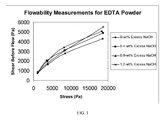
- FIG. 1 is a graph showing flowability measurements for EDTA powders containing various NaOH concentrations.
- the invention provides a method for producing a free-flowing solid aminocarboxylate chelant.
- Any aminocarboxylate chelant that contains residual excess alkaline metal hydroxide e.g., sodium hydroxide or potassium hydroxide
- alkaline metal hydroxide e.g., sodium hydroxide or potassium hydroxide
- chelants manufactured by processes that utilize an alkaline metal hydroxide as a reagent typically contain residual amounts of the reagent and as such are particularly suited for the invention.
- Non-limiting examples of these manufacturing processes include, for instance, the Bersworth process and the low NTA process of the second aspect of the invention, described in more detail below.
- a fully neutralized aminocarboxylate chelant containing residual alkaline metal hydroxide is provided as an aqueous solution.
- the solution may contain between 20 and 70 percent, alternatively, between 30 and 60 percent, by weight of the aminocarboxylate chelant based on the total weight of the solution.
- the solution may contain greater than 0%, alternatively at least 0.1 %, alternatively at least 0.8 %, or alternatively at least 1.2 % by weight of the alkaline metal hydroxide, based on the total weight of the solution.
- the solution may contain up to 5 %, alternatively up to 2 % by weight of the alkaline metal hydroxide, based on the total weight of the solution.
- any aminocarboxylate chelant that contains residual alkaline metal hydroxide may be used in the invention.
- Examples include the full alkaline metal salts of: ethylenediamine-N,N,N',N'-tetraacetic acid (EDTA); 1,1,4,7,7-diethylene-triaminepentaacetic acid (DTPA); ethylenediamine- N,N'-disuccinic acid (EDDS); (2-hydroxyethyl)-imino-diacetic acid (HEIDA); L-glutamic acid-N,N-di-(acetic acid) (GLDA); ethylenediamine-N,N'-diacetic acid (EDDA); or hydroxyethylethylene-diaminotriacetic acid (HEDTA).
- Suitable alkaline metals for the salts include sodium and potassium, with sodium being preferred.
- step (b) of the method a molecule containing a free or partially neutralized carboxylic acid is added to the solution.
- Sufficient free or partially neutralized carboxylic acid is used such that the acid reacts with at least a portion of the residual alkaline metal hydroxide, thereby reducing the levels of the metal hydroxide.
- the amount of free or partially neutralized carboxylic acid that should be used can be readily determined by a person of ordinary skill in the art and will depend, for instance, on how much alkaline metal hydroxide is present, the number of available acid groups in the free or partially neutralized carboxylic acid, and how much of the hydroxide it is desired to neutralize.
- EDTA 1 mole of ethylenediamine-N,N,N',N'-tetraacetic acid (EDTA) may be used to neutralize 4 moles of residual sodium hydroxide (NaOH).
- the amount of free or partially neutralized acid used is such that no more than 5 %, alternatively no more than 2 %, alternatively no more than 1 %, or alternatively no more than 0.1 % by weight of the aminocarboxylate is acidified. It is also preferable that the pH of the solution, during and following addition of the carboxylic acid, does not drop below 7 (i.e., the pH is 7 or greater).
- suitable carboxylic acids for use in step (b) include, but are not limited to, oxalic acid, glycolic acid, and formic acid.
- free or partially neutralized aminocarboxylic acid chelants such as the free or partially neutralized acids of: ethylenediamine-N,N,N',N'-tetraacetic acid (EDTA); 1,1,4,7,7-diethylene-triaminepentaacetic acid (DTPA); ethylenediamine- N,N'-disuccinic acid (EDDS); (2-hydroxyethyl)-imino-diacetic acid (HEIDA); L-glutamic acid-N,N-di-(acetic acid) (GLDA); ethylenediamine-N,N'-diacetic acid (EDDA); or hydroxyethylethylene-diaminotriacetic acid (HEDTA).
- suitable salts include the sodium and potassium salts, with sodium being preferred.
- an aminocarboxylic acid is used in step (b) that is the free acid or partially neutralized salt of (i.e., corresponding to) the aminocarboxylate being treated.
- a suitable aminocarboxylic acid under this embodiment may be EDTA or Na 2 EDTA.
- the free or partially neutralized aminocarboxylic acid it is not required, however, under the invention for the free or partially neutralized aminocarboxylic acid to correspond to the aminocarboxylate and in some embodiments it may be preferable for them not to correspond. For instance, if the aminocarboxylate is a relatively expensive material, use of a different free or partially neutralized acid that is less costly may be preferred.
- the mixture, containing the free or partially neutralized acid, the aminocarboxylate, and the alkaline metal hydroxide may be heated to, for example, between 45 °C and 100 °C, in order to facilitate the neutralization reaction. Heating, however, is not required.
- the mixture may also be stirred, also to facilitate the reaction.
- step (c) of the method once sufficient time for the neutralization of the alkaline metal hydroxide has elapsed, which, in some embodiments, may be between 5 min and 4 hours, the purified aminocarboxylate chelant may then be isolated from the mixture as a free-flowing solid.
- Various isolation techniques and combinations of techniques may be used including, for instance, crystallization or drying.
- the aminocarboxylate solution is evaporated beyond its saturation point, allowing for a portion of the aminocarboxylate to crystallize in a solid form which can be recovered. This is typically achieved by driving off water by heating the aminocarboxylate solution.
- Drying of the aminocarboxylate solution may be done by any conventional drying method.
- the drying may conveniently be done in a vacuum oven at suitably elevated temperature or by spraying the aminocarboxylate chelant solution into a conventional counter-current or co-current spray-drying tower.
- the spray drying tower water is evaporated by hot gas, usually hot air, to such an extent that a solid aminocarboxylate chelant is obtained in a powder or granular form.
- hot gas usually hot air
- the method of the invention is used to produce free-flowing solid ethylenediamine-N,N,N',N'-tetraacetic acid tetrasodium salt (Na 4 EDTA).
- the method comprises: (a) providing a solution comprising the ethylenediamine-N,N,N',N'-tetraacetic acid tetrasodium salt and sodium hydroxide; (b) adding to the solution ethylenediamine-N,N,N',N'-tetraacetic acid or a partial salt thereof such that at least a portion of the sodium hydroxide is neutralized; and (c) isolating therefrom the free-flowing solid ethylenediamine-N,N,N',N'-tetraacetic acid tetrasodium salt by crystallization or spray-drying.
- the acid or salt of step (b) comprises ethylenediamine-N,N,N',N'-tetraacetic acid, alternatively ethylenediamine-N,N,N',N'-tetraacetic acid monosodium salt, alternatively ethylenediamine-N,N,N',N'-tetraacetic acid disodium salt, alternatively ethylenediamine-N,N,N',N'-tetraacetic acid trisodium salt, or alternatively a mixture of two or more of the foregoing.
- the invention provides a method for preparing an aminocarboxylic acid or salt thereof (aminocarboxylate) chelant containing low levels of nitrilotriacetic acid.
- Chelants produced by conventional processes utilizing cyanide and formaldehyde, including the Bersworth process described above, may be contaminated with nitrilotriacetic acid or its salts (NTA).
- NTA is an undesirable impurity in the final product and its levels are increasingly subject to government regulation in some regions. Thus, chelants that contain little or no NTA are desirable.
- the invention addresses the problem of NTA contamination by providing a method in which an amine precursor of the desired aminocarboxylic acid is reacted with formaldehyde and cyanide in the presence of a base in sufficient amounts and under conditions to form the chelant.
- the reaction between the cyanide, formaldehyde and precursor amine is carried under various protocols that result in significantly reduced formation of NTA or its salts.
- the formaldehyde and cyanide are added substantially over the whole reaction (the time required for the reaction to go to substantial completion).
- the formaldehyde and cyanide are added over a period of between 4 and 24 hours.
- a profiled addition rate of the formaldehyde and cyanide may be used such that the rate during the first half of the reaction is on average greater than during the second half of the reaction. For example, in some embodiments, in a reaction whose reaction time is about six hours, about half of the formaldehyde and cyanide are added over 2 hours during the first half of the reaction, and the remainder added over 4 hours during the second half of the reaction.
- a further protocol for reducing NTA levels in the chelant product is that byproduct ammonia is continuously removed from the reaction substantially as it is formed.
- Various techniques may be used for ammonia removal including, for instance, distillation or gas (e.g., air or steam) stripping.
- gas e.g., air or steam
- a gas:amine purge rate of 1 to 50 mol gas to mol amine may be used.
- a ratio of reactive cyanide/formaldehyde (defined as any cyanide/formaldehyde that is not reduced to glycolate or formate salts in the reaction) to amine group of 1.60-2.0, alternatively 1.90-2.0, or alternatively 2.0 may be used is for forming EDTA with low NTA levels.
- a ratio of 2.5-3, alternatively 2.7 cyanide/formaldehyde to amine is suitable since much of the cyanide/formaldehyde is lost to by-product glycolate and formate.
- the method may be carried out as a batch or as a continuous process, the latter using, for example, a continuous stirred-tank reactor (CSTR).
- CSTR continuous stirred-tank reactor
- chelants prepared by the methods of the invention contain lower levels of NTA than materials prepared by the conventional methods.
- chelants may be prepared that contain 5.5 percent or less, alternatively 3 percent or less, alternatively 2 percent or less, alternatively 1.5 percent or less, or alternatively 1 percent or less of NTA (or its salts), based on the total weight of NTA and chelant, or salts thereof, as determined for instance by HPLC.
- an EDTA product containing low levels of NTA may suitably be obtained in a batch process, as follows.
- One mole of ethylene diamine may be mixed with 0.1-0.3, alternatively 0.16, moles of sodium hydroxide (e.g., in the form of a 50 % NaOH solution) and the temperature elevated, for instance to 60-100°C, alternatively to 70 °C.
- Cyanide, 1.9 to 2.0 moles, alternatively 1.95 moles, and formaldehyde, 1.9 to 2.1 moles, alternatively 1.99 moles, are added at a constant rate over 1 to 3 hours, alternatively 2 hours, which may result in the mixture heating to boiling temperatures.
- Another 1.9 to 2.0 moles, alternatively 1.95 moles, of cyanide and 1.9 to 2.1 moles, alternatively 1.99 moles, of formaldehyde are added at a substantially constant rate over 3 to 5 hours, alternatively 4 hours, to complete the reaction.
- ammonia is substantially removed, for instance by steam distillation.
- the reaction may be boiled for an additional period, e.g., 1 to 3 hours, alternatively 2 hours, to remove remaining ammonia.
- Typical workup may be used to isolate the low NTA product.
- the EDTA prepared by this process may contain 2 percent or less, alternatively 1.5 percent or less, or alternatively 1 percent or less of NTA (or its salts), based on the total weight of NTA and EDTA or their salts.
- the method is not limited to formation of EDTA containing low amounts of NTA and indeed can be used for other chelants.
- the amine precursor for any particular chelant in the method can be readily determined by a person of ordinary skill in the art. Suitable precursors include primary or secondary amines (either cyclic or acyclic) such as diamines, triamines higher amines, amino alcohols, amino acids, amino thiols, aminosuccinates, polycarboxylate amines, amino ethers, substituted and unsubstituted guanidines, polyamino ethers, amino sugars, and chitosan. Also suitable are materials that hydrolyze under the reaction conditions into an amine, such as: amides, cyclic amides, imines and imides.
- the cyanide used in the reaction may be in the form of a cyanide salt (e.g., sodium cyanide) or hydrogen cyanide.
- glycolonitrile may be used as a substitute for cyanide and formaldehyde (glycolonitrile is the reactive product obtained when cyanide and formaldehyde are mixed together).
- the reaction Upon completion of the addition, the reaction is boiled for 2-hrs to remove any excess ammonia. 222.2-mol of water (151.3-g) are added back to the reaction and the reaction is cooled to room temperature.
- the resulting product contains 39.90-wt% tetrasodium ethylenediaminetetraacetate (Na4EDTA) and 2.5-wt% trisodium nitrilotriacetate (Na3NTA), as determined by HPLC analysis (see method below).
- 1-mol of ethylenediamine (60.0-g) is mixed with 0.16-mol sodium hydroxide (12.8-g of 50% NaOH) and raised to 70°C.
- 1.95-mol of sodium cyanide (318.4-g of 30% aq sln) and 1.99-mol of formaldehyde (119.2-g of 50% aq sln) are added at a constant rate over 2-hrs, quickly allowing the mixture to heat to boiling temperatures.
- steam is used to distill off the ammonia.
- the 0.0-wt% excess caustic solution is prepared by dissolving 50.5-g of EDTA acid into 2134.8-g of solution containing 39-wt% Na 4 EDTA and 1.30-wt% excess NaOH and then diluting with 101.9-g of water.
- the 0.4-wt% excess NaOH is prepared by mixing 155.8-g of the 0.0-wt% NaOH solution with 76..9-g of the 1.3-wt% NaOH solution.
- the 0.8-wt% excess NaOH solution is prepared by mixing 160-g of the 1.3-wt% NaOH solution with 85.2-g of the 0.0-wt% NaOH solution,
- FIG. 1 is a graph showing the flowability curves for the material under various loads.
Landscapes
- Chemical & Material Sciences (AREA)
- Organic Chemistry (AREA)
- Chemical Kinetics & Catalysis (AREA)
- Crystallography & Structural Chemistry (AREA)
- Organic Low-Molecular-Weight Compounds And Preparation Thereof (AREA)
- Detergent Compositions (AREA)
Abstract
Description
- This application claims priority from
U.S. provisional application serial number 61/346,960, filed May 21, 2010 - The invention relates to processes for preparing stable free flowing solid chelants.
- Chelants are used in a variety of applications including food processing, soaps, detergents, cleaning products, personal care products, pharmaceuticals, pulp and paper processing, water treatment, metalworking and metal plating solutions, textile processing solutions, fertilizers, animal feeds, herbicides, rubber and polymer chemistry, photofmishing, and oil field chemistry. Commercially available chelants are typically aqueous solutions having a chelant activity of about 40 percent to about 60 percent by weight.
- Aminocarboxylic acid chelants and their salts (aminocarboxylates) may be prepared by a number of known techniques. On an industrial scale, a typical process involves the reaction of an amine with formaldehyde and cyanide in the presence of an alkaline metal hydroxide (see e.g., Bersworth,
U.S. Patent 2,407,645 , which is incorporated herein by reference). - There are various disadvantages associated with the known manufacturing processes. One such disadvantage is that chelants produced by methods that utilize an alkaline metal hydroxide as a reagent, including the Bersworth process described above, in general are hygroscopic and become caked when exposed to the atmosphere. Chelants with better atmospheric stability and solid flowability are desirable in the industry.
- The invention provides a method for producing a solid aminocarboxylate chelant which is low hygroscopic and remains free-flowing when exposed to the atmosphere. The method comprises: (a) providing a solution comprising the aminocarboxylate chelant and residual alkaline metal hydroxide; (b) adding to the solution a free or partially neutralized carboxylic acid such that the free or partially neutralized acid neutralizes at least a portion of the residual alkaline metal hydroxide; and (c) isolating therefrom the free-flowing solid amino carboxylate chelant.
-
FIG. 1 is a graph showing flowability measurements for EDTA powders containing various NaOH concentrations. - As noted above, the invention provides a method for producing a free-flowing solid aminocarboxylate chelant. Any aminocarboxylate chelant that contains residual excess alkaline metal hydroxide (e.g., sodium hydroxide or potassium hydroxide) may suitably be used in the method of the invention. As noted, chelants manufactured by processes that utilize an alkaline metal hydroxide as a reagent typically contain residual amounts of the reagent and as such are particularly suited for the invention. Non-limiting examples of these manufacturing processes include, for instance, the Bersworth process and the low NTA process of the second aspect of the invention, described in more detail below.
- In step (a) of the method, a fully neutralized aminocarboxylate chelant containing residual alkaline metal hydroxide is provided as an aqueous solution. In some embodiments, the solution may contain between 20 and 70 percent, alternatively, between 30 and 60 percent, by weight of the aminocarboxylate chelant based on the total weight of the solution. The solution may contain greater than 0%, alternatively at least 0.1 %, alternatively at least 0.8 %, or alternatively at least 1.2 % by weight of the alkaline metal hydroxide, based on the total weight of the solution. In some embodiments, the solution may contain up to 5 %, alternatively up to 2 % by weight of the alkaline metal hydroxide, based on the total weight of the solution.
- As noted, any aminocarboxylate chelant that contains residual alkaline metal hydroxide may be used in the invention. Examples include the full alkaline metal salts of: ethylenediamine-N,N,N',N'-tetraacetic acid (EDTA); 1,1,4,7,7-diethylene-triaminepentaacetic acid (DTPA); ethylenediamine- N,N'-disuccinic acid (EDDS); (2-hydroxyethyl)-imino-diacetic acid (HEIDA); L-glutamic acid-N,N-di-(acetic acid) (GLDA); ethylenediamine-N,N'-diacetic acid (EDDA); or hydroxyethylethylene-diaminotriacetic acid (HEDTA). Suitable alkaline metals for the salts include sodium and potassium, with sodium being preferred.
- In step (b) of the method, a molecule containing a free or partially neutralized carboxylic acid is added to the solution. Sufficient free or partially neutralized carboxylic acid is used such that the acid reacts with at least a portion of the residual alkaline metal hydroxide, thereby reducing the levels of the metal hydroxide. The amount of free or partially neutralized carboxylic acid that should be used can be readily determined by a person of ordinary skill in the art and will depend, for instance, on how much alkaline metal hydroxide is present, the number of available acid groups in the free or partially neutralized carboxylic acid, and how much of the hydroxide it is desired to neutralize. By way of example, in the case of EDTA, 1 mole of ethylenediamine-N,N,N',N'-tetraacetic acid (EDTA) may be used to neutralize 4 moles of residual sodium hydroxide (NaOH).
- In some embodiments, it is desirable to add sufficient free or partially neutralized carboxylic acid in order to reduce the level of alkaline metal salt to 5 % or less, alternatively 2 % or less, alternatively 1.2 % or less, alternatively 0.8 % or less, alternatively 0.5 % or less, or alternatively 0.1 % or less, by weight based on the total weight of the solution.
- It is also preferred that sufficient free or partially neutralized acid be added as described above, but without significantly acidifying the aminocarboxylate chelant in the solution. In some embodiments, the amount of free or partially neutralized acid used is such that no more than 5 %, alternatively no more than 2 %, alternatively no more than 1 %, or alternatively no more than 0.1 % by weight of the aminocarboxylate is acidified. It is also preferable that the pH of the solution, during and following addition of the carboxylic acid, does not drop below 7 (i.e., the pH is 7 or greater).
- Examples of suitable carboxylic acids for use in step (b) include, but are not limited to, oxalic acid, glycolic acid, and formic acid. Also suitable are free or partially neutralized aminocarboxylic acid chelants, such as the free or partially neutralized acids of: ethylenediamine-N,N,N',N'-tetraacetic acid (EDTA); 1,1,4,7,7-diethylene-triaminepentaacetic acid (DTPA); ethylenediamine- N,N'-disuccinic acid (EDDS); (2-hydroxyethyl)-imino-diacetic acid (HEIDA); L-glutamic acid-N,N-di-(acetic acid) (GLDA); ethylenediamine-N,N'-diacetic acid (EDDA); or hydroxyethylethylene-diaminotriacetic acid (HEDTA). Where the material is partially neutralized, suitable salts include the sodium and potassium salts, with sodium being preferred.
- In a particular embodiment, an aminocarboxylic acid is used in step (b) that is the free acid or partially neutralized salt of (i.e., corresponding to) the aminocarboxylate being treated. Thus, for instance, if the aminocarboxylate is tetrasodium EDTA, then a suitable aminocarboxylic acid under this embodiment may be EDTA or Na2EDTA.
- It is not required, however, under the invention for the free or partially neutralized aminocarboxylic acid to correspond to the aminocarboxylate and in some embodiments it may be preferable for them not to correspond. For instance, if the aminocarboxylate is a relatively expensive material, use of a different free or partially neutralized acid that is less costly may be preferred.
- The mixture, containing the free or partially neutralized acid, the aminocarboxylate, and the alkaline metal hydroxide may be heated to, for example, between 45 °C and 100 °C, in order to facilitate the neutralization reaction. Heating, however, is not required. The mixture may also be stirred, also to facilitate the reaction.
- In step (c) of the method, once sufficient time for the neutralization of the alkaline metal hydroxide has elapsed, which, in some embodiments, may be between 5 min and 4 hours, the purified aminocarboxylate chelant may then be isolated from the mixture as a free-flowing solid. Various isolation techniques and combinations of techniques may be used including, for instance, crystallization or drying.
- In crystallization, typically the aminocarboxylate solution is evaporated beyond its saturation point, allowing for a portion of the aminocarboxylate to crystallize in a solid form which can be recovered. This is typically achieved by driving off water by heating the aminocarboxylate solution.
- Drying of the aminocarboxylate solution may be done by any conventional drying method. For instance, the drying may conveniently be done in a vacuum oven at suitably elevated temperature or by spraying the aminocarboxylate chelant solution into a conventional counter-current or co-current spray-drying tower. In the spray drying tower, water is evaporated by hot gas, usually hot air, to such an extent that a solid aminocarboxylate chelant is obtained in a powder or granular form. Examples of other drying techniques that may be used include rotating disk drying, rotating drum drying, or freeze drying.
- In an exemplary embodiment, the method of the invention is used to produce free-flowing solid ethylenediamine-N,N,N',N'-tetraacetic acid tetrasodium salt (Na4EDTA). The method comprises: (a) providing a solution comprising the ethylenediamine-N,N,N',N'-tetraacetic acid tetrasodium salt and sodium hydroxide; (b) adding to the solution ethylenediamine-N,N,N',N'-tetraacetic acid or a partial salt thereof such that at least a portion of the sodium hydroxide is neutralized; and (c) isolating therefrom the free-flowing solid ethylenediamine-N,N,N',N'-tetraacetic acid tetrasodium salt by crystallization or spray-drying. In a further embodiment, the acid or salt of step (b) comprises ethylenediamine-N,N,N',N'-tetraacetic acid, alternatively ethylenediamine-N,N,N',N'-tetraacetic acid monosodium salt, alternatively ethylenediamine-N,N,N',N'-tetraacetic acid disodium salt, alternatively ethylenediamine-N,N,N',N'-tetraacetic acid trisodium salt, or alternatively a mixture of two or more of the foregoing.
- In a second aspect, the invention provides a method for preparing an aminocarboxylic acid or salt thereof (aminocarboxylate) chelant containing low levels of nitrilotriacetic acid. Chelants produced by conventional processes utilizing cyanide and formaldehyde, including the Bersworth process described above, may be contaminated with nitrilotriacetic acid or its salts (NTA). NTA is an undesirable impurity in the final product and its levels are increasingly subject to government regulation in some regions. Thus, chelants that contain little or no NTA are desirable.
- The invention addresses the problem of NTA contamination by providing a method in which an amine precursor of the desired aminocarboxylic acid is reacted with formaldehyde and cyanide in the presence of a base in sufficient amounts and under conditions to form the chelant. The reaction between the cyanide, formaldehyde and precursor amine is carried under various protocols that result in significantly reduced formation of NTA or its salts.
- Under one such protocol, the formaldehyde and cyanide are added substantially over the whole reaction (the time required for the reaction to go to substantial completion). In some embodiments, the formaldehyde and cyanide are added over a period of between 4 and 24 hours. Further, a profiled addition rate of the formaldehyde and cyanide may be used such that the rate during the first half of the reaction is on average greater than during the second half of the reaction. For example, in some embodiments, in a reaction whose reaction time is about six hours, about half of the formaldehyde and cyanide are added over 2 hours during the first half of the reaction, and the remainder added over 4 hours during the second half of the reaction.
- A further protocol for reducing NTA levels in the chelant product is that byproduct ammonia is continuously removed from the reaction substantially as it is formed. Various techniques may be used for ammonia removal including, for instance, distillation or gas (e.g., air or steam) stripping. In some embodiments, a gas:amine purge rate of 1 to 50 mol gas to mol amine may be used.
- Because byproducts of cyanide and formaldehyde can be formed in the reaction, the exact ratio of cyanide/formaldehyde to amine will vary. The general ratio of cyanide/formaldehyde to amine is related to the reactivity of the amine and the base concentration. Slower reactive amines and higher caustic levels generally result in more glycolate or formate byproducts.
- For example, in some embodiments, a ratio of reactive cyanide/formaldehyde (defined as any cyanide/formaldehyde that is not reduced to glycolate or formate salts in the reaction) to amine group of 1.60-2.0, alternatively 1.90-2.0, or alternatively 2.0 may be used is for forming EDTA with low NTA levels. When making GLDA, a ratio of 2.5-3, alternatively 2.7 cyanide/formaldehyde to amine is suitable since much of the cyanide/formaldehyde is lost to by-product glycolate and formate. The method may be carried out as a batch or as a continuous process, the latter using, for example, a continuous stirred-tank reactor (CSTR).
- It has been found that chelants prepared by the methods of the invention contain lower levels of NTA than materials prepared by the conventional methods. In some embodiments, chelants may be prepared that contain 5.5 percent or less, alternatively 3 percent or less, alternatively 2 percent or less, alternatively 1.5 percent or less, or alternatively 1 percent or less of NTA (or its salts), based on the total weight of NTA and chelant, or salts thereof, as determined for instance by HPLC.
- By way of illustration, an EDTA product containing low levels of NTA may suitably be obtained in a batch process, as follows. One mole of ethylene diamine may be mixed with 0.1-0.3, alternatively 0.16, moles of sodium hydroxide (e.g., in the form of a 50 % NaOH solution) and the temperature elevated, for instance to 60-100°C, alternatively to 70 °C. Cyanide, 1.9 to 2.0 moles, alternatively 1.95 moles, and formaldehyde, 1.9 to 2.1 moles, alternatively 1.99 moles, are added at a constant rate over 1 to 3 hours, alternatively 2 hours, which may result in the mixture heating to boiling temperatures. Another 1.9 to 2.0 moles, alternatively 1.95 moles, of cyanide and 1.9 to 2.1 moles, alternatively 1.99 moles, of formaldehyde are added at a substantially constant rate over 3 to 5 hours, alternatively 4 hours, to complete the reaction. At the start and throughout the reaction, ammonia is substantially removed, for instance by steam distillation. Upon completion of the addition of the formaldehyde and cyanide, the reaction may be boiled for an additional period, e.g., 1 to 3 hours, alternatively 2 hours, to remove remaining ammonia. Typical workup may be used to isolate the low NTA product.
- The EDTA prepared by this process may contain 2 percent or less, alternatively 1.5 percent or less, or alternatively 1 percent or less of NTA (or its salts), based on the total weight of NTA and EDTA or their salts.
- The method is not limited to formation of EDTA containing low amounts of NTA and indeed can be used for other chelants. The amine precursor for any particular chelant in the method can be readily determined by a person of ordinary skill in the art. Suitable precursors include primary or secondary amines (either cyclic or acyclic) such as diamines, triamines higher amines, amino alcohols, amino acids, amino thiols, aminosuccinates, polycarboxylate amines, amino ethers, substituted and unsubstituted guanidines, polyamino ethers, amino sugars, and chitosan. Also suitable are materials that hydrolyze under the reaction conditions into an amine, such as: amides, cyclic amides, imines and imides.
- The cyanide used in the reaction may be in the form of a cyanide salt (e.g., sodium cyanide) or hydrogen cyanide. In addition, glycolonitrile may be used as a substitute for cyanide and formaldehyde (glycolonitrile is the reactive product obtained when cyanide and formaldehyde are mixed together).
- The terms "carboxylic acid," "acid," "aminocarboxylic acid," and their derivations are used herein as shorthand to represent molecules containing these functional groups.
- The following examples are illustrative of the invention but are not intended to limit its scope. Unless otherwise indicated, the ratios, percentages, parts, and the like used herein are by weight.
- 1-mol of ethylenediamine (60.0-g) is mixed with 0.18-mol sodium hydroxide (14.7-g of 50% NaOH) and raised to 70°C. 4.47-mol of sodium cyanide (729.6-g of 30% aq sln) and 4.55-mol of formaldehyde (273.2-g of 50% aq sln) are added at a constant rate over 4.5-hrs and the reaction is allowed to quickly reach boiling temperature (materials can be obtained at Sigma-Aldrich). Any vapors escaping from the reaction are refluxed back to the reactor for the first half of the addition. After the first half of the addition, vapors are no longer refluxed, but distilled away from the reactor. Upon completion of the addition, the reaction is boiled for 2-hrs to remove any excess ammonia. 222.2-mol of water (151.3-g) are added back to the reaction and the reaction is cooled to room temperature. The resulting product contains 39.90-wt% tetrasodium ethylenediaminetetraacetate (Na4EDTA) and 2.5-wt% trisodium nitrilotriacetate (Na3NTA), as determined by HPLC analysis (see method below).
- 1-mol of ethylenediamine (60.0-g) is mixed with 0.16-mol sodium hydroxide (12.8-g of 50% NaOH) and raised to 70°C. 1.95-mol of sodium cyanide (318.4-g of 30% aq sln) and 1.99-mol of formaldehyde (119.2-g of 50% aq sln) are added at a constant rate over 2-hrs, quickly allowing the mixture to heat to boiling temperatures. At the start of the addition and throughout the reaction, steam is used to distill off the ammonia. Another 1.95-mol of sodium cyanide (318.4-g of 30% aq sln) and 1.99-mol of formaldehyde (119.2-g of 50% aq sln) are added at a constant rate over 4-hrs to complete the reaction. Upon completion of the addition, the reaction is boiled for 2-hrs to remove any excess ammonia. 222.2-mol of water (151.3-g) are added back to the reaction and the reaction is cooled to room temperature. The resulting product contains 39.24-wt% Na4EDTA and 0.4-wt% Na3NTA, as determined by HPLC analysis.
- Four aqueous solutions containing 39-wt% Na4EDTA are adjusted to different excess caustic levels, such that the solutions contain 0.0-wt%, 0.4-wt%, 0.8-wt%, and 1.3-wt% excess sodium hydroxide. The 0.0-wt% excess caustic solution is prepared by dissolving 50.5-g of EDTA acid into 2134.8-g of solution containing 39-wt% Na4EDTA and 1.30-wt% excess NaOH and then diluting with 101.9-g of water. The 0.4-wt% excess NaOH is prepared by mixing 155.8-g of the 0.0-wt% NaOH solution with 76..9-g of the 1.3-wt% NaOH solution. The 0.8-wt% excess NaOH solution is prepared by mixing 160-g of the 1.3-wt% NaOH solution with 85.2-g of the 0.0-wt% NaOH solution,
- The solutions are spray dried on a Buchi benchtop spray drier using a two-fluid nozzle atomizer at the same conditions for each (3.1-mL/min liquid rate, 24M-L/hr gas rate, 200°C inlet air, and 580-L/hr nozzle air). The resulting powders have similar particle sizes and initial moisture levels (7-wt% water). The four powders are tested for flowability using an RST-Control 95 SX shear cell tester, which measures the yield strength gained by the sample under varying degrees of consolidating stress. There is a distinct trend for powder with higher excess caustic levels to have a higher resistance to flow (greater gain in yield strength), which becomes more pronounced at higher stress levels.
FIG. 1 is a graph showing the flowability curves for the material under various loads. - While the invention has been described above according to its preferred embodiments, it can be modified within the spirit and scope of this disclosure. This application is therefore intended to cover any variations, uses, or adaptations of the invention using the general principles disclosed herein. Further, the application is intended to cover such departures from the present disclosure as come within the known or customary practice in the art to which this invention pertains and which fall within the limits of the following claims.
- Preferred embodiments of the invention include the following:
- 1. A method for producing a free-flowing solid aminocarboxylate chelant, the method comprising:
- (a) providing a solution comprising the aminocarboxylate chelant and residual alkaline metal hydroxide;
- (b) adding to the solution a free or partially neutralized carboxylic acid such that the free or partially neutralized acid neutralizes at least a portion of the residual alkaline metal hydroxide; and
- (c) isolating therefrom the free-flowing solid aminocarboxylate chelant.
- 2. A method according to embodiment 1 wherein the free-flowing solid aminocarboxylate chelant is isolated under step (c) by crystallization.
- 3. A method according to any one of embodiments 1-2 wherein the free-flowing solid aminocarboxylate chelant is isolated under step (c) by drying.
- 4. A method according to any one of embodiments 1-3 wherein the free-flowing solid aminocarboxylate chelant is isolated under step (c) by spray drying, rotating disk drying, rotating drum drying, freeze drying, or vacuum oven drying.
- 5. A method according to any one of embodiments 1-4 wherein sufficient free or partially neutralized carboxylic acid is added such that the concentration of residual alkaline metal hydroxide is 2 % or less by weight, based on the total weight of the solution.
- 6. A method according to any one of embodiments 1-5 wherein the amount of free or partially neutralized carboxylic acid added in step (b) is such that no more than 5% by weight of the aminocarboxylate chelant is acidified.
- 7. A method according to any one of embodiments 1-6 wherein the aminocarboxylate chelant is ethylenediamine-N,N,N',N'-tetraacetic acid tetrasodium salt, 1,1,4,7,7-diethylene-triaminepentaacetic acid pentasodium salt, ethylenediamine- N,N'-disuccinic acid disodium salt, (2-hydroxyethyl)-imino-diacetic acid disodium salt, L-glutamic acid-N,N-di-(acetic acid) tetrasodium salt, ethylenediamine-N,N'-diacetic acid disodium salt, or hydroxyethylethylene-diaminotriacetic acid trisodium salt.
- 8. A method according to any one of embodiments 1-7 wherein the free or partially neutralized carboxylic acid is oxalic acid, glycolic acid, or formic acid.
- 9. A method according to any one of embodiments 1-8 wherein the free or partially neutralized carboxylic acid comprises: ethylenediamine-N,N,N',N'-tetraacetic acid (EDTA), 1,1,4,7,7-diethylene-triaminepentaacetic acid (DTPA), ethylenediamine- N,N'-disuccinic acid (EDDS), (2-hydroxyethyl)-imino-diacetic acid (HEIDA), L-glutamic acid-N,N-di-(acetic acid) (GLDA), ethylenediamine-N,N'-diacetic acid (EDDA), hydroxyethylethylene-diaminotriacetic acid (HEDTA), or a partial salt of any of the foregoing.
- 10. A method for producing free-flowing solid ethylenediamine-N,N,N',N'-tetraacetic acid tetrasodium salt (Na4EDTA), the method comprising:
- (a) providing a solution comprising the ethylenediamine-N,N,N',N'-tetraacetic acid tetrasodium salt and residual sodium hydroxide;
- (b) adding to the solution ethylenediamine-N,N,N',N'-tetraacetic acid or a partial salt thereof such that at least a portion of the residual sodium hydroxide is neutralized; and
- (c) isolating therefrom the free-flowing solid ethylenediamine-N,N,N',N'-tetraacetic acid tetrasodium salt by crystallization or spray-drying.
- 11. A free-flowing solid aminocarboxylate chelant prepared by the method of any one of embodiments 1-10.
- 12. A method for preparing an aminocarboxylic acid or salt thereof chelant containing low levels of nitrilotriacetic acid, the method comprising: providing an amine precursor of the aminocarboxylic acid and adding thereto formaldehyde and cyanide in the presence of a base in sufficient amounts and under conditions such that substantial completion of the reaction of the amine occurs to form the aminocarboxylic acid or salt thereof, wherein:
- (a) the formaldehyde and cyanide are added substantially over the whole reaction;
- (b) the rate of addition during the first half of the reaction is on average greater than during the second half of the reaction; and
- (c) byproduct ammonia is continuously removed from the reaction substantially as it is formed.
- 13. A method according to embodiment 12 wherein the formaldehyde is utilized as formalin or paraformaldehyde.
- 14. A method according to any one of embodiments 12-13 wherein the cyanide is utilized as hydrogen cyanide or a salt thereof.
- 15. A method according to embodiment 12 wherein the formaldehyde and cyanide are utilized as glycolonitrile.
- 16. A method according to any one of embodiments 12-15 wherein the base is sodium hydroxide.
- 17. A method according to any one of embodiments 12-16 for the preparation of EDTA or salt thereof containing low levels of nitrilotriacetic acid, the method comprising:
- combining ethylene diamine with 0.1-0.3 equivalents of sodium hydroxide raising the temperature to 60-100 °C; adding 1.9 to 2.0 moles of cyanide and 1.9 to 2.1 moles of formaldehyde at a constant rate over 1 to 3 hours; adding another 1.9 to 2.0 moles of cyanide and 1.9 to 2.1 moles of formaldehyde at a substantially constant rate over 3 to 5 hours to complete the reaction, wherein byproduct ammonia is continuously removed throughout the reaction substantially as it is formed.
- 18. An aminocarboxylic acid or salt thereof chelant containing low levels of nitrilotriacetic acid prepared by the method of any one of embodiments 12-17.
Claims (7)
- A method for preparing an aminocarboxylic acid or salt thereof chelant containing low levels of nitrilotriacetic acid, the method comprising: providing an amine precursor of the aminocarboxylic acid and adding thereto formaldehyde and cyanide in the presence of a base in sufficient amounts and under conditions such that substantial completion of the reaction of the amine occurs to form the aminocarboxylic acid or salt thereof, wherein:(a) the formaldehyde and cyanide are added substantially over the whole reaction;(b) the rate of addition during the first half of the reaction is on average greater than during the second half of the reaction; and(c) byproduct ammonia is continuously removed from the reaction substantially as it is formed.
- A method according to claim 1 wherein the formaldehyde is utilized as formalin or paraformaldehyde.
- A method according to any one of claims 1-2 wherein the cyanide is utilized as hydrogen cyanide or a salt thereof.
- A method according to claim 1 wherein the formaldehyde and cyanide are utilized as glycolonitrile.
- A method according to any one of claims 1-4 wherein the base is sodium hydroxide.
- A method according to any one of claims 1-5 for the preparation of EDTA or salt thereof containing low levels of nitrilotriacetic acid, the method comprising: combining ethylene diamine with 0.1-0.3 equivalents of sodium hydroxide raising the temperature to 60-100 °C; adding 1.9 to 2.0 moles of cyanide and 1.9 to 2.1 moles of formaldehyde at a constant rate over 1 to 3 hours; adding another 1.9 to 2.0 moles of cyanide and 1.9 to 2.1 moles of formaldehyde at a substantially constant rate over 3 to 5 hours to complete the reaction, wherein byproduct ammonia is continuously removed throughout the reaction substantially as it is formed.
- An aminocarboxylic acid or salt thereof chelant containing low levels of nitrilotriacetic acid prepared by the method of any one of claims 1-6.
Applications Claiming Priority (2)
| Application Number | Priority Date | Filing Date | Title |
|---|---|---|---|
| US34696010P | 2010-05-21 | 2010-05-21 | |
| EP11721962A EP2571846A2 (en) | 2010-05-21 | 2011-05-18 | Aminocarboxylate powders with improved purity and flow ability properties |
Related Parent Applications (1)
| Application Number | Title | Priority Date | Filing Date |
|---|---|---|---|
| EP11721962A Division EP2571846A2 (en) | 2010-05-21 | 2011-05-18 | Aminocarboxylate powders with improved purity and flow ability properties |
Publications (1)
| Publication Number | Publication Date |
|---|---|
| EP2743254A1 true EP2743254A1 (en) | 2014-06-18 |
Family
ID=44544220
Family Applications (2)
| Application Number | Title | Priority Date | Filing Date |
|---|---|---|---|
| EP11721962A Withdrawn EP2571846A2 (en) | 2010-05-21 | 2011-05-18 | Aminocarboxylate powders with improved purity and flow ability properties |
| EP20140158627 Withdrawn EP2743254A1 (en) | 2010-05-21 | 2011-05-18 | Method for preparing an aminocarboxylate chelant containing low level of nitrilotriacetic acid |
Family Applications Before (1)
| Application Number | Title | Priority Date | Filing Date |
|---|---|---|---|
| EP11721962A Withdrawn EP2571846A2 (en) | 2010-05-21 | 2011-05-18 | Aminocarboxylate powders with improved purity and flow ability properties |
Country Status (6)
| Country | Link |
|---|---|
| US (1) | US9012684B2 (en) |
| EP (2) | EP2571846A2 (en) |
| JP (1) | JP2013526575A (en) |
| CN (1) | CN102906062A (en) |
| BR (1) | BR112012028249A2 (en) |
| WO (1) | WO2011146582A2 (en) |
Families Citing this family (10)
| Publication number | Priority date | Publication date | Assignee | Title |
|---|---|---|---|---|
| WO2014090942A1 (en) | 2012-12-14 | 2014-06-19 | Akzo Nobel Chemicals International B.V. | Crystalline particles of glutamic acid n,n-diacetic acid |
| US9738594B2 (en) | 2012-12-14 | 2017-08-22 | Akzo Nobel Chemicals International B.V. | Crystalline particles of salts of glutamic acid N,N-diacetic acid |
| WO2014206781A1 (en) * | 2013-06-25 | 2014-12-31 | Unilever N.V. | Hygroscopic detergent formulation comprising water, aminocarboxylate chelant and moisture-sensitive ingredients |
| CN103601648B (en) * | 2013-11-19 | 2015-03-25 | 宜兴市丰泽化工有限公司 | Desalination and purification method of pentasodium diethylenetriamine pentaacetic acid (DTPA) |
| CN104910030B (en) * | 2015-05-14 | 2018-03-23 | 石家庄杰克化工有限公司 | A kind of synthesis technique of high purity ethanol amine amino carboxy chelating agent |
| JP2019507671A (en) * | 2015-12-11 | 2019-03-22 | ビーエーエスエフ ソシエタス・ヨーロピアBasf Se | Granule production method |
| CN110891930B (en) * | 2017-07-07 | 2021-09-03 | 诺力昂化学品国际有限公司 | Process for preparing solid compositions of amino acid diacetic acid |
| PT115056B (en) * | 2018-10-04 | 2021-12-10 | Hovione Farm Sa | Amorphous forms of chelating agents and their preparation methods |
| CN113924286A (en) * | 2019-06-13 | 2022-01-11 | 陶氏环球技术有限责任公司 | Preparation of ethylenediaminetetraacetic acid |
| EP4349949A1 (en) * | 2022-10-05 | 2024-04-10 | Basf Se | Process for making a solid alkali metal salt of an aminocarboxylate complexing agent |
Citations (5)
| Publication number | Priority date | Publication date | Assignee | Title |
|---|---|---|---|---|
| US2407645A (en) | 1943-06-21 | 1946-09-17 | Martin Dennis Company | Aliphatic polycarboxylic amino acids and process of making them |
| US3668246A (en) * | 1967-08-16 | 1972-06-06 | Basf Ag | Process for the continuous production of alkali metal salts of nitrilotriacetic acid |
| DE4211713A1 (en) * | 1992-04-08 | 1993-10-14 | Basf Ag | New amino di:carboxylic-N,N-di:acetic acid deriv., useful as complexing agents - is prepd. from amino di:carboxylic acids, formaldehyde and hydrocyanic acid, or alkali metal cyanide, with amino di:carboxylic acid-N,N-di:acetonitrile as intermediate |
| WO2009024518A1 (en) * | 2007-08-17 | 2009-02-26 | Akzo Nobel N.V. | Alkali metal salt of glutamic acid n,n-diacetic acid, a process to prepare such salt, and the use thereof |
| WO2009109544A1 (en) * | 2008-03-03 | 2009-09-11 | Basf Se | Method for the production of aminodicarboxylic acid-n,n-diacetic acids: |
Family Cites Families (19)
| Publication number | Priority date | Publication date | Assignee | Title |
|---|---|---|---|---|
| DD89849A (en) | ||||
| GB136099A (en) | 1919-05-21 | 1919-12-11 | Niels Pedersen Moller | Improvements in or relating to Folding Frames for Tables. |
| US2500019A (en) * | 1946-10-08 | 1950-03-07 | Frederick C Bersworth | Method of producing polycarboxylic amino acids |
| US2906762A (en) | 1954-08-13 | 1959-09-29 | Geigy Chem Corp | Polyhydroxyethyl polyamine compound |
| US3681416A (en) | 1968-10-29 | 1972-08-01 | Ciba Geigy Corp | Process for the production of metal chelates |
| US3607931A (en) * | 1969-06-27 | 1971-09-21 | Grace W R & Co | Method for the manufacture of the disodium salt of ethylenediaminetetraacetic acid |
| RO85562B1 (en) | 1982-07-28 | 1985-02-28 | Institutul De Cercetari Produse Auxiliare Organice | Process for preparing iron and natrium salt of ethylene-diamino-tetra-acetic acid |
| US4636336A (en) | 1984-11-02 | 1987-01-13 | Rockwell International Corporation | Process for drying a chelating agent |
| US5110965A (en) | 1990-08-16 | 1992-05-05 | W.R. Grace & Co.-Conn. | Process for the preparation of salts of iron amino and hydroxy carboxylic acid complexes |
| US5958866A (en) | 1996-03-23 | 1999-09-28 | The Procter & Gamble Company | Spray-dried component comprising chelant |
| JPH11124595A (en) | 1997-08-22 | 1999-05-11 | Sekisui Chem Co Ltd | Fungicide composition |
| EP1107945B1 (en) * | 1998-08-27 | 2003-04-23 | The Dow Chemical Company | Stable free-flowing solid chelants |
| US6451224B1 (en) | 1999-07-21 | 2002-09-17 | The Dow Chemical Company | Stable free-flowing solid chelants |
| DE19937345A1 (en) * | 1999-08-11 | 2001-02-15 | Basf Ag | Mixed powder or mixed granules based on glycine-N, N-diacetic acid |
| US6410783B1 (en) * | 2000-10-19 | 2002-06-25 | Basf Corporation | Method of producing carboxylic acid salts |
| US7105176B2 (en) | 2000-11-29 | 2006-09-12 | Basf Aktiengesellschaft | Production of solid preparations of water-soluble, sparingly water-soluble or water-insoluble active compounds |
| DE10303312A1 (en) | 2003-01-28 | 2004-07-29 | Basf Ag | Preparation of aqueous dispersion of olefin polymer, useful as binder in e.g. paper and paint, in presence of specific metal complexes and dispersants |
| DE102004032320A1 (en) | 2004-07-02 | 2006-01-19 | Basf Ag | Mixed powder or mixed granules based on MGDA |
| US7034172B1 (en) | 2005-06-07 | 2006-04-25 | Basf Corporation | Ferric and acid complex |
-
2011
- 2011-05-18 EP EP11721962A patent/EP2571846A2/en not_active Withdrawn
- 2011-05-18 BR BR112012028249A patent/BR112012028249A2/en not_active IP Right Cessation
- 2011-05-18 JP JP2013511323A patent/JP2013526575A/en not_active Withdrawn
- 2011-05-18 US US13/110,318 patent/US9012684B2/en active Active
- 2011-05-18 WO PCT/US2011/036948 patent/WO2011146582A2/en not_active Ceased
- 2011-05-18 CN CN2011800251502A patent/CN102906062A/en active Pending
- 2011-05-18 EP EP20140158627 patent/EP2743254A1/en not_active Withdrawn
Patent Citations (5)
| Publication number | Priority date | Publication date | Assignee | Title |
|---|---|---|---|---|
| US2407645A (en) | 1943-06-21 | 1946-09-17 | Martin Dennis Company | Aliphatic polycarboxylic amino acids and process of making them |
| US3668246A (en) * | 1967-08-16 | 1972-06-06 | Basf Ag | Process for the continuous production of alkali metal salts of nitrilotriacetic acid |
| DE4211713A1 (en) * | 1992-04-08 | 1993-10-14 | Basf Ag | New amino di:carboxylic-N,N-di:acetic acid deriv., useful as complexing agents - is prepd. from amino di:carboxylic acids, formaldehyde and hydrocyanic acid, or alkali metal cyanide, with amino di:carboxylic acid-N,N-di:acetonitrile as intermediate |
| WO2009024518A1 (en) * | 2007-08-17 | 2009-02-26 | Akzo Nobel N.V. | Alkali metal salt of glutamic acid n,n-diacetic acid, a process to prepare such salt, and the use thereof |
| WO2009109544A1 (en) * | 2008-03-03 | 2009-09-11 | Basf Se | Method for the production of aminodicarboxylic acid-n,n-diacetic acids: |
Also Published As
| Publication number | Publication date |
|---|---|
| EP2571846A2 (en) | 2013-03-27 |
| US9012684B2 (en) | 2015-04-21 |
| BR112012028249A2 (en) | 2016-08-02 |
| US20110288332A1 (en) | 2011-11-24 |
| JP2013526575A (en) | 2013-06-24 |
| CN102906062A (en) | 2013-01-30 |
| WO2011146582A2 (en) | 2011-11-24 |
| WO2011146582A3 (en) | 2012-01-05 |
Similar Documents
| Publication | Publication Date | Title |
|---|---|---|
| US9012684B2 (en) | Aminocarboxylate powders with improved purity and flowability properties | |
| US8455682B2 (en) | Method for the production of aminodicarboxylic acid-N,N-diacetic acids | |
| CN101784514B (en) | Glutamic acid N,N-diacetic amide, glutamic acid N-acetic amide n-acetonitrile, alkali metal salts thereof, process to prepare them and their use | |
| AU2006245816B2 (en) | Method for producing methylglycine-N,N-diethanoic acid-trialkali metal salts with a low by-product content | |
| JP5802200B2 (en) | Method for producing chelating agent or precursor thereof using cyanide salt | |
| CN109134286B (en) | A kind of preparation method of methylglycine diacetic acid trisodium salt | |
| US20150321995A1 (en) | Crystalline particles of glutamic acid N,N-diacetic acid | |
| EP4286363A1 (en) | Chelating composition and method of forming | |
| JP3870448B2 (en) | Process for producing aminodicarboxylic acid-N, N-diacetates | |
| CN117142970A (en) | Methods of forming chelating compositions |
Legal Events
| Date | Code | Title | Description |
|---|---|---|---|
| PUAI | Public reference made under article 153(3) epc to a published international application that has entered the european phase |
Free format text: ORIGINAL CODE: 0009012 |
|
| 17P | Request for examination filed |
Effective date: 20140310 |
|
| AC | Divisional application: reference to earlier application |
Ref document number: 2571846 Country of ref document: EP Kind code of ref document: P |
|
| AK | Designated contracting states |
Kind code of ref document: A1 Designated state(s): AL AT BE BG CH CY CZ DE DK EE ES FI FR GB GR HR HU IE IS IT LI LT LU LV MC MK MT NL NO PL PT RO RS SE SI SK SM TR |
|
| STAA | Information on the status of an ep patent application or granted ep patent |
Free format text: STATUS: THE APPLICATION HAS BEEN WITHDRAWN |
|
| R17P | Request for examination filed (corrected) |
Effective date: 20141218 |
|
| RBV | Designated contracting states (corrected) |
Designated state(s): AL AT BE BG CH CY CZ DE DK EE ES FI FR GB GR HR HU IE IS IT LI LT LU LV MC MK MT NL NO PL PT RO RS SE SI SK SM TR |
|
| 18W | Application withdrawn |
Effective date: 20150501 |