EP2743245A1 - Material for solid state sintered material. - Google Patents
Material for solid state sintered material. Download PDFInfo
- Publication number
- EP2743245A1 EP2743245A1 EP13195597.3A EP13195597A EP2743245A1 EP 2743245 A1 EP2743245 A1 EP 2743245A1 EP 13195597 A EP13195597 A EP 13195597A EP 2743245 A1 EP2743245 A1 EP 2743245A1
- Authority
- EP
- European Patent Office
- Prior art keywords
- solid state
- sintered material
- state sintered
- pore
- oxide
- Prior art date
- Legal status (The legal status is an assumption and is not a legal conclusion. Google has not performed a legal analysis and makes no representation as to the accuracy of the status listed.)
- Withdrawn
Links
- 239000000463 material Substances 0.000 title claims abstract description 86
- 239000007787 solid Substances 0.000 title claims abstract description 52
- VTYYLEPIZMXCLO-UHFFFAOYSA-L Calcium carbonate Chemical compound [Ca+2].[O-]C([O-])=O VTYYLEPIZMXCLO-UHFFFAOYSA-L 0.000 claims abstract description 72
- 239000000203 mixture Substances 0.000 claims abstract description 39
- 229910000019 calcium carbonate Inorganic materials 0.000 claims abstract description 36
- 229910044991 metal oxide Inorganic materials 0.000 claims abstract description 22
- 150000004706 metal oxides Chemical class 0.000 claims abstract description 22
- XEEYBQQBJWHFJM-UHFFFAOYSA-N Iron Chemical compound [Fe] XEEYBQQBJWHFJM-UHFFFAOYSA-N 0.000 claims abstract description 21
- 239000000919 ceramic Substances 0.000 claims abstract description 18
- 239000010416 ion conductor Substances 0.000 claims abstract description 18
- 229910052760 oxygen Inorganic materials 0.000 claims abstract description 18
- 239000001301 oxygen Substances 0.000 claims abstract description 18
- QVGXLLKOCUKJST-UHFFFAOYSA-N atomic oxygen Chemical compound [O] QVGXLLKOCUKJST-UHFFFAOYSA-N 0.000 claims abstract description 15
- 239000000292 calcium oxide Substances 0.000 claims abstract description 13
- 239000006229 carbon black Substances 0.000 claims abstract description 13
- 239000000446 fuel Substances 0.000 claims abstract description 13
- 238000005245 sintering Methods 0.000 claims abstract description 12
- ODINCKMPIJJUCX-UHFFFAOYSA-N calcium oxide Inorganic materials [Ca]=O ODINCKMPIJJUCX-UHFFFAOYSA-N 0.000 claims abstract description 11
- 229910052746 lanthanum Inorganic materials 0.000 claims abstract description 11
- 238000000034 method Methods 0.000 claims abstract description 10
- CETPSERCERDGAM-UHFFFAOYSA-N ceric oxide Chemical compound O=[Ce]=O CETPSERCERDGAM-UHFFFAOYSA-N 0.000 claims abstract description 9
- 229910000422 cerium(IV) oxide Inorganic materials 0.000 claims abstract description 9
- 229910017052 cobalt Inorganic materials 0.000 claims abstract description 9
- 239000010941 cobalt Substances 0.000 claims abstract description 9
- GUTLYIVDDKVIGB-UHFFFAOYSA-N cobalt atom Chemical compound [Co] GUTLYIVDDKVIGB-UHFFFAOYSA-N 0.000 claims abstract description 9
- 229910052742 iron Inorganic materials 0.000 claims abstract description 9
- FZLIPJUXYLNCLC-UHFFFAOYSA-N lanthanum atom Chemical compound [La] FZLIPJUXYLNCLC-UHFFFAOYSA-N 0.000 claims abstract description 9
- 229910052712 strontium Inorganic materials 0.000 claims abstract description 9
- CIOAGBVUUVVLOB-UHFFFAOYSA-N strontium atom Chemical compound [Sr] CIOAGBVUUVVLOB-UHFFFAOYSA-N 0.000 claims abstract description 9
- BRPQOXSCLDDYGP-UHFFFAOYSA-N calcium oxide Chemical compound [O-2].[Ca+2] BRPQOXSCLDDYGP-UHFFFAOYSA-N 0.000 claims abstract description 5
- 239000011236 particulate material Substances 0.000 claims abstract description 4
- 238000003801 milling Methods 0.000 claims description 12
- -1 poly(methyl methacrylate) Polymers 0.000 claims description 12
- 238000001778 solid-state sintering Methods 0.000 claims description 8
- 239000011230 binding agent Substances 0.000 claims description 7
- 238000010438 heat treatment Methods 0.000 claims description 7
- 238000001035 drying Methods 0.000 claims description 5
- 229920002472 Starch Polymers 0.000 claims description 4
- 235000019241 carbon black Nutrition 0.000 claims description 4
- 235000013312 flour Nutrition 0.000 claims description 4
- 229920003229 poly(methyl methacrylate) Polymers 0.000 claims description 4
- 239000004926 polymethyl methacrylate Substances 0.000 claims description 4
- 239000008107 starch Substances 0.000 claims description 4
- 235000019698 starch Nutrition 0.000 claims description 4
- 239000011363 dried mixture Substances 0.000 claims description 3
- CMIHHWBVHJVIGI-UHFFFAOYSA-N gadolinium(III) oxide Inorganic materials [O-2].[O-2].[O-2].[Gd+3].[Gd+3] CMIHHWBVHJVIGI-UHFFFAOYSA-N 0.000 claims description 3
- 238000004519 manufacturing process Methods 0.000 claims description 3
- PLDDOISOJJCEMH-UHFFFAOYSA-N neodymium oxide Inorganic materials [O-2].[O-2].[O-2].[Nd+3].[Nd+3] PLDDOISOJJCEMH-UHFFFAOYSA-N 0.000 claims description 3
- FKTOIHSPIPYAPE-UHFFFAOYSA-N samarium(III) oxide Inorganic materials [O-2].[O-2].[O-2].[Sm+3].[Sm+3] FKTOIHSPIPYAPE-UHFFFAOYSA-N 0.000 claims description 3
- FIXNOXLJNSSSLJ-UHFFFAOYSA-N ytterbium(III) oxide Inorganic materials O=[Yb]O[Yb]=O FIXNOXLJNSSSLJ-UHFFFAOYSA-N 0.000 claims description 3
- RUDFQVOCFDJEEF-UHFFFAOYSA-N yttrium(III) oxide Inorganic materials [O-2].[O-2].[O-2].[Y+3].[Y+3] RUDFQVOCFDJEEF-UHFFFAOYSA-N 0.000 claims description 3
- 238000005979 thermal decomposition reaction Methods 0.000 claims 1
- 230000015572 biosynthetic process Effects 0.000 abstract description 4
- 239000010406 cathode material Substances 0.000 abstract description 3
- 239000010410 layer Substances 0.000 description 17
- 239000011148 porous material Substances 0.000 description 17
- 239000003792 electrolyte Substances 0.000 description 8
- 150000001768 cations Chemical class 0.000 description 7
- 235000013339 cereals Nutrition 0.000 description 7
- 239000013078 crystal Substances 0.000 description 7
- 229910001233 yttria-stabilized zirconia Inorganic materials 0.000 description 7
- 239000000843 powder Substances 0.000 description 6
- 150000003839 salts Chemical class 0.000 description 6
- UFHFLCQGNIYNRP-UHFFFAOYSA-N Hydrogen Chemical compound [H][H] UFHFLCQGNIYNRP-UHFFFAOYSA-N 0.000 description 5
- 239000002245 particle Substances 0.000 description 5
- 238000001354 calcination Methods 0.000 description 4
- 230000003197 catalytic effect Effects 0.000 description 4
- 239000002131 composite material Substances 0.000 description 4
- 238000009792 diffusion process Methods 0.000 description 4
- 239000001257 hydrogen Substances 0.000 description 4
- 229910052739 hydrogen Inorganic materials 0.000 description 4
- 238000002156 mixing Methods 0.000 description 4
- 238000006243 chemical reaction Methods 0.000 description 3
- PXHVJJICTQNCMI-UHFFFAOYSA-N nickel Substances [Ni] PXHVJJICTQNCMI-UHFFFAOYSA-N 0.000 description 3
- 239000012071 phase Substances 0.000 description 3
- 239000007784 solid electrolyte Substances 0.000 description 3
- 239000002904 solvent Substances 0.000 description 3
- 239000000126 substance Substances 0.000 description 3
- LFQSCWFLJHTTHZ-UHFFFAOYSA-N Ethanol Chemical compound CCO LFQSCWFLJHTTHZ-UHFFFAOYSA-N 0.000 description 2
- 229910002272 La1–xSrxCo1–yFeyO3−δ Inorganic materials 0.000 description 2
- 229910002271 La1−xSrxCo1−yFeyO3−δ Inorganic materials 0.000 description 2
- MCMNRKCIXSYSNV-UHFFFAOYSA-N Zirconium dioxide Chemical compound O=[Zr]=O MCMNRKCIXSYSNV-UHFFFAOYSA-N 0.000 description 2
- 150000001450 anions Chemical group 0.000 description 2
- 238000000498 ball milling Methods 0.000 description 2
- 230000005611 electricity Effects 0.000 description 2
- 239000007789 gas Substances 0.000 description 2
- 150000002500 ions Chemical class 0.000 description 2
- 229910052751 metal Inorganic materials 0.000 description 2
- 239000002184 metal Substances 0.000 description 2
- KDLHZDBZIXYQEI-UHFFFAOYSA-N palladium Substances [Pd] KDLHZDBZIXYQEI-UHFFFAOYSA-N 0.000 description 2
- BASFCYQUMIYNBI-UHFFFAOYSA-N platinum Chemical compound [Pt] BASFCYQUMIYNBI-UHFFFAOYSA-N 0.000 description 2
- 230000010287 polarization Effects 0.000 description 2
- 238000002360 preparation method Methods 0.000 description 2
- 238000006722 reduction reaction Methods 0.000 description 2
- 239000011347 resin Substances 0.000 description 2
- 229920005989 resin Polymers 0.000 description 2
- 229910001427 strontium ion Inorganic materials 0.000 description 2
- 239000000758 substrate Substances 0.000 description 2
- 229910002971 CaTiO3 Inorganic materials 0.000 description 1
- 229910021532 Calcite Inorganic materials 0.000 description 1
- BVKZGUZCCUSVTD-UHFFFAOYSA-L Carbonate Chemical compound [O-]C([O-])=O BVKZGUZCCUSVTD-UHFFFAOYSA-L 0.000 description 1
- 229910002449 CoO3−δ Inorganic materials 0.000 description 1
- 239000001856 Ethyl cellulose Substances 0.000 description 1
- ZZSNKZQZMQGXPY-UHFFFAOYSA-N Ethyl cellulose Chemical compound CCOCC1OC(OC)C(OCC)C(OCC)C1OC1C(O)C(O)C(OC)C(CO)O1 ZZSNKZQZMQGXPY-UHFFFAOYSA-N 0.000 description 1
- 229910002132 La0.6Sr0.4Co0.2Fe0.8O3-δ Inorganic materials 0.000 description 1
- 229910002131 La0.6Sr0.4Co0.2Fe0.8O3–δ Inorganic materials 0.000 description 1
- 229910002130 La0.6Sr0.4Co0.2Fe0.8O3−δ Inorganic materials 0.000 description 1
- 229910002651 NO3 Inorganic materials 0.000 description 1
- NHNBFGGVMKEFGY-UHFFFAOYSA-N Nitrate Chemical compound [O-][N+]([O-])=O NHNBFGGVMKEFGY-UHFFFAOYSA-N 0.000 description 1
- 229910002811 Sm0.5Sr0.5CoO3 Inorganic materials 0.000 description 1
- 229910002299 SrCo0.8Fe0.2O3−δ Inorganic materials 0.000 description 1
- NIXOWILDQLNWCW-UHFFFAOYSA-N acrylic acid group Chemical group C(C=C)(=O)O NIXOWILDQLNWCW-UHFFFAOYSA-N 0.000 description 1
- 239000000654 additive Substances 0.000 description 1
- ZJRWDIJRKKXMNW-UHFFFAOYSA-N carbonic acid;cobalt Chemical compound [Co].OC(O)=O ZJRWDIJRKKXMNW-UHFFFAOYSA-N 0.000 description 1
- 238000010531 catalytic reduction reaction Methods 0.000 description 1
- 239000011248 coating agent Substances 0.000 description 1
- 238000000576 coating method Methods 0.000 description 1
- 229910000001 cobalt(II) carbonate Inorganic materials 0.000 description 1
- 150000001875 compounds Chemical class 0.000 description 1
- 238000000354 decomposition reaction Methods 0.000 description 1
- 230000003247 decreasing effect Effects 0.000 description 1
- 238000000280 densification Methods 0.000 description 1
- 239000010411 electrocatalyst Substances 0.000 description 1
- 238000002848 electrochemical method Methods 0.000 description 1
- 230000002708 enhancing effect Effects 0.000 description 1
- 229920001249 ethyl cellulose Polymers 0.000 description 1
- 235000019325 ethyl cellulose Nutrition 0.000 description 1
- 238000009472 formulation Methods 0.000 description 1
- 239000011521 glass Substances 0.000 description 1
- 238000011065 in-situ storage Methods 0.000 description 1
- 238000010348 incorporation Methods 0.000 description 1
- 239000004615 ingredient Substances 0.000 description 1
- JEIPFZHSYJVQDO-UHFFFAOYSA-N iron(III) oxide Inorganic materials O=[Fe]O[Fe]=O JEIPFZHSYJVQDO-UHFFFAOYSA-N 0.000 description 1
- MRELNEQAGSRDBK-UHFFFAOYSA-N lanthanum oxide Inorganic materials [O-2].[O-2].[O-2].[La+3].[La+3] MRELNEQAGSRDBK-UHFFFAOYSA-N 0.000 description 1
- 239000000320 mechanical mixture Substances 0.000 description 1
- 238000001000 micrograph Methods 0.000 description 1
- 229910052759 nickel Inorganic materials 0.000 description 1
- 229910002119 nickel–yttria stabilized zirconia Inorganic materials 0.000 description 1
- 229910000510 noble metal Inorganic materials 0.000 description 1
- KTUFCUMIWABKDW-UHFFFAOYSA-N oxo(oxolanthaniooxy)lanthanum Chemical compound O=[La]O[La]=O KTUFCUMIWABKDW-UHFFFAOYSA-N 0.000 description 1
- SWELZOZIOHGSPA-UHFFFAOYSA-N palladium silver Chemical compound [Pd].[Ag] SWELZOZIOHGSPA-UHFFFAOYSA-N 0.000 description 1
- 229910052697 platinum Inorganic materials 0.000 description 1
- 239000002243 precursor Substances 0.000 description 1
- 239000003566 sealing material Substances 0.000 description 1
- 229910052709 silver Inorganic materials 0.000 description 1
- 239000004332 silver Substances 0.000 description 1
- 239000002356 single layer Substances 0.000 description 1
- 239000007790 solid phase Substances 0.000 description 1
- 239000007858 starting material Substances 0.000 description 1
- LEDMRZGFZIAGGB-UHFFFAOYSA-L strontium carbonate Chemical compound [Sr+2].[O-]C([O-])=O LEDMRZGFZIAGGB-UHFFFAOYSA-L 0.000 description 1
- 229910000018 strontium carbonate Inorganic materials 0.000 description 1
- 229910001773 titanium mineral Inorganic materials 0.000 description 1
- XLYOFNOQVPJJNP-UHFFFAOYSA-N water Substances O XLYOFNOQVPJJNP-UHFFFAOYSA-N 0.000 description 1
Images

Classifications
-
- C—CHEMISTRY; METALLURGY
- C01—INORGANIC CHEMISTRY
- C01G—COMPOUNDS CONTAINING METALS NOT COVERED BY SUBCLASSES C01D OR C01F
- C01G51/00—Compounds of cobalt
- C01G51/40—Complex oxides containing cobalt and at least one other metal element
- C01G51/66—Complex oxides containing cobalt and at least one other metal element containing alkaline earth metals, e.g. SrCoO3
- C01G51/68—Complex oxides containing cobalt and at least one other metal element containing alkaline earth metals, e.g. SrCoO3 containing rare earths, e.g. (La0.3Sr0.7)CoO3
-
- H—ELECTRICITY
- H01—ELECTRIC ELEMENTS
- H01M—PROCESSES OR MEANS, e.g. BATTERIES, FOR THE DIRECT CONVERSION OF CHEMICAL ENERGY INTO ELECTRICAL ENERGY
- H01M4/00—Electrodes
- H01M4/86—Inert electrodes with catalytic activity, e.g. for fuel cells
- H01M4/8647—Inert electrodes with catalytic activity, e.g. for fuel cells consisting of more than one material, e.g. consisting of composites
- H01M4/8652—Inert electrodes with catalytic activity, e.g. for fuel cells consisting of more than one material, e.g. consisting of composites as mixture
-
- C—CHEMISTRY; METALLURGY
- C04—CEMENTS; CONCRETE; ARTIFICIAL STONE; CERAMICS; REFRACTORIES
- C04B—LIME, MAGNESIA; SLAG; CEMENTS; COMPOSITIONS THEREOF, e.g. MORTARS, CONCRETE OR LIKE BUILDING MATERIALS; ARTIFICIAL STONE; CERAMICS; REFRACTORIES; TREATMENT OF NATURAL STONE
- C04B35/00—Shaped ceramic products characterised by their composition; Ceramics compositions; Processing powders of inorganic compounds preparatory to the manufacturing of ceramic products
- C04B35/01—Shaped ceramic products characterised by their composition; Ceramics compositions; Processing powders of inorganic compounds preparatory to the manufacturing of ceramic products based on oxide ceramics
- C04B35/26—Shaped ceramic products characterised by their composition; Ceramics compositions; Processing powders of inorganic compounds preparatory to the manufacturing of ceramic products based on oxide ceramics based on ferrites
-
- C—CHEMISTRY; METALLURGY
- C04—CEMENTS; CONCRETE; ARTIFICIAL STONE; CERAMICS; REFRACTORIES
- C04B—LIME, MAGNESIA; SLAG; CEMENTS; COMPOSITIONS THEREOF, e.g. MORTARS, CONCRETE OR LIKE BUILDING MATERIALS; ARTIFICIAL STONE; CERAMICS; REFRACTORIES; TREATMENT OF NATURAL STONE
- C04B35/00—Shaped ceramic products characterised by their composition; Ceramics compositions; Processing powders of inorganic compounds preparatory to the manufacturing of ceramic products
- C04B35/01—Shaped ceramic products characterised by their composition; Ceramics compositions; Processing powders of inorganic compounds preparatory to the manufacturing of ceramic products based on oxide ceramics
- C04B35/26—Shaped ceramic products characterised by their composition; Ceramics compositions; Processing powders of inorganic compounds preparatory to the manufacturing of ceramic products based on oxide ceramics based on ferrites
- C04B35/2608—Compositions containing one or more ferrites of the group comprising manganese, zinc, nickel, copper or cobalt and one or more ferrites of the group comprising rare earth metals, alkali metals, alkaline earth metals or lead
-
- C—CHEMISTRY; METALLURGY
- C04—CEMENTS; CONCRETE; ARTIFICIAL STONE; CERAMICS; REFRACTORIES
- C04B—LIME, MAGNESIA; SLAG; CEMENTS; COMPOSITIONS THEREOF, e.g. MORTARS, CONCRETE OR LIKE BUILDING MATERIALS; ARTIFICIAL STONE; CERAMICS; REFRACTORIES; TREATMENT OF NATURAL STONE
- C04B35/00—Shaped ceramic products characterised by their composition; Ceramics compositions; Processing powders of inorganic compounds preparatory to the manufacturing of ceramic products
- C04B35/01—Shaped ceramic products characterised by their composition; Ceramics compositions; Processing powders of inorganic compounds preparatory to the manufacturing of ceramic products based on oxide ceramics
- C04B35/26—Shaped ceramic products characterised by their composition; Ceramics compositions; Processing powders of inorganic compounds preparatory to the manufacturing of ceramic products based on oxide ceramics based on ferrites
- C04B35/2608—Compositions containing one or more ferrites of the group comprising manganese, zinc, nickel, copper or cobalt and one or more ferrites of the group comprising rare earth metals, alkali metals, alkaline earth metals or lead
- C04B35/2633—Compositions containing one or more ferrites of the group comprising manganese, zinc, nickel, copper or cobalt and one or more ferrites of the group comprising rare earth metals, alkali metals, alkaline earth metals or lead containing barium, strontium or calcium
-
- C—CHEMISTRY; METALLURGY
- C04—CEMENTS; CONCRETE; ARTIFICIAL STONE; CERAMICS; REFRACTORIES
- C04B—LIME, MAGNESIA; SLAG; CEMENTS; COMPOSITIONS THEREOF, e.g. MORTARS, CONCRETE OR LIKE BUILDING MATERIALS; ARTIFICIAL STONE; CERAMICS; REFRACTORIES; TREATMENT OF NATURAL STONE
- C04B35/00—Shaped ceramic products characterised by their composition; Ceramics compositions; Processing powders of inorganic compounds preparatory to the manufacturing of ceramic products
- C04B35/01—Shaped ceramic products characterised by their composition; Ceramics compositions; Processing powders of inorganic compounds preparatory to the manufacturing of ceramic products based on oxide ceramics
- C04B35/26—Shaped ceramic products characterised by their composition; Ceramics compositions; Processing powders of inorganic compounds preparatory to the manufacturing of ceramic products based on oxide ceramics based on ferrites
- C04B35/2641—Compositions containing one or more ferrites of the group comprising rare earth metals and one or more ferrites of the group comprising alkali metals, alkaline earth metals or lead
-
- C—CHEMISTRY; METALLURGY
- C04—CEMENTS; CONCRETE; ARTIFICIAL STONE; CERAMICS; REFRACTORIES
- C04B—LIME, MAGNESIA; SLAG; CEMENTS; COMPOSITIONS THEREOF, e.g. MORTARS, CONCRETE OR LIKE BUILDING MATERIALS; ARTIFICIAL STONE; CERAMICS; REFRACTORIES; TREATMENT OF NATURAL STONE
- C04B38/00—Porous mortars, concrete, artificial stone or ceramic ware; Preparation thereof
-
- H—ELECTRICITY
- H01—ELECTRIC ELEMENTS
- H01M—PROCESSES OR MEANS, e.g. BATTERIES, FOR THE DIRECT CONVERSION OF CHEMICAL ENERGY INTO ELECTRICAL ENERGY
- H01M4/00—Electrodes
- H01M4/86—Inert electrodes with catalytic activity, e.g. for fuel cells
- H01M4/8605—Porous electrodes
-
- H—ELECTRICITY
- H01—ELECTRIC ELEMENTS
- H01M—PROCESSES OR MEANS, e.g. BATTERIES, FOR THE DIRECT CONVERSION OF CHEMICAL ENERGY INTO ELECTRICAL ENERGY
- H01M4/00—Electrodes
- H01M4/86—Inert electrodes with catalytic activity, e.g. for fuel cells
- H01M4/88—Processes of manufacture
- H01M4/8875—Methods for shaping the electrode into free-standing bodies, like sheets, films or grids, e.g. moulding, hot-pressing, casting without support, extrusion without support
-
- H—ELECTRICITY
- H01—ELECTRIC ELEMENTS
- H01M—PROCESSES OR MEANS, e.g. BATTERIES, FOR THE DIRECT CONVERSION OF CHEMICAL ENERGY INTO ELECTRICAL ENERGY
- H01M8/00—Fuel cells; Manufacture thereof
- H01M8/10—Fuel cells with solid electrolytes
- H01M8/1016—Fuel cells with solid electrolytes characterised by the electrolyte material
-
- C—CHEMISTRY; METALLURGY
- C01—INORGANIC CHEMISTRY
- C01P—INDEXING SCHEME RELATING TO STRUCTURAL AND PHYSICAL ASPECTS OF SOLID INORGANIC COMPOUNDS
- C01P2002/00—Crystal-structural characteristics
- C01P2002/30—Three-dimensional structures
- C01P2002/34—Three-dimensional structures perovskite-type (ABO3)
-
- C—CHEMISTRY; METALLURGY
- C01—INORGANIC CHEMISTRY
- C01P—INDEXING SCHEME RELATING TO STRUCTURAL AND PHYSICAL ASPECTS OF SOLID INORGANIC COMPOUNDS
- C01P2006/00—Physical properties of inorganic compounds
- C01P2006/40—Electric properties
-
- C—CHEMISTRY; METALLURGY
- C04—CEMENTS; CONCRETE; ARTIFICIAL STONE; CERAMICS; REFRACTORIES
- C04B—LIME, MAGNESIA; SLAG; CEMENTS; COMPOSITIONS THEREOF, e.g. MORTARS, CONCRETE OR LIKE BUILDING MATERIALS; ARTIFICIAL STONE; CERAMICS; REFRACTORIES; TREATMENT OF NATURAL STONE
- C04B2111/00—Mortars, concrete or artificial stone or mixtures to prepare them, characterised by specific function, property or use
- C04B2111/00474—Uses not provided for elsewhere in C04B2111/00
- C04B2111/00853—Uses not provided for elsewhere in C04B2111/00 in electrochemical cells or batteries, e.g. fuel cells
-
- C—CHEMISTRY; METALLURGY
- C04—CEMENTS; CONCRETE; ARTIFICIAL STONE; CERAMICS; REFRACTORIES
- C04B—LIME, MAGNESIA; SLAG; CEMENTS; COMPOSITIONS THEREOF, e.g. MORTARS, CONCRETE OR LIKE BUILDING MATERIALS; ARTIFICIAL STONE; CERAMICS; REFRACTORIES; TREATMENT OF NATURAL STONE
- C04B2235/00—Aspects relating to ceramic starting mixtures or sintered ceramic products
- C04B2235/02—Composition of constituents of the starting material or of secondary phases of the final product
- C04B2235/30—Constituents and secondary phases not being of a fibrous nature
- C04B2235/32—Metal oxides, mixed metal oxides, or oxide-forming salts thereof, e.g. carbonates, nitrates, (oxy)hydroxides, chlorides
- C04B2235/3205—Alkaline earth oxides or oxide forming salts thereof, e.g. beryllium oxide
- C04B2235/3208—Calcium oxide or oxide-forming salts thereof, e.g. lime
-
- C—CHEMISTRY; METALLURGY
- C04—CEMENTS; CONCRETE; ARTIFICIAL STONE; CERAMICS; REFRACTORIES
- C04B—LIME, MAGNESIA; SLAG; CEMENTS; COMPOSITIONS THEREOF, e.g. MORTARS, CONCRETE OR LIKE BUILDING MATERIALS; ARTIFICIAL STONE; CERAMICS; REFRACTORIES; TREATMENT OF NATURAL STONE
- C04B2235/00—Aspects relating to ceramic starting mixtures or sintered ceramic products
- C04B2235/02—Composition of constituents of the starting material or of secondary phases of the final product
- C04B2235/30—Constituents and secondary phases not being of a fibrous nature
- C04B2235/32—Metal oxides, mixed metal oxides, or oxide-forming salts thereof, e.g. carbonates, nitrates, (oxy)hydroxides, chlorides
- C04B2235/327—Iron group oxides, their mixed metal oxides, or oxide-forming salts thereof
- C04B2235/3272—Iron oxides or oxide forming salts thereof, e.g. hematite, magnetite
- C04B2235/3274—Ferrites
-
- Y—GENERAL TAGGING OF NEW TECHNOLOGICAL DEVELOPMENTS; GENERAL TAGGING OF CROSS-SECTIONAL TECHNOLOGIES SPANNING OVER SEVERAL SECTIONS OF THE IPC; TECHNICAL SUBJECTS COVERED BY FORMER USPC CROSS-REFERENCE ART COLLECTIONS [XRACs] AND DIGESTS
- Y02—TECHNOLOGIES OR APPLICATIONS FOR MITIGATION OR ADAPTATION AGAINST CLIMATE CHANGE
- Y02E—REDUCTION OF GREENHOUSE GAS [GHG] EMISSIONS, RELATED TO ENERGY GENERATION, TRANSMISSION OR DISTRIBUTION
- Y02E60/00—Enabling technologies; Technologies with a potential or indirect contribution to GHG emissions mitigation
- Y02E60/30—Hydrogen technology
- Y02E60/50—Fuel cells
Definitions
- SOFC solid oxide fuel cells
- An SOFC generally consists of a cathode and an anode physically separated by a solid oxide electrolyte, and electrically connected by an external electrical circuit.
- oxygen is provided to the cathode of the cell while hydrogen-containing fuel is provided to the anode.
- Oxygen is catalytically reduced at and diffuses through the cathode to reach the solid electrolyte.
- the solid electrolyte is permeable to the oxygen anions, which diffuse across the electrolyte to the anode where they combine with hydrogen to form water and release electrons, which flow through the external circuit to the cathode to provide the source of electrons for the catalytic reduction of oxygen, thereby generating electricity.
- the cathode of an SOFC must satisfy a combination of criteria, including but not limited to catalytic activity, electrical conductivity (both ionic and electronic conductivity), electronic structure, stability, structural integrity, thermal expansion, and the like, all at operating conditions such as high temperatures in excess of 800°C.
- a class of materials that have used for SOFC cathode applications is the mixed ionic and electronic conducting (MIEC) materials such as perovskite-type ABO 3 oxides.
- MIEC mixed ionic and electronic conducting
- perovskite-type ABO 3 oxides The general chemical formula for perovskite compounds is ABX 3 , wherein 'A' and 'B' are two cations of very different sizes, and X is an anion that bonds to both.
- the native titanium mineral perovskite itself is of the formula CaTiO 3 .
- the 'A' atoms are larger than the 'B' atoms.
- the ideal cubic-symmetry structure has the B cation in 6-fold coordination, surrounded by an octahedron of anions, and the A cation in 12-fold cuboctahedral coordination.
- the relative ion size requirements for stability of the cubic structure are quite stringent, so slight buckling and distortion can produce several lower-symmetry distorted versions, in which the coordination numbers of A cations, B cations, or both are reduced.
- a solid state sintered material comprises a mixed oxide comprising lanthanum, strontium, cobalt, iron and oxygen, and inclusions comprising calcium carbonate.
- the solid state sintered material also includes calcium oxide, which can form from thermal composition of calcium carbonate.
- the solid state sintered material includes a pore-forming particulate material such as carbon black.
- the solid state sintered material further comprises a doped ceramic metal oxide such as Sm-doped ceria, which can be uniformly dispersed in the solid state sintered material.
- the solid state sintered material described herein can be used as a cathode material for solid oxide fuel cell.
- the solid state LSCF material carbonate can be prepared by:
- the mixture in (1) and/or the mixture in (4) can also include added pore-forming material such as carbon black. In some embodiments, the mixture in (1) and/or the mixture in (4) can include an added doped ceramic metal oxide ionic conductor such as Sm-doped ceria.
- the solid state sintered material described herein can be prepared by mixing powders of metal salts and/or oxides in the appropriate amounts to provide the desired ratio of the various elemental components of the desired mixed oxide comprising lanthanum, strontium, cobalt, iron, and oxygen.
- Exemplary salts or oxides include La 2 O 3 , SrCO 3 , CoCO 3 , and Fe 2 O 3 as starting materials for the mixed oxide.
- metal/oxide powder mixing techniques such as ball milling in solvent.
- Starting particle sizes can vary widely depending on supplier specifications, and final particle sizes of the mixture after milling can range from 0.5 ⁇ m to 5.0 ⁇ m, more specifically about 1.0 ⁇ m d 50 mean particle size being typical.
- Milling times can range from 0.5 to 20 hours, more specifically about 6 hours.
- the resulting mixture comprising metal oxide and/or salt powder can be calcined (e.g., at 1150°C to 1300°C for 20 to 10 hours) to promote the formation of LSCF crystal structures such as the LSCF 6428 crystal structure, followed by additional milling to produce an LSCF powder.
- LSCF 6428 materials can be characterized by the formation of perovskite crystal structures of the type that tend to form from tend to form from the mixture having the elements in the ratio La 0.6 Sr 0.4 Co 0.2 Fe 0.8 O 3- ⁇ , where ⁇ is 0-0.2.
- An exemplary perovskite crystal structure is depicted in FIG. 1 , where a perovskite lattice structure 10 comprises a central B-site cation 12 surrounded by a square double pyramid lattice of six oxygen ions 14 in turn surrounded by a cubic lattice of eight A-site cations 16.
- LSCF 6428 materials comprise perovskite crystal structures where the A-sites are occupied by La and Sr ions, and the B-sites are occupied by Co and Fe ions that surround oxygen ions 14.
- the mixture from which an LSCF 6428 material is formed is not required to precisely match the 6:4:2:8 molar ratio of La:Sr:Co:Fe, and it is known in the art to modify the ratio of components so that some of the A-sites, such as site 16', which would otherwise hold an La or Sr ions, are left vacant.
- Various compositions such as La 1-x Sr x Co 1-y Fe y O 3- ⁇ or (La 0.6 Sr 0.4 ) 1-z CO 0.2 Fe 0.8+b O 3- ⁇ , have been proposed as a mixed ionic and electronic conducting (“MIEC") material for use as or in a solid oxide fuel cell cathode.
- MIEC mixed ionic and electronic conducting
- Such LSCF 6428 materials can be characterized by the formula La 1-x-2z Sr x+z Co 0.2+a Fe 0.8+b O 3- ⁇ , where x can equal 0.4, z can be 0 to 0.1, a can be 0.01 to 0.04, and b can be 0.05 to 0.15.
- Calcium carbonate as the source for the inclusions comprising calcium carbonate in the solid state sintered material, can be incorporated in the mixture during the milling of the metal oxide and/or salt powders, and/or during post-calcining milling of the LSCF material.
- Calcium carbonate starting particle sizes can vary depending on factors such as the milling protocol, and can generally range from 50 ⁇ m to 20 ⁇ m As calcium carbonate tends to thermally decompose to calcium oxide under calcining conditions, incorporation of calcium carbonate during post-calcining milling of the LSCF material avoids subjecting it to the first calcining, and can thereby provide more significant amounts of residual calcium carbonate in the inclusions and/or provide larger inclusions in the solid state sintered material. Calcium carbonate can be included in the final composition in amounts of from 0.5 wt.% to 10 wt.%, more specifically from 2-6 wt.%.
- the solid state materials comprising lanthanum, strontium, cobalt, and iron can also include other materials such as ionic conductors as a mechanical mixture, which can promote the ionic conducting of the composite cathode in the final solid state material.
- exemplary doped ceramic metal oxides include ceria doped with Y 2 O 3 , Gd 2 O 3 , Nd 2 O 3 , Sm 2 O 3 or Yb 2 O3.
- the doped ceramic metal oxide can be Sm-doped ceria such as Ce 0.8 Sm 0.2 O 3 .
- Ionic conductors like doped ceramic metal oxides can be included in an amount of from 0 wt.% to 60 wt.%, more specifically from 25 wt.% to 50 wt.%, of the amount of the LSCF mixed oxide [see discussion.
- the doping level may be about 3 mole % to about 30 mole %, more specifically about 10 mole % to about 20 mole %.
- the amount of ionic conducting phase in the MIEC material may be varied from about 0 wt % to about 60 wt %, more specifically about 25 wt % to about 50 wt %.
- an SOFC cathode will include a layer or segments comprising LSCF and an ionic conductor like samaria-doped ceria (SDC), also referred to an SDCF layer or segment, which have mixed ionic and electronic conductivity with a higher level of ionic conductivity than other portions of the electrode formed from LSCF without the ionic conductor.
- SDC samaria-doped ceria
- presence of the CaCO 3 material and its decomposition product CaO can allow for the ionic conductor (e.g., SDC) to be uniformly dispersed in the solid state sintered material, which provides for reduced complexity of manufacturing.
- the mixtures out of which the solid state LSCF materials are formed can also include a pore former.
- a pore former is to enable the formation of low resistance gas diffusion paths.
- Pore formers are materials that decompose to leave the desired porosity in the sintered layer.
- carbon black, flour, starch, non-soluble organics such as poly(methyl methacrylate), or mixtures comprising any of the foregoing can be used as pore formers.
- the amount of pore formers may vary from about 0 wt % to about 100 wt % of the solid phase or even higher, more specifically from 10 wt % to 50 wt %.
- Solid state LSCF materials can be prepared by sintering techniques where powdered LSCF material is mixed with resin binder to form a paste, which is then deposited onto a substrate like an anode-supported electrolyte and sintered under conditions conducive to solid state sintering.
- Solid state sintering well-known in the art and is characterized by grain growth that occurs in so-called "neck regions", i.e., interstitial spaces between grains of the material being sintered are filled with new crystals or grain growth from atoms that have diffused from the initial grains to the neck regions. This growth of new material in the neck regions between the grains transforms the individual grains into a solid state cohesive material.
- Solid state sintering is typically controlled to limit the amount of grain growth into the neck regions of the material in order to provide desired physical and electrical properties while maintaining desired levels of porosity.
- Conditions conducive to solid state sintering of LSCF materials can include 900°C to 1050°C for 0.5-6 hours.
- the solid state LSCF material having inclusions comprising calcium carbonate can be prepared by:
- the above-described method involves adding the calcium carbonate in two portions: a first portion in (1) and a second portion in (4).
- a first portion in (1) from 30-70 wt.%, more specifically from 40-60 wt.%, and even more specifically about 50 wt.% of the total amount of calcium carbonate to be used in the solid state material is milled in solvent with the LSCF material.
- the mixture in (1) can comprise from 0.1 wt.% to 5 wt.%, more specifically from 2 wt.% to 4.5 wt.%, and even more specifically from 3 wt.% to 4 wt.% of calcium carbonate.
- the mixture in (1) can include a pore former, which can be present in amounts of 0.5 wt.% to 20 wt.%, more specifically from 2 wt.% to 10 wt.%, and even more specifically from 4 wt.% to 8 wt.% of the mixture.
- the mixture in (1) further comprises a doped ceramic metal oxide ionic conductor.
- the doped ceramic metal oxide can be incorporated into the mixture in (1) in the form of a material that is prepared by mechanically mixing (e.g., by ball milling in solvent) the metal oxide and/or salt components used to make an LSCF material with a doped ceramic metal oxide ionic conductor (e.g., SDC).
- the mixture in (1) would comprise an LSCF material and a composite material such as SDCF containing LSCF and a doped ceramic metal oxide ionic conductor.
- Such a composite material can comprise from 50-80 wt.% of LSCF, more specifically from 65-75 wt.%, and even more specifically about 70 wt.%, with the balance being an ionic conductor like SDC.
- the doped ceramic metal oxide ionic conductor can be incorporated during the preparation of the LSCF material, in which case the mixture in (1) would be all SDCF (plus CaCO 3 and any pore former or other additives), but with a lower amount of ionic conductor (compared to SDCF that is mixed with LSCF) to achieve the same target amount of ionic conductor in the final material.
- Overall levels of doped ceramic metal oxide ionic conductor in the solid state material can range from 0-60 wt.%, more specifically from 25-50 wt.%, and even more specifically from 30-35 wt.%.
- the mixture formed in (1) according to the above-described method is is milled (e.g., 0.5 to 20 hours) and then dried and heated, typically in air to form porous agglomerates.
- Heating temperatures can range from 400°C to 1100°C, more specifically from 600°C to 900°C, and even more specifically about 750°C.
- Heating times can range from 30 minutes to 2 hours, more specifically from 45 minutes to 1.5 hours, and even more specifically about 1 hour. This heating procedure to create porous agglomerates helps optimize ionic conductivity and oxygen bulk diffusion, along with surface exchange coefficients of the material.
- the porous agglomerate material is mixed with additional calcium carbonate, an organic binder, and optionally additional pore former to form a pre-sintering paste.
- the amount of calcium carbonate added in this stage of the process can range from 0.1wt.% to 5 wt.%, more specifically from 2 wt.% to 4.5 wt.%, and even more specifically from 3 wt.% to 4 wt.% of calcium carbonate.
- the mixture in (4) can include additional pore former, which can be present in amounts of 0.5 wt.% to 20 wt.%, more specifically from 2 wt.% to 10 wt.%, and even more specifically from 4 wt.% to 8 wt.% of the mixture.
- the resin can be any of the known types for making pre-sintering pastes, including polyvinylbutryal, ethylcellulose, or acrylic, and is typically present in an amount of 7-14 wt.%, more specifically 8-12 wt.%, and even more specifically about 10 wt.%, based on the total weight of the binder vehicle used for making the paste (solids 60 wt.%).
- the paste is then deposited on a suitable support such as an anode-supported solid electrolyte and sintered (e.g., at 1050°C) to form the solid state material over a doped ceria-containing SDCF layer.
- a suitable support such as an anode-supported solid electrolyte and sintered (e.g., at 1050°C) to form the solid state material over a doped ceria-containing SDCF layer.
- sintering conditions are set to promote solid state sintering while producing a microstructure with a desired surface area to volume ratio, porosity, and path tortuosity for oxygen diffusion.
- the sintering time at the peak temperature can range from 0.5 hours to 6 hours, and can be adjusted to optimize the pore size around the calcite particle.
- the resulting material can have total porosity of about 20-25% distributed between fine pores and large pores around the CaCO 3 inclusions.
- the CaCO 3 during sintering partially decomposes to CaO, wets the surfaces of LSCF, SDCF, and pore walls, assists in the oxygen reaction occurring at the cathode, and reduces tortuosity of the cathode by creating large pores and thus works as an electrochemical sintering aid. It does not promote densification of LSCF, form other phases, or reduce its electronic conductivity.
- the pore former e.g., carbon black
- a uniformly mixed SOFC cathode material was obtained by milling 63 g LSCF, 27 g SDCF (LSCF doped with 27 wt. % of SDC, 6.5 g carbon black, and 3.5g CaCO 3 in ethanol using zirconia media (4 mm) for 6 hours. The milled material was then collected and dried. The milled material was then heated in air at 750°C for 1 hour to create porous agglomerates. Next 90 g of the resulting porous LSCF/SDCF/CaCO 3 agglomerated mix material, 6.5 g of carbon black, and 3.5 g of CaCO 3 were added and a 70% solids paste was prepared using an organic binder vehicle.
- solid oxide fuel cell 20 has Ni-YSZ anode support 22 disposed on one side of YSZ electrolyte 24. On the other side of YSZ electrolyte 24 is disposed, in order, a porous SDCF layer 26, a layer 28 of the mixed LSCF/SDCF/CaO 3 /carbon black paste described above, and a silver-palladium current collector layer 30.
- the single layer 28 is used in place of two separate layers of a LSCF/SDCF mix layer and an LSCF layer, thus significantly simplifying the manufacturing process.
- FIG. 3 which shows the YSZ electrolyte as the lower-most layer, the SDCF layer above the YSZ electrolyte, and the mixed LSCF/SDCF/CaO 3 /carbon black layer as the uppermost layer.
- a noble metal layer of Ag-Pd was screen printed onto the cathode and sintered at 1000°C to form a current collector.
- silver and nickel meshes with platinum lead wires and pastes were attached to measure the cell performance.
- a 1 molar solution of Sm 0.5 Sr 0.5 CoO 3 using corresponding nitrate precursors was prepared and dispensed on the 2.5 cm 2 cathode surface to further improve the power performance.
- the air and fuel sides of the cells were isolated using a glass sealing material.
- the NiO/YSZ composite anode was reduced, in situ, at 800°C for 1 hour in a hydrogen gas atmosphere (50% H 2 in N 2 ).
- the cathode side of the cell was exposed to flowing air at a rate of 2.3 liters/min and the anode side was exposed to a flowing stream of 50% hydrogen at a rate of 2.3 liters/min.
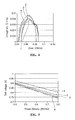
- the electrochemical measurements were conducted using a potentiostat/ galvanostat (Parstat® 2273), and power-generating characteristics at 750°C in 50% H 2 in N 2 at 0.8 V polarization potential as a function of time were measured. The results are shown in FIGS. 4 and 5 .
- Cell g was prepared for comparison purposes in similar as described above, but with all ingredients combined in a single step instead of adding part of the CaO 3 and pore former in a second stage.
- a control cell was prepared in similar fashion as described above, but without any CaO 3 .
- Impedance of the cells at 0.8 V is shown in FIG. 4
- power density versus cell voltage is shown in FIG. 5 .
- plot line 1 represents cell g
- plot line 2 represents cell g'
- plot line 3 represents cell g
- plot line 4 represents the control cell.
- the cells g and g' exhibit reduced impedance compared to the g" and control cells, and also exhibit 12% and 25% improvements in power density, respectively.
Landscapes
- Chemical & Material Sciences (AREA)
- Engineering & Computer Science (AREA)
- Ceramic Engineering (AREA)
- Organic Chemistry (AREA)
- Materials Engineering (AREA)
- Manufacturing & Machinery (AREA)
- Structural Engineering (AREA)
- Electrochemistry (AREA)
- General Chemical & Material Sciences (AREA)
- Chemical Kinetics & Catalysis (AREA)
- Life Sciences & Earth Sciences (AREA)
- General Life Sciences & Earth Sciences (AREA)
- Geology (AREA)
- Inorganic Chemistry (AREA)
- Composite Materials (AREA)
- Sustainable Development (AREA)
- Sustainable Energy (AREA)
- Inert Electrodes (AREA)
Abstract
Description
- Fuel cells for combining hydrogen and oxygen to produce electricity are well known. One known class of fuel cells is referred to as solid oxide fuel cells (SOFC's). An SOFC generally consists of a cathode and an anode physically separated by a solid oxide electrolyte, and electrically connected by an external electrical circuit. During operation of an SOFC, oxygen is provided to the cathode of the cell while hydrogen-containing fuel is provided to the anode. Oxygen is catalytically reduced at and diffuses through the cathode to reach the solid electrolyte. The solid electrolyte is permeable to the oxygen anions, which diffuse across the electrolyte to the anode where they combine with hydrogen to form water and release electrons, which flow through the external circuit to the cathode to provide the source of electrons for the catalytic reduction of oxygen, thereby generating electricity.
- The cathode of an SOFC must satisfy a combination of criteria, including but not limited to catalytic activity, electrical conductivity (both ionic and electronic conductivity), electronic structure, stability, structural integrity, thermal expansion, and the like, all at operating conditions such as high temperatures in excess of 800°C. A class of materials that have used for SOFC cathode applications is the mixed ionic and electronic conducting (MIEC) materials such as perovskite-type ABO3 oxides. The general chemical formula for perovskite compounds is ABX3, wherein 'A' and 'B' are two cations of very different sizes, and X is an anion that bonds to both. The native titanium mineral perovskite itself is of the formula CaTiO3. The 'A' atoms are larger than the 'B' atoms. The ideal cubic-symmetry structure has the B cation in 6-fold coordination, surrounded by an octahedron of anions, and the A cation in 12-fold cuboctahedral coordination. The relative ion size requirements for stability of the cubic structure are quite stringent, so slight buckling and distortion can produce several lower-symmetry distorted versions, in which the coordination numbers of A cations, B cations, or both are reduced.
- Mixed oxide materials comprising lanthanum (La), strontium (Sr), cobalt (Co), and iron (Fe), also known as "LSCF", of have been proposed in the prior art as materials for SOFC cathodes due to their high catalytic activity for the oxygen exchange reaction and a high electronic conductivity for current collection. One proposed formulation is characterized by the general formula La1-xSrxCo1-yFeyO3-δ. The physical and chemical properties of this class of materials, such as electrical conductivity, electronic structure, catalytic activity, stability, and thermal expansion coefficient ("TEC"), have been studied in detail. Generally, electronic and ionic conductivities and catalytic activity are enhanced with increasing values of x and decreasing values of y, whereas there is an opposite tendency for chemical stability.
- Although many of the materials proposed for SOFC cathodes have been effective to varying degrees, alternative materials that offer better performance, reliability, cost, or combination of these or other parameters.
- These and other advantages and features will become more apparent from the following description taken in conjunction with the drawings.
- As described in further detail below, a solid state sintered material comprises a mixed oxide comprising lanthanum, strontium, cobalt, iron and oxygen, and inclusions comprising calcium carbonate. In some exemplary embodiments, the solid state sintered material also includes calcium oxide, which can form from thermal composition of calcium carbonate. In some embodiments, the solid state sintered material includes a pore-forming particulate material such as carbon black. In some embodiments, the solid state sintered material further comprises a doped ceramic metal oxide such as Sm-doped ceria, which can be uniformly dispersed in the solid state sintered material. The solid state sintered material described herein can be used as a cathode material for solid oxide fuel cell.
- The solid state LSCF material carbonate can be prepared by:
- (1) forming a mixture comprising calcium carbonate and a mixed oxide comprising lanthanum, strontium, cobalt, and iron;
- (2) milling and drying the mixture from (1);
- (3) heating the dried mixture from (2) to form porous agglomerates;
- (4) forming a paste comprising an organic binder, the porous agglomerates from (3), and additional calcium carbonate; and
- (4) sintering the paste from (4) under pressure and temperature conditions to cause solid state sintering.
- In some embodiments, the mixture in (1) and/or the mixture in (4) can also include added pore-forming material such as carbon black. In some embodiments, the mixture in (1) and/or the mixture in (4) can include an added doped ceramic metal oxide ionic conductor such as Sm-doped ceria.
- The foregoing and other features, and advantages of the invention are described in the following detailed description taken in conjunction with the accompanying drawings in which:
-
FIG. 1 depicts a perovskite crystal structure; -
FIG. 2 schematically illustrates an exemplary solid oxide fuel cell configuration as described herein; -
FIG. 3 depicts a photomicrograph of an exemplary solid state material as described herein; -
FIG. 4 is an impedance plot of a solid oxide fuel cell prepared as described herein; and -
FIG. 5 is a plot of power density versus cell voltage of a solid oxide fuel cell prepared as described herein. - The solid state sintered material described herein can be prepared by mixing powders of metal salts and/or oxides in the appropriate amounts to provide the desired ratio of the various elemental components of the desired mixed oxide comprising lanthanum, strontium, cobalt, iron, and oxygen. Exemplary salts or oxides include La2O3, SrCO3, CoCO3, and Fe2O3 as starting materials for the mixed oxide.
- Mixing of the metal oxide and/or salt powders can be accomplished by known metal/oxide powder mixing techniques such as ball milling in solvent. Starting particle sizes can vary widely depending on supplier specifications, and final particle sizes of the mixture after milling can range from 0.5 µm to 5.0 µm, more specifically about 1.0 µm d50 mean particle size being typical. Milling times can range from 0.5 to 20 hours, more specifically about 6 hours. After milling and drying the resulting mixture comprising metal oxide and/or salt powder can be calcined (e.g., at 1150°C to 1300°C for 20 to 10 hours) to promote the formation of LSCF crystal structures such as the LSCF 6428 crystal structure, followed by additional milling to produce an LSCF powder.
- LSCF 6428 materials can be characterized by the formation of perovskite crystal structures of the type that tend to form from tend to form from the mixture having the elements in the ratio La0.6Sr0.4Co0.2Fe0.8O3-δ, where δ is 0-0.2. An exemplary perovskite crystal structure is depicted in
FIG. 1 , where aperovskite lattice structure 10 comprises a central B-site cation 12 surrounded by a square double pyramid lattice of sixoxygen ions 14 in turn surrounded by a cubic lattice of eightA-site cations 16. LSCF 6428 materials comprise perovskite crystal structures where the A-sites are occupied by La and Sr ions, and the B-sites are occupied by Co and Fe ions that surroundoxygen ions 14. - As known in the art, the mixture from which an LSCF 6428 material is formed is not required to precisely match the 6:4:2:8 molar ratio of La:Sr:Co:Fe, and it is known in the art to modify the ratio of components so that some of the A-sites, such as site 16', which would otherwise hold an La or Sr ions, are left vacant. Various compositions such as La1-xSrxCo1-yFeyO3-δ or (La0.6Sr0.4)1-zCO0.2Fe0.8+bO3-δ, have been proposed as a mixed ionic and electronic conducting ("MIEC") material for use as or in a solid oxide fuel cell cathode. Other LSCF materials of the 6428 type are disclosed in US pat. app. publ. no. 2011/0143255 A1, the disclosure of which is incorporated herein by reference in its entirety. Such LSCF 6428 materials can be characterized by the formula La1-x-2zSrx+zCo0.2+aFe0.8+bO3-δ, where x can equal 0.4, z can be 0 to 0.1, a can be 0.01 to 0.04, and b can be 0.05 to 0.15.
- Calcium carbonate, as the source for the inclusions comprising calcium carbonate in the solid state sintered material, can be incorporated in the mixture during the milling of the metal oxide and/or salt powders, and/or during post-calcining milling of the LSCF material. Calcium carbonate starting particle sizes can vary depending on factors such as the milling protocol, and can generally range from 50 µm to 20 µm As calcium carbonate tends to thermally decompose to calcium oxide under calcining conditions, incorporation of calcium carbonate during post-calcining milling of the LSCF material avoids subjecting it to the first calcining, and can thereby provide more significant amounts of residual calcium carbonate in the inclusions and/or provide larger inclusions in the solid state sintered material. Calcium carbonate can be included in the final composition in amounts of from 0.5 wt.% to 10 wt.%, more specifically from 2-6 wt.%.
- The solid state materials comprising lanthanum, strontium, cobalt, and iron can also include other materials such as ionic conductors as a mechanical mixture, which can promote the ionic conducting of the composite cathode in the final solid state material. Exemplary doped ceramic metal oxides include ceria doped with Y2O3, Gd2O3, Nd2O3, Sm2O3 or Yb2O3. In more specific embodiments, the doped ceramic metal oxide can be Sm-doped ceria such as Ce0.8Sm0.2O3. Ionic conductors like doped ceramic metal oxides can be included in an amount of from 0 wt.% to 60 wt.%, more specifically from 25 wt.% to 50 wt.%, of the amount of the LSCF mixed oxide [see discussion. The doping level may be about 3 mole % to about 30 mole %, more specifically about 10 mole % to about 20 mole %. The amount of ionic conducting phase in the MIEC material may be varied from about 0 wt % to about 60 wt %, more specifically about 25 wt % to about 50 wt %. In some embodiments, an SOFC cathode will include a layer or segments comprising LSCF and an ionic conductor like samaria-doped ceria (SDC), also referred to an SDCF layer or segment, which have mixed ionic and electronic conductivity with a higher level of ionic conductivity than other portions of the electrode formed from LSCF without the ionic conductor. In other embodiments, presence of the CaCO3 material and its decomposition product CaO can allow for the ionic conductor (e.g., SDC) to be uniformly dispersed in the solid state sintered material, which provides for reduced complexity of manufacturing.
- The mixtures out of which the solid state LSCF materials are formed can also include a pore former. The purpose of a pore former is to enable the formation of low resistance gas diffusion paths. Pore formers are materials that decompose to leave the desired porosity in the sintered layer. For example, carbon black, flour, starch, non-soluble organics such as poly(methyl methacrylate), or mixtures comprising any of the foregoing, can be used as pore formers. The amount of pore formers may vary from about 0 wt % to about 100 wt % of the solid phase or even higher, more specifically from 10 wt % to 50 wt %.
- Solid state LSCF materials can be prepared by sintering techniques where powdered LSCF material is mixed with resin binder to form a paste, which is then deposited onto a substrate like an anode-supported electrolyte and sintered under conditions conducive to solid state sintering. Solid state sintering well-known in the art and is characterized by grain growth that occurs in so-called "neck regions", i.e., interstitial spaces between grains of the material being sintered are filled with new crystals or grain growth from atoms that have diffused from the initial grains to the neck regions. This growth of new material in the neck regions between the grains transforms the individual grains into a solid state cohesive material. Of course, a certain degree of porosity is needed in order for oxygen to be able to diffuse through an SOFC cathode, so solid state sintering is typically controlled to limit the amount of grain growth into the neck regions of the material in order to provide desired physical and electrical properties while maintaining desired levels of porosity. Conditions conducive to solid state sintering of LSCF materials can include 900°C to 1050°C for 0.5-6 hours.
- The solid state LSCF material having inclusions comprising calcium carbonate can be prepared by:
- (1) forming a mixture comprising calcium carbonate and a mixed oxide comprising lanthanum, strontium, cobalt, and iron;
- (2) milling and drying the mixture from (1);
- (3) heating the dried mixture from (2) to form porous agglomerates;
- (4) forming a paste comprising an organic binder, the porous agglomerates from (3), and additional calcium carbonate; and
- (4) sintering the paste from (4) under pressure and temperature conditions to cause solid state sintering.
- The above-described method involves adding the calcium carbonate in two portions: a first portion in (1) and a second portion in (4). In some embodiments of this method, from 30-70 wt.%, more specifically from 40-60 wt.%, and even more specifically about 50 wt.% of the total amount of calcium carbonate to be used in the solid state material is milled in solvent with the LSCF material. More specifically, the mixture in (1) can comprise from 0.1 wt.% to 5 wt.%, more specifically from 2 wt.% to 4.5 wt.%, and even more specifically from 3 wt.% to 4 wt.% of calcium carbonate. In some embodiments, the mixture in (1) can include a pore former, which can be present in amounts of 0.5 wt.% to 20 wt.%, more specifically from 2 wt.% to 10 wt.%, and even more specifically from 4 wt.% to 8 wt.% of the mixture.
- In some embodiments, the mixture in (1) further comprises a doped ceramic metal oxide ionic conductor. The doped ceramic metal oxide can be incorporated into the mixture in (1) in the form of a material that is prepared by mechanically mixing (e.g., by ball milling in solvent) the metal oxide and/or salt components used to make an LSCF material with a doped ceramic metal oxide ionic conductor (e.g., SDC). In these embodiments, the mixture in (1) would comprise an LSCF material and a composite material such as SDCF containing LSCF and a doped ceramic metal oxide ionic conductor. Such a composite material can comprise from 50-80 wt.% of LSCF, more specifically from 65-75 wt.%, and even more specifically about 70 wt.%, with the balance being an ionic conductor like SDC. Alternatively, the doped ceramic metal oxide ionic conductor can be incorporated during the preparation of the LSCF material, in which case the mixture in (1) would be all SDCF (plus CaCO3 and any pore former or other additives), but with a lower amount of ionic conductor (compared to SDCF that is mixed with LSCF) to achieve the same target amount of ionic conductor in the final material. Overall levels of doped ceramic metal oxide ionic conductor in the solid state material can range from 0-60 wt.%, more specifically from 25-50 wt.%, and even more specifically from 30-35 wt.%.
- The mixture formed in (1) according to the above-described method is is milled (e.g., 0.5 to 20 hours) and then dried and heated, typically in air to form porous agglomerates. Heating temperatures can range from 400°C to 1100°C, more specifically from 600°C to 900°C, and even more specifically about 750°C. Heating times can range from 30 minutes to 2 hours, more specifically from 45 minutes to 1.5 hours, and even more specifically about 1 hour. This heating procedure to create porous agglomerates helps optimize ionic conductivity and oxygen bulk diffusion, along with surface exchange coefficients of the material. After heating to form the porous agglomerates, the porous agglomerate material is mixed with additional calcium carbonate, an organic binder, and optionally additional pore former to form a pre-sintering paste. The amount of calcium carbonate added in this stage of the process can range from 0.1wt.% to 5 wt.%, more specifically from 2 wt.% to 4.5 wt.%, and even more specifically from 3 wt.% to 4 wt.% of calcium carbonate. In some embodiments, the mixture in (4) can include additional pore former, which can be present in amounts of 0.5 wt.% to 20 wt.%, more specifically from 2 wt.% to 10 wt.%, and even more specifically from 4 wt.% to 8 wt.% of the mixture. The resin can be any of the known types for making pre-sintering pastes, including polyvinylbutryal, ethylcellulose, or acrylic, and is typically present in an amount of 7-14 wt.%, more specifically 8-12 wt.%, and even more specifically about 10 wt.%, based on the total weight of the binder vehicle used for making the paste (solids 60 wt.%).
- The paste is then deposited on a suitable support such as an anode-supported solid electrolyte and sintered (e.g., at 1050°C) to form the solid state material over a doped ceria-containing SDCF layer. As discussed above, sintering conditions are set to promote solid state sintering while producing a microstructure with a desired surface area to volume ratio, porosity, and path tortuosity for oxygen diffusion. The sintering time at the peak temperature can range from 0.5 hours to 6 hours, and can be adjusted to optimize the pore size around the calcite particle. The resulting material can have total porosity of about 20-25% distributed between fine pores and large pores around the CaCO3 inclusions. Although the operation of the present invention is not bound by any particular theory, it is believed that the CaCO3 during sintering partially decomposes to CaO, wets the surfaces of LSCF, SDCF, and pore walls, assists in the oxygen reaction occurring at the cathode, and reduces tortuosity of the cathode by creating large pores and thus works as an electrochemical sintering aid. It does not promote densification of LSCF, form other phases, or reduce its electronic conductivity. The pore former (e.g., carbon black) is also believed to assist in achieving a cathode with high surface area/volume with low tortuosity gas diffusion paths.
- The invention is further described below in the following non-limiting example(s).
- A uniformly mixed SOFC cathode material was obtained by milling 63 g LSCF, 27 g SDCF (LSCF doped with 27 wt. % of SDC, 6.5 g carbon black, and 3.5g CaCO3 in ethanol using zirconia media (4 mm) for 6 hours. The milled material was then collected and dried. The milled material was then heated in air at 750°C for 1 hour to create porous agglomerates. Next 90 g of the resulting porous LSCF/SDCF/CaCO3 agglomerated mix material, 6.5 g of carbon black, and 3.5 g of CaCO3 were added and a 70% solids paste was prepared using an organic binder vehicle. This material was used in the preparation of an SOFC as shown in
FIG. 2 . As shown inFIG. 2 , solidoxide fuel cell 20 has Ni-YSZ anode support 22 disposed on one side ofYSZ electrolyte 24. On the other side ofYSZ electrolyte 24 is disposed, in order, aporous SDCF layer 26, alayer 28 of the mixed LSCF/SDCF/CaO3/carbon black paste described above, and a silver-palladiumcurrent collector layer 30. Compared to some prior art cells utilizing MIEC's enhanced with an ionic conductor, thesingle layer 28 is used in place of two separate layers of a LSCF/SDCF mix layer and an LSCF layer, thus significantly simplifying the manufacturing process. - On two 1" diameter substrates labeled as cell (g) and cell (g') with 12 micron thick YSZ electrolyte supported on a 0.45 mm Ni/YSZ anode, a 5 µm thick layer of an SDCF layer and a 30 µm thick of the mixed LSCF/SDCF/CaO3/carbon black paste described above were screen printed, dried, and sintered at 1050°C for 1.5 hour to form a cathode. The resulting structure and materials are typified by the micrograph shown in
Fig. 3 , which shows the YSZ electrolyte as the lower-most layer, the SDCF layer above the YSZ electrolyte, and the mixed LSCF/SDCF/CaO3/carbon black layer as the uppermost layer. Next, a noble metal layer of Ag-Pd was screen printed onto the cathode and sintered at 1000°C to form a current collector. Next, silver and nickel meshes with platinum lead wires and pastes were attached to measure the cell performance. Finally onto cell (g') a 1 molar solution of Sm0.5Sr0.5CoO3 using corresponding nitrate precursors was prepared and dispensed on the 2.5 cm2 cathode surface to further improve the power performance. This amount of solution dripped onto the cathode, after drying at 110°C to 400°C for sufficient time (e.g., 5 to 30 minutes) results in about a 7-10 mg increase in the mass of the cell. Alternatively, Pd or any other electro-catalyst (La0.6Sr01.4CoO3-δ ("LSCo"), SrCo0.8Fe0.2O3-δ ("SCF")), and LSCF) can be dripped and dried to impregnate the cathode and improve the power performance by enhancing the oxygen reduction reaction. - For measuring the power performance, the air and fuel sides of the cells were isolated using a glass sealing material. The NiO/YSZ composite anode was reduced, in situ, at 800°C for 1 hour in a hydrogen gas atmosphere (50% H2 in N2). The cathode side of the cell was exposed to flowing air at a rate of 2.3 liters/min and the anode side was exposed to a flowing stream of 50% hydrogen at a rate of 2.3 liters/min. The electrochemical measurements were conducted using a potentiostat/ galvanostat (Parstat® 2273), and power-generating characteristics at 750°C in 50% H2 in N2 at 0.8 V polarization potential as a function of time were measured. The results are shown in
FIGS. 4 and 5 . Cell g" was prepared for comparison purposes in similar as described above, but with all ingredients combined in a single step instead of adding part of the CaO3 and pore former in a second stage. A control cell was prepared in similar fashion as described above, but without any CaO3. Impedance of the cells at 0.8 V is shown inFIG. 4 , and power density versus cell voltage is shown inFIG. 5 . InFIGS. 4 and 5 ,plot line 1 represents cell g,plot line 2 represents cell g',plot line 3 represents cell g", andplot line 4 represents the control cell. The cells g and g' exhibit reduced impedance compared to the g" and control cells, and also exhibit 12% and 25% improvements in power density, respectively. Part of the reduction in cell impedance is believed to be due to the improved microstructure (cell g & g') itself and the remainder is believed to be due to improved electrode oxygen reaction due to a thin physical coating of CaO and high conductivity electrocatalytic phase on electrode surfaces and pores. These factors can help provide reduced non-charge and charge transfer resistances at 750°C in 50% H2 in N2 and 0.8V polarization and, as shown inFig. 5 , cells g' and g achieve 12% and 25% improvement in the power density, respectively.
Claims (14)
- A solid state sintered material comprising a mixed oxide comprising lanthanum, strontium, cobalt, iron and oxygen, and inclusions comprising calcium carbonate.
- Solid state sintered material as set in the preceding claim, further comprising calcium oxide.
- Solid state sintered material as set in claims 1 or 2, wherein said inclusions further comprise a pore-forming particulate material.
- Solid state sintered material as set in claim 3, wherein said pore-forming particulate material comprises carbon black, flour, starch, poly(methyl methacrylate), or mixtures comprising any of the foregoing.
- Solid state sintered material as set in any of claims 1 to 4, wherein said inclusions are derived from agglomerates comprising calcium carbonate that have been subjected to partial thermal decomposition of the calcium carbonate to calcium oxide.
- Solid state sintered material as set in claim 5, wherein said agglomerates further comprise a pore-forming material.
- Solid state sintered material as set in claim 6, wherein said pore-forming material comprises carbon black, flour, starch, poly(methyl methacrylate), or mixtures comprising any of the foregoing.
- Solid state sintered material as set any of claims 1-7, further comprising a doped ceramic metal oxide ionic conductor.
- Solid state sintered material as set in claim 8, wherein the doped ceramic metal oxide comprises ceria doped with Y2O3, Gd2O3, Nd2O3, Sm2O3, or Yb2O3.
- Solid state sintered material as set in claim 8, wherein the doped ceramic metal oxide is according to the formula Ce0.8Sm0.2O3.
- A solid oxide fuel cell (20) having a cathode (28) that comprises the solid state sintered material as set in any of the preceding claims.
- A method of making a solid state sintered material, comprising:(1) forming a mixture comprising calcium carbonate and a mixed oxide comprising lanthanum, strontium, cobalt, and iron;(2) milling and drying the mixture from (1);(3) heating the dried mixture from (2) to form porous agglomerates;(4) forming a paste comprising an organic binder, the porous agglomerates from (3), and additional calcium carbonate; and(4) sintering the paste from (4) under pressure and temperature conditions to cause solid state sintering, wherein the sintering in (4) is performed under a temperature of 900°C to 1070°C for 0.5 to 6 hours.
- Method as set in claim 12, wherein the mixture from (1) further comprises a pore-forming material, wherein the paste from (4) further comprises additional pore-forming material, wherein said pore-forming material comprises carbon black, flour, starch, poly(methyl methacrylate), or mixtures comprising any of the foregoing.
- Method as set in claims 12 or 13, wherein the mixture in (1) further comprises a doped ceramic metal oxide ionic conductor, wherein the doped ceramic metal oxide comprises ceria doped with Y2O3, Gd2O3, Nd2O3, Sm2O3, or Yb2O3, or wherein the doped ceramic metal oxide is according to the formula Ce0.8Sm0.2O3.
Applications Claiming Priority (1)
| Application Number | Priority Date | Filing Date | Title |
|---|---|---|---|
| US13/714,564 US9005490B2 (en) | 2012-12-14 | 2012-12-14 | Material for solid state sintered material |
Publications (1)
| Publication Number | Publication Date |
|---|---|
| EP2743245A1 true EP2743245A1 (en) | 2014-06-18 |
Family
ID=49766869
Family Applications (1)
| Application Number | Title | Priority Date | Filing Date |
|---|---|---|---|
| EP13195597.3A Withdrawn EP2743245A1 (en) | 2012-12-14 | 2013-12-04 | Material for solid state sintered material. |
Country Status (2)
| Country | Link |
|---|---|
| US (1) | US9005490B2 (en) |
| EP (1) | EP2743245A1 (en) |
Cited By (2)
| Publication number | Priority date | Publication date | Assignee | Title |
|---|---|---|---|---|
| CN108808047A (en) * | 2018-05-07 | 2018-11-13 | 湖北大学 | LSCF/Na2CO3Nanocomposite is the preparation method of fuel cell ion transport layer |
| CN109571294A (en) * | 2019-01-25 | 2019-04-05 | 广州金谷钻石工具有限公司 | A kind of diamond cutter head containing pore forming particles |
Families Citing this family (3)
| Publication number | Priority date | Publication date | Assignee | Title |
|---|---|---|---|---|
| EP3616701A1 (en) | 2011-06-24 | 2020-03-04 | GRI Bio, Inc. | Prevention and treatment of inflammatory conditions |
| JP6858519B2 (en) * | 2016-09-21 | 2021-04-14 | 日東電工株式会社 | Sheet for heat bonding and sheet for heat bonding with dicing tape |
| CN113667998A (en) * | 2021-09-15 | 2021-11-19 | 北京思伟特新能源科技有限公司 | Reversible solid oxide electrolytic cell and preparation method thereof |
Citations (5)
| Publication number | Priority date | Publication date | Assignee | Title |
|---|---|---|---|---|
| JP2002118012A (en) * | 1997-12-25 | 2002-04-19 | Hitachi Metals Ltd | Ferrite magnet, rotary machine and magnet roll using the same |
| US20040021240A1 (en) * | 2002-07-31 | 2004-02-05 | Hancun Chen | Ceramic manufacture for a composite ion transport membrane |
| EP1652829A2 (en) * | 2004-10-29 | 2006-05-03 | TDK Corporation | Ferrite magnetic material and process for producing the same |
| EP2333882A2 (en) * | 2009-12-11 | 2011-06-15 | Delphi Technologies, Inc. | Perovskite materials for solid oxide fuel cell cathodes |
| EP2452928A1 (en) * | 2009-07-08 | 2012-05-16 | TDK Corporation | Ferrite magnetic material |
Family Cites Families (2)
| Publication number | Priority date | Publication date | Assignee | Title |
|---|---|---|---|---|
| US5922486A (en) * | 1997-05-29 | 1999-07-13 | The Dow Chemical Company | Cosintering of multilayer stacks of solid oxide fuel cells |
| US9276267B2 (en) * | 2008-09-23 | 2016-03-01 | Delphi Technologies, Inc. | Low-temperature bonding of refractory ceramic layers |
-
2012
- 2012-12-14 US US13/714,564 patent/US9005490B2/en active Active
-
2013
- 2013-12-04 EP EP13195597.3A patent/EP2743245A1/en not_active Withdrawn
Patent Citations (6)
| Publication number | Priority date | Publication date | Assignee | Title |
|---|---|---|---|---|
| JP2002118012A (en) * | 1997-12-25 | 2002-04-19 | Hitachi Metals Ltd | Ferrite magnet, rotary machine and magnet roll using the same |
| US20040021240A1 (en) * | 2002-07-31 | 2004-02-05 | Hancun Chen | Ceramic manufacture for a composite ion transport membrane |
| EP1652829A2 (en) * | 2004-10-29 | 2006-05-03 | TDK Corporation | Ferrite magnetic material and process for producing the same |
| EP2452928A1 (en) * | 2009-07-08 | 2012-05-16 | TDK Corporation | Ferrite magnetic material |
| EP2333882A2 (en) * | 2009-12-11 | 2011-06-15 | Delphi Technologies, Inc. | Perovskite materials for solid oxide fuel cell cathodes |
| US20110143255A1 (en) | 2009-12-11 | 2011-06-16 | Jain Kailash C | Perovskite Materials for Solid Oxide Fuel Cell Cathodes |
Cited By (2)
| Publication number | Priority date | Publication date | Assignee | Title |
|---|---|---|---|---|
| CN108808047A (en) * | 2018-05-07 | 2018-11-13 | 湖北大学 | LSCF/Na2CO3Nanocomposite is the preparation method of fuel cell ion transport layer |
| CN109571294A (en) * | 2019-01-25 | 2019-04-05 | 广州金谷钻石工具有限公司 | A kind of diamond cutter head containing pore forming particles |
Also Published As
| Publication number | Publication date |
|---|---|
| US20140166941A1 (en) | 2014-06-19 |
| US9005490B2 (en) | 2015-04-14 |
Similar Documents
| Publication | Publication Date | Title |
|---|---|---|
| US8124037B2 (en) | Perovskite materials for solid oxide fuel cell cathodes | |
| CN101847725B (en) | Cathode material of solid oxide fuel cell in A omission type perovskite structure | |
| US9017897B2 (en) | Metal composite material for attachment to ceramic | |
| Wang et al. | Electrochemical characteristics of nano-structured PrBaCo2O5+ x cathodes fabricated with ion impregnation process | |
| Zhu et al. | Novel BaCo0. 7Fe0. 3− yNbyO3− δ (y= 0–0.12) as a cathode for intermediate temperature solid oxide fuel cell | |
| US10305116B2 (en) | Cost-effective solid state reactive sintering method for protonic ceramic fuel cells | |
| AU2004216002A1 (en) | Porous electrode, solid oxide fuel cell, and method of producing the same | |
| US20040214069A1 (en) | Perovskite electrodes and method of making the same | |
| KR20130099704A (en) | Functional layer material for solid oxide fuel cell, functional layer manufactured using the material and solid oxide fuel cell including the functional layer | |
| JP2012528438A (en) | Cathode | |
| Li et al. | Electrochemical characterization of gradient Sm0. 5Sr0. 5CoO3− δ cathodes on Ce0. 8Sm0. 2O1. 9 electrolytes for solid oxide fuel cells | |
| US9005490B2 (en) | Material for solid state sintered material | |
| Zhang et al. | A novel composite cathode for intermediate temperature solid oxide fuel cell | |
| Jafari et al. | Enhancement of an IT-SOFC cathode by introducing YSZ: Electrical and electrochemical properties of La0. 6Ca0. 4Fe0. 8Ni0. 2O3-δ-YSZ composites | |
| US20120308915A1 (en) | Cathode material for fuel cell, cathode including the cathode material, solid oxide fuel cell including the cathode | |
| Yi et al. | Electrochemical performance of La1. 5Sr0. 5Ni1-xFexO4+ δ cathode for IT-SOFCs | |
| Chaianansutcharit et al. | Ni doped PrSr3Fe3O10-δ Ruddlesden-Popper oxide for active oxygen reduction cathode for solid oxide fuel cell | |
| Zhu et al. | Performance evaluation of Ca3Co4O9-δ cathode on Sm0. 075Nd0. 075Ce0. 85O2-δ electrolyte for solid oxide fuel cells | |
| Fang et al. | An active and durable air electrode with self-generated nanoparticles decorated on the surface for reversible oxygen-ionic ceramic electrochemical cells | |
| US9914649B2 (en) | Electro-catalytic conformal coatings and method for making the same | |
| KR101642427B1 (en) | Method for manufacturing anode material for solid oxide fuel cell | |
| JP3729194B2 (en) | Solid oxide fuel cell | |
| Bu et al. | Composites of single/double perovskites as cathodes for solid oxide fuel cells | |
| KR20120123639A (en) | Cathode material for fuel cell, cathode for fuel cell and solid oxide fuel cell including the material | |
| CN100508259C (en) | Multiple phase electrocatalysis material and preparation method thereof |
Legal Events
| Date | Code | Title | Description |
|---|---|---|---|
| PUAI | Public reference made under article 153(3) epc to a published international application that has entered the european phase |
Free format text: ORIGINAL CODE: 0009012 |
|
| 17P | Request for examination filed |
Effective date: 20131204 |
|
| AK | Designated contracting states |
Kind code of ref document: A1 Designated state(s): AL AT BE BG CH CY CZ DE DK EE ES FI FR GB GR HR HU IE IS IT LI LT LU LV MC MK MT NL NO PL PT RO RS SE SI SK SM TR |
|
| AX | Request for extension of the european patent |
Extension state: BA ME |
|
| R17P | Request for examination filed (corrected) |
Effective date: 20141218 |
|
| RBV | Designated contracting states (corrected) |
Designated state(s): AL AT BE BG CH CY CZ DE DK EE ES FI FR GB GR HR HU IE IS IT LI LT LU LV MC MK MT NL NO PL PT RO RS SE SI SK SM TR |
|
| STAA | Information on the status of an ep patent application or granted ep patent |
Free format text: STATUS: THE APPLICATION IS DEEMED TO BE WITHDRAWN |
|
| 18D | Application deemed to be withdrawn |
Effective date: 20170701 |