EP2740735A1 - Condensed polycyclic aromatic compound, aromatic polymer, and method for synthesizing aromatic compound - Google Patents
Condensed polycyclic aromatic compound, aromatic polymer, and method for synthesizing aromatic compound Download PDFInfo
- Publication number
- EP2740735A1 EP2740735A1 EP12822644.6A EP12822644A EP2740735A1 EP 2740735 A1 EP2740735 A1 EP 2740735A1 EP 12822644 A EP12822644 A EP 12822644A EP 2740735 A1 EP2740735 A1 EP 2740735A1
- Authority
- EP
- European Patent Office
- Prior art keywords
- group
- carbon atoms
- substituted
- unsubstituted aromatic
- independently selected
- Prior art date
- Legal status (The legal status is an assumption and is not a legal conclusion. Google has not performed a legal analysis and makes no representation as to the accuracy of the status listed.)
- Withdrawn
Links
- 125000003118 aryl group Chemical group 0.000 title claims abstract description 168
- 238000000034 method Methods 0.000 title claims abstract description 105
- -1 polycyclic aromatic compound Chemical class 0.000 title claims abstract description 94
- 230000002194 synthesizing effect Effects 0.000 title claims abstract description 41
- 229920000642 polymer Polymers 0.000 title claims description 51
- 150000001491 aromatic compounds Chemical class 0.000 title claims description 13
- 125000005843 halogen group Chemical group 0.000 claims abstract description 121
- 125000004435 hydrogen atom Chemical group [H]* 0.000 claims abstract description 113
- 125000000217 alkyl group Chemical group 0.000 claims abstract description 111
- 125000001997 phenyl group Chemical group [H]C1=C([H])C([H])=C(*)C([H])=C1[H] 0.000 claims abstract description 38
- 229910052798 chalcogen Inorganic materials 0.000 claims abstract description 34
- 150000001787 chalcogens Chemical class 0.000 claims abstract description 34
- 125000004432 carbon atom Chemical group C* 0.000 claims description 634
- 150000001875 compounds Chemical class 0.000 claims description 175
- 239000004065 semiconductor Substances 0.000 claims description 96
- 125000003368 amide group Chemical group 0.000 claims description 65
- 125000003277 amino group Chemical group 0.000 claims description 60
- 125000005462 imide group Chemical group 0.000 claims description 60
- 125000000468 ketone group Chemical group 0.000 claims description 60
- 125000000101 thioether group Chemical group 0.000 claims description 60
- 125000003342 alkenyl group Chemical group 0.000 claims description 59
- 125000000304 alkynyl group Chemical group 0.000 claims description 59
- 238000006243 chemical reaction Methods 0.000 claims description 53
- 239000003960 organic solvent Substances 0.000 claims description 43
- 125000001424 substituent group Chemical group 0.000 claims description 23
- 239000000758 substrate Substances 0.000 claims description 23
- 229910052736 halogen Inorganic materials 0.000 claims description 18
- 150000002367 halogens Chemical class 0.000 claims description 18
- 229910052739 hydrogen Inorganic materials 0.000 claims description 15
- 239000001257 hydrogen Substances 0.000 claims description 15
- 238000003477 Sonogashira cross-coupling reaction Methods 0.000 claims description 14
- 150000001336 alkenes Chemical class 0.000 claims description 14
- 239000000203 mixture Substances 0.000 claims description 14
- 238000000576 coating method Methods 0.000 claims description 13
- 125000004093 cyano group Chemical group *C#N 0.000 claims description 13
- 125000002887 hydroxy group Chemical group [H]O* 0.000 claims description 13
- 238000004519 manufacturing process Methods 0.000 claims description 13
- 239000011248 coating agent Substances 0.000 claims description 11
- 238000006411 Negishi coupling reaction Methods 0.000 claims description 10
- 238000005859 coupling reaction Methods 0.000 claims description 10
- 125000002827 triflate group Chemical group FC(S(=O)(=O)O*)(F)F 0.000 claims description 10
- UFHFLCQGNIYNRP-UHFFFAOYSA-N Hydrogen Chemical compound [H][H] UFHFLCQGNIYNRP-UHFFFAOYSA-N 0.000 claims description 8
- 238000010168 coupling process Methods 0.000 claims description 8
- 125000004185 ester group Chemical group 0.000 claims description 8
- 238000006619 Stille reaction Methods 0.000 claims description 6
- 125000003545 alkoxy group Chemical group 0.000 claims description 6
- 230000008878 coupling Effects 0.000 claims description 6
- 125000001033 ether group Chemical group 0.000 claims description 6
- 238000006443 Buchwald-Hartwig cross coupling reaction Methods 0.000 claims description 5
- 238000007341 Heck reaction Methods 0.000 claims description 5
- 238000006161 Suzuki-Miyaura coupling reaction Methods 0.000 claims description 5
- 125000003396 thiol group Chemical group [H]S* 0.000 claims description 5
- 230000001590 oxidative effect Effects 0.000 claims description 3
- 125000004055 thiomethyl group Chemical group [H]SC([H])([H])* 0.000 claims description 3
- 125000004492 methyl ester group Chemical group 0.000 claims 1
- 239000002243 precursor Substances 0.000 abstract description 3
- 125000004429 atom Chemical group 0.000 abstract 1
- HEDRZPFGACZZDS-UHFFFAOYSA-N Chloroform Chemical compound ClC(Cl)Cl HEDRZPFGACZZDS-UHFFFAOYSA-N 0.000 description 72
- IJGRMHOSHXDMSA-UHFFFAOYSA-N Atomic nitrogen Chemical compound N#N IJGRMHOSHXDMSA-UHFFFAOYSA-N 0.000 description 62
- 239000000243 solution Substances 0.000 description 49
- UHOVQNZJYSORNB-UHFFFAOYSA-N Benzene Chemical compound C1=CC=CC=C1 UHOVQNZJYSORNB-UHFFFAOYSA-N 0.000 description 48
- VLKZOEOYAKHREP-UHFFFAOYSA-N n-Hexane Chemical compound CCCCCC VLKZOEOYAKHREP-UHFFFAOYSA-N 0.000 description 48
- 239000010408 film Substances 0.000 description 46
- YXFVVABEGXRONW-UHFFFAOYSA-N Toluene Chemical compound CC1=CC=CC=C1 YXFVVABEGXRONW-UHFFFAOYSA-N 0.000 description 45
- 230000015572 biosynthetic process Effects 0.000 description 40
- 238000003786 synthesis reaction Methods 0.000 description 40
- 238000005160 1H NMR spectroscopy Methods 0.000 description 38
- YMWUJEATGCHHMB-UHFFFAOYSA-N Dichloromethane Chemical compound ClCCl YMWUJEATGCHHMB-UHFFFAOYSA-N 0.000 description 36
- 238000004949 mass spectrometry Methods 0.000 description 31
- 229910052757 nitrogen Inorganic materials 0.000 description 31
- XEKOWRVHYACXOJ-UHFFFAOYSA-N Ethyl acetate Chemical compound CCOC(C)=O XEKOWRVHYACXOJ-UHFFFAOYSA-N 0.000 description 30
- 238000010926 purge Methods 0.000 description 30
- RIOQSEWOXXDEQQ-UHFFFAOYSA-N triphenylphosphine Chemical compound C1=CC=CC=C1P(C=1C=CC=CC=1)C1=CC=CC=C1 RIOQSEWOXXDEQQ-UHFFFAOYSA-N 0.000 description 24
- ZMXDDKWLCZADIW-UHFFFAOYSA-N N,N-Dimethylformamide Chemical compound CN(C)C=O ZMXDDKWLCZADIW-UHFFFAOYSA-N 0.000 description 23
- KDLHZDBZIXYQEI-UHFFFAOYSA-N palladium Substances [Pd] KDLHZDBZIXYQEI-UHFFFAOYSA-N 0.000 description 23
- HEDRZPFGACZZDS-MICDWDOJSA-N Trichloro(2H)methane Chemical compound [2H]C(Cl)(Cl)Cl HEDRZPFGACZZDS-MICDWDOJSA-N 0.000 description 22
- AUHZEENZYGFFBQ-UHFFFAOYSA-N mesitylene Substances CC1=CC(C)=CC(C)=C1 AUHZEENZYGFFBQ-UHFFFAOYSA-N 0.000 description 22
- 239000002904 solvent Substances 0.000 description 22
- UAOMVDZJSHZZME-UHFFFAOYSA-N diisopropylamine Chemical compound CC(C)NC(C)C UAOMVDZJSHZZME-UHFFFAOYSA-N 0.000 description 21
- IAZDPXIOMUYVGZ-UHFFFAOYSA-N Dimethylsulphoxide Chemical compound CS(C)=O IAZDPXIOMUYVGZ-UHFFFAOYSA-N 0.000 description 18
- WYURNTSHIVDZCO-UHFFFAOYSA-N Tetrahydrofuran Chemical compound C1CCOC1 WYURNTSHIVDZCO-UHFFFAOYSA-N 0.000 description 18
- RTZKZFJDLAIYFH-UHFFFAOYSA-N Diethyl ether Chemical compound CCOCC RTZKZFJDLAIYFH-UHFFFAOYSA-N 0.000 description 17
- 125000000623 heterocyclic group Chemical group 0.000 description 17
- 239000000460 chlorine Substances 0.000 description 16
- 238000001308 synthesis method Methods 0.000 description 16
- WEVYAHXRMPXWCK-UHFFFAOYSA-N Acetonitrile Chemical compound CC#N WEVYAHXRMPXWCK-UHFFFAOYSA-N 0.000 description 15
- OKKJLVBELUTLKV-UHFFFAOYSA-N Methanol Chemical compound OC OKKJLVBELUTLKV-UHFFFAOYSA-N 0.000 description 15
- 239000002994 raw material Substances 0.000 description 15
- 101150041968 CDC13 gene Proteins 0.000 description 14
- LDDNRNSKVVDQCS-UHFFFAOYSA-N 3-methylsulfanylnaphthalene-2-carbaldehyde Chemical compound C1=CC=C2C=C(C=O)C(SC)=CC2=C1 LDDNRNSKVVDQCS-UHFFFAOYSA-N 0.000 description 13
- 238000010438 heat treatment Methods 0.000 description 13
- MZRVEZGGRBJDDB-UHFFFAOYSA-N N-Butyllithium Chemical compound [Li]CCCC MZRVEZGGRBJDDB-UHFFFAOYSA-N 0.000 description 12
- IMNFDUFMRHMDMM-UHFFFAOYSA-N N-Heptane Chemical compound CCCCCCC IMNFDUFMRHMDMM-UHFFFAOYSA-N 0.000 description 12
- YTPLMLYBLZKORZ-UHFFFAOYSA-N Thiophene Chemical group C=1C=CSC=1 YTPLMLYBLZKORZ-UHFFFAOYSA-N 0.000 description 12
- YLQBMQCUIZJEEH-UHFFFAOYSA-N Furan Chemical group C=1C=COC=1 YLQBMQCUIZJEEH-UHFFFAOYSA-N 0.000 description 11
- 239000003054 catalyst Substances 0.000 description 11
- 238000005227 gel permeation chromatography Methods 0.000 description 11
- FJDQFPXHSGXQBY-UHFFFAOYSA-L caesium carbonate Chemical compound [Cs+].[Cs+].[O-]C([O-])=O FJDQFPXHSGXQBY-UHFFFAOYSA-L 0.000 description 10
- 150000002500 ions Chemical class 0.000 description 10
- GDTBXPJZTBHREO-UHFFFAOYSA-N bromine Substances BrBr GDTBXPJZTBHREO-UHFFFAOYSA-N 0.000 description 9
- 238000001816 cooling Methods 0.000 description 9
- 239000013078 crystal Substances 0.000 description 9
- 239000010409 thin film Substances 0.000 description 9
- 239000003638 chemical reducing agent Substances 0.000 description 8
- 125000001827 mesitylenyl group Chemical group [H]C1=C(C(*)=C(C([H])=C1C([H])([H])[H])C([H])([H])[H])C([H])([H])[H] 0.000 description 8
- 125000002496 methyl group Chemical group [H]C([H])([H])* 0.000 description 8
- 238000007254 oxidation reaction Methods 0.000 description 8
- 239000007787 solid Substances 0.000 description 8
- 0 C[C@@]1C[C@@](C)C*C1 Chemical compound C[C@@]1C[C@@](C)C*C1 0.000 description 7
- 229910052794 bromium Inorganic materials 0.000 description 7
- 229940043279 diisopropylamine Drugs 0.000 description 7
- ZYFIQFHNZSYCRW-UHFFFAOYSA-N methyl 3-methylsulfanylnaphthalene-2-carboxylate Chemical compound C1=CC=C2C=C(SC)C(C(=O)OC)=CC2=C1 ZYFIQFHNZSYCRW-UHFFFAOYSA-N 0.000 description 7
- 238000006722 reduction reaction Methods 0.000 description 7
- RYHBNJHYFVUHQT-UHFFFAOYSA-N 1,4-Dioxane Chemical compound C1COCCO1 RYHBNJHYFVUHQT-UHFFFAOYSA-N 0.000 description 6
- NYNSLUOZDGYMGL-UHFFFAOYSA-N 3-methylsulfanylnaphthalene-2-carbonitrile Chemical compound C1=CC=C2C=C(C#N)C(SC)=CC2=C1 NYNSLUOZDGYMGL-UHFFFAOYSA-N 0.000 description 6
- WKBOTKDWSSQWDR-UHFFFAOYSA-N Bromine atom Chemical compound [Br] WKBOTKDWSSQWDR-UHFFFAOYSA-N 0.000 description 6
- VEXZGXHMUGYJMC-UHFFFAOYSA-N Hydrochloric acid Chemical compound Cl VEXZGXHMUGYJMC-UHFFFAOYSA-N 0.000 description 6
- CTQNGGLPUBDAKN-UHFFFAOYSA-N O-Xylene Chemical compound CC1=CC=CC=C1C CTQNGGLPUBDAKN-UHFFFAOYSA-N 0.000 description 6
- 239000004793 Polystyrene Substances 0.000 description 6
- ATJFFYVFTNAWJD-UHFFFAOYSA-N Tin Chemical compound [Sn] ATJFFYVFTNAWJD-UHFFFAOYSA-N 0.000 description 6
- 239000004210 ether based solvent Substances 0.000 description 6
- 229920002223 polystyrene Polymers 0.000 description 6
- 238000003756 stirring Methods 0.000 description 6
- 238000012916 structural analysis Methods 0.000 description 6
- 229910052717 sulfur Inorganic materials 0.000 description 6
- 125000000025 triisopropylsilyl group Chemical group C(C)(C)[Si](C(C)C)(C(C)C)* 0.000 description 6
- 239000008096 xylene Substances 0.000 description 6
- KZPYGQFFRCFCPP-UHFFFAOYSA-N 1,1'-bis(diphenylphosphino)ferrocene Chemical compound [Fe+2].C1=CC=C[C-]1P(C=1C=CC=CC=1)C1=CC=CC=C1.C1=CC=C[C-]1P(C=1C=CC=CC=1)C1=CC=CC=C1 KZPYGQFFRCFCPP-UHFFFAOYSA-N 0.000 description 5
- SCYULBFZEHDVBN-UHFFFAOYSA-N 1,1-Dichloroethane Chemical compound CC(Cl)Cl SCYULBFZEHDVBN-UHFFFAOYSA-N 0.000 description 5
- XFXPMWWXUTWYJX-UHFFFAOYSA-N Cyanide Chemical compound N#[C-] XFXPMWWXUTWYJX-UHFFFAOYSA-N 0.000 description 5
- ZAFNJMIOTHYJRJ-UHFFFAOYSA-N Diisopropyl ether Chemical compound CC(C)OC(C)C ZAFNJMIOTHYJRJ-UHFFFAOYSA-N 0.000 description 5
- KWYHDKDOAIKMQN-UHFFFAOYSA-N N,N,N',N'-tetramethylethylenediamine Chemical compound CN(C)CCN(C)C KWYHDKDOAIKMQN-UHFFFAOYSA-N 0.000 description 5
- SECXISVLQFMRJM-UHFFFAOYSA-N N-Methylpyrrolidone Chemical compound CN1CCCC1=O SECXISVLQFMRJM-UHFFFAOYSA-N 0.000 description 5
- 150000001338 aliphatic hydrocarbons Chemical class 0.000 description 5
- 150000004945 aromatic hydrocarbons Chemical class 0.000 description 5
- 239000002585 base Substances 0.000 description 5
- SIPUZPBQZHNSDW-UHFFFAOYSA-N bis(2-methylpropyl)aluminum Chemical compound CC(C)C[Al]CC(C)C SIPUZPBQZHNSDW-UHFFFAOYSA-N 0.000 description 5
- 229910000024 caesium carbonate Inorganic materials 0.000 description 5
- 239000007822 coupling agent Substances 0.000 description 5
- SBZXBUIDTXKZTM-UHFFFAOYSA-N diglyme Chemical compound COCCOCCOC SBZXBUIDTXKZTM-UHFFFAOYSA-N 0.000 description 5
- 238000003379 elimination reaction Methods 0.000 description 5
- 125000001449 isopropyl group Chemical group [H]C([H])([H])C([H])(*)C([H])([H])[H] 0.000 description 5
- CTSLXHKWHWQRSH-UHFFFAOYSA-N oxalyl chloride Chemical compound ClC(=O)C(Cl)=O CTSLXHKWHWQRSH-UHFFFAOYSA-N 0.000 description 5
- 239000002798 polar solvent Substances 0.000 description 5
- 239000000047 product Substances 0.000 description 5
- JUJWROOIHBZHMG-UHFFFAOYSA-N pyridine Substances C1=CC=NC=C1 JUJWROOIHBZHMG-UHFFFAOYSA-N 0.000 description 5
- 238000006467 substitution reaction Methods 0.000 description 5
- XLYOFNOQVPJJNP-UHFFFAOYSA-N water Substances O XLYOFNOQVPJJNP-UHFFFAOYSA-N 0.000 description 5
- 239000011592 zinc chloride Substances 0.000 description 5
- JIAARYAFYJHUJI-UHFFFAOYSA-L zinc dichloride Chemical compound [Cl-].[Cl-].[Zn+2] JIAARYAFYJHUJI-UHFFFAOYSA-L 0.000 description 5
- ZPXSHJQFMKPLPR-UHFFFAOYSA-N 3-methylsulfanylnaphthalene-2-carboxylic acid Chemical compound C1=CC=C2C=C(C(O)=O)C(SC)=CC2=C1 ZPXSHJQFMKPLPR-UHFFFAOYSA-N 0.000 description 4
- NLXLAEXVIDQMFP-UHFFFAOYSA-N Ammonia chloride Chemical compound [NH4+].[Cl-] NLXLAEXVIDQMFP-UHFFFAOYSA-N 0.000 description 4
- ZAMOUSCENKQFHK-UHFFFAOYSA-N Chlorine atom Chemical compound [Cl] ZAMOUSCENKQFHK-UHFFFAOYSA-N 0.000 description 4
- JRNVZBWKYDBUCA-UHFFFAOYSA-N N-chlorosuccinimide Chemical compound ClN1C(=O)CCC1=O JRNVZBWKYDBUCA-UHFFFAOYSA-N 0.000 description 4
- VYPSYNLAJGMNEJ-UHFFFAOYSA-N Silicium dioxide Chemical compound O=[Si]=O VYPSYNLAJGMNEJ-UHFFFAOYSA-N 0.000 description 4
- XUIMIQQOPSSXEZ-UHFFFAOYSA-N Silicon Chemical compound [Si] XUIMIQQOPSSXEZ-UHFFFAOYSA-N 0.000 description 4
- NINIDFKCEFEMDL-UHFFFAOYSA-N Sulfur Chemical compound [S] NINIDFKCEFEMDL-UHFFFAOYSA-N 0.000 description 4
- CUFNKYGDVFVPHO-UHFFFAOYSA-N azulene Chemical compound C1=CC=CC2=CC=CC2=C1 CUFNKYGDVFVPHO-UHFFFAOYSA-N 0.000 description 4
- 229910052801 chlorine Inorganic materials 0.000 description 4
- 239000000706 filtrate Substances 0.000 description 4
- 150000002431 hydrogen Chemical class 0.000 description 4
- 239000012280 lithium aluminium hydride Substances 0.000 description 4
- 125000002816 methylsulfanyl group Chemical group [H]C([H])([H])S[*] 0.000 description 4
- 229910052710 silicon Inorganic materials 0.000 description 4
- 239000010703 silicon Substances 0.000 description 4
- 239000000126 substance Substances 0.000 description 4
- 239000011593 sulfur Substances 0.000 description 4
- DZEFNRWGWQDGTR-UHFFFAOYSA-N tetradec-1-yne Chemical compound CCCCCCCCCCCCC#C DZEFNRWGWQDGTR-UHFFFAOYSA-N 0.000 description 4
- HIDBROSJWZYGSZ-UHFFFAOYSA-N 1-phenylpyrrole-2,5-dione Chemical compound O=C1C=CC(=O)N1C1=CC=CC=C1 HIDBROSJWZYGSZ-UHFFFAOYSA-N 0.000 description 3
- WFDIJRYMOXRFFG-UHFFFAOYSA-N Acetic anhydride Chemical compound CC(=O)OC(C)=O WFDIJRYMOXRFFG-UHFFFAOYSA-N 0.000 description 3
- ZMANZCXQSJIPKH-UHFFFAOYSA-N Triethylamine Chemical compound CCN(CC)CC ZMANZCXQSJIPKH-UHFFFAOYSA-N 0.000 description 3
- 239000012190 activator Substances 0.000 description 3
- 125000003172 aldehyde group Chemical group 0.000 description 3
- QVGXLLKOCUKJST-UHFFFAOYSA-N atomic oxygen Chemical compound [O] QVGXLLKOCUKJST-UHFFFAOYSA-N 0.000 description 3
- 239000007795 chemical reaction product Substances 0.000 description 3
- 238000000354 decomposition reaction Methods 0.000 description 3
- 230000003247 decreasing effect Effects 0.000 description 3
- 230000008030 elimination Effects 0.000 description 3
- 239000003480 eluent Substances 0.000 description 3
- 238000000605 extraction Methods 0.000 description 3
- 239000011259 mixed solution Substances 0.000 description 3
- 125000001624 naphthyl group Chemical group 0.000 description 3
- 239000011368 organic material Substances 0.000 description 3
- 229910052760 oxygen Inorganic materials 0.000 description 3
- 239000001301 oxygen Substances 0.000 description 3
- 230000009467 reduction Effects 0.000 description 3
- 238000000926 separation method Methods 0.000 description 3
- FWSPXZXVNVQHIF-UHFFFAOYSA-N triethyl(ethynyl)silane Chemical group CC[Si](CC)(CC)C#C FWSPXZXVNVQHIF-UHFFFAOYSA-N 0.000 description 3
- CWMFRHBXRUITQE-UHFFFAOYSA-N trimethylsilylacetylene Chemical group C[Si](C)(C)C#C CWMFRHBXRUITQE-UHFFFAOYSA-N 0.000 description 3
- UKSZBOKPHAQOMP-SVLSSHOZSA-N (1e,4e)-1,5-diphenylpenta-1,4-dien-3-one;palladium Chemical compound [Pd].C=1C=CC=CC=1\C=C\C(=O)\C=C\C1=CC=CC=C1.C=1C=CC=CC=1\C=C\C(=O)\C=C\C1=CC=CC=C1 UKSZBOKPHAQOMP-SVLSSHOZSA-N 0.000 description 2
- PDGNCWIMTLEYTG-UHFFFAOYSA-N (3-methylsulfanylnaphthalen-2-yl)methanol Chemical compound C1=CC=C2C=C(CO)C(SC)=CC2=C1 PDGNCWIMTLEYTG-UHFFFAOYSA-N 0.000 description 2
- MYMSJFSOOQERIO-UHFFFAOYSA-N 1-bromodecane Chemical compound CCCCCCCCCCBr MYMSJFSOOQERIO-UHFFFAOYSA-N 0.000 description 2
- LUZDYPLAQQGJEA-UHFFFAOYSA-N 2-Methoxynaphthalene Chemical compound C1=CC=CC2=CC(OC)=CC=C21 LUZDYPLAQQGJEA-UHFFFAOYSA-N 0.000 description 2
- PJKVFARRVXDXAD-UHFFFAOYSA-N 2-naphthaldehyde Chemical compound C1=CC=CC2=CC(C=O)=CC=C21 PJKVFARRVXDXAD-UHFFFAOYSA-N 0.000 description 2
- VHYFNPMBLIVWCW-UHFFFAOYSA-N 4-Dimethylaminopyridine Chemical compound CN(C)C1=CC=NC=C1 VHYFNPMBLIVWCW-UHFFFAOYSA-N 0.000 description 2
- ZCYVEMRRCGMTRW-UHFFFAOYSA-N 7553-56-2 Chemical compound [I] ZCYVEMRRCGMTRW-UHFFFAOYSA-N 0.000 description 2
- OKTJSMMVPCPJKN-UHFFFAOYSA-N Carbon Chemical compound [C] OKTJSMMVPCPJKN-UHFFFAOYSA-N 0.000 description 2
- OTMSDBZUPAUEDD-UHFFFAOYSA-N Ethane Chemical compound CC OTMSDBZUPAUEDD-UHFFFAOYSA-N 0.000 description 2
- PXGOKWXKJXAPGV-UHFFFAOYSA-N Fluorine Chemical compound FF PXGOKWXKJXAPGV-UHFFFAOYSA-N 0.000 description 2
- OAKJQQAXSVQMHS-UHFFFAOYSA-N Hydrazine Chemical compound NN OAKJQQAXSVQMHS-UHFFFAOYSA-N 0.000 description 2
- CSNNHWWHGAXBCP-UHFFFAOYSA-L Magnesium sulfate Chemical compound [Mg+2].[O-][S+2]([O-])([O-])[O-] CSNNHWWHGAXBCP-UHFFFAOYSA-L 0.000 description 2
- 238000005481 NMR spectroscopy Methods 0.000 description 2
- BUGBHKTXTAQXES-UHFFFAOYSA-N Selenium Chemical compound [Se] BUGBHKTXTAQXES-UHFFFAOYSA-N 0.000 description 2
- 150000001264 acyl cyanides Chemical class 0.000 description 2
- 229910052783 alkali metal Inorganic materials 0.000 description 2
- VSCWAEJMTAWNJL-UHFFFAOYSA-K aluminium trichloride Chemical compound Cl[Al](Cl)Cl VSCWAEJMTAWNJL-UHFFFAOYSA-K 0.000 description 2
- 235000019270 ammonium chloride Nutrition 0.000 description 2
- 150000004303 annulenes Chemical class 0.000 description 2
- 229910052789 astatine Inorganic materials 0.000 description 2
- RYXHOMYVWAEKHL-UHFFFAOYSA-N astatine atom Chemical compound [At] RYXHOMYVWAEKHL-UHFFFAOYSA-N 0.000 description 2
- 230000005540 biological transmission Effects 0.000 description 2
- 239000006227 byproduct Substances 0.000 description 2
- 229910052799 carbon Inorganic materials 0.000 description 2
- 238000005266 casting Methods 0.000 description 2
- DOBRDRYODQBAMW-UHFFFAOYSA-N copper(i) cyanide Chemical compound [Cu+].N#[C-] DOBRDRYODQBAMW-UHFFFAOYSA-N 0.000 description 2
- RWGFKTVRMDUZSP-UHFFFAOYSA-N cumene Chemical compound CC(C)C1=CC=CC=C1 RWGFKTVRMDUZSP-UHFFFAOYSA-N 0.000 description 2
- ILLHQJIJCRNRCJ-UHFFFAOYSA-N dec-1-yne Chemical compound CCCCCCCCC#C ILLHQJIJCRNRCJ-UHFFFAOYSA-N 0.000 description 2
- 230000002542 deteriorative effect Effects 0.000 description 2
- 238000010586 diagram Methods 0.000 description 2
- CZWHMRTTWFJMBC-UHFFFAOYSA-N dinaphtho[2,3-b:2',3'-f]thieno[3,2-b]thiophene Chemical compound C1=CC=C2C=C(SC=3C4=CC5=CC=CC=C5C=C4SC=33)C3=CC2=C1 CZWHMRTTWFJMBC-UHFFFAOYSA-N 0.000 description 2
- 230000000694 effects Effects 0.000 description 2
- KZGWPHUWNWRTEP-UHFFFAOYSA-N ethynyl-tri(propan-2-yl)silane Chemical group CC(C)[Si](C#C)(C(C)C)C(C)C KZGWPHUWNWRTEP-UHFFFAOYSA-N 0.000 description 2
- 238000001914 filtration Methods 0.000 description 2
- 239000011737 fluorine Substances 0.000 description 2
- 229910052731 fluorine Inorganic materials 0.000 description 2
- 150000004820 halides Chemical class 0.000 description 2
- FFUAGWLWBBFQJT-UHFFFAOYSA-N hexamethyldisilazane Chemical compound C[Si](C)(C)N[Si](C)(C)C FFUAGWLWBBFQJT-UHFFFAOYSA-N 0.000 description 2
- 150000002430 hydrocarbons Chemical group 0.000 description 2
- LELOWRISYMNNSU-UHFFFAOYSA-N hydrogen cyanide Chemical compound N#C LELOWRISYMNNSU-UHFFFAOYSA-N 0.000 description 2
- 230000005661 hydrophobic surface Effects 0.000 description 2
- 125000002883 imidazolyl group Chemical group 0.000 description 2
- 229910010272 inorganic material Inorganic materials 0.000 description 2
- 239000011147 inorganic material Substances 0.000 description 2
- 239000011630 iodine Substances 0.000 description 2
- 229910052740 iodine Inorganic materials 0.000 description 2
- 230000001678 irradiating effect Effects 0.000 description 2
- 229910052751 metal Inorganic materials 0.000 description 2
- 239000002184 metal Substances 0.000 description 2
- 229910052987 metal hydride Inorganic materials 0.000 description 2
- 150000004681 metal hydrides Chemical class 0.000 description 2
- 150000002825 nitriles Chemical class 0.000 description 2
- IYDNQWWOZQLMRH-UHFFFAOYSA-N octadec-1-yne Chemical compound CCCCCCCCCCCCCCCCC#C IYDNQWWOZQLMRH-UHFFFAOYSA-N 0.000 description 2
- 239000007800 oxidant agent Substances 0.000 description 2
- 230000003647 oxidation Effects 0.000 description 2
- 238000012856 packing Methods 0.000 description 2
- 238000006116 polymerization reaction Methods 0.000 description 2
- 238000000746 purification Methods 0.000 description 2
- UMJSCPRVCHMLSP-UHFFFAOYSA-N pyridine Natural products COC1=CC=CN=C1 UMJSCPRVCHMLSP-UHFFFAOYSA-N 0.000 description 2
- 125000000168 pyrrolyl group Chemical group 0.000 description 2
- 229910052711 selenium Inorganic materials 0.000 description 2
- 239000011669 selenium Substances 0.000 description 2
- 239000000741 silica gel Substances 0.000 description 2
- 229910002027 silica gel Inorganic materials 0.000 description 2
- RMBAVIFYHOYIFM-UHFFFAOYSA-M sodium methanethiolate Chemical compound [Na+].[S-]C RMBAVIFYHOYIFM-UHFFFAOYSA-M 0.000 description 2
- 238000004528 spin coating Methods 0.000 description 2
- 125000004434 sulfur atom Chemical group 0.000 description 2
- DPKBAXPHAYBPRL-UHFFFAOYSA-M tetrabutylazanium;iodide Chemical compound [I-].CCCC[N+](CCCC)(CCCC)CCCC DPKBAXPHAYBPRL-UHFFFAOYSA-M 0.000 description 2
- 150000003613 toluenes Chemical class 0.000 description 2
- 229910052723 transition metal Inorganic materials 0.000 description 2
- 150000003624 transition metals Chemical class 0.000 description 2
- 238000007740 vapor deposition Methods 0.000 description 2
- DURPTKYDGMDSBL-UHFFFAOYSA-N 1-butoxybutane Chemical compound CCCCOCCCC DURPTKYDGMDSBL-UHFFFAOYSA-N 0.000 description 1
- RRQYJINTUHWNHW-UHFFFAOYSA-N 1-ethoxy-2-(2-ethoxyethoxy)ethane Chemical compound CCOCCOCCOCC RRQYJINTUHWNHW-UHFFFAOYSA-N 0.000 description 1
- JALILDKSIHTILC-UHFFFAOYSA-N 2,3-dioctyl-[1]benzothiolo[2,3-g][1]benzothiole Chemical compound S1C2=CC=CC=C2C2=C1C=CC1=C2SC(CCCCCCCC)=C1CCCCCCCC JALILDKSIHTILC-UHFFFAOYSA-N 0.000 description 1
- MWFMGBPGAXYFAR-UHFFFAOYSA-N 2-hydroxy-2-methylpropanenitrile Chemical compound CC(C)(O)C#N MWFMGBPGAXYFAR-UHFFFAOYSA-N 0.000 description 1
- DENVFRPAVPSEDJ-UHFFFAOYSA-N 2-methoxy-3-methylsulfanylnaphthalene Chemical compound C1=CC=C2C=C(SC)C(OC)=CC2=C1 DENVFRPAVPSEDJ-UHFFFAOYSA-N 0.000 description 1
- 229960000549 4-dimethylaminophenol Drugs 0.000 description 1
- QJNLUNBGDFUULX-UHFFFAOYSA-N 4-n,4-n'-dimethyl-3h-pyridine-4,4-diamine Chemical compound CNC1(NC)CC=NC=C1 QJNLUNBGDFUULX-UHFFFAOYSA-N 0.000 description 1
- CPELXLSAUQHCOX-UHFFFAOYSA-M Bromide Chemical compound [Br-] CPELXLSAUQHCOX-UHFFFAOYSA-M 0.000 description 1
- 239000004215 Carbon black (E152) Substances 0.000 description 1
- LFQSCWFLJHTTHZ-UHFFFAOYSA-N Ethanol Chemical compound CCO LFQSCWFLJHTTHZ-UHFFFAOYSA-N 0.000 description 1
- 239000002841 Lewis acid Substances 0.000 description 1
- 229910010084 LiAlH4 Inorganic materials 0.000 description 1
- FYYHWMGAXLPEAU-UHFFFAOYSA-N Magnesium Chemical compound [Mg] FYYHWMGAXLPEAU-UHFFFAOYSA-N 0.000 description 1
- CBENFWSGALASAD-UHFFFAOYSA-N Ozone Chemical compound [O-][O+]=O CBENFWSGALASAD-UHFFFAOYSA-N 0.000 description 1
- YNHIGQDRGKUECZ-UHFFFAOYSA-L PdCl2(PPh3)2 Substances [Cl-].[Cl-].[Pd+2].C1=CC=CC=C1P(C=1C=CC=CC=1)C1=CC=CC=C1.C1=CC=CC=C1P(C=1C=CC=CC=1)C1=CC=CC=C1 YNHIGQDRGKUECZ-UHFFFAOYSA-L 0.000 description 1
- 238000006859 Swern oxidation reaction Methods 0.000 description 1
- XSTXAVWGXDQKEL-UHFFFAOYSA-N Trichloroethylene Chemical group ClC=C(Cl)Cl XSTXAVWGXDQKEL-UHFFFAOYSA-N 0.000 description 1
- NXCSDJOTXUWERI-UHFFFAOYSA-N [1]benzothiolo[3,2-b][1]benzothiole Chemical compound C12=CC=CC=C2SC2=C1SC1=CC=CC=C21 NXCSDJOTXUWERI-UHFFFAOYSA-N 0.000 description 1
- CWVZGJORVTZXFW-UHFFFAOYSA-N [benzyl(dimethyl)silyl]methyl carbamate Chemical compound NC(=O)OC[Si](C)(C)CC1=CC=CC=C1 CWVZGJORVTZXFW-UHFFFAOYSA-N 0.000 description 1
- QLDHWVVRQCGZLE-UHFFFAOYSA-N acetyl cyanide Chemical compound CC(=O)C#N QLDHWVVRQCGZLE-UHFFFAOYSA-N 0.000 description 1
- 150000008065 acid anhydrides Chemical class 0.000 description 1
- 150000001340 alkali metals Chemical class 0.000 description 1
- 229910052784 alkaline earth metal Inorganic materials 0.000 description 1
- 150000001342 alkaline earth metals Chemical class 0.000 description 1
- 125000004450 alkenylene group Chemical group 0.000 description 1
- 125000002947 alkylene group Chemical group 0.000 description 1
- 125000004419 alkynylene group Chemical group 0.000 description 1
- 239000012298 atmosphere Substances 0.000 description 1
- GJQBHOAJJGIPRH-UHFFFAOYSA-N benzoyl cyanide Chemical compound N#CC(=O)C1=CC=CC=C1 GJQBHOAJJGIPRH-UHFFFAOYSA-N 0.000 description 1
- 229910000085 borane Inorganic materials 0.000 description 1
- UORVGPXVDQYIDP-BJUDXGSMSA-N borane Chemical compound [10BH3] UORVGPXVDQYIDP-BJUDXGSMSA-N 0.000 description 1
- 150000001639 boron compounds Chemical class 0.000 description 1
- PPTSBERGOGHCHC-UHFFFAOYSA-N boron lithium Chemical compound [Li].[B] PPTSBERGOGHCHC-UHFFFAOYSA-N 0.000 description 1
- MOOAHMCRPCTRLV-UHFFFAOYSA-N boron sodium Chemical compound [B].[Na] MOOAHMCRPCTRLV-UHFFFAOYSA-N 0.000 description 1
- 125000001246 bromo group Chemical group Br* 0.000 description 1
- 230000005587 bubbling Effects 0.000 description 1
- 125000002915 carbonyl group Chemical group [*:2]C([*:1])=O 0.000 description 1
- 238000012512 characterization method Methods 0.000 description 1
- KXZJHVJKXJLBKO-UHFFFAOYSA-N chembl1408157 Chemical compound N=1C2=CC=CC=C2C(C(=O)O)=CC=1C1=CC=C(O)C=C1 KXZJHVJKXJLBKO-UHFFFAOYSA-N 0.000 description 1
- 238000004140 cleaning Methods 0.000 description 1
- 229910052681 coesite Inorganic materials 0.000 description 1
- 238000004440 column chromatography Methods 0.000 description 1
- 229920001577 copolymer Polymers 0.000 description 1
- 229910052906 cristobalite Inorganic materials 0.000 description 1
- 239000012043 crude product Substances 0.000 description 1
- QPJDMGCKMHUXFD-UHFFFAOYSA-N cyanogen chloride Chemical compound ClC#N QPJDMGCKMHUXFD-UHFFFAOYSA-N 0.000 description 1
- 238000003795 desorption Methods 0.000 description 1
- 229940019778 diethylene glycol diethyl ether Drugs 0.000 description 1
- 230000000447 dimerizing effect Effects 0.000 description 1
- BOCFGAMKSYQRCI-UHFFFAOYSA-N dinaphtho[2,3-b:2',3'-d]furan Chemical compound C1=CC=C2C=C3C4=CC5=CC=CC=C5C=C4OC3=CC2=C1 BOCFGAMKSYQRCI-UHFFFAOYSA-N 0.000 description 1
- 238000001035 drying Methods 0.000 description 1
- 125000001495 ethyl group Chemical group [H]C([H])([H])C([H])([H])* 0.000 description 1
- 125000002534 ethynyl group Chemical group [H]C#C* 0.000 description 1
- 230000005669 field effect Effects 0.000 description 1
- LTYRAPJYLUPLCI-UHFFFAOYSA-N glycolonitrile Chemical compound OCC#N LTYRAPJYLUPLCI-UHFFFAOYSA-N 0.000 description 1
- PCHJSUWPFVWCPO-UHFFFAOYSA-N gold Chemical compound [Au] PCHJSUWPFVWCPO-UHFFFAOYSA-N 0.000 description 1
- 229910052737 gold Inorganic materials 0.000 description 1
- 239000010931 gold Substances 0.000 description 1
- 150000002390 heteroarenes Chemical class 0.000 description 1
- 125000005842 heteroatom Chemical group 0.000 description 1
- 238000004128 high performance liquid chromatography Methods 0.000 description 1
- 229930195733 hydrocarbon Natural products 0.000 description 1
- XMBWDFGMSWQBCA-UHFFFAOYSA-N hydrogen iodide Chemical compound I XMBWDFGMSWQBCA-UHFFFAOYSA-N 0.000 description 1
- PNDPGZBMCMUPRI-UHFFFAOYSA-N iodine Chemical compound II PNDPGZBMCMUPRI-UHFFFAOYSA-N 0.000 description 1
- WOFDVDFSGLBFAC-UHFFFAOYSA-N lactonitrile Chemical compound CC(O)C#N WOFDVDFSGLBFAC-UHFFFAOYSA-N 0.000 description 1
- 150000007517 lewis acids Chemical class 0.000 description 1
- 239000007788 liquid Substances 0.000 description 1
- 229910052749 magnesium Inorganic materials 0.000 description 1
- 239000011777 magnesium Substances 0.000 description 1
- 229910052943 magnesium sulfate Inorganic materials 0.000 description 1
- 235000019341 magnesium sulphate Nutrition 0.000 description 1
- 239000000463 material Substances 0.000 description 1
- YVVBECLPRBAATK-UHFFFAOYSA-N methyl 3-hydroxynaphthalene-2-carboxylate Chemical compound C1=CC=C2C=C(O)C(C(=O)OC)=CC2=C1 YVVBECLPRBAATK-UHFFFAOYSA-N 0.000 description 1
- SMBBZHGTZJNSRQ-UHFFFAOYSA-N n'-(6,6-dichlorohexyl)methanediimine Chemical compound ClC(Cl)CCCCCN=C=N SMBBZHGTZJNSRQ-UHFFFAOYSA-N 0.000 description 1
- APBBAQCENVXUHL-UHFFFAOYSA-N n,n-diethylethanamine;2,2,2-trifluoroacetic acid Chemical compound CCN(CC)CC.OC(=O)C(F)(F)F APBBAQCENVXUHL-UHFFFAOYSA-N 0.000 description 1
- 125000004108 n-butyl group Chemical group [H]C([H])([H])C([H])([H])C([H])([H])C([H])([H])* 0.000 description 1
- 229910000510 noble metal Inorganic materials 0.000 description 1
- 238000000655 nuclear magnetic resonance spectrum Methods 0.000 description 1
- 230000003287 optical effect Effects 0.000 description 1
- 229910052763 palladium Inorganic materials 0.000 description 1
- SLIUAWYAILUBJU-UHFFFAOYSA-N pentacene Chemical compound C1=CC=CC2=CC3=CC4=CC5=CC=CC=C5C=C4C=C3C=C21 SLIUAWYAILUBJU-UHFFFAOYSA-N 0.000 description 1
- 229910052699 polonium Inorganic materials 0.000 description 1
- HZEBHPIOVYHPMT-UHFFFAOYSA-N polonium atom Chemical compound [Po] HZEBHPIOVYHPMT-UHFFFAOYSA-N 0.000 description 1
- 229920001296 polysiloxane Polymers 0.000 description 1
- NNFCIKHAZHQZJG-UHFFFAOYSA-N potassium cyanide Chemical compound [K+].N#[C-] NNFCIKHAZHQZJG-UHFFFAOYSA-N 0.000 description 1
- 239000002244 precipitate Substances 0.000 description 1
- 230000008569 process Effects 0.000 description 1
- JQLHQBWQAFDAGK-UHFFFAOYSA-N propanoyl cyanide Chemical compound CCC(=O)C#N JQLHQBWQAFDAGK-UHFFFAOYSA-N 0.000 description 1
- 238000000425 proton nuclear magnetic resonance spectrum Methods 0.000 description 1
- 229910052705 radium Inorganic materials 0.000 description 1
- 238000001953 recrystallisation Methods 0.000 description 1
- 238000010992 reflux Methods 0.000 description 1
- 229910052701 rubidium Inorganic materials 0.000 description 1
- 125000002914 sec-butyl group Chemical group [H]C([H])([H])C([H])([H])C([H])(*)C([H])([H])[H] 0.000 description 1
- 239000000377 silicon dioxide Substances 0.000 description 1
- HPALAKNZSZLMCH-UHFFFAOYSA-M sodium;chloride;hydrate Chemical class O.[Na+].[Cl-] HPALAKNZSZLMCH-UHFFFAOYSA-M 0.000 description 1
- 239000007858 starting material Substances 0.000 description 1
- 229910052682 stishovite Inorganic materials 0.000 description 1
- 229910052714 tellurium Inorganic materials 0.000 description 1
- PORWMNRCUJJQNO-UHFFFAOYSA-N tellurium atom Chemical compound [Te] PORWMNRCUJJQNO-UHFFFAOYSA-N 0.000 description 1
- 125000000999 tert-butyl group Chemical group [H]C([H])([H])C(*)(C([H])([H])[H])C([H])([H])[H] 0.000 description 1
- DZLFLBLQUQXARW-UHFFFAOYSA-N tetrabutylammonium Chemical compound CCCC[N+](CCCC)(CCCC)CCCC DZLFLBLQUQXARW-UHFFFAOYSA-N 0.000 description 1
- 229930192474 thiophene Natural products 0.000 description 1
- UKTDFYOZPFNQOQ-UHFFFAOYSA-N tributyl(thiophen-2-yl)stannane Chemical compound CCCC[Sn](CCCC)(CCCC)C1=CC=CS1 UKTDFYOZPFNQOQ-UHFFFAOYSA-N 0.000 description 1
- UBOXGVDOUJQMTN-UHFFFAOYSA-N trichloroethylene Natural products ClCC(Cl)Cl UBOXGVDOUJQMTN-UHFFFAOYSA-N 0.000 description 1
- 229910052905 tridymite Inorganic materials 0.000 description 1
- WJKHJLXJJJATHN-UHFFFAOYSA-N triflic anhydride Chemical compound FC(F)(F)S(=O)(=O)OS(=O)(=O)C(F)(F)F WJKHJLXJJJATHN-UHFFFAOYSA-N 0.000 description 1
- UORVGPXVDQYIDP-UHFFFAOYSA-N trihydridoboron Substances B UORVGPXVDQYIDP-UHFFFAOYSA-N 0.000 description 1
- 238000001771 vacuum deposition Methods 0.000 description 1
- 238000005406 washing Methods 0.000 description 1
Images

Classifications
-
- C—CHEMISTRY; METALLURGY
- C07—ORGANIC CHEMISTRY
- C07D—HETEROCYCLIC COMPOUNDS
- C07D495/00—Heterocyclic compounds containing in the condensed system at least one hetero ring having sulfur atoms as the only ring hetero atoms
- C07D495/02—Heterocyclic compounds containing in the condensed system at least one hetero ring having sulfur atoms as the only ring hetero atoms in which the condensed system contains two hetero rings
- C07D495/04—Ortho-condensed systems
-
- C—CHEMISTRY; METALLURGY
- C07—ORGANIC CHEMISTRY
- C07D—HETEROCYCLIC COMPOUNDS
- C07D495/00—Heterocyclic compounds containing in the condensed system at least one hetero ring having sulfur atoms as the only ring hetero atoms
- C07D495/12—Heterocyclic compounds containing in the condensed system at least one hetero ring having sulfur atoms as the only ring hetero atoms in which the condensed system contains three hetero rings
- C07D495/18—Bridged systems
-
- C—CHEMISTRY; METALLURGY
- C07—ORGANIC CHEMISTRY
- C07F—ACYCLIC, CARBOCYCLIC OR HETEROCYCLIC COMPOUNDS CONTAINING ELEMENTS OTHER THAN CARBON, HYDROGEN, HALOGEN, OXYGEN, NITROGEN, SULFUR, SELENIUM OR TELLURIUM
- C07F7/00—Compounds containing elements of Groups 4 or 14 of the Periodic Table
- C07F7/02—Silicon compounds
- C07F7/08—Compounds having one or more C—Si linkages
- C07F7/0803—Compounds with Si-C or Si-Si linkages
- C07F7/081—Compounds with Si-C or Si-Si linkages comprising at least one atom selected from the elements N, O, halogen, S, Se or Te
- C07F7/0812—Compounds with Si-C or Si-Si linkages comprising at least one atom selected from the elements N, O, halogen, S, Se or Te comprising a heterocyclic ring
-
- H—ELECTRICITY
- H10—SEMICONDUCTOR DEVICES; ELECTRIC SOLID-STATE DEVICES NOT OTHERWISE PROVIDED FOR
- H10K—ORGANIC ELECTRIC SOLID-STATE DEVICES
- H10K85/00—Organic materials used in the body or electrodes of devices covered by this subclass
- H10K85/10—Organic polymers or oligomers
- H10K85/111—Organic polymers or oligomers comprising aromatic, heteroaromatic, or aryl chains, e.g. polyaniline, polyphenylene or polyphenylene vinylene
- H10K85/113—Heteroaromatic compounds comprising sulfur or selene, e.g. polythiophene
-
- H—ELECTRICITY
- H10—SEMICONDUCTOR DEVICES; ELECTRIC SOLID-STATE DEVICES NOT OTHERWISE PROVIDED FOR
- H10K—ORGANIC ELECTRIC SOLID-STATE DEVICES
- H10K85/00—Organic materials used in the body or electrodes of devices covered by this subclass
- H10K85/40—Organosilicon compounds, e.g. TIPS pentacene
-
- H—ELECTRICITY
- H10—SEMICONDUCTOR DEVICES; ELECTRIC SOLID-STATE DEVICES NOT OTHERWISE PROVIDED FOR
- H10K—ORGANIC ELECTRIC SOLID-STATE DEVICES
- H10K85/00—Organic materials used in the body or electrodes of devices covered by this subclass
- H10K85/60—Organic compounds having low molecular weight
- H10K85/649—Aromatic compounds comprising a hetero atom
- H10K85/655—Aromatic compounds comprising a hetero atom comprising only sulfur as heteroatom
-
- H—ELECTRICITY
- H10—SEMICONDUCTOR DEVICES; ELECTRIC SOLID-STATE DEVICES NOT OTHERWISE PROVIDED FOR
- H10K—ORGANIC ELECTRIC SOLID-STATE DEVICES
- H10K85/00—Organic materials used in the body or electrodes of devices covered by this subclass
- H10K85/60—Organic compounds having low molecular weight
- H10K85/649—Aromatic compounds comprising a hetero atom
- H10K85/657—Polycyclic condensed heteroaromatic hydrocarbons
- H10K85/6576—Polycyclic condensed heteroaromatic hydrocarbons comprising only sulfur in the heteroaromatic polycondensed ring system, e.g. benzothiophene
-
- H—ELECTRICITY
- H10—SEMICONDUCTOR DEVICES; ELECTRIC SOLID-STATE DEVICES NOT OTHERWISE PROVIDED FOR
- H10K—ORGANIC ELECTRIC SOLID-STATE DEVICES
- H10K10/00—Organic devices specially adapted for rectifying, amplifying, oscillating or switching; Organic capacitors or resistors having potential barriers
- H10K10/40—Organic transistors
- H10K10/46—Field-effect transistors, e.g. organic thin-film transistors [OTFT]
- H10K10/462—Insulated gate field-effect transistors [IGFETs]
- H10K10/484—Insulated gate field-effect transistors [IGFETs] characterised by the channel regions
Definitions
- First and second aspects of the present invention relate to a novel condensed polycyclic aromatic compound. Also, the first and second aspects of the present invention relate to synthesis and use methods of the novel condensed polycyclic aromatic compound.
- a third aspect of the present invention relates to a novel aromatic polymer. Also, the present invention relates to synthesis and use methods of the novel aromatic polymer.
- Fourth and fifth aspects of the present invention relate to a method for synthesizing an aromatic compound. More specifically, the present invention relates to an intermediate aromatic compound for the synthesis of [1]benzothieno[3,2-b][1]benzothiophene (hereinafter, referred to as "DNTT" or “dinaphthothienothiophene”) or a derivative thereof, a synthesis method of the intermediate aromatic compound, and a method for synthesizing DNTT or a derivative thereof, including the synthesis method above.
- DNTT [1]benzothieno[3,2-b][1]benzothiophene
- an organic semiconductor compound in an organic thin-film transistor (TFT), an organic carrier transport layer, an organic semiconductor layer for an organic light-emitting device, or the like.
- TFT organic thin-film transistor
- a thin-film transistor having an organic semiconductor layer composed of an organic semiconductor compound is a low-cost lightweight device, and expected to substitute for the current silicon-based transistor.
- the organic semiconductor layer is also expected to be applied to a smart tag, a lightweight display and the like, by utilizing the advantages peculiar to an organic material, such as lightness and flexibility.
- Patent Documents 1 to 5 and Non-Patent Documents 1 to 3 are examples of an organic semiconductor compound to form an organic semiconductor layer.
- a condensed polycyclic aromatic compound and particularly dinaphthothienothiophene (DNTT), a substitution product thereof, or a condensed polycyclic aromatic compound having a similar structure, has been found to be preferable in terms of semiconductor characteristics such as stability of the material and mobility of the carrier.
- DNTT dinaphthothienothiophene
- the condensed polycyclic aromatic compound has high aromaticity and high crystallinity and in turn, exhibits very low solubility in an organic solvent or the like, making it difficult to use the compound in a coating method. For this reason, in the case of obtaining an organic semiconductor film by using a condensed polycyclic aromatic compound, it is a general practice to obtain an organic semiconductor thin film composed of a condensed polycyclic aromatic compound by a vapor deposition method.
- DNTT exhibits slight solubility for an organic solvent because of a small number of fused rings, but still falls short of achieving sufficient solubility for its industrial use in a solution method (Patent Document 4).
- a low-molecular organic semiconductor compound having sufficient solubility for use in a solution method such as dioctylbenzothienobenzothiophene (C8-BTBT).
- C8-BTBT dioctylbenzothienobenzothiophene
- the size of crystal precipitated in the solution process is greatly varied and in turn, the characteristics of the obtained semiconductor film tend to become non-uniform. Therefore, when a thin-film transistor (TFT) array is formed of a device using such an organic semiconductor film, variation in the characteristics may occur among devices.
- TFT thin-film transistor
- the viscosity of the solution is low, and therefore it is not easy to obtain an organic semiconductor film having a sufficient thickness and to form a semiconductor film on a hydrophobic surface.
- Patent Document 2 With respect to the synthesis route of DNTT, the following conventional synthesis route (1) is known as a promising candidate therefor (Patent Document 2).
- Non-Patent Document 4 a method for synthesizing DNTT without synthesizing 3-methylthio-2-naphthaldehyde (formula (b)) from 2-naphthaldehyde (formula (a)) has been studied.
- the following conventional synthesis route (2) has been proposed as such a method (Non-Patent Document 4).
- trans-1,2-bis(tributylstanyl)ethane (formula (h)) that is an organic tin coupling agent is required so as to obtain trans-1,2-bis(3-methylthionaphthalen-2-yl)ethane (formula (c)) by dimerizing 3-methylthio-2-triflatenaphthalene (formula (g)).
- this organic tin coupling agent since a relatively complicated reaction is necessary for synthesizing this organic tin coupling agent (Non-Patent Document 5), and in addition, since tin is used as a raw material, the organic tin coupling agent above is expensive (Wako Pure Chemical Industries, Ltd., 30,000 yen/5 g). Furthermore, 1 mol of the organic tin coupling above must be used for the synthesis of 1 mol of DNTT, and use of this coupling agent increases the synthesis cost of the conventional synthesis route (2).
- DNTT exhibits slight solubility for an organic solvent because of a small number of fused rings, but still falls short of achieving sufficient solubility for its industrial use in a solution method (Patent Document 4).
- the first and second aspects of the present invention provide a condensed polycyclic aromatic compound having a relatively high solubility, and synthesis and use methods of such a novel condensed polycyclic aromatic compound.
- the third aspect of the present invention provides an aromatic polymer capable of at least partially solving the above-described problem, and synthesis and use methods of such a novel aromatic polymer.
- the present invention provides a novel method for synthesizing DNTT or a derivative thereof, which is free from the above-described problems in the conventional synthesis routes, and particularly a novel synthesis method of DNTT or a derivative thereof, in which an expensive raw material such as organic tin coupling agent is not required. Also, the present invention provides an intermediate aromatic compound for the novel synthesis method, and a synthesis method of the intermediate aromatic compound.
- the inventors of the present invention have found that, by introducing a substituent into an aromatic ring adjacent to a central heterocyclic moiety of a condensed polycyclic aromatic compound having a similar structure to DNTT, the solubility of the condensed polycyclic aromatic compound is improved.
- the first aspect of the present invention has been achieved based on this finding.
- the condensed polycyclic aromatic compound of the first aspect of the present invention is represented by the following formula (I): (wherein each of Q 1 and Q 2 is independently selected from the group consisting of a hydrogen atom, a halogen atom, an alkyl group and the like, and at least one of Q 1 and Q 2 is a group other than a hydrogen atom and a halogen atom;
- the condensed polycyclic aromatic compound represented by formula (I) can be used as an organic semiconductor compound.
- the condensed polycyclic aromatic compound represented by formula (I) can have a relatively high solubility by virtue of a substituent (Q) on the benzene ring adjacent to the condensed heterocyclic ring in the central part. This may be attributable to the decreased crystallinity of the compound, increased the polarity of the compound as a whole due to the polarity of the substituent, or the like, which is caused by the presence of a substituent on the benzene ring adjacent to the condensed heterocyclic ring in the central part, i.e. by the presence of a substituent at a position close to the center of the condensed polycyclic aromatic compound.
- Patent Document 4 encompasses DNTT of which hydrogen of the condensed benzene ring is substituted for.
- Document 4 merely discloses DNTT substituted at a position most distant from the condensed heterocyclic ring in the central part, and does not specifically disclose the embodiment wherein a benzene ring adjacent to the condensed heterocyclic ring in the central part is substituted.
- Patent Document 4 does not disclose a specific method for synthesizing DNTT of which a benzene ring adjacent to the condensed heterocyclic ring in the central part is substituted.
- the first aspect of the present invention also relates to a solution, an organic semiconductor film, an organic semiconductor device and the like, each using the condensed polycyclic aromatic compound of the first aspect of the present invention.
- the inventors of the present invention have found that the condensed polycyclic aromatic compound of the first aspect of the present invention can be easily synthesized by using a specific condensed polycyclic aromatic compound.
- the second aspect of the present invention has been achieved based on this finding.
- the condensed polycyclic aromatic compound of the second aspect of the present invention is represented by the following formula (II): (wherein each of X 1 and X 2 is independently selected from the group consisting of a hydrogen atom, a halogen atom, an alkyl group and the like, and at least one of X 1 and X 2 is a halogen atom;
- the condensed polycyclic aromatic compound of the second aspect of the present invention can be used as a precursor for the synthesis of the condensed polycyclic aromatic compound of the first aspect of the present invention.
- the condensed polycyclic aromatic compound of the first aspect of the present invention can be synthesized by various coupling methods using an aromatic halide, e.g. Mizoroki-Heck reaction, Negishi coupling, Migita-Kosugi-Stille coupling, Sonogashira coupling, Suzuki-Miyaura coupling, Buchwald-Hartwig reaction or Kumada-Tamao-Corriu coupling.
- an aromatic halide e.g. Mizoroki-Heck reaction, Negishi coupling, Migita-Kosugi-Stille coupling, Sonogashira coupling, Suzuki-Miyaura coupling, Buchwald-Hartwig reaction or Kumada-Tamao-Corriu coupling.
- the condensed polycyclic aromatic compound represented by formula (II) can have relatively large solubility by virtue of a halogen atom (X) on a benzene ring adjacent to the condensed heterocyclic ring in the central part. This may be attributable the decreased crystallinity of the compound, leading to high solubility, the increased polarity of the compound as a whole due to the polarity of the halogen group, or the like, which is caused by the presence of a halogen group on the benzene ring adjacent to the condensed heterocyclic ring in the central part, i.e. by the presence of a halogen group at a position close to the center of the condensed polycyclic aromatic compound.
- the second aspect of the present invention also relates to a synthesis method, a use method and the like of the condensed polycyclic aromatic compound of the second aspect of the present invention.
- the inventors of the present invention have found that the above-described problem can be at least partially solved by an aromatic polymer having two or more condensed polycyclic aromatic moieties having a similar structure to DNTT.
- the present invention has been achieved based on this finding.
- the aromatic polymer of the present invention has two or more condensed polycyclic aromatic moieties represented by the following formula (IV): (wherein each of G 1 and G 2 is independently selected from the group consisting of a bond, a hydrogen atom, a halogen atom, an alkyl group and the like, and at least one of G 1 and G 2 is a bond;
- the condensed polycyclic aromatic moiety can provide relatively large solubility by virtue of a bond or the like on a benzene ring adjacent to the condensed heterocyclic ring in the central part. This may be attributable to the decreased crystallinity of the moiety, leading to high solubility, the increased polarity of the moiety due to the polarity of the bond, or the like, which is caused by the presence of a bond or the like on the benzene ring adjacent to the condensed heterocyclic ring in the central part of the condensed polycyclic aromatic moiety, i.e. by the presence of a bond or the like at a position close to the center of the condensed polycyclic aromatic compound.
- Patent Document 4 encompasses DNTT of which hydrogen of the condensed benzene ring is substituted for.
- Document 4 merely discloses DNTT substituted at a position most distant from the condensed heterocyclic ring in the central part, and does not specifically disclose the embodiment where a benzene ring adjacent to the condensed heterocyclic ring in the central part is substituted.
- Patent Document 4 does not disclose a specific method for synthesizing DNTT of which benzene ring adjacent to the condensed heterocyclic ring in the central part is substituted.
- the present invention also relates to a synthesis method, a use method and the like of the aromatic polymer of the present invention. Furthermore, the present invention relates to a solution, an organic semiconductor film, an organic semiconductor device and the like, each containing the aromatic polymer of the present invention.
- the present inventors have discovered a novel synthesis method of DNTT or a derivative thereof, an intermediate aromatic compound for the novel synthesis method, and a method for synthesizing the intermediate aromatic compound.
- DNTT or a derivative can be synthesized, without problems of the above-described conventional synthesis routes (1) and (2).
- 3-methylthio-2-naphthaldehyde (formula (b)) usable as an intermediate in the conventional synthesis route (1) is synthesized by a novel synthesis method, whereby DNTT or a derivative thereof can be synthesized, without problems of the above-described conventional synthesis routes (1) and (2).
- aromatic group in the "substituted or unsubstituted aromatic group having from 4 to 20 carbon atoms” may be a benzene-based aromatic group, a heterocyclic group or a non-benzene-based aromatic group.
- benzene-based aromatic groups include a benzene group and a naphthalene group.
- Specific heterocyclic groups include a furan group, a thiophene group, a pyrrole group, and an imidazole group.
- Specific non-benzene-based aromatic groups include annulene and azulene.
- the substituent includes an alkyl group, an alkenyl group, an alkynyl group, an aromatic group, a ketone group, an amino group, an amide group, an imide group, and a sulfide group.
- the thiophene group may be further substituted with a substituted or unsubstituted thiophene group, as shown below. (wherein u is an integer of 0 to 4).
- the substituent when the aromatic group such as thiophene group is substituted, the substituent may be a halogen atom, an alkyl group, an alkenyl group, an alkynyl group, a substituted or unsubstituted aromatic group, a ketone group, an amino group, an amide group, an imide group, a sulfide group, an alkylsilylalkynyl group or the like.
- alkylsilylalkynyl group having from 1 to 40 carbon atoms may be a trialkylsilylalkynyl group having from 1 to 40 carbon atoms, and particularly a trialkylsilylalkynyl group having the following formula: (wherein each of R 1 to R 3 is independently an alkyl group having from 1 to 10 carbon atoms, and particularly a group selected from the group consisting of a methyl group, an ethyl group, an isopropyl group, an n-butyl group, a sec-butyl group and a tert-butyl group).
- chalcogen means oxygen, sulfur, selenium, tellurium or polonium, and particularly sulfur or selenium, and more particularly sulfur.
- halogen means fluorine, chlorine, bromine, iodine or astatine, particularly chlorine, bromine or iodine, and more particularly bromine.
- substituted or unsubstituted aromatic group having from 4 to 20 carbon atoms formed by combining two adjacent groups with each other may be, for example, a substituted or unsubstituted aromatic group having the following structure.
- Patent Document 5 may be referred to for the dienophilic alkene.
- Patent Document 5 may be referred to as to the method for adding such a dienophilic alkene to a benzene ring of a condensed polycyclic aromatic compound.
- the dienophilic alkene added to a benzene ring of a condensed polycyclic aromatic compound can decrease the crystallinity of the condensed polycyclic aromatic compound, and thereby can increase the solubility of the condensed polycyclic aromatic compound of the present invention having such a condensed polycyclic aromatic moiety.
- the coating film of a solution containing this compound is heated, whereby elimination and removal of the dienophilic alkene can be achieved together with removal of the solvent from the solution.
- the "(D) substituent having from 2 to 20 carbon atoms, which is obtained by adding a dienophilic alkene to a benzene ring” includes, for example, compounds of the following formulae (B-1a) and (B-2a), particularly the following formulae (B-1b) and (B-2b), and more particularly the following formulae (B-1c) and (B-2c).
- each of R a , R b , R c and R d is independently selected from the group consisting of a bond, hydrogen, a halogen, a hydroxyl group, an amide group, a mercapto group, a cyano group, an alkyl group having from 1 to 10 carbon atoms, an alkenyl group having from 2 to 10 carbon atoms, an alkynyl group having from 2 to 10 carbon atoms, an alkoxy group having from 1 to 10 carbon atoms, a substituted or unsubstituted aromatic group having from 4 to 10 carbon atoms, an ester group having from 1 to 10 carbon atoms, an ether group having from 1 to 10 carbon atoms, a ketone group having from 1 to 10 carbon atoms, an amino group having from 1 to 10 carbon atoms, an amide group having from 1 to 10 carbon atoms, an imide group having from 1 to 10 carbon atoms, and a sulfide group having from 1 to 10 10
- the dienophilic alkene includes compounds of the following formulae (B-1-1) to (B-2-3): (wherein each of R and R r is independently selected from the group consisting of hydrogen, a halogen, a hydroxyl group, an amide group, a mercapto group, a cyano group, an alkyl group having from 1 to 10 carbon atoms, an alkenyl group having from 2 to 10 carbon atoms, an alkynyl group having from 2 to 10 carbon atoms, an alkoxy group having from 1 to 10 carbon atoms, a substituted or unsubstituted aromatic group having from 4 to 10 carbon atoms, an ester group having from 1 to 10 carbon atoms, an ether group having from 1 to 10 carbon atoms, a ketone group having from 1 to 10 carbon atoms, an amino group having from 1 to 10 carbon atoms, an amide group having from 1 to 10 carbon atoms, an imide group having from 1 to 10 carbon atoms,
- the condensed polycyclic aromatic compound of the first aspect of the present invention is represented by the following formula (I): (wherein each of Q 1 and Q 2 is independently selected from the group consisting of a hydrogen atom, a halogen atom, an alkyl group and the like, and at least one of Q 1 and Q 2 is a group other than a hydrogen atom and a halogen atom;
- the condensed polycyclic aromatic compound of the first aspect of the present invention is represented, for example, by the following formula (I-1): (wherein each of Q 1 to Q 4 is independently selected from the group consisting of a hydrogen atom, a halogen atom, an alkyl group and the like, and at least one of Q 1 to Q 4 is a group other than a hydrogen atom and a halogen atom;
- each of Q 2 and Q 3 is independently selected from the group consisting of a hydrogen atom, a halogen atom, an alkyl group and the like, at least one of Q 2 and Q 3 is a group other than a hydrogen atom and a halogen atom, and Q 1 and Q 4 are a hydrogen atom.
- the compound of formula (I-1) may be particularly a compound represented by the following formula (I-1-1): (wherein each of R 1 to R 3 is independently an alkyl group having from 1 to 10 carbon atoms).
- the condensed polycyclic aromatic compound of the first aspect of the present invention is represented, for example, by the following formula (I-2): (wherein each of Q 1 and Q 2 is independently selected from the group consisting of a hydrogen atom, a halogen atom, an alkyl group and the like, and at least one of Q 1 and Q 2 is a group other than a hydrogen atom and a halogen atom;
- each of Q 1 and Q 2 is independently selected from the group consisting of an alkyl group and the like.
- the compound of formula (I-2) may be particularly a compound represented by the following formula (I-2-1): (wherein each of R 1 to R 3 is independently an alkyl group having from 1 to 10 carbon atoms, and
- a 1 , A 4 , A 5 and A 8 , and particularly A 1 to A 8 may be a hydrogen atom.
- Y may be a sulfur atom.
- the condensed polycyclic aromatic compound-containing solution of the first aspect of the present invention contains an organic solvent, and the condensed polycyclic aromatic compound of the first aspect of the present invention which is at least partially dissolved in the organic solvent.
- the condensed polycyclic aromatic compound-containing solution may contain the condensed polycyclic aromatic compound of the first aspect of the present invention at any concentration.
- the solution may contain the condensed polycyclic aromatic compound of the first aspect of the present invention at a concentration of 0.01 to 10 mass%, from 0.05 to 5 mass%, or from 0.1 to 3 mass%.
- the organic solvent which can be used here includes any organic solvent capable of dissolving the condensed polycyclic aromatic compound of the first aspect of the present invention without deteriorating the compound.
- an aprotic polar solvent such as N-methylpyrrolidone, dimethylsulfoxide, acetonitrile and ethyl acetate
- an ether-based solvent such as diethyl ether, tetrahydrofuran, diisopropyl ether, diethylene glycol dimethyl ether and 1,4-dioxane
- aromatic hydrocarbons such as benzene, toluene, xylene and mesitylene (i.e., 1,3,5-trimethylbenzene); aliphatic hydrocarbons such as hexane and heptane
- a halogen-containing solvent such as dichloromethane, chloroform and dichloroethane may be considered as the organic solvent.
- the method of the first aspect of the present invention for producing an organic semiconductor film comprises coating a substrate with the condensed polycyclic aromatic compound-containing solution of the first aspect of the present invention, and removing the organic solvent from the solution coated on the substrate.
- Coating of the solution on a substrate may be performed in any manner and, for example, may be performed by a casting method, a spin coating method or a printing method. Also, coating of the solution on a substrate may be performed by merely dropping the solution on the substrate.
- Removal of the organic solvent from the solution may be performed simultaneously with the coating step.
- Removal of the organic solvent from the solution may also be accelerated by heating.
- the heating can be performed at any temperature involving substantially no decomposition of the condensed polycyclic aromatic compound of the first aspect of the present invention, for example, at a temperature of 80°C or more, 100°C or more, 120°C or more, or 140°C or more, and 200°C or less, 220°C or less, 240°C or less, or 260°C or less.
- Such heating can be achieved, for example, by bringing the solution-coated substrate into direct contact with a heated thing such as heated electric heater, introducing the substrate into a heated region such as heated furnace, or irradiating the substrate with an electromagnetic wave such as infrared ray and microwave.
- the method of the first aspect of the present invention for manufacturing an organic semiconductor device comprises producing an organic semiconductor film by the method of the first aspect of the present invention for producing an organic semiconductor film.
- this method may optionally further comprise forming an electrode layer and/or a dielectric layer on the top side or bottom side of the organic semiconductor film.
- the organic semiconductor device of the first aspect of the present invention has an organic semiconductor film containing the condensed polycyclic aromatic compound of the first aspect of the present invention.
- the compound of the first aspect of the present invention which is intended to constitute directly the organic semiconductor film
- the compound of formula (I-1) the compound constitutes the substantial portion of the organic semiconductor, i.e. the organic semiconductor film is substantially composed of the compound of the first aspect of the present invention.
- the compound having still attached thereto an addition compound is sometimes contained as a trace component of the organic semiconductor.
- the molar ratio of the compound having still attached thereto an addition compound may be more than 1 ppm, more than 10 ppm, more than 100 ppm, more than 1,000 ppm, or more than 10,000 ppm (1%).
- the ratio of the compound having still attached thereto an addition compound may be 10 mol% or less, 5 mol% or less, 3 mol% or less, 1 mol% or less, 0.1 mol% or less, or 0.01 mol% or less.
- the organic semiconductor device of the present invention is a thin-film transistor having a source electrode, a drain electrode, a gate electrode, a gate insulating film and the organic semiconductor film, and this is a thin-film transistor in which the source electrode and the drain electrode are insulated from the gate electrode by the gate insulating film and the current flowing through the organic semiconductor from the source electrode to the drain electrode is controlled by the voltage applied to the gate electrode.
- the organic semiconductor device of the present invention is a solar cell having the organic semiconductor film as an active layer.
- the "organic semiconductor device" as used in the present invention means a device having an organic semiconductor film, and other layers such as electrode layer and dielectric layer may be formed of an inorganic material or an organic material.
- the condensed polycyclic aromatic compound of the second aspect of the present invention is represented by the following formula (II): (wherein each of X 1 and X 2 is independently selected from the group consisting of a hydrogen atom, a halogen atom, an alkyl group and the like, and at least one of X 1 and X 2 is a halogen atom;
- the condensed polycyclic aromatic compound of the second aspect of the present invention is represented, for example, by the following formula (II-1): (wherein each of X 1 to X 4 is independently selected from the group consisting of a hydrogen atom, a halogen atom, an alkyl group and the like, and at least one of X 1 to X 4 is a halogen atom;
- each of X 2 and X 3 is independently selected from the group consisting of a hydrogen atom, a halogen atom, an alkyl group and the like, at least one of X 2 and X 3 is a halogen atom, and X 1 and X 4 are a hydrogen atom.
- the compound of formula (II-1) may be particularly a compound represented by the following formula (II-1-1):
- the compound of formula (II-1) may be particularly a compound represented by the following formula (II-1-2):
- the condensed polycyclic aromatic compound of the second aspect of the present invention is represented, for example, by the following formula (II-2): (wherein each of X 1 and X 2 is independently selected from the group consisting of a hydrogen atom, a halogen atom, an alkyl group and the like, and at least one of X 1 and X 2 is a halogen atom;
- both X 1 and X 2 are a halogen atom.
- the compound of formula (II-2-1) may be particularly a compound represented by the following formula (I-2-1): (wherein R r is as described above).
- a 1 , A 4 , A 5 and A 8 , and particularly A 1 to A 8 may be a hydrogen atom.
- Y may be a sulfur atom.
- the method for synthesizing the condensed polycyclic aromatic compound of the second aspect of the present invention includes the following steps:
- the organic solvent which can be used here includes any organic solvent capable of dissolving and/or dispersing the condensed polycyclic aromatic compound represented by the following formula (III).
- an aprotic polar solvent such as N-methylpyrrolidone, dimethylsulfoxide, acetonitrile and ethyl acetate
- an ether-based solvent such as diethyl ether, tetrahydrofuran, diisopropyl ether, diethylene glycol dimethyl ether and 1,4-dioxane
- aromatic hydrocarbons such as benzene, toluene, xylene and mesitylene (i.e., 1,3,5-trimethylbenzene); aliphatic hydrocarbons such as hexane and heptane
- a halogen-containing solvent such as dichloromethane, chloroform and dichloroethane may be considered as the organic solvent.
- Addition of a halogen to the composition containing the condensed polycyclic aromatic compound represented by formula (III) can be performed by any method.
- fluorine or chlorine can be added by bubbling, and bromine, iodine or astatine can be added as a liquid or a solid.
- bromine, iodine or astatine can be added as a liquid or a solid.
- heating may be performed in order to accelerate the reaction of the compound represented by formula (III) and a halogen.
- the compound of formula (III) is represented, for example, by the following formula (III-1): (wherein each of E 1 to E 4 is independently selected from the group consisting of a hydrogen atom, a halogen atom, an alkyl group and the like, and at least one of E 1 to E 4 is a hydrogen atom;
- the compound of formula (III) is represented, for example, by the following formula (III-2): (wherein each of E 1 and E 2 is independently selected from the group consisting of a hydrogen atom, a halogen atom, an alkyl group and the like, and at least one of E 1 and E 2 is a hydrogen atom;
- both E 1 and E 2 are hydrogen.
- the compound of formula (III-2) may be particularly a compound represented by the following formula (III-2-1) : (wherein R r is as described above).
- the use method of the second aspect of the present invention i.e. the method for synthesizing the condensed polycyclic aromatic compound of the first aspect of the present invention from the second aspect of the present invention, includes the following steps:
- the organic solvent which can be used here includes any organic solvent capable of dissolving and/or dispersing the compound of the second aspect of the present invention, i.e. the compound of formula (II).
- an aprotic polar solvent such as N-methylpyrrolidone, dimethylsulfoxide, acetonitrile and ethyl acetate
- an ether-based solvent such as diethyl ether, tetrahydrofuran, diisopropyl ether, diethylene glycol dimethyl ether and 1,4-dioxane
- aromatic hydrocarbons such as benzene, toluene, xylene and mesitylene (i.e., 1,3,5-trimethylbenzene); aliphatic hydrocarbons such as hexane and heptane
- a halogen-containing solvent such as dichloromethane, chloroform and dichloroethane may be considered as the organic solvent.
- the reaction of substituting at least one halogen atom out of X 1 to X 4 in the compound represented by formula (II) with a substituent selected from the group consisting of an alkyl group and the like can be performed by various coupling method using an aromatic halide, i.e. Mizoroki-Heck reaction, Negishi coupling, Migita-Kosugi-Stille coupling, Sonogashira coupling, Suzuki-Miyaura coupling, Buchwald-Hartwig reaction or Kumada-Tamao-Corriu coupling. In order to accelerate this coupling reaction, heating may be performed.
- each coupling reaction is as follows (Ar is an aromatic moiety, X is a halogen, and R is hydrogen, an alkyl group or the like).
- the aromatic polymer of the third aspect of the present invention contains two or more condensed polycyclic aromatic moieties represented by the following formula (IV): (wherein each of G 1 and G 2 is independently selected from the group consisting of a bond, a hydrogen atom, a halogen atom, an alkyl group and the like, and at least one of G 1 and G 2 is a bond;
- the condensed polycyclic aromatic moiety is represented, for example, by the following formula (IV-1) : (wherein each of G 1 to G 4 is independently selected from the group consisting of a bond, a hydrogen atom, a halogen atom, an alkyl group and the like, and at least one of G 1 to G 4 is a bond;
- G 2 and G 3 are a bond
- G 1 and G 4 are a hydrogen atom
- the condensed polycyclic aromatic moiety of formula (IV-1) may be particularly a moiety represented by the following formula (IV-1-1):
- the condensed polycyclic aromatic moiety is represented, for example, by the following formula (IV-2) : (wherein each of G 1 and G 2 is independently selected from the group consisting of a bond, a hydrogen atom, a halogen atom, an alkyl group and the like, and at least one of G 1 and G 2 is a bond;
- both G 1 and G 2 are a bond.
- the condensed polycyclic aromatic moiety of formula (IV-2) may be particularly a compound represented by the following formula (IV-2-1): (wherein each of G 2 and G 3 is a bond, and R r is as described above).
- the aromatic polymer of the third aspect of the present invention contains, for example, a repeating unit of the following formula (V): - ⁇ (T T )-(Q Q ) ⁇ - (V) (wherein T T is the condensed polycyclic aromatic moiety above; and Q Q is a bond or a divalent group).
- the aromatic polymer of the third aspect of the present invention contains, for example, a repeating unit of the following formula (V-1): (wherein each of G 1 and G 4 is independently selected from the group consisting of a bond, a hydrogen atom, a halogen atom, an alkyl group and the like;
- the bond as Q Q is not particularly limited as long as it is bondable to an adjacent unit, and the bond may be, for example, any of a single bond, a double bond and a triple bond.
- the divalent group as Q Q is not particularly limited as long as it is bondable to an adjacent unit, and the divalent group is, for example, a hydrocarbon group having from 1 to 40 carbon atoms, which may be accompanied by a heteroatom such as oxygen and nitrogen, and may be selected from the group consisting of an alkylene group having from 1 to 20 carbon atoms, an alkenylene group having from 2 to 20 carbon atoms, an alkynylene group having from 2 to 20 carbon atoms, a substituted or unsubstituted divalent aromatic group having from 4 to 20 carbon atoms, a divalent ketone group having from 2 to 10 carbon atoms, a divalent amino group having from 1 to 20 carbon atoms, a divalent amide group having from 1 to 20 carbon atoms, a divalent imide group having from 1 to 20 carbon atoms, a divalent sulfide group having from 1 to 20 carbon atoms, and a divalent alkylsilylalkynyl group having
- the "aromatic group" in the "substituted or unsubstituted divalent aromatic group having from 4 to 20 carbon atoms” may be a benzene-based aromatic group, a heterocyclic group or a non-benzene-based aromatic group.
- Specific benzene-based aromatic groups include a benzene group and a naphthalene group.
- Specific heterocyclic groups include a furan group, a thiophene group, a pyrrole group, and an imidazole group.
- Specific non-benzene-based aromatic groups include annulene and azulene.
- the substituent includes an alkyl group, an alkenyl group, an alkynyl group, an aromatic group, a ketone group, an amino group, an amide group, an imide group, and a sulfide group.
- the thiophene group may be further substituted with a substituted or unsubstituted thiophene group as shown below. (wherein u is an integer of 0 to 4).
- the substituent when the aromatic group such as thiophene group is substituted, the substituent may be a halogen atom, an alkyl group, an alkenyl group, an alkynyl group, a substituted or unsubstituted aromatic group, a ketone group, an amino group, an amide group, an imide group, a sulfide group, an alkylsilylalkynyl group or the like.
- the molecular weight obtained in terms of polystyrene by gel permeation chromatography may be 1,000 or more, 2,000 or more, 3,000 or more, 4,000 or more, or 5,000 or more. Also, in aromatic polymer of the third aspect of the present invention, the molecular weight obtained in terms of polystyrene by GPC may be 500,000 or less, 100,000 or less, 100,000 or less, 50,000 or less, or 30,000 or less.
- the method for synthesizing the aromatic polymer of the third aspect of the present invention includes the following steps:
- a moiety capable of substituting a halogen atom of the bonding compound used in the step (b), i.e. a moiety capable of substituting a halogen of an aromatic halide various moieties are known.
- a coupling reaction such as Mizoroki-Heck reaction, Negishi coupling, Migita-Kosugi-Stille coupling, Sonogashira coupling, Suzuki-Miyaura coupling, Buchwald-Hartwig reaction, and Kumada-Tamao-Corriu coupling is known.
- the organic solvent which can be used here includes any organic solvent capable of dissolving and/or dispersing the condensed polycyclic aromatic compound represented by the following formula (II).
- an aprotic polar solvent such as N-methylpyrrolidone, dimethylsulfoxide, acetonitrile and ethyl acetate
- an ether-based solvent such as diethyl ether, tetrahydrofuran, diisopropyl ether, diethylene glycol dimethyl ether and 1,4-dioxane
- aromatic hydrocarbons such as benzene, toluene, xylene and mesitylene (i.e., 1,3,5-trimethylbenzene); aliphatic hydrocarbons such as hexane and heptane
- a halogen-containing solvent such as dichloromethane, chloroform and dichloroethane may be considered as the organic solvent.
- Addition of a bonding compound to the composition containing the condensed polycyclic aromatic compound represented by formula (II) can be performed by any method.
- the bonding compound may be added as it is, or the bonding compound may be previously diluted with an organic solvent and then added.
- heating may be performed in order to accelerate the reaction of the compound represented by formula (II) and the bonding compound.
- the aromatic polymer-containing solution of the third aspect of the present invention contains an organic solvent and the aromatic polymer of the third aspect of the present invention which is at least partially dissolved in the organic solvent.
- the aromatic polymer-containing solution can contain the aromatic polymer of the third aspect of the present invention at any concentration and, for example, may contain the aromatic polymer of the third aspect of the present invention at a concentration of 0.01 to 10 mass%, from 0.05 to 5 mass%, or from 0.1 to 3 mass%.
- the organic solvent which can be used here includes any organic solvent capable of dissolving the aromatic polymer of the third aspect of the present invention without deteriorating the polymer.
- an aprotic polar solvent such as N-methylpyrrolidone, dimethylsulfoxide, acetonitrile and ethyl acetate
- an ether-based solvent such as diethyl ether, tetrahydrofuran, diisopropyl ether, diethylene glycol dimethyl ether and 1,4-dioxane
- aromatic hydrocarbons such as benzene, toluene, xylene and mesitylene (i.e., 1,3,5-trimethylbenzene); aliphatic hydrocarbons such as hexane and heptane
- a halogen-containing solvent such as dichloromethane, chloroform and dichloroethane may be considered as the organic solvent.
- the method of the third aspect of the present invention for producing an organic semiconductor film comprises coating a substrate with the aromatic polymer-containing solution of the third aspect of the present invention, and removing the organic solvent from the solution coated on the substrate.
- Coating of the solution on a substrate may be performed in any manner and, for example, may be performed by a casting method, a spin coating method or a printing method. Also, coating of the solution on a substrate may be performed by merely dropping the solution on the substrate.
- Removal of the organic solvent from the solution may be performed simultaneously with the coating step.
- Removal of the organic solvent from the solution may also be accelerated by heating.
- the heating can be performed at any temperature involving substantially no decomposition of the aromatic polymer of the third aspect of the present invention, for example, at a temperature of 80°C or more, 100°C or more, 120°C or more, or 140°C or more, and 200°C or less, 220°C or less, 240°C or less, or 260°C or less.
- Such heating can be achieved, for example, by bringing the solution-coated substrate into direct contact with a heated thing such as heated electric heater, introducing the substrate into a heated region such as heated furnace, or irradiating the substrate with an electromagnetic wave such as infrared ray and microwave.
- the method of the third aspect of the present invention for manufacturing an organic semiconductor device comprises producing an organic semiconductor film by the method of the third aspect of the present invention for producing an organic semiconductor film.
- this method may optionally further comprise forming an electrode layer and/or a dielectric layer on the top side or bottom side of the organic semiconductor film.
- the organic semiconductor device of the third aspect of the present invention has an organic semiconductor film containing the aromatic polymer of the third aspect of the present invention.
- the context in which the organic semiconductor film contains the aromatic polymer of the third aspect of the present invention means that the organic semiconductor film contains the aromatic polymer of the third aspect of the present invention at least in a detectable amount.
- the aromatic polymer of the third aspect of the present invention which is intended to constitute directly the organic semiconductor film
- the aromatic polymer of formula (IV-1) the aromatic polymer constitutes the substantial portion of the organic semiconductor, i.e. the organic semiconductor film is substantially composed of the aromatic polymer of the third aspect of the present invention.
- the organic semiconductor device of the third aspect of the present invention is a thin-film transistor having a source electrode, a drain electrode, a gate electrode, a gate insulating film and the organic semiconductor film, and this is a thin-film transistor in which the source electrode and the drain electrode are insulated from the gate electrode by the gate insulating film and the current flowing through the organic semiconductor from the source electrode to the drain electrode is controlled by the voltage applied to the gate electrode.
- the organic semiconductor device of the third aspect of the present invention is a solar cell having the organic semiconductor film as an active layer.
- the "organic semiconductor device" as used in the present invention means a device having an organic semiconductor film, and other layers such as electrode layer and dielectric layer may be formed of an inorganic material or an organic material.
- the method of the fourth aspect of the present invention for synthesizing a compound of the following formula (b), i.e. the method of the fourth aspect of the present invention for synthesizing a compound of the following formula (b) usable as an intermediate for the synthesis of DNTT or a derivative thereof, comprises reducing the cyano group of a compound of the following formula (i): (wherein each of A 1 to A 4 , X 1 and X 2 is independently selected from the group consisting of a hydrogen atom, a halogen atom, an alkyl group and the like, and two adjacent members out of A 1 to A 4 may combine with each other to form a substituted or unsubstituted aromatic group having from 4 to 20 carbon atoms).
- the reduction above can be performed by any reducing agent capable of reducing the cyano group (-CN) of the compound of formula (i) to an aldehyde group (-CHO).
- a boron compound such as borane and diborane
- a metal hydride such as hydrazine, diisobutylaluminum hydride, lithium aluminum hydride, sodium boron hydride and lithium boron hydride
- DIBAL diisobutylaluminum hydride
- the temperature, time and amount of reducing agent for the reduction may be selected so that the intended reduction reaction can be achieved.
- a reaction temperature of -100 to 25°C, particularly from -80 to 0°C, and more particularly from -78 to -50°C may be considered.
- the reduction reaction can be performed in a solvent that does not inhibit the reduction reaction.
- a chlorine-based solvent such as methylene chloride, chloroform and trichloroethylene
- a hydrocarbon-based solvent such as hexane, heptane, benzene, toluene, xylene and cumene
- an ether-based solvent such as dibutyl ether and diethylene glycol diethyl ether
- the method of the fourth aspect of the present invention for synthesizing the compound of formula (b) may comprise substituting the triflate group of a compound of formula (g) by a cyano group to synthesize the compound of formula (i):
- the cyanidation reaction above can be performed by any cyanide capable of substituting a cyano group (-CN) for the triflate group (-OTf) of the compound of formula (g).
- cyanide a hydrogen cyanide, a metal cyanide, a cyanhydrin compound, an acyl cyanide, and a cyan halide may be considered.
- Specific metal cyanides which can be considered are a cyanide of an alkali metal, such as sodium cyanide and potassium cyanide; a cyanide of an alkaline earth metal, such as calcium cyanide; and a cyanide of a transition metal, such as copper cyanide.
- the cyanhydrin compound an ⁇ -cyanhydrin compound such as hydroxyacetonitrile, lactonitrile and acetone cyanhydrin may be considered.
- acyl cyanide an aliphatic acyl cyanide such as acetyl cyanide and propionyl cyanide; and an aromatic acyl cyanide such as benzoyl cyanide may be considered.
- cyan halide cyan chloride and cyan bromide may be considered.
- an activator capable of accelerating the reaction by capturing the desorbed triflate group (-OTf) can be added.
- this activator tetra-n-butyl ammonium:iodide may be considered.
- the cyanidation reaction above can be accelerated by a transition metal catalyst, particularly a noble metal catalyst, and more particularly a palladium catalyst.
- a transition metal catalyst particularly a noble metal catalyst, and more particularly a palladium catalyst.
- a combination of 1,1'-bis(diphenylphosphino)ferrocene (DPPF) and bis(dibenzylideneacetone)palladium may be considered.
- Non-Patent Document 4 may be referred to, and specifically, the compound can be synthesized, for example, by a reaction illustrated below.
- the reaction for synthesizing formula (e) from the compound of formula (d) uses n-butyllithium (n-BuLi) as a strong base for extracting hydrogen on the 3-position of the naphthalene ring, but other strong bases, for example, other alkyllithiums, may also be considered.
- n-butyllithium n-BuLi
- the method of the fifth aspect of the present invention for synthesizing a compound of the following formula (b), i.e. the method of the fifth aspect of the present invention for synthesizing a compound of the following formula (b) usable as an intermediate for the synthesis of DNTT or a derivative thereof, comprises partially oxidizing the hydroxyl group of a compound of the following formula (n) to an aldehyde group: (wherein each of A 1 to A 4 , X 1 and X 2 is independently selected from the group consisting of a hydrogen atom, a halogen atom, an alkyl group and the like, and two adjacent members out of A 1 to A 4 may combine with each other to form a substituted or unsubstituted aromatic group having from 4 to 20 carbon atoms).
- the oxidation above can be performed by any oxidizing agent capable of partially oxidizing the hydroxyl group (-OH) of a compound of formula (n) to an aldehyde group (-CHO).
- This oxidation can be achieved, for example, by a reaction known as a Swern oxidation reaction, i.e. an alcohol oxidation reaction using dimethylsulfoxide (DMSO) as an oxidizing agent.
- a Swern oxidation reaction i.e. an alcohol oxidation reaction using dimethylsulfoxide (DMSO) as an oxidizing agent.
- DMSO dimethylsulfoxide
- oxalyl chloride, acetic anhydride, SO 3 -pyridine, dichlorohexylcarbodiimide and the like can be used as an activator.
- triethylamine, trifluoroacetic acid or the like may be used in combination, if desired.
- the temperature, time and solvent for the oxidation reaction may be selected so that the intended oxidation reaction can be achieved.
- solvents recited as a solvent when reducing the compound of formula (i) to the compound of formula (b), i.e. methylene chloride and the like may be considered.
- the method of the fifth aspect of the present invention for synthesizing the compound of formula (b) may comprise reducing the ester group of a compound of formula (m) to a hydroxyl group to synthesize the compound of formula (n): (wherein R is selected from the group consisting of an alkyl group and the like).
- the reduction above can be performed by any reducing agent capable of reducing the ester group (-COOR) of a compound of formula (m) to a hydroxyl group (-OH).
- reducing agents used when reducing the compound of formula (i) to the compound of formula (b), and particularly strong reducing agents such as lithium aluminum hydride, may be considered.
- the temperature, time and solvent for the reduction reaction may be selected so that the intended oxidation reaction can be achieved. With respect to these conditions, the conditions when reducing the compound of formula (i) to the compound of formula (b) may be considered.
- the method of the fifth aspect of the present invention for synthesizing the compound of formula (b) may comprise substituting the triflate group of a compound of formula (1) by a thiomethyl group to synthesize the compound of formula (m):
- substitution reaction above can be performed by any thiomethoxide compound capable of substituting a thiomethyl group (-SCH 3 ) for the triflate group (-OTf) of the compound of formula (1).
- an alkali metal thiomethoxide and particularly sodium thiomethoxide, may be considered.
- the method of the fifth aspect of the present invention for synthesizing the compound of formula (b) may comprise substituting the hydroxy group of a compound of formula (k) by a triflate group to synthesize the compound of formula (1):
- substitution reaction above can be performed by any triflate compound capable of substituting a triflate group (-OTf) for the hydroxyl group (-OH) of the compound of formula (k).
- a trifluoromethesulfonic acid anhydride may be considered.
- the substitution reaction may also be accelerated using pyridine, 4,4-dimethylaminopyridine (DMAP) or the like.
- the method of the present invention for synthesizing a compound of the following formula (x) comprises synthesizing the compound of formula (b) by the method of the fourth or fifth aspect of the present invention and condensing two molecules of the compound of formula (b): (wherein each of A 1 to A 8 and X 1 to X 4 is independently selected from the group consisting of a hydrogen atom, a halogen atom, an alkyl group and the like, and two adjacent members out of A 1 to A 8 and X 1 to X 4 may combine with each other to form a substituted or unsubstituted aromatic group having from 4 to 20 carbon atoms).
- Patent Document 2 As for the synthesis of the compound of formula (x) from the compound of formula (b), Patent Document 2 and the like may be referred to, and specifically, the compound can be synthesized, for example, by a reaction illustrated below.
- the DNTT can be synthesized by the following route.
- the DNTT can be synthesized by the following route.
- the structure of the target compound was determined as needed by 1H-nuclear magnetic resonance spectrum (1H-NMR spectrum), mass spectrometry (MS), single-crystal structural analysis and gel permeation chromatography (GPC).
- DNTT Dinaphthothienothiophene
- Example A-1 The di-Br-substituted DNTT synthesized in Example A-1 was subjected to introduction of a triisopropylsilyl (TIPS) group by the Sonogashira coupling method.
- TIPS triisopropylsilyl
- N,N-DMF N,N-dimethylformamide
- the di-triisopropylsilylacetylene-substituted DNTT (di-TIPS-substituted DNTT) synthesized in Example A-2 was hydrogen-reduced to synthesize di-triisopropylsilylethane-substituted DNTT.
- the solubility of the obtained di-triisopropylsilylethane-substituted DNTT in chloroform was 0.51 wt%.
- DNTT used as a raw material was substantially not dissolved in chloroform.
- Di-triisopropylsilylethane-substituted DNTT (di-TIPS4H2-substituted DNTT)
- an n-doped silicone wafer with an SiO 2 oxide film of 300 nm was subjected to a UV-ozone treatment for 20 minutes (Eye UV-Ozone Cleaning System OC-250615-D+A, Eye Graphics Co., Ltd.).
- a toluene solution containing 10 mmol of 1,1,1,3,3,3-hexamethyldisilazane (HMDS) was prepared, and the silicon substrate subjected the UV ozone treatment was dipped in this solution over 24 hours, thereby performing a hydrophobing treatment of the silicon substrate.
- source/drain gold electrodes having a channel width of 50 ⁇ m and a channel length of 1.5 mm were produced by the vacuum deposition method (resistance-heating vapor deposition apparatus: SVC-700 TM/700-2, Sanyu Electron Co., Ltd.).
- the solution for the manufacture of a semiconductor device was dropped on the channel portion to volatilize the solvent, and thereby form a thin layer composed of di-TIPS-substituted DNTT.
- the thus-produced device was heat-treated at 70°C over 1 hour in a vacuum to dry and remove the chloroform solvent and thereby manufacture an organic semiconductor device.
- the obtained organic semiconductor device was measured for the organic semiconductor characteristics and found to exhibit p-type semiconductor behavior. Also, in this organic semiconductor device, the carrier mobility was 1 ⁇ 10 -3 cm 2 /Vs, the on/off ratio was 10 5 , and the threshold voltage was -26 V.
- Fig. 3 illustrates the transmission property of FET characteristics. Fig. 3 shows the relationship between the drain current (I D (A) or I D 1/2 (A 1/2 )) (ordinate) and the gate voltage (V G (V)) (abscissa) when the drain voltage (V D ) is -80 V.
- the di-Br-substituted DNTT-PMI monoadduct synthesized in Example A-4 was subjected to introduction of a triisopropylsilyl (TIPS) group by the Sonogashira coupling method.
- TIPS triisopropylsilyl
- N,N-DMF N,N-dimethylformamide
- R i isopropyl (i-Pr) Di-triisopropylsilylacetylene-substituted dinaphthothienothiophene-phenylmaleimide monoadduct (exo form) (di-TIPS-substituted DNTT-PMI monoadduct (exo form))
- Example A-1 The di-Br-substituted DNTT synthesized in Example A-1 was reacted with 1-decyne by the Sonogashira coupling method to synthesize di-1-decyne-substituted DNTT.
- the solubility of the obtained di-1-dysine-substituted DNTT in chloroform was 2.3 wt%.
- DNTT used as a raw material was substantially not dissolved in chloroform.
- Di-1-dysine-substituted dinaphthothienothiophene (di-1-dysine-substituted DNTT)
- Example A-1 The di-Br-substituted DNTT synthesized in Example A-1 was reacted with 1-tetradecyne by the Sonogashira coupling method to synthesize di-1-tetradecyne-substituted DNTT.
- the solubility of the obtained di-1-tetradysine-substituted DNTT in chloroform was 6.5 wt%.
- DNTT used as a raw material was substantially not dissolved in chloroform.
- Example A-1 The di-Br-substituted DNTT synthesized in Example A-1 was reacted with 1-tetradecyne by using Negishi coupling in place of the Sonogashira coupling method used in Example A-7 to synthesize di-1-tetradecyne-substituted DNTT.
- Example A-1 The di-Br-substituted DNTT synthesized in Example A-1 was reacted with 1-octadecyne by the Sonogashira coupling method to synthesize di-1-octadecyne-substituted DNTT.
- Example A-1 The di-Br-substituted DNTT synthesized in Example A-1 was reacted with 1-tetradecyne by using Negishi coupling in place of the Sonogashira coupling method used in Example A-8 to synthesize di-1-octadecyne-substituted DNTT.
- the solubility of the obtained di-1-tetradesyne-substituted DNTT in chloroform was 1.67 wt%.
- DNTT used as a raw material was substantially not dissolved in chloroform.
- Example 1 The di-Br-substituted DNTT synthesized in Example 1 was reacted with trimethylsilylacetylene (TMS) by the Negishi coupling method to synthesize di-TMS-substituted DNTT.
- TMS trimethylsilylacetylene
- the solubility of the obtained di-trimethylsilylacetylene-substituted DNTT in chloroform was 0.05 wt%.
- DNTT used as a raw material was substantially not dissolved in chloroform.
- Di-trimethylsilylacetylene-substituted DNTT (di-TMS-substituted DNTT)
- Example A-1 The di-Br-substituted DNTT synthesized in Example A-1 was reacted with triethylsilylacetylene (TES) by the Negishi coupling method to synthesize di-TES-substituted DNTT.
- TES triethylsilylacetylene
- the solubility of the obtained di-triethylsilylacetylene-substituted DNTT in chloroform was 0.10 wt%.
- DNTT used as a raw material was substantially not dissolved in chloroform.
- Di-triethylsilylacetylene-substituted DNTT (di-TES-substituted DNTT)
- Example A-1 The di-Br-substituted DNTT synthesized in Example A-1 was reacted with thiophene by the Stille coupling method to synthesize di-thiophene-substituted DNTT.
- the system was cooled to room temperature. Chloroform and water were added, and the precipitate was filtered. The solvent was distilled of from the filtrate, and the peak of the target compound was confirmed by MS only from the filtrate. The black oily substance was washed twice by adding 10 ml of ether thereto, and the solid was filtered to obtain a dark green solid. Thereafter, the dark green solid was purified on a column, and the product was obtained as a yellow solid.
- the solubility of the obtained di-triethylsilylacetylene-substituted DNTT in chloroform was 0.13 wt%.
- DNTT used as a raw material was substantially not dissolved in chloroform.
- Example A-1 The di-Br-substituted DNTT synthesized in Example A-1 was reacted with 1-bromodecane by the Negishi coupling method to synthesize di-decane-substituted DNTT.
- the solubility of the obtained di-decane-substituted DNTT in chloroform was 0.05 wt%.
- DNTT used as a raw material was substantially not dissolved in chloroform.
- Example A-1 The di-Br-substituted DNTT synthesized in Example A-1 was reacted with 1,6-heptadiine by the Sonogashira coupling method to effect polymerization of DNTT.
- Example A-1 The di-Br-substituted DNTT synthesized in Example A-1 was reacted with 1,9-decadiine by the Sonogashira coupling method to effect polymerization of DNTT.
- 3-methylthio-2-naphthyl-trifluoromethanesulfonate (formula (g)) was synthesized from commercially available 2-methoxynaphthalene (formula (d)) by the method described in Non-Patent Document 4.
- 3-methylthio-2-cyanonaphthalene (formula (i)) was synthesized from 3-methylthio-2-naphthyl-trifluoromethanesulfonate (formula (g)).
- 3-methylthio-2-naphthaldehyde (formula (b)) was synthesized from 3-methylthio-2-cyanonaphthalene (formula (i)).
- methyl 2-naphthoate-3-trifluoromethanesulfonate (1) was synthesize from methyl 3-hydroxy-2-naphthoate (k).
- methyl 3-methylthio-2-naphthoate (m) was synthesized from methyl 2-naphthoate-3-trifluoromethanesulfonate (1) obtained in (A) above.
- LiAlH 4 lithium aluminum hydride
- THF tetrahydrofuran
- 3-methylthio-2-naphthaldehyde (b) was synthesized from methanol 3-methylthio-2-naphthoate (n).
Landscapes
- Chemical & Material Sciences (AREA)
- Organic Chemistry (AREA)
- Engineering & Computer Science (AREA)
- Materials Engineering (AREA)
- Physics & Mathematics (AREA)
- Spectroscopy & Molecular Physics (AREA)
- Heterocyclic Carbon Compounds Containing A Hetero Ring Having Oxygen Or Sulfur (AREA)
- Organic Low-Molecular-Weight Compounds And Preparation Thereof (AREA)
Abstract
Description
- First and second aspects of the present invention relate to a novel condensed polycyclic aromatic compound. Also, the first and second aspects of the present invention relate to synthesis and use methods of the novel condensed polycyclic aromatic compound.
- A third aspect of the present invention relates to a novel aromatic polymer. Also, the present invention relates to synthesis and use methods of the novel aromatic polymer.
- Fourth and fifth aspects of the present invention relate to a method for synthesizing an aromatic compound. More specifically, the present invention relates to an intermediate aromatic compound for the synthesis of [1]benzothieno[3,2-b][1]benzothiophene (hereinafter, referred to as "DNTT" or "dinaphthothienothiophene") or a derivative thereof, a synthesis method of the intermediate aromatic compound, and a method for synthesizing DNTT or a derivative thereof, including the synthesis method above.

- Various studies are being made on use of an organic semiconductor compound in an organic thin-film transistor (TFT), an organic carrier transport layer, an organic semiconductor layer for an organic light-emitting device, or the like. In particular, a thin-film transistor having an organic semiconductor layer composed of an organic semiconductor compound is a low-cost lightweight device, and expected to substitute for the current silicon-based transistor. The organic semiconductor layer is also expected to be applied to a smart tag, a lightweight display and the like, by utilizing the advantages peculiar to an organic material, such as lightness and flexibility.
- Accordingly, many studies are being made on an organic semiconductor compound to form an organic semiconductor layer (
Patent Documents 1 to 5 and Non-PatentDocuments 1 to 3). - Among these organic semiconductor compounds, a condensed polycyclic aromatic compound, and particularly dinaphthothienothiophene (DNTT), a substitution product thereof, or a condensed polycyclic aromatic compound having a similar structure, has been found to be preferable in terms of semiconductor characteristics such as stability of the material and mobility of the carrier.
- However, the condensed polycyclic aromatic compound has high aromaticity and high crystallinity and in turn, exhibits very low solubility in an organic solvent or the like, making it difficult to use the compound in a coating method. For this reason, in the case of obtaining an organic semiconductor film by using a condensed polycyclic aromatic compound, it is a general practice to obtain an organic semiconductor thin film composed of a condensed polycyclic aromatic compound by a vapor deposition method.
- Alternatively, DNTT exhibits slight solubility for an organic solvent because of a small number of fused rings, but still falls short of achieving sufficient solubility for its industrial use in a solution method (Patent Document 4).
- In addition, a low-molecular organic semiconductor compound having sufficient solubility for use in a solution method, such as dioctylbenzothienobenzothiophene (C8-BTBT), is known. However, in the case of using such a low-molecular organic semiconductor compound, the size of crystal precipitated in the solution process is greatly varied and in turn, the characteristics of the obtained semiconductor film tend to become non-uniform. Therefore, when a thin-film transistor (TFT) array is formed of a device using such an organic semiconductor film, variation in the characteristics may occur among devices. Furthermore, in the case of using the above-described low-molecular organic semiconductor compound in a solution method, the viscosity of the solution is low, and therefore it is not easy to obtain an organic semiconductor film having a sufficient thickness and to form a semiconductor film on a hydrophobic surface.
- Incidentally, in order to obtain an organic semiconductor thin film by using a condensed polycyclic aromatic compound such as DNTT in a coating method, it has been also proposed to use a precursor having high solubility, and producing such a condensed polycyclic aromatic compound by undergoing decomposition (Patent Document 5,
Non-Patent Documents 2 and 3). - With respect to the synthesis route of DNTT, the following conventional synthesis route (1) is known as a promising candidate therefor (Patent Document 2).

- However, regarding this conventional synthesis route (1), in the step of synthesizing 3-methylthio-2-naphthaldehyde (formula (b)) from 2-naphthaldehyde (formula (a)), a byproduct in which a methylthio group is introduced into the 1- or 4-position is produced in addition to the target compound in which a methylthio group (-SMe) is introduced into the 3-position (formula (b)). Accordingly, the yield of the target compound (formula (b)) in this step is relatively low, and an additional purification treatment using a large amount of solvent, such as chromatograph separation and recrystallization, is required so as to remove the byproduct.
- To cope with this problem, a method for synthesizing DNTT without synthesizing 3-methylthio-2-naphthaldehyde (formula (b)) from 2-naphthaldehyde (formula (a)) has been studied. For example, the following conventional synthesis route (2) has been proposed as such a method (Non-Patent Document 4).

- In this conventional synthesis route (2), commercially available 2-methoxynaphthalene (compound (d)) is used as a starting material so as to selectively introduce a methylthio group into the 3-position, whereby a high yield of 3-methylthio-2-methoxynaphthalene (formula (e)) is obtained. It is reported that the conventional synthesis route (2) requires a five-step reaction, but DNTT is obtained in a high yield of 79%.
- In the conventional synthesis route (2), trans-1,2-bis(tributylstanyl)ethane (formula (h)) that is an organic tin coupling agent is required so as to obtain trans-1,2-bis(3-methylthionaphthalen-2-yl)ethane (formula (c)) by dimerizing 3-methylthio-2-triflatenaphthalene (formula (g)). However, since a relatively complicated reaction is necessary for synthesizing this organic tin coupling agent (Non-Patent Document 5), and in addition, since tin is used as a raw material, the organic tin coupling agent above is expensive (Wako Pure Chemical Industries, Ltd., 30,000 yen/5 g). Furthermore, 1 mol of the organic tin coupling above must be used for the synthesis of 1 mol of DNTT, and use of this coupling agent increases the synthesis cost of the conventional synthesis route (2).
-
- [Patent Document 1]
JP-A-2006-89413 - [Patent Document 2]
JP-A-2008-290963 - [Patent Document 3]
W02006/077888 - [Patent Document 4]
WO2008/050726 - [Patent Document 5]
WO2011/024804 -
- [Non-Patent Document 1] "Facile Synthesis of Highly π-Extended Heteroarenes, Dinaphtho[2,3-b:2',3'-f]chalcogenopheno[3,2-b]chalcogenophenes, and Their Application to Field-Effect Transistors", Tatsuya Yamamoto, and Kazuo Takimiya, J. Am. Chem. Soc., 2007, 129 (8), pp. 2224-2225
- [Non-Patent Document 2] H. Uno et a1., Photoprecursor for pentacene, Tetrahedron Letters, 2005, Vol. 46, No. 12, PP. 1981-1983
- [Non-Patent Document 3] WANG, Y. et al., "Synthesis, characterization, and reactions of 6,13-disubstituted 2,3,9,10-tetrakis(trimethylsilyl)pentacene derivatives", Tetrahedron, 2007, Vol. 63, No. 35, pp. 8586-8597
- [Non-Patent Document 4] Kazuki Niimi, et al., "General Synthesis of Dinaphtho[2,3-b:2',3'-f]thieno[3,2-b]thiophene (DNTT) Derivatives", Organic Letters (2011), 13 (13), pp. 3430-3433
- [Non-Patent Document 5] ZOU Yingping et al., "New cyano-substituted copolymers containing biphenylenevinylene and bithienylenevinylene units: synthesis, optical, and electrochemical properties", J. Mater. Sci. 2009, 44, 4174-4180
- As described above, DNTT exhibits slight solubility for an organic solvent because of a small number of fused rings, but still falls short of achieving sufficient solubility for its industrial use in a solution method (Patent Document 4).
- Also, in the case where a low-molecular organic semiconductor compound having sufficient solubility is used in a solution method, there is a problem that variation in the characteristics occurs among devices using the obtained organic semiconductor film. Furthermore, in the case of using the above-described low-molecular organic semiconductor compound in a solution method, the viscosity of the solution is low, and therefore it is disadvantageously not easy to obtain an organic semiconductor film having a sufficient thickness and to form a semiconductor film on a hydrophobic surface.
- Accordingly, the first and second aspects of the present invention provide a condensed polycyclic aromatic compound having a relatively high solubility, and synthesis and use methods of such a novel condensed polycyclic aromatic compound. Also, the third aspect of the present invention provides an aromatic polymer capable of at least partially solving the above-described problem, and synthesis and use methods of such a novel aromatic polymer.
- The present invention provides a novel method for synthesizing DNTT or a derivative thereof, which is free from the above-described problems in the conventional synthesis routes, and particularly a novel synthesis method of DNTT or a derivative thereof, in which an expensive raw material such as organic tin coupling agent is not required. Also, the present invention provides an intermediate aromatic compound for the novel synthesis method, and a synthesis method of the intermediate aromatic compound.
- The inventors of the present invention have found that, by introducing a substituent into an aromatic ring adjacent to a central heterocyclic moiety of a condensed polycyclic aromatic compound having a similar structure to DNTT, the solubility of the condensed polycyclic aromatic compound is improved. The first aspect of the present invention has been achieved based on this finding.
- The condensed polycyclic aromatic compound of the first aspect of the present invention is represented by the following formula (I):

- B is a substituted or unsubstituted condensed ring having at least one benzene ring moiety;
- each Y is independently selected from chalcogens; and
- each of A1 to A4 is independently selected from the group consisting of a hydrogen atom, a halogen atom, an alkyl group and the like, and two adjacent members may combine with each other to form an aromatic group).
- The condensed polycyclic aromatic compound represented by formula (I) can be used as an organic semiconductor compound.
- Also, the condensed polycyclic aromatic compound represented by formula (I) can have a relatively high solubility by virtue of a substituent (Q) on the benzene ring adjacent to the condensed heterocyclic ring in the central part. This may be attributable to the decreased crystallinity of the compound, increased the polarity of the compound as a whole due to the polarity of the substituent, or the like, which is caused by the presence of a substituent on the benzene ring adjacent to the condensed heterocyclic ring in the central part, i.e. by the presence of a substituent at a position close to the center of the condensed polycyclic aromatic compound.
- Incidentally, the formula of Patent Document 4 encompasses DNTT of which hydrogen of the condensed benzene ring is substituted for. However, Document 4 merely discloses DNTT substituted at a position most distant from the condensed heterocyclic ring in the central part, and does not specifically disclose the embodiment wherein a benzene ring adjacent to the condensed heterocyclic ring in the central part is substituted. In addition, Patent Document 4 does not disclose a specific method for synthesizing DNTT of which a benzene ring adjacent to the condensed heterocyclic ring in the central part is substituted.
- The first aspect of the present invention also relates to a solution, an organic semiconductor film, an organic semiconductor device and the like, each using the condensed polycyclic aromatic compound of the first aspect of the present invention.
- The inventors of the present invention have found that the condensed polycyclic aromatic compound of the first aspect of the present invention can be easily synthesized by using a specific condensed polycyclic aromatic compound. The second aspect of the present invention has been achieved based on this finding.
- The condensed polycyclic aromatic compound of the second aspect of the present invention is represented by the following formula (II):

- B is a condensed ring having at least one benzene ring moiety;
- each Y is independently selected from chalcogens; and
- each of A1 to A4 is independently selected from the group consisting of a hydrogen atom, a halogen atom, an alkyl group and the like, and two adjacent members may combine with each other to form an aromatic group).
- The condensed polycyclic aromatic compound of the second aspect of the present invention can be used as a precursor for the synthesis of the condensed polycyclic aromatic compound of the first aspect of the present invention. Specifically, according to the condensed polycyclic aromatic compound of the second aspect of the present invention, the condensed polycyclic aromatic compound of the first aspect of the present invention can be synthesized by various coupling methods using an aromatic halide, e.g. Mizoroki-Heck reaction, Negishi coupling, Migita-Kosugi-Stille coupling, Sonogashira coupling, Suzuki-Miyaura coupling, Buchwald-Hartwig reaction or Kumada-Tamao-Corriu coupling.
- Also, the condensed polycyclic aromatic compound represented by formula (II) can have relatively large solubility by virtue of a halogen atom (X) on a benzene ring adjacent to the condensed heterocyclic ring in the central part. This may be attributable the decreased crystallinity of the compound, leading to high solubility, the increased polarity of the compound as a whole due to the polarity of the halogen group, or the like, which is caused by the presence of a halogen group on the benzene ring adjacent to the condensed heterocyclic ring in the central part, i.e. by the presence of a halogen group at a position close to the center of the condensed polycyclic aromatic compound.
- The second aspect of the present invention also relates to a synthesis method, a use method and the like of the condensed polycyclic aromatic compound of the second aspect of the present invention.
- The inventors of the present invention have found that the above-described problem can be at least partially solved by an aromatic polymer having two or more condensed polycyclic aromatic moieties having a similar structure to DNTT. The present invention has been achieved based on this finding.
- The aromatic polymer of the present invention has two or more condensed polycyclic aromatic moieties represented by the following formula (IV):

- B is a condensed ring having at least one benzene ring moiety;
- each Y is independently selected from chalcogens; and
- each of A1 to A4 is independently selected from the group consisting of a hydrogen atom, a halogen atom, an alkyl group and the like, and two adjacent members may combine with each other to form an aromatic group).
- In the aromatic polymer of the present invention, the condensed polycyclic aromatic moiety can provide relatively large solubility by virtue of a bond or the like on a benzene ring adjacent to the condensed heterocyclic ring in the central part. This may be attributable to the decreased crystallinity of the moiety, leading to high solubility, the increased polarity of the moiety due to the polarity of the bond, or the like, which is caused by the presence of a bond or the like on the benzene ring adjacent to the condensed heterocyclic ring in the central part of the condensed polycyclic aromatic moiety, i.e. by the presence of a bond or the like at a position close to the center of the condensed polycyclic aromatic compound.
- Incidentally, the formula of Patent Document 4 encompasses DNTT of which hydrogen of the condensed benzene ring is substituted for. However, Document 4 merely discloses DNTT substituted at a position most distant from the condensed heterocyclic ring in the central part, and does not specifically disclose the embodiment where a benzene ring adjacent to the condensed heterocyclic ring in the central part is substituted. In addition, Patent Document 4 does not disclose a specific method for synthesizing DNTT of which benzene ring adjacent to the condensed heterocyclic ring in the central part is substituted.
- The present invention also relates to a synthesis method, a use method and the like of the aromatic polymer of the present invention. Furthermore, the present invention relates to a solution, an organic semiconductor film, an organic semiconductor device and the like, each containing the aromatic polymer of the present invention.
- As a result of intensive studies, the present inventors have discovered a novel synthesis method of DNTT or a derivative thereof, an intermediate aromatic compound for the novel synthesis method, and a method for synthesizing the intermediate aromatic compound.
- According to the present invention, DNTT or a derivative can be synthesized, without problems of the above-described conventional synthesis routes (1) and (2). Specifically, according to the present invention, 3-methylthio-2-naphthaldehyde (formula (b)) usable as an intermediate in the conventional synthesis route (1) is synthesized by a novel synthesis method, whereby DNTT or a derivative thereof can be synthesized, without problems of the above-described conventional synthesis routes (1) and (2).
-
- [
Fig. 1 ] A molecular structure ORTEP drawing based on the single-crystal structural analysis of di-TIPS-substituted DNTT obtained in Example A-2. - [
Fig. 2 ] A crystal packing (stereo) diagram of di-TIPS-substituted DNTT obtained in Example A-2. - [
Fig. 3 ] A view illustrating the transmission property of FET characteristics of the organic semiconductor device obtained in Example A-3. - In the description of this specification, for the sake of brevity, the expression "an alkyl group having from 1 to 20 carbon atoms, an alkenyl group having from 2 to 20 carbon atoms, an alkynyl group having from 2 to 20 carbon atoms, a substituted or unsubstituted aromatic group having from 4 to 20 carbon atoms, a ketone group having from 2 to 10 carbon atoms, an amino group having from 1 to 20 carbon atoms, an amide group having from 1 to 20 carbon atoms, an imide group having from 1 to 20 carbon atoms, a sulfide group having from 1 to 20 carbon atoms, and an alkylsilylalkynyl group having from 1 to 40 carbon atoms" is referred to as "an alkyl group and the like".
- The "aromatic group" in the "substituted or unsubstituted aromatic group having from 4 to 20 carbon atoms" may be a benzene-based aromatic group, a heterocyclic group or a non-benzene-based aromatic group. Specific benzene-based aromatic groups include a benzene group and a naphthalene group. Specific heterocyclic groups include a furan group, a thiophene group, a pyrrole group, and an imidazole group. Specific non-benzene-based aromatic groups include annulene and azulene. In the case where such an aromatic group is substituted, the substituent includes an alkyl group, an alkenyl group, an alkynyl group, an aromatic group, a ketone group, an amino group, an amide group, an imide group, and a sulfide group.
- For example, when the "substituted or unsubstituted aromatic group having from 4 to 20 carbon atoms" is a substituted or unsubstituted thiophene group, the thiophene group may be further substituted with a substituted or unsubstituted thiophene group, as shown below.

- Incidentally, when the aromatic group such as thiophene group is substituted, the substituent may be a halogen atom, an alkyl group, an alkenyl group, an alkynyl group, a substituted or unsubstituted aromatic group, a ketone group, an amino group, an amide group, an imide group, a sulfide group, an alkylsilylalkynyl group or the like.
- Also, the "alkylsilylalkynyl group having from 1 to 40 carbon atoms" may be a trialkylsilylalkynyl group having from 1 to 40 carbon atoms, and particularly a trialkylsilylalkynyl group having the following formula:

- In the description of this specification, the "chalcogen" means oxygen, sulfur, selenium, tellurium or polonium, and particularly sulfur or selenium, and more particularly sulfur.
- In the description of this specification, the "halogen" means fluorine, chlorine, bromine, iodine or astatine, particularly chlorine, bromine or iodine, and more particularly bromine.
- In the description of this specification, the "substituted or unsubstituted aromatic group having from 4 to 20 carbon atoms" formed by combining two adjacent groups with each other may be, for example, a substituted or unsubstituted aromatic group having the following structure.

- In the description of this specification, with respect to "(D) a substituent having from 2 to 20 carbon atoms, which is obtained by adding a dienophilic alkene to a benzene ring", Patent Document 5 may be referred to for the dienophilic alkene. As to the method for adding such a dienophilic alkene to a benzene ring of a condensed polycyclic aromatic compound, Patent Document 5 may be referred to.
- Incidentally, as described in Patent Document 5, the dienophilic alkene added to a benzene ring of a condensed polycyclic aromatic compound can decrease the crystallinity of the condensed polycyclic aromatic compound, and thereby can increase the solubility of the condensed polycyclic aromatic compound of the present invention having such a condensed polycyclic aromatic moiety. Also, in the case of producing a semiconductor film by using such a condensed polycyclic aromatic compound in a solution method, the coating film of a solution containing this compound is heated, whereby elimination and removal of the dienophilic alkene can be achieved together with removal of the solvent from the solution.
- Specifically, the "(D) substituent having from 2 to 20 carbon atoms, which is obtained by adding a dienophilic alkene to a benzene ring" includes, for example, compounds of the following formulae (B-1a) and (B-2a), particularly the following formulae (B-1b) and (B-2b), and more particularly the following formulae (B-1c) and (B-2c).

- Ra and Rb may combine with each other to form a ring,
- Rc and Rd may combine with each other to form a ring,
- n is an integer of 1 to 5, and
- Z is selected from a group consisting of a bond (-), oxygen (-O-), a methylenic carbon (-C(Rr)2-), an ethylenic carbon (-C(Rr)=), a carbonyl group (-C(=O)-), a nitrogen (-N(Rr)-) and sulfur (-S-), and when n is 2 or more, each may be the same as or different from every other (each Rr is independently selected from the group consisting of hydrogen, a halogen, an alkyl group having from 1 to 10 carbon atoms, an alkenyl group having from 2 to 10 carbon atoms, an alkynyl group having from 2 to 10 carbon atoms, an alkoxy group having from 1 to 10 carbon atoms, a substituted or unsubstituted aromatic group having from 4 to 10 carbon atoms, an ester group having from 1 to 10 carbon atoms, an ether group having from 1 to 10 carbon atoms, a ketone group having from 1 to 10 carbon atoms, an amino group having from 1 to 10 carbon atoms, an amide group having from 1 to 10 carbon atoms, an imide group having from 1 to 10 carbon atoms, and a sulfide group having from 1 to 10 carbon atoms).
- More specifically, the dienophilic alkene includes compounds of the following formulae (B-1-1) to (B-2-3):

- The condensed polycyclic aromatic compound of the first aspect of the present invention is represented by the following formula (I):

- B is a substituted or unsubstituted condensed ring having at least one benzene ring moiety;
- each Y is independently selected from chalcogens; and
- each of A1 to A4 is independently selected from the group consisting of a hydrogen atom, a halogen atom, an alkyl group and the like, and two adjacent members out of A1 to A4 may combine with each other to form a substituted or unsubstituted aromatic group having from 4 to 20 carbon atoms).
- The condensed polycyclic aromatic compound of the first aspect of the present invention is represented, for example, by the following formula (I-1):

- each Y is independently selected from chalcogens; and
- each of A1 to A8 is independently selected from the group consisting of a hydrogen atom, a halogen atom, an alkyl group and the like, and two adjacent members out of A1 to A8 may combine with each other to form a substituted or unsubstituted aromatic group having from 4 to 20 carbon atoms).
- In the compound of formula (I-1), for example, each of Q2 and Q3 is independently selected from the group consisting of a hydrogen atom, a halogen atom, an alkyl group and the like, at least one of Q2 and Q3 is a group other than a hydrogen atom and a halogen atom, and Q1 and Q4 are a hydrogen atom.
- The compound of formula (I-1) may be particularly a compound represented by the following formula (I-1-1):

- The condensed polycyclic aromatic compound of the first aspect of the present invention is represented, for example, by the following formula (I-2):

- D is a substituent having from 2 to 20 carbon atoms, which is obtained by adding a dienophilic alkene to a benzene ring;
- each Y is independently selected from chalcogens; and
- each of A1 to A8 is independently selected from the group consisting of a hydrogen atom, a halogen atom, an alkyl group and the like, and two adjacent members out of A1 to A8 may combine with each other to form a substituted or unsubstituted aromatic group having from 4 to 20 carbon atoms).
- In the compound of formula (I-2), for example, each of Q1 and Q2 is independently selected from the group consisting of an alkyl group and the like.
- The compound of formula (I-2) may be particularly a compound represented by the following formula (I-2-1):

- Rr is as described above).
- In the compound of formula (I), and particularly in the compound of formula (I-1) or (I-2), A1, A4, A5 and A8, and particularly A1 to A8, may be a hydrogen atom. Also, in the compound of formula (I), and particularly of formula (I-1) or (I-2), Y may be a sulfur atom.
- The condensed polycyclic aromatic compound-containing solution of the first aspect of the present invention contains an organic solvent, and the condensed polycyclic aromatic compound of the first aspect of the present invention which is at least partially dissolved in the organic solvent.
- The condensed polycyclic aromatic compound-containing solution may contain the condensed polycyclic aromatic compound of the first aspect of the present invention at any concentration. For example, the solution may contain the condensed polycyclic aromatic compound of the first aspect of the present invention at a concentration of 0.01 to 10 mass%, from 0.05 to 5 mass%, or from 0.1 to 3 mass%.
- The organic solvent which can be used here includes any organic solvent capable of dissolving the condensed polycyclic aromatic compound of the first aspect of the present invention without deteriorating the compound. Specifically, for example, an aprotic polar solvent such as N-methylpyrrolidone, dimethylsulfoxide, acetonitrile and ethyl acetate; an ether-based solvent such as diethyl ether, tetrahydrofuran, diisopropyl ether, diethylene glycol dimethyl ether and 1,4-dioxane; aromatic hydrocarbons such as benzene, toluene, xylene and mesitylene (i.e., 1,3,5-trimethylbenzene); aliphatic hydrocarbons such as hexane and heptane; and a halogen-containing solvent such as dichloromethane, chloroform and dichloroethane may be considered as the organic solvent.
- The method of the first aspect of the present invention for producing an organic semiconductor film comprises coating a substrate with the condensed polycyclic aromatic compound-containing solution of the first aspect of the present invention, and removing the organic solvent from the solution coated on the substrate.
- Coating of the solution on a substrate may be performed in any manner and, for example, may be performed by a casting method, a spin coating method or a printing method. Also, coating of the solution on a substrate may be performed by merely dropping the solution on the substrate.
- Removal of the organic solvent from the solution may be performed simultaneously with the coating step.
- Removal of the organic solvent from the solution may also be accelerated by heating. In this case, the heating can be performed at any temperature involving substantially no decomposition of the condensed polycyclic aromatic compound of the first aspect of the present invention, for example, at a temperature of 80°C or more, 100°C or more, 120°C or more, or 140°C or more, and 200°C or less, 220°C or less, 240°C or less, or 260°C or less. Such heating can be achieved, for example, by bringing the solution-coated substrate into direct contact with a heated thing such as heated electric heater, introducing the substrate into a heated region such as heated furnace, or irradiating the substrate with an electromagnetic wave such as infrared ray and microwave.
- Incidentally, in the case of the compound of the first aspect of the present invention, which is intended to constitute an organic semiconductor film by eliminating an addition compound, for example, in the case of the compound of formula (I-2), elimination and removal of the substituent represented by D can be achieved together with removal of the organic solvent. This elimination reaction can be accelerated by heating.
- The method of the first aspect of the present invention for manufacturing an organic semiconductor device comprises producing an organic semiconductor film by the method of the first aspect of the present invention for producing an organic semiconductor film.
- Also, this method may optionally further comprise forming an electrode layer and/or a dielectric layer on the top side or bottom side of the organic semiconductor film.
- The organic semiconductor device of the first aspect of the present invention has an organic semiconductor film containing the condensed polycyclic aromatic compound of the first aspect of the present invention.
- The context in which the organic semiconductor film contains the compound of the first aspect of the present invention means that the organic semiconductor film contains the compound of the first aspect of the present invention at least in a detectable amount.
- Accordingly, for example, in the case of the compound of the first aspect of the present invention, which is intended to constitute directly the organic semiconductor film, for example, in the case of the compound of formula (I-1), the compound constitutes the substantial portion of the organic semiconductor, i.e. the organic semiconductor film is substantially composed of the compound of the first aspect of the present invention.
- Also, in the case of the compound of the first aspect of the present invention, which is intended to constitute the organic semiconductor film by eliminating an addition compound, for example, in the case of the compound of formula (I-2), a compound having still attached thereto an addition compound is sometimes contained as a trace component of the organic semiconductor. In this case, the molar ratio of the compound having still attached thereto an addition compound may be more than 1 ppm, more than 10 ppm, more than 100 ppm, more than 1,000 ppm, or more than 10,000 ppm (1%). Also, the ratio of the compound having still attached thereto an addition compound may be 10 mol% or less, 5 mol% or less, 3 mol% or less, 1 mol% or less, 0.1 mol% or less, or 0.01 mol% or less.
- In particular, the organic semiconductor device of the present invention is a thin-film transistor having a source electrode, a drain electrode, a gate electrode, a gate insulating film and the organic semiconductor film, and this is a thin-film transistor in which the source electrode and the drain electrode are insulated from the gate electrode by the gate insulating film and the current flowing through the organic semiconductor from the source electrode to the drain electrode is controlled by the voltage applied to the gate electrode. Also, in particular, the organic semiconductor device of the present invention is a solar cell having the organic semiconductor film as an active layer. Incidentally, the "organic semiconductor device" as used in the present invention means a device having an organic semiconductor film, and other layers such as electrode layer and dielectric layer may be formed of an inorganic material or an organic material.
- The condensed polycyclic aromatic compound of the second aspect of the present invention is represented by the following formula (II):

- B is a condensed ring having at least one benzene ring moiety;
- each Y is independently selected from chalcogens; and
- each of A1 to A4 is independently selected from the group consisting of a hydrogen atom, a halogen atom, an alkyl group and the like, and two adjacent members out of A1 to A4 may combine with each other to form a substituted or unsubstituted aromatic group having from 4 to 20 carbon atoms).
- The condensed polycyclic aromatic compound of the second aspect of the present invention is represented, for example, by the following formula (II-1):

- each Y is independently selected from chalcogens; and
- each of A1 to A8 is independently selected from the group consisting of a hydrogen atom, a halogen atom, an alkyl group and the like, and two adjacent members out of A1 to A8 may combine with each other to form a substituted or unsubstituted aromatic group having from 4 to 20 carbon atoms).
- In the compound of formula (II-1), for example, each of X2 and X3 is independently selected from the group consisting of a hydrogen atom, a halogen atom, an alkyl group and the like, at least one of X2 and X3 is a halogen atom, and X1 and X4 are a hydrogen atom.
- The compound of formula (II-1) may be particularly a compound represented by the following formula (II-1-1):
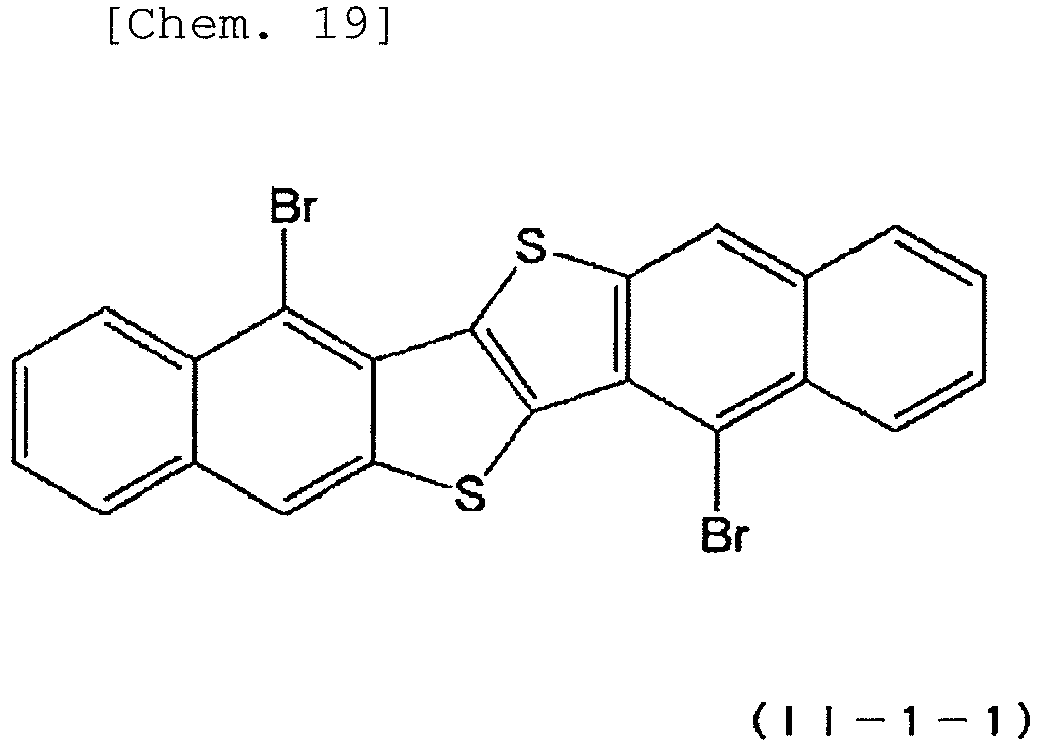
- The compound of formula (II-1) may be particularly a compound represented by the following formula (II-1-2):

- The condensed polycyclic aromatic compound of the second aspect of the present invention is represented, for example, by the following formula (II-2):

- D is a substituent having from 2 to 20 carbon atoms, which is obtained by adding a dienophilic alkene to a benzene ring;
- each Y is independently selected from chalcogens; and
- each of A1 to A8 is independently selected from the group consisting of a hydrogen atom, a halogen atom, an alkyl group and the like, and two adjacent members out of A1 to A8 may combine with each other to form a substituted or unsubstituted aromatic group having from 4 to 20 carbon atoms).
- In the compound of formula (II-2), for example, both X1 and X2 are a halogen atom.
- The compound of formula (II-2-1) may be particularly a compound represented by the following formula (I-2-1):

- In the compound of formula (I), and particularly in the compound of formula (I-1) or (1-2), A1, A4, A5 and A8, and particularly A1 to A8, may be a hydrogen atom. Also, in the compound of formula (I), and particularly in the compound of formula (I-1) or (I-2), Y may be a sulfur atom.
- The method for synthesizing the condensed polycyclic aromatic compound of the second aspect of the present invention includes the following steps:
- (a) providing a composition containing an organic solvent and a condensed polycyclic aromatic compound represented by the following formula (III):
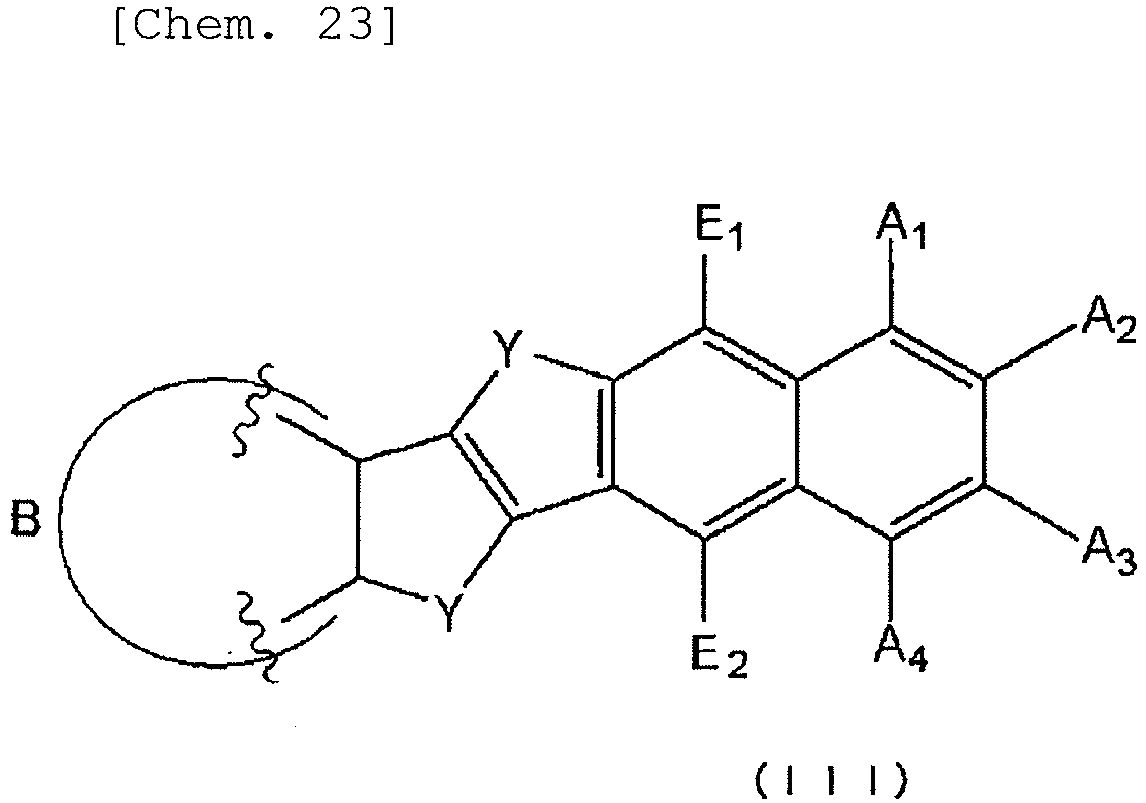
- B is a condensed ring having at least one benzene ring moiety;
- each Y is independently selected from chalcogens; and
- each of A1 to A4 is independently selected from the group consisting of a hydrogen atom, a halogen atom, an alkyl group and the like, and two adjacent members out of A1 to A4 may combine with each other to form a substituted or unsubstituted aromatic group having from 4 to 20 carbon atoms), and
- (b) adding a halogen to the composition.
- The organic solvent which can be used here includes any organic solvent capable of dissolving and/or dispersing the condensed polycyclic aromatic compound represented by the following formula (III). Specifically, for example, an aprotic polar solvent such as N-methylpyrrolidone, dimethylsulfoxide, acetonitrile and ethyl acetate; an ether-based solvent such as diethyl ether, tetrahydrofuran, diisopropyl ether, diethylene glycol dimethyl ether and 1,4-dioxane; aromatic hydrocarbons such as benzene, toluene, xylene and mesitylene (i.e., 1,3,5-trimethylbenzene); aliphatic hydrocarbons such as hexane and heptane; and a halogen-containing solvent such as dichloromethane, chloroform and dichloroethane may be considered as the organic solvent.
- Addition of a halogen to the composition containing the condensed polycyclic aromatic compound represented by formula (III) can be performed by any method. For example, fluorine or chlorine can be added by bubbling, and bromine, iodine or astatine can be added as a liquid or a solid. Also, in order to accelerate the reaction of the compound represented by formula (III) and a halogen, heating may be performed.
- The compound of formula (III) is represented, for example, by the following formula (III-1):

- each Y is independently selected from chalcogens; and
- each of A1 to A8 is independently selected from the group consisting of a hydrogen atom, a halogen atom, an alkyl group and the like, and two adjacent members out of A1 to A8 may combine with each other to form a substituted or unsubstituted aromatic group having from 4 to 20 carbon atoms).
- In the compound of formula (III-1), for example, all of E1 to E4 are a hydrogen atom.
- The compound of formula (III) is represented, for example, by the following formula (III-2):

- D is a substituent having from 2 to 20 carbon atoms, which is obtained by adding a dienophilic alkene to a benzene ring;
- each Y is independently selected from chalcogens; and
- each of A1 to A8 is independently selected from the group consisting of a hydrogen atom, a halogen atom, an alkyl group and the like, and two adjacent members out of A1 to A8 may combine with each other to form a substituted or unsubstituted aromatic group having from 4 to 20 carbon atoms).
- In the compound of formula (III-2), for example, both E1 and E2 are hydrogen.
- The compound of formula (III-2) may be particularly a compound represented by the following formula (III-2-1) :

- The use method of the second aspect of the present invention, i.e. the method for synthesizing the condensed polycyclic aromatic compound of the first aspect of the present invention from the second aspect of the present invention, includes the following steps:
- (a) providing a composition containing an organic solvent and a condensed polycyclic aromatic compound of the second aspect of the present invention, and
- (b) substituting at least one halogen atom out of X1 to X4 with a substituent selected from the group consisting of an alkyl group and the like.
- The organic solvent which can be used here includes any organic solvent capable of dissolving and/or dispersing the compound of the second aspect of the present invention, i.e. the compound of formula (II). Specifically, for example, an aprotic polar solvent such as N-methylpyrrolidone, dimethylsulfoxide, acetonitrile and ethyl acetate; an ether-based solvent such as diethyl ether, tetrahydrofuran, diisopropyl ether, diethylene glycol dimethyl ether and 1,4-dioxane; aromatic hydrocarbons such as benzene, toluene, xylene and mesitylene (i.e., 1,3,5-trimethylbenzene); aliphatic hydrocarbons such as hexane and heptane; and a halogen-containing solvent such as dichloromethane, chloroform and dichloroethane may be considered as the organic solvent.
- The reaction of substituting at least one halogen atom out of X1 to X4 in the compound represented by formula (II) with a substituent selected from the group consisting of an alkyl group and the like can be performed by various coupling method using an aromatic halide, i.e. Mizoroki-Heck reaction, Negishi coupling, Migita-Kosugi-Stille coupling, Sonogashira coupling, Suzuki-Miyaura coupling, Buchwald-Hartwig reaction or Kumada-Tamao-Corriu coupling. In order to accelerate this coupling reaction, heating may be performed.
- Incidentally, the outline of each coupling reaction is as follows (Ar is an aromatic moiety, X is a halogen, and R is hydrogen, an alkyl group or the like).
- (1) Mizoroki-Heck Reaction
Ar-X + H2C=CHR (+ Pd catalyst) → Ar-HC=CHR - (2) Negishi Coupling
Ar-X + R-Zn-X (+ Pd catalyst) → Ar-R - (3) Migita-Kosugi-Stille Coupling
Ar-X + R-Sn-R'3 (+ Pd catalyst) → Ar-R - (4) Sonogashira Coupling
Ar-X + R-C≡C-H (+ Pd catalyst) + base → Ar-C≡C-R - (5) Suzuki-Miyaura Coupling
Ar-X + R-B (OH)2 (+ Pd catalyst) + base → Ar-R - (6) Buchwald-Hartwig Reaction
Ar-X + R-NH2 (+ Pd catalyst) + base → Ar-NHR - (7) Kumada-Tamao-Corriu Coupling
Ar-X + R-Mg-X (+ Ni catalyst) → Ar-R - The aromatic polymer of the third aspect of the present invention contains two or more condensed polycyclic aromatic moieties represented by the following formula (IV):

- B is a condensed ring having at least one benzene ring moiety;
- each Y is independently selected from chalcogens; and
- each of A1 to A4 is independently selected from the group consisting of a hydrogen atom, a halogen atom, an alkyl group and the like, and two adjacent members out of A1 to A4 may combine with each other to form a substituted or unsubstituted aromatic group having from 4 to 20 carbon atoms).
- The condensed polycyclic aromatic moiety is represented, for example, by the following formula (IV-1) :

- each Y is independently selected from chalcogens; and
- each of A1 to A8 is independently selected from the group consisting of a hydrogen atom, a halogen atom, an alkyl group and the like, and two adjacent members out of A1 to A8 may combine with each other to form a substituted or unsubstituted aromatic group having from 4 to 20 carbon atoms).
- In the condensed polycyclic aromatic moiety of formula (IV-1), for example, G2 and G3 are a bond, and G1 and G4 are a hydrogen atom.
- The condensed polycyclic aromatic moiety of formula (IV-1) may be particularly a moiety represented by the following formula (IV-1-1):

- The condensed polycyclic aromatic moiety is represented, for example, by the following formula (IV-2) :

- D is a substituent having from 2 to 20 carbon atoms, which is obtained by adding a dienophilic alkene to a benzene ring;
- each Y is independently selected from chalcogens; and
- each of A1 to A8 is independently selected from the group consisting of a hydrogen atom, a halogen atom, an alkyl group and the like, and two adjacent members out of A1 to A8 may combine with each other to form a substituted or unsubstituted aromatic group having from 4 to 20 carbon atoms).
- In the condensed polycyclic aromatic moiety of formula (IV-2), for example, both G1 and G2 are a bond.
- The condensed polycyclic aromatic moiety of formula (IV-2) may be particularly a compound represented by the following formula (IV-2-1):

- The aromatic polymer of the third aspect of the present invention contains, for example, a repeating unit of the following formula (V):
-{(TT)-(QQ)}- (V)
(wherein TT is the condensed polycyclic aromatic moiety above; and
QQ is a bond or a divalent group). - Also, the aromatic polymer of the third aspect of the present invention contains, for example, a repeating unit of the following formula (V-1):

- each Y is independently selected from chalcogens;
- each of A1 to A8 is independently selected from the group consisting of a hydrogen atom, a halogen atom, an alkyl group and the like, and two adjacent members out of A1 to A8 may combine with each other to form a substituted or unsubstituted aromatic group having from 4 to 20 carbon atoms; and
- QQ is a bond or a divalent group).
- Incidentally, the bond as QQ is not particularly limited as long as it is bondable to an adjacent unit, and the bond may be, for example, any of a single bond, a double bond and a triple bond.
- Also, the divalent group as QQ is not particularly limited as long as it is bondable to an adjacent unit, and the divalent group is, for example, a hydrocarbon group having from 1 to 40 carbon atoms, which may be accompanied by a heteroatom such as oxygen and nitrogen, and may be selected from the group consisting of an alkylene group having from 1 to 20 carbon atoms, an alkenylene group having from 2 to 20 carbon atoms, an alkynylene group having from 2 to 20 carbon atoms, a substituted or unsubstituted divalent aromatic group having from 4 to 20 carbon atoms, a divalent ketone group having from 2 to 10 carbon atoms, a divalent amino group having from 1 to 20 carbon atoms, a divalent amide group having from 1 to 20 carbon atoms, a divalent imide group having from 1 to 20 carbon atoms, a divalent sulfide group having from 1 to 20 carbon atoms, and a divalent alkylsilylalkynyl group having from 1 to 40 carbon atoms.
- The "aromatic group" in the "substituted or unsubstituted divalent aromatic group having from 4 to 20 carbon atoms" may be a benzene-based aromatic group, a heterocyclic group or a non-benzene-based aromatic group. Specific benzene-based aromatic groups include a benzene group and a naphthalene group. Specific heterocyclic groups include a furan group, a thiophene group, a pyrrole group, and an imidazole group. Specific non-benzene-based aromatic groups include annulene and azulene. In the case where such an aromatic group is substituted, the substituent includes an alkyl group, an alkenyl group, an alkynyl group, an aromatic group, a ketone group, an amino group, an amide group, an imide group, and a sulfide group.
- For example, when the "substituted or unsubstituted divalent aromatic group having from 4 to 20 carbon atoms" is a substituted or unsubstituted thiophene group, the thiophene group may be further substituted with a substituted or unsubstituted thiophene group as shown below.

- Incidentally, when the aromatic group such as thiophene group is substituted, the substituent may be a halogen atom, an alkyl group, an alkenyl group, an alkynyl group, a substituted or unsubstituted aromatic group, a ketone group, an amino group, an amide group, an imide group, a sulfide group, an alkylsilylalkynyl group or the like.
- In the aromatic polymer of the third aspect of the present invention, the molecular weight obtained in terms of polystyrene by gel permeation chromatography (GPC) may be 1,000 or more, 2,000 or more, 3,000 or more, 4,000 or more, or 5,000 or more. Also, in aromatic polymer of the third aspect of the present invention, the molecular weight obtained in terms of polystyrene by GPC may be 500,000 or less, 100,000 or less, 100,000 or less, 50,000 or less, or 30,000 or less.
- The method for synthesizing the aromatic polymer of the third aspect of the present invention includes the following steps:
- (a) providing a composition containing an organic solvent and a condensed polycyclic aromatic compound represented by the following formula (II):

- B is a condensed ring having at least one benzene ring moiety;
each Y is independently selected from chalcogens; and
each of A1 to A4 is independently selected from the group consisting of a hydrogen atom, a halogen atom, an alkyl group and the like, and two adjacent members out of A1 to A4 may combine with each other to form a substituted or unsubstituted aromatic group having from 4 to 20 carbon atoms); and - (b) adding, to the composition, a bonding compound having two or more moieties capable of substituting at least one halogen atom out of X1 and X2 to combine two or more condensed polycyclic aromatic compounds with each other.
- As the moiety capable of substituting a halogen atom of the bonding compound used in the step (b), i.e. a moiety capable of substituting a halogen of an aromatic halide, various moieties are known. As the reaction using such a moiety, a coupling reaction such as Mizoroki-Heck reaction, Negishi coupling, Migita-Kosugi-Stille coupling, Sonogashira coupling, Suzuki-Miyaura coupling, Buchwald-Hartwig reaction, and Kumada-Tamao-Corriu coupling is known.
- The organic solvent which can be used here includes any organic solvent capable of dissolving and/or dispersing the condensed polycyclic aromatic compound represented by the following formula (II). Specifically, for example, an aprotic polar solvent such as N-methylpyrrolidone, dimethylsulfoxide, acetonitrile and ethyl acetate; an ether-based solvent such as diethyl ether, tetrahydrofuran, diisopropyl ether, diethylene glycol dimethyl ether and 1,4-dioxane; aromatic hydrocarbons such as benzene, toluene, xylene and mesitylene (i.e., 1,3,5-trimethylbenzene); aliphatic hydrocarbons such as hexane and heptane; and a halogen-containing solvent such as dichloromethane, chloroform and dichloroethane may be considered as the organic solvent.
- Addition of a bonding compound to the composition containing the condensed polycyclic aromatic compound represented by formula (II) can be performed by any method. For example, the bonding compound may be added as it is, or the bonding compound may be previously diluted with an organic solvent and then added. Also, in order to accelerate the reaction of the compound represented by formula (II) and the bonding compound, heating may be performed.
- Incidentally, with respect to the compound of formula (II) used in the method for synthesizing the aromatic polymer of the third aspect of the present invention, the description related to the second aspect of the present invention can be referred to.
- The aromatic polymer-containing solution of the third aspect of the present invention contains an organic solvent and the aromatic polymer of the third aspect of the present invention which is at least partially dissolved in the organic solvent.
- The aromatic polymer-containing solution can contain the aromatic polymer of the third aspect of the present invention at any concentration and, for example, may contain the aromatic polymer of the third aspect of the present invention at a concentration of 0.01 to 10 mass%, from 0.05 to 5 mass%, or from 0.1 to 3 mass%.
- The organic solvent which can be used here includes any organic solvent capable of dissolving the aromatic polymer of the third aspect of the present invention without deteriorating the polymer. Specifically, for example, an aprotic polar solvent such as N-methylpyrrolidone, dimethylsulfoxide, acetonitrile and ethyl acetate; an ether-based solvent such as diethyl ether, tetrahydrofuran, diisopropyl ether, diethylene glycol dimethyl ether and 1,4-dioxane; aromatic hydrocarbons such as benzene, toluene, xylene and mesitylene (i.e., 1,3,5-trimethylbenzene); aliphatic hydrocarbons such as hexane and heptane; and a halogen-containing solvent such as dichloromethane, chloroform and dichloroethane may be considered as the organic solvent.
- The method of the third aspect of the present invention for producing an organic semiconductor film comprises coating a substrate with the aromatic polymer-containing solution of the third aspect of the present invention, and removing the organic solvent from the solution coated on the substrate.
- Coating of the solution on a substrate may be performed in any manner and, for example, may be performed by a casting method, a spin coating method or a printing method. Also, coating of the solution on a substrate may be performed by merely dropping the solution on the substrate.
- Removal of the organic solvent from the solution may be performed simultaneously with the coating step.
- Removal of the organic solvent from the solution may also be accelerated by heating. In this case, the heating can be performed at any temperature involving substantially no decomposition of the aromatic polymer of the third aspect of the present invention, for example, at a temperature of 80°C or more, 100°C or more, 120°C or more, or 140°C or more, and 200°C or less, 220°C or less, 240°C or less, or 260°C or less. Such heating can be achieved, for example, by bringing the solution-coated substrate into direct contact with a heated thing such as heated electric heater, introducing the substrate into a heated region such as heated furnace, or irradiating the substrate with an electromagnetic wave such as infrared ray and microwave.
- Incidentally, in the case of the aromatic polymer of the third aspect of the present invention, which is intended to constitute an organic semiconductor film by eliminating an addition compound, for example, in the case of the aromatic polymer of formula (IV-2), elimination and removal of the substituent represented by D can be achieved together with removal of the organic solvent. This elimination reaction can be accelerated by heating.
- The method of the third aspect of the present invention for manufacturing an organic semiconductor device comprises producing an organic semiconductor film by the method of the third aspect of the present invention for producing an organic semiconductor film.
- Also, this method may optionally further comprise forming an electrode layer and/or a dielectric layer on the top side or bottom side of the organic semiconductor film.
- The organic semiconductor device of the third aspect of the present invention has an organic semiconductor film containing the aromatic polymer of the third aspect of the present invention.
- The context in which the organic semiconductor film contains the aromatic polymer of the third aspect of the present invention means that the organic semiconductor film contains the aromatic polymer of the third aspect of the present invention at least in a detectable amount.
- Accordingly, for example, in the case of the aromatic polymer of the third aspect of the present invention, which is intended to constitute directly the organic semiconductor film, for example, in the case of the aromatic polymer of formula (IV-1), the aromatic polymer constitutes the substantial portion of the organic semiconductor, i.e. the organic semiconductor film is substantially composed of the aromatic polymer of the third aspect of the present invention.
- In particular, the organic semiconductor device of the third aspect of the present invention is a thin-film transistor having a source electrode, a drain electrode, a gate electrode, a gate insulating film and the organic semiconductor film, and this is a thin-film transistor in which the source electrode and the drain electrode are insulated from the gate electrode by the gate insulating film and the current flowing through the organic semiconductor from the source electrode to the drain electrode is controlled by the voltage applied to the gate electrode. Also, in particular, the organic semiconductor device of the third aspect of the present invention is a solar cell having the organic semiconductor film as an active layer. Incidentally, the "organic semiconductor device" as used in the present invention means a device having an organic semiconductor film, and other layers such as electrode layer and dielectric layer may be formed of an inorganic material or an organic material.
- The method of the fourth aspect of the present invention for synthesizing a compound of the following formula (b), i.e. the method of the fourth aspect of the present invention for synthesizing a compound of the following formula (b) usable as an intermediate for the synthesis of DNTT or a derivative thereof, comprises reducing the cyano group of a compound of the following formula (i):


- The reduction above can be performed by any reducing agent capable of reducing the cyano group (-CN) of the compound of formula (i) to an aldehyde group (-CHO).
- As this reducing agent, a boron compound such as borane and diborane; a metal hydride such as hydrazine, diisobutylaluminum hydride, lithium aluminum hydride, sodium boron hydride and lithium boron hydride; and a combination of a metal hydride and a Lewis acid, and particularly diisobutylaluminum hydride (DIBAL), may be considered.
- Also, the temperature, time and amount of reducing agent for the reduction may be selected so that the intended reduction reaction can be achieved. For example, in the case of using diisobutylaluminum hydride as the reducing agent, a reaction temperature of -100 to 25°C, particularly from -80 to 0°C, and more particularly from -78 to -50°C, may be considered.
- In addition, the reduction reaction can be performed in a solvent that does not inhibit the reduction reaction. As this solvent, a chlorine-based solvent such as methylene chloride, chloroform and trichloroethylene; a hydrocarbon-based solvent such as hexane, heptane, benzene, toluene, xylene and cumene; an ether-based solvent such as dibutyl ether and diethylene glycol diethyl ether, may be considered.
- The method of the fourth aspect of the present invention for synthesizing the compound of formula (b) may comprise substituting the triflate group of a compound of formula (g) by a cyano group to synthesize the compound of formula (i):
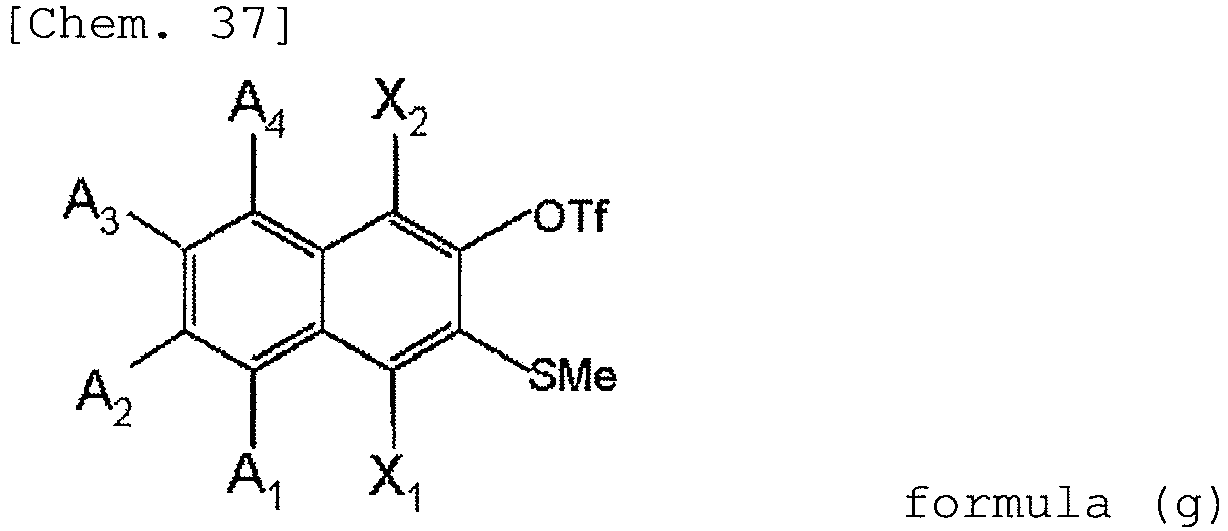
- The cyanidation reaction above can be performed by any cyanide capable of substituting a cyano group (-CN) for the triflate group (-OTf) of the compound of formula (g).
- As this cyanide, a hydrogen cyanide, a metal cyanide, a cyanhydrin compound, an acyl cyanide, and a cyan halide may be considered. Specific metal cyanides which can be considered are a cyanide of an alkali metal, such as sodium cyanide and potassium cyanide; a cyanide of an alkaline earth metal, such as calcium cyanide; and a cyanide of a transition metal, such as copper cyanide. Also, as the cyanhydrin compound, an α-cyanhydrin compound such as hydroxyacetonitrile, lactonitrile and acetone cyanhydrin may be considered. As the acyl cyanide, an aliphatic acyl cyanide such as acetyl cyanide and propionyl cyanide; and an aromatic acyl cyanide such as benzoyl cyanide may be considered. Furthermore, as the cyan halide, cyan chloride and cyan bromide may be considered.
- For the cyanidation reaction, an activator capable of accelerating the reaction by capturing the desorbed triflate group (-OTf) can be added. As this activator, tetra-n-butyl ammonium:iodide may be considered.
- The cyanidation reaction above can be accelerated by a transition metal catalyst, particularly a noble metal catalyst, and more particularly a palladium catalyst. As this catalyst, a combination of 1,1'-bis(diphenylphosphino)ferrocene (DPPF) and bis(dibenzylideneacetone)palladium may be considered.
- As for the synthesis of the compound of formula (g), Non-Patent Document 4 may be referred to, and specifically, the compound can be synthesized, for example, by a reaction illustrated below.

- As the compound of formula (d) that is a starting raw material in the reaction formula above, various commercial products are available.
- Incidentally, in the reaction formula above, the reaction for synthesizing formula (e) from the compound of formula (d) uses n-butyllithium (n-BuLi) as a strong base for extracting hydrogen on the 3-position of the naphthalene ring, but other strong bases, for example, other alkyllithiums, may also be considered.
- The method of the fifth aspect of the present invention for synthesizing a compound of the following formula (b), i.e. the method of the fifth aspect of the present invention for synthesizing a compound of the following formula (b) usable as an intermediate for the synthesis of DNTT or a derivative thereof, comprises partially oxidizing the hydroxyl group of a compound of the following formula (n) to an aldehyde group:


- The oxidation above can be performed by any oxidizing agent capable of partially oxidizing the hydroxyl group (-OH) of a compound of formula (n) to an aldehyde group (-CHO).
- This oxidation can be achieved, for example, by a reaction known as a Swern oxidation reaction, i.e. an alcohol oxidation reaction using dimethylsulfoxide (DMSO) as an oxidizing agent. In such an oxidation reaction, oxalyl chloride, acetic anhydride, SO3-pyridine, dichlorohexylcarbodiimide and the like can be used as an activator. Also, triethylamine, trifluoroacetic acid or the like may be used in combination, if desired.
- The temperature, time and solvent for the oxidation reaction may be selected so that the intended oxidation reaction can be achieved. For example, as the solvent for the oxidation reaction, solvents recited as a solvent when reducing the compound of formula (i) to the compound of formula (b), i.e. methylene chloride and the like, may be considered.
- Also, the method of the fifth aspect of the present invention for synthesizing the compound of formula (b) may comprise reducing the ester group of a compound of formula (m) to a hydroxyl group to synthesize the compound of formula (n):

- The reduction above can be performed by any reducing agent capable of reducing the ester group (-COOR) of a compound of formula (m) to a hydroxyl group (-OH).
- As this reducing agent, reducing agents used when reducing the compound of formula (i) to the compound of formula (b), and particularly strong reducing agents such as lithium aluminum hydride, may be considered. Also, the temperature, time and solvent for the reduction reaction may be selected so that the intended oxidation reaction can be achieved. With respect to these conditions, the conditions when reducing the compound of formula (i) to the compound of formula (b) may be considered.
- Also, the method of the fifth aspect of the present invention for synthesizing the compound of formula (b) may comprise substituting the triflate group of a compound of formula (1) by a thiomethyl group to synthesize the compound of formula (m):
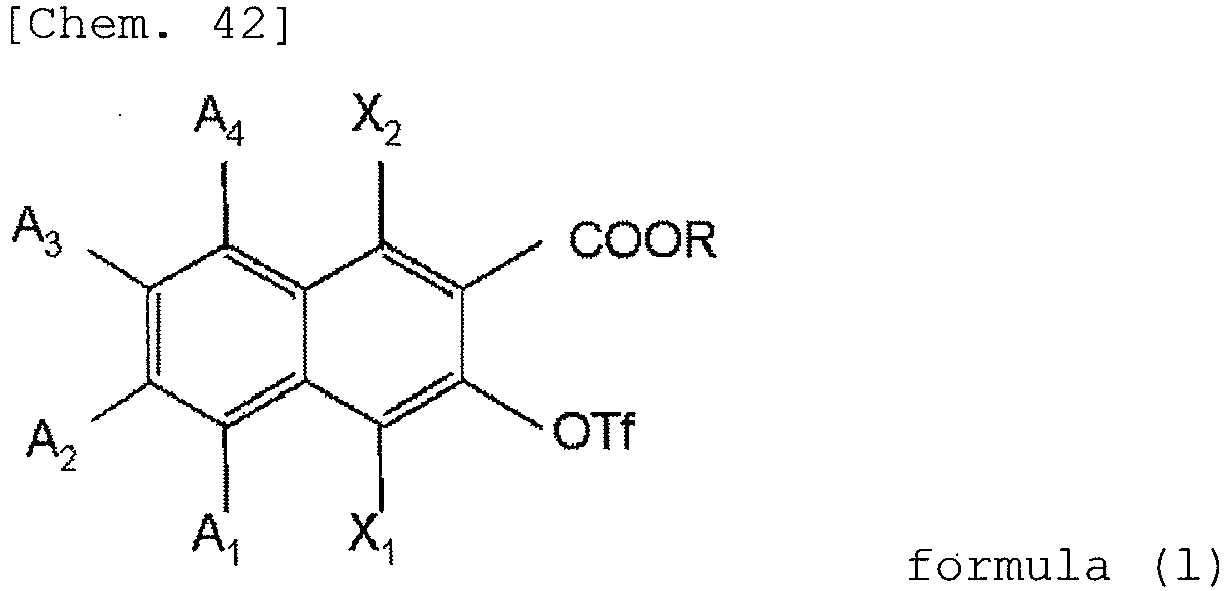
- The substitution reaction above can be performed by any thiomethoxide compound capable of substituting a thiomethyl group (-SCH3) for the triflate group (-OTf) of the compound of formula (1).
- As this thiomethoxide compound, an alkali metal thiomethoxide, and particularly sodium thiomethoxide, may be considered.
- Also, the method of the fifth aspect of the present invention for synthesizing the compound of formula (b) may comprise substituting the hydroxy group of a compound of formula (k) by a triflate group to synthesize the compound of formula (1):

- The substitution reaction above can be performed by any triflate compound capable of substituting a triflate group (-OTf) for the hydroxyl group (-OH) of the compound of formula (k).
- As this triflate compound, a trifluoromethesulfonic acid anhydride may be considered. Furthermore, the substitution reaction may also be accelerated using pyridine, 4,4-dimethylaminopyridine (DMAP) or the like.
- Incidentally, as the compound of formula (k) used as a raw material in the reaction above, various products are commercially available.
- The method of the present invention for synthesizing a compound of the following formula (x) comprises synthesizing the compound of formula (b) by the method of the fourth or fifth aspect of the present invention and condensing two molecules of the compound of formula (b):

- As for the synthesis of the compound of formula (x) from the compound of formula (b),
Patent Document 2 and the like may be referred to, and specifically, the compound can be synthesized, for example, by a reaction illustrated below.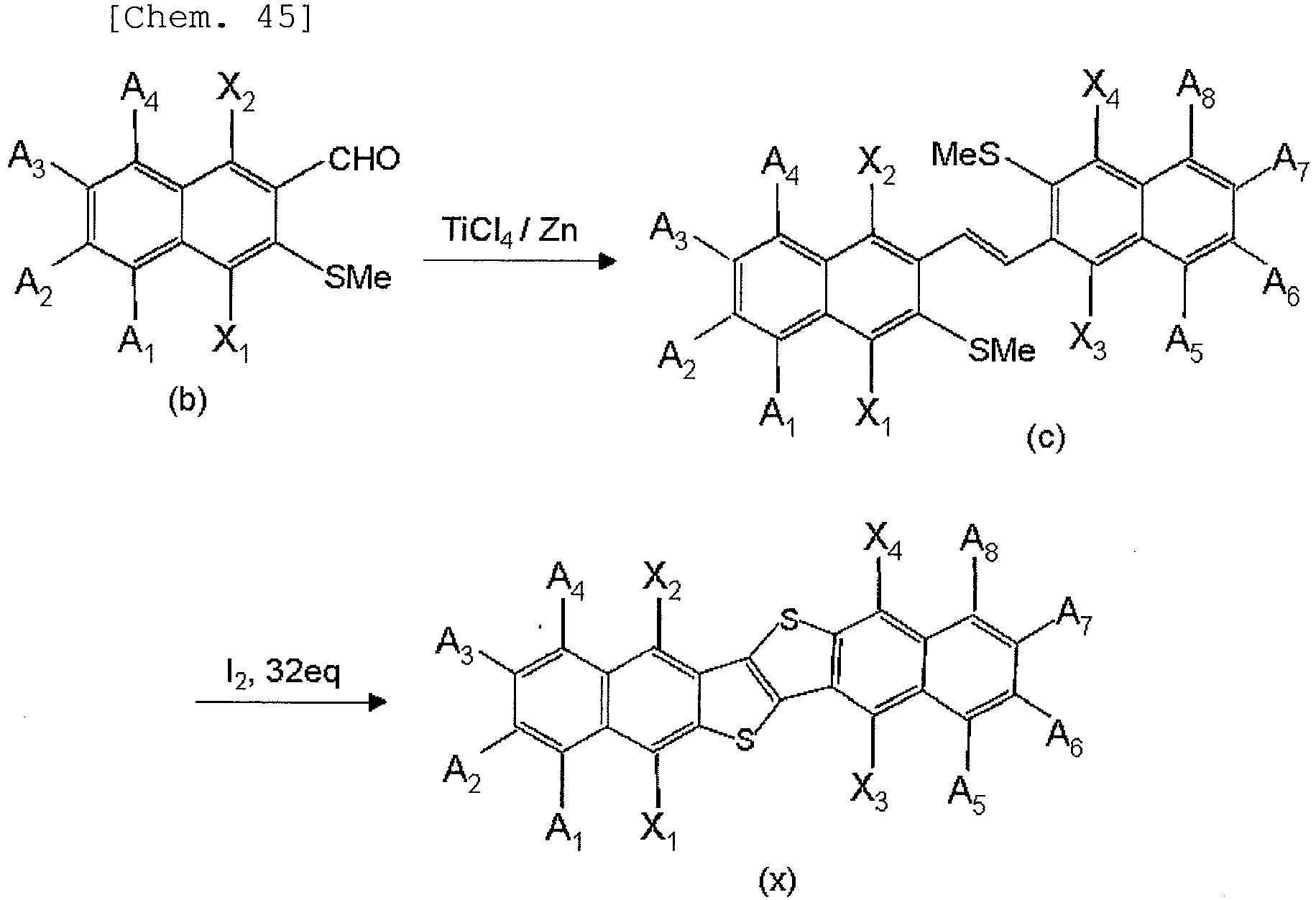
- Accordingly, for example, in the case of using the method of the fourth aspect of the present invention for synthesizing a compound of formula (b), in the method of the present invention for synthesizing DNTT, the DNTT can be synthesized by the following route.

- Also, for example, in the case of using the method of the fifth aspect of the present invention for synthesizing a compound of formula (b), in the method of the present invention for synthesizing DNTT, the DNTT can be synthesized by the following route.

- In the following Examples, the structure of the target compound was determined as needed by 1H-nuclear magnetic resonance spectrum (1H-NMR spectrum), mass spectrometry (MS), single-crystal structural analysis and gel permeation chromatography (GPC).
- The devices used are as follows.
1H-NMR (Examples A and B): ECA-500 of JEOL (500 MHz)
1H-NMR (Example C): AVANCE 500 of BLUKER - MS (Examples A and B): Autoflex III (MALDI) of Bruker Single crystal structural analysis (Example A):
- RAXIS RAPID S of Rigaku
- GPC (Example A):
- LC-9101 of Japan Analytical Industry Co., Ltd. (column: JAIGEL-2H, JAIGEL-1H)
- GPC (Example B):
- LC-9101 of Japan Analytical Industry Co., Ltd. (column: JAIGEL-6H, JAIGEL-5H)
- GPC (Example A):
- Dinaphthothienothiophene (DNTT) (structural formula shown below, MW=340.46) was synthesized by the method described in Patent Document 2 (Kokai No.
2008-290963 
- To 100 mL of mesitylene (i.e., 1,3,5-trimethylbenzene) containing 1,000 mg (2.93 mmol) of DNTT above, 2,341 mg (14.65 mmol) of bromine (Br2, MW=159.8) was added, and the reaction temperature was kept at 40°C for 4 hours. Thereafter, the reaction solution was allowed to cool to obtain di-bromine-substituted dinaphthothienothiophene (di-Br-substituted DNTT) (structural formula shown below, Mw=498.25, 1431 mg, 2.87 mmol, yield: 98.1%). Incidentally, the reaction product was purified in chloroform.

- Incidentally, the substitution position of bromine in the di-Br-substituted DNTT was judged from the position of the triisopropylsilyl (TIPS) group by single-crystal structural analysis of di-TIPS-substituted DNTT in Example A-2.
- The 1H-NMR and MS results of the obtained di-Br-substituted DNTT are shown below.
- 1H-NMR (500 MHz, CDC13, 50°C): δ8.47 (d, J=8.3 Hz, 2H), 8.44 (s, 2H), 7.97 (d, J=8.3 Hz, 2H), 7.66 (t, J=8.3 Hz, 2H), 7.59 (t, J=8.3 Hz, 2H).
- MS (m/z): 497.513 (positive ion observation) (Exact Mass: 495.86).
- To a flask, 100.7 mg (0.296 mmol) of DNTT synthesized as in Example A-1A and 17.7 mg (0.133 mmol) of aluminum chloride were added, and nitrogen purging was performed three times. Thereafter, 5.0 ml of chloroform was added and after cooling to 0°C, 78.7 mg (0.589 mmol) of N-chlorosuccinimide was added, followed by stirring for 1.5 hours.
- After confirming that N-chlorosuccinimide as a raw material disappeared by mass spectrometry (MS), 5.0 ml of water was added to terminate the reaction. The reaction product was filtered to obtain di-chlorine-substituted dinaphthothienothiophene (di-Cl-substituted DNTT) (structural formula shown below, Mw=409.35, 116.0 mg, 0.28 mmol, yield: 95.8%). Incidentally, the reaction product was purified in chloroform.

- The MS result of the obtained di-Cl-substituted DNTT is shown below.
- MS (m/z): 407.822 (positive ion observation) (Exact Mass: 407.96).
- The di-Br-substituted DNTT synthesized in Example A-1 was subjected to introduction of a triisopropylsilyl (TIPS) group by the Sonogashira coupling method.
- Specifically, 191.3 mg of Pd(PPh3)2Cl2 (Mw=701.90), 134.1 mg of CuI (Mw=190.45), 0.706 mL of diisopropylamine (Mw=101.20), 791.6 mg of CsCO3 (Mw=325.82) and 1.698 mL of triisopropylsilylacetylene (Mw=182.38) were added to 500 mg (1.0 mmol) of di-Br-substituted DNTT (Mw=498.25), and deaeration under reduced pressure and nitrogen purging were performed three times. Thereafter, 35 mL of N,N-dimethylformamide (N,N-DMF) was introduced and after again performing deaeration under pressure and nitrogen purging three times, the system was stirred at 120°C over 20 hours, thereby allowing the reaction to proceed.
- By this reaction, 479.1 mg (68.3 mmol, yield: 68.0%) of di-triisopropylsilylacetylene-substituted dinaphthothienothiophene (di-TIPS-substituted DNTT, structural formula shown below) (Mw=701.19) was obtained. The solubility of the obtained di-TIPS-substituted DNTT in chloroform was 0.2 wt%. Incidentally, DNTT used as a raw material was substantially not dissolved in chloroform.

- The 1H-NMR and MS results of the obtained di-TIPS-substituted DNTT are shown below.
- 1H-NMR (500 MHz, CDCl3) : δ8.61 (d, J=8.0 Hz, 2H), 8.41 (s, 2H), 7.97 (d, J=8.0 Hz, 2H), 7.63 (dd, J=8.0 Hz, 8.0 Hz 2H), 7.57 (dd, J=8.0 Hz, 8.0 Hz, 2H), 1.40-1.47 (m, 6H), 1.34 (d, J=6.9 Hz, 36H)
- MS (m/z): 700.3 (Exact Mass: 700.30)
- The single crystal structural analysis results of the obtained di-TIPS-substituted DNTT are shown below.
- a=8.2044 (5) Å
- b=8.4591 (6) Å
- c=14.488 (1) Å
- α=88.475 (4)°
- β=89.336 (3)°
- γ=89.555 (4)°
- ν=1005.1 (1) Å3
- Also, the molecular structure ORTEP (Oak Ridge Thermal Ellipsoid Plot) drawing based on single-crystal structural analysis and the crystal packing (stereo) diagram of this di-TIPS-substituted DNTT are depicted in
Figs. 1 and2 , respectively. - The di-triisopropylsilylacetylene-substituted DNTT (di-TIPS-substituted DNTT) synthesized in Example A-2 was hydrogen-reduced to synthesize di-triisopropylsilylethane-substituted DNTT.
- Specifically, to a 200-ml flask, 304.6 mg (0.43 mmol) of di-triisopropylsilylacetylene-substituted DNTT (Mw=701.18), 60 ml of toluene and 79.2 mg of 10% Pd/C were added, and purging with hydrogen was performed three times. The system was stirred at 60°C for 15 hours in a hydrogen atmosphere, thereby allowing the reaction to proceed.
- By this reaction, di-triisopropylsilylethane-substituted DNTT (structural formula shown below, Mw=709.37, 296.1 mg, 0.42 mmol, yield: 96.1%) was obtained. The solubility of the obtained di-triisopropylsilylethane-substituted DNTT in chloroform was 0.51 wt%. Incidentally, DNTT used as a raw material was substantially not dissolved in chloroform.

- The 1H-NMR and MS results of the obtained di-triisopropylsilylethane-substituted DNTT are shown below.
- 1H-NMR (500 MHz, CDCl3, 50°C) : δ8.33 (s, 2H), 7.26 (d, J=8.6 Hz, 2H), 7.97 (d, J=8.6 Hz, 2H), 7.57 (dd, J=8.6 Hz, 8.6 Hz, 2H), 7.53 (dd, J=8.3 Hz, 8.3 Hz, 2H), 3.76-3.72 (m, 8H), 1.39-1.32 (m, 6H), 1.30-1.19 (m, 36H).
- MS (m/z): 708.322 (positive ion observation) (Exact Mass: 708.367).
- Di-TIPS-substituted DNTT (Mw=701.19) obtained in Example A-2 was dissolved in chloroform at a concentration of 0.2 wt% to prepare a solution for the manufacture of a semiconductor device.
- Next, an n-doped silicone wafer with an SiO2 oxide film of 300 nm (surface resistance: 1-10 Ω·cm) was subjected to a UV-ozone treatment for 20 minutes (Eye UV-Ozone Cleaning System OC-250615-D+A, Eye Graphics Co., Ltd.). Also, a toluene solution containing 10 mmol of 1,1,1,3,3,3-hexamethyldisilazane (HMDS) was prepared, and the silicon substrate subjected the UV ozone treatment was dipped in this solution over 24 hours, thereby performing a hydrophobing treatment of the silicon substrate. Thereafter, source/drain gold electrodes having a channel width of 50 µm and a channel length of 1.5 mm were produced by the vacuum deposition method (resistance-heating vapor deposition apparatus: SVC-700 TM/700-2, Sanyu Electron Co., Ltd.).
- While heating the silicon substrate at 40°C, the solution for the manufacture of a semiconductor device was dropped on the channel portion to volatilize the solvent, and thereby form a thin layer composed of di-TIPS-substituted DNTT. The thus-produced device was heat-treated at 70°C over 1 hour in a vacuum to dry and remove the chloroform solvent and thereby manufacture an organic semiconductor device.
- The obtained organic semiconductor device was measured for the organic semiconductor characteristics and found to exhibit p-type semiconductor behavior. Also, in this organic semiconductor device, the carrier mobility was 1×10⁻³ cm2/Vs, the on/off ratio was 105, and the threshold voltage was -26 V.
Fig. 3 illustrates the transmission property of FET characteristics.Fig. 3 shows the relationship between the drain current (ID(A) or ID 1/2(A1/2)) (ordinate) and the gate voltage (VG(V)) (abscissa) when the drain voltage (VD) is -80 V. - Dinaphthothienothiophene (DNTT) (MW=340.46) was synthesized in the same manner as in Example A-1.
- To 500 mL of mesitylene (i.e., 1,3,5-trimethylbenzene) containing 5,000 mg (14.65 mmol) of DNTT above, 12.68 g (73.25 mmol) of N-phenylmaleimide (MW=173.17) was added, and the reaction temperature was kept at 160°C for 4 hours. Thereafter, the system was allowed to cool and through separation and purification, 376 mg (0.73 mmol, yield: 4.9%) of dinaphthothienothiophene-N-phenylmaleimide monoadduct in which one N-phenylmaleimide was added to DNTT (DNTT-PMI monoadduct, a mixture of Endo form and Exo form which are stereoisomers) (structural formula shown below, Mw=513.63) was obtained. Incidentally, stereoisomers were separated by HPLC to obtain 132 mg of Endo form and 151 mg of Exo form.

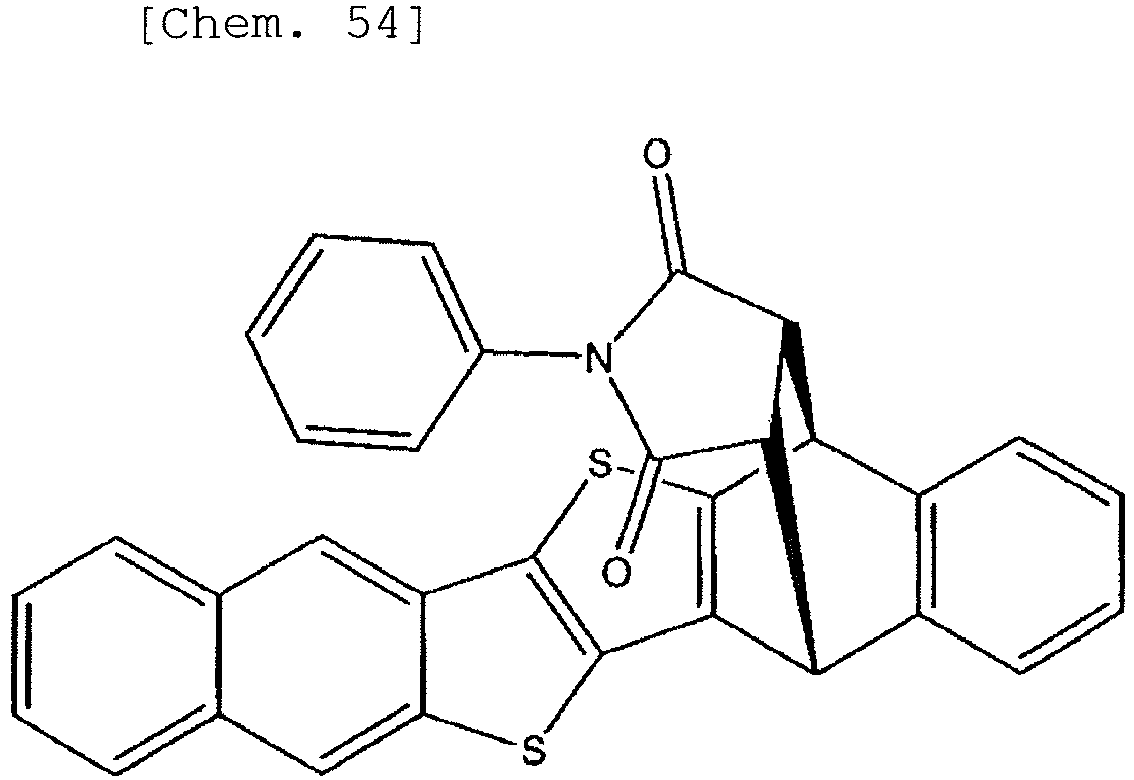
- To 50 mL of mesitylene containing 151 mg (0.29 mmol) of the DNTT-PMI monoadduct (Exo form) above, 235 mg (1.47 mmol) of bromine (Br2, MW=159.8) was added, and the reaction temperature was kept at 40°C for 1 hour. Thereafter, the system was allowed to cool, as a result, 186 mg (0.276 mmol, yield: 95.2%) of di-bromine-substituted dinaphthothienothiophene-N-phenylmaleimide monoadduct (di-Br-substituted DNTT-PMI monoadduct) (structural formula shown below, Mw=673.44) was obtained.

- The 1H-NMR and MS results of the obtained di-Br-substituted DNTT-PMI monoadduct are shown below.
- 1H-NMR (500 MHz, CDCl3) : δ8.39 (d, J=7.7 Hz, 1H), 8.29 (d, J=7.7 Hz, 1H), 7.67 (dd, J=7.7 Hz, 1H), 7.64 (dd, J=7.7 Hz, 1H), 7.41-7.44 (m, 2H), 7.31-7.32 (m, 3H), 7.27-7.29 (m, 2H), 6.52-6.54 (m, 2H), 5.25 (d, J=3.2 Hz, 1H), 5.23 (d, J=3.2 Hz, 1H), 3.59 (dd, J=3.2 Hz, 8.3 Hz, 1H), 3.55 (dd, J=3.2 Hz, 8.3 Hz, 1H).
- MS (m/z): 497.513 (Exact Mass: 670.92)
- Incidentally, it is presumed that in MS, di-Br-substituted DNTT (Exact Mass: 497.86) formed as a result of desorption of N-phenylmaleimide from the di-Br-substituted DNTT-PMI monoadduct was observed.
- The di-Br-substituted DNTT-PMI monoadduct synthesized in Example A-4 was subjected to introduction of a triisopropylsilyl (TIPS) group by the Sonogashira coupling method.
- Specifically, 28.1 mg of Pd(PPh3)2Cl2 (Mw=701.90), 20.0 mg of CuI (Mw=190.45), 0.11 mL of diisopropylamine (Mw=101.20) and 0.1 mL of triisopropylsilylacetylene (Mw=182.38) were added to 100 mg (0.148 mmol) of di-Br-substituted DNTT-PMI monoadduct (Mw=673.44), and deaeration under reduced pressure and nitrogen purging were performed three times. Thereafter, 7 mL of N,N-dimethylformamide (N,N-DMF)was introduced and after again performing deaeration under pressure and nitrogen purging three times, the system was stirred at 120°C over 20 hours, thereby allowing the reaction to proceed.
- By this reaction, 74.9 mg (85.4 mmol, yield: 57.7%) of di-triisopropylsilylacetylene-substituted dinaphthothienothiophene-phenylmaleimide monoadduct (exo form) (di-TIPS-substituted DNTT-PMI monoadduct (exo form)) (structural formula shown below, Mw=876.37) was obtained.

- The 1H-NMR and MS results of the obtained di-TIPS-substituted DNTT-PMI monoadduct (exo form) are shown below.
- 1H-NMR (500 MHz, CDCl3): δ8.52-8.54 (m, 1H), 8.43-8.45 (m, 1H), 7.60-7.64 (m, 2H), 7.43-7.46 (m, 2H), 7.31-7.33 (m, 3H), 7.25-7.29 (m, 2H), 6.52-6.54 (m, 2H), 5.29 (d, J=3.4 Hz, 1H), 5.21 (d, J=3.4 Hz, 1H), 3.62 (dd, J=3.4 Hz, 8.3 Hz, 1H), 3.56 (dd, J=3.4 Hz, 8.3 Hz, 1H), 1.36-1.43 (m, 6H), 1.31 (d, J=2.9 Hz, 12H), 1.30 (d, J=4.0 Hz, 24H)
- MS (m/z): 873.078 (Exact Mass: 875.37).
- The di-Br-substituted DNTT synthesized in Example A-1 was reacted with 1-decyne by the Sonogashira coupling method to synthesize di-1-decyne-substituted DNTT.
- Specifically, 761.1 mg (1.08 mmol) of Pd(PPh3)2Cl2 (Mw=701.90), 577 mg (3.03 mmol) of CuI (Mw=190.45) and 3.20 g (9.82 mmol) of Cs2CO3 (Mw=325.8) were added to 1000 mg (2.01 mmol) of di-Br-substituted DNTT (Mw=498.25), and deaeration under reduced pressure and nitrogen purging were performed five times.
- Thereafter, 70 ml of dimethylformamide, 1.41 ml (10.0 mmol) of diisopropylamine (Mw=101.2, d=0.72 g/cm3) and 2.78 ml (15.4 mmol) of 1-decyne (Mw=138.25, d=0.77 g/cm3) were added and after again performing deaeration under reduced pressure and nitrogen purging five times, the system was stirred at 120°C over 15.5 hours, thereby allowing the reaction to proceed.
- By this reaction, di-1-dysine-substituted DNTT (structural formula shown below, Mw=612.93, 20.5 mg, 0.033 mmol, yield: 1.6%) was obtained. The solubility of the obtained di-1-dysine-substituted DNTT in chloroform was 2.3 wt%. Incidentally, DNTT used as a raw material was substantially not dissolved in chloroform.

- The 1H-NMR and MS results of the obtained di-1-dysine-substituted DNTT are shown below.
- 1H-NMR (500 MHz, CDC13, 50°C): δ8.45 (d, J=8.3 Hz, 2H), 8.25 (s, 2H), 7.86 (d, J=8.3 Hz, 2H), 7.54 (dd, J=8.3 Hz, 6.9 Hz, 2H), 7.48 (dd, J=8.3 Hz, 6.9 Hz, 2H), 2.81 (t, J=7.2 Hz, 4H), 1.90 (tt, J=7.2 Hz, 7.2 Hz, 4H), 1.65 (tt, J=7.2 Hz, 7.2 Hz, 4H), 1.31-1.48 (m, 16H), 0.89 (t, J=7.2 Hz, 6H).
- MS (m/z): 612.284 (positive ion observation) (Exact Mass: 612.288).
- The di-Br-substituted DNTT synthesized in Example A-1 was reacted with 1-tetradecyne by the Sonogashira coupling method to synthesize di-1-tetradecyne-substituted DNTT.
- Specifically, 830.0 mg (1.17 mmol) of Pd(PPh3)2Cl2 (Mw=701.90), 590.0 mg (3.12 mmol) of CuI (Mw=190.45) and 1.62g (4.98 mmol) of Cs2CO3 (Mw=325.8) were added to 1000 mg (2.01 mmol) of di-Br-substituted DNTT (Mw=498.25), and deaeration under reduced pressure and nitrogen purging were performed five times.
- Thereafter, 70 ml of dimethylformamide, 1.41 ml (10.0 mmol) of diisopropylamine (Mw=101.2, d=0.72 g/cm3) and 4.19 ml (17.0 mmol) of 1-tetradecyne (Mw=194.36, d=0.79 g/cm3) were added and after again performing deaeration under reduced pressure and nitrogen purging five times, the system was stirred at 120°C over 12 hours, thereby allowing the reaction to proceed.
- By this reaction, di-1-tetradysine-substituted DNTT (structural formula shown below, Mw=612.93, 156.04 mg, 0.207 mmol, yield: 10.3%) was obtained. The solubility of the obtained di-1-tetradysine-substituted DNTT in chloroform was 6.5 wt%. Incidentally, DNTT used as a raw material was substantially not dissolved in chloroform.

- The 1H-NMR and MS results of the obtained di-1-tetradysine-substituted DNTT are shown below.
- 1H-NMR (500 MHz, CDC13, 50°C): δ8.38 (d, J=8.3 Hz, 2H), 8.14 (s, 2H), 7.78 (d, J=8.3 Hz, 2H), 7.48 (dd, J=8.3 Hz, 6.6 Hz, 2H), 7.42 (dd, J=8.3 Hz, 6.6 Hz, 2H), 2.76 (t, J=7.2 Hz, 4H), 1.86 (tt, J=7.2 Hz, 7.2 Hz, 4H), 1.62 (tt, J=7.2 Hz, 7.2 Hz, 4H), 1.24-1.46 (m, 32H), 0.86 (t, J=7.2 Hz, 6H).
- MS (m/z): 724.411 (positive ion observation) (Exact Mass: 724.414).
- The di-Br-substituted DNTT synthesized in Example A-1 was reacted with 1-tetradecyne by using Negishi coupling in place of the Sonogashira coupling method used in Example A-7 to synthesize di-1-tetradecyne-substituted DNTT.
- Specifically, to a 10-ml flask, 0.21 ml (0.85 mmol) of 1-tetradesyne (Mw=194.36, d=0.79 g/cm3) and 3.5 ml of toluene were added, and deaeration under reduced pressure and nitrogen purging were performed three times. After cooling to 0°C, 0.53 ml (0.859 mmol) of a hexane solution of n-BuLi was added and then, the temperature was raised to room temperature.
- Thereafter, 215.3 mg (0.853 mmol) of ZnCl2 (TMEDA) (Mw=252.50), 50 mg (0.10 mmol) of di-Br-substituted DNTT (Mw=498.25) and 35.2 mg (0.05 mmol) of Pd(PPh3)2Cl2 (Mw=701.90) were added, and deaeration under reduced pressure and nitrogen purging were performed three times. The system was stirred at 100°C over 12 hours, thereby allowing the reaction to proceed.
- By this reaction, di-1-tetradesyne-substituted DNTT (structural formula shown above, Mw=612.93, 8.9 mg, 0.012 mmol, yield: 12.2%) was obtained.
- The di-Br-substituted DNTT synthesized in Example A-1 was reacted with 1-octadecyne by the Sonogashira coupling method to synthesize di-1-octadecyne-substituted DNTT.
- Specifically, 820.0 mg (1.17 mmol) of Pd(PPh3)2Cl2 (Mw=701.90), 590.0 mg (3.12 mmol) of CuI (Mw=190.45) and 1.58g (4.85 mmol) of Cs2CO3 (Mw=325.8) were added to 1010 mg (2.02 mmol) of di-Br-substituted DNTT (Mw=498.25), and deaeration under reduced pressure and nitrogen purging were performed five times.
- Thereafter, 70 ml of dimethylformamide, 1.41 ml (10.0 mmol) of diisopropylamine (Mw=101.2, d=0.72 g/cm3) and 5.34 ml (16.8 mmol) of 1-octadecyne (Mw=250.46, d=0.79 g/cm3) were added and after again performing deaeration under reduced pressure and nitrogen purging five times, the system was stirred at 120°C over 14 hours, thereby allowing the reaction to proceed.
- By this reaction, di-1-octadecyne-substituted DNTT (structural formula shown below, Mw=836.54, 54.2 mg, 0.064 mmol, yield: 3.2%) was obtained.

- The di-Br-substituted DNTT synthesized in Example A-1 was reacted with 1-tetradecyne by using Negishi coupling in place of the Sonogashira coupling method used in Example A-8 to synthesize di-1-octadecyne-substituted DNTT.
- Specifically, to a 10-ml flask, 0.26 ml (0.85 mmol) of 1-octadesyne (Mw=250.46, d=0.80 g/cm3) and 3.5 ml of toluene were added, and deaeration under reduced pressure and nitrogen purging were performed three times. After cooling to 0°C, 0.53 ml (0.859 mmol) of a hexane solution of n-BuLi was added and then, the temperature was raised to room temperature.
- Thereafter, 216.1 mg (0.856 mmol) of ZnCl2 (TMEDA) (Mw=252.50), 49.7 mg (0.10 mmol) of di-Br-substituted DNTT (Mw=498.25) and 35.6 mg (0.05 mmol) of Pd(PPh3)2Cl2 (Mw=701.90) were added, and deaeration under reduced pressure and nitrogen purging were performed three times. The system was stirred at 100°C over 12 hours, thereby allowing the reaction to proceed.
- By this reaction, di-1-octadesyne-substituted DNTT (structural formula shown above, Mw=836.54, 3.8 mg, 0.004 mmol, yield: 4.5%) was obtained. The solubility of the obtained di-1-tetradesyne-substituted DNTT in chloroform was 1.67 wt%. Incidentally, DNTT used as a raw material was substantially not dissolved in chloroform.
- The 1H-NMR and MS results of the obtained di-1-octadesyne-substituted DNTT are shown below.
- 1H-NMR (500 MHz, CDC13, 50°C): δ8.48 (d, J=8.3 Hz, 2H), 8.30 (s, 2H), 7.89 (d, J=8.3 Hz, 2H), 7.56 (dd, J=8.3 Hz, 6.6 Hz, 2H), 7.51 (dd, J=8.3 Hz, 6.6 Hz, 2H), 2.83 (t, J=7.2 Hz, 4H), 1.91 (tt, J=7.2 Hz, 7.2 Hz, 2H), 1.66 (tt, J=7.2 Hz, 7.2 Hz, 2H), 1.24-1.46 (m, 48H), 0.87 (t, J=7.2 Hz, 6H).
- MS (m/z): 836.539 (positive ion observation) (Exact Mass: 836.537).
- The di-Br-substituted DNTT synthesized in Example 1 was reacted with trimethylsilylacetylene (TMS) by the Negishi coupling method to synthesize di-TMS-substituted DNTT.
- To a 200-ml flask, 1.68 g (17.10 mmol) of trimethylsilylacetylene (Mw=98.22, d=0.70 g/cm3) and 70 ml of toluene were added, and deaeration under reduced pressure and nitrogen purging were performed three times. After cooling to 0°C, 10.3 ml (16.68 mmol) of a hexane solution of n-BuLi was added and then, the temperature was raised to room temperature.
- Thereafter, 4.31 g (17.06 mmol) of ZnCl2 (TMEDA) (Mw=252.50), 1.0 g (2.00 mmol) of di-Br-substituted DNTT (Mw=498.25) and 702.5 mg (1.00 mmol) of Pd(PPh3)2Cl2 (Mw=701.90) were added, and deaeration under reduced pressure and nitrogen purging were performed three times. The system was stirred at 100°C over 12 hours, thereby allowing the reaction to proceed.
- By this reaction, di-trimethylsilylacetylene-substituted DNTT (di-TMS-substituted DNTT) (structural formula shown above, Mw=532.87, 536.30 mg, 1.00 mmol, yield: 50.1%) was obtained. The solubility of the obtained di-trimethylsilylacetylene-substituted DNTT in chloroform was 0.05 wt%. Incidentally, DNTT used as a raw material was substantially not dissolved in chloroform.

- The 1H-NMR and MS results of the obtained di-TMS-substituted DNTT are shown below.
- 1H-NMR (500 MHz, CDC13, 50°C): δ8.53 (d, J=8.3 Hz, 2H), 8.43 (s, 2H), 7.96 (d, J=8.3 Hz, 2H), 7.63 (dd, J=8.3 Hz, 8.3 Hz, 2H), 7.57 (dd, J=8.3 Hz, 8.3 Hz, 2H), 0.52 (s, 18H).
- MS (m/z): 532.008 (positive ion observation) (Exact Mass: 532.111).
- The di-Br-substituted DNTT synthesized in Example A-1 was reacted with triethylsilylacetylene (TES) by the Negishi coupling method to synthesize di-TES-substituted DNTT.
- To a 200-ml flask, 2.25 g (16.03 mmol) of triethylsilylacetylene (Mw=140.30, d=0.78 g/cm3) and 70 ml of toluene were added, and deaeration under reduced pressure and nitrogen purging were performed three times. After cooling to 0°C, 10.3 ml (16.68 mmol) of a hexane solution of n-BuLi was added and then, the temperature was raised to room temperature.
- Thereafter, 4.31 g (17.06 mmol) of ZnCl2 (TMEDA) (Mw=252.50), 1.0 g (2.00 mmol) of di-Br-substituted DNTT (Mw=498.25) and 704.8 mg (1.00 mmol) of Pd(PPh3)2Cl2 (Mw=701.90) were added, and deaeration under reduced pressure and nitrogen purging were performed three times. The system was stirred at 100°C over 12 hours, thereby allowing the reaction to proceed.
- By this reaction, di-triethylsilylacetylene-substituted DNTT (di-TES-substituted DNTT) (structural formula shown above, Mw=617.03, 321.40 mg, 0.52 mmol, yield: 26.0%) was obtained. The solubility of the obtained di-triethylsilylacetylene-substituted DNTT in chloroform was 0.10 wt%. Incidentally, DNTT used as a raw material was substantially not dissolved in chloroform.

- The 1H-NMR and MS results of the obtained di-TES-substituted DNTT are shown below.
- 1H-NMR (500 MHz, CDC13, 50°C): δ8.56 (d, J=8.3 Hz, 2H), 8.42 (s, 2H), 7.96 (d, J=8.3 Hz, 2H), 7.63 (dd, J=8.3 Hz, 8.3 Hz, 2H), 7.57 (dd, J=8.3 Hz, 8.3 Hz, 2H), 1.25 (t, J=8.0 Hz, 18H), 0.94-0.98 (m, 12H).
- MS (m/z): 616.057 (positive ion observation) (Exact Mass: 616.211).
- The di-Br-substituted DNTT synthesized in Example A-1 was reacted with thiophene by the Stille coupling method to synthesize di-thiophene-substituted DNTT.
- To a 100-ml flask, 500 mg (1.00 mmol) of di-Br-substituted DNTT (Mw=498.25), 351.6 mg (0.501 mmol) of PdCl2(PPh3)2 (Mw=701.90), 3.23g (8.64 mmol) of tributyl(2-thienyl)tin (Mw=373.18) and 35 ml of dry toluene were added, and nitrogen purging was performed three times. Thereafter, the system was stirred at 100°C all night.
- After confirming that the peak of di-Br-substituted DNTT disappeared from MALDI, the system was cooled to room temperature. Chloroform and water were added, and the precipitate was filtered. The solvent was distilled of from the filtrate, and the peak of the target compound was confirmed by MS only from the filtrate. The black oily substance was washed twice by adding 10 ml of ether thereto, and the solid was filtered to obtain a dark green solid. Thereafter, the dark green solid was purified on a column, and the product was obtained as a yellow solid.
- Di-thiophene-substituted DNTT (structural formula shown below, Mw=504.71, 158.80 mg, 0.31 mmol, yield: 31.4%) was obtained. The solubility of the obtained di-triethylsilylacetylene-substituted DNTT in chloroform was 0.13 wt%. Incidentally, DNTT used as a raw material was substantially not dissolved in chloroform.

- The 1H-NMR and MS results of the obtained di-thiophene-substituted DNTT are shown below.
- 1H-NMR (500 MHz, CDC13, 50°C): δ8.31 (s, 2H), 7.92 (d, J=6.5, 2H), 7.87 (d, J=7.0 Hz, 2H), 7.76 (dd, J=1.0 Hz, 1.0 Hz, 2H), 7.52-7.49 (m, 2H), 7.47-7.46 (m, 2H), 7.43-7.41 (m, 2H), 7.28-7.26 (m, 2H).
- MS (m/z): 503.838 (positive ion observation) (Exact Mass: 504.013).
- The di-Br-substituted DNTT synthesized in Example A-1 was reacted with 1-bromodecane by the Negishi coupling method to synthesize di-decane-substituted DNTT.
- Specifically, to a 10-ml flask, 548.2 mg (22.5 mmol) of magnesium was added, and deaeration under reduced pressure and nitrogen purging were performed three times. Thereafter, 2.5 ml of THF and 4.39 ml (21.3 mmol) of 1-bromodecane (Mw=221.18, d=1.07 g/cm3) were added, and refluxing was performed with stirring at 60°C for 1 hour.
- After cooling to room temperature, 100 ml of toluene and 5.32 g (21.31 mmol) of ZnCl2 (TMEDA) (Mw=252.50) were added, followed by stirring for 10 minutes. Thereafter, 1.25 g (2.50 mmol) of di-Br-substituted DNTT (Mw=498.25), 881.5 mg (1.25 mmol) of Pd(PPh3)2Cl2 (Mw=701.90) and 77.5 ml of toluene were added, and deaeration under reduced pressure and nitrogen purging were performed three times. The system was stirred at 100°C over 12 hours, thereby allowing the reaction to proceed.
- By this reaction, di-decane-substituted DNTT (structural formula shown below, Mw=620.99, 44.3 mg, 0.089 mmol, yield: 2.8%) was obtained. The solubility of the obtained di-decane-substituted DNTT in chloroform was 0.05 wt%. Incidentally, DNTT used as a raw material was substantially not dissolved in chloroform.
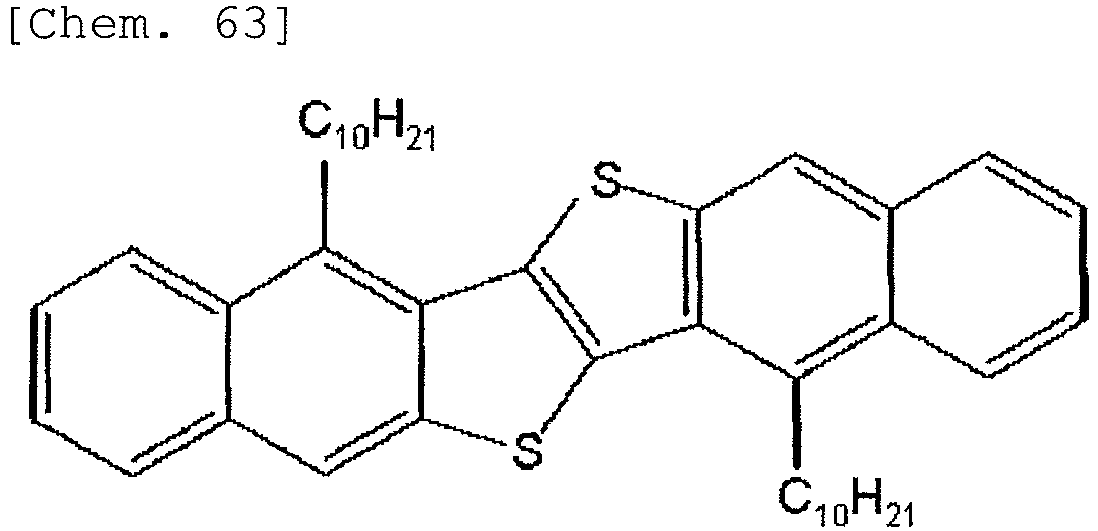
- The 1H-NMR and MS results of the obtained di-decane-substituted DNTT are shown below.
- 1H-NMR (500 MHz, CDC13, 50°C): δ8.33 (s, 2H), 8.26 (d, J=8.30 Hz, 2H), 7.95 (d, J=8.3 Hz, 2H), 7.56 (dd, J=8.3 Hz, 8.3 Hz, 2H), 7.53 (dd, J=8.3 Hz, 8.3 Hz, 2H), 3.67-3.64 (m, 4H), 1.93-1.86 (m, 4H), 1.76-1.71 (m, 4H), 1.49-1.45 (m, 4H), 1.41-1.29 (m, 20H), 0.88 (t, J=6.8 Hz, 6H).
- MS (m/z): 620.083 (positive ion observation) (Exact Mass: 620.288).
- The di-Br-substituted DNTT synthesized in Example A-1 was reacted with 1,6-heptadiine by the Sonogashira coupling method to effect polymerization of DNTT.
- Specifically, 110 mg (0.15 mmol) of Pd(PPh3)2Cl2 (Mw=701.90), 60 mg (0.31 mmol) of CuI (Mw=190.45) and 170 mg (0.53 mmol) of Cs2CO3 (Mw=325.8) were added to 200 mg (0.41 mmol) of di-Br-substituted DNTT (Mw=498.25), and deaeration under reduced pressure and nitrogen purging were performed five times. Subsequently, 0.14 ml (1.00 mmol) of diisopropylamine (Mw=101.2, d=0.72 g/cm3), 14 ml of dimethylformamide and 0.20 ml (1.70 mmol) of 1,6-heptadiine (Mw=92.14, d=0.81g/cm3) were added and after again performing deaeration under reduced pressure and nitrogen purging five times, the system was stirred at 120°C over 12 hours, thereby allowing the reaction to proceed.
- By this reaction, a 1,6-heptanediine-bonded dinaphthothienothiophene polymer (structural formula shown below) was obtained. The molecular weight in terms of polystyrene by gel permeation chromatography (GPC) was 5,000 or more (in terms of polystyrene). The solubility of the obtained polymer in chloroform was 0.1 wt% or more. Incidentally, DNTT used as a raw material was substantially not dissolved in chloroform.

- The di-Br-substituted DNTT synthesized in Example A-1 was reacted with 1,9-decadiine by the Sonogashira coupling method to effect polymerization of DNTT.
- Specifically, 100 mg (0.14 mmol) of Pd(PPh3)2Cl2 (Mw=701.90), 60 mg (0.31 mmol) of CuI (Mw=190.45) and 170 mg (0.53 mmol) of Cs2CO3 (Mw=325.8) were added to 200 mg (0.41 mmol) of di-Br-substituted DNTT (Mw=498.25), and deaeration under pressure and nitrogen purging were performed five times. Subsequently, 0.14 ml (1.00 mmol) of diisopropylamine (Mw=101.2, d=0.72 g/cm3), 14 ml of dimethylformamide, 1 and 0.28 ml (1.70 mmol) of 1,9-decadiine (Mw=134.22, d=0.82 g/cm3) were added and after again performing deaeration under reduced pressure and nitrogen purging five times, the system was stirred at 120°C over 12 hours, thereby allowing the reaction to proceed.
- By this reaction, a 1,9-decadiine-bonded dinaphthothienothiophene polymer (structural formula shown below) was obtained. The molecular weight in terms of polystyrene by gel permeation chromatography (GPC) was 5,000 or more (in terms of polystyrene). The solubility of the obtained polymer in chloroform was 0.1 wt% or more.

- Using the reaction route illustrated below, 3-methylthio-2-naphthaldehyde (formula (b)) was synthesized as shown in (A) to (C).

- As illustrated below, 3-methylthio-2-naphthyl-trifluoromethanesulfonate (formula (g)) was synthesized from commercially available 2-methoxynaphthalene (formula (d)) by the method described in Non-Patent Document 4.

- As illustrated below, 3-methylthio-2-cyanonaphthalene (formula (i)) was synthesized from 3-methylthio-2-naphthyl-trifluoromethanesulfonate (formula (g)).

- Specifically, 102.2 mg (0.317 mmol) of 3-methylthio-2-naphthyl-trifluoromethanesulfonate (formula (g)) (Mw=322.32), 14.4 mg (0.088 mmol) of 1,1'-bis(diphenylphosphino)ferrocene (DPPF) (Mw=164.32), 9.6 mg (0.014 mmol) of bis(dibenzylideneacetone)palladium (Pd(dba)2) (Mw=701.9), 117.1 mg (0.317 mmol) of tetra-n-butylammonium iodide (TBAI: Mw=369.38) and 90 mg (1.00 mmol) of CuCN were mixed, and nitrogen purging was performed 5 times.
- Subsequently, 1.0 ml of dioxane was added, and the system was stirred at 80°C over 7 hours. After cooling to room temperature, chloroform was added, and a gray solid was removed by filtration. The filtrate was diluted by adding water and hydrochloric acid thereto.
- The diluted filtrate was purified twice on a silica gel column by using, as an eluent, a mixed solution of hexane and ethyl acetate (at a ratio of hexane/ethyl acetate = 10/1) to obtain 3-methylthio-2-cyanonaphthalene (formula (i)) (Mw=199.27, 27.4 mg, 0.137 mmol, yield: 42.8%).
- The 1H-NMR results of the obtained 3-methylthio-2-cyanonaphthalene (formula (i)) are shown below.
- 1H-NMR (500 MHz, CDC13, 27°C): δ8.18 (s, 1H), 7.82 (d, J=8.0 Hz, 1H), 7.78 (d, J=8.0 Hz, 1H), 7.66 (s, 1H), 7.61 (dd, J=7.0 Hz, 8.0 Hz, 1H), 7.51 (dd, J=7.0 Hz, 8.0 Hz, 1H), 2.64 (s, 1H).
- As illustrated below, 3-methylthio-2-naphthaldehyde (formula (b)) was synthesized from 3-methylthio-2-cyanonaphthalene (formula (i)).

- Specifically, to a 30-ml flask, 21.3 mg (0.107 mmol) of 3-methylthio-2-cyanonaphthalene (formula (i)) (Mw=199.27) and 1.0 ml of methylene chloride were added, and the flask was cooled to -78°C. Thereto, 0.1 ml (0.122 mmol) of a hexane solution of diisobutylaluminum hydride (Mw=142.22) was added, and the system was stirred at -70°C over 30 minutes. Thereafter, 1.0 ml of an aqueous ammonium chloride solution and 1 N hydrochloric acid were added and after extraction with methylene chloride, the solvent was distilled off to obtain 3-methylthio-2-naphthaldehyde (formula (b)) (Mw=207.27) as a yellow oily substance.
- The 1H-NMR results of the obtained 3-methylthio-2-naphthaldehyde are shown below:
- 1H-NMR (500 MHz, CDC13, 27°C): δ10.3 (s, 1H), 8.31 (s, 1H), 7.92 (d, J=8.0 Hz, 1H), 7.78 (d, J=8.0 Hz, 1H), 7.62-7.59 (m, 1H), 7.60 (s, 1H), 7.49-7.46 (m, 1H), 2.58 (s, 3H).
- Using the reaction route illustrated below, 3-methylthio-2-naphthaldehyde (formula (b)) was synthesized as shown in (A) to (D).

- As illustrated below, methyl 2-naphthoate-3-trifluoromethanesulfonate (1) was synthesize from methyl 3-hydroxy-2-naphthoate (k).

- Specifically, a mixture of 2.01 g (10.0 mmol) of methyl 3-hyddroxy-2-naphthoate (Mw=199.25), 25 ml of methylene chloride and 2.39 ml (29.67 mmol) of pyridine (Mw=79.10, d=0.98 g/cm3) was cooled to a temperature of 0°C and stirred.
- To the cooled mixed solution, 1.78 ml (10 mmol) of trifluoromethanesulfonic acid anhydride (Tf2O: Mw=282.14, d=1.72 g/cm3) was added dropwise. After stirring at room temperature over 75 minutes, cold water and 4 N hydrochloric acid were added, and liquid-separation was performed to obtain red oily methyl 2-naphthoate-3-trifluoromethanesulfonate.
- The 1H-NMR results of the obtained methyl 2-naphthoate-3-trifluoromethanesulfonate are shown below:
- 1H-NMR (500 MHz, CDC13, 50°C): δ8.66 (s, 1H), 7.99 (d, J=8.5 Hz, 1H), 7.89 (d, J=8.5 Hz, 1H), 7.74 (s, 1H), 7.70-7.67 (m, 1H), 7.65-7.62 (m, 1H) 1.54 (s, 3H).
- As illustrated below, methyl 3-methylthio-2-naphthoate (m) was synthesized from methyl 2-naphthoate-3-trifluoromethanesulfonate (1) obtained in (A) above.

- Specifically, to a 50-ml flask, 740 mg (2.2 µmol) of methyl 2-naphthoate-3-trifluoromethanesulfonate (Mw=334.25), 136 mg (0.24 µmol) of DPPF (Mw=554.38), 126 mg (0.22 µmol) of Pd(dba)2 (Mw=575.00) and 30 ml of dehydrated toluene were added, and nitrogen purging was performed three times. Thereafter, 433 mg (3.1 µmol) of sodium thiomethoxide (CH3SNa), 6 ml of dehydrated toluene and 6 ml of methanol were added.
- Nitrogen purging was performed three times, and then the system was stirred at 85°C all night. After cooling to room temperature, extraction was performed using ethyl acetate and water. Thereafter, the extractate was subjected to column chromatography using, as an eluent, a mixed solution of chloroform and hexane (chloroform/hexane = 7/3) and dried to obtain 142 mg of a solid.
- This solid was judged to be the target methyl 3-methylthio-2-naphthoate (formula (m)) from NMR. The yield was 27.6%.
- The 1H-NMR results of the obtained methyl 3-methylthio-2-naphthoate (formula (m)) are shown below:
- 1H-NMR (500M Hz, CDC13, 27°C): δ8.54 (s, 1H), 7.85 (d, J=8.5 Hz, 1H), 7.76 (d, J=8.0 Hz, 1H), 7.57 (s, 1H), 7.56 (t, J=8.0 Hz, 1H), 7.44 (t, J=7.5 Hz, 1H), 2.57 (s, 3H) 1.54 (s, 3H).
- As illustrated below, methanol 3-methylthio-2-naphthoate (formula (n)) was synthesized from methyl 3-methylthio-2-naphthoate (formula (m)).

- Specifically, 40.1 mg (1.05 mmol) of lithium aluminum hydride (LiAlH4, Mw=37.95) and 3 ml of tetrahydrofuran (THF) were added and stirred at 0°C. Subsequently, 0.14 g of methyl 3-methylthio-2-naphthoate (Mw=232.30) and 3 ml of THF were added, and the system was stirred at room temperature for 1.5 hours. After cooling to 0°C, filtration and washing twice with saturated brine were performed and then, the solvent was distilled off.
- The target 3-methylthio-2-naphthalenemethanol (formula (n)) was obtained as a yellow-white oily substance. the yield was 82.3%.
- The 1H-NMR results of the obtained methanol 3-methylthio-2-naphthoate (formula (n)) are shown below:
- 1H-NMR (500 MHz, CDC13, 27°C): δ7.83 (s, 1H), 7.79 (d, J=8.0 Hz, 1H), 7.75 (d, J=8.0 Hz, 1H), 7.61 (s, 1H), 7.48-7.41 (m, 2H), 4.90 (d, J=6.0 Hz, 2H), 2.57 (s, 3H).
- As illustrated below, 3-methylthio-2-naphthaldehyde (b) was synthesized from methanol 3-methylthio-2-naphthoate (n).

- A 30-ml flask was cooled to -80°C, and 0.13 g (1.0 mmol) of oxalyl chloride ((COCl)2, Mw=126.93, d=1.48 g/cm3), 3.2 ml of methylene chloride and 0.105 g of dimethylsulfoxide (DMSO, Mw=78.13, d=2.66 g/cm3) were added thereto, followed by stirring for 15 minutes. Thereafter, 0.103 g (0.5 mmol) of 3-methylthio-2-naphthalenemethanol (formula (n), Mw=204.29) and 1 ml of methylene chloride were added, and the system was stirred for 15 minutes.
- The resulting solution was stirred for 2 hours while gradually raising the temperature, and 0.37 g (3.67 mmol) of triethylamine (Mw=101.19, d=0.73 g/cm3) was added, followed by stirring at 0°C for 20 minutes. Subsequently, ammonium chloride was added, and extraction with ethyl acetate was performed twice. After drying over magnesium sulfate, the solvent was distilled off.
- The crude product was purified on a silica gel column by using hexane/ethyl acetate = 8/2 as an eluent to obtain a yellow oily product. NMR revealed that 3-methylthio-2-naphthaldehyde (Mw=202.27) was obtained.
- The 1H-NMR results of the obtained 3-methylthio-2-naphthaldehyde are shown below:
- 1H-NMR (500 MHz, CDC13, 27°C): δ10.3 (s, 1H), 8.31 (s, 1H), 7.92 (d, J=8.0 Hz, 1H), 7.78 (d, J=8.0 Hz, 1H), 7.62-7.59 (m, 1H), 7.60 (s, 1H), 7.49-7.46 (m, 1H), 2.58 (s, 3H).
Claims (58)
- A condensed polycyclic aromatic compound represented by the following formula (I):

B is a substituted or unsubstituted condensed ring having at least one benzene ring moiety;
each Y is independently selected from chalcogens; and
each of A1 to A4 is independently selected from the group consisting of a hydrogen atom, a halogen atom, an alkyl group having from 1 to 20 carbon atoms, an alkenyl group having from 2 to 20 carbon atoms, an alkynyl group having from 2 to 20 carbon atoms, a substituted or unsubstituted aromatic group having from 4 to 20 carbon atoms, a ketone group having from 2 to 10 carbon atoms, an amino group having from 1 to 20 carbon atoms, an amide group having from 1 to 20 carbon atoms, an imide group having from 1 to 20 carbon atoms, a sulfide group having from 1 to 20 carbon atoms, and an alkylsilylalkynyl group having from 1 to 40 carbon atoms, and two adjacent members out of A1 to A4 may combine with each other to form a substituted or unsubstituted aromatic group having from 4 to 20 carbon atoms). - The compound according to claim 1, which is represented by the following formula (I-1):

each Y is independently selected from chalcogens; and
each of A1 to A8 is independently selected from the group consisting of a hydrogen atom, a halogen atom, an alkyl group having from 1 to 20 carbon atoms, an alkenyl group having from 2 to 20 carbon atoms, an alkynyl group having from 2 to 20 carbon atoms, a substituted or unsubstituted aromatic group having from 4 to 20 carbon atoms, a ketone group having from 2 to 10 carbon atoms, an amino group having from 1 to 20 carbon atoms, an amide group having from 1 to 20 carbon atoms, an imide group having from 1 to 20 carbon atoms, a sulfide group having from 1 to 20 carbon atoms, and an alkylsilylalkynyl group having from 1 to 40 carbon atoms, and two adjacent members out of A1 to A8 may combine with each other to form a substituted or unsubstituted aromatic group having from 4 to 20 carbon atoms). - The compound according to claim 2, wherein each of Q2 and Q3 is independently selected from the group consisting of a hydrogen atom, a halogen atom, an alkyl group having from 1 to 20 carbon atoms, an alkenyl group having from 2 to 20 carbon atoms, an alkynyl group having from 2 to 20 carbon atoms, a substituted or unsubstituted aromatic group having from 4 to 20 carbon atoms, a ketone group having from 2 to 10 carbon atoms, an amino group having from 1 to 20 carbon atoms, an amide group having from 1 to 20 carbon atoms, an imide group having from 1 to 20 carbon atoms, a sulfide group having from 1 to 20 carbon atoms, and an alkylsilylalkynyl group having from 1 to 40 carbon atoms, at least one of Q2 and Q3 is a group other than a hydrogen atom and a halogen atom, and
Q1 and Q4 are a hydrogen atom. - The compound according to claim 2, which is represented by the following formula (I-1-1):

- The compound according to any one of claims 1 to 3, wherein at least one of Q1 to Q4 is selected from the group consisting of substituted or unsubstituted aromatic groups represented by the following formula:

- The compound according to claim 5, which is represented by the following formula (I-1-2):

- The compound according to claim 1, which is represented by the following formula (I-2):

D is a substituent having from 2 to 20 carbon atoms, which is obtained by adding a dienophilic alkene to a benzene ring;
each Y is independently selected from chalcogens; and
each of A1 to A8 is independently selected from the group consisting of a hydrogen atom, a halogen atom, an alkyl group having from 1 to 20 carbon atoms, an alkenyl group having from 2 to 20 carbon atoms, an alkynyl group having from 2 to 20 carbon atoms, a substituted or unsubstituted aromatic group having from 4 to 20 carbon atoms, a ketone group having from 2 to 10 carbon atoms, an amino group having from 1 to 20 carbon atoms, an amide group having from 1 to 20 carbon atoms, an imide group having from 1 to 20 carbon atoms, a sulfide group having from 1 to 20 carbon atoms, and an alkylsilylalkynyl group having from 1 to 40 carbon atoms, and two adjacent members out of A1 to A8 may combine with each other to form a substituted or unsubstituted aromatic group having from 4 to 20 carbon atoms). - The compound according to claim 7, wherein each of Q1 and Q2 is independently selected from the group consisting of an alkyl group having from 1 to 20 carbon atoms, an alkenyl group having from 2 to 20 carbon atoms, an alkynyl group having from 2 to 20 carbon atoms, a substituted or unsubstituted aromatic group having from 4 to 20 carbon atoms, a ketone group having from 2 to 10 carbon atoms, an amino group having from 1 to 20 carbon atoms, an amide group having from 1 to 20 carbon atoms, an imide group having from 1 to 20 carbon atoms, a sulfide group having from 1 to 20 carbon atoms, and an alkylsilylalkynyl group having from 1 to 40 carbon atoms.
- The compound according to claim 7, which is represented by the following formula (I-2-1):

each Rr is independently selected from the group consisting of hydrogen, a halogen, a hydroxyl group, an amide group, a mercapto group, a cyano group, an alkyl group having from 1 to 10 carbon atoms, an alkenyl group having from 2 to 10 carbon atoms, an alkynyl group having from 2 to 10 carbon atoms, an alkoxy group having from 1 to 10 carbon atoms, a substituted or unsubstituted aromatic group having from 4 to 10 carbon atoms, an ester group having from 1 to 10 carbon atoms, an ether group having from 1 to 10 carbon atoms, a ketone group having from 1 to 10 carbon atoms, an amino group having from 1 to 10 carbon atoms, an amide group having from 1 to 10 carbon atoms, an imide group having from 1 to 10 carbon atoms, and a sulfide group having from 1 to 10 carbon atoms). - A condensed polycyclic aromatic compound-containing solution comprising an organic solvent and the compound of any one of claims 1 to 9 which is at least partially dissolved in said organic solvent.
- A method for producing an organic semiconductor film, comprising:coating a substrate with the solution of claim 10, andremoving said organic solvent from said solution coated on the substrate.
- A method for manufacturing an organic semiconductor device, comprising producing an organic semiconductor film by the method of claim 11.
- An organic semiconductor device, having an organic semiconductor film containing the compound of any one of claims 1 to 9.
- A condensed polycyclic aromatic compound represented by the following formula (II):

B is a condensed ring having at least one benzene ring moiety;
each Y is independently selected from chalcogens; and
each of A1 to A4 is independently selected from the group consisting of a hydrogen atom, a halogen atom, an alkyl group having from 1 to 20 carbon atoms, an alkenyl group having from 2 to 20 carbon atoms, an alkynyl group having from 2 to 20 carbon atoms, a substituted or unsubstituted aromatic group having from 4 to 20 carbon atoms, a ketone group having from 2 to 10 carbon atoms, an amino group having from 1 to 20 carbon atoms, an amide group having from 1 to 20 carbon atoms, an imide group having from 1 to 20 carbon atoms, a sulfide group having from 1 to 20 carbon atoms, and an alkylsilylalkynyl group having from 1 to 40 carbon atoms, and two adjacent members out of A1 to A4 may combine with each other to form a substituted or unsubstituted aromatic group having from 4 to 20 carbon atoms). - The compound according to claim 14, which is represented by the following formula (II-1):

each Y is independently selected from chalcogens; and
each of A1 to A8 is independently selected from the group consisting of a hydrogen atom, a halogen atom, an alkyl group having from 1 to 20 carbon atoms, an alkenyl group having from 2 to 20 carbon atoms, an alkynyl group having from 2 to 20 carbon atoms, a substituted or unsubstituted aromatic group having from 4 to 20 carbon atoms, a ketone group having from 2 to 10 carbon atoms, an amino group having from 1 to 20 carbon atoms, an amide group having from 1 to 20 carbon atoms, an imide group having from 1 to 20 carbon atoms, a sulfide group having from 1 to 20 carbon atoms, and an alkylsilylalkynyl group having from 1 to 40 carbon atoms, and two adjacent members out of A1 to A8 may combine with each other to form a substituted or unsubstituted aromatic group having from 4 to 20 carbon atoms). - The compound according to claim 15, wherein each of X2 and X3 is independently selected from the group consisting of a hydrogen atom, a halogen atom, an alkyl group having from 1 to 20 carbon atoms, an alkenyl group having from 2 to 20 carbon atoms, an alkynyl group having from 2 to 20 carbon atoms, a substituted or unsubstituted aromatic group having from 4 to 20 carbon atoms, a ketone group having from 2 to 10 carbon atoms, an amino group having from 1 to 20 carbon atoms, an amide group having from 1 to 20 carbon atoms, an imide group having from 1 to 20 carbon atoms, a sulfide group having from 1 to 20 carbon atoms, and an alkylsilylalkynyl group having from 1 to 40 carbon atoms, at least one of X2 and X3 is a halogen atom, and
X1 and X4 are a hydrogen atom. - The compound according to claim 15, which is represented by the following formula (II-1-1):

- The compound according to claim 15, which is represented by the following formula (II-1-2):

- The compound according to claim 14, which is represented by the following formula (II-2):

D is a substituent having from 2 to 20 carbon atoms, which is obtained by adding a dienophilic alkene to a benzene ring;
each Y is independently selected from chalcogens; and
each of A1 to A8 is independently selected from the group consisting of a hydrogen atom, a halogen atom, an alkyl group having from 1 to 20 carbon atoms, an alkenyl group having from 2 to 20 carbon atoms, an alkynyl group having from 2 to 20 carbon atoms, a substituted or unsubstituted aromatic group having from 4 to 20 carbon atoms, a ketone group having from 2 to 10 carbon atoms, an amino group having from 1 to 20 carbon atoms, an amide group having from 1 to 20 carbon atoms, an imide group having from 1 to 20 carbon atoms, a sulfide group having from 1 to 20 carbon atoms, and an alkylsilylalkynyl group having from 1 to 40 carbon atoms, and two adjacent members out of A1 to A8 may combine with each other to form a substituted or unsubstituted aromatic group having from 4 to 20 carbon atoms). - The compound according to claim 19, wherein both X1 and X2 are a halogen atom.
- The compound according to claim 19, which is represented by the following formula (II-2-1):

- A method for synthesizing the condensed polycyclic aromatic compound of any one of claims 14 to 21, comprising:(a) providing a composition containing an organic solvent and a condensed polycyclic aromatic compound represented by the following formula (III):

B is a condensed ring having at least one benzene ring moiety;
each Y is independently selected from chalcogens; and
each of A1 to A4 is independently selected from the group consisting of a hydrogen atom, a halogen atom, an alkyl group having from 1 to 20 carbon atoms, an alkenyl group having from 2 to 20 carbon atoms, an alkynyl group having from 2 to 20 carbon atoms, a substituted or unsubstituted aromatic group having from 4 to 20 carbon atoms, a ketone group having from 2 to 10 carbon atoms, an amino group having from 1 to 20 carbon atoms, an amide group having from 1 to 20 carbon atoms, an imide group having from 1 to 20 carbon atoms, a sulfide group having from 1 to 20 carbon atoms, and an alkylsilylalkynyl group having from 1 to 40 carbon atoms, and two adjacent members out of A1 to A4 may combine with each other to form a substituted or unsubstituted aromatic group having from 4 to 20 carbon atoms), and(b) adding a halogen to said composition. - The method according to claim 22, wherein said compound of formula (III) is represented by the following formula (III-1):

each Y is independently selected from chalcogens; and
each of A1 to A8 is independently selected from the group consisting of a hydrogen atom, a halogen atom, an alkyl group having from 1 to 20 carbon atoms, an alkenyl group having from 2 to 20 carbon atoms, an alkynyl group having from 2 to 20 carbon atoms, a substituted or unsubstituted aromatic group having from 4 to 20 carbon atoms, a ketone group having from 2 to 10 carbon atoms, an amino group having from 1 to 20 carbon atoms, an amide group having from 1 to 20 carbon atoms, an imide group having from 1 to 20 carbon atoms, a sulfide group having from 1 to 20 carbon atoms, and an alkylsilylalkynyl group having from 1 to 40 carbon atoms, and two adjacent members out of A1 to A8 may combine with each other to form a substituted or unsubstituted aromatic group having from 4 to 20 carbon atoms). - The method according to claim 23, wherein all of E1 to E4 are a hydrogen atom.
- The method according to claim 23, wherein said compound of formula (III-1) is represented by the following formula (III-1-1):

- The method according to claim 22, wherein said compound of formula (III) is represented by the following formula (III-2):

D is a substituent having from 2 to 20 carbon atoms, which is obtained by adding a dienophilic alkene to a benzene ring;
each Y is independently selected from chalcogens; and
each of A1 to A8 is independently selected from the group consisting of a hydrogen atom, a halogen atom, an alkyl group having from 1 to 20 carbon atoms, an alkenyl group having from 2 to 20 carbon atoms, an alkynyl group having from 2 to 20 carbon atoms, a substituted or unsubstituted aromatic group having from 4 to 20 carbon atoms, a ketone group having from 2 to 10 carbon atoms, an amino group having from 1 to 20 carbon atoms, an amide group having from 1 to 20 carbon atoms, an imide group having from 1 to 20 carbon atoms, a sulfide group having from 1 to 20 carbon atoms, and an alkylsilylalkynyl group having from 1 to 40 carbon atoms, and two adjacent members out of A1 to A8 may combine with each other to form a substituted or unsubstituted aromatic group having from 4 to 20 carbon atoms). - The method according to claim 26, wherein both E1 and E3 are hydrogen.
- The method according to claim 26, wherein said compound of formula (III-2) is represented by the following formula (III-2-1):

- A method for synthesizing a condensed polycyclic aromatic compound represented by the following formula (I), comprising:(a) providing a composition containing an organic solvent and the compound of any one of claims 14 to 21, and(b) substituting at least one halogen atom out of X1 to X4 with a substituent selected from the group consisting of an alkyl group having from 1 to 20 carbon atoms, an alkenyl group having from 2 to 20 carbon atoms, an alkynyl group having from 2 to 20 carbon atoms, a substituted or unsubstituted aromatic group having from 4 to 20 carbon atoms, a ketone group having from 2 to 10 carbon atoms, an amino group having from 1 to 20 carbon atoms, an amide group having from 1 to 20 carbon atoms, an imide group having from 1 to 20 carbon atoms, and a sulfide group having from 1 to 20 carbon atoms):

B is a substituted or unsubstituted condensed ring having at least one benzene ring moiety;
each Y is independently selected from chalcogens; and
each of A1 to A4 is independently selected from the group consisting of a hydrogen atom, a halogen atom, an alkyl group having from 1 to 20 carbon atoms, an alkenyl group having from 2 to 20 carbon atoms, an alkynyl group having from 2 to 20 carbon atoms, a substituted or unsubstituted aromatic group having from 4 to 20 carbon atoms, a ketone group having from 2 to 10 carbon atoms, an amino group having from 1 to 20 carbon atoms, an amide group having from 1 to 20 carbon atoms, an imide group having from 1 to 20 carbon atoms, a sulfide group having from 1 to 20 carbon atoms, and an alkylsilylalkynyl group having from 1 to 40 carbon atoms, and two adjacent members out of A1 to A4 may combine with each other to form a substituted or unsubstituted aromatic group having from 4 to 20 carbon atoms). - An aromatic polymer having two or more condensed polycyclic aromatic moieties represented by the following formula (IV):
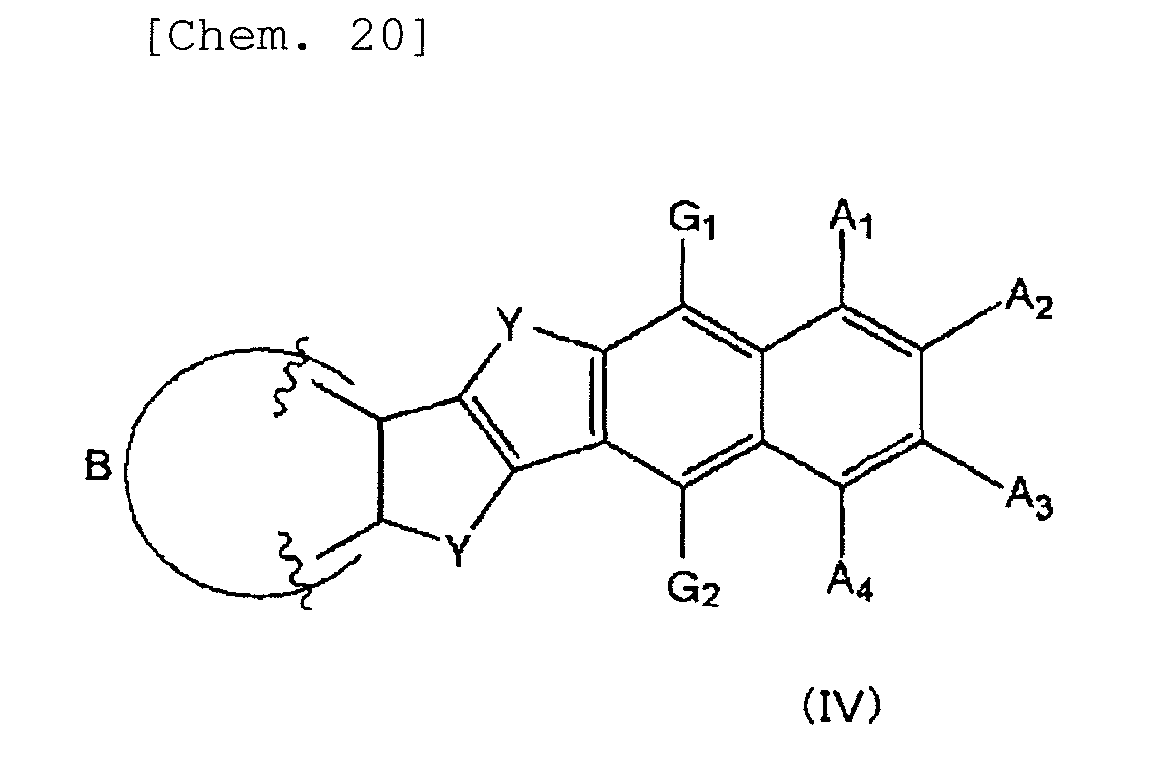
B is a condensed ring having at least one benzene ring moiety;
each Y is independently selected from chalcogens; and
each of A1 to A4 is independently selected from the group consisting of a hydrogen atom, a halogen atom, an alkyl group having from 1 to 20 carbon atoms, an alkenyl group having from 2 to 20 carbon atoms, an alkynyl group having from 2 to 20 carbon atoms, a substituted or unsubstituted aromatic group having from 4 to 20 carbon atoms, a ketone group having from 2 to 10 carbon atoms, an amino group having from 1 to 20 carbon atoms, an amide group having from 1 to 20 carbon atoms, an imide group having from 1 to 20 carbon atoms, a sulfide group having from 1 to 20 carbon atoms, and an alkylsilylalkynyl group having from 1 to 40 carbon atoms, and two adjacent members out of A1 to A4 may combine with each other to form a substituted or unsubstituted aromatic group having from 4 to 20 carbon atoms). - The compound according to claim 30, wherein said condensed polycyclic aromatic moiety is represented by the following formula (IV-1):

each Y is independently selected from chalcogens; and
each of A1 to A8 is independently selected from the group consisting of a hydrogen atom, a halogen atom, an alkyl group having from 1 to 20 carbon atoms, an alkenyl group having from 2 to 20 carbon atoms, an alkynyl group having from 2 to 20 carbon atoms, a substituted or unsubstituted aromatic group having from 4 to 20 carbon atoms, a ketone group having from 2 to 10 carbon atoms, an amino group having from 1 to 20 carbon atoms, an amide group having from 1 to 20 carbon atoms, an imide group having from 1 to 20 carbon atoms, a sulfide group having from 1 to 20 carbon atoms, and an alkylsilylalkynyl group having from 1 to 40 carbon atoms, and two adjacent members out of A1 to A8 may combine with each other to form a substituted or unsubstituted aromatic group having from 4 to 20 carbon atoms). - The compound according to claim 31, wherein G2 and G3 are a bond, and G1 and G4 are a hydrogen atom.
- The polymer according to any one of claims 30 to 32, wherein said condensed polycyclic aromatic moiety is represented by the following formula (IV-1-1):

- The aromatic polymer according to any one of claims 30 to 33, which contains a repeating unit of the following formula (V):
-{(TT) - (QQ)}- (V)
(wherein TT is said condensed polycyclic aromatic moiety; and
QQ is a bond or a divalent group). - The aromatic polymer according to claim 30, which contains a repeating unit of the following formula (V-1):

each Y is independently selected from chalcogens; each of A1 to A8 is independently selected from the group consisting of a hydrogen atom, a halogen atom, an alkyl group having from 1 to 20 carbon atoms, an alkenyl group having from 2 to 20 carbon atoms, an alkynyl group having from 2 to 20 carbon atoms, a substituted or unsubstituted aromatic group having from 4 to 20 carbon atoms, a ketone group having from 2 to 10 carbon atoms, an amino group having from 1 to 20 carbon atoms, an amide group having from 1 to 20 carbon atoms, an imide group having from 1 to 20 carbon atoms, a sulfide group having from 1 to 20 carbon atoms, and an alkylsilylalkynyl group having from 1 to 40 carbon atoms, and two adjacent members out of A1 to A8 may combine with each other to form a substituted or unsubstituted aromatic group having from 4 to 20 carbon atoms; and
QQ is a bond or a divalent group). - The polymer according to any one of claims 30 to 35, having a molecular weight of 1,000 or more.
- A method for synthesizing the aromatic polymer of any one of claims 30 to 36, comprising(a) providing a composition containing an organic solvent and a condensed polycyclic aromatic compound represented by the following formula (II):

B is a condensed ring having at least one benzene ring moiety;
each Y is independently selected from chalcogens; and
each of A1 to A4 is independently selected from the group consisting of a hydrogen atom, a halogen atom, an alkyl group having from 1 to 20 carbon atoms, an alkenyl group having from 2 to 20 carbon atoms, an alkynyl group having from 2 to 20 carbon atoms, a substituted or unsubstituted aromatic group having from 4 to 20 carbon atoms, a ketone group having from 2 to 10 carbon atoms, an amino group having from 1 to 20 carbon atoms, an amide group having from 1 to 20 carbon atoms, an imide group having from 1 to 20 carbon atoms, a sulfide group having from 1 to 20 carbon atoms, and an alkylsilylalkynyl group having from 1 to 40 carbon atoms, and two adjacent members out of A1 to A4 may combine with each other to form a substituted or unsubstituted aromatic group having from 4 to 20 carbon atoms); and(b) adding, to said composition, a bonding compound having two or more moieties capable of substituting at least one halogen atom out of X1 and X2 to combine two or more condensed polycyclic aromatic compounds with each other. - The method according to claim 37, wherein the reaction of the step (b) is achieved by a coupling reaction selected from the group consisting of Mizoroki-Heck reaction, Negishi coupling, Migita-Kosugi-Stille coupling, Sonogashira coupling, Suzuki-Miyaura coupling, Buchwald-Hartwig reaction, and Kumada-Tamao-Corriu coupling.
- The method according to claim 37 or 38, wherein said condensed polycyclic aromatic compound is represented by the following formula (II-1):

each Y is independently selected from chalcogens; and
each of A1 to A8 is independently selected from the group consisting of a hydrogen atom, a halogen atom, an alkyl group having from 1 to 20 carbon atoms, an alkenyl group having from 2 to 20 carbon atoms, an alkynyl group having from 2 to 20 carbon atoms, a substituted or unsubstituted aromatic group having from 4 to 20 carbon atoms, a ketone group having from 2 to 10 carbon atoms, an amino group having from 1 to 20 carbon atoms, an amide group having from 1 to 20 carbon atoms, an imide group having from 1 to 20 carbon atoms, a sulfide group having from 1 to 20 carbon atoms, and an alkylsilylalkynyl group having from 1 to 40 carbon atoms, and two adjacent members out of A1 to A8 may combine with each other to form a substituted or unsubstituted aromatic group having from 4 to 20 carbon atoms). - The method according to claim 39, wherein each of X2 and X3 is independently selected from the group consisting of a hydrogen atom, a halogen atom, an alkyl group having from 1 to 20 carbon atoms, an alkenyl group having from 2 to 20 carbon atoms, an alkynyl group having from 2 to 20 carbon atoms, a substituted or unsubstituted aromatic group having from 4 to 20 carbon atoms, a ketone group having from 2 to 10 carbon atoms, an amino group having from 1 to 20 carbon atoms, an amide group having from 1 to 20 carbon atoms, an imide group having from 1 to 20 carbon atoms, a sulfide group having from 1 to 20 carbon atoms, and an alkylsilylalkynyl group having from 1 to 40 carbon atoms, and at least one of X2 and X3 is a halogen atom, and
X1 and X4 are a hydrogen atom. - The method according to claim 40, wherein said condensed polycyclic aromatic compound is represented by the following formula (II-1-1):

- An aromatic polymer-containing solution, comprising an organic solvent, and the aromatic polymer of any one of claims 30 to 36 which is at least partially dissolved in said organic solvent.
- A method for producing an organic semiconductor film, comprising:coating a substrate with the solution of claim 42, andremoving said organic solvent from said solution coated on the substrate.
- A method for manufacturing an organic semiconductor device, comprising producing an organic semiconductor film by the method of claim 43.
- An organic semiconductor device having an organic semiconductor film containing the polymer of any one of claims 30 to 36.
- A method for synthesizing a compound of formula (b), comprising reducing the cyano group of a compound of formula (i):


- The method according to claim 46, comprising substituting the triflate group of a compound of formula (g) by a cyano group to synthesize said compound of formula (i):

- A method for synthesizing a compound of the following formula (x), comprising synthesizing said compound of formula (b) by the method of claim 46 or 47, and condensing two molecules of said compound of formula (b) :

- An aromatic compound having the following formula:

- An aromatic compound having the following formula:

- A method for synthesizing a compound of formula (b), comprising partially oxidizing the hydroxyl group of a compound of formula (n):


- The method according to claim 51, comprising reducing the methyl ester group of a compound of formula (m) to synthesize said compound of formula (n):

- The method according to claim 51 or 52, comprising substituting the triflate group of a compound of formula (1) by a thiomethyl group to synthesize said compound of formula (m):

- The method according to any one of claims 51 to 53, comprising substituting the hydroxy group of a compound of formula (k) with a triflate group to synthesize said compound of formula (l):
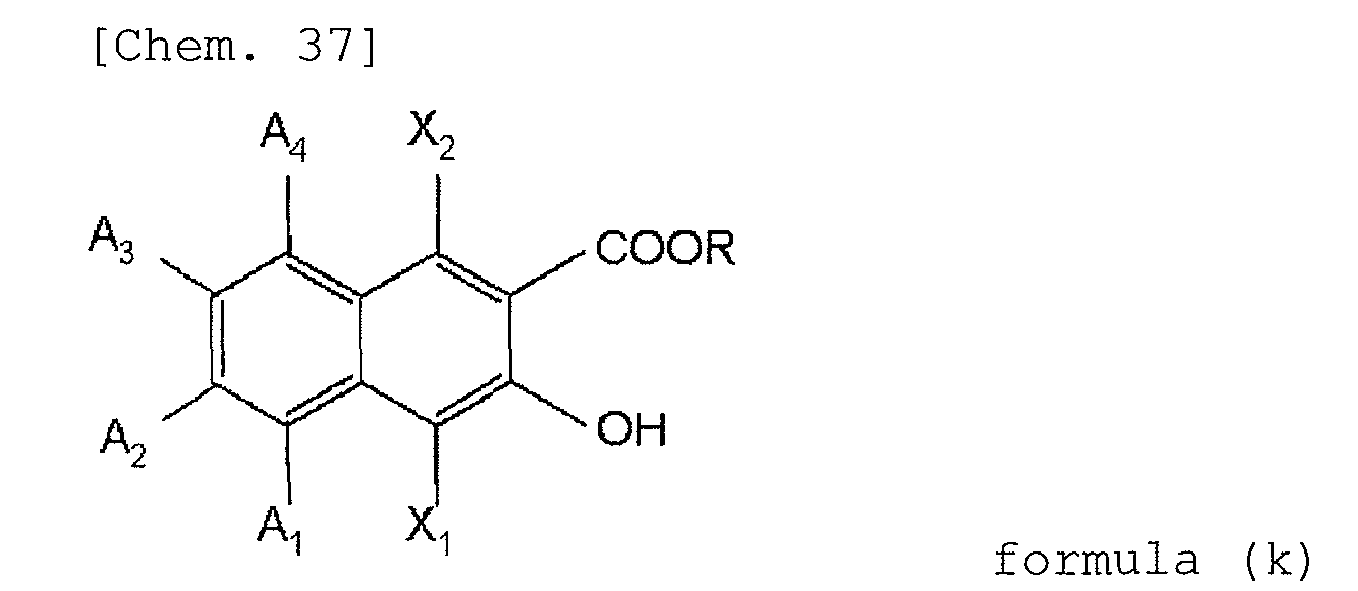
- A method for synthesizing a compound of the following formula (x), comprising synthesizing said compound of formula (b) by the method of any one of claims 51 to 54 and condensing two molecules of said compound of formula (b):

- An aromatic compound having the following formula:

- An aromatic compound having the following formula:

R is selected from the group consisting of an alkyl group having from 1 to 20 carbon atoms, an alkenyl group having from 2 to 20 carbon atoms, an alkynyl group having from 2 to 20 carbon atoms, a substituted or unsubstituted aromatic group having from 4 to 20 carbon atoms, a ketone group having from 2 to 10 carbon atoms, an amino group having from 1 to 20 carbon atoms, an amide group having from 1 to 20 carbon atoms, an imide group having from 1 to 20 carbon atoms, a sulfide group having from 1 to 20 carbon atoms, and an alkylsilylalkynyl group having from 1 to 40 carbon atoms). - An aromatic compound having the following formula:

R is selected from the group consisting of an alkyl group having from 1 to 20 carbon atoms, an alkenyl group having from 2 to 20 carbon atoms, an alkynyl group having from 2 to 20 carbon atoms, a substituted or unsubstituted aromatic group having from 4 to 20 carbon atoms, a ketone group having from 2 to 10 carbon atoms, an amino group having from 1 to 20 carbon atoms, an amide group having from 1 to 20 carbon atoms, an imide group having from 1 to 20 carbon atoms, a sulfide group having from 1 to 20 carbon atoms, and an alkylsilylalkynyl group having from 1 to 40 carbon atoms).
Applications Claiming Priority (7)
| Application Number | Priority Date | Filing Date | Title |
|---|---|---|---|
| JP2011172301 | 2011-08-05 | ||
| JP2011172296 | 2011-08-05 | ||
| JP2011222355A JP5881363B2 (en) | 2011-10-06 | 2011-10-06 | Novel aromatic polymer |
| JP2012171915A JP2013053140A (en) | 2011-08-05 | 2012-08-02 | New condensed polycyclic aromatic compound |
| JP2012171873A JP5404865B2 (en) | 2011-08-05 | 2012-08-02 | Novel condensed polycyclic aromatic compounds |
| JP2012171821A JP2014031324A (en) | 2012-08-02 | 2012-08-02 | Synthesis method for aromatic compound |
| PCT/JP2012/069896 WO2013021953A1 (en) | 2011-08-05 | 2012-08-03 | Condensed polycyclic aromatic compound, aromatic polymer, and method for synthesizing aromatic compound |
Publications (2)
| Publication Number | Publication Date |
|---|---|
| EP2740735A1 true EP2740735A1 (en) | 2014-06-11 |
| EP2740735A4 EP2740735A4 (en) | 2014-09-03 |
Family
ID=48871718
Family Applications (1)
| Application Number | Title | Priority Date | Filing Date |
|---|---|---|---|
| EP12822644.6A Withdrawn EP2740735A4 (en) | 2011-08-05 | 2012-08-03 | Condensed polycyclic aromatic compound, aromatic polymer, and method for synthesizing aromatic compound |
Country Status (6)
| Country | Link |
|---|---|
| US (1) | US8829202B2 (en) |
| EP (1) | EP2740735A4 (en) |
| KR (1) | KR101606294B1 (en) |
| CN (1) | CN103717606A (en) |
| TW (1) | TWI523857B (en) |
| WO (1) | WO2013021953A1 (en) |
Cited By (2)
| Publication number | Priority date | Publication date | Assignee | Title |
|---|---|---|---|---|
| EP3228622A3 (en) * | 2016-04-08 | 2017-11-15 | Samsung Electronics Co., Ltd | Synthetic method of fused heteroaromatic compound and fused heteroaromatic compound, and intermediate thereof |
| US20180130952A1 (en) * | 2016-11-08 | 2018-05-10 | Samsung Electronics Co., Ltd. | Synthetic method of fused heteroaromatic compound and fused heteroaromatic compound and intermediate therefor and synthetic method of intermediate |
Families Citing this family (6)
| Publication number | Priority date | Publication date | Assignee | Title |
|---|---|---|---|---|
| WO2014027685A1 (en) | 2012-08-15 | 2014-02-20 | 帝人株式会社 | Organic semiconductor solution and organic semiconductor film |
| KR102520104B1 (en) | 2015-10-12 | 2023-04-07 | 삼성전자주식회사 | Fused Polycyclic Heteroaromatic Compound, Organic Thin Film Including Compound and Electronic Device Including Organic Thin Film |
| EP3438150A4 (en) * | 2016-03-29 | 2019-11-27 | The University Of Tokyo | NOVEL ORGANIC POLYMER AND PROCESS FOR PRODUCING THE SAME |
| JP7241346B2 (en) * | 2019-05-21 | 2023-03-17 | 国立大学法人東北大学 | Method for producing aromatic compound |
| TWI844726B (en) | 2019-09-17 | 2024-06-11 | 日商日本化藥股份有限公司 | Condensed polycyclic aromatic compound |
| CN116332807A (en) * | 2023-03-24 | 2023-06-27 | 安徽秀朗新材料科技有限公司 | Production process of 3- (trifluoromethyl sulfonyl) -2-methyl naphthoate |
Family Cites Families (18)
| Publication number | Priority date | Publication date | Assignee | Title |
|---|---|---|---|---|
| US3346612A (en) * | 1964-07-02 | 1967-10-10 | Minnesota Mining & Mfg | Perfluoroalkane sulfonate esters |
| DE3225386A1 (en) | 1982-07-07 | 1984-01-12 | Beiersdorf Ag, 2000 Hamburg | Substituted naphthylimidazo[4,5-b]pyridines, process for their preparation, and their use, and preparations containing these compounds |
| GB9922521D0 (en) | 1998-10-07 | 1999-11-24 | Zeneca Ltd | Compounds |
| JP4220951B2 (en) | 2004-09-24 | 2009-02-04 | 国立大学法人広島大学 | NOVEL ORGANIC SEMICONDUCTOR COMPOUND, PROCESS FOR PRODUCING THE SAME AND ORGANIC SEMICONDUCTOR DEVICE USING THE SAME |
| CN101103037B (en) | 2005-01-19 | 2010-10-13 | 国立大学法人广岛大学 | New Condensed Polycyclic Aromatic Compounds and Their Applications |
| KR101355305B1 (en) * | 2005-06-09 | 2014-01-23 | 메르크 파텐트 게엠베하 | Monomers, oligomers and polymers of thieno (3,4-d) thiazole |
| US7772485B2 (en) * | 2005-07-14 | 2010-08-10 | Konarka Technologies, Inc. | Polymers with low band gaps and high charge mobility |
| MX2008013237A (en) | 2006-04-14 | 2009-03-06 | Merck & Co Inc | Substituted imidazole 4-carboxamides as cholecystokinin-1 receptor modulators. |
| JP5499422B2 (en) * | 2006-06-28 | 2014-05-21 | コニカミノルタ株式会社 | Organic semiconductor material, organic semiconductor film, organic thin film transistor, and organic thin film transistor manufacturing method |
| CN101528753B (en) * | 2006-10-25 | 2012-05-23 | 国立大学法人广岛大学 | Condensed polycyclic aromatic compound, its production method and use |
| KR20080100982A (en) * | 2007-05-15 | 2008-11-21 | 삼성전자주식회사 | Heteroacene compound, an organic thin film comprising the same and an electronic device comprising the thin film |
| JP2008290963A (en) | 2007-05-24 | 2008-12-04 | Nippon Kayaku Co Ltd | Method for producing aromatic compound |
| JP5228411B2 (en) | 2007-09-05 | 2013-07-03 | Jnc株式会社 | [1] Benzochalcogeno [3,2-b] [1] Compound having benzochalcogenophene skeleton and organic transistor using the same |
| US9040505B2 (en) | 2007-09-26 | 2015-05-26 | Indiana University Research And Technology Corporation | Benzoquinone derivative E3330 in combination with chemotherapeutic agents for the treatment of cancer and angiogenesis |
| JP2009124064A (en) | 2007-11-19 | 2009-06-04 | Konica Minolta Holdings Inc | Organic semiconductor thin film, organic thin film transistor, and method of manufacturing organic thin film transistor |
| WO2009123695A1 (en) * | 2008-03-31 | 2009-10-08 | Corning Incorporated | Fused thiophenes and methods for making and using same |
| JP5487655B2 (en) * | 2008-04-17 | 2014-05-07 | 株式会社リコー | [1] Benzothieno [3,2-b] [1] benzothiophene compound, production method thereof, and organic electronic device using the same |
| US9056871B2 (en) | 2009-08-28 | 2015-06-16 | Teijin Limited | Adduct compound, methods for purification and preparation of fused polycyclic aromatic compound, solution for formation of organic semiconductor film, and novel alpha-diketone compound |
-
2012
- 2012-08-03 TW TW101127987A patent/TWI523857B/en not_active IP Right Cessation
- 2012-08-03 KR KR1020147001601A patent/KR101606294B1/en not_active Expired - Fee Related
- 2012-08-03 WO PCT/JP2012/069896 patent/WO2013021953A1/en not_active Ceased
- 2012-08-03 US US14/237,103 patent/US8829202B2/en not_active Expired - Fee Related
- 2012-08-03 CN CN201280038287.6A patent/CN103717606A/en active Pending
- 2012-08-03 EP EP12822644.6A patent/EP2740735A4/en not_active Withdrawn
Non-Patent Citations (2)
| Title |
|---|
| See also references of WO2013021953A1 * |
| YANG NI ET AL: "Zirconium-Mediated Coupling Reaction for Synthesis of Substituted Thiophene-Fused Acenes", ORGANIC LETTERS, vol. 11, no. 16, 20 August 2009 (2009-08-20), pages 3702-3705, XP055131504, ISSN: 1523-7060, DOI: 10.1021/ol900903w * |
Cited By (5)
| Publication number | Priority date | Publication date | Assignee | Title |
|---|---|---|---|---|
| EP3228622A3 (en) * | 2016-04-08 | 2017-11-15 | Samsung Electronics Co., Ltd | Synthetic method of fused heteroaromatic compound and fused heteroaromatic compound, and intermediate thereof |
| US10056563B2 (en) | 2016-04-08 | 2018-08-21 | Samsung Electronics Co., Ltd. | Synthetic method of fused heteroaromatic compound and fused heteroaromatic compound, and intermediate thereof |
| US10600973B2 (en) | 2016-04-08 | 2020-03-24 | Samsung Electronics Co., Ltd. | Synthetic method of fused heteroaromatic compound and fused heteroaromatic compound, and intermediate thereof |
| US20180130952A1 (en) * | 2016-11-08 | 2018-05-10 | Samsung Electronics Co., Ltd. | Synthetic method of fused heteroaromatic compound and fused heteroaromatic compound and intermediate therefor and synthetic method of intermediate |
| US10707424B2 (en) * | 2016-11-08 | 2020-07-07 | Samsung Electronics Co., Ltd. | Synthetic method of fused heteroaromatic compound and fused heteroaromatic compound and intermediate therefor and synthetic method of intermediate |
Also Published As
| Publication number | Publication date |
|---|---|
| TW201317242A (en) | 2013-05-01 |
| US20140187792A1 (en) | 2014-07-03 |
| CN103717606A (en) | 2014-04-09 |
| KR101606294B1 (en) | 2016-03-24 |
| WO2013021953A1 (en) | 2013-02-14 |
| KR20140060489A (en) | 2014-05-20 |
| EP2740735A4 (en) | 2014-09-03 |
| TWI523857B (en) | 2016-03-01 |
| US8829202B2 (en) | 2014-09-09 |
Similar Documents
| Publication | Publication Date | Title |
|---|---|---|
| US8829202B2 (en) | Condensed polycyclic aromatic compound, aromatic polymer, and method for synthesizing aromatic compound | |
| Shao et al. | Direct arylation polycondensation for efficient synthesis of narrow-bandgap alternating D–A copolymers consisting of naphthalene diimide as an acceptor | |
| CA2716458C (en) | Methods for preparing benzodithiophenes | |
| WO2007097395A1 (en) | Fluorine-containing compound and method for producing same, fluorine-containing polymer, organic thin film, and organic thin film device | |
| US9818946B2 (en) | Film and organic semiconductor device containing the film | |
| WO2017028460A1 (en) | Nine-membered fused ring derivative, synthesis method therefor, and application thereof | |
| EP2407464A1 (en) | Branched compound, and organic thin film and organic thin film element each comprising same | |
| JP4931118B2 (en) | POLYMER CONTAINING CONDENSATION OF FLUORINATED CYCLOPENTANE RING AND AROMATIC RING, ORGANIC THIN FILM AND ORGANIC THIN FILM DEVICE USING SAME | |
| KR101956970B1 (en) | Thieno[2,3-c]pyrrole-dione derivatives and their use for organic semiconductors | |
| KR20140064789A (en) | Polymer compound and organic transistor using same | |
| KR20180128026A (en) | Novel organic polymers and methods for their preparation | |
| KR20130018720A (en) | Nitrogen-containing fused ring compound, nitrogen-containing fused ring polymer, organic thin film, and organic thin film element | |
| JP7006277B2 (en) | Composition and organic thin film transistor using it | |
| JP5404865B2 (en) | Novel condensed polycyclic aromatic compounds | |
| Choi et al. | Synthesis and characterization of a series of bis (dimethyl-n-octylsilyl) oligothiophenes for organic thin film transistor applications | |
| US20130005979A1 (en) | Thienopyridine derivative, method for producing same and organic semiconductor device using same | |
| JP2013053140A (en) | New condensed polycyclic aromatic compound | |
| HK1195313A (en) | Condensed polycyclic aromatic compound, aromatic polymer, and method for synthesizing aromatic compound | |
| JP5881363B2 (en) | Novel aromatic polymer |
Legal Events
| Date | Code | Title | Description |
|---|---|---|---|
| PUAI | Public reference made under article 153(3) epc to a published international application that has entered the european phase |
Free format text: ORIGINAL CODE: 0009012 |
|
| 17P | Request for examination filed |
Effective date: 20140305 |
|
| AK | Designated contracting states |
Kind code of ref document: A1 Designated state(s): AL AT BE BG CH CY CZ DE DK EE ES FI FR GB GR HR HU IE IS IT LI LT LU LV MC MK MT NL NO PL PT RO RS SE SI SK SM TR |
|
| A4 | Supplementary search report drawn up and despatched |
Effective date: 20140801 |
|
| RIC1 | Information provided on ipc code assigned before grant |
Ipc: C07D 495/04 20060101AFI20140728BHEP Ipc: H01L 51/00 20060101ALI20140728BHEP Ipc: H01L 21/368 20060101ALI20140728BHEP Ipc: C07D 495/18 20060101ALI20140728BHEP Ipc: C07F 7/08 20060101ALI20140728BHEP |
|
| 17Q | First examination report despatched |
Effective date: 20140825 |
|
| DAX | Request for extension of the european patent (deleted) | ||
| STAA | Information on the status of an ep patent application or granted ep patent |
Free format text: STATUS: THE APPLICATION IS DEEMED TO BE WITHDRAWN |
|
| 18D | Application deemed to be withdrawn |
Effective date: 20160106 |