EP2740734A1 - Hcv protease inhibitors - Google Patents
Hcv protease inhibitors Download PDFInfo
- Publication number
- EP2740734A1 EP2740734A1 EP12820086.2A EP12820086A EP2740734A1 EP 2740734 A1 EP2740734 A1 EP 2740734A1 EP 12820086 A EP12820086 A EP 12820086A EP 2740734 A1 EP2740734 A1 EP 2740734A1
- Authority
- EP
- European Patent Office
- Prior art keywords
- alkyl
- cycloalkyl
- substituted
- compound
- synthesis
- Prior art date
- Legal status (The legal status is an assumption and is not a legal conclusion. Google has not performed a legal analysis and makes no representation as to the accuracy of the status listed.)
- Granted
Links
- 239000000137 peptide hydrolase inhibitor Substances 0.000 title description 2
- 229940042399 direct acting antivirals protease inhibitors Drugs 0.000 title 1
- 150000001875 compounds Chemical class 0.000 claims abstract description 48
- 125000000217 alkyl group Chemical group 0.000 claims abstract description 39
- 125000003118 aryl group Chemical group 0.000 claims abstract description 34
- 125000000753 cycloalkyl group Chemical group 0.000 claims abstract description 33
- 125000000592 heterocycloalkyl group Chemical group 0.000 claims abstract description 31
- 229910052736 halogen Inorganic materials 0.000 claims abstract description 30
- 150000002367 halogens Chemical class 0.000 claims abstract description 30
- 229910052760 oxygen Inorganic materials 0.000 claims abstract description 27
- 229910052717 sulfur Inorganic materials 0.000 claims abstract description 26
- 125000001072 heteroaryl group Chemical group 0.000 claims abstract description 21
- 229910052739 hydrogen Inorganic materials 0.000 claims abstract description 16
- 239000001257 hydrogen Substances 0.000 claims abstract description 16
- 229910052757 nitrogen Inorganic materials 0.000 claims abstract description 10
- 229920006395 saturated elastomer Polymers 0.000 claims abstract description 8
- 125000002485 formyl group Chemical group [H]C(*)=O 0.000 claims abstract description 7
- 229930195734 saturated hydrocarbon Natural products 0.000 claims abstract description 6
- 229930195735 unsaturated hydrocarbon Natural products 0.000 claims abstract description 6
- 125000001183 hydrocarbyl group Chemical group 0.000 claims abstract 3
- 125000004169 (C1-C6) alkyl group Chemical group 0.000 claims description 87
- 241000711549 Hepacivirus C Species 0.000 claims description 25
- 125000004178 (C1-C4) alkyl group Chemical group 0.000 claims description 24
- 125000001424 substituent group Chemical group 0.000 claims description 24
- 125000003545 alkoxy group Chemical group 0.000 claims description 23
- 125000000392 cycloalkenyl group Chemical group 0.000 claims description 22
- 125000000882 C2-C6 alkenyl group Chemical group 0.000 claims description 21
- 125000003601 C2-C6 alkynyl group Chemical group 0.000 claims description 16
- 125000004435 hydrogen atom Chemical class [H]* 0.000 claims description 15
- 125000005842 heteroatom Chemical group 0.000 claims description 13
- 125000000008 (C1-C10) alkyl group Chemical group 0.000 claims description 12
- 125000001313 C5-C10 heteroaryl group Chemical group 0.000 claims description 12
- 239000003814 drug Substances 0.000 claims description 12
- 229940079593 drug Drugs 0.000 claims description 11
- 125000006272 (C3-C7) cycloalkyl group Chemical group 0.000 claims description 10
- 241000700605 Viruses Species 0.000 claims description 9
- 125000004453 alkoxycarbonyl group Chemical group 0.000 claims description 6
- 125000000000 cycloalkoxy group Chemical group 0.000 claims description 6
- 125000005257 alkyl acyl group Chemical group 0.000 claims description 5
- 230000002155 anti-virotic effect Effects 0.000 claims description 5
- 125000004191 (C1-C6) alkoxy group Chemical group 0.000 claims description 4
- 125000004432 carbon atom Chemical group C* 0.000 claims description 4
- 238000002360 preparation method Methods 0.000 claims description 4
- 230000009385 viral infection Effects 0.000 claims description 4
- -1 (C1-C6)alkyl-O- Chemical group 0.000 claims description 3
- 125000004209 (C1-C8) alkyl group Chemical group 0.000 claims description 3
- 125000006577 C1-C6 hydroxyalkyl group Chemical group 0.000 claims description 3
- 125000004648 C2-C8 alkenyl group Chemical group 0.000 claims description 3
- 125000004649 C2-C8 alkynyl group Chemical group 0.000 claims description 3
- 150000001335 aliphatic alkanes Chemical group 0.000 claims description 3
- 208000006454 hepatitis Diseases 0.000 claims description 3
- 231100000283 hepatitis Toxicity 0.000 claims description 3
- 125000002924 primary amino group Chemical group [H]N([H])* 0.000 claims description 3
- 125000000171 (C1-C6) haloalkyl group Chemical group 0.000 claims description 2
- 125000005913 (C3-C6) cycloalkyl group Chemical group 0.000 claims description 2
- MDFFNEOEWAXZRQ-UHFFFAOYSA-N aminyl Chemical compound [NH2] MDFFNEOEWAXZRQ-UHFFFAOYSA-N 0.000 claims description 2
- 150000003839 salts Chemical class 0.000 claims description 2
- 125000006367 bivalent amino carbonyl group Chemical group [H]N([*:1])C([*:2])=O 0.000 claims 1
- 150000002431 hydrogen Chemical group 0.000 abstract 1
- 230000015572 biosynthetic process Effects 0.000 description 137
- 238000003786 synthesis reaction Methods 0.000 description 137
- 238000006243 chemical reaction Methods 0.000 description 102
- IAZDPXIOMUYVGZ-WFGJKAKNSA-N Dimethyl sulfoxide Chemical compound [2H]C([2H])([2H])S(=O)C([2H])([2H])[2H] IAZDPXIOMUYVGZ-WFGJKAKNSA-N 0.000 description 94
- 239000000203 mixture Substances 0.000 description 88
- 238000005160 1H NMR spectroscopy Methods 0.000 description 80
- XEKOWRVHYACXOJ-UHFFFAOYSA-N Ethyl acetate Chemical compound CCOC(C)=O XEKOWRVHYACXOJ-UHFFFAOYSA-N 0.000 description 78
- 238000000034 method Methods 0.000 description 61
- 239000011541 reaction mixture Substances 0.000 description 60
- 239000007858 starting material Substances 0.000 description 58
- 239000007787 solid Substances 0.000 description 54
- OKKJLVBELUTLKV-UHFFFAOYSA-N Methanol Chemical compound OC OKKJLVBELUTLKV-UHFFFAOYSA-N 0.000 description 48
- 238000004809 thin layer chromatography Methods 0.000 description 48
- XLYOFNOQVPJJNP-UHFFFAOYSA-N water Substances O XLYOFNOQVPJJNP-UHFFFAOYSA-N 0.000 description 48
- XHXFXVLFKHQFAL-UHFFFAOYSA-N phosphoryl trichloride Chemical compound ClP(Cl)(Cl)=O XHXFXVLFKHQFAL-UHFFFAOYSA-N 0.000 description 44
- 238000001914 filtration Methods 0.000 description 43
- HEMHJVSKTPXQMS-UHFFFAOYSA-M Sodium hydroxide Chemical compound [OH-].[Na+] HEMHJVSKTPXQMS-UHFFFAOYSA-M 0.000 description 39
- 239000000243 solution Substances 0.000 description 37
- WYURNTSHIVDZCO-UHFFFAOYSA-N Tetrahydrofuran Chemical compound C1CCOC1 WYURNTSHIVDZCO-UHFFFAOYSA-N 0.000 description 35
- IAZDPXIOMUYVGZ-UHFFFAOYSA-N Dimethylsulphoxide Chemical compound CS(C)=O IAZDPXIOMUYVGZ-UHFFFAOYSA-N 0.000 description 31
- YMWUJEATGCHHMB-UHFFFAOYSA-N Dichloromethane Chemical compound ClCCl YMWUJEATGCHHMB-UHFFFAOYSA-N 0.000 description 29
- 239000000047 product Substances 0.000 description 29
- 229910019213 POCl3 Inorganic materials 0.000 description 22
- QTBSBXVTEAMEQO-UHFFFAOYSA-N Acetic acid Chemical compound CC(O)=O QTBSBXVTEAMEQO-UHFFFAOYSA-N 0.000 description 20
- 238000003756 stirring Methods 0.000 description 18
- YLQBMQCUIZJEEH-UHFFFAOYSA-N tetrahydrofuran Natural products C=1C=COC=1 YLQBMQCUIZJEEH-UHFFFAOYSA-N 0.000 description 17
- 239000005457 ice water Substances 0.000 description 16
- BWHMMNNQKKPAPP-UHFFFAOYSA-L potassium carbonate Chemical compound [K+].[K+].[O-]C([O-])=O BWHMMNNQKKPAPP-UHFFFAOYSA-L 0.000 description 16
- CHZCERSEMVWNHL-UHFFFAOYSA-N 2-hydroxybenzonitrile Chemical compound OC1=CC=CC=C1C#N CHZCERSEMVWNHL-UHFFFAOYSA-N 0.000 description 14
- VEXZGXHMUGYJMC-UHFFFAOYSA-N Hydrochloric acid Chemical compound Cl VEXZGXHMUGYJMC-UHFFFAOYSA-N 0.000 description 14
- VYPSYNLAJGMNEJ-UHFFFAOYSA-N Silicium dioxide Chemical compound O=[Si]=O VYPSYNLAJGMNEJ-UHFFFAOYSA-N 0.000 description 12
- 239000000706 filtrate Substances 0.000 description 12
- AIWMRCXOSVFKPY-UHFFFAOYSA-N methyl 2-(1-bromo-2-methoxy-2-oxoethyl)benzoate Chemical compound COC(=O)C(Br)C1=CC=CC=C1C(=O)OC AIWMRCXOSVFKPY-UHFFFAOYSA-N 0.000 description 12
- 238000004440 column chromatography Methods 0.000 description 11
- 239000000741 silica gel Substances 0.000 description 11
- 229910002027 silica gel Inorganic materials 0.000 description 11
- NBIIXXVUZAFLBC-UHFFFAOYSA-N Phosphoric acid Chemical compound OP(O)(O)=O NBIIXXVUZAFLBC-UHFFFAOYSA-N 0.000 description 10
- 239000012043 crude product Substances 0.000 description 10
- WEVYAHXRMPXWCK-UHFFFAOYSA-N Acetonitrile Chemical compound CC#N WEVYAHXRMPXWCK-UHFFFAOYSA-N 0.000 description 9
- WFDIJRYMOXRFFG-UHFFFAOYSA-N Acetic anhydride Chemical compound CC(=O)OC(C)=O WFDIJRYMOXRFFG-UHFFFAOYSA-N 0.000 description 8
- LFQSCWFLJHTTHZ-UHFFFAOYSA-N Ethanol Chemical compound CCO LFQSCWFLJHTTHZ-UHFFFAOYSA-N 0.000 description 8
- CSNNHWWHGAXBCP-UHFFFAOYSA-L Magnesium sulfate Chemical compound [Mg+2].[O-][S+2]([O-])([O-])[O-] CSNNHWWHGAXBCP-UHFFFAOYSA-L 0.000 description 8
- JRNVZBWKYDBUCA-UHFFFAOYSA-N N-chlorosuccinimide Chemical compound ClN1C(=O)CCC1=O JRNVZBWKYDBUCA-UHFFFAOYSA-N 0.000 description 8
- ZMANZCXQSJIPKH-UHFFFAOYSA-N Triethylamine Chemical compound CCN(CC)CC ZMANZCXQSJIPKH-UHFFFAOYSA-N 0.000 description 8
- HUMNYLRZRPPJDN-UHFFFAOYSA-N benzaldehyde Chemical compound O=CC1=CC=CC=C1 HUMNYLRZRPPJDN-UHFFFAOYSA-N 0.000 description 8
- DOVPUTNKFUANCA-UHFFFAOYSA-N dimethyl 5-chloro-3-methylbenzene-1,2-dicarboxylate Chemical compound COC(=O)C1=CC(Cl)=CC(C)=C1C(=O)OC DOVPUTNKFUANCA-UHFFFAOYSA-N 0.000 description 8
- 229910000027 potassium carbonate Inorganic materials 0.000 description 8
- ZFKRGDMEHBTPFN-UHFFFAOYSA-N 2-hydroxy-5-methoxybenzonitrile Chemical compound COC1=CC=C(O)C(C#N)=C1 ZFKRGDMEHBTPFN-UHFFFAOYSA-N 0.000 description 7
- XWQDMIXVAYAZGB-UHFFFAOYSA-N 5-chloro-2-hydroxybenzonitrile Chemical compound OC1=CC=C(Cl)C=C1C#N XWQDMIXVAYAZGB-UHFFFAOYSA-N 0.000 description 7
- FZHSPPYCNDYIKD-UHFFFAOYSA-N 5-methoxysalicylaldehyde Chemical compound COC1=CC=C(O)C(C=O)=C1 FZHSPPYCNDYIKD-UHFFFAOYSA-N 0.000 description 7
- HEDRZPFGACZZDS-UHFFFAOYSA-N Chloroform Chemical compound ClC(Cl)Cl HEDRZPFGACZZDS-UHFFFAOYSA-N 0.000 description 7
- ZMXDDKWLCZADIW-UHFFFAOYSA-N N,N-Dimethylformamide Chemical compound CN(C)C=O ZMXDDKWLCZADIW-UHFFFAOYSA-N 0.000 description 7
- NUJOXMJBOLGQSY-UHFFFAOYSA-N manganese dioxide Chemical class O=[Mn]=O NUJOXMJBOLGQSY-UHFFFAOYSA-N 0.000 description 7
- YYLLAEDRGUBJTM-UHFFFAOYSA-N methyl 2-(1-bromo-2-methoxy-2-oxoethyl)-5-chlorobenzoate Chemical compound COC(=O)C(Br)C1=CC=C(Cl)C=C1C(=O)OC YYLLAEDRGUBJTM-UHFFFAOYSA-N 0.000 description 7
- ROMWRJNZSHFGEK-UHFFFAOYSA-N methyl 2-(2-methoxy-2-oxoethyl)benzoate Chemical compound COC(=O)CC1=CC=CC=C1C(=O)OC ROMWRJNZSHFGEK-UHFFFAOYSA-N 0.000 description 7
- 239000012044 organic layer Substances 0.000 description 7
- RYHBNJHYFVUHQT-UHFFFAOYSA-N 1,4-Dioxane Chemical compound C1COCCO1 RYHBNJHYFVUHQT-UHFFFAOYSA-N 0.000 description 6
- RTZKZFJDLAIYFH-UHFFFAOYSA-N Diethyl ether Chemical compound CCOCC RTZKZFJDLAIYFH-UHFFFAOYSA-N 0.000 description 6
- WTDHULULXKLSOZ-UHFFFAOYSA-N Hydroxylamine hydrochloride Chemical compound Cl.ON WTDHULULXKLSOZ-UHFFFAOYSA-N 0.000 description 6
- 229910021578 Iron(III) chloride Inorganic materials 0.000 description 6
- PCLIMKBDDGJMGD-UHFFFAOYSA-N N-bromosuccinimide Chemical compound BrN1C(=O)CCC1=O PCLIMKBDDGJMGD-UHFFFAOYSA-N 0.000 description 6
- 239000007832 Na2SO4 Substances 0.000 description 6
- 241000700159 Rattus Species 0.000 description 6
- PMZURENOXWZQFD-UHFFFAOYSA-L Sodium Sulfate Chemical compound [Na+].[Na+].[O-]S([O-])(=O)=O PMZURENOXWZQFD-UHFFFAOYSA-L 0.000 description 6
- RBTARNINKXHZNM-UHFFFAOYSA-K iron trichloride Chemical compound Cl[Fe](Cl)Cl RBTARNINKXHZNM-UHFFFAOYSA-K 0.000 description 6
- UKENSFIGNCRHFN-UHFFFAOYSA-N methyl 5-chloro-2-(2-methoxy-2-oxoethyl)benzoate Chemical compound COC(=O)CC1=CC=C(Cl)C=C1C(=O)OC UKENSFIGNCRHFN-UHFFFAOYSA-N 0.000 description 6
- 239000000523 sample Substances 0.000 description 6
- 229910052938 sodium sulfate Inorganic materials 0.000 description 6
- ZMAGOJZPCBYKSV-VURMDHGXSA-N (z)-1-(3-amino-5-bromo-1-benzofuran-2-yl)-3-phenylprop-2-en-1-one Chemical compound O1C2=CC=C(Br)C=C2C(N)=C1C(=O)\C=C/C1=CC=CC=C1 ZMAGOJZPCBYKSV-VURMDHGXSA-N 0.000 description 5
- UVQLWEREHFLAGA-UHFFFAOYSA-N 1-(3-amino-5-bromo-1-benzofuran-2-yl)ethanone Chemical compound C1=C(Br)C=C2C(N)=C(C(=O)C)OC2=C1 UVQLWEREHFLAGA-UHFFFAOYSA-N 0.000 description 5
- QYNSPAPDKFXPMC-UHFFFAOYSA-N 2-bromo-3,6-dihydroxybenzaldehyde Chemical compound OC1=CC=C(O)C(C=O)=C1Br QYNSPAPDKFXPMC-UHFFFAOYSA-N 0.000 description 5
- AOYOBWSGCQMROU-UHFFFAOYSA-N 2-sulfanylbenzonitrile Chemical compound SC1=CC=CC=C1C#N AOYOBWSGCQMROU-UHFFFAOYSA-N 0.000 description 5
- UIZLWIFXAHZWQR-UHFFFAOYSA-N 8-bromo-2-phenyl-1h-[1]benzofuro[3,2-b]pyridin-4-one Chemical compound N=1C=2C3=CC(Br)=CC=C3OC=2C(O)=CC=1C1=CC=CC=C1 UIZLWIFXAHZWQR-UHFFFAOYSA-N 0.000 description 5
- IVDQZDFPAKHXAM-UHFFFAOYSA-N 8-bromo-2-phenyl-2,3-dihydro-1h-[1]benzofuro[3,2-b]pyridin-4-one Chemical compound C12=CC(Br)=CC=C2OC(C(C2)=O)=C1NC2C1=CC=CC=C1 IVDQZDFPAKHXAM-UHFFFAOYSA-N 0.000 description 5
- 230000000694 effects Effects 0.000 description 5
- CLFRCXCBWIQVRN-UHFFFAOYSA-N 2,5-dihydroxybenzaldehyde Chemical compound OC1=CC=C(O)C(C=O)=C1 CLFRCXCBWIQVRN-UHFFFAOYSA-N 0.000 description 4
- QHIFWNXJOHQQTH-UHFFFAOYSA-N 2-(carboxymethyl)-5-nitrobenzoic acid Chemical compound OC(=O)CC1=CC=C([N+]([O-])=O)C=C1C(O)=O QHIFWNXJOHQQTH-UHFFFAOYSA-N 0.000 description 4
- MTEJUMJSNYUMRR-UHFFFAOYSA-N 2-bromo-3-(hydroxyiminomethyl)benzene-1,4-diol Chemical compound ON=CC1=C(O)C=CC(O)=C1Br MTEJUMJSNYUMRR-UHFFFAOYSA-N 0.000 description 4
- LEVUFKZOZYIXFZ-UHFFFAOYSA-N 2-chloro-6-sulfanylbenzonitrile Chemical compound SC1=CC=CC(Cl)=C1C#N LEVUFKZOZYIXFZ-UHFFFAOYSA-N 0.000 description 4
- YQAKZQPWSDWPFM-UHFFFAOYSA-N 8-bromo-4-chloro-2-phenyl-[1]benzofuro[3,2-b]pyridine Chemical compound N=1C=2C3=CC(Br)=CC=C3OC=2C(Cl)=CC=1C1=CC=CC=C1 YQAKZQPWSDWPFM-UHFFFAOYSA-N 0.000 description 4
- BULLHNJGPPOUOX-UHFFFAOYSA-N chloroacetone Chemical compound CC(=O)CCl BULLHNJGPPOUOX-UHFFFAOYSA-N 0.000 description 4
- 238000003818 flash chromatography Methods 0.000 description 4
- ZHQLTKAVLJKSKR-UHFFFAOYSA-N homophthalic acid Chemical compound OC(=O)CC1=CC=CC=C1C(O)=O ZHQLTKAVLJKSKR-UHFFFAOYSA-N 0.000 description 4
- 229910052943 magnesium sulfate Inorganic materials 0.000 description 4
- ZUNGUJMJYRRJGJ-UHFFFAOYSA-N methyl 2-(1-bromo-2-methoxy-2-oxoethyl)-5-methoxybenzoate Chemical compound COC(=O)C(Br)C1=CC=C(OC)C=C1C(=O)OC ZUNGUJMJYRRJGJ-UHFFFAOYSA-N 0.000 description 4
- FCVCCFDITXKNMD-UHFFFAOYSA-N methyl 5-amino-2-(2-methoxy-2-oxoethyl)benzoate Chemical compound COC(=O)CC1=CC=C(N)C=C1C(=O)OC FCVCCFDITXKNMD-UHFFFAOYSA-N 0.000 description 4
- QNGNSVIICDLXHT-UHFFFAOYSA-N para-ethylbenzaldehyde Natural products CCC1=CC=C(C=O)C=C1 QNGNSVIICDLXHT-UHFFFAOYSA-N 0.000 description 4
- 238000005055 short column chromatography Methods 0.000 description 4
- 239000011592 zinc chloride Substances 0.000 description 4
- JIAARYAFYJHUJI-UHFFFAOYSA-L zinc dichloride Chemical compound [Cl-].[Cl-].[Zn+2] JIAARYAFYJHUJI-UHFFFAOYSA-L 0.000 description 4
- KDXJYVZQEXZDIL-UHFFFAOYSA-N (2-acetyl-3-amino-4-bromo-1-benzofuran-5-yl) acetate Chemical compound CC(=O)OC1=CC=C2OC(C(C)=O)=C(N)C2=C1Br KDXJYVZQEXZDIL-UHFFFAOYSA-N 0.000 description 3
- XJGDKYDALRYXDS-UHFFFAOYSA-N (2-acetyl-3-amino-4-chloro-1-benzofuran-5-yl) acetate Chemical compound CC(=O)OC1=CC=C2OC(C(C)=O)=C(N)C2=C1Cl XJGDKYDALRYXDS-UHFFFAOYSA-N 0.000 description 3
- ZGTJVQNTDNMSSY-UHFFFAOYSA-N (2-bromo-3-cyano-4-hydroxyphenyl) acetate Chemical compound CC(=O)OC1=CC=C(O)C(C#N)=C1Br ZGTJVQNTDNMSSY-UHFFFAOYSA-N 0.000 description 3
- DVXBYFGNFISXLX-UHFFFAOYSA-N (4-acetyloxy-3-bromo-2-cyanophenyl) acetate Chemical compound CC(=O)OC1=CC=C(OC(C)=O)C(C#N)=C1Br DVXBYFGNFISXLX-UHFFFAOYSA-N 0.000 description 3
- XVOCQDWZPZUASV-UHFFFAOYSA-N (4-acetyloxy-3-chloro-2-cyanophenyl) acetate Chemical compound CC(=O)OC1=CC=C(OC(C)=O)C(C#N)=C1Cl XVOCQDWZPZUASV-UHFFFAOYSA-N 0.000 description 3
- QJFGDXLCVGONFY-ZHACJKMWSA-N (e)-1-(3-amino-1-benzofuran-2-yl)-3-phenylprop-2-en-1-one Chemical compound O1C2=CC=CC=C2C(N)=C1C(=O)\C=C\C1=CC=CC=C1 QJFGDXLCVGONFY-ZHACJKMWSA-N 0.000 description 3
- ZYFTYCLHFBSMSL-SNAWJCMRSA-N (e)-1-(3-amino-4-bromo-5-methoxy-1-benzofuran-2-yl)-3-(2-propan-2-yl-1,3-thiazol-5-yl)prop-2-en-1-one Chemical compound NC=1C2=C(Br)C(OC)=CC=C2OC=1C(=O)\C=C\C1=CN=C(C(C)C)S1 ZYFTYCLHFBSMSL-SNAWJCMRSA-N 0.000 description 3
- NNQBNOWMBVHDMH-UHFFFAOYSA-N 1-(3-amino-1-benzofuran-2-yl)ethanone Chemical compound C1=CC=C2C(N)=C(C(=O)C)OC2=C1 NNQBNOWMBVHDMH-UHFFFAOYSA-N 0.000 description 3
- NBYPEPKUCASERJ-UHFFFAOYSA-N 1-(3-amino-4-bromo-5-hydroxy-1-benzofuran-2-yl)ethanone Chemical compound C1=C(O)C(Br)=C2C(N)=C(C(=O)C)OC2=C1 NBYPEPKUCASERJ-UHFFFAOYSA-N 0.000 description 3
- OZBMFCGMJFQDHY-UHFFFAOYSA-N 1-(3-amino-4-bromo-5-methoxy-1-benzofuran-2-yl)-3-(2-propan-2-yl-1,3-thiazol-4-yl)prop-2-en-1-one Chemical compound NC=1C2=C(Br)C(OC)=CC=C2OC=1C(=O)C=CC1=CSC(C(C)C)=N1 OZBMFCGMJFQDHY-UHFFFAOYSA-N 0.000 description 3
- VPWZFIVVSCMZKZ-UHFFFAOYSA-N 1-(3-amino-4-bromo-5-methoxy-1-benzofuran-2-yl)-3-phenylprop-2-en-1-one Chemical compound COc1ccc2oc(C(=O)C=Cc3ccccc3)c(N)c2c1Br VPWZFIVVSCMZKZ-UHFFFAOYSA-N 0.000 description 3
- LASVWVJKEKECIH-UHFFFAOYSA-N 1-(3-amino-4-bromo-5-methoxy-1-benzofuran-2-yl)ethanone Chemical compound COC1=CC=C2OC(C(C)=O)=C(N)C2=C1Br LASVWVJKEKECIH-UHFFFAOYSA-N 0.000 description 3
- AGBIVXSSASLCED-UHFFFAOYSA-N 1-(3-amino-4-chloro-5-methoxy-1-benzofuran-2-yl)-3-(2-propan-2-yl-1,3-thiazol-4-yl)prop-2-en-1-one Chemical compound NC=1C2=C(Cl)C(OC)=CC=C2OC=1C(=O)C=CC1=CSC(C(C)C)=N1 AGBIVXSSASLCED-UHFFFAOYSA-N 0.000 description 3
- YJVGUZYNEQWFDZ-UHFFFAOYSA-N 1-(3-amino-4-chloro-5-methoxy-1-benzofuran-2-yl)-3-phenylprop-2-en-1-one Chemical compound NC=1C2=C(Cl)C(OC)=CC=C2OC=1C(=O)C=CC1=CC=CC=C1 YJVGUZYNEQWFDZ-UHFFFAOYSA-N 0.000 description 3
- MULZIECASSQWBZ-UHFFFAOYSA-N 1-(3-amino-4-chloro-5-methoxy-1-benzofuran-2-yl)ethanone Chemical compound COC1=CC=C2OC(C(C)=O)=C(N)C2=C1Cl MULZIECASSQWBZ-UHFFFAOYSA-N 0.000 description 3
- SHBMEDRRMJULPU-UHFFFAOYSA-N 2-chloro-3,6-dihydroxybenzaldehyde Chemical compound OC1=CC=C(O)C(C=O)=C1Cl SHBMEDRRMJULPU-UHFFFAOYSA-N 0.000 description 3
- PTGYEAOVJCXFEN-UHFFFAOYSA-N 2-phenyl-1h-[1]benzofuro[3,2-b]pyridin-4-one Chemical compound N=1C=2C3=CC=CC=C3OC=2C(O)=CC=1C1=CC=CC=C1 PTGYEAOVJCXFEN-UHFFFAOYSA-N 0.000 description 3
- LUAMINBASXOIKY-UHFFFAOYSA-N 3-chloro-6h-[1]benzofuro[3,2-c]isoquinolin-5-one Chemical compound O1C2=C3C=CC(Cl)=C[C]3C(O)=NC2=C2[C]1C=CC=C2 LUAMINBASXOIKY-UHFFFAOYSA-N 0.000 description 3
- YTKGTZYWRGMGIE-UHFFFAOYSA-N 4,9-dichloro-8-methoxy-2-(2-propan-2-yl-1,3-thiazol-4-yl)-[1]benzofuro[3,2-b]pyridine Chemical compound N1=C2C3=C(Cl)C(OC)=CC=C3OC2=C(Cl)C=C1C1=CSC(C(C)C)=N1 YTKGTZYWRGMGIE-UHFFFAOYSA-N 0.000 description 3
- ZDLZNBVAUIXJPL-UHFFFAOYSA-N 4,9-dichloro-8-methoxy-2-phenyl-[1]benzofuro[3,2-b]pyridine Chemical compound N1=C2C3=C(Cl)C(OC)=CC=C3OC2=C(Cl)C=C1C1=CC=CC=C1 ZDLZNBVAUIXJPL-UHFFFAOYSA-N 0.000 description 3
- KLCZPMDEWMTCCM-UHFFFAOYSA-N 4-chloro-2-phenyl-[1]benzofuro[3,2-b]pyridine Chemical compound N=1C=2C3=CC=CC=C3OC=2C(Cl)=CC=1C1=CC=CC=C1 KLCZPMDEWMTCCM-UHFFFAOYSA-N 0.000 description 3
- GKFZTBZFMRQWKA-UHFFFAOYSA-N 4-fluoro-2-sulfanylbenzonitrile Chemical compound FC1=CC=C(C#N)C(S)=C1 GKFZTBZFMRQWKA-UHFFFAOYSA-N 0.000 description 3
- GCNTZFIIOFTKIY-UHFFFAOYSA-N 4-hydroxypyridine Chemical compound OC1=CC=NC=C1 GCNTZFIIOFTKIY-UHFFFAOYSA-N 0.000 description 3
- YBIXHULSUZVQPO-UHFFFAOYSA-N 5-chloro-8-methoxy-[1]benzofuro[3,2-c]isoquinoline Chemical compound C1=CC=C2C(OC3=CC=C(C=C33)OC)=C3N=C(Cl)C2=C1 YBIXHULSUZVQPO-UHFFFAOYSA-N 0.000 description 3
- MBPWVNMKXFJENN-UHFFFAOYSA-N 5-chloro-[1]benzothiolo[3,2-c]isoquinoline Chemical compound S1C2=C3C=CC=C[C]3C(Cl)=NC2=C2[C]1C=CC=C2 MBPWVNMKXFJENN-UHFFFAOYSA-N 0.000 description 3
- VBNQRUDRPXALQD-UHFFFAOYSA-N 6h-[1]benzothiolo[3,2-c]isoquinolin-5-one Chemical compound S1C2=C3C=CC=C[C]3C(O)=NC2=C2[C]1C=CC=C2 VBNQRUDRPXALQD-UHFFFAOYSA-N 0.000 description 3
- BLJHFXOHMGYEJV-UHFFFAOYSA-N 8-methoxy-6h-[1]benzofuro[3,2-c]isoquinolin-5-one Chemical compound C1=CC=C2C(OC3=CC=C(C=C33)OC)=C3NC(=O)C2=C1 BLJHFXOHMGYEJV-UHFFFAOYSA-N 0.000 description 3
- KGQBWMWAHMQMQZ-UHFFFAOYSA-N 9-bromo-4-chloro-8-methoxy-2-(2-propan-2-yl-1,3-thiazol-4-yl)-[1]benzofuro[3,2-b]pyridine Chemical compound N1=C2C3=C(Br)C(OC)=CC=C3OC2=C(Cl)C=C1C1=CSC(C(C)C)=N1 KGQBWMWAHMQMQZ-UHFFFAOYSA-N 0.000 description 3
- ZIBDACZTKHQLFM-UHFFFAOYSA-N 9-bromo-4-chloro-8-methoxy-2-(2-propan-2-yl-1,3-thiazol-5-yl)-[1]benzofuro[3,2-b]pyridine Chemical compound N1=C2C3=C(Br)C(OC)=CC=C3OC2=C(Cl)C=C1C1=CN=C(C(C)C)S1 ZIBDACZTKHQLFM-UHFFFAOYSA-N 0.000 description 3
- JOQVWOQKZPSCFE-UHFFFAOYSA-N 9-bromo-4-chloro-8-methoxy-2-phenyl-[1]benzofuro[3,2-b]pyridine Chemical compound N1=C2C3=C(Br)C(OC)=CC=C3OC2=C(Cl)C=C1C1=CC=CC=C1 JOQVWOQKZPSCFE-UHFFFAOYSA-N 0.000 description 3
- KEAPMAHBONDLQI-UHFFFAOYSA-N 9-bromo-8-methoxy-2-(2-propan-2-yl-1,3-thiazol-4-yl)-1h-[1]benzofuro[3,2-b]pyridin-4-one Chemical compound N1=C2C3=C(Br)C(OC)=CC=C3OC2=C(O)C=C1C1=CSC(C(C)C)=N1 KEAPMAHBONDLQI-UHFFFAOYSA-N 0.000 description 3
- ZHALFJPYCGDADS-UHFFFAOYSA-N 9-bromo-8-methoxy-2-(2-propan-2-yl-1,3-thiazol-4-yl)-2,3-dihydro-1h-[1]benzofuro[3,2-b]pyridin-4-one Chemical compound C12=C(Br)C(OC)=CC=C2OC(C(C2)=O)=C1NC2C1=CSC(C(C)C)=N1 ZHALFJPYCGDADS-UHFFFAOYSA-N 0.000 description 3
- HKBBUCPVAOXGSD-UHFFFAOYSA-N 9-bromo-8-methoxy-2-(2-propan-2-yl-1,3-thiazol-5-yl)-2,3-dihydro-1h-[1]benzofuro[3,2-b]pyridin-4-one Chemical compound C12=C(Br)C(OC)=CC=C2OC(C(C2)=O)=C1NC2C1=CN=C(C(C)C)S1 HKBBUCPVAOXGSD-UHFFFAOYSA-N 0.000 description 3
- GFXPVSBQWKXVBB-UHFFFAOYSA-N 9-bromo-8-methoxy-2-(2-propan-2-yl-1,3-thiazol-5-yl)dibenzofuran-4-ol Chemical compound C1=C2C3=C(Br)C(OC)=CC=C3OC2=C(O)C=C1C1=CN=C(C(C)C)S1 GFXPVSBQWKXVBB-UHFFFAOYSA-N 0.000 description 3
- MZFSZFOJFGNPBE-UHFFFAOYSA-N 9-bromo-8-methoxy-2-phenyl-1h-[1]benzofuro[3,2-b]pyridin-4-one Chemical compound N1=C2C3=C(Br)C(OC)=CC=C3OC2=C(O)C=C1C1=CC=CC=C1 MZFSZFOJFGNPBE-UHFFFAOYSA-N 0.000 description 3
- YBNBLVAEOBMKOE-UHFFFAOYSA-N 9-bromo-8-methoxy-2-phenyl-2,3-dihydro-1h-[1]benzofuro[3,2-b]pyridin-4-one Chemical compound C12=C(Br)C(OC)=CC=C2OC(C(C2)=O)=C1NC2C1=CC=CC=C1 YBNBLVAEOBMKOE-UHFFFAOYSA-N 0.000 description 3
- RJSWPEYJKKNDFL-UHFFFAOYSA-N 9-chloro-8-methoxy-2-(2-propan-2-yl-1,3-thiazol-4-yl)-1h-[1]benzofuro[3,2-b]pyridin-4-one Chemical compound N1=C2C3=C(Cl)C(OC)=CC=C3OC2=C(O)C=C1C1=CSC(C(C)C)=N1 RJSWPEYJKKNDFL-UHFFFAOYSA-N 0.000 description 3
- RSGDEDUCYNPJDN-UHFFFAOYSA-N 9-chloro-8-methoxy-2-(2-propan-2-yl-1,3-thiazol-4-yl)-2,3-dihydro-1h-[1]benzofuro[3,2-b]pyridin-4-one Chemical compound C12=C(Cl)C(OC)=CC=C2OC(C(C2)=O)=C1NC2C1=CSC(C(C)C)=N1 RSGDEDUCYNPJDN-UHFFFAOYSA-N 0.000 description 3
- MGJYWFRWBMRZRQ-UHFFFAOYSA-N 9-chloro-8-methoxy-2-phenyl-1h-[1]benzofuro[3,2-b]pyridin-4-one Chemical compound N1=C2C3=C(Cl)C(OC)=CC=C3OC2=C(O)C=C1C1=CC=CC=C1 MGJYWFRWBMRZRQ-UHFFFAOYSA-N 0.000 description 3
- IGWLANYDRILHAX-UHFFFAOYSA-N 9-chloro-8-methoxy-2-phenyl-2,3-dihydro-1h-[1]benzofuro[3,2-b]pyridin-4-one Chemical compound C12=C(Cl)C(OC)=CC=C2OC(C(C2)=O)=C1NC2C1=CC=CC=C1 IGWLANYDRILHAX-UHFFFAOYSA-N 0.000 description 3
- 239000004342 Benzoyl peroxide Substances 0.000 description 3
- OMPJBNCRMGITSC-UHFFFAOYSA-N Benzoylperoxide Chemical compound C=1C=CC=CC=1C(=O)OOC(=O)C1=CC=CC=C1 OMPJBNCRMGITSC-UHFFFAOYSA-N 0.000 description 3
- 0 CC(C)[C@](C)C*C[C@](C)CN Chemical compound CC(C)[C@](C)C*C[C@](C)CN 0.000 description 3
- WSFSSNUMVMOOMR-UHFFFAOYSA-N Formaldehyde Chemical compound O=C WSFSSNUMVMOOMR-UHFFFAOYSA-N 0.000 description 3
- 101710144111 Non-structural protein 3 Proteins 0.000 description 3
- 108700026244 Open Reading Frames Proteins 0.000 description 3
- YXFVVABEGXRONW-UHFFFAOYSA-N Toluene Chemical compound CC1=CC=CC=C1 YXFVVABEGXRONW-UHFFFAOYSA-N 0.000 description 3
- 235000019400 benzoyl peroxide Nutrition 0.000 description 3
- DKZVXZMRTPLYGA-UHFFFAOYSA-N ethyl 2-(2-methylpropanoylamino)-1,3-thiazole-4-carboxylate Chemical compound CCOC(=O)C1=CSC(NC(=O)C(C)C)=N1 DKZVXZMRTPLYGA-UHFFFAOYSA-N 0.000 description 3
- 206010073071 hepatocellular carcinoma Diseases 0.000 description 3
- 231100000844 hepatocellular carcinoma Toxicity 0.000 description 3
- 150000002430 hydrocarbons Chemical group 0.000 description 3
- 238000000338 in vitro Methods 0.000 description 3
- 230000002401 inhibitory effect Effects 0.000 description 3
- YLFLCTBGQLPNCU-UHFFFAOYSA-N methyl 2-(2-methoxy-2-oxoethyl)-5-nitrobenzoate Chemical compound COC(=O)CC1=CC=C([N+]([O-])=O)C=C1C(=O)OC YLFLCTBGQLPNCU-UHFFFAOYSA-N 0.000 description 3
- LYMVEIMCUCPSEU-UHFFFAOYSA-N n-(4-formyl-1,3-thiazol-2-yl)-2-methylpropanamide Chemical compound CC(C)C(=O)NC1=NC(C=O)=CS1 LYMVEIMCUCPSEU-UHFFFAOYSA-N 0.000 description 3
- CSLYDUXQRFKQQV-UHFFFAOYSA-N n-[4-(9-bromo-4-chloro-8-methoxy-[1]benzofuro[3,2-b]pyridin-2-yl)-1,3-thiazol-2-yl]-2-methylpropanamide Chemical compound N1=C2C3=C(Br)C(OC)=CC=C3OC2=C(Cl)C=C1C1=CSC(NC(=O)C(C)C)=N1 CSLYDUXQRFKQQV-UHFFFAOYSA-N 0.000 description 3
- CIEOFGOVNWURGV-UHFFFAOYSA-N n-[4-(9-bromo-8-methoxy-4-oxo-1h-[1]benzofuro[3,2-b]pyridin-2-yl)-1,3-thiazol-2-yl]-2-methylpropanamide Chemical compound N1=C2C3=C(Br)C(OC)=CC=C3OC2=C(O)C=C1C1=CSC(NC(=O)C(C)C)=N1 CIEOFGOVNWURGV-UHFFFAOYSA-N 0.000 description 3
- LRAPMWNNLYDMKI-UHFFFAOYSA-N n-[4-(9-bromo-8-methoxy-4-oxo-2,3-dihydro-1h-[1]benzofuro[3,2-b]pyridin-2-yl)-1,3-thiazol-2-yl]-2-methylpropanamide Chemical compound C12=C(Br)C(OC)=CC=C2OC(C(C2)=O)=C1NC2C1=CSC(NC(=O)C(C)C)=N1 LRAPMWNNLYDMKI-UHFFFAOYSA-N 0.000 description 3
- QNABWWMIXKERAF-UHFFFAOYSA-N n-[4-(hydroxymethyl)-1,3-thiazol-2-yl]-2-methylpropanamide Chemical compound CC(C)C(=O)NC1=NC(CO)=CS1 QNABWWMIXKERAF-UHFFFAOYSA-N 0.000 description 3
- OYKQBRXYHYCFMG-UHFFFAOYSA-N n-[4-[3-(3-amino-4-bromo-5-methoxy-1-benzofuran-2-yl)-3-oxoprop-1-enyl]-1,3-thiazol-2-yl]-2-methylpropanamide Chemical compound NC=1C2=C(Br)C(OC)=CC=C2OC=1C(=O)C=CC1=CSC(NC(=O)C(C)C)=N1 OYKQBRXYHYCFMG-UHFFFAOYSA-N 0.000 description 3
- QDAGIMDDJUTAFV-UHFFFAOYSA-N n-carbamothioyl-2-methylpropanamide Chemical compound CC(C)C(=O)NC(N)=S QDAGIMDDJUTAFV-UHFFFAOYSA-N 0.000 description 3
- 239000003208 petroleum Substances 0.000 description 3
- LPNYRYFBWFDTMA-UHFFFAOYSA-N potassium tert-butoxide Chemical compound [K+].CC(C)(C)[O-] LPNYRYFBWFDTMA-UHFFFAOYSA-N 0.000 description 3
- 238000012453 sprague-dawley rat model Methods 0.000 description 3
- 238000010189 synthetic method Methods 0.000 description 3
- 125000000999 tert-butyl group Chemical group [H]C([H])([H])C(*)(C([H])([H])[H])C([H])([H])[H] 0.000 description 3
- XLKQYXCTRLUUMR-UHFFFAOYSA-N (2-chloro-3-cyano-4-hydroxyphenyl) acetate Chemical compound CC(=O)OC1=CC=C(O)C(C#N)=C1Cl XLKQYXCTRLUUMR-UHFFFAOYSA-N 0.000 description 2
- IPQVPGVZEGQFJO-ZHACJKMWSA-N (e)-1-(3-amino-1-benzothiophen-2-yl)-3-phenylprop-2-en-1-one Chemical compound S1C2=CC=CC=C2C(N)=C1C(=O)\C=C\C1=CC=CC=C1 IPQVPGVZEGQFJO-ZHACJKMWSA-N 0.000 description 2
- OHEQJSPTJSCUAT-MDZDMXLPSA-N (e)-1-(3-amino-4-chloro-1-benzothiophen-2-yl)-3-phenylprop-2-en-1-one Chemical compound S1C2=CC=CC(Cl)=C2C(N)=C1C(=O)\C=C\C1=CC=CC=C1 OHEQJSPTJSCUAT-MDZDMXLPSA-N 0.000 description 2
- JGOSJQFGMQKKQW-SNAWJCMRSA-N (e)-1-(3-amino-4-chloro-5-methoxy-1-benzofuran-2-yl)-3-(2-propan-2-yl-1,3-thiazol-5-yl)prop-2-en-1-one Chemical compound NC=1C2=C(Cl)C(OC)=CC=C2OC=1C(=O)\C=C\C1=CN=C(C(C)C)S1 JGOSJQFGMQKKQW-SNAWJCMRSA-N 0.000 description 2
- SHEMVFKQGLFQKX-SOFGYWHQSA-N (e)-1-(3-amino-5-chloro-1-benzofuran-2-yl)-3-phenylprop-2-en-1-one Chemical compound O1C2=CC=C(Cl)C=C2C(N)=C1C(=O)\C=C\C1=CC=CC=C1 SHEMVFKQGLFQKX-SOFGYWHQSA-N 0.000 description 2
- GVVYJVTTZHGSRR-VQHVLOKHSA-N (e)-1-(3-amino-5-methoxy-1-benzofuran-2-yl)-3-phenylprop-2-en-1-one Chemical compound NC=1C2=CC(OC)=CC=C2OC=1C(=O)\C=C\C1=CC=CC=C1 GVVYJVTTZHGSRR-VQHVLOKHSA-N 0.000 description 2
- OWDWZYYRXGXSSU-RMKNXTFCSA-N (e)-1-(3-amino-6-fluoro-1-benzothiophen-2-yl)-3-phenylprop-2-en-1-one Chemical compound S1C2=CC(F)=CC=C2C(N)=C1C(=O)\C=C\C1=CC=CC=C1 OWDWZYYRXGXSSU-RMKNXTFCSA-N 0.000 description 2
- BAJXNWBVSDWHSY-UHFFFAOYSA-N 1-(3-amino-1-benzothiophen-2-yl)ethanone Chemical compound C1=CC=C2C(N)=C(C(=O)C)SC2=C1 BAJXNWBVSDWHSY-UHFFFAOYSA-N 0.000 description 2
- LXVQSVNLEWOFDC-UHFFFAOYSA-N 1-(3-amino-4-chloro-1-benzothiophen-2-yl)ethanone Chemical compound C1=CC(Cl)=C2C(N)=C(C(=O)C)SC2=C1 LXVQSVNLEWOFDC-UHFFFAOYSA-N 0.000 description 2
- SEYDYKDOADIQDZ-UHFFFAOYSA-N 1-(3-amino-4-chloro-5-hydroxy-1-benzofuran-2-yl)ethanone Chemical compound C1=C(O)C(Cl)=C2C(N)=C(C(=O)C)OC2=C1 SEYDYKDOADIQDZ-UHFFFAOYSA-N 0.000 description 2
- FPAMQDWIHLDIRH-UHFFFAOYSA-N 1-(3-amino-5-chloro-1-benzofuran-2-yl)ethanone Chemical compound C1=C(Cl)C=C2C(N)=C(C(=O)C)OC2=C1 FPAMQDWIHLDIRH-UHFFFAOYSA-N 0.000 description 2
- YVUNBCMFXGUQJJ-UHFFFAOYSA-N 1-(3-amino-5-methoxy-1-benzofuran-2-yl)ethanone Chemical compound COC1=CC=C2OC(C(C)=O)=C(N)C2=C1 YVUNBCMFXGUQJJ-UHFFFAOYSA-N 0.000 description 2
- MYOGNNLZSONLLC-UHFFFAOYSA-N 1-(3-amino-6-fluoro-1-benzothiophen-2-yl)ethanone Chemical compound FC1=CC=C2C(N)=C(C(=O)C)SC2=C1 MYOGNNLZSONLLC-UHFFFAOYSA-N 0.000 description 2
- YBYIRNPNPLQARY-UHFFFAOYSA-N 1H-indene Chemical compound C1=CC=C2CC=CC2=C1 YBYIRNPNPLQARY-UHFFFAOYSA-N 0.000 description 2
- YOYAIZYFCNQIRF-UHFFFAOYSA-N 2,6-dichlorobenzonitrile Chemical compound ClC1=CC=CC(Cl)=C1C#N YOYAIZYFCNQIRF-UHFFFAOYSA-N 0.000 description 2
- WJLYTUNRMGYVQW-YCRREMRBSA-N 2-chloro-3-[(E)-hydroxyiminomethyl]benzene-1,4-diol Chemical compound O\N=C\C1=C(O)C=CC(O)=C1Cl WJLYTUNRMGYVQW-YCRREMRBSA-N 0.000 description 2
- GDHXJNRAJRCGMX-UHFFFAOYSA-N 2-fluorobenzonitrile Chemical compound FC1=CC=CC=C1C#N GDHXJNRAJRCGMX-UHFFFAOYSA-N 0.000 description 2
- LNQZKIXJHAFZKX-UHFFFAOYSA-N 2-phenyl-1h-[1]benzothiolo[3,2-b]pyridin-4-one Chemical compound N=1C=2C3=CC=CC=C3SC=2C(O)=CC=1C1=CC=CC=C1 LNQZKIXJHAFZKX-UHFFFAOYSA-N 0.000 description 2
- OBVVQCFCSVGXFN-UHFFFAOYSA-N 2-phenyl-2,3-dihydro-1h-[1]benzothiolo[3,2-b]pyridin-4-one Chemical compound N1C(C2=CC=CC=C2S2)=C2C(=O)CC1C1=CC=CC=C1 OBVVQCFCSVGXFN-UHFFFAOYSA-N 0.000 description 2
- NUEZKCPTDMEROB-UHFFFAOYSA-N 2-propan-2-yl-1,3-thiazole-4-carbaldehyde Chemical compound CC(C)C1=NC(C=O)=CS1 NUEZKCPTDMEROB-UHFFFAOYSA-N 0.000 description 2
- AQUYPRJMFNPTGE-UHFFFAOYSA-N 2-propan-2-yl-1,3-thiazole-5-carbaldehyde Chemical compound CC(C)C1=NC=C(C=O)S1 AQUYPRJMFNPTGE-UHFFFAOYSA-N 0.000 description 2
- DQUQHPJVQVQZFP-UHFFFAOYSA-N 3,5,8-trichloro-[1]benzofuro[3,2-c]isoquinoline Chemical compound ClC1=CC=C2C(OC3=CC=C(C=C33)Cl)=C3N=C(Cl)C2=C1 DQUQHPJVQVQZFP-UHFFFAOYSA-N 0.000 description 2
- OMKNZCGWMDJDSP-UHFFFAOYSA-N 3,5-dichloro-8-methoxy-[1]benzofuro[3,2-c]isoquinoline Chemical compound ClC1=CC=C2C(OC3=CC=C(C=C33)OC)=C3N=C(Cl)C2=C1 OMKNZCGWMDJDSP-UHFFFAOYSA-N 0.000 description 2
- QVFFDLHRQAAQFQ-UHFFFAOYSA-N 3,5-dichloro-[1]benzofuro[3,2-c]isoquinoline Chemical compound O1C2=CC=CC=C2C2=C1C1=CC=C(Cl)C=C1C(Cl)=N2 QVFFDLHRQAAQFQ-UHFFFAOYSA-N 0.000 description 2
- URQFPTCBPWOZAM-UHFFFAOYSA-N 3-bromo-5-chloro-[1]benzofuro[3,2-c]isoquinoline Chemical compound O1C2=C3C=CC(Br)=C[C]3C(Cl)=NC2=C2[C]1C=CC=C2 URQFPTCBPWOZAM-UHFFFAOYSA-N 0.000 description 2
- FMCQOVXGEDFIQD-UHFFFAOYSA-N 3-bromo-6h-[1]benzofuro[3,2-c]isoquinolin-5-one Chemical compound O1C2=C3C=CC(Br)=C[C]3C(O)=NC2=C2[C]1C=CC=C2 FMCQOVXGEDFIQD-UHFFFAOYSA-N 0.000 description 2
- MHNPNLKCPQQZOG-UHFFFAOYSA-N 3-chloro-8-methoxy-6h-[1]benzofuro[3,2-c]isoquinolin-5-one Chemical compound ClC1=CC=C2C(OC3=CC=C(C=C33)OC)=C3N=C(O)C2=C1 MHNPNLKCPQQZOG-UHFFFAOYSA-N 0.000 description 2
- UVPOHONLTXDGBD-UHFFFAOYSA-N 3-methoxy-6h-[1]benzofuro[3,2-c]isoquinolin-5-one Chemical compound O1C2=CC=CC=C2C2=C1C1=CC=C(OC)C=C1C(O)=N2 UVPOHONLTXDGBD-UHFFFAOYSA-N 0.000 description 2
- ZOWKEVAQCTUHQF-UHFFFAOYSA-N 4,8-dichloro-2-phenyl-[1]benzofuro[3,2-b]pyridine Chemical compound N1=C2C3=CC(Cl)=CC=C3OC2=C(Cl)C=C1C1=CC=CC=C1 ZOWKEVAQCTUHQF-UHFFFAOYSA-N 0.000 description 2
- VPSDKQTXILQYIO-UHFFFAOYSA-N 4,9-dichloro-2-phenyl-[1]benzothiolo[3,2-b]pyridine Chemical compound N1=C2C=3C(Cl)=CC=CC=3SC2=C(Cl)C=C1C1=CC=CC=C1 VPSDKQTXILQYIO-UHFFFAOYSA-N 0.000 description 2
- METGMWAMJYUCGW-UHFFFAOYSA-N 4,9-dichloro-8-methoxy-2-(2-propan-2-yl-1,3-thiazol-5-yl)-[1]benzofuro[3,2-b]pyridine Chemical compound N1=C2C3=C(Cl)C(OC)=CC=C3OC2=C(Cl)C=C1C1=CN=C(C(C)C)S1 METGMWAMJYUCGW-UHFFFAOYSA-N 0.000 description 2
- FMHSTYHILHMDHT-UHFFFAOYSA-N 4-chloro-2-phenyl-[1]benzothiolo[3,2-b]pyridine Chemical compound N=1C=2C3=CC=CC=C3SC=2C(Cl)=CC=1C1=CC=CC=C1 FMHSTYHILHMDHT-UHFFFAOYSA-N 0.000 description 2
- QKBQEAVBKVANCA-UHFFFAOYSA-N 4-chloro-8-methoxy-2-phenyl-[1]benzofuro[3,2-b]pyridine Chemical compound N1=C2C3=CC(OC)=CC=C3OC2=C(Cl)C=C1C1=CC=CC=C1 QKBQEAVBKVANCA-UHFFFAOYSA-N 0.000 description 2
- ORYBVXTZQCIXPE-UHFFFAOYSA-N 5,8-dichloro-3-methoxy-[1]benzofuro[3,2-c]isoquinoline Chemical compound O1C2=CC=C(Cl)C=C2C2=C1C1=CC=C(OC)C=C1C(Cl)=N2 ORYBVXTZQCIXPE-UHFFFAOYSA-N 0.000 description 2
- JFHQXSUUUIZAQE-UHFFFAOYSA-N 5,8-dichloro-[1]benzofuro[3,2-c]isoquinoline Chemical compound C1=CC=C2C(OC3=CC=C(C=C33)Cl)=C3N=C(Cl)C2=C1 JFHQXSUUUIZAQE-UHFFFAOYSA-N 0.000 description 2
- WMTFXRMLIHWFNM-UHFFFAOYSA-N 5-chloro-3-methoxy-[1]benzofuro[3,2-c]isoquinoline Chemical compound O1C2=CC=CC=C2C2=C1C1=CC=C(OC)C=C1C(Cl)=N2 WMTFXRMLIHWFNM-UHFFFAOYSA-N 0.000 description 2
- LZMZIBMTHJYFRU-UHFFFAOYSA-N 5-chloro-9-fluoro-[1]benzothiolo[3,2-c]isoquinoline Chemical compound N1=C(Cl)C2=CC=CC=C2C2=C1C1=CC=C(F)C=C1S2 LZMZIBMTHJYFRU-UHFFFAOYSA-N 0.000 description 2
- BTVKWFQDOBKRAA-UHFFFAOYSA-N 5-chloro-[1]benzofuro[3,2-c]isoquinoline Chemical compound O1C2=C3C=CC=C[C]3C(Cl)=NC2=C2[C]1C=CC=C2 BTVKWFQDOBKRAA-UHFFFAOYSA-N 0.000 description 2
- ZQYHDUUPMVFFDZ-UHFFFAOYSA-N 7-fluoro-2-phenyl-1h-[1]benzothiolo[3,2-b]pyridin-4-one Chemical compound N=1C=2C3=CC=C(F)C=C3SC=2C(O)=CC=1C1=CC=CC=C1 ZQYHDUUPMVFFDZ-UHFFFAOYSA-N 0.000 description 2
- KERZDJCZWJDALF-UHFFFAOYSA-N 7-fluoro-2-phenyl-2,3-dihydro-1h-[1]benzothiolo[3,2-b]pyridin-4-one Chemical compound C1C(=O)C=2SC3=CC(F)=CC=C3C=2NC1C1=CC=CC=C1 KERZDJCZWJDALF-UHFFFAOYSA-N 0.000 description 2
- DHMUMAKACCRVPZ-UHFFFAOYSA-N 8-chloro-2-phenyl-1h-[1]benzofuro[3,2-b]pyridin-4-one Chemical compound N=1C=2C3=CC(Cl)=CC=C3OC=2C(O)=CC=1C1=CC=CC=C1 DHMUMAKACCRVPZ-UHFFFAOYSA-N 0.000 description 2
- XHQZZQOXWAEMQE-UHFFFAOYSA-N 8-chloro-2-phenyl-2,3-dihydro-1h-[1]benzofuro[3,2-b]pyridin-4-one Chemical compound C12=CC(Cl)=CC=C2OC(C(C2)=O)=C1NC2C1=CC=CC=C1 XHQZZQOXWAEMQE-UHFFFAOYSA-N 0.000 description 2
- LIOQDUBSNBEESZ-UHFFFAOYSA-N 8-chloro-3-methoxy-6h-[1]benzofuro[3,2-c]isoquinolin-5-one Chemical compound O1C2=CC=C(Cl)C=C2C2=C1C1=CC=C(OC)C=C1C(O)=N2 LIOQDUBSNBEESZ-UHFFFAOYSA-N 0.000 description 2
- MBNVRUIXKUGAKN-UHFFFAOYSA-N 8-chloro-6h-[1]benzofuro[3,2-c]isoquinolin-5-one Chemical compound O1C2=C3C=CC=C[C]3C(O)=NC2=C2[C]1C=CC(Cl)=C2 MBNVRUIXKUGAKN-UHFFFAOYSA-N 0.000 description 2
- MLPZAQZKYZCXBJ-UHFFFAOYSA-N 8-methoxy-2-phenyl-1h-[1]benzofuro[3,2-b]pyridin-4-one Chemical compound N1=C2C3=CC(OC)=CC=C3OC2=C(O)C=C1C1=CC=CC=C1 MLPZAQZKYZCXBJ-UHFFFAOYSA-N 0.000 description 2
- TUYSHBOPPVLUIO-UHFFFAOYSA-N 8-methoxy-2-phenyl-2,3-dihydro-1h-[1]benzofuro[3,2-b]pyridin-4-one Chemical compound C12=CC(OC)=CC=C2OC(C(C2)=O)=C1NC2C1=CC=CC=C1 TUYSHBOPPVLUIO-UHFFFAOYSA-N 0.000 description 2
- FBEXFXZLYUZVTK-UHFFFAOYSA-N 9-chloro-2-phenyl-1h-[1]benzothiolo[3,2-b]pyridin-4-one Chemical compound N=1C(C2=C(Cl)C=CC=C2S2)=C2C(O)=CC=1C1=CC=CC=C1 FBEXFXZLYUZVTK-UHFFFAOYSA-N 0.000 description 2
- BAGVICPLDOMJSC-UHFFFAOYSA-N 9-chloro-2-phenyl-2,3-dihydro-1h-[1]benzothiolo[3,2-b]pyridin-4-one Chemical compound C1=2C(Cl)=CC=CC=2SC(C(C2)=O)=C1NC2C1=CC=CC=C1 BAGVICPLDOMJSC-UHFFFAOYSA-N 0.000 description 2
- MURVVFYNGWJYDG-UHFFFAOYSA-N 9-chloro-8-methoxy-2-(2-propan-2-yl-1,3-thiazol-5-yl)-1h-[1]benzofuro[3,2-b]pyridin-4-one Chemical compound N1=C2C3=C(Cl)C(OC)=CC=C3OC2=C(O)C=C1C1=CN=C(C(C)C)S1 MURVVFYNGWJYDG-UHFFFAOYSA-N 0.000 description 2
- BUTNUKSUBMDJCD-UHFFFAOYSA-N 9-chloro-8-methoxy-2-(2-propan-2-yl-1,3-thiazol-5-yl)-2,3-dihydro-1h-[1]benzofuro[3,2-b]pyridin-4-one Chemical compound C12=C(Cl)C(OC)=CC=C2OC(C(C2)=O)=C1NC2C1=CN=C(C(C)C)S1 BUTNUKSUBMDJCD-UHFFFAOYSA-N 0.000 description 2
- OKINQKZPJQECMB-UHFFFAOYSA-N 9-fluoro-6h-[1]benzothiolo[3,2-c]isoquinolin-5-one Chemical compound S1C2=C3C=CC=C[C]3C(O)=NC2=C2[C]1C=C(F)C=C2 OKINQKZPJQECMB-UHFFFAOYSA-N 0.000 description 2
- 229910021591 Copper(I) chloride Inorganic materials 0.000 description 2
- 208000005176 Hepatitis C Diseases 0.000 description 2
- 101000600434 Homo sapiens Putative uncharacterized protein encoded by MIR7-3HG Proteins 0.000 description 2
- WMFOQBRAJBCJND-UHFFFAOYSA-M Lithium hydroxide Chemical compound [Li+].[OH-] WMFOQBRAJBCJND-UHFFFAOYSA-M 0.000 description 2
- TWRXJAOTZQYOKJ-UHFFFAOYSA-L Magnesium chloride Chemical compound [Mg+2].[Cl-].[Cl-] TWRXJAOTZQYOKJ-UHFFFAOYSA-L 0.000 description 2
- JGFZNNIVVJXRND-UHFFFAOYSA-N N,N-Diisopropylethylamine (DIPEA) Chemical compound CCN(C(C)C)C(C)C JGFZNNIVVJXRND-UHFFFAOYSA-N 0.000 description 2
- NQRYJNQNLNOLGT-UHFFFAOYSA-N Piperidine Chemical compound C1CCNCC1 NQRYJNQNLNOLGT-UHFFFAOYSA-N 0.000 description 2
- 102100037401 Putative uncharacterized protein encoded by MIR7-3HG Human genes 0.000 description 2
- UIIMBOGNXHQVGW-UHFFFAOYSA-M Sodium bicarbonate Chemical compound [Na+].OC([O-])=O UIIMBOGNXHQVGW-UHFFFAOYSA-M 0.000 description 2
- QAOWNCQODCNURD-UHFFFAOYSA-N Sulfuric acid Chemical compound OS(O)(=O)=O QAOWNCQODCNURD-UHFFFAOYSA-N 0.000 description 2
- 239000008280 blood Substances 0.000 description 2
- 210000004369 blood Anatomy 0.000 description 2
- 239000012267 brine Substances 0.000 description 2
- 230000003197 catalytic effect Effects 0.000 description 2
- OXBLHERUFWYNTN-UHFFFAOYSA-M copper(I) chloride Chemical compound [Cu]Cl OXBLHERUFWYNTN-UHFFFAOYSA-M 0.000 description 2
- 238000010790 dilution Methods 0.000 description 2
- 239000012895 dilution Substances 0.000 description 2
- 238000001917 fluorescence detection Methods 0.000 description 2
- 238000011534 incubation Methods 0.000 description 2
- 238000004895 liquid chromatography mass spectrometry Methods 0.000 description 2
- MOYHIPQBTMVKFY-UHFFFAOYSA-N methyl 5-bromo-2-(1-bromo-2-methoxy-2-oxoethyl)benzoate Chemical compound COC(=O)C(Br)C1=CC=C(Br)C=C1C(=O)OC MOYHIPQBTMVKFY-UHFFFAOYSA-N 0.000 description 2
- MJZAZGXNIDQYMO-UHFFFAOYSA-N methyl 5-methoxy-2-(2-methoxy-2-oxoethyl)benzoate Chemical compound COC(=O)CC1=CC=C(OC)C=C1C(=O)OC MJZAZGXNIDQYMO-UHFFFAOYSA-N 0.000 description 2
- VLKZOEOYAKHREP-UHFFFAOYSA-N n-Hexane Chemical compound CCCCCC VLKZOEOYAKHREP-UHFFFAOYSA-N 0.000 description 2
- DPNZBRRGFRMGAY-UHFFFAOYSA-N n-[4-(4,9-dichloro-8-methoxy-2,3-dihydro-[1]benzofuro[3,2-b]pyridin-2-yl)-1,3-thiazol-2-yl]-2-methylpropanamide Chemical compound N1=C2C3=C(Cl)C(OC)=CC=C3OC2=C(Cl)CC1C1=CSC(NC(=O)C(C)C)=N1 DPNZBRRGFRMGAY-UHFFFAOYSA-N 0.000 description 2
- JIZIERNODVYYHB-UHFFFAOYSA-N n-[4-(9-chloro-8-methoxy-4-oxo-1h-[1]benzofuro[3,2-b]pyridin-2-yl)-1,3-thiazol-2-yl]-2-methylpropanamide Chemical compound N1=C2C3=C(Cl)C(OC)=CC=C3OC2=C(O)C=C1C1=CSC(NC(=O)C(C)C)=N1 JIZIERNODVYYHB-UHFFFAOYSA-N 0.000 description 2
- CHGDVVKKAKAZGE-UHFFFAOYSA-N n-[4-(9-chloro-8-methoxy-4-oxo-2,3-dihydro-1h-[1]benzofuro[3,2-b]pyridin-2-yl)-1,3-thiazol-2-yl]-2-methylpropanamide Chemical compound C12=C(Cl)C(OC)=CC=C2OC(C(C2)=O)=C1NC2C1=CSC(NC(=O)C(C)C)=N1 CHGDVVKKAKAZGE-UHFFFAOYSA-N 0.000 description 2
- XDTMPHSUSUUBNW-UHFFFAOYSA-N n-[4-[3-(3-amino-4-chloro-5-methoxy-1-benzofuran-2-yl)-3-oxoprop-1-enyl]-1,3-thiazol-2-yl]-2-methylpropanamide Chemical compound NC=1C2=C(Cl)C(OC)=CC=C2OC=1C(=O)C=CC1=CSC(NC(=O)C(C)C)=N1 XDTMPHSUSUUBNW-UHFFFAOYSA-N 0.000 description 2
- NWVVVBRKAWDGAB-UHFFFAOYSA-N p-methoxyphenol Chemical compound COC1=CC=C(O)C=C1 NWVVVBRKAWDGAB-UHFFFAOYSA-N 0.000 description 2
- 239000008194 pharmaceutical composition Substances 0.000 description 2
- 230000036470 plasma concentration Effects 0.000 description 2
- 239000000843 powder Substances 0.000 description 2
- 239000002244 precipitate Substances 0.000 description 2
- 230000010076 replication Effects 0.000 description 2
- LPXPTNMVRIOKMN-UHFFFAOYSA-M sodium nitrite Chemical compound [Na+].[O-]N=O LPXPTNMVRIOKMN-UHFFFAOYSA-M 0.000 description 2
- HPALAKNZSZLMCH-UHFFFAOYSA-M sodium;chloride;hydrate Chemical compound O.[Na+].[Cl-] HPALAKNZSZLMCH-UHFFFAOYSA-M 0.000 description 2
- 239000002904 solvent Substances 0.000 description 2
- 230000008685 targeting Effects 0.000 description 2
- 238000012360 testing method Methods 0.000 description 2
- VZGDMQKNWNREIO-UHFFFAOYSA-N tetrachloromethane Chemical compound ClC(Cl)(Cl)Cl VZGDMQKNWNREIO-UHFFFAOYSA-N 0.000 description 2
- FYSNRJHAOHDILO-UHFFFAOYSA-N thionyl chloride Chemical compound ClS(Cl)=O FYSNRJHAOHDILO-UHFFFAOYSA-N 0.000 description 2
- UMGDCJDMYOKAJW-UHFFFAOYSA-N thiourea Chemical compound NC(N)=S UMGDCJDMYOKAJW-UHFFFAOYSA-N 0.000 description 2
- SZUVGFMDDVSKSI-WIFOCOSTSA-N (1s,2s,3s,5r)-1-(carboxymethyl)-3,5-bis[(4-phenoxyphenyl)methyl-propylcarbamoyl]cyclopentane-1,2-dicarboxylic acid Chemical compound O=C([C@@H]1[C@@H]([C@](CC(O)=O)([C@H](C(=O)N(CCC)CC=2C=CC(OC=3C=CC=CC=3)=CC=2)C1)C(O)=O)C(O)=O)N(CCC)CC(C=C1)=CC=C1OC1=CC=CC=C1 SZUVGFMDDVSKSI-WIFOCOSTSA-N 0.000 description 1
- HBZBAMXERPYTFS-SECBINFHSA-N (4S)-2-(6,7-dihydro-5H-pyrrolo[3,2-f][1,3]benzothiazol-2-yl)-4,5-dihydro-1,3-thiazole-4-carboxylic acid Chemical compound OC(=O)[C@H]1CSC(=N1)c1nc2cc3CCNc3cc2s1 HBZBAMXERPYTFS-SECBINFHSA-N 0.000 description 1
- 108091032973 (ribonucleotides)n+m Proteins 0.000 description 1
- UNILWMWFPHPYOR-KXEYIPSPSA-M 1-[6-[2-[3-[3-[3-[2-[2-[3-[[2-[2-[[(2r)-1-[[2-[[(2r)-1-[3-[2-[2-[3-[[2-(2-amino-2-oxoethoxy)acetyl]amino]propoxy]ethoxy]ethoxy]propylamino]-3-hydroxy-1-oxopropan-2-yl]amino]-2-oxoethyl]amino]-3-[(2r)-2,3-di(hexadecanoyloxy)propyl]sulfanyl-1-oxopropan-2-yl Chemical compound O=C1C(SCCC(=O)NCCCOCCOCCOCCCNC(=O)COCC(=O)N[C@@H](CSC[C@@H](COC(=O)CCCCCCCCCCCCCCC)OC(=O)CCCCCCCCCCCCCCC)C(=O)NCC(=O)N[C@H](CO)C(=O)NCCCOCCOCCOCCCNC(=O)COCC(N)=O)CC(=O)N1CCNC(=O)CCCCCN\1C2=CC=C(S([O-])(=O)=O)C=C2CC/1=C/C=C/C=C/C1=[N+](CC)C2=CC=C(S([O-])(=O)=O)C=C2C1 UNILWMWFPHPYOR-KXEYIPSPSA-M 0.000 description 1
- LJFDXXUKKMEQKE-UHFFFAOYSA-N 2,4-difluorobenzonitrile Chemical compound FC1=CC=C(C#N)C(F)=C1 LJFDXXUKKMEQKE-UHFFFAOYSA-N 0.000 description 1
- DGMOBVGABMBZSB-UHFFFAOYSA-N 2-methylpropanoyl chloride Chemical compound CC(C)C(Cl)=O DGMOBVGABMBZSB-UHFFFAOYSA-N 0.000 description 1
- 108020005345 3' Untranslated Regions Proteins 0.000 description 1
- VGFKWNXQLUVCDN-UHFFFAOYSA-N 3,8-dichloro-6h-[1]benzofuro[3,2-c]isoquinolin-5-one Chemical compound O1C2=C3C=CC(Cl)=C[C]3C(O)=NC2=C2[C]1C=CC(Cl)=C2 VGFKWNXQLUVCDN-UHFFFAOYSA-N 0.000 description 1
- PRRZDZJYSJLDBS-UHFFFAOYSA-N 3-bromo-2-oxopropanoic acid Chemical compound OC(=O)C(=O)CBr PRRZDZJYSJLDBS-UHFFFAOYSA-N 0.000 description 1
- FRRRNIOOEQSJJZ-UHFFFAOYSA-N 4-chloro-7-fluoro-2-phenyl-[1]benzothiolo[3,2-b]pyridine Chemical compound C=1C(F)=CC=C(C2=N3)C=1SC2=C(Cl)C=C3C1=CC=CC=C1 FRRRNIOOEQSJJZ-UHFFFAOYSA-N 0.000 description 1
- 108020003589 5' Untranslated Regions Proteins 0.000 description 1
- PVCONXMDUZOPJH-UHFFFAOYSA-N 5-bromo-2-hydroxybenzonitrile Chemical compound OC1=CC=C(Br)C=C1C#N PVCONXMDUZOPJH-UHFFFAOYSA-N 0.000 description 1
- BLTPLPDATGSBEQ-UHFFFAOYSA-N 6h-[1]benzofuro[3,2-c]isoquinolin-5-one Chemical compound O1C2=C3C=CC=C[C]3C(=O)NC2=C2[C]1C=CC=C2 BLTPLPDATGSBEQ-UHFFFAOYSA-N 0.000 description 1
- RFGUWOCFYCYEDM-ZOMNBDOOSA-N 8v42y78hru Chemical compound OP([C@@]12C[C@H]1CCCCCCC[C@@H](C(=O)N1[C@H](C(N2)=O)C[C@H](C1)OC=1C2=CC=C(C(=C2N=C(C=1)C=1N=C(NC(C)C)SC=1)Cl)OC)NC(=O)OC1CCCC1)(=O)CC1=C(F)C=CC=C1F RFGUWOCFYCYEDM-ZOMNBDOOSA-N 0.000 description 1
- NLXLAEXVIDQMFP-UHFFFAOYSA-N Ammonia chloride Chemical compound [NH4+].[Cl-] NLXLAEXVIDQMFP-UHFFFAOYSA-N 0.000 description 1
- FLZPYVKXGDIKAP-UHFFFAOYSA-N CC(C)(C)C1(CC1)F Chemical compound CC(C)(C)C1(CC1)F FLZPYVKXGDIKAP-UHFFFAOYSA-N 0.000 description 1
- TZNQPHWDMCRFNP-ZEBXWTDNSA-N CC(C)(C)OC(N[C@@H](CCCCC/C=C\[C@H](C1)[C@]1(C(NS(C1CC1)(=O)=O)=O)NC([C@H](C1)N2C[C@@H]1Oc(c1c3cccc1)nc1c3[o]c(cc3)c1cc3OC)=O)C2=O)=O Chemical compound CC(C)(C)OC(N[C@@H](CCCCC/C=C\[C@H](C1)[C@]1(C(NS(C1CC1)(=O)=O)=O)NC([C@H](C1)N2C[C@@H]1Oc(c1c3cccc1)nc1c3[o]c(cc3)c1cc3OC)=O)C2=O)=O TZNQPHWDMCRFNP-ZEBXWTDNSA-N 0.000 description 1
- HKGAPJDAKSQWAA-KJQLSMRZSA-N CC(C)(C)[C@H](CC(N(CCC1)CC1C(C1)C1S(NC([C@@](C1)([C@@H]1C=C)NC([C@H](C[C@H](C1)Oc(nc2c3c4)c(cccc5)c5c2[o]c3ccc4Cl)N1C([C@@H](CC(OC(C)(C)C)=O)C(C)(C)C)=O)=O)=O)(=O)=O)=O)C(N(C[C@@H](C1)Oc2c(cccc3)c3c3[o]c(ccc(Cl)c4)c4c3n2)[C@@H]1C(NC(C1)([C@@H]1C=C)C(NS(C1C(CC(C)(C)OC(N[C@@H](C(C)(C)C)C(N(C[C@@H](C2)Oc(nc3c4c5)c(cccc6)c6c3[o]c4ccc5OC)[C@@H]2C(N[C@](C2)([C@@H]2C=C)C(NS(C2CC2)(=O)=O)=O)=O)=O)=O)C1)(=O)=O)=O)=O)=O Chemical compound CC(C)(C)[C@H](CC(N(CCC1)CC1C(C1)C1S(NC([C@@](C1)([C@@H]1C=C)NC([C@H](C[C@H](C1)Oc(nc2c3c4)c(cccc5)c5c2[o]c3ccc4Cl)N1C([C@@H](CC(OC(C)(C)C)=O)C(C)(C)C)=O)=O)=O)(=O)=O)=O)C(N(C[C@@H](C1)Oc2c(cccc3)c3c3[o]c(ccc(Cl)c4)c4c3n2)[C@@H]1C(NC(C1)([C@@H]1C=C)C(NS(C1C(CC(C)(C)OC(N[C@@H](C(C)(C)C)C(N(C[C@@H](C2)Oc(nc3c4c5)c(cccc6)c6c3[o]c4ccc5OC)[C@@H]2C(N[C@](C2)([C@@H]2C=C)C(NS(C2CC2)(=O)=O)=O)=O)=O)=O)C1)(=O)=O)=O)=O)=O HKGAPJDAKSQWAA-KJQLSMRZSA-N 0.000 description 1
- JFBVMDSCHLKPRV-WKAYXHEGSA-N CC[C@H](C1)[C@]1(C(NS(C1C(CC(C)(C)OC(N[C@@H](C(C)(C)C)C(N(C[C@@H](C2)OC3=CC(c4cnc(C(C)(C)O)[s]4)=NC4c(c(Cl)c(cc5)OC)c5OC34C)[C@@H]2C(N[C@](C2)([C@@H]2C=C)C(NS(C2CC2)(=O)=O)=O)=O)=O)=O)C1)(=O)=O)=O)NC([C@H](C[C@H](C1)Oc2c3[o]c(cccc4)c4c3nc(-c3ccccc3)c2)N1C([C@H](C(C)(C)C)NC(OC(C)(C)CC(C1)C1S(NC([C@@](C1)([C@@H]1C=C)NC([C@H](C/C(/C1)=[O]\C(C2C)c([o]c3c4cccc3)c4N=C2c2ccccc2)N1C([C@@H](CC(N1CCCCC1)=O)C(C)(C)C)=O)=O)=O)(=O)=O)=O)=O)=O Chemical compound CC[C@H](C1)[C@]1(C(NS(C1C(CC(C)(C)OC(N[C@@H](C(C)(C)C)C(N(C[C@@H](C2)OC3=CC(c4cnc(C(C)(C)O)[s]4)=NC4c(c(Cl)c(cc5)OC)c5OC34C)[C@@H]2C(N[C@](C2)([C@@H]2C=C)C(NS(C2CC2)(=O)=O)=O)=O)=O)=O)C1)(=O)=O)=O)NC([C@H](C[C@H](C1)Oc2c3[o]c(cccc4)c4c3nc(-c3ccccc3)c2)N1C([C@H](C(C)(C)C)NC(OC(C)(C)CC(C1)C1S(NC([C@@](C1)([C@@H]1C=C)NC([C@H](C/C(/C1)=[O]\C(C2C)c([o]c3c4cccc3)c4N=C2c2ccccc2)N1C([C@@H](CC(N1CCCCC1)=O)C(C)(C)C)=O)=O)=O)(=O)=O)=O)=O)=O JFBVMDSCHLKPRV-WKAYXHEGSA-N 0.000 description 1
- KXDHJXZQYSOELW-UHFFFAOYSA-M Carbamate Chemical compound NC([O-])=O KXDHJXZQYSOELW-UHFFFAOYSA-M 0.000 description 1
- 208000035473 Communicable disease Diseases 0.000 description 1
- 229910021589 Copper(I) bromide Inorganic materials 0.000 description 1
- 108020004414 DNA Proteins 0.000 description 1
- 101710118188 DNA-binding protein HU-alpha Proteins 0.000 description 1
- 239000006144 Dulbecco’s modified Eagle's medium Substances 0.000 description 1
- 102100038132 Endogenous retrovirus group K member 6 Pro protein Human genes 0.000 description 1
- 101710091045 Envelope protein Proteins 0.000 description 1
- 239000007821 HATU Substances 0.000 description 1
- HTTJABKRGRZYRN-UHFFFAOYSA-N Heparin Chemical compound OC1C(NC(=O)C)C(O)OC(COS(O)(=O)=O)C1OC1C(OS(O)(=O)=O)C(O)C(OC2C(C(OS(O)(=O)=O)C(OC3C(C(O)C(O)C(O3)C(O)=O)OS(O)(=O)=O)C(CO)O2)NS(O)(=O)=O)C(C(O)=O)O1 HTTJABKRGRZYRN-UHFFFAOYSA-N 0.000 description 1
- 206010019799 Hepatitis viral Diseases 0.000 description 1
- 102000014150 Interferons Human genes 0.000 description 1
- 108010050904 Interferons Proteins 0.000 description 1
- 108091026898 Leader sequence (mRNA) Proteins 0.000 description 1
- 239000012448 Lithium borohydride Substances 0.000 description 1
- GRYLNZFGIOXLOG-UHFFFAOYSA-N Nitric acid Chemical compound O[N+]([O-])=O GRYLNZFGIOXLOG-UHFFFAOYSA-N 0.000 description 1
- 101710144128 Non-structural protein 2 Proteins 0.000 description 1
- 101800001020 Non-structural protein 4A Proteins 0.000 description 1
- 101800001019 Non-structural protein 4B Proteins 0.000 description 1
- 101800001014 Non-structural protein 5A Proteins 0.000 description 1
- 101710199667 Nuclear export protein Proteins 0.000 description 1
- 108090001074 Nucleocapsid Proteins Proteins 0.000 description 1
- 229930040373 Paraformaldehyde Natural products 0.000 description 1
- 229940124158 Protease/peptidase inhibitor Drugs 0.000 description 1
- 101710188315 Protein X Proteins 0.000 description 1
- 101800001554 RNA-directed RNA polymerase Proteins 0.000 description 1
- 108010052090 Renilla Luciferases Proteins 0.000 description 1
- IWUCXVSUMQZMFG-AFCXAGJDSA-N Ribavirin Chemical compound N1=C(C(=O)N)N=CN1[C@H]1[C@H](O)[C@H](O)[C@@H](CO)O1 IWUCXVSUMQZMFG-AFCXAGJDSA-N 0.000 description 1
- 229910006124 SOCl2 Inorganic materials 0.000 description 1
- 102000012479 Serine Proteases Human genes 0.000 description 1
- 108010022999 Serine Proteases Proteins 0.000 description 1
- VMHLLURERBWHNL-UHFFFAOYSA-M Sodium acetate Chemical compound [Na+].CC([O-])=O VMHLLURERBWHNL-UHFFFAOYSA-M 0.000 description 1
- DWAQJAXMDSEUJJ-UHFFFAOYSA-M Sodium bisulfite Chemical compound [Na+].OS([O-])=O DWAQJAXMDSEUJJ-UHFFFAOYSA-M 0.000 description 1
- MHFMTUBUVQZIRE-WINRQGAFSA-N Sovaprevir Chemical compound C([C@H](C(=O)N1[C@@H](C[C@H](C1)OC=1C2=CC=C(C=C2N=C(C=1)C=1C=CC=CC=1)OC)C(=O)N[C@]1([C@@H](C1)C=C)C(=O)NS(=O)(=O)C1CC1)C(C)(C)C)C(=O)N1CCCCC1 MHFMTUBUVQZIRE-WINRQGAFSA-N 0.000 description 1
- 101710172711 Structural protein Proteins 0.000 description 1
- 108091036066 Three prime untranslated region Proteins 0.000 description 1
- 229910021626 Tin(II) chloride Inorganic materials 0.000 description 1
- XSQUKJJJFZCRTK-UHFFFAOYSA-N Urea Natural products NC(N)=O XSQUKJJJFZCRTK-UHFFFAOYSA-N 0.000 description 1
- WXIONIWNXBAHRU-UHFFFAOYSA-N [dimethylamino(triazolo[4,5-b]pyridin-3-yloxy)methylidene]-dimethylazanium Chemical compound C1=CN=C2N(OC(N(C)C)=[N+](C)C)N=NC2=C1 WXIONIWNXBAHRU-UHFFFAOYSA-N 0.000 description 1
- 238000004458 analytical method Methods 0.000 description 1
- 239000007864 aqueous solution Substances 0.000 description 1
- 229960002118 asunaprevir Drugs 0.000 description 1
- XRWSZZJLZRKHHD-WVWIJVSJSA-N asunaprevir Chemical compound O=C([C@@H]1C[C@H](CN1C(=O)[C@@H](NC(=O)OC(C)(C)C)C(C)(C)C)OC1=NC=C(C2=CC=C(Cl)C=C21)OC)N[C@]1(C(=O)NS(=O)(=O)C2CC2)C[C@H]1C=C XRWSZZJLZRKHHD-WVWIJVSJSA-N 0.000 description 1
- 229960000517 boceprevir Drugs 0.000 description 1
- LHHCSNFAOIFYRV-DOVBMPENSA-N boceprevir Chemical compound O=C([C@@H]1[C@@H]2[C@@H](C2(C)C)CN1C(=O)[C@@H](NC(=O)NC(C)(C)C)C(C)(C)C)NC(C(=O)C(N)=O)CC1CCC1 LHHCSNFAOIFYRV-DOVBMPENSA-N 0.000 description 1
- 230000037396 body weight Effects 0.000 description 1
- 229940126543 compound 14 Drugs 0.000 description 1
- 229940125782 compound 2 Drugs 0.000 description 1
- 229940126214 compound 3 Drugs 0.000 description 1
- HEDRZPFGACZZDS-MICDWDOJSA-N deuterated chloroform Substances [2H]C(Cl)(Cl)Cl HEDRZPFGACZZDS-MICDWDOJSA-N 0.000 description 1
- 238000011161 development Methods 0.000 description 1
- VDQVEACBQKUUSU-UHFFFAOYSA-M disodium;sulfanide Chemical compound [Na+].[Na+].[SH-] VDQVEACBQKUUSU-UHFFFAOYSA-M 0.000 description 1
- 239000003937 drug carrier Substances 0.000 description 1
- 230000008030 elimination Effects 0.000 description 1
- 238000003379 elimination reaction Methods 0.000 description 1
- 238000011156 evaluation Methods 0.000 description 1
- 230000005284 excitation Effects 0.000 description 1
- 238000002474 experimental method Methods 0.000 description 1
- LLGDPTDZOVKFDU-XUHJSTDZSA-N faldaprevir Chemical compound N([C@H](C(=O)N1[C@@H](C[C@H](C1)OC=1C2=CC=C(C(=C2N=C(C=1)C=1N=C(NC(=O)C(C)C)SC=1)Br)OC)C(=O)N[C@]1([C@@H](C1)C=C)C(O)=O)C(C)(C)C)C(=O)OC1CCCC1 LLGDPTDZOVKFDU-XUHJSTDZSA-N 0.000 description 1
- 229960002897 heparin Drugs 0.000 description 1
- 229920000669 heparin Polymers 0.000 description 1
- 208000015181 infectious disease Diseases 0.000 description 1
- 230000005764 inhibitory process Effects 0.000 description 1
- 229940079322 interferon Drugs 0.000 description 1
- UEXQBEVWFZKHNB-UHFFFAOYSA-N intermediate 29 Natural products C1=CC(N)=CC=C1NC1=NC=CC=N1 UEXQBEVWFZKHNB-UHFFFAOYSA-N 0.000 description 1
- 239000010410 layer Substances 0.000 description 1
- 238000001294 liquid chromatography-tandem mass spectrometry Methods 0.000 description 1
- 210000004185 liver Anatomy 0.000 description 1
- 229910001629 magnesium chloride Inorganic materials 0.000 description 1
- 238000010907 mechanical stirring Methods 0.000 description 1
- QHKJASKHRONXLL-UHFFFAOYSA-N methyl 5-bromo-2-(2-methoxy-2-oxoethyl)benzoate Chemical compound COC(=O)CC1=CC=C(Br)C=C1C(=O)OC QHKJASKHRONXLL-UHFFFAOYSA-N 0.000 description 1
- 229910017604 nitric acid Inorganic materials 0.000 description 1
- 238000003305 oral gavage Methods 0.000 description 1
- 229920002866 paraformaldehyde Polymers 0.000 description 1
- 229960002754 paritaprevir Drugs 0.000 description 1
- UAUIUKWPKRJZJV-MDJGTQRPSA-N paritaprevir Chemical compound C1=NC(C)=CN=C1C(=O)N[C@@H]1C(=O)N2C[C@H](OC=3C4=CC=CC=C4C4=CC=CC=C4N=3)C[C@H]2C(=O)N[C@]2(C(=O)NS(=O)(=O)C3CC3)C[C@@H]2\C=C/CCCCC1 UAUIUKWPKRJZJV-MDJGTQRPSA-N 0.000 description 1
- 235000010482 polyoxyethylene sorbitan monooleate Nutrition 0.000 description 1
- 229920001184 polypeptide Polymers 0.000 description 1
- 229920000053 polysorbate 80 Polymers 0.000 description 1
- KMUONIBRACKNSN-UHFFFAOYSA-N potassium dichromate Chemical compound [K+].[K+].[O-][Cr](=O)(=O)O[Cr]([O-])(=O)=O KMUONIBRACKNSN-UHFFFAOYSA-N 0.000 description 1
- 238000002953 preparative HPLC Methods 0.000 description 1
- 238000012746 preparative thin layer chromatography Methods 0.000 description 1
- 108090000765 processed proteins & peptides Proteins 0.000 description 1
- 102000004196 processed proteins & peptides Human genes 0.000 description 1
- 229940002612 prodrug Drugs 0.000 description 1
- 239000000651 prodrug Substances 0.000 description 1
- 108090000623 proteins and genes Proteins 0.000 description 1
- 102000004169 proteins and genes Human genes 0.000 description 1
- VLJNHYLEOZPXFW-UHFFFAOYSA-N pyrrolidine-2-carboxamide Chemical compound NC(=O)C1CCCN1 VLJNHYLEOZPXFW-UHFFFAOYSA-N 0.000 description 1
- 238000010992 reflux Methods 0.000 description 1
- 229960000329 ribavirin Drugs 0.000 description 1
- HZCAHMRRMINHDJ-DBRKOABJSA-N ribavirin Natural products O[C@@H]1[C@H](O)[C@@H](CO)O[C@H]1N1N=CN=C1 HZCAHMRRMINHDJ-DBRKOABJSA-N 0.000 description 1
- 239000003001 serine protease inhibitor Substances 0.000 description 1
- 229960002091 simeprevir Drugs 0.000 description 1
- JTZZSQYMACOLNN-VDWJNHBNSA-N simeprevir Chemical compound O=C([C@@]12C[C@H]1\C=C/CCCCN(C)C(=O)[C@H]1[C@H](C(N2)=O)C[C@H](C1)OC=1C2=CC=C(C(=C2N=C(C=1)C=1SC=C(N=1)C(C)C)C)OC)NS(=O)(=O)C1CC1 JTZZSQYMACOLNN-VDWJNHBNSA-N 0.000 description 1
- 239000011734 sodium Substances 0.000 description 1
- 239000001632 sodium acetate Substances 0.000 description 1
- 235000017281 sodium acetate Nutrition 0.000 description 1
- 229910000030 sodium bicarbonate Inorganic materials 0.000 description 1
- 229910052979 sodium sulfide Inorganic materials 0.000 description 1
- 238000011272 standard treatment Methods 0.000 description 1
- 239000006228 supernatant Substances 0.000 description 1
- 229960002935 telaprevir Drugs 0.000 description 1
- 108010017101 telaprevir Proteins 0.000 description 1
- BBAWEDCPNXPBQM-GDEBMMAJSA-N telaprevir Chemical compound N([C@H](C(=O)N[C@H](C(=O)N1C[C@@H]2CCC[C@@H]2[C@H]1C(=O)N[C@@H](CCC)C(=O)C(=O)NC1CC1)C(C)(C)C)C1CCCCC1)C(=O)C1=CN=CC=N1 BBAWEDCPNXPBQM-GDEBMMAJSA-N 0.000 description 1
- AXZWODMDQAVCJE-UHFFFAOYSA-L tin(II) chloride (anhydrous) Chemical compound [Cl-].[Cl-].[Sn+2] AXZWODMDQAVCJE-UHFFFAOYSA-L 0.000 description 1
- RYFMWSXOAZQYPI-UHFFFAOYSA-K trisodium phosphate Chemical compound [Na+].[Na+].[Na+].[O-]P([O-])([O-])=O RYFMWSXOAZQYPI-UHFFFAOYSA-K 0.000 description 1
- 229910000406 trisodium phosphate Inorganic materials 0.000 description 1
- HPAPGONEMPZXMM-CMWVUSIZSA-N vaniprevir Chemical compound O=C([C@H]1C[C@@H]2OC(=O)N3CC=4C=CC=C(C=4C3)CCCCC(C)(C)COC(=O)N[C@@H](C(N1C2)=O)C(C)(C)C)N[C@]1(C(=O)NS(=O)(=O)C2CC2)C[C@H]1C=C HPAPGONEMPZXMM-CMWVUSIZSA-N 0.000 description 1
- 201000001862 viral hepatitis Diseases 0.000 description 1
Classifications
-
- C—CHEMISTRY; METALLURGY
- C07—ORGANIC CHEMISTRY
- C07D—HETEROCYCLIC COMPOUNDS
- C07D495/00—Heterocyclic compounds containing in the condensed system at least one hetero ring having sulfur atoms as the only ring hetero atoms
- C07D495/02—Heterocyclic compounds containing in the condensed system at least one hetero ring having sulfur atoms as the only ring hetero atoms in which the condensed system contains two hetero rings
- C07D495/04—Ortho-condensed systems
-
- C—CHEMISTRY; METALLURGY
- C07—ORGANIC CHEMISTRY
- C07K—PEPTIDES
- C07K5/00—Peptides containing up to four amino acids in a fully defined sequence; Derivatives thereof
- C07K5/04—Peptides containing up to four amino acids in a fully defined sequence; Derivatives thereof containing only normal peptide links
- C07K5/08—Tripeptides
- C07K5/0802—Tripeptides with the first amino acid being neutral
- C07K5/0804—Tripeptides with the first amino acid being neutral and aliphatic
- C07K5/0808—Tripeptides with the first amino acid being neutral and aliphatic the side chain containing 2 to 4 carbon atoms, e.g. Val, Ile, Leu
-
- A—HUMAN NECESSITIES
- A61—MEDICAL OR VETERINARY SCIENCE; HYGIENE
- A61P—SPECIFIC THERAPEUTIC ACTIVITY OF CHEMICAL COMPOUNDS OR MEDICINAL PREPARATIONS
- A61P1/00—Drugs for disorders of the alimentary tract or the digestive system
- A61P1/16—Drugs for disorders of the alimentary tract or the digestive system for liver or gallbladder disorders, e.g. hepatoprotective agents, cholagogues, litholytics
-
- A—HUMAN NECESSITIES
- A61—MEDICAL OR VETERINARY SCIENCE; HYGIENE
- A61P—SPECIFIC THERAPEUTIC ACTIVITY OF CHEMICAL COMPOUNDS OR MEDICINAL PREPARATIONS
- A61P31/00—Antiinfectives, i.e. antibiotics, antiseptics, chemotherapeutics
- A61P31/12—Antivirals
-
- A—HUMAN NECESSITIES
- A61—MEDICAL OR VETERINARY SCIENCE; HYGIENE
- A61P—SPECIFIC THERAPEUTIC ACTIVITY OF CHEMICAL COMPOUNDS OR MEDICINAL PREPARATIONS
- A61P31/00—Antiinfectives, i.e. antibiotics, antiseptics, chemotherapeutics
- A61P31/12—Antivirals
- A61P31/14—Antivirals for RNA viruses
-
- C—CHEMISTRY; METALLURGY
- C07—ORGANIC CHEMISTRY
- C07D—HETEROCYCLIC COMPOUNDS
- C07D207/00—Heterocyclic compounds containing five-membered rings not condensed with other rings, with one nitrogen atom as the only ring hetero atom
- C07D207/02—Heterocyclic compounds containing five-membered rings not condensed with other rings, with one nitrogen atom as the only ring hetero atom with only hydrogen or carbon atoms directly attached to the ring nitrogen atom
- C07D207/04—Heterocyclic compounds containing five-membered rings not condensed with other rings, with one nitrogen atom as the only ring hetero atom with only hydrogen or carbon atoms directly attached to the ring nitrogen atom having no double bonds between ring members or between ring members and non-ring members
- C07D207/10—Heterocyclic compounds containing five-membered rings not condensed with other rings, with one nitrogen atom as the only ring hetero atom with only hydrogen or carbon atoms directly attached to the ring nitrogen atom having no double bonds between ring members or between ring members and non-ring members with hetero atoms or with carbon atoms having three bonds to hetero atoms with at the most one bond to halogen, e.g. ester or nitrile radicals, directly attached to ring carbon atoms
- C07D207/16—Carbon atoms having three bonds to hetero atoms with at the most one bond to halogen, e.g. ester or nitrile radicals
-
- C—CHEMISTRY; METALLURGY
- C07—ORGANIC CHEMISTRY
- C07D—HETEROCYCLIC COMPOUNDS
- C07D491/00—Heterocyclic compounds containing in the condensed ring system both one or more rings having oxygen atoms as the only ring hetero atoms and one or more rings having nitrogen atoms as the only ring hetero atoms, not provided for by groups C07D451/00 - C07D459/00, C07D463/00, C07D477/00 or C07D489/00
- C07D491/02—Heterocyclic compounds containing in the condensed ring system both one or more rings having oxygen atoms as the only ring hetero atoms and one or more rings having nitrogen atoms as the only ring hetero atoms, not provided for by groups C07D451/00 - C07D459/00, C07D463/00, C07D477/00 or C07D489/00 in which the condensed system contains two hetero rings
- C07D491/04—Ortho-condensed systems
- C07D491/044—Ortho-condensed systems with only one oxygen atom as ring hetero atom in the oxygen-containing ring
- C07D491/048—Ortho-condensed systems with only one oxygen atom as ring hetero atom in the oxygen-containing ring the oxygen-containing ring being five-membered
-
- C—CHEMISTRY; METALLURGY
- C07—ORGANIC CHEMISTRY
- C07K—PEPTIDES
- C07K5/00—Peptides containing up to four amino acids in a fully defined sequence; Derivatives thereof
- C07K5/04—Peptides containing up to four amino acids in a fully defined sequence; Derivatives thereof containing only normal peptide links
- C07K5/06—Dipeptides
- C07K5/06139—Dipeptides with the first amino acid being heterocyclic
- C07K5/06165—Dipeptides with the first amino acid being heterocyclic and Pro-amino acid; Derivatives thereof
-
- C—CHEMISTRY; METALLURGY
- C07—ORGANIC CHEMISTRY
- C07K—PEPTIDES
- C07K5/00—Peptides containing up to four amino acids in a fully defined sequence; Derivatives thereof
- C07K5/04—Peptides containing up to four amino acids in a fully defined sequence; Derivatives thereof containing only normal peptide links
- C07K5/08—Tripeptides
- C07K5/0802—Tripeptides with the first amino acid being neutral
-
- C—CHEMISTRY; METALLURGY
- C07—ORGANIC CHEMISTRY
- C07K—PEPTIDES
- C07K5/00—Peptides containing up to four amino acids in a fully defined sequence; Derivatives thereof
- C07K5/04—Peptides containing up to four amino acids in a fully defined sequence; Derivatives thereof containing only normal peptide links
- C07K5/08—Tripeptides
- C07K5/0802—Tripeptides with the first amino acid being neutral
- C07K5/0804—Tripeptides with the first amino acid being neutral and aliphatic
-
- A—HUMAN NECESSITIES
- A61—MEDICAL OR VETERINARY SCIENCE; HYGIENE
- A61K—PREPARATIONS FOR MEDICAL, DENTAL OR TOILETRY PURPOSES
- A61K38/00—Medicinal preparations containing peptides
Definitions
- the invention relates to a kind of compound having anti-virus activity, more particularly to a kind of hepatitis C virus protease inhibitor.
- Viral hepatitis can be divided into seven types of A, B, C, D, E, F and G.
- Hepatitis C is the more common one and is a kind of infectious disease targeting to liver organ caused by hepatitis C virus (hepatitis C virus, HCV). About 3 percent of the population in the global have been infected with the hepatitis C virus.
- Hepatitis C virus is a positive-strand RNA of about 9.6Kb including 5' untranslated region (5'-UTR), open reading frame (ORF) and 3' untranslated region (3'-UTR).
- ORF is translated into a polypeptide chain which is subsequently processed into at least 10 different proteins including one nucleocapsid protein, two envelope proteins (E1 and E2) and non-structural proteins (NS2, NS3, NS4A, NS4B, NS5A and NS5B).
- anti-HCV compounds such as ABT-450, BMS-650032, BI 201335, TMC-435, GS 9256, ACH-1625, MK-7009, etc
- All of them are designed to target HCV NS3/4A serine protease inhibitors.
- the drug boceprevir developed by the pharmaceutical giant Merck (Merck) and the drug telaprevir developed by Vertex Pharmaceuticals, Inc. (Vertex) both are designed to target NS3/4A serine protease of HCV, which were approved by U.S. FDA in 2011. Showed clinically is that the cure rate of both drugs combined with standard treatment can be increased to approximately 75%.
- the first aim of the present invention is to provide an anti-virus compound having the general formula (I), or a pharmaceutically acceptable prodrug, salt or hydrate thereof, wherein,
- Z 3 links with O
- Z 1 is N or CR Z1
- Z 2 is CR Z2
- R Z1 is hydrogen, halogen, C 1 -C 6 alkyl, C 1 -C 6 alkoxy, NH 2 , (C 1 -C 6 alkyl)NH or (C 1 -C 6 alkyl) 2 N
- R Z2 is hydrogen, C 1 -C 6 alkyl, C 1 -C 6 alkoxy, aryl or heteroaryl
- R Z1 , R Z2 with carbon atoms linking with them together form a substituted or unsubstituted ring
- Z 1 links with O Z 2 is CH
- Z 3 is C-Ar
- Ar is a substituted or unsubstituted aryl or heteroaryl.
- R 1 is hydrogen
- R 3 is C 1 -C 6 alkyl, C 2 -C 6 alkenyl, C 3 -C 7 cycloalkyl, C 3 -C 7 cycloalkenyl, heterocycloalkyl, (C 3 -C 7 cycloalkyl) C 1 -C 4 alkyl, (C 3 -C 7 cycloalkenyl) C 1 -C 4 alkyl, (heterocycloalkyl) C 1 -C 4 alkyl, C 2 -C 6 alkylacyl, (C 1 -C 4 alkyl) 1-2 (C 3 -C 7 ) cycloalkyl or (C 1 -C 6 alkyl) 1-2 amino.
- the general formula (I) turns into formula (Ib1), In formula (Ib1),
- R 1 linking covalently with R 3 together forms a C 5 -C 9 saturated or unsaturated hydrocarbon chain which can be inserted by 0 ⁇ 2 heteroatom(s) independently selected from N, S and O, or which can be substituted by one or more halogen, O, S or -NRpRq, wherein, R p and Rq independently is hydrogen or C 1 -C 6 alkyl.
- a 1 is preferably CH 2 and the general formula (I) turns into formula (Ib2),
- the detailed compound is preferably as follows:
- the second aim of the present invention is to provide a pharmaceutical composition that comprises the compound having the general formula (I) of the present invention and pharmaceutically acceptable carrier(s).
- the pharmaceutical composition of the present invention can also be used in combination with other anti-virus drugs such as interferon or ribavirin.
- the third aim of the present invention is to provide a use of the compound of the present invention in preparation of a drug for preventing virus infection or antivirus, wherein, said virus is preferably hepatitis virus, more preferably hepatitis C virus.
- the forth aim of the present invention is to provide a method where an effective amount of the compound of the present invention is administered to a patient infected with hepatitis virus, more preferably with HCV.
- Step S 1A Synthesis of 1-(3-amino-benzofuran-2-yl)-ethanone (1A)
- Step S 1B Synthesis of ( E ) 2- cinnamoyl-3-amino-benzofuran (1B)
- Step S 1C Synthesis of 2-phenyl-2,3-dihydrobenzofuron[3,2-b]pyridin -4(1 H )-one (1C)
- Step S 1D Synthesis of 2-phenyl-4-hydroxyl-benzo[4,5]furo[3,2- b ]pyridine (1D)
- Step S 1E Synthesis of 4-chloro-2-phenyl-benzofuro[3,2- b ]pyridine (M1)
- Step S 2B Synthesis of 1-(3-amino-4-chloro-benzothiophen-2-yl)-ethanone (2B)
- Step S 2C Synthesis of ( E ) 2-cinnamoyl-3-amino-4-chloro-benzo[ b ]thiophene (2C)
- Step S 2D Synthesis of 2-phenyl-9-chloro-2,3-dihydro-benzo[4,5]thieno [3,2- b ]pyridin-4(1 H )-one (2D)
- Step S 2E Synthesis of 2-phenyl-9-chloro-4-hydroxyl-benzo[4,5]thieno [3,2- b ]pyridine (2E)
- Step S 2F Synthesis of 4,9-dichloro-2-phenyl-benzo[4,5]thieno[3,2- b ]pyridine (M2)
- Step S 3B Synthesis of 1-(3-amino-benzo[ b ]thiophen-2-yl)-ethanone (3B)
- Step S 3C Synthesis of ( E )-2-cinnamoyl 3-amino-benzo[ b ]thiophene (3C)
- Step S 3D Synthesis of 2-phenyl-2,3-dihydro-benzo[4,5]thieno[3,2- b ] pyridin-4(1 H )-one (3D)
- Step S 3E Synthesis of 2-phenyl-4-hydroxyl-benzothieno[3,2- b ]pyridine (3E)
- Step S 3F Synthesis of 4-chloro-2-phenyl-benzothieno[3,2- b ]pyridine (M3)
- Step S 4A Synthesis of 2-hydroxy-5-methoxy-benzaldehyde (4A)
- Step S 4C Synthesis of 1-(3-amino-5-methoxy-benzofuran-2-yl)-ethanone (4C)
- Step S 4D Synthesis of ( E )-2-cinnamoyl-3-amino-5-methoxy-benzofuran (4D)
- Step S 4E Synthesis of 2-phenyl-8-methoxy-2,3-dihydro-benzofuro[3,2- b ] pyridin-4(1 H )-one (4E)
- Step S 4F Synthesis of 2-phenyl-4-hydroxyl-8-methoxy-benzofuro[3,2- b ] pyridine (4F)
- Step S 4G Synthesis of 4-chloro-8-methoxy-2-phenyl-benzofuro[3,2- b ] pyridine (M4)
- Step S 5B Synthesis of 1-(3-amino-5-chloro-benzofuran-2-yl)-ethanone (5B)
- Step S 5C Synthesis of ( E )-2-cinnamoyl-3-amino-5-chloro-benzofuran (5C)
- Step S 5D Synthesis of 2-phenyl-8-chloro-2,3-dihydro-benzofuro[3,2- b ] pyridin-4(1 H )-one (5D)
- Step S 5E Synthesis of 2-phenyl-8-chloro-4-hydroxyl-benzofuro[3,2- b ] pyridine (5E)
- Step S 5F Synthesis of 4,8-dichloro-2-phenyl-benzo[4,5]furo[3,2- b ]pyridine (M5)
- Step S 6A Synthesis of 1-(3-amino-5-bromo-benzofuran-2-yl)-ethanone (6A)
- Step S 6B Synthesis of ( Z )-2-cinnamoyl-3-amino-5-bromo-benzofuran (6B)
- Step S 6C Synthesis of 8-bromo-2-phenyl-2,3-dihydro-benzofuro[3,2- b ] pyridin-4(1 H )-one (6C)
- Step S 6D Synthesis of 4-hydroxyl-8-bromo-2-phenyl-benzofuro[3,2- b ]pyridine (6D)
- Step S 6E Synthesis of 8-bromo-4-chloro-2-phenyl-benzofuro[3,2- b ]pyridine (M6)
- Step S 7A Synthesis of 2-chloro-3,6-dihydroxy-benzaldehyde (7A)
- Step S 7B Synthesis of ( E )-2-chloro-3,6-dihydroxy-benzaldehyde oxime (7B)
- Step S 7C Synthesis of 2-chloro-3-cyano-1,4-diacetoxy-benzene (7C)
- Step S 7E Synthesis of 2-acetyl-3-amino-4-chloro-5-acetoxyl-benzofuran (7E)
- Step S 7F Synthesis of 2-acetyl-3-amino-4-chloro-5-hydroxy-benzofuran (7F)
- Step S 7G Synthesis of 2-acetyl-3-amino-4-chloro-5-methoxyl-benzofuran (7G)
- Step S 8A Synthesis of 2-cinnamoyl-3-amino-4-chloro-5-methoxy-benzofuran (8A)
- Step S 8B Synthesis of
- Step S 8C Synthesis of
- Step S 8D Synthesis of 4,9-dichloro-8-methoxy-2-phenyl-benzofuro[3,2-b] pyridine (M8)
- Step S 9A Synthesis of ( E )-1-(3-amino-4-chloro-5-methoxy-benzofuran-2-yl) -3-(2-isopropyl-thiazol-5-yl)-2-propen-1-one (9A)
- Step S 9B Synthesis of 9-chloro-2-(2-isopropylthiazol-5-yl)-8-methoxy-1,2-dihydro-benzofuro[3,2- b ]pyridin-4-one (9B)
- Step S 9C Synthesis of 4-hydroxyl-9-chloro-2-(2-isopropyl-thiazol-5-yl)-8-methoxy-benzofuro[3,2- b ]pyridine (9C)
- Step S 9D Synthesis of 4,9-dichloro-2-(2-isopropyl-thiazol-5-yl)-8-methoxy-benzofuro[3,2- b ]pyridine (M9)
- Step S 10A Synthesis of 1-(3-amino-4-chloro-5-methoxy-benzofuran-2-yl)-3-(2-isopropyl-thiazol-4-yl)-2-propen-1-one (10A)
- Step S 10B Synthesis of 9-chloro-2-(2-isopropyl-thiazol-4-yl)-8-methoxy-2,3-dihydro-benzofuro[3,2- b ]pyridin-4(1 H )-one (10B)
- Step S 10C Synthesis of 4-hydroxyl-9-chloro-2-(2-isopropyl-thiazol-4-yl)-8-methoxy-benzofuro[3,2- b ]pyridine (10C)
- Step S 10D Synthesis of 4,9-dichloro-2-(2-isopropyl-thiazol-4-yl)-8-methoxy-benzofuro[3,2- b ]pyridine (M10)
- Step S 11A Synthesis of isobutyryl-thiourea (11A)
- Step S 11B Synthesis of 2-isobutyrylamino-thiazole-4-carboxylic acid ethyl ester (11B)
- Step S 11C Synthesis of 2-isobutyrylamino-thiazole-4-methanol (11C)
- Step S 11D Synthesis of N -(4-formyl-thiazol-2-yl)-isobutyramide (11D)
- Step S 11E Synthesis of N - ⁇ 4-[3-(3-amino-4-chloro-5-methoxy-benzofuran-2-yl) -3-oxo-propenyl]-thiazol-2-yl ⁇ -isobutyramide (11E)
- Step S 11H Synthesis of 4,9-dichloro-2-(2-isobutyrylamino-thiazole-4-yl)-8-methoxy-2,3-dihydro-benzofuro[3,2- b ]pyridine (M11)
- Step S 12A Synthesis of 2-bromo-3,6-dihydroxy-benzaldehyde (12A)
- Step S 12B Synthesis of 2-bromo-3,6-dihydroxy-benzaldehyde oxime (12B) To a mixture of 2-bromo-3,6-dihydroxy-benzaldehyde (12A) (50g, 0.23mol) and hydroxylamine hydrochloride (19.2g, 0.28mol) was added 95% EtOH (500mL), followed by NaOH (13.8g, 0.345mol). The reaction mixture was stirred at room temperature for 2 hours, then extracted with ethyl acetate and concentrated to give 2-bromo-3,6-dihydroxy- benzaldehyde oxime (12B) (45g, 84.1% yield) as a solid.
- Step S 12C Synthesis of 2-bromo-3-cyano-1,4-diacetoxylbenzene (12C)
- Step S 12D Synthesis of 2-bromo-3-cyano-4-hydroxy-phenyl acetate (12D)
- Step S 12E Synthesis of 2-acetyl-3-amino-4-bromo-5-acetoxyl-benzofuran (12E) To a mixture of 12D (7g, 0.027mol) and 1-chloro-propan-2-one (3mL) in DMF (30mL) was added K 2 CO 3 (4.1g, 0.029mol). The reaction mixture was stirred at 90°C for 1 hour. TLC monitored the reaction. After the reaction completed, the reaction mixture was cooled to room temperature and added dropwise to ice-water. The precipitated solids were collected by filtration to give a crude product 12E (6.8g, 79.6% yield).
- Step S 12G Synthesis of 2-acetyl-3-amino-4-bromo-5-methoxy-benzofuran (12G)
- Step S 13A Synthesis of 2-cinnamoyl-3-amino-4-bromo-5-methoxy-benzofuran (13A)
- Step S 13B Synthesis of 9-bromo-8-methoxy-2-phenyl-2,3-dihydro-benzofuro [3,2- b ]pyridin-4(1 H )-one (13B)
- Step S 13C Synthesis of 4-hydroxyl-9-bromo-8-methoxy-2-phenyl-benzofuro [3,2- b ] pyridine (13C)
- Step S 13D Synthesis of 9-bromo-4-chloro-8-methoxy-2-phenyl-benzofuro[3,2- b ] pyridine (M13)
- Step S 14A Synthesis of ( E )-1-(3-amino-4-bromo-5-methoxy-benzofuran-2-yl) -3-(2-isopropyl-thiazol-5-yl)-2-propen-1-one (14A)
- Step S 14B Synthesis of 9-bromo-2-(2-isopropyl-thiazol-5-yl)-8-methoxy-1,2-dihydro-benzofuro[3,2- b ]pyridin-4-one (14B)
- Step S 14C Synthesis of 4-hydroxyl-9-bromo-2-(2-isopropyl-thiazol-5-yl)-8-methoxy-dibenzofuran (14C)
- Step S 14D Synthesis of 9-bromo-4-chloro-2-(2-isopropyl-thiazol-5-yl)-8-methoxy-benzofuro[3,2- b ]pyridine (M14)
- Step S 15A Synthesis of 1-(3-amino-4-bromo-5-methoxy-benzofuran-2-yl)-3-(2-isopropyl-thiazol-4-yl)-2-propen-1-one (15A)
- Step S 15B Synthesis of 9-bromo-2-(2-isopropyl-thiazol-4-yl)-8-methoxy-2,3-dihydro-benzofuro[3,2- b ]pyridin-4(1 H )-one (15B)
- Step S 15C Synthesis of 4-hydroxyl-9-bromo-2-(2-isopropyl-thiazol-4-yl)-8-methoxy-benzofuro[3,2- b ]pyridine (15C)
- Step S 15D Synthesis of 9-bromo-4-chloro-2-(2-isopropyl-thiazol-4-yl)-8-methoxy-benzofuro[3,2- b ]pyridine (M15)
- Step S 16A Synthesis of 1-(3-amino-4-bromo-5-methoxy-benzofuran-2-yl)-3-(2-isobutyrylamino-thiazole-4-yl)-2-propen-1-one (16A)
- Step S 16B Synthesis of 9-bromo-2-(2-isobutyrylamino-thiazole-4-yl)-8-methoxy-2,3-dihydro-benzofuro[3,2- b ]pyridin-4(1 H )-one (16B)
- Step S 16C Synthesis of 4-hydroxyl-9-bromo-2-(2-isobutyrylamino-thiazole -4-yl)-8-methoxy-benzofuro[3,2- b ]pyridine (16C)
- Step S 16D Synthesis of 9-bromo-4-chloro-2-(2-isobutyrylamino-thiazole-4-yl)-8-methoxy-benzofuro[3,2- b ]pyridine (M16)
- step S 3A The procedure was similar to step S 3A , while the starting material was 2,4-difluoro-benzonitrile in stead of 2-fluoro-benzonitrile.
- Step S 17B Synthesis of 1-(3-amino-6-fluoro-benzo[ b ]thiophen-2-yl)-ethanone (17B)
- step S 3B The procedure was similar to step S 3B , while the starting material was 17A in stead of 3A.
- Step S 17C Synthesis of ( E )-2-cinnamoyl-3-amino-6-fluoro-benzo[ b ]thiophene (17C)
- step S 3C The procedure was similar to step S 3C , while the starting material was 17B in stead of 3B.
- Step S 17D Synthesis of 2-phenyl-7-fluoro-2,3-dihydro-benzothieno[3,2- b ] pyridin-4(1 H )-one (17D)
- step S 3D The procedure was similar to step S 3D , while the starting material was 17C in stead of 3C.
- Step S 17F Synthesis of 4-chloro-7-fluoro-2-phenyl-benzothieno[3,2- b ]pyridine (M 17)
- Step S 18A Synthesis of 2-carboxyl-phenyl acetic acid (18A)
- Step S 18B Synthesis of 2-carboxymethyl-5-nitro-benzoic acid (18B)
- Step S 18C Synthesis of 2-methoxycarbonylmethyl-5-nitro-benzoic acid methyl ester (18C)
- Step S 18D Synthesis of 2-methoxycarbonylmethyl-5-amino-benzoic acid methyl ester (18D)
- Step S 18E Synthesis of 4-chloro-2-methoxycarbonyl-phenyl acetic acid methyl ester (18E)
- 5-amino-2-methoxycarbonylmethyl-benzoic acid methyl ester (5g, .22.4mmol) was dissolved in hydrochloric acid (50mL). To the solution was added dropwise aq.NaNO 2 (1.7g, 24.6mmol) at below 5°C. After addition completed, the color became maroon. Then CuCl (2.4g, 24.6mmol) solution was added to the reaction mixture. The reaction mixture was reacted at below 5°C for 1 hour. The reaction mixture was extracted with dichloromethane.
- Step S 19A Synthesis of 2-(4-chloro-2-methoxycarbonyl-phenyl)-2-bromo-acetic acid methyl ester (19A)
- Step S 19B Synthesis of 3-chloro-benzofuro[3,2- c ]isoquinoline-5-ol (19B)
- Step S 20A Synthesis of 2-(4-bromo-2-methoxycarbonyl-phenyl)-2-bromo-acetic acid methyl ester (20A)
- step S 19A The procedure was similar to step S 19A , while the starting material was 5-bromo-2-methoxycarbonylmethyl-benzoic acid methyl ester (the procedure of this compound was similar to 5-chloro-2-methoxycarbonylmethyl-benzoic acid methyl ester, while the starting material was CuBr in stead of CuCl) in stead of 5-chloro-2-methoxycarbonyl methyl-benzoic acid methyl ester.
- MS (ESI): M + +1 367.
- Step S 20B Synthesis of 5-hydroxyl-3-bromo-benzofuro[3,2- c ]isoquinoline (20B)
- Step S 20C Synthesis of 3-bromo-5-chloro-benzofuro[3,2- c ]isoquinoline (M20)
- Step S 21A Synthesis of 2-(2-methoxycarbonyl-phenyl)- 2-bromo-acetic acid methyl ester (21A)
- Step S 21B Synthesis of 5-hydroxyl-8-methoxy-benzofuro[3,2- c ]isoquinoline (21 B)
- Step S 21C Synthesis of 8-methoxy-5-chloro-benzofuro[3,2- c ]isoquinoline (M21)
- Step S 22A Synthesis of 2-(2-methoxycarbonyl-phenyl)- 2-bromo-acetic acid methyl ester (22A)
- step S 19A The procedure was similar to step S 19A , while the starting material was 2-methoxycarbonylmethyl-benzoic acid methyl ester (commercialized) in stead of 5-chloro-2-methoxycarbonyl methyl-benzoic acid methyl ester (18E).
- Step S 22B Synthesis of 5-hydroxyl-benzofuro[3,2- c ]isoquinoline 1 (22B)
- step S 19B The procedure was similar to step S 19B , while the starting material was 22A in stead of 19A.
- Step S 22C Synthesis of 5-chloro-benzofuro[3,2- c ]isoquinoline (M22)
- Step S 23A Synthesis of 2-(2-methoxycarbonyl-phenyl)- 2-bromo-acetic acid methyl ester (23A)
- step S 19A The procedure was similar to step S 19A , while the starting material was 2-methoxycarbonylmethyl-benzoic acid methyl ester (commercialized) in stead of 5-chloro-2-methoxycarbonyl methyl-benzoic acid methyl ester (18E).
- Step S 23B Synthesis of 5-hydroxyl-benzothieno[3,2- c ]isoquinoline (23B)
- step S 19B The procedure was similar to step S 19B , while the starting material was 23A in stead of 19A, and used 2-mercapto-benzonitrile in stead of 2-hydroxy-benzonitrile.
- Step S 23C Synthesis of 5-chloro-benzothieno[3,2- c ]isoquinoline (M23)
- Step S 24A Synthesis of 2-(2-methoxycarbonyl-phenyl)- 2-bromo-acetic acid methyl ester (24A)
- step S 19A The procedure was similar to step S 19A , while the starting material was 2-methoxycarbonylmethyl-benzoic acid methyl ester in stead of 5-chloro-2-methoxycarbonyl methyl-benzoic acid methyl ester (18E).
- Step S 24B Synthesis of 5-hydroxyl-8-chloro-benzofuro[3,2- c ]isoquinoline (24B)
- step S 19B The procedure was similar to step S 19B , while the starting material was 24A in stead of 19A, and used 5-chloro-2-hydroxy-benzonitrile in stead of 2-hydroxy-benzonitrile.
- Step S 24C Synthesis of 5,8-dichloro-benzofuro[3,2- c ]isoquinoline (M24)
- Step S 25A Synthesis of 2-(4-methoxyl-2-methoxycarbonyl-phenyl)-2-bromo-acetic acid methyl ester (25A)
- Step S 25B Synthesis of 5-hydroxyl-3-methoxy-benzofuro[3,2- c ]isoquinoline (25B)
- Step S 25C Synthesis of 3-methoxy-5-chloro-benzofuro[3,2- c ]isoquinoline (M25)
- Step S 26A Synthesis of 2-(4-chloro-2-methoxycarbonyl-phenyl)-2-bromo-acetic acid methyl ester (26A)
- Step S 26B Synthesis of 5-hydroxyl-3-chloro-8-methoxy-benzofuro[3,2- c ] isoquinoline (26B)
- Step S 26C Synthesis of 3,5-dichloro-8-methoxy-benzofuro[3,2- c ]isoquinoline (M26)
- Step S 27A Synthesis of 2-(4-chloro-2-methoxycarbonyl-phenyl)-2-bromo-acetic acid methyl ester (27A)
- Step S 27B Synthesis of 3,8-dichloro-5-hydroxyl-benzofuro[3,2- c ]isoquinoline 1 (27B)
- Step S 27C Synthesis of 3,5,8-trichloro-benzofuro[3,2- c ]isoquinoline (M27)
- Step S 28A Synthesis of
- Step S 28B Synthesis of 5-hydroxyl-3-methoxy--8-chloro-benzofuro[3,2- c ] isoquinoline (28B)
- step S 19B The procedure was similar to step S 19B , while the starting material was 28A in stead of 19A, and used 5-chloro-2-hydroxy-benzonitrile in stead of 2-hydroxy-benzonitrile.
- Step S 28C Synthesis of 3-methoxy-5,8-dichloro-benzofuro[3,2- c ]isoquinoline (M28)
- Step S 29A Synthesis of 2-(2-methoxycarbonyl-phenyl)-2-bromo-acetic acid methyl ester (29A)
- step S 19A The procedure was similar to step S 19A , while the starting material was 2-methoxycarbonylmethyl-benzoic acid methyl ester in stead of 5-chloro-2-methoxycarbonyl methyl-benzoic acid methyl ester (18E).
- Step S 29B Synthesis of 5-hydroxyl-9-fluoro-benzothieno[3,2- c ]isoquinoline (29B)
- step S 19B The procedure was similar to step S 19B , while the starting material was 29A in stead of 19A, and used 4-fluoro-2-mercapto-benzonitrile in stead of 2-hydroxy-benzonitrile.
- Step S 29C Synthesis of 5-chloro-9-fluoro-benzothieno[3,2- c ]isoquinoline (M29)
- Huh7.5.1cells Huh 7.5.1 cells were seeded at a 96-well plate with 37 ⁇ and 5%CO 2 for 24 hours incubation.
- Virus infection Using the J399EM virus supernatants (moi ⁇ 0.1) to infect Huh7.5.1cells. At the same time, the no virus infected cell will be set up as the control. After 8 hours virus infection, the virus will be washed out with PBS.
- HCV-EGFP fluorescence detection After samples treatment for 72 hours, the autofluorescence of HCV-EGFP were measured by the luminometer with excitation of 488nm, and emission of 516nm. The related fluorescence unit (RFU) of samples will be read out and used for calculating the inhibitory rates of compounds in HCV replication.
- REU fluorescence unit
- the concentration started at 400 nM, with quarter dilution to form five different concentrations of samples, that is 400 nM, 100 nM, 25 nM, 6.25 nM and 1.56 nM.
- the samples were added separately, and continued to incubated for 72 hr.
- Fluorescence detection After 72 hr treatment with sample, the cells were lysed and added with Renilla luciferase substrate to detect luminescent signal.
- the relative luminescent unit (RLU) in the luminometer was read out and used to calculate the inhibition rate of HCV.
- mice Twenty healthy male Sprague-Dawley (SD) rats with body weight of 200-220 g were divided into 5 groups randomly and each group contains 4 rats. Before the experiment, rats were fasted for 12 h with free access to water.
- the compounds were prepared with 0.5% CMC-Na containing 1% Tween 80. The dose volume was 10 mL/kg. The rats were afforded unlimited access to food after 2 h of dosing.
- 0.3 mL of blood samples were collected at 0.25 h, 0.5 h, 1.0 h, 2.0 h, 3.0 h, 5.0 h, 7.0 h, 9.0 h, and 24.0 h, respectively, from postocular venous plexes of the rat.
- the blood samples were placed in heparin-containing tubes and immediately centrifuged at 11000 rpm for 5 min. Plasma was separated and refrigerated at -20°C until analysis. LC-MS/MS methods were used to quantify plasma concentrations of the compound Ik. The pharmacokinetic parameters obtained are shown in Table 3.
- the compounds of this invention showed satisfied pharmacokinetic behaviour.
- Compound I18 was orally administered to SD rats at 10 mg/kg.
- the peak plasma concentration was at 1.7 ⁇ 0.6 h, with C max of 623 ⁇ 60.7 ng/mL, and the area under plasma concentration-time curves AUC 0-t was 3218.5 ⁇ 336.4 ng ⁇ h/mL, AUC 0- ⁇ was 3266.8 ⁇ 303.2 ng ⁇ h/mL.
- the elimination half-life t 1/2 was 3.8 ⁇ 1.0 h.
- the absolute bioavailability F approached to 36.1%.
- the compounds of the present invention have the excellent activity of anti-hepatitis C virus.
- the value EC 50 of the desired compounds for HCV replicon system (pSGR-399LM+ Huh7.5) all are lesser than 1000nM. A majority of compounds are lesser than 100nM.
- the value EC 50 of the compounds for HCV infected human hepatocellular carcinoma cells (Huh7.5.1) in vitro all are lesser than 1000nM also. And the compounds of this invention showed satisfied pharmacokinetic behaviour also.
Landscapes
- Chemical & Material Sciences (AREA)
- Organic Chemistry (AREA)
- Health & Medical Sciences (AREA)
- Life Sciences & Earth Sciences (AREA)
- Medicinal Chemistry (AREA)
- General Health & Medical Sciences (AREA)
- Molecular Biology (AREA)
- Biophysics (AREA)
- Biochemistry (AREA)
- Proteomics, Peptides & Aminoacids (AREA)
- Genetics & Genomics (AREA)
- Pharmacology & Pharmacy (AREA)
- Virology (AREA)
- Animal Behavior & Ethology (AREA)
- Chemical Kinetics & Catalysis (AREA)
- Public Health (AREA)
- Veterinary Medicine (AREA)
- Nuclear Medicine, Radiotherapy & Molecular Imaging (AREA)
- General Chemical & Material Sciences (AREA)
- Oncology (AREA)
- Communicable Diseases (AREA)
- Gastroenterology & Hepatology (AREA)
- Engineering & Computer Science (AREA)
- Bioinformatics & Cheminformatics (AREA)
- Pharmaceuticals Containing Other Organic And Inorganic Compounds (AREA)
- Peptides Or Proteins (AREA)
- Medicines That Contain Protein Lipid Enzymes And Other Medicines (AREA)
Abstract

Description
- The invention relates to a kind of compound having anti-virus activity, more particularly to a kind of hepatitis C virus protease inhibitor.
- Viral hepatitis can be divided into seven types of A, B, C, D, E, F and G. Hepatitis C is the more common one and is a kind of infectious disease targeting to liver organ caused by hepatitis C virus (hepatitis C virus, HCV). About 3 percent of the population in the global have been infected with the hepatitis C virus.
- Hepatitis C virus (HCV) is a positive-strand RNA of about 9.6Kb including 5' untranslated region (5'-UTR), open reading frame (ORF) and 3' untranslated region (3'-UTR). ORF is translated into a polypeptide chain which is subsequently processed into at least 10 different proteins including one nucleocapsid protein, two envelope proteins (E1 and E2) and non-structural proteins (NS2, NS3, NS4A, NS4B, NS5A and NS5B).
- At present, there are about 17 anti-HCV compounds (such as ABT-450, BMS-650032, BI 201335, TMC-435, GS 9256, ACH-1625, MK-7009, etc) which have been into the stage of the pre-clinical and clinical development. All of them are designed to target HCV NS3/4A serine protease inhibitors. For example, the drug boceprevir developed by the pharmaceutical giant Merck (Merck) and the drug telaprevir developed by Vertex Pharmaceuticals, Inc. (Vertex), both are designed to target NS3/4A serine protease of HCV, which were approved by U.S. FDA in 2011. Showed clinically is that the cure rate of both drugs combined with standard treatment can be increased to approximately 75%.
- Nevertheless, these drugs are just the beginning. Researchers are developing drugs targeting to more than one biological characteristic of hepatitis C virus. These drugs by combined administration are expected to solve the drug-resistant problem of HCV.
- The first aim of the present invention is to provide an anti-virus compound having the general formula (I), or a pharmaceutically acceptable prodrug, salt or hydrate thereof,

- A is O, S, CH, NH or NR', wherein, R' is C1-C6 alkyl unsubstituted or substituted by halogen which alkyl includes 0∼3 heteroatom(s) of O, S or N.
- Ra, Rb, Rc and Rd independently is H, OH, halogen or -Y1-Rm, Y1 is linking bond, O, S, SO, SO2 or NRn; Rm is hydrogen, or, Rm is an unsubstituted substituent or one substituted by 1∼3 Rm' which is selected from the following group: (C1-C8) alkyl, N≡C-(C1-C6) alkyl, (C2-C8) alkenyl, (C2-C8) alkynyl, (C3-C7) cycloalkyl, (C3-C7 cycloalkyl) (C1-C6) alkyl, and 5∼6 membered aryl or heteroaryl including 0∼2 heteroatom(s) independently selected from N, O, S; Rn is H, (C1-C6) alkyl or (C3-C6) cycloalkyl. Wherein, Rm' is a substituent selected from the following group: halogen, (C1-C6) alkyl substituted optionally by (C1-C6)alkyl-O- or (C3-C6)cycloalkyl-O-, (C1-C6) haloalkyl, (C3-C7)cycloalkyl, (C1-C6)alkyl-O-, heteroaryl, -NH2, (C1-C4 alkyl)NH- and (C1-C4 alkyl)2N-.
- A1 is NH or CH2.
- A2 is N, O or linking bond.
- R1' is an unsubstituted substituent or one substituted by 1 to more R1" which is selected from the following group: C1-C6 alkyl, C2-C6 alkenyl, C2-C6 alkynyl, aryl, (aryl) C1-C2 alkyl, C3-C7 cycloalkyl, (C3-C7 cycloalkyl) C1-C2 alkyl, C3-C7 cycloalkenyl, (C3-C7 cycloalkenyl) C1-C2 alkyl, heterocycloalkyl, (heterocycloalkyl) C1-C2 alkyl, C5-C10 heteroaryl and (C5-C10 heteroaryl) C1-C2 alkyl;
- R1" is a substituent selected from the following group: halogen, OH, CN, C1-C6 alkyl, C2-C6 alkenyl, C2-C6 alkynyl, C1-C6 alkoxyl, -NH2, (C1-C6 alkyl)-NH-and -N(C1-C6 alkyl)2;
- preferably, R1' is

- R1 is hydrogen; or; R1 linking covalently with R3 together forms a C5-C9 saturated or unsaturated hydrocarbon chain which can be inserted by 0∼2 heteroatom(s) independently selected from N, S and O, or which can be substituted by one or more halogen, O, S or -NRpRq, wherein, Rp and Rq independently is hydrogen or C1-C6 alkyl; preferably, R1 linking covalently with R3 together forms a C5 alkane chain.
- R3 is C1-C6 alkyl, C2-C6 alkenyl, C3-C7 cycloalkyl, C3-C7 cycloalkenyl, heterocycloalkyl, (C3-C7 cycloalkyl) C1-C4 alkyl, (C3-C7 cycloalkenyl) C1-C4 alkyl, (heterocycloalkyl) C1-C4 alkyl, C2-C6 alkylacyl, (C1-C4 alkyl)1-2 (C3-C7) cycloalkyl or (C1-C6 alkyl)1-2 amino.
- R4 is C1-C10 alkoxycarbonyl, (C1-C10 alkyl)-NHCO, (C1-C10 alkyl)2NCO, aryl, heteroaryl or formyl substituted by 3∼7 membered cycloalkyl, heterocycloalkyl or cycloalkoxy, which may be unsubstituted or substituted by 1 to more R4'; wherein, R4' is a substituent selected from the following group: halogen, OH, CN, C1-C6 alkyl, C2-C6 alkenyl, C2-C6 alkynyl, C1-C6 alkoxyl, -NH2, (C1-C6 alkyl)-NH- and -N(C1-C6 alkyl)2, (C1-C6 alkyl)-SO2-;
- preferably, R4 is


- When Z3 links with O, Z1 is N or CRZ1, Z2 is CRZ2, wherein, RZ1 is hydrogen, halogen, C1-C6 alkyl, C1-C6 alkoxy, NH2, (C1-C6 alkyl)NH or (C1-C6 alkyl)2N, RZ2 is hydrogen, C1-C6 alkyl, C1-C6 alkoxy, aryl or heteroaryl; or RZ1, RZ2 with carbon atoms linking with them together form a substituted or unsubstituted ring;
when Z1 links with O, Z2 is CH, Z3 is C-Ar, Ar is a substituted or unsubstituted aryl or heteroaryl. - In one preferable embodiment of the present invention, when Z3 links with O, preferably, RZ1, RZ2 with carbon atoms linking with them together form a 6 membered aromatic ring substituted by Re, Rf, Rg and Rh, shown in formula (Ia),

- A is O, S, CH, NH or NR', wherein, R' is C1-C6 alkyl unsubstituted or substituted by halogen which alkyl includes 0∼3 heteroatom(s) of O, S or N. Ra, Rb, Rc, Rd, Re, Rf, Rg and Rh independently is H, OH, halogen or -Y1-Rm, Y1 is linking bond, O, S, SO, SO2 or NRn; Rm is hydrogen, or, Rm is an unsubstituted substituent or one substituted by 1∼3 Rm' which is selected from the following group: (C1-C8) alkyl, N ≡ C-(C1-C6) alkyl, (C2-C8) alkenyl, (C2-C8) alkynyl, (C3-C7) cycloalkyl, (C3-C7cycloalkyl) (C1-C6) alkyl, and 5∼6 membered aryl or heteroaryl including 0∼2 heteroatom(s) independently selected from N, O, S; Rn is H, (C1-C6) alkyl or (C3-C6) cycloalkyl. Wherein, Rm' is a substituent selected from the following group: halogen, (C1-C6) alkyl substituted optionally by (C1-C6)alkyl-O- or (C3-C6)cycloalkyl-O-, (C1-C6) haloalkyl, (C3-C7)cycloalkyl, (C1-C6)alkyl-O-, heteroaryl, -NH2, (C1-C4 alkyl)NH- and (C1-C4 alkyl)2N-.
- A1 is NH or CH2.
- A2 is N, O or linking bond.
- R1' is an unsubstituted substituent or one substituted by 1 to more R1" which is selected from the following group: C1-C6 alkyl, C2-C6 alkenyl, C2-C6 alkynyl, aryl, (aryl) C1-C2 alkyl, C3-C7 cycloalkyl, (C3-C7 cycloalkyl) C1-C2 alkyl, C3-C7 cycloalkenyl, (C3-C7 cycloalkenyl) C1-C2 alkyl, heterocycloalkyl, (heterocycloalkyl) C1-C2 alkyl, C5-C10 heteroaryl and (C5-C10 heteroaryl) C1-C2 alkyl;
- R1" is a substituent selected from the following group: halogen, OH, CN, C1-C6 alkyl, C2-C6 alkenyl, C2-C6 alkynyl, C1-C6 alkoxyl, -NH2, (C1-C6 alkyl)-NH-and -N(C1-C6 alkyl)2;
- preferably, R1' is

- R1 is hydrogen; or; R1 linking covalently with R3 together forms a C5-C9 saturated or unsaturated hydrocarbon chain which can be inserted by 0∼2 heteroatom(s) independently selected from N, S and O, or which can be substituted by one or more halogen, O, S or -NRpRq, wherein, Rp and Rq independently is hydrogen or C1-C6 alkyl; preferably, R1 linking covalently with R3 together forms a C5 alkane chain.
- R3 is C1-C6 alkyl, C2-C6 alkenyl, C3-C7 cycloalkyl, C3-C7 cycloalkenyl, heterocycloalkyl, (C3-C7 cycloalkyl) C1-C4 alkyl, (C3-C7 cycloalkenyl) C1-C4 alkyl, (heterocycloalkyl) C1-C4 alkyl, C2-C6 alkylacyl, (C1-C4 alkyl)1-2 (C3-C7) cycloalkyl or (C1-C6 alkyl)1-2 amino.
- R4 is C1-C10 alkoxycarbonyl, (C1-C10 alkyl)-NHCO, (C1-C10 alkyl)2NCO, aryl, heteroaryl or formyl substituted by 3∼7 membered cycloalkyl, heterocycloalkyl or cycloalkoxy, which may be unsubstituted or substituted by 1 to more R4'; wherein, R4' is a substituent selected from the following group: halogen, OH, CN, C1-C6 alkyl, C2-C6 alkenyl, C2-C6 alkynyl, C1-C6 alkoxyl, -NH2, (C1-C6 alkyl)-NH- and -N(C1-C6 alkyl)2, (C1-C6 alkyl)-SO2-;
- preferably, R4 is


- In second preferably embodiment of the present invention, when Z1 links with O, preferably, R1 is hydrogen, R3 is C1-C6 alkyl, C2-C6 alkenyl, C3-C7 cycloalkyl, C3-C7 cycloalkenyl, heterocycloalkyl, (C3-C7 cycloalkyl) C1-C4 alkyl, (C3-C7 cycloalkenyl) C1-C4 alkyl, (heterocycloalkyl) C1-C4 alkyl, C2-C6 alkylacyl, (C1-C4 alkyl)1-2 (C3-C7) cycloalkyl or (C1-C6 alkyl)1-2 amino. In this case, the general formula (I) turns into formula (Ib1),

- Ar is a substituted or unsubstituted aryl or heteroaryl, preferably, Ar is a 6 membered aryl or a 5∼6 membered heteroaryl which is substituted optionally by 1 or more RAr; wherein, RAr is selected from the following substituent group: halogen, amino, C1-C6 alkyl, C1-C6 alkoxyl, C1-C6 hydroxyalkyl and (C1-C6) alkylamido.
- A is O, S, CH, NH or NR', wherein, R' is C1-C6 alkyl unsubstituted or substituted by halogen which alkyl includes 0∼3 heteroatom(s) of O, S or N.
- Ra, Rb, Rc and Rd independently is H, OH, halogen or -Y1-Rm, Y1 is linking bond, O, S, SO, SO2 or NRn; Rm is hydrogen, or, Rm is an unsubstituted substituent or one substituted by 1∼3 Rm' which is selected from the following group: (C1-C8) alkyl, N≡C-(C1-C6) alkyl, (C2-C8) alkenyl, (C2-C8) alkynyl, (C3-C7) cycloalkyl, (C3-C7 cycloalkyl) (C1-C6) alkyl, and 5∼6 membered aryl or heteroaryl including 0∼2 heteroatom(s) independently selected from N, O, S; Rn is H, (C1-C6) alkyl or (C3-C6) cycloalkyl. Wherein, Rm' is a substituent selected from the following group: halogen, (C1-C6) alkyl substituted optionally by (C1-C6)alkyl-O- or (C3-C6)cycloalkyl-O-, (C1-C6) haloalkyl, (C3-C7)cycloalkyl, (C1-C6)alkyl-O-, heteroaryl, -NH2, (C1-C4 alkyl)NH- and (C1-C4 alkyl)2N-.
- A1 is NH or CH2.
- A2 is N, O or linking bond.
- R1' is an unsubstituted substituent or one substituted by 1 to more R1" which is selected from the following group: C1-C6 alkyl, C2-C6 alkenyl, C2-C6 alkynyl, aryl, (aryl) C1-C2 alkyl, C3-C7 cycloalkyl, (C3-C7 cycloalkyl) C1-C2 alkyl, C3-C7 cycloalkenyl, (C3-C7 cycloalkenyl) C1-C2 alkyl, heterocycloalkyl, (heterocycloalkyl) C1-C2 alkyl, C5-C10 heteroaryl and (C5-C10 heteroaryl) C1-C2 alkyl;
- R1" is a substituent selected from the following group: halogen, OH, CN, C1-C6 alkyl, C2-C6 alkenyl, C2-C6 alkynyl, C1-C6 alkoxyl, -NH2, (C1-C6 alkyl)-NH-and -N(C1-C6 alkyl)2;
- preferably, R1' is

- R4 is C1-C10 alkoxycarbonyl, (C1-C10 alkyl)-NHCO, (C1-C10 alkyl)2NCO, aryl, heteroaryl or formyl substituted by 3∼7 membered cycloalkyl, heterocycloalkyl or cycloalkoxy, which may be unsubstituted or substituted by 1 to more R4'; wherein, R4' is a substituent selected from the following group: halogen, OH, CN, C1-C6 alkyl, C2-C6 alkenyl, C2-C6 alkynyl, C1-C6 alkoxyl, -NH2, (C1-C6 alkyl)-NH- and -N(C1-C6 alkyl)2, (C1-C6 alkyl)-SO2-;
- preferably, R4 is


- In another preferably embodiment of the present invention, when Z1 links with O, preferably, R1 linking covalently with R3 together forms a C5-C9 saturated or unsaturated hydrocarbon chain which can be inserted by 0∼2 heteroatom(s) independently selected from N, S and O, or which can be substituted by one or more halogen, O, S or -NRpRq, wherein, Rp and Rq independently is hydrogen or C1-C6 alkyl. In this case, A1 is preferably CH2 and the general formula (I) turns into formula (Ib2),

- In formula (Ib2),
- Ar is a substituted or unsubstituted aryl or heteroaryl, preferably, Ar is a 6 membered aryl or a 5∼6 membered heteroaryl which is substituted optionally by 1 or more RAr; wherein, RAr is selected from the following substituent group: halogen, amino, C1-C6 alkyl, C1-C6 alkoxyl, C1-C6 hydroxyalkyl and (C1-C6) alkylamido.
- A is O, S, CH, NH or NR', wherein, R' is C1-C6 alkyl unsubstituted or substituted by halogen which alkyl includes 0∼3 heteroatom(s) of O, S or N.
- Ra, Rb, Rc and Rd independently is H, OH, halogen or -Y1-Rm, Y1 is linking bond, O, S, SO, SO2 or NRn; Rm is hydrogen, or, Rm is an unsubstituted substituent or one substituted by 1∼3 Rm' which is selected from the following group: (C1-C8) alkyl, N≡C-(C1-C6) alkyl, (C2-C8) alkenyl, (C2-C8) alkynyl, (C3-C7) cycloalkyl, (C3-C7 cycloalkyl) (C1-C6) alkyl, and 5∼6 membered aryl or heteroaryl including 0∼2 heteroatom(s) independently selected from N, O, S; Rn is H, (C1-C6) alkyl or (C3-C6) cycloalkyl. Wherein, Rm' is a substituent selected from the following group: halogen, (C1-C6) alkyl substituted optionally by (C1-C6)alkyl-O- or (C3-C6)cycloalkyl-O-, (C1-C6) haloalkyl, (C3-C7)cycloalkyl, (C1-C6)alkyl-O-, heteroaryl, -NH2, (C1-C4 alkyl)NH- and (C1-C4 alkyl)2N-.
- A2 is N, O or linking bond.
- R1' is an unsubstituted substituent or one substituted by 1 to more R1" which is selected from the following group: C1-C6 alkyl, C2-C6 alkenyl, C2-C6 alkynyl, aryl, (aryl) C1-C2 alkyl, C3-C7 cycloalkyl, (C3-C7 cycloalkyl) C1-C2 alkyl, C3-C7 cycloalkenyl, (C3-C7 cycloalkenyl) C1-C2 alkyl, heterocycloalkyl, (heterocycloalkyl) C1-C2 alkyl, C5-C10 heteroaryl and (C5-C10 heteroaryl) C1-C2 alkyl;
- R1" is a substituent selected from the following group: halogen, OH, CN, C1-C6 alkyl, C2-C6 alkenyl, C2-C6 alkynyl, C1-C6 alkoxyl, -NH2, (C1-C6 alkyl)-NH-and -N(C1-C6 alkyl)2;
- preferably, R1' is

- R4 is C1-C10 alkoxycarbonyl, (C1-C10 alkyl)-NHCO, (C1-C10 alkyl)2NCO, aryl, heteroaryl or formyl substituted by 3∼7 membered cycloalkyl, heterocycloalkyl or cycloalkoxy, which may be not substituted or substituted by 1 or more R4'; wherein, R4' is a substituent selected from the following group: halogen, OH, CN, C1-C6 alkyl, C2-C6 alkenyl, C2-C6 alkynyl, C1-C6 alkoxyl, -NH2, (C1-C6 alkyl)-NH- and -N(C1-C6 alkyl)2, (C1-C6 alkyl)-SO2-;
- preferably, R4 is


- In the present invention,
--- means that it can be double bond or single bond either. - In the present invention, the detailed compound is preferably as follows:


- The second aim of the present invention is to provide a pharmaceutical composition that comprises the compound having the general formula (I) of the present invention and pharmaceutically acceptable carrier(s). Wherein, the pharmaceutical composition of the present invention can also be used in combination with other anti-virus drugs such as interferon or ribavirin.
- The third aim of the present invention is to provide a use of the compound of the present invention in preparation of a drug for preventing virus infection or antivirus, wherein, said virus is preferably hepatitis virus, more preferably hepatitis C virus.
- The forth aim of the present invention is to provide a method where an effective amount of the compound of the present invention is administered to a patient infected with hepatitis virus, more preferably with HCV.
- The synthesis process of the compound having the formula (I) of the present invention is as follows:

- Specifically, when Z3 links with O, the synthesis of intermediate M that used to synthesize the compound having the formula (Ia) is as follows:

- Specifically, when Z1 links with O, the synthesis of intermediate M that used to synthesize the compound having the formula (Ib1) and the formula (Ib2) is as follows:

-

- To a solution of 2-hydroxy-benzonitrile (1000mmol) in DMF (dimethylformamide, 80mL) was added K2CO3 (207g, 1.5mol) portionwise under stirring, followed by 1-chloro-propan-2-one (139g, 1.5mol). After addition, the mixture was heated to 120°C and stirred at that temperature for 2 hours. TLC showed the reaction was completed. The reaction mixture was cooled to room temperature and filtered. The filtrate was extracted with ethyl acetate, washed with brine, dried and concentrated. The residue was washed with dichloromethane, filtered and dried to give 112g of 1-(3-amino-benzofuran- 2-yl)-ethanone (1A).
1H-NMR (DMSO) : δ (ppm) : 7.98 (d, J = 8.0 Hz, 1H), 7.52 (m, 2H), 7.28 (dt, J= 6.4, 1.6 Hz, 1H), 6.95 (brs, 2H), 2.37 (s, 3H). MS (ESI) : M++1=176.18. - To a solution of 1A (114mmol) in MeOH (200mL) was added NaOH (18.2g, 445mmol). The reaction was exothermic. After cooled to room temperature, benzaldehyde (14.5g, 137mmol) was added. The mixture was stirred overnight under N2. TLC monitored the reaction. After the reaction completed, the reaction mixture was poured into ice-water under stirring. The solids precipitated out and were collected by filtration, and dried to give 1B (26g).
1H-NMR (DMSO) : δ (ppm): 8.03 (d, J= 8 Hz, 1H), 7.80 (dd, J1 = 7.6 Hz, J2 = 1.6 Hz, 2H), 7.70 (d, J= 16 Hz, 1H), 7.55-7.59 (m, 3H), 7.47 (m, 3H), 7.44-7.48 (m, 3H). MS (ESI) : M++1=265.3. - 1B (98mmol) was dissolved in a mixture of AcOH (150ml) and H3PO4 (150mL). The reaction mixture was heated to 120°C, and reacted under stirring for 4 hours. TLC monitored the reaction. After the reaction completed, the mixture was cooled and poured into ice-water, filtered and dried to give 1C (21g).
1H-NMR (DMSO) : δ (ppm): 7.98 (s, 1H), 7.97 (d, J= 8.4 Hz, 2H), 7.59 (q, J1 = 10.4 Hz, J2 = 7.6 Hz ,4H), 7.45 (t, J = 7.2 Hz, 2H), 7.39 (t, J = 7.4 Hz, 1H), 7.32 (m, 1H), 4.98 (dd, J1 = 14 Hz, J2 = 4.4 Hz, 1H), 2.86 (dd, J = 14, 16.4 Hz, 1H), 2.57 (dd, J= 16.4, 4.4Hz, 1H). MS (ESI) : M++1=264.3. - To a solution of 1C (79.7mmol) in 1,4-dioxane (100mL) was added FeCl3·6H2O (110g, 400mmol). The mixture was refluxed for 3 hours. TLC showed the reaction completed. The mixture was cooled and poured into cold diluted hydrochloric acid aqueous solution under stirring. The solids were precipitated out and collected by filtration, dried to give 1D (14g).
1H-NMR (DMSO-d6 ) : δ (ppm): 10.61 (s, 1H), 8.55 (s, 1H), 8.15 (d, J= 7.6 Hz, 1H), 8.02 (d, J= 8.4 Hz, 2H), 7.55-7.63 (m, 4H), 7.38 (t, J= 4.6 Hz, 1H), 7.33 (t, J= 3.8 Hz, 1H). MS (ESI): M++1=262.27. - 1D (53.6mmol) was added to POCl3 (90mL), heated to dissolve and stirred at 110°C for 2.5 hours. TLC showed the reaction completed. POCl3 was evaporated under reduced pressure. The residue was cooled and poured into ice-water under stirring. The solids were collected by filtration and dried to give the desired product M1 (11.5g).
1H-NMR (DMSO-d6 ) : δ (ppm): 8.29 (s, 1H), 8.22-8.27 (m, 3H), 7.91 (d, J= 8.0 Hz, 1H), 7.76 (dt, J=8.2, 1.6 Hz, 1H), 7.49-7.59 (m, 4H). MS (ESI): M++1=280.7. -

- The solution of 2,6-dichloro-benzonitrile (20mmol) in DMSO (dimethyl sulfoxide, 30mL) was heated to 70°C, followed by addition of Na2S·9H2O portionwise under stirring. The mixture was stirred for 1 hour. TLC monitored the reaction. After the reaction completed, the mixture was cooled and extracted between water and ethyl acetate. The aqueous layer was acidified by hydrochloric acid to pH=3∼4 under stirring. The formed solids were collected by filtration and dried to give 2.3g of 2-chloro-6-mercapto-benzonitrile (2A). MS (ESI): M++1=170.6.
- The procedure was similar to step S1A, while the starting material was 2-chloro-6-mercapto-benzonitrile (2A) in stead of 2-hydroxy-benzonitrile. 1H-NMR (DMSO-d6 ) : δ (ppm): 7.89 (dd, J = 8 Hz, J = 0.8 Hz, 1H), 7.84 (b, 2H), 7.53 (t, J = 16 Hz, 1H), 7.45 (dd, J1 = 7.6 Hz, J2 = 1.2 Hz, 1H), 2.37 (s, 3H). MS (ESI): M++1=226.7.
- The procedure was similar to step S1B, while the starting material was 2B in stead of 1A.
1H-NMR (DMSO-d6 ) : δ (ppm): 8.19 (b, 2H), 7.92 (d, J = 8.4 Hz, 1H), 7.79 (m, 2H), 7.70 (d, J = 15.6 Hz, 1H), 7.56 (t, J = 7.6 Hz, 1H), 7.46-7.49 (m, 4H), 7.24 (d, J = 15.6 Hz, 1H). MS (ESI): M++1=315.8. - The procedure was similar to step S1C, while the starting material was 2C in stead of 1B.
MS (ESI): M++1=314.8. - The procedure was similar to step S1D, while the starting material was 2D in stead of 1C.
1H-NMR (DMSO) : δ (ppm): 11.95 (s, 1H), 8.24 (d, J = 8.0 Hz, 2H), 8.12 (dd, J1 = 7.6Hz, J2 = 0.8 Hz, 1H), 7.65 (dd, J = 6.4, 1.2 Hz, 1H), 7.61 (d, J = 8.0 Hz, 1H), 7.57 (t, J = 8.0 Hz, 1H), 7.52 (s, 1H), 7.49 (t, J = 7.2 Hz, 1H). MS (ESI): M++1=312.8. - The procedure was similar to step S1E, while the starting material was 2E in stead of 1D.
1H-NMR (DMSO) : δ (ppm): 8.43 (s, 1H), 8.40 (dd, J = 1.2, 7.6 Hz, 2H), 8.20 (dd, J1 = 7.6 Hz, J2 = 1.2 Hz, 1H), 7.73 (dd, J = 1.2, 8.0 Hz, 1H), 7.68 (t, J = 7.6 Hz, 1H), 7.59 (t, J = 7.6 Hz, 2H), 7.53 (dt, J = 2.0, 7.6 Hz, 1H). MS (ESI): M++1=331.2. -

- The procedure was similar to step S2A, while the starting material was 2-fluoro-benzonitrile in stead of 2,6-dichloro-benzonitrile.
MS (ESI): M++1=136.2. - The procedure was similar to step S1A, while the starting material was 2-mercapto-benzonitrile (3A) in stead of 2-hydroxy-benzonitrile.
1H-NMR (DMSO-d6 ) : δ (ppm): 8.19 (d, J = 8.4 Hz, 2H), 7.86 (t, J = 7.0 Hz, 3H), 7.55 (t, J = 7.2 Hz, 1H), 7.43 (t, J = 7.2 Hz, 1H), 2.35 (s, 3H). MS (ESI): M++1=193.2. - The procedure was similar to step S1B, while the starting material was 3B in stead of 1A. 1H-NMR (DMSO-d6 ) : δ (ppm): 8.25 (m, 3H), 7.91 (d, J = 8.4 Hz, 1H), 7.79 (d, J = 15.6 Hz, 2H), 7.69 (d, J = 7.2 Hz, 1H), 7.61 (t, J = 7.6 Hz, 1H), 7.46 (t, J = 6.4 Hz, 4H), 7.23 (d, J = 15.6 Hz, 1H). MS (ESI): M++1=280.3.
- The procedure was similar to step S1C, while the starting material was 2C in stead of 1B.
MS (ESI): M++1=280.3. - The procedure was similar to step S1D, while the starting material was 3D in stead of 1C.
MS (ESI): M++1=278.3. - The procedure was similar to step S1E, while the starting material was 3E in stead of 1D.
1H-NMR (DMSO-d6 ) : δ (ppm): 8.54 (d, J = 7.6 Hz, 1H), 8.35 (s, 1H), 8.34 (dd, J = 1.6, 7.6 Hz, 1H), 8.20 (d, J = 7.6 Hz, 1H), 7.74 (dt, J = 7.2, 1.2 Hz, 1H), 7.68 (dt, J = 7.6, 1.6 Hz, 1H), 7.51-7.60 (m, 3H). MS (ESI): M++1=296.8. Example 4 Intermediate 4 (M4)
- To a mixture of MgCl2 (3.48g, 37.0mmol), TEA (12.8mL, 92.1 mmol) and paraformaldehyde (5g, 167mmol) in MeCN (100mL) was added 4-methoxy-phenol (3g, 24.2mmol). The mixture was refluxed for 8 hours, cooled to room temperature, then poured into 5% HCl (300mL), extracted with ethyl acetate (200mL×3). The combined organic layer was dried, concentrated and purified by column chromatography on silica gel (ethyl acetate/n-hexane=1/5) to give 2.3g of 2-hydroxy-5-methoxy-benzaldehyde (4A).
1H-NMR (DMSO-d6 ) : δ (ppm): 10.67 (s, 1H), 9.87 (s, 1H), 7.18 (dd, J1 = 8.8 Hz, J2 = 3.6 Hz, 1H), 7.02 (d, J = 2.8 Hz, 1H), 6.95 (d, J = 8.8 Hz, 1H), 3.83 (s, 3H). MS (ESI): M++1=153.15. - To a solution of 2-hydroxy-5-methoxy-benzaldehyde (10g, 65.7mmol) in 95% EtOH (30mL) was added a solution of hydroxylamine hydrochloride (2.8g, 78.8mmol) in water (6mL), followed a solution of NaOH (4g, 98.8mmol) in water. The mixture was stirred at room temperature for 2.5 hours, then extracted with ethyl acetate, dried over anhydrous Na2SO4 and concentrated to give 12g of solid. To the solid was added Ac2O (15g, 146.9mmol) and the mixture was refluxed for 20min. TLC monitored the reaction. After the reaction completed, the mixture was poured into crash ice. Solids were precipitated out while stirring, which was collected by filtration and dried to give 9g of 2-hydroxy-5-methoxy-benzonitrile (4B).
MS (ESI): M++1=150.15. - The procedure was similar to step S1A, while the starting material was 2-hydroxy-5-methoxy-benzonitrile (4B) in stead of 2-hydroxy-benzonitrile.
1H-NMR (DMSO-d6 ) : δ (ppm): 7.52 (d, J = 2.4 Hz, 1H), 7.41 (d, J = 9.2 Hz, 1H), 7.13 (dd, J=2.8, 9.2 Hz, 1H), 6.82 (s, 2H), 3.79 (s, 3H), 2.34 (s, 3H). MS (ESI): M++1=208.23. - The procedure was similar to step S1B, while the starting material was 4C in stead of 1A.
MS (ESI): M++1=294.32. - The procedure was similar to step S1C, while the starting material was 4D in stead of 1B.
MS (ESI): M++1=294.32. - The procedure was similar to step S1D, while the starting material was 4E in stead of 1C.
MS (ESI): M++1=292.3. - The procedure was similar to step S1E, while the starting material was 4F in stead of 1D.
1H-NMR (DMSO-d6 ) : δ (ppm): 8.29 (s, 1H), 8.26 (dd, J1 = 6.8 Hz, J2 = 1.6 Hz, 2H), 7.83 (d, J = 8.8 Hz, 1H), 7.70 (d, J = 2.8 Hz, 1H), 7.55 (t, J = 6.4 Hz, 2H), 7.51 (t, J = 7.2 Hz, 1H), 7.31 (dd, J1 = 8.8 Hz, J2 = 2.8 Hz, 1H), 3.93 (s, 1H). MS (ESI): M++1=310.75. -

- To a solution of 2-hydroxy-benzonitrile (5g, 42mmol) in chloroform (50mL) was added 15mL of a solution of NCS (N-chlorosuccinimide, 5.558g, 44.1mmol) in chloroform. The reaction mixture was refluxed overnight. TLC monitored the reaction. After the reaction completed, the mixture was poured into ice-water. The organic layer was washed with water, then stayed overnight. The precipitated solids were collected by filtration. The filtrate was concentrated, recrystallized from chloroform and filtered to give a solid. The two batches of product were combined to give 4g of 5-chloro-2-hydroxy-benzonitrile (5A).
1H-NMR (DMSO-d6 ) : δ (ppm): 11.44 (s, 1H), 7.77 (d, J = 2.4 Hz, 1H), 7.55 (dd, J1 = 8.8 Hz, J2 = 2.4 Hz, 1H), 7.02 (d, J = 9.2 Hz, 1H). MS (ESI): M++1=154.6. - The procedure was similar to step S1A, while the starting material was 5-chloro-2-hydroxy-benzonitrile (5A) in stead of 2-hydroxy-benzonitrile. 1H-NMR (DMSO-d6 ) : δ (ppm): 8.09 (q, 1H), 7.55 (t, J = 1.2 Hz, 2H), 6.92 (b, 2H), 2.37 (s, 3H). MS (ESI): M++1=212.6.
- The procedure was similar to step S1B, while the starting material was 5B in stead of 1A.
1H-NMR (DMSO-d6 ) : δ (ppm): 8.14 (m, 1H), 7.78-7.81 (m, 2H), 7.70 (d, J = 15.6 Hz, 1H), 7.60 (m, 2H), 7.50 (d, J = 15.6 Hz, 1H), 7.45-7.49 (m, 3H), 7.24 (b, 2H). MS (ESI): M++1=298.7. - The procedure was similar to step S1C, while the starting material was 5C in stead of 1B.
MS (ESI): M++1=298.7. - The procedure was similar to step S1D, while the starting material was 5D in stead of 1C.
MS (ESI): M++1=296.7. - The procedure was similar to step S1E, while the starting material was 5E in stead of 1D.
1H-NMR (DMSO-d6 ) : δ (ppm): 8.37 (s, 1H), 8.30 (d, J = 2.4 Hz, 1H), 8.25 (dd, J1 = 8.4Hz, J2 = 1.6Hz, 2H), 7.96 (d, J = 8.8 Hz, 1H), 7.78 (dd, J1 = 8.8 Hz, J2 = 2.4 Hz, 1H), 7.55 (dt, J = 7.6, 1.6 Hz, 2H), 7.52 (t, J = 7.6 Hz, 1H). MS (ESI): M++1=315.2. -

- A mixture of 5-bromo-2-hydroxy-benzonitrile (15.06g, 76.06mmol), 1-chloro-propan-2-one (10.56g, 114.09mmol, 1.5eq) and K2CO3 (15.77g, 114.09mmol, 1.5eq) was added to DMF (100mL). The mixture was stirred at 90°C for 2 hours. TLC monitored the reaction. After the reaction completed, the mixture was cooled to room temperature and poured into water (500mL). The yellow solids precipitated out were collected by filtration to give 1-(3-amino-5-bromo-benzofuran-2-yl)-ethanone (6A) (19.2g, 99.36% yield).
1H-NMR (400 MHz, DMSO-d6 ) : δ (ppm): 8.24 (d, J = 2.0 Hz, 1H), 7.64-7.67 (dd, J1 = 8.8 Hz, J2 = 2.0 Hz, 1H), 7.51 (d, J = 8.8 Hz, 1H), 6.91 (s, 2H), 2.37 (s, 3H). - A mixture of 1-(3-amino-5-bromo-benzofuran-2-yl)-ethanone (19.2g, 75.57mmol), NaOH (12.09g, 302.27mmol, 4eq) and benzaldehyde (10.42g, 98.24mmol, 1.3eq) was added to MeOH (400mL). The mixture was stirred at 45°C for 48 hours. TLC monitored the reaction. After the reaction completed, the mixture was cooled to room temperature and poured into water (400mL). The yellow solids precipitated out were collected by filtration to give (Z)-2-cinnamoyl-3-amino-5-bromo-benzofuran (6B) (28g, 100% yield). 1H-NMR (400 MHz, DMSO-d6 ) δ 8.29 (d, J = 1.6 Hz, 1H), 7.78-7.80 (m, 2H), 7.68-7.72 (m, 2H), 7.57 (s, 1H), 7.54 (d, J = 8.4 Hz, 1H), 7.45-7.48 (m, 3H), 7.24 (s, 2H).
- A solution of (Z)-2-cinnamoyl-3-amino-5-bromo-benzofuran (28g, 81.83mmol) in AcOH (70mL) and H3PO4 (70mL) was refluxed for 2 hours. TLC showed the reaction completed. The mixture was cooled to room temperature and poured into water (250mL). The yellow solids precipitated out were collected by filtration to give 8-bromo-2-phenyl-2,3-dihydro-benzofuro[3,2-b] pyridin-4(1H)-one (6C) (23.8g, 85% yield).
1H-NMR (400 MHz, DMSO-d6 ) δ 8.2 (d, J = 1.6 Hz, 1H), 7.94 (s, 1H), 7.70-7.73 (dd, J1 = 9.2 Hz, J2 = 2.8 Hz, 1H), 7.56-7.59 (m, 3H), 7.44 (t, J = 7.2 Hz, 3H), 7.37-7.40 (m, 1H), 4.97 (dd, J1 = 14.6 Hz, J2 = 4.8 Hz, 1H), 2.87 (dd, J1 = 16.4 Hz, J2 = 14.0 Hz, 1H), 2.54-2.60 (dd, J1 = 16.0 Hz, J2 = 4.4 Hz, 1H). - A mixture of 8-bromo-2-phenyl-2,3-dihydro-benzofuro[3,2-b]pyridin-4(1H) -one (23.8g, 69.55mmol) and FeCl3·6H2O (112.78g, 417.3mmol) was added to 1,4-dioxane (300mL). The mixture was refluxed for 16 hours. TLC showed the reaction completed. The mixture was cooled to room temperature and poured into ice-water (500mL). The yellow solids precipitated out were collected by filtration to give 4-hydroxyl-8-bromo-2-phenyl-benzofuro[3,2-b]pyridine (6D) (15.7g, 66.36% yield).
- 4-hydroxyl-8-bromo-2-phenyl-benzofuro[3,2-b]pyridine (8.7g, 25.72mmol) was added to POCl3 (100mL). The mixture was refluxed for 4 hours. TLC showed the reaction completed. POCl3 was evaporated under reduced pressure. The residue was poured into ice-water under stirring. The yellow solids precipitated out were collected by filtration to give 8-bromo-4-chloro-2-phenyl-benzofuro[3,2-b]pyridine (M6) (6.52g, 71.01% yield).
1H-NMR (400 MHz, CDCl3) δ 8.43 (s, 1H), 8.09 (d, J = 7.2 Hz, 2H), 7.87 (s, 1H), 7.70-7.74 (dd, J1 = 8.8 Hz, J2 = 2.0 Hz, 1H), 7.53-7.59 (m, 3H), 7.47-7.51 (m, 1H). -

- 2,5-dihydroxy-benzaldehyde (100g, 0.725mol) was dissolved in MeCN (1L). To the solution was added NCS (N-chlorosuccinimide, 106g, 1.1 eq) in batches under N2 protection. After addition completed, the mixture was stirred at room temperature overnight. TLC monitored the reaction. After the reaction completed, NaHSO3(38%, 500mL) was added to the mixture, then extracted with ethyl acetate (3×600mL). The organic layer was washed with water (2×600mL) and brine (600mL), dried over anhydrous MgSO4, concentrated to give a crude product, which was recrystallized to give the desired product 7A (25.6g, 20.5% yield), as a yellow solid.
1H-NMR (400 MHz, DMSO-d6 ): δ 11.09 (s, 1H), 10.34 (s, 1H), 9.94 (s, 1H), 7.23 (d, J = 9.2 Hz, 1H), 6.84 (d, J = 8.8 Hz, 1H). - A mixture of 7A (25.0g, 144.87mmol), hydroxylamine hydrochloride (12.08g, 173.84mmol, 1.2eq) and NaOH (8.69g, 217.3mmol, 1.5eq) in EtOH (200mL) and H2O (100mL) was stirred at room temperature overnight. TLC monitored the reaction. After the reaction completed, the mixture was extracted with ethyl acetate and concentrated to give a yellow solid 7B (34.2g, 100% yield).
- 7B (34.2g, 182.32mmol) was dissolved in Ac2O (200mL). The reaction mixture was refluxed for 24 hours under stirring. TLC monitored the reaction. After the reaction completed, the mixture was cooled to room temperature and poured into water (250mL), extracted with ethyl acetate, concentrated and purified by column chromatography on silica gel to give product 7C (17.3g, 37.2% yield). Step S7D: Synthesis of acetic acid 2-chloro-3-cyano-4-hydroxy-phenyl ester (7D)
- 7C (13.8g, 54.4mmol) was dissolved in MeOH(80ml) and dichloromethane (80mL). To the solution was added K2CO3 (7.52g, 54.4mmol, 1eq). The reaction mixture was stirred at room temperature for 40min. TLC monitored the reaction. After the reaction completed, the mixture was acidified by 1N hydrochloric acid to pH∼6, extracted with dichloromethane and concentrated to give white solid 7D (7.8g, 67.76% yield).
1H-NMR (400 MHz, CDCl3) δ 11.76 (s, 1H), 7.46 (d, J = 9.2 Hz, 1H), 7.03 (d, J = 9.2 Hz, 1H), 2.32 (s, 3H). - To a solution of 7D (2.2g, 10.4mmol) in MeCN (20mL) was added 1-chloro-propan-2-one (1.25g, 13.52mmol, 1.3eq), followed by K2CO3 (1.868g, 13.52mmol, 1.3Rq). The mixture was stirred at 90°C for 40min. TLC monitored the reaction. After the reaction completed, the mixture was quenched with water (100mL). The white solids were precipitated out and collected by filtration and dried to give product 7E (3g, 100% yield).
- To a solution of 7E (12.8g, 47.82mmol) in MeOH (100mL) was added a solution of saturated aqueous of K2CO3 (6.61g, 47.82mmol, 1eq.) dropwise. The mixture was stirred at room temperature overnight. TLC monitored the reaction. After the reaction completed, the mixture was acidified by 1N hydrochloric acid to pH∼6, extracted with ethyl acetate and concentrated to give white solid 7F (10.2g, 94.54% yield).
1H-NMR (400 MHz ,DMSO-d6 ) δ 10.14 (s, 1H), 7.36 (d, J = 8.8 Hz, 1H), 7.19 (d, J = 8.8 Hz, 1H), 6.46 (s, 2H), 2.37 (s, 3H). - To a solution of 7F (0.5g, 2.22mmol) in DMF (5mL) was added anhydrous CsF (1.01g, 6.65mmol, 3eq), followed by MeI (0.377g, 2.66mmol, 1.2eq) dropwise. The mixture was stirred at room temperature for 40min. TLC monitored the reaction. After the reaction completed, the mixture was poured into water (25mL). The white solids were precipitated out, collected by filtration and purified to give product 7G (0.33g, 62.14% yield).
1H-NMR (400 MHz, CDCl3) δ 7.50 (d, J = 9.2 Hz, 1H), 7.42 (d, J = 9.2 Hz, 1H), 6.51 (s, 2H), 3.89 (s, 3H), 2.38 (s, 3H). -

- A mixture of 7G (1.5g, 6.26mmol), benzaldehyde (0.863g, 8.14mmol, 1.3eq) and NaOH (1.0g, 25.04mmol, 4eq) in MeOH (20mL) was stirred at 45°C for 24 hours. TLC monitored the reaction. After the reaction completed, the reaction mixture was cooled to room temperature and poured into water (20mL). The yellow solids precipitated out were collected by filtration and dried to give product 8A (1.9g, 92.6% yield).
- A mixture of 8A (1.9g, 5.8mmol) in AcOH (10mL) and H3PO4 (10mL) was refluxed for 2 hours. TLC monitored the reaction. After the reaction completed, the reaction mixture was cooled to room temperature and poured into water (20mL). The yellow solids were precipitated out, collected by filtration and dried to give product 8B (1.78g, 93.68% yield).
- 4-hydroxyl-9-chloro-8-methoxy-2-phenyl-benzofuro[3,2-b] pyridine (8C) A mixture of 8B (1.78g, 5.43mmol) and FeCl3·6H2O (6.57g, 32.58mmol, 6eq) was added to 1,4-dioxane (40mL). The mixture was refluxed for 16 hours. TLC monitored the reaction. After the reaction completed, the reaction mixture was cooled to room temperature and poured into water (50mL). The brown solids were precipitated out, collected by filtration and dried to give product 8C (1.5g, 84.8% yield).
- A mixture of 8C (1.4g, 4.3mmol) in POCl3 (20mL) was refluxed for 2 hours. TLC monitored the reaction. After the reaction completed, POCl3 was evaporated under reduced pressure. The residue was poured into ice-water. The yellow solids were precipitated out, collected by filtration and purified by column chromatography to give product M8 (1.22g, 82.5% yield).
1H-NMR (400 MHz, CDCl3) δ 8.16 (d, J = 7.2 Hz, 2H), 7.88 (s, 1H), 7.44-7.55 (m, 4H), 7.19-7.22 (d, J = 8.8 Hz, 1H), 4.02(s, 3H). -

- 7G (3g, 12.5mmol) was dissolved in THF (tetrahydrofuran, 30mL). To the solution was added 2-isopropyl-thiazole-5-carbaldehyde (2.33g, 15mmol, 1.2eq), followed by crushed NaOH powder (1g, 25mmol, 2eq). The reaction mixture was stirred at room temperature for 10min. The solution became dark and some solids formed. The mixture was poured into ice-water under stirring. The solids were collected by filtration, dried and purified by column chromatography on silica gel to give 3.5g of pure product (9A).
1H-NMR (400 MHz, CDCl3) δ 7.88 (d, J = 16.0 Hz, 1H), 7.86 (s, 1H), 7.32 (d, J = 8.8 Hz, 1H), 7.21 (d, J = 16.0 Hz, 1H), 7.19 (d, J = 8.8 Hz, 1H), 6.38 (s, 2H), 3.97 (s, 3H), 3.35 (m, 1H), 1.44 (d, J = 7.2 Hz, 6H); ES-LCMS m/z N/A. - 9A (3.5g, 9.28mmol) was added to MeCN (50mL) and stirred at room temperature. To the mixture was added ZnCl2 (1.91g, 13.93mmol, 1.5eq), followed by AcOH (50mL) and H3PO4 (50mL). The reaction mixture was heated to 80°C and stirred overnight. After reaction completed, the mixture was cooled and poured into crushed ice under stirring, neutralized to pH=7∼8, extracted with ethyl acetate, dried and concentrated to give 2.4g of product (9B).
1H-NMR (400 MHz, DMSO-d6 ) δ 7.70 (s, 1H), 7.39 (d, J = 8.8 Hz, 1H), 7.21 (d, J = 8.8 Hz, 1H), 5.56 (brs, 1H), 5.25 (dd, J = 12.0, 4.8 Hz, 1H), 3.97 (s, 3H), 3.25-3.35 (m, 1H), 2.29-3.02 (m, 2H), 1.45 (d, J = 7.0 Hz, 6H). - The crude 9B (2.4g, 6.9mmol) was dissolved in THF (50mL). To the solution was added activated MnO2 (3.6g, 40.4mmol, 6eq). The mixture was refluxed overnight. After reaction completed, the reaction mixture was cooled and filtered. The cake was washed well with THF and MeOH. The filtrate was concentrated and purified by column chromatography on silica gel to give 300mg of pure product (9C).
1H-NMR (400 MHz, DMSO-d6 ) δ 8.23 (s, 1H), 7.75 (d, J = 8.8 Hz, 1H), 7.48 (s, 1H), 7.46 (d, J = 8.8 Hz, 1H), 3.96 (s, 3H), 3.30 (m, 1H), 1.385 (d, J = 7.3 Hz, 6H). - A mixture of 9C (300mg, 0.80mmol) in POCl3 (5mL) was refluxed for 30min. After reaction completed, POCl3 was evaporated under reduced pressure. The residue was poured into crushed ice under stirring for 10 min. The solids were collected by filtration and dried to give 320mg of crude product, which was dissolved in dichloromethane, purified by flash chromatography and concentrated to give 175mg of pure product (M9).
1H-NMR (400 MHz, CDCl3) δ 8.15 (s, 1H), 7.79 (s, 1H), 7.567 (d, J = 8.8 Hz, 1H), 7.268 (d, J = 8.8 Hz, 1H), 4.04 (s, 3H), 3.39 (m, 1H), 1.50 (d, J = 7.2 Hz, 6H); ES-LCMS m/z N/A. -

- A mixture of 7G (6.4g, 26.7mmol), 2-isopropyl-thiazole-4-carbaldehyde (4.8g, 30.92mmol, 1.16eq) and NaOH (4.27g, 106.8mmol, 4eq) in MeOH (200mL) was stirred at 45 °C for 24 hours. TLC monitored the reaction. After the reaction completed, the reaction mixture was cooled to room temperature and poured into water (200mL). The yellow precipitates were collected by filtration and dried to give product 10A (9.96g, 98.9% yield).
1H-NMR (400 MHz, DMSO-d6 ) δ 8.03 (s, 1H), 7.63 (s, 1H), 7.60 (d, J = 9.2 Hz, 1H), 7.45-7.48 (d, J = 9.2 Hz, 1H), 6.86 (s, 2H), 3.91 (s, 3H), 3.39 (m, 1H), 1.38 (d, J = 6.4 Hz, 6H). - 10A (9.96g, 26.43mmol) was dissolved in AcOH (50mL) and H3PO4 (50mL). The solution was refluxed for 2 hours. TLC monitored the reaction. After the reaction completed, the reaction mixture was cooled to room temperature and poured into water (200mL). The brown precipitates were collected by filtration and dried to give product 10B (10.8g), which was used for the next step directly.
- A mixture of 10B (10.3g, 27.33mmol, crude) and FeCl3·6H2O (33.04g, 164.0mmol, 6eq) was added to 1,4-dioxane (300mL). The mixture was refluxed for 16 hours. TLC monitored the reaction. After the reaction completed, the reaction mixture was cooled to room temperature and poured into water (300mL), extracted with ethyl acetate and concentrated to give a crude product 10C (8.75g), which was used for the next step directly.
- The crude 10C (8.75g, 23.34mmol) was added to POCl3 (200mL). The mixture was refluxed for 2 hours. TLC monitored the reaction. After the reaction completed, POCl3 was evaporated under reduced pressure. The residue was poured into crushed ice under stirring. The yellow solids were collected by filtration and purified by flash chromatography to give product M10 (0.66g).
1H-NMR (400 MHz, CDCl3) δ 8.36 (s, 1H), 8.17 (s, 1H), 7.53 (d, J = 8.8 Hz, 1H), 7.22 (d, J = 8.4 Hz, 1H), 4.03 (s, 3H), 3.42 (m, 1H), 1.50 (d, J = 6.0 Hz, 6H). -

- Thiourea (152g, 2mol) was dissolved in toluene (1520mL). To the solution was added isobutyryl chloride (213g, 2mol) under mechanical stirring. The reaction mixture was refluxed for 3 hours. TLC monitored the reaction. After the reaction completed, the reaction mixture was cooled to room temperature and filtered to remove insoluble solids. The filtrate was concentrated to dryness. The yellow solids were collected by filtration, washed with petroleum ether (100mL×3) to appear white, dried in vacumm to give the desired product 11A (90g, 30% yield) as a white solid (mp: 114∼116°C).
1H-NMR (CDCl3): δ 1.24 (d, J = 6.0 Hz, 2×3H), δ 2.68 (m, J = 6.93 Hz, 1H). - 11A (29.6g, 0.2mol) was dissolved in anhydrous EtOH (300mL). To the solution was added 3-bromo-2-oxo-propionic acid (34g, 0.17mol). The mixture was refluxed for 2 hours, then cooled to room temperature, concentrated to dryness, dissolved with ethyl acetate, washed with saturated aqueous of NaHCO3. The organic layer was dried and concentrated to give a crude product 11B (48g, 100% yield).
1H-NMR (CDCl3): δ 1.356-1.373 (d, J = 6.8 Hz, 2×3H), δ 2.828-2.845 (m, J = 6.93 Hz, 1H), δ 8.094 (s, 1H), δ 10.026 (s, 1H), δ 11.605 (b, 1H). - 11B (0.73g, 3mmol) was dissolved in THF (14mL). To the solution was added LiBH4 (0.23g,10mmol) in batches at room temperature. The reaction mixture was refluxed overnight, then quenched with 14mL of anhydrous MeOH and concentrated to dryness. The residue was dissolved in dichloromethane and filtered. The filtrate was concentrated and dried to give a crude product 11C (0.48g, 100% yield).
1H-NMR (CDCl3): δ 1.32 (d, J = 5.0 Hz, 2×3H), δ 2.58-2.73 (m, 1H), δ 4.68 (s, 2H), δ 6.82 (s, 1H). - 11C (0.5g, 2.5mmol) was dissolved in THF (10mL). To the solution at room temperature was added activated MnO2 (1.74g, 20mmol). The reaction mixture was refluxed overnight, then filtered. The filtrate was concentrated and dried to give a crude product 11D (0.25g, 50% yield).
1H-NMR (CDCl3): δ 1.32 (d, J = 6.8Hz, 6H), δ 2.58-2.73 (m, 1H), δ 7.88 (s,1H), δ 9.88 (s, 1H), δ 10.24 (brs, 1H). - 7G (2.5g, 10.4mmol) was dissolved in THF (25mL). To the solution was added 11D (2.4g, 1.2eq, 12.5mmol), followed by crushed NaOH powder (0.8g, 2eq, 20.8mmol). The reaction mixture was stirred at room temperature for about 1 hour and the solution was getting darker. After reaction completed, the mixture was poured into ice-water under stirring. The solids were collected by filtration, dried and purified by column chromatography on silica gel to give 2.6g of pure product 11E.
1H-NMR (400 MHz, d-CDCl3) δ 11.48 (brs, 1H), 7.64 (m, 2H), 7.26 (d, J = 8.8 Hz, 1H), 7.23 (s, 1H), 7.18 (d, J = 8.8 Hz, 1H), 6.41 (s, 2H), 3.96 (s, 3H), 2.78 (m, 1H), 1.31 (d, J = 7.2 Hz, 6H). - To a mixture of 11E (2.6g, 6.19mmol) in MeCN (30mL) was added ZnCl2 (1.27g, 1.5eq, 9.3mmol) at room temperature, followed by AcOH (30mL) and H3PO4 (30mL). The reaction mixture was stirred 80°C overnight. After reaction completed, the mixture was cooled and poured into crushed ice under stirring, neutralized to pH=7∼8, extracted with ethyl acetate, dried and concentrated to give 1.6g of crude product, which was purified by column chromatography on silica gel to give 500mg of pure product (11F).
1H-NMR (400 MHz, DMSO-d6 ) δ 12.15 (s, 1H), 7.55 (d, J= 8.8 Hz, 1H), 7.45 (d, J = 8.8 Hz, 1H), 7.134 (brs, 1H), 6.99 (s, 1H), 4.97 (m, 1H), 3.91 (s, 3H), 2.91 (m, 2H), 2.73 (m, 1H), 1.10 (d, J= 7.2 Hz, 6H). - 11F (500mg, 1.19mmol) was dissolved in THF (tetrahydrofuran, 30mL). To the solution was added activated MnO2 (600mg, 6eq, 6.9mmol). The mixture was refluxed for 48 hours. After reaction completed, the mixture was cooled and filtered. The cake was washed well with THF and MeOH. The filtrate was concentrated and purified by column chromatography on silica gel to give 300mg of pure product (11G).
1H-NMR (400 MHz, DMSO-d6 ) δ 12.26 (s, 1H), 7.82 (s, 1H), 7.74 (d, J= 9.6 Hz, 1H), 7.66 (s, 1H), 7.46 (d, J = 9.6 Hz, 1H), 3.97 (s, 3H), 2.81 (m, 1H), 1.16 (d, J = 7.2 Hz, 6H). - A mixture of 11G (300mg, 0.72mmol) in POCl3 (5mL) was refluxed for 30min. After reaction completed, POCl3 was evaporated under reduced pressure. The residue was poured into crushed ice and stirred for 10min. The solids were collected by filtration and dried to give 161 mg of product (M11).
1H-NMR (400 MHz, CDCl3) δ 8.32 (s, 1H), 7.97 (s, 1H), 7.601 (d, J= 8.8 Hz, 1H), 7.31 (d, J = 8.8 Hz, 1H), 4.06 (s, 3H), 2.99 (m, 1H), 1.3 (d, J = 7.2 Hz, 6H). -

- 2,5-dihydroxy-benzaldehyde (100g, 0.72mol) was dissolved in chlorform (1L). To the solution was added Na3PO4 (77g), followed by Br2 (150g, 0.94mol) dropwise at room temperature. The mixture was stirred for 2.5 hours. To the reaction mixture was added aq.NH4Cl. The precipitated solid was collected by filtration, then dissolved in ethyl acetate, washed with water. The organic layer was dried over anhydrous Na2SO4, concentrated and purified by column chromatography on silica gel to give product 12A (90g, 57.2% yield). Step S12B: Synthesis of 2-bromo-3,6-dihydroxy-benzaldehyde oxime (12B) To a mixture of 2-bromo-3,6-dihydroxy-benzaldehyde (12A) (50g, 0.23mol) and hydroxylamine hydrochloride (19.2g, 0.28mol) was added 95% EtOH (500mL), followed by NaOH (13.8g, 0.345mol). The reaction mixture was stirred at room temperature for 2 hours, then extracted with ethyl acetate and concentrated to give 2-bromo-3,6-dihydroxy- benzaldehyde oxime (12B) (45g, 84.1% yield) as a solid.
- A mixture of 12B (45g, 0.193mol) and sodium acetate (3g) in Ac2O (200mL) was heated to reflux overnight. The reaction mixture was evaporated under reduced pressure to remove Ac2O. The residue was poured into water and stirred for 1 hour. The precipitated solids were collected by filtration and dried to give 12C (40g, 69.1% yield).
1H-NMR (400MHz, DMSO-d6 ) δ 7.79 (d, J = 9.2 Hz, 1H), 7.61 (d, J = 9.2 Hz, 1H), 2.40 (s, 3H), 2.38 (s, 3H). - 12C (15g, 0.05mol) was added to MeOH (52ml) and dichloromethane (52mL). To the mixture was added K2CO3 (7g, 0.05mol) in batches at room temperature. The reaction mixture was stirred overnight at room temperture, then neutralized with diluted hydrochloric acid to pH=6∼7, extracted with dichloromethane, dried over anhydrous Na2SO4 and concentrated to give 12D (8g, 62.1% yield).
1H-NMR (400 MHz, DMSO-d6 ) δ 11.75 (s, 1H), 7.44 (d, J= 9.2 Hz, 1H), 7.06 (d, J = 9.2 Hz, 1H), 2.31 (s, 3H). - Step S12E: Synthesis of 2-acetyl-3-amino-4-bromo-5-acetoxyl-benzofuran (12E) To a mixture of 12D (7g, 0.027mol) and 1-chloro-propan-2-one (3mL) in DMF (30mL) was added K2CO3 (4.1g, 0.029mol). The reaction mixture was stirred at 90°C for 1 hour. TLC monitored the reaction. After the reaction completed, the reaction mixture was cooled to room temperature and added dropwise to ice-water. The precipitated solids were collected by filtration to give a crude product 12E (6.8g, 79.6% yield).
1H-NMR (400 MHz, DMSO-d6 ) δ 7.65 (d, J= 9.2 Hz, 1H), 7.48 (d, J= 9.2 Hz, 1H), 6.49 (s, 2H), 2.41 (s, 3H), 2.36 (s, 3H). - Step S12F: Synthesis of 2-acetyl-3-amino-4-bromo-5-hydroxy-benzofuran (12F) To a mixture of 12E (6.8g, 0.021mol) in MeOH (40mL) and water (20mL) was added K2CO3 (4.5g, 0.032mol) in bateches at room temperature. The reaction mixture was stirred at room temperature overnight, then neutralized with diluted hydrochloric acid to pH=6∼7, extracted with ethyl acetate, dried and concentrated to give 12F (5.6g, 95.1% yield).
- To a mixture of 12F (5.6g, 0.020mol) and CsF (9.5g, 0.0625mol) in THF (20mL) was added MeI (2.9g) dropwise at room temperature. The reaction mixture was stirred at room temperature for 1 hour, then added dropwise into water. The solids were precipitated out dissolved in ethyl acetate and purified by column chromatography on silica gel to give 12G (2.4g, 40.7% yield).
1H-NMR (400 MHz, CDCl3) δ 7.58 (d, J= 9.2 Hz, 1H), 7.41 (t, J= 9.2 Hz, 1H), 6.41 (s, 2H), 3.89 (s, 3H), 2.38 (s, 3H). -

- A mixture of 12G (2g, 0.007mol), benzaldehyde (1.6g, 0.015mol), NaOH (1.2g) and formaldehyde (20mL) was heated to 50°C and reacted overnight, then added into water dropwise. The precipitated solids were collected by filtration to give 13A (2.6g, 95% yield)
1H-NMR (400 MHz, DMSO-d6 ) δ 7.81 (m, 2H), 7.37 (d, J= 15.6 Hz, 1H), 7.63 (d, J = 8.8 Hz, 1H), 7.56 (d, J = 16.0 Hz, 1H), 7.44-7.50 (m, 4H), 6.82 (s, 2H), 3.91 (s,3H). - A mixture of 13A (2.6g, 0.0069mol) in AcOH (10mL) and H3PO4 (10mL) was heated to 90°C and reacted for 2 hours. TLC monitored the reaction. After the reaction completed, the reaction mixture was added dropwise into water. The precipitated solids were collected by filtration to give 13B (2g, 76.9% yield).
1H-NMR (400 MHz, DMSO-d6 ) δ 7.61 (d, J= 9.2 Hz, 1H), 7.50 (d, J= 7.6 Hz, 1H), 7.43 (d, J = 9.2 Hz, 1H), 7.33 (t, J = 7.2 Hz, 2H), 6.83 (s, 1H), 4.99 (m, 1H), 3.91 (s, 3H), 2.75-2.87 (m, 2H). - A mixture of 13B (2.0g, 0.0053mol), FeCl3·6H2O (6g) and 1,4-dioxane (20mL) was heated to 110°C and reacted overnight. After reaction completed, the reaction mixture was added dropwise into water. The precipitated solids were collected by filtration to give 13C (1.8g, 90.4% yield).
1H-NMR (400 MHz, DMSO-d6 ) δ 11.79 (s, 1H), 8.17 (d, J= 7.6 Hz, 2H), 7.08 (d, J = 9.2 Hz, 1H), 7.51-7.54 (m, 3H), 7.42-7.46 (m, 2H), 3.95 (s, 3H). - A mixture of 13C (1.8g, 0.0048mol) and POCl3 (10mL) was heated to 110°C and reacted for 30min. TLC monitored the reaction. After the reaction completed, POCl3 in the mixture was evaporated. The residue was added dropwise into ice-water. The solids were collected by filtration and purified by a short column chromatography to give M13 (1.5g, 79.3% yield).
1H-NMR (400 MHz,CDCl3) δ 8.23 (dd, J1 = 8.0 Hz, J2 = 1.6 Hz, 2H), 7.94 (s, 1H), 7.63 (d, J = 8.4 Hz, 1H), 7.55 (dt, J1 = 7.6 Hz, J2 = 0.8 Hz, 2H), 7.49 (t, J = 7.2 Hz, 1H), 7.23 (d, J = 8.4 Hz, 1H), 4.04 (s, 3H). -

- A mixture of 12G (1.5g, 5.2mmol), 2-isopropyl-thiazole-5-carbaldehyde (1.2g,7.7mmol) in THF (20mL) was cooled to 0°C. To the mixture was added NaOH (1.5g), then stirred at room temperature overnight. TLC monitored the reaction. After the reaction completed, the reaction mixture was added dropwise into water. The precipitated solids were collected by filtration to give 14A (1.4g, 62.9% yield).
- A mixture of 14A (1.4g, 3.3mmol), ZnCl2 (6g), MeCN (10mL), AcOH (2mL) and H3PO4 (2mL) was heated to 90°C and reacted overnight. TLC monitored the reaction. After the reaction completed, the reaction mixture was added dropwise into water, extracted with ethyl acetate and concentrated to give 14B (1.1g, 78% yield).
- A mixture of 14B (1.1g, 2.6mmol), MnO2 (6g) in THF (20mL) was heated to 110°C and reacted overnight, then filtered. The filtrate was concentrated to give 14C (0.8g, 73% yield).
- A mixttire of 14C (0.8g, 1.9mmol) in POCl3 (10mL) was heated to 110°C and reacted for 30min. TLC monitored the reaction. After the reaction completed, POCl3 in reaction mixture was evaporated. The residue was added dropwise into ice-water. The precipitated solids were collected by filtration and purified by short column chromatography to give M14 (0.16g, 19% yield).
1H-NMR (400 MHz, CDCl3) δ 8.19 (s, 1H), 7.81 (s, 1H), 7.63 (d, J = 8.4 Hz, 1H), 7.25 (d, J = 8.4 Hz, 1H), 4.04 (s, 3H), 3.40 (m, 1H), 1.52 (d, J = 7.2 Hz, 6H). -

- A mixture of 12G (2g, 7mmol), 2-isopropyl-thiazole-4-carbaldehyde (2.2g, 14.6mmol), NaOH (1.5g) and MeOH (20mL) was heated to 50°C and reacted overnight. TLC monitored the reaction. After the reaction completed, the reaction mixture was added dropwise into water. The precipitated solids were collected by filtration to give 15A (2.8g, 94.4% yield).
1H-NMR (400 MHz, DMSO-d6 ) δ 8.04 (s, 1H), 7.67 (d, J = 9.2 Hz, 1H), 7.63 (s, 2H), 7.45 (d, J= 9.2 Hz, 1H), 6.81 (s, 2H), 3.90 (s, 3H), 3.38 (m, 1H), 1.38 (d, J = 6.4 Hz, 6H). - A mixture of 15A (2.8g, 6.6mmol), AcOH (10mL) and H3PO4 (10mL) was heated to 90°C and reacted for 2 hours. TLC monitored the reaction. After the reaction completed, the reaction mixture was added dropwise into water. The precipitated solids were collected by filtration to give 15B (2g, 71.4% yield). Step S15C: Synthesis of 4-hydroxyl-9-bromo-2-(2-isopropyl-thiazol-4-yl)-8-methoxy-benzofuro[3,2-b]pyridine (15C)
- A mixture of 15B (2.0g, 4.7mmol), FeCl3·6H2O (6g) in 1,4-dioxane (20mL) was heated to 110°C and reacted overnight. TLC monitored the reaction.
- After the reaction completed, the reaction mixture was added dropwise into water. The precipitated solids were collected by filtration to give 15C (1.2g, 60.2% yield).
1H-NMR (400 MHz, DMSO-d6 ) δ 8.04 (s, 1H), 7.67 (d, J = 9.2 Hz, 1H), 7.63 (s, 2H), 7.45 (d, J = 9.2 Hz, 1H), 6.81 (s, 2H), 3.91 (s, 3H), 3.38 (m, 1H), 1.42 (d, J = 6.4 Hz, 6H). - A mixttire of 15C (1.2g, 2.8mmol) in POCl3 (10mL) was heated to 110°C and reacted for 30min. TLC monitored the reaction. After the reaction completed, POCl3 in the reaction mixture was evaporated. The residue was added dropwise into ice-water. The precipitated solids were collected by filtration and purified by short column chromatography to give M15 (0.2g, 16% yield).
1H-NMR (400 MHz, CDCl3) δ 8.39 (s, 1H), 8.20 (s, 1H), 7.62 (d, J = 8.8 Hz, 1H), 7.24 (d, J = 9.2 Hz, 1H), 4.04 (s, 3H), 3.40 (m, 1H), 1.50 (d, J = 7.2 Hz, 6H). -

- A mixture of 12G (2g, 7mmol), 11D (2.8g, 14.5mmol) in THF (20mL) was cooled to 0°C. To the mixture was added NaOH (2g). The reaction mixture was reacted at room temperature overnight. TLC monitored the reaction. After reaction completed, the reaction mixture was added dropwise into water. The precipitated solids were collected by filtration to give 16A (2g, 61 % yield).
1H-NMR (400 MHz, CDCl3) δ 9.80 (s, 1H), 7.65 (s, 1H), 7.35 (d, J = 9.2 Hz, 1H), 7.23 (s, 1H), 7.16 (d, J = 9.2 Hz, 1H), 6.52 (s, 2H), 3.96 (s, 3H), 2.73 (m, 1H), 1.38 (d, J= 7.2 Hz, 6H). - A mixture of 16A (2g, 4.3mmol), ZnCl2 (6g), MeCN (10mL), AcOH (2mL) and H3PO4 (2mL) was heated to 90°C and reacted overnight. TLC monitored the reaction. After the reaction completed, the reaction mixture was added dropwise into water, extracted with ethyl acetate and concentrated to give 16B (1.1g, 55% yield).
1H-NMR (400 MHz, DMSO-d6 ) δ 10.21 (s, 1H), 7.43 (d, J= 9.2 Hz, 1H), 7.17 (d, J = 9.2 Hz, 1H), 6.92 (s, 1H), 5.99 (m, 1H), 5.03 (m, 1H), 3.96 (s, 3H), 2.93-3.09 (m, 2H), 2.69-2.74 (m, 1H), 1.33 (d, J= 7.2 Hz, 6H). - A mixture of 16B (1.1g, 2.3mmol) and MnO2 (6g) in THF (20mL) was heated to 110°C and reacted overnight. TLC monitored the reaction. After the reaction completed, the reaction mixture was filtered and the filtrate was concentrated to give 16C (0.7g, 63.9% yield).
- A mixttire of 16C (0.7g, 1.5mmol) in POCl3 (10mL) was heated to 110°C and reacted for 30min. TLC monitored the reaction. After the reaction completed, POCl3 in the reaction mixture was evaporated. The residue was added dropwise into ice-water. The precipitated solids were collected by filtration and purified by short column chromatography to give M16 (0.2g, 27% yield).
1H-NMR (400 MHz, CDCl3) δ 9.37 (s, 1H), 8.17 (s, 1H), 8.00 (s, 1H), 7.63 (d, J = 9.2 Hz, 1H), 7.24 (d, J = 9.2 Hz, 1H), 4.04 (s, 3H), 2.72 (m, 1H), 1.50 (d, J = 7.2 Hz, 6H). -

- The procedure was similar to step S3A, while the starting material was 2,4-difluoro-benzonitrile in stead of 2-fluoro-benzonitrile.
- The procedure was similar to step S3B, while the starting material was 17A in stead of 3A.
- The procedure was similar to step S3C, while the starting material was 17B in stead of 3B.
- The procedure was similar to step S3D, while the starting material was 17C in stead of 3C.
- The procedure was similar to step S3E, while the starting material was 17D in stead of 3D.
17E: MS (ESI): M++1=296. - The procedure was similar to step S3F, while the starting material was 17E in stead of 3E.
M17: MS (ESI): M++1=314. -

- K2Cr2O7 (24.4g, 83mmol) was dissolved in water (360mL). To the solution was added conc. H2SO4 (133g, 1.3mol) dropwise slowly at 65°C, followed by 1H-indene (6.85g, 56mmol) dropwise. The reaction mixture was stirred at this temperture for 2 hours. The color of the solution changed from orange to blue, some solids were precipitated out on the bottle wall. The reaction mixture was cooled to below 0°C, and stirred for 2 hours, then filtered. The cake was washed with 1% aq.H2SO4 and ice-water until the green color disappeared, then dried to give 7.6g of 2-carboxyl-phenyl acetic acid (18A). MS (ESI): M++1=181.1.
- 2-carboxyl-phenyl acetic acid (3g, 16.7mmol) was added in batches to fuming HNO3 (16mL) under ice-salt bath while keeping the temperature under -3°C. The reaction mixture was reacted at that temperature for 2 hours. TLC monitored the reaction. After the reaction completed, the reaction mixture was added into ice (16g) under stirring. The precipitated white solids were collected by filtration and dried to give 2.1g of the desired product 2-carboxymethyl-5-nitro-benzoic acid (18B). 1H-NMR (DMSO-d6 ): δ (ppm): 8.62 (d, J= 2.8 Hz, 1H), 8.35-8.37 (dd, J1 = 8.8 Hz, J2 = 2.4 Hz, 1H), 7.68 (d, J = 8.8 Hz, 1H), 4.11 (s, 2H); MS (ESI): M++1=226.1.
- 2-carboxymethyl-5-nitro-benzoic acid (2g, 8.8mmol) was dissolved in MeOH (30mL). To the solution was added SOCl2 (2.64g, 22.2mmol) dropwise slowly at room temperature. The reaction mixture was refluxed for 2 hours. TLC monitored the reaction. After the reaction completed, the solvent in the reaction mixture was evaporated to dryness, which was used for the next step directly.
- 2-methoxycarbonylmethyl-5-nitro-benzoic acid methyl ester (2.2g, 8.8mmol) was dissolved in MeOH (30mL), then heated to 50°C. To the solution was added SnCl2 (5.89g, 31mmol) in batches. The reaction mixture was stirred at this temperture for 1 day. TLC monitored the reaction. After the reaction completed, the solvent was evaporated. To the residue was added ethyl acetate and base, adjusted pH to 8∼9, then filtered though celite and washed with ethyl acetate. The organic layer of the filtrate was collected and washed with water, dried over anhydrous Na2SO4 and concentrated to give 1.3g of 5-amino-2-methoxycarbonylmethyl-benzoic acid methyl ester (18D).
1H-NMR (DMSO-d6 ): δ (ppm) : 7.15 (d, J= 2.8 Hz, 1H), 6.88 (d, J= 8.0 Hz, 1H), 6.72 (dd, J1 = 8 Hz, J2 = 2.8 Hz, 1H), 5.30 (s, 1H), 3.75 (s, 2H), 3.73 (s, 3H), 3.56 (s, 3H); MS (ESI): M++1=224.2. - 5-amino-2-methoxycarbonylmethyl-benzoic acid methyl ester (5g, .22.4mmol) was dissolved in hydrochloric acid (50mL). To the solution was added dropwise aq.NaNO2 (1.7g, 24.6mmol) at below 5°C. After addition completed, the color became maroon. Then CuCl (2.4g, 24.6mmol) solution was added to the reaction mixture. The reaction mixture was reacted at below 5°C for 1 hour. The reaction mixture was extracted with dichloromethane. The organic layer was washed with water, dried over anhydrous Na2SO4, concentrated and purified by column chromatography on silica gel (petroleum ether/ethyl acetate=10/1) to give 2.3g of 5-chloro-2-methoxycarbonylmethyl-benzoic acid methyl ester (18E).
1H-NMR (DMSO-d6 ) : δ (ppm) : 7.88 (d, J= 2.8 Hz, 1H), 7.64-7.66 (dd, J1 = 8 Hz, J2 = 2 Hz, 1H), 7.45 (d, J = 8.4 Hz, 1H), 4.00 (d, J = 4.0 Hz, 2H), 3.80 (s, 3H), 3.60 (s, 3H); MS (ESI): M++1=243.7. -

- 18E (16.48mmol) was dissolved in CCl4 (50mL), and was added NBS (N-bromosuccinimide, 3.23g, 18.13mmol), followed by catalytic amount of BPO (benzoyl peroxide). The reaction mixture was refluxed for about 20 hours under stirring. When no more product was produced any more, the reaction mixture was cooled and filtered. To the filtrate was added NBS (1.6g, 8.24mmol) and catalytic amount of BPO. The reaction mixture was refluxed for additional 10 hours. After the reaction completed, the mixture was cooled and filtered. The filtrate was concentrated to give 6.4g of a crude product (19A), which was used directly for the next step.
- A mixture of 19A (crude, 20.29mmol) and 2-hydroxy-benzonitrile (20.29mmol) in MeCN (100mL) was stirred at room temperature. To the solution was added triethylamine (TEA, 20.44g, 202.9mmol) dropwise. After addition completed, the reaction was refluxed for 24 hours, then cooled. The precipitated solids were collected by filtration, washed with a small amount of MeCN, then washed with water several times until there was no TEA salt, dried to give pure product 19B (3.1g).
1H-NMR (DMSO-d6 ): δ (ppm) : 12.63 (s, 1H), 8.28 (d, J= 2.4 Hz, 1H), 8.04-8.07 (m, 2H), 7.95 (dd, J1 = 8.8 Hz, J2 = 2.4Hz, 1H), 7.78 (d, J = 8.8 Hz, 1H), 7.52 (t, J = 7.8 Hz, 1H), 7.42 (t, J = 7.6 Hz, 1H); MS (ESI): M++1=270.7. Step S19C: Synthesis of 3,5-dichloro-benzofuro[3,2-c]isoquinoline (M19) - A mixture of 19B (11.8mmol) in POCl3 (20mL) was refluxed for 2 hours. After reaction completed, POCl3 was evaporated under reduced pressure. The residue was added into crushed ice and stirred for 10min. The solids were collected by filtration and dried to give 3.2g of a crude product, which was dissolved in dichloromethane and purified by flash chromatography (petroleum ether 1:1) and concentrated to give a pure product M 19 (3.1 g).
1H-NMR (DMSO-d6 ): δ (ppm) : 8.50 (d, J= 8.8 Hz, 1H), 8.44 (s, 1H), 8.20 (d, J = 7.6 Hz, 1H), 8.13 (dd, J1 = 9.2 Hz, J2 = 2.0 Hz, 1H), 7.95 (d, J = 8.4 Hz, 1H), 7.69 (t,J= 7.4 Hz, 1H), 7.59 (t,J= 7.4 Hz, 1H); MS (ESI): M++1=289.1. -

- The procedure was similar to step S19A, while the starting material was 5-bromo-2-methoxycarbonylmethyl-benzoic acid methyl ester (the procedure of this compound was similar to 5-chloro-2-methoxycarbonylmethyl-benzoic acid methyl ester, while the starting material was CuBr in stead of CuCl) in stead of 5-chloro-2-methoxycarbonyl methyl-benzoic acid methyl ester.
MS (ESI): M++1=367. - The procedure was similar to step S19B, while the starting material was 20A in stead of 19A.
1H-NMR (DMSO-d6 ): δ (ppm) : 12.63 (s, 1H), 8.41 (d, J = 1.6 Hz, 1H), 8.05 (d, J = 8.0 Hz, 2H), 7.98 (d, J = 8.0 Hz, 1H), 7.77 (d, J = 8.4 Hz, 1H), 7.50-7.54 (t, J = 7.6 Hz, 1H), 7.40-7.44 (t, J = 7.6 Hz, 1H); MS (ESI):
M++1=315.1. - The procedure was similar to step S19C, while the starting material was 20B in stead of 19B.
1H-NMR (DMSO-d6 ): δ (ppm) : 8.59 (d, J= 1.6 Hz, 1H), 8.42 (d, J= 8.8 Hz, 1H), 8.19-8.24 (m, 2H), 7.95 (d, J = 8.0 Hz, 1H), 7.60 (dt, J = 1.2, 7.6 Hz, 1H), 7.59 (t, J= 7.6 Hz, 1H); MS (ESI): M++1=333.6. -

- The procedure was similar to step S19A, while the starting material was 2-methoxycarbonylmethyl-benzoic acid methyl ester (commercialized) in stead of 5-chloro-2-methoxycarbonyl methyl-benzoic acid methyl ester (18E).
MS (ESI): M++1= 288.1. - The procedure was similar to step S19B, while the starting material 19A and 2-hydroxy-benzonitrile were replaced with 21A and 2-hydroxy-5-methoxy-benzonitrile, respectively.
1H-NMR (DMSO-d6 ): δ (ppm): 12.32 (s, 1H), 8.34 (d, J= 8.0 Hz, 1H), 8.01 (d, J = 8.4 Hz, 1H), 7.88 (t, J = 8.4 Hz, 1H), 7.67 (d, J = 9.2 Hz, 1H), 7.59-7.62 (m, 2H), 7.09 (dd, J1 = 9.2 Hz, J2 = 2.4 Hz, 1H), 3.83 (s, 3H); MS (ESI): M++1=266.3. - The procedure was similar to step S19C, while the starting material was 21B in stead of 19B.
1H-NMR (DMSO-d6 ): δ (ppm): 8.50 (t, J= 9.0 Hz, 2H), 8.12 (t, J= 8.0 Hz, 1H), 7.96 (t, J = 8.0 Hz, 1H), 7.86 (d, J = 9.2 Hz, 1H), 7.68 (d, J = 2.4 Hz, 1H), 7.25 (dd, J1 = 9.2 Hz, J2 = 2.8 Hz, 1H), 3.93 (s, 3H); MS (ESI): M++1=284.7. -
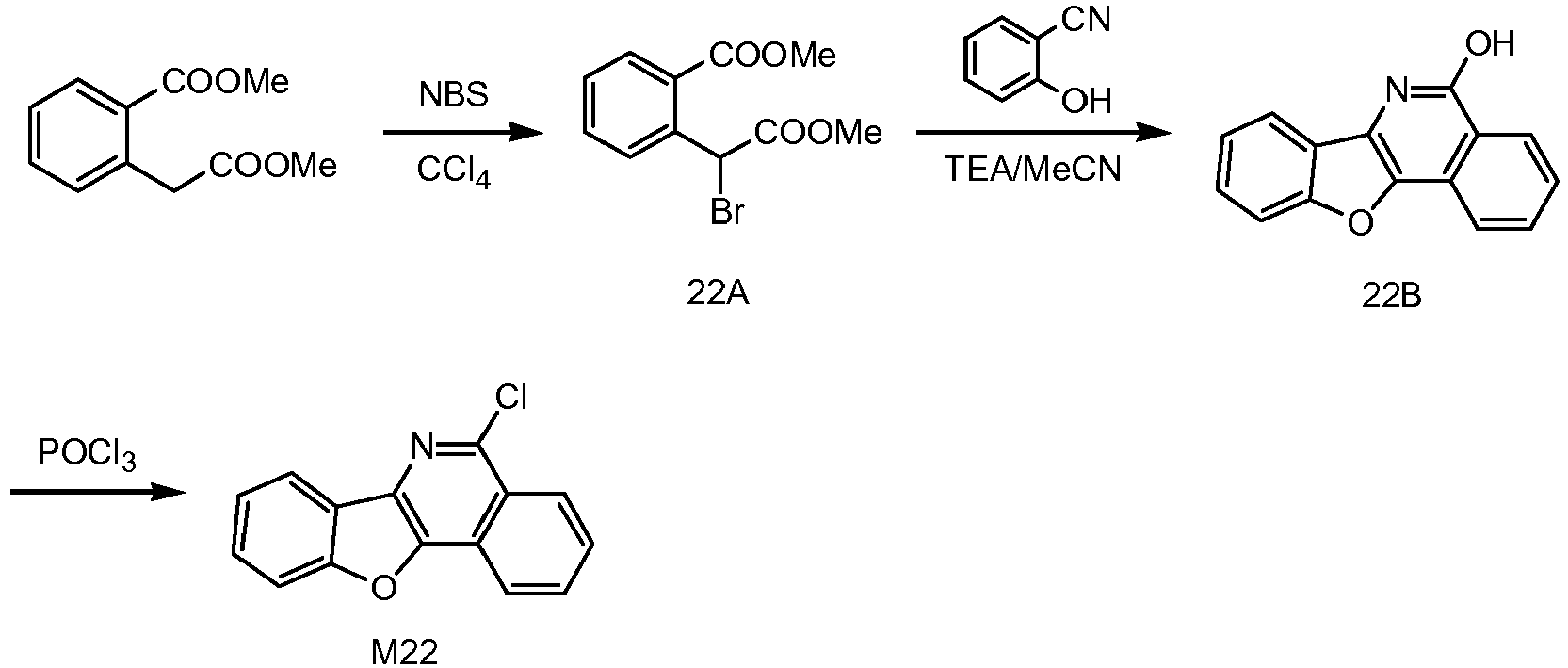
- Step S22A: Synthesis of 2-(2-methoxycarbonyl-phenyl)- 2-bromo-acetic acid methyl ester (22A)
- The procedure was similar to step S19A, while the starting material was 2-methoxycarbonylmethyl-benzoic acid methyl ester (commercialized) in stead of 5-chloro-2-methoxycarbonyl methyl-benzoic acid methyl ester (18E).
- The procedure was similar to step S19B, while the starting material was 22A in stead of 19A.
- The procedure was similar to step S19C, while the starting material was 22B in stead of 19B.
1H-NMR (DMSO-d6 ): δ (ppm) : 8.48 (d, J= 6.4 Hz, 2H), 8.20 (d, J= 7.2 Hz, 1H), 8.12 (t, J = 7.6 Hz, 1H), 7.90-7.95 (m, 2H), 7.68 (t, J = 7.8 Hz, 1H), 7.58 (t, J = 7.2 Hz, 1H), MS (ESI): M++1=254.7. -

- The procedure was similar to step S19A, while the starting material was 2-methoxycarbonylmethyl-benzoic acid methyl ester (commercialized) in stead of 5-chloro-2-methoxycarbonyl methyl-benzoic acid methyl ester (18E).
- The procedure was similar to step S19B, while the starting material was 23A in stead of 19A, and used 2-mercapto-benzonitrile in stead of 2-hydroxy-benzonitrile.
- The procedure was similar to step S19C, while the starting material was 23B in stead of 19B.
1H-NMR (DMSO-d6 ): δ (ppm) : 8.51 (d, J = 8.4 Hz, 1H), 8.41 (m, 1H), 8.31 (dd, J1 = 7.2 Hz, J2 = 0.8 Hz, 1H), 8.24 (m, 1H), 8.09 (t, J = 8.0 Hz, 1H), 7.96 (t, J = 8.0 Hz, 1H), 7.65-7.68 (m, 2H); MS (ESI): M++1=270.7. -

- The procedure was similar to step S19A, while the starting material was 2-methoxycarbonylmethyl-benzoic acid methyl ester in stead of 5-chloro-2-methoxycarbonyl methyl-benzoic acid methyl ester (18E).
- The procedure was similar to step S19B, while the starting material was 24A in stead of 19A, and used 5-chloro-2-hydroxy-benzonitrile in stead of 2-hydroxy-benzonitrile.
- The procedure was similar to step S19C, while the starting material was 24B in stead of 19B.
1H-NMR (DMSO-d6 ): δ (ppm) : 8.51 (t, J = 17.2 Hz, 2H), 8.23 (d, J = 2.0 Hz, 1H), 8.15 (t, J = 16.0 Hz, 1H), 7.96-7.99 (m, 2H), 7.70 (dd, J1 = 8.8 Hz, J2 = 2.4 Hz, 1H); MS (ESI): M++1=289.1. -

- The procedure was similar to step S19A, while the starting material was 5-methoxyl-2-methoxycarbonylmethyl-benzoic acid methyl ester (commercialized) in stead of 5-chloro-2-methoxycarbonyl methyl-benzoic acid methyl ester (18E).
MS (ESI): M++1=318.1. - The procedure was similar to step S19B, while the starting material was 25A in stead of 19A.
MS (ESI): M++1=266.3. - The procedure was similar to step S19C, while the starting material was 25B in stead of 19B.
1H-NMR (CDCl3) : δ (ppm) : 8.336 (d, J= 8.8 Hz, 1H), 8.242 (d, J= 7.6 Hz, 1H), 7.746 (d, J = 2.4 Hz, 1H), 7.711 (d, J = 7.6 Hz, 1H), 7.53-7.58 (m, 2H), 7.48 (t, J= 7.2 Hz, 1H), 4.06 (s, 3H); MS (ESI): M++1=284.7. -

- The procedure was similar to step 19A.
- The procedure was similar to step S19B, while the starting material was 2-hydroxy-5-methoxy-benzonitrile in stead of 2-hydroxy-benzonitrile. 1H-NMR (DMSO-d6 ): δ (ppm) : 12.49 (s,1H), 8.25 (d, J = 2.0 Hz, 1H), 8.027 (d, J = 8.8 Hz, 1H), 7.918 (dd, J1 = 8.8 Hz, J2 = 2 Hz, 1H), 7.669 (d, J = 9.2 Hz, 1H), 7.587 (d, J = 2.8 Hz, 1H), 7.097 (dd, J1 = 8.8 Hz, J2 = 2.8 Hz, 1H), 3.840 (s, 3H); MS (ESI): M++1=300.7.
- The procedure was similar to step S19C, while the starting material was 26B in stead of 19B.
1H-NMR (CDCl3) : δ (ppm) : 8.502 (d, J= 1.6 Hz, 1H), 8.360 (d, J= 8.8 Hz, 1H), 8.871 (dd, J1 = 8.8 Hz, J2 = 1.6 Hz, 1H), 7.706 (s, J = 2.4 Hz, 1H), 7.623 (d, J= 9.2 Hz, 1H), 7.182 (dd, J1 = 9.2 Hz, J2 = 2.8 Hz, 1H), 3.964 (s, 3H); MS(ESI): M++1=319.2. -

- The procedure was similar to step 19A.
- The procedure was similar to step S19B, while the starting material was 5-chloro-2-hydroxy-benzonitrile in stead of 2-hydroxy-benzonitrile.
1H-NMR (DMSO-d6 ): δ (ppm) : 12.539 (s, 1H), 8.246 (d, J= 2.0 Hz, 1H), 8.039 (s, 1H), 8.028 (d, J = 8.8 Hz, 1H), 7.926 (dd, J1 = 8.4 Hz, J2 = 2 Hz, 1H), 7.796 (d, J= 8.8 Hz, 1H), 7.520 (dd, J1 = 8.8 Hz, J2 = 2.4 Hz, 1H); MS (ESI): M++1=305.1. - The procedure was similar to step S19C, while the starting material was 27B in stead of 19B.
1H-NMR (CDCl3) : δ (ppm) : 8.510 (d, J = 2.0 Hz, 1H), 8.356 (d, J = 8.8 Hz, 1H), 8.220 (d, J = 1.6 Hz, 1H), 7.890 (dd, J1 = 8.8 Hz, J2 = 1.6 Hz, 1H), 7.655 (d, J = 8.8 Hz, 1H), 7.540 (dd, J1 = 8.4 Hz, J2 = 2 Hz, 1H); MS (ESI): M++1=323.6. -

- The procedure was similar to step S19A, while the starting material was 5-methoxy-2-methoxycarbonylmethyl-benzoic acid methyl ester (commercialized) in stead of 5-chloro-2-methoxycarbonyl methyl-benzoic acid methyl ester (18E).
MS (ESI): M++1=318.1. - The procedure was similar to step S19B, while the starting material was 28A in stead of 19A, and used 5-chloro-2-hydroxy-benzonitrile in stead of 2-hydroxy-benzonitrile.
- The procedure was similar to step S19C, while the starting material was 28B in stead of 19B.
1H-NMR (CDCl3) : δ (ppm) : 8.325 (d, J= 8.8 Hz, 1H), 8.204 (d, J= 2.0 Hz, 1H), 7.761 (d, J = 2.4 Hz, 1H), 7.634 (d, J = 8.8 Hz, 1H), 7.591 (dd, J1 = 8.8 Hz, J2 = 2 Hz, 1H), 7.495 (dd, J1 = 8.8 Hz, J2 = 2.4 Hz, 1H), 4.070 (s, 3H); MS(ESI): M++1=319.1. -

- The procedure was similar to step S19A, while the starting material was 2-methoxycarbonylmethyl-benzoic acid methyl ester in stead of 5-chloro-2-methoxycarbonyl methyl-benzoic acid methyl ester (18E).
- The procedure was similar to step S19B, while the starting material was 29A in stead of 19A, and used 4-fluoro-2-mercapto-benzonitrile in stead of 2-hydroxy-benzonitrile.
- The procedure was similar to step S19C, while the starting material was 29B in stead of 19B.
1H-NMR (CDCl3) : δ (ppm) : 8.47 (d, J= 8.4 Hz, 1H), 8.37 (m, 1H), 8.27 (d, J = 8.0 Hz, 1H), 8.171 (d, J = 8.4 Hz, 1H), 8.05 (dd, J1 = 8.0 Hz, J2 = 7.2 Hz, 1H), 7.49 (dd, J1 = 8.4 Hz, J2 = 8.0 Hz, 1H); MS(ESI): M++1=288. - A mixture of intermediate Mi (I = 1, 2, 3, ...11, 13, ...17, 19, ... or 29) (0.1mmol), starting material A-j (j = I, II, ......or VI) (0.1mmol) and t-BuOK (potassium tert-butoxide, 5mmol) was cooled to 0°C. To the mixture was added DMSO (dimethyl sulfoxide, 5mL), then warmed to room temperature within 20min. TLC monitored the reaction. After the reaction completed, the reaction mixture was poured into ice-water, extracted with ethyl acetate (50mL×3), dried over anhydrous Na2SO4, filtered, concentrated to dryness under reduced pressure and purified by preparative-TLC (silica gel, CH2Cl2: MeOH=100:5) to give desired product Ik.
- A mixture of starting material A-j (j = I, II, ......or VI) (1mmol) and t-BuOK (5mmol) was dissolved in THF (tetrahydrofuran) and DMSO (2ml+2mL) and cooled to 0°C. To the solution was added a solution of intermediate Mi (I = 1, 2, 3, ...11, 13, ...17, 19, ...or 29) (1mmol) in THF/DMSO (2ml, 1/1) dropwise within 5min at 0°C. The reaction mixture was stirred at room temperature overnight, then poured into water, extracted with ethyl acetate, dried over anhydrous MgSO4 and purified by preparative-HPLC.
wherein, A-j (j = I, II, ...... or VI) (The references of preparation: 1)PCT Int. Appl., 2009140500, 19 Nov 2009 ; 2)PCT Int. Appl., 2008008776, 17 Jan 2008 ) was listed as follows:


Table 1 Example Ik A-j Mi Synthetic method Compoud Structure M++1 30 1 A-II M2 A 
850.3 31 2 A-I M21 A 
816 32 3 A-II M4 A 
830 33 4 A-II M5 A 
834 34 5 A-I M24 A 
820.2 35 6 A-I M22 A 
786.3 36 7 A-II M17 A 
834.2 37 8 A-II M6 A 
878.2 38 9 A-II M3 A 
816.3 39 10 A-I M28 A 
820.2 40 11 A-II M24 A 
808.2 41 12 A-II M28 A 
808.2 42 13 A-III M24 A 
807.2 43 15 A-II M21 A 
804.3 44 16 A-I M20 B 
865.1 45 17 A-I M19 B 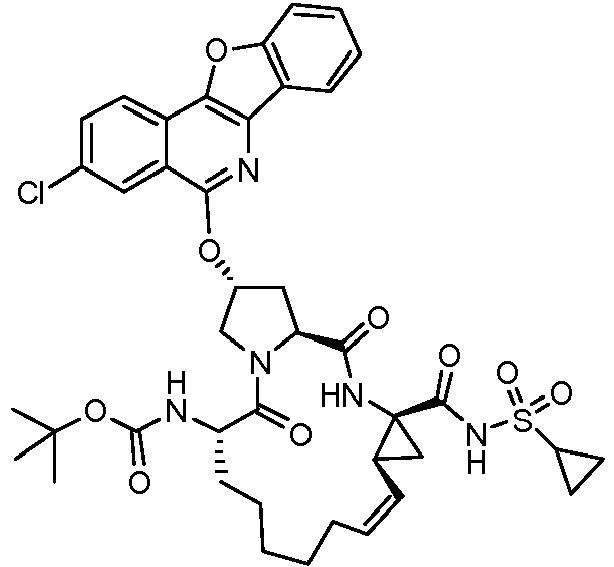
820.3 46 18 A-I M25 B 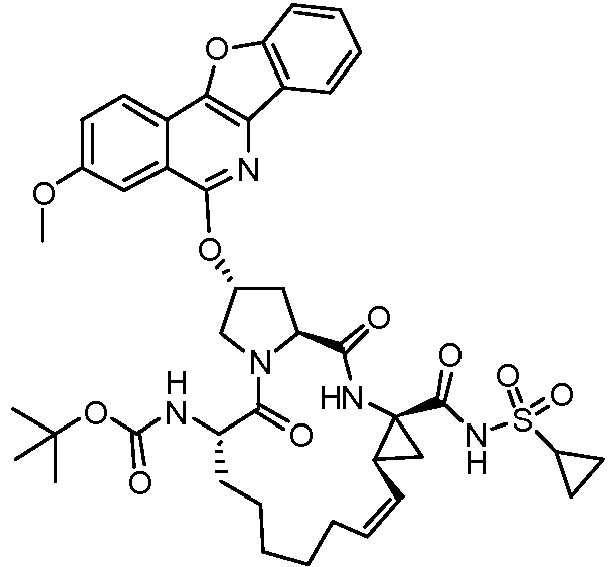
816.3 47 19 A-I M26 B 
850.2 48 20 A-IV M19 B 
820.2 49 21 A-IV M4 A 
842.3 50 22 A-IV M8 A 
876.3 51 23 A-II M8 A 
864.3 52 24 A-II M10 B 
913.3 53 25 A-II M10 A 
929.2 54 26 A-II M15 A 
973.2 55 27 A-II M13 A 
908.2 56 28 A-IV M13 A 
920.2 57 29 A-II M19 B 
808.2 58 30 A-II M20 B 
852.2 59 31 A-II M25 B 
804.3 60 32 A-II M26 B 
838.2 61 33 A-II M27 B 
842.2 62 34 A-II M11 A 
956.3 63 35 A-II M16 A 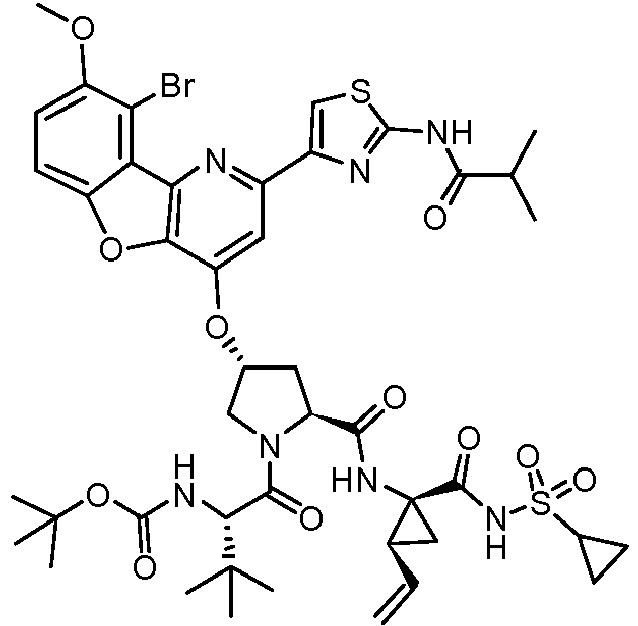
1000.2 64 36 A-V M1 A 
822.3 65 37 A-VI M1 A 
810.3 66 38 A-II M1 A 
800.3 67 39 A-II M9 A 
929.2 68 40 A-II M14 A 
973.2 69 41 A-II M23 A 
780.2 70 42 A-II M28 B 
838.2 - tert-butyl(2R,6S, 13aS, 14aR, 16aS,Z)-14a-(cyclopropylsulfonylcarbamoyl)-2-(8-methoxybenzofuro[3,2-c]isoquinolin-5-yloxy)-5,16-dioxo-1,2,3,5,6,7,8,9,10,11 , 13a, 14,14a, 15,16,16a-hexadecahydrocyclopropa[e]pyrrolo[1,2-a][1,4]diazacy clopentadecin-6-yl carbamate
1H-NMR (CDCl3) : δ (ppm) : 10.29 (s, 1H), 8.33 (d, J= 8.2 Hz, 1H), 8.22 (d, J = 8.0 Hz, 1H), 7.78 (t, J= 7.6 Hz, 1H), 7.49-7.55 (m, 3H), 7.08 (d, J= 9.0 Hz, 1H), 6.96 (s, 1H), 6.11 (s, 1H), 5.70 (dd, J = 8.8, 8.0 Hz, 1H), 5.20 (m, 1H), 4.98 (t, J = 9.6 Hz, 1H), 4.67-4.72 (m, 2H), 4.33 (m, 1H), 4.12 (d, J = 9.3 Hz, 1H), 3.99 (s, 3H), 2.80-2.92 (m, 2H), 2.73-2.78 (m, 1H), 2.49-2.59 (brs, 1H), 2.28 (q, J= 8.8 Hz, 1H), 1.70-1.95 (m,3H), 1.55-1.65 (m, 1H), 1.40-1.52 (m, 7H), 1.28 (s, 10H), 1.08-1.15 (m, 2H), 0.91 (m, 1H); MS (ESI): M++1=816. - tert-butyl(S)-1-((2S,4R)-2-((1R,2S)-1-(cyclopropylsulfonylcarbamoyl)-2-vinylc yclopropylcarbamoyl)-4-(8-methoxy-2-phenylbenzofuro[3,2-b]pyridin-4-yloxy )pyrrolidin-1-yl)-3,3-dimethyl-1-oxobutan-2-yl carbamate
1H-NMR (CDCl3) : δ (ppm) : 9.27 (s, 1H), 8.02 (d, J= 6.8 Hz, 2H), 7.82 (d, J = 2.5 Hz, 1H), 7.69 (s, 1H), 7.61-7.65 (m, 4H), 7.33 (d, J= 9.2 Hz, 1H), 5.84 (brs, 1H), 5.71 (dd, J = 18.3, 9.6 Hz, 1H), 5.30 (d, J = 18.3 Hz, 1H), 5.13 (d, J = 9.6 Hz, 1H), 4.56-4.62 (m, 2H), 3.95-4.18 (m, 2H), 3.94 (s, 3H), 2.91-2.97 (m, 1H), 2.71 (dd, J= 6.7, 14.1Hz, 1H), 2.57 (ddd, J= 14.1, 10.8, 4.1 Hz, 1H), 2.23 (dd, J = 8.1, 17.5 Hz, 1H), 1.89 (dd, J = 5.5,17.8 Hz, 1H), 1.45 (dd, J = 5.3, 9.2 Hz, 1H), 1.21-1.27 (m, 2H), 1.10 (s, 11H), 1.02 (s, 9H); MS (ESI): M++1=830. - tert-butyl(S)-1-((2S,4R)-4-(8-chloro-2-phenylbenzofuro[3,2-b]pyridin-4-yloxy) -2-((1R,2S)-1-(cyclopropylsulfonylcarbamoyl)-2-vinylcyclopropylcarbamoyl)p yrrolidin-1-yl)-3,3-dimethyl-1-oxobutan-2-yl carbamate
1H-NMR (CDCl3) : δ (ppm) : 9.27 (s, 1H), 8.30 (s, 1H), 8.04 (d, J= 8.4 Hz, 2H), 7.61-7.70 (m, 3H), 7.51-7.58 (m, 3H), 5.71-5.80 (m, 2H), 5.30 (d, J= 16.7 Hz, 1H), 5.13 (d, J = 10.4 Hz, 1H), 4.52-4.62 (m, 2H), 3.20 (s, 1H), 4.13 (d, J = 10.0 Hz, 1H), 2.91-2.97 (m, 1H), 2.67 (dd, J = 6.8, 13.9 Hz, 1H), 2.57 (ddd, J = 14.1, 10.8, 4.1, 1H), 2.23 (dd, J = 8.1, 17.5 Hz, 1H), 1.88 (dd, J= 5.5, 17.8 Hz, 1H), 1.45 (dd, J = 5.3, 9.2 Hz, 1H), 1.21-1.27 (m, 2H), 1.12 (s, 11H), 1.02 (s,9H); MS (ESI): M++1=834. - Synthesis of (2S,4R)-1-((S)-2-tert-butyl-4-oxo-4-(piperidin-1-yl)butanoyl)-4-(8-chlorobenzofuro[3,2-c]isoquinolin-5-yloxy)-N ((1R,2S)-1-(cyclopropylsul fonylcarbamoyl)-2-vinylcyclopropyl)pyrrolidine-2-carboxamide

- A mixture of compound 13 (40.4mg, 0.05mmol) and LiOH (5eq) was dissolved in THF/MeOH/H2O (3mL/3mL/3mL) and stirred at room temperature for 3 hours. TLC monitored the reaction. After the reaction completed, the reaction mixture was acidified with 1N hydrochloric acid to pH∼7, then extracted with ethyl acetate, dried over MgSO4, filtered and concentrated to dryness under reduced pressure. The residue was dissolved in dimethylfomamide, then piperidine (0.1mmol),
o-(7-azabenzotriazol-1-yl)-N,N,N',N'-tetramethyluronium hexafluorophosphate (HATU) (0.065mmol) and N,N-diisopropyl ethylamine (0.2mmol) were added. The reaction mixture was stirred at room temperature overnight, then poured into water, extracted with ethyl acetate (50mL×3), dried over MgSO4 and purified by flash chromatography to give desired product 14.
1H-NMR (CDCl3) : δ (ppm) : 10.21 (s, 1H), 8.50 (d, J= 8.4 Hz, 1H), 8.24 (d, J = 8.0 Hz, 1H), 8.01 (brs, 1H), 7.82 (t, J = 8.0 Hz, 1H), 7.54-7.60 (m, 2H), 7.43 (dt, J = 8.8, 1.2 Hz, 1H), 7.14 (brs, 1H), 6.06 (brs, 1H), 5.75-5.83 (m, 1H), 5.25 (m, d, J = 17.2 Hz, 1H), 5.13 (d, J = 10.0 Hz, 1H), 4.63 (d, J = 11.6 Hz, 1H), 4.51 (t, J = 8.0 Hz, 1H), 4.14 (dd, J = 8.8, 2.0 Hz, 1H), 3.63 (s, 2H), 3.05-3.20 (m, 2H), 2.86-3.00 (m, 2H), 2.68-2.73 (m, 1H), 2.57-2.63 (m, 1H), 2.35 (d, J= 14.4 Hz, 1H), 2.06-2.13 (m, 1H), 1.99 (t, J = 8.0 Hz, 1H), 1.43-1.60 (m, 5H), 1.28-1.42 (m, 4H), 0.9-1.10 (m, 11H); MS (ESI): M++1=818.3. - The preparation of Huh7.5.1cells: Huh 7.5.1 cells were seeded at a 96-well plate with 37□ and 5%CO2 for 24 hours incubation.
- Virus infection: Using the J399EM virus supernatants (moi≈0.1) to infect Huh7.5.1cells. At the same time, the no virus infected cell will be set up as the control. After 8 hours virus infection, the virus will be washed out with PBS. Drug treatment: The different doses of samples (i.e. the compound Ik, wherein k=1,2,3,...42) were added in J399EM infected Huh7.5.1 cells, the each dose for duplicate. At the same time the no sample added in wells will be set up as the control. The test dose of sample is starting from 25nM or 400nM, with quarter dilution, 5 doses of sample will be added in the test wells, respectively, then continued for 72 hours incubation.
- HCV-EGFP fluorescence detection: After samples treatment for 72 hours, the autofluorescence of HCV-EGFP were measured by the luminometer with excitation of 488nm, and emission of 516nm. The related fluorescence unit (RFU) of samples will be read out and used for calculating the inhibitory rates of compounds in HCV replication.
- HCV replicon cell-line: The Huh7 cells were transfected with pSGR-399LM replicon DNA and cultured in the DMEM containing 10% FBS and 0.5 mg/mL G418. The cells were split at 1:3 to 1:5 every 3-4 days. The transfected cells were seeded in 96-well plates and cultured at 37°C, 5% CO2 for 24 hr. Treatment with samples: To the HCV replicon Huh7 cells-line were added different concentration of the samples (i.e. compound Ik, wherein k = 1, 2, 3...42), the each concentration for duplicate, and set no sample control wells. The concentration started at 400 nM, with quarter dilution to form five different concentrations of samples, that is 400 nM, 100 nM, 25 nM, 6.25 nM and 1.56 nM. The samples were added separately, and continued to incubated for 72 hr. Fluorescence detection: After 72 hr treatment with sample, the cells were lysed and added with Renilla luciferase substrate to detect luminescent signal. The relative luminescent unit (RLU) in the luminometer was read out and used to calculate the inhibition rate of HCV.
Table 2 compound MS(ESI): M++1 HCV replicon system EC50(nM) HCV infected human hepatocellular carcinoma cells in vitro EC50(nM) 1 850 B B 2 816 A A 3 830 A B 4 834 A B 5 820 A A 6 786 A A 7 834 A A 8 878 A B 9 816 A B 10 820 A A 11 808 A B 12 808 A B 13 807 B B 14 818 A B 15 804 B B 16 865 A A 17 820 A A 18 816 A A 19 850 A A 20 820 A A 21 842 A B 22 876 A A 23 864 A A 24 913 A A 25 929 A A 26 973 A A 27 908 A A 28 920 A A 29 808 A A 30 852 B B 31 804 B B 32 838 A B 33 842 B B 34 956 A A 35 1000 A A 36 822 A B 37 810 B B 38 800 A A 39 929 A A 40 973 A A 41 780 - - 42 838 - - A: EC50≤100nM, B: 100nM< EC50<1000nM - Twenty healthy male Sprague-Dawley (SD) rats with body weight of 200-220 g were divided into 5 groups randomly and each group contains 4 rats. Before the experiment, rats were fasted for 12 h with free access to water. The compound Ik (wherein k = 2, 5, 18, 34 or 38) of this invention was administered by oral gavage at a dose level of 10 mg/kg. The compounds were prepared with 0.5% CMC-Na containing 1% Tween 80. The dose volume was 10 mL/kg. The rats were afforded unlimited access to food after 2 h of dosing. 0.3 mL of blood samples were collected at 0.25 h, 0.5 h, 1.0 h, 2.0 h, 3.0 h, 5.0 h, 7.0 h, 9.0 h, and 24.0 h, respectively, from postocular venous plexes of the rat. The blood samples were placed in heparin-containing tubes and immediately centrifuged at 11000 rpm for 5 min. Plasma was separated and refrigerated at -20°C until analysis. LC-MS/MS methods were used to quantify plasma concentrations of the compound Ik. The pharmacokinetic parameters obtained are shown in Table 3.
Table 3 Pharmacokinetic parameters of SD rats after oral administration Compound Tmax Cmax AUC0-t AUC0-∞ t1/2 F (h) (ng/mL) (ng·h/mL) (ng·h/mL) (h) (%) I38 0.63±0.25 150±42 239±81 243±81 0.72±0.30 8.7 I5 1.25±0.50 560±139 2882±1720 3028±1705 3.48±1.09 17.1 I18 1.7±0.6 623.3±60.7 3218.5±336.4 3266.8±303.2 3.8±1.0 36.1 I34 0.4±0.2 11.4±4.3 9.6±0.9 11.0±1.1 0.5±0.3 1.6 I2 0.4±0.1 49.7±11.0 157.9±49.8 1777.6±53.7 3.1±1.3 1.8 - The compounds of this invention showed satisfied pharmacokinetic behaviour. For instance, Compound I18 was orally administered to SD rats at 10 mg/kg. The peak plasma concentration was at 1.7 ± 0.6 h, with Cmax of 623 ± 60.7 ng/mL, and the area under plasma concentration-time curves AUC0-t was 3218.5 ± 336.4 ng·h/mL, AUC0-∞ was 3266.8 ± 303.2 ng·h/mL. The elimination half-life t1/2 was 3.8 ± 1.0 h. The absolute bioavailability F approached to 36.1%.
- The compounds of the present invention have the excellent activity of anti-hepatitis C virus. The value EC50 of the desired compounds for HCV replicon system (pSGR-399LM+ Huh7.5) all are lesser than 1000nM. A majority of compounds are lesser than 100nM. The value EC50 of the compounds for HCV infected human hepatocellular carcinoma cells (Huh7.5.1) in vitro all are lesser than 1000nM also. And the compounds of this invention showed satisfied pharmacokinetic behaviour also.
Claims (13)
- A compound having the general formula (I):
 A is O, S, CH, NH or NR', wherein, R' is C1-C6 alkyl unsubstituted or substituted by halogen which alkyl includes 0∼3 heteroatom(s) of O, S or N; when Z3 links with O, Z1 is N or CRZ1, Z2 is CRZ2, wherein, RZ1 is hydrogen, halogen, C1-C6 alkyl, C1-C6 alkoxy, NH2, (C1-C6 alkyl)NH or (C1-C6 alkyl)2N, RZ2 is hydrogen, C1-C6 alkyl, C1-C6 alkoxy, aryl or heteroaryl; or RZ1, RZ2 with carbon atoms linking with them together form a substituted or unsubstituted ring;when Z1 links with O, Z2 is CH, Z3 is C-Ar, Ar is a substituted or unsubstituted aryl or heteroaryl;Ra, Rb, Rc and Rd independently is H, OH, halogen or -Y1-Rm, Y1 is linking bond, O, S, SO, SO2 or NRn; Rm is hydrogen, or a substituted or unsubstituted substituent selected from the following group: (C1-C8) alkyl, N≡C-(C1-C6) alkyl, (C2-C8) alkenyl, (C2-C8) alkynyl, (C3-C7) cycloalkyl, (C3-C7 cycloalkyl) (C1-C6) alkyl, and 5∼6 membered aryl or heteroaryl including 0∼2 heteroatom(s) independently selected from N, O, S; Rn is H, (C1-C6) alkyl or (C3-C6) cycloalkyl;A1 is NH or CH2;A2 is N, O or linking bond;R1' is a substituted or unsubstituted substituent selected from the following group: C1-C6 alkyl, C2-C6 alkenyl, C2-C6 alkynyl, aryl, (aryl) C1-C2 alkyl, C3-C7 cycloalkyl, (C3-C7 cycloalkyl) C1-C2 alkyl, C3-C7 cycloalkenyl, (C3-C7 cycloalkenyl) C1-C2 alkyl, heterocycloalkyl, (heterocycloalkyl) C1-C2 alkyl, C5-C10 heteroaryl and (C5-C10 heteroaryl) C1-C2 alkyl;R1 is hydrogen; or; R1 linking covalently with R3 together forms a C5-C9 saturated or unsaturated hydrocarbon chain which can be inserted by 0∼2 heteroatom(s) independently selected from N, S and O, or which can be substituted by one or more halogen, O, S or -NRpRq, wherein, Rp and Rq independently is hydrogen or C1-C6 alkyl;R3 is C1-C6 alkyl, C2-C6 alkenyl, C3-C7 cycloalkyl, C3-C7 cycloalkenyl, heterocycloalkyl, (C3-C7 cycloalkyl) C1-C4 alkyl, (C3-C7 cycloalkenyl) C1-C4 alkyl, (heterocycloalkyl) C1-C4 alkyl, C2-C6 alkylacyl, (C1-C4 alkyl)1-2 (C3-C7) cycloalkyl or (C1-C6 alkyl)1-2 amino; andR4 is substituted or unsubstituted C1-C10 alkoxycarbonyl, (C1-C10 alkyl)NHCO, (C1-C10 alkyl)2NCO, aryl, heteroaryl or formyl substituted by 3∼7 membered cycloalkyl, heterocycloalkyl or cycloalkoxy.
 - The compound as claimed in claim 1, characterized in that when Z3 links with O, RZ1, RZ2 with carbon atoms linking with them together form a 6 membered aromatic ring substituted by Re, Rf, Rg and Rh, therefore, the structure of the compound having the general formula (I) is shown in formula (Ia),

- The compound as claimed in claim 1, characterized in that when Z1 links with O, the structure of the compound having the general formula (I) is shown in formula (Ib1),

- The compound as claimed in claim 1, characterized in that when Z1 links with O, the structure of the compound having the general formula (I) is shown in formula (Ib2),
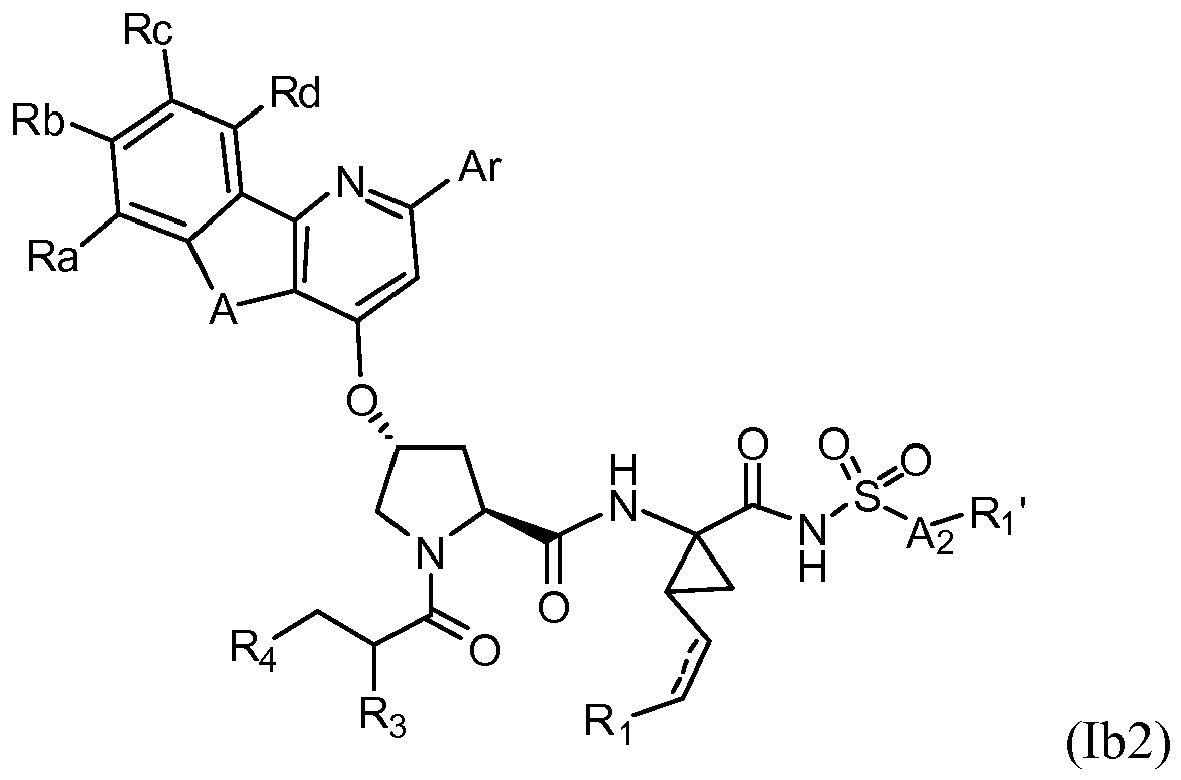
- The compound as claimed in claim 3 or 4, characterized in that Ar is a 6 membered aryl or a 5∼6 membered heteroaryl which is substituted optionally by 1 or more RAr; wherein, RAr is selected from the following substituent group: halogen, amino, C1-C6 alkyl, C1-C6 alkoxyl, C1-C6 hydroxyalkyl and (C1-C6) alkylamido.
- The compound as claimed in claim 2, 3 or 4, characterized in that Rm is a substituent substituted by 1∼3 Rm' selected from the following group: C1-C8 alkyl, N≡C-(C1-C6) alkyl, (C2-C8) alkenyl, (C2-C8) alkynyl, (C3-C7) cycloalkyl, (C3-C7 cycloalkyl) (C1-C6) alkyl, and 5∼6 membered aryl or heteroaryl including 0∼2 heteroatom(s) independently selected from N, O, S; Rm' is a substituent selected from the following group: halogen, (C1-C6) alkyl substituted optionally by (C1-C6)alkyl-O- or (C3-C6)cycloalkyl-O-, (C1-C6) haloalkyl, (C3-C7)cycloalkyl, (C1-C6)alkyl-O-, heteroaryl, -NH2, (C1-C4 alkyl)NH- and (C1-C4 alkyl)2N-.
- The compound as claimed in claim 2, 3 or 4, characterized in that R1' is a substituent substituted by 1 or more R1" selected from the following group: C1-C6 alkyl, C2-C6 alkenyl, C2-C6 alkynyl, aryl, (aryl) C1-C2 alkyl, C3-C7 cycloalkyl, (C3-C7 cycloalkyl) C1-C2 alkyl, C3-C7 cycloalkenyl, (C3-C7 cycloalkenyl) C1-C2 alkyl, heterocycloalkyl, (heterocycloalkyl) C1-C2 alkyl, C5-C10 heteroaryl and (C5-C10 heteroaryl) C1-C2 alkyl;
R1" is a substituent selected from the following group: halogen, OH, CN, C1-C6 alkyl, C2-C6 alkenyl, C2-C6 alkynyl, C1-C6 alkoxyl, -NH2, (C1-C6 alkyl)-NH- and -N(C1-C6 alkyl)2. - The compound as claimed in claim 2, 3 or 4, characterized in that R1' is

- The compound as claimed in claim 2 or 4, characterized in that R1 linking covalently with R3 together forms a C5 alkane chain.
- The compound as claimed in claim 2, 3 or 4, characterized in that R4 is C1-C10 alkoxycarbonyl, (C1-C10 alkyl)-NHCO, (C1-C10 alkyl)2NCO, aryl, heteroaryl or formyl substituted by 3∼7 membered cycloalkyl, heterocycloalkyl or cycloalkoxy, which can be substituted by 1 or more R4';
R4' is a substituent selected from the following group: halogen, OH, CN, C1-C6 alkyl, C2-C6 alkenyl, C2-C6 alkynyl, C1-C6 alkoxyl, -NH2, (C1-C6 alkyl)-NH-and -N(C1-C6 alkyl)2, (C1-C6 alkyl)-SO2-. - The compound as claimed in claim 2, 3 or 4, characterized in that R4 is


- The compound as claimed in claim 1, characterized in that the compound is


- Use the compound as claimed in claim 1 for preparation of a drug for preventing virus infection or antivirus, wherein, said virus is preferably hepatitis virus, more preferably hepatitis C virus.
Applications Claiming Priority (2)
| Application Number | Priority Date | Filing Date | Title |
|---|---|---|---|
| CN2011102200530A CN102911254A (en) | 2011-08-02 | 2011-08-02 | HCV (hepatitis C virus) protease inhibitor |
| PCT/CN2012/078990 WO2013017026A1 (en) | 2011-08-02 | 2012-07-23 | Hcv protease inhibitors |
Publications (3)
| Publication Number | Publication Date |
|---|---|
| EP2740734A1 true EP2740734A1 (en) | 2014-06-11 |
| EP2740734A4 EP2740734A4 (en) | 2015-03-11 |
| EP2740734B1 EP2740734B1 (en) | 2017-09-06 |
Family
ID=47609854
Family Applications (1)
| Application Number | Title | Priority Date | Filing Date |
|---|---|---|---|
| EP12820086.2A Not-in-force EP2740734B1 (en) | 2011-08-02 | 2012-07-23 | Hcv protease inhibitors |
Country Status (6)
| Country | Link |
|---|---|
| US (1) | US8969373B2 (en) |
| EP (1) | EP2740734B1 (en) |
| JP (1) | JP5945837B2 (en) |
| KR (1) | KR101768985B1 (en) |
| CN (2) | CN102911254A (en) |
| WO (1) | WO2013017026A1 (en) |
Families Citing this family (14)
| Publication number | Priority date | Publication date | Assignee | Title |
|---|---|---|---|---|
| CN104557954A (en) * | 2013-10-16 | 2015-04-29 | 上海唐润医药科技有限公司 | Anti-HCV (hepatitis c virus) macrocyclic compound |
| CN104447952A (en) * | 2014-12-11 | 2015-03-25 | 上海唐润医药科技有限公司 | Hepatitis C virus protease inhibitor and synthesis method thereof |
| JP7071919B2 (en) * | 2016-08-02 | 2022-05-19 | メルク パテント ゲーエムベーハー | Method for Producing Nitrogen-Containing Heterocyclic Compound and Nitrogen-Containing Heterocyclic Compound |
| CN106674055A (en) * | 2016-12-27 | 2017-05-17 | 苏州山青竹生物医药有限公司 | Preparation method of phenyl 3-cyano-4-hydroxybenzoate |
| CN106674045A (en) * | 2016-12-27 | 2017-05-17 | 苏州山青竹生物医药有限公司 | Preparation method of 3-cyano-4-isopropoxybenzoic acid |
| CN106674044A (en) * | 2016-12-27 | 2017-05-17 | 苏州山青竹生物医药有限公司 | Method for preparing 3-cyano-4-isopropoxybenzoic acid |
| CN106674046A (en) * | 2016-12-27 | 2017-05-17 | 苏州山青竹生物医药有限公司 | Preparation method of 3-cyano-4-isopropyloxybenzoic acid |
| CN106674042A (en) * | 2016-12-27 | 2017-05-17 | 苏州山青竹生物医药有限公司 | Method for preparing 3-cyan-4-hydroxy ethyl benzoate |
| CN106674052A (en) * | 2016-12-27 | 2017-05-17 | 苏州山青竹生物医药有限公司 | Preparation method of methyl 3-cyano-4-hydroxybenzoate |
| CN106674054A (en) * | 2016-12-27 | 2017-05-17 | 苏州山青竹生物医药有限公司 | Method for preparing 3-cyan-4-isopropoxy ethyl benzoate |
| CN106674053A (en) * | 2016-12-27 | 2017-05-17 | 苏州山青竹生物医药有限公司 | Preparation method of 3-cyano-4-isopropoxy methyl benzoate |
| CN106674051A (en) * | 2016-12-27 | 2017-05-17 | 苏州山青竹生物医药有限公司 | Preparation method for 3-cyano-4-isopropoxy phenyl benzoate |
| CN106674047A (en) * | 2016-12-27 | 2017-05-17 | 苏州山青竹生物医药有限公司 | Method for preparing 3-cyano-4-isopropoxybenzoic acid |
| WO2024044825A1 (en) * | 2022-09-01 | 2024-03-07 | Monash University | Compound collections, compounds and synthesis thereof |
Family Cites Families (7)
| Publication number | Priority date | Publication date | Assignee | Title |
|---|---|---|---|---|
| MY140680A (en) * | 2002-05-20 | 2010-01-15 | Bristol Myers Squibb Co | Hepatitis c virus inhibitors |
| US7605126B2 (en) * | 2006-08-11 | 2009-10-20 | Enanta Pharmaceuticals, Inc. | Acylaminoheteroaryl hepatitis C virus protease inhibitors |
| WO2008106130A2 (en) * | 2007-02-26 | 2008-09-04 | Achillion Pharmaceuticals, Inc. | Tertiary amine substituted peptides useful as inhibitors of hcv replication |
| US20090111757A1 (en) * | 2007-10-25 | 2009-04-30 | Taigen Biotechnology Co., Ltd. | Hcv protease inhibitors |
| CN101580535B (en) * | 2008-05-16 | 2012-10-03 | 太景生物科技股份有限公司 | Hepatitis C virus protease inhibitors |
| HUE030402T2 (en) * | 2009-09-15 | 2017-05-29 | Taigen Biotechnology Co Ltd | Hcv protease inhibitors |
| US20110178107A1 (en) * | 2010-01-20 | 2011-07-21 | Taigen Biotechnology Co., Ltd. | Hcv protease inhibitors |
-
2011
- 2011-08-02 CN CN2011102200530A patent/CN102911254A/en active Pending
-
2012
- 2012-07-23 EP EP12820086.2A patent/EP2740734B1/en not_active Not-in-force
- 2012-07-23 KR KR1020147003889A patent/KR101768985B1/en not_active Expired - Fee Related
- 2012-07-23 US US14/236,468 patent/US8969373B2/en not_active Expired - Fee Related
- 2012-07-23 WO PCT/CN2012/078990 patent/WO2013017026A1/en not_active Ceased
- 2012-07-23 CN CN201280006159.3A patent/CN103703006B/en not_active Expired - Fee Related
- 2012-07-23 JP JP2014523182A patent/JP5945837B2/en not_active Expired - Fee Related
Also Published As
| Publication number | Publication date |
|---|---|
| JP5945837B2 (en) | 2016-07-05 |
| US20140163219A1 (en) | 2014-06-12 |
| EP2740734B1 (en) | 2017-09-06 |
| CN103703006B (en) | 2016-08-10 |
| CN102911254A (en) | 2013-02-06 |
| KR20140076547A (en) | 2014-06-20 |
| CN103703006A (en) | 2014-04-02 |
| JP2014533237A (en) | 2014-12-11 |
| WO2013017026A1 (en) | 2013-02-07 |
| EP2740734A4 (en) | 2015-03-11 |
| US8969373B2 (en) | 2015-03-03 |
| KR101768985B1 (en) | 2017-08-17 |
Similar Documents
| Publication | Publication Date | Title |
|---|---|---|
| EP2740734B1 (en) | Hcv protease inhibitors | |
| EP2410844B1 (en) | Inhibitors of hepatitis c virus replication | |
| EP1105413B1 (en) | Hepatitis c inhibitor tri-peptides | |
| JP5465667B2 (en) | Antiviral compounds | |
| US7923004B2 (en) | 4-ethynyl pyrazole derivative compounds and methods for treatment of HCV | |
| CA2370396A1 (en) | Hepatitis c inhibitor tri-peptides | |
| CN107250137B (en) | Substituted amino six-membered saturated heteroalicyclics as long-acting DPP-IV inhibitors | |
| WO2012011847A1 (en) | Substituted indoles, antiviral active component, method for producing and using same | |
| WO2020001089A1 (en) | Crystalline methyl carbamate compound | |
| US8143276B2 (en) | 4-thio substituted quinoline and naphthyridine compounds | |
| CN109419806B (en) | Antiviral composition and application thereof | |
| TW200906392A (en) | Protease inhibitors | |
| HK1160359B (en) | Inhibitors of hepatitis c virus replication |
Legal Events
| Date | Code | Title | Description |
|---|---|---|---|
| PUAI | Public reference made under article 153(3) epc to a published international application that has entered the european phase |
Free format text: ORIGINAL CODE: 0009012 |
|
| 17P | Request for examination filed |
Effective date: 20140217 |
|
| AK | Designated contracting states |
Kind code of ref document: A1 Designated state(s): AL AT BE BG CH CY CZ DE DK EE ES FI FR GB GR HR HU IE IS IT LI LT LU LV MC MK MT NL NO PL PT RO RS SE SI SK SM TR |
|
| DAX | Request for extension of the european patent (deleted) | ||
| A4 | Supplementary search report drawn up and despatched |
Effective date: 20150211 |
|
| RIC1 | Information provided on ipc code assigned before grant |
Ipc: C07D 207/16 20060101ALI20150205BHEP Ipc: A61K 31/437 20060101ALI20150205BHEP Ipc: A61K 31/4365 20060101ALI20150205BHEP Ipc: C07D 491/048 20060101AFI20150205BHEP Ipc: C07D 495/04 20060101ALI20150205BHEP Ipc: A61K 31/4355 20060101ALI20150205BHEP Ipc: C07K 5/08 20060101ALI20150205BHEP Ipc: A61P 31/14 20060101ALI20150205BHEP Ipc: C07K 5/083 20060101ALI20150205BHEP |
|
| RIN1 | Information on inventor provided before grant (corrected) |
Inventor name: ZHANG, SUOMING |
|
| GRAP | Despatch of communication of intention to grant a patent |
Free format text: ORIGINAL CODE: EPIDOSNIGR1 |
|
| RIC1 | Information provided on ipc code assigned before grant |
Ipc: C07K 5/083 20060101ALI20170302BHEP Ipc: A61K 31/437 20060101ALI20170302BHEP Ipc: C07D 495/04 20060101ALI20170302BHEP Ipc: C07D 491/048 20060101AFI20170302BHEP Ipc: A61P 31/14 20060101ALI20170302BHEP Ipc: C07K 5/08 20060101ALI20170302BHEP Ipc: A61K 31/4355 20060101ALI20170302BHEP Ipc: A61K 31/4365 20060101ALI20170302BHEP Ipc: C07D 207/16 20060101ALI20170302BHEP |
|
| RIC1 | Information provided on ipc code assigned before grant |
Ipc: C07D 491/048 20060101AFI20170308BHEP Ipc: C07K 5/083 20060101ALI20170308BHEP Ipc: A61K 31/4355 20060101ALI20170308BHEP Ipc: C07D 495/04 20060101ALI20170308BHEP Ipc: A61K 31/437 20060101ALI20170308BHEP Ipc: C07K 5/078 20060101ALI20170308BHEP Ipc: C07K 5/08 20060101ALI20170308BHEP Ipc: A61P 31/14 20060101ALI20170308BHEP Ipc: C07D 207/16 20060101ALI20170308BHEP Ipc: A61K 31/4365 20060101ALI20170308BHEP |
|
| RIN1 | Information on inventor provided before grant (corrected) |
Inventor name: ZHANG, SUOMING |
|
| INTG | Intention to grant announced |
Effective date: 20170328 |
|
| RAP1 | Party data changed (applicant data changed or rights of an application transferred) |
Owner name: SHANGHAI TANGRUN PHARMACEUTICALS, CO., LTD |
|
| GRAS | Grant fee paid |
Free format text: ORIGINAL CODE: EPIDOSNIGR3 |
|
| GRAA | (expected) grant |
Free format text: ORIGINAL CODE: 0009210 |
|
| AK | Designated contracting states |
Kind code of ref document: B1 Designated state(s): AL AT BE BG CH CY CZ DE DK EE ES FI FR GB GR HR HU IE IS IT LI LT LU LV MC MK MT NL NO PL PT RO RS SE SI SK SM TR |
|
| REG | Reference to a national code |
Ref country code: GB Ref legal event code: FG4D |
|
| REG | Reference to a national code |
Ref country code: CH Ref legal event code: EP Ref country code: AT Ref legal event code: REF Ref document number: 925773 Country of ref document: AT Kind code of ref document: T Effective date: 20170915 |
|
| REG | Reference to a national code |
Ref country code: IE Ref legal event code: FG4D |
|
| REG | Reference to a national code |
Ref country code: DE Ref legal event code: R096 Ref document number: 602012037087 Country of ref document: DE |
|
| REG | Reference to a national code |
Ref country code: NL Ref legal event code: MP Effective date: 20170906 |
|
| REG | Reference to a national code |
Ref country code: LT Ref legal event code: MG4D |
|
| PG25 | Lapsed in a contracting state [announced via postgrant information from national office to epo] |
Ref country code: FI Free format text: LAPSE BECAUSE OF FAILURE TO SUBMIT A TRANSLATION OF THE DESCRIPTION OR TO PAY THE FEE WITHIN THE PRESCRIBED TIME-LIMIT Effective date: 20170906 Ref country code: LT Free format text: LAPSE BECAUSE OF FAILURE TO SUBMIT A TRANSLATION OF THE DESCRIPTION OR TO PAY THE FEE WITHIN THE PRESCRIBED TIME-LIMIT Effective date: 20170906 Ref country code: HR Free format text: LAPSE BECAUSE OF FAILURE TO SUBMIT A TRANSLATION OF THE DESCRIPTION OR TO PAY THE FEE WITHIN THE PRESCRIBED TIME-LIMIT Effective date: 20170906 Ref country code: SE Free format text: LAPSE BECAUSE OF FAILURE TO SUBMIT A TRANSLATION OF THE DESCRIPTION OR TO PAY THE FEE WITHIN THE PRESCRIBED TIME-LIMIT Effective date: 20170906 Ref country code: NO Free format text: LAPSE BECAUSE OF FAILURE TO SUBMIT A TRANSLATION OF THE DESCRIPTION OR TO PAY THE FEE WITHIN THE PRESCRIBED TIME-LIMIT Effective date: 20171206 |
|
| REG | Reference to a national code |
Ref country code: AT Ref legal event code: MK05 Ref document number: 925773 Country of ref document: AT Kind code of ref document: T Effective date: 20170906 |
|
| PG25 | Lapsed in a contracting state [announced via postgrant information from national office to epo] |
Ref country code: RS Free format text: LAPSE BECAUSE OF FAILURE TO SUBMIT A TRANSLATION OF THE DESCRIPTION OR TO PAY THE FEE WITHIN THE PRESCRIBED TIME-LIMIT Effective date: 20170906 Ref country code: GR Free format text: LAPSE BECAUSE OF FAILURE TO SUBMIT A TRANSLATION OF THE DESCRIPTION OR TO PAY THE FEE WITHIN THE PRESCRIBED TIME-LIMIT Effective date: 20171207 Ref country code: BG Free format text: LAPSE BECAUSE OF FAILURE TO SUBMIT A TRANSLATION OF THE DESCRIPTION OR TO PAY THE FEE WITHIN THE PRESCRIBED TIME-LIMIT Effective date: 20171206 Ref country code: LV Free format text: LAPSE BECAUSE OF FAILURE TO SUBMIT A TRANSLATION OF THE DESCRIPTION OR TO PAY THE FEE WITHIN THE PRESCRIBED TIME-LIMIT Effective date: 20170906 Ref country code: ES Free format text: LAPSE BECAUSE OF FAILURE TO SUBMIT A TRANSLATION OF THE DESCRIPTION OR TO PAY THE FEE WITHIN THE PRESCRIBED TIME-LIMIT Effective date: 20170906 |
|
| PG25 | Lapsed in a contracting state [announced via postgrant information from national office to epo] |
Ref country code: NL Free format text: LAPSE BECAUSE OF FAILURE TO SUBMIT A TRANSLATION OF THE DESCRIPTION OR TO PAY THE FEE WITHIN THE PRESCRIBED TIME-LIMIT Effective date: 20170906 |
|
| PG25 | Lapsed in a contracting state [announced via postgrant information from national office to epo] |
Ref country code: PL Free format text: LAPSE BECAUSE OF FAILURE TO SUBMIT A TRANSLATION OF THE DESCRIPTION OR TO PAY THE FEE WITHIN THE PRESCRIBED TIME-LIMIT Effective date: 20170906 Ref country code: CZ Free format text: LAPSE BECAUSE OF FAILURE TO SUBMIT A TRANSLATION OF THE DESCRIPTION OR TO PAY THE FEE WITHIN THE PRESCRIBED TIME-LIMIT Effective date: 20170906 Ref country code: RO Free format text: LAPSE BECAUSE OF FAILURE TO SUBMIT A TRANSLATION OF THE DESCRIPTION OR TO PAY THE FEE WITHIN THE PRESCRIBED TIME-LIMIT Effective date: 20170906 |
|
| PG25 | Lapsed in a contracting state [announced via postgrant information from national office to epo] |
Ref country code: IT Free format text: LAPSE BECAUSE OF FAILURE TO SUBMIT A TRANSLATION OF THE DESCRIPTION OR TO PAY THE FEE WITHIN THE PRESCRIBED TIME-LIMIT Effective date: 20170906 Ref country code: IS Free format text: LAPSE BECAUSE OF FAILURE TO SUBMIT A TRANSLATION OF THE DESCRIPTION OR TO PAY THE FEE WITHIN THE PRESCRIBED TIME-LIMIT Effective date: 20180106 Ref country code: EE Free format text: LAPSE BECAUSE OF FAILURE TO SUBMIT A TRANSLATION OF THE DESCRIPTION OR TO PAY THE FEE WITHIN THE PRESCRIBED TIME-LIMIT Effective date: 20170906 Ref country code: SM Free format text: LAPSE BECAUSE OF FAILURE TO SUBMIT A TRANSLATION OF THE DESCRIPTION OR TO PAY THE FEE WITHIN THE PRESCRIBED TIME-LIMIT Effective date: 20170906 Ref country code: AT Free format text: LAPSE BECAUSE OF FAILURE TO SUBMIT A TRANSLATION OF THE DESCRIPTION OR TO PAY THE FEE WITHIN THE PRESCRIBED TIME-LIMIT Effective date: 20170906 Ref country code: SK Free format text: LAPSE BECAUSE OF FAILURE TO SUBMIT A TRANSLATION OF THE DESCRIPTION OR TO PAY THE FEE WITHIN THE PRESCRIBED TIME-LIMIT Effective date: 20170906 |
|
| REG | Reference to a national code |
Ref country code: DE Ref legal event code: R097 Ref document number: 602012037087 Country of ref document: DE |
|
| PLBE | No opposition filed within time limit |
Free format text: ORIGINAL CODE: 0009261 |
|
| STAA | Information on the status of an ep patent application or granted ep patent |
Free format text: STATUS: NO OPPOSITION FILED WITHIN TIME LIMIT |
|
| PG25 | Lapsed in a contracting state [announced via postgrant information from national office to epo] |
Ref country code: DK Free format text: LAPSE BECAUSE OF FAILURE TO SUBMIT A TRANSLATION OF THE DESCRIPTION OR TO PAY THE FEE WITHIN THE PRESCRIBED TIME-LIMIT Effective date: 20170906 |
|
| 26N | No opposition filed |
Effective date: 20180607 |
|
| PG25 | Lapsed in a contracting state [announced via postgrant information from national office to epo] |
Ref country code: SI Free format text: LAPSE BECAUSE OF FAILURE TO SUBMIT A TRANSLATION OF THE DESCRIPTION OR TO PAY THE FEE WITHIN THE PRESCRIBED TIME-LIMIT Effective date: 20170906 |
|
| REG | Reference to a national code |
Ref country code: DE Ref legal event code: R119 Ref document number: 602012037087 Country of ref document: DE |
|
| REG | Reference to a national code |
Ref country code: CH Ref legal event code: PL |
|
| GBPC | Gb: european patent ceased through non-payment of renewal fee |
Effective date: 20180723 |
|
| PG25 | Lapsed in a contracting state [announced via postgrant information from national office to epo] |
Ref country code: MC Free format text: LAPSE BECAUSE OF FAILURE TO SUBMIT A TRANSLATION OF THE DESCRIPTION OR TO PAY THE FEE WITHIN THE PRESCRIBED TIME-LIMIT Effective date: 20170906 Ref country code: LU Free format text: LAPSE BECAUSE OF NON-PAYMENT OF DUE FEES Effective date: 20180723 |
|
| REG | Reference to a national code |
Ref country code: BE Ref legal event code: MM Effective date: 20180731 |
|
| REG | Reference to a national code |
Ref country code: IE Ref legal event code: MM4A |
|
| PG25 | Lapsed in a contracting state [announced via postgrant information from national office to epo] |
Ref country code: CH Free format text: LAPSE BECAUSE OF NON-PAYMENT OF DUE FEES Effective date: 20180731 Ref country code: DE Free format text: LAPSE BECAUSE OF NON-PAYMENT OF DUE FEES Effective date: 20190201 Ref country code: IE Free format text: LAPSE BECAUSE OF NON-PAYMENT OF DUE FEES Effective date: 20180723 Ref country code: LI Free format text: LAPSE BECAUSE OF NON-PAYMENT OF DUE FEES Effective date: 20180731 Ref country code: GB Free format text: LAPSE BECAUSE OF NON-PAYMENT OF DUE FEES Effective date: 20180723 Ref country code: FR Free format text: LAPSE BECAUSE OF NON-PAYMENT OF DUE FEES Effective date: 20180731 |
|
| PG25 | Lapsed in a contracting state [announced via postgrant information from national office to epo] |
Ref country code: BE Free format text: LAPSE BECAUSE OF NON-PAYMENT OF DUE FEES Effective date: 20180731 |
|
| PG25 | Lapsed in a contracting state [announced via postgrant information from national office to epo] |
Ref country code: MT Free format text: LAPSE BECAUSE OF NON-PAYMENT OF DUE FEES Effective date: 20180723 |
|
| PG25 | Lapsed in a contracting state [announced via postgrant information from national office to epo] |
Ref country code: TR Free format text: LAPSE BECAUSE OF FAILURE TO SUBMIT A TRANSLATION OF THE DESCRIPTION OR TO PAY THE FEE WITHIN THE PRESCRIBED TIME-LIMIT Effective date: 20170906 |
|
| PG25 | Lapsed in a contracting state [announced via postgrant information from national office to epo] |
Ref country code: PT Free format text: LAPSE BECAUSE OF FAILURE TO SUBMIT A TRANSLATION OF THE DESCRIPTION OR TO PAY THE FEE WITHIN THE PRESCRIBED TIME-LIMIT Effective date: 20170906 Ref country code: HU Free format text: LAPSE BECAUSE OF FAILURE TO SUBMIT A TRANSLATION OF THE DESCRIPTION OR TO PAY THE FEE WITHIN THE PRESCRIBED TIME-LIMIT; INVALID AB INITIO Effective date: 20120723 |
|
| PG25 | Lapsed in a contracting state [announced via postgrant information from national office to epo] |
Ref country code: MK Free format text: LAPSE BECAUSE OF NON-PAYMENT OF DUE FEES Effective date: 20170906 Ref country code: CY Free format text: LAPSE BECAUSE OF FAILURE TO SUBMIT A TRANSLATION OF THE DESCRIPTION OR TO PAY THE FEE WITHIN THE PRESCRIBED TIME-LIMIT Effective date: 20170906 |
|
| PG25 | Lapsed in a contracting state [announced via postgrant information from national office to epo] |
Ref country code: AL Free format text: LAPSE BECAUSE OF FAILURE TO SUBMIT A TRANSLATION OF THE DESCRIPTION OR TO PAY THE FEE WITHIN THE PRESCRIBED TIME-LIMIT Effective date: 20170906 |