EP2738518A2 - Inertia sensor and method for reducing operation error of the same - Google Patents
Inertia sensor and method for reducing operation error of the same Download PDFInfo
- Publication number
- EP2738518A2 EP2738518A2 EP13194713.7A EP13194713A EP2738518A2 EP 2738518 A2 EP2738518 A2 EP 2738518A2 EP 13194713 A EP13194713 A EP 13194713A EP 2738518 A2 EP2738518 A2 EP 2738518A2
- Authority
- EP
- European Patent Office
- Prior art keywords
- sensor
- inertia
- inertia sensor
- data
- memory
- Prior art date
- Legal status (The legal status is an assumption and is not a legal conclusion. Google has not performed a legal analysis and makes no representation as to the accuracy of the status listed.)
- Withdrawn
Links
- 238000000034 method Methods 0.000 title claims abstract description 21
- 238000012545 processing Methods 0.000 claims abstract description 12
- 230000001133 acceleration Effects 0.000 claims abstract description 8
- 238000012937 correction Methods 0.000 claims description 29
- 238000004519 manufacturing process Methods 0.000 claims description 5
- 230000003321 amplification Effects 0.000 description 7
- 238000003199 nucleic acid amplification method Methods 0.000 description 7
- 238000001514 detection method Methods 0.000 description 6
- 238000010586 diagram Methods 0.000 description 6
- 230000006870 function Effects 0.000 description 3
- 238000006243 chemical reaction Methods 0.000 description 2
- 238000007796 conventional method Methods 0.000 description 2
- 230000000694 effects Effects 0.000 description 2
- 230000007274 generation of a signal involved in cell-cell signaling Effects 0.000 description 2
- 230000010355 oscillation Effects 0.000 description 2
- 230000035945 sensitivity Effects 0.000 description 2
- 239000000919 ceramic Substances 0.000 description 1
- 238000004891 communication Methods 0.000 description 1
- 239000002131 composite material Substances 0.000 description 1
- 238000011835 investigation Methods 0.000 description 1
- 230000002093 peripheral effect Effects 0.000 description 1
- 239000011347 resin Substances 0.000 description 1
- 229920005989 resin Polymers 0.000 description 1
Images




Classifications
-
- G—PHYSICS
- G01—MEASURING; TESTING
- G01P—MEASURING LINEAR OR ANGULAR SPEED, ACCELERATION, DECELERATION, OR SHOCK; INDICATING PRESENCE, ABSENCE, OR DIRECTION, OF MOVEMENT
- G01P21/00—Testing or calibrating of apparatus or devices covered by the preceding groups
- G01P21/02—Testing or calibrating of apparatus or devices covered by the preceding groups of speedometers
-
- G—PHYSICS
- G01—MEASURING; TESTING
- G01C—MEASURING DISTANCES, LEVELS OR BEARINGS; SURVEYING; NAVIGATION; GYROSCOPIC INSTRUMENTS; PHOTOGRAMMETRY OR VIDEOGRAMMETRY
- G01C25/00—Manufacturing, calibrating, cleaning, or repairing instruments or devices referred to in the other groups of this subclass
-
- G—PHYSICS
- G01—MEASURING; TESTING
- G01C—MEASURING DISTANCES, LEVELS OR BEARINGS; SURVEYING; NAVIGATION; GYROSCOPIC INSTRUMENTS; PHOTOGRAMMETRY OR VIDEOGRAMMETRY
- G01C21/00—Navigation; Navigational instruments not provided for in groups G01C1/00 - G01C19/00
- G01C21/10—Navigation; Navigational instruments not provided for in groups G01C1/00 - G01C19/00 by using measurements of speed or acceleration
- G01C21/12—Navigation; Navigational instruments not provided for in groups G01C1/00 - G01C19/00 by using measurements of speed or acceleration executed aboard the object being navigated; Dead reckoning
- G01C21/16—Navigation; Navigational instruments not provided for in groups G01C1/00 - G01C19/00 by using measurements of speed or acceleration executed aboard the object being navigated; Dead reckoning by integrating acceleration or speed, i.e. inertial navigation
- G01C21/183—Compensation of inertial measurements, e.g. for temperature effects
Definitions
- the present invention relates to an inertia sensor and a method for reducing an operation error of the inertia sensor. More particularly, the present invention relates to an inertia sensor (an angular velocity sensor, an acceleration sensor) and a method for reducing an operation error of the inertia sensor, the sensor and the method being capable of reducing, in a relatively simple and highly accurate manner, an operation error due to an output change caused by a temperature change in a system which uses the inertia sensor and is used for car navigation, posture control of an automobile and a robot, hand-shake correction of a camera, and the like.
- an inertia sensor an angular velocity sensor, an acceleration sensor
- a method for reducing an operation error of the inertia sensor the sensor and the method being capable of reducing, in a relatively simple and highly accurate manner, an operation error due to an output change caused by a temperature change in a system which uses the inertia sensor and is used for car navigation, posture control of an
- Japanese Patent Laid-Open No. 2006-308448 entitled “Correction Value Memory Unit and Correction Apparatus” discloses, as a correction value memory unit for improving the correction value accuracy, a configuration in which a terminal for connecting a battery to two sensors of a temperature sensor and a gyro-sensor without via an ignition switch is provided between the battery and the two sensors of the temperature sensor and the gyro-sensor, in which the temperature sensor and the gyro-sensor can be connected to the battery by one of two circuits, one passing through the terminal and the other passing through the another terminal connected to the ignition switch, in which a switch for changing over whether the temperature sensor and the gyro-sensor are connected to the terminal or the another terminal is provided between the temperature sensor and the gyro-sensor, and the terminal and the another terminal, and in which a switch control circuit for making the switch change over the connection of the
- Japanese Patent Laid-Open No. 2006-090706 entitled “Physical Quantity Sensor” discloses a configuration which includes variable gain amplification means that performs sensitivity correction of the physical quantity sensor by adjusting an amplification rate thereof with respect to an output signal of detection means, and correction signal adjustment means that performs level adjustment of the output of the correction signal generation means according to the amplification rate of the variable gain amplification means, and in which a signal obtained by adding the output signal of the correction signal adjustment means to the output signal of the detection means is amplified by the variable gain amplification means.
- Japanese Patent Laid-Open No. 2006-090706 describes that, with this configuration, the resolution of the zero-point drift correction of the output can be made constant without depending on the amplification rate of the variable gain amplification means.
- Japanese Patent Laid-Open No. 2010-224166 entitled “Digital Camera and Exchangeable Lens” discloses a technique which aims to eliminate the effect of misalignment of a lens of a digital camera due to mechanical play caused at the time of driving the lens, and in which the digital camera is provided with a misalignment amount recording memory for recording the amount of misalignment due to mechanical play caused in a focus lens at the time of driving the focus lens, and corrects an image shift caused at the time of driving the focus lens, on the basis of the amount of misalignment stored in the misalignment amount recording memory.
- the technique is related to correction of the mechanical play.
- the operation error due to a sensor output change caused by a temperature change in the system is reduced as the sensor is repeatedly used and each time the sensor is used.
- the operation error is caused, and it takes considerable time until the operation error is reduced.
- an object of the present invention is to provide an inertia sensor and a method for reducing an operation error of the inertia sensor, in which complicated means, such as the techniques disclosed in the above-described patent literatures, are not required, and in which, even in such cases as the initial use stage in which the temperature characteristic of the sensor is not learned by the side of a system using the sensor, and the case where the sensor is used in an ambient temperature different from the ambient temperature during the previous use of the sensor, the operation error due to a sensor output change caused by a temperature change in the system can be reduced in a relatively simple and highly accurate manner.
- the present inventors came up with an idea that the problems can be solved in such a manner that information on a temperature characteristic of a sensor is stored in a memory in the sensor, and that the system side reads beforehand the information by using digital communication, so as to perform correction based on the information.
- the present inventors came to complete the present invention. That is, the invention as claimed in the present application as means for solving the above-described problems, or at least the invention disclosed in the present application is as follows.
- the inertia sensor and the method for reducing the operation error of the inertia sensor, according to the present invention are configured as described above. Therefore, in the inertia sensor and the method for reducing the operation error of the inertia sensor, complicated means, such as the conventional techniques, is not required. Further, even at the initial use stage in which the temperature characteristic of the sensor is not learned, and even in the case where the sensor is used in an ambient temperature different from the ambient temperature during the previous use of the sensor, the operation error due to a sensor output change caused by an ambient temperature change can be reduced in a relatively simple and highly accurate manner.
- the temperature characteristic of the sensor can be estimated from the memory data easily and highly precisely. Therefore, from the beginning of the use of the sensor, a highly precise operation with less operation error due to a temperature change can be performed without requiring that the temperature characteristic of the sensor be learned by the learning function of the system side. Therefore, the present invention can provide a high performance inertia sensor as an inertia sensor (an angular velocity sensor, an acceleration sensor) used for car navigation, posture control of an automobile and a robot, hand-shake correction of a camera, and the like.
- an inertia sensor an angular velocity sensor, an acceleration sensor
- FIG. 1 is a conceptual diagram showing a fundamental configuration of an inertia sensor of the present invention.
- an inertia sensor 10 includes at least a sensor element 1 for sensing inertia, a signal processing circuit 2, and a memory 3, and is mainly configured such that memory data 8 for estimating the characteristic of the inertia sensor 10 is stored in the memory 3.
- memory data 8 for estimating the characteristic of the inertia sensor 10 is stored in the memory 3.
- an angular velocity sensor and an acceleration sensor are also included in the category of the inertia sensor 10.
- FIG. 2 is a conceptual diagram showing another fundamental configuration of an inertia sensor of the present invention.
- an inertia sensor 210 includes a sensor element 21 for sensing inertia, and an LSI 25 configured by including at least a signal processing circuit 22 and a memory 23, and is also configured such that memory data 28 for estimating the characteristic of the inertia sensor 210 is stored in the memory 23. That is, the inertia sensor of the present invention is configured regardless of whether or not the inertia sensor has a form in which the signal processing circuit and the memory are incorporated in an LSI. Note that a composite device in which the sensor element 21 and the LSI 25 shown in FIG.
- FIG. 2 are configured as separate bodies, and a configuration as a system LSI formed by incorporating the sensor element 21 and the LSI 25 in one chip, are also not excluded from the present invention, and are included in the present invention described with reference to FIG. 1 . Note that the following description is made mainly in relation to the configuration shown in FIG. 2 .
- the inertia sensor 210 configured as described above, it is possible to obtain an effect that an operation error due to a sensor output change caused by a change in the use environment of the sensor is reduced on the basis of the memory data 28.
- the memory data 28 is generated on the basis of source data used as a source of the memory data 28, and operation processing of the sensor output is performed on the basis of the memory data 28, so that an estimated value of the sensor characteristic of the inertia sensor 210 is obtained. Thereby, the operation error due to the sensor output change is reduced.
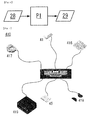
- FIG. 3 is a flow diagram showing a configuration of a method for reducing the operation error of the inertia sensor of the present invention.
- the system using the inertia sensor estimates the characteristic of the inertia sensor by reading the memory data 28 from the inertia sensor (estimation value generation process P1), and reduces the operation error due to a sensor output change caused by a use environment change, on the basis of a generated estimated value 29.
- the memory data 28 can be formed of, for example, coefficients expressing a straight line or a curve of quadratic or higher order polynomial based on a data group (sensor output data including definition range data and value range data).
- FIG. 4 is an illustration showing a configuration example of an angular velocity sensor as an example of the present invention.
- FIG. 5 is an illustration showing an example of a circuit configuration of an LSI according to the inertia sensor of the present invention.
- the inertia sensor is configured to include a temperature sensor 54, and can use, as the memory data 28, the data about the temperature characteristic of the inertia sensor.
- the memory data 28 can be configured by including at least one of a data group (temperature data, sensor output data) about the temperature data, and an inclination amount data based on a plurality of data groups (temperature data, sensor output data).
- a data group temperature data, sensor output data
- an inclination amount data based on a plurality of data groups (temperature data, sensor output data).
- the present invention can be implemented by using at least zero or more of the data groups about the temperature data and one or more of the inclination amount data.
- the data acquired at the time of manufacture of the inertia sensor can be used as it is as the memory data.
- the memory data may be temperature-corrected or may not be temperature-corrected.
- the memory data can be temperature-corrected by the LSI 25 or a peripheral component of the LSI.
- a straight line or a curve of quadratic or higher order polynomial can be preferably used for the temperature correction.
- An angular velocity sensor 410 of this example is configured by a sensor element 41 for detecting angular velocity, an LSI 45 for oscillating the sensor element 41 and for processing an angular velocity signal outputted from the sensor element 41, a package 419 for mounting therein the sensor element 41 and the LSI 45, and the like.
- the LSI of the inertia sensor of this example can have a circuit configuration such as, for example, the circuit configuration example shown in FIG. 5 . That is, the LSI is configured by an oscillation circuit 512 for oscillating a sensor element 51, a detection circuit 553 for processing an angular velocity signal outputted from the sensor element 51, an adjustment circuit 557 for adjusting an output of the detection circuit 553 to a predetermined value, a memory 58 for storing the amount of adjustment, and the like, performed in the adjustment circuit 557, an ADC circuit 555 for converting, into digital data, the outputs (analog outputs) of the temperature sensor 54 and the detection circuit 553, a serial IF circuit 556 for outputting an output of the ADC circuit 555 to the outside and for writing and reading data to and from the memory 58, and the like.
- an oscillation circuit 512 for oscillating a sensor element 51
- a detection circuit 553 for processing an angular velocity signal outputted from the sensor element 51
- FIG. 6 is a graph showing a temperature characteristic (angular velocity conversion value) of static-state output of the angular velocity sensor in this example. This characteristic is acquired at the time of manufacture of the angular velocity sensor. Note that the characteristic may be subjected to temperature correction based on a straight line or a curve of second or higher order polynomial by using a circuit, such as the adjustment circuit in the LSI, and an external circuit such as, for example, a circuit using a temperature elements such as a thermistor, or may not be subjected to temperature correction.
- a circuit such as the adjustment circuit in the LSI
- an external circuit such as, for example, a circuit using a temperature elements such as a thermistor
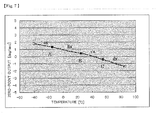
- FIG. 7 is a graph showing an example of data stored in the memory in the LSI of this example. From the measured data, for example, temperature data of A, B and C, a sensor inclination amount a in the range of the temperature A or less, a sensor inclination amount b between the temperatures A and B, a sensor inclination amounts c between the temperatures B and C, and a sensor inclination amount d in the range of the temperature C or more are set as the data to be stored in the memory. From the acquired characteristic data, each of the temperatures A, B and C, and each of the inclination amount data a, b, c and d are arbitrarily set so as to make the error as small as possible. The temperature characteristic of the sensor can be estimated from these data.
- the temperature characteristic of the sensor which is to be stored in the memory, can be estimated. Therefore, it is only necessary to use zero or more temperature data and one or more inclination amounts.
- the temperature characteristic of the sensor may be subjected to temperature correction based on a curve of second or higher order polynomial. For example, when the temperature characteristic of the sensor is subjected to temperature correction based on a quartic curve, the contents of coefficients a, b, c and d of a quartic expression of a x 4 + b x 3 + c x 2 + d x may be stored.
- FIG. 8(A) is a graph showing an example of a relationship between the sensor temperature change and the error in the case where the sensor characteristic is not estimated in the example of the present invention.
- FIG. 8(B) is a graph showing an example of a relationship between the sensor temperature change and the error in the case where the sensor characteristic is estimated from the data in the memory in the LSI in the example of the present invention.
- the error for example, when the temperature changes from 0 degree to 60 degrees during the use of the sensor, an integrated angle error is obtained as the error by integrating, over the time period of the temperature change, the area X between the line of the reference value and the curve of the sensor characteristic in the range of the temperature change from 0 degree to 60 degrees.
- the reference value is set to 0, and hence the error is significantly large.
- the sensor characteristic is estimated from the memory data, and the estimated characteristic is set as the reference. From FIG. 8(B) , it can be seen that, in this case, the error X' is significantly smaller than the error X in the case of the example of FIG. 8(A) .
- An inertia sensor and a method for reducing an operation error of the inertia sensor, according to the present invention are configured such that complicated means, such as the conventional techniques, is not required, and such that, even at the initial use stage in which the temperature characteristic of the sensor is not learned, and even in a case where the sensor is used in an ambient temperature different from the ambient temperature during the previous use of the sensor, an operation error due to a sensor output change caused by a temperature change can be reduced in a relatively simple and highly accurate manner. Therefore, the present invention can provide a high performance inertia sensor used for car navigation, posture control of an automobile and a robot, hand-shake correction of a camera, and the like. Therefore, the present invention is highly available in all the industrial fields in which the sensor manufacturing method and the acceleration sensor are used.
Landscapes
- Engineering & Computer Science (AREA)
- Radar, Positioning & Navigation (AREA)
- Remote Sensing (AREA)
- Physics & Mathematics (AREA)
- General Physics & Mathematics (AREA)
- Automation & Control Theory (AREA)
- Manufacturing & Machinery (AREA)
- Gyroscopes (AREA)
- Pressure Sensors (AREA)
Abstract
Description
- The present invention relates to an inertia sensor and a method for reducing an operation error of the inertia sensor. More particularly, the present invention relates to an inertia sensor (an angular velocity sensor, an acceleration sensor) and a method for reducing an operation error of the inertia sensor, the sensor and the method being capable of reducing, in a relatively simple and highly accurate manner, an operation error due to an output change caused by a temperature change in a system which uses the inertia sensor and is used for car navigation, posture control of an automobile and a robot, hand-shake correction of a camera, and the like.
- In a system which uses an inertia sensor (an angular velocity sensor, an acceleration sensor), and which is used for car navigation, posture control of an automobile and a robot, hand-shake correction of a camera, and the like, it is required that an operation error due to an output change caused, particularly, by a temperature change in the system is reduced as small as possible. Conventionally, the operation error has been suppressed to some extent by using a sensor which has a temperature characteristic within a certain range. However, each of the sensors has a temperature characteristic, and the temperature characteristic is different for each of the sensors. Therefore, it is difficult to completely suppress the operation error. To cope with this, conventionally, a method has often been adopted in which a learning function is given to the side of a system using a sensor, and in which the system learns a temperature characteristic of the sensor from temperature data and sensor data during the use of the sensor, so as to reduce the operation error on the basis of the temperature characteristic.
- Note that a plurality of proposals have been conventionally made about a data correction technique for an inertia sensor. Among the proposals, Japanese Patent Laid-Open No.
2006-308448 - Further, as a physical quantity sensor which can perform sensitivity and drift correction in a wide range even when a circuit with relatively low precision is used as correction signal generation means, Japanese Patent Laid-Open No.
2006-090706 4559805 2006-090706 - Japanese Patent Laid-Open No.
2010-224166 - As described above, when a learning function is given to the side of a system using an inertia sensor, and when the temperature characteristic of the inertia sensor is thereby learned by the system side, the operation error due to a sensor output change caused by a temperature change in the system is reduced as the sensor is repeatedly used and each time the sensor is used. However, at the initial use stage in which the temperature characteristic of the sensor is not learned by the system side, and in the case where the sensor is used in an ambient temperature different from the ambient temperature during the previous use of the sensor, the operation error is caused, and it takes considerable time until the operation error is reduced.
- Therefore, an object of the present invention is to provide an inertia sensor and a method for reducing an operation error of the inertia sensor, in which complicated means, such as the techniques disclosed in the above-described patent literatures, are not required, and in which, even in such cases as the initial use stage in which the temperature characteristic of the sensor is not learned by the side of a system using the sensor, and the case where the sensor is used in an ambient temperature different from the ambient temperature during the previous use of the sensor, the operation error due to a sensor output change caused by a temperature change in the system can be reduced in a relatively simple and highly accurate manner.
- As a result of an extensive investigation of the above-described problems, the present inventors came up with an idea that the problems can be solved in such a manner that information on a temperature characteristic of a sensor is stored in a memory in the sensor, and that the system side reads beforehand the information by using digital communication, so as to perform correction based on the information. On the basis of this idea, the present inventors came to complete the present invention. That is, the invention as claimed in the present application as means for solving the above-described problems, or at least the invention disclosed in the present application is as follows.
- [1] An inertia sensor configured by including at least a sensor element for sensing inertia, a signal processing circuit, and a memory, in which memory data for estimating a characteristic of the inertia sensor is stored in the memory.
- [2] An inertia sensor configured by a sensor element for sensing inertia, and an LSI configured by including at least a signal processing circuit and a memory, in which memory data for estimating a characteristic of the inertia sensor is stored in the memory.
- [3] The inertia sensor as described in one of [1] and [2], in which an operation error due to a sensor output change caused by a use environment change of the sensor is reduced on the basis of the memory data.
- [4] The inertia sensor as described in one of [1] to [3], in which a temperature sensor is included in the configuration of the inertia sensor, and the memory data is data about the temperature characteristic of the inertia sensor, the data being obtained on the basis of an output of the temperature sensor.
- [5] The inertia sensor as described in [4], in which the memory data represents coefficients of a straight line or a curve of quadratic or higher order polynomial based on sensor output data including definition range data and value range data.
- [6] The inertia sensor as described in [5], in which the memory data represents a plurality of pieces of temperature data and sensor output data.
- [7] The inertia sensor as described in one of [4] to [6], in which the memory data is data acquired at the time of manufacture of the inertia sensor.
- [8] The inertia sensor as described in one of [4] to [7], in which the memory data is subjected to temperature correction.
- [9] The inertia sensor as described in [8], in which the temperature correction is expressed as a straight line or a curve of quadratic or higher order polynomial.
- [10] The inertia sensor as described in one of [4] to [7], in which the memory data is not subjected to temperature correction.
- [11] The inertia sensor as described in one of [1] to [10], the inertia sensor being an angular velocity sensor.
- [12] The inertia sensor as described in one of [1] to [10], the inertia sensor being an acceleration sensor.
- [13] A method for reducing an operation error of an inertia sensor, in which a system using the inertia sensor as described in one of [4] to [12] estimates a characteristic of the inertia sensor by reading the memory data from the inertia sensor, and reduces, on the basis of the estimated characteristic, an operation error due to a sensor output change caused by a use environment change.
- The inertia sensor and the method for reducing the operation error of the inertia sensor, according to the present invention, are configured as described above. Therefore, in the inertia sensor and the method for reducing the operation error of the inertia sensor, complicated means, such as the conventional techniques, is not required. Further, even at the initial use stage in which the temperature characteristic of the sensor is not learned, and even in the case where the sensor is used in an ambient temperature different from the ambient temperature during the previous use of the sensor, the operation error due to a sensor output change caused by an ambient temperature change can be reduced in a relatively simple and highly accurate manner.
- That is, with the present invention, the temperature characteristic of the sensor can be estimated from the memory data easily and highly precisely. Therefore, from the beginning of the use of the sensor, a highly precise operation with less operation error due to a temperature change can be performed without requiring that the temperature characteristic of the sensor be learned by the learning function of the system side. Therefore, the present invention can provide a high performance inertia sensor as an inertia sensor (an angular velocity sensor, an acceleration sensor) used for car navigation, posture control of an automobile and a robot, hand-shake correction of a camera, and the like.
-
-
FIG. 1 is a conceptual diagram showing a fundamental configuration of an inertia sensor of the present invention; -
FIG. 2 is a conceptual diagram showing another fundamental configuration of an inertia sensor of the present invention; -
FIG. 3 is a flow diagram showing a configuration of a method for reducing an operation error of the inertia sensor of the present invention; -
FIG. 4 is an illustration showing a configuration example of an angular velocity sensor as an example of the present invention; -
FIG. 5 is an illustration showing an example of a circuit configuration of an LSI according to the inertia sensor of the present invention; -
FIG. 6 is a graph showing a temperature characteristic (angular velocity conversion value) of static-state output of the angular velocity sensor as an example of the present invention; -
FIG. 7 is a graph showing an example of data stored in the memory of the LSI in the example of the present invention; -
FIG. 8(A) is a graph showing an example of a relationship between the sensor temperature change and the error in the case where the sensor characteristic is not estimated in the example of the present invention; and -
FIG. 8(B) is a graph showing an example of a relationship between the sensor temperature change and the error in the case where the sensor characteristic is estimated from the memory data in the LSI in the example of the present invention. - In the following, the present invention will be described in detail with reference to the accompanying drawings.
-
FIG. 1 is a conceptual diagram showing a fundamental configuration of an inertia sensor of the present invention. As shown inFIG. 1 , aninertia sensor 10 includes at least asensor element 1 for sensing inertia, asignal processing circuit 2, and amemory 3, and is mainly configured such thatmemory data 8 for estimating the characteristic of theinertia sensor 10 is stored in thememory 3. Note that an angular velocity sensor and an acceleration sensor are also included in the category of theinertia sensor 10. -
FIG. 2 is a conceptual diagram showing another fundamental configuration of an inertia sensor of the present invention. As shown inFIG. 2 , aninertia sensor 210 includes asensor element 21 for sensing inertia, and anLSI 25 configured by including at least asignal processing circuit 22 and amemory 23, and is also configured such thatmemory data 28 for estimating the characteristic of theinertia sensor 210 is stored in thememory 23. That is, the inertia sensor of the present invention is configured regardless of whether or not the inertia sensor has a form in which the signal processing circuit and the memory are incorporated in an LSI. Note that a composite device in which thesensor element 21 and theLSI 25 shown inFIG. 2 are configured as separate bodies, and a configuration as a system LSI formed by incorporating thesensor element 21 and theLSI 25 in one chip, are also not excluded from the present invention, and are included in the present invention described with reference toFIG. 1 . Note that the following description is made mainly in relation to the configuration shown inFIG. 2 . - With the
inertia sensor 210 configured as described above, it is possible to obtain an effect that an operation error due to a sensor output change caused by a change in the use environment of the sensor is reduced on the basis of thememory data 28. Specifically, thememory data 28 is generated on the basis of source data used as a source of thememory data 28, and operation processing of the sensor output is performed on the basis of thememory data 28, so that an estimated value of the sensor characteristic of theinertia sensor 210 is obtained. Thereby, the operation error due to the sensor output change is reduced. -
FIG. 3 is a flow diagram showing a configuration of a method for reducing the operation error of the inertia sensor of the present invention. As shown inFIG. 3 , in the inertia sensor described above, the system using the inertia sensor estimates the characteristic of the inertia sensor by reading thememory data 28 from the inertia sensor (estimation value generation process P1), and reduces the operation error due to a sensor output change caused by a use environment change, on the basis of a generated estimatedvalue 29. Note that thememory data 28 can be formed of, for example, coefficients expressing a straight line or a curve of quadratic or higher order polynomial based on a data group (sensor output data including definition range data and value range data). -
FIG. 4 is an illustration showing a configuration example of an angular velocity sensor as an example of the present invention. Further,FIG. 5 is an illustration showing an example of a circuit configuration of an LSI according to the inertia sensor of the present invention. As shown inFIG. 5 , the inertia sensor is configured to include atemperature sensor 54, and can use, as thememory data 28, the data about the temperature characteristic of the inertia sensor. - In the
inertia sensor 210 of the present invention shown inFIG. 2 , thememory data 28 can be configured by including at least one of a data group (temperature data, sensor output data) about the temperature data, and an inclination amount data based on a plurality of data groups (temperature data, sensor output data). As will be described in an example below, the present invention can be implemented by using at least zero or more of the data groups about the temperature data and one or more of the inclination amount data. - Note that the data acquired at the time of manufacture of the inertia sensor can be used as it is as the memory data. Further, the memory data may be temperature-corrected or may not be temperature-corrected. In the case where the memory data is temperature-corrected, the memory data can be temperature-corrected by the
LSI 25 or a peripheral component of the LSI. Further, a straight line or a curve of quadratic or higher order polynomial can be preferably used for the temperature correction. - In the following, the present invention will be described with reference to an example, but the present invention is not limited to the example.
- The inertia sensor (angular velocity sensor) as shown in
FIG. 4 was manufactured. Anangular velocity sensor 410 of this example is configured by asensor element 41 for detecting angular velocity, anLSI 45 for oscillating thesensor element 41 and for processing an angular velocity signal outputted from thesensor element 41, apackage 419 for mounting therein thesensor element 41 and theLSI 45, and the like. - Further, the LSI of the inertia sensor of this example can have a circuit configuration such as, for example, the circuit configuration example shown in
FIG. 5 . That is, the LSI is configured by anoscillation circuit 512 for oscillating asensor element 51, adetection circuit 553 for processing an angular velocity signal outputted from thesensor element 51, anadjustment circuit 557 for adjusting an output of thedetection circuit 553 to a predetermined value, amemory 58 for storing the amount of adjustment, and the like, performed in theadjustment circuit 557, anADC circuit 555 for converting, into digital data, the outputs (analog outputs) of thetemperature sensor 54 and thedetection circuit 553, a serial IFcircuit 556 for outputting an output of theADC circuit 555 to the outside and for writing and reading data to and from thememory 58, and the like. -
FIG. 6 is a graph showing a temperature characteristic (angular velocity conversion value) of static-state output of the angular velocity sensor in this example. This characteristic is acquired at the time of manufacture of the angular velocity sensor. Note that the characteristic may be subjected to temperature correction based on a straight line or a curve of second or higher order polynomial by using a circuit, such as the adjustment circuit in the LSI, and an external circuit such as, for example, a circuit using a temperature elements such as a thermistor, or may not be subjected to temperature correction. -
FIG. 7 is a graph showing an example of data stored in the memory in the LSI of this example. From the measured data, for example, temperature data of A, B and C, a sensor inclination amount a in the range of the temperature A or less, a sensor inclination amount b between the temperatures A and B, a sensor inclination amounts c between the temperatures B and C, and a sensor inclination amount d in the range of the temperature C or more are set as the data to be stored in the memory. From the acquired characteristic data, each of the temperatures A, B and C, and each of the inclination amount data a, b, c and d are arbitrarily set so as to make the error as small as possible. The temperature characteristic of the sensor can be estimated from these data. Note that it is only necessary that the temperature characteristic of the sensor, which is to be stored in the memory, can be estimated. Therefore, it is only necessary to use zero or more temperature data and one or more inclination amounts. Further, the temperature characteristic of the sensor may be subjected to temperature correction based on a curve of second or higher order polynomial. For example, when the temperature characteristic of the sensor is subjected to temperature correction based on a quartic curve, the contents of coefficients a, b, c and d of a quartic expression of a x4 + b x3 + c x2 + d x may be stored. -
FIG. 8(A) is a graph showing an example of a relationship between the sensor temperature change and the error in the case where the sensor characteristic is not estimated in the example of the present invention.FIG. 8(B) is a graph showing an example of a relationship between the sensor temperature change and the error in the case where the sensor characteristic is estimated from the data in the memory in the LSI in the example of the present invention. As for the error, for example, when the temperature changes from 0 degree to 60 degrees during the use of the sensor, an integrated angle error is obtained as the error by integrating, over the time period of the temperature change, the area X between the line of the reference value and the curve of the sensor characteristic in the range of the temperature change from 0 degree to 60 degrees. - In the case of the example of
FIG. 8(A) in which the sensor characteristic is not estimated, the reference value is set to 0, and hence the error is significantly large. On the other hand, in the case of the example ofFIG. 8(B) in which the sensor characteristic is estimated on the basis of the present invention, the sensor characteristic is estimated from the memory data, and the estimated characteristic is set as the reference. FromFIG. 8(B) , it can be seen that, in this case, the error X' is significantly smaller than the error X in the case of the example ofFIG. 8(A) . - An inertia sensor and a method for reducing an operation error of the inertia sensor, according to the present invention, are configured such that complicated means, such as the conventional techniques, is not required, and such that, even at the initial use stage in which the temperature characteristic of the sensor is not learned, and even in a case where the sensor is used in an ambient temperature different from the ambient temperature during the previous use of the sensor, an operation error due to a sensor output change caused by a temperature change can be reduced in a relatively simple and highly accurate manner. Therefore, the present invention can provide a high performance inertia sensor used for car navigation, posture control of an automobile and a robot, hand-shake correction of a camera, and the like. Therefore, the present invention is highly available in all the industrial fields in which the sensor manufacturing method and the acceleration sensor are used.
-
- 1, 21, 41, 51
- Sensor element
- 2, 22
- Signal processing circuit
- 3, 23, 58
- Memory
- 8, 28
- Memory data
- 29
- Estimated value
- 10, 210
- Inertia sensor
- 25, 45
- LSI
- 30
- Estimated value of sensor characteristic
- 410
- Angular velocity sensor
- 416
- Top cover (LID)
- 417
- Support base
- 418
- Holding structure (holding resin)
- 419
- Housing (ceramic package)
- 512
- Oscillation circuit
- 54
- Temperature sensor
- 553
- Detection circuit
- 555
- ADC circuit
- 556
- Serial IF
- 557
- Adjustment circuit
- P1
- Estimated value generation process
- X, X'
- Integrated angle error
Claims (13)
- An inertia sensor configured by including at least a sensor element for sensing inertia, a signal processing circuit, and a memory, wherein memory data for estimating a characteristic of the inertia sensor is stored in the memory.
- An inertia sensor configured by a sensor element for sensing inertia, and an LSI configured by including at least a signal processing circuit and a memory, wherein memory data for estimating a characteristic of the inertia sensor is stored in the memory.
- The inertia sensor according to one of claim 1 and claim 2, wherein an operation error due to a sensor output change caused by a use environment change of the sensor is reduced on the basis of the memory data.
- The inertia sensor according to one of claim 1 to claim 3, wherein a temperature sensor is included in the configuration of the inertia sensor, and the memory data is data about the temperature characteristic of the inertia sensor, the data being obtained on the basis of an output of the temperature sensor.
- The inertia sensor according to claim 4, wherein the memory data represents coefficients of a straight line or a curve of a quadratic or higher order polynomial based on sensor output data including definition range data and value range data.
- The inertia sensor according to claim 5, wherein the memory data represents a plurality of pieces of temperature data and sensor output data.
- The inertia sensor according to one of claim 4 to claim 6, wherein the memory data is data acquired at the time of manufacture of the inertia sensor.
- The inertia sensor according to one of claim 4 to claim 7, wherein the memory data is subjected to temperature correction.
- The inertia sensor according to claim 8, wherein the temperature correction is expressed as a straight line or a curve of quadratic or higher order polynomial.
- The inertia sensor according to one of claim 4 to claim 7, wherein the memory data is not subjected to temperature correction.
- The inertia sensor according to one of claim 1 to claim 10, the inertia sensor being an angular velocity sensor.
- The inertia sensor according to one of claim 1 to claim 10, the inertia sensor being an acceleration sensor.
- A method for reducing an operation error of an inertia sensor, wherein a system using the inertia sensor according to one of claim 4 to claim 12 estimates a characteristic of the inertia sensor by reading the memory data from the inertia sensor, and reduces, on the basis of the estimated characteristic, an operation error due to a sensor output change caused by a use environment change.
Applications Claiming Priority (1)
| Application Number | Priority Date | Filing Date | Title |
|---|---|---|---|
| JP2012261558A JP2014106206A (en) | 2012-11-29 | 2012-11-29 | Inertial sensor and method for reducing its calculation error |
Publications (2)
| Publication Number | Publication Date |
|---|---|
| EP2738518A2 true EP2738518A2 (en) | 2014-06-04 |
| EP2738518A3 EP2738518A3 (en) | 2016-08-31 |
Family
ID=49876349
Family Applications (1)
| Application Number | Title | Priority Date | Filing Date |
|---|---|---|---|
| EP13194713.7A Withdrawn EP2738518A3 (en) | 2012-11-29 | 2013-11-27 | Inertia sensor and method for reducing operation error of the same |
Country Status (3)
| Country | Link |
|---|---|
| US (1) | US20140149061A1 (en) |
| EP (1) | EP2738518A3 (en) |
| JP (1) | JP2014106206A (en) |
Families Citing this family (10)
| Publication number | Priority date | Publication date | Assignee | Title |
|---|---|---|---|---|
| JP6572585B2 (en) * | 2015-03-27 | 2019-09-11 | セイコーエプソン株式会社 | CIRCUIT DEVICE, PHYSICAL QUANTITY DETECTION DEVICE, ELECTRONIC DEVICE, MOBILE BODY, CIRCUIT DEVICE MANUFACTURING METHOD |
| US10345329B2 (en) | 2015-07-07 | 2019-07-09 | Panasonic Intellectual Property Management Co., Ltd. | Inertial force sensor |
| JP6661937B2 (en) * | 2015-09-28 | 2020-03-11 | 富士電機株式会社 | Acceleration correction data calculation device and method of manufacturing acceleration sensor |
| CN105466452B (en) * | 2015-11-20 | 2019-02-19 | 中船重工西安东仪科工集团有限公司 | Test method for measuring error coefficient of MEMS sensor combined output temperature drift |
| JP2019070554A (en) * | 2017-10-06 | 2019-05-09 | クラリオン株式会社 | Gradient amount output device and correction coefficient updating method |
| WO2020031711A1 (en) * | 2018-08-07 | 2020-02-13 | 日立オートモティブシステムズ株式会社 | Vehicle control device |
| CN109341724B (en) * | 2018-12-04 | 2023-05-05 | 中国航空工业集团公司西安航空计算技术研究所 | On-line calibration method for relative pose of airborne camera-inertial measurement unit |
| CN110006457A (en) * | 2019-04-25 | 2019-07-12 | 扬州工业职业技术学院 | A measuring system for automobile calibration |
| CN113124859B (en) * | 2019-12-30 | 2023-03-21 | 北京极智嘉科技股份有限公司 | Robot, angular velocity correction method, and computer-readable storage medium |
| CN119717309B (en) * | 2023-12-27 | 2025-09-26 | 十二毫米健康科技(海南)有限公司 | Glasses hanging rope data correction method for correcting eye posture |
Citations (3)
| Publication number | Priority date | Publication date | Assignee | Title |
|---|---|---|---|---|
| JP2006090706A (en) | 2004-09-21 | 2006-04-06 | Citizen Watch Co Ltd | Physical quantity sensor |
| JP2006308448A (en) | 2005-04-28 | 2006-11-09 | Matsushita Electric Ind Co Ltd | Correction value storage device and correction device |
| JP2010224166A (en) | 2009-03-23 | 2010-10-07 | Olympus Corp | Digital camera and exchangeable lens |
Family Cites Families (12)
| Publication number | Priority date | Publication date | Assignee | Title |
|---|---|---|---|---|
| US5249267A (en) * | 1988-06-30 | 1993-09-28 | Kabushiki Kaisha Toshiba | Image processing apparatus and method |
| JP2577760Y2 (en) * | 1992-09-30 | 1998-07-30 | ナイルス部品株式会社 | Drift correction device for rotation sensitive sensor |
| JP3251499B2 (en) * | 1996-05-31 | 2002-01-28 | 矢崎総業株式会社 | Battery remaining capacity measurement device |
| JP2000258162A (en) * | 1999-03-04 | 2000-09-22 | Alps Electric Co Ltd | Temperature compensator piezoelectric oscillator |
| JP2005121576A (en) * | 2003-10-20 | 2005-05-12 | Honda Motor Co Ltd | Inertial sensor unit |
| US7526398B1 (en) * | 2005-09-21 | 2009-04-28 | Samsung Electronics Co., Ltd. | Method and apparatus for calibrating gyro-sensor |
| JP2008170294A (en) * | 2007-01-12 | 2008-07-24 | Matsushita Electric Ind Co Ltd | Angular velocity sensor |
| JP4439572B2 (en) * | 2008-07-11 | 2010-03-24 | 任天堂株式会社 | Digital data correction program and digital data correction apparatus |
| US9052202B2 (en) * | 2010-06-10 | 2015-06-09 | Qualcomm Incorporated | Use of inertial sensor data to improve mobile station positioning |
| JP2012008096A (en) * | 2010-06-28 | 2012-01-12 | Seiko Epson Corp | Bias estimation method, attitude estimation method, bias estimation device and attitude estimation device |
| US20120262297A1 (en) * | 2011-04-17 | 2012-10-18 | Tai Cheung Poon | Systems and methods for measuring the skiing condition for skiers |
| JP5752741B2 (en) * | 2012-09-26 | 2015-07-22 | 富士フイルム株式会社 | Multilayer substrate and semiconductor package |
-
2012
- 2012-11-29 JP JP2012261558A patent/JP2014106206A/en active Pending
-
2013
- 2013-11-07 US US14/074,133 patent/US20140149061A1/en not_active Abandoned
- 2013-11-27 EP EP13194713.7A patent/EP2738518A3/en not_active Withdrawn
Patent Citations (4)
| Publication number | Priority date | Publication date | Assignee | Title |
|---|---|---|---|---|
| JP2006090706A (en) | 2004-09-21 | 2006-04-06 | Citizen Watch Co Ltd | Physical quantity sensor |
| JP4559805B2 (en) | 2004-09-21 | 2010-10-13 | シチズンホールディングス株式会社 | Physical quantity sensor |
| JP2006308448A (en) | 2005-04-28 | 2006-11-09 | Matsushita Electric Ind Co Ltd | Correction value storage device and correction device |
| JP2010224166A (en) | 2009-03-23 | 2010-10-07 | Olympus Corp | Digital camera and exchangeable lens |
Also Published As
| Publication number | Publication date |
|---|---|
| JP2014106206A (en) | 2014-06-09 |
| US20140149061A1 (en) | 2014-05-29 |
| EP2738518A3 (en) | 2016-08-31 |
Similar Documents
| Publication | Publication Date | Title |
|---|---|---|
| EP2738518A2 (en) | Inertia sensor and method for reducing operation error of the same | |
| CN103946672B (en) | The output value correction method of physical quantity sensor or its device and device | |
| EP3640600B1 (en) | Device and method for self-correcting a sensed physical parameter in a drone or unmanned aerial vehicle | |
| JP4736508B2 (en) | Physical quantity detection method and sensor device | |
| US12210035B2 (en) | Inertial sensor device and sensor module | |
| US10794776B2 (en) | Failure determination circuit, physical quantity measurement device, electronic apparatus, and vehicle | |
| KR20100056388A (en) | Vibration compensating control circuit and imaging pickup apparatus | |
| CN112857395A (en) | Method and device for creating a correction value for correcting an inertial measurement unit of a vehicle | |
| CN115808165A (en) | Inertial Sensor Module | |
| KR101331956B1 (en) | High precision ins module using analog mems sensor and operating method thereof | |
| EP2199807A2 (en) | Sensor device | |
| JP2004093552A (en) | Acceleration detection device | |
| CN114460550B (en) | A monitoring method and device for sensor external parameter calibration | |
| CN115371700B (en) | Gyroscope drift data compensation method, device, storage medium and projection equipment | |
| CN112857402B (en) | Sensor calibration method, device and equipment | |
| JP2009053164A (en) | Physical quantity sensor | |
| JP4559805B2 (en) | Physical quantity sensor | |
| US10345329B2 (en) | Inertial force sensor | |
| JP2010216906A (en) | Automobile-use flowmeter | |
| JP2000221040A (en) | Oscillation gyro | |
| US8978474B2 (en) | Inertial measurement systems, and methods of use and manufacture thereof | |
| KR101029137B1 (en) | Acceleration measuring method and its measuring device | |
| KR100710772B1 (en) | Sensor Signal Processing System and Detector | |
| KR20210076086A (en) | Method, system and computer program for offset correction of yaw rate sensor signal of yaw rate sensor | |
| JP2025165046A (en) | Temperature characteristic correction method, temperature characteristic correction device, and sensor device |
Legal Events
| Date | Code | Title | Description |
|---|---|---|---|
| PUAI | Public reference made under article 153(3) epc to a published international application that has entered the european phase |
Free format text: ORIGINAL CODE: 0009012 |
|
| 17P | Request for examination filed |
Effective date: 20131127 |
|
| AK | Designated contracting states |
Kind code of ref document: A2 Designated state(s): AL AT BE BG CH CY CZ DE DK EE ES FI FR GB GR HR HU IE IS IT LI LT LU LV MC MK MT NL NO PL PT RO RS SE SI SK SM TR |
|
| AX | Request for extension of the european patent |
Extension state: BA ME |
|
| PUAL | Search report despatched |
Free format text: ORIGINAL CODE: 0009013 |
|
| AK | Designated contracting states |
Kind code of ref document: A3 Designated state(s): AL AT BE BG CH CY CZ DE DK EE ES FI FR GB GR HR HU IE IS IT LI LT LU LV MC MK MT NL NO PL PT RO RS SE SI SK SM TR |
|
| AX | Request for extension of the european patent |
Extension state: BA ME |
|
| RIC1 | Information provided on ipc code assigned before grant |
Ipc: G01C 21/16 20060101AFI20160727BHEP Ipc: G01C 25/00 20060101ALI20160727BHEP |
|
| STAA | Information on the status of an ep patent application or granted ep patent |
Free format text: STATUS: REQUEST FOR EXAMINATION WAS MADE |
|
| STAA | Information on the status of an ep patent application or granted ep patent |
Free format text: STATUS: THE APPLICATION IS DEEMED TO BE WITHDRAWN |
|
| 18D | Application deemed to be withdrawn |
Effective date: 20170301 |