EP2734522B1 - 4-imidazopyridazin-1-yl-benzamides and 4-imidazotriazin-1-yl-benzamides as btk-inhibitors - Google Patents
4-imidazopyridazin-1-yl-benzamides and 4-imidazotriazin-1-yl-benzamides as btk-inhibitors Download PDFInfo
- Publication number
- EP2734522B1 EP2734522B1 EP12733505.7A EP12733505A EP2734522B1 EP 2734522 B1 EP2734522 B1 EP 2734522B1 EP 12733505 A EP12733505 A EP 12733505A EP 2734522 B1 EP2734522 B1 EP 2734522B1
- Authority
- EP
- European Patent Office
- Prior art keywords
- compound
- acceptable salt
- btk
- pharmaceutically acceptable
- chronic
- Prior art date
- Legal status (The legal status is an assumption and is not a legal conclusion. Google has not performed a legal analysis and makes no representation as to the accuracy of the status listed.)
- Active
Links
- WDENQIQQYWYTPO-IBGZPJMESA-N CC#CC(N(CCC1)[C@@H]1c1nc(-c(cc2)ccc2C(Nc2ccccn2)=O)c2[n]1ccnc2N)=O Chemical compound CC#CC(N(CCC1)[C@@H]1c1nc(-c(cc2)ccc2C(Nc2ccccn2)=O)c2[n]1ccnc2N)=O WDENQIQQYWYTPO-IBGZPJMESA-N 0.000 description 2
- WDENQIQQYWYTPO-UHFFFAOYSA-N CC#CC(N(CCC1)C1c1nc(-c(cc2)ccc2C(Nc2ccccn2)=O)c2[n]1ccnc2N)=O Chemical compound CC#CC(N(CCC1)C1c1nc(-c(cc2)ccc2C(Nc2ccccn2)=O)c2[n]1ccnc2N)=O WDENQIQQYWYTPO-UHFFFAOYSA-N 0.000 description 1
- WDENQIQQYWYTPO-UHFFFAOYSA-O CC#CC(N(CCC1)C1c1nc(-c(cc2)ccc2C(Nc2ccccn2)=O)c2[n]1ccnc2[NH3+])=O Chemical compound CC#CC(N(CCC1)C1c1nc(-c(cc2)ccc2C(Nc2ccccn2)=O)c2[n]1ccnc2[NH3+])=O WDENQIQQYWYTPO-UHFFFAOYSA-O 0.000 description 1
- LRYUKAYVYDKKAB-FTBISJDPSA-N CC#CC(N(CCC1)[C@@H]1c1nc(-c(cc2)ccc2C(Nc2ccccn2)=[U])c2[n]1ccnc2N)=C Chemical compound CC#CC(N(CCC1)[C@@H]1c1nc(-c(cc2)ccc2C(Nc2ccccn2)=[U])c2[n]1ccnc2N)=C LRYUKAYVYDKKAB-FTBISJDPSA-N 0.000 description 1
Classifications
-
- A—HUMAN NECESSITIES
- A61—MEDICAL OR VETERINARY SCIENCE; HYGIENE
- A61K—PREPARATIONS FOR MEDICAL, DENTAL OR TOILETRY PURPOSES
- A61K31/00—Medicinal preparations containing organic active ingredients
- A61K31/33—Heterocyclic compounds
- A61K31/395—Heterocyclic compounds having nitrogen as a ring hetero atom, e.g. guanethidine or rifamycins
- A61K31/495—Heterocyclic compounds having nitrogen as a ring hetero atom, e.g. guanethidine or rifamycins having six-membered rings with two or more nitrogen atoms as the only ring heteroatoms, e.g. piperazine or tetrazines
- A61K31/4985—Pyrazines or piperazines ortho- or peri-condensed with heterocyclic ring systems
-
- A—HUMAN NECESSITIES
- A61—MEDICAL OR VETERINARY SCIENCE; HYGIENE
- A61K—PREPARATIONS FOR MEDICAL, DENTAL OR TOILETRY PURPOSES
- A61K31/00—Medicinal preparations containing organic active ingredients
- A61K31/33—Heterocyclic compounds
- A61K31/395—Heterocyclic compounds having nitrogen as a ring hetero atom, e.g. guanethidine or rifamycins
- A61K31/495—Heterocyclic compounds having nitrogen as a ring hetero atom, e.g. guanethidine or rifamycins having six-membered rings with two or more nitrogen atoms as the only ring heteroatoms, e.g. piperazine or tetrazines
- A61K31/50—Pyridazines; Hydrogenated pyridazines
- A61K31/501—Pyridazines; Hydrogenated pyridazines not condensed and containing further heterocyclic rings
-
- A—HUMAN NECESSITIES
- A61—MEDICAL OR VETERINARY SCIENCE; HYGIENE
- A61K—PREPARATIONS FOR MEDICAL, DENTAL OR TOILETRY PURPOSES
- A61K31/00—Medicinal preparations containing organic active ingredients
- A61K31/33—Heterocyclic compounds
- A61K31/395—Heterocyclic compounds having nitrogen as a ring hetero atom, e.g. guanethidine or rifamycins
- A61K31/495—Heterocyclic compounds having nitrogen as a ring hetero atom, e.g. guanethidine or rifamycins having six-membered rings with two or more nitrogen atoms as the only ring heteroatoms, e.g. piperazine or tetrazines
- A61K31/505—Pyrimidines; Hydrogenated pyrimidines, e.g. trimethoprim
- A61K31/506—Pyrimidines; Hydrogenated pyrimidines, e.g. trimethoprim not condensed and containing further heterocyclic rings
-
- A—HUMAN NECESSITIES
- A61—MEDICAL OR VETERINARY SCIENCE; HYGIENE
- A61K—PREPARATIONS FOR MEDICAL, DENTAL OR TOILETRY PURPOSES
- A61K31/00—Medicinal preparations containing organic active ingredients
- A61K31/33—Heterocyclic compounds
- A61K31/395—Heterocyclic compounds having nitrogen as a ring hetero atom, e.g. guanethidine or rifamycins
- A61K31/535—Heterocyclic compounds having nitrogen as a ring hetero atom, e.g. guanethidine or rifamycins having six-membered rings with at least one nitrogen and one oxygen as the ring hetero atoms, e.g. 1,2-oxazines
- A61K31/5375—1,4-Oxazines, e.g. morpholine
- A61K31/5377—1,4-Oxazines, e.g. morpholine not condensed and containing further heterocyclic rings, e.g. timolol
-
- A—HUMAN NECESSITIES
- A61—MEDICAL OR VETERINARY SCIENCE; HYGIENE
- A61K—PREPARATIONS FOR MEDICAL, DENTAL OR TOILETRY PURPOSES
- A61K31/00—Medicinal preparations containing organic active ingredients
- A61K31/33—Heterocyclic compounds
- A61K31/395—Heterocyclic compounds having nitrogen as a ring hetero atom, e.g. guanethidine or rifamycins
- A61K31/55—Heterocyclic compounds having nitrogen as a ring hetero atom, e.g. guanethidine or rifamycins having seven-membered rings, e.g. azelastine, pentylenetetrazole
-
- A—HUMAN NECESSITIES
- A61—MEDICAL OR VETERINARY SCIENCE; HYGIENE
- A61P—SPECIFIC THERAPEUTIC ACTIVITY OF CHEMICAL COMPOUNDS OR MEDICINAL PREPARATIONS
- A61P1/00—Drugs for disorders of the alimentary tract or the digestive system
-
- A—HUMAN NECESSITIES
- A61—MEDICAL OR VETERINARY SCIENCE; HYGIENE
- A61P—SPECIFIC THERAPEUTIC ACTIVITY OF CHEMICAL COMPOUNDS OR MEDICINAL PREPARATIONS
- A61P1/00—Drugs for disorders of the alimentary tract or the digestive system
- A61P1/02—Stomatological preparations, e.g. drugs for caries, aphtae, periodontitis
-
- A—HUMAN NECESSITIES
- A61—MEDICAL OR VETERINARY SCIENCE; HYGIENE
- A61P—SPECIFIC THERAPEUTIC ACTIVITY OF CHEMICAL COMPOUNDS OR MEDICINAL PREPARATIONS
- A61P1/00—Drugs for disorders of the alimentary tract or the digestive system
- A61P1/04—Drugs for disorders of the alimentary tract or the digestive system for ulcers, gastritis or reflux esophagitis, e.g. antacids, inhibitors of acid secretion, mucosal protectants
-
- A—HUMAN NECESSITIES
- A61—MEDICAL OR VETERINARY SCIENCE; HYGIENE
- A61P—SPECIFIC THERAPEUTIC ACTIVITY OF CHEMICAL COMPOUNDS OR MEDICINAL PREPARATIONS
- A61P1/00—Drugs for disorders of the alimentary tract or the digestive system
- A61P1/16—Drugs for disorders of the alimentary tract or the digestive system for liver or gallbladder disorders, e.g. hepatoprotective agents, cholagogues, litholytics
-
- A—HUMAN NECESSITIES
- A61—MEDICAL OR VETERINARY SCIENCE; HYGIENE
- A61P—SPECIFIC THERAPEUTIC ACTIVITY OF CHEMICAL COMPOUNDS OR MEDICINAL PREPARATIONS
- A61P1/00—Drugs for disorders of the alimentary tract or the digestive system
- A61P1/18—Drugs for disorders of the alimentary tract or the digestive system for pancreatic disorders, e.g. pancreatic enzymes
-
- A—HUMAN NECESSITIES
- A61—MEDICAL OR VETERINARY SCIENCE; HYGIENE
- A61P—SPECIFIC THERAPEUTIC ACTIVITY OF CHEMICAL COMPOUNDS OR MEDICINAL PREPARATIONS
- A61P11/00—Drugs for disorders of the respiratory system
-
- A—HUMAN NECESSITIES
- A61—MEDICAL OR VETERINARY SCIENCE; HYGIENE
- A61P—SPECIFIC THERAPEUTIC ACTIVITY OF CHEMICAL COMPOUNDS OR MEDICINAL PREPARATIONS
- A61P11/00—Drugs for disorders of the respiratory system
- A61P11/06—Antiasthmatics
-
- A—HUMAN NECESSITIES
- A61—MEDICAL OR VETERINARY SCIENCE; HYGIENE
- A61P—SPECIFIC THERAPEUTIC ACTIVITY OF CHEMICAL COMPOUNDS OR MEDICINAL PREPARATIONS
- A61P13/00—Drugs for disorders of the urinary system
- A61P13/02—Drugs for disorders of the urinary system of urine or of the urinary tract, e.g. urine acidifiers
-
- A—HUMAN NECESSITIES
- A61—MEDICAL OR VETERINARY SCIENCE; HYGIENE
- A61P—SPECIFIC THERAPEUTIC ACTIVITY OF CHEMICAL COMPOUNDS OR MEDICINAL PREPARATIONS
- A61P13/00—Drugs for disorders of the urinary system
- A61P13/12—Drugs for disorders of the urinary system of the kidneys
-
- A—HUMAN NECESSITIES
- A61—MEDICAL OR VETERINARY SCIENCE; HYGIENE
- A61P—SPECIFIC THERAPEUTIC ACTIVITY OF CHEMICAL COMPOUNDS OR MEDICINAL PREPARATIONS
- A61P17/00—Drugs for dermatological disorders
-
- A—HUMAN NECESSITIES
- A61—MEDICAL OR VETERINARY SCIENCE; HYGIENE
- A61P—SPECIFIC THERAPEUTIC ACTIVITY OF CHEMICAL COMPOUNDS OR MEDICINAL PREPARATIONS
- A61P17/00—Drugs for dermatological disorders
- A61P17/06—Antipsoriatics
-
- A—HUMAN NECESSITIES
- A61—MEDICAL OR VETERINARY SCIENCE; HYGIENE
- A61P—SPECIFIC THERAPEUTIC ACTIVITY OF CHEMICAL COMPOUNDS OR MEDICINAL PREPARATIONS
- A61P19/00—Drugs for skeletal disorders
-
- A—HUMAN NECESSITIES
- A61—MEDICAL OR VETERINARY SCIENCE; HYGIENE
- A61P—SPECIFIC THERAPEUTIC ACTIVITY OF CHEMICAL COMPOUNDS OR MEDICINAL PREPARATIONS
- A61P19/00—Drugs for skeletal disorders
- A61P19/02—Drugs for skeletal disorders for joint disorders, e.g. arthritis, arthrosis
-
- A—HUMAN NECESSITIES
- A61—MEDICAL OR VETERINARY SCIENCE; HYGIENE
- A61P—SPECIFIC THERAPEUTIC ACTIVITY OF CHEMICAL COMPOUNDS OR MEDICINAL PREPARATIONS
- A61P19/00—Drugs for skeletal disorders
- A61P19/08—Drugs for skeletal disorders for bone diseases, e.g. rachitism, Paget's disease
-
- A—HUMAN NECESSITIES
- A61—MEDICAL OR VETERINARY SCIENCE; HYGIENE
- A61P—SPECIFIC THERAPEUTIC ACTIVITY OF CHEMICAL COMPOUNDS OR MEDICINAL PREPARATIONS
- A61P21/00—Drugs for disorders of the muscular or neuromuscular system
- A61P21/04—Drugs for disorders of the muscular or neuromuscular system for myasthenia gravis
-
- A—HUMAN NECESSITIES
- A61—MEDICAL OR VETERINARY SCIENCE; HYGIENE
- A61P—SPECIFIC THERAPEUTIC ACTIVITY OF CHEMICAL COMPOUNDS OR MEDICINAL PREPARATIONS
- A61P25/00—Drugs for disorders of the nervous system
-
- A—HUMAN NECESSITIES
- A61—MEDICAL OR VETERINARY SCIENCE; HYGIENE
- A61P—SPECIFIC THERAPEUTIC ACTIVITY OF CHEMICAL COMPOUNDS OR MEDICINAL PREPARATIONS
- A61P27/00—Drugs for disorders of the senses
- A61P27/02—Ophthalmic agents
-
- A—HUMAN NECESSITIES
- A61—MEDICAL OR VETERINARY SCIENCE; HYGIENE
- A61P—SPECIFIC THERAPEUTIC ACTIVITY OF CHEMICAL COMPOUNDS OR MEDICINAL PREPARATIONS
- A61P27/00—Drugs for disorders of the senses
- A61P27/02—Ophthalmic agents
- A61P27/06—Antiglaucoma agents or miotics
-
- A—HUMAN NECESSITIES
- A61—MEDICAL OR VETERINARY SCIENCE; HYGIENE
- A61P—SPECIFIC THERAPEUTIC ACTIVITY OF CHEMICAL COMPOUNDS OR MEDICINAL PREPARATIONS
- A61P27/00—Drugs for disorders of the senses
- A61P27/16—Otologicals
-
- A—HUMAN NECESSITIES
- A61—MEDICAL OR VETERINARY SCIENCE; HYGIENE
- A61P—SPECIFIC THERAPEUTIC ACTIVITY OF CHEMICAL COMPOUNDS OR MEDICINAL PREPARATIONS
- A61P29/00—Non-central analgesic, antipyretic or antiinflammatory agents, e.g. antirheumatic agents; Non-steroidal antiinflammatory drugs [NSAID]
-
- A—HUMAN NECESSITIES
- A61—MEDICAL OR VETERINARY SCIENCE; HYGIENE
- A61P—SPECIFIC THERAPEUTIC ACTIVITY OF CHEMICAL COMPOUNDS OR MEDICINAL PREPARATIONS
- A61P3/00—Drugs for disorders of the metabolism
- A61P3/08—Drugs for disorders of the metabolism for glucose homeostasis
- A61P3/10—Drugs for disorders of the metabolism for glucose homeostasis for hyperglycaemia, e.g. antidiabetics
-
- A—HUMAN NECESSITIES
- A61—MEDICAL OR VETERINARY SCIENCE; HYGIENE
- A61P—SPECIFIC THERAPEUTIC ACTIVITY OF CHEMICAL COMPOUNDS OR MEDICINAL PREPARATIONS
- A61P31/00—Antiinfectives, i.e. antibiotics, antiseptics, chemotherapeutics
-
- A—HUMAN NECESSITIES
- A61—MEDICAL OR VETERINARY SCIENCE; HYGIENE
- A61P—SPECIFIC THERAPEUTIC ACTIVITY OF CHEMICAL COMPOUNDS OR MEDICINAL PREPARATIONS
- A61P31/00—Antiinfectives, i.e. antibiotics, antiseptics, chemotherapeutics
- A61P31/04—Antibacterial agents
-
- A—HUMAN NECESSITIES
- A61—MEDICAL OR VETERINARY SCIENCE; HYGIENE
- A61P—SPECIFIC THERAPEUTIC ACTIVITY OF CHEMICAL COMPOUNDS OR MEDICINAL PREPARATIONS
- A61P31/00—Antiinfectives, i.e. antibiotics, antiseptics, chemotherapeutics
- A61P31/12—Antivirals
-
- A—HUMAN NECESSITIES
- A61—MEDICAL OR VETERINARY SCIENCE; HYGIENE
- A61P—SPECIFIC THERAPEUTIC ACTIVITY OF CHEMICAL COMPOUNDS OR MEDICINAL PREPARATIONS
- A61P35/00—Antineoplastic agents
-
- A—HUMAN NECESSITIES
- A61—MEDICAL OR VETERINARY SCIENCE; HYGIENE
- A61P—SPECIFIC THERAPEUTIC ACTIVITY OF CHEMICAL COMPOUNDS OR MEDICINAL PREPARATIONS
- A61P35/00—Antineoplastic agents
- A61P35/02—Antineoplastic agents specific for leukemia
-
- A—HUMAN NECESSITIES
- A61—MEDICAL OR VETERINARY SCIENCE; HYGIENE
- A61P—SPECIFIC THERAPEUTIC ACTIVITY OF CHEMICAL COMPOUNDS OR MEDICINAL PREPARATIONS
- A61P37/00—Drugs for immunological or allergic disorders
-
- A—HUMAN NECESSITIES
- A61—MEDICAL OR VETERINARY SCIENCE; HYGIENE
- A61P—SPECIFIC THERAPEUTIC ACTIVITY OF CHEMICAL COMPOUNDS OR MEDICINAL PREPARATIONS
- A61P37/00—Drugs for immunological or allergic disorders
- A61P37/02—Immunomodulators
-
- A—HUMAN NECESSITIES
- A61—MEDICAL OR VETERINARY SCIENCE; HYGIENE
- A61P—SPECIFIC THERAPEUTIC ACTIVITY OF CHEMICAL COMPOUNDS OR MEDICINAL PREPARATIONS
- A61P37/00—Drugs for immunological or allergic disorders
- A61P37/02—Immunomodulators
- A61P37/06—Immunosuppressants, e.g. drugs for graft rejection
-
- A—HUMAN NECESSITIES
- A61—MEDICAL OR VETERINARY SCIENCE; HYGIENE
- A61P—SPECIFIC THERAPEUTIC ACTIVITY OF CHEMICAL COMPOUNDS OR MEDICINAL PREPARATIONS
- A61P43/00—Drugs for specific purposes, not provided for in groups A61P1/00-A61P41/00
-
- A—HUMAN NECESSITIES
- A61—MEDICAL OR VETERINARY SCIENCE; HYGIENE
- A61P—SPECIFIC THERAPEUTIC ACTIVITY OF CHEMICAL COMPOUNDS OR MEDICINAL PREPARATIONS
- A61P5/00—Drugs for disorders of the endocrine system
- A61P5/14—Drugs for disorders of the endocrine system of the thyroid hormones, e.g. T3, T4
-
- A—HUMAN NECESSITIES
- A61—MEDICAL OR VETERINARY SCIENCE; HYGIENE
- A61P—SPECIFIC THERAPEUTIC ACTIVITY OF CHEMICAL COMPOUNDS OR MEDICINAL PREPARATIONS
- A61P7/00—Drugs for disorders of the blood or the extracellular fluid
-
- A—HUMAN NECESSITIES
- A61—MEDICAL OR VETERINARY SCIENCE; HYGIENE
- A61P—SPECIFIC THERAPEUTIC ACTIVITY OF CHEMICAL COMPOUNDS OR MEDICINAL PREPARATIONS
- A61P7/00—Drugs for disorders of the blood or the extracellular fluid
- A61P7/06—Antianaemics
-
- C—CHEMISTRY; METALLURGY
- C07—ORGANIC CHEMISTRY
- C07D—HETEROCYCLIC COMPOUNDS
- C07D487/00—Heterocyclic compounds containing nitrogen atoms as the only ring hetero atoms in the condensed system, not provided for by groups C07D451/00 - C07D477/00
- C07D487/02—Heterocyclic compounds containing nitrogen atoms as the only ring hetero atoms in the condensed system, not provided for by groups C07D451/00 - C07D477/00 in which the condensed system contains two hetero rings
- C07D487/04—Ortho-condensed systems
-
- C—CHEMISTRY; METALLURGY
- C07—ORGANIC CHEMISTRY
- C07D—HETEROCYCLIC COMPOUNDS
- C07D519/00—Heterocyclic compounds containing more than one system of two or more relevant hetero rings condensed among themselves or condensed with a common carbocyclic ring system not provided for in groups C07D453/00 or C07D455/00
-
- Y—GENERAL TAGGING OF NEW TECHNOLOGICAL DEVELOPMENTS; GENERAL TAGGING OF CROSS-SECTIONAL TECHNOLOGIES SPANNING OVER SEVERAL SECTIONS OF THE IPC; TECHNICAL SUBJECTS COVERED BY FORMER USPC CROSS-REFERENCE ART COLLECTIONS [XRACs] AND DIGESTS
- Y02—TECHNOLOGIES OR APPLICATIONS FOR MITIGATION OR ADAPTATION AGAINST CLIMATE CHANGE
- Y02A—TECHNOLOGIES FOR ADAPTATION TO CLIMATE CHANGE
- Y02A50/00—TECHNOLOGIES FOR ADAPTATION TO CLIMATE CHANGE in human health protection, e.g. against extreme weather
- Y02A50/30—Against vector-borne diseases, e.g. mosquito-borne, fly-borne, tick-borne or waterborne diseases whose impact is exacerbated by climate change
Definitions
- the present invention relates to a 6-5 membered fused pyridine ring compound, to pharmaceutical compositions comprising this compound and to its use in therapy.
- the present invention relates to the use of a 6-5 membered fused pyridine ring compound in the treatment of Bruton's Tyrosine Kinase (Btk) mediated disorders.
- Btk Bruton's Tyrosine Kinase
- B lymphocyte activation is key in the generation of adaptive immune responses. Derailed B lymphocyte activation is a hallmark of many autoimmune diseases and modulation of this immune response is therefore of therapeutic interest. Recently the success of B cell therapies in autoimmune diseases has been established. Treatment of rheumatoid arthritis (RA) patients with Rituximab (anti-CD20 therapy) is an accepted clinical therapy by now. More recent clinical trial studies show that treatment with Rituximab also ameliorates disease symptoms in relapsing remitting multiple sclerosis (RRMS) and systemic lupus erythematosus (SLE) patients. This success supports the potential for future therapies in autoimmune diseases targeting B cell immunity.
- RRMS multiple sclerosis
- SLE systemic lupus erythematosus
- Btk Bruton tyrosine kinase
- Btk in the regulation of the production of auto-antibodies in autoimmune diseases.
- regulation of Btk may affect BCR-induced production of pro-inflammatory cytokines and chemokines by B cells, indicating a broad potential for Btk in the treatment of autoimmune diseases.
- Btk inhibitors may also show potential in the treatment of allergic responses [ Gilfillan et al, Immunological Reviews 288 (2009) pp149-169 ].
- Btk is also reported to be implicated in RANKL-induced osteoclast differentiation [ Shinohara et al, Cell 132 (2008) pp794-806 ] and therefore may also be of interest for the treatment of bone resorption disorders.
- B cell malignancies Other diseases with an important role for dysfunctional B cells are B cell malignancies. Indeed anti-CD20 therapy is used effectively in the clinic for the treatment of follicular lymphoma, diffuse large B-cell lymphoma and chronic lymphocytic leukemia [ Lim et al, Haematologica, 95 (2010) pp135-143 ]. The reported role for Btk in the regulation of proliferation and apoptosis of B cells indicates there is potential for Btk inhibitors in the treatment of B cell lymphomas as well. Inhibition of Btk seems to be relevant in particular for B cell lymphomas due to chronic active BCR signaling [ Davis et al, Nature, 463 (2010) pp88-94 ].
- Imidazo[1,5-f][1,2,4]triazine compounds have been described in WO2005097800 and WO2007064993 ;.
- Imidazo[1,5-a]pyrazine compounds have been described in WO2005037836 and WO2001019828 as IGF-1R enzyme inhibitors.
- Btk inhibitors are not selective over Src-family kinases. With dramatic adverse effects reported for knockouts of Src-family kinases, especially for double and triple knockouts, this is seen as prohibitive for the development of Btk inhibitors that are not selective over the Src-family kinases. Both Lyn-deficient and Fyn-deficient mice exhibit autoimmunity mimicking the phenotype of human lupus nephritis. In addition, Fyn-deficient mice also show pronounced neurological defects.
- Lyn knockout mice also show an allergic-like phenotype, indicating Lyn as a broad negative regulator of the IgE-mediated allergic response by controlling mast cell responsiveness and allergy-associated traits [ Odom et al, J. Exp. Med., 199 (2004) pp1491-1502 ]. Furthermore, aged Lyn knock-out mice develop severe splenomegaly (myeloid expansion) and disseminated monocyte/macrophage tumors [ Harder et al, Immunity, 15 (2001) pp603-615 ]. These observations are in line with hyperresponsive B cells, mast cells and myeloid cells, and increased Ig levels observed in Lyn-deficient mice.
- mice Female Src knockout mice are infertile due to reduced follicle development and ovulation [ Roby et al, Endocrine, 26 (2005) pp169-176 ].
- the double knockouts Src -/- Fyn -/- and Src -/- Yes -/- show a severe phenotype with effects on movement and breathing.
- the object of the present invention is to provide 6-5 membered fused pyridine ring compounds, to pharmaceutical compositions comprising these compounds and to their use in therapy.
- the present invention relates to the use of a 6-5 membered fused pyridine ring compound in the treatment of Bruton's Tyrosine Kinase (Btk) mediated disorders.
- Btk Bruton's Tyrosine Kinase
- the present invention provides a compound which is a compound having the structure: or a pharmaceutically-acceptable salt thereof.
- the present invention also provides a compound which is a compound having the structure: or a pharmaceutically-acceptable salt thereof, for use in therapy.
- the present invention also provides a combination of a compound which is a compound having the structure: or a pharmaceutically-acceptable salt thereof, and a further drug.
- the present invention also provides a pharmaceutical composition
- a pharmaceutical composition comprising a compound which is a compound having the structure: or a pharmaceutically-acceptable salt thereof, and a pharmaceutically acceptable auxiliary.
- substituents are defined as X is CH, N, O or S; Y is C(R6), N, O or S; Z is CH, N or bond; A is CH or N; B1 is N or C(R7); B2 is N or C(R8); B3 is N or C(R9); B4 is N or C(R10); R1 is R11C(O), R12S(O), R13SO 2 or (1-6C)alkyl optionally substituted with R14; R2 is H, (1-3C)alkyl or (3-7C)cycloalkyl; R3 is H, (1-6C)alkyl or (3-7C)cycloalkyl); or R2 and R3 form, together with the N and C atom they are attached to, a (3-7C)heterocycloalkyl optionally substituted with one or more fluorine, hydroxyl, (1-3C)alkyl, (1-3C)alkoxy or oxo; R4 is H or (1-3C)alkyl;
- R12 and R13 are independently selected from a group consisting of (2-6C)alkenyl or (2-6C)alkynyl both optionally substituted with one or more groups selected from hydroxyl, (1-4C)alkyl, (3-7C)cycloalkyl, [(1-4C)alkyl]amino, di[(1-4C)alkyl]amino, (1-3C)alkoxy, (3-7C)cycloalkoxy, (6-10C)aryl, or (3-7C)heterocycloalkyl; or (1-5C)heteroaryl optionally substituted with one or more groups selected from halogen or cyano;
- R14 is independently selected from a group consisting of halogen, cyano or (2-6C)alkenyl or (2-6C)alkynyl both optionally substituted with one or more groups selected from hydroxyl, (1-4C)alkyl, (3-7C)cycloalkyl, [(1-4C)alkyl]amino, di[(1-4C
- the attachment point is at the last group.
- "all of the alkyl groups" of said substituent are optionally substituted, this also includes the alkyl moiety of an alkoxy group.
- a circle in a ring of Formula I indicates that the ring is aromatic.
- the nitrogen if present in X or Y, may carry a hydrogen.
- substituted means that one or more hydrogens on the designated atom/atoms is/are replaced with a selection from the indicated group, provided that the designated atom's normal valency under the existing circumstances is not exceeded, and that the substitution results in a stable compound. Combinations of substituents and/or variables are permissible only if such combinations result in stable compounds.
- Stable compound or “stable structure” is defined as a compound or structure that is sufficiently robust to survive isolation to a useful degree of purity from a reaction mixture, and formulation into an efficacious therapeutic agent.
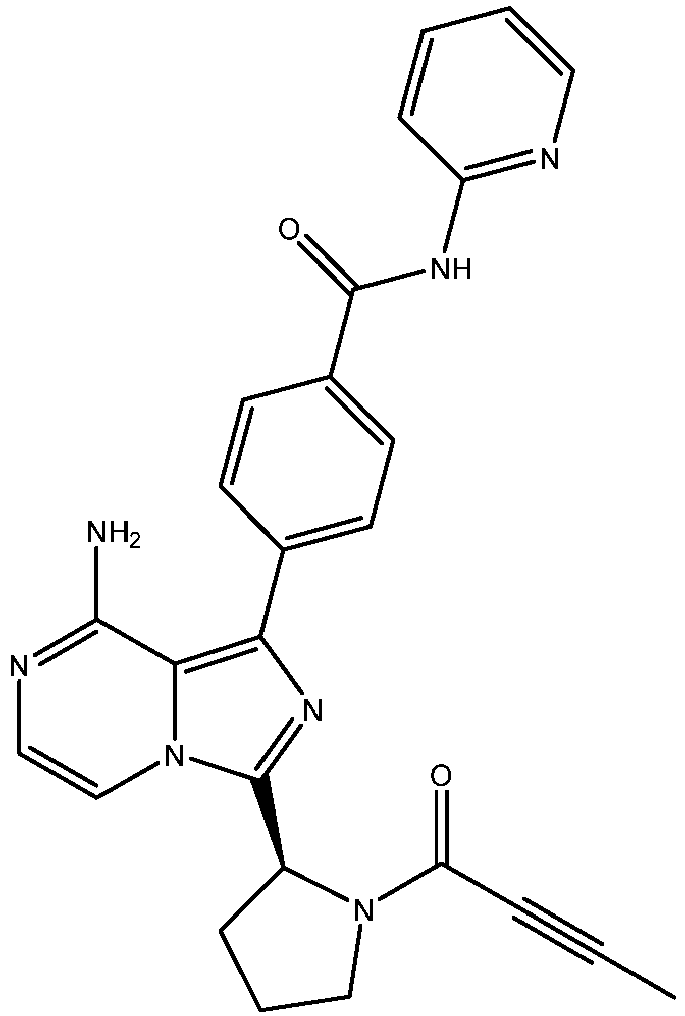
- the invention relates to (S)-4-(8-amino-3-(1-but-2-ynoylpyrrolidin-2-yl)imidazo[1,5-a]pyrazin-1-yl)-N-(pyridin-2-yl)benzamide.
- the compound of the invention inhibits the Btk kinase activity.
- the compound of the invention has an EC50 of less than 10 nM.
- the term EC50 means the concentration of the test compound that is required for 50% inhibition of its maximum effect in vitro.
- Inhibition of kinase activity can be measured using the Immobilized Metal Assay for Phosphochemicals (IMAP) assay.
- IMAP is a homogeneous fluorescence polarization (FP) assay based on affinity capture of phosphorylated peptide substrates.
- IMAP uses fluorescein-labeled peptide substrates that, upon phosphorylation by a protein kinase, bind to so-called IMAP nanoparticles, which are derivatized with trivalent metal complexes.
- Binding causes a change in the rate of the molecular motion of the peptide, and results in an increase in the FP value observed for the fluorescein label attached to the substrate peptide ( Gaudet et al. A homogeneous fluorescence polarization assay adaptable for a range of protein serine/threonine and tyrosine kinases. J. Biomol. Screen (2003) 8, 164-175 ).
- the compound of the invention can form salts which are also within the scope of this invention.
- Reference to the compound of the invention herein is understood to include reference to salts thereof, unless otherwise indicated.
- the term "salt(s)", as employed herein, denotes acidic salts formed with inorganic and/or organic acids, as well as basic salts formed with inorganic and/or organic bases.
- Such acidic and basic salts used within the scope of the invention are pharmaceutically acceptable (i.e., nontoxic, physiologically acceptable) salts.
- Salts of the compound of the invention may be formed, for example, by reacting the compound of the invention with an amount of acid or base, such as an equivalent amount, in a medium such as one in which the salt precipitates or in an aqueous medium followed by lyophilization.
- Exemplary acid addition salts include acetates, ascorbates, benzoates, benzenesulfonates, bisulfates, borates, butyrates, citrates, camphorates, camphorsulfonates, fumarates, hydrochlorides, hydrobromides, hydroiodides, lactates, maleates, methanesulfonates, naphthalenesulfonates, nitrates, oxalates, phosphates, propionates, salicylates, succinates, sulfates, tartarates, thiocyanates, toluenesulfonates (also known as tosylates,) and the like.
- Exemplary basic salts include ammonium salts, alkali metal salts such as sodium, lithium, and potassium salts, alkaline earth metal salts such as calcium and magnesium salts, salts with organic bases (for example, organic amines) such as dicyclohexylamines, t-butyl amines, and salts with amino acids such as arginine, lysine and the like.
- alkali metal salts such as sodium, lithium, and potassium salts
- alkaline earth metal salts such as calcium and magnesium salts
- salts with organic bases for example, organic amines
- organic amines such as dicyclohexylamines, t-butyl amines
- salts with amino acids such as arginine, lysine and the like.
- Basic nitrogen-containing groups may be quarternized with agents such as lower alkyl halides (e.g., methyl, ethyl, and butyl chlorides, bromides and iodides), dialkyl sulfates (e.g., dimethyl, diethyl, and dibutyl sulfates), long chain halides (e.g., decyl, lauryl, and stearyl chlorides, bromides and iodides), aralkyl halides (e.g., benzyl and phenethyl bromides), and others.
- the compounds of Formula I may contain asymmetric or chiral centers, and, therefore, exist in different stereoisomeric forms.
- Diastereomeric mixtures can be separated into their individual diastereomers on the basis of their physical chemical differences by methods well known to those skilled in the art, such as, for example, by chromatography and/or fractional crystallization.
- Enantiomers can be separated by converting the enantiomeric mixture into a diastereomeric mixture by reaction with an appropriate optically active compound (e.g. chiral auxiliary such as a chiral alcohol or Mosher's acid chloride), separating the diastereomers and converting (e.g. hydrolyzing) the individual diastereomers to the corresponding pure enantiomers.
- an appropriate optically active compound e.g. chiral auxiliary such as a chiral alcohol or Mosher's acid chloride
- Individual stereoisomers of the compound of the invention may, for example, be substantially free of other isomers, or may be admixed, for example, as racemates or with all other, or other selected, stereoisomers.
- the compound of the invention may form hydrates or solvates. It is known to those of skill in the art that charged compounds form hydrated species when lyophilized with water, or form solvated species when concentrated in a solution with an appropriate organic solvent.
- the compound of this invention includes the hydrates or solvates of the compound.
- the compound of the invention may exist in unsolvated as well as solvated forms with pharmaceutically acceptable solvents such as water, ethanol, and the like, and it is intended that the invention embrace both solvated and unsolvated forms.
- “Solvate” means a physical association of a compound of this invention with one or more solvent molecules. This physical association involves varying degrees of ionic and covalent bonding, including hydrogen bonding.
- solvate will be capable of isolation, for example when one or more solvent molecules are incorporated in the crystal lattice of the crystalline solid.
- Solvate encompasses both solution-phase and isolatable solvates.
- suitable solvates include ethanolates, methanolates, and the like.
- “Hydrate” is a solvate wherein the solvent molecule is H 2 O.
- the present invention also relates to a pharmaceutical composition
- a pharmaceutical composition comprising the compound of the invention or pharmaceutically acceptable salts thereof in admixture with pharmaceutically acceptable auxiliaries and optionally other therapeutic agents.
- the auxiliaries must be "acceptable” in the sense of being compatible with the other ingredients of the composition and not deleterious to the recipients thereof.
- the invention further includes a compound of the invention in combination with one or more other drug(s).
- Compositions include e.g. those suitable for oral, sublingual, subcutaneous, intravenous, intramuscular, nasal, local, or rectal administration, and the like, all in unit dosage forms for administration.
- the active ingredient may be presented as discrete units, such as tablets, capsules, powders, granulates, solutions, suspensions, and the like.
- the pharmaceutical composition of the invention may be presented in unit-dose or multi-dose containers, e.g. injection liquids in predetermined amounts, for example in sealed vials and ampoules, and may also be stored in a freeze dried (lyophilized) condition requiring only the addition of sterile liquid carrier, e.g. water, prior to use.
- sterile liquid carrier e.g. water
- the active agent may be compressed into solid dosage units, such as pills, tablets, or be processed into capsules or suppositories.
- the active agent can be applied as a fluid composition, e.g. as an injection preparation, in the form of a solution, suspension, emulsion, or as a spray, e.g. a nasal spray.
- a fluid composition e.g. as an injection preparation
- a spray e.g. a nasal spray
- a spray e.g. a nasal spray.
- Suitable carriers with which the active agent of the invention can be administered as solid compositions include lactose, starch, cellulose derivatives and the like, or mixtures thereof, used in suitable amounts.
- aqueous suspensions, isotonic saline solutions and sterile injectable solutions may be used, containing pharmaceutically acceptable dispersing agents and/or wetting agents, such as propylene glycol or butylene glycol.
- the invention further includes a pharmaceutical composition, as hereinbefore described, in combination with packaging material suitable for said composition, said packaging material including instructions for the use of the composition for the use as hereinbefore described.
- a pharmaceutical composition as hereinbefore described, in combination with packaging material suitable for said composition, said packaging material including instructions for the use of the composition for the use as hereinbefore described.
- the exact dose and regimen of administration of the active ingredient, or a pharmaceutical composition thereof, may vary with the particular compound, the route of administration, and the age and condition of the individual subject to whom the medicament is to be administered.
- a dosage for humans preferably contains 0.0001-25 mg per kg body weight.
- the desired dose may be presented as one dose or as multiple subdoses administered at appropriate intervals throughout the day, or, in case of female recipients, as doses to be administered at appropriate daily intervals throughout the menstrual cycle.
- the dosage as well as the regimen of administration may differ between a female and a male recipient.
- the atoms may exhibit their natural isotopic abundances, or one or more of the atoms may be artificially enriched in a particular isotope having the same atomic number, but an atomic mass or mass number different from the atomic mass or mass number predominantly found in nature.
- the present invention is meant to include all suitable isotopic variations of the compound of the invention.
- different isotopic forms of hydrogen (H) include protium ( 1 H) and deuterium ( 2 H).
- Protium is the predominant hydrogen isotope found in nature. Enriching for deuterium may afford certain therapeutic advantages, such as increasing in vivo half-life or reducing dosage requirements, or may provide a compound useful as a standard for characterization of biological samples.
- An isotopically-enriched compound of the invention can be prepared without undue experimentation by conventional techniques well known to those skilled in the art or by processes analogous to those described in the Schemes and Examples herein using appropriate isotopically-enriched reagents and/or intermediates.
- the compound according to the invention can be used in therapy.
- 6-5 membered fused pyridine ring compounds or a pharmaceutically acceptable salt thereof having the general formula I for the manufacture of a medicament to be used for the treatment of Btk-mediated diseases or Btk-mediated conditions.
- 6-5 membered fused pyridine ring compounds or a pharmaceutically acceptable salt thereof having the general formula I for the manufacture of a medicament to be used for the treatment of chronic B cell disorders in which T cells play a prominent role.
- 6-5 membered fused pyridine ring compounds like 8-amino-imidazo[1,5-a]pyrazine and 4-amino-imidazo[1,5-f][1,2,4]triazine compounds having the general formula I for the manufacture of a medicament to be used for the treatment of Btk-mediated diseases or conditions.
- These include, but are not limited to, the treatment of B cell lymphomas resulting from chronic active B cell receptor signaling.
- the compound according to the invention can be used in therapies to treat or prevent diseases Bruton's Tyrosine Kinase (Btk) mediated disorders.
- Btk mediated disorders or Btk mediated condition as used herein mean any disease state or other deleterious condition in which B cells, mast cells, myeloid cells or osteoclasts play a central role.
- diseases include but are not limited to, immune, autoimmune and inflammatory diseases, allergies, infectious diseases, bone resorption disorders and proliferative diseases.
- Immune, autoimmune and inflammatory diseases that can be treated or prevented with the compound of the present invention include rheumatic diseases (e.g.
- rheumatoid arthritis psoriatic arthritis, infectious arthritis, progressive chronic arthritis, deforming arthritis, osteoarthritis, traumatic arthritis, gouty arthritis, Reiter's syndrome, polychondritis, acute synovitis and spondylitis), glomerulonephritis (with or without nephrotic syndrome), autoimmune hematologic disorders (e.g. hemolytic anemia, aplasic anemia, idiopathic thrombocytopenia, and neutropenia), autoimmune gastritis, and autoimmune inflammatory bowel diseases (e.g.
- ulcerative colitis and Crohn's disease host versus graft disease, allograft rejection, chronic thyroiditis, Graves' disease, schleroderma, diabetes (type I and type II), active hepatitis (acute and chronic), pancreatitis, primary billiary cirrhosis, myasthenia gravis, multiple sclerosis, systemic lupus erythematosis, psoriasis, atopic dermatitis, contact dermatitis, eczema, skin sunburns, vasculitis (e.g.
- Behcet's disease chronic renal insufficiency, Stevens-Johnson syndrome, inflammatory pain, idiopathic sprue, cachexia, sarcoidosis, Guillain-Barre syndrome, uveitis, conjunctivitis, kerato conjunctivitis, otitis media, periodontal disease, pulmonary interstitial fibrosis, asthma, bronchitis, rhinitis, sinusitis, pneumoconiosis, pulmonary insufficiency syndrome, pulmonary emphysema, pulmonary fibrosis, silicosis, chronic inflammatory pulmonary disease (e.g.
- Allergies that can be treated or prevented include, among others, allergies to foods, food additives, insect poisons, dust mites, pollen, animal materials and contact allergans, type I hypersensitivity allergic asthma, allergic rhinitis, allergic conjunctivitis.
- Infectious diseases that can be treated or prevented include, among others, sepsis, septic shock, endotoxic shock, sepsis by Gram-negative bacteria, shigellosis, meningitis, cerebral malaria, pneumonia, tuberculosis, viral myocarditis, viral hepatitis (hepatitis A, hepatitis B and hepatitis C), HIV infection, retinitis caused by cytomegalovirus, influenza, herpes, treatment of infections associated with severe burns, myalgias caused by infections, cachexia secondary to infections, and veterinary viral infections such as lentivirus, caprine arthritic virus, visna-maedi virus, feline immunodeficiency virus, bovine immunodeficiency virus or canine immunodeficiency virus.
- Bone resorption disorders that can be treated or prevented include, among others, osteoporosis, osteoarthritis, traumatic arthritis, gouty arthritis and bone disorders related with multiple myeloma.
- Proliferative diseases that can be treated or prevented include, among others, non-Hodgkin lymphoma (in particular the subtypes diffuse large B-cell lymphoma (DLBCL) and mantle cell lymphoma (MCL)), B cell chronic lymphocytic leukemia and acute lymphoblastic leukemia (ALL) with mature B cell, ALL in particular.
- the compound of the invention can be used for the treatment of B cell lymphomas resulting from chronic active B cell receptor signaling.
- IMAP Immobilized Metal Assay for Phosphochemicals
- FP fluorescence polarization
- IMAP uses fluorescein-labeled peptide substrates that, upon phosphorylation by a protein kinase, bind to so-called IMAP nanoparticles, which are derivatized with trivalent metal complexes. Binding causes a change in the rate of the molecular motion of the peptide, and results in an increase in the FP value observed for the fluorescein label attached to the substrate peptide.
- the Btk activity can also be determined in B cell lines such as Ramos cells or in primary cell assays, e.g PBMC or whole blood from human, monkey, rat or mouse or isolated splenocytes from monkey, rat or mouse. Inhibition of Btk activity can be investigated measuring anti-IgM-induced MIP1 ⁇ production (Ramos, PBMC, splenocytes), H 2 O 2 -induced Btk and PLC ⁇ 2 phosphorylation (Ramos cells), or anti-IgM-induced B cell proliferation or CD86 expression on primary B cells (PBMC and splenocytes).
- B cell lines such as Ramos cells or in primary cell assays, e.g PBMC or whole blood from human, monkey, rat or mouse or isolated splenocytes from monkey, rat or mouse.
- Inhibition of Btk activity can be investigated measuring anti-IgM-induced MIP1 ⁇ production (Ramos, PBMC, splenocytes), H
- Regulation of Btk activity can also be determined on human, monkey, rat or mouse mast cells following activation Fc ⁇ R induced degranulation, cytokine production and CD63 induced cell surface expression. Furthermore, regulation of Btk activity can be determined on CD14+ monocytes differentiated following treatment with M-CSF to osteoclasts and activated with RANKL.
- mice can be euthanized 3h following compound administration.
- Spleens can be extracted from the treated mice for splenocyte isolation.
- Splenocytes can be plated in 96 well culture plates and stimulated with anti-IgM, without further addition of compounds.
- Anti-IgM-induced B cell stimulation and inhibition thereof by Btk inhibitors can be measured by B cell proliferation, MIP1 ⁇ production or CD86 expression on CD19+ splenocyte B cells.
- Efficacy of Btk inhibitors can also be investigated in the mouse collagen induced arthritis model using a therapeutic protocol with start of treatment following onset of disease, measuring disease score, X-ray analysis of bone destruction, cartilage breakdown and histology of joints
- Efficacy of Btk inhibitors on the regulation of activated mast cells can be investigated in vivo using the passive cutaneous anaphylaxis model.
- the effect of Btk inhibitors on bone resorption in vivo can be investigated using the rat OVX model. In this model ovariectomized animals develop symptoms of osteoporosis that may be regulated using a Btk inhibitor.
- the 8-amino-imidazo[1,5-a]pyrazine derivative of the present invention and 4-amino-imidazo[1,5-f][1,2,4]triazine derivatives can be prepared by methods well known in the art of organic chemistry. See, for example, J. March, 'Advanced Organic Chemistry 4th Edition, John Wiley and Sons . During synthetic sequences it may be necessary and/or desirable to protect sensitive or reactive groups on any of the molecules concerned. This is achieved by means of conventional protecting groups, such as those described in T.W. Greene and P.G.M. Wutts 'Protective Groups in Organic Synthesis' 3rd Edition, John Wiley and Sons, 1999 . The protective groups are optionally removed at a convenient subsequent stage using methods well known in the art.
- the products of the reactions are optionally isolated and purified, if desired, using conventional techniques, but not limited to, filtration, distillation, crystallization, chromatography and the like. Such materials are optionally characterized using conventional means, including physical constants and spectral data.
- Reduction of 3-chloropyrazine-2-carbonitrile ( II ) can be accomplished by hydrogenation in the presence of a suitable catalysts system and solvent, for example Raney-Nickel to provide (3-chloropyrazin-2-yl)methanamine ( III ). This can then be reacted with an appropriately amine protected amino acid.
- a suitable catalysts system and solvent for example Raney-Nickel
- the reaction of Cbz-N(R 2 )CR 3 R 4 )COOH can be carried out in a solvent such as DMF, THF or DCM in the presence of a base such as DIPEA, N-methylmorpholine, 4-DMAP or triethylamine and in the presence of a coupling reagent such as PyBOP, TBTU, EDCI or HATU to form N-((3-chloropyrazin-2-yl)methyl)amide IV.
- Cyclisation chloropyrazine IV can be performed using condensation reagents like phosphorousoxychloride under heating conditions to provide the 8-chloroimidazo[1,5-a]pyrazine derivatives V.
- bromination can be accomplished using bromine or N-bromosuccinimide in a suitable solvent like DCM or DMF at appropriate temperature to obtain compounds of formula VI.
- 8-Aminoimidazo[1,5-a]pyrazine derivatives ( VII ) can be prepared from compounds VI using ammonia(gas) in isopropanol at elevated temperature in a pressure vessel (>4 atm).
- Compounds of formula IX can be prepared from compounds of formula VII using an appropriate boronic acid or pinacol ester ( VIII ), in the presence of a suitable palladium catalyst system and solvent, for example bis(diphenylphosphino)ferrocene palladium(II)chloride complex or tetrakis (triphenylphosphine)palladium(0) in the presence of potassium carbonate in dioxane/water provide compounds of formula IX.
- cleaving the protective group of compounds with the formula IX give the unprotected amine which after functionalisation, using methods well known in the art, with appropriate warheads with previously defined meanings, provided compounds of formula I.
- An example of such protective strategy is the use of the benzyloxycarbonyl protecting group to protect the amine from the amino acids used, and after deprotection with 33% HBr/HOAc or conc. HCI gave the resulting amines.
- amino acids HN(R 2 )CR 3 R 4 )COOH are either commercially available or they can be readily prepared using methods well known to the skilled organic chemist, to introduce protecting groups like benzyloxycarbonyl or tert -butyloxycarbonyl.
- Palladium catalysts and conditions to form either the pinacol esters or to couple the boronic acids or pinacol esters with the 1-bromoimidazo[1,5-a]pyrazin-8-amine are well known to the skilled organic chemist - see, for example, Ei-ichi Negishi (Editor), Armin de Meijere (Associate Editor), Handbook of Organopalladium Chemistry for Organic Synthesis, John Wiley and Sons, 2002 .
- Starting material 3-amino-6-(aminomethyl)-1,2,4-triazin-5(4H)-one X can be prepared via a condensation reaction of ethyl bromopyruvate, dibenzylamine, and aminoguanidine carbonate, followed by debenzylation via hydrogenation over Pd-C catalyst [ Mitchel, W.L.et al, J. Heterocycl. Chem. 21 (1984) pp697 ].This can then be reacted with an appropriately amine protected amino acid.
- the reaction of Cbz-N(R 2 )CR 3 R 4 )COOH can be carried out in a solvent such as DMF, THF or DCM in the presence of a base such as DIPEA, N-methylmorpholine, 4-DMAP or triethylamine and in the presence of a coupling reagent such as PyBOP, TBTU, EDCI or HATU to form N-((3-amino-5-oxo-4,5-dihydro-1,2,4-triazin-6-yl)methyl)amide XI.
- a solvent such as DMF, THF or DCM
- a base such as DIPEA, N-methylmorpholine, 4-DMAP or triethylamine
- a coupling reagent such as PyBOP, TBTU, EDCI or HATU
- Cyclisation of the amino-triazinone XI can be performed using condensation reagents like phosphorousoxychloride under heating conditions to provide the 2-aminoimidazo[1,5-f][1,2,4]triazin-4(3H)-one derivatives XII. Subsequent iodination can be accomplished using iodine or N-iodosuccinimide in a suitable solvent like DCM or DMF at appropriate temperature to obtain compounds of formula XIII.
- Removal of the 2-amino group in the 2-aminoimidazo[1,5-f][1,2,4]triazin-4(3H)-one derivatives XIII can be perfomed using t-butyl nitrite in solvents like DMF/THF at room temperature to form imidazo[1,5-f][1,2,4]triazin-4(3H)-one derivatives XIV.
- 4-Amino-imidazo[1,5-f][1,2,4]triazine derivatives ( XV ) can be prepared from compounds XIV using phosphorousoxychloride, 1,2,4-triazole in pyridine and subsequent ammonolysis with ammonia(gas) in isopropanol at room temperature.
- Compounds of formula XVI can be prepared from compounds of formula XV using an appropriate boronic acid or pinacol ester ( VIII ), in the presence of a suitable palladium catalyst system and solvent, for example bis(diphenylphosphino)ferrocene palladium(II)chloride complex or tetrakis (triphenylphosphine)palladium(0) in the presence of potassium carbonate in dioxane/water provide compounds of formula XVI .
- cleaving the protective group of compounds with the formula XVI give the unprotected amine which after functionalisation, using methods well known in the art, with appropriate warheads with previously defined meanings, provided compounds of formula I.
- An example of such protective strategy is the use of the benzyloxycarbonyl protecting group to protect the amine from the amino acids used, and after deprotection with 33% HBr/HOAc or conc. HCI gave the resulting amines.
- amino acids HN(R 2 )CR 3 R 4 )COOH are either commercially available or they can be readily prepared using methods well known to the skilled organic chemist, to introduce protecting groups like benzyloxycarbonyl or tert -butyloxycarbonyl.
- Palladium catalysts and conditions to form either the pinacol esters or to couple the boronic acids or pinacol esters with the 5-iodoimidazo[1,5-f][1,2,4]triazin-4-amine are well known to the skilled organic chemist - see, for example, Ei-ichi Negishi (Editor), Armin de Meijere (Associate Editor), Handbook of Organopalladium Chemistry for Organic Synthesis, John Wiley and Sons, 2002 .
- the present invention includes the aforementioned stereoisomer substantially free, i.e., associated with less than 5%, preferably less than 2% and in particular less than 1% of the other stereoisomer.
- Mixtures of stereoisomers in any proportion, for example a racemic mixture comprising substantially equal amounts of two enantiomers are also included within the scope of the present invention.
- Method for asymmetric synthesis whereby the pure stereoisomers are obtained are well known in the art, e.g.
- the pharmaceutically acceptable salts may also be obtained by treating the free base of the compound of the invention with an organic or inorganic acid such as hydrogen chloride, hydrogen bromide, hydrogen iodide, sulfuric acid, phosphoric acid, acetic acid, propionic acid, glycolic acid, maleic acid, malonic acid, methanesulphonic acid, fumaric acid, succinic acid, tartaric acid, citric acid, benzoic acid, and ascorbic acid.
- an organic or inorganic acid such as hydrogen chloride, hydrogen bromide, hydrogen iodide, sulfuric acid, phosphoric acid, acetic acid, propionic acid, glycolic acid, maleic acid, malonic acid, methanesulphonic acid, fumaric acid, succinic acid, tartaric acid, citric acid, benzoic acid, and ascorbic acid.
- the 8-amino-imidazo[1,5-a]pyrazine derivative of the present invention and 4-amino-imidazo[1,5-f][1,2,4]triazine derivatives also exist as amorphous forms. Multiple crystalline forms are also possible. All the physical forms are included within the scope of the present invention.
- solvates Preparation of solvates is generally known.
- M. Caira et al, J. Pharmaceutical Sci., 93(3), 601-611 (2004 ) describe the preparation of the solvates of the antifungal fluconazole in ethyl acetate as well as from water.
- Similar preparations of solvates, hemisolvate, hydrates and the like are described by E. C. van Tonder et al, AAPS PharmSciTech., 5(1), article 12 (2004 ); and A. L. Bingham et al, Chem. Commun. 603-604 (2001 ).
- a typical, non-limiting, process involves dissolving the inventive compound in desired amounts of the desired solvent (organic or water or mixtures thereof) at a higher than ambient temperature, and cooling the solution at a rate sufficient to form crystals which are then isolated by standard methods.
- Analytical techniques such as, for example IR spectroscopy, show the presence of the solvent (or water) in the crystals as a solvate (or hydrate).
- the present invention also embraces isotopically-labelled compounds of the present invention which are identical to those recited herein, but for the fact that one or more atoms are replaced by an atom having an atomic mass or mass number different from the atomic mass or mass number usually found in nature.
- isotopes that can be incorporated into compounds of the invention include isotopes of hydrogen, carbon, nitrogen, oxygen, phosphorus, fluorine and chlorine, such as 2 H, 3 H, 13 C, 14 C, 15 N, 17 O, 18 O, 31 P, 32 P, 35 S, 18 F, and 36 Cl, respectively.
- Certain isotopically-labelled compounds of the invention are useful in compound and/or substrate tissue distribution assays. Tritiated (i.e., 3 H) and carbon-14 (i.e., 14 C) isotopes are particularly preferred for their ease of preparation and detectability. Further, substitution with heavier isotopes such as deuterium (i.e., 2 H) may afford certain therapeutic advantages resulting from greater metabolic stability (e.g., increased in vivo half-life or reduced dosage requirements) and hence may be preferred in some circumstances.
- Isotopically labelled compounds of the invention can generally be prepared by following procedures analogous to those disclosed in the Schemes and/or in the Examples herinbelow, by substituting an appropriate isotopically labeled reagent for a non-isotoplically labeled reagent.
- Mass Spectrometry Electron Spray spectra were recorded on the Applied Biosystems API-165 single quad mass spectrometer in alternating positive and negative ion mode using Flow Injection. The mass range was 120-2000 Da and scanned with a step rate of 0.2 Da. and the capillary voltage was set to 5000 V. N2-gas was used for nebulisation.
- Preparative HPLC was conducted on a column (50 x 10 mm ID, 5 ⁇ m, Xterra Prep MS C18) at a flow rate of 5 ml/min, injection volume 500 ⁇ l, at room temperature and UV Detection at 210 nm.
- Btk enzyme activity is measured using the IMAP (immobilized metal ion affinity-based fluorescence polarization) assay as outlined below.
- Btk enzyme (His-Btk (Millipore catalog# 14-552), is diluted to 0.4 U/mL in KR buffer (10 mM Tris-HCI, 10 mM MgCl 2 , 0.01% Tween-20, 0.05% NaN 3 , 1 mM DTT, 2 mM MnCl 2 , pH 7.2).
- Serial dilution log10 from 2 mM to 63.2 nM of test compounds are made in 100% DMSO. The dilutions in DMSO are then diluted 50-fold in KR-buffer. Final compound concentration range in the assay from 10 ⁇ M to 0.316 nM.
- test compound 5 ⁇ L/well of test compound in KR buffer (final DMSO concentration in the assay is 1%) is mixed with 5 ⁇ l/well of 0.4 U/mL Btk enzyme (final concentration in the assay is 0.1 U/mL).
- Test compounds and Btk enzyme are pre-incubated 60 minutes at room temperature, before adding 5 ⁇ L/well of 200 nM Fluorescin labeled substrate peptide (Blk/Lyntide substrate, e.g. #R7188/#R7233, Molecular Devices) in KR-buffer.
- Final peptide substrate concentration in assay is 50 nM.
- the kinase assay is started by adding 5 ⁇ L/well of 20 ⁇ M ATP in KR-buffer (final ATP concentration is 5 ⁇ M ATP, Km ATP in Btk IMAP assay). Following incubation for 2h at room temperature the enzyme reaction is stopped by adding 40 ⁇ L/well IMAP Progressive Binding Solution (according to suppliers (Molecular Devices) protocol using 75% 1x buffer A and 25% 1x buffer B with 1:600 Progressive Binding Solution). After 60 min incubation at room temperature in the dark the FP signal is read. Fluorescence at 535 nm is measured using parallel and perpendicular filters to determine differences in rotation due to binding of the phosphorylated substrate peptide to the beads. Values are calculated as percentage of the difference in readout ( ⁇ mPi) of the controls with and without ATP. EC 50 values are determined by curve fitting of the experimental results using Activity Base.
- example 1 is a reference example.
- Lck enzyme activity is measured using the IMAP (immobilized metal ion affinity-based fluorescence polarization) assay as outlined below.
- Lck enzyme (Millipore catalog# 14-442), is diluted to 0.4 U/mL in KR buffer (10 mM Tris-HCI, 10 mM MgCI2, 0.01% Tween-20, 0.05% NaN 3 , 1 mM DTT, 2 mM MnCl 2 , pH 7.2).
- Serial dilution log10 from 2 mM to 63.2 nM of test compounds are made in 100% DMSO.
- the dilutions in DMSO are then diluted 50-fold in KR-buffer of which 5 ⁇ l is used in the assay, leading to a final compound concentration range in the assay from 10 ⁇ M to 0.316 nM.
- test compound 5 ⁇ L/well of test compound in KR buffer (final DMSO concentration in the assay is 1%) is mixed with 5 ⁇ l/well of 0.4 U/mL Lck enzyme (final concentration in the assay is 0.1 U/mL).
- Test compounds and Lck enzyme are pre-incubated 60 minutes at room temperature, before adding 5 ⁇ L/well of 400 nM Fluorescin labeled substrate peptide (p34cdc2 substrate peptide, e.g. #R7157/#R7172, Molecular Devices) in KR-buffer.
- Final peptide substrate concentration in assay is 100 nM.
- the kinase assay is started by adding 5 ⁇ L/well of 24 ⁇ M ATP in KR-buffer (final ATP concentration is 6 ⁇ M ATP, Km ATP in Lck IMAP assay). Following incubation for 2h at room temperature the enzyme reaction is stopped by adding 40 ⁇ L/well IMAP Progressive Binding Solution (according to suppliers (Molecular Devices) protocol using 75% 1x buffer A and 25% 1x buffer B with 1:600 Progressive Binding Solution). After 60 min incubation at room temperature in the dark the FP signal is read. Fluorescence at 535 nm is measured using parallel and perpendicular filters to determine differences in rotation due to binding of the phosphorylated substrate peptide to the beads.
- example 1 is a reference example.
- Src enzyme activity is measured using the IMAP (immobilized metal ion affinity-based fluorescence polarization) assay as outlined below.
- Src enzyme (Millipore catalog# 14-326), is diluted to 0.8 U/mL in KR buffer (10 mM Tris-HCI, 10 mM MgCl 2 , 0.01% Tween-20, 0.05% NaN 3 , 1 mM DTT, 2 mM MnCl 2 , pH 7.2).
- Serial dilution log10 from 2 mM to 63.2 nM of test compounds are made in 100% DMSO.
- the dilutions in DMSO are then diluted 50-fold in KR-buffer of which 5 ⁇ l is used in the assay, leading to a final compound concentration range in the assay from 10 ⁇ M to 0.316 nM.
- test compound in KR buffer 5 ⁇ L/well of test compound in KR buffer (final DMSO concentration in the assay is 1%) is mixed with 5 ⁇ l/well of 0.8 U/mL Src enzyme (final concentration in the assay is 0.2 U/mL).
- Test compounds and Src enzyme are pre-incubated 60 minutes at room temperature, before adding 5 ⁇ L/well of 400 nM Fluorescin labeled substrate peptide (p34cdc2 substrate peptide, e.g. #R7157/#R7172, Molecular Devices) in KR-buffer.
- Final peptide substrate concentration in assay is 100 nM.
- the kinase assay is started by adding 5 ⁇ L/well of 16 ⁇ M ATP in KR-buffer (final ATP concentration is 4 ⁇ M ATP, Km ATP in Src IMAP assay). Following incubation for 2h at room temperature the enzyme reaction is stopped by adding 40 ⁇ L/well IMAP Progressive Binding Solution (according to suppliers (Molecular Devices) protocol using 75% 1x buffer A and 25% 1x buffer B with 1:600 Progressive Binding Solution). After 60 min incubation at room temperature in the dark the FP signal is read. Fluorescence at 535 nm is measured using parallel and perpendicular filters to determine differences in rotation due to binding of the phosphorylated substrate peptide to the beads.
- example 1 is a reference example.
- FynT enzyme activity is measured using the IMAP (immobilized metal ion affinity-based fluorescence polarization) assay as outlined below.
- FynT enzyme (Biomol catalog# SE-287), is diluted to 0.5 ⁇ g/mL in KR buffer (10 mM Tris-HCI, 10 mM MgCl 2 , 0.01% Tween-20, 0.05% NaN 3 , 1 mM DTT, 2 mM MnCl 2 , pH 7.2).
- Serial dilution log10 from 2 mM to 63.2 nM of test compounds are made in 100% DMSO.
- the dilutions in DMSO are then diluted 50-fold in KR-buffer of which 5 ⁇ l is used in the assay, leading to a final compound concentration range in the assay from 10 ⁇ M to 0.316 nM.
- test compound in KR buffer 5 ⁇ L/well of test compound in KR buffer (final DMSO concentration in the assay is 1%) is mixed with 5 ⁇ l/well of 0.5 ⁇ g/mL FynT enzyme (final concentration in the assay is 125 ng/mL).
- Test compounds and FynT enzyme are pre-incubated 60 minutes at room temperature, before adding 5 ⁇ L/well of 400 nM Fluorescin labeled substrate peptide (p34cdc2 substrate peptide, e.g. #R7157/#R7172, Molecular Devices) in KR-buffer.
- Final peptide substrate concentration in assay is 100 nM.
- the kinase assay is started by adding 5 ⁇ L/well of 0.8 ⁇ M ATP in KR-buffer (final ATP concentration is 0.2 ⁇ M ATP, Km ATP in FynT IMAP assay). Following incubation for 2h at room temperature the enzyme reaction is stopped by adding 40 ⁇ L/well IMAP Progressive Binding Solution (according to suppliers (Molecular Devices) protocol using 75% 1x buffer A and 25% 1x buffer B with 1:600 Progressive Binding Solution). After 60 min incubation at room temperature in the dark the FP signal is read. Fluorescence at 535 nm is measured using parallel and perpendicular filters to determine differences in rotation due to binding of the phosphorylated substrate peptide to the beads.
- example 1 is a reference example.
- Lyn enzyme activity is measured using the IMAP (immobilized metal ion affinity-based fluorescence polarization) assay as outlined below.
- Lyn enzyme (Millipore catalog# 14-510), is diluted to 250 mU/mL in KR buffer (10 mM Tris-HCI, 10 mM MgCl 2 , 0.01% Tween-20, 0.05% NaN 3 , 1 mM DTT, 2 mM MnCl 2 , pH 7.2).
- Serial dilution log10 from 2 mM to 63.2 nM of test compounds are made in 100% DMSO.
- the dilutions in DMSO are then diluted 50-fold in KR-buffer of which 5 ⁇ l is used in the assay, leading to a final compound concentration range in the assay from 10 ⁇ M to 0.316 nM.
- test compound 5 ⁇ L/well of test compound in KR buffer (final DMSO concentration in the assay is 1%) is mixed with 5 ⁇ l/well of 250 mU/mL Lyn enzyme (final concentration in the assay is 62.5 mU/mL).
- Test compounds and Lyn enzyme are pre-incubated 60 minutes at room temperature, before adding 5 ⁇ L/well of 400 nM Fluorescin labeled substrate peptide (Blk/Lyntide substrate, e.g. #R7188/#R7233, Molecular Devices) in KR-buffer.
- Final peptide substrate concentration in assay is 100 nM.
- the kinase assay is started by adding 5 ⁇ L/well of 8 ⁇ M ATP in KR-buffer (final ATP concentration is 2 ⁇ M ATP, Km ATP in Lyn IMAP assay). Following incubation for 2h at room temperature the enzyme reaction is stopped by adding 40 ⁇ L/well IMAP Progressive Binding Solution (according to suppliers (Molecular Devices) protocol using 75% 1x buffer A and 25% 1x buffer B with 1:600 Progressive Binding Solution). After 60 min incubation at room temperature in the dark the FP signal is read. Fluorescence at 535 nm is measured using parallel and perpendicular filters to determine differences in rotation due to binding of the phosphorylated substrate peptide to the beads.
- example 1 is a reference example.
Landscapes
- Health & Medical Sciences (AREA)
- Chemical & Material Sciences (AREA)
- Organic Chemistry (AREA)
- Life Sciences & Earth Sciences (AREA)
- Pharmacology & Pharmacy (AREA)
- Veterinary Medicine (AREA)
- Public Health (AREA)
- General Health & Medical Sciences (AREA)
- Animal Behavior & Ethology (AREA)
- Medicinal Chemistry (AREA)
- General Chemical & Material Sciences (AREA)
- Nuclear Medicine, Radiotherapy & Molecular Imaging (AREA)
- Chemical Kinetics & Catalysis (AREA)
- Bioinformatics & Cheminformatics (AREA)
- Engineering & Computer Science (AREA)
- Epidemiology (AREA)
- Immunology (AREA)
- Physical Education & Sports Medicine (AREA)
- Diabetes (AREA)
- Oncology (AREA)
- Hematology (AREA)
- Rheumatology (AREA)
- Communicable Diseases (AREA)
- Orthopedic Medicine & Surgery (AREA)
- Ophthalmology & Optometry (AREA)
- Pulmonology (AREA)
- Neurology (AREA)
- Urology & Nephrology (AREA)
- Dermatology (AREA)
- Endocrinology (AREA)
- Pain & Pain Management (AREA)
- Gastroenterology & Hepatology (AREA)
- Obesity (AREA)
- Emergency Medicine (AREA)
- Transplantation (AREA)
- Biomedical Technology (AREA)
- Neurosurgery (AREA)
- Virology (AREA)
- Pharmaceuticals Containing Other Organic And Inorganic Compounds (AREA)
- Nitrogen Condensed Heterocyclic Rings (AREA)
Description
- The present invention relates to a 6-5 membered fused pyridine ring compound, to pharmaceutical compositions comprising this compound and to its use in therapy. In particular, the present invention relates to the use of a 6-5 membered fused pyridine ring compound in the treatment of Bruton's Tyrosine Kinase (Btk) mediated disorders.
- B lymphocyte activation is key in the generation of adaptive immune responses. Derailed B lymphocyte activation is a hallmark of many autoimmune diseases and modulation of this immune response is therefore of therapeutic interest. Recently the success of B cell therapies in autoimmune diseases has been established. Treatment of rheumatoid arthritis (RA) patients with Rituximab (anti-CD20 therapy) is an accepted clinical therapy by now. More recent clinical trial studies show that treatment with Rituximab also ameliorates disease symptoms in relapsing remitting multiple sclerosis (RRMS) and systemic lupus erythematosus (SLE) patients. This success supports the potential for future therapies in autoimmune diseases targeting B cell immunity.
Bruton tyrosine kinase (Btk) is a Tec family non-receptor protein kinase, expressed in B cells and myeloid cells. The function of Btk in signaling pathways activated by the engagement of the B cell receptor (BCR) and FcεR1 on mast cells is well established. In addition, a function for Btk as a downstream target in Toll like receptor signaling was suggested. Functional mutations in Btk in human results in the primary immunodeficiency disease called XLA which is characterized by a defect in B cell development with a block between pro- and pre-B cell stage. This results in an almost complete absence of B lymphocytes in human causing a pronounced reduction of serum immunoglobulin of all classes. These finding support the key role for Btk in the regulation of the production of auto-antibodies in autoimmune diseases. In addition, regulation of Btk may affect BCR-induced production of pro-inflammatory cytokines and chemokines by B cells, indicating a broad potential for Btk in the treatment of autoimmune diseases.
With the regulatory role reported for Btk in FcεR-mediated mast cell activation, Btk inhibitors may also show potential in the treatment of allergic responses [Gilfillan et al, Immunological Reviews 288 (2009) pp149-169].
Furthermore, Btk is also reported to be implicated in RANKL-induced osteoclast differentiation [Shinohara et al, Cell 132 (2008) pp794-806] and therefore may also be of interest for the treatment of bone resorption disorders. - Other diseases with an important role for dysfunctional B cells are B cell malignancies. Indeed anti-CD20 therapy is used effectively in the clinic for the treatment of follicular lymphoma, diffuse large B-cell lymphoma and chronic lymphocytic leukemia [Lim et al, Haematologica, 95 (2010) pp135-143]. The reported role for Btk in the regulation of proliferation and apoptosis of B cells indicates there is potential for Btk inhibitors in the treatment of B cell lymphomas as well. Inhibition of Btk seems to be relevant in particular for B cell lymphomas due to chronic active BCR signaling [Davis et al, Nature, 463 (2010) pp88-94].
- Some classes of 6-5 membered fused pyridine ring compounds have been described as kinase inhibitors e.g. Imidazo[1,5-f][1,2,4]triazine compounds have been described in
WO2005097800 andWO2007064993 ;. Imidazo[1,5-a]pyrazine compounds have been described inWO2005037836 andWO2001019828 as IGF-1R enzyme inhibitors. - Some of the Btk inhibitors reported are not selective over Src-family kinases. With dramatic adverse effects reported for knockouts of Src-family kinases, especially for double and triple knockouts, this is seen as prohibitive for the development of Btk inhibitors that are not selective over the Src-family kinases. Both Lyn-deficient and Fyn-deficient mice exhibit autoimmunity mimicking the phenotype of human lupus nephritis. In addition, Fyn-deficient mice also show pronounced neurological defects. Lyn knockout mice also show an allergic-like phenotype, indicating Lyn as a broad negative regulator of the IgE-mediated allergic response by controlling mast cell responsiveness and allergy-associated traits [Odom et al, J. Exp. Med., 199 (2004) pp1491-1502]. Furthermore, aged Lyn knock-out mice develop severe splenomegaly (myeloid expansion) and disseminated monocyte/macrophage tumors [Harder et al, Immunity, 15 (2001) pp603-615]. These observations are in line with hyperresponsive B cells, mast cells and myeloid cells, and increased Ig levels observed in Lyn-deficient mice.
Female Src knockout mice are infertile due to reduced follicle development and ovulation [Roby et al, Endocrine, 26 (2005) pp169-176].
The double knockouts Src-/-Fyn-/- and Src-/-Yes-/- show a severe phenotype with effects on movement and breathing. The triple knockouts Src-/-Fyn-/-Yes-/- die at day 9.5 [Klinghoffer et al, EMBO J., 18 (1999) pp2459-2471]. For the double knockout Src-/-Hck-/-, two thirds of the mice die at birth, with surviving mice developing osteopetrosis, extramedullary hematopoiseis, anemia, leukopenia [Lowell et al, Blood, 87 (1996) pp1780-1792].
Hence, an inhibitor that inhibits multiple or all kinases of the Src-family kinases simultaneously may cause serious adverse effects. - The object of the present invention is to provide 6-5 membered fused pyridine ring compounds, to pharmaceutical compositions comprising these compounds and to their use in therapy. In particular, the present invention relates to the use of a 6-5 membered fused pyridine ring compound in the treatment of Bruton's Tyrosine Kinase (Btk) mediated disorders.
- More specifically, the present invention provides a compound which is a compound having the structure:

- The present invention also provides a compound which is a compound having the structure:

The present invention also provides a combination of a compound which is a compound having the structure:
- The present invention also provides a pharmaceutical composition comprising a compound which is a compound having the structure:
- Also described herein are 6-5 membered fused pyridine ring compounds according to formula I or pharmaceutically acceptable salts thereof.

- In this formula the substituents are defined as
X is CH, N, O or S;
Y is C(R6), N, O or S;
Z is CH, N or bond;
A is CH or N;
B1 is N or C(R7);
B2 is N or C(R8);
B3 is N or C(R9);
B4 is N or C(R10);
R1 is R11C(O), R12S(O), R13SO2 or (1-6C)alkyl optionally substituted with R14;
R2 is H, (1-3C)alkyl or (3-7C)cycloalkyl;
R3 is H, (1-6C)alkyl or (3-7C)cycloalkyl); or
R2 and R3 form, together with the N and C atom they are attached to, a (3-7C)heterocycloalkyl optionally substituted with one or more fluorine, hydroxyl, (1-3C)alkyl, (1-3C)alkoxy or oxo;
R4 is H or (1-3C)alkyl;
R5 is H, halogen, cyano, (1-4C)alkyl, (1-3C)alkoxy, (3-6C)cycloalkyl; all alkyl groups of R5 are optionally substituted with one or more halogen; or R5 is (6-10C)aryl or (2-6C)heterocycloalkyl;
R6 is H or (1-3C)alkyl; or
R5 and R6 together may form a (3-7C)cycloalkenyl, or (2-6C)heterocycloalkenyl; each optionally substituted with (1-3C)alkyl, or one or more halogen;
R7 is H, halogen or (1-3C)alkoxy;
R8 is H or (1-3C)alkyl; or
R7 and R8 form, together with the carbon atom they are attached to a (6-10C)aryl or (1-9C)heteroaryl;
R9 is H, halogen or (1-3C)alkoxy;
R10 is H, halogen, or (1-3C)alkoxy;
R11 is independently selected from a group consisting of (1-6C)alkyl, (2-6C)alkenyl and (2-6C)alkynyl each alkyl, alkenyl or alkynyl optionally substituted with one or more groups selected from hydroxyl, (1-4C)alkyl, (3-7C)cycloalkyl, [(1-4C)alkyl]amino, di[(1-4C)alkyl]amino, (1-3C)alkoxy, (3-7C)cycloalkoxy, (6-10C)aryl or (3-7C)heterocycloalkyl; or
R11 is (1-3C)alkyl-C(O)-S-(1-3C)alkyl; or
R11 is (1-5C)heteroaryl optionally substituted with one or more groups selected from halogen or cyano.
R12 and R13 are independently selected from a group consisting of (2-6C)alkenyl or (2-6C)alkynyl both optionally substituted with one or more groups selected from hydroxyl, (1-4C)alkyl, (3-7C)cycloalkyl, [(1-4C)alkyl]amino, di[(1-4C)alkyl]amino, (1-3C)alkoxy, (3-7C)cycloalkoxy, (6-10C)aryl, or (3-7C)heterocycloalkyl; or
(1-5C)heteroaryl optionally substituted with one or more groups selected from halogen or cyano;
R14 is independently selected from a group consisting of halogen, cyano or (2-6C)alkenyl or (2-6C)alkynyl both optionally substituted with one or more groups selected from hydroxyl, (1-4C)alkyl, (3-7C)cycloalkyl, [(1-4C)alkyl]amino, di[(1-4C)alkyl]amino, (1-3C)alkoxy, (3-7C)cycloalkoxy, (6-10C)aryl, (1-5C)heteroaryl or (3-7C)heterocycloalkyl.
With the proviso that: - 0 to 2 atoms of X, Y, Z can simultaneously be a heteroatom;
- when one atom selected from X, Y is O or S, then Z is a bond and the other atom selected from X, Y can not be O or S;
- when Z is C or N then Y is C(R6) or N and X is C or N;
- 0 to 2 atoms of B1, B2, B3 and B4 are N.
- The terms as used herein refer to the following:
- (1-2C)Alkyl means an alkyl group having 1 to 2 carbon atoms, being methyl or ethyl.
- (1-3C)Alkyl means a branched or unbranched alkyl group having 1-3 carbon atoms, being methyl, ethyl, propyl or isopropyl.
- (1-4C)Alkyl means a branched or unbranched alkyl group having 1-4 carbon atoms, being methyl, ethyl, propyl, isopropyl, butyl, isobutyl, sec-butyl and tert-butyl, (1-3C)alkyl groups being preferred.
- (1-5C)Alkyl means a branched or unbranched alkyl group having 1-5 carbon atoms, for example methyl, ethyl, propyl, isopropyl, butyl, isobutyl, sec-butyl, tert-butyl, pentyl and isopentyl, (1-4C)alkyl groups being preferred.
- (1-6C)Alkyl means a branched or unbranched alkyl group having 1-6 carbon atoms, for example methyl, ethyl, propyl, isopropyl, butyl, tert-butyl, n-pentyl and n-hexyl. (1-5C)alkyl groups are preferred, (1-4C)alkyl being most preferred.
- (1-2C)Alkoxy means an alkoxy group having 1-2 carbon atoms, the alkyl moiety having the same meaning as previously defined.
- (1-3C)Alkoxy means an alkoxy group having 1-3 carbon atoms, the alkyl moiety having the same meaning as previously defined. (1-2C)alkoxy groups are preferred.
- (1-4C)Alkoxy means an alkoxy group having 1-4 carbon atoms, the alkyl moiety having the same meaning as previously defined. (1-3C)alkoxy groups are preferred, (1-2C)alkoxy groups being most preferred.
- (2-4C)Alkenyl means a branched or unbranched alkenyl group having 2-4 carbon atoms, such as ethenyl, 2-propenyl, isobutenyl or 2-butenyl.
- (2-6C)Alkenyl means a branched or unbranched alkenyl group having 2-6 carbon atoms, such as ethenyl, 2-butenyl, and n-pentenyl. (2-4C)alkenyl groups are preferred.
- (2-4C)Alkynyl means a branched or unbranched alkynyl group having 2-4 carbon atoms, such as ethynyl, 2-propynyl or 2-butynyl.
- (2-6C)Alkynyl means a branched or unbranched alkynyl group having 2-6 carbon atoms, such as ethynyl, propynyl, n-butynyl, n-pentynyl, isopentynyl, isohexynyl or n-hexynyl. (2-4C)alkynyl groups are preferred.
- (3-6C)Cycloalkyl means a cycloalkyl group having 3-6 carbon atoms, being cyclopropyl, cyclobutyl, cyclopentyl or cyclohexyl.
- (3-7C)Cycloalkyl means a cycloalkyl group having 3-7 carbon atoms, being cyclopropyl, cyclobutyl, cyclopentyl, cyclohexyl or cycloheptyl.
- (2-6C)Heterocycloalkyl means a heterocycloalkyl group having 2-6 carbon atoms, preferably 3-5 carbon atoms, and one or two heteroatoms selected from N, O and/or S, which may be attached via a heteroatom if feasible, or a carbon atom. Preferred heteroatoms are N or O. Preferred are piperidine, morpholine, pyrrolidine and piperazine. Most preferred (2-6C)heterocycloalkyl is pyrrolidine. The heterocycloalkyl group may be attached via a heteroatom if feasible.
- (3-7C)Heterocycloalkyl means a heterocycloalkyl group having 3-7 carbon atoms, preferably 3-5 carbon atoms, and one or two heteroatoms selected from N, O and/or S. Preferred heteroatoms are N or O. Preferred (3-7C) heterocycloalkyl groups are azetidinyl, pyrrolidinyl, piperidinyl, homopiperidinyl or morpholinyl. More preferred (3-7C)heterocycloalkyl groups are piperidine, morpholine and pyrrolidine. The heterocycloalkyl group may be attached via a heteroatom if feasible.
- (3-7C)Cycloalkoxy means a cycloalkyl group having 3-7 carbon atoms, with the same meaning as previously defined, attached via a ring carbon atom to an exocyclic oxygen atom.
- (6-10C)Aryl means an aromatic hydrocarbon group having 6-10 carbon atoms, such as phenyl, naphthyl, tetrahydronaphthyl or indenyl. The preferred (6-10C)aryl group is phenyl.
- (1-5C)Heteroaryl means a substituted or unsubstituted aromatic group having 1-5 carbon atoms and 1-4 heteroatoms selected from N, O and/or S. The (1-5C)heteroaryl may optionally be substituted. Preferred (1-5C)heteroaryl groups are tetrazolyl, imidazolyl, thiadiazolyl, pyridyl, pyrimidyl, triazinyl, thienyl or furyl, more preferred (1-5C)heteroaryl is pyrimidyl.
- (1-9C)Heteroaryl means a substituted or unsubstituted aromatic group having 1-9 carbon atoms and 1-4 heteroatoms selected from N, O and/or S. The (1-9C)heteroaryl may optionally be substituted. Preferred (1-9C)heteroaryl groups are quinoline, isoquinoline and indole.
- [(1-4C)Alkyl]amino means an amino group, monosubstituted with an alkyl group containing 1-4 carbon atoms having the same meaning as previously defined. Preferred [(1-4C)alkyl]amino group is methylamino.
- Di[(1-4C)alkyl]amino means an amino group, disubstituted with alkyl group(s), each containing 1-4 carbon atoms and having the same meaning as previously defined. Preferred di[(1-4C)alkyl]amino group is dimethylamino.
Halogen means means fluorine, chlorine, bromine or iodine - (1-3C)Alkyl-C(O)-S-(1-3C)alkyl means an alkyl-carbonyl-thio-alkyl group, each of the alkyl groups having 1 to 3 carbon atoms with the same meaning as previously defined.
- (3-7C)Cycloalkenyl means a cycloalkenyl group having 3-7 carbon atoms, preferably 5-7 carbon atoms. Preferred (3-7C)cycloalkenyl groups are cyclopentenyl or cyclohexenyl. Cyclohexenyl groups are most preferred.
- (2-6C)Heterocycloalkenyl means a heterocycloalkenyl group having 2-6 carbon atoms, preferably 3-5 carbon atoms; and 1 heteroatom selected from N, O and/or S. Preferred (2-6C)heterocycloalkenyl groups are oxycyclohexenyl and azacyclohexenyl group.
- In the above definitions with multifunctional groups, the attachment point is at the last group. When, in the definition of a substituent, is indicated that "all of the alkyl groups" of said substituent are optionally substituted, this also includes the alkyl moiety of an alkoxy group.
A circle in a ring of Formula I indicates that the ring is aromatic.
Depending on the ring formed, the nitrogen, if present in X or Y, may carry a hydrogen. - The term "substituted" means that one or more hydrogens on the designated atom/atoms is/are replaced with a selection from the indicated group, provided that the designated atom's normal valency under the existing circumstances is not exceeded, and that the substitution results in a stable compound. Combinations of substituents and/or variables are permissible only if such combinations result in stable compounds. "Stable compound" or "stable structure" is defined as a compound or structure that is sufficiently robust to survive isolation to a useful degree of purity from a reaction mixture, and formulation into an efficacious therapeutic agent.
- The term "optionally substituted" means optional substitution with the specified groups, radicals or moieties.
- The invention relates to (S)-4-(8-amino-3-(1-but-2-ynoylpyrrolidin-2-yl)imidazo[1,5-a]pyrazin-1-yl)-N-(pyridin-2-yl)benzamide.
- The compound of the invention inhibits the Btk kinase activity. The compound of the invention has an EC50 of less than 10 nM.
The term EC50 means the concentration of the test compound that is required for 50% inhibition of its maximum effect in vitro.
Inhibition of kinase activity can be measured using the Immobilized Metal Assay for Phosphochemicals (IMAP) assay. IMAP is a homogeneous fluorescence polarization (FP) assay based on affinity capture of phosphorylated peptide substrates. IMAP uses fluorescein-labeled peptide substrates that, upon phosphorylation by a protein kinase, bind to so-called IMAP nanoparticles, which are derivatized with trivalent metal complexes. Binding causes a change in the rate of the molecular motion of the peptide, and results in an increase in the FP value observed for the fluorescein label attached to the substrate peptide (Gaudet et al. A homogeneous fluorescence polarization assay adaptable for a range of protein serine/threonine and tyrosine kinases. J. Biomol. Screen (2003) 8, 164-175). - The compound of the invention can form salts which are also within the scope of this invention. Reference to the compound of the invention herein is understood to include reference to salts thereof, unless otherwise indicated. The term "salt(s)", as employed herein, denotes acidic salts formed with inorganic and/or organic acids, as well as basic salts formed with inorganic and/or organic bases. Such acidic and basic salts used within the scope of the invention are pharmaceutically acceptable (i.e., nontoxic, physiologically acceptable) salts. Salts of the compound of the invention may be formed, for example, by reacting the compound of the invention with an amount of acid or base, such as an equivalent amount, in a medium such as one in which the salt precipitates or in an aqueous medium followed by lyophilization.
Exemplary acid addition salts include acetates, ascorbates, benzoates, benzenesulfonates, bisulfates, borates, butyrates, citrates, camphorates, camphorsulfonates, fumarates, hydrochlorides, hydrobromides, hydroiodides, lactates, maleates, methanesulfonates, naphthalenesulfonates, nitrates, oxalates, phosphates, propionates, salicylates, succinates, sulfates, tartarates, thiocyanates, toluenesulfonates (also known as tosylates,) and the like. Additionally, acids which are generally considered suitable for the formation of pharmaceutically useful salts from basic pharmaceutical compounds are discussed, for example, by P. Stahl et al, Camille G. (eds.) Handbook of Pharmaceutical Salts. Properties, Selection and Use. (2002) Zurich: Wiley-VCH; S. Berge et al, Journal of Pharmaceutical Sciences (1977) 66(1) 1-19; P. Gould, International J. of Pharmaceutics (1986) 33 201-217; Anderson et al, The Practice of Medicinal Chemistry (1996), Academic Press, New York; and in The Orange Book (Food & Drug Administration, Washington, D.C. on their website).
Exemplary basic salts include ammonium salts, alkali metal salts such as sodium, lithium, and potassium salts, alkaline earth metal salts such as calcium and magnesium salts, salts with organic bases (for example, organic amines) such as dicyclohexylamines, t-butyl amines, and salts with amino acids such as arginine, lysine and the like. Basic nitrogen-containing groups may be quarternized with agents such as lower alkyl halides (e.g., methyl, ethyl, and butyl chlorides, bromides and iodides), dialkyl sulfates (e.g., dimethyl, diethyl, and dibutyl sulfates), long chain halides (e.g., decyl, lauryl, and stearyl chlorides, bromides and iodides), aralkyl halides (e.g., benzyl and phenethyl bromides), and others.
The compounds of Formula I may contain asymmetric or chiral centers, and, therefore, exist in different stereoisomeric forms. Diastereomeric mixtures can be separated into their individual diastereomers on the basis of their physical chemical differences by methods well known to those skilled in the art, such as, for example, by chromatography and/or fractional crystallization. Enantiomers can be separated by converting the enantiomeric mixture into a diastereomeric mixture by reaction with an appropriate optically active compound (e.g. chiral auxiliary such as a chiral alcohol or Mosher's acid chloride), separating the diastereomers and converting (e.g. hydrolyzing) the individual diastereomers to the corresponding pure enantiomers.
Individual stereoisomers of the compound of the invention may, for example, be substantially free of other isomers, or may be admixed, for example, as racemates or with all other, or other selected, stereoisomers. - The compound of the invention may form hydrates or solvates. It is known to those of skill in the art that charged compounds form hydrated species when lyophilized with water, or form solvated species when concentrated in a solution with an appropriate organic solvent. The compound of this invention includes the hydrates or solvates of the compound.
The compound of the invention may exist in unsolvated as well as solvated forms with pharmaceutically acceptable solvents such as water, ethanol, and the like, and it is intended that the invention embrace both solvated and unsolvated forms. "Solvate" means a physical association of a compound of this invention with one or more solvent molecules. This physical association involves varying degrees of ionic and covalent bonding, including hydrogen bonding. In certain instances the solvate will be capable of isolation, for example when one or more solvent molecules are incorporated in the crystal lattice of the crystalline solid. "Solvate" encompasses both solution-phase and isolatable solvates. Non-limiting examples of suitable solvates include ethanolates, methanolates, and the like. "Hydrate" is a solvate wherein the solvent molecule is H2O. - The present invention also relates to a pharmaceutical composition comprising the compound of the invention or pharmaceutically acceptable salts thereof in admixture with pharmaceutically acceptable auxiliaries and optionally other therapeutic agents. The auxiliaries must be "acceptable" in the sense of being compatible with the other ingredients of the composition and not deleterious to the recipients thereof.
The invention further includes a compound of the invention in combination with one or more other drug(s).
Compositions include e.g. those suitable for oral, sublingual, subcutaneous, intravenous, intramuscular, nasal, local, or rectal administration, and the like, all in unit dosage forms for administration.
For oral administration, the active ingredient may be presented as discrete units, such as tablets, capsules, powders, granulates, solutions, suspensions, and the like.
For parenteral administration, the pharmaceutical composition of the invention may be presented in unit-dose or multi-dose containers, e.g. injection liquids in predetermined amounts, for example in sealed vials and ampoules, and may also be stored in a freeze dried (lyophilized) condition requiring only the addition of sterile liquid carrier, e.g. water, prior to use.
Mixed with such pharmaceutically acceptable auxiliaries, e.g. as described in the standard reference, Gennaro, A.R. et al., Remington: The Science and Practice of Pharmacy (20th Edition., Lippincott Williams & Wilkins, 2000, see especially Part 5: Pharmaceutical Manufacturing), the active agent may be compressed into solid dosage units, such as pills, tablets, or be processed into capsules or suppositories. By means of pharmaceutically acceptable liquids the active agent can be applied as a fluid composition, e.g. as an injection preparation, in the form of a solution, suspension, emulsion, or as a spray, e.g. a nasal spray.
For making solid dosage units, the use of conventional additives such as fillers, colorants, polymeric binders and the like is contemplated. In general any pharmaceutically acceptable additive which does not interfere with the function of the active compound can be used. Suitable carriers with which the active agent of the invention can be administered as solid compositions include lactose, starch, cellulose derivatives and the like, or mixtures thereof, used in suitable amounts. For parenteral administration, aqueous suspensions, isotonic saline solutions and sterile injectable solutions may be used, containing pharmaceutically acceptable dispersing agents and/or wetting agents, such as propylene glycol or butylene glycol. - The invention further includes a pharmaceutical composition, as hereinbefore described, in combination with packaging material suitable for said composition, said packaging material including instructions for the use of the composition for the use as hereinbefore described.
The exact dose and regimen of administration of the active ingredient, or a pharmaceutical composition thereof, may vary with the particular compound, the route of administration, and the age and condition of the individual subject to whom the medicament is to be administered. - In general parenteral administration requires lower dosages than other methods of administration which are more dependent upon absorption. However, a dosage for humans preferably contains 0.0001-25 mg per kg body weight. The desired dose may be presented as one dose or as multiple subdoses administered at appropriate intervals throughout the day, or, in case of female recipients, as doses to be administered at appropriate daily intervals throughout the menstrual cycle. The dosage as well as the regimen of administration may differ between a female and a male recipient.
- In the compound of the invention, the atoms may exhibit their natural isotopic abundances, or one or more of the atoms may be artificially enriched in a particular isotope having the same atomic number, but an atomic mass or mass number different from the atomic mass or mass number predominantly found in nature. The present invention is meant to include all suitable isotopic variations of the compound of the invention. For example, different isotopic forms of hydrogen (H) include protium (1H) and deuterium (2H). Protium is the predominant hydrogen isotope found in nature. Enriching for deuterium may afford certain therapeutic advantages, such as increasing in vivo half-life or reducing dosage requirements, or may provide a compound useful as a standard for characterization of biological samples. An isotopically-enriched compound of the invention can be prepared without undue experimentation by conventional techniques well known to those skilled in the art or by processes analogous to those described in the Schemes and Examples herein using appropriate isotopically-enriched reagents and/or intermediates.
- The compound according to the invention can be used in therapy.
- Also described herein is the use of 6-5 membered fused pyridine ring compounds or a pharmaceutically acceptable salt thereof, having the general formula I for the manufacture of a medicament to be used for the treatment of Btk-mediated diseases or Btk-mediated conditions.
Also described herein is the use of 6-5 membered fused pyridine ring compounds or a pharmaceutically acceptable salt thereof having the general formula I for the manufacture of a medicament to be used for the treatment of chronic B cell disorders in which T cells play a prominent role.
Also described herein is the use of 6-5 membered fused pyridine ring compounds like 8-amino-imidazo[1,5-a]pyrazine and 4-amino-imidazo[1,5-f][1,2,4]triazine compounds having the general formula I for the manufacture of a medicament to be used for the treatment of Btk-mediated diseases or conditions. These include, but are not limited to, the treatment of B cell lymphomas resulting from chronic active B cell receptor signaling. - The compound according to the invention can be used in therapies to treat or prevent diseases Bruton's Tyrosine Kinase (Btk) mediated disorders. Btk mediated disorders or Btk mediated condition as used herein, mean any disease state or other deleterious condition in which B cells, mast cells, myeloid cells or osteoclasts play a central role. These diseases include but are not limited to, immune, autoimmune and inflammatory diseases, allergies, infectious diseases, bone resorption disorders and proliferative diseases.
Immune, autoimmune and inflammatory diseases that can be treated or prevented with the compound of the present invention include rheumatic diseases (e.g. rheumatoid arthritis, psoriatic arthritis, infectious arthritis, progressive chronic arthritis, deforming arthritis, osteoarthritis, traumatic arthritis, gouty arthritis, Reiter's syndrome, polychondritis, acute synovitis and spondylitis), glomerulonephritis (with or without nephrotic syndrome), autoimmune hematologic disorders (e.g. hemolytic anemia, aplasic anemia, idiopathic thrombocytopenia, and neutropenia), autoimmune gastritis, and autoimmune inflammatory bowel diseases (e.g. ulcerative colitis and Crohn's disease), host versus graft disease, allograft rejection, chronic thyroiditis, Graves' disease, schleroderma, diabetes (type I and type II), active hepatitis (acute and chronic), pancreatitis, primary billiary cirrhosis, myasthenia gravis, multiple sclerosis, systemic lupus erythematosis, psoriasis, atopic dermatitis, contact dermatitis, eczema, skin sunburns, vasculitis (e.g. Behcet's disease) chronic renal insufficiency, Stevens-Johnson syndrome, inflammatory pain, idiopathic sprue, cachexia, sarcoidosis, Guillain-Barre syndrome, uveitis, conjunctivitis, kerato conjunctivitis, otitis media, periodontal disease, pulmonary interstitial fibrosis, asthma, bronchitis, rhinitis, sinusitis, pneumoconiosis, pulmonary insufficiency syndrome, pulmonary emphysema, pulmonary fibrosis, silicosis, chronic inflammatory pulmonary disease (e.g. chronic obstructive pulmonary disease) and other inflammatory or obstructive disease on airways.
Allergies that can be treated or prevented include, among others, allergies to foods, food additives, insect poisons, dust mites, pollen, animal materials and contact allergans, type I hypersensitivity allergic asthma, allergic rhinitis, allergic conjunctivitis.
Infectious diseases that can be treated or prevented include, among others, sepsis, septic shock, endotoxic shock, sepsis by Gram-negative bacteria, shigellosis, meningitis, cerebral malaria, pneumonia, tuberculosis, viral myocarditis, viral hepatitis (hepatitis A, hepatitis B and hepatitis C), HIV infection, retinitis caused by cytomegalovirus, influenza, herpes, treatment of infections associated with severe burns, myalgias caused by infections, cachexia secondary to infections, and veterinary viral infections such as lentivirus, caprine arthritic virus, visna-maedi virus, feline immunodeficiency virus, bovine immunodeficiency virus or canine immunodeficiency virus.
Bone resorption disorders that can be treated or prevented include, among others, osteoporosis, osteoarthritis, traumatic arthritis, gouty arthritis and bone disorders related with multiple myeloma.
Proliferative diseases that can be treated or prevented include, among others, non-Hodgkin lymphoma (in particular the subtypes diffuse large B-cell lymphoma (DLBCL) and mantle cell lymphoma (MCL)), B cell chronic lymphocytic leukemia and acute lymphoblastic leukemia (ALL) with mature B cell, ALL in particular.
In particular, the compound of the invention can be used for the treatment of B cell lymphomas resulting from chronic active B cell receptor signaling. - Inhibition of kinase activity can be measured using the Immobilized Metal Assay for Phosphochemicals (IMAP) assay. IMAP is a homogeneous fluorescence polarization (FP) assay based on affinity capture of phosphorylated peptide substrates. IMAP uses fluorescein-labeled peptide substrates that, upon phosphorylation by a protein kinase, bind to so-called IMAP nanoparticles, which are derivatized with trivalent metal complexes. Binding causes a change in the rate of the molecular motion of the peptide, and results in an increase in the FP value observed for the fluorescein label attached to the substrate peptide.
- The Btk activity can also be determined in B cell lines such as Ramos cells or in primary cell assays, e.g PBMC or whole blood from human, monkey, rat or mouse or isolated splenocytes from monkey, rat or mouse. Inhibition of Btk activity can be investigated measuring anti-IgM-induced MIP1β production (Ramos, PBMC, splenocytes), H2O2-induced Btk and PLCγ2 phosphorylation (Ramos cells), or anti-IgM-induced B cell proliferation or CD86 expression on primary B cells (PBMC and splenocytes).
Regulation of Btk activity can also be determined on human, monkey, rat or mouse mast cells following activation FcεR induced degranulation, cytokine production and CD63 induced cell surface expression. Furthermore, regulation of Btk activity can be determined on CD14+ monocytes differentiated following treatment with M-CSF to osteoclasts and activated with RANKL. - Activity of Btk inhibitors can be investigated in mouse splenocytes following administration in vivo. In a typical experiment mice can be euthanized 3h following compound administration. Spleens can be extracted from the treated mice for splenocyte isolation. Splenocytes can be plated in 96 well culture plates and stimulated with anti-IgM, without further addition of compounds. Anti-IgM-induced B cell stimulation and inhibition thereof by Btk inhibitors can be measured by B cell proliferation, MIP1β production or CD86 expression on CD19+ splenocyte B cells.
Efficacy of Btk inhibitors can also be investigated in the mouse collagen induced arthritis model using a therapeutic protocol with start of treatment following onset of disease, measuring disease score, X-ray analysis of bone destruction, cartilage breakdown and histology of joints
Efficacy of Btk inhibitors on the regulation of activated mast cells can be investigated in vivo using the passive cutaneous anaphylaxis model.
The effect of Btk inhibitors on bone resorption in vivo can be investigated using the rat OVX model. In this model ovariectomized animals develop symptoms of osteoporosis that may be regulated using a Btk inhibitor. - The 8-amino-imidazo[1,5-a]pyrazine derivative of the present invention and 4-amino-imidazo[1,5-f][1,2,4]triazine derivatives can be prepared by methods well known in the art of organic chemistry. See, for example, J. March, 'Advanced Organic Chemistry 4th Edition, John Wiley and Sons. During synthetic sequences it may be necessary and/or desirable to protect sensitive or reactive groups on any of the molecules concerned. This is achieved by means of conventional protecting groups, such as those described in T.W. Greene and P.G.M. Wutts 'Protective Groups in Organic Synthesis' 3rd Edition, John Wiley and Sons, 1999. The protective groups are optionally removed at a convenient subsequent stage using methods well known in the art.
- The products of the reactions are optionally isolated and purified, if desired, using conventional techniques, but not limited to, filtration, distillation, crystallization, chromatography and the like. Such materials are optionally characterized using conventional means, including physical constants and spectral data.
- 8-amino-imidazo[1,5-a]pyrazine compounds of formula I, wherein R1-R5 have the previously defined meanings, can be prepared by the general synthetic route shown in scheme I

- Reduction of 3-chloropyrazine-2-carbonitrile (II) can be accomplished by hydrogenation in the presence of a suitable catalysts system and solvent, for example Raney-Nickel to provide (3-chloropyrazin-2-yl)methanamine (III). This can then be reacted with an appropriately amine protected amino acid. The reaction of Cbz-N(R2)CR3R4)COOH can be carried out in a solvent such as DMF, THF or DCM in the presence of a base such as DIPEA, N-methylmorpholine, 4-DMAP or triethylamine and in the presence of a coupling reagent such as PyBOP, TBTU, EDCI or HATU to form N-((3-chloropyrazin-2-yl)methyl)amide IV. Cyclisation chloropyrazine IV can be performed using condensation reagents like phosphorousoxychloride under heating conditions to provide the 8-chloroimidazo[1,5-a]pyrazine derivatives V. Subsequent bromination can be accomplished using bromine or N-bromosuccinimide in a suitable solvent like DCM or DMF at appropriate temperature to obtain compounds of formula VI. 8-Aminoimidazo[1,5-a]pyrazine derivatives (VII) can be prepared from compounds VI using ammonia(gas) in isopropanol at elevated temperature in a pressure vessel (>4 atm). Compounds of formula IX can be prepared from compounds of formula VII using an appropriate boronic acid or pinacol ester (VIII), in the presence of a suitable palladium catalyst system and solvent, for example bis(diphenylphosphino)ferrocene palladium(II)chloride complex or tetrakis(triphenylphosphine)palladium(0) in the presence of potassium carbonate in dioxane/water provide compounds of formula IX. Finally, cleaving the protective group of compounds with the formula IX give the unprotected amine which after functionalisation, using methods well known in the art, with appropriate warheads with previously defined meanings, provided compounds of formula I. An example of such protective strategy is the use of the benzyloxycarbonyl protecting group to protect the amine from the amino acids used, and after deprotection with 33% HBr/HOAc or conc. HCI gave the resulting amines.
- The amino acids HN(R2)CR3R4)COOH are either commercially available or they can be readily prepared using methods well known to the skilled organic chemist, to introduce protecting groups like benzyloxycarbonyl or tert-butyloxycarbonyl.
- Palladium catalysts and conditions to form either the pinacol esters or to couple the boronic acids or pinacol esters with the 1-bromoimidazo[1,5-a]pyrazin-8-amine are well known to the skilled organic chemist - see, for example, Ei-ichi Negishi (Editor), Armin de Meijere (Associate Editor), Handbook of Organopalladium Chemistry for Organic Synthesis, John Wiley and Sons, 2002.
- For reference, 4-Amino-imidazo[1,5-f][1,2,4]triazine compounds of formula I, wherein R1-R5 have the previously defined meanings, can be prepared by the general synthetic route shown in scheme II
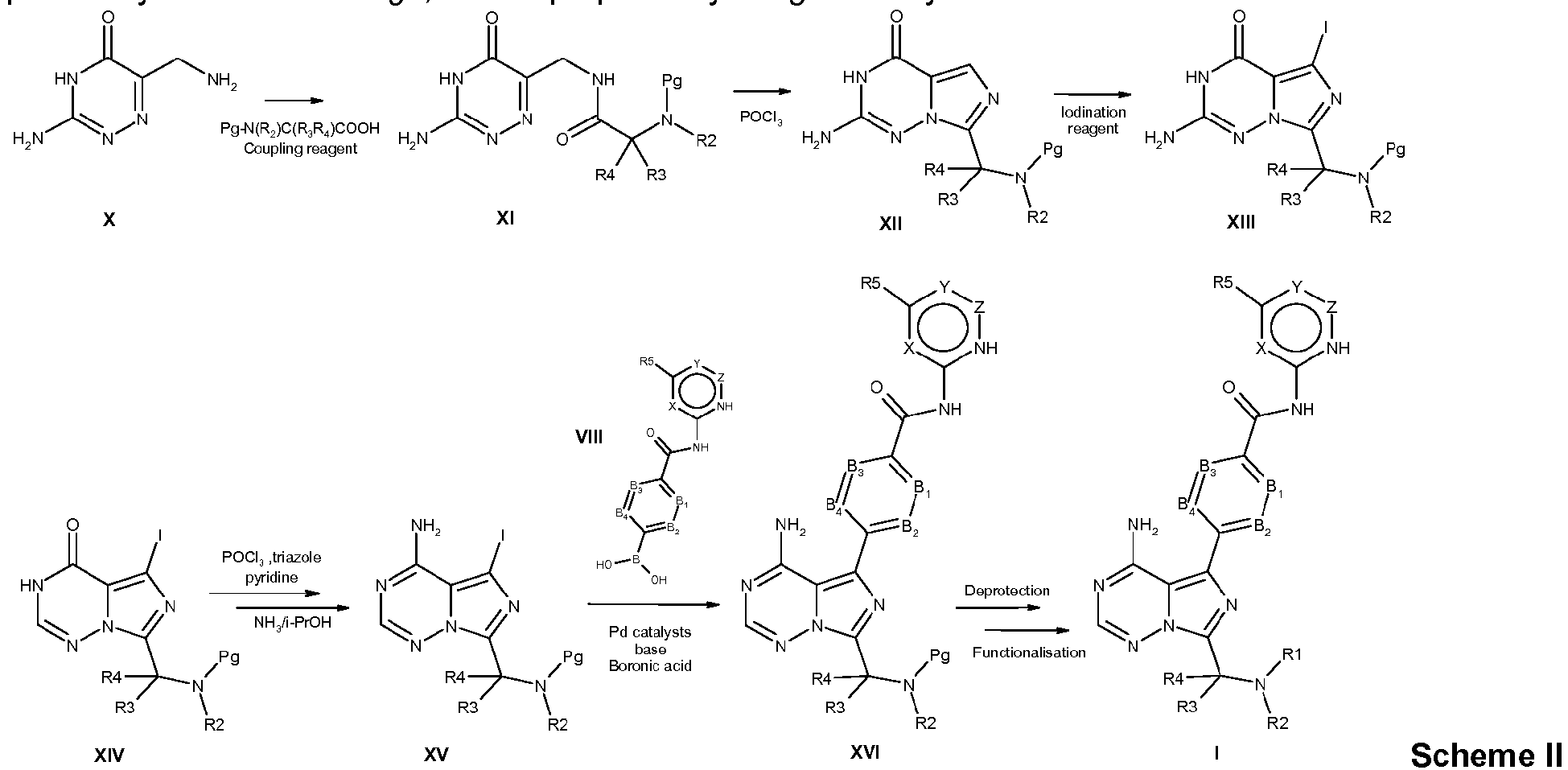
- Starting material 3-amino-6-(aminomethyl)-1,2,4-triazin-5(4H)-one X can be prepared via a condensation reaction of ethyl bromopyruvate, dibenzylamine, and aminoguanidine carbonate, followed by debenzylation via hydrogenation over Pd-C catalyst [Mitchel, W.L.et al, J. Heterocycl. Chem. 21 (1984) pp697].This can then be reacted with an appropriately amine protected amino acid. The reaction of Cbz-N(R2)CR3R4)COOH can be carried out in a solvent such as DMF, THF or DCM in the presence of a base such as DIPEA, N-methylmorpholine, 4-DMAP or triethylamine and in the presence of a coupling reagent such as PyBOP, TBTU, EDCI or HATU to form N-((3-amino-5-oxo-4,5-dihydro-1,2,4-triazin-6-yl)methyl)amide XI. Cyclisation of the amino-triazinone XI can be performed using condensation reagents like phosphorousoxychloride under heating conditions to provide the 2-aminoimidazo[1,5-f][1,2,4]triazin-4(3H)-one derivatives XII. Subsequent iodination can be accomplished using iodine or N-iodosuccinimide in a suitable solvent like DCM or DMF at appropriate temperature to obtain compounds of formula XIII. Removal of the 2-amino group in the 2-aminoimidazo[1,5-f][1,2,4]triazin-4(3H)-one derivatives XIII can be perfomed using t-butyl nitrite in solvents like DMF/THF at room temperature to form imidazo[1,5-f][1,2,4]triazin-4(3H)-one derivatives XIV. 4-Amino-imidazo[1,5-f][1,2,4]triazine derivatives (XV) can be prepared from compounds XIV using phosphorousoxychloride, 1,2,4-triazole in pyridine and subsequent ammonolysis with ammonia(gas) in isopropanol at room temperature. Compounds of formula XVI can be prepared from compounds of formula XV using an appropriate boronic acid or pinacol ester (VIII), in the presence of a suitable palladium catalyst system and solvent, for example bis(diphenylphosphino)ferrocene palladium(II)chloride complex or tetrakis(triphenylphosphine)palladium(0) in the presence of potassium carbonate in dioxane/water provide compounds of formula XVI. Finally, cleaving the protective group of compounds with the formula XVI give the unprotected amine which after functionalisation, using methods well known in the art, with appropriate warheads with previously defined meanings, provided compounds of formula I. An example of such protective strategy is the use of the benzyloxycarbonyl protecting group to protect the amine from the amino acids used, and after deprotection with 33% HBr/HOAc or conc. HCI gave the resulting amines.
- The amino acids HN(R2)CR3R4)COOH are either commercially available or they can be readily prepared using methods well known to the skilled organic chemist, to introduce protecting groups like benzyloxycarbonyl or tert-butyloxycarbonyl.
- Palladium catalysts and conditions to form either the pinacol esters or to couple the boronic acids or pinacol esters with the 5-iodoimidazo[1,5-f][1,2,4]triazin-4-amine are well known to the skilled organic chemist - see, for example, Ei-ichi Negishi (Editor), Armin de Meijere (Associate Editor), Handbook of Organopalladium Chemistry for Organic Synthesis, John Wiley and Sons, 2002.
- In the case of the individual stereoisomer of a compound of the invention or salts or solvates thereof, the present invention includes the aforementioned stereoisomer substantially free, i.e., associated with less than 5%, preferably less than 2% and in particular less than 1% of the other stereoisomer. Mixtures of stereoisomers in any proportion, for example a racemic mixture comprising substantially equal amounts of two enantiomers are also included within the scope of the present invention.For chiral compounds, methods for asymmetric synthesis whereby the pure stereoisomers are obtained are well known in the art, e.g. synthesis with chiral induction, synthesis starting from chiral intermediates, enantioselective enzymatic conversions, separation of stereoisomers using chromatography on chiral media. Such methods are described in Chirality In Industry (edited by A.N. Collins, G.N. Sheldrake and J. Crosby, 1992; John Wiley). Likewise methods for synthesis of geometrical isomers are also well known in the art. The 8-amino-imidazo[1,5-a]pyrazine derivative of the present invention, which can be in the form of a free base, may be isolated from the reaction mixture in the form of a pharmaceutically acceptable salt. The pharmaceutically acceptable salts may also be obtained by treating the free base of the compound of the invention with an organic or inorganic acid such as hydrogen chloride, hydrogen bromide, hydrogen iodide, sulfuric acid, phosphoric acid, acetic acid, propionic acid, glycolic acid, maleic acid, malonic acid, methanesulphonic acid, fumaric acid, succinic acid, tartaric acid, citric acid, benzoic acid, and ascorbic acid.
- The 8-amino-imidazo[1,5-a]pyrazine derivative of the present invention and 4-amino-imidazo[1,5-f][1,2,4]triazine derivatives also exist as amorphous forms. Multiple crystalline forms are also possible. All the physical forms are included within the scope of the present invention.
- Preparation of solvates is generally known. Thus, for example, M. Caira et al, J. Pharmaceutical Sci., 93(3), 601-611 (2004) describe the preparation of the solvates of the antifungal fluconazole in ethyl acetate as well as from water. Similar preparations of solvates, hemisolvate, hydrates and the like are described by E. C. van Tonder et al, AAPS PharmSciTech., 5(1), article 12 (2004); and A. L. Bingham et al, Chem. Commun. 603-604 (2001). A typical, non-limiting, process involves dissolving the inventive compound in desired amounts of the desired solvent (organic or water or mixtures thereof) at a higher than ambient temperature, and cooling the solution at a rate sufficient to form crystals which are then isolated by standard methods. Analytical techniques such as, for example IR spectroscopy, show the presence of the solvent (or water) in the crystals as a solvate (or hydrate).
- The present invention also embraces isotopically-labelled compounds of the present invention which are identical to those recited herein, but for the fact that one or more atoms are replaced by an atom having an atomic mass or mass number different from the atomic mass or mass number usually found in nature. Examples of isotopes that can be incorporated into compounds of the invention include isotopes of hydrogen, carbon, nitrogen, oxygen, phosphorus, fluorine and chlorine, such as 2H, 3H, 13C, 14C, 15N, 17O, 18O, 31P, 32P, 35S, 18F, and 36Cl, respectively.
- Certain isotopically-labelled compounds of the invention (e.g. those labeled with 3H and 14C) are useful in compound and/or substrate tissue distribution assays. Tritiated (i.e., 3H) and carbon-14 (i.e., 14C) isotopes are particularly preferred for their ease of preparation and detectability. Further, substitution with heavier isotopes such as deuterium (i.e., 2H) may afford certain therapeutic advantages resulting from greater metabolic stability (e.g., increased in vivo half-life or reduced dosage requirements) and hence may be preferred in some circumstances. Isotopically labelled compounds of the invention can generally be prepared by following procedures analogous to those disclosed in the Schemes and/or in the Examples herinbelow, by substituting an appropriate isotopically labeled reagent for a non-isotoplically labeled reagent.
- The invention is illustrated by the following examples.
- The following examples are illustrative embodiments of the invention, not limiting the scope of the invention in any way. Reagents are commercially available or are prepared according to procedures in the literature.
- Mass Spectrometry: Electron Spray spectra were recorded on the Applied Biosystems API-165 single quad mass spectrometer in alternating positive and negative ion mode using Flow Injection. The mass range was 120-2000 Da and scanned with a step rate of 0.2 Da. and the capillary voltage was set to 5000 V. N2-gas was used for nebulisation.
- LC-MS spectrometer (Waters) Detector: PDA (200-320 nm), Mass detector: ZQ
Eluens : A: acetonitrile with 0.05% trifluoroacetic acid, B: acetronitrile / water = 1/9 (v/v) with 0.05% trifluoroacetic acid - Column 1: Chromolith Performance, RP-18e, 4.6x100 mm,
Gradient method: Flow: 4 mL/minTime (min) A (%) B (%) 0.00 100 0 3.60 0 100 4.00 0 100 4.05 100 0 6.00 100 0 - Column 2: XBridge C18, 3.5µm, 4.6x20mm
Gradient methoden: Flow: 4 ml/minTime (min.) A (%) B (%) 0.0 100 0 1.60 0 100 3.10 0 100 3.20 100 0 5.00 100 0 - UPLC : Water acquity UPLC system; Column : BEH C18 1.7 µm, 2.1 x 100 mm, Detector: PDA (200-320 nm), Mass detector: SQD
Eluens : A: acetonitrile with 0.035% trifluoroacetic acid, B: acetronitrile / water = 1/9 (v/v) with 0.035% trifluoroacetic acidMethode UPLC (A) UPLC (B) UPLC (C) Method 60 100 Method 40 80 Method 0 60 Flow: 0.75 mL/min Flow: 0.65 mL/min Flow: 0.60 mL/min Time (min) A (%) B (%) A (%) B (%) A (%) B (%) 0.0 40 60 60 40 100 0 3.00 0 100 20 80 40 60 3.20 0 100 0 100 0 100 3.69 0 100 0 100 0 100 3.70 40 60 60 40 100 0 - Preparative HPLC was conducted on a column (50 x 10 mm ID, 5µm, Xterra Prep MS C18) at a flow rate of 5 ml/min, injection volume 500 µl, at room temperature and UV Detection at 210 nm.
- The following abbreviations are used throughout the application with respect to chemical terminology:
- HATU
- O-(7-Azabenzotriazol-1-yl)-1,1,3,3-tetramethyluroniumhexafluoro phosphate
- Cbz
- Benzyloxycarbonyl
- DMF
- N,N-Dimethylformamide
- DCM
- Dichloromethane
- EtOAc
- Ethyl acetate
- DIPEA
- N,N-Diisopropylethylamine
- THF
- Tetrahydrofuran
- EtOH
- Ethanol
- EDCl.HCl
- 1-(3-Dimethylaminopropyl)-3-ethylcarbodiimide. hydrochloride
- 4-DMAP
- 4-Dimethylamino pyridine
- PyBOP
- O-Benzotriazole-1-yl-oxy-trispyrrolidinophosphonium hexafluorophosphate
- TBTU
- O-Benzotriazol-1-yl-N,N,N',N'-tetramethyluronium tetrafluoroborate
- HBr
- Hydrogen bromide
- HCI
- Hydrogen chloride
- HOAc
- Acetic acid
- Z
- Benzyloxycarbonyl
- Pro
- Proline
- POCl3
- Phosphorous oxychloride
- HPLC
- High Pressure Liquid Chromatography
- UPLC
- LiHMDS
- Lithium hexamethyldisilazide
- MeOH
- Methanol
- Gly
- Glycine
- Ala
- Alanine
- n-BuLi
- n-Butyllithium
- CO2
- Carbondioxide
- The names of the final products in the examples are generated using Chemdraw Ultra (version 9.0.7).
-

- To a solution of 3-chloropyrazine-2-carbonitrile (160 g, 1.147 mol) in acetic acid (1.5 L) was added Raney Nickel (50% slurry in water, 70 g, 409 mmol). The resulting mixture was stirred under 4 bar hydrogen at room temperature overnight. Raney Nickel was removed by filtration over decalite and the filtrate was concentrated under reduced pressure and co-evaporated with toluene. The remaining brown solid was dissolved in ethyl acetate at 50°C and cooled on an ice-bath. 2M hydrogen chloride solution in diethyl ether (1.14 L) was added in 30 min. The mixture was allowed to stir at room temperature over weekend. The crystals were collected by filtration, washed with diethyl ether and dried under reduced pressure at 40°C. The product brown solid obtained was dissolved in methanol at 60°C. The mixture was filtered and partially concentrated, cooled to room temperature and diethyl ether (1000 ml) was added. The mixture was allowed to stir at room temperature overnight. The solids formed were collected by filtration, washed with diethyl ether and dried under reduced pressure at 40°C to give 153.5 g of (3-chloropyrazin-2-yl)methanamine.hydrochloride as a brown solid (74.4 %, content 77 %).
- To a solution of (3-chloropyrazin-2-yl)methanamine.HCl (9.57 g, 21.26 mmol, 40% wt) and Z-Pro-OH (5.3 g, 21.26 mmol) in dichloromethane (250 mL) was added triethylamine (11.85 mL, 85 mmol) and the reaction mixture was cooled to 0°C. After 15 min stirring at 0°C, HATU (8.49 g, 22.33 mmol) was added. The mixture was stirred for 1 hour at 0°C and then overnight at room temperature. The mixture was washed with 0.1 M HCI-solution, 5% NaHCO3, water and brine, dried over sodium sulfate and concentrated in vacuo. The product was purified using silica gel chromatography (heptane/ethyl acetate = 1/4 v/v%) to give 5 g of (S)-benzyl 2-((3-chloropyrazin-2-yl)methylcarbamoyl)pyrrolidine-1-carboxylate (62.7%).
- (S)-Benzyl 2-((3-chloropyrazin-2-yl)methylcarbamoyl)pyrrolidine-1-carboxylate (20.94 mmol, 7.85 g) was dissolved in acetonitrile (75 ml), 1,3-dimethyl-2-imidazolidinone (62.8 mmol, 6.9 ml, 7.17 g) was added and the reaction mixture was cooled to 0°C before POCl3 (84 mmol, 7.81 ml, 12.84 g) was added drop wise while the temperature remained around 5°C. The reaction mixture was refluxed at 60-65°C overnight. The reaction mixture was poured carefully in ammonium hydroxide 25% in water (250 ml)/crushed ice (500 ml) to give a yellow suspension (pH ∼8-9) which was stirred for 15 min until no ice was present in the suspension. Ethyl acetate was added, layers were separated and the aqueous layer was extracted with ethyl acetate (3x). The organic layers were combined and washed with brine, dried over sodium sulfate, filtered and evaporated to give 7.5 g crude product. The crude product was purified using silica gel chromatography (heptane/ethyl acetate = 1/4 v/v%) to give 6.6 g of (S)-benzyl 2-(8-chloroimidazo[1,5-a]pyrazin-3-yl)pyrrolidine-1-carboxylate (88%).
- N-Bromosuccinimide (24.69 mmol, 4.4 g) was added to a stirred solution of (S)-benzyl 2-(8-chloroimidazo[1,5-a]pyrazin-3-yl)pyrrolidine-1-carboxylate (24.94 mmol, 8.9 g) in DMF (145 mL). The reaction was stirred 3 h at rt. The mixture was poored (slowly) in a stirred mixture of water (145 mL), ethyl acetate (145 mL) and brine (145 mL). The mixture was then transferred into a separating funnel and extracted. The water layer was extracted with 2x145 mL ethyl acetate. The combined organic layers were washed with 3x300 mL water, 300 mL brine, dried over sodium sulfate, filtered and evaporated. The product was purified using silica gel chromatography (ethyl acetate/heptane = 3/1 v/v%) to give 8.95 g of (S)-benzyl 2-(1-bromo-8-chloroimidazo[1,5-a]pyrazin-3-yl)pyrrolidine-1-carboxylate (82.3%).
- (S)-Benzyl 2-(8-amino-1-bromoimidazo[1,5-a]pyrazin-3-yl)pyrrolidine-1-carboxylate (20.54 mmol, 8.95 g) was suspended in 2-propanol (113 ml) in a pressure vessel. 2-propanol (50 ml) was cooled to -78°C in a pre-weighed flask (with stopper and stirring bar) and ammonia gas (646 mmol, 11 g) was lead through for 15 minutes. The resulting solution was added to the suspension in the pressure vessel. The vessel was closed and stirred at room temperature and a slight increase in pressure was observed. Then the suspension was heated to 110 °C which resulted in an increased pressure to 4.5 bar. The clear solution was stirred at 110 °C, 4.5 bar overnight. After 18h the pressure remained 4 bar. The reaction mixture was concentrated in vacuum, the residue was suspended in ethyl acetate and subsequent washed with water. The layers were separated and the aqueous layer was extracted with ethyl acetate. The combined organic layers were washed with water, saturated sodium chloride solution, dried over sodium sulfate and concentrated to give 7.35 g of (S)-benzyl 2-(8-amino-1-bromoimidazo[1,5-a]pyrazin-3-yl)pyrrolidine-1-carboxylate (86%).
-

- (S)-benzyl 2-(8-amino-1-bromoimidazo[1,5-a]pyrazin-3-yl)pyrrolidine-1-carboxylate (0.237 mmol, 98.5 mg) and 4-(pyridin-2-yl-aminocarbonyl)benzeneboronic acid (0.260 mmol, 63.0 mg) were suspended in a mixture of 2N aqueous potassium carbonate solution (2.37 mmol, 1.18 mL) and dioxane (2.96 mL). Nitrogen was bubbled through the mixture, followed by the addition of 1,1'-bis(diphenylphosphino)ferrocene palladium (ii) chloride (0.059 mmol, 47.8 mg). The reaction mixture was heated for 20 minutes at 140°C in the microwave. Water was added to the reaction mixture, followed by an extraction with ethyl acetate (2x). The combined organic layer was washed with brine, dried over magnesium sulfate and evaporated. The product was purified using silicagel and dichloromethane/methanol = 9/1 v/v% as eluent to afford 97.1 mg of (S)-benzyl 2-(8-amino-1-(4-(pyridin-2-ylcarbamoyl)phenyl)imidazo[1,5-a]pyrazin-3-yl)pyrrolidine-1-carboxylate (77%).
- To (S)-benzyl 2-(8-amino-1-(4-(pyridin-2-ylcarbamoyl)phenyl)imidazo[1,5-a]pyrazin-3-yl)pyrrolidine-1-carboxylate (0.146 mmol, 78 mg) was added a 33% hydrobromic acid/acetic acid solution (11.26 mmol, 2 ml) and the mixture was left at room temperature for 1 hour. The mixture was diluted with water and extracted with dichloromethane. The aqueous phase was neutralized using 2N sodium hydroxide solution, and then extracted with dichloromethane. the organic layer was dried over magnesium sulfate, filtered and evaporated to give 34 mg of (S)-4-(8-Amino-3-(pyrrolidin-2-yl)imidazo[1,5-a]pyrazin-1-yl)-N-(pyridin-2-yl)benzamide (58%).
-
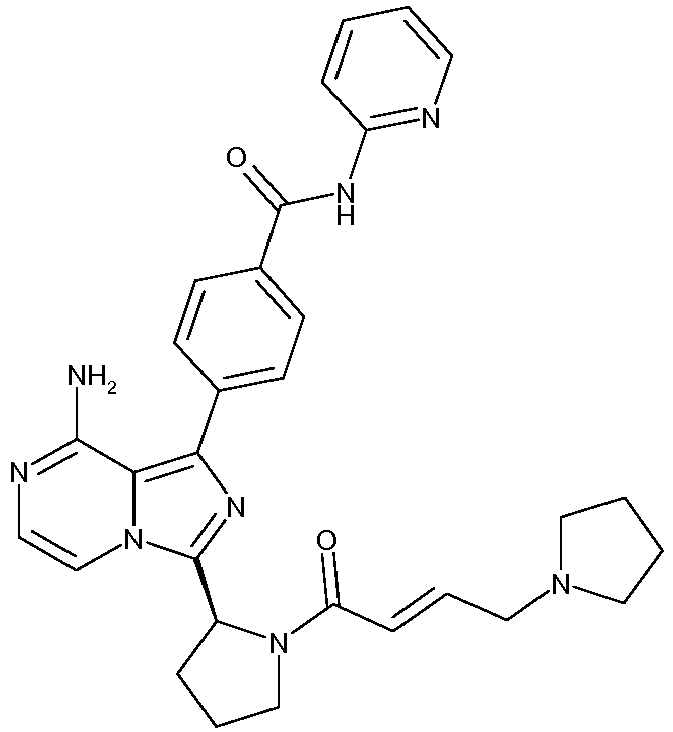
- To a solution of (S)-4-(8-Amino-3-(pyrrolidin-2-yl)imidazo[1,5-a]pyrazin-1-yl)-N-(pyridin-2-yl)benzamide (intermediate 2b, 19.7 mg, 0.049 mmol), triethylamine (20 mg, 0.197 mmol, 0.027 mL) and (E)-4-(pyrrolidin-1-yl)but-2-enoic acid hydrochloride (9.45 mg, 0.049 mmol) in dichloromethane (2 mL) was added HATU (18.75 mg, 0.049 mmol). The mixture was stirred for 30 min at room temperature. The mixture was washed with water dried over magnesium sulfate and concentrated in vacuo. The residue was purified by preparative HPLC. Fractions containing product were collected and reduced to dryness to afford 7.1 mg of (S,E)-4-(8-amino-3-(1-(4-(pyrrolidin-1-yl)but-2-enoyl)pyrrolidin-2-yl)imidazo[1,5-a]pyrazin-1-yl)-N-(pyridin-2-yl)benzamide (26.8 % yield). Data: UPLC (C) Rt : 1.25 min; m/z 537.4 (M+H)+.
-

- This compound was prepared, in an analoguous manner as described in Reference Example 1, from the compound described in intermediate 2b and 2-butynoic acid, to afford the title compound (10.5 mg, 18.0%). Data: LCMS (B) Rt: 2.08 min; m/z 466.1 (M+H)+.
- Btk enzyme activity is measured using the IMAP (immobilized metal ion affinity-based fluorescence polarization) assay as outlined below.
- Btk enzyme (His-Btk (Millipore catalog# 14-552), is diluted to 0.4 U/mL in KR buffer (10 mM Tris-HCI, 10 mM MgCl2, 0.01% Tween-20, 0.05% NaN3, 1 mM DTT, 2 mM MnCl2, pH 7.2).
- Serial dilution log10 from 2 mM to 63.2 nM of test compounds are made in 100% DMSO. The dilutions in DMSO are then diluted 50-fold in KR-buffer. Final compound concentration range in the assay from 10 µM to 0.316 nM.
- 5 µL/well of test compound in KR buffer (final DMSO concentration in the assay is 1%) is mixed with 5 µl/well of 0.4 U/mL Btk enzyme (final concentration in the assay is 0.1 U/mL). Test compounds and Btk enzyme are pre-incubated 60 minutes at room temperature, before adding 5 µL/well of 200 nM Fluorescin labeled substrate peptide (Blk/Lyntide substrate, e.g. #R7188/#R7233, Molecular Devices) in KR-buffer. Final peptide substrate concentration in assay is 50 nM. The kinase assay is started by adding 5 µL/well of 20 µM ATP in KR-buffer (final ATP concentration is 5 µM ATP, Km ATP in Btk IMAP assay). Following incubation for 2h at room temperature the enzyme reaction is stopped by adding 40 µL/well IMAP Progressive Binding Solution (according to suppliers (Molecular Devices) protocol using 75% 1x buffer A and 25% 1x buffer B with 1:600 Progressive Binding Solution). After 60 min incubation at room temperature in the dark the FP signal is read. Fluorescence at 535 nm is measured using parallel and perpendicular filters to determine differences in rotation due to binding of the phosphorylated substrate peptide to the beads. Values are calculated as percentage of the difference in readout (ΔmPi) of the controls with and without ATP. EC50 values are determined by curve fitting of the experimental results using Activity Base.
- All examples have an EC50 of 10 µM or lower.
Table 1 EC50 Btk activity values EC50 Example ≥10nM <100nM 1 <10 nM 2 - Where example 1 is a reference example.
- Lck enzyme activity is measured using the IMAP (immobilized metal ion affinity-based fluorescence polarization) assay as outlined below.
- Lck enzyme (Millipore catalog# 14-442), is diluted to 0.4 U/mL in KR buffer (10 mM Tris-HCI, 10 mM MgCI2, 0.01% Tween-20, 0.05% NaN3, 1 mM DTT, 2 mM MnCl2, pH 7.2).
- Serial dilution log10 from 2 mM to 63.2 nM of test compounds are made in 100% DMSO. The dilutions in DMSO are then diluted 50-fold in KR-buffer of which 5 µl is used in the assay, leading to a final compound concentration range in the assay from 10 µM to 0.316 nM.
- 5 µL/well of test compound in KR buffer (final DMSO concentration in the assay is 1%) is mixed with 5 µl/well of 0.4 U/mL Lck enzyme (final concentration in the assay is 0.1 U/mL). Test compounds and Lck enzyme are pre-incubated 60 minutes at room temperature, before adding 5 µL/well of 400 nM Fluorescin labeled substrate peptide (p34cdc2 substrate peptide, e.g. #R7157/#R7172, Molecular Devices) in KR-buffer. Final peptide substrate concentration in assay is 100 nM. The kinase assay is started by adding 5 µL/well of 24 µM ATP in KR-buffer (final ATP concentration is 6 µM ATP, Km ATP in Lck IMAP assay). Following incubation for 2h at room temperature the enzyme reaction is stopped by adding 40 µL/well IMAP Progressive Binding Solution (according to suppliers (Molecular Devices) protocol using 75% 1x buffer A and 25% 1x buffer B with 1:600 Progressive Binding Solution). After 60 min incubation at room temperature in the dark the FP signal is read. Fluorescence at 535 nm is measured using parallel and perpendicular filters to determine differences in rotation due to binding of the phosphorylated substrate peptide to the beads. Values are calculated as percentage of the difference in readout (ΔmPi) of the controls with and without ATP. EC50 values are determined by curve fitting of the experimental results using Activity Base.
Table 2 EC50 Lck activity values EC50 Example ≥1µM 1, 2 - Where example 1 is a reference example.
- Src enzyme activity is measured using the IMAP (immobilized metal ion affinity-based fluorescence polarization) assay as outlined below.
- Src enzyme (Millipore catalog# 14-326), is diluted to 0.8 U/mL in KR buffer (10 mM Tris-HCI, 10 mM MgCl2, 0.01% Tween-20, 0.05% NaN3, 1 mM DTT, 2 mM MnCl2, pH 7.2).
- Serial dilution log10 from 2 mM to 63.2 nM of test compounds are made in 100% DMSO. The dilutions in DMSO are then diluted 50-fold in KR-buffer of which 5 µl is used in the assay, leading to a final compound concentration range in the assay from 10 µM to 0.316 nM.
- 5 µL/well of test compound in KR buffer (final DMSO concentration in the assay is 1%) is mixed with 5 µl/well of 0.8 U/mL Src enzyme (final concentration in the assay is 0.2 U/mL). Test compounds and Src enzyme are pre-incubated 60 minutes at room temperature, before adding 5 µL/well of 400 nM Fluorescin labeled substrate peptide (p34cdc2 substrate peptide, e.g. #R7157/#R7172, Molecular Devices) in KR-buffer. Final peptide substrate concentration in assay is 100 nM. The kinase assay is started by adding 5 µL/well of 16 µM ATP in KR-buffer (final ATP concentration is 4 µM ATP, Km ATP in Src IMAP assay). Following incubation for 2h at room temperature the enzyme reaction is stopped by adding 40 µL/well IMAP Progressive Binding Solution (according to suppliers (Molecular Devices) protocol using 75% 1x buffer A and 25% 1x buffer B with 1:600 Progressive Binding Solution). After 60 min incubation at room temperature in the dark the FP signal is read. Fluorescence at 535 nm is measured using parallel and perpendicular filters to determine differences in rotation due to binding of the phosphorylated substrate peptide to the beads. Values are calculated as percentage of the difference in readout (ΔmPi) of the controls with and without ATP. EC50 values are determined by curve fitting of the experimental results using Activity Base.
Table 3 EC50 Src activity values EC50 Example ≥1µM 1,2 - Where example 1 is a reference example.
- FynT enzyme activity is measured using the IMAP (immobilized metal ion affinity-based fluorescence polarization) assay as outlined below.
- FynT enzyme (Biomol catalog# SE-287), is diluted to 0.5 µg/mL in KR buffer (10 mM Tris-HCI, 10 mM MgCl2, 0.01% Tween-20, 0.05% NaN3, 1 mM DTT, 2 mM MnCl2, pH 7.2).
- Serial dilution log10 from 2 mM to 63.2 nM of test compounds are made in 100% DMSO. The dilutions in DMSO are then diluted 50-fold in KR-buffer of which 5 µl is used in the assay, leading to a final compound concentration range in the assay from 10 µM to 0.316 nM.
- 5 µL/well of test compound in KR buffer (final DMSO concentration in the assay is 1%) is mixed with 5 µl/well of 0.5 µg/mL FynT enzyme (final concentration in the assay is 125 ng/mL). Test compounds and FynT enzyme are pre-incubated 60 minutes at room temperature, before adding 5 µL/well of 400 nM Fluorescin labeled substrate peptide (p34cdc2 substrate peptide, e.g. #R7157/#R7172, Molecular Devices) in KR-buffer. Final peptide substrate concentration in assay is 100 nM. The kinase assay is started by adding 5 µL/well of 0.8 µM ATP in KR-buffer (final ATP concentration is 0.2 µM ATP, Km ATP in FynT IMAP assay). Following incubation for 2h at room temperature the enzyme reaction is stopped by adding 40 µL/well IMAP Progressive Binding Solution (according to suppliers (Molecular Devices) protocol using 75% 1x buffer A and 25% 1x buffer B with 1:600 Progressive Binding Solution). After 60 min incubation at room temperature in the dark the FP signal is read. Fluorescence at 535 nm is measured using parallel and perpendicular filters to determine differences in rotation due to binding of the phosphorylated substrate peptide to the beads. Values are calculated as percentage of the difference in readout (ΔmPi) of the controls with and without ATP. EC50 values are determined by curve fitting of the experimental results using Activity Base.
Table 4 EC50 FynT activity values EC50 Example ≥1µM 1, 2 - Where example 1 is a reference example.
- Lyn enzyme activity is measured using the IMAP (immobilized metal ion affinity-based fluorescence polarization) assay as outlined below.
- Lyn enzyme (Millipore catalog# 14-510), is diluted to 250 mU/mL in KR buffer (10 mM Tris-HCI, 10 mM MgCl2, 0.01% Tween-20, 0.05% NaN3, 1 mM DTT, 2 mM MnCl2, pH 7.2).
- Serial dilution log10 from 2 mM to 63.2 nM of test compounds are made in 100% DMSO. The dilutions in DMSO are then diluted 50-fold in KR-buffer of which 5 µl is used in the assay, leading to a final compound concentration range in the assay from 10 µM to 0.316 nM.
- 5 µL/well of test compound in KR buffer (final DMSO concentration in the assay is 1%) is mixed with 5 µl/well of 250 mU/mL Lyn enzyme (final concentration in the assay is 62.5 mU/mL). Test compounds and Lyn enzyme are pre-incubated 60 minutes at room temperature, before adding 5 µL/well of 400 nM Fluorescin labeled substrate peptide (Blk/Lyntide substrate, e.g. #R7188/#R7233, Molecular Devices) in KR-buffer. Final peptide substrate concentration in assay is 100 nM. The kinase assay is started by adding 5 µL/well of 8 µM ATP in KR-buffer (final ATP concentration is 2 µM ATP, Km ATP in Lyn IMAP assay). Following incubation for 2h at room temperature the enzyme reaction is stopped by adding 40 µL/well IMAP Progressive Binding Solution (according to suppliers (Molecular Devices) protocol using 75% 1x buffer A and 25% 1x buffer B with 1:600 Progressive Binding Solution). After 60 min incubation at room temperature in the dark the FP signal is read. Fluorescence at 535 nm is measured using parallel and perpendicular filters to determine differences in rotation due to binding of the phosphorylated substrate peptide to the beads. Values are calculated as percentage of the difference in readout (ΔmPi) of the controls with and without ATP. EC50 values are determined by curve fitting of the experimental results using Activity Base.
Table 5 EC50 Lyn activity values EC50 Example ≥1µM 1,2 - Where example 1 is a reference example.
Claims (19)
- A compound which is a compound having the structure:

- The compound of claim 1, which has the structure:
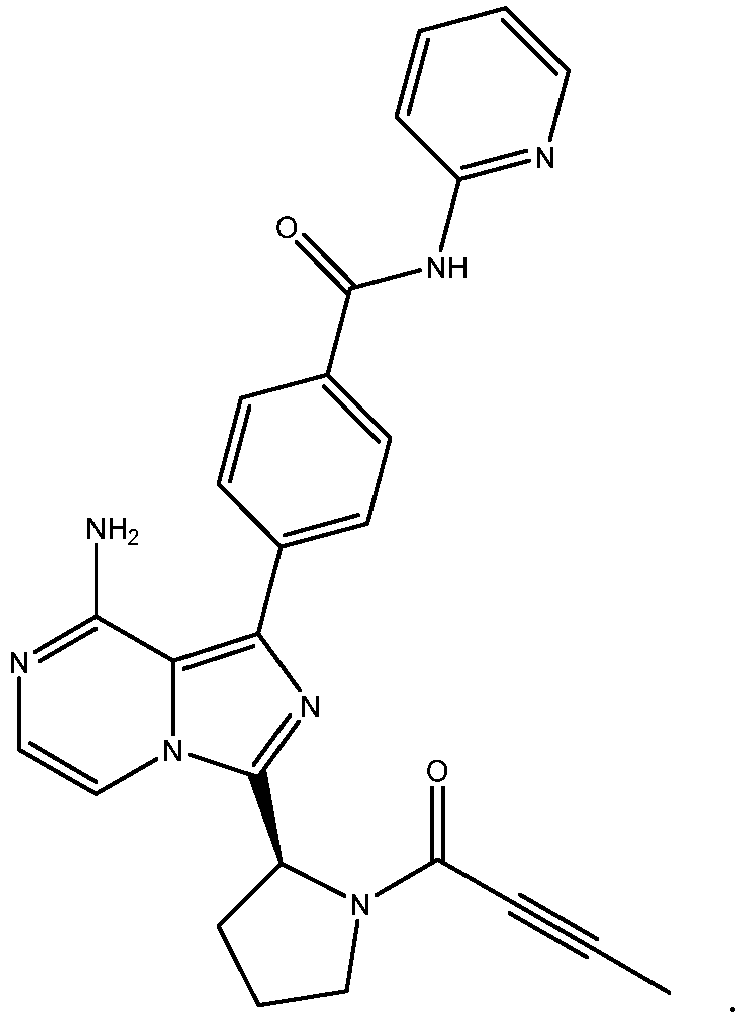
- The compound of claim 1, wherein the compound is a pharmaceutically acceptable salt of a compound which has the structure:

- The compound of claim 3, wherein the pharmaceutically acceptable salt is selected from the group consisting of acetate, ascorbate, benzoate, benzenesulfonate, bisulfate, borate, butyrate, citrate, camphorate, camphorsulfonate, fumarate, hydrochloride, hydrobromide, hydroiodide, lactate, maleate, methanesulfonate, naphthalenesulfonate, nitrate, oxalate, phosphate, propionate, salicylate, succinate, sulfate, tartarate, thiocyanate, and toluenesulfonate.
- A compound which is a compound having the structure:

- The compound for use of claim 5, wherein the compound is for use in the treatment of a Bruton's Tyrosine Kinase (Btk) mediated disorder selected from the group consisting of rheumatoid arthritis, psoriatic arthritis, infectious arthritis, progressive chronic arthritis, deforming arthritis, osteoarthritis, traumatic arthritis, gouty arthritis, Reiter's syndrome, polychondritis, acute synovitis, spondylitis, glomerulonephritis with nephrotic syndrome, glomerulonephritis without nephrotic syndrome, autoimmune hematologic disorders, hemolytic anemia, aplastic anemia, idiopathic thrombocytopenia, neutropenia, autoimmune gastritis, autoimmune inflammatory bowel diseases, ulcerative colitis, Crohn's disease, host versus graft disease, allograft rejection, chronic thyroiditis, Graves' disease, scleroderma, type I diabetes, type II diabetes, acute active hepatitis, chronic active hepatitis, pancreatitis, primary biliary cirrhosis, myasthenia gravis, multiple sclerosis, systemic lupus erythematosis, psoriasis, atopic dermatitis, contact dermatitis, eczema, skin sunburns, vasculitis, Behcet's disease, chronic renal insufficiency, Stevens-Johnson syndrome, inflammatory pain, idiopathic sprue, cachexia, sarcoidosis, Guillain-Barré syndrome, uveitis, conjunctivitis, kerato conjunctivitis, otitis media, periodontal disease, pulmonary interstitial fibrosis, asthma, bronchitis, rhinitis, sinusitis, pneumoconiosis, pulmonary insufficiency syndrome, pulmonary emphysema, pulmonary fibrosis, silicosis, chronic inflammatory pulmonary disease, chronic obstructive pulmonary disease, a proliferative disease, non-Hodgkin lymphoma, diffuse large B-cell lymphoma, mantle cell lymphoma, B cell chronic lymphocytic leukemia, acute lymphoblastic leukemia with mature B cell, B cell lymphoma resulting from chronic active B cell receptor signaling, and a bone disorder related to multiple myeloma.
- The compound for use of claim 5, wherein the compound is for use in the treatment of a Bruton's Tyrosine Kinase (Btk) mediated disorder wherein the Btk mediated disorder is B cell chronic lymphocytic leukemia.
- The compound for use of claim 5, wherein the compound is for use in the treatment of a Bruton's Tyrosine Kinase (Btk) mediated disorder wherein the Btk mediated disorder is mantle cell lymphoma.
- The compound for use of any one of claims 5 to 8, wherein the compound has the structure:

- The compound for use of any one of claims 5 to 8, wherein the compound is a pharmaceutically acceptable salt of a compound which has the structure:

- The compound for use of claim 10, wherein the pharmaceutically acceptable salt is selected from the group consisting of acetate, ascorbate, benzoate, benzenesulfonate, bisulfate, borate, butyrate, citrate, camphorate, camphorsulfonate, fumarate, hydrochloride, hydrobromide, hydroiodide, lactate, maleate, methanesulfonate, naphthalenesulfonate, nitrate, oxalate, phosphate, propionate, salicylate, succinate, sulfate, tartarate, thiocyanate, and toluenesulfonate.
- A combination of a compound which is a compound having the structure:

- The combination of claim 12, wherein the compound has the structure:
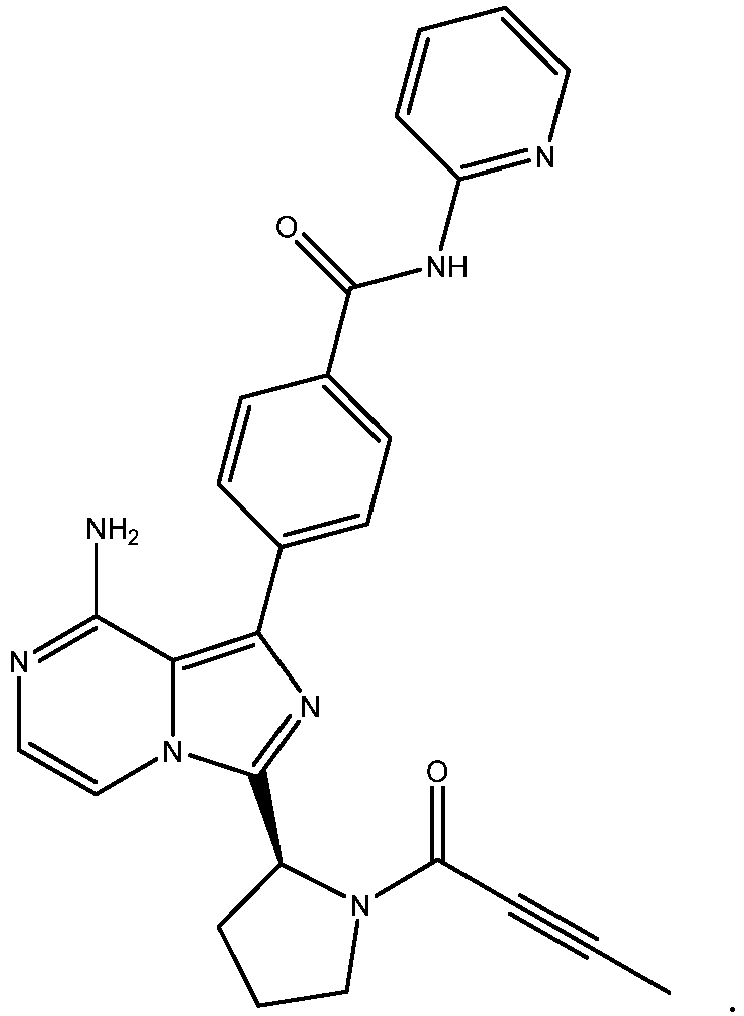
- The combination of claim 12, wherein the compound is a pharmaceutically acceptable salt of a compound which has the structure:

- The combination of claim 14, wherein the pharmaceutically acceptable salt is selected from the group consisting of acetate, ascorbate, benzoate, benzenesulfonate, bisulfate, borate, butyrate, citrate, camphorate, camphorsulfonate, fumarate, hydrochloride, hydrobromide, hydroiodide, lactate, maleate, methanesulfonate, naphthalenesulfonate, nitrate, oxalate, phosphate, propionate, salicylate, succinate, sulfate, tartarate, thiocyanate, and toluenesulfonate.
- A pharmaceutical composition comprising a compound which is a compound having the structure:

- The composition of claim 16, wherein the compound has the structure:

- The composition of claim 16, wherein the compound is a pharmaceutically acceptable salt of a compound which has the structure:

- The composition of claim 18, wherein the pharmaceutically acceptable salt is selected from the group consisting of acetate, ascorbate, benzoate, benzenesulfonate, bisulfate, borate, butyrate, citrate, camphorate, camphorsulfonate, fumarate, hydrochloride, hydrobromide, hydroiodide, lactate, maleate, methanesulfonate, naphthalenesulfonate, nitrate, oxalate, phosphate, propionate, salicylate, succinate, sulfate, tartarate, thiocyanate, and toluenesulfonate.
Priority Applications (19)
| Application Number | Priority Date | Filing Date | Title |
|---|---|---|---|
| EP23168571.0A EP4249076A3 (en) | 2011-07-19 | 2012-07-11 | (s)-4-(8-amino-3-(1-(but-2-ynoyl)pyrrolidin-2-yl)imidazo[1,5-a]pyrazin-1-yl)-2-methoxy-n-(pyridin-2-yl)benzamide as btk-inhibitor |
| PL19215783T PL3689878T3 (en) | 2011-07-19 | 2012-07-11 | 4-imidazopyridazin-1-yl-benzamides and 4-imidazotriazin-1-yl-benzamides as btk-inhibitors |
| SI201231495T SI2734522T1 (en) | 2011-07-19 | 2012-07-11 | 4-imidazopyridazin-1-yl-benzamides and 4-imidazotriazin-1-yl-benzamides as btk-inhibitors |
| MEP-2019-4A ME03310B (en) | 2011-07-19 | 2012-07-11 | 4 - imidazopyridazin- 1-yl-benzamides and 4 - imidazotriazin- 1 - yl - benzamides as btk- inhibitors |
| EP12733505.7A EP2734522B1 (en) | 2011-07-19 | 2012-07-11 | 4-imidazopyridazin-1-yl-benzamides and 4-imidazotriazin-1-yl-benzamides as btk-inhibitors |
| EP19215783.2A EP3689878B1 (en) | 2011-07-19 | 2012-07-11 | 4-imidazopyridazin-1-yl-benzamides and 4-imidazotriazin-1-yl-benzamides as btk-inhibitors |
| EP18203086.6A EP3495368B1 (en) | 2011-07-19 | 2012-07-11 | (s)-4-(8-amino-3-(1-(but-2-ynoyl)pyrrolidin-2-yl)imidazo[1,5-a]pyrazin-1-yl)-2-methoxy-n-(pyridin-2-yl)benzamide as btk-inhibitor |
| HRP20190135TT HRP20190135T1 (en) | 2011-07-19 | 2012-07-11 | 4-IMIDAZOPYRIDAZINE-1-YL-BENZAMIDES AND 4-IMIDAZOTRIAZIN-1-YL-BENZAMIDES AS INHIBITORS BTK |
| SM20190029T SMT201900029T1 (en) | 2011-07-19 | 2012-07-11 | 4-imidazopyridazin-1-yl-benzamides and 4-imidazotriazin-1-yl-benzamides as btk-inhibitors |
| RS20190018A RS58177B1 (en) | 2011-07-19 | 2012-07-11 | 4-imidazopyridazin-1-yl-benzamides and 4-imidazotriazin-1-yl-benzamides as btk-inhibitors |
| PL12733505T PL2734522T3 (en) | 2011-07-19 | 2012-07-11 | 4-imidazopyridazin-1-yl-benzamides and 4-imidazotriazin-1-yl-benzamides as btk-inhibitors |
| PT192157832T PT3689878T (en) | 2011-07-19 | 2012-07-11 | 4-imidazopyridazin-1-yl-benzamides and 4-imidazotriazin-1-yl-benzamides as btk-inhibitors |
| CY20191100084T CY1121174T1 (en) | 2011-07-19 | 2019-01-22 | 4-IMIDAZOPYRIDAZIN-1-YL-BENZAMIDS AND 4-IMIDAZOTRIAZIN-1-YL-BENZAMIDS AS BTC INhibitors |
| NL301097C NL301097I2 (en) | 2011-07-19 | 2021-03-22 | acalabrutinib or a pharmaceutically acceptable salt thereof |
| LTPA2021004C LTC2734522I2 (en) | 2011-07-19 | 2021-03-24 | 4-IMIDAZOPYRIDAZIN-1-IL-BENZAMIDES AND 4-IMIDAZOTRIAZIN-1-IL-BENZAMIDES AS BTK INHIBITORS |
| NO2021016C NO2021016I1 (en) | 2011-07-19 | 2021-04-09 | akalabrutinib |
| HUS2100012C HUS2100012I1 (en) | 2011-07-19 | 2021-04-14 | 4-Imidazopyridazin-1-yl-benzamides and 4-imidazotriazin-1-yl-benzamides as BTK inhibitors |
| CY2021010C CY2021010I1 (en) | 2011-07-19 | 2021-04-21 | 4-IMIDAZOPYRIDAZIN-1-YL-BENZAMIDES AND 4-IMIDAZOTRIAZIN-1-YL-BENZAMIDES AS BTK INHIBITORS |
| CY20211101020T CY1125613T1 (en) | 2011-07-19 | 2021-11-24 | 4-IMIDAZOPYRIDAZIN-1-YL-BENZAMIDES AND 4- IMIDAZOTRIAZIN-1-YL-BENZAMIDES AS BTK INHIBITORS |
Applications Claiming Priority (4)
| Application Number | Priority Date | Filing Date | Title |
|---|---|---|---|
| US201161509397P | 2011-07-19 | 2011-07-19 | |
| EP11174578 | 2011-07-19 | ||
| EP12733505.7A EP2734522B1 (en) | 2011-07-19 | 2012-07-11 | 4-imidazopyridazin-1-yl-benzamides and 4-imidazotriazin-1-yl-benzamides as btk-inhibitors |
| PCT/EP2012/063552 WO2013010868A1 (en) | 2011-07-19 | 2012-07-11 | 4 - imidazopyridazin- 1 -yl-benzamides and 4 - imidazotriazin- 1 - yl - benzamides as btk- inhibitors |
Related Child Applications (3)
| Application Number | Title | Priority Date | Filing Date |
|---|---|---|---|
| EP18203086.6A Division EP3495368B1 (en) | 2011-07-19 | 2012-07-11 | (s)-4-(8-amino-3-(1-(but-2-ynoyl)pyrrolidin-2-yl)imidazo[1,5-a]pyrazin-1-yl)-2-methoxy-n-(pyridin-2-yl)benzamide as btk-inhibitor |
| EP23168571.0A Division EP4249076A3 (en) | 2011-07-19 | 2012-07-11 | (s)-4-(8-amino-3-(1-(but-2-ynoyl)pyrrolidin-2-yl)imidazo[1,5-a]pyrazin-1-yl)-2-methoxy-n-(pyridin-2-yl)benzamide as btk-inhibitor |
| EP19215783.2A Division EP3689878B1 (en) | 2011-07-19 | 2012-07-11 | 4-imidazopyridazin-1-yl-benzamides and 4-imidazotriazin-1-yl-benzamides as btk-inhibitors |
Publications (2)
| Publication Number | Publication Date |
|---|---|
| EP2734522A1 EP2734522A1 (en) | 2014-05-28 |
| EP2734522B1 true EP2734522B1 (en) | 2018-10-31 |
Family
ID=47557677
Family Applications (4)
| Application Number | Title | Priority Date | Filing Date |
|---|---|---|---|
| EP23168571.0A Pending EP4249076A3 (en) | 2011-07-19 | 2012-07-11 | (s)-4-(8-amino-3-(1-(but-2-ynoyl)pyrrolidin-2-yl)imidazo[1,5-a]pyrazin-1-yl)-2-methoxy-n-(pyridin-2-yl)benzamide as btk-inhibitor |
| EP19215783.2A Active EP3689878B1 (en) | 2011-07-19 | 2012-07-11 | 4-imidazopyridazin-1-yl-benzamides and 4-imidazotriazin-1-yl-benzamides as btk-inhibitors |
| EP12733505.7A Active EP2734522B1 (en) | 2011-07-19 | 2012-07-11 | 4-imidazopyridazin-1-yl-benzamides and 4-imidazotriazin-1-yl-benzamides as btk-inhibitors |
| EP18203086.6A Active EP3495368B1 (en) | 2011-07-19 | 2012-07-11 | (s)-4-(8-amino-3-(1-(but-2-ynoyl)pyrrolidin-2-yl)imidazo[1,5-a]pyrazin-1-yl)-2-methoxy-n-(pyridin-2-yl)benzamide as btk-inhibitor |
Family Applications Before (2)
| Application Number | Title | Priority Date | Filing Date |
|---|---|---|---|
| EP23168571.0A Pending EP4249076A3 (en) | 2011-07-19 | 2012-07-11 | (s)-4-(8-amino-3-(1-(but-2-ynoyl)pyrrolidin-2-yl)imidazo[1,5-a]pyrazin-1-yl)-2-methoxy-n-(pyridin-2-yl)benzamide as btk-inhibitor |
| EP19215783.2A Active EP3689878B1 (en) | 2011-07-19 | 2012-07-11 | 4-imidazopyridazin-1-yl-benzamides and 4-imidazotriazin-1-yl-benzamides as btk-inhibitors |
Family Applications After (1)
| Application Number | Title | Priority Date | Filing Date |
|---|---|---|---|
| EP18203086.6A Active EP3495368B1 (en) | 2011-07-19 | 2012-07-11 | (s)-4-(8-amino-3-(1-(but-2-ynoyl)pyrrolidin-2-yl)imidazo[1,5-a]pyrazin-1-yl)-2-methoxy-n-(pyridin-2-yl)benzamide as btk-inhibitor |
Country Status (38)
| Country | Link |
|---|---|
| US (8) | US9290504B2 (en) |
| EP (4) | EP4249076A3 (en) |
| JP (6) | JP5826931B2 (en) |
| KR (2) | KR101702727B1 (en) |
| CN (2) | CN103889987B (en) |
| AU (4) | AU2012285987C1 (en) |
| BR (1) | BR112014001255B1 (en) |
| CA (1) | CA2841886C (en) |
| CL (1) | CL2014000130A1 (en) |
| CO (1) | CO6940411A2 (en) |
| CR (1) | CR20140030A (en) |
| CY (2) | CY2021010I1 (en) |
| DK (2) | DK3689878T3 (en) |
| DO (1) | DOP2014000008A (en) |
| EA (2) | EA034558B1 (en) |
| EC (1) | ECSP14013217A (en) |
| ES (3) | ES2950569T3 (en) |
| GT (1) | GT201400009A (en) |
| HR (2) | HRP20212021T1 (en) |
| HU (3) | HUE056249T2 (en) |
| IL (3) | IL230511B (en) |
| IN (1) | IN2014CN00408A (en) |
| LT (1) | LT2734522T (en) |
| MA (1) | MA35348B1 (en) |
| MX (1) | MX342983B (en) |
| MY (1) | MY192354A (en) |
| PE (1) | PE20141681A1 (en) |
| PH (2) | PH12014500148A1 (en) |
| PL (2) | PL3689878T3 (en) |
| PT (1) | PT3689878T (en) |
| RS (2) | RS62760B1 (en) |
| SG (1) | SG10201605913VA (en) |
| SI (2) | SI2734522T1 (en) |
| SM (2) | SMT201900029T1 (en) |
| TN (1) | TN2014000027A1 (en) |
| UA (1) | UA115312C2 (en) |
| WO (1) | WO2013010868A1 (en) |
| ZA (1) | ZA202109164B (en) |
Cited By (1)
| Publication number | Priority date | Publication date | Assignee | Title |
|---|---|---|---|---|
| EP3317281B1 (en) | 2015-07-02 | 2020-04-22 | Acerta Pharma B.V. | Solid forms and formulations of (s)-4-(8-amino-3-(1-(but-2-ynoyl)pyrrolidin-2-yl)imidazo[1,5-a]pyrazin-1-yl)-n-(pyridin-2-yl)benzamide |
Families Citing this family (120)
| Publication number | Priority date | Publication date | Assignee | Title |
|---|---|---|---|---|
| US8809273B2 (en) * | 2007-03-28 | 2014-08-19 | Pharmacyclics, Inc. | Inhibitors of Bruton's tyrosine kinase |
| MX380504B (en) | 2010-06-03 | 2025-03-12 | Pharmacyclics Llc | THE USE OF BRUTON TYROSINE KINASE (BTK) INHIBITORS. |
| AU2012255860C1 (en) | 2011-05-17 | 2015-12-10 | Principia Biopharma Inc. | Tyrosine kinase inhibitors |
| WO2012158795A1 (en) | 2011-05-17 | 2012-11-22 | Principia Biopharma Inc. | Pyrazolopyrimidine derivatives as tyrosine kinase inhibitors |
| KR20140048968A (en) | 2011-07-13 | 2014-04-24 | 파마시클릭스, 인코포레이티드 | Inhibitors of bruton's tyrosine kinase |
| CN103889987B (en) * | 2011-07-19 | 2016-09-14 | 默沙东有限责任公司 | Imidazolopyrazines of choice as BTK inhibitors |
| EP2548877A1 (en) | 2011-07-19 | 2013-01-23 | MSD Oss B.V. | 4-(5-Membered fused pyridinyl)benzamides as BTK-inhibitors |
| HK1206073A1 (en) | 2012-07-24 | 2015-12-31 | 药品循环有限责任公司 | Mutations associated with resistance to inhibitors of bruton's tyrosine kinase (btk) |
| SMT201900344T1 (en) | 2012-09-10 | 2019-07-11 | Principia Biopharma Inc | Pyrazolopyrimidine compounds as kinase inhibitors |
| CA2886240A1 (en) * | 2012-09-26 | 2014-04-03 | The Regents Of The University Of California | Modulation of ire1 |
| JP6313772B2 (en) * | 2012-10-04 | 2018-04-18 | ユニヴァーシティー オブ ユタ リサーチ ファウンデーション | Substituted N- (3- (pyrimidin-4-yl) phenyl) acrylamide analogs that are tyrosine receptor kinase BTK inhibitors |
| RU2702908C2 (en) | 2012-11-01 | 2019-10-14 | Инфинити Фармасьютикалз, Инк. | Treating malignant tumours using modulators of pi3-kinase isoforms |
| WO2014113942A1 (en) | 2013-01-23 | 2014-07-31 | Merck Sharp & Dohme Corp. | Btk inhibitors |
| US9481682B2 (en) | 2013-01-23 | 2016-11-01 | Merck Sharp & Dohme Corp. | Substituted benzamides and substituted pyridinecarboxamides as Btk inhibitors |
| US8957080B2 (en) | 2013-04-09 | 2015-02-17 | Principia Biopharma Inc. | Tyrosine kinase inhibitors |
| KR20160013204A (en) * | 2013-05-30 | 2016-02-03 | 인피니티 파마슈티칼스, 인코포레이티드 | Treatment of cancers using pi3 kinase isoform modulators |
| JP6612751B2 (en) | 2013-07-31 | 2019-11-27 | メルク パテント ゲゼルシャフト ミット ベシュレンクテル ハフツング | Pyridine, pyrimidine and pyrazine and their use as inhibitors of BTK |
| WO2015057992A1 (en) * | 2013-10-16 | 2015-04-23 | Izumi Raquel | Btk inhibitors for hematopoietic mobilization |
| EP3076974A1 (en) | 2013-12-05 | 2016-10-12 | Acerta Pharma B.V. | Therapeutic combination of a pi3k inhibitor and a btk inhibitor |
| US9834554B2 (en) | 2013-12-20 | 2017-12-05 | Merck Sharp & Dohme Corp. | BTK inhibitors |
| US9637486B2 (en) | 2013-12-20 | 2017-05-02 | Merck Sharp & Dohme Corp. | Btk inhibitors |
| US10272083B2 (en) | 2014-01-21 | 2019-04-30 | Acerta Pharma B.V. | Methods of treating chronic lymphocytic leukemia and small lymphocytic leukemia using a BTK inhibitor |
| WO2015110923A2 (en) * | 2014-01-21 | 2015-07-30 | Acerta Pharma B.V. | Methods of treating chronic lymphocytic leukemia and small lymphocytic leukemia usng a btk inhibitor |
| CN112353806A (en) | 2014-02-21 | 2021-02-12 | 普林斯匹亚生物制药公司 | Salts and solid forms of BTK inhibitors |
| US9937171B2 (en) | 2014-04-11 | 2018-04-10 | Acerta Pharma B.V. | Methods of blocking the CXCR-4/SDF-1 signaling pathway with inhibitors of bruton's tyrosine kinase |
| WO2015185998A2 (en) | 2014-04-11 | 2015-12-10 | Acerta Pharma B.V. | Methods of blocking the cxcr-4/sdf-1 signaling pathway with inhibitors of bone marrow x kinase |
| WO2015193740A2 (en) * | 2014-06-17 | 2015-12-23 | Acerta Pharma B.V. | Therapeutic combinations of a btk inhibitor, a pi3k inhibitor and/or a jak-2 inhibitor |
| CA2959602A1 (en) * | 2014-08-01 | 2016-02-04 | Pharmacyclics Llc | Inhibitors of bruton's tyrosine kinase |
| WO2016020901A1 (en) | 2014-08-07 | 2016-02-11 | Acerta Pharma B.V. | Methods of treating cancers, immune and autoimmune diseases, and inflammatory diseases based on btk occupancy and btk resynthesis rate |
| US20170231995A1 (en) * | 2014-08-11 | 2017-08-17 | Acerta Pharma B.V. | BTK Inhibitors to Treat Solid Tumors Through Modulation of the Tumor Microenvironment |
| TW201609099A (en) * | 2014-08-11 | 2016-03-16 | 艾森塔製藥公司 | Methods of treating chronic lymphocytic leukemia and small lymphocytic leukemia using a BTK inhibitor |
| SMT202100674T1 (en) | 2014-08-11 | 2022-01-10 | Acerta Pharma Bv | Therapeutic combinations of a btk inhibitor and a bcl-2 inhibitor |
| RS63364B1 (en) | 2014-08-11 | 2022-07-29 | Acerta Pharma Bv | THERAPEUTIC COMBINATIONS OF BTK INHIBITORS, PD-1 INHIBITORS AND/OR PD-L1 INHIBITORS |
| WO2016024232A1 (en) * | 2014-08-11 | 2016-02-18 | Acerta Pharma B.V. | Therapeutic combinations of a btk inhibitor, a pi3k inhibitor, a jak-2 inhibitor and/or a cdk 4/6 inhibitor |
| WO2016027781A1 (en) | 2014-08-18 | 2016-02-25 | エーザイ・アール・アンド・ディー・マネジメント株式会社 | Salt of monocyclic pyridine derivative and crystal thereof |
| EP3191098A4 (en) * | 2014-09-12 | 2018-04-25 | G1 Therapeutics, Inc. | Combinations and dosing regimes to treat rb-positive tumors |
| WO2016055982A1 (en) * | 2014-10-10 | 2016-04-14 | Acerta Pharma B.V. | Quinoline and quinazoline compounds |
| WO2016087994A1 (en) | 2014-12-05 | 2016-06-09 | Acerta Pharma B.V. | Btk inhibitors to treat solid tumors through modulation of the tumor microenvironment |
| SG11201704808VA (en) | 2014-12-18 | 2017-07-28 | Principia Biopharma Inc | Treatment of pemphigus |
| WO2016106626A1 (en) | 2014-12-31 | 2016-07-07 | Merck Sharp & Dohme Corp. | Imidazopyrazine analogs with 3-tertiary carbon substitutions as btk inhibitors |
| WO2016106625A1 (en) * | 2014-12-31 | 2016-07-07 | Merck Sharp & Dohme Corp. | Btk inhibitors |
| WO2016106624A1 (en) | 2014-12-31 | 2016-07-07 | Merck Sharp & Dohme Corp. | Tertiary alcohol imidazopyrazine btk inhibitors |
| WO2016106629A1 (en) * | 2014-12-31 | 2016-07-07 | Merck Sharp & Dohme Corp. | Btk inhibitors |
| WO2016106623A1 (en) * | 2014-12-31 | 2016-07-07 | Merck Sharp & Dohme Corp. | Benzamide imidazopyrazine btk inhibitors |
| WO2016106627A1 (en) * | 2014-12-31 | 2016-07-07 | Merck Sharp & Dohme Corp. | Btk inhibitors |
| WO2016128912A1 (en) * | 2015-02-12 | 2016-08-18 | Acerta Pharma B.V. | Therapeutic combinations of a btk inhibitor, a pi3k inhibitor, a jak-2 inhibitor, a pd-1 inhibitor, and/or a pd-l1 inhibitor |
| CN114984013A (en) | 2015-03-25 | 2022-09-02 | 国立癌症研究中心 | Cholangiocarcinoma therapeutic agent |
| WO2016161571A1 (en) | 2015-04-08 | 2016-10-13 | Merck Sharp & Dohme Corp. | Indazole and azaindazole btk inhibitors |
| WO2016192074A1 (en) * | 2015-06-04 | 2016-12-08 | Merck Sharp & Dohme Corp. | Btk inhibitors |
| US20180305350A1 (en) | 2015-06-24 | 2018-10-25 | Principia Biopharma Inc. | Tyrosine kinase inhibitors |
| US20190008859A1 (en) * | 2015-08-21 | 2019-01-10 | Acerta Pharma B.V. | Therapeutic Combinations of a MEK Inhibitor and a BTK Inhibitor |
| WO2017046746A1 (en) | 2015-09-15 | 2017-03-23 | Acerta Pharma B.V. | Therapeutic combinations of a btk inhibitor and a gitr binding molecule, a 4-1bb agonist, or an ox40 agonist |
| EP3747472B1 (en) | 2015-09-15 | 2024-04-03 | Acerta Pharma B.V. | Therapeutic combinations of a cd19 inhibitor and a btk inhibitor |
| WO2017077507A1 (en) | 2015-11-06 | 2017-05-11 | Acerta Pharma B.V. | Imidazopyrazine inhibitors of bruton's tyrosine kinase |
| AU2016374441B2 (en) | 2015-12-17 | 2021-10-21 | Eisai R&D Management Co., Ltd. | Therapeutic agent for breast cancer |
| EP3402503B1 (en) | 2016-01-13 | 2020-10-21 | Acerta Pharma B.V. | Therapeutic combinations of an antifolate and a btk inhibitor |
| KR20230047507A (en) | 2016-06-27 | 2023-04-07 | 더 리젠츠 오브 더 유니버시티 오브 캘리포니아 | Cancer treatment combinations |
| IL263815B (en) | 2016-06-29 | 2022-07-01 | Principia Biopharma Inc | Modified release formulations of 2-[3-[4-amino-3-(2-fluoro-4-phenoxy-phenyl)pyrazolo[3,4-d]pyrimidin-1-yl]piperidine-1-carbonyl]-4-methyl-4-[4-(oxetan-3-yl)piperazin-1-yl]pent-2-enenitrile |
| US10640512B2 (en) | 2016-06-30 | 2020-05-05 | Hangzhou Sanyintai Pharmaceutical Technology Co., Ltd. | Imidazopyrazinamine phenyl derivative and use thereof |
| WO2018002958A1 (en) | 2016-06-30 | 2018-01-04 | Sun Pharma Advanced Research Company Limited | Novel hydrazide containing compounds as btk inhibitors |
| CN109851620B (en) * | 2016-08-17 | 2020-08-07 | 深圳市塔吉瑞生物医药有限公司 | Fused Bicyclic Compounds for Inhibiting Tyrosine Kinase Activity |
| WO2018064797A1 (en) * | 2016-10-05 | 2018-04-12 | 杭州领业医药科技有限公司 | Crystal form of acp-196, preparation method therefor and pharmaceutical composition thereof |
| CN107056786B (en) * | 2016-10-14 | 2019-05-07 | 苏州明锐医药科技有限公司 | Ah Ka replaces the preparation method of Buddhist nun |
| CN108101905A (en) * | 2016-11-24 | 2018-06-01 | 中国科学院上海药物研究所 | Pyrimido [5,4-b] indolizine or pyrimido [5,4-b] pyrrole biopterin compound, preparation method and the usage |
| ES2856248T3 (en) * | 2016-12-21 | 2021-09-27 | Acerta Pharma Bv | Bruton's Imidazopyrazine Tyrosine Kinase Inhibitors |
| WO2018115965A1 (en) | 2016-12-23 | 2018-06-28 | Acerta Pharma Bv | Solid forms of imidazopyrazine compounds |
| CN106588937B (en) * | 2017-01-16 | 2018-09-21 | 东莞市真兴贝特医药技术有限公司 | Imidazopyrazines and its preparation method and application |
| US20190376971A1 (en) | 2017-01-19 | 2019-12-12 | Acerta Pharma B.V. | Compositions and Methods for the Assessment of Drug Target Occupancy for Bruton's Tyrosine Kinase |
| CN106831787B (en) | 2017-01-20 | 2018-10-23 | 成都倍特药业有限公司 | Compound and its preparation method and application as bruton's tyrosine kinase inhibitor |
| US10899770B2 (en) | 2017-02-20 | 2021-01-26 | Hangzhou Solipharma Co., Ltd. | Crystal form of ACP-196 salt and preparation method, pharmaceutical composition, and use thereof |
| US10314844B2 (en) | 2017-02-24 | 2019-06-11 | Gilead Sciences, Inc. | Inhibitors of Bruton's tyrosine kinase |
| US10370381B2 (en) | 2017-02-24 | 2019-08-06 | Gilead Sciences, Inc. | Inhibitors of bruton'S tyrosine kinase |
| US11554118B2 (en) * | 2017-03-22 | 2023-01-17 | Xibin Liao | Bruton's tyrosine kinase inhibitors |
| RS65386B1 (en) | 2017-04-14 | 2024-04-30 | Biogen Ma Inc | Benzoazepine analogs as inhibiting agents for bruton's tyrosine kinase |
| US10800787B2 (en) | 2017-04-20 | 2020-10-13 | Apotex Inc. | Process for the preparation of acalabrutinib |
| WO2018229613A1 (en) * | 2017-06-13 | 2018-12-20 | Dr. Reddy's Laboratories Limited | Solid forms of acalabrutinib and process for preparation thereof |
| CN107522701B (en) * | 2017-09-01 | 2019-11-08 | 苏州富士莱医药股份有限公司 | A kind of synthetic method of the BTK inhibitor Acalabrutinib for the treatment of chronic lymphocytic leukemia |
| CN107602564B (en) * | 2017-09-20 | 2019-08-30 | 南京亘泰医药技术有限公司 | Bruton's tyrosine kinase inhibitor |
| AU2018335617B2 (en) | 2017-09-25 | 2021-12-09 | Astrazeneca Ab | Combination of a BTK inhibitor and an inhibitor of CDK9 to treat cancer |
| CN109836416B (en) * | 2017-11-27 | 2023-02-03 | 苏州鹏旭医药科技有限公司 | Preparation method of compound |
| US11161851B2 (en) | 2017-11-06 | 2021-11-02 | Suzhou Pengxu Pharmatech Co. Ltd. | Processes to produce acalabrutinib |
| KR20200106511A (en) * | 2018-01-05 | 2020-09-14 | 크리스탈 파마슈티컬 (쑤저우) 씨오., 엘티디. | New crystal form of acalabrutinib and its preparation method and use |
| CN108250186B (en) * | 2018-02-07 | 2020-01-14 | 杭州科巢生物科技有限公司 | Synthesis method of Acaraburtinib and intermediate thereof |
| CN110256438B (en) * | 2018-03-12 | 2020-07-17 | 新发药业有限公司 | Preparation method of Acotinib |
| BR112020017922A2 (en) | 2018-03-28 | 2020-12-22 | Eisai R&D Management Co., Ltd. | THERAPEUTIC AGENT FOR HEPATOCELLULAR CARCINOMA |
| US20210113568A1 (en) | 2018-04-27 | 2021-04-22 | Ono Pharmaceutical Co., Ltd. | PREVENTIVE AND/OR THERAPEUTIC AGENT FOR AUTOIMMUNE DISEASE COMPRISING COMPOUND HAVING Btk INHIBITORY ACTIVITY AS ACTIVE INGREDIENT |
| TW202014184A (en) | 2018-04-30 | 2020-04-16 | 瑞典商阿斯特捷利康公司 | Combinations for treating cancer |
| WO2019239374A1 (en) | 2018-06-13 | 2019-12-19 | Acerta Pharma B.V. | Imidazopyrazine inhibitors of interleukin-2-inducible t-cell kinase |
| EA202190056A1 (en) | 2018-06-19 | 2021-05-28 | Ридженерон Фармасьютикалз, Инк. | ANTIBODIES AGAINST FACTOR XII / XIIa AND THEIR APPLICATION |
| EP3587421A1 (en) | 2018-06-29 | 2020-01-01 | Sandoz AG | Crystalline forms of (s)-4-(8-amino-3-(1-(but-2-ynoyl)pyrrolidin-2-yl)imidazo[1,5-alpha]pyrazin-1-yl-n-(pyridin-2-yl)benzamide |
| KR20250119664A (en) * | 2018-08-29 | 2025-08-07 | 아세르타 파마. 비.브이. | PROCESSES FOR THE PREPARATION OF 4-(8-AMINO-3-[(2S)-l-(BUT-2-YNOYL)-PYRROLIDIN-2-YL]IMIDAZO[1,5-A]-PYRAZIN-1-YL)N-(PYRIDIN-2-YL)-BENZAMIDE |
| WO2020053795A2 (en) | 2018-09-13 | 2020-03-19 | Fresenius Kabi Oncology Ltd. | Process for the preparation of acalabrutinib and its intermediates |
| WO2020065667A1 (en) | 2018-09-25 | 2020-04-02 | Cipla Limited | Novel polymorphs of acalabrutinib, a bruton's tyrosine kinase inhibitor |
| CN109020977B (en) * | 2018-10-26 | 2020-11-13 | 安庆奇创药业有限公司 | Preparation method of Acaraburtinib |
| EP3897631A4 (en) | 2018-12-20 | 2022-11-23 | C4 Therapeutics, Inc. | TARGETED PROTEIN DEGRADATION |
| BR112021011894A2 (en) | 2018-12-21 | 2021-09-08 | Daiichi Sankyo Company, Limited | PHARMACEUTICAL COMPOSITION |
| CN111377928A (en) * | 2018-12-28 | 2020-07-07 | 南京艾德凯腾生物医药有限责任公司 | Method for preparing acarabretinib |
| CN111377929A (en) * | 2018-12-28 | 2020-07-07 | 南京艾德凯腾生物医药有限责任公司 | Preparation method of acarabtinib (acarabutinib) for treating leukemia |
| CA3126940A1 (en) | 2019-01-18 | 2020-07-23 | Xibin Liao | Bruton's tyrosine kinase inhibitors |
| US20220194945A1 (en) * | 2019-02-27 | 2022-06-23 | Optikira, LLC | Imidazolopyridine Compounds For IRE1 Inhibition |
| CA3129665A1 (en) | 2019-03-21 | 2020-09-24 | Onxeo | A dbait molecule in combination with kinase inhibitor for the treatment of cancer |
| EP3947386A1 (en) | 2019-03-27 | 2022-02-09 | Assia Chemical Industries Ltd | Solid state forms of acalabrutinib |
| WO2020225831A1 (en) * | 2019-05-09 | 2020-11-12 | Msn Laboratories Private Limited, R&D Center | Improved process for the preparation of 4-{8-amino-3-[(2s)-1-(but-2-ynoyl)pyrrolidin-2-yl] imidazo[1,5-a]pyrazin-1-yl)}-n-(pyridine-2-yl)benzamide |
| WO2021038540A1 (en) | 2019-08-31 | 2021-03-04 | Sun Pharma Advanced Research Company Limited | Cycloalkylidene carboxylic acids and derivatives as btk inhibitors |
| CN110563733A (en) * | 2019-09-12 | 2019-12-13 | 安帝康(无锡)生物科技有限公司 | Imidazopyrazines as Selective BTK Inhibitors |
| AU2020365951B2 (en) | 2019-10-14 | 2026-07-16 | Principia Biopharma Inc. | Methods for treating immune thrombocytopenia by administering (R)-2-[3-[4-amino-3-(2-fluoro-4-phenoxy-phenyl)pyrazolo[3,4-d]pyrimidin-1-yl]piperidine-1-carbonyl]-4-methyl-4-[4-(oxetan-3-yl)piperazin-1-yl]pent-2-enenitrile |
| DK4054582T3 (en) | 2019-11-04 | 2025-12-01 | Astrazeneca Ab | THERAPEUTIC COMBINATIONS OF ACALABRUTINIB AND CAPIVASERTIB FOR THE TREATMENT OF B-CELL MALIGNANTS |
| KR20220098759A (en) | 2019-11-08 | 2022-07-12 | 인쎄름 (엥스띠뛰 나씨오날 드 라 쌍떼 에 드 라 흐쉐르슈 메디깔) | A method of treating cancer that has acquired resistance to a kinase inhibitor |
| WO2021111465A1 (en) | 2019-12-02 | 2021-06-10 | Natco Pharma Limited | Novel process for the preparation of acalabrutinib and its intermediates |
| KR102993352B1 (en) | 2019-12-20 | 2026-07-22 | 프린시피아 바이오파마, 인코퍼레이티드 | Solid form of 2-[3-[4-amino-3-(2-fluoro-4-phenoxy-phenyl)pyrazolo[3,4-d]pyrimidine-1-yl]piperidine-1-carbonyl]-4-methyl-4-[4-(oxetane-3-yl)piperazine-1-yl]pent-2-enenitrile |
| WO2021150723A1 (en) | 2020-01-22 | 2021-07-29 | Principia Biopharma Inc. | Crystalline forms of 2-[3-[4-amino-3-(2-fluoro-4-phenoxy-phenyl)-1h-pyrazolo[3,4-d]pyrimidin-1-yl]piperidine-1-carbonyl]-4-methyl-4-[4-(oxetan-3-yl)piperazin-1-yl]pent-2-enenitrile |
| WO2021148581A1 (en) | 2020-01-22 | 2021-07-29 | Onxeo | Novel dbait molecule and its use |
| CN115667266A (en) * | 2020-06-01 | 2023-01-31 | 豪夫迈·罗氏有限公司 | Novel imidazopyrazine derivatives |
| CR20230018A (en) | 2020-06-19 | 2023-04-11 | Acerta Pharma Bv | Acalabrutinib maleate dosage forms |
| CN112386597B (en) * | 2020-10-15 | 2022-03-15 | 天津济坤医药科技有限公司 | Application of zebritinib in preparation of medicine for treating pulmonary fibrosis diseases |
| CN113264938B (en) * | 2021-07-21 | 2021-11-02 | 北京鑫开元医药科技有限公司 | A kind of imidazo[1,5-a]pyrazine-8-amine compound, preparation method, pharmaceutical composition and application |
| WO2023014817A1 (en) | 2021-08-03 | 2023-02-09 | Syros Pharmaceuticals, Inc. | Compositions and methods for treating lymphomas with a cdk7 inhibitor in combination with a btk inhibitor |
| WO2025125383A1 (en) | 2023-12-11 | 2025-06-19 | Synthon B.V. | Crystalline forms of acalabrutinib hydrogen maleate |
| US12414950B1 (en) | 2024-05-21 | 2025-09-16 | Telios Pharma Inc. | Methods of treating indolent systemic mastocytosis |
| WO2026117542A1 (en) | 2024-11-26 | 2026-06-04 | Arvinas Operations, Inc. | Combination therapy for the targeted degradation of bcl6 |
Family Cites Families (37)
| Publication number | Priority date | Publication date | Assignee | Title |
|---|---|---|---|---|
| NZ510588A (en) | 1998-09-18 | 2003-08-29 | Abbott Gmbh & Co | Pyrrolopyrimidines as protein kinase inhibitors |
| HK1053831A1 (en) | 1999-09-17 | 2003-11-07 | Basf Aktiengesellschaft | Kinase inhibitors as therapeutic agents |
| US6921763B2 (en) | 1999-09-17 | 2005-07-26 | Abbott Laboratories | Pyrazolopyrimidines as therapeutic agents |
| US6998391B2 (en) | 2002-02-07 | 2006-02-14 | Supergen.Inc. | Method for treating diseases associated with abnormal kinase activity |
| US7405295B2 (en) | 2003-06-04 | 2008-07-29 | Cgi Pharmaceuticals, Inc. | Certain imidazo[1,2-a]pyrazin-8-ylamines and method of inhibition of Bruton's tyrosine kinase by such compounds |
| ES2372694T3 (en) | 2003-10-15 | 2012-01-25 | OSI Pharmaceuticals, LLC | INHIBITORS OF TYPEOSIN KINASE IMIDAZO [1,5-A] PIRAZINA. |
| MXPA06011423A (en) * | 2004-04-02 | 2007-01-23 | Osi Pharm Inc | 6,6-bicyclic ring substituted heterobicyclic protein kinase inhibitors. |
| CA2630271C (en) | 2005-11-17 | 2014-04-08 | Osi Pharmaceuticals, Inc. | Fused bicyclic mtor inhibitors |
| PE20070855A1 (en) | 2005-12-02 | 2007-10-14 | Bayer Pharmaceuticals Corp | DERIVATIVES OF 4-AMINO-PYRROLOTRIAZINE SUBSTITUTE AS KINASE INHIBITORS |
| AR057960A1 (en) | 2005-12-02 | 2007-12-26 | Osi Pharm Inc | BICYCLE PROTEIN QUINASE INHIBITORS |
| WO2007106503A2 (en) | 2006-03-13 | 2007-09-20 | Osi Pharmaceuticals, Inc. | Combined treatment with an egfr kinase inhibitor and an agent that sensitizes tumor cells to the effects of egfr kinase inhibitors |
| EP2529621B1 (en) | 2006-09-22 | 2016-10-05 | Pharmacyclics LLC | Inhibitors of bruton's tyrosine kinase |
| US8809273B2 (en) | 2007-03-28 | 2014-08-19 | Pharmacyclics, Inc. | Inhibitors of Bruton's tyrosine kinase |
| EP2139487B1 (en) * | 2007-03-28 | 2015-11-11 | Pharmacyclics LLC | Inhibitors of bruton's tyrosine kinase |
| AU2008335469A1 (en) | 2007-12-13 | 2009-06-18 | Novartis Ag | Combinations of therapeutic agents for treating cancer |
| AU2009233711B2 (en) * | 2008-04-09 | 2015-02-12 | Infinity Pharmaceuticals, Inc | Inhibitors of fatty acid amide hydrolase |
| US9095592B2 (en) | 2008-11-07 | 2015-08-04 | The Research Foundation For The State University Of New York | Bruton's tyrosine kinase as anti-cancer drug target |
| US8765754B2 (en) * | 2009-04-29 | 2014-07-01 | Locus Pharmaceuticals, Inc. | Pyrrolotriazine compounds |
| US8658794B2 (en) * | 2010-02-08 | 2014-02-25 | Merck Sharp & Dohme B.V. | 8-methyl-1-phenyl-imidazol[1,5-a]pyrazine compounds as Lck inhibitors and uses thereof |
| UY33288A (en) | 2010-03-25 | 2011-10-31 | Glaxosmithkline Llc | INDOLINE DERIVATIVES INHIBITORS OF THE PROTEIN QUINASA R OF THE ENDOPLASMATIC RETICLE |
| US8940725B2 (en) | 2010-05-31 | 2015-01-27 | Ono Pharmaceutical Co., Ltd. | Purinone derivative |
| MX380504B (en) | 2010-06-03 | 2025-03-12 | Pharmacyclics Llc | THE USE OF BRUTON TYROSINE KINASE (BTK) INHIBITORS. |
| US20120053189A1 (en) | 2010-06-28 | 2012-03-01 | Pharmacyclics, Inc. | Btk inhibitors for the treatment of immune mediated conditions |
| DK2710007T3 (en) | 2011-05-17 | 2020-01-27 | Principia Biopharma Inc | kinase inhibitors |
| WO2013003629A2 (en) | 2011-06-28 | 2013-01-03 | Pharmacyclics, Inc. | Methods and compositions for inhibition of bone resorption |
| KR20140048968A (en) | 2011-07-13 | 2014-04-24 | 파마시클릭스, 인코포레이티드 | Inhibitors of bruton's tyrosine kinase |
| WO2013010869A1 (en) | 2011-07-19 | 2013-01-24 | Msd Oss B.V. | 4-imidazopyridazin-1-yl-benzamides and 4-imidazotriazin-1-yl-benzamides btk-inhibitors |
| EP2548877A1 (en) | 2011-07-19 | 2013-01-23 | MSD Oss B.V. | 4-(5-Membered fused pyridinyl)benzamides as BTK-inhibitors |
| CN103889987B (en) * | 2011-07-19 | 2016-09-14 | 默沙东有限责任公司 | Imidazolopyrazines of choice as BTK inhibitors |
| US20140303191A1 (en) | 2011-10-19 | 2014-10-09 | Pharmacyclics, Inc. | Use of inhibitors of bruton's tyrosine kinase (btk) |
| US20140212425A1 (en) | 2011-12-05 | 2014-07-31 | Immunomedics, Inc. | Therapeutic use of anti-cd22 antibodies for inducing trogocytosis |
| US8377946B1 (en) | 2011-12-30 | 2013-02-19 | Pharmacyclics, Inc. | Pyrazolo[3,4-d]pyrimidine and pyrrolo[2,3-d]pyrimidine compounds as kinase inhibitors |
| US9481682B2 (en) | 2013-01-23 | 2016-11-01 | Merck Sharp & Dohme Corp. | Substituted benzamides and substituted pyridinecarboxamides as Btk inhibitors |
| AU2014244518A1 (en) | 2013-03-14 | 2015-09-17 | Pharmacyclics Llc | Combinations of Bruton's tyrosine kinase inhibitors and CYP3A4 inhibitors |
| WO2014143807A2 (en) | 2013-03-15 | 2014-09-18 | Stromatt Scott | Anti-cd37 antibody and bcr pathway antagonist combination therapy for treatment of b-cell malignancies and disorders |
| US20160287592A1 (en) | 2013-04-08 | 2016-10-06 | Pharmacyclics Llc | Ibrutinib combination therapy |
| WO2015018522A1 (en) | 2013-08-06 | 2015-02-12 | Oncoethix Sa | Bet-bromodomain inhibitor shows synergism with several anti-cancer agents in pre-clinical models of diffuse large b-cell lymphoma (dlbcl) |
-
2012
- 2012-07-11 CN CN201280045383.3A patent/CN103889987B/en active Active
- 2012-07-11 SM SM20190029T patent/SMT201900029T1/en unknown
- 2012-07-11 IN IN408CHN2014 patent/IN2014CN00408A/en unknown
- 2012-07-11 BR BR112014001255-5A patent/BR112014001255B1/en active IP Right Grant
- 2012-07-11 US US14/233,418 patent/US9290504B2/en active Active
- 2012-07-11 EP EP23168571.0A patent/EP4249076A3/en active Pending
- 2012-07-11 CN CN201610692460.4A patent/CN106243113B/en active Active
- 2012-07-11 LT LTEP12733505.7T patent/LT2734522T/en unknown
- 2012-07-11 SI SI201231495T patent/SI2734522T1/en unknown
- 2012-07-11 DK DK19215783.2T patent/DK3689878T3/en active
- 2012-07-11 EP EP19215783.2A patent/EP3689878B1/en active Active
- 2012-07-11 CA CA2841886A patent/CA2841886C/en active Active
- 2012-07-11 MY MYPI2014000148A patent/MY192354A/en unknown
- 2012-07-11 EP EP12733505.7A patent/EP2734522B1/en active Active
- 2012-07-11 JP JP2014520606A patent/JP5826931B2/en active Active
- 2012-07-11 EP EP18203086.6A patent/EP3495368B1/en active Active
- 2012-07-11 EA EA201490300A patent/EA034558B1/en active Protection Beyond IP Right Term
- 2012-07-11 PH PH1/2014/500148A patent/PH12014500148A1/en unknown
- 2012-07-11 SG SG10201605913VA patent/SG10201605913VA/en unknown
- 2012-07-11 ES ES18203086T patent/ES2950569T3/en active Active
- 2012-07-11 HU HUE19215783A patent/HUE056249T2/en unknown
- 2012-07-11 HR HRP20212021TT patent/HRP20212021T1/en unknown
- 2012-07-11 PT PT192157832T patent/PT3689878T/en unknown
- 2012-07-11 DK DK12733505.7T patent/DK2734522T3/en active
- 2012-07-11 KR KR1020147003955A patent/KR101702727B1/en active Active
- 2012-07-11 WO PCT/EP2012/063552 patent/WO2013010868A1/en not_active Ceased
- 2012-07-11 MX MX2014000746A patent/MX342983B/en active IP Right Grant
- 2012-07-11 ES ES12733505T patent/ES2708224T3/en active Active
- 2012-07-11 PL PL19215783T patent/PL3689878T3/en unknown
- 2012-07-11 RS RS20211594A patent/RS62760B1/en unknown
- 2012-07-11 SM SM20210729T patent/SMT202100729T1/en unknown
- 2012-07-11 RS RS20190018A patent/RS58177B1/en unknown
- 2012-07-11 SI SI201231956T patent/SI3689878T1/en unknown
- 2012-07-11 EA EA201992270A patent/EA037644B1/en unknown
- 2012-07-11 KR KR1020167026989A patent/KR101802689B1/en active Active
- 2012-07-11 AU AU2012285987A patent/AU2012285987C1/en active Active
- 2012-07-11 HU HUE12733505A patent/HUE041987T2/en unknown
- 2012-07-11 ES ES19215783T patent/ES2904707T3/en active Active
- 2012-07-11 HR HRP20190135TT patent/HRP20190135T1/en unknown
- 2012-07-11 PE PE2014000096A patent/PE20141681A1/en active IP Right Grant
- 2012-07-11 UA UAA201401626A patent/UA115312C2/en unknown
- 2012-07-11 PL PL12733505T patent/PL2734522T3/en unknown
-
2014
- 2014-01-16 IL IL230511A patent/IL230511B/en active IP Right Grant
- 2014-01-17 CO CO14008868A patent/CO6940411A2/en unknown
- 2014-01-17 CL CL2014000130A patent/CL2014000130A1/en unknown
- 2014-01-17 GT GT201400009A patent/GT201400009A/en unknown
- 2014-01-17 DO DO2014000008A patent/DOP2014000008A/en unknown
- 2014-01-20 CR CR20140030A patent/CR20140030A/en unknown
- 2014-01-20 TN TNP2014000027A patent/TN2014000027A1/en unknown
- 2014-02-12 MA MA36752A patent/MA35348B1/en unknown
- 2014-02-19 EC ECSP14013217 patent/ECSP14013217A/en unknown
-
2015
- 2015-10-14 JP JP2015202737A patent/JP6251220B2/en active Active
-
2016
- 2016-02-09 US US15/019,543 patent/US9758524B2/en active Active
- 2016-02-09 US US15/019,561 patent/US9790226B2/en active Active
- 2016-06-09 AU AU2016203837A patent/AU2016203837B2/en active Active
-
2017
- 2017-01-27 PH PH12017500166A patent/PH12017500166B1/en unknown
- 2017-08-03 US US15/668,385 patent/US10239883B2/en active Active
- 2017-10-12 JP JP2017198591A patent/JP6617130B2/en active Active
- 2017-12-22 AU AU2017279778A patent/AU2017279778B2/en active Active
-
2019
- 2019-02-14 US US16/276,161 patent/US10934296B2/en active Active
- 2019-03-15 JP JP2019047900A patent/JP6749444B2/en active Active
- 2019-05-26 IL IL266894A patent/IL266894B/en unknown
- 2019-12-04 AU AU2019275591A patent/AU2019275591B2/en active Active
-
2020
- 2020-08-11 JP JP2020135694A patent/JP7054721B2/en active Active
-
2021
- 2021-01-05 US US17/142,202 patent/US20210230166A1/en not_active Abandoned
- 2021-04-14 HU HUS2100012C patent/HUS2100012I1/en unknown
- 2021-04-21 CY CY2021010C patent/CY2021010I1/en unknown
- 2021-11-17 ZA ZA2021/09164A patent/ZA202109164B/en unknown
- 2021-11-24 CY CY20211101020T patent/CY1125613T1/en unknown
-
2022
- 2022-03-18 IL IL291489A patent/IL291489A/en unknown
- 2022-04-04 JP JP2022062400A patent/JP2022088618A/en not_active Withdrawn
- 2022-11-10 US US17/984,242 patent/US20230331729A1/en not_active Abandoned
-
2025
- 2025-01-17 US US19/030,807 patent/US20260001885A1/en active Pending
Non-Patent Citations (1)
| Title |
|---|
| None * |
Cited By (3)
| Publication number | Priority date | Publication date | Assignee | Title |
|---|---|---|---|---|
| EP3317281B1 (en) | 2015-07-02 | 2020-04-22 | Acerta Pharma B.V. | Solid forms and formulations of (s)-4-(8-amino-3-(1-(but-2-ynoyl)pyrrolidin-2-yl)imidazo[1,5-a]pyrazin-1-yl)-n-(pyridin-2-yl)benzamide |
| US11059829B2 (en) | 2015-07-02 | 2021-07-13 | Acerta Pharma B.V. | Crystal forms of (S)-4-(8-amino-3-(1-(but-2-ynoyl)pyrrolidin-2-yl)imidazo[1,5-a]pyrazin-1-yl)-N-(pyridin-2-yl)benzamide maleate |
| US11820777B2 (en) | 2015-07-02 | 2023-11-21 | Acerta Pharma B.V. | Crystal forms of (s)-4-(8-amino-3-(1-(but-2-ynoyl)pyrrolidin-2-yl)imidazo[1,5-a]pyrazin-1-yl)-n-(pyridin-2-yl)benzamide |
Also Published As
Similar Documents
| Publication | Publication Date | Title |
|---|---|---|
| DK2734522T3 (en) | 4-IMIDAZOPYRIDAZIN-1-YL-BENZAMIDES AND 4-IMIDAZOTRIAZIN-1-YL-BENZAMIDES AS BTK INHIBITORS | |
| AU2012285988B2 (en) | 4-imidazopyridazin-1-yl-benzamides and 4-imidazotriazin-1-yl-benzamides Btk-inhibitors | |
| HK1192752B (en) | 4 - imidazopyridazin- 1 -yl-benzamides and 4 - imidazotriazin- 1 - yl - benzamides as btk- inhibitors | |
| HK1192752A (en) | 4 - imidazopyridazin- 1 -yl-benzamides and 4 - imidazotriazin- 1 - yl - benzamides as btk- inhibitors | |
| HK40026806B (en) | 4-imidazopyridazin-1-yl-benzamides and 4-imidazotriazin-1-yl-benzamides as btk-inhibitors | |
| HK40026806A (en) | 4-imidazopyridazin-1-yl-benzamides and 4-imidazotriazin-1-yl-benzamides as btk-inhibitors | |
| HK40008890B (en) | (s)-4-(8-amino-3-(1-(but-2-ynoyl)pyrrolidin-2-yl)imidazo[1,5-a]pyrazin-1-yl)-2-methoxy-n-(pyridin-2-yl)benzamide as btk-inhibitor | |
| HK40008890A (en) | (s)-4-(8-amino-3-(1-(but-2-ynoyl)pyrrolidin-2-yl)imidazo[1,5-a]pyrazin-1-yl)-2-methoxy-n-(pyridin-2-yl)benzamide as btk-inhibitor | |
| HK40096146A (en) | (s)-4-(8-amino-3-(1-(but-2-ynoyl)pyrrolidin-2-yl)imidazo[1,5-a]pyrazin-1-yl)-2-methoxy-n-(pyridin-2-yl)benzamide as btk-inhibitor | |
| NZ716110B2 (en) | 4-imidazopyridazin-1-yl-benzamides and 4-imidazotriazin-1-yl-benzamides as btk-inhibitors | |
| NZ620085B2 (en) | 4-imidazopyridazin-1-yl-benzamides and 4-imidazotriazin-1-yl-benzamides as btk-inhibitors | |
| TR201901013T4 (en) | 4-imidazopyridazin-1-yl-benzamides and 4-imidazotriazin-1-yl-benzamides as BTK inhibitors. |
Legal Events
| Date | Code | Title | Description |
|---|---|---|---|
| PUAI | Public reference made under article 153(3) epc to a published international application that has entered the european phase |
Free format text: ORIGINAL CODE: 0009012 |
|
| 17P | Request for examination filed |
Effective date: 20140219 |
|
| AK | Designated contracting states |
Kind code of ref document: A1 Designated state(s): AL AT BE BG CH CY CZ DE DK EE ES FI FR GB GR HR HU IE IS IT LI LT LU LV MC MK MT NL NO PL PT RO RS SE SI SK SM TR |
|
| AX | Request for extension of the european patent |
Extension state: BA ME |
|
| REG | Reference to a national code |
Ref country code: HK Ref legal event code: DE Ref document number: 1192752 Country of ref document: HK |
|
| 17Q | First examination report despatched |
Effective date: 20150421 |
|
| STAA | Information on the status of an ep patent application or granted ep patent |
Free format text: STATUS: EXAMINATION IS IN PROGRESS |
|
| 111L | Licence recorded |
Designated state(s): AL AT BE BG CH CY CZ DE DK EE ES FI FR GB GR HR HU IE IS IT LT LU LV MC MK MT NL NO PL PT RO RS SE SI SK SM TR Free format text: EXCLUSIVE LICENSE Name of requester: ACERTA PHARMA B.V., NL Effective date: 20171218 |
|
| GRAP | Despatch of communication of intention to grant a patent |
Free format text: ORIGINAL CODE: EPIDOSNIGR1 |
|
| STAA | Information on the status of an ep patent application or granted ep patent |
Free format text: STATUS: GRANT OF PATENT IS INTENDED |
|
| INTG | Intention to grant announced |
Effective date: 20180518 |
|
| GRAS | Grant fee paid |
Free format text: ORIGINAL CODE: EPIDOSNIGR3 |
|
| GRAA | (expected) grant |
Free format text: ORIGINAL CODE: 0009210 |
|
| STAA | Information on the status of an ep patent application or granted ep patent |
Free format text: STATUS: THE PATENT HAS BEEN GRANTED |
|
| 111L | Licence recorded |
Designated state(s): AL AT BE BG CH CY CZ DE DK EE ES FI FR GB GR HR HU IE IS IT LT LU LV MC MK MT NL NO PL PT RO RS SE SI SK SM TR Free format text: EXCLUSIVE LICENSE Name of requester: ACERTA PHARMA B.V., NL Effective date: 20171218 |
|
| AK | Designated contracting states |
Kind code of ref document: B1 Designated state(s): AL AT BE BG CH CY CZ DE DK EE ES FI FR GB GR HR HU IE IS IT LI LT LU LV MC MK MT NL NO PL PT RO RS SE SI SK SM TR |
|
| AX | Request for extension of the european patent |
Extension state: BA ME |
|
| REG | Reference to a national code |
Ref country code: GB Ref legal event code: FG4D Ref country code: CH Ref legal event code: EP |
|
| REG | Reference to a national code |
Ref country code: AT Ref legal event code: REF Ref document number: 1059234 Country of ref document: AT Kind code of ref document: T Effective date: 20181115 |
|
| REG | Reference to a national code |
Ref country code: IE Ref legal event code: FG4D |
|
| REG | Reference to a national code |
Ref country code: DE Ref legal event code: R096 Ref document number: 602012052878 Country of ref document: DE |
|
| REG | Reference to a national code |
Ref country code: RO Ref legal event code: EPE |
|
| REG | Reference to a national code |
Ref country code: HR Ref legal event code: TUEP Ref document number: P20190135 Country of ref document: HR |
|
| REG | Reference to a national code |
Ref country code: PT Ref legal event code: SC4A Ref document number: 2734522 Country of ref document: PT Date of ref document: 20190204 Kind code of ref document: T Free format text: AVAILABILITY OF NATIONAL TRANSLATION Effective date: 20190128 |
|
| REG | Reference to a national code |
Ref country code: NL Ref legal event code: FP |
|
| REG | Reference to a national code |
Ref country code: DK Ref legal event code: T3 Effective date: 20190212 |
|
| REG | Reference to a national code |
Ref country code: SE Ref legal event code: TRGR |
|
| REG | Reference to a national code |
Ref country code: EE Ref legal event code: FG4A Ref document number: E016799 Country of ref document: EE Effective date: 20181206 |
|
| REG | Reference to a national code |
Ref country code: HR Ref legal event code: T1PR Ref document number: P20190135 Country of ref document: HR |
|
| REG | Reference to a national code |
Ref country code: NO Ref legal event code: T2 Effective date: 20181031 |
|
| REG | Reference to a national code |
Ref country code: ES Ref legal event code: FG2A Ref document number: 2708224 Country of ref document: ES Kind code of ref document: T3 Effective date: 20190409 |
|
| REG | Reference to a national code |
Ref country code: GR Ref legal event code: EP Ref document number: 20190400308 Country of ref document: GR Effective date: 20190422 |
|
| REG | Reference to a national code |
Ref country code: SK Ref legal event code: T3 Ref document number: E 29830 Country of ref document: SK |
|
| REG | Reference to a national code |
Ref country code: HU Ref legal event code: AG4A Ref document number: E041987 Country of ref document: HU |
|
| REG | Reference to a national code |
Ref country code: HR Ref legal event code: ODRP Ref document number: P20190135 Country of ref document: HR Payment date: 20190701 Year of fee payment: 8 |
|
| REG | Reference to a national code |
Ref country code: DE Ref legal event code: R097 Ref document number: 602012052878 Country of ref document: DE |
|
| PLBE | No opposition filed within time limit |
Free format text: ORIGINAL CODE: 0009261 |
|
| STAA | Information on the status of an ep patent application or granted ep patent |
Free format text: STATUS: NO OPPOSITION FILED WITHIN TIME LIMIT |
|
| 26N | No opposition filed |
Effective date: 20190801 |
|
| REG | Reference to a national code |
Ref country code: AT Ref legal event code: UEP Ref document number: 1059234 Country of ref document: AT Kind code of ref document: T Effective date: 20181031 |
|
| REG | Reference to a national code |
Ref country code: HR Ref legal event code: ODRP Ref document number: P20190135 Country of ref document: HR Payment date: 20200707 Year of fee payment: 9 |
|
| REG | Reference to a national code |
Ref country code: NL Ref legal event code: SPCF Free format text: PRODUCT NAME: ACALABRUTINIB OF EEN FARMACEUTISCH AANVAARDBAAR ZOUT DAARVAN; REGISTRATION NO/DATE: EU/1/20/1479 20201105 Spc suppl protection certif: 301097 Filing date: 20210322 Expiry date: 20320710 Extension date: 20351104 |
|
| REG | Reference to a national code |
Ref country code: GB Ref legal event code: CTFF Free format text: PRODUCT NAME: ACALABRUTINIB OR A PHARMACEUTICALLY ACCEPTABLE SALT THEREOF; REGISTERED: UK EU/1/20/1479 20201105 Spc suppl protection certif: SPC/GB21/019 Filing date: 20210226 |
|
| REG | Reference to a national code |
Ref country code: LT Ref legal event code: SPCF Free format text: PRODUCT NAME: AKALABRUTINIBAS ARBA JO FARMACINIU POZIURIU PRIIMTINA DRUSKA; REGISTRATION NO/DATE: EU/1/20/1479/001-EU/1/20/1479/002 20201105 Spc suppl protection certif: PA2021004 Filing date: 20210324 Expiry date: 20320711 Ref country code: FR Ref legal event code: CP Free format text: PRODUCT NAME: ACALABRUTINIB OU UN SEL PHARMACEUTIQUEMENT ACCEPTABLE DE CELUI-CI; REGISTRATION NO/DATE: EU/1/20/1479 20201106 Spc suppl protection certif: 21C1014 Filing date: 20210412 Extension date: 20351106 |
|
| REG | Reference to a national code |
Ref country code: NL Ref legal event code: SPCG Free format text: PRODUCT NAME: ACALABRUTINIB OF EEN FARMACEUTISCH AANVAARDBAAR ZOUT DAARVAN; REGISTRATION NO/DATE: EU/1/20/1479 20201106 Spc suppl protection certif: 301097 Filing date: 20210322 Expiry date: 20320710 Extension date: 20351105 Effective date: 20210412 Ref country code: IE Ref legal event code: SPCF Free format text: PRODUCT NAME: ACALABRUTINIB OR A PHARMACEUTICALLY ACCEPTABLE SALT THEREOF; REGISTRATION NO/DATE: EU/1/20/1479 20201106 Spc suppl protection certif: 2021/011 Filing date: 20210319 |
|
| REG | Reference to a national code |
Ref country code: EE Ref legal event code: AA1Y Ref document number: E016799 Country of ref document: EE Free format text: PRODUCT NAME: AKALABRUTINIIB;REG NO/DATE: EU/1/20/1479 05.11.2020 Spc suppl protection certif: C20210006 Filing date: 20210329 |
|
| REG | Reference to a national code |
Ref country code: SE Ref legal event code: SPCF Free format text: PRODUCT NAME: ACALABRUTINIB OR A PHARMACEUTICALLY ACCEPTABLE SALT THEREOF; REG. NO/DATE: EU/1/20/1479 20201106 Spc suppl protection certif: 2190009-7 |
|
| REG | Reference to a national code |
Ref country code: IT Ref legal event code: SPCF Ref document number: 502019000006141 Country of ref document: IT Free format text: PRODUCT NAME: ACALABRUTINIB O UN SUO SALE FARMACEUTICAMENTE ACCETTABILE(CALQUENCE); AUTHORISATION NUMBER(S) AND DATE(S): EU/1/20/1479, 20201106 Spc suppl protection certif: 132021000000047 Ref country code: FI Ref legal event code: SPCF Spc suppl protection certif: C20210009 Ref country code: NO Ref legal event code: SPCF Free format text: PRODUCT NAME: AKALABRUTINIB; REG. NO/DATE: EU/1/20/1479 20201111 Spc suppl protection certif: 2021016 Filing date: 20210409 |
|
| REG | Reference to a national code |
Ref country code: DK Ref legal event code: CTFF Free format text: PRODUCT NAME: ACALABRUTINIB ELLER ET FARMACEUTISK ACCEPTABELT SALT DERAF; REG. NO/DATE: EU/1/20/1479 20201106 Spc suppl protection certif: CA 2021 00007 Filing date: 20210316 Expiry date: 20320711 Extension date: 20351106 |
|
| REG | Reference to a national code |
Ref country code: LU Ref legal event code: SPCF Free format text: PRODUCT NAME: ACALABRUTINIBOU UN SEL PHARMACEUTIQUEMENT ACCEPTABLE DE CELUI-CI; AUTHORISATION NUMBER AND DATE: EU/1/20/1479 20201106 Spc suppl protection certif: LUC00202 Filing date: 20210412 Expiry date: 20320711 Extension date: 20351106 |
|
| REG | Reference to a national code |
Ref country code: IT Ref legal event code: SPCG Ref document number: 502019000006141 Country of ref document: IT Free format text: PRODUCT NAME: ACALABRUTINIB O UN SUO SALE FARMACEUTICAMENTE ACCETTABILE(CALQUENCE); AUTHORISATION NUMBER(S) AND DATE(S): EU/1/20/1479, 20201106 Spc suppl protection certif: 132021000000047 Extension date: 20351106 |
|
| REG | Reference to a national code |
Ref country code: CH Ref legal event code: SPCF Free format text: PRODUCT NAME: ACALABRUTINIBUM; REGISTRATION NO/DATE: SWISSMEDIC-ZULASSUNG 67790 04.03.2021 Filing date: 20210504 |
|
| REG | Reference to a national code |
Ref country code: AT Ref legal event code: SPCF Ref document number: 1059234 Country of ref document: AT Kind code of ref document: T Free format text: PRODUCT NAME: 4-IMIDAZOPYRIDAZIN-1-YL-BENZAMIDE UND 4-IMIDAZOTRIAZIN-1-YL-BENZAMIDE ALS BTK-INHIBITOREN; REGISTRATION NO/DATE: EU/1/20/1479 (MITTEILUNG) 20201106 Spc suppl protection certif: 12/2021 Filing date: 20210422 Effective date: 20210515 |
|
| REG | Reference to a national code |
Ref country code: DE Ref legal event code: R065 Ref document number: 602012052878 Country of ref document: DE Free format text: PRODUCT NAME: ACALABRUTINIB ODER EIN PHARMAZEUTISCH AKZEPTABLES SALZ DAVON; AUTHORISATION NO/DATE: EU/1/20/1479 20201105 Spc suppl protection certif: 122021000020 Ref country code: DE Ref legal event code: R065 Ref document number: 602012052878 Free format text: PRODUCT NAME: ACALABRUTINIB ODER EIN PHARMAZEUTISCH AKZEPTABLES SALZ DAVON; REGISTRATION NO/DATE: EU/1/20/1479 20201105 Spc suppl protection certif: 122021000020 Filing date: 20210423 Expiry date: 20320712 Ref country code: DE Ref legal event code: R065 Ref document number: 602012052878 Country of ref document: DE Free format text: PRODUCT NAME: ACALABRUTINIB ODER EIN PHARMAZEUTISCH AKZEPTABLES SALZ DAVON; REGISTRATION NO/DATE: EU/1/20/1479 20201105 Spc suppl protection certif: 122021000020 Filing date: 20210423 Expiry date: 20320712 Extension date: 20351106 |
|
| REG | Reference to a national code |
Ref country code: HU Ref legal event code: AA1S Ref document number: E041987 Country of ref document: HU Spc suppl protection certif: S2100012 Filing date: 20210414 |
|
| REG | Reference to a national code |
Ref country code: BE Ref legal event code: SPCF Free format text: PRODUCT NAME: ACALABRUTINIB OU UN SEL PHARMACEUTIQUEMENT ACCEPTABLE DE CELUI-CI; AUTHORISATION NUMBER AND DATE: EU/1/20/1479 20201106 Spc suppl protection certif: 2021C/512 Filing date: 20210412 Expiry date: 20320711 Extension date: 20351106 Ref country code: SI Ref legal event code: SPCF Ref document number: 2734522 Country of ref document: SI Kind code of ref document: T1 Free format text: PRODUCT NAME: ACALABRUTINIB; NATIONAL AUTHORISATION NUMBER: EU/1/20/1479; DATE OF NATIONAL AUTHORISATION: 20201105; AUTHORITY FOR NATIONAL AUTHORISATION: EU Spc suppl protection certif: 202140007 Filing date: 20210426 |
|
| REG | Reference to a national code |
Ref country code: ES Ref legal event code: SPCF Free format text: PRODUCT NAME: ACALABRUTINIB O UNA SAL FARMACEUTICAMENTE ACEPTABLE DEL MISMO; NATIONAL AUTHORISATION NUMBER: EU/1/20/1479; DATE OF AUTHORISATION: 20201105; NUMBER OF FIRST AUTHORISATION IN EUROPEAN ECONOMIC AREA (EEA): EU/1/20/1479; DATE OF FIRST AUTHORISATION IN EEA: 20201105 Spc suppl protection certif: C202130014 Effective date: 20210317 |
|
| REG | Reference to a national code |
Ref country code: SK Ref legal event code: SPCF Free format text: PRODUCT NAME: AKALABRUTINIB VO VSETKYCH FORMACH CHRANENYCH ZAKLADNYM PATENTOM; REGISTRATION NO/DATE: EU/1/20/1479 20201106 Spc suppl protection certif: 50004-2021 Filing date: 20210316 |
|
| REG | Reference to a national code |
Ref country code: AT Ref legal event code: SPCG Ref document number: 1059234 Country of ref document: AT Kind code of ref document: T Free format text: PRODUCT NAME: 4-IMIDAZOPYRIDAZIN-1-YL-BENZAMIDE UND 4-IMIDAZOTRIAZIN-1-YL-BENZAMIDE ALS BTK-INHIBITOREN; REGISTRATION NO/DATE: EU/1/20/1479 (MITTEILUNG) 20201106 Spc suppl protection certif: 12/2021 Filing date: 20210422 Expiry date: 20320711 Extension date: 20351106 Effective date: 20210615 |
|
| REG | Reference to a national code |
Ref country code: HR Ref legal event code: ODRP Ref document number: P20190135 Country of ref document: HR Payment date: 20210623 Year of fee payment: 10 |
|
| REG | Reference to a national code |
Ref country code: SI Ref legal event code: SPCG Ref document number: 2734522 Country of ref document: SI Kind code of ref document: T1 Free format text: PRODUCT NAME: ACALABRUTINIB; NATIONAL AUTHORISATION NUMBER: EU/1/20/1479; DATE OF NATIONAL AUTHORISATION: 20201105; AUTHORITY FOR NATIONAL AUTHORISATION: EU Spc suppl protection certif: 202140007 Filing date: 20210426 Expiry date: 20320711 Extension date: 20351106 |
|
| REG | Reference to a national code |
Ref country code: CH Ref legal event code: SPCG Free format text: PRODUCT NAME: ACALABRUTINIBUM; REGISTRATION NO/DATE: SWISSMEDIC-ZULASSUNG 67790 04.03.2021 Spc suppl protection certif: C02734522/01 Filing date: 20210504 Extension date: 20360303 |
|
| REG | Reference to a national code |
Ref country code: ES Ref legal event code: SPCG Free format text: PRODUCT NAME: ACALABRUTINIB O UNA SAL FARMACEUTICAMENTE ACEPTABLE DEL MISMO; NATIONAL AUTHORISATION NUMBER: EU/1/20/1479; DATE OF AUTHORISATION: 20201105; NUMBER OF FIRST AUTHORISATION IN EUROPEAN ECONOMIC AREA (EEA): EU/1/20/1479; DATE OF FIRST AUTHORISATION IN EEA: 20201105 Spc suppl protection certif: C202130014 Extension date: 20351106 Effective date: 20220119 |
|
| REG | Reference to a national code |
Ref country code: HU Ref legal event code: FG4S Ref document number: E041987 Country of ref document: HU Spc suppl protection certif: S2100012 Filing date: 20210414 |
|
| REG | Reference to a national code |
Ref country code: SE Ref legal event code: SPCG Free format text: PRODUCT NAME: ACALABRUTINIB OR A PHARMACEUTICALLY ACCEPTABLE SALT THEREOF; REG. NO/DATE: EU/1/20/1479 20201106 Spc suppl protection certif: 2190009-7 Expiry date: 20320712 Extension date: 20351105 |
|
| REG | Reference to a national code |
Ref country code: FR Ref legal event code: CT Free format text: PRODUCT NAME: ACALABRUTINIB OU UN SEL PHARMACEUTIQUEMENT ACCEPTABLE DE CELUI-CI; REGISTRATION NO/DATE: EU/1/20/1479 20201106 Spc suppl protection certif: 21C1014 Filing date: 20210412 Extension date: 20351106 Ref country code: FR Ref legal event code: CT Free format text: RODUCT NAME: ACALABRUTINIB OU UN SEL PHARMACEUTIQUEMENT ACCEPTABLE DE CELUI-CI; REGISTRATION NO/DATE: EU/1/20/1479 20201106 Spc suppl protection certif: 21C1014 Filing date: 20210412 Extension date: 20351106 |
|
| REG | Reference to a national code |
Ref country code: LU Ref legal event code: SPCG Free format text: PRODUCT NAME: ACALABRUTINIB OU UN SEL PHARMACEUTIQUEMENT ACCEPTABLE DE CELUI-CI; AUTHORISATION NUMBER AND DATE: EU/1/20/1479 20201106 Spc suppl protection certif: LUC00202 Filing date: 20210412 Expiry date: 20320711 Extension date: 20351106 Effective date: 20220429 |
|
| REG | Reference to a national code |
Ref country code: CH Ref legal event code: SPCN Spc suppl protection certif: C02734522/01 Representative=s name: RENTSCH PARTNER AG, CH |
|
| REG | Reference to a national code |
Ref country code: HR Ref legal event code: ODRP Ref document number: P20190135 Country of ref document: HR Payment date: 20220707 Year of fee payment: 11 |
|
| REG | Reference to a national code |
Ref country code: EE Ref legal event code: FG1Y Ref document number: E016799 Country of ref document: EE Free format text: PRODUCT NAME: AKALABRUTINIIB;REG NO/DATE: EU/1/20/1479 06.11.2020 Spc suppl protection certif: C20210006 00368 Filing date: 20210329 Extension date: 20351106 |
|
| REG | Reference to a national code |
Ref country code: LT Ref legal event code: SPCG Free format text: PRODUCT NAME: AKALABRUTINIBAS ARBA FARMACINIU POZIURIU PRIIMTINA JO DRUSKA; REGISTRATION NO/DATE: EU/1/20/1479/001-EU/1/20/1479/002 20201105 Spc suppl protection certif: PA2021004,C2734522 Filing date: 20210324 Expiry date: 20320711 Extension date: 20351106 |
|
| REG | Reference to a national code |
Ref country code: NO Ref legal event code: SPCG Free format text: PRODUCT NAME: AKALABRUTINIB; REG. NO/DATE: EU/1/20/1479 20201111 Spc suppl protection certif: 2021016 Filing date: 20210409 Extension date: 20351106 |
|
| REG | Reference to a national code |
Ref country code: DK Ref legal event code: CTFG Free format text: PRODUCT NAME: ACALABRUTINIB ELLER ET FARMACEUTISK ACCEPTABELT SALT DERAF; REG. NO/DATE: EU/1/20/1479 20201106 Spc suppl protection certif: CR 2021 00007 Filing date: 20210316 Expiry date: 20320711 Extension date: 20351106 |
|
| REG | Reference to a national code |
Ref country code: DE Ref legal event code: R067 Ref document number: 602012052878 Country of ref document: DE Free format text: PRODUCT NAME: ACALABRUTINIB ODER EIN PHARMAZEUTISCH AKZEPTABLES SALZ DAVON; REGISTRATION NO/DATE: EU/1/20/1479 20201105 Spc suppl protection certif: 122021000020 Filing date: 20210423 Expiry date: 20320712 Extension date: 20351106 Ref country code: DE Ref legal event code: R067 Ref document number: 602012052878 Country of ref document: DE Free format text: PRODUCT NAME: ACALABRUTINIB ODER EIN PHARMAZEUTISCH AKZEPTABLES SALZ DAVON; AUTHORISATION NO/DATE: EU/1/20/1479 20201105 Spc suppl protection certif: 122021000020 |
|
| REG | Reference to a national code |
Ref country code: DE Ref legal event code: R069 Ref document number: 602012052878 Country of ref document: DE Free format text: PRODUCT NAME: ACALABRUTINIB ODER EIN PHARMAZEUTISCH AKZEPTABLES SALZ DAVON; REGISTRATION NO/DATE: EU/1/20/1479 20201105 Spc suppl protection certif: 122021000020 Filing date: 20210423 Expiry date: 20320712 Extension date: 20351106 Ref country code: DE Ref legal event code: R069 Ref document number: 602012052878 Country of ref document: DE Free format text: PRODUCT NAME: ACALABRUTINIB ODER EIN PHARMAZEUTISCH AKZEPTABLES SALZ DAVON; AUTHORISATION NO/DATE: EU/1/20/1479 20201105 Spc suppl protection certif: 122021000020 |
|
| REG | Reference to a national code |
Ref country code: GB Ref legal event code: CTFG Free format text: PRODUCT NAME: ACALABRUTINIB OR A PHARMACEUTICALLY ACCEPTABLE SALT THEREOF; REGISTERED: UK EU/1/20/1479 (NI) 20201106; UK PLGB 17901/0353 20201106 Spc suppl protection certif: SPC/GB21/019 Filing date: 20210226 Extension date: 20351105 Effective date: 20230417 |
|
| REG | Reference to a national code |
Ref country code: CH Ref legal event code: SPCN Spc suppl protection certif: C02734522/01 Representative=s name: MLL MEYERLUSTENBERGER LACHENAL FRORIEP AG, CH |
|
| P01 | Opt-out of the competence of the unified patent court (upc) registered |
Effective date: 20230515 |
|
| REG | Reference to a national code |
Ref country code: HR Ref legal event code: ODRP Ref document number: P20190135 Country of ref document: HR Payment date: 20230627 Year of fee payment: 12 |
|
| P02 | Opt-out of the competence of the unified patent court (upc) changed |
Effective date: 20230629 |
|
| REG | Reference to a national code |
Ref country code: HR Ref legal event code: ODRP Ref document number: P20190135 Country of ref document: HR Payment date: 20240619 Year of fee payment: 13 |
|
| REG | Reference to a national code |
Ref country code: IE Ref legal event code: SPCG Free format text: PRODUCT NAME: ACALABRUTINIB OR A PHARMACEUTICALLY ACCEPTABLE SALT THEREOF; REGISTRATION NO/DATE: EU/1/20/1479 20201106 Spc suppl protection certif: 2021/011 Extension date: 20351105 Effective date: 20241002 |
|
| REG | Reference to a national code |
Ref country code: HR Ref legal event code: ODRP Ref document number: P20190135 Country of ref document: HR Payment date: 20250623 Year of fee payment: 14 |
|
| PGFP | Annual fee paid to national office [announced via postgrant information from national office to epo] |
Ref country code: MT Payment date: 20250627 Year of fee payment: 14 |
|
| PGFP | Annual fee paid to national office [announced via postgrant information from national office to epo] |
Ref country code: SK Payment date: 20250630 Year of fee payment: 14 |
|
| PGFP | Annual fee paid to national office [announced via postgrant information from national office to epo] |
Ref country code: SI Payment date: 20250710 Year of fee payment: 14 |
|
| PGFP | Annual fee paid to national office [announced via postgrant information from national office to epo] |
Ref country code: HU Payment date: 20250714 Year of fee payment: 14 |
|
| PGFP | Annual fee paid to national office [announced via postgrant information from national office to epo] |
Ref country code: LU Payment date: 20250725 Year of fee payment: 14 Ref country code: NL Payment date: 20250725 Year of fee payment: 14 |
|
| PGFP | Annual fee paid to national office [announced via postgrant information from national office to epo] |
Ref country code: FI Payment date: 20250730 Year of fee payment: 14 Ref country code: ES Payment date: 20250813 Year of fee payment: 14 |
|
| PGFP | Annual fee paid to national office [announced via postgrant information from national office to epo] |
Ref country code: LT Payment date: 20250630 Year of fee payment: 14 Ref country code: DK Payment date: 20250729 Year of fee payment: 14 Ref country code: DE Payment date: 20250730 Year of fee payment: 14 |
|
| PGFP | Annual fee paid to national office [announced via postgrant information from national office to epo] |
Ref country code: NO Payment date: 20250801 Year of fee payment: 14 Ref country code: MC Payment date: 20250729 Year of fee payment: 14 Ref country code: GR Payment date: 20250730 Year of fee payment: 14 |
|
| PGFP | Annual fee paid to national office [announced via postgrant information from national office to epo] |
Ref country code: IT Payment date: 20250723 Year of fee payment: 14 Ref country code: TR Payment date: 20250707 Year of fee payment: 14 |
|
| PGFP | Annual fee paid to national office [announced via postgrant information from national office to epo] |
Ref country code: BE Payment date: 20250725 Year of fee payment: 14 Ref country code: GB Payment date: 20250730 Year of fee payment: 14 |
|
| PGFP | Annual fee paid to national office [announced via postgrant information from national office to epo] |
Ref country code: AL Payment date: 20250703 Year of fee payment: 14 Ref country code: FR Payment date: 20250725 Year of fee payment: 14 Ref country code: AT Payment date: 20250730 Year of fee payment: 14 |
|
| PGFP | Annual fee paid to national office [announced via postgrant information from national office to epo] |
Ref country code: CH Payment date: 20250801 Year of fee payment: 14 Ref country code: SE Payment date: 20250731 Year of fee payment: 14 |
|
| PGFP | Annual fee paid to national office [announced via postgrant information from national office to epo] |
Ref country code: IE Payment date: 20250729 Year of fee payment: 14 |
|
| PGFP | Annual fee paid to national office [announced via postgrant information from national office to epo] |
Ref country code: RO Payment date: 20250707 Year of fee payment: 14 |
|
| PGFP | Annual fee paid to national office [announced via postgrant information from national office to epo] |
Ref country code: IS Payment date: 20250704 Year of fee payment: 14 |
|
| PGFP | Annual fee paid to national office [announced via postgrant information from national office to epo] |
Ref country code: MK Payment date: 20250623 Year of fee payment: 14 |
|
| PGFP | Annual fee paid to national office [announced via postgrant information from national office to epo] |
Ref country code: CY Payment date: 20250704 Year of fee payment: 14 |
|
| PGFP | Annual fee paid to national office [announced via postgrant information from national office to epo] |
Ref country code: SM Payment date: 20260629 Year of fee payment: 15 |
|
| PGFP | Annual fee paid to national office [announced via postgrant information from national office to epo] |
Ref country code: RS Payment date: 20260622 Year of fee payment: 15 Ref country code: PL Payment date: 20260623 Year of fee payment: 15 |
|
| PGFP | Annual fee paid to national office [announced via postgrant information from national office to epo] |
Ref country code: EE Payment date: 20260629 Year of fee payment: 15 Ref country code: HR Payment date: 20260623 Year of fee payment: 15 |
|
| REG | Reference to a national code |
Ref country code: HR Ref legal event code: ODRP Ref document number: P20190135 Country of ref document: HR Payment date: 20260623 Year of fee payment: 15 |
|
| PGFP | Annual fee paid to national office [announced via postgrant information from national office to epo] |
Ref country code: PT Payment date: 20260622 Year of fee payment: 15 |
|
| PGFP | Annual fee paid to national office [announced via postgrant information from national office to epo] |
Ref country code: CZ Payment date: 20260626 Year of fee payment: 15 |
|
| PGFP | Annual fee paid to national office [announced via postgrant information from national office to epo] |
Ref country code: LV Payment date: 20260622 Year of fee payment: 15 |
|
| PGFP | Annual fee paid to national office [announced via postgrant information from national office to epo] |
Ref country code: BG Payment date: 20260622 Year of fee payment: 15 |
|
| REG | Reference to a national code |
Ref country code: CH Ref legal event code: U11 Free format text: ST27 STATUS EVENT CODE: U-0-0-U10-U11 (AS PROVIDED BY THE NATIONAL OFFICE) Effective date: 20260801 |