EP2733931A1 - Video search device, video search method, recording medium, and program - Google Patents
Video search device, video search method, recording medium, and program Download PDFInfo
- Publication number
- EP2733931A1 EP2733931A1 EP12866068.5A EP12866068A EP2733931A1 EP 2733931 A1 EP2733931 A1 EP 2733931A1 EP 12866068 A EP12866068 A EP 12866068A EP 2733931 A1 EP2733931 A1 EP 2733931A1
- Authority
- EP
- European Patent Office
- Prior art keywords
- image
- video
- depicted
- target
- frame image
- Prior art date
- Legal status (The legal status is an assumption and is not a legal conclusion. Google has not performed a legal analysis and makes no representation as to the accuracy of the status listed.)
- Granted
Links
Images







Classifications
-
- H—ELECTRICITY
- H04—ELECTRIC COMMUNICATION TECHNIQUE
- H04N—PICTORIAL COMMUNICATION, e.g. TELEVISION
- H04N5/00—Details of television systems
- H04N5/76—Television signal recording
-
- G—PHYSICS
- G06—COMPUTING OR CALCULATING; COUNTING
- G06F—ELECTRIC DIGITAL DATA PROCESSING
- G06F16/00—Information retrieval; Database structures therefor; File system structures therefor
- G06F16/70—Information retrieval; Database structures therefor; File system structures therefor of video data
- G06F16/73—Querying
- G06F16/732—Query formulation
- G06F16/7328—Query by example, e.g. a complete video frame or video sequence
-
- G—PHYSICS
- G06—COMPUTING OR CALCULATING; COUNTING
- G06F—ELECTRIC DIGITAL DATA PROCESSING
- G06F16/00—Information retrieval; Database structures therefor; File system structures therefor
- G06F16/70—Information retrieval; Database structures therefor; File system structures therefor of video data
- G06F16/78—Retrieval characterised by using metadata, e.g. metadata not derived from the content or metadata generated manually
- G06F16/783—Retrieval characterised by using metadata, e.g. metadata not derived from the content or metadata generated manually using metadata automatically derived from the content
- G06F16/7837—Retrieval characterised by using metadata, e.g. metadata not derived from the content or metadata generated manually using metadata automatically derived from the content using objects detected or recognised in the video content
-
- G—PHYSICS
- G06—COMPUTING OR CALCULATING; COUNTING
- G06F—ELECTRIC DIGITAL DATA PROCESSING
- G06F16/00—Information retrieval; Database structures therefor; File system structures therefor
- G06F16/70—Information retrieval; Database structures therefor; File system structures therefor of video data
- G06F16/78—Retrieval characterised by using metadata, e.g. metadata not derived from the content or metadata generated manually
- G06F16/783—Retrieval characterised by using metadata, e.g. metadata not derived from the content or metadata generated manually using metadata automatically derived from the content
- G06F16/7847—Retrieval characterised by using metadata, e.g. metadata not derived from the content or metadata generated manually using metadata automatically derived from the content using low-level visual features of the video content
- G06F16/786—Retrieval characterised by using metadata, e.g. metadata not derived from the content or metadata generated manually using metadata automatically derived from the content using low-level visual features of the video content using motion, e.g. object motion or camera motion
-
- G—PHYSICS
- G06—COMPUTING OR CALCULATING; COUNTING
- G06T—IMAGE DATA PROCESSING OR GENERATION, IN GENERAL
- G06T7/00—Image analysis
- G06T7/20—Analysis of motion
- G06T7/246—Analysis of motion using feature-based methods, e.g. the tracking of corners or segments
- G06T7/248—Analysis of motion using feature-based methods, e.g. the tracking of corners or segments involving reference images or patches
-
- G—PHYSICS
- G06—COMPUTING OR CALCULATING; COUNTING
- G06V—IMAGE OR VIDEO RECOGNITION OR UNDERSTANDING
- G06V20/00—Scenes; Scene-specific elements
- G06V20/40—Scenes; Scene-specific elements in video content
-
- G—PHYSICS
- G06—COMPUTING OR CALCULATING; COUNTING
- G06F—ELECTRIC DIGITAL DATA PROCESSING
- G06F2218/00—Aspects of pattern recognition specially adapted for signal processing
- G06F2218/08—Feature extraction
-
- G—PHYSICS
- G06—COMPUTING OR CALCULATING; COUNTING
- G06V—IMAGE OR VIDEO RECOGNITION OR UNDERSTANDING
- G06V10/00—Arrangements for image or video recognition or understanding
- G06V10/20—Image preprocessing
- G06V10/24—Aligning, centring, orientation detection or correction of the image
- G06V10/248—Aligning, centring, orientation detection or correction of the image by interactive preprocessing or interactive shape modelling, e.g. feature points assigned by a user
Definitions
- the present invention relates to a video search device, video search method, recording medium and program for accomplishing video searches by enabling a user to easily specify an object that should appear in videos, along with the position, orientation and movement thereof.
- Non Patent Literatures 3 and 4 Particle Video is proposed in Non Patent Literatures 3 and 4 as art for tracing movement of an object in a video.
- this art it is possible to acquire in what position a given location on the surface of an object in the real world is depicted in each frame image included in the video, and it is possible to identify a track of movement including that depicted position. That is to say, with this art, it is possible to identify a track expressing how a given pixel in a given frame image moves with the forward or retrograde progress of time.
- Patent Literature 1 Japanese Patent Literature 1
- Patent Literature 1 Unexamined Japanese Patent Application Kokai Publication No. 2001-134589 .
- Non Patent Literature 2 N. Dalal and B. Triggs, Histograms of Oriented Gradients for Human Detection, Proceedings of IEEE Computer Society Conference on Computer Vision and Pattern Recognition, pp. 886-893, 2005 .
- Non Patent Literature 3 Peter Sand and Seth Teller, Particle Video: Long-Range Motion Estimation using Point Trajectories, International Journal of Computer Vision, vol. 80, no. 1, pp. 72-91, Springer, 2008 .
- Non Patent Literature 4 Dan B. Goldman, Chris Gonterman, Brian Curless, David Salesin and Steven M. Seitz, Video Object Annotation, Navigation and Composition, UIST 2008, Proc. ACM symposium on User Interface Software and Technology, pp. 3-12, ACM 978-1-59593-975-3/08/10 , http://www.danbgoldman.com/uw/papers/ivoa.uist08.pdf, 2008.
- the video search device of the present invention it is possible to have a composition such that the searcher, for each of the searched videos, traces a representative track along which a representative pixel of a local image depicted in the searched target frame image moves, by scanning frame images contained in the searched video in the chronological direction from a target frame image included in the video, and produces as the search result the representative track of those videos along with those videos.
- the video search method comprises the steps of:
- the computer-readable recording medium is comprised so as to record a program that causes a computer to function as:
- the program according to a fourth aspect of the present invention is comprised so as to cause a computer to function as:
- a computer-readable non-transitory recording medium such as a compact disc, a flexible disk, a hard disk, an magneto-optical disc, a digital video disc, magnetic tape, semiconductor memory and/or the like.
- a computer-readable non-transitory recording medium such as a compact disc, a flexible disk, a hard disk, an magneto-optical disc, a digital video disc, magnetic tape, semiconductor memory and/or the like.
- recording media it is possible for such recording media to be distributed and sold independently of a computer.
- the program of the present invention can be loaded from the above-described recording medium into a recording medium readable and writable by a computer, such as RAM (Random Access Memory) and/or the like, and be temporarily stored, and for a CPU (Central Processing Unit) to read, interpret and execute the program recorded in the RAM and/or the like.
- a computer such as RAM (Random Access Memory) and/or the like
- CPU Central Processing Unit
- the program of the present invention can be distributed and sold via a transitory transmission medium such as a computer communication network and/or the like, independent of the computer that executes the program.
- the present invention it is possible to provide a video search device, video search method, recording medium and program for accomplishing video searches such that it is possible for a user to easily specify an object that should appear in videos, along with the position, orientation and furthermore movement thereof.
- a video search device it is possible for a video search device according to the present invention to be realized by executing a prescribed program in various computers, such as a server computer or a personal computer, and/or the like.
- a computer is hardware for receiving instructions from a user through an input device such as a keyboard, a mouse and/or the like, outputting results of processes to an output device such as a display and/or the like, and accomplishing the above-described input and output by communicating with other equipment via a NIC (Network Interface Card), by the CPU executing a program using RAM as a temporary memory region or output designation for process results, and it is also possible to appropriately omit equipment for input and output.
- NIC Network Interface Card
- the CPU accomplishes processes such as searching records matching a search query from the database and appending new records to the database.
- the user specifies what kind of video is to be obtained by specifying various information along with still images. Below, methods for specifying such information will be explained first.
- the user specifies the desired position and desired orientation of the desired object in the screen frame.
- the video search device searches for videos in which appear objects (hereafter called “target objects”) resembling the object (hereafter called the “reference object”) having the desired orientation at the desired location.
- the reference object corresponds to the character string that is the search key and the target objects correspond to character strings appearing in the document obtained as a result of accomplishing the search.
- the user specifies as a search key a reference object depicted in a still image, a desired location and a desired orientation.
- the video search device searches for videos in which a target object resembling the reference object appears in the desired position with the desired orientation.
- the user inputs one still image in which the reference object corresponding to the search key is depicted, using, for example, an image search engine and/or the like.
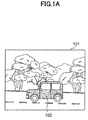
- FIG. 1A is an explanatory drawing showing an example of a still image in which a reference object is depicted.
- an automobile 102 that is the reference object is depicted in the still image 101.
- the automobile 102 is depicted facing left in the center of the image. That is to say, the still image 101 was obtained by photographing the automobile 102 from a camera positioned directly to the left as viewed from the driver of the automobile 102.
- the reference region region where the reference object is depicted in the still image
- the reference image is called the reference image
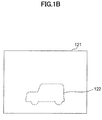
- a reference region 122 surrounded by a dotted line is shown within an entire region 121 of the still image 101.
- the entire region 121 corresponds to the still image 101 as a whole
- the reference region 122 corresponds to the region where the automobile 102 (the reference object) is depicted in the still image 101.
- FIG. 1C shows a reference image 123 with the external appearance of the automobile 102 (reference object) alone cut out from the still image 101.
- a search is made for a video in which a target object resembling the reference object expressed by the reference image 123 appears.
- the user specifies as search keys a desired position and a desired orientation.
- search keys a desired position and a desired orientation.
- the explanation is for an example in which the user has specified the upper right of the screen frame as the desired position and downward to the left as the desired orientation.
- the user wants as search results videos in which a target object resembling the reference object appears in the upper right of the screen frame with an orientation downward to the left.
- an automobile 202 resembling this automobile 102 (which may be the same as the automobile 102) is depicted as the target object in the frame image 201 thought to be for which the user wants to search.
- videos that include the frame image 201 in which the target object (automobile 202) resembling the reference object (automobile 102) depicted in the still image 101 appear are search result candidates.
- the automobile 202 appears in the upper right of the screen frame facing downward to the left. That is to say, the desired video is a video including an instant in which the automobile 202 was photographed by a camera positioned to the front and looking downward to the left as viewed from the driver of the automobile 202.
- the region where the target object is depicted in the frame image is called the local region and the image depicted in this local region is called the local image.
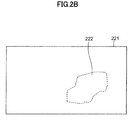
- FIG. 2B is an explanatory drawing showing the condition of the local region in the frame image 201
- FIG. 2C is an explanatory drawing showing the condition of the local image. The explanation below makes reference to these images.
- a target region 222 enclosed by a dotted line is shown in the entire region 221 of the frame image 201.
- the entire region 221 corresponds to the frame image 201 as a whole and the target region 222 corresponds to the region in which the automobile 202 (target object) is depicted within the frame image 201.
- FIG. 2C shows the target image 223 as the external appearance of the automobile 202 (target object) cut out from the frame image 201.
- a video is searched such that the reference object expressed by the reference image 123 and the target object expressed by the target image 223 are similar.
- the still image 101 is the automobile 102 photographed from the left side, so it is not possible to obtain a composition similar to the target object 223 even implementing affine transformations including rotation, reversal, planar shifts, enlargement/reduction, shearing and/or the like of the reference image 123.
- the user specifies a correspondence relationship between the reference image in the still image 101 and the target image in the frame image 201.
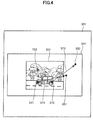
- FIGS. 3 and 4 are explanatory drawing showing the condition in which a user specifies the correspondence relationship between the reference image and the target image. The explanation below makes reference to these drawings.
- the still image 101 is enlarged or reduced and positioned so as to occupy the center of the video frame 331, but in the example shown in FIG. 4 , the still image 101 is positioned separated from the video frame 331.
- the user designates the target positions 351 and 352 where the locations (front edge and back edge) corresponding to the target object (automobile 202) should be depicted in the video frame 331.
- the aspect ratio of the video frame 331 is 9:16, and matches in size the video image that is the search target. Accordingly, the target positions 351 and 352 designated by the user in the video frame 331 are used as positions directly expressing the position and orientation where the automobile 202 that is the target object 202 should be appear.
- the vertical and horizontal of those videos are made to match by stretching or contracting horizontally and vertically the 9:16 video frame 331. That is to say, as the target position in a video having a different aspect ratio or vertical and horizontal pixel counts, it would be fine to use not the target positions 351 and 352 the user directly designated in the video frame 331 but rather those moved through expansion or contraction as described above.
- the receiver 502 receives input of the below information as search conditions (step S601).
- the functions of the receiver 502 are realized by the working together of a display or mouse, touch screen or touch panel, under control of the CPU.
- the extractor 503 extracts the reference image depicted in the reference region based on the reference positions 311 and 312 (step S602).
- the user specifies the still image 101 when the reference object is depicted.
- the user specifies the reference positions 311 and 312 where the locations the user thinks are the marks of the reference object are depicted, in the still image 101.
- the extractor 503 extracts the reference image from the information regarding the still image 101 and the reference positions 311 and 312 by using image processing technology.
- FIG. 7 is an explanatory drawing showing the condition of the reference image obtained by the user's specification shown in FIGS. 3 and 4 . The explanation below makes reference to this drawing.
- a reference image 701 shows the external appearance of the reference object as photographed from a given shooting direction.
- the automobile 101 is photographed from the left side, and the background is removed from the photographed image. That is to say, the outer edge of the reference region corresponds to a boundary line dividing the reference object from the background in the still image 101.
- the reference image 701 is the reference image including the reference positions 311 and 312 cut away from the still image 101, so the reference positions 311 and 312 are both contained within the reference region and are position locations that are marks of the reference object in the reference image 701.
- searcher 504 repeats the below process for each of multiple videos (step S603).
- a frame image that is a frame image in which the video is included and in which a local image similar to the reference image 701 is depicted (hereafter called a 'similar frame image") is searched for, and a determination is made as to whether or not a similar frame image is contained in the video (step S604).
- the video is composed of a string of multiple frame images in chronological order.
- the video frame 331 prepared in the frame 301 it is possible to playback the video by displaying the frame videos in order at a prescribed time interval (for example, one-thirtieth of a second or one-sixtieth of a second are common). That is to say, a frame image can be thought of as a type of still image.
- the multiple videos are recorded in advance in a video database and/or the like. Multiple frame images are included for each video.
- a determination is made as to whether or not a local image resembling the reference image 701 is depicted in each frame image by applying various types of image similarity determination technology and image recognition technology.
- FIG. 8 is an explanatory drawing showing an example of a video containing frame images having a local image resembling the reference image 701. The explanation below makes reference to this drawing.
- a video 801 comprises a string of multiple frame images 802a, 802b, ..., 802f, ... 802i, 802j, ... (in this drawing, the time interval of the frame images is lengthened in order to facilitate understanding. That is to say, the frame images are shown curtailed from typical videos).
- the reference will be to "frame images 802", omitting the letter at the end of the reference number.
- the automobile 202 resembling the automobile 102 that is the reference object is depicted.
- the shooting direction differs, so in the frame images 802a, 802b, 802i and 802j, an image resembling the reference image 701 is not depicted.
- the automobile 202 with virtually the same shooting direction is depicted, and this corresponds to a local image. 803. That is to say, the local image 803 and the reference image 701 have mutually corresponding characteristic points, and the local image 803 and the reference image 701 can be made to overlap by undertaking a transformation such as enlarging or reducing, parallel shifting, rotating or reversing the reference image 701.
- local characteristic amounts such as SIFT, HOG and/or the like are calculated in advance and stored in a database. Furthermore, the local characteristic amounts are calculated for the reference image 701 and the database is searched for a frame image 802 having a local characteristic amount similar to this local characteristic amount.
- the searcher 504 determines where in the local image 803 the reference positions 311 and 312 are positioned when the reference image 701 overlaps the local image 803 (below, this position is called the "start position"). That is to say, the searcher 504 finds the start position corresponding to the reference positions 311 and 312 in the reference region, in the local region in which the local image 803 is depicted in the searched similar frame image 802f (step S605).
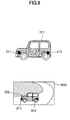
- FIG. 9 is an explanatory drawing showing the correspondence relationship between the reference image 701 and the similar frame image 802f. The explanation below makes reference to this drawing.
- black dots are displayed as the marks of the reference positions 311 and 312 at the front edge and back edge of the automobile 102 in the reference image 701.
- black marks are displayed as the marks of the start positions 811 and 812 at the front edge and back edge of the automobile 202 inside the automobile 202 corresponding to the local image 803 of the similar frame image 802f.
- the reference positions 311 and 312 are positions where positions selected as marks by the user on he reference object (automobile 102) are depicted in the reference image 701
- the locations corresponding to marks in the reference object are depicted as the start positions 811 and 812 on the local image 803 in the target object (automobile 202 similar to automobile 102).
- transformations such as enlarging or reducing, rotating, reversing and/or the like are done so that the reference image 701 overlaps the local image 803, and by similarly implementing these transformations on the reference positions 311 and 312, the start positions 811 and 812 are obtained.
- the searcher 504 traces how the pixels positioned at the start positions 811 and 812 in the similar frame image 802f (hereafter called “noteworthy pixels”) move in the video 801 and obtains the movement track thereof. That is to say, by scanning the frame images 802a, 802b, ..., 802i, 802j, ..., contained in the video 801 containing the searched similar frame image 802f in the chronological progress direction (the order of frame images 802g, 802h, 802i, 802j, ...) or retrogression direction (the order of frame images 802e, 802d, 802c, 802b,...) from the similar frame image, the searcher 504 traces the movement track along which the noteworthy pixels depicted at the start positions 811 and 812 in the searched similar frame image 802f move through being depicted in other frame images 802 (step S606).
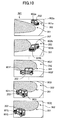
- FIG. 10 is an explanatory drawing showing the condition of movement of pixels in the video 801. The explanation below makes reference to this drawing.
- noteworthy pixels 901 and 902 are depicted at the start positions 811 and 812 of the similar frame image 802f, but these respectively depict the front edge and back edge of the automobile 202.
- the positions of the noteworthy pixels 901 and 902 depicting the front edge and back edge of the automobile 202 are shown in the frame images 802a, 802b, ..., 802f, ..., 802i, 802j, ..., contained in the video 801.
- an English letter corresponding to that frame image 802 is appended at the end of the reference numbers of the noteworthy pixels 901 and 902.
- target positions 351 and 352 referenced in later processes are displayed.
- the target positions 351 and 352 are designated from the user in the video frame 331, and the target positions 351 and 352 are obtained in each frame image 802 by enlarging/reducing and/or the like so that each frame image 802 fits neatly inside the video frame 331.
- the trace of the noteworthy pixels 901 and 902 does not necessarily mean tracing the track along which pixels of the same color move. That is to say, this means tracing where the location of the target object depicted in the frame images 802 by the noteworthy pixels 901 and 902 is depicted in another frame image 802. Accordingly, depending on the target object photography status and/or the like, the color of the noteworthy pixels 901 and 902 may gradually change.
- the frame images 802 are scanned in the chronological progress direction or retrogression direction from the similar frame image 802 contained in the video 801, and where the noteworthy pixels 901 and 902 are positioned in each frame image 802 is traced. Accordingly, movement tracks of the noteworthy pixels 901 and 902 are obtained.
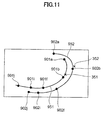
- FIG. 11 is an explanatory drawing showing movement tracks of the noteworthy pixels 901 and 902 in the video 801. The explanation below makes reference to this drawing.
- the noteworthy pixels 901 and 902 depict movement tracks 951 and 952 moving smoothly from the upper right of the screen (frame image 802a) to the lower left of the screen (from frame image 802j on) with the passage of time.
- the movement tracks 951 and 952 pass through the start positions 811 and 812, respectively, in the similar frame image 802f.
- the searcher 504 traces these movement tracks 951 and 952 with the passing of time, searches frame images (hereafter called "target frame images") where these simultaneously arrive close to the target positions 351 and 352, and determine whether or not the video 801 contains the target frame image (step S607).
- target frame images hereafter called "target frame images”
- the frame image 802b is found as the target frame image as a search result.
- this video 801 is output as a search result (step S608).
- step S603 on is repeated (step S609) and this process concludes when the process has been executed for all.
- step S608 It would be fine to display the output as search results in step S608 by immediately outputting such to the screen of a display and/or the like so that search results are additionally displayed on successive screens each time a desired video is discovered. Besides this, it would be fine in step S608 to accumulate search results by outputting such temporarily to a RAM and/or the like, and after repetition of steps S603 through S609 is completed, to display all at once on the screen of a display and/or the like.
- step S604 when no similar frame images are discovered (step S604; No), or when no target frame images are discovered (step S607: No), the process advances to step S609. Accordingly, this video 801 does not become a search result.
- a local image 803 is similar to a reference image 701 even when rotated by around 30 degrees, using image recognition technology such as SIFT and/or the like. However, when the angle of rotation exceeds this, or when the images are reversed and have a mirror-image relationship, detection is impossible.
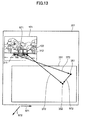
- FIGS. 12 and 13 are explanatory drawing explaining the relative position relationship of the reference positions 311 and 312 and the relative position relationship of the target positions 351 and 352. The explanation below makes reference to these drawings.
- a direction vector 971 going from the reference position 311 to the reference position 312 and a direction vector 972 going from the target position 351 to the target position 352 are shown in these drawings.
- the example shown in FIG. 12 makes reference to the example shown in FIG. 3 (and FIG. 4 ), and the direction vectors 971 and 972 form an acute angle.
- the reference image 701 is used in searching for similar frame images.
- the target positions 351 and 352 are designated so as to switch the front edge and the back edge of the reference positions 311 and 312 of the automobile 102 seeing from the left side in the still image 101, so as to search for a video in which an automobile 202 seeing from the right side and slightly upward appears.
- the direction vectors 971 and 972 form an obtuse angle.
- a mirror image is used in searching for a similar frame image.
- the angle that is the appropriate boundary for example using the reference image 701 if the angle formed by the direction vectors 971 and 972 is 60 degrees or less, using the mirror image if the angle formed by the direction vectors 971 and 972 is at least 120 degrees, and using both the reference image 701 and the mirror image if the angle formed by the direction vectors 971 and 972 is greater than 60 degrees but less than 120 degrees.
- the searched video 801 when the searched video 801 is reproduced, it is possible to find the track (hereafter called the "representative track") over which the target object 202 itself moves.
- each frame image 802 the region where the target object 202 is depicted is found and the pixel at the center point (centroid of the region) thereof is called a representative pixel. By tracing this representative pixel, it is possible to create the representative track over which the target object 202 moves in the video 801.
- a representative track 981 passes through the midpoint 908 of the noteworthy pixels 901 and 902 in each of the frame images 802. Accordingly, the representative track 981 is an average of the movement tracks 951 and 952 of movement of the noteworthy pixels 901 and 902.
- a video 801 in which the target object 202 similar to the reference object 102 appears at a position and attitude desired by the user is searched, from the user.
- the representative track 981 is output as a search result along with the searched video 801.
- FIG. 14B is an explanatory drawing showing the condition of a summary image for explaining a summary of a video 801 when the video 801 and the representative track 981 are output as search results. The explanation below makes reference to this drawing.
- a summary image 991 depicts the frame image 802b where the target object 202 similar to the reference object 102, out of the video 801 that is the search result, appears in the position and attitude desired by the user, with the representative track 981 overlaid in the shape of an arrow.
- the summary image 991 it is possible for the summary image 991 to use thumbnail images and/or the like when showing a summary display of the search result video, and it is possible to provide more detailed information relating to the obtained video 801 to the user by showing the representative track 981 as a search result.
- the representative track 981 where the target object 202 moves is output as search results, but in this preferred embodiment, the user is caused to input the track where the target object 202 should move (hereafter called the "target track") and videos in which the representative track 981 is similar to the target track become search results.
- the receiver 502 in addition to the above-described information also receives the input of a target track in the frame images contained in the video.
- FIG. 15 is an explanatory drawing showing the condition when the user has further designated the target track in the input example shown in FIG. 3 .
- the explanation below makes reference to this drawing.
- the user inputs an arrow 982 starting near the target positions 351 and 352 in the video frame 331, in addition to the arrows 371 and 372.
- This arrow 982 is the target track input by the user.
- the following process is executed after the target frame image 802b is discovered in the video 801 (step S607; Yes).
- FIG. 16 is a partial flowchart showing the content of a process added to the video search process in the flowchart shown in FIG. 6 .
- the explanation below makes reference to this drawing.
- step S607 when the target frame image 802b is discovered (step S607; Yes), the searcher 504 traces the frame images 802 in chronological order from the target frame image 802b to obtain the representative track 981 (step S621).
- step S622 a determination is made as to whether or not the representative track 981 obtained and the target track designated by the arrow 982 by the user are similar.
- step S622 When the representative track 981 and the target track are similar (step S622; Yes), the process advances to step S608 and that video is output as a search result.
- step S622 when the representative track 981 and the target track are not similar (step S622; No), the process advances to step S609 and the process is repeated with another video as the process subject.
- a video obtained by shooting in the real world using a camera was cited as an example of the video 801, but it is also possible to apply the same method to an arbitrary video, such as a video created through computer graphics of the condition of a virtual world viewed from a virtual point of view, or an animated video obtained by creating and arranging frame images one at a time through manual work, and/or the like.
- the reference positions 311 and 312 and the target positions 351 and 352 were designated by inputting the arrows 371 and 372, but it is also possible to use other parameters when the user draws the arrows 371 and 372.
- the size of a threshold value concerning whether or not a position is in the neighborhood of the target position is determined.
- the local information amount is a vector value
- the user more easily forecasts with what position as the target position a more appropriate search result can be obtained, and/or the like.
Landscapes
- Engineering & Computer Science (AREA)
- Multimedia (AREA)
- Theoretical Computer Science (AREA)
- Physics & Mathematics (AREA)
- General Physics & Mathematics (AREA)
- Library & Information Science (AREA)
- Data Mining & Analysis (AREA)
- Databases & Information Systems (AREA)
- General Engineering & Computer Science (AREA)
- Signal Processing (AREA)
- Computational Linguistics (AREA)
- Mathematical Physics (AREA)
- Computer Vision & Pattern Recognition (AREA)
- Information Retrieval, Db Structures And Fs Structures Therefor (AREA)
- Processing Or Creating Images (AREA)
- Television Signal Processing For Recording (AREA)
- User Interface Of Digital Computer (AREA)
- Image Analysis (AREA)
Abstract
Description
- The present invention relates to a video search device, video search method, recording medium and program for accomplishing video searches by enabling a user to easily specify an object that should appear in videos, along with the position, orientation and movement thereof.
- Previously, the SIFT (Scale Invariant Feature Transformation) disclosed in Non Patent Literature 1 and the HOG (Histograms of Oriented Gradients) disclosed in Non Patent Literature 2 have been proposed as art for recognizing objects depicted in still images and the characteristic points thereof. By applying this art, it is easy to determine whether or not the external appearance of objects depicted in two still images are similar, even if the objects are rotated, the magnification ratio differs or the luminosity differs. In addition, by applying the aforementioned art after reversing the object image showing the depicted object, it is possible to determine that images are similar even when the mirror image of the object is depicted.
- On the other hand, Particle Video is proposed in Non Patent Literatures 3 and 4 as art for tracing movement of an object in a video. By applying this art, it is possible to acquire in what position a given location on the surface of an object in the real world is depicted in each frame image included in the video, and it is possible to identify a track of movement including that depicted position. That is to say, with this art, it is possible to identify a track expressing how a given pixel in a given frame image moves with the forward or retrograde progress of time.
- Furthermore, art for searching other videos similar to the video specified by the user are proposed in Patent Literature 1.
- Patent Literature 1: Unexamined Japanese Patent Application Kokai Publication No.
2001-134589 - Non Patent Literature 1: D.G. Lowe, Object recognition from Local Scale-Invariant Features, Proceedings of IEEE International Conference on Computer Vision, pp. 1150-1157, 1999.
- Non Patent Literature 2: N. Dalal and B. Triggs, Histograms of Oriented Gradients for Human Detection, Proceedings of IEEE Computer Society Conference on Computer Vision and Pattern Recognition, pp. 886-893, 2005.
- Non Patent Literature 3: Peter Sand and Seth Teller, Particle Video: Long-Range Motion Estimation using Point Trajectories, International Journal of Computer Vision, vol. 80, no. 1, pp. 72-91, Springer, 2008.
- Non Patent Literature 4: Dan B. Goldman, Chris Gonterman, Brian Curless, David Salesin and Steven M. Seitz, Video Object Annotation, Navigation and Composition, UIST 2008, Proc. ACM symposium on User Interface Software and Technology, pp. 3-12, ACM 978-1-59593-975-3/08/10,
http://www.danbgoldman.com/uw/papers/ivoa.uist08.pdf, 2008. - However, when doing video searches, the demand that users want to be able to easily specify information such as the outward appearance, position, orientation and/or the like of an object depicted in the video remains great.
- In particular, when a still image in which the desired object is depicted has already been prepared, there is the demand that users want to be able to easily specify the position and orientation when that object appears in the video, using that still image.
- Even in videos in which an object shot in a different shooting direction or with a position or orientation differing from the orientation of the objected depicted in the still image appears, there is the strong demand that users want to be able to obtain such as search results.
- In consideration of the foregoing, it is an objective of the present invention to provide a video search device, video search method, recording medium and program for accomplishing video searches such that it is possible for a user to easily specify an object that should appear in videos, along with the position, orientation and furthermore movement thereof.
- The video search device according to a first aspect of the present invention comprises:
- a receiver for receiving input of a still image in which a reference object is depicted, a first reference position and a second reference position contained in a reference region in which the reference object in the still image is depicted, and a first target position and a second target position within a frame image contained in a video;
- an extractor for extracting a reference image depicted in the reference region based on the first reference position and the second reference position; and
- a searcher for searching for, out of multiple videos, similar frame images that are frame images contained in the videos and in which local images similar to the reference image are depicted, finding a first start position and a second start position corresponding to the first reference position and the second reference position in the reference region, in a local region in which the local image is depicted in the searched similar frame image, tracing a first movement track along which a first noteworthy pixel depicted at the first start position moves in the searched similar frame image and a second movement track along which a second noteworthy pixel depicted at the second start position moves, by scanning frame images contained in the video including the searched similar frame image in the chronological progress or retrogression direction from the searched similar frame image, searching a target frame image at which the first movement track reaches the neighborhood of the first target position and the second movement track reaches the neighborhood of the second target position, and producing as a search result a video including the searched similar frame image and the searched target frame image.
- In addition, in the video search device of the present invention, it is possible to have a composition such that:
- the receiver further receives input of a target track in a frame image including the video; and
- the searcher, for each of the searched videos, traces a representative track along which a representative pixel of a local image depicted in the searched target frame image moves, by scanning frame images contained in the searched video in the chronological direction from a target frame image included in the video, and produces as the search result a video in which the target track and the representative track are similar.
- In addition, in the video search device of the present invention, it is possible to have a composition such that the searcher, for each of the searched videos, traces a representative track along which a representative pixel of a local image depicted in the searched target frame image moves, by scanning frame images contained in the searched video in the chronological direction from a target frame image included in the video, and produces as the search result the representative track of those videos along with those videos.
- In addition, in the video search device of the present invention, it is possible to have a composition such that:
- the extractor obtains image characteristic amounts for the reference image; and
- the searcher searches for the similar frame images by searching for frame images having image characteristic amounts similar to the image characteristic amounts of the reference image.
- In addition, in the video search device of the present invention, it is possible to have a composition such that:
- the extractor further obtains image characteristic amounts of a mirror image that is a reversal of the reference image; and
- the searcher searches for the similar frame images by searching for frame images similar to the image characteristic amounts of the reference image or the image characteristic amounts of the mirror image.
- The video search method according to a second aspect of the present invention comprises the steps of:
- receiving input of a still image in which a reference object is depicted, a first reference position and a second reference position contained in a reference region in which the reference object in the still image is depicted, and a first target position and a second target position within a frame image contained in a video;
- extracting a reference image depicted in the reference region based on the first reference position and the second reference position; and
- searching for, out of multiple videos, similar frame images that are frame images contained in the videos and in which local images similar to the reference image are depicted, finding a first start position and a second start position corresponding to the first reference position and the second reference position in the reference region, in a local region in which the local image is depicted in the searched similar frame image, tracing a first movement track along which a first noteworthy pixel depicted at the first start position moves in the searched similar frame image and a second movement track along which a second noteworthy pixel depicted at the second start position moves, by scanning frame images contained in the video including the searched similar frame image in the chronological progress or retrogression direction from the searched similar frame image, searching a target frame image at which the first movement track reaches the neighborhood of the first target position and the second movement track reaches the neighborhood of the second target position, and producing as a search result a video including the searched similar frame image and the searched target frame image.
- The computer-readable recording medium according to a third aspect of the present invention is comprised so as to record a program that causes a computer to function as:
- a receiver for receiving input of a still image in which a reference object is depicted, a first reference position and a second reference position contained in a reference region in which the reference object in the still image is depicted, and a first target position and a second target position within a frame image contained in a video;
- an extractor for extracting a reference image depicted in the reference region based on the first reference position and the second reference position; and
- a searcher for searching for, out of multiple videos, similar frame images that are frame images contained in the videos and in which local images similar to the reference image are depicted, finding a first start position and a second start position corresponding to the first reference position and the second reference position in the reference region, in a local region in which the local image is depicted in the searched similar frame image, tracing a first movement track along which a first noteworthy pixel depicted at the first start position moves in the searched similar frame image and a second movement track along which a second noteworthy pixel depicted at the second start position moves, by scanning frame images contained in the video including the searched similar frame image in the chronological progress or retrogression direction from the searched similar frame image, searching a target frame image at which the first movement track reaches the neighborhood of the first target position and the second movement track reaches the neighborhood of the second target position, and producing as a search result a video including the searched similar frame image and the searched target frame image.
- The program according to a fourth aspect of the present invention is comprised so as to cause a computer to function as:
- a receiver for receiving input of a still image in which a reference object is depicted, a first reference position and a second reference position contained in a reference region in which the reference object in the still image is depicted, and a first target position and a second target position within a frame image contained in a video;
- an extractor for extracting a reference image depicted in the reference region based on the first reference position and the second reference position; and
- a searcher for searching for, out of multiple videos, similar frame images that are frame images contained in the videos and in which local images similar to the reference image are depicted, finding a first start position and a second start position corresponding to the first reference position and the second reference position in the reference region, in a local region in which the local image is depicted in the searched similar frame image, tracing a first movement track along which a first noteworthy pixel depicted at the first start position moves within the searched similar frame image and a second movement track along which a second noteworthy pixel depicted at the second start position moves, by scanning frame images contained in the video including the searched similar frame image in the chronological progress or retrogression direction from the searched similar frame image, searching a target frame image at which the first movement track reaches the neighborhood of the first target position and the second movement track reaches the neighborhood of the second target position, and producing as a search result a video including the searched similar frame image and the searched target frame image.
- It is possible to record the program of the present invention on a computer-readable non-transitory recording medium such as a compact disc, a flexible disk, a hard disk, an magneto-optical disc, a digital video disc, magnetic tape, semiconductor memory and/or the like. In addition, it is possible for such recording media to be distributed and sold independently of a computer.
- In addition, it is possible for the program of the present invention to be loaded from the above-described recording medium into a recording medium readable and writable by a computer, such as RAM (Random Access Memory) and/or the like, and be temporarily stored, and for a CPU (Central Processing Unit) to read, interpret and execute the program recorded in the RAM and/or the like.
- Furthermore, it is possible for the program of the present invention to be distributed and sold via a transitory transmission medium such as a computer communication network and/or the like, independent of the computer that executes the program.
- With the present invention, it is possible to provide a video search device, video search method, recording medium and program for accomplishing video searches such that it is possible for a user to easily specify an object that should appear in videos, along with the position, orientation and furthermore movement thereof.
-
-
FIG. 1A is an explanatory drawing showing an example of a still image in which a reference object is depicted; -
FIG. 1B is an explanatory drawing showing the condition of a reference region in the still image; -
FIG. 1C is an explanatory drawing showing the condition of a reference image; -
FIG. 2A is an explanatory drawing showing an example of the position and orientation where a target object should be positioned in a frame image included in a video; -
FIG. 2B is an explanatory drawing showing the condition of a local region in the frame image; -
FIG. 2C is an explanatory drawing showing the condition of a local image; -
FIG. 3 is an explanatory drawing showing the condition in which a user specifies the correspondence relationship between the reference image and the target image; -
FIG. 4 is an explanatory drawing showing the condition in which a user specifies the correspondence relationship between the reference image and the target image; -
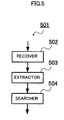
FIG. 5 is an explanatory drawing showing the summary composition of a video search device according to an example of the present invention; -
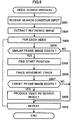
FIG. 6 is a flowchart showing the flow of control of the video search process executed by a video search device according to an example of the present invention; -
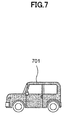
FIG. 7 is an explanatory drawing showing the condition of the reference image obtained by user specification; -
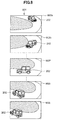
FIG. 8 is an explanatory drawing showing an example of a video containing a frame image having a local image similar to the reference image; -
FIG. 9 is an explanatory drawing showing the correspondence relationship between the reference image and the similar frame image; -
FIG. 10 is an explanatory drawing showing the condition of movement of pixels in the video; -
FIG. 11 is an explanatory drawing showing the track of movement of pixels in the video; -
FIG. 12 is an explanatory drawing showing an explanation of the relative position relationship of the reference positions and the relative position relationship of the target position; -
FIG. 13 is an explanatory drawing showing an explanation of the relative position relationship of the reference positions and the relative position relationship of the target positions; -
FIG. 14A is an explanatory drawing showing the condition of a representative track; -
FIG. 14B is an explanatory drawing showing the condition of a summary image; -
FIG. 15 is an explanatory drawing showing the condition when a user specifies a target track; and -
FIG. 16 is a flowchart showing the contents of a process followed in the video search process. - Below the preferred embodiment of the present invention is explained. However, this preferred embodiment is intended to be illustrative and not limiting to the scope of the present invention. Accordingly, the preferred embodiment may be modified in arrangement and detail without departing from the principles disclosed herein and that it is intended that the application be construed as including all such modifications and variations insofar as they come within the spirit and scope of the subject matter disclosed herein.
- It is possible for a video search device according to the present invention to be realized by executing a prescribed program in various computers, such as a server computer or a personal computer, and/or the like.
- A computer is hardware for receiving instructions from a user through an input device such as a keyboard, a mouse and/or the like, outputting results of processes to an output device such as a display and/or the like, and accomplishing the above-described input and output by communicating with other equipment via a NIC (Network Interface Card), by the CPU executing a program using RAM as a temporary memory region or output designation for process results, and it is also possible to appropriately omit equipment for input and output.
- A program executed by the CPU and a database in which are stored records expressing various types of information that is the target of processing by the CPU are recorded on a hard disk drive and/or the like of the computer. The CPU accomplishes processes such as searching records matching a search query from the database and appending new records to the database.
- In this preferred embodiment, in addition to multiple videos, local information from which the various frame images contained in the video are considered as still images are recorded in the database.
- In addition, it is also possible to speed up the processes of the video search device according to the present invention by having multiple computers, connected via a computer communication network such as dedicated connection lines, communication circuits, the Internet and/or the like, execute the above-described process in parallel, decentralized and concurrently.
- Besides this, it is also possible to realize the video search device of the present invention by creating an electronic circuit design from programs through application of technology such as FPGA (Field Programmable Gate Array) and/or the like and organizing special electronic circuits based on this design.
- With this preferred embodiment, the user specifies what kind of video is to be obtained by specifying various information along with still images. Below, methods for specifying such information will be explained first.
- With this preferred embodiment, the user specifies the desired position and desired orientation of the desired object in the screen frame. Furthermore, the video search device searches for videos in which appear objects (hereafter called "target objects") resembling the object (hereafter called the "reference object") having the desired orientation at the desired location.
- Thinking of this in comparison to document searches, the reference object corresponds to the character string that is the search key and the target objects correspond to character strings appearing in the document obtained as a result of accomplishing the search.
- In a document search, it is possible to search for documents in which character strings perfectly matching the search key appear and it is also possible to search for documents in which character strings similar to the search key (having various conditions, such as synonyms or variations in spelling) appear. That is to say, the search key and character strings appearing in character strings that are search results do not necessarily match.
- Similarly, with this preferred embodiment, the user specifies as a search key a reference object depicted in a still image, a desired location and a desired orientation.
- Whereupon, the video search device searches for videos in which a target object resembling the reference object appears in the desired position with the desired orientation.
- In order to facilitate understanding, below the explanation will use an automobile as an example of an object.
- First, the user inputs one still image in which the reference object corresponding to the search key is depicted, using, for example, an image search engine and/or the like.
-
FIG. 1A is an explanatory drawing showing an example of a still image in which a reference object is depicted. - As shown in this drawing, an
automobile 102 that is the reference object is depicted in thestill image 101. In this drawing, theautomobile 102 is depicted facing left in the center of the image. That is to say, thestill image 101 was obtained by photographing theautomobile 102 from a camera positioned directly to the left as viewed from the driver of theautomobile 102. - Below, to facilitate understanding the region where the reference object is depicted in the still image is called the reference region and the image depicted in this reference region is called the reference image.
-
FIG. 1B is an explanatory drawing showing the condition of the reference region within thestill image 101, andFIG. 1C is an explanatory drawing showing the condition of the reference image. These are explained below with reference to the drawings. - In
FIG. 1B , areference region 122 surrounded by a dotted line is shown within anentire region 121 of thestill image 101. Theentire region 121 corresponds to thestill image 101 as a whole, and thereference region 122 corresponds to the region where the automobile 102 (the reference object) is depicted in thestill image 101. -
FIG. 1C shows areference image 123 with the external appearance of the automobile 102 (reference object) alone cut out from thestill image 101. In this preferred embodiment, a search is made for a video in which a target object resembling the reference object expressed by thereference image 123 appears. - As described above, the user specifies as search keys a desired position and a desired orientation. Below, the explanation is for an example in which the user has specified the upper right of the screen frame as the desired position and downward to the left as the desired orientation.
- In this example, it is considered that the user wants as search results videos in which a target object resembling the reference object appears in the upper right of the screen frame with an orientation downward to the left.
-
FIG. 2A is an explanatory drawing showing an example of the position and orientation where the target object should be positioned in the frame image contained in the video. The explanation below makes reference to this image. - In the example shown in this drawing, an
automobile 202 resembling this automobile 102 (which may be the same as the automobile 102) is depicted as the target object in theframe image 201 thought to be for which the user wants to search. - That is to say, with this preferred embodiment, videos that include the
frame image 201 in which the target object (automobile 202) resembling the reference object (automobile 102) depicted in thestill image 101 appear are search result candidates. - In the
frame image 201, theautomobile 202 appears in the upper right of the screen frame facing downward to the left. That is to say, the desired video is a video including an instant in which theautomobile 202 was photographed by a camera positioned to the front and looking downward to the left as viewed from the driver of theautomobile 202. - To facilitate understanding below, the region where the target object is depicted in the frame image is called the local region and the image depicted in this local region is called the local image.
-
FIG. 2B is an explanatory drawing showing the condition of the local region in theframe image 201, andFIG. 2C is an explanatory drawing showing the condition of the local image. The explanation below makes reference to these images. - In
FIG. 2B , atarget region 222 enclosed by a dotted line is shown in theentire region 221 of theframe image 201. Theentire region 221 corresponds to theframe image 201 as a whole and thetarget region 222 corresponds to the region in which the automobile 202 (target object) is depicted within theframe image 201. -
FIG. 2C shows thetarget image 223 as the external appearance of the automobile 202 (target object) cut out from theframe image 201. - With this preferred embodiment, a video is searched such that the reference object expressed by the
reference image 123 and the target object expressed by thetarget image 223 are similar. - However, the
still image 101 is theautomobile 102 photographed from the left side, so it is not possible to obtain a composition similar to thetarget object 223 even implementing affine transformations including rotation, reversal, planar shifts, enlargement/reduction, shearing and/or the like of thereference image 123. - In this example, while the front of the
automobile 102 clearly cannot be seen in thestill image 101, the front of theautomobile 202 can be seen well in theframe image 201. - In general, if image search art is used, it is not impossible to obtain a still image in which the reference object desired by the user appears.
- However, there are virtually no cases in which the position and orientation with which the reference object is depicted in that still image along with the shooting direction and angle of the reference object match as-is the position and orientation with which the target object is depicted in the frame image contained in the video along with the shooting direction and angle of the target object.
- Hence, with this preferred embodiment, the user specifies a correspondence relationship between the reference image in the
still image 101 and the target image in theframe image 201. -
FIGS. 3 and4 are explanatory drawing showing the condition in which a user specifies the correspondence relationship between the reference image and the target image. The explanation below makes reference to these drawings. - In the examples shown by these drawings, a
video frame 331 expressing a region where a video including thestill image 101 and theframe image 201 should be reproduced within thescreen 301 is displayed. - In the example shown in
FIG. 3 , thestill image 101 is enlarged or reduced and positioned so as to occupy the center of thevideo frame 331, but in the example shown inFIG. 4 , thestill image 101 is positioned separated from thevideo frame 331. - This is because in general the aspect ratio differs between the
still image 101 and thevideo frame 331. - Here, the user accomplishes:
- (a) a designation by drawing an
arrow 371 from areference position 311 where the front edge of theautomobile 102 is depicted in thestill image 101 to atarget position 351 where the front edge of theautomobile 202 should be depicted in thevideo frame 331; and - (b) a designation by drawing an
arrow 372 from areference position 312 where the back edge of theautomobile 102 is depicted in thestill image 101 to atarget position 352 where the back edge of theautomobile 202 should be depicted in thevideo frame 331. - These designations are accomplished for example by a drag-and-drop operation using a mouse or a slide operation on a touch screen or touch panel (an operation of touching the screen with a finger, and then removing the finger after causing the finger to move while still in contact).
- With this preferred embodiment, the user selects the locations (front edge and back edge) that are to be marks of the reference object (automobile 102) by designating
reference positions - Furthermore, the user designates the target positions 351 and 352 where the locations (front edge and back edge) corresponding to the target object (automobile 202) should be depicted in the
video frame 331. - In the examples shown in these drawings, the aspect ratio of the
video frame 331 is 9:16, and matches in size the video image that is the search target. Accordingly, the target positions 351 and 352 designated by the user in thevideo frame 331 are used as positions directly expressing the position and orientation where theautomobile 202 that is thetarget object 202 should be appear. - On the other hand, for videos having different aspect ratios or videos with different vertical and horizontal pixels counts, the vertical and horizontal of those videos are made to match by stretching or contracting horizontally and vertically the 9:16
video frame 331. That is to say, as the target position in a video having a different aspect ratio or vertical and horizontal pixel counts, it would be fine to use not the target positions 351 and 352 the user directly designated in thevideo frame 331 but rather those moved through expansion or contraction as described above. - With this preferred embodiment, it is possible to search for video images by specifying through a simple operation in what position and orientation the target object should appear in a frame image contained in the video. Below, details of the video search art are explained.
-
FIG. 5 is an explanatory drawing showing the summary composition of a video search device according to an example of the present invention.FIG. 6 is flowchart showing the flow of control in a video search process executed by the video search device according to an example embodiment of the present invention. - A
video search device 501 according to this preferred embodiment is realized by a prescribed program being executed in a computer, and comprises areceiver 502, anextractor 503 and asearcher 504. - The
receiver 502 receives input of the below information as search conditions (step S601). - (a) still
image 101. - (b)
reference positions arrows 371 and 372). - (c)
target positions arrows 371 and 372). - As described above, the functions of the
receiver 502 are realized by the working together of a display or mouse, touch screen or touch panel, under control of the CPU. - Next, the
extractor 503 extracts the reference image depicted in the reference region based on the reference positions 311 and 312 (step S602). - As described above, with this preferred embodiment, the user specifies the
still image 101 when the reference object is depicted. In addition, the user specifies the reference positions 311 and 312 where the locations the user thinks are the marks of the reference object are depicted, in thestill image 101. - The
extractor 503 extracts the reference image from the information regarding thestill image 101 and the reference positions 311 and 312 by using image processing technology. -
FIG. 7 is an explanatory drawing showing the condition of the reference image obtained by the user's specification shown inFIGS. 3 and4 . The explanation below makes reference to this drawing. - As shown in the drawing, a
reference image 701 shows the external appearance of the reference object as photographed from a given shooting direction. In this example, theautomobile 101 is photographed from the left side, and the background is removed from the photographed image. That is to say, the outer edge of the reference region corresponds to a boundary line dividing the reference object from the background in thestill image 101. - In extracting the
reference image 701, it is possible to use various types of image recognition technology. For example, after extracting the outline of thestill image 101 and accomplishing region separation, regions that include the reference positions 311 and 312 are selected. Furthermore, regions interposed between the selected regions, regions adjacent to the selected regions and regions with small differences in average color and/or the like are bonded, and a reference region is obtained by repeating this. In addition, it would also be fine to use the art disclosed in Patent Literature 1. - The
reference image 701 is the reference image including the reference positions 311 and 312 cut away from thestill image 101, so the reference positions 311 and 312 are both contained within the reference region and are position locations that are marks of the reference object in thereference image 701. - The
extractor 503 is realized by the CPU working together with RAM and/or the like where pixel information of thestill image 101 is recorded. - Furthermore, the
searcher 504 repeats the below process for each of multiple videos (step S603). - First, a frame image that is a frame image in which the video is included and in which a local image similar to the
reference image 701 is depicted (hereafter called a 'similar frame image") is searched for, and a determination is made as to whether or not a similar frame image is contained in the video (step S604). - The video is composed of a string of multiple frame images in chronological order. In the
video frame 331 prepared in theframe 301, it is possible to playback the video by displaying the frame videos in order at a prescribed time interval (for example, one-thirtieth of a second or one-sixtieth of a second are common). That is to say, a frame image can be thought of as a type of still image. - With this preferred embodiment, the multiple videos are recorded in advance in a video database and/or the like. Multiple frame images are included for each video. Here, a determination is made as to whether or not a local image resembling the
reference image 701 is depicted in each frame image by applying various types of image similarity determination technology and image recognition technology. -
FIG. 8 is an explanatory drawing showing an example of a video containing frame images having a local image resembling thereference image 701. The explanation below makes reference to this drawing. - As shown in the drawings, a
video 801 comprises a string ofmultiple frame images - In the frame images 802, the
automobile 202 resembling theautomobile 102 that is the reference object is depicted. - However, in the
frame images frame images reference image 701 is not depicted. - On the other hand, in the
frame image 802f, theautomobile 202 with virtually the same shooting direction is depicted, and this corresponds to a local image. 803. That is to say, the local image 803 and thereference image 701 have mutually corresponding characteristic points, and the local image 803 and thereference image 701 can be made to overlap by undertaking a transformation such as enlarging or reducing, parallel shifting, rotating or reversing thereference image 701. - In order to detect an image resembling the reference image from within the frame image 802, various types of image recognition, image detection and pattern recognition technology are applied.
- For example, in each of the frame images 802 included in the various videos, local characteristic amounts such as SIFT, HOG and/or the like are calculated in advance and stored in a database. Furthermore, the local characteristic amounts are calculated for the
reference image 701 and the database is searched for a frame image 802 having a local characteristic amount similar to this local characteristic amount. - When the local characteristic amount of the frame image included in a given video is registered in the database, if the local characteristic amounts of mutually adjacent frame images 802 are similar, it is possible to control data volumes and speed searching by registering such with an appropriate thinning.
- In this manner, if a similar frame image in which a local image 803 similar to the
reference image 701 is depicted (in the example shown in the drawings, theframe image 802f corresponds to the similar frame image) (step S604; Yes), thesearcher 504 determines where in the local image 803 the reference positions 311 and 312 are positioned when thereference image 701 overlaps the local image 803 (below, this position is called the "start position"). That is to say, thesearcher 504 finds the start position corresponding to the reference positions 311 and 312 in the reference region, in the local region in which the local image 803 is depicted in the searchedsimilar frame image 802f (step S605). -
FIG. 9 is an explanatory drawing showing the correspondence relationship between thereference image 701 and thesimilar frame image 802f. The explanation below makes reference to this drawing. - In this drawing, black dots are displayed as the marks of the reference positions 311 and 312 at the front edge and back edge of the
automobile 102 in thereference image 701. - On the other hand, black marks are displayed as the marks of the start positions 811 and 812 at the front edge and back edge of the
automobile 202 inside theautomobile 202 corresponding to the local image 803 of thesimilar frame image 802f. - The reference positions 311 and 312 are positions where positions selected as marks by the user on he reference object (automobile 102) are depicted in the
reference image 701 - On the other hand, the locations corresponding to marks in the reference object (automobile 102) are depicted as the start positions 811 and 812 on the local image 803 in the target object (
automobile 202 similar to automobile 102). - When detecting the local image 803 similar to the
reference image 701, transformations such as enlarging or reducing, rotating, reversing and/or the like are done so that thereference image 701 overlaps the local image 803, and by similarly implementing these transformations on the reference positions 311 and 312, the start positions 811 and 812 are obtained. - Following this, the
searcher 504 traces how the pixels positioned at the start positions 811 and 812 in thesimilar frame image 802f (hereafter called "noteworthy pixels") move in thevideo 801 and obtains the movement track thereof. That is to say, by scanning theframe images video 801 containing the searchedsimilar frame image 802f in the chronological progress direction (the order offrame images frame images 802e, 802d, 802c, 802b,...) from the similar frame image, thesearcher 504 traces the movement track along which the noteworthy pixels depicted at the start positions 811 and 812 in the searchedsimilar frame image 802f move through being depicted in other frame images 802 (step S606). -
FIG. 10 is an explanatory drawing showing the condition of movement of pixels in thevideo 801. The explanation below makes reference to this drawing. - As shown in this drawing,
noteworthy pixels 901 and 902 are depicted at the start positions 811 and 812 of thesimilar frame image 802f, but these respectively depict the front edge and back edge of theautomobile 202. - In this drawing, the positions of the
noteworthy pixels 901 and 902 depicting the front edge and back edge of theautomobile 202 are shown in theframe images video 801. In eachframe image noteworthy pixels 901 and 902. - In addition, in this drawing, target positions 351 and 352 referenced in later processes are displayed. The target positions 351 and 352 are designated from the user in the
video frame 331, and the target positions 351 and 352 are obtained in each frame image 802 by enlarging/reducing and/or the like so that each frame image 802 fits neatly inside thevideo frame 331. - It is possible to obtain this kind of trace of the
noteworthy pixels 901 and 902 by finding the correspondence relationship among characteristic points in adjacent frame images 802 using art such as SIFT, HOG and/or the like and then interpolating changes in positions of corresponding characteristic points, and through this calculating how the positions of thenoteworthy pixels 901 and 902 in one frame image 802 move in the other frame image 802. In addition, a trace of thenoteworthy pixels 901 and 902 is possible even by applying Particle Video art. - The trace of the
noteworthy pixels 901 and 902 does not necessarily mean tracing the track along which pixels of the same color move. That is to say, this means tracing where the location of the target object depicted in the frame images 802 by thenoteworthy pixels 901 and 902 is depicted in another frame image 802. Accordingly, depending on the target object photography status and/or the like, the color of thenoteworthy pixels 901 and 902 may gradually change. - In this manner, the frame images 802 are scanned in the chronological progress direction or retrogression direction from the similar frame image 802 contained in the
video 801, and where thenoteworthy pixels 901 and 902 are positioned in each frame image 802 is traced. Accordingly, movement tracks of thenoteworthy pixels 901 and 902 are obtained. -
FIG. 11 is an explanatory drawing showing movement tracks of thenoteworthy pixels 901 and 902 in thevideo 801. The explanation below makes reference to this drawing. - As shown in this drawing, in the
video 801 thenoteworthy pixels 901 and 902 depict movement tracks 951 and 952 moving smoothly from the upper right of the screen (frame image 802a) to the lower left of the screen (fromframe image 802j on) with the passage of time. The movement tracks 951 and 952 pass through the start positions 811 and 812, respectively, in thesimilar frame image 802f. - The
searcher 504 traces these movement tracks 951 and 952 with the passing of time, searches frame images (hereafter called "target frame images") where these simultaneously arrive close to the target positions 351 and 352, and determine whether or not thevideo 801 contains the target frame image (step S607). - Returning to
FIG. 10 , when the positions of thenoteworthy pixels 901 and 902 in each frame image 802 are compared to the target positions 351 and 352, it is understood inframe image 802b that these are positioned close. Accordingly, in this example, theframe image 802b is found as the target frame image as a search result. - In this manner, if a target frame image is found (step S607; Yes), this
video 801 is output as a search result (step S608). - Furthermore, for all
videos 801 recorded in the database, the process from step S603 on is repeated (step S609) and this process concludes when the process has been executed for all. - It would be fine to display the output as search results in step S608 by immediately outputting such to the screen of a display and/or the like so that search results are additionally displayed on successive screens each time a desired video is discovered. Besides this, it would be fine in step S608 to accumulate search results by outputting such temporarily to a RAM and/or the like, and after repetition of steps S603 through S609 is completed, to display all at once on the screen of a display and/or the like.
- On the other hand, when no similar frame images are discovered (step S604; No), or when no target frame images are discovered (step S607: No), the process advances to step S609. Accordingly, this
video 801 does not become a search result. - In this manner, in this preferred embodiment even when the composition in which the reference object is depicted in the
still image 101 and the composition in which the target object appears in thevideo 801 are completely different, it is possible for a user to easily accomplish searching of videos by simply inputting the correspondence relationship between the reference positions 311 and 312 that are marks in thestill image 101 and the target positions 351 and 352 in these video frames 331. - In particular, in this preferred embodiment it is possible to easily and quickly accomplish video searches because searches are executed through a two-dimensional image process.
- At present, it is possible to determine whether or not a local image 803 is similar to a
reference image 701 even when rotated by around 30 degrees, using image recognition technology such as SIFT and/or the like. However, when the angle of rotation exceeds this, or when the images are reversed and have a mirror-image relationship, detection is impossible. - In such a case, it would be good if besides local characteristic amounts of the
reference image 701, a mirror image of thisreference image 701 reversed were prepared and the local characteristic amounts of this mirror image were also found, and for frame images 802 having local characteristic amounts similar to either of these two local characteristic amounts to be searched from the database. - In searching for similar frame images, it would be fine to constantly use both the
reference image 701 and the mirror image thereof, but it is also possible to selectively use one of thereference image 701 and the mirror image. - For example, it is possible to use the relative position relationship of the reference positions 311 and 312 and the relative position relationship of the target positions 351 and 352.
-
FIGS. 12 and13 are explanatory drawing explaining the relative position relationship of the reference positions 311 and 312 and the relative position relationship of the target positions 351 and 352. The explanation below makes reference to these drawings. - A
direction vector 971 going from thereference position 311 to thereference position 312 and adirection vector 972 going from thetarget position 351 to thetarget position 352 are shown in these drawings. - The example shown in
FIG. 12 makes reference to the example shown inFIG. 3 (andFIG. 4 ), and thedirection vectors reference image 701 is used in searching for similar frame images. - On the other hand, in the example shown in
FIG. 13 , the target positions 351 and 352 are designated so as to switch the front edge and the back edge of the reference positions 311 and 312 of theautomobile 102 seeing from the left side in thestill image 101, so as to search for a video in which anautomobile 202 seeing from the right side and slightly upward appears. - Accordingly, the
direction vectors - Besides this, there is also a method of determining the angle that is the appropriate boundary, for example using the
reference image 701 if the angle formed by thedirection vectors direction vectors reference image 701 and the mirror image if the angle formed by thedirection vectors - These methods are based on heuristics such as thinking that reversal in the horizontal direction is more typical than reversal in the vertical direction when shooting video and in addition that this is what the user wants to search, and with these it is possible to increase the speed of video searches.
- With the information obtained from the above-described examples, when the searched
video 801 is reproduced, it is possible to find the track (hereafter called the "representative track") over which thetarget object 202 itself moves. - For example, in each frame image 802, the region where the
target object 202 is depicted is found and the pixel at the center point (centroid of the region) thereof is called a representative pixel. By tracing this representative pixel, it is possible to create the representative track over which thetarget object 202 moves in thevideo 801. - In addition, as a method with simpler computations, there is a method that takes as the representative pixel the pixel at the position of the midpoint of the
noteworthy pixels 901 and 902 in each frame image 802. -
FIG. 14A is an explanatory drawing showing the state of the representative track for the example shown inFIG. 11 . The explanation below makes references to this drawing. - As shown in this drawing, a
representative track 981 passes through the midpoint 908 of thenoteworthy pixels 901 and 902 in each of the frame images 802. Accordingly, therepresentative track 981 is an average of the movement tracks 951 and 952 of movement of thenoteworthy pixels 901 and 902. - In the
video search device 501 according to this preferred embodiment, avideo 801 in which thetarget object 202 similar to thereference object 102 appears at a position and attitude desired by the user is searched, from the user. - Hence, in this preferred embodiment, the
representative track 981 is output as a search result along with the searchedvideo 801. -
FIG. 14B is an explanatory drawing showing the condition of a summary image for explaining a summary of avideo 801 when thevideo 801 and therepresentative track 981 are output as search results. The explanation below makes reference to this drawing. - As shown in this drawing, a
summary image 991 depicts theframe image 802b where thetarget object 202 similar to thereference object 102, out of thevideo 801 that is the search result, appears in the position and attitude desired by the user, with therepresentative track 981 overlaid in the shape of an arrow. - It is possible for the
summary image 991 to use thumbnail images and/or the like when showing a summary display of the search result video, and it is possible to provide more detailed information relating to the obtainedvideo 801 to the user by showing therepresentative track 981 as a search result. - In the above-described examples, the
representative track 981 where thetarget object 202 moves is output as search results, but in this preferred embodiment, the user is caused to input the track where thetarget object 202 should move (hereafter called the "target track") and videos in which therepresentative track 981 is similar to the target track become search results. - That is to say, in this preferred embodiment, the
receiver 502 in addition to the above-described information also receives the input of a target track in the frame images contained in the video. -
FIG. 15 is an explanatory drawing showing the condition when the user has further designated the target track in the input example shown inFIG. 3 . The explanation below makes reference to this drawing. - As shown in this drawing, the user inputs an
arrow 982 starting near the target positions 351 and 352 in thevideo frame 331, in addition to thearrows arrow 982 is the target track input by the user. - In this preferred embodiment, the following process is executed after the
target frame image 802b is discovered in the video 801 (step S607; Yes). -
FIG. 16 is a partial flowchart showing the content of a process added to the video search process in the flowchart shown inFIG. 6 . The explanation below makes reference to this drawing. - As shown in this drawing, when the
target frame image 802b is discovered (step S607; Yes), thesearcher 504 traces the frame images 802 in chronological order from thetarget frame image 802b to obtain the representative track 981 (step S621). - Furthermore, a determination is made as to whether or not the
representative track 981 obtained and the target track designated by thearrow 982 by the user are similar (step S622). - Here, the simplest method of determining similarity between the
representative track 981 and the target track is as follows. That is to say, the determination is that the two are similar when the difference in angles formed by the orientation from the starting point to the ending point of therepresentative track 981 and the orientation from the starting point to the ending point of the target track is not greater than a prescribed threshold value, and that the two are not similar if this prescribed threshold value is exceeded. Besides this, it is also possible to apply various curve similarity determination technologies. - When the
representative track 981 and the target track are similar (step S622; Yes), the process advances to step S608 and that video is output as a search result. - On the other hand, when the
representative track 981 and the target track are not similar (step S622; No), the process advances to step S609 and the process is repeated with another video as the process subject. - With this invention, it is possible for the user to easily designate in what position the target object is, in what orientation such is positioned and in what direction such is moving from there within the
video frame 331, so it is possible to easily and swiftly execute a video search. - In the above-described example, a video obtained by shooting in the real world using a camera was cited as an example of the
video 801, but it is also possible to apply the same method to an arbitrary video, such as a video created through computer graphics of the condition of a virtual world viewed from a virtual point of view, or an animated video obtained by creating and arranging frame images one at a time through manual work, and/or the like. - In the above-described preferred embodiments, the reference positions 311 and 312 and the target positions 351 and 352 were designated by inputting the
arrows arrows - For example, when a touch panel, mouse, controller and/or the like is used that is capable of detecting the strength of the user's pressure, it is possible to change the size of the neighborhood of the target positions 351 and 352 in accordance with the user's pressing strength when drawing the
arrows - In this state, the display settings of the
screen 301 are set so that if the user's pressing force is strong in the input example shown inFIGS. 3 and4 , thearrows arrows - Furthermore, through the strength of the user's pressing force, that is to say the thickness of the
arrows - With this preferred embodiment, it is possible for detailed specification of search conditions for a video to be realized through simple operations.
- Besides this, as shown in
FIG. 3 , when thevideo frame 331 is displayed in a position different form thestill image 101, it is possible to exhibit various information within thevideo frame 331. - There is also a method of totaling the local information amounts for the frame images 802 of all
videos 801 recorded in the database for each position within thevideo frame 331, and making a screen display within thevideo frame 331 of the distribution of each position of the totaled results. - In general, when the local information amount is a scalar value, the greater that value the easier that location is to see for a person and the more this can be forecasted as a characteristic location.
- In addition, when the local information amount is a vector value, the longer the length thereof, the more this location can be forecast to be characteristic.
- Accordingly, by making the sum of the local information amounts scalar, it is possible to obtain the degree to which each position within the
video frame 331 is characteristic in the average of all videos. - Accordingly, with this method, the user more easily forecasts with what position as the target position a more appropriate search result can be obtained, and/or the like.
- This application claims the benefit of Japanese Patent Application No.
2012-010492, filed on 20 January, 2012 - With the present invention, it is possible to provide a video search device, video search method, recording medium and program for accomplishing video searches such that a user can easily specify an object that should appear in the video, and the position, orientation and moreover movement thereof
-
- 101
- Still image
- 102
- Reference object automobile
- 121
- Entire region of still image
- 122
- Reference region
- 123
- Reference image
- 201
- Frame image
- 202
- Target object automobile
- 221
- Entire region of frame image
- 222
- Target region
- 223
- Target image
- 301
- Screen
- 311
- Reference position
- 312
- Reference position
- 331
- Video frame
- 351
- Target position
- 352
- Target position
- 371
- Arrow
- 372
- Arrow
- 501
- Video search device
- 502
- Receiver
- 503
- Extractor
- 504
- Searcher
- 701
- Reference image
- 801
- Video
- 802
- Frame image
- 803
- Local image
- 811
- Start position
- 812
- Start position
- 901
- Noteworthy pixel
- 902
- Noteworthy pixel
- 951
- Movement track
- 952
- Movement track
- 971
- Direction vector related to reference position
- 972
- Direction vector related to target position
- 981
- Representative track
- 982
- Arrow related to target track
- 991
- Summary image
Claims (8)
- A video search device, comprising:a receiver for receiving input of a still image in which a reference object is depicted, a first reference position and a second reference position contained in a reference region in which the reference object in the still image is depicted, and a first target position and a second target position within a frame image contained in a video;an extractor for extracting a reference image depicted in the reference region based on the first reference position and the second reference position; anda searcher for searching for, out of multiple videos, similar frame images that are frame images contained in the videos and in which local images similar to the reference image are depicted, finding a first start position and a second start position corresponding to the first reference position and the second reference position in the reference region, in a local region in which the local image is depicted in the searched similar frame image, tracing a first movement track along which a first noteworthy pixel depicted at the first start position moves in the searched similar frame image and a second movement track along which a second noteworthy pixel depicted at the second start position moves, by scanning frame images contained in the video including the searched similar frame image in the chronological progress or retrogression direction from the searched similar frame image, searching a target frame image at which the first movement track reaches the neighborhood of the first target position and the second movement track reaches the neighborhood of the second target position, and producing as a search result a video including the searched similar frame image and the searched target frame image.
- The video search device according to Claim 1, wherein:the receiver further receives input of a target track in a frame image including the video; andthe searcher, for each of the searched videos, traces a representative track along which a representative pixel of a local image depicted in the searched target frame image moves, by scanning frame images contained in the searched video in the chronological direction from a target frame image included in the video, and produces as the search result a video in which the target track and the representative track are similar.
- The video search device according to Claim 1, wherein the searcher, for each of the searched videos, traces a representative track along which a representative pixel of a local image depicted in the searched target frame image moves, by scanning frame images contained in the searched video in the chronological direction from a target frame image included in the video, and produces as the search result the representative track of those videos along with those videos.
- The video search device according to anyone of Claims 1 to 3, wherein:the extractor obtains image characteristic amounts for the reference image; andthe searcher searches for the similar frame images by searching for frame images having image characteristic amounts similar to the image characteristic amounts of the reference image.
- The video search device according to Claim 4, wherein:the extractor further obtains image characteristic amounts of a mirror image that is a reversal of the reference image; andthe searcher searches for the similar frame images by searching for frame images similar to the image characteristic amounts of the reference image or the image characteristic amounts of the mirror image.
- A video search method comprising the steps of:receiving input of a still image in which a reference object is depicted, a first reference position and a second reference position contained in a reference region in which the reference object in the still image is depicted, and a first target position and a second target position within a frame image contained in a video;extracting a reference image depicted in the reference region based on the first reference position and the second reference position; andsearching for, out of multiple videos, similar frame images that are frame images contained in the videos and in which local images similar to the reference image are depicted, finding a first start position and a second start position corresponding to the first reference position and the second reference position in the reference region, in a local region in which the local image is depicted in the searched similar frame image, tracing a first movement track along which a first noteworthy pixel depicted at the first start position moves in the searched similar frame image and a second movement track along which a second noteworthy pixel depicted at the second start position moves, by scanning frame images contained in the video including the searched similar frame image in the chronological progress or retrogression direction from the searched similar frame image, searching a target frame image at which the first movement track reaches the neighborhood of the first target position and the second movement track reaches the neighborhood of the second target position, and producing as a search result a video including the searched similar frame image and the searched target frame image.
- A computer-readable recording medium on which is recorded a program that causes a computer to function as:a receiver for receiving input of a still image in which a reference object is depicted, a first reference position and a second reference position contained in a reference region in which the reference object in the still image is depicted, and a first target position and a second target position within a frame image contained in a video;an extractor for extracting a reference image depicted in the reference region based on the first reference position and the second reference position; anda searcher for searching for, out of multiple videos, similar frame images that are frame images contained in the videos and in which local images similar to the reference image are depicted, finding a first start position and a second start position corresponding to the first reference position and the second reference position in the reference region, in a local region in which the local image is depicted in the searched similar frame image, tracing a first movement track along which a first noteworthy pixel depicted at the first start position moves in the searched similar frame image and a second movement track along which a second noteworthy pixel depicted at the second start position moves, by scanning frame images contained in the video including the searched similar frame image in the chronological progress or retrogression direction from the searched similar frame image, searching a target frame image at which the first movement track reaches the neighborhood of the first target position and the second movement track reaches the neighborhood of the second target position, and producing as a search result a video including the searched similar frame image and the searched target frame image.
- A program that causes a computer to function as:a receiver for receiving a still image in which a reference object is depicted, a first reference position and a second reference position contained in a reference region in which the reference object in the still image is depicted, and a first target position and a second target position within a frame image contained in a video;an extractor for extracting a reference image depicted in the reference region based on the first reference position and the second reference position; anda searcher for searching for, out of multiple videos, similar frame images that are frame images contained in the videos and in which local images similar to the reference image are depicted, finding a first start position and a second start position corresponding to the first reference position and the second reference position in the reference region, in a local region in which the local image is depicted in the searched similar frame image, tracing a first movement track along which a first noteworthy pixel depicted at the first start position moves in the searched similar frame image and a second movement track along which a second noteworthy pixel depicted at the second start position moves, by scanning frame images contained in the video including the searched similar frame image in the chronological progress or retrogression direction from the searched similar frame image, searching a target frame image at which the first movement track reaches the neighborhood of the first target position and the second movement track reaches the neighborhood of the second target position, and producing as a search result a video including the searched similar frame image and the searched target frame image.
Applications Claiming Priority (2)
| Application Number | Priority Date | Filing Date | Title |
|---|---|---|---|
| JP2012010492A JP5248685B1 (en) | 2012-01-20 | 2012-01-20 | Video search device, video search method, recording medium, and program |
| PCT/JP2012/076480 WO2013108448A1 (en) | 2012-01-20 | 2012-10-12 | Video search device, video search method, recording medium, and program |
Publications (3)
| Publication Number | Publication Date |
|---|---|
| EP2733931A1 true EP2733931A1 (en) | 2014-05-21 |
| EP2733931A4 EP2733931A4 (en) | 2015-03-04 |
| EP2733931B1 EP2733931B1 (en) | 2016-12-07 |
Family
ID=48798885
Family Applications (1)
| Application Number | Title | Priority Date | Filing Date |
|---|---|---|---|
| EP12866068.5A Active EP2733931B1 (en) | 2012-01-20 | 2012-10-12 | Video search device, video search method, recording medium, and program |
Country Status (7)
| Country | Link |
|---|---|
| US (1) | US9076036B2 (en) |
| EP (1) | EP2733931B1 (en) |
| JP (1) | JP5248685B1 (en) |
| CN (1) | CN103748870B (en) |
| ES (1) | ES2618075T3 (en) |
| TW (1) | TWI514172B (en) |
| WO (1) | WO2013108448A1 (en) |
Families Citing this family (8)
| Publication number | Priority date | Publication date | Assignee | Title |
|---|---|---|---|---|
| KR102025362B1 (en) * | 2013-11-07 | 2019-09-25 | 한화테크윈 주식회사 | Search System and Video Search method |
| JP6225039B2 (en) | 2014-01-31 | 2017-11-01 | 株式会社日立製作所 | Image search system, image search apparatus, and image search method |
| CN105678254B (en) * | 2016-01-04 | 2019-05-31 | 深圳市茁壮网络股份有限公司 | A kind of video detecting method and device |
| KR102673041B1 (en) * | 2016-08-18 | 2024-06-07 | 한화비전 주식회사 | The System, Apparatus And MethodFor Searching Event |
| US10229325B2 (en) | 2017-02-28 | 2019-03-12 | International Business Machines Corporation | Motion based video searching system using a defined movement path for an object |
| SG11201909105TA (en) * | 2017-03-30 | 2019-11-28 | Nec Corp | Information processing apparatus, control method, and program |
| US20220137700A1 (en) * | 2020-10-30 | 2022-05-05 | Rovi Guides, Inc. | System and method for selection of displayed objects by path tracing |
| US11599253B2 (en) * | 2020-10-30 | 2023-03-07 | ROVl GUIDES, INC. | System and method for selection of displayed objects by path tracing |
Family Cites Families (11)
| Publication number | Priority date | Publication date | Assignee | Title |
|---|---|---|---|---|
| JPH06101018B2 (en) * | 1991-08-29 | 1994-12-12 | インターナショナル・ビジネス・マシーンズ・コーポレイション | Search of moving image database |
| JP2001134589A (en) | 1999-11-05 | 2001-05-18 | Nippon Hoso Kyokai <Nhk> | Video search device |
| TWI310545B (en) * | 2003-10-04 | 2009-06-01 | Samsung Electronics Co Ltd | Storage medium storing search information and reproducing apparatus |
| JP2006093955A (en) * | 2004-09-22 | 2006-04-06 | Matsushita Electric Ind Co Ltd | Video processing device |
| US7804981B2 (en) * | 2005-01-13 | 2010-09-28 | Sensis Corporation | Method and system for tracking position of an object using imaging and non-imaging surveillance devices |
| JP4703480B2 (en) * | 2006-05-17 | 2011-06-15 | 株式会社日立製作所 | Moving object detection method in video, abnormality cause analysis support method and support system for video system |
| CN101465033B (en) * | 2008-05-28 | 2011-01-26 | 丁国锋 | Automatic tracking recognition system and method |
| US8848974B2 (en) * | 2008-09-29 | 2014-09-30 | Restoration Robotics, Inc. | Object-tracking systems and methods |
| KR101634228B1 (en) * | 2009-03-17 | 2016-06-28 | 삼성전자주식회사 | Digital image processing apparatus, method for tracking, recording medium storing program to implement the method, and digital image processing apparatus adopting the method |
| JP4874425B1 (en) * | 2010-12-28 | 2012-02-15 | オリンパスイメージング株式会社 | Reproducing apparatus and imaging apparatus |
| JP4922472B1 (en) * | 2011-09-29 | 2012-04-25 | 楽天株式会社 | Information processing apparatus, information processing method, information processing apparatus program, and recording medium |
-
2012
- 2012-01-20 JP JP2012010492A patent/JP5248685B1/en active Active
- 2012-10-12 US US14/240,284 patent/US9076036B2/en active Active
- 2012-10-12 WO PCT/JP2012/076480 patent/WO2013108448A1/en not_active Ceased
- 2012-10-12 CN CN201280040285.0A patent/CN103748870B/en active Active
- 2012-10-12 EP EP12866068.5A patent/EP2733931B1/en active Active
- 2012-10-12 ES ES12866068.5T patent/ES2618075T3/en active Active
-
2013
- 2013-01-18 TW TW102102120A patent/TWI514172B/en active
Also Published As
| Publication number | Publication date |
|---|---|
| CN103748870B (en) | 2016-12-07 |
| ES2618075T3 (en) | 2017-06-20 |
| CN103748870A (en) | 2014-04-23 |
| TW201333734A (en) | 2013-08-16 |
| JP5248685B1 (en) | 2013-07-31 |
| EP2733931B1 (en) | 2016-12-07 |
| EP2733931A4 (en) | 2015-03-04 |
| US20140205148A1 (en) | 2014-07-24 |
| TWI514172B (en) | 2015-12-21 |
| US9076036B2 (en) | 2015-07-07 |
| WO2013108448A1 (en) | 2013-07-25 |
| JP2013150218A (en) | 2013-08-01 |
Similar Documents
| Publication | Publication Date | Title |
|---|---|---|
| EP2733931B1 (en) | Video search device, video search method, recording medium, and program | |
| Liang et al. | Camera-based analysis of text and documents: a survey | |
| Ju et al. | Summarization of videotaped presentations: automatic analysis of motion and gesture | |
| JP4168940B2 (en) | Video display system | |
| US7594177B2 (en) | System and method for video browsing using a cluster index | |
| CN103973969B (en) | Electronic device and image selection method thereof | |
| US20070237225A1 (en) | Method for enabling preview of video files | |
| CN110035329B (en) | Image processing method, device and storage medium | |
| US9207757B2 (en) | Gesture recognition apparatus, method thereof and program therefor | |
| WO2017197593A1 (en) | Apparatus, method and computer program product for recovering editable slide | |
| CN105593855A (en) | Image search system, image search device, and image search method | |
| EP1066593A1 (en) | System and method for representing trajectories of moving object for content-based indexing and retrieval of visual animated data | |
| JP2011008752A (en) | Document operation system, document operation method and program thereof | |
| Li et al. | Structuring lecture videos by automatic projection screen localization and analysis | |
| WO1999005865A1 (en) | Content-based video access | |
| KR101758693B1 (en) | Apparatus and Method of Behavior Recognition based on Object-Behavior Relation Model | |
| Jeong et al. | Automatic detection of slide transitions in lecture videos | |
| JP2018097490A (en) | Information processor, method and program | |
| CN114529589A (en) | Panoramic video browsing interaction method | |
| Mooser et al. | Large document, small screen: a camera driven scroll and zoom control for mobile devices | |
| JPH11225310A (en) | Video still image display method and apparatus, and video still image display program storage recording medium | |
| Masneri et al. | Towards semi-automatic annotations for video and audio corpora | |
| Pan et al. | Interpreting camera operations in the context of content-based video indexing and retrieval | |
| Kuramoto et al. | Video database retrieval based on gestures and its application | |
| Hong et al. | Advanced paper document in a projection display |
Legal Events
| Date | Code | Title | Description |
|---|---|---|---|
| PUAI | Public reference made under article 153(3) epc to a published international application that has entered the european phase |
Free format text: ORIGINAL CODE: 0009012 |
|
| 17P | Request for examination filed |
Effective date: 20140217 |
|
| AK | Designated contracting states |
Kind code of ref document: A1 Designated state(s): AL AT BE BG CH CY CZ DE DK EE ES FI FR GB GR HR HU IE IS IT LI LT LU LV MC MK MT NL NO PL PT RO RS SE SI SK SM TR |
|
| REG | Reference to a national code |
Ref country code: DE Ref legal event code: R079 Ref document number: 602012026467 Country of ref document: DE Free format text: PREVIOUS MAIN CLASS: H04N0005760000 Ipc: G06F0017300000 |
|
| A4 | Supplementary search report drawn up and despatched |
Effective date: 20150204 |
|
| RIC1 | Information provided on ipc code assigned before grant |
Ipc: G06F 17/30 20060101AFI20150129BHEP Ipc: G06K 9/00 20060101ALI20150129BHEP Ipc: H04N 5/76 20060101ALI20150129BHEP Ipc: G06T 7/20 20060101ALI20150129BHEP |
|
| DAX | Request for extension of the european patent (deleted) | ||
| RAP1 | Party data changed (applicant data changed or rights of an application transferred) |
Owner name: RAKUTEN, INC. |
|
| 17Q | First examination report despatched |
Effective date: 20151221 |
|
| GRAP | Despatch of communication of intention to grant a patent |
Free format text: ORIGINAL CODE: EPIDOSNIGR1 |
|
| INTG | Intention to grant announced |
Effective date: 20160502 |
|
| GRAS | Grant fee paid |
Free format text: ORIGINAL CODE: EPIDOSNIGR3 |
|
| GRAA | (expected) grant |
Free format text: ORIGINAL CODE: 0009210 |
|
| AK | Designated contracting states |
Kind code of ref document: B1 Designated state(s): AL AT BE BG CH CY CZ DE DK EE ES FI FR GB GR HR HU IE IS IT LI LT LU LV MC MK MT NL NO PL PT RO RS SE SI SK SM TR |
|
| REG | Reference to a national code |
Ref country code: GB Ref legal event code: FG4D |
|
| REG | Reference to a national code |
Ref country code: CH Ref legal event code: EP Ref country code: AT Ref legal event code: REF Ref document number: 852299 Country of ref document: AT Kind code of ref document: T Effective date: 20161215 |
|
| REG | Reference to a national code |
Ref country code: IE Ref legal event code: FG4D |
|
| REG | Reference to a national code |
Ref country code: DE Ref legal event code: R096 Ref document number: 602012026467 Country of ref document: DE |
|
| PG25 | Lapsed in a contracting state [announced via postgrant information from national office to epo] |
Ref country code: LV Free format text: LAPSE BECAUSE OF FAILURE TO SUBMIT A TRANSLATION OF THE DESCRIPTION OR TO PAY THE FEE WITHIN THE PRESCRIBED TIME-LIMIT Effective date: 20161207 |
|
| REG | Reference to a national code |
Ref country code: LT Ref legal event code: MG4D |
|
| REG | Reference to a national code |
Ref country code: NL Ref legal event code: MP Effective date: 20161207 |
|
| PG25 | Lapsed in a contracting state [announced via postgrant information from national office to epo] |
Ref country code: GR Free format text: LAPSE BECAUSE OF FAILURE TO SUBMIT A TRANSLATION OF THE DESCRIPTION OR TO PAY THE FEE WITHIN THE PRESCRIBED TIME-LIMIT Effective date: 20170308 Ref country code: NO Free format text: LAPSE BECAUSE OF FAILURE TO SUBMIT A TRANSLATION OF THE DESCRIPTION OR TO PAY THE FEE WITHIN THE PRESCRIBED TIME-LIMIT Effective date: 20170307 Ref country code: LT Free format text: LAPSE BECAUSE OF FAILURE TO SUBMIT A TRANSLATION OF THE DESCRIPTION OR TO PAY THE FEE WITHIN THE PRESCRIBED TIME-LIMIT Effective date: 20161207 Ref country code: SE Free format text: LAPSE BECAUSE OF FAILURE TO SUBMIT A TRANSLATION OF THE DESCRIPTION OR TO PAY THE FEE WITHIN THE PRESCRIBED TIME-LIMIT Effective date: 20161207 |
|
| PG25 | Lapsed in a contracting state [announced via postgrant information from national office to epo] |
Ref country code: FI Free format text: LAPSE BECAUSE OF FAILURE TO SUBMIT A TRANSLATION OF THE DESCRIPTION OR TO PAY THE FEE WITHIN THE PRESCRIBED TIME-LIMIT Effective date: 20161207 Ref country code: RS Free format text: LAPSE BECAUSE OF FAILURE TO SUBMIT A TRANSLATION OF THE DESCRIPTION OR TO PAY THE FEE WITHIN THE PRESCRIBED TIME-LIMIT Effective date: 20161207 Ref country code: HR Free format text: LAPSE BECAUSE OF FAILURE TO SUBMIT A TRANSLATION OF THE DESCRIPTION OR TO PAY THE FEE WITHIN THE PRESCRIBED TIME-LIMIT Effective date: 20161207 |
|
| REG | Reference to a national code |
Ref country code: ES Ref legal event code: FG2A Ref document number: 2618075 Country of ref document: ES Kind code of ref document: T3 Effective date: 20170620 |
|
| PG25 | Lapsed in a contracting state [announced via postgrant information from national office to epo] |
Ref country code: NL Free format text: LAPSE BECAUSE OF FAILURE TO SUBMIT A TRANSLATION OF THE DESCRIPTION OR TO PAY THE FEE WITHIN THE PRESCRIBED TIME-LIMIT Effective date: 20161207 |
|
| PG25 | Lapsed in a contracting state [announced via postgrant information from national office to epo] |
Ref country code: RO Free format text: LAPSE BECAUSE OF FAILURE TO SUBMIT A TRANSLATION OF THE DESCRIPTION OR TO PAY THE FEE WITHIN THE PRESCRIBED TIME-LIMIT Effective date: 20161207 Ref country code: IS Free format text: LAPSE BECAUSE OF FAILURE TO SUBMIT A TRANSLATION OF THE DESCRIPTION OR TO PAY THE FEE WITHIN THE PRESCRIBED TIME-LIMIT Effective date: 20170407 Ref country code: SK Free format text: LAPSE BECAUSE OF FAILURE TO SUBMIT A TRANSLATION OF THE DESCRIPTION OR TO PAY THE FEE WITHIN THE PRESCRIBED TIME-LIMIT Effective date: 20161207 Ref country code: EE Free format text: LAPSE BECAUSE OF FAILURE TO SUBMIT A TRANSLATION OF THE DESCRIPTION OR TO PAY THE FEE WITHIN THE PRESCRIBED TIME-LIMIT Effective date: 20161207 Ref country code: CZ Free format text: LAPSE BECAUSE OF FAILURE TO SUBMIT A TRANSLATION OF THE DESCRIPTION OR TO PAY THE FEE WITHIN THE PRESCRIBED TIME-LIMIT Effective date: 20161207 |
|
| PG25 | Lapsed in a contracting state [announced via postgrant information from national office to epo] |
Ref country code: PL Free format text: LAPSE BECAUSE OF FAILURE TO SUBMIT A TRANSLATION OF THE DESCRIPTION OR TO PAY THE FEE WITHIN THE PRESCRIBED TIME-LIMIT Effective date: 20161207 Ref country code: PT Free format text: LAPSE BECAUSE OF FAILURE TO SUBMIT A TRANSLATION OF THE DESCRIPTION OR TO PAY THE FEE WITHIN THE PRESCRIBED TIME-LIMIT Effective date: 20170407 Ref country code: BE Free format text: LAPSE BECAUSE OF FAILURE TO SUBMIT A TRANSLATION OF THE DESCRIPTION OR TO PAY THE FEE WITHIN THE PRESCRIBED TIME-LIMIT Effective date: 20161207 Ref country code: BG Free format text: LAPSE BECAUSE OF FAILURE TO SUBMIT A TRANSLATION OF THE DESCRIPTION OR TO PAY THE FEE WITHIN THE PRESCRIBED TIME-LIMIT Effective date: 20170307 Ref country code: IT Free format text: LAPSE BECAUSE OF FAILURE TO SUBMIT A TRANSLATION OF THE DESCRIPTION OR TO PAY THE FEE WITHIN THE PRESCRIBED TIME-LIMIT Effective date: 20161207 Ref country code: SM Free format text: LAPSE BECAUSE OF FAILURE TO SUBMIT A TRANSLATION OF THE DESCRIPTION OR TO PAY THE FEE WITHIN THE PRESCRIBED TIME-LIMIT Effective date: 20161207 |
|
| REG | Reference to a national code |
Ref country code: DE Ref legal event code: R097 Ref document number: 602012026467 Country of ref document: DE |
|
| PLBE | No opposition filed within time limit |
Free format text: ORIGINAL CODE: 0009261 |
|
| STAA | Information on the status of an ep patent application or granted ep patent |
Free format text: STATUS: NO OPPOSITION FILED WITHIN TIME LIMIT |
|
| REG | Reference to a national code |
Ref country code: FR Ref legal event code: PLFP Year of fee payment: 6 |
|
| 26N | No opposition filed |
Effective date: 20170908 |
|
| PG25 | Lapsed in a contracting state [announced via postgrant information from national office to epo] |
Ref country code: SI Free format text: LAPSE BECAUSE OF FAILURE TO SUBMIT A TRANSLATION OF THE DESCRIPTION OR TO PAY THE FEE WITHIN THE PRESCRIBED TIME-LIMIT Effective date: 20161207 Ref country code: DK Free format text: LAPSE BECAUSE OF FAILURE TO SUBMIT A TRANSLATION OF THE DESCRIPTION OR TO PAY THE FEE WITHIN THE PRESCRIBED TIME-LIMIT Effective date: 20161207 |
|
| PG25 | Lapsed in a contracting state [announced via postgrant information from national office to epo] |
Ref country code: MC Free format text: LAPSE BECAUSE OF FAILURE TO SUBMIT A TRANSLATION OF THE DESCRIPTION OR TO PAY THE FEE WITHIN THE PRESCRIBED TIME-LIMIT Effective date: 20161207 |
|
| REG | Reference to a national code |
Ref country code: CH Ref legal event code: PL |
|
| REG | Reference to a national code |
Ref country code: IE Ref legal event code: MM4A |
|
| PG25 | Lapsed in a contracting state [announced via postgrant information from national office to epo] |
Ref country code: LI Free format text: LAPSE BECAUSE OF NON-PAYMENT OF DUE FEES Effective date: 20171031 Ref country code: LU Free format text: LAPSE BECAUSE OF NON-PAYMENT OF DUE FEES Effective date: 20171012 Ref country code: CH Free format text: LAPSE BECAUSE OF NON-PAYMENT OF DUE FEES Effective date: 20171031 |
|
| PG25 | Lapsed in a contracting state [announced via postgrant information from national office to epo] |
Ref country code: MT Free format text: LAPSE BECAUSE OF NON-PAYMENT OF DUE FEES Effective date: 20171012 |
|
| REG | Reference to a national code |
Ref country code: FR Ref legal event code: PLFP Year of fee payment: 7 |
|
| PG25 | Lapsed in a contracting state [announced via postgrant information from national office to epo] |
Ref country code: IE Free format text: LAPSE BECAUSE OF NON-PAYMENT OF DUE FEES Effective date: 20171012 |
|
| REG | Reference to a national code |
Ref country code: DE Ref legal event code: R079 Ref document number: 602012026467 Country of ref document: DE Free format text: PREVIOUS MAIN CLASS: G06F0017300000 Ipc: G06F0016000000 |
|
| REG | Reference to a national code |
Ref country code: AT Ref legal event code: UEP Ref document number: 852299 Country of ref document: AT Kind code of ref document: T Effective date: 20161207 |
|
| PG25 | Lapsed in a contracting state [announced via postgrant information from national office to epo] |
Ref country code: HU Free format text: LAPSE BECAUSE OF FAILURE TO SUBMIT A TRANSLATION OF THE DESCRIPTION OR TO PAY THE FEE WITHIN THE PRESCRIBED TIME-LIMIT; INVALID AB INITIO Effective date: 20121012 |
|
| PG25 | Lapsed in a contracting state [announced via postgrant information from national office to epo] |
Ref country code: CY Free format text: LAPSE BECAUSE OF NON-PAYMENT OF DUE FEES Effective date: 20161207 |
|
| PG25 | Lapsed in a contracting state [announced via postgrant information from national office to epo] |
Ref country code: MK Free format text: LAPSE BECAUSE OF FAILURE TO SUBMIT A TRANSLATION OF THE DESCRIPTION OR TO PAY THE FEE WITHIN THE PRESCRIBED TIME-LIMIT Effective date: 20161207 |
|
| PG25 | Lapsed in a contracting state [announced via postgrant information from national office to epo] |
Ref country code: TR Free format text: LAPSE BECAUSE OF FAILURE TO SUBMIT A TRANSLATION OF THE DESCRIPTION OR TO PAY THE FEE WITHIN THE PRESCRIBED TIME-LIMIT Effective date: 20161207 |
|
| PG25 | Lapsed in a contracting state [announced via postgrant information from national office to epo] |
Ref country code: AL Free format text: LAPSE BECAUSE OF FAILURE TO SUBMIT A TRANSLATION OF THE DESCRIPTION OR TO PAY THE FEE WITHIN THE PRESCRIBED TIME-LIMIT Effective date: 20161207 |
|
| REG | Reference to a national code |
Ref country code: DE Ref legal event code: R082 Ref document number: 602012026467 Country of ref document: DE Representative=s name: DENNEMEYER & ASSOCIATES RECHTSANWALTSGESELLSCH, DE Ref country code: DE Ref legal event code: R081 Ref document number: 602012026467 Country of ref document: DE Owner name: RAKUTEN GROUP, INC., JP Free format text: FORMER OWNER: RAKUTEN, INC, TOKYO, JP Ref country code: DE Ref legal event code: R082 Ref document number: 602012026467 Country of ref document: DE Representative=s name: DENNEMEYER & ASSOCIATES S.A., DE |
|
| REG | Reference to a national code |
Ref country code: ES Ref legal event code: PC2A Owner name: RAKUTEN GROUP, INC. Effective date: 20220121 |
|
| REG | Reference to a national code |
Ref country code: AT Ref legal event code: HC Ref document number: 852299 Country of ref document: AT Kind code of ref document: T Owner name: RAKUTEN GROUP, INC., JP Effective date: 20220719 |
|
| REG | Reference to a national code |
Ref country code: DE Ref legal event code: R082 Ref document number: 602012026467 Country of ref document: DE Representative=s name: DENNEMEYER & ASSOCIATES RECHTSANWALTSGESELLSCH, DE |
|
| PGFP | Annual fee paid to national office [announced via postgrant information from national office to epo] |
Ref country code: GB Payment date: 20250923 Year of fee payment: 14 |
|
| PGFP | Annual fee paid to national office [announced via postgrant information from national office to epo] |
Ref country code: FR Payment date: 20250924 Year of fee payment: 14 |
|
| PGFP | Annual fee paid to national office [announced via postgrant information from national office to epo] |
Ref country code: DE Payment date: 20250923 Year of fee payment: 14 |
|
| PGFP | Annual fee paid to national office [announced via postgrant information from national office to epo] |
Ref country code: AT Payment date: 20250926 Year of fee payment: 14 |
|
| PGFP | Annual fee paid to national office [announced via postgrant information from national office to epo] |
Ref country code: ES Payment date: 20251103 Year of fee payment: 14 |