EP2731952B1 - Radiolabelled rotenone derivatives and their use in spect imaging - Google Patents
Radiolabelled rotenone derivatives and their use in spect imaging Download PDFInfo
- Publication number
- EP2731952B1 EP2731952B1 EP12811958.3A EP12811958A EP2731952B1 EP 2731952 B1 EP2731952 B1 EP 2731952B1 EP 12811958 A EP12811958 A EP 12811958A EP 2731952 B1 EP2731952 B1 EP 2731952B1
- Authority
- EP
- European Patent Office
- Prior art keywords
- tetrahydrochromeno
- chromen
- furo
- dimethoxy
- hydroxypropan
- Prior art date
- Legal status (The legal status is an assumption and is not a legal conclusion. Google has not performed a legal analysis and makes no representation as to the accuracy of the status listed.)
- Not-in-force
Links
- 238000003384 imaging method Methods 0.000 title claims description 29
- 229940080817 rotenone Drugs 0.000 title description 56
- JUVIOZPCNVVQFO-UHFFFAOYSA-N rotenone Natural products O1C2=C3CC(C(C)=C)OC3=CC=C2C(=O)C2C1COC1=C2C=C(OC)C(OC)=C1 JUVIOZPCNVVQFO-UHFFFAOYSA-N 0.000 title description 47
- 239000000203 mixture Substances 0.000 claims description 84
- 210000002216 heart Anatomy 0.000 claims description 79
- 150000001875 compounds Chemical class 0.000 claims description 73
- 238000000034 method Methods 0.000 claims description 24
- 230000005855 radiation Effects 0.000 claims description 20
- 239000008194 pharmaceutical composition Substances 0.000 claims description 14
- PETYMCMEHIRSOK-MXNNVQDNSA-N (1S,6R,13S)-6-[(2R)-2-hydroxy-1-(123I)iodanylpropan-2-yl]-16,17-dimethoxy-2,7,20-trioxapentacyclo[11.8.0.03,11.04,8.014,19]henicosa-3(11),4(8),9,14,16,18-hexaen-12-one Chemical compound O[C@](C[123I])(C)[C@H]1CC2=C(C=CC=3C([C@@H]4[C@H](OC2=3)COC2=CC(=C(C=C24)OC)OC)=O)O1 PETYMCMEHIRSOK-MXNNVQDNSA-N 0.000 claims description 10
- PETYMCMEHIRSOK-IEFRNZNDSA-N (1S,6R,13S)-6-[(2S)-2-hydroxy-1-(123I)iodanylpropan-2-yl]-16,17-dimethoxy-2,7,20-trioxapentacyclo[11.8.0.03,11.04,8.014,19]henicosa-3(11),4(8),9,14,16,18-hexaen-12-one Chemical compound O[C@@](C[123I])(C)[C@H]1CC2=C(C=CC=3C([C@@H]4[C@H](OC2=3)COC2=CC(=C(C=C24)OC)OC)=O)O1 PETYMCMEHIRSOK-IEFRNZNDSA-N 0.000 claims description 10
- MMSHZPFCQADWTI-IEFRNZNDSA-N (1S,6R,13S)-6-[(2R)-1-hydroxy-2-(123I)iodanylpropan-2-yl]-16,17-dimethoxy-2,7,20-trioxapentacyclo[11.8.0.03,11.04,8.014,19]henicosa-3(11),4(8),9,14,16,18-hexaen-12-one Chemical compound [123I][C@@](CO)(C)[C@H]1CC2=C(C=CC=3C([C@@H]4[C@H](OC2=3)COC2=CC(=C(C=C24)OC)OC)=O)O1 MMSHZPFCQADWTI-IEFRNZNDSA-N 0.000 claims description 9
- MMSHZPFCQADWTI-MXNNVQDNSA-N (1S,6R,13S)-6-[(2S)-1-hydroxy-2-(123I)iodanylpropan-2-yl]-16,17-dimethoxy-2,7,20-trioxapentacyclo[11.8.0.03,11.04,8.014,19]henicosa-3(11),4(8),9,14,16,18-hexaen-12-one Chemical compound O([C@H](CC1=C2O3)[C@@](C)([123I])CO)C1=CC=C2C(=O)[C@@H]1[C@H]3COC2=C1C=C(OC)C(OC)=C2 MMSHZPFCQADWTI-MXNNVQDNSA-N 0.000 claims description 9
- 230000000717 retained effect Effects 0.000 claims description 3
- ALXASIYPXJRESP-MXNNVQDNSA-N (1S,6R,13S)-16,17-dimethoxy-6-[(2R)-1-(76Br)bromanyl-2-hydroxypropan-2-yl]-2,7,20-trioxapentacyclo[11.8.0.03,11.04,8.014,19]henicosa-3(11),4(8),9,14,16,18-hexaen-12-one Chemical compound [76Br]C[C@](C)(O)[C@H]1CC2=C(C=CC=3C([C@@H]4[C@H](OC2=3)COC2=CC(=C(C=C24)OC)OC)=O)O1 ALXASIYPXJRESP-MXNNVQDNSA-N 0.000 claims description 2
- ALXASIYPXJRESP-FMAXMKOOSA-N (1S,6R,13S)-16,17-dimethoxy-6-[(2R)-1-(77Br)bromanyl-2-hydroxypropan-2-yl]-2,7,20-trioxapentacyclo[11.8.0.03,11.04,8.014,19]henicosa-3(11),4(8),9,14,16,18-hexaen-12-one Chemical compound [77Br]C[C@](C)(O)[C@H]1CC2=C(C=CC=3C([C@@H]4[C@H](OC2=3)COC2=CC(=C(C=C24)OC)OC)=O)O1 ALXASIYPXJRESP-FMAXMKOOSA-N 0.000 claims description 2
- ALXASIYPXJRESP-CDRRSKQWSA-N (1S,6R,13S)-16,17-dimethoxy-6-[(2R)-1-(82Br)bromanyl-2-hydroxypropan-2-yl]-2,7,20-trioxapentacyclo[11.8.0.03,11.04,8.014,19]henicosa-3(11),4(8),9,14,16,18-hexaen-12-one Chemical compound [82Br]C[C@](C)(O)[C@H]1CC2=C(C=CC=3C([C@@H]4[C@H](OC2=3)COC2=CC(=C(C=C24)OC)OC)=O)O1 ALXASIYPXJRESP-CDRRSKQWSA-N 0.000 claims description 2
- NFIQGKGICADRGQ-IEFRNZNDSA-N (1S,6R,13S)-16,17-dimethoxy-6-[(2R)-2-(76Br)bromanyl-1-hydroxypropan-2-yl]-2,7,20-trioxapentacyclo[11.8.0.03,11.04,8.014,19]henicosa-3(11),4(8),9,14,16,18-hexaen-12-one Chemical compound [76Br][C@@](CO)(C)[C@H]1CC2=C(C=CC=3C([C@@H]4[C@H](OC2=3)COC2=CC(=C(C=C24)OC)OC)=O)O1 NFIQGKGICADRGQ-IEFRNZNDSA-N 0.000 claims description 2
- NFIQGKGICADRGQ-SGZPOJMGSA-N (1S,6R,13S)-16,17-dimethoxy-6-[(2R)-2-(77Br)bromanyl-1-hydroxypropan-2-yl]-2,7,20-trioxapentacyclo[11.8.0.03,11.04,8.014,19]henicosa-3(11),4(8),9,14,16,18-hexaen-12-one Chemical compound [77Br][C@@](CO)(C)[C@H]1CC2=C(C=CC=3C([C@@H]4[C@H](OC2=3)COC2=CC(=C(C=C24)OC)OC)=O)O1 NFIQGKGICADRGQ-SGZPOJMGSA-N 0.000 claims description 2
- NFIQGKGICADRGQ-WDCAYPKYSA-N (1S,6R,13S)-16,17-dimethoxy-6-[(2R)-2-(82Br)bromanyl-1-hydroxypropan-2-yl]-2,7,20-trioxapentacyclo[11.8.0.03,11.04,8.014,19]henicosa-3(11),4(8),9,14,16,18-hexaen-12-one Chemical compound [82Br][C@@](CO)(C)[C@H]1CC2=C(C=CC=3C([C@@H]4[C@H](OC2=3)COC2=CC(=C(C=C24)OC)OC)=O)O1 NFIQGKGICADRGQ-WDCAYPKYSA-N 0.000 claims description 2
- ALXASIYPXJRESP-IEFRNZNDSA-N (1S,6R,13S)-16,17-dimethoxy-6-[(2S)-1-(76Br)bromanyl-2-hydroxypropan-2-yl]-2,7,20-trioxapentacyclo[11.8.0.03,11.04,8.014,19]henicosa-3(11),4(8),9,14,16,18-hexaen-12-one Chemical compound [76Br]C[C@@](C)(O)[C@H]1CC2=C(C=CC=3C([C@@H]4[C@H](OC2=3)COC2=CC(=C(C=C24)OC)OC)=O)O1 ALXASIYPXJRESP-IEFRNZNDSA-N 0.000 claims description 2
- ALXASIYPXJRESP-SGZPOJMGSA-N (1S,6R,13S)-16,17-dimethoxy-6-[(2S)-1-(77Br)bromanyl-2-hydroxypropan-2-yl]-2,7,20-trioxapentacyclo[11.8.0.03,11.04,8.014,19]henicosa-3(11),4(8),9,14,16,18-hexaen-12-one Chemical compound [77Br]C[C@@](C)(O)[C@H]1CC2=C(C=CC=3C([C@@H]4[C@H](OC2=3)COC2=CC(=C(C=C24)OC)OC)=O)O1 ALXASIYPXJRESP-SGZPOJMGSA-N 0.000 claims description 2
- ALXASIYPXJRESP-WDCAYPKYSA-N (1S,6R,13S)-16,17-dimethoxy-6-[(2S)-1-(82Br)bromanyl-2-hydroxypropan-2-yl]-2,7,20-trioxapentacyclo[11.8.0.03,11.04,8.014,19]henicosa-3(11),4(8),9,14,16,18-hexaen-12-one Chemical compound [82Br]C[C@@](C)(O)[C@H]1CC2=C(C=CC=3C([C@@H]4[C@H](OC2=3)COC2=CC(=C(C=C24)OC)OC)=O)O1 ALXASIYPXJRESP-WDCAYPKYSA-N 0.000 claims description 2
- NFIQGKGICADRGQ-MXNNVQDNSA-N (1S,6R,13S)-16,17-dimethoxy-6-[(2S)-2-(76Br)bromanyl-1-hydroxypropan-2-yl]-2,7,20-trioxapentacyclo[11.8.0.03,11.04,8.014,19]henicosa-3(11),4(8),9,14,16,18-hexaen-12-one Chemical compound [76Br][C@](CO)(C)[C@H]1CC2=C(C=CC=3C([C@@H]4[C@H](OC2=3)COC2=CC(=C(C=C24)OC)OC)=O)O1 NFIQGKGICADRGQ-MXNNVQDNSA-N 0.000 claims description 2
- NFIQGKGICADRGQ-FMAXMKOOSA-N (1S,6R,13S)-16,17-dimethoxy-6-[(2S)-2-(77Br)bromanyl-1-hydroxypropan-2-yl]-2,7,20-trioxapentacyclo[11.8.0.03,11.04,8.014,19]henicosa-3(11),4(8),9,14,16,18-hexaen-12-one Chemical compound [77Br][C@](CO)(C)[C@H]1CC2=C(C=CC=3C([C@@H]4[C@H](OC2=3)COC2=CC(=C(C=C24)OC)OC)=O)O1 NFIQGKGICADRGQ-FMAXMKOOSA-N 0.000 claims description 2
- MMSHZPFCQADWTI-SGZPOJMGSA-N (1S,6R,13S)-6-[(2R)-1-hydroxy-2-(124I)iodanylpropan-2-yl]-16,17-dimethoxy-2,7,20-trioxapentacyclo[11.8.0.03,11.04,8.014,19]henicosa-3(11),4(8),9,14,16,18-hexaen-12-one Chemical compound [124I][C@@](CO)(C)[C@H]1CC2=C(C=CC=3C([C@@H]4[C@H](OC2=3)COC2=CC(=C(C=C24)OC)OC)=O)O1 MMSHZPFCQADWTI-SGZPOJMGSA-N 0.000 claims description 2
- MMSHZPFCQADWTI-AUQXFUTMSA-N (1S,6R,13S)-6-[(2R)-1-hydroxy-2-(131I)iodanylpropan-2-yl]-16,17-dimethoxy-2,7,20-trioxapentacyclo[11.8.0.03,11.04,8.014,19]henicosa-3(11),4(8),9,14,16,18-hexaen-12-one Chemical compound [131I][C@@](CO)(C)[C@H]1CC2=C(C=CC=3C([C@@H]4[C@H](OC2=3)COC2=CC(=C(C=C24)OC)OC)=O)O1 MMSHZPFCQADWTI-AUQXFUTMSA-N 0.000 claims description 2
- PETYMCMEHIRSOK-OFAUGGSZSA-N (1S,6R,13S)-6-[(2R)-2-hydroxy-1-(125I)iodanylpropan-2-yl]-16,17-dimethoxy-2,7,20-trioxapentacyclo[11.8.0.03,11.04,8.014,19]henicosa-3(11),4(8),9,14,16,18-hexaen-12-one Chemical compound O[C@](C[125I])(C)[C@H]1CC2=C(C=CC=3C([C@@H]4[C@H](OC2=3)COC2=CC(=C(C=C24)OC)OC)=O)O1 PETYMCMEHIRSOK-OFAUGGSZSA-N 0.000 claims description 2
- PETYMCMEHIRSOK-RWLYYUIJSA-N (1S,6R,13S)-6-[(2R)-2-hydroxy-1-(131I)iodanylpropan-2-yl]-16,17-dimethoxy-2,7,20-trioxapentacyclo[11.8.0.03,11.04,8.014,19]henicosa-3(11),4(8),9,14,16,18-hexaen-12-one Chemical compound O[C@](C[131I])(C)[C@H]1CC2=C(C=CC=3C([C@@H]4[C@H](OC2=3)COC2=CC(=C(C=C24)OC)OC)=O)O1 PETYMCMEHIRSOK-RWLYYUIJSA-N 0.000 claims description 2
- MMSHZPFCQADWTI-OFAUGGSZSA-N (1S,6R,13S)-6-[(2S)-1-hydroxy-2-(125I)iodanylpropan-2-yl]-16,17-dimethoxy-2,7,20-trioxapentacyclo[11.8.0.03,11.04,8.014,19]henicosa-3(11),4(8),9,14,16,18-hexaen-12-one Chemical compound [125I][C@](CO)(C)[C@H]1CC2=C(C=CC=3C([C@@H]4[C@H](OC2=3)COC2=CC(=C(C=C24)OC)OC)=O)O1 MMSHZPFCQADWTI-OFAUGGSZSA-N 0.000 claims description 2
- MMSHZPFCQADWTI-RWLYYUIJSA-N (1S,6R,13S)-6-[(2S)-1-hydroxy-2-(131I)iodanylpropan-2-yl]-16,17-dimethoxy-2,7,20-trioxapentacyclo[11.8.0.03,11.04,8.014,19]henicosa-3(11),4(8),9,14,16,18-hexaen-12-one Chemical compound [131I][C@](CO)(C)[C@H]1CC2=C(C=CC=3C([C@@H]4[C@H](OC2=3)COC2=CC(=C(C=C24)OC)OC)=O)O1 MMSHZPFCQADWTI-RWLYYUIJSA-N 0.000 claims description 2
- PETYMCMEHIRSOK-SGZPOJMGSA-N (1S,6R,13S)-6-[(2S)-2-hydroxy-1-(124I)iodanylpropan-2-yl]-16,17-dimethoxy-2,7,20-trioxapentacyclo[11.8.0.03,11.04,8.014,19]henicosa-3(11),4(8),9,14,16,18-hexaen-12-one Chemical compound O[C@@](C[124I])(C)[C@H]1CC2=C(C=CC=3C([C@@H]4[C@H](OC2=3)COC2=CC(=C(C=C24)OC)OC)=O)O1 PETYMCMEHIRSOK-SGZPOJMGSA-N 0.000 claims description 2
- PETYMCMEHIRSOK-HWSFOHDOSA-N (1S,6R,13S)-6-[(2S)-2-hydroxy-1-(125I)iodanylpropan-2-yl]-16,17-dimethoxy-2,7,20-trioxapentacyclo[11.8.0.03,11.04,8.014,19]henicosa-3(11),4(8),9,14,16,18-hexaen-12-one Chemical compound O[C@@](C[125I])(C)[C@H]1CC2=C(C=CC=3C([C@@H]4[C@H](OC2=3)COC2=CC(=C(C=C24)OC)OC)=O)O1 PETYMCMEHIRSOK-HWSFOHDOSA-N 0.000 claims description 2
- PETYMCMEHIRSOK-AUQXFUTMSA-N (1S,6R,13S)-6-[(2S)-2-hydroxy-1-(131I)iodanylpropan-2-yl]-16,17-dimethoxy-2,7,20-trioxapentacyclo[11.8.0.03,11.04,8.014,19]henicosa-3(11),4(8),9,14,16,18-hexaen-12-one Chemical compound O[C@@](C[131I])(C)[C@H]1CC2=C(C=CC=3C([C@@H]4[C@H](OC2=3)COC2=CC(=C(C=C24)OC)OC)=O)O1 PETYMCMEHIRSOK-AUQXFUTMSA-N 0.000 claims description 2
- NFIQGKGICADRGQ-CDRRSKQWSA-N (1S,6R,13S)-16,17-dimethoxy-6-[(2S)-2-(82Br)bromanyl-1-hydroxypropan-2-yl]-2,7,20-trioxapentacyclo[11.8.0.03,11.04,8.014,19]henicosa-3(11),4(8),9,14,16,18-hexaen-12-one Chemical compound [82Br][C@](CO)(C)[C@H]1CC2=C(C=CC=3C([C@@H]4[C@H](OC2=3)COC2=CC(=C(C=C24)OC)OC)=O)O1 NFIQGKGICADRGQ-CDRRSKQWSA-N 0.000 claims 1
- MMSHZPFCQADWTI-HWSFOHDOSA-N (1S,6R,13S)-6-[(2R)-1-hydroxy-2-(125I)iodanylpropan-2-yl]-16,17-dimethoxy-2,7,20-trioxapentacyclo[11.8.0.03,11.04,8.014,19]henicosa-3(11),4(8),9,14,16,18-hexaen-12-one Chemical compound [125I][C@@](CO)(C)[C@H]1CC2=C(C=CC=3C([C@@H]4[C@H](OC2=3)COC2=CC(=C(C=C24)OC)OC)=O)O1 MMSHZPFCQADWTI-HWSFOHDOSA-N 0.000 claims 1
- PETYMCMEHIRSOK-FMAXMKOOSA-N (1S,6R,13S)-6-[(2R)-2-hydroxy-1-(124I)iodanylpropan-2-yl]-16,17-dimethoxy-2,7,20-trioxapentacyclo[11.8.0.03,11.04,8.014,19]henicosa-3(11),4(8),9,14,16,18-hexaen-12-one Chemical compound O[C@](C[124I])(C)[C@H]1CC2=C(C=CC=3C([C@@H]4[C@H](OC2=3)COC2=CC(=C(C=C24)OC)OC)=O)O1 PETYMCMEHIRSOK-FMAXMKOOSA-N 0.000 claims 1
- MMSHZPFCQADWTI-YLENGAPYSA-N (1S,6R,13S)-6-[(2S)-1-hydroxy-2-(127I)iodanylpropan-2-yl]-16,17-dimethoxy-2,7,20-trioxapentacyclo[11.8.0.03,11.04,8.014,19]henicosa-3(11),4(8),9,14,16,18-hexaen-12-one Chemical compound [127I][C@](CO)(C)[C@H]1CC2=C(C=CC=3C([C@@H]4[C@H](OC2=3)COC2=CC(=C(C=C24)OC)OC)=O)O1 MMSHZPFCQADWTI-YLENGAPYSA-N 0.000 claims 1
- SYSQUGFVNFXIIT-UHFFFAOYSA-N n-[4-(1,3-benzoxazol-2-yl)phenyl]-4-nitrobenzenesulfonamide Chemical class C1=CC([N+](=O)[O-])=CC=C1S(=O)(=O)NC1=CC=C(C=2OC3=CC=CC=C3N=2)C=C1 SYSQUGFVNFXIIT-UHFFFAOYSA-N 0.000 description 37
- 230000002107 myocardial effect Effects 0.000 description 29
- LFQSCWFLJHTTHZ-UHFFFAOYSA-N Ethanol Chemical compound CCO LFQSCWFLJHTTHZ-UHFFFAOYSA-N 0.000 description 27
- 230000000284 resting effect Effects 0.000 description 25
- 239000008280 blood Substances 0.000 description 24
- 210000004369 blood Anatomy 0.000 description 24
- 239000000700 radioactive tracer Substances 0.000 description 20
- 238000002603 single-photon emission computed tomography Methods 0.000 description 20
- 210000001519 tissue Anatomy 0.000 description 19
- 230000017531 blood circulation Effects 0.000 description 18
- 239000004005 microsphere Substances 0.000 description 17
- 230000010412 perfusion Effects 0.000 description 17
- 239000000243 solution Substances 0.000 description 17
- 230000000694 effects Effects 0.000 description 12
- 239000007924 injection Substances 0.000 description 12
- 238000002347 injection Methods 0.000 description 12
- 230000002285 radioactive effect Effects 0.000 description 11
- HEMHJVSKTPXQMS-UHFFFAOYSA-M Sodium hydroxide Chemical compound [OH-].[Na+] HEMHJVSKTPXQMS-UHFFFAOYSA-M 0.000 description 9
- HEDRZPFGACZZDS-MICDWDOJSA-N Trichloro(2H)methane Chemical compound [2H]C(Cl)(Cl)Cl HEDRZPFGACZZDS-MICDWDOJSA-N 0.000 description 9
- 230000000875 corresponding effect Effects 0.000 description 9
- 238000001727 in vivo Methods 0.000 description 9
- 210000004185 liver Anatomy 0.000 description 9
- 210000004072 lung Anatomy 0.000 description 9
- 238000005259 measurement Methods 0.000 description 9
- 210000004165 myocardium Anatomy 0.000 description 9
- 210000000056 organ Anatomy 0.000 description 9
- 229910052772 Samarium Inorganic materials 0.000 description 8
- 208000028867 ischemia Diseases 0.000 description 8
- KZUNJOHGWZRPMI-UHFFFAOYSA-N samarium atom Chemical compound [Sm] KZUNJOHGWZRPMI-UHFFFAOYSA-N 0.000 description 8
- 229960004113 tetrofosmin Drugs 0.000 description 8
- 210000001685 thyroid gland Anatomy 0.000 description 8
- 239000003981 vehicle Substances 0.000 description 8
- XLYOFNOQVPJJNP-UHFFFAOYSA-N water Chemical compound O XLYOFNOQVPJJNP-UHFFFAOYSA-N 0.000 description 7
- 241001465754 Metazoa Species 0.000 description 6
- DNIAPMSPPWPWGF-UHFFFAOYSA-N Propylene glycol Chemical compound CC(O)CO DNIAPMSPPWPWGF-UHFFFAOYSA-N 0.000 description 6
- DTQVDTLACAAQTR-UHFFFAOYSA-N Trifluoroacetic acid Chemical compound OC(=O)C(F)(F)F DTQVDTLACAAQTR-UHFFFAOYSA-N 0.000 description 6
- OIRDTQYFTABQOQ-KQYNXXCUSA-N adenosine Chemical compound C1=NC=2C(N)=NC=NC=2N1[C@@H]1O[C@H](CO)[C@@H](O)[C@H]1O OIRDTQYFTABQOQ-KQYNXXCUSA-N 0.000 description 6
- 239000007864 aqueous solution Substances 0.000 description 6
- 238000002474 experimental method Methods 0.000 description 6
- PCHJSUWPFVWCPO-UHFFFAOYSA-N gold Chemical compound [Au] PCHJSUWPFVWCPO-UHFFFAOYSA-N 0.000 description 6
- 229910052737 gold Inorganic materials 0.000 description 6
- 239000010931 gold Substances 0.000 description 6
- 238000002360 preparation method Methods 0.000 description 6
- 238000012360 testing method Methods 0.000 description 6
- 241000700159 Rattus Species 0.000 description 5
- 210000004413 cardiac myocyte Anatomy 0.000 description 5
- 210000004351 coronary vessel Anatomy 0.000 description 5
- IZEKFCXSFNUWAM-UHFFFAOYSA-N dipyridamole Chemical compound C=12N=C(N(CCO)CCO)N=C(N3CCCCC3)C2=NC(N(CCO)CCO)=NC=1N1CCCCC1 IZEKFCXSFNUWAM-UHFFFAOYSA-N 0.000 description 5
- 239000011541 reaction mixture Substances 0.000 description 5
- 238000012453 sprague-dawley rat model Methods 0.000 description 5
- 210000002784 stomach Anatomy 0.000 description 5
- 238000001644 13C nuclear magnetic resonance spectroscopy Methods 0.000 description 4
- 0 CC(C*)([C@@]1Oc2ccc(C([C@]3c(cc(c(OC)c4)OC)c4OC[C@]3O3)=O)c3c2C1)O Chemical compound CC(C*)([C@@]1Oc2ccc(C([C@]3c(cc(c(OC)c4)OC)c4OC[C@]3O3)=O)c3c2C1)O 0.000 description 4
- YMWUJEATGCHHMB-UHFFFAOYSA-N Dichloromethane Chemical compound ClCCl YMWUJEATGCHHMB-UHFFFAOYSA-N 0.000 description 4
- IAZDPXIOMUYVGZ-UHFFFAOYSA-N Dimethylsulphoxide Chemical compound CS(C)=O IAZDPXIOMUYVGZ-UHFFFAOYSA-N 0.000 description 4
- PEDCQBHIVMGVHV-UHFFFAOYSA-N Glycerine Chemical compound OCC(O)CO PEDCQBHIVMGVHV-UHFFFAOYSA-N 0.000 description 4
- SECXISVLQFMRJM-UHFFFAOYSA-N N-Methylpyrrolidone Chemical compound CN1CCCC1=O SECXISVLQFMRJM-UHFFFAOYSA-N 0.000 description 4
- 230000004913 activation Effects 0.000 description 4
- 238000003556 assay Methods 0.000 description 4
- 210000004027 cell Anatomy 0.000 description 4
- 238000002059 diagnostic imaging Methods 0.000 description 4
- 238000004128 high performance liquid chromatography Methods 0.000 description 4
- 230000000302 ischemic effect Effects 0.000 description 4
- 210000005246 left atrium Anatomy 0.000 description 4
- 210000002700 urine Anatomy 0.000 description 4
- 238000005160 1H NMR spectroscopy Methods 0.000 description 3
- 239000002126 C01EB10 - Adenosine Substances 0.000 description 3
- 101150041968 CDC13 gene Proteins 0.000 description 3
- FXHOOIRPVKKKFG-UHFFFAOYSA-N N,N-Dimethylacetamide Chemical compound CN(C)C(C)=O FXHOOIRPVKKKFG-UHFFFAOYSA-N 0.000 description 3
- FAPWRFPIFSIZLT-UHFFFAOYSA-M Sodium chloride Chemical compound [Na+].[Cl-] FAPWRFPIFSIZLT-UHFFFAOYSA-M 0.000 description 3
- 230000035508 accumulation Effects 0.000 description 3
- 238000009825 accumulation Methods 0.000 description 3
- 229960005305 adenosine Drugs 0.000 description 3
- 238000004458 analytical method Methods 0.000 description 3
- 229910052799 carbon Inorganic materials 0.000 description 3
- 230000000747 cardiac effect Effects 0.000 description 3
- 238000001802 infusion Methods 0.000 description 3
- 210000000936 intestine Anatomy 0.000 description 3
- 210000003205 muscle Anatomy 0.000 description 3
- 239000003182 parenteral nutrition solution Substances 0.000 description 3
- 229940090007 persantine Drugs 0.000 description 3
- 235000010482 polyoxyethylene sorbitan monooleate Nutrition 0.000 description 3
- 229920000053 polysorbate 80 Polymers 0.000 description 3
- 229920000036 polyvinylpyrrolidone Polymers 0.000 description 3
- 239000001267 polyvinylpyrrolidone Substances 0.000 description 3
- 235000013855 polyvinylpyrrolidone Nutrition 0.000 description 3
- 239000000047 product Substances 0.000 description 3
- 102000004169 proteins and genes Human genes 0.000 description 3
- 108090000623 proteins and genes Proteins 0.000 description 3
- 238000000746 purification Methods 0.000 description 3
- 239000011734 sodium Substances 0.000 description 3
- FVAUCKIRQBBSSJ-UHFFFAOYSA-M sodium iodide Chemical compound [Na+].[I-] FVAUCKIRQBBSSJ-UHFFFAOYSA-M 0.000 description 3
- 230000002861 ventricular Effects 0.000 description 3
- WXTMDXOMEHJXQO-UHFFFAOYSA-N 2,5-dihydroxybenzoic acid Chemical compound OC(=O)C1=CC(O)=CC=C1O WXTMDXOMEHJXQO-UHFFFAOYSA-N 0.000 description 2
- ALYNCZNDIQEVRV-UHFFFAOYSA-N 4-aminobenzoic acid Chemical compound NC1=CC=C(C(O)=O)C=C1 ALYNCZNDIQEVRV-UHFFFAOYSA-N 0.000 description 2
- CIWBSHSKHKDKBQ-JLAZNSOCSA-N Ascorbic acid Chemical compound OC[C@H](O)[C@H]1OC(=O)C(O)=C1O CIWBSHSKHKDKBQ-JLAZNSOCSA-N 0.000 description 2
- IJGRMHOSHXDMSA-UHFFFAOYSA-N Atomic nitrogen Chemical compound N#N IJGRMHOSHXDMSA-UHFFFAOYSA-N 0.000 description 2
- 201000000057 Coronary Stenosis Diseases 0.000 description 2
- 206010011089 Coronary artery stenosis Diseases 0.000 description 2
- TWRXJAOTZQYOKJ-UHFFFAOYSA-L Magnesium chloride Chemical compound [Mg+2].[Cl-].[Cl-] TWRXJAOTZQYOKJ-UHFFFAOYSA-L 0.000 description 2
- 229920001213 Polysorbate 20 Polymers 0.000 description 2
- 239000008156 Ringer's lactate solution Substances 0.000 description 2
- VMHLLURERBWHNL-UHFFFAOYSA-M Sodium acetate Chemical compound [Na+].CC([O-])=O VMHLLURERBWHNL-UHFFFAOYSA-M 0.000 description 2
- UIIMBOGNXHQVGW-UHFFFAOYSA-M Sodium bicarbonate Chemical compound [Na+].OC([O-])=O UIIMBOGNXHQVGW-UHFFFAOYSA-M 0.000 description 2
- GKLVYJBZJHMRIY-OUBTZVSYSA-N Technetium-99 Chemical compound [99Tc] GKLVYJBZJHMRIY-OUBTZVSYSA-N 0.000 description 2
- 150000001350 alkyl halides Chemical class 0.000 description 2
- 210000004204 blood vessel Anatomy 0.000 description 2
- 210000004556 brain Anatomy 0.000 description 2
- 230000001413 cellular effect Effects 0.000 description 2
- 239000003795 chemical substances by application Substances 0.000 description 2
- 230000004087 circulation Effects 0.000 description 2
- 208000029078 coronary artery disease Diseases 0.000 description 2
- 238000005831 deiodination reaction Methods 0.000 description 2
- 238000001514 detection method Methods 0.000 description 2
- 238000003745 diagnosis Methods 0.000 description 2
- 238000007865 diluting Methods 0.000 description 2
- 229960002768 dipyridamole Drugs 0.000 description 2
- 239000012530 fluid Substances 0.000 description 2
- 235000011187 glycerol Nutrition 0.000 description 2
- 150000004820 halides Chemical class 0.000 description 2
- 229910052736 halogen Inorganic materials 0.000 description 2
- 150000002367 halogens Chemical class 0.000 description 2
- 238000000338 in vitro Methods 0.000 description 2
- 230000006698 induction Effects 0.000 description 2
- 238000001990 intravenous administration Methods 0.000 description 2
- -1 iodide ions Chemical class 0.000 description 2
- 210000003734 kidney Anatomy 0.000 description 2
- 238000002372 labelling Methods 0.000 description 2
- 230000014759 maintenance of location Effects 0.000 description 2
- 238000007911 parenteral administration Methods 0.000 description 2
- 229940068886 polyethylene glycol 300 Drugs 0.000 description 2
- 229940068918 polyethylene glycol 400 Drugs 0.000 description 2
- 239000000256 polyoxyethylene sorbitan monolaurate Substances 0.000 description 2
- 235000010486 polyoxyethylene sorbitan monolaurate Nutrition 0.000 description 2
- 230000035945 sensitivity Effects 0.000 description 2
- 239000001632 sodium acetate Substances 0.000 description 2
- 235000017281 sodium acetate Nutrition 0.000 description 2
- 239000007974 sodium acetate buffer Substances 0.000 description 2
- 239000011780 sodium chloride Substances 0.000 description 2
- DAEPDZWVDSPTHF-UHFFFAOYSA-M sodium pyruvate Chemical compound [Na+].CC(=O)C([O-])=O DAEPDZWVDSPTHF-UHFFFAOYSA-M 0.000 description 2
- 159000000000 sodium salts Chemical class 0.000 description 2
- 239000007787 solid Substances 0.000 description 2
- 210000000952 spleen Anatomy 0.000 description 2
- 238000012496 stress study Methods 0.000 description 2
- 239000000725 suspension Substances 0.000 description 2
- 210000001550 testis Anatomy 0.000 description 2
- 210000001541 thymus gland Anatomy 0.000 description 2
- 210000000689 upper leg Anatomy 0.000 description 2
- 210000005166 vasculature Anatomy 0.000 description 2
- MMSHZPFCQADWTI-QDEZMYEKSA-N (1S,6R,13S)-6-[(2R)-1-hydroxy-2-(121I)iodanylpropan-2-yl]-16,17-dimethoxy-2,7,20-trioxapentacyclo[11.8.0.03,11.04,8.014,19]henicosa-3(11),4(8),9,14,16,18-hexaen-12-one Chemical compound [121I][C@@](CO)(C)[C@H]1CC2=C(C=CC=3C([C@@H]4[C@H](OC2=3)COC2=CC(=C(C=C24)OC)OC)=O)O1 MMSHZPFCQADWTI-QDEZMYEKSA-N 0.000 description 1
- MMSHZPFCQADWTI-FMAXMKOOSA-N (1S,6R,13S)-6-[(2S)-1-hydroxy-2-(124I)iodanylpropan-2-yl]-16,17-dimethoxy-2,7,20-trioxapentacyclo[11.8.0.03,11.04,8.014,19]henicosa-3(11),4(8),9,14,16,18-hexaen-12-one Chemical compound [124I][C@](CO)(C)[C@H]1CC2=C(C=CC=3C([C@@H]4[C@H](OC2=3)COC2=CC(=C(C=C24)OC)OC)=O)O1 MMSHZPFCQADWTI-FMAXMKOOSA-N 0.000 description 1
- FJQZXCPWAGYPSD-UHFFFAOYSA-N 1,3,4,6-tetrachloro-3a,6a-diphenylimidazo[4,5-d]imidazole-2,5-dione Chemical compound ClN1C(=O)N(Cl)C2(C=3C=CC=CC=3)N(Cl)C(=O)N(Cl)C12C1=CC=CC=C1 FJQZXCPWAGYPSD-UHFFFAOYSA-N 0.000 description 1
- BVIZIWVHTBDMEX-RCUQKECRSA-R 2-[bis(2-ethoxyethyl)phosphaniumyl]ethyl-bis(2-ethoxyethyl)phosphanium;dioxotechnetium-99 Chemical compound O=[99Tc]=O.CCOCC[PH+](CCOCC)CC[PH+](CCOCC)CCOCC.CCOCC[PH+](CCOCC)CC[PH+](CCOCC)CCOCC BVIZIWVHTBDMEX-RCUQKECRSA-R 0.000 description 1
- 102000009027 Albumins Human genes 0.000 description 1
- 108010088751 Albumins Proteins 0.000 description 1
- 206010002091 Anaesthesia Diseases 0.000 description 1
- UXVMQQNJUSDDNG-UHFFFAOYSA-L Calcium chloride Chemical compound [Cl-].[Cl-].[Ca+2] UXVMQQNJUSDDNG-UHFFFAOYSA-L 0.000 description 1
- 244000025254 Cannabis sativa Species 0.000 description 1
- OKTJSMMVPCPJKN-UHFFFAOYSA-N Carbon Chemical compound [C] OKTJSMMVPCPJKN-UHFFFAOYSA-N 0.000 description 1
- LZZYPRNAOMGNLH-UHFFFAOYSA-M Cetrimonium bromide Chemical compound [Br-].CCCCCCCCCCCCCCCC[N+](C)(C)C LZZYPRNAOMGNLH-UHFFFAOYSA-M 0.000 description 1
- 102000002004 Cytochrome P-450 Enzyme System Human genes 0.000 description 1
- 108010015742 Cytochrome P-450 Enzyme System Proteins 0.000 description 1
- JRWZLRBJNMZMFE-UHFFFAOYSA-N Dobutamine Chemical compound C=1C=C(O)C(O)=CC=1CCNC(C)CCC1=CC=C(O)C=C1 JRWZLRBJNMZMFE-UHFFFAOYSA-N 0.000 description 1
- 239000006144 Dulbecco’s modified Eagle's medium Substances 0.000 description 1
- 206010015548 Euthanasia Diseases 0.000 description 1
- WQZGKKKJIJFFOK-GASJEMHNSA-N Glucose Natural products OC[C@H]1OC(O)[C@H](O)[C@@H](O)[C@@H]1O WQZGKKKJIJFFOK-GASJEMHNSA-N 0.000 description 1
- VPNYRYCIDCJBOM-UHFFFAOYSA-M Glycopyrronium bromide Chemical compound [Br-].C1[N+](C)(C)CCC1OC(=O)C(O)(C=1C=CC=CC=1)C1CCCC1 VPNYRYCIDCJBOM-UHFFFAOYSA-M 0.000 description 1
- HTTJABKRGRZYRN-UHFFFAOYSA-N Heparin Chemical compound OC1C(NC(=O)C)C(O)OC(COS(O)(=O)=O)C1OC1C(OS(O)(=O)=O)C(O)C(OC2C(C(OS(O)(=O)=O)C(OC3C(C(O)C(O)C(O3)C(O)=O)OS(O)(=O)=O)C(CO)O2)NS(O)(=O)=O)C(C(O)=O)O1 HTTJABKRGRZYRN-UHFFFAOYSA-N 0.000 description 1
- 102000008100 Human Serum Albumin Human genes 0.000 description 1
- 108091006905 Human Serum Albumin Proteins 0.000 description 1
- DGAQECJNVWCQMB-PUAWFVPOSA-M Ilexoside XXIX Chemical compound C[C@@H]1CC[C@@]2(CC[C@@]3(C(=CC[C@H]4[C@]3(CC[C@@H]5[C@@]4(CC[C@@H](C5(C)C)OS(=O)(=O)[O-])C)C)[C@@H]2[C@]1(C)O)C)C(=O)O[C@H]6[C@@H]([C@H]([C@@H]([C@H](O6)CO)O)O)O.[Na+] DGAQECJNVWCQMB-PUAWFVPOSA-M 0.000 description 1
- 101000878457 Macrocallista nimbosa FMRFamide Proteins 0.000 description 1
- 241000124008 Mammalia Species 0.000 description 1
- 238000007476 Maximum Likelihood Methods 0.000 description 1
- 238000012565 NMR experiment Methods 0.000 description 1
- 239000007832 Na2SO4 Substances 0.000 description 1
- 241001327682 Oncorhynchus mykiss irideus Species 0.000 description 1
- QGMRQYFBGABWDR-UHFFFAOYSA-M Pentobarbital sodium Chemical compound [Na+].CCCC(C)C1(CC)C(=O)NC(=O)[N-]C1=O QGMRQYFBGABWDR-UHFFFAOYSA-M 0.000 description 1
- 239000004698 Polyethylene Substances 0.000 description 1
- 239000002202 Polyethylene glycol Substances 0.000 description 1
- 125000000066 S-methyl group Chemical group [H]C([H])([H])S* 0.000 description 1
- PMZURENOXWZQFD-UHFFFAOYSA-L Sodium Sulfate Chemical compound [Na+].[Na+].[O-]S([O-])(=O)=O PMZURENOXWZQFD-UHFFFAOYSA-L 0.000 description 1
- 102100020886 Sodium/iodide cotransporter Human genes 0.000 description 1
- 102100023935 Transmembrane glycoprotein NMB Human genes 0.000 description 1
- 210000000577 adipose tissue Anatomy 0.000 description 1
- 150000001298 alcohols Chemical class 0.000 description 1
- 230000037005 anaesthesia Effects 0.000 description 1
- 239000003963 antioxidant agent Substances 0.000 description 1
- 235000006708 antioxidants Nutrition 0.000 description 1
- 210000000709 aorta Anatomy 0.000 description 1
- 239000012062 aqueous buffer Substances 0.000 description 1
- 210000001367 artery Anatomy 0.000 description 1
- 229960005070 ascorbic acid Drugs 0.000 description 1
- 235000010323 ascorbic acid Nutrition 0.000 description 1
- 239000011668 ascorbic acid Substances 0.000 description 1
- 230000009286 beneficial effect Effects 0.000 description 1
- 230000027455 binding Effects 0.000 description 1
- 230000036983 biotransformation Effects 0.000 description 1
- 230000000903 blocking effect Effects 0.000 description 1
- 230000008081 blood perfusion Effects 0.000 description 1
- 230000036772 blood pressure Effects 0.000 description 1
- 239000000872 buffer Substances 0.000 description 1
- QWUZMTJBRUASOW-UHFFFAOYSA-N cadmium tellanylidenezinc Chemical compound [Zn].[Cd].[Te] QWUZMTJBRUASOW-UHFFFAOYSA-N 0.000 description 1
- 239000001110 calcium chloride Substances 0.000 description 1
- 229910001628 calcium chloride Inorganic materials 0.000 description 1
- BPKIGYQJPYCAOW-FFJTTWKXSA-I calcium;potassium;disodium;(2s)-2-hydroxypropanoate;dichloride;dihydroxide;hydrate Chemical compound O.[OH-].[OH-].[Na+].[Na+].[Cl-].[Cl-].[K+].[Ca+2].C[C@H](O)C([O-])=O BPKIGYQJPYCAOW-FFJTTWKXSA-I 0.000 description 1
- BMLSTPRTEKLIPM-UHFFFAOYSA-I calcium;potassium;disodium;hydrogen carbonate;dichloride;dihydroxide;hydrate Chemical compound O.[OH-].[OH-].[Na+].[Na+].[Cl-].[Cl-].[K+].[Ca+2].OC([O-])=O BMLSTPRTEKLIPM-UHFFFAOYSA-I 0.000 description 1
- 230000015556 catabolic process Effects 0.000 description 1
- 239000006143 cell culture medium Substances 0.000 description 1
- 239000003610 charcoal Substances 0.000 description 1
- 238000006243 chemical reaction Methods 0.000 description 1
- 239000003153 chemical reaction reagent Substances 0.000 description 1
- 238000001816 cooling Methods 0.000 description 1
- 230000002596 correlated effect Effects 0.000 description 1
- 238000005100 correlation spectroscopy Methods 0.000 description 1
- UJRXJHPYROZVGI-AQNXPRMDSA-N dalpanol Chemical compound O([C@H](CC1=C2O3)C(C)(C)O)C1=CC=C2C(=O)[C@@H]1[C@H]3COC2=C1C=C(OC)C(OC)=C2 UJRXJHPYROZVGI-AQNXPRMDSA-N 0.000 description 1
- UJRXJHPYROZVGI-UHFFFAOYSA-N dalpanol Natural products O1C2=C3CC(C(C)(C)O)OC3=CC=C2C(=O)C2C1COC1=C2C=C(OC)C(OC)=C1 UJRXJHPYROZVGI-UHFFFAOYSA-N 0.000 description 1
- 230000007812 deficiency Effects 0.000 description 1
- 238000006731 degradation reaction Methods 0.000 description 1
- 230000001419 dependent effect Effects 0.000 description 1
- 239000008356 dextrose and sodium chloride injection Substances 0.000 description 1
- 239000008355 dextrose injection Substances 0.000 description 1
- 229960001089 dobutamine Drugs 0.000 description 1
- 238000010828 elution Methods 0.000 description 1
- 210000002253 embryonic cardiomyocyte Anatomy 0.000 description 1
- 210000001174 endocardium Anatomy 0.000 description 1
- 230000029142 excretion Effects 0.000 description 1
- 210000001105 femoral artery Anatomy 0.000 description 1
- 229960005219 gentisic acid Drugs 0.000 description 1
- 239000008103 glucose Substances 0.000 description 1
- 229940015042 glycopyrrolate Drugs 0.000 description 1
- 150000002343 gold Chemical class 0.000 description 1
- PCHJSUWPFVWCPO-OUBTZVSYSA-N gold-198 Chemical compound [198Au] PCHJSUWPFVWCPO-OUBTZVSYSA-N 0.000 description 1
- 210000002837 heart atrium Anatomy 0.000 description 1
- 229960002897 heparin Drugs 0.000 description 1
- 229920000669 heparin Polymers 0.000 description 1
- 230000002440 hepatic effect Effects 0.000 description 1
- 238000003919 heteronuclear multiple bond coherence Methods 0.000 description 1
- 238000003929 heteronuclear multiple quantum coherence Methods 0.000 description 1
- 230000003301 hydrolyzing effect Effects 0.000 description 1
- 125000002887 hydroxy group Chemical group [H]O* 0.000 description 1
- 239000012216 imaging agent Substances 0.000 description 1
- 230000006872 improvement Effects 0.000 description 1
- 238000011065 in-situ storage Methods 0.000 description 1
- 239000000411 inducer Substances 0.000 description 1
- 230000003601 intercostal effect Effects 0.000 description 1
- 230000000968 intestinal effect Effects 0.000 description 1
- 238000010255 intramuscular injection Methods 0.000 description 1
- 239000007927 intramuscular injection Substances 0.000 description 1
- 230000001788 irregular Effects 0.000 description 1
- 230000000155 isotopic effect Effects 0.000 description 1
- 239000004816 latex Substances 0.000 description 1
- 229920000126 latex Polymers 0.000 description 1
- 210000005240 left ventricle Anatomy 0.000 description 1
- 210000002414 leg Anatomy 0.000 description 1
- 238000012417 linear regression Methods 0.000 description 1
- 229910001629 magnesium chloride Inorganic materials 0.000 description 1
- 239000002609 medium Substances 0.000 description 1
- 239000002207 metabolite Substances 0.000 description 1
- 210000001589 microsome Anatomy 0.000 description 1
- 210000003470 mitochondria Anatomy 0.000 description 1
- 230000005787 mitochondrial ATP synthesis coupled electron transport Effects 0.000 description 1
- 210000004115 mitral valve Anatomy 0.000 description 1
- 238000012986 modification Methods 0.000 description 1
- 230000004048 modification Effects 0.000 description 1
- 208000010125 myocardial infarction Diseases 0.000 description 1
- 208000031225 myocardial ischemia Diseases 0.000 description 1
- 238000011587 new zealand white rabbit Methods 0.000 description 1
- 229910052757 nitrogen Inorganic materials 0.000 description 1
- 231100000252 nontoxic Toxicity 0.000 description 1
- 230000003000 nontoxic effect Effects 0.000 description 1
- 238000009206 nuclear medicine Methods 0.000 description 1
- 239000007800 oxidant agent Substances 0.000 description 1
- 230000001590 oxidative effect Effects 0.000 description 1
- 229960001412 pentobarbital Drugs 0.000 description 1
- 210000003516 pericardium Anatomy 0.000 description 1
- 239000000575 pesticide Substances 0.000 description 1
- 230000035479 physiological effects, processes and functions Effects 0.000 description 1
- 239000002504 physiological saline solution Substances 0.000 description 1
- 229920000573 polyethylene Polymers 0.000 description 1
- 229920001223 polyethylene glycol Polymers 0.000 description 1
- 239000000244 polyoxyethylene sorbitan monooleate Substances 0.000 description 1
- 229920001451 polypropylene glycol Polymers 0.000 description 1
- 229940068977 polysorbate 20 Drugs 0.000 description 1
- 229940068968 polysorbate 80 Drugs 0.000 description 1
- 230000008569 process Effects 0.000 description 1
- 238000000163 radioactive labelling Methods 0.000 description 1
- 239000012217 radiopharmaceutical Substances 0.000 description 1
- 229940121896 radiopharmaceutical Drugs 0.000 description 1
- 230000002799 radiopharmaceutical effect Effects 0.000 description 1
- 230000001105 regulatory effect Effects 0.000 description 1
- 210000005245 right atrium Anatomy 0.000 description 1
- JUVIOZPCNVVQFO-HBGVWJBISA-N rotenone Chemical compound O([C@H](CC1=C2O3)C(C)=C)C1=CC=C2C(=O)[C@@H]1[C@H]3COC2=C1C=C(OC)C(OC)=C2 JUVIOZPCNVVQFO-HBGVWJBISA-N 0.000 description 1
- KZUNJOHGWZRPMI-AKLPVKDBSA-N samarium-153 Chemical compound [153Sm] KZUNJOHGWZRPMI-AKLPVKDBSA-N 0.000 description 1
- 150000003384 small molecules Chemical class 0.000 description 1
- 229910052708 sodium Inorganic materials 0.000 description 1
- 229910000030 sodium bicarbonate Inorganic materials 0.000 description 1
- 239000008354 sodium chloride injection Substances 0.000 description 1
- AJPJDKMHJJGVTQ-UHFFFAOYSA-M sodium dihydrogen phosphate Chemical compound [Na+].OP(O)([O-])=O AJPJDKMHJJGVTQ-UHFFFAOYSA-M 0.000 description 1
- BTURAGWYSMTVOW-UHFFFAOYSA-M sodium dodecanoate Chemical compound [Na+].CCCCCCCCCCCC([O-])=O BTURAGWYSMTVOW-UHFFFAOYSA-M 0.000 description 1
- 235000009518 sodium iodide Nutrition 0.000 description 1
- 229910000162 sodium phosphate Inorganic materials 0.000 description 1
- 229940054269 sodium pyruvate Drugs 0.000 description 1
- 229910052938 sodium sulfate Inorganic materials 0.000 description 1
- 108010013351 sodium-iodide symporter Proteins 0.000 description 1
- 230000006641 stabilisation Effects 0.000 description 1
- 238000011105 stabilization Methods 0.000 description 1
- 239000003381 stabilizer Substances 0.000 description 1
- 239000008223 sterile water Substances 0.000 description 1
- 239000012258 stirred mixture Substances 0.000 description 1
- 239000006228 supernatant Substances 0.000 description 1
- 230000035488 systolic blood pressure Effects 0.000 description 1
- 229940056501 technetium 99m Drugs 0.000 description 1
- 229940052907 telazol Drugs 0.000 description 1
- QCWJONLQSHEGEJ-UHFFFAOYSA-N tetrofosmin Chemical compound CCOCCP(CCOCC)CCP(CCOCC)CCOCC QCWJONLQSHEGEJ-UHFFFAOYSA-N 0.000 description 1
- WROMPOXWARCANT-UHFFFAOYSA-N tfa trifluoroacetic acid Chemical compound OC(=O)C(F)(F)F.OC(=O)C(F)(F)F WROMPOXWARCANT-UHFFFAOYSA-N 0.000 description 1
- 229910052716 thallium Inorganic materials 0.000 description 1
- 210000000115 thoracic cavity Anatomy 0.000 description 1
- 231100000331 toxic Toxicity 0.000 description 1
- 230000002588 toxic effect Effects 0.000 description 1
- 210000003437 trachea Anatomy 0.000 description 1
- 238000002627 tracheal intubation Methods 0.000 description 1
- 108091007466 transmembrane glycoproteins Proteins 0.000 description 1
- 230000002792 vascular Effects 0.000 description 1
- 239000003071 vasodilator agent Substances 0.000 description 1
- 210000003462 vein Anatomy 0.000 description 1
Images






Classifications
-
- C—CHEMISTRY; METALLURGY
- C07—ORGANIC CHEMISTRY
- C07D—HETEROCYCLIC COMPOUNDS
- C07D493/00—Heterocyclic compounds containing oxygen atoms as the only ring hetero atoms in the condensed system
- C07D493/12—Heterocyclic compounds containing oxygen atoms as the only ring hetero atoms in the condensed system in which the condensed system contains three hetero rings
- C07D493/14—Ortho-condensed systems
Definitions
- the present invention provides radiolabelled rotenone derivatives, and methods for their preparation and use in diagnostic imaging.
- the present invention provides radio-iodinated rotenone derivatives, methods for their preparation and their use in Single Photon Emission Computed Tomography (SPECT) myocardial perfusion imaging to detect regions of ischemia.
- SPECT Single Photon Emission Computed Tomography
- Myocardial perfusion imaging is a noninvasive test for assessing the amount of blood flow to the muscle of the heart, and is used in the diagnosis of myocardial ischemia, myocardial infarction, and coronary heart disease.
- a nuclear tracer containing a gamma-emitting radionuclide is injected into the blood stream of a patient, and the tracer is taken up by heart muscle cells that receive good blood flow.
- the heart is then imaged with a camera that detects gamma rays released by the radionuclide of the tracer, thereby providing an image map of blood perfusion or flow to the heart.
- Two separate scans of the heart are conducted: a first scan where the heart is at rest and a second scan where the heart is under increased workload (i.e. under stress conditions). The two separate scans are compared to assess whether there are any areas in the heart where blood flow is inadequate under stress conditions, which indicates the presence of a blockage or narrowing in the coronary arteries.
- Isotopic labels in Crombie include 3 H, 13 C- and 14 C- labeling.
- O'Neil PCT Patent Application Publication No. WO 2008/133730 ) previously prepared rotenone analogs labeled with halogen isotopes or carbon isotopes for clinical imaging applications as tracers to measure cardiac blood flow and detect regions of ischemia.
- the halogen isotope may be located on a condensed ring of the rotenone analog.
- Van Brocklin et al. (United States Patent Application Publication No. 2009/0136424 ) have previously prepared radiolabelled rotenone derivatives for use as myocardial flow tracers based on their ability to localize in the myocardial tissue of the heart. The number of steps required to synthesize these derivatives, however, may preclude their widespread clinical use in myocardial perfusion imaging. There is therefore a need for radiolabelled rotenone derivatives, which can be easily prepared and which demonstrate sufficient stability to be effectively used in myocardial perfusion imaging.
- An embodiment of the invention provides radiolabelled rotenone derivatives, and methods for their preparation and use in diagnostic imaging.
- the radio-iodinated rotenone derivatives may be used in Single Photon Emission Computed Tomography (SPECT) myocardial perfusion imaging to detect regions of ischemia.
- SPECT Single Photon Emission Computed Tomography
- the present invention provides radiolabelled rotenone derivatives, and methods for their preparation and use in diagnostic imaging.
- the present invention provides radio-iodinated rotenone derivatives, methods for their preparation and their use in Single Photon Emission Computed Tomography (SPECT) myocardial perfusion imaging to detect regions of ischemia.
- SPECT Single Photon Emission Computed Tomography
- the present invention relates to rotenone derivatives of formula (I) and formula (II): wherein X is a gamma-emitting radionuclide, which contain a gamma-radiation emitting radionuclide useful in SPECT imaging.
- the rotenone derivatives of the present invention have a high affinity to Complex I of the mitochondrial electron transport chain, and can therefore localize in tissues having a high content of mitochondria, such as the myocardium in the heart.
- SPECT imaging of blood flow in the heart myocardial perfusion imaging
- using the rotenone derivatives of the present invention can be used to assess the degree of blood flow to the heart and assist in the diagnosis of coronary artery disease in a subject.
- Suitable myocardial perfusion imaging studies using the compound of formula (I) and formula (II) can be performed by those of skill in the medical specialty of cardiac imaging (Radiology, Nuclear Medicine and Cardiology) in accordance with generally accepted practices.
- Diagnostic compositions of the present invention may be administered by parenteral administration, including but not limited to injection and infusion, either alone or in combination with each other.
- the compound of formula (I), the compound of formula (II), or a mixture thereof can be administered in the form of a pharmaceutical composition comprising a physiologically acceptable vehicle.
- physiologically acceptable vehicle includes, but is not limited to, a carrier medium that does not interfere with the effectiveness of the binding activity of the compound of formula (I) or the compound of formula (II), is chemically inert, and is not toxic to the patient to whom it is administered.
- the term "effective amount" of the physiologically acceptable vehicle refers to a non-toxic amount of the physiologically acceptable vehicle, which will result in clear imaging of the region of interest of a subject without introducing significant background.
- physiologically acceptable vehicles include human serum albumin; aqueous buffer solutions; alcohols, such as ethanol; aqueous alcohol solutions, such as aqueous ethanol; sterile water; physiological saline; sodium chloride injection; Ringer's injection; lactated Ringer's injection; dextrose injection; dextrose and sodium chloride injection; and aqueous solutions containing propylene glycol, polypropylene glycol, a polyethylene glycol (such as polyethylene glycol 300 and polyethylene glycol 400), glycerine, dimethylacetamide (DMA), polyvinyl pyrrolidone (PVP), N-methyl-2-pyrrolidone (NMP), dimethylsulfoxide (DMSO), Polysorbate-80 (Tween 80), Polysorbate-20 (Tween 20), sodium dodecanoate, or hexadecyltrimethyl ammonium bromide.
- DMA dimethylacetamide
- PVP polyvinyl pyrrolidone
- vehicles include aqueous solutions containing propylene glycol (10-68 volume %), ethanol (1-20 volume %), polyethylene glycol 300 (10-50 volume %), polyethylene glycol 400 (1-9 volume %), glycerin (1-15 volume %), DMA (0.5-3 volume %), PVP (0.5-6 volume %), or Tween 80 (0.08-0.4 volume %).
- compositions of the present invention may also include stabilisers or antioxidants such as ascorbic acid, gentisic acid or para-aminobenzoic acid.
- the compound of the present invention can be an isomer of the formula (Ia), (Ib), (IIa) or (IIb): wherein X is a gamma-emitting radionuclide.
- Examples of gamma-emitting radioisotopes that may be used in the radiotracers of the present invention include without limitation 76 Br, 77 Br, 82 Br, 123 I, 124 I, 125 I and 131 I.
- the compound of the present invention may be selected from the group consisting of:
- the compound of the present invention is selected from the group consisting of:
- the present invention also relates to a composition comprising a mixture of two or more of the compounds of formulas (Ia), (Ib), (IIa) and (IIb).
- the present invention provides a composition comprising a mixture of two or more compounds selected from the group consisting of:
- the present application also provides a pharmaceutical composition
- a pharmaceutical composition comprising one or more than one compound selected from the group consisting of:
- Radio-iodinated derivatives of the present invention can be prepared according to the synthetic schemes illustrated in Figure 1 .
- rotenone (1) may be allowed to react with a sodium salt of a radioactive halide in aqueous solution in the presence of the oxidant Iodogen TM (1,3,4,6-tetrachloro-3 ⁇ ,6 ⁇ -diphenyl glycoluril; Pierce (Rockford, IL)) to form radioactive isomeric alkyl halides (Ia), (Ib), (IIa) and (IIb).
- rotenone (1) may be allowed to react with a sodium salt of a non-radioactive halide in aqueous solution in the presence of Iodogen TM to form non-radioactive isomeric alkyl halides (IIIa), (IIIb), (IVa) and (IVb), which can be converted to isomers (Ia), (Ib), (IIa) and (IIb) using an isotope exchange reaction.
- Isomers (Ia), (Ib), (IIa) and (IIb) can be used together or separated from each other and used individually as radiotracers in SPECT imaging according to the present invention.
- the amount of the compound of formula (I) and/or the compound of formula (II) included in the pharmaceutical composition of the present invention should be sufficient to provide satisfactory imaging.
- the dosage can be from about 1.0 to about 50 millicuries or any subrange or value therebetween, from about 1.0 to about 10 millicuries or any subrange or value therebetween, from about 10 to about 20 millicuries or any subrange or value therebetween, from about 20 to about 30 millicuries or any subrange or value therebetween, from about 30 to about 40 millicuries or any subrange or value therebetween, or from about 40 to about 50 millicuries or any subrange or value therebetween.
- the amount and activity of each one of the radiotracers of the present invention should be selected such that it remains in the patient for a period of about 1 to 3 hours, although both longer and shorter time periods are acceptable.
- the present invention also relates to a method of imaging a region in a patient, comprising:
- the compound administered to the patient is an isomer of the formula (Ia), (Ib), (IIa), (IIb) or a mixture thereof, wherein X is a gamma-emitting radionuclide.
- the compound administered to the patient is one or more than one compound selected from the group consisting of:
- the region of the patient is the heart.
- the region of the patient being imaged is the heart, and prior to the step of administering, stress is induced in the patient for a period of about 1 to about 8 minutes by having the patient exercise or by administering a stress agent to the patient, such as dipyridamole, dobutamine, adenosine, or regadenosan.
- a stress agent such as dipyridamole, dobutamine, adenosine, or regadenosan.
- the compound of formula (I) and/or the compound of formula (II) is administered to the patient 30 seconds to 1 minute after the period in which stress has been induced in the patient.
- the column used was a preparative Luna 5u C18(2) of 21.2 ⁇ 250 mm and 5 ⁇ m (Phenomenex, CA).
- the sample was eluted at a flow rate of 6 mL min -1 , using a combination of water and EtOH (50/50).
- the detector was set to 290 nm.
- the desired product (retention time 51-63 min) was collected and evaporated to dryness to yield a mixture of isomers 2-5 as a white solid (3 mg, 5.6%).
- the diastereomeric pair 2 and 3 and the diastereomeric pair 4 and 5 were produced in the following ratio: 13% 2 and 3: 87% 4 and 5 .
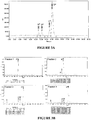
- Figure 2 shows a UV chromatogram of a purified mixture of iodinated rotenone where peaks A and B represent diastereomeric pair 2 and 3 and peaks C and D represent diastereomeric pair 4 and 5 .
- the absolute configuration at the 6' position of each isomer corresponding to peaks A-D was not determined.
- Figure 3A shows a chromatogram of a purified reaction mixture with peaks A * and B * representing diastereomeric pair 6 and 7 and peaks C * and D * representing diastereomeric pair 8 and 9 , based upon a comparison of the elution times of these peaks with those of the peaks A and B (corresponding to non-radioactive diastereomeric pair 2 and 3 ) and peaks C and D (corresponding to non-radioactive diastereomeric pair 4 and 5 ) shown in Figure 2 .
- the absolute configuration at the 6' position of each isomer corresponding to peaks A*-D* was not determined.
- Figure 3B shows chromatograms of purified fractions of the purified reaction mixture containing isomers 6-9.
- Rotenone was radiolabelled with 123 I according to the method described above to produce a mixture of compounds 6-9 .
- 0.56 mL of a 15.5 mCi/mL mixture of compounds 6-9 in 23% ethanol was diluted with 3.84 mL of 10 mM sodium acetate, pH 6.5 and 0.10 mL of 95% ethanol, to produce 4.5 mL of a 1.9 mCi/mL solution having a value of pH of about 5.
- the solution was left undisturbed for 22 hours at room temperature. Analysis of the mixture of compounds after 22 hours revealed that there was no substantial hydrolytic degradation of these products.
- NIS sodium iodide symporter
- the amount of thyroid uptake is the indication to the degree of in vivo deiodination.
- the thyroid uptake of the mixture of compounds 6-9 was low at 2 hr p.i. (0.33 ⁇ 0.12 %ID/organ), indicating the tracer is relatively stable within 2 hrs.
- Thyroid uptake was significantly increased at 24 hr p.i., with the calculated linear thyroid accumulation rate about 0.13 % per hour from 2 hr to 24 hr, which is consistent with the deiodination of the tracer at 24 hr p.i.
- a thyroid blocking reagent was not employed as it was necessary to understand the normal "unaffected" distribution of the mixture of compounds 6-9 .
- Figure 3B shows HPLC chromatograms of the four separate fractions used in the biodistribution study: Fraction 1: fraction comprising 100% of Component A*; Fraction 2 : fraction comprising an isomeric mixture comprising 15.2% Component A* and 84.8% Component B*; Fraction 3: fraction comprising an isomeric mixture comprising 4.4% Component A*, 4.4% Component B* and 91.2% Component C*; Fraction 4: fraction comprising an isomeric mixture comprising 1.5% Component A*, 0.8% Component B* and 97.7% Component D*.
- Table 2 shows biodistribution data (% ID/g tissue at 2 hr. p.i.) for each of the Fractions 1-4 .
- the data suggests that the biodistribution for each of the isomers 6-9 is similar in most organs, except for the isomer represented by peak B*, which shows slightly lower heart uptake and much lower liver uptake, resulting in a relatively higher heart to liver ratio.
- the intestine uptake of B* is also significantly higher than others.
- the marked microspheres become lodged by the circulating blood within the blood vessels of the myocardium of the pig.
- the relative amounts of these stable isotope-marked microspheres residing within the blood vessels of myocardial tissue can be measured in situ by first subjecting the tissue being analysed to neutron activation and then measuring the amount of gamma radiation emitted from the resulting radioactive isotopes contained within the microspheres.
- the measured amount of gamma radiation emitted by the microspheres is indicative of the former flow of blood containing the microspheres to the tissue in which the microspheres are disposed.
- the use of stable labelled microspheres in measuring perfusion is described in Reinhardt et al. Am J. Physiol Heart Circ Physiol 280: H108-H116, 2001 , the disclosure of which is incorporated by reference herein.
- a pig was anesthetized by an intramuscular injection of Telazol. Glycopyrrolate was also administered to facilitate intubation. The pig was intubated and maintained under anesthesia using an isofluorane mask. The pig was then placed in a right lateral position and subjected to a thoracotomy at approximately the third left intercostal space. After opening the left thoracic cavity, the pericardium was incised along the longitudinal axis of the heart and a catheter (Catheter 1) was inserted into the left atrium.
- Catheter 1 Catheter 1
- a vascular loop was placed around the left anterior descending (LAD) coronary artery 3 mm below the D2 branch.
- a femoral artery was exposed on the left leg by incision and a catheter (Catheter 2) was inserted into that artery.
- Catheter 2 was attached to a withdrawal pump (model PHD 2000, Harvard Apparatus). All connecting lines and both catheters were primed with heparinized saline, and blood was collected at a rate of 4 mL/min over a four minute period, resulting in a 16 mL reference blood collection.
- Two standard IV ear catheters were placed in each ear of the pig (one for injecting the radiotracers of the present invention and the other one for injecting a stressing agent.)
- a solution of the mixture of compounds 6-9 for parenteral administration was prepared by diluting 0.20 mL of a 13.6 mCi/mL aqueous solution of the mixture of compounds 6-9 with 0.16 mL of 95% ethanol and 2.84 mL of 10 mM sodium acetate buffer, to produce 3.2 mL of a 0.85 mCi/mL solution in 5% ethanol.
- Electrocardiogram-gated images of the distribution of I-123 were acquired on a dedicated cardiac SPECT camera (Discovery NM 530c, GE Healthcare) with the heart of the animal centered in the field-of-view of the camera.
- the dedicated system used pinhole collimation and 19.8 cm x 8 cm cadmium-zinc-telluride solid state detectors.
- the sensitivity of the camera was ⁇ 4x that of a traditional gamma camera and it had a 2x improvement in energy resolution.
- the data were acquired simultaneously in list mode and using an energy window of 159 ⁇ 16 keV.
- Two acquisitions of 15 min duration each were obtained with the animal in a resting state, one immediately following the other, with the first starting immediately following injection of the tracer.
- a third 15 min resting image was obtained just prior to stressing the animal. All images were reconstructed as per a standard clinical protocol using a vendor-supplied iterative algorithm based on the maximum-likelihood expectation-maximization (MLEM) reconstruction algorithm. Data were not corrected for the effects of attenuation.
- MLEM maximum-likelihood expectation-maximization
- the animal was stressed using the vasodilating agent Persantine (dipyridamole), which was injected into the ear catheter of the right ear.
- Persantine (0.56 mg/kg/min) was delivered via IV infusion over 4 min.
- the LAD Coronary artery of the pig was constricted at the 8 minute period to emulate an ischemic condition in the pig.
- Samarium BioPAL STERIspheres TM were injected at time point 8:30 min after the start of Persantine infusion, to allow the blood pressure to stabilize. Five mL of thoroughly mixed samarium Biopal STERIspheres TM were injected into the left atrium via catheter 1 over 10-30 seconds.
- the blood was collected through Catheter 2 at a withdrawal rate of 4 mL/min for 4 min, resulting in a 16 mL reference blood collection.
- 4 mL of a parenteral solution of the mixture of compounds 6-9 was injected into a standard IV ear catheter of the left ear and two imaging sessions of fifteen minutes were performed.
- the parenteral solution was prepared by diluting 0.55 mL of a 13.7 mCi/mL aqueous solution of the mixture of compounds 6-9 with 0.21 mL of 95% ethanol and 3.44 mL of 10 mM sodium acetate buffer, to produce 4.2 mL of a 1.8 mCi/mL solution of the mixture of compounds 6-9 in water.
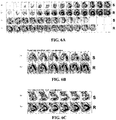
- FIGURES 6A-C show short axis images, horizontal long axis images and vertical long axis images, respectively, of sections of the in vivo heart of a pig subject in rested ( R ) and stressed ( S ) states, which were determined by SPECT imaging.
- FIGURES 7A-B show polar maps of the in vivo heart of the pig subject in the resting state and the stressed state, respectively, which were prepared from the images obtained during the SPECT imaging sessions.
- the pig was euthanized with a bolus injection of sodium pentobarbital (240 mg/ml) 2 mL/4.5 kg.
- the pig heart was harvested after euthanasia and rinsed thoroughly under running water.
- the left ventricle was isolated and cut into five transverse slices, which were further subdivided into transmural segments of about 1 gram, each containing approximately equal concentration of the endocardium and epicardium.
- the tissue and blood samples were weighed and measured using a gamma well counter to determine the amount of gamma radiation emitted by the I-123 radiolabel of the radio-iodinated tracers of the present invention.
- the measured gamma radiation in each segment represents the combined amount of gamma radiation emitted by the tracers in that segment during the resting and stressed states of the heart.
- the counts and the weights of the samples were also used to calculate the percentage of injected dose per gram of tissue (%ID/g).
- both the tissue and the blood were dried in an oven at 70°C for 48-72 h, the samples were sent for neutron activation and the gamma radiation emitted by each of the resulting radioactive [ 198 Au]gold-containing microspheres and [ 153 Sm]samarium-containing microspheres, which were embedded in the samples, were measured.
- Polar maps of the resting and stressed states of the isolated heart of the pig were generated using MATLAB TM to assemble the gamma measurement results in all the transected segments from the bottom (apex) to the top (AV groove) of the pig heart.
- the initial polar map generated from measurements of gamma radiation emitted by the radio-iodinated tracers of the present invention represented a combined polar map of the distribution of gamma radiation in the isolated heart of the pig in both the resting and stressed states.
- the value of this contribution was first determined from the SPECT images of the in vivo pig heart.
- both a polar map at rest and a polar map following the induction of stress were obtained.
- the initial polar map that was generated on the basis of images acquired after the induction of stress contained residual activity from the resting state, and, therefore, approximately represented an initial combined polar map of both the resting and stressed states of the in vivo pig heart.
- the contribution of the resting state polar map was removed from the combined polar map by aligning these two polar maps and then subtracting the contribution of each pixel value of the resting state polar map from each corresponding pixel value of the initial combined polar map to provide a corrected polar map approximately representing the polar map of the stressed state of the in vivo pig heart.
- This procedure provided two separate matrices of pixel values representing the fractions of the pixel values of the initial combined polar map corresponding to the pixel values of the resting state polar map and the stressed state polar map of the pig heart.
- the matrices obtained from the analysis of the SPECT polar maps were used to separate the combined resting state and stressed state polar map obtained from direct measurement of gamma radiation emitted from the radio-iodinated rotenone derivatives into individual resting state and stressed state polar maps.
- FIGURES 7C and 7D show the polar maps determined by measurement using the gamma radiation emitted by the gold and samarium BioPal STERIspheres TM in the heart of the pig subject in the resting and stressed states, respectively, following neutron activation.
- FIGURES 7E and 7F show the polar maps determined by measurement using the gamma radiation emitted by the [ 123 I] iodinated rotenone derivatives in the heart of the pig subject in the resting state and the stressed state (after removing the contribution of the resting state), respectively.
- FIGS 7B, 7D and 7F are indicative of reduced blood flow in the pig heart under stress conditions as a result of the induced occlusion caused by constriction of the LAD coronary artery.
- the position of reduced blood flow aligns with the position of constriction in the heart.
- blood flow in the pig heart under rest conditions is substantially uniform throughout the heart as shown by Figures 7A, 7C and 7E .
- the contrast observed with the microspheres are greater than that observed with the radiotracers of the present invention possibly due to a larger amount of the microspheres being blocked in the capillaries of the heart than the amount of the radiotracers taken up by the myocardial cells of the heart.
- MBF Myocardial blood flow
- Figure 8 illustrates a plot of uptake (percent of injected dose per gram of tissue; % ID/g) of the radiotracer compounds of the present invention as a function of the myocardial blood flow in the pig heart under stress and induced ischemic conditions as determined using the marked microspheres.
- Figure 4 of Glover et al. shows uptake data (activity (% normal)) for 99m Tc-Sestamibi plotted as a function of microsphere flow (ml/min/g) from a representative dog having a critical LAD coronary artery stenosis that received intravenous adenosine.
- the value of the ratio of the slope of the non-linear fitted line to the 123 I-ZIROT data of Broisat et al. and the slope derived from the slope of the non-linear fitted line to the 99m Tc-Sestamibi data of Glover et al. is 2.5, while the value of the ratio of the slopes of the non-linear fitted lines to the data for Mixture A and 99m Tc-sestamibi shown in Figure 8 of the present application is 3.0.
- the hearts were immediately placed into an ice-cold bath containing modified Tyrode's solution (10 mM NaCl, 1 mM MgCl 2 , 28 mM NaHCO 3 , 0.44 mM NaH 2 PO 4 , 2.5 mM CaCl 2 , 6 mM KCl, 5 mM glucose, 100 mM sodium pyruvate with 22 g/L BSA and aerated with 95% O 2 /5% CO 2 ) and thymus and fatty tissue were quickly removed.
- modified Tyrode's solution 10 mM NaCl, 1 mM MgCl 2 , 28 mM NaHCO 3 , 0.44 mM NaH 2 PO 4 , 2.5 mM CaCl 2 , 6 mM KCl, 5 mM glucose, 100 mM sodium pyruvate with 22 g/L BSA and aerated with 95% O 2 /5% CO 2
- the hearts were then suspended on an aortic cannula and perfused with pre-warmed modified Tyrode's buffer through a water jacketed, temperature regulated Langendorff perfusion system (Radnotti, CA, USA) at a constant flow rate. Total time for suspension onto the Langendorff apparatus was typically 60 seconds or less. Following suspension on the aortic cannula, the remaining lung, trachea and extraneous tissues were removed.
- Fluid from Thebesian circulation was drained via a polyethylene catheterized apical drain.
- a fluid filled latex ballon connected to a pressure transducer (Radnotti) was inserted into the left ventrical via the left atrium and mitral valve.
- a pacing electrode (Radnotti) was placed at the level of the atria to allow controlled pacing of the heart.
- the left ventricular balloon was inflated to achieve an end-diastolic pressure of approximately 8-10 mmHg with a constant systolic pressure held between 60-80 mm Hg.
- the heart was continually perfused with modified Tyrode's solution warmed to 38 °C and was held in an enclosed chamber to maintain humidity and temperature.
- the heart was paced with a Grass SD9 stimulator (Harvard Apparatus, Montreal QC) at 180 beats per minute with a stimulus of 4 V delivered over 4 ms.
- Perfusion and ventricular pressures were monitored throughout the experiment using a BioPac data acquisition system (BioPac, Montreal QC). Hearts that displayed irregular pressures and electrical activity during the experiment were not included in the analyses.
- the initial peak fractional venous appearance rates for the reference tracer ( 131 I-albumin) vs the perfusion tracers C 99m Tc-sestamibi and the isomers of Mixture A) can be qualitatively evaluated.
- the higher venous effluent rate observed with albumin (non-diffusable tracer) suggests that it remains in the intravascular space and does not perfuse into the myocardium, i.e. extravascular space.
- the diffusible tracers, 99m Tc-sestamibi, 201 Tl and the isomers of Mixture A have lower fractional venous appearance rates suggesting that these tracers escape from the vasculature into the extravascular space and perfuse the myocardium.
- 99m Tc-sestamibi, 201 Tl and the isomers of Mixture A have higher fractional appearance rates signifying that they re-enter the vasculature and exit the myocardium through the venous effluent.
- the lower peak venous effluent rate observed with the isomers of Mixture A suggests a longer myocardial retention relative to 99m Tc-sestamibi, 201 Tl and 131 I-albumin.
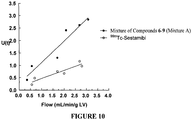
- Maximal tracer uptake U(t) is a measure of the maximum content of tracer remaining in the myocardium relative to the total amount injected.
- Six animals for each tracer were perfused at varying flow rates (expressed as mL/min/g left ventricular wet weight).
- Marshall et al. report slopes of 0.29 and 0.78 for the fitted linear lines to the maximal uptake data for 99m Tc-sestamibi and 125 I-rotenone, respectively.
- the slopes of the fitted lines to the data for 99m Tc-sestamibi and the isomers of Mixture A shown in Figure 10 of the present application are 0.33 and 0.86, respectively.
- the value of the ratio of the slopes of the fitted lines for 125 I-rotenone and 99m Tc-sestamibi from Marshall et al. is 2.69, while the value of the ratio of the slopes of the fitted lines for Mixture A and 99m Tc-sestamibi shown in Figure 10 is 2.61.
Landscapes
- Chemical & Material Sciences (AREA)
- Organic Chemistry (AREA)
- Heterocyclic Carbon Compounds Containing A Hetero Ring Having Oxygen Or Sulfur (AREA)
- Pharmaceuticals Containing Other Organic And Inorganic Compounds (AREA)
- Medicines Containing Antibodies Or Antigens For Use As Internal Diagnostic Agents (AREA)
Description
- The present invention provides radiolabelled rotenone derivatives, and methods for their preparation and use in diagnostic imaging. In particular, the present invention provides radio-iodinated rotenone derivatives, methods for their preparation and their use in Single Photon Emission Computed Tomography (SPECT) myocardial perfusion imaging to detect regions of ischemia.
- Myocardial perfusion imaging is a noninvasive test for assessing the amount of blood flow to the muscle of the heart, and is used in the diagnosis of myocardial ischemia, myocardial infarction, and coronary heart disease. In the test, a nuclear tracer containing a gamma-emitting radionuclide is injected into the blood stream of a patient, and the tracer is taken up by heart muscle cells that receive good blood flow. The heart is then imaged with a camera that detects gamma rays released by the radionuclide of the tracer, thereby providing an image map of blood perfusion or flow to the heart. Two separate scans of the heart are conducted: a first scan where the heart is at rest and a second scan where the heart is under increased workload (i.e. under stress conditions). The two separate scans are compared to assess whether there are any areas in the heart where blood flow is inadequate under stress conditions, which indicates the presence of a blockage or narrowing in the coronary arteries.
- Babich et al. (PCT Patent Application Publication No.
WO 03/086476 - Isotopic labels in Crombie include 3H, 13C- and 14C- labeling. O'Neil (PCT Patent Application Publication No.
WO 2008/133730 - Van Brocklin et al. (United States Patent Application Publication No.
2009/0136424 ) have previously prepared radiolabelled rotenone derivatives for use as myocardial flow tracers based on their ability to localize in the myocardial tissue of the heart. The number of steps required to synthesize these derivatives, however, may preclude their widespread clinical use in myocardial perfusion imaging. There is therefore a need for radiolabelled rotenone derivatives, which can be easily prepared and which demonstrate sufficient stability to be effectively used in myocardial perfusion imaging. - According to the present invention, there is provided a compound as set out in
claim 1 below. - Optional features of the invention are set out in the dependent claims below.
- An embodiment of the invention provides radiolabelled rotenone derivatives, and methods for their preparation and use in diagnostic imaging. The radio-iodinated rotenone derivatives may be used in Single Photon Emission Computed Tomography (SPECT) myocardial perfusion imaging to detect regions of ischemia.
- These and other features of the invention will become more apparent from the following description in which reference is made to the appended drawings wherein:
-
FIGURE 1 illustrates examples of synthetic schemes of forming rotenone derivatives according to the present invention. -
FIGURE 2 shows a chromatogram of non-radioactive [127I] iodinated rotenone derivatives of the present invention. -
FIGURE 3A shows a chromatogram of a mixture of [123I] iodinated rotenone derivatives of the present invention.FIGURE 3B shows chromatograms of purified fractions of the mixture of [123I] iodinated rotenone derivatives ofFIGURE 3A . -
FIGURE 4 shows the amount of internalization of the [123I] iodinated rotenone derivatives of the present invention and 99mTc-tetrofosmin in cultured cardiomyocytes. Primary neonatal cardiomyocytes were incubated with [123I]iodinated rotenone derivatives of the present invention (rot) or 99mTc-tetrofosmin (myo). The amount of internalization is shown as cpm/total ug protein. The results of two separate trials for each compound are shown. -
FIGURE 5 shows SPECT images of 123I-Rotenone distribution at 30 minutes (summed images) following injection in a rat. Starting from the top left and proceeding clockwise are shown the maximum intensity projection, the coronal view, the transverse view and the sagittal view. -
FIGURES 6A-C show short axis images, horizontal long axis images and vertical long axis images, respectively, of sections of the in vivo heart of a pig subject in a rest state (R) and a stressed state (S), which were determined by SPECT imaging. The light regions inFigures 6A-C are representative of areas of relatively lower uptake of the radio-labeled tracer of the present invention, and are indicative of areas of reduced blood flow (ischemia). -
FIGURE 7 shows polar maps determined by SPECT of the in vivo heart of a pig subject in a resting state and a stressed state, and polar maps representative of the resting and stressed states of the heart of the pig, which were obtained using measurements of gamma radiation emitted from isolated transected sections of the heart of the pig subject. When in the resting state, the pig subject was administered a combination of a mixture of the [123I] iodinated rotenone derivatives 6-9 of the present invention and gold BioPal STERIspheres™. In the stressed state, the pig subject was administered a combination of a mixture of the [123I] iodinated rotenone derivatives 6-9 of the present invention and samarium BioPal STERIspheres™. Ischemia in the heart of the pig was simulated by constricting the left anterior descending (LAD) coronary artery of the pig.FIGURES 7A and 7B show polar maps determined by SPECT imaging of the gamma radiation emitted by a mixture of the [123I] iodinated rotenone derivatives 6-9 in the in vivo heart of the pig subject in the resting state and stressed state, respectively.FIGURES 7C and 7D show the polar maps determined using measurements of the gamma radiation emitted by neutron-activated gold and samarium BioPal STERIspheres™, which were introduced into the heart of the pig subject in the resting state and stressed state, respectively.FIGURES 7E and 7F show the polar maps determined using measurements of the gamma radiation emitted by a mixture of the [123I] iodinated rotenone derivatives 6-9 in the heart of the pig subject in the resting state and stressed state, respectively. The dark regions inFigures 7B, 7D and 7F are indicative of areas of reduced blood flow (ischemia). -
FIGURE 8 shows a plot of uptake (percent injected dose per gram; % ID/g) of a mixture of [123I] iodinated rotenone derivatives 6-9 of the present invention, Myoview™ (99mTc-tetrofosmin) and 99mTc-sestamibi in the hearts of pig subjects as a function of myocardial blood flow (MBF). -
FIGURE 9 shows the values of the fractional venous appearance rates h(s-1) of 131I-albumin, 99mTc-sestamibi 201Thallium and a mixture of [123I] iodinated rotenone derivatives 6-9 of the present invention as a function of venous collection time at a flow rate of 1.7 ml/min/g LV. -
FIGURE 10 shows the values of the maximum net uptake of 99mTc-sestamibi and a mixture of [123I] iodinated rotenone derivatives 6-9 of the present invention. Each point represents a single experiment from a separate animal. - The present invention provides radiolabelled rotenone derivatives, and methods for their preparation and use in diagnostic imaging. In particular, the present invention provides radio-iodinated rotenone derivatives, methods for their preparation and their use in Single Photon Emission Computed Tomography (SPECT) myocardial perfusion imaging to detect regions of ischemia.
- The present invention relates to rotenone derivatives of formula (I) and formula (II):
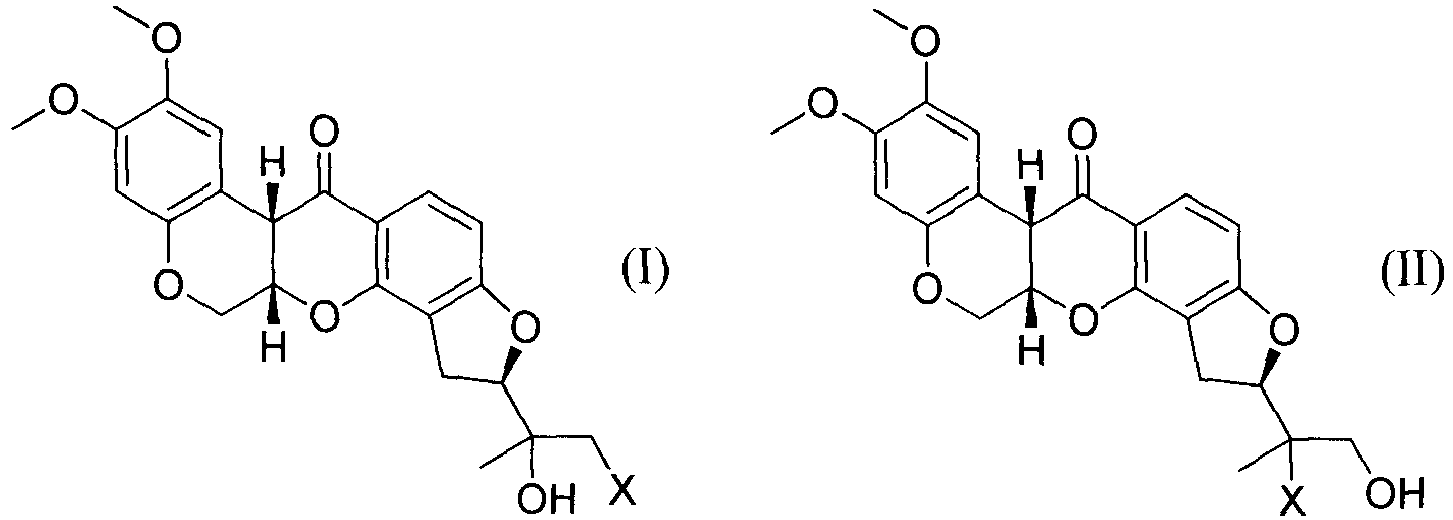
which contain a gamma-radiation emitting radionuclide useful in SPECT imaging. The rotenone derivatives of the present invention have a high affinity to Complex I of the mitochondrial electron transport chain, and can therefore localize in tissues having a high content of mitochondria, such as the myocardium in the heart. In particular, SPECT imaging of blood flow in the heart (myocardial perfusion imaging) using the rotenone derivatives of the present invention can be used to assess the degree of blood flow to the heart and assist in the diagnosis of coronary artery disease in a subject. - Suitable myocardial perfusion imaging studies using the compound of formula (I) and formula (II) can be performed by those of skill in the medical specialty of cardiac imaging (Radiology, Nuclear Medicine and Cardiology) in accordance with generally accepted practices.
- Diagnostic compositions of the present invention may be administered by parenteral administration, including but not limited to injection and infusion, either alone or in combination with each other. The compound of formula (I), the compound of formula (II), or a mixture thereof can be administered in the form of a pharmaceutical composition comprising a physiologically acceptable vehicle.
- As used herein, the term "physiologically acceptable vehicle" includes, but is not limited to, a carrier medium that does not interfere with the effectiveness of the binding activity of the compound of formula (I) or the compound of formula (II), is chemically inert, and is not toxic to the patient to whom it is administered.
- As used herein, the term "effective amount" of the physiologically acceptable vehicle refers to a non-toxic amount of the physiologically acceptable vehicle, which will result in clear imaging of the region of interest of a subject without introducing significant background.
- Non-limiting examples of physiologically acceptable vehicles include human serum albumin; aqueous buffer solutions; alcohols, such as ethanol; aqueous alcohol solutions, such as aqueous ethanol; sterile water; physiological saline; sodium chloride injection; Ringer's injection; lactated Ringer's injection; dextrose injection; dextrose and sodium chloride injection; and aqueous solutions containing propylene glycol, polypropylene glycol, a polyethylene glycol (such as
polyethylene glycol 300 and polyethylene glycol 400), glycerine, dimethylacetamide (DMA), polyvinyl pyrrolidone (PVP), N-methyl-2-pyrrolidone (NMP), dimethylsulfoxide (DMSO), Polysorbate-80 (Tween 80), Polysorbate-20 (Tween 20), sodium dodecanoate, or hexadecyltrimethyl ammonium bromide. Particular examples of vehicles include aqueous solutions containing propylene glycol (10-68 volume %), ethanol (1-20 volume %), polyethylene glycol 300 (10-50 volume %), polyethylene glycol 400 (1-9 volume %), glycerin (1-15 volume %), DMA (0.5-3 volume %), PVP (0.5-6 volume %), or Tween 80 (0.08-0.4 volume %). - The pharmaceutical compositions of the present invention may also include stabilisers or antioxidants such as ascorbic acid, gentisic acid or para-aminobenzoic acid.
- The compound of the present invention can be an isomer of the formula (Ia), (Ib), (IIa) or (IIb):


- Examples of gamma-emitting radioisotopes that may be used in the radiotracers of the present invention include without limitation 76Br, 77Br, 82Br, 123I, 124I, 125I and 131I.
- More specifically, the compound of the present invention may be selected from the group consisting of:
- (2R,6aS, 12aS)-2-((S)-1-[76Br]bromo-2-hydroxypropan-2-yl)-8,9-dimethoxy-1,2,12,12a-tetrahydrochromeno[3,4-b]furo[2,3-h]chromen-6(6aH)-one;
- (2R,6aS, 12aS)-2-((R)-[76Br]bromo-2-hydroxypropan-2-yl)-8,9-dimethoxy-1,2,12,12a-tetrahydrochromeno[3,4-b]furo[2,3-h]chromen-6(6aH)-one;
- (2R,6aS, 12aS)-2-((S)-1-[77Br]bromo-2-hydroxypropan-2-yl)-8,9-dimethoxy-1,2,12,12a-tetrahydrochromeno[3,4-b]furo[2,3-h]chromen-6(6aH)-one;
- (2R,6aS, 12aS)-2-((R)-1-[77Br]bromo-2-hydroxypropan-2-yl)-8,9-dimethoxy-1,2,12,12a-tetrahydrochromeno[3,4-b]furo[2,3-h]chromen-6(6aH)-one;
- (2R,6aS,12aS)-2-((S)-1-[82Br]bromo-2-hydroxypropan-2-yl)-8,9-dimethoxy-1,2,12,12a-tetrahydrochromeno[3,4-b]furo[2,3-h]chromen-6(6aH)-one;
- (2R,6aS, 12aS)-2-((R)-1-[82Br]bromo-2-hydroxypropan-2-yl)-8,9-dimethoxy-1,2,12,12a-tetrahydrochromeno[3,4-b]furo[2,3-h]chromen-6(6aH)-one;
- (2R,6aS, 12aS)-2-((S)-2-hydroxy-1-[123I]iodopropan-2-yl)-8,9-dimethoxy-1,2,12,12a-tetrahydrochromeno[3,4-b]furo[2,3-h]chromen-6(6aH)-one;
- (2R,6aS, 12aS)-2-((R)-2-hydroxy-1-[123I]iodopropan-2-yl)-8,9-dimethoxy-1,2,12,12a-tetrahydrochromeno[3,4-b]furo[2,3-h]chromen-6(6aH)-one;
- (2R,6aS,12aS)-2-((S)-2-hydroxy-l-[124I]iodopropan-2-yl)-8,9-dimethoxy-1,2,12,12a-tetrahydrochromeno[3,4-b]furo[2,3-h]chromen-6(6aH)-one;
- (2R,6aS,12aS)-2-((R)-2-hydroxy-1-[124I]iodopropan-2-yl)-8,9-dimethoxy-l,2,12,12a-tetrahydrochromeno[3,4-b]furo[2,3-h]chromen-6(6aH)-one;
- (2R,6aS,12aS)-2-((S)-2-hydroxy-1-[125I]iodopropan-2-yl)-8,9-dimethoxy-1,2,12,12a-tetrahydrochromeno[3,4-b]furo[2,3-h]chromen-6(6aH)-one;
- (2R,6aS, 12aS)-2-((R)-2-hydroxy-1-[125I]iodopropan-2-yl)-8,9-dimethoxy-1,2,12,12a-tetrahydrochromeno[3,4-b]furo[2,3-h]chromen-6(6aH)-one;
- (2R,6aS,12aS)-2-((S)-2-hydroxy-1-[131I]iodopropan-2-yl)-8,9-dimethoxy-1,2,12,12a-tetrahydrochromeno[3,4-b]furo[2,3-h]chromen-6(6aH)-one;
- (2R,6aS, 12aS)-2-((R)-2-hydroxy-1-[131I]iodopropan-2-yl)-8,9-dimethoxy-1,2,12,12a-tetrahydrochromeno[3,4-b]furo[2,3-h]chromen-6(6aH)-one;
- (2R,6aS, 12aS)-2-((R)-2-[76Br]bromo-1-hydroxypropan-2-yl)-8,9-dimethoxy-1,2,12,12a-tetrahydrochromeno[3,4-b]furo[2,3-h]chromen-6(6aH)-one;
- (2R,6aS,12aS)-2-((S)-2-[76Br]bromo-1-hydroxypropan-2-yl)-8,9-dimethoxy-1,2,12,12a-tetrahydrochromeno[3,4-b]furo[2,3-h]chromen-6(6aH)-one;
- (2R,6aS,12aS)-2-((R)-2-[77Br]bromo-1-hydroxypropan-2-yl)-8,9-dimethoxy-1,2,12,12a-tetrahydrochromeno[3,4-b]furo[2,3-h]chromen-6(6aH)-one;
- (2R,6aS, 12aS)-2-((S)-2-[77Br]bromo-1-hydroxypropan-2-yl)-8,9-dimethoxy-1,2,12,12a-tetrahydrochromeno[3,4-b] furo[2,3-h] chromen-6(6aH)-one;
- (2R,6aS, 12aS)-2-((R)-2-[82Br]bromo-1-hydroxypropan-2-yl)-8,9-dimethoxy-1,2,12,12a-tetrahydrochromeno[3,4-b]furo[2,3-h]chromen-6(6aH)-one;
- (2R,6aS, 12aS)-2-((S)-2-[g2Br]bromo-1-hydroxypropan-2-yl)-8,9-dimethoxy-1,2,12,12a-tetrahydrochromeno[3,4-b]furo[2,3-h]chromen-6(6aH)-one;
- (2R,6aS, 12aS)-2-((R)-2-[123I]iodo-1-hydroxypropan-2-yl)-8,9-dimethoxy-1,2,12,12a-tetrahydrochromeno[3,4-b]furo[2,3-h]chromen-6(6aH)-one;
- (2R,6aS, 12aS)-2-((S)-2-[123I]iodo-1-hydroxypropan-2-yl)-8,9-dimethoxy-1,2,12,12a-tetrahydrochromeno[3,4-b]furo[2,3-h]chromen-6(6aH)-one;
- (2R,6aS, 12aS)-2-((R)-2-[124I]iodo-1-hydroxypropan-2-yl)-8,9-dimethoxy-1,2,12,12a-tetrahydrochromeno[3,4-b]furo[2,3-h]chromen-6(6aH)-one;
- (2R,6aS, 12aS)-2-((S)-2-[124I]iodo-1-hydroxypropan-2-yl)-8,9-dimethoxy-1,2,12,12a-tetrahydrochromeno[3,4-b]furo[2,3-h]chromen-6(6aH)-one;
- (2R,6aS,12aS)-2-((R)-2-[l25I]iodo-1-hydroxypropan-2-yl)-8,9-dimethoxy-1,2,12,12a-tetrahydrochromeno[3,4-b]furo[2,3-h]chromen-6(6aH)-one;
- (2R,6aS, 12aS)-2-((S)-2-[125I]iodo-1-hydroxypropan-2-yl)-8,9-dimethoxy-1,2,12,12a-tetrahydrochromeno[3,4-b]furo[2,3-h]chromen-6(6aH)-one;
- (2R,6aS,12aS)-2-((R)-2-[131I]iodo-1-hydroxypropan-2-yl)-8,9-dimethoxy-1,2,12,12a-tetrahydrochromeno[3,4-b]furo[2,3-h]chromen-6(6aH)-one, and
- (2R,6aS,12aS)-2-((S)-2-[131I]iodo-1-hydroxypropan-2-yl)-8,9-dimethoxy-1,2,12,12a-tetrahydrochromeno[3,4-b]furo[2,3-h]chromen-6(6aH)-one.
- In another example, the compound of the present invention is selected from the group consisting of:
- (2R,6aS,12aS)-2-((S)-2-hydroxy-1-[123I]iodopropan-2-yl)-8,9-dimethoxy-1,2,12,12a-tetrahydrochromeno[3,4-b]furo[2,3-h]chromen-6(6aH)-one;
- (2R,6aS,12aS)-2-((R)-2-hydroxy-1-[123I]iodopropan-2-yl)-8,9-dimethoxy-1,2,12,12a-tetrahydrochromeno[3,4-b]furo[2,3-h]chromen-6(6aH)-one;
- (2R,6aS,12aS)-2-((R)-2- [121I]iodo-1-hydroxypropan-2-yl)-8,9-dimethoxy-1,2,12,12a-tetrahydrochromeno[3,4-b]furo[2,3-h]chromen-6(6aH)-one, and
- (2R,6aS,12aS)-2-((S)-2-[123I]iodo-1-hydroxypropan-2-yl)-8,9-dimethoxy-1,2,12,12a-tetrahydrochromeno[3,4-b]furo[2,3-h]chromen-6(6aH)-one.
- The present invention also relates to a composition comprising a mixture of two or more of the compounds of formulas (Ia), (Ib), (IIa) and (IIb).
- In particular, the present invention provides a composition comprising a mixture of two or more compounds selected from the group consisting of:
- (2R,6aS,12aS)-2-((S)-2-hydroxy-1-[123I]iodopropan-2-yl)-8,9-dimethoxy-1,2,12,12a-tetrahydrochromeno[3,4-b]furo[2,3-h]chromen-6(6aH)-one;
- (2R,6aS,12aS)-2-((R)-2-hydroxy-1-[123I]iodopropan-2-yl)-8,9-dimethoxy-1,2,12,12a-tetrahydrochromeno[3,4-b]furo[2,3-h]chromen-6(6aH)-one;
- (2R,6aS,12aS)-2-((R)-2-[123I]iodo-1-hydroxypropan-2-yl)-8,9-dimethoxy-1,2,12,12a-tetrahydrochromeno[3,4-b]furo[2,3-h]chromen-6(6aH)-one, and
- (2R,6aS,12aS)-2-((S)-2-[123I]iodo-1-hydroxypropan-2-yl)-8,9-dimethoxy-1,2,12,12a-tetrahydrochromeno [3,4-b] furo[2,3-h]chromen-6(6aH)-one.
- The present application also provides a pharmaceutical composition comprising one or more than one compound selected from the group consisting of:
- (2R,6aS,12aS)-2-((S)-2-hydroxy-1-[123I]iodopropan-2-yl)-8,9-dimethoxy-1,2,12,12a-tetrahydrochromeno[3,4-b]furo[2,3-h]chromen-6(6aH)-one;
- (2R,6aS,12aS)-2-((R)-2-hydroxy-1-[123I]iodopropan-2-yl)-8,9-dimethoxy-1,2,12,12a-tetrahydrochromeno[3,4-b]furo[2,3-h]chromen-6(6aH)-one;
- (2R,6aS,12aS)-2-((R)-2-[123I]iodo-1-hydroxypropan-2-yl)-8,9-dimethoxy-1,2,12,12a-tetrahydrochromeno[3,4-b]furo[2,3-h]chromen-6(6aH)-one, and
- (2R,6aS,12aS)-2-((S)-2-[1231]iodo-1-hydroxypropan-2-yl)-8,9-dimethoxy-1,2,12,12a-tetrahydrochromeno[3,4-b]furo[2,3-h]chromen-6(6aH)-one, and
- Radio-iodinated derivatives of the present invention can be prepared according to the synthetic schemes illustrated in
Figure 1 . In one example, rotenone (1) may be allowed to react with a sodium salt of a radioactive halide in aqueous solution in the presence of the oxidant Iodogen™ (1,3,4,6-tetrachloro-3α,6α-diphenyl glycoluril; Pierce (Rockford, IL)) to form radioactive isomeric alkyl halides (Ia), (Ib), (IIa) and (IIb). Alternatively, rotenone (1) may be allowed to react with a sodium salt of a non-radioactive halide in aqueous solution in the presence of Iodogen™ to form non-radioactive isomeric alkyl halides (IIIa), (IIIb), (IVa) and (IVb), which can be converted to isomers (Ia), (Ib), (IIa) and (IIb) using an isotope exchange reaction. Isomers (Ia), (Ib), (IIa) and (IIb) can be used together or separated from each other and used individually as radiotracers in SPECT imaging according to the present invention. - The amount of the compound of formula (I) and/or the compound of formula (II) included in the pharmaceutical composition of the present invention should be sufficient to provide satisfactory imaging. For example, the dosage can be from about 1.0 to about 50 millicuries or any subrange or value therebetween, from about 1.0 to about 10 millicuries or any subrange or value therebetween, from about 10 to about 20 millicuries or any subrange or value therebetween, from about 20 to about 30 millicuries or any subrange or value therebetween, from about 30 to about 40 millicuries or any subrange or value therebetween, or from about 40 to about 50 millicuries or any subrange or value therebetween. The amount and activity of each one of the radiotracers of the present invention should be selected such that it remains in the patient for a period of about 1 to 3 hours, although both longer and shorter time periods are acceptable.
- The present invention also relates to a method of imaging a region in a patient, comprising:
- administering to the patient a diagnostically effective amount of a composition comprising a compound of formula (I), a compound of formula (II) or a mixture thereof:
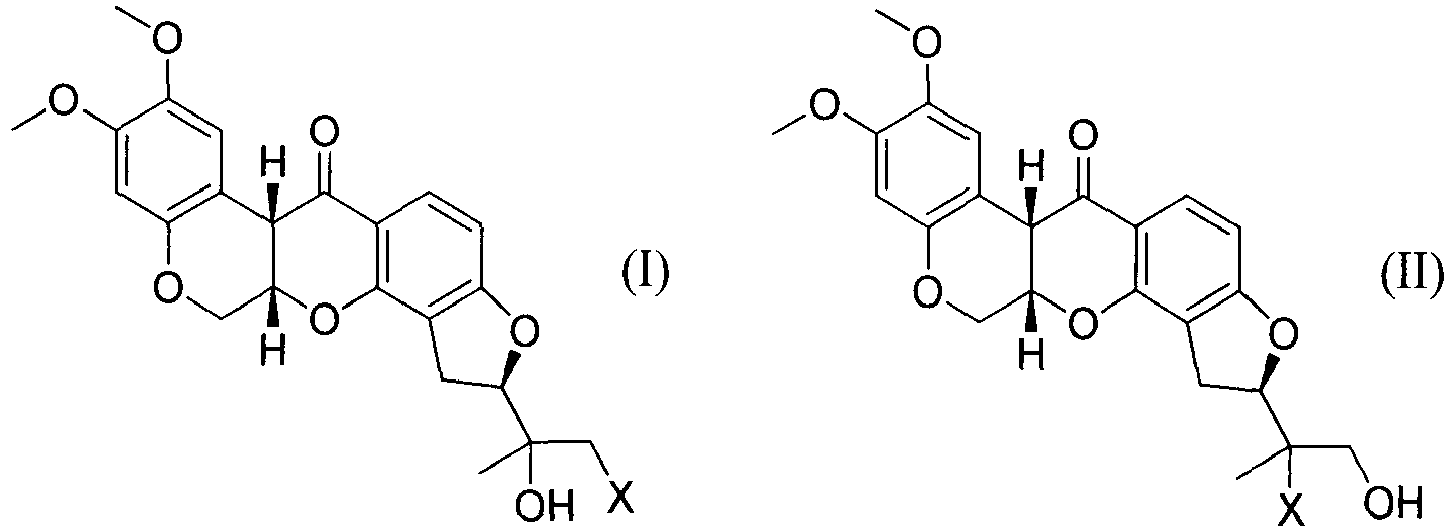
- wherein X is a gamma-emitting radionuclide, and a physiologically acceptable vehicle, a portion of the composition being retained in the region of the patient,
- detecting radiation in the region of the patient, and
- obtaining an image of the region of the patient.
- In one example of the above-defined method, the compound administered to the patient is an isomer of the formula (Ia), (Ib), (IIa), (IIb) or a mixture thereof,


- In a further example of the above-defined method, the compound administered to the patient is one or more than one compound selected from the group consisting of:
- (2R,6aS,12aS)-2-((S)-2-hydroxy-1-[123I]iodopropan-2-yl)-8,9-dimethoxy-1,2,12,12a-tetrahydrochromeno [3,4-b] furo [2,3 -h] chromen-6(6aH)-one;
- (2R,6aS, 12aS)-2-((R)-2-hydroxy-1-[123I]iodopropan-2-yl)-8,9-dimethoxy-1,2,12,12a-tetrahydrochromeno[3,4-b]furo[2,3-h]chromen-6(6aH)-one;
- (2R,6aS, 12aS)-2-((R)-2-[123I]iodo-1-hydroxypropan-2-yl)-8,9-dimethoxy-1,2,12,12a-tetrahydrochromeno[3,4-b]furo[2,3-h]chromen-6(6aH)-one, and
- (2R,6aS, 12aS)-2-((S)-2-[123I]iodo-1-hydroxypropan-2-yl)-8,9-dimethoxy-1,2,12,12a-tetrahydrochromeno[3,4-b]furo[2,3-h]chromen-6(6aH)-one.
- In another example of the above defined method, the region of the patient is the heart.
- In a further example of the method described above, the region of the patient being imaged is the heart, and prior to the step of administering, stress is induced in the patient for a period of about 1 to about 8 minutes by having the patient exercise or by administering a stress agent to the patient, such as dipyridamole, dobutamine, adenosine, or regadenosan.
- In another example of the method defined above, the compound of formula (I) and/or the compound of formula (II) is administered to the patient 30 seconds to 1 minute after the period in which stress has been induced in the patient.
- The following examples are included to demonstrate particular embodiments of the invention. Those of skill in the art should, in light of the present disclosure, appreciate that many changes can be made in the specific embodiments which are disclosed and still obtain a like or similar result without departing from the spirit and scope of the invention.
-

- Rotenone (1, 42.5 mg) in TFA (17 mL) was mixed with NaI (81 mg) in NaOH solution (0.1 M, 5 mL). To the stirred mixture was added Iodogen™ (45 mg) in TFA (3 mL) at room temperature. The reaction mixture was stirred at 60 °C for 45 min and concentrated under reduced pressure. Water (20 mL) was poured in and extracted with CH2Cl2 (20 mL X 3), dried over anhydrous Na2SO4, filtered, and concentrated under reduced pressure to yield a green oil. This residue was taken up by CH2Cl2 (1 mL) and subjected to HPLC purification. The column used was a preparative Luna 5u C18(2) of 21.2 × 250 mm and 5 µm (Phenomenex, CA). The sample was eluted at a flow rate of 6 mL min-1, using a combination of water and EtOH (50/50). The detector was set to 290 nm. The desired product (retention time 51-63 min) was collected and evaporated to dryness to yield a mixture of isomers 2-5 as a white solid (3 mg, 5.6%). The
diastereomeric pair diastereomeric pair -
Figure 2 shows a UV chromatogram of a purified mixture of iodinated rotenone where peaks A and B representdiastereomeric pair diastereomeric pair - The isomers corresponding to peaks A-D were purified and analysed by 1H- and 13C-NMR and HRMS.
- Peak A: 1H NMR (300 MHz, CDC13) δ 7.83 (d, J = 8.6 Hz, 1H), 6.74 (s, 1H), 6.49 (d, J = 8.6 Hz, 1H), 6.43 (s, 1H), 5.02 - 4.89 (m, 1H), 4.62 (dd, J = 12.1, 3.1 Hz, 1H), 4.28 - 4.10 (m, 2H), 3.92 (d, J = 11.8 Hz, 1H), 3.84 (d, J = 4.0 Hz, 2H), 3.79 (s, 3H), 3.74 (s, 3H), 3.31 (dd, J = 14.3, 7.9 Hz, 1H), 3.13 (dd, J = 15.9, 8.2 Hz, 1H), 1.91 (s, 3H). 13C NMR (75 MHz, CDCl3) δ 188.97, 166.40, 157.79, 149.46, 147.38, 143.85, 130.15, 113.65, 112.54, 110.15, 104.89, 104.66, 100.89, 88.44, 72.24, 71.29, 66.28, 59.80, 56.32, 55.89, 44.61, 32.56, 26.61. HRMS forC23H23IO7 EI calcd. 538.0488, found 538.0514.
- Peak B: 1H NMR (500 MHz, CDC13) δ 7.82 (d, J = 7.7 Hz, 1H), 6.74 (s, 1H), 6.53 (s, 1H), 6.46 (d, 1H), 5.09 (t, J = 8.7 Hz, 1H), 4.96 (s, 1H), 4.70 - 4.55 (m, 1H), 4.19 (d, J = 12.1 Hz, 1H), 3.88 - 3.67 (m, 9H), 3.53 - 3.34 (m, 1H), 3.29 - 3.10 (m, 1H), 1.93 (s, 3H). 13C NMR (126 MHz, CDC13) δ 188.91, 166.87, 157.71, 149.49, 147.36, 143.84, 130.04, 113.60, 112.26, 110.20, 104.72, 104.55, 100.90, 88.09, 72.25, 71.43, 66.17, 58.68, 56.29, 55.83, 44.58, 31.65, 23.52. HRMS for C23H23IO7 EI calcd. 538.0488, found 538.0473.
- Peak C: HRMS for C23H23IO7 EI calcd. 538.0488, found: 538.0550.
- Peak D: 1H NMR (500 MHz, CDCl3) δ 7.81 (d, J = 8.6 Hz, 1H), 6.73 (s, 1H), 6.46 (d, J = 8.6 Hz, 1H), 6.43 (s, 1H), 4.94 - 4.88 (m, 2H), 4.60 (dd, J = 12.1, 3.1 Hz, 1H), 4.17 (d, J = 12.1 Hz, 1H), 3.83 (d, J = 4.0 Hz, 1H), 3.79 (s, 3H), 3.74 (s, 3H), 3.46 (d, J = 10.5 Hz, 1H), 3.36 (d, J = 10.5 Hz, 1H), 3.20 (dd, J = 16.2, 9.8 Hz, 1H), 3.12 (dd, J = 16.2, 7.9 Hz, 1H), 1.98 (bs, 1H), 1.36 (s, 3H); 13C NMR (126 MHz, CDCl3) δ 188.96, 166.76, 157.89, 149.49, 147.36, 143.85, 129.99, 113.60, 113.10, 110.21, 104.81, 104.59, 100.89, 87.69, 72.25, 71.71, 66.22, 56.30, 55.85, 44.58, 27.35, 22.19, 17.46; HRMS for C23H23IO7 EI calcd. 538.0488, found 538.0590. The structure of the isomer corresponding to peak D was confirmed using HMQC, HMBC and COSY NMR experiments.
-

- 12.5 mCi of a Na123I solution in 0.1 M NaOH was added into a 1.5 mL BioRad vial. The volume of Na123I solution was calculated based on the activity concentration on a corresponding technical datasheet. 170 µL of a solution of rotenone (1, 2.5 mg/mL) in trifluoroacetic acid (TFA) and 30 µL of an Iodogen™ solution (0.75 mg/mL) in TFA were added. The ratio of rotenone (1) to Iodogen™ was 20:1. The mixture was heated on a thermomixer at 60 °C, 600 rpm for 45 min. After cooling at room temperature for 5 min, the reaction mixture was applied to an HPLC column (Phenomenex Luna C18(2), 5 µm, 100 Å, 250 x 4.6 mm column and 50% ethanol/50% water as a mobile phase; Flow rate: 1.0 mL/min) to purify the crude reaction mixture. Radiometric detection was conducted using an open window going from 0 - 2048 keV (the I-123 peak was detected at 159 keV). A purified solution containing isomers 6-9 was isolated and heated at 60°C under a constant supply of nitrogen to partially evaporate ethanol. A charcoal filter was used as a vent and also to absorb any free I-123 during the concentration process. The radiochemical purity of the isolated isomers was ≥ 90%. The overall yield of isomers 6-9 after HPLC purification was 30%. The
diastereomeric pair 6 and 7, and thediastereomeric pair -
Figure 3A shows a chromatogram of a purified reaction mixture with peaks A* and B* representingdiastereomeric pair 6 and 7 and peaks C* and D* representingdiastereomeric pair diastereomeric pair 2 and 3) and peaks C and D (corresponding to non-radioactivediastereomeric pair 4 and 5) shown inFigure 2 . The absolute configuration at the 6' position of each isomer corresponding to peaks A*-D* was not determined.Figure 3B shows chromatograms of purified fractions of the purified reaction mixture containing isomers 6-9. - An internalization assay was used to test the in vitro function of candidate perfusion tracers. In this assay, cultures of rat cardiomyocytes were plated at a density of 3-5
X 105 cells/mL into 24-well tissue culture plates. The cardiomyocytes were then incubated with 0.5 µCi of radiolabeled tracer 99mTc-tetrofosmin (Myoview™) or [123I] iodinated rotenone (mixture containing isomers 6-9) mixed in cell culture medium (DMEM) and incubated for up to five minutes. At different time points, the total supernatant was collected, the cells were washed twice with PBS and then exposed and lysed with 1 M NaOH for 15 min. Samples were counted in a gamma well counter and the cellular protein was determined for the lysed samples. The data was analyzed to represent the total "internalized" fraction expressed as cpm per total protein (Figure 4 ). - From preliminary assays, cellular internalization of 123I-Rotenone was rapid and immediate with maximal uptake by 15 s. In comparison, 99mTc-tetrofosmin internalization was evident at 15 s but a gradual increase was seen up to 5 min. Internalization of [123I] iodinated rotenone was not as high at subsequent time points compared to 15 seconds. Relative to 99mTc-tetrofosmin, [123I] iodinated rotenone remained higher at all time points suggesting that [123I] iodinated rotenone may have a higher capacity for cardiomyocytes perfusion than 99mTc-tetrofosmin in vitro.
- Rotenone was radiolabelled with 123I according to the method described above to produce a mixture of compounds 6-9. 0.56 mL of a 15.5 mCi/mL mixture of compounds 6-9 in 23% ethanol was diluted with 3.84 mL of 10 mM sodium acetate, pH 6.5 and 0.10 mL of 95% ethanol, to produce 4.5 mL of a 1.9 mCi/mL solution having a value of pH of about 5. The solution was left undisturbed for 22 hours at room temperature. Analysis of the mixture of compounds after 22 hours revealed that there was no substantial hydrolytic degradation of these products.
- An amount of 0.5 mL of a 2.4 mCi/mL mixture of compounds 6-9 (Mixture A: composition comprising isomeric mixture of 12% 6 and 7 diastereomers; 88% 8 and 9 diastereomers) in 7% ethanol was diluted with 0.58 mL of 10 mM sodium acetate, pH 6.5 and 0.023 mL of 95% ethanol, to produce a 1.1 mL of a 1.1 mCi/mL solution having a value of pH of about 5. An amount of 0.8 mL of this solution (0.9 mCi) was injected through the tail veins of 14 Sprague-Dawley rats. Six of the rats were used to assess biodistribution of the mixture of compounds 6-9 after two hours, and the remaining eight rats were used to determine the biodistribution of the compounds after 24 hours. Selected organs were collected and weighed and the activity was measured for each organ with a gamma well counter using the detection range of 138-207 keV, and the measured values of activity were decay-corrected to the time of injection. The values of percentage of injected dose per gram of tissue (%ID/g) were calculated by taking the ratio of the activity in the organ over the total activity injected per gram of tissue. Uptake in the heart of the rat was confirmed by the SPECT/CT images shown in
Figure 5 , in which the heart is well defined. - As shown in Table 1, at 2 hours post injection, there was a significant uptake in the myocardial tissue (2.01 ± 0.48 %), while the tracer accumulations in all other organs were lower than heart, except stomach (3.26 ± 1.77 %). The heart to blood ratio was high (8.37 ± 3.97) at 2 hr p.i., indicating the tracer was rapidly extracted from the blood to myocardium. The ratios of heart uptake to surrounding organs were also high (heart/liver: 2.98 ± 0.93; heart/lung: 4.11 ± 1.04), which is consistent with the minimal interference from the background in the SPECT/CT images (
Figure 5 ). - After 24 hr, the majority of the mixture of compounds 6-9 (82-98 %) had been cleared from most organs, the washout rate from stomach (35 %) and urine/bladder (16 %) is lower. The high urine uptake at 24 hr p.i. is expected, due to the common renal excretion route for radiopharmaceuticals based on small molecules. Accumulation in the stomach and slow clearance is likely related to the activity of the sodium iodide symporter (NIS). NIS is a transmembrane glycoprotein that exchanges sodium and iodide ions and is expressed at high levels in the intestinal lumen in mammals. The clearance from heart was faster than liver, blood and lung, as shown from the significantly reduced heart to blood, heart to liver and heart to lung ratios from 2 hr to 24 hr p.i.
- The amount of thyroid uptake is the indication to the degree of in vivo deiodination. The thyroid uptake of the mixture of compounds 6-9 was low at 2 hr p.i. (0.33 ± 0.12 %ID/organ), indicating the tracer is relatively stable within 2 hrs. Thyroid uptake was significantly increased at 24 hr p.i., with the calculated linear thyroid accumulation rate about 0.13 % per hour from 2 hr to 24 hr, which is consistent with the deiodination of the tracer at 24 hr p.i. In the current study, a thyroid blocking reagent was not employed as it was necessary to understand the normal "unaffected" distribution of the mixture of compounds 6-9.
Table 1: Biodistribution of a mixture containing isomers 6-9 (12% 6 and 7 diastereomers; 88% 8 and 9 diastereomers) in Sprague-Dawley rats %ID/g Mixture containing 5.6%A*, 6.4 % B*, 14.0 % C*, 74.0 %D* (12% 6 and 7 and 88% 8 and 9) Tissue 2 hr p.i. (n = 6) 24 hr p.i. (n = 8) Urine / Bladder 0.918 ± 0.660 0.768 ± 0.656 Liver 0.709 ± 0.210 0.042 ±0.011 Femur 0.242 ± 0.049 0.025 ± 0.005 Muscle 0.357 ± 0.033 0.024 ± 0.008 Spleen 0.234 ± 0.026 0.032 ± 0.010 Blood 0.257 ± 0.046 0.060 ± 0.023 Brain 0.098 ± 0.041 0.003 ± 0.001 Intestine 0.846 ± 0.065 0.122 ± 0.066 Kidney 0.700 ± 0.201 0.044 ± 0.010 Heart 2.010 ± 0.477 0.045 ± 0.014 Lung 0.502 ± 0.104 0.055 ± 0.019 Testis/overies 0.220 ± 0.055 0.040 ± 0.012 Stomach 3.263 ± 1.773 2.121 ± 0.378 Thyroid 1.368 ± 0.458 13.329 ± 6.225 Thyroid (%ID/organ) 0.334 ± 0.122 3.160 ± 0.948 Heart/Liver 2.98 ± 0.93 1.08 ± 0.19 Heart/Blood 8.37 ± 3.97 0.79 ± 0.19 Heart/Lung 4.11 ± 1.04 0.85 ± 0.13 - A biodistribution study was conducted according to the method described above using purified fractions of the mixture of isomers 6-9 (Mixture A).
-
Figure 3B shows HPLC chromatograms of the four separate fractions used in the biodistribution study: Fraction 1: fraction comprising 100% of Component A*; Fraction 2: fraction comprising an isomeric mixture comprising 15.2% Component A* and 84.8% Component B*; Fraction 3: fraction comprising an isomeric mixture comprising 4.4% Component A*, 4.4% Component B* and 91.2% Component C*; Fraction 4: fraction comprising an isomeric mixture comprising 1.5% Component A*, 0.8% Component B* and 97.7% Component D*. - Table 2 shows biodistribution data (% ID/g tissue at 2 hr. p.i.) for each of the Fractions 1-4. The data suggests that the biodistribution for each of the isomers 6-9 is similar in most organs, except for the isomer represented by peak B*, which shows slightly lower heart uptake and much lower liver uptake, resulting in a relatively higher heart to liver ratio. The intestine uptake of B* is also significantly higher than others.
- As a result of the similarity in biodistribution of the four isomers 6-9, it is believed that a mixture containing various ratios of these four isomers can be used without further purification in SPECT imaging.
Table 2. Biodistribution of purified compounds 6-9 in Sprague-Dawley rats at 2 hr p.i. %ID/g, 2 hr p.i. Tissue Fraction 1 (100% A*) (n = 3) Fraction 2 (15.2% A*, 84.8% B*) (n = 5) Fraction 3 (4.4% A*, 4.4% B*, 91.2% C*) (n = 6) Fraction 4 (1.5% A*, 0.8% B*, 97.7% D*) (n = 6) Urine 0.528 ± 0.134 1.083 ± 0.861 1.221 ± 0.717 0.910 ± 0.806 Liver 1.363 ± 0.101 0.189 ± 0.058 0.981 ± 0.251 0.840 ± 1.189 Femur 0.239 ± 0.083 0.174 ± 0.048 0.251 ± 0.031 0.248 ± 0.047 Muscle 0.369 ± 0.117 0.300 ± 0.118 0.372 ± 0.129 0.324 ± 0.040 Spleen 0.177 ± 0.031 0.121 ± 0.034 0.242 ± 0.044 0.271 ± 0.020 Blood 0.191 ± 0.040 0.169 ±0.063 0.340 ± 0.079 0.356 ± 0.145 Brain 0.063 ± 0.013 0.057 ± 0.012 0.073 ± 0.025 0.123 ± 0.011 Intestine 0.787 ± 0.186 2.062 ± 0.480 0.684 ± 0.036 0.642 ± 0.148 Kidney 0.634 ± 0.099 0.381 ± 0.069 0.671 ± 0.131 0.913 ± 0.113 Heart 1.617 ± 0.335 0.841 ± 0.201 1.298 ± 0.234 2.194 ± 0.365 Lung 0.357 ± 0.059 0.389 ± 0.156 0.673 ± 0.449 0.511 ± 0.169 Stomach 1.628 ± 0.837 1.910 ± 1.094 2.119 ± 0.403 1.992 ± 0.955 Thyroid 0.826 ± 0.191 0.943 ± 0.606 1.176 ± 0.268 1.406 ± 0.320 Testis 0.128 ± 0.017 0.107 ± 0.025 0.158 ± 0.015 0.181 ± 0.011 Heart/Liver 1.20 ± 0.35 4.64 ± 1.31 1.37 ± 0.32 2.67 ± 0.56 Heart/Blood 8.46 ± 0.51 5.30 ± 1.44 3.93 ± 0.92 6.83 ± 2.39 Heart/lung 4.54 ± 0.59 2.38 ± 0.76 2.42 ± 0.98 4.62 ± 1.44 - In the following example, the distribution of a mixture of compounds 6-9 (12% 6 and 7; 88% 8 and 9; see
Figure 3A ) and microspheres marked with non-radioactive stable isotopes of gold and samarium (BioPal STERIspheres™) were assessed in both the resting and stressed states of a pig heart model. - Following injection, the marked microspheres become lodged by the circulating blood within the blood vessels of the myocardium of the pig. The relative amounts of these stable isotope-marked microspheres residing within the blood vessels of myocardial tissue can be measured in situ by first subjecting the tissue being analysed to neutron activation and then measuring the amount of gamma radiation emitted from the resulting radioactive isotopes contained within the microspheres. The measured amount of gamma radiation emitted by the microspheres is indicative of the former flow of blood containing the microspheres to the tissue in which the microspheres are disposed. The use of stable labelled microspheres in measuring perfusion is described in Reinhardt et al. Am J. Physiol Heart Circ Physiol 280: H108-H116, 2001, the disclosure of which is incorporated by reference herein.
- A pig was anesthetized by an intramuscular injection of Telazol. Glycopyrrolate was also administered to facilitate intubation. The pig was intubated and maintained under anesthesia using an isofluorane mask. The pig was then placed in a right lateral position and subjected to a thoracotomy at approximately the third left intercostal space. After opening the left thoracic cavity, the pericardium was incised along the longitudinal axis of the heart and a catheter (Catheter 1) was inserted into the left atrium.
- A vascular loop was placed around the left anterior descending (LAD)
coronary artery 3 mm below the D2 branch. A femoral artery was exposed on the left leg by incision and a catheter (Catheter 2) was inserted into that artery.Catheter 2 was attached to a withdrawal pump (model PHD 2000, Harvard Apparatus). All connecting lines and both catheters were primed with heparinized saline, and blood was collected at a rate of 4 mL/min over a four minute period, resulting in a 16 mL reference blood collection. Two standard IV ear catheters were placed in each ear of the pig (one for injecting the radiotracers of the present invention and the other one for injecting a stressing agent.) - Five mL of thoroughly mixed gold BioPAL STERIspheres™ were injected into the left atrium of the pig via
Catheter 1 over 10-30 seconds. The blood was then collected throughCatheter 2 at a withdrawal rate of 4 mL/min for 4 minutes, resulting in a 16 mL reference blood collection. A solution of the mixture of compounds 6-9 for parenteral administration was prepared by diluting 0.20 mL of a 13.6 mCi/mL aqueous solution of the mixture of compounds 6-9 with 0.16 mL of 95% ethanol and 2.84 mL of 10 mM sodium acetate buffer, to produce 3.2 mL of a 0.85 mCi/mL solution in 5% ethanol. Three mL of the parenteral solution of the mixture of compounds 6-9 were injected into a standard IV ear catheter into the left ear of the pig after the blood was collected and an imaging session was started. Electrocardiogram-gated images of the distribution of I-123 were acquired on a dedicated cardiac SPECT camera (Discovery NM 530c, GE Healthcare) with the heart of the animal centered in the field-of-view of the camera. The dedicated system used pinhole collimation and 19.8 cm x 8 cm cadmium-zinc-telluride solid state detectors. The sensitivity of the camera was ~4x that of a traditional gamma camera and it had a 2x improvement in energy resolution. The data were acquired simultaneously in list mode and using an energy window of 159 ± 16 keV. Two acquisitions of 15 min duration each were obtained with the animal in a resting state, one immediately following the other, with the first starting immediately following injection of the tracer. A third 15 min resting image was obtained just prior to stressing the animal. All images were reconstructed as per a standard clinical protocol using a vendor-supplied iterative algorithm based on the maximum-likelihood expectation-maximization (MLEM) reconstruction algorithm. Data were not corrected for the effects of attenuation. - The time line for the stress study was as described below:

- The animal was stressed using the vasodilating agent Persantine (dipyridamole), which was injected into the ear catheter of the right ear. Persantine (0.56 mg/kg/min) was delivered via IV infusion over 4 min. The LAD Coronary artery of the pig was constricted at the 8 minute period to emulate an ischemic condition in the pig. Samarium BioPAL STERIspheres™ were injected at time point 8:30 min after the start of Persantine infusion, to allow the blood pressure to stabilize. Five mL of thoroughly mixed samarium Biopal STERIspheres™ were injected into the left atrium via
catheter 1 over 10-30 seconds. The blood was collected throughCatheter 2 at a withdrawal rate of 4 mL/min for 4 min, resulting in a 16 mL reference blood collection. At the same time, 4 mL of a parenteral solution of the mixture of compounds 6-9 was injected into a standard IV ear catheter of the left ear and two imaging sessions of fifteen minutes were performed. The parenteral solution was prepared by diluting 0.55 mL of a 13.7 mCi/mL aqueous solution of the mixture of compounds 6-9 with 0.21 mL of 95% ethanol and 3.44 mL of 10 mM sodium acetate buffer, to produce 4.2 mL of a 1.8 mCi/mL solution of the mixture of compounds 6-9 in water. -
FIGURES 6A-C show short axis images, horizontal long axis images and vertical long axis images, respectively, of sections of the in vivo heart of a pig subject in rested (R) and stressed (S) states, which were determined by SPECT imaging.FIGURES 7A-B show polar maps of the in vivo heart of the pig subject in the resting state and the stressed state, respectively, which were prepared from the images obtained during the SPECT imaging sessions. The results of the SPECT imaging experiment were confirmed by two additional experiments involving direct measurements of gamma radiation emitted by the radio-iodinated rotenone derivatives of the present invention and by the gold and samarium microspheres following neutron activation in transected sections of the isolated heart of the pig subject. - After the images shown in
FIGURES 7A-B were obtained, the pig was euthanized with a bolus injection of sodium pentobarbital (240 mg/ml) 2 mL/4.5 kg. The pig heart was harvested after euthanasia and rinsed thoroughly under running water. The left ventricle was isolated and cut into five transverse slices, which were further subdivided into transmural segments of about 1 gram, each containing approximately equal concentration of the endocardium and epicardium. - The tissue and blood samples were weighed and measured using a gamma well counter to determine the amount of gamma radiation emitted by the I-123 radiolabel of the radio-iodinated tracers of the present invention. The measured gamma radiation in each segment represents the combined amount of gamma radiation emitted by the tracers in that segment during the resting and stressed states of the heart. The counts and the weights of the samples were also used to calculate the percentage of injected dose per gram of tissue (%ID/g). After the I-123 in the blood and tissue samples had completely decayed, both the tissue and the blood were dried in an oven at 70°C for 48-72 h, the samples were sent for neutron activation and the gamma radiation emitted by each of the resulting radioactive [198Au]gold-containing microspheres and [153Sm]samarium-containing microspheres, which were embedded in the samples, were measured. Polar maps of the resting and stressed states of the isolated heart of the pig were generated using MATLAB™ to assemble the gamma measurement results in all the transected segments from the bottom (apex) to the top (AV groove) of the pig heart.
- The initial polar map generated from measurements of gamma radiation emitted by the radio-iodinated tracers of the present invention (not shown) represented a combined polar map of the distribution of gamma radiation in the isolated heart of the pig in both the resting and stressed states. To remove the contribution of the distribution of gamma radiation in the pig heart during the resting state from the combined polar map, the value of this contribution was first determined from the SPECT images of the in vivo pig heart.
- During the acquisition of the SPECT images (
FIGURES 6A-C ), both a polar map at rest and a polar map following the induction of stress were obtained. The initial polar map that was generated on the basis of images acquired after the induction of stress contained residual activity from the resting state, and, therefore, approximately represented an initial combined polar map of both the resting and stressed states of the in vivo pig heart. The contribution of the resting state polar map was removed from the combined polar map by aligning these two polar maps and then subtracting the contribution of each pixel value of the resting state polar map from each corresponding pixel value of the initial combined polar map to provide a corrected polar map approximately representing the polar map of the stressed state of the in vivo pig heart. This procedure provided two separate matrices of pixel values representing the fractions of the pixel values of the initial combined polar map corresponding to the pixel values of the resting state polar map and the stressed state polar map of the pig heart. - The matrices obtained from the analysis of the SPECT polar maps were used to separate the combined resting state and stressed state polar map obtained from direct measurement of gamma radiation emitted from the radio-iodinated rotenone derivatives into individual resting state and stressed state polar maps.
-
FIGURES 7C and 7D show the polar maps determined by measurement using the gamma radiation emitted by the gold and samarium BioPal STERIspheres™ in the heart of the pig subject in the resting and stressed states, respectively, following neutron activation.FIGURES 7E and 7F show the polar maps determined by measurement using the gamma radiation emitted by the [123I] iodinated rotenone derivatives in the heart of the pig subject in the resting state and the stressed state (after removing the contribution of the resting state), respectively. - The dark regions shown in
Figures 7B, 7D and 7F are indicative of reduced blood flow in the pig heart under stress conditions as a result of the induced occlusion caused by constriction of the LAD coronary artery. The position of reduced blood flow aligns with the position of constriction in the heart. In contrast, blood flow in the pig heart under rest conditions is substantially uniform throughout the heart as shown byFigures 7A, 7C and 7E . The contrast observed with the microspheres are greater than that observed with the radiotracers of the present invention possibly due to a larger amount of the microspheres being blocked in the capillaries of the heart than the amount of the radiotracers taken up by the myocardial cells of the heart. These results indicate that the radiotracers of the present invention can be used in myocardial imaging of subjects having ischemia. - The myocardial blood flow (MBF) that was present in the tissue samples during the resting and stressed states was determined from the total amount of gamma radiation emitted from each of the radioactive gold and samarium microspheres, respectively, in the isolated transections of the heart of the pig and the dried blood sample according to the following equation:

-
Figure 8 illustrates a plot of uptake (percent of injected dose per gram of tissue; % ID/g) of the radiotracer compounds of the present invention as a function of the myocardial blood flow in the pig heart under stress and induced ischemic conditions as determined using the marked microspheres. This data demonstrate that the uptake of the mixture of compounds 6-9 of the present invention only begins to level off (roll off) at a myocardial flow rate of 3 ml/min/g at two hours after injection, while the Myoview product (Technetium (99mTc) tetrofosmin) and Tc-99m-Sestamibi begin to roll off at a rate of 2 ml/min/g and 1.5 mL/min/g, respectively, at two hours after injection. - The slopes of the non-linear fitted lines to the data for the isomers of Mixture A and 99mTc-sestamibi are shown in
Figure 8 are -3.60 and -1.21, respectively. -
Figure 3 of Broisat et al. (A. Broisat, M. Ruiz, N. C. Goodman, S. M. Hanrahan, B. W. Reutter, K. M. Brennan, M. Janabi, S. Schaefer, D. D. Watson, G. A. Beller, H. F. VanBrocklin, and D. K. Glover Circ Cardiovasc Imaging 2011; 4:685-692, the disclosure of which is incorporated by reference herein) shows uptake data for 7-(Z)-[123I] iodorotenone (123I-ZIROT) plotted as a function of microsphere flow (ml/min/g) from a representative dog having a critical LAD coronary artery stenosis that received intravenous adenosine. The slope of a non-linear fitted line to the 123I-ZIROT data shown inFigure 3 of Broisat et al. is -3.59. -
Figure 4 of Glover et al. (D.K. Glover, M. Ruiz, N. C. Edwards, M. Cunningham, J. P. Simanis, W. H. Smith, D. D. Watson, G. A. Beller Circulation 1995; 91: 813-820, the disclosure of which is incorporated by reference herein) shows uptake data (activity (% normal)) for 99mTc-Sestamibi plotted as a function of microsphere flow (ml/min/g) from a representative dog having a critical LAD coronary artery stenosis that received intravenous adenosine. The value of slope of -143 of the non-linear fitted line to the 99mTc-Sestamibi data shown inFigure 4 of Glover et al. was standardized to match the magnitude of the slope of the fitted line to the 123I-ZIROT data shown inFigure 3 of Broisat et al by dividing that value by 100 to produce a comparable value of slope of - 1.43. - The value of the ratio of the slope of the non-linear fitted line to the 123I-ZIROT data of Broisat et al. and the slope derived from the slope of the non-linear fitted line to the 99mTc-Sestamibi data of Glover et al. is 2.5, while the value of the ratio of the slopes of the non-linear fitted lines to the data for Mixture A and 99mTc-sestamibi shown in
Figure 8 of the present application is 3.0. These values suggest that the isomers of Mixture A have a similar rate of uptake with increasing flow to that of 121I-ZIROT. - The polar maps shown in
Figure 7 and the data illustrated inFigure 8 suggest that compounds 6-9 of the present invention can be retained in the myocardium of a test subject at the relatively high myocardial flow rates resulting during the stress component of a myocardial perfusion imaging test, and would therefore be effective in diagnosing an ischemic condition in the subject. - Preparation of retrograde perfusion (Langendorff) was performed as previously described (R. C. Marshall, P. Powers-Risius, B. W. Reutter, S. E. Taylor, H. F. VanBrocklin, R. H. Huesman, T. F. Budinger J Nucl Med. 2001; 42:272-281, which is incorporated by reference herein) using hearts from 1.5-2.5 kg male New Zealand White rabbits (Charles River, Wilmington MA). Following an injection of heparin (5 mg/kg) and median sternotomy, hearts were excised keeping the ascending aorta and aortic branches, lungs and thymus intact. The hearts were immediately placed into an ice-cold bath containing modified Tyrode's solution (10 mM NaCl, 1 mM MgCl2, 28 mM NaHCO3, 0.44 mM NaH2PO4, 2.5 mM CaCl2, 6 mM KCl, 5 mM glucose, 100 mM sodium pyruvate with 22 g/L BSA and aerated with 95% O2/5% CO2) and thymus and fatty tissue were quickly removed. The hearts were then suspended on an aortic cannula and perfused with pre-warmed modified Tyrode's buffer through a water jacketed, temperature regulated Langendorff perfusion system (Radnotti, CA, USA) at a constant flow rate. Total time for suspension onto the Langendorff apparatus was typically 60 seconds or less. Following suspension on the aortic cannula, the remaining lung, trachea and extraneous tissues were removed.
- Fluid from Thebesian circulation was drained via a polyethylene catheterized apical drain. A fluid filled latex ballon connected to a pressure transducer (Radnotti) was inserted into the left ventrical via the left atrium and mitral valve. Following excision of the right atrium, a pacing electrode (Radnotti) was placed at the level of the atria to allow controlled pacing of the heart.
- Following final preparation, the left ventricular balloon was inflated to achieve an end-diastolic pressure of approximately 8-10 mmHg with a constant systolic pressure held between 60-80 mm Hg. The heart was continually perfused with modified Tyrode's solution warmed to 38 °C and was held in an enclosed chamber to maintain humidity and temperature. The heart was paced with a Grass SD9 stimulator (Harvard Apparatus, Montreal QC) at 180 beats per minute with a stimulus of 4 V delivered over 4 ms. Perfusion and ventricular pressures were monitored throughout the experiment using a BioPac data acquisition system (BioPac, Montreal QC). Hearts that displayed irregular pressures and electrical activity during the experiment were not included in the analyses.
- After stabilization (approximately 15-30 minutes), 5 second samples were collected for 15-20 seconds representing baseline activity after which a 200 µL bolus injection of radiotracer (2µCi 131I-albumin, 99mTc-sestamibi, 201Tl or a mixture of compounds 6-9 (Mixture A: composition comprising isomeric mixture of 12% 6 and 7 diastereomers; 88% 8 and 9 diastereomers) was injected via an injection port positioned immediately above the aortic cannula. Five second venous effluent samples were collected continuously for the first 5 minutes, at 30 second intervals for the next 10 minutes and every 60 seconds for 20 minutes thereafter into pre-weighed vials. Radioactivity from all samples were counted in a gamma counter and data was analyzed using Matlab software. The average venous appearance rates for each tracer was determined for 131I-albumin (N=3), 99mTc-sestamibi (N=5), Mixture A (N=6) and 201Tl (N=6) collected at a flow rate of 1.7 ml/min/g LV wet weight. Maximal uptake values were determined for 99mTc-sestamibi and Mixture A at varying flow rates (0.35-3.1 ml/min/g LV wet weight).
- From
Figure 9 , the initial peak fractional venous appearance rates for the reference tracer (131I-albumin) vs the perfusion tracers C99mTc-sestamibi and the isomers of Mixture A) can be qualitatively evaluated. The higher venous effluent rate observed with albumin (non-diffusable tracer) suggests that it remains in the intravascular space and does not perfuse into the myocardium, i.e. extravascular space. Conversely, the diffusible tracers, 99mTc-sestamibi, 201Tl and the isomers of Mixture A have lower fractional venous appearance rates suggesting that these tracers escape from the vasculature into the extravascular space and perfuse the myocardium. At later time points, 99mTc-sestamibi, 201Tl and the isomers of Mixture A have higher fractional appearance rates signifying that they re-enter the vasculature and exit the myocardium through the venous effluent. The lower peak venous effluent rate observed with the isomers of Mixture A suggests a longer myocardial retention relative to 99mTc-sestamibi, 201Tl and 131I-albumin. - In comparison with Marshall et al., the curves for 99mTc-sestamibi and 131I-albumin are very similar. The isomers of Mixture A have a comparable venous appearance rate to 7'-Z-[125I]iodorotenone (125I-rotenone) in the early portions of the curve (compare
Figure 1 , Marshall et al. 2001 withFigure 9 of the present application). At the later portions of the curve, 125I-rotenone appears to have a higher venous effluent rate relative to the isomers of Mixture A. This implies that following myocardial perfusion into the extravascular space, the isomers of Mixture A exit the myocardium more slowly than 125I-rotenone. A slower myocardial exit is beneficial for clinical diagnostic imaging since this permits the physician to gather images over a longer period of time thereby increasing image resolution, sensitivity and quality. - Maximal tracer uptake U(t) is a measure of the maximum content of tracer remaining in the myocardium relative to the total amount injected. Six animals for each tracer were perfused at varying flow rates (expressed as mL/min/g left ventricular wet weight). The overall maximal uptake of the isomers of Mixture A was significantly greater than 99mTc-sestamibi (P = 0.03). Additionally, the rate of increase in uptake with increasing flow was significantly greater for the isomers of Mixture A than sestamibi (P = 0.007). The results from linear regression for the isomers of Mixture A are y = 0.86x + 0.26, R2=0.92 and for sestamibi are y = 0.33x + 0.14, R2=0.88.
- Qualitatively, the maximum net uptake for 99mTc-sestamibi and the isomers of Mixture A shown in
Figure 10 is similar to that reported for 125I-rotenone and 99mTc-sestamibi in Marshall et al. (2001) (compareFigure 6A of Marshall et al. withFigure 10 of the present application). The correlation coefficients for Mixture A (r = 0.96) and 99mTc-sestamibi (r = 0.94) suggest that in these experiments tracer uptake is highly correlated to flow rate. - Marshall et al. report slopes of 0.29 and 0.78 for the fitted linear lines to the maximal uptake data for 99mTc-sestamibi and 125I-rotenone, respectively. The slopes of the fitted lines to the data for 99mTc-sestamibi and the isomers of Mixture A shown in
Figure 10 of the present application are 0.33 and 0.86, respectively. The value of the ratio of the slopes of the fitted lines for 125I-rotenone and 99mTc-sestamibi from Marshall et al. is 2.69, while the value of the ratio of the slopes of the fitted lines for Mixture A and 99mTc-sestamibi shown inFigure 10 is 2.61. These values suggest that the isomers of Mixture A have a similar rate of uptake with increasing flow to that of 125I-rotenone. A linear uptake of tracer with increasing flow is especially desired in a clinical setting since in patients, deficiencies in myocardial perfusion are almost exclusively detected at higher blood flow rates, i.e. during a stress test by comparison of low (ischemic) and high flow (normal) areas. - One or more currently preferred embodiments have been described by way of example. It will be apparent to persons skilled in the art that a number of variations and modifications can be made without departing from the scope of the invention as defined in the claims.
Claims (20)
- A compound of formula (I) or (II):

- The compound according to claim 1, wherein the compound is of the formula (Ia), (Ib), (IIa) or (IIb):


- A pharmaceutical composition comprising:a compound of formula (I) according to claim 1, a compound of formula (II) according to claim 1, or a mixture thereof; anda physiologically acceptable vehicle.
- The pharmaceutical composition according to claim 3, wherein the compound is of the formula (Ia), (Ib), (IIa) or (IIb):


- The pharmaceutical composition according to claim 3, wherein the pharmaceutical composition comprises a mixture of two or more of a compound of formula (Ia), a compound of formula (Ib), a compound of formula (IIa), and a compound of formula (IIb):


- The compound according to claim 1 or 2 or the pharmaceutical composition according to any one of claims 3-5, wherein X is 76Br, 77Br, 82Br, 123I, 124I, 125I or 131I.
- A method of imaging a region in a patient, comprising:administering to a patient a diagnostically effective amount of a pharmaceutical composition comprising:a compound of formula (I) according to claim 1, a compound of formula (II) according to claim 1, or a mixture thereof; anda physiologically acceptable vehicle, a portion of the composition being retained in a region of the patient;detecting radiation in the region of the patient; andobtaining an image of the region of the patient.
- The method according to claim 7, wherein the pharmaceutical composition comprises a compound of the formula (Ia), (Ib), (IIa) or (IIb):


- The method according to claim 7, wherein the pharmaceutical composition comprises a mixture of two or more of a compound of formula (Ia), a compound of formula (Ib), a compound of formula (IIa), and a compound of formula (IIb):


- The method according to any one of claims 7-9, wherein X is 76Br, 77Br, 82Br, 123I, 124I, 125I or 131I.
- The method according to any one of claims 7-10, wherein the region of the patient is the heart.
- The method according to claim 11, wherein prior to the step of administering, stress is induced in the patient.
- The method according to claim 12, wherein the stress is induced in the patient for a period of about 1 to about 8 minutes.
- The method according to claim 12 or 13, wherein the pharmaceutical composition is administered to the patient 30 seconds to 1 minute after the period in which stress has been induced in the patient.
- A compound according to claim 1 selected from the group consisting of:(2R,6aS,12aS)-2-((S)-1-[76Br]bromo-2-hydroxypropan-2-yl)-8,9-dimethoxy-1,2,12,12a-tetrahydrochromeno[3,4-b]furo[2,3-h] chromen-6(6aH)-one;(2R,6aS, 12aS)-2-((R)-1-[76Br]bromo-2-hydroxypropan-2-yl)-8,9-dimethoxy-1,2,12,12a-tetrahydrochromeno[3,4-b]furo[2,3-h]chromen-6(6aH)-one;(2R,6aS,12aS)-2-((S)-1-[77Br]bromo-2-hydroxypropan-2-yl)-8,9-dimethoxy-1,2,12,12a-tetrahydrochromeno[3,4-b]furo[2,3-h]chromen-6(6aH)-one;(2R,6aS, 12aS)-2-((R)-1-[77Br]bromo-2-hydroxypropan-2-yl)-8,9-dimethoxy-1,2,12,12a-tetrahydrochromeno[3,4-b]furo[2,3-h]chromen-6(6aH)-one;(2R,6aS,12aS)-2-((S)-1-[82Br]bromo-2-hydroxypropan-2-yl)-8,9-dimethoxy-1,2,12,12a-tetrahydrochromeno[3,4-b]furo[2,3-h]chromen-6(6aH)-one;(2R,6aS, 12aS)-2-((R)-1-[82Br]bromo-2-hydroxypropan-2-yl)-8,9-dimethoxy-1,2,12,12a-tetrahydrochromeno[3,4-b]furo[2,3-h]chromen-6(6aH)-one;(2R,6aS, 12aS)-2-((S)-2-hydroxy-1-[123I]iodopropan-2-yl)-8,9-dimethoxy-1,2,12,12a-tetrahydrochromeno[3,4-b]furo[2,3-h]chromen-6(6aH)-one;(2R,6aS, 12aS)-2-((R)-2-hydroxy-1-[123I]iodopropan-2-yl)-8,9-dimethoxy-1,2,12,12a-tetrahydrochromeno[3,4-b]furo[2,3-h]chromen-6(6aH)-one;(2R,6aS, 12aS)-2-((S)-2-hydroxy-1-[124I]iodopropan-2-yl)-8,9-dimethoxy-1,2,12,12a-tetrahydrochromeno[3,4-b]furo[2,3-h]chromen-6(6aH)-one;(2R,6aS,12aS)-2-((R)-2-hydroxy-l-[124I]iodopropan-2-yl)-8,9-dimethoxy-1,2,12,12a-tetrahydrochromeno [3,4-b]furo[2,3-h]chromen-6(6aH)-one;(2R,6aS,12aS)-2-((S)-2-hydroxy-1-[125I]iodopropan-2-yl)-8,9-dimethoxy-1,2,12,12a-tetrahydrochromeno[3,4-b]furo[2,3-h]chromen-6(6aH)-one;(2R,6aS,12aS)-2-((R)-2-hydroxy-1-[125I]iodopropan-2-yl)-8,9-dimethoxy-1,2,12,12a-tetrahydrochromeno[3,4-b]furo[2,3-h]chromen-6(6aH)-one;(2R,6aS,12aS)-2-((S)-2-hydroxy-l-[131I]iodopropan-2-yl)-8,9-dimethoxy-1,2,12,12a-tetrahydrochromeno[3,4-b]furo[2,3-h]chromen-6(6aH)-one;(2R,6aS,12aS)-2-((R)-2-hydroxy-1-[131I]iodopropan-2-yl)-8,9-dimethoxy-1,2,12,12a-tetrahydrochromeno[3,4-b]furo[2,3-h]chromen-6(6aH)-one;(2R,6aS,12aS)-2-((R)-2-[76Br]bromo-1-hydroxypropan-2-yl)-8,9-dimethoxy-1,2,12,12a-tetrahydrochromeno[3,4-b]furo[2,3-h]chromen-6(6aH)-one;(2R,6aS,12aS)-2-((S)-2-[76Br]bromo-1-hydroxypropan-2-yl)-8,9-dimethoxy-1,2,12,12a-tetrahydrochromeno[3,4-b]furo[2,3-h]chromen-6(6aH)-one;(2R,6aS,12aS)-2-((R)-2-[77Br]bromo-1-hydroxypropan-2-yl)-8,9-dimethoxy-1,2,12,12a-tetrahydrochromeno[3,4-b]furo[2,3-h]chromen-6(6aH)-one;(2R,6aS,12aS)-2-((S)-2-[77Br]bromo-1-hydroxypropan-2-yl)-8,9-dimethoxy-1,2,12,12a-tetrahydrochromeno[3,4-b]furo[2,3-h]chromen-6(6aH)-one;(2R,6aS,12aS)-2-((R)-2-[82Br]bromo-1-hydroxypropan-2-yl)-8,9-dimethoxy-1,2,12,12a-tetrahydrochromeno[3,4-b]furo[2,3-h]chromen-6(6aH)-one;(2R,6aS,12aS)-2-((S)-2-[82Br]bromo-1-hydroxypropan-2-yl)-8,9-dimethoxy-1,2,12,12a-tetrahydrochromeno[3,4-b]furo[2,3-h]chromen-6(6aH)-one;(2R,6aS,12aS)-2-((R)-2-[123I]iodo-1-hydroxypropan-2-yl)-8,9-dimethoxy-1,2,12,12a-tetrahydrochromeno[3,4-b]furo[2,3-h]chromen-6(6aH)-one;(2R,6aS,12aS)-2-((S)-2-[123I]iodo-1-hydroxypropan-2-yl)-8,9-dimethoxy-1,2,12,12a-tetrahydrochromeno[3,4-b]furo[2,3-h]chromen-6(6aH)-one;(2R,6aS,12aS)-2-((R)-2-[124I]iodo-1-hydroxypropan-2-yl)-8,9-dimethoxy-1,2,12,12a-tetrahydrochromeno[3,4-b]furo[2,3-h]chromen-6(6aH)-one;(2R,6aS,12aS)-2-((S)-2-[127I]iodo-1-hydroxypropan-2-yl)-8,9-dimethoxy-1,2,12,12a-tetrahydrochromeno[3,4-b]furo[2,3-h]chromen-6(6aH)-one;(2R,6aS,12aS)-2-((R)-2-[125I]iodo-1-hydroxypropan-2-yl)-8,9-dimethoxy-1,2,12,12a-tetrahydrochromeno[3,4-b]furo[2,3-h]chromen-6(6aH)-one;(2R,6aS,12aS)-2-((S)-2-[125I]iodo-1-hydroxypropan-2-yl)-8,9-dimethoxy-1,2,12,12a-tetrahydrochromeno [3,4-b]furo[2,3-h]chromen-6(6aH)-one;(2R,6aS,12aS)-2-((R)-2-[131I]iodo-1-hydroxypropan-2-yl)-8,9-dimethoxy-1,2,12,12a-tetrahydrochromeno[3,4-b]furo[2,3-h]chromen-6(6aH)-one, and(2R,6aS,12aS)-2-((S)-2-[131I]iodo-1-hydroxypropan-2-yl)-8,9-dimethoxy-1,2,12,12a-tetrahydrochromeno[3,4-b]furo[2,3-h]chromen-6(6aH)-one.
- A composition comprising two or more compounds according to claim 1 selected from the group consisting of the compounds of formulas (Ia), (Ib), (IIa) and (IIb):


- The compound according to claim 15, wherein the compound is selected from the group consisting of:(2R,6aS,12aS)-2-((S)-2-hydroxy-1-[123I]iodopropan-2-yl)-8,9-dimethoxy-1,2,12,12a-tetrahydrochromeno[3,4-b]furo[2,3-h]chromen-6(6aH)-one;(2R,6aS,12aS)-2-((R)-2-hydroxy-1-[123I]iodopropan-2-yl)-8,9-dimethoxy-1,2,12,12a-tetrahydrochromeno[3,4-b]furo[2,3-h]chromen-6(6aH)-one;(2R,6aS,12aS)-2-((R)-2-[123I]iodo-1-hydroxypropan-2-yl)-8,9-dimethoxy-1,2,12,12a-tetrahydrochromeno[3,4-b]furo[2,3-h]chromen-6(6aH)-one, and(2R,6aS,12aS)-2-((S)-2-[123I]iodo-1-hydroxypropan-2-yl)-8,9-dimethoxy-1,2,12,12a-tetrahydrochromeno[3,4-b]furo[2,3-h]chromen-6(6aH)-one.
- The pharmaceutical composition according to claim 3, wherein the compound is one or more than one compound selected from the group consisting of:(2R,6aS,12aS)-2-((S)-2-hydroxy-1-[123I]iodopropan-2-yl)-8,9-dimethoxy-1,2,12,12a-tetrahydrochromeno[3,4-b]furo[2,3-h]chromen-6(6aH)-one;(2R,6aS,12aS)-2-((R)-2-hydroxy-l-[123I]iodopropan-2-yl)-8,9-dimethoxy-1,2,12,12a-tetrahydrochromeno[3,4-b]furo[2,3-h]chromen-6(6aH)-one;(2R,6aS,12aS)-2-((R)-2-[123I]iodo-1-hydroxypropan-2-yl)-8,9-dimethoxy-1,2,12,12a-tetrahydrochromeno[3,4-b]furo[2,3-h]chromen-6(6aH)-one, and(2R,6aS,12aS)-2-((S)-2-[123I]iodo-1-hydroxypropan-2-yl)-8,9-dimethoxy-1,2,12,12a-tetrahydrochromeno[3,4-b]furo[2,3-h]chromen-6(6aH)-one.
- The method according to claim 7, wherein the compound is one or more than one compound selected from the group consisting of:(2R,6aS,12aS)-2-((S)-2-hydroxy-1-[123I]iodopropan-2-yl)-8,9-dimethoxy-1,2,12,12a-tetrahydrochromeno[3,4-b]furo[2,3-h]chromen-6(6aH)-one;(2R,6aS,12aS)-2-((R)-2-hydroxy-1-[123I]iodopropan-2-yl)-8,9-dimethoxy-1,2,12,12a-tetrahydrochromeno[3,4-b]furo[2,3-h]chromen-6(6aH)-one;(2R,6aS,12aS)-2-((R)-2-[123I]iodo-1-hydroxypropan-2-yl)-8,9-dimethoxy-1,2,12,12a-tetrahydrochromeno[3,4-b]furo[2,3-h]chromen-6(6aH)-one, and(2R,6aS, 12aS)-2-((S)-2-[123I]iodo-1-hydroxypropan-2-yl)-8,9-dimethoxy-1,2,12,12a-tetrahydrochromeno[3,4-b]furo[2,3-h]chromen-6(6aH)-one.
- The composition according to claim 16, wherein the composition comprises two or more compounds selected from the group consisting of:(2R,6aS,12aS)-2-((S)-2-hydroxy-1-[123I]iodopropan-2-yl)-8,9-dimethoxy-1,2,12,12a-tetrahydrochromeno[3,4-b]furo[2,3-h]chromen-6(6aH)-one;(2R,6aS,12aS)-2-((R)-2-hydroxy-l-[123I]iodopropan-2-yl)-8,9-dimethoxy-1,2,12,12a-tetrahydrochromeno[3,4-b]furo[2,3-h] chromen-6(6aH)-one;(2R,6aS,12aS)-2-((R)-2-[123I]iodo-1-hydroxypropan-2-yl)-8,9-dimethoxy-1,2,12,12a-tetrahydrochromeno[3,4-b]furo[2,3-h]chromen-6(6aH)-one, and(2R,6aS,12aS)-2-((S)-2-[123I]iodo-1-hydroxypropan-2-yl)-8,9-dimethoxy-1,2,12,12a-tetrahydrochromeno[3,4-b]furo[2,3-h]chromen-6(6aH)-one.
Applications Claiming Priority (2)
| Application Number | Priority Date | Filing Date | Title |
|---|---|---|---|
| US201161507291P | 2011-07-13 | 2011-07-13 | |
| PCT/CA2012/000664 WO2013006958A1 (en) | 2011-07-13 | 2012-07-13 | Radiolabelled rotenone derivatives and their use in spect imaging |
Publications (3)
| Publication Number | Publication Date |
|---|---|
| EP2731952A1 EP2731952A1 (en) | 2014-05-21 |
| EP2731952A4 EP2731952A4 (en) | 2015-01-07 |
| EP2731952B1 true EP2731952B1 (en) | 2017-01-18 |
Family
ID=47505457
Family Applications (1)
| Application Number | Title | Priority Date | Filing Date |
|---|---|---|---|
| EP12811958.3A Not-in-force EP2731952B1 (en) | 2011-07-13 | 2012-07-13 | Radiolabelled rotenone derivatives and their use in spect imaging |
Country Status (5)
| Country | Link |
|---|---|
| US (1) | US9133208B2 (en) |
| EP (1) | EP2731952B1 (en) |
| JP (1) | JP5961259B2 (en) |
| CA (1) | CA2839351C (en) |
| WO (1) | WO2013006958A1 (en) |
Families Citing this family (1)
| Publication number | Priority date | Publication date | Assignee | Title |
|---|---|---|---|---|
| JP6609641B2 (en) * | 2015-05-29 | 2019-11-20 | イルミナ ケンブリッジ リミテッド | Advanced use of surface primers in clusters |
Family Cites Families (5)
| Publication number | Priority date | Publication date | Assignee | Title |
|---|---|---|---|---|
| AU2003224747A1 (en) * | 2002-04-08 | 2003-10-27 | Biostream, Inc. | Technetium-labeled rotenone derivatives, and methods of use thereof |
| US9040016B2 (en) * | 2004-01-13 | 2015-05-26 | Biosensors International Group, Ltd. | Diagnostic kit and methods for radioimaging myocardial perfusion |
| AU2007202205A1 (en) | 2006-05-18 | 2007-12-06 | Deere & Company | Multi-prong conversion tine for a harvester reel |
| WO2007137135A2 (en) * | 2006-05-18 | 2007-11-29 | The Regents Of The University Of California | Rotenone analogs: method of preparation and use |
| WO2008133730A2 (en) * | 2006-11-15 | 2008-11-06 | The Regents Of The University Of California | Labeled rotenone analogs |
-
2012
- 2012-07-13 EP EP12811958.3A patent/EP2731952B1/en not_active Not-in-force
- 2012-07-13 JP JP2014519357A patent/JP5961259B2/en not_active Expired - Fee Related
- 2012-07-13 US US13/549,093 patent/US9133208B2/en not_active Expired - Fee Related
- 2012-07-13 CA CA2839351A patent/CA2839351C/en not_active Expired - Fee Related
- 2012-07-13 WO PCT/CA2012/000664 patent/WO2013006958A1/en not_active Ceased
Non-Patent Citations (1)
| Title |
|---|
| None * |
Also Published As
| Publication number | Publication date |
|---|---|
| US9133208B2 (en) | 2015-09-15 |
| WO2013006958A1 (en) | 2013-01-17 |
| CA2839351C (en) | 2015-11-24 |
| JP2014520821A (en) | 2014-08-25 |
| US20130022542A1 (en) | 2013-01-24 |
| EP2731952A4 (en) | 2015-01-07 |
| EP2731952A1 (en) | 2014-05-21 |
| CA2839351A1 (en) | 2013-01-17 |
| JP5961259B2 (en) | 2016-08-02 |
Similar Documents
| Publication | Publication Date | Title |
|---|---|---|
| Volkert et al. | 99mTc-propylene amine oxime (99mTc-PnAO); a potential brain radiopharmaceutical | |
| Okada et al. | Myocardial kinetics of technetium-99m-hexakis-2-methoxy-2-methylpropyl-isonitrile. | |
| Narra et al. | A neutral technetium-99m complex for myocardial imaging | |
| Lerch et al. | Localization of viable, ischemic myocardium by positron-emission tomography with 11C-palmitate. | |
| Van der Wall et al. | Metabolic myocardial imaging with 123I-labeled heptadecanoic acid in patients with angina pectoris | |
| Beanlands et al. | The kinetics of copper-62-PTSM in the normal human heart | |
| CA2170879C (en) | Diagnostic uses of hydrazinoadenosines | |
| Okada et al. | Tellurium-123m-labeled-9-telluraheptadecanoic acid: a possible cardiac imaging agent. | |
| Primeau et al. | Technetium 99m SESTAMIBI myocardial perfusion imaging: comparison between treadmill, dipyridamole and trans-oesophageal atrial pacing “stress” tests in normal subjects | |
| US9133208B2 (en) | Radiolabelled rotenone derivatives and their use in SPECT imaging | |
| Tadamura et al. | Generator-produced copper-62-PTSM as a myocardial PET perfusion tracer compared with nitrogen-13-ammonia | |
| de Murphy et al. | 99mTc-glucarate for detection of isoproterenol-induced myocardial infarction in rats | |
| Westera et al. | A comparison between terminally radioiodinated hexadecenoic acid (* I-HA) and 201Tl-thallium chloride in the dog heart: Implications for the use of* I-HA for myocardial imaging | |
| DE69634448T2 (en) | COMPOUNDS, METHODS AND KITS FOR IMAGING THE CARDIOVASCULAR SYSTEM AND THROMBEN | |
| JP3051591B2 (en) | Anti-adhesion agent for thallium-201 container | |
| Gerson et al. | Myocardial uptake and kinetic properties of technetium-99m-Q3 in dogs | |
| US8506926B2 (en) | [18F]-furanosylpurine derivatives and uses thereof | |
| AU620618B2 (en) | Method of localizing and quantifying regional energy metabolism in a warm-blooded living being and composition therefor | |
| Sullivan et al. | A comparison of the technetium-labeled myocardial agents DiArs and DMPE to 201Tl in experimental animals | |
| Antar et al. | 15-(ortho-123I-phenyl)-pentadecanoic acid, a new myocardial imaging agent for clinical use | |
| Nurlaila et al. | The Reevaluation of MIBI as the Ligand of 99m Tc-MIBI Radiopharmaceutical for Myocardial Imaging | |
| CN116003382A (en) | Radionuclide-labeled molecular probe as amyloidogenic protein imaging agent, preparation method and application thereof | |
| Chatterjee Debnath et al. | Technetium-99m cysteine; a novel radiopharmaceutical for detection of experimental myocardial infarction in rats | |
| Pike | Some Recent Progress in the Development and Application of Radiopharmaceuticals Labelled with 11C and 18F | |
| Rumsey et al. | Detecting Hypoxia in Heart Using Phosphorescence Quenching and 99MTechnetium-Nitroimidazoles |
Legal Events
| Date | Code | Title | Description |
|---|---|---|---|
| PUAI | Public reference made under article 153(3) epc to a published international application that has entered the european phase |
Free format text: ORIGINAL CODE: 0009012 |
|
| 17P | Request for examination filed |
Effective date: 20140210 |
|
| AK | Designated contracting states |
Kind code of ref document: A1 Designated state(s): AL AT BE BG CH CY CZ DE DK EE ES FI FR GB GR HR HU IE IS IT LI LT LU LV MC MK MT NL NO PL PT RO RS SE SI SK SM TR |
|
| DAX | Request for extension of the european patent (deleted) | ||
| A4 | Supplementary search report drawn up and despatched |
Effective date: 20141208 |
|
| RIC1 | Information provided on ipc code assigned before grant |
Ipc: A61K 31/35 20060101ALI20141202BHEP Ipc: C07D 493/14 20060101AFI20141202BHEP |
|
| 17Q | First examination report despatched |
Effective date: 20151015 |
|
| GRAP | Despatch of communication of intention to grant a patent |
Free format text: ORIGINAL CODE: EPIDOSNIGR1 |
|
| INTG | Intention to grant announced |
Effective date: 20160701 |
|
| RAP1 | Party data changed (applicant data changed or rights of an application transferred) |
Owner name: NORDION (CANADA) INC. |
|
| GRAS | Grant fee paid |
Free format text: ORIGINAL CODE: EPIDOSNIGR3 |
|
| GRAA | (expected) grant |
Free format text: ORIGINAL CODE: 0009210 |
|
| RAP1 | Party data changed (applicant data changed or rights of an application transferred) |
Owner name: NORDION (CANADA) INC. |
|
| AK | Designated contracting states |
Kind code of ref document: B1 Designated state(s): AL AT BE BG CH CY CZ DE DK EE ES FI FR GB GR HR HU IE IS IT LI LT LU LV MC MK MT NL NO PL PT RO RS SE SI SK SM TR |
|
| REG | Reference to a national code |
Ref country code: GB Ref legal event code: FG4D |
|
| REG | Reference to a national code |
Ref country code: CH Ref legal event code: EP |
|
| REG | Reference to a national code |
Ref country code: AT Ref legal event code: REF Ref document number: 862831 Country of ref document: AT Kind code of ref document: T Effective date: 20170215 |
|
| REG | Reference to a national code |
Ref country code: IE Ref legal event code: FG4D |
|
| REG | Reference to a national code |
Ref country code: DE Ref legal event code: R096 Ref document number: 602012028065 Country of ref document: DE |
|
| REG | Reference to a national code |
Ref country code: NL Ref legal event code: FP |
|
| REG | Reference to a national code |
Ref country code: LT Ref legal event code: MG4D |
|
| REG | Reference to a national code |
Ref country code: AT Ref legal event code: MK05 Ref document number: 862831 Country of ref document: AT Kind code of ref document: T Effective date: 20170118 |
|
| PG25 | Lapsed in a contracting state [announced via postgrant information from national office to epo] |
Ref country code: FI Free format text: LAPSE BECAUSE OF FAILURE TO SUBMIT A TRANSLATION OF THE DESCRIPTION OR TO PAY THE FEE WITHIN THE PRESCRIBED TIME-LIMIT Effective date: 20170118 Ref country code: HR Free format text: LAPSE BECAUSE OF FAILURE TO SUBMIT A TRANSLATION OF THE DESCRIPTION OR TO PAY THE FEE WITHIN THE PRESCRIBED TIME-LIMIT Effective date: 20170118 Ref country code: GR Free format text: LAPSE BECAUSE OF FAILURE TO SUBMIT A TRANSLATION OF THE DESCRIPTION OR TO PAY THE FEE WITHIN THE PRESCRIBED TIME-LIMIT Effective date: 20170419 Ref country code: IS Free format text: LAPSE BECAUSE OF FAILURE TO SUBMIT A TRANSLATION OF THE DESCRIPTION OR TO PAY THE FEE WITHIN THE PRESCRIBED TIME-LIMIT Effective date: 20170518 Ref country code: LT Free format text: LAPSE BECAUSE OF FAILURE TO SUBMIT A TRANSLATION OF THE DESCRIPTION OR TO PAY THE FEE WITHIN THE PRESCRIBED TIME-LIMIT Effective date: 20170118 Ref country code: NO Free format text: LAPSE BECAUSE OF FAILURE TO SUBMIT A TRANSLATION OF THE DESCRIPTION OR TO PAY THE FEE WITHIN THE PRESCRIBED TIME-LIMIT Effective date: 20170418 |
|
| PG25 | Lapsed in a contracting state [announced via postgrant information from national office to epo] |
Ref country code: ES Free format text: LAPSE BECAUSE OF FAILURE TO SUBMIT A TRANSLATION OF THE DESCRIPTION OR TO PAY THE FEE WITHIN THE PRESCRIBED TIME-LIMIT Effective date: 20170118 Ref country code: PL Free format text: LAPSE BECAUSE OF FAILURE TO SUBMIT A TRANSLATION OF THE DESCRIPTION OR TO PAY THE FEE WITHIN THE PRESCRIBED TIME-LIMIT Effective date: 20170118 Ref country code: PT Free format text: LAPSE BECAUSE OF FAILURE TO SUBMIT A TRANSLATION OF THE DESCRIPTION OR TO PAY THE FEE WITHIN THE PRESCRIBED TIME-LIMIT Effective date: 20170518 Ref country code: AT Free format text: LAPSE BECAUSE OF FAILURE TO SUBMIT A TRANSLATION OF THE DESCRIPTION OR TO PAY THE FEE WITHIN THE PRESCRIBED TIME-LIMIT Effective date: 20170118 Ref country code: SE Free format text: LAPSE BECAUSE OF FAILURE TO SUBMIT A TRANSLATION OF THE DESCRIPTION OR TO PAY THE FEE WITHIN THE PRESCRIBED TIME-LIMIT Effective date: 20170118 Ref country code: RS Free format text: LAPSE BECAUSE OF FAILURE TO SUBMIT A TRANSLATION OF THE DESCRIPTION OR TO PAY THE FEE WITHIN THE PRESCRIBED TIME-LIMIT Effective date: 20170118 Ref country code: BG Free format text: LAPSE BECAUSE OF FAILURE TO SUBMIT A TRANSLATION OF THE DESCRIPTION OR TO PAY THE FEE WITHIN THE PRESCRIBED TIME-LIMIT Effective date: 20170418 Ref country code: LV Free format text: LAPSE BECAUSE OF FAILURE TO SUBMIT A TRANSLATION OF THE DESCRIPTION OR TO PAY THE FEE WITHIN THE PRESCRIBED TIME-LIMIT Effective date: 20170118 |
|
| REG | Reference to a national code |
Ref country code: DE Ref legal event code: R097 Ref document number: 602012028065 Country of ref document: DE |
|
| PG25 | Lapsed in a contracting state [announced via postgrant information from national office to epo] |
Ref country code: SK Free format text: LAPSE BECAUSE OF FAILURE TO SUBMIT A TRANSLATION OF THE DESCRIPTION OR TO PAY THE FEE WITHIN THE PRESCRIBED TIME-LIMIT Effective date: 20170118 Ref country code: CZ Free format text: LAPSE BECAUSE OF FAILURE TO SUBMIT A TRANSLATION OF THE DESCRIPTION OR TO PAY THE FEE WITHIN THE PRESCRIBED TIME-LIMIT Effective date: 20170118 Ref country code: RO Free format text: LAPSE BECAUSE OF FAILURE TO SUBMIT A TRANSLATION OF THE DESCRIPTION OR TO PAY THE FEE WITHIN THE PRESCRIBED TIME-LIMIT Effective date: 20170118 Ref country code: EE Free format text: LAPSE BECAUSE OF FAILURE TO SUBMIT A TRANSLATION OF THE DESCRIPTION OR TO PAY THE FEE WITHIN THE PRESCRIBED TIME-LIMIT Effective date: 20170118 Ref country code: IT Free format text: LAPSE BECAUSE OF FAILURE TO SUBMIT A TRANSLATION OF THE DESCRIPTION OR TO PAY THE FEE WITHIN THE PRESCRIBED TIME-LIMIT Effective date: 20170118 |
|
| PLBE | No opposition filed within time limit |
Free format text: ORIGINAL CODE: 0009261 |
|
| STAA | Information on the status of an ep patent application or granted ep patent |
Free format text: STATUS: NO OPPOSITION FILED WITHIN TIME LIMIT |
|
| PG25 | Lapsed in a contracting state [announced via postgrant information from national office to epo] |
Ref country code: SM Free format text: LAPSE BECAUSE OF FAILURE TO SUBMIT A TRANSLATION OF THE DESCRIPTION OR TO PAY THE FEE WITHIN THE PRESCRIBED TIME-LIMIT Effective date: 20170118 Ref country code: DK Free format text: LAPSE BECAUSE OF FAILURE TO SUBMIT A TRANSLATION OF THE DESCRIPTION OR TO PAY THE FEE WITHIN THE PRESCRIBED TIME-LIMIT Effective date: 20170118 |
|
| 26N | No opposition filed |
Effective date: 20171019 |
|
| REG | Reference to a national code |
Ref country code: DE Ref legal event code: R119 Ref document number: 602012028065 Country of ref document: DE |
|
| PG25 | Lapsed in a contracting state [announced via postgrant information from national office to epo] |
Ref country code: SI Free format text: LAPSE BECAUSE OF FAILURE TO SUBMIT A TRANSLATION OF THE DESCRIPTION OR TO PAY THE FEE WITHIN THE PRESCRIBED TIME-LIMIT Effective date: 20170118 |
|
| REG | Reference to a national code |
Ref country code: CH Ref legal event code: PL |
|
| REG | Reference to a national code |
Ref country code: NL Ref legal event code: MM Effective date: 20170801 |
|
| GBPC | Gb: european patent ceased through non-payment of renewal fee |
Effective date: 20170713 |
|
| REG | Reference to a national code |
Ref country code: IE Ref legal event code: MM4A |
|
| REG | Reference to a national code |
Ref country code: FR Ref legal event code: ST Effective date: 20180330 |
|
| PG25 | Lapsed in a contracting state [announced via postgrant information from national office to epo] |
Ref country code: CH Free format text: LAPSE BECAUSE OF NON-PAYMENT OF DUE FEES Effective date: 20170731 Ref country code: LI Free format text: LAPSE BECAUSE OF NON-PAYMENT OF DUE FEES Effective date: 20170731 Ref country code: NL Free format text: LAPSE BECAUSE OF NON-PAYMENT OF DUE FEES Effective date: 20170801 Ref country code: IE Free format text: LAPSE BECAUSE OF NON-PAYMENT OF DUE FEES Effective date: 20170713 Ref country code: DE Free format text: LAPSE BECAUSE OF NON-PAYMENT OF DUE FEES Effective date: 20180201 Ref country code: GB Free format text: LAPSE BECAUSE OF NON-PAYMENT OF DUE FEES Effective date: 20170713 |
|
| PG25 | Lapsed in a contracting state [announced via postgrant information from national office to epo] |
Ref country code: FR Free format text: LAPSE BECAUSE OF NON-PAYMENT OF DUE FEES Effective date: 20170731 |
|
| REG | Reference to a national code |
Ref country code: BE Ref legal event code: MM Effective date: 20170731 |
|
| PG25 | Lapsed in a contracting state [announced via postgrant information from national office to epo] |
Ref country code: LU Free format text: LAPSE BECAUSE OF NON-PAYMENT OF DUE FEES Effective date: 20170713 |
|
| PG25 | Lapsed in a contracting state [announced via postgrant information from national office to epo] |
Ref country code: BE Free format text: LAPSE BECAUSE OF NON-PAYMENT OF DUE FEES Effective date: 20170731 |
|
| PG25 | Lapsed in a contracting state [announced via postgrant information from national office to epo] |
Ref country code: MT Free format text: LAPSE BECAUSE OF NON-PAYMENT OF DUE FEES Effective date: 20170713 |
|
| PG25 | Lapsed in a contracting state [announced via postgrant information from national office to epo] |
Ref country code: HU Free format text: LAPSE BECAUSE OF FAILURE TO SUBMIT A TRANSLATION OF THE DESCRIPTION OR TO PAY THE FEE WITHIN THE PRESCRIBED TIME-LIMIT; INVALID AB INITIO Effective date: 20120713 Ref country code: MC Free format text: LAPSE BECAUSE OF FAILURE TO SUBMIT A TRANSLATION OF THE DESCRIPTION OR TO PAY THE FEE WITHIN THE PRESCRIBED TIME-LIMIT Effective date: 20170118 |
|
| PG25 | Lapsed in a contracting state [announced via postgrant information from national office to epo] |
Ref country code: CY Free format text: LAPSE BECAUSE OF NON-PAYMENT OF DUE FEES Effective date: 20170118 |
|
| PG25 | Lapsed in a contracting state [announced via postgrant information from national office to epo] |
Ref country code: MK Free format text: LAPSE BECAUSE OF FAILURE TO SUBMIT A TRANSLATION OF THE DESCRIPTION OR TO PAY THE FEE WITHIN THE PRESCRIBED TIME-LIMIT Effective date: 20170118 |
|
| PG25 | Lapsed in a contracting state [announced via postgrant information from national office to epo] |
Ref country code: TR Free format text: LAPSE BECAUSE OF FAILURE TO SUBMIT A TRANSLATION OF THE DESCRIPTION OR TO PAY THE FEE WITHIN THE PRESCRIBED TIME-LIMIT Effective date: 20170118 |
|
| PG25 | Lapsed in a contracting state [announced via postgrant information from national office to epo] |
Ref country code: AL Free format text: LAPSE BECAUSE OF FAILURE TO SUBMIT A TRANSLATION OF THE DESCRIPTION OR TO PAY THE FEE WITHIN THE PRESCRIBED TIME-LIMIT Effective date: 20170118 |