EP2731786B1 - Method for manufacturing a composite - Google Patents
Method for manufacturing a composite Download PDFInfo
- Publication number
- EP2731786B1 EP2731786B1 EP12772939.0A EP12772939A EP2731786B1 EP 2731786 B1 EP2731786 B1 EP 2731786B1 EP 12772939 A EP12772939 A EP 12772939A EP 2731786 B1 EP2731786 B1 EP 2731786B1
- Authority
- EP
- European Patent Office
- Prior art keywords
- adhesive
- resin
- thermoset
- base resin
- fibre material
- Prior art date
- Legal status (The legal status is an assumption and is not a legal conclusion. Google has not performed a legal analysis and makes no representation as to the accuracy of the status listed.)
- Revoked
Links
- 238000000034 method Methods 0.000 title claims description 31
- 239000002131 composite material Substances 0.000 title claims description 18
- 238000004519 manufacturing process Methods 0.000 title claims description 16
- 230000001070 adhesive effect Effects 0.000 claims description 103
- 239000000853 adhesive Substances 0.000 claims description 101
- 239000000835 fiber Substances 0.000 claims description 39
- 239000000463 material Substances 0.000 claims description 39
- 229920005989 resin Polymers 0.000 claims description 38
- 239000011347 resin Substances 0.000 claims description 38
- PPBRXRYQALVLMV-UHFFFAOYSA-N Styrene Chemical compound C=CC1=CC=CC=C1 PPBRXRYQALVLMV-UHFFFAOYSA-N 0.000 claims description 30
- 239000004634 thermosetting polymer Substances 0.000 claims description 20
- 229920001187 thermosetting polymer Polymers 0.000 claims description 14
- 229920001169 thermoplastic Polymers 0.000 claims description 12
- 239000004416 thermosoftening plastic Substances 0.000 claims description 12
- 238000009736 wetting Methods 0.000 claims description 10
- 230000035699 permeability Effects 0.000 claims description 7
- 239000000203 mixture Substances 0.000 claims description 6
- 229920001567 vinyl ester resin Polymers 0.000 claims description 6
- 125000000524 functional group Chemical group 0.000 claims description 5
- 238000009745 resin transfer moulding Methods 0.000 claims description 5
- 239000007809 chemical reaction catalyst Substances 0.000 claims description 4
- 239000002683 reaction inhibitor Substances 0.000 claims description 4
- 239000002904 solvent Substances 0.000 claims description 4
- 230000008018 melting Effects 0.000 claims description 3
- 238000002844 melting Methods 0.000 claims description 3
- 229920000728 polyester Polymers 0.000 claims 1
- 238000005507 spraying Methods 0.000 claims 1
- 239000004744 fabric Substances 0.000 description 15
- 238000001723 curing Methods 0.000 description 6
- 238000006073 displacement reaction Methods 0.000 description 5
- IISBACLAFKSPIT-UHFFFAOYSA-N bisphenol A Chemical compound C=1C=C(O)C=CC=1C(C)(C)C1=CC=C(O)C=C1 IISBACLAFKSPIT-UHFFFAOYSA-N 0.000 description 4
- 239000007787 solid Substances 0.000 description 4
- 238000006243 chemical reaction Methods 0.000 description 3
- 150000003254 radicals Chemical class 0.000 description 3
- 230000002787 reinforcement Effects 0.000 description 3
- 229920006305 unsaturated polyester Polymers 0.000 description 3
- 230000037303 wrinkles Effects 0.000 description 3
- 239000000654 additive Substances 0.000 description 2
- 125000003636 chemical group Chemical group 0.000 description 2
- 230000000694 effects Effects 0.000 description 2
- 239000004814 polyurethane Substances 0.000 description 2
- 229920002635 polyurethane Polymers 0.000 description 2
- 230000008439 repair process Effects 0.000 description 2
- 238000007789 sealing Methods 0.000 description 2
- 238000007711 solidification Methods 0.000 description 2
- 230000008023 solidification Effects 0.000 description 2
- 239000012815 thermoplastic material Substances 0.000 description 2
- NIXOWILDQLNWCW-UHFFFAOYSA-M Acrylate Chemical compound [O-]C(=O)C=C NIXOWILDQLNWCW-UHFFFAOYSA-M 0.000 description 1
- 239000004593 Epoxy Substances 0.000 description 1
- 239000004831 Hot glue Substances 0.000 description 1
- 239000002253 acid Substances 0.000 description 1
- 150000007513 acids Chemical class 0.000 description 1
- 239000002390 adhesive tape Substances 0.000 description 1
- 239000011230 binding agent Substances 0.000 description 1
- 239000012876 carrier material Substances 0.000 description 1
- 239000011248 coating agent Substances 0.000 description 1
- 238000000576 coating method Methods 0.000 description 1
- 229920001577 copolymer Polymers 0.000 description 1
- 238000004132 cross linking Methods 0.000 description 1
- 238000011161 development Methods 0.000 description 1
- 230000018109 developmental process Effects 0.000 description 1
- 229920006242 ethylene acrylic acid copolymer Polymers 0.000 description 1
- 229920005648 ethylene methacrylic acid copolymer Polymers 0.000 description 1
- 229920006226 ethylene-acrylic acid Polymers 0.000 description 1
- 150000002334 glycols Chemical class 0.000 description 1
- 239000008240 homogeneous mixture Substances 0.000 description 1
- 239000012943 hotmelt Substances 0.000 description 1
- 238000010348 incorporation Methods 0.000 description 1
- 239000003999 initiator Substances 0.000 description 1
- 238000002347 injection Methods 0.000 description 1
- 239000007924 injection Substances 0.000 description 1
- 239000011159 matrix material Substances 0.000 description 1
- 229920000642 polymer Polymers 0.000 description 1
- 239000000243 solution Substances 0.000 description 1
- 239000000126 substance Substances 0.000 description 1
- 239000000758 substrate Substances 0.000 description 1
- 229920001897 terpolymer Polymers 0.000 description 1
Images
Classifications
-
- B—PERFORMING OPERATIONS; TRANSPORTING
- B29—WORKING OF PLASTICS; WORKING OF SUBSTANCES IN A PLASTIC STATE IN GENERAL
- B29C—SHAPING OR JOINING OF PLASTICS; SHAPING OF MATERIAL IN A PLASTIC STATE, NOT OTHERWISE PROVIDED FOR; AFTER-TREATMENT OF THE SHAPED PRODUCTS, e.g. REPAIRING
- B29C70/00—Shaping composites, i.e. plastics material comprising reinforcements, fillers or preformed parts, e.g. inserts
- B29C70/04—Shaping composites, i.e. plastics material comprising reinforcements, fillers or preformed parts, e.g. inserts comprising reinforcements only, e.g. self-reinforcing plastics
- B29C70/28—Shaping operations therefor
- B29C70/30—Shaping by lay-up, i.e. applying fibres, tape or broadsheet on a mould, former or core; Shaping by spray-up, i.e. spraying of fibres on a mould, former or core
-
- B—PERFORMING OPERATIONS; TRANSPORTING
- B29—WORKING OF PLASTICS; WORKING OF SUBSTANCES IN A PLASTIC STATE IN GENERAL
- B29C—SHAPING OR JOINING OF PLASTICS; SHAPING OF MATERIAL IN A PLASTIC STATE, NOT OTHERWISE PROVIDED FOR; AFTER-TREATMENT OF THE SHAPED PRODUCTS, e.g. REPAIRING
- B29C70/00—Shaping composites, i.e. plastics material comprising reinforcements, fillers or preformed parts, e.g. inserts
- B29C70/04—Shaping composites, i.e. plastics material comprising reinforcements, fillers or preformed parts, e.g. inserts comprising reinforcements only, e.g. self-reinforcing plastics
- B29C70/28—Shaping operations therefor
- B29C70/54—Component parts, details or accessories; Auxiliary operations, e.g. feeding or storage of prepregs or SMC after impregnation or during ageing
- B29C70/543—Fixing the position or configuration of fibrous reinforcements before or during moulding
-
- Y—GENERAL TAGGING OF NEW TECHNOLOGICAL DEVELOPMENTS; GENERAL TAGGING OF CROSS-SECTIONAL TECHNOLOGIES SPANNING OVER SEVERAL SECTIONS OF THE IPC; TECHNICAL SUBJECTS COVERED BY FORMER USPC CROSS-REFERENCE ART COLLECTIONS [XRACs] AND DIGESTS
- Y10—TECHNICAL SUBJECTS COVERED BY FORMER USPC
- Y10T—TECHNICAL SUBJECTS COVERED BY FORMER US CLASSIFICATION
- Y10T156/00—Adhesive bonding and miscellaneous chemical manufacture
- Y10T156/10—Methods of surface bonding and/or assembly therefor
Definitions
- the present disclosure relates to a method for manufacturing a composite, for example a wind turbine rotor blade. It further relates to a use of an adhesive for temporary fixating the reinforcement material.
- the adhesive can also be used for reducing the permeability of a package of fibre material.
- a holding device for fabrics can be positioned at the side of the mould, which can then be used to hold each new layer of fabric. This often requires use of excess fabric which should subsequently be cut away and can to some extent also result in a disruption of the fibre structure.
- This holding method can only be used around the edges of the mould.
- the known reactive hot melt adhesives can be used for a variety of purposes and are often based mainly on polyurethanes reacting with moisture in the air, but also adhesives based on ethyl vinyl acetate copolymers. Such adhesives can not be incorporated in a subsequently applied thermosetting resin.
- a reactive hot melt composition which has excellent adhesion and curing properties.
- the composition comprises in ethylene-acrylic acid copolymer, and ethylene-methacrylic acid copolymer, and/or an ethylene-acrylic acid methacrylic acid terpolymer along with free radical cross linking initiators.
- An adhesive tape which can be used to adhere fibre fabrics to a mould or other fibre fabrics is produced by Saertex and commercially available under the trade name Saerfix. This tape can also be pre-applied to the fabric from the manufacturer. As in the present disclosure, this tape is also incorporated into the thermosetting resin matrix during fibre wet out without negative effects on the mechanical properties.
- the inventive method for manufacturing the composite comprises the step of fixating at least one layer of fibre material by means of an adhesive with functional groups, which can react with a thermoset resin.
- the method further comprises the step of at least partly dissolving the adhesive during wetting the adhesive with a thermoset resin containing components acting as solvents for the adhesive.
- the adhesive can be wholly dissolved during wetting the adhesive with a thermoset resin containing components acting as solvents for the adhesive.
- the composite is a wind turbine rotor blade.
- Using an adhesive with functional groups, which can react with a thermoset resin, has the advantage, that the used adhesive can subsequently be incorporated into the resulting laminate without affecting the laminate properties negatively.
- the at least one layer of fibre material is fixated to a surface of a mould or to other layers, for example to other layers of fibre material.
- thermoplastic and/or thermoset adhesive can be used.
- an adhesive comprising an unsaturated base resin can be used.
- the adhesive can comprise a base resin of oligomers containing unsaturated bonds.
- an adhesive comprising an unsaturated polyester and/or vinylester, for instance Bisphenol A based vinylester can be used.
- thermoplastic adhesives are typically based on either thermoplastic or thermoset materials.
- Thermoplastic adhesives are usually heated above the melting point and applied to the materials to be bonded, which are then put together. The adhesion can then be obtained by solidification of the thermoplastic. This is a relative fast process and can be performed with simple equipment.
- the known thermoplastic materials will only to a small extent be compatible with the resin used to wet the laminate or used to infuse into the laminate, resulting in inferior mechanical properties. A subsequent wetting of the fibres with a thermoset material may also be negatively affected by the thermoplastic material which may act as a coating on the fibres.
- Thermoset adhesives are typically composed of two components or more which are mixed shortly before application. With time and, in some cases, elevated temperatures, a chemical reaction may take place and a solid structure can be formed. The formed structure is often very rigid, and may, if used as adhesive for holding fabrics, form a substructure which may negatively affect the overall laminate properties. Such adhesives also often require longer working time.
- Thermoset adhesives are often based on epoxy or polyurethane.
- the unsaturated polyester and the vinylester resins can be made by reacting unsaturated acids together with glycols to form a base resin of oligomers containing unsaturated bonds. Oligomers are short chained polymers. After the desired reaction has taken place, the still hot base resin can be diluted in styrene in order to obtain the required thermoset resin properties. If the base resin is not diluted, it is often a solid with thermoplastic like properties, e.g. it can be melted, but it still contains the reactive chemical groups or unsaturated bonds needed to obtain a thermoset trough a subsequent free radical cure reaction.
- the base resin can be melted and re-solidified depending on temperature, it can be used as a thermoplastic adhesive as previously described. This can be advantageous, as the use of such an adhesive in combination with a styrene based thermoset resin makes an ideal compatibility between the adhesive and the thermoset resin possible.
- the adhesive can be dissolved by styrene during wetting the adhesive with a thermoset resin containing styrene.
- a thermoset resin containing styrene a thermoset resin containing styrene.
- the adhesive is dissolved by styrene, and, due to the reactive groups in the adhesive, the adhesive is integrated into the thermoset laminate during the cure reaction without compromising the laminate properties.
- the adhesive can be melted and sprayed or otherwise applied to the layer of fibre material.
- the subsequent layer of fibre material can then be positioned before the adhesive re-solidifies.
- the adhesive can be present on the substrate in solid form, by previous application in either melted or solid form, and melted shortly before lay up of the subsequent reinforcement layer.
- Vacuum assisted resin transfer moulding is applied to manufacture the composite.
- an adhesive comprising the same or a chemically similar base resin can be used as the resin which is used to manufacture the composite. This provides for an incorporation of the adhesive into the resulting laminate without affecting the laminate properties negatively.
- the adhesive can be dissolved by styrene during wetting the adhesive with a thermoset resin containing styrene.
- the same or similar oligomers in the adhesive and in the resin can be used. By using the same or similar oligomers in the adhesive and in the resin, compatibility between the two materials is ensured.
- Chemically similar base resins have the same chemical properties. This means that they can form a homogenous mixture and are able to react together during the curing reaction.
- the properties of the base resin can be adjusted to meet process and material requirements by adding different other components in smaller amounts.
- additives can include, but are not limited to, reaction inhibitors, reaction catalysts, softeners and other polymeric compositions than the base resin.
- an adhesive can be used which comprises a base resin to which at least one other component was added.
- an adhesive can be used which comprises a base resin to which at least one reaction inhibitor and/or at least one reaction catalyst and/or at least one softener and/or at least one other polymeric composition than the base resin was added.
- the permeability of the layers of fibre materials can be reduced by means of the adhesive.
- the application of the previously described adhesive can be made to limit the permeability of the fibre package comprising a number of layers of fibre material.
- This can further be used to produce a semi-vacuum on one side of an area of the applied adhesive by removal of air faster than it can be replenished through the layers of the fibre material.
- the adhesive which may be used for reducing the permeability of the layers of fibre material can have the same properties as the previously described adhesive, which can be used for fixating the layers of fibre material.
- a method to obtain a pressure difference in a permeable material comprises the steps of partly sealing the permeable material by means of an adhesive and removing air faster at one side of an area of the permeable material than it can be replenished through the permeable material due to the partly sealing by means of the adhesive.
- the permeable material can comprise a number of layers of fibre material or a package of fibre material, as it can be used for manufacturing a composite, as previously described.
- the adhesive may have the same properties as the previously described adhesive in conjunction with the inventive method for manufacturing a composite.
- the inventive method for manufacturing a composite uses an adhesive for fixating different layers of fibre material in correct position.
- the adhesive can be a thermoplastic adhesive with functional groups, which can react with a thermoset resin.
- the adhesive can be made from the same base resin as the thermoset resin for optimal compatibility.
- the adhesive can also be used to reduce the permeability of a material, for example of a fibre package, e.g. for handling using a semi-vacuum.
- VARTM vacuum assistant resin transfer moulding
- a number of layers are placed in a first mould part. Then a number of core parts and at least one shear web are placed in the first mould part. Then, a number of layers of fibre material are placed onto the core parts and the shear web.
- a second mould part can then be placed onto the core parts and the fibre material such that the first mould shell and the second mould shell are connected to each other forming a closed cavity.
- vacuum is applied to the closed mould cavity and resin is sucked into the space between the mould shells and the core parts. After letting the resin set the mould shells and the core parts can be removed.
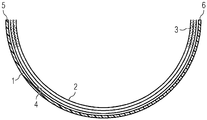
- Figure 1 schematically shows a mould 1 in a sectional view.
- a number of layers of fibre fabric or fibre material 2 are positioned onto each other at the inner surface 4 of the mould 1.
- the layers 2 are adhered to one another for fixation.
- an adhesive is used for adhering the layers to each other.
- the mould 1 comprises two edges 5 and 6.
- the adhesive is applied to the layers 2 at an area which is located close to the edges 5 or 6.
- the used adhesive is a thermoplastic adhesive with functional groups, which can react with a thermoset resin.
- the adhesive is based on either an unsaturated polyester or vinylester, for example a Bisphenol A based vinylester.
- the used adhesive is melted and sprayed onto the surface of the fibre layer 2 or onto the inner surface 4 of the mould 1, followed by application of the fibre layer before the adhesive re-solidifies.
- the solidification of the melted adhesive bonds the fibre layer to the surface.
- Open time can to some extent be controlled by application of temperature in relation to the melting temperature.
- the adhesive effect is only temporary, as the adhesive is partly or wholly dissolved during the injection of resin, and the adhesive effect is cancelled out.
- the adhesive is wetted, in a process of vacuum assisted resin transfer moulding (VARTM), with a thermoset resin containing components acting as solvents for the adhesive. Thereby the adhesive is partly or wholly dissolved.
- the used base resin may be not diluted in styrene and has thermoplastic like properties, which means, that it can be melted, but it still contains the reactive chemical groups (unsaturated bonds) needed to obtain a thermoset through a subsequent free radical cure reaction.
- the thermoplastic adhesive is combined with a styrene based thermoset resin.
- the thermoplastic adhesive is wetted with a styrene containing thermoset resin.
- the adhesive is dissolved by styrene, and, due to the reactive groups in the adhesive, it is integrated into the thermoset laminate during the cure reaction without compromising the laminate properties.
- the adhesive is dissolved by styrene, and, due to the reactive groups in the adhesive, it is integrated into the thermoset laminate during the cure reaction without compromising the laminate properties.
- Vacuum assisted resin transfer moulding is applied.
- the permeability of the fibre package 2 is reduced. This can be used to obtain a semi-vacuum on one side of the area of the applied adhesive by removal of air faster than it can be replenished through the fibre package 2.
- the properties of the base resin can be adjusted to meet process and material requirements by adding different other components in smaller amounts.
- additives can include, but are not limited to, reaction inhibitors, reaction catalysts, softeners and other polymeric compositions than the base resin.
Landscapes
- Engineering & Computer Science (AREA)
- Chemical & Material Sciences (AREA)
- Composite Materials (AREA)
- Mechanical Engineering (AREA)
- Textile Engineering (AREA)
- Laminated Bodies (AREA)
- Moulding By Coating Moulds (AREA)
- Casting Or Compression Moulding Of Plastics Or The Like (AREA)
- Reinforced Plastic Materials (AREA)
Description
- The present disclosure relates to a method for manufacturing a composite, for example a wind turbine rotor blade. It further relates to a use of an adhesive for temporary fixating the reinforcement material. The adhesive can also be used for reducing the permeability of a package of fibre material.
- To obtain optimal performance of a composite reinforced with fibres in the form of rovings or fabrics, the lay up of the fibres is essential. Unintentional movement of fibres resulting in wrinkles or displacement of the fibres can have a severe effect on the final laminate properties, and can result in costly repairs or discarding of the laminate.
- Especially in large moulds, where a large amount of fibre reinforcement is applied in a predefined sequence, the risk of local displacement of fibres is high, unless new layers are continuously fixated. Also, if movement of the mould or inserts into the mould is necessary, the risk of displacement is high.
- Currently, to ensure proper placement of mainly fabrics, these are often stitched together for each new layer to form a more stable package of fibres. This is however very labour intensive and in some cases, the stitching of fabrics can be very difficult or impossible to perform, as it requires the fabrics to be lifted at least partly for proper use of the stitching equipment. Furthermore, the stitching negatively affects the fibre structure of the fabrics and thereby induces suboptimal material performance.
- Alternatively, a holding device for fabrics can be positioned at the side of the mould, which can then be used to hold each new layer of fabric. This often requires use of excess fabric which should subsequently be cut away and can to some extent also result in a disruption of the fibre structure. This holding method can only be used around the edges of the mould.
- The use of adhesives for fixating purposes is limited, as currently available adhesives can interfere with the subsequent wetting of the fibres in the area covered by the adhesive, and will also affect the material properties negatively due to inferior compatibility between adhesive and the thermoset material used to produce the composite part.
- The known reactive hot melt adhesives can be used for a variety of purposes and are often based mainly on polyurethanes reacting with moisture in the air, but also adhesives based on ethyl vinyl acetate copolymers. Such adhesives can not be incorporated in a subsequently applied thermosetting resin.
- In
US 7,271,202 B2 a reactive hot melt composition is disclosed, which has excellent adhesion and curing properties. The composition comprises in ethylene-acrylic acid copolymer, and ethylene-methacrylic acid copolymer, and/or an ethylene-acrylic acid methacrylic acid terpolymer along with free radical cross linking initiators. - An adhesive tape which can be used to adhere fibre fabrics to a mould or other fibre fabrics is produced by Saertex and commercially available under the trade name Saerfix. This tape can also be pre-applied to the fabric from the manufacturer. As in the present disclosure, this tape is also incorporated into the thermosetting resin matrix during fibre wet out without negative effects on the mechanical properties.
- Such tapes do however suffer from some limitations. The geometry of the adhesion surface is limited to simple geometries, which must be cut to shape. As the tapes have adhesive surfaces, until use, the surface must be covered by a carrier material, which must be removed before application and discarded. The shelf life is somewhat limited. Such tapes are relatively expensive. Automated lay-up of such tapes will be rather difficult.
- In
US 2010/0029155 A1 adhesive coated fabrics are disclosed, which are suitable for use in composite materials. The adhesive coated fabrics are coated on at least one outwards facing surface with an acrylate adhesive. InUS 2007/0023975 A1 methods of making fibre reinforced molded articles and fibre mats using anaerobic binders are described. InUS 3,340,136 a method for preparing bonded fibrous products is described. - It is the objective of the present invention to provide an improved method for manufacturing a composite, which reduces the occurrence of wrinkles or a displacement of the used fibre layers.
- The objective is solved by a method for manufacturing a composite, which is a wind turbine rotor blade as claimed in claim 1. The depending claims define further developments of the present invention.
- The inventive method for manufacturing the composite comprises the step of fixating at least one layer of fibre material by means of an adhesive with functional groups, which can react with a thermoset resin. The method further comprises the step of at least partly dissolving the adhesive during wetting the adhesive with a thermoset resin containing components acting as solvents for the adhesive. For example, the adhesive can be wholly dissolved during wetting the adhesive with a thermoset resin containing components acting as solvents for the adhesive.
- The composite is a wind turbine rotor blade. Using an adhesive with functional groups, which can react with a thermoset resin, has the advantage, that the used adhesive can subsequently be incorporated into the resulting laminate without affecting the laminate properties negatively. The at least one layer of fibre material is fixated to a surface of a mould or to other layers, for example to other layers of fibre material. By using an adhesive, as previously described, for fixating layers of fibre material during the process of manufacturing a composite an unintentional movement of fibres possibly resulting in wrinkles or displacement of the fibres can be avoided. This increases the quality and the properties of the final laminate or composite. Moreover, costly repairs or discarding of the laminate can be avoided.
- Preferably a thermoplastic and/or thermoset adhesive can be used. For example, an adhesive comprising an unsaturated base resin can be used. Advantageously, the adhesive can comprise a base resin of oligomers containing unsaturated bonds. For example, an adhesive comprising an unsaturated polyester and/or vinylester, for instance Bisphenol A based vinylester, can be used.
- Commercial adhesives are typically based on either thermoplastic or thermoset materials. Thermoplastic adhesives are usually heated above the melting point and applied to the materials to be bonded, which are then put together. The adhesion can then be obtained by solidification of the thermoplastic. This is a relative fast process and can be performed with simple equipment. However, used in the production of reinforced laminates with thermosetting resins, the known thermoplastic materials will only to a small extent be compatible with the resin used to wet the laminate or used to infuse into the laminate, resulting in inferior mechanical properties. A subsequent wetting of the fibres with a thermoset material may also be negatively affected by the thermoplastic material which may act as a coating on the fibres.
- Thermoset adhesives are typically composed of two components or more which are mixed shortly before application. With time and, in some cases, elevated temperatures, a chemical reaction may take place and a solid structure can be formed. The formed structure is often very rigid, and may, if used as adhesive for holding fabrics, form a substructure which may negatively affect the overall laminate properties. Such adhesives also often require longer working time. Thermoset adhesives are often based on epoxy or polyurethane.
- In general, the unsaturated polyester and the vinylester resins, as can be used in the context of the inventive method, can be made by reacting unsaturated acids together with glycols to form a base resin of oligomers containing unsaturated bonds. Oligomers are short chained polymers. After the desired reaction has taken place, the still hot base resin can be diluted in styrene in order to obtain the required thermoset resin properties. If the base resin is not diluted, it is often a solid with thermoplastic like properties, e.g. it can be melted, but it still contains the reactive chemical groups or unsaturated bonds needed to obtain a thermoset trough a subsequent free radical cure reaction.
- As the base resin can be melted and re-solidified depending on temperature, it can be used as a thermoplastic adhesive as previously described. This can be advantageous, as the use of such an adhesive in combination with a styrene based thermoset resin makes an ideal compatibility between the adhesive and the thermoset resin possible.
- Preferably, the adhesive can be dissolved by styrene during wetting the adhesive with a thermoset resin containing styrene. During wetting with the styrene containing thermoset resin, the adhesive is dissolved by styrene, and, due to the reactive groups in the adhesive, the adhesive is integrated into the thermoset laminate during the cure reaction without compromising the laminate properties.
- Generally, the adhesive can be melted and sprayed or otherwise applied to the layer of fibre material. The subsequent layer of fibre material can then be positioned before the adhesive re-solidifies. Alternatively, the adhesive can be present on the substrate in solid form, by previous application in either melted or solid form, and melted shortly before lay up of the subsequent reinforcement layer.
- Vacuum assisted resin transfer moulding (VARTM) is applied to manufacture the composite. Preferably, an adhesive comprising the same or a chemically similar base resin can be used as the resin which is used to manufacture the composite. This provides for an incorporation of the adhesive into the resulting laminate without affecting the laminate properties negatively. The adhesive can be dissolved by styrene during wetting the adhesive with a thermoset resin containing styrene. Moreover, the same or similar oligomers in the adhesive and in the resin can be used. By using the same or similar oligomers in the adhesive and in the resin, compatibility between the two materials is ensured.
- Chemically similar base resins have the same chemical properties. This means that they can form a homogenous mixture and are able to react together during the curing reaction.
- The properties of the base resin can be adjusted to meet process and material requirements by adding different other components in smaller amounts. These additives can include, but are not limited to, reaction inhibitors, reaction catalysts, softeners and other polymeric compositions than the base resin. For example, an adhesive can be used which comprises a base resin to which at least one other component was added. Advantageously, an adhesive can be used which comprises a base resin to which at least one reaction inhibitor and/or at least one reaction catalyst and/or at least one softener and/or at least one other polymeric composition than the base resin was added.
- Furthermore, the permeability of the layers of fibre materials can be reduced by means of the adhesive. This means that the application of the previously described adhesive can be made to limit the permeability of the fibre package comprising a number of layers of fibre material. This can further be used to produce a semi-vacuum on one side of an area of the applied adhesive by removal of air faster than it can be replenished through the layers of the fibre material. Generally, the adhesive which may be used for reducing the permeability of the layers of fibre material can have the same properties as the previously described adhesive, which can be used for fixating the layers of fibre material.
- A method to obtain a pressure difference in a permeable material comprises the steps of partly sealing the permeable material by means of an adhesive and removing air faster at one side of an area of the permeable material than it can be replenished through the permeable material due to the partly sealing by means of the adhesive. The permeable material can comprise a number of layers of fibre material or a package of fibre material, as it can be used for manufacturing a composite, as previously described. Furthermore, the adhesive may have the same properties as the previously described adhesive in conjunction with the inventive method for manufacturing a composite.
- The inventive method for manufacturing a composite uses an adhesive for fixating different layers of fibre material in correct position. The adhesive can be a thermoplastic adhesive with functional groups, which can react with a thermoset resin. Preferably, the adhesive can be made from the same base resin as the thermoset resin for optimal compatibility. Moreover, the adhesive can also be used to reduce the permeability of a material, for example of a fibre package, e.g. for handling using a semi-vacuum.
- The aspects defined above and further aspects of the present invention are apparent from the example of embodiment to be described hereinafter and are explained with reference to the example of embodiment. The invention will be described in more detail hereinafter with reference to an example of embodiment.
- Further features, properties and advantages of the present invention will become clear from the following description of an embodiment in conjunction with the accompanying drawings. All features are advantageous separate or in combination with each other.
- Fig. 1
- schematically shows a mould for manufacturing a composite in a sectional view.
- An embodiment of the present invention will now be described with reference to
Figure 1 . - At first, the method for manufacturing a wind turbine rotor blade by vacuum assistant resin transfer moulding (VARTM) will shortly be described. It comprises the following steps:
- A number of layers are placed in a first mould part. Then a number of core parts and at least one shear web are placed in the first mould part. Then, a number of layers of fibre material are placed onto the core parts and the shear web. A second mould part can then be placed onto the core parts and the fibre material such that the first mould shell and the second mould shell are connected to each other forming a closed cavity. To inject resin into the closed mould cavity, vacuum is applied to the closed mould cavity and resin is sucked into the space between the mould shells and the core parts. After letting the resin set the mould shells and the core parts can be removed.
-
Figure 1 schematically shows a mould 1 in a sectional view. A number of layers of fibre fabric orfibre material 2 are positioned onto each other at the inner surface 4 of the mould 1. During laying thedifferent layers 2 onto each other, thelayers 2 are adhered to one another for fixation. For adhering the layers to each other an adhesive is used. - The mould 1 comprises two
edges 5 and 6. The adhesive is applied to thelayers 2 at an area which is located close to theedges 5 or 6. - The used adhesive is a thermoplastic adhesive with functional groups, which can react with a thermoset resin. The adhesive is based on either an unsaturated polyester or vinylester, for example a Bisphenol A based vinylester. The used adhesive is melted and sprayed onto the surface of the
fibre layer 2 or onto the inner surface 4 of the mould 1, followed by application of the fibre layer before the adhesive re-solidifies. The solidification of the melted adhesive bonds the fibre layer to the surface. Open time can to some extent be controlled by application of temperature in relation to the melting temperature. The adhesive effect is only temporary, as the adhesive is partly or wholly dissolved during the injection of resin, and the adhesive effect is cancelled out. - The adhesive is wetted, in a process of vacuum assisted resin transfer moulding (VARTM), with a thermoset resin containing components acting as solvents for the adhesive. Thereby the adhesive is partly or wholly dissolved. The used base resin may be not diluted in styrene and has thermoplastic like properties, which means, that it can be melted, but it still contains the reactive chemical groups (unsaturated bonds) needed to obtain a thermoset through a subsequent free radical cure reaction. The thermoplastic adhesive is combined with a styrene based thermoset resin. The thermoplastic adhesive is wetted with a styrene containing thermoset resin. During wetting with the styrene containing thermoset resin, the adhesive is dissolved by styrene, and, due to the reactive groups in the adhesive, it is integrated into the thermoset laminate during the cure reaction without compromising the laminate properties. By using the same or similar oligomers in the adhesive as in the resin, compatibility between the two materials is ensured.
- Vacuum assisted resin transfer moulding is applied. By means of the used adhesive, the permeability of the
fibre package 2 is reduced. This can be used to obtain a semi-vacuum on one side of the area of the applied adhesive by removal of air faster than it can be replenished through thefibre package 2. - The properties of the base resin can be adjusted to meet process and material requirements by adding different other components in smaller amounts. These additives can include, but are not limited to, reaction inhibitors, reaction catalysts, softeners and other polymeric compositions than the base resin.
Claims (12)
- A method for manufacturing a wind turbine rotor blade applying vacuum assisted resin transfer moulding , comprising the step of fixating at least one layer of fibre material (2) to a surface of a mould (1) or to other layers (2) by means of an adhesive with functional groups, which can react with a thermoset resin, characterised in at least partly dissolving the adhesive during wetting the adhesive with the thermoset resin containing components acting as solvents for the adhesive.
- The method as claimed in claim 1,
characterised in
using a thermoplastic and/or thermoset adhesive. - The method as claimed in any of the claims 1 to claim 2,
characterised in
using an adhesive comprising an unsaturated base resin. - The method as claimed in any of the claims 1 to claim 3,
characterised in
using an adhesive comprising a base resin of oligomers containing unsaturated bonds. - The method as claimed in any of the claims 1 to claim 4,
characterised in
using an adhesive comprising polyester and/or vinylester. - The method as claimed in any of the claims 1 to claim 5,
characterised in
melting and/or spraying the adhesive to the layer of fibre material (2) and positioning the layer of fibre material (2) before the adhesive re-solidifies. - The method as claimed in any of the claims 1 to claim 6,
characterised in
using an adhesive comprising the same or a chemically similar base resin as the resin which is used to manufacture the composite. - The method as claimed in any of the claims 1 to claim 7,
characterised in
dissolving the adhesive by styrene during wetting the adhesive with a thermoset resin containing styrene. - The method as claimed in any of the claims 1 to claim 8,
characterised in
using the same or similar oligomers in the adhesive and in the resin. - The method as claimed in any of the claims 1 to claim 9,
characterised in
using an adhesive comprising a base resin to which at least one other component was added. - The method as claimed in claim 10,
characterised in
using an adhesive comprising a base resin to which at least one reaction inhibitor and/or reaction catalyst and/or softener and/or other polymeric composition than the base resin was added. - The method as claimed in any of the claims 1 to claim 11,
characterised in
reducing the permeability of the layers of fibre material (2) by means of the adhesive.
Priority Applications (1)
| Application Number | Priority Date | Filing Date | Title |
|---|---|---|---|
| EP12772939.0A EP2731786B1 (en) | 2011-10-27 | 2012-10-15 | Method for manufacturing a composite |
Applications Claiming Priority (3)
| Application Number | Priority Date | Filing Date | Title |
|---|---|---|---|
| EP11186893.1A EP2586599A1 (en) | 2011-10-27 | 2011-10-27 | Method for manufacturing a composite |
| EP12772939.0A EP2731786B1 (en) | 2011-10-27 | 2012-10-15 | Method for manufacturing a composite |
| PCT/EP2012/070382 WO2013060588A1 (en) | 2011-10-27 | 2012-10-15 | Method for manufacturing a composite |
Publications (2)
| Publication Number | Publication Date |
|---|---|
| EP2731786A1 EP2731786A1 (en) | 2014-05-21 |
| EP2731786B1 true EP2731786B1 (en) | 2019-06-05 |
Family
ID=47022675
Family Applications (2)
| Application Number | Title | Priority Date | Filing Date |
|---|---|---|---|
| EP11186893.1A Withdrawn EP2586599A1 (en) | 2011-10-27 | 2011-10-27 | Method for manufacturing a composite |
| EP12772939.0A Revoked EP2731786B1 (en) | 2011-10-27 | 2012-10-15 | Method for manufacturing a composite |
Family Applications Before (1)
| Application Number | Title | Priority Date | Filing Date |
|---|---|---|---|
| EP11186893.1A Withdrawn EP2586599A1 (en) | 2011-10-27 | 2011-10-27 | Method for manufacturing a composite |
Country Status (4)
| Country | Link |
|---|---|
| US (1) | US9833954B2 (en) |
| EP (2) | EP2586599A1 (en) |
| CN (1) | CN103889690B (en) |
| WO (1) | WO2013060588A1 (en) |
Families Citing this family (7)
| Publication number | Priority date | Publication date | Assignee | Title |
|---|---|---|---|---|
| DE102015208320A1 (en) | 2015-05-05 | 2016-11-10 | Tesa Se | Adhesive tape with temporary fixing adhesive |
| GB201620227D0 (en) * | 2016-11-29 | 2017-01-11 | Cytec Ind Inc | Automated fabrication of fibrous preform |
| USD860897S1 (en) * | 2017-12-21 | 2019-09-24 | Sram, Llc | Bicycle rim with surface indicia |
| USD898649S1 (en) * | 2017-12-21 | 2020-10-13 | Sram, Llc | Bicycle rim |
| DE102019201025A1 (en) | 2019-01-28 | 2020-07-30 | Tesa Se | Adhesive tape with temporary fixing adhesive |
| DE102019201026A1 (en) | 2019-01-28 | 2020-07-30 | Tesa Se | Temporary fixing adhesive |
| DE202020100778U1 (en) * | 2020-02-13 | 2020-02-21 | Markus Brzeski | Gluing fiber-reinforced plastic tapes into an injection mold |
Family Cites Families (4)
| Publication number | Priority date | Publication date | Assignee | Title |
|---|---|---|---|---|
| US3340136A (en) * | 1962-03-09 | 1967-09-05 | Atlas Chem Ind | Bonded fibrous products and a method for preparing them |
| GB0304276D0 (en) | 2003-02-25 | 2003-03-26 | Dow Benelux | Reactive hot melt adhesive |
| US20070023975A1 (en) * | 2005-08-01 | 2007-02-01 | Buckley Daniel T | Method for making three-dimensional preforms using anaerobic binders |
| EP1934298A1 (en) | 2005-09-22 | 2008-06-25 | Saint-Gobain Syncoglas N.V. | Adhesive coated fabrics suitable for use in composite materials |
-
2011
- 2011-10-27 EP EP11186893.1A patent/EP2586599A1/en not_active Withdrawn
-
2012
- 2012-10-15 WO PCT/EP2012/070382 patent/WO2013060588A1/en not_active Ceased
- 2012-10-15 EP EP12772939.0A patent/EP2731786B1/en not_active Revoked
- 2012-10-15 CN CN201280052258.5A patent/CN103889690B/en active Active
- 2012-10-15 US US14/345,242 patent/US9833954B2/en active Active
Non-Patent Citations (1)
| Title |
|---|
| None * |
Also Published As
| Publication number | Publication date |
|---|---|
| WO2013060588A1 (en) | 2013-05-02 |
| US20140238590A1 (en) | 2014-08-28 |
| CN103889690B (en) | 2019-07-19 |
| EP2586599A1 (en) | 2013-05-01 |
| US9833954B2 (en) | 2017-12-05 |
| CN103889690A (en) | 2014-06-25 |
| EP2731786A1 (en) | 2014-05-21 |
Similar Documents
| Publication | Publication Date | Title |
|---|---|---|
| US9833954B2 (en) | Method for manufacturing a composite | |
| US9199431B2 (en) | Fibre-reinforced composite molding and manufacture thereof | |
| EP1625929B1 (en) | Moulding method | |
| TW201433433A (en) | Method for forming shaped preform | |
| EP3548241B1 (en) | Automated fabrication of fibrous preform | |
| JP5984933B2 (en) | Flexible reinforcing fiber yarn pre-impregnated with resin | |
| TW201429691A (en) | Combination of composite materials | |
| EP3161199B1 (en) | Non-woven fabrics | |
| CN101913251A (en) | Liquid Molding Fusible Core Forming Technology for Complicated Components of Resin Matrix Composite | |
| EP3313639B1 (en) | Improvements in or relating to three dimensional mouldings | |
| CN103802333A (en) | Method for manufacturing electronic product composite housing by resin transfer molding process | |
| EP2584014B1 (en) | Method for joining aluminum part and resin and composite made by same | |
| EP3380308A1 (en) | Improvements in or relating to fibre reinforced composites | |
| WO2012149939A2 (en) | Method of preparing a composite laminate | |
| CN102173113B (en) | Method for improving bonding quality of foams and fabrics applied in liquid molding process | |
| WO2012174623A1 (en) | Support material, sheet moulding compound and process for making a moulding material | |
| JP2009214371A (en) | Method for manufacturing fiber-reinforced composite material and fiber-reinforced composite material, method for manufacturing integrated structural member and integrated structural member | |
| RS57091B1 (en) | 1-component system, products derived from same and method for the production of fibre compound semi-finished products components with the 1-component system | |
| KR100748826B1 (en) | Method for producing surface reinforced fiber moldings | |
| US9821491B2 (en) | Method for producing thermosetting composite parts by drape forming of preimpregnated material | |
| US12486430B2 (en) | Preform assembly | |
| US20150021835A1 (en) | Use Of Biodegradable Plastics Films In Processes For Producing Fiber-Reinforced Plastics By Means Of Vacuum Infusion | |
| CN120569287A (en) | Method for the automated processing of high-temperature stable closed-cell rigid foams |
Legal Events
| Date | Code | Title | Description |
|---|---|---|---|
| PUAI | Public reference made under article 153(3) epc to a published international application that has entered the european phase |
Free format text: ORIGINAL CODE: 0009012 |
|
| 17P | Request for examination filed |
Effective date: 20140213 |
|
| AK | Designated contracting states |
Kind code of ref document: A1 Designated state(s): AL AT BE BG CH CY CZ DE DK EE ES FI FR GB GR HR HU IE IS IT LI LT LU LV MC MK MT NL NO PL PT RO RS SE SI SK SM TR |
|
| DAX | Request for extension of the european patent (deleted) | ||
| RAP1 | Party data changed (applicant data changed or rights of an application transferred) |
Owner name: SIEMENS AKTIENGESELLSCHAFT |
|
| STAA | Information on the status of an ep patent application or granted ep patent |
Free format text: STATUS: EXAMINATION IS IN PROGRESS |
|
| 17Q | First examination report despatched |
Effective date: 20180509 |
|
| GRAP | Despatch of communication of intention to grant a patent |
Free format text: ORIGINAL CODE: EPIDOSNIGR1 |
|
| STAA | Information on the status of an ep patent application or granted ep patent |
Free format text: STATUS: GRANT OF PATENT IS INTENDED |
|
| INTG | Intention to grant announced |
Effective date: 20190104 |
|
| GRAS | Grant fee paid |
Free format text: ORIGINAL CODE: EPIDOSNIGR3 |
|
| GRAA | (expected) grant |
Free format text: ORIGINAL CODE: 0009210 |
|
| STAA | Information on the status of an ep patent application or granted ep patent |
Free format text: STATUS: THE PATENT HAS BEEN GRANTED |
|
| RAP1 | Party data changed (applicant data changed or rights of an application transferred) |
Owner name: SIEMENS GAMESA RENEWABLE ENERGY A/S |
|
| AK | Designated contracting states |
Kind code of ref document: B1 Designated state(s): AL AT BE BG CH CY CZ DE DK EE ES FI FR GB GR HR HU IE IS IT LI LT LU LV MC MK MT NL NO PL PT RO RS SE SI SK SM TR |
|
| REG | Reference to a national code |
Ref country code: GB Ref legal event code: FG4D |
|
| REG | Reference to a national code |
Ref country code: CH Ref legal event code: EP |
|
| REG | Reference to a national code |
Ref country code: AT Ref legal event code: REF Ref document number: 1139560 Country of ref document: AT Kind code of ref document: T Effective date: 20190615 |
|
| REG | Reference to a national code |
Ref country code: DE Ref legal event code: R096 Ref document number: 602012060734 Country of ref document: DE |
|
| REG | Reference to a national code |
Ref country code: IE Ref legal event code: FG4D |
|
| REG | Reference to a national code |
Ref country code: NL Ref legal event code: MP Effective date: 20190605 |
|
| REG | Reference to a national code |
Ref country code: LT Ref legal event code: MG4D |
|
| PG25 | Lapsed in a contracting state [announced via postgrant information from national office to epo] |
Ref country code: ES Free format text: LAPSE BECAUSE OF FAILURE TO SUBMIT A TRANSLATION OF THE DESCRIPTION OR TO PAY THE FEE WITHIN THE PRESCRIBED TIME-LIMIT Effective date: 20190605 Ref country code: AL Free format text: LAPSE BECAUSE OF FAILURE TO SUBMIT A TRANSLATION OF THE DESCRIPTION OR TO PAY THE FEE WITHIN THE PRESCRIBED TIME-LIMIT Effective date: 20190605 Ref country code: SE Free format text: LAPSE BECAUSE OF FAILURE TO SUBMIT A TRANSLATION OF THE DESCRIPTION OR TO PAY THE FEE WITHIN THE PRESCRIBED TIME-LIMIT Effective date: 20190605 Ref country code: NO Free format text: LAPSE BECAUSE OF FAILURE TO SUBMIT A TRANSLATION OF THE DESCRIPTION OR TO PAY THE FEE WITHIN THE PRESCRIBED TIME-LIMIT Effective date: 20190905 Ref country code: FI Free format text: LAPSE BECAUSE OF FAILURE TO SUBMIT A TRANSLATION OF THE DESCRIPTION OR TO PAY THE FEE WITHIN THE PRESCRIBED TIME-LIMIT Effective date: 20190605 Ref country code: LT Free format text: LAPSE BECAUSE OF FAILURE TO SUBMIT A TRANSLATION OF THE DESCRIPTION OR TO PAY THE FEE WITHIN THE PRESCRIBED TIME-LIMIT Effective date: 20190605 Ref country code: HR Free format text: LAPSE BECAUSE OF FAILURE TO SUBMIT A TRANSLATION OF THE DESCRIPTION OR TO PAY THE FEE WITHIN THE PRESCRIBED TIME-LIMIT Effective date: 20190605 |
|
| PG25 | Lapsed in a contracting state [announced via postgrant information from national office to epo] |
Ref country code: RS Free format text: LAPSE BECAUSE OF FAILURE TO SUBMIT A TRANSLATION OF THE DESCRIPTION OR TO PAY THE FEE WITHIN THE PRESCRIBED TIME-LIMIT Effective date: 20190605 Ref country code: BG Free format text: LAPSE BECAUSE OF FAILURE TO SUBMIT A TRANSLATION OF THE DESCRIPTION OR TO PAY THE FEE WITHIN THE PRESCRIBED TIME-LIMIT Effective date: 20190905 Ref country code: GR Free format text: LAPSE BECAUSE OF FAILURE TO SUBMIT A TRANSLATION OF THE DESCRIPTION OR TO PAY THE FEE WITHIN THE PRESCRIBED TIME-LIMIT Effective date: 20190906 Ref country code: LV Free format text: LAPSE BECAUSE OF FAILURE TO SUBMIT A TRANSLATION OF THE DESCRIPTION OR TO PAY THE FEE WITHIN THE PRESCRIBED TIME-LIMIT Effective date: 20190605 |
|
| REG | Reference to a national code |
Ref country code: AT Ref legal event code: MK05 Ref document number: 1139560 Country of ref document: AT Kind code of ref document: T Effective date: 20190605 |
|
| PG25 | Lapsed in a contracting state [announced via postgrant information from national office to epo] |
Ref country code: NL Free format text: LAPSE BECAUSE OF FAILURE TO SUBMIT A TRANSLATION OF THE DESCRIPTION OR TO PAY THE FEE WITHIN THE PRESCRIBED TIME-LIMIT Effective date: 20190605 Ref country code: EE Free format text: LAPSE BECAUSE OF FAILURE TO SUBMIT A TRANSLATION OF THE DESCRIPTION OR TO PAY THE FEE WITHIN THE PRESCRIBED TIME-LIMIT Effective date: 20190605 Ref country code: CZ Free format text: LAPSE BECAUSE OF FAILURE TO SUBMIT A TRANSLATION OF THE DESCRIPTION OR TO PAY THE FEE WITHIN THE PRESCRIBED TIME-LIMIT Effective date: 20190605 Ref country code: AT Free format text: LAPSE BECAUSE OF FAILURE TO SUBMIT A TRANSLATION OF THE DESCRIPTION OR TO PAY THE FEE WITHIN THE PRESCRIBED TIME-LIMIT Effective date: 20190605 Ref country code: SK Free format text: LAPSE BECAUSE OF FAILURE TO SUBMIT A TRANSLATION OF THE DESCRIPTION OR TO PAY THE FEE WITHIN THE PRESCRIBED TIME-LIMIT Effective date: 20190605 Ref country code: RO Free format text: LAPSE BECAUSE OF FAILURE TO SUBMIT A TRANSLATION OF THE DESCRIPTION OR TO PAY THE FEE WITHIN THE PRESCRIBED TIME-LIMIT Effective date: 20190605 Ref country code: PT Free format text: LAPSE BECAUSE OF FAILURE TO SUBMIT A TRANSLATION OF THE DESCRIPTION OR TO PAY THE FEE WITHIN THE PRESCRIBED TIME-LIMIT Effective date: 20191007 |
|
| PG25 | Lapsed in a contracting state [announced via postgrant information from national office to epo] |
Ref country code: IS Free format text: LAPSE BECAUSE OF FAILURE TO SUBMIT A TRANSLATION OF THE DESCRIPTION OR TO PAY THE FEE WITHIN THE PRESCRIBED TIME-LIMIT Effective date: 20191005 Ref country code: IT Free format text: LAPSE BECAUSE OF FAILURE TO SUBMIT A TRANSLATION OF THE DESCRIPTION OR TO PAY THE FEE WITHIN THE PRESCRIBED TIME-LIMIT Effective date: 20190605 Ref country code: SM Free format text: LAPSE BECAUSE OF FAILURE TO SUBMIT A TRANSLATION OF THE DESCRIPTION OR TO PAY THE FEE WITHIN THE PRESCRIBED TIME-LIMIT Effective date: 20190605 |
|
| REG | Reference to a national code |
Ref country code: DE Ref legal event code: R026 Ref document number: 602012060734 Country of ref document: DE |
|
| PLBI | Opposition filed |
Free format text: ORIGINAL CODE: 0009260 |
|
| PLAX | Notice of opposition and request to file observation + time limit sent |
Free format text: ORIGINAL CODE: EPIDOSNOBS2 |
|
| PG25 | Lapsed in a contracting state [announced via postgrant information from national office to epo] |
Ref country code: TR Free format text: LAPSE BECAUSE OF FAILURE TO SUBMIT A TRANSLATION OF THE DESCRIPTION OR TO PAY THE FEE WITHIN THE PRESCRIBED TIME-LIMIT Effective date: 20190605 |
|
| 26 | Opposition filed |
Opponent name: LM WP PATENT HOLDING A/S Effective date: 20200305 |
|
| PG25 | Lapsed in a contracting state [announced via postgrant information from national office to epo] |
Ref country code: DK Free format text: LAPSE BECAUSE OF FAILURE TO SUBMIT A TRANSLATION OF THE DESCRIPTION OR TO PAY THE FEE WITHIN THE PRESCRIBED TIME-LIMIT Effective date: 20190605 Ref country code: PL Free format text: LAPSE BECAUSE OF FAILURE TO SUBMIT A TRANSLATION OF THE DESCRIPTION OR TO PAY THE FEE WITHIN THE PRESCRIBED TIME-LIMIT Effective date: 20190605 |
|
| PG25 | Lapsed in a contracting state [announced via postgrant information from national office to epo] |
Ref country code: MC Free format text: LAPSE BECAUSE OF FAILURE TO SUBMIT A TRANSLATION OF THE DESCRIPTION OR TO PAY THE FEE WITHIN THE PRESCRIBED TIME-LIMIT Effective date: 20190605 Ref country code: SI Free format text: LAPSE BECAUSE OF FAILURE TO SUBMIT A TRANSLATION OF THE DESCRIPTION OR TO PAY THE FEE WITHIN THE PRESCRIBED TIME-LIMIT Effective date: 20190605 |
|
| REG | Reference to a national code |
Ref country code: CH Ref legal event code: PL |
|
| PLBB | Reply of patent proprietor to notice(s) of opposition received |
Free format text: ORIGINAL CODE: EPIDOSNOBS3 |
|
| PG25 | Lapsed in a contracting state [announced via postgrant information from national office to epo] |
Ref country code: LU Free format text: LAPSE BECAUSE OF NON-PAYMENT OF DUE FEES Effective date: 20191015 Ref country code: CH Free format text: LAPSE BECAUSE OF NON-PAYMENT OF DUE FEES Effective date: 20191031 Ref country code: LI Free format text: LAPSE BECAUSE OF NON-PAYMENT OF DUE FEES Effective date: 20191031 |
|
| REG | Reference to a national code |
Ref country code: BE Ref legal event code: MM Effective date: 20191031 |
|
| PG25 | Lapsed in a contracting state [announced via postgrant information from national office to epo] |
Ref country code: BE Free format text: LAPSE BECAUSE OF NON-PAYMENT OF DUE FEES Effective date: 20191031 |
|
| PG25 | Lapsed in a contracting state [announced via postgrant information from national office to epo] |
Ref country code: FR Free format text: LAPSE BECAUSE OF NON-PAYMENT OF DUE FEES Effective date: 20191031 Ref country code: IE Free format text: LAPSE BECAUSE OF NON-PAYMENT OF DUE FEES Effective date: 20191015 |
|
| PG25 | Lapsed in a contracting state [announced via postgrant information from national office to epo] |
Ref country code: CY Free format text: LAPSE BECAUSE OF FAILURE TO SUBMIT A TRANSLATION OF THE DESCRIPTION OR TO PAY THE FEE WITHIN THE PRESCRIBED TIME-LIMIT Effective date: 20190605 |
|
| PG25 | Lapsed in a contracting state [announced via postgrant information from national office to epo] |
Ref country code: HU Free format text: LAPSE BECAUSE OF FAILURE TO SUBMIT A TRANSLATION OF THE DESCRIPTION OR TO PAY THE FEE WITHIN THE PRESCRIBED TIME-LIMIT; INVALID AB INITIO Effective date: 20121015 Ref country code: MT Free format text: LAPSE BECAUSE OF FAILURE TO SUBMIT A TRANSLATION OF THE DESCRIPTION OR TO PAY THE FEE WITHIN THE PRESCRIBED TIME-LIMIT Effective date: 20190605 |
|
| PLCK | Communication despatched that opposition was rejected |
Free format text: ORIGINAL CODE: EPIDOSNREJ1 |
|
| APBM | Appeal reference recorded |
Free format text: ORIGINAL CODE: EPIDOSNREFNO |
|
| APBP | Date of receipt of notice of appeal recorded |
Free format text: ORIGINAL CODE: EPIDOSNNOA2O |
|
| APAH | Appeal reference modified |
Free format text: ORIGINAL CODE: EPIDOSCREFNO |
|
| PLAB | Opposition data, opponent's data or that of the opponent's representative modified |
Free format text: ORIGINAL CODE: 0009299OPPO |
|
| R26 | Opposition filed (corrected) |
Opponent name: LM WP PATENT HOLDING A/S LM WIND POWER A/S Effective date: 20200305 |
|
| APBQ | Date of receipt of statement of grounds of appeal recorded |
Free format text: ORIGINAL CODE: EPIDOSNNOA3O |
|
| PG25 | Lapsed in a contracting state [announced via postgrant information from national office to epo] |
Ref country code: MK Free format text: LAPSE BECAUSE OF FAILURE TO SUBMIT A TRANSLATION OF THE DESCRIPTION OR TO PAY THE FEE WITHIN THE PRESCRIBED TIME-LIMIT Effective date: 20190605 |
|
| REG | Reference to a national code |
Ref country code: DE Ref legal event code: R082 Ref document number: 602012060734 Country of ref document: DE Representative=s name: SAUTHOFF, KARSTEN, DIPL.-ING. UNIV., DE |
|
| P01 | Opt-out of the competence of the unified patent court (upc) registered |
Effective date: 20230530 |
|
| PGFP | Annual fee paid to national office [announced via postgrant information from national office to epo] |
Ref country code: DE Payment date: 20231018 Year of fee payment: 12 |
|
| REG | Reference to a national code |
Ref country code: DE Ref legal event code: R103 Ref document number: 602012060734 Country of ref document: DE Ref country code: DE Ref legal event code: R064 Ref document number: 602012060734 Country of ref document: DE |
|
| APBU | Appeal procedure closed |
Free format text: ORIGINAL CODE: EPIDOSNNOA9O |
|
| PLCK | Communication despatched that opposition was rejected |
Free format text: ORIGINAL CODE: EPIDOSNREJ1 |
|
| RDAF | Communication despatched that patent is revoked |
Free format text: ORIGINAL CODE: EPIDOSNREV1 |
|
| STAA | Information on the status of an ep patent application or granted ep patent |
Free format text: STATUS: PATENT REVOKED |
|
| RDAG | Patent revoked |
Free format text: ORIGINAL CODE: 0009271 |
|
| REG | Reference to a national code |
Ref country code: CH Ref legal event code: PL |
|
| 27W | Patent revoked |
Effective date: 20240419 |
|
| GBPR | Gb: patent revoked under art. 102 of the ep convention designating the uk as contracting state |
Effective date: 20240419 |
|
| PGFP | Annual fee paid to national office [announced via postgrant information from national office to epo] |
Ref country code: GB Payment date: 20241022 Year of fee payment: 13 |