EP2731604B1 - Use of coumarin derivatives for the preparation of drugs for treating skin diseases - Google Patents
Use of coumarin derivatives for the preparation of drugs for treating skin diseases Download PDFInfo
- Publication number
- EP2731604B1 EP2731604B1 EP12733783.0A EP12733783A EP2731604B1 EP 2731604 B1 EP2731604 B1 EP 2731604B1 EP 12733783 A EP12733783 A EP 12733783A EP 2731604 B1 EP2731604 B1 EP 2731604B1
- Authority
- EP
- European Patent Office
- Prior art keywords
- group
- alkyl
- branched
- saturated
- linear
- Prior art date
- Legal status (The legal status is an assumption and is not a legal conclusion. Google has not performed a legal analysis and makes no representation as to the accuracy of the status listed.)
- Active
Links
- 0 CCCCC(CC1CC1)C(CCC*CCC)C1C(CC2CC(C)CC2)C1 Chemical compound CCCCC(CC1CC1)C(CCC*CCC)C1C(CC2CC(C)CC2)C1 0.000 description 9
- QHGWYSKWBBEBSI-UHFFFAOYSA-N CS(NCc(cc1)cc(C=C2C(Oc3cccc(Cl)c3)=O)c1OC2=O)(=O)=O Chemical compound CS(NCc(cc1)cc(C=C2C(Oc3cccc(Cl)c3)=O)c1OC2=O)(=O)=O QHGWYSKWBBEBSI-UHFFFAOYSA-N 0.000 description 2
- VBRWHTMSOGVKLX-UHFFFAOYSA-N NCc(cc1)cc(C=C2C(Oc3ccccc3)=O)c1OC2=O Chemical compound NCc(cc1)cc(C=C2C(Oc3ccccc3)=O)c1OC2=O VBRWHTMSOGVKLX-UHFFFAOYSA-N 0.000 description 2
- OZKMBTRSTVYGMK-UHFFFAOYSA-N O=C(C1=Cc2cc(CCl)ccc2OC1=O)Oc(cc(cc1)Cl)c1Cl Chemical compound O=C(C1=Cc2cc(CCl)ccc2OC1=O)Oc(cc(cc1)Cl)c1Cl OZKMBTRSTVYGMK-UHFFFAOYSA-N 0.000 description 2
- WIBPRJHSRYQIFR-UHFFFAOYSA-N O=C(C1=Cc2cc(CCl)ccc2OC1=O)Sc1ccccc1 Chemical compound O=C(C1=Cc2cc(CCl)ccc2OC1=O)Sc1ccccc1 WIBPRJHSRYQIFR-UHFFFAOYSA-N 0.000 description 2
- RJPZRLIIMQKKSG-UHFFFAOYSA-N Oc(cc1)cc(C=C2C(Oc(cccc3)c3Cl)=O)c1OC2=O Chemical compound Oc(cc1)cc(C=C2C(Oc(cccc3)c3Cl)=O)c1OC2=O RJPZRLIIMQKKSG-UHFFFAOYSA-N 0.000 description 2
- FQPRZVWTJUKVAT-UHFFFAOYSA-N Oc(cc1)cc(C=C2C(Oc3ccccc3)=O)c1OC2=O Chemical compound Oc(cc1)cc(C=C2C(Oc3ccccc3)=O)c1OC2=O FQPRZVWTJUKVAT-UHFFFAOYSA-N 0.000 description 2
- VKDGLHCHBIHDDG-UHFFFAOYSA-N C=NCc(cc1C=C2C(Oc3cccc(Br)c3)=[U])ccc1OC2=O Chemical compound C=NCc(cc1C=C2C(Oc3cccc(Br)c3)=[U])ccc1OC2=O VKDGLHCHBIHDDG-UHFFFAOYSA-N 0.000 description 1
- SVYVBPOLKDWUSW-XHFAFUTOSA-N CC(/C(/C(Oc(cccc1)c1Br)=[U])=C\c1c(C)ccc(CNC(C)=N)c1)=O Chemical compound CC(/C(/C(Oc(cccc1)c1Br)=[U])=C\c1c(C)ccc(CNC(C)=N)c1)=O SVYVBPOLKDWUSW-XHFAFUTOSA-N 0.000 description 1
- MBIXRNHQWYIXLS-UHFFFAOYSA-N CC(OCc(cc1C=C2C(Oc(cc(cc3)F)c3Br)=O)ccc1OC2=O)=O Chemical compound CC(OCc(cc1C=C2C(Oc(cc(cc3)F)c3Br)=O)ccc1OC2=O)=O MBIXRNHQWYIXLS-UHFFFAOYSA-N 0.000 description 1
- DVBOLSPGWVRGPK-UHFFFAOYSA-N CC(OCc(cc1C=C2C(Oc(cccc3)c3Br)=O)ccc1OC2=O)=O Chemical compound CC(OCc(cc1C=C2C(Oc(cccc3)c3Br)=O)ccc1OC2=O)=O DVBOLSPGWVRGPK-UHFFFAOYSA-N 0.000 description 1
- IPFNIMGFVAMGCV-UHFFFAOYSA-N CC(OCc(cc1C=C2C(Oc(cccc3)c3Cl)=O)ccc1OC2=O)=O Chemical compound CC(OCc(cc1C=C2C(Oc(cccc3)c3Cl)=O)ccc1OC2=O)=O IPFNIMGFVAMGCV-UHFFFAOYSA-N 0.000 description 1
- KAFRHPTYCPHSIO-UHFFFAOYSA-N CC(OCc(cc1C=C2C(Oc(cccc3)c3I)=O)ccc1OC2=O)=O Chemical compound CC(OCc(cc1C=C2C(Oc(cccc3)c3I)=O)ccc1OC2=O)=O KAFRHPTYCPHSIO-UHFFFAOYSA-N 0.000 description 1
- VYQRLCPMERGGPA-UHFFFAOYSA-N CC(OCc(cc1C=C2C(Oc3ccccc3C#N)=O)ccc1OC2=O)=O Chemical compound CC(OCc(cc1C=C2C(Oc3ccccc3C#N)=O)ccc1OC2=O)=O VYQRLCPMERGGPA-UHFFFAOYSA-N 0.000 description 1
- KRRJIXOBNSNFLN-UHFFFAOYSA-N CCOC(C1=Cc(cc(CCl)cc2)c2OC1=O)=O Chemical compound CCOC(C1=Cc(cc(CCl)cc2)c2OC1=O)=O KRRJIXOBNSNFLN-UHFFFAOYSA-N 0.000 description 1
- LQOHTLVTDQSFJM-UHFFFAOYSA-N COC(C1=Cc2cc(CCl)ccc2OC1=O)=O Chemical compound COC(C1=Cc2cc(CCl)ccc2OC1=O)=O LQOHTLVTDQSFJM-UHFFFAOYSA-N 0.000 description 1
- JCCPMEPSIXWTGI-UHFFFAOYSA-N COC(c(cc1)ccc1OC(C1=Cc(cc(C[NH-])cc2)c2OC1=O)=O)=C Chemical compound COC(c(cc1)ccc1OC(C1=Cc(cc(C[NH-])cc2)c2OC1=O)=O)=C JCCPMEPSIXWTGI-UHFFFAOYSA-N 0.000 description 1
- HSCQDLBMPRZOIA-UHFFFAOYSA-N COC(c(cccc1)c1OC(C1=Cc2cc(CCl)ccc2OC1=O)=O)=O Chemical compound COC(c(cccc1)c1OC(C1=Cc2cc(CCl)ccc2OC1=O)=O)=O HSCQDLBMPRZOIA-UHFFFAOYSA-N 0.000 description 1
- SLSYTOVCPAGJGJ-UHFFFAOYSA-N COC1Oc2ccc(CCl)cc2C=C1[NH+]([O-])Oc(cc(cc1)F)c1Br Chemical compound COC1Oc2ccc(CCl)cc2C=C1[NH+]([O-])Oc(cc(cc1)F)c1Br SLSYTOVCPAGJGJ-UHFFFAOYSA-N 0.000 description 1
- LKFIVBGEUXRLJH-UHFFFAOYSA-N COc1cc(OC(C2=Cc3cc(CCl)ccc3OC2=O)=O)ccc1 Chemical compound COc1cc(OC(C2=Cc3cc(CCl)ccc3OC2=O)=O)ccc1 LKFIVBGEUXRLJH-UHFFFAOYSA-N 0.000 description 1
- GEEMFRVOSNCBAF-MGNBDDOMSA-N C[C@H](Cc(cc1C=C2C(Oc(cc(cc3)F)c3Br)=O)ccc1O[C@@H]2O)Cl Chemical compound C[C@H](Cc(cc1C=C2C(Oc(cc(cc3)F)c3Br)=O)ccc1O[C@@H]2O)Cl GEEMFRVOSNCBAF-MGNBDDOMSA-N 0.000 description 1
- NXUHHYYKYMGUDP-UHFFFAOYSA-N Cc1c(C(CC2)C2C(C2=Cc(cc(cc3)O)c3OC2=O)=O)cccc1 Chemical compound Cc1c(C(CC2)C2C(C2=Cc(cc(cc3)O)c3OC2=O)=O)cccc1 NXUHHYYKYMGUDP-UHFFFAOYSA-N 0.000 description 1
- VNKLMQDQFDPIAN-UHFFFAOYSA-N NC(c1cccc(OC(C2=Cc(cc(CCl)cc3)c3OC2=O)=O)c1)=O Chemical compound NC(c1cccc(OC(C2=Cc(cc(CCl)cc3)c3OC2=O)=O)c1)=O VNKLMQDQFDPIAN-UHFFFAOYSA-N 0.000 description 1
- VRDCRRZKXXIZIZ-UHFFFAOYSA-N NNC(C1=Cc(cc(cc2)O)c2OC2OC12)=O Chemical compound NNC(C1=Cc(cc(cc2)O)c2OC2OC12)=O VRDCRRZKXXIZIZ-UHFFFAOYSA-N 0.000 description 1
- FNSNDUDYXFIZEJ-UHFFFAOYSA-N O=C(C1=CC2=CC(CCl)=CCC2OC1=O)Oc1ccccc1 Chemical compound O=C(C1=CC2=CC(CCl)=CCC2OC1=O)Oc1ccccc1 FNSNDUDYXFIZEJ-UHFFFAOYSA-N 0.000 description 1
- FRZZUMFHKUBYJP-UHFFFAOYSA-N O=C(C1=Cc(cc(CCl)cc2)c2OC1=O)Oc(cccc1Cl)c1Cl Chemical compound O=C(C1=Cc(cc(CCl)cc2)c2OC1=O)Oc(cccc1Cl)c1Cl FRZZUMFHKUBYJP-UHFFFAOYSA-N 0.000 description 1
- KTAAQZUDIRYTJP-UHFFFAOYSA-N O=C(C1=Cc(cc(CCl)cc2)c2OC1=O)Oc1cccc(F)c1 Chemical compound O=C(C1=Cc(cc(CCl)cc2)c2OC1=O)Oc1cccc(F)c1 KTAAQZUDIRYTJP-UHFFFAOYSA-N 0.000 description 1
- DFQANNIQMJQPMO-UHFFFAOYSA-N O=C(C1=Cc(cc(CCl)cc2)c2OC1=O)Oc1cccc(I)c1 Chemical compound O=C(C1=Cc(cc(CCl)cc2)c2OC1=O)Oc1cccc(I)c1 DFQANNIQMJQPMO-UHFFFAOYSA-N 0.000 description 1
- VLAVQNSKKDLVGI-UHFFFAOYSA-N O=C(C1=Cc(cc(CCl)cc2)c2OC1=O)Oc1ccccc1 Chemical compound O=C(C1=Cc(cc(CCl)cc2)c2OC1=O)Oc1ccccc1 VLAVQNSKKDLVGI-UHFFFAOYSA-N 0.000 description 1
- IAVDHPIPLOUCNW-UHFFFAOYSA-N O=C(C1=Cc2cc(CCl)ccc2OC1=O)OC1C=CC(Cl)=CC1 Chemical compound O=C(C1=Cc2cc(CCl)ccc2OC1=O)OC1C=CC(Cl)=CC1 IAVDHPIPLOUCNW-UHFFFAOYSA-N 0.000 description 1
- HGBFQSALVRJSHG-UHFFFAOYSA-N O=C(C1=Cc2cc(CCl)ccc2OC1=O)Oc1cc(F)ccc1F Chemical compound O=C(C1=Cc2cc(CCl)ccc2OC1=O)Oc1cc(F)ccc1F HGBFQSALVRJSHG-UHFFFAOYSA-N 0.000 description 1
- OMYRMHAKNNIGHA-UHFFFAOYSA-N O=C(C1=Cc2cc(CCl)ccc2OC1=O)Oc1cccc(Cl)n1 Chemical compound O=C(C1=Cc2cc(CCl)ccc2OC1=O)Oc1cccc(Cl)n1 OMYRMHAKNNIGHA-UHFFFAOYSA-N 0.000 description 1
- APSVKFJSFAVDBL-UHFFFAOYSA-N OC(c(cccc1)c1OC(C(Cc1cc(CCl)ccc1O1)C1=O)=O)=O Chemical compound OC(c(cccc1)c1OC(C(Cc1cc(CCl)ccc1O1)C1=O)=O)=O APSVKFJSFAVDBL-UHFFFAOYSA-N 0.000 description 1
- GMBRMYSVWZRVML-UHFFFAOYSA-N OC1Oc2ccc(CCl)cc2C=C1C(Oc(cc(cc1)F)c1Br)=O Chemical compound OC1Oc2ccc(CCl)cc2C=C1C(Oc(cc(cc1)F)c1Br)=O GMBRMYSVWZRVML-UHFFFAOYSA-N 0.000 description 1
- RXRXLSPZYQZWAG-UHFFFAOYSA-N Oc(cc(C=C(C(Oc1ccccc1)=O)C(O1)=O)c1c1)c1O Chemical compound Oc(cc(C=C(C(Oc1ccccc1)=O)C(O1)=O)c1c1)c1O RXRXLSPZYQZWAG-UHFFFAOYSA-N 0.000 description 1
- QLZQAJHHBIEUCT-UHFFFAOYSA-N [O-][N+](c(ccc(F)c1)c1OC(C1=Cc2cc(CCl)ccc2OC1=O)=O)=O Chemical compound [O-][N+](c(ccc(F)c1)c1OC(C1=Cc2cc(CCl)ccc2OC1=O)=O)=O QLZQAJHHBIEUCT-UHFFFAOYSA-N 0.000 description 1
- JHCBBCDCJNXGHJ-UHFFFAOYSA-N [O-][N+](c(cccc1)c1OC(C1=Cc2cc(CCl)ccc2OC1=O)=O)=O Chemical compound [O-][N+](c(cccc1)c1OC(C1=Cc2cc(CCl)ccc2OC1=O)=O)=O JHCBBCDCJNXGHJ-UHFFFAOYSA-N 0.000 description 1
Images


Classifications
-
- A—HUMAN NECESSITIES
- A61—MEDICAL OR VETERINARY SCIENCE; HYGIENE
- A61K—PREPARATIONS FOR MEDICAL, DENTAL OR TOILETRY PURPOSES
- A61K31/00—Medicinal preparations containing organic active ingredients
- A61K31/33—Heterocyclic compounds
- A61K31/335—Heterocyclic compounds having oxygen as the only ring hetero atom, e.g. fungichromin
- A61K31/365—Lactones
- A61K31/366—Lactones having six-membered rings, e.g. delta-lactones
- A61K31/37—Coumarins, e.g. psoralen
-
- A—HUMAN NECESSITIES
- A61—MEDICAL OR VETERINARY SCIENCE; HYGIENE
- A61K—PREPARATIONS FOR MEDICAL, DENTAL OR TOILETRY PURPOSES
- A61K31/00—Medicinal preparations containing organic active ingredients
- A61K31/33—Heterocyclic compounds
- A61K31/395—Heterocyclic compounds having nitrogen as a ring hetero atom, e.g. guanethidine or rifamycins
- A61K31/435—Heterocyclic compounds having nitrogen as a ring hetero atom, e.g. guanethidine or rifamycins having six-membered rings with one nitrogen as the only ring hetero atom
- A61K31/44—Non condensed pyridines; Hydrogenated derivatives thereof
- A61K31/4427—Non condensed pyridines; Hydrogenated derivatives thereof containing further heterocyclic ring systems
- A61K31/4433—Non condensed pyridines; Hydrogenated derivatives thereof containing further heterocyclic ring systems containing a six-membered ring with oxygen as a ring hetero atom
-
- A—HUMAN NECESSITIES
- A61—MEDICAL OR VETERINARY SCIENCE; HYGIENE
- A61K—PREPARATIONS FOR MEDICAL, DENTAL OR TOILETRY PURPOSES
- A61K31/00—Medicinal preparations containing organic active ingredients
- A61K31/33—Heterocyclic compounds
- A61K31/395—Heterocyclic compounds having nitrogen as a ring hetero atom, e.g. guanethidine or rifamycins
- A61K31/435—Heterocyclic compounds having nitrogen as a ring hetero atom, e.g. guanethidine or rifamycins having six-membered rings with one nitrogen as the only ring hetero atom
- A61K31/47—Quinolines; Isoquinolines
- A61K31/472—Non-condensed isoquinolines, e.g. papaverine
- A61K31/4725—Non-condensed isoquinolines, e.g. papaverine containing further heterocyclic rings
-
- A—HUMAN NECESSITIES
- A61—MEDICAL OR VETERINARY SCIENCE; HYGIENE
- A61P—SPECIFIC THERAPEUTIC ACTIVITY OF CHEMICAL COMPOUNDS OR MEDICINAL PREPARATIONS
- A61P17/00—Drugs for dermatological disorders
-
- C—CHEMISTRY; METALLURGY
- C07—ORGANIC CHEMISTRY
- C07D—HETEROCYCLIC COMPOUNDS
- C07D311/00—Heterocyclic compounds containing six-membered rings having one oxygen atom as the only hetero atom, condensed with other rings
- C07D311/02—Heterocyclic compounds containing six-membered rings having one oxygen atom as the only hetero atom, condensed with other rings ortho- or peri-condensed with carbocyclic rings or ring systems
- C07D311/04—Benzo[b]pyrans, not hydrogenated in the carbocyclic ring
- C07D311/06—Benzo[b]pyrans, not hydrogenated in the carbocyclic ring with oxygen or sulfur atoms directly attached in position 2
- C07D311/08—Benzo[b]pyrans, not hydrogenated in the carbocyclic ring with oxygen or sulfur atoms directly attached in position 2 not hydrogenated in the hetero ring
- C07D311/12—Benzo[b]pyrans, not hydrogenated in the carbocyclic ring with oxygen or sulfur atoms directly attached in position 2 not hydrogenated in the hetero ring substituted in position 3 and unsubstituted in position 7
-
- C—CHEMISTRY; METALLURGY
- C07—ORGANIC CHEMISTRY
- C07D—HETEROCYCLIC COMPOUNDS
- C07D311/00—Heterocyclic compounds containing six-membered rings having one oxygen atom as the only hetero atom, condensed with other rings
- C07D311/02—Heterocyclic compounds containing six-membered rings having one oxygen atom as the only hetero atom, condensed with other rings ortho- or peri-condensed with carbocyclic rings or ring systems
- C07D311/04—Benzo[b]pyrans, not hydrogenated in the carbocyclic ring
- C07D311/06—Benzo[b]pyrans, not hydrogenated in the carbocyclic ring with oxygen or sulfur atoms directly attached in position 2
- C07D311/08—Benzo[b]pyrans, not hydrogenated in the carbocyclic ring with oxygen or sulfur atoms directly attached in position 2 not hydrogenated in the hetero ring
- C07D311/14—Benzo[b]pyrans, not hydrogenated in the carbocyclic ring with oxygen or sulfur atoms directly attached in position 2 not hydrogenated in the hetero ring substituted in position 6 and unsubstituted in position 7
-
- C—CHEMISTRY; METALLURGY
- C07—ORGANIC CHEMISTRY
- C07D—HETEROCYCLIC COMPOUNDS
- C07D405/00—Heterocyclic compounds containing both one or more hetero rings having oxygen atoms as the only ring hetero atoms, and one or more rings having nitrogen as the only ring hetero atom
- C07D405/02—Heterocyclic compounds containing both one or more hetero rings having oxygen atoms as the only ring hetero atoms, and one or more rings having nitrogen as the only ring hetero atom containing two hetero rings
- C07D405/12—Heterocyclic compounds containing both one or more hetero rings having oxygen atoms as the only ring hetero atoms, and one or more rings having nitrogen as the only ring hetero atom containing two hetero rings linked by a chain containing hetero atoms as chain links
Definitions
- the invention relates to the use of coumarin derivatives for the preparation of drugs for treating skin diseases.
- Coumarin is a benzopyran found in many plants. It was first synthesized by William H. Perkin in 1868 ( W. H.Perkin, J. Chem. Soc. 1868, 21, p 53 ) and its first use in perfumes since 1882 is due to its sweet odor, readily recognised as the scent of sweet grass and sweet clover.
- coumarin and other benzopyrans have numerous applications ( Riveiro, M.E., De Kimpe, N., Moglioni A., Vasquez, R., Monczor, F., Shayo, C., Davio, C. Curr. Med.
- neuroprotector compounds Liu, W. B., Zhou, J., Qu, Y., Li, X., Lu, C. T., Xie, K. L., Sun, X. L., and Fei, Z., Neurochem Int, 2010, 57, 206-215
- neuroprotector compounds Liu, W. B., Zhou, J., Qu, Y., Li, X., Lu, C. T., Xie, K. L., Sun, X. L., and Fei, Z., Neurochem Int, 2010, 57, 206-215
- antibacterial compounds Parvez, A., Meshram, J., Tiwari, V., Sheik, J., Dongre, R., Youssoufi, M. H., and Ben Hadda, T.
- Coumarin derivative compounds are already known as serine protease inhibitors ( WO9855472 ; Pochet L., Doucet C., Schynts M., Thierry N., Boggetto N., Pirotte B., Jiang K.I., Masereel B., de Tullio P., Delarge J., Reboud-Ravaux M., J. Med. Chem, 1996, 39, 2579-2585 ; Doucet C., Pochet L., Thierry N., Pirotte B., Delarge J., Reboud-Ravaux M., J. Med. Chem, 1999, 42, 4161-4171 ).
- US 6 355 658 discloses coumarin derivatives according to the present invention. Inactivating or inhibitory properties of coumarin derivatives are tested with respect to human leukocyte elastase, bovine ⁇ -chymotrypsin, human thrombin and bovine trypsin (Tables 1-5).
- Pochet et al J. Med. Chem. 1996, vol. 39, pp. 2579-2585 discloses coumarin derivatives according to the present invention. Inactivating or inhibitory properties of those coumarin derivatives are tested with respect to human leukocyte elastase, bovine ⁇ -chymotrypsin (Tables 1-2).
- Doucet et al J. Med. Chem. 1999, vol. 42, pp. 4161-4171 discloses coumarin derivatives according to the present invention. Inactivating or inhibitory properties of coumarin derivatives are tested with respect to human leukocyte elastase, bovine ⁇ -chymotrypsin, human thrombin (see Table 1-3).
- Pochet et al (Bioorg. Med. Chem. 2000, vol. 8, pp. 489-1501 ) describes coumarin derivatives according to the invention. Inactivating or inhibitory properties of coumarin derivatives are tested with respect to human leukocyte elastase, bovine ⁇ -chymotrypsin (Tables 2-4).
- Pochet et al (Bioorg. Med. Chem. 2000, vol. 8, pp. 1489-1501 ) describes coumarin derivatives according to the invention. Inactivating or inhibitory properties of coumarin derivatives are tested with respect to human leukocyte elastase, bovine ⁇ -chymotrypsin (Tables 2-4).
- Netherton syndrome ( Comel C., «Ichtyosis linearis circumflexa, Dermatologica, 1949, 98, 133-136 ; Netherton E.W., «a unique case of trichorrexis invaginata » Arch Dermatol, 1958, 78, 483-487 ; Hovnanian A. et al, Mol Biol Cell, 2007, 18, 3607-3619 ; Hovnanian A. et al, Nat Med, 2007, 13, 975-80 ; Hovnanian A. et al, Nat Genet, 2005, 37, 56-65 ; Hovnanian A.
- Netherton syndrome is a long-term debilitating and life-threatening condition because of the skin infections associated with the changes of the physical appearance of the patients and effects on the patients' mental state.
- Netherton syndrome affected approximately 0.05 in 10,000 people in the European Union.
- This skin pathology may appear if the endogenous protein inhibitor LEKTI (lympho-epithelial Kazal type inhibitor) which controls the activity of a specific kind of serine protease belonging to the kallikrein family, is not active ( Chavanas S., Bodemer C., Rochat A., Hamel-Teillac D., Ali M., Irvine A.D., Nat Genet 2000, 25, 141-142 ; Deraison C., Bonnart C., Lopez F., Besson C., Robinson R., Jayakumar A., Mol Biol Cell, 2007, 18, 3607-3619 ).
- LEKTI lympho-epithelial Kazal type inhibitor
- One of the aim of the invention is to provide coumarin derivatives able to treat skin diseases, in particular orphan skin diseases.
- One of the aim of the invention is to provide pharmaceutical compositions for the treatment of pathologies involving an excess of activity of at least one member of the kallikrein family, in particular kallikrein-5 (KLK5), kallikrein-7 (KLK7) or kallikrein-14 (KLK14).
- KLK5 kallikrein-5
- KLK7 kallikrein-7
- KLK14 kallikrein-14
- Another aim of the invention is to provide prevention or treatment of skin pathologies consisting of Netherton syndrome and atopic dermatitis.
- the present disclosure relates to compounds of formula (I) as presented below:
- R1 ⁇ H if R2 is an aryl or an hetero aryl substituted by one linear or branched, saturated or not, C1-C7 alkyl, said aryl or heteroaryl is also substituted by at least another group different from a C1-C7 alkyl
- R1 is different from hydrogen and if R2 is an aryl or an hetero aryl substituted by one linear or branched, saturated or not, C1-C7 alkyl, then R2 has to be substituted by at least another group different from a C1-C7 alkyl.
- the kallikreins were first named by E. Werle who reported in 1934 finding a substance in the pancreas of men and various animals in such great amounts that the pancreas could be taken for its site of origin. He named it kallikrein, by derivation from the Greek word for pancreas. It is clear that the fifteen known kallikreins are serine proteases with sufficient structural and functional similarities to be classified as a family.
- KLK5 kallikreins named KLK5, KLK7, KLK14, which are involved in skin desquamation and inflammatory phenomenons.
- the present disclosure also relates to compounds of formula (I-1) as presented below:
- the present disclosure relates to the above mentioned compounds wherein said pathologies are skin pathologies.
- the use of the coumarin derivatives may be a way for treating skin pathologies involving an excess of activity of at least one member of the kallikrein family, belonging to the group consisting of KLK5, KLK7 and KLK14.
- the activation cascade involving these kallikreins is represented in figure 1 .
- the present disclosure relates to the above mentioned compounds wherein said pathologies belong to the group consisting of Netherton syndrome, atopic dermatitis, psoriasis, eczema and peeling skin syndrome, preferably Netherton syndrome.
- the present disclosure relates to the above mentioned compounds wherein said pathologies belong to the group consisting of Netherton syndrome, psoriasis, atopic eczema and allergic contact dermatitis, preferably Netherton syndrome.
- Netherton syndrome inherited skin disease, is caused by a genetic abnormality.
- the SPINK5 chromosome is responsible for LEKTI enzyme inhibitor ( Chavanas S., Bodemer C., Rochat A., Hamel-Teillac D., Ali M., Irvine A.D., « Mutations in SPINK5, encoding a serine protease inhibitor, cause Netherton syndrom » Nat Genet 2000, 25, 141-142 ; Magert H.J., Standker L., Kneutzmann P., "LEKTI, a novel 15-domain type of human serine proteinase inhibitor, J Biol Chem, 1999, 274, 21499-21502 ; Deraison C., Bonnart C., Lopez F., Besson C., Robinson R., Jayakumar A., « LEKTI fragments specifically inhibit KLK5, KLK7 and KLK14 and control desquamation through a pH-dependent interaction » Mol Biol Cell, 2007, 18, 3607-3619 ).
- the present disclosure relates to the above mentioned compounds wherein said at kallikrein family member protein is chosen among the group consisting of kallikrein-5, kallikrein-7 and kallikrein-14. According to another embodiment, the present disclosure relates to the above mentioned compounds having the following formula (Ia): wherein
- n 1, Z being oxygen or sulfur atom.
- the present disclosure relates to the above mentioned compounds having the following formula (I-1b): wherein
- the above mentioned compounds present an inhibitory activity against at least one kallikrein, among KLK5, KLK7 and KLK14, or even a combination of two or three of said kallikreins.
- the present disclosure relates to the above mentioned compounds having the following formula (II): wherein
- the coumarin derivatives of formula II are enzyme inhibitors, molecules that binds to enzymes and decreases their activity.
- a test to show the inhibitory activity consists in incubating KLK7 and a coumarin derivative and then determining the activity of KLK7 by comparison of the initial rates to those obtained in control experiments without coumarin derivative.
- the values of "IC50" express the inhibitory activity.
- the present disclosure relates to the above mentioned compounds having the following formula (II): wherein
- the coumarin derivatives of formula II are enzyme inhibitors, molecules that binds to enzymes and decreases their activity. According to another embodiment, the present disclosure relates to the above mentioned compounds chosen among the group consisting of : and
- a test to show the inhibitory activity consists in incubating KLK5 and a coumarin derivative and then determining the activity of KLK5 by comparison of the initial rates to those obtained in control experiments without coumarin derivative.
- the values of "IC50" express the inhibitory activity.
- the present disclosure relates to the above mentioned compounds having the following formula (II): wherein
- a test to show the inhibitory activity consists in incubating KLK14 and a coumarin derivative and then determining the activity of KLK14 by comparison of the initial rates to those obtained in control experiments, without coumarin derivative.
- the values of "IC50" express the inhibitory activity.
- the present disclosure relates to the above mentioned compounds having the following formula (II): wherein
- the present disclosure relates to the above mentioned compounds having the following formula (Ib): wherein
- the present disclosure relates to the above mentioned compounds chosen among the group consisting of : and
- the present disclosure relates to compounds of formula (I-1) as presented below: wherein n equals 0 or 1, and wherein
- the present disclosure relates to compounds of formula (I-1) as presented below: wherein n equals 0 or 1, and wherein
- the present disclosure relates to the compound of formula (II11)
- the present disclosure relates to a compound selected from the group comprising:
- the compound CFL33 is a new coumarin derivative. Its synthesis is described in the example 1.
- the present disclosure relates to the compound of formula CFL33 for its use as drug.
- the present disclosure relates to a compound selected from the group comprising SMB28 and SMB33, for its use as drug.
- the present disclosure is therefore directed towards the preparation of a pharmaceutical composition comprising as active substance a compound of formula CFL33 in association with a pharmaceutically acceptable carrier.
- the present disclosure is therefore directed towards the preparation of a pharmaceutical composition comprising as active substance a compound selected from the group comprising SMB28 and SMB33 in association with a pharmaceutically acceptable carrier.
- the disclosure is therefore directed towards the preparation of a pharmaceutical composition containing a compound of formula CFL33 as a drug in which said compound has a kallikrein-inhibitory activity.
- This composition is characterized in that it comprises, in a pharmaceutically acceptable carrier that is compatible with the method of administration selected for said composition, a compound of formula CFL33.
- the disclosure is therefore directed towards the preparation of a pharmaceutical composition containing a compound selected from the group comprising SMB28 and SMB33 as a drug in which said compound has a kallikrein-inhibitory activity.
- This composition is characterized in that it comprises, in a pharmaceutically acceptable carrier that is compatible with the method of administration selected for said composition, aforesaid compound selected from the group comprising SMB28 and SMB33.
- composition is intended to mean a medium that is compatible with the skin, the mucous membranes and systemic administration.
- the composition according to the disclosure can be administered topically.
- the pharmaceutical composition is packaged in a form suitable for topical application.
- the pharmaceutical composition is more particularly for use in the treatment of the skin and the mucous membranes and may be in liquid, pasty or solid form, and more particularly in the form of ointments, creams, solutions or gels.
- compositions used for topical application have a concentration of compound according to the invention of generally between 0.001% and 20% by weight, relative to the total weight of the composition.
- the composition can be administered systemically.
- the pharmaceutical composition is packaged in a form suitable for systemic administration.
- the routes of administration can be parenteral, digestive, rectal, transcutaneous.
- the composition may be in the form of injectable solutions or suspensions, tablets, capsules, powders or preparation for transdermal use.
- the posology may vary according to the severity of the disease, the patient's age and weight and the route of administration. Generally, the unit dose may be of 1 to 200 mg per taking and the daily dose may be of 2 to 500 mg.
- the pharmaceutical composition as described above may also contain inert additives or pharmacodynamically active additives as regards the pharmaceutical compositions, or combinations of theses additives.
- the present disclosure relates to a composition comprising a compound of formula CFL33 for its use for the treatment of skin pathologies.
- the present disclosure relates to a composition comprising a compound selected from the group comprising SMB28 and SMB33 for its use for the treatment of skin pathologies.
- the present disclosure relates to a composition comprising a compound of formula CFL33 wherein said skin pathologies belong to the group consisting of Netherton syndrome, atopic dermatitis, psoriasis, eczema and peeling skin syndrome, preferably Netherton syndrome.
- the present disclosure relates to a composition
- a composition comprising a compound of formula CFL33 wherein said skin pathologies belong to the group consisting of Netherton syndrome, psoriasis, atopic eczema and allergic contact dermatitis, preferably Netherton syndrome.
- the present disclosure relates to a composition
- a composition comprising a compound selected from the group comprising SMB28 and SMB33 wherein said skin pathologies belong to the group consisting of Netherton syndrome, atopic dermatitis, psoriasis, eczema and peeling skin syndrome, preferably Netherton syndrome.
- the present disclosure relates to a composition comprising a compound selected from the group comprising SMB28 and SMB33 wherein said skin pathologies belong to the group consisting of Netherton syndrome, psoriasis, atopic eczema and allergic contact dermatitis, preferably Netherton syndrome.
- the compound CFL33 is suitable for use related to the treatment or prevention of skin disorders such as Netherton syndrome, atopic dermatitis, psoriasis, eczema and peeling skin syndrome, preferably Netherton syndrome.
- the compound CFL33 is suitable for use related to the treatment or prevention of skin disorders such as Netherton syndrome, psoriasis, atopic eczema and allergic contact dermatitis, preferably Netherton syndrome.
- the compound selected from the group comprising SMB28 and SMB33 is suitable for use related to the treatment or prevention of skin disorders such as Netherton syndrome, atopic dermatitis, psoriasis, eczema and peeling skin syndrome, preferably Netherton syndrome.
- the compound selected from the group comprising SMB28 and SMB33 is suitable for use related to the treatment or prevention of skin disorders such as Netherton syndrome, psoriasis, atopic eczema and allergic contact dermatitis, preferably Netherton syndrome.
- Example 1 synthesis of CFL33, isoquinolin-1-yl2-oxo-2 H -1-benzopyran-3-carboxylate
- Example 2 Biological results, enzyme and inhibition assays.
- composition of the activity buffers was 100 mM Tris-HCl, 150 mM NaCl, 0.01 % (v/v) Tween 20 for the KLK5 assay, and 100 mM Tris-HCl, 1M NaCl, 0.01 % (v/v) Tween 20 in the KLK 7 and 14 assays.
- the final concentrations were 0.6 nM (KLK5) and 100 ⁇ M (Boc-Val-Pro-Arg-AMC) (KLK5 assay), 8 nM (KLK7) and 40 ⁇ M (Suc-Leu-Leu-Val-Tyr-AMC, AMC:7-amino-4-methyl-coumarin) (KLK7 assay), and 0. 17 nM (KLK14) and 10 ⁇ M (Boc-Val-Pro-Arg-AMC) (KLK14 assay).
- the coumarinic compounds (0.01-100 ⁇ M) were tested in duplicate for each inhibitor concentration to detect their inhibitory potential. The enzyme and the inhibitors were incubated for 15 min before the determination of the enzyme activity.
- the coumarin derivatives listed in the table B present a selective activity against KLK5, KLK7 and KLK14.
- the acceptable threshold of inhibition corresponds in 30 % at 100 ⁇ M.
- TABLE B Enzyme Molecule KLK5 LP12, LP71, CFL33, IK9, IK10, D9 KLK7 LP2, LP42, LP51, LP55, LP72, LP74, MFS7, CFL15, SMB26, SMB28, IK53, MH52, IK49, MH8, MH14 KLK14 LP65, MFS35, CFL21, CFL17, IK3, IK13, SMB33
- Example 4 Cytotoxicity in human keratinocytes using the Neutral Red Uptake (NRU) cytotoxicity test
- the NRU cytotoxicity assay procedure is a cell survival/viability chemosensitivity assay based on the ability of viable cells to incorporate and bind neutral red (NR), a supravital dye.
- NR is a weak cationic dye that readily penetrates cell membranes by non-ionic diffusion and accumulates intracellularly in lysosomes. Alterations of the cell surface or the sensitive lysosomal membrane lead to lysosomal fragility and other changes that gradually become irreversible. Such changes caused by the action of xenobiotics result in a decreased uptake and binding of NR. It is thus possible to distinguish between viable, damaged, or dead cells, which is the basis of this assay. After treatment with the small-molecules inhibitors, NR uptake in cells will be measured by spectrophotometry at 540 ⁇ 10 nm.
- Keratinocytes from healthy persons or patients with Netherton syndrome are seeded at the density of 4000 cells in 125 ⁇ L of medium per well in 96-well plates.
- the culture medium is made of:
- cells are incubated for 48 hours in the following experimental conditions: 37°C ⁇ 1°C, 90 % ⁇ 5.0 % humidity, and 5 % ⁇ 1 % CO 2 /air. This incubation period allows for cell recovery and adherence and progression to exponential growth phase.
- NR medium is the culture medium containing 33 ⁇ g/mL of NR. After incubation, remove the NR medium, and carefully rinse cells with 250 ⁇ L pre-warmed PBS.
- Shake microtiter plate rapidly on a microtiter plate shaker for 20 - 45 min to extract NR from the cells and form a homogeneous solution. Plates should be protected from light by using a cover during shaking.
- Plates should be still for at least five minutes after removal from the plate shaker. Measure the absorption (within 60 minutes after adding NR Desorb solution) of the resulting colored solution at 540 nm ⁇ 10 nm in a microtiter plate reader (spectrophotometer), using the blank as a reference.
- the experiments are performed three times on three different days for each inhibitor.
- a calculation of cell viability expressed as NRU is made for each concentration of the tested inhibitor by using the mean NRU of the three replicate values per each concentration. This value is compared with the mean NRU of all vehicle values. Relative cell viability is then expressed as percent of untreated vehicle control (DMSO).
- Toxicity was observed for IK3 at 1 and 10 ⁇ M reaching 16,09 ⁇ 8,32 % at 1 ⁇ M and 47,1 ⁇ 4,43 % at 10 ⁇ M.
- NNK Netherton syndrome patient
- medium made of: (a) half of complete Green medium: (Dulbecco's Modified Eagle Media) 60%; Ham's F12 30%; FCS 10%; adenin 180 mM; insulin 5 ⁇ g/mL; hydrocortisone 0,4 ⁇ g/mL; cholera toxin 10 nM; triiodothyronin 2 nM; human recombinant EGF 10 ng/mL; penicillin G/streptomycin 100 U/mL; (b) half of a basal medium (Epilife - Cascade Biologies).
- Green medium made of: (a) half of complete Green medium: (Dulbecco's Modified Eagle Media) 60%; Ham's F12 30%; FCS 10%; adenin 180 mM; insulin 5 ⁇ g/mL; hydrocortisone 0,4 ⁇ g/mL; cholera toxin 10 nM; triiodothyronin 2
- Inhibitors were added in the culture medium 24 h after medium renewal.
- the supernatant was removed and cells were washed once with PBS.
- KLK5 activity was evaluated by an indirect method. Indeed KLK5 induces TSLP (thymic stromal lymphopoietin), TNF-a (tumor necrosis factor alpha) and IL-8 (interleukin 8) expression. If KLK5 activity is inhibited, the expression of these cytokines will be reduced.
- TSLP thymic stromal lymphopoietin
- TNF-a tumor necrosis factor alpha
- IL-8 interleukin 8
- TSLP total RNA sequence
- TNF-a and IL-8 transcripts were compared between cells treated or not treated with the inhibitors.
- HPRT hyperxanthine phosphoribosyltransferase 1 housekeeping gene.
- the ratio «treated/not treated» relative to housekeeping gene reflects KLK5 inhibition.
- MDC macrophage derived cytokine or CCL22
- TARC thymus and activation regulated chemokine or CCL17
- Example 7 Evaluation of the efficacy of coumarin derivatives of the invention on psoriasis, atopic eczema and allergic contact dermatitis skin pathologies
- in situ zymographies on skin sections can be performed.
- the total protease activity can be visualized, as well as specific KLK5 and KLK7 activities directly in the tissue.
- In situ zymography allows the study of protease activity in tissue. Skin sections of lesional skin are incubated in the presence, or not, of the tested compound and incubated O/N with a specific substrate coupled to a fluorochrome (casein can be used as substrate to assess total protease activity or KLK5 and KLK7 specific substrates can be used to evaluate KLK5 and KLK7 activities.
- a fluorochrome casein can be used as substrate to assess total protease activity or KLK5 and KLK7 specific substrates can be used to evaluate KLK5 and KLK7 activities.
- the protocol is the following: frozen sections of lesional skin (5- ⁇ m thickness) are rinsed with a washing solution (2% Tween 20 in PBS, 2 min, followed by 5 min in PBS) and incubated or not with the tested compound and incubated at 37°C overnight with 100 ⁇ l of BODIPY FL casein (10 ⁇ g/ml) using the EnzChek Ultra Protease Assay kit (Invitrogen) in 100 mM Tris-Cl, pH 8, in order to visualize global protease activity.
- cryostat sections after incubation or not with the tested compound are incubated in the same conditions with 100 ⁇ l of Boc-Val-Pro-Arg-AMC or Suc-Leu-Leu-Val-Tyr-AMC (Sigma-Aldrich) at 100 ⁇ M and 40 ⁇ M respectively in Tris 50 mM, CaCl2 10 mM for the detection of trypsin- (KLK5) and chymotrypsin-like (KLK7) activity, respectively.
Landscapes
- Chemical & Material Sciences (AREA)
- Health & Medical Sciences (AREA)
- Organic Chemistry (AREA)
- Animal Behavior & Ethology (AREA)
- Pharmacology & Pharmacy (AREA)
- Veterinary Medicine (AREA)
- Public Health (AREA)
- Medicinal Chemistry (AREA)
- General Health & Medical Sciences (AREA)
- Life Sciences & Earth Sciences (AREA)
- Epidemiology (AREA)
- Dermatology (AREA)
- Bioinformatics & Cheminformatics (AREA)
- Engineering & Computer Science (AREA)
- Nuclear Medicine, Radiotherapy & Molecular Imaging (AREA)
- General Chemical & Material Sciences (AREA)
- Chemical Kinetics & Catalysis (AREA)
- Pharmaceuticals Containing Other Organic And Inorganic Compounds (AREA)
- Plural Heterocyclic Compounds (AREA)
Description
- The invention relates to the use of coumarin derivatives for the preparation of drugs for treating skin diseases.
- Coumarin is a benzopyran found in many plants. It was first synthesized by William H. Perkin in 1868 (W. H.Perkin, J. Chem. Soc. 1868, 21, p 53) and its first use in perfumes since 1882 is due to its sweet odor, readily recognised as the scent of sweet grass and sweet clover. In the pharmaceutical industry, coumarin and other benzopyrans have numerous applications (Riveiro, M.E., De Kimpe, N., Moglioni A., Vasquez, R., Monczor, F., Shayo, C., Davio, C. Curr. Med. Chem., 2010, 17(13), 1525-38 ; Wu, L., Wang, X., Xu, W., Farzaneh, F., Xu, R., Curr. Med. Chem, 2009, 16(32), 4236-60). For example, some derivatives are known as antitumoral compounds (Liu, X. H., Liu, H. F., Chen, J., Yang, Y., Song, B. A., Bai, L. S., Liu, J. X., Zhu, H. L., and Qi, X. B., Bioorg Med Chem Lett, 2010, 20, 5705-5708 ; Maresca, A., Temperini, C., Vu, H., Pham, N. B., Poulsen, S. A., Scozzafava, A., Quinn, R. J., and Supuran, C. T., J Am Chem Soc, 2009, 131, 3057-3062 ; Maresca, A., and Supuran, C. T. Bioorg Med Chem Lett, 2010, 20, 4511-4514 ; Starević S, Kocbek P, Hribar G, Lani
 nik Ri
 ner T, Gobec S. Chem Biol Interac. 2011, 191(1-3):60-5, as neuroprotector compounds (Liu, W. B., Zhou, J., Qu, Y., Li, X., Lu, C. T., Xie, K. L., Sun, X. L., and Fei, Z., Neurochem Int, 2010, 57, 206-215), as antibacterial compounds (Parvez, A., Meshram, J., Tiwari, V., Sheik, J., Dongre, R., Youssoufi, M. H., and Ben Hadda, T. Eur J Med Chem, 2010, 45, 4370-4378), as anti-Alzheimer compounds (Pisani, L., Catto, M., Giangreco, I., Leonetti, F., Nicolotti, O., Stefanachi, A., Cellamare, S., and Carotti, A., ChemMedChem, 2010, 5, 1616-1630. ; Fallarero, A., Oinonen, P., Gupta, S., Blom, P., Galkin, A., Mohan, C. G., and Vuorela, P. M., Pharmacol Res, 2008, 58, 215-221 ; Shelton, C. C., Zhu, L., Chau, D., Yang, L., Wang, R., Djaballah, H., Zheng, H., and Li, Y. M. Proc Natl Acad Sci U S A, 2009, 106, 20228-20233), anti-VIH compounds (Huang, L., Yuan, X., Yu, D., Lee, K. H., and Chen, C. H., VirologyI, 2005, 332, 623-628.; Yu, D., Suzuki, M., Xie, L., Morris-Natschke, S. L., and Lee, K. H. Med Res Rev , 2003, 23, 322-345).
- Coumarin derivative compounds are already known as serine protease inhibitors (
WO9855472 - Some of the compounds used in this patent definitively inactivate the α-chymotrypsin whereas human leukocyte elastase and human thrombin are temporarily inactivated.
-
US 6 355 658 discloses coumarin derivatives according to the present invention. Inactivating or inhibitory properties of coumarin derivatives are tested with respect to human leukocyte elastase, bovine α-chymotrypsin, human thrombin and bovine trypsin (Tables 1-5). - Kempen et al (European Journal of Medicinal Chemistry. 2008 , vol. 43, 12, pp. 2735-27 50) describes the use of coumarin derivatives according to the invention for treating cancer.
- Pochet et al (J. Med. Chem. 1996, vol. 39, pp. 2579-2585) discloses coumarin derivatives according to the present invention. Inactivating or inhibitory properties of those coumarin derivatives are tested with respect to human leukocyte elastase, bovine α-chymotrypsin (Tables 1-2).
- Doucet et al (J. Med. Chem. 1999, vol. 42, pp. 4161-4171) discloses coumarin derivatives according to the present invention. Inactivating or inhibitory properties of coumarin derivatives are tested with respect to human leukocyte elastase, bovine α-chymotrypsin, human thrombin (see Table 1-3).
- Robert et al (J. Med. Chem. 2008, vol. 51, pp. 3077-3080) describes 3-Carboxamide-coumarins derivatives according to the present invention. Inactivating or inhibitory properties of coumarin derivatives are tested with respect to Factor XIIIa, human thrombin, Factor Xa, Factor VIIa, and Kallikrein (Tables 2-3).
- Pochet et al (Bioorg. Med. Chem. 2000, vol. 8, pp. 489-1501) describes coumarin derivatives according to the invention. Inactivating or inhibitory properties of coumarin derivatives are tested with respect to human leukocyte elastase, bovine α-chymotrypsin (Tables 2-4).
- Pochet et al (Bioorg. Med. Chem. 2000, vol. 8, pp. 1489-1501) describes coumarin derivatives according to the invention. Inactivating or inhibitory properties of coumarin derivatives are tested with respect to human leukocyte elastase, bovine α-chymotrypsin (Tables 2-4).
- Fredrick et al (J. Med. Chem. 2005, vol. 48, pp. 7592-7603) describes coumarin derivatives for the development of anticoagulant drugs. Inactivating or inhibitory properties of coumarin derivatives are tested with respect to thrombin (THR) and factor Xa (FXa) (Tables 1-2).
- Among the skin pathologies, Netherton syndrome (Comel C., «Ichtyosis linearis circumflexa, Dermatologica, 1949, 98, 133-136 ; Netherton E.W., «a unique case of trichorrexis invaginata », Arch Dermatol, 1958, 78, 483-487 ; Hovnanian A. et al, Mol Biol Cell, 2007, 18, 3607-3619 ; Hovnanian A. et al, Nat Med, 2007, 13, 975-80 ; Hovnanian A. et al, Nat Genet, 2005, 37, 56-65 ; Hovnanian A. et al, Nat Genet, 2000, 25, 141-142; Hovnanian A. et al, J. Clin. Invest, 2010, 120871-120882), is an inherited disease caused by a genetic abnormality in one chromosome. It entails abnormal skin desquamation and inflammatory phenomenons. Babies born with the syndrome have red and scaly skin, which can easily get infected, and they fail to thrive in their first years of life. They also have abnormal 'bamboo-type' hair. Netherton syndrome is a long-term debilitating and life-threatening condition because of the skin infections associated with the changes of the physical appearance of the patients and effects on the patients' mental state.
- At the time of designation, Netherton syndrome affected approximately 0.05 in 10,000 people in the European Union.
- There is no known cure at the moment for the Netherton syndrome, only several things can be done such as relieving the symptoms. Moisturising products are very helpful to minimise the scaling/cracking and anti-infective treatments are useful when appropriate because the skin is very susceptible to infection. Steroids can also be used.
- This skin pathology may appear if the endogenous protein inhibitor LEKTI (lympho-epithelial Kazal type inhibitor) which controls the activity of a specific kind of serine protease belonging to the kallikrein family, is not active (Chavanas S., Bodemer C., Rochat A., Hamel-Teillac D., Ali M., Irvine A.D., Nat Genet 2000, 25, 141-142 ; Deraison C., Bonnart C., Lopez F., Besson C., Robinson R., Jayakumar A., Mol Biol Cell, 2007, 18, 3607-3619).
- Miltiadis et al (Biol. Chem., Vol. 387, pp. 643-652, June 2006) is a review of status of kallikrein research and identify future avenues that will enhance our understanding of their function and involvement in human diseases
WO2009/024528 describes the use of cyclic depepsipeptides for the treatment of kallikrein 7-dependant disease such as the Netherton syndrome. - Komatsu et al (Journal of Investigative Dermatology. 2008. vol. 128, pp. 1148-1159) describes suppression of KLK activity by protein LEKTI in Netherton syndrome patients.
- Fortungo et al (Journal of Investigative Dermatology. 2011. Vol. 131, pp. 2223-2232) describes the proteolytic Activation Cascade of the Netherton Syndrome-Defective Protein, LEKTI, in the Epidermis: Implications for Skin Homeostasis.
- One of the aim of the invention is to provide coumarin derivatives able to treat skin diseases, in particular orphan skin diseases.
- One of the aim of the invention is to provide pharmaceutical compositions for the treatment of pathologies involving an excess of activity of at least one member of the kallikrein family, in particular kallikrein-5 (KLK5), kallikrein-7 (KLK7) or kallikrein-14 (KLK14).
- Another aim of the invention is to provide prevention or treatment of skin pathologies consisting of Netherton syndrome and atopic dermatitis. Thus, the present disclosure relates to compounds of formula (I) as presented below:

- wherein n equals 0 or 1, and wherein
- ◆ if n=1, Z represents O or S,
- ◆ R1 represents at least one group chosen among the group consisting of:
- hydrogen
- a linear or branched, saturated or not, C1-C7 alkyl, preferably a methyl group, substituted, or not, by a halogen chosen among Cl, F, I and Br,
- a group -CH2-O-CO-R5, wherein R5 is chosen among a hydrogen atom, and a linear or branched, saturated or not, C1-C7 alkyl, substituted or not by at least one halogen chosen among Cl, F, I and Br, and
- an amine

- ◆ R2 is chosen among the group consisting of:
- a linear or branched, saturated or not, C1-C7 alkyl, preferably a C1-C3 alkyl,
- a C3-C6 cycloalkyl, preferably a C4-C6 cycloalkyl, more preferably a cyclohexyl,
- an aryl group, preferably a phenyl group, possibly mono or or polysubstituted, in particular disubstituted, by
- ∘ a halogen chosen among Cl, F, I and Br, or
- ∘ a linear or branched, saturated or not, C1-C7 alkyl, or
- ∘ a group -CO-R6, R6 being chosen among the group consisting of: -OH,-NH2, or salt thereof, and -O-R7, R7 being a linear or branched, saturated or not, C1-C7 alkyl, or
- ∘ a group -O-R8, R8 being a linear or branched, saturated or not, C1-C7 alkyl, or
- ∘ a group -NO2,
- ∘ a combination of the above,
- an heteroaryl group, preferably a pyridyl or an isoquinolinyl, possibly mono or polysubstituted, in particular disubstituted, by
- ∘ a halogen chosen among Cl, F, I and Br, or
- ∘ a linear or branched, saturated or not, C1-C7 alkyl, or
- ∘ a group -CO-R6, R6 being chosen among the group consisting of: -OH,-NH2, or salt thereof, and -O-R7, R7 being a linear or branched, saturated or not, C1-C7 alkyl, or
- ∘ a group -O-R8, R8 being a linear or branched, saturated or not, C1-C7 alkyl, or
- ∘ a combination of the above,
- when n=0, then R1 can only represent a linear or branched, saturated or not, C1-C7 alkyl, preferably a methyl group, possibly substituted by an halogen, such that
- if R1= CH3 or CH2-X, wherein X is an halogen, then R2 is a methyl group or a cycloalkyl group, preferably a cyclohexyl group,
- when n=1,
- * if R1= H, then R2 can only represent an isoquinolinyl or a phenyl substituted by two halogens, and
- * if R1≠ H, then if R2 is an aryl or an hetero aryl substituted by one linear or branched, saturated or not, C1-C7 alkyl, said aryl or heteroaryl is also substituted by at least another group, which is different from a C1-C7 alkyl,
- By the expression "if R1≠ H, then if R2 is an aryl or an hetero aryl substituted by one linear or branched, saturated or not, C1-C7 alkyl, said aryl or heteroaryl is also substituted by at least another group different from a C1-C7 alkyl" is meant that if n=1, and if R1 is different from hydrogen and if R2 is an aryl or an hetero aryl substituted by one linear or branched, saturated or not, C1-C7 alkyl, then R2 has to be substituted by at least another group different from a C1-C7 alkyl.
- The kallikreins were first named by E. Werle who reported in 1934 finding a substance in the pancreas of men and various animals in such great amounts that the pancreas could be taken for its site of origin. He named it kallikrein, by derivation from the Greek word for pancreas. It is clear that the fifteen known kallikreins are serine proteases with sufficient structural and functional similarities to be classified as a family.
- Among the different members of this family of serine proteases, the focus is on kallikreins named KLK5, KLK7, KLK14, which are involved in skin desquamation and inflammatory phenomenons. The present disclosure also relates to compounds of formula (I-1) as presented below:

- wherein n equals 0 or 1, and wherein
- ◆ if n=1, Z represents O or S,
- ◆ R1 represents at least one group chosen among the group consisting of:
- hydrogen
- a linear or branched, saturated or not, C1-C7 alkyl, preferably a methyl group, substituted, or not, by a halogen chosen among Cl, F, I and Br,
- a linear or branched, saturated or not, C1-C7 alkyl, preferably a methyl group, substituted by a hydroxyl or a -O-R12 group, wherein R12 is a linear or branched, saturated or not, C1-C7 alkyl, preferably a hydroxyl,
- a group -CH2-O-CO-R5, wherein R5 is chosen among a hydrogen atom, and a linear or branched, saturated or not, C1-C7 alkyl, substituted or not by at least one halogen chosen among Cl, F, I and Br,
- a group -O-R13, wherein R13 is chosen among hydrogen and a linear or branched, saturated or not, C1-C7 alkyl, R13 being preferably a hydrogen,
- an amine

- a group

- ∘ hydrogen,
- ∘ a linear or branched, saturated or not,C1-C5 alkyl,
- ∘ -CO-R5, wherein R5 is chosen among a hydrogen atom, and a linear or branched, saturated or not, C1-C7 alkyl, substituted or not by at least one halogen chosen among Cl, F, I and Br,
- ∘ -SO2-R11, wherein R11 is a linear or branched, saturated or not,C1-C7 alkyl,
- ◆ R'1 represents a group chosen among hydrogen and -O-R14, wherein R14 is chosen among hydrogen and a linear or branched, saturated or not, C1-C7 alkyl, R14 being preferably a hydrogen, R'1 being preferably a hydrogen, provided that R'1 represents hydrogen when R1 does not represent a -O-R13 group,
and - ◆ R2 is chosen among the group consisting of:
- a linear or branched, saturated or not, C1-C7 alkyl, preferably a C1-C3 alkyl,
- a C3-C6 cycloalkyl, preferably a C4-C6 cycloalkyl, more preferably a cyclohexyl,
- an aryl group, preferably a phenyl group, possibly mono or or polysubstituted, in particular disubstituted, by
- ∘ a halogen chosen among Cl, F, I and Br, or
- ∘ a linear or branched, saturated or not, C1-C7 alkyl, or
- ∘ a group -CO-R6, R6 being chosen among the group consisting of: -OH,-NH2, or salt thereof, and -O-R7, R7 being a linear or branched, saturated or not, C1-C7 alkyl, or
- ∘ a group -O-R8, R8 being a linear or branched, saturated or not, C1-C7 alkyl, or
- ∘ a group -NO2,
- ∘ a group -CN,
- ∘ a combination of the above,
- an heteroaryl group, preferably a pyridyl or an isoquinolinyl, possibly mono or polysubstituted, in particular disubstituted, by
- ∘ a halogen chosen among Cl, F, I and Br, or
- ∘ a linear or branched, saturated or not, C1-C7 alkyl, or
- ∘ a group -CO-R6, R6 being chosen among the group consisting of: -OH,-NH2, or salt thereof, and -O-R7, R7 being a linear or branched, saturated or not, C1-C7 alkyl, or
- ∘ a group -O-R8, R8 being a linear or branched, saturated or not, C1-C7 alkyl, or
- ∘ a combination of the above,
- when n=0, then R1 can only represent a linear or branched, saturated or not, C1-C7 alkyl, preferably a methyl group, possibly substituted by an halogen, such that
- if R1= CH3 or CH2-X, wherein X is an halogen, then R2 is a methyl group or a cycloalkyl group, preferably a cyclohexyl group,
- - when n=1,
- * if R1= H, then R2 can only represent an isoquinolinyl or a phenyl substituted by two halogens, and
- * if R1≠ H, then if R2 is an aryl or an hetero aryl substituted by one linear or branched, saturated or not, C1-C7 alkyl, said aryl or heteroaryl is also substituted by at least another group different from a C1-C7 alkyl,
- According to another embodiment, the present disclosure relates to the above mentioned compounds wherein said pathologies are skin pathologies. The use of the coumarin derivatives may be a way for treating skin pathologies involving an excess of activity of at least one member of the kallikrein family, belonging to the group consisting of KLK5, KLK7 and KLK14. The activation cascade involving these kallikreins is represented in
figure 1 . According to another embodiment, the present disclosure relates to the above mentioned compounds wherein said pathologies belong to the group consisting of Netherton syndrome, atopic dermatitis, psoriasis, eczema and peeling skin syndrome, preferably Netherton syndrome. According to another embodiment, the present disclosure relates to the above mentioned compounds wherein said pathologies belong to the group consisting of Netherton syndrome, psoriasis, atopic eczema and allergic contact dermatitis, preferably Netherton syndrome. - Netherton syndrome, inherited skin disease, is caused by a genetic abnormality. The SPINK5 chromosome is responsible for LEKTI enzyme inhibitor (Chavanas S., Bodemer C., Rochat A., Hamel-Teillac D., Ali M., Irvine A.D., « Mutations in SPINK5, encoding a serine protease inhibitor, cause Netherton syndrom », Nat Genet 2000, 25, 141-142 ; Magert H.J., Standker L., Kneutzmann P., "LEKTI, a novel 15-domain type of human serine proteinase inhibitor, J Biol Chem, 1999, 274, 21499-21502 ; Deraison C., Bonnart C., Lopez F., Besson C., Robinson R., Jayakumar A., « LEKTI fragments specifically inhibit KLK5, KLK7 and KLK14 and control desquamation through a pH-dependent interaction », Mol Biol Cell, 2007, 18, 3607-3619).
- According to another embodiment, the present disclosure relates to the above mentioned compounds wherein said at kallikrein family member protein is chosen among the group consisting of kallikrein-5, kallikrein-7 and kallikrein-14.
According to another embodiment, the present disclosure relates to the above mentioned compounds having the following formula (Ia):
- R1 represents a linear or branched, saturated or not, C1-C7 alkyl, preferably a methyl group, possibly substituted by a halogen, and
- R2 represents a methyl group, a cycloalkyl or an aryl group, preferably a cyclohexyl or a phenyl group.
- ◆ Z represents O or S,
- ◆ R1 represents at least one group chosen among the group consisting of:
- a hydrogen
- a linear or branched, saturated or not, C1-C7 alkyl, preferably a methyl group, substituted, or not, by a halogen chosen among Cl, F, I and Br,
- a group -CH2-O-CO-R5, wherein R5 is chosen among a hydrogen atom and a linear or branched, saturated or not, C1-C7 alkyl, substituted or not by at least one halogen chosen among Cl, F, I and Br, and
- an amine

- ◆ R2 is chosen among the group consisting of:
- a linear or branched, saturated or not, C1-C7 alkyl, preferably a C1-C3 alkyl,
- a C3-C6 cycloalkyl, preferably a C4-C6 cycloalkyl, more preferably a cyclohexyl,
- an aryl group, preferably a phenyl group, possibly mono or or polysubstituted, in particular disubstituted, by
- ∘ a halogen chosen among Cl, F, I and Br, or
- ∘ a linear or branched, saturated or not, C1-C7 alkyl, or
- ∘ a group -CO-R6, R6 being chosen among the group consisting of: -OH,-NH2, or salt thereof, and -O-R7, R7 being a linear or branched, saturated or not, C1-C7 alkyl, or
- ∘ a group -O-R8, R8 being a linear or branched, saturated or not, C1-C7 alkyl, or
- ∘ a group -NO2,
- ∘ a combination of the above,
- an heteroaryl group, preferably a pyridyl or an isoquinolinyl, possibly mono or polysubstituted, in particular disubstituted, by
- ∘ a halogen chosen among Cl, F, I and Br, or
- ∘ a linear or branched, saturated or not, C1-C7 alkyl, or
- ∘ a group -CO-R6, R6 being chosen among the group consisting of : -OH,-NH2, or salt thereof, and -O-R7, R7 being a linear or branched, saturated or not, C1-C7 alkyl, or
- ∘ a group -O-R8, R8 being a linear or branched, saturated or not, C1-C7 alkyl, or
- ∘ a combination of the above,
- * if R1= H, then R2 can only represent an isoquinolinyl or a phenyl substituted by two halogens, and
- * if R1≠H, if R2 is an aryl or an hetero aryl substituted by one a linear or branched, saturated or not, C1-C7 alkyl, said aryl or heteroaryl is also substituted by at least another group different from a C1-C7 alkyl.
- In this case, in the general formula, n =1, Z being oxygen or sulfur atom. According to another embodiment, the present disclosure relates to the above mentioned compounds having the following formula (I-1b):
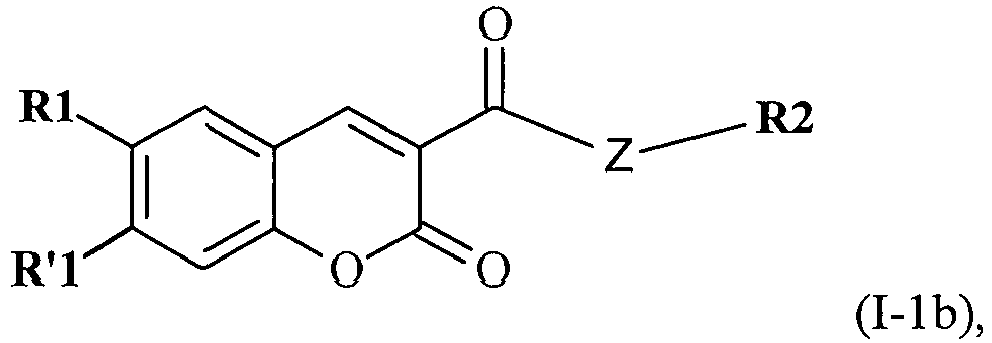
- ◆ Z represents O or S,
- ◆ R1 represents at least one group chosen among the group consisting of :
- hydrogen
- a linear or branched, saturated or not, C1-C7 alkyl, preferably a methyl group, substituted, or not, by a halogen chosen among Cl, F, I and Br,
- a linear or branched, saturated or not, C1-C7 alkyl, preferably a methyl group, substituted by a hydroxyl or a -O-R12 group, wherein R12 is a linear or branched, saturated or not, C1-C7 alkyl, preferably a hydroxyl,
- a group -CH2-O-CO-R5, wherein R5 is chosen among a hydrogen atom, and a linear or branched, saturated or not, C1-C7 alkyl, substituted or not by at least one halogen chosen among Cl, F, I and Br,
- a group -O-R13, wherein R13 is chosen among hydrogen and a linear or branched, saturated or not, C1-C7 alkyl, R13 being preferably a hydrogen,
- an amine

- a group
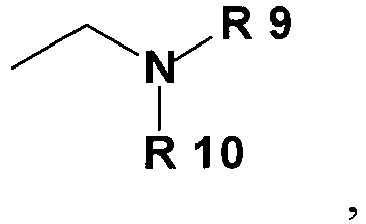
- ∘ hydrogen,
- ∘ a linear or branched, saturated or not,C1-C5 alkyl,
- ∘ -CO-R5, wherein R5 is chosen among a hydrogen atom, and a linear or branched, saturated or not, C1-C7 alkyl, substituted or not by at least one halogen chosen among Cl, F, I and Br,
- ∘ -SO2-R11, wherein R11 is a linear or branched, saturated or not,C1-C7 alkyl,
- ◆ R'1 represents a group chosen among hydrogen and -O-R14, wherein R14 is chosen among hydrogen and a linear or branched, saturated or not, C1-C7 alkyl, R14 being preferably a hydrogen, R'1 being preferably a hydrogen,
provided that R'1 represents hydrogen when R1 does not represent a -O-R13 group,
and - ◆ R2 is chosen among the group consisting of:
- a linear or branched, saturated or not, C1-C7 alkyl, preferably a C1-C3 alkyl,
- a C3-C6 cycloalkyl, preferably a C4-C6 cycloalkyl, more preferably a cyclohexyl,
- an aryl group, preferably a phenyl group, possibly mono or or polysubstituted, in particular disubstituted, by
- ∘ a halogen chosen among Cl, F, I and Br, or
- ∘ a linear or branched, saturated or not, C1-C7 alkyl, or
- ∘ a group -CO-R6, R6 being chosen among the group consisting of : -OH,-NH2, or salt thereof, and -O-R7, R7 being a linear or branched, saturated or not, C1-C7 alkyl, or
- ∘ a group -O-R8, R8 being a linear or branched, saturated or not, C1-C7 alkyl, or
- ∘ a group -NO2,
- ∘ a group -CN,
- ∘ a combination of the above,
- an heteroaryl group, preferably a pyridyl or an isoquinolinyl, possibly mono or polysubstituted, in particular disubstituted, by
- ∘ a halogen chosen among Cl, F, I and Br, or
- ∘ a linear or branched, saturated or not, C1-C7 alkyl, or
- ∘ a group -CO-R6, R6 being chosen among the group consisting of: -OH,-NH2, or salt thereof, and -O-R7, R7 being a linear or branched, saturated or not, C1-C7 alkyl, or
- ∘ a group -O-R8, R8 being a linear or branched, saturated or not, C1-C7 alkyl, or
- ∘ a combination of the above,
- * if R1= H, then R2 can only represent an isoquinolinyl or a phenyl substituted by two halogens, and
- * if R1≠H, if R2 is an aryl or an hetero aryl substituted by one a linear or branched, saturated or not, C1-C7 alkyl, said aryl or heteroaryl is also substituted by at least another group different from a C1-C7 alkyl.
- The above mentioned compounds present an inhibitory activity against at least one kallikrein, among KLK5, KLK7 and KLK14, or even a combination of two or three of said kallikreins.
- According to another embodiment, the present disclosure relates to the above mentioned compounds having the following formula (II):

- R1 represents -CH2-Cl or -CH2OCOC2H5, and
- R2 represents
- a pyridyl substituted by a Cl, or
- a phenyl substituted, or not, either by a group -OCH3 or by one or two halogens chosen among Cl, Br or I.
- Compounds having the formula (II) and the above mentioned significations for R1 and R2 present an inhibitory activity against KLK7.
- The coumarin derivatives of formula II are enzyme inhibitors, molecules that binds to enzymes and decreases their activity.
- A test to show the inhibitory activity consists in incubating KLK7 and a coumarin derivative and then determining the activity of KLK7 by comparison of the initial rates to those obtained in control experiments without coumarin derivative. The values of "IC50" (inhibitor concentrations giving 50% inhibition) express the inhibitory activity.
According to another embodiment, the present disclosure relates to the above mentioned compounds having the following formula (II):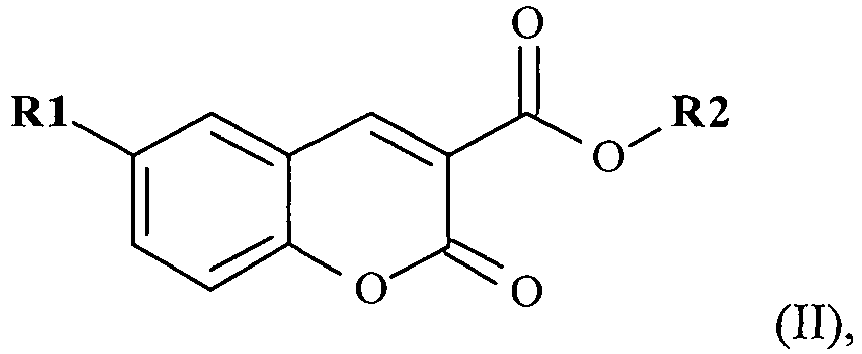
- R1 represents:
- - a group -O-R13, wherein R13 is chosen among hydrogen and a linear or branched, saturated or not, C1-C7 alkyl, R13 being preferably a hydrogen,
- - -CH2-Cl,
- - -CH2OCOC2H5, or
- - a group

- ∘ hydrogen,
- ∘ a linear or branched, saturated or not,C1-C5 alkyl,
- ∘ -CO-R5, wherein R5 is chosen among a hydrogen atom, and a linear or branched, saturated or not, C1-C7 alkyl, substituted or not by at least one halogen chosen among Cl, F, I and Br,
- ∘ -SO2-R11, wherein R11 is a linear or branched, saturated or not,C1-C7 alkyl,
- R2 represents
- a pyridyl substituted by a Cl, or
- a phenyl substituted, or not, either by a group -OCH3 or by one or two halogens chosen among Cl, Br or I,
- The coumarin derivatives of formula II are enzyme inhibitors, molecules that binds to enzymes and decreases their activity.
According to another embodiment, the present disclosure relates to the above mentioned compounds chosen among the group consisting of :
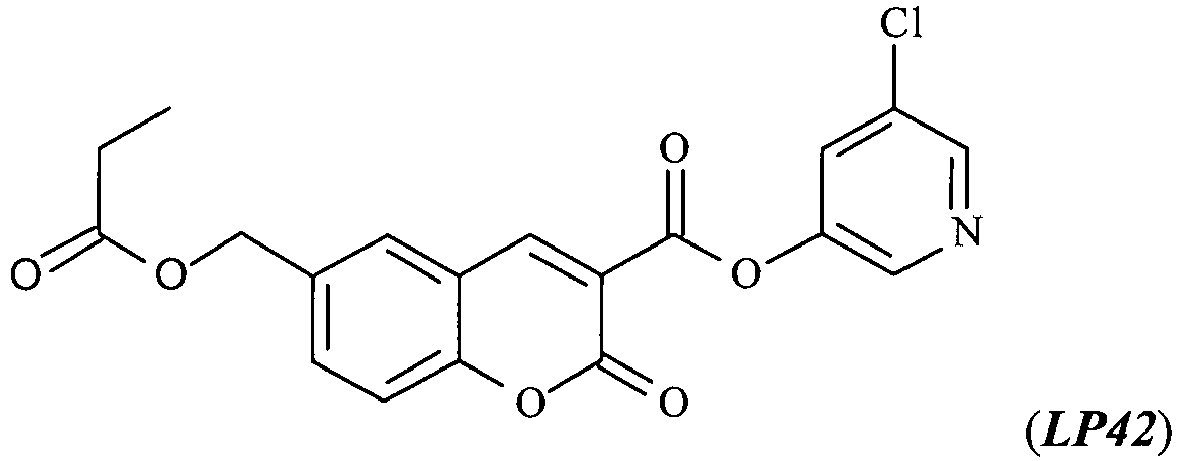


- Compounds above show an inhibitory activity against KLK7. According to another embodiment, the present disclosure relates to the above mentioned compounds belonging to the group consisting of:


- Compounds above show an inhibitory activity against KLK7. According to another embodiment, the present disclosure relates to the above mentioned compounds having the following formula (II):

- R1 represents -CH2-Cl, -CH2OCOCH3, -CH3, -NH2, and its salts thereof, or H, and
- R2 represents:
- - an isoquinolinyl, or
- - -CH3, or
- - a pyridyl, or
- - a phenyl, substituted or not by a halogen,
- if R1= H, R2 can only represent an isoquinolinyl, and
- if R1= CH3, R2 can only represent a CH3.
- Compounds having the formula (II) and the significations for R1 and R2 noted above show an inhibitory activity against KLK5.
- A test to show the inhibitory activity consists in incubating KLK5 and a coumarin derivative and then determining the activity of KLK5 by comparison of the initial rates to those obtained in control experiments without coumarin derivative. The values of "IC50" (inhibitor concentrations giving 50% inhibition) express the inhibitory activity. According to another embodiment, the present disclosure relates to the above mentioned compounds having the following formula (II):

- R1 represents -CH2-Cl, -CH2OCOCH3, -CH3, -CH2-NH2, and its salts thereof, or H, and
- R2 represents:
- - an isoquinolinyl, or
- - -CH3, or
- - a pyridyl, or
- - a phenyl, substituted or not by a halogen,
- if R1= H, R2 can only represent an isoquinolinyl, and
- if R1= CH3, R2 can only represent a CH3.
- Compounds having the formula (II) and the significations for R1 and R2 noted above show an inhibitory activity against KLK5. According to another embodiment, the present disclosure relates to the above mentioned compounds chosen among the group consisting of :
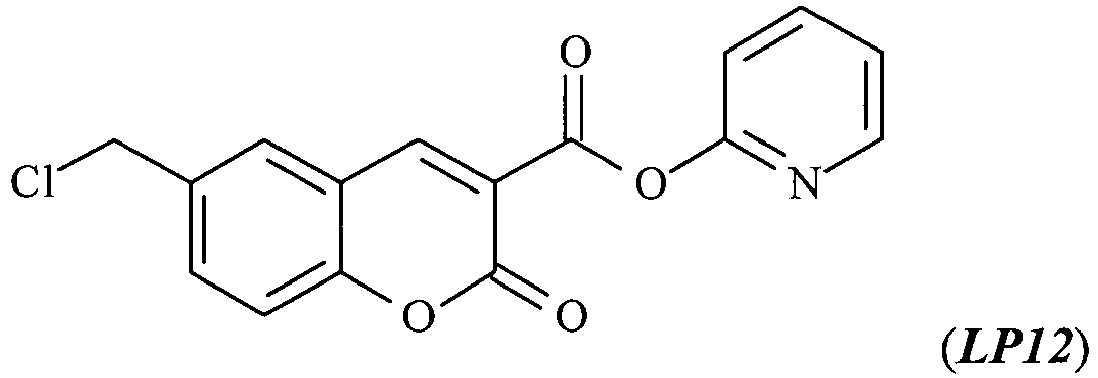
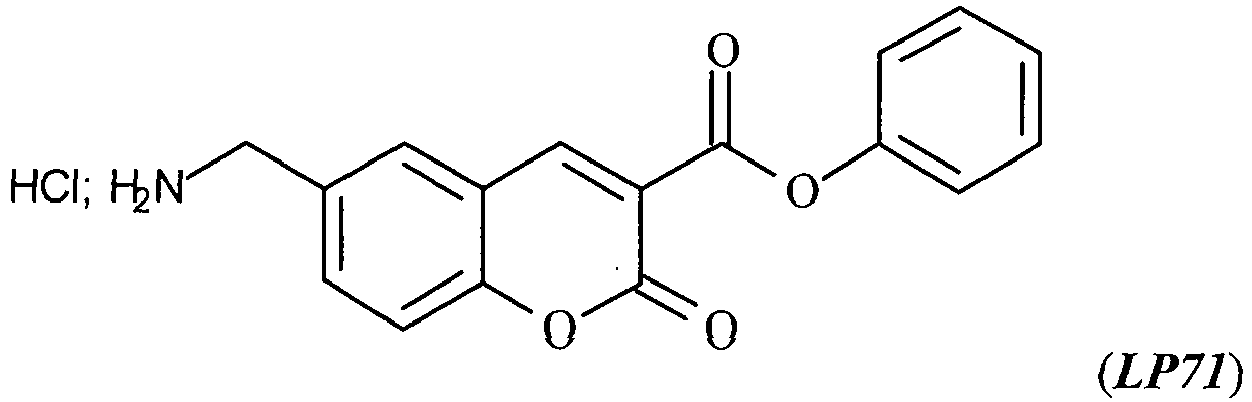


- Compounds above show an inhibitory activity against KLK5. According to another embodiment, the present disclosure relates to the above mentioned compounds having the following formula (II):

- R1 represents -CH2OCOC(CH3)3, -CH2OCOCH3 or-CH2Cl, and
- R2 represents a pyridyl or a phenyl, said pyridyl or phenyl being mono or bisubstituted by one or two groups chosen among a halogen, an amide, an acid, a -CH3 or a -NO2.
- Compounds having the formula (II) and the significations for R1 and R2 noted above show an inhibitory activity against KLK14.
- A test to show the inhibitory activity consists in incubating KLK14 and a coumarin derivative and then determining the activity of KLK14 by comparison of the initial rates to those obtained in control experiments, without coumarin derivative. The values of "IC50" (inhibitor concentrations giving 50% inhibition) express the inhibitory activity. According to another embodiment, the present disclosure relates to the above mentioned compounds having the following formula (II):

- R1 represents -CH2OCOC(CH3)3, - CH2OCOCH3 or -CH2Cl, and
- R2 represents a pyridyl or a phenyl, said pyridyl or phenyl being mono or bisubstituted by one or two groups chosen among a halogen, an amide, an acid, a -CH3, a -NO2 or a -CN.
- Compounds having the formula (II) and the significations for R1 and R2 noted above show an inhibitory activity against KLK14. According to another embodiment, the present disclosure relates to the above mentioned compounds chosen among the group consisting of :


- Compounds above show an inhibitory activity against KLK14. According to another embodiment, the present disclosure relates to the above mentioned compound:

- Compound above shows an inhibitory activity against KLK14. According to another embodiment, the present disclosure relates to the above mentioned compounds having the following formula (Ib):
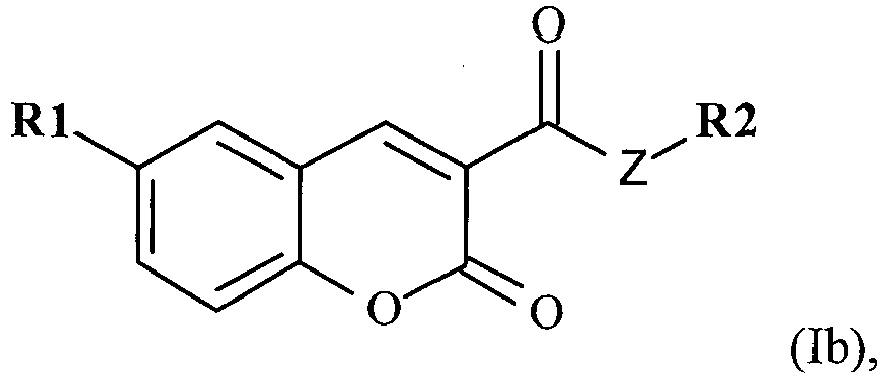
- Z represents O or S,
- R1 represents -CH2Cl or -NH2 or its salt thereof, and
- R2 represents a pyridyl or a phenyl, said pyridyl or phenyl being substituted or not by one or two halogens, one amide or one ester.
- According to another embodiment, the present disclosure relates to the above mentioned compounds having the following formula (Ib):

- Z represents O or S,
- R1 represents -CH2Cl or -CH2-NH2 or its salt thereof, and
- R2 represents a pyridyl or a phenyl, said pyridyl or phenyl being substituted or not by one or two halogens, one amide or one ester.
- According to another embodiment, the present disclosure relates to the above mentioned compounds chosen among the group consisting of :


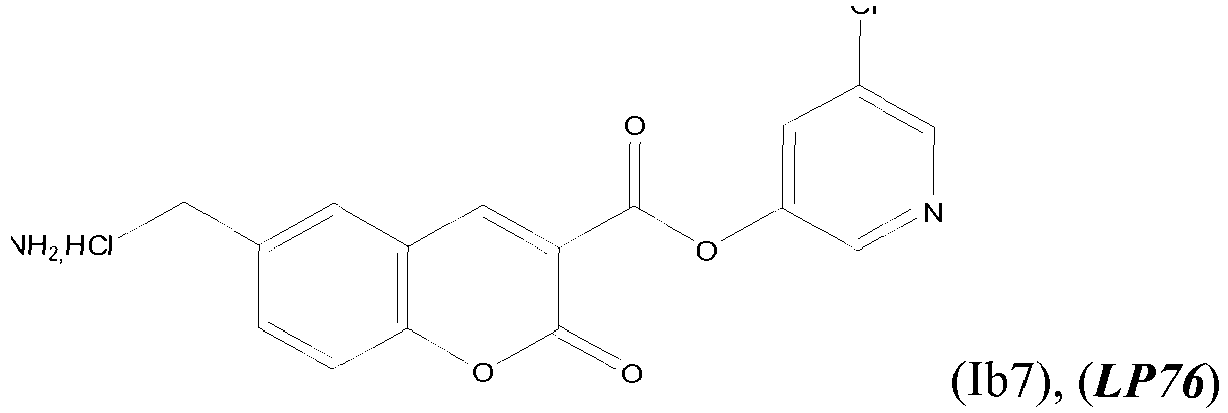
- According to another embodiment, the present disclosure relates to compounds of formula (I-1) as presented below:

- wherein n equals 0 or 1, and wherein
- ◆ if n=1, Z represents O or S,
- ◆ R1 represents at least one group chosen among the group consisting of:
- hydrogen
- a linear or branched, saturated or not, C1-C7 alkyl, preferably a methyl group, substituted, or not, by a halogen chosen among Cl, F, I and Br,
- a linear or branched, saturated or not, C1-C7 alkyl, preferably a methyl group, substituted by a hydroxyl or a -O-R12 group, wherein R12 is a linear or branched, saturated or not, C1-C7 alkyl, preferably a hydroxyl,
- a group -CH2-O-CO-R5, wherein R5 is chosen among a hydrogen atom, and a linear or branched, saturated or not, C1-C7 alkyl, substituted or not by at least one halogen chosen among Cl, F, I and Br,
- a group -O-R13, wherein R13 is chosen among hydrogen and a linear or branched, saturated or not, C1-C7 alkyl, R13 being preferably a hydrogen,
- an amine

- a group

- ∘ hydrogen,
- ∘ a linear or branched, saturated or not,C1-C5 alkyl,
- ∘ -CO-R5, wherein R5 is chosen among a hydrogen atom, and a linear or branched, saturated or not, C1-C7 alkyl, substituted or not by at least one halogen chosen among Cl, F, I and Br,
- ∘ -SO2-R11, wherein R11 is a linear or branched, saturated or not,C1-C7 alkyl,
- ◆ R'1 represents a group chosen among hydrogen and -O-R14, wherein R14 is chosen among hydrogen and a linear or branched, saturated or not, C1-C7 alkyl, R14 being preferably a hydrogen, R'1 being preferably a hydrogen,
provided that R'1 represents hydrogen when R1 does not represent a -O-R13 group,
and - ◆ R2 is chosen among the group consisting of:
- a linear or branched, saturated or not, C1-C7 alkyl, preferably a C1-C3 alkyl,
- a C3-C6 cycloalkyl, preferably a C4-C6 cycloalkyl, more preferably a cyclohexyl,
- an aryl group, preferably a phenyl group, possibly mono or or polysubstituted, in particular disubstituted, by
- ∘ a halogen chosen among Cl, F, I and Br, or
- ∘ a linear or branched, saturated or not, C1-C7 alkyl, or
- ∘ a group -CO-R6, R6 being chosen among the group consisting of: -OH,-NH2, or salt thereof, and -O-R7, R7 being a linear or branched, saturated or not, C1-C7 alkyl, or
- ∘ a group -O-R8, R8 being a linear or branched, saturated or not, C1-C7 alkyl, or
- ∘ a group -NO2,
- ∘ a group -CN,
- ∘ a combination of the above,
- an heteroaryl group, preferably a pyridyl or an isoquinolinyl, possibly mono or polysubstituted, in particular disubstituted, by
- ∘ a halogen chosen among Cl, F, I and Br, or
- ∘ a linear or branched, saturated or not, C1-C7 alkyl, or
- ∘ a group -CO-R6, R6 being chosen among the group consisting of: -OH,-NH2, or salt thereof, and -O-R7, R7 being a linear or branched, saturated or not, C1-C7 alkyl, or
- ∘ a group -O-R8, R8 being a linear or branched, saturated or not, C1-C7 alkyl, or
- ∘ a combination of the above,
- when n=0, then R1 can only represent a linear or branched, saturated or not, C1-C7 alkyl, preferably a methyl group, possibly substituted by an halogen, such that
- if R1= CH3 or CH2-X, wherein X is an halogen, then R2 is a methyl group or a cycloalkyl group, preferably a cyclohexyl group,
- when n=1,
- * if R1= H, then R2 can only represent an isoquinolinyl or a phenyl substituted by two halogens, and
- * if R1≠ H, then if R2 is an aryl or an hetero aryl substituted by one linear or branched, saturated or not, C1-C7 alkyl, said aryl or heteroaryl is also substituted by at least another group different from a C1-C7 alkyl,
- According to another embodiment, the present disclosure relates to compounds of formula (I-1) as presented below:

and wherein - ◆ if n=1, Z represents O or S,
- ◆ R1 represents at least one group chosen among the group consisting of:
- hydrogen
- a linear or branched, saturated or not, C1-C7 alkyl, preferably a methyl group, substituted, or not, by a halogen chosen among Cl, F, I and Br,
- a linear or branched, saturated or not, C1-C7 alkyl, preferably a methyl group, substituted by a hydroxyl or a -O-R12 group, wherein R12 is a linear or branched, saturated or not, C1-C7 alkyl, preferably a hydroxyl,
- a group -CH2-O-CO-R5, wherein R5 is chosen among a hydrogen atom, and a linear or branched, saturated or not, C1-C7 alkyl, substituted or not by at least one halogen chosen among Cl, F, I and Br,
- a group -O-R13, wherein R13 is chosen among hydrogen and a linear or branched, saturated or not, C1-C7 alkyl, R13 being preferably a hydrogen,
- an amine

- a group

- ∘ hydrogen,
- ∘ a linear or branched, saturated or not,C1-C5 alkyl,
- ∘ -CO-R5, wherein R5 is chosen among a hydrogen atom, and a linear or branched, saturated or not, C1-C7 alkyl, substituted or not by at least one halogen chosen among Cl, F, I and Br,
- ∘ -SO2-R11, wherein R11 is a linear or branched, saturated or not,C1-C7 alkyl,
- ◆ R'1 represents a group chosen among hydrogen and -O-R14, wherein R14 is chosen among hydrogen and a linear or branched, saturated or not, C1-C7 alkyl, R14 being preferably a hydrogen, R'1 being preferably a hydrogen,
provided that R'1 represents hydrogen when R1 does not represent a -O-R13 group,
and - ◆ R2 is chosen among the group consisting of:
- a linear or branched, saturated or not, C1-C7 alkyl, preferably a C1-C3 alkyl,
- a C3-C6 cycloalkyl, preferably a C4-C6 cycloalkyl, more preferably a cyclohexyl,
- an aryl group, preferably a phenyl group, possibly mono or or polysubstituted, in particular disubstituted, by
- ∘ a halogen chosen among Cl, F, I and Br, or
- ∘ a linear or branched, saturated or not, C1-C7 alkyl, or
- ∘ a group -CO-R6, R6 being chosen among the group consisting of: -OH,-NH2, or salt thereof, and -O-R7, R7 being a linear or branched, saturated or not, C1-C7 alkyl, or
- ∘ a group -O-R8, R8 being a linear or branched, saturated or not, C1-C7 alkyl, or
- ∘ a group -NO2,
- ∘ a group -CN,
- ∘ a combination of the above,
- an heteroaryl group, preferably a pyridyl or an isoquinolinyl, possibly mono or polysubstituted, in particular disubstituted, by
- ∘ a halogen chosen among Cl, F, I and Br, or
- ∘ a linear or branched, saturated or not, C1-C7 alkyl, or
- ∘ a group -CO-R6, R6 being chosen among the group consisting of: -OH,-NH2, or salt thereof, and -O-R7, R7 being a linear or branched, saturated or not, C1-C7 alkyl, or
- ∘ a group -O-R8, R8 being a linear or branched, saturated or not, C1-C7 alkyl, or
- ∘ a combination of the above,
- when n=0, then R1 can only represent a linear or branched, saturated or not, C1-C7 alkyl, preferably a methyl group, possibly substituted by an halogen, such that
- if R1= CH3 or CH2-X, wherein X is an halogen, then R2 is a methyl group or a cycloalkyl group, preferably a cyclohexyl group,
- when n=1,
- * if R1= H, then R2 can only represent an isoquinolinyl or a phenyl substituted by two halogens, and
- * if R1≠ H, then if R2 is an aryl or an hetero aryl substituted by one linear or branched, saturated or not, C1-C7 alkyl, said aryl or heteroaryl is also substituted by at least another group different from a C1-C7 alkyl,
- According to another embodiment, the present disclosure relates to compounds of formula (I-1) as presented below:

and wherein - ◆ if n=1, Z represents O or S,
- ◆ R1 represents at least one group chosen among the group consisting of:
- hydrogen
- a linear or branched, saturated or not, C1-C7 alkyl, preferably a methyl group, substituted, or not, by a halogen chosen among Cl, F, I and Br,
- a linear or branched, saturated or not, C1-C7 alkyl, preferably a methyl group, substituted by a hydroxyl or a -O-R12 group, wherein R12 is a linear or branched, saturated or not, C1-C7 alkyl, preferably a hydroxyl,
- a group -CH2-O-CO-R5, wherein R5 is chosen among a hydrogen atom, and a linear or branched, saturated or not, C1-C7 alkyl, substituted or not by at least one halogen chosen among Cl, F, I and Br,
- a group -O-R13, wherein R13 is chosen among hydrogen and a linear or branched, saturated or not, C1-C7 alkyl, R13 being preferably a hydrogen,
- an amine

- a group

- ∘ hydrogen,
- ∘ a linear or branched, saturated or not,C1-C5 alkyl,
- ∘ -CO-R5, wherein R5 is chosen among a hydrogen atom, and a linear or branched, saturated or not, C1-C7 alkyl, substituted or not by at least one halogen chosen among Cl, F, I and Br,
- ∘ -SO2-R11, wherein R11 is a linear or branched, saturated or not,C1-C7 alkyl,
- ◆ R'1 represents a group chosen among hydrogen and -O-R14, wherein R14 is chosen among hydrogen and a linear or branched, saturated or not, C1-C7 alkyl, R14 being preferably a hydrogen, R'1 being preferably a hydrogen, provided that R'1 represents hydrogen when R1 does not represent a -O-R13 group,
and - ◆ R2 is chosen among the group consisting of:
- a linear or branched, saturated or not, C1-C7 alkyl, preferably a C1-C3 alkyl,
- a C3-C6 cycloalkyl, preferably a C4-C6 cycloalkyl, more preferably a cyclohexyl,
- an aryl group, preferably a phenyl group, possibly mono or or polysubstituted, in particular disubstituted, by
- ∘ a halogen chosen among Cl, F, I and Br, or
- ∘ a linear or branched, saturated or not, C1-C7 alkyl, or
- ∘ a group -CO-R6, R6 being chosen among the group consisting of: -OH,-NH2, or salt thereof, and -O-R7, R7 being a linear or branched, saturated or not, C1-C7 alkyl, or
- ∘ a group -O-R8, R8 being a linear or branched, saturated or not, C1-C7 alkyl, or
- ∘ a group -NO2,
- ∘ a group -CN,
- ∘ a combination of the above,
- an heteroaryl group, preferably a pyridyl or an isoquinolinyl, possibly mono or polysubstituted, in particular disubstituted, by
- ∘ a halogen chosen among Cl, F, I and Br, or
- ∘ a linear or branched, saturated or not, C1-C7 alkyl, or
- ∘ a group -CO-R6, R6 being chosen among the group consisting of: -OH,-NH2, or salt thereof, and -O-R7, R7 being a linear or branched, saturated or not, C1-C7 alkyl, or
- ∘ a group -O-R8, R8 being a linear or branched, saturated or not, C1-C7 alkyl, or
- ∘ a combination of the above,
- when n=0, then R1 can only represent a linear or branched, saturated or not, C1-C7 alkyl, preferably a methyl group, possibly substituted by an halogen, such that
- if R1= CH3 or CH2-X, wherein X is an halogen, then R2 is a methyl group or a cycloalkyl group, preferably a cyclohexyl group,
- when n=1,
- * if R1= H, then R2 can only represent an isoquinolinyl or a phenyl substituted by two halogens, and
- * if R1≠ H, then if R2 is an aryl or an hetero aryl substituted by one linear or branched, saturated or not, C1-C7 alkyl, said aryl or heteroaryl is also substituted by at least another group different from a C1-C7 alkyl,
- According to another embodiment, the present disclosure relates to compounds of formula
(I-1b) as presented below:
- ◆ Z represents O or S,
- ◆ R1 represents at least one group chosen among the group consisting of:
- a linear or branched, saturated or not, C1-C7 alkyl, preferably a methyl group, substituted by a hydroxyl or a -O-R12 group, wherein R12 is a linear or branched, saturated or not, C1-C7 alkyl, preferably a hydroxyl,
- a group -O-R13, wherein R13 is chosen among hydrogen and a linear or branched, saturated or not, C1-C7 alkyl, R13 being preferably a hydrogen,
- an amine

- a group

- o hydrogen,
- ∘ a linear or branched, saturated or not,C1-C5 alkyl,
- ∘ -CO-R5, wherein R5 is chosen among a hydrogen atom, and a linear or branched, saturated or not, C1-C7 alkyl, substituted or not by at least one halogen chosen among Cl, F, I and Br,
- ∘ -SO2-R11, wherein R11 is a linear or branched, saturated or not,C1-C7 alkyl,
- ◆ R'1 represents a group chosen among hydrogen and -O-R14, wherein R14 is chosen among hydrogen and a linear or branched, saturated or not, C1-C7 alkyl, R14 being preferably a hydrogen, R'1 being preferably a hydrogen,
provided that R'1 represents hydrogen when R1 does not represent a -O-R13 group,
and - ◆ R2 is chosen among the group consisting of:
- a linear or branched, saturated or not, C1-C7 alkyl, preferably a C1-C3 alkyl,
- a C3-C6 cycloalkyl, preferably a C4-C6 cycloalkyl, more preferably a cyclohexyl,
- an aryl group, preferably a phenyl group, possibly mono or or polysubstituted, in particular disubstituted, by
- ∘ a halogen chosen among Cl, F, I and Br, or
- ∘ a linear or branched, saturated or not, C1-C7 alkyl, or
- ∘ a group -CO-R6, R6 being chosen among the group consisting of: -OH,-NH2, or salt thereof, and -O-R7, R7 being a linear or branched, saturated or not, C1-C7 alkyl, or
- ∘ a group -O-R8, R8 being a linear or branched, saturated or not, C1-C7 alkyl, or
- ∘ a group -NO2,
- ∘ a group -CN,
- ∘ a combination of the above,
- an heteroaryl group, preferably a pyridyl or an isoquinolinyl, possibly mono or polysubstituted, in particular disubstituted, by
- ∘ a halogen chosen among Cl, F, I and Br, or
- ∘ a linear or branched, saturated or not, C1-C7 alkyl, or
- ∘ a group -CO-R6, R6 being chosen among the group consisting of: -OH,-NH2, or salt thereof, and -O-R7, R7 being a linear or branched, saturated or not, C1-C7 alkyl, or
- ∘ a group -O-R8, R8 being a linear or branched, saturated or not, C1-C7 alkyl, or
- ∘ a combination of the above,
- * if R2 is an aryl or an hetero aryl substituted by one a linear or branched, saturated or not, C1-C7 alkyl, said aryl or heteroaryl is also substituted by at least another group different from a C1-C7 alkyl,
- * if R1 represents a group
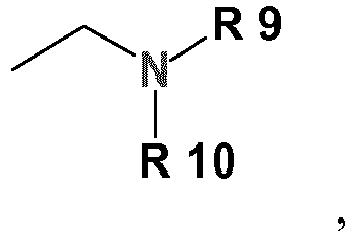
- According to another embodiment, the present disclosure relates to compounds of formula (Ib) as presented below:

- ◆ Z represents O or S,
- ◆ R1 represents a group

- ∘ hydrogen,
- ∘ a linear or branched, saturated or not,C1-C5 alkyl,
- ◆ R2 is a phenyl group, possibly mono or or polysubstituted, in particular disubstituted, by
- ∘ a halogen chosen among Cl, F, I and Br, or
- ∘ a linear or branched, saturated or not, C1-C7 alkyl, or
- ∘ a group -CO-R6, R6 being chosen among the group consisting of: -OH,-NH2, or salt thereof, and -O-R7, R7 being a linear or branched, saturated or not, C1-C7 alkyl, or
- ∘ a group -O-R8, R8 being a linear or branched, saturated or not, C1-C7 alkyl, or
- ∘ a group -NO2,
- ∘ a group -CN,
- ∘ a combination of the above,
- * if R2 is substituted by one a linear or branched, saturated or not, C1-C7 alkyl, R2 is substituted by at least another group different from a C1-C7 alkyl,
- According to another embodiment, the present disclosure relates to compounds of formula (Ib) as presented below:

- ◆ Z represents O or S,
- ◆ R1 represents a group

- ∘ hydrogen,
- ∘ a linear or branched, saturated or not,C1-C5 alkyl,
- ∘ -CO-R5, wherein R5 is chosen among a hydrogen atom, and a linear or branched, saturated or not, C1-C7 alkyl, substituted or not by at least one halogen chosen among Cl, F, I and Br,
- ◆ R2 is chosen among the group consisting of:
- a linear or branched, saturated or not, C1-C7 alkyl, preferably a C1-C3 alkyl,
- a C3-C6 cycloalkyl, preferably a C4-C6 cycloalkyl, more preferably a cyclohexyl,
- an aryl group, preferably a phenyl group, possibly mono or or polysubstituted, in particular disubstituted, by
- o a halogen chosen among Cl, F, I and Br, or
- ∘ a linear or branched, saturated or not, C1-C7 alkyl, or
- ∘ a group -CO-R6, R6 being chosen among the group consisting of: -OH,-NH2, or salt thereof, and -O-R7, R7 being a linear or branched, saturated or not, C1-C7 alkyl, or
- ∘ a group -O-R8, R8 being a linear or branched, saturated or not, C1-C7 alkyl, or
- ∘ a group -NO2,
- ∘ a group -CN,
- ∘ a combination of the above,
- an heteroaryl group, preferably a pyridyl or an isoquinolinyl, possibly mono or polysubstituted, in particular disubstituted, by
- ∘ a halogen chosen among Cl, F, I and Br, or
- ∘ a linear or branched, saturated or not, C1-C7 alkyl, or
- ∘ a group -CO-R6, R6 being chosen among the group consisting of: -OH,-NH2, or salt thereof, and -O-R7, R7 being a linear or branched, saturated or not, C1-C7 alkyl, or
- ∘ a group -O-R8, R8 being a linear or branched, saturated or not, C1-C7 alkyl, or
- ∘ a combination of the above,
- * if R2 is an aryl or an hetero aryl substituted by one a linear or branched, saturated or not, C1-C7 alkyl, said aryl or heteroaryl is also substituted by at least another group different from a C1-C7 alkyl,
- According to another embodiment, the present disclosure relates to compounds of formula (Ib) as presented below:

- ◆ Z represents O or S,
- ◆ R1 represents a group

- o hydrogen,
- o a linear or branched, saturated or not,C1-C5 alkyl,
- ∘ -SO2-R11, wherein R11 is a linear or branched, saturated or not, C1-C7 alkyl,
and - ◆ R2 is chosen among the group consisting of:
- a linear or branched, saturated or not, C1-C7 alkyl, preferably a C1-C3 alkyl,
- a C3-C6 cycloalkyl, preferably a C4-C6 cycloalkyl, more preferably a cyclohexyl,
- an aryl group, preferably a phenyl group, possibly mono or or polysubstituted, in particular disubstituted, by
- ∘ a halogen chosen among Cl, F, I and Br, or
- ∘ a linear or branched, saturated or not, C1-C7 alkyl, or
- ∘ a group -CO-R6, R6 being chosen among the group consisting of: -OH,-NH2, or salt thereof, and -O-R7, R7 being a linear or branched, saturated or not, C1-C7 alkyl, or
- ∘ a group -O-R8, R8 being a linear or branched, saturated or not, C1-C7 alkyl, or
- ∘ a group -NO2,
- ∘ a group -CN,
- ∘ a combination of the above,
- an heteroaryl group, preferably a pyridyl or an isoquinolinyl, possibly mono or polysubstituted, in particular disubstituted, by
- ∘ a halogen chosen among Cl, F, I and Br, or
- ∘ a linear or branched, saturated or not, C1-C7 alkyl, or
- ∘ a group -CO-R6, R6 being chosen among the group consisting of: -OH,-NH2, or salt thereof, and -O-R7, R7 being a linear or branched, saturated or not, C1-C7 alkyl, or
- ∘ a group -O-R8, R8 being a linear or branched, saturated or not, C1-C7 alkyl, or
- ∘ a combination of the above,
- * if R2 is an aryl or an hetero aryl substituted by one a linear or branched, saturated or not, C1-C7 alkyl, said aryl or heteroaryl is also substituted by at least another group different from a C1-C7 alkyl,
- According to another embodiment, the present disclosure relates to compounds of formula (Ib) as presented below:

- ◆ Z represents O or S,
- ◆ R1 represents a linear or branched, saturated or not, C1-C7 alkyl, preferably a methyl group, substituted by a hydroxyl or a -O-R12 group, wherein R12 is a linear or branched, saturated or not, C1-C7 alkyl, preferably a hydroxyl,
and - ◆ R2 is chosen among the group consisting of:
- a linear or branched, saturated or not, C1-C7 alkyl, preferably a C1-C3 alkyl,
- a C3-C6 cycloalkyl, preferably a C4-C6 cycloalkyl, more preferably a cyclohexyl,
- an aryl group, preferably a phenyl group, possibly mono or or polysubstituted, in particular disubstituted, by
- ∘ a halogen chosen among Cl, F, I and Br, or
- ∘ a linear or branched, saturated or not, C1-C7 alkyl, or
- ∘ a group -CO-R6, R6 being chosen among the group consisting of: -OH,-NH2, or salt thereof, and -O-R7, R7 being a linear or branched, saturated or not, C1-C7 alkyl, or
- ∘ a group -O-R8, R8 being a linear or branched, saturated or not, C1-C7 alkyl, or
- ∘ a group -NO2,
- ∘ a group -CN,
- ∘ a combination of the above,
- an heteroaryl group, preferably a pyridyl or an isoquinolinyl, possibly mono or polysubstituted, in particular disubstituted, by
- ∘ a halogen chosen among Cl, F, I and Br, or
- ∘ a linear or branched, saturated or not, C1-C7 alkyl, or
- ∘ a group -CO-R6, R6 being chosen among the group consisting of: -OH,-NH2, or salt thereof, and -O-R7, R7 being a linear or branched, saturated or not, C1-C7 alkyl, or
- ∘ a group -O-R8, R8 being a linear or branched, saturated or not, C1-C7 alkyl, or
- ∘ a combination of the above,
- * if R2 is an aryl or an hetero aryl substituted by one a linear or branched, saturated or not, C1-C7 alkyl, said aryl or heteroaryl is also substituted by at least another group different from a C1-C7 alkyl,
- According to another embodiment, the present disclosure relates to compounds of formula (Ib) as presented below:

- ◆ Z represents O or S,
- ◆ R1 represents an amine

and - ◆ R2 is chosen among the group consisting of:
- a linear or branched, saturated or not, C1-C7 alkyl, preferably a C1-C3 alkyl,
- a C3-C6 cycloalkyl, preferably a C4-C6 cycloalkyl, more preferably a cyclohexyl,
- an aryl group, preferably a phenyl group, possibly mono or or polysubstituted, in particular disubstituted, by
- ∘ a halogen chosen among Cl, F, I and Br, or
- ∘ a linear or branched, saturated or not, C1-C7 alkyl, or
- ∘ a group -CO-R6, R6 being chosen among the group consisting of: -OH,-NH2, or salt thereof, and -O-R7, R7 being a linear or branched, saturated or not, C1-C7 alkyl, or
- ∘ a group -O-R8, R8 being a linear or branched, saturated or not, C1-C7 alkyl, or
- ∘ a group -NO2,
- ∘ a group -CN,
- ∘ a combination of the above, and
- an heteroaryl group, preferably a pyridyl or an isoquinolinyl, possibly mono or polysubstituted, in particular disubstituted, by
- ∘ a halogen chosen among Cl, F, I and Br, or
- ∘ a linear or branched, saturated or not, C1-C7 alkyl, or
- ∘ a group -CO-R6, R6 being chosen among the group consisting of: -OH,-NH2, or salt thereof, and -O-R7, R7 being a linear or branched, saturated or not, C1-C7 alkyl, or
- ∘ a group -O-R8, R8 being a linear or branched, saturated or not, C1-C7 alkyl, or
- ∘ a combination of the above,
- * if R2 is an aryl or an hetero aryl substituted by one a linear or branched, saturated or not, C1-C7 alkyl, said aryl or heteroaryl is also substituted by at least another group different from a C1-C7 alkyl,
- According to another embodiment, the present disclosure relates to compounds of formula (I-1b) as presented below:

- ◆ Z represents O or S,
- ◆ R1 represents a group -O-R13, wherein R13 is chosen among hydrogen and a linear or branched, saturated or not, C1-C7 alkyl, R13 being preferably a hydrogen,
- ◆ R'1 represents a group chosen among hydrogen and -O-R14, wherein R14 is chosen among hydrogen and a linear or branched, saturated or not, C1-C7 alkyl, R14 being preferably a hydrogen, R'1 being preferably a hydrogen,
- ◆ R2 is chosen among the group consisting of:
- a linear or branched, saturated or not, C1-C7 alkyl, preferably a C1-C3 alkyl,
- a C3-C6 cycloalkyl, preferably a C4-C6 cycloalkyl, more preferably a cyclohexyl,
- an aryl group, preferably a phenyl group, possibly mono or or polysubstituted, in particular disubstituted, by
- ∘ a halogen chosen among Cl, F, I and Br, or
- ∘ a linear or branched, saturated or not, C1-C7 alkyl, or
- ∘ a group -CO-R6, R6 being chosen among the group consisting of: -OH,-NH2, or salt thereof, and -O-R7, R7 being a linear or branched, saturated or not, C1-C7 alkyl, or
- ∘ a group -O-R8, R8 being a linear or branched, saturated or not, C1-C7 alkyl, or
- ∘ a group -NO2,
- ∘ a group -CN,
- ∘ a combination of the above,
- an heteroaryl group, preferably a pyridyl or an isoquinolinyl, possibly mono or polysubstituted, in particular disubstituted, by
- ∘ a halogen chosen among Cl, F, I and Br, or
- ∘ a linear or branched, saturated or not, C1-C7 alkyl, or
- ∘ a group -CO-R6, R6 being chosen among the group consisting of: -OH,-NH2, or salt thereof, and -O-R7, R7 being a linear or branched, saturated or not, C1-C7 alkyl, or
- ∘ a group -O-R8, R8 being a linear or branched, saturated or not, C1-C7 alkyl, or
- ∘ a combination of the above,
- * if R2 is an aryl or an hetero aryl substituted by one a linear or branched, saturated or not, C1-C7 alkyl, said aryl or heteroaryl is also substituted by at least another group different from a C1-C7 alkyl,
- According to another embodiment, the present disclosure relates to the compound of formula (II11)

- According to another embodiment, the present disclosure relates to a compound selected from the group comprising:


- The synthesis of the coumarin derivatives is described in the patent of
Reboud-Ravaux et al (WO9855472 - On the other hand, the compound CFL33 is a new coumarin derivative. Its synthesis is described in the example 1.
- Compounds SMB28 and SMB33 are new coumarin derivatives. Their synthesis is respectively described in examples 1.2 and 1.3.
- According to another embodiment, the present disclosure relates to the compound of formula CFL33 for its use as drug.
According to another embodiment, the present disclosure relates to a compound selected from the group comprising SMB28 and SMB33, for its use as drug.
According to another embodiment, the present disclosure is therefore directed towards the preparation of a pharmaceutical composition comprising as active substance a compound of formula CFL33 in association with a pharmaceutically acceptable carrier.
According to another embodiment, the present disclosure is therefore directed towards the preparation of a pharmaceutical composition comprising as active substance a compound selected from the group comprising SMB28 and SMB33 in association with a pharmaceutically acceptable carrier.
The disclosure is therefore directed towards the preparation of a pharmaceutical composition containing a compound of formula CFL33 as a drug in which said compound has a kallikrein-inhibitory activity. This composition is characterized in that it comprises, in a pharmaceutically acceptable carrier that is compatible with the method of administration selected for said composition, a compound of formula CFL33.
The disclosure is therefore directed towards the preparation of a pharmaceutical composition containing a compound selected from the group comprising SMB28 and SMB33 as a drug in which said compound has a kallikrein-inhibitory activity. This composition is characterized in that it comprises, in a pharmaceutically acceptable carrier that is compatible with the method of administration selected for said composition, aforesaid compound selected from the group comprising SMB28 and SMB33.
The term "pharmaceutically acceptable carrier" is intended to mean a medium that is compatible with the skin, the mucous membranes and systemic administration.
The composition according to the disclosure can be administered topically. Preferably, the pharmaceutical composition is packaged in a form suitable for topical application. - When used topically, the pharmaceutical composition is more particularly for use in the treatment of the skin and the mucous membranes and may be in liquid, pasty or solid form, and more particularly in the form of ointments, creams, solutions or gels.
- The compositions used for topical application have a concentration of compound according to the invention of generally between 0.001% and 20% by weight, relative to the total weight of the composition.
- The composition can be administered systemically. Preferably, the pharmaceutical composition is packaged in a form suitable for systemic administration. The routes of administration can be parenteral, digestive, rectal, transcutaneous. More particularly, the composition may be in the form of injectable solutions or suspensions, tablets, capsules, powders or preparation for transdermal use.
- The posology may vary according to the severity of the disease, the patient's age and weight and the route of administration. Generally, the unit dose may be of 1 to 200 mg per taking and the daily dose may be of 2 to 500 mg. The pharmaceutical composition as described above may also contain inert additives or pharmacodynamically active additives as regards the pharmaceutical compositions, or combinations of theses additives.
- According to another embodiment, the present disclosure relates to a composition comprising a compound of formula CFL33 for its use for the treatment of skin pathologies. According to another embodiment, the present disclosure relates to a composition comprising a compound selected from the group comprising SMB28 and SMB33 for its use for the treatment of skin pathologies. According to another embodiment, the present disclosure relates to a composition comprising a compound of formula CFL33 wherein said skin pathologies belong to the group consisting of Netherton syndrome, atopic dermatitis, psoriasis, eczema and peeling skin syndrome, preferably Netherton syndrome. According to another embodiment, the present disclosure relates to a composition comprising a compound of formula CFL33 wherein said skin pathologies belong to the group consisting of Netherton syndrome, psoriasis, atopic eczema and allergic contact dermatitis, preferably Netherton syndrome.
- According to another embodiment, the present disclosure relates to a composition comprising a compound selected from the group comprising SMB28 and SMB33 wherein said skin pathologies belong to the group consisting of Netherton syndrome, atopic dermatitis, psoriasis, eczema and peeling skin syndrome, preferably Netherton syndrome. According to another embodiment, the present disclosure relates to a composition comprising a compound selected from the group comprising SMB28 and SMB33 wherein said skin pathologies belong to the group consisting of Netherton syndrome, psoriasis, atopic eczema and allergic contact dermatitis, preferably Netherton syndrome.
- The compound CFL33 is suitable for use related to the treatment or prevention of skin disorders such as Netherton syndrome, atopic dermatitis, psoriasis, eczema and peeling skin syndrome, preferably Netherton syndrome.
- The compound CFL33 is suitable for use related to the treatment or prevention of skin disorders such as Netherton syndrome, psoriasis, atopic eczema and allergic contact dermatitis, preferably Netherton syndrome.
- The compound selected from the group comprising SMB28 and SMB33 is suitable for use related to the treatment or prevention of skin disorders such as Netherton syndrome, atopic dermatitis, psoriasis, eczema and peeling skin syndrome, preferably Netherton syndrome.
- The compound selected from the group comprising SMB28 and SMB33 is suitable for use related to the treatment or prevention of skin disorders such as Netherton syndrome, psoriasis, atopic eczema and allergic contact dermatitis, preferably Netherton syndrome.
-
Figure 1 : This figure presents the activation cascade involving kallikreins. In Netherton syndrome LEKTI loses its faculty to efficiently control the KLK5, leading to an abnormal skin desquamation due to an increase of the degradation of the corneodesmosomes proteins. Synthetic inhibitors are susceptible to control the double KLK5 function, that is direct degradation and other proteases activation, KLK7 and KLK14, this one activating pro-elastase. -
Figure 2 and figure 3 present cell viability of normal human keratinocytes after treatment with some compounds of the present invention, respectively at 1 µM (figure 2 ) and 10 µM (figure 3 ). -
Figure 4 shows the mean +/- SD of the expression of the target genes relative to the expression of the housekeeping gene: (A) TSLP, (B) IL-8, (C) TNF-a, (D) MDC and (E) TARC. - 1.0 g of the commercially available 2-oxo-2H-1-benzopyran-3-carboxylic acid and 10 ml of thionyl chloride were refluxed for 3 h. The resulting solution was evaporated under reduced pressure. The residue was suspended in 10 ml anhydrous toluene. The solvent was eliminated by distillation under reduced pressure. The two last steps were repeated twice. The residue was dispersed in 10 ml dioxane. To this suspension were added 1-hydroxyquinoleine (1.1 éq.) and anhydrous pyridine (1.1 eq.). After 90 min stirring at room temperature, the solvent was removed by distillation under reduced pressure. The residue was solubilized in chloroform and the organic phase was washed three times with HCl 0.1N, then dried over MgSO4. The solvent was evaporated under reduced pressure and the residue obtained was recrystallized in ethyl acetate.
white solid ; m.p. 197-200°C
1H NMR (500 MHz) DMSO-d6: 6.87 (d, 1H, 4-H isoquin.), 7.47 (t, 1H, 6-H coumar.), 7.52 (d, 1H, 8-H coumar.), 7.58 (t, 1H, 7-H isoquin.), 7.75 (m, 2H, 7-H coumar. + 5-H isoquin.), 7.84 (m, 2H, 6-H + 3-H isoquin.), 7.93 (d, 1H, 5-H coumar.), 8.16 (d, 1H, 8-H isoquin.), 8.56 (s, 1H, 4-H coumar.). - To the suspension of the acid chloride of 6-acetoxymethyl-2-oxo-2H-1-benzopyran-3-carboxylic acid (4 mmol) obtained according to Pochet et al. (Bioorg. Med. Chem. 2000, 8, 1489) in anhydrous dioxane (10 mL) was added 2-iodophenol (5 mmol) and pyridine (0.4 mL). After 12 h stirring at room temperature, the solvent was evapotated under vacuum and the residue was suspended in methanol. 1. The resulting precipitate was collected by filtration, washed with methanol and dried. The solid was crystallyzed in ethyl acetate (45%); mp: 156-158°C.
- To the suspension of the acid chloride of 6-acetoxymethyl-2-oxo-2H-1-benzopyran-3-carboxylic acid (4 mmol) obtained according to Pochet et al. (Bioorg. Med. Chem. 2000, 8, 1489) in anhydrous dioxane (10 mL) was added 2-cyanophenol (5 mmol) and pyridine (0.4 mL). After 12 h stirring at room temperature, the solvent was evapotated under vacuum and the residue was suspended in methanol. The resulting precipitate was collected by filtration, washed with methanol and dried. The solid was crystallyzed in ethyl acetate (40%) ; mp: 181-183°C.
- In the examples described below :
- DMSO means "dimethylsulfoxide"
- Tris-HCl means " tris(hydroxymethyl)aminomethane, hydrogen chloride »
-
Tween 20 refers topolysorbate 20 or polyoxyethylene (20) sorbitan monolaurate - The Hill number provides a way to quantify the binding of a ligand to a macromolecule.
- Kallikreins KLK5, KLK7 and KLK14 activities were determined by monitoring the hydrolysis of the appropriate fluorogenic substrate (λexc = 355, λem = 460 nm) for 15 min at 37 °C in the presence of the untreated kallikrein (control) or kallikrein that had been incubated with a test compound. Substrate and compounds were previously dissolved in DMSO, with the final solvent concentration kept constant at 2 % (v/v) (KLK 5 and 14), and 4 % (v/v) (KLK7). The composition of the activity buffers (pH 8.0) was 100 mM Tris-HCl, 150 mM NaCl, 0.01 % (v/v)
Tween 20 for the KLK5 assay, and 100 mM Tris-HCl, 1M NaCl, 0.01 % (v/v)Tween 20 in the KLK 7 and 14 assays. - The final concentrations were 0.6 nM (KLK5) and 100 µM (Boc-Val-Pro-Arg-AMC) (KLK5 assay), 8 nM (KLK7) and 40 µM (Suc-Leu-Leu-Val-Tyr-AMC, AMC:7-amino-4-methyl-coumarin) (KLK7 assay), and 0. 17 nM (KLK14) and 10 µM (Boc-Val-Pro-Arg-AMC) (KLK14 assay). Using the appropriate substrate, the coumarinic compounds (0.01-100 µM) were tested in duplicate for each inhibitor concentration to detect their inhibitory potential. The enzyme and the inhibitors were incubated for 15 min before the determination of the enzyme activity. Initial rates determined in control experiments (V0) were considered to be 100 % of the peptidase activity; initial rates below 100 % were considered to be inhibitions. The inhibitory activity of compounds was expressed as IC50 (inhibitor concentrations giving 50% inhibition). The values of IC50 were calculated by fitting the experimental data to the equation:


- To examine the putative covalent nature of the inhibition by coumarins, percentage of inhibition was monitored as function of time; a putative enzyme reactivation by hydroxylamine was detected. The reaction mixtures containing the inhibited enzyme were treated with 0.5 M hydroxylamine at pH 7.5 and 37 °C during 30 min. Enzyme activity of aliquots was monitored and compared to a control. The fast reactivation in the presence of hydroxylamine indicated the formation of a stable acyl-enzyme; the absence of reactivation was in agreement with a suicide inactivation.
- The results obtained for the compounds of the invention are shown in table A.
The tests were realized at 37°C after 15 min of incubation atpH 8.
In this table, «NI»means non-inhibitor and ND non-determined.TABLE A molecule name IC50 (µM) ou % Inhibition KLK5 KLK7 KLK14 
MFS7 26 % (50 µM) 0.235 ± 0.009 45% (100 µM) 
MFS36 50% (100 µM) 0.209 ± 0.006 100% (100 µM) 
LP15 NI 1.9± 0.1 37% (100 µM) 
IK11 37.4 % (50 µM) 63 % (100 µM) 43 ± 4 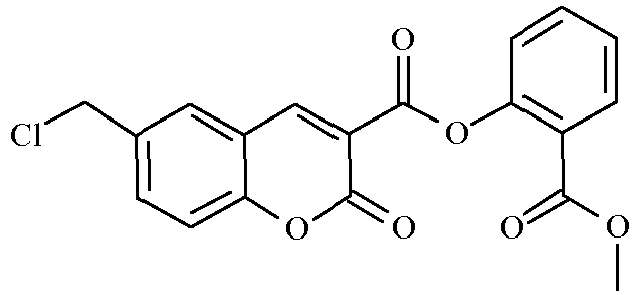
IK1 26.3 ± 1,4 2.7±0.1 38±5 
IK3 NI NI 77 % (100 µM) 
LP60 112 ± 6 1.44± 0.02 46 % (100 µM) 
IK5 36.9 ± 4.2 5.8± 0.2 89 ±10 
LP73 NI 0.063 ± 0.004 NI 
LP74 1.3 ± 0.2 0,195 ± 0,024 54 ± 6 µM 
LP72 59 ± 9 0.495 ± 0.037 50 % (100 µM) 
LP51 26 % (50 µM) 0.25 ± 0.01 30 % (100 µM) 
LP8 49 % (100 µM) 0.103 ± 0.005 40 % (100 µM) 
LP53 34 % (50 µM) 0.065 ± 0.003 41 % (100 µM) 
LP14 48 % (100 µM) 0.077± 0.003 70 % (100 µM) 
IK4 21.6 ± 5 7.8±0.6 30 ± 8 
IK2 NI 0.68± 0.01 67 % (100 µM) 
LP46 31 % (50 µM) ND 31±6 
LP55 NI 8.4± 0.2 NI 
LP75 80 ± 8 0.136 ± 0.012 NI 
LP61 NI 0.130 ± 0.005 NI 
CFL16 40 % (100 µM) 0.9± 0.4 73 % (100 µM) 
CFL5 35 % (100 µM) 0.50 ± 0.04 39 ± 4 
CFL21 [121 ± 5] 22 % (100 µM) 43 % (100 µM) 
CFL25 44 ± 10 ND 68 ± 9 
CFL15 47 % (100 µM) 0.352 ± 0.055 45 % (100 µM) 
CFL7 NI 33 % (100 µM) 33 % (100 µM) 
MFS35 NI 55 % (100 µM) 71 % (100 µM) 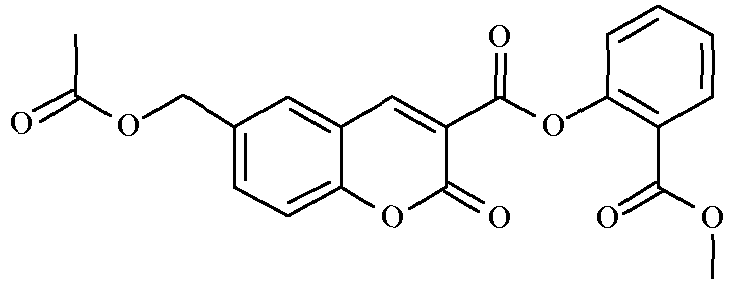
IK8 ≈ 40 64.3± 2.7 64 % (100 µM) 
IK10 23 % (50 µM) NI NI 
IK9 22 % (50 µM) NI NI 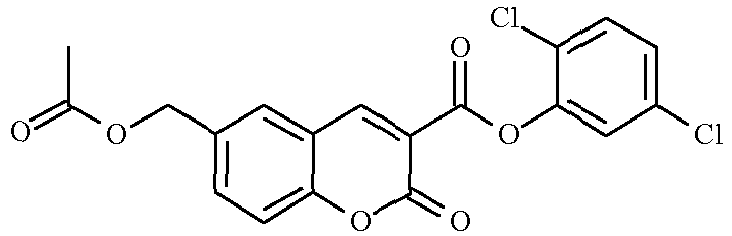
CFL4 NI 5.01± 0.4 60 % (50 µM) 
CFL17 NI 33 % (100 µM) 50 % (50 µM) 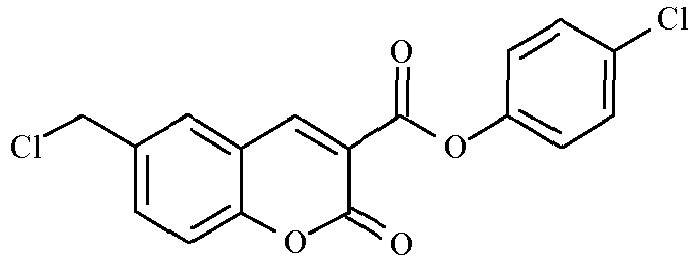
LP7 NI 0.463 ± 0.007 NI 
LP16 NI 47 % (50 µM) NI 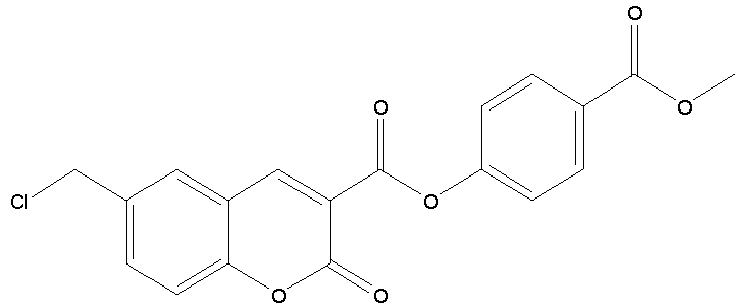
IK13 NI 34 % (100 µM) 72 % (100 µM) 
LP71 182 ± 14 NI NI 
LP18 78 ± 12 4.9 ± 0.3 30 ± 2 
LP42 22% (50 µM) 52% (100 µM) NI 
LP76 30% (50µM) 25% (50 µM) 35 % (50 µM) 
LP2 NI 0.128 ± 0.030 NI 
D5 90 % (100 µM) 61 % (100 µM) 38 % (100 µM) 
MFS2 54 ± 2 26.8± 1.5 73±14 
MFS3 39% (50 µM) 20.9± 0.9 48% (100 µM) 
LP43 49% (100 µM) 30 % (100 µM) 49% (100 µM) 
D9 80% (100 µM) NI 40% (100 µM) 
CFL33 7.0 ± 0.4 NI 61 %(100 µM) 
LP41 32 % (100 µM) 0.39± 0.03 67% (100 µM) 
IK48 27 % (50 µM) 9.7 ± 1.3 32 % (50 µM) 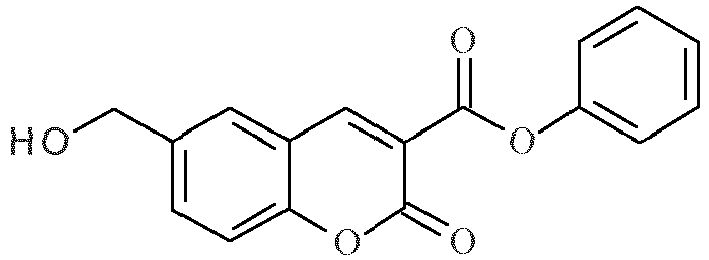
MH30 25 % (50 µM) 33.2± 1.4 32 % (50 µM) 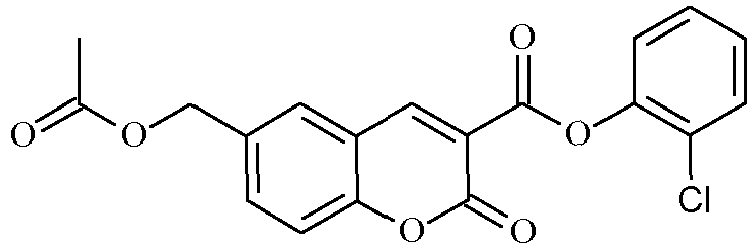
SMB27 NI 42 % (50 µM) 27 % (50 µM) 
SMB26 NI 52 % (10 µM) NI 
SMB28 NI 82.2± 13.2 NI 
IK53 NI 54 % (10 µM) NI 
MH52 NI 58 % (10 µM) NI 
IK49 NI 54 % (10 µM) NI 
MH24 NI 33.2± 1.4 42% (50 µM) 
MH8 NI 25 % (50 µM) NI 
MH14 NI 35 % (50 µM) NI 
SMB33 NI NI 27 % (50 µM) 
MH22 32 % (50 µM) 100% (50 µM) 85% (50 µM) - The coumarin derivatives listed in the table B present a selective activity against KLK5, KLK7 and KLK14.
- The acceptable threshold of inhibition corresponds in 30 % at 100 µM.
TABLE B Enzyme Molecule KLK5 LP12, LP71, CFL33, IK9, IK10, D9 KLK7 LP2, LP42, LP51, LP55, LP72, LP74, MFS7, CFL15, SMB26, SMB28, IK53, MH52, IK49, MH8, MH14 KLK14 LP65, MFS35, CFL21, CFL17, IK3, IK13, SMB33 - The NRU cytotoxicity assay procedure is a cell survival/viability chemosensitivity assay based on the ability of viable cells to incorporate and bind neutral red (NR), a supravital dye. NR is a weak cationic dye that readily penetrates cell membranes by non-ionic diffusion and accumulates intracellularly in lysosomes. Alterations of the cell surface or the sensitive lysosomal membrane lead to lysosomal fragility and other changes that gradually become irreversible. Such changes caused by the action of xenobiotics result in a decreased uptake and binding of NR. It is thus possible to distinguish between viable, damaged, or dead cells, which is the basis of this assay. After treatment with the small-molecules inhibitors, NR uptake in cells will be measured by spectrophotometry at 540 ± 10 nm.
- Keratinocytes from healthy persons or patients with Netherton syndrome are seeded at the density of 4000 cells in 125 µL of medium per well in 96-well plates.
- The culture medium is made of:
- half of complete Green medium: 60% (Dulbecco's Modified Eagle Media), 30% Ham's F12, 10% FCS, 180 mM adenin, 5 µg/mL insulin, 0,4 µg/mL hydrocortisone, 10 nM cholera toxin, 2 nM triiodothyronin, 10 ng/mL human recombinant EGF, 100 U/mL penicillin G/streptomycin.
- half of a basal medium (Epilife - Cascade Biologics) allowing keratinocytes culture without feeders.
- After seeding, cells are incubated for 48 hours in the following experimental conditions: 37°C ± 1°C, 90 % ± 5.0 % humidity, and 5 % ± 1 % CO2/air. This incubation period allows for cell recovery and adherence and progression to exponential growth phase. Prepare inhibitors solutions 2-fold more concentrated than desired. Add 125µL of these solutions to the wells without changing or removing the medium (125 µL).
- A control with the vehicle alone (DMSO) is made.
- A minimum of 3 wells per each experimental condition is done.
- 48h hours after the beginning of the treatment, carefully remove the medium (containing the tested inhibitor) and rinse the cells very carefully with 250 µL pre-warmed PBS. Add 250 µL NR medium and incubate (37°C ± 1°C, 90 % ± 5 % humidity, and 5.0 % ± 1 % CO2/air) for 3 ± 0.1 h. NR medium is the culture medium containing 33µg/mL of NR. After incubation, remove the NR medium, and carefully rinse cells with 250 µL pre-warmed PBS.
- Decant and blot PBS from the plate.
- Add exactly 100 µL NR Desorb (50% ETOH/1% acetic acid) solution to all wells, including blanks.
- Shake microtiter plate rapidly on a microtiter plate shaker for 20 - 45 min to extract NR from the cells and form a homogeneous solution. Plates should be protected from light by using a cover during shaking.
- Plates should be still for at least five minutes after removal from the plate shaker. Measure the absorption (within 60 minutes after adding NR Desorb solution) of the resulting colored solution at 540 nm ± 10 nm in a microtiter plate reader (spectrophotometer), using the blank as a reference.
- The experiments are performed three times on three different days for each inhibitor.
- A calculation of cell viability expressed as NRU is made for each concentration of the tested inhibitor by using the mean NRU of the three replicate values per each concentration. This value is compared with the mean NRU of all vehicle values. Relative cell viability is then expressed as percent of untreated vehicle control (DMSO).
- Normal human keratinocytes were seeded in a 96-well tissue culture plate. At 20% of confluence, molecules were added in the culture medium and incubated for 48 h. Neutral red medium was added to every well for an incubation period of 3 h, then the dye was extracted with acidified ethanol solution. Data (
figures 2 and 3 ) represent the mean cell viability after treatment +/- SD compared to mean viability of cells treated with the vehicle only (DMSO). Data represent the mean of 5 individual experiments. - No noticeable cytotoxicity on human normal keratinocytes was observed at 1 and 10 µM when assayed using the neutral red uptake test for LP7, LP14, LP41, LP53, LP55, LP61, LP73, LP76, MFS7, MFS33, CFL5, CFL33, IK2 and IK4.
- Toxicity was observed for IK3 at 1 and 10 µM reaching 16,09 ± 8,32 % at 1µM and 47,1 ± 4,43 % at 10µM.
- 250,000 keratinocytes from a Netherton syndrome patient (NSK) were seeded in 6 well plates in 2 mL of medium made of: (a) half of complete Green medium: (Dulbecco's Modified Eagle Media) 60%; Ham's
F12 30%;FCS 10%; adenin 180 mM; insulin 5 µg/mL;hydrocortisone 0,4 µg/mL;cholera toxin 10 nM; triiodothyronin 2 nM; humanrecombinant EGF 10 ng/mL; penicillin G/streptomycin 100 U/mL; (b) half of a basal medium (Epilife - Cascade Biologies). - When confluent, cells were washed 5 times with PBS and 2 mL of complete Green medium without FCS (fetal calf serum) were added per well.
- Inhibitors were added in the culture medium 24 h after medium renewal.
- The supernatant was removed and cells were washed once with PBS.
- 350 µL of RLT lysis buffer (Mini Kit QIAGEN) + β-mercapto-ethanol (0,1 %) were added per well to extract total RNA. The cell lysate was kept at -80°C before RNA extraction (Mini Kit QIAGEN).
- In this in cellulo test, KLK5 activity was evaluated by an indirect method. Indeed KLK5 induces TSLP (thymic stromal lymphopoietin), TNF-a (tumor necrosis factor alpha) and IL-8 (interleukin 8) expression. If KLK5 activity is inhibited, the expression of these cytokines will be reduced.
- The relative amount of TSLP, TNF-a and IL-8 transcripts [relative to HPRT (hypoxanthine phosphoribosyltransferase 1) housekeeping gene] was compared between cells treated or not treated with the inhibitors. The ratio «treated/not treated» relative to housekeeping gene reflects KLK5 inhibition.
- Two other genes showed increased expression in NSK i.e. MDC (macrophage derived cytokine or CCL22) and TARC (thymus and activation regulated chemokine or CCL17). Their expression had also been studied even if their mechanism of induction is not known yet.
- The effect of LP73 and CFL33 on the expression of the described pro-allergic and inflammatory cytokines was analyzed on keratinocytes from two different NS patients. Each experiment was performed twice (
figure 4 ). - LP73 at the dose of 1 µM significantly inhibited the expression of TSLP (p = 0.0088), IL-8 (p = 0.0269), TNF-a (p = 0.0004), MDC (p < 0.0001) and TARC (p = 0.0004) whereas at the dose of 10 µM, it only inhibited the expression of TSLP (p = 0.002) and TARC (p = 0.0461).
- CFL33 at the dose of 1 µM significantly inhibited the expression of IL-8 (p = 0.0309), MDC (p < 0.0001) and TARC (p = 0.0078) only.
- To analyze whether coumarin derivatives have an efficacy on psoriasis, atopic eczema and allergic contact dermatitis skin pathologies, in situ zymographies on skin sections can be performed. The total protease activity can be visualized, as well as specific KLK5 and KLK7 activities directly in the tissue.
- In situ zymography allows the study of protease activity in tissue. Skin sections of lesional skin are incubated in the presence, or not, of the tested compound and incubated O/N with a specific substrate coupled to a fluorochrome (casein can be used as substrate to assess total protease activity or KLK5 and KLK7 specific substrates can be used to evaluate KLK5 and KLK7 activities. When the substrate is cleaved, the fluorochrome is released. The inhibition of the fluorochrome release is then analysed and quantified by confocal microscopy analysis.
- The protocol is the following: frozen sections of lesional skin (5-µm thickness) are rinsed with a washing solution (2
% Tween 20 in PBS, 2 min, followed by 5 min in PBS) and incubated or not with the tested compound and incubated at 37°C overnight with 100 µl of BODIPY FL casein (10 µg/ml) using the EnzChek Ultra Protease Assay kit (Invitrogen) in 100 mM Tris-Cl,pH 8, in order to visualize global protease activity. - To assess KLK5 and KLK7 activities, cryostat sections after incubation or not with the tested compound, are incubated in the same conditions with 100 µl of Boc-Val-Pro-Arg-AMC or Suc-Leu-Leu-Val-Tyr-AMC (Sigma-Aldrich) at 100 µM and 40µM respectively in
Tris 50 mM,CaCl2 10 mM for the detection of trypsin- (KLK5) and chymotrypsin-like (KLK7) activity, respectively. - After incubation overnight at 37°C with the substrate, sections are rinsed with PBS solution and visualized with the Axiovert 200 inverted high-end microscope (Zeiss) for KLK5 and KLK7 activities and Leica TCS SP5 AOBS for global protease activity. Images are analyzed with Image J software.
- Should the coumarin derivatives inhibit KLK5 and KLK7 activities, a decrease of the release of the fluorochrome will be observed.

According to another embodiment, the present disclosure relates to the above mentioned compounds having the following formula (Ib):


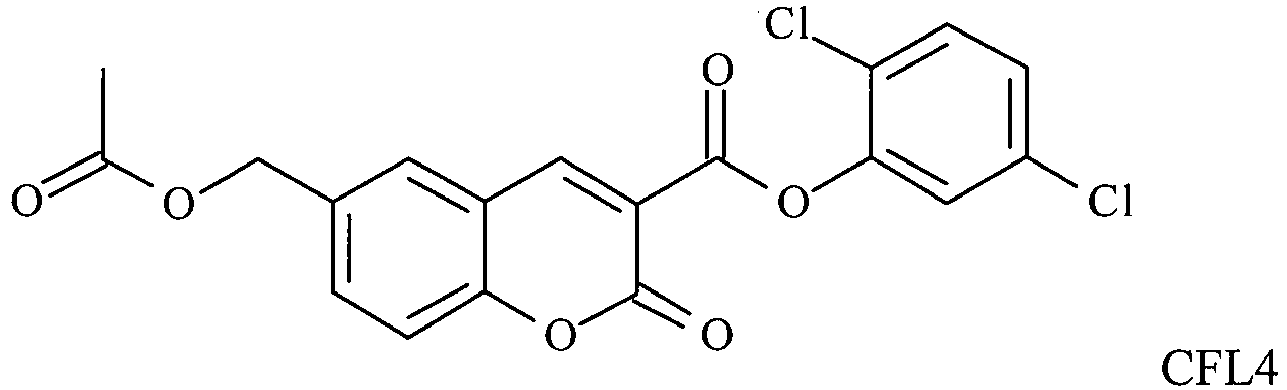


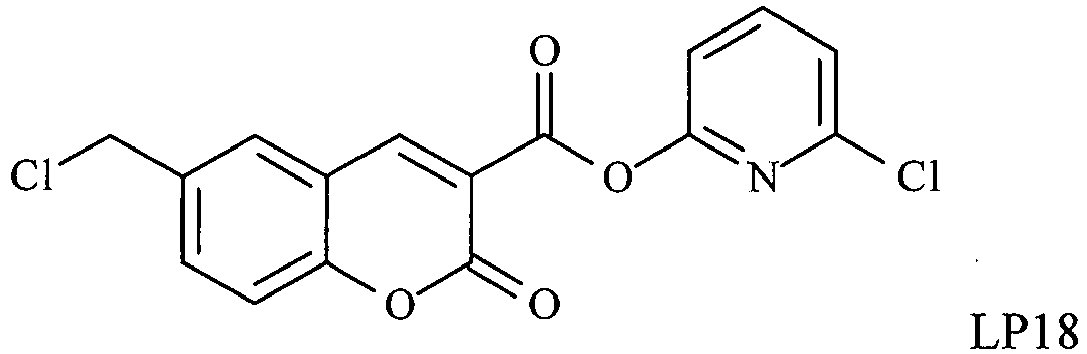


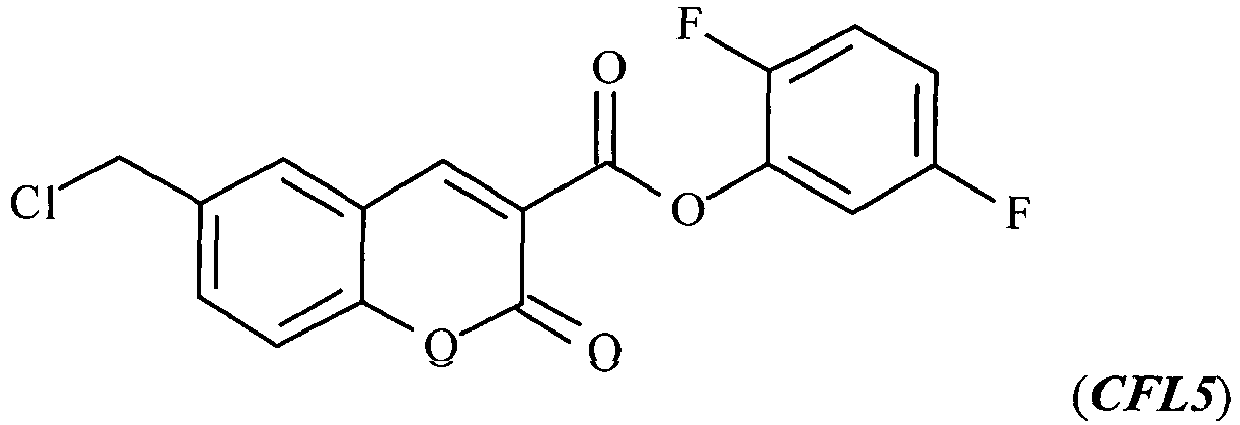


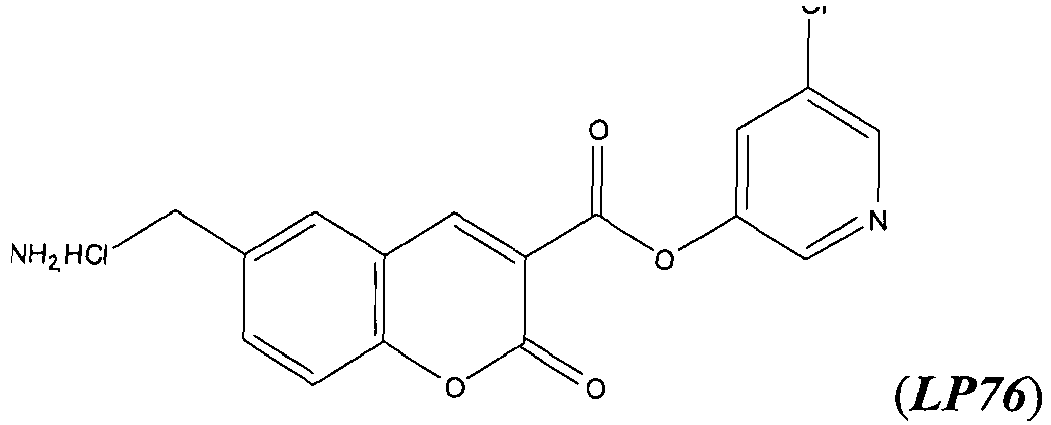
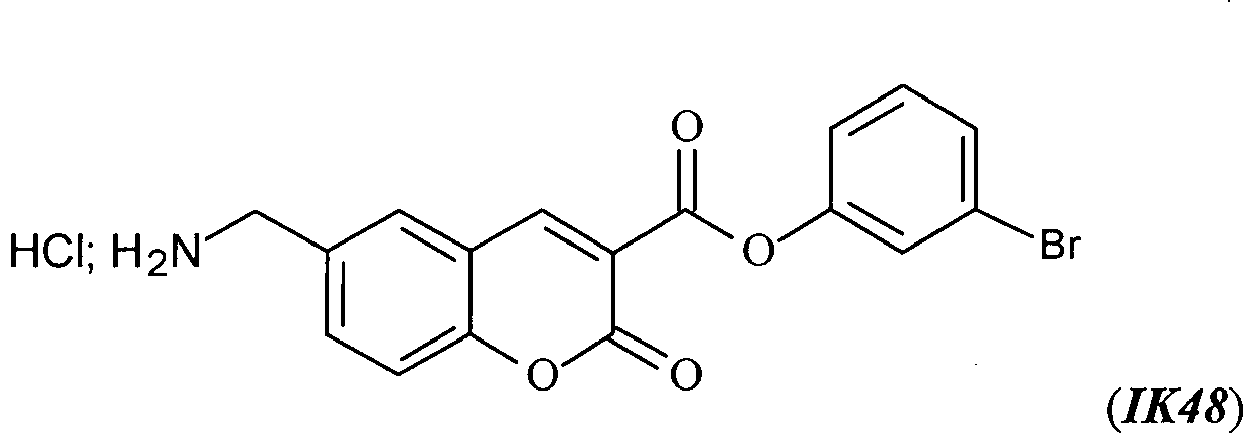


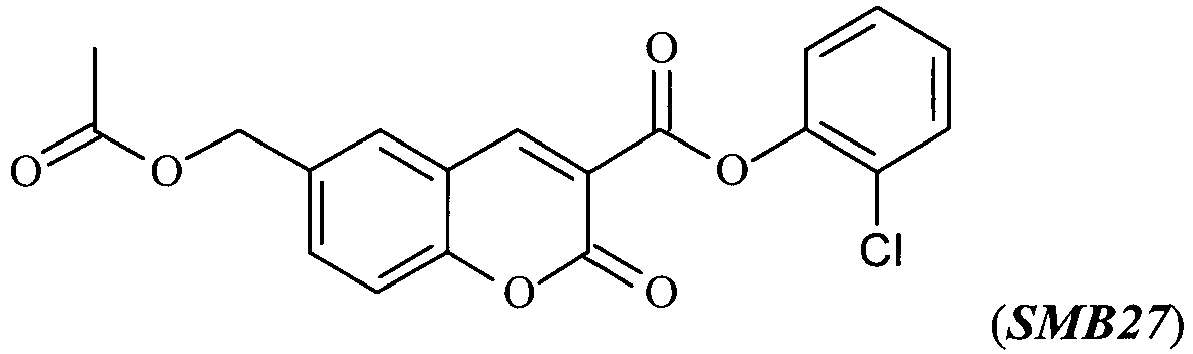


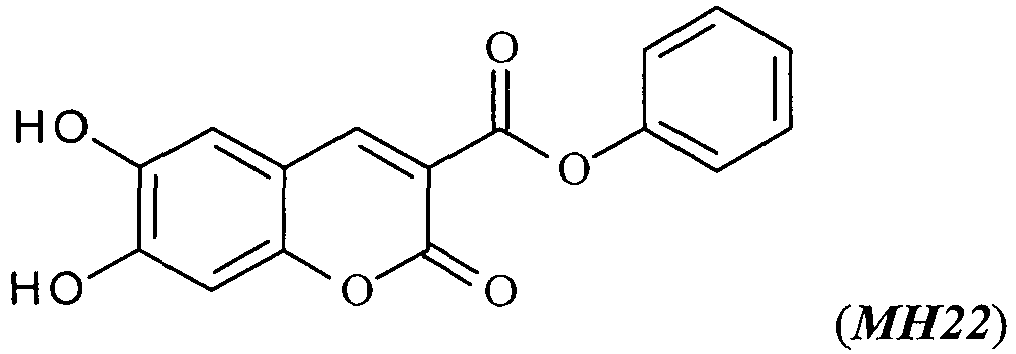
aforesaid pathologies belonging to the group consisting of Netherton syndrome, psoriasis, atopic eczema and allergic contact dermatitis.
aforesaid pathologies being Netherton syndrome.
aforesaid pathologies belonging to the group consisting of psoriasis, atopic eczema and allergic contact dermatitis.
aforesaid pathologies belonging to the group consisting of psoriasis, atopic eczema and allergic contact dermatitis.
aforesaid pathologies belonging to the group consisting of psoriasis, atopic eczema and allergic contact dermatitis.
aforesaid pathologies belonging to the group consisting of psoriasis, atopic eczema and allergic contact dermatitis.
aforesaid pathologies belonging to the group consisting of psoriasis, atopic eczema and allergic contact dermatitis.
aforesaid pathologies belonging to the group consisting of psoriasis, atopic eczema and allergic contact dermatitis.
aforesaid pathologies belonging to the group consisting of psoriasis, atopic eczema and allergic contact dermatitis.
aforesaid pathologies belonging to the group consisting of psoriasis, atopic eczema and allergic contact dermatitis.
Claims (11)
- Compound of formula (I-1b):
 ◆ Z represents O or S,◆ R1 represents at least one group chosen among the group consisting of :- a Hydrogen- a linear or branched, saturated or not, C1-C7 alkyl, preferably a methyl group, substituted, or not, by a halogen chosen among Cl, F, I and Br,- a linear or branched, saturated or not, C1-C7 alkyl, preferably a methyl group, substituted by a hydroxyl or a -O-R12 group, wherein R12 is a linear or branched, saturated or not, C1-C7 alkyl, preferably a hydroxyl,- a group -CH2-O-CO-R5, wherein R5 is chosen among a hydrogen atom and a linear or branched, saturated or not, C1-C7 alkyl, substituted or not by at least one halogen chosen among Cl, F, I and Br,- a group -0-R13, wherein R13 is chosen among hydrogen and a linear or branched, saturated or not, C1-C7 alkyl, R13 being preferably a hydrogen,- an amine
 - a group
 ∘ hydrogen,∘ a linear or branched, saturated or not,C1-C5 alkyl,∘ -CO-R5, wherein R5 is chosen among a hydrogen atom, and a linear or branched, saturated or not, C1-C7 alkyl, substituted or not by at least one halogen chosen among Cl, F, I and Br,∘ -SO2-R11 wherein R11 is a linear or branched, saturated or not,C1-C7 alkyl,◆ R'1 represents a group chosen among hydrogen and -O-R14, wherein R14 is chosen among hydrogen and a linear or branched, saturated or not, C1-C7 alkyl, R14 being preferably a hydrogen, R'1 being preferably a hydrogen,
provided that R'1 represents hydrogen when R1 does not represent a -O-R13 group,
and◆ R2 is chosen among the group consisting of:provided that- a linear or branched, saturated or not, C1-C7 alkyl, preferably a C1-C3 alkyl,- a C3-C6 cycloalkyl, preferably a C4-C6 cycloalkyl, more preferably a cyclohexyl,- an aryl group, preferably a phenyl group, possibly mono or or polysubstituted, in particular disubstituted, by∘ a halogen chosen among Cl, F, I and Br, or∘ a linear or branched, saturated or not, C1-C7 alkyl, or∘ a group -CO-R6, R6 being chosen among the group consisting of: -OH, NH2, or salt thereof, and -O-R7, R7 being a linear or branched, saturated or not, C1-C7 alkyl, or∘ a group -O-R8, R8 being a linear or branched, saturated or not, C1-C7 alkyl, or∘ a group -NO2,∘ a group -CN,∘ a combination of the above,and- an heteroaryl group, preferably a pyridyl or an isoquinolinyl, possibly mono or polysubstituted, in particular disubstituted, by∘ a halogen chosen among Cl, F, I and Br, or∘ a linear or branched, saturated or not, C1-C7 alkyl, or∘ a group -CO-R6, R6 being chosen among the group consisting of: -OH,-NH2, or salt thereof, and -O-R7, R7 being a linear or branched, saturated or not, C1-C7 alkyl, or∘ a group -O-R8, R8 being a linear or branched, saturated or not, C1-C7 alkyl, or∘ a combination of the above,* if R1= H, then R2 can only represent an isoquinolinyl or a phenyl substituted by two halogens, and* if R1≠H, if R2 is an aryl or an hetero aryl substituted by one a linear or branched, saturated or not, C1-C7 alkyl, said aryl or heteroaryl is also substituted by at least another group different from a C1-C7 alkyl,for its use for the treatment of pathologies involving an excess of activity of at least one member of the kallikrein family, preferably at least one member of the kallikrein family belonging to the group consisting of KLK5, KLK7 and KLK14,
said pathologies belonging to the group consisting of Netherton syndrome and atopic eczema,
said compound belonging in particular to the group consisting of :


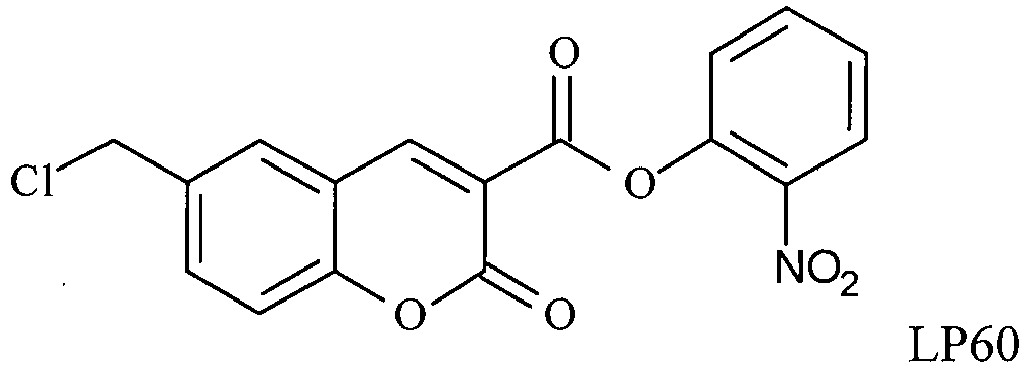


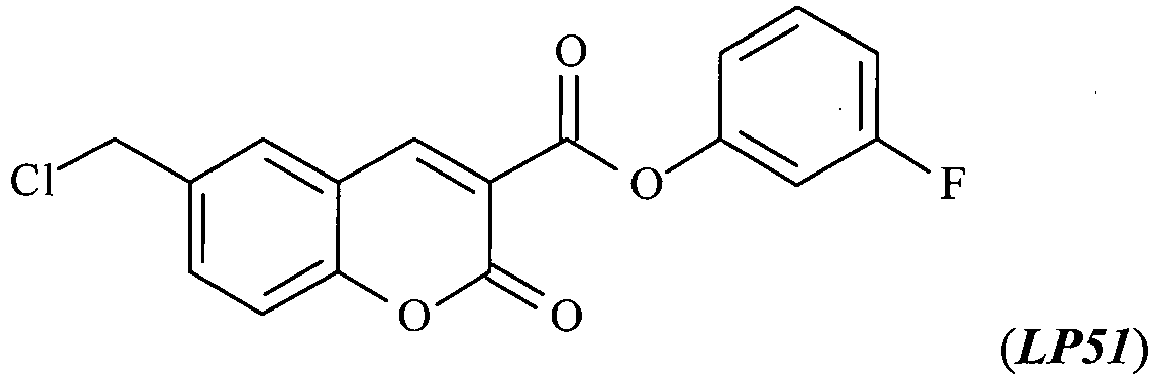


- Compound for use according to claim 1, said compound having the following formula (II):
 R1 represents:and- a group -O-R13, wherein R13 is chosen among hydrogen and a linear or branched, saturated or not, C1-C7 alkyl, R13 being preferably a hydrogen,- -CH2-Cl,- -CH2OCOC2H5, or- a group
 ∘ hydrogen,∘ a linear or branched, saturated or not,C1-C5 alkyl,∘ -CO-R5, wherein R5 is chosen among a hydrogen atom, and a linear or branched, saturated or not, C1-C7 alkyl, substituted or not by at least one halogen chosen among Cl, F, I and Br,∘ -SO2-R11, wherein R11 is a linear or branched, saturated or not,C1-C7 alkyl,R2 representsproviding at least one of R9 and R10 represents -CO-R5 or -SO2-R11, preferably R9 being -CO-R5 and R10 being hydrogen or R9 being -SO2-R11 and R10 being hydrogen,- a pyridyl substituted by a Cl, or- a phenyl substituted, or not, either by a group -OCH3 or by one or two halogens chosen among Cl, Br or I,
said compounds being in particular chosen among the group consisting of :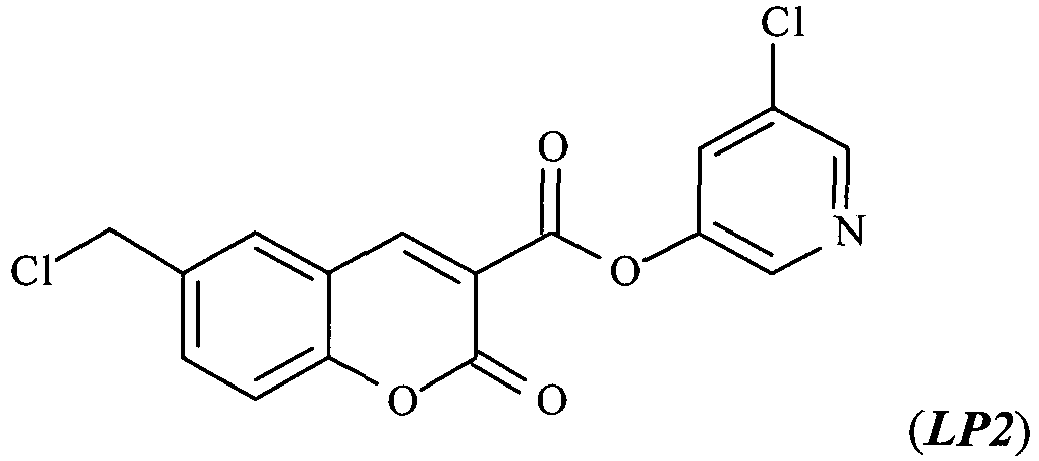


- Compound for use according to claim 1, said compound having the following formula (II):
 R1 represents -CH2-Cl, -CH2OCOCH3, -CH3, -CH2-NH2, and its salts thereof, or H, andR2 represents:provided that- an isoquinolinyl, or- -CH3, or- a pyridyl, or- a phenyl, substituted or not by a halogen,- if R1= H, R2 can only represent an isoquinolinyl, and- if R1= CH3, R2 can only represent a CH3.said compounds being in particular chosen among the group consisting of :


- Compound for use according to claim 1, said compound having the following formula (II):
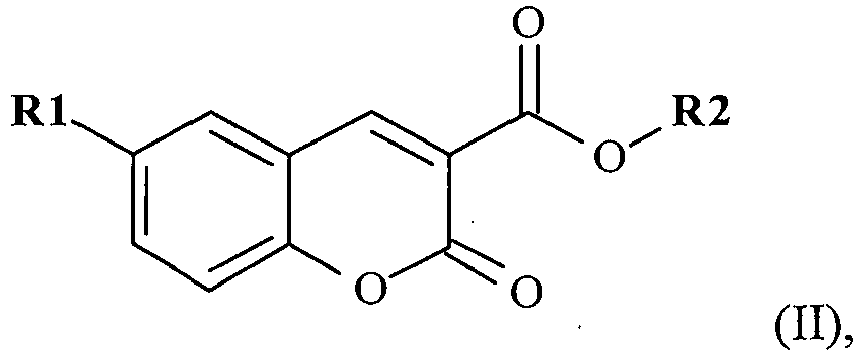 R1 represents -CH2OCOC(CH3)3, - CH2OCOCH3 or-CH2Cl, andR2 represents a pyridyl or a phenyl, said pyridyl or phenyl being mono or bisubstituted by one or two groups chosen among a halogen, an amide, an acid, a -CH3, a -NO2 or a -CN,said compounds being in particular chosen among the group consisting of :


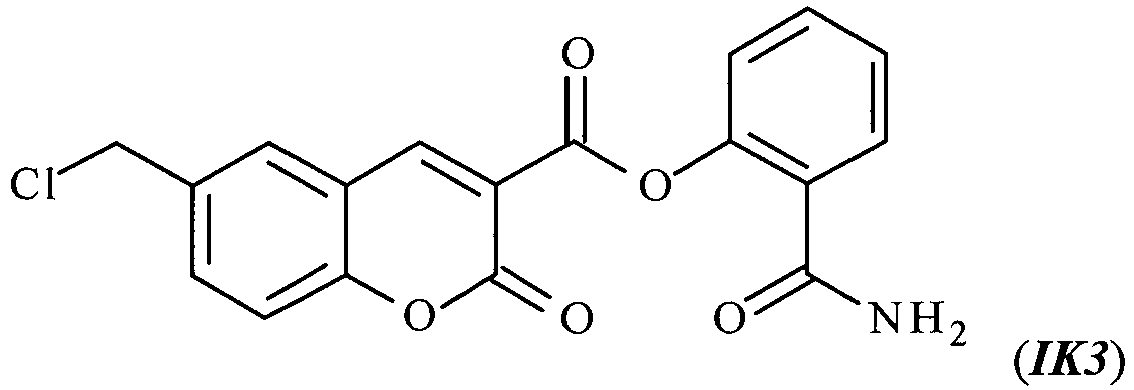


- Compound for use according to claim 1, said compound having the following formula (Ib):
 Z represents O or S,R1 represents -CH2Cl or -CH2-NH2 or its salt thereof, andR2 represents a pyridyl or a phenyl, said pyridyl or phenyl being substituted or not by one or two halogens, one amide or one ester,said compounds being in particular chosen among the group consisting of :


- Compound for use according to claim 1, said compound having the following formula (I-1) :
 ◆ Z represents O or S,◆ R1 represents at least one group chosen among the group consisting of :- hydrogen- a linear or branched, saturated or not, C1-C7 alkyl, preferably a methyl group, substituted, or not, by a halogen chosen among Cl, F, I and Br,- a linear or branched, saturated or not, C1-C7 alkyl, preferably a methyl group, substituted by a hydroxyl or a -O-R12 group, wherein R12 is a linear or branched, saturated or not, C1-C7 alkyl, preferably a hydroxyl,- a group -CH2-O-CO-R5, wherein R5 is chosen among a hydrogen atom, and a linear or branched, saturated or not, C 1-C7 alkyl, substituted or not by at least one halogen chosen among Cl, F, I and Br,- a group -O-R13, wherein R13 is chosen among hydrogen and a linear or branched, saturated or not, C1-C7 alkyl, R13 being preferably a hydrogen,- an amine
 - a group
 ∘ hydrogen,∘ a linear or branched, saturated or not,C1-C5 alkyl,∘ -CO-R5, wherein R5 is chosen among a hydrogen atom, and a linear or branched, saturated or not, C1-C7 alkyl, substituted or not by at least one halogen chosen among Cl, F, I and Br,∘ -SO2-R11, wherein R11 is a linear or branched, saturated or not,C1-C7 alkyl,◆ R'1 represents a group chosen among hydrogen and -O-R14, wherein R14 is chosen among hydrogen and a linear or branched, saturated or not, C1-C7 alkyl, R14 being preferably a hydrogen, R'1 being preferably a hydrogen,
provided that R'1 represents hydrogen when R1 does not represent a -O-R13 group,
and◆ R2 is chosen among the group consisting of:provided that- a linear or branched, saturated or not, C1-C7 alkyl, preferably a C1-C3 alkyl,- a C3-C6 cycloalkyl, preferably a C4-C6 cycloalkyl, more preferably a cyclohexyl,- an aryl group, preferably a phenyl group, possibly mono or or polysubstituted, in particular disubstituted, by∘ a halogen chosen among Cl, F, I and Br, or∘ a linear or branched, saturated or not, C1-C7 alkyl, or∘ a group -CO-R6, R6 being chosen among the group consisting of: -OH,-NH2, or salt thereof, and -O-R7, R7 being a linear or branched, saturated or not, C1-C7 alkyl, or∘ a group -O-R8, R8 being a linear or branched, saturated or not, C1-C7 alkyl, or∘ a group -NO2,∘ a group -CN,∘ a combination of the above,and- an heteroaryl group, preferably a pyridyl or an isoquinolinyl, possibly mono or polysubstituted, in particular disubstituted, by∘ a halogen chosen among Cl, F, I and Br, or∘ a linear or branched, saturated or not, C1-C7 alkyl, or∘ a group -CO-R6, R6 being chosen among the group consisting of: -OH,-NH2, or salt thereof, and -O-R7, R7 being a linear or branched, saturated or not, C1-C7 alkyl, or∘ a group -0-R8, R8 being a linear or branched, saturated or not, C1-C7 alkyl, or∘ a combination of the above,* if R1= H, then R2 can only represent an isoquinolinyl or a phenyl substituted by two halogens, and* if R1≠ H, then if R2 is an aryl or an hetero aryl substituted by one linear or branched, saturated or not, C1-C7 alkyl, said aryl or heteroaryl is also substituted by at least another group different from a C 1-C7 alkyl,for its use for the treatment of pathologies involving an excess of activity of at least one member of the kallikrein family, preferably belonging to the group consisting of KLK5, KLK7 and KLK14,
aforesaid pathologies being Netherton syndrome. - Compound for use according to claim 1, said compound having the following formula (I-1b) :
 ◆ Z represents O or S,◆ R1 represents at least one group chosen among the group consisting of:- a linear or branched, saturated or not, C1-C7 alkyl, preferably a methyl group, substituted by a hydroxyl or a -O-R12 group, wherein R12 is a linear or branched, saturated or not, C1-C7 alkyl, preferably a hydroxyl,- a group -O-R13, wherein R13 is chosen among hydrogen and a linear or branched, saturated or not, C1-C7 alkyl, R13 being preferably a hydrogen,- an amine
 - a group
 ∘ hydrogen,∘ a linear or branched, saturated or not,C1-C5 alkyl,∘ -CO-R5, wherein R5 is chosen among a hydrogen atom, and a linear or branched, saturated or not, C1-C7 alkyl, substituted or not by at least one halogen chosen among Cl, F, I and Br,∘ -SO2-R11, wherein R11 is a linear or branched, saturated or not,C1-C7 alkyl,◆ R'1 represents a group chosen among hydrogen and -O-R14, wherein R14 is chosen among hydrogen and a linear or branched, saturated or not, C1-C7 alkyl, R14 being preferably a hydrogen, R'1 being preferably a hydrogen,
provided that R'1 represents hydrogen when R1 does not represent a -O-R13 group,
and◆ R2 is chosen among the group consisting of:provided that:- a linear or branched, saturated or not, C1-C7 alkyl, preferably a C1-C3 alkyl,- a C3-C6 cycloalkyl, preferably a C4-C6 cycloalkyl, more preferably a cyclohexyl,- an aryl group, preferably a phenyl group, possibly mono or or polysubstituted, in particular disubstituted, by∘ a halogen chosen among Cl, F, I and Br, or∘ a linear or branched, saturated or not, C1-C7 alkyl, or∘ a group -CO-R6, R6 being chosen among the group consisting of: -OH,-NH2, or salt thereof, and -O-R7, R7 being a linear or branched, saturated or not, C1-C7 alkyl, or∘ a group -O-R8, R8 being a linear or branched, saturated or not, C1-C7 alkyl, or∘ a group -NO2,∘ a group -CN,∘ a combination of the above,and- an heteroaryl group, preferably a pyridyl or an isoquinolinyl, possibly mono or polysubstituted, in particular disubstituted, by∘ a halogen chosen among Cl, F, I and Br, or∘ a linear or branched, saturated or not, C1-C7 alkyl, or∘ a group -CO-R6, R6 being chosen among the group consisting of: -OH,-NH2, or salt thereof, and -O-R7, R7 being a linear or branched, saturated or not, C1-C7 alkyl, or∘ a group -O-R8, R8 being a linear or branched, saturated or not, C1-C7 alkyl, or∘ a combination of the above,* if R2 is an aryl or an hetero aryl substituted by one a linear or branched, saturated or not, C1-C7 alkyl, said aryl or heteroaryl is also substituted by at least another group different from a C1-C7 alkyl,* if R1 represents a groupfor its use for the treatment of pathologies involving an excess of activity of at least one member of the kallikrein family, preferably belonging to the group consisting of KLK5, KLK7 and KLK 14,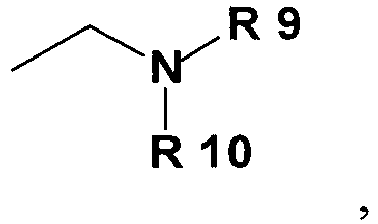
aforesaid pathologies being atopic eczema. - Compound selected from the group comprising:


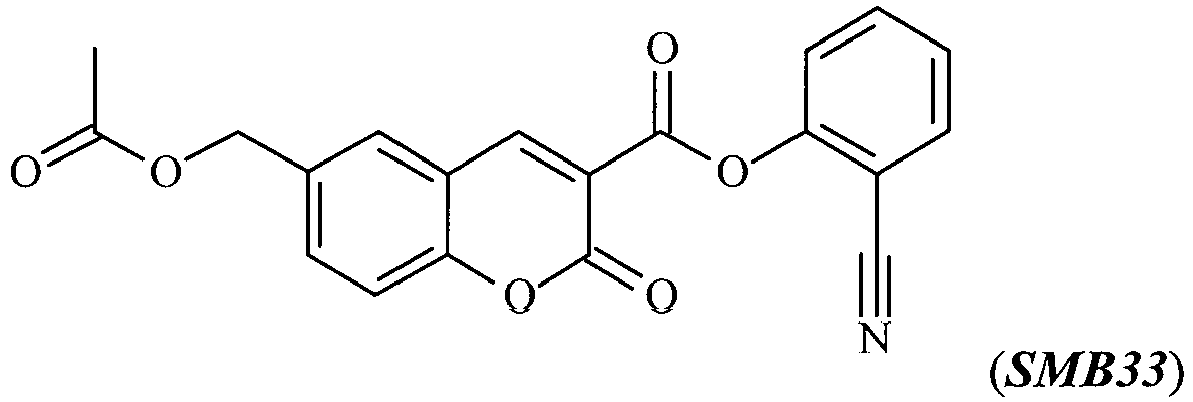
- Compound according to claim 8, for its use as drug.
- Pharmaceutical composition comprising as active substance a compound according to claim 8, in association with a pharmaceutically acceptable carrier.
- Composition comprising a compound according to claim 8, for its use for the treatment of skin pathologies,
said skin pathologies belonging to the group consisting of Netherton syndrome and atopic eczema.
Priority Applications (1)
| Application Number | Priority Date | Filing Date | Title |
|---|---|---|---|
| EP12733783.0A EP2731604B1 (en) | 2011-07-15 | 2012-07-13 | Use of coumarin derivatives for the preparation of drugs for treating skin diseases |
Applications Claiming Priority (3)
| Application Number | Priority Date | Filing Date | Title |
|---|---|---|---|
| EP20110305931 EP2545916A1 (en) | 2011-07-15 | 2011-07-15 | Use of coumarin derivatives for the preparation of drugs for treating skin diseases |
| EP12733783.0A EP2731604B1 (en) | 2011-07-15 | 2012-07-13 | Use of coumarin derivatives for the preparation of drugs for treating skin diseases |
| PCT/EP2012/063851 WO2013010963A1 (en) | 2011-07-15 | 2012-07-13 | Use of coumarin derivatives for the preparation of drugs for treating skin diseases |
Publications (2)
| Publication Number | Publication Date |
|---|---|
| EP2731604A1 EP2731604A1 (en) | 2014-05-21 |
| EP2731604B1 true EP2731604B1 (en) | 2017-04-19 |
Family
ID=46506459
Family Applications (2)
| Application Number | Title | Priority Date | Filing Date |
|---|---|---|---|
| EP20110305931 Withdrawn EP2545916A1 (en) | 2011-07-15 | 2011-07-15 | Use of coumarin derivatives for the preparation of drugs for treating skin diseases |
| EP12733783.0A Active EP2731604B1 (en) | 2011-07-15 | 2012-07-13 | Use of coumarin derivatives for the preparation of drugs for treating skin diseases |
Family Applications Before (1)
| Application Number | Title | Priority Date | Filing Date |
|---|---|---|---|
| EP20110305931 Withdrawn EP2545916A1 (en) | 2011-07-15 | 2011-07-15 | Use of coumarin derivatives for the preparation of drugs for treating skin diseases |
Country Status (5)
| Country | Link |
|---|---|
| US (3) | US9006466B2 (en) |
| EP (2) | EP2545916A1 (en) |
| CA (1) | CA2841986C (en) |
| ES (1) | ES2632798T3 (en) |
| WO (1) | WO2013010963A1 (en) |
Families Citing this family (10)
| Publication number | Priority date | Publication date | Assignee | Title |
|---|---|---|---|---|
| EP3097084B1 (en) * | 2014-01-23 | 2020-09-30 | Sixera Pharma AB | New kallikrein 7 inhibitors |
| WO2015114144A1 (en) * | 2014-02-03 | 2015-08-06 | INSERM (Institut National de la Santé et de la Recherche Médicale) | Methods and pharmaceutical compositions for the treatment of netherton syndrome |
| US10821094B2 (en) | 2016-01-13 | 2020-11-03 | Children's Hospital Medical Center | Compositions and methods for treating allergic inflammatory conditions |
| CN107823200A (en) * | 2017-11-14 | 2018-03-23 | 三峡大学 | Inhibitor application on pharmacy of the coumarin derivative as KLK7 |
| US11859250B1 (en) | 2018-02-23 | 2024-01-02 | Children's Hospital Medical Center | Methods for treating eosinophilic esophagitis |
| WO2019204580A1 (en) | 2018-04-20 | 2019-10-24 | Children's Hospital Medical Center | Blood biomarker for eosinophilic gastrointestinal disorders |
| US12297501B2 (en) | 2019-02-25 | 2025-05-13 | Children's Hospital Medical Center | Methods for diagnosing and treating eosinophilic gastritis |
| BR102020009679A2 (en) | 2020-05-14 | 2021-11-23 | Fundação Universidade Federal Do Abc - Ufabc | HUMAN RECOMBINANT ANTIBODIES FOR INHIBITION OF HUMAN TISSUE KALKREIN 7 (KLK7) AND USE IN DISEASES RELATED TO THE SKIN PEELING PROCESS |
| WO2023213728A1 (en) | 2022-05-03 | 2023-11-09 | Université de Liège | Substituted aryl esters of coumarin-3-carboxylic acid and their use as host cell proteases inhibitors |
| CN116693487B (en) * | 2023-06-09 | 2026-03-31 | 北京化工大学 | A coumarin-based thioester photoinitiator suitable for photopolymerization and its preparation method |
Family Cites Families (2)
| Publication number | Priority date | Publication date | Assignee | Title |
|---|---|---|---|---|
| FR2763944B1 (en) * | 1997-06-03 | 2000-12-15 | Centre Nat Rech Scient | NOVEL COUMARIN DERIVATIVES, PROCESSES FOR THEIR PREPARATION AND THEIR USE AS DRUGS AS PROTEASE INHIBITORS |
| JP5401459B2 (en) * | 2007-08-17 | 2014-01-29 | ノバルティス アーゲー | Use of cyclic depsipeptides to inhibit kallikrein 7 |
-
2011
- 2011-07-15 EP EP20110305931 patent/EP2545916A1/en not_active Withdrawn
-
2012
- 2012-07-13 EP EP12733783.0A patent/EP2731604B1/en active Active
- 2012-07-13 CA CA2841986A patent/CA2841986C/en active Active
- 2012-07-13 ES ES12733783.0T patent/ES2632798T3/en active Active
- 2012-07-13 WO PCT/EP2012/063851 patent/WO2013010963A1/en not_active Ceased
-
2014
- 2014-01-15 US US14/155,633 patent/US9006466B2/en active Active
-
2015
- 2015-03-10 US US14/643,442 patent/US9532973B2/en not_active Expired - Fee Related
-
2016
- 2016-11-21 US US15/356,853 patent/US9814696B2/en not_active Expired - Fee Related
Non-Patent Citations (1)
| Title |
|---|
| None * |
Also Published As
| Publication number | Publication date |
|---|---|
| CA2841986C (en) | 2020-05-05 |
| US20140148480A1 (en) | 2014-05-29 |
| EP2545916A1 (en) | 2013-01-16 |
| US9814696B2 (en) | 2017-11-14 |
| US20150182499A1 (en) | 2015-07-02 |
| US9532973B2 (en) | 2017-01-03 |
| WO2013010963A1 (en) | 2013-01-24 |
| US20170065555A1 (en) | 2017-03-09 |
| ES2632798T3 (en) | 2017-09-15 |
| CA2841986A1 (en) | 2013-01-24 |
| US9006466B2 (en) | 2015-04-14 |
| EP2731604A1 (en) | 2014-05-21 |
Similar Documents
| Publication | Publication Date | Title |
|---|---|---|
| CA2841986C (en) | Use of coumarin derivatives for the preparation of drugs for treating skin diseases. | |
| Pillai et al. | Synthesis, spectroscopic characterization, reactive properties by DFT calculations, molecular dynamics simulations and biological evaluation of Schiff bases tethered 1, 2, 4-triazole and pyrazole rings | |
| Frédérick et al. | 3, 6-Disubstituted coumarins as mechanism-based inhibitors of thrombin and factor Xa | |
| Kwak et al. | β-Secretase (BACE1) inhibitors from pomegranate (Punica granatum) husk | |
| Kontogiorgis et al. | Synthesis and biological evaluation of novel coumarin derivatives with a 7-azomethine linkage | |
| Kuruva et al. | Aqua-soluble DDQ reduces the levels of Drp1 and A β and inhibits abnormal interactions between A β and Drp1 and protects Alzheimer’s disease neurons from A β-and Drp1-induced mitochondrial and synaptic toxicities | |
| Steinmetzer et al. | Secondary amides of sulfonylated 3-amidinophenylalanine. New potent and selective inhibitors of matriptase | |
| CN105294660B (en) | The diketone of (3R, 6S) 3,6 disubstituted piperazine 2,5, it is prepared and application | |
| Tan et al. | 1, 2, 4-Triazole derivatives as transient inactivators of kallikreins involved in skin diseases | |
| Kim et al. | Antitumor and antioxidant activity of protocatechualdehyde produced from Streptomyces lincolnensis M-20 | |
| EA017735B1 (en) | Cyclic depsipeptides | |
| Madsen et al. | Synthesis and evaluation of silanediols as highly selective uncompetitive inhibitors of human neutrophil elastase | |
| Nakamura et al. | The discovery of shorter synthetic proteolytic peptides derived from Tob1 protein | |
| WO1998022619A1 (en) | Metal mediated serine protease inhibitors | |
| Erba et al. | Selective inhibition of human mast cell tryptase by gabexate mesylate, an antiproteinase drug | |
| Meng et al. | Discovery of highly selective, potent, covalent, and orally bioavailable factor XIIa inhibitors for the treatment of thrombo-inflammation | |
| WO2013084199A1 (en) | Boron heterocycles as new inhibitors of human neutrophil elastase | |
| Luo et al. | Hormetic effects of EGC and EGCG on CES1 activity and its rescue from oxidative stress in rat liver S9 | |
| Sage et al. | Modulation of the expression and activity of cathepsin S in reconstructed human skin by neohesperidin dihydrochalcone | |
| FR2763944A1 (en) | NOVEL COUMARIN DERIVATIVES, PROCESSES FOR THEIR PREPARATION AND THEIR USE AS MEDICAMENTS AS PROTEASE INHIBITORS | |
| Antognelli et al. | Crystalline silica Min-U-Sil 5 induces oxidative stress in human bronchial epithelial cells BEAS-2B by reducing the efficiency of antiglycation and antioxidant enzymatic defenses | |
| Bissonnette et al. | Coumarinic derivatives show anti-inflammatory effects on alveolar macrophages, but their anti-elastase activity is essential to reduce lung inflammation in vivo | |
| CA2840678C (en) | Use of coumarin derivatives for the preparation of drugs for treating skin diseases | |
| Schmitt et al. | Norfuraneol dephosphorylates eNOS at threonine 495 and enhances eNOS activity in human endothelial cells | |
| Li et al. | Regulating effect of tea polyphenols on endothelin, intracellular calcium concentration, and mitochondrial membrane potential in vascular endothelial cells injured by Angiotensin II |
Legal Events
| Date | Code | Title | Description |
|---|---|---|---|
| PUAI | Public reference made under article 153(3) epc to a published international application that has entered the european phase |
Free format text: ORIGINAL CODE: 0009012 |
|
| 17P | Request for examination filed |
Effective date: 20140115 |
|
| AK | Designated contracting states |
Kind code of ref document: A1 Designated state(s): AL AT BE BG CH CY CZ DE DK EE ES FI FR GB GR HR HU IE IS IT LI LT LU LV MC MK MT NL NO PL PT RO RS SE SI SK SM TR |
|
| DAX | Request for extension of the european patent (deleted) | ||
| 17Q | First examination report despatched |
Effective date: 20150304 |
|
| RIC1 | Information provided on ipc code assigned before grant |
Ipc: C07D 311/14 20060101ALI20160727BHEP Ipc: A61K 31/4725 20060101ALI20160727BHEP Ipc: A61K 31/37 20060101AFI20160727BHEP Ipc: C07D 405/12 20060101ALI20160727BHEP Ipc: C07D 311/12 20060101ALI20160727BHEP Ipc: A61P 17/00 20060101ALI20160727BHEP Ipc: A61K 31/4433 20060101ALI20160727BHEP |
|
| GRAP | Despatch of communication of intention to grant a patent |
Free format text: ORIGINAL CODE: EPIDOSNIGR1 |
|
| INTG | Intention to grant announced |
Effective date: 20161108 |
|
| RIN1 | Information on inventor provided before grant (corrected) |
Inventor name: QIN, LIXIAN Inventor name: TAN, XIAO Inventor name: REBOUD, RAVAUX, MICHELE Inventor name: PAGANO, MAURICE Inventor name: PIROTTE, BERNARD Inventor name: YERROUM, EL AMRI, CHAHRAZADE Inventor name: HOVNANIAN, ALAIN Inventor name: FURIO, LAETITIA |
|
| GRAS | Grant fee paid |
Free format text: ORIGINAL CODE: EPIDOSNIGR3 |
|
| GRAA | (expected) grant |
Free format text: ORIGINAL CODE: 0009210 |
|
| AK | Designated contracting states |
Kind code of ref document: B1 Designated state(s): AL AT BE BG CH CY CZ DE DK EE ES FI FR GB GR HR HU IE IS IT LI LT LU LV MC MK MT NL NO PL PT RO RS SE SI SK SM TR |
|
| REG | Reference to a national code |
Ref country code: GB Ref legal event code: FG4D |
|
| REG | Reference to a national code |
Ref country code: CH Ref legal event code: EP |
|
| REG | Reference to a national code |
Ref country code: AT Ref legal event code: REF Ref document number: 885277 Country of ref document: AT Kind code of ref document: T Effective date: 20170515 |
|
| REG | Reference to a national code |
Ref country code: IE Ref legal event code: FG4D |
|
| REG | Reference to a national code |
Ref country code: DE Ref legal event code: R096 Ref document number: 602012031329 Country of ref document: DE |
|
| REG | Reference to a national code |
Ref country code: CH Ref legal event code: NV Representative=s name: ABREMA AGENCE BREVET ET MARQUES, GANGUILLET, CH |
|
| REG | Reference to a national code |
Ref country code: SE Ref legal event code: TRGR |
|
| REG | Reference to a national code |
Ref country code: FR Ref legal event code: PLFP Year of fee payment: 6 |
|
| REG | Reference to a national code |
Ref country code: NL Ref legal event code: MP Effective date: 20170419 |
|
| REG | Reference to a national code |
Ref country code: LT Ref legal event code: MG4D |
|
| REG | Reference to a national code |
Ref country code: ES Ref legal event code: FG2A Ref document number: 2632798 Country of ref document: ES Kind code of ref document: T3 Effective date: 20170915 Ref country code: AT Ref legal event code: MK05 Ref document number: 885277 Country of ref document: AT Kind code of ref document: T Effective date: 20170419 |
|
| PG25 | Lapsed in a contracting state [announced via postgrant information from national office to epo] |
Ref country code: NL Free format text: LAPSE BECAUSE OF FAILURE TO SUBMIT A TRANSLATION OF THE DESCRIPTION OR TO PAY THE FEE WITHIN THE PRESCRIBED TIME-LIMIT Effective date: 20170419 |
|
| PG25 | Lapsed in a contracting state [announced via postgrant information from national office to epo] |
Ref country code: AT Free format text: LAPSE BECAUSE OF FAILURE TO SUBMIT A TRANSLATION OF THE DESCRIPTION OR TO PAY THE FEE WITHIN THE PRESCRIBED TIME-LIMIT Effective date: 20170419 Ref country code: HR Free format text: LAPSE BECAUSE OF FAILURE TO SUBMIT A TRANSLATION OF THE DESCRIPTION OR TO PAY THE FEE WITHIN THE PRESCRIBED TIME-LIMIT Effective date: 20170419 Ref country code: LT Free format text: LAPSE BECAUSE OF FAILURE TO SUBMIT A TRANSLATION OF THE DESCRIPTION OR TO PAY THE FEE WITHIN THE PRESCRIBED TIME-LIMIT Effective date: 20170419 Ref country code: FI Free format text: LAPSE BECAUSE OF FAILURE TO SUBMIT A TRANSLATION OF THE DESCRIPTION OR TO PAY THE FEE WITHIN THE PRESCRIBED TIME-LIMIT Effective date: 20170419 Ref country code: NO Free format text: LAPSE BECAUSE OF FAILURE TO SUBMIT A TRANSLATION OF THE DESCRIPTION OR TO PAY THE FEE WITHIN THE PRESCRIBED TIME-LIMIT Effective date: 20170719 Ref country code: GR Free format text: LAPSE BECAUSE OF FAILURE TO SUBMIT A TRANSLATION OF THE DESCRIPTION OR TO PAY THE FEE WITHIN THE PRESCRIBED TIME-LIMIT Effective date: 20170720 |
|
| REG | Reference to a national code |
Ref country code: DE Ref legal event code: R082 Ref document number: 602012031329 Country of ref document: DE Ref country code: DE Ref legal event code: R081 Ref document number: 602012031329 Country of ref document: DE Owner name: UNIVERSITE DE LIEGE, BE Free format text: FORMER OWNER: UNIVERSITE PIERRE ET MARIE CURIE (PARIS 6), PARIS, FR Ref country code: DE Ref legal event code: R081 Ref document number: 602012031329 Country of ref document: DE Owner name: UNIVERSITE PIERRE ET MARIE CURIE (PARIS 6), FR Free format text: FORMER OWNER: UNIVERSITE PIERRE ET MARIE CURIE (PARIS 6), PARIS, FR |
|
| PG25 | Lapsed in a contracting state [announced via postgrant information from national office to epo] |
Ref country code: BG Free format text: LAPSE BECAUSE OF FAILURE TO SUBMIT A TRANSLATION OF THE DESCRIPTION OR TO PAY THE FEE WITHIN THE PRESCRIBED TIME-LIMIT Effective date: 20170719 Ref country code: PL Free format text: LAPSE BECAUSE OF FAILURE TO SUBMIT A TRANSLATION OF THE DESCRIPTION OR TO PAY THE FEE WITHIN THE PRESCRIBED TIME-LIMIT Effective date: 20170419 Ref country code: LV Free format text: LAPSE BECAUSE OF FAILURE TO SUBMIT A TRANSLATION OF THE DESCRIPTION OR TO PAY THE FEE WITHIN THE PRESCRIBED TIME-LIMIT Effective date: 20170419 Ref country code: IS Free format text: LAPSE BECAUSE OF FAILURE TO SUBMIT A TRANSLATION OF THE DESCRIPTION OR TO PAY THE FEE WITHIN THE PRESCRIBED TIME-LIMIT Effective date: 20170819 Ref country code: RS Free format text: LAPSE BECAUSE OF FAILURE TO SUBMIT A TRANSLATION OF THE DESCRIPTION OR TO PAY THE FEE WITHIN THE PRESCRIBED TIME-LIMIT Effective date: 20170419 |
|
| REG | Reference to a national code |
Ref country code: DE Ref legal event code: R097 Ref document number: 602012031329 Country of ref document: DE |
|
| PG25 | Lapsed in a contracting state [announced via postgrant information from national office to epo] |
Ref country code: RO Free format text: LAPSE BECAUSE OF FAILURE TO SUBMIT A TRANSLATION OF THE DESCRIPTION OR TO PAY THE FEE WITHIN THE PRESCRIBED TIME-LIMIT Effective date: 20170419 Ref country code: SK Free format text: LAPSE BECAUSE OF FAILURE TO SUBMIT A TRANSLATION OF THE DESCRIPTION OR TO PAY THE FEE WITHIN THE PRESCRIBED TIME-LIMIT Effective date: 20170419 Ref country code: EE Free format text: LAPSE BECAUSE OF FAILURE TO SUBMIT A TRANSLATION OF THE DESCRIPTION OR TO PAY THE FEE WITHIN THE PRESCRIBED TIME-LIMIT Effective date: 20170419 Ref country code: CZ Free format text: LAPSE BECAUSE OF FAILURE TO SUBMIT A TRANSLATION OF THE DESCRIPTION OR TO PAY THE FEE WITHIN THE PRESCRIBED TIME-LIMIT Effective date: 20170419 Ref country code: DK Free format text: LAPSE BECAUSE OF FAILURE TO SUBMIT A TRANSLATION OF THE DESCRIPTION OR TO PAY THE FEE WITHIN THE PRESCRIBED TIME-LIMIT Effective date: 20170419 |
|
| PLBE | No opposition filed within time limit |
Free format text: ORIGINAL CODE: 0009261 |
|
| STAA | Information on the status of an ep patent application or granted ep patent |
Free format text: STATUS: NO OPPOSITION FILED WITHIN TIME LIMIT |
|
| PG25 | Lapsed in a contracting state [announced via postgrant information from national office to epo] |
Ref country code: SM Free format text: LAPSE BECAUSE OF FAILURE TO SUBMIT A TRANSLATION OF THE DESCRIPTION OR TO PAY THE FEE WITHIN THE PRESCRIBED TIME-LIMIT Effective date: 20170419 |
|
| 26N | No opposition filed |
Effective date: 20180122 |
|
| REG | Reference to a national code |
Ref country code: FR Ref legal event code: TQ Owner name: UNIVERSITE PIERRE ET MARIE CURIE (PARIS 6), FR Effective date: 20180227 Ref country code: FR Ref legal event code: TQ Owner name: UNIVERSITE DE LIEGE, BE Effective date: 20180227 |
|
| REG | Reference to a national code |
Ref country code: IE Ref legal event code: MM4A |
|
| PG25 | Lapsed in a contracting state [announced via postgrant information from national office to epo] |
Ref country code: IE Free format text: LAPSE BECAUSE OF NON-PAYMENT OF DUE FEES Effective date: 20170713 |
|
| REG | Reference to a national code |
Ref country code: CH Ref legal event code: PUEA Owner name: UNIVERSITE DE LIEGE, FR Free format text: FORMER OWNER: UNIVERSITE PIERRE ET MARIE CURIE (PARIS 6), FR |
|
| PG25 | Lapsed in a contracting state [announced via postgrant information from national office to epo] |
Ref country code: SI Free format text: LAPSE BECAUSE OF FAILURE TO SUBMIT A TRANSLATION OF THE DESCRIPTION OR TO PAY THE FEE WITHIN THE PRESCRIBED TIME-LIMIT Effective date: 20170419 |
|
| REG | Reference to a national code |
Ref country code: BE Ref legal event code: MM Effective date: 20170731 |
|
| PG25 | Lapsed in a contracting state [announced via postgrant information from national office to epo] |
Ref country code: LU Free format text: LAPSE BECAUSE OF NON-PAYMENT OF DUE FEES Effective date: 20170713 |
|
| PG25 | Lapsed in a contracting state [announced via postgrant information from national office to epo] |
Ref country code: BE Free format text: LAPSE BECAUSE OF NON-PAYMENT OF DUE FEES Effective date: 20170731 |
|
| PG25 | Lapsed in a contracting state [announced via postgrant information from national office to epo] |
Ref country code: MT Free format text: LAPSE BECAUSE OF NON-PAYMENT OF DUE FEES Effective date: 20170713 |
|
| PG25 | Lapsed in a contracting state [announced via postgrant information from national office to epo] |
Ref country code: MC Free format text: LAPSE BECAUSE OF FAILURE TO SUBMIT A TRANSLATION OF THE DESCRIPTION OR TO PAY THE FEE WITHIN THE PRESCRIBED TIME-LIMIT Effective date: 20170419 Ref country code: HU Free format text: LAPSE BECAUSE OF FAILURE TO SUBMIT A TRANSLATION OF THE DESCRIPTION OR TO PAY THE FEE WITHIN THE PRESCRIBED TIME-LIMIT; INVALID AB INITIO Effective date: 20120713 |
|
| PG25 | Lapsed in a contracting state [announced via postgrant information from national office to epo] |
Ref country code: CY Free format text: LAPSE BECAUSE OF NON-PAYMENT OF DUE FEES Effective date: 20170419 |
|
| PG25 | Lapsed in a contracting state [announced via postgrant information from national office to epo] |
Ref country code: MK Free format text: LAPSE BECAUSE OF FAILURE TO SUBMIT A TRANSLATION OF THE DESCRIPTION OR TO PAY THE FEE WITHIN THE PRESCRIBED TIME-LIMIT Effective date: 20170419 |
|
| PG25 | Lapsed in a contracting state [announced via postgrant information from national office to epo] |
Ref country code: TR Free format text: LAPSE BECAUSE OF FAILURE TO SUBMIT A TRANSLATION OF THE DESCRIPTION OR TO PAY THE FEE WITHIN THE PRESCRIBED TIME-LIMIT Effective date: 20170419 |
|
| PG25 | Lapsed in a contracting state [announced via postgrant information from national office to epo] |
Ref country code: PT Free format text: LAPSE BECAUSE OF FAILURE TO SUBMIT A TRANSLATION OF THE DESCRIPTION OR TO PAY THE FEE WITHIN THE PRESCRIBED TIME-LIMIT Effective date: 20170419 |
|
| PG25 | Lapsed in a contracting state [announced via postgrant information from national office to epo] |
Ref country code: AL Free format text: LAPSE BECAUSE OF FAILURE TO SUBMIT A TRANSLATION OF THE DESCRIPTION OR TO PAY THE FEE WITHIN THE PRESCRIBED TIME-LIMIT Effective date: 20170419 |
|
| REG | Reference to a national code |
Ref country code: CH Ref legal event code: PFUS Owner name: UNIVERSITE DE LIEGE, FR Free format text: FORMER OWNER: UNIVERSITE DE LIEGE, FR |
|
| PGFP | Annual fee paid to national office [announced via postgrant information from national office to epo] |
Ref country code: IT Payment date: 20230620 Year of fee payment: 12 Ref country code: FR Payment date: 20230621 Year of fee payment: 12 |
|
| PGFP | Annual fee paid to national office [announced via postgrant information from national office to epo] |
Ref country code: SE Payment date: 20230622 Year of fee payment: 12 |
|
| PGFP | Annual fee paid to national office [announced via postgrant information from national office to epo] |
Ref country code: GB Payment date: 20230620 Year of fee payment: 12 Ref country code: ES Payment date: 20230801 Year of fee payment: 12 Ref country code: CH Payment date: 20230801 Year of fee payment: 12 |
|
| PGFP | Annual fee paid to national office [announced via postgrant information from national office to epo] |
Ref country code: DE Payment date: 20230620 Year of fee payment: 12 |
|
| REG | Reference to a national code |
Ref country code: DE Ref legal event code: R119 Ref document number: 602012031329 Country of ref document: DE |
|
| REG | Reference to a national code |
Ref country code: CH Ref legal event code: PL |
|
| REG | Reference to a national code |
Ref country code: SE Ref legal event code: EUG |
|
| GBPC | Gb: european patent ceased through non-payment of renewal fee |
Effective date: 20240713 |
|
| PG25 | Lapsed in a contracting state [announced via postgrant information from national office to epo] |
Ref country code: DE Free format text: LAPSE BECAUSE OF NON-PAYMENT OF DUE FEES Effective date: 20250201 |
|
| PG25 | Lapsed in a contracting state [announced via postgrant information from national office to epo] |
Ref country code: CH Free format text: LAPSE BECAUSE OF NON-PAYMENT OF DUE FEES Effective date: 20240731 |
|
| PG25 | Lapsed in a contracting state [announced via postgrant information from national office to epo] |
Ref country code: FR Free format text: LAPSE BECAUSE OF NON-PAYMENT OF DUE FEES Effective date: 20240731 |
|
| PG25 | Lapsed in a contracting state [announced via postgrant information from national office to epo] |
Ref country code: GB Free format text: LAPSE BECAUSE OF NON-PAYMENT OF DUE FEES Effective date: 20240713 |
|
| PG25 | Lapsed in a contracting state [announced via postgrant information from national office to epo] |
Ref country code: IT Free format text: LAPSE BECAUSE OF NON-PAYMENT OF DUE FEES Effective date: 20240713 |
|
| REG | Reference to a national code |
Ref country code: ES Ref legal event code: FD2A Effective date: 20250829 |
|
| PG25 | Lapsed in a contracting state [announced via postgrant information from national office to epo] |
Ref country code: ES Free format text: LAPSE BECAUSE OF NON-PAYMENT OF DUE FEES Effective date: 20240714 |
|
| PG25 | Lapsed in a contracting state [announced via postgrant information from national office to epo] |
Ref country code: SE Free format text: LAPSE BECAUSE OF NON-PAYMENT OF DUE FEES Effective date: 20240714 |