EP2731114A1 - Method for separating a fluid from a mixture of fluids using ferromagnetic nanoparticles - Google Patents
Method for separating a fluid from a mixture of fluids using ferromagnetic nanoparticles Download PDFInfo
- Publication number
- EP2731114A1 EP2731114A1 EP12191925.2A EP12191925A EP2731114A1 EP 2731114 A1 EP2731114 A1 EP 2731114A1 EP 12191925 A EP12191925 A EP 12191925A EP 2731114 A1 EP2731114 A1 EP 2731114A1
- Authority
- EP
- European Patent Office
- Prior art keywords
- fluid
- mixture
- polymer coated
- coated nanoparticles
- lcst
- Prior art date
- Legal status (The legal status is an assumption and is not a legal conclusion. Google has not performed a legal analysis and makes no representation as to the accuracy of the status listed.)
- Withdrawn
Links
- 239000012530 fluid Substances 0.000 title claims abstract description 61
- 239000000203 mixture Substances 0.000 title claims abstract description 39
- 239000002105 nanoparticle Substances 0.000 title claims abstract description 34
- 230000005294 ferromagnetic effect Effects 0.000 title claims abstract description 8
- 238000000034 method Methods 0.000 title claims description 26
- 229920000642 polymer Polymers 0.000 claims abstract description 27
- 230000005291 magnetic effect Effects 0.000 claims abstract description 19
- 239000011557 critical solution Substances 0.000 claims abstract description 7
- 230000004044 response Effects 0.000 claims description 13
- 229920000208 temperature-responsive polymer Polymers 0.000 claims description 13
- 239000000839 emulsion Substances 0.000 claims description 10
- 239000007764 o/w emulsion Substances 0.000 claims description 10
- XLYOFNOQVPJJNP-UHFFFAOYSA-N water Substances O XLYOFNOQVPJJNP-UHFFFAOYSA-N 0.000 claims description 10
- VYPSYNLAJGMNEJ-UHFFFAOYSA-N Silicium dioxide Chemical compound O=[Si]=O VYPSYNLAJGMNEJ-UHFFFAOYSA-N 0.000 claims description 3
- 229910015189 FeOx Inorganic materials 0.000 claims description 2
- 230000000694 effects Effects 0.000 claims description 2
- SZVJSHCCFOBDDC-UHFFFAOYSA-N iron(II,III) oxide Inorganic materials O=[Fe]O[Fe]O[Fe]=O SZVJSHCCFOBDDC-UHFFFAOYSA-N 0.000 claims description 2
- -1 Poly(N-isopropylacrylamide) Polymers 0.000 claims 2
- QNILTEGFHQSKFF-UHFFFAOYSA-N n-propan-2-ylprop-2-enamide Chemical compound CC(C)NC(=O)C=C QNILTEGFHQSKFF-UHFFFAOYSA-N 0.000 claims 1
- 229920003213 poly(N-isopropyl acrylamide) Polymers 0.000 claims 1
- 239000000377 silicon dioxide Substances 0.000 claims 1
- 239000002122 magnetic nanoparticle Substances 0.000 description 27
- 239000002245 particle Substances 0.000 description 10
- 238000000926 separation method Methods 0.000 description 10
- 239000002069 magnetite nanoparticle Substances 0.000 description 4
- 238000011084 recovery Methods 0.000 description 4
- OKTJSMMVPCPJKN-UHFFFAOYSA-N Carbon Chemical compound [C] OKTJSMMVPCPJKN-UHFFFAOYSA-N 0.000 description 2
- 239000004215 Carbon black (E152) Substances 0.000 description 2
- 239000002253 acid Substances 0.000 description 2
- 239000013060 biological fluid Substances 0.000 description 2
- 230000008859 change Effects 0.000 description 2
- 238000004581 coalescence Methods 0.000 description 2
- 239000000356 contaminant Substances 0.000 description 2
- 238000010438 heat treatment Methods 0.000 description 2
- 229930195733 hydrocarbon Natural products 0.000 description 2
- 150000002430 hydrocarbons Chemical class 0.000 description 2
- 230000002209 hydrophobic effect Effects 0.000 description 2
- 238000007885 magnetic separation Methods 0.000 description 2
- 239000000463 material Substances 0.000 description 2
- 239000000126 substance Substances 0.000 description 2
- HNNQYHFROJDYHQ-UHFFFAOYSA-N 3-(4-ethylcyclohexyl)propanoic acid 3-(3-ethylcyclopentyl)propanoic acid Chemical compound CCC1CCC(CCC(O)=O)C1.CCC1CCC(CCC(O)=O)CC1 HNNQYHFROJDYHQ-UHFFFAOYSA-N 0.000 description 1
- 230000002411 adverse Effects 0.000 description 1
- 238000010420 art technique Methods 0.000 description 1
- 239000012620 biological material Substances 0.000 description 1
- 229910052799 carbon Inorganic materials 0.000 description 1
- 150000001875 compounds Chemical class 0.000 description 1
- 238000001816 cooling Methods 0.000 description 1
- 239000011258 core-shell material Substances 0.000 description 1
- 238000005202 decontamination Methods 0.000 description 1
- 230000003588 decontaminative effect Effects 0.000 description 1
- 239000002270 dispersing agent Substances 0.000 description 1
- 230000005293 ferrimagnetic effect Effects 0.000 description 1
- 125000000524 functional group Chemical group 0.000 description 1
- 229910021389 graphene Inorganic materials 0.000 description 1
- 230000005484 gravity Effects 0.000 description 1
- 239000003446 ligand Substances 0.000 description 1
- 239000007788 liquid Substances 0.000 description 1
- 239000006249 magnetic particle Substances 0.000 description 1
- 239000005284 oxidic glass Substances 0.000 description 1
- 239000002861 polymer material Substances 0.000 description 1
- 230000008569 process Effects 0.000 description 1
- 230000009467 reduction Effects 0.000 description 1
- 239000000243 solution Substances 0.000 description 1
- 239000004094 surface-active agent Substances 0.000 description 1
- 230000007704 transition Effects 0.000 description 1
Images


Classifications
-
- B—PERFORMING OPERATIONS; TRANSPORTING
- B03—SEPARATION OF SOLID MATERIALS USING LIQUIDS OR USING PNEUMATIC TABLES OR JIGS; MAGNETIC OR ELECTROSTATIC SEPARATION OF SOLID MATERIALS FROM SOLID MATERIALS OR FLUIDS; SEPARATION BY HIGH-VOLTAGE ELECTRIC FIELDS
- B03C—MAGNETIC OR ELECTROSTATIC SEPARATION OF SOLID MATERIALS FROM SOLID MATERIALS OR FLUIDS; SEPARATION BY HIGH-VOLTAGE ELECTRIC FIELDS
- B03C1/00—Magnetic separation
- B03C1/005—Pretreatment specially adapted for magnetic separation
- B03C1/015—Pretreatment specially adapted for magnetic separation by chemical treatment imparting magnetic properties to the material to be separated, e.g. roasting, reduction, oxidation
-
- B—PERFORMING OPERATIONS; TRANSPORTING
- B01—PHYSICAL OR CHEMICAL PROCESSES OR APPARATUS IN GENERAL
- B01D—SEPARATION
- B01D17/00—Separation of liquids, not provided for elsewhere, e.g. by thermal diffusion
- B01D17/02—Separation of non-miscible liquids
- B01D17/0202—Separation of non-miscible liquids by ab- or adsorption
-
- B—PERFORMING OPERATIONS; TRANSPORTING
- B01—PHYSICAL OR CHEMICAL PROCESSES OR APPARATUS IN GENERAL
- B01D—SEPARATION
- B01D17/00—Separation of liquids, not provided for elsewhere, e.g. by thermal diffusion
- B01D17/06—Separation of liquids from each other by electricity
-
- H—ELECTRICITY
- H01—ELECTRIC ELEMENTS
- H01F—MAGNETS; INDUCTANCES; TRANSFORMERS; SELECTION OF MATERIALS FOR THEIR MAGNETIC PROPERTIES
- H01F1/00—Magnets or magnetic bodies characterised by the magnetic materials therefor; Selection of materials for their magnetic properties
- H01F1/0036—Magnets or magnetic bodies characterised by the magnetic materials therefor; Selection of materials for their magnetic properties showing low dimensional magnetism, i.e. spin rearrangements due to a restriction of dimensions, e.g. showing giant magnetoresistivity
- H01F1/0045—Zero dimensional, e.g. nanoparticles, soft nanoparticles for medical/biological use
- H01F1/0054—Coated nanoparticles, e.g. nanoparticles coated with organic surfactant
-
- B—PERFORMING OPERATIONS; TRANSPORTING
- B03—SEPARATION OF SOLID MATERIALS USING LIQUIDS OR USING PNEUMATIC TABLES OR JIGS; MAGNETIC OR ELECTROSTATIC SEPARATION OF SOLID MATERIALS FROM SOLID MATERIALS OR FLUIDS; SEPARATION BY HIGH-VOLTAGE ELECTRIC FIELDS
- B03C—MAGNETIC OR ELECTROSTATIC SEPARATION OF SOLID MATERIALS FROM SOLID MATERIALS OR FLUIDS; SEPARATION BY HIGH-VOLTAGE ELECTRIC FIELDS
- B03C1/00—Magnetic separation
- B03C1/02—Magnetic separation acting directly on the substance being separated
- B03C1/28—Magnetic plugs and dipsticks
- B03C1/286—Magnetic plugs and dipsticks disposed at the inner circumference of a recipient, e.g. magnetic drain bolt
-
- B—PERFORMING OPERATIONS; TRANSPORTING
- B03—SEPARATION OF SOLID MATERIALS USING LIQUIDS OR USING PNEUMATIC TABLES OR JIGS; MAGNETIC OR ELECTROSTATIC SEPARATION OF SOLID MATERIALS FROM SOLID MATERIALS OR FLUIDS; SEPARATION BY HIGH-VOLTAGE ELECTRIC FIELDS
- B03C—MAGNETIC OR ELECTROSTATIC SEPARATION OF SOLID MATERIALS FROM SOLID MATERIALS OR FLUIDS; SEPARATION BY HIGH-VOLTAGE ELECTRIC FIELDS
- B03C2201/00—Details of magnetic or electrostatic separation
- B03C2201/18—Magnetic separation whereby the particles are suspended in a liquid
-
- H—ELECTRICITY
- H01—ELECTRIC ELEMENTS
- H01F—MAGNETS; INDUCTANCES; TRANSFORMERS; SELECTION OF MATERIALS FOR THEIR MAGNETIC PROPERTIES
- H01F1/00—Magnets or magnetic bodies characterised by the magnetic materials therefor; Selection of materials for their magnetic properties
- H01F1/44—Magnets or magnetic bodies characterised by the magnetic materials therefor; Selection of materials for their magnetic properties of magnetic liquids, e.g. ferrofluids
Definitions
- the invention relates to a method for separating a fluid from a mixture of fluids using ferromagnetic nanoparticles.
- Magnetic particulates/fluid for separation of desired phase from multiphase mixtures is well known in the art.
- Magnetic particulates which may be coated with surfactants, polymers, dispersants etc attached to their surfaces are added to a multiphase mixture resulting in collection of a dispersed phase on to the magnetic particulate surfaces.
- a magnetic field gradient is then applied to cause separation of the magnetic particulate - dispersed phase complex from the continuous phase of multiphase mixture.
- nanoparticles compositions for achieving industrial applications such as separation and decontamination of substances from biological fluids, selective feedstock from refinery streams etc have been suggested and described in patent publications.
- US patent application 20110139687 describes a method of separating polar organic molecule contaminants from a fluid hydrocarbon refinery stream that adversely affect processing schemes by use of magnetic nanoparticles.
- a magnetic nanoparticle - polar molecule complex mixture is formed in which polar contaminant molecules are adsorbed on the magnetic nanoparticles.
- This complex is then separated from the refinery stream by applying an external magnetic field following which the magnetic nanoparticles are regenerated by heating the complex to temperatures below the magnetic phase transition temperatures of the magnetic nanoparticle compound and/or by dissolving in water.
- Such a method however has disadvantages that very high temperatures may be required for recovery of magnetic nanoparticles that may severely limit their reuse.
- US patent 20100051510 discloses a magnetic nanoparticle complex to which a ligand is associated and consisting of a functional group capable of combining with an acid component or a conjugate base of the acid component, such as naphthenic acid in a hydrocarbon fluid.
- European patent EP2244268 describes a method of separating a biological material from a biological fluid using magnetic nanoparticle compositions of shell and core type and coated with polymer material in which the core comprises ferromagnetic,ferrimagnetic or superparamagnetic material coated with one or more graphene layers and shell consists of an oxidic glass composition.
- the publication describes no effective methods/processes of the use compositions and or their recovery for applications in chemical separation of emulsions such as produced water in oil fields.
- a problem with the known methods is that it is difficult to remove the nanoparticles from the fluid after separation of the fluid from the fluid mixture.
- a method for separating a fluid from a mixture of fluids comprises:
- the mixture of fluids may be a fluid emulsion, both oil in water emulsion and water in oil emulsions, and the fluid may be a discontinuous fluid phase in the emulsion and the LCST polymer coated nanoparticles may be induced to be adsorbed to the fluid at the interfaces between the discontinuous and continuous fluid phases of the emulsion by the Pickering effect.
- the LSCT polymer coated nanoparticles may comprise magnetite (FeO x )and be configured to have a wettability such that they adhere more to oil than to water at an ambient or initial temperature in the fluid mixture, whilst their wettability changes in response to a variation of temperature (both cooling or heating). This may be accomplished by configuring the LCST polymer coated nanoparticles such that the thermoresponsive polymer coated surface molecules shrink in response to a temperature increase above the ambient temperature.
- magnetite FeO x
- the wettability of the LCST polymer coated nanoparticles may change in response to the shrinking of the thermoresponsive polymers, such that their adhesion to the fluid is reduced and they are released from the fluid in response to a temperature increase above the ambient temperature.
- the released polymer coated nanoparticles may be cooled and reused for separating the fluid from the fluid mixture.
Landscapes
- Chemical & Material Sciences (AREA)
- Chemical Kinetics & Catalysis (AREA)
- Engineering & Computer Science (AREA)
- Nanotechnology (AREA)
- Thermal Sciences (AREA)
- Physics & Mathematics (AREA)
- Life Sciences & Earth Sciences (AREA)
- Health & Medical Sciences (AREA)
- Inorganic Chemistry (AREA)
- Biomedical Technology (AREA)
- General Health & Medical Sciences (AREA)
- Molecular Biology (AREA)
- Power Engineering (AREA)
- General Chemical & Material Sciences (AREA)
- Soft Magnetic Materials (AREA)
- Separation Of Suspended Particles By Flocculating Agents (AREA)
Abstract
A fluid is separated from a mixture of fluids by:
- mixing the mixture of fluids with ferromagnetic Lower Critical Solution Temperature (LCST) polymer coated nanoparticles, which are configured to be adsorbed to the fluid;
- exerting a magnetic field to the mixture of fluids and LCST polymer coated nanoparticles to separate at least some of the fluid adsorbed to the LCST polymer coated nanoparticles from the fluid mixture.
- mixing the mixture of fluids with ferromagnetic Lower Critical Solution Temperature (LCST) polymer coated nanoparticles, which are configured to be adsorbed to the fluid;
- exerting a magnetic field to the mixture of fluids and LCST polymer coated nanoparticles to separate at least some of the fluid adsorbed to the LCST polymer coated nanoparticles from the fluid mixture.
Description
- The invention relates to a method for separating a fluid from a mixture of fluids using ferromagnetic nanoparticles.
- Use of magnetic particulates/fluid for separation of desired phase from multiphase mixtures is well known in the art. Magnetic particulates which may be coated with surfactants, polymers, dispersants etc attached to their surfaces are added to a multiphase mixture resulting in collection of a dispersed phase on to the magnetic particulate surfaces. A magnetic field gradient is then applied to cause separation of the magnetic particulate - dispersed phase complex from the continuous phase of multiphase mixture.
- Use of nanoparticles compositions for achieving industrial applications such as separation and decontamination of substances from biological fluids, selective feedstock from refinery streams etc have been suggested and described in patent publications.
-
US patent application 20110139687 describes a method of separating polar organic molecule contaminants from a fluid hydrocarbon refinery stream that adversely affect processing schemes by use of magnetic nanoparticles. By dispersing magnetic nanoparticles in to a refinery stream, a magnetic nanoparticle - polar molecule complex mixture is formed in which polar contaminant molecules are adsorbed on the magnetic nanoparticles. This complex is then separated from the refinery stream by applying an external magnetic field following which the magnetic nanoparticles are regenerated by heating the complex to temperatures below the magnetic phase transition temperatures of the magnetic nanoparticle compound and/or by dissolving in water. Such a method however has disadvantages that very high temperatures may be required for recovery of magnetic nanoparticles that may severely limit their reuse. -
US patent 20100051510 discloses a magnetic nanoparticle complex to which a ligand is associated and consisting of a functional group capable of combining with an acid component or a conjugate base of the acid component, such as naphthenic acid in a hydrocarbon fluid. - European patent
EP2244268 describes a method of separating a biological material from a biological fluid using magnetic nanoparticle compositions of shell and core type and coated with polymer material in which the core comprises ferromagnetic,ferrimagnetic or superparamagnetic material coated with one or more graphene layers and shell consists of an oxidic glass composition. However, the publication describes no effective methods/processes of the use compositions and or their recovery for applications in chemical separation of emulsions such as produced water in oil fields. - In
US patent application 2010059449 a method is described of magnetic separation using carbon coated magnetic nanoparticles of shell and core type for separating dispersed phase and/or dissolved material from multiphasic or monophasic systems. However, the method has disadvantages that used magnetic particles are recovered for reuse in further separation by application of stronger magnetic fields than that are applied in the first separation step. - To circumvent one or more limitations of the prior art techniques described above, it would be advantageous to have a magnetic separation method using high surface energy smaller size magnetic nanoparticles and their easy recovery for subsequent separation. In particular, it would be advantageous to develop magnetic nanoparticle compositions that are suitably coated by selected polymers and that bind to liquid-liquid interface than preferentially be adsorbed on a particular phase. Further, it would be advantageous to configure such magnetic nanoparticles to vary in size in response to controlled temperatures above ambient temperatures thereby enabling easily recovery.
- A problem with the known methods is that it is difficult to remove the nanoparticles from the fluid after separation of the fluid from the fluid mixture.
- There is a need for and improved method for separating a fluid from a mixture of fluids using ferromagnetic nanoparticles, wherein the ferromagnetic nanoparticles can be released from the fluid after the fluid separation and can be re-used for further fluid separation.
- In accordance with the invention there is provided a method for separating a fluid from a mixture of fluids comprises:
- mixing the mixture of fluids with ferromagnetic nanoparticles coated with thermoresponsive polymers with tunable Lower Critical Solution Temperatures (LCST) , which are tuned to be adsorbed to the fluid at the temperature of the fluid mixture;
- exerting a magnetic field to the mixture of fluids and LCST polymer coated nanoparticles to induce the LCST polymer coated nanoparticles to migrate and to thereby separate at least some of the fluid adsorbed to the LCST polymer coated nanoparticles from the fluid mixture.
- The mixture of fluids may be a fluid emulsion, both oil in water emulsion and water in oil emulsions, and the fluid may be a discontinuous fluid phase in the emulsion and the LCST polymer coated nanoparticles may be induced to be adsorbed to the fluid at the interfaces between the discontinuous and continuous fluid phases of the emulsion by the Pickering effect.
- Furthermore, the LSCT polymer coated nanoparticles may comprise magnetite (FeOx)and be configured to have a wettability such that they adhere more to oil than to water at an ambient or initial temperature in the fluid mixture, whilst their wettability changes in response to a variation of temperature (both cooling or heating). This may be accomplished by configuring the LCST polymer coated nanoparticles such that the thermoresponsive polymer coated surface molecules shrink in response to a temperature increase above the ambient temperature.
- The wettability of the LCST polymer coated nanoparticles may change in response to the shrinking of the thermoresponsive polymers, such that their adhesion to the fluid is reduced and they are released from the fluid in response to a temperature increase above the ambient temperature.
- Subsequently, the released polymer coated nanoparticles may be cooled and reused for separating the fluid from the fluid mixture.
- These and other features, embodiments and advantages of the method according to the invention are described in the accompanying claims, abstract and the following detailed description of non-limiting embodiments depicted in the accompanying drawings, in which description reference numerals are used which refer to corresponding reference numerals that are depicted in the drawings. Similar reference numerals in different figures denote the same or similar objects.
-
-
Fig.1A shows hydrated hydrophilic Thermoresponsive Polymer(TP) chains at a temperature below the Lower Critical Solution Temperature (LCST) thereof; -
Fig.1B shows dehydrated hydrophobic Thermoresponsive Polymer(TP) chains at a temperature above the Lower Critical Solution Temperature (LCST) thereof; -
Fig.2A shows a graph of the variation of the contact angle e of TP coated nanoparticles in response to increase of temperature from below to above the LCST; -
Fig.2B shows that below the LCST the TP chains are hydrated; - Fig.2C shows that below the LCST the TP chains are collapsed;
-
Fig.3A shows schematically a Pickering oil in water emulsion where oil emulsion droplets are surrounded by hydrated expanded TP coated magnetic nanoparticles; -
Fig.3B shows schematically a Pickering oil in water emulsion where oil particles are surrounded by collapsed expanded TP coated magnetic nanoparticles and thereby induced enhanced coalescence; -
Fig.3C shows a picture a Pickering oil in water emulsion where oil particles are surrounded by hydrated expanded TP coated magnetic nanoparticles; - Fig.3D shows a picture of a cold (T<LCST) oil in water mixture, where the oil droplets are surrounded by hydrated TP coated magnetic nanoparticles;
- Fig.3E shows a picture of a heated (T>LCST) oil in water mixture, where the oil droplets are surrounded by collapsed TP coated magnetic nanoparticles;
-
Fig.4A schematically show a Thermoresponsive Polymer(TP) with a core filled with single or multiple magnetic magnetite nanoparticles; -
Fig.4B shows how an oil droplet surrounded by TP coated magnetic magnetite nanoparticles is removed from an oil in water emulsion by a magnetic force; -
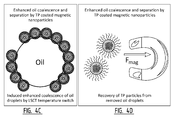
Fig.4C schematically shows how where oil particles surrounded by collapsed expanded TP coated magnetic nanoparticles are induce enhanced coalescence; and -
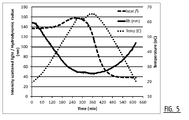
Fig.4D schematically shows how collapsed TP coated magnetic nanoparticles are removed from the coalesced oil droplets by applying a magnetic field to the mixture of oil droplets. - Fig.5A shows thermal response of core-shell particles in solution. Silica particles are coated with a LCST thermoresponsive polymer (PEGMA/DEGMA 20:80 LCST ~50 degrees Celsius). Graphs indicate temperature sweep in blue and consequent change in hydrodynamic radius. Reduction in scattering intensity is due to gravity settling.
-
-
Fig.1A shows hydrated hydrophilic Thermoresponsive Polymer(TP) chains at a temperature below the Lower Critical Solution Temperature (LCST) thereof; -
Fig.1B shows dehydrated hydrophobic Thermoresponsive Polymer(TP) chains at a temperature above the Lower Critical Solution Temperature (LCST) thereof; -
Fig.2A shows a graph of the variation of the contact angle e of TP coated nanoparticles in response to increase of temperature from below to above the LCST; -
Fig.2B shows that below the LCST the TP chains are hydrated; - Fig.2C shows that below the LCST the TP chains are collapsed;
-
Fig.3A shows schematically a pickering oil in water emulsion where oil particles are surrounded by hydrated expanded TP coated magnetic nanoparticles; -
Fig.3B shows schematically a pickering oil in water emulsion where oil particles are surrounded by collapsed expanded TP coated magnetic nanoparticles and thereby induced to coalesce; -
Fig.3C shows a picture a pickering oil in water emulsion where oil particles are surrounded by hydrated expanded TP coated magnetic nanoparticles; - Fig.3D shows a picture of a cold (T<LCST) oil in water mixture, where the oil droplets are surrounded by hydrated TP coated magnetic nanoparticles;
- Fig.3E shows a picture of a heated (T>LCST) oil in water mixture, where the oil droplets are surrounded by collapsed TP coated magnetic nanoparticles;
-
Fig.4A schematically show a Thermoresponsive Polymer(TP) with a core filled with magnetic magnetite nanoparticles; -
Fig.4B shows how an oil droplet surrounded by TP coated magnetic magnetite nanoparticles is removed from an oil in water emulsion by a magnetic force; -
Fig.4C schematically shows how where oil particles surrounded by collapsed expanded TP coated magnetic nanoparticles are induced to coalesce; and -
Fig.4D schematically shows how collapsed TP coated magnetic nanoparticles are removed from the coalesced oil droplets by applying a magnetic field to the mixture of oil droplets. - Fig. 5A graph shows the thermal response of the particles by induced changes in particle dimensions upon thermal trigger indicating the switch to the collapsed state of the polymers.
Claims (12)
- A method for separating a fluid from a mixture of fluids comprises:- mixing the mixture of fluids with ferromagnetic Lower Critical Solution Temperature (LCST) polymer coated nanoparticles, which are configured to be adsorbed to the fluid at the temperature of the fluid mixture;- exerting a magnetic field to the mixture of fluids and LCST polymer coated nanoparticles to induce the LCST polymer coated nanoparticles to migrate and to thereby separate at least some of the fluid adsorbed to the LCST polymer coated nanoparticles from the fluid mixture.
- The method of claim 1, wherein the mixture of fluids is a fluid emulsion and the fluid is a discontinuous fluid phase in the emulsion and the LCST polymer coated nanoparticles are induced to be adsorbed to the fluid at the interfaces between the discontinuous and continuous fluid phases of the emulsion by the Pickering effect.
- The method of claim 2, wherein the emulsion is an oil in water emulsion of which the discontinuous fluid phase comprises oil and the continuous phase comprises water.
- The method of claim 3, wherein the LSCT polymer coated nanoparticles are configured to have a wettability such that they adhere more to oil than to water at an ambient temperature in the fluid mixture.
- The method of any one of claims 1-4, wherein the LCST polymer coated nanoparticles comprise magnetite (FeOx).
- The method of any one of claims 1-5, wherein the LCST polymer coated nanoparticles comprise other Thermoresponsive Polymers(TP).
- The method of claim 6, wherein the thermoresponsive polymer(TP) comprises N-isopropylacrylamide.
- The method of claim 7, wherein the thermoresponsive polymer(TP) comprises a Poly(N-isopropylacrylamide)brush on silica nanoparticles.
- The method of claim 1-8, wherein the LCST polymer coated nanoparticles are configured such that their wettability changes in response to a variation of temperature.
- The method of claim 1-9, wherein the LCST polymer coated nanoparticles are configured to shrink in response to a temperature increase above the ambient temperature.
- The method of claim 10, wherein wettability of the LCST polymer coated nanoparticles changes in response to the shrinking of the LCST polymer coated nanoparticles, such that their adhesion to the fluid is reduced and they are released from the fluid in response to a temperature increase above the ambient temperature.
- The method of claim 11, wherein the released LCST polymer coated nanoparticles are cooled and reused for separating the fluid from the fluid mixture.
Priority Applications (1)
| Application Number | Priority Date | Filing Date | Title |
|---|---|---|---|
| EP12191925.2A EP2731114A1 (en) | 2012-11-09 | 2012-11-09 | Method for separating a fluid from a mixture of fluids using ferromagnetic nanoparticles |
Applications Claiming Priority (1)
| Application Number | Priority Date | Filing Date | Title |
|---|---|---|---|
| EP12191925.2A EP2731114A1 (en) | 2012-11-09 | 2012-11-09 | Method for separating a fluid from a mixture of fluids using ferromagnetic nanoparticles |
Publications (1)
| Publication Number | Publication Date |
|---|---|
| EP2731114A1 true EP2731114A1 (en) | 2014-05-14 |
Family
ID=47215408
Family Applications (1)
| Application Number | Title | Priority Date | Filing Date |
|---|---|---|---|
| EP12191925.2A Withdrawn EP2731114A1 (en) | 2012-11-09 | 2012-11-09 | Method for separating a fluid from a mixture of fluids using ferromagnetic nanoparticles |
Country Status (1)
| Country | Link |
|---|---|
| EP (1) | EP2731114A1 (en) |
Cited By (5)
| Publication number | Priority date | Publication date | Assignee | Title |
|---|---|---|---|---|
| WO2015044450A1 (en) * | 2013-09-30 | 2015-04-02 | Mærsk Olie Og Gas A/S | Depletion of water from oil using magnetic hydrophilic nanoparticles |
| CN107427838A (en) * | 2015-02-20 | 2017-12-01 | 莫门蒂夫性能材料股份有限公司 | For separating the composition and method of fluid |
| JP2018161596A (en) * | 2017-03-24 | 2018-10-18 | 国立大学法人秋田大学 | Wastewater treatment method |
| US10726981B2 (en) | 2015-09-23 | 2020-07-28 | Kemira Oyj | Functionalized magnetic nanoparticles and a method for preparation thereof |
| CN111680444A (en) * | 2020-06-12 | 2020-09-18 | 福州大学 | An automatic positioning method for the critical heat production value of magnetic nanoparticles based on simplex algorithm |
Citations (7)
| Publication number | Priority date | Publication date | Assignee | Title |
|---|---|---|---|---|
| US20100051510A1 (en) | 2008-08-27 | 2010-03-04 | Seoul National University Industry Foundation | Magnetic nanoparticle complex |
| US20100059449A1 (en) | 2006-11-09 | 2010-03-11 | Eth Zurich | Carbon Coated Magnetic Nanoparticles and Their Use in Separation Processes |
| EP2244268A1 (en) | 2009-04-23 | 2010-10-27 | Turbobeads GmbH | Chemically stable magnetic carriers |
| WO2011008315A1 (en) * | 2009-04-03 | 2011-01-20 | Board Of Trustees Of The University Of Arkansas | Use of magnetic carbon composites from renewable resource materials for oil spill clean up and recovery |
| EP2320437A1 (en) * | 2008-09-05 | 2011-05-11 | Chisso Corporation | Temperature-responsive magnetic fine grains capable of freeze drying |
| US20110139687A1 (en) | 2009-12-14 | 2011-06-16 | Exxonmobil Research And Engineering Company | Method and systems to remove polar molecules from refinery streams |
| US20110303772A1 (en) * | 2010-06-11 | 2011-12-15 | Siemens Ag | Utilization of the naturally occuring magnetic constituents of ores |
-
2012
- 2012-11-09 EP EP12191925.2A patent/EP2731114A1/en not_active Withdrawn
Patent Citations (7)
| Publication number | Priority date | Publication date | Assignee | Title |
|---|---|---|---|---|
| US20100059449A1 (en) | 2006-11-09 | 2010-03-11 | Eth Zurich | Carbon Coated Magnetic Nanoparticles and Their Use in Separation Processes |
| US20100051510A1 (en) | 2008-08-27 | 2010-03-04 | Seoul National University Industry Foundation | Magnetic nanoparticle complex |
| EP2320437A1 (en) * | 2008-09-05 | 2011-05-11 | Chisso Corporation | Temperature-responsive magnetic fine grains capable of freeze drying |
| WO2011008315A1 (en) * | 2009-04-03 | 2011-01-20 | Board Of Trustees Of The University Of Arkansas | Use of magnetic carbon composites from renewable resource materials for oil spill clean up and recovery |
| EP2244268A1 (en) | 2009-04-23 | 2010-10-27 | Turbobeads GmbH | Chemically stable magnetic carriers |
| US20110139687A1 (en) | 2009-12-14 | 2011-06-16 | Exxonmobil Research And Engineering Company | Method and systems to remove polar molecules from refinery streams |
| US20110303772A1 (en) * | 2010-06-11 | 2011-12-15 | Siemens Ag | Utilization of the naturally occuring magnetic constituents of ores |
Non-Patent Citations (1)
| Title |
|---|
| ANDREAS KAISER ET AL: "Magnetic Capsules and Pickering Emulsions Stabilized by Core-Shell Particles", LANGMUIR, vol. 25, no. 13, 7 July 2009 (2009-07-07), pages 7335 - 7341, XP055062433, ISSN: 0743-7463, DOI: 10.1021/la900401f * |
Cited By (7)
| Publication number | Priority date | Publication date | Assignee | Title |
|---|---|---|---|---|
| WO2015044450A1 (en) * | 2013-09-30 | 2015-04-02 | Mærsk Olie Og Gas A/S | Depletion of water from oil using magnetic hydrophilic nanoparticles |
| CN107427838A (en) * | 2015-02-20 | 2017-12-01 | 莫门蒂夫性能材料股份有限公司 | For separating the composition and method of fluid |
| EP3259073A4 (en) * | 2015-02-20 | 2018-10-10 | Momentive Performance Materials Inc. | Compositions and methods for separating fluids |
| US10726981B2 (en) | 2015-09-23 | 2020-07-28 | Kemira Oyj | Functionalized magnetic nanoparticles and a method for preparation thereof |
| JP2018161596A (en) * | 2017-03-24 | 2018-10-18 | 国立大学法人秋田大学 | Wastewater treatment method |
| CN111680444A (en) * | 2020-06-12 | 2020-09-18 | 福州大学 | An automatic positioning method for the critical heat production value of magnetic nanoparticles based on simplex algorithm |
| CN111680444B (en) * | 2020-06-12 | 2022-10-04 | 福州大学 | Magnetic nanoparticle critical heat production value automatic positioning method based on simplex algorithm |
Similar Documents
| Publication | Publication Date | Title |
|---|---|---|
| Sun et al. | Cooperative recyclable magnetic microsubmarines for oil and microplastics removal from water | |
| US11079141B2 (en) | Controlled liquid/solid mobility using external fields on lubricant-impregnated surfaces | |
| He et al. | Cellulose-coated magnetic Janus nanoparticles for dewatering of crude oil emulsions | |
| Hussein et al. | Application of emulsion and Pickering emulsion liquid membrane technique for wastewater treatment: an overview | |
| Ali et al. | Novel Janus magnetic micro particle synthesis and its applications as a demulsifier for breaking heavy crude oil and water emulsion | |
| Wang et al. | Recyclable amine-functionalized magnetic nanoparticles for efficient demulsification of crude oil-in-water emulsions | |
| Gangwal et al. | Dielectrophoretic assembly of metallodielectric Janus particles in AC electric fields | |
| Nie et al. | An “inside-out” microfluidic approach to monodisperse emulsions stabilized by solid particles | |
| CN111632405B (en) | Oil-water separation method based on magnetic Janus particles | |
| Yan et al. | An integrated dielectrophoresis-active hydrophoretic microchip for continuous particle filtration and separation | |
| Ko et al. | Accelerated oil droplet separation from produced water using magnetic nanoparticles | |
| Mandal et al. | Transport of a sessile aqueous droplet over spikes of oil based ferrofluid in the presence of a magnetic field | |
| Luo et al. | Separation of oil from a water/oil mixed drop using two nonparallel plates | |
| Bharti et al. | Analysis of the field-assisted permanent assembly of oppositely charged particles | |
| WO2016069604A1 (en) | Micro-and nano-particles with variable surface morphologies and methods of making same | |
| Banerjee et al. | Cross-stream migration and coalescence of droplets in a microchannel co-flow using magnetophoresis | |
| Onishi et al. | Preparation of Janus particles with different stabilizers and formation of one-dimensional particle arrays | |
| CN104312616B (en) | Electric field and microchannel are coupled together and realize the method and device of Pickering emulsion breaking | |
| Kumar et al. | A facile and economical configuration for continuous generation and separation of oil in water emulsions | |
| CA2822704A1 (en) | Method and apparatus for the separation of oil and water using hydrophobic and hydrophilic functional solid particles | |
| Chen et al. | Simulation study on the dynamic behaviors of water-in-oil emulsified droplets on coalescing fibers | |
| US10322417B2 (en) | Magnetically enhanced phase separation for solvent extraction | |
| Zhao et al. | Direct current dielectrophoretic manipulation of the ionic liquid droplets in water | |
| Lu et al. | Demulsification performance and mechanism of tertiary amine polymer-grafted magnetic nanoparticles in surfactant-free oil-in-water emulsion | |
| Prigiobbe et al. | Magnetic nanoparticles for efficient removal of oilfield “contaminants”: Modeling of magnetic separation and validation |
Legal Events
| Date | Code | Title | Description |
|---|---|---|---|
| PUAI | Public reference made under article 153(3) epc to a published international application that has entered the european phase |
Free format text: ORIGINAL CODE: 0009012 |
|
| 17P | Request for examination filed |
Effective date: 20121109 |
|
| AK | Designated contracting states |
Kind code of ref document: A1 Designated state(s): AL AT BE BG CH CY CZ DE DK EE ES FI FR GB GR HR HU IE IS IT LI LT LU LV MC MK MT NL NO PL PT RO RS SE SI SK SM TR |
|
| AX | Request for extension of the european patent |
Extension state: BA ME |
|
| STAA | Information on the status of an ep patent application or granted ep patent |
Free format text: STATUS: THE APPLICATION IS DEEMED TO BE WITHDRAWN |
|
| 18D | Application deemed to be withdrawn |
Effective date: 20141115 |